
A English
Mix Example - MOTION Questions in English
Class 9 Science · MOTION · Mix Example - MOTION
247+
Questions
English
Language
100%
With Solutions
Showing 50 of 247 questions in English
1
EasyMCQ
$A$ particle is moving in a circular path of radius $r$. The displacement after half a circle would be:
A
$2r$
B
$\pi r$
C
Zero
D
$2\pi r$
Solution
(A) Displacement is defined as the shortest distance between the initial and final positions of an object.
In a circular path of radius $r$,after completing half a circle,the particle moves from one end of the diameter to the other end.
The initial position and final position are diametrically opposite.
The shortest distance between these two points is the diameter of the circle.
Therefore,displacement = $2r$.
In a circular path of radius $r$,after completing half a circle,the particle moves from one end of the diameter to the other end.
The initial position and final position are diametrically opposite.
The shortest distance between these two points is the diameter of the circle.
Therefore,displacement = $2r$.
0 likes
View Solution2
MediumMCQ
$A$ body is thrown vertically upward with velocity $u$,the greatest height $h$ to which it will rise is,
A
$u/g$
B
$u^2/2g$
C
$u^2/g$
D
$u/2g$
Solution
(B) When a body is thrown vertically upward with an initial velocity $u$,it reaches its maximum height $h$ where its final velocity $v$ becomes $0$.
According to the third equation of motion: $v^2 = u^2 + 2as$.
Here,$v = 0$,$a = -g$ (acceleration due to gravity acting downwards),and $s = h$.
Substituting these values: $0^2 = u^2 + 2(-g)h$.
$0 = u^2 - 2gh$.
$2gh = u^2$.
Therefore,the maximum height reached is $h = u^2 / (2g)$.
According to the third equation of motion: $v^2 = u^2 + 2as$.
Here,$v = 0$,$a = -g$ (acceleration due to gravity acting downwards),and $s = h$.
Substituting these values: $0^2 = u^2 + 2(-g)h$.
$0 = u^2 - 2gh$.
$2gh = u^2$.
Therefore,the maximum height reached is $h = u^2 / (2g)$.
0 likes
View Solution3
EasyMCQ
The numerical ratio of displacement to distance for a moving object is
A
always less than $1$
B
always equal to $1$
C
equal or less than $1$
D
always more than $1$
Solution
(C) Displacement is the shortest path between the initial and final positions,while distance is the total path length covered by an object.
Since the shortest path is always less than or equal to the total path length,the magnitude of displacement is always less than or equal to the distance.
Therefore,the ratio of displacement to distance is always $\leq 1$.
Since the shortest path is always less than or equal to the total path length,the magnitude of displacement is always less than or equal to the distance.
Therefore,the ratio of displacement to distance is always $\leq 1$.
0 likes
View Solution4
MediumMCQ
If the displacement of an object is proportional to the square of time,then the object moves with
A
uniform velocity
B
increasing acceleration
C
decreasing acceleration
D
uniform acceleration
Solution
(D) Given that displacement $s$ is proportional to the square of time $t$,we can write $s = kt^2$,where $k$ is a constant.
Velocity $v$ is the rate of change of displacement with respect to time: $v = \frac{ds}{dt} = \frac{d}{dt}(kt^2) = 2kt$.
Acceleration $a$ is the rate of change of velocity with respect to time: $a = \frac{dv}{dt} = \frac{d}{dt}(2kt) = 2k$.
Since $2k$ is a constant,the acceleration of the object is constant or uniform.
Therefore,the object moves with uniform acceleration.
Velocity $v$ is the rate of change of displacement with respect to time: $v = \frac{ds}{dt} = \frac{d}{dt}(kt^2) = 2kt$.
Acceleration $a$ is the rate of change of velocity with respect to time: $a = \frac{dv}{dt} = \frac{d}{dt}(2kt) = 2k$.
Since $2k$ is a constant,the acceleration of the object is constant or uniform.
Therefore,the object moves with uniform acceleration.
0 likes
View Solution5
EasyMCQ
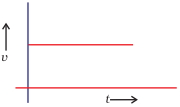
From the given $v-t$ graph (Fig.),it can be inferred that the object is
A
in uniform motion
B
at rest
C
in non-uniform motion
D
moving with uniform acceleration
Solution
(A) In a $v-t$ (velocity-time) graph,the $y$-axis represents velocity $(v)$ and the $x$-axis represents time $(t)$.
Since the graph is a straight horizontal line parallel to the time axis and above the zero mark on the $v$-axis,it indicates that the velocity of the object remains constant over time.
$A$ constant velocity implies that the object is in uniform motion.
Since the graph is a straight horizontal line parallel to the time axis and above the zero mark on the $v$-axis,it indicates that the velocity of the object remains constant over time.
$A$ constant velocity implies that the object is in uniform motion.
0 likes
View Solution6
EasyMCQ
Suppose a boy is enjoying a ride on a merry-go-round which is moving with a constant speed of $10 \, ms^{-1}$. It implies that the boy is
A
at rest
B
in accelerated motion
C
moving with no acceleration
D
moving with uniform velocity
Solution
(B) boy on a merry-go-round is performing circular motion.
In circular motion,even if the speed remains constant,the direction of motion changes at every point.
Since velocity is a vector quantity (having both magnitude and direction),a change in direction results in a change in velocity.
Therefore,the boy is in accelerated motion.
In circular motion,even if the speed remains constant,the direction of motion changes at every point.
Since velocity is a vector quantity (having both magnitude and direction),a change in direction results in a change in velocity.
Therefore,the boy is in accelerated motion.
0 likes
View Solution7
EasyMCQ
The area under a $v-t$ graph represents a physical quantity which has the unit:
A
$m^2$
B
$m^3$
C
$m$
D
$ms^{-1}$
Solution
(C) The area under a velocity-time $(v-t)$ graph is calculated by multiplying velocity $(v)$ and time $(t)$.
Since $\text{velocity} = \text{displacement} / \text{time}$,the product of velocity and time gives displacement.
$\text{Area} = \text{velocity} \times \text{time} = (\text{m/s}) \times \text{s} = \text{m}$.
Therefore,the physical quantity represented by the area under a $v-t$ graph is displacement,and its $SI$ unit is meter $(m)$.
Since $\text{velocity} = \text{displacement} / \text{time}$,the product of velocity and time gives displacement.
$\text{Area} = \text{velocity} \times \text{time} = (\text{m/s}) \times \text{s} = \text{m}$.
Therefore,the physical quantity represented by the area under a $v-t$ graph is displacement,and its $SI$ unit is meter $(m)$.
0 likes
View Solution8
MediumMCQ
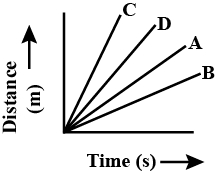
Four cars $A$,$B$,$C$ and $D$ are moving on a levelled road. Their distance versus time graphs are shown in the figure. Choose the correct statement.
A
Car $A$ is faster than car $D$.
B
Car $C$ is the slowest.
C
Car $D$ is faster than car $C$.
D
Car $B$ is the slowest.
Solution
(D) In a distance-time graph,the slope of the line represents the speed of the object.
Greater the slope,higher is the speed.
Looking at the graph,the line for car $C$ has the maximum slope,followed by $D$,$A$,and $B$.
Therefore,car $C$ is the fastest and car $B$ has the minimum slope,making it the slowest car.
Greater the slope,higher is the speed.
Looking at the graph,the line for car $C$ has the maximum slope,followed by $D$,$A$,and $B$.
Therefore,car $C$ is the fastest and car $B$ has the minimum slope,making it the slowest car.
0 likes
View Solution9
EasyMCQ
Which of the following figures (Fig.) represents uniform motion of a moving object correctly?
A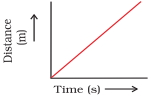
B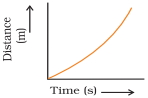
C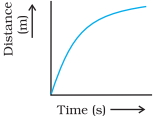
D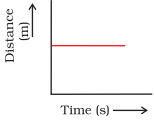
Solution
(A) Uniform motion is defined as the motion of an object in which it travels equal distances in equal intervals of time.
In a distance-time graph,this is represented by a straight line with a constant slope passing through the origin.
Figure $(A)$ shows a straight line starting from the origin,which indicates that the distance increases at a constant rate with respect to time,thus representing uniform motion.
In a distance-time graph,this is represented by a straight line with a constant slope passing through the origin.
Figure $(A)$ shows a straight line starting from the origin,which indicates that the distance increases at a constant rate with respect to time,thus representing uniform motion.
0 likes
View Solution10
EasyMCQ
The slope of a velocity-time graph gives:
A
the distance
B
the acceleration
C
the displacement
D
the speed
Solution
(B) The slope of a velocity-time graph is defined as the change in velocity divided by the change in time.
Mathematically, $\text{Slope} = \frac{\Delta v}{\Delta t}$.
Since acceleration is defined as the rate of change of velocity $(a = \frac{dv}{dt})$, the slope of the velocity-time graph represents the acceleration of the object.
Therefore, the correct option is $B$.
Mathematically, $\text{Slope} = \frac{\Delta v}{\Delta t}$.
Since acceleration is defined as the rate of change of velocity $(a = \frac{dv}{dt})$, the slope of the velocity-time graph represents the acceleration of the object.
Therefore, the correct option is $B$.
0 likes
View Solution11
MediumMCQ
In which of the following cases of motion,are the distance moved and the magnitude of displacement equal?
A
The pendulum is moving to and fro
B
The car is moving in a circular path
C
The car is moving on a straight road
D
The Earth is revolving around the Sun
Solution
(C) Distance is the total path length covered by an object,while displacement is the shortest distance between the initial and final positions.
When an object moves along a straight-line path without changing its direction,the total distance covered is equal to the magnitude of the displacement.
In cases of circular motion,to-and-fro motion,or orbital motion,the object changes its direction,causing the displacement to be less than the total distance covered.
Therefore,the correct option is $C$.
When an object moves along a straight-line path without changing its direction,the total distance covered is equal to the magnitude of the displacement.
In cases of circular motion,to-and-fro motion,or orbital motion,the object changes its direction,causing the displacement to be less than the total distance covered.
Therefore,the correct option is $C$.
0 likes
View Solution12
Easy
The displacement of a moving object in a given interval of time is zero. Would the distance travelled by the object also be zero? Justify your answer.
Solution
(B) No,the distance travelled by the object would not necessarily be zero.
Displacement is a vector quantity defined as the shortest distance between the initial and final positions,whereas distance is a scalar quantity representing the total path length covered by the object.
Displacement becomes zero when an object returns to its starting point (initial position = final position) after completing a journey.
However,the object has still covered a path to return to the start,meaning the total distance travelled is greater than zero.
For example,if an athlete runs one complete lap around a circular track,their displacement is $0$,but the distance travelled is equal to the circumference of the track $(2 \pi r)$.
Displacement is a vector quantity defined as the shortest distance between the initial and final positions,whereas distance is a scalar quantity representing the total path length covered by the object.
Displacement becomes zero when an object returns to its starting point (initial position = final position) after completing a journey.
However,the object has still covered a path to return to the start,meaning the total distance travelled is greater than zero.
For example,if an athlete runs one complete lap around a circular track,their displacement is $0$,but the distance travelled is equal to the circumference of the track $(2 \pi r)$.
0 likes
View Solution13
Medium
How will the equations of motion for an object moving with a uniform velocity change?
Solution
(N/A) When an object moves with a uniform velocity,the acceleration $(a)$ is $0$ and the final velocity $(v)$ is equal to the initial velocity $(u)$,i.e.,$v = u$.
$1$. The first equation of motion,$v = u + at$,becomes $v = u + (0)t$,which simplifies to $v = u$.
$2$. The second equation of motion,$s = ut + (1/2)at^2$,becomes $s = ut + (1/2)(0)t^2$,which simplifies to $s = ut$.
$3$. The third equation of motion,$v^2 - u^2 = 2as$,becomes $v^2 - u^2 = 2(0)s$,which simplifies to $v^2 - u^2 = 0$ or $v^2 = u^2$.
$1$. The first equation of motion,$v = u + at$,becomes $v = u + (0)t$,which simplifies to $v = u$.
$2$. The second equation of motion,$s = ut + (1/2)at^2$,becomes $s = ut + (1/2)(0)t^2$,which simplifies to $s = ut$.
$3$. The third equation of motion,$v^2 - u^2 = 2as$,becomes $v^2 - u^2 = 2(0)s$,which simplifies to $v^2 - u^2 = 0$ or $v^2 = u^2$.
0 likes
View Solution14
Medium
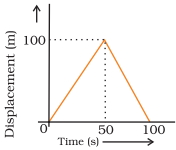
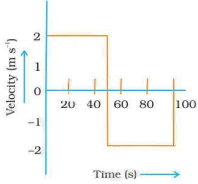
$A$ girl walks along a straight path to drop a letter in the letterbox and comes back to her initial position. Her displacement-time graph is shown in the figure. Plot a velocity-time graph for the same.
Solution
(N/A) $1$. From the displacement-time graph,the velocity is the slope of the line.
$2$. For the interval $0-50 \, s$,the displacement changes from $0 \, m$ to $100 \, m$. Thus,velocity $v_1 = \frac{100 \, m - 0 \, m}{50 \, s - 0 \, s} = 2 \, m/s$.
$3$. For the interval $50-100 \, s$,the displacement changes from $100 \, m$ to $0 \, m$. Thus,velocity $v_2 = \frac{0 \, m - 100 \, m}{100 \, s - 50 \, s} = \frac{-100 \, m}{50 \, s} = -2 \, m/s$.
$4$. The velocity-time graph will show a constant velocity of $2 \, m/s$ from $0$ to $50 \, s$ and a constant velocity of $-2 \, m/s$ from $50$ to $100 \, s$.
$2$. For the interval $0-50 \, s$,the displacement changes from $0 \, m$ to $100 \, m$. Thus,velocity $v_1 = \frac{100 \, m - 0 \, m}{50 \, s - 0 \, s} = 2 \, m/s$.
$3$. For the interval $50-100 \, s$,the displacement changes from $100 \, m$ to $0 \, m$. Thus,velocity $v_2 = \frac{0 \, m - 100 \, m}{100 \, s - 50 \, s} = \frac{-100 \, m}{50 \, s} = -2 \, m/s$.
$4$. The velocity-time graph will show a constant velocity of $2 \, m/s$ from $0$ to $50 \, s$ and a constant velocity of $-2 \, m/s$ from $50$ to $100 \, s$.
0 likes
View Solution15
MediumMCQ
$A$ car starts from rest and moves along the $x-$ axis with constant acceleration $5\, ms^{-2}$ for $8\, s$. If it then continues with constant velocity,what distance will the car cover in $12\, s$ since it started from the rest (in $m$)?
A
$320$
B
$160$
C
$400$
D
$240$
Solution
(A) The distance travelled in the first $8 \, s$ is calculated using the equation $s = ut + \frac{1}{2}at^2$. Since the car starts from rest,$u = 0$.
$x_1 = 0 + \frac{1}{2} \times 5 \times (8)^2 = 160 \, m$.
At $t = 8 \, s$,the velocity $v$ is calculated as $v = u + at = 0 + (5 \times 8) = 40 \, m/s$.
For the remaining time,which is $12 \, s - 8 \, s = 4 \, s$,the car moves with a constant velocity of $40 \, m/s$.
The distance covered in the last $4 \, s$ is $x_2 = v \times t = 40 \times 4 = 160 \, m$.
Therefore,the total distance covered in $12 \, s$ is $x = x_1 + x_2 = 160 \, m + 160 \, m = 320 \, m$.
$x_1 = 0 + \frac{1}{2} \times 5 \times (8)^2 = 160 \, m$.
At $t = 8 \, s$,the velocity $v$ is calculated as $v = u + at = 0 + (5 \times 8) = 40 \, m/s$.
For the remaining time,which is $12 \, s - 8 \, s = 4 \, s$,the car moves with a constant velocity of $40 \, m/s$.
The distance covered in the last $4 \, s$ is $x_2 = v \times t = 40 \times 4 = 160 \, m$.
Therefore,the total distance covered in $12 \, s$ is $x = x_1 + x_2 = 160 \, m + 160 \, m = 320 \, m$.
0 likes
View Solution16
MediumMCQ
$A$ motorcyclist drives from $A$ to $B$ with a uniform speed of $30\, km\, h^{-1}$ and returns back with a speed of $20\, km\, h^{-1}$. Find its average speed (in $km\, h^{-1}$).
A
$20$
B
$30$
C
$34$
D
$24$
Solution
(D) Let the distance between $A$ and $B$ be $x\, km$.
Time taken to travel from $A$ to $B$ is $t_{1} = \frac{x}{30}\, h$.
Time taken to travel from $B$ to $A$ is $t_{2} = \frac{x}{20}\, h$.
Total distance covered $= x + x = 2x\, km$.
Total time taken $= t_{1} + t_{2} = \frac{x}{30} + \frac{x}{20} = \frac{2x + 3x}{60} = \frac{5x}{60} = \frac{x}{12}\, h$.
Average speed $= \frac{\text{Total distance}}{\text{Total time}} = \frac{2x}{x/12} = 2 \times 12 = 24\, km\, h^{-1}$.
Time taken to travel from $A$ to $B$ is $t_{1} = \frac{x}{30}\, h$.
Time taken to travel from $B$ to $A$ is $t_{2} = \frac{x}{20}\, h$.
Total distance covered $= x + x = 2x\, km$.
Total time taken $= t_{1} + t_{2} = \frac{x}{30} + \frac{x}{20} = \frac{2x + 3x}{60} = \frac{5x}{60} = \frac{x}{12}\, h$.
Average speed $= \frac{\text{Total distance}}{\text{Total time}} = \frac{2x}{x/12} = 2 \times 12 = 24\, km\, h^{-1}$.
0 likes
View Solution17
MediumMCQ
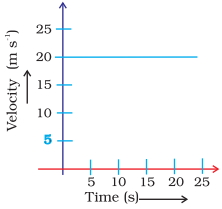
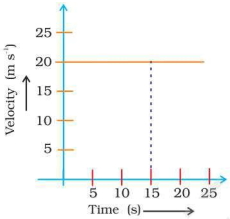
The velocity-time graph (Fig.) shows the motion of a cyclist. Find $(i)$ its acceleration $(ii)$ its velocity and $(iii)$ the distance covered by the cyclist in $15\,s$.
A
$0$,$20\,m/s$,$300\,m$
B
$10$,$20\,m/s$,$30\,m$
C
$0.5$,$20\,m/s$,$0.30\,m$
D
$0$,$0.2\,m/s$,$300\,m$
Solution
(A) $(i)$ Since the velocity-time graph is a horizontal line parallel to the time axis,the velocity is constant. Therefore,the acceleration is $0\,m/s^2$.
$(ii)$ By observing the graph,the constant velocity of the cyclist is $20\,m/s$.
$(iii)$ The distance covered by the cyclist in $15\,s$ is given by the area under the velocity-time graph,which is a rectangle with height $v = 20\,m/s$ and width $t = 15\,s$.
Distance $= v \times t = 20\,m/s \times 15\,s = 300\,m$.
$(ii)$ By observing the graph,the constant velocity of the cyclist is $20\,m/s$.
$(iii)$ The distance covered by the cyclist in $15\,s$ is given by the area under the velocity-time graph,which is a rectangle with height $v = 20\,m/s$ and width $t = 15\,s$.
Distance $= v \times t = 20\,m/s \times 15\,s = 300\,m$.
18 likes
View Solution18
Medium
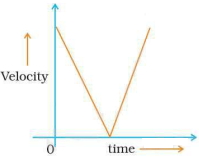
Draw a velocity versus time graph of a stone thrown vertically upwards and then coming downwards after attaining the maximum height.
Solution
(N/A) When a stone is thrown vertically upwards,its initial velocity is at its maximum. As the stone rises,its velocity decreases due to the constant downward acceleration due to gravity $(g)$.
At the maximum height,the velocity of the stone becomes zero.
After reaching the maximum height,the stone begins to fall downwards. During this phase,its velocity increases in the downward direction until it hits the ground.
The velocity-time graph for this motion is a straight line with a negative slope,representing constant deceleration during the upward journey and constant acceleration during the downward journey.
At the maximum height,the velocity of the stone becomes zero.
After reaching the maximum height,the stone begins to fall downwards. During this phase,its velocity increases in the downward direction until it hits the ground.
The velocity-time graph for this motion is a straight line with a negative slope,representing constant deceleration during the upward journey and constant acceleration during the downward journey.
0 likes
View Solution19
Difficult
An object is dropped from rest at a height of $150 \, m$ and simultaneously another object is dropped from rest at a height of $100 \, m$. What is the difference in their heights after $2 \, s$ if both objects drop with the same acceleration? How does the difference in heights vary with time?
Solution
(50 M) Let the initial heights be $H_1 = 150 \, m$ and $H_2 = 100 \, m$.
Both objects are dropped from rest,so their initial velocity $u = 0 \, m/s$.
Both objects fall with the same acceleration due to gravity,$g$.
Distance covered by an object in time $t$ is given by $s = ut + \frac{1}{2}gt^2$.
Since $u = 0$,the distance covered by both objects in $t = 2 \, s$ is $s = \frac{1}{2}g(2)^2 = 2g$.
After $2 \, s$,the height of the first object from the ground is $h_1 = H_1 - s = 150 - 2g$.
The height of the second object from the ground is $h_2 = H_2 - s = 100 - 2g$.
The difference in their heights after $2 \, s$ is $h_1 - h_2 = (150 - 2g) - (100 - 2g) = 150 - 100 = 50 \, m$.
Since the acceleration $g$ is the same for both,the distance covered by both objects at any time $t$ is the same $(s = \frac{1}{2}gt^2)$.
Therefore,the difference in heights at any time $t$ is $(H_1 - s) - (H_2 - s) = H_1 - H_2 = 150 - 100 = 50 \, m$.
Thus,the difference in heights remains constant and does not vary with time.
Both objects are dropped from rest,so their initial velocity $u = 0 \, m/s$.
Both objects fall with the same acceleration due to gravity,$g$.
Distance covered by an object in time $t$ is given by $s = ut + \frac{1}{2}gt^2$.
Since $u = 0$,the distance covered by both objects in $t = 2 \, s$ is $s = \frac{1}{2}g(2)^2 = 2g$.
After $2 \, s$,the height of the first object from the ground is $h_1 = H_1 - s = 150 - 2g$.
The height of the second object from the ground is $h_2 = H_2 - s = 100 - 2g$.
The difference in their heights after $2 \, s$ is $h_1 - h_2 = (150 - 2g) - (100 - 2g) = 150 - 100 = 50 \, m$.
Since the acceleration $g$ is the same for both,the distance covered by both objects at any time $t$ is the same $(s = \frac{1}{2}gt^2)$.
Therefore,the difference in heights at any time $t$ is $(H_1 - s) - (H_2 - s) = H_1 - H_2 = 150 - 100 = 50 \, m$.
Thus,the difference in heights remains constant and does not vary with time.
2 likes
View Solution20
DifficultMCQ
An object starting from rest travels $20 \, m$ in the first $2 \, s$ and $160 \, m$ in the next $4 \, s$. What will be the velocity after $7 \, s$ from the start (in $, m/s$)?
A
$0.07$
B
$700$
C
$0.7$
D
$70$
Solution
(D) Given that the object starts from rest,initial velocity $u = 0 \, m/s$.
For the first $2 \, s$,distance $s_1 = 20 \, m$ and time $t_1 = 2 \, s$.
Using the equation of motion $s = ut + \frac{1}{2}at^2$:
$20 = 0(2) + \frac{1}{2} a(2)^2 \Rightarrow 20 = 2a \Rightarrow a = 10 \, m/s^2$.
Since the acceleration is constant,we can calculate the velocity at any time $t$ using $v = u + at$.
For $t = 7 \, s$:
$v = 0 + (10 \times 7) = 70 \, m/s$.
For the first $2 \, s$,distance $s_1 = 20 \, m$ and time $t_1 = 2 \, s$.
Using the equation of motion $s = ut + \frac{1}{2}at^2$:
$20 = 0(2) + \frac{1}{2} a(2)^2 \Rightarrow 20 = 2a \Rightarrow a = 10 \, m/s^2$.
Since the acceleration is constant,we can calculate the velocity at any time $t$ using $v = u + at$.
For $t = 7 \, s$:
$v = 0 + (10 \times 7) = 70 \, m/s$.
0 likes
View Solution21
Medium
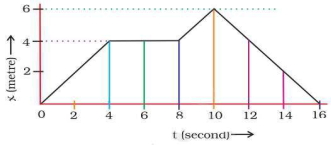
Using the following data,draw a time-displacement graph for a moving object:
Use this graph to find the average velocity for the first $4 \, s$,for the next $4 \, s$,and for the last $6 \, s$.
| Time $(s)$ | $0, 2, 4, 6, 8, 10, 12, 14, 16$ |
| Displacement $(m)$ | $0, 2, 4, 4, 4, 6, 4, 2, 0$ |
Use this graph to find the average velocity for the first $4 \, s$,for the next $4 \, s$,and for the last $6 \, s$.
Solution
(N/A) Average velocity is defined as the total change in displacement divided by the total time taken.
$1$. For the first $4 \, s$ ($t = 0$ to $4 \, s$):
Average velocity $v = \frac{\Delta x}{\Delta t} = \frac{4 - 0}{4 - 0} = \frac{4}{4} = 1 \, m/s$.
$2$. For the next $4 \, s$ ($t = 4$ to $8 \, s$):
Average velocity $v = \frac{\Delta x}{\Delta t} = \frac{4 - 4}{8 - 4} = \frac{0}{4} = 0 \, m/s$.
$3$. For the last $6 \, s$ ($t = 10$ to $16 \, s$):
Average velocity $v = \frac{\Delta x}{\Delta t} = \frac{0 - 6}{16 - 10} = \frac{-6}{6} = -1 \, m/s$.
$1$. For the first $4 \, s$ ($t = 0$ to $4 \, s$):
Average velocity $v = \frac{\Delta x}{\Delta t} = \frac{4 - 0}{4 - 0} = \frac{4}{4} = 1 \, m/s$.
$2$. For the next $4 \, s$ ($t = 4$ to $8 \, s$):
Average velocity $v = \frac{\Delta x}{\Delta t} = \frac{4 - 4}{8 - 4} = \frac{0}{4} = 0 \, m/s$.
$3$. For the last $6 \, s$ ($t = 10$ to $16 \, s$):
Average velocity $v = \frac{\Delta x}{\Delta t} = \frac{0 - 6}{16 - 10} = \frac{-6}{6} = -1 \, m/s$.
0 likes
View Solution22
MediumMCQ
An electron moving with a velocity of $5 \times 10^{4} \, ms^{-1}$ enters into a uniform electric field and acquires a uniform acceleration of $10^{4} \, ms^{-2}$ in the direction of its initial motion.
$(i)$ Calculate the time in which the electron would acquire a velocity double of its initial velocity.
$(ii)$ How much distance the electron would cover in this time?
$(i)$ Calculate the time in which the electron would acquire a velocity double of its initial velocity.
$(ii)$ How much distance the electron would cover in this time?
A
$20 \, s$ and $7.5 \times 10^{4} \, m$
B
$5 \, s$ and $37.5 \times 10^{4} \, m$
C
$0.5 \, s$ and $75.3 \times 10^{4} \, m$
D
$15 \, s$ and $35.7 \times 10^{4} \, m$
Solution
(B) Given initial velocity,$u = 5 \times 10^{4} \, ms^{-1}$.
Acceleration,$a = 10^{4} \, ms^{-2}$.
$(i)$ Final velocity $v = 2u = 2 \times 5 \times 10^{4} = 10 \times 10^{4} \, ms^{-1}$.
Using the first equation of motion,$v = u + at$,we get $t = \frac{v - u}{a}$.
$t = \frac{10 \times 10^{4} - 5 \times 10^{4}}{10^{4}} = \frac{5 \times 10^{4}}{10^{4}} = 5 \, s$.
$(ii)$ Using the second equation of motion,$s = ut + \frac{1}{2}at^{2}$.
$s = (5 \times 10^{4}) \times 5 + \frac{1}{2} \times (10^{4}) \times (5)^{2}$.
$s = 25 \times 10^{4} + 12.5 \times 10^{4} = 37.5 \times 10^{4} \, m$.
Acceleration,$a = 10^{4} \, ms^{-2}$.
$(i)$ Final velocity $v = 2u = 2 \times 5 \times 10^{4} = 10 \times 10^{4} \, ms^{-1}$.
Using the first equation of motion,$v = u + at$,we get $t = \frac{v - u}{a}$.
$t = \frac{10 \times 10^{4} - 5 \times 10^{4}}{10^{4}} = \frac{5 \times 10^{4}}{10^{4}} = 5 \, s$.
$(ii)$ Using the second equation of motion,$s = ut + \frac{1}{2}at^{2}$.
$s = (5 \times 10^{4}) \times 5 + \frac{1}{2} \times (10^{4}) \times (5)^{2}$.
$s = 25 \times 10^{4} + 12.5 \times 10^{4} = 37.5 \times 10^{4} \, m$.
0 likes
View Solution23
DifficultMCQ
Obtain a relation for the distance travelled by an object moving with a uniform acceleration in the interval between the $4^{th}$ and $5^{th}$ seconds.
A
$(u+5a) \, m$
B
$(u+\frac{3}{2}a) \, m$
C
$(u+\frac{9}{2}a) \, m$
D
$(u+4a) \, m$
Solution
(C) The distance travelled by an object in time $t$ with uniform acceleration $a$ and initial velocity $u$ is given by the equation of motion: $s = ut + \frac{1}{2}at^2$.
First,calculate the total distance travelled in $5 \, s$:
$s_5 = u(5) + \frac{1}{2}a(5)^2 = 5u + \frac{25}{2}a$ ........... $(i)$
Next,calculate the total distance travelled in $4 \, s$:
$s_4 = u(4) + \frac{1}{2}a(4)^2 = 4u + \frac{16}{2}a = 4u + 8a$ ........... $(ii)$
The distance travelled in the interval between the $4^{th}$ and $5^{th}$ second is the difference between the distance at $5 \, s$ and $4 \, s$:
Distance $= s_5 - s_4 = (5u + \frac{25}{2}a) - (4u + 8a)$
Distance $= (5u - 4u) + (12.5a - 8a) = u + 4.5a$
Distance $= (u + \frac{9}{2}a) \, m$.
First,calculate the total distance travelled in $5 \, s$:
$s_5 = u(5) + \frac{1}{2}a(5)^2 = 5u + \frac{25}{2}a$ ........... $(i)$
Next,calculate the total distance travelled in $4 \, s$:
$s_4 = u(4) + \frac{1}{2}a(4)^2 = 4u + \frac{16}{2}a = 4u + 8a$ ........... $(ii)$
The distance travelled in the interval between the $4^{th}$ and $5^{th}$ second is the difference between the distance at $5 \, s$ and $4 \, s$:
Distance $= s_5 - s_4 = (5u + \frac{25}{2}a) - (4u + 8a)$
Distance $= (5u - 4u) + (12.5a - 8a) = u + 4.5a$
Distance $= (u + \frac{9}{2}a) \, m$.
0 likes
View Solution24
Difficult
Two stones are thrown vertically upwards simultaneously with their initial velocities $u_{1}$ and $u_{2}$ respectively. Prove that the heights reached by them would be in the ratio of $u_{1}^{2}: u_{2}^{2}$ (Assume upward acceleration is $-g$ and downward acceleration is $+g$).
Solution
For an object moving vertically upwards,the third equation of motion is given by $v^{2} = u^{2} + 2as$.
At the maximum height,the final velocity $v$ becomes $0$.
Substituting $v = 0$,$a = -g$,and $s = h$ into the equation: $0 = u^{2} - 2gh$.
Rearranging for height,we get $h = \frac{u^{2}}{2g}$.
For the first stone with initial velocity $u_{1}$,the maximum height reached is $h_{1} = \frac{u_{1}^{2}}{2g}$.
For the second stone with initial velocity $u_{2}$,the maximum height reached is $h_{2} = \frac{u_{2}^{2}}{2g}$.
Taking the ratio of the two heights: $\frac{h_{1}}{h_{2}} = \frac{u_{1}^{2} / 2g}{u_{2}^{2} / 2g} = \frac{u_{1}^{2}}{u_{2}^{2}}$.
Therefore,the ratio of the heights reached is $h_{1}: h_{2} = u_{1}^{2}: u_{2}^{2}$.
At the maximum height,the final velocity $v$ becomes $0$.
Substituting $v = 0$,$a = -g$,and $s = h$ into the equation: $0 = u^{2} - 2gh$.
Rearranging for height,we get $h = \frac{u^{2}}{2g}$.
For the first stone with initial velocity $u_{1}$,the maximum height reached is $h_{1} = \frac{u_{1}^{2}}{2g}$.
For the second stone with initial velocity $u_{2}$,the maximum height reached is $h_{2} = \frac{u_{2}^{2}}{2g}$.
Taking the ratio of the two heights: $\frac{h_{1}}{h_{2}} = \frac{u_{1}^{2} / 2g}{u_{2}^{2} / 2g} = \frac{u_{1}^{2}}{u_{2}^{2}}$.
Therefore,the ratio of the heights reached is $h_{1}: h_{2} = u_{1}^{2}: u_{2}^{2}$.
0 likes
View Solution25
EasyMCQ
Name the physical quantity which corresponds to the rate of change of momentum.
A
Force
B
Velocity
C
Acceleration
D
Work
Solution
(A) According to Newton's $Second$ $Law$ of $Motion$, the rate of change of momentum of an object is directly proportional to the applied unbalanced force in the direction of the force.
Mathematically, $F = \frac{dp}{dt}$, where $F$ is the force and $p$ is the momentum.
Therefore, the physical quantity that corresponds to the rate of change of momentum is $Force$.
Mathematically, $F = \frac{dp}{dt}$, where $F$ is the force and $p$ is the momentum.
Therefore, the physical quantity that corresponds to the rate of change of momentum is $Force$.
0 likes
View Solution26
EasyMCQ
Mention the nature of motion of a body if its displacement$-$time graph is a straight line parallel to the time axis.
A
Uniform motion
B
Non-uniform motion
C
At rest
D
Accelerated motion
Solution
(C) If the displacement$-$time graph is a straight line parallel to the time axis,it indicates that the displacement of the body does not change with time.
Since the rate of change of displacement with respect to time is zero,the velocity of the body is zero.
Therefore,the body is at rest.
Since the rate of change of displacement with respect to time is zero,the velocity of the body is zero.
Therefore,the body is at rest.
0 likes
View Solution27
EasyMCQ
The displacement-time graph of a body is parallel to the time axis. What will you infer about the velocity of the body?
A
The velocity is constant and non-zero.
B
The velocity is zero.
C
The velocity is increasing.
D
The velocity is decreasing.
Solution
(B) In a displacement-time graph,the slope of the line represents the velocity of the body.
If the graph is parallel to the time axis,the displacement of the body does not change with time.
This means the body is at rest or stationary.
Since the body is not changing its position,its velocity is $0 \ m/s$.
If the graph is parallel to the time axis,the displacement of the body does not change with time.
This means the body is at rest or stationary.
Since the body is not changing its position,its velocity is $0 \ m/s$.
0 likes
View Solution28
MediumMCQ
$A$ body is moving along a circular path of radius $R$. Find the displacement of the body when it completes half a revolution.
A
$R$
B
$2\,R$
C
$\pi\,R$
D
$0$
Solution
(B) Displacement is defined as the shortest distance between the initial and final positions of an object.
When a body completes half a revolution on a circular path of radius $R$,it moves from one end of the diameter to the other end.
The initial position is at one end of the diameter,and the final position is at the diametrically opposite end.
The shortest distance between these two points is the diameter of the circle.
Therefore,the displacement is equal to the diameter,which is $2 \times R = 2\,R$.
When a body completes half a revolution on a circular path of radius $R$,it moves from one end of the diameter to the other end.
The initial position is at one end of the diameter,and the final position is at the diametrically opposite end.
The shortest distance between these two points is the diameter of the circle.
Therefore,the displacement is equal to the diameter,which is $2 \times R = 2\,R$.
0 likes
View Solution29
EasyMCQ
Name a physical quantity that essentially changes as a body moves.
A
Mass
B
Distance
C
Density
D
Volume
Solution
(B) When a body is in motion,its position changes with respect to time.
Consequently,the distance covered by the body and its displacement from the initial point change continuously.
Therefore,distance or displacement are the physical quantities that essentially change as a body moves.
Consequently,the distance covered by the body and its displacement from the initial point change continuously.
Therefore,distance or displacement are the physical quantities that essentially change as a body moves.
0 likes
View Solution30
EasyMCQ
Under what condition will the magnitude of the displacement be equal to the distance travelled by an object?
A
When the object moves in a circular path.
B
When the object moves along a straight line in one direction.
C
When the object moves in a zig-zag path.
D
When the object returns to its starting point.
Solution
(B) The magnitude of displacement is the shortest distance between the initial and final positions of an object.
Distance is the total path length covered by the object.
When an object moves along a straight line without changing its direction,the total path length covered is exactly equal to the straight-line distance between the starting and ending points.
Therefore,the magnitude of displacement is equal to the distance travelled only when the object moves along a straight line in one direction.
Distance is the total path length covered by the object.
When an object moves along a straight line without changing its direction,the total path length covered is exactly equal to the straight-line distance between the starting and ending points.
Therefore,the magnitude of displacement is equal to the distance travelled only when the object moves along a straight line in one direction.
0 likes
View Solution31
EasyMCQ
What is the numerical ratio of average velocity to average speed of an object when it is moving along a straight path?
A
$1:1$
B
$1:2$
C
$2:1$
D
Less than $1$
Solution
(A) When an object moves along a straight path in a single direction without changing its direction, the magnitude of its displacement is equal to the total distance traveled.
Since Average Velocity = $\frac{\text{Total Displacement}}{\text{Total Time}}$ and Average Speed = $\frac{\text{Total Distance}}{\text{Total Time}}$, and given that Displacement = Distance in this specific case, the ratio of average velocity to average speed is $1:1$.
Since Average Velocity = $\frac{\text{Total Displacement}}{\text{Total Time}}$ and Average Speed = $\frac{\text{Total Distance}}{\text{Total Time}}$, and given that Displacement = Distance in this specific case, the ratio of average velocity to average speed is $1:1$.
0 likes
View Solution32
EasyMCQ
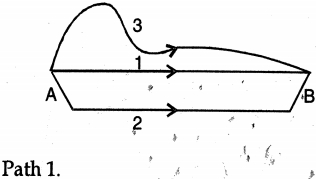
$A$ person standing at $A$ goes to $B$ by following any of the paths $1, 2$ or $3$. Which path can we measure to find the average velocity?
A
Path $1$
B
Path $2$
C
Path $3$
D
All of the above
Solution
(D) Average velocity is defined as the total displacement divided by the total time taken.
Displacement is the shortest distance between the initial point $A$ and the final point $B$.
Since the displacement is the same regardless of the path taken,the average velocity depends only on the total time taken to travel from $A$ to $B$.
Therefore,we can use any of the paths $1, 2$ or $3$ to calculate the average velocity,provided we know the total time taken for that specific path.
Thus,the correct answer is all of the above.
Displacement is the shortest distance between the initial point $A$ and the final point $B$.
Since the displacement is the same regardless of the path taken,the average velocity depends only on the total time taken to travel from $A$ to $B$.
Therefore,we can use any of the paths $1, 2$ or $3$ to calculate the average velocity,provided we know the total time taken for that specific path.
Thus,the correct answer is all of the above.
0 likes
View Solution33
EasyMCQ
Why does $(second)^{2}$ occur in the unit of acceleration?
A
Because velocity is divided by time twice.
B
Because acceleration is the rate of change of velocity with respect to time.
C
Because it is a fundamental unit.
D
Because distance is measured in square meters.
Solution
(B) Acceleration is defined as the rate of change of velocity with respect to time.
$\text{Acceleration} = \frac{\text{Change in velocity}}{\text{Time taken}}$
The $SI$ unit of velocity is $\text{meters per second}$ ($m/s$ or $m s^{-1}$) and the $SI$ unit of time is $\text{second}$ $(s)$.
Substituting these units into the formula:
$\text{Unit of acceleration} = \frac{m s^{-1}}{s} = m s^{-2}$
Therefore,the $(second)^{2}$ appears in the denominator because velocity is divided by time,resulting in the square of the time unit in the denominator.
$\text{Acceleration} = \frac{\text{Change in velocity}}{\text{Time taken}}$
The $SI$ unit of velocity is $\text{meters per second}$ ($m/s$ or $m s^{-1}$) and the $SI$ unit of time is $\text{second}$ $(s)$.
Substituting these units into the formula:
$\text{Unit of acceleration} = \frac{m s^{-1}}{s} = m s^{-2}$
Therefore,the $(second)^{2}$ appears in the denominator because velocity is divided by time,resulting in the square of the time unit in the denominator.
0 likes
View Solution34
Easy
Can a particle be accelerated
$(i)$ if its speed is constant?
$(ii)$ if its velocity is constant?
$(i)$ if its speed is constant?
$(ii)$ if its velocity is constant?
Solution
(A) $(i)$ Yes. $A$ particle moving with constant speed can be accelerated if its direction of motion changes,such as in uniform circular motion.
$(ii)$ No. Acceleration is defined as the rate of change of velocity. If velocity is constant,the rate of change of velocity is zero,meaning acceleration is zero.
$(ii)$ No. Acceleration is defined as the rate of change of velocity. If velocity is constant,the rate of change of velocity is zero,meaning acceleration is zero.
0 likes
View Solution35
EasyMCQ
Give an expression for the speed of an athlete if he takes time $t$ to complete one round of a circular track of radius $r$.
A
v = $2$πr / t
B
v = πr / t
C
v = $2$π / rt
D
v = r / $2$πt
Solution
(A) The speed of an object moving in a circular path is defined as the distance traveled per unit time.
For one complete round of a circular track with radius $r$,the distance traveled is equal to the circumference of the circle,which is $2 \pi r$.
Given that the time taken to complete this round is $t$,the speed $v$ is calculated as:
$v = \frac{\text{Distance}}{\text{Time}} = \frac{2 \pi r}{t}$.
For one complete round of a circular track with radius $r$,the distance traveled is equal to the circumference of the circle,which is $2 \pi r$.
Given that the time taken to complete this round is $t$,the speed $v$ is calculated as:
$v = \frac{\text{Distance}}{\text{Time}} = \frac{2 \pi r}{t}$.
0 likes
View Solution36
EasyMCQ
Under what condition will the displacement and distance have the same magnitude?
A
When the object moves in a circular path.
B
When the object moves in a straight line without changing direction.
C
When the object moves with uniform acceleration.
D
When the object returns to its starting point.
Solution
(B) Distance is the total path length covered by an object,while displacement is the shortest distance between the initial and final positions.
For the magnitude of displacement to be equal to the distance,the object must move in a straight line in a single direction without any change in direction.
If the object changes its direction,the total path length (distance) will be greater than the straight-line distance (displacement) between the start and end points.
For the magnitude of displacement to be equal to the distance,the object must move in a straight line in a single direction without any change in direction.
If the object changes its direction,the total path length (distance) will be greater than the straight-line distance (displacement) between the start and end points.
0 likes
View Solution37
EasyMCQ
Can a body have constant speed and still be accelerating?
A
Yes
B
No
C
Only at rest
D
Only in linear motion
Solution
(A) Yes. When a body moves along a circular path with a constant speed,its direction of motion changes at every point. Since velocity is a vector quantity (having both magnitude and direction),a change in direction results in a change in velocity. This change in velocity constitutes acceleration,known as centripetal acceleration.
0 likes
View Solution38
EasyMCQ
$A$ boy hits a football high up into the air. He runs and catches the football before it hits the ground. Which of the two,the boy or the football,has had greater displacement?
A
The boy
B
The football
C
Both have the same displacement
D
Cannot be determined
Solution
(C) Displacement is defined as the shortest distance between the initial position and the final position of an object.
In this scenario,both the boy and the football start from the same initial position (where the boy kicks the ball) and end at the same final position (where the boy catches the ball).
Since the initial and final positions are identical for both,their displacement is equal.
Although the path taken by the football is a curved trajectory (projectile motion) and the path taken by the boy is a straight or curved path on the ground,the displacement depends only on the start and end points,not the path taken.
In this scenario,both the boy and the football start from the same initial position (where the boy kicks the ball) and end at the same final position (where the boy catches the ball).
Since the initial and final positions are identical for both,their displacement is equal.
Although the path taken by the football is a curved trajectory (projectile motion) and the path taken by the boy is a straight or curved path on the ground,the displacement depends only on the start and end points,not the path taken.
0 likes
View Solution39
EasyMCQ
Under what conditions of motion,the distance covered by a body is equal to the magnitude of its displacement?
A
When the body moves in a circular path.
B
When the body moves along a straight line path without changing its direction.
C
When the body moves with a constant speed.
D
When the body moves with a constant acceleration.
Solution
(B) The distance covered by a body is equal to the magnitude of its displacement when the body moves along a straight-line path in a single direction.
In this scenario,the path length (distance) is identical to the straight-line distance between the initial and final positions (displacement).
If the body reverses its direction,the distance will be greater than the magnitude of the displacement.
In this scenario,the path length (distance) is identical to the straight-line distance between the initial and final positions (displacement).
If the body reverses its direction,the distance will be greater than the magnitude of the displacement.
0 likes
View Solution40
EasyMCQ
What is the nature of the displacement-time graph of a body moving with constant velocity?
A
$A$ straight line parallel to the time axis
B
$A$ straight line passing through the origin
C
$A$ curved line
D
$A$ straight line not passing through the origin
Solution
(B) When a body moves with constant velocity,the displacement is directly proportional to time $(s = v \times t)$.
Since the relationship is linear,the displacement-time graph is a straight line.
If the body starts from the origin at time $t = 0$,the graph passes through the origin.
Since the relationship is linear,the displacement-time graph is a straight line.
If the body starts from the origin at time $t = 0$,the graph passes through the origin.
0 likes
View Solution41
EasyMCQ
What is the slope of the displacement $-$ time graph when the body has uniform motion?
A
Zero
B
Constant
C
Increasing
D
Decreasing
Solution
(B) In a displacement-time graph,the slope represents the velocity of the object.
When a body is in uniform motion,it covers equal displacements in equal intervals of time.
Therefore,the velocity remains constant.
Since the velocity is constant,the slope of the displacement-time graph is also constant.
When a body is in uniform motion,it covers equal displacements in equal intervals of time.
Therefore,the velocity remains constant.
Since the velocity is constant,the slope of the displacement-time graph is also constant.
0 likes
View Solution42
EasyMCQ
What is the nature of the displacement-time graph of a body moving with constant acceleration?
A
Straight line
B
Parabola
C
Circle
D
Hyperbola
Solution
(B) For a body moving with constant acceleration,the displacement $s$ is related to time $t$ by the kinematic equation $s = ut + \frac{1}{2}at^2$. Since $s$ is a quadratic function of $t$,the displacement-time graph is a parabola.
0 likes
View Solution43
EasyMCQ
Can the distance travelled by a particle be zero when displacement is not zero?
A
Yes
B
No
C
Sometimes
D
Depends on the path
Solution
(B) No,it is not possible. Distance is the total path length covered by an object. If an object moves,it must cover some distance. Displacement is the shortest distance between the initial and final positions. If displacement is not zero,it means the object has changed its position,which implies that the object must have moved,and therefore,the distance travelled cannot be zero.
0 likes
View Solution44
EasyMCQ
If the acceleration of a particle is constant in magnitude but not in direction,what type of path is followed by the particle?
A
Straight line
B
Circular path
C
Parabolic path
D
Elliptical path
Solution
(B) When the magnitude of acceleration is constant but its direction is always perpendicular to the velocity of the particle,the particle undergoes uniform circular motion.
In this case,the acceleration acts as a centripetal acceleration,which changes the direction of the velocity vector continuously while keeping its magnitude constant.
Therefore,the path followed by the particle is a circular path.
In this case,the acceleration acts as a centripetal acceleration,which changes the direction of the velocity vector continuously while keeping its magnitude constant.
Therefore,the path followed by the particle is a circular path.
0 likes
View Solution45
EasyMCQ
How can you find the distance travelled by a body in uniform motion from the velocity$-$time graph?
A
By calculating the slope of the graph.
B
By calculating the area under the graph.
C
By calculating the intercept of the graph.
D
By calculating the product of velocity and time at a single point.
Solution
(B) In a velocity$-$time graph,the distance travelled by an object is equal to the area enclosed between the velocity$-$time curve and the time axis.
For uniform motion,the velocity$-$time graph is a straight line parallel to the time axis.
The area of the rectangle formed under this line represents the distance covered by the body during a specific time interval.
For uniform motion,the velocity$-$time graph is a straight line parallel to the time axis.
The area of the rectangle formed under this line represents the distance covered by the body during a specific time interval.
0 likes
View Solution46
EasyMCQ
If the displacement of a body is proportional to the square of the time elapsed,what type of motion does the body possess?
A
Uniform velocity
B
Uniform acceleration
C
Increasing acceleration
D
Zero acceleration
Solution
(B) The displacement $s$ is proportional to the square of time $t$,which can be written as $s \propto t^2$ or $s = kt^2$,where $k$ is a constant.
According to the equation of motion $s = ut + \frac{1}{2}at^2$,if the initial velocity $u = 0$,then $s = \frac{1}{2}at^2$.
Comparing $s = kt^2$ with $s = \frac{1}{2}at^2$,we get $k = \frac{1}{2}a$,which implies $a = 2k$.
Since $k$ is a constant,the acceleration $a$ is also constant.
Therefore,the body possesses uniform acceleration.
According to the equation of motion $s = ut + \frac{1}{2}at^2$,if the initial velocity $u = 0$,then $s = \frac{1}{2}at^2$.
Comparing $s = kt^2$ with $s = \frac{1}{2}at^2$,we get $k = \frac{1}{2}a$,which implies $a = 2k$.
Since $k$ is a constant,the acceleration $a$ is also constant.
Therefore,the body possesses uniform acceleration.
0 likes
View Solution47
EasyMCQ
If the displacement of a body is proportional to the time elapsed,what type of motion does the body possess?
A
Uniform motion
B
Non-uniform motion
C
Uniformly accelerated motion
D
Non-uniformly accelerated motion
Solution
(A) The displacement $s$ of a body is proportional to the time $t$ elapsed,which can be expressed as $s \propto t$ or $s = kt$,where $k$ is a constant representing velocity.
Since the velocity $(v = ds/dt = k)$ remains constant over time,the body is said to be in uniform motion.
Therefore,the correct answer is uniform motion.
Since the velocity $(v = ds/dt = k)$ remains constant over time,the body is said to be in uniform motion.
Therefore,the correct answer is uniform motion.
0 likes
View Solution48
EasyMCQ
When is an object in motion considered to be a point object?
A
When the object is very small.
B
When the object is very large.
C
When the distance traveled by the object is much larger than its size.
D
When the object is stationary.
Solution
(C) An object in motion is considered to be a point object if the distance it travels is very large compared to the dimensions (size) of the object itself. In such cases,the size of the object becomes negligible relative to the path covered.
0 likes
View Solution49
EasyMCQ
Can the speed of a body be negative?
A
Yes
B
No
C
Sometimes
D
Depends on the direction
Solution
(B) No,the speed of a body cannot be negative.
Speed is defined as the ratio of the total distance traveled to the time taken.
Since distance is a scalar quantity and represents the total path length covered,it is always positive or zero.
Therefore,the ratio of distance to time (speed) must also be non-negative.
Speed is defined as the ratio of the total distance traveled to the time taken.
Since distance is a scalar quantity and represents the total path length covered,it is always positive or zero.
Therefore,the ratio of distance to time (speed) must also be non-negative.
0 likes
View Solution50
EasyMCQ
If the displacement-time graph for a particle is parallel to the displacement axis,what is the velocity of the particle?
A
Zero
B
Constant
C
Infinity
D
Variable
Solution
(C) The velocity of a particle is defined as the rate of change of displacement with respect to time,which is given by the slope of the displacement-time graph $(v = \frac{ds}{dt})$.
If the displacement-time graph is parallel to the displacement axis,it implies that the displacement changes instantaneously at a single point in time.
Mathematically,the slope of a line parallel to the vertical axis is undefined or infinite.
Therefore,the velocity of the particle is infinite.
If the displacement-time graph is parallel to the displacement axis,it implies that the displacement changes instantaneously at a single point in time.
Mathematically,the slope of a line parallel to the vertical axis is undefined or infinite.
Therefore,the velocity of the particle is infinite.
0 likes
View SolutionMOTION — Mix Example - MOTION · Frequently Asked Questions
1Are these MOTION questions useful for JEE and NEET?
Yes. All questions in this section are mapped to JEE Main and NEET exam patterns. Previous year questions from JEE Main, NEET, GUJCET and state-level exams are included with full solutions.
2Can I switch to Hindi or Gujarati for these questions?
Yes. Use the language tabs in the hero section or the sidebar to view the same questions and solutions in English, Hindi or Gujarati.
3How do I generate a question paper from this subtopic?
Use the Vedclass Exam Paper Generator — select the chapter and subtopic, set difficulty, and generate Sets A, B, C, D automatically. First 3 chapters of every subject are free.
Vedclass Products
For Students
Vedclass Test Series
Mock tests in real JEE/NEET style with performance analysis. 5-day free trial.
Start Free TrialFor Teachers
Exam Paper Generator
Generate Set A/B/C/D papers from this chapter in 2 minutes. 3 chapters free.
Try FreeFor Institutes
Online Exam Module
Live online exams with unlimited students, 360° analytics & white-label branding.
See DemoFor Teachers & Institutes
Generate a MOTION Exam Paper in 2 Minutes
Select subtopic & difficulty — Sets A, B, C, D auto-generated with No Repeat logic.
First 3 chapters of every subject are free — no payment required.