
A English
Mix Examples - Number Systems Questions in English
Class 9 Mathematics · Number Systems · Mix Examples - Number Systems
260+
Questions
English
Language
100%
With Solutions
Showing 50 of 260 questions in English
151
Medium
Calculate the sum: $0. \overline{3} + 0.4 \overline{7}$
Solution
(N/A) To add $0. \overline{3}$ and $0.4 \overline{7}$,first convert them into fractions.
$0. \overline{3} = \frac{3}{9} = \frac{1}{3}$
$0.4 \overline{7} = \frac{47 - 4}{90} = \frac{43}{90}$
Now,add the two fractions:
$\frac{1}{3} + \frac{43}{90} = \frac{30}{90} + \frac{43}{90} = \frac{73}{90}$
Converting $\frac{73}{90}$ back to decimal form:
$73 \div 90 = 0.8111... = 0.8 \overline{1}$
$0. \overline{3} = \frac{3}{9} = \frac{1}{3}$
$0.4 \overline{7} = \frac{47 - 4}{90} = \frac{43}{90}$
Now,add the two fractions:
$\frac{1}{3} + \frac{43}{90} = \frac{30}{90} + \frac{43}{90} = \frac{73}{90}$
Converting $\frac{73}{90}$ back to decimal form:
$73 \div 90 = 0.8111... = 0.8 \overline{1}$
0 likes
View Solution152
Medium
Subtract: $0.\overline{52} - 0.4\overline{6}$
Solution
(N/A) Step $1$: Convert $0.\overline{52}$ to a fraction.
Let $x = 0.525252...$ $(i)$
$100x = 52.525252...$ (ii)
Subtracting $(i)$ from (ii): $99x = 52$,so $x = \frac{52}{99}$.
Step $2$: Convert $0.4\overline{6}$ to a fraction.
Let $y = 0.4666...$ (iii)
$10y = 4.666...$ (iv)
$100y = 46.666...$ $(v)$
Subtracting (iv) from $(v)$: $90y = 42$,so $y = \frac{42}{90} = \frac{7}{15}$.
Step $3$: Subtract the fractions.
$\frac{52}{99} - \frac{7}{15} = \frac{52 \times 5 - 7 \times 33}{495} = \frac{260 - 231}{495} = \frac{29}{495}$.
Step $4$: Convert to decimal.
$\frac{29}{495} = 0.0585858... = 0.0\overline{58}$.
Let $x = 0.525252...$ $(i)$
$100x = 52.525252...$ (ii)
Subtracting $(i)$ from (ii): $99x = 52$,so $x = \frac{52}{99}$.
Step $2$: Convert $0.4\overline{6}$ to a fraction.
Let $y = 0.4666...$ (iii)
$10y = 4.666...$ (iv)
$100y = 46.666...$ $(v)$
Subtracting (iv) from $(v)$: $90y = 42$,so $y = \frac{42}{90} = \frac{7}{15}$.
Step $3$: Subtract the fractions.
$\frac{52}{99} - \frac{7}{15} = \frac{52 \times 5 - 7 \times 33}{495} = \frac{260 - 231}{495} = \frac{29}{495}$.
Step $4$: Convert to decimal.
$\frac{29}{495} = 0.0585858... = 0.0\overline{58}$.
0 likes
View Solution153
Medium
Show that $0.1\overline{6} = \frac{1}{6}$.
Solution
(N/A) Let $x = 0.1\overline{6}$. This can be written as $x = 0.1666...$ (Equation $1$).
Multiply both sides by $10$ to shift the decimal point:
$10x = 1.6666...$ (Equation $2$).
Subtract Equation $1$ from Equation $2$:
$10x - x = (1.6666...) - (0.1666...)$
$9x = 1.5$
$x = \frac{1.5}{9}$
To remove the decimal,multiply the numerator and denominator by $10$:
$x = \frac{15}{90}$
Simplify the fraction by dividing both by $15$:
$x = \frac{1}{6}$.
Thus,$0.1\overline{6} = \frac{1}{6}$.
Multiply both sides by $10$ to shift the decimal point:
$10x = 1.6666...$ (Equation $2$).
Subtract Equation $1$ from Equation $2$:
$10x - x = (1.6666...) - (0.1666...)$
$9x = 1.5$
$x = \frac{1.5}{9}$
To remove the decimal,multiply the numerator and denominator by $10$:
$x = \frac{15}{90}$
Simplify the fraction by dividing both by $15$:
$x = \frac{1}{6}$.
Thus,$0.1\overline{6} = \frac{1}{6}$.
0 likes
View Solution154
Medium
Show that $0.142857142857... = 0.\overline{142857} = \frac{1}{7}$.
Solution
(N/A) Let $x = 0.142857142857...$ (Equation $1$).
Since there are $6$ repeating digits,multiply both sides of Equation $1$ by $10^6 = 1,000,000$:
$1,000,000x = 142857.142857142857...$ (Equation $2$).
Subtract Equation $1$ from Equation $2$:
$1,000,000x - x = 142857.142857... - 0.142857...$
$999,999x = 142857$.
$x = \frac{142857}{999999}$.
Dividing both numerator and denominator by $142857$,we get:
$x = \frac{1}{7}$.
Thus,$0.\overline{142857} = \frac{1}{7}$.
Since there are $6$ repeating digits,multiply both sides of Equation $1$ by $10^6 = 1,000,000$:
$1,000,000x = 142857.142857142857...$ (Equation $2$).
Subtract Equation $1$ from Equation $2$:
$1,000,000x - x = 142857.142857... - 0.142857...$
$999,999x = 142857$.
$x = \frac{142857}{999999}$.
Dividing both numerator and denominator by $142857$,we get:
$x = \frac{1}{7}$.
Thus,$0.\overline{142857} = \frac{1}{7}$.
0 likes
View Solution155
Medium
Show that $0.\overline{076923} = \frac{1}{13}$.
Solution
(N/A) Let $x = 0.\overline{076923}$.
This can be written as $x = 0.076923076923...$ (Equation $1$).
Since there are $6$ repeating digits, multiply both sides by $10^6 = 1,000,000$:
$1,000,000x = 76923.076923076923...$ (Equation $2$).
Subtract Equation $1$ from Equation $2$:
$1,000,000x - x = 76923.076923... - 0.076923...$
$999,999x = 76923$.
$x = \frac{76923}{999999}$.
Dividing both numerator and denominator by $76923$:
$x = \frac{76923 \div 76923}{999999 \div 76923} = \frac{1}{13}$.
Thus, $0.\overline{076923} = \frac{1}{13}$.
This can be written as $x = 0.076923076923...$ (Equation $1$).
Since there are $6$ repeating digits, multiply both sides by $10^6 = 1,000,000$:
$1,000,000x = 76923.076923076923...$ (Equation $2$).
Subtract Equation $1$ from Equation $2$:
$1,000,000x - x = 76923.076923... - 0.076923...$
$999,999x = 76923$.
$x = \frac{76923}{999999}$.
Dividing both numerator and denominator by $76923$:
$x = \frac{76923 \div 76923}{999999 \div 76923} = \frac{1}{13}$.
Thus, $0.\overline{076923} = \frac{1}{13}$.
0 likes
View Solution156
Medium
Visualize the representation of $2.6\overline{4}$ on the number line up to $5$ decimal places,that is,up to $2.64444$.
Solution
(N/A) To visualize $2.64444$ on the number line,we use the process of successive magnification:
$1$. Since $2.64444$ lies between $2$ and $3$,we divide the distance between $2$ and $3$ into $10$ equal parts and locate $2.6$ and $2.7$.
$2$. Now,$2.64444$ lies between $2.6$ and $2.7$. We magnify this region and divide it into $10$ equal parts to locate $2.64$ and $2.65$.
$3$. Next,$2.64444$ lies between $2.64$ and $2.65$. We magnify this region and divide it into $10$ equal parts to locate $2.644$ and $2.645$.
$4$. Continuing this process,$2.64444$ lies between $2.644$ and $2.645$. We magnify this region to locate $2.6444$ and $2.6445$.
$5$. Finally,we magnify the region between $2.6444$ and $2.6445$ to locate the point $2.64444$ on the number line.
$1$. Since $2.64444$ lies between $2$ and $3$,we divide the distance between $2$ and $3$ into $10$ equal parts and locate $2.6$ and $2.7$.
$2$. Now,$2.64444$ lies between $2.6$ and $2.7$. We magnify this region and divide it into $10$ equal parts to locate $2.64$ and $2.65$.
$3$. Next,$2.64444$ lies between $2.64$ and $2.65$. We magnify this region and divide it into $10$ equal parts to locate $2.644$ and $2.645$.
$4$. Continuing this process,$2.64444$ lies between $2.644$ and $2.645$. We magnify this region to locate $2.6444$ and $2.6445$.
$5$. Finally,we magnify the region between $2.6444$ and $2.6445$ to locate the point $2.64444$ on the number line.
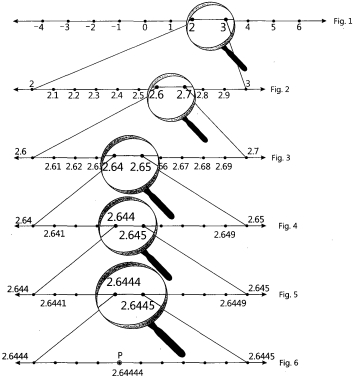
0 likes
View Solution157
Medium
Visualise $2.365$ on the number line,using successive magnification.
Solution
(N/A) Step $1$: Locate $2.3$ and $2.4$ on the number line. Divide the distance between $2.3$ and $2.4$ into $10$ equal parts. The first mark represents $2.31$,the second $2.32$,and so on.
Step $2$: Locate $2.36$ and $2.37$ on the number line. Divide the distance between $2.36$ and $2.37$ into $10$ equal parts.
Step $3$: The $5$th mark between $2.36$ and $2.37$ represents $2.365$.
Step $2$: Locate $2.36$ and $2.37$ on the number line. Divide the distance between $2.36$ and $2.37$ into $10$ equal parts.
Step $3$: The $5$th mark between $2.36$ and $2.37$ represents $2.365$.
0 likes
View Solution158
Medium
Visualise $-4.126$ on the number line,using successive magnification.
Solution
(N/A) To visualise $-4.126$ on the number line using successive magnification,we follow these steps:
$1$. Since $-4.126$ lies between $-4$ and $-5$,we divide the segment between $-4$ and $-5$ into $10$ equal parts and locate $-4.1$ and $-4.2$.
$2$. Now,$-4.126$ lies between $-4.1$ and $-4.2$. We magnify this segment and divide it into $10$ equal parts to locate $-4.12$ and $-4.13$.
$3$. Finally,$-4.126$ lies between $-4.12$ and $-4.13$. We magnify this segment and divide it into $10$ equal parts to locate the point representing $-4.126$ exactly.
$1$. Since $-4.126$ lies between $-4$ and $-5$,we divide the segment between $-4$ and $-5$ into $10$ equal parts and locate $-4.1$ and $-4.2$.
$2$. Now,$-4.126$ lies between $-4.1$ and $-4.2$. We magnify this segment and divide it into $10$ equal parts to locate $-4.12$ and $-4.13$.
$3$. Finally,$-4.126$ lies between $-4.12$ and $-4.13$. We magnify this segment and divide it into $10$ equal parts to locate the point representing $-4.126$ exactly.
0 likes
View Solution159
Medium
Represent $3.\overline{42}$ on the number line, using successive magnification, up to $4$ decimal places.
Solution
To represent $3.\overline{42}$ up to $4$ decimal places, we need to locate $3.4242$ on the number line.
Step $1$: $3.4242$ lies between $3$ and $4$. Divide the interval $[3, 4]$ into $10$ equal parts and magnify the interval $[3.4, 3.5]$.
Step $2$: $3.4242$ lies between $3.4$ and $3.5$. Divide the interval $[3.4, 3.5]$ into $10$ equal parts and magnify the interval $[3.42, 3.43]$.
Step $3$: $3.4242$ lies between $3.42$ and $3.43$. Divide the interval $[3.42, 3.43]$ into $10$ equal parts and magnify the interval $[3.424, 3.425]$.
Step $4$: $3.4242$ lies between $3.424$ and $3.425$. Divide the interval $[3.424, 3.425]$ into $10$ equal parts. The point $3.4242$ is the $2$nd mark after $3.424$.
Step $1$: $3.4242$ lies between $3$ and $4$. Divide the interval $[3, 4]$ into $10$ equal parts and magnify the interval $[3.4, 3.5]$.
Step $2$: $3.4242$ lies between $3.4$ and $3.5$. Divide the interval $[3.4, 3.5]$ into $10$ equal parts and magnify the interval $[3.42, 3.43]$.
Step $3$: $3.4242$ lies between $3.42$ and $3.43$. Divide the interval $[3.42, 3.43]$ into $10$ equal parts and magnify the interval $[3.424, 3.425]$.
Step $4$: $3.4242$ lies between $3.424$ and $3.425$. Divide the interval $[3.424, 3.425]$ into $10$ equal parts. The point $3.4242$ is the $2$nd mark after $3.424$.
0 likes
View Solution160
MediumMCQ
Represent $5.4949$ on the number line,using successive magnification,up to $4$ decimal places.
A
Visualize $5.4$ between $5$ and $6$.
B
Visualize $5.49$ between $5.4$ and $5.5$.
C
Visualize $5.494$ between $5.49$ and $5.50$.
D
Visualize $5.4949$ between $5.494$ and $5.495$.
Solution
(D) To represent $5.4949$ on the number line using successive magnification:
$1$. Locate $5.4949$ between $5$ and $6$. Divide the interval into $10$ equal parts to find $5.4$ and $5.5$.
$2$. Magnify the interval between $5.4$ and $5.5$. Divide it into $10$ equal parts to locate $5.49$ and $5.50$.
$3$. Magnify the interval between $5.49$ and $5.50$. Divide it into $10$ equal parts to locate $5.494$ and $5.495$.
$4$. Magnify the interval between $5.494$ and $5.495$. Divide it into $10$ equal parts. The point $5.4949$ lies between $5.494$ and $5.495$,specifically at the $9^{th}$ subdivision.
$1$. Locate $5.4949$ between $5$ and $6$. Divide the interval into $10$ equal parts to find $5.4$ and $5.5$.
$2$. Magnify the interval between $5.4$ and $5.5$. Divide it into $10$ equal parts to locate $5.49$ and $5.50$.
$3$. Magnify the interval between $5.49$ and $5.50$. Divide it into $10$ equal parts to locate $5.494$ and $5.495$.
$4$. Magnify the interval between $5.494$ and $5.495$. Divide it into $10$ equal parts. The point $5.4949$ lies between $5.494$ and $5.495$,specifically at the $9^{th}$ subdivision.
0 likes
View Solution161
MediumMCQ
Add $4 \sqrt{3}+2 \sqrt{5}$ and $6 \sqrt{3}-4 \sqrt{5}$.
A
$10 \sqrt{3}-2 \sqrt{5}$
B
$10 \sqrt{3}+2 \sqrt{5}$
C
$2 \sqrt{3}-2 \sqrt{5}$
D
$10 \sqrt{3}+6 \sqrt{5}$
Solution
(A) To add the given expressions,we group the like terms involving $\sqrt{3}$ and $\sqrt{5}$ together.
$(4 \sqrt{3}+2 \sqrt{5})+(6 \sqrt{3}-4 \sqrt{5})$
$= (4 \sqrt{3}+6 \sqrt{3}) + (2 \sqrt{5}-4 \sqrt{5})$
$= (4+6) \sqrt{3} + (2-4) \sqrt{5}$
$= 10 \sqrt{3} - 2 \sqrt{5}$
$(4 \sqrt{3}+2 \sqrt{5})+(6 \sqrt{3}-4 \sqrt{5})$
$= (4 \sqrt{3}+6 \sqrt{3}) + (2 \sqrt{5}-4 \sqrt{5})$
$= (4+6) \sqrt{3} + (2-4) \sqrt{5}$
$= 10 \sqrt{3} - 2 \sqrt{5}$
0 likes
View Solution162
EasyMCQ
Multiply $3 \sqrt{7}$ and $5 \sqrt{7}$.
A
$15 \sqrt{7}$
B
$105$
C
$15 \sqrt{14}$
D
$35$
Solution
(B) To multiply $3 \sqrt{7}$ and $5 \sqrt{7}$,we follow these steps:
Step $1$: Multiply the coefficients (the numbers outside the square roots) together: $3 \times 5 = 15$.
Step $2$: Multiply the square root terms together: $\sqrt{7} \times \sqrt{7} = 7$.
Step $3$: Multiply the results from Step $1$ and Step $2$: $15 \times 7 = 105$.
Therefore,$3 \sqrt{7} \times 5 \sqrt{7} = 105$.
Step $1$: Multiply the coefficients (the numbers outside the square roots) together: $3 \times 5 = 15$.
Step $2$: Multiply the square root terms together: $\sqrt{7} \times \sqrt{7} = 7$.
Step $3$: Multiply the results from Step $1$ and Step $2$: $15 \times 7 = 105$.
Therefore,$3 \sqrt{7} \times 5 \sqrt{7} = 105$.
0 likes
View Solution163
EasyMCQ
Divide $12 \sqrt{30}$ by $3 \sqrt{5}$.
A
$4 \sqrt{6}$
B
$3 \sqrt{6}$
C
$4 \sqrt{5}$
D
$2 \sqrt{6}$
Solution
(A) To divide $12 \sqrt{30}$ by $3 \sqrt{5}$,we write it as a fraction:
$\frac{12 \sqrt{30}}{3 \sqrt{5}}$
We can simplify the coefficients: $\frac{12}{3} = 4$.
Next,we simplify the square roots using the property $\frac{\sqrt{a}}{\sqrt{b}} = \sqrt{\frac{a}{b}}$:
$\sqrt{\frac{30}{5}} = \sqrt{6}$
Combining these,we get $4 \times \sqrt{6} = 4 \sqrt{6}$.
$\frac{12 \sqrt{30}}{3 \sqrt{5}}$
We can simplify the coefficients: $\frac{12}{3} = 4$.
Next,we simplify the square roots using the property $\frac{\sqrt{a}}{\sqrt{b}} = \sqrt{\frac{a}{b}}$:
$\sqrt{\frac{30}{5}} = \sqrt{6}$
Combining these,we get $4 \times \sqrt{6} = 4 \sqrt{6}$.
0 likes
View Solution164
EasyMCQ
Simplify the following expression: $(3+\sqrt{5})(4-\sqrt{11})$
A
$12-3\sqrt{11}+4\sqrt{5}-\sqrt{55}$
B
$12+3\sqrt{11}-4\sqrt{5}+\sqrt{55}$
C
$12-3\sqrt{11}-4\sqrt{5}+\sqrt{55}$
D
$12+3\sqrt{11}+4\sqrt{5}+\sqrt{55}$
Solution
(A) To simplify the expression $(3+\sqrt{5})(4-\sqrt{11})$,we use the distributive property of multiplication over addition ($FOIL$ method):
$(3+\sqrt{5})(4-\sqrt{11}) = 3(4-\sqrt{11}) + \sqrt{5}(4-\sqrt{11})$
$= (3 \times 4) - (3 \times \sqrt{11}) + (\sqrt{5} \times 4) - (\sqrt{5} \times \sqrt{11})$
$= 12 - 3\sqrt{11} + 4\sqrt{5} - \sqrt{5 \times 11}$
$= 12 - 3\sqrt{11} + 4\sqrt{5} - \sqrt{55}$
$(3+\sqrt{5})(4-\sqrt{11}) = 3(4-\sqrt{11}) + \sqrt{5}(4-\sqrt{11})$
$= (3 \times 4) - (3 \times \sqrt{11}) + (\sqrt{5} \times 4) - (\sqrt{5} \times \sqrt{11})$
$= 12 - 3\sqrt{11} + 4\sqrt{5} - \sqrt{5 \times 11}$
$= 12 - 3\sqrt{11} + 4\sqrt{5} - \sqrt{55}$
0 likes
View Solution165
EasyMCQ
Simplify the following expression: $(\sqrt{15}+\sqrt{7})(\sqrt{15}-\sqrt{7})$
A
$8$
B
$22$
C
$15$
D
$7$
Solution
(A) To simplify the expression $(\sqrt{15}+\sqrt{7})(\sqrt{15}-\sqrt{7})$,we use the algebraic identity $(a+b)(a-b) = a^2 - b^2$.
Here,$a = \sqrt{15}$ and $b = \sqrt{7}$.
Applying the identity:
$(\sqrt{15})^2 - (\sqrt{7})^2 = 15 - 7 = 8$.
Here,$a = \sqrt{15}$ and $b = \sqrt{7}$.
Applying the identity:
$(\sqrt{15})^2 - (\sqrt{7})^2 = 15 - 7 = 8$.
0 likes
View Solution166
EasyMCQ
Simplify the following expression: $(\sqrt{11}-\sqrt{3})^{2}$
A
$14-2\sqrt{33}$
B
$14+2\sqrt{33}$
C
$8-2\sqrt{33}$
D
$14-\sqrt{33}$
Solution
(A) To simplify the expression $(\sqrt{11}-\sqrt{3})^{2}$,we use the algebraic identity $(a-b)^{2} = a^{2} - 2ab + b^{2}$.
Here,$a = \sqrt{11}$ and $b = \sqrt{3}$.
Substituting these values into the identity:
$(\sqrt{11}-\sqrt{3})^{2} = (\sqrt{11})^{2} - 2(\sqrt{11})(\sqrt{3}) + (\sqrt{3})^{2}$
$= 11 - 2\sqrt{11 \times 3} + 3$
$= 11 - 2\sqrt{33} + 3$
$= 14 - 2\sqrt{33}$
Here,$a = \sqrt{11}$ and $b = \sqrt{3}$.
Substituting these values into the identity:
$(\sqrt{11}-\sqrt{3})^{2} = (\sqrt{11})^{2} - 2(\sqrt{11})(\sqrt{3}) + (\sqrt{3})^{2}$
$= 11 - 2\sqrt{11 \times 3} + 3$
$= 11 - 2\sqrt{33} + 3$
$= 14 - 2\sqrt{33}$
0 likes
View Solution167
Easy
Rationalise the denominator of the following expression:
$\frac{30}{5 \sqrt{3}-3 \sqrt{5}}$
$\frac{30}{5 \sqrt{3}-3 \sqrt{5}}$
Solution
(N/A) To rationalise the denominator,multiply the numerator and the denominator by the conjugate of the denominator,which is $(5 \sqrt{3} + 3 \sqrt{5})$.
$\frac{30}{5 \sqrt{3}-3 \sqrt{5}} = \frac{30}{5 \sqrt{3}-3 \sqrt{5}} \times \frac{5 \sqrt{3}+3 \sqrt{5}}{5 \sqrt{3}+3 \sqrt{5}}$
$= \frac{30(5 \sqrt{3}+3 \sqrt{5})}{(5 \sqrt{3})^{2}-(3 \sqrt{5})^{2}}$
$= \frac{30(5 \sqrt{3}+3 \sqrt{5})}{75-45}$
$= \frac{30(5 \sqrt{3}+3 \sqrt{5})}{30}$
$= 5 \sqrt{3}+3 \sqrt{5}$
$\frac{30}{5 \sqrt{3}-3 \sqrt{5}} = \frac{30}{5 \sqrt{3}-3 \sqrt{5}} \times \frac{5 \sqrt{3}+3 \sqrt{5}}{5 \sqrt{3}+3 \sqrt{5}}$
$= \frac{30(5 \sqrt{3}+3 \sqrt{5})}{(5 \sqrt{3})^{2}-(3 \sqrt{5})^{2}}$
$= \frac{30(5 \sqrt{3}+3 \sqrt{5})}{75-45}$
$= \frac{30(5 \sqrt{3}+3 \sqrt{5})}{30}$
$= 5 \sqrt{3}+3 \sqrt{5}$
0 likes
View Solution168
Medium
Rationalise the denominator of the following number:
$\frac{1}{5+2 \sqrt{3}}$
$\frac{1}{5+2 \sqrt{3}}$
Solution
(A) To rationalise the denominator,multiply the numerator and the denominator by the conjugate of the denominator,which is $(5-2 \sqrt{3})$.
$\frac{1}{5+2 \sqrt{3}} = \frac{1}{5+2 \sqrt{3}} \times \frac{5-2 \sqrt{3}}{5-2 \sqrt{3}}$
Using the identity $(a+b)(a-b) = a^2 - b^2$ in the denominator:
$= \frac{5-2 \sqrt{3}}{(5)^2 - (2 \sqrt{3})^2}$
$= \frac{5-2 \sqrt{3}}{25 - (4 \times 3)}$
$= \frac{5-2 \sqrt{3}}{25 - 12}$
$= \frac{5-2 \sqrt{3}}{13}$
$\frac{1}{5+2 \sqrt{3}} = \frac{1}{5+2 \sqrt{3}} \times \frac{5-2 \sqrt{3}}{5-2 \sqrt{3}}$
Using the identity $(a+b)(a-b) = a^2 - b^2$ in the denominator:
$= \frac{5-2 \sqrt{3}}{(5)^2 - (2 \sqrt{3})^2}$
$= \frac{5-2 \sqrt{3}}{25 - (4 \times 3)}$
$= \frac{5-2 \sqrt{3}}{25 - 12}$
$= \frac{5-2 \sqrt{3}}{13}$
0 likes
View Solution169
Medium
Rationalize the denominator of the following expression: $\frac{n^{2}}{\sqrt{m^{2}+n^{2}}+m}$
Solution
To rationalize the denominator,multiply the numerator and the denominator by the conjugate of the denominator,which is $\sqrt{m^{2}+n^{2}}-m$.
$\frac{n^{2}}{\sqrt{m^{2}+n^{2}}+m} = \frac{n^{2}}{\sqrt{m^{2}+n^{2}}+m} \times \frac{\sqrt{m^{2}+n^{2}}-m}{\sqrt{m^{2}+n^{2}}-m}$
Using the identity $(a+b)(a-b) = a^{2}-b^{2}$ in the denominator:
$= \frac{n^{2}(\sqrt{m^{2}+n^{2}}-m)}{(\sqrt{m^{2}+n^{2}})^{2} - (m)^{2}}$
$= \frac{n^{2}(\sqrt{m^{2}+n^{2}}-m)}{m^{2}+n^{2}-m^{2}}$
$= \frac{n^{2}(\sqrt{m^{2}+n^{2}}-m)}{n^{2}}$
$= \sqrt{m^{2}+n^{2}}-m$
$\frac{n^{2}}{\sqrt{m^{2}+n^{2}}+m} = \frac{n^{2}}{\sqrt{m^{2}+n^{2}}+m} \times \frac{\sqrt{m^{2}+n^{2}}-m}{\sqrt{m^{2}+n^{2}}-m}$
Using the identity $(a+b)(a-b) = a^{2}-b^{2}$ in the denominator:
$= \frac{n^{2}(\sqrt{m^{2}+n^{2}}-m)}{(\sqrt{m^{2}+n^{2}})^{2} - (m)^{2}}$
$= \frac{n^{2}(\sqrt{m^{2}+n^{2}}-m)}{m^{2}+n^{2}-m^{2}}$
$= \frac{n^{2}(\sqrt{m^{2}+n^{2}}-m)}{n^{2}}$
$= \sqrt{m^{2}+n^{2}}-m$
0 likes
View Solution170
MediumMCQ
If $\frac{2 \sqrt{6}-\sqrt{5}}{3 \sqrt{5}-2 \sqrt{6}}=a+b \sqrt{30}$,find the value of $a$ and $b$.
A
$a=\frac{3}{7}, b=\frac{4}{21}$
B
$a=\frac{4}{21}, b=\frac{3}{7}$
C
$a=\frac{3}{7}, b=-\frac{4}{21}$
D
$a=-\frac{3}{7}, b=\frac{4}{21}$
Solution
(A) Given: $\frac{2 \sqrt{6}-\sqrt{5}}{3 \sqrt{5}-2 \sqrt{6}}=a+b \sqrt{30}$
To rationalize the denominator,multiply the numerator and denominator by $(3 \sqrt{5}+2 \sqrt{6})$:
$\frac{2 \sqrt{6}-\sqrt{5}}{3 \sqrt{5}-2 \sqrt{6}} \times \frac{3 \sqrt{5}+2 \sqrt{6}}{3 \sqrt{5}+2 \sqrt{6}}=a+b \sqrt{30}$
Using the identity $(x-y)(x+y) = x^2 - y^2$ in the denominator:
$\frac{(2 \sqrt{6}-\sqrt{5})(3 \sqrt{5}+2 \sqrt{6})}{(3 \sqrt{5})^{2}-(2 \sqrt{6})^{2}}=a+b \sqrt{30}$
Expanding the numerator:
$(2 \sqrt{6})(3 \sqrt{5}) + (2 \sqrt{6})(2 \sqrt{6}) - (\sqrt{5})(3 \sqrt{5}) - (\sqrt{5})(2 \sqrt{6}) = 6 \sqrt{30} + 24 - 15 - 2 \sqrt{30} = 9 + 4 \sqrt{30}$
Calculating the denominator:
$(3 \sqrt{5})^2 - (2 \sqrt{6})^2 = 45 - 24 = 21$
So,$\frac{9+4 \sqrt{30}}{21} = a+b \sqrt{30}$
$\frac{9}{21} + \frac{4 \sqrt{30}}{21} = a+b \sqrt{30}$
$\frac{3}{7} + \frac{4}{21} \sqrt{30} = a+b \sqrt{30}$
Comparing the rational and irrational parts,we get $a=\frac{3}{7}$ and $b=\frac{4}{21}$.
To rationalize the denominator,multiply the numerator and denominator by $(3 \sqrt{5}+2 \sqrt{6})$:
$\frac{2 \sqrt{6}-\sqrt{5}}{3 \sqrt{5}-2 \sqrt{6}} \times \frac{3 \sqrt{5}+2 \sqrt{6}}{3 \sqrt{5}+2 \sqrt{6}}=a+b \sqrt{30}$
Using the identity $(x-y)(x+y) = x^2 - y^2$ in the denominator:
$\frac{(2 \sqrt{6}-\sqrt{5})(3 \sqrt{5}+2 \sqrt{6})}{(3 \sqrt{5})^{2}-(2 \sqrt{6})^{2}}=a+b \sqrt{30}$
Expanding the numerator:
$(2 \sqrt{6})(3 \sqrt{5}) + (2 \sqrt{6})(2 \sqrt{6}) - (\sqrt{5})(3 \sqrt{5}) - (\sqrt{5})(2 \sqrt{6}) = 6 \sqrt{30} + 24 - 15 - 2 \sqrt{30} = 9 + 4 \sqrt{30}$
Calculating the denominator:
$(3 \sqrt{5})^2 - (2 \sqrt{6})^2 = 45 - 24 = 21$
So,$\frac{9+4 \sqrt{30}}{21} = a+b \sqrt{30}$
$\frac{9}{21} + \frac{4 \sqrt{30}}{21} = a+b \sqrt{30}$
$\frac{3}{7} + \frac{4}{21} \sqrt{30} = a+b \sqrt{30}$
Comparing the rational and irrational parts,we get $a=\frac{3}{7}$ and $b=\frac{4}{21}$.
0 likes
View Solution171
Difficult
If $x = 5 + 2\sqrt{6}$,then find the value of $x^{2} + \frac{1}{x^{2}}$ and $x^{3} + \frac{1}{x^{3}}$.
Solution
(N/A) Given: $x = 5 + 2\sqrt{6}$.
First,find $\frac{1}{x}$:
$\frac{1}{x} = \frac{1}{5 + 2\sqrt{6}} = \frac{1}{5 + 2\sqrt{6}} \times \frac{5 - 2\sqrt{6}}{5 - 2\sqrt{6}} = \frac{5 - 2\sqrt{6}}{25 - 24} = 5 - 2\sqrt{6}$.
Now,calculate $x + \frac{1}{x}$:
$x + \frac{1}{x} = (5 + 2\sqrt{6}) + (5 - 2\sqrt{6}) = 10$.
To find $x^{2} + \frac{1}{x^{2}}$:
$x^{2} + \frac{1}{x^{2}} = (x + \frac{1}{x})^{2} - 2 = (10)^{2} - 2 = 100 - 2 = 98$.
To find $x^{3} + \frac{1}{x^{3}}$:
$x^{3} + \frac{1}{x^{3}} = (x + \frac{1}{x})^{3} - 3(x + \frac{1}{x}) = (10)^{3} - 3(10) = 1000 - 30 = 970$.
First,find $\frac{1}{x}$:
$\frac{1}{x} = \frac{1}{5 + 2\sqrt{6}} = \frac{1}{5 + 2\sqrt{6}} \times \frac{5 - 2\sqrt{6}}{5 - 2\sqrt{6}} = \frac{5 - 2\sqrt{6}}{25 - 24} = 5 - 2\sqrt{6}$.
Now,calculate $x + \frac{1}{x}$:
$x + \frac{1}{x} = (5 + 2\sqrt{6}) + (5 - 2\sqrt{6}) = 10$.
To find $x^{2} + \frac{1}{x^{2}}$:
$x^{2} + \frac{1}{x^{2}} = (x + \frac{1}{x})^{2} - 2 = (10)^{2} - 2 = 100 - 2 = 98$.
To find $x^{3} + \frac{1}{x^{3}}$:
$x^{3} + \frac{1}{x^{3}} = (x + \frac{1}{x})^{3} - 3(x + \frac{1}{x}) = (10)^{3} - 3(10) = 1000 - 30 = 970$.
0 likes
View Solution172
Easy
Add $4 \sqrt{6}-8 \sqrt{10}$ and $3 \sqrt{6}+12 \sqrt{10}$.
Solution
(N/A) To add the given expressions,we group the like terms:
$(4 \sqrt{6}-8 \sqrt{10}) + (3 \sqrt{6}+12 \sqrt{10})$
$= (4 \sqrt{6} + 3 \sqrt{6}) + (-8 \sqrt{10} + 12 \sqrt{10})$
$= (4 + 3) \sqrt{6} + (-8 + 12) \sqrt{10}$
$= 7 \sqrt{6} + 4 \sqrt{10}$
$(4 \sqrt{6}-8 \sqrt{10}) + (3 \sqrt{6}+12 \sqrt{10})$
$= (4 \sqrt{6} + 3 \sqrt{6}) + (-8 \sqrt{10} + 12 \sqrt{10})$
$= (4 + 3) \sqrt{6} + (-8 + 12) \sqrt{10}$
$= 7 \sqrt{6} + 4 \sqrt{10}$
0 likes
View Solution173
EasyMCQ
Multiply $5 \sqrt{3}$ and $4 \sqrt{12}$.
A
$120$
B
$115$
C
$125$
D
$130$
Solution
(A) To multiply $5 \sqrt{3}$ and $4 \sqrt{12}$,we follow these steps:
$1$. Write the expression as $(5 \sqrt{3}) \times (4 \sqrt{12})$.
$2$. Multiply the coefficients: $5 \times 4 = 20$.
$3$. Multiply the radicals: $\sqrt{3} \times \sqrt{12} = \sqrt{3 \times 12} = \sqrt{36}$.
$4$. Calculate the square root: $\sqrt{36} = 6$.
$5$. Multiply the results: $20 \times 6 = 120$.
Therefore,the product is $120$.
$1$. Write the expression as $(5 \sqrt{3}) \times (4 \sqrt{12})$.
$2$. Multiply the coefficients: $5 \times 4 = 20$.
$3$. Multiply the radicals: $\sqrt{3} \times \sqrt{12} = \sqrt{3 \times 12} = \sqrt{36}$.
$4$. Calculate the square root: $\sqrt{36} = 6$.
$5$. Multiply the results: $20 \times 6 = 120$.
Therefore,the product is $120$.
0 likes
View Solution174
EasyMCQ
Simplify: $5 \sqrt{2} + 2 \sqrt{8} - 3 \sqrt{32} + 4 \sqrt{128}$ (in $\sqrt{2}$)
A
$25$
B
$29$
C
$32$
D
$27$
Solution
(B) To simplify the expression $5 \sqrt{2} + 2 \sqrt{8} - 3 \sqrt{32} + 4 \sqrt{128}$, we first simplify each radical term:
$1$. $5 \sqrt{2} = 5 \sqrt{2}$
$2$. $2 \sqrt{8} = 2 \sqrt{4 \times 2} = 2 \times 2 \sqrt{2} = 4 \sqrt{2}$
$3$. $3 \sqrt{32} = 3 \sqrt{16 \times 2} = 3 \times 4 \sqrt{2} = 12 \sqrt{2}$
$4$. $4 \sqrt{128} = 4 \sqrt{64 \times 2} = 4 \times 8 \sqrt{2} = 32 \sqrt{2}$
Now, substitute these values back into the expression:
$5 \sqrt{2} + 4 \sqrt{2} - 12 \sqrt{2} + 32 \sqrt{2}$
Combine the coefficients:
$(5 + 4 - 12 + 32) \sqrt{2} = 29 \sqrt{2}$
$1$. $5 \sqrt{2} = 5 \sqrt{2}$
$2$. $2 \sqrt{8} = 2 \sqrt{4 \times 2} = 2 \times 2 \sqrt{2} = 4 \sqrt{2}$
$3$. $3 \sqrt{32} = 3 \sqrt{16 \times 2} = 3 \times 4 \sqrt{2} = 12 \sqrt{2}$
$4$. $4 \sqrt{128} = 4 \sqrt{64 \times 2} = 4 \times 8 \sqrt{2} = 32 \sqrt{2}$
Now, substitute these values back into the expression:
$5 \sqrt{2} + 4 \sqrt{2} - 12 \sqrt{2} + 32 \sqrt{2}$
Combine the coefficients:
$(5 + 4 - 12 + 32) \sqrt{2} = 29 \sqrt{2}$
0 likes
View Solution175
Medium
Rationalise the denominator in the following expression:
$\frac{1}{\sqrt{5}-\sqrt{3}}$
$\frac{1}{\sqrt{5}-\sqrt{3}}$
Solution
(A) To rationalise the denominator,multiply the numerator and the denominator by the conjugate of the denominator,which is $(\sqrt{5} + \sqrt{3})$.
$\frac{1}{\sqrt{5}-\sqrt{3}} \times \frac{\sqrt{5}+\sqrt{3}}{\sqrt{5}+\sqrt{3}}$
$= \frac{\sqrt{5}+\sqrt{3}}{(\sqrt{5})^2 - (\sqrt{3})^2}$
$= \frac{\sqrt{5}+\sqrt{3}}{5 - 3}$
$= \frac{\sqrt{5}+\sqrt{3}}{2}$
$\frac{1}{\sqrt{5}-\sqrt{3}} \times \frac{\sqrt{5}+\sqrt{3}}{\sqrt{5}+\sqrt{3}}$
$= \frac{\sqrt{5}+\sqrt{3}}{(\sqrt{5})^2 - (\sqrt{3})^2}$
$= \frac{\sqrt{5}+\sqrt{3}}{5 - 3}$
$= \frac{\sqrt{5}+\sqrt{3}}{2}$
0 likes
View Solution176
EasyMCQ
Rationalise the denominator of the following expression:
$\frac{4}{\sqrt{10}+\sqrt{6}}$
$\frac{4}{\sqrt{10}+\sqrt{6}}$
A
$\sqrt{10}-\sqrt{6}$
B
$\sqrt{10}+\sqrt{6}$
C
$\frac{\sqrt{10}-\sqrt{6}}{4}$
D
$\frac{\sqrt{10}+\sqrt{6}}{4}$
Solution
(A) To rationalise the denominator of $\frac{4}{\sqrt{10}+\sqrt{6}}$,multiply the numerator and the denominator by the conjugate of the denominator,which is $(\sqrt{10}-\sqrt{6})$.
$\frac{4}{\sqrt{10}+\sqrt{6}} \times \frac{\sqrt{10}-\sqrt{6}}{\sqrt{10}-\sqrt{6}}$
$= \frac{4(\sqrt{10}-\sqrt{6})}{(\sqrt{10})^2 - (\sqrt{6})^2}$
$= \frac{4(\sqrt{10}-\sqrt{6})}{10-6}$
$= \frac{4(\sqrt{10}-\sqrt{6})}{4}$
$= \sqrt{10}-\sqrt{6}$
$\frac{4}{\sqrt{10}+\sqrt{6}} \times \frac{\sqrt{10}-\sqrt{6}}{\sqrt{10}-\sqrt{6}}$
$= \frac{4(\sqrt{10}-\sqrt{6})}{(\sqrt{10})^2 - (\sqrt{6})^2}$
$= \frac{4(\sqrt{10}-\sqrt{6})}{10-6}$
$= \frac{4(\sqrt{10}-\sqrt{6})}{4}$
$= \sqrt{10}-\sqrt{6}$
0 likes
View Solution177
Easy
Rationalise the denominator in each of the following:
$\frac{18}{3 \sqrt{2}-2 \sqrt{3}}$
$\frac{18}{3 \sqrt{2}-2 \sqrt{3}}$
Solution
(N/A) To rationalise the denominator,we multiply the numerator and the denominator by the conjugate of the denominator,which is $(3 \sqrt{2} + 2 \sqrt{3})$.
$\frac{18}{3 \sqrt{2}-2 \sqrt{3}} \times \frac{3 \sqrt{2}+2 \sqrt{3}}{3 \sqrt{2}+2 \sqrt{3}}$
$= \frac{18(3 \sqrt{2}+2 \sqrt{3})}{(3 \sqrt{2})^2 - (2 \sqrt{3})^2}$
$= \frac{18(3 \sqrt{2}+2 \sqrt{3})}{(9 \times 2) - (4 \times 3)}$
$= \frac{18(3 \sqrt{2}+2 \sqrt{3})}{18 - 12}$
$= \frac{18(3 \sqrt{2}+2 \sqrt{3})}{6}$
$= 3(3 \sqrt{2}+2 \sqrt{3})$
$\frac{18}{3 \sqrt{2}-2 \sqrt{3}} \times \frac{3 \sqrt{2}+2 \sqrt{3}}{3 \sqrt{2}+2 \sqrt{3}}$
$= \frac{18(3 \sqrt{2}+2 \sqrt{3})}{(3 \sqrt{2})^2 - (2 \sqrt{3})^2}$
$= \frac{18(3 \sqrt{2}+2 \sqrt{3})}{(9 \times 2) - (4 \times 3)}$
$= \frac{18(3 \sqrt{2}+2 \sqrt{3})}{18 - 12}$
$= \frac{18(3 \sqrt{2}+2 \sqrt{3})}{6}$
$= 3(3 \sqrt{2}+2 \sqrt{3})$
0 likes
View Solution178
Easy
Rationalise the denominator in each of the following:
$\frac{1}{7-4 \sqrt{3}}$
$\frac{1}{7-4 \sqrt{3}}$
Solution
(A) To rationalise the denominator of $\frac{1}{7-4 \sqrt{3}}$,we multiply the numerator and the denominator by the conjugate of the denominator,which is $7+4 \sqrt{3}$.
$\frac{1}{7-4 \sqrt{3}} \times \frac{7+4 \sqrt{3}}{7+4 \sqrt{3}} = \frac{7+4 \sqrt{3}}{(7)^2 - (4 \sqrt{3})^2}$
$= \frac{7+4 \sqrt{3}}{49 - (16 \times 3)}$
$= \frac{7+4 \sqrt{3}}{49 - 48}$
$= \frac{7+4 \sqrt{3}}{1}$
$= 7+4 \sqrt{3}$
$\frac{1}{7-4 \sqrt{3}} \times \frac{7+4 \sqrt{3}}{7+4 \sqrt{3}} = \frac{7+4 \sqrt{3}}{(7)^2 - (4 \sqrt{3})^2}$
$= \frac{7+4 \sqrt{3}}{49 - (16 \times 3)}$
$= \frac{7+4 \sqrt{3}}{49 - 48}$
$= \frac{7+4 \sqrt{3}}{1}$
$= 7+4 \sqrt{3}$
0 likes
View Solution179
Easy
Rationalise the denominator in each of the following:
$\frac{3+2 \sqrt{2}}{3-2 \sqrt{2}}$
$\frac{3+2 \sqrt{2}}{3-2 \sqrt{2}}$
Solution
$(17+12 \sqrt{2})$ To rationalise the denominator,multiply the numerator and the denominator by the conjugate of the denominator,which is $(3+2 \sqrt{2})$.
$\frac{3+2 \sqrt{2}}{3-2 \sqrt{2}} \times \frac{3+2 \sqrt{2}}{3+2 \sqrt{2}}$
$= \frac{(3+2 \sqrt{2})^2}{(3)^2 - (2 \sqrt{2})^2}$
$= \frac{3^2 + (2 \sqrt{2})^2 + 2(3)(2 \sqrt{2})}{9 - (4 \times 2)}$
$= \frac{9 + 8 + 12 \sqrt{2}}{9 - 8}$
$= \frac{17 + 12 \sqrt{2}}{1}$
$= 17 + 12 \sqrt{2}$
$\frac{3+2 \sqrt{2}}{3-2 \sqrt{2}} \times \frac{3+2 \sqrt{2}}{3+2 \sqrt{2}}$
$= \frac{(3+2 \sqrt{2})^2}{(3)^2 - (2 \sqrt{2})^2}$
$= \frac{3^2 + (2 \sqrt{2})^2 + 2(3)(2 \sqrt{2})}{9 - (4 \times 2)}$
$= \frac{9 + 8 + 12 \sqrt{2}}{9 - 8}$
$= \frac{17 + 12 \sqrt{2}}{1}$
$= 17 + 12 \sqrt{2}$
0 likes
View Solution180
Medium
Rationalise the denominator in each of the following:
$\frac{5-2 \sqrt{6}}{5+2 \sqrt{6}}$
$\frac{5-2 \sqrt{6}}{5+2 \sqrt{6}}$
Solution
(A) To rationalise the denominator,multiply the numerator and the denominator by the conjugate of the denominator,which is $(5-2 \sqrt{6})$.
$\frac{5-2 \sqrt{6}}{5+2 \sqrt{6}} \times \frac{5-2 \sqrt{6}}{5-2 \sqrt{6}}$
$= \frac{(5-2 \sqrt{6})^2}{(5)^2 - (2 \sqrt{6})^2}$
$= \frac{5^2 - 2(5)(2 \sqrt{6}) + (2 \sqrt{6})^2}{25 - (4 \times 6)}$
$= \frac{25 - 20 \sqrt{6} + 24}{25 - 24}$
$= \frac{49 - 20 \sqrt{6}}{1}$
$= 49 - 20 \sqrt{6}$
$\frac{5-2 \sqrt{6}}{5+2 \sqrt{6}} \times \frac{5-2 \sqrt{6}}{5-2 \sqrt{6}}$
$= \frac{(5-2 \sqrt{6})^2}{(5)^2 - (2 \sqrt{6})^2}$
$= \frac{5^2 - 2(5)(2 \sqrt{6}) + (2 \sqrt{6})^2}{25 - (4 \times 6)}$
$= \frac{25 - 20 \sqrt{6} + 24}{25 - 24}$
$= \frac{49 - 20 \sqrt{6}}{1}$
$= 49 - 20 \sqrt{6}$
0 likes
View Solution181
MediumMCQ
If $\sqrt{2} = 1.4142$,then evaluate $\sqrt{5} \div \sqrt{10}$ correct to four decimal places.
A
$0.7071$
B
$1.2541$
C
$0.9571$
D
$2.4587$
Solution
(A) Given expression is $\frac{\sqrt{5}}{\sqrt{10}}$.
We can simplify this as $\sqrt{\frac{5}{10}} = \sqrt{\frac{1}{2}}$.
This is equal to $\frac{1}{\sqrt{2}}$.
Rationalizing the denominator,we get $\frac{1}{\sqrt{2}} \times \frac{\sqrt{2}}{\sqrt{2}} = \frac{\sqrt{2}}{2}$.
Substituting the value of $\sqrt{2} = 1.4142$,we get $\frac{1.4142}{2} = 0.7071$.
We can simplify this as $\sqrt{\frac{5}{10}} = \sqrt{\frac{1}{2}}$.
This is equal to $\frac{1}{\sqrt{2}}$.
Rationalizing the denominator,we get $\frac{1}{\sqrt{2}} \times \frac{\sqrt{2}}{\sqrt{2}} = \frac{\sqrt{2}}{2}$.
Substituting the value of $\sqrt{2} = 1.4142$,we get $\frac{1.4142}{2} = 0.7071$.
0 likes
View Solution182
MediumMCQ
If $\sqrt{5} = 2.236$,then evaluate $\frac{4 - \sqrt{5}}{\sqrt{5}}$ correct to four decimal places.
A
$3.921$
B
$0.7888$
C
$0.278$
D
$2.365$
Solution
(B) Given that $\sqrt{5} = 2.236$.
We need to evaluate $\frac{4 - \sqrt{5}}{\sqrt{5}}$.
This expression can be simplified as $\frac{4}{\sqrt{5}} - 1$.
Substituting the value of $\sqrt{5}$: $\frac{4}{2.236} - 1$.
Calculating $\frac{4}{2.236} \approx 1.788895$.
Subtracting $1$ from this value gives $1.788895 - 1 = 0.788895$.
Rounding to four decimal places,we get $0.7889$.
However,checking the calculation $\frac{4 - 2.236}{2.236} = \frac{1.764}{2.236} \approx 0.788886$.
Rounding to four decimal places,we get $0.7889$.
Given the options provided,$0.7888$ is the closest match.
We need to evaluate $\frac{4 - \sqrt{5}}{\sqrt{5}}$.
This expression can be simplified as $\frac{4}{\sqrt{5}} - 1$.
Substituting the value of $\sqrt{5}$: $\frac{4}{2.236} - 1$.
Calculating $\frac{4}{2.236} \approx 1.788895$.
Subtracting $1$ from this value gives $1.788895 - 1 = 0.788895$.
Rounding to four decimal places,we get $0.7889$.
However,checking the calculation $\frac{4 - 2.236}{2.236} = \frac{1.764}{2.236} \approx 0.788886$.
Rounding to four decimal places,we get $0.7889$.
Given the options provided,$0.7888$ is the closest match.
0 likes
View Solution183
Difficult
If $x = 3 + 2\sqrt{2}$,then find the value of $x^{2} + \frac{1}{x^{2}}$ and $x^{3} + \frac{1}{x^{3}}$.
Solution
(N/A) Given $x = 3 + 2\sqrt{2}$.
First,find $\frac{1}{x}$:
$\frac{1}{x} = \frac{1}{3 + 2\sqrt{2}} = \frac{1}{3 + 2\sqrt{2}} \times \frac{3 - 2\sqrt{2}}{3 - 2\sqrt{2}} = \frac{3 - 2\sqrt{2}}{9 - 8} = 3 - 2\sqrt{2}$.
Now,calculate $x + \frac{1}{x}$:
$x + \frac{1}{x} = (3 + 2\sqrt{2}) + (3 - 2\sqrt{2}) = 6$.
To find $x^{2} + \frac{1}{x^{2}}$,use the identity $(x + \frac{1}{x})^{2} = x^{2} + \frac{1}{x^{2}} + 2$:
$x^{2} + \frac{1}{x^{2}} = (x + \frac{1}{x})^{2} - 2 = (6)^{2} - 2 = 36 - 2 = 34$.
To find $x^{3} + \frac{1}{x^{3}}$,use the identity $(x + \frac{1}{x})^{3} = x^{3} + \frac{1}{x^{3}} + 3(x + \frac{1}{x})$:
$x^{3} + \frac{1}{x^{3}} = (x + \frac{1}{x})^{3} - 3(x + \frac{1}{x}) = (6)^{3} - 3(6) = 216 - 18 = 198$.
Thus,the values are $34$ and $198$.
First,find $\frac{1}{x}$:
$\frac{1}{x} = \frac{1}{3 + 2\sqrt{2}} = \frac{1}{3 + 2\sqrt{2}} \times \frac{3 - 2\sqrt{2}}{3 - 2\sqrt{2}} = \frac{3 - 2\sqrt{2}}{9 - 8} = 3 - 2\sqrt{2}$.
Now,calculate $x + \frac{1}{x}$:
$x + \frac{1}{x} = (3 + 2\sqrt{2}) + (3 - 2\sqrt{2}) = 6$.
To find $x^{2} + \frac{1}{x^{2}}$,use the identity $(x + \frac{1}{x})^{2} = x^{2} + \frac{1}{x^{2}} + 2$:
$x^{2} + \frac{1}{x^{2}} = (x + \frac{1}{x})^{2} - 2 = (6)^{2} - 2 = 36 - 2 = 34$.
To find $x^{3} + \frac{1}{x^{3}}$,use the identity $(x + \frac{1}{x})^{3} = x^{3} + \frac{1}{x^{3}} + 3(x + \frac{1}{x})$:
$x^{3} + \frac{1}{x^{3}} = (x + \frac{1}{x})^{3} - 3(x + \frac{1}{x}) = (6)^{3} - 3(6) = 216 - 18 = 198$.
Thus,the values are $34$ and $198$.
0 likes
View Solution184
MediumMCQ
If $x = 7 - 4\sqrt{3}$,then find the value of $x^{2} + \frac{1}{x^{2}}$.
A
$146$
B
$184$
C
$176$
D
$194$
Solution
(D) Given $x = 7 - 4\sqrt{3}$.
First,find $\frac{1}{x}$:
$\frac{1}{x} = \frac{1}{7 - 4\sqrt{3}}$.
Rationalizing the denominator:
$\frac{1}{x} = \frac{1}{7 - 4\sqrt{3}} \times \frac{7 + 4\sqrt{3}}{7 + 4\sqrt{3}} = \frac{7 + 4\sqrt{3}}{49 - (16 \times 3)} = \frac{7 + 4\sqrt{3}}{49 - 48} = 7 + 4\sqrt{3}$.
Now,find $x + \frac{1}{x}$:
$x + \frac{1}{x} = (7 - 4\sqrt{3}) + (7 + 4\sqrt{3}) = 14$.
We know that $(x + \frac{1}{x})^{2} = x^{2} + \frac{1}{x^{2}} + 2$.
Therefore,$x^{2} + \frac{1}{x^{2}} = (x + \frac{1}{x})^{2} - 2$.
Substituting the value:
$x^{2} + \frac{1}{x^{2}} = (14)^{2} - 2 = 196 - 2 = 194$.
First,find $\frac{1}{x}$:
$\frac{1}{x} = \frac{1}{7 - 4\sqrt{3}}$.
Rationalizing the denominator:
$\frac{1}{x} = \frac{1}{7 - 4\sqrt{3}} \times \frac{7 + 4\sqrt{3}}{7 + 4\sqrt{3}} = \frac{7 + 4\sqrt{3}}{49 - (16 \times 3)} = \frac{7 + 4\sqrt{3}}{49 - 48} = 7 + 4\sqrt{3}$.
Now,find $x + \frac{1}{x}$:
$x + \frac{1}{x} = (7 - 4\sqrt{3}) + (7 + 4\sqrt{3}) = 14$.
We know that $(x + \frac{1}{x})^{2} = x^{2} + \frac{1}{x^{2}} + 2$.
Therefore,$x^{2} + \frac{1}{x^{2}} = (x + \frac{1}{x})^{2} - 2$.
Substituting the value:
$x^{2} + \frac{1}{x^{2}} = (14)^{2} - 2 = 196 - 2 = 194$.
0 likes
View Solution185
Medium
If $\frac{\sqrt{7}+\sqrt{5}}{\sqrt{7}-\sqrt{5}}=a+b \sqrt{35},$ find the value of $a$ and $b$.
Solution
(A) To solve $\frac{\sqrt{7}+\sqrt{5}}{\sqrt{7}-\sqrt{5}}=a+b \sqrt{35}$,we rationalize the denominator by multiplying the numerator and denominator by the conjugate $(\sqrt{7}+\sqrt{5})$.
$\frac{\sqrt{7}+\sqrt{5}}{\sqrt{7}-\sqrt{5}} \times \frac{\sqrt{7}+\sqrt{5}}{\sqrt{7}+\sqrt{5}} = \frac{(\sqrt{7}+\sqrt{5})^2}{(\sqrt{7})^2-(\sqrt{5})^2}$
$= \frac{7+5+2\sqrt{35}}{7-5}$
$= \frac{12+2\sqrt{35}}{2}$
$= 6+\sqrt{35}$
Comparing $6+\sqrt{35}$ with $a+b\sqrt{35}$,we get $a=6$ and $b=1$.
$\frac{\sqrt{7}+\sqrt{5}}{\sqrt{7}-\sqrt{5}} \times \frac{\sqrt{7}+\sqrt{5}}{\sqrt{7}+\sqrt{5}} = \frac{(\sqrt{7}+\sqrt{5})^2}{(\sqrt{7})^2-(\sqrt{5})^2}$
$= \frac{7+5+2\sqrt{35}}{7-5}$
$= \frac{12+2\sqrt{35}}{2}$
$= 6+\sqrt{35}$
Comparing $6+\sqrt{35}$ with $a+b\sqrt{35}$,we get $a=6$ and $b=1$.
1 likes
View Solution186
Medium
Prove that,$\frac{1}{1+\sqrt{2}}+\frac{1}{\sqrt{2}+\sqrt{3}}+\frac{1}{\sqrt{3}+\sqrt{4}}=1$.
Solution
(N/A) To solve this,we rationalize each term in the expression.
Step $1$: Rationalize the first term: $\frac{1}{1+\sqrt{2}} = \frac{1}{\sqrt{2}+1} \times \frac{\sqrt{2}-1}{\sqrt{2}-1} = \frac{\sqrt{2}-1}{2-1} = \sqrt{2}-1$.
Step $2$: Rationalize the second term: $\frac{1}{\sqrt{2}+\sqrt{3}} = \frac{1}{\sqrt{3}+\sqrt{2}} \times \frac{\sqrt{3}-\sqrt{2}}{\sqrt{3}-\sqrt{2}} = \frac{\sqrt{3}-\sqrt{2}}{3-2} = \sqrt{3}-\sqrt{2}$.
Step $3$: Rationalize the third term: $\frac{1}{\sqrt{3}+\sqrt{4}} = \frac{1}{\sqrt{4}+\sqrt{3}} \times \frac{\sqrt{4}-\sqrt{3}}{\sqrt{4}-\sqrt{3}} = \frac{\sqrt{4}-\sqrt{3}}{4-3} = \sqrt{4}-\sqrt{3} = 2-\sqrt{3}$.
Step $4$: Add the results: $(\sqrt{2}-1) + (\sqrt{3}-\sqrt{2}) + (2-\sqrt{3})$.
Step $5$: Simplify the expression: $\sqrt{2} - 1 + \sqrt{3} - \sqrt{2} + 2 - \sqrt{3} = -1 + 2 = 1$.
Thus,the expression equals $1$.
Step $1$: Rationalize the first term: $\frac{1}{1+\sqrt{2}} = \frac{1}{\sqrt{2}+1} \times \frac{\sqrt{2}-1}{\sqrt{2}-1} = \frac{\sqrt{2}-1}{2-1} = \sqrt{2}-1$.
Step $2$: Rationalize the second term: $\frac{1}{\sqrt{2}+\sqrt{3}} = \frac{1}{\sqrt{3}+\sqrt{2}} \times \frac{\sqrt{3}-\sqrt{2}}{\sqrt{3}-\sqrt{2}} = \frac{\sqrt{3}-\sqrt{2}}{3-2} = \sqrt{3}-\sqrt{2}$.
Step $3$: Rationalize the third term: $\frac{1}{\sqrt{3}+\sqrt{4}} = \frac{1}{\sqrt{4}+\sqrt{3}} \times \frac{\sqrt{4}-\sqrt{3}}{\sqrt{4}-\sqrt{3}} = \frac{\sqrt{4}-\sqrt{3}}{4-3} = \sqrt{4}-\sqrt{3} = 2-\sqrt{3}$.
Step $4$: Add the results: $(\sqrt{2}-1) + (\sqrt{3}-\sqrt{2}) + (2-\sqrt{3})$.
Step $5$: Simplify the expression: $\sqrt{2} - 1 + \sqrt{3} - \sqrt{2} + 2 - \sqrt{3} = -1 + 2 = 1$.
Thus,the expression equals $1$.
0 likes
View Solution187
Medium
If $\frac{5+3 \sqrt{3}}{7+4 \sqrt{3}}=a+b \sqrt{3},$ find the value of $a$ and $b$.
Solution
(A) To find the values of $a$ and $b$,we rationalize the denominator of the given expression:
$\frac{5+3 \sqrt{3}}{7+4 \sqrt{3}} \times \frac{7-4 \sqrt{3}}{7-4 \sqrt{3}}$
$= \frac{(5+3 \sqrt{3})(7-4 \sqrt{3})}{(7)^2 - (4 \sqrt{3})^2}$
$= \frac{35 - 20 \sqrt{3} + 21 \sqrt{3} - 12(3)}{49 - 16(3)}$
$= \frac{35 + \sqrt{3} - 36}{49 - 48}$
$= \frac{-1 + \sqrt{3}}{1}$
$= -1 + 1 \sqrt{3}$
Comparing this with $a+b \sqrt{3}$,we get $a = -1$ and $b = 1$.
$\frac{5+3 \sqrt{3}}{7+4 \sqrt{3}} \times \frac{7-4 \sqrt{3}}{7-4 \sqrt{3}}$
$= \frac{(5+3 \sqrt{3})(7-4 \sqrt{3})}{(7)^2 - (4 \sqrt{3})^2}$
$= \frac{35 - 20 \sqrt{3} + 21 \sqrt{3} - 12(3)}{49 - 16(3)}$
$= \frac{35 + \sqrt{3} - 36}{49 - 48}$
$= \frac{-1 + \sqrt{3}}{1}$
$= -1 + 1 \sqrt{3}$
Comparing this with $a+b \sqrt{3}$,we get $a = -1$ and $b = 1$.
0 likes
View Solution188
Medium
If $x = 2 + \sqrt{3},$ then find the value of $x^{2} + \frac{1}{x^{2}}$ and $x^{3} + \frac{1}{x^{3}}.$
Solution
(N/A) Given $x = 2 + \sqrt{3}.$
First,find $\frac{1}{x} = \frac{1}{2 + \sqrt{3}}.$
Rationalizing the denominator: $\frac{1}{2 + \sqrt{3}} \times \frac{2 - \sqrt{3}}{2 - \sqrt{3}} = \frac{2 - \sqrt{3}}{4 - 3} = 2 - \sqrt{3}.$
Now,$x + \frac{1}{x} = (2 + \sqrt{3}) + (2 - \sqrt{3}) = 4.$
To find $x^{2} + \frac{1}{x^{2}},$ use the identity $(x + \frac{1}{x})^{2} = x^{2} + \frac{1}{x^{2}} + 2.$
$4^{2} = x^{2} + \frac{1}{x^{2}} + 2 \implies 16 = x^{2} + \frac{1}{x^{2}} + 2 \implies x^{2} + \frac{1}{x^{2}} = 14.$
To find $x^{3} + \frac{1}{x^{3}},$ use the identity $(x + \frac{1}{x})^{3} = x^{3} + \frac{1}{x^{3}} + 3(x + \frac{1}{x}).$
$4^{3} = x^{3} + \frac{1}{x^{3}} + 3(4) \implies 64 = x^{3} + \frac{1}{x^{3}} + 12 \implies x^{3} + \frac{1}{x^{3}} = 52.$
Thus,the values are $14$ and $52.$
First,find $\frac{1}{x} = \frac{1}{2 + \sqrt{3}}.$
Rationalizing the denominator: $\frac{1}{2 + \sqrt{3}} \times \frac{2 - \sqrt{3}}{2 - \sqrt{3}} = \frac{2 - \sqrt{3}}{4 - 3} = 2 - \sqrt{3}.$
Now,$x + \frac{1}{x} = (2 + \sqrt{3}) + (2 - \sqrt{3}) = 4.$
To find $x^{2} + \frac{1}{x^{2}},$ use the identity $(x + \frac{1}{x})^{2} = x^{2} + \frac{1}{x^{2}} + 2.$
$4^{2} = x^{2} + \frac{1}{x^{2}} + 2 \implies 16 = x^{2} + \frac{1}{x^{2}} + 2 \implies x^{2} + \frac{1}{x^{2}} = 14.$
To find $x^{3} + \frac{1}{x^{3}},$ use the identity $(x + \frac{1}{x})^{3} = x^{3} + \frac{1}{x^{3}} + 3(x + \frac{1}{x}).$
$4^{3} = x^{3} + \frac{1}{x^{3}} + 3(4) \implies 64 = x^{3} + \frac{1}{x^{3}} + 12 \implies x^{3} + \frac{1}{x^{3}} = 52.$
Thus,the values are $14$ and $52.$
0 likes
View Solution189
Difficult
Represent $\sqrt{8.2}$ on the number line.
Solution
(N/A) To represent $\sqrt{8.2}$ on the number line,follow these steps:
$1$. Draw a line segment $AB = 8.2 \text{ units}$ on the number line.
$2$. From point $B$,mark a point $C$ such that $BC = 1 \text{ unit}$. Now,$AC = 9.2 \text{ units}$.
$3$. Find the midpoint $O$ of $AC$. The distance $AO = OC = 4.6 \text{ units}$.
$4$. Draw a semicircle with center $O$ and radius $OA$ (or $OC$).
$5$. Draw a perpendicular line at point $B$ to the line $AC$,intersecting the semicircle at point $D$.
$6$. The length $BD$ is equal to $\sqrt{8.2}$.
$7$. With $B$ as the center and $BD$ as the radius,draw an arc on the number line. The point where the arc intersects the number line represents $\sqrt{8.2}$.
$1$. Draw a line segment $AB = 8.2 \text{ units}$ on the number line.
$2$. From point $B$,mark a point $C$ such that $BC = 1 \text{ unit}$. Now,$AC = 9.2 \text{ units}$.
$3$. Find the midpoint $O$ of $AC$. The distance $AO = OC = 4.6 \text{ units}$.
$4$. Draw a semicircle with center $O$ and radius $OA$ (or $OC$).
$5$. Draw a perpendicular line at point $B$ to the line $AC$,intersecting the semicircle at point $D$.
$6$. The length $BD$ is equal to $\sqrt{8.2}$.
$7$. With $B$ as the center and $BD$ as the radius,draw an arc on the number line. The point where the arc intersects the number line represents $\sqrt{8.2}$.
3 likes
View Solution190
Difficult
Represent $\sqrt{5.6}$ on the number line.
Solution
(N/A) To represent $\sqrt{5.6}$ on the number line,follow these steps:
$1$. Draw a line segment $AB = 5.6 \text{ units}$ on the number line.
$2$. From point $B$,mark a point $C$ such that $BC = 1 \text{ unit}$. Now,$AC = 6.6 \text{ units}$.
$3$. Find the midpoint $O$ of $AC$. The distance $AO = OC = 3.3 \text{ units}$.
$4$. Draw a semicircle with center $O$ and radius $3.3 \text{ units}$ passing through $A$ and $C$.
$5$. Draw a perpendicular line at point $B$ to $AC$,which intersects the semicircle at point $D$.
$6$. The length $BD$ is equal to $\sqrt{5.6}$.
$7$. With $B$ as the center and $BD$ as the radius,draw an arc on the number line. The point where the arc intersects the number line represents $\sqrt{5.6}$.
$1$. Draw a line segment $AB = 5.6 \text{ units}$ on the number line.
$2$. From point $B$,mark a point $C$ such that $BC = 1 \text{ unit}$. Now,$AC = 6.6 \text{ units}$.
$3$. Find the midpoint $O$ of $AC$. The distance $AO = OC = 3.3 \text{ units}$.
$4$. Draw a semicircle with center $O$ and radius $3.3 \text{ units}$ passing through $A$ and $C$.
$5$. Draw a perpendicular line at point $B$ to $AC$,which intersects the semicircle at point $D$.
$6$. The length $BD$ is equal to $\sqrt{5.6}$.
$7$. With $B$ as the center and $BD$ as the radius,draw an arc on the number line. The point where the arc intersects the number line represents $\sqrt{5.6}$.
0 likes
View Solution191
DifficultMCQ
Represent $\sqrt{7.5}$ on the number line.
A
Geometric construction method
B
Algebraic calculation method
C
Using a calculator
D
Estimation method
Solution
(A) To represent $\sqrt{7.5}$ on the number line,follow these steps:
$1$. Draw a line segment $AB$ of length $7.5 \text{ units}$.
$2$. Extend the line segment $AB$ by $1 \text{ unit}$ to point $C$,such that $BC = 1 \text{ unit}$. Now,$AC = 8.5 \text{ units}$.
$3$. Find the midpoint $O$ of $AC$. The distance $AO = OC = 4.25 \text{ units}$.
$4$. With $O$ as the center and $OA$ as the radius,draw a semicircle.
$5$. Draw a perpendicular line at point $B$ to the line $AC$,which intersects the semicircle at point $D$.
$6$. The length $BD$ is equal to $\sqrt{7.5}$.
$7$. Using $B$ as the center and $BD$ as the radius,draw an arc on the number line to mark the point representing $\sqrt{7.5}$.
$1$. Draw a line segment $AB$ of length $7.5 \text{ units}$.
$2$. Extend the line segment $AB$ by $1 \text{ unit}$ to point $C$,such that $BC = 1 \text{ unit}$. Now,$AC = 8.5 \text{ units}$.
$3$. Find the midpoint $O$ of $AC$. The distance $AO = OC = 4.25 \text{ units}$.
$4$. With $O$ as the center and $OA$ as the radius,draw a semicircle.
$5$. Draw a perpendicular line at point $B$ to the line $AC$,which intersects the semicircle at point $D$.
$6$. The length $BD$ is equal to $\sqrt{7.5}$.
$7$. Using $B$ as the center and $BD$ as the radius,draw an arc on the number line to mark the point representing $\sqrt{7.5}$.
0 likes
View Solution192
DifficultMCQ
Find the value of the following expression correct to three decimal places,rationalizing the denominator if needed. Take $\sqrt{2} = 1.414$,$\sqrt{3} = 1.732$,and $\sqrt{5} = 2.236$.
$\frac{\sqrt{2}}{2+\sqrt{2}}$
$\frac{\sqrt{2}}{2+\sqrt{2}}$
A
$2.695$
B
$1.414$
C
$0.874$
D
$0.414$
Solution
(D) To evaluate $\frac{\sqrt{2}}{2+\sqrt{2}}$,we first rationalize the denominator by multiplying the numerator and the denominator by the conjugate $(2-\sqrt{2})$:
$\frac{\sqrt{2}}{2+\sqrt{2}} \times \frac{2-\sqrt{2}}{2-\sqrt{2}} = \frac{2\sqrt{2} - (\sqrt{2})^2}{2^2 - (\sqrt{2})^2}$
$= \frac{2\sqrt{2} - 2}{4 - 2} = \frac{2(\sqrt{2} - 1)}{2} = \sqrt{2} - 1$
Given $\sqrt{2} = 1.414$,we substitute this value:
$1.414 - 1 = 0.414$
Thus,the correct value is $0.414$.
$\frac{\sqrt{2}}{2+\sqrt{2}} \times \frac{2-\sqrt{2}}{2-\sqrt{2}} = \frac{2\sqrt{2} - (\sqrt{2})^2}{2^2 - (\sqrt{2})^2}$
$= \frac{2\sqrt{2} - 2}{4 - 2} = \frac{2(\sqrt{2} - 1)}{2} = \sqrt{2} - 1$
Given $\sqrt{2} = 1.414$,we substitute this value:
$1.414 - 1 = 0.414$
Thus,the correct value is $0.414$.
0 likes
View Solution193
DifficultMCQ
Find the value of the following expression correct to three decimal places,rationalizing the denominator if needed. Given $\sqrt{2} = 1.414$,$\sqrt{3} = 1.732$,and $\sqrt{5} = 2.236$.
$\frac{1}{\sqrt{3} + \sqrt{2}}$
$\frac{1}{\sqrt{3} + \sqrt{2}}$
A
$0.318$
B
$1.235$
C
$0.956$
D
$2.248$
Solution
(A) To find the value of $\frac{1}{\sqrt{3} + \sqrt{2}}$,we first rationalize the denominator by multiplying the numerator and the denominator by the conjugate $(\sqrt{3} - \sqrt{2})$.
$\frac{1}{\sqrt{3} + \sqrt{2}} \times \frac{\sqrt{3} - \sqrt{2}}{\sqrt{3} - \sqrt{2}} = \frac{\sqrt{3} - \sqrt{2}}{(\sqrt{3})^2 - (\sqrt{2})^2}$
$= \frac{\sqrt{3} - \sqrt{2}}{3 - 2} = \frac{\sqrt{3} - \sqrt{2}}{1} = \sqrt{3} - \sqrt{2}$
Given $\sqrt{3} = 1.732$ and $\sqrt{2} = 1.414$,we substitute these values:
$1.732 - 1.414 = 0.318$
Thus,the value is $0.318$.
$\frac{1}{\sqrt{3} + \sqrt{2}} \times \frac{\sqrt{3} - \sqrt{2}}{\sqrt{3} - \sqrt{2}} = \frac{\sqrt{3} - \sqrt{2}}{(\sqrt{3})^2 - (\sqrt{2})^2}$
$= \frac{\sqrt{3} - \sqrt{2}}{3 - 2} = \frac{\sqrt{3} - \sqrt{2}}{1} = \sqrt{3} - \sqrt{2}$
Given $\sqrt{3} = 1.732$ and $\sqrt{2} = 1.414$,we substitute these values:
$1.732 - 1.414 = 0.318$
Thus,the value is $0.318$.
0 likes
View Solution194
DifficultMCQ
Find the value of the following expression correct to three decimal places,taking $\sqrt{2} = 1.414$,$\sqrt{3} = 1.732$,and $\sqrt{5} = 2.236$:
$\frac{\sqrt{10} - \sqrt{5}}{2}$
$\frac{\sqrt{10} - \sqrt{5}}{2}$
A
$0.753$
B
$0.463$
C
$2.517$
D
$3.687$
Solution
(B) Given the expression: $\frac{\sqrt{10} - \sqrt{5}}{2}$
We can rewrite $\sqrt{10}$ as $\sqrt{2} \times \sqrt{5}$.
So,the expression becomes: $\frac{\sqrt{2} \times \sqrt{5} - \sqrt{5}}{2}$
Factor out $\sqrt{5}$ from the numerator: $\frac{\sqrt{5}(\sqrt{2} - 1)}{2}$
Substitute the given values $\sqrt{5} = 2.236$ and $\sqrt{2} = 1.414$:
$= \frac{2.236(1.414 - 1)}{2}$
$= \frac{2.236(0.414)}{2}$
$= 1.118 \times 0.414$
$= 0.462852$
Rounding to three decimal places,we get $0.463$.
We can rewrite $\sqrt{10}$ as $\sqrt{2} \times \sqrt{5}$.
So,the expression becomes: $\frac{\sqrt{2} \times \sqrt{5} - \sqrt{5}}{2}$
Factor out $\sqrt{5}$ from the numerator: $\frac{\sqrt{5}(\sqrt{2} - 1)}{2}$
Substitute the given values $\sqrt{5} = 2.236$ and $\sqrt{2} = 1.414$:
$= \frac{2.236(1.414 - 1)}{2}$
$= \frac{2.236(0.414)}{2}$
$= 1.118 \times 0.414$
$= 0.462852$
Rounding to three decimal places,we get $0.463$.
0 likes
View Solution195
DifficultMCQ
Find the value of the following expression correct to three decimal places,rationalizing the denominator if needed. Take $\sqrt{2} = 1.414$,$\sqrt{3} = 1.732$,and $\sqrt{5} = 2.236$.
$\frac{4}{3 \sqrt{3}-2 \sqrt{2}} + \frac{3}{3 \sqrt{3}+2 \sqrt{2}}$
$\frac{4}{3 \sqrt{3}-2 \sqrt{2}} + \frac{3}{3 \sqrt{3}+2 \sqrt{2}}$
A
$2.364$
B
$1.085$
C
$2.063$
D
$1.479$
Solution
(C) Given expression: $\frac{4}{3 \sqrt{3}-2 \sqrt{2}} + \frac{3}{3 \sqrt{3}+2 \sqrt{2}}$
Rationalize the first term: $\frac{4(3 \sqrt{3}+2 \sqrt{2})}{(3 \sqrt{3}-2 \sqrt{2})(3 \sqrt{3}+2 \sqrt{2})} = \frac{12 \sqrt{3}+8 \sqrt{2}}{(3 \sqrt{3})^2 - (2 \sqrt{2})^2} = \frac{12 \sqrt{3}+8 \sqrt{2}}{27-8} = \frac{12 \sqrt{3}+8 \sqrt{2}}{19}$
Rationalize the second term: $\frac{3(3 \sqrt{3}-2 \sqrt{2})}{(3 \sqrt{3}+2 \sqrt{2})(3 \sqrt{3}-2 \sqrt{2})} = \frac{9 \sqrt{3}-6 \sqrt{2}}{27-8} = \frac{9 \sqrt{3}-6 \sqrt{2}}{19}$
Adding both terms: $\frac{12 \sqrt{3}+8 \sqrt{2} + 9 \sqrt{3}-6 \sqrt{2}}{19} = \frac{21 \sqrt{3}+2 \sqrt{2}}{19}$
Substitute the values $\sqrt{3} = 1.732$ and $\sqrt{2} = 1.414$:
$= \frac{21(1.732) + 2(1.414)}{19} = \frac{36.372 + 2.828}{19} = \frac{39.2}{19} \approx 2.06315...$
Rounding to three decimal places,we get $2.063$.
Rationalize the first term: $\frac{4(3 \sqrt{3}+2 \sqrt{2})}{(3 \sqrt{3}-2 \sqrt{2})(3 \sqrt{3}+2 \sqrt{2})} = \frac{12 \sqrt{3}+8 \sqrt{2}}{(3 \sqrt{3})^2 - (2 \sqrt{2})^2} = \frac{12 \sqrt{3}+8 \sqrt{2}}{27-8} = \frac{12 \sqrt{3}+8 \sqrt{2}}{19}$
Rationalize the second term: $\frac{3(3 \sqrt{3}-2 \sqrt{2})}{(3 \sqrt{3}+2 \sqrt{2})(3 \sqrt{3}-2 \sqrt{2})} = \frac{9 \sqrt{3}-6 \sqrt{2}}{27-8} = \frac{9 \sqrt{3}-6 \sqrt{2}}{19}$
Adding both terms: $\frac{12 \sqrt{3}+8 \sqrt{2} + 9 \sqrt{3}-6 \sqrt{2}}{19} = \frac{21 \sqrt{3}+2 \sqrt{2}}{19}$
Substitute the values $\sqrt{3} = 1.732$ and $\sqrt{2} = 1.414$:
$= \frac{21(1.732) + 2(1.414)}{19} = \frac{36.372 + 2.828}{19} = \frac{39.2}{19} \approx 2.06315...$
Rounding to three decimal places,we get $2.063$.
0 likes
View Solution196
EasyMCQ
Simplify $3^{\frac{2}{3}} \cdot 3^{\frac{4}{3}}$.
A
$13$
B
$3$
C
$7$
D
$9$
Solution
(D) To simplify the expression $3^{\frac{2}{3}} \cdot 3^{\frac{4}{3}}$,we use the law of exponents: $a^m \cdot a^n = a^{m+n}$.
Applying this rule,we get:
$3^{\frac{2}{3}} \cdot 3^{\frac{4}{3}} = 3^{\frac{2}{3} + \frac{4}{3}}$
$= 3^{\frac{2+4}{3}}$
$= 3^{\frac{6}{3}}$
$= 3^2$
$= 9$
Applying this rule,we get:
$3^{\frac{2}{3}} \cdot 3^{\frac{4}{3}} = 3^{\frac{2}{3} + \frac{4}{3}}$
$= 3^{\frac{2+4}{3}}$
$= 3^{\frac{6}{3}}$
$= 3^2$
$= 9$
0 likes
View Solution197
EasyMCQ
Simplify $\left(4^{\frac{1}{5}}\right)^{3}$.
A
$4^{\frac{3}{5}}$
B
$4^{\frac{4}{5}}$
C
$4^{\frac{1}{15}}$
D
$4^{\frac{8}{5}}$
Solution
(A) To simplify the expression $\left(4^{\frac{1}{5}}\right)^{3}$,we use the law of exponents: $(a^m)^n = a^{m \times n}$.
Applying this rule:
$\left(4^{\frac{1}{5}}\right)^{3} = 4^{\frac{1}{5} \times 3}$
$= 4^{\frac{3}{5}}$
Thus,the simplified form is $4^{\frac{3}{5}}$.
Applying this rule:
$\left(4^{\frac{1}{5}}\right)^{3} = 4^{\frac{1}{5} \times 3}$
$= 4^{\frac{3}{5}}$
Thus,the simplified form is $4^{\frac{3}{5}}$.
0 likes
View Solution198
EasyMCQ
Simplify: $\frac{11^{\frac{1}{3}}}{11^{\frac{1}{5}}}$
A
$11^{\frac{2}{15}}$
B
$11^{\frac{8}{15}}$
C
$11^{\frac{1}{15}}$
D
$11^{\frac{2}{8}}$
Solution
(A) To simplify the expression $\frac{11^{\frac{1}{3}}}{11^{\frac{1}{5}}}$,we use the law of exponents: $\frac{a^m}{a^n} = a^{m-n}$.
Applying this rule,we get $11^{\frac{1}{3} - \frac{1}{5}}$.
To subtract the fractions in the exponent,we find a common denominator,which is $15$.
So,$\frac{1}{3} - \frac{1}{5} = \frac{5}{15} - \frac{3}{15} = \frac{2}{15}$.
Therefore,the simplified expression is $11^{\frac{2}{15}}$.
Applying this rule,we get $11^{\frac{1}{3} - \frac{1}{5}}$.
To subtract the fractions in the exponent,we find a common denominator,which is $15$.
So,$\frac{1}{3} - \frac{1}{5} = \frac{5}{15} - \frac{3}{15} = \frac{2}{15}$.
Therefore,the simplified expression is $11^{\frac{2}{15}}$.
0 likes
View Solution199
EasyMCQ
Simplify $7^{\frac{1}{4}} \cdot 12^{\frac{1}{4}}$.
A
$84^{\frac{1}{4}}$
B
$84^{\frac{1}{2}}$
C
$84^{\frac{1}{8}}$
D
$84^{\frac{1}{16}}$
Solution
(A) Using the law of exponents,$a^m \cdot b^m = (a \cdot b)^m$.
Given expression: $7^{\frac{1}{4}} \cdot 12^{\frac{1}{4}}$.
Applying the rule: $(7 \times 12)^{\frac{1}{4}}$.
Calculating the product: $84^{\frac{1}{4}}$.
Given expression: $7^{\frac{1}{4}} \cdot 12^{\frac{1}{4}}$.
Applying the rule: $(7 \times 12)^{\frac{1}{4}}$.
Calculating the product: $84^{\frac{1}{4}}$.
0 likes
View Solution200
EasyMCQ
Find the value of $64^{\frac{2}{3}}$.
A
$15$
B
$24$
C
$22$
D
$16$
Solution
(D) To find the value of $64^{\frac{2}{3}}$,we first express $64$ as a power of $2$ or $4$.
Since $64 = 4^3$,we can write the expression as:
$64^{\frac{2}{3}} = (4^3)^{\frac{2}{3}}$.
Using the exponent rule $(a^m)^n = a^{m \times n}$,we get:
$4^{3 \times \frac{2}{3}} = 4^2$.
Calculating the value,$4^2 = 16$.
Since $64 = 4^3$,we can write the expression as:
$64^{\frac{2}{3}} = (4^3)^{\frac{2}{3}}$.
Using the exponent rule $(a^m)^n = a^{m \times n}$,we get:
$4^{3 \times \frac{2}{3}} = 4^2$.
Calculating the value,$4^2 = 16$.
0 likes
View SolutionNumber Systems — Mix Examples - Number Systems · Frequently Asked Questions
1Are these Number Systems questions useful for JEE and NEET?
Yes. All questions in this section are mapped to JEE Main and NEET exam patterns. Previous year questions from JEE Main, NEET, GUJCET and state-level exams are included with full solutions.
2Can I switch to Hindi or Gujarati for these questions?
Yes. Use the language tabs in the hero section or the sidebar to view the same questions and solutions in English, Hindi or Gujarati.
3How do I generate a question paper from this subtopic?
Use the Vedclass Exam Paper Generator — select the chapter and subtopic, set difficulty, and generate Sets A, B, C, D automatically. First 3 chapters of every subject are free.
Vedclass Products
For Students
Vedclass Test Series
Mock tests in real JEE/NEET style with performance analysis. 5-day free trial.
Start Free TrialFor Teachers
Exam Paper Generator
Generate Set A/B/C/D papers from this chapter in 2 minutes. 3 chapters free.
Try FreeFor Institutes
Online Exam Module
Live online exams with unlimited students, 360° analytics & white-label branding.
See DemoFor Teachers & Institutes
Generate a Number Systems Exam Paper in 2 Minutes
Select subtopic & difficulty — Sets A, B, C, D auto-generated with No Repeat logic.
First 3 chapters of every subject are free — no payment required.