
A English
Junction Transistor Questions in English
Class 12 Physics · Semiconductor Electronics · Junction Transistor
399+
Questions
English
Language
100%
With Solutions
Showing 50 of 399 questions in English
51
MediumMCQ
In a common emitter configuration,an $N-P-N$ transistor is connected. The current gain of the transistor is $100$. If the collector current changes by $1 \ mA$,by how much will the emitter current change in $mA$?
A
$1.1$
B
$1.01$
C
$0.01$
D
$10$
Solution
(B) Given: Current gain $\beta = 100$. Change in collector current $\Delta I_C = 1 \ mA$.
We know that the relation between collector current and base current is $\Delta I_C = \beta \Delta I_B$.
Therefore,the change in base current is $\Delta I_B = \frac{\Delta I_C}{\beta} = \frac{1 \ mA}{100} = 0.01 \ mA$.
The relationship between emitter current,collector current,and base current is $\Delta I_E = \Delta I_C + \Delta I_B$.
Substituting the values: $\Delta I_E = 1 \ mA + 0.01 \ mA = 1.01 \ mA$.
Thus,the emitter current changes by $1.01 \ mA$.
We know that the relation between collector current and base current is $\Delta I_C = \beta \Delta I_B$.
Therefore,the change in base current is $\Delta I_B = \frac{\Delta I_C}{\beta} = \frac{1 \ mA}{100} = 0.01 \ mA$.
The relationship between emitter current,collector current,and base current is $\Delta I_E = \Delta I_C + \Delta I_B$.
Substituting the values: $\Delta I_E = 1 \ mA + 0.01 \ mA = 1.01 \ mA$.
Thus,the emitter current changes by $1.01 \ mA$.
0 likes
View Solution52
EasyMCQ
In a $P-N-P$ transistor,the emitter has ....... as majority carriers and the base has ....... as majority carriers.
A
Electrons,Holes
B
Holes,Electrons
C
Electrons,Electrons
D
Holes,Holes
Solution
(B) In a $P-N-P$ transistor,the structure consists of a $P$-type emitter,an $N$-type base,and a $P$-type collector.
Since the emitter is $P$-type,its majority charge carriers are holes.
Since the base is $N$-type,its majority charge carriers are electrons.
Therefore,the emitter has holes as majority carriers and the base has electrons as majority carriers.
Since the emitter is $P$-type,its majority charge carriers are holes.
Since the base is $N$-type,its majority charge carriers are electrons.
Therefore,the emitter has holes as majority carriers and the base has electrons as majority carriers.
0 likes
View Solution53
EasyMCQ
In the symbol of a transistor,the arrow indicates the direction of:
A
Current in the emitter
B
Electron flow in the emitter
C
Hole flow in the emitter
D
Conventional current flow in the base
Solution
(A) In a transistor symbol,the arrow is always placed on the emitter terminal.
By convention,the direction of the arrow represents the direction of the conventional current flow in the emitter.
For a $PNP$ transistor,the arrow points inward (towards the base),indicating conventional current flow from emitter to base.
For an $NPN$ transistor,the arrow points outward (away from the base),indicating conventional current flow from base to emitter.
Therefore,the arrow signifies the direction of the conventional current in the emitter.
By convention,the direction of the arrow represents the direction of the conventional current flow in the emitter.
For a $PNP$ transistor,the arrow points inward (towards the base),indicating conventional current flow from emitter to base.
For an $NPN$ transistor,the arrow points outward (away from the base),indicating conventional current flow from base to emitter.
Therefore,the arrow signifies the direction of the conventional current in the emitter.
0 likes
View Solution54
EasyMCQ
An $N-P-N$ transistor conducts when:
A
Both collector and emitter are positive with respect to the base.
B
Collector is positive with respect to the base and emitter is negative with respect to the base.
C
Collector is positive,and emitter and base are at the same potential.
D
Both collector and emitter are negative with respect to the base.
Solution
(B) For an $N-P-N$ transistor to conduct (operate in the active region),the base-emitter junction must be forward-biased and the base-collector junction must be reverse-biased.
$1$. Forward bias for the base-emitter junction: Since the base is $P$-type and the emitter is $N$-type,the base must be at a higher potential than the emitter (or the emitter must be negative with respect to the base).
$2$. Reverse bias for the base-collector junction: Since the base is $P$-type and the collector is $N$-type,the collector must be at a higher potential than the base (or the collector must be positive with respect to the base).
Therefore,the collector is positive with respect to the base,and the emitter is negative with respect to the base.
$1$. Forward bias for the base-emitter junction: Since the base is $P$-type and the emitter is $N$-type,the base must be at a higher potential than the emitter (or the emitter must be negative with respect to the base).
$2$. Reverse bias for the base-collector junction: Since the base is $P$-type and the collector is $N$-type,the collector must be at a higher potential than the base (or the collector must be positive with respect to the base).
Therefore,the collector is positive with respect to the base,and the emitter is negative with respect to the base.
0 likes
View Solution55
EasyMCQ
In an $N-P-N$ transistor,when does the current flow?
A
When the collector and emitter are positive with respect to the base.
B
When the collector is positive and the emitter is negative with respect to the base.
C
When the collector is positive and the base and emitter are at the same potential.
D
When both the collector and emitter are negative with respect to the base.
Solution
(B) In an $N-P-N$ transistor,current flows when the collector-base junction is reverse-biased and the emitter-base junction is forward-biased.
For the emitter-base junction to be forward-biased,the emitter must be negative with respect to the base.
For the collector-base junction to be reverse-biased,the collector must be positive with respect to the base.
Therefore,the current flows when the collector is positive and the emitter is negative with respect to the base.
For the emitter-base junction to be forward-biased,the emitter must be negative with respect to the base.
For the collector-base junction to be reverse-biased,the collector must be positive with respect to the base.
Therefore,the current flows when the collector is positive and the emitter is negative with respect to the base.
0 likes
View Solution56
MediumMCQ
If the base current is $100 \mu A$ and the collector current is $3 \ mA$,then the values of $\beta$,$\alpha$,and $I_e$ are respectively:
A
$20, 0.88, 2.3 \ mA$
B
$30, 0.80, 2.9 \ mA$
C
$30, 0.97, 3.1 \ mA$
D
$25, 0.50, 3.3 \ mA$
Solution
(C) Given: Base current $I_b = 100 \mu A = 0.1 \ mA$ and Collector current $I_c = 3 \ mA$.
$1$. Current gain $\beta$ is given by: $\beta = \frac{I_c}{I_b} = \frac{3 \ mA}{0.1 \ mA} = 30$.
$2$. Current gain $\alpha$ is given by: $\alpha = \frac{\beta}{1 + \beta} = \frac{30}{1 + 30} = \frac{30}{31} \approx 0.97$.
$3$. Emitter current $I_e$ is given by: $I_e = I_c + I_b = 3 \ mA + 0.1 \ mA = 3.1 \ mA$.
Thus,the values are $30, 0.97, 3.1 \ mA$.
$1$. Current gain $\beta$ is given by: $\beta = \frac{I_c}{I_b} = \frac{3 \ mA}{0.1 \ mA} = 30$.
$2$. Current gain $\alpha$ is given by: $\alpha = \frac{\beta}{1 + \beta} = \frac{30}{1 + 30} = \frac{30}{31} \approx 0.97$.
$3$. Emitter current $I_e$ is given by: $I_e = I_c + I_b = 3 \ mA + 0.1 \ mA = 3.1 \ mA$.
Thus,the values are $30, 0.97, 3.1 \ mA$.
0 likes
View Solution57
MediumMCQ
When a transistor is used as an amplifier in common emitter configuration,which of the following statements are correct?
$(1)$ The base-emitter junction is forward-biased.
$(2)$ The base-emitter junction is reverse-biased.
$(3)$ The input signal is connected in series with the biasing voltage to the base-emitter junction.
$(4)$ The input signal is connected in series with the biasing voltage to the base-collector junction.
$(1)$ The base-emitter junction is forward-biased.
$(2)$ The base-emitter junction is reverse-biased.
$(3)$ The input signal is connected in series with the biasing voltage to the base-emitter junction.
$(4)$ The input signal is connected in series with the biasing voltage to the base-collector junction.
A
$1, 2$
B
$1, 4$
C
$1, 3$
D
$3$
Solution
(C) For a transistor to operate as an amplifier,it must be in the active region.
In the active region,the base-emitter junction must be forward-biased to allow current flow from the emitter to the base.
Therefore,statement $(1)$ is correct.
To amplify the input signal,the signal is superimposed on the $DC$ biasing voltage applied to the base-emitter junction.
Therefore,statement $(3)$ is correct.
Statements $(2)$ and $(4)$ are incorrect because the base-collector junction must be reverse-biased in the active region,and the input signal is not applied to the base-collector junction.
In the active region,the base-emitter junction must be forward-biased to allow current flow from the emitter to the base.
Therefore,statement $(1)$ is correct.
To amplify the input signal,the signal is superimposed on the $DC$ biasing voltage applied to the base-emitter junction.
Therefore,statement $(3)$ is correct.
Statements $(2)$ and $(4)$ are incorrect because the base-collector junction must be reverse-biased in the active region,and the input signal is not applied to the base-collector junction.
0 likes
View Solution58
EasyMCQ
For a transistor to be used as an amplifier,which of the following conditions must be satisfied?
A
The emitter-base junction must be forward-biased and the base-collector junction must be reverse-biased.
B
No bias voltage is required.
C
Both junctions must be forward-biased.
D
Both junctions must be reverse-biased.
Solution
(A) For a transistor to function as an amplifier,it must operate in the active region.
In the active region,the emitter-base junction is forward-biased,which allows charge carriers to flow from the emitter into the base.
The base-collector junction is reverse-biased,which allows the collector to collect the majority of the charge carriers injected from the emitter.
Therefore,the correct condition is that the emitter-base junction is forward-biased and the base-collector junction is reverse-biased.
In the active region,the emitter-base junction is forward-biased,which allows charge carriers to flow from the emitter into the base.
The base-collector junction is reverse-biased,which allows the collector to collect the majority of the charge carriers injected from the emitter.
Therefore,the correct condition is that the emitter-base junction is forward-biased and the base-collector junction is reverse-biased.
0 likes
View Solution59
EasyMCQ
When an $N-P-N$ transistor is used as an amplifier,which of the following occurs?
A
Electrons in the base move towards the collector.
B
Holes from the emitter move towards the base.
C
Electrons from the emitter move towards the base.
D
Holes from the base move towards the emitter.
Solution
(C) In an $N-P-N$ transistor,the majority charge carriers are electrons. When used as an amplifier,the emitter is forward-biased,causing electrons to be injected from the $N$-type emitter into the $P$-type base. Due to the thin base region and the reverse-biased collector junction,these electrons then diffuse through the base and are collected by the collector.
0 likes
View Solution60
EasyMCQ
In which section of a transistor is the doping concentration highest to produce a large number of majority charge carriers?
A
Emitter
B
Base
C
Collector
D
None of the above
Solution
(A) The emitter section of a transistor is heavily doped to supply a large number of majority charge carriers to the base.
Therefore,the doping concentration is highest in the emitter.
Therefore,the doping concentration is highest in the emitter.
0 likes
View Solution61
EasyMCQ
$A$ transistor oscillator is a device that is used to:
A
Convert $DC$ electrical energy into $AC$ electrical energy.
B
Convert $DC$ electrical energy into higher voltage $DC$ energy.
C
Convert $DC$ electrical energy into lower voltage $DC$ energy.
D
None of the above.
Solution
(A) An oscillator is an electronic circuit that produces a periodic,oscillating electronic signal,often a sine wave or a square wave.
In the context of a transistor oscillator,it uses a $DC$ power source to generate an $AC$ signal.
This process involves feedback where a portion of the output signal is fed back into the input to maintain oscillations.
Therefore,a transistor oscillator converts $DC$ electrical energy into $AC$ electrical energy.
In the context of a transistor oscillator,it uses a $DC$ power source to generate an $AC$ signal.
This process involves feedback where a portion of the output signal is fed back into the input to maintain oscillations.
Therefore,a transistor oscillator converts $DC$ electrical energy into $AC$ electrical energy.
0 likes
View Solution62
MediumMCQ
The thinnest part of a transistor is . . . . . .
A
Emitter
B
Base
C
Collector
D
None of the above
Solution
(B) transistor consists of three regions: the Emitter,the Base,and the Collector.
$1$. The Emitter is moderately doped and is of medium size.
$2$. The Collector is larger in size compared to the Emitter and Base to dissipate heat generated during operation.
$3$. The Base is the central region and is made very thin and lightly doped to allow the majority of charge carriers from the Emitter to pass into the Collector.
Therefore,the Base is the thinnest part of the transistor.
$1$. The Emitter is moderately doped and is of medium size.
$2$. The Collector is larger in size compared to the Emitter and Base to dissipate heat generated during operation.
$3$. The Base is the central region and is made very thin and lightly doped to allow the majority of charge carriers from the Emitter to pass into the Collector.
Therefore,the Base is the thinnest part of the transistor.
0 likes
View Solution63
EasyMCQ
In a properly biased transistor:
A
Both depletion layers are of equal width.
B
Both depletion layers are equally narrow.
C
The emitter-base junction is wide and the collector-base junction is narrow.
D
The emitter-base junction is narrow and the collector-base junction is wide.
Solution
(D) In a properly biased transistor (e.g.,$NPN$ or $PNP$ in active mode),the emitter-base junction is forward-biased,which reduces the width of its depletion layer.
Conversely,the collector-base junction is reverse-biased,which increases the width of its depletion layer.
Therefore,the emitter-base junction is narrow,and the collector-base junction is wide.
Conversely,the collector-base junction is reverse-biased,which increases the width of its depletion layer.
Therefore,the emitter-base junction is narrow,and the collector-base junction is wide.
0 likes
View Solution64
MediumMCQ
The correct relationship between $\alpha$ and $\beta$ for a transistor is ........
A
$\beta = \frac{1 - \alpha}{\alpha}$
B
$\beta = \frac{\alpha}{1 - \alpha}$
C
$\alpha = \frac{\beta - 1}{\beta}$
D
$\alpha \beta = 1$
Solution
(B) We know that the current gain in common base configuration is $\alpha = \frac{\Delta i_C}{\Delta i_E}$.
We know that the current gain in common emitter configuration is $\beta = \frac{\Delta i_C}{\Delta i_B}$.
Since the emitter current is the sum of collector and base currents,we have $\Delta i_E = \Delta i_C + \Delta i_B$,which implies $\Delta i_B = \Delta i_E - \Delta i_C$.
Substituting this into the expression for $\beta$:
$\beta = \frac{\Delta i_C}{\Delta i_E - \Delta i_C}$.
Dividing the numerator and denominator by $\Delta i_E$:
$\beta = \frac{\frac{\Delta i_C}{\Delta i_E}}{1 - \frac{\Delta i_C}{\Delta i_E}}$.
Since $\alpha = \frac{\Delta i_C}{\Delta i_E}$,we get:
$\beta = \frac{\alpha}{1 - \alpha}$.
We know that the current gain in common emitter configuration is $\beta = \frac{\Delta i_C}{\Delta i_B}$.
Since the emitter current is the sum of collector and base currents,we have $\Delta i_E = \Delta i_C + \Delta i_B$,which implies $\Delta i_B = \Delta i_E - \Delta i_C$.
Substituting this into the expression for $\beta$:
$\beta = \frac{\Delta i_C}{\Delta i_E - \Delta i_C}$.
Dividing the numerator and denominator by $\Delta i_E$:
$\beta = \frac{\frac{\Delta i_C}{\Delta i_E}}{1 - \frac{\Delta i_C}{\Delta i_E}}$.
Since $\alpha = \frac{\Delta i_C}{\Delta i_E}$,we get:
$\beta = \frac{\alpha}{1 - \alpha}$.
0 likes
View Solution65
MediumMCQ
Which two of the following statements are true for a transistor?
$(1)$ The base,emitter,and collector regions of a transistor have the same size and doping concentration.
$(2)$ The base region is thin and lightly doped.
$(3)$ The emitter-base junction is forward-biased,and the base-collector junction is reverse-biased.
$(4)$ Both the emitter-base junction and the base-collector junction are forward-biased.
$(1)$ The base,emitter,and collector regions of a transistor have the same size and doping concentration.
$(2)$ The base region is thin and lightly doped.
$(3)$ The emitter-base junction is forward-biased,and the base-collector junction is reverse-biased.
$(4)$ Both the emitter-base junction and the base-collector junction are forward-biased.
A
$(4)$ and $(1)$
B
$(1)$ and $(2)$
C
$(2)$ and $(3)$
D
$(3)$ and $(4)$
Solution
(C) In a transistor,the emitter is heavily doped to provide a large number of charge carriers,the collector is moderately doped and larger in size to dissipate heat,and the base is very thin and lightly doped to allow most charge carriers to pass through to the collector.
Statement $(1)$ is false because the regions have different sizes and doping levels.
Statement $(2)$ is true because the base is designed to be thin and lightly doped to minimize recombination.
Statement $(3)$ is true because,for active operation (amplification),the emitter-base junction must be forward-biased and the base-collector junction must be reverse-biased.
Statement $(4)$ is false because this configuration corresponds to the saturation region,not the standard active mode of operation.
Therefore,statements $(2)$ and $(3)$ are correct.
Statement $(1)$ is false because the regions have different sizes and doping levels.
Statement $(2)$ is true because the base is designed to be thin and lightly doped to minimize recombination.
Statement $(3)$ is true because,for active operation (amplification),the emitter-base junction must be forward-biased and the base-collector junction must be reverse-biased.
Statement $(4)$ is false because this configuration corresponds to the saturation region,not the standard active mode of operation.
Therefore,statements $(2)$ and $(3)$ are correct.
0 likes
View Solution66
MediumMCQ
For a given transistor,if $\alpha = I_C / I_E = 0.96$,then the current gain $\beta$ is:
A
$6$
B
$12$
C
$24$
D
$48$
Solution
(C) The relationship between current gain $\alpha$ (common base) and $\beta$ (common emitter) is given by the formula: $\beta = \frac{\alpha}{1 - \alpha}$.
Given $\alpha = 0.96$.
Substituting the value into the formula:
$\beta = \frac{0.96}{1 - 0.96}$
$\beta = \frac{0.96}{0.04}$
$\beta = \frac{96}{4} = 24$.
Therefore,the current gain $\beta$ is $24$.
Given $\alpha = 0.96$.
Substituting the value into the formula:
$\beta = \frac{0.96}{1 - 0.96}$
$\beta = \frac{0.96}{0.04}$
$\beta = \frac{96}{4} = 24$.
Therefore,the current gain $\beta$ is $24$.
0 likes
View Solution67
MediumMCQ
For a transistor amplifier in a common-emitter configuration,given the load resistance $R_L = 1 \ k\Omega$,$h_{fe} = 50$,and $h_{oe} = 25 \ \mu A/V$,calculate the current gain $(A_i)$.
A
$-5.24$
B
$-15.7$
C
$-24.8$
D
$-48.78$
Solution
(D) The current gain $A_i$ for a common-emitter transistor amplifier is given by the formula:
$A_i = - \left( \frac{h_{fe}}{1 + h_{oe} R_L} \right)$
Given values are $h_{fe} = 50$,$h_{oe} = 25 \ \mu A/V = 25 \times 10^{-6} \ S$,and $R_L = 1 \ k\Omega = 10^3 \ \Omega$.
Substituting these values into the formula:
$A_i = - \left( \frac{50}{1 + (25 \times 10^{-6} \times 10^3)} \right)$
$A_i = - \left( \frac{50}{1 + 0.025} \right)$
$A_i = - \left( \frac{50}{1.025} \right)$
$A_i \approx -48.78$
$A_i = - \left( \frac{h_{fe}}{1 + h_{oe} R_L} \right)$
Given values are $h_{fe} = 50$,$h_{oe} = 25 \ \mu A/V = 25 \times 10^{-6} \ S$,and $R_L = 1 \ k\Omega = 10^3 \ \Omega$.
Substituting these values into the formula:
$A_i = - \left( \frac{50}{1 + (25 \times 10^{-6} \times 10^3)} \right)$
$A_i = - \left( \frac{50}{1 + 0.025} \right)$
$A_i = - \left( \frac{50}{1.025} \right)$
$A_i \approx -48.78$
0 likes
View Solution68
EasyMCQ
If $\alpha$ is the current gain in a $CB$ circuit and $\beta$ is the current gain in a $CE$ circuit,then $\alpha / \beta$ = ......
A
$\frac{\Delta I_B}{\Delta I_E}$
B
$\frac{\Delta I_E}{\Delta I_B}$
C
$\frac{\Delta I_B}{\Delta I_C}$
D
$\frac{\Delta I_C}{\Delta I_E}$
Solution
(A) The current gain in a common-base $(CB)$ configuration is defined as $\alpha = \frac{\Delta I_C}{\Delta I_E}$.
The current gain in a common-emitter $(CE)$ configuration is defined as $\beta = \frac{\Delta I_C}{\Delta I_B}$.
Taking the ratio of $\alpha$ to $\beta$:
$\frac{\alpha}{\beta} = \frac{(\Delta I_C / \Delta I_E)}{(\Delta I_C / \Delta I_B)}$
$\frac{\alpha}{\beta} = \frac{\Delta I_C}{\Delta I_E} \times \frac{\Delta I_B}{\Delta I_C}$
$\frac{\alpha}{\beta} = \frac{\Delta I_B}{\Delta I_E}$
The current gain in a common-emitter $(CE)$ configuration is defined as $\beta = \frac{\Delta I_C}{\Delta I_B}$.
Taking the ratio of $\alpha$ to $\beta$:
$\frac{\alpha}{\beta} = \frac{(\Delta I_C / \Delta I_E)}{(\Delta I_C / \Delta I_B)}$
$\frac{\alpha}{\beta} = \frac{\Delta I_C}{\Delta I_E} \times \frac{\Delta I_B}{\Delta I_C}$
$\frac{\alpha}{\beta} = \frac{\Delta I_B}{\Delta I_E}$
0 likes
View Solution69
MediumMCQ
For a transistor,if the emitter current $I_E = 25 \, mA$ and the base current $I_B = 1 \, mA$,what is the ratio of the collector current $I_C$ to the emitter current $I_E$?
A
$\frac{25}{24}$
B
$\frac{24}{25}$
C
$\frac{25}{26}$
D
$\frac{26}{25}$
Solution
(B) The relationship between emitter current $(I_E)$,collector current $(I_C)$,and base current $(I_B)$ is given by $I_E = I_C + I_B$.
Therefore,$I_C = I_E - I_B$.
Given $I_E = 25 \, mA$ and $I_B = 1 \, mA$,we have $I_C = 25 \, mA - 1 \, mA = 24 \, mA$.
The ratio of collector current to emitter current is $\alpha = \frac{I_C}{I_E}$.
Substituting the values,$\alpha = \frac{24 \, mA}{25 \, mA} = \frac{24}{25}$.
Therefore,$I_C = I_E - I_B$.
Given $I_E = 25 \, mA$ and $I_B = 1 \, mA$,we have $I_C = 25 \, mA - 1 \, mA = 24 \, mA$.
The ratio of collector current to emitter current is $\alpha = \frac{I_C}{I_E}$.
Substituting the values,$\alpha = \frac{24 \, mA}{25 \, mA} = \frac{24}{25}$.
0 likes
View Solution70
MediumMCQ
For a common base circuit,if $\frac{I_C}{I_E} = 0.98$,then the current gain for a common emitter circuit will be:
A
$49$
B
$98$
C
$4.9$
D
$25.5$
Solution
(A) In a common base configuration,the current gain $\alpha$ is defined as the ratio of collector current to emitter current: $\alpha = \frac{I_C}{I_E} = 0.98$.
The current gain for a common emitter circuit,denoted by $\beta$,is related to $\alpha$ by the formula: $\beta = \frac{\alpha}{1 - \alpha}$.
Substituting the given value of $\alpha$ into the formula:
$\beta = \frac{0.98}{1 - 0.98} = \frac{0.98}{0.02} = 49$.
Therefore,the current gain for the common emitter circuit is $49$.
The current gain for a common emitter circuit,denoted by $\beta$,is related to $\alpha$ by the formula: $\beta = \frac{\alpha}{1 - \alpha}$.
Substituting the given value of $\alpha$ into the formula:
$\beta = \frac{0.98}{1 - 0.98} = \frac{0.98}{0.02} = 49$.
Therefore,the current gain for the common emitter circuit is $49$.
0 likes
View Solution71
MediumMCQ
The base current is $100 \mu A$ and the collector current is $3 \text{ mA}$. $A$ change of $20 \mu A$ in the base current results in a change of $0.5 \text{ mA}$ in the collector current. The value of $\beta_{ac}$ is:
A
$100$
B
$20$
C
$25$
D
$10$
Solution
(C) Given: Base current $I_b = 100 \mu A$,Collector current $I_c = 3 \text{ mA}$.
Change in base current $\Delta I_b = 20 \mu A = 0.02 \text{ mA}$.
Change in collector current $\Delta I_c = 0.5 \text{ mA}$.
The $AC$ current gain $\beta_{ac}$ is defined as the ratio of the change in collector current to the change in base current.
$\beta_{ac} = \frac{\Delta I_c}{\Delta I_b}$
Substituting the values:
$\beta_{ac} = \frac{0.5 \text{ mA}}{0.02 \text{ mA}} = \frac{50}{2} = 25$.
Therefore,the value of $\beta_{ac}$ is $25$.
Change in base current $\Delta I_b = 20 \mu A = 0.02 \text{ mA}$.
Change in collector current $\Delta I_c = 0.5 \text{ mA}$.
The $AC$ current gain $\beta_{ac}$ is defined as the ratio of the change in collector current to the change in base current.
$\beta_{ac} = \frac{\Delta I_c}{\Delta I_b}$
Substituting the values:
$\beta_{ac} = \frac{0.5 \text{ mA}}{0.02 \text{ mA}} = \frac{50}{2} = 25$.
Therefore,the value of $\beta_{ac}$ is $25$.
0 likes
View Solution72
MediumMCQ
$A$ transistor is connected in a common emitter configuration with $R_o = 4 \text{ k}\Omega$,$R_i = 1 \text{ k}\Omega$,$I_C = 1 \text{ mA}$,and $I_b = 20 \text{ }\mu\text{A}$. The voltage gain is:
A
$180$
B
$150$
C
$200$
D
$100$
Solution
(C) The voltage gain $A_V$ is given by the formula: $A_V = \beta \times \left( \frac{R_o}{R_i} \right)$.
Here,$\beta$ is the current gain,which is defined as $\beta = \frac{I_C}{I_b}$.
Given values: $I_C = 1 \text{ mA} = 1 \times 10^{-3} \text{ A}$,$I_b = 20 \text{ }\mu\text{A} = 20 \times 10^{-6} \text{ A}$,$R_o = 4 \text{ k}\Omega$,and $R_i = 1 \text{ k}\Omega$.
First,calculate $\beta$: $\beta = \frac{1 \times 10^{-3}}{20 \times 10^{-6}} = \frac{1000}{20} = 50$.
Now,calculate the voltage gain: $A_V = 50 \times \left( \frac{4 \text{ k}\Omega}{1 \text{ k}\Omega} \right) = 50 \times 4 = 200$.
Here,$\beta$ is the current gain,which is defined as $\beta = \frac{I_C}{I_b}$.
Given values: $I_C = 1 \text{ mA} = 1 \times 10^{-3} \text{ A}$,$I_b = 20 \text{ }\mu\text{A} = 20 \times 10^{-6} \text{ A}$,$R_o = 4 \text{ k}\Omega$,and $R_i = 1 \text{ k}\Omega$.
First,calculate $\beta$: $\beta = \frac{1 \times 10^{-3}}{20 \times 10^{-6}} = \frac{1000}{20} = 50$.
Now,calculate the voltage gain: $A_V = 50 \times \left( \frac{4 \text{ k}\Omega}{1 \text{ k}\Omega} \right) = 50 \times 4 = 200$.
0 likes
View Solution73
MediumMCQ
The input voltage applied to a $CE$ amplifier is $v_i = 0.2 \sin(1000t) \text{ V}$. If the voltage gain of the amplifier is $10$,the equation for the output voltage is ....... $\text{V}$.
A
$0.2 \sin(10,000t)$
B
$0.2 \sin(10,000t + \pi)$
C
$2 \sin(1000t)$
D
$2 \sin(1000t + \pi)$
Solution
(D) Comparing the input voltage $v_i = 0.2 \sin(1000t)$ with the standard form $v = V_m \sin(\omega t)$,we get the peak input voltage $V_m = 0.2 \text{ V}$.
Given the voltage gain $A_v = 10$,the peak output voltage is $V_{out,m} = A_v \times V_m = 10 \times 0.2 = 2 \text{ V}$.
In a Common Emitter $(CE)$ amplifier,there is a phase shift of $\pi$ radians between the input and output signals.
Therefore,the equation for the output voltage is $v_o = 2 \sin(1000t + \pi) \text{ V}$.
Given the voltage gain $A_v = 10$,the peak output voltage is $V_{out,m} = A_v \times V_m = 10 \times 0.2 = 2 \text{ V}$.
In a Common Emitter $(CE)$ amplifier,there is a phase shift of $\pi$ radians between the input and output signals.
Therefore,the equation for the output voltage is $v_o = 2 \sin(1000t + \pi) \text{ V}$.
0 likes
View Solution74
MediumMCQ
In an $NPN$ transistor,the collector current is $20 \, mA$. If $90\%$ of the electrons emitted reach the collector,then:
A
Emitter current will be $18 \, mA$
B
Emitter current will be $22.22 \, mA$
C
Base current will be $2 \, mA$
D
Base current will be $1 \, mA$
Solution
(C) Given that the collector current $I_C = 20 \, mA$.
Since $90\%$ of the emitted electrons reach the collector,the collector current is $90\%$ of the emitter current $(I_E)$.
So,$I_C = 0.90 \times I_E$.
$I_E = \frac{I_C}{0.90} = \frac{20}{0.90} \approx 22.22 \, mA$.
The base current is given by $I_B = I_E - I_C$.
$I_B = 22.22 \, mA - 20 \, mA = 2.22 \, mA$.
Comparing this with the given options,the most appropriate choice is that the base current is $2 \, mA$ (approximately) or the emitter current is $22.22 \, mA$.
Since $90\%$ of the emitted electrons reach the collector,the collector current is $90\%$ of the emitter current $(I_E)$.
So,$I_C = 0.90 \times I_E$.
$I_E = \frac{I_C}{0.90} = \frac{20}{0.90} \approx 22.22 \, mA$.
The base current is given by $I_B = I_E - I_C$.
$I_B = 22.22 \, mA - 20 \, mA = 2.22 \, mA$.
Comparing this with the given options,the most appropriate choice is that the base current is $2 \, mA$ (approximately) or the emitter current is $22.22 \, mA$.
0 likes
View Solution75
EasyMCQ
What is the voltage gain of a common-emitter amplifier with an input resistance of $3 \ \Omega$ and a load resistance of $24 \ \Omega$? (Given $\beta = 6$)
A
$2.2$
B
$1.2$
C
$4.8$
D
$48$
Solution
(D) The voltage gain $(A_v)$ of a common-emitter amplifier is given by the formula:
$A_v = \beta \times \frac{R_{out}}{R_{in}}$
Given:
Input resistance $(R_{in})$ = $3 \ \Omega$
Load resistance $(R_{out})$ = $24 \ \Omega$
Current gain $(\beta)$ = $6$
Substituting the values:
$A_v = 6 \times \frac{24}{3}$
$A_v = 6 \times 8$
$A_v = 48$
$A_v = \beta \times \frac{R_{out}}{R_{in}}$
Given:
Input resistance $(R_{in})$ = $3 \ \Omega$
Load resistance $(R_{out})$ = $24 \ \Omega$
Current gain $(\beta)$ = $6$
Substituting the values:
$A_v = 6 \times \frac{24}{3}$
$A_v = 6 \times 8$
$A_v = 48$
0 likes
View Solution76
DifficultMCQ
$A$ common emitter amplifier has a voltage gain of $50$, an input resistance of $100 \ \Omega$, and an output resistance of $200 \ \Omega$. What is the power gain of the amplifier?
A
$1000$
B
$1250$
C
$100$
D
$500$
Solution
(B) The voltage gain $A_V$ is given as $50$.
Input resistance $R_i = 100 \ \Omega$.
Output resistance $R_o = 200 \ \Omega$.
The power gain $A_P$ of an amplifier is defined as the product of voltage gain and current gain, or $A_P = A_V \times A_I$.
Since $A_V = \beta \times \frac{R_o}{R_i}$, we can express power gain as $A_P = A_V \times \beta$.
However, a more direct formula using the given parameters is $A_P = \frac{A_V^2 \times R_i}{R_o}$ is incorrect; the standard relation is $A_P = \frac{V_{out} \times I_{out}}{V_{in} \times I_{in}} = A_V \times A_I$.
Given $A_V = 50$, and assuming the current gain $\beta$ is related to the voltage gain by $A_V = \beta \frac{R_o}{R_i}$, we find $\beta = A_V \times \frac{R_i}{R_o} = 50 \times \frac{100}{200} = 25$.
Thus, power gain $A_P = A_V \times \beta = 50 \times 25 = 1250$.
Input resistance $R_i = 100 \ \Omega$.
Output resistance $R_o = 200 \ \Omega$.
The power gain $A_P$ of an amplifier is defined as the product of voltage gain and current gain, or $A_P = A_V \times A_I$.
Since $A_V = \beta \times \frac{R_o}{R_i}$, we can express power gain as $A_P = A_V \times \beta$.
However, a more direct formula using the given parameters is $A_P = \frac{A_V^2 \times R_i}{R_o}$ is incorrect; the standard relation is $A_P = \frac{V_{out} \times I_{out}}{V_{in} \times I_{in}} = A_V \times A_I$.
Given $A_V = 50$, and assuming the current gain $\beta$ is related to the voltage gain by $A_V = \beta \frac{R_o}{R_i}$, we find $\beta = A_V \times \frac{R_i}{R_o} = 50 \times \frac{100}{200} = 25$.
Thus, power gain $A_P = A_V \times \beta = 50 \times 25 = 1250$.
0 likes
View Solution77
DifficultMCQ
In a common-emitter transistor amplifier,$\beta = 50$ and the input resistance is $1 \ k\Omega$. If the peak value of the $AC$ input voltage is $0.01 \ V$,then the peak value of the $AC$ collector current will be .......
A
$100 \ \mu A$
B
$0.01 \ mA$
C
$0.25 \ mA$
D
$500 \ \mu A$
Solution
(D) Given: Current gain $\beta = 50$,input resistance $r_i = 1 \ k\Omega = 10^3 \ \Omega$,and peak $AC$ input voltage $v_S = 0.01 \ V$.
The base current $I_B$ is given by the relation $I_B = \frac{v_S}{r_i}$.
Substituting the values: $I_B = \frac{0.01 \ V}{10^3 \ \Omega} = 10^{-5} \ A$.
In a common-emitter transistor amplifier,the current gain $\beta$ is defined as $\beta = \frac{I_C}{I_B}$.
Therefore,the collector current $I_C = \beta \times I_B$.
Substituting the values: $I_C = 50 \times 10^{-5} \ A = 500 \times 10^{-6} \ A = 500 \ \mu A$.
The base current $I_B$ is given by the relation $I_B = \frac{v_S}{r_i}$.
Substituting the values: $I_B = \frac{0.01 \ V}{10^3 \ \Omega} = 10^{-5} \ A$.
In a common-emitter transistor amplifier,the current gain $\beta$ is defined as $\beta = \frac{I_C}{I_B}$.
Therefore,the collector current $I_C = \beta \times I_B$.
Substituting the values: $I_C = 50 \times 10^{-5} \ A = 500 \times 10^{-6} \ A = 500 \ \mu A$.
0 likes
View Solution78
MediumMCQ
For $I_b = 20 \ \mu A$ and $\beta = 100$,the value of the emitter current is ........ $mA$.
A
$1.5$
B
$2.02$
C
$0.2$
D
$5$
Solution
(B) Given: Base current $I_b = 20 \ \mu A = 20 \times 10^{-6} \ A$ and current gain $\beta = 100$.
First,calculate the collector current $I_c$ using the formula $I_c = \beta I_b$:
$I_c = 100 \times 20 \times 10^{-6} \ A = 2000 \times 10^{-6} \ A = 2 \times 10^{-3} \ A = 2 \ mA$.
Now,calculate the emitter current $I_e$ using the relation $I_e = I_b + I_c$:
$I_e = 20 \ \mu A + 2000 \ \mu A = 2020 \ \mu A$.
Convert the emitter current to $mA$:
$I_e = 2020 \times 10^{-6} \ A = 2.02 \times 10^{-3} \ A = 2.02 \ mA$.
First,calculate the collector current $I_c$ using the formula $I_c = \beta I_b$:
$I_c = 100 \times 20 \times 10^{-6} \ A = 2000 \times 10^{-6} \ A = 2 \times 10^{-3} \ A = 2 \ mA$.
Now,calculate the emitter current $I_e$ using the relation $I_e = I_b + I_c$:
$I_e = 20 \ \mu A + 2000 \ \mu A = 2020 \ \mu A$.
Convert the emitter current to $mA$:
$I_e = 2020 \times 10^{-6} \ A = 2.02 \times 10^{-3} \ A = 2.02 \ mA$.
0 likes
View Solution79
EasyMCQ
$A$ common emitter circuit is used as an amplifier with a current gain of $50$. If the input resistance is $1 \ k\Omega$ and the input voltage is $5 \ V$, then the output current is ....... $mA$.
A
$250$
B
$30$
C
$50$
D
$100$
Solution
(A) The current gain $\beta$ is defined as the ratio of output current $(I_o)$ to input current $(I_{in})$, so $I_o = \beta \times I_{in}$.
Given that the input current $I_{in} = \frac{V_{in}}{R_{in}}$, we substitute the values:
$I_{in} = \frac{5 \ V}{1 \ k\Omega} = \frac{5}{1000} \ A = 5 \ mA$.
Now, calculating the output current:
$I_o = 50 \times 5 \ mA = 250 \ mA$.
Given that the input current $I_{in} = \frac{V_{in}}{R_{in}}$, we substitute the values:
$I_{in} = \frac{5 \ V}{1 \ k\Omega} = \frac{5}{1000} \ A = 5 \ mA$.
Now, calculating the output current:
$I_o = 50 \times 5 \ mA = 250 \ mA$.
0 likes
View Solution80
DifficultMCQ
In an $N-P-N$ transistor circuit,the collector current is $10 \ mA$. If $90\%$ of the electrons emitted reach the collector,then the emitter current $(I_E)$ and base current $(I_B)$ are respectively:
A
$I_E = 1 \ mA; I_B = 11 \ mA$
B
$I_E = 11 \ mA; I_B = 1 \ mA$
C
$I_E = -1 \ mA; I_B = 9 \ mA$
D
$I_E = 9 \ mA; I_B = -1 \ mA$
Solution
(B) Given that the collector current $I_C = 10 \ mA$.
Since $90\%$ of the electrons emitted from the emitter reach the collector,we have the relation: $I_C = 0.90 \times I_E$.
Rearranging for $I_E$: $I_E = \frac{I_C}{0.90} = \frac{10 \ mA}{0.9} = 11.11 \ mA \approx 11 \ mA$.
Using the Kirchhoff's current law for a transistor: $I_E = I_B + I_C$.
Therefore,the base current is $I_B = I_E - I_C = 11 \ mA - 10 \ mA = 1 \ mA$.
Thus,$I_E = 11 \ mA$ and $I_B = 1 \ mA$.
Since $90\%$ of the electrons emitted from the emitter reach the collector,we have the relation: $I_C = 0.90 \times I_E$.
Rearranging for $I_E$: $I_E = \frac{I_C}{0.90} = \frac{10 \ mA}{0.9} = 11.11 \ mA \approx 11 \ mA$.
Using the Kirchhoff's current law for a transistor: $I_E = I_B + I_C$.
Therefore,the base current is $I_B = I_E - I_C = 11 \ mA - 10 \ mA = 1 \ mA$.
Thus,$I_E = 11 \ mA$ and $I_B = 1 \ mA$.
0 likes
View Solution81
DifficultMCQ
$A$ transistor is used as an amplifier in a common-base configuration. The load resistance is $5 \text{ k}\Omega$, the current gain is $0.98$, and the input resistance is $70 \Omega$. The voltage gain and power gain are, respectively:
A
$70, 68.6$
B
$80, 75.6$
C
$60, 66.6$
D
$90, 96.6$
Solution
(A) Given: Current gain $\alpha = 0.98$, Load resistance $R_L = 5 \text{ k}\Omega = 5000 \Omega$, Input resistance $R_{in} = 70 \Omega$.
The voltage gain $A_v$ is given by the formula: $A_v = \alpha \times \frac{R_L}{R_{in}}$.
Substituting the values: $A_v = 0.98 \times \frac{5000}{70} = 0.98 \times 71.428 \approx 70$.
The power gain $A_p$ is given by the product of current gain and voltage gain: $A_p = \alpha \times A_v$.
Substituting the values: $A_p = 0.98 \times 70 = 68.6$.
Therefore, the voltage gain is $70$ and the power gain is $68.6$.
The voltage gain $A_v$ is given by the formula: $A_v = \alpha \times \frac{R_L}{R_{in}}$.
Substituting the values: $A_v = 0.98 \times \frac{5000}{70} = 0.98 \times 71.428 \approx 70$.
The power gain $A_p$ is given by the product of current gain and voltage gain: $A_p = \alpha \times A_v$.
Substituting the values: $A_p = 0.98 \times 70 = 68.6$.
Therefore, the voltage gain is $70$ and the power gain is $68.6$.
0 likes
View Solution82
MediumMCQ
The current amplification factor of a transistor is $50$. In a $CE$ amplifier circuit, the collector resistance is $5 \, k\Omega$ and the input resistance is $1 \, k\Omega$. If the input voltage is $0.01 \, V$, the output voltage is ........ $V$.
A
$1.7$
B
$0.4$
C
$4.7$
D
$2.5$
Solution
(D) The voltage gain $A_v$ of a $CE$ amplifier is given by the formula:
$A_v = \beta \times \frac{R_C}{R_{in}}$
Given:
$\beta = 50$
$R_C = 5 \, k\Omega$
$R_{in} = 1 \, k\Omega$
$V_{in} = 0.01 \, V$
Substituting the values:
$A_v = 50 \times \frac{5 \, k\Omega}{1 \, k\Omega} = 250$
The output voltage $V_{out}$ is:
$V_{out} = A_v \times V_{in} = 250 \times 0.01 \, V = 2.5 \, V$
$A_v = \beta \times \frac{R_C}{R_{in}}$
Given:
$\beta = 50$
$R_C = 5 \, k\Omega$
$R_{in} = 1 \, k\Omega$
$V_{in} = 0.01 \, V$
Substituting the values:
$A_v = 50 \times \frac{5 \, k\Omega}{1 \, k\Omega} = 250$
The output voltage $V_{out}$ is:
$V_{out} = A_v \times V_{in} = 250 \times 0.01 \, V = 2.5 \, V$
0 likes
View Solution83
MediumMCQ
In an $NPN$ transistor circuit,the collector current is $10 \ mA$. If $95\%$ of the electrons emitted reach the collector,what is the base current in $mA$?
A
$0.53$
B
$1$
C
$3.2$
D
$4.1$
Solution
(A) Given that the collector current $I_c = 10 \ mA$.
Since $95\%$ of the emitted electrons reach the collector,we have $I_c = 0.95 \ I_e$.
Therefore,the emitter current $I_e = \frac{I_c}{0.95} = \frac{10 \ mA}{0.95} \approx 10.53 \ mA$.
Using the relation for transistor currents,$I_e = I_c + I_b$,we can find the base current $I_b$.
$I_b = I_e - I_c = 10.53 \ mA - 10 \ mA = 0.53 \ mA$.
Since $95\%$ of the emitted electrons reach the collector,we have $I_c = 0.95 \ I_e$.
Therefore,the emitter current $I_e = \frac{I_c}{0.95} = \frac{10 \ mA}{0.95} \approx 10.53 \ mA$.
Using the relation for transistor currents,$I_e = I_c + I_b$,we can find the base current $I_b$.
$I_b = I_e - I_c = 10.53 \ mA - 10 \ mA = 0.53 \ mA$.
0 likes
View Solution84
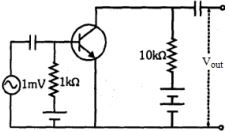
MediumMCQ
In the given common-emitter circuit, an $npn$ transistor with $\beta = 100$ is connected. What is the output voltage of the amplifier?
A
$10 \text{ mV}$
B
$0.1 \text{ V}$
C
$1.0 \text{ V}$
D
$10 \text{ V}$
Solution
(C) The voltage gain $A_v$ for a common-emitter amplifier is given by $A_v = \beta \times \frac{R_L}{R_{in}}$.
Given: $\beta = 100$, $R_L = 10 \text{ k}\Omega$, $R_{in} = 1 \text{ k}\Omega$, and $V_{in} = 1 \text{ mV}$.
The output voltage $V_{out}$ is calculated as:
$V_{out} = A_v \times V_{in} = \beta \times \frac{R_L}{R_{in}} \times V_{in}$
$V_{out} = 100 \times \frac{10 \text{ k}\Omega}{1 \text{ k}\Omega} \times 1 \text{ mV}$
$V_{out} = 100 \times 10 \times 1 \text{ mV} = 1000 \text{ mV} = 1.0 \text{ V}$.
Given: $\beta = 100$, $R_L = 10 \text{ k}\Omega$, $R_{in} = 1 \text{ k}\Omega$, and $V_{in} = 1 \text{ mV}$.
The output voltage $V_{out}$ is calculated as:
$V_{out} = A_v \times V_{in} = \beta \times \frac{R_L}{R_{in}} \times V_{in}$
$V_{out} = 100 \times \frac{10 \text{ k}\Omega}{1 \text{ k}\Omega} \times 1 \text{ mV}$
$V_{out} = 100 \times 10 \times 1 \text{ mV} = 1000 \text{ mV} = 1.0 \text{ V}$.
0 likes
View Solution85
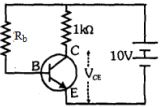
MediumMCQ
In the given circuit,a transistor with a current gain $\beta = 100$ is used. To have $V_{CE} = 5 \text{ V}$ and $V_{BE} = 0$,what should be the value of the base resistance $R_b$?
A
$1 \times 10^3 \Omega$
B
$500 \Omega$
C
$200 \times 10^3 \Omega$
D
$2 \times 10^3 \Omega$
Solution
(C) From the collector circuit,applying Kirchhoff's Voltage Law $(KVL)$:
$V_{CC} = I_C R_C + V_{CE}$
Given $V_{CC} = 10 \text{ V}$,$V_{CE} = 5 \text{ V}$,and $R_C = 1 \text{ k}\Omega = 1000 \Omega$.
$10 = I_C (1000) + 5$
$I_C = \frac{5}{1000} = 5 \times 10^{-3} \text{ A} = 5 \text{ mA}$.
Now,for the base circuit:
$V_{CC} = I_B R_b + V_{BE}$
Given $V_{BE} = 0$ and $V_{CC} = 10 \text{ V}$.
Since $\beta = \frac{I_C}{I_B}$,we have $I_B = \frac{I_C}{\beta} = \frac{5 \times 10^{-3}}{100} = 5 \times 10^{-5} \text{ A}$.
Substituting into the base circuit equation:
$10 = (5 \times 10^{-5}) R_b + 0$
$R_b = \frac{10}{5 \times 10^{-5}} = 2 \times 10^5 \Omega = 200 \times 10^3 \Omega$.
$V_{CC} = I_C R_C + V_{CE}$
Given $V_{CC} = 10 \text{ V}$,$V_{CE} = 5 \text{ V}$,and $R_C = 1 \text{ k}\Omega = 1000 \Omega$.
$10 = I_C (1000) + 5$
$I_C = \frac{5}{1000} = 5 \times 10^{-3} \text{ A} = 5 \text{ mA}$.
Now,for the base circuit:
$V_{CC} = I_B R_b + V_{BE}$
Given $V_{BE} = 0$ and $V_{CC} = 10 \text{ V}$.
Since $\beta = \frac{I_C}{I_B}$,we have $I_B = \frac{I_C}{\beta} = \frac{5 \times 10^{-3}}{100} = 5 \times 10^{-5} \text{ A}$.
Substituting into the base circuit equation:
$10 = (5 \times 10^{-5}) R_b + 0$
$R_b = \frac{10}{5 \times 10^{-5}} = 2 \times 10^5 \Omega = 200 \times 10^3 \Omega$.
0 likes
View Solution86
MediumMCQ
For a $CE$ amplifier,the current gain is $60$. If the load resistance is $5 \times 10^3 \ \Omega$ and the input resistance is $5 \times 10^2 \ \Omega$,then the voltage gain is .......
A
$500$
B
$460$
C
$600$
D
$560$
Solution
(C) Given: Current gain $\beta = 60$,Load resistance $R_L = 5 \times 10^3 \ \Omega$,Input resistance $r_i = 5 \times 10^2 \ \Omega$.
The voltage gain $A_V$ for a common emitter amplifier is given by the formula:
$A_V = \beta \times \frac{R_L}{r_i}$
Substituting the given values into the formula:
$A_V = 60 \times \frac{5 \times 10^3}{5 \times 10^2}$
$A_V = 60 \times 10 = 600$
Therefore,the voltage gain is $600$.
The voltage gain $A_V$ for a common emitter amplifier is given by the formula:
$A_V = \beta \times \frac{R_L}{r_i}$
Substituting the given values into the formula:
$A_V = 60 \times \frac{5 \times 10^3}{5 \times 10^2}$
$A_V = 60 \times 10 = 600$
Therefore,the voltage gain is $600$.
0 likes
View Solution87
MediumMCQ
In a $CB$ amplifier,the collector current is $5.488 \ mA$ and the emitter current is $5.6 \ mA$. The current gain $(\beta)$ of this transistor will be .......
A
$48$
B
$49$
C
$50$
D
$51$
Solution
(B) Given: Collector current $I_C = 5.488 \ mA$ and Emitter current $I_E = 5.6 \ mA$.
First,calculate the base current $I_B$ using the relation $I_E = I_C + I_B$.
$I_B = I_E - I_C = 5.6 \ mA - 5.488 \ mA = 0.112 \ mA$.
The current gain $\beta$ is defined as the ratio of collector current to base current: $\beta = \frac{I_C}{I_B}$.
Substituting the values: $\beta = \frac{5.488}{0.112} = 49$.
Therefore,the current gain $\beta$ is $49$.
First,calculate the base current $I_B$ using the relation $I_E = I_C + I_B$.
$I_B = I_E - I_C = 5.6 \ mA - 5.488 \ mA = 0.112 \ mA$.
The current gain $\beta$ is defined as the ratio of collector current to base current: $\beta = \frac{I_C}{I_B}$.
Substituting the values: $\beta = \frac{5.488}{0.112} = 49$.
Therefore,the current gain $\beta$ is $49$.
0 likes
View Solution88
EasyMCQ
For a given transistor,if $\alpha = 0.95$,find the common emitter current gain $\beta$.
A
$95$
B
$19$
C
$0.95$
D
$100$
Solution
(B) The relationship between common base current gain $\alpha$ and common emitter current gain $\beta$ is given by the formula: $\beta = \frac{\alpha}{1 - \alpha}$.
Given $\alpha = 0.95$.
Substituting the value: $\beta = \frac{0.95}{1 - 0.95} = \frac{0.95}{0.05}$.
Calculating the result: $\beta = \frac{95}{5} = 19$.
Given $\alpha = 0.95$.
Substituting the value: $\beta = \frac{0.95}{1 - 0.95} = \frac{0.95}{0.05}$.
Calculating the result: $\beta = \frac{95}{5} = 19$.
0 likes
View Solution89
MediumMCQ
Three terminals of a transistor,denoted by $P, Q,$ and $R,$ are tested using a multimeter. No conduction occurs between $P$ and $Q.$ When the negative lead of the multimeter is connected to $R$ and the positive lead is connected to either $P$ or $Q,$ the meter shows some resistance. Which of the following options is correct for the given transistor?
A
It is an $N-P-N$ transistor and $R$ is the collector.
B
It is an $N-P-N$ transistor and $R$ is the base.
C
It is a $P-N-P$ transistor and $R$ is the collector.
D
It is a $P-N-P$ transistor and $R$ is the base.
Solution
(D) When the negative lead of the multimeter is connected to terminal $R$ and the positive lead is connected to either $P$ or $Q,$ the meter shows some resistance. This indicates that both junctions (base-collector and base-emitter) are forward-biased,which implies that $R$ must be the base terminal.
Since the meter shows resistance when the negative lead is connected to the base $(R)$,it means the base is of $N$-type material. Therefore,the transistor must be a $P-N-P$ transistor.
Since the meter shows resistance when the negative lead is connected to the base $(R)$,it means the base is of $N$-type material. Therefore,the transistor must be a $P-N-P$ transistor.
0 likes
View Solution90
MediumMCQ
In a common-emitter transistor,the current gain $\beta$ is $49$. If there is a change of $5.0 \ \mu A$ in the base current,what will be the change in the collector current and the emitter current?
A
$245 \ \mu A, 250 \ \mu A$
B
$240 \ \mu A, 235 \ \mu A$
C
$260 \ \mu A, 255 \ \mu A$
D
None of these
Solution
(A) Given: Current gain $\beta = 49$,Change in base current $\Delta I_B = 5.0 \ \mu A$.
The change in collector current is given by $\Delta I_C = \beta \times \Delta I_B$.
Substituting the values: $\Delta I_C = 49 \times 5.0 \ \mu A = 245 \ \mu A$.
The change in emitter current is given by $\Delta I_E = \Delta I_B + \Delta I_C$.
Substituting the values: $\Delta I_E = 5.0 \ \mu A + 245 \ \mu A = 250 \ \mu A$.
Therefore,the change in collector current is $245 \ \mu A$ and the change in emitter current is $250 \ \mu A$.
The change in collector current is given by $\Delta I_C = \beta \times \Delta I_B$.
Substituting the values: $\Delta I_C = 49 \times 5.0 \ \mu A = 245 \ \mu A$.
The change in emitter current is given by $\Delta I_E = \Delta I_B + \Delta I_C$.
Substituting the values: $\Delta I_E = 5.0 \ \mu A + 245 \ \mu A = 250 \ \mu A$.
Therefore,the change in collector current is $245 \ \mu A$ and the change in emitter current is $250 \ \mu A$.
0 likes
View Solution91
MediumMCQ
In a common base amplifier,the phase difference between the input and output voltage is .......
A
Zero
B
$ \pi /2 \text{ rad} $
C
$ \pi /4 \text{ rad} $
D
$ \pi \text{ rad} $
Solution
(A) In a common base $(CB)$ amplifier configuration,the input signal is applied between the emitter and base,and the output is taken between the collector and base.
Since the input and output signals are in phase with each other,the phase difference between them is $0$.
Since the input and output signals are in phase with each other,the phase difference between them is $0$.
0 likes
View Solution92
MediumMCQ
For a common emitter amplifier,the current gain is $50$. If the emitter current is $6.6 \ mA$,then the value of the base current is ........ (in $mA$)
A
$1.125$
B
$0.062$
C
$0.129$
D
$0.567$
Solution
(C) Given: Current gain $\beta = 50$ and emitter current $I_E = 6.6 \ mA$.
We know that the relationship between collector current $I_C$ and base current $I_B$ is given by $\beta = \frac{I_C}{I_B}$,which implies $I_C = 50 I_B$.
Also,the emitter current is the sum of collector current and base current: $I_E = I_C + I_B$.
Substituting $I_C = 50 I_B$ into the equation: $6.6 \ mA = 50 I_B + I_B = 51 I_B$.
Therefore,$I_B = \frac{6.6}{51} \ mA \approx 0.129 \ mA$.
We know that the relationship between collector current $I_C$ and base current $I_B$ is given by $\beta = \frac{I_C}{I_B}$,which implies $I_C = 50 I_B$.
Also,the emitter current is the sum of collector current and base current: $I_E = I_C + I_B$.
Substituting $I_C = 50 I_B$ into the equation: $6.6 \ mA = 50 I_B + I_B = 51 I_B$.
Therefore,$I_B = \frac{6.6}{51} \ mA \approx 0.129 \ mA$.
0 likes
View Solution93
DifficultMCQ
In a $CE$ circuit,the collector of a transistor is kept at a constant voltage $V_C = 1.5 \ V$. When the base current changes from $100 \ \mu A$ to $150 \ \mu A$,the collector current changes from $5 \ mA$ to $10 \ mA$. The current gain $\beta$ for this transistor is:
A
$50$
B
$67$
C
$75$
D
$100$
Solution
(D) The change in base current is given by $\Delta I_B = 150 \ \mu A - 100 \ \mu A = 50 \ \mu A = 50 \times 10^{-6} \ A$.
The change in collector current is given by $\Delta I_C = 10 \ mA - 5 \ mA = 5 \ mA = 5 \times 10^{-3} \ A$.
The current gain $\beta$ is defined as the ratio of the change in collector current to the change in base current:
$\beta = \frac{\Delta I_C}{\Delta I_B} = \frac{5 \times 10^{-3} \ A}{50 \times 10^{-6} \ A} = \frac{5000 \times 10^{-6}}{50 \times 10^{-6}} = 100$.
The change in collector current is given by $\Delta I_C = 10 \ mA - 5 \ mA = 5 \ mA = 5 \times 10^{-3} \ A$.
The current gain $\beta$ is defined as the ratio of the change in collector current to the change in base current:
$\beta = \frac{\Delta I_C}{\Delta I_B} = \frac{5 \times 10^{-3} \ A}{50 \times 10^{-6} \ A} = \frac{5000 \times 10^{-6}}{50 \times 10^{-6}} = 100$.
0 likes
View Solution94
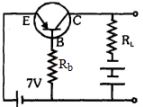
EasyMCQ
In the given transistor circuit,the base current is $35 \ \mu A$. If the value of $V_{BE}$ is negligible,what is the value of $R_b$ in $k\Omega$?
A
$100$
B
$300$
C
$200$
D
$400$
Solution
(C) From the given circuit,applying Kirchhoff's voltage law to the base-emitter loop:
$V_{source} = I_B R_b + V_{BE}$
Given $V_{source} = 7 \ V$,$I_B = 35 \ \mu A = 35 \times 10^{-6} \ A$,and $V_{BE} \approx 0 \ V$.
Substituting the values:
$7 = (35 \times 10^{-6}) \times R_b + 0$
$R_b = \frac{7}{35 \times 10^{-6}} \ \Omega$
$R_b = \frac{1}{5} \times 10^6 \ \Omega = 0.2 \times 10^6 \ \Omega = 200 \ \times 10^3 \ \Omega = 200 \ k\Omega$.
$V_{source} = I_B R_b + V_{BE}$
Given $V_{source} = 7 \ V$,$I_B = 35 \ \mu A = 35 \times 10^{-6} \ A$,and $V_{BE} \approx 0 \ V$.
Substituting the values:
$7 = (35 \times 10^{-6}) \times R_b + 0$
$R_b = \frac{7}{35 \times 10^{-6}} \ \Omega$
$R_b = \frac{1}{5} \times 10^6 \ \Omega = 0.2 \times 10^6 \ \Omega = 200 \ \times 10^3 \ \Omega = 200 \ k\Omega$.
0 likes
View Solution95
EasyMCQ
In a transistor amplifier, $\beta = 62$, $R_L = 5 \times 10^3 \ \Omega$, and the input resistance is $500 \ \Omega$. The ratio of power gain to voltage gain is .......
A
$60$
B
$61$
C
$62$
D
$100$
Solution
(C) The power gain $(A_P)$ of an amplifier is defined as the product of the voltage gain $(A_V)$ and the current gain $(\beta)$.
$A_P = A_V \times \beta$
Dividing both sides by the voltage gain $(A_V)$, we get:
$\frac{A_P}{A_V} = \beta$
Given that $\beta = 62$, the ratio of power gain to voltage gain is $62$.
$A_P = A_V \times \beta$
Dividing both sides by the voltage gain $(A_V)$, we get:
$\frac{A_P}{A_V} = \beta$
Given that $\beta = 62$, the ratio of power gain to voltage gain is $62$.
0 likes
View Solution96
EasyMCQ
In the $CB$ mode of a transistor, when the collector voltage changes by $0.5 \ V$, the collector current changes by $0.05 \ mA$. What is the output resistance in $k\Omega$?
A
$10$
B
$20$
C
$5$
D
$2.5$
Solution
(A) The output resistance $(R_o)$ in common base $(CB)$ configuration is defined as the ratio of the change in collector-base voltage $(\Delta V_{CB})$ to the change in collector current $(\Delta I_C)$ while keeping the emitter current constant.
Formula: $R_o = \frac{\Delta V_{CB}}{\Delta I_C}$
Given:
$\Delta V_{CB} = 0.5 \ V$
$\Delta I_C = 0.05 \ mA$
Calculation:
$R_o = \frac{0.5 \ V}{0.05 \ mA} = \frac{0.5}{0.05} \ k\Omega = 10 \ k\Omega$
Therefore, the output resistance is $10 \ k\Omega$.
Formula: $R_o = \frac{\Delta V_{CB}}{\Delta I_C}$
Given:
$\Delta V_{CB} = 0.5 \ V$
$\Delta I_C = 0.05 \ mA$
Calculation:
$R_o = \frac{0.5 \ V}{0.05 \ mA} = \frac{0.5}{0.05} \ k\Omega = 10 \ k\Omega$
Therefore, the output resistance is $10 \ k\Omega$.
0 likes
View Solution97
MediumMCQ
In an $NPN$ transistor,$10^{10}$ electrons enter the emitter in $10^{-6} \ s$ and $2\%$ of the electrons recombine with holes in the base. The current gains $\alpha$ and $\beta$ are respectively:
A
$1.2, 45$
B
$2.1, 38$
C
$0.98, 49$
D
$3.1, 32$
Solution
(C) The emitter current $I_e$ is given by $I_e = \frac{n \cdot e}{t} = \frac{10^{10} \times 1.6 \times 10^{-19}}{10^{-6}} = 1.6 \times 10^{-3} \ A = 1.6 \ mA$.
Since $2\%$ of electrons recombine in the base,the base current $I_b = 0.02 \times I_e = 0.02 \times 1.6 \ mA = 0.032 \ mA$.
The collector current $I_c = I_e - I_b = 1.6 \ mA - 0.032 \ mA = 1.568 \ mA$.
The current gain $\alpha = \frac{I_c}{I_e} = \frac{1.568}{1.6} = 0.98$.
The current gain $\beta = \frac{I_c}{I_b} = \frac{1.568}{0.032} = 49$.
Thus,the values are $0.98$ and $49$.
Since $2\%$ of electrons recombine in the base,the base current $I_b = 0.02 \times I_e = 0.02 \times 1.6 \ mA = 0.032 \ mA$.
The collector current $I_c = I_e - I_b = 1.6 \ mA - 0.032 \ mA = 1.568 \ mA$.
The current gain $\alpha = \frac{I_c}{I_e} = \frac{1.568}{1.6} = 0.98$.
The current gain $\beta = \frac{I_c}{I_b} = \frac{1.568}{0.032} = 49$.
Thus,the values are $0.98$ and $49$.
0 likes
View Solution98
MediumMCQ
In a transistor,the value of $\beta$ is $50$. The value of $\alpha$ is ........
A
$0.98$
B
$1.50$
C
$1.80$
D
$2.10$
Solution
(A) The relationship between current gain $\alpha$ and $\beta$ is given by the formula: $\beta = \frac{\alpha}{1 - \alpha}$.
Given that $\beta = 50$,we substitute this into the equation:
$50 = \frac{\alpha}{1 - \alpha}$.
Multiplying both sides by $(1 - \alpha)$,we get:
$50(1 - \alpha) = \alpha$.
$50 - 50\alpha = \alpha$.
$50 = 51\alpha$.
$\alpha = \frac{50}{51} \approx 0.98$.
Given that $\beta = 50$,we substitute this into the equation:
$50 = \frac{\alpha}{1 - \alpha}$.
Multiplying both sides by $(1 - \alpha)$,we get:
$50(1 - \alpha) = \alpha$.
$50 - 50\alpha = \alpha$.
$50 = 51\alpha$.
$\alpha = \frac{50}{51} \approx 0.98$.
0 likes
View Solution99
EasyMCQ
In an amplifier circuit,the value of the load resistance $R_L$ is $2 \text{ k}\Omega$. $A$ change of $10 \text{ }\mu\text{A}$ in the base current of the transistor results in a change of $1 \text{ mA}$ in the collector current. The change in the collector-emitter voltage $(V_{CE})$ is ....... $V$.
A
$2$
B
$0.2$
C
$0.5$
D
$100$
Solution
(A) Given: Load resistance $R_L = 2 \text{ k}\Omega = 2 \times 10^3 \text{ }\Omega$.
Change in base current $\Delta I_B = 10 \text{ }\mu\text{A} = 10^{-5} \text{ A}$.
Change in collector current $\Delta I_C = 1 \text{ mA} = 10^{-3} \text{ A}$.
The change in collector-emitter voltage is given by the formula $\Delta V_{CE} = R_L \times \Delta I_C$.
Substituting the values: $\Delta V_{CE} = (2 \times 10^3 \text{ }\Omega) \times (10^{-3} \text{ A}) = 2 \text{ V}$.
Therefore,the change in collector-emitter voltage is $2 \text{ V}$.
Change in base current $\Delta I_B = 10 \text{ }\mu\text{A} = 10^{-5} \text{ A}$.
Change in collector current $\Delta I_C = 1 \text{ mA} = 10^{-3} \text{ A}$.
The change in collector-emitter voltage is given by the formula $\Delta V_{CE} = R_L \times \Delta I_C$.
Substituting the values: $\Delta V_{CE} = (2 \times 10^3 \text{ }\Omega) \times (10^{-3} \text{ A}) = 2 \text{ V}$.
Therefore,the change in collector-emitter voltage is $2 \text{ V}$.
0 likes
View Solution100
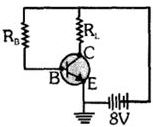
DifficultMCQ
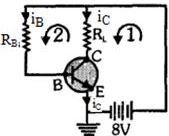
In an $N-P-N$ transistor circuit,the common emitter configuration is used. $A$ load resistor $R_L$ is connected to the collector and a base resistor $R_B$ is connected to the base. Given $V_{CC} = 8V$,$V_{CE} = 4V$,$V_{BE} = 0.6V$,collector current $I_C = 4mA$,and current gain $\beta = 100$,find the values of $R_L$ and $R_B$ respectively.
A
$1 k\Omega, 185 k\Omega$
B
$1.9 k\Omega, 175 k\Omega$
C
$3.4 k\Omega, 195 k\Omega$
D
$0.7 k\Omega, 168 k\Omega$
Solution
(A) Given $I_C = 4mA = 4 \times 10^{-3} A$. Applying Kirchhoff's voltage law to the collector circuit:
$V_{CC} = I_C R_L + V_{CE}$
$8V = (4 \times 10^{-3} A) R_L + 4V$
$4V = (4 \times 10^{-3} A) R_L$
$R_L = \frac{4}{4 \times 10^{-3}} \Omega = 1000 \Omega = 1 k\Omega$
Now,for the base circuit,the base current $I_B$ is given by:
$I_B = \frac{I_C}{\beta} = \frac{4mA}{100} = 0.04mA = 4 \times 10^{-5} A$
Applying Kirchhoff's voltage law to the base circuit:
$V_{CC} = I_B R_B + V_{BE}$
$8V = (4 \times 10^{-5} A) R_B + 0.6V$
$7.4V = (4 \times 10^{-5} A) R_B$
$R_B = \frac{7.4}{4 \times 10^{-5}} \Omega = 1.85 \times 10^5 \Omega = 185 k\Omega$
Thus,$R_L = 1 k\Omega$ and $R_B = 185 k\Omega$.
$V_{CC} = I_C R_L + V_{CE}$
$8V = (4 \times 10^{-3} A) R_L + 4V$
$4V = (4 \times 10^{-3} A) R_L$
$R_L = \frac{4}{4 \times 10^{-3}} \Omega = 1000 \Omega = 1 k\Omega$
Now,for the base circuit,the base current $I_B$ is given by:
$I_B = \frac{I_C}{\beta} = \frac{4mA}{100} = 0.04mA = 4 \times 10^{-5} A$
Applying Kirchhoff's voltage law to the base circuit:
$V_{CC} = I_B R_B + V_{BE}$
$8V = (4 \times 10^{-5} A) R_B + 0.6V$
$7.4V = (4 \times 10^{-5} A) R_B$
$R_B = \frac{7.4}{4 \times 10^{-5}} \Omega = 1.85 \times 10^5 \Omega = 185 k\Omega$
Thus,$R_L = 1 k\Omega$ and $R_B = 185 k\Omega$.
0 likes
View SolutionSemiconductor Electronics — Junction Transistor · Frequently Asked Questions
1Are these Semiconductor Electronics questions useful for JEE and NEET?
Yes. All questions in this section are mapped to JEE Main and NEET exam patterns. Previous year questions from JEE Main, NEET, GUJCET and state-level exams are included with full solutions.
2Can I switch to Hindi or Gujarati for these questions?
Yes. Use the language tabs in the hero section or the sidebar to view the same questions and solutions in English, Hindi or Gujarati.
3How do I generate a question paper from this subtopic?
Use the Vedclass Exam Paper Generator — select the chapter and subtopic, set difficulty, and generate Sets A, B, C, D automatically. First 3 chapters of every subject are free.
Vedclass Products
For Students
Vedclass Test Series
Mock tests in real JEE/NEET style with performance analysis. 5-day free trial.
Start Free TrialFor Teachers
Exam Paper Generator
Generate Set A/B/C/D papers from this chapter in 2 minutes. 3 chapters free.
Try FreeFor Institutes
Online Exam Module
Live online exams with unlimited students, 360° analytics & white-label branding.
See DemoFor Teachers & Institutes
Generate a Semiconductor Electronics Exam Paper in 2 Minutes
Select subtopic & difficulty — Sets A, B, C, D auto-generated with No Repeat logic.
First 3 chapters of every subject are free — no payment required.