
A English
The Moving Coil Galvanometer (Sensitivity) and Ammeter and Voltmeter Conversion Questions in English
Class 12 Physics · Moving Charges and Magnetism · The Moving Coil Galvanometer (Sensitivity) and Ammeter and Voltmeter Conversion
388+
Questions
English
Language
100%
With Solutions
Showing 50 of 388 questions in English
51
MediumMCQ
$A$ $100\, \Omega$ galvanometer gives full-scale deflection at $10\, mA$. How much shunt is required to read $100\, mA$?
A
$11.11$
B
$9.9$
C
$1.1$
D
$4.4$
Solution
(A) Given: Galvanometer resistance $G = 100\, \Omega$,full-scale current $I_g = 10\, mA = 10 \times 10^{-3}\, A$,and the desired range $I = 100\, mA = 100 \times 10^{-3}\, A$.
The formula for the shunt resistance $S$ required to convert a galvanometer into an ammeter is given by:
$S = \frac{I_g \cdot G}{I - I_g}$
Substituting the values:
$S = \frac{10 \times 10^{-3} \times 100}{100 \times 10^{-3} - 10 \times 10^{-3}}$
$S = \frac{1}{90 \times 10^{-3}} = \frac{1000}{90}$
$S = 11.11\, \Omega$.
The formula for the shunt resistance $S$ required to convert a galvanometer into an ammeter is given by:
$S = \frac{I_g \cdot G}{I - I_g}$
Substituting the values:
$S = \frac{10 \times 10^{-3} \times 100}{100 \times 10^{-3} - 10 \times 10^{-3}}$
$S = \frac{1}{90 \times 10^{-3}} = \frac{1000}{90}$
$S = 11.11\, \Omega$.
0 likes
View Solution52
MediumMCQ
An ammeter of $100 \, \Omega$ resistance gives full-scale deflection for a current of $10^{-5} \, A$. The shunt resistance required to convert it into an ammeter of $1 \, A$ range will be:
A
$10^{-4} \, \Omega$
B
$10^{-5} \, \Omega$
C
$10^{-3} \, \Omega$
D
$10^{-1} \, \Omega$
Solution
(C) Given: Galvanometer resistance $G = 100 \, \Omega$,full-scale deflection current $I_g = 10^{-5} \, A$,and the desired range $I = 1 \, A$.
To convert a galvanometer into an ammeter,a shunt resistance $S$ is connected in parallel.
The formula for shunt resistance is $S = \frac{I_g \cdot G}{I - I_g}$.
Substituting the values: $S = \frac{10^{-5} \times 100}{1 - 10^{-5}}$.
Since $10^{-5}$ is negligible compared to $1$,we have $S \approx \frac{10^{-5} \times 10^2}{1} = 10^{-3} \, \Omega$.
Thus,the required shunt resistance is $10^{-3} \, \Omega$.
To convert a galvanometer into an ammeter,a shunt resistance $S$ is connected in parallel.
The formula for shunt resistance is $S = \frac{I_g \cdot G}{I - I_g}$.
Substituting the values: $S = \frac{10^{-5} \times 100}{1 - 10^{-5}}$.
Since $10^{-5}$ is negligible compared to $1$,we have $S \approx \frac{10^{-5} \times 10^2}{1} = 10^{-3} \, \Omega$.
Thus,the required shunt resistance is $10^{-3} \, \Omega$.
0 likes
View Solution53
MediumMCQ
$A$ galvanometer of resistance $36 \ \Omega$ is converted into an ammeter by using a shunt of $4 \ \Omega$. The fraction $f_0$ of the total current passing through the galvanometer is:
A
$\frac{1}{40}$
B
$\frac{1}{4}$
C
$\frac{1}{140}$
D
$\frac{1}{10}$
Solution
(D) Let $G$ be the resistance of the galvanometer and $S$ be the resistance of the shunt.
Given: $G = 36 \ \Omega$,$S = 4 \ \Omega$.
The fraction of the total current $i$ passing through the galvanometer is given by the formula:
$f_0 = \frac{i_g}{i} = \frac{S}{G + S}$
Substituting the given values:
$f_0 = \frac{4}{36 + 4} = \frac{4}{40} = \frac{1}{10}$
Therefore,the fraction of the total current passing through the galvanometer is $\frac{1}{10}$.
Given: $G = 36 \ \Omega$,$S = 4 \ \Omega$.
The fraction of the total current $i$ passing through the galvanometer is given by the formula:
$f_0 = \frac{i_g}{i} = \frac{S}{G + S}$
Substituting the given values:
$f_0 = \frac{4}{36 + 4} = \frac{4}{40} = \frac{1}{10}$
Therefore,the fraction of the total current passing through the galvanometer is $\frac{1}{10}$.
0 likes
View Solution54
MediumMCQ
$A$ $50\, \Omega$ galvanometer gets full-scale deflection when a current of $0.01\, A$ passes through the coil. When it is converted to a $10\, A$ ammeter,the shunt resistance is ........... $\Omega$.
A
$0.01$
B
$0.05$
C
$2000$
D
$5000$
Solution
(B) The formula for the shunt resistance $S$ required to convert a galvanometer of resistance $G$ into an ammeter of range $I$ is given by $S = \frac{I_g G}{I - I_g}$.
Given:
Galvanometer resistance $G = 50\, \Omega$.
Full-scale deflection current $I_g = 0.01\, A$.
Desired range of ammeter $I = 10\, A$.
Substituting the values into the formula:
$S = \frac{0.01 \times 50}{10 - 0.01}$
$S = \frac{0.5}{9.99}$
$S \approx 0.05\, \Omega$.
Thus,the shunt resistance is $0.05\, \Omega$.
Given:
Galvanometer resistance $G = 50\, \Omega$.
Full-scale deflection current $I_g = 0.01\, A$.
Desired range of ammeter $I = 10\, A$.
Substituting the values into the formula:
$S = \frac{0.01 \times 50}{10 - 0.01}$
$S = \frac{0.5}{9.99}$
$S \approx 0.05\, \Omega$.
Thus,the shunt resistance is $0.05\, \Omega$.
0 likes
View Solution55
MediumMCQ
An ammeter reads up to $1\, A$. Its internal resistance is $0.81\, \Omega$. To increase the range to $10\, A$,the value of the required shunt is ............ $\Omega$.
A
$0.09$
B
$0.03$
C
$0.3$
D
$0.9$
Solution
(A) Given:
Full-scale current of the ammeter,$I_g = 1\, A$.
Internal resistance of the ammeter,$G = 0.81\, \Omega$.
Desired range of the ammeter,$I = 10\, A$.
Let $S$ be the required shunt resistance.
The formula for the shunt resistance required to increase the range of an ammeter is given by:
$S = \frac{I_g \cdot G}{I - I_g}$
Substituting the given values:
$S = \frac{1 \cdot 0.81}{10 - 1}$
$S = \frac{0.81}{9}$
$S = 0.09\, \Omega$.
Therefore,the required shunt resistance is $0.09\, \Omega$.
Full-scale current of the ammeter,$I_g = 1\, A$.
Internal resistance of the ammeter,$G = 0.81\, \Omega$.
Desired range of the ammeter,$I = 10\, A$.
Let $S$ be the required shunt resistance.
The formula for the shunt resistance required to increase the range of an ammeter is given by:
$S = \frac{I_g \cdot G}{I - I_g}$
Substituting the given values:
$S = \frac{1 \cdot 0.81}{10 - 1}$
$S = \frac{0.81}{9}$
$S = 0.09\, \Omega$.
Therefore,the required shunt resistance is $0.09\, \Omega$.
0 likes
View Solution56
EasyMCQ
The maximum current that can be measured by a galvanometer of resistance $40 \,\Omega$ is $10 \,mA$. It is converted into a voltmeter that can read up to $50 \,V$. The resistance to be connected in series with the galvanometer is ... (in $\Omega$)
A
$5040$
B
$4960$
C
$2010$
D
$4050$
Solution
(B) To convert a galvanometer into a voltmeter,a high resistance $R$ must be connected in series with it.
The formula for the series resistance is given by $R = \frac{V}{I_g} - G$,where $V$ is the maximum voltage to be measured,$I_g$ is the full-scale deflection current of the galvanometer,and $G$ is the resistance of the galvanometer.
Given: $V = 50 \,V$,$I_g = 10 \,mA = 10 \times 10^{-3} \,A = 0.01 \,A$,and $G = 40 \,\Omega$.
Substituting the values: $R = \frac{50}{0.01} - 40$.
$R = 5000 - 40 = 4960 \,\Omega$.
Thus,the required resistance is $4960 \,\Omega$.
The formula for the series resistance is given by $R = \frac{V}{I_g} - G$,where $V$ is the maximum voltage to be measured,$I_g$ is the full-scale deflection current of the galvanometer,and $G$ is the resistance of the galvanometer.
Given: $V = 50 \,V$,$I_g = 10 \,mA = 10 \times 10^{-3} \,A = 0.01 \,A$,and $G = 40 \,\Omega$.
Substituting the values: $R = \frac{50}{0.01} - 40$.
$R = 5000 - 40 = 4960 \,\Omega$.
Thus,the required resistance is $4960 \,\Omega$.
0 likes
View Solution57
MediumMCQ
$A$ galvanometer of $50 \, \Omega$ resistance has $25$ divisions. $A$ current of $4 \times 10^{-4} \, A$ gives a deflection of one division. To convert this galvanometer into a voltmeter having a range of $25 \, V$, it should be connected with a resistance of
A
$2500 \, \Omega$ as a shunt
B
$2450 \, \Omega$ as a shunt
C
$2550 \, \Omega$ in series
D
$2450 \, \Omega$ in series
Solution
(D) The full-scale deflection current $I_g$ is calculated by multiplying the number of divisions by the current per division: $I_g = 25 \times 4 \times 10^{-4} \, A = 100 \times 10^{-4} \, A = 0.01 \, A$.
To convert a galvanometer into a voltmeter, a high resistance $R$ must be connected in series with it.
The formula for the series resistance is $R = \frac{V}{I_g} - G$, where $V = 25 \, V$, $I_g = 0.01 \, A$, and $G = 50 \, \Omega$.
Substituting the values: $R = \frac{25}{0.01} - 50 = 2500 - 50 = 2450 \, \Omega$.
Therefore, a resistance of $2450 \, \Omega$ should be connected in series.
To convert a galvanometer into a voltmeter, a high resistance $R$ must be connected in series with it.
The formula for the series resistance is $R = \frac{V}{I_g} - G$, where $V = 25 \, V$, $I_g = 0.01 \, A$, and $G = 50 \, \Omega$.
Substituting the values: $R = \frac{25}{0.01} - 50 = 2500 - 50 = 2450 \, \Omega$.
Therefore, a resistance of $2450 \, \Omega$ should be connected in series.
0 likes
View Solution58
MediumMCQ
$A$ galvanometer coil of resistance $50 \,\Omega$ shows full-scale deflection for a current of $100 \,\mu A$. The shunt resistance to be added to the galvanometer to convert it into an ammeter of range $10 \, mA$ is:
A
$5 \,\Omega$ in parallel
B
$0.5 \,\Omega$ in series
C
$5 \,\Omega$ in series
D
$0.5 \,\Omega$ in parallel
Solution
(D) Given: Galvanometer resistance $G = 50 \,\Omega$,full-scale deflection current $I_g = 100 \,\mu A = 100 \times 10^{-6} \, A = 10^{-4} \, A$,and the desired range $I = 10 \, mA = 10 \times 10^{-3} \, A = 10^{-2} \, A$.
To convert a galvanometer into an ammeter,a shunt resistance $S$ is connected in parallel with the galvanometer.
The formula for shunt resistance is $S = \frac{I_g \times G}{I - I_g}$.
Substituting the values: $S = \frac{10^{-4} \times 50}{10^{-2} - 10^{-4}} = \frac{50 \times 10^{-4}}{100 \times 10^{-4} - 1 \times 10^{-4}} = \frac{50 \times 10^{-4}}{99 \times 10^{-4}} = \frac{50}{99} \approx 0.505 \,\Omega$.
Rounding to the nearest provided option,the shunt resistance is $0.5 \,\Omega$ in parallel.
To convert a galvanometer into an ammeter,a shunt resistance $S$ is connected in parallel with the galvanometer.
The formula for shunt resistance is $S = \frac{I_g \times G}{I - I_g}$.
Substituting the values: $S = \frac{10^{-4} \times 50}{10^{-2} - 10^{-4}} = \frac{50 \times 10^{-4}}{100 \times 10^{-4} - 1 \times 10^{-4}} = \frac{50 \times 10^{-4}}{99 \times 10^{-4}} = \frac{50}{99} \approx 0.505 \,\Omega$.
Rounding to the nearest provided option,the shunt resistance is $0.5 \,\Omega$ in parallel.
0 likes
View Solution59
MediumMCQ
$A$ voltmeter essentially consists of
A
$A$ high resistance in series with a galvanometer
B
$A$ low resistance in series with a galvanometer
C
$A$ high resistance in parallel with a galvanometer
D
$A$ low resistance in parallel with a galvanometer
Solution
(A) voltmeter is a device used to measure the potential difference between two points in an electrical circuit.
To measure voltage,the voltmeter must be connected in parallel to the component across which the potential difference is to be measured.
To ensure that the voltmeter does not draw significant current from the circuit (which would alter the potential difference being measured),it must have a very high resistance.
This is achieved by connecting a high resistance in series with a galvanometer.
Therefore,the correct option is $A$.
To measure voltage,the voltmeter must be connected in parallel to the component across which the potential difference is to be measured.
To ensure that the voltmeter does not draw significant current from the circuit (which would alter the potential difference being measured),it must have a very high resistance.
This is achieved by connecting a high resistance in series with a galvanometer.
Therefore,the correct option is $A$.
0 likes
View Solution60
MediumMCQ
$A$ moving coil galvanometer of resistance $100 \,\Omega$ is used as an ammeter using a shunt resistance of $0.1 \,\Omega$. The maximum deflection current in the galvanometer is $100 \,\mu A$. Find the minimum current in the circuit so that the ammeter shows maximum deflection in $mA$.
A
$100.1$
B
$1000.1$
C
$10.01$
D
$1.01$
Solution
(A) The galvanometer resistance $G = 100 \,\Omega$ and shunt resistance $S = 0.1 \,\Omega$.
The maximum current through the galvanometer is $I_G = 100 \,\mu A = 100 \times 10^{-6} \, A = 0.1 \, mA$.
For an ammeter,the shunt resistance $S$ is connected in parallel with the galvanometer.
The potential difference across the galvanometer and the shunt is the same: $I_G \times G = (I - I_G) \times S$.
Rearranging for the total current $I$: $I = I_G \left( 1 + \frac{G}{S} \right)$.
Substituting the values: $I = 0.1 \, mA \times \left( 1 + \frac{100}{0.1} \right)$.
$I = 0.1 \, mA \times (1 + 1000) = 0.1 \times 1001 \, mA$.
$I = 100.1 \, mA$.
The maximum current through the galvanometer is $I_G = 100 \,\mu A = 100 \times 10^{-6} \, A = 0.1 \, mA$.
For an ammeter,the shunt resistance $S$ is connected in parallel with the galvanometer.
The potential difference across the galvanometer and the shunt is the same: $I_G \times G = (I - I_G) \times S$.
Rearranging for the total current $I$: $I = I_G \left( 1 + \frac{G}{S} \right)$.
Substituting the values: $I = 0.1 \, mA \times \left( 1 + \frac{100}{0.1} \right)$.
$I = 0.1 \, mA \times (1 + 1000) = 0.1 \times 1001 \, mA$.
$I = 100.1 \, mA$.
0 likes
View Solution61
MediumMCQ
$A$ microammeter has a resistance of $100\,\Omega$ and a full-scale range of $50\,\mu A$. It can be used as a voltmeter or as a higher-range ammeter provided a resistance is added to it. Pick the correct range and resistance combination.
A
$50\,V$ range with $10\,k\Omega$ resistance in series
B
$10\,V$ range with $200\,k\Omega$ resistance in series
C
$10\,mA$ range with $1\,\Omega$ resistance in parallel
D
$10\,mA$ range with $0.1\,\Omega$ resistance in parallel
Solution
(B) Given: Galvanometer resistance $G = 100\,\Omega$,full-scale current $I_g = 50\,\mu A = 50 \times 10^{-6}\,A$.
For a voltmeter (series resistance $R$):
$R = \frac{V}{I_g} - G = \frac{10}{50 \times 10^{-6}} - 100 = 200,000 - 100 = 199,900\,\Omega \approx 200\,k\Omega$.
Thus,option $(b)$ is correct.
For an ammeter (shunt resistance $S$):
$S = \frac{I_g G}{I - I_g} = \frac{50 \times 10^{-6} \times 100}{10 \times 10^{-3} - 50 \times 10^{-6}} = \frac{5 \times 10^{-3}}{10^{-2} - 0.05 \times 10^{-3}} = \frac{5 \times 10^{-3}}{9.95 \times 10^{-3}} \approx 0.5\,\Omega$.
Options $(c)$ and $(d)$ are incorrect.
For a voltmeter (series resistance $R$):
$R = \frac{V}{I_g} - G = \frac{10}{50 \times 10^{-6}} - 100 = 200,000 - 100 = 199,900\,\Omega \approx 200\,k\Omega$.
Thus,option $(b)$ is correct.
For an ammeter (shunt resistance $S$):
$S = \frac{I_g G}{I - I_g} = \frac{50 \times 10^{-6} \times 100}{10 \times 10^{-3} - 50 \times 10^{-6}} = \frac{5 \times 10^{-3}}{10^{-2} - 0.05 \times 10^{-3}} = \frac{5 \times 10^{-3}}{9.95 \times 10^{-3}} \approx 0.5\,\Omega$.
Options $(c)$ and $(d)$ are incorrect.
0 likes
View Solution62
MediumMCQ
$A$ moving coil galvanometer has $150$ equal divisions. Its current sensitivity is $10$ divisions per milliampere and voltage sensitivity is $2$ divisions per millivolt. In order that each division reads $1 \, V$,the resistance in $\Omega$ needed to be connected in series with the coil will be
A
$99995$
B
$9995$
C
$10^3$
D
$10^5$
Solution
(B) The voltage sensitivity $(V_s)$ is related to current sensitivity $(I_s)$ and galvanometer resistance $(G)$ by the formula: $V_s = \frac{I_s}{G}$.
Given $I_s = 10 \, \text{div/mA}$ and $V_s = 2 \, \text{div/mV}$,we find $G = \frac{I_s}{V_s} = \frac{10}{2} = 5 \, \Omega$.
The full-scale deflection current $(I_g)$ is the total divisions divided by current sensitivity: $I_g = \frac{150 \, \text{div}}{10 \, \text{div/mA}} = 15 \, \text{mA} = 15 \times 10^{-3} \, \text{A}$.
To make each division read $1 \, V$,the total voltage $(V)$ to be measured for full-scale deflection is $150 \, \text{divisions} \times 1 \, \text{V/division} = 150 \, \text{V}$.
To convert the galvanometer into a voltmeter of range $V$,a series resistance $R$ is required,given by $R = \frac{V}{I_g} - G$.
Substituting the values: $R = \frac{150}{15 \times 10^{-3}} - 5 = 10000 - 5 = 9995 \, \Omega$.
Given $I_s = 10 \, \text{div/mA}$ and $V_s = 2 \, \text{div/mV}$,we find $G = \frac{I_s}{V_s} = \frac{10}{2} = 5 \, \Omega$.
The full-scale deflection current $(I_g)$ is the total divisions divided by current sensitivity: $I_g = \frac{150 \, \text{div}}{10 \, \text{div/mA}} = 15 \, \text{mA} = 15 \times 10^{-3} \, \text{A}$.
To make each division read $1 \, V$,the total voltage $(V)$ to be measured for full-scale deflection is $150 \, \text{divisions} \times 1 \, \text{V/division} = 150 \, \text{V}$.
To convert the galvanometer into a voltmeter of range $V$,a series resistance $R$ is required,given by $R = \frac{V}{I_g} - G$.
Substituting the values: $R = \frac{150}{15 \times 10^{-3}} - 5 = 10000 - 5 = 9995 \, \Omega$.
0 likes
View Solution63
EasyMCQ
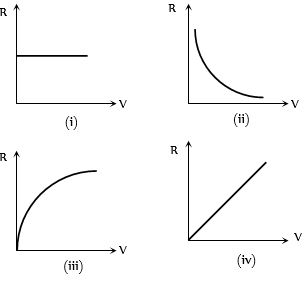
The graph which represents the relation between the total resistance $R$ of a multi-range moving coil voltmeter and its full-scale deflection $V$ is
A
$(i)$
B
$(ii)$
C
$(iii)$
D
$(iv)$
Solution
(D) To convert a galvanometer into a voltmeter,a high resistance $R$ is connected in series with the galvanometer of resistance $G$.
The total resistance of the voltmeter is $R_V = R + G$.
The full-scale deflection voltage $V$ is given by $V = i_g(R + G)$,where $i_g$ is the full-scale deflection current of the galvanometer.
Rearranging this,we get $R_V = R + G = \frac{V}{i_g}$.
Since $i_g$ is a constant for a given galvanometer,we have $R_V \propto V$.
This represents a linear relationship passing through the origin (if we consider the total resistance $R_V$ as a function of $V$).
Therefore,the graph is a straight line passing through the origin,which corresponds to graph $(iv)$.
The total resistance of the voltmeter is $R_V = R + G$.
The full-scale deflection voltage $V$ is given by $V = i_g(R + G)$,where $i_g$ is the full-scale deflection current of the galvanometer.
Rearranging this,we get $R_V = R + G = \frac{V}{i_g}$.
Since $i_g$ is a constant for a given galvanometer,we have $R_V \propto V$.
This represents a linear relationship passing through the origin (if we consider the total resistance $R_V$ as a function of $V$).
Therefore,the graph is a straight line passing through the origin,which corresponds to graph $(iv)$.
0 likes
View Solution64
MediumMCQ
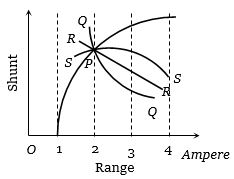
An ammeter has a range of $1 \, A$ without a shunt. The range can be varied by using different shunt resistances. The graph between shunt resistance $(S)$ and range $(I)$ will have the nature of which curve shown in the figure?
A
$P$
B
$Q$
C
$R$
D
$S$
Solution
(B) Let $I_g$ be the full-scale deflection current of the galvanometer and $G$ be its resistance. The initial range is $I_0 = I_g = 1 \, A$.
When a shunt resistance $S$ is connected in parallel,the new range $I$ is given by the formula: $I = I_g \left(1 + \frac{G}{S}\right)$.
Since $I_g = 1 \, A$,we have $I = 1 + \frac{G}{S}$.
Rearranging for $S$,we get: $S = \frac{G}{I - 1}$.
This equation represents a rectangular hyperbola where $S \to \infty$ as $I \to 1$ and $S \to 0$ as $I \to \infty$. Looking at the graph,the curve $Q$ represents this hyperbolic relationship starting from the range $1 \, A$ on the $x$-axis.
When a shunt resistance $S$ is connected in parallel,the new range $I$ is given by the formula: $I = I_g \left(1 + \frac{G}{S}\right)$.
Since $I_g = 1 \, A$,we have $I = 1 + \frac{G}{S}$.
Rearranging for $S$,we get: $S = \frac{G}{I - 1}$.
This equation represents a rectangular hyperbola where $S \to \infty$ as $I \to 1$ and $S \to 0$ as $I \to \infty$. Looking at the graph,the curve $Q$ represents this hyperbolic relationship starting from the range $1 \, A$ on the $x$-axis.
0 likes
View Solution65
MediumMCQ
Consider the following two statements $A$ and $B$ and identify the correct choice given in the answers.
$A$. Duddell's thermo-galvanometer is suitable to measure direct current only.
$B$. Thermopile can measure temperature differences of the order of $10^{-3} \, ^\circ C$.
$A$. Duddell's thermo-galvanometer is suitable to measure direct current only.
$B$. Thermopile can measure temperature differences of the order of $10^{-3} \, ^\circ C$.
A
Both $A$ and $B$ are true.
B
Both $A$ and $B$ are false.
C
$A$ is true but $B$ is false.
D
$A$ is false but $B$ is true.
Solution
(D) . The Duddell's thermo-galvanometer is an instrument used for measuring small electric currents. It is suitable for circuits of any frequency (even up to $120,000 \, Hz$) and can measure currents as small as $20 \, \mu A$. It is equally effective for both direct current $(DC)$ and alternating current $(AC)$. Therefore,statement $A$ is false.
$B$. $A$ thermopile is a device consisting of several thermocouples connected in series,used to measure small amounts of radiant heat. It is highly sensitive and can detect temperature differences of the order of $10^{-3} \, ^\circ C$. Therefore,statement $B$ is true.
Conclusion: Statement $A$ is false,and statement $B$ is true.
$B$. $A$ thermopile is a device consisting of several thermocouples connected in series,used to measure small amounts of radiant heat. It is highly sensitive and can detect temperature differences of the order of $10^{-3} \, ^\circ C$. Therefore,statement $B$ is true.
Conclusion: Statement $A$ is false,and statement $B$ is true.
0 likes
View Solution66
DifficultMCQ
An ammeter, suspected to give inaccurate reading, is connected in series with a silver voltameter. The ammeter indicates $0.54\, A$. A steady current passed for one hour deposits $2.0124\, g$ of silver. If the $E.C.E.$ of silver is $1.118 \times 10^{-3}\, g\, C^{-1}$, then the error in ammeter reading is ................ $A$.
A
$+ 0.04$
B
$+ 0.02$
C
$- 0.03$
D
$- 0.01$
Solution
(A) The actual current $i$ flowing through the circuit can be calculated using Faraday's law of electrolysis: $m = Z i t$.
Given: $m = 2.0124\, g$, $Z = 1.118 \times 10^{-3}\, g\, C^{-1}$, and $t = 1\, \text{hour} = 3600\, s$.
Rearranging for current: $i = \frac{m}{Z t}$.
Substituting the values: $i = \frac{2.0124}{1.118 \times 10^{-3} \times 3600} = \frac{2.0124}{4.0248} = 0.5\, A$.
The error in the ammeter reading is defined as: $\text{Error} = \text{Measured value} - \text{Actual value}$.
$\text{Error} = 0.54\, A - 0.5\, A = + 0.04\, A$.
Given: $m = 2.0124\, g$, $Z = 1.118 \times 10^{-3}\, g\, C^{-1}$, and $t = 1\, \text{hour} = 3600\, s$.
Rearranging for current: $i = \frac{m}{Z t}$.
Substituting the values: $i = \frac{2.0124}{1.118 \times 10^{-3} \times 3600} = \frac{2.0124}{4.0248} = 0.5\, A$.
The error in the ammeter reading is defined as: $\text{Error} = \text{Measured value} - \text{Actual value}$.
$\text{Error} = 0.54\, A - 0.5\, A = + 0.04\, A$.
0 likes
View Solution67
EasyMCQ
To make the magnetic field radial in a moving coil galvanometer:
A
The number of turns in the coil is increased
B
Magnet is taken in the form of a horse-shoe
C
Poles are cylindrically cut
D
Coil is wound on an aluminium frame
Solution
(C) In a moving coil galvanometer,a radial magnetic field is essential to ensure that the torque on the coil remains constant regardless of its orientation. This is achieved by using a soft iron core and shaping the pole pieces of the magnet into a cylindrical form. This geometry ensures that the magnetic field lines are always parallel to the plane of the coil,making the field radial.
0 likes
View Solution68
EasyMCQ
The deflection in a moving coil galvanometer is
A
Directly proportional to the torsional constant
B
Directly proportional to the number of turns in the coil
C
Inversely proportional to the area of the coil
D
Inversely proportional to the current flowing
Solution
(B) The deflection $\theta$ in a moving coil galvanometer is given by the formula $\theta = \frac{NiAB}{k}$,where $N$ is the number of turns,$i$ is the current,$A$ is the area of the coil,$B$ is the magnetic field,and $k$ is the torsional constant of the spring.
From this relation,it is clear that $\theta \propto N$.
Therefore,the deflection is directly proportional to the number of turns in the coil.
From this relation,it is clear that $\theta \propto N$.
Therefore,the deflection is directly proportional to the number of turns in the coil.
0 likes
View Solution69
EasyMCQ
$A$ moving coil sensitive galvanometer shows a large deflection. To control its speed of deflection (damping),which of the following is used?
A
$A$ high resistance is to be connected across its terminals
B
$A$ magnet should be placed near the coil
C
$A$ small copper wire should be connected across its terminals
D
The body of galvanometer should be earthed
Solution
(C) To control the speed of deflection and bring the coil to rest quickly,electromagnetic damping is required. This is achieved by winding the coil on a non-magnetic metallic frame (usually copper). When the coil moves,eddy currents are induced in the metallic frame,which oppose the motion of the coil,thereby providing the necessary damping. Thus,connecting a small copper wire across its terminals or using a metallic frame provides the required damping effect. Among the given options,connecting a low resistance (like a copper wire) across the terminals creates a closed circuit for eddy currents,providing damping.
0 likes
View Solution70
EasyMCQ
In a moving coil galvanometer,the deflection of the coil $\theta$ is related to the electrical current $i$ by the relation
A
$i \propto \tan \theta$
B
$i \propto \theta$
C
$i \propto \theta^2$
D
$i \propto \sqrt{\theta}$
Solution
(B) In a moving coil galvanometer,the magnetic torque acting on the coil is given by $\tau_m = NIAB \sin \phi$. For a radial magnetic field,$\phi = 90^\circ$,so $\tau_m = NIAB$.
This magnetic torque is balanced by the restoring torque of the spring,$\tau_r = C\theta$,where $C$ is the torsional constant.
Equating the two torques: $NIAB = C\theta$.
Rearranging for current: $i = \left( \frac{C}{NAB} \right) \theta$.
Since $C, N, A,$ and $B$ are constants for a given galvanometer,we have $i \propto \theta$.
This magnetic torque is balanced by the restoring torque of the spring,$\tau_r = C\theta$,where $C$ is the torsional constant.
Equating the two torques: $NIAB = C\theta$.
Rearranging for current: $i = \left( \frac{C}{NAB} \right) \theta$.
Since $C, N, A,$ and $B$ are constants for a given galvanometer,we have $i \propto \theta$.
0 likes
View Solution71
EasyMCQ
$A$ moving coil galvanometer has $N$ number of turns in a coil of effective area $A$,and it carries a current $I$. The magnetic field $B$ is radial. The torque acting on the coil is:
A
$N{A^2}{B^2}I$
B
$NAB{I^2}$
C
${N^2}ABI$
D
$NABI$
Solution
(D) The torque $\tau$ acting on a current-carrying coil placed in a magnetic field is given by the formula $\tau = \vec{m} \times \vec{B}$,where $\vec{m}$ is the magnetic dipole moment and $\vec{B}$ is the magnetic field.
For a coil with $N$ turns,area $A$,and current $I$,the magnetic moment is $m = NIA$.
The magnitude of the torque is $\tau = mB \sin \theta$,where $\theta$ is the angle between the normal to the coil and the magnetic field.
In a moving coil galvanometer,the magnetic field is made radial so that the plane of the coil is always parallel to the magnetic field lines. This means the angle between the normal to the coil and the magnetic field is always $90^\circ$.
Therefore,$\sin 90^\circ = 1$.
Substituting these values,we get $\tau = (NIA)B \sin 90^\circ = NABI$.
For a coil with $N$ turns,area $A$,and current $I$,the magnetic moment is $m = NIA$.
The magnitude of the torque is $\tau = mB \sin \theta$,where $\theta$ is the angle between the normal to the coil and the magnetic field.
In a moving coil galvanometer,the magnetic field is made radial so that the plane of the coil is always parallel to the magnetic field lines. This means the angle between the normal to the coil and the magnetic field is always $90^\circ$.
Therefore,$\sin 90^\circ = 1$.
Substituting these values,we get $\tau = (NIA)B \sin 90^\circ = NABI$.
0 likes
View Solution72
EasyMCQ
The pole pieces of the magnet used in a pivoted coil galvanometer are
A
Plane surfaces of a bar magnet
B
Plane surfaces of a horse-shoe magnet
C
Cylindrical surfaces of a bar magnet
D
Cylindrical surfaces of a horse-shoe magnet
Solution
(D) In a pivoted coil galvanometer, the magnetic field must be radial so that the plane of the coil is always parallel to the magnetic field lines, regardless of its orientation. This ensures that the torque on the coil remains constant $( \tau = NIAB )$ for a given current. To achieve this radial magnetic field, the pole pieces of the horse-shoe magnet are made cylindrical (concave). Thus, the correct option is $D$.
0 likes
View Solution73
EasyMCQ
The sensitiveness of a moving coil galvanometer can be increased by decreasing:
A
The number of turns in the coil
B
The area of the coil
C
The magnetic field
D
The couple per unit twist of the suspension
Solution
(D) The sensitivity $S$ of a moving coil galvanometer is given by the formula $S = \frac{\theta}{i} = \frac{nBA}{k}$,where $n$ is the number of turns,$B$ is the magnetic field,$A$ is the area of the coil,and $k$ (or $C$) is the couple per unit twist of the suspension.
From the formula,it is clear that the sensitivity $S$ is directly proportional to $n$,$B$,and $A$,and inversely proportional to $k$.
Therefore,to increase the sensitivity $S$,we must decrease the value of $k$ (the couple per unit twist of the suspension).
From the formula,it is clear that the sensitivity $S$ is directly proportional to $n$,$B$,and $A$,and inversely proportional to $k$.
Therefore,to increase the sensitivity $S$,we must decrease the value of $k$ (the couple per unit twist of the suspension).
0 likes
View Solution74
MediumMCQ
The coil of a galvanometer consists of $100$ turns and an effective area of $1 \, cm^2$. The restoring couple per unit radian is $10^{-8} \, N \cdot m/rad$. The magnetic field between the pole pieces is $5 \, T$. The current sensitivity of this galvanometer will be:
A
$5 \times 10^4 \, rad/\mu A$
B
$5 \times 10^{-6} \, rad/A$
C
$2 \times 10^{-7} \, rad/A$
D
$5 \, rad/\mu A$
Solution
(D) The current sensitivity of a galvanometer is defined as the deflection produced per unit current,given by the formula: $\frac{\theta}{i} = \frac{NBA}{k}$.
Given:
Number of turns $N = 100$
Magnetic field $B = 5 \, T$
Area $A = 1 \, cm^2 = 10^{-4} \, m^2$
Restoring couple per unit radian $k = 10^{-8} \, N \cdot m/rad$.
Substituting the values:
$\frac{\theta}{i} = \frac{100 \times 5 \times 10^{-4}}{10^{-8}}$
$\frac{\theta}{i} = \frac{5 \times 10^{-2}}{10^{-8}} = 5 \times 10^6 \, rad/A$.
Since $1 \, A = 10^6 \, \mu A$,we have:
$\frac{\theta}{i} = 5 \times 10^6 \times 10^{-6} \, rad/\mu A = 5 \, rad/\mu A$.
Given:
Number of turns $N = 100$
Magnetic field $B = 5 \, T$
Area $A = 1 \, cm^2 = 10^{-4} \, m^2$
Restoring couple per unit radian $k = 10^{-8} \, N \cdot m/rad$.
Substituting the values:
$\frac{\theta}{i} = \frac{100 \times 5 \times 10^{-4}}{10^{-8}}$
$\frac{\theta}{i} = \frac{5 \times 10^{-2}}{10^{-8}} = 5 \times 10^6 \, rad/A$.
Since $1 \, A = 10^6 \, \mu A$,we have:
$\frac{\theta}{i} = 5 \times 10^6 \times 10^{-6} \, rad/\mu A = 5 \, rad/\mu A$.
0 likes
View Solution75
EasyMCQ
The current sensitivity of a moving coil galvanometer can be increased by
A
Increasing the magnetic field of the permanent magnet
B
Increasing the area of the deflecting coil
C
Increasing the number of turns in the coil
D
All of the above
Solution
(D) The current sensitivity $(I_s)$ of a moving coil galvanometer is defined as the deflection produced per unit current,given by the formula:
$I_s = \frac{\theta}{i} = \frac{NAB}{k}$
Where:
$N$ = Number of turns in the coil
$A$ = Area of the coil
$B$ = Magnetic field strength
$k$ = Torsional constant of the spring
From the formula,it is evident that $I_s$ is directly proportional to $N$,$A$,and $B$.
Therefore,increasing the magnetic field $(B)$,the area of the coil $(A)$,or the number of turns $(N)$ will increase the current sensitivity.
Hence,the correct option is $(d)$.
$I_s = \frac{\theta}{i} = \frac{NAB}{k}$
Where:
$N$ = Number of turns in the coil
$A$ = Area of the coil
$B$ = Magnetic field strength
$k$ = Torsional constant of the spring
From the formula,it is evident that $I_s$ is directly proportional to $N$,$A$,and $B$.
Therefore,increasing the magnetic field $(B)$,the area of the coil $(A)$,or the number of turns $(N)$ will increase the current sensitivity.
Hence,the correct option is $(d)$.
0 likes
View Solution76
EasyMCQ
In order to increase the sensitivity of a moving coil galvanometer,one should decrease
A
The strength of its magnet
B
The torsional constant of its suspension
C
The number of turns in its coil
D
The area of its coil
Solution
(B) The current sensitivity of a moving coil galvanometer is given by the formula $S = \frac{NAB}{k}$,where $N$ is the number of turns,$A$ is the area of the coil,$B$ is the magnetic field strength,and $k$ (or $C$) is the torsional constant of the suspension wire.
To increase the sensitivity $S$,we must increase $N$,$A$,or $B$,or decrease the torsional constant $k$.
Therefore,decreasing the torsional constant of the suspension is the correct method to increase sensitivity.
Thus,the correct option is $B$.
To increase the sensitivity $S$,we must increase $N$,$A$,or $B$,or decrease the torsional constant $k$.
Therefore,decreasing the torsional constant of the suspension is the correct method to increase sensitivity.
Thus,the correct option is $B$.
0 likes
View Solution77
EasyMCQ
The relation between voltage sensitivity $({\sigma _V})$ and current sensitivity $({\sigma _i})$ of a moving coil galvanometer is (Resistance of Galvanometer = $G$)
A
$\frac{{\sigma _i}}{G} = {\sigma _V}$
B
$\frac{{\sigma _V}}{G} = {\sigma _i}$
C
$\frac{G}{{\sigma _V}} = {\sigma _i}$
D
$\frac{G}{{\sigma _i}} = {\sigma _V}$
Solution
(A) Current sensitivity $({\sigma _i})$ is defined as the deflection per unit current: ${\sigma _i} = \frac{\theta}{I}$.
Voltage sensitivity $({\sigma _V})$ is defined as the deflection per unit voltage: ${\sigma _V} = \frac{\theta}{V}$.
Since $V = I \cdot G$,where $G$ is the resistance of the galvanometer,we can substitute $V$ in the voltage sensitivity equation:
${\sigma _V} = \frac{\theta}{I \cdot G}$.
Substituting ${\sigma _i} = \frac{\theta}{I}$ into the expression for ${\sigma _V}$,we get:
${\sigma _V} = \frac{{\sigma _i}}{G}$.
Therefore,the relation is $\frac{{\sigma _i}}{G} = {\sigma _V}$.
Voltage sensitivity $({\sigma _V})$ is defined as the deflection per unit voltage: ${\sigma _V} = \frac{\theta}{V}$.
Since $V = I \cdot G$,where $G$ is the resistance of the galvanometer,we can substitute $V$ in the voltage sensitivity equation:
${\sigma _V} = \frac{\theta}{I \cdot G}$.
Substituting ${\sigma _i} = \frac{\theta}{I}$ into the expression for ${\sigma _V}$,we get:
${\sigma _V} = \frac{{\sigma _i}}{G}$.
Therefore,the relation is $\frac{{\sigma _i}}{G} = {\sigma _V}$.
0 likes
View Solution78
EasyMCQ
What is the shape of the magnet in a moving coil galvanometer used to create a radial magnetic field?
A
Concave
B
Horse shoe magnet
C
Convex
D
None of these
Solution
(A) In a moving coil galvanometer,a radial magnetic field is essential to ensure that the magnetic torque remains constant regardless of the coil's orientation. This is achieved by using a strong permanent magnet with concave-shaped pole pieces. These concave pole pieces,along with a cylindrical soft iron core,ensure that the magnetic field lines are always parallel to the plane of the coil,making the field radial. Therefore,the correct shape is concave.
0 likes
View Solution79
EasyMCQ
$A$ small cylindrical soft iron piece is kept in a galvanometer so that
A
$A$ radial uniform magnetic field is produced
B
$A$ uniform magnetic field is produced
C
There is a steady deflection of the coil
D
All of these
Solution
(A) soft iron core is used in a moving coil galvanometer. The soft iron core attracts the magnetic lines of force,which increases the strength of the magnetic field.
This increases the sensitivity of the galvanometer.
Furthermore,the use of a cylindrical soft iron core makes the magnetic field radial,ensuring that the plane of the coil remains parallel to the direction of the magnetic field for all orientations of the coil.
This increases the sensitivity of the galvanometer.
Furthermore,the use of a cylindrical soft iron core makes the magnetic field radial,ensuring that the plane of the coil remains parallel to the direction of the magnetic field for all orientations of the coil.
0 likes
View Solution80
EasyMCQ
Two galvanometers $A$ and $B$ require $3\,mA$ and $5\,mA$ respectively to produce the same deflection of $10$ divisions. Then:
A
$A$ is more sensitive than $B$
B
$B$ is more sensitive than $A$
C
$A$ and $B$ are equally sensitive
D
Sensitiveness of $B$ is $5/3$ times that of $A$
Solution
(A) Sensitivity $(S)$ is defined as the deflection per unit current,given by $S = \frac{\theta}{i}$.
For the same deflection $\theta = 10$ divisions:
$S_A = \frac{10}{3\,mA}$ and $S_B = \frac{10}{5\,mA}$.
Taking the ratio: $\frac{S_A}{S_B} = \frac{10/3}{10/5} = \frac{5}{3}$.
Since $\frac{S_A}{S_B} = 1.67 > 1$,it follows that $S_A > S_B$.
Therefore,galvanometer $A$ is more sensitive than $B$.
For the same deflection $\theta = 10$ divisions:
$S_A = \frac{10}{3\,mA}$ and $S_B = \frac{10}{5\,mA}$.
Taking the ratio: $\frac{S_A}{S_B} = \frac{10/3}{10/5} = \frac{5}{3}$.
Since $\frac{S_A}{S_B} = 1.67 > 1$,it follows that $S_A > S_B$.
Therefore,galvanometer $A$ is more sensitive than $B$.
0 likes
View Solution81
EasyMCQ
If the current is doubled,the deflection is also doubled in
A
$A$ tangent galvanometer
B
$A$ moving coil galvanometer
C
Both $(a)$ and $(b)$
D
None of these
Solution
(B) In a moving coil galvanometer,the torque acting on the coil is given by $\tau = NIAB \sin \theta$. In the equilibrium position,this magnetic torque is balanced by the restoring torque of the spring,$\tau_r = k \phi$,where $\phi$ is the deflection. Thus,$NIAB = k \phi$,which implies $\phi = (\frac{NAB}{k}) i$. Since $N, A, B,$ and $k$ are constants,we have $\phi \propto i$. Therefore,if the current $i$ is doubled,the deflection $\phi$ is also doubled. In a tangent galvanometer,the current is proportional to the tangent of the deflection $(i \propto \tan \theta)$,so the deflection does not double when the current doubles.
0 likes
View Solution82
EasyMCQ
In a ballistic galvanometer,the frame on which the coil is wound is non-metallic to
A
Avoid the production of induced $e.m.f.$
B
Avoid the production of eddy currents
C
Increase the production of eddy currents
D
Increase the production of induced $e.m.f.$
Solution
(B) In a moving coil galvanometer,the coil is wound on a metallic (copper or aluminum) frame to make the motion dead-beat due to the production of eddy currents,which provide electromagnetic damping.
In a ballistic galvanometer,the objective is to measure the total charge passing through the circuit,which requires the coil to oscillate with minimal damping.
Therefore,the frame is made of a non-conducting (non-metallic) material,such as paper or bamboo,to avoid the production of eddy currents that would otherwise damp the motion of the coil.
In a ballistic galvanometer,the objective is to measure the total charge passing through the circuit,which requires the coil to oscillate with minimal damping.
Therefore,the frame is made of a non-conducting (non-metallic) material,such as paper or bamboo,to avoid the production of eddy currents that would otherwise damp the motion of the coil.
0 likes
View Solution83
EasyMCQ
The sensitivity of a tangent galvanometer is increased if
A
Number of turns decreases
B
Number of turns increases
C
Field increases
D
None of the above
Solution
(B) The sensitivity $S$ of a tangent galvanometer is defined as the deflection produced per unit current,given by $S = \frac{\theta}{i}$.
From the principle of the tangent galvanometer,$i = K \tan \theta$,where $K = \frac{2R B_H}{\mu_0 N}$ is the reduction factor.
Substituting $i$ in the sensitivity formula,we get $S = \frac{\theta}{K \tan \theta} = \frac{1}{K} \cdot \frac{\theta}{\tan \theta}$.
For small angles,$\tan \theta \approx \theta$,so $S \approx \frac{1}{K} = \frac{\mu_0 N}{2R B_H}$.
From this expression,it is clear that the sensitivity $S$ is directly proportional to the number of turns $N$.
Therefore,to increase the sensitivity,the number of turns $N$ must be increased.
From the principle of the tangent galvanometer,$i = K \tan \theta$,where $K = \frac{2R B_H}{\mu_0 N}$ is the reduction factor.
Substituting $i$ in the sensitivity formula,we get $S = \frac{\theta}{K \tan \theta} = \frac{1}{K} \cdot \frac{\theta}{\tan \theta}$.
For small angles,$\tan \theta \approx \theta$,so $S \approx \frac{1}{K} = \frac{\mu_0 N}{2R B_H}$.
From this expression,it is clear that the sensitivity $S$ is directly proportional to the number of turns $N$.
Therefore,to increase the sensitivity,the number of turns $N$ must be increased.
0 likes
View Solution84
EasyMCQ
Which of the following does not depend upon the magnetic effect of current?
A
Moving coil galvanometer
B
Hot wire ammeter
C
Dynamo
D
Electric motor
Solution
(B) The $Moving$ $coil$ $galvanometer$,$Dynamo$,and $Electric$ $motor$ all operate based on the magnetic effects of current or electromagnetic induction.
$A$ $Hot$ $wire$ $ammeter$ works on the principle of the heating effect of current $(H = I^2Rt)$,where the current passing through a wire causes it to heat up and expand,leading to a deflection of the pointer.
Therefore,it does not depend on the magnetic effect of current.
$A$ $Hot$ $wire$ $ammeter$ works on the principle of the heating effect of current $(H = I^2Rt)$,where the current passing through a wire causes it to heat up and expand,leading to a deflection of the pointer.
Therefore,it does not depend on the magnetic effect of current.
0 likes
View Solution85
EasyMCQ
The pointer of a dead-beat galvanometer gives a steady deflection because
A
Eddy currents are produced in the conducting frame over which the coil is wound
B
Its magnet is very strong
C
Its pointer is very light
D
Its frame is made of ebonite
Solution
(A) dead-beat galvanometer is designed to bring the pointer to rest quickly without oscillations.
When the coil of the galvanometer moves in the magnetic field,it induces eddy currents in the metallic frame (usually made of aluminum or copper) on which the coil is wound.
According to Lenz's Law,these eddy currents oppose the motion of the coil,providing magnetic damping.
This damping effect causes the pointer to come to a steady deflection rapidly,making the galvanometer 'dead-beat'.
When the coil of the galvanometer moves in the magnetic field,it induces eddy currents in the metallic frame (usually made of aluminum or copper) on which the coil is wound.
According to Lenz's Law,these eddy currents oppose the motion of the coil,providing magnetic damping.
This damping effect causes the pointer to come to a steady deflection rapidly,making the galvanometer 'dead-beat'.
0 likes
View Solution86
EasyMCQ
Which of the following statements is incorrect?
A
$A$ voltmeter has a high resistance.
B
An ammeter has a low resistance.
C
An ammeter is connected in parallel with the conductor in a circuit.
D
$A$ voltmeter is connected in parallel with the resistance in a circuit.
Solution
(C) An ammeter is used to measure the current flowing through a circuit. To measure the total current,it must be connected in series with the conductor so that the entire current passes through it. Connecting it in parallel would cause a short circuit due to its very low resistance. Therefore,the statement that an ammeter is connected in parallel is incorrect.
0 likes
View Solution87
EasyMCQ
Why is the total resistance of a voltmeter kept very high?
A
To prevent it from overheating.
B
To ensure that very little current flows through it.
C
To provide a higher potential difference.
D
To prevent a sudden increase in the measured potential difference.
Solution
(B) voltmeter is connected in parallel to the component across which the potential difference is to be measured. If the resistance of the voltmeter is low,it would draw a significant amount of current from the circuit,thereby altering the potential difference it is intended to measure. By keeping the resistance of the voltmeter very high,it draws negligible current from the circuit,ensuring that the potential difference across the component remains practically unchanged.
0 likes
View Solution88
EasyMCQ
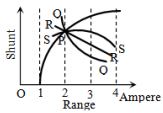
An ammeter has a range of $1 \ A$ without a shunt. The range of the ammeter can be changed by using different shunt resistances. What is the nature of the graph between the shunt resistance and the range?
A
$P$
B
$Q$
C
$R$
D
$S$
Solution
(B) Let $I_g$ be the full-scale deflection current of the galvanometer and $G$ be its resistance.
The initial range of the ammeter is $I_0 = I_g = 1 \ A$.
When a shunt resistance $S$ is connected in parallel to increase the range to $I$,the formula is given by $S = \frac{I_g G}{I - I_g}$.
Substituting $I_g = 1 \ A$,we get $S = \frac{G}{I - 1}$.
This equation represents a rectangular hyperbola of the form $y = \frac{k}{x - c}$,where $S$ is the shunt resistance and $I$ is the range.
As $I$ increases,$S$ decreases,and as $I \to 1$,$S \to \infty$.
Looking at the provided graph,curve $Q$ represents this hyperbolic relationship where the shunt resistance decreases as the range increases,starting from infinity at $I = 1 \ A$.
The initial range of the ammeter is $I_0 = I_g = 1 \ A$.
When a shunt resistance $S$ is connected in parallel to increase the range to $I$,the formula is given by $S = \frac{I_g G}{I - I_g}$.
Substituting $I_g = 1 \ A$,we get $S = \frac{G}{I - 1}$.
This equation represents a rectangular hyperbola of the form $y = \frac{k}{x - c}$,where $S$ is the shunt resistance and $I$ is the range.
As $I$ increases,$S$ decreases,and as $I \to 1$,$S \to \infty$.
Looking at the provided graph,curve $Q$ represents this hyperbolic relationship where the shunt resistance decreases as the range increases,starting from infinity at $I = 1 \ A$.
0 likes
View Solution89
EasyMCQ
To reduce the current flowing through a coil of resistance $90\, \Omega$ by $90\%$,a resistor of what value in $\Omega$ must be connected in parallel?
A
$9$
B
$90$
C
$1000$
D
$10$
Solution
(D) Let the initial current be $I$ and the resistance of the coil be $G = 90\, \Omega$.
We want the current through the coil $(I_g)$ to be reduced by $90\%$,which means the new current $I_g = I - 0.9I = 0.1I = I/10$.
Using the formula for shunt resistance $S$ required to divert current such that the galvanometer current becomes $I_g = I/n$,where $n = I/I_g = 10$.
The shunt resistance is given by $S = \frac{G}{n - 1}$.
Substituting the values: $S = \frac{90}{10 - 1} = \frac{90}{9} = 10\, \Omega$.
Therefore,a resistor of $10\, \Omega$ must be connected in parallel.
We want the current through the coil $(I_g)$ to be reduced by $90\%$,which means the new current $I_g = I - 0.9I = 0.1I = I/10$.
Using the formula for shunt resistance $S$ required to divert current such that the galvanometer current becomes $I_g = I/n$,where $n = I/I_g = 10$.
The shunt resistance is given by $S = \frac{G}{n - 1}$.
Substituting the values: $S = \frac{90}{10 - 1} = \frac{90}{9} = 10\, \Omega$.
Therefore,a resistor of $10\, \Omega$ must be connected in parallel.
0 likes
View Solution90
MediumMCQ
$A$ galvanometer coil has a resistance of $990 \,\Omega$. It shows a full-scale deflection for a current of $10 \,mA$. Calculate the value of the shunt resistance required to convert it into an ammeter of range $1 \,A$.
A
$2$
B
$6$
C
$15$
D
$10$
Solution
(D) Given: Resistance of galvanometer $R_g = 990 \,\Omega$,full-scale deflection current $I_g = 10 \,mA = 0.01 \,A$,and the desired range of the ammeter $I = 1 \,A$.
To convert a galvanometer into an ammeter,a shunt resistance $S$ is connected in parallel with it.
The formula for shunt resistance is $S = \frac{I_g R_g}{I - I_g}$.
Substituting the values: $S = \frac{0.01 \times 990}{1 - 0.01}$.
$S = \frac{9.9}{0.99} = 10 \,\Omega$.
Therefore,the required shunt resistance is $10 \,\Omega$.
To convert a galvanometer into an ammeter,a shunt resistance $S$ is connected in parallel with it.
The formula for shunt resistance is $S = \frac{I_g R_g}{I - I_g}$.
Substituting the values: $S = \frac{0.01 \times 990}{1 - 0.01}$.
$S = \frac{9.9}{0.99} = 10 \,\Omega$.
Therefore,the required shunt resistance is $10 \,\Omega$.
0 likes
View Solution91
MediumMCQ
$A$ galvanometer has $30$ divisions and a current sensitivity of $20 \, \mu A$ per division. Its resistance is $25 \, \Omega$. How will you convert this galvanometer into a voltmeter of $1 \, V$ range? (Find the series resistance in $\Omega$)
A
$0.15$
B
$0.015$
C
$1641.67$
D
$1567.45$
Solution
(C) The current required for full-scale deflection is $I_g = 20 \, \mu A/\text{division} \times 30 \, \text{divisions} = 600 \, \mu A = 6 \times 10^{-4} \, A$.
To convert a galvanometer into a voltmeter,a high resistance $R$ must be connected in series with it.
The formula for series resistance is $R = \frac{V}{I_g} - R_g$.
Substituting the given values: $R = \frac{1}{6 \times 10^{-4}} - 25$.
$R = 1666.67 - 25 = 1641.67 \, \Omega$.
To convert a galvanometer into a voltmeter,a high resistance $R$ must be connected in series with it.
The formula for series resistance is $R = \frac{V}{I_g} - R_g$.
Substituting the given values: $R = \frac{1}{6 \times 10^{-4}} - 25$.
$R = 1666.67 - 25 = 1641.67 \, \Omega$.
0 likes
View Solution92
DifficultMCQ
$A$ galvanometer of resistance $G$ is shunted by a resistance $S$. To keep the main current in the circuit unchanged,what value of resistance should be connected in series with the galvanometer?
A
$\frac{G^2}{S + G}$
B
$\frac{G}{S + G}$
C
$\frac{S^2}{S + G}$
D
$\frac{SG}{S + G}$
Solution
(A) Let the original resistance of the galvanometer be $G$. When a shunt resistance $S$ is connected in parallel,the equivalent resistance of the combination is $R_{eq} = \frac{GS}{G + S}$.
To keep the main current unchanged,the total resistance of the circuit must remain equal to the original resistance $G$.
Let $S'$ be the resistance connected in series with the galvanometer. The new equivalent resistance is $R'_{eq} = \frac{GS}{G + S} + S'$.
Setting $R'_{eq} = G$,we get:
$G = \frac{GS}{G + S} + S'$
$S' = G - \frac{GS}{G + S}$
$S' = \frac{G(G + S) - GS}{G + S}$
$S' = \frac{G^2 + GS - GS}{G + S}$
$S' = \frac{G^2}{G + S}$
To keep the main current unchanged,the total resistance of the circuit must remain equal to the original resistance $G$.
Let $S'$ be the resistance connected in series with the galvanometer. The new equivalent resistance is $R'_{eq} = \frac{GS}{G + S} + S'$.
Setting $R'_{eq} = G$,we get:
$G = \frac{GS}{G + S} + S'$
$S' = G - \frac{GS}{G + S}$
$S' = \frac{G(G + S) - GS}{G + S}$
$S' = \frac{G^2 + GS - GS}{G + S}$
$S' = \frac{G^2}{G + S}$
0 likes
View Solution93
MediumMCQ
$A$ galvanometer with $30$ divisions has a current sensitivity of $20 \, \mu A/division$. Its resistance is $25 \, \Omega$. How will you convert it into an ammeter to measure $1 \, A$ current?
A
$0.15 \, \Omega$
B
$0.015 \, \Omega$
C
$1641.67 \, \Omega$
D
$1567.45 \, \Omega$
Solution
(B) The current required for full-scale deflection is $I_g = 20 \, \mu A/division \times 30 \, divisions = 600 \, \mu A = 6 \times 10^{-4} \, A$.
To convert the galvanometer into an ammeter,a shunt resistance $S$ must be connected in parallel with it.
The formula for shunt resistance is $S = \frac{I_g R_g}{I - I_g}$.
Given $I_g = 6 \times 10^{-4} \, A$,$R_g = 25 \, \Omega$,and $I = 1 \, A$.
$S = \frac{(6 \times 10^{-4}) \times 25}{1 - 6 \times 10^{-4}} = \frac{0.015}{0.9994} \approx 0.015 \, \Omega$.
Therefore,a shunt of $0.015 \, \Omega$ should be connected in parallel.
To convert the galvanometer into an ammeter,a shunt resistance $S$ must be connected in parallel with it.
The formula for shunt resistance is $S = \frac{I_g R_g}{I - I_g}$.
Given $I_g = 6 \times 10^{-4} \, A$,$R_g = 25 \, \Omega$,and $I = 1 \, A$.
$S = \frac{(6 \times 10^{-4}) \times 25}{1 - 6 \times 10^{-4}} = \frac{0.015}{0.9994} \approx 0.015 \, \Omega$.
Therefore,a shunt of $0.015 \, \Omega$ should be connected in parallel.
0 likes
View Solution94
DifficultMCQ
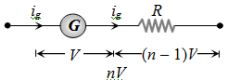
$A$ voltmeter has a range $V$ and resistance $G \, \Omega$. The value of the series resistance required to convert this voltmeter into a voltmeter of range $nV$ is ....
A
$nG$
B
$(n - 1)G$
C
$G/n$
D
$G/(n - 1)$
Solution
(B) Let the resistance $R$ be connected in series with the voltmeter.
The full-scale deflection current of the voltmeter is $i_g = V/G$.
When the range is increased to $nV$,the total resistance becomes $G + R$.
According to Ohm's law,the new voltage range is given by:
$nV = i_g(G + R)$
Substituting $i_g = V/G$:
$nV = (V/G)(G + R)$
$n = (G + R)/G$
$nG = G + R$
$R = nG - G = (n - 1)G$
The full-scale deflection current of the voltmeter is $i_g = V/G$.
When the range is increased to $nV$,the total resistance becomes $G + R$.
According to Ohm's law,the new voltage range is given by:
$nV = i_g(G + R)$
Substituting $i_g = V/G$:
$nV = (V/G)(G + R)$
$n = (G + R)/G$
$nG = G + R$
$R = nG - G = (n - 1)G$
0 likes
View Solution95
MediumMCQ
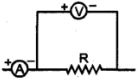
$A$ student connects a voltmeter,an ammeter,and a resistor as shown in the circuit. If the voltmeter reading is $20 \ V$ and the ammeter reading is $4 \ A$,then the resistance $R$ will be:
A
Equal to $5 \ \Omega$
B
Greater than $5 \ \Omega$
C
Less than $5 \ \Omega$
D
Depends on the material of the wire
Solution
(B) The resistance $R$ is given by the ratio of the potential difference across the resistor to the current flowing through it.
$R = \frac{V_R}{I_R}$
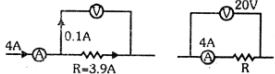
In the given circuit,the voltmeter is connected in parallel with the resistor $R$. Therefore,the potential difference across the resistor is $20 \ V$.
However,the ammeter is connected in series with the parallel combination of the voltmeter and the resistor. The total current $I = 4 \ A$ splits into two parts: a current $I_V$ flowing through the voltmeter and a current $I_R$ flowing through the resistor.
Thus,$I_R = I - I_V = 4 \ A - I_V$.
Since $I_V > 0$,the current flowing through the resistor $I_R$ must be less than $4 \ A$.
Therefore,$R = \frac{20 \ V}{I_R} > \frac{20 \ V}{4 \ A} = 5 \ \Omega$.
Hence,the resistance $R$ is greater than $5 \ \Omega$.
$R = \frac{V_R}{I_R}$
In the given circuit,the voltmeter is connected in parallel with the resistor $R$. Therefore,the potential difference across the resistor is $20 \ V$.
However,the ammeter is connected in series with the parallel combination of the voltmeter and the resistor. The total current $I = 4 \ A$ splits into two parts: a current $I_V$ flowing through the voltmeter and a current $I_R$ flowing through the resistor.
Thus,$I_R = I - I_V = 4 \ A - I_V$.
Since $I_V > 0$,the current flowing through the resistor $I_R$ must be less than $4 \ A$.
Therefore,$R = \frac{20 \ V}{I_R} > \frac{20 \ V}{4 \ A} = 5 \ \Omega$.
Hence,the resistance $R$ is greater than $5 \ \Omega$.
0 likes
View Solution96
MediumMCQ
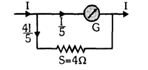
When a shunt of $4\,\Omega$ is connected to a galvanometer,the deflection reduces to $1/5$ of its initial value. If an additional shunt of $2\,\Omega$ is connected in parallel,what will be the new deflection?
A
$I$
B
$I/2$
C
$2I/11$
D
$I/13$
Solution
(D) Let the initial current through the galvanometer be $I_g = I/5$. The shunt resistance is $S = 4\,\Omega$. The current through the shunt is $I_s = I - I_g = I - I/5 = 4I/5$.
Since the galvanometer and shunt are in parallel,the potential difference across them is equal:
$I_g \cdot G = I_s \cdot S$
$(I/5) \cdot G = (4I/5) \cdot 4$
$G = 16\,\Omega$
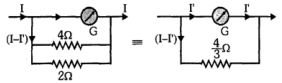
Now,an additional shunt of $2\,\Omega$ is connected in parallel to the existing $4\,\Omega$ shunt. The new equivalent shunt resistance $S'$ is:
$1/S' = 1/4 + 1/2 = (1+2)/4 = 3/4$
$S' = 4/3\,\Omega$
Let the new current through the galvanometer be $I'$. The total current $I$ remains the same. The potential difference across the galvanometer and the new shunt is equal:
$I' \cdot G = (I - I') \cdot S'$
$I' \cdot 16 = (I - I') \cdot (4/3)$
$12I' = I - I'$
$13I' = I$
$I' = I/13$
Since the galvanometer and shunt are in parallel,the potential difference across them is equal:
$I_g \cdot G = I_s \cdot S$
$(I/5) \cdot G = (4I/5) \cdot 4$
$G = 16\,\Omega$
Now,an additional shunt of $2\,\Omega$ is connected in parallel to the existing $4\,\Omega$ shunt. The new equivalent shunt resistance $S'$ is:
$1/S' = 1/4 + 1/2 = (1+2)/4 = 3/4$
$S' = 4/3\,\Omega$
Let the new current through the galvanometer be $I'$. The total current $I$ remains the same. The potential difference across the galvanometer and the new shunt is equal:
$I' \cdot G = (I - I') \cdot S'$
$I' \cdot 16 = (I - I') \cdot (4/3)$
$12I' = I - I'$
$13I' = I$
$I' = I/13$
0 likes
View Solution97
MediumMCQ
The scale of a galvanometer is divided into $25$ equal divisions. The resistance of the galvanometer is $100 \,\Omega$. The current sensitivity of the galvanometer is $4 \times 10^{-4} \,A/div$. What resistance in $ohm$ must be connected in series to measure $2.5 \,V$?
A
$100$
B
$150$
C
$250$
D
$300$
Solution
(B) The full-scale deflection current $I_g$ is calculated as:
$I_g = (\text{number of divisions}) \times (\text{current sensitivity})$
$I_g = 25 \times 4 \times 10^{-4} \,A = 10^{-2} \,A$
To convert a galvanometer into a voltmeter, a high resistance $R$ is connected in series with it.
The formula for the series resistance is:
$R = \frac{V}{I_g} - G$
where $V = 2.5 \,V$ and $G = 100 \,\Omega$.
$R = \frac{2.5}{10^{-2}} - 100$
$R = 250 - 100 = 150 \,\Omega$
Therefore, a resistance of $150 \,\Omega$ must be connected in series.
$I_g = (\text{number of divisions}) \times (\text{current sensitivity})$
$I_g = 25 \times 4 \times 10^{-4} \,A = 10^{-2} \,A$
To convert a galvanometer into a voltmeter, a high resistance $R$ is connected in series with it.
The formula for the series resistance is:
$R = \frac{V}{I_g} - G$
where $V = 2.5 \,V$ and $G = 100 \,\Omega$.
$R = \frac{2.5}{10^{-2}} - 100$
$R = 250 - 100 = 150 \,\Omega$
Therefore, a resistance of $150 \,\Omega$ must be connected in series.
0 likes
View Solution98
EasyMCQ
An ammeter with a resistance of $2 \,\Omega$ can measure up to $100 \,mA$. What resistance (in $\Omega$) must be connected in series to make it measure up to $5 \,V$?
A
$98$
B
$52$
C
$80$
D
$48$
Solution
(D) To convert an ammeter into a voltmeter, a high resistance $R$ is connected in series with the ammeter.
The formula for the series resistance is $R = \frac{V}{I_g} - G$, where $V$ is the desired voltage range, $I_g$ is the full-scale deflection current of the ammeter, and $G$ is the internal resistance of the ammeter.
Given: $V = 5 \,V$, $I_g = 100 \,mA = 100 \times 10^{-3} \,A = 0.1 \,A$, and $G = 2 \,\Omega$.
Substituting the values: $R = \frac{5}{0.1} - 2$.
$R = 50 - 2 = 48 \,\Omega$.
Thus, a resistance of $48 \,\Omega$ must be connected in series.
The formula for the series resistance is $R = \frac{V}{I_g} - G$, where $V$ is the desired voltage range, $I_g$ is the full-scale deflection current of the ammeter, and $G$ is the internal resistance of the ammeter.
Given: $V = 5 \,V$, $I_g = 100 \,mA = 100 \times 10^{-3} \,A = 0.1 \,A$, and $G = 2 \,\Omega$.
Substituting the values: $R = \frac{5}{0.1} - 2$.
$R = 50 - 2 = 48 \,\Omega$.
Thus, a resistance of $48 \,\Omega$ must be connected in series.
0 likes
View Solution99
EasyMCQ
An ammeter with a resistance of $1\, \Omega$ can measure up to $10\, mA$. To convert it into a voltmeter that can measure up to $10\, V$,what resistance (in $\Omega$) must be connected in series?
A
$999$
B
$99$
C
$1000$
D
None of these
Solution
(A) To convert an ammeter into a voltmeter,a high resistance $R$ must be connected in series with the ammeter.
Given:
Resistance of ammeter $G = 1\, \Omega$
Full-scale current $I_g = 10\, mA = 10 \times 10^{-3}\, A = 0.01\, A$
Required voltage range $V = 10\, V$
The formula for series resistance is $R = \frac{V}{I_g} - G$.
Substituting the values:
$R = \frac{10}{0.01} - 1$
$R = 1000 - 1$
$R = 999\, \Omega$.
Therefore,a resistance of $999\, \Omega$ must be connected in series.
Given:
Resistance of ammeter $G = 1\, \Omega$
Full-scale current $I_g = 10\, mA = 10 \times 10^{-3}\, A = 0.01\, A$
Required voltage range $V = 10\, V$
The formula for series resistance is $R = \frac{V}{I_g} - G$.
Substituting the values:
$R = \frac{10}{0.01} - 1$
$R = 1000 - 1$
$R = 999\, \Omega$.
Therefore,a resistance of $999\, \Omega$ must be connected in series.
0 likes
View Solution100
MediumMCQ
An ammeter with a resistance of $0.018 \, \Omega$ can measure $1 \, A$. What shunt resistance is required to enable it to measure $10 \, A$?
A
$0.18 \, \Omega$
B
$0.0018 \, \Omega$
C
$0.002 \, \Omega$
D
$0.12 \, \Omega$
Solution
(C) Let the resistance of the ammeter be $G = 0.018 \, \Omega$ and the full-scale current be $I_g = 1 \, A$.
We want to measure a total current $I = 10 \, A$ by connecting a shunt resistance $S$ in parallel.
The formula for the shunt resistance is $S = \frac{I_g G}{I - I_g}$.
Substituting the given values: $S = \frac{1 \times 0.018}{10 - 1}$.
$S = \frac{0.018}{9} = 0.002 \, \Omega$.
Therefore,a shunt resistance of $0.002 \, \Omega$ is required.
We want to measure a total current $I = 10 \, A$ by connecting a shunt resistance $S$ in parallel.
The formula for the shunt resistance is $S = \frac{I_g G}{I - I_g}$.
Substituting the given values: $S = \frac{1 \times 0.018}{10 - 1}$.
$S = \frac{0.018}{9} = 0.002 \, \Omega$.
Therefore,a shunt resistance of $0.002 \, \Omega$ is required.
0 likes
View SolutionMoving Charges and Magnetism — The Moving Coil Galvanometer (Sensitivity) and Ammeter and Voltmeter Conversion · Frequently Asked Questions
1Are these Moving Charges and Magnetism questions useful for JEE and NEET?
Yes. All questions in this section are mapped to JEE Main and NEET exam patterns. Previous year questions from JEE Main, NEET, GUJCET and state-level exams are included with full solutions.
2Can I switch to Hindi or Gujarati for these questions?
Yes. Use the language tabs in the hero section or the sidebar to view the same questions and solutions in English, Hindi or Gujarati.
3How do I generate a question paper from this subtopic?
Use the Vedclass Exam Paper Generator — select the chapter and subtopic, set difficulty, and generate Sets A, B, C, D automatically. First 3 chapters of every subject are free.
Vedclass Products
For Students
Vedclass Test Series
Mock tests in real JEE/NEET style with performance analysis. 5-day free trial.
Start Free TrialFor Teachers
Exam Paper Generator
Generate Set A/B/C/D papers from this chapter in 2 minutes. 3 chapters free.
Try FreeFor Institutes
Online Exam Module
Live online exams with unlimited students, 360° analytics & white-label branding.
See DemoFor Teachers & Institutes
Generate a Moving Charges and Magnetism Exam Paper in 2 Minutes
Select subtopic & difficulty — Sets A, B, C, D auto-generated with No Repeat logic.
First 3 chapters of every subject are free — no payment required.