
A English
The Moving Coil Galvanometer (Sensitivity) and Ammeter and Voltmeter Conversion Questions in English
Class 12 Physics · Moving Charges and Magnetism · The Moving Coil Galvanometer (Sensitivity) and Ammeter and Voltmeter Conversion
388+
Questions
English
Language
100%
With Solutions
Showing 49 of 388 questions in English
101
MediumMCQ
$A$ galvanometer with a resistance of $8 \, \Omega$ is connected to a shunt of $2 \, \Omega$. If the total current is $1 \, A$,how much current in $A$ passes through the shunt?
A
$0.25$
B
$0.8$
C
$0.2$
D
$0.5$
Solution
(B) Given: Resistance of galvanometer $G = 8 \, \Omega$,Shunt resistance $S = 2 \, \Omega$,Total current $I = 1 \, A$.
The current through the shunt $I_s$ is given by the formula:
$I_s = I \times \left( \frac{G}{S + G} \right)$
Substituting the values:
$I_s = 1 \times \left( \frac{8}{2 + 8} \right)$
$I_s = \frac{8}{10} = 0.8 \, A$.
Therefore,the current passing through the shunt is $0.8 \, A$.
The current through the shunt $I_s$ is given by the formula:
$I_s = I \times \left( \frac{G}{S + G} \right)$
Substituting the values:
$I_s = 1 \times \left( \frac{8}{2 + 8} \right)$
$I_s = \frac{8}{10} = 0.8 \, A$.
Therefore,the current passing through the shunt is $0.8 \, A$.
0 likes
View Solution102
DifficultMCQ
When a shunt resistance of $4r$ is connected to a galvanometer,it becomes an ammeter that can measure $0.03 \, A$. When a shunt resistance of $r$ is connected to the same galvanometer,it becomes an ammeter that can measure $0.06 \, A$. What is the current capacity $(i_g)$ of the galvanometer in $A$?
A
$0.01$
B
$0.02$
C
$0.03$
D
$0.04$
Solution
(B) The formula for the shunt resistance $S$ required to convert a galvanometer of resistance $G$ and full-scale deflection current $i_g$ into an ammeter of range $i$ is given by: $S = \frac{i_g}{i - i_g} G$,which implies $i_g G = (i - i_g) S$.
For the first case,with shunt $S_1 = 4r$ and range $i_1 = 0.03 \, A$:
$i_g G = (0.03 - i_g) 4r$ --- $(i)$
For the second case,with shunt $S_2 = r$ and range $i_2 = 0.06 \, A$:
$i_g G = (0.06 - i_g) r$ --- $(ii)$
Equating $(i)$ and $(ii)$:
$(0.03 - i_g) 4r = (0.06 - i_g) r$
$4(0.03 - i_g) = 0.06 - i_g$
$0.12 - 4i_g = 0.06 - i_g$
$3i_g = 0.06$
$i_g = 0.02 \, A$.
For the first case,with shunt $S_1 = 4r$ and range $i_1 = 0.03 \, A$:
$i_g G = (0.03 - i_g) 4r$ --- $(i)$
For the second case,with shunt $S_2 = r$ and range $i_2 = 0.06 \, A$:
$i_g G = (0.06 - i_g) r$ --- $(ii)$
Equating $(i)$ and $(ii)$:
$(0.03 - i_g) 4r = (0.06 - i_g) r$
$4(0.03 - i_g) = 0.06 - i_g$
$0.12 - 4i_g = 0.06 - i_g$
$3i_g = 0.06$
$i_g = 0.02 \, A$.
0 likes
View Solution103
MediumMCQ
$A$ galvanometer coil has $100$ turns and an area of $1 \, cm^2$. The restoring torque constant of the coil is $10^{-8} \, N-m/rad$. If the magnetic field is $5 \, T$,what is the current sensitivity?
A
$5 \times 10^4 \, rad/A$
B
$5 \times 10^{-6} \, rad/A$
C
$2 \times 10^{-7} \, rad/A$
D
$5 \times 10^6 \, rad/A$
Solution
(D) The current sensitivity $(S_i)$ of a galvanometer is given by the formula: $S_i = \frac{\theta}{i} = \frac{NBA}{k}$,where $N$ is the number of turns,$B$ is the magnetic field,$A$ is the area,and $k$ is the restoring torque constant.
Given: $N = 100$,$A = 1 \, cm^2 = 10^{-4} \, m^2$,$B = 5 \, T$,and $k = 10^{-8} \, N-m/rad$.
Substituting the values:
$S_i = \frac{100 \times 5 \times 10^{-4}}{10^{-8}}$
$S_i = \frac{500 \times 10^{-4}}{10^{-8}} = 500 \times 10^4 = 5 \times 10^6 \, rad/A$.
Since $1 \, A = 10^6 \, \mu A$,the sensitivity is $5 \, rad/\mu A$.
Given: $N = 100$,$A = 1 \, cm^2 = 10^{-4} \, m^2$,$B = 5 \, T$,and $k = 10^{-8} \, N-m/rad$.
Substituting the values:
$S_i = \frac{100 \times 5 \times 10^{-4}}{10^{-8}}$
$S_i = \frac{500 \times 10^{-4}}{10^{-8}} = 500 \times 10^4 = 5 \times 10^6 \, rad/A$.
Since $1 \, A = 10^6 \, \mu A$,the sensitivity is $5 \, rad/\mu A$.
0 likes
View Solution104
DifficultMCQ
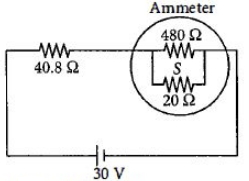
$A$ circuit contains an ammeter,a battery of $30\,V$ and a resistance of $40.8\,\Omega$ all connected in series. If the ammeter has a coil of resistance $480\,\Omega$ and a shunt of $20\,\Omega$,the reading in the ammeter will be .................. $A$.
A
$1$
B
$0.25$
C
$0.5$
D
$2$
Solution
(C) The circuit is shown in the figure.
First,calculate the effective resistance of the ammeter $(R_A)$. Since the coil resistance $(480\,\Omega)$ and the shunt resistance $(20\,\Omega)$ are in parallel,the equivalent resistance is:
$R_A = \frac{480 \times 20}{480 + 20} = \frac{9600}{500} = 19.2\,\Omega$
Since the ammeter is connected in series with the $40.8\,\Omega$ resistor,the total resistance $(R_{total})$ of the circuit is:
$R_{total} = 40.8\,\Omega + 19.2\,\Omega = 60\,\Omega$
Using Ohm's law $(I = V/R)$,the total current flowing through the circuit is:
$I = \frac{30\,V}{60\,\Omega} = 0.5\,A$
Thus,the reading in the ammeter will be $0.5\,A$.
First,calculate the effective resistance of the ammeter $(R_A)$. Since the coil resistance $(480\,\Omega)$ and the shunt resistance $(20\,\Omega)$ are in parallel,the equivalent resistance is:
$R_A = \frac{480 \times 20}{480 + 20} = \frac{9600}{500} = 19.2\,\Omega$
Since the ammeter is connected in series with the $40.8\,\Omega$ resistor,the total resistance $(R_{total})$ of the circuit is:
$R_{total} = 40.8\,\Omega + 19.2\,\Omega = 60\,\Omega$
Using Ohm's law $(I = V/R)$,the total current flowing through the circuit is:
$I = \frac{30\,V}{60\,\Omega} = 0.5\,A$
Thus,the reading in the ammeter will be $0.5\,A$.
0 likes
View Solution105
MediumMCQ
Current sensitivity of a moving coil galvanometer is $5\,div/mA$ and its voltage sensitivity (angular deflection per unit voltage applied) is $20\,div/V$. The resistance of the galvanometer is ................. $\Omega$.
A
$40$
B
$25$
C
$500$
D
$250$
Solution
(D) Current sensitivity $(I_s)$ is defined as the deflection per unit current: $I_s = \frac{\theta}{I}$.
Voltage sensitivity $(V_s)$ is defined as the deflection per unit voltage: $V_s = \frac{\theta}{V}$.
Since $V = IR$,where $R$ is the resistance of the galvanometer $(R_G)$,we have $V_s = \frac{\theta}{I R_G} = \frac{I_s}{R_G}$.
Therefore,the resistance of the galvanometer is $R_G = \frac{I_s}{V_s}$.
Given: $I_s = 5\,div/mA = 5\,div/(10^{-3}\,A) = 5000\,div/A$.
Given: $V_s = 20\,div/V$.
Substituting the values: $R_G = \frac{5000}{20} = 250\,\Omega$.
Voltage sensitivity $(V_s)$ is defined as the deflection per unit voltage: $V_s = \frac{\theta}{V}$.
Since $V = IR$,where $R$ is the resistance of the galvanometer $(R_G)$,we have $V_s = \frac{\theta}{I R_G} = \frac{I_s}{R_G}$.
Therefore,the resistance of the galvanometer is $R_G = \frac{I_s}{V_s}$.
Given: $I_s = 5\,div/mA = 5\,div/(10^{-3}\,A) = 5000\,div/A$.
Given: $V_s = 20\,div/V$.
Substituting the values: $R_G = \frac{5000}{20} = 250\,\Omega$.
0 likes
View Solution106
MediumMCQ
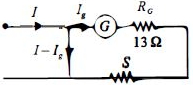
The resistance of an ammeter is $13\, \Omega$ and its scale is graduated for a current up to $100\, A$. After an additional shunt has been connected to this ammeter,it becomes possible to measure currents up to $750\, A$ by this meter. The value of the shunt resistance is:
A
$2\, \Omega$
B
$0.2\, \Omega$
C
$2\, k\Omega$
D
$20\, \Omega$
Solution
(A) Let the shunt resistance be $S$.
Given:
Total current to be measured,$I = 750\, A$
Full-scale deflection current of the ammeter,$I_g = 100\, A$
Resistance of the ammeter,$R_G = 13\, \Omega$
When a shunt $S$ is connected in parallel with the ammeter,the potential difference across the ammeter and the shunt must be equal:
$I_g R_G = (I - I_g) S$
Substituting the given values:
$100 \times 13 = (750 - 100) \times S$
$1300 = 650 \times S$
Solving for $S$:
$S = \frac{1300}{650} = 2\, \Omega$
Thus,the value of the shunt resistance is $2\, \Omega$.
Given:
Total current to be measured,$I = 750\, A$
Full-scale deflection current of the ammeter,$I_g = 100\, A$
Resistance of the ammeter,$R_G = 13\, \Omega$
When a shunt $S$ is connected in parallel with the ammeter,the potential difference across the ammeter and the shunt must be equal:
$I_g R_G = (I - I_g) S$
Substituting the given values:
$100 \times 13 = (750 - 100) \times S$
$1300 = 650 \times S$
Solving for $S$:
$S = \frac{1300}{650} = 2\, \Omega$
Thus,the value of the shunt resistance is $2\, \Omega$.
0 likes
View Solution107
DifficultMCQ
$A$ galvanometer of resistance $50\, \Omega$ is connected to a battery of $3\, V$ along with a resistance of $2950\, \Omega$ in series. $A$ full-scale deflection of $30$ divisions is obtained in the galvanometer. In order to reduce this deflection to $20$ divisions,the resistance in series should be.......$\Omega$
A
$6050$
B
$4450$
C
$5050$
D
$5550$
Solution
(B) The initial total resistance is $R_{total,1} = R_G + R_1 = 50\, \Omega + 2950\, \Omega = 3000\, \Omega$.
The current for full-scale deflection ($30$ divisions) is $I_1 = \frac{V}{R_{total,1}} = \frac{3\, V}{3000\, \Omega} = 1 \times 10^{-3}\, A = 1\, mA$.
To reduce the deflection to $20$ divisions,the new current $I_2$ must be proportional to the divisions: $I_2 = I_1 \times \frac{20}{30} = 1\, mA \times \frac{2}{3} = \frac{2}{3}\, mA$.
Using Ohm's law for the new circuit,$V = I_2 \times R_{total,2}$,where $R_{total,2} = R_G + R_2$.
$3\, V = (\frac{2}{3} \times 10^{-3}\, A) \times R_{total,2}$.
$R_{total,2} = \frac{3 \times 3}{2} \times 10^3\, \Omega = 4500\, \Omega$.
Since $R_{total,2} = R_G + R_2$,the required series resistance is $R_2 = 4500\, \Omega - 50\, \Omega = 4450\, \Omega$.
The current for full-scale deflection ($30$ divisions) is $I_1 = \frac{V}{R_{total,1}} = \frac{3\, V}{3000\, \Omega} = 1 \times 10^{-3}\, A = 1\, mA$.
To reduce the deflection to $20$ divisions,the new current $I_2$ must be proportional to the divisions: $I_2 = I_1 \times \frac{20}{30} = 1\, mA \times \frac{2}{3} = \frac{2}{3}\, mA$.
Using Ohm's law for the new circuit,$V = I_2 \times R_{total,2}$,where $R_{total,2} = R_G + R_2$.
$3\, V = (\frac{2}{3} \times 10^{-3}\, A) \times R_{total,2}$.
$R_{total,2} = \frac{3 \times 3}{2} \times 10^3\, \Omega = 4500\, \Omega$.
Since $R_{total,2} = R_G + R_2$,the required series resistance is $R_2 = 4500\, \Omega - 50\, \Omega = 4450\, \Omega$.
0 likes
View Solution108
MediumMCQ
$A$ galvanometer having a coil resistance of $60\,\Omega$ shows full-scale deflection when a current of $1.0\,A$ passes through it. It can be converted into an ammeter to read currents up to $5.0\,A$ by:
A
putting in series a resistance of $15\,\Omega$
B
putting in series a resistance of $240\,\Omega$
C
putting in parallel a resistance of $15\,\Omega$
D
putting in parallel a resistance of $240\,\Omega$
Solution
(C) To convert a galvanometer into an ammeter,a shunt resistance $S$ must be connected in parallel with the galvanometer.
The formula for the shunt resistance is $i_g G = (I - i_g) S$,where $i_g$ is the full-scale deflection current,$G$ is the galvanometer resistance,and $I$ is the maximum current to be measured.
Given: $G = 60\,\Omega$,$i_g = 1.0\,A$,and $I = 5.0\,A$.
Substituting the values: $1.0 \times 60 = (5.0 - 1.0) \times S$.
$60 = 4 \times S$.
$S = \frac{60}{4} = 15\,\Omega$.
Therefore,a resistance of $15\,\Omega$ must be connected in parallel.
The formula for the shunt resistance is $i_g G = (I - i_g) S$,where $i_g$ is the full-scale deflection current,$G$ is the galvanometer resistance,and $I$ is the maximum current to be measured.
Given: $G = 60\,\Omega$,$i_g = 1.0\,A$,and $I = 5.0\,A$.
Substituting the values: $1.0 \times 60 = (5.0 - 1.0) \times S$.
$60 = 4 \times S$.
$S = \frac{60}{4} = 15\,\Omega$.
Therefore,a resistance of $15\,\Omega$ must be connected in parallel.
0 likes
View Solution109
MediumMCQ
$A$ galvanometer has a coil of resistance $100 \, \Omega$ and gives a full-scale deflection for $30 \, mA$ current. If it is to work as a voltmeter of $30 \, V$ range,the resistance required to be added will be..... $\Omega$
A
$900$
B
$1800$
C
$500$
D
$1000$
Solution
(A) Resistance of galvanometer,$G = 100 \, \Omega$.
Current for full-scale deflection,$I_g = 30 \, mA = 30 \times 10^{-3} \, A$.
Range of voltmeter,$V = 30 \, V$.
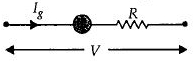
To convert the galvanometer into a voltmeter of a given range,a resistance $R$ is connected in series with it.
The total resistance of the circuit is $(G + R)$.
According to Ohm's law,$V = I_g(G + R)$.
Substituting the values: $30 = 30 \times 10^{-3} \times (100 + R)$.
$1000 = 100 + R$.
$R = 1000 - 100 = 900 \, \Omega$.
Current for full-scale deflection,$I_g = 30 \, mA = 30 \times 10^{-3} \, A$.
Range of voltmeter,$V = 30 \, V$.
To convert the galvanometer into a voltmeter of a given range,a resistance $R$ is connected in series with it.
The total resistance of the circuit is $(G + R)$.
According to Ohm's law,$V = I_g(G + R)$.
Substituting the values: $30 = 30 \times 10^{-3} \times (100 + R)$.
$1000 = 100 + R$.
$R = 1000 - 100 = 900 \, \Omega$.
0 likes
View Solution110
MediumMCQ
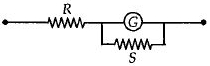
$A$ galvanometer of resistance $G$ is shunted by a resistance $S$. To keep the main current in the circuit unchanged,the resistance to be put in series with the galvanometer is
A
$\frac{G}{S + G}$
B
$\frac{S^2}{S + G}$
C
$\frac{SG}{S + G}$
D
$\frac{G^2}{S + G}$
Solution
(D) Let the original resistance of the galvanometer be $G$. When a shunt resistance $S$ is connected in parallel with the galvanometer,the equivalent resistance of this parallel combination is $R_p = \frac{GS}{G+S}$.
To keep the main current in the circuit unchanged,the total resistance of the circuit must remain equal to the original resistance of the galvanometer,which is $G$.
Let $R$ be the resistance to be connected in series with the parallel combination of $G$ and $S$.
Therefore,the total resistance is $R + R_p = G$.
Substituting the value of $R_p$,we get $R + \frac{GS}{G+S} = G$.
Solving for $R$,we have $R = G - \frac{GS}{G+S}$.
Taking the common denominator,$R = \frac{G(G+S) - GS}{G+S} = \frac{G^2 + GS - GS}{G+S}$.
Thus,$R = \frac{G^2}{G+S}$.
To keep the main current in the circuit unchanged,the total resistance of the circuit must remain equal to the original resistance of the galvanometer,which is $G$.
Let $R$ be the resistance to be connected in series with the parallel combination of $G$ and $S$.
Therefore,the total resistance is $R + R_p = G$.
Substituting the value of $R_p$,we get $R + \frac{GS}{G+S} = G$.
Solving for $R$,we have $R = G - \frac{GS}{G+S}$.
Taking the common denominator,$R = \frac{G(G+S) - GS}{G+S} = \frac{G^2 + GS - GS}{G+S}$.
Thus,$R = \frac{G^2}{G+S}$.
0 likes
View Solution111
MediumMCQ
$A$ millivoltmeter of $25 \, mV$ range is to be converted into an ammeter of $25 \, A$ range. The value (in $\Omega$) of the necessary shunt will be:
A
$0.001 \, \Omega$
B
$0.01 \, \Omega$
C
$1 \, \Omega$
D
$0.05 \, \Omega$
Solution
(A) The shunt resistance $S$ required to convert a galvanometer (or millivoltmeter) into an ammeter is given by the formula: $S = \frac{V_g}{I - I_g}$.
Here,$V_g$ is the full-scale voltage of the millivoltmeter,$I$ is the desired range of the ammeter,and $I_g$ is the full-scale current of the millivoltmeter.
Given $V_g = 25 \, mV = 25 \times 10^{-3} \, V$ and $I = 25 \, A$.
Since $I \gg I_g$,we can approximate $I - I_g \approx I$.
Therefore,$S = \frac{V_g}{I} = \frac{25 \times 10^{-3} \, V}{25 \, A} = 10^{-3} \, \Omega = 0.001 \, \Omega$.
Here,$V_g$ is the full-scale voltage of the millivoltmeter,$I$ is the desired range of the ammeter,and $I_g$ is the full-scale current of the millivoltmeter.
Given $V_g = 25 \, mV = 25 \times 10^{-3} \, V$ and $I = 25 \, A$.
Since $I \gg I_g$,we can approximate $I - I_g \approx I$.
Therefore,$S = \frac{V_g}{I} = \frac{25 \times 10^{-3} \, V}{25 \, A} = 10^{-3} \, \Omega = 0.001 \, \Omega$.
0 likes
View Solution112
MediumMCQ
In an ammeter, $0.2\%$ of the main current passes through the galvanometer. If the resistance of the galvanometer is $G$, the resistance of the ammeter will be
A
$\frac{1}{499} G \, \Omega$
B
$\frac{499}{500} G \, \Omega$
C
$\frac{1}{500} G \, \Omega$
D
$\frac{500}{499} G \, \Omega$
Solution
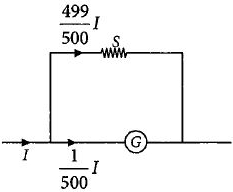
(C) Let the total current be $I$ and the resistance of the galvanometer be $G$.
The current through the galvanometer is $I_G = 0.2\% \text{ of } I = \frac{0.2}{100} I = \frac{1}{500} I$.
The current through the shunt resistance $S$ is $I_S = I - I_G = I - \frac{1}{500} I = \frac{499}{500} I$.
Since the galvanometer and shunt are in parallel, the potential difference across them is the same:
$I_G G = I_S S$
$\left( \frac{1}{500} I \right) G = \left( \frac{499}{500} I \right) S$
$S = \frac{G}{499}$.
The resistance of the ammeter $R_A$ is the equivalent resistance of the parallel combination of $G$ and $S$:
$\frac{1}{R_A} = \frac{1}{G} + \frac{1}{S} = \frac{1}{G} + \frac{499}{G} = \frac{500}{G}$.
Therefore, $R_A = \frac{G}{500}$.
The current through the galvanometer is $I_G = 0.2\% \text{ of } I = \frac{0.2}{100} I = \frac{1}{500} I$.
The current through the shunt resistance $S$ is $I_S = I - I_G = I - \frac{1}{500} I = \frac{499}{500} I$.
Since the galvanometer and shunt are in parallel, the potential difference across them is the same:
$I_G G = I_S S$
$\left( \frac{1}{500} I \right) G = \left( \frac{499}{500} I \right) S$
$S = \frac{G}{499}$.
The resistance of the ammeter $R_A$ is the equivalent resistance of the parallel combination of $G$ and $S$:
$\frac{1}{R_A} = \frac{1}{G} + \frac{1}{S} = \frac{1}{G} + \frac{499}{G} = \frac{500}{G}$.
Therefore, $R_A = \frac{G}{500}$.
0 likes
View Solution113
MediumMCQ
$A$ moving coil galvanometer is converted into an ammeter reading up to $0.03\,A$ by connecting a shunt of resistance $4r$ across it,and into an ammeter reading up to $0.06\,A$ when a shunt of resistance $r$ is connected across it. What is the maximum current which can be sent through this galvanometer if no shunt is used?
A
$0.01$
B
$0.02$
C
$0.03$
D
$0.04$
Solution
(B) Let $G$ be the resistance of the galvanometer and $i_g$ be the maximum current that can pass through it without any shunt.
The formula for the range of an ammeter with a shunt $S$ is given by $i_g G = (i - i_g)S$,where $i$ is the total current.
For the first case,$S = 4r$ and $i = 0.03\,A$:
$i_g G = (0.03 - i_g)4r$ ..... $(i)$
For the second case,$S = r$ and $i = 0.06\,A$:
$i_g G = (0.06 - i_g)r$ ..... $(ii)$
Equating $(i)$ and $(ii)$:
$(0.03 - i_g)4r = (0.06 - i_g)r$
$0.12 - 4i_g = 0.06 - i_g$
$0.06 = 3i_g$
$i_g = 0.02\,A$.
The formula for the range of an ammeter with a shunt $S$ is given by $i_g G = (i - i_g)S$,where $i$ is the total current.
For the first case,$S = 4r$ and $i = 0.03\,A$:
$i_g G = (0.03 - i_g)4r$ ..... $(i)$
For the second case,$S = r$ and $i = 0.06\,A$:
$i_g G = (0.06 - i_g)r$ ..... $(ii)$
Equating $(i)$ and $(ii)$:
$(0.03 - i_g)4r = (0.06 - i_g)r$
$0.12 - 4i_g = 0.06 - i_g$
$0.06 = 3i_g$
$i_g = 0.02\,A$.
0 likes
View Solution114
MediumMCQ
$A$ moving coil galvanometer has $48$ turns and the area of the coil is $4 \times 10^{-2} \, m^2$. If the magnetic field is $0.2 \, T$,then to increase the current sensitivity by $25\%$ without changing the area $(A)$ and the magnetic field $(B)$,the number of turns should become:
A
$24$
B
$36$
C
$60$
D
$54$
Solution
(C) The current sensitivity of a moving coil galvanometer is given by the formula:
$S_i = \frac{NBA}{C}$
where $N$ is the number of turns,$B$ is the magnetic field,$A$ is the area,and $C$ is the torsional constant of the spring.
From the formula,we see that $S_i \propto N$ when $B, A,$ and $C$ are kept constant.
Let the initial sensitivity be $(S_i)_1$ and the final sensitivity be $(S_i)_2$.
Given that the sensitivity increases by $25\%$,we have:
$(S_i)_2 = (S_i)_1 + 0.25(S_i)_1 = 1.25(S_i)_1$
Using the proportionality $S_i \propto N$:
$\frac{(S_i)_1}{(S_i)_2} = \frac{N_1}{N_2}$
$\frac{(S_i)_1}{1.25(S_i)_1} = \frac{48}{N_2}$
$\frac{1}{1.25} = \frac{48}{N_2}$
$N_2 = 48 \times 1.25 = 60$
Therefore,the number of turns should become $60$.
$S_i = \frac{NBA}{C}$
where $N$ is the number of turns,$B$ is the magnetic field,$A$ is the area,and $C$ is the torsional constant of the spring.
From the formula,we see that $S_i \propto N$ when $B, A,$ and $C$ are kept constant.
Let the initial sensitivity be $(S_i)_1$ and the final sensitivity be $(S_i)_2$.
Given that the sensitivity increases by $25\%$,we have:
$(S_i)_2 = (S_i)_1 + 0.25(S_i)_1 = 1.25(S_i)_1$
Using the proportionality $S_i \propto N$:
$\frac{(S_i)_1}{(S_i)_2} = \frac{N_1}{N_2}$
$\frac{(S_i)_1}{1.25(S_i)_1} = \frac{48}{N_2}$
$\frac{1}{1.25} = \frac{48}{N_2}$
$N_2 = 48 \times 1.25 = 60$
Therefore,the number of turns should become $60$.
0 likes
View Solution115
MediumMCQ
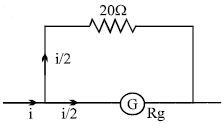
In a galvanometer,the deflection becomes one half when the galvanometer is shunted by a $20\,\Omega$ resistor. The galvanometer resistance is ............... $\Omega$.
A
$5$
B
$10$
C
$40$
D
$20$
Solution
(D) Let the total current entering the circuit be $I$. When the galvanometer is shunted by a resistor $S = 20\,\Omega$,the current through the galvanometer $I_g$ becomes half of the total current,i.e.,$I_g = I/2$.
Using the principle of current division in a parallel circuit,the current through the galvanometer is given by:
$I_g = I \left( \frac{S}{S + R_g} \right)$
Substituting the given values:
$\frac{I}{2} = I \left( \frac{20}{20 + R_g} \right)$
$\frac{1}{2} = \frac{20}{20 + R_g}$
$20 + R_g = 40$
$R_g = 40 - 20 = 20\,\Omega$
Thus,the galvanometer resistance is $20\,\Omega$.
Using the principle of current division in a parallel circuit,the current through the galvanometer is given by:
$I_g = I \left( \frac{S}{S + R_g} \right)$
Substituting the given values:
$\frac{I}{2} = I \left( \frac{20}{20 + R_g} \right)$
$\frac{1}{2} = \frac{20}{20 + R_g}$
$20 + R_g = 40$
$R_g = 40 - 20 = 20\,\Omega$
Thus,the galvanometer resistance is $20\,\Omega$.
0 likes
View Solution116
MediumMCQ
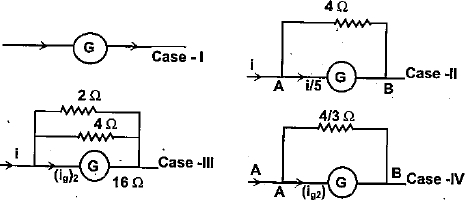
When a galvanometer is shunted with a $4\,\Omega$ resistance,the deflection is reduced to one-fifth. If the galvanometer is further shunted with a $2\,\Omega$ wire,the further reduction in the deflection will be (the main current remains same).
A
$\frac{8}{13}$ of the deflection when shunted with $4\,\Omega$ only
B
$\frac{5}{13}$ of the deflection when shunted with $4\,\Omega$ only
C
$\frac{3}{4}$ of the deflection when shunted with $4\,\Omega$ only
D
$\frac{3}{13}$ of the deflection when shunted with $4\,\Omega$ only
Solution
(B) Let $G$ be the resistance of the galvanometer and $i$ be the main current.
When shunted with $S_1 = 4\,\Omega$,the current through the galvanometer is $i_{g1} = i/5$.
Using the shunt formula: $i_{g1} = i \cdot \frac{S_1}{G + S_1} \implies \frac{i}{5} = i \cdot \frac{4}{G + 4}$.
Solving for $G$: $G + 4 = 20 \implies G = 16\,\Omega$.
Now,the galvanometer is further shunted with $S_2 = 2\,\Omega$ in parallel with $S_1 = 4\,\Omega$.
The equivalent shunt resistance $S_{eq}$ is: $\frac{1}{S_{eq}} = \frac{1}{4} + \frac{1}{2} = \frac{1+2}{4} = \frac{3}{4} \implies S_{eq} = \frac{4}{3}\,\Omega$.
The new current through the galvanometer is $i_{g2} = i \cdot \frac{S_{eq}}{G + S_{eq}} = i \cdot \frac{4/3}{16 + 4/3} = i \cdot \frac{4/3}{52/3} = \frac{4}{52}i = \frac{1}{13}i$.
The ratio of the new deflection to the previous deflection is $\frac{i_{g2}}{i_{g1}} = \frac{i/13}{i/5} = \frac{5}{13}$.
Thus,the new deflection is $\frac{5}{13}$ of the deflection when shunted with $4\,\Omega$ only.
When shunted with $S_1 = 4\,\Omega$,the current through the galvanometer is $i_{g1} = i/5$.
Using the shunt formula: $i_{g1} = i \cdot \frac{S_1}{G + S_1} \implies \frac{i}{5} = i \cdot \frac{4}{G + 4}$.
Solving for $G$: $G + 4 = 20 \implies G = 16\,\Omega$.
Now,the galvanometer is further shunted with $S_2 = 2\,\Omega$ in parallel with $S_1 = 4\,\Omega$.
The equivalent shunt resistance $S_{eq}$ is: $\frac{1}{S_{eq}} = \frac{1}{4} + \frac{1}{2} = \frac{1+2}{4} = \frac{3}{4} \implies S_{eq} = \frac{4}{3}\,\Omega$.
The new current through the galvanometer is $i_{g2} = i \cdot \frac{S_{eq}}{G + S_{eq}} = i \cdot \frac{4/3}{16 + 4/3} = i \cdot \frac{4/3}{52/3} = \frac{4}{52}i = \frac{1}{13}i$.
The ratio of the new deflection to the previous deflection is $\frac{i_{g2}}{i_{g1}} = \frac{i/13}{i/5} = \frac{5}{13}$.
Thus,the new deflection is $\frac{5}{13}$ of the deflection when shunted with $4\,\Omega$ only.
0 likes
View Solution117
DifficultMCQ
$A$ galvanometer has a resistance of $20\,\Omega$ and reads full-scale when $0.2\,V$ is applied across it. To convert it into a $10\,A$ ammeter,the galvanometer coil should have a
A
$0.01\,\Omega$ resistor connected across it
B
$0.02\,\Omega$ resistor connected across it
C
$200\,\Omega$ resistor connected in series with it
D
$2000\,\Omega$ resistor connected in series with it
Solution
(B) Given: Galvanometer resistance $R_g = 20\,\Omega$,full-scale voltage $V_g = 0.2\,V$,and target current $I = 10\,A$.
First,calculate the full-scale deflection current $I_g$ of the galvanometer:
$I_g = \frac{V_g}{R_g} = \frac{0.2\,V}{20\,\Omega} = 0.01\,A$.
To convert a galvanometer into an ammeter of range $I$,a shunt resistance $S$ must be connected in parallel with the galvanometer coil.
The formula for shunt resistance is:
$S = \frac{I_g R_g}{I - I_g}$.
Substituting the values:
$S = \frac{0.01 \times 20}{10 - 0.01} = \frac{0.2}{9.99} \approx 0.02\,\Omega$.
Therefore,a $0.02\,\Omega$ resistor should be connected in parallel (across) the galvanometer.
First,calculate the full-scale deflection current $I_g$ of the galvanometer:
$I_g = \frac{V_g}{R_g} = \frac{0.2\,V}{20\,\Omega} = 0.01\,A$.
To convert a galvanometer into an ammeter of range $I$,a shunt resistance $S$ must be connected in parallel with the galvanometer coil.
The formula for shunt resistance is:
$S = \frac{I_g R_g}{I - I_g}$.
Substituting the values:
$S = \frac{0.01 \times 20}{10 - 0.01} = \frac{0.2}{9.99} \approx 0.02\,\Omega$.
Therefore,a $0.02\,\Omega$ resistor should be connected in parallel (across) the galvanometer.
0 likes
View Solution118
MediumMCQ
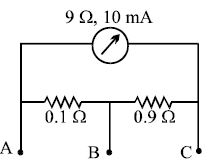
$A$ milliammeter of range $10\, mA$ and resistance $9\, \Omega$ is joined in a circuit as shown. The meter gives full-scale deflection for current $I$ when $A$ and $B$ are used as its terminals,i.e.,current enters at $A$ and leaves at $B$ ($C$ is left isolated). The value of $I$ is
A
$100\, mA$
B
$900\, mA$
C
$1\, A$
D
$1.1\, A$
Solution
(C) The milliammeter has a full-scale deflection current $i_{g} = 10\, mA = 0.01\, A$ and resistance $R_{g} = 9\, \Omega$.
When terminals $A$ and $B$ are used,the current $I$ enters at $A$. The current $i_{g}$ flows through the milliammeter,and the remaining current $(I - i_{g})$ flows through the shunt resistor of $0.1\, \Omega$ connected between $A$ and $B$.
Since the milliammeter and the shunt resistor are in parallel between $A$ and $B$,the potential difference across them is equal.
$V_{AB} = i_{g} \times R_{g} = (I - i_{g}) \times R_{shunt}$
$0.01\, A \times 9\, \Omega = (I - 0.01\, A) \times 0.1\, \Omega$
$0.09 = 0.1I - 0.001$
$0.1I = 0.091$
$I = 0.91\, A = 910\, mA$.
Wait,re-evaluating the circuit: The milliammeter is in series with the $0.9\, \Omega$ resistor,and this combination is in parallel with the $0.1\, \Omega$ resistor.
$V_{AB} = i_{g}(R_{g} + 0.9\, \Omega) = (I - i_{g}) \times 0.1\, \Omega$
$0.01(9 + 0.9) = (I - 0.01) \times 0.1$
$0.01(9.9) = 0.1I - 0.001$
$0.099 + 0.001 = 0.1I$
$0.1 = 0.1I$
$I = 1\, A$.
When terminals $A$ and $B$ are used,the current $I$ enters at $A$. The current $i_{g}$ flows through the milliammeter,and the remaining current $(I - i_{g})$ flows through the shunt resistor of $0.1\, \Omega$ connected between $A$ and $B$.
Since the milliammeter and the shunt resistor are in parallel between $A$ and $B$,the potential difference across them is equal.
$V_{AB} = i_{g} \times R_{g} = (I - i_{g}) \times R_{shunt}$
$0.01\, A \times 9\, \Omega = (I - 0.01\, A) \times 0.1\, \Omega$
$0.09 = 0.1I - 0.001$
$0.1I = 0.091$
$I = 0.91\, A = 910\, mA$.
Wait,re-evaluating the circuit: The milliammeter is in series with the $0.9\, \Omega$ resistor,and this combination is in parallel with the $0.1\, \Omega$ resistor.
$V_{AB} = i_{g}(R_{g} + 0.9\, \Omega) = (I - i_{g}) \times 0.1\, \Omega$
$0.01(9 + 0.9) = (I - 0.01) \times 0.1$
$0.01(9.9) = 0.1I - 0.001$
$0.099 + 0.001 = 0.1I$
$0.1 = 0.1I$
$I = 1\, A$.
0 likes
View Solution119
MediumMCQ
$A$ galvanometer coil has a resistance $90\, \Omega$ and full-scale deflection current $10\, mA$. $A$ $910\, \Omega$ resistance is connected in series with the galvanometer to make a voltmeter. If the least count of the voltmeter is $0.1\, V$,the number of divisions on its scale is:
A
$90$
B
$91$
C
$100$
D
none
Solution
(C) The full-scale voltage $V$ of the voltmeter is given by $V = I_g(R_g + R_s)$,where $I_g = 10\, mA = 0.01\, A$,$R_g = 90\, \Omega$,and $R_s = 910\, \Omega$.
$V = 0.01\, A \times (90\, \Omega + 910\, \Omega) = 0.01 \times 1000 = 10\, V$.
Given the least count of the voltmeter is $0.1\, V/\text{division}$.
The total number of divisions $N$ is given by $N = \frac{V}{\text{least count}}$.
$N = \frac{10\, V}{0.1\, V/\text{division}} = 100\, \text{divisions}$.
$V = 0.01\, A \times (90\, \Omega + 910\, \Omega) = 0.01 \times 1000 = 10\, V$.
Given the least count of the voltmeter is $0.1\, V/\text{division}$.
The total number of divisions $N$ is given by $N = \frac{V}{\text{least count}}$.
$N = \frac{10\, V}{0.1\, V/\text{division}} = 100\, \text{divisions}$.
0 likes
View Solution120
MediumMCQ
$A$ galvanometer may be converted into an ammeter or a voltmeter. In which of the following cases will the resistance of the device be the largest? (Assume the maximum range of the galvanometer is $1 \, mA$)
A
An ammeter of range $10 \, A$
B
$A$ voltmeter of range $5 \, V$
C
An ammeter of range $5 \, A$
D
$A$ voltmeter of range $10 \, V$
Solution
(D) To convert a galvanometer into an ammeter,a very small resistance (shunt) is connected in parallel. Thus,the resistance of an ammeter is very low.
To convert a galvanometer into a voltmeter,a very large resistance is connected in series. Thus,the resistance of a voltmeter is very high.
For a voltmeter,the resistance $R$ is given by $R = (V / I_g) - G$,where $V$ is the range,$I_g$ is the full-scale deflection current $(1 \, mA)$,and $G$ is the galvanometer resistance.
Since $R$ is directly proportional to the voltage range $V$,the voltmeter with the highest range will have the largest resistance.
Comparing the two voltmeters ($5 \, V$ and $10 \, V$),the voltmeter with a range of $10 \, V$ will have the largest resistance.
To convert a galvanometer into a voltmeter,a very large resistance is connected in series. Thus,the resistance of a voltmeter is very high.
For a voltmeter,the resistance $R$ is given by $R = (V / I_g) - G$,where $V$ is the range,$I_g$ is the full-scale deflection current $(1 \, mA)$,and $G$ is the galvanometer resistance.
Since $R$ is directly proportional to the voltage range $V$,the voltmeter with the highest range will have the largest resistance.
Comparing the two voltmeters ($5 \, V$ and $10 \, V$),the voltmeter with a range of $10 \, V$ will have the largest resistance.
0 likes
View Solution121
EasyMCQ
Mark out the correct options.
A
An ammeter should have small resistance.
B
An ammeter should have large resistance.
C
$A$ voltmeter should have large resistance.
D
Both $(A)$ and $(C)$.
Solution
(D) The smaller the resistance of an ammeter,the more accurate its reading will be. An ammeter is considered ideal if its resistance is zero,meaning it measures the actual current flowing through the circuit without affecting it.
Similarly,the greater the resistance of a voltmeter,the more accurate its reading will be. $A$ voltmeter is considered ideal if its resistance is infinite,meaning it draws no current from the circuit element for its operation.
Therefore,an ammeter should have small resistance and a voltmeter should have large resistance.
Thus,both $(A)$ and $(C)$ are correct.
Similarly,the greater the resistance of a voltmeter,the more accurate its reading will be. $A$ voltmeter is considered ideal if its resistance is infinite,meaning it draws no current from the circuit element for its operation.
Therefore,an ammeter should have small resistance and a voltmeter should have large resistance.
Thus,both $(A)$ and $(C)$ are correct.
0 likes
View Solution122
DifficultMCQ
$A$ microammeter has a resistance of $100\,\Omega$ and a full-scale range of $50\,\mu A$. It can be used as a voltmeter or a higher-range ammeter provided a resistance is added to it. Pick the correct range and resistance combination$(s)$.
A
$50\, V$ range with $10\, k\Omega$ resistance in series.
B
$10\, V$ range with $200\, k\Omega$ resistance in series.
C
$5\, mA$ range with $1\, \Omega$ resistance in parallel.
D
Both $(B)$ and $(C)$
Solution
(D) Given: Galvanometer resistance $G = 100\,\Omega$,full-scale current $I_g = 50\,\mu A = 50 \times 10^{-6}\,A$.
For Voltmeter conversion: $A$ high resistance $R$ is connected in series. The formula is $R = \frac{V}{I_g} - G$.
For option $(B)$: $V = 10\,V$. $R = \frac{10}{50 \times 10^{-6}} - 100 = 200,000 - 100 \approx 200\,k\Omega$. Thus,$(B)$ is correct.
For Ammeter conversion: $A$ shunt resistance $S$ is connected in parallel. The formula is $S = \frac{I_g \cdot G}{I - I_g}$.
For option $(C)$: $I = 5\,mA = 5 \times 10^{-3}\,A$. $S = \frac{50 \times 10^{-6} \times 100}{5 \times 10^{-3} - 50 \times 10^{-6}} = \frac{5 \times 10^{-3}}{4.95 \times 10^{-3}} \approx 1.01\,\Omega \approx 1\,\Omega$. Thus,$(C)$ is correct.
Since both $(B)$ and $(C)$ are correct,the answer is $(D)$.
For Voltmeter conversion: $A$ high resistance $R$ is connected in series. The formula is $R = \frac{V}{I_g} - G$.
For option $(B)$: $V = 10\,V$. $R = \frac{10}{50 \times 10^{-6}} - 100 = 200,000 - 100 \approx 200\,k\Omega$. Thus,$(B)$ is correct.
For Ammeter conversion: $A$ shunt resistance $S$ is connected in parallel. The formula is $S = \frac{I_g \cdot G}{I - I_g}$.
For option $(C)$: $I = 5\,mA = 5 \times 10^{-3}\,A$. $S = \frac{50 \times 10^{-6} \times 100}{5 \times 10^{-3} - 50 \times 10^{-6}} = \frac{5 \times 10^{-3}}{4.95 \times 10^{-3}} \approx 1.01\,\Omega \approx 1\,\Omega$. Thus,$(C)$ is correct.
Since both $(B)$ and $(C)$ are correct,the answer is $(D)$.
0 likes
View Solution123
EasyMCQ
This question has Statement-$I$ and Statement-$II$. Of the four choices given after the statements,choose the one that best describes the two statements.
Statement-$I$: Higher the range,greater is the resistance of an ammeter.
Statement-$II$: To increase the range of an ammeter,an additional shunt needs to be used across it.
Statement-$I$: Higher the range,greater is the resistance of an ammeter.
Statement-$II$: To increase the range of an ammeter,an additional shunt needs to be used across it.
A
Statement-$I$ is true,Statement-$II$ is true,Statement-$II$ is the correct explanation of Statement-$I$.
B
Statement-$I$ is true,Statement-$II$ is true,Statement-$II$ is not the correct explanation of Statement-$I$.
C
Statement-$I$ is true,Statement-$II$ is false.
D
Statement-$I$ is false,Statement-$II$ is true.
Solution
(D) The resistance of an ammeter is given by $R_A = \frac{G \cdot S}{G + S}$,where $G$ is the galvanometer resistance and $S$ is the shunt resistance.
To increase the range $(I)$ of an ammeter,the shunt resistance $S$ must be decreased,as $S = \frac{I_g G}{I - I_g}$.
As the range $I$ increases,the required shunt resistance $S$ decreases,which in turn decreases the total resistance of the ammeter $R_A$. Therefore,Statement-$I$ is false.
Statement-$II$ is true because connecting an additional shunt in parallel effectively reduces the total resistance and allows a larger current to bypass the galvanometer,thereby increasing the range.
To increase the range $(I)$ of an ammeter,the shunt resistance $S$ must be decreased,as $S = \frac{I_g G}{I - I_g}$.
As the range $I$ increases,the required shunt resistance $S$ decreases,which in turn decreases the total resistance of the ammeter $R_A$. Therefore,Statement-$I$ is false.
Statement-$II$ is true because connecting an additional shunt in parallel effectively reduces the total resistance and allows a larger current to bypass the galvanometer,thereby increasing the range.
0 likes
View Solution124
MediumMCQ
$A$ galvanometer having a coil resistance of $100 \ \Omega$ gives a full-scale deflection when a current of $1 \ mA$ is passed through it. The value of the shunt resistance,which can convert this galvanometer into an ammeter giving a full-scale deflection for a current of $10 \ A$,is: ...... $\Omega$
A
$0.1$
B
$3$
C
$0.01$
D
$2$
Solution
(C) To convert a galvanometer into an ammeter,a shunt resistance $S$ is connected in parallel with the galvanometer.
Given:
Galvanometer resistance $G = 100 \ \Omega$
Full-scale deflection current $I_g = 1 \ mA = 10^{-3} \ A$
Total current to be measured $I = 10 \ A$
The formula for shunt resistance is $S = \frac{I_g G}{I - I_g}$.
Substituting the values:
$S = \frac{10^{-3} \times 100}{10 - 10^{-3}}$
$S = \frac{0.1}{9.999}$
$S \approx 0.01 \ \Omega$.
Given:
Galvanometer resistance $G = 100 \ \Omega$
Full-scale deflection current $I_g = 1 \ mA = 10^{-3} \ A$
Total current to be measured $I = 10 \ A$
The formula for shunt resistance is $S = \frac{I_g G}{I - I_g}$.
Substituting the values:
$S = \frac{10^{-3} \times 100}{10 - 10^{-3}}$
$S = \frac{0.1}{9.999}$
$S \approx 0.01 \ \Omega$.
0 likes
View Solution125
MediumMCQ
When a current of $5 \ mA$ is passed through a galvanometer having a coil of resistance $15 \ \Omega$,it shows full scale deflection. The value of the resistance to be put in series with the galvanometer to convert it into a voltmeter of range $0 - 10 \ V$ is
A
$1.985 \times 10^3 \ \Omega$
B
$2.045 \times 10^3 \ \Omega$
C
$2.535 \times 10^3 \ \Omega$
D
$4.005 \times 10^3 \ \Omega$
Solution
(A) Given: Current through the galvanometer,$i_{g} = 5 \times 10^{-3} \ A$.
Galvanometer resistance,$G = 15 \ \Omega$.
To convert a galvanometer into a voltmeter of range $V$,a high resistance $R$ must be connected in series with it.
The formula is $V = i_{g}(R + G)$.
Substituting the given values: $10 = 5 \times 10^{-3} \times (R + 15)$.
$R + 15 = \frac{10}{5 \times 10^{-3}} = 2000$.
$R = 2000 - 15 = 1985 \ \Omega$.
$R = 1.985 \times 10^{3} \ \Omega$.
Galvanometer resistance,$G = 15 \ \Omega$.
To convert a galvanometer into a voltmeter of range $V$,a high resistance $R$ must be connected in series with it.
The formula is $V = i_{g}(R + G)$.
Substituting the given values: $10 = 5 \times 10^{-3} \times (R + 15)$.
$R + 15 = \frac{10}{5 \times 10^{-3}} = 2000$.
$R = 2000 - 15 = 1985 \ \Omega$.
$R = 1.985 \times 10^{3} \ \Omega$.
0 likes
View Solution126
MediumMCQ
$A$ galvanometer gives a full-scale reading of $50 \ mA$,when a potential difference across its terminals is $0.15 \ V$. It can be used as an ammeter of range $0 - 100 \ A$ by connecting a shunt resistance of: (in $Omega$)
A
$0.00075$
B
$0.00045$
C
$0.0015$
D
$3$
Solution
(C) The resistance of the galvanometer $G$ is given by $G = \frac{V_g}{I_g} = \frac{0.15 \ V}{50 \times 10^{-3} \ A} = 3 \ \Omega$.
To convert the galvanometer into an ammeter of range $I = 100 \ A$,we connect a shunt resistance $S$ in parallel.
The formula for shunt resistance is $S = \frac{I_g G}{I - I_g}$.
Substituting the values: $S = \frac{50 \times 10^{-3} \times 3}{100 - 50 \times 10^{-3}}$.
$S = \frac{0.15}{100 - 0.05} = \frac{0.15}{99.95} \approx 0.0015 \ \Omega$.
To convert the galvanometer into an ammeter of range $I = 100 \ A$,we connect a shunt resistance $S$ in parallel.
The formula for shunt resistance is $S = \frac{I_g G}{I - I_g}$.
Substituting the values: $S = \frac{50 \times 10^{-3} \times 3}{100 - 50 \times 10^{-3}}$.
$S = \frac{0.15}{100 - 0.05} = \frac{0.15}{99.95} \approx 0.0015 \ \Omega$.
0 likes
View Solution127
MediumMCQ
$A$ galvanometer $G$ deflects full scale when a potential difference of $0.50 \ V$ is applied. The internal resistance of the galvanometer $r_g$ is $25 \ \Omega$. An ammeter is constructed by incorporating the galvanometer and an additional shunt resistance $R_S$. The ammeter deflects full scale when a measurement of $2.0 \ A$ is made. The resistance $R_S$ is closest to : ................. $\Omega$
A
$0.25$
B
$2.5$
C
$0.45$
D
$0.1$
Solution
(A) To construct an ammeter from a galvanometer,a shunt resistance $R_S$ is connected in parallel with the galvanometer.
The full-scale deflection current of the galvanometer $I_g$ is given by $I_g = V / r_g = 0.50 \ V / 25 \ \Omega = 0.02 \ A$.
The total current $I$ to be measured is $2.0 \ A$. The current through the shunt resistance $I_S$ is $I_S = I - I_g = 2.0 \ A - 0.02 \ A = 1.98 \ A$.
Since the galvanometer and shunt are in parallel,the potential difference across them is the same: $V = I_g \cdot r_g = I_S \cdot R_S$.
Therefore,$R_S = (I_g \cdot r_g) / I_S = 0.50 \ V / 1.98 \ A \approx 0.2525 \ \Omega$.
The value closest to this is $0.25 \ \Omega$.
The full-scale deflection current of the galvanometer $I_g$ is given by $I_g = V / r_g = 0.50 \ V / 25 \ \Omega = 0.02 \ A$.
The total current $I$ to be measured is $2.0 \ A$. The current through the shunt resistance $I_S$ is $I_S = I - I_g = 2.0 \ A - 0.02 \ A = 1.98 \ A$.
Since the galvanometer and shunt are in parallel,the potential difference across them is the same: $V = I_g \cdot r_g = I_S \cdot R_S$.
Therefore,$R_S = (I_g \cdot r_g) / I_S = 0.50 \ V / 1.98 \ A \approx 0.2525 \ \Omega$.
The value closest to this is $0.25 \ \Omega$.
0 likes
View Solution128
MediumMCQ
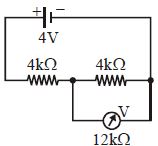
The percentage error in the reading of the voltmeter in the figure shown here is nearly ............ $\%$
A
$14$
B
$28$
C
$7$
D
$0.71$
Solution
(A) The ideal voltage across the $4 \text{ k}\Omega$ resistor (without the voltmeter) is calculated using the voltage divider rule: $V = \frac{4 \text{ k}\Omega}{4 \text{ k}\Omega + 4 \text{ k}\Omega} \times 4 \text{ V} = 2 \text{ V}$.
When the voltmeter with resistance $R_v = 12 \text{ k}\Omega$ is connected in parallel with the $4 \text{ k}\Omega$ resistor, the equivalent resistance $R_p$ of the parallel combination is: $R_p = \frac{4 \text{ k}\Omega \times 12 \text{ k}\Omega}{4 \text{ k}\Omega + 12 \text{ k}\Omega} = \frac{48}{16} \text{ k}\Omega = 3 \text{ k}\Omega$.
The actual reading $V^{\prime}$ of the voltmeter is the voltage across this parallel combination: $V^{\prime} = \frac{R_p}{R_p + 4 \text{ k}\Omega} \times 4 \text{ V} = \frac{3}{3 + 4} \times 4 \text{ V} = \frac{12}{7} \text{ V} \approx 1.714 \text{ V}$.
The percentage error is given by: $\text{Percentage Error} = \frac{V - V^{\prime}}{V} \times 100 = \frac{2 - \frac{12}{7}}{2} \times 100 = \frac{\frac{14 - 12}{7}}{2} \times 100 = \frac{2}{14} \times 100 = \frac{1}{7} \times 100 \approx 14.28 \%$.
Thus, the percentage error is nearly $14 \%$.
When the voltmeter with resistance $R_v = 12 \text{ k}\Omega$ is connected in parallel with the $4 \text{ k}\Omega$ resistor, the equivalent resistance $R_p$ of the parallel combination is: $R_p = \frac{4 \text{ k}\Omega \times 12 \text{ k}\Omega}{4 \text{ k}\Omega + 12 \text{ k}\Omega} = \frac{48}{16} \text{ k}\Omega = 3 \text{ k}\Omega$.
The actual reading $V^{\prime}$ of the voltmeter is the voltage across this parallel combination: $V^{\prime} = \frac{R_p}{R_p + 4 \text{ k}\Omega} \times 4 \text{ V} = \frac{3}{3 + 4} \times 4 \text{ V} = \frac{12}{7} \text{ V} \approx 1.714 \text{ V}$.
The percentage error is given by: $\text{Percentage Error} = \frac{V - V^{\prime}}{V} \times 100 = \frac{2 - \frac{12}{7}}{2} \times 100 = \frac{\frac{14 - 12}{7}}{2} \times 100 = \frac{2}{14} \times 100 = \frac{1}{7} \times 100 \approx 14.28 \%$.
Thus, the percentage error is nearly $14 \%$.
0 likes
View Solution129
DifficultMCQ
$A$ moving coil galvanometer has $100$ equal divisions. Its current sensitivity is $10$ divisions per milliampere and voltage sensitivity is $2$ divisions per millivolt. In order that each division reads $1 \ V$,the resistance in Ohm's needed to be connected in series with the coil will be
A
$10^3$
B
$10^5$
C
$99995$
D
$9995$
Solution
(D) The current sensitivity $I_s = 10 \text{ divisions/mA}$.
The voltage sensitivity $V_s = 2 \text{ divisions/mV}$.
The resistance of the galvanometer $G$ is given by $G = \frac{I_s}{V_s} = \frac{10 \text{ div/mA}}{2 \text{ div/mV}} = 5 \ \Omega$.
The full-scale deflection current $I_g$ for $100$ divisions is $I_g = \frac{100 \text{ divisions}}{10 \text{ divisions/mA}} = 10 \text{ mA} = 0.01 \text{ A}$.
We want the galvanometer to read $1 \text{ V}$ per division. For $100$ divisions,the total voltage $V$ required is $V = 100 \times 1 \text{ V} = 100 \text{ V}$.
Let the series resistance be $R$. Then $V = I_g(G + R)$.
$100 = 0.01(5 + R)$.
$10000 = 5 + R$.
$R = 10000 - 5 = 9995 \ \Omega$.
The voltage sensitivity $V_s = 2 \text{ divisions/mV}$.
The resistance of the galvanometer $G$ is given by $G = \frac{I_s}{V_s} = \frac{10 \text{ div/mA}}{2 \text{ div/mV}} = 5 \ \Omega$.
The full-scale deflection current $I_g$ for $100$ divisions is $I_g = \frac{100 \text{ divisions}}{10 \text{ divisions/mA}} = 10 \text{ mA} = 0.01 \text{ A}$.
We want the galvanometer to read $1 \text{ V}$ per division. For $100$ divisions,the total voltage $V$ required is $V = 100 \times 1 \text{ V} = 100 \text{ V}$.
Let the series resistance be $R$. Then $V = I_g(G + R)$.
$100 = 0.01(5 + R)$.
$10000 = 5 + R$.
$R = 10000 - 5 = 9995 \ \Omega$.
0 likes
View Solution130
MediumMCQ
Which one of the following modifications may increase the sensitivity of a moving coil galvanometer?
$1^{st}$ Way: By using a spring of smaller torsion constant.
$2^{nd}$ Way: By using a smaller coil.
$3^{rd}$ Way: By using a stronger magnet.
$4^{th}$ Way: By using a coil having fewer number of turns.
$1^{st}$ Way: By using a spring of smaller torsion constant.
$2^{nd}$ Way: By using a smaller coil.
$3^{rd}$ Way: By using a stronger magnet.
$4^{th}$ Way: By using a coil having fewer number of turns.
A
$1^{st}$ and $4^{th}$ ways only
B
$1^{st}$ and $3^{rd}$ ways only
C
$1^{st}$,$2^{nd}$,and $3^{rd}$ ways only
D
$2^{nd}$ and $4^{th}$ ways only
Solution
(B) The current sensitivity of a moving coil galvanometer is given by the formula: $S_i = \frac{\theta}{I} = \frac{NBA}{k}$.
Here,$N$ is the number of turns,$B$ is the magnetic field,$A$ is the area of the coil,and $k$ is the torsion constant of the spring.
To increase the sensitivity $(S_i)$:
$1$. Increase $N$ (number of turns).
$2$. Increase $B$ (using a stronger magnet).
$3$. Increase $A$ (using a larger coil).
$4$. Decrease $k$ (using a spring with a smaller torsion constant).
Comparing these with the given options,the $1^{st}$ way (smaller torsion constant) and the $3^{rd}$ way (stronger magnet) will increase the sensitivity. Therefore,the correct option is $B$.
Here,$N$ is the number of turns,$B$ is the magnetic field,$A$ is the area of the coil,and $k$ is the torsion constant of the spring.
To increase the sensitivity $(S_i)$:
$1$. Increase $N$ (number of turns).
$2$. Increase $B$ (using a stronger magnet).
$3$. Increase $A$ (using a larger coil).
$4$. Decrease $k$ (using a spring with a smaller torsion constant).
Comparing these with the given options,the $1^{st}$ way (smaller torsion constant) and the $3^{rd}$ way (stronger magnet) will increase the sensitivity. Therefore,the correct option is $B$.
0 likes
View Solution131
DifficultMCQ
$A$ shunt of resistance $1\ \Omega$ is connected across a galvanometer of $120\ \Omega$ resistance. $A$ current of $5.5\ A$ flows through the circuit,and the galvanometer shows full-scale deflection. What is the current that would cause full-scale deflection in the galvanometer in the absence of the shunt (in $A$)?
A
$5.5$
B
$0.5$
C
$0.045$
D
$0.004$
Solution
(C) Let $G = 120\ \Omega$ be the resistance of the galvanometer and $S = 1\ \Omega$ be the resistance of the shunt.
Let $I_g$ be the current through the galvanometer for full-scale deflection and $I$ be the total current in the circuit.
When the shunt is connected,the total current $I = 5.5\ A$ is divided between the galvanometer and the shunt.
The current through the galvanometer is given by $I_g = I \left( \frac{S}{G + S} \right)$.
Substituting the values: $I_g = 5.5 \times \left( \frac{1}{120 + 1} \right) = 5.5 \times \left( \frac{1}{121} \right)$.
$I_g = \frac{5.5}{121} = \frac{55}{1210} = \frac{1}{22} \approx 0.04545\ A$.
Thus,the current required for full-scale deflection in the absence of the shunt is approximately $0.045\ A$.
Let $I_g$ be the current through the galvanometer for full-scale deflection and $I$ be the total current in the circuit.
When the shunt is connected,the total current $I = 5.5\ A$ is divided between the galvanometer and the shunt.
The current through the galvanometer is given by $I_g = I \left( \frac{S}{G + S} \right)$.
Substituting the values: $I_g = 5.5 \times \left( \frac{1}{120 + 1} \right) = 5.5 \times \left( \frac{1}{121} \right)$.
$I_g = \frac{5.5}{121} = \frac{55}{1210} = \frac{1}{22} \approx 0.04545\ A$.
Thus,the current required for full-scale deflection in the absence of the shunt is approximately $0.045\ A$.
0 likes
View Solution132
MediumMCQ
The circular coil of a galvanometer has $50$ turns. The coil has a radius of $1 \ cm$. The coil is placed in a radial magnetic field of $0.010 \ T$. The torsion coefficient of the spring on which the coil hangs is $3 \times 10^{-7} \ N-m-rad^{-1}$. Determine the deflection of the galvanometer's pointer if the current through the coil is $1.0 \ mA$. (in $^{\circ}$)
A
$15$
B
$30$
C
$45$
D
$60$
Solution
(B) The deflection $\phi$ of a moving coil galvanometer is given by the formula: $\phi = \frac{N A B i}{k}$.
Here, $N = 50$, $r = 1 \ cm = 0.01 \ m$, $B = 0.010 \ T$, $i = 1.0 \ mA = 1.0 \times 10^{-3} \ A$, and $k = 3 \times 10^{-7} \ N-m-rad^{-1}$.
The area $A = \pi r^2 = \pi \times (0.01)^2 = \pi \times 10^{-4} \ m^2$.
Substituting these values into the formula:
$\phi = \frac{50 \times (\pi \times 10^{-4}) \times 0.010 \times 1.0 \times 10^{-3}}{3 \times 10^{-7}}$
$\phi = \frac{50 \times \pi \times 10^{-4} \times 10^{-2} \times 10^{-3}}{3 \times 10^{-7}} = \frac{50 \times \pi \times 10^{-9}}{3 \times 10^{-7}} = \frac{50 \times \pi}{3} \times 10^{-2} = \frac{0.5 \pi}{3} \approx 0.5236 \ radians$.
Converting radians to degrees: $\phi_{deg} = 0.5236 \times \frac{180}{\pi} = 30^{\circ}$.
Here, $N = 50$, $r = 1 \ cm = 0.01 \ m$, $B = 0.010 \ T$, $i = 1.0 \ mA = 1.0 \times 10^{-3} \ A$, and $k = 3 \times 10^{-7} \ N-m-rad^{-1}$.
The area $A = \pi r^2 = \pi \times (0.01)^2 = \pi \times 10^{-4} \ m^2$.
Substituting these values into the formula:
$\phi = \frac{50 \times (\pi \times 10^{-4}) \times 0.010 \times 1.0 \times 10^{-3}}{3 \times 10^{-7}}$
$\phi = \frac{50 \times \pi \times 10^{-4} \times 10^{-2} \times 10^{-3}}{3 \times 10^{-7}} = \frac{50 \times \pi \times 10^{-9}}{3 \times 10^{-7}} = \frac{50 \times \pi}{3} \times 10^{-2} = \frac{0.5 \pi}{3} \approx 0.5236 \ radians$.
Converting radians to degrees: $\phi_{deg} = 0.5236 \times \frac{180}{\pi} = 30^{\circ}$.
0 likes
View Solution133
MediumMCQ
To convert a galvanometer into an ammeter,a shunt of $0.01\,\Omega$ is used. The resistance of the galvanometer coil is $50\,\Omega$ and its maximum deflection current is $20\,mA$. The range of the ammeter is:
A
$0-1\,A$
B
$0-10\,A$
C
$0-100\,A$
D
$0-1000\,A$
Solution
(C) The potential difference across the galvanometer and the shunt resistor is the same because they are connected in parallel.
$V_g = V_s$
$I_g R_g = I_s R_s$
Given: $R_g = 50\,\Omega$,$R_s = 0.01\,\Omega$,$I_g = 20\,mA = 0.02\,A$.
$I_s = \frac{I_g R_g}{R_s} = \frac{0.02 \times 50}{0.01} = \frac{1}{0.01} = 100\,A$.
The total range of the ammeter $I = I_g + I_s$.
$I = 0.02\,A + 100\,A = 100.02\,A$.
Since $I_g$ is very small compared to $I_s$,the range is approximately $100\,A$.
$V_g = V_s$
$I_g R_g = I_s R_s$
Given: $R_g = 50\,\Omega$,$R_s = 0.01\,\Omega$,$I_g = 20\,mA = 0.02\,A$.
$I_s = \frac{I_g R_g}{R_s} = \frac{0.02 \times 50}{0.01} = \frac{1}{0.01} = 100\,A$.
The total range of the ammeter $I = I_g + I_s$.
$I = 0.02\,A + 100\,A = 100.02\,A$.
Since $I_g$ is very small compared to $I_s$,the range is approximately $100\,A$.
0 likes
View Solution134
DifficultMCQ
The coil in a moving coil galvanometer experiences a torque proportional to the current passed through it. If a steady current $i$ is passed through it,the deflection of the coil is found to be $90^o$. Now,the steady current is switched off and a charge $Q$ is suddenly passed through the coil. If the coil has $N$ turns of area $A$ each and its moment of inertia is $I$ about the axis it is going to rotate,then the maximum angle through which it deflects upon passing $Q$ is:
A
$Q\sqrt {\frac{{\pi NAB}}{{2iI}}} $
B
$\frac{{\pi Q}}{2}\sqrt {\frac{{NAB}}{{iI}}} $
C
$\pi Q\sqrt {\frac{{NAB}}{{2iI}}} $
D
$Q\sqrt {\frac{{\pi NAB}}{{iI}}} $
Solution
(A) The torque on the coil is given by $\tau = NIAB \sin \theta$. For small deflections,$\tau = NIAB = C \theta$,where $C$ is the torsional constant.
Given that for current $i$,the deflection is $\theta = 90^o = \frac{\pi}{2}$ radians.
So,$NiAB = C \frac{\pi}{2} \Rightarrow C = \frac{2NiAB}{\pi}$ ........$(1)$
When a charge $Q$ is passed suddenly,the impulse of the torque is equal to the change in angular momentum:
$\int \tau dt = \int (NIAB) dt = NAB \int i dt = NABQ$
Since $\int \tau dt = \Delta L = I \omega$,we have $I \omega = NABQ$ ........$(2)$
By the law of conservation of energy,the initial kinetic energy is converted into potential energy of the spring at maximum deflection $\theta_{max}$:
$\frac{1}{2} I \omega^2 = \frac{1}{2} C \theta_{max}^2$
$\theta_{max} = \omega \sqrt{\frac{I}{C}} = \frac{I \omega}{\sqrt{IC}} = \frac{NABQ}{\sqrt{IC}}$
Substituting $C$ from $(1)$:
$\theta_{max} = \frac{NABQ}{\sqrt{I \cdot \frac{2NiAB}{\pi}}} = NABQ \sqrt{\frac{\pi}{2NiABI}} = Q \sqrt{\frac{\pi NAB}{2iI}}$
Given that for current $i$,the deflection is $\theta = 90^o = \frac{\pi}{2}$ radians.
So,$NiAB = C \frac{\pi}{2} \Rightarrow C = \frac{2NiAB}{\pi}$ ........$(1)$
When a charge $Q$ is passed suddenly,the impulse of the torque is equal to the change in angular momentum:
$\int \tau dt = \int (NIAB) dt = NAB \int i dt = NABQ$
Since $\int \tau dt = \Delta L = I \omega$,we have $I \omega = NABQ$ ........$(2)$
By the law of conservation of energy,the initial kinetic energy is converted into potential energy of the spring at maximum deflection $\theta_{max}$:
$\frac{1}{2} I \omega^2 = \frac{1}{2} C \theta_{max}^2$
$\theta_{max} = \omega \sqrt{\frac{I}{C}} = \frac{I \omega}{\sqrt{IC}} = \frac{NABQ}{\sqrt{IC}}$
Substituting $C$ from $(1)$:
$\theta_{max} = \frac{NABQ}{\sqrt{I \cdot \frac{2NiAB}{\pi}}} = NABQ \sqrt{\frac{\pi}{2NiABI}} = Q \sqrt{\frac{\pi NAB}{2iI}}$
0 likes
View Solution135
MediumMCQ
$A$ galvanometer having a coil resistance of $30\,\Omega$ shows full-scale deflection when a current of $2\,A$ passes through it. It can be converted into an ammeter to read currents up to $10\,A$ by:
A
by putting in series a resistance of $240\,\Omega$
B
by putting in parallel a resistance of $240\,\Omega$
C
by putting in series a resistance of $7.5\,\Omega$
D
by putting in parallel a resistance of $7.5\,\Omega$
Solution
(D) To convert a galvanometer into an ammeter,a shunt resistance $S$ must be connected in parallel with the galvanometer.
Given: Galvanometer resistance $R_g = 30\,\Omega$,full-scale current $I_g = 2\,A$,and desired range $I = 10\,A$.
The formula for shunt resistance is $S = \frac{I_g R_g}{I - I_g}$.
Substituting the values: $S = \frac{2 \times 30}{10 - 2} = \frac{60}{8} = 7.5\,\Omega$.
Thus,a resistance of $7.5\,\Omega$ must be connected in parallel.
Given: Galvanometer resistance $R_g = 30\,\Omega$,full-scale current $I_g = 2\,A$,and desired range $I = 10\,A$.
The formula for shunt resistance is $S = \frac{I_g R_g}{I - I_g}$.
Substituting the values: $S = \frac{2 \times 30}{10 - 2} = \frac{60}{8} = 7.5\,\Omega$.
Thus,a resistance of $7.5\,\Omega$ must be connected in parallel.
0 likes
View Solution136
MediumMCQ
The sensitivity of a galvanometer of resistance $406\, \Omega$ is decreased by $30$ times. The shunt used is .................. $\Omega$.
A
$88$
B
$14$
C
$6$
D
$16$
Solution
(B) The sensitivity of a galvanometer is given by $S = \frac{i_g}{i}$.
Given that the sensitivity is decreased by $30$ times,we have $\frac{i_g}{i} = \frac{1}{30}$,which implies $\frac{i}{i_g} = 30$.
The formula for the shunt resistance $S$ required to convert a galvanometer of resistance $G$ into an ammeter is $S = \frac{G \cdot i_g}{i - i_g}$.
Dividing the numerator and denominator by $i_g$,we get $S = \frac{G}{\frac{i}{i_g} - 1}$.
Substituting the given values $G = 406\, \Omega$ and $\frac{i}{i_g} = 30$:
$S = \frac{406}{30 - 1} = \frac{406}{29} = 14\, \Omega$.
Given that the sensitivity is decreased by $30$ times,we have $\frac{i_g}{i} = \frac{1}{30}$,which implies $\frac{i}{i_g} = 30$.
The formula for the shunt resistance $S$ required to convert a galvanometer of resistance $G$ into an ammeter is $S = \frac{G \cdot i_g}{i - i_g}$.
Dividing the numerator and denominator by $i_g$,we get $S = \frac{G}{\frac{i}{i_g} - 1}$.
Substituting the given values $G = 406\, \Omega$ and $\frac{i}{i_g} = 30$:
$S = \frac{406}{30 - 1} = \frac{406}{29} = 14\, \Omega$.
0 likes
View Solution137
MediumMCQ
$A$ galvanometer having a resistance $G$ and current $I_g$ flowing in it,produces full-scale deflection. If $S_1$ is the value of the shunt which converts it into an ammeter of range $0-I$ and $S_2$ is the value of the shunt for range $0-8I$,then the ratio $\frac{S_1}{S_2}$ will be:
A
$\frac{8I - I_g}{I - I_g}$
B
$1$
C
$8$
D
$\frac{1}{2} \left( \frac{I - I_g}{8I - I_g} \right)$
Solution
(A) The shunt resistance $S$ required to convert a galvanometer of resistance $G$ into an ammeter of range $I$ is given by the formula: $S = \frac{I_g G}{I - I_g}$.
For the first range $0-I$,the shunt resistance is $S_1 = \frac{I_g G}{I - I_g}$.
For the second range $0-8I$,the shunt resistance is $S_2 = \frac{I_g G}{8I - I_g}$.
Taking the ratio of $S_1$ to $S_2$:
$\frac{S_1}{S_2} = \frac{\frac{I_g G}{I - I_g}}{\frac{I_g G}{8I - I_g}} = \frac{8I - I_g}{I - I_g}$.
For the first range $0-I$,the shunt resistance is $S_1 = \frac{I_g G}{I - I_g}$.
For the second range $0-8I$,the shunt resistance is $S_2 = \frac{I_g G}{8I - I_g}$.
Taking the ratio of $S_1$ to $S_2$:
$\frac{S_1}{S_2} = \frac{\frac{I_g G}{I - I_g}}{\frac{I_g G}{8I - I_g}} = \frac{8I - I_g}{I - I_g}$.
0 likes
View Solution138
EasyMCQ
In a moving coil galvanometer,to make the field radial,what is done?
A
The coil is wound on a wooden frame.
B
The magnetic poles are cylindrically cut.
C
$A$ horse-shoe magnet is used.
D
The number of windings in the coil is decreased.
Solution
(B) In a moving coil galvanometer,a radial magnetic field is essential to ensure that the magnetic torque remains constant regardless of the coil's orientation.
This is achieved by using concave (cylindrically cut) magnetic pole pieces and placing a soft iron core inside the coil.
The concave shape of the pole pieces ensures that the magnetic field lines are always parallel to the plane of the coil for any angular position,making the field radial.
Therefore,the correct option is $B$.
This is achieved by using concave (cylindrically cut) magnetic pole pieces and placing a soft iron core inside the coil.
The concave shape of the pole pieces ensures that the magnetic field lines are always parallel to the plane of the coil for any angular position,making the field radial.
Therefore,the correct option is $B$.
0 likes
View Solution139
MediumMCQ
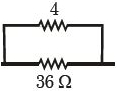
$A$ galvanometer has $36\,\Omega$ resistance. If a $4\,\Omega$ shunt is added to this,the fraction of current that passes through the shunt is
A
$\frac{1}{4}$
B
$\frac{1}{9}$
C
$\frac{1}{10}$
D
$\frac{9}{10}$
Solution
(D) Let $G = 36\,\Omega$ be the resistance of the galvanometer and $S = 4\,\Omega$ be the resistance of the shunt.
When a shunt is connected in parallel to a galvanometer,the current $I$ divides into two parts: $I_g$ through the galvanometer and $I_s$ through the shunt.
Since they are in parallel,the potential difference across both is the same: $I_g G = I_s S$.
Therefore,the ratio of currents is $\frac{I_s}{I_g} = \frac{G}{S} = \frac{36}{4} = 9$.
This means $I_s = 9 I_g$.
The total current is $I = I_s + I_g = 9 I_g + I_g = 10 I_g$.
The fraction of current passing through the shunt is $\frac{I_s}{I} = \frac{9 I_g}{10 I_g} = \frac{9}{10}$.
When a shunt is connected in parallel to a galvanometer,the current $I$ divides into two parts: $I_g$ through the galvanometer and $I_s$ through the shunt.
Since they are in parallel,the potential difference across both is the same: $I_g G = I_s S$.
Therefore,the ratio of currents is $\frac{I_s}{I_g} = \frac{G}{S} = \frac{36}{4} = 9$.
This means $I_s = 9 I_g$.
The total current is $I = I_s + I_g = 9 I_g + I_g = 10 I_g$.
The fraction of current passing through the shunt is $\frac{I_s}{I} = \frac{9 I_g}{10 I_g} = \frac{9}{10}$.
0 likes
View Solution140
MediumMCQ
The resistance of a galvanometer is $50\,\Omega$ and it requires $2\,\mu A$ per two division deflection. The value of the shunt required in order to convert this galvanometer into an ammeter of range $5\,A$ is (The number of divisions on the galvanometer scale on one side is $30$).
A
$0.2\,\Omega$
B
$0.002\,\Omega$
C
$3 \times 10^{-4}\,\Omega$
D
$4 \times 10^{-6}\,\Omega$
Solution
(C) The resistance of the galvanometer is $G = 50\,\Omega$.
Given that the galvanometer requires $2\,\mu A$ for $2$ divisions,the current per division is $1\,\mu A/\text{division}$.
Since there are $30$ divisions on one side,the full-scale deflection current $I_g$ is:
$I_g = 30 \times 1\,\mu A = 30 \times 10^{-6}\,A$.
The range of the ammeter is $I = 5\,A$.
The shunt resistance $S$ required is given by the formula:
$S = \frac{I_g G}{I - I_g}$.
Substituting the values:
$S = \frac{30 \times 10^{-6} \times 50}{5 - 30 \times 10^{-6}}$.
Since $30 \times 10^{-6}$ is negligible compared to $5$,we have:
$S \approx \frac{30 \times 10^{-6} \times 50}{5} = 30 \times 10^{-6} \times 10 = 300 \times 10^{-6}\,\Omega = 3 \times 10^{-4}\,\Omega$.
Given that the galvanometer requires $2\,\mu A$ for $2$ divisions,the current per division is $1\,\mu A/\text{division}$.
Since there are $30$ divisions on one side,the full-scale deflection current $I_g$ is:
$I_g = 30 \times 1\,\mu A = 30 \times 10^{-6}\,A$.
The range of the ammeter is $I = 5\,A$.
The shunt resistance $S$ required is given by the formula:
$S = \frac{I_g G}{I - I_g}$.
Substituting the values:
$S = \frac{30 \times 10^{-6} \times 50}{5 - 30 \times 10^{-6}}$.
Since $30 \times 10^{-6}$ is negligible compared to $5$,we have:
$S \approx \frac{30 \times 10^{-6} \times 50}{5} = 30 \times 10^{-6} \times 10 = 300 \times 10^{-6}\,\Omega = 3 \times 10^{-4}\,\Omega$.
0 likes
View Solution141
EasyMCQ
To convert a galvanometer into an ammeter,one needs to connect a
A
low resistance in parallel
B
high resistance in parallel
C
low resistance in series
D
high resistance in series
Solution
(A) To convert a galvanometer into an ammeter,a low resistance,known as a shunt $(S)$,must be connected in parallel with the galvanometer coil.
This arrangement ensures that the majority of the current in the circuit passes through the shunt,protecting the sensitive galvanometer coil from damage due to high current.
Additionally,it reduces the overall resistance of the device,allowing it to measure current accurately without significantly affecting the circuit's current flow.
This arrangement ensures that the majority of the current in the circuit passes through the shunt,protecting the sensitive galvanometer coil from damage due to high current.
Additionally,it reduces the overall resistance of the device,allowing it to measure current accurately without significantly affecting the circuit's current flow.
0 likes
View Solution142
MediumMCQ
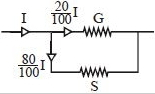
$20\%$ of the main current passes through the galvanometer. If the resistance of the galvanometer is $G$,then the resistance of the shunt will be
A
$\frac{G}{50}$
B
$\frac{G}{4}$
C
$50\,G$
D
$9\,G$
Solution
(B) Let the main current be $I$.
According to the problem,the current passing through the galvanometer $(I_g)$ is $20\%$ of $I$,so $I_g = 0.2I$.
The current passing through the shunt $(I_s)$ is the remaining current,so $I_s = I - 0.2I = 0.8I$.
Since the galvanometer and the shunt are connected in parallel,the potential difference across them is equal:
$I_g \cdot G = I_s \cdot S$
Substituting the values:
$0.2I \cdot G = 0.8I \cdot S$
$0.2G = 0.8S$
$S = \frac{0.2G}{0.8} = \frac{G}{4}$
According to the problem,the current passing through the galvanometer $(I_g)$ is $20\%$ of $I$,so $I_g = 0.2I$.
The current passing through the shunt $(I_s)$ is the remaining current,so $I_s = I - 0.2I = 0.8I$.
Since the galvanometer and the shunt are connected in parallel,the potential difference across them is equal:
$I_g \cdot G = I_s \cdot S$
Substituting the values:
$0.2I \cdot G = 0.8I \cdot S$
$0.2G = 0.8S$
$S = \frac{0.2G}{0.8} = \frac{G}{4}$
0 likes
View Solution143
DifficultMCQ
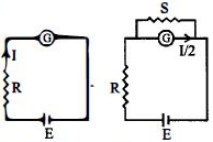
In a circuit for finding the resistance of a galvanometer by the half-deflection method,a $6\,V$ battery and a high resistance of $11\,k\Omega$ are used. The figure of merit of the galvanometer is $60\,\mu A/\text{division}$. In the absence of shunt resistance,the galvanometer produces a deflection of $\theta = 9$ divisions when current flows in the circuit. The value of the shunt resistance that can cause the deflection of $\theta/2$ is closest to .................. $\Omega$.
A
$55$
B
$110$
C
$220$
D
$550$
Solution
(B) Given: Battery voltage $E = 6\,V$,high resistance $R = 11\,k\Omega = 11000\,\Omega$,figure of merit $k = 60\,\mu A/\text{div}$,initial deflection $\theta = 9\,\text{div}$.
$1$. Calculate the current $I$ for full deflection $\theta = 9$:
$I = k \cdot \theta = 60 \times 10^{-6} \times 9 = 540 \times 10^{-6} = 5.4 \times 10^{-4}\,A$.
$2$. Using Ohm's law for the circuit without shunt:
$I = \frac{E}{R + G} \implies 5.4 \times 10^{-4} = \frac{6}{11000 + G}$.
Since $R \gg G$,$R + G \approx R = 11000\,\Omega$.
$G = \frac{E}{I} - R = \frac{6}{5.4 \times 10^{-4}} - 11000 = 11111 - 11000 = 111.1\,\Omega$.
$3$. In the half-deflection method,the shunt resistance $S$ is connected such that the deflection becomes $\theta/2 = 4.5\,\text{div}$.
The formula for shunt resistance in the half-deflection method is $S = \frac{G \cdot R}{R - G}$.
Given $R = 11000\,\Omega$ and $G \approx 111.1\,\Omega$:
$S = \frac{111.1 \times 11000}{11000 - 111.1} \approx \frac{111.1 \times 11000}{10888.9} \approx 112.2\,\Omega$.
Rounding to the nearest given option,the value is $110\,\Omega$.
$1$. Calculate the current $I$ for full deflection $\theta = 9$:
$I = k \cdot \theta = 60 \times 10^{-6} \times 9 = 540 \times 10^{-6} = 5.4 \times 10^{-4}\,A$.
$2$. Using Ohm's law for the circuit without shunt:
$I = \frac{E}{R + G} \implies 5.4 \times 10^{-4} = \frac{6}{11000 + G}$.
Since $R \gg G$,$R + G \approx R = 11000\,\Omega$.
$G = \frac{E}{I} - R = \frac{6}{5.4 \times 10^{-4}} - 11000 = 11111 - 11000 = 111.1\,\Omega$.
$3$. In the half-deflection method,the shunt resistance $S$ is connected such that the deflection becomes $\theta/2 = 4.5\,\text{div}$.
The formula for shunt resistance in the half-deflection method is $S = \frac{G \cdot R}{R - G}$.
Given $R = 11000\,\Omega$ and $G \approx 111.1\,\Omega$:
$S = \frac{111.1 \times 11000}{11000 - 111.1} \approx \frac{111.1 \times 11000}{10888.9} \approx 112.2\,\Omega$.
Rounding to the nearest given option,the value is $110\,\Omega$.
0 likes
View Solution144
DifficultMCQ
$A$ galvanometer with its coil resistance $25\,\Omega$ requires a current of $1\,mA$ for its full-scale deflection. In order to construct an ammeter to read up to a current of $2\,A$,the approximate value of the shunt resistance should be:
A
$2.5 \times 10^{-2}\,\Omega$
B
$1.25 \times 10^{-3}\,\Omega$
C
$2.5 \times 10^{-3}\,\Omega$
D
$1.25 \times 10^{-2}\,\Omega$
Solution
(D) Given:
Galvanometer resistance,$R_g = 25\,\Omega$
Full-scale deflection current,$I_g = 1\,mA = 10^{-3}\,A$
Maximum current to be measured,$I = 2\,A$
To convert a galvanometer into an ammeter,a shunt resistance $S$ is connected in parallel with the galvanometer.
The potential difference across the galvanometer and the shunt must be equal:
$I_g R_g = (I - I_g) S$
Substituting the values:
$10^{-3} \times 25 = (2 - 10^{-3}) S$
$0.025 = (2 - 0.001) S$
$0.025 = 1.999 S$
$S = \frac{0.025}{1.999} \approx \frac{0.025}{2} = 0.0125\,\Omega$
Thus,$S = 1.25 \times 10^{-2}\,\Omega$.
Galvanometer resistance,$R_g = 25\,\Omega$
Full-scale deflection current,$I_g = 1\,mA = 10^{-3}\,A$
Maximum current to be measured,$I = 2\,A$
To convert a galvanometer into an ammeter,a shunt resistance $S$ is connected in parallel with the galvanometer.
The potential difference across the galvanometer and the shunt must be equal:
$I_g R_g = (I - I_g) S$
Substituting the values:
$10^{-3} \times 25 = (2 - 10^{-3}) S$
$0.025 = (2 - 0.001) S$
$0.025 = 1.999 S$
$S = \frac{0.025}{1.999} \approx \frac{0.025}{2} = 0.0125\,\Omega$
Thus,$S = 1.25 \times 10^{-2}\,\Omega$.
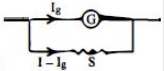
0 likes
View Solution145
DifficultMCQ
To determine the resistance $G$ of a galvanometer by the half-deflection method,a battery of $emf$ $V$ and a series resistance $R$ are used to produce a deflection $\theta$ in the galvanometer. If a shunt resistance $S$ is connected in parallel to the galvanometer to reduce the deflection to $\theta/2$,then $G, R$,and $S$ are related by the equation:
A
$S(R + G) = RG$
B
$2S(R + G) = RG$
C
$2G = S$
D
$2S = G$
Solution
(A) In the first case,the current through the galvanometer is $I_g = \frac{V}{R + G}$.
In the second case,when a shunt resistance $S$ is connected in parallel with the galvanometer,the equivalent resistance of the parallel combination is $R_p = \frac{GS}{G + S}$.
The total current in the circuit becomes $I = \frac{V}{R + R_p} = \frac{V}{R + \frac{GS}{G + S}}$.
The current through the galvanometer is now $I_g' = I \times \frac{S}{G + S} = \frac{V}{R + \frac{GS}{G + S}} \times \frac{S}{G + S} = \frac{VS}{R(G + S) + GS}$.
According to the problem,the deflection is halved,so $I_g' = \frac{I_g}{2}$.
Substituting the expressions: $\frac{VS}{R(G + S) + GS} = \frac{1}{2} \times \frac{V}{R + G}$.
$\frac{S}{RG + RS + GS} = \frac{1}{2(R + G)}$.
$2S(R + G) = RG + RS + GS$.
$2SR + 2SG = RG + RS + GS$.
$2SR - RS + 2SG - GS = RG$.
$SR + SG = RG$.
$S(R + G) = RG$.
In the second case,when a shunt resistance $S$ is connected in parallel with the galvanometer,the equivalent resistance of the parallel combination is $R_p = \frac{GS}{G + S}$.
The total current in the circuit becomes $I = \frac{V}{R + R_p} = \frac{V}{R + \frac{GS}{G + S}}$.
The current through the galvanometer is now $I_g' = I \times \frac{S}{G + S} = \frac{V}{R + \frac{GS}{G + S}} \times \frac{S}{G + S} = \frac{VS}{R(G + S) + GS}$.
According to the problem,the deflection is halved,so $I_g' = \frac{I_g}{2}$.
Substituting the expressions: $\frac{VS}{R(G + S) + GS} = \frac{1}{2} \times \frac{V}{R + G}$.
$\frac{S}{RG + RS + GS} = \frac{1}{2(R + G)}$.
$2S(R + G) = RG + RS + GS$.
$2SR + 2SG = RG + RS + GS$.
$2SR - RS + 2SG - GS = RG$.
$SR + SG = RG$.
$S(R + G) = RG$.
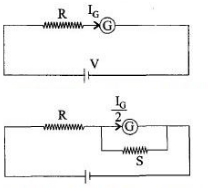
0 likes
View Solution146
DifficultMCQ
$A$ $50\,\Omega$ resistance is connected to a battery of $5\,V$. $A$ galvanometer of resistance $100\,\Omega$ is to be used as an ammeter to measure current through the resistance. For this,a resistance $r_s$ is connected to the galvanometer. Which of the following connections should be employed if the measured current is within $1\%$ of the current without the ammeter in the circuit?
A
$r_s = 0.5\,\Omega$ in series with the galvanometer
B
$r_s = 1\,\Omega$ in series with the galvanometer
C
$r_s = 1\,\Omega$ in parallel with the galvanometer
D
$r_s = 0.5\,\Omega$ in parallel with the galvanometer
Solution
(D) The current in the circuit without the ammeter is $I = \frac{V}{R} = \frac{5\,V}{50\,\Omega} = 0.1\,A$.
The measured current $I'$ must be within $1\%$ of $I$. Thus,$I' \geq 0.99 \times 0.1 = 0.099\,A$.
To measure current,an ammeter (galvanometer with a shunt resistor $r_s$ in parallel) is connected in series with the $50\,\Omega$ resistor.
The equivalent resistance of the circuit is $R_{eq} = 50 + R_A$,where $R_A = \frac{100 \times r_s}{100 + r_s}$.
The current measured is $I' = \frac{V}{R_{eq}} = \frac{5}{50 + R_A} = 0.099\,A$.
Solving for $R_A$: $50 + R_A = \frac{5}{0.099} \approx 50.505\,\Omega$.
So,$R_A = 50.505 - 50 = 0.505\,\Omega$.
Since $R_A = \frac{100 \times r_s}{100 + r_s} = 0.505$,we get $100 r_s = 50.5 + 0.505 r_s$.
$99.495 r_s = 50.5 \Rightarrow r_s \approx 0.507\,\Omega$.
Rounding to the nearest provided option,$r_s = 0.5\,\Omega$ connected in parallel is the correct choice.
The measured current $I'$ must be within $1\%$ of $I$. Thus,$I' \geq 0.99 \times 0.1 = 0.099\,A$.
To measure current,an ammeter (galvanometer with a shunt resistor $r_s$ in parallel) is connected in series with the $50\,\Omega$ resistor.
The equivalent resistance of the circuit is $R_{eq} = 50 + R_A$,where $R_A = \frac{100 \times r_s}{100 + r_s}$.
The current measured is $I' = \frac{V}{R_{eq}} = \frac{5}{50 + R_A} = 0.099\,A$.
Solving for $R_A$: $50 + R_A = \frac{5}{0.099} \approx 50.505\,\Omega$.
So,$R_A = 50.505 - 50 = 0.505\,\Omega$.
Since $R_A = \frac{100 \times r_s}{100 + r_s} = 0.505$,we get $100 r_s = 50.5 + 0.505 r_s$.
$99.495 r_s = 50.5 \Rightarrow r_s \approx 0.507\,\Omega$.
Rounding to the nearest provided option,$r_s = 0.5\,\Omega$ connected in parallel is the correct choice.
0 likes
View Solution147
DifficultMCQ
$A$ galvanometer has a $50$ division scale. The battery has no internal resistance. It is found that there is a deflection of $40$ divisions when $R = 2400\,\Omega$. The deflection becomes $20$ divisions when the resistance taken from the resistance box is $4900\,\Omega$. Then we can conclude:
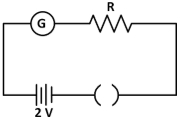
A
Full scale deflection current is $2\,mA$.
B
Resistance of galvanometer is $200\,\Omega$.
C
Resistance required on $R.B.$ for a deflection of $10$ divisions is $9900\,\Omega$.
D
Current sensitivity of galvanometer is $20\,\mu A/\text{division}$.
Solution
(D) Let $I$ be the full scale deflection current and $V = 2\,V$ be the battery voltage.
In case $1$,when $R_1 = 2400\,\Omega$,deflection $\theta_1 = 40$ divisions.
$\frac{40}{50} I = \frac{V}{G + R_1} \Rightarrow \frac{4}{5} I = \frac{2}{G + 2400} \dots (1)$
In case $2$,when $R_2 = 4900\,\Omega$,deflection $\theta_2 = 20$ divisions.
$\frac{20}{50} I = \frac{V}{G + R_2} \Rightarrow \frac{2}{5} I = \frac{2}{G + 4900} \dots (2)$
Dividing $(1)$ by $(2)$:
$\frac{4/5 I}{2/5 I} = \frac{G + 4900}{G + 2400} \Rightarrow 2 = \frac{G + 4900}{G + 2400}$
$2G + 4800 = G + 4900 \Rightarrow G = 100\,\Omega$.
Substituting $G = 100\,\Omega$ in $(1)$:
$\frac{4}{5} I = \frac{2}{100 + 2400} = \frac{2}{2500} = \frac{1}{1250}$
$I = \frac{5}{4} \times \frac{1}{1250} = \frac{1}{1000}\,A = 1\,mA$.
Current sensitivity $= \frac{I}{50} = \frac{1\,mA}{50} = 0.02\,mA/\text{division} = 20\,\mu A/\text{division}$.
For a deflection of $10$ divisions:
$\frac{10}{50} I = \frac{V}{G + R} \Rightarrow \frac{1}{5} \times 10^{-3} = \frac{2}{100 + R}$
$100 + R = 10000 \Rightarrow R = 9900\,\Omega$.
Thus,option $D$ is correct.
In case $1$,when $R_1 = 2400\,\Omega$,deflection $\theta_1 = 40$ divisions.
$\frac{40}{50} I = \frac{V}{G + R_1} \Rightarrow \frac{4}{5} I = \frac{2}{G + 2400} \dots (1)$
In case $2$,when $R_2 = 4900\,\Omega$,deflection $\theta_2 = 20$ divisions.
$\frac{20}{50} I = \frac{V}{G + R_2} \Rightarrow \frac{2}{5} I = \frac{2}{G + 4900} \dots (2)$
Dividing $(1)$ by $(2)$:
$\frac{4/5 I}{2/5 I} = \frac{G + 4900}{G + 2400} \Rightarrow 2 = \frac{G + 4900}{G + 2400}$
$2G + 4800 = G + 4900 \Rightarrow G = 100\,\Omega$.
Substituting $G = 100\,\Omega$ in $(1)$:
$\frac{4}{5} I = \frac{2}{100 + 2400} = \frac{2}{2500} = \frac{1}{1250}$
$I = \frac{5}{4} \times \frac{1}{1250} = \frac{1}{1000}\,A = 1\,mA$.
Current sensitivity $= \frac{I}{50} = \frac{1\,mA}{50} = 0.02\,mA/\text{division} = 20\,\mu A/\text{division}$.
For a deflection of $10$ divisions:
$\frac{10}{50} I = \frac{V}{G + R} \Rightarrow \frac{1}{5} \times 10^{-3} = \frac{2}{100 + R}$
$100 + R = 10000 \Rightarrow R = 9900\,\Omega$.
Thus,option $D$ is correct.
0 likes
View Solution148
DifficultMCQ
In the circuit diagrams ($A, B, C$ and $D$) shown below,$R$ is a high resistance and $S$ is a resistance of the order of galvanometer resistance $G$. The correct circuit,corresponding to the half deflection method for finding the resistance and figure of merit of the galvanometer,is the circuit labelled as
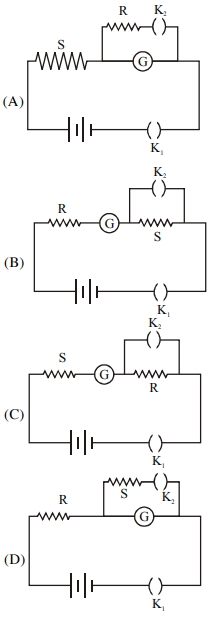
A
Circuit $A$ with $G = \frac{RS}{R - S}$
B
Circuit $B$ with $G = S$
C
Circuit $C$ with $G = S$
D
Circuit $D$ with $G = \frac{RS}{R - S}$
Solution
(D) In the half-deflection method,a high resistance $R$ is connected in series with the galvanometer to maintain a nearly constant current,and a shunt resistance $S$ is connected in parallel with the galvanometer to reduce the deflection to half.
The circuit diagram $D$ shows a high resistance $R$ in series with the galvanometer $G$,and a shunt resistance $S$ connected in parallel with the galvanometer through a key $K_2$.
When key $K_1$ is closed and $K_2$ is open,the current $I$ flows through $R$ and $G$. When $K_2$ is closed,the shunt $S$ is introduced,and the current through the galvanometer becomes $I/2$. The galvanometer resistance $G$ is then given by the formula $G = \frac{RS}{R - S}$.
The circuit diagram $D$ shows a high resistance $R$ in series with the galvanometer $G$,and a shunt resistance $S$ connected in parallel with the galvanometer through a key $K_2$.
When key $K_1$ is closed and $K_2$ is open,the current $I$ flows through $R$ and $G$. When $K_2$ is closed,the shunt $S$ is introduced,and the current through the galvanometer becomes $I/2$. The galvanometer resistance $G$ is then given by the formula $G = \frac{RS}{R - S}$.
0 likes
View Solution149
MediumMCQ
$A$ shunt of resistance $1\,\Omega$ is connected across a galvanometer of $120\,\Omega$ resistance. $A$ total current of $5.5\,A$ is passed through the combination,which gives full-scale deflection in the galvanometer. The current that would give full-scale deflection in the absence of the shunt is nearly ............... $A$.
A
$5.5$
B
$0.5$
C
$0.004$
D
$0.045$
Solution
(D) Let $G = 120\,\Omega$ be the resistance of the galvanometer and $S = 1\,\Omega$ be the resistance of the shunt.
Let $I = 5.5\,A$ be the total current flowing through the parallel combination.
Let $I_g$ be the current flowing through the galvanometer for full-scale deflection.
Using the current divider rule for a parallel circuit,the current through the galvanometer is given by:
$I_g = I \times \frac{S}{G + S}$
Substituting the given values:
$I_g = 5.5 \times \frac{1}{120 + 1}$
$I_g = 5.5 \times \frac{1}{121}$
$I_g = \frac{5.5}{121} = \frac{55}{1210} = \frac{1}{22} \approx 0.04545\,A$
Therefore,the current that gives full-scale deflection is approximately $0.045\,A$.
Let $I = 5.5\,A$ be the total current flowing through the parallel combination.
Let $I_g$ be the current flowing through the galvanometer for full-scale deflection.
Using the current divider rule for a parallel circuit,the current through the galvanometer is given by:
$I_g = I \times \frac{S}{G + S}$
Substituting the given values:
$I_g = 5.5 \times \frac{1}{120 + 1}$
$I_g = 5.5 \times \frac{1}{121}$
$I_g = \frac{5.5}{121} = \frac{55}{1210} = \frac{1}{22} \approx 0.04545\,A$
Therefore,the current that gives full-scale deflection is approximately $0.045\,A$.
0 likes
View SolutionMoving Charges and Magnetism — The Moving Coil Galvanometer (Sensitivity) and Ammeter and Voltmeter Conversion · Frequently Asked Questions
1Are these Moving Charges and Magnetism questions useful for JEE and NEET?
Yes. All questions in this section are mapped to JEE Main and NEET exam patterns. Previous year questions from JEE Main, NEET, GUJCET and state-level exams are included with full solutions.
2Can I switch to Hindi or Gujarati for these questions?
Yes. Use the language tabs in the hero section or the sidebar to view the same questions and solutions in English, Hindi or Gujarati.
3How do I generate a question paper from this subtopic?
Use the Vedclass Exam Paper Generator — select the chapter and subtopic, set difficulty, and generate Sets A, B, C, D automatically. First 3 chapters of every subject are free.
Vedclass Products
For Students
Vedclass Test Series
Mock tests in real JEE/NEET style with performance analysis. 5-day free trial.
Start Free TrialFor Teachers
Exam Paper Generator
Generate Set A/B/C/D papers from this chapter in 2 minutes. 3 chapters free.
Try FreeFor Institutes
Online Exam Module
Live online exams with unlimited students, 360° analytics & white-label branding.
See DemoFor Teachers & Institutes
Generate a Moving Charges and Magnetism Exam Paper in 2 Minutes
Select subtopic & difficulty — Sets A, B, C, D auto-generated with No Repeat logic.
First 3 chapters of every subject are free — no payment required.