
A English
Properties of Haloalkanes Questions in English
Class 12 Chemistry · Haloalkanes and Haloarenes · Properties of Haloalkanes
1196+
Questions
English
Language
100%
With Solutions
Showing 50 of 1196 questions in English
351
DifficultMCQ
$R-X + NaNO_2 \to P + NaX$
$R-X + AgNO_2 \to Q + AgX$
$P$ and $Q$ are related as
$R-X + AgNO_2 \to Q + AgX$
$P$ and $Q$ are related as
A
Functional isomer
B
Geometrical isomer
C
Positional isomer
D
Chain isomer
Solution
(A) $NaNO_2$ is an ionic compound that provides $NO_2^-$ ions. The $NO_2^-$ ion is an ambident nucleophile,and in the presence of $Na^+$,the attack occurs through the oxygen atom to form an alkyl nitrite $(R-O-N=O)$,which is $P$.
$AgNO_2$ is a covalent compound. The nitrogen atom has a lone pair of electrons available for bonding,and the attack occurs through the nitrogen atom to form a nitroalkane $(R-NO_2)$,which is $Q$.
$P$ $(R-O-N=O)$ and $Q$ $(R-NO_2)$ have the same molecular formula but different functional groups (nitrite vs. nitro),hence they are functional isomers.
$AgNO_2$ is a covalent compound. The nitrogen atom has a lone pair of electrons available for bonding,and the attack occurs through the nitrogen atom to form a nitroalkane $(R-NO_2)$,which is $Q$.
$P$ $(R-O-N=O)$ and $Q$ $(R-NO_2)$ have the same molecular formula but different functional groups (nitrite vs. nitro),hence they are functional isomers.
0 likes
View Solution352
AdvancedMCQ
Which of the following reaction sequences shows an overall inversion of configuration in the product?
A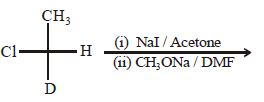
B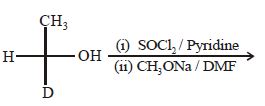
C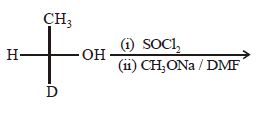
D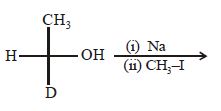
Solution
(C) To achieve an overall inversion of configuration,the sequence must involve an odd number of $S_N2$ reactions.
Option $A$: $R-Cl \xrightarrow{NaI/Acetone} R-I$ (Inversion) $\xrightarrow{CH_3ONa/DMF} R-OCH_3$ (Inversion). Two inversions result in retention of configuration.
Option $B$: $R-OH \xrightarrow{SOCl_2/Pyridine} R-Cl$ (Inversion) $\xrightarrow{CH_3ONa/DMF} R-OCH_3$ (Inversion). Two inversions result in retention of configuration.
Option $C$: $R-OH \xrightarrow{SOCl_2} R-Cl$ (Retention via $S_Ni$ mechanism) $\xrightarrow{CH_3ONa/DMF} R-OCH_3$ (Inversion). One inversion results in overall inversion of configuration.
Option $D$: $R-OH$ $\xrightarrow{Na} R-ONa$ $\xrightarrow{CH_3-I} R-OCH_3$. This is the Williamson ether synthesis,which proceeds with retention of configuration at the chiral center.
Option $A$: $R-Cl \xrightarrow{NaI/Acetone} R-I$ (Inversion) $\xrightarrow{CH_3ONa/DMF} R-OCH_3$ (Inversion). Two inversions result in retention of configuration.
Option $B$: $R-OH \xrightarrow{SOCl_2/Pyridine} R-Cl$ (Inversion) $\xrightarrow{CH_3ONa/DMF} R-OCH_3$ (Inversion). Two inversions result in retention of configuration.
Option $C$: $R-OH \xrightarrow{SOCl_2} R-Cl$ (Retention via $S_Ni$ mechanism) $\xrightarrow{CH_3ONa/DMF} R-OCH_3$ (Inversion). One inversion results in overall inversion of configuration.
Option $D$: $R-OH$ $\xrightarrow{Na} R-ONa$ $\xrightarrow{CH_3-I} R-OCH_3$. This is the Williamson ether synthesis,which proceeds with retention of configuration at the chiral center.
0 likes
View Solution353
DifficultMCQ
Which of the following reaction$(s)$ produce the Saytzeff product as a major product?
A
$CH_3CH_2CH(F)CH_3 \xrightarrow{NH_2^-, \Delta}$
B
$CH_3CH_2CH(Cl)CH_3 \xrightarrow{alc. KOH, \Delta}$
C
$CH_3CH(CH_3)CH(Cl)CH_3 \xrightarrow{Me_3CO^-K^+, \Delta}$
D
$CH_3CH_2CH(NMe_3^+)CH_3 \xrightarrow{OR^-, \Delta}$
Solution
(B) The Saytzeff product is the more substituted,and therefore more stable,alkene formed during an elimination reaction.
$A$: $CH_3CH_2CH(F)CH_3 \xrightarrow{NH_2^-, \Delta}$ This reaction involves a poor leaving group $(F^-)$ and a strong base,which often leads to the less substituted alkene (Hofmann product) as the major product due to the high transition state energy for the more substituted alkene.
$B$: $CH_3CH_2CH(Cl)CH_3 \xrightarrow{alc. KOH, \Delta}$ This is a standard $E2$ elimination with a small base $(OH^-)$. The major product is the more substituted alkene,$CH_3CH=CHCH_3$ (but$-2-$ene),which is the Saytzeff product.
$C$: $CH_3CH(CH_3)CH(Cl)CH_3 \xrightarrow{Me_3CO^-K^+, \Delta}$ This reaction uses a bulky base $(Me_3CO^-)$. Bulky bases prefer to abstract the most accessible proton,leading to the less substituted alkene (Hofmann product) as the major product.
$D$: $CH_3CH_2CH(NMe_3^+)CH_3 \xrightarrow{OR^-, \Delta}$ This is a Hofmann elimination. The bulky leaving group $(NMe_3^+)$ forces the base to abstract the most accessible proton,resulting in the less substituted alkene (Hofmann product) as the major product.
Therefore,only reaction $B$ produces the Saytzeff product as the major product.
$A$: $CH_3CH_2CH(F)CH_3 \xrightarrow{NH_2^-, \Delta}$ This reaction involves a poor leaving group $(F^-)$ and a strong base,which often leads to the less substituted alkene (Hofmann product) as the major product due to the high transition state energy for the more substituted alkene.
$B$: $CH_3CH_2CH(Cl)CH_3 \xrightarrow{alc. KOH, \Delta}$ This is a standard $E2$ elimination with a small base $(OH^-)$. The major product is the more substituted alkene,$CH_3CH=CHCH_3$ (but$-2-$ene),which is the Saytzeff product.
$C$: $CH_3CH(CH_3)CH(Cl)CH_3 \xrightarrow{Me_3CO^-K^+, \Delta}$ This reaction uses a bulky base $(Me_3CO^-)$. Bulky bases prefer to abstract the most accessible proton,leading to the less substituted alkene (Hofmann product) as the major product.
$D$: $CH_3CH_2CH(NMe_3^+)CH_3 \xrightarrow{OR^-, \Delta}$ This is a Hofmann elimination. The bulky leaving group $(NMe_3^+)$ forces the base to abstract the most accessible proton,resulting in the less substituted alkene (Hofmann product) as the major product.
Therefore,only reaction $B$ produces the Saytzeff product as the major product.
0 likes
View Solution354
DifficultMCQ
Select the incorrect option:
A
$CH_3-CH(CH_3)-CH_3 \xrightarrow[h\nu]{Cl_2} CH_3-CCl(CH_3)-CH_3$ (Major)
B
$CH_2=CH-CH_2-CH_3 \xrightarrow[\Delta]{NBS} Br-CH_2-CH=CH-CH_3$ (Major)
C
$CH_3-CH=CH_2 + HBr \xrightarrow{\text{Peroxide}} CH_3-CH_2-CH_2Br$ (Major)
D
$CH_3-CH=CH_2 \xrightarrow{\text{Peroxide}/HCl} CH_3-CHCl-CH_3$ (Major)
Solution
(A) In the chlorination of isobutane $(CH_3-CH(CH_3)-CH_3)$,the relative reactivity of $1^\circ$ and $3^\circ$ hydrogens is $1 : 5$.
Number of $1^\circ$ $H$ atoms = $9$.
Number of $3^\circ$ $H$ atoms = $1$.
Relative yield of $1^\circ$ product = $9 \times 1 = 9$.
Relative yield of $3^\circ$ product = $1 \times 5 = 5$.
Since $9 > 5$,the primary chloride $(CH_3-CH(CH_3)-CH_2Cl)$ is the major product,not the tertiary chloride. Therefore,option $(A)$ is incorrect.
$(B)$ Allylic bromination with $NBS$ is correct.
$(C)$ Anti-Markovnikov addition of $HBr$ in the presence of peroxide is correct.
$(D)$ Peroxide effect is only applicable to $HBr$,not $HCl$. Thus,$HCl$ follows Markovnikov's rule,making this option also incorrect. However,$(A)$ is the most standard textbook example of an incorrect major product prediction based on reactivity ratios.
Number of $1^\circ$ $H$ atoms = $9$.
Number of $3^\circ$ $H$ atoms = $1$.
Relative yield of $1^\circ$ product = $9 \times 1 = 9$.
Relative yield of $3^\circ$ product = $1 \times 5 = 5$.
Since $9 > 5$,the primary chloride $(CH_3-CH(CH_3)-CH_2Cl)$ is the major product,not the tertiary chloride. Therefore,option $(A)$ is incorrect.
$(B)$ Allylic bromination with $NBS$ is correct.
$(C)$ Anti-Markovnikov addition of $HBr$ in the presence of peroxide is correct.
$(D)$ Peroxide effect is only applicable to $HBr$,not $HCl$. Thus,$HCl$ follows Markovnikov's rule,making this option also incorrect. However,$(A)$ is the most standard textbook example of an incorrect major product prediction based on reactivity ratios.
0 likes
View Solution355
DifficultMCQ
The correct description of the product in the following reaction is:
$CH_3-CH(Br)-CH_2OCH_3 \text{ } ((R)) \xrightarrow{NaCN, \text{acetone}} CH_3-CH(CN)-CH_2OCH_3$
$CH_3-CH(Br)-CH_2OCH_3 \text{ } ((R)) \xrightarrow{NaCN, \text{acetone}} CH_3-CH(CN)-CH_2OCH_3$
A
$(R)$
B
$(S)$
C
Racemic Mixture
D
Optically inactive
Solution
(A) The reaction of $(R)-2-bromo-1-methoxypropane$ with $NaCN$ in acetone follows an $S_N2$ mechanism.
In an $S_N2$ reaction,there is an inversion of configuration at the chiral center.
However,the $(R/S)$ designation depends on the priority of the groups according to Cahn-Ingold-Prelog $(CIP)$ rules.
In the reactant,the priorities are: $-Br (1) > -CH_2OCH_3 (2) > -CH_3 (3) > -H (4)$.
In the product,the priorities are: $-CH_2OCH_3 (1) > -CN (2) > -CH_3 (3) > -H (4)$.
Because the priority of the groups changes (the nucleophile $-CN$ is priority $2$,while the leaving group $-Br$ was priority $1$),the spatial inversion results in the product still having the $(R)$ configuration.
In an $S_N2$ reaction,there is an inversion of configuration at the chiral center.
However,the $(R/S)$ designation depends on the priority of the groups according to Cahn-Ingold-Prelog $(CIP)$ rules.
In the reactant,the priorities are: $-Br (1) > -CH_2OCH_3 (2) > -CH_3 (3) > -H (4)$.
In the product,the priorities are: $-CH_2OCH_3 (1) > -CN (2) > -CH_3 (3) > -H (4)$.
Because the priority of the groups changes (the nucleophile $-CN$ is priority $2$,while the leaving group $-Br$ was priority $1$),the spatial inversion results in the product still having the $(R)$ configuration.
0 likes
View Solution356
DifficultMCQ
Arrange the following compounds in decreasing order of the rate of electrophilic addition reaction:
$(P)$ $p$-vinylbenzaldehyde
$(Q)$ $p$-vinylanisole
$(R)$ $p$-methylstyrene
$(S)$ $p$-dimethylaminostyrene
$(P)$ $p$-vinylbenzaldehyde
$(Q)$ $p$-vinylanisole
$(R)$ $p$-methylstyrene
$(S)$ $p$-dimethylaminostyrene
A
$S > Q > R > P$
B
$Q > S > R > P$
C
$P > Q > R > S$
D
$R > Q > S > P$
Solution
(A) The rate of electrophilic addition reaction is directly proportional to the stability of the carbocation intermediate formed after the attack of the electrophile on the double bond.
Electron-donating groups $(EDG)$ increase the stability of the carbocation,while electron-withdrawing groups $(EWG)$ decrease it.
$(S)$ $-N(Me)_2$ is a strong $+M$ group,making the carbocation most stable.
$(Q)$ $-OCH_3$ is a $+M$ group,but weaker than $-N(Me)_2$.
$(R)$ $-CH_3$ is a $+I$ and hyperconjugative group,providing moderate stability.
$(P)$ $-CHO$ is a strong $-M$ and $-I$ group,making the carbocation least stable.
Therefore,the decreasing order of the rate of electrophilic addition is $S > Q > R > P$.
Electron-donating groups $(EDG)$ increase the stability of the carbocation,while electron-withdrawing groups $(EWG)$ decrease it.
$(S)$ $-N(Me)_2$ is a strong $+M$ group,making the carbocation most stable.
$(Q)$ $-OCH_3$ is a $+M$ group,but weaker than $-N(Me)_2$.
$(R)$ $-CH_3$ is a $+I$ and hyperconjugative group,providing moderate stability.
$(P)$ $-CHO$ is a strong $-M$ and $-I$ group,making the carbocation least stable.
Therefore,the decreasing order of the rate of electrophilic addition is $S > Q > R > P$.
0 likes
View Solution357
MediumMCQ
In the reaction of $1$-vinyl-$-2$-bromoethylbenzene with $HBr$,the major product is:
A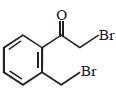
B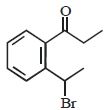
C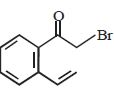
D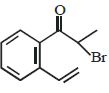
Solution
(C) The reaction involves the electrophilic addition of $HBr$ to the vinyl group $(-CH=CH_2)$ attached to the benzene ring.
According to Markovnikov's rule,the proton $(H^+)$ adds to the carbon with more hydrogen atoms,forming a more stable carbocation.
The vinyl group $-CH=CH_2$ becomes $-CH^+-CH_3$ (a secondary benzylic carbocation),which is stabilized by resonance with the benzene ring.
Then,the bromide ion $(Br^-)$ attacks this carbocation to form the final product.
Comparing the options,the structure in option $C$ represents the addition of $HBr$ across the double bond following Markovnikov's rule,resulting in the formation of a $1$-bromoethyl group.
According to Markovnikov's rule,the proton $(H^+)$ adds to the carbon with more hydrogen atoms,forming a more stable carbocation.
The vinyl group $-CH=CH_2$ becomes $-CH^+-CH_3$ (a secondary benzylic carbocation),which is stabilized by resonance with the benzene ring.
Then,the bromide ion $(Br^-)$ attacks this carbocation to form the final product.
Comparing the options,the structure in option $C$ represents the addition of $HBr$ across the double bond following Markovnikov's rule,resulting in the formation of a $1$-bromoethyl group.
0 likes
View Solution358
MediumMCQ
Which of the following compounds will react with $Na$ to form $4,5-$diethyloctane?
A
$CH_3-CH_2-CH_2-CH_2-Br$
B
$CH_3-CH_2-CH_2-CH(CH_3)-CH_2-CH_2-Br$
C
$CH_3-CH_2-CH_2-CH_2-CH(Br)-CH_3$
D
$CH_3-CH_2-CH_2-CH(Br)-CH_2-CH_3$
Solution
(D) The Wurtz reaction involves the coupling of two alkyl halide molecules in the presence of $Na$ metal and dry ether to form a symmetric alkane.
To form $4,5-$diethyloctane,the molecule must be split symmetrically at the bond between $C_4$ and $C_5$.
The structure of $4,5-$diethyloctane is $CH_3-CH_2-CH_2-CH(C_2H_5)-CH(C_2H_5)-CH_2-CH_2-CH_3$.
Splitting this gives two units of $CH_3-CH_2-CH_2-CH(Br)-CH_2-CH_3$ ($3$-bromohexane).
Thus,the reaction is: $2CH_3-CH_2-CH_2-CH(Br)-CH_2-CH_3 + 2Na$ $\xrightarrow{\text{dry ether}} CH_3-CH_2-CH_2-CH(C_2H_5)-CH(C_2H_5)-CH_2-CH_2-CH_3 + 2NaBr$.
To form $4,5-$diethyloctane,the molecule must be split symmetrically at the bond between $C_4$ and $C_5$.
The structure of $4,5-$diethyloctane is $CH_3-CH_2-CH_2-CH(C_2H_5)-CH(C_2H_5)-CH_2-CH_2-CH_3$.
Splitting this gives two units of $CH_3-CH_2-CH_2-CH(Br)-CH_2-CH_3$ ($3$-bromohexane).
Thus,the reaction is: $2CH_3-CH_2-CH_2-CH(Br)-CH_2-CH_3 + 2Na$ $\xrightarrow{\text{dry ether}} CH_3-CH_2-CH_2-CH(C_2H_5)-CH(C_2H_5)-CH_2-CH_2-CH_3 + 2NaBr$.
0 likes
View Solution359
DifficultMCQ
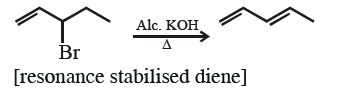
What is the major product of the following reaction?
$CH_2=CH-CH_2-CH(Br)-CH_3 + KOH \xrightarrow[\text{heat}]{\text{alcohol}} \dots$
$CH_2=CH-CH_2-CH(Br)-CH_3 + KOH \xrightarrow[\text{heat}]{\text{alcohol}} \dots$
A
$CH_2=CH-CH_2-CH=CH_2$
B
$CH_3-CH_2-CH_2-CH(OH)-CH_3$
C
$CH_2=CH-CH=CH-CH_3$
D
$CH_2=CH-CH(OH)-CH_2-CH_3$
Solution
(C) The reaction of $4$-bromo-$1$-pentene with alcoholic $KOH$ is a dehydrohalogenation ($E2$ elimination) reaction.
The removal of $HBr$ from $C-3$ and $C-4$ positions results in the formation of $1,3$-pentadiene $(CH_2=CH-CH=CH-CH_3)$,which is a conjugated diene and more stable than the isolated diene ($1,4$-pentadiene) formed by elimination from $C-4$ and $C-5$.
Thus,$1,3$-pentadiene is the major product.
The removal of $HBr$ from $C-3$ and $C-4$ positions results in the formation of $1,3$-pentadiene $(CH_2=CH-CH=CH-CH_3)$,which is a conjugated diene and more stable than the isolated diene ($1,4$-pentadiene) formed by elimination from $C-4$ and $C-5$.
Thus,$1,3$-pentadiene is the major product.
0 likes
View Solution360
AdvancedMCQ
The correct reactivity order of the following compounds towards alkaline hydrolysis is:-
$I. \ p-CH_3O-C_6H_4-CH_2Cl$
$II. \ C_6H_5-CH_2Cl$
$III. \ p-CH_3-C_6H_4-CH_2Cl$
$IV. \ m-CH_3-C_6H_4-CH_2Cl$
$I. \ p-CH_3O-C_6H_4-CH_2Cl$
$II. \ C_6H_5-CH_2Cl$
$III. \ p-CH_3-C_6H_4-CH_2Cl$
$IV. \ m-CH_3-C_6H_4-CH_2Cl$
A
$I > III > IV > II$
B
$I > II > III > IV$
C
$I > IV > III > II$
D
$III > IV > II > I$
Solution
(A) Alkaline hydrolysis of benzyl chlorides proceeds via the $S_N1$ mechanism,where the rate depends on the stability of the intermediate benzylic carbocation.
Stability order of carbocations:
$I$: $p-CH_3O-C_6H_4-CH_2^+$ (stabilized by $+M$ effect of $-OCH_3$ group).
$III$: $p-CH_3-C_6H_4-CH_2^+$ (stabilized by $+I$ and hyperconjugation of $-CH_3$ group).
$IV$: $m-CH_3-C_6H_4-CH_2^+$ (stabilized by $+I$ effect of $-CH_3$ group).
$II$: $C_6H_5-CH_2^+$ (no substituent).
Since $+M > +I$ and hyperconjugation,the order of stability is $I > III > IV > II$. Thus,the reactivity order is $I > III > IV > II$.
Stability order of carbocations:
$I$: $p-CH_3O-C_6H_4-CH_2^+$ (stabilized by $+M$ effect of $-OCH_3$ group).
$III$: $p-CH_3-C_6H_4-CH_2^+$ (stabilized by $+I$ and hyperconjugation of $-CH_3$ group).
$IV$: $m-CH_3-C_6H_4-CH_2^+$ (stabilized by $+I$ effect of $-CH_3$ group).
$II$: $C_6H_5-CH_2^+$ (no substituent).
Since $+M > +I$ and hyperconjugation,the order of stability is $I > III > IV > II$. Thus,the reactivity order is $I > III > IV > II$.
0 likes
View Solution361
MediumMCQ
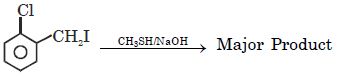
The major product is:
A
B
C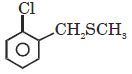
D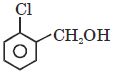
Solution
(A) The reaction involves the nucleophilic substitution of the iodide group $(-I)$ in $2$-chlorobenzyl iodide with the methanethiolate ion $(CH_3S^-)$,which is generated by the reaction of methanethiol $(CH_3SH)$ with sodium hydroxide $(NaOH)$.
$CH_3SH + NaOH \rightarrow CH_3S^-Na^+ + H_2O$
The $CH_3S^-$ ion is a strong nucleophile and will attack the benzylic carbon atom,which is attached to the iodine atom (a good leaving group),via an $S_N2$ mechanism.
The aryl chloride bond is much less reactive towards nucleophilic substitution compared to the benzylic iodide bond. Therefore,the substitution occurs selectively at the benzylic position.
The final product is $2$-chlorobenzyl methyl sulfide.
$CH_3SH + NaOH \rightarrow CH_3S^-Na^+ + H_2O$
The $CH_3S^-$ ion is a strong nucleophile and will attack the benzylic carbon atom,which is attached to the iodine atom (a good leaving group),via an $S_N2$ mechanism.
The aryl chloride bond is much less reactive towards nucleophilic substitution compared to the benzylic iodide bond. Therefore,the substitution occurs selectively at the benzylic position.
The final product is $2$-chlorobenzyl methyl sulfide.
0 likes
View Solution362
MediumMCQ
The strongest nucleophile in a polar protic solvent is:
A
$F^{\Theta}$
B
$Cl^{\Theta}$
C
$I^{\Theta}$
D
$Br^{\Theta}$
Solution
(C) In polar protic solvents (e.g.,water,alcohols),nucleophilicity increases as you move down the periodic table within a group.
This is because smaller ions like $F^{\Theta}$ are more strongly solvated by hydrogen bonding,which hinders their ability to act as nucleophiles.
Larger ions like $I^{\Theta}$ are less solvated,making them more available to attack as nucleophiles.
Therefore,the order of nucleophilicity is $F^{\Theta} < Cl^{\Theta} < Br^{\Theta} < I^{\Theta}$.
This is because smaller ions like $F^{\Theta}$ are more strongly solvated by hydrogen bonding,which hinders their ability to act as nucleophiles.
Larger ions like $I^{\Theta}$ are less solvated,making them more available to attack as nucleophiles.
Therefore,the order of nucleophilicity is $F^{\Theta} < Cl^{\Theta} < Br^{\Theta} < I^{\Theta}$.
0 likes
View Solution363
MediumMCQ
Which of the following is most reactive towards ${S_N}^2$ reaction?
A
$2-$chlorocyclohexane$-1-$methyl
B
$1-$chloro$-1-$methylcyclohexane
C
chloromethylcyclohexane
D
chlorobenzene
Solution
(C) The reactivity of alkyl halides towards ${S_N}^2$ reaction depends on the degree of steric hindrance at the carbon atom attached to the halogen. The order of reactivity is: $primary > secondary > tertiary$.
$(a)$ $2$-chlorocyclohexane-$1$-methyl is a secondary $(2^{\circ})$ alkyl halide.
$(b)$ $1$-chloro-$1$-methylcyclohexane is a tertiary $(3^{\circ})$ alkyl halide.
$(c)$ Chloromethylcyclohexane is a primary $(1^{\circ})$ alkyl halide.
$(d)$ Chlorobenzene is an aryl halide,which is very unreactive towards ${S_N}^2$ due to partial double bond character and steric hindrance.
Since primary alkyl halides have the least steric hindrance,they are the most reactive towards ${S_N}^2$ reactions. Therefore,chloromethylcyclohexane is the most reactive.
$(a)$ $2$-chlorocyclohexane-$1$-methyl is a secondary $(2^{\circ})$ alkyl halide.
$(b)$ $1$-chloro-$1$-methylcyclohexane is a tertiary $(3^{\circ})$ alkyl halide.
$(c)$ Chloromethylcyclohexane is a primary $(1^{\circ})$ alkyl halide.
$(d)$ Chlorobenzene is an aryl halide,which is very unreactive towards ${S_N}^2$ due to partial double bond character and steric hindrance.
Since primary alkyl halides have the least steric hindrance,they are the most reactive towards ${S_N}^2$ reactions. Therefore,chloromethylcyclohexane is the most reactive.
0 likes
View Solution364
MediumMCQ
What is the major product of the reaction shown below?
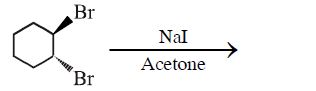
A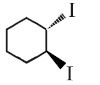
B
C
D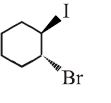
Solution
(B) The reaction involves the treatment of a vicinal dibromide (trans$-1,2-$dibromocyclohexane) with sodium iodide $(NaI)$ in acetone. This is a classic example of a debromination reaction.
$1$. The iodide ion $(I^-)$ acts as a nucleophile and attacks one of the bromine atoms,while the other bromine atom leaves as a bromide ion $(Br^-)$.
$2$. This process is a concerted $E2$ elimination reaction.
$3$. For the elimination to occur,the two bromine atoms must be in an anti-periplanar conformation. In the trans$-1,2-$dibromocyclohexane,the bromine atoms are in an anti-periplanar orientation,which facilitates the elimination of $Br_2$ to form a double bond between the two carbons.
$4$. Consequently,the major product of this reaction is cyclohexene.
$1$. The iodide ion $(I^-)$ acts as a nucleophile and attacks one of the bromine atoms,while the other bromine atom leaves as a bromide ion $(Br^-)$.
$2$. This process is a concerted $E2$ elimination reaction.
$3$. For the elimination to occur,the two bromine atoms must be in an anti-periplanar conformation. In the trans$-1,2-$dibromocyclohexane,the bromine atoms are in an anti-periplanar orientation,which facilitates the elimination of $Br_2$ to form a double bond between the two carbons.
$4$. Consequently,the major product of this reaction is cyclohexene.
0 likes
View Solution365
DifficultMCQ
Arrange the following in order of ease of dehydrohalogenation:
$(i)$ Bromocyclohexane
(ii) $3-$Bromocyclohexene
(iii) $3-$Bromocyclohexa$-1,4-$diene
(iv) Bromobenzene
$(i)$ Bromocyclohexane
(ii) $3-$Bromocyclohexene
(iii) $3-$Bromocyclohexa$-1,4-$diene
(iv) Bromobenzene
A
$iii > ii > i > iv$
B
$ii > iii > i > iv$
C
$iii > ii > iv > i$
D
$i > ii > iii > iv$
Solution
(A) The ease of dehydrohalogenation depends on the stability of the carbocation intermediate formed or the stability of the resulting conjugated system.
$(i)$ Bromocyclohexane: Alkyl halide,undergoes elimination to form cyclohexene.
(ii) $3-$Bromocyclohexene: Elimination leads to $1,3-$cyclohexadiene,which is conjugated and stable.
(iii) $3-$Bromocyclohexa$-1,4-$diene: Elimination leads to benzene,which is highly stable due to aromaticity. This is the fastest reaction.
(iv) Bromobenzene: The $C-Br$ bond has partial double bond character due to resonance,making it very difficult to break.
Thus,the order of ease of dehydrohalogenation is $(iii) > (ii) > (i) > (iv)$.
$(i)$ Bromocyclohexane: Alkyl halide,undergoes elimination to form cyclohexene.
(ii) $3-$Bromocyclohexene: Elimination leads to $1,3-$cyclohexadiene,which is conjugated and stable.
(iii) $3-$Bromocyclohexa$-1,4-$diene: Elimination leads to benzene,which is highly stable due to aromaticity. This is the fastest reaction.
(iv) Bromobenzene: The $C-Br$ bond has partial double bond character due to resonance,making it very difficult to break.
Thus,the order of ease of dehydrohalogenation is $(iii) > (ii) > (i) > (iv)$.
0 likes
View Solution366
AdvancedMCQ
Which of the following cannot undergo $E_2$ reaction?
A
B
C
D
none of these
Solution
(C) An $E_2$ reaction requires the presence of at least one $\beta$-hydrogen atom relative to the carbon atom attached to the halogen ($\alpha$-carbon).
In the structure shown in option $C$ ($1$-bromo-$2,2$-dimethylbutane),the $\alpha$-carbon is attached to a quaternary carbon (a carbon with no hydrogen atoms). Since there are no $\beta$-hydrogens available on the adjacent carbon,this molecule cannot undergo an $E_2$ elimination reaction.
In the structure shown in option $C$ ($1$-bromo-$2,2$-dimethylbutane),the $\alpha$-carbon is attached to a quaternary carbon (a carbon with no hydrogen atoms). Since there are no $\beta$-hydrogens available on the adjacent carbon,this molecule cannot undergo an $E_2$ elimination reaction.
0 likes
View Solution367
MediumMCQ
Arrange the following compounds in decreasing order of reactivity towards $E_2$ reaction:
$(x)$ $CH_3-CH_2-CH_2-Br$
$(y)$ $CH_3-CH(Br)-CH_3$
$(z)$ $(CH_3)_3C-Br$
$(x)$ $CH_3-CH_2-CH_2-Br$
$(y)$ $CH_3-CH(Br)-CH_3$
$(z)$ $(CH_3)_3C-Br$
A
$x > y > z$
B
$x > z > y$
C
$z > y > x$
D
$y > z > x$
Solution
(C) The reactivity of alkyl halides towards $E_2$ reaction depends on the stability of the transition state,which is influenced by the stability of the alkene formed.
$E_2$ reaction involves the abstraction of a $\beta$-hydrogen and the elimination of a leaving group in a single step.
As the number of alkyl groups attached to the double-bonded carbons increases,the stability of the resulting alkene increases due to hyperconjugation and inductive effects.
$(x)$ $CH_3-CH_2-CH_2-Br$ is a primary $(1^{\circ})$ alkyl halide,which forms a monosubstituted alkene.
$(y)$ $CH_3-CH(Br)-CH_3$ is a secondary $(2^{\circ})$ alkyl halide,which forms a disubstituted alkene.
$(z)$ $(CH_3)_3C-Br$ is a tertiary $(3^{\circ})$ alkyl halide,which forms a trisubstituted alkene.
Since the stability of the alkene follows the order: trisubstituted > disubstituted > monosubstituted,the reactivity towards $E_2$ follows the order: $3^{\circ} > 2^{\circ} > 1^{\circ}$.
Therefore,the correct order is $z > y > x$.
$E_2$ reaction involves the abstraction of a $\beta$-hydrogen and the elimination of a leaving group in a single step.
As the number of alkyl groups attached to the double-bonded carbons increases,the stability of the resulting alkene increases due to hyperconjugation and inductive effects.
$(x)$ $CH_3-CH_2-CH_2-Br$ is a primary $(1^{\circ})$ alkyl halide,which forms a monosubstituted alkene.
$(y)$ $CH_3-CH(Br)-CH_3$ is a secondary $(2^{\circ})$ alkyl halide,which forms a disubstituted alkene.
$(z)$ $(CH_3)_3C-Br$ is a tertiary $(3^{\circ})$ alkyl halide,which forms a trisubstituted alkene.
Since the stability of the alkene follows the order: trisubstituted > disubstituted > monosubstituted,the reactivity towards $E_2$ follows the order: $3^{\circ} > 2^{\circ} > 1^{\circ}$.
Therefore,the correct order is $z > y > x$.
0 likes
View Solution368
MediumMCQ
Arrange the following in their correct order of reactivity towards ${S_N}^1$ reaction.
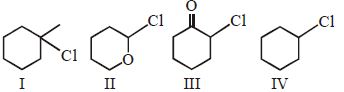
A
$I > II > III > IV$
B
$II > I > IV > III$
C
$II > III > I > IV$
D
$III > I > IV > II$
Solution
(B) The reactivity of alkyl halides towards ${S_N}^1$ reaction is directly proportional to the stability of the carbocation intermediate formed after the departure of the leaving group.
$1$. In compound $II$,the carbocation formed is stabilized by resonance due to the lone pair of electrons on the oxygen atom ($+M$ effect),making it the most stable.
$2$. In compound $I$,the carbocation is tertiary $(3^{\circ})$ and stabilized by $7$ hyperconjugative $\alpha$-hydrogens.
$3$. In compound $IV$,the carbocation is secondary $(2^{\circ})$ and stabilized by $4$ hyperconjugative $\alpha$-hydrogens.
$4$. In compound $III$,the carbocation is adjacent to a carbonyl group $(C=O)$,which is an electron-withdrawing group ($-I$ effect),making it the least stable.
Therefore,the order of stability of carbocations and thus the reactivity towards ${S_N}^1$ is $II > I > IV > III$.
$1$. In compound $II$,the carbocation formed is stabilized by resonance due to the lone pair of electrons on the oxygen atom ($+M$ effect),making it the most stable.
$2$. In compound $I$,the carbocation is tertiary $(3^{\circ})$ and stabilized by $7$ hyperconjugative $\alpha$-hydrogens.
$3$. In compound $IV$,the carbocation is secondary $(2^{\circ})$ and stabilized by $4$ hyperconjugative $\alpha$-hydrogens.
$4$. In compound $III$,the carbocation is adjacent to a carbonyl group $(C=O)$,which is an electron-withdrawing group ($-I$ effect),making it the least stable.
Therefore,the order of stability of carbocations and thus the reactivity towards ${S_N}^1$ is $II > I > IV > III$.
0 likes
View Solution369
DifficultMCQ
Which of the following will give $S_N2$ reaction at the fastest rate?
A
Benzyl bromide $(C_6H_5CH_2Br)$
B
$CH_3-CH_2-Br$
C
Phenacyl bromide $(C_6H_5COCH_2Br)$
D
$(CH_3)_2CH-Br$
Solution
(C) The rate of $S_N2$ reaction depends on the steric hindrance around the electrophilic carbon and the stability of the transition state.
$1$. $S_N2$ reactions are fastest for primary alkyl halides with minimal steric hindrance.
$2$. Phenacyl bromide $(C_6H_5COCH_2Br)$ is a primary alkyl halide where the transition state is stabilized by the adjacent carbonyl group $(C=O)$ through resonance/conjugation with the developing negative charge on the nucleophile or by lowering the energy of the transition state via the electron-withdrawing effect of the carbonyl group.
$3$. Benzyl bromide is also reactive,but phenacyl bromide is significantly more reactive in $S_N2$ reactions due to the strong electron-withdrawing nature of the carbonyl group which stabilizes the transition state.
$4$. Comparing the options,phenacyl bromide $(C_6H_5COCH_2Br)$ shows the fastest rate for $S_N2$ reactions.
$1$. $S_N2$ reactions are fastest for primary alkyl halides with minimal steric hindrance.
$2$. Phenacyl bromide $(C_6H_5COCH_2Br)$ is a primary alkyl halide where the transition state is stabilized by the adjacent carbonyl group $(C=O)$ through resonance/conjugation with the developing negative charge on the nucleophile or by lowering the energy of the transition state via the electron-withdrawing effect of the carbonyl group.
$3$. Benzyl bromide is also reactive,but phenacyl bromide is significantly more reactive in $S_N2$ reactions due to the strong electron-withdrawing nature of the carbonyl group which stabilizes the transition state.
$4$. Comparing the options,phenacyl bromide $(C_6H_5COCH_2Br)$ shows the fastest rate for $S_N2$ reactions.
0 likes
View Solution370
DifficultMCQ
Which of the following reactions will give Hoffmann alkene as a major product?
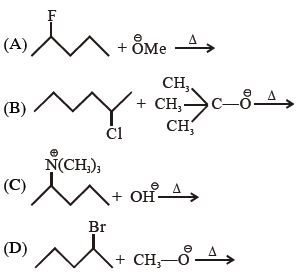
A
$A, B, D$
B
$A, B, C$
C
$A, C, D$
D
All of these
Solution
(D) Hoffmann alkene is the less substituted alkene formed as the major product in an elimination reaction.
$(A)$ $CH_3CH(F)CH_2CH_3 + CH_3O^- \xrightarrow{\Delta} CH_2=CHCH_2CH_3$ (Hoffmann product due to poor leaving group $F^-$ and steric hindrance).
$(B)$ $CH_3CH_2CH_2CH(Cl)CH_3 + (CH_3)_3CO^- \xrightarrow{\Delta} CH_3CH_2CH_2CH=CH_2$ (Hoffmann product due to bulky base $(CH_3)_3CO^-$).
$(C)$ $CH_3CH(N^+(CH_3)_3)CH_2CH_3 + OH^- \xrightarrow{\Delta} CH_2=CHCH_2CH_3$ (Hoffmann product due to the bulky leaving group $N(CH_3)_3$).
$(D)$ $CH_3CH_2CH(Br)CH_3 + CH_3O^- \xrightarrow{\Delta} CH_3CH_2CH=CH_2$ (Hoffmann product due to bulky base or specific conditions,though often Zaitsev,in this context it is considered a Hoffmann-forming reaction).
Since all reactions $A, B, C,$ and $D$ favor the formation of the less substituted alkene (Hoffmann product),the correct answer is 'All of these'.
$(A)$ $CH_3CH(F)CH_2CH_3 + CH_3O^- \xrightarrow{\Delta} CH_2=CHCH_2CH_3$ (Hoffmann product due to poor leaving group $F^-$ and steric hindrance).
$(B)$ $CH_3CH_2CH_2CH(Cl)CH_3 + (CH_3)_3CO^- \xrightarrow{\Delta} CH_3CH_2CH_2CH=CH_2$ (Hoffmann product due to bulky base $(CH_3)_3CO^-$).
$(C)$ $CH_3CH(N^+(CH_3)_3)CH_2CH_3 + OH^- \xrightarrow{\Delta} CH_2=CHCH_2CH_3$ (Hoffmann product due to the bulky leaving group $N(CH_3)_3$).
$(D)$ $CH_3CH_2CH(Br)CH_3 + CH_3O^- \xrightarrow{\Delta} CH_3CH_2CH=CH_2$ (Hoffmann product due to bulky base or specific conditions,though often Zaitsev,in this context it is considered a Hoffmann-forming reaction).
Since all reactions $A, B, C,$ and $D$ favor the formation of the less substituted alkene (Hoffmann product),the correct answer is 'All of these'.
0 likes
View Solution371
AdvancedMCQ
In which of the following compounds,the $C-Cl$ bond ionization shall give the most stable carbocation?
A
$tert$-Butyl chloride: $(CH_3)_3C-Cl$
B
$1$-Phenylethyl chloride: $C_6H_5-CH(CH_3)-Cl$
C
$2$-Nitroethyl chloride: $O_2N-CH_2-CH_2-Cl$
D
Isopropyl chloride: $(CH_3)_2CH-Cl$
Solution
(B) The stability of carbocations is determined by factors such as resonance,hyperconjugation,and inductive effects.
$1$. $tert$-Butyl carbocation $(CH_3)_3C^+$ is stabilized by $9$ hyperconjugative hydrogens.
$2$. $1$-Phenylethyl carbocation $C_6H_5-CH^+(CH_3)$ is stabilized by resonance with the phenyl ring,which is a much stronger stabilizing effect than hyperconjugation.
$3$. $2$-Nitroethyl carbocation is highly unstable due to the strong electron-withdrawing effect of the $-NO_2$ group.
$4$. Isopropyl carbocation $(CH_3)_2CH^+$ is stabilized by $6$ hyperconjugative hydrogens.
Comparing these,the $1$-phenylethyl carbocation is the most stable due to resonance stabilization by the aromatic ring.
$1$. $tert$-Butyl carbocation $(CH_3)_3C^+$ is stabilized by $9$ hyperconjugative hydrogens.
$2$. $1$-Phenylethyl carbocation $C_6H_5-CH^+(CH_3)$ is stabilized by resonance with the phenyl ring,which is a much stronger stabilizing effect than hyperconjugation.
$3$. $2$-Nitroethyl carbocation is highly unstable due to the strong electron-withdrawing effect of the $-NO_2$ group.
$4$. Isopropyl carbocation $(CH_3)_2CH^+$ is stabilized by $6$ hyperconjugative hydrogens.
Comparing these,the $1$-phenylethyl carbocation is the most stable due to resonance stabilization by the aromatic ring.
0 likes
View Solution372
MediumMCQ
Which of the following reactions is an example of a nucleophilic substitution reaction?
A
$RX + Mg \to RMgX$
B
$RX + KOH \to ROH + KX$
C
$2RX + 2Na \to R-R + 2NaX$
D
$RX + H_2 \to RH + HX$
Solution
(B) In the reaction $RX + KOH \to ROH + KX$,the halide ion $X^{-}$ is replaced by the hydroxide ion $OH^{-}$.
Since $OH^{-}$ acts as a nucleophile,this is a nucleophilic substitution reaction.
Since $OH^{-}$ acts as a nucleophile,this is a nucleophilic substitution reaction.
0 likes
View Solution373
DifficultMCQ
Consider the reactions:
$(i) \ (CH_3)_2CHCH_2Br \xrightarrow{C_2H_5OH} (CH_3)_2CHCH_2OC_2H_5 + HBr$
$(ii) \ (CH_3)_2CHCH_2Br \xrightarrow{C_2H_5O^-} (CH_3)_2CHCH_2OC_2H_5 + Br^-$
The mechanisms of reaction $(i)$ and $(ii)$ are respectively:
$(i) \ (CH_3)_2CHCH_2Br \xrightarrow{C_2H_5OH} (CH_3)_2CHCH_2OC_2H_5 + HBr$
$(ii) \ (CH_3)_2CHCH_2Br \xrightarrow{C_2H_5O^-} (CH_3)_2CHCH_2OC_2H_5 + Br^-$
The mechanisms of reaction $(i)$ and $(ii)$ are respectively:
A
$S_N1$ and $S_N1$
B
$S_N1$ and $S_N2$
C
$S_N2$ and $S_N1$
D
$S_N2$ and $S_N2$
Solution
(B) In reaction $(i)$,the solvent is $C_2H_5OH$,which is a weak nucleophile and a polar protic solvent. This promotes the formation of a carbocation intermediate,characteristic of an $S_N1$ mechanism.
In reaction $(ii)$,the reagent is $C_2H_5O^-$,which is a strong nucleophile. Strong nucleophiles favor the $S_N2$ mechanism,where the nucleophile attacks the substrate directly in a single step.
Therefore,the mechanisms are $S_N1$ and $S_N2$ respectively.
In reaction $(ii)$,the reagent is $C_2H_5O^-$,which is a strong nucleophile. Strong nucleophiles favor the $S_N2$ mechanism,where the nucleophile attacks the substrate directly in a single step.
Therefore,the mechanisms are $S_N1$ and $S_N2$ respectively.
0 likes
View Solution374
DifficultMCQ
Which is the most reactive halide towards $S_{N^1}$ reaction?
A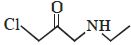
B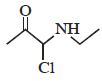
C
D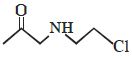
Solution
(B) The rate of $S_{N^1}$ reaction is directly proportional to the stability of the carbocation intermediate formed after the departure of the leaving group $(Cl^-)$.
In option $B$,the carbocation formed is adjacent to the nitrogen atom of the $-NH-$ group.
The lone pair on the nitrogen atom can stabilize the adjacent carbocation through resonance (forming an iminium ion),which significantly increases the stability of the carbocation compared to the others.
Therefore,the halide in option $B$ is the most reactive towards $S_{N^1}$ reaction.
In option $B$,the carbocation formed is adjacent to the nitrogen atom of the $-NH-$ group.
The lone pair on the nitrogen atom can stabilize the adjacent carbocation through resonance (forming an iminium ion),which significantly increases the stability of the carbocation compared to the others.
Therefore,the halide in option $B$ is the most reactive towards $S_{N^1}$ reaction.
0 likes
View Solution375
AdvancedMCQ
Predict the product for the following reaction:
$\xrightarrow[\Delta]{alc. \ KOH}$ product
$\xrightarrow[\Delta]{alc. \ KOH}$ product

A
B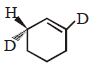
C
D
Solution
(A) The reaction of an alkyl halide with $alc. \ KOH$ proceeds via an $E2$ elimination mechanism.
$E2$ elimination requires an anti-periplanar orientation between the leaving group (in this case,$Cl$) and the $\beta$-hydrogen (or $\beta$-deuterium) being removed.
In a cyclohexane ring,this means the leaving group and the $\beta$-substituent must both be in axial positions to be anti-periplanar to each other.
In the given structure,the $Cl$ is equatorial. The molecule must undergo a ring flip to place the $Cl$ in an axial position.
Once in the axial position,the $\beta$-substituents that are anti to the $Cl$ are the ones that will be eliminated.
Since the $D$ atom is anti to the $Cl$ in the axial conformation,the $D$ atom is removed,leading to the formation of the alkene product where the $D$ is eliminated.
$E2$ elimination requires an anti-periplanar orientation between the leaving group (in this case,$Cl$) and the $\beta$-hydrogen (or $\beta$-deuterium) being removed.
In a cyclohexane ring,this means the leaving group and the $\beta$-substituent must both be in axial positions to be anti-periplanar to each other.
In the given structure,the $Cl$ is equatorial. The molecule must undergo a ring flip to place the $Cl$ in an axial position.
Once in the axial position,the $\beta$-substituents that are anti to the $Cl$ are the ones that will be eliminated.
Since the $D$ atom is anti to the $Cl$ in the axial conformation,the $D$ atom is removed,leading to the formation of the alkene product where the $D$ is eliminated.
0 likes
View Solution376
DifficultMCQ
Which of the following undergoes $S_N1$ reaction at the fastest rate?
A
$CH_3-CH(Br)-C_6H_5$
B
$CH_3-O-CH(Br)-CH_3$
C
$Ph-CH_2-Br$
D
$CH_3-C(CH_3)(Br)-CH_3$
Solution
(B) The rate of $S_N1$ reaction depends on the stability of the carbocation intermediate formed in the rate-determining step.
In option $(B)$,the carbocation formed is $CH_3-O-C^+H-CH_3$.
This carbocation is highly stabilized by the resonance effect ($+R$ effect) of the lone pair of electrons on the oxygen atom,which is much stronger than the stabilization provided by the phenyl ring in the benzylic carbocation or the inductive effect in the tertiary carbocation.
Therefore,$CH_3-O-CH(Br)-CH_3$ reacts at the fastest rate.
In option $(B)$,the carbocation formed is $CH_3-O-C^+H-CH_3$.
This carbocation is highly stabilized by the resonance effect ($+R$ effect) of the lone pair of electrons on the oxygen atom,which is much stronger than the stabilization provided by the phenyl ring in the benzylic carbocation or the inductive effect in the tertiary carbocation.
Therefore,$CH_3-O-CH(Br)-CH_3$ reacts at the fastest rate.
0 likes
View Solution377
MediumMCQ
Arrange the following compounds in order of decreasing rate of hydrolysis for $S_N1$ reaction:
$(i)$ $C_6H_5CH_2Br$
(ii) $p-CH_3-C_6H_4-CH_2Br$
(iii) $p-CH_3CH_2-C_6H_4-CH_2Br$
(iv) $p-(CH_3)_2CH-C_6H_4-CH_2Br$
$(i)$ $C_6H_5CH_2Br$
(ii) $p-CH_3-C_6H_4-CH_2Br$
(iii) $p-CH_3CH_2-C_6H_4-CH_2Br$
(iv) $p-(CH_3)_2CH-C_6H_4-CH_2Br$
A
$iii > iv > ii > i$
B
$iv > iii > ii > i$
C
$ii > iii > iv > i$
D
$i > ii > iii > iv$
Solution
(B) The rate of $S_N1$ reaction depends on the stability of the carbocation intermediate formed after the departure of the leaving group $(Br^-)$.
In all these cases,a benzylic carbocation is formed: $Ar-CH_2^+$.
The stability of the benzylic carbocation is increased by electron-donating groups $(EDG)$ at the para position due to the $+I$ effect and hyperconjugation.
The order of electron-donating ability of the alkyl groups is: isopropyl $(>CH(CH_3)_2)$ > ethyl $(-CH_2CH_3)$ > methyl $(-CH_3)$ > hydrogen $(-H)$.
- Compound (iv) has an isopropyl group,which provides the strongest $+I$ effect and hyperconjugation,making the carbocation most stable.
- Compound (iii) has an ethyl group,which is the next most effective electron donor.
- Compound (ii) has a methyl group,which is the least effective electron donor among the alkyl groups.
- Compound $(i)$ has no electron-donating group.
Therefore,the stability of the carbocations and the rate of $S_N1$ reaction follow the order: $(iv) > (iii) > (ii) > (i)$.
In all these cases,a benzylic carbocation is formed: $Ar-CH_2^+$.
The stability of the benzylic carbocation is increased by electron-donating groups $(EDG)$ at the para position due to the $+I$ effect and hyperconjugation.
The order of electron-donating ability of the alkyl groups is: isopropyl $(>CH(CH_3)_2)$ > ethyl $(-CH_2CH_3)$ > methyl $(-CH_3)$ > hydrogen $(-H)$.
- Compound (iv) has an isopropyl group,which provides the strongest $+I$ effect and hyperconjugation,making the carbocation most stable.
- Compound (iii) has an ethyl group,which is the next most effective electron donor.
- Compound (ii) has a methyl group,which is the least effective electron donor among the alkyl groups.
- Compound $(i)$ has no electron-donating group.
Therefore,the stability of the carbocations and the rate of $S_N1$ reaction follow the order: $(iv) > (iii) > (ii) > (i)$.
0 likes
View Solution378
DifficultMCQ
Rank the following groups in order of decreasing leaving group ability:
$(i)$ $-OSO_2C_6H_4CH_3$ (tosylate)
(ii) $-OCOCH_3$ (acetate)
(iii) $-OCH_3$ (methoxide)
(iv) $-OSO_2CF_3$ (triflate)
$(i)$ $-OSO_2C_6H_4CH_3$ (tosylate)
(ii) $-OCOCH_3$ (acetate)
(iii) $-OCH_3$ (methoxide)
(iv) $-OSO_2CF_3$ (triflate)
A
$ii > i > iv > iii$
B
$i > ii > iv > iii$
C
$iv > i > iii > ii$
D
$iv > i > ii > iii$
Solution
(D) The leaving group ability is directly proportional to the stability of the conjugate base formed after the leaving group departs.
More stable conjugate bases are weaker bases,and weaker bases are better leaving groups.
$(i)$ The conjugate base is the tosylate ion,which is stabilized by resonance with two sulfonyl oxygen atoms.
(ii) The conjugate base is the acetate ion,which is stabilized by resonance with one carbonyl oxygen atom.
(iii) The conjugate base is the methoxide ion $(CH_3O^-)$,which is a strong base and a poor leaving group.
(iv) The conjugate base is the triflate ion,which is highly stabilized by resonance and the strong electron-withdrawing effect of the $-CF_3$ group.
Comparing the stability of the conjugate bases:
Triflate $(iv)$ > Tosylate $(i)$ > Acetate $(ii)$ > Methoxide $(iii)$.
Therefore,the order of leaving group ability is $(iv) > (i) > (ii) > (iii)$.
More stable conjugate bases are weaker bases,and weaker bases are better leaving groups.
$(i)$ The conjugate base is the tosylate ion,which is stabilized by resonance with two sulfonyl oxygen atoms.
(ii) The conjugate base is the acetate ion,which is stabilized by resonance with one carbonyl oxygen atom.
(iii) The conjugate base is the methoxide ion $(CH_3O^-)$,which is a strong base and a poor leaving group.
(iv) The conjugate base is the triflate ion,which is highly stabilized by resonance and the strong electron-withdrawing effect of the $-CF_3$ group.
Comparing the stability of the conjugate bases:
Triflate $(iv)$ > Tosylate $(i)$ > Acetate $(ii)$ > Methoxide $(iii)$.
Therefore,the order of leaving group ability is $(iv) > (i) > (ii) > (iii)$.
0 likes
View Solution379
DifficultMCQ
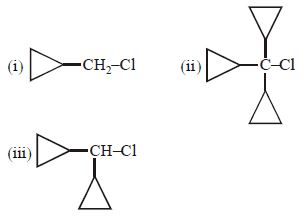
Identify the correct reactivity order for $S_N1$ reaction for the following compounds:
A
$(i) > (iii) > (ii)$
B
$(ii) > (iii) > (i)$
C
$(i) > (ii) > (iii)$
D
$(iii) > (ii) > (i)$
Solution
(B) The reactivity of alkyl halides towards $S_N1$ reaction depends on the stability of the carbocation intermediate formed after the departure of the leaving group $(Cl^-)$.
$(i)$ Forms a primary $(1^{\circ})$ carbocation: $Cyclopropyl-CH_2^+$.
(ii) Forms a tertiary $(3^{\circ})$ carbocation: $(Cyclopropyl)_3C^+$.
(iii) Forms a secondary $(2^{\circ})$ carbocation: $(Cyclopropyl)_2CH^+$.
Cyclopropyl groups provide significant stabilization to the adjacent carbocation through conjugation with the bent bonds of the cyclopropyl ring (often described as homoaromatic or through-ring conjugation).
As the number of cyclopropyl groups increases,the stability of the resulting carbocation increases significantly due to increased resonance-like stabilization.
Therefore,the stability order of the carbocations is: $(ii) > (iii) > (i)$.
Consequently,the reactivity order for $S_N1$ is: $(ii) > (iii) > (i)$.
$(i)$ Forms a primary $(1^{\circ})$ carbocation: $Cyclopropyl-CH_2^+$.
(ii) Forms a tertiary $(3^{\circ})$ carbocation: $(Cyclopropyl)_3C^+$.
(iii) Forms a secondary $(2^{\circ})$ carbocation: $(Cyclopropyl)_2CH^+$.
Cyclopropyl groups provide significant stabilization to the adjacent carbocation through conjugation with the bent bonds of the cyclopropyl ring (often described as homoaromatic or through-ring conjugation).
As the number of cyclopropyl groups increases,the stability of the resulting carbocation increases significantly due to increased resonance-like stabilization.
Therefore,the stability order of the carbocations is: $(ii) > (iii) > (i)$.
Consequently,the reactivity order for $S_N1$ is: $(ii) > (iii) > (i)$.
0 likes
View Solution380
MediumMCQ
Identify the correct reactivity order for the $S_N2$ reaction for the following compounds:
$(i)$ $CH_2=CH-Cl$
(ii) $CH_2=CH-CH_2-Cl$
(iii) $N\equiv C-CH_2-CH_2-Cl$
$(i)$ $CH_2=CH-Cl$
(ii) $CH_2=CH-CH_2-Cl$
(iii) $N\equiv C-CH_2-CH_2-Cl$
A
$i > ii > iii$
B
$ii > iii > i$
C
$i > iii > ii$
D
$iii > ii > i$
Solution
(B) The reactivity of alkyl halides towards $S_N2$ reaction depends on steric hindrance and the stability of the transition state.
$(i)$ $CH_2=CH-Cl$ is a vinyl chloride where the $C-Cl$ bond has partial double bond character due to resonance,making it extremely unreactive towards $S_N2$.
(ii) $CH_2=CH-CH_2-Cl$ is an allyl chloride. The transition state is stabilized by resonance with the adjacent double bond,making it highly reactive.
(iii) $N\equiv C-CH_2-CH_2-Cl$ is a primary alkyl chloride. It is reactive,but less so than the allylic halide due to the lack of resonance stabilization in the transition state.
Therefore,the order of reactivity is $ii > iii > i$.
$(i)$ $CH_2=CH-Cl$ is a vinyl chloride where the $C-Cl$ bond has partial double bond character due to resonance,making it extremely unreactive towards $S_N2$.
(ii) $CH_2=CH-CH_2-Cl$ is an allyl chloride. The transition state is stabilized by resonance with the adjacent double bond,making it highly reactive.
(iii) $N\equiv C-CH_2-CH_2-Cl$ is a primary alkyl chloride. It is reactive,but less so than the allylic halide due to the lack of resonance stabilization in the transition state.
Therefore,the order of reactivity is $ii > iii > i$.
0 likes
View Solution381
DifficultMCQ
Identify the correct reactivity order for $E_2$ reaction with alc. $KOH$ for the following compounds:
$(i)$ $8$-chlorocycloocta-$1,3,5$-triene
(ii) $3$-chlorocyclohexa-$1,4$-diene
(iii) $3$-chlorocyclobutene
$(i)$ $8$-chlorocycloocta-$1,3,5$-triene
(ii) $3$-chlorocyclohexa-$1,4$-diene
(iii) $3$-chlorocyclobutene
A
$i > ii > iii$
B
$ii > i > iii$
C
$i > iii > ii$
D
$iii > i > ii$
Solution
(B) The $E_2$ reaction involves the elimination of a proton and a leaving group to form a double bond. The rate of $E_2$ elimination is significantly enhanced if the resulting product is aromatic or anti-aromatic,as the transition state is stabilized by conjugation.
$(i)$ Elimination in $8$-chlorocycloocta-$1,3,5$-triene leads to cyclooctatetraene,which is a stable $8\pi$ electron system (non-aromatic,but highly conjugated).
(ii) Elimination in $3$-chlorocyclohexa-$1,4$-diene leads to benzene,which is highly aromatic and stable. This provides a very strong driving force for the reaction.
(iii) Elimination in $3$-chlorocyclobutene leads to cyclobutadiene,which is anti-aromatic ($4\pi$ electrons) and highly unstable. This makes the reaction very slow.
Therefore,the reactivity order is $(ii) > (i) > (iii)$.
$(i)$ Elimination in $8$-chlorocycloocta-$1,3,5$-triene leads to cyclooctatetraene,which is a stable $8\pi$ electron system (non-aromatic,but highly conjugated).
(ii) Elimination in $3$-chlorocyclohexa-$1,4$-diene leads to benzene,which is highly aromatic and stable. This provides a very strong driving force for the reaction.
(iii) Elimination in $3$-chlorocyclobutene leads to cyclobutadiene,which is anti-aromatic ($4\pi$ electrons) and highly unstable. This makes the reaction very slow.
Therefore,the reactivity order is $(ii) > (i) > (iii)$.
0 likes
View Solution382
DifficultMCQ
Identify the correct order of reactivity for the $E_2$ reaction with alcoholic $KOH$ for the following compounds:
$(i)$ $(CH_3)_3C-Cl$
(ii) $(CD_3)_3C-Cl$
(iii) $(CT_3)_3C-Cl$
$(i)$ $(CH_3)_3C-Cl$
(ii) $(CD_3)_3C-Cl$
(iii) $(CT_3)_3C-Cl$
A
$i > ii > iii$
B
$ii > iii > i$
C
$i > iii > ii$
D
$iii > i > ii$
Solution
(A) The $E_2$ reaction involves the abstraction of a $\beta$-hydrogen by a base in the rate-determining step.
In these compounds,the $\beta$-atoms are $H$,$D$,and $T$ respectively.
The $C-H$ bond is weaker than the $C-D$ bond,which is weaker than the $C-T$ bond due to the primary kinetic isotope effect.
Since the $C-H$ bond is the easiest to break,the rate of the $E_2$ reaction follows the order: $H > D > T$.
Therefore,the reactivity order is $(i) > (ii) > (iii)$.
In these compounds,the $\beta$-atoms are $H$,$D$,and $T$ respectively.
The $C-H$ bond is weaker than the $C-D$ bond,which is weaker than the $C-T$ bond due to the primary kinetic isotope effect.
Since the $C-H$ bond is the easiest to break,the rate of the $E_2$ reaction follows the order: $H > D > T$.
Therefore,the reactivity order is $(i) > (ii) > (iii)$.
0 likes
View Solution383
DifficultMCQ
Which reaction is faster $(i)$ or $(ii)$ and what is the mechanism?
$(i) \ CH_3CH_2CH_2Br + CH_3ONa \xrightarrow{DMF} CH_3CH_2CH_2OCH_3 + Br^-$
$(ii) \ CH_3CH_2CH_2Br + CH_3SNa \xrightarrow{DMF} CH_3CH_2CH_2SCH_3 + Br^-$
$(i) \ CH_3CH_2CH_2Br + CH_3ONa \xrightarrow{DMF} CH_3CH_2CH_2OCH_3 + Br^-$
$(ii) \ CH_3CH_2CH_2Br + CH_3SNa \xrightarrow{DMF} CH_3CH_2CH_2SCH_3 + Br^-$
A
reaction $(i)$,$S_{N}1$
B
reaction $(ii)$,$S_{N}2$
C
reaction $(ii)$,$S_{N}1$
D
reaction $(i)$,$S_{N}2$
Solution
(B) Both reactions involve a primary alkyl halide $(CH_3CH_2CH_2Br)$ reacting with a strong nucleophile in a polar aprotic solvent $(DMF)$,which follows the $S_{N}2$ mechanism.
In an $S_{N}2$ reaction,the rate depends on the nucleophilicity of the attacking species.
$CH_3S^-$ is a better nucleophile than $CH_3O^-$ because sulfur is larger,more polarizable,and less solvated in polar aprotic solvents compared to oxygen.
Therefore,reaction $(ii)$ is faster than reaction $(i)$ due to the higher nucleophilicity of the thiomethoxide ion $(CH_3S^-)$.
In an $S_{N}2$ reaction,the rate depends on the nucleophilicity of the attacking species.
$CH_3S^-$ is a better nucleophile than $CH_3O^-$ because sulfur is larger,more polarizable,and less solvated in polar aprotic solvents compared to oxygen.
Therefore,reaction $(ii)$ is faster than reaction $(i)$ due to the higher nucleophilicity of the thiomethoxide ion $(CH_3S^-)$.
0 likes
View Solution384
AdvancedMCQ
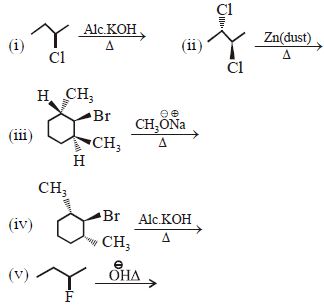
Identify the total number of $\beta$-elimination reactions in the following processes:
A
$4$
B
$3$
C
$5$
D
$2$
Solution
(C) $\beta$-elimination reaction involves the removal of two atoms or groups from adjacent carbon atoms ($\alpha$ and $\beta$ carbons) to form a multiple bond.
$(i)$ $CH_3CH_2CH(Cl)CH_3 + Alc. KOH \xrightarrow{\Delta} CH_3CH=CHCH_3 + CH_3CH_2CH=CH_2$: This is a dehydrohalogenation,which is a $\beta$-elimination reaction.
(ii) $CH_3CH(Cl)CH(Cl)CH_3 + Zn(dust) \xrightarrow{\Delta} CH_3CH=CHCH_3 + ZnCl_2$: This is a dehalogenation,which is a $\beta$-elimination reaction.
(iii) The reaction of a vicinal bromo-methylcyclohexane with $CH_3ONa$ involves the removal of $H$ and $Br$ from adjacent carbons to form an alkene,which is a $\beta$-elimination reaction.
(iv) The reaction of a bromo-dimethylcyclohexane with $Alc. KOH$ involves the removal of $H$ and $Br$ from adjacent carbons to form an alkene,which is a $\beta$-elimination reaction.
$(v)$ $CH_3CH_2CH(F)CH_3 + OH^- \xrightarrow{\Delta} CH_3CH=CHCH_3 + CH_3CH_2CH=CH_2$: This is a dehydrofluorination,which is a $\beta$-elimination reaction.
All five reactions are examples of $\beta$-elimination. Therefore,the total number is $5$.
$(i)$ $CH_3CH_2CH(Cl)CH_3 + Alc. KOH \xrightarrow{\Delta} CH_3CH=CHCH_3 + CH_3CH_2CH=CH_2$: This is a dehydrohalogenation,which is a $\beta$-elimination reaction.
(ii) $CH_3CH(Cl)CH(Cl)CH_3 + Zn(dust) \xrightarrow{\Delta} CH_3CH=CHCH_3 + ZnCl_2$: This is a dehalogenation,which is a $\beta$-elimination reaction.
(iii) The reaction of a vicinal bromo-methylcyclohexane with $CH_3ONa$ involves the removal of $H$ and $Br$ from adjacent carbons to form an alkene,which is a $\beta$-elimination reaction.
(iv) The reaction of a bromo-dimethylcyclohexane with $Alc. KOH$ involves the removal of $H$ and $Br$ from adjacent carbons to form an alkene,which is a $\beta$-elimination reaction.
$(v)$ $CH_3CH_2CH(F)CH_3 + OH^- \xrightarrow{\Delta} CH_3CH=CHCH_3 + CH_3CH_2CH=CH_2$: This is a dehydrofluorination,which is a $\beta$-elimination reaction.
All five reactions are examples of $\beta$-elimination. Therefore,the total number is $5$.
0 likes
View Solution385
DifficultMCQ
Vinylcyclopentane $\xrightarrow{HCl}$ Major product is
A
$1-$chloro$-1-$methylcyclohexane
B
$1-$chloro$-1-$cyclopentyl-ethane
C
$1-$chloro$-1-$methylcyclohexane (same as $A$)
D
$2-$chloro$-1-$methylcyclohexane
Solution
(A) The reaction proceeds via the formation of a carbocation intermediate.
$1$. Protonation of the alkene gives a secondary carbocation on the side chain.
$2$. The five-membered ring undergoes ring expansion to form a more stable six-membered ring carbocation.
$3$. $A$ $1,2$-hydride shift occurs to form a more stable tertiary carbocation.
$4$. Finally,the chloride ion attacks the tertiary carbocation to form $1$-chloro-$1$-methylcyclohexane.
$1$. Protonation of the alkene gives a secondary carbocation on the side chain.
$2$. The five-membered ring undergoes ring expansion to form a more stable six-membered ring carbocation.
$3$. $A$ $1,2$-hydride shift occurs to form a more stable tertiary carbocation.
$4$. Finally,the chloride ion attacks the tertiary carbocation to form $1$-chloro-$1$-methylcyclohexane.
0 likes
View Solution386
DifficultMCQ
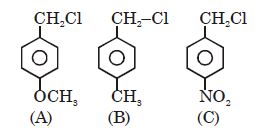
The rate of $S_{N}1$ reaction for the given compounds is:
A
$A > B > C$
B
$C > B > A$
C
$A > C > B$
D
$B > A > C$
Solution
(A) The rate of $S_{N}1$ reaction is directly proportional to the stability of the carbocation intermediate formed.
In the given compounds,the carbocation formed is a substituted benzyl carbocation $(Ar-CH_2^+)$.
Compound $(A)$ has a $-OCH_3$ group at the para position,which provides strong $+M$ (mesomeric) effect,greatly stabilizing the carbocation.
Compound $(B)$ has a $-CH_3$ group at the para position,which provides $+I$ (inductive) and hyperconjugation effects,stabilizing the carbocation.
Compound $(C)$ has a $-NO_2$ group at the para position,which provides a strong $-M$ and $-I$ effect,destabilizing the carbocation.
Therefore,the order of stability of the carbocations is $A > B > C$,which is also the order of the rate of $S_{N}1$ reaction.
In the given compounds,the carbocation formed is a substituted benzyl carbocation $(Ar-CH_2^+)$.
Compound $(A)$ has a $-OCH_3$ group at the para position,which provides strong $+M$ (mesomeric) effect,greatly stabilizing the carbocation.
Compound $(B)$ has a $-CH_3$ group at the para position,which provides $+I$ (inductive) and hyperconjugation effects,stabilizing the carbocation.
Compound $(C)$ has a $-NO_2$ group at the para position,which provides a strong $-M$ and $-I$ effect,destabilizing the carbocation.
Therefore,the order of stability of the carbocations is $A > B > C$,which is also the order of the rate of $S_{N}1$ reaction.
0 likes
View Solution387
MediumMCQ
In the reaction of $2$-chlorobutane with aqueous $KOH$,the product $A$ formed is:
A
Meso compound
B
Racemic mixture
C
Diastereomers
D
Structural isomers
Solution
(B) The reaction of $2$-chlorobutane with aqueous $KOH$ proceeds via an $S_N1$ mechanism because $2$-chlorobutane is a secondary alkyl halide.
In the $S_N1$ mechanism,the rate-determining step involves the formation of a planar carbocation intermediate.
The nucleophile $(OH^-)$ can attack the planar carbocation from either side with equal probability.
This leads to the formation of both $(R)$ and $(S)$ enantiomers in equal amounts,resulting in a racemic mixture.
In the $S_N1$ mechanism,the rate-determining step involves the formation of a planar carbocation intermediate.
The nucleophile $(OH^-)$ can attack the planar carbocation from either side with equal probability.
This leads to the formation of both $(R)$ and $(S)$ enantiomers in equal amounts,resulting in a racemic mixture.
0 likes
View Solution388
MediumMCQ
The correct order for $E_2$ reaction with alc. $KOH$ will be
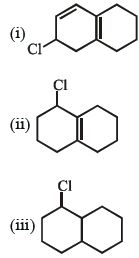
A
$(i) > (ii) > (iii)$
B
$(iii) > (ii) > (i)$
C
$(ii) > (i) > (iii)$
D
$(iii) > (i) > (ii)$
Solution
(A) The rate of $E_2$ reaction depends on the stability of the transition state and the ease of forming the double bond.
In compound $(i)$,the presence of a double bond in the ring makes the formation of a conjugated system or a more stable alkene easier upon elimination.
In compound $(ii)$,the chlorine is attached to a carbon adjacent to a double bond (allylic position),which facilitates the elimination reaction due to the formation of a conjugated diene system.
In compound $(iii)$,it is a simple secondary alkyl halide without any activating double bonds,making it the least reactive towards $E_2$ elimination compared to the others.
Thus,the reactivity order is $(i) > (ii) > (iii)$.
In compound $(i)$,the presence of a double bond in the ring makes the formation of a conjugated system or a more stable alkene easier upon elimination.
In compound $(ii)$,the chlorine is attached to a carbon adjacent to a double bond (allylic position),which facilitates the elimination reaction due to the formation of a conjugated diene system.
In compound $(iii)$,it is a simple secondary alkyl halide without any activating double bonds,making it the least reactive towards $E_2$ elimination compared to the others.
Thus,the reactivity order is $(i) > (ii) > (iii)$.
0 likes
View Solution389
DifficultMCQ
Which is the correct reactivity order for $E_2$ reaction with alcoholic $KOH$?
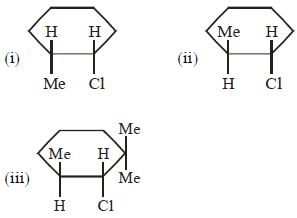
A
$i > ii > iii$
B
$ii > iii > i$
C
$i > iii > ii$
D
$iii > i > ii$
Solution
(A) For an $E_2$ reaction to occur,the leaving group $(-Cl)$ and the $\beta$-hydrogen must be in an anti-periplanar conformation.
In compound $(i)$,the $\beta$-hydrogen is anti to the $-Cl$ group,allowing for easy elimination.
In compound $(ii)$,the $\beta$-hydrogen is also anti to the $-Cl$ group,but the presence of a methyl group $(Me)$ creates more steric hindrance compared to $(i)$,making it slightly less reactive.
In compound $(iii)$,the $\beta$-hydrogen is anti to the $-Cl$ group,but there are two methyl groups $(Me)$ on the adjacent carbons,leading to significant steric hindrance and making it the least reactive.
Therefore,the correct order of reactivity is $(i) > (ii) > (iii)$.
In compound $(i)$,the $\beta$-hydrogen is anti to the $-Cl$ group,allowing for easy elimination.
In compound $(ii)$,the $\beta$-hydrogen is also anti to the $-Cl$ group,but the presence of a methyl group $(Me)$ creates more steric hindrance compared to $(i)$,making it slightly less reactive.
In compound $(iii)$,the $\beta$-hydrogen is anti to the $-Cl$ group,but there are two methyl groups $(Me)$ on the adjacent carbons,leading to significant steric hindrance and making it the least reactive.
Therefore,the correct order of reactivity is $(i) > (ii) > (iii)$.
0 likes
View Solution390
MediumMCQ
In the given reaction sequence,$(X)$ and $(Y)$ are:
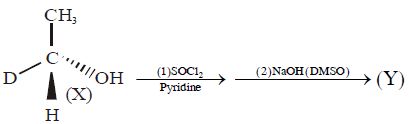
A
Structural isomers
B
Enantiomers
C
Different compounds
D
Identical compounds
Solution
(D) The reaction of the alcohol $(X)$ with $SOCl_2$ in the presence of pyridine proceeds via an $S_N2$ mechanism,resulting in an inversion of configuration at the chiral center to form an alkyl chloride.
Subsequently,the reaction of this alkyl chloride with $NaOH$ in $DMSO$ (a polar aprotic solvent) also proceeds via an $S_N2$ mechanism,causing a second inversion of configuration.
Since two successive inversions occur,the final product $(Y)$ has the same configuration as the starting material $(X)$.
Therefore,$(X)$ and $(Y)$ are identical compounds.
Subsequently,the reaction of this alkyl chloride with $NaOH$ in $DMSO$ (a polar aprotic solvent) also proceeds via an $S_N2$ mechanism,causing a second inversion of configuration.
Since two successive inversions occur,the final product $(Y)$ has the same configuration as the starting material $(X)$.
Therefore,$(X)$ and $(Y)$ are identical compounds.
0 likes
View Solution391
MediumMCQ
Among the following,which will readily undergo $S_{N}2$ reaction?
A
$4-$Chlorobut$-1-$ene
B
$1-$Chlorobut$-1-$ene
C
$1-$Chlorobut$-2-$ene
D
$2-$Chlorobut$-1-$ene
Solution
(C) The $S_{N}2$ reaction rate is significantly enhanced in allylic halides due to the stabilization of the transition state by the adjacent double bond.
$4-$Chlorobut$-1-$ene $(CH_2=CH-CH_2-CH_2Cl)$ is a primary alkyl halide,but it is also an allylic halide because the chlorine atom is attached to a carbon adjacent to the double bond ($CH_2=CH-CH_2-Cl$ is the structure of $3-$chloroprop$-1-$ene,but here $4-$chlorobut$-1-$ene is $CH_2=CH-CH_2-CH_2Cl$).
Wait,let us re-evaluate: $1-$Chlorobut$-2-$ene $(CH_3-CH=CH-CH_2Cl)$ is a primary allylic halide.
Primary allylic halides are highly reactive towards $S_{N}2$ reactions due to the resonance stabilization of the transition state.
Therefore,$1-$Chlorobut$-2-$ene is the most reactive among the given options.
$4-$Chlorobut$-1-$ene $(CH_2=CH-CH_2-CH_2Cl)$ is a primary alkyl halide,but it is also an allylic halide because the chlorine atom is attached to a carbon adjacent to the double bond ($CH_2=CH-CH_2-Cl$ is the structure of $3-$chloroprop$-1-$ene,but here $4-$chlorobut$-1-$ene is $CH_2=CH-CH_2-CH_2Cl$).
Wait,let us re-evaluate: $1-$Chlorobut$-2-$ene $(CH_3-CH=CH-CH_2Cl)$ is a primary allylic halide.
Primary allylic halides are highly reactive towards $S_{N}2$ reactions due to the resonance stabilization of the transition state.
Therefore,$1-$Chlorobut$-2-$ene is the most reactive among the given options.
0 likes
View Solution392
MediumMCQ
The correct reactivity order for $E_2$ reaction with alcoholic $KOH$ will be:
$(i)$ $3-$chlorocyclohexene derivative (conjugated system)
(ii) $1-$chlorodecalin derivative (with double bond)
(iii) $1-$chlorodecalin (saturated)
$(i)$ $3-$chlorocyclohexene derivative (conjugated system)
(ii) $1-$chlorodecalin derivative (with double bond)
(iii) $1-$chlorodecalin (saturated)
A
$i > ii > iii$
B
$ii > iii > i$
C
$i > iii > ii$
D
$iii > i > ii$
Solution
(A) The reactivity of an $E_2$ reaction depends on the stability of the transition state,which is influenced by the stability of the resulting alkene.
$(i)$ In the first case,the elimination leads to a conjugated diene system,which is highly stable.
(ii) In the second case,the elimination leads to a more substituted alkene within the bicyclic system.
(iii) In the third case,the elimination leads to a less substituted alkene compared to (ii).
Therefore,the order of reactivity is $(i) > (ii) > (iii)$.
$(i)$ In the first case,the elimination leads to a conjugated diene system,which is highly stable.
(ii) In the second case,the elimination leads to a more substituted alkene within the bicyclic system.
(iii) In the third case,the elimination leads to a less substituted alkene compared to (ii).
Therefore,the order of reactivity is $(i) > (ii) > (iii)$.
0 likes
View Solution393
DifficultMCQ
Identify the major product for the following reaction:
$1$-fluoro-$1$-methylcyclohexane $\xrightarrow[\Delta]{Alc. KOH}$ ?
$1$-fluoro-$1$-methylcyclohexane $\xrightarrow[\Delta]{Alc. KOH}$ ?
A
$1-$methylcyclohexene
B
Methylenecyclohexane
C
$3-$methylcyclohexene
D
$4-$methylcyclohexene
Solution
(B) The reaction of $1$-fluoro-$1$-methylcyclohexane with alcoholic $KOH$ proceeds via an $E2$ elimination mechanism.
In cases involving alkyl fluorides,the transition state has significant carbanion character due to the high electronegativity of the fluorine atom.
According to the Hofmann rule,the less substituted alkene is formed as the major product because the transition state leading to it is more stable due to less steric hindrance and the electronic effects of the fluorine leaving group.
Therefore,the major product is methylenecyclohexane.
In cases involving alkyl fluorides,the transition state has significant carbanion character due to the high electronegativity of the fluorine atom.
According to the Hofmann rule,the less substituted alkene is formed as the major product because the transition state leading to it is more stable due to less steric hindrance and the electronic effects of the fluorine leaving group.
Therefore,the major product is methylenecyclohexane.
0 likes
View Solution394
MediumMCQ
What is the major product of the following reaction?
$1\text{-methylcyclohexene} \xrightarrow{Br_2, H_2O} ?$
$1\text{-methylcyclohexene} \xrightarrow{Br_2, H_2O} ?$
A
$2-$bromo$-1-$methylcyclohexan$-1-$ol
B
$1-$bromo$-2-$methylcyclohexan$-1-$ol
C
$1,2-$dibromo$-1-$methylcyclohexane
D
$1-$bromo$-1-$methylcyclohexane
Solution
(A) The reaction of $1\text{-methylcyclohexene}$ with $Br_2$ in the presence of $H_2O$ is a halohydrin formation reaction.
In this reaction,the electrophile $Br^+$ attacks the double bond to form a cyclic bromonium ion intermediate.
Water $(H_2O)$,acting as a nucleophile,attacks the more substituted carbon of the bromonium ion because it can better stabilize the partial positive charge in the transition state.
This leads to the formation of $2\text{-bromo-1-methylcyclohexan-1-ol}$ as the major product,where the $-OH$ group is attached to the more substituted carbon and the $-Br$ atom is attached to the less substituted carbon.
In this reaction,the electrophile $Br^+$ attacks the double bond to form a cyclic bromonium ion intermediate.
Water $(H_2O)$,acting as a nucleophile,attacks the more substituted carbon of the bromonium ion because it can better stabilize the partial positive charge in the transition state.
This leads to the formation of $2\text{-bromo-1-methylcyclohexan-1-ol}$ as the major product,where the $-OH$ group is attached to the more substituted carbon and the $-Br$ atom is attached to the less substituted carbon.
0 likes
View Solution395
EasyMCQ
Which of the following species is most reactive in $S_{N}2$ reaction?
A
$CH_3-CH_2-Cl$
B
$CH_3-CH_2-Br$
C
$CH_3-CH_2-I$
D
$CH_3-CH_2-F$
Solution
(C) In an $S_{N}2$ reaction,the rate of reaction depends on the ability of the leaving group to depart.
Better leaving groups are weak bases,which are the conjugate bases of strong acids.
The leaving group ability follows the order: $I^- > Br^- > Cl^- > F^-$.
Since $I^-$ is the best leaving group among the halides,$CH_3-CH_2-I$ is the most reactive species in an $S_{N}2$ reaction.
Better leaving groups are weak bases,which are the conjugate bases of strong acids.
The leaving group ability follows the order: $I^- > Br^- > Cl^- > F^-$.
Since $I^-$ is the best leaving group among the halides,$CH_3-CH_2-I$ is the most reactive species in an $S_{N}2$ reaction.
0 likes
View Solution396
MediumMCQ
The order of reactivity of the following alkyl halides for a $S_N2$ reaction is
A
$R-F > R-Cl > R-Br > R-I$
B
$R-F > R-Br > R-Cl > R-I$
C
$R-Cl > R-Br > R-F > R-I$
D
$R-I > R-Br > R-Cl > R-F$
Solution
(D) The reactivity of alkyl halides in $S_N2$ reactions depends on the ability of the halide ion to act as a leaving group.
The better the leaving group,the faster the $S_N2$ reaction proceeds.
The order of leaving group ability is $I^{-} > Br^{-} > Cl^{-} > F^{-}$.
Therefore,the order of reactivity of alkyl halides towards $S_N2$ reaction is $R-I > R-Br > R-Cl > R-F$.
The better the leaving group,the faster the $S_N2$ reaction proceeds.
The order of leaving group ability is $I^{-} > Br^{-} > Cl^{-} > F^{-}$.
Therefore,the order of reactivity of alkyl halides towards $S_N2$ reaction is $R-I > R-Br > R-Cl > R-F$.
0 likes
View Solution397
MediumMCQ
$2-$Bromobutane on heating with alcoholic $KOH$ forms
A
$\alpha-$Butylene only
B
$\beta-$Butylene only
C
$20\%$ of $\beta-$Butylene $+ 80\%$ of $\alpha-$Butylene
D
$80\% \beta-$Butylene $+ 20\% \alpha-$Butylene
Solution
(D) The reaction of $2-$bromobutane with alcoholic $KOH$ is a dehydrohalogenation reaction (elimination reaction).
According to $Saytzeff's$ rule,the major product is the more substituted alkene.
$2-$Bromobutane $(CH_3-CHBr-CH_2-CH_3)$ undergoes elimination to form $2-$butene ($\beta-$butylene) and $1-$butene ($\alpha-$butylene).
$2-$Butene is more stable due to hyperconjugation and steric factors,making it the major product $(80\%)$.
$1-$Butene is the minor product $(20\%)$.
Therefore,the correct composition is $80\% \beta-$butylene and $20\% \alpha-$butylene.
According to $Saytzeff's$ rule,the major product is the more substituted alkene.
$2-$Bromobutane $(CH_3-CHBr-CH_2-CH_3)$ undergoes elimination to form $2-$butene ($\beta-$butylene) and $1-$butene ($\alpha-$butylene).
$2-$Butene is more stable due to hyperconjugation and steric factors,making it the major product $(80\%)$.
$1-$Butene is the minor product $(20\%)$.
Therefore,the correct composition is $80\% \beta-$butylene and $20\% \alpha-$butylene.
0 likes
View Solution398
MediumMCQ
What is the correct order of nucleophilicity for an $S_N2$ reaction?
A
$OH^- > H_2O > CH_3COO^-$
B
$OH^- > CH_3COO^- > H_2O$
C
$H_2O > CH_3COO^- > OH^-$
D
$H_2O = OH^- = CH_3COO^-$
Solution
(B) The $S_N2$ reaction is a concerted mechanism where the rate depends on the strength of the nucleophile.
Nucleophilicity generally increases with the negative charge and decreases with resonance stabilization.
$1$. $OH^-$ is a strong nucleophile because it carries a full negative charge.
$2$. $CH_3COO^-$ is a weaker nucleophile than $OH^-$ because the negative charge is delocalized over two oxygen atoms due to resonance.
$3$. $H_2O$ is a neutral molecule and acts as the weakest nucleophile among the given species.
Therefore,the correct order of nucleophilicity is $OH^- > CH_3COO^- > H_2O$.
Nucleophilicity generally increases with the negative charge and decreases with resonance stabilization.
$1$. $OH^-$ is a strong nucleophile because it carries a full negative charge.
$2$. $CH_3COO^-$ is a weaker nucleophile than $OH^-$ because the negative charge is delocalized over two oxygen atoms due to resonance.
$3$. $H_2O$ is a neutral molecule and acts as the weakest nucleophile among the given species.
Therefore,the correct order of nucleophilicity is $OH^- > CH_3COO^- > H_2O$.
0 likes
View Solution399
MediumMCQ
In the following reaction
$C_6H_5CH_2Br \xrightarrow[{(ii)H_3O^{+}}]{{(i)Mg, \text{Ether}}} X$
Product $X$ is
$C_6H_5CH_2Br \xrightarrow[{(ii)H_3O^{+}}]{{(i)Mg, \text{Ether}}} X$
Product $X$ is
A
$C_6H_5CH_3$
B
$C_6H_5CH_2OH$
C
$C_6H_5CH_2CH_2C_6H_5$
D
$C_6H_5CH_2OCH_2C_6H_5$
Solution
(A) The reaction of benzyl bromide $(C_6H_5CH_2Br)$ with magnesium in the presence of dry ether forms the Grignard reagent,benzylmagnesium bromide $(C_6H_5CH_2MgBr)$.
Subsequent hydrolysis of the Grignard reagent with $H_3O^{+}$ leads to the protonation of the carbanion,resulting in the formation of toluene $(C_6H_5CH_3)$.
The overall reaction is: $C_6H_5CH_2Br + Mg$ $\xrightarrow{\text{Ether}} C_6H_5CH_2MgBr$ $\xrightarrow{H_3O^{+}} C_6H_5CH_3 + Mg(Br)(OH)$.
Subsequent hydrolysis of the Grignard reagent with $H_3O^{+}$ leads to the protonation of the carbanion,resulting in the formation of toluene $(C_6H_5CH_3)$.
The overall reaction is: $C_6H_5CH_2Br + Mg$ $\xrightarrow{\text{Ether}} C_6H_5CH_2MgBr$ $\xrightarrow{H_3O^{+}} C_6H_5CH_3 + Mg(Br)(OH)$.
0 likes
View Solution400
MediumMCQ
$C_2H_5Br$ $\xrightarrow{KCN} A$ $\xrightarrow{\text{Hydrolysis}} B$
The compound $A$ in the above reaction is
The compound $A$ in the above reaction is
A
Ethylene chloride
B
Acetic acid
C
Propanoic acid
D
Ethyl cyanide
Solution
(D) The reaction is a nucleophilic substitution reaction.
$C_2H_5Br + KCN \rightarrow C_2H_5CN + KBr$
Here,$C_2H_5Br$ (Ethyl bromide) reacts with $KCN$ to form $C_2H_5CN$ (Ethyl cyanide or Propanenitrile) as compound $A$.
Further hydrolysis of $A$ $(C_2H_5CN)$ yields $B$ ($C_2H_5COOH$,Propanoic acid).
Therefore,compound $A$ is Ethyl cyanide.
$C_2H_5Br + KCN \rightarrow C_2H_5CN + KBr$
Here,$C_2H_5Br$ (Ethyl bromide) reacts with $KCN$ to form $C_2H_5CN$ (Ethyl cyanide or Propanenitrile) as compound $A$.
Further hydrolysis of $A$ $(C_2H_5CN)$ yields $B$ ($C_2H_5COOH$,Propanoic acid).
Therefore,compound $A$ is Ethyl cyanide.
0 likes
View SolutionHaloalkanes and Haloarenes — Properties of Haloalkanes · Frequently Asked Questions
1Are these Haloalkanes and Haloarenes questions useful for JEE and NEET?
Yes. All questions in this section are mapped to JEE Main and NEET exam patterns. Previous year questions from JEE Main, NEET, GUJCET and state-level exams are included with full solutions.
2Can I switch to Hindi or Gujarati for these questions?
Yes. Use the language tabs in the hero section or the sidebar to view the same questions and solutions in English, Hindi or Gujarati.
3How do I generate a question paper from this subtopic?
Use the Vedclass Exam Paper Generator — select the chapter and subtopic, set difficulty, and generate Sets A, B, C, D automatically. First 3 chapters of every subject are free.
Vedclass Products
For Students
Vedclass Test Series
Mock tests in real JEE/NEET style with performance analysis. 5-day free trial.
Start Free TrialFor Teachers
Exam Paper Generator
Generate Set A/B/C/D papers from this chapter in 2 minutes. 3 chapters free.
Try FreeFor Institutes
Online Exam Module
Live online exams with unlimited students, 360° analytics & white-label branding.
See DemoFor Teachers & Institutes
Generate a Haloalkanes and Haloarenes Exam Paper in 2 Minutes
Select subtopic & difficulty — Sets A, B, C, D auto-generated with No Repeat logic.
First 3 chapters of every subject are free — no payment required.