
A English
Properties of Haloalkanes Questions in English
Class 12 Chemistry · Haloalkanes and Haloarenes · Properties of Haloalkanes
1196+
Questions
English
Language
100%
With Solutions
Showing 50 of 1196 questions in English
251
DifficultMCQ
The reaction of $C_6H_5CH=CHCH_3$ with $HBr$ produces
A
$C_6H_5CH_2CH_2CH_2Br$
B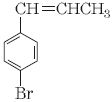
C
$C_6H_5CH(Br)CH_2CH_3$
D
$C_6H_5CH_2CH(Br)CH_3$
Solution
(C) The reaction follows Markovnikov's rule,where the electrophile $H^+$ adds to the carbon atom with more hydrogen atoms,and the nucleophile $Br^-$ adds to the more substituted carbon atom.
In the reaction of $C_6H_5CH=CHCH_3$ with $HBr$,the proton $H^+$ adds to the $CH$ group (adjacent to the methyl group) to form a more stable benzylic carbocation,$C_6H_5CH^+CH_2CH_3$.
Subsequently,the bromide ion $Br^-$ attacks this carbocation to form the final product,$C_6H_5CH(Br)CH_2CH_3$.
In the reaction of $C_6H_5CH=CHCH_3$ with $HBr$,the proton $H^+$ adds to the $CH$ group (adjacent to the methyl group) to form a more stable benzylic carbocation,$C_6H_5CH^+CH_2CH_3$.
Subsequently,the bromide ion $Br^-$ attacks this carbocation to form the final product,$C_6H_5CH(Br)CH_2CH_3$.
0 likes
View Solution252
MediumMCQ
Which of the following compounds will undergo racemisation when hydrolysed by an aqueous $KOH$ solution?
$(i)$ $C_6H_5CH_2Cl$
$(ii)$ $CH_3CH_2CH_2Cl$
$(iii)$ $(CH_3)_2CHCH_2Cl$
$(iv)$ $CH_3CH(Cl)C_2H_5$
$(i)$ $C_6H_5CH_2Cl$
$(ii)$ $CH_3CH_2CH_2Cl$
$(iii)$ $(CH_3)_2CHCH_2Cl$
$(iv)$ $CH_3CH(Cl)C_2H_5$
A
$(i)$ and $(ii)$
B
$(ii)$ and $(iv)$
C
$(iii)$ and $(iv)$
D
None of the above
Solution
(D) Racemisation occurs in $S_N1$ reactions where a chiral carbocation intermediate is formed,allowing the nucleophile to attack from both sides.
Compound $(iv)$,$CH_3CH(Cl)C_2H_5$,is a secondary alkyl halide that can form a stable carbocation and possesses a chiral center,leading to a racemic mixture upon hydrolysis.
Compounds $(i)$,$(ii)$,and $(iii)$ are primary alkyl halides. Primary halides typically undergo $S_N2$ reactions,which result in Walden inversion rather than racemisation. Therefore,only $(iv)$ undergoes racemisation.
Compound $(iv)$,$CH_3CH(Cl)C_2H_5$,is a secondary alkyl halide that can form a stable carbocation and possesses a chiral center,leading to a racemic mixture upon hydrolysis.
Compounds $(i)$,$(ii)$,and $(iii)$ are primary alkyl halides. Primary halides typically undergo $S_N2$ reactions,which result in Walden inversion rather than racemisation. Therefore,only $(iv)$ undergoes racemisation.
0 likes
View Solution253
AdvancedMCQ
Consider the reactions.
$(i) \ (CH_3)_2CH-CH_2Br \xrightarrow{C_2H_5OH} (CH_3)_2CH-CH_2OC_2H_5 + HBr$
$(ii) \ (CH_3)_2CH-CH_2Br \xrightarrow{C_2H_5O^-} (CH_3)_2CH-CH_2OC_2H_5 + Br^-$
The mechanisms of reactions $(i)$ and $(ii)$ are respectively:
$(i) \ (CH_3)_2CH-CH_2Br \xrightarrow{C_2H_5OH} (CH_3)_2CH-CH_2OC_2H_5 + HBr$
$(ii) \ (CH_3)_2CH-CH_2Br \xrightarrow{C_2H_5O^-} (CH_3)_2CH-CH_2OC_2H_5 + Br^-$
The mechanisms of reactions $(i)$ and $(ii)$ are respectively:
A
$S_N2$ and $S_N2$
B
$S_N1$ and $S_N1$
C
$S_N1$ and $S_N2$
D
$S_N2$ and $S_N1$
Solution
(C) Reaction $(i)$ involves a primary alkyl halide reacting with a weak nucleophile $(C_2H_5OH)$,which proceeds via the $S_N1$ mechanism.
Reaction $(ii)$ involves a primary alkyl halide reacting with a strong nucleophile $(C_2H_5O^-)$,which proceeds via the $S_N2$ mechanism.
Therefore,the mechanisms are $S_N1$ and $S_N2$ respectively.
Reaction $(ii)$ involves a primary alkyl halide reacting with a strong nucleophile $(C_2H_5O^-)$,which proceeds via the $S_N2$ mechanism.
Therefore,the mechanisms are $S_N1$ and $S_N2$ respectively.
0 likes
View Solution254
AdvancedMCQ
Which one is most reactive towards $S_{N}1$ reaction?
A
$C_6H_5CH(C_6H_5)Br$
B
$C_6H_5CH(CH_3)Br$
C
$C_6H_5C(CH_3)(C_6H_5)Br$
D
$C_6H_5CH_2Br$
Solution
(C) Key Idea: The $S_{N}1$ reaction proceeds via the formation of a carbocation intermediate. The stability of the carbocation determines the reactivity of the alkyl/aryl halide; higher stability leads to higher reactivity.
The carbocations formed from the given halides are:
$1$. $C_6H_5CH(C_6H_5)Br \rightarrow (C_6H_5)_2CH^+ + Br^-$
$2$. $C_6H_5CH(CH_3)Br \rightarrow C_6H_5CH^+(CH_3) + Br^-$
$3$. $C_6H_5C(CH_3)(C_6H_5)Br \rightarrow (C_6H_5)_2C^+(CH_3) + Br^-$
$4$. $C_6H_5CH_2Br \rightarrow C_6H_5CH_2^+ + Br^-$
The stability order of these carbocations is: $(C_6H_5)_2C^+(CH_3) > (C_6H_5)_2CH^+ > C_6H_5CH^+(CH_3) > C_6H_5CH_2^+$.
The carbocation $(C_6H_5)_2C^+(CH_3)$ is the most stable due to the presence of two phenyl groups and one methyl group providing resonance and inductive stabilization. Thus,$C_6H_5C(CH_3)(C_6H_5)Br$ is the most reactive towards $S_{N}1$ reaction.
The carbocations formed from the given halides are:
$1$. $C_6H_5CH(C_6H_5)Br \rightarrow (C_6H_5)_2CH^+ + Br^-$
$2$. $C_6H_5CH(CH_3)Br \rightarrow C_6H_5CH^+(CH_3) + Br^-$
$3$. $C_6H_5C(CH_3)(C_6H_5)Br \rightarrow (C_6H_5)_2C^+(CH_3) + Br^-$
$4$. $C_6H_5CH_2Br \rightarrow C_6H_5CH_2^+ + Br^-$
The stability order of these carbocations is: $(C_6H_5)_2C^+(CH_3) > (C_6H_5)_2CH^+ > C_6H_5CH^+(CH_3) > C_6H_5CH_2^+$.
The carbocation $(C_6H_5)_2C^+(CH_3)$ is the most stable due to the presence of two phenyl groups and one methyl group providing resonance and inductive stabilization. Thus,$C_6H_5C(CH_3)(C_6H_5)Br$ is the most reactive towards $S_{N}1$ reaction.
0 likes
View Solution255
DifficultMCQ
In the following reaction $C_6H_5CH_2Br \xrightarrow{1. Mg, \text{ ether } \atop 2. H_3O^{+}} X$,the product $X$ is
A
$C_6H_5CH_2OCH_2C_6H_5$
B
$C_6H_5CH_2OH$
C
$C_6H_5CH_3$
D
$C_6H_5CH_2CH_2C_6H_5$
Solution
(C) The reaction proceeds as follows:
$1$. $C_6H_5CH_2Br$ reacts with $Mg$ in the presence of dry ether to form the Grignard reagent,$C_6H_5CH_2MgBr$.
$2$. The Grignard reagent $C_6H_5CH_2MgBr$ undergoes hydrolysis with $H_3O^{+}$ to form $C_6H_5CH_3$ (Toluene).
Therefore,the product $X$ is $C_6H_5CH_3$.
$1$. $C_6H_5CH_2Br$ reacts with $Mg$ in the presence of dry ether to form the Grignard reagent,$C_6H_5CH_2MgBr$.
$2$. The Grignard reagent $C_6H_5CH_2MgBr$ undergoes hydrolysis with $H_3O^{+}$ to form $C_6H_5CH_3$ (Toluene).
Therefore,the product $X$ is $C_6H_5CH_3$.
0 likes
View Solution256
DifficultMCQ
Which of the following reactions is an example of a nucleophilic substitution reaction?
A
$2RX + 2Na \rightarrow R-R + 2NaX$
B
$RX + H_2 \rightarrow RH + HX$
C
$RX + Mg \rightarrow RMgX$
D
$RX + KOH \rightarrow ROH + KX$
Solution
(D) $KOH \rightarrow K^{+} + OH^{-}$
$RX + OH^{-} \rightarrow R-OH + X^{-}$
$OH^{-}$ is a stronger nucleophile than the halide ion $(X^{-})$,so it easily replaces the weaker nucleophile. Nucleophiles are species that are either negatively charged or possess lone pairs of electrons,such as $OH^{-}$,$\ddot{N}H_{3}$,etc.
$RX + OH^{-} \rightarrow R-OH + X^{-}$
$OH^{-}$ is a stronger nucleophile than the halide ion $(X^{-})$,so it easily replaces the weaker nucleophile. Nucleophiles are species that are either negatively charged or possess lone pairs of electrons,such as $OH^{-}$,$\ddot{N}H_{3}$,etc.
0 likes
View Solution257
DifficultMCQ
In a $S_N2$ substitution reaction of the type $R-Br + Cl^- \xrightarrow{DMF} R-Cl + Br^-$,which one of the following has the highest relative rate?
A
$CH_3-C(CH_3)_2-CH_2-Br$
B
$CH_3-CH_2-Br$
C
$CH_3-CH_2-CH_2-Br$
D
$CH_3-CH(CH_3)-CH_2-Br$
Solution
(B) In $S_N2$ reactions,the rate of reaction is inversely proportional to the steric hindrance around the carbon atom undergoing substitution.
As the size of the alkyl group increases or branching increases near the reaction center,the rate decreases.
Comparing the given primary alkyl halides:
$(a)$ $CH_3-C(CH_3)_2-CH_2-Br$ (neopentyl bromide) has significant steric hindrance due to the bulky tert-butyl group.
$(b)$ $CH_3-CH_2-Br$ (ethyl bromide) has the least steric hindrance.
$(c)$ $CH_3-CH_2-CH_2-Br$ (n-propyl bromide) has more steric hindrance than ethyl bromide.
$(d)$ $CH_3-CH(CH_3)-CH_2-Br$ (isobutyl bromide) has more steric hindrance than ethyl bromide.
Therefore,$CH_3-CH_2-Br$ shows the highest relative rate.
As the size of the alkyl group increases or branching increases near the reaction center,the rate decreases.
Comparing the given primary alkyl halides:
$(a)$ $CH_3-C(CH_3)_2-CH_2-Br$ (neopentyl bromide) has significant steric hindrance due to the bulky tert-butyl group.
$(b)$ $CH_3-CH_2-Br$ (ethyl bromide) has the least steric hindrance.
$(c)$ $CH_3-CH_2-CH_2-Br$ (n-propyl bromide) has more steric hindrance than ethyl bromide.
$(d)$ $CH_3-CH(CH_3)-CH_2-Br$ (isobutyl bromide) has more steric hindrance than ethyl bromide.
Therefore,$CH_3-CH_2-Br$ shows the highest relative rate.
0 likes
View Solution258
DifficultMCQ
In the following reactions,
$(i) CH_3-CH(CH_3)-CH(OH)-CH_3 \xrightarrow{H^{+}/\text{heat}} A \text{ [Major product]} + B \text{ [Minor product]}$
$(ii) A$ $\xrightarrow[\text{in absence of peroxide}]{HBr, \text{dark}} C \text{ [Major product]} + D \text{ [Minor product]}$
the major products $(A)$ and $(C)$ are respectively:
$(i) CH_3-CH(CH_3)-CH(OH)-CH_3 \xrightarrow{H^{+}/\text{heat}} A \text{ [Major product]} + B \text{ [Minor product]}$
$(ii) A$ $\xrightarrow[\text{in absence of peroxide}]{HBr, \text{dark}} C \text{ [Major product]} + D \text{ [Minor product]}$
the major products $(A)$ and $(C)$ are respectively:
A
$CH_2=C(CH_3)-CH_2-CH_3$ and $CH_3-C(Br)(CH_3)-CH_2-CH_3$
B
$CH_3-C(CH_3)=CH-CH_3$ and $CH_3-C(Br)(CH_3)-CH_2-CH_3$
C
$CH_2=C(CH_3)-CH_2-CH_3$ and $CH_3-CH(CH_3)-CH(Br)-CH_3$
D
$CH_3-C(CH_3)=CH-CH_3$ and $CH_3-CH(CH_3)-CH(Br)-CH_3$
Solution
(B) In reaction $(i)$,dehydration of $3\text{-methylbutan-}2\text{-ol}$ occurs via a carbocation intermediate.
The initially formed $2^\circ$ carbocation $CH_3-CH(CH_3)-C^+H-CH_3$ undergoes a $1,2\text{-hydride shift}$ to form a more stable $3^\circ$ carbocation $CH_3-C^+(CH_3)-CH_2-CH_3$.
Elimination of a proton from this $3^\circ$ carbocation according to Saytzeff's rule gives the major product $A$,which is $2\text{-methylbut-}2\text{-ene}$ $(CH_3-C(CH_3)=CH-CH_3)$.
In reaction $(ii)$,Markovnikov addition of $HBr$ to $A$ in the absence of peroxide yields the major product $C$,which is $2\text{-bromo-}2\text{-methylbutane}$ $(CH_3-C(Br)(CH_3)-CH_2-CH_3)$.
The initially formed $2^\circ$ carbocation $CH_3-CH(CH_3)-C^+H-CH_3$ undergoes a $1,2\text{-hydride shift}$ to form a more stable $3^\circ$ carbocation $CH_3-C^+(CH_3)-CH_2-CH_3$.
Elimination of a proton from this $3^\circ$ carbocation according to Saytzeff's rule gives the major product $A$,which is $2\text{-methylbut-}2\text{-ene}$ $(CH_3-C(CH_3)=CH-CH_3)$.
In reaction $(ii)$,Markovnikov addition of $HBr$ to $A$ in the absence of peroxide yields the major product $C$,which is $2\text{-bromo-}2\text{-methylbutane}$ $(CH_3-C(Br)(CH_3)-CH_2-CH_3)$.
0 likes
View Solution259
DifficultMCQ
$CH_3Br + Nu^{-} \rightarrow CH_3-Nu + Br^{-}$
The decreasing order of the rate of the above reaction with nucleophiles $(Nu^{-})$ $A$ to $D$ is
$[Nu^{-} = (A) \, PhO^{-}, (B) \, AcO^{-}, (C) \, HO^{-}, (D) \, CH_3O^{-}]$
The decreasing order of the rate of the above reaction with nucleophiles $(Nu^{-})$ $A$ to $D$ is
$[Nu^{-} = (A) \, PhO^{-}, (B) \, AcO^{-}, (C) \, HO^{-}, (D) \, CH_3O^{-}]$
A
$A > B > C > D$
B
$B > D > C > A$
C
$D > C > A > B$
D
$D > C > B > A$
Solution
(C) The rate of the $S_N2$ reaction is directly proportional to the nucleophilicity of the attacking nucleophile.
Nucleophilicity is inversely related to the strength of the corresponding conjugate acid.
The order of acidity of the conjugate acids is: $CH_3COOH (AcOH) > C_6H_5OH (PhOH) > H_2O > CH_3OH$.
Therefore,the order of basicity (nucleophilicity) is the reverse: $CH_3COO^{-} < C_6H_5O^{-} < HO^{-} < CH_3O^{-}$.
Thus,the decreasing order of the rate of reaction is: $D > C > A > B$.
Nucleophilicity is inversely related to the strength of the corresponding conjugate acid.
The order of acidity of the conjugate acids is: $CH_3COOH (AcOH) > C_6H_5OH (PhOH) > H_2O > CH_3OH$.
Therefore,the order of basicity (nucleophilicity) is the reverse: $CH_3COO^{-} < C_6H_5O^{-} < HO^{-} < CH_3O^{-}$.
Thus,the decreasing order of the rate of reaction is: $D > C > A > B$.
0 likes
View Solution260
DifficultMCQ
$A$ solution of $(-)-1-$chloro$-1-$phenylethane in toluene racemises slowly in the presence of a small amount of $SbCl_5$,due to the formation of:
A
carbanion
B
carbene
C
carbocation
D
free radical
Solution
(C) $SbCl_5$ acts as a Lewis acid and abstracts the chloride ion from $(-)-1-$chloro$-1-$phenylethane to form a stable benzylic carbocation intermediate: $Ph-CH(Cl)-CH_3 + SbCl_5 \to [Ph-CH^+-CH_3] + SbCl_6^-$.
Since the carbocation is planar,the nucleophilic attack by $Cl^-$ can occur from either side,leading to the formation of a racemic mixture.
Since the carbocation is planar,the nucleophilic attack by $Cl^-$ can occur from either side,leading to the formation of a racemic mixture.
0 likes
View Solution261
AdvancedMCQ
Reaction of trans-$2-$phenyl$-1-$bromocyclopentane with alcoholic $KOH$ produces:
A
$1-$phenylcyclopentene
B
$3-$phenylcyclopentene
C
$4-$phenylcyclopentene
D
$2-$phenylcyclopentene
Solution
(B) The reaction follows the $E2$ mechanism. In an $E2$ elimination,the leaving group $(-Br)$ and the $\beta$-hydrogen atom must be in an anti-periplanar (trans) orientation to allow for the formation of the double bond. In trans-$2-$phenyl$-1-$bromocyclopentane,the $\beta$-hydrogen at the $C-3$ position is anti to the $-Br$ group at the $C-1$ position. Therefore,the elimination occurs between $C-1$ and $C-3$,resulting in the formation of $3-$phenylcyclopentene.
0 likes
View Solution262
MediumMCQ
Which of the following is the correct order of decreasing $S_{N^{2}}$ reactivity?
($X$ is a halogen)
($X$ is a halogen)
A
$R_2CHX > R_3CX > RCH_2X$
B
$RCH_2X > R_3CX > R_2CHX$
C
$RCH_2X > R_2CHX > R_3CX$
D
$R_3CX > R_2CHX > RCH_2X$
Solution
(C) In the $S_{N^{2}}$ mechanism,the transition state is pentavalent.
Steric hindrance plays a crucial role in $S_{N^{2}}$ reactions.
Bulky alkyl groups hinder the approach of the nucleophile,while smaller alkyl groups facilitate it.
Therefore,the reactivity order for $S_{N^{2}}$ is primary $(RCH_2X)$ > secondary $(R_2CHX)$ > tertiary $(R_3CX)$.
The correct order is $RCH_2X > R_2CHX > R_3CX$.
Steric hindrance plays a crucial role in $S_{N^{2}}$ reactions.
Bulky alkyl groups hinder the approach of the nucleophile,while smaller alkyl groups facilitate it.
Therefore,the reactivity order for $S_{N^{2}}$ is primary $(RCH_2X)$ > secondary $(R_2CHX)$ > tertiary $(R_3CX)$.
The correct order is $RCH_2X > R_2CHX > R_3CX$.
0 likes
View Solution263
DifficultMCQ
The organic chloro compound,which shows complete stereochemical inversion during an $S_{N}2$ reaction,is
A
$(C_2H_5)_2CHCl$
B
$(CH_3)_3CCl$
C
$(CH_3)_2CHCl$
D
$CH_3Cl$
Solution
(D) Nucleophilic substitution bimolecular $S_{N}2$ reaction prefers a less sterically hindered site for the nucleophilic attack.
Lesser the steric hindrance,faster is the $S_{N}2$ reaction.
The order of reactivity for $S_{N}2$ reactions is: $\text{Methyl halide} > 1^{\circ} > 2^{\circ} > 3^{\circ}$.
$S_{N}2$ reactions involve complete inversion of configuration (Walden inversion).
Among the given options,$CH_3Cl$ is a methyl halide,which is the least sterically hindered and thus undergoes $S_{N}2$ reaction with complete stereochemical inversion.
Lesser the steric hindrance,faster is the $S_{N}2$ reaction.
The order of reactivity for $S_{N}2$ reactions is: $\text{Methyl halide} > 1^{\circ} > 2^{\circ} > 3^{\circ}$.
$S_{N}2$ reactions involve complete inversion of configuration (Walden inversion).
Among the given options,$CH_3Cl$ is a methyl halide,which is the least sterically hindered and thus undergoes $S_{N}2$ reaction with complete stereochemical inversion.
0 likes
View Solution264
DifficultMCQ
Compound $(A), \, C_8H_9Br,$ gives a white precipitate when warmed with alcoholic $AgNO_3.$ Oxidation of $(A)$ gives an acid $(B), \, C_8H_6O_4.$ $(B)$ easily forms anhydride on heating. Identify the compound $(A).$
A
o-Methylbenzyl bromide
B
o-Ethylphenyl bromide
C
p-Methylbenzyl bromide
D
m-Methylbenzyl bromide
Solution
(A) $1$. Compound $(A)$ has the formula $C_8H_9Br.$ The formation of a white precipitate with alcoholic $AgNO_3$ indicates the presence of a reactive bromine atom,likely a benzylic bromide $(-CH_2Br)$.
$2$. Oxidation of $(A)$ gives an acid $(B)$ with formula $C_8H_6O_4.$ This acid readily forms an anhydride upon heating,which is a characteristic property of phthalic acid (benzene$-1,2-$dicarboxylic acid).
$3$. For $(A)$ to yield phthalic acid upon oxidation,it must have two substituents at the ortho positions on the benzene ring that can be oxidized to carboxylic acid groups. One is the $-CH_2Br$ group (which oxidizes to $-COOH$) and the other must be a methyl group $(-CH_3)$ at the ortho position.
$4$. Therefore,$(A)$ is $o$-methylbenzyl bromide ($1$-bromo$-2-$methylbenzene derivative). The reaction sequence is: $o$-methylbenzyl bromide $\xrightarrow{Oxidation}$ phthalic acid $\xrightarrow{\Delta}$ phthalic anhydride.
$2$. Oxidation of $(A)$ gives an acid $(B)$ with formula $C_8H_6O_4.$ This acid readily forms an anhydride upon heating,which is a characteristic property of phthalic acid (benzene$-1,2-$dicarboxylic acid).
$3$. For $(A)$ to yield phthalic acid upon oxidation,it must have two substituents at the ortho positions on the benzene ring that can be oxidized to carboxylic acid groups. One is the $-CH_2Br$ group (which oxidizes to $-COOH$) and the other must be a methyl group $(-CH_3)$ at the ortho position.
$4$. Therefore,$(A)$ is $o$-methylbenzyl bromide ($1$-bromo$-2-$methylbenzene derivative). The reaction sequence is: $o$-methylbenzyl bromide $\xrightarrow{Oxidation}$ phthalic acid $\xrightarrow{\Delta}$ phthalic anhydride.
1 likes
View Solution265
MediumMCQ
In $S_{N}2$ reactions,the correct order of reactivity for the following compounds:
A
$CH_3Cl > (CH_3)_2CHCl > CH_3CH_2Cl > (CH_3)_3CCl$
B
$CH_3Cl > CH_3CH_2Cl > (CH_3)_2CHCl > (CH_3)_3CCl$
C
$CH_3CH_2Cl > CH_3Cl > (CH_3)_2CHCl > (CH_3)_3CCl$
D
$(CH_3)_2CHCl > CH_3CH_2Cl > CH_3Cl > (CH_3)_3CCl$
Solution
(B) The rate of $S_{N}2$ reactions is inversely proportional to the steric hindrance around the electrophilic carbon atom.
As the number of alkyl groups attached to the carbon bearing the halogen increases,the steric crowding increases,which hinders the approach of the nucleophile.
The order of reactivity for alkyl halides in $S_{N}2$ reactions is: $Methyl \ halide > Primary \ (1^{\circ}) \ halide > Secondary \ (2^{\circ}) \ halide > Tertiary \ (3^{\circ}) \ halide$.
Comparing the given compounds:
$CH_3Cl$ (Methyl halide) > $CH_3CH_2Cl$ (Primary) > $(CH_3)_2CHCl$ (Secondary) > $(CH_3)_3CCl$ (Tertiary).
Therefore,the correct order is $CH_3Cl > CH_3CH_2Cl > (CH_3)_2CHCl > (CH_3)_3CCl$.
As the number of alkyl groups attached to the carbon bearing the halogen increases,the steric crowding increases,which hinders the approach of the nucleophile.
The order of reactivity for alkyl halides in $S_{N}2$ reactions is: $Methyl \ halide > Primary \ (1^{\circ}) \ halide > Secondary \ (2^{\circ}) \ halide > Tertiary \ (3^{\circ}) \ halide$.
Comparing the given compounds:
$CH_3Cl$ (Methyl halide) > $CH_3CH_2Cl$ (Primary) > $(CH_3)_2CHCl$ (Secondary) > $(CH_3)_3CCl$ (Tertiary).
Therefore,the correct order is $CH_3Cl > CH_3CH_2Cl > (CH_3)_2CHCl > (CH_3)_3CCl$.
0 likes
View Solution266
MediumMCQ
$HBr$ reacts with $CH_2=CH-OCH_3$ under anhydrous conditions at room temperature to give:
A
$BrCH_2-CH_2-OCH_3$
B
$CH_3-CHBr-OCH_3$
C
$CH_3CHO$ and $CH_3Br$
D
$BrCH_2CHO$ and $CH_3OH$
Solution
(B) The reaction involves electrophilic addition of $HBr$ to the vinyl ether.
$H^{+}$ from $HBr$ adds to the terminal carbon $(CH_2)$ to form a resonance-stabilized carbocation:
$CH_2=CH-OCH_3 + H^{+} \rightarrow CH_3-C^{+}H-OCH_3 \leftrightarrow CH_3-CH=O^{+}-CH_3$
The $Br^{-}$ ion then attacks the carbocation to form the product:
$CH_3-C^{+}H-OCH_3 + Br^{-} \rightarrow CH_3-CHBr-OCH_3$
$H^{+}$ from $HBr$ adds to the terminal carbon $(CH_2)$ to form a resonance-stabilized carbocation:
$CH_2=CH-OCH_3 + H^{+} \rightarrow CH_3-C^{+}H-OCH_3 \leftrightarrow CH_3-CH=O^{+}-CH_3$
The $Br^{-}$ ion then attacks the carbocation to form the product:
$CH_3-C^{+}H-OCH_3 + Br^{-} \rightarrow CH_3-CHBr-OCH_3$
0 likes
View Solution267
DifficultMCQ
$2-$chloro$-2-$methylpentane on reaction with sodium methoxide in methanol yields:
$(1)\ C_2H_5-CH_2-C(CH_3)_2-OCH_3$
$(2)\ C_2H_5-CH_2-C(CH_3)=CH_2$
$(3)\ C_2H_5-CH=C(CH_3)_2$
$(1)\ C_2H_5-CH_2-C(CH_3)_2-OCH_3$
$(2)\ C_2H_5-CH_2-C(CH_3)=CH_2$
$(3)\ C_2H_5-CH=C(CH_3)_2$
A
$(3)$ only
B
$(1)$ and $(2)$
C
All of these
D
$(1)$ and $(3)$
Solution
(C) $2-$chloro$-2-$methylpentane is a tertiary $(3^{\circ})$ alkyl halide.
In the presence of a strong base/nucleophile like sodium methoxide $(CH_3ONa)$ in methanol $(CH_3OH)$,it can undergo both substitution and elimination reactions.
$1.$ Substitution $(S_N1)$: The $Cl^-$ is replaced by $-OCH_3$ to form $2-$methoxy$-2-$methylpentane (Product $(1)$).
$2.$ Elimination $(E2)$: Removal of $HCl$ from $\beta-$carbons.
$-$ From the terminal methyl group,it forms $2-$methylpent$-1-$ene (Product $(2)$).
$-$ From the internal methylene group,it forms $2-$methylpent$-2-$ene (Product $(3)$).
Thus,all three products are obtained.
In the presence of a strong base/nucleophile like sodium methoxide $(CH_3ONa)$ in methanol $(CH_3OH)$,it can undergo both substitution and elimination reactions.
$1.$ Substitution $(S_N1)$: The $Cl^-$ is replaced by $-OCH_3$ to form $2-$methoxy$-2-$methylpentane (Product $(1)$).
$2.$ Elimination $(E2)$: Removal of $HCl$ from $\beta-$carbons.
$-$ From the terminal methyl group,it forms $2-$methylpent$-1-$ene (Product $(2)$).
$-$ From the internal methylene group,it forms $2-$methylpent$-2-$ene (Product $(3)$).
Thus,all three products are obtained.
0 likes
View Solution268
MediumMCQ
Which of the following,on heating with aqueous $KOH$,produces acetaldehyde?
A
$CH_3CH_2Cl$
B
$CH_2ClCH_2Cl$
C
$CH_3CHCl_2$
D
$CH_3COCl$
Solution
(C) When $CH_3CHCl_2$ ($1$,$1$-dichloroethane) is heated with aqueous $KOH$,it undergoes nucleophilic substitution to form a geminal diol,$CH_3CH(OH)_2$.
Geminal diols are unstable and lose a water molecule to form acetaldehyde $(CH_3CHO)$:
$CH_3CHCl_2$ $\xrightarrow{aq. KOH} CH_3CH(OH)_2$ $\xrightarrow{-H_2O} CH_3CHO$.
Geminal diols are unstable and lose a water molecule to form acetaldehyde $(CH_3CHO)$:
$CH_3CHCl_2$ $\xrightarrow{aq. KOH} CH_3CH(OH)_2$ $\xrightarrow{-H_2O} CH_3CHO$.
0 likes
View Solution269
DifficultMCQ
The increasing order of the reactivity of the following halides for the $S_N1$ reaction is:
$(I)$ $CH_3-CHCl-CH_2-CH_3$
$(II)$ $CH_3-CH_2-CH_2-Cl$
$(III)$ $p-CH_3O-C_6H_4-CH_2Cl$
$(I)$ $CH_3-CHCl-CH_2-CH_3$
$(II)$ $CH_3-CH_2-CH_2-Cl$
$(III)$ $p-CH_3O-C_6H_4-CH_2Cl$
A
$(III) < (II) < (I)$
B
$(II) < (I) < (III)$
C
$(I) < (III) < (II)$
D
$(II) < (III) < (I)$
Solution
(B) The reactivity of halides in $S_N1$ reaction depends on the stability of the carbocation formed as the rate-determining step.
The carbocations formed are:
$(I)$ $CH_3-CH^+-CH_2-CH_3$ ($2^\circ$ carbocation)
$(II)$ $CH_3-CH_2-CH_2^+$ ($1^\circ$ carbocation)
$(III)$ $p-CH_3O-C_6H_4-CH_2^+$ (Resonance stabilized benzylic carbocation with strong $+M$ effect of $-OCH_3$ group).
The stability order of these carbocations is $(II) < (I) < (III)$.
Therefore,the increasing order of reactivity for the $S_N1$ reaction is $(II) < (I) < (III)$.
The carbocations formed are:
$(I)$ $CH_3-CH^+-CH_2-CH_3$ ($2^\circ$ carbocation)
$(II)$ $CH_3-CH_2-CH_2^+$ ($1^\circ$ carbocation)
$(III)$ $p-CH_3O-C_6H_4-CH_2^+$ (Resonance stabilized benzylic carbocation with strong $+M$ effect of $-OCH_3$ group).
The stability order of these carbocations is $(II) < (I) < (III)$.
Therefore,the increasing order of reactivity for the $S_N1$ reaction is $(II) < (I) < (III)$.
0 likes
View Solution270
DifficultMCQ
Which of the following,upon treatment with $tert-BuONa$ followed by addition of bromine water,fails to decolourize the colour of bromine?
A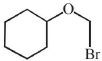
B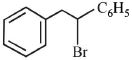
C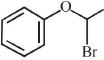
D
Solution
(A) Bromine water is decolourized by compounds containing carbon-carbon double or triple bonds (unsaturation) due to electrophilic addition.
Treatment with $tert-BuONa$ (a strong base) typically induces elimination reactions $(E2)$ in alkyl halides to form alkenes.
Option $A$ is cyclohexyl bromomethyl ether. Treatment with $tert-BuONa$ leads to substitution (Williamson ether synthesis) rather than elimination because the $\beta$-carbon lacks hydrogens,resulting in a saturated ether that does not react with bromine water.
Options $B$,$C$,and $D$ contain $\beta$-hydrogens and undergo elimination to form alkenes,which will decolourize bromine water.
Treatment with $tert-BuONa$ (a strong base) typically induces elimination reactions $(E2)$ in alkyl halides to form alkenes.
Option $A$ is cyclohexyl bromomethyl ether. Treatment with $tert-BuONa$ leads to substitution (Williamson ether synthesis) rather than elimination because the $\beta$-carbon lacks hydrogens,resulting in a saturated ether that does not react with bromine water.
Options $B$,$C$,and $D$ contain $\beta$-hydrogens and undergo elimination to form alkenes,which will decolourize bromine water.

0 likes
View Solution271
MediumMCQ
The major product obtained in the following reaction is $:$
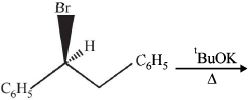
A
$(\pm ) C_6H_5CH(O^tBu)CH_2C_6H_5$
B
$C_6H_5CH=CHC_6H_5$
C
$(+) C_6H_5CH(O^tBu)CH_2C_6H_5$
D
$(-) C_6H_5CH(O^tBu)CH_2C_6H_5$
Solution
(B) The reaction of $1,2-diphenyl-1-bromoethane$ with a strong base like potassium tert-butoxide $(t-BuOK)$ in the presence of heat $(\Delta)$ undergoes a dehydrohalogenation reaction.
This is an $E_2$ elimination reaction where the base abstracts a proton from the $\beta$-carbon,leading to the formation of a double bond between the $\alpha$ and $\beta$ carbons.
The product formed is $1,2-diphenylethene$ $(C_6H_5CH=CHC_6H_5)$,which is a stable conjugated alkene.
The reaction is:
$C_6H_5CH(Br)CH_2C_6H_5 + t-BuOK \xrightarrow{\Delta} C_6H_5CH=CHC_6H_5 + t-BuOH + KBr$
This is an $E_2$ elimination reaction where the base abstracts a proton from the $\beta$-carbon,leading to the formation of a double bond between the $\alpha$ and $\beta$ carbons.
The product formed is $1,2-diphenylethene$ $(C_6H_5CH=CHC_6H_5)$,which is a stable conjugated alkene.
The reaction is:
$C_6H_5CH(Br)CH_2C_6H_5 + t-BuOK \xrightarrow{\Delta} C_6H_5CH=CHC_6H_5 + t-BuOH + KBr$

0 likes
View Solution272
DifficultMCQ
The major product obtained in the following reaction is:
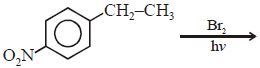
A
$1-$($4$-nitrophenyl)$-2-$bromoethane
B
$1-$($4$-nitrophenyl)$-1-$bromoethane
C
$1-$bromo$-1-$ethyl$-4-$nitrobenzene
D
$1-$bromo$-2-$ethyl$-4-$nitrobenzene
Solution
(B) The reaction of $1$-ethyl-$4$-nitrobenzene with $Br_2$ in the presence of light $(h\nu)$ proceeds via a free radical mechanism.
Free radical bromination occurs preferentially at the benzylic position because the resulting benzylic radical is stabilized by resonance with the benzene ring.
In $1$-ethyl-$4$-nitrobenzene,the benzylic carbon is the $CH_2$ group attached to the benzene ring.
Therefore,the bromine atom replaces one of the hydrogen atoms on the benzylic carbon,leading to the formation of $1$-($4$-nitrophenyl)-$1$-bromoethane as the major product.
Free radical bromination occurs preferentially at the benzylic position because the resulting benzylic radical is stabilized by resonance with the benzene ring.
In $1$-ethyl-$4$-nitrobenzene,the benzylic carbon is the $CH_2$ group attached to the benzene ring.
Therefore,the bromine atom replaces one of the hydrogen atoms on the benzylic carbon,leading to the formation of $1$-($4$-nitrophenyl)-$1$-bromoethane as the major product.
0 likes
View Solution273
AdvancedMCQ
Which of the following statements is correct for the reactivity in $S_N2$ reaction?
A
Cyclohexyl chloride is more reactive than chloromethylcyclohexane.
B
$1-$Iodobut$-2-$ene is more reactive than $1-$iodobutane.
C
$3-$Chloropentane is more reactive than $1-$chloropentane.
D
$1-$Chlorobutane is more reactive than $1-$iodobutane.
Solution
(B) The reactivity of alkyl halides in $S_N2$ reactions is primarily governed by steric hindrance. The order of reactivity is: $Primary > Secondary > Tertiary$.
Additionally,the nature of the leaving group affects the rate,with iodide being a better leaving group than chloride.
In option $B$,$1$-iodobut-$2$-ene is an allylic halide. Allylic halides are significantly more reactive in $S_N2$ reactions compared to simple primary alkyl halides like $1$-iodobutane due to the stabilization of the transition state by the adjacent double bond.
Therefore,$1$-iodobut-$2$-ene is more reactive than $1$-iodobutane.
Additionally,the nature of the leaving group affects the rate,with iodide being a better leaving group than chloride.
In option $B$,$1$-iodobut-$2$-ene is an allylic halide. Allylic halides are significantly more reactive in $S_N2$ reactions compared to simple primary alkyl halides like $1$-iodobutane due to the stabilization of the transition state by the adjacent double bond.
Therefore,$1$-iodobut-$2$-ene is more reactive than $1$-iodobutane.
0 likes
View Solution274
MediumMCQ
What is the product of the following reaction?
$C_6H_5CH_2Br + KF \xrightarrow{DMF} ?$
$C_6H_5CH_2Br + KF \xrightarrow{DMF} ?$
A
Benzyl fluoride $(C_6H_5CH_2F)$
B
o-Fluorotoluene
C
m-Fluorotoluene
D
No reaction will occur
Solution
(A) The given reaction is an example of the Finkelstein reaction,specifically a halogen exchange reaction used to prepare alkyl fluorides.
In this reaction,benzyl bromide $(C_6H_5CH_2Br)$ reacts with potassium fluoride $(KF)$ in the presence of a polar aprotic solvent like $DMF$ (Dimethylformamide).
The bromide ion is replaced by the fluoride ion through an $S_N2$ mechanism to form benzyl fluoride $(C_6H_5CH_2F)$ and potassium bromide $(KBr)$.
The reaction is: $C_6H_5CH_2Br + KF \xrightarrow{DMF} C_6H_5CH_2F + KBr$.
In this reaction,benzyl bromide $(C_6H_5CH_2Br)$ reacts with potassium fluoride $(KF)$ in the presence of a polar aprotic solvent like $DMF$ (Dimethylformamide).
The bromide ion is replaced by the fluoride ion through an $S_N2$ mechanism to form benzyl fluoride $(C_6H_5CH_2F)$ and potassium bromide $(KBr)$.
The reaction is: $C_6H_5CH_2Br + KF \xrightarrow{DMF} C_6H_5CH_2F + KBr$.
0 likes
View Solution275
MediumMCQ
Correct reactivity order of alkyl halide towards dehydrohalogenation-
A
$3^{\circ} > 2^{\circ} > 1^{\circ}$
B
$1^{\circ} > 2^{\circ} > 3^{\circ}$
C
$2^{\circ} > 1^{\circ} > 3^{\circ}$
D
$1^{\circ} > 3^{\circ} > 2^{\circ}$
Solution
(A) According to the Saytzeff rule,the reactivity of alkyl halides towards dehydrohalogenation depends on the stability of the resulting alkene.
More substituted alkenes are more stable.
Since $3^{\circ}$ alkyl halides form the most substituted (most stable) alkenes,they react the fastest.
Therefore,the order of reactivity is $3^{\circ} > 2^{\circ} > 1^{\circ}$.
More substituted alkenes are more stable.
Since $3^{\circ}$ alkyl halides form the most substituted (most stable) alkenes,they react the fastest.
Therefore,the order of reactivity is $3^{\circ} > 2^{\circ} > 1^{\circ}$.
0 likes
View Solution276
DifficultMCQ
Which of the following $S_N2$ reactions is the slowest?
A
$CH_3-CH_2-CH(Br)-CH_3 + OH^{\ominus} \rightarrow$
B
$CH_3-CH_2-CH(Br)-CH_3 + H_2O \rightarrow$
C
$CH_3-CH_2-CH_2-Br + OH^{\ominus} \rightarrow$
D
$CH_3-CH_2-CH_2-CH_2-Br + H_2O \rightarrow$
Solution
(B) The rate of an $S_N2$ reaction depends on the steric hindrance around the electrophilic carbon and the nucleophilicity of the attacking species.
$1$. Steric hindrance: Primary alkyl halides $(1^{\circ})$ react faster than secondary alkyl halides $(2^{\circ})$ in $S_N2$ reactions.
$2$. Nucleophilicity: $A$ strong nucleophile like $OH^{\ominus}$ reacts much faster than a weak nucleophile like $H_2O$.
Comparing the options:
- Options $A$ and $C$ involve $OH^{\ominus}$ (strong nucleophile).
- Options $B$ and $D$ involve $H_2O$ (weak nucleophile).
- Between $B$ and $D$,$B$ is a secondary alkyl halide $(2^{\circ})$ while $D$ is a primary alkyl halide $(1^{\circ})$.
- Since $S_N2$ is highly sensitive to steric hindrance,the secondary alkyl halide $(B)$ will react slower than the primary one $(D)$ when using the same weak nucleophile.
- Therefore,the reaction of a secondary alkyl halide with a weak nucleophile $(H_2O)$ is the slowest.
$1$. Steric hindrance: Primary alkyl halides $(1^{\circ})$ react faster than secondary alkyl halides $(2^{\circ})$ in $S_N2$ reactions.
$2$. Nucleophilicity: $A$ strong nucleophile like $OH^{\ominus}$ reacts much faster than a weak nucleophile like $H_2O$.
Comparing the options:
- Options $A$ and $C$ involve $OH^{\ominus}$ (strong nucleophile).
- Options $B$ and $D$ involve $H_2O$ (weak nucleophile).
- Between $B$ and $D$,$B$ is a secondary alkyl halide $(2^{\circ})$ while $D$ is a primary alkyl halide $(1^{\circ})$.
- Since $S_N2$ is highly sensitive to steric hindrance,the secondary alkyl halide $(B)$ will react slower than the primary one $(D)$ when using the same weak nucleophile.
- Therefore,the reaction of a secondary alkyl halide with a weak nucleophile $(H_2O)$ is the slowest.
0 likes
View Solution277
MediumMCQ
The rate of $\beta$-dehydrohalogenation in the following halides under treatment with a strong base follows the order:
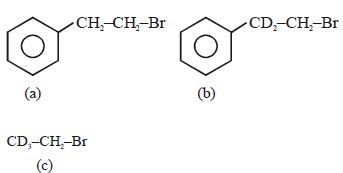
A
$a > b > c$
B
$c > b > a$
C
$c > a > b$
D
$b > c > a$
Solution
(A) The $\beta$-dehydrohalogenation reaction proceeds via an $E2$ mechanism,which involves the abstraction of a $\beta$-hydrogen by a strong base.
In this reaction,the rate-determining step involves the breaking of the $C-H$ or $C-D$ bond at the $\beta$-position.
Since the $C-D$ bond is stronger than the $C-H$ bond due to the primary kinetic isotope effect,the cleavage of the $C-H$ bond is faster than that of the $C-D$ bond.
Compound $(a)$ has two $\beta$-hydrogens $(Ph-CH_2-CH_2-Br)$,making it the fastest.
Compound $(b)$ has two $\beta$-deuteriums $(Ph-CD_2-CH_2-Br)$,making it slower than $(a)$ due to the isotope effect.
Compound $(c)$ $(CD_3-CH_2-Br)$ also has $\beta$-deuteriums,but the electron-donating effect of the phenyl ring in $(b)$ stabilizes the transition state more effectively than the methyl group in $(c)$,making $(b)$ faster than $(c)$.
Thus,the order of the rate of reaction is $a > b > c$.
In this reaction,the rate-determining step involves the breaking of the $C-H$ or $C-D$ bond at the $\beta$-position.
Since the $C-D$ bond is stronger than the $C-H$ bond due to the primary kinetic isotope effect,the cleavage of the $C-H$ bond is faster than that of the $C-D$ bond.
Compound $(a)$ has two $\beta$-hydrogens $(Ph-CH_2-CH_2-Br)$,making it the fastest.
Compound $(b)$ has two $\beta$-deuteriums $(Ph-CD_2-CH_2-Br)$,making it slower than $(a)$ due to the isotope effect.
Compound $(c)$ $(CD_3-CH_2-Br)$ also has $\beta$-deuteriums,but the electron-donating effect of the phenyl ring in $(b)$ stabilizes the transition state more effectively than the methyl group in $(c)$,making $(b)$ faster than $(c)$.
Thus,the order of the rate of reaction is $a > b > c$.
0 likes
View Solution278
DifficultMCQ
Which of the following compounds will give a racemic mixture by $S_N1$ reaction?
A
$CH_3-Br$
B
$Ph-CH_2-Br$
C
$CH_3-CH(Br)-C_2H_5$
D
$CH_3-CH(CH_3)-CH_2-Br$
Solution
(C) $S_N1$ reaction proceeds through a planar carbocation intermediate. If the starting material is chiral at the reaction center,the nucleophile can attack from both sides with equal probability,resulting in a racemic mixture. $CH_3-CH(Br)-C_2H_5$ ($2$-bromobutane) is a chiral molecule because the carbon atom is attached to four different groups ($-H$,$-CH_3$,$-C_2H_5$,and $-Br$). Therefore,it will form a racemic mixture upon $S_N1$ reaction.
0 likes
View Solution279
DifficultMCQ
Which of the following represents the correct reactivity order for both $SN^1$ and $SN^2$ mechanisms?
A
$sec-butyl chloride > sec-butyl bromide$
B
$CH_2 = CHCl > CH_3CH_2Cl$
C
$Benzyl chloride > Chlorobenzene$
D
$CH_2 = CHCl > CH_2 = CH-CH_2Cl$
Solution
(C) For $SN^1$ and $SN^2$ mechanisms,the reactivity depends on the stability of the carbocation (for $SN^1$) and steric hindrance/leaving group ability (for $SN^2$).
$A$: $sec-butyl chloride$ is less reactive than $sec-butyl bromide$ because $Br^-$ is a better leaving group than $Cl^-$.
$B$: $CH_2=CHCl$ (vinyl chloride) is very unreactive due to partial double bond character,while $CH_3CH_2Cl$ is a primary alkyl halide. Thus,$CH_3CH_2Cl > CH_2=CHCl$.
$C$: $Benzyl chloride$ $(C_6H_5CH_2Cl)$ is highly reactive in both $SN^1$ (due to resonance-stabilized benzyl carbocation) and $SN^2$ (due to resonance stabilization of the transition state). $Chlorobenzene$ is extremely unreactive in both mechanisms due to the partial double bond character of the $C-Cl$ bond and the instability of the phenyl cation. Therefore,$Benzyl chloride > Chlorobenzene$ is correct.
$D$: $CH_2=CH-CH_2Cl$ (allyl chloride) is more reactive than $CH_2=CHCl$ due to resonance stabilization of the allyl carbocation and less steric hindrance. Thus,$CH_2=CH-CH_2Cl > CH_2=CHCl$.
$A$: $sec-butyl chloride$ is less reactive than $sec-butyl bromide$ because $Br^-$ is a better leaving group than $Cl^-$.
$B$: $CH_2=CHCl$ (vinyl chloride) is very unreactive due to partial double bond character,while $CH_3CH_2Cl$ is a primary alkyl halide. Thus,$CH_3CH_2Cl > CH_2=CHCl$.
$C$: $Benzyl chloride$ $(C_6H_5CH_2Cl)$ is highly reactive in both $SN^1$ (due to resonance-stabilized benzyl carbocation) and $SN^2$ (due to resonance stabilization of the transition state). $Chlorobenzene$ is extremely unreactive in both mechanisms due to the partial double bond character of the $C-Cl$ bond and the instability of the phenyl cation. Therefore,$Benzyl chloride > Chlorobenzene$ is correct.
$D$: $CH_2=CH-CH_2Cl$ (allyl chloride) is more reactive than $CH_2=CHCl$ due to resonance stabilization of the allyl carbocation and less steric hindrance. Thus,$CH_2=CH-CH_2Cl > CH_2=CHCl$.
0 likes
View Solution280
MediumMCQ
Toluene $\xrightarrow[{heat}]{{NBS\,/\,CCl_4}} A$ $\xrightarrow{{CH_3ONa}} B,$
The final product $(B)$ formed in the reaction sequence is:
The final product $(B)$ formed in the reaction sequence is:
A
$C_6H_5CO_2CH_3$
B
$C_6H_5OCH_3$
C
$CH_3OC_6H_4CH_3$
D
$C_6H_5CH_2OCH_3$
Solution
(D) Step $1$: Toluene reacts with $NBS$ in the presence of $CCl_4$ and heat to undergo free-radical bromination at the benzylic position,forming benzyl bromide $(A = C_6H_5CH_2Br)$.
Step $2$: Benzyl bromide $(A)$ reacts with sodium methoxide $(CH_3ONa)$,which is a strong nucleophile,via an $S_N2$ mechanism to form benzyl methyl ether $(B = C_6H_5CH_2OCH_3)$.
Step $2$: Benzyl bromide $(A)$ reacts with sodium methoxide $(CH_3ONa)$,which is a strong nucleophile,via an $S_N2$ mechanism to form benzyl methyl ether $(B = C_6H_5CH_2OCH_3)$.
0 likes
View Solution281
MediumMCQ
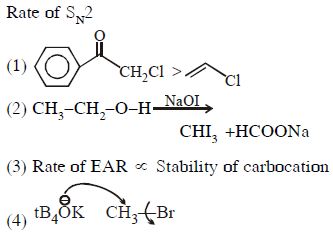
Which of the following is an incorrect statement?
A
$CH_3-Cl$ shows a faster rate than $CH_3-CH_2-Cl$ with $NaI / \text{acetone}$
B
$CH_3-CH_2-OH$ on reaction with $NaOI$ gives a yellow precipitate
C
$CH_3-C(CH_3)=CH_2$ shows a faster rate than $CH_3-CH=CH-CH_3$ with $HBr / CCl_4$
D
$t-BuO^{-}K^{+}$ on reaction with $CH_3-Br$ gives $CH_3-C(CH_3)=CH_2$ as the major product
Solution
(D) $t-BuO^{-}K^{+}$ is a strong bulky base,but $CH_3-Br$ is a methyl halide. Since methyl halides do not have $\beta$-hydrogens,elimination $(E2)$ is not possible. The reaction proceeds via $S_N2$ mechanism to form an ether $(t-Bu-O-CH_3)$ as the major product.
$t-BuO^{-}K^{+} + CH_3-Br \rightarrow t-Bu-O-CH_3 + KBr$.
Therefore,the statement that it gives isobutylene $(CH_3-C(CH_3)=CH_2)$ is incorrect.
$t-BuO^{-}K^{+} + CH_3-Br \rightarrow t-Bu-O-CH_3 + KBr$.
Therefore,the statement that it gives isobutylene $(CH_3-C(CH_3)=CH_2)$ is incorrect.
0 likes
View Solution282
DifficultMCQ
Which compound gives acetaldehyde upon reaction with aqueous $KOH$?
A
$CH_3-CHCl_2$
B
$CH_3-CCl_2-CH_3$
C
$Cl-CH_2-CH_2-Cl$
D
$CH_3-CH_2-Cl$
Solution
(A) $CH_3-CHCl_2$ (Ethylidene chloride) is a geminal dihalide. On hydrolysis with aqueous $KOH$,it forms an unstable gem-diol,which loses a water molecule to give acetaldehyde $(CH_3CHO)$.
$CH_3-CHCl_2 + 2KOH_{(aq)}$ $\rightarrow [CH_3-CH(OH)_2]$ $\rightarrow CH_3CHO + H_2O$
$CH_3-CHCl_2 + 2KOH_{(aq)}$ $\rightarrow [CH_3-CH(OH)_2]$ $\rightarrow CH_3CHO + H_2O$
0 likes
View Solution283
MediumMCQ
$ \xrightarrow[Acetone]{NaI} \underset{(Major)}{X} $ $ \xrightarrow[{S_N2}]{aq. KOH} \underset{(Major)}{Y} $
$X$ and $Y$ should be
$X$ and $Y$ should be
A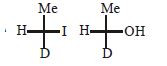
B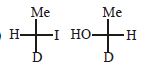
C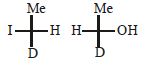
D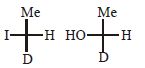
Solution
(C) The reaction proceeds in two steps,both involving $S_N2$ mechanisms.
Step $1$: The starting material (assumed to be a chiral alkyl chloride) reacts with $NaI$ in acetone (Finkelstein reaction) to form the alkyl iodide $X$. The $S_N2$ mechanism results in the inversion of configuration at the chiral center.
Step $2$: The alkyl iodide $X$ reacts with $aq. KOH$ to form the alcohol $Y$. This is also an $S_N2$ reaction,which causes another inversion of configuration at the chiral center.
Since two successive inversions occur,the final product $Y$ will have the same configuration as the original starting material.
Comparing the structures,option $C$ shows the correct inversion for $X$ relative to the starting material (if we assume the starting material had $Cl$ on the right) and the subsequent inversion for $Y$ relative to $X$.
Step $1$: The starting material (assumed to be a chiral alkyl chloride) reacts with $NaI$ in acetone (Finkelstein reaction) to form the alkyl iodide $X$. The $S_N2$ mechanism results in the inversion of configuration at the chiral center.
Step $2$: The alkyl iodide $X$ reacts with $aq. KOH$ to form the alcohol $Y$. This is also an $S_N2$ reaction,which causes another inversion of configuration at the chiral center.
Since two successive inversions occur,the final product $Y$ will have the same configuration as the original starting material.
Comparing the structures,option $C$ shows the correct inversion for $X$ relative to the starting material (if we assume the starting material had $Cl$ on the right) and the subsequent inversion for $Y$ relative to $X$.
0 likes
View Solution284
AdvancedMCQ
$C_6H_6 + CH_3CH_2CH_2Cl + AlCl_3 \to X$ (Major product)
$X$ (Major product) $\xrightarrow{HNO_3 + H_2SO_4} Y$ (Major product) $\xrightarrow{Sn + HCl} Z$ $\xrightarrow{H_2SO_4 + SO_3} W$
$W$ is
$X$ (Major product) $\xrightarrow{HNO_3 + H_2SO_4} Y$ (Major product) $\xrightarrow{Sn + HCl} Z$ $\xrightarrow{H_2SO_4 + SO_3} W$
$W$ is
A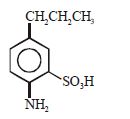
B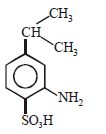
C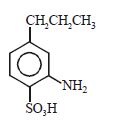
D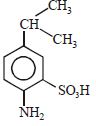
Solution
(D) $1$. Friedel-Crafts alkylation of benzene with $n$-propyl chloride $(CH_3CH_2CH_2Cl)$ in the presence of $AlCl_3$ leads to rearrangement of the carbocation. The primary propyl carbocation rearranges to the more stable secondary isopropyl carbocation. Thus,$X$ is isopropylbenzene (cumene).
$2$. Nitration of cumene $(X)$ with $HNO_3 + H_2SO_4$ gives $p$-nitrocumene $(Y)$ as the major product due to steric hindrance at the ortho position.
$3$. Reduction of $p$-nitrocumene $(Y)$ with $Sn + HCl$ gives $p$-isopropylaniline $(Z)$.
$4$. Sulfonation of $p$-isopropylaniline $(Z)$ with $H_2SO_4 + SO_3$ (fuming sulfuric acid) occurs at the ortho position relative to the $-NH_2$ group (which is a strong activating group) to give $W$ ($2$-amino$-5-$isopropylbenzenesulfonic acid).
$2$. Nitration of cumene $(X)$ with $HNO_3 + H_2SO_4$ gives $p$-nitrocumene $(Y)$ as the major product due to steric hindrance at the ortho position.
$3$. Reduction of $p$-nitrocumene $(Y)$ with $Sn + HCl$ gives $p$-isopropylaniline $(Z)$.
$4$. Sulfonation of $p$-isopropylaniline $(Z)$ with $H_2SO_4 + SO_3$ (fuming sulfuric acid) occurs at the ortho position relative to the $-NH_2$ group (which is a strong activating group) to give $W$ ($2$-amino$-5-$isopropylbenzenesulfonic acid).
0 likes
View Solution285
MediumMCQ
$C_4H_9Cl$ (Optically Active Compound $A$) $\xrightarrow[DMSO]{NaCN}$ $(R)-2-$methylbutanenitrile; Identify compound $A$?
A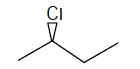
B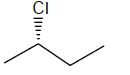
C
D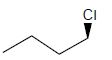
Solution
(A) The reaction of an alkyl halide with $NaCN$ in $DMSO$ proceeds via an $S_N2$ mechanism.
In an $S_N2$ reaction,there is an inversion of configuration (Walden inversion) at the chiral center.
The product formed is $(R)-2-$methylbutanenitrile.
Since the reaction involves inversion of configuration,the starting material (compound $A$) must have the $(S)$ configuration.
The structure of $2-$methylbutanenitrile is $CH_3-CH(CH_3)-CH_2-CN$.
Therefore,the starting material $A$ is $(S)-2-$chlorobutane,which is $CH_3-CH(Cl)-CH_2-CH_3$.
Among the given options,the structure corresponding to $(S)-2-$chlorobutane is represented by option $A$.
In an $S_N2$ reaction,there is an inversion of configuration (Walden inversion) at the chiral center.
The product formed is $(R)-2-$methylbutanenitrile.
Since the reaction involves inversion of configuration,the starting material (compound $A$) must have the $(S)$ configuration.
The structure of $2-$methylbutanenitrile is $CH_3-CH(CH_3)-CH_2-CN$.
Therefore,the starting material $A$ is $(S)-2-$chlorobutane,which is $CH_3-CH(Cl)-CH_2-CH_3$.
Among the given options,the structure corresponding to $(S)-2-$chlorobutane is represented by option $A$.
0 likes
View Solution286
MediumMCQ
Which one of the following halogen compounds is not useful as a substrate in an $S_N2$ reaction?
A
$CH_3-CH_2Cl$
B
$CH_2=CH-CH_2Cl$
C
$CH_2=CHCl$
D
$C_6H_5-CH_2Cl$
Solution
(C) In an $S_N2$ reaction,the nucleophile attacks the carbon atom bonded to the halogen from the backside.
$CH_2=CHCl$ (vinyl chloride) is not useful as a substrate because the $C-Cl$ bond has partial double bond character due to resonance,making it very strong and difficult to break.
Additionally,the $sp^2$ hybridized carbon atom is more electronegative,which further strengthens the $C-Cl$ bond,making it resistant to nucleophilic substitution.
$CH_2=CHCl$ (vinyl chloride) is not useful as a substrate because the $C-Cl$ bond has partial double bond character due to resonance,making it very strong and difficult to break.
Additionally,the $sp^2$ hybridized carbon atom is more electronegative,which further strengthens the $C-Cl$ bond,making it resistant to nucleophilic substitution.
0 likes
View Solution287
MediumMCQ
$HBr$ reacts with $CH_2=CH-OCH_3$ at room temperature to give
A
$BrCH_2CHO$ and $CH_3OH$
B
$BrCH_2-CH_2-OCH_3$
C
$H_3C-CHBr-OCH_3$
D
$CH_3CHO$ and $CH_3Br$
Solution
(C) The reaction of $HBr$ with vinyl methyl ether $(CH_2=CH-OCH_3)$ is an electrophilic addition reaction.
First,the $H^+$ ion from $HBr$ attacks the double bond.
Due to the resonance effect of the methoxy group $(-OCH_3)$,the electron density is higher on the terminal carbon atom $(CH_2)$.
Thus,the protonation occurs at the terminal carbon to form a stable carbocation: $CH_3-CH^+-OCH_3$.
This carbocation is stabilized by the lone pair of electrons on the oxygen atom.
Finally,the bromide ion $(Br^-)$ attacks the carbocation to form the product $CH_3-CHBr-OCH_3$.
First,the $H^+$ ion from $HBr$ attacks the double bond.
Due to the resonance effect of the methoxy group $(-OCH_3)$,the electron density is higher on the terminal carbon atom $(CH_2)$.
Thus,the protonation occurs at the terminal carbon to form a stable carbocation: $CH_3-CH^+-OCH_3$.
This carbocation is stabilized by the lone pair of electrons on the oxygen atom.
Finally,the bromide ion $(Br^-)$ attacks the carbocation to form the product $CH_3-CHBr-OCH_3$.
0 likes
View Solution288
DifficultMCQ
The reaction of $3$-bromocyclohexene with $HBr$ yields $P_1$ and $P_2$ as major dibromo products. What is the relationship between $P_1$ and $P_2$?
A
Diastereomers
B
Enantiomers
C
Configurational isomers
D
Constitutional isomers
Solution
(A) The reaction of $3$-bromocyclohexene with $HBr$ involves the formation of a carbocation intermediate at the $C_2$ position after the protonation of the double bond.
This carbocation is resonance-stabilized.
Nucleophilic attack by $Br^-$ can occur from either the same side (syn) or the opposite side (anti) relative to the existing bromine atom at the $C_3$ position.
This leads to the formation of $1,2$-dibromocyclohexane derivatives.
The two major products formed are $cis$-$1,2$-dibromocyclohexane and $trans$-$1,2$-dibromocyclohexane (which exists as a pair of enantiomers).
Specifically,the addition to $3$-bromocyclohexene results in $1,2$-dibromocyclohexane isomers where the relative stereochemistry at $C_1$ and $C_2$ creates diastereomeric relationships with the fixed stereocenter at $C_3$.
Thus,$P_1$ and $P_2$ are diastereomers.
This carbocation is resonance-stabilized.
Nucleophilic attack by $Br^-$ can occur from either the same side (syn) or the opposite side (anti) relative to the existing bromine atom at the $C_3$ position.
This leads to the formation of $1,2$-dibromocyclohexane derivatives.
The two major products formed are $cis$-$1,2$-dibromocyclohexane and $trans$-$1,2$-dibromocyclohexane (which exists as a pair of enantiomers).
Specifically,the addition to $3$-bromocyclohexene results in $1,2$-dibromocyclohexane isomers where the relative stereochemistry at $C_1$ and $C_2$ creates diastereomeric relationships with the fixed stereocenter at $C_3$.
Thus,$P_1$ and $P_2$ are diastereomers.
0 likes
View Solution289
MediumMCQ
The decreasing order of the rate of $S_{N^1}$ reaction for the following compounds is:
$I$. $Ph-C(Br)(CH_3)-Ph$
$II$. $Ph-CH(Br)-Ph$
$III$. $Ph-CH(Br)-CH_3$
$IV$. $Ph-CH_2Br$
$I$. $Ph-C(Br)(CH_3)-Ph$
$II$. $Ph-CH(Br)-Ph$
$III$. $Ph-CH(Br)-CH_3$
$IV$. $Ph-CH_2Br$
A
$I > II > III > IV$
B
$II > I > III > IV$
C
$IV > III > II > I$
D
$III > IV > II > I$
Solution
(A) The rate of $S_{N^1}$ reaction is directly proportional to the stability of the intermediate carbocation formed.
$1$. For $I$: The carbocation is $Ph-C^+(CH_3)-Ph$,which is stabilized by two phenyl groups and one methyl group (tertiary and resonance stabilized).
$2$. For $II$: The carbocation is $Ph-CH^+-Ph$,which is stabilized by two phenyl groups (secondary and resonance stabilized).
$3$. For $III$: The carbocation is $Ph-CH^+-CH_3$,which is stabilized by one phenyl group and one methyl group (secondary and resonance stabilized).
$4$. For $IV$: The carbocation is $Ph-CH_2^+$,which is stabilized by only one phenyl group (primary and resonance stabilized).
Comparing the stability: $I > II > III > IV$. Therefore,the order of reactivity is $I > II > III > IV$.
$1$. For $I$: The carbocation is $Ph-C^+(CH_3)-Ph$,which is stabilized by two phenyl groups and one methyl group (tertiary and resonance stabilized).
$2$. For $II$: The carbocation is $Ph-CH^+-Ph$,which is stabilized by two phenyl groups (secondary and resonance stabilized).
$3$. For $III$: The carbocation is $Ph-CH^+-CH_3$,which is stabilized by one phenyl group and one methyl group (secondary and resonance stabilized).
$4$. For $IV$: The carbocation is $Ph-CH_2^+$,which is stabilized by only one phenyl group (primary and resonance stabilized).
Comparing the stability: $I > II > III > IV$. Therefore,the order of reactivity is $I > II > III > IV$.
0 likes
View Solution290
AdvancedMCQ
Gem dihalide on hydrolysis gives:
A
Vic diol
B
Gem diol
C
Carbonyl compound
D
Carboxylic acid
Solution
(C) $gem$-dihalide is a compound where two halogen atoms are attached to the same carbon atom,represented as $R_2C(X)_2$.
Upon hydrolysis with aqueous alkali (e.g.,$KOH$),the halogen atoms are replaced by hydroxyl groups to form a $gem$-diol $(R_2C(OH)_2)$.
$Gem$-diols are generally unstable and readily lose a water molecule $(H_2O)$ to form a stable carbonyl compound (an aldehyde or a ketone).
Therefore,the final product of the hydrolysis of a $gem$-dihalide is a carbonyl compound.
Upon hydrolysis with aqueous alkali (e.g.,$KOH$),the halogen atoms are replaced by hydroxyl groups to form a $gem$-diol $(R_2C(OH)_2)$.
$Gem$-diols are generally unstable and readily lose a water molecule $(H_2O)$ to form a stable carbonyl compound (an aldehyde or a ketone).
Therefore,the final product of the hydrolysis of a $gem$-dihalide is a carbonyl compound.
0 likes
View Solution291
DifficultMCQ
$1,2-dichlorocyclopentane$ $\xrightarrow{1 \text{ equivalent } Mg, \text{ ether}} X$ $\xrightarrow{D_2O} Y;$
$Y$ is:
$Y$ is:
A
$1-$chloro$-2-$deuterocyclopentane
B
$1-$bromo$-2-$deuterocyclopentane
C
$1,2-$dideuterocyclopentane
D
none of these
Solution
(A) The reaction of $1,2-dichlorocyclopentane$ with $1 \text{ equivalent}$ of $Mg$ in ether leads to the formation of a Grignard reagent intermediate $X$ $(2-chlorocyclopentylmagnesium \text{ chloride})$.
$X$ is $C_5H_8ClMgCl$.
When this intermediate $X$ is treated with $D_2O$,the $MgCl$ group is replaced by a deuterium atom $(D)$.
Therefore,the final product $Y$ is $1-chloro-2-deuterocyclopentane$.
$X$ is $C_5H_8ClMgCl$.
When this intermediate $X$ is treated with $D_2O$,the $MgCl$ group is replaced by a deuterium atom $(D)$.
Therefore,the final product $Y$ is $1-chloro-2-deuterocyclopentane$.
0 likes
View Solution292
DifficultMCQ
For the reactions given below:
$(I)$ Cyclohexyl chloride $\rightarrow$ Cyclohexyl cation + $Cl^-$,$\Delta H_1^{\circ}$
$(II)$ Cyclohex$-2-$enyl chloride $\rightarrow$ Cyclohex$-2-$enyl cation + $Cl^-$,$\Delta H_2^{\circ}$
$(III)$ Benzyl chloride $\rightarrow$ Benzyl cation + $Cl^-$,$\Delta H_3^{\circ}$
$(IV)$ Chlorobenzene $\rightarrow$ Phenyl cation + $Cl^-$,$\Delta H_4^{\circ}$
The correct decreasing order of enthalpies of reaction for producing the carbocation is:
$(I)$ Cyclohexyl chloride $\rightarrow$ Cyclohexyl cation + $Cl^-$,$\Delta H_1^{\circ}$
$(II)$ Cyclohex$-2-$enyl chloride $\rightarrow$ Cyclohex$-2-$enyl cation + $Cl^-$,$\Delta H_2^{\circ}$
$(III)$ Benzyl chloride $\rightarrow$ Benzyl cation + $Cl^-$,$\Delta H_3^{\circ}$
$(IV)$ Chlorobenzene $\rightarrow$ Phenyl cation + $Cl^-$,$\Delta H_4^{\circ}$
The correct decreasing order of enthalpies of reaction for producing the carbocation is:
A
$\Delta H_1^{\circ} > \Delta H_2^{\circ} > \Delta H_3^{\circ} > \Delta H_4^{\circ}$
B
$\Delta H_4^{\circ} > \Delta H_1^{\circ} > \Delta H_2^{\circ} > \Delta H_3^{\circ}$
C
$\Delta H_3^{\circ} > \Delta H_2^{\circ} > \Delta H_1^{\circ} > \Delta H_4^{\circ}$
D
$\Delta H_2^{\circ} > \Delta H_1^{\circ} > \Delta H_4^{\circ} > \Delta H_3^{\circ}$
Solution
(B) The enthalpy of reaction $(\Delta H^{\circ})$ for the formation of a carbocation is inversely proportional to the stability of the carbocation formed. More stable carbocations are formed more easily,requiring less energy (lower $\Delta H^{\circ}$).
$1$. Stability order of carbocations:
Benzyl cation $(III)$ > Cyclohex$-2-$enyl cation $(II)$ > Cyclohexyl cation $(I)$ > Phenyl cation $(IV)$.
- $(III)$ is resonance-stabilized by the benzene ring.
- $(II)$ is resonance-stabilized by the adjacent $C=C$ double bond.
- $(I)$ is a secondary alkyl carbocation with no resonance stabilization.
- $(IV)$ is highly unstable because the positive charge is on an $sp^2$ hybridized carbon atom in the benzene ring,which is more electronegative.
$2$. Enthalpy order $(\Delta H^{\circ})$:
Since stability is $(III)$ > $(II)$ > $(I)$ > $(IV)$,the enthalpy required follows the reverse order:
$\Delta H_4^{\circ} > \Delta H_1^{\circ} > \Delta H_2^{\circ} > \Delta H_3^{\circ}$.
$1$. Stability order of carbocations:
Benzyl cation $(III)$ > Cyclohex$-2-$enyl cation $(II)$ > Cyclohexyl cation $(I)$ > Phenyl cation $(IV)$.
- $(III)$ is resonance-stabilized by the benzene ring.
- $(II)$ is resonance-stabilized by the adjacent $C=C$ double bond.
- $(I)$ is a secondary alkyl carbocation with no resonance stabilization.
- $(IV)$ is highly unstable because the positive charge is on an $sp^2$ hybridized carbon atom in the benzene ring,which is more electronegative.
$2$. Enthalpy order $(\Delta H^{\circ})$:
Since stability is $(III)$ > $(II)$ > $(I)$ > $(IV)$,the enthalpy required follows the reverse order:
$\Delta H_4^{\circ} > \Delta H_1^{\circ} > \Delta H_2^{\circ} > \Delta H_3^{\circ}$.
0 likes
View Solution293
MediumMCQ
Arrange the leaving group ability of the following groups in decreasing order:
$(I)$ $CH_3-C_6H_4-SO_3^-$,$(II)$ $C_6H_5-SO_3^-$,$(III)$ $N_3^-$,$(IV)$ $Br^-$
$(I)$ $CH_3-C_6H_4-SO_3^-$,$(II)$ $C_6H_5-SO_3^-$,$(III)$ $N_3^-$,$(IV)$ $Br^-$
A
$II, I, III, IV$
B
$II, I, IV, III$
C
$I, II, IV, III$
D
$I, II, III, IV$
Solution
(B) The leaving group ability is inversely proportional to the basicity of the group. $A$ weaker base is a better leaving group.
Among the given options,the sulfonate ions $(I)$ and $(II)$ are excellent leaving groups due to resonance stabilization of the negative charge across three oxygen atoms.
Between $(I)$ and $(II)$,the methyl group in $(I)$ is electron-donating ($+I$ and $+H$ effect),which increases the electron density and basicity of the anion,making $(II)$ a better leaving group than $(I)$.
$Br^-$ $(IV)$ is a better leaving group than $N_3^-$ $(III)$ because $HBr$ is a much stronger acid than $HN_3$.
Thus,the decreasing order of leaving group ability is $II > I > IV > III$.
Among the given options,the sulfonate ions $(I)$ and $(II)$ are excellent leaving groups due to resonance stabilization of the negative charge across three oxygen atoms.
Between $(I)$ and $(II)$,the methyl group in $(I)$ is electron-donating ($+I$ and $+H$ effect),which increases the electron density and basicity of the anion,making $(II)$ a better leaving group than $(I)$.
$Br^-$ $(IV)$ is a better leaving group than $N_3^-$ $(III)$ because $HBr$ is a much stronger acid than $HN_3$.
Thus,the decreasing order of leaving group ability is $II > I > IV > III$.
0 likes
View Solution294
MediumMCQ
Arrange the following compounds in decreasing order of reactivity for nucleophilic substitution reaction:
$(I)$ $CH_3-CH_2-OSO_2CF_3$
$(II)$ $CH_3-CH_2-OTs$
$(III)$ $CH_3-CH(OH)-CH_3$
$(IV)$ $C_6H_5-CH(OH)-CH_3$
$(I)$ $CH_3-CH_2-OSO_2CF_3$
$(II)$ $CH_3-CH_2-OTs$
$(III)$ $CH_3-CH(OH)-CH_3$
$(IV)$ $C_6H_5-CH(OH)-CH_3$
A
$III, IV, I, II$
B
$III, IV, II, I$
C
$I, II, III, IV$
D
$I, II, IV, III$
Solution
(D) The reactivity of nucleophilic substitution depends on the leaving group ability.
$(I)$ Triflate $(-OSO_2CF_3)$ is an excellent leaving group due to the strong electron-withdrawing effect of the $CF_3$ group.
$(II)$ Tosylate $(-OTs)$ is a good leaving group but less effective than triflate.
$(III)$ and $(IV)$ contain $-OH$ groups,which are poor leaving groups. However,in the presence of an acid catalyst,they can undergo substitution. Between $(III)$ and $(IV)$,$(IV)$ is more reactive because it forms a resonance-stabilized benzylic carbocation $(C_6H_5-CH^+-CH_3)$,whereas $(III)$ forms a secondary carbocation $(CH_3-CH^+-CH_3)$.
Thus,the decreasing order of reactivity is $I > II > IV > III$.
$(I)$ Triflate $(-OSO_2CF_3)$ is an excellent leaving group due to the strong electron-withdrawing effect of the $CF_3$ group.
$(II)$ Tosylate $(-OTs)$ is a good leaving group but less effective than triflate.
$(III)$ and $(IV)$ contain $-OH$ groups,which are poor leaving groups. However,in the presence of an acid catalyst,they can undergo substitution. Between $(III)$ and $(IV)$,$(IV)$ is more reactive because it forms a resonance-stabilized benzylic carbocation $(C_6H_5-CH^+-CH_3)$,whereas $(III)$ forms a secondary carbocation $(CH_3-CH^+-CH_3)$.
Thus,the decreasing order of reactivity is $I > II > IV > III$.
0 likes
View Solution295
DifficultMCQ
The reaction of $4-methylcyclohexyl$ halide with $OH^-$ via the $S_N2$ mechanism produces $A$. Identify $A$.
A
The product with $OH$ group in the axial position (cis-isomer).
B
The product with $OH$ group in the equatorial position (trans-isomer).
C
Both are correct.
D
None is correct.
Solution
(D) The $S_N2$ mechanism involves a backside attack by the nucleophile $(OH^-)$ on the carbon atom bonded to the leaving group (halide).
This results in the inversion of configuration at the chiral center.
If the starting material is a $cis-4-methylcyclohexyl$ halide,the $OH^-$ will attack from the opposite side of the halide,leading to the $trans-4-methylcyclohexanol$ product.
Conversely,if the starting material is a $trans-4-methylcyclohexyl$ halide,the product will be the $cis-4-methylcyclohexanol$.
Since the specific stereochemistry of the starting halide is not provided in the prompt,and the options refer to general stereochemical outcomes of $S_N2$ reactions on substituted cyclohexanes,the inversion of configuration is the key principle.
Given the options provided,the reaction proceeds with inversion of configuration.
This results in the inversion of configuration at the chiral center.
If the starting material is a $cis-4-methylcyclohexyl$ halide,the $OH^-$ will attack from the opposite side of the halide,leading to the $trans-4-methylcyclohexanol$ product.
Conversely,if the starting material is a $trans-4-methylcyclohexyl$ halide,the product will be the $cis-4-methylcyclohexanol$.
Since the specific stereochemistry of the starting halide is not provided in the prompt,and the options refer to general stereochemical outcomes of $S_N2$ reactions on substituted cyclohexanes,the inversion of configuration is the key principle.
Given the options provided,the reaction proceeds with inversion of configuration.
0 likes
View Solution296
DifficultMCQ
The reaction $CH_3-CH(C_6H_5)-CH(Br)-C_6H_5 \xrightarrow{alc.KOH} A$. Identify the product $A$.
A
$1,2-$diphenylprop$-1-$ene (cis-isomer)
B
$1,2-$diphenylprop$-1-$ene (trans-isomer)
C
$1,1-$diphenylprop$-1-$ene
D
None is correct
Solution
(B) The reaction of $1-bromo-1,2-diphenylpropane$ with $alc.KOH$ is a dehydrohalogenation reaction ($E2$ mechanism).
This reaction leads to the formation of an alkene by removing $H$ and $Br$ from adjacent carbons.
The major product is the more stable alkene,which is the trans-isomer of $1,2-diphenylprop-1-ene$.
In the trans-isomer,the bulky phenyl groups are on opposite sides of the double bond,minimizing steric hindrance.
Thus,the product $A$ is $1,2-diphenylprop-1-ene$ (trans-isomer).
This reaction leads to the formation of an alkene by removing $H$ and $Br$ from adjacent carbons.
The major product is the more stable alkene,which is the trans-isomer of $1,2-diphenylprop-1-ene$.
In the trans-isomer,the bulky phenyl groups are on opposite sides of the double bond,minimizing steric hindrance.
Thus,the product $A$ is $1,2-diphenylprop-1-ene$ (trans-isomer).
0 likes
View Solution297
MediumMCQ
What is the major product obtained in the reaction of $1-$phenyl$-2-$bromobutane with $NaOMe$?
A
$(E)-1-$phenylbut$-1-$ene
B
$(E)-1-$phenylbut$-2-$ene
C
$1-$phenyl$-1-$methoxybutane
D
$(Z)-1-$phenylbut$-2-$ene
Solution
(A) The reaction of $1-$phenyl$-2-$bromobutane with $NaOMe$ (a strong base) proceeds via an $E2$ elimination mechanism.
$1-$phenyl$-2-$bromobutane has the structure $Ph-CH_2-CH(Br)-CH_2-CH_3$.
Elimination of $HBr$ can occur to form either $1-$phenylbut$-1-$ene or $1-$phenylbut$-2-$ene.
Although Zaitsev's rule generally predicts the more substituted alkene as the major product,in this specific case,the formation of $(E)-1-$phenylbut$-1-$ene is favored because the double bond is in conjugation with the phenyl ring,which provides significant extra stability.
Between the $(E)$ and $(Z)$ isomers of $1-$phenylbut$-1-$ene,the $(E)-$isomer is more stable due to reduced steric hindrance between the phenyl group and the ethyl group.
Therefore,the major product is $(E)-1-$phenylbut$-1-$ene.
$1-$phenyl$-2-$bromobutane has the structure $Ph-CH_2-CH(Br)-CH_2-CH_3$.
Elimination of $HBr$ can occur to form either $1-$phenylbut$-1-$ene or $1-$phenylbut$-2-$ene.
Although Zaitsev's rule generally predicts the more substituted alkene as the major product,in this specific case,the formation of $(E)-1-$phenylbut$-1-$ene is favored because the double bond is in conjugation with the phenyl ring,which provides significant extra stability.
Between the $(E)$ and $(Z)$ isomers of $1-$phenylbut$-1-$ene,the $(E)-$isomer is more stable due to reduced steric hindrance between the phenyl group and the ethyl group.
Therefore,the major product is $(E)-1-$phenylbut$-1-$ene.
0 likes
View Solution298
MediumMCQ
Arrange the following in order of $C-Br$ bond strength in a polar solvent. The structures are as follows:
$(I)$ $1$-methylcyclohexa-$2,4$-dienyl bromide
$(II)$ cyclohexa-$2,4$-dienyl bromide
$(III)$ $1$-methylcyclopenta-$2,4$-dienyl bromide
$(IV)$ cyclopenta-$2,4$-dienyl bromide
$(I)$ $1$-methylcyclohexa-$2,4$-dienyl bromide
$(II)$ cyclohexa-$2,4$-dienyl bromide
$(III)$ $1$-methylcyclopenta-$2,4$-dienyl bromide
$(IV)$ cyclopenta-$2,4$-dienyl bromide
A
$I < II < III < IV$
B
$III < IV < I < II$
C
$IV < III < II < I$
D
$II < I < IV < III$
Solution
(C) The $C-Br$ bond strength in a polar solvent is inversely proportional to the stability of the carbocation formed after the dissociation of the $Br^-$ ion.
More stable the carbocation,weaker is the $C-Br$ bond.
$(I)$ and $(II)$ form cyclohexadienyl cations. $(III)$ and $(IV)$ form cyclopentadienyl cations.
The cyclopentadienyl cation is anti-aromatic ($4n \pi$ electrons,$n=1$,total $4\pi$ electrons),making it highly unstable.
The cyclohexadienyl cation is non-aromatic and relatively more stable than the cyclopentadienyl cation.
Comparing $(I)$ and $(II)$: $(I)$ has a methyl group which stabilizes the carbocation via inductive effect and hyperconjugation,making the carbocation more stable and the $C-Br$ bond weaker. Thus,$C-Br$ bond strength: $II > I$.
Comparing $(III)$ and $(IV)$: $(III)$ has a methyl group which stabilizes the carbocation,making the $C-Br$ bond weaker. Thus,$C-Br$ bond strength: $IV > III$.
Since the cyclopentadienyl cation is much less stable (anti-aromatic) than the cyclohexadienyl cation,the $C-Br$ bond in $(III)$ and $(IV)$ is much stronger than in $(I)$ and $(II)$.
Therefore,the order of $C-Br$ bond strength is $I < II < III < IV$ is incorrect based on stability. The correct order is $III < IV < I < II$ is also incorrect.
Re-evaluating: Stability of carbocation: $I > II > III > IV$.
Bond strength: $IV > III > II > I$.
More stable the carbocation,weaker is the $C-Br$ bond.
$(I)$ and $(II)$ form cyclohexadienyl cations. $(III)$ and $(IV)$ form cyclopentadienyl cations.
The cyclopentadienyl cation is anti-aromatic ($4n \pi$ electrons,$n=1$,total $4\pi$ electrons),making it highly unstable.
The cyclohexadienyl cation is non-aromatic and relatively more stable than the cyclopentadienyl cation.
Comparing $(I)$ and $(II)$: $(I)$ has a methyl group which stabilizes the carbocation via inductive effect and hyperconjugation,making the carbocation more stable and the $C-Br$ bond weaker. Thus,$C-Br$ bond strength: $II > I$.
Comparing $(III)$ and $(IV)$: $(III)$ has a methyl group which stabilizes the carbocation,making the $C-Br$ bond weaker. Thus,$C-Br$ bond strength: $IV > III$.
Since the cyclopentadienyl cation is much less stable (anti-aromatic) than the cyclohexadienyl cation,the $C-Br$ bond in $(III)$ and $(IV)$ is much stronger than in $(I)$ and $(II)$.
Therefore,the order of $C-Br$ bond strength is $I < II < III < IV$ is incorrect based on stability. The correct order is $III < IV < I < II$ is also incorrect.
Re-evaluating: Stability of carbocation: $I > II > III > IV$.
Bond strength: $IV > III > II > I$.
0 likes
View Solution299
MediumMCQ
$1$-chloroapocamphane is a bridgehead halide. Which of the following statements about its reactivity toward $AgNO_3$ is true?

A
Reacts by $S_N1$ mechanism
B
Reacts by $S_N2$ mechanism
C
Reacts by $S_Ni$ mechanism
D
Does not react
Solution
(D) $1$-chloroapocamphane is a bridgehead halide where the chlorine atom is attached to the bridgehead carbon of a bicyclic system.
According to Bredt's rule,the formation of a carbocation at the bridgehead position is highly unstable because the resulting carbocation cannot achieve the required planar $sp^2$ hybridization due to the rigid bicyclic structure.
Furthermore,an $S_N2$ mechanism is impossible because the backside of the bridgehead carbon is sterically shielded by the bicyclic framework,preventing the nucleophile from attacking.
Therefore,bridgehead halides like $1$-chloroapocamphane are extremely unreactive toward both $S_N1$ and $S_N2$ reactions with $AgNO_3$.
According to Bredt's rule,the formation of a carbocation at the bridgehead position is highly unstable because the resulting carbocation cannot achieve the required planar $sp^2$ hybridization due to the rigid bicyclic structure.
Furthermore,an $S_N2$ mechanism is impossible because the backside of the bridgehead carbon is sterically shielded by the bicyclic framework,preventing the nucleophile from attacking.
Therefore,bridgehead halides like $1$-chloroapocamphane are extremely unreactive toward both $S_N1$ and $S_N2$ reactions with $AgNO_3$.
0 likes
View Solution300
MediumMCQ
Arrange the following halides in decreasing order of $S_N1$ reactivity:
$(I)$ $CH_3CH_2CH_2Cl$
$(II)$ $CH_2=CHCHClCH_3$
$(III)$ $CH_3CH_2CHClCH_3$
$(I)$ $CH_3CH_2CH_2Cl$
$(II)$ $CH_2=CHCHClCH_3$
$(III)$ $CH_3CH_2CHClCH_3$
A
$I > II > III$
B
$II > I > III$
C
$II > III > I$
D
$III > II > I$
Solution
(C) The reactivity of halides towards $S_N1$ mechanism depends on the stability of the carbocation intermediate formed.
$(I)$ $CH_3CH_2CH_2Cl$ forms a $1^\circ$ carbocation: $CH_3CH_2CH_2^+$.
$(II)$ $CH_2=CHCHClCH_3$ forms an allylic carbocation: $CH_2=CHCH^+CH_3$,which is highly stabilized by resonance.
$(III)$ $CH_3CH_2CHClCH_3$ forms a $2^\circ$ carbocation: $CH_3CH_2CH^+CH_3$.
The order of stability of carbocations is: Allylic $(II) > 2^\circ (III) > 1^\circ (I)$.
Therefore,the decreasing order of $S_N1$ reactivity is $II > III > I$.
$(I)$ $CH_3CH_2CH_2Cl$ forms a $1^\circ$ carbocation: $CH_3CH_2CH_2^+$.
$(II)$ $CH_2=CHCHClCH_3$ forms an allylic carbocation: $CH_2=CHCH^+CH_3$,which is highly stabilized by resonance.
$(III)$ $CH_3CH_2CHClCH_3$ forms a $2^\circ$ carbocation: $CH_3CH_2CH^+CH_3$.
The order of stability of carbocations is: Allylic $(II) > 2^\circ (III) > 1^\circ (I)$.
Therefore,the decreasing order of $S_N1$ reactivity is $II > III > I$.
0 likes
View SolutionHaloalkanes and Haloarenes — Properties of Haloalkanes · Frequently Asked Questions
1Are these Haloalkanes and Haloarenes questions useful for JEE and NEET?
Yes. All questions in this section are mapped to JEE Main and NEET exam patterns. Previous year questions from JEE Main, NEET, GUJCET and state-level exams are included with full solutions.
2Can I switch to Hindi or Gujarati for these questions?
Yes. Use the language tabs in the hero section or the sidebar to view the same questions and solutions in English, Hindi or Gujarati.
3How do I generate a question paper from this subtopic?
Use the Vedclass Exam Paper Generator — select the chapter and subtopic, set difficulty, and generate Sets A, B, C, D automatically. First 3 chapters of every subject are free.
Vedclass Products
For Students
Vedclass Test Series
Mock tests in real JEE/NEET style with performance analysis. 5-day free trial.
Start Free TrialFor Teachers
Exam Paper Generator
Generate Set A/B/C/D papers from this chapter in 2 minutes. 3 chapters free.
Try FreeFor Institutes
Online Exam Module
Live online exams with unlimited students, 360° analytics & white-label branding.
See DemoFor Teachers & Institutes
Generate a Haloalkanes and Haloarenes Exam Paper in 2 Minutes
Select subtopic & difficulty — Sets A, B, C, D auto-generated with No Repeat logic.
First 3 chapters of every subject are free — no payment required.