
A English
Properties of Haloalkanes Questions in English
Class 12 Chemistry · Haloalkanes and Haloarenes · Properties of Haloalkanes
1196+
Questions
English
Language
100%
With Solutions
Showing 50 of 1196 questions in English
401
DifficultMCQ
Which of the following is not a product of the given reaction?
$1$-chloro-$2$-methylcyclohexane $\xrightarrow{C_2H_5OH/\Delta}$ ?
$1$-chloro-$2$-methylcyclohexane $\xrightarrow{C_2H_5OH/\Delta}$ ?
A
$3$-methylcyclohexene
B
$4$-methylcyclohexene
C
$1$-methylcyclohexene
D
Methylenecyclohexane
Solution
(D) The reaction is an elimination reaction (dehydrohalogenation) of $1$-chloro-$2$-methylcyclohexane in the presence of a base ($C_2H_5O^-$ from $C_2H_5OH$) and heat.
This reaction proceeds via an $E2$ mechanism.
The possible alkenes formed by removing a hydrogen atom from the adjacent carbons are:
$1$. If the hydrogen is removed from the $C_3$ position,we get $3$-methylcyclohexene.
$2$. If the hydrogen is removed from the $C_1$ position (where the methyl group is attached),we get $1$-methylcyclohexene.
$3$. If the hydrogen is removed from the $C_2$ position (the carbon with the methyl group),it is not possible to form methylenecyclohexane because the methyl group is already attached to the ring carbon,and the double bond would require five bonds on that carbon.
Therefore,methylenecyclohexane is not a product of this reaction.
This reaction proceeds via an $E2$ mechanism.
The possible alkenes formed by removing a hydrogen atom from the adjacent carbons are:
$1$. If the hydrogen is removed from the $C_3$ position,we get $3$-methylcyclohexene.
$2$. If the hydrogen is removed from the $C_1$ position (where the methyl group is attached),we get $1$-methylcyclohexene.
$3$. If the hydrogen is removed from the $C_2$ position (the carbon with the methyl group),it is not possible to form methylenecyclohexane because the methyl group is already attached to the ring carbon,and the double bond would require five bonds on that carbon.
Therefore,methylenecyclohexane is not a product of this reaction.
0 likes
View Solution402
MediumMCQ
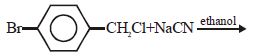
The product obtained from the reaction is:
A
$4-$Bromophenylacetonitrile
B
$4-$Bromobenzyl chloride
C
$4-$Cyanophenylacetonitrile
D
$2-$Cyano$-4-$bromobenzyl chloride
Solution
(A) The given reaction is a nucleophilic substitution reaction $(S_N2)$.
In the reactant,$4$-bromobenzyl chloride,there are two halogen atoms: $Br$ attached to the benzene ring and $Cl$ attached to the side chain $(CH_2Cl)$.
$NaCN$ acts as a nucleophile $(CN^-)$. The $Cl$ atom in the $CH_2Cl$ group is part of an alkyl halide (specifically a primary benzylic halide),which is highly reactive towards nucleophilic substitution.
In contrast,the $Br$ atom is directly attached to the benzene ring (aryl halide),which is inert towards nucleophilic substitution under these conditions due to the partial double-bond character of the $C-X$ bond.
Therefore,the $CN^-$ nucleophile will selectively replace the $Cl$ atom in the $CH_2Cl$ group to form $4$-bromophenylacetonitrile $(Br-C_6H_4-CH_2CN)$.
In the reactant,$4$-bromobenzyl chloride,there are two halogen atoms: $Br$ attached to the benzene ring and $Cl$ attached to the side chain $(CH_2Cl)$.
$NaCN$ acts as a nucleophile $(CN^-)$. The $Cl$ atom in the $CH_2Cl$ group is part of an alkyl halide (specifically a primary benzylic halide),which is highly reactive towards nucleophilic substitution.
In contrast,the $Br$ atom is directly attached to the benzene ring (aryl halide),which is inert towards nucleophilic substitution under these conditions due to the partial double-bond character of the $C-X$ bond.
Therefore,the $CN^-$ nucleophile will selectively replace the $Cl$ atom in the $CH_2Cl$ group to form $4$-bromophenylacetonitrile $(Br-C_6H_4-CH_2CN)$.
0 likes
View Solution403
MediumMCQ
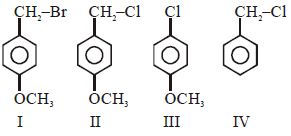
The order of the rate of $S_N1$ reactivity for the following compounds is:
A
$I > II > III > IV$
B
$I > II > IV > III$
C
$II > I > IV > III$
D
$I > IV > III > II$
Solution
(B) The rate of $S_N1$ reaction depends on the stability of the carbocation intermediate formed after the departure of the leaving group.
$I$ and $II$ are $p$-methoxybenzyl halides. The $-OCH_3$ group at the para position provides strong $+M$ (mesomeric) effect,which stabilizes the benzylic carbocation significantly.
Comparing $I$ ($p$-methoxybenzyl bromide) and $II$ ($p$-methoxybenzyl chloride),the bromide ion $(Br^-)$ is a better leaving group than the chloride ion $(Cl^-)$,so $I$ reacts faster than $II$.
$IV$ is benzyl chloride,which forms a stable benzylic carbocation but lacks the additional $+M$ stabilization from the $-OCH_3$ group,so it is less reactive than $I$ and $II$.
$III$ is $p$-chloroanisole,where the $Cl$ atom is directly attached to the benzene ring. $S_N1$ reaction at this position would form an unstable aryl cation,making it the least reactive.
Thus,the order is $I > II > IV > III$.
$I$ and $II$ are $p$-methoxybenzyl halides. The $-OCH_3$ group at the para position provides strong $+M$ (mesomeric) effect,which stabilizes the benzylic carbocation significantly.
Comparing $I$ ($p$-methoxybenzyl bromide) and $II$ ($p$-methoxybenzyl chloride),the bromide ion $(Br^-)$ is a better leaving group than the chloride ion $(Cl^-)$,so $I$ reacts faster than $II$.
$IV$ is benzyl chloride,which forms a stable benzylic carbocation but lacks the additional $+M$ stabilization from the $-OCH_3$ group,so it is less reactive than $I$ and $II$.
$III$ is $p$-chloroanisole,where the $Cl$ atom is directly attached to the benzene ring. $S_N1$ reaction at this position would form an unstable aryl cation,making it the least reactive.
Thus,the order is $I > II > IV > III$.
0 likes
View Solution404
DifficultMCQ
The major product obtained when this substrate is subjected to $E_2$ reaction under the treatment of potassium $tert$-butoxide is:
A
$1-$methyl$-2-$methylenecyclohexane
B
$1,2-$dimethylcyclohex$-1-$ene
C
Both in equal proportion
D
$3,3-$dimethylcyclohex$-1-$ene
Solution
(A) The substrate is $1$-bromo-$1,2$-dimethylcyclohexane. When treated with a bulky base like potassium $tert$-butoxide $(t-BuOK)$,the $E_2$ elimination reaction occurs.
$t-BuOK$ is a sterically hindered base,which prefers to abstract a proton from the less sterically hindered position (Hofmann product).
In this molecule,there are two types of $\beta$-hydrogens available for elimination:
$1$. Protons on the $CH_2$ group of the ring (leading to the more substituted,Zaitsev product,$1,2$-dimethylcyclohex-$1$-ene).
$2$. Protons on the exocyclic $CH_3$ group attached to the $C_1$ position or the $CH_2$ group adjacent to $C_1$ (leading to the less substituted,Hofmann product,$1$-methyl-$2$-methylenecyclohexane).
Due to the steric bulk of the $t-BuOK$ base,it preferentially abstracts the more accessible proton from the $CH_2$ group adjacent to the $C_1$ position to form the less substituted alkene,which is $1$-methyl-$2$-methylenecyclohexane.
$t-BuOK$ is a sterically hindered base,which prefers to abstract a proton from the less sterically hindered position (Hofmann product).
In this molecule,there are two types of $\beta$-hydrogens available for elimination:
$1$. Protons on the $CH_2$ group of the ring (leading to the more substituted,Zaitsev product,$1,2$-dimethylcyclohex-$1$-ene).
$2$. Protons on the exocyclic $CH_3$ group attached to the $C_1$ position or the $CH_2$ group adjacent to $C_1$ (leading to the less substituted,Hofmann product,$1$-methyl-$2$-methylenecyclohexane).
Due to the steric bulk of the $t-BuOK$ base,it preferentially abstracts the more accessible proton from the $CH_2$ group adjacent to the $C_1$ position to form the less substituted alkene,which is $1$-methyl-$2$-methylenecyclohexane.
0 likes
View Solution405
MediumMCQ
In which of the following reactions does an $SN^1$ reaction take place?
A
$CH_3-Br \xrightarrow{H_2O}$
B
$Ph-Br \xrightarrow{H_2O}$
C
$CH_2=CH-CH_2-Br \xrightarrow{H_2O}$
D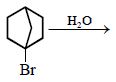
Solution
(C) The $SN^1$ reaction mechanism proceeds via the formation of a carbocation intermediate. The rate of $SN^1$ reaction depends on the stability of the carbocation formed.
$A$. $CH_3-Br$ forms a primary methyl carbocation,which is highly unstable and does not undergo $SN^1$.
$B$. $Ph-Br$ (Bromobenzene) does not undergo $SN^1$ because the $C-Br$ bond has partial double bond character due to resonance,and the phenyl cation is extremely unstable.
$C$. $CH_2=CH-CH_2-Br$ forms an allyl carbocation $(CH_2=CH-CH_2^+)$,which is resonance-stabilized. This reaction can proceed via $SN^1$ in the presence of a polar protic solvent like $H_2O$.
$D$. $1-$bromobicyclo[$2.2$.$1$]heptane cannot undergo $SN^1$ because the bridgehead carbon cannot achieve the planar geometry required for a carbocation intermediate (Bredt's rule).
Therefore,the correct option is $C$.
$A$. $CH_3-Br$ forms a primary methyl carbocation,which is highly unstable and does not undergo $SN^1$.
$B$. $Ph-Br$ (Bromobenzene) does not undergo $SN^1$ because the $C-Br$ bond has partial double bond character due to resonance,and the phenyl cation is extremely unstable.
$C$. $CH_2=CH-CH_2-Br$ forms an allyl carbocation $(CH_2=CH-CH_2^+)$,which is resonance-stabilized. This reaction can proceed via $SN^1$ in the presence of a polar protic solvent like $H_2O$.
$D$. $1-$bromobicyclo[$2.2$.$1$]heptane cannot undergo $SN^1$ because the bridgehead carbon cannot achieve the planar geometry required for a carbocation intermediate (Bredt's rule).
Therefore,the correct option is $C$.
0 likes
View Solution406
MediumMCQ
What is the major product of the following reaction?
$1\text{-methylcyclopentene} \xrightarrow[\text{Peroxide}]{\text{HBr}} ?$
$1\text{-methylcyclopentene} \xrightarrow[\text{Peroxide}]{\text{HBr}} ?$
A
$1-$bromo$-1-$methylcyclopentane
B
$2-$bromo$-1-$methylcyclopentane
C
$1-$bromo$-2-$methylcyclopentane
D
bromomethylcyclopentane
Solution
(B) The reaction of $1\text{-methylcyclopentene}$ with $\text{HBr}$ in the presence of peroxide follows the anti-Markovnikov addition mechanism (Kharasch effect or peroxide effect).
In this mechanism,the bromine atom $(\text{Br}^\bullet)$ adds to the carbon atom of the double bond that has more hydrogen atoms (or less substituted carbon),while the hydrogen atom adds to the other carbon.
For $1\text{-methylcyclopentene}$,the double bond is between $C_1$ (substituted with a methyl group) and $C_2$ (which has one hydrogen atom).
According to the anti-Markovnikov rule,the $\text{Br}$ atom will attach to the $C_2$ position,resulting in $2\text{-bromo-1-methylcyclopentane}$ as the major product.
In this mechanism,the bromine atom $(\text{Br}^\bullet)$ adds to the carbon atom of the double bond that has more hydrogen atoms (or less substituted carbon),while the hydrogen atom adds to the other carbon.
For $1\text{-methylcyclopentene}$,the double bond is between $C_1$ (substituted with a methyl group) and $C_2$ (which has one hydrogen atom).
According to the anti-Markovnikov rule,the $\text{Br}$ atom will attach to the $C_2$ position,resulting in $2\text{-bromo-1-methylcyclopentane}$ as the major product.
0 likes
View Solution407
MediumMCQ
Which of the following is a polar aprotic solvent?
A
$DMSO$
B
Crown ether
C
$DMG$
D
All of these
Solution
(D) The correct answer is $(d)$.
Polar aprotic solvents are solvents that do not contain a hydrogen atom attached to an electronegative atom (like $O$ or $N$).
$DMSO$ (Dimethyl sulfoxide) is a well-known polar aprotic solvent.
Crown ethers are also considered polar aprotic solvents as they can solvate cations effectively without having acidic protons.
$DMG$ (Dimethylglyoxime) is also used in specific contexts as a polar aprotic solvent.
Therefore,all the given options are examples of polar aprotic solvents.
Polar aprotic solvents are solvents that do not contain a hydrogen atom attached to an electronegative atom (like $O$ or $N$).
$DMSO$ (Dimethyl sulfoxide) is a well-known polar aprotic solvent.
Crown ethers are also considered polar aprotic solvents as they can solvate cations effectively without having acidic protons.
$DMG$ (Dimethylglyoxime) is also used in specific contexts as a polar aprotic solvent.
Therefore,all the given options are examples of polar aprotic solvents.
0 likes
View Solution408
DifficultMCQ
The dipole moments of halo compounds are in the order:
A
$CHCl_3 > CCl_4 > CH_2Cl_2 > cis-CHCl=CHCl$
B
$cis-CHCl=CHCl > CHCl_3 > CH_2Cl_2 > CCl_4$
C
$cis-CHCl=CHCl > CH_2Cl_2 > CHCl_3 > CCl_4$
D
$CHCl_3 > CH_2Cl_2 > cis-CHCl=CHCl > CCl_4$
Solution
(C) The dipole moments of the given compounds are as follows:
$1$. $CCl_4$ is a symmetrical tetrahedral molecule,so its net dipole moment is $0 \ D$.
$2$. $cis-CHCl=CHCl$ has a significant dipole moment due to the polar $C-Cl$ bonds on the same side,approximately $1.90 \ D$.
$3$. $CH_2Cl_2$ has a dipole moment of approximately $1.60 \ D$.
$4$. $CHCl_3$ has a dipole moment of approximately $1.03 \ D$.
Comparing these values,the order is $cis-CHCl=CHCl > CH_2Cl_2 > CHCl_3 > CCl_4$.
$1$. $CCl_4$ is a symmetrical tetrahedral molecule,so its net dipole moment is $0 \ D$.
$2$. $cis-CHCl=CHCl$ has a significant dipole moment due to the polar $C-Cl$ bonds on the same side,approximately $1.90 \ D$.
$3$. $CH_2Cl_2$ has a dipole moment of approximately $1.60 \ D$.
$4$. $CHCl_3$ has a dipole moment of approximately $1.03 \ D$.
Comparing these values,the order is $cis-CHCl=CHCl > CH_2Cl_2 > CHCl_3 > CCl_4$.
0 likes
View Solution409
MediumMCQ
Which one of the following is chiral?
A
$1,1-$Dibromo$-1-$chloropropane
B
$1,3-$Dibromo$-1-$chloropropane
C
$1,1-$Dibromo$-3-$chloropropane
D
$1,3-$Dibromo$-2-$chloropropane
Solution
(B) molecule is chiral if it contains at least one chiral carbon atom (a carbon atom bonded to four different groups).
In $1,3-$dibromo$-1-$chloropropane $(CH_2Br-CH_2-CH(Cl)Br)$,the carbon atom at position $1$ is bonded to a hydrogen atom $(H)$,a chlorine atom $(Cl)$,a bromine atom $(Br)$,and a $2-$bromoethyl group $(-CH_2-CH_2-Br)$.
Since all four groups attached to the $C-1$ carbon are different,it is a chiral center.
Therefore,$1,3-$dibromo$-1-$chloropropane is chiral.
In $1,3-$dibromo$-1-$chloropropane $(CH_2Br-CH_2-CH(Cl)Br)$,the carbon atom at position $1$ is bonded to a hydrogen atom $(H)$,a chlorine atom $(Cl)$,a bromine atom $(Br)$,and a $2-$bromoethyl group $(-CH_2-CH_2-Br)$.
Since all four groups attached to the $C-1$ carbon are different,it is a chiral center.
Therefore,$1,3-$dibromo$-1-$chloropropane is chiral.
0 likes
View Solution410
MediumMCQ
$A$ student was carrying out a Grignard reaction between $PhMgBr$ and ethyl benzoate. She ran out of anhydrous ether just after the Grignard reagent was made. Which of the following solvents can still be used to dissolve the ethyl benzoate for its reaction with already formed $PhMgBr$?
A
acetone
B
ethyl acetate
C
absolute alcohol
D
benzene
Solution
(D) Grignard reagents $(RMgX)$ are highly reactive towards compounds containing active hydrogen atoms (like alcohols,water,amines) and electrophilic carbonyl groups (like ketones and esters).
$ (a) $ Acetone contains a carbonyl group and will react with $PhMgBr$.
$ (b) $ Ethyl acetate is an ester and will react with $PhMgBr$.
$ (c) $ Absolute alcohol contains an acidic hydroxyl group and will react with $PhMgBr$.
$ (d) $ Benzene is an inert hydrocarbon and does not contain any active hydrogen or reactive functional groups,making it a suitable solvent for the reaction.
$ (a) $ Acetone contains a carbonyl group and will react with $PhMgBr$.
$ (b) $ Ethyl acetate is an ester and will react with $PhMgBr$.
$ (c) $ Absolute alcohol contains an acidic hydroxyl group and will react with $PhMgBr$.
$ (d) $ Benzene is an inert hydrocarbon and does not contain any active hydrogen or reactive functional groups,making it a suitable solvent for the reaction.
0 likes
View Solution411
DifficultMCQ
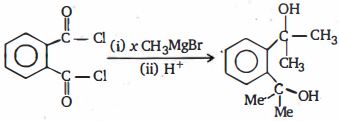
Number of moles of $CH_3MgBr$ consumed in the above reaction is:
A
$2$
B
$4$
C
$6$
D
$8$
Solution
(B) The reactant is phthaloyl chloride $(C_6H_4(COCl)_2)$.
Each acid chloride group $(-COCl)$ reacts with $2$ moles of Grignard reagent $(CH_3MgBr)$ to form a tertiary alcohol.
Specifically,the first mole of $CH_3MgBr$ attacks the carbonyl carbon to form a ketone intermediate,and the second mole attacks the ketone to form the tertiary alcohol after acidic workup $(H^+)$.
Since there are two $-COCl$ groups in the molecule,a total of $2 \times 2 = 4$ moles of $CH_3MgBr$ are consumed.
Therefore,the correct option is $B$.
Each acid chloride group $(-COCl)$ reacts with $2$ moles of Grignard reagent $(CH_3MgBr)$ to form a tertiary alcohol.
Specifically,the first mole of $CH_3MgBr$ attacks the carbonyl carbon to form a ketone intermediate,and the second mole attacks the ketone to form the tertiary alcohol after acidic workup $(H^+)$.
Since there are two $-COCl$ groups in the molecule,a total of $2 \times 2 = 4$ moles of $CH_3MgBr$ are consumed.
Therefore,the correct option is $B$.
0 likes
View Solution412
MediumMCQ
Which of the following compounds is not a suitable solvent for a Grignard reaction?
A
Tetrahydrofuran $(THF)$
B
$1,4-$Dioxane
C
$CH_3-O-CH_2-CH_2-O-CH_3$ ($1$,$2$-Dimethoxyethane)
D
Cyclohexane
Solution
(D) Grignard reagents $(RMgX)$ are highly reactive organometallic compounds. They require a polar aprotic solvent that can act as a Lewis base to stabilize the magnesium atom through coordination.
$A$,$B$,and $C$ are ethers,which are polar aprotic solvents capable of coordinating with the magnesium center,thus stabilizing the Grignard reagent.
$D$ (Cyclohexane) is a non-polar hydrocarbon solvent. It lacks the lone pairs of electrons necessary to coordinate with and stabilize the magnesium atom in the Grignard reagent. Therefore,it is not a suitable solvent for the Grignard reaction.
$A$,$B$,and $C$ are ethers,which are polar aprotic solvents capable of coordinating with the magnesium center,thus stabilizing the Grignard reagent.
$D$ (Cyclohexane) is a non-polar hydrocarbon solvent. It lacks the lone pairs of electrons necessary to coordinate with and stabilize the magnesium atom in the Grignard reagent. Therefore,it is not a suitable solvent for the Grignard reaction.
0 likes
View Solution413
MediumMCQ
The product of the reaction will be:
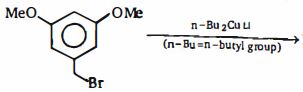
A
$3,5-$dimethoxybenzyl-n-butyl
B
$1-$($3$,$5$-dimethoxyphenyl)pentane
C
$3,5-$dimethoxy$-1-$butylbenzene
D
$3,5-$dihydroxybenzyl-n-butyl
Solution
(B) The reaction involves the use of Gilman reagent,$(n-Bu)_2CuLi$,which is an organocopper reagent. Gilman reagents are known for their ability to perform nucleophilic substitution reactions with primary alkyl halides,replacing the halogen atom with an alkyl group. In this reaction,the $n-butyl$ group from the Gilman reagent attacks the benzylic carbon atom of $3,5-dimethoxybenzyl$ bromide,displacing the bromide ion. This results in the formation of $1-(3,5-dimethoxyphenyl)pentane$.
0 likes
View Solution414
MediumMCQ
Which of the following Grignard reagents can be prepared?
A
$BrMgCH_2CH_2CH_2OH$
B
$BrMgCH_2CH_2SH$
C
$BrMgCH_2CH_2NH_2$
D
$BrMgCH_2CH_2N(CH_3)_2$
Solution
(D) Grignard reagents $(RMgX)$ are strong bases and react rapidly with compounds containing acidic hydrogen atoms (such as $-OH$,$-SH$,and $-NH_2$ groups).
In options $(a)$,$(b)$,and $(c)$,the molecules contain acidic hydrogen atoms attached to oxygen,sulfur,or nitrogen,which would immediately protonate the Grignard reagent.
In option $(d)$,the nitrogen atom is part of a tertiary amine group $(-N(CH_3)_2)$,which does not have an acidic hydrogen.
Therefore,this Grignard reagent can be prepared.
In options $(a)$,$(b)$,and $(c)$,the molecules contain acidic hydrogen atoms attached to oxygen,sulfur,or nitrogen,which would immediately protonate the Grignard reagent.
In option $(d)$,the nitrogen atom is part of a tertiary amine group $(-N(CH_3)_2)$,which does not have an acidic hydrogen.
Therefore,this Grignard reagent can be prepared.
0 likes
View Solution415
MediumMCQ
What is the product $(B)$ of the following reaction sequence?
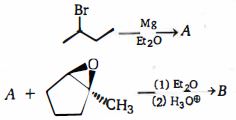
A
B
C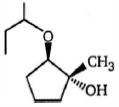
D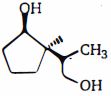
Solution
(A) $1$. The reaction of $sec$-butyl bromide with $Mg$ in $Et_2O$ forms the Grignard reagent $A$,which is $sec$-butylmagnesium bromide $(CH_3CH_2CH(CH_3)MgBr)$.
$2$. The Grignard reagent acts as a strong nucleophile and attacks the epoxide ring.
$3$. In the presence of a basic medium (Grignard reagent),the nucleophilic attack occurs at the less sterically hindered carbon atom of the epoxide.
$4$. The $sec$-butyl group attacks the less substituted carbon of the $1-$methyl$-1,2-$epoxycyclopentane ring.
$5$. Subsequent acid workup with $H_3O^+$ protonates the resulting alkoxide to form the final alcohol product $(B)$.
$6$. Based on the stereochemistry and regioselectivity,the product is the one shown in option $A$.
$2$. The Grignard reagent acts as a strong nucleophile and attacks the epoxide ring.
$3$. In the presence of a basic medium (Grignard reagent),the nucleophilic attack occurs at the less sterically hindered carbon atom of the epoxide.
$4$. The $sec$-butyl group attacks the less substituted carbon of the $1-$methyl$-1,2-$epoxycyclopentane ring.
$5$. Subsequent acid workup with $H_3O^+$ protonates the resulting alkoxide to form the final alcohol product $(B)$.
$6$. Based on the stereochemistry and regioselectivity,the product is the one shown in option $A$.
0 likes
View Solution416
MediumMCQ
The $S_N2$ product of the following reaction is:
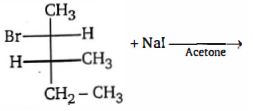
A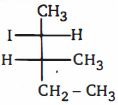
B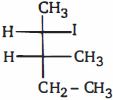
C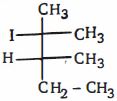
D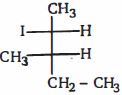
Solution
(C) The reaction is an $S_N2$ reaction,which proceeds with inversion of configuration at the chiral carbon atom where the leaving group $(Br^-)$ is attached. The nucleophile $(I^-)$ attacks from the side opposite to the leaving group. In the given reactant,the $Br$ atom is on the left side of the chiral carbon. Therefore,in the product,the $I$ atom will be on the right side of the same chiral carbon. Comparing the options,option $(A)$ shows the $I$ atom on the left,option $(B)$ shows the $I$ atom on the left,option $(C)$ shows the $I$ atom on the right,and option $(D)$ shows the $I$ atom on the left. Thus,the correct structure is $(C)$.
0 likes
View Solution417
MediumMCQ
The rate of $S_N2$ reaction will be negligible in:
A
Bromocyclohexane
B
$3-$Bromocyclohexene
C
$1-$Bromobicyclo[$2.2$.$1$]heptane
D
$4-$Bromocyclohexene
Solution
(C) The $S_N2$ mechanism requires a backside attack by the nucleophile on the carbon atom bonded to the leaving group.
In $1$-bromobicyclo$[2.2.1]$heptane (option $C$),the carbon atom attached to the bromine is at the bridgehead position.
Due to the rigid bicyclic structure,the backside of the bridgehead carbon is sterically hindered and inaccessible to the nucleophile.
Furthermore,the formation of a planar transition state (required for $S_N2$) or a carbocation (required for $S_N1$) at the bridgehead position is geometrically constrained and energetically unfavorable due to Bredt's rule.
Therefore,$S_N2$ reactions are negligible at the bridgehead position.
In $1$-bromobicyclo$[2.2.1]$heptane (option $C$),the carbon atom attached to the bromine is at the bridgehead position.
Due to the rigid bicyclic structure,the backside of the bridgehead carbon is sterically hindered and inaccessible to the nucleophile.
Furthermore,the formation of a planar transition state (required for $S_N2$) or a carbocation (required for $S_N1$) at the bridgehead position is geometrically constrained and energetically unfavorable due to Bredt's rule.
Therefore,$S_N2$ reactions are negligible at the bridgehead position.
0 likes
View Solution418
MediumMCQ
What is the major product obtained in the following reaction?
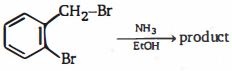
A
$2-$bromobenzylamine
B
$2-$bromobenzyl bromide
C
$2-$aminobenzyl bromide
D
$1,2-$diaminobenzene
Solution
(A) The reaction involves the nucleophilic substitution of a bromine atom by an ammonia $(NH_3)$ molecule.
In the given molecule,there are two bromine atoms: one is a benzylic bromide $(-CH_2Br)$ and the other is an aryl bromide (attached directly to the benzene ring).
The benzylic bromide is highly reactive towards nucleophilic substitution ($S_N2$ or $S_N1$ depending on conditions) because the resulting carbocation is resonance-stabilized or the transition state is easily formed.
In contrast,the aryl bromide is very unreactive towards nucleophilic substitution due to the partial double bond character of the $C-Br$ bond caused by resonance with the benzene ring.
Therefore,the $NH_3$ molecule will selectively attack the benzylic carbon,replacing the $-Br$ group with an $-NH_2$ group to form $2$-bromobenzylamine.
In the given molecule,there are two bromine atoms: one is a benzylic bromide $(-CH_2Br)$ and the other is an aryl bromide (attached directly to the benzene ring).
The benzylic bromide is highly reactive towards nucleophilic substitution ($S_N2$ or $S_N1$ depending on conditions) because the resulting carbocation is resonance-stabilized or the transition state is easily formed.
In contrast,the aryl bromide is very unreactive towards nucleophilic substitution due to the partial double bond character of the $C-Br$ bond caused by resonance with the benzene ring.
Therefore,the $NH_3$ molecule will selectively attack the benzylic carbon,replacing the $-Br$ group with an $-NH_2$ group to form $2$-bromobenzylamine.
0 likes
View Solution419
MediumMCQ
$Cl-CH_2-C(CH_3)_2-CH_2-CH_2-Cl + I^- \xrightarrow[DMF]{} \text{product}$; The major product of this reaction is:
A
$I-CH_2-C(CH_3)_2-CH_2-CH_2-Cl$
B
$Cl-CH_2-C(CH_3)_2-CH_2-CH_2-I$
C
$H_2C=C(CH_3)-CH_2-CH_2-Cl$
D
$Cl-CH_2-C(CH_3)_2-CH=CH_2$
Solution
(B) The reaction involves a nucleophilic substitution $(S_N2)$ mechanism using $I^-$ as the nucleophile in a polar aprotic solvent $(DMF)$.
$S_N2$ reactions are highly sensitive to steric hindrance.
In the substrate $Cl-CH_2-C(CH_3)_2-CH_2-CH_2-Cl$,there are two primary chloride sites.
The site at the end of the chain $(-CH_2-CH_2-Cl)$ is less sterically hindered compared to the site near the bulky tert-butyl group $(-CH_2-C(CH_3)_2-)$.
Therefore,the nucleophile $I^-$ preferentially attacks the less hindered primary carbon atom,resulting in the formation of $Cl-CH_2-C(CH_3)_2-CH_2-CH_2-I$ as the major product.
$S_N2$ reactions are highly sensitive to steric hindrance.
In the substrate $Cl-CH_2-C(CH_3)_2-CH_2-CH_2-Cl$,there are two primary chloride sites.
The site at the end of the chain $(-CH_2-CH_2-Cl)$ is less sterically hindered compared to the site near the bulky tert-butyl group $(-CH_2-C(CH_3)_2-)$.
Therefore,the nucleophile $I^-$ preferentially attacks the less hindered primary carbon atom,resulting in the formation of $Cl-CH_2-C(CH_3)_2-CH_2-CH_2-I$ as the major product.
0 likes
View Solution420
MediumMCQ
Which of the following expressions is representative of the rate law for a $S_{N}2$ reaction?
A
$Rate = k$ [electrophile]
B
$Rate = k$ [electrophile] [nucleophile]
C
$Rate = k$ [nucleophile]$^2$
D
$Rate = k$ [electrophile]$^2$
Solution
(B) The $S_{N}2$ reaction stands for Substitution Nucleophilic Bimolecular.
In a bimolecular reaction,the rate of the reaction depends on the concentration of both the substrate (electrophile) and the nucleophile.
Therefore,the rate law is expressed as: $Rate = k$ [electrophile] [nucleophile].
In a bimolecular reaction,the rate of the reaction depends on the concentration of both the substrate (electrophile) and the nucleophile.
Therefore,the rate law is expressed as: $Rate = k$ [electrophile] [nucleophile].
0 likes
View Solution421
MediumMCQ
The major product of the following reaction is:

A
$1-$fluoro$-3-$iodocyclopentane
B
$1-$fluoro$-2-$iodocyclopentane
C
$1-$bromo$-3-$iodocyclopentane
D
$1-$bromo$-2-$iodocyclopentane
Solution
(A) The reaction is a Finkelstein reaction,which proceeds via an $S_N2$ mechanism in acetone solvent.
In the given substrate,$Br^{\ominus}$ is a better leaving group than $F^{\ominus}$.
Therefore,the $I^{\ominus}$ nucleophile will attack the carbon atom attached to the $Br$ atom,displacing it to form the corresponding iodo-derivative.
The configuration at the chiral center undergoes inversion during the $S_N2$ process.
In the given substrate,$Br^{\ominus}$ is a better leaving group than $F^{\ominus}$.
Therefore,the $I^{\ominus}$ nucleophile will attack the carbon atom attached to the $Br$ atom,displacing it to form the corresponding iodo-derivative.
The configuration at the chiral center undergoes inversion during the $S_N2$ process.
0 likes
View Solution422
MediumMCQ
Arrange the following three chlorides in decreasing order of their reactivity towards $S_{N^1}$ reaction.

A
$1 > 2 > 3$
B
$2 > 3 > 1$
C
$2 > 1 > 3$
D
$3 > 2 > 1$
Solution
(B) The reactivity of alkyl halides towards the $S_{N^1}$ reaction depends on the stability of the carbocation intermediate formed in the rate-determining step ($R$.$D$.$S$.).
$(1)$ $CH_3CH_2CH_2Cl$ forms a primary $(1^{\circ})$ carbocation $(CH_3CH_2CH_2^+)$,which is the least stable.
$(2)$ $CH_2=CH-CHCl-CH_3$ forms an allylic carbocation $(CH_2=CH-CH^+-CH_3)$,which is resonance-stabilized and thus the most stable.
$(3)$ $CH_3CH_2-CHCl-CH_3$ forms a secondary $(2^{\circ})$ carbocation $(CH_3CH_2-CH^+-CH_3)$,which is more stable than the primary carbocation due to hyperconjugation (more $\alpha$-hydrogens) but less stable than the resonance-stabilized allylic carbocation.
Therefore,the order of stability of carbocations is: $(2) > (3) > (1)$.
Hence,the decreasing order of $S_{N^1}$ reactivity is $2 > 3 > 1$.
$(1)$ $CH_3CH_2CH_2Cl$ forms a primary $(1^{\circ})$ carbocation $(CH_3CH_2CH_2^+)$,which is the least stable.
$(2)$ $CH_2=CH-CHCl-CH_3$ forms an allylic carbocation $(CH_2=CH-CH^+-CH_3)$,which is resonance-stabilized and thus the most stable.
$(3)$ $CH_3CH_2-CHCl-CH_3$ forms a secondary $(2^{\circ})$ carbocation $(CH_3CH_2-CH^+-CH_3)$,which is more stable than the primary carbocation due to hyperconjugation (more $\alpha$-hydrogens) but less stable than the resonance-stabilized allylic carbocation.
Therefore,the order of stability of carbocations is: $(2) > (3) > (1)$.
Hence,the decreasing order of $S_{N^1}$ reactivity is $2 > 3 > 1$.
0 likes
View Solution423
MediumMCQ
Which compound undergoes nucleophilic substitution with $NaCN$ at the fastest rate?
A
$CH_3CH_2CH_2CH_2Br$
B
$CH_3CH_2CH(CH_3)Br$
C
$(CH_3)_2CHCH_2Br$
D
$CH_3CH_2C(CH_3)_2Br$
Solution
(A) The reaction with $NaCN$ typically proceeds via the $S_N2$ mechanism,as $CN^-$ is a strong nucleophile.
The rate of $S_N2$ reaction is inversely proportional to the steric hindrance at the reaction center.
The order of reactivity for $S_N2$ is: primary $(1^\circ)$ > secondary $(2^\circ)$ > tertiary $(3^\circ)$.
Comparing the given compounds:
$(A)$ $CH_3CH_2CH_2CH_2Br$ is a primary alkyl halide $(1^\circ)$.
$(B)$ $CH_3CH_2CH(CH_3)Br$ is a secondary alkyl halide $(2^\circ)$.
$(C)$ $(CH_3)_2CHCH_2Br$ is a primary alkyl halide $(1^\circ)$,but it has steric hindrance at the $\beta$-carbon.
$(D)$ $CH_3CH_2C(CH_3)_2Br$ is a tertiary alkyl halide $(3^\circ)$.
Among the primary halides,$CH_3CH_2CH_2CH_2Br$ has the least steric hindrance at the reaction center,making it the fastest to undergo $S_N2$ substitution.
The rate of $S_N2$ reaction is inversely proportional to the steric hindrance at the reaction center.
The order of reactivity for $S_N2$ is: primary $(1^\circ)$ > secondary $(2^\circ)$ > tertiary $(3^\circ)$.
Comparing the given compounds:
$(A)$ $CH_3CH_2CH_2CH_2Br$ is a primary alkyl halide $(1^\circ)$.
$(B)$ $CH_3CH_2CH(CH_3)Br$ is a secondary alkyl halide $(2^\circ)$.
$(C)$ $(CH_3)_2CHCH_2Br$ is a primary alkyl halide $(1^\circ)$,but it has steric hindrance at the $\beta$-carbon.
$(D)$ $CH_3CH_2C(CH_3)_2Br$ is a tertiary alkyl halide $(3^\circ)$.
Among the primary halides,$CH_3CH_2CH_2CH_2Br$ has the least steric hindrance at the reaction center,making it the fastest to undergo $S_N2$ substitution.
0 likes
View Solution424
MediumMCQ
Rank the following compounds in order of decreasing rate of solvolysis with aqueous ethanol (fastest $\to$ slowest):
$(1)$ $CH_2=C(CH_3)Br$
$(2)$ $1-bromo-1-methylcyclohexane$
$(3)$ $CH_3-CH(Br)-CH_2-CH(CH_3)_2$
$(1)$ $CH_2=C(CH_3)Br$
$(2)$ $1-bromo-1-methylcyclohexane$
$(3)$ $CH_3-CH(Br)-CH_2-CH(CH_3)_2$
A
$2 > 1 > 3$
B
$1 > 2 > 3$
C
$2 > 3 > 1$
D
$1 > 3 > 2$
Solution
(C) The rate of solvolysis follows an $S_N1$ mechanism,which depends on the stability of the carbocation intermediate formed after the departure of the leaving group $(Br^-)$.
$(1)$ $CH_2=C(CH_3)^+$ is a vinylic carbocation,which is highly unstable due to the $sp$ hybridization of the positively charged carbon.
$(2)$ $1-methylcyclohexyl$ cation is a tertiary $(3^{\circ})$ carbocation,which is highly stable due to hyperconjugation and inductive effects.
$(3)$ $CH_3-CH^+-CH_2-CH(CH_3)_2$ is a secondary $(2^{\circ})$ carbocation,which is less stable than a tertiary carbocation but more stable than a vinylic carbocation.
Therefore,the order of stability of the carbocations is $(2) > (3) > (1)$.
Thus,the rate of solvolysis is $(2) > (3) > (1)$.
$(1)$ $CH_2=C(CH_3)^+$ is a vinylic carbocation,which is highly unstable due to the $sp$ hybridization of the positively charged carbon.
$(2)$ $1-methylcyclohexyl$ cation is a tertiary $(3^{\circ})$ carbocation,which is highly stable due to hyperconjugation and inductive effects.
$(3)$ $CH_3-CH^+-CH_2-CH(CH_3)_2$ is a secondary $(2^{\circ})$ carbocation,which is less stable than a tertiary carbocation but more stable than a vinylic carbocation.
Therefore,the order of stability of the carbocations is $(2) > (3) > (1)$.
Thus,the rate of solvolysis is $(2) > (3) > (1)$.
0 likes
View Solution425
MediumMCQ
The reaction of $4-$bromobenzyl chloride with sodium cyanide in ethanol leads to the formation of
A
$4-$bromobenzyl cyanide
B
$4-$cyanobenzyl chloride
C
$4-$cyanobenzyl cyanide
D
$4-$bromo$-2-$cyanobenzyl chloride
Solution
(A) The reaction involves the nucleophilic substitution of the chlorine atom in $4-$bromobenzyl chloride by the cyanide ion $(CN^-)$ from sodium cyanide $(NaCN)$.
In $4-$bromobenzyl chloride,the $Cl$ atom is attached to a benzylic carbon,which is highly reactive towards nucleophilic substitution ($S_N2$ mechanism).
Conversely,the $Br$ atom is directly attached to the benzene ring,which exhibits partial double-bond character due to resonance,making it a poor leaving group and resistant to nucleophilic substitution under these conditions.
Therefore,the $CN^-$ nucleophile selectively replaces the $Cl$ atom to form $4-$bromobenzyl cyanide.
In $4-$bromobenzyl chloride,the $Cl$ atom is attached to a benzylic carbon,which is highly reactive towards nucleophilic substitution ($S_N2$ mechanism).
Conversely,the $Br$ atom is directly attached to the benzene ring,which exhibits partial double-bond character due to resonance,making it a poor leaving group and resistant to nucleophilic substitution under these conditions.
Therefore,the $CN^-$ nucleophile selectively replaces the $Cl$ atom to form $4-$bromobenzyl cyanide.
0 likes
View Solution426
MediumMCQ
Which of the following reactants will not favour nucleophilic substitution reaction?
A
$1-$Bromobicyclo[$2.2$.$1$]heptane
B
$Ph-Br$
C
$(CH_3)_3C-CH_2-Br$
D
All the above
Solution
(D) The correct answer is $D$. All the given compounds do not readily undergo nucleophilic substitution reactions ($S_N1$ or $S_N2$):
$1$. $1$-Bromobicyclo$[2.2.1]$heptane: The bridgehead carbon is sterically crowded,preventing $S_N2$ attack. Furthermore,the formation of a carbocation at the bridgehead is forbidden by Bredt's rule,preventing $S_N1$ reaction.
$2$. $Ph-Br$ (Bromobenzene): The lone pair on the bromine atom is in resonance with the benzene ring,giving the $C-Br$ bond partial double bond character. This makes the bond stronger and shorter,preventing nucleophilic substitution.
$3$. $(CH_3)_3C-CH_2-Br$ (Neopentyl bromide): This is a primary alkyl halide with significant steric hindrance at the $\beta$-carbon,which blocks the backside attack required for $S_N2$. Additionally,the formation of a primary carbocation is energetically unfavorable,preventing $S_N1$.
$1$. $1$-Bromobicyclo$[2.2.1]$heptane: The bridgehead carbon is sterically crowded,preventing $S_N2$ attack. Furthermore,the formation of a carbocation at the bridgehead is forbidden by Bredt's rule,preventing $S_N1$ reaction.
$2$. $Ph-Br$ (Bromobenzene): The lone pair on the bromine atom is in resonance with the benzene ring,giving the $C-Br$ bond partial double bond character. This makes the bond stronger and shorter,preventing nucleophilic substitution.
$3$. $(CH_3)_3C-CH_2-Br$ (Neopentyl bromide): This is a primary alkyl halide with significant steric hindrance at the $\beta$-carbon,which blocks the backside attack required for $S_N2$. Additionally,the formation of a primary carbocation is energetically unfavorable,preventing $S_N1$.
0 likes
View Solution427
AdvancedMCQ
Conversion of $I$ to $II$:
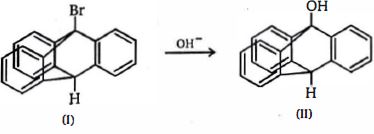
A
takes place by $S_N1$
B
takes place by $S_N2$
C
takes place both by $S_N1$ and $S_N2$
D
does not take place
Solution
(D) In $1-$bromotriptycene,the bromine atom is found to be virtually inert to nucleophiles.
This is because the rigid structure of the triptycene molecule prevents the formation of a planar carbocation intermediate required for an $S_N1$ reaction.
Furthermore,the backside attack by a nucleophile,which is necessary for an $S_N2$ reaction,is sterically hindered by the three benzene rings,making it impossible for the nucleophile to approach the carbon atom bonded to the bromine.
Therefore,the conversion does not take place under standard conditions.
This is because the rigid structure of the triptycene molecule prevents the formation of a planar carbocation intermediate required for an $S_N1$ reaction.
Furthermore,the backside attack by a nucleophile,which is necessary for an $S_N2$ reaction,is sterically hindered by the three benzene rings,making it impossible for the nucleophile to approach the carbon atom bonded to the bromine.
Therefore,the conversion does not take place under standard conditions.
0 likes
View Solution428
DifficultMCQ
Which is the correct reaction coordinate diagram for the following solvolysis reaction?

A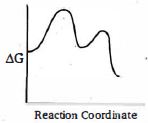
B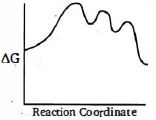
C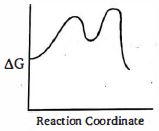
D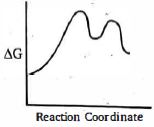
Solution
(B) The given reaction is a $S_N1$ solvolysis reaction.
$1$. The first step is the slow ionization of the alkyl bromide to form a carbocation intermediate.
$2$. The second step is the fast nucleophilic attack by $H_2O$ to form an oxonium ion intermediate.
$3$. The third step is the fast deprotonation to form the final alcohol product.
Since there are three steps,the reaction coordinate diagram must have three transition states and two intermediates. Diagram $B$ correctly represents this $3$-step process.
$1$. The first step is the slow ionization of the alkyl bromide to form a carbocation intermediate.
$2$. The second step is the fast nucleophilic attack by $H_2O$ to form an oxonium ion intermediate.
$3$. The third step is the fast deprotonation to form the final alcohol product.
Since there are three steps,the reaction coordinate diagram must have three transition states and two intermediates. Diagram $B$ correctly represents this $3$-step process.
0 likes
View Solution429
MediumMCQ
What is the product of this reaction?
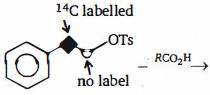
A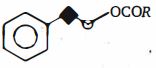
B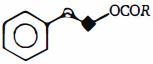
C
Both $(a)$ and $(b)$.
D
None of these.
Solution
(C) The reaction proceeds via Neighboring Group Participation $(NGP)$ by the phenyl ring. The $\pi$-electrons of the phenyl ring attack the carbon bearing the $OTs$ group,forming a phenonium ion intermediate. This intermediate is symmetric in terms of the two carbons of the ethyl chain,allowing the nucleophile $(RCOO^-)$ to attack either of the two equivalent carbons. Consequently,the $OCOR$ group can be attached to either the $^{14}C$ labelled carbon or the non-labelled carbon,resulting in a mixture of both products.
0 likes
View Solution430
MediumMCQ
The product $(B)$ is
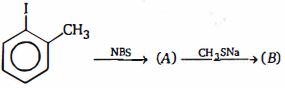
A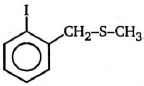
B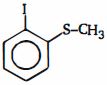
C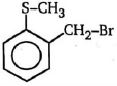
D
None of these
Solution
(A) Step $1$: $NBS$ ($N$-Bromosuccinimide) is a reagent used for allylic or benzylic bromination. In the reaction of $o$-iodotoluene with $NBS$,the benzylic hydrogen is replaced by bromine to form $o$-iodobenzyl bromide,which is product $(A)$.
Step $2$: The product $(A)$ ($o$-iodobenzyl bromide) reacts with $CH_3SNa$ (sodium methanethiolate). This is a nucleophilic substitution reaction ($S_N2$ mechanism) where the $-SCH_3$ group replaces the $-Br$ atom at the benzylic position to form $o$-iodobenzyl methyl sulfide as product $(B)$.
Step $2$: The product $(A)$ ($o$-iodobenzyl bromide) reacts with $CH_3SNa$ (sodium methanethiolate). This is a nucleophilic substitution reaction ($S_N2$ mechanism) where the $-SCH_3$ group replaces the $-Br$ atom at the benzylic position to form $o$-iodobenzyl methyl sulfide as product $(B)$.
0 likes
View Solution431
DifficultMCQ
Which of the following represents the correct graph for $S_N2$ reaction?
A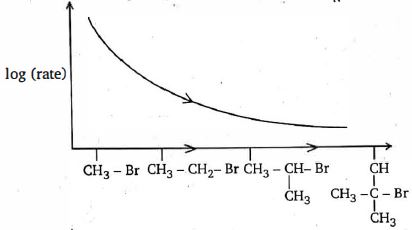
B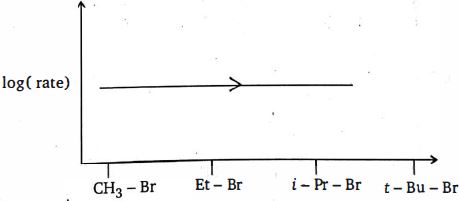
C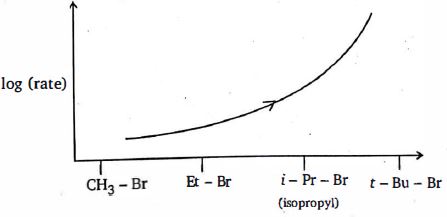
D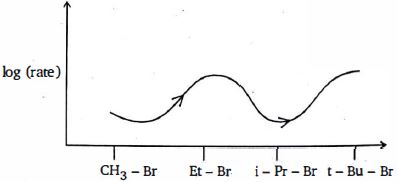
Solution
(A) The rate of $S_N2$ reaction is inversely proportional to the steric hindrance around the reaction center.
As the number of alkyl groups attached to the carbon bearing the leaving group increases (i.e.,from methyl to tertiary),the steric hindrance increases,which significantly decreases the rate of the $S_N2$ reaction.
Therefore,$\log(\text{rate})$ decreases as we move from $CH_3Br$ to $t-BuBr$.
The correct graph is the one showing a downward trend.
As the number of alkyl groups attached to the carbon bearing the leaving group increases (i.e.,from methyl to tertiary),the steric hindrance increases,which significantly decreases the rate of the $S_N2$ reaction.
Therefore,$\log(\text{rate})$ decreases as we move from $CH_3Br$ to $t-BuBr$.
The correct graph is the one showing a downward trend.
0 likes
View Solution432
MediumMCQ
Which of the following is most reactive toward $S_N2$ reaction?
A
$p$-Methylbenzyl chloride
B
Benzyl chloride
C
$p$-Chlorobenzyl chloride
D
$p$-Nitrobenzyl chloride
Solution
(D) The reactivity of benzylic halides toward $S_N2$ reactions is influenced by the electronic effects of substituents on the benzene ring.
An electron-withdrawing group (like $-NO_2$) at the para position stabilizes the transition state of the $S_N2$ reaction by dispersing the negative charge that develops on the carbon atom during the nucleophilic attack.
Conversely,electron-donating groups (like $-CH_3$) destabilize the transition state.
Therefore,$p$-nitrobenzyl chloride is the most reactive toward $S_N2$ reaction among the given options.
An electron-withdrawing group (like $-NO_2$) at the para position stabilizes the transition state of the $S_N2$ reaction by dispersing the negative charge that develops on the carbon atom during the nucleophilic attack.
Conversely,electron-donating groups (like $-CH_3$) destabilize the transition state.
Therefore,$p$-nitrobenzyl chloride is the most reactive toward $S_N2$ reaction among the given options.
0 likes
View Solution433
DifficultMCQ
Among the given pairs,in which pair does the first compound react faster than the second compound in an $S_{N}1$ reaction?
A
$CH_{3}CH_{2}CH_{2}CH_{2}Br$ or $CH_{3}CH_{2}CH(Br)CH_{3}$
B
$CH_{3}C(Br)(CH_{3})CH_{2}CH_{3}$ or $CH_{3}CH(Br)CH(CH_{3})_{2}$
C
Bromocyclohexane or $3-$bromocyclohexene
D
$CH_{3}C(Br)(CH_{3})_{2}$ or $CH_{3}C(I)(CH_{3})_{2}$
Solution
(B) The rate of an $S_{N}1$ reaction depends on the stability of the carbocation intermediate formed after the leaving group departs.
In option $(c)$,the first compound is bromocyclohexane,which forms a secondary carbocation.
The second compound is $3-$bromocyclohexene,which forms an allylic carbocation upon the loss of the bromide ion.
An allylic carbocation is resonance-stabilized,making it significantly more stable than a simple secondary carbocation.
Therefore,$3$-bromocyclohexene reacts faster than bromocyclohexane.
In option $(b)$,the first compound is $CH_{3}C(Br)(CH_{3})CH_{2}CH_{3}$ (a tertiary alkyl bromide),which forms a tertiary carbocation.
The second compound is $CH_{3}CH(Br)CH(CH_{3})_{2}$ (a secondary alkyl bromide),which forms a secondary carbocation.
Since a tertiary carbocation is more stable than a secondary carbocation,the first compound reacts faster than the second.
Thus,both $(b)$ and $(c)$ are correct,but $(b)$ is the standard textbook example for tertiary vs secondary carbocation stability.
In option $(c)$,the first compound is bromocyclohexane,which forms a secondary carbocation.
The second compound is $3-$bromocyclohexene,which forms an allylic carbocation upon the loss of the bromide ion.
An allylic carbocation is resonance-stabilized,making it significantly more stable than a simple secondary carbocation.
Therefore,$3$-bromocyclohexene reacts faster than bromocyclohexane.
In option $(b)$,the first compound is $CH_{3}C(Br)(CH_{3})CH_{2}CH_{3}$ (a tertiary alkyl bromide),which forms a tertiary carbocation.
The second compound is $CH_{3}CH(Br)CH(CH_{3})_{2}$ (a secondary alkyl bromide),which forms a secondary carbocation.
Since a tertiary carbocation is more stable than a secondary carbocation,the first compound reacts faster than the second.
Thus,both $(b)$ and $(c)$ are correct,but $(b)$ is the standard textbook example for tertiary vs secondary carbocation stability.
0 likes
View Solution434
MediumMCQ
What is the major product of the following reaction?
$H_2C = CH - CH_2 - OH \xrightarrow[excess]{HBr} \text{Product}$
$H_2C = CH - CH_2 - OH \xrightarrow[excess]{HBr} \text{Product}$
A
$CH_3-CH(Br)-CH_2-Br$
B
$H_2C = CH - CH_2 - Br$
C
$CH_3-CH(Br)-CH_2-OH$
D
$CH_3-CH(OH)-CH_2-OH$
Solution
(A) The reaction of allyl alcohol with excess $HBr$ proceeds in two steps:
$1.$ Substitution of the hydroxyl group by bromine to form allyl bromide:
$CH_2=CH-CH_2-OH + HBr \rightarrow CH_2=CH-CH_2-Br + H_2O$
$2.$ Electrophilic addition of $HBr$ to the double bond of allyl bromide following Markovnikov's rule:
$CH_2=CH-CH_2-Br + HBr \rightarrow CH_3-CH(Br)-CH_2-Br$
Therefore,the major product is $1,2$-dibromopropane.
$1.$ Substitution of the hydroxyl group by bromine to form allyl bromide:
$CH_2=CH-CH_2-OH + HBr \rightarrow CH_2=CH-CH_2-Br + H_2O$
$2.$ Electrophilic addition of $HBr$ to the double bond of allyl bromide following Markovnikov's rule:
$CH_2=CH-CH_2-Br + HBr \rightarrow CH_3-CH(Br)-CH_2-Br$
Therefore,the major product is $1,2$-dibromopropane.
0 likes
View Solution435
MediumMCQ
$S_{N}1$ and $S_{N}2$ products are the same (excluding stereoisomers) for which of the following compounds?
A
$2-$chlorocyclohexane
B
$1-$chloro$-1-$methylcyclohexane
C
$4-$methylchlorocyclohexane
D
$Ph-CH(CH_3)-CHCl-CH_3$
Solution
(C) $S_{N}1$ reactions involve the formation of a carbocation intermediate,which can undergo rearrangement if a more stable carbocation can be formed. $S_{N}2$ reactions occur in a single step with inversion of configuration and no rearrangement. For the products to be the same (excluding stereoisomers),the substrate must not undergo rearrangement during the $S_{N}1$ process. In $4$-methylchlorocyclohexane,the chlorine is attached to a secondary carbon. Upon ionization,it forms a secondary carbocation that does not rearrange to a more stable form,leading to the same substitution product as the $S_{N}2$ pathway.
0 likes
View Solution436
MediumMCQ
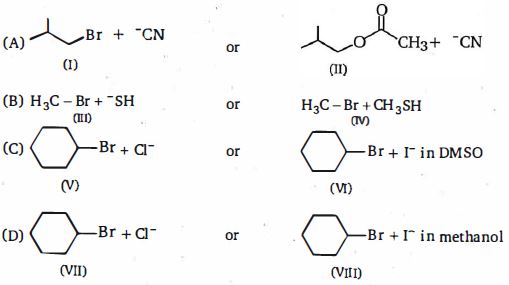
Consider the nucleophilic attacks given below. Select the reaction in each pair that shows the greater $S_N2$ reaction rate.
A
$A-I; B-III; C-V; D-VII$
B
$A-I; B-III; C-VI; D-VIII$
C
$A-II; B-III; C-V; D-VIII$
D
$A-I; B-IV; C-VI; D-VII$
Solution
(C) For $S_N2$ reactions,the rate depends on the strength of the nucleophile and the quality of the leaving group.
$(A)$ In pair $A$,$I$ involves $Br^-$ as a leaving group,while $II$ involves $CH_3COO^-$ as a leaving group. Since $Br^-$ is a better leaving group than $CH_3COO^-$,$I$ has a greater $S_N2$ rate.
$(B)$ In pair $B$,$III$ uses $SH^-$ (a strong nucleophile) while $IV$ uses $CH_3SH$ (a neutral,weaker nucleophile). Thus,$III$ has a greater $S_N2$ rate.
$(C)$ In pair $C$,both reactions occur in $DMSO$ (a polar aprotic solvent). In polar aprotic solvents,nucleophilicity increases as basicity increases. Since $Cl^-$ is more basic than $I^-$,$Cl^-$ is a better nucleophile in $DMSO$. Thus,$V$ has a greater $S_N2$ rate.
$(D)$ In pair $D$,the reactions occur in methanol (a polar protic solvent). In polar protic solvents,nucleophilicity increases down the group due to decreased solvation. Thus,$I^-$ is a better nucleophile than $Cl^-$. Therefore,$VIII$ has a greater $S_N2$ rate.
Conclusion: The correct choices are $I, III, V, VIII$,which corresponds to option $C$.
$(A)$ In pair $A$,$I$ involves $Br^-$ as a leaving group,while $II$ involves $CH_3COO^-$ as a leaving group. Since $Br^-$ is a better leaving group than $CH_3COO^-$,$I$ has a greater $S_N2$ rate.
$(B)$ In pair $B$,$III$ uses $SH^-$ (a strong nucleophile) while $IV$ uses $CH_3SH$ (a neutral,weaker nucleophile). Thus,$III$ has a greater $S_N2$ rate.
$(C)$ In pair $C$,both reactions occur in $DMSO$ (a polar aprotic solvent). In polar aprotic solvents,nucleophilicity increases as basicity increases. Since $Cl^-$ is more basic than $I^-$,$Cl^-$ is a better nucleophile in $DMSO$. Thus,$V$ has a greater $S_N2$ rate.
$(D)$ In pair $D$,the reactions occur in methanol (a polar protic solvent). In polar protic solvents,nucleophilicity increases down the group due to decreased solvation. Thus,$I^-$ is a better nucleophile than $Cl^-$. Therefore,$VIII$ has a greater $S_N2$ rate.
Conclusion: The correct choices are $I, III, V, VIII$,which corresponds to option $C$.
0 likes
View Solution437
MediumMCQ
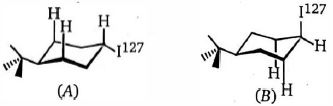
Which of the two stereoisomers of $4-t-$butylcyclohexyl iodide $(^{127}I^-)$ will undergo $S_N2$ substitution with $^{128}I^-$ faster,and why?
A
$A$ will react faster because it is the more stable of the two isomers.
B
$A$ will react faster because it will yield a more stable product,and the transition state for both reactions is of the same energy.
C
$A$ will react faster because the approach of $^{128}I^-$ can occur unhindered.
D
$B$ will react faster because it is less stable than $A$,and the transition state for both reactions is of the same energy.
Solution
(C) In isomer $A$,the iodine atom is in the axial position. Due to $1,3-$diaxial interactions,the leaving group $(I^-)$ is more sterically crowded and experiences repulsion,which facilitates its departure.
In isomer $B$,the iodine atom is in the equatorial position,which is less sterically hindered and more stable,making the departure of the leaving group slower.
Therefore,the axial isomer $(A)$ undergoes $S_N2$ substitution faster due to the relief of steric strain upon the departure of the leaving group.
In isomer $B$,the iodine atom is in the equatorial position,which is less sterically hindered and more stable,making the departure of the leaving group slower.
Therefore,the axial isomer $(A)$ undergoes $S_N2$ substitution faster due to the relief of steric strain upon the departure of the leaving group.
0 likes
View Solution438
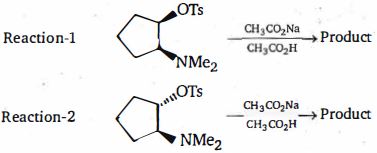
DifficultMCQ
Identify the products of the given reactions.
A
The product of Reaction-$1$ is a single enantiomer,while Reaction-$2$ yields a racemic mixture.
B
Reaction-$1$ yields a racemic mixture,while the product of Reaction-$2$ is a single enantiomer.
C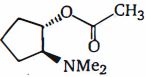
$A$ single product is obtained in both the reactions.
D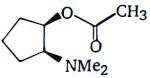
$A$ single product is obtained in both the reactions.
Solution
(C) In Reaction-$1$,the $-OTs$ group and the $-NMe_2$ group are in a cis-configuration. The nucleophilic attack by $CH_3COO^-$ occurs via an $S_N2$ mechanism,resulting in inversion of configuration at the carbon atom bearing the $-OTs$ group. Since the starting material is chiral,the product is a single enantiomer.
In Reaction-$2$,the $-OTs$ group and the $-NMe_2$ group are in a trans-configuration. The lone pair on the nitrogen atom of the $-NMe_2$ group participates in Neighboring Group Participation $(NGP)$,forming a cyclic aziridinium ion intermediate. This intermediate is then opened by the acetate nucleophile. Due to the symmetry and the nature of the $NGP$-assisted pathway,this reaction also leads to a specific stereochemical outcome,typically resulting in a single product (or a specific pair of enantiomers depending on the starting material's chirality). Given the options,the most accurate description is that a single product is obtained in both reactions due to the stereospecific nature of these pathways.
In Reaction-$2$,the $-OTs$ group and the $-NMe_2$ group are in a trans-configuration. The lone pair on the nitrogen atom of the $-NMe_2$ group participates in Neighboring Group Participation $(NGP)$,forming a cyclic aziridinium ion intermediate. This intermediate is then opened by the acetate nucleophile. Due to the symmetry and the nature of the $NGP$-assisted pathway,this reaction also leads to a specific stereochemical outcome,typically resulting in a single product (or a specific pair of enantiomers depending on the starting material's chirality). Given the options,the most accurate description is that a single product is obtained in both reactions due to the stereospecific nature of these pathways.
0 likes
View Solution439
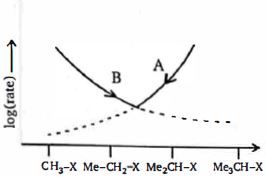
DifficultMCQ
Which of the following is true about the given graphs $A$ and $B$?
A
$A \to S_{N^1} , \, B \to S_{N^2}$
B
$A \to S_{N^2} , \, B \to S_{N^1}$
C
$A$ & $B \to E_1$
D
$A$ & $B \to E_2$
Solution
(A) The graph shows the variation of reaction rate with the degree of substitution of the alkyl halide.
$1$. For $S_{N^2}$ reactions,the rate decreases as the steric hindrance around the reaction center increases. Thus,the rate order is $CH_3-X > Me-CH_2-X > Me_2CH-X > Me_3C-X$. This corresponds to graph $B$.
$2$. For $S_{N^1}$ reactions,the rate increases as the stability of the carbocation intermediate increases. Thus,the rate order is $Me_3C-X > Me_2CH-X > Me-CH_2-X > CH_3-X$. This corresponds to graph $A$.
Therefore,$A \to S_{N^1}$ and $B \to S_{N^2}$.
$1$. For $S_{N^2}$ reactions,the rate decreases as the steric hindrance around the reaction center increases. Thus,the rate order is $CH_3-X > Me-CH_2-X > Me_2CH-X > Me_3C-X$. This corresponds to graph $B$.
$2$. For $S_{N^1}$ reactions,the rate increases as the stability of the carbocation intermediate increases. Thus,the rate order is $Me_3C-X > Me_2CH-X > Me-CH_2-X > CH_3-X$. This corresponds to graph $A$.
Therefore,$A \to S_{N^1}$ and $B \to S_{N^2}$.
0 likes
View Solution440
MediumMCQ
What is the principal product of the following reaction?
$CH_3-CH(Br)-CH_2-CH_2-CH(Cl)-CH_3 + NaN_3 \rightarrow \text{Product}$
$CH_3-CH(Br)-CH_2-CH_2-CH(Cl)-CH_3 + NaN_3 \rightarrow \text{Product}$
A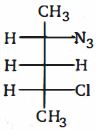
B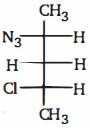
C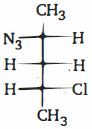
D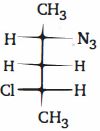
Solution
(C) The reaction involves a nucleophilic substitution with $NaN_3$ (azide ion,$N_3^-$) acting as the nucleophile.
$Br^-$ is a better leaving group than $Cl^-$,so the substitution occurs at the carbon atom attached to the bromine atom.
Since $NaN_3$ is a strong nucleophile and the reaction proceeds via an $S_N2$ mechanism,the nucleophile attacks from the side opposite to the leaving group,resulting in an inversion of configuration at the chiral center.
Therefore,the $-N_3$ group replaces the $-Br$ group with inversion of configuration.
$Br^-$ is a better leaving group than $Cl^-$,so the substitution occurs at the carbon atom attached to the bromine atom.
Since $NaN_3$ is a strong nucleophile and the reaction proceeds via an $S_N2$ mechanism,the nucleophile attacks from the side opposite to the leaving group,resulting in an inversion of configuration at the chiral center.
Therefore,the $-N_3$ group replaces the $-Br$ group with inversion of configuration.
0 likes
View Solution441
MediumMCQ
What would be the effect of increasing solvent polarity on the rate of each of the following reactions? ($Nu =$ neutral nucleophile)
$A. Nu + R-L \to Nu^{+}-R + L^{-}$
$B. R-L \to R^{+} + L^{-}$
$A. Nu + R-L \to Nu^{+}-R + L^{-}$
$B. R-L \to R^{+} + L^{-}$
A
Increase in both $A$ and $B$
B
Increase in $A$ and decrease in $B$
C
Decrease in $A$ and increase in $B$
D
Decrease in both $A$ and $B$
Solution
(A) Reaction $A$ represents an $S_N2$ mechanism involving a neutral nucleophile and a neutral substrate,leading to a charged transition state. Increasing solvent polarity stabilizes the charged transition state more than the reactants,thus increasing the rate.
Reaction $B$ represents an $S_N1$ mechanism where the rate-determining step involves the formation of a carbocation $(R^{+})$ and an anion $(L^{-})$. Increasing solvent polarity stabilizes the ionic transition state and the resulting ions,thereby increasing the rate of reaction $B$ as well.
Reaction $B$ represents an $S_N1$ mechanism where the rate-determining step involves the formation of a carbocation $(R^{+})$ and an anion $(L^{-})$. Increasing solvent polarity stabilizes the ionic transition state and the resulting ions,thereby increasing the rate of reaction $B$ as well.
0 likes
View Solution442
MediumMCQ
Which of the following is most reactive toward $S_{N}2$ reaction?
A
$CH_2=CH-CH_2-Cl$
B
$Ph-CH_2-Cl$
C
$Me-O-CH_2-Cl$
D
$Ph-CO-CH_2-Cl$
Solution
(C) The reactivity of alkyl halides toward $S_{N}2$ reactions depends on the steric hindrance and the stability of the transition state.
$S_{N}2$ reactions are favored by less steric hindrance and electron-withdrawing groups that stabilize the transition state.
In $Me-O-CH_2-Cl$,the oxygen atom has lone pairs that can stabilize the transition state through resonance (or the inductive effect of the oxygen atom),making it highly reactive.
Specifically,$\alpha$-halo ethers are known to be extremely reactive in $S_{N}2$ reactions due to the stabilization of the transition state by the adjacent oxygen atom.
Therefore,$Me-O-CH_2-Cl$ is the most reactive toward $S_{N}2$ reaction.
$S_{N}2$ reactions are favored by less steric hindrance and electron-withdrawing groups that stabilize the transition state.
In $Me-O-CH_2-Cl$,the oxygen atom has lone pairs that can stabilize the transition state through resonance (or the inductive effect of the oxygen atom),making it highly reactive.
Specifically,$\alpha$-halo ethers are known to be extremely reactive in $S_{N}2$ reactions due to the stabilization of the transition state by the adjacent oxygen atom.
Therefore,$Me-O-CH_2-Cl$ is the most reactive toward $S_{N}2$ reaction.
0 likes
View Solution443
MediumMCQ
In the given pairs of alkyl halides,in which pair is the first compound more reactive than the second compound toward $S_N2$ reaction?
A
$(CH_3)_2CHBr$ or $CH_3-CH_2-CH_2-Br$
B
$CH_3-CH_2-CH_2-Br$ or $CH_3-CH_2-CH_2-I$
C
$Ph-Br$ or $CH_3-CH_2-CH_2-Br$
D
$CH_2=CH-CH_2-Cl$ or $CH_2=CH-Cl$
Solution
(D) The reactivity of alkyl halides toward $S_N2$ reactions depends on steric hindrance and the nature of the leaving group.
In option $D$,the first compound is allyl chloride $(CH_2=CH-CH_2-Cl)$,which is a primary alkyl halide and highly reactive toward $S_N2$ due to resonance stabilization of the transition state.
The second compound is vinyl chloride $(CH_2=CH-Cl)$,where the $C-Cl$ bond has partial double bond character due to resonance,making it very unreactive toward nucleophilic substitution.
Therefore,the first compound is significantly more reactive than the second.
In option $D$,the first compound is allyl chloride $(CH_2=CH-CH_2-Cl)$,which is a primary alkyl halide and highly reactive toward $S_N2$ due to resonance stabilization of the transition state.
The second compound is vinyl chloride $(CH_2=CH-Cl)$,where the $C-Cl$ bond has partial double bond character due to resonance,making it very unreactive toward nucleophilic substitution.
Therefore,the first compound is significantly more reactive than the second.
0 likes
View Solution444
MediumMCQ
In the given pairs of reactions,in which pair is the second reaction more reactive than the first toward $S_{N}2$ reaction?
A
$CH_{3}CH_{2}Cl + CH_{3}CH_{2}O^{-} \to CH_{3}CH_{2}OCH_{2}CH_{3}$ (or) $CH_{3}CH_{2}Cl + CH_{3}CH_{2}OH \to CH_{3}CH_{2}OCH_{2}CH_{3}$
B
$CH_{3}CH_{2}Cl + EtO^{-} \to CH_{3}CH_{2}OEt$ (or) $CH_{3}CH_{2}Cl + EtS^{-} \to CH_{3}CH_{2}SEt$
C
$EtCl (1 \ M) + CH_{3}O^{-} (2 \ M) \to EtOCH_{3}$ (or) $EtCl (2 \ M) + CH_{3}O^{-} (1 \ M) \to EtOCH_{3}$
D
$EtBr + Ph_{3}P \to EtP^{+}Ph_{3}$ (or) $EtBr + Ph_{3}N \to EtN^{+}Ph_{3}$
Solution
(B) The rate of an $S_{N}2$ reaction depends on the nucleophilicity of the nucleophile.
$(a)$ Charged nucleophiles $(EtO^{-})$ are much stronger than neutral nucleophiles $(EtOH)$. Thus,the first reaction is faster.
$(b)$ $EtS^{-}$ is a better nucleophile than $EtO^{-}$ because sulfur is larger and more polarizable than oxygen,leading to a more stable transition state. Therefore,the second reaction is faster.
$(c)$ The rate of $S_{N}2$ is given by $Rate = k[Substrate][Nu^{-}]$. In both cases,the product of concentrations $[Substrate] \times [Nu^{-}]$ is $1 \times 2 = 2$,so the rates are equal.
$(d)$ $Ph_{3}P$ is a better nucleophile than $Ph_{3}N$ due to the larger size of phosphorus,which allows for better charge dispersion in the transition state. Thus,the first reaction is faster.
$(a)$ Charged nucleophiles $(EtO^{-})$ are much stronger than neutral nucleophiles $(EtOH)$. Thus,the first reaction is faster.
$(b)$ $EtS^{-}$ is a better nucleophile than $EtO^{-}$ because sulfur is larger and more polarizable than oxygen,leading to a more stable transition state. Therefore,the second reaction is faster.
$(c)$ The rate of $S_{N}2$ is given by $Rate = k[Substrate][Nu^{-}]$. In both cases,the product of concentrations $[Substrate] \times [Nu^{-}]$ is $1 \times 2 = 2$,so the rates are equal.
$(d)$ $Ph_{3}P$ is a better nucleophile than $Ph_{3}N$ due to the larger size of phosphorus,which allows for better charge dispersion in the transition state. Thus,the first reaction is faster.
0 likes
View Solution445
DifficultMCQ
Among the following pairs of reactions,in which pair is the second reaction more reactive than the first in an $S_{N^1}$ reaction?
A
$Me_3C-Cl + H_2O \to Me_3C-OH$ (or) $Me_3C-Br + H_2O \to Me_3C-OH$
B
$Me_3C-Cl + CH_3OH \to Me_3C-OCH_3$ (or) $Me_3C-Cl + H_2O \to Me_3C-OH$
C
$\underset{(1 \ M)}{Me_3C-Cl} + H_2O \to$ (or) $\underset{(2 \ M)}{Me_3C-Cl} + H_2O \to$
D
All of these
Solution
(D) $S_{N^1}$ reaction rate depends on the following factors:
$1$. Leaving group ability: $Br^-$ is a better leaving group than $Cl^-$,so the second reaction in option $A$ is faster.
$2$. Solvent polarity: $H_2O$ has a higher dielectric constant than $CH_3OH$,which stabilizes the carbocation intermediate more effectively,making the second reaction in option $B$ faster.
$3$. Substrate concentration: The rate of $S_{N^1}$ is proportional to the concentration of the substrate. $A$ higher concentration $(2 \ M)$ in the second reaction makes it faster than the first $(1 \ M)$ in option $C$.
Therefore,all pairs satisfy the condition.
$1$. Leaving group ability: $Br^-$ is a better leaving group than $Cl^-$,so the second reaction in option $A$ is faster.
$2$. Solvent polarity: $H_2O$ has a higher dielectric constant than $CH_3OH$,which stabilizes the carbocation intermediate more effectively,making the second reaction in option $B$ faster.
$3$. Substrate concentration: The rate of $S_{N^1}$ is proportional to the concentration of the substrate. $A$ higher concentration $(2 \ M)$ in the second reaction makes it faster than the first $(1 \ M)$ in option $C$.
Therefore,all pairs satisfy the condition.
0 likes
View Solution446
MediumMCQ
Which is a true statement concerning the transition state of an $S_N2$ reaction?
A
Closely resembles a carbocation intermediate
B
The electrophile is responsible for the reaction
C
Lower in energy than the starting materials
D
Involves both the nucleophile and electrophile
Solution
(D) The $S_N2$ reaction proceeds through a single-step concerted mechanism where the nucleophile attacks the electrophilic carbon from the side opposite to the leaving group.
In the transition state,the bond between the nucleophile and the carbon is partially formed,and the bond between the carbon and the leaving group is partially broken.
Therefore,the transition state involves both the nucleophile and the electrophile (substrate) simultaneously.
Thus,option $D$ is correct.
In the transition state,the bond between the nucleophile and the carbon is partially formed,and the bond between the carbon and the leaving group is partially broken.
Therefore,the transition state involves both the nucleophile and the electrophile (substrate) simultaneously.
Thus,option $D$ is correct.
0 likes
View Solution447
DifficultMCQ
Increasing the concentration of a nucleophile in a typical $S_N2$ reaction by a factor of $10$ will cause the reaction rate to
A
increase by a factor of $10$
B
increase by a factor of $10^2$
C
decrease by a factor of $10$
D
remain about the same
Solution
(A) The rate law for an $S_N2$ reaction is given by: $\text{Rate} = k [\text{Substrate}] [\text{Nucleophile}]$.
Since the rate is directly proportional to the concentration of the nucleophile,increasing the concentration of the nucleophile by a factor of $10$ will increase the reaction rate by a factor of $10$.
Since the rate is directly proportional to the concentration of the nucleophile,increasing the concentration of the nucleophile by a factor of $10$ will increase the reaction rate by a factor of $10$.
0 likes
View Solution448
MediumMCQ
Decreasing the concentration of an electrophile (substrate) in a typical $S_N2$ reaction by a factor of $3$ will cause the reaction rate to
A
increase by a factor of $3$
B
increase by a factor of $3^2$
C
decrease by a factor of $3$
D
remain about the same
Solution
(C) The rate law for an $S_N2$ reaction is given by: $\text{Rate} = k[\text{Substrate}][\text{Nucleophile}]$.
Since the reaction is first-order with respect to the substrate (electrophile),the rate is directly proportional to its concentration.
If the concentration of the substrate is decreased by a factor of $3$,the reaction rate will also decrease by a factor of $3$.
Since the reaction is first-order with respect to the substrate (electrophile),the rate is directly proportional to its concentration.
If the concentration of the substrate is decreased by a factor of $3$,the reaction rate will also decrease by a factor of $3$.
0 likes
View Solution449
DifficultMCQ
Increasing the concentration of an electrophile (substrate) in a typical $S_N2$ reaction by a factor of $3$ and the concentration of the nucleophile by a factor of $3$ will change the reaction rate to
A
increase by a factor of $6$
B
increase by a factor of $9$
C
decrease by a factor of $3$
D
remain about the same
Solution
(B) The rate law for an $S_N2$ reaction is given by: $Rate = k [Substrate] [Nucleophile]$.
If the concentration of the substrate is increased by a factor of $3$ and the concentration of the nucleophile is increased by a factor of $3$,the new rate becomes:
$Rate_{new} = k (3 [Substrate]) (3 [Nucleophile]) = 9 \times k [Substrate] [Nucleophile]$.
Therefore,the reaction rate increases by a factor of $9$.
If the concentration of the substrate is increased by a factor of $3$ and the concentration of the nucleophile is increased by a factor of $3$,the new rate becomes:
$Rate_{new} = k (3 [Substrate]) (3 [Nucleophile]) = 9 \times k [Substrate] [Nucleophile]$.
Therefore,the reaction rate increases by a factor of $9$.
0 likes
View Solution450
DifficultMCQ
Consider the following reaction and select the best choice that represents the product:
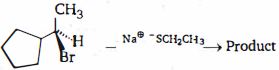
A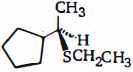
B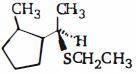
C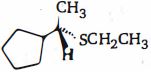
D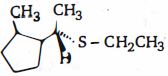
Solution
(B) The given reaction involves a secondary alkyl halide reacting with a strong nucleophile,$Na^+ -SCH_2CH_3$ (sodium ethanethiolate).
This reaction proceeds via an $S_N2$ mechanism.
In an $S_N2$ reaction,the nucleophile attacks the electrophilic carbon from the side opposite to the leaving group $(-Br)$,resulting in the inversion of configuration at the chiral center (Walden inversion).
Therefore,the correct representation is the inversion of configuration.
This reaction proceeds via an $S_N2$ mechanism.
In an $S_N2$ reaction,the nucleophile attacks the electrophilic carbon from the side opposite to the leaving group $(-Br)$,resulting in the inversion of configuration at the chiral center (Walden inversion).
Therefore,the correct representation is the inversion of configuration.
0 likes
View SolutionHaloalkanes and Haloarenes — Properties of Haloalkanes · Frequently Asked Questions
1Are these Haloalkanes and Haloarenes questions useful for JEE and NEET?
Yes. All questions in this section are mapped to JEE Main and NEET exam patterns. Previous year questions from JEE Main, NEET, GUJCET and state-level exams are included with full solutions.
2Can I switch to Hindi or Gujarati for these questions?
Yes. Use the language tabs in the hero section or the sidebar to view the same questions and solutions in English, Hindi or Gujarati.
3How do I generate a question paper from this subtopic?
Use the Vedclass Exam Paper Generator — select the chapter and subtopic, set difficulty, and generate Sets A, B, C, D automatically. First 3 chapters of every subject are free.
Vedclass Products
For Students
Vedclass Test Series
Mock tests in real JEE/NEET style with performance analysis. 5-day free trial.
Start Free TrialFor Teachers
Exam Paper Generator
Generate Set A/B/C/D papers from this chapter in 2 minutes. 3 chapters free.
Try FreeFor Institutes
Online Exam Module
Live online exams with unlimited students, 360° analytics & white-label branding.
See DemoFor Teachers & Institutes
Generate a Haloalkanes and Haloarenes Exam Paper in 2 Minutes
Select subtopic & difficulty — Sets A, B, C, D auto-generated with No Repeat logic.
First 3 chapters of every subject are free — no payment required.