
A English
Properties of Haloalkanes Questions in English
Class 12 Chemistry · Haloalkanes and Haloarenes · Properties of Haloalkanes
1196+
Questions
English
Language
100%
With Solutions
Showing 50 of 1196 questions in English
301
MediumMCQ
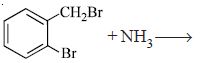
The major product in the given reaction is:
A
$2-$Bromobenzylamine
B
o-Phenylenediamine
C
$2-$Bromoaniline
D
All of these
Solution
(A) The reactant is $2$-bromobenzyl bromide. The reaction involves the nucleophilic substitution of the $-CH_2Br$ group with $NH_3$.
The $-CH_2Br$ group is a benzylic halide,which is highly reactive towards nucleophilic substitution ($S_N2$ mechanism) due to the resonance stabilization of the transition state.
In contrast,the $-Br$ atom directly attached to the benzene ring (aryl halide) is much less reactive towards nucleophilic substitution under these conditions due to the partial double bond character of the $C-Br$ bond and the instability of the phenyl cation.
Therefore,the nucleophile $NH_3$ will selectively attack the benzylic carbon to form $2$-bromobenzylamine.
The $-CH_2Br$ group is a benzylic halide,which is highly reactive towards nucleophilic substitution ($S_N2$ mechanism) due to the resonance stabilization of the transition state.
In contrast,the $-Br$ atom directly attached to the benzene ring (aryl halide) is much less reactive towards nucleophilic substitution under these conditions due to the partial double bond character of the $C-Br$ bond and the instability of the phenyl cation.
Therefore,the nucleophile $NH_3$ will selectively attack the benzylic carbon to form $2$-bromobenzylamine.
0 likes
View Solution302
DifficultMCQ
Consider the following groups:
$I$. $-OAc$
$II$. $-OMe$
$III$. $-OSO_2Me$
$IV$. $-OSO_2CF_3$
The order of leaving power is:
$I$. $-OAc$
$II$. $-OMe$
$III$. $-OSO_2Me$
$IV$. $-OSO_2CF_3$
The order of leaving power is:
A
$I > II > III > IV$
B
$IV > III > I > II$
C
$III > II > I > IV$
D
$II > III > IV > I$
Solution
(B) The leaving group ability is directly proportional to the stability of the resulting anion.
$1$. $-OSO_2CF_3$ (triflate) is the best leaving group because the negative charge is highly stabilized by resonance with the $SO_2$ group and the strong electron-withdrawing effect of the $-CF_3$ group.
$2$. $-OSO_2Me$ (mesylate) is the next best,as the negative charge is stabilized by resonance with the $SO_2$ group,but it lacks the strong inductive effect of the $-CF_3$ group.
$3$. $-OAc$ (acetate) is a moderate leaving group where the negative charge is stabilized by resonance between two oxygen atoms.
$4$. $-OMe$ (methoxide) is a poor leaving group because the negative charge is localized on the oxygen atom with no resonance stabilization.
Therefore,the correct order of leaving power is $IV > III > I > II$.
$1$. $-OSO_2CF_3$ (triflate) is the best leaving group because the negative charge is highly stabilized by resonance with the $SO_2$ group and the strong electron-withdrawing effect of the $-CF_3$ group.
$2$. $-OSO_2Me$ (mesylate) is the next best,as the negative charge is stabilized by resonance with the $SO_2$ group,but it lacks the strong inductive effect of the $-CF_3$ group.
$3$. $-OAc$ (acetate) is a moderate leaving group where the negative charge is stabilized by resonance between two oxygen atoms.
$4$. $-OMe$ (methoxide) is a poor leaving group because the negative charge is localized on the oxygen atom with no resonance stabilization.
Therefore,the correct order of leaving power is $IV > III > I > II$.
0 likes
View Solution303
AdvancedMCQ
Which one of the following compounds will give an enantiomeric pair on treatment with $HOH$?
A
$C_6H_5-C(C_2H_5)_2-I$
B
$CH_3-C(CH_3)(C_2H_5)-Br$
C
$C_6H_5-CH(D)-Br$
D
$C_2H_5-C(C_2H_5)(CH_3)-Br$
Solution
(C) In option $(c)$,the compound is $C_6H_5-CH(D)-Br$.
It contains a chiral carbon atom because it is attached to four different groups: $-C_6H_5$,$-H$,$-D$,and $-Br$.
Upon reaction with $HOH$ (water),it undergoes $S_N1$ substitution via a planar carbocation intermediate $C_6H_5-C^{+}H(D)$.
The nucleophile $H_2O$ can attack from either side of the planar carbocation,resulting in a racemic mixture (enantiomeric pair) of $C_6H_5-CH(D)-OH$.
It contains a chiral carbon atom because it is attached to four different groups: $-C_6H_5$,$-H$,$-D$,and $-Br$.
Upon reaction with $HOH$ (water),it undergoes $S_N1$ substitution via a planar carbocation intermediate $C_6H_5-C^{+}H(D)$.
The nucleophile $H_2O$ can attack from either side of the planar carbocation,resulting in a racemic mixture (enantiomeric pair) of $C_6H_5-CH(D)-OH$.
0 likes
View Solution304
DifficultMCQ
Arrange the following compounds in order of decreasing rate of hydrolysis for $S_{N}1$ reaction:
$(I) \ C_6H_5-CH_2-Br$
$(II) \ p-CH_3-C_6H_4-CH_2-Br$
$(III) \ p-CH_3CH_2-C_6H_4-CH_2-Br$
$(IV) \ p-(CH_3)_2CH-C_6H_4-CH_2-Br$
$(I) \ C_6H_5-CH_2-Br$
$(II) \ p-CH_3-C_6H_4-CH_2-Br$
$(III) \ p-CH_3CH_2-C_6H_4-CH_2-Br$
$(IV) \ p-(CH_3)_2CH-C_6H_4-CH_2-Br$
A
$IV > III > II > I$
B
$IV > III > II > I$
C
$III > IV > II > I$
D
$I > II > III > IV$
Solution
(A) The rate of $S_{N}1$ reaction depends on the stability of the carbocation intermediate formed after the departure of the leaving group $(Br^-)$.
In these compounds,the carbocation formed is a substituted benzyl carbocation: $Ar-CH_2^+$.
The stability of the benzyl carbocation is increased by electron-donating groups $(EDG)$ at the para position due to the $+I$ effect and hyperconjugation.
The electron-donating power of the alkyl groups follows the order: isopropyl $(-(CH_3)_2CH)$ > ethyl $(-CH_2CH_3)$ > methyl $(-CH_3)$ > hydrogen $(-H)$.
Therefore,the stability of the carbocations follows the order: $(IV) > (III) > (II) > (I)$.
Consequently,the rate of $S_{N}1$ hydrolysis follows the same order: $(IV) > (III) > (II) > (I)$.
In these compounds,the carbocation formed is a substituted benzyl carbocation: $Ar-CH_2^+$.
The stability of the benzyl carbocation is increased by electron-donating groups $(EDG)$ at the para position due to the $+I$ effect and hyperconjugation.
The electron-donating power of the alkyl groups follows the order: isopropyl $(-(CH_3)_2CH)$ > ethyl $(-CH_2CH_3)$ > methyl $(-CH_3)$ > hydrogen $(-H)$.
Therefore,the stability of the carbocations follows the order: $(IV) > (III) > (II) > (I)$.
Consequently,the rate of $S_{N}1$ hydrolysis follows the same order: $(IV) > (III) > (II) > (I)$.
0 likes
View Solution305
AdvancedMCQ
Which of the following nucleophiles will show minimum reactivity towards $S_N2$ reaction:
A
$Me_3C-O^{\ominus}$
B
$Me-O^{\ominus}$
C
Cyclopentoxide ion $(C_5H_9O^{\ominus})$
D
$Me_2CH-O^{\ominus}$
Solution
(A) The nucleophile $Me_3C-O^{\ominus}$ (tert-butoxide ion) will show minimum reactivity towards $S_N2$ reaction.
This is due to the presence of a bulky tert-butyl group,which creates significant steric hindrance.
Steric hindrance prevents the nucleophile from effectively approaching the electrophilic carbon atom of the substrate in an $S_N2$ transition state.
This is due to the presence of a bulky tert-butyl group,which creates significant steric hindrance.
Steric hindrance prevents the nucleophile from effectively approaching the electrophilic carbon atom of the substrate in an $S_N2$ transition state.
0 likes
View Solution306
DifficultMCQ
Rate of $S_N2$ reactions depends on :
A
The nucleophile
B
The carbon skeleton
C
The leaving group
D
All of these
Solution
(D) The rate of an $S_N2$ reaction is given by the rate law: $Rate = k[Substrate][Nucleophile]$.
$1$. The nucleophile: The strength and concentration of the nucleophile directly affect the rate.
$2$. The carbon skeleton: Steric hindrance plays a crucial role; primary alkyl halides react fastest due to less crowding.
$3$. The leaving group: $A$ better leaving group (weaker base) increases the rate of reaction.
Therefore,all these factors influence the rate of $S_N2$ reactions.
$1$. The nucleophile: The strength and concentration of the nucleophile directly affect the rate.
$2$. The carbon skeleton: Steric hindrance plays a crucial role; primary alkyl halides react fastest due to less crowding.
$3$. The leaving group: $A$ better leaving group (weaker base) increases the rate of reaction.
Therefore,all these factors influence the rate of $S_N2$ reactions.
0 likes
View Solution307
DifficultMCQ
Consider the given reaction: $CH_3-CH=CH-CH_2-OH \xrightarrow[S_N1]{HBr} [P]$. In the given reaction,the product $[P]$ is:
A
$CH_3-CH=CH-CH_2-Br$
B
$CH_3-CH(Br)-CH=CH_2$
C
$CH_2=CH-CH=CH_2$
D
$CH_3-CH(Br)-CH_2-CH_2-OH$
Solution
(B) The reaction proceeds via an $S_N1$ mechanism.
First,the hydroxyl group is protonated by $HBr$ and leaves as water to form a resonance-stabilized allylic carbocation: $[CH_3-CH=CH-CH_2^+ \leftrightarrow CH_3-CH^+-CH=CH_2]$.
The nucleophile $Br^-$ then attacks the more stable secondary carbocation site,leading to the formation of $CH_3-CH(Br)-CH=CH_2$ as the major product $[P]$.
First,the hydroxyl group is protonated by $HBr$ and leaves as water to form a resonance-stabilized allylic carbocation: $[CH_3-CH=CH-CH_2^+ \leftrightarrow CH_3-CH^+-CH=CH_2]$.
The nucleophile $Br^-$ then attacks the more stable secondary carbocation site,leading to the formation of $CH_3-CH(Br)-CH=CH_2$ as the major product $[P]$.
0 likes
View Solution308
DifficultMCQ
For the given reaction
$R_1-C(R)(X)-R_2 \xrightarrow{HOH} R_1-C(R)(OH)-R_2$
Which substrate will give maximum racemisation?
$R_1-C(R)(X)-R_2 \xrightarrow{HOH} R_1-C(R)(OH)-R_2$
Which substrate will give maximum racemisation?
A
$CH_3-C(C_6H_5)(Br)-C_2H_5$
B
$CH_2=CH-C(CH_3)(Br)-C_2H_5$
C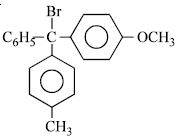
D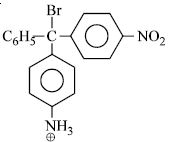
Solution
(C) Racemisation occurs via an $S_N1$ mechanism,which involves the formation of a carbocation intermediate. The stability of the carbocation determines the rate and the extent of racemisation.
Option $C$ features a central carbon attached to two phenyl rings,one of which has a methoxy $(-OCH_3)$ group at the para position. The methoxy group is a strong electron-donating group by resonance ($+M$ effect),which significantly stabilizes the resulting carbocation intermediate.
Greater stability of the carbocation leads to a more planar and longer-lived intermediate,which allows the nucleophile $(H_2O)$ to attack from either side with equal probability,resulting in maximum racemisation.
Therefore,the substrate in option $C$ will give maximum racemisation.
Option $C$ features a central carbon attached to two phenyl rings,one of which has a methoxy $(-OCH_3)$ group at the para position. The methoxy group is a strong electron-donating group by resonance ($+M$ effect),which significantly stabilizes the resulting carbocation intermediate.
Greater stability of the carbocation leads to a more planar and longer-lived intermediate,which allows the nucleophile $(H_2O)$ to attack from either side with equal probability,resulting in maximum racemisation.
Therefore,the substrate in option $C$ will give maximum racemisation.
0 likes
View Solution309
AdvancedMCQ
Consider the following four reactions: $(I) C_6H_5-CHCl-CH_3 \xrightarrow{95\% \text{ acetone}, 5\% \text{ water}} C_6H_5-CH(OH)-CH_3$ $(II) C_6H_5-CHCl-CH_3 \xrightarrow{90\% \text{ acetone}, 10\% \text{ water}} C_6H_5-CH(OH)-CH_3$ $(III) C_6H_5-CHCl-CH_3 \xrightarrow{80\% \text{ acetone}, 20\% \text{ water}} C_6H_5-CH(OH)-CH_3$ $(IV) C_6H_5-CHCl-CH_3 \xrightarrow{100\% \text{ water}} C_6H_5-CH(OH)-CH_3$ Arrange these reactions in decreasing order of the proportion of inverted product and select the correct answer from the codes given below:
A
$I > II > III > IV$
B
$II > I > III > IV$
C
$III > II > I > IV$
D
$IV > III > II > I$
Solution
(A) The given reaction is an $S_N1$ hydrolysis of a secondary benzylic halide.
In $S_N1$ reactions,the leaving group $(Cl^-)$ initially forms an ion pair with the carbocation,which shields the front side and favors attack from the back side (inversion).
In less polar solvents (higher acetone concentration),the ion pair is more stable and persists longer,leading to a higher proportion of inverted product.
As the solvent polarity increases (more water),the ion pair dissociates more easily into a free carbocation,leading to more racemization and a lower proportion of inverted product.
Therefore,the decreasing order of the proportion of inverted product is $I > II > III > IV$.
In $S_N1$ reactions,the leaving group $(Cl^-)$ initially forms an ion pair with the carbocation,which shields the front side and favors attack from the back side (inversion).
In less polar solvents (higher acetone concentration),the ion pair is more stable and persists longer,leading to a higher proportion of inverted product.
As the solvent polarity increases (more water),the ion pair dissociates more easily into a free carbocation,leading to more racemization and a lower proportion of inverted product.
Therefore,the decreasing order of the proportion of inverted product is $I > II > III > IV$.
0 likes
View Solution310
AdvancedMCQ
In the given reaction:
$CH_3-CH_2-\ddot{S}-CH_2^*-CH_2-Br \xrightarrow{HOH} [X]$
$[X]$ will be:
$CH_3-CH_2-\ddot{S}-CH_2^*-CH_2-Br \xrightarrow{HOH} [X]$
$[X]$ will be:
A
$CH_3-CH_2-S-CH_2^*-CH_2-OH$
B
$CH_3-CH_2-S-CH_2-CH_2^*-OH$
C
$1:1$ mixture of $(A)$ and $(B)$
D
$2:1$ mixture of $(A)$ and $(B)$
Solution
(C) The reaction involves an intramolecular nucleophilic substitution (anchimeric assistance or neighboring group participation).
The sulfur atom has a lone pair of electrons that attacks the carbon atom attached to the bromine,forming a cyclic sulfonium ion intermediate.
This cyclic intermediate is then opened by the nucleophile $(H_2O)$ at either of the two equivalent electrophilic carbons of the ring.
Due to the symmetry of the intermediate,the nucleophilic attack occurs with equal probability at both positions,resulting in a $1:1$ mixture of the two products $(A)$ and $(B)$.
The sulfur atom has a lone pair of electrons that attacks the carbon atom attached to the bromine,forming a cyclic sulfonium ion intermediate.
This cyclic intermediate is then opened by the nucleophile $(H_2O)$ at either of the two equivalent electrophilic carbons of the ring.
Due to the symmetry of the intermediate,the nucleophilic attack occurs with equal probability at both positions,resulting in a $1:1$ mixture of the two products $(A)$ and $(B)$.
0 likes
View Solution311
MediumMCQ
In the given reaction
$CH_3-CH(OTs)-CH_2-CH_2-CH(OTs)-CH_3$ $\xrightarrow[(ii) \ KOH]{(i) \ SH^{\ominus} (one \ equivalent)}$ $[X]$
$[X]$ will be :
$CH_3-CH(OTs)-CH_2-CH_2-CH(OTs)-CH_3$ $\xrightarrow[(ii) \ KOH]{(i) \ SH^{\ominus} (one \ equivalent)}$ $[X]$
$[X]$ will be :
A
$CH_3-CH(OTs)-CH_2-CH_2-CH(S^{\ominus})-CH_3$
B
$CH_3-CH(S^{\ominus})-CH_2-CH_2-CH(S^{\ominus})-CH_3$
C
$2,5-$dimethyltetrahydrothiophene
D
$2,6-$dimethyltetrahydrothiopyran
Solution
(C) The starting material is $CH_3-CH(OTs)-CH_2-CH_2-CH(OTs)-CH_3$,which is a ditosylate.
$(i)$ Treatment with one equivalent of $SH^{\ominus}$ leads to the nucleophilic substitution of one $OTs$ group by $SH^{\ominus}$ to form $CH_3-CH(SH)-CH_2-CH_2-CH(OTs)-CH_3$.
(ii) Treatment with $KOH$ deprotonates the $SH$ group to form a thiolate ion $(S^{\ominus})$,which then performs an intramolecular nucleophilic substitution $(S_N2)$ on the carbon bearing the remaining $OTs$ group.
This cyclization forms a five-membered ring containing a sulfur atom,resulting in $2,5-dimethyltetrahydrothiophene$.
$(i)$ Treatment with one equivalent of $SH^{\ominus}$ leads to the nucleophilic substitution of one $OTs$ group by $SH^{\ominus}$ to form $CH_3-CH(SH)-CH_2-CH_2-CH(OTs)-CH_3$.
(ii) Treatment with $KOH$ deprotonates the $SH$ group to form a thiolate ion $(S^{\ominus})$,which then performs an intramolecular nucleophilic substitution $(S_N2)$ on the carbon bearing the remaining $OTs$ group.
This cyclization forms a five-membered ring containing a sulfur atom,resulting in $2,5-dimethyltetrahydrothiophene$.
0 likes
View Solution312
MediumMCQ
The given compound $CH_3-O-CH_2-Br$ undergoes which of the following reactions?
A
Only $S_N1$
B
Only $S_N2$
C
$S_N1$ as well as $S_N2$
D
$E_1$
Solution
(C) $CH_3-O-CH_2-Br$ is a primary alkyl halide,which facilitates the $S_N2$ reaction pathway.
Additionally,the carbocation intermediate $CH_3-O-CH_2^+$ is significantly stabilized by the resonance effect of the lone pair on the oxygen atom $(CH_3-O^+=CH_2)$.
Due to this stabilization,the compound can also undergo $S_N1$ reactions.
Therefore,the compound exhibits both $S_N1$ and $S_N2$ reaction mechanisms.
Additionally,the carbocation intermediate $CH_3-O-CH_2^+$ is significantly stabilized by the resonance effect of the lone pair on the oxygen atom $(CH_3-O^+=CH_2)$.
Due to this stabilization,the compound can also undergo $S_N1$ reactions.
Therefore,the compound exhibits both $S_N1$ and $S_N2$ reaction mechanisms.
0 likes
View Solution313
EasyMCQ
Which one is liquid at room temperature?
A
$CH_3Cl$
B
$C_2H_5Cl$
C
$CH_3Br$
D
$C_2H_5Br$
Solution
(D) The physical state of haloalkanes depends on their molecular mass and intermolecular forces.
$CH_3Cl$ (boiling point $\approx -24^{\circ}C$),$C_2H_5Cl$ (boiling point $\approx 12^{\circ}C$),and $CH_3Br$ (boiling point $\approx 3.5^{\circ}C$) are gases at room temperature $(25^{\circ}C)$.
$C_2H_5Br$ has a boiling point of approximately $38^{\circ}C$,which makes it a liquid at room temperature.
$CH_3Cl$ (boiling point $\approx -24^{\circ}C$),$C_2H_5Cl$ (boiling point $\approx 12^{\circ}C$),and $CH_3Br$ (boiling point $\approx 3.5^{\circ}C$) are gases at room temperature $(25^{\circ}C)$.
$C_2H_5Br$ has a boiling point of approximately $38^{\circ}C$,which makes it a liquid at room temperature.
0 likes
View Solution314
EasyMCQ
The correct order of melting and boiling points of the primary $(1^o)$,secondary $(2^o)$ and tertiary $(3^o)$ alkyl halides is:
A
$1^o > 2^o > 3^o$
B
$3^o > 2^o > 1^o$
C
$2^o > 3^o > 1^o$
D
$3^o > 1^o > 2^o$
Solution
(A) For isomeric alkyl halides,the boiling point decreases as the branching increases.
This is because branching leads to a decrease in the surface area of the molecule,which in turn reduces the magnitude of the van der Waals forces of attraction.
Therefore,the primary $(1^o)$ alkyl halide has the highest surface area and the strongest intermolecular forces,while the tertiary $(3^o)$ alkyl halide has the lowest surface area and the weakest intermolecular forces.
The correct order is $1^o > 2^o > 3^o$.
This is because branching leads to a decrease in the surface area of the molecule,which in turn reduces the magnitude of the van der Waals forces of attraction.
Therefore,the primary $(1^o)$ alkyl halide has the highest surface area and the strongest intermolecular forces,while the tertiary $(3^o)$ alkyl halide has the lowest surface area and the weakest intermolecular forces.
The correct order is $1^o > 2^o > 3^o$.
0 likes
View Solution315
DifficultMCQ
$CCl_4 + KOH$ (excess) $\rightarrow$ end product of the reaction is :
A
$K_2CO_3$
B
$CO_2$
C
$C(OH)_4$
D
$HCOOK$
Solution
(A) The reaction of carbon tetrachloride $(CCl_4)$ with excess aqueous potassium hydroxide $(KOH)$ proceeds as follows:
$1$. Initially,$CCl_4$ undergoes nucleophilic substitution where chlorine atoms are replaced by hydroxyl groups to form an unstable intermediate,$C(OH)_4$.
$2$. $C(OH)_4$ is highly unstable due to the presence of four hydroxyl groups on a single carbon atom,leading to the loss of two water molecules $(2H_2O)$ to form carbonic acid $(H_2CO_3)$.
$3$. Since the reaction occurs in the presence of excess $KOH$ (a strong base),the carbonic acid is neutralized to form potassium carbonate $(K_2CO_3)$ and water.
$4$. The overall reaction is: $CCl_4 + 6KOH \rightarrow K_2CO_3 + 4KCl + 3H_2O$.
$1$. Initially,$CCl_4$ undergoes nucleophilic substitution where chlorine atoms are replaced by hydroxyl groups to form an unstable intermediate,$C(OH)_4$.
$2$. $C(OH)_4$ is highly unstable due to the presence of four hydroxyl groups on a single carbon atom,leading to the loss of two water molecules $(2H_2O)$ to form carbonic acid $(H_2CO_3)$.
$3$. Since the reaction occurs in the presence of excess $KOH$ (a strong base),the carbonic acid is neutralized to form potassium carbonate $(K_2CO_3)$ and water.
$4$. The overall reaction is: $CCl_4 + 6KOH \rightarrow K_2CO_3 + 4KCl + 3H_2O$.
0 likes
View Solution316
DifficultMCQ
Which of the following statements is invalid?
A
The more stable the carbocation,the faster it is formed.
B
Propyl cation changes to more stable isopropyl carbocation by $1,2-$ shift of a hydrogen.
C
Isopropyl chloride reacts with sodium ethoxide to form $1-$ethoxypropane.
D
Propyl halides react with sodium ethoxide to form $1-$ethoxypropane.
Solution
(C) Statement $A$ is correct because carbocation stability lowers the activation energy of the rate-determining step.
Statement $B$ is correct as a primary carbocation rearranges to a more stable secondary carbocation via a $1,2-$hydride shift.
Statement $C$ is invalid. Isopropyl chloride $(CH_3CHClCH_3)$ reacting with sodium ethoxide $(NaOCH_2CH_3)$ primarily undergoes an $E2$ elimination reaction to form propene,not $1-$ethoxypropane. Even if substitution occurs,it would form $2-$ethoxypropane,not $1-$ethoxypropane.
Statement $D$ is correct as propyl halides $(CH_3CH_2CH_2X)$ react with sodium ethoxide via an $S_N2$ mechanism to form $1-$ethoxypropane $(CH_3CH_2CH_2OCH_2CH_3)$.
Statement $B$ is correct as a primary carbocation rearranges to a more stable secondary carbocation via a $1,2-$hydride shift.
Statement $C$ is invalid. Isopropyl chloride $(CH_3CHClCH_3)$ reacting with sodium ethoxide $(NaOCH_2CH_3)$ primarily undergoes an $E2$ elimination reaction to form propene,not $1-$ethoxypropane. Even if substitution occurs,it would form $2-$ethoxypropane,not $1-$ethoxypropane.
Statement $D$ is correct as propyl halides $(CH_3CH_2CH_2X)$ react with sodium ethoxide via an $S_N2$ mechanism to form $1-$ethoxypropane $(CH_3CH_2CH_2OCH_2CH_3)$.
0 likes
View Solution317
DifficultMCQ
Nitrochloroform (Chloropicrin) is prepared by the action of chloroform and:
A
Hot aqueous solution of $KNO_3$
B
Hot aqueous solution of $NaNO_2$
C
Hot concentrated nitric acid
D
Hot dilute $HCl$ $+$ aq. $NaNO_2$ solution
Solution
(C) Nitrochloroform,also known as chloropicrin,is prepared by the reaction of chloroform $(CHCl_3)$ with concentrated nitric acid $(HNO_3)$.
The reaction is as follows:
$CHCl_3 + HNO_3 \rightarrow CCl_3NO_2 + H_2O$
In this reaction,the hydrogen atom of chloroform is replaced by a nitro group $(-NO_2)$.
The reaction is as follows:
$CHCl_3 + HNO_3 \rightarrow CCl_3NO_2 + H_2O$
In this reaction,the hydrogen atom of chloroform is replaced by a nitro group $(-NO_2)$.
0 likes
View Solution318
DifficultMCQ
Which of the following compounds is most rapidly hydrolysed by $S_N1$ mechanism?
A
$C_6H_5Cl$
B
$Cl-CH_2-CH=CH_2$
C
$(C_6H_5)_3CCl$
D
$C_6H_5CH_2Cl$
Solution
(C) The rate of $S_N1$ reaction depends on the stability of the carbocation intermediate formed during the rate-determining step.
In $(C_6H_5)_3CCl$,the carbocation formed is $(C_6H_5)_3C^+$,which is highly stabilized by resonance with three phenyl groups.
This carbocation is significantly more stable than the allyl carbocation $(CH_2=CH-CH_2^+)$,the benzyl carbocation $(C_6H_5CH_2^+)$,or the phenyl cation $(C_6H_5^+)$.
Therefore,$(C_6H_5)_3CCl$ undergoes hydrolysis most rapidly via the $S_N1$ mechanism.
In $(C_6H_5)_3CCl$,the carbocation formed is $(C_6H_5)_3C^+$,which is highly stabilized by resonance with three phenyl groups.
This carbocation is significantly more stable than the allyl carbocation $(CH_2=CH-CH_2^+)$,the benzyl carbocation $(C_6H_5CH_2^+)$,or the phenyl cation $(C_6H_5^+)$.
Therefore,$(C_6H_5)_3CCl$ undergoes hydrolysis most rapidly via the $S_N1$ mechanism.
0 likes
View Solution319
MediumMCQ
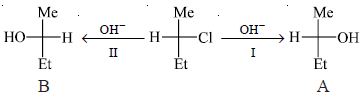
Identify the reaction mechanisms for steps $I$ and $II$ in the given transformation:
$CH(Me)(Et)Cl + OH^- \rightarrow CH(Me)(Et)OH$
(Refer to the provided image for stereochemical outcomes $A$ and $B$)
$CH(Me)(Et)Cl + OH^- \rightarrow CH(Me)(Et)OH$
(Refer to the provided image for stereochemical outcomes $A$ and $B$)
A
$I$ can't be $S_N1$
B
$II$ can't be $S_N1$
C
$I$ is $S_N1$ and $II$ is $S_N2$
D
$I$ is $S_N2$ and $II$ is $S_N1$
Solution
(C) The starting material is a chiral secondary alkyl chloride,$CH(Me)(Et)Cl$.
Step $I$ leads to product $A$,which shows retention of configuration relative to the starting material. This is characteristic of an $S_N1$ mechanism where the nucleophile can attack from the same side as the leaving group due to the formation of a planar carbocation intermediate.
Step $II$ leads to product $B$,which shows inversion of configuration. This is characteristic of an $S_N2$ mechanism,where the nucleophile attacks from the side opposite to the leaving group.
Therefore,step $I$ is $S_N1$ and step $II$ is $S_N2$.
Step $I$ leads to product $A$,which shows retention of configuration relative to the starting material. This is characteristic of an $S_N1$ mechanism where the nucleophile can attack from the same side as the leaving group due to the formation of a planar carbocation intermediate.
Step $II$ leads to product $B$,which shows inversion of configuration. This is characteristic of an $S_N2$ mechanism,where the nucleophile attacks from the side opposite to the leaving group.
Therefore,step $I$ is $S_N1$ and step $II$ is $S_N2$.
0 likes
View Solution320
DifficultMCQ
Identify product $A$ in the following reaction:
$4-methylcyclohexyl bromide + OH^- \xrightarrow{S_N2} A$
$4-methylcyclohexyl bromide + OH^- \xrightarrow{S_N2} A$
A
$4-$methylcyclohexanol (cis-isomer)
B
$4-$methylcyclohexanol (trans-isomer)
C
Both
D
None
Solution
(B) The reaction proceeds via an $S_N2$ mechanism.
In an $S_N2$ reaction,the nucleophile $(OH^-)$ attacks the electrophilic carbon from the side opposite to the leaving group $(Br^-)$,resulting in an inversion of configuration (Walden inversion).
Starting with the given $4-methylcyclohexyl$ bromide,the $Br$ atom is on one side of the ring. The $S_N2$ attack by $OH^-$ will occur from the opposite side,leading to the formation of the trans-isomer of $4-methylcyclohexanol$.
In an $S_N2$ reaction,the nucleophile $(OH^-)$ attacks the electrophilic carbon from the side opposite to the leaving group $(Br^-)$,resulting in an inversion of configuration (Walden inversion).
Starting with the given $4-methylcyclohexyl$ bromide,the $Br$ atom is on one side of the ring. The $S_N2$ attack by $OH^-$ will occur from the opposite side,leading to the formation of the trans-isomer of $4-methylcyclohexanol$.
0 likes
View Solution321
AdvancedMCQ
For $CH_3Br + OH^{-} \rightarrow CH_3OH + Br^{-}$ the rate of reaction is given by the expression:
A
rate $= k[CH_3Br]$
B
rate $= k[OH^{-}]$
C
rate $= k[CH_3Br][OH^{-}]$
D
rate $= k[CH_3Br]^0[OH^{-}]^0$
Solution
(C) The reaction $CH_3Br + OH^{-} \rightarrow CH_3OH + Br^{-}$ proceeds through an $S_N2$ mechanism.
In an $S_N2$ reaction,the rate-determining step involves both the substrate and the nucleophile.
Therefore,the rate law is given by the expression $rate = k[CH_3Br][OH^{-}]$.
This is a second-order reaction where the rate depends on the concentration of both the methyl bromide and the hydroxide ion.
In an $S_N2$ reaction,the rate-determining step involves both the substrate and the nucleophile.
Therefore,the rate law is given by the expression $rate = k[CH_3Br][OH^{-}]$.
This is a second-order reaction where the rate depends on the concentration of both the methyl bromide and the hydroxide ion.
0 likes
View Solution322
MediumMCQ
Which of the following will give a white precipitate with $AgNO_3$?
A
$3-$chlorocyclohex$-1-$ene
B
Chlorobenzene
C
Benzyl chloride
D
Both $A$ and $C$
Solution
(D) white precipitate with $AgNO_3$ is formed by the reaction of $Ag^+$ ions with $Cl^-$ ions to form $AgCl$.
This reaction occurs readily if the $C-Cl$ bond breaks easily to release $Cl^-$.
In $3$-chlorocyclohex-$1$-ene $(A)$,the carbocation formed after the loss of $Cl^-$ is allylic,which is resonance-stabilized.
In benzyl chloride $(C)$,the carbocation formed is benzylic,which is also highly resonance-stabilized.
Chlorobenzene $(B)$ does not give a precipitate because the $C-Cl$ bond has partial double-bond character due to resonance,making it difficult to break.
Therefore,both $A$ and $C$ readily give a white precipitate of $AgCl$ with $AgNO_3$.
This reaction occurs readily if the $C-Cl$ bond breaks easily to release $Cl^-$.
In $3$-chlorocyclohex-$1$-ene $(A)$,the carbocation formed after the loss of $Cl^-$ is allylic,which is resonance-stabilized.
In benzyl chloride $(C)$,the carbocation formed is benzylic,which is also highly resonance-stabilized.
Chlorobenzene $(B)$ does not give a precipitate because the $C-Cl$ bond has partial double-bond character due to resonance,making it difficult to break.
Therefore,both $A$ and $C$ readily give a white precipitate of $AgCl$ with $AgNO_3$.
0 likes
View Solution323
AdvancedMCQ
Which of the following statement$(s)$ is/are true about alkyl halides?
A
$Tertiary$ alkyl halides undergo $S_{N}2$ substitutions.
B
Alkyl iodides on exposure to sunlight gradually darken.
C
Alkyl chlorides do not give Beilstein test.
D
Nucleophilic substitution is most difficult in alkyl iodides.
Solution
(B) $1$. $Tertiary$ alkyl halides are sterically hindered,making $S_{N}2$ reactions extremely slow or impossible. They prefer $S_{N}1$ mechanisms.
$2$. Alkyl iodides are photosensitive. Upon exposure to sunlight,they decompose to liberate iodine $(I_2)$,which causes them to darken.
$3$. Alkyl chlorides do give a positive Beilstein test (green flame),although it is less intense than bromides or iodides.
$4$. Nucleophilic substitution is easiest in alkyl iodides because the $C-I$ bond is the weakest due to the large size of the iodine atom,making $I^-$ a good leaving group.
$2$. Alkyl iodides are photosensitive. Upon exposure to sunlight,they decompose to liberate iodine $(I_2)$,which causes them to darken.
$3$. Alkyl chlorides do give a positive Beilstein test (green flame),although it is less intense than bromides or iodides.
$4$. Nucleophilic substitution is easiest in alkyl iodides because the $C-I$ bond is the weakest due to the large size of the iodine atom,making $I^-$ a good leaving group.
0 likes
View Solution324
DifficultMCQ
Non-occurrence of the following reaction
$Br^{-} + CH_3OH \rightarrow BrCH_3 + OH^{-}$,is due to
$Br^{-} + CH_3OH \rightarrow BrCH_3 + OH^{-}$,is due to
A
Attacking nucleophile is stronger one
B
Leaving group is a strong base
C
Alcohols are not good substrate
D
Hydroxide ions are weak bases
Solution
(B) The reaction $Br^{-} + CH_3OH \rightarrow BrCH_3 + OH^{-}$ does not occur because the hydroxide ion $(OH^-)$ is a strong base and therefore acts as a very poor leaving group.
In a nucleophilic substitution reaction,a good leaving group must be a weak base.
In a nucleophilic substitution reaction,a good leaving group must be a weak base.
0 likes
View Solution325
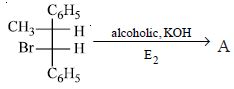
MediumMCQ
Product $(A)$ is :
A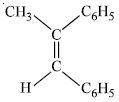
B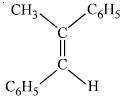
C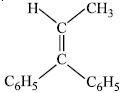
D
None is correct
Solution
(A) The reaction is an $E2$ elimination reaction using alcoholic $KOH$.
In an $E2$ mechanism,the base abstracts a $\beta$-hydrogen that is anti-periplanar to the leaving group $(Br^-)$.
The starting material is $1$-bromo-$1,2$-diphenylpropane. In the Newman projection or the eclipsed conformation,the $H$ on the $\beta$-carbon and the $Br$ on the $\alpha$-carbon must be anti to each other.
Upon elimination,the groups that are on the same side in the transition state will end up on the same side in the final alkene product.
Given the stereochemistry of the reactant,the $CH_3$ and the $H$ (from the $\beta$-carbon) will be on the same side of the double bond,while the two $C_6H_5$ groups will be on opposite sides.
This corresponds to the structure where $CH_3$ and $H$ are cis to each other.
In an $E2$ mechanism,the base abstracts a $\beta$-hydrogen that is anti-periplanar to the leaving group $(Br^-)$.
The starting material is $1$-bromo-$1,2$-diphenylpropane. In the Newman projection or the eclipsed conformation,the $H$ on the $\beta$-carbon and the $Br$ on the $\alpha$-carbon must be anti to each other.
Upon elimination,the groups that are on the same side in the transition state will end up on the same side in the final alkene product.
Given the stereochemistry of the reactant,the $CH_3$ and the $H$ (from the $\beta$-carbon) will be on the same side of the double bond,while the two $C_6H_5$ groups will be on opposite sides.
This corresponds to the structure where $CH_3$ and $H$ are cis to each other.
0 likes
View Solution326
DifficultMCQ
What will be the reduction products of the following reactions:
$CHCl_3 \xrightarrow[Zn/HCl \text{ (alc.)}]{+2H}$
$CHCl_3 \xrightarrow[Zn/HCl \text{ (aq.)}]{+4H}$
$CHCl_3 \xrightarrow[Zn/H_2O]{+6H}$
$CHCl_3 \xrightarrow[Zn/HCl \text{ (alc.)}]{+2H}$
$CHCl_3 \xrightarrow[Zn/HCl \text{ (aq.)}]{+4H}$
$CHCl_3 \xrightarrow[Zn/H_2O]{+6H}$
A
$CH_2Cl_2, CH_3Cl, CH_4$
B
$CH_4, CH_3Cl, CH_2Cl_2$
C
$CH_3Cl, CH_2Cl_2, CH_4$
D
$CH_3Cl, CH_4, CH_2Cl_2$
Solution
(A) The reduction of chloroform $(CHCl_3)$ depends on the reagents used:
$1$. $CHCl_3 + 2H \xrightarrow{Zn/HCl \text{ (alc.)}} CH_2Cl_2 + HCl$. The product is dichloromethane $(CH_2Cl_2)$.
$2$. $CHCl_3 + 4H \xrightarrow{Zn/HCl \text{ (aq.)}} CH_3Cl + 2HCl$. The product is chloromethane $(CH_3Cl)$.
$3$. $CHCl_3 + 6H \xrightarrow{Zn/H_2O} CH_4 + 3HCl$. The product is methane $(CH_4)$.
Thus,the sequence of products is $CH_2Cl_2, CH_3Cl, CH_4$.
$1$. $CHCl_3 + 2H \xrightarrow{Zn/HCl \text{ (alc.)}} CH_2Cl_2 + HCl$. The product is dichloromethane $(CH_2Cl_2)$.
$2$. $CHCl_3 + 4H \xrightarrow{Zn/HCl \text{ (aq.)}} CH_3Cl + 2HCl$. The product is chloromethane $(CH_3Cl)$.
$3$. $CHCl_3 + 6H \xrightarrow{Zn/H_2O} CH_4 + 3HCl$. The product is methane $(CH_4)$.
Thus,the sequence of products is $CH_2Cl_2, CH_3Cl, CH_4$.
0 likes
View Solution327
MediumMCQ
$CH_3-C(CH_3)=CH-CH_2-CH_2-Cl \xrightarrow[CaCO_3]{H_2O} (X)$
The major product $(X)$ of the above reaction is:
The major product $(X)$ of the above reaction is:
A
$CH_3-C(OH)(CH_3)-CH_2-CH_2-CH_3$
B
$CH_3-C(CH_3)=CH-CH_2-CH_2-OH$
C
$CH_3-C(CH_3)=CH-CH(OH)-CH_2-OH$
D
$2-$cyclopropylpropan$-2-$ol
Solution
(D) The reaction proceeds via a homoallylic carbocation intermediate.
The ionization of the $C-Cl$ bond in $CH_3-C(CH_3)=CH-CH_2-CH_2-Cl$ initially forms a primary carbocation,which is stabilized by the neighboring $\pi$ bond (homoallylic participation).
This leads to the formation of a more stable tertiary cyclopropylmethyl cation ($2$-cyclopropylpropan-$2$-yl cation).
Nucleophilic attack by $H_2O$ on this tertiary carbocation yields $2$-cyclopropylpropan-$2$-ol as the major product.
The ionization of the $C-Cl$ bond in $CH_3-C(CH_3)=CH-CH_2-CH_2-Cl$ initially forms a primary carbocation,which is stabilized by the neighboring $\pi$ bond (homoallylic participation).
This leads to the formation of a more stable tertiary cyclopropylmethyl cation ($2$-cyclopropylpropan-$2$-yl cation).
Nucleophilic attack by $H_2O$ on this tertiary carbocation yields $2$-cyclopropylpropan-$2$-ol as the major product.
0 likes
View Solution328
AdvancedMCQ
The reactivity of $2-$bromo$-2-$methylbutane $(I)$,$1-$bromopentane $(II)$ and $2-$bromopentane $(III)$ towards $S_N2$ displacement is such that :
A
$I > II > III$
B
$I > III > II$
C
$II > III > I$
D
$II > I > III$
Solution
(C) The reactivity of alkyl halides towards $S_N2$ reactions is primarily governed by steric hindrance.
$S_N2$ reactions involve the nucleophilic attack from the back side,which is hindered by the presence of bulky groups around the electrophilic carbon.
Therefore,the order of reactivity is $1^{\circ} > 2^{\circ} > 3^{\circ}$.
In the given compounds:
$1-$bromopentane $(II)$ is a primary $(1^{\circ})$ alkyl halide.
$2-$bromopentane $(III)$ is a secondary $(2^{\circ})$ alkyl halide.
$2-$bromo$-2-$methylbutane $(I)$ is a tertiary $(3^{\circ})$ alkyl halide.
Thus,the correct order of reactivity towards $S_N2$ displacement is $II > III > I$.
$S_N2$ reactions involve the nucleophilic attack from the back side,which is hindered by the presence of bulky groups around the electrophilic carbon.
Therefore,the order of reactivity is $1^{\circ} > 2^{\circ} > 3^{\circ}$.
In the given compounds:
$1-$bromopentane $(II)$ is a primary $(1^{\circ})$ alkyl halide.
$2-$bromopentane $(III)$ is a secondary $(2^{\circ})$ alkyl halide.
$2-$bromo$-2-$methylbutane $(I)$ is a tertiary $(3^{\circ})$ alkyl halide.
Thus,the correct order of reactivity towards $S_N2$ displacement is $II > III > I$.
0 likes
View Solution329
AdvancedMCQ
Consider the $S_N1$ solvolysis of the following halides in aqueous formic acid:
$(I)$ $CH_3-CH(CH_3)-CH(Br)-CH_3$
$(II)$ $CH_3-C(CH_3)(Br)-CH_3$
$(III)$ $C_6H_5-CH(Br)-C_6H_5$
$(IV)$ $C_6H_5-CH(Br)-CH_3$
Which one of the following is the correct sequence of the halides given above in the decreasing order of their reactivity?
$(I)$ $CH_3-CH(CH_3)-CH(Br)-CH_3$
$(II)$ $CH_3-C(CH_3)(Br)-CH_3$
$(III)$ $C_6H_5-CH(Br)-C_6H_5$
$(IV)$ $C_6H_5-CH(Br)-CH_3$
Which one of the following is the correct sequence of the halides given above in the decreasing order of their reactivity?
A
$III > IV > II > I$
B
$II > IV > I > III$
C
$I > II > III > IV$
D
$III > I > II > IV$
Solution
(A) The rate of $S_N1$ reaction is directly proportional to the stability of the carbocation formed in the rate-determining step.
$(III)$ $C_6H_5-CH(Br)-C_6H_5 \rightarrow (C_6H_5)_2CH^{+}$ (Highly stable due to resonance with two phenyl rings).
$(IV)$ $C_6H_5-CH(Br)-CH_3 \rightarrow C_6H_5-CH^{+}-CH_3$ (Stable due to resonance with one phenyl ring).
$(II)$ $CH_3-C(CH_3)(Br)-CH_3 \rightarrow (CH_3)_3C^{+}$ ($3^\circ$ carbocation,stabilized by $+I$ effect and $9$ hyperconjugative hydrogens).
$(I)$ $CH_3-CH(CH_3)-CH(Br)-CH_3 \rightarrow CH_3-CH(CH_3)-CH^{+}-CH_3$ ($2^\circ$ carbocation,stabilized by $4$ hyperconjugative hydrogens).
Therefore,the stability order is $III > IV > II > I$,which is also the order of reactivity.
$(III)$ $C_6H_5-CH(Br)-C_6H_5 \rightarrow (C_6H_5)_2CH^{+}$ (Highly stable due to resonance with two phenyl rings).
$(IV)$ $C_6H_5-CH(Br)-CH_3 \rightarrow C_6H_5-CH^{+}-CH_3$ (Stable due to resonance with one phenyl ring).
$(II)$ $CH_3-C(CH_3)(Br)-CH_3 \rightarrow (CH_3)_3C^{+}$ ($3^\circ$ carbocation,stabilized by $+I$ effect and $9$ hyperconjugative hydrogens).
$(I)$ $CH_3-CH(CH_3)-CH(Br)-CH_3 \rightarrow CH_3-CH(CH_3)-CH^{+}-CH_3$ ($2^\circ$ carbocation,stabilized by $4$ hyperconjugative hydrogens).
Therefore,the stability order is $III > IV > II > I$,which is also the order of reactivity.
0 likes
View Solution330
AdvancedMCQ
Arrange the following compounds in decreasing order of their reactivity for hydrolysis reaction:
$(I)$ $C_6H_5-CH_2-Br$
$(II)$ $C_6H_5-CH(Br)-C_2H_5$
$(III)$ $CH_3-CH_2-Br$
$(IV)$ $C_6H_5-CH(Br)-C_6H_5$
$(I)$ $C_6H_5-CH_2-Br$
$(II)$ $C_6H_5-CH(Br)-C_2H_5$
$(III)$ $CH_3-CH_2-Br$
$(IV)$ $C_6H_5-CH(Br)-C_6H_5$
A
$I > II > III > IV$
B
$IV > II > I > III$
C
$III > IV > II > I$
D
$IV > III > II > I$
Solution
(B) The reactivity of alkyl halides towards hydrolysis (via $S_N1$ mechanism) depends on the stability of the carbocation intermediate formed.
$(IV)$ forms a secondary dibenzylic carbocation $C_6H_5-C^+H-C_6H_5$,which is highly stable due to resonance with two phenyl rings.
$(II)$ forms a secondary benzylic carbocation $C_6H_5-C^+H-C_2H_5$,stabilized by resonance and the $+I$ effect of the ethyl group.
$(I)$ forms a primary benzylic carbocation $C_6H_5-C^+H_2$,stabilized by resonance.
$(III)$ forms a primary alkyl carbocation $CH_3-C^+H_2$,which is the least stable.
Therefore,the decreasing order of reactivity is $IV > II > I > III$.
$(IV)$ forms a secondary dibenzylic carbocation $C_6H_5-C^+H-C_6H_5$,which is highly stable due to resonance with two phenyl rings.
$(II)$ forms a secondary benzylic carbocation $C_6H_5-C^+H-C_2H_5$,stabilized by resonance and the $+I$ effect of the ethyl group.
$(I)$ forms a primary benzylic carbocation $C_6H_5-C^+H_2$,stabilized by resonance.
$(III)$ forms a primary alkyl carbocation $CH_3-C^+H_2$,which is the least stable.
Therefore,the decreasing order of reactivity is $IV > II > I > III$.
0 likes
View Solution331
MediumMCQ
The main product formed when ethylbenzene reacts with $Cl_2$ in the presence of light is:
A
$o- \& \ p-$ chloroethylbenzene
B
$1-$ Chloroethylbenzene
C
$2-$ Chloroethylbenzene
D
$m-$ Chloroethylbenzene
Solution
(B) The reaction of ethylbenzene with $Cl_2$ in the presence of light ($UV$ light) proceeds via a free radical mechanism.
Light facilitates the homolytic cleavage of $Cl_2$ to form chlorine radicals $(Cl^{\bullet})$.
These radicals abstract a hydrogen atom from the benzylic position (the carbon atom attached to the benzene ring) because the resulting benzylic radical is resonance-stabilized by the benzene ring.
Therefore,the chlorine atom replaces a hydrogen atom at the benzylic carbon,resulting in $1-$chloroethylbenzene $(C_6H_5-CHCl-CH_3)$.
Light facilitates the homolytic cleavage of $Cl_2$ to form chlorine radicals $(Cl^{\bullet})$.
These radicals abstract a hydrogen atom from the benzylic position (the carbon atom attached to the benzene ring) because the resulting benzylic radical is resonance-stabilized by the benzene ring.
Therefore,the chlorine atom replaces a hydrogen atom at the benzylic carbon,resulting in $1-$chloroethylbenzene $(C_6H_5-CHCl-CH_3)$.
0 likes
View Solution332
MediumMCQ
Chlorination of toluene in the presence of light and heat followed by treatment with aqueous $NaOH$ gives :
A
$o-$Cresol
B
$p-$Cresol
C
$2,4-$Dihydroxytoluene
D
Benzyl alcohol
Solution
(D) $1$. Chlorination of toluene in the presence of light and heat (free radical substitution) leads to the formation of benzal chloride $(C_6H_5CHCl_2)$ or benzotrichloride $(C_6H_5CCl_3)$ depending on the amount of chlorine used. However,the standard reaction for this sequence typically refers to the formation of benzaldehyde upon hydrolysis. If the question implies side-chain chlorination followed by hydrolysis,it yields benzaldehyde.
$2$. Re-evaluating the options: None of the options match benzaldehyde.
$3$. If the question implies chlorination of the ring (electrophilic substitution) followed by $NaOH$ treatment,it would yield chlorotoluene,not cresol.
$4$. Given the options provided,there is a discrepancy. However,if we assume the question meant the hydrolysis of benzyl chloride $(C_6H_5CH_2Cl)$,the product is benzyl alcohol $(C_6H_5CH_2OH)$. This is the most chemically consistent answer among the choices.
$2$. Re-evaluating the options: None of the options match benzaldehyde.
$3$. If the question implies chlorination of the ring (electrophilic substitution) followed by $NaOH$ treatment,it would yield chlorotoluene,not cresol.
$4$. Given the options provided,there is a discrepancy. However,if we assume the question meant the hydrolysis of benzyl chloride $(C_6H_5CH_2Cl)$,the product is benzyl alcohol $(C_6H_5CH_2OH)$. This is the most chemically consistent answer among the choices.
0 likes
View Solution333
MediumMCQ
The order of relative reactivity of the given halides towards $S_N2$ reaction is :
A
$PhCH_2Cl > PhCHClCH_3 > PhCCl(CH_3)_2$
B
$PhCH_2Cl < PhCHCl(CH_3) < PhCCl(CH_3)_2$
C
$PhCHCl(CH_3) > PhCH_2Cl > PhCCl(CH_3)_2$
D
$PhCHCl(CH_3) > PhCCl(CH_3)_2 > PhCH_2Cl$
Solution
(A) The $S_N2$ reaction mechanism is highly sensitive to steric hindrance.
In $S_N2$ reactions,the nucleophile attacks from the backside,and as the number of alkyl groups attached to the carbon bearing the leaving group increases,the steric hindrance increases,making the attack more difficult.
The order of reactivity for $S_N2$ is: $\text{primary} > \text{secondary} > \text{tertiary}$.
In the given compounds:
$1$. $PhCH_2Cl$ is a primary halide (least hindered).
$2$. $PhCHClCH_3$ is a secondary halide.
$3$. $PhCCl(CH_3)_2$ is a tertiary halide (most hindered).
Therefore,the order of reactivity is $PhCH_2Cl > PhCHClCH_3 > PhCCl(CH_3)_2$.
In $S_N2$ reactions,the nucleophile attacks from the backside,and as the number of alkyl groups attached to the carbon bearing the leaving group increases,the steric hindrance increases,making the attack more difficult.
The order of reactivity for $S_N2$ is: $\text{primary} > \text{secondary} > \text{tertiary}$.
In the given compounds:
$1$. $PhCH_2Cl$ is a primary halide (least hindered).
$2$. $PhCHClCH_3$ is a secondary halide.
$3$. $PhCCl(CH_3)_2$ is a tertiary halide (most hindered).
Therefore,the order of reactivity is $PhCH_2Cl > PhCHClCH_3 > PhCCl(CH_3)_2$.
0 likes
View Solution334
MediumMCQ
The order of relative reactivity of the given halides towards $S_N1$ reaction is:
A
$benzyl \ chloride > p-methoxybenzyl \ chloride > p-nitrobenzyl \ chloride$
B
$p-methoxybenzyl \ chloride > benzyl \ chloride > p-nitrobenzyl \ chloride$
C
$p-methoxybenzyl \ chloride > p-nitrobenzyl \ chloride > benzyl \ chloride$
D
$benzyl \ chloride > p-nitrobenzyl \ chloride > p-methoxybenzyl \ chloride$
Solution
(B) The $S_N1$ reaction proceeds via the formation of a carbocation intermediate. The stability of the carbocation determines the reactivity of the halide.
Substituents on the benzene ring affect the stability of the benzyl carbocation through inductive and resonance effects.
$1$. $p-methoxybenzyl \ chloride$: The $-OCH_3$ group is an electron-donating group $(EDG)$ by resonance ($+R$ effect),which significantly stabilizes the carbocation.
$2$. $benzyl \ chloride$: This forms a standard benzyl carbocation with no additional substituents.
$3$. $p-nitrobenzyl \ chloride$: The $-NO_2$ group is a strong electron-withdrawing group $(EWG)$ by both inductive $(-I)$ and resonance $(-R)$ effects,which destabilizes the carbocation.
Therefore,the order of stability of the carbocations,and thus the reactivity towards $S_N1$,is: $p-methoxybenzyl \ chloride > benzyl \ chloride > p-nitrobenzyl \ chloride$.
Substituents on the benzene ring affect the stability of the benzyl carbocation through inductive and resonance effects.
$1$. $p-methoxybenzyl \ chloride$: The $-OCH_3$ group is an electron-donating group $(EDG)$ by resonance ($+R$ effect),which significantly stabilizes the carbocation.
$2$. $benzyl \ chloride$: This forms a standard benzyl carbocation with no additional substituents.
$3$. $p-nitrobenzyl \ chloride$: The $-NO_2$ group is a strong electron-withdrawing group $(EWG)$ by both inductive $(-I)$ and resonance $(-R)$ effects,which destabilizes the carbocation.
Therefore,the order of stability of the carbocations,and thus the reactivity towards $S_N1$,is: $p-methoxybenzyl \ chloride > benzyl \ chloride > p-nitrobenzyl \ chloride$.
0 likes
View Solution335
MediumMCQ
Which of the following reactions is expected to take place by the $S_N2$ mechanism?
A
$CH_3-CH_2-C(CH_3)_2-Br + AgOH \xrightarrow{H_2O}$
B
$CH_3-C(CH_3)_2-Br + KOH \xrightarrow{H_2O}$
C
$CH_3-CH_2-CHBr-CH_3 + KOH \xrightarrow[heat]{C_2H_5OH}$
D
$CH_3-CHBr-CH_3 + CH_3COONa \xrightarrow{DMF}$
Solution
(D) In reaction $(d)$,a secondary alkyl halide reacts with a nucleophile in a polar aprotic solvent $(DMF)$.
Polar aprotic solvents favor the $S_N2$ mechanism by not solvating the nucleophile strongly,keeping it reactive.
Options $(a)$ and $(b)$ involve tertiary halides,which favor the $S_N1$ mechanism.
Option $(c)$ involves alcoholic $KOH$ and heat,which favors the elimination $(E2)$ mechanism.
Polar aprotic solvents favor the $S_N2$ mechanism by not solvating the nucleophile strongly,keeping it reactive.
Options $(a)$ and $(b)$ involve tertiary halides,which favor the $S_N1$ mechanism.
Option $(c)$ involves alcoholic $KOH$ and heat,which favors the elimination $(E2)$ mechanism.
0 likes
View Solution336
AdvancedMCQ
Consider the following reaction. Which of the following products is not expected to be formed?
$CH_3CH_2CH(Br)CH_3 + HC \equiv C^- Na^+ \rightarrow ?$
$CH_3CH_2CH(Br)CH_3 + HC \equiv C^- Na^+ \rightarrow ?$
A
$3-$Methylpent$-1-$yne
B
Pent$-2-$ene
C
cis-Pent$-2-$ene
D
$3-$Methylpent$-1-$yne (enantiomer)
Solution
(A) The reaction involves a secondary alkyl halide $(CH_3CH_2CH(Br)CH_3)$ reacting with a strong base/nucleophile,the acetylide ion $(HC \equiv C^-)$.
Secondary alkyl halides with strong bases primarily undergo $E2$ elimination reactions rather than $S_N2$ substitution,due to steric hindrance.
In this case,the acetylide ion acts as a base,abstracting a proton from the $\beta$-carbon to form alkenes.
Elimination can occur at two different $\beta$-carbons:
$1$. Removal of a proton from the $CH_3$ group (at $C_1$) leads to $pent-1-ene$.
$2$. Removal of a proton from the $CH_2$ group (at $C_3$) leads to $pent-2-ene$,which can exist as $cis$ or $trans$ isomers.
$S_N2$ substitution would lead to the formation of $3-methylpent-1-yne$. However,for a secondary halide,$S_N2$ is a minor pathway or suppressed by the $E2$ pathway.
Among the options,$3-methylpent-1-yne$ is the substitution product,but the question asks what is not expected. Given the options,$3-methylpent-1-yne$ is formed via $S_N2$,but $pent-2-ene$ (specifically the $cis$ isomer) is a major elimination product. Actually,looking at the options provided,$3-methylpent-1-yne$ is the substitution product. Since the substrate is secondary,$E2$ is favored. Thus,the substitution product is the least expected.
Secondary alkyl halides with strong bases primarily undergo $E2$ elimination reactions rather than $S_N2$ substitution,due to steric hindrance.
In this case,the acetylide ion acts as a base,abstracting a proton from the $\beta$-carbon to form alkenes.
Elimination can occur at two different $\beta$-carbons:
$1$. Removal of a proton from the $CH_3$ group (at $C_1$) leads to $pent-1-ene$.
$2$. Removal of a proton from the $CH_2$ group (at $C_3$) leads to $pent-2-ene$,which can exist as $cis$ or $trans$ isomers.
$S_N2$ substitution would lead to the formation of $3-methylpent-1-yne$. However,for a secondary halide,$S_N2$ is a minor pathway or suppressed by the $E2$ pathway.
Among the options,$3-methylpent-1-yne$ is the substitution product,but the question asks what is not expected. Given the options,$3-methylpent-1-yne$ is formed via $S_N2$,but $pent-2-ene$ (specifically the $cis$ isomer) is a major elimination product. Actually,looking at the options provided,$3-methylpent-1-yne$ is the substitution product. Since the substrate is secondary,$E2$ is favored. Thus,the substitution product is the least expected.
0 likes
View Solution337
DifficultMCQ
Predict the major product for the following $E2$ elimination reaction:
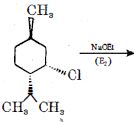
A
$1-$isopropyl$-4-$methylcyclohex$-1-$ene
B
$3-$isopropyl$-6-$methylcyclohex$-1-$ene
C
$4-$isopropyl$-1-$methylcyclohex$-1-$ene
D
$1-$isopropyl$-4-$methylcyclohex$-1-$ene (exocyclic double bond)
Solution
(C) The $E2$ elimination requires an anti-periplanar arrangement of the leaving group $(Cl)$ and the $\beta$-hydrogen.
In the chair conformation,the bulky isopropyl group prefers the equatorial position.
Elimination can occur from two $\beta$-carbons,leading to two possible products,$(I)$ and $(II)$.
Product $(II)$ has $5$ $\alpha$-hydrogens,making it more substituted and thus more stable than product $(I)$.
Therefore,$(II)$ is the major product,which is $4$-isopropyl-$1$-methylcyclohex-$1$-ene.
In the chair conformation,the bulky isopropyl group prefers the equatorial position.
Elimination can occur from two $\beta$-carbons,leading to two possible products,$(I)$ and $(II)$.
Product $(II)$ has $5$ $\alpha$-hydrogens,making it more substituted and thus more stable than product $(I)$.
Therefore,$(II)$ is the major product,which is $4$-isopropyl-$1$-methylcyclohex-$1$-ene.
0 likes
View Solution338
AdvancedMCQ
Which $Cl$ atom is most susceptible to be attacked by aqueous $KOH$?
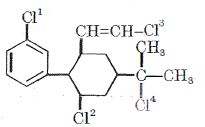
A
$Cl^1$
B
$Cl^2$
C
$Cl^3$
D
$Cl^4$
Solution
(D) The reactivity of a $C-Cl$ bond towards nucleophilic substitution depends on the nature of the carbon atom to which the chlorine is attached.
$Cl^1$ is attached to an aromatic ring (aryl halide),where the $C-Cl$ bond has partial double bond character due to resonance,making it least reactive.
$Cl^3$ is attached to a $sp^2$ hybridized carbon atom (vinylic halide),which is also very stable and less reactive towards nucleophilic substitution.
$Cl^2$ is attached to a secondary alkyl carbon,which can undergo nucleophilic substitution.
$Cl^4$ is attached to a tertiary alkyl carbon. Tertiary alkyl halides are the most reactive towards $S_N1$ reactions due to the formation of a stable tertiary carbocation intermediate. Therefore,$Cl^4$ is the most susceptible to nucleophilic attack by aqueous $KOH$.
$Cl^1$ is attached to an aromatic ring (aryl halide),where the $C-Cl$ bond has partial double bond character due to resonance,making it least reactive.
$Cl^3$ is attached to a $sp^2$ hybridized carbon atom (vinylic halide),which is also very stable and less reactive towards nucleophilic substitution.
$Cl^2$ is attached to a secondary alkyl carbon,which can undergo nucleophilic substitution.
$Cl^4$ is attached to a tertiary alkyl carbon. Tertiary alkyl halides are the most reactive towards $S_N1$ reactions due to the formation of a stable tertiary carbocation intermediate. Therefore,$Cl^4$ is the most susceptible to nucleophilic attack by aqueous $KOH$.
0 likes
View Solution339
DifficultMCQ
The correct reactivity order for $S_N2$ reaction is:
$(i)$ $CH_3COCH_2Cl$
(ii) $CH_2=CH-CH_2Cl$
(iii) $CH_3CH_2CH_2Cl$
$(i)$ $CH_3COCH_2Cl$
(ii) $CH_2=CH-CH_2Cl$
(iii) $CH_3CH_2CH_2Cl$
A
$(i) > (ii) > (iii)$
B
$(ii) > (iii) > (i)$
C
$(i) > (iii) > (ii)$
D
$(iii) > (i) > (ii)$
Solution
(A) $S_N2$ reactivity depends on the steric hindrance and the stability of the transition state.
$(i)$ $CH_3COCH_2Cl$ is an $\alpha$-halo ketone. The carbonyl group is electron-withdrawing and stabilizes the transition state through resonance/inductive effects,making it highly reactive towards $S_N2$.
(ii) $CH_2=CH-CH_2Cl$ is an allyl chloride. The transition state is stabilized by conjugation with the $\pi$-bond,making it more reactive than a simple primary alkyl halide.
(iii) $CH_3CH_2CH_2Cl$ is a simple primary alkyl halide.
Therefore,the reactivity order is $(i) > (ii) > (iii)$.
$(i)$ $CH_3COCH_2Cl$ is an $\alpha$-halo ketone. The carbonyl group is electron-withdrawing and stabilizes the transition state through resonance/inductive effects,making it highly reactive towards $S_N2$.
(ii) $CH_2=CH-CH_2Cl$ is an allyl chloride. The transition state is stabilized by conjugation with the $\pi$-bond,making it more reactive than a simple primary alkyl halide.
(iii) $CH_3CH_2CH_2Cl$ is a simple primary alkyl halide.
Therefore,the reactivity order is $(i) > (ii) > (iii)$.
0 likes
View Solution340
AdvancedMCQ
Which one of the following compounds will give a $Saytzeff$ alkene as the major product in an elimination reaction?
A
$CH_3-CH_2-CH(Br)-CH_3 \xrightarrow[alc. KOH]{\Delta}$
B
$CH_3-CH_2-CH(F)-CH_3 \xrightarrow[alc. KOH]{\Delta}$
C
$CH_3-CH_2-CH(CH_3)-N^{+}(CH_3)_3 OH^{-} \xrightarrow{\Delta}$
D
$CH_3-CH_2-CH(CH_3)-OCOCH_3 \xrightarrow{\Delta}$
Solution
(A) In the dehydrohalogenation of $2$-bromobutane $(CH_3-CH_2-CH(Br)-CH_3)$ with alcoholic $KOH$,the $Br^{-}$ ion is a good leaving group.
According to $Saytzeff$'s rule,the elimination of a $\beta$-hydrogen occurs from the more substituted carbon to form the more stable alkene,$2$-butene $(CH_3-CH=CH-CH_3)$,as the major product.
In contrast,alkyl fluorides (option $B$),quaternary ammonium salts (option $C$),and esters (option $D$) typically follow $Hofmann$'s rule,yielding the less substituted alkene ($1$-butene) as the major product due to the poor leaving group ability or steric/electronic factors in their respective transition states.
According to $Saytzeff$'s rule,the elimination of a $\beta$-hydrogen occurs from the more substituted carbon to form the more stable alkene,$2$-butene $(CH_3-CH=CH-CH_3)$,as the major product.
In contrast,alkyl fluorides (option $B$),quaternary ammonium salts (option $C$),and esters (option $D$) typically follow $Hofmann$'s rule,yielding the less substituted alkene ($1$-butene) as the major product due to the poor leaving group ability or steric/electronic factors in their respective transition states.
0 likes
View Solution341
AdvancedMCQ
What is $E$?
Cyclohexanone $\xrightarrow{Br_2 + CH_3COOH} A$ $\xrightarrow{Alc. KOH} B$ (Product with six-membered ring) $\xrightarrow[(2) H_2O]{(1) CH_3MgBr} C$ $\xrightarrow{H^{\oplus} + \Delta} D$ $\xrightarrow{HBr (1 \text{ mole})} E$
Cyclohexanone $\xrightarrow{Br_2 + CH_3COOH} A$ $\xrightarrow{Alc. KOH} B$ (Product with six-membered ring) $\xrightarrow[(2) H_2O]{(1) CH_3MgBr} C$ $\xrightarrow{H^{\oplus} + \Delta} D$ $\xrightarrow{HBr (1 \text{ mole})} E$
A
$3-$bromo$-1-$methylcyclohex$-1-$ene
B
$1-$bromo$-1-$methylcyclohex$-2-$ene
C
$4-$bromo$-1-$methylcyclohex$-1-$ene
D
$2-$bromo$-1-$methylcyclohex$-1-$ene
Solution
(A) $1$. Cyclohexanone reacts with $Br_2$ in $CH_3COOH$ to form $2$-bromocyclohexanone $(A)$.
$2$. $A$ undergoes dehydrohalogenation with $Alc. KOH$ to form cyclohex$-2-$en$-1-$one $(B)$.
$3$. $B$ reacts with $CH_3MgBr$ followed by $H_2O$ ($1$,$2$-addition) to form $1$-methylcyclohex$-2-$en$-1-$ol $(C)$.
$4$. $C$ undergoes acid-catalyzed dehydration $(H^{\oplus} + \Delta)$ to form $1$-methylcyclohexa$-1,3-$diene $(D)$.
$5$. $D$ reacts with $1 \text{ mole}$ of $HBr$ via thermodynamic control ($T$.$C$.$P$) to form the most stable product,which is $3$-bromo-$1$-methylcyclohex-$1$-ene $(E)$.
$2$. $A$ undergoes dehydrohalogenation with $Alc. KOH$ to form cyclohex$-2-$en$-1-$one $(B)$.
$3$. $B$ reacts with $CH_3MgBr$ followed by $H_2O$ ($1$,$2$-addition) to form $1$-methylcyclohex$-2-$en$-1-$ol $(C)$.
$4$. $C$ undergoes acid-catalyzed dehydration $(H^{\oplus} + \Delta)$ to form $1$-methylcyclohexa$-1,3-$diene $(D)$.
$5$. $D$ reacts with $1 \text{ mole}$ of $HBr$ via thermodynamic control ($T$.$C$.$P$) to form the most stable product,which is $3$-bromo-$1$-methylcyclohex-$1$-ene $(E)$.
0 likes
View Solution342
DifficultMCQ
Which of the following reactions gives an incorrect major product?
A
Chlorobenzene $\xrightarrow[(ii) CO_2, (iii) H^+]{(i) Mg/dry ether}$ Benzoic acid
B
$Me-C\equiv N \xrightarrow[(ii) H_3O^+]{(i) MeMgBr} Me-C(=O)-Me$
C
$Cl-(CH_2)_5-Cl \xrightarrow{Mg/dry ether (1 eq.)}$ Cyclohexane
D
$1,3-$dichlorocyclobutane $\xrightarrow{Mg/dry ether (1 eq.)}$ Bicyclobutane
Solution
(C) Let's analyze each reaction:
$A$. Chlorobenzene reacts with $Mg$ in dry ether to form phenylmagnesium chloride,which then reacts with $CO_2$ followed by acid workup to give benzoic acid. This is a correct reaction.
$B$. Methyl cyanide $(CH_3CN)$ reacts with $MeMgBr$ (Grignard reagent) followed by acid hydrolysis to form acetone $(CH_3COCH_3)$. This is a correct reaction.
$C$. $Cl-(CH_2)_5-Cl$ with $1$ equivalent of $Mg$ in dry ether forms a Grignard reagent at one end: $Cl-(CH_2)_5-MgCl$. This species can undergo intramolecular cyclization to form cyclopentane,not cyclohexane. Thus,this is an incorrect product.
$D$. $1,3$-dichlorocyclobutane with $Mg$ can undergo intramolecular coupling to form bicyclobutane. This is a known reaction.
Therefore,option $C$ is the incorrect major product.
$A$. Chlorobenzene reacts with $Mg$ in dry ether to form phenylmagnesium chloride,which then reacts with $CO_2$ followed by acid workup to give benzoic acid. This is a correct reaction.
$B$. Methyl cyanide $(CH_3CN)$ reacts with $MeMgBr$ (Grignard reagent) followed by acid hydrolysis to form acetone $(CH_3COCH_3)$. This is a correct reaction.
$C$. $Cl-(CH_2)_5-Cl$ with $1$ equivalent of $Mg$ in dry ether forms a Grignard reagent at one end: $Cl-(CH_2)_5-MgCl$. This species can undergo intramolecular cyclization to form cyclopentane,not cyclohexane. Thus,this is an incorrect product.
$D$. $1,3$-dichlorocyclobutane with $Mg$ can undergo intramolecular coupling to form bicyclobutane. This is a known reaction.
Therefore,option $C$ is the incorrect major product.
0 likes
View Solution343
AdvancedMCQ
Select the incorrect order among the following:
A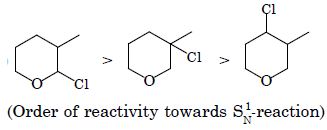
B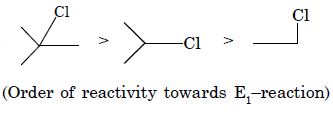
C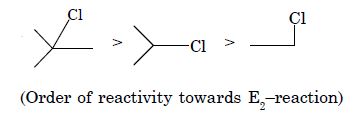
D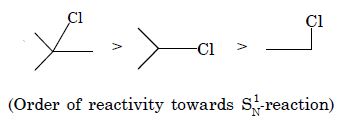
Solution
(A) In $S_N^1$ reactions,the rate depends on the stability of the carbocation intermediate. For the cyclic ethers in option $A$,the carbocation formed at the $3$-position in $3-$chloro$-3-$methyltetrahydropyran is tertiary and stabilized by the adjacent oxygen atom's lone pair (resonance),making it the most reactive. The order given in option $A$ is incorrect because $3-$chloro$-3-$methyltetrahydropyran should be the most reactive.
For $E_1$ reactions,the rate depends on the stability of the carbocation intermediate,which follows the order: $3^\circ > 2^\circ > 1^\circ$. Thus,(tert-butyl chloride) > (isopropyl chloride) > (ethyl chloride) is correct.
For $E_2$ reactions,the rate depends on the stability of the alkene formed and the number of $\beta$-hydrogens. The order (tert-butyl chloride) > (isopropyl chloride) > (ethyl chloride) is correct.
For $S_N^1$ reactions of simple alkyl halides,the order is $3^\circ > 2^\circ > 1^\circ$,so (tert-butyl chloride) > (isopropyl chloride) > (ethyl chloride) is correct.
For $E_1$ reactions,the rate depends on the stability of the carbocation intermediate,which follows the order: $3^\circ > 2^\circ > 1^\circ$. Thus,(tert-butyl chloride) > (isopropyl chloride) > (ethyl chloride) is correct.
For $E_2$ reactions,the rate depends on the stability of the alkene formed and the number of $\beta$-hydrogens. The order (tert-butyl chloride) > (isopropyl chloride) > (ethyl chloride) is correct.
For $S_N^1$ reactions of simple alkyl halides,the order is $3^\circ > 2^\circ > 1^\circ$,so (tert-butyl chloride) > (isopropyl chloride) > (ethyl chloride) is correct.
0 likes
View Solution344
AdvancedMCQ
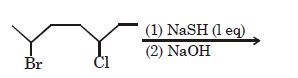
The major product obtained in the above reaction is
A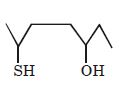
B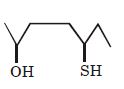
C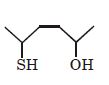
D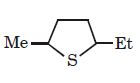
Solution
(D) The starting material is a haloalkane containing both a $Br$ and a $Cl$ atom.
$NaSH$ is a strong nucleophile. The $Br$ atom is a better leaving group than the $Cl$ atom,so $NaSH$ will selectively attack the carbon attached to $Br$ via an $S_N2$ mechanism to form a thiol $(-SH)$.
After the formation of the thiol,the molecule contains both a thiol group and a chloro group.
The thiol group $(-SH)$ is a strong nucleophile. In the presence of $NaOH$ (a base),the thiol is deprotonated to form a thiolate ion $(-S^-)$.
This internal thiolate ion then performs an intramolecular $S_N2$ reaction by attacking the carbon attached to the $Cl$ atom,displacing the $Cl^-$ ion and forming a cyclic sulfide (a thiacycloalkane).
The resulting product is a five-membered ring containing a sulfur atom,with a methyl group and an ethyl group attached to the carbons adjacent to the sulfur atom.
$NaSH$ is a strong nucleophile. The $Br$ atom is a better leaving group than the $Cl$ atom,so $NaSH$ will selectively attack the carbon attached to $Br$ via an $S_N2$ mechanism to form a thiol $(-SH)$.
After the formation of the thiol,the molecule contains both a thiol group and a chloro group.
The thiol group $(-SH)$ is a strong nucleophile. In the presence of $NaOH$ (a base),the thiol is deprotonated to form a thiolate ion $(-S^-)$.
This internal thiolate ion then performs an intramolecular $S_N2$ reaction by attacking the carbon attached to the $Cl$ atom,displacing the $Cl^-$ ion and forming a cyclic sulfide (a thiacycloalkane).
The resulting product is a five-membered ring containing a sulfur atom,with a methyl group and an ethyl group attached to the carbons adjacent to the sulfur atom.
0 likes
View Solution345
MediumMCQ
The following order can be correct for:
$F^{-} > Cl^{-} > Br^{-} > I^{-}$
$F^{-} > Cl^{-} > Br^{-} > I^{-}$
A
Nucleophilicity in $H_2O$
B
Leaving group tendency
C
Stability of anion
D
Nucleophilicity in $DMSO$
Solution
(D) In a polar protic solvent like $H_2O$,the nucleophilicity is governed by the extent of solvation.
Small ions like $F^{-}$ are highly solvated by hydrogen bonding,which hinders their nucleophilic attack.
As the size of the halide ion increases $(F^{-} < Cl^{-} < Br^{-} < I^{-})$,the extent of solvation decreases.
Therefore,the nucleophilicity order in $H_2O$ is $I^{-} > Br^{-} > Cl^{-} > F^{-}$.
However,the order $F^{-} > Cl^{-} > Br^{-} > I^{-}$ represents the order of decreasing basicity and increasing stability of the conjugate acid,which also corresponds to the order of decreasing nucleophilicity in polar aprotic solvents like $DMSO$ where solvation effects are minimal.
Small ions like $F^{-}$ are highly solvated by hydrogen bonding,which hinders their nucleophilic attack.
As the size of the halide ion increases $(F^{-} < Cl^{-} < Br^{-} < I^{-})$,the extent of solvation decreases.
Therefore,the nucleophilicity order in $H_2O$ is $I^{-} > Br^{-} > Cl^{-} > F^{-}$.
However,the order $F^{-} > Cl^{-} > Br^{-} > I^{-}$ represents the order of decreasing basicity and increasing stability of the conjugate acid,which also corresponds to the order of decreasing nucleophilicity in polar aprotic solvents like $DMSO$ where solvation effects are minimal.
0 likes
View Solution346
MediumMCQ
For the following reaction,the yield of the product is highest in:
$CH_3-Br + NaOH \to CH_3-OH + NaBr$
$CH_3-Br + NaOH \to CH_3-OH + NaBr$
A
Water
B
$CH_2Cl_2$
C
Benzene
D
$N,N$-dimethylformamide
Solution
(D) The given reaction is an $S_N2$ reaction.
$S_N2$ reactions proceed faster in polar aprotic solvents.
Polar aprotic solvents like $N,N$-dimethylformamide $(DMF)$ increase the nucleophilicity of the $OH^-$ ion by not solvating it through hydrogen bonding.
In contrast,protic solvents like water solvate the nucleophile,reducing its reactivity.
Therefore,the yield of the product is highest in $N,N$-dimethylformamide.
$S_N2$ reactions proceed faster in polar aprotic solvents.
Polar aprotic solvents like $N,N$-dimethylformamide $(DMF)$ increase the nucleophilicity of the $OH^-$ ion by not solvating it through hydrogen bonding.
In contrast,protic solvents like water solvate the nucleophile,reducing its reactivity.
Therefore,the yield of the product is highest in $N,N$-dimethylformamide.
0 likes
View Solution347
MediumMCQ
Identify the incorrect statement regarding the given structures $A$ and $B$.
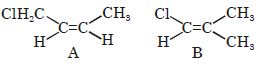
A
$A$ and $B$ are diastereoisomers with respect to each other.
B
$A$ and $B$ are chain isomers.
C
$S_N2$ rate $A > B$.
D
$S_N1$ rate $A > B$.
Solution
(B) Structure $A$ is $1$-chlorobut-$2$-ene $(CH_3-CH=CH-CH_2Cl)$.
Structure $B$ is $2$-chloro$-2-$methylprop$-1-$ene $(CH_2=C(Cl)-CH_3)$.
These are structural isomers,specifically functional/positional isomers,not diastereoisomers. Diastereoisomers are stereoisomers that are not mirror images of each other.
Since they have different carbon skeletons and functional group positions,they are not chain isomers either.
However,evaluating the reactivity: $A$ is a primary allylic halide,which is highly reactive in $S_N2$ reactions due to less steric hindrance. $B$ is a vinylic halide,which is generally inert to $S_N2$ and $S_N1$ reactions.
Therefore,the statement that $A$ and $B$ are chain isomers is incorrect as they are structural isomers with different connectivity.
Structure $B$ is $2$-chloro$-2-$methylprop$-1-$ene $(CH_2=C(Cl)-CH_3)$.
These are structural isomers,specifically functional/positional isomers,not diastereoisomers. Diastereoisomers are stereoisomers that are not mirror images of each other.
Since they have different carbon skeletons and functional group positions,they are not chain isomers either.
However,evaluating the reactivity: $A$ is a primary allylic halide,which is highly reactive in $S_N2$ reactions due to less steric hindrance. $B$ is a vinylic halide,which is generally inert to $S_N2$ and $S_N1$ reactions.
Therefore,the statement that $A$ and $B$ are chain isomers is incorrect as they are structural isomers with different connectivity.
0 likes
View Solution348
MediumMCQ
From the given pairs of compounds,in which will the first compound undergo $S_N2$ reaction faster?
A
$CH_3CH(CH_3)CH_2Br$ and $CH_3CH_2CH_2CH_2Br$
B
$CH_3CH_2CH_2CH_2Cl$ and $CH_3CH_2CH_2CH_2I$
C
$CH_3COCH_2Cl$ and $CH_3CH_2Cl$
D
$CH_3CH_2Br$ and $CH_3Br$
Solution
(C) The rate of $S_N2$ reaction depends on steric hindrance and the nature of the leaving group.
$(a)$ $CH_3CH(CH_3)CH_2Br$ is a primary alkyl halide with more steric hindrance than $CH_3CH_2CH_2CH_2Br$,so the second compound reacts faster.
$(b)$ $I^-$ is a better leaving group than $Cl^-$,so $CH_3CH_2CH_2CH_2I$ reacts faster.
$(c)$ $\alpha$-halocarbonyl compounds like $CH_3COCH_2Cl$ undergo $S_N2$ reactions much faster than simple alkyl halides like $CH_3CH_2Cl$ because the carbonyl group $(C=O)$ is electron-withdrawing and stabilizes the transition state through the overlap of its $\pi$ system with the p-orbitals of the transition state.
$(d)$ $CH_3Br$ is less sterically hindered than $CH_3CH_2Br$,so $CH_3Br$ reacts faster.
Therefore,the first compound reacts faster in option $(c)$.
$(a)$ $CH_3CH(CH_3)CH_2Br$ is a primary alkyl halide with more steric hindrance than $CH_3CH_2CH_2CH_2Br$,so the second compound reacts faster.
$(b)$ $I^-$ is a better leaving group than $Cl^-$,so $CH_3CH_2CH_2CH_2I$ reacts faster.
$(c)$ $\alpha$-halocarbonyl compounds like $CH_3COCH_2Cl$ undergo $S_N2$ reactions much faster than simple alkyl halides like $CH_3CH_2Cl$ because the carbonyl group $(C=O)$ is electron-withdrawing and stabilizes the transition state through the overlap of its $\pi$ system with the p-orbitals of the transition state.
$(d)$ $CH_3Br$ is less sterically hindered than $CH_3CH_2Br$,so $CH_3Br$ reacts faster.
Therefore,the first compound reacts faster in option $(c)$.
0 likes
View Solution349
DifficultMCQ
Arrange the following compounds in order of decreasing rate of hydrolysis for $SN_1$ reaction:
$(I)$ $C_6H_5CH_2Br$
$(II)$ $p-CH_3-C_6H_4-CH_2Br$
$(III)$ $p-(CH_3)_2CH-C_6H_4-CH_2Br$
$(IV)$ $p-CH_3CH_2-C_6H_4-CH_2Br$
$(I)$ $C_6H_5CH_2Br$
$(II)$ $p-CH_3-C_6H_4-CH_2Br$
$(III)$ $p-(CH_3)_2CH-C_6H_4-CH_2Br$
$(IV)$ $p-CH_3CH_2-C_6H_4-CH_2Br$
A
$II > IV > III > I$
B
$III > IV > II > I$
C
$IV > III > II > I$
D
$III > II > IV > I$
Solution
(B) The rate of $SN_1$ reaction depends on the stability of the carbocation intermediate formed.
In these compounds,the carbocation formed is a substituted benzyl carbocation $(Ar-CH_2^+)$.
The stability of the carbocation is increased by the electron-donating effect ($+I$ and hyperconjugation) of the alkyl group attached at the para position.
The order of electron-donating ability of the alkyl groups is: isopropyl $(>(CH_3)_2CH-)$ > ethyl $(>CH_3CH_2-)$ > methyl $(>CH_3-)$.
Therefore,the stability of the carbocations follows the order: $III > IV > II > I$.
Thus,the decreasing order of the rate of hydrolysis is $III > IV > II > I$.
In these compounds,the carbocation formed is a substituted benzyl carbocation $(Ar-CH_2^+)$.
The stability of the carbocation is increased by the electron-donating effect ($+I$ and hyperconjugation) of the alkyl group attached at the para position.
The order of electron-donating ability of the alkyl groups is: isopropyl $(>(CH_3)_2CH-)$ > ethyl $(>CH_3CH_2-)$ > methyl $(>CH_3-)$.
Therefore,the stability of the carbocations follows the order: $III > IV > II > I$.
Thus,the decreasing order of the rate of hydrolysis is $III > IV > II > I$.
0 likes
View Solution350
AdvancedMCQ
$CH_3-CHCl-CH_2-CH_3 \xrightarrow[\Delta]{KOH} \text{product}$
The possible number of elimination products (alkene) of the given reaction is?
The possible number of elimination products (alkene) of the given reaction is?
A
$1$
B
$2$
C
$3$
D
$4$
Solution
(C) The reaction is the dehydrohalogenation of $2$-chlorobutane using an alcoholic base $(KOH)$.
The base removes a $\beta$-hydrogen and a chloride ion to form alkenes.
The possible products are:
$1.$ But-$1$-ene $(CH_2=CH-CH_2-CH_3)$
$2.$ $cis$-But-$2$-ene $(CH_3-CH=CH-CH_3)$
$3.$ $trans$-But-$2$-ene $(CH_3-CH=CH-CH_3)$
Since But-$2$-ene exhibits geometrical isomerism,it exists as two distinct stereoisomers. Therefore,the total number of elimination products is $3$.
The base removes a $\beta$-hydrogen and a chloride ion to form alkenes.
The possible products are:
$1.$ But-$1$-ene $(CH_2=CH-CH_2-CH_3)$
$2.$ $cis$-But-$2$-ene $(CH_3-CH=CH-CH_3)$
$3.$ $trans$-But-$2$-ene $(CH_3-CH=CH-CH_3)$
Since But-$2$-ene exhibits geometrical isomerism,it exists as two distinct stereoisomers. Therefore,the total number of elimination products is $3$.
0 likes
View SolutionHaloalkanes and Haloarenes — Properties of Haloalkanes · Frequently Asked Questions
1Are these Haloalkanes and Haloarenes questions useful for JEE and NEET?
Yes. All questions in this section are mapped to JEE Main and NEET exam patterns. Previous year questions from JEE Main, NEET, GUJCET and state-level exams are included with full solutions.
2Can I switch to Hindi or Gujarati for these questions?
Yes. Use the language tabs in the hero section or the sidebar to view the same questions and solutions in English, Hindi or Gujarati.
3How do I generate a question paper from this subtopic?
Use the Vedclass Exam Paper Generator — select the chapter and subtopic, set difficulty, and generate Sets A, B, C, D automatically. First 3 chapters of every subject are free.
Vedclass Products
For Students
Vedclass Test Series
Mock tests in real JEE/NEET style with performance analysis. 5-day free trial.
Start Free TrialFor Teachers
Exam Paper Generator
Generate Set A/B/C/D papers from this chapter in 2 minutes. 3 chapters free.
Try FreeFor Institutes
Online Exam Module
Live online exams with unlimited students, 360° analytics & white-label branding.
See DemoFor Teachers & Institutes
Generate a Haloalkanes and Haloarenes Exam Paper in 2 Minutes
Select subtopic & difficulty — Sets A, B, C, D auto-generated with No Repeat logic.
First 3 chapters of every subject are free — no payment required.