
A English
Buoyancy, Archimedes' Principle and Laws of Floatation Questions in English
Class 11 Physics · Fluid Mechanics and Surface Tension · Buoyancy, Archimedes' Principle and Laws of Floatation
257+
Questions
English
Language
100%
With Solutions
Showing 48 of 257 questions in English
201
MediumMCQ
$A$ cube made of a material having a density of $0.9 \times 10^3 \ kg/m^3$ floats between water (density $1.0 \times 10^3 \ kg/m^3$) and a liquid of density $0.7 \times 10^3 \ kg/m^3$. What part of the cube is immersed in water?
A
$1/3$
B
$2/3$
C
$3/4$
D
$1/4$
Solution
(B) Let the total volume of the cube be $V$ and the volume immersed in water be $V_1$. The volume immersed in the other liquid is $(V - V_1)$.
For the cube to be in equilibrium,the weight of the cube must be equal to the sum of the buoyant forces from both liquids.
$Weight = F_{B,liquid} + F_{B,water}$
$V \rho_{cube} g = (V - V_1) \rho_{liquid} g + V_1 \rho_{water} g$
Dividing by $g$ and substituting the given values:
$V \times 0.9 = (V - V_1) \times 0.7 + V_1 \times 1.0$
$0.9 V = 0.7 V - 0.7 V_1 + 1.0 V_1$
$0.9 V - 0.7 V = 0.3 V_1$
$0.2 V = 0.3 V_1$
$\frac{V_1}{V} = \frac{0.2}{0.3} = \frac{2}{3}$
Thus,$2/3$ of the cube is immersed in water.
For the cube to be in equilibrium,the weight of the cube must be equal to the sum of the buoyant forces from both liquids.
$Weight = F_{B,liquid} + F_{B,water}$
$V \rho_{cube} g = (V - V_1) \rho_{liquid} g + V_1 \rho_{water} g$
Dividing by $g$ and substituting the given values:
$V \times 0.9 = (V - V_1) \times 0.7 + V_1 \times 1.0$
$0.9 V = 0.7 V - 0.7 V_1 + 1.0 V_1$
$0.9 V - 0.7 V = 0.3 V_1$
$0.2 V = 0.3 V_1$
$\frac{V_1}{V} = \frac{0.2}{0.3} = \frac{2}{3}$
Thus,$2/3$ of the cube is immersed in water.
0 likes
View Solution202
MediumMCQ
An iceberg floats in sea water with a part of it submerged. The percentage fraction of the iceberg which is unsubmerged is (Density of ice $= 0.9 \text{ g/cm}^3$, density of sea water $= 1.1 \text{ g/cm}^3$). (in $\%$)
A
$18.18$
B
$12.5$
C
$10$
D
$8.2$
Solution
(A) Let $V$ be the total volume of the iceberg and $V_{\text{sub}}$ be the volume submerged in sea water.
According to the law of floatation, the weight of the iceberg is equal to the weight of the displaced sea water.
$V \cdot \rho_{\text{ice}} \cdot g = V_{\text{sub}} \cdot \rho_{\text{sea water}} \cdot g$
$V \cdot 0.9 = V_{\text{sub}} \cdot 1.1$
$V_{\text{sub}} = \frac{0.9}{1.1} V = \frac{9}{11} V$
The volume unsubmerged is $V_{\text{unsub}} = V - V_{\text{sub}} = V - \frac{9}{11} V = \frac{2}{11} V$.
The percentage fraction of the iceberg which is unsubmerged is $\left( \frac{V_{\text{unsub}}}{V} \right) \times 100 = \left( \frac{2}{11} \right) \times 100 \approx 18.18 \%$.
According to the law of floatation, the weight of the iceberg is equal to the weight of the displaced sea water.
$V \cdot \rho_{\text{ice}} \cdot g = V_{\text{sub}} \cdot \rho_{\text{sea water}} \cdot g$
$V \cdot 0.9 = V_{\text{sub}} \cdot 1.1$
$V_{\text{sub}} = \frac{0.9}{1.1} V = \frac{9}{11} V$
The volume unsubmerged is $V_{\text{unsub}} = V - V_{\text{sub}} = V - \frac{9}{11} V = \frac{2}{11} V$.
The percentage fraction of the iceberg which is unsubmerged is $\left( \frac{V_{\text{unsub}}}{V} \right) \times 100 = \left( \frac{2}{11} \right) \times 100 \approx 18.18 \%$.
0 likes
View Solution203
MediumMCQ
$A$ small metal sphere of density $\varrho$ is dropped from height $h$ into a jar containing liquid of density $\sigma$ $(\sigma > \varrho)$. The maximum depth up to which the sphere sinks is (Neglect damping forces).
A
$\frac{\varrho h}{(\sigma - \varrho)}$
B
$\frac{h \sigma}{(\sigma - \varrho)}$
C
$\frac{\sigma}{(\sigma - \varrho)}$
D
$\frac{h \varrho}{(\sigma - \varrho)}$
Solution
(D) Let the sphere have mass $m$,volume $V$,and density $\varrho$. Thus,$m = V \varrho$.
When the sphere is dropped from height $h$,its velocity $v$ just before hitting the liquid surface is given by $v^2 = 2gh$.
Inside the liquid,the forces acting on the sphere are its weight $mg$ (downward) and the buoyant force $F_B = V \sigma g$ (upward).
The net force on the sphere inside the liquid is $F_{net} = F_B - mg = V \sigma g - V \varrho g = Vg(\sigma - \varrho)$.
The acceleration $a$ of the sphere inside the liquid is $a = \frac{F_{net}}{m} = \frac{Vg(\sigma - \varrho)}{V \varrho} = g \frac{(\sigma - \varrho)}{\varrho}$.
Since the buoyant force is greater than the weight (as $\sigma > \varrho$),the sphere will decelerate.
Let $d$ be the maximum depth reached. Using the equation of motion $v_f^2 = v_i^2 + 2ad$,where $v_f = 0$ (at maximum depth),$v_i^2 = 2gh$,and $a = -g \frac{(\sigma - \varrho)}{\varrho}$:
$0 = 2gh - 2 \left( g \frac{(\sigma - \varrho)}{\varrho} \right) d$.
Solving for $d$: $d = \frac{h \varrho}{(\sigma - \varrho)}$.
When the sphere is dropped from height $h$,its velocity $v$ just before hitting the liquid surface is given by $v^2 = 2gh$.
Inside the liquid,the forces acting on the sphere are its weight $mg$ (downward) and the buoyant force $F_B = V \sigma g$ (upward).
The net force on the sphere inside the liquid is $F_{net} = F_B - mg = V \sigma g - V \varrho g = Vg(\sigma - \varrho)$.
The acceleration $a$ of the sphere inside the liquid is $a = \frac{F_{net}}{m} = \frac{Vg(\sigma - \varrho)}{V \varrho} = g \frac{(\sigma - \varrho)}{\varrho}$.
Since the buoyant force is greater than the weight (as $\sigma > \varrho$),the sphere will decelerate.
Let $d$ be the maximum depth reached. Using the equation of motion $v_f^2 = v_i^2 + 2ad$,where $v_f = 0$ (at maximum depth),$v_i^2 = 2gh$,and $a = -g \frac{(\sigma - \varrho)}{\varrho}$:
$0 = 2gh - 2 \left( g \frac{(\sigma - \varrho)}{\varrho} \right) d$.
Solving for $d$: $d = \frac{h \varrho}{(\sigma - \varrho)}$.
0 likes
View Solution204
MediumMCQ
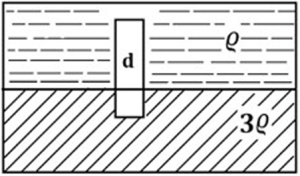
$A$ solid cylinder of length $\ell$ and cross-sectional area $A$ is immersed such that it floats with its axis vertical at the liquid-liquid interface with length $\ell / 4$ in the denser liquid as shown in the figure. The lower density liquid has density $\varrho$ and the denser liquid has density $3\varrho$. The density $d$ of the solid cylinder is:
A
$\frac{1}{2} \varrho$
B
$\frac{3}{2} \varrho$
C
$\frac{3}{4} \varrho$
D
$\varrho$
Solution
(B) For the cylinder to float in equilibrium, the total weight of the cylinder must be equal to the total buoyant force exerted by the two liquids.
Let $A$ be the cross-sectional area of the cylinder and $d$ be its density.
Weight of the cylinder $W = (\text{Volume}) \times (\text{Density}) \times g = (A \ell) d g$.
Buoyant force from the upper liquid (density $\varrho$): $F_1 = (\text{Volume submerged in upper liquid}) \times \varrho \times g = A (\ell - \ell/4) \varrho g = A (3\ell/4) \varrho g$.
Buoyant force from the lower liquid (density $3\varrho$): $F_2 = (\text{Volume submerged in lower liquid}) \times (3\varrho) \times g = A (\ell/4) (3\varrho) g = A (3\ell/4) \varrho g$.
Equating weight to the total buoyant force: $A \ell d g = A (3\ell/4) \varrho g + A (3\ell/4) \varrho g$.
$d \ell = (3\ell/4) \varrho + (3\ell/4) \varrho = (6\ell/4) \varrho = (3/2) \varrho \ell$.
Therefore, $d = \frac{3}{2} \varrho$.
Let $A$ be the cross-sectional area of the cylinder and $d$ be its density.
Weight of the cylinder $W = (\text{Volume}) \times (\text{Density}) \times g = (A \ell) d g$.
Buoyant force from the upper liquid (density $\varrho$): $F_1 = (\text{Volume submerged in upper liquid}) \times \varrho \times g = A (\ell - \ell/4) \varrho g = A (3\ell/4) \varrho g$.
Buoyant force from the lower liquid (density $3\varrho$): $F_2 = (\text{Volume submerged in lower liquid}) \times (3\varrho) \times g = A (\ell/4) (3\varrho) g = A (3\ell/4) \varrho g$.
Equating weight to the total buoyant force: $A \ell d g = A (3\ell/4) \varrho g + A (3\ell/4) \varrho g$.
$d \ell = (3\ell/4) \varrho + (3\ell/4) \varrho = (6\ell/4) \varrho = (3/2) \varrho \ell$.
Therefore, $d = \frac{3}{2} \varrho$.
0 likes
View Solution205
MediumMCQ
$A$ hemispherical portion of radius $R$ is removed from the bottom of a cylinder of radius $R$. The volume of the remaining cylinder is $V$ and its mass is $M$. It is suspended by a string in a liquid of density $\rho$ where it stays vertical. The upper surface of the cylinder is at a depth $h$ below the liquid surface. The force on the bottom of the liquid is
A
$Mg$
B
$Mg - V \rho g$
C
$Mg + \pi R^2 h \rho g$
D
$\rho g (V + \pi R^2 h)$
Solution
(D) The force exerted by the liquid on the bottom surface of the cylinder is equal to the weight of the liquid displaced by the cylinder plus the force due to the pressure at the depth of the cylinder's top surface.
By Archimedes' principle,the buoyant force $F_B = \rho V g$.
The downward force due to the liquid column above the cylinder is $F_{top} = P_{top} \times A = (\rho g h) \times (\pi R^2)$.
The total upward force exerted by the liquid on the cylinder is $F_{net} = F_B + F_{top} = \rho V g + \rho g h \pi R^2$.
Thus,the force on the bottom of the cylinder is $F_{bottom} = \rho g (V + \pi R^2 h)$.
By Archimedes' principle,the buoyant force $F_B = \rho V g$.
The downward force due to the liquid column above the cylinder is $F_{top} = P_{top} \times A = (\rho g h) \times (\pi R^2)$.
The total upward force exerted by the liquid on the cylinder is $F_{net} = F_B + F_{top} = \rho V g + \rho g h \pi R^2$.
Thus,the force on the bottom of the cylinder is $F_{bottom} = \rho g (V + \pi R^2 h)$.
0 likes
View Solution206
DifficultMCQ
$A$ ball rises to the surface at a constant velocity in a liquid whose density is $3$ times greater than that of the material of the ball. The ratio of the force of friction acting on the rising ball to its weight is (in $: 1$)
A
$2$
B
$3$
C
$4$
D
$6$
Solution
(A) The ball is moving with constant velocity. Therefore,the net force acting on it is zero.
Let the density of the ball be $\rho_b$ and the density of the liquid be $\rho_l = 3\rho_b$.
The weight of the ball is $W = V \rho_b g$,where $V$ is the volume of the ball.
As the ball is rising up,the buoyant force $F_B$ acts upwards and the viscous force (friction) $F_v$ acts downwards along with the weight $W$.
The buoyant force is $F_B = V \rho_l g = V (3\rho_b) g = 3 V \rho_b g$.
Since the velocity is constant,the net force is zero:
$F_B = W + F_v$
$F_v = F_B - W = 3 V \rho_b g - V \rho_b g = 2 V \rho_b g$.
The ratio of the force of friction to the weight is:
$\frac{F_v}{W} = \frac{2 V \rho_b g}{V \rho_b g} = \frac{2}{1}$.
Let the density of the ball be $\rho_b$ and the density of the liquid be $\rho_l = 3\rho_b$.
The weight of the ball is $W = V \rho_b g$,where $V$ is the volume of the ball.
As the ball is rising up,the buoyant force $F_B$ acts upwards and the viscous force (friction) $F_v$ acts downwards along with the weight $W$.
The buoyant force is $F_B = V \rho_l g = V (3\rho_b) g = 3 V \rho_b g$.
Since the velocity is constant,the net force is zero:
$F_B = W + F_v$
$F_v = F_B - W = 3 V \rho_b g - V \rho_b g = 2 V \rho_b g$.
The ratio of the force of friction to the weight is:
$\frac{F_v}{W} = \frac{2 V \rho_b g}{V \rho_b g} = \frac{2}{1}$.
0 likes
View Solution207
MediumMCQ
$A$ body of density $\rho$ is dropped from rest at a height $h$ into a lake of density $\sigma$ $(\sigma > \rho)$. The maximum depth to which the body sinks before returning to float on the surface is (neglect air dissipative forces).
A
$\frac{h \rho}{(\sigma - \rho)}$
B
$\frac{h \rho}{(\sigma + \rho)}$
C
$\frac{h \rho}{(\rho - \sigma)}$
D
$\frac{2 h \rho}{(\sigma - \rho)}$
Solution
(A) Let $V$ be the volume of the body. When the body hits the surface of the lake,its velocity $v_0$ is given by $v_0^2 = 2gh$.
Inside the water,the forces acting on the body are the weight $W = \rho V g$ (downward) and the buoyant force $F_B = \sigma V g$ (upward).
The net upward force is $F_{net} = F_B - W = Vg(\sigma - \rho)$.
The acceleration $a$ of the body inside the water is $a = \frac{F_{net}}{m} = \frac{Vg(\sigma - \rho)}{\rho V} = \frac{g(\sigma - \rho)}{\rho}$.
Since the force is upward,the acceleration is directed upward (opposing the motion),so $a = -\frac{g(\sigma - \rho)}{\rho}$.
Let $H$ be the maximum depth reached. At this depth,the final velocity $v = 0$.
Using the equation of motion $v^2 - u^2 = 2aH$,we have:
$0 - (\sqrt{2gh})^2 = 2 \left( -\frac{g(\sigma - \rho)}{\rho} \right) H$
$-2gh = -\frac{2g(\sigma - \rho)}{\rho} H$
$h = \frac{(\sigma - \rho)}{\rho} H$
$H = \frac{h \rho}{(\sigma - \rho)}$.
Inside the water,the forces acting on the body are the weight $W = \rho V g$ (downward) and the buoyant force $F_B = \sigma V g$ (upward).
The net upward force is $F_{net} = F_B - W = Vg(\sigma - \rho)$.
The acceleration $a$ of the body inside the water is $a = \frac{F_{net}}{m} = \frac{Vg(\sigma - \rho)}{\rho V} = \frac{g(\sigma - \rho)}{\rho}$.
Since the force is upward,the acceleration is directed upward (opposing the motion),so $a = -\frac{g(\sigma - \rho)}{\rho}$.
Let $H$ be the maximum depth reached. At this depth,the final velocity $v = 0$.
Using the equation of motion $v^2 - u^2 = 2aH$,we have:
$0 - (\sqrt{2gh})^2 = 2 \left( -\frac{g(\sigma - \rho)}{\rho} \right) H$
$-2gh = -\frac{2g(\sigma - \rho)}{\rho} H$
$h = \frac{(\sigma - \rho)}{\rho} H$
$H = \frac{h \rho}{(\sigma - \rho)}$.
0 likes
View Solution208
DifficultMCQ
$A$ body of density $\rho$ is dropped from rest at a height $h$ into a lake of density $\delta$ $(\delta > \rho)$. Neglecting all dissipative forces,find the maximum depth to which the body sinks before returning to float on the surface.
A
$\frac{(\delta - \rho)}{2 h \rho}$
B
$\frac{2 h \rho}{(\delta - \rho)}$
C
$\frac{h \rho}{2(\delta - \rho)}$
D
$\frac{h \rho}{(\delta - \rho)}$
Solution
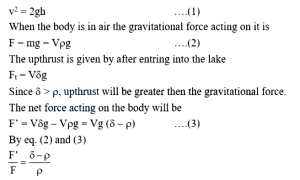
(D) Let $V$ be the volume of the body. When the body falls from height $h$,its velocity $v$ just before entering the water is given by $v^2 = 2gh$.
When the body enters the water,it experiences an upward buoyant force $F_B = V \delta g$ and a downward gravitational force $W = V \rho g$.
The net upward force (retarding force) is $F_{net} = F_B - W = Vg(\delta - \rho)$.
The retardation $a$ of the body in the water is $a = \frac{F_{net}}{m} = \frac{Vg(\delta - \rho)}{V \rho} = g \left( \frac{\delta - \rho}{\rho} \right)$.
Let $d$ be the maximum depth reached. Using the equation of motion $v^2 = 2ad$ (where $v$ is the velocity at the surface and $a$ is the retardation),we have $2gh = 2 \left[ g \left( \frac{\delta - \rho}{\rho} \right) \right] d$.
Solving for $d$,we get $d = \frac{h \rho}{(\delta - \rho)}$.
When the body enters the water,it experiences an upward buoyant force $F_B = V \delta g$ and a downward gravitational force $W = V \rho g$.
The net upward force (retarding force) is $F_{net} = F_B - W = Vg(\delta - \rho)$.
The retardation $a$ of the body in the water is $a = \frac{F_{net}}{m} = \frac{Vg(\delta - \rho)}{V \rho} = g \left( \frac{\delta - \rho}{\rho} \right)$.
Let $d$ be the maximum depth reached. Using the equation of motion $v^2 = 2ad$ (where $v$ is the velocity at the surface and $a$ is the retardation),we have $2gh = 2 \left[ g \left( \frac{\delta - \rho}{\rho} \right) \right] d$.
Solving for $d$,we get $d = \frac{h \rho}{(\delta - \rho)}$.
0 likes
View Solution209
MediumMCQ
$A$ rectangular block of mass $M$ and cross-sectional area $A$ floats on a liquid of density $\rho$. It is given a small vertical displacement from equilibrium; it starts oscillating with frequency $n$. Then:
A
$n \propto \sqrt{A}$
B
$n \propto A^3$
C
$n \propto A$
D
$n \propto A^2$
Solution
(A) When the block is displaced vertically by a small distance $x$ from its equilibrium position,the additional volume of liquid displaced is $V = A x$.
The additional buoyant force acting on the block is $F = \rho V g = \rho (A x) g$.
This force acts as a restoring force,so $F_{\text{restoring}} = -\rho A g x$.
According to Newton's second law,$F = M a$,where $M$ is the mass of the block.
Thus,$M a = -\rho A g x$,which gives $a = -(\frac{\rho A g}{M}) x$.
Comparing this with the standard $SHM$ equation $a = -\omega^2 x$,we get $\omega^2 = \frac{\rho A g}{M}$,so $\omega = \sqrt{\frac{\rho A g}{M}}$.
Since frequency $n = \frac{\omega}{2 \pi}$,we have $n = \frac{1}{2 \pi} \sqrt{\frac{\rho A g}{M}}$.
Therefore,$n \propto \sqrt{A}$.
The additional buoyant force acting on the block is $F = \rho V g = \rho (A x) g$.
This force acts as a restoring force,so $F_{\text{restoring}} = -\rho A g x$.
According to Newton's second law,$F = M a$,where $M$ is the mass of the block.
Thus,$M a = -\rho A g x$,which gives $a = -(\frac{\rho A g}{M}) x$.
Comparing this with the standard $SHM$ equation $a = -\omega^2 x$,we get $\omega^2 = \frac{\rho A g}{M}$,so $\omega = \sqrt{\frac{\rho A g}{M}}$.
Since frequency $n = \frac{\omega}{2 \pi}$,we have $n = \frac{1}{2 \pi} \sqrt{\frac{\rho A g}{M}}$.
Therefore,$n \propto \sqrt{A}$.
0 likes
View Solution210
MediumMCQ
An iceberg floats in water with part of it submerged. What is the fraction of the volume of the iceberg submerged,if the density of ice is $\rho_{i} = 0.917 \ g \ cm^{-3}$ and the density of water is $\rho_{w} = 1.00 \ g \ cm^{-3}$?
A
$0.917$
B
$1.000$
C
$0.458$
D
$0.083$
Solution
(A) According to the Law of Floatation,for an object floating in a liquid,the weight of the object is equal to the weight of the liquid displaced.
Let $V$ be the total volume of the iceberg and $V_{sub}$ be the volume submerged in water.
Weight of the iceberg = $V \cdot \rho_{i} \cdot g$
Weight of the water displaced = $V_{sub} \cdot \rho_{w} \cdot g$
Equating the two: $V \cdot \rho_{i} \cdot g = V_{sub} \cdot \rho_{w} \cdot g$
The fraction of the volume submerged is $\frac{V_{sub}}{V} = \frac{\rho_{i}}{\rho_{w}}$.
Given $\rho_{i} = 0.917 \ g \ cm^{-3}$ and $\rho_{w} = 1.00 \ g \ cm^{-3}$.
Therefore,$\frac{V_{sub}}{V} = \frac{0.917}{1.00} = 0.917$.
Let $V$ be the total volume of the iceberg and $V_{sub}$ be the volume submerged in water.
Weight of the iceberg = $V \cdot \rho_{i} \cdot g$
Weight of the water displaced = $V_{sub} \cdot \rho_{w} \cdot g$
Equating the two: $V \cdot \rho_{i} \cdot g = V_{sub} \cdot \rho_{w} \cdot g$
The fraction of the volume submerged is $\frac{V_{sub}}{V} = \frac{\rho_{i}}{\rho_{w}}$.
Given $\rho_{i} = 0.917 \ g \ cm^{-3}$ and $\rho_{w} = 1.00 \ g \ cm^{-3}$.
Therefore,$\frac{V_{sub}}{V} = \frac{0.917}{1.00} = 0.917$.
0 likes
View Solution211
MediumMCQ
An aluminium sphere is dipped into water. Which of the following is true?
A
Buoyancy in water at $0 \ ^\circ C$ will be same as that in water at $4 \ ^\circ C$
B
Buoyancy will be less in water at $0 \ ^\circ C$ than that in water at $4 \ ^\circ C$
C
Buoyancy may be more or less in water at $4 \ ^\circ C$ depending on the radius of the sphere
D
Buoyancy will be more in water at $0 \ ^\circ C$ than that in water at $4 \ ^\circ C$
Solution
(B) The buoyant force $F_b$ acting on a submerged object is given by Archimedes' principle: $F_b = V \rho g$,where $V$ is the volume of the displaced liquid,$\rho$ is the density of the liquid,and $g$ is the acceleration due to gravity.
The density of water is maximum at $4 \ ^\circ C$ $(\rho_4 \approx 1000 \ kg/m^3)$ and is lower at $0 \ ^\circ C$ $(\rho_0 \approx 999.8 \ kg/m^3)$.
Since the volume of the aluminium sphere $V$ remains constant,the buoyancy at $0 \ ^\circ C$ is $F_b = V \rho_0 g$ and at $4 \ ^\circ C$ is $F'_b = V \rho_4 g$.
Comparing the two,since $\rho_0 < \rho_4$,it follows that $F_b < F'_b$.
Therefore,the buoyancy is less in water at $0 \ ^\circ C$ than in water at $4 \ ^\circ C$.
The density of water is maximum at $4 \ ^\circ C$ $(\rho_4 \approx 1000 \ kg/m^3)$ and is lower at $0 \ ^\circ C$ $(\rho_0 \approx 999.8 \ kg/m^3)$.
Since the volume of the aluminium sphere $V$ remains constant,the buoyancy at $0 \ ^\circ C$ is $F_b = V \rho_0 g$ and at $4 \ ^\circ C$ is $F'_b = V \rho_4 g$.
Comparing the two,since $\rho_0 < \rho_4$,it follows that $F_b < F'_b$.
Therefore,the buoyancy is less in water at $0 \ ^\circ C$ than in water at $4 \ ^\circ C$.
0 likes
View Solution212
EasyMCQ
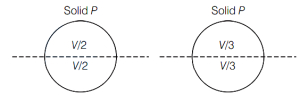
Two solids $P$ and $Q$ float in water. It is observed that $P$ floats with half of its volume immersed and $Q$ floats with $\frac{2}{3}$ of its volume immersed. The ratio of densities of $P$ and $Q$ is
A
$\frac{4}{3}$
B
$\frac{3}{4}$
C
$\frac{2}{3}$
D
$\frac{3}{2}$
Solution
(B) According to the law of floatation,for a body floating in equilibrium,the weight of the body is equal to the buoyant force (weight of the displaced liquid).
Let $V$ be the total volume of each solid,$\rho_P$ and $\rho_Q$ be their densities,and $\rho_w$ be the density of water.
For solid $P$: $V \rho_P g = (V/2) \rho_w g \Rightarrow \rho_P = \frac{1}{2} \rho_w$.
For solid $Q$: $V \rho_Q g = (2V/3) \rho_w g \Rightarrow \rho_Q = \frac{2}{3} \rho_w$.
The ratio of densities is $\frac{\rho_P}{\rho_Q} = \frac{\frac{1}{2} \rho_w}{\frac{2}{3} \rho_w} = \frac{1}{2} \times \frac{3}{2} = \frac{3}{4}$.
Let $V$ be the total volume of each solid,$\rho_P$ and $\rho_Q$ be their densities,and $\rho_w$ be the density of water.
For solid $P$: $V \rho_P g = (V/2) \rho_w g \Rightarrow \rho_P = \frac{1}{2} \rho_w$.
For solid $Q$: $V \rho_Q g = (2V/3) \rho_w g \Rightarrow \rho_Q = \frac{2}{3} \rho_w$.
The ratio of densities is $\frac{\rho_P}{\rho_Q} = \frac{\frac{1}{2} \rho_w}{\frac{2}{3} \rho_w} = \frac{1}{2} \times \frac{3}{2} = \frac{3}{4}$.
0 likes
View Solution213
DifficultMCQ
Spheres of iron and lead having the same mass are completely immersed in water. The density of lead is greater than that of iron. If the apparent loss of weight is $w_{1}$ for the iron sphere and $w_{2}$ for the lead sphere,then the ratio $\frac{w_{1}}{w_{2}}$ is:
A
$>1$
B
$=1$
C
between $0$ and $1$
D
$=0$
Solution
(A) According to Archimedes' principle,the apparent loss of weight of an object immersed in a fluid is equal to the weight of the fluid displaced by it.
Loss of weight $w = V \rho_{w} g$,where $V$ is the volume of the object and $\rho_{w}$ is the density of water.
Since the mass $m$ of both spheres is the same,we have $m = V_{iron} \rho_{iron} = V_{lead} \rho_{lead}$.
Thus,the volume $V = \frac{m}{\rho}$.
Substituting this into the expression for loss of weight: $w = \frac{m}{\rho} \rho_{w} g = m g \frac{\rho_{w}}{\rho}$.
For the iron sphere,$w_{1} = m g \frac{\rho_{w}}{\rho_{iron}}$.
For the lead sphere,$w_{2} = m g \frac{\rho_{w}}{\rho_{lead}}$.
Taking the ratio: $\frac{w_{1}}{w_{2}} = \frac{\rho_{lead}}{\rho_{iron}}$.
Since the density of lead is greater than the density of iron $(\rho_{lead} > \rho_{iron})$,it follows that $\frac{w_{1}}{w_{2}} > 1$.
Loss of weight $w = V \rho_{w} g$,where $V$ is the volume of the object and $\rho_{w}$ is the density of water.
Since the mass $m$ of both spheres is the same,we have $m = V_{iron} \rho_{iron} = V_{lead} \rho_{lead}$.
Thus,the volume $V = \frac{m}{\rho}$.
Substituting this into the expression for loss of weight: $w = \frac{m}{\rho} \rho_{w} g = m g \frac{\rho_{w}}{\rho}$.
For the iron sphere,$w_{1} = m g \frac{\rho_{w}}{\rho_{iron}}$.
For the lead sphere,$w_{2} = m g \frac{\rho_{w}}{\rho_{lead}}$.
Taking the ratio: $\frac{w_{1}}{w_{2}} = \frac{\rho_{lead}}{\rho_{iron}}$.
Since the density of lead is greater than the density of iron $(\rho_{lead} > \rho_{iron})$,it follows that $\frac{w_{1}}{w_{2}} > 1$.
0 likes
View Solution214
MediumMCQ
Two solid pieces,one of steel and the other of aluminium,when immersed completely in water,have equal weights. When the solid pieces are weighed in air:
A
the weight of aluminium is half the weight of steel
B
the steel piece will weigh more
C
they have the same weight
D
the aluminium piece will weigh more
Solution
(D) Let $W_s$ and $W_a$ be the weights of steel and aluminium in air,and $V_s$ and $V_a$ be their respective volumes. The density of water is $\rho_w$. When immersed in water,the apparent weight is $W_{app} = W - V\rho_w g$. Given that the apparent weights are equal: $W_s - V_s \rho_w g = W_a - V_a \rho_w g$. Since $W = V \rho g$,we have $V = W / (\rho g)$. Substituting this,$W_s - (W_s / \rho_s) \rho_w g = W_a - (W_a / \rho_a) \rho_w g$,which simplifies to $W_s(1 - \rho_w / \rho_s) = W_a(1 - \rho_w / \rho_a)$. Since the density of steel $\rho_s \approx 7800 \ kg/m^3$ is much greater than the density of aluminium $\rho_a \approx 2700 \ kg/m^3$,the term $(1 - \rho_w / \rho_s)$ is greater than $(1 - \rho_w / \rho_a)$. Therefore,for the equality to hold,$W_s$ must be less than $W_a$. Thus,the aluminium piece weighs more in air.
0 likes
View Solution215
EasyMCQ
$A$ body weighs $50 \,g$ in air and $40 \,g$ in water. How much would it weigh in a liquid of specific gravity $1.5$ (in $\,g$)?
A
$30$
B
$35$
C
$65$
D
$45$
Solution
(B) The upthrust on a body is given by the weight of the liquid displaced. The ratio of upthrusts is equal to the ratio of the densities (or specific gravities) of the liquids.
$\frac{\text{Upthrust in liquid}}{\text{Upthrust in water}} = \frac{\text{Specific gravity of liquid}}{\text{Specific gravity of water}}$
Upthrust in water $= 50 \,g - 40 \,g = 10 \,g$.
Let the upthrust in the liquid be $x$.
$\frac{x}{10 \,g} = \frac{1.5}{1}$
$x = 15 \,g$.
The weight of the body in the liquid is given by: $\text{Weight in air} - \text{Upthrust in liquid}$.
Weight $= 50 \,g - 15 \,g = 35 \,g$.
$\frac{\text{Upthrust in liquid}}{\text{Upthrust in water}} = \frac{\text{Specific gravity of liquid}}{\text{Specific gravity of water}}$
Upthrust in water $= 50 \,g - 40 \,g = 10 \,g$.
Let the upthrust in the liquid be $x$.
$\frac{x}{10 \,g} = \frac{1.5}{1}$
$x = 15 \,g$.
The weight of the body in the liquid is given by: $\text{Weight in air} - \text{Upthrust in liquid}$.
Weight $= 50 \,g - 15 \,g = 35 \,g$.
0 likes
View Solution216
EasyMCQ
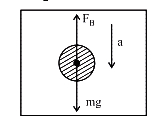
An object of mass $10 \ kg$ is released from rest in a liquid. If the object moves a distance of $2 \ m$ while sinking in a time duration of $1 \ s$,then the mass of the liquid displaced by the submerged object is $(g = 10 \ m/s^2)$. (in $kg$)
A
$5$
B
$6$
C
$3$
D
$4$
Solution
(B) Given: Mass of the object $m = 10 \ kg$,distance $S = 2 \ m$,time $t = 1 \ s$,initial velocity $u = 0$,and acceleration due to gravity $g = 10 \ m/s^2$.
Using the equation of motion $S = ut + \frac{1}{2}at^2$:
$2 = 0 \times 1 + \frac{1}{2} \times a \times (1)^2$
$2 = \frac{1}{2}a \Rightarrow a = 4 \ m/s^2$.
Now,applying Newton's second law for the sinking object:
$mg - F_B = ma$
Where $F_B$ is the buoyant force.
$F_B = m(g - a) = 10 \times (10 - 4) = 10 \times 6 = 60 \ N$.
According to Archimedes' principle,the buoyant force $F_B$ is equal to the weight of the displaced liquid:
$F_B = m_{liquid} \times g$
$60 = m_{liquid} \times 10$
$m_{liquid} = 6 \ kg$.
Using the equation of motion $S = ut + \frac{1}{2}at^2$:
$2 = 0 \times 1 + \frac{1}{2} \times a \times (1)^2$
$2 = \frac{1}{2}a \Rightarrow a = 4 \ m/s^2$.
Now,applying Newton's second law for the sinking object:
$mg - F_B = ma$
Where $F_B$ is the buoyant force.
$F_B = m(g - a) = 10 \times (10 - 4) = 10 \times 6 = 60 \ N$.
According to Archimedes' principle,the buoyant force $F_B$ is equal to the weight of the displaced liquid:
$F_B = m_{liquid} \times g$
$60 = m_{liquid} \times 10$
$m_{liquid} = 6 \ kg$.
0 likes
View Solution217
EasyMCQ
$A$ block of wood of volume $V$ floats in water with half of its volume submerged. The same block floats in an oil with $0.8 \,V$ volume submerged. If the density of water is $1000 \,kg \,m^{-3}$, then the density of the oil is
A
$800 \,kg \,m^{-3}$
B
$600 \,kg \,m^{-3}$
C
$550 \,kg \,m^{-3}$
D
$625 \,kg \,m^{-3}$
Solution
(D) For a floating object, the weight of the object equals the weight of the displaced fluid. This is given by the principle: $\rho_s V g = \rho_f V_{sub} g$, where $\rho_s$ is the density of the solid, $\rho_f$ is the density of the fluid, and $V_{sub}$ is the submerged volume.
$1$. In water: $\rho_s V g = \rho_w (0.5 V) g$.
Given $\rho_w = 1000 \,kg \,m^{-3}$, we have $\rho_s = 0.5 \times 1000 = 500 \,kg \,m^{-3}$.
$2$. In oil: $\rho_s V g = \rho_{oil} (0.8 V) g$.
Substituting $\rho_s = 500 \,kg \,m^{-3}$, we get $500 = 0.8 \times \rho_{oil}$.
Therefore, $\rho_{oil} = \frac{500}{0.8} = 625 \,kg \,m^{-3}$.
$1$. In water: $\rho_s V g = \rho_w (0.5 V) g$.
Given $\rho_w = 1000 \,kg \,m^{-3}$, we have $\rho_s = 0.5 \times 1000 = 500 \,kg \,m^{-3}$.
$2$. In oil: $\rho_s V g = \rho_{oil} (0.8 V) g$.
Substituting $\rho_s = 500 \,kg \,m^{-3}$, we get $500 = 0.8 \times \rho_{oil}$.
Therefore, $\rho_{oil} = \frac{500}{0.8} = 625 \,kg \,m^{-3}$.
0 likes
View Solution218
EasyMCQ
$A$ body of volume $V$ floats on water with $\frac{1}{3}$ of its volume above the surface. The volume of the object above the surface when floating on a liquid of specific gravity $1.5$ is
A
$\frac{3V}{8}$
B
$\frac{4V}{9}$
C
$\frac{5V}{9}$
D
$\frac{2V}{3}$
Solution
(C) According to the law of floatation,the weight of the body is equal to the weight of the liquid displaced.
Let $\rho$ be the density of the body and $\rho_w$ be the density of water $(1000 \ kg/m^3)$.
When floating on water,the volume submerged is $V_{sub} = V - \frac{1}{3}V = \frac{2}{3}V$.
Weight of body = Weight of displaced water $\Rightarrow V \rho g = V_{sub} \rho_w g$.
$V \rho = \frac{2}{3}V \rho_w \Rightarrow \rho = \frac{2}{3} \rho_w = \frac{2}{3} \times 1000 = \frac{2000}{3} \ kg/m^3$.
Now,the body floats on a liquid with specific gravity $1.5$,so the density of the liquid is $\rho_l = 1.5 \times 1000 = 1500 \ kg/m^3$.
Let $V'_{sub}$ be the volume submerged in this liquid.
$V \rho g = V'_{sub} \rho_l g \Rightarrow V \times \frac{2000}{3} = V'_{sub} \times 1500$.
$V'_{sub} = V \times \frac{2000}{3 \times 1500} = V \times \frac{2000}{4500} = \frac{4}{9}V$.
The volume above the surface is $V_{above} = V - V'_{sub} = V - \frac{4}{9}V = \frac{5}{9}V$.
Let $\rho$ be the density of the body and $\rho_w$ be the density of water $(1000 \ kg/m^3)$.
When floating on water,the volume submerged is $V_{sub} = V - \frac{1}{3}V = \frac{2}{3}V$.
Weight of body = Weight of displaced water $\Rightarrow V \rho g = V_{sub} \rho_w g$.
$V \rho = \frac{2}{3}V \rho_w \Rightarrow \rho = \frac{2}{3} \rho_w = \frac{2}{3} \times 1000 = \frac{2000}{3} \ kg/m^3$.
Now,the body floats on a liquid with specific gravity $1.5$,so the density of the liquid is $\rho_l = 1.5 \times 1000 = 1500 \ kg/m^3$.
Let $V'_{sub}$ be the volume submerged in this liquid.
$V \rho g = V'_{sub} \rho_l g \Rightarrow V \times \frac{2000}{3} = V'_{sub} \times 1500$.
$V'_{sub} = V \times \frac{2000}{3 \times 1500} = V \times \frac{2000}{4500} = \frac{4}{9}V$.
The volume above the surface is $V_{above} = V - V'_{sub} = V - \frac{4}{9}V = \frac{5}{9}V$.
0 likes
View Solution219
MediumMCQ
$A$ glass flask weighing $390 \ g$,having an internal volume of $500 \ cm^3$,just floats when half of it is filled with water. The specific gravity of the glass is:
A
$2.8$
B
$1.8$
C
$1.0$
D
$2.5$
Solution
(A) According to the principle of floatation,the weight of the flask plus the weight of the water inside it must equal the weight of the water displaced by the flask.
Let $V_{ext}$ be the external volume of the flask (volume of water displaced).
Mass of flask $m_f = 390 \ g$.
Volume of water inside $V_w = 250 \ cm^3$.
Mass of water inside $m_w = \rho_w \times V_w = 1 \times 250 = 250 \ g$.
Total weight of the system = $(390 + 250) \ g = 640 \ g$.
Since the flask just floats,the buoyant force equals the total weight,so the mass of water displaced is $640 \ g$.
Thus,the external volume of the flask $V_{ext} = 640 \ cm^3$.
The volume of the glass material $V_{glass} = V_{ext} - V_{internal} = 640 - 500 = 140 \ cm^3$.
The density of the glass $\rho_{glass} = \frac{m_f}{V_{glass}} = \frac{390}{140} \approx 2.785 \ g/cm^3$.
Specific gravity = $\frac{\rho_{glass}}{\rho_w} = \frac{2.785}{1} \approx 2.8$.
Let $V_{ext}$ be the external volume of the flask (volume of water displaced).
Mass of flask $m_f = 390 \ g$.
Volume of water inside $V_w = 250 \ cm^3$.
Mass of water inside $m_w = \rho_w \times V_w = 1 \times 250 = 250 \ g$.
Total weight of the system = $(390 + 250) \ g = 640 \ g$.
Since the flask just floats,the buoyant force equals the total weight,so the mass of water displaced is $640 \ g$.
Thus,the external volume of the flask $V_{ext} = 640 \ cm^3$.
The volume of the glass material $V_{glass} = V_{ext} - V_{internal} = 640 - 500 = 140 \ cm^3$.
The density of the glass $\rho_{glass} = \frac{m_f}{V_{glass}} = \frac{390}{140} \approx 2.785 \ g/cm^3$.
Specific gravity = $\frac{\rho_{glass}}{\rho_w} = \frac{2.785}{1} \approx 2.8$.
0 likes
View Solution220
DifficultMCQ
$A$ wooden block floating in a bucket of water has $(4/5)$th of its volume submerged. When a certain amount of oil is poured into the bucket,it is found that the block is just under the oil surface,with half of its volume under water and the other half in oil. The density of oil relative to that of water is
A
$1/4$
B
$3/5$
C
$2/5$
D
$5/3$
Solution
(B) Let $V$ be the total volume of the wooden block and $\sigma$ be its density. Let $\rho$ be the density of water.
Initially,the block floats in water with $(4/5)V$ submerged. By the law of floatation,the weight of the block equals the buoyant force:
$V \sigma g = (4/5)V \rho g$
$\sigma = (4/5) \rho$ ...$(i)$
When oil is poured,the block is submerged such that half its volume $(V/2)$ is in water and half $(V/2)$ is in oil. Let $\rho_o$ be the density of oil.
The total buoyant force equals the weight of the block:
$V \sigma g = (V/2) \rho g + (V/2) \rho_o g$
Substituting $\sigma = (4/5) \rho$ from $(i)$:
$(4/5) V \rho = (1/2) V \rho + (1/2) V \rho_o$
Dividing by $V$ and multiplying by $2$:
$(8/5) \rho = \rho + \rho_o$
$\rho_o = (8/5 - 1) \rho = (3/5) \rho$
Thus,the relative density of oil with respect to water is $3/5$.
Initially,the block floats in water with $(4/5)V$ submerged. By the law of floatation,the weight of the block equals the buoyant force:
$V \sigma g = (4/5)V \rho g$
$\sigma = (4/5) \rho$ ...$(i)$
When oil is poured,the block is submerged such that half its volume $(V/2)$ is in water and half $(V/2)$ is in oil. Let $\rho_o$ be the density of oil.
The total buoyant force equals the weight of the block:
$V \sigma g = (V/2) \rho g + (V/2) \rho_o g$
Substituting $\sigma = (4/5) \rho$ from $(i)$:
$(4/5) V \rho = (1/2) V \rho + (1/2) V \rho_o$
Dividing by $V$ and multiplying by $2$:
$(8/5) \rho = \rho + \rho_o$
$\rho_o = (8/5 - 1) \rho = (3/5) \rho$
Thus,the relative density of oil with respect to water is $3/5$.
0 likes
View Solution221
MediumMCQ
$A$ solid floats such that its $(1/3)$rd part is above the water surface. Then,the density of the solid is
A
$744 \ kg \ m^{-3}$
B
$\frac{1000}{3} \ kg \ m^{-3}$
C
$\frac{2000}{3} \ kg \ m^{-3}$
D
$910 \ kg \ m^{-3}$
Solution
(C) Given that,$(1/3)$rd part of the body is above the water surface.
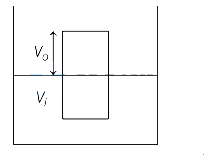
Therefore,the volume of the body outside the water is $V_o = (1/3)V$,where $V$ is the total volume of the body.
Therefore,the volume of the body inside the water is $V_i = V - V_o = V - (V/3) = (2V/3)$.
Let the density of the body be $\sigma$ and the density of water be $\rho = 10^3 \ kg \ m^{-3}$.
According to the law of floatation,the weight of the body is balanced by the buoyant force $(F_B)$.
$W = F_B$
$Mg = V_i \rho g$
Since mass $M = V \sigma$,we have:
$V \sigma g = V_i \rho g$
$\sigma = (V_i / V) \rho$
Substituting the values:
$\sigma = \frac{(2V/3)}{V} \times 10^3 = \frac{2}{3} \times 10^3 = \frac{2000}{3} \ kg \ m^{-3}$.
Thus,the density of the solid is $\frac{2000}{3} \ kg \ m^{-3}$.
Therefore,the volume of the body outside the water is $V_o = (1/3)V$,where $V$ is the total volume of the body.
Therefore,the volume of the body inside the water is $V_i = V - V_o = V - (V/3) = (2V/3)$.
Let the density of the body be $\sigma$ and the density of water be $\rho = 10^3 \ kg \ m^{-3}$.
According to the law of floatation,the weight of the body is balanced by the buoyant force $(F_B)$.
$W = F_B$
$Mg = V_i \rho g$
Since mass $M = V \sigma$,we have:
$V \sigma g = V_i \rho g$
$\sigma = (V_i / V) \rho$
Substituting the values:
$\sigma = \frac{(2V/3)}{V} \times 10^3 = \frac{2}{3} \times 10^3 = \frac{2000}{3} \ kg \ m^{-3}$.
Thus,the density of the solid is $\frac{2000}{3} \ kg \ m^{-3}$.
0 likes
View Solution222
MediumMCQ
$A$ weightless bag is filled with $5 \,kg$ of water and is weighed in water using a spring balance. The reading of the spring balance is (in $\,kg$)
A
$5$
B
$2.5$
C
$1.25$
D
$0$
Solution
(D) The apparent weight of an object submerged in a fluid is given by the formula: $W_{app} = W_{actual} - F_B$, where $W_{actual}$ is the actual weight and $F_B$ is the buoyant force.
For an object of volume $V$ and density $\rho_{obj}$ submerged in a fluid of density $\rho_{fluid}$, the buoyant force is $F_B = V \rho_{fluid} g$.
The actual weight of the bag is $W_{actual} = m g = V \rho_{obj} g$.
Since the bag is filled with water, the density of the object (water) is equal to the density of the surrounding fluid (water), i.e., $\rho_{obj} = \rho_{fluid}$.
Therefore, $W_{app} = V \rho_{obj} g - V \rho_{fluid} g = 0$.
Thus, the reading of the spring balance is $0 \,kg$.
For an object of volume $V$ and density $\rho_{obj}$ submerged in a fluid of density $\rho_{fluid}$, the buoyant force is $F_B = V \rho_{fluid} g$.
The actual weight of the bag is $W_{actual} = m g = V \rho_{obj} g$.
Since the bag is filled with water, the density of the object (water) is equal to the density of the surrounding fluid (water), i.e., $\rho_{obj} = \rho_{fluid}$.
Therefore, $W_{app} = V \rho_{obj} g - V \rho_{fluid} g = 0$.
Thus, the reading of the spring balance is $0 \,kg$.
0 likes
View Solution223
EasyMCQ
$A$ $0.5 \,kg$ block of brass (density $=8 \times 10^3 \,kg \,m^{-3}$) is suspended from a string. What is the tension in the string if the block is completely immersed in water? $(g=10 \,ms^{-2})$
A
$5 \,N$
B
$\frac{0.5}{8 \times 10^3} \,N$
C
$\frac{5}{8} \,N$
D
$\frac{35}{8} \,N$
Solution
(D) Mass of the block,$m = 0.5 \,kg$.
Density of brass,$\rho = 8 \times 10^3 \,kg \,m^{-3}$.
Volume of the block,$V = \frac{m}{\rho} = \frac{0.5}{8 \times 10^3} = 6.25 \times 10^{-5} \,m^3$.
When the block is fully immersed in water,the upthrust (buoyant) force $F_b$ is given by the weight of the displaced water:
$F_b = V \cdot \rho_w \cdot g = (6.25 \times 10^{-5} \,m^3) \times (10^3 \,kg \,m^{-3}) \times (10 \,ms^{-2}) = 0.625 \,N$.
The tension $T$ in the string is the weight of the block minus the upthrust force:
$T = mg - F_b = (0.5 \,kg \times 10 \,ms^{-2}) - 0.625 \,N = 5 \,N - 0.625 \,N = 4.375 \,N$.
Converting to fraction: $4.375 = \frac{4375}{1000} = \frac{35}{8} \,N$.
Density of brass,$\rho = 8 \times 10^3 \,kg \,m^{-3}$.
Volume of the block,$V = \frac{m}{\rho} = \frac{0.5}{8 \times 10^3} = 6.25 \times 10^{-5} \,m^3$.
When the block is fully immersed in water,the upthrust (buoyant) force $F_b$ is given by the weight of the displaced water:
$F_b = V \cdot \rho_w \cdot g = (6.25 \times 10^{-5} \,m^3) \times (10^3 \,kg \,m^{-3}) \times (10 \,ms^{-2}) = 0.625 \,N$.
The tension $T$ in the string is the weight of the block minus the upthrust force:
$T = mg - F_b = (0.5 \,kg \times 10 \,ms^{-2}) - 0.625 \,N = 5 \,N - 0.625 \,N = 4.375 \,N$.
Converting to fraction: $4.375 = \frac{4375}{1000} = \frac{35}{8} \,N$.
0 likes
View Solution224
EasyMCQ
Find the apparent weight of a metallic block of density $5 \text{ g cm}^{-3}$ and dimensions $5 \text{ cm} \times 5 \text{ cm} \times 5 \text{ cm}$,in water.
A
$5 \times 5 \times 5 \times 5 \text{ gf}$
B
$4 \times 4 \times 4 \times 4 \text{ gf}$
C
$5 \times 4 \times 4 \times 4 \text{ gf}$
D
$4 \times 5 \times 5 \times 5 \text{ gf}$
Solution
(D) Density of the metallic block,$\rho = 5 \text{ g cm}^{-3}$.
Volume of the block,$V = 5 \text{ cm} \times 5 \text{ cm} \times 5 \text{ cm} = 125 \text{ cm}^3$.
Mass of the block,$m = \rho \times V = 5 \times 125 = 625 \text{ g}$.
Weight of the block in air,$W = m \times g = 625 \text{ gf}$.
Upthrust force on the metallic block in water,$F_u = \text{Volume of displaced water} \times \text{density of water} \times g$.
Since $\rho_w = 1 \text{ g cm}^{-3}$,$F_u = 125 \text{ cm}^3 \times 1 \text{ g cm}^{-3} = 125 \text{ gf}$.
Apparent weight = Weight in air - Upthrust force.
Apparent weight $= 625 \text{ gf} - 125 \text{ gf} = 500 \text{ gf}$.
Expressing this in the given format: $500 = 5 \times 5 \times 5 \times 4 \text{ gf}$.
Volume of the block,$V = 5 \text{ cm} \times 5 \text{ cm} \times 5 \text{ cm} = 125 \text{ cm}^3$.
Mass of the block,$m = \rho \times V = 5 \times 125 = 625 \text{ g}$.
Weight of the block in air,$W = m \times g = 625 \text{ gf}$.
Upthrust force on the metallic block in water,$F_u = \text{Volume of displaced water} \times \text{density of water} \times g$.
Since $\rho_w = 1 \text{ g cm}^{-3}$,$F_u = 125 \text{ cm}^3 \times 1 \text{ g cm}^{-3} = 125 \text{ gf}$.
Apparent weight = Weight in air - Upthrust force.
Apparent weight $= 625 \text{ gf} - 125 \text{ gf} = 500 \text{ gf}$.
Expressing this in the given format: $500 = 5 \times 5 \times 5 \times 4 \text{ gf}$.
0 likes
View Solution225
EasyMCQ
If there were no gravity, which of the following will not be there for a fluid?
A
Viscosity
B
Surface tension
C
Pressure
D
Archimedes' upward thrust
Solution
(D) Archimedes' upward thrust (buoyant force) is defined as the weight of the fluid displaced by an object immersed in it.
Mathematically, the buoyant force $F_B = V \rho g$, where $V$ is the volume of the displaced fluid, $\rho$ is the density of the fluid, and $g$ is the acceleration due to gravity.
If there were no gravity, $g = 0$, which implies that the buoyant force $F_B = 0$.
Viscosity, surface tension, and pressure (in a fluid at rest due to intermolecular forces or external applied pressure) do not depend on gravity for their existence.
Therefore, Archimedes' upward thrust will not exist in the absence of gravity.
Mathematically, the buoyant force $F_B = V \rho g$, where $V$ is the volume of the displaced fluid, $\rho$ is the density of the fluid, and $g$ is the acceleration due to gravity.
If there were no gravity, $g = 0$, which implies that the buoyant force $F_B = 0$.
Viscosity, surface tension, and pressure (in a fluid at rest due to intermolecular forces or external applied pressure) do not depend on gravity for their existence.
Therefore, Archimedes' upward thrust will not exist in the absence of gravity.
0 likes
View Solution226
DifficultMCQ
$A$ body is suspended by a light string. The tensions in the string when the body is in air,when the body is totally immersed in water,and when the body is totally immersed in a liquid are respectively $40.2 \,N$,$28.4 \,N$,and $16.6 \,N$. The density of the liquid is
A
$1200 \,kg/m^3$
B
$1600 \,kg/m^3$
C
$2000 \,kg/m^3$
D
$2400 \,kg/m^3$
Solution
(C) Let $V$ be the volume of the body,$\rho_b$ be the density of the body,$\rho_w$ be the density of water $(1000 \,kg/m^3)$,and $\rho_l$ be the density of the liquid.
In air: $T_1 = V \rho_b g = 40.2 \,N$.
In water: $T_2 = V(\rho_b - \rho_w)g = 28.4 \,N$.
Buoyant force in water: $F_{Bw} = T_1 - T_2 = 40.2 - 28.4 = 11.8 \,N$.
Since $F_{Bw} = V \rho_w g$,we have $V g = 11.8 / 1000 = 0.0118 \,m^3 \cdot kg/m^3 \cdot m/s^2$.
In liquid: $T_3 = V(\rho_b - \rho_l)g = 16.6 \,N$.
Buoyant force in liquid: $F_{Bl} = T_1 - T_3 = 40.2 - 16.6 = 23.6 \,N$.
Since $F_{Bl} = V \rho_l g$,we have $V \rho_l g = 23.6 \,N$.
Dividing the two buoyant force equations: $\frac{V \rho_l g}{V \rho_w g} = \frac{23.6}{11.8} = 2$.
Therefore,$\rho_l = 2 \rho_w = 2 \times 1000 \,kg/m^3 = 2000 \,kg/m^3$.
In air: $T_1 = V \rho_b g = 40.2 \,N$.
In water: $T_2 = V(\rho_b - \rho_w)g = 28.4 \,N$.
Buoyant force in water: $F_{Bw} = T_1 - T_2 = 40.2 - 28.4 = 11.8 \,N$.
Since $F_{Bw} = V \rho_w g$,we have $V g = 11.8 / 1000 = 0.0118 \,m^3 \cdot kg/m^3 \cdot m/s^2$.
In liquid: $T_3 = V(\rho_b - \rho_l)g = 16.6 \,N$.
Buoyant force in liquid: $F_{Bl} = T_1 - T_3 = 40.2 - 16.6 = 23.6 \,N$.
Since $F_{Bl} = V \rho_l g$,we have $V \rho_l g = 23.6 \,N$.
Dividing the two buoyant force equations: $\frac{V \rho_l g}{V \rho_w g} = \frac{23.6}{11.8} = 2$.
Therefore,$\rho_l = 2 \rho_w = 2 \times 1000 \,kg/m^3 = 2000 \,kg/m^3$.
0 likes
View Solution227
EasyMCQ
$A$ sphere of material of relative density $8$ has a concentric spherical cavity and just sinks in water. If the radius of the sphere is $2 \ cm$,then the volume of the cavity is
A
$\frac{76}{3} \ cm^3$
B
$\frac{79}{3} \ cm^3$
C
$\frac{82}{3} \ cm^3$
D
$\frac{88}{3} \ cm^3$
Solution
(D) Let $R$ be the radius of the sphere and $r$ be the radius of the cavity.
Given: $R = 2 \ cm$,relative density of material $\rho_s = 8$,density of water $\rho_w = 1 \ g/cm^3$.
The sphere just sinks in water,which means its weight equals the buoyant force.
Weight of sphere = $\text{Volume of material} \times \rho_s \times g = \frac{4}{3} \pi (R^3 - r^3) \times 8 \times g$.
Buoyant force = $\text{Total volume of sphere} \times \rho_w \times g = \frac{4}{3} \pi R^3 \times 1 \times g$.
Equating the two: $\frac{4}{3} \pi (R^3 - r^3) \times 8 = \frac{4}{3} \pi R^3$.
$8(R^3 - r^3) = R^3$.
$8R^3 - 8r^3 = R^3 \Rightarrow 7R^3 = 8r^3$.
$r^3 = \frac{7}{8} R^3 = \frac{7}{8} \times (2)^3 = \frac{7}{8} \times 8 = 7 \ cm^3$.
Volume of cavity $V_c = \frac{4}{3} \pi r^3 = \frac{4}{3} \times \frac{22}{7} \times 7 = \frac{88}{3} \ cm^3$.
Given: $R = 2 \ cm$,relative density of material $\rho_s = 8$,density of water $\rho_w = 1 \ g/cm^3$.
The sphere just sinks in water,which means its weight equals the buoyant force.
Weight of sphere = $\text{Volume of material} \times \rho_s \times g = \frac{4}{3} \pi (R^3 - r^3) \times 8 \times g$.
Buoyant force = $\text{Total volume of sphere} \times \rho_w \times g = \frac{4}{3} \pi R^3 \times 1 \times g$.
Equating the two: $\frac{4}{3} \pi (R^3 - r^3) \times 8 = \frac{4}{3} \pi R^3$.
$8(R^3 - r^3) = R^3$.
$8R^3 - 8r^3 = R^3 \Rightarrow 7R^3 = 8r^3$.
$r^3 = \frac{7}{8} R^3 = \frac{7}{8} \times (2)^3 = \frac{7}{8} \times 8 = 7 \ cm^3$.
Volume of cavity $V_c = \frac{4}{3} \pi r^3 = \frac{4}{3} \times \frac{22}{7} \times 7 = \frac{88}{3} \ cm^3$.
0 likes
View Solution228
MediumMCQ
$A$ non-conducting body floats in a liquid at $20^{\circ} C$ with $\frac{2}{3}$ of its volume immersed in the liquid. When the liquid temperature is increased to $100^{\circ} C$,$\frac{3}{4}$ of the body's volume is immersed in the liquid. Then the coefficient of real expansion of the liquid is (neglecting the expansion of the container of the liquid):
A
$15.6 \times 10^{-4} {}^{\circ} C^{-1}$
B
$156 \times 10^{-4} {}^{\circ} C^{-1}$
C
$1.56 \times 10^{-4} {}^{\circ} C^{-1}$
D
$0.156 \times 10^{4} {}^{\circ} C^{-1}$
Solution
(A) Let $V$ be the volume of the body and $\rho_b$ be its density. Let $\rho_1$ and $\rho_2$ be the densities of the liquid at $20^{\circ} C$ and $100^{\circ} C$ respectively.
By the law of flotation,the weight of the body equals the weight of the displaced liquid.
At $20^{\circ} C$: $V \rho_b g = (\frac{2}{3} V) \rho_1 g \implies \rho_b = \frac{2}{3} \rho_1$.
At $100^{\circ} C$: $V \rho_b g = (\frac{3}{4} V) \rho_2 g \implies \rho_b = \frac{3}{4} \rho_2$.
Equating the two expressions for $\rho_b$: $\frac{2}{3} \rho_1 = \frac{3}{4} \rho_2 \implies \frac{\rho_1}{\rho_2} = \frac{9}{8}$.
Since density $\rho = \frac{\rho_0}{1 + \gamma \Delta t}$,we have $\frac{\rho_1}{\rho_2} = \frac{1 + \gamma \Delta t_2}{1 + \gamma \Delta t_1} = 1 + \gamma \Delta T$ (where $\Delta T = 80^{\circ} C$).
$1 + \gamma (80) = \frac{9}{8} \implies 80 \gamma = \frac{1}{8} \implies \gamma = \frac{1}{640} = 0.0015625 {}^{\circ} C^{-1}$.
$\gamma = 15.6 \times 10^{-4} {}^{\circ} C^{-1}$.
By the law of flotation,the weight of the body equals the weight of the displaced liquid.
At $20^{\circ} C$: $V \rho_b g = (\frac{2}{3} V) \rho_1 g \implies \rho_b = \frac{2}{3} \rho_1$.
At $100^{\circ} C$: $V \rho_b g = (\frac{3}{4} V) \rho_2 g \implies \rho_b = \frac{3}{4} \rho_2$.
Equating the two expressions for $\rho_b$: $\frac{2}{3} \rho_1 = \frac{3}{4} \rho_2 \implies \frac{\rho_1}{\rho_2} = \frac{9}{8}$.
Since density $\rho = \frac{\rho_0}{1 + \gamma \Delta t}$,we have $\frac{\rho_1}{\rho_2} = \frac{1 + \gamma \Delta t_2}{1 + \gamma \Delta t_1} = 1 + \gamma \Delta T$ (where $\Delta T = 80^{\circ} C$).
$1 + \gamma (80) = \frac{9}{8} \implies 80 \gamma = \frac{1}{8} \implies \gamma = \frac{1}{640} = 0.0015625 {}^{\circ} C^{-1}$.
$\gamma = 15.6 \times 10^{-4} {}^{\circ} C^{-1}$.
0 likes
View Solution229
DifficultMCQ
$A$ $20 \,g$ copper block is suspended by a vertical spring causing $1 \,cm$ elongation over the natural length of the spring. If a beaker of water is placed below the block so that the copper block is completely immersed in the liquid, the elongation of the spring is (Density of copper = $9000 \,kg/m^3$, Density of water = $1000 \,kg/m^3$, $g = 10 \,m/s^2$) (in $\,cm$)
A
$0.25$
B
$0.15$
C
$0.78$
D
$0.89$
Solution
(D) Mass of block, $m = 20 \,g = 0.02 \,kg$.
Initial elongation, $x = 1 \,cm = 0.01 \,m$.
At equilibrium, the spring force equals the weight: $kx = mg$.
Spring constant $k = \frac{mg}{x} = \frac{0.02 \times 10}{0.01} = 20 \,N/m$.
When the block is immersed in water, it experiences an upward buoyant force $F_B = \rho_w V g$, where $V = \frac{m}{\rho_c}$.
The new equilibrium condition is $kx' + F_B = mg$, where $x'$ is the new elongation.
$kx' = mg - \rho_w \left(\frac{m}{\rho_c}\right) g = mg \left(1 - \frac{\rho_w}{\rho_c}\right)$.
$x' = \frac{mg}{k} \left(1 - \frac{\rho_w}{\rho_c}\right) = x \left(1 - \frac{1000}{9000}\right)$.
$x' = 0.01 \times \left(1 - \frac{1}{9}\right) = 0.01 \times \frac{8}{9} \approx 0.00888 \,m$.
$x' \approx 0.89 \,cm$.
Initial elongation, $x = 1 \,cm = 0.01 \,m$.
At equilibrium, the spring force equals the weight: $kx = mg$.
Spring constant $k = \frac{mg}{x} = \frac{0.02 \times 10}{0.01} = 20 \,N/m$.
When the block is immersed in water, it experiences an upward buoyant force $F_B = \rho_w V g$, where $V = \frac{m}{\rho_c}$.
The new equilibrium condition is $kx' + F_B = mg$, where $x'$ is the new elongation.
$kx' = mg - \rho_w \left(\frac{m}{\rho_c}\right) g = mg \left(1 - \frac{\rho_w}{\rho_c}\right)$.
$x' = \frac{mg}{k} \left(1 - \frac{\rho_w}{\rho_c}\right) = x \left(1 - \frac{1000}{9000}\right)$.
$x' = 0.01 \times \left(1 - \frac{1}{9}\right) = 0.01 \times \frac{8}{9} \approx 0.00888 \,m$.
$x' \approx 0.89 \,cm$.
0 likes
View Solution230
MediumMCQ
$A$ wooden block of outer volume $1 \text{ litre}$ and specific gravity $\frac{3}{4}$ having a cavity floats with half of its volume immersed in water. Then the volume of the cavity is (in $\text{ ml}$)
A
$250$
B
$500$
C
$333.3$
D
$666.6$
Solution
(C) Let the outer volume of the block be $V = 1000 \text{ ml} = 10^{-3} \text{ m}^3$.
The specific gravity of the wood is $\rho_w / \rho_{water} = 0.75$.
Thus,the density of the wood material is $\rho_w = 0.75 \times 1000 \text{ kg/m}^3 = 750 \text{ kg/m}^3$.
Let $V_c$ be the volume of the cavity. The volume of the actual wooden material is $V_m = V - V_c$.
The mass of the block is $M = \rho_w \times V_m = 750 \times (10^{-3} - V_c)$.
According to the law of floatation,the weight of the block equals the weight of the water displaced.
The block floats with half its volume immersed,so $V_{displaced} = \frac{V}{2} = 500 \text{ ml} = 5 \times 10^{-4} \text{ m}^3$.
Weight of displaced water = $\rho_{water} \times V_{displaced} \times g = 1000 \times 5 \times 10^{-4} \times g = 0.5g$.
Weight of the block = $M \times g = 750 \times (10^{-3} - V_c) \times g$.
Equating the two: $0.5g = 750 \times (10^{-3} - V_c) \times g$.
$0.5 = 0.75 - 750 \times V_c$.
$750 \times V_c = 0.25$.
$V_c = \frac{0.25}{750} = \frac{1}{3000} \text{ m}^3$.
$V_c = \frac{1}{3000} \times 10^6 \text{ ml} = 333.33 \text{ ml}$.
The specific gravity of the wood is $\rho_w / \rho_{water} = 0.75$.
Thus,the density of the wood material is $\rho_w = 0.75 \times 1000 \text{ kg/m}^3 = 750 \text{ kg/m}^3$.
Let $V_c$ be the volume of the cavity. The volume of the actual wooden material is $V_m = V - V_c$.
The mass of the block is $M = \rho_w \times V_m = 750 \times (10^{-3} - V_c)$.
According to the law of floatation,the weight of the block equals the weight of the water displaced.
The block floats with half its volume immersed,so $V_{displaced} = \frac{V}{2} = 500 \text{ ml} = 5 \times 10^{-4} \text{ m}^3$.
Weight of displaced water = $\rho_{water} \times V_{displaced} \times g = 1000 \times 5 \times 10^{-4} \times g = 0.5g$.
Weight of the block = $M \times g = 750 \times (10^{-3} - V_c) \times g$.
Equating the two: $0.5g = 750 \times (10^{-3} - V_c) \times g$.
$0.5 = 0.75 - 750 \times V_c$.
$750 \times V_c = 0.25$.
$V_c = \frac{0.25}{750} = \frac{1}{3000} \text{ m}^3$.
$V_c = \frac{1}{3000} \times 10^6 \text{ ml} = 333.33 \text{ ml}$.
0 likes
View Solution231
MediumMCQ
$A$ cube of side $40 \ cm$ is floating with $\frac{1}{4}$th of its volume immersed in water. When a circular disc is placed on the cube,it floats with $\frac{2}{5}$th of its volume immersed in water. The mass of the disc is (in $kg$)
A
$6.4$
B
$3.2$
C
$9.6$
D
$1.6$
Solution
(C) Let the side of the cube be $a = 40 \ cm = 0.4 \ m$. The volume of the cube is $V = a^3 = (0.4)^3 = 0.064 \ m^3$.
Density of water $\rho_w = 1000 \ kg/m^3$.
Initially,the cube floats with $\frac{1}{4}$ of its volume immersed. By the law of floatation,the weight of the cube equals the weight of the displaced water:
$m_{cube} \cdot g = \rho_w \cdot V_{immersed} \cdot g$
$m_{cube} = 1000 \cdot (\frac{1}{4} \cdot 0.064) = 1000 \cdot 0.016 = 16 \ kg$.
When the disc of mass $M$ is placed on the cube,the total weight is $(m_{cube} + M)g$. The new volume immersed is $\frac{2}{5}$ of $V$:
$(m_{cube} + M)g = \rho_w \cdot (\frac{2}{5} \cdot V) \cdot g$
$16 + M = 1000 \cdot (\frac{2}{5} \cdot 0.064)$
$16 + M = 1000 \cdot 0.0256 = 25.6$
$M = 25.6 - 16 = 9.6 \ kg$.
Density of water $\rho_w = 1000 \ kg/m^3$.
Initially,the cube floats with $\frac{1}{4}$ of its volume immersed. By the law of floatation,the weight of the cube equals the weight of the displaced water:
$m_{cube} \cdot g = \rho_w \cdot V_{immersed} \cdot g$
$m_{cube} = 1000 \cdot (\frac{1}{4} \cdot 0.064) = 1000 \cdot 0.016 = 16 \ kg$.
When the disc of mass $M$ is placed on the cube,the total weight is $(m_{cube} + M)g$. The new volume immersed is $\frac{2}{5}$ of $V$:
$(m_{cube} + M)g = \rho_w \cdot (\frac{2}{5} \cdot V) \cdot g$
$16 + M = 1000 \cdot (\frac{2}{5} \cdot 0.064)$
$16 + M = 1000 \cdot 0.0256 = 25.6$
$M = 25.6 - 16 = 9.6 \ kg$.
0 likes
View Solution232
DifficultMCQ
$A$ wooden cube of side $10 \ cm$ floats at the interface between water and oil with its lower surface $3 \ cm$ below the interface. If the density of oil is $0.9 \ g \ cm^{-3}$,the mass of the wooden cube is (in $g$)
A
$940$
B
$900$
C
$1000$
D
$930$
Solution
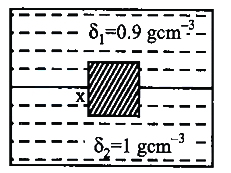
(D) Given: Side of the cube $a = 10 \ cm$,so the area of each face $A = a^2 = 100 \ cm^2$.
Depth of the cube in water $x = 3 \ cm$.
Depth of the cube in oil $h = a - x = 10 - 3 = 7 \ cm$.
Density of oil $\delta_1 = 0.9 \ g \ cm^{-3}$.
Density of water $\delta_2 = 1 \ g \ cm^{-3}$.
By the law of flotation,the weight of the cube is equal to the total buoyant force exerted by the two liquids.
$W = F_{B1} + F_{B2}$
$mg = (\delta_1 \cdot V_{oil} \cdot g) + (\delta_2 \cdot V_{water} \cdot g)$
$m = \delta_1 \cdot A \cdot h + \delta_2 \cdot A \cdot x$
$m = 0.9 \times 100 \times 7 + 1 \times 100 \times 3$
$m = 630 + 300 = 930 \ g$
Therefore,the mass of the wooden cube is $930 \ g$.
Depth of the cube in water $x = 3 \ cm$.
Depth of the cube in oil $h = a - x = 10 - 3 = 7 \ cm$.
Density of oil $\delta_1 = 0.9 \ g \ cm^{-3}$.
Density of water $\delta_2 = 1 \ g \ cm^{-3}$.
By the law of flotation,the weight of the cube is equal to the total buoyant force exerted by the two liquids.
$W = F_{B1} + F_{B2}$
$mg = (\delta_1 \cdot V_{oil} \cdot g) + (\delta_2 \cdot V_{water} \cdot g)$
$m = \delta_1 \cdot A \cdot h + \delta_2 \cdot A \cdot x$
$m = 0.9 \times 100 \times 7 + 1 \times 100 \times 3$
$m = 630 + 300 = 930 \ g$
Therefore,the mass of the wooden cube is $930 \ g$.
0 likes
View Solution233
MediumMCQ
$A$ hollow spherical body of outer and inner radii of $4 \ cm$ and $2 \ cm$ respectively floats half submerged in a liquid of density $2.0 \ g \ cm^{-3}$. The density of the material of the sphere is (in $g \ cm^{-3}$)
A
$1.02$
B
$1.14$
C
$1.18$
D
$1.24$
Solution
(B) The volume of the material of the hollow sphere is $V_S = \frac{4}{3} \pi (R^3 - r^3)$,where $R = 4 \ cm$ and $r = 2 \ cm$.
For a floating body,the buoyant force equals the weight of the body.
$B = W$
$\rho_L V_{sub} g = \rho_S V_S g$
Since the sphere is half submerged,the submerged volume $V_{sub} = \frac{1}{2} \times ( \frac{4}{3} \pi R^3 ) = \frac{2}{3} \pi R^3$.
Substituting the values:
$2.0 \times \frac{2}{3} \pi (4)^3 = \rho_S \times \frac{4}{3} \pi (4^3 - 2^3)$
$2.0 \times 64 = \rho_S \times (64 - 8)$
$128 = \rho_S \times 56$
$\rho_S = \frac{128}{56} \approx 2.28 \ g \ cm^{-3}$.
Wait,re-evaluating the calculation: $V_S = \frac{4}{3} \pi (64 - 8) = \frac{4}{3} \pi (56) = \frac{224}{3} \pi$.
$V_{sub} = \frac{1}{2} \times \frac{4}{3} \pi (4^3) = \frac{128}{3} \pi$.
Equating forces: $2.0 \times (\frac{128}{3} \pi) = \rho_S \times (\frac{224}{3} \pi)$.
$\rho_S = \frac{256}{224} = 1.1428 \approx 1.14 \ g \ cm^{-3}$.
For a floating body,the buoyant force equals the weight of the body.
$B = W$
$\rho_L V_{sub} g = \rho_S V_S g$
Since the sphere is half submerged,the submerged volume $V_{sub} = \frac{1}{2} \times ( \frac{4}{3} \pi R^3 ) = \frac{2}{3} \pi R^3$.
Substituting the values:
$2.0 \times \frac{2}{3} \pi (4)^3 = \rho_S \times \frac{4}{3} \pi (4^3 - 2^3)$
$2.0 \times 64 = \rho_S \times (64 - 8)$
$128 = \rho_S \times 56$
$\rho_S = \frac{128}{56} \approx 2.28 \ g \ cm^{-3}$.
Wait,re-evaluating the calculation: $V_S = \frac{4}{3} \pi (64 - 8) = \frac{4}{3} \pi (56) = \frac{224}{3} \pi$.
$V_{sub} = \frac{1}{2} \times \frac{4}{3} \pi (4^3) = \frac{128}{3} \pi$.
Equating forces: $2.0 \times (\frac{128}{3} \pi) = \rho_S \times (\frac{224}{3} \pi)$.
$\rho_S = \frac{256}{224} = 1.1428 \approx 1.14 \ g \ cm^{-3}$.
0 likes
View Solution234
MediumMCQ
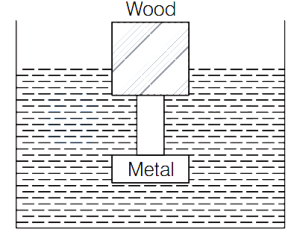
$A$ cubical block of wood having a mass of $160 \,g$ has a metal piece fastened underneath as shown in the figure. Find the maximum mass of the metal piece which will allow the block to float in water. The specific gravity of wood is $0.8$, the specific gravity of the metal is $10$, and the density of water is $1 \,g/cm^3$. (in $\,g$)
A
$55.5$
B
$44.4$
C
$33.3$
D
$66.6$
Solution
(B) Volume of the wood block $V_w = \frac{\text{Mass}}{\text{Density}} = \frac{160}{0.8 \times 1} = 200 \,cm^3$.
Let the mass of the metal piece be $x \,g$.
Volume of the metal piece $V_m = \frac{\text{Mass}}{\text{Density}} = \frac{x}{10 \times 1} = \frac{x}{10} \,cm^3$.
For the system to float in water, the total weight of the system must be equal to the buoyant force (upthrust) exerted by the water when the entire system is submerged.
Total weight $W = (m_w + m_m)g = (160 + x)g$.
Total volume of the system $V_{total} = V_w + V_m = (200 + \frac{x}{10}) \,cm^3$.
Buoyant force $F_B = V_{total} \times \rho_{water} \times g = (200 + \frac{x}{10}) \times 1 \times g$.
Equating weight and buoyant force: $(160 + x)g = (200 + \frac{x}{10})g$.
$160 + x = 200 + 0.1x$.
$0.9x = 40$.
$x = \frac{400}{9} \approx 44.4 \,g$.
Let the mass of the metal piece be $x \,g$.
Volume of the metal piece $V_m = \frac{\text{Mass}}{\text{Density}} = \frac{x}{10 \times 1} = \frac{x}{10} \,cm^3$.
For the system to float in water, the total weight of the system must be equal to the buoyant force (upthrust) exerted by the water when the entire system is submerged.
Total weight $W = (m_w + m_m)g = (160 + x)g$.
Total volume of the system $V_{total} = V_w + V_m = (200 + \frac{x}{10}) \,cm^3$.
Buoyant force $F_B = V_{total} \times \rho_{water} \times g = (200 + \frac{x}{10}) \times 1 \times g$.
Equating weight and buoyant force: $(160 + x)g = (200 + \frac{x}{10})g$.
$160 + x = 200 + 0.1x$.
$0.9x = 40$.
$x = \frac{400}{9} \approx 44.4 \,g$.
0 likes
View Solution235
MediumMCQ
The tension in a massless cable connected to an iron ball of $100 \,kg$ when it is submerged in sea water is (Given: $\rho_{\text{iron}} = 8 \times 10^3 \,kg/m^3$, $\rho_{\text{sea water}} = 1000 \,kg/m^3$, $g = 10 \,m/s^2$). (in $\,N$)
A
$950$
B
$846$
C
$875$
D
$933$
Solution
(C) Given: Mass of iron ball, $m = 100 \,kg$. Density of iron, $\rho_{\text{iron}} = 8 \times 10^3 \,kg/m^3$. Density of sea water, $\rho_{\text{sea water}} = 1000 \,kg/m^3$. Acceleration due to gravity, $g = 10 \,m/s^2$.
When the ball is submerged in sea water, an upthrust (buoyant force) acts on it in the upward direction.
According to Archimedes' principle, the apparent weight of the ball is equal to its actual weight minus the upthrust force.
The tension $T$ in the cable is equal to the apparent weight of the ball.
$T = W - F_B = mg - V \rho_{\text{sea water}} g = mg \left(1 - \frac{\rho_{\text{sea water}}}{\rho_{\text{iron}}}\right)$.
Substituting the values:
$T = 100 \times 10 \left(1 - \frac{1000}{8 \times 10^3}\right) = 1000 \left(1 - \frac{1}{8}\right) = 1000 \times \frac{7}{8} = 875 \,N$.
When the ball is submerged in sea water, an upthrust (buoyant force) acts on it in the upward direction.
According to Archimedes' principle, the apparent weight of the ball is equal to its actual weight minus the upthrust force.
The tension $T$ in the cable is equal to the apparent weight of the ball.
$T = W - F_B = mg - V \rho_{\text{sea water}} g = mg \left(1 - \frac{\rho_{\text{sea water}}}{\rho_{\text{iron}}}\right)$.
Substituting the values:
$T = 100 \times 10 \left(1 - \frac{1000}{8 \times 10^3}\right) = 1000 \left(1 - \frac{1}{8}\right) = 1000 \times \frac{7}{8} = 875 \,N$.
0 likes
View Solution236
DifficultMCQ
$A$ cylinder of mass $m$ and material density $\rho$ hanging from a string is lowered into a vessel of cross-sectional area $A$ containing a liquid of density $\sigma$ $(< \rho)$ until it is fully immersed. The increase in pressure at the bottom of the vessel is
A
Zero
B
$\frac{mg}{A}$
C
$\frac{m g \rho}{\sigma A}$
D
$\frac{m \sigma g}{\rho A}$
Solution
(D) When the cylinder is immersed in the liquid,it displaces a volume of liquid equal to its own volume $V$.
According to Archimedes' principle,the buoyant force $F_B$ exerted by the liquid on the cylinder is $F_B = V \sigma g$.
By Newton's third law,the cylinder exerts an equal and opposite force on the liquid,which increases the pressure at the bottom of the vessel.
The volume of the cylinder is $V = \frac{m}{\rho}$.
The increase in pressure $\Delta P$ is given by the force exerted on the liquid divided by the cross-sectional area $A$ of the vessel:
$\Delta P = \frac{F_B}{A} = \frac{V \sigma g}{A}$.
Substituting $V = \frac{m}{\rho}$ into the equation:
$\Delta P = \frac{(m/\rho) \sigma g}{A} = \frac{m \sigma g}{\rho A}$.
According to Archimedes' principle,the buoyant force $F_B$ exerted by the liquid on the cylinder is $F_B = V \sigma g$.
By Newton's third law,the cylinder exerts an equal and opposite force on the liquid,which increases the pressure at the bottom of the vessel.
The volume of the cylinder is $V = \frac{m}{\rho}$.
The increase in pressure $\Delta P$ is given by the force exerted on the liquid divided by the cross-sectional area $A$ of the vessel:
$\Delta P = \frac{F_B}{A} = \frac{V \sigma g}{A}$.
Substituting $V = \frac{m}{\rho}$ into the equation:
$\Delta P = \frac{(m/\rho) \sigma g}{A} = \frac{m \sigma g}{\rho A}$.
0 likes
View Solution237
MediumMCQ
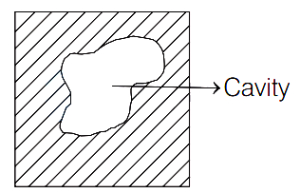
$A$ block of iron contains a hollow cavity as shown below. The block weighs $6000 \,N$ in air and $4000 \,N$ in water. If the densities of iron and water are $6 \,g/cm^3$ and $1 \,g/cm^3$ respectively, then the volume of the cavity is (assume $g = 10 \,m/s^2$): (in $\,m^3$)
A
$0.05$
B
$0.5$
C
$0.25$
D
$0.1$
Solution
(D) Weight of the block in air, $w_{\text{air}} = 6000 \,N$.
Weight of the block in water, $w_{\text{water}} = 4000 \,N$.
The buoyant force (upthrust) acting on the block is equal to the weight of the water displaced: $F_B = w_{\text{air}} - w_{\text{water}} = 6000 - 4000 = 2000 \,N$.
The total volume of the block $(V_{\text{total}})$ is equal to the volume of water displaced: $V_{\text{total}} = \frac{F_B}{\rho_{\text{water}} \cdot g} = \frac{2000}{1000 \cdot 10} = 0.2 \,m^3$.
The actual volume of the iron material $(V_{\text{iron}})$ is calculated from its weight in air: $V_{\text{iron}} = \frac{w_{\text{air}}}{\rho_{\text{iron}} \cdot g} = \frac{6000}{6000 \cdot 10} = 0.1 \,m^3$.
The volume of the cavity $(V_{\text{cavity}})$ is the difference between the total volume and the volume of the iron: $V_{\text{cavity}} = V_{\text{total}} - V_{\text{iron}} = 0.2 \,m^3 - 0.1 \,m^3 = 0.1 \,m^3$.
Weight of the block in water, $w_{\text{water}} = 4000 \,N$.
The buoyant force (upthrust) acting on the block is equal to the weight of the water displaced: $F_B = w_{\text{air}} - w_{\text{water}} = 6000 - 4000 = 2000 \,N$.
The total volume of the block $(V_{\text{total}})$ is equal to the volume of water displaced: $V_{\text{total}} = \frac{F_B}{\rho_{\text{water}} \cdot g} = \frac{2000}{1000 \cdot 10} = 0.2 \,m^3$.
The actual volume of the iron material $(V_{\text{iron}})$ is calculated from its weight in air: $V_{\text{iron}} = \frac{w_{\text{air}}}{\rho_{\text{iron}} \cdot g} = \frac{6000}{6000 \cdot 10} = 0.1 \,m^3$.
The volume of the cavity $(V_{\text{cavity}})$ is the difference between the total volume and the volume of the iron: $V_{\text{cavity}} = V_{\text{total}} - V_{\text{iron}} = 0.2 \,m^3 - 0.1 \,m^3 = 0.1 \,m^3$.
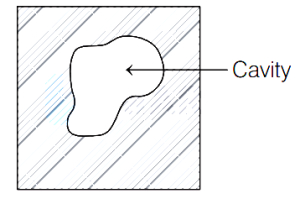
0 likes
View Solution238
EasyMCQ
$A$ block of material with density $3 \,g/cc$ is placed on a fluid of density $7 \,g/cc$. The fraction of volume of the piece of material outside the fluid is
A
$0.43$
B
$0.57$
C
$0.63$
D
$0.15$
Solution
(B) Density of the material,$\rho = 3 \,g/cc$.
Density of the fluid,$\sigma = 7 \,g/cc$.
Let the total volume of the material be $V$ and the fraction of the volume submerged in the fluid be $n$.
According to the principle of flotation,the weight of the block is equal to the weight of the displaced fluid.
$V \rho g = (n V) \sigma g$.
Dividing both sides by $V g$,we get $\rho = n \sigma$.
Therefore,the submerged fraction $n = \frac{\rho}{\sigma} = \frac{3}{7}$.
The fraction of the volume of the block outside the fluid is $1 - n = 1 - \frac{3}{7} = \frac{4}{7} \approx 0.57$.
Density of the fluid,$\sigma = 7 \,g/cc$.
Let the total volume of the material be $V$ and the fraction of the volume submerged in the fluid be $n$.
According to the principle of flotation,the weight of the block is equal to the weight of the displaced fluid.
$V \rho g = (n V) \sigma g$.
Dividing both sides by $V g$,we get $\rho = n \sigma$.
Therefore,the submerged fraction $n = \frac{\rho}{\sigma} = \frac{3}{7}$.
The fraction of the volume of the block outside the fluid is $1 - n = 1 - \frac{3}{7} = \frac{4}{7} \approx 0.57$.
0 likes
View Solution239
EasyMCQ
$A$ wooden block of density $0.5 \ g/cc$ is tied to a string. The other end of the string is fixed to the bottom of a tank. The tank is filled with a liquid of density $1 \ g/cc$. If the tension of the string is $20 \ N$,then the mass of the block is (Take $g = 10 \ m/s^2$) (in $kg$)
A
$1$
B
$2$
C
$3$
D
$0.5$
Solution
(B) At equilibrium,the forces acting on the block are the buoyant force $(F_B)$ acting upwards,the weight of the block $(W)$ acting downwards,and the tension in the string $(T)$ acting downwards.
For equilibrium: $F_B = W + T$.
Thus,$T = F_B - W$.
Given: Density of block $\rho_s = 0.5 \ g/cc = 500 \ kg/m^3$,density of liquid $\rho_l = 1 \ g/cc = 1000 \ kg/m^3$,$T = 20 \ N$,and $g = 10 \ m/s^2$.
$T = \rho_l V g - \rho_s V g = V g (\rho_l - \rho_s)$.
Substituting the values: $20 = V \times 10 \times (1000 - 500)$.
$20 = V \times 10 \times 500$.
$20 = 5000 V$.
$V = \frac{20}{5000} = \frac{1}{250} \ m^3$.
The mass of the block is $m = \rho_s V$.
$m = 500 \times \frac{1}{250} = 2 \ kg$.
For equilibrium: $F_B = W + T$.
Thus,$T = F_B - W$.
Given: Density of block $\rho_s = 0.5 \ g/cc = 500 \ kg/m^3$,density of liquid $\rho_l = 1 \ g/cc = 1000 \ kg/m^3$,$T = 20 \ N$,and $g = 10 \ m/s^2$.
$T = \rho_l V g - \rho_s V g = V g (\rho_l - \rho_s)$.
Substituting the values: $20 = V \times 10 \times (1000 - 500)$.
$20 = V \times 10 \times 500$.
$20 = 5000 V$.
$V = \frac{20}{5000} = \frac{1}{250} \ m^3$.
The mass of the block is $m = \rho_s V$.
$m = 500 \times \frac{1}{250} = 2 \ kg$.
0 likes
View Solution240
DifficultMCQ
$A$ piece of metal weighs $45 \ g$ in air and $25 \ g$ in a liquid of density $1.5 \times 10^3 \ kg \ m^{-3}$ kept at $30^{\circ} C$. When the temperature of the liquid is raised to $40^{\circ} C$,the metal piece weighs $27 \ g$. The density of the liquid at $40^{\circ} C$ is $1.25 \times 10^3 \ kg \ m^{-3}$. The coefficient of linear expansion of the metal is:
A
$1.3 \times 10^{-3} /^{\circ} C$
B
$5.2 \times 10^{-3} /^{\circ} C$
C
$2.6 \times 10^{-3} /^{\circ} C$
D
$0.26 \times 10^{-3} /^{\circ} C$
Solution
(C) The apparent weight loss is equal to the weight of the displaced liquid (Archimedes' Principle).
At $30^{\circ} C$: Loss in weight = $45 - 25 = 20 \ g$.
Volume of metal $V_{30} = \frac{\text{Loss}}{\rho_{30}} = \frac{20 \ g}{1.5 \ g/cm^3} = 13.33 \ cm^3$.
At $40^{\circ} C$: Loss in weight = $45 - 27 = 18 \ g$.
Volume of metal $V_{40} = \frac{\text{Loss}}{\rho_{40}} = \frac{18 \ g}{1.25 \ g/cm^3} = 14.40 \ cm^3$.
The coefficient of volume expansion $\gamma$ is given by $V_{40} = V_{30}(1 + \gamma \Delta T)$.
$\gamma = \frac{V_{40} - V_{30}}{V_{30} \Delta T} = \frac{14.40 - 13.33}{13.33 \times (40 - 30)} = \frac{1.07}{133.3} \approx 8.03 \times 10^{-3} /^{\circ} C$.
The coefficient of linear expansion $\alpha = \frac{\gamma}{3} = \frac{8.03 \times 10^{-3}}{3} \approx 2.67 \times 10^{-3} /^{\circ} C$.
At $30^{\circ} C$: Loss in weight = $45 - 25 = 20 \ g$.
Volume of metal $V_{30} = \frac{\text{Loss}}{\rho_{30}} = \frac{20 \ g}{1.5 \ g/cm^3} = 13.33 \ cm^3$.
At $40^{\circ} C$: Loss in weight = $45 - 27 = 18 \ g$.
Volume of metal $V_{40} = \frac{\text{Loss}}{\rho_{40}} = \frac{18 \ g}{1.25 \ g/cm^3} = 14.40 \ cm^3$.
The coefficient of volume expansion $\gamma$ is given by $V_{40} = V_{30}(1 + \gamma \Delta T)$.
$\gamma = \frac{V_{40} - V_{30}}{V_{30} \Delta T} = \frac{14.40 - 13.33}{13.33 \times (40 - 30)} = \frac{1.07}{133.3} \approx 8.03 \times 10^{-3} /^{\circ} C$.
The coefficient of linear expansion $\alpha = \frac{\gamma}{3} = \frac{8.03 \times 10^{-3}}{3} \approx 2.67 \times 10^{-3} /^{\circ} C$.
0 likes
View Solution241
MediumMCQ
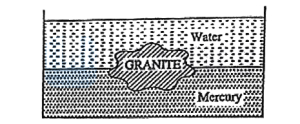
$A$ piece of granite floats at the interface of mercury and water contained in a beaker as shown in the figure. If the densities of granite,water,and mercury are $\rho, \rho_1$,and $\rho_2$ respectively,the ratio of the volume of granite in water to the volume of granite in mercury is:
A
$\frac{\rho_2-\rho}{\rho-\rho_1}$
B
$\frac{\rho_2+\rho}{\rho_1+\rho}$
C
$\frac{\rho_1 \rho_2}{\rho}$
D
$\frac{\rho_1}{\rho_2}$
Solution
(A) Let $V_1$ be the volume of granite in water and $V_2$ be the volume of granite in mercury.
According to the principle of floatation,the total buoyant force acting on the granite must be equal to its weight.
The buoyant force from water is $F_{B1} = V_1 \rho_1 g$.
The buoyant force from mercury is $F_{B2} = V_2 \rho_2 g$.
The weight of the granite is $W = (V_1 + V_2) \rho g$.
Equating the forces: $V_1 \rho_1 g + V_2 \rho_2 g = (V_1 + V_2) \rho g$.
Dividing by $g$: $V_1 \rho_1 + V_2 \rho_2 = V_1 \rho + V_2 \rho$.
Rearranging the terms to group $V_1$ and $V_2$: $V_1 \rho_1 - V_1 \rho = V_2 \rho - V_2 \rho_2$.
$V_1(\rho_1 - \rho) = V_2(\rho - \rho_2)$.
Therefore,the ratio of the volume of granite in water $(V_1)$ to the volume of granite in mercury $(V_2)$ is:
$\frac{V_1}{V_2} = \frac{\rho - \rho_2}{\rho_1 - \rho} = \frac{\rho_2 - \rho}{\rho - \rho_1}$.
According to the principle of floatation,the total buoyant force acting on the granite must be equal to its weight.
The buoyant force from water is $F_{B1} = V_1 \rho_1 g$.
The buoyant force from mercury is $F_{B2} = V_2 \rho_2 g$.
The weight of the granite is $W = (V_1 + V_2) \rho g$.
Equating the forces: $V_1 \rho_1 g + V_2 \rho_2 g = (V_1 + V_2) \rho g$.
Dividing by $g$: $V_1 \rho_1 + V_2 \rho_2 = V_1 \rho + V_2 \rho$.
Rearranging the terms to group $V_1$ and $V_2$: $V_1 \rho_1 - V_1 \rho = V_2 \rho - V_2 \rho_2$.
$V_1(\rho_1 - \rho) = V_2(\rho - \rho_2)$.
Therefore,the ratio of the volume of granite in water $(V_1)$ to the volume of granite in mercury $(V_2)$ is:
$\frac{V_1}{V_2} = \frac{\rho - \rho_2}{\rho_1 - \rho} = \frac{\rho_2 - \rho}{\rho - \rho_1}$.
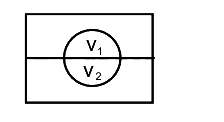
0 likes
View Solution242
DifficultMCQ
$A$ hollow sphere of external radius $R$ and thickness $t$ $(t \ll R)$ is made of a metal of density $\rho$. The sphere will float in water if:
A
$t \leq \frac{R}{\rho}$
B
$t \leq \frac{R}{3 \rho}$
C
$t \leq \frac{R}{2 \rho}$
D
$t \geq \frac{R}{3 \rho}$
Solution
(B) The density of the metal is $\rho$. The density of water is $\rho_w = 1 \text{ g/cm}^3$ (or $1000 \text{ kg/m}^3$).
For the hollow sphere to float,its weight must be less than or equal to the weight of the water displaced by the total volume of the sphere.
The volume of the metal shell is $V_m = 4 \pi R^2 t$ (since $t \ll R$).
The mass of the sphere is $m_s = V_m \times \rho = 4 \pi R^2 t \rho$.
The volume of water displaced by the sphere is $V_w = \frac{4}{3} \pi R^3$.
The mass of the displaced water is $m_w = V_w \times \rho_w = \frac{4}{3} \pi R^3 \times 1$ (assuming $\rho$ is relative to water density).
For floatation,$m_s \leq m_w$:
$4 \pi R^2 t \rho \leq \frac{4}{3} \pi R^3$
Dividing both sides by $4 \pi R^2$:
$t \rho \leq \frac{R}{3}$
$t \leq \frac{R}{3 \rho}$
For the hollow sphere to float,its weight must be less than or equal to the weight of the water displaced by the total volume of the sphere.
The volume of the metal shell is $V_m = 4 \pi R^2 t$ (since $t \ll R$).
The mass of the sphere is $m_s = V_m \times \rho = 4 \pi R^2 t \rho$.
The volume of water displaced by the sphere is $V_w = \frac{4}{3} \pi R^3$.
The mass of the displaced water is $m_w = V_w \times \rho_w = \frac{4}{3} \pi R^3 \times 1$ (assuming $\rho$ is relative to water density).
For floatation,$m_s \leq m_w$:
$4 \pi R^2 t \rho \leq \frac{4}{3} \pi R^3$
Dividing both sides by $4 \pi R^2$:
$t \rho \leq \frac{R}{3}$
$t \leq \frac{R}{3 \rho}$
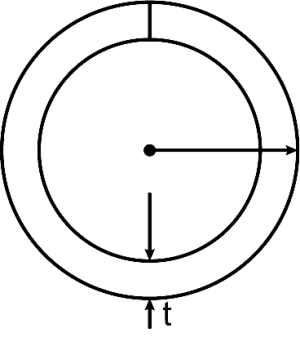
0 likes
View Solution243
MediumMCQ
$A$ wooden block is floating on water kept in a beaker. $40 \%$ of the block is above the water surface. Now the beaker is kept inside a lift that starts going upward with acceleration equal to $g / 2$. The block will then
A
sink
B
float with $10 \%$ above the water surface
C
float with $40 \%$ above the water surface
D
float with $70 \%$ above the water surface
Solution
(C) The buoyant force acting on an immersed body is equal to the weight of the fluid displaced by it when the fluid is at rest. When the fluid is accelerating,the effective gravity $g_{\text{eff}}$ must be considered.
In the first case,the block is in equilibrium: $V_{\text{immersed}} \rho g = V_{\text{total}} \rho_b g$,where $\rho$ is the density of water and $\rho_b$ is the density of the block.
Given $40 \%$ is above the surface,$60 \%$ is immersed,so $V_{\text{immersed}} = 0.6 V_{\text{total}}$.
Thus,$0.6 V \rho g = V \rho_b g \implies \rho_b = 0.6 \rho$.
When the lift accelerates upward with $a = g/2$,the effective gravity is $g_{\text{eff}} = g + a = 1.5 g$.
The buoyant force becomes $F_B = V_{\text{immersed}} \rho (1.5 g)$.
The weight of the block in the accelerating frame is $W_{\text{eff}} = V_{\text{total}} \rho_b (1.5 g)$.
For equilibrium,$F_B = W_{\text{eff}} \implies V_{\text{immersed}} \rho (1.5 g) = V_{\text{total}} \rho_b (1.5 g)$.
Dividing by $1.5 g$,we get $V_{\text{immersed}} \rho = V_{\text{total}} \rho_b$.
Substituting $\rho_b = 0.6 \rho$,we get $V_{\text{immersed}} = 0.6 V_{\text{total}}$.
Therefore,the fraction of the volume immersed remains $60 \%$,and the fraction above the surface remains $40 \%$.
In the first case,the block is in equilibrium: $V_{\text{immersed}} \rho g = V_{\text{total}} \rho_b g$,where $\rho$ is the density of water and $\rho_b$ is the density of the block.
Given $40 \%$ is above the surface,$60 \%$ is immersed,so $V_{\text{immersed}} = 0.6 V_{\text{total}}$.
Thus,$0.6 V \rho g = V \rho_b g \implies \rho_b = 0.6 \rho$.
When the lift accelerates upward with $a = g/2$,the effective gravity is $g_{\text{eff}} = g + a = 1.5 g$.
The buoyant force becomes $F_B = V_{\text{immersed}} \rho (1.5 g)$.
The weight of the block in the accelerating frame is $W_{\text{eff}} = V_{\text{total}} \rho_b (1.5 g)$.
For equilibrium,$F_B = W_{\text{eff}} \implies V_{\text{immersed}} \rho (1.5 g) = V_{\text{total}} \rho_b (1.5 g)$.
Dividing by $1.5 g$,we get $V_{\text{immersed}} \rho = V_{\text{total}} \rho_b$.
Substituting $\rho_b = 0.6 \rho$,we get $V_{\text{immersed}} = 0.6 V_{\text{total}}$.
Therefore,the fraction of the volume immersed remains $60 \%$,and the fraction above the surface remains $40 \%$.
0 likes
View Solution244
MediumMCQ
$A$ uniform rod is suspended horizontally from its mid-point. $A$ piece of metal whose weight is $w$ is suspended at a distance $l$ from the mid-point. Another weight $w_{1}$ is suspended on the other side at a distance $l_{1}$ from the mid-point to bring the rod to a horizontal position. When $w$ is completely immersed in water,$w_{1}$ needs to be kept at a distance $l_{2}$ from the mid-point to get the rod back into a horizontal position. The specific gravity of the metal piece is
A
$\frac{w}{w_{1}}$
B
$\frac{w l}{w l - w_{1} l_{2}}$
C
$\frac{l_{1}}{l_{1} - l_{2}}$
D
$\frac{l_{1}}{l_{2}}$
Solution
(C) For the rod to be in horizontal equilibrium,the net torque about the mid-point must be zero.
Initially,the torque balance is: $w \cdot l = w_{1} \cdot l_{1}$.
When the metal piece of weight $w$ is immersed in water,it experiences an upward buoyant force $F_{B}$. The effective weight becomes $w' = w - F_{B}$.
The buoyant force is $F_{B} = V \rho_{w} g$,where $V$ is the volume of the metal and $\rho_{w}$ is the density of water. Since $w = V \rho_{metal} g$,we have $F_{B} = w \cdot \frac{\rho_{w}}{\rho_{metal}} = \frac{w}{\sigma}$,where $\sigma$ is the specific gravity of the metal.
Thus,the new effective weight is $w' = w(1 - \frac{1}{\sigma})$.
For the new equilibrium,the torque balance is: $w' \cdot l = w_{1} \cdot l_{2}$.
Substituting $w'$,we get: $w(1 - \frac{1}{\sigma}) l = w_{1} l_{2}$.
From the initial condition,$w = \frac{w_{1} l_{1}}{l}$.
Substituting $w$ into the new equilibrium equation: $\frac{w_{1} l_{1}}{l} (1 - \frac{1}{\sigma}) l = w_{1} l_{2}$.
$l_{1} (1 - \frac{1}{\sigma}) = l_{2}$.
$1 - \frac{1}{\sigma} = \frac{l_{2}}{l_{1}}$.
$\frac{1}{\sigma} = 1 - \frac{l_{2}}{l_{1}} = \frac{l_{1} - l_{2}}{l_{1}}$.
Therefore,$\sigma = \frac{l_{1}}{l_{1} - l_{2}}$.
Initially,the torque balance is: $w \cdot l = w_{1} \cdot l_{1}$.
When the metal piece of weight $w$ is immersed in water,it experiences an upward buoyant force $F_{B}$. The effective weight becomes $w' = w - F_{B}$.
The buoyant force is $F_{B} = V \rho_{w} g$,where $V$ is the volume of the metal and $\rho_{w}$ is the density of water. Since $w = V \rho_{metal} g$,we have $F_{B} = w \cdot \frac{\rho_{w}}{\rho_{metal}} = \frac{w}{\sigma}$,where $\sigma$ is the specific gravity of the metal.
Thus,the new effective weight is $w' = w(1 - \frac{1}{\sigma})$.
For the new equilibrium,the torque balance is: $w' \cdot l = w_{1} \cdot l_{2}$.
Substituting $w'$,we get: $w(1 - \frac{1}{\sigma}) l = w_{1} l_{2}$.
From the initial condition,$w = \frac{w_{1} l_{1}}{l}$.
Substituting $w$ into the new equilibrium equation: $\frac{w_{1} l_{1}}{l} (1 - \frac{1}{\sigma}) l = w_{1} l_{2}$.
$l_{1} (1 - \frac{1}{\sigma}) = l_{2}$.
$1 - \frac{1}{\sigma} = \frac{l_{2}}{l_{1}}$.
$\frac{1}{\sigma} = 1 - \frac{l_{2}}{l_{1}} = \frac{l_{1} - l_{2}}{l_{1}}$.
Therefore,$\sigma = \frac{l_{1}}{l_{1} - l_{2}}$.
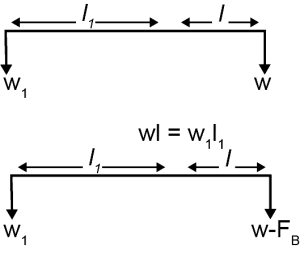
0 likes
View Solution245
DifficultMCQ
To determine the composition of a bimetallic alloy,a sample is first weighed in air and then in water. These weights are found to be $w_1$ and $w_2$ respectively. If the densities of the two constituent metals are $\rho_1$ and $\rho_2$ respectively,then the weight of the first metal in the sample is (where $\rho_w$ is the density of water):
A
$\frac{\rho_1}{\rho_w(\rho_2-\rho_1)}[w_1(\rho_2-\rho_w)-w_2 \rho_2]$
B
$\frac{\rho_1}{\rho_w(\rho_2+\rho_1)}[w_1(\rho_2-\rho_w)+w_2 \rho_2]$
C
$\frac{\rho_1}{\rho_w(\rho_2-\rho_1)}[w_1(\rho_2+\rho_w)-w_2 \rho_1]$
D
$\frac{\rho_1}{\rho_w(\rho_2-\rho_1)}[w_1(\rho_1-\rho_w)-w_2 \rho_1]$
Solution
(A) Let $x$ be the weight of the first metal and $(w_1 - x)$ be the weight of the second metal in air.
Let $v_1$ and $v_2$ be the volumes of the two metals respectively.
$v_1 = \frac{x}{\rho_1}$ and $v_2 = \frac{w_1 - x}{\rho_2}$.
The total volume of the alloy is $V = v_1 + v_2 = \frac{x}{\rho_1} + \frac{w_1 - x}{\rho_2}$.
According to Archimedes' Principle,the loss in weight equals the weight of the displaced water:
$w_1 - w_2 = V \rho_w = \left( \frac{x}{\rho_1} + \frac{w_1 - x}{\rho_2} \right) \rho_w$.
Multiplying by $\rho_1 \rho_2$:
$(w_1 - w_2) \rho_1 \rho_2 = (x \rho_2 + (w_1 - x) \rho_1) \rho_w$.
$(w_1 - w_2) \rho_1 \rho_2 = (x \rho_2 + w_1 \rho_1 - x \rho_1) \rho_w$.
$(w_1 - w_2) \rho_1 \rho_2 = x(\rho_2 - \rho_1) \rho_w + w_1 \rho_1 \rho_w$.
$x(\rho_2 - \rho_1) \rho_w = w_1 \rho_1 \rho_2 - w_2 \rho_1 \rho_2 - w_1 \rho_1 \rho_w$.
$x(\rho_2 - \rho_1) \rho_w = w_1 \rho_1(\rho_2 - \rho_w) - w_2 \rho_1 \rho_2$.
$x = \frac{\rho_1}{\rho_w(\rho_2 - \rho_1)} [w_1(\rho_2 - \rho_w) - w_2 \rho_2]$.
Let $v_1$ and $v_2$ be the volumes of the two metals respectively.
$v_1 = \frac{x}{\rho_1}$ and $v_2 = \frac{w_1 - x}{\rho_2}$.
The total volume of the alloy is $V = v_1 + v_2 = \frac{x}{\rho_1} + \frac{w_1 - x}{\rho_2}$.
According to Archimedes' Principle,the loss in weight equals the weight of the displaced water:
$w_1 - w_2 = V \rho_w = \left( \frac{x}{\rho_1} + \frac{w_1 - x}{\rho_2} \right) \rho_w$.
Multiplying by $\rho_1 \rho_2$:
$(w_1 - w_2) \rho_1 \rho_2 = (x \rho_2 + (w_1 - x) \rho_1) \rho_w$.
$(w_1 - w_2) \rho_1 \rho_2 = (x \rho_2 + w_1 \rho_1 - x \rho_1) \rho_w$.
$(w_1 - w_2) \rho_1 \rho_2 = x(\rho_2 - \rho_1) \rho_w + w_1 \rho_1 \rho_w$.
$x(\rho_2 - \rho_1) \rho_w = w_1 \rho_1 \rho_2 - w_2 \rho_1 \rho_2 - w_1 \rho_1 \rho_w$.
$x(\rho_2 - \rho_1) \rho_w = w_1 \rho_1(\rho_2 - \rho_w) - w_2 \rho_1 \rho_2$.
$x = \frac{\rho_1}{\rho_w(\rho_2 - \rho_1)} [w_1(\rho_2 - \rho_w) - w_2 \rho_2]$.
0 likes
View Solution246
MediumMCQ
$A$ cylindrical block floats vertically in a liquid of density $\rho_{1}$ kept in a container such that the fraction of volume of the cylinder inside the liquid is $x_{1}$. Then some amount of another immiscible liquid of density $\rho_{2} (\rho_{2} < \rho_{1})$ is added to the liquid in the container so that the cylinder now floats just fully immersed in the liquids with $x_{2}$ being the fraction of volume of the cylinder inside the liquid of density $\rho_{1}$. The ratio $\rho_{1} / \rho_{2}$ will be
A
$\frac{1-x_{2}}{x_{1}-x_{2}}$
B
$\frac{1-x_{1}}{x_{1}+x_{2}}$
C
$\frac{x_{1}-x_{2}}{x_{1}+x_{2}}$
D
$\frac{x_{2}}{x_{1}}-1$
Solution
(A) Let $V$ be the total volume of the cylindrical block and $\rho$ be its density.
In the first case,the block floats in a liquid of density $\rho_{1}$. According to the law of floatation,the weight of the block equals the buoyant force:
$V \rho g = V x_{1} \rho_{1} g$
$\Rightarrow \rho = x_{1} \rho_{1} \quad ... (1)$
In the second case,the block is fully immersed in two immiscible liquids of densities $\rho_{1}$ and $\rho_{2}$. The volume fraction $x_{2}$ is in liquid $\rho_{1}$ and the remaining fraction $(1 - x_{2})$ is in liquid $\rho_{2}$. The total buoyant force equals the weight of the block:
$V \rho g = V x_{2} \rho_{1} g + V (1 - x_{2}) \rho_{2} g$
$\Rightarrow \rho = x_{2} \rho_{1} + (1 - x_{2}) \rho_{2} \quad ... (2)$
Equating $(1)$ and $(2)$:
$x_{1} \rho_{1} = x_{2} \rho_{1} + (1 - x_{2}) \rho_{2}$
$x_{1} \rho_{1} - x_{2} \rho_{1} = (1 - x_{2}) \rho_{2}$
$\rho_{1} (x_{1} - x_{2}) = \rho_{2} (1 - x_{2})$
$\frac{\rho_{1}}{\rho_{2}} = \frac{1 - x_{2}}{x_{1} - x_{2}}$
In the first case,the block floats in a liquid of density $\rho_{1}$. According to the law of floatation,the weight of the block equals the buoyant force:
$V \rho g = V x_{1} \rho_{1} g$
$\Rightarrow \rho = x_{1} \rho_{1} \quad ... (1)$
In the second case,the block is fully immersed in two immiscible liquids of densities $\rho_{1}$ and $\rho_{2}$. The volume fraction $x_{2}$ is in liquid $\rho_{1}$ and the remaining fraction $(1 - x_{2})$ is in liquid $\rho_{2}$. The total buoyant force equals the weight of the block:
$V \rho g = V x_{2} \rho_{1} g + V (1 - x_{2}) \rho_{2} g$
$\Rightarrow \rho = x_{2} \rho_{1} + (1 - x_{2}) \rho_{2} \quad ... (2)$
Equating $(1)$ and $(2)$:
$x_{1} \rho_{1} = x_{2} \rho_{1} + (1 - x_{2}) \rho_{2}$
$x_{1} \rho_{1} - x_{2} \rho_{1} = (1 - x_{2}) \rho_{2}$
$\rho_{1} (x_{1} - x_{2}) = \rho_{2} (1 - x_{2})$
$\frac{\rho_{1}}{\rho_{2}} = \frac{1 - x_{2}}{x_{1} - x_{2}}$
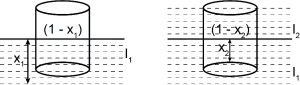
0 likes
View Solution247
MediumMCQ
$A$ body when fully immersed in a liquid of specific gravity $1.2$ weighs $44 \text{ gwt}$. The same body when fully immersed in water weighs $50 \text{ gwt}$. The mass of the body is (in $\text{ g}$)
A
$36$
B
$48$
C
$64$
D
$80$
Solution
(D) Let $m$ be the mass of the body in grams and $V$ be the volume of the body in $\text{cm}^3$. The density of water is $\rho_w = 1 \text{ g/cm}^3$. The apparent weight $W'$ is given by $W' = W_{actual} - F_B$,where $F_B$ is the buoyant force.
For the liquid with specific gravity $1.2$,the density is $\rho_l = 1.2 \text{ g/cm}^3$. The weight is $44 \text{ gwt}$,so:
$44 = m - 1.2V$ $(i)$
For water,the weight is $50 \text{ gwt}$,so:
$50 = m - V$ $(ii)$
Subtracting $(i)$ from $(ii)$:
$(50 - 44) = (m - V) - (m - 1.2V)$
$6 = 0.2V$
$V = 30 \text{ cm}^3$
Substituting $V = 30$ into $(ii)$:
$50 = m - 30$
$m = 80 \text{ g}$
For the liquid with specific gravity $1.2$,the density is $\rho_l = 1.2 \text{ g/cm}^3$. The weight is $44 \text{ gwt}$,so:
$44 = m - 1.2V$ $(i)$
For water,the weight is $50 \text{ gwt}$,so:
$50 = m - V$ $(ii)$
Subtracting $(i)$ from $(ii)$:
$(50 - 44) = (m - V) - (m - 1.2V)$
$6 = 0.2V$
$V = 30 \text{ cm}^3$
Substituting $V = 30$ into $(ii)$:
$50 = m - 30$
$m = 80 \text{ g}$
0 likes
View Solution248
EasyMCQ
$A$ stone of relative density $K$ is released from rest on the surface of a lake. If viscous effects are ignored,the stone sinks in water with an acceleration of
A
$g(1-K)$
B
$g(1+K)$
C
$g\left(1-\frac{1}{K}\right)$
D
$g\left(1+\frac{1}{K}\right)$
Solution
(C) Let $V$ be the volume of the stone,$\sigma$ be the density of the stone,and $\rho$ be the density of water.
The relative density $K$ of the stone is given by $K = \frac{\sigma}{\rho}$,so $\sigma = K\rho$.
The forces acting on the stone as it sinks are:
$1$. Weight of the stone acting downwards: $W = V\sigma g = V(K\rho)g$.
$2$. Buoyant force acting upwards: $F_B = V\rho g$.
According to Newton's second law,the net force $F_{net} = W - F_B = ma$,where $m = V\sigma$ is the mass of the stone.
$V\sigma g - V\rho g = (V\sigma)a$
Dividing by $V\sigma$:
$a = g - \frac{V\rho g}{V\sigma} = g - \frac{\rho}{\sigma}g$
Since $K = \frac{\sigma}{\rho}$,we have $\frac{\rho}{\sigma} = \frac{1}{K}$.
Therefore,the acceleration $a = g - \frac{g}{K} = g\left(1 - \frac{1}{K}\right)$.
The relative density $K$ of the stone is given by $K = \frac{\sigma}{\rho}$,so $\sigma = K\rho$.
The forces acting on the stone as it sinks are:
$1$. Weight of the stone acting downwards: $W = V\sigma g = V(K\rho)g$.
$2$. Buoyant force acting upwards: $F_B = V\rho g$.
According to Newton's second law,the net force $F_{net} = W - F_B = ma$,where $m = V\sigma$ is the mass of the stone.
$V\sigma g - V\rho g = (V\sigma)a$
Dividing by $V\sigma$:
$a = g - \frac{V\rho g}{V\sigma} = g - \frac{\rho}{\sigma}g$
Since $K = \frac{\sigma}{\rho}$,we have $\frac{\rho}{\sigma} = \frac{1}{K}$.
Therefore,the acceleration $a = g - \frac{g}{K} = g\left(1 - \frac{1}{K}\right)$.
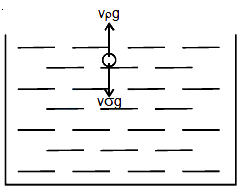
0 likes
View SolutionFluid Mechanics and Surface Tension — Buoyancy, Archimedes' Principle and Laws of Floatation · Frequently Asked Questions
1Are these Fluid Mechanics and Surface Tension questions useful for JEE and NEET?
Yes. All questions in this section are mapped to JEE Main and NEET exam patterns. Previous year questions from JEE Main, NEET, GUJCET and state-level exams are included with full solutions.
2Can I switch to Hindi or Gujarati for these questions?
Yes. Use the language tabs in the hero section or the sidebar to view the same questions and solutions in English, Hindi or Gujarati.
3How do I generate a question paper from this subtopic?
Use the Vedclass Exam Paper Generator — select the chapter and subtopic, set difficulty, and generate Sets A, B, C, D automatically. First 3 chapters of every subject are free.
Vedclass Products
For Students
Vedclass Test Series
Mock tests in real JEE/NEET style with performance analysis. 5-day free trial.
Start Free TrialFor Teachers
Exam Paper Generator
Generate Set A/B/C/D papers from this chapter in 2 minutes. 3 chapters free.
Try FreeFor Institutes
Online Exam Module
Live online exams with unlimited students, 360° analytics & white-label branding.
See DemoFor Teachers & Institutes
Generate a Fluid Mechanics and Surface Tension Exam Paper in 2 Minutes
Select subtopic & difficulty — Sets A, B, C, D auto-generated with No Repeat logic.
First 3 chapters of every subject are free — no payment required.