
A English
Buoyancy, Archimedes' Principle and Laws of Floatation Questions in English
Class 11 Physics · Fluid Mechanics and Surface Tension · Buoyancy, Archimedes' Principle and Laws of Floatation
257+
Questions
English
Language
100%
With Solutions
Showing 50 of 257 questions in English
151
MediumMCQ
Why do bubbles rise in a soda water bottle?
A
Due to the high density of the gas bubbles.
B
Due to the buoyant force being greater than the weight of the bubble.
C
Due to the surface tension of the liquid.
D
Due to the viscosity of the soda.
Solution
(B) When a soda bottle is opened,the pressure inside decreases,causing dissolved $CO_2$ gas to form bubbles.
According to Archimedes' principle,any object submerged in a fluid experiences an upward buoyant force equal to the weight of the fluid displaced by it.
The buoyant force $(F_b)$ acting on the bubble is given by $F_b = V \rho_{liquid} g$,where $V$ is the volume of the bubble,$\rho_{liquid}$ is the density of the liquid,and $g$ is the acceleration due to gravity.
The weight of the bubble $(W)$ is $W = V \rho_{gas} g$.
Since the density of the gas $(\rho_{gas})$ is much smaller than the density of the liquid $(\rho_{liquid})$,the buoyant force is significantly greater than the weight of the bubble $(F_b > W)$.
This net upward force causes the bubbles to accelerate and rise to the surface.
According to Archimedes' principle,any object submerged in a fluid experiences an upward buoyant force equal to the weight of the fluid displaced by it.
The buoyant force $(F_b)$ acting on the bubble is given by $F_b = V \rho_{liquid} g$,where $V$ is the volume of the bubble,$\rho_{liquid}$ is the density of the liquid,and $g$ is the acceleration due to gravity.
The weight of the bubble $(W)$ is $W = V \rho_{gas} g$.
Since the density of the gas $(\rho_{gas})$ is much smaller than the density of the liquid $(\rho_{liquid})$,the buoyant force is significantly greater than the weight of the bubble $(F_b > W)$.
This net upward force causes the bubbles to accelerate and rise to the surface.
0 likes
View Solution152
Easy
What is buoyancy?
Solution
(N/A) Buoyancy is the upward force exerted by a fluid on an object immersed in it. This force is known as the buoyant force. The property of a fluid to exert this upward force is called buoyancy.
0 likes
View Solution153
Medium
Why does a ship made of iron float while a piece of iron sinks in water?
Solution
(N/A) According to Archimedes' principle,an object floats if the weight of the liquid it displaces is equal to its own weight.
$1$. $A$ piece of iron has a small volume,so the weight of the water it displaces is less than its own weight,causing it to sink.
$2$. $A$ ship is designed with a large hollow structure,which increases its volume significantly. This allows the ship to displace a volume of water whose weight is equal to the total weight of the ship,satisfying the condition for flotation.
$1$. $A$ piece of iron has a small volume,so the weight of the water it displaces is less than its own weight,causing it to sink.
$2$. $A$ ship is designed with a large hollow structure,which increases its volume significantly. This allows the ship to displace a volume of water whose weight is equal to the total weight of the ship,satisfying the condition for flotation.
0 likes
View Solution154
Medium
$A$ person is sitting in a boat floating in a lake. This person fills a bucket of water from the lake and puts it in the boat. Will the water level in the lake go down? Explain.
Solution
(N/A) No,the water level in the lake will not change.
According to Archimedes' principle,the weight of the water displaced by the boat is equal to the weight of the boat and the person.
When the person takes a bucket of water from the lake,the weight of the water removed is equal to the weight of the water displaced by the bucket when it was submerged.
When the bucket is placed inside the boat,the total weight of the boat increases by the weight of the water in the bucket.
This additional weight causes the boat to sink slightly deeper,displacing an amount of water equal to the weight of the water in the bucket.
Since the volume of water added to the boat is exactly equal to the volume of water removed from the lake,the net change in the water level of the lake is zero.
According to Archimedes' principle,the weight of the water displaced by the boat is equal to the weight of the boat and the person.
When the person takes a bucket of water from the lake,the weight of the water removed is equal to the weight of the water displaced by the bucket when it was submerged.
When the bucket is placed inside the boat,the total weight of the boat increases by the weight of the water in the bucket.
This additional weight causes the boat to sink slightly deeper,displacing an amount of water equal to the weight of the water in the bucket.
Since the volume of water added to the boat is exactly equal to the volume of water removed from the lake,the net change in the water level of the lake is zero.
0 likes
View Solution155
EasyMCQ
$A$ container of liquid is in free fall. Without any liquid spilling out, does this container obey the principle of Archimedes?
A
Yes
B
No
C
Only at the start
D
Only at the end
Solution
(B) No, the container does not obey the principle of Archimedes in free fall.
Archimedes' principle states that the buoyant force is equal to the weight of the fluid displaced, which is given by $F_{b} = V \rho g$.
In a state of free fall, the effective acceleration due to gravity $(g_{eff})$ acting on the fluid is $g - a$. Since $a = g$ in free fall, $g_{eff} = 0$.
Consequently, the buoyant force $F_{b} = V \rho (0) = 0$.
Since the buoyant force becomes zero, the principle of Archimedes is not applicable.
Archimedes' principle states that the buoyant force is equal to the weight of the fluid displaced, which is given by $F_{b} = V \rho g$.
In a state of free fall, the effective acceleration due to gravity $(g_{eff})$ acting on the fluid is $g - a$. Since $a = g$ in free fall, $g_{eff} = 0$.
Consequently, the buoyant force $F_{b} = V \rho (0) = 0$.
Since the buoyant force becomes zero, the principle of Archimedes is not applicable.
0 likes
View Solution156
Medium
When two corks,one small and one big,are placed into a vessel filled with water and released,which cork will reach the surface of the water faster? Why?
Solution
(B) The bigger cork will reach the surface faster. According to Archimedes' principle,the buoyant force acting on an object is equal to the weight of the fluid displaced by it. Since the bigger cork has a larger volume,it displaces a greater volume of water compared to the smaller cork. Consequently,the buoyant force acting on the bigger cork is significantly higher. Since the buoyant force is the upward force responsible for bringing the cork to the surface,the larger cork experiences a greater net upward acceleration,causing it to reach the surface faster.
0 likes
View Solution157
Medium
Why is it easier to swim in sea water than in river water?
Solution
(N/A) It is easier to swim in sea water than in river water because sea water contains dissolved salts,which increases the density of the water. According to Archimedes' principle,the upthrust (buoyant force) acting on an object is given by $F = V \rho g$,where $V$ is the volume of the displaced fluid,$\rho$ is the density of the fluid,and $g$ is the acceleration due to gravity. Since the density of sea water is higher than that of river water,the upthrust exerted by sea water is greater. This increased buoyant force helps the body float more easily,requiring less effort to stay afloat.
0 likes
View Solution158
EasyMCQ
An iceberg floats in water with part of it submerged. What is the fraction of the volume of the iceberg submerged if the density of ice is ${\rho _i} = 0.917 \, g/cm^3$?
A
$0.083$
B
$0.917$
C
$0.500$
D
$0.091$
Solution
(B) The density of ice is $\rho_{\text{ice}} = 0.917 \, g/cm^3$.
The density of water is $\rho_{w} = 1 \, g/cm^3$.
Let the total volume of the iceberg be $V$.
Let the volume of the iceberg submerged in water be $V^{\prime}$.
For a body floating in equilibrium,the weight of the body must be equal to the weight of the liquid displaced by the submerged part of the body (Archimedes' Principle).
Weight of iceberg = Weight of water displaced
$V \cdot \rho_{\text{ice}} \cdot g = V^{\prime} \cdot \rho_{w} \cdot g$
Dividing both sides by $V \cdot \rho_{w} \cdot g$,we get the fraction of submerged volume:
$\frac{V^{\prime}}{V} = \frac{\rho_{\text{ice}}}{\rho_{w}} = \frac{0.917}{1} = 0.917$.
The density of water is $\rho_{w} = 1 \, g/cm^3$.
Let the total volume of the iceberg be $V$.
Let the volume of the iceberg submerged in water be $V^{\prime}$.
For a body floating in equilibrium,the weight of the body must be equal to the weight of the liquid displaced by the submerged part of the body (Archimedes' Principle).
Weight of iceberg = Weight of water displaced
$V \cdot \rho_{\text{ice}} \cdot g = V^{\prime} \cdot \rho_{w} \cdot g$
Dividing both sides by $V \cdot \rho_{w} \cdot g$,we get the fraction of submerged volume:
$\frac{V^{\prime}}{V} = \frac{\rho_{\text{ice}}}{\rho_{w}} = \frac{0.917}{1} = 0.917$.
0 likes
View Solution159
Medium
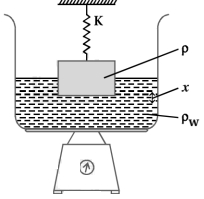
$A$ vessel filled with water is kept on a weighing pan and the scale is adjusted to zero. $A$ block of mass $M$ and density $\rho$ is suspended by a massless spring of spring constant $k$. This block is submerged into the water in the vessel. What is the reading of the scale?
Solution
(N/A) Consider the system consisting of the vessel and the water. The scale is initially adjusted to zero.
When the block is submerged in the water,it experiences an upward buoyant force (upthrust) $F_B$ from the water.
According to Newton's third law,the block exerts an equal and opposite downward force on the water.
Therefore,the reading of the scale increases by an amount equal to the upthrust experienced by the block.
Upthrust $F_B = V_{sub} \rho_w g$,where $V_{sub}$ is the submerged volume of the block and $\rho_w$ is the density of water.
If the entire block of mass $M$ and density $\rho$ is submerged,then $V_{sub} = V = \frac{M}{\rho}$.
Thus,the reading of the scale is $F_B = \left( \frac{M}{\rho} \right) \rho_w g = M g \left( \frac{\rho_w}{\rho} \right)$.
When the block is submerged in the water,it experiences an upward buoyant force (upthrust) $F_B$ from the water.
According to Newton's third law,the block exerts an equal and opposite downward force on the water.
Therefore,the reading of the scale increases by an amount equal to the upthrust experienced by the block.
Upthrust $F_B = V_{sub} \rho_w g$,where $V_{sub}$ is the submerged volume of the block and $\rho_w$ is the density of water.
If the entire block of mass $M$ and density $\rho$ is submerged,then $V_{sub} = V = \frac{M}{\rho}$.
Thus,the reading of the scale is $F_B = \left( \frac{M}{\rho} \right) \rho_w g = M g \left( \frac{\rho_w}{\rho} \right)$.
0 likes
View Solution160
Medium
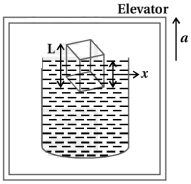
$A$ cubical block of density $\rho$ is floating on the surface of water. Out of its height $L$,a fraction $x$ is submerged in water. The vessel is in an elevator accelerating upward with acceleration $a$. What is the fraction immersed?
Solution
(A) Let the density of water be $\rho_{w}$. The block of height $L$ floats on it. Let $x$ be the height of the block submerged in water.
Volume of the block $V = L^{3}$.
Mass of the block $m = V \rho = L^{3} \rho$.
Weight of the block $W = mg = L^{3} \rho g$.
Case $1$: When the elevator is at rest (or moving with constant velocity),the weight of the block is balanced by the buoyant force.
Weight of the block = Weight of the water displaced.
$L^{3} \rho g = (x L^{2}) \rho_{w} g$.
Therefore,the fraction submerged is $\frac{x}{L} = \frac{\rho}{\rho_{w}}$.
Case $2$: When the elevator is accelerating upward with acceleration $a$,the effective acceleration becomes $g' = (g + a)$.
In this frame,the weight of the block becomes $W' = m(g + a) = L^{3} \rho (g + a)$.
The buoyant force also changes because the effective gravity acting on the fluid changes: $F_{B}' = V_{submerged} \rho_{w} (g + a) = (x' L^{2}) \rho_{w} (g + a)$,where $x'$ is the new submerged height.
Equating the two: $L^{3} \rho (g + a) = x' L^{2} \rho_{w} (g + a)$.
Canceling $(g + a)$ from both sides,we get $L^{3} \rho = x' L^{2} \rho_{w}$.
Therefore,the new fraction submerged is $\frac{x'}{L} = \frac{\rho}{\rho_{w}}$.
Conclusion: The fraction of the block submerged remains unchanged regardless of the acceleration of the elevator.
Volume of the block $V = L^{3}$.
Mass of the block $m = V \rho = L^{3} \rho$.
Weight of the block $W = mg = L^{3} \rho g$.
Case $1$: When the elevator is at rest (or moving with constant velocity),the weight of the block is balanced by the buoyant force.
Weight of the block = Weight of the water displaced.
$L^{3} \rho g = (x L^{2}) \rho_{w} g$.
Therefore,the fraction submerged is $\frac{x}{L} = \frac{\rho}{\rho_{w}}$.
Case $2$: When the elevator is accelerating upward with acceleration $a$,the effective acceleration becomes $g' = (g + a)$.
In this frame,the weight of the block becomes $W' = m(g + a) = L^{3} \rho (g + a)$.
The buoyant force also changes because the effective gravity acting on the fluid changes: $F_{B}' = V_{submerged} \rho_{w} (g + a) = (x' L^{2}) \rho_{w} (g + a)$,where $x'$ is the new submerged height.
Equating the two: $L^{3} \rho (g + a) = x' L^{2} \rho_{w} (g + a)$.
Canceling $(g + a)$ from both sides,we get $L^{3} \rho = x' L^{2} \rho_{w}$.
Therefore,the new fraction submerged is $\frac{x'}{L} = \frac{\rho}{\rho_{w}}$.
Conclusion: The fraction of the block submerged remains unchanged regardless of the acceleration of the elevator.
0 likes
View Solution161
DifficultMCQ
An air bubble of radius $1\,cm$ in water has an upward acceleration of $9.8\,cm\,s^{-2}$. The density of water is $1\,g\,cm^{-3}$ and water offers negligible drag force on the bubble. The mass of the bubble is $.......g$.
$(g = 980\,cm\,s^{-2})$
$(g = 980\,cm\,s^{-2})$
A
$3.15$
B
$4.51$
C
$4.15$
D
$1.52$
Solution
(C) The volume of the air bubble is $V = \frac{4}{3} \pi r^3 = \frac{4}{3} \times \pi \times (1)^3 \approx 4.1888\,cm^3 \approx 4.19\,cm^3$.
The forces acting on the bubble are the buoyant force $B$ (upward) and the weight $mg$ (downward).
According to Newton's second law,the net force is $B - mg = ma$.
Here,$B = V \rho_w g$,where $\rho_w = 1\,g\,cm^{-3}$ is the density of water.
Substituting $B$ into the equation: $V \rho_w g - mg = ma$.
Rearranging to solve for mass $m$: $m(g + a) = V \rho_w g$.
$m = \frac{V \rho_w g}{g + a} = \frac{V \rho_w}{1 + \frac{a}{g}}$.
Substituting the values: $m = \frac{4.19 \times 1}{1 + \frac{9.8}{980}} = \frac{4.19}{1 + 0.01} = \frac{4.19}{1.01} \approx 4.1485\,g \approx 4.15\,g$.
The forces acting on the bubble are the buoyant force $B$ (upward) and the weight $mg$ (downward).
According to Newton's second law,the net force is $B - mg = ma$.
Here,$B = V \rho_w g$,where $\rho_w = 1\,g\,cm^{-3}$ is the density of water.
Substituting $B$ into the equation: $V \rho_w g - mg = ma$.
Rearranging to solve for mass $m$: $m(g + a) = V \rho_w g$.
$m = \frac{V \rho_w g}{g + a} = \frac{V \rho_w}{1 + \frac{a}{g}}$.
Substituting the values: $m = \frac{4.19 \times 1}{1 + \frac{9.8}{980}} = \frac{4.19}{1 + 0.01} = \frac{4.19}{1.01} \approx 4.1485\,g \approx 4.15\,g$.

0 likes
View Solution162
DifficultMCQ
$A$ hollow spherical shell of outer radius $R$ floats just submerged under the water surface. The inner radius of the shell is $r$. If the specific gravity of the shell material is $\frac{27}{8}$ with respect to water,the value of $r$ is $......R$.
A
$0.44$
B
$0.88$
C
$0.33$
D
$0.66$
Solution
(B) For the shell to float just submerged,the weight of the shell must be equal to the weight of the water displaced.
Weight of shell = $V_{material} \times \rho_{material} \times g = \frac{4}{3} \pi (R^3 - r^3) \rho_{material} g$.
Weight of displaced water = $V_{total} \times \rho_{water} \times g = \frac{4}{3} \pi R^3 \rho_{water} g$.
Equating the two: $\frac{4}{3} \pi (R^3 - r^3) \rho_{material} g = \frac{4}{3} \pi R^3 \rho_{water} g$.
$(R^3 - r^3) \rho_{material} = R^3 \rho_{water}$.
Given specific gravity $\frac{\rho_{material}}{\rho_{water}} = \frac{27}{8}$.
So,$(R^3 - r^3) \frac{27}{8} = R^3$.
$R^3 - r^3 = \frac{8}{27} R^3$.
$r^3 = R^3 - \frac{8}{27} R^3 = \frac{19}{27} R^3$.
$r = R \left( \frac{19}{27} \right)^{1/3} = \frac{R}{3} (19)^{1/3}$.
Since $(19)^{1/3} \approx 2.668$,$r \approx \frac{2.668}{3} R \approx 0.889 R$.
Weight of shell = $V_{material} \times \rho_{material} \times g = \frac{4}{3} \pi (R^3 - r^3) \rho_{material} g$.
Weight of displaced water = $V_{total} \times \rho_{water} \times g = \frac{4}{3} \pi R^3 \rho_{water} g$.
Equating the two: $\frac{4}{3} \pi (R^3 - r^3) \rho_{material} g = \frac{4}{3} \pi R^3 \rho_{water} g$.
$(R^3 - r^3) \rho_{material} = R^3 \rho_{water}$.
Given specific gravity $\frac{\rho_{material}}{\rho_{water}} = \frac{27}{8}$.
So,$(R^3 - r^3) \frac{27}{8} = R^3$.
$R^3 - r^3 = \frac{8}{27} R^3$.
$r^3 = R^3 - \frac{8}{27} R^3 = \frac{19}{27} R^3$.
$r = R \left( \frac{19}{27} \right)^{1/3} = \frac{R}{3} (19)^{1/3}$.
Since $(19)^{1/3} \approx 2.668$,$r \approx \frac{2.668}{3} R \approx 0.889 R$.
0 likes
View Solution163
AdvancedMCQ
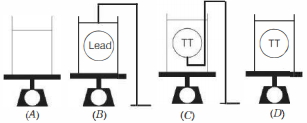
Four identical beakers contain the same amount of water as shown below. Beaker $A$ contains only water. $A$ lead ball is held submerged in beaker $B$ by a string from above. $A$ same-sized plastic ball,say a table tennis $(TT)$ ball,is held submerged in beaker $C$ by a string attached to a stand from outside. Beaker $D$ contains a same-sized $TT$ ball which is held submerged by a string attached to the bottom of the beaker. These beakers (without the stand) are placed on weighing pans and register readings $w_{A}, w_{B}, w_{C}$,and $w_{D}$ for $A, B, C$,and $D$,respectively. Effects of the mass and volume of the stand and string are to be neglected.
A
$w_{A}=w_{B}=w_{C}=w_{D}$
B
$w_{B}=w_{C} > w_{D} > w_{A}$
C
$w_{B}=w_{C} > w_{A} > w_{D}$
D
$w_{B} > w_{C} > w_{D} > w_{A}$
Solution
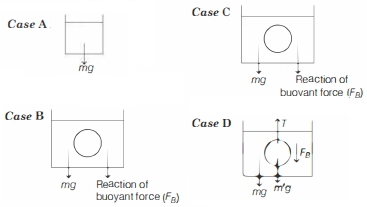
(B) Case $A$: Here,only the force acting on the weighing pan is the weight of the water. So,$w_{A} = mg$.
Case $B$: In this case,the downward forces on the pan are the weight of the water and the reaction force equal to the buoyant force $(F_{B})$ exerted by the water on the ball. So,$w_{B} = mg + F_{B}$.
Case $C$: In this case,the downward acting forces are the weight of the water and the reaction of the buoyant force,which is the same as in case $B$ because the balls are of the same size. So,$w_{C} = mg + F_{B}$.
Case $D$: In this case,the forces acting on the bottom of the beaker are the weight of the water $(mg)$,the weight of the ball $(m'g)$,and the tension $(T)$ in the string pulling upwards. The buoyant force $(F_{B})$ acts upwards on the ball. For the ball to be in equilibrium,$T + F_{B} = m'g$,so $T = m'g - F_{B}$. The total force on the pan is the weight of the water plus the weight of the ball minus the upward tension: $w_{D} = mg + m'g - T = mg + m'g - (m'g - F_{B}) = mg + F_{B}$.
Wait,let's re-evaluate Case $D$: The total downward force on the pan is the weight of the water $(mg)$ plus the weight of the ball $(m'g)$ minus the tension $(T)$ in the string. Since the ball is submerged,$F_{B} + T = m'g$,so $T = m'g - F_{B}$. Thus,$w_{D} = mg + m'g - (m'g - F_{B}) = mg + F_{B}$.
Therefore,$w_{B} = w_{C} = w_{D} > w_{A}$. However,if the $TT$ ball is very light $(m' \approx 0)$,then $w_{D} \approx mg + F_{B}$. If the lead ball is heavy,$w_{B} = mg + F_{B}$. The correct relationship is $w_{B} = w_{C} = w_{D} > w_{A}$.
Case $B$: In this case,the downward forces on the pan are the weight of the water and the reaction force equal to the buoyant force $(F_{B})$ exerted by the water on the ball. So,$w_{B} = mg + F_{B}$.
Case $C$: In this case,the downward acting forces are the weight of the water and the reaction of the buoyant force,which is the same as in case $B$ because the balls are of the same size. So,$w_{C} = mg + F_{B}$.
Case $D$: In this case,the forces acting on the bottom of the beaker are the weight of the water $(mg)$,the weight of the ball $(m'g)$,and the tension $(T)$ in the string pulling upwards. The buoyant force $(F_{B})$ acts upwards on the ball. For the ball to be in equilibrium,$T + F_{B} = m'g$,so $T = m'g - F_{B}$. The total force on the pan is the weight of the water plus the weight of the ball minus the upward tension: $w_{D} = mg + m'g - T = mg + m'g - (m'g - F_{B}) = mg + F_{B}$.
Wait,let's re-evaluate Case $D$: The total downward force on the pan is the weight of the water $(mg)$ plus the weight of the ball $(m'g)$ minus the tension $(T)$ in the string. Since the ball is submerged,$F_{B} + T = m'g$,so $T = m'g - F_{B}$. Thus,$w_{D} = mg + m'g - (m'g - F_{B}) = mg + F_{B}$.
Therefore,$w_{B} = w_{C} = w_{D} > w_{A}$. However,if the $TT$ ball is very light $(m' \approx 0)$,then $w_{D} \approx mg + F_{B}$. If the lead ball is heavy,$w_{B} = mg + F_{B}$. The correct relationship is $w_{B} = w_{C} = w_{D} > w_{A}$.
0 likes
View Solution164
AdvancedMCQ
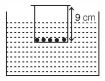
$A$ wide-bottomed cylindrical massless plastic container of height $9 \, cm$ contains $40$ identical coins and is floating on water with $3 \, cm$ of its height submerged. If we start placing additional identical coins on its lid,it is observed that after $N$ coins are added,the equilibrium changes from stable to unstable. Equilibrium in floating is stable if the geometric centre of the submerged portion is above the centre of mass of the object. The value of $N$ is closest to:
A
$6$
B
$10$
C
$16$
D
$24$
Solution
(B) Let $m$ be the mass of each coin. The initial submerged depth is $h_0 = 3 \, cm$ for $40$ coins.
By Archimedes' principle,the weight of the container equals the weight of the displaced water: $(40m)g = A \cdot h_0 \cdot \rho_w \cdot g$,where $A$ is the cross-sectional area and $\rho_w$ is the density of water.
Thus,$A \rho_w = \frac{40m}{3}$.
When $N$ additional coins are added,the total mass is $(40+N)m$. The new submerged depth $h'$ is given by $(40+N)m = A \cdot h' \cdot \rho_w$,so $h' = \frac{(40+N)m}{A \rho_w} = \frac{(40+N)m}{40m/3} = \frac{3(40+N)}{40} \, cm$.
The centre of mass $(CM)$ of the system (measured from the base) is $CM = \frac{40m(0) + Nm(9)}{(40+N)m} = \frac{9N}{40+N} \, cm$.
The geometric centre $(GC)$ of the submerged portion is at a distance $h'/2$ from the base: $GC = \frac{h'}{2} = \frac{3(40+N)}{80} \, cm$.
For the transition from stable to unstable equilibrium,the $CM$ must coincide with the $GC$ $(CM = GC)$:
$\frac{9N}{40+N} = \frac{3(40+N)}{80}$
$720N = 3(40+N)^2$
$240N = 1600 + 80N + N^2$
$N^2 - 160N + 1600 = 0$
Using the quadratic formula: $N = \frac{160 \pm \sqrt{160^2 - 4(1600)}}{2} = \frac{160 \pm \sqrt{25600 - 6400}}{2} = \frac{160 \pm \sqrt{19200}}{2} = 80 \pm 40\sqrt{3} \approx 80 \pm 69.28$.
Since $N < 40$ (the container height is $9 \, cm$),we take $N = 80 - 69.28 = 10.72$.
The value of $N$ is closest to $10$.
By Archimedes' principle,the weight of the container equals the weight of the displaced water: $(40m)g = A \cdot h_0 \cdot \rho_w \cdot g$,where $A$ is the cross-sectional area and $\rho_w$ is the density of water.
Thus,$A \rho_w = \frac{40m}{3}$.
When $N$ additional coins are added,the total mass is $(40+N)m$. The new submerged depth $h'$ is given by $(40+N)m = A \cdot h' \cdot \rho_w$,so $h' = \frac{(40+N)m}{A \rho_w} = \frac{(40+N)m}{40m/3} = \frac{3(40+N)}{40} \, cm$.
The centre of mass $(CM)$ of the system (measured from the base) is $CM = \frac{40m(0) + Nm(9)}{(40+N)m} = \frac{9N}{40+N} \, cm$.
The geometric centre $(GC)$ of the submerged portion is at a distance $h'/2$ from the base: $GC = \frac{h'}{2} = \frac{3(40+N)}{80} \, cm$.
For the transition from stable to unstable equilibrium,the $CM$ must coincide with the $GC$ $(CM = GC)$:
$\frac{9N}{40+N} = \frac{3(40+N)}{80}$
$720N = 3(40+N)^2$
$240N = 1600 + 80N + N^2$
$N^2 - 160N + 1600 = 0$
Using the quadratic formula: $N = \frac{160 \pm \sqrt{160^2 - 4(1600)}}{2} = \frac{160 \pm \sqrt{25600 - 6400}}{2} = \frac{160 \pm \sqrt{19200}}{2} = 80 \pm 40\sqrt{3} \approx 80 \pm 69.28$.
Since $N < 40$ (the container height is $9 \, cm$),we take $N = 80 - 69.28 = 10.72$.
The value of $N$ is closest to $10$.
0 likes
View Solution165
MediumMCQ
$A$ block of wood is floating on water at $0^{\circ} C$ with volume $V_0$ above water. When the temperature of water increases from $0^{\circ} C$ to $10^{\circ} C$,the change in the volume of the block that is above water is best described schematically by which graph?
A
B
C
D
Solution
(A) For a floating block,the weight of the block equals the weight of the displaced water: $Mg = V_{sub} \rho_{water} g$,where $V_{sub}$ is the submerged volume.
Since the total volume of the block $V = V_{sub} + V_0$ is constant (ignoring thermal expansion of wood),we have $V_0 = V - V_{sub} = V - \frac{M}{\rho_{water}}$.
As the temperature of water increases from $0^{\circ} C$ to $10^{\circ} C$,the density of water $\rho_{water}$ initially increases,reaching a maximum at $4^{\circ} C$,and then decreases.
Since $V_0 = V - \frac{M}{\rho_{water}}$,as $\rho_{water}$ increases,the term $\frac{M}{\rho_{water}}$ decreases,causing $V_0$ to increase until $4^{\circ} C$.
After $4^{\circ} C$,as $\rho_{water}$ decreases,the term $\frac{M}{\rho_{water}}$ increases,causing $V_0$ to decrease.
Therefore,the volume of the block above water $V_0$ increases up to $4^{\circ} C$ and then decreases from $4^{\circ} C$ to $10^{\circ} C$,which corresponds to the graph shown in option $A$.
Since the total volume of the block $V = V_{sub} + V_0$ is constant (ignoring thermal expansion of wood),we have $V_0 = V - V_{sub} = V - \frac{M}{\rho_{water}}$.
As the temperature of water increases from $0^{\circ} C$ to $10^{\circ} C$,the density of water $\rho_{water}$ initially increases,reaching a maximum at $4^{\circ} C$,and then decreases.
Since $V_0 = V - \frac{M}{\rho_{water}}$,as $\rho_{water}$ increases,the term $\frac{M}{\rho_{water}}$ decreases,causing $V_0$ to increase until $4^{\circ} C$.
After $4^{\circ} C$,as $\rho_{water}$ decreases,the term $\frac{M}{\rho_{water}}$ increases,causing $V_0$ to decrease.
Therefore,the volume of the block above water $V_0$ increases up to $4^{\circ} C$ and then decreases from $4^{\circ} C$ to $10^{\circ} C$,which corresponds to the graph shown in option $A$.
0 likes
View Solution166
MediumMCQ
$A$ very large block of ice of the size of a volleyball court and of uniform thickness of $8 \,m$ is floating on water. $A$ person standing near its edge wishes to fetch a bucketful of water using a rope. The smallest length of rope required for this is about ............... $m$.
A
$3.6$
B
$1.8$
C
$0.9$
D
$0.4$
Solution
(C) The fraction of the thickness of the ice block that remains above the water surface is given by $x = 1 - (\rho_{\text{ice}} / \rho_{\text{water}})$.
Taking the density of ice $\rho_{\text{ice}} \approx 0.9 \, \text{g/cm}^3$ and density of water $\rho_{\text{water}} = 1 \, \text{g/cm}^3$,we get $x = 1 - 0.9 = 0.1$.
The thickness of the ice block is $H = 8 \, m$.
The height of the ice block above the water level is $h = H \times x = 8 \times 0.1 = 0.8 \, m$.
Since the person is standing on the ice,the distance to the water surface is the height of the ice above the water.
Therefore,the minimum length of rope required is approximately $0.8 \, m$.
Comparing this with the given options,the nearest value is $0.9 \, m$.
Taking the density of ice $\rho_{\text{ice}} \approx 0.9 \, \text{g/cm}^3$ and density of water $\rho_{\text{water}} = 1 \, \text{g/cm}^3$,we get $x = 1 - 0.9 = 0.1$.
The thickness of the ice block is $H = 8 \, m$.
The height of the ice block above the water level is $h = H \times x = 8 \times 0.1 = 0.8 \, m$.
Since the person is standing on the ice,the distance to the water surface is the height of the ice above the water.
Therefore,the minimum length of rope required is approximately $0.8 \, m$.
Comparing this with the given options,the nearest value is $0.9 \, m$.
0 likes
View Solution167
DifficultMCQ
$A$ box when hung from a spring balance shows a reading of $50 \,kg$. If the same box is hung from the same spring balance inside an evacuated chamber,the reading on the scale will be
A
$50 \,kg$ because the mass of the box remains unchanged.
B
$50 \,kg$ because the effect of the absence of the atmosphere will be identical on the box and the spring balance.
C
less than $50 \,kg$ because the weight of the column of air on the box will be absent.
D
more than $50 \,kg$ because the atmospheric buoyancy force will be absent.
Solution
(D) The reading of a spring balance measures the tension in the spring,which is equal to the apparent weight of the object.
When the box is in the atmosphere,it experiences an upward buoyant force $F_b$ due to the displaced air.
The reading $R$ in the atmosphere is given by $R = W - F_b$,where $W$ is the true weight of the box.
In an evacuated chamber,the buoyant force $F_b$ becomes zero.
Therefore,the new reading $R'$ will be equal to the true weight $W$.
Since $R' = W$ and $R = W - F_b$,it follows that $R' > R$.
Thus,the reading will be more than $50 \,kg$ because the atmospheric buoyancy force is absent.
When the box is in the atmosphere,it experiences an upward buoyant force $F_b$ due to the displaced air.
The reading $R$ in the atmosphere is given by $R = W - F_b$,where $W$ is the true weight of the box.
In an evacuated chamber,the buoyant force $F_b$ becomes zero.
Therefore,the new reading $R'$ will be equal to the true weight $W$.
Since $R' = W$ and $R = W - F_b$,it follows that $R' > R$.
Thus,the reading will be more than $50 \,kg$ because the atmospheric buoyancy force is absent.
0 likes
View Solution168
AdvancedMCQ
$A$ machine is blowing spherical soap bubbles of different radii filled with helium gas. It is found that,if the bubbles have a radius smaller than $1 \, cm$,then they sink to the floor in still air. Larger bubbles float in the air. Assume that the thickness of the soap film in all bubbles is uniform and equal. Assume that the density of soap solution is same as that of water $\left(= 1000 \, kg \, m^{-3}\right)$. The density of helium inside the bubbles and air are $0.18 \, kg \, m^{-3}$ and $1.23 \, kg \, m^{-3}$,respectively. Then,the thickness of the soap film of the bubbles is .......... $\mu m$ (Note: $1 \, \mu m = 10^{-6} \, m$)
A
$0.50$
B
$1.50$
C
$7.00$
D
$3.50$
Solution
(D) For a soap bubble to float in air,the gravitational force must be equal to the buoyant force.
Gravitational force = Buoyant force
$g \times (\text{mass of helium} + \text{mass of soap film}) = \text{Weight of air displaced by bubble}$
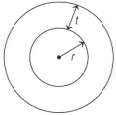
Let $r$ be the inner radius of the soap bubble and $t$ be the thickness of the film.
The volume of helium is $V_{He} = \frac{4}{3} \pi r^3$.
The volume of the soap film is $V_{film} \approx 4 \pi r^2 t$ (since $t \ll r$).
The equation of equilibrium is:
$\frac{4}{3} \pi r^3 \rho_{He} g + (4 \pi r^2 t) \rho_{soap} g = \frac{4}{3} \pi r^3 \rho_{air} g$
Dividing by $g$ and rearranging:
$4 \pi r^2 t \rho_{soap} = \frac{4}{3} \pi r^3 (\rho_{air} - \rho_{He})$
$t = \frac{r}{3} \frac{(\rho_{air} - \rho_{He})}{\rho_{soap}}$
Given $r = 1 \, cm = 10^{-2} \, m$,$\rho_{air} = 1.23 \, kg \, m^{-3}$,$\rho_{He} = 0.18 \, kg \, m^{-3}$,and $\rho_{soap} = 1000 \, kg \, m^{-3}$.
$t = \frac{10^{-2}}{3} \times \frac{(1.23 - 0.18)}{1000}$
$t = \frac{10^{-2}}{3} \times \frac{1.05}{1000} = \frac{1.05 \times 10^{-5}}{3} = 0.35 \times 10^{-5} \, m = 3.5 \times 10^{-6} \, m$.
Since $1 \, \mu m = 10^{-6} \, m$,the thickness $t = 3.50 \, \mu m$.
Gravitational force = Buoyant force
$g \times (\text{mass of helium} + \text{mass of soap film}) = \text{Weight of air displaced by bubble}$
Let $r$ be the inner radius of the soap bubble and $t$ be the thickness of the film.
The volume of helium is $V_{He} = \frac{4}{3} \pi r^3$.
The volume of the soap film is $V_{film} \approx 4 \pi r^2 t$ (since $t \ll r$).
The equation of equilibrium is:
$\frac{4}{3} \pi r^3 \rho_{He} g + (4 \pi r^2 t) \rho_{soap} g = \frac{4}{3} \pi r^3 \rho_{air} g$
Dividing by $g$ and rearranging:
$4 \pi r^2 t \rho_{soap} = \frac{4}{3} \pi r^3 (\rho_{air} - \rho_{He})$
$t = \frac{r}{3} \frac{(\rho_{air} - \rho_{He})}{\rho_{soap}}$
Given $r = 1 \, cm = 10^{-2} \, m$,$\rho_{air} = 1.23 \, kg \, m^{-3}$,$\rho_{He} = 0.18 \, kg \, m^{-3}$,and $\rho_{soap} = 1000 \, kg \, m^{-3}$.
$t = \frac{10^{-2}}{3} \times \frac{(1.23 - 0.18)}{1000}$
$t = \frac{10^{-2}}{3} \times \frac{1.05}{1000} = \frac{1.05 \times 10^{-5}}{3} = 0.35 \times 10^{-5} \, m = 3.5 \times 10^{-6} \, m$.
Since $1 \, \mu m = 10^{-6} \, m$,the thickness $t = 3.50 \, \mu m$.
0 likes
View Solution169
DifficultMCQ
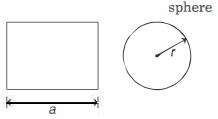
$A$ solid cube and a solid sphere,both made of the same material,are completely submerged in water but at different depths. The sphere and the cube have the same surface area. The buoyant force is
A
greater for the cube than the sphere
B
greater for the sphere than the cube
C
same for the sphere and the cube
D
greater for the object that is submerged deeper
Solution
(B) Given,surface area of cube $=$ surface area of sphere.
$6a^2 = 4\pi r^2 \Rightarrow \frac{a}{r} = \sqrt{\frac{4\pi}{6}} = \sqrt{\frac{2\pi}{3}}$.
Buoyant force $F_B = V \cdot \rho_f \cdot g$. Since both are completely submerged in the same fluid,the ratio of buoyant forces is equal to the ratio of their volumes:
$\frac{(F_B)_{\text{cube}}}{(F_B)_{\text{sphere}}} = \frac{V_{\text{cube}}}{V_{\text{sphere}}} = \frac{a^3}{\frac{4}{3}\pi r^3} = \frac{3}{4\pi} \left( \frac{a}{r} \right)^3$.
Substituting $\frac{a}{r} = \sqrt{\frac{2\pi}{3}}$:
$\frac{(F_B)_{\text{cube}}}{(F_B)_{\text{sphere}}} = \frac{3}{4\pi} \left( \sqrt{\frac{2\pi}{3}} \right)^3 = \frac{3}{4\pi} \cdot \frac{2\pi}{3} \cdot \sqrt{\frac{2\pi}{3}} = \frac{1}{2} \sqrt{\frac{2\pi}{3}} = \sqrt{\frac{2\pi}{3 \cdot 4}} = \sqrt{\frac{\pi}{6}}$.
Since $\pi \approx 3.14$,$\frac{\pi}{6} < 1$,therefore $\sqrt{\frac{\pi}{6}} < 1$.
This implies $(F_B)_{\text{cube}} < (F_B)_{\text{sphere}}$.
Thus,the buoyant force is greater for the sphere.
$6a^2 = 4\pi r^2 \Rightarrow \frac{a}{r} = \sqrt{\frac{4\pi}{6}} = \sqrt{\frac{2\pi}{3}}$.
Buoyant force $F_B = V \cdot \rho_f \cdot g$. Since both are completely submerged in the same fluid,the ratio of buoyant forces is equal to the ratio of their volumes:
$\frac{(F_B)_{\text{cube}}}{(F_B)_{\text{sphere}}} = \frac{V_{\text{cube}}}{V_{\text{sphere}}} = \frac{a^3}{\frac{4}{3}\pi r^3} = \frac{3}{4\pi} \left( \frac{a}{r} \right)^3$.
Substituting $\frac{a}{r} = \sqrt{\frac{2\pi}{3}}$:
$\frac{(F_B)_{\text{cube}}}{(F_B)_{\text{sphere}}} = \frac{3}{4\pi} \left( \sqrt{\frac{2\pi}{3}} \right)^3 = \frac{3}{4\pi} \cdot \frac{2\pi}{3} \cdot \sqrt{\frac{2\pi}{3}} = \frac{1}{2} \sqrt{\frac{2\pi}{3}} = \sqrt{\frac{2\pi}{3 \cdot 4}} = \sqrt{\frac{\pi}{6}}$.
Since $\pi \approx 3.14$,$\frac{\pi}{6} < 1$,therefore $\sqrt{\frac{\pi}{6}} < 1$.
This implies $(F_B)_{\text{cube}} < (F_B)_{\text{sphere}}$.
Thus,the buoyant force is greater for the sphere.
0 likes
View Solution170
AdvancedMCQ
An object with uniform density $\rho$ is attached to a spring that is known to stretch linearly with applied force. When the spring-object system is immersed in a liquid of density $\rho_1$,the spring stretches by an amount $x_1$ (where $\rho > \rho_1$). When the experiment is repeated in a liquid of density $\rho_2$ (where $\rho_2 < \rho_1$),the spring stretches by an amount $x_2$. Neglecting any buoyant force on the spring,the density of the object is:
A
$\rho=\frac{\rho_1 x_1-\rho_2 x_2}{x_1-x_2}$
B
$\rho=\frac{\rho_1 x_2-\rho_2 x_1}{x_2-x_1}$
C
$\rho=\frac{\rho_1 x_2+\rho_2 x_1}{x_1+x_2}$
D
$\rho=\frac{\rho_1 x_1+\rho_2 x_2}{x_1+x_2}$
Solution
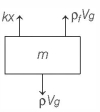
(B) For the equilibrium of the block hung from the spring,the sum of the spring force and the buoyant force must equal the weight of the block.
Let $V$ be the volume of the object and $k$ be the spring constant.
The weight of the object is $W = \rho V g$.
The buoyant force in a liquid of density $\rho_f$ is $F_B = \rho_f V g$.
The spring force is $F_s = kx$.
For equilibrium: $kx + \rho_f V g = \rho V g$.
In the first liquid (density $\rho_1$): $k x_1 + \rho_1 V g = \rho V g \quad \dots(i)$
In the second liquid (density $\rho_2$): $k x_2 + \rho_2 V g = \rho V g \quad \dots(ii)$
From $(i)$,$k = \frac{(\rho - \rho_1) V g}{x_1}$.
From $(ii)$,$k = \frac{(\rho - \rho_2) V g}{x_2}$.
Equating the two expressions for $k$:
$\frac{(\rho - \rho_1) V g}{x_1} = \frac{(\rho - \rho_2) V g}{x_2}$
$(\rho - \rho_1) x_2 = (\rho - \rho_2) x_1$
$\rho x_2 - \rho_1 x_2 = \rho x_1 - \rho_2 x_1$
$\rho (x_2 - x_1) = \rho_1 x_2 - \rho_2 x_1$
$\rho = \frac{\rho_1 x_2 - \rho_2 x_1}{x_2 - x_1}$
Let $V$ be the volume of the object and $k$ be the spring constant.
The weight of the object is $W = \rho V g$.
The buoyant force in a liquid of density $\rho_f$ is $F_B = \rho_f V g$.
The spring force is $F_s = kx$.
For equilibrium: $kx + \rho_f V g = \rho V g$.
In the first liquid (density $\rho_1$): $k x_1 + \rho_1 V g = \rho V g \quad \dots(i)$
In the second liquid (density $\rho_2$): $k x_2 + \rho_2 V g = \rho V g \quad \dots(ii)$
From $(i)$,$k = \frac{(\rho - \rho_1) V g}{x_1}$.
From $(ii)$,$k = \frac{(\rho - \rho_2) V g}{x_2}$.
Equating the two expressions for $k$:
$\frac{(\rho - \rho_1) V g}{x_1} = \frac{(\rho - \rho_2) V g}{x_2}$
$(\rho - \rho_1) x_2 = (\rho - \rho_2) x_1$
$\rho x_2 - \rho_1 x_2 = \rho x_1 - \rho_2 x_1$
$\rho (x_2 - x_1) = \rho_1 x_2 - \rho_2 x_1$
$\rho = \frac{\rho_1 x_2 - \rho_2 x_1}{x_2 - x_1}$
0 likes
View Solution171
MediumMCQ
$A$ spring balance $A$ reads $2 \,kg$ with a block of mass $m$ suspended from it. Another balance $B$ reads $3 \,kg$ when a beaker with a liquid is put on its pan. The two balances are now so arranged that the hanging mass $m$ is fully immersed inside the liquid in the beaker as shown in the figure. In this situation,
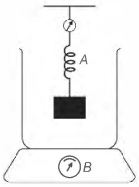
A
the balance $A$ will read $2 \,kg$ and $B$ will read $5 \,kg$
B
the balance $A$ will read $2 \,kg$ and $B$ will read $3 \,kg$
C
the balance $A$ will read less than $2 \,kg$ and $B$ will read between $3 \,kg$ and $5 \,kg$
D
the balance $A$ will read less than $2 \,kg$ and $B$ will read $3 \,kg$
Solution
(C) When the block is immersed in the liquid,it experiences an upward buoyant force $F_b$ due to the liquid.
For balance $A$,the reading corresponds to the tension $T$ in the spring. Initially,$T = mg = 2 \,kg \times g$. When immersed,$T' = mg - F_b$. Since $F_b > 0$,the new reading $T'$ will be less than $2 \,kg$.
For balance $B$,the initial reading is the weight of the beaker plus the liquid. When the block is immersed,by Newton's third law,the block exerts an equal and opposite downward force $F_b$ on the liquid. Therefore,the new reading on balance $B$ will be the initial weight plus the buoyant force $F_b$. Since $F_b > 0$,the new reading will be greater than $3 \,kg$. However,the total weight of the system (beaker + liquid + block) is $2 \,kg + 3 \,kg = 5 \,kg$. Since the block is not resting on the bottom of the beaker but is supported by spring $A$,the reading on $B$ will be less than the total weight of $5 \,kg$.
Thus,balance $A$ reads less than $2 \,kg$ and balance $B$ reads between $3 \,kg$ and $5 \,kg$.
For balance $A$,the reading corresponds to the tension $T$ in the spring. Initially,$T = mg = 2 \,kg \times g$. When immersed,$T' = mg - F_b$. Since $F_b > 0$,the new reading $T'$ will be less than $2 \,kg$.
For balance $B$,the initial reading is the weight of the beaker plus the liquid. When the block is immersed,by Newton's third law,the block exerts an equal and opposite downward force $F_b$ on the liquid. Therefore,the new reading on balance $B$ will be the initial weight plus the buoyant force $F_b$. Since $F_b > 0$,the new reading will be greater than $3 \,kg$. However,the total weight of the system (beaker + liquid + block) is $2 \,kg + 3 \,kg = 5 \,kg$. Since the block is not resting on the bottom of the beaker but is supported by spring $A$,the reading on $B$ will be less than the total weight of $5 \,kg$.
Thus,balance $A$ reads less than $2 \,kg$ and balance $B$ reads between $3 \,kg$ and $5 \,kg$.
0 likes
View Solution172
MediumMCQ
$A$ cube of edge length $10 \, cm$ is just balanced at the interface of two liquids $A$ and $B$ as shown in the figure. If liquids $A$ and $B$ have specific gravities $0.6$ and $0.4$ respectively,then the mass of the cube is ................ $g$.
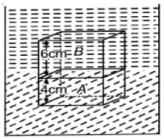
A
$240$
B
$360$
C
$480$
D
$540$
Solution
(C) For the cube to be in equilibrium,the weight of the cube must be equal to the total buoyant force exerted by the two liquids.
Weight of the cube $W = m g$,where $m$ is the mass of the cube.
Buoyant force $F_B = F_{B,A} + F_{B,B} = V_A \rho_A g + V_B \rho_B g$.
Here,the edge length of the cube is $L = 10 \, cm = 0.1 \, m$. The cross-sectional area of the cube is $A_{cube} = L^2 = 100 \, cm^2 = 0.01 \, m^2$.
The volume of the cube submerged in liquid $A$ is $V_A = A_{cube} \times h_A = 100 \, cm^2 \times 4 \, cm = 400 \, cm^3 = 400 \times 10^{-6} \, m^3$.
The volume of the cube submerged in liquid $B$ is $V_B = A_{cube} \times h_B = 100 \, cm^2 \times 6 \, cm = 600 \, cm^3 = 600 \times 10^{-6} \, m^3$.
The densities of the liquids are $\rho_A = 0.6 \times 1000 \, kg/m^3 = 600 \, kg/m^3$ and $\rho_B = 0.4 \times 1000 \, kg/m^3 = 400 \, kg/m^3$.
Equating weight and buoyant force: $m g = (V_A \rho_A + V_B \rho_B) g$.
$m = V_A \rho_A + V_B \rho_B = (400 \times 10^{-6} \, m^3 \times 600 \, kg/m^3) + (600 \times 10^{-6} \, m^3 \times 400 \, kg/m^3)$.
$m = (240,000 \times 10^{-6}) + (240,000 \times 10^{-6}) \, kg = 0.24 \, kg + 0.24 \, kg = 0.48 \, kg$.
Converting to grams,$m = 0.48 \times 1000 \, g = 480 \, g$.
Weight of the cube $W = m g$,where $m$ is the mass of the cube.
Buoyant force $F_B = F_{B,A} + F_{B,B} = V_A \rho_A g + V_B \rho_B g$.
Here,the edge length of the cube is $L = 10 \, cm = 0.1 \, m$. The cross-sectional area of the cube is $A_{cube} = L^2 = 100 \, cm^2 = 0.01 \, m^2$.
The volume of the cube submerged in liquid $A$ is $V_A = A_{cube} \times h_A = 100 \, cm^2 \times 4 \, cm = 400 \, cm^3 = 400 \times 10^{-6} \, m^3$.
The volume of the cube submerged in liquid $B$ is $V_B = A_{cube} \times h_B = 100 \, cm^2 \times 6 \, cm = 600 \, cm^3 = 600 \times 10^{-6} \, m^3$.
The densities of the liquids are $\rho_A = 0.6 \times 1000 \, kg/m^3 = 600 \, kg/m^3$ and $\rho_B = 0.4 \times 1000 \, kg/m^3 = 400 \, kg/m^3$.
Equating weight and buoyant force: $m g = (V_A \rho_A + V_B \rho_B) g$.
$m = V_A \rho_A + V_B \rho_B = (400 \times 10^{-6} \, m^3 \times 600 \, kg/m^3) + (600 \times 10^{-6} \, m^3 \times 400 \, kg/m^3)$.
$m = (240,000 \times 10^{-6}) + (240,000 \times 10^{-6}) \, kg = 0.24 \, kg + 0.24 \, kg = 0.48 \, kg$.
Converting to grams,$m = 0.48 \times 1000 \, g = 480 \, g$.
0 likes
View Solution173
MediumMCQ
$A$ boat containing some iron pieces is floating in a pond. If the iron pieces are thrown into the water,the level of the water will:
A
Increase
B
Decrease
C
May increase or decrease
D
Remain unchanged
Solution
(B) When the boat is floating with iron pieces,the weight of the water displaced by the boat is equal to the total weight of the boat plus the iron pieces $(W_{boat} + W_{iron})$.
According to Archimedes' principle,the buoyant force equals the weight of the displaced water.
When the iron pieces are thrown into the water,they sink because the density of iron is greater than the density of water.
In this case,the iron pieces displace a volume of water equal to their own volume.
Since the density of iron is greater than water,the weight of the water displaced by the iron pieces when submerged is less than the weight of the water displaced when they were floating in the boat.
Therefore,the total volume of water displaced decreases,causing the water level in the pond to decrease.
According to Archimedes' principle,the buoyant force equals the weight of the displaced water.
When the iron pieces are thrown into the water,they sink because the density of iron is greater than the density of water.
In this case,the iron pieces displace a volume of water equal to their own volume.
Since the density of iron is greater than water,the weight of the water displaced by the iron pieces when submerged is less than the weight of the water displaced when they were floating in the boat.
Therefore,the total volume of water displaced decreases,causing the water level in the pond to decrease.
0 likes
View Solution174
MediumMCQ
An ice cube contains a large air bubble. The cube is floating on the horizontal surface of water contained in a trough. What will happen to the water level when the cube melts?
A
It will fall
B
It will remain unchanged
C
It will rise
D
First it will fall and then rise
Solution
(A) According to Archimedes' principle,the weight of the floating ice cube is equal to the weight of the water displaced by it.
Let $M$ be the mass of the ice and $V_{air}$ be the volume of the air bubble.
The total volume of the ice cube is $V_{ice} + V_{air}$.
The weight of the ice cube is $W = Mg$.
Since it is floating,the weight of the displaced water is equal to the weight of the ice cube: $W_{displaced} = Mg$.
The volume of the displaced water is $V_{disp} = \frac{Mg}{\rho_w g} = \frac{M}{\rho_w}$,where $\rho_w$ is the density of water.
When the ice melts,it turns into water of mass $M$,occupying a volume $V_{melted} = \frac{M}{\rho_w}$.
However,the air bubble was previously displacing water equal to its own volume $V_{air}$ to keep the cube afloat.
When the ice melts,the air bubble is released,and the water level drops because the volume previously occupied by the air bubble $(V_{air})$ is no longer displacing water.
Therefore,the water level will fall.
Let $M$ be the mass of the ice and $V_{air}$ be the volume of the air bubble.
The total volume of the ice cube is $V_{ice} + V_{air}$.
The weight of the ice cube is $W = Mg$.
Since it is floating,the weight of the displaced water is equal to the weight of the ice cube: $W_{displaced} = Mg$.
The volume of the displaced water is $V_{disp} = \frac{Mg}{\rho_w g} = \frac{M}{\rho_w}$,where $\rho_w$ is the density of water.
When the ice melts,it turns into water of mass $M$,occupying a volume $V_{melted} = \frac{M}{\rho_w}$.
However,the air bubble was previously displacing water equal to its own volume $V_{air}$ to keep the cube afloat.
When the ice melts,the air bubble is released,and the water level drops because the volume previously occupied by the air bubble $(V_{air})$ is no longer displacing water.
Therefore,the water level will fall.
0 likes
View Solution175
MediumMCQ
The density of ice is $0.9 \, g/cm^3$. What percentage by volume of the block of ice floats outside the water is ..........$\%$
A
$10$
B
$45$
C
$75$
D
$90$
Solution
(A) For a floating object,the buoyant force must balance the weight of the object.
Let $V$ be the total volume of the ice block and $V_{imm}$ be the volume of ice immersed in water.
Let $\rho_{ice} = 0.9 \, g/cm^3$ be the density of ice and $\rho_{water} = 1.0 \, g/cm^3$ be the density of water.
The weight of the ice block is $W = V \cdot \rho_{ice} \cdot g$.
The buoyant force is $F_B = V_{imm} \cdot \rho_{water} \cdot g$.
Equating the two: $V \cdot \rho_{ice} \cdot g = V_{imm} \cdot \rho_{water} \cdot g$.
$\frac{V_{imm}}{V} = \frac{\rho_{ice}}{\rho_{water}} = \frac{0.9}{1.0} = 0.9$.
This means $90\%$ of the ice is submerged.
The fraction of the volume floating outside the water is $1 - 0.9 = 0.1$.
Converting to percentage: $0.1 \times 100\% = 10\%$.
Let $V$ be the total volume of the ice block and $V_{imm}$ be the volume of ice immersed in water.
Let $\rho_{ice} = 0.9 \, g/cm^3$ be the density of ice and $\rho_{water} = 1.0 \, g/cm^3$ be the density of water.
The weight of the ice block is $W = V \cdot \rho_{ice} \cdot g$.
The buoyant force is $F_B = V_{imm} \cdot \rho_{water} \cdot g$.
Equating the two: $V \cdot \rho_{ice} \cdot g = V_{imm} \cdot \rho_{water} \cdot g$.
$\frac{V_{imm}}{V} = \frac{\rho_{ice}}{\rho_{water}} = \frac{0.9}{1.0} = 0.9$.
This means $90\%$ of the ice is submerged.
The fraction of the volume floating outside the water is $1 - 0.9 = 0.1$.
Converting to percentage: $0.1 \times 100\% = 10\%$.
0 likes
View Solution176
MediumMCQ
The reading of a spring balance when a block is suspended from it in air is $60 \, N$. This reading is changed to $40 \, N$ when the block is submerged in water. The specific gravity of the block must be therefore ............
A
$3$
B
$2$
C
$6$
D
$1.5$
Solution
(A) Let $V$ be the volume of the block,$\rho$ be the density of the block,and $\rho_w$ be the density of water.
In air,the weight of the block is $W_{air} = V \rho g = 60 \, N$.
When submerged in water,the apparent weight is $W_{water} = V \rho g - V \rho_w g = 40 \, N$.
Substituting $V \rho g = 60$,we get $60 - V \rho_w g = 40$,which implies the buoyant force $F_B = V \rho_w g = 20 \, N$.
Now,the specific gravity of the block is defined as $SG = \frac{\rho}{\rho_w} = \frac{V \rho g}{V \rho_w g}$.
Substituting the values,$SG = \frac{60}{20} = 3$.
Therefore,the specific gravity of the block is $3$.
In air,the weight of the block is $W_{air} = V \rho g = 60 \, N$.
When submerged in water,the apparent weight is $W_{water} = V \rho g - V \rho_w g = 40 \, N$.
Substituting $V \rho g = 60$,we get $60 - V \rho_w g = 40$,which implies the buoyant force $F_B = V \rho_w g = 20 \, N$.
Now,the specific gravity of the block is defined as $SG = \frac{\rho}{\rho_w} = \frac{V \rho g}{V \rho_w g}$.
Substituting the values,$SG = \frac{60}{20} = 3$.
Therefore,the specific gravity of the block is $3$.
0 likes
View Solution177
MediumMCQ
The weight of a body in water is one-third of its weight in air. The density of the body is ....... $g/cm^3$. (in $.5$)
A
$0$
B
$1$
C
$2$
D
$3$
Solution
(B) Let the weight of the body in air be $W_a = V \rho_b g$,where $V$ is the volume of the body and $\rho_b$ is its density.
The weight of the body in water is given as $W_w = \frac{1}{3} W_a$.
According to Archimedes' principle,the buoyant force $F_B$ is equal to the weight of the displaced water: $F_B = W_a - W_w = W_a - \frac{1}{3} W_a = \frac{2}{3} W_a$.
Also,$F_B = V \rho_w g$,where $\rho_w$ is the density of water $(1 \ g/cm^3)$.
Equating the two expressions for $F_B$:
$V \rho_w g = \frac{2}{3} (V \rho_b g)$
$\rho_w = \frac{2}{3} \rho_b$
$\rho_b = \frac{3}{2} \rho_w = 1.5 \times 1 \ g/cm^3 = 1.5 \ g/cm^3$.
Thus,the density of the body is $1.5 \ g/cm^3$.
The weight of the body in water is given as $W_w = \frac{1}{3} W_a$.
According to Archimedes' principle,the buoyant force $F_B$ is equal to the weight of the displaced water: $F_B = W_a - W_w = W_a - \frac{1}{3} W_a = \frac{2}{3} W_a$.
Also,$F_B = V \rho_w g$,where $\rho_w$ is the density of water $(1 \ g/cm^3)$.
Equating the two expressions for $F_B$:
$V \rho_w g = \frac{2}{3} (V \rho_b g)$
$\rho_w = \frac{2}{3} \rho_b$
$\rho_b = \frac{3}{2} \rho_w = 1.5 \times 1 \ g/cm^3 = 1.5 \ g/cm^3$.
Thus,the density of the body is $1.5 \ g/cm^3$.
0 likes
View Solution178
MediumMCQ
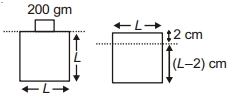
$A$ wooden cube just floats inside water with a $200 \,g$ mass placed on it. When the mass is removed,the cube floats with its top surface $2 \,cm$ above the water level. The side of the cube is ......... $cm$.
A
$6$
B
$8$
C
$10$
D
$12$
Solution
(C) Let $L$ be the side of the cube in $cm$. The density of water is $\rho_w = 1 \,g/cm^3$.
In the first case,the cube with the $200 \,g$ mass is just floating,meaning the total weight is balanced by the buoyant force on the entire volume of the cube:
$(M_{cube} + 200)g = (L^3 \times \rho_w)g$
In the second case,the cube alone is floating,meaning its weight is balanced by the buoyant force on the submerged volume:
$M_{cube}g = (L^2 \times (L - 2) \times \rho_w)g$
Subtracting the second equation from the first:
$(M_{cube} + 200)g - M_{cube}g = (L^3 \times \rho_w)g - (L^2(L - 2) \times \rho_w)g$
$200 = L^3 - L^2(L - 2)$
$200 = L^3 - L^3 + 2L^2$
$200 = 2L^2$
$L^2 = 100$
$L = 10 \,cm$.
In the first case,the cube with the $200 \,g$ mass is just floating,meaning the total weight is balanced by the buoyant force on the entire volume of the cube:
$(M_{cube} + 200)g = (L^3 \times \rho_w)g$
In the second case,the cube alone is floating,meaning its weight is balanced by the buoyant force on the submerged volume:
$M_{cube}g = (L^2 \times (L - 2) \times \rho_w)g$
Subtracting the second equation from the first:
$(M_{cube} + 200)g - M_{cube}g = (L^3 \times \rho_w)g - (L^2(L - 2) \times \rho_w)g$
$200 = L^3 - L^2(L - 2)$
$200 = L^3 - L^3 + 2L^2$
$200 = 2L^2$
$L^2 = 100$
$L = 10 \,cm$.
0 likes
View Solution179
DifficultMCQ
$A$ block of steel of size $5 \times 5 \times 5 \, cm^3$ is weighed in water. If the relative density of steel is $7$,its apparent weight is ........... $g wt$.
A
$6 \times 5 \times 5 \times 5$
B
$4 \times 4 \times 4 \times 7$
C
$5 \times 5 \times 5 \times 7$
D
$4 \times 4 \times 4 \times 6$
Solution
(A) The apparent weight of an object submerged in a fluid is given by the formula: $W_{app} = W_{actual} - F_B$,where $F_B$ is the buoyant force.
$W_{app} = V_b \rho_s g - V_b \rho_w g = V_b g (\rho_s - \rho_w)$.
Given:
Volume of the block $V_b = 5 \times 5 \times 5 \, cm^3 = 125 \, cm^3$.
Relative density of steel $\text{RD}_s = \frac{\rho_s}{\rho_w} = 7$,so $\rho_s = 7 \, g/cm^3$ and $\rho_w = 1 \, g/cm^3$.
Substituting the values:
$W_{app} = (5 \times 5 \times 5) \times (7 - 1) \, g wt$
$W_{app} = 6 \times 5 \times 5 \times 5 \, g wt$.
Thus,the correct option is $A$.
$W_{app} = V_b \rho_s g - V_b \rho_w g = V_b g (\rho_s - \rho_w)$.
Given:
Volume of the block $V_b = 5 \times 5 \times 5 \, cm^3 = 125 \, cm^3$.
Relative density of steel $\text{RD}_s = \frac{\rho_s}{\rho_w} = 7$,so $\rho_s = 7 \, g/cm^3$ and $\rho_w = 1 \, g/cm^3$.
Substituting the values:
$W_{app} = (5 \times 5 \times 5) \times (7 - 1) \, g wt$
$W_{app} = 6 \times 5 \times 5 \times 5 \, g wt$.
Thus,the correct option is $A$.
0 likes
View Solution180
MediumMCQ
$A$ block of wood floats in water with $\frac{4}{5}$ of its volume submerged,but it just floats in another liquid. The density of the liquid is (in $kg/m^3$):
A
$750$
B
$800$
C
$1000$
D
$1250$
Solution
(B) Let $V_b$ be the volume of the block and $\rho_b$ be its density.
When the block floats in water,the weight of the block equals the weight of the displaced water:
$V_b \cdot \rho_b \cdot g = (\frac{4}{5} V_b) \cdot \rho_w \cdot g$
Given $\rho_w = 1000 \, kg/m^3$,we have:
$\rho_b = \frac{4}{5} \times 1000 = 800 \, kg/m^3$.
When the block 'just floats' in another liquid of density $\rho_l$,it means the entire volume of the block is submerged:
$V_b \cdot \rho_b \cdot g = V_b \cdot \rho_l \cdot g$
Therefore,$\rho_l = \rho_b = 800 \, kg/m^3$.
When the block floats in water,the weight of the block equals the weight of the displaced water:
$V_b \cdot \rho_b \cdot g = (\frac{4}{5} V_b) \cdot \rho_w \cdot g$
Given $\rho_w = 1000 \, kg/m^3$,we have:
$\rho_b = \frac{4}{5} \times 1000 = 800 \, kg/m^3$.
When the block 'just floats' in another liquid of density $\rho_l$,it means the entire volume of the block is submerged:
$V_b \cdot \rho_b \cdot g = V_b \cdot \rho_l \cdot g$
Therefore,$\rho_l = \rho_b = 800 \, kg/m^3$.
0 likes
View Solution181
MediumMCQ
$A$ cubical block is floating in a liquid with one-fourth of its volume immersed in the liquid. If the whole system accelerates upward with an acceleration of $g / 4$,what will be the fraction of the volume immersed in the liquid?
A
$1 / 4$
B
$1 / 2$
C
$3 / 4$
D
$2 / 3$
Solution
(A) Let $V$ be the total volume of the cubical block and $\rho_b$ be its density. Let $\rho_l$ be the density of the liquid.
Initially,the block is in equilibrium,so the weight of the block equals the buoyant force:
$V \rho_b g = V_{immersed} \rho_l g$
Given $V_{immersed} = V / 4$,we have:
$V \rho_b g = (V / 4) \rho_l g \implies \rho_b = \rho_l / 4$
When the system accelerates upward with acceleration $a = g / 4$,the effective gravity becomes $g' = g + a = g + g / 4 = 5g / 4$.
The new buoyant force $F_B'$ must balance the effective weight $W'$ of the block:
$W' = V \rho_b g' = V (\rho_l / 4) (5g / 4)$
$F_B' = V_{immersed}' \rho_l g' = V_{immersed}' \rho_l (5g / 4)$
Equating $W' = F_B'$:
$V (\rho_l / 4) (5g / 4) = V_{immersed}' \rho_l (5g / 4)$
$V / 4 = V_{immersed}'$
Thus,the fraction of volume immersed remains $1 / 4$.
Initially,the block is in equilibrium,so the weight of the block equals the buoyant force:
$V \rho_b g = V_{immersed} \rho_l g$
Given $V_{immersed} = V / 4$,we have:
$V \rho_b g = (V / 4) \rho_l g \implies \rho_b = \rho_l / 4$
When the system accelerates upward with acceleration $a = g / 4$,the effective gravity becomes $g' = g + a = g + g / 4 = 5g / 4$.
The new buoyant force $F_B'$ must balance the effective weight $W'$ of the block:
$W' = V \rho_b g' = V (\rho_l / 4) (5g / 4)$
$F_B' = V_{immersed}' \rho_l g' = V_{immersed}' \rho_l (5g / 4)$
Equating $W' = F_B'$:
$V (\rho_l / 4) (5g / 4) = V_{immersed}' \rho_l (5g / 4)$
$V / 4 = V_{immersed}'$
Thus,the fraction of volume immersed remains $1 / 4$.
0 likes
View Solution182
MediumMCQ
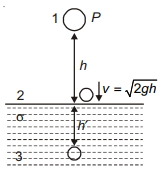
$A$ body of density $\rho$ is dropped from rest from a height $h$ into a lake of density $\sigma$,where $\sigma > \rho$. Neglecting all dissipative forces,the maximum depth to which the body sinks before returning to float on the surface is:
A
$\frac{h}{\sigma-\rho}$
B
$\frac{h \rho}{\sigma}$
C
$\frac{h \rho}{\sigma-\rho}$
D
$\frac{h \sigma}{\sigma-\rho}$
Solution
(C) Let $V$ be the volume of the body. When the body is dropped from height $h$,its velocity $v$ just before entering the water is given by $v = \sqrt{2gh}$.
As the body sinks to a maximum depth $h'$,its final velocity becomes zero. We can apply the work-energy theorem: the work done by gravity plus the work done by the buoyant force equals the change in kinetic energy.
Work done by gravity = $(mg)h' = (V \rho g)h'$
Work done by buoyant force = $-(F_B)h' = -(V \sigma g)h'$
Change in kinetic energy = $K_f - K_i = 0 - \frac{1}{2}mv^2 = -\frac{1}{2}(V \rho)(2gh) = -V \rho gh$
Equating the work done to the change in kinetic energy:
$(V \rho g)h' - (V \sigma g)h' = -V \rho gh$
$V g h' (\rho - \sigma) = -V \rho gh$
$h' (\sigma - \rho) = h \rho$
$h' = \frac{h \rho}{\sigma - \rho}$
As the body sinks to a maximum depth $h'$,its final velocity becomes zero. We can apply the work-energy theorem: the work done by gravity plus the work done by the buoyant force equals the change in kinetic energy.
Work done by gravity = $(mg)h' = (V \rho g)h'$
Work done by buoyant force = $-(F_B)h' = -(V \sigma g)h'$
Change in kinetic energy = $K_f - K_i = 0 - \frac{1}{2}mv^2 = -\frac{1}{2}(V \rho)(2gh) = -V \rho gh$
Equating the work done to the change in kinetic energy:
$(V \rho g)h' - (V \sigma g)h' = -V \rho gh$
$V g h' (\rho - \sigma) = -V \rho gh$
$h' (\sigma - \rho) = h \rho$
$h' = \frac{h \rho}{\sigma - \rho}$
0 likes
View Solution183
DifficultMCQ
$A$ boat carrying a number of stones is floating in a water tank. If the stones are unloaded into the water,the water level in the tank will ............
A
Remain unchanged
B
Rise
C
Fall
D
Rise or fall depends on the number of stones unloaded
Solution
(C) The correct answer is $C$.
When the stones are in the boat,the boat floats by displacing a volume of water whose weight is equal to the total weight of the boat and the stones (Archimedes' Principle).
Let $M_b$ be the mass of the boat and $M_s$ be the mass of the stones. The total weight is $(M_b + M_s)g$. The volume of water displaced by the boat is $V_1 = \frac{(M_b + M_s)}{\rho_w}$,where $\rho_w$ is the density of water.
When the stones are thrown into the water,they sink to the bottom. The boat now only displaces water equal to its own weight,$V_2 = \frac{M_b}{\rho_w}$. The stones,being submerged,displace a volume of water equal to their own volume,$V_s = \frac{M_s}{\rho_s}$,where $\rho_s$ is the density of the stones.
Since the stones are denser than water $(\rho_s > \rho_w)$,the volume of water displaced by the stones when submerged is less than the volume of water displaced by them when they were floating in the boat $(V_s < \frac{M_s}{\rho_w})$.
Therefore,the total volume of water displaced decreases,causing the water level in the tank to fall.
When the stones are in the boat,the boat floats by displacing a volume of water whose weight is equal to the total weight of the boat and the stones (Archimedes' Principle).
Let $M_b$ be the mass of the boat and $M_s$ be the mass of the stones. The total weight is $(M_b + M_s)g$. The volume of water displaced by the boat is $V_1 = \frac{(M_b + M_s)}{\rho_w}$,where $\rho_w$ is the density of water.
When the stones are thrown into the water,they sink to the bottom. The boat now only displaces water equal to its own weight,$V_2 = \frac{M_b}{\rho_w}$. The stones,being submerged,displace a volume of water equal to their own volume,$V_s = \frac{M_s}{\rho_s}$,where $\rho_s$ is the density of the stones.
Since the stones are denser than water $(\rho_s > \rho_w)$,the volume of water displaced by the stones when submerged is less than the volume of water displaced by them when they were floating in the boat $(V_s < \frac{M_s}{\rho_w})$.
Therefore,the total volume of water displaced decreases,causing the water level in the tank to fall.

0 likes
View Solution184
MediumMCQ
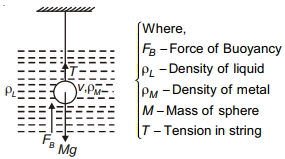
$A$ metallic sphere weighing $3 \,kg$ in air is held by a string so as to be completely immersed in a liquid of relative density $0.8$. The relative density of the metal is $10$. The tension in the string is ........ $N$.
A
$18.7$
B
$42.5$
C
$32.7$
D
$27.6$
Solution
(D) The forces acting on the sphere are the gravitational force $(Mg)$ acting downwards,the buoyant force $(F_B)$ acting upwards,and the tension $(T)$ in the string acting upwards.
For equilibrium,$T + F_B = Mg$,so $T = Mg - F_B$.
The mass of the sphere is $M = 3 \,kg$. The relative density of the metal is $\rho_{rel, M} = 10$,so the density of the metal is $\rho_M = 10 \times 1000 \,kg/m^3$.
The volume of the sphere is $V = \frac{M}{\rho_M} = \frac{3}{10 \times 1000} \,m^3 = 3 \times 10^{-4} \,m^3$.
The density of the liquid is $\rho_L = 0.8 \times 1000 \,kg/m^3 = 800 \,kg/m^3$.
The buoyant force is $F_B = \rho_L V g = 800 \times (3 \times 10^{-4}) \times 10 = 2.4 \,N$.
The weight of the sphere in air is $Mg = 3 \times 10 = 30 \,N$.
Therefore,the tension in the string is $T = 30 - 2.4 = 27.6 \,N$.
For equilibrium,$T + F_B = Mg$,so $T = Mg - F_B$.
The mass of the sphere is $M = 3 \,kg$. The relative density of the metal is $\rho_{rel, M} = 10$,so the density of the metal is $\rho_M = 10 \times 1000 \,kg/m^3$.
The volume of the sphere is $V = \frac{M}{\rho_M} = \frac{3}{10 \times 1000} \,m^3 = 3 \times 10^{-4} \,m^3$.
The density of the liquid is $\rho_L = 0.8 \times 1000 \,kg/m^3 = 800 \,kg/m^3$.
The buoyant force is $F_B = \rho_L V g = 800 \times (3 \times 10^{-4}) \times 10 = 2.4 \,N$.
The weight of the sphere in air is $Mg = 3 \times 10 = 30 \,N$.
Therefore,the tension in the string is $T = 30 - 2.4 = 27.6 \,N$.
0 likes
View Solution185
EasyMCQ
$A$ rectangular block of size $10 \,cm \times 10 \,cm \times 15 \,cm$ is floating in water with the $10 \,cm$ side vertical. If it floats with the $15 \,cm$ side vertical,then the level of water will ..........
A
Rise
B
Fall
C
Remain same
D
Change according to density of block
Solution
(C) According to the Law of Floatation,for a floating body,the weight of the body is equal to the weight of the displaced liquid.
Since the mass of the block remains constant,the weight of the block remains constant.
Therefore,the weight of the displaced water must also remain constant.
Since the weight of the displaced water is equal to $V_{displaced} \times \rho_{water} \times g$,and both $\rho_{water}$ and $g$ are constant,the volume of displaced water $(V_{displaced})$ must remain the same.
Because the volume of the displaced water does not change,the level of the water in the container will remain the same.
Since the mass of the block remains constant,the weight of the block remains constant.
Therefore,the weight of the displaced water must also remain constant.
Since the weight of the displaced water is equal to $V_{displaced} \times \rho_{water} \times g$,and both $\rho_{water}$ and $g$ are constant,the volume of displaced water $(V_{displaced})$ must remain the same.
Because the volume of the displaced water does not change,the level of the water in the container will remain the same.
0 likes
View Solution186
MediumMCQ
Two cubical blocks identical in dimensions float in water in such a way that the $1$st block floats with half part immersed in water and the $2$nd block floats with $3/4$ of its volume inside the water. The ratio of densities of the blocks is ..........
A
$2:3$
B
$3:4$
C
$1:3$
D
$2:3$ (Wait,let's re-evaluate: $1/2 \rho_1 = 3/4 \rho_2 \implies \rho_1/\rho_2 = 3/2$)
Solution
(A) According to the law of floatation,for a body floating in a liquid,the weight of the body is equal to the weight of the liquid displaced.
Let $V$ be the volume of each cubical block and $\rho_w$ be the density of water.
For the $1$st block: Weight of block = Weight of displaced water $\implies V \cdot \rho_1 \cdot g = (V/2) \cdot \rho_w \cdot g \implies \rho_1 = \rho_w / 2$.
For the $2$nd block: Weight of block = Weight of displaced water $\implies V \cdot \rho_2 \cdot g = (3V/4) \cdot \rho_w \cdot g \implies \rho_2 = 3\rho_w / 4$.
The ratio of densities of the blocks is $\rho_1 / \rho_2 = (\rho_w / 2) / (3\rho_w / 4) = (1/2) \times (4/3) = 2/3$.
Let $V$ be the volume of each cubical block and $\rho_w$ be the density of water.
For the $1$st block: Weight of block = Weight of displaced water $\implies V \cdot \rho_1 \cdot g = (V/2) \cdot \rho_w \cdot g \implies \rho_1 = \rho_w / 2$.
For the $2$nd block: Weight of block = Weight of displaced water $\implies V \cdot \rho_2 \cdot g = (3V/4) \cdot \rho_w \cdot g \implies \rho_2 = 3\rho_w / 4$.
The ratio of densities of the blocks is $\rho_1 / \rho_2 = (\rho_w / 2) / (3\rho_w / 4) = (1/2) \times (4/3) = 2/3$.
0 likes
View Solution187
MediumMCQ
$A$ piece of gold weighs $10 \,g$ in air and $9 \,g$ in water. What is the volume of the cavity in $cc$? (Density of gold $= 19.3 \,g \,cm^{-3}$)
A
$0.182$
B
$0.282$
C
$0.382$
D
$0.482$
Solution
(D) The apparent weight of the object in water is given by $W_{\text{app}} = W_{\text{air}} - F_B$,where $F_B$ is the buoyant force.
Given $W_{\text{air}} = 10 \,g$ and $W_{\text{app}} = 9 \,g$,the buoyant force is $F_B = 10 - 9 = 1 \,g \text{ (force equivalent)} = 1 \,g \times g$.
According to Archimedes' principle,the buoyant force is equal to the weight of the water displaced: $F_B = V_{\text{total}} \times \rho_w \times g$.
Since $\rho_w = 1 \,g/cm^3$,we have $V_{\text{total}} = 1 \,cm^3$.
The total volume $V_{\text{total}}$ is the sum of the volume of the gold $V_g$ and the volume of the cavity $V_c$: $V_{\text{total}} = V_g + V_c$.
The volume of the gold is $V_g = \frac{\text{mass}}{\rho_g} = \frac{10}{19.3} \approx 0.518 \,cm^3$.
Substituting these values: $1 = 0.518 + V_c$.
Therefore,$V_c = 1 - 0.518 = 0.482 \,cm^3$.
Given $W_{\text{air}} = 10 \,g$ and $W_{\text{app}} = 9 \,g$,the buoyant force is $F_B = 10 - 9 = 1 \,g \text{ (force equivalent)} = 1 \,g \times g$.
According to Archimedes' principle,the buoyant force is equal to the weight of the water displaced: $F_B = V_{\text{total}} \times \rho_w \times g$.
Since $\rho_w = 1 \,g/cm^3$,we have $V_{\text{total}} = 1 \,cm^3$.
The total volume $V_{\text{total}}$ is the sum of the volume of the gold $V_g$ and the volume of the cavity $V_c$: $V_{\text{total}} = V_g + V_c$.
The volume of the gold is $V_g = \frac{\text{mass}}{\rho_g} = \frac{10}{19.3} \approx 0.518 \,cm^3$.
Substituting these values: $1 = 0.518 + V_c$.
Therefore,$V_c = 1 - 0.518 = 0.482 \,cm^3$.
0 likes
View Solution188
EasyMCQ
$A$ block of ice floats in an oil in a vessel. When the ice melts,the level of oil will ..............
A
Go up
B
Go down
C
Remain same
D
Go up or down depending on quantity of ice
Solution
(B) According to Archimedes' principle,the weight of the displaced oil is equal to the weight of the floating ice block.
Let $V_{ice}$ be the volume of the ice and $\rho_{ice}$ be its density. The weight of the ice is $W = V_{ice} \rho_{ice} g$.
The weight of the displaced oil is $W_{oil} = V_{displaced} \rho_{oil} g$.
Since the ice is floating,$W = W_{oil}$,so $V_{displaced} = V_{ice} (\rho_{ice} / \rho_{oil})$.
When the ice melts,it turns into water with volume $V_{water} = V_{ice} (\rho_{ice} / \rho_{water})$.
Since the density of oil $\rho_{oil}$ is generally less than the density of water $\rho_{water}$,the volume of the melted water $V_{water}$ is less than the volume of the displaced oil $V_{displaced}$.
Therefore,the level of the oil in the vessel will go down.
Let $V_{ice}$ be the volume of the ice and $\rho_{ice}$ be its density. The weight of the ice is $W = V_{ice} \rho_{ice} g$.
The weight of the displaced oil is $W_{oil} = V_{displaced} \rho_{oil} g$.
Since the ice is floating,$W = W_{oil}$,so $V_{displaced} = V_{ice} (\rho_{ice} / \rho_{oil})$.
When the ice melts,it turns into water with volume $V_{water} = V_{ice} (\rho_{ice} / \rho_{water})$.
Since the density of oil $\rho_{oil}$ is generally less than the density of water $\rho_{water}$,the volume of the melted water $V_{water}$ is less than the volume of the displaced oil $V_{displaced}$.
Therefore,the level of the oil in the vessel will go down.
0 likes
View Solution189
MediumMCQ
An object suspended by a wire stretches it by $10 \,mm$. When the object is immersed in a liquid,the elongation in the wire reduces by $\frac{10}{3} \,mm$. The ratio of the relative densities of the object and the liquid is ............
A
$3: 1$
B
$1: 3$
C
$1: 2$
D
$2: 1$
Solution
(A) Let the density of the object be $\sigma$ and the density of the liquid be $\rho$. Let the volume of the object be $V$.
The elongation $\Delta L$ in the wire is proportional to the tension $T$ in the wire,i.e.,$\Delta L \propto T$.
Case $1$: When the object is in air,the tension $T_1 = Mg = V\sigma g$. The elongation is $\Delta L_1 = 10 \,mm$.
Case $2$: When the object is submerged in the liquid,the tension $T_2 = Mg - F_B = V\sigma g - V\rho g$,where $F_B$ is the buoyant force. The elongation is $\Delta L_2 = 10 - \frac{10}{3} = \frac{20}{3} \,mm$.
Taking the ratio of the elongations:
$\frac{\Delta L_1}{\Delta L_2} = \frac{T_1}{T_2} = \frac{V\sigma g}{V\sigma g - V\rho g} = \frac{\sigma}{\sigma - \rho}$.
Substituting the values:
$\frac{10}{20/3} = \frac{\sigma}{\sigma - \rho} \Rightarrow \frac{3}{2} = \frac{\sigma}{\sigma - \rho}$.
Cross-multiplying:
$3(\sigma - \rho) = 2\sigma \Rightarrow 3\sigma - 3\rho = 2\sigma \Rightarrow \sigma = 3\rho$.
Therefore,the ratio of the density of the object to the density of the liquid is $\frac{\sigma}{\rho} = 3: 1$.
The elongation $\Delta L$ in the wire is proportional to the tension $T$ in the wire,i.e.,$\Delta L \propto T$.
Case $1$: When the object is in air,the tension $T_1 = Mg = V\sigma g$. The elongation is $\Delta L_1 = 10 \,mm$.
Case $2$: When the object is submerged in the liquid,the tension $T_2 = Mg - F_B = V\sigma g - V\rho g$,where $F_B$ is the buoyant force. The elongation is $\Delta L_2 = 10 - \frac{10}{3} = \frac{20}{3} \,mm$.
Taking the ratio of the elongations:
$\frac{\Delta L_1}{\Delta L_2} = \frac{T_1}{T_2} = \frac{V\sigma g}{V\sigma g - V\rho g} = \frac{\sigma}{\sigma - \rho}$.
Substituting the values:
$\frac{10}{20/3} = \frac{\sigma}{\sigma - \rho} \Rightarrow \frac{3}{2} = \frac{\sigma}{\sigma - \rho}$.
Cross-multiplying:
$3(\sigma - \rho) = 2\sigma \Rightarrow 3\sigma - 3\rho = 2\sigma \Rightarrow \sigma = 3\rho$.
Therefore,the ratio of the density of the object to the density of the liquid is $\frac{\sigma}{\rho} = 3: 1$.
0 likes
View Solution190
MediumMCQ
$A$ spring balance reads $200 \,gF$ when carrying a lump of lead in air. If the lead is now immersed with half of its volume in brine solution,what will be the new reading of the spring balance? The specific gravity of lead and brine are $11.4$ and $1.1$ respectively. (Result in $gF$)
A
$190.4$
B
$180.4$
C
$210$
D
$170.4$
Solution
(A) The weight of the lead lump in air is $W_1 = mg = 200 \,gF$.
The volume of the lead lump is $V = \frac{m}{\rho_{lead}}$,where $\rho_{lead}$ is the density of lead.
When the lead is immersed with half of its volume in brine,the buoyant force $F_B$ acting on it is equal to the weight of the displaced brine:
$F_B = \text{Volume immersed} \times \rho_{brine} \times g = \frac{V}{2} \times \rho_{brine} \times g$.
The new reading of the spring balance $W_2$ is the apparent weight:
$W_2 = W_1 - F_B = mg - \frac{V}{2} \rho_{brine} g$.
Substituting $V = \frac{m}{\rho_{lead}}$:
$W_2 = mg - \frac{m}{2 \rho_{lead}} \rho_{brine} g = mg \left(1 - \frac{\rho_{brine}}{2 \rho_{lead}}\right)$.
Given the specific gravity $\sigma = \frac{\rho_{substance}}{\rho_{water}}$,we have $\frac{\rho_{brine}}{\rho_{lead}} = \frac{1.1}{11.4}$.
$W_2 = 200 \times \left(1 - \frac{1.1}{2 \times 11.4}\right) = 200 \times \left(1 - \frac{1.1}{22.8}\right) = 200 \times \left(1 - 0.048245\right) = 200 \times 0.951755 = 190.351 \,gF$.
Rounding to one decimal place,the reading is approximately $190.4 \,gF$.
The volume of the lead lump is $V = \frac{m}{\rho_{lead}}$,where $\rho_{lead}$ is the density of lead.
When the lead is immersed with half of its volume in brine,the buoyant force $F_B$ acting on it is equal to the weight of the displaced brine:
$F_B = \text{Volume immersed} \times \rho_{brine} \times g = \frac{V}{2} \times \rho_{brine} \times g$.
The new reading of the spring balance $W_2$ is the apparent weight:
$W_2 = W_1 - F_B = mg - \frac{V}{2} \rho_{brine} g$.
Substituting $V = \frac{m}{\rho_{lead}}$:
$W_2 = mg - \frac{m}{2 \rho_{lead}} \rho_{brine} g = mg \left(1 - \frac{\rho_{brine}}{2 \rho_{lead}}\right)$.
Given the specific gravity $\sigma = \frac{\rho_{substance}}{\rho_{water}}$,we have $\frac{\rho_{brine}}{\rho_{lead}} = \frac{1.1}{11.4}$.
$W_2 = 200 \times \left(1 - \frac{1.1}{2 \times 11.4}\right) = 200 \times \left(1 - \frac{1.1}{22.8}\right) = 200 \times \left(1 - 0.048245\right) = 200 \times 0.951755 = 190.351 \,gF$.
Rounding to one decimal place,the reading is approximately $190.4 \,gF$.
0 likes
View Solution191
MediumMCQ
$A$ solid cube is floating in a liquid. The coefficient of linear expansion of the cube is $\alpha$ and the coefficient of volume expansion of the liquid is $\gamma$. On increasing the temperature of the (liquid + cube) system,the cube will sink if
A
$\gamma = 3\alpha$
B
$\gamma > 3\alpha$
C
$\gamma < 3\alpha$
D
$\gamma = 2\alpha$
Solution
(B) For a floating object,the weight of the displaced liquid equals the weight of the object: $V_{sub} \rho_{liq} g = V_{cube} \rho_{cube} g$,where $V_{sub}$ is the submerged volume of the cube.
This implies $V_{sub} \rho_{liq} = V_{cube} \rho_{cube}$.
Let the temperature increase by $\Delta T$. The new volumes and densities are:
$V'_{cube} = V_{cube}(1 + 3\alpha \Delta T)$
$V'_{liq} = V_{liq}(1 + \gamma \Delta T) \implies \rho'_{liq} = \frac{\rho_{liq}}{1 + \gamma \Delta T} \approx \rho_{liq}(1 - \gamma \Delta T)$
For the cube to sink,the fraction of the submerged volume must increase,meaning the density of the liquid must decrease more rapidly than the density of the cube,or effectively,the liquid must expand more than the cube.
The condition for sinking is that the liquid expands more than the cube,i.e.,the volume expansion coefficient of the liquid must be greater than the volume expansion coefficient of the solid cube.
The volume expansion coefficient of the cube is $3\alpha$.
Therefore,the cube will sink if $\gamma > 3\alpha$.
This implies $V_{sub} \rho_{liq} = V_{cube} \rho_{cube}$.
Let the temperature increase by $\Delta T$. The new volumes and densities are:
$V'_{cube} = V_{cube}(1 + 3\alpha \Delta T)$
$V'_{liq} = V_{liq}(1 + \gamma \Delta T) \implies \rho'_{liq} = \frac{\rho_{liq}}{1 + \gamma \Delta T} \approx \rho_{liq}(1 - \gamma \Delta T)$
For the cube to sink,the fraction of the submerged volume must increase,meaning the density of the liquid must decrease more rapidly than the density of the cube,or effectively,the liquid must expand more than the cube.
The condition for sinking is that the liquid expands more than the cube,i.e.,the volume expansion coefficient of the liquid must be greater than the volume expansion coefficient of the solid cube.
The volume expansion coefficient of the cube is $3\alpha$.
Therefore,the cube will sink if $\gamma > 3\alpha$.
0 likes
View Solution192
MediumMCQ
An ice block floats in a liquid whose density is less than water. $A$ part of the block is outside the liquid. When the whole of the ice has melted,the liquid level will
A
rise
B
go down
C
remain same
D
first rise then go down
Solution
(B) According to Archimedes' principle,the weight of the displaced liquid is equal to the weight of the floating ice block.
Let $M$ be the mass of the ice block. The weight of the ice is $W = Mg$.
The volume of the liquid displaced by the ice is $V_{disp} = \frac{M}{\rho_L}$,where $\rho_L$ is the density of the liquid.
When the ice melts,it turns into water of mass $M$. The volume of this water is $V_{water} = \frac{M}{\rho_W}$,where $\rho_W$ is the density of water.
Since the density of the liquid is less than the density of water $(\rho_L < \rho_W)$,it follows that $\frac{M}{\rho_L} > \frac{M}{\rho_W}$.
Therefore,$V_{disp} > V_{water}$.
Since the volume of the liquid displaced by the ice is greater than the volume of the water formed after melting,the liquid level will go down.
Let $M$ be the mass of the ice block. The weight of the ice is $W = Mg$.
The volume of the liquid displaced by the ice is $V_{disp} = \frac{M}{\rho_L}$,where $\rho_L$ is the density of the liquid.
When the ice melts,it turns into water of mass $M$. The volume of this water is $V_{water} = \frac{M}{\rho_W}$,where $\rho_W$ is the density of water.
Since the density of the liquid is less than the density of water $(\rho_L < \rho_W)$,it follows that $\frac{M}{\rho_L} > \frac{M}{\rho_W}$.
Therefore,$V_{disp} > V_{water}$.
Since the volume of the liquid displaced by the ice is greater than the volume of the water formed after melting,the liquid level will go down.
0 likes
View Solution193
DifficultMCQ
$A$ cube of ice floats partly in water and partly in kerosene oil. Find the ratio of the volume of ice immersed in water to that in kerosene oil. (Specific gravity of kerosene oil $= 0.8$, specific gravity of ice $= 0.9$)
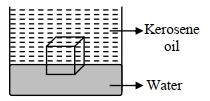
A
$8: 9$
B
$5: 4$
C
$9: 10$
D
$1: 1$
Solution
(D) Let $V_w$ be the volume of ice immersed in water and $V_k$ be the volume of ice immersed in kerosene oil.
According to the principle of floatation, the weight of the ice cube is equal to the total buoyant force exerted by both liquids.
Weight of ice $= (V_w + V_k) \rho_{ice} g$
Buoyant force $= V_w \rho_w g + V_k \rho_k g$
Equating the two: $(V_w + V_k) \rho_{ice} g = V_w \rho_w g + V_k \rho_k g$
Dividing by $\rho_w g$ (where $\rho_w = 1 \text{ g/cm}^3$):
$(V_w + V_k) \times 0.9 = V_w \times 1 + V_k \times 0.8$
$0.9 V_w + 0.9 V_k = V_w + 0.8 V_k$
$0.9 V_k - 0.8 V_k = V_w - 0.9 V_w$
$0.1 V_k = 0.1 V_w$
Therefore, $V_w / V_k = 1 / 1$ or $1: 1$.
According to the principle of floatation, the weight of the ice cube is equal to the total buoyant force exerted by both liquids.
Weight of ice $= (V_w + V_k) \rho_{ice} g$
Buoyant force $= V_w \rho_w g + V_k \rho_k g$
Equating the two: $(V_w + V_k) \rho_{ice} g = V_w \rho_w g + V_k \rho_k g$
Dividing by $\rho_w g$ (where $\rho_w = 1 \text{ g/cm}^3$):
$(V_w + V_k) \times 0.9 = V_w \times 1 + V_k \times 0.8$
$0.9 V_w + 0.9 V_k = V_w + 0.8 V_k$
$0.9 V_k - 0.8 V_k = V_w - 0.9 V_w$
$0.1 V_k = 0.1 V_w$
Therefore, $V_w / V_k = 1 / 1$ or $1: 1$.
0 likes
View Solution194
DifficultMCQ
$A$ sphere of relative density $\sigma$ and diameter $D$ has a concentric cavity of diameter $d$. The ratio of $\frac{D}{d}$,if it just floats on water in a tank,is:
A
$\left(\frac{\sigma}{\sigma-1}\right)^{\frac{1}{3}}$
B
$\left(\frac{\sigma+1}{\sigma-1}\right)^{\frac{1}{3}}$
C
$\left(\frac{\sigma-1}{\sigma}\right)^{\frac{1}{3}}$
D
$\left(\frac{\sigma-2}{\sigma+2}\right)^{\frac{1}{3}}$
Solution
(A) The weight of the sphere is given by $W = V_{material} \cdot \rho_{sphere} \cdot g = \frac{4}{3} \pi \left( \frac{D^3 - d^3}{8} \right) \sigma \rho_w g$.
The buoyant force is equal to the weight of the water displaced by the total volume of the sphere: $F_b = V_{total} \cdot \rho_w \cdot g = \frac{4}{3} \pi \left( \frac{D^3}{8} \right) \rho_w g$.
For the sphere to just float,the weight must equal the buoyant force: $W = F_b$.
Substituting the expressions: $\frac{4}{3} \pi \left( \frac{D^3 - d^3}{8} \right) \sigma \rho_w g = \frac{4}{3} \pi \left( \frac{D^3}{8} \right) \rho_w g$.
Simplifying the equation: $(D^3 - d^3) \sigma = D^3$.
Dividing by $D^3 \sigma$: $1 - \frac{d^3}{D^3} = \frac{1}{\sigma}$.
Rearranging for the ratio: $\frac{d^3}{D^3} = 1 - \frac{1}{\sigma} = \frac{\sigma - 1}{\sigma}$.
Taking the reciprocal and cube root: $\frac{D}{d} = \left( \frac{\sigma}{\sigma - 1} \right)^{\frac{1}{3}}$.
The buoyant force is equal to the weight of the water displaced by the total volume of the sphere: $F_b = V_{total} \cdot \rho_w \cdot g = \frac{4}{3} \pi \left( \frac{D^3}{8} \right) \rho_w g$.
For the sphere to just float,the weight must equal the buoyant force: $W = F_b$.
Substituting the expressions: $\frac{4}{3} \pi \left( \frac{D^3 - d^3}{8} \right) \sigma \rho_w g = \frac{4}{3} \pi \left( \frac{D^3}{8} \right) \rho_w g$.
Simplifying the equation: $(D^3 - d^3) \sigma = D^3$.
Dividing by $D^3 \sigma$: $1 - \frac{d^3}{D^3} = \frac{1}{\sigma}$.
Rearranging for the ratio: $\frac{d^3}{D^3} = 1 - \frac{1}{\sigma} = \frac{\sigma - 1}{\sigma}$.
Taking the reciprocal and cube root: $\frac{D}{d} = \left( \frac{\sigma}{\sigma - 1} \right)^{\frac{1}{3}}$.
0 likes
View Solution195
MediumMCQ
$A$ hot air balloon is carrying some passengers and a few sandbags of mass $1 kg$ each,so that its total mass is $480 kg$. Its effective volume providing buoyancy is $V$. The balloon is floating at an equilibrium height of $100 m$. When $N$ number of sandbags are thrown out,the balloon rises to a new equilibrium height of $150 m$ with its volume $V$ remaining unchanged. If the variation of the density of air with height $h$ from the ground is $\rho(h) = \rho_0 e^{-\frac{h}{h_0}}$,where $\rho_0 = 1.25 kg m^{-3}$ and $h_0 = 6000 m$,the value of $N$ is:
A
$3$
B
$4$
C
$5$
D
$6$
Solution
(B) At equilibrium,the buoyant force equals the weight of the balloon: $Mg = V \rho(h) g$,which simplifies to $M = V \rho(h)$.
For the initial state at $h_1 = 100 m$: $480 = V \rho_0 e^{-\frac{100}{6000}}$.
For the final state at $h_2 = 150 m$ after removing $N$ sandbags: $(480 - N) = V \rho_0 e^{-\frac{150}{6000}}$.
Dividing the two equations: $\frac{480 - N}{480} = \frac{e^{-\frac{150}{6000}}}{e^{-\frac{100}{6000}}} = e^{-\frac{50}{6000}}$.
Using the approximation $e^{-x} \approx 1 - x$ for small $x$: $1 - \frac{N}{480} \approx 1 - \frac{50}{6000}$.
Therefore,$\frac{N}{480} = \frac{50}{6000} = \frac{1}{120}$.
$N = \frac{480}{120} = 4$.
For the initial state at $h_1 = 100 m$: $480 = V \rho_0 e^{-\frac{100}{6000}}$.
For the final state at $h_2 = 150 m$ after removing $N$ sandbags: $(480 - N) = V \rho_0 e^{-\frac{150}{6000}}$.
Dividing the two equations: $\frac{480 - N}{480} = \frac{e^{-\frac{150}{6000}}}{e^{-\frac{100}{6000}}} = e^{-\frac{50}{6000}}$.
Using the approximation $e^{-x} \approx 1 - x$ for small $x$: $1 - \frac{N}{480} \approx 1 - \frac{50}{6000}$.
Therefore,$\frac{N}{480} = \frac{50}{6000} = \frac{1}{120}$.
$N = \frac{480}{120} = 4$.
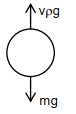
0 likes
View Solution196
AdvancedMCQ
$A$ thin uniform cylindrical shell,closed at both ends,is partially filled with water. It is floating vertically in water in a half-submerged state. If $\rho_c$ is the relative density of the material of the shell with respect to water,then the correct statement is that the shell is
A
more than half filled if $\rho_c < 0.5$
B
more than half filled if $\rho_c < 1.0$
C
half filled if $\rho_c < 0.5$
D
less than half filled if $\rho_c < 0.5$
Solution
(A) Let $V_0$ be the outer volume of the shell and $V_i$ be the inner volume of the shell.
Let $V$ be the volume of water inside the shell.
Let $\rho_c$ be the relative density of the shell material.
For the shell to float in a half-submerged state,the total weight of the shell and the water inside must equal the buoyant force exerted by the displaced water.
The weight of the shell is $W_s = \rho_c (V_0 - V_i) g$.
The weight of the water inside is $W_w = V g$.
The buoyant force is $F_B = \frac{V_0}{2} g$ (since it is half-submerged).
Equating weight and buoyant force: $\rho_c (V_0 - V_i) g + V g = \frac{V_0}{2} g$.
Simplifying,we get: $\rho_c (V_0 - V_i) = \frac{V_0}{2} - V$.
Thus,$\rho_c = \frac{V_0/2 - V}{V_0 - V_i}$.
If $\rho_c < 0.5$,then $\frac{V_0/2 - V}{V_0 - V_i} < \frac{1}{2}$.
Multiplying both sides by $2(V_0 - V_i)$ (assuming $V_0 > V_i$): $V_0 - 2V < V_0 - V_i$.
This simplifies to $-2V < -V_i$,or $V > V_i / 2$.
Since $V$ is the volume of water and $V_i$ is the total inner volume,$V > V_i / 2$ means the shell is more than half filled.
Let $V$ be the volume of water inside the shell.
Let $\rho_c$ be the relative density of the shell material.
For the shell to float in a half-submerged state,the total weight of the shell and the water inside must equal the buoyant force exerted by the displaced water.
The weight of the shell is $W_s = \rho_c (V_0 - V_i) g$.
The weight of the water inside is $W_w = V g$.
The buoyant force is $F_B = \frac{V_0}{2} g$ (since it is half-submerged).
Equating weight and buoyant force: $\rho_c (V_0 - V_i) g + V g = \frac{V_0}{2} g$.
Simplifying,we get: $\rho_c (V_0 - V_i) = \frac{V_0}{2} - V$.
Thus,$\rho_c = \frac{V_0/2 - V}{V_0 - V_i}$.
If $\rho_c < 0.5$,then $\frac{V_0/2 - V}{V_0 - V_i} < \frac{1}{2}$.
Multiplying both sides by $2(V_0 - V_i)$ (assuming $V_0 > V_i$): $V_0 - 2V < V_0 - V_i$.
This simplifies to $-2V < -V_i$,or $V > V_i / 2$.
Since $V$ is the volume of water and $V_i$ is the total inner volume,$V > V_i / 2$ means the shell is more than half filled.
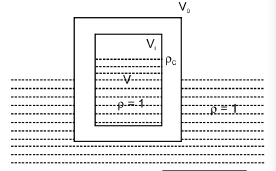
0 likes
View Solution197
DifficultMCQ
$A$ solid sphere of radius $R$ and density $\rho$ is attached to one end of a massless spring of force constant $k$. The other end of the spring is connected to another solid sphere of radius $R$ and density $3\rho$. The complete arrangement is placed in a liquid of density $2\rho$ and is allowed to reach equilibrium. The correct statement$(s)$ is (are):
$(A)$ The net elongation of the spring is $\frac{4 \pi R^3 \rho g}{3 k}$
$(B)$ The net elongation of the spring is $\frac{8 \pi R^3 \rho g}{3 k}$
$(C)$ The light sphere is partially submerged.
$(D)$ The light sphere is completely submerged.
$(A)$ The net elongation of the spring is $\frac{4 \pi R^3 \rho g}{3 k}$
$(B)$ The net elongation of the spring is $\frac{8 \pi R^3 \rho g}{3 k}$
$(C)$ The light sphere is partially submerged.
$(D)$ The light sphere is completely submerged.
A
$(B, C)$
B
$(B, D)$
C
$(A, D)$
D
$(C, D)$
Solution
(C) Let $V = \frac{4}{3} \pi R^3$ be the volume of each sphere.
For the upper sphere (density $\rho$): The forces acting are gravity ($mg = V\rho g$ downwards),spring force ($kx$ upwards,as it is being pulled down by the lower sphere),and buoyant force ($F_{B1} = V(2\rho)g$ upwards). At equilibrium: $V\rho g + kx = V(2\rho)g \implies kx = V\rho g = \frac{4}{3} \pi R^3 \rho g$. Thus,$x = \frac{4 \pi R^3 \rho g}{3 k}$. This confirms statement $(A)$ is correct.
For the lower sphere (density $3\rho$): The forces are gravity ($mg = V(3\rho)g$ downwards),spring force ($kx$ downwards),and buoyant force ($F_{B2} = V(2\rho)g$ upwards). At equilibrium: $V(3\rho)g = V(2\rho)g + kx \implies kx = V\rho g = \frac{4}{3} \pi R^3 \rho g$. This confirms the elongation is indeed $\frac{4 \pi R^3 \rho g}{3 k}$.
Since the buoyant force on the upper sphere $(2V\rho g)$ is greater than its weight $(V\rho g)$,it must be fully submerged to maintain equilibrium,as the spring provides the necessary downward force to balance the net upward buoyant force. Thus,the light sphere is completely submerged. Statement $(D)$ is correct.
For the upper sphere (density $\rho$): The forces acting are gravity ($mg = V\rho g$ downwards),spring force ($kx$ upwards,as it is being pulled down by the lower sphere),and buoyant force ($F_{B1} = V(2\rho)g$ upwards). At equilibrium: $V\rho g + kx = V(2\rho)g \implies kx = V\rho g = \frac{4}{3} \pi R^3 \rho g$. Thus,$x = \frac{4 \pi R^3 \rho g}{3 k}$. This confirms statement $(A)$ is correct.
For the lower sphere (density $3\rho$): The forces are gravity ($mg = V(3\rho)g$ downwards),spring force ($kx$ downwards),and buoyant force ($F_{B2} = V(2\rho)g$ upwards). At equilibrium: $V(3\rho)g = V(2\rho)g + kx \implies kx = V\rho g = \frac{4}{3} \pi R^3 \rho g$. This confirms the elongation is indeed $\frac{4 \pi R^3 \rho g}{3 k}$.
Since the buoyant force on the upper sphere $(2V\rho g)$ is greater than its weight $(V\rho g)$,it must be fully submerged to maintain equilibrium,as the spring provides the necessary downward force to balance the net upward buoyant force. Thus,the light sphere is completely submerged. Statement $(D)$ is correct.
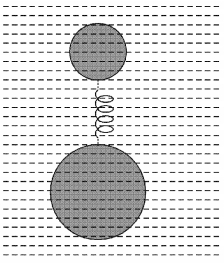
0 likes
View Solution198
DifficultMCQ
$A$ soft plastic bottle,filled with water of density $1 \text{ g/cc}$,contains an inverted glass test-tube with some air (ideal gas) trapped inside,as shown in the figure. The test-tube has a mass of $5 \text{ g}$,and it is made of thick glass with a density of $2.5 \text{ g/cc}$. Initially,the bottle is sealed at atmospheric pressure $P_0 = 10^5 \text{ Pa}$,such that the volume of the trapped air is $V_0 = 3.3 \text{ cc}$. When the bottle is squeezed from the outside at a constant temperature,the pressure inside increases and the volume of the trapped air decreases. It is observed that the test-tube begins to sink at a pressure $P_0 + \Delta P$ without changing its orientation. At this pressure,the volume of the trapped air is $V_0 - \Delta V$.
Let $\Delta V = X \text{ cc}$ and $\Delta P = Y \times 10^3 \text{ Pa}$.
$(1)$ The value of $X$ is
$(2)$ The value of $Y$ is
Let $\Delta V = X \text{ cc}$ and $\Delta P = Y \times 10^3 \text{ Pa}$.
$(1)$ The value of $X$ is
$(2)$ The value of $Y$ is
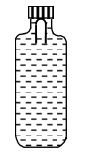
A
$10, 20$
B
$30, 20$
C
$30, 10$
D
$15, 10$
Solution
(C) $(1)$ For the test-tube to sink,its average density must equal the density of water. The volume of the glass is $V_{\text{glass}} = \frac{\text{mass}}{\text{density}} = \frac{5 \text{ g}}{2.5 \text{ g/cc}} = 2 \text{ cc}$.
Let $V_{\text{gas}}$ be the volume of the trapped air when it starts to sink. The total volume of the test-tube system is $V_{\text{total}} = V_{\text{glass}} + V_{\text{gas}} = 2 + V_{\text{gas}}$.
For the system to sink,the buoyant force must equal the weight: $\rho_{\text{water}} V_{\text{total}} g = m_{\text{total}} g$.
$1 \times (2 + V_{\text{gas}}) = 5 \implies V_{\text{gas}} = 3 \text{ cc}$.
The change in volume is $\Delta V = V_0 - V_{\text{gas}} = 3.3 - 3 = 0.3 \text{ cc}$.
Since $\Delta V = X \text{ cc}$,$X = 0.3$. Note: The options provided seem to imply $X$ in units of $0.1 \text{ cc}$ or a typo in the question's expected format. Based on standard physics problems of this type,$X=0.3$ is the correct physical value.
$(2)$ Using the isothermal process for the trapped air: $P_1 V_1 = P_2 V_2$.
$10^5 \times 3.3 = P_2 \times 3$.
$P_2 = 1.1 \times 10^5 \text{ Pa}$.
$\Delta P = P_2 - P_1 = 1.1 \times 10^5 - 10^5 = 0.1 \times 10^5 = 10 \times 10^3 \text{ Pa}$.
Given $\Delta P = Y \times 10^3 \text{ Pa}$,we get $Y = 10$.
Let $V_{\text{gas}}$ be the volume of the trapped air when it starts to sink. The total volume of the test-tube system is $V_{\text{total}} = V_{\text{glass}} + V_{\text{gas}} = 2 + V_{\text{gas}}$.
For the system to sink,the buoyant force must equal the weight: $\rho_{\text{water}} V_{\text{total}} g = m_{\text{total}} g$.
$1 \times (2 + V_{\text{gas}}) = 5 \implies V_{\text{gas}} = 3 \text{ cc}$.
The change in volume is $\Delta V = V_0 - V_{\text{gas}} = 3.3 - 3 = 0.3 \text{ cc}$.
Since $\Delta V = X \text{ cc}$,$X = 0.3$. Note: The options provided seem to imply $X$ in units of $0.1 \text{ cc}$ or a typo in the question's expected format. Based on standard physics problems of this type,$X=0.3$ is the correct physical value.
$(2)$ Using the isothermal process for the trapped air: $P_1 V_1 = P_2 V_2$.
$10^5 \times 3.3 = P_2 \times 3$.
$P_2 = 1.1 \times 10^5 \text{ Pa}$.
$\Delta P = P_2 - P_1 = 1.1 \times 10^5 - 10^5 = 0.1 \times 10^5 = 10 \times 10^3 \text{ Pa}$.
Given $\Delta P = Y \times 10^3 \text{ Pa}$,we get $Y = 10$.
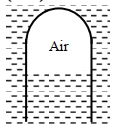
0 likes
View Solution199
MediumMCQ
$A$ $400 \ g$ solid cube having an edge of length $10 \ cm$ floats in water. How much volume of the cube is outside the water (in $cm^3$)? (Given: density of water $= 1000 \ kg/m^3$)
A
$1400$
B
$4000$
C
$400$
D
$600$
Solution
(D) The mass of the cube is $M = 400 \ g = 0.4 \ kg$. The edge length is $L = 10 \ cm = 0.1 \ m$. The total volume of the cube is $V_{total} = L^3 = (0.1 \ m)^3 = 0.001 \ m^3 = 1000 \ cm^3$.
For a floating object,the weight of the object equals the buoyant force: $Mg = \rho_{water} V_{displaced} g$.
$0.4 = 1000 \times V_{displaced}$.
$V_{displaced} = 0.4 / 1000 = 0.0004 \ m^3 = 400 \ cm^3$.
The volume outside the water is $V_{outside} = V_{total} - V_{displaced} = 1000 \ cm^3 - 400 \ cm^3 = 600 \ cm^3$.
For a floating object,the weight of the object equals the buoyant force: $Mg = \rho_{water} V_{displaced} g$.
$0.4 = 1000 \times V_{displaced}$.
$V_{displaced} = 0.4 / 1000 = 0.0004 \ m^3 = 400 \ cm^3$.
The volume outside the water is $V_{outside} = V_{total} - V_{displaced} = 1000 \ cm^3 - 400 \ cm^3 = 600 \ cm^3$.
0 likes
View Solution200
DifficultMCQ
$A$ cube having a side of $10 \ cm$ with unknown mass $m$ and a $200 \ g$ mass were hung at two ends of a uniform rigid rod of $27 \ cm$ length. The rod along with the masses was placed on a wedge,keeping the distance between the wedge point and the $200 \ g$ weight as $25 \ cm$. Initially,the masses were not in balance. $A$ beaker is placed beneath the unknown mass and water is added slowly to it. At a given point,the masses were in balance and half the volume of the unknown mass was submerged in the water. (Take the density of the unknown mass to be greater than that of water,the mass did not absorb water,and the water density is $1 \ g/cm^3$). The unknown mass $m$ is . . . . . . $kg$.
A
$3$
B
$9$
C
$8$
D
$7$
Solution
(A) Given: Side of the cube $a = 10 \ cm = 0.1 \ m$. Volume of the cube $V = a^3 = (0.1)^3 = 10^{-3} \ m^3$.
Let the mass of the cube be $m$ and its density be $\rho$. Thus,$m = \rho V = \rho \times 10^{-3} \ kg$.
The distance of the unknown mass from the wedge is $2 \ cm = 0.02 \ m$,and the distance of the $200 \ g$ $(0.2 \ kg)$ mass from the wedge is $25 \ cm = 0.25 \ m$.
When half the volume of the cube is submerged,the buoyant force $F_B$ acting on it is given by $F_B = \rho_{water} \times V_{submerged} \times g = 1000 \ kg/m^3 \times (0.5 \times 10^{-3} \ m^3) \times 10 \ m/s^2 = 5 \ N$.
For the rod to be in rotational equilibrium about the wedge point $O$,the net torque must be zero:
$\tau_{net} = (mg - F_B) \times 0.02 \ m - (0.2 \ kg \times 10 \ m/s^2) \times 0.25 \ m = 0$
$(m \times 10 - 5) \times 0.02 = 2 \times 0.25$
$(10m - 5) \times 0.02 = 0.5$
$10m - 5 = 0.5 / 0.02 = 25$
$10m = 30$
$m = 3 \ kg$.
Let the mass of the cube be $m$ and its density be $\rho$. Thus,$m = \rho V = \rho \times 10^{-3} \ kg$.
The distance of the unknown mass from the wedge is $2 \ cm = 0.02 \ m$,and the distance of the $200 \ g$ $(0.2 \ kg)$ mass from the wedge is $25 \ cm = 0.25 \ m$.
When half the volume of the cube is submerged,the buoyant force $F_B$ acting on it is given by $F_B = \rho_{water} \times V_{submerged} \times g = 1000 \ kg/m^3 \times (0.5 \times 10^{-3} \ m^3) \times 10 \ m/s^2 = 5 \ N$.
For the rod to be in rotational equilibrium about the wedge point $O$,the net torque must be zero:
$\tau_{net} = (mg - F_B) \times 0.02 \ m - (0.2 \ kg \times 10 \ m/s^2) \times 0.25 \ m = 0$
$(m \times 10 - 5) \times 0.02 = 2 \times 0.25$
$(10m - 5) \times 0.02 = 0.5$
$10m - 5 = 0.5 / 0.02 = 25$
$10m = 30$
$m = 3 \ kg$.
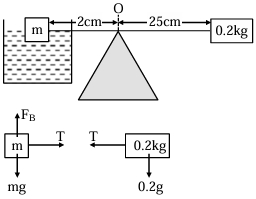
0 likes
View SolutionFluid Mechanics and Surface Tension — Buoyancy, Archimedes' Principle and Laws of Floatation · Frequently Asked Questions
1Are these Fluid Mechanics and Surface Tension questions useful for JEE and NEET?
Yes. All questions in this section are mapped to JEE Main and NEET exam patterns. Previous year questions from JEE Main, NEET, GUJCET and state-level exams are included with full solutions.
2Can I switch to Hindi or Gujarati for these questions?
Yes. Use the language tabs in the hero section or the sidebar to view the same questions and solutions in English, Hindi or Gujarati.
3How do I generate a question paper from this subtopic?
Use the Vedclass Exam Paper Generator — select the chapter and subtopic, set difficulty, and generate Sets A, B, C, D automatically. First 3 chapters of every subject are free.
Vedclass Products
For Students
Vedclass Test Series
Mock tests in real JEE/NEET style with performance analysis. 5-day free trial.
Start Free TrialFor Teachers
Exam Paper Generator
Generate Set A/B/C/D papers from this chapter in 2 minutes. 3 chapters free.
Try FreeFor Institutes
Online Exam Module
Live online exams with unlimited students, 360° analytics & white-label branding.
See DemoFor Teachers & Institutes
Generate a Fluid Mechanics and Surface Tension Exam Paper in 2 Minutes
Select subtopic & difficulty — Sets A, B, C, D auto-generated with No Repeat logic.
First 3 chapters of every subject are free — no payment required.