
A English
Buoyancy, Archimedes' Principle and Laws of Floatation Questions in English
Class 11 Physics · Fluid Mechanics and Surface Tension · Buoyancy, Archimedes' Principle and Laws of Floatation
257+
Questions
English
Language
100%
With Solutions
Showing 7 of 257 questions in English
251
EasyMCQ
An object weighs $m_1$ in a liquid of density $d_1$ and $m_2$ in a liquid of density $d_2$. The density $d$ of the object is
A
$d=\frac{m_2 d_2-m_1 d_1}{m_2-m_1}$
B
$d=\frac{m_1 d_1-m_2 d_2}{m_2-m_1}$
C
$d=\frac{m_2 d_1-m_1 d_2}{m_1-m_2}$
D
$d=\frac{m_1 d_2-m_2 d_1}{m_1-m_2}$
Solution
(D) Let $V$ be the volume of the object and $d$ be its density. The apparent weight of the object in a liquid is given by the actual weight minus the buoyant force.
In the first liquid: $m_1 g = V d g - V d_1 g = V g (d - d_1) \implies m_1 = V(d - d_1) \quad (1)$
In the second liquid: $m_2 g = V d g - V d_2 g = V g (d - d_2) \implies m_2 = V(d - d_2) \quad (2)$
Dividing equation $(1)$ by equation $(2)$:
$\frac{m_1}{m_2} = \frac{d - d_1}{d - d_2}$
$m_1(d - d_2) = m_2(d - d_1)$
$m_1 d - m_1 d_2 = m_2 d - m_2 d_1$
$d(m_1 - m_2) = m_1 d_2 - m_2 d_1$
$d = \frac{m_1 d_2 - m_2 d_1}{m_1 - m_2}$
In the first liquid: $m_1 g = V d g - V d_1 g = V g (d - d_1) \implies m_1 = V(d - d_1) \quad (1)$
In the second liquid: $m_2 g = V d g - V d_2 g = V g (d - d_2) \implies m_2 = V(d - d_2) \quad (2)$
Dividing equation $(1)$ by equation $(2)$:
$\frac{m_1}{m_2} = \frac{d - d_1}{d - d_2}$
$m_1(d - d_2) = m_2(d - d_1)$
$m_1 d - m_1 d_2 = m_2 d - m_2 d_1$
$d(m_1 - m_2) = m_1 d_2 - m_2 d_1$
$d = \frac{m_1 d_2 - m_2 d_1}{m_1 - m_2}$
0 likes
View Solution252
DifficultMCQ
$A$ body floats in water with $40 \%$ of its volume outside water. When the same body floats in an oil,$60 \%$ of its volume remains outside oil. The relative density of oil is
A
$0.9$
B
$1$
C
$1.2$
D
$1.5$
Solution
(D) Let $V$ be the total volume of the body and $\rho$ be its density.
According to the law of floatation,the weight of the body is equal to the weight of the liquid displaced.
Case $1$: In water (density $\rho_w = 1 \text{ g/cm}^3$):
Volume inside water = $V - 0.4V = 0.6V$.
Weight of body = Weight of water displaced $\implies V \rho g = (0.6V) \rho_w g \implies \rho = 0.6 \rho_w = 0.6 \text{ g/cm}^3$.
Case $2$: In oil (density $\rho_o$):
Volume inside oil = $V - 0.6V = 0.4V$.
Weight of body = Weight of oil displaced $\implies V \rho g = (0.4V) \rho_o g \implies \rho = 0.4 \rho_o$.
Equating the density of the body from both cases: $0.6 \rho_w = 0.4 \rho_o$.
Relative density of oil = $\frac{\rho_o}{\rho_w} = \frac{0.6}{0.4} = 1.5$.
According to the law of floatation,the weight of the body is equal to the weight of the liquid displaced.
Case $1$: In water (density $\rho_w = 1 \text{ g/cm}^3$):
Volume inside water = $V - 0.4V = 0.6V$.
Weight of body = Weight of water displaced $\implies V \rho g = (0.6V) \rho_w g \implies \rho = 0.6 \rho_w = 0.6 \text{ g/cm}^3$.
Case $2$: In oil (density $\rho_o$):
Volume inside oil = $V - 0.6V = 0.4V$.
Weight of body = Weight of oil displaced $\implies V \rho g = (0.4V) \rho_o g \implies \rho = 0.4 \rho_o$.
Equating the density of the body from both cases: $0.6 \rho_w = 0.4 \rho_o$.
Relative density of oil = $\frac{\rho_o}{\rho_w} = \frac{0.6}{0.4} = 1.5$.
0 likes
View Solution253
EasyMCQ
$A$ body floats in water with $40 \%$ of its volume outside water. When the same body floats in oil, $60 \%$ of its volume remains outside oil. The relative density of the oil is
A
$0.9$
B
$1.2$
C
$1.5$
D
$1.8$
Solution
(C) For a body floating in a liquid, the weight of the body equals the weight of the displaced liquid. Let $V$ be the total volume of the body and $d$ be its density.
Case $1$: Floating in water (density $\rho_w = 1 \text{ g/cm}^3$)
Volume immersed $V_{in} = V - 0.4V = 0.6V$.
Weight of body = Weight of displaced water
$V \cdot d \cdot g = (0.6V) \cdot \rho_w \cdot g$
$d = 0.6 \cdot 1 = 0.6 \text{ g/cm}^3$.
Case $2$: Floating in oil (density $\rho_{oil}$)
Volume immersed $V_{in} = V - 0.6V = 0.4V$.
Weight of body = Weight of displaced oil
$V \cdot d \cdot g = (0.4V) \cdot \rho_{oil} \cdot g$
$0.6 = 0.4 \cdot \rho_{oil}$
$\rho_{oil} = \frac{0.6}{0.4} = 1.5$.
Thus, the relative density of the oil is $1.5$.
Case $1$: Floating in water (density $\rho_w = 1 \text{ g/cm}^3$)
Volume immersed $V_{in} = V - 0.4V = 0.6V$.
Weight of body = Weight of displaced water
$V \cdot d \cdot g = (0.6V) \cdot \rho_w \cdot g$
$d = 0.6 \cdot 1 = 0.6 \text{ g/cm}^3$.
Case $2$: Floating in oil (density $\rho_{oil}$)
Volume immersed $V_{in} = V - 0.6V = 0.4V$.
Weight of body = Weight of displaced oil
$V \cdot d \cdot g = (0.4V) \cdot \rho_{oil} \cdot g$
$0.6 = 0.4 \cdot \rho_{oil}$
$\rho_{oil} = \frac{0.6}{0.4} = 1.5$.
Thus, the relative density of the oil is $1.5$.
0 likes
View Solution254
MediumMCQ
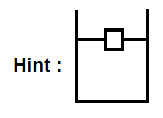
$A$ body floats with $\frac{1}{n}$ of its volume outside of water. If the body is pushed to a depth $h$ inside the water and released,it will come to the surface after time $t$. Then:
A
$t \propto \sqrt{n}$
B
$t \propto n$
C
$t \propto \sqrt{n+1}$
D
$t \propto \sqrt{n-1}$
Solution
(D) Let $V$ be the total volume of the body,$d$ be its density,and $\sigma$ be the density of water.
For a floating body,the weight equals the buoyant force: $Vdg = V(1 - \frac{1}{n})\sigma g$.
Thus,$d = (\frac{n-1}{n})\sigma$.
When the body is submerged,the net upward force $F_{net}$ is $F_B - mg = V\sigma g - Vdg = V\sigma g - V(\frac{n-1}{n})\sigma g = V\sigma g (1 - \frac{n-1}{n}) = V\sigma g (\frac{1}{n})$.
The acceleration $a$ is given by $a = \frac{F_{net}}{m} = \frac{V\sigma g / n}{Vd} = \frac{\sigma g / n}{(\frac{n-1}{n})\sigma} = \frac{g}{n-1}$.
Using the kinematic equation $h = \frac{1}{2}at^2$,we have $h = \frac{1}{2} (\frac{g}{n-1}) t^2$.
Solving for $t$,we get $t = \sqrt{\frac{2h(n-1)}{g}}$.
Therefore,$t \propto \sqrt{n-1}$.
For a floating body,the weight equals the buoyant force: $Vdg = V(1 - \frac{1}{n})\sigma g$.
Thus,$d = (\frac{n-1}{n})\sigma$.
When the body is submerged,the net upward force $F_{net}$ is $F_B - mg = V\sigma g - Vdg = V\sigma g - V(\frac{n-1}{n})\sigma g = V\sigma g (1 - \frac{n-1}{n}) = V\sigma g (\frac{1}{n})$.
The acceleration $a$ is given by $a = \frac{F_{net}}{m} = \frac{V\sigma g / n}{Vd} = \frac{\sigma g / n}{(\frac{n-1}{n})\sigma} = \frac{g}{n-1}$.
Using the kinematic equation $h = \frac{1}{2}at^2$,we have $h = \frac{1}{2} (\frac{g}{n-1}) t^2$.
Solving for $t$,we get $t = \sqrt{\frac{2h(n-1)}{g}}$.
Therefore,$t \propto \sqrt{n-1}$.
0 likes
View Solution255
MediumMCQ
$A$ body of density $1.2 \times 10^{3} \text{ kg/m}^3$ is dropped from rest from a height $1 \text{ m}$ into a liquid of density $2.4 \times 10^{3} \text{ kg/m}^3$. Neglecting all dissipative effects, the maximum depth to which the body sinks before returning to float on the surface is: (in $\text{ m}$)
A
$0.1$
B
$1$
C
$0.01$
D
$2$
Solution
(B) Let the density of the body be $\rho_b = 1.2 \times 10^3 \text{ kg/m}^3$, the density of the liquid be $\rho_l = 2.4 \times 10^3 \text{ kg/m}^3$, the height of fall be $h = 1 \text{ m}$, and the maximum depth reached be $d$.
According to the Work-Energy Theorem, the total work done by all forces (gravity and buoyancy) on the body from the point of release to the point of maximum depth is zero (since the change in kinetic energy is zero).
Work done by gravity = $Mg(h + d) = V \rho_b g (h + d)$.
Work done by buoyancy = $-Bd = -V \rho_l g d$.
Equating the work done: $V \rho_b g (h + d) - V \rho_l g d = 0$.
Dividing by $Vg$: $\rho_b (h + d) = \rho_l d$.
Substituting the values: $(1.2 \times 10^3)(1 + d) = (2.4 \times 10^3) d$.
$1.2(1 + d) = 2.4d$.
$1 + d = 2d$.
$d = 1 \text{ m}$.
According to the Work-Energy Theorem, the total work done by all forces (gravity and buoyancy) on the body from the point of release to the point of maximum depth is zero (since the change in kinetic energy is zero).
Work done by gravity = $Mg(h + d) = V \rho_b g (h + d)$.
Work done by buoyancy = $-Bd = -V \rho_l g d$.
Equating the work done: $V \rho_b g (h + d) - V \rho_l g d = 0$.
Dividing by $Vg$: $\rho_b (h + d) = \rho_l d$.
Substituting the values: $(1.2 \times 10^3)(1 + d) = (2.4 \times 10^3) d$.
$1.2(1 + d) = 2.4d$.
$1 + d = 2d$.
$d = 1 \text{ m}$.
0 likes
View Solution256
MediumMCQ
$A$ cubical block of density $\rho_{b} = 600 \ kg/m^3$ floats in a liquid of density $\rho_{l} = 900 \ kg/m^3$. If the height of the block is $H = 8.0 \ cm$,then the height of the submerged part is . . . . . . $cm$. (in $.3$)
A
$7$
B
$4$
C
$6$
D
$5$
Solution
(D) For a floating object,the weight of the object is equal to the buoyant force exerted by the liquid.
$Mg = F_{b}$
Let $A$ be the area of the base of the cubical block and $h$ be the height of the submerged part.
The mass of the block is $M = \rho_{b} \times A \times H$.
The buoyant force is $F_{b} = \rho_{l} \times A \times h \times g$.
Equating the two: $\rho_{b} \times A \times H \times g = \rho_{l} \times A \times h \times g$.
Simplifying,we get: $\rho_{b} \times H = \rho_{l} \times h$.
Substituting the given values: $600 \times 8.0 = 900 \times h$.
$h = \frac{600 \times 8.0}{900} = \frac{2}{3} \times 8.0 = \frac{16}{3} \approx 5.33 \ cm$.
Rounding to one decimal place,the height of the submerged part is $5.3 \ cm$.
$Mg = F_{b}$
Let $A$ be the area of the base of the cubical block and $h$ be the height of the submerged part.
The mass of the block is $M = \rho_{b} \times A \times H$.
The buoyant force is $F_{b} = \rho_{l} \times A \times h \times g$.
Equating the two: $\rho_{b} \times A \times H \times g = \rho_{l} \times A \times h \times g$.
Simplifying,we get: $\rho_{b} \times H = \rho_{l} \times h$.
Substituting the given values: $600 \times 8.0 = 900 \times h$.
$h = \frac{600 \times 8.0}{900} = \frac{2}{3} \times 8.0 = \frac{16}{3} \approx 5.33 \ cm$.
Rounding to one decimal place,the height of the submerged part is $5.3 \ cm$.
0 likes
View Solution257
DifficultMCQ
$A$ tub is filled with water and a wooden cube $10 \ \text{cm} \times 10 \ \text{cm} \times 10 \ \text{cm}$ is placed in the water. The wooden cube is found to float on the water with a part of it submerged in water. When a metal coin is placed on the wooden cube,the submerged part is increased by $3.87 \ \text{cm}$. The mass of the metal coin is . . . . . . gram. (Take water density as $1 \ \text{g/cm}^3$ and density of wood as $0.4 \ \text{g/cm}^3$)
A
$387$
B
$400$
C
$100$
D
$250$
Solution
(A) According to Archimedes' principle,when an object floats,the buoyant force is equal to the weight of the object.
When the metal coin is placed on the wooden cube,the system (cube + coin) remains in equilibrium.
The additional buoyant force provided by the extra submerged volume of the cube must balance the weight of the metal coin.
The additional volume of water displaced is $V_{sub} = \text{Area} \times \Delta h = (10 \ \text{cm} \times 10 \ \text{cm}) \times 3.87 \ \text{cm} = 387 \ \text{cm}^3$.
Since the density of water is $\rho_w = 1 \ \text{g/cm}^3$,the mass of the displaced water is $m = \rho_w \times V_{sub} = 1 \ \text{g/cm}^3 \times 387 \ \text{cm}^3 = 387 \ \text{g}$.
Therefore,the mass of the metal coin is $387 \ \text{g}$.
When the metal coin is placed on the wooden cube,the system (cube + coin) remains in equilibrium.
The additional buoyant force provided by the extra submerged volume of the cube must balance the weight of the metal coin.
The additional volume of water displaced is $V_{sub} = \text{Area} \times \Delta h = (10 \ \text{cm} \times 10 \ \text{cm}) \times 3.87 \ \text{cm} = 387 \ \text{cm}^3$.
Since the density of water is $\rho_w = 1 \ \text{g/cm}^3$,the mass of the displaced water is $m = \rho_w \times V_{sub} = 1 \ \text{g/cm}^3 \times 387 \ \text{cm}^3 = 387 \ \text{g}$.
Therefore,the mass of the metal coin is $387 \ \text{g}$.
0 likes
View SolutionFluid Mechanics and Surface Tension — Buoyancy, Archimedes' Principle and Laws of Floatation · Frequently Asked Questions
1Are these Fluid Mechanics and Surface Tension questions useful for JEE and NEET?
Yes. All questions in this section are mapped to JEE Main and NEET exam patterns. Previous year questions from JEE Main, NEET, GUJCET and state-level exams are included with full solutions.
2Can I switch to Hindi or Gujarati for these questions?
Yes. Use the language tabs in the hero section or the sidebar to view the same questions and solutions in English, Hindi or Gujarati.
3How do I generate a question paper from this subtopic?
Use the Vedclass Exam Paper Generator — select the chapter and subtopic, set difficulty, and generate Sets A, B, C, D automatically. First 3 chapters of every subject are free.
Vedclass Products
For Students
Vedclass Test Series
Mock tests in real JEE/NEET style with performance analysis. 5-day free trial.
Start Free TrialFor Teachers
Exam Paper Generator
Generate Set A/B/C/D papers from this chapter in 2 minutes. 3 chapters free.
Try FreeFor Institutes
Online Exam Module
Live online exams with unlimited students, 360° analytics & white-label branding.
See DemoFor Teachers & Institutes
Generate a Fluid Mechanics and Surface Tension Exam Paper in 2 Minutes
Select subtopic & difficulty — Sets A, B, C, D auto-generated with No Repeat logic.
First 3 chapters of every subject are free — no payment required.