
A English
Buoyancy, Archimedes' Principle and Laws of Floatation Questions in English
Class 11 Physics · Fluid Mechanics and Surface Tension · Buoyancy, Archimedes' Principle and Laws of Floatation
257+
Questions
English
Language
100%
With Solutions
Showing 50 of 257 questions in English
101
DifficultMCQ
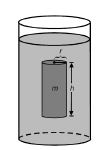
$A$ right circular cylinder has a mass $m$,radius $r$,and a height $h$. The cylinder is completely submerged in a fluid of density $\rho$,as shown in the diagram,and is released. What is the magnitude of the net force on the cylinder initially?
A
$r\rho gh + mg$
B
$|r\rho gh - mg|$
C
$\pi r^2 \rho gh + mg$
D
$|\pi r^2 \rho gh - mg|$
Solution
(D) The forces acting on the cylinder are the gravitational force $(mg)$ acting downwards and the buoyant force $(F_b)$ acting upwards.
According to Archimedes' principle,the buoyant force is equal to the weight of the fluid displaced by the cylinder.
The volume of the cylinder is $V = \pi r^2 h$.
Therefore,the buoyant force is $F_b = \rho Vg = \rho (\pi r^2 h) g = \pi r^2 \rho gh$.
The net force $F_{net}$ on the cylinder is the difference between the buoyant force and the gravitational force.
$F_{net} = F_b - mg = \pi r^2 \rho gh - mg$.
Since we are asked for the magnitude of the net force,we take the absolute value:
$|F_{net}| = |\pi r^2 \rho gh - mg|$.
According to Archimedes' principle,the buoyant force is equal to the weight of the fluid displaced by the cylinder.
The volume of the cylinder is $V = \pi r^2 h$.
Therefore,the buoyant force is $F_b = \rho Vg = \rho (\pi r^2 h) g = \pi r^2 \rho gh$.
The net force $F_{net}$ on the cylinder is the difference between the buoyant force and the gravitational force.
$F_{net} = F_b - mg = \pi r^2 \rho gh - mg$.
Since we are asked for the magnitude of the net force,we take the absolute value:
$|F_{net}| = |\pi r^2 \rho gh - mg|$.
0 likes
View Solution102
MediumMCQ
$A$ $0.5\ kg$ mass of lead is submerged in a container filled to the brim with water and a block of wood floats on top. The lead mass is slowly lifted from the container by a thin wire and as it emerges into air the level of the water in the container drops a bit. The lead mass is now placed on the block of wood. As the lead is placed on the wood,what happens to the water level in the container?
A
Some water spills over the edge of the container.
B
The water level rises exactly to the brim as before.
C
The water level rises but does not reach the brim of the container.
D
There is not enough information provided to decide between the three options.
Solution
(B) Initially,the lead mass is submerged,so it displaces a volume of water equal to its own volume $(V_{lead})$. The wood block floats,displacing water equal to its weight $(W_{wood}/\rho_{water}g)$.
When the lead is removed,the water level drops because the volume $V_{lead}$ is no longer displaced.
When the lead is placed on the wood,the total weight supported by the water increases by the weight of the lead $(W_{lead} = m_{lead}g)$.
According to Archimedes' principle,the wood block must displace an additional volume of water equal to the weight of the lead divided by the density of water: $\Delta V = W_{lead} / (\rho_{water}g) = m_{lead} / \rho_{water}$.
Since the density of lead $(\rho_{lead} \approx 11.3 \times 10^3 \ kg/m^3)$ is much greater than the density of water $(\rho_{water} = 1.0 \times 10^3 \ kg/m^3)$,the volume of water displaced by the weight of the lead $(m_{lead}/\rho_{water})$ is significantly larger than the volume of the lead itself $(m_{lead}/\rho_{lead})$.
Therefore,the water level rises higher than it was when the lead was submerged,but since the container was initially full and water spilled out when the wood was first placed,the level will rise back to the brim.
When the lead is removed,the water level drops because the volume $V_{lead}$ is no longer displaced.
When the lead is placed on the wood,the total weight supported by the water increases by the weight of the lead $(W_{lead} = m_{lead}g)$.
According to Archimedes' principle,the wood block must displace an additional volume of water equal to the weight of the lead divided by the density of water: $\Delta V = W_{lead} / (\rho_{water}g) = m_{lead} / \rho_{water}$.
Since the density of lead $(\rho_{lead} \approx 11.3 \times 10^3 \ kg/m^3)$ is much greater than the density of water $(\rho_{water} = 1.0 \times 10^3 \ kg/m^3)$,the volume of water displaced by the weight of the lead $(m_{lead}/\rho_{water})$ is significantly larger than the volume of the lead itself $(m_{lead}/\rho_{lead})$.
Therefore,the water level rises higher than it was when the lead was submerged,but since the container was initially full and water spilled out when the wood was first placed,the level will rise back to the brim.
0 likes
View Solution103
DifficultMCQ
$A$ sphere of solid material of relative density $9$ has a concentric spherical cavity and floats just submerged in water. If the radius of the sphere is $R$,then the radius of the cavity $(r)$ is related to $R$ as:
A
$r^3 = \frac{8}{9} R^3$
B
$r^3 = \frac{2}{3} R^3$
C
$r^3 = \frac{\sqrt{8}}{3} R^3$
D
$r^3 = \sqrt{\frac{2}{3}} R^3$
Solution
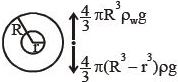
(A) For the sphere to float just submerged in water,the weight of the sphere must be equal to the buoyant force exerted by the water.
Weight of the sphere = Volume of solid material $\times$ density of material $\times g = \frac{4}{3} \pi (R^3 - r^3) \rho g$
Buoyant force = Volume of displaced water $\times$ density of water $\times g = \frac{4}{3} \pi R^3 \rho_w g$
Equating the two: $\frac{4}{3} \pi (R^3 - r^3) \rho g = \frac{4}{3} \pi R^3 \rho_w g$
Given relative density $\frac{\rho}{\rho_w} = 9$,we have:
$9(R^3 - r^3) = R^3$
$9R^3 - 9r^3 = R^3$
$8R^3 = 9r^3$
$r^3 = \frac{8}{9} R^3$
Weight of the sphere = Volume of solid material $\times$ density of material $\times g = \frac{4}{3} \pi (R^3 - r^3) \rho g$
Buoyant force = Volume of displaced water $\times$ density of water $\times g = \frac{4}{3} \pi R^3 \rho_w g$
Equating the two: $\frac{4}{3} \pi (R^3 - r^3) \rho g = \frac{4}{3} \pi R^3 \rho_w g$
Given relative density $\frac{\rho}{\rho_w} = 9$,we have:
$9(R^3 - r^3) = R^3$
$9R^3 - 9r^3 = R^3$
$8R^3 = 9r^3$
$r^3 = \frac{8}{9} R^3$
0 likes
View Solution104
MediumMCQ
An empty balloon weighs $1\, g$. The balloon is filled with water to the neck and tied with a massless thread. The weight of the balloon along with water is $101\, g$. The balloon filled with water is weighed when fully immersed in water. Its weight in water is ...... $g$.
A
$1$
B
$101$
C
$201$
D
$51$
Solution
(A) Mass of empty balloon $= 1\, g$.
Mass of balloon filled with water $= 101\, g$.
Mass of water inside the balloon $= 101\, g - 1\, g = 100\, g$.
Since the density of water is $\rho_w$,the volume of the balloon $V = \frac{100\, g}{\rho_w} = 100\, cm^3$.
When the balloon is fully immersed in water,it experiences an upward buoyant force equal to the weight of the displaced water.
Buoyant force $F_B = V \cdot \rho_w \cdot g = 100\, cm^3 \cdot 1\, g/cm^3 \cdot g = 100\, g$ (in terms of weight).
The effective weight of the balloon in water is given by: $W_{\text{eff}} = W_{\text{total}} - F_B$.
$W_{\text{eff}} = 101\, g - 100\, g = 1\, g$.
Therefore,the weight of the balloon in water is $1\, g$.
Mass of balloon filled with water $= 101\, g$.
Mass of water inside the balloon $= 101\, g - 1\, g = 100\, g$.
Since the density of water is $\rho_w$,the volume of the balloon $V = \frac{100\, g}{\rho_w} = 100\, cm^3$.
When the balloon is fully immersed in water,it experiences an upward buoyant force equal to the weight of the displaced water.
Buoyant force $F_B = V \cdot \rho_w \cdot g = 100\, cm^3 \cdot 1\, g/cm^3 \cdot g = 100\, g$ (in terms of weight).
The effective weight of the balloon in water is given by: $W_{\text{eff}} = W_{\text{total}} - F_B$.
$W_{\text{eff}} = 101\, g - 100\, g = 1\, g$.
Therefore,the weight of the balloon in water is $1\, g$.
0 likes
View Solution105
DifficultMCQ
$A$ ball whose density is $0.4 \times 10^3 \, kg/m^3$ falls into water from a height of $9 \, cm$. To what depth does the ball sink? ....... $cm$
A
$9$
B
$6$
C
$4.5$
D
$2.25$
Solution
(B) Let the volume of the ball be $V$,the density of the ball be $\rho_b = 0.4 \times 10^3 \, kg/m^3$,and the density of water be $\rho_w = 1.0 \times 10^3 \, kg/m^3$.
The potential energy of the ball at the surface of the water is $U = mgh = V \rho_b gh$.
When the ball enters the water,it experiences an upward buoyant force (upthrust) $F_B = V \rho_w g$ and a downward gravitational force $W = V \rho_b g$.
The net force acting on the ball while submerged is $F_{net} = F_B - W = Vg(\rho_w - \rho_b)$,which is directed upwards.
By the work-energy theorem,the work done by the net force as the ball sinks to a depth $d$ must equal the initial potential energy of the ball:
$W_{net} = F_{net} \times d = Vg(\rho_w - \rho_b)d$.
Equating the work done to the initial potential energy:
$Vg(\rho_w - \rho_b)d = V \rho_b gh$.
Solving for $d$:
$d = \frac{\rho_b}{\rho_w - \rho_b} h$.
Substituting the given values:
$d = \frac{0.4 \times 10^3}{1.0 \times 10^3 - 0.4 \times 10^3} \times 9 \, cm = \frac{0.4}{0.6} \times 9 \, cm = \frac{2}{3} \times 9 \, cm = 6 \, cm$.
The potential energy of the ball at the surface of the water is $U = mgh = V \rho_b gh$.
When the ball enters the water,it experiences an upward buoyant force (upthrust) $F_B = V \rho_w g$ and a downward gravitational force $W = V \rho_b g$.
The net force acting on the ball while submerged is $F_{net} = F_B - W = Vg(\rho_w - \rho_b)$,which is directed upwards.
By the work-energy theorem,the work done by the net force as the ball sinks to a depth $d$ must equal the initial potential energy of the ball:
$W_{net} = F_{net} \times d = Vg(\rho_w - \rho_b)d$.
Equating the work done to the initial potential energy:
$Vg(\rho_w - \rho_b)d = V \rho_b gh$.
Solving for $d$:
$d = \frac{\rho_b}{\rho_w - \rho_b} h$.
Substituting the given values:
$d = \frac{0.4 \times 10^3}{1.0 \times 10^3 - 0.4 \times 10^3} \times 9 \, cm = \frac{0.4}{0.6} \times 9 \, cm = \frac{2}{3} \times 9 \, cm = 6 \, cm$.
0 likes
View Solution106
DifficultMCQ
$A$ homogeneous solid cylinder of length $L$ $(L < H/2)$, cross-sectional area $A$ is immersed such that it floats with its axis vertical at the liquid-liquid interface with length $L/4$ in the denser liquid (density $2d$) and $3L/4$ in the lighter liquid (density $d$). The lower density liquid is open to the atmosphere having pressure $P_0$. Then, the density $D$ of the solid is given by:
A
$\frac{5}{4}d$
B
$\frac{4}{5}d$
C
$4d$
D
$\frac{d}{5}$
Solution
(A) For a floating body, the weight of the body is equal to the total buoyant force exerted by the liquids.
Weight of the cylinder $W = (\text{Volume}) \times (\text{Density of solid}) \times g = (A \times L) \times D \times g$.
Buoyant force $F_B = (\text{Volume submerged in liquid 1}) \times (\text{Density of liquid 1}) \times g + (\text{Volume submerged in liquid 2}) \times (\text{Density of liquid 2}) \times g$.
Given: Volume in lighter liquid (density $d$) is $V_1 = A \times (3L/4)$ and volume in denser liquid (density $2d$) is $V_2 = A \times (L/4)$.
Equating weight and buoyant force: $(A \times L) \times D \times g = (A \times 3L/4) \times d \times g + (A \times L/4) \times 2d \times g$.
Dividing both sides by $A \times L \times g$: $D = (3/4)d + (1/4) \times 2d$.
$D = (3/4)d + (2/4)d = 5d/4$.
Weight of the cylinder $W = (\text{Volume}) \times (\text{Density of solid}) \times g = (A \times L) \times D \times g$.
Buoyant force $F_B = (\text{Volume submerged in liquid 1}) \times (\text{Density of liquid 1}) \times g + (\text{Volume submerged in liquid 2}) \times (\text{Density of liquid 2}) \times g$.
Given: Volume in lighter liquid (density $d$) is $V_1 = A \times (3L/4)$ and volume in denser liquid (density $2d$) is $V_2 = A \times (L/4)$.
Equating weight and buoyant force: $(A \times L) \times D \times g = (A \times 3L/4) \times d \times g + (A \times L/4) \times 2d \times g$.
Dividing both sides by $A \times L \times g$: $D = (3/4)d + (1/4) \times 2d$.
$D = (3/4)d + (2/4)d = 5d/4$.
0 likes
View Solution107
DifficultMCQ
$A$ stream-lined body falls through air from a height $h$ on the surface of a liquid. Let $d$ and $D$ denote the densities of the materials of the body and the liquid respectively. If $D$ > $d$, then the time after which the body will be instantaneously at rest is
A
$\sqrt{\frac{2h}{g}}$
B
$\sqrt{\frac{2h}{g} \frac{D}{d}}$
C
$\sqrt{\frac{2h}{g} \frac{d}{D}}$
D
$\sqrt{\frac{2h}{g}} \left( \frac{d}{D-d} \right)$
Solution
(D) The velocity $u$ of the body when it enters the liquid is given by conservation of energy:
$mgh = \frac{1}{2} mu^2 \implies u = \sqrt{2gh}$
Let $V$ be the volume of the body.
Mass of the body $m = Vd$.
Weight of the body $W = Vdg$.
Buoyant force $F_B = VDg$.
Net upward force $F_{net} = F_B - W = Vg(D-d)$.
Retardation $a = \frac{F_{net}}{m} = \frac{Vg(D-d)}{Vd} = \left( \frac{D-d}{d} \right) g$.
Since the body is moving downwards, the acceleration is $a' = -\left( \frac{D-d}{d} \right) g$.
Using the equation of motion $v = u + a't$, where $v = 0$ at the point of instantaneous rest:
$0 = \sqrt{2gh} - \left( \frac{D-d}{d} \right) gt$
$t = \left( \frac{d}{D-d} \right) \sqrt{\frac{2h}{g}}$
$mgh = \frac{1}{2} mu^2 \implies u = \sqrt{2gh}$
Let $V$ be the volume of the body.
Mass of the body $m = Vd$.
Weight of the body $W = Vdg$.
Buoyant force $F_B = VDg$.
Net upward force $F_{net} = F_B - W = Vg(D-d)$.
Retardation $a = \frac{F_{net}}{m} = \frac{Vg(D-d)}{Vd} = \left( \frac{D-d}{d} \right) g$.
Since the body is moving downwards, the acceleration is $a' = -\left( \frac{D-d}{d} \right) g$.
Using the equation of motion $v = u + a't$, where $v = 0$ at the point of instantaneous rest:
$0 = \sqrt{2gh} - \left( \frac{D-d}{d} \right) gt$
$t = \left( \frac{d}{D-d} \right) \sqrt{\frac{2h}{g}}$
0 likes
View Solution108
MediumMCQ
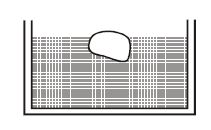
$A$ body floats in a liquid contained in a beaker. The whole system falls freely under gravity. The upthrust on the body due to the liquid is
A
equal to weight of the body in air
B
equal to weight of liquid displaced
C
equal to weight of immersed portion of body
D
zero
Solution
(D) The upthrust (buoyant force) on a body submerged in a liquid is given by the formula $F_B = V_{disp} \cdot \rho_{liquid} \cdot g_{eff}$,where $g_{eff}$ is the effective acceleration due to gravity.
When the entire system (beaker and liquid) is falling freely under gravity,the effective acceleration $g_{eff}$ becomes $g - g = 0$.
Since the upthrust depends on the effective gravity,and $g_{eff} = 0$,the upthrust on the body becomes zero.
When the entire system (beaker and liquid) is falling freely under gravity,the effective acceleration $g_{eff}$ becomes $g - g = 0$.
Since the upthrust depends on the effective gravity,and $g_{eff} = 0$,the upthrust on the body becomes zero.
0 likes
View Solution109
DifficultMCQ
$A$ piece of copper having an internal cavity weighs $264\, g$ in air and $221\, g$ in water. Find the volume (in $cc$) of the cavity. Density of $Cu = 8.8\, g/cc$.
A
$30$
B
$20$
C
$43$
D
$13$
Solution
(D) The apparent loss in weight of the body when immersed in water is equal to the buoyant force (thrust) exerted by the water.
Loss in weight $= 264\, g - 221\, g = 43\, g$.
Since the density of water is $\rho_w = 1\, g/cc$,the volume of the water displaced is equal to the total volume of the copper piece $(V_{total})$.
$V_{total} = \frac{\text{Loss in weight}}{\rho_w} = \frac{43\, g}{1\, g/cc} = 43\, cc$.
The volume of the copper material $(V_{material})$ is calculated using its mass and density:
$V_{material} = \frac{\text{Mass}}{\text{Density of } Cu} = \frac{264\, g}{8.8\, g/cc} = 30\, cc$.
The volume of the internal cavity $(V_{cavity})$ is the difference between the total volume and the volume of the material:
$V_{cavity} = V_{total} - V_{material} = 43\, cc - 30\, cc = 13\, cc$.
Loss in weight $= 264\, g - 221\, g = 43\, g$.
Since the density of water is $\rho_w = 1\, g/cc$,the volume of the water displaced is equal to the total volume of the copper piece $(V_{total})$.
$V_{total} = \frac{\text{Loss in weight}}{\rho_w} = \frac{43\, g}{1\, g/cc} = 43\, cc$.
The volume of the copper material $(V_{material})$ is calculated using its mass and density:
$V_{material} = \frac{\text{Mass}}{\text{Density of } Cu} = \frac{264\, g}{8.8\, g/cc} = 30\, cc$.
The volume of the internal cavity $(V_{cavity})$ is the difference between the total volume and the volume of the material:
$V_{cavity} = V_{total} - V_{material} = 43\, cc - 30\, cc = 13\, cc$.
0 likes
View Solution110
MediumMCQ
$A$ cube of wood supporting a $200 \, g$ mass just floats in water. When the mass is removed,the cube rises by $2 \, cm$. The side of the cube is ............ $cm$.
A
$5$
B
$10$
C
$15$
D
$20$
Solution
(B) Let $a$ be the side of the cube and $\rho_w$ be the density of water $(1 \, g/cm^3)$.
When the mass $m = 200 \, g$ is placed on the cube,it floats. The weight of the mass is supported by the buoyant force equal to the weight of the water displaced by the volume of the cube submerged.
When the mass is removed,the cube rises by $h = 2 \, cm$. This means the volume of water displaced decreases by an amount equal to the volume of the cube's cross-section multiplied by the rise in height.
The weight of the removed mass is equal to the weight of the water displaced by the volume that was previously submerged due to that mass.
Weight of mass = Weight of water displaced by the volume $(a \times a \times h)$.
$m \cdot g = (a^2 \cdot h) \cdot \rho_w \cdot g$.
Substituting the values: $200 = a^2 \times 2 \times 1$.
$a^2 = 100$.
$a = 10 \, cm$.
When the mass $m = 200 \, g$ is placed on the cube,it floats. The weight of the mass is supported by the buoyant force equal to the weight of the water displaced by the volume of the cube submerged.
When the mass is removed,the cube rises by $h = 2 \, cm$. This means the volume of water displaced decreases by an amount equal to the volume of the cube's cross-section multiplied by the rise in height.
The weight of the removed mass is equal to the weight of the water displaced by the volume that was previously submerged due to that mass.
Weight of mass = Weight of water displaced by the volume $(a \times a \times h)$.
$m \cdot g = (a^2 \cdot h) \cdot \rho_w \cdot g$.
Substituting the values: $200 = a^2 \times 2 \times 1$.
$a^2 = 100$.
$a = 10 \, cm$.
0 likes
View Solution111
EasyMCQ
$A$ man is sitting in a boat which is floating in a pond. If the man drinks some water from the pond,the level of water in the pond will
A
rise a little
B
go down
C
remain same
D
none of these
Solution
(C) Let the mass of water consumed by the man be $m$.
Initially,the man and the boat displace a volume of water $V_1$ such that the weight of the displaced water equals the total weight of the man and the boat (Archimedes' Principle).
When the man drinks mass $m$ of water,the total weight of the man and the boat increases by $mg$.
To support this additional weight,the boat must displace an additional volume of water $V_{add} = \frac{m}{\rho}$,where $\rho$ is the density of water.
However,by drinking mass $m$ of water from the pond,the total volume of water in the pond decreases by $V_{removed} = \frac{m}{\rho}$.
Since the additional volume displaced by the boat $(V_{add})$ is exactly equal to the volume of water removed from the pond $(V_{removed})$,the net change in the water level of the pond is zero.
Therefore,the level of water in the pond remains the same.
Initially,the man and the boat displace a volume of water $V_1$ such that the weight of the displaced water equals the total weight of the man and the boat (Archimedes' Principle).
When the man drinks mass $m$ of water,the total weight of the man and the boat increases by $mg$.
To support this additional weight,the boat must displace an additional volume of water $V_{add} = \frac{m}{\rho}$,where $\rho$ is the density of water.
However,by drinking mass $m$ of water from the pond,the total volume of water in the pond decreases by $V_{removed} = \frac{m}{\rho}$.
Since the additional volume displaced by the boat $(V_{add})$ is exactly equal to the volume of water removed from the pond $(V_{removed})$,the net change in the water level of the pond is zero.
Therefore,the level of water in the pond remains the same.
0 likes
View Solution112
EasyMCQ
$A$ cube of ice has an iron piece frozen inside it. The cube floats in a beaker filled with water. When the ice melts, the level of water in the beaker:
A
remains same
B
level decreases
C
level increases
D
first increases then decreases
Solution
(B) Let $m_i$ be the mass of ice and $m_f$ be the mass of the iron piece.
Before the ice melts, the total weight of the system is $(m_i + m_f)g$. Since the system is floating, the buoyant force equals the weight of the system: $F_b = (m_i + m_f)g$.
The volume of water displaced by the floating system is $V_{disp} = \frac{F_b}{\rho_w g} = \frac{m_i + m_f}{\rho_w} = \frac{m_i}{\rho_w} + \frac{m_f}{\rho_w}$.
After the ice melts, the ice becomes water with volume $V_{water\_from\_ice} = \frac{m_i}{\rho_w}$. The iron piece sinks to the bottom, displacing its own volume $V_{iron} = \frac{m_f}{\rho_f}$.
The total volume occupied by the water and the iron piece is $V_{total} = \frac{m_i}{\rho_w} + \frac{m_f}{\rho_f}$.
Comparing the displaced volumes: $V_{disp} - V_{total} = (\frac{m_i}{\rho_w} + \frac{m_f}{\rho_w}) - (\frac{m_i}{\rho_w} + \frac{m_f}{\rho_f}) = m_f(\frac{1}{\rho_w} - \frac{1}{\rho_f})$.
Since the density of iron $\rho_f$ is greater than the density of water $\rho_w$, we have $\frac{1}{\rho_w} > \frac{1}{\rho_f}$.
Therefore, $V_{disp} > V_{total}$, which means the water level decreases.
Before the ice melts, the total weight of the system is $(m_i + m_f)g$. Since the system is floating, the buoyant force equals the weight of the system: $F_b = (m_i + m_f)g$.
The volume of water displaced by the floating system is $V_{disp} = \frac{F_b}{\rho_w g} = \frac{m_i + m_f}{\rho_w} = \frac{m_i}{\rho_w} + \frac{m_f}{\rho_w}$.
After the ice melts, the ice becomes water with volume $V_{water\_from\_ice} = \frac{m_i}{\rho_w}$. The iron piece sinks to the bottom, displacing its own volume $V_{iron} = \frac{m_f}{\rho_f}$.
The total volume occupied by the water and the iron piece is $V_{total} = \frac{m_i}{\rho_w} + \frac{m_f}{\rho_f}$.
Comparing the displaced volumes: $V_{disp} - V_{total} = (\frac{m_i}{\rho_w} + \frac{m_f}{\rho_w}) - (\frac{m_i}{\rho_w} + \frac{m_f}{\rho_f}) = m_f(\frac{1}{\rho_w} - \frac{1}{\rho_f})$.
Since the density of iron $\rho_f$ is greater than the density of water $\rho_w$, we have $\frac{1}{\rho_w} > \frac{1}{\rho_f}$.
Therefore, $V_{disp} > V_{total}$, which means the water level decreases.
0 likes
View Solution113
EasyMCQ
$A$ block of volume $V$ and density $\sigma_b$ is placed in a liquid of density $\sigma_l$ (where $\sigma_l > \sigma_b$). If the block is moved upward by a height $h$ while remaining completely submerged in the liquid,what is the increase in the gravitational potential energy of the system?
A
$\sigma_b Vgh$
B
$(\sigma_b + \sigma_l) Vgh$
C
$(\sigma_b - \sigma_l) Vgh$
D
None of these
Solution
(C) When the block is moved upward by a height $h$ within the liquid,the system consists of the block and the displaced liquid.
The change in potential energy of the block is $\Delta U_b = m_b gh = (\sigma_b V) gh$.
As the block moves up,an equal volume $V$ of liquid moves down by height $h$ to fill the space previously occupied by the block. The change in potential energy of the displaced liquid is $\Delta U_l = -m_l gh = -(\sigma_l V) gh$.
The total change in gravitational potential energy of the system is $\Delta U = \Delta U_b + \Delta U_l$.
$\Delta U = (\sigma_b V) gh - (\sigma_l V) gh = (\sigma_b - \sigma_l) Vgh$.
The change in potential energy of the block is $\Delta U_b = m_b gh = (\sigma_b V) gh$.
As the block moves up,an equal volume $V$ of liquid moves down by height $h$ to fill the space previously occupied by the block. The change in potential energy of the displaced liquid is $\Delta U_l = -m_l gh = -(\sigma_l V) gh$.
The total change in gravitational potential energy of the system is $\Delta U = \Delta U_b + \Delta U_l$.
$\Delta U = (\sigma_b V) gh - (\sigma_l V) gh = (\sigma_b - \sigma_l) Vgh$.
0 likes
View Solution114
MediumMCQ
$A$ cubical block of steel of each side equal to $l$ is floating on mercury in a vessel. The densities of steel and mercury are $\rho_s$ and $\rho_m$. The height of the block above the mercury level is given by:
A
$l(1 + \frac{\rho_s}{\rho_m})$
B
$l(1 - \frac{\rho_s}{\rho_m})$
C
$l(1 + \frac{\rho_m}{\rho_s})$
D
$l(1 - \frac{\rho_m}{\rho_s})$
Solution
(B) The volume of the cubical block is $V = l^3$.
Let $h$ be the height of the block above the surface of the mercury.
The depth of the block submerged in mercury is $(l - h)$.
The volume of mercury displaced is $V_{disp} = (l - h)l^2$.
According to the law of floatation,the weight of the displaced mercury must equal the weight of the steel block.
Weight of displaced mercury = $(l - h)l^2 \rho_m g$.
Weight of the steel block = $l^3 \rho_s g$.
Equating the two: $(l - h)l^2 \rho_m g = l^3 \rho_s g$.
Dividing both sides by $l^2 g$: $(l - h) \rho_m = l \rho_s$.
$l - h = l \frac{\rho_s}{\rho_m}$.
$h = l - l \frac{\rho_s}{\rho_m} = l(1 - \frac{\rho_s}{\rho_m})$.
Let $h$ be the height of the block above the surface of the mercury.
The depth of the block submerged in mercury is $(l - h)$.
The volume of mercury displaced is $V_{disp} = (l - h)l^2$.
According to the law of floatation,the weight of the displaced mercury must equal the weight of the steel block.
Weight of displaced mercury = $(l - h)l^2 \rho_m g$.
Weight of the steel block = $l^3 \rho_s g$.
Equating the two: $(l - h)l^2 \rho_m g = l^3 \rho_s g$.
Dividing both sides by $l^2 g$: $(l - h) \rho_m = l \rho_s$.
$l - h = l \frac{\rho_s}{\rho_m}$.
$h = l - l \frac{\rho_s}{\rho_m} = l(1 - \frac{\rho_s}{\rho_m})$.
0 likes
View Solution115
EasyMCQ
$A$ balloon of mass $m$ contains water of mass $M$. If it is completely immersed in water, find the apparent mass of the balloon with water in it.
A
$M + m$
B
$M - m$
C
$M$
D
$m$
Solution
(D) The total mass of the balloon system is $M_{total} = M + m$.
When the balloon is completely immersed in water, it displaces a volume of water equal to its own volume.
Since the balloon contains water of mass $M$ and the balloon material itself has mass $m$, the total volume $V$ of the system is the volume of the water $M$ plus the volume of the balloon material $m$.
However, the density of the water inside is the same as the density of the surrounding water.
According to Archimedes' Principle, the buoyant force $F_B$ acting on the balloon is equal to the weight of the displaced water: $F_B = (M + \rho_{material} \cdot V_{material})g$, where $\rho_{material} \cdot V_{material} = m$.
Thus, $F_B = (M + m)g$.
The apparent weight $W_{app}$ is given by $W_{app} = W_{actual} - F_B = (M + m)g - (M + m)g = 0$.
Wait, if the balloon material has negligible volume, the buoyant force is equal to the weight of the water displaced, which is $M \cdot g$. The total weight is $(M + m)g$. The apparent weight is $(M + m)g - Mg = mg$.
Therefore, the apparent mass is $m$.
When the balloon is completely immersed in water, it displaces a volume of water equal to its own volume.
Since the balloon contains water of mass $M$ and the balloon material itself has mass $m$, the total volume $V$ of the system is the volume of the water $M$ plus the volume of the balloon material $m$.
However, the density of the water inside is the same as the density of the surrounding water.
According to Archimedes' Principle, the buoyant force $F_B$ acting on the balloon is equal to the weight of the displaced water: $F_B = (M + \rho_{material} \cdot V_{material})g$, where $\rho_{material} \cdot V_{material} = m$.
Thus, $F_B = (M + m)g$.
The apparent weight $W_{app}$ is given by $W_{app} = W_{actual} - F_B = (M + m)g - (M + m)g = 0$.
Wait, if the balloon material has negligible volume, the buoyant force is equal to the weight of the water displaced, which is $M \cdot g$. The total weight is $(M + m)g$. The apparent weight is $(M + m)g - Mg = mg$.
Therefore, the apparent mass is $m$.
0 likes
View Solution116
MediumMCQ
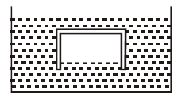
An empty glass jar is submerged in a tank of water with the open mouth of the jar downwards, so that the air inside the jar is trapped and cannot escape. As the jar is pushed down slowly, the magnitude of the net buoyant force on the system of the volume of gas trapped in the jar and the jar:
A
increases
B
decreases
C
remains same
D
information is insufficient to draw an inference
Solution
(B) The buoyant force $F_B$ acting on an object submerged in a fluid is given by Archimedes' principle: $F_B = \rho_{water} V_{displaced} g$, where $\rho_{water}$ is the density of water, $V_{displaced}$ is the volume of the fluid displaced by the object, and $g$ is the acceleration due to gravity.
As the jar is pushed deeper into the water, the hydrostatic pressure at the depth of the jar increases.
According to Boyle's Law $(PV = \text{constant})$, as the pressure $P$ on the trapped air increases, the volume $V$ of the trapped air decreases.
Since the jar is submerged, the total volume of the system displaced $(V_{displaced})$ is the sum of the volume of the glass jar itself and the volume of the trapped air.
As the volume of the trapped air decreases, the total volume of the system displaced $(V_{displaced})$ decreases.
Consequently, the buoyant force $F_B = \rho_{water} V_{displaced} g$ decreases.
As the jar is pushed deeper into the water, the hydrostatic pressure at the depth of the jar increases.
According to Boyle's Law $(PV = \text{constant})$, as the pressure $P$ on the trapped air increases, the volume $V$ of the trapped air decreases.
Since the jar is submerged, the total volume of the system displaced $(V_{displaced})$ is the sum of the volume of the glass jar itself and the volume of the trapped air.
As the volume of the trapped air decreases, the total volume of the system displaced $(V_{displaced})$ decreases.
Consequently, the buoyant force $F_B = \rho_{water} V_{displaced} g$ decreases.
0 likes
View Solution117
DifficultMCQ
$A$ wooden block floating in a bucket of water has $\frac{4}{5}$ of its volume submerged. When a certain amount of oil is poured into the bucket,it is found that the block is just under the oil surface with half of its volume under water and half in oil. The density of oil relative to that of water is
A
$0.5$
B
$0.7$
C
$0.6$
D
$0.8$
Solution
(C) In the first situation,the block is floating in water. By the law of floatation,the weight of the block equals the weight of the displaced water:
$V_b \rho_b g = V_s \rho_w g$
$\frac{V_s}{V_b} = \frac{\rho_b}{\rho_w} = \frac{4}{5} \quad ... (i)$
Here,$V_b$ is the volume of the block,$V_s$ is the submerged volume,$\rho_b$ is the density of the block,and $\rho_w$ is the density of water.
In the second situation,the block is floating in a mixture of oil and water. The total weight of the block is balanced by the buoyant force from both the oil and the water:
$V_b \rho_b g = \left(\frac{V_b}{2}\right) \rho_o g + \left(\frac{V_b}{2}\right) \rho_w g$
Dividing by $V_b g$,we get:
$\rho_b = \frac{\rho_o}{2} + \frac{\rho_w}{2}$
$2 \rho_b = \rho_o + \rho_w$
Substitute $\rho_b = \frac{4}{5} \rho_w$ from equation $(i)$:
$2 \left(\frac{4}{5} \rho_w\right) = \rho_o + \rho_w$
$\frac{8}{5} \rho_w - \rho_w = \rho_o$
$\rho_o = \frac{3}{5} \rho_w = 0.6 \rho_w$
Therefore,the relative density of oil with respect to water is $\frac{\rho_o}{\rho_w} = 0.6$.
$V_b \rho_b g = V_s \rho_w g$
$\frac{V_s}{V_b} = \frac{\rho_b}{\rho_w} = \frac{4}{5} \quad ... (i)$
Here,$V_b$ is the volume of the block,$V_s$ is the submerged volume,$\rho_b$ is the density of the block,and $\rho_w$ is the density of water.
In the second situation,the block is floating in a mixture of oil and water. The total weight of the block is balanced by the buoyant force from both the oil and the water:
$V_b \rho_b g = \left(\frac{V_b}{2}\right) \rho_o g + \left(\frac{V_b}{2}\right) \rho_w g$
Dividing by $V_b g$,we get:
$\rho_b = \frac{\rho_o}{2} + \frac{\rho_w}{2}$
$2 \rho_b = \rho_o + \rho_w$
Substitute $\rho_b = \frac{4}{5} \rho_w$ from equation $(i)$:
$2 \left(\frac{4}{5} \rho_w\right) = \rho_o + \rho_w$
$\frac{8}{5} \rho_w - \rho_w = \rho_o$
$\rho_o = \frac{3}{5} \rho_w = 0.6 \rho_w$
Therefore,the relative density of oil with respect to water is $\frac{\rho_o}{\rho_w} = 0.6$.
0 likes
View Solution118
DifficultMCQ
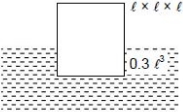
$A$ cubical block of side $0.5\,m$ floats on water with $30\%$ of its volume under water. What is the maximum weight (in $kg$) that can be put on the block without fully submerging it under water? [Take density of water $= 10^3\,kg/m^3$]
A
$46.3$
B
$65.4$
C
$30.1$
D
$87.5$
Solution
(D) Let the side of the cube be $\ell = 0.5\,m$. The volume of the cube is $V = \ell^3 = (0.5)^3 = 0.125\,m^3$.
Initially,$30\%$ of the volume is submerged,so the buoyant force balances the weight of the block:
$V_{sub} \cdot \rho_w \cdot g = V \cdot \rho_{block} \cdot g$
$0.3 \cdot V \cdot \rho_w = V \cdot \rho_{block}$
$\rho_{block} = 0.3 \cdot \rho_w = 0.3 \cdot 1000 = 300\,kg/m^3$.
The mass of the block is $m_{block} = V \cdot \rho_{block} = 0.125 \cdot 300 = 37.5\,kg$.
When an additional mass $M$ is placed on the block,the block is fully submerged,meaning the total weight equals the buoyant force for the full volume $V$:
$(m_{block} + M)g = V \cdot \rho_w \cdot g$
$M = V \cdot \rho_w - m_{block} = (0.125 \cdot 1000) - 37.5 = 125 - 37.5 = 87.5\,kg$.
Initially,$30\%$ of the volume is submerged,so the buoyant force balances the weight of the block:
$V_{sub} \cdot \rho_w \cdot g = V \cdot \rho_{block} \cdot g$
$0.3 \cdot V \cdot \rho_w = V \cdot \rho_{block}$
$\rho_{block} = 0.3 \cdot \rho_w = 0.3 \cdot 1000 = 300\,kg/m^3$.
The mass of the block is $m_{block} = V \cdot \rho_{block} = 0.125 \cdot 300 = 37.5\,kg$.
When an additional mass $M$ is placed on the block,the block is fully submerged,meaning the total weight equals the buoyant force for the full volume $V$:
$(m_{block} + M)g = V \cdot \rho_w \cdot g$
$M = V \cdot \rho_w - m_{block} = (0.125 \cdot 1000) - 37.5 = 125 - 37.5 = 87.5\,kg$.
0 likes
View Solution119
DifficultMCQ
$A$ solid sphere of specific gravity $27$ has a concentric spherical cavity and it just sinks in water. The ratio of the cavity radius to the outer radius of the sphere is
A
$\frac{(28)^{1/3}}{3}$
B
$\frac{(30)^{1/3}}{3}$
C
$\frac{(26)^{1/3}}{3}$
D
$\frac{(24)^{1/3}}{3}$
Solution
(C) Let $R$ be the outer radius and $r$ be the radius of the cavity.
The density of the sphere material is $\rho = 27 \times \rho_{water} = 27 \rho_{w}$.
For the sphere to just sink in water,its weight must be equal to the buoyant force acting on it.
Weight of the sphere = $V_{solid} \times \rho \times g = \frac{4}{3} \pi (R^3 - r^3) \times 27 \rho_{w} \times g$.
Buoyant force = $V_{total} \times \rho_{w} \times g = \frac{4}{3} \pi R^3 \times \rho_{w} \times g$.
Equating the two: $\frac{4}{3} \pi (R^3 - r^3) \times 27 \rho_{w} g = \frac{4}{3} \pi R^3 \rho_{w} g$.
$27(R^3 - r^3) = R^3$.
$27R^3 - 27r^3 = R^3$.
$26R^3 = 27r^3$.
$\frac{r^3}{R^3} = \frac{26}{27}$.
Taking the cube root on both sides,$\frac{r}{R} = \frac{(26)^{1/3}}{3}$.
The density of the sphere material is $\rho = 27 \times \rho_{water} = 27 \rho_{w}$.
For the sphere to just sink in water,its weight must be equal to the buoyant force acting on it.
Weight of the sphere = $V_{solid} \times \rho \times g = \frac{4}{3} \pi (R^3 - r^3) \times 27 \rho_{w} \times g$.
Buoyant force = $V_{total} \times \rho_{w} \times g = \frac{4}{3} \pi R^3 \times \rho_{w} \times g$.
Equating the two: $\frac{4}{3} \pi (R^3 - r^3) \times 27 \rho_{w} g = \frac{4}{3} \pi R^3 \rho_{w} g$.
$27(R^3 - r^3) = R^3$.
$27R^3 - 27r^3 = R^3$.
$26R^3 = 27r^3$.
$\frac{r^3}{R^3} = \frac{26}{27}$.
Taking the cube root on both sides,$\frac{r}{R} = \frac{(26)^{1/3}}{3}$.
0 likes
View Solution120
MediumMCQ
$A$ wooden cube first floats inside water when a $200\,g$ mass is placed on it. When the mass is removed,the cube rises $2\,cm$ above the water level. The side of the cube is ........ $cm$.
A
$5$
B
$10$
C
$15$
D
$20$
Solution
(B) Let the mass of the cube be $m$ and the side length be $a$. The density of water is $\rho_w = 1\,g/cm^3$.
When the $200\,g$ mass is placed on the cube,it floats such that the entire volume is submerged (or at the surface level). The total weight equals the buoyant force:
$(m + 200)g = a^3 \rho_w g$ --- $(i)$
When the mass is removed,the cube floats with $2\,cm$ above the water level. The submerged volume is $a^2(a - 2)$:
$mg = a^2(a - 2) \rho_w g$ --- $(ii)$
Subtracting equation $(ii)$ from equation $(i)$:
$(m + 200)g - mg = a^3 \rho_w g - a^2(a - 2) \rho_w g$
$200 = a^3 \rho_w - (a^3 - 2a^2) \rho_w$
$200 = a^3 \rho_w - a^3 \rho_w + 2a^2 \rho_w$
$200 = 2a^2 \rho_w$
Since $\rho_w = 1\,g/cm^3$:
$200 = 2a^2$
$a^2 = 100$
$a = 10\,cm$.
When the $200\,g$ mass is placed on the cube,it floats such that the entire volume is submerged (or at the surface level). The total weight equals the buoyant force:
$(m + 200)g = a^3 \rho_w g$ --- $(i)$
When the mass is removed,the cube floats with $2\,cm$ above the water level. The submerged volume is $a^2(a - 2)$:
$mg = a^2(a - 2) \rho_w g$ --- $(ii)$
Subtracting equation $(ii)$ from equation $(i)$:
$(m + 200)g - mg = a^3 \rho_w g - a^2(a - 2) \rho_w g$
$200 = a^3 \rho_w - (a^3 - 2a^2) \rho_w$
$200 = a^3 \rho_w - a^3 \rho_w + 2a^2 \rho_w$
$200 = 2a^2 \rho_w$
Since $\rho_w = 1\,g/cm^3$:
$200 = 2a^2$
$a^2 = 100$
$a = 10\,cm$.
0 likes
View Solution121
DifficultMCQ
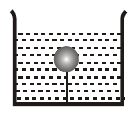
$A$ solid sphere of density $\rho_s$ which is $\eta$ times lighter than water (density $\rho_w$) is suspended in a water tank by a string tied to its base as shown in the figure. If the mass of the sphere is $m$,then the tension in the string is given by:
A
$\left( \frac{\eta - 1}{\eta} \right) mg$
B
$\eta mg$
C
$\frac{mg}{(\eta - 1)}$
D
$(\eta - 1) mg$
Solution
(D) Let $V$ be the volume of the sphere,$\rho_s$ be the density of the sphere,and $\rho_w$ be the density of water.
Given that the sphere is $\eta$ times lighter than water,we have $\rho_w = \eta \rho_s$.
The mass of the sphere is $m = V \rho_s$,so $V = \frac{m}{\rho_s}$.
The forces acting on the sphere are:
$1$. Weight $(W = mg)$ acting downwards.
$2$. Tension $(T)$ in the string acting downwards.
$3$. Buoyant force $(F_B = V \rho_w g)$ acting upwards.
For equilibrium,the upward force must equal the downward forces:
$F_B = W + T$
$T = F_B - W$
$T = V \rho_w g - mg$
Substitute $V = \frac{m}{\rho_s}$ and $\rho_w = \eta \rho_s$:
$T = \left( \frac{m}{\rho_s} \right) (\eta \rho_s) g - mg$
$T = \eta mg - mg$
$T = (\eta - 1) mg$
Given that the sphere is $\eta$ times lighter than water,we have $\rho_w = \eta \rho_s$.
The mass of the sphere is $m = V \rho_s$,so $V = \frac{m}{\rho_s}$.
The forces acting on the sphere are:
$1$. Weight $(W = mg)$ acting downwards.
$2$. Tension $(T)$ in the string acting downwards.
$3$. Buoyant force $(F_B = V \rho_w g)$ acting upwards.
For equilibrium,the upward force must equal the downward forces:
$F_B = W + T$
$T = F_B - W$
$T = V \rho_w g - mg$
Substitute $V = \frac{m}{\rho_s}$ and $\rho_w = \eta \rho_s$:
$T = \left( \frac{m}{\rho_s} \right) (\eta \rho_s) g - mg$
$T = \eta mg - mg$
$T = (\eta - 1) mg$
0 likes
View Solution122
MediumMCQ
$A$ cubical block of wood of specific gravity $0.5$ and a chunk of concrete of specific gravity $2.5$ are fastened together. The ratio of the mass of wood to the mass of concrete which makes the combination to float with its entire volume submerged under water is
A
$1/5$
B
$1/3$
C
$3/5$
D
$2/5$
Solution
(C) Let the mass of wood be $M$ and the mass of concrete be $m$. The density of water is $\rho_w$. The specific gravity is the ratio of the density of the substance to the density of water.
Volume of wood $V_w = \frac{M}{0.5 \rho_w} = \frac{2M}{\rho_w}$.
Volume of concrete $V_c = \frac{m}{2.5 \rho_w} = \frac{m}{2.5 \rho_w} = \frac{0.4m}{\rho_w}$.
For the combination to float with its entire volume submerged,the total weight must equal the buoyant force:
$(M + m)g = (V_w + V_c) \rho_w g$
$M + m = \left(\frac{2M}{\rho_w} + \frac{0.4m}{\rho_w}\right) \rho_w$
$M + m = 2M + 0.4m$
$m - 0.4m = 2M - M$
$0.6m = M$
$\frac{M}{m} = \frac{0.6}{1} = \frac{6}{10} = \frac{3}{5}$.
Volume of wood $V_w = \frac{M}{0.5 \rho_w} = \frac{2M}{\rho_w}$.
Volume of concrete $V_c = \frac{m}{2.5 \rho_w} = \frac{m}{2.5 \rho_w} = \frac{0.4m}{\rho_w}$.
For the combination to float with its entire volume submerged,the total weight must equal the buoyant force:
$(M + m)g = (V_w + V_c) \rho_w g$
$M + m = \left(\frac{2M}{\rho_w} + \frac{0.4m}{\rho_w}\right) \rho_w$
$M + m = 2M + 0.4m$
$m - 0.4m = 2M - M$
$0.6m = M$
$\frac{M}{m} = \frac{0.6}{1} = \frac{6}{10} = \frac{3}{5}$.
0 likes
View Solution123
DifficultMCQ
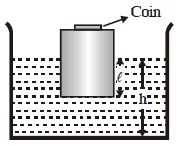
$A$ wooden block with a coin placed on its top floats in water as shown in the figure. $l$ and $h$ are as shown. After some time,the coin falls into the water. Then:
A
$l$ decreases and $h$ decreases
B
$l$ increases and $h$ increases
C
$l$ increases and $h$ decreases
D
$l$ decreases and $h$ increases
Solution
(A) Initially,the block and the coin float together. The total weight of the block and the coin is balanced by the buoyant force,which is equal to the weight of the displaced water. Let $M$ be the mass of the block and $m$ be the mass of the coin. The total weight is $(M+m)g$. The volume of water displaced is $V_{disp} = (M+m)/\rho_w$,where $\rho_w$ is the density of water.
When the coin falls into the water,the block alone floats. The weight of the block is $Mg$. The volume of water displaced by the block is $V'_{disp} = M/\rho_w$. The coin sinks to the bottom and displaces a volume of water equal to its own volume,$V_{coin} = m/\rho_c$,where $\rho_c$ is the density of the coin.
The total volume of water displaced is now $V_{total} = V'_{disp} + V_{coin} = M/\rho_w + m/\rho_c$. Since the density of the coin $\rho_c$ is much greater than the density of water $\rho_w$,$m/\rho_c < m/\rho_w$. Therefore,the total volume of water displaced decreases $(V_{total} < V_{disp})$,which causes the water level $h$ to decrease.
The submerged depth of the block $l$ is proportional to the weight of the block alone $(Mg)$,which is less than the weight of the block plus the coin $(Mg+mg)$. Thus,the submerged depth $l$ also decreases.
When the coin falls into the water,the block alone floats. The weight of the block is $Mg$. The volume of water displaced by the block is $V'_{disp} = M/\rho_w$. The coin sinks to the bottom and displaces a volume of water equal to its own volume,$V_{coin} = m/\rho_c$,where $\rho_c$ is the density of the coin.
The total volume of water displaced is now $V_{total} = V'_{disp} + V_{coin} = M/\rho_w + m/\rho_c$. Since the density of the coin $\rho_c$ is much greater than the density of water $\rho_w$,$m/\rho_c < m/\rho_w$. Therefore,the total volume of water displaced decreases $(V_{total} < V_{disp})$,which causes the water level $h$ to decrease.
The submerged depth of the block $l$ is proportional to the weight of the block alone $(Mg)$,which is less than the weight of the block plus the coin $(Mg+mg)$. Thus,the submerged depth $l$ also decreases.
0 likes
View Solution124
MediumMCQ
$A$ wooden piece floats half-submerged in a tub of water. If the system is transferred to a lift ascending with acceleration $a$,the wooden piece will:
A
Sink a little more
B
Rise a little
C
Remain half-submerged
D
Sink to the bottom
Solution
(C) According to Archimedes' principle,the buoyant force $F_B$ is equal to the weight of the displaced liquid,given by $F_B = V_{sub} \rho_{water} g_{eff}$.
When the lift accelerates upwards with acceleration $a$,the effective acceleration due to gravity becomes $g_{eff} = g + a$.
Both the wooden piece and the water experience this same effective gravity $g_{eff}$.
The weight of the wooden piece is $W = V_{total} \rho_{wood} g_{eff}$.
For equilibrium,$W = F_B$,which implies $V_{total} \rho_{wood} g_{eff} = V_{sub} \rho_{water} g_{eff}$.
Since $g_{eff}$ cancels out from both sides,the fraction of the volume submerged $(V_{sub} / V_{total} = \rho_{wood} / \rho_{water})$ remains independent of the acceleration of the lift.
Therefore,the wooden piece will remain half-submerged.
Thus,option $C$ is correct.
When the lift accelerates upwards with acceleration $a$,the effective acceleration due to gravity becomes $g_{eff} = g + a$.
Both the wooden piece and the water experience this same effective gravity $g_{eff}$.
The weight of the wooden piece is $W = V_{total} \rho_{wood} g_{eff}$.
For equilibrium,$W = F_B$,which implies $V_{total} \rho_{wood} g_{eff} = V_{sub} \rho_{water} g_{eff}$.
Since $g_{eff}$ cancels out from both sides,the fraction of the volume submerged $(V_{sub} / V_{total} = \rho_{wood} / \rho_{water})$ remains independent of the acceleration of the lift.
Therefore,the wooden piece will remain half-submerged.
Thus,option $C$ is correct.
0 likes
View Solution125
MediumMCQ
$A$ boat having a length of $3\,m$ and breadth $2\,m$ is floating on a lake. The boat sinks by $1\,cm$ when a man gets on it. The mass of the man is ....... $kg$. (Take density of water $\rho = 1000\,kg/m^3$ and $g = 10\,m/s^2$)
A
$60$
B
$62$
C
$72$
D
$128$
Solution
(A) According to the principle of floatation, the additional weight of the man must be equal to the weight of the water displaced by the boat due to the sinking.
The volume of water displaced by the boat is $V = \text{length} \times \text{breadth} \times \text{depth}$.
Given: $\text{length} = 3\,m$, $\text{breadth} = 2\,m$, and $\text{depth} = 1\,cm = 0.01\,m$.
$V = 3 \times 2 \times 0.01 = 0.06\,m^3$.
The mass of the displaced water is $m_w = \rho \times V$, where $\rho = 1000\,kg/m^3$.
$m_w = 1000 \times 0.06 = 60\,kg$.
Since the weight of the man equals the weight of the displaced water, the mass of the man is $60\,kg$.
The volume of water displaced by the boat is $V = \text{length} \times \text{breadth} \times \text{depth}$.
Given: $\text{length} = 3\,m$, $\text{breadth} = 2\,m$, and $\text{depth} = 1\,cm = 0.01\,m$.
$V = 3 \times 2 \times 0.01 = 0.06\,m^3$.
The mass of the displaced water is $m_w = \rho \times V$, where $\rho = 1000\,kg/m^3$.
$m_w = 1000 \times 0.06 = 60\,kg$.
Since the weight of the man equals the weight of the displaced water, the mass of the man is $60\,kg$.
0 likes
View Solution126
MediumMCQ
An ornament weighs $10\, g$ in air and $6\, g$ in water. The density of the material of the ornament is $20\, g/cc$. The volume of the cavity in the ornament is ........ $cc$.
A
$0$
B
$3.5$
C
$4$
D
$0.5$
Solution
(B) The weight of the ornament in air is $W_{air} = 10\, g$ (mass $m = 10\, g$).
The weight of the ornament in water is $W_{water} = 6\, g$.
The apparent loss in weight is equal to the buoyant force,which equals the weight of the water displaced: $F_{buoyant} = W_{air} - W_{water} = 10\, g - 6\, g = 4\, g$.
Since the density of water is $\rho_{water} = 1\, g/cc$,the volume of water displaced is $V_{total} = \frac{F_{buoyant}}{\rho_{water} \cdot g} = 4\, cc$.
This $V_{total}$ represents the external volume of the ornament (material volume + cavity volume).
The volume of the material alone is $V_{material} = \frac{m}{\rho_{material}} = \frac{10\, g}{20\, g/cc} = 0.5\, cc$.
The volume of the cavity is $V_{cavity} = V_{total} - V_{material} = 4\, cc - 0.5\, cc = 3.5\, cc$.
The weight of the ornament in water is $W_{water} = 6\, g$.
The apparent loss in weight is equal to the buoyant force,which equals the weight of the water displaced: $F_{buoyant} = W_{air} - W_{water} = 10\, g - 6\, g = 4\, g$.
Since the density of water is $\rho_{water} = 1\, g/cc$,the volume of water displaced is $V_{total} = \frac{F_{buoyant}}{\rho_{water} \cdot g} = 4\, cc$.
This $V_{total}$ represents the external volume of the ornament (material volume + cavity volume).
The volume of the material alone is $V_{material} = \frac{m}{\rho_{material}} = \frac{10\, g}{20\, g/cc} = 0.5\, cc$.
The volume of the cavity is $V_{cavity} = V_{total} - V_{material} = 4\, cc - 0.5\, cc = 3.5\, cc$.
0 likes
View Solution127
MediumMCQ
$A$ hollow sphere has an inner volume equal to half of its outer volume. If $4/5$ of its volume is submerged when placed in water,what is the density of the material of the sphere? (Density of water = $10^3 \ kg/m^3$)
A
$1.4 \times 10^3 \ kg/m^3$
B
$1.5 \times 10^3 \ kg/m^3$
C
$1.6 \times 10^3 \ kg/m^3$
D
$1.7 \times 10^3 \ kg/m^3$
Solution
(C) Let $V$ be the outer volume of the sphere.
Given that the inner volume is half the outer volume,the volume of the material of the sphere is $V_{material} = V - V/2 = V/2$.
According to the principle of floatation,the weight of the sphere is equal to the weight of the water displaced by the submerged part.
Weight of sphere = $V_{material} \times \rho \times g = (V/2) \times \rho \times g$,where $\rho$ is the density of the material.
Weight of displaced water = $V_{submerged} \times \sigma \times g = (4/5)V \times \sigma \times g$,where $\sigma = 10^3 \ kg/m^3$ is the density of water.
Equating the two: $(V/2) \rho g = (4/5) V \sigma g$.
$\rho/2 = 4\sigma/5$.
$\rho = (8/5) \sigma = 1.6 \times 10^3 \ kg/m^3$.
Given that the inner volume is half the outer volume,the volume of the material of the sphere is $V_{material} = V - V/2 = V/2$.
According to the principle of floatation,the weight of the sphere is equal to the weight of the water displaced by the submerged part.
Weight of sphere = $V_{material} \times \rho \times g = (V/2) \times \rho \times g$,where $\rho$ is the density of the material.
Weight of displaced water = $V_{submerged} \times \sigma \times g = (4/5)V \times \sigma \times g$,where $\sigma = 10^3 \ kg/m^3$ is the density of water.
Equating the two: $(V/2) \rho g = (4/5) V \sigma g$.
$\rho/2 = 4\sigma/5$.
$\rho = (8/5) \sigma = 1.6 \times 10^3 \ kg/m^3$.
0 likes
View Solution128
DifficultMCQ
$A$ wooden cube floats in water when a $200\,g$ mass is placed on it. When the mass is removed,the cube rises by $2\,cm$ above the water level. The side of the cube is ......... $cm$.
A
$5$
B
$10$
C
$15$
D
$20$
Solution
(B) Let the mass of the cube be $m$ and the side length be $a$. The density of water is $\rho_w = 1\,g/cm^3$.
When the $200\,g$ mass is on the cube,it is fully submerged or floating at a specific level. Assuming it floats such that the entire volume is submerged (or the displacement equals the total weight):
$(m + 200)g = a^3 \rho_w g$ --- $(i)$
When the mass is removed,the cube rises by $2\,cm$,meaning the submerged height becomes $(a - 2)$. The weight of the cube is now balanced by the buoyant force on the submerged volume:
$mg = a^2(a - 2) \rho_w g$ --- $(ii)$
Subtracting equation $(ii)$ from $(i)$:
$(m + 200)g - mg = a^3 \rho_w g - a^2(a - 2) \rho_w g$
$200 = a^3 \rho_w - (a^3 - 2a^2) \rho_w$
Since $\rho_w = 1\,g/cm^3$:
$200 = a^3 - a^3 + 2a^2$
$200 = 2a^2$
$a^2 = 100$
$a = 10\,cm$.
When the $200\,g$ mass is on the cube,it is fully submerged or floating at a specific level. Assuming it floats such that the entire volume is submerged (or the displacement equals the total weight):
$(m + 200)g = a^3 \rho_w g$ --- $(i)$
When the mass is removed,the cube rises by $2\,cm$,meaning the submerged height becomes $(a - 2)$. The weight of the cube is now balanced by the buoyant force on the submerged volume:
$mg = a^2(a - 2) \rho_w g$ --- $(ii)$
Subtracting equation $(ii)$ from $(i)$:
$(m + 200)g - mg = a^3 \rho_w g - a^2(a - 2) \rho_w g$
$200 = a^3 \rho_w - (a^3 - 2a^2) \rho_w$
Since $\rho_w = 1\,g/cm^3$:
$200 = a^3 - a^3 + 2a^2$
$200 = 2a^2$
$a^2 = 100$
$a = 10\,cm$.
0 likes
View Solution129
MediumMCQ
The reading of a spring balance when a block is suspended from it in air is $60\,N$. This reading changes to $40\,N$ when the block is immersed in water. The specific density (relative density) of the block is:
A
$3$
B
$\frac{2}{3}$
C
$6$
D
$\frac{3}{2}$
Solution
(A) Let the weight of the block in air be $W_{actual} = 60\,N$.
Let the apparent weight of the block in water be $W_{app} = 40\,N$.
The buoyant force $F_B$ acting on the block is the difference between the actual weight and the apparent weight:
$F_B = W_{actual} - W_{app} = 60\,N - 40\,N = 20\,N$.
According to Archimedes' principle,the buoyant force is equal to the weight of the water displaced:
$F_B = V \cdot \rho_w \cdot g = 20\,N$,where $V$ is the volume of the block and $\rho_w$ is the density of water.
The actual weight of the block is $W_{actual} = V \cdot \rho_s \cdot g = 60\,N$,where $\rho_s$ is the density of the block.
Dividing the two equations:
$\frac{W_{actual}}{F_B} = \frac{V \cdot \rho_s \cdot g}{V \cdot \rho_w \cdot g} = \frac{\rho_s}{\rho_w} = \text{Specific Density}$.
$\text{Specific Density} = \frac{60}{20} = 3$.
Let the apparent weight of the block in water be $W_{app} = 40\,N$.
The buoyant force $F_B$ acting on the block is the difference between the actual weight and the apparent weight:
$F_B = W_{actual} - W_{app} = 60\,N - 40\,N = 20\,N$.
According to Archimedes' principle,the buoyant force is equal to the weight of the water displaced:
$F_B = V \cdot \rho_w \cdot g = 20\,N$,where $V$ is the volume of the block and $\rho_w$ is the density of water.
The actual weight of the block is $W_{actual} = V \cdot \rho_s \cdot g = 60\,N$,where $\rho_s$ is the density of the block.
Dividing the two equations:
$\frac{W_{actual}}{F_B} = \frac{V \cdot \rho_s \cdot g}{V \cdot \rho_w \cdot g} = \frac{\rho_s}{\rho_w} = \text{Specific Density}$.
$\text{Specific Density} = \frac{60}{20} = 3$.
0 likes
View Solution130
DifficultMCQ
$A$ boat carrying a number of large stones is floating in a water tank. What would happen to the water level if a few stones are unloaded into the water?
A
Rises
B
Falls
C
Remains unchanged
D
Rises till half the number of stones are unloaded and then begins to fall
Solution
(B) When the stones are in the boat, they displace a volume of water equal to their weight (Archimedes' Principle for floating objects). Let $W_s$ be the weight of the stones and $\rho_w$ be the density of water. The volume of water displaced is $V_1 = W_s / (\rho_w g)$.
When the stones are dropped into the water, they sink and displace a volume of water equal to their own volume. Let $V_s$ be the volume of the stones and $\rho_s$ be the density of the stones. The volume of water displaced is $V_2 = V_s = W_s / (\rho_s g)$.
Since the density of the stones is greater than the density of water $(\rho_s > \rho_w)$, it follows that $V_1 > V_2$.
Because the volume of water displaced decreases when the stones are moved from the boat to the bottom of the tank, the water level in the tank falls.
When the stones are dropped into the water, they sink and displace a volume of water equal to their own volume. Let $V_s$ be the volume of the stones and $\rho_s$ be the density of the stones. The volume of water displaced is $V_2 = V_s = W_s / (\rho_s g)$.
Since the density of the stones is greater than the density of water $(\rho_s > \rho_w)$, it follows that $V_1 > V_2$.
Because the volume of water displaced decreases when the stones are moved from the boat to the bottom of the tank, the water level in the tank falls.
0 likes
View Solution131
EasyMCQ
$A$ certain block weighs $15 \ N$ in air. It weighs $12 \ N$ when immersed in water. When immersed in another liquid,it weighs $13 \ N$. The relative density of the block is:
A
$5$
B
$12$
C
$15$
D
None
Solution
(A) The relative density $(RD)$ of a solid is defined as the ratio of its weight in air to the loss of weight in water.
$RD = \frac{\text{Weight in air}}{\text{Weight in air} - \text{Weight in water}}$
Given:
Weight in air $(W_a)$ = $15 \ N$
Weight in water $(W_w)$ = $12 \ N$
$RD = \frac{15}{15 - 12} = \frac{15}{3} = 5$
Therefore,the relative density of the block is $5$.
$RD = \frac{\text{Weight in air}}{\text{Weight in air} - \text{Weight in water}}$
Given:
Weight in air $(W_a)$ = $15 \ N$
Weight in water $(W_w)$ = $12 \ N$
$RD = \frac{15}{15 - 12} = \frac{15}{3} = 5$
Therefore,the relative density of the block is $5$.
0 likes
View Solution132
EasyMCQ
$Assertion$ : $A$ balloon filled with hydrogen will fall with acceleration $\frac{g}{6}$ on the moon.
$Reason$ : Moon has no atmosphere.
$Reason$ : Moon has no atmosphere.
A
If both $Assertion$ and $Reason$ are correct and the $Reason$ is a correct explanation of the $Assertion$.
B
If both $Assertion$ and $Reason$ are correct but $Reason$ is not a correct explanation of the $Assertion$.
C
If the $Assertion$ is correct but $Reason$ is incorrect.
D
If both the $Assertion$ and $Reason$ are incorrect.
Solution
(A) On Earth,a balloon filled with hydrogen rises because the buoyant force (upthrust) is greater than the weight of the balloon.
On the moon,there is no atmosphere,which means there is no air to provide a buoyant force.
Therefore,the balloon will undergo free fall under the influence of the moon's gravity alone.
The acceleration due to gravity on the moon is $\frac{g}{6}$,where $g$ is the acceleration due to gravity on Earth.
Since the balloon is in free fall,its acceleration will be equal to the acceleration due to gravity on the moon,which is $\frac{g}{6}$.
Thus,both the $Assertion$ and $Reason$ are correct,and the $Reason$ correctly explains why the balloon falls with that specific acceleration.
On the moon,there is no atmosphere,which means there is no air to provide a buoyant force.
Therefore,the balloon will undergo free fall under the influence of the moon's gravity alone.
The acceleration due to gravity on the moon is $\frac{g}{6}$,where $g$ is the acceleration due to gravity on Earth.
Since the balloon is in free fall,its acceleration will be equal to the acceleration due to gravity on the moon,which is $\frac{g}{6}$.
Thus,both the $Assertion$ and $Reason$ are correct,and the $Reason$ correctly explains why the balloon falls with that specific acceleration.
0 likes
View Solution133
MediumMCQ
$A$ boy has a mass of $60\, kg$. He wants to swim in a river with the help of a wooden log. If the relative density of the wood is $0.6$,what is the minimum volume of the wooden log required? (Density of river water is $1000\, kg/m^3$)
A
$0.66\, m^3$
B
$150\, m^3$
C
$\frac{3}{1}\, m^3$
D
$\frac{3}{20}\, m^3$
Solution
(D) According to the principle of flotation,for the boy and the log to float,the total weight of the system must be equal to the upthrust (buoyant force) exerted by the water.
Let $V$ be the volume of the wooden log.
Mass of the boy = $60\, kg$.
Density of wood $\rho_{wood} = 0.6 \times 1000 = 600\, kg/m^3$.
Density of water $\rho_{water} = 1000\, kg/m^3$.
Total weight of the system = Weight of boy + Weight of log
$= 60g + (V \times 600)g$
Upthrust (Buoyant force) = Weight of water displaced by the log
$= V \times 1000 \times g$
Equating the two:
$60g + 600Vg = 1000Vg$
$60 = 1000V - 600V$
$60 = 400V$
$V = \frac{60}{400} = \frac{3}{20}\, m^3$.
Let $V$ be the volume of the wooden log.
Mass of the boy = $60\, kg$.
Density of wood $\rho_{wood} = 0.6 \times 1000 = 600\, kg/m^3$.
Density of water $\rho_{water} = 1000\, kg/m^3$.
Total weight of the system = Weight of boy + Weight of log
$= 60g + (V \times 600)g$
Upthrust (Buoyant force) = Weight of water displaced by the log
$= V \times 1000 \times g$
Equating the two:
$60g + 600Vg = 1000Vg$
$60 = 1000V - 600V$
$60 = 400V$
$V = \frac{60}{400} = \frac{3}{20}\, m^3$.
1 likes
View Solution134
MediumMCQ
$Assertion :$ The buoyant force on a submerged rigid object can be considered to be acting at the centre of mass of the object.
$Reason :$ For a rigid body,a force field distributed uniformly through its volume can be considered to be acting at the centre of mass of the body.
$Reason :$ For a rigid body,a force field distributed uniformly through its volume can be considered to be acting at the centre of mass of the body.
A
If both Assertion and Reason are correct and the Reason is a correct explanation of the Assertion.
B
If both Assertion and Reason are correct but Reason is not a correct explanation of the Assertion.
C
If the Assertion is correct but Reason is incorrect.
D
If both the Assertion and Reason are incorrect.
Solution
(D) The buoyant force acts at the centre of buoyancy,which is the centre of mass of the displaced fluid. This point coincides with the centre of mass of the object only if the object is homogeneous (uniform density). Since the object is not necessarily homogeneous,the Assertion is incorrect.
The Reason statement is a general principle in mechanics: for a uniform force field (like gravity) acting on a body,the resultant force acts at the centre of mass. However,the buoyant force is not a uniform force field acting on the object itself; it is the resultant of pressure forces acting on the surface of the object. Thus,the Reason is also incorrect.
The Reason statement is a general principle in mechanics: for a uniform force field (like gravity) acting on a body,the resultant force acts at the centre of mass. However,the buoyant force is not a uniform force field acting on the object itself; it is the resultant of pressure forces acting on the surface of the object. Thus,the Reason is also incorrect.
0 likes
View Solution135
DifficultMCQ
Consider a solid sphere of radius $R$ and mass density $\rho(r) = \rho_{0} \left(1 - \frac{r^{2}}{R^{2}}\right)$ for $0 < r \leq R$. The minimum density of a liquid in which it will float is
A
$\frac{\rho_{0}}{5}$
B
$\frac{\rho_{0}}{3}$
C
$\frac{2\rho_{0}}{3}$
D
$\frac{2\rho_{0}}{5}$
Solution
(D) For the sphere to float with minimum liquid density,it must be completely submerged. In this state,the weight of the sphere equals the buoyant force.
Weight $W = mg = \int \rho(r) g dV = \int_{0}^{R} \rho_{0} \left(1 - \frac{r^{2}}{R^{2}}\right) g (4 \pi r^{2} dr)$.
$W = 4 \pi \rho_{0} g \int_{0}^{R} \left(r^{2} - \frac{r^{4}}{R^{2}}\right) dr$.
$W = 4 \pi \rho_{0} g \left[ \frac{r^{3}}{3} - \frac{r^{5}}{5R^{2}} \right]_{0}^{R} = 4 \pi \rho_{0} g \left( \frac{R^{3}}{3} - \frac{R^{3}}{5} \right) = 4 \pi \rho_{0} g \left( \frac{2R^{3}}{15} \right) = \frac{8}{15} \pi R^{3} \rho_{0} g$.
Buoyant force $B = V_{sphere} \rho_{l} g = \frac{4}{3} \pi R^{3} \rho_{l} g$.
Equating $W = B$: $\frac{8}{15} \pi R^{3} \rho_{0} g = \frac{4}{3} \pi R^{3} \rho_{l} g$.
Solving for $\rho_{l}$: $\rho_{l} = \frac{8}{15} \times \frac{3}{4} \rho_{0} = \frac{2}{5} \rho_{0}$.
Weight $W = mg = \int \rho(r) g dV = \int_{0}^{R} \rho_{0} \left(1 - \frac{r^{2}}{R^{2}}\right) g (4 \pi r^{2} dr)$.
$W = 4 \pi \rho_{0} g \int_{0}^{R} \left(r^{2} - \frac{r^{4}}{R^{2}}\right) dr$.
$W = 4 \pi \rho_{0} g \left[ \frac{r^{3}}{3} - \frac{r^{5}}{5R^{2}} \right]_{0}^{R} = 4 \pi \rho_{0} g \left( \frac{R^{3}}{3} - \frac{R^{3}}{5} \right) = 4 \pi \rho_{0} g \left( \frac{2R^{3}}{15} \right) = \frac{8}{15} \pi R^{3} \rho_{0} g$.
Buoyant force $B = V_{sphere} \rho_{l} g = \frac{4}{3} \pi R^{3} \rho_{l} g$.
Equating $W = B$: $\frac{8}{15} \pi R^{3} \rho_{0} g = \frac{4}{3} \pi R^{3} \rho_{l} g$.
Solving for $\rho_{l}$: $\rho_{l} = \frac{8}{15} \times \frac{3}{4} \rho_{0} = \frac{2}{5} \rho_{0}$.
0 likes
View Solution136
MediumMCQ
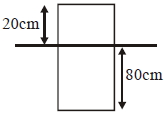
$A$ leak-proof cylinder of length $1 \; m,$ made of a metal which has a very low coefficient of expansion,is floating vertically in water at $0^{\circ} C$ such that its height above the water surface is $20 \; cm.$ When the temperature of water is increased to $4^{\circ} C,$ the height of the cylinder above the water surface becomes $21 \; cm.$ The density of water at $T=4^{\circ} C,$ relative to the density at $T=0^{\circ} C,$ is close to
A
$1.01$
B
$1.04$
C
$1.03$
D
$1.26$
Solution
(A) Let $A$ be the cross-sectional area of the cylinder and $\rho_0$ and $\rho_4$ be the densities of water at $0^{\circ} C$ and $4^{\circ} C$ respectively.
At $0^{\circ} C,$ the submerged length of the cylinder is $h_0 = 100 \; cm - 20 \; cm = 80 \; cm.$
By the principle of flotation,the weight of the cylinder equals the weight of the displaced water:
$mg = A \times h_0 \times \rho_0 \times g \implies m = A \times 80 \times \rho_0.$
At $4^{\circ} C,$ the submerged length of the cylinder is $h_4 = 100 \; cm - 21 \; cm = 79 \; cm.$
Since the mass of the cylinder remains constant:
$m = A \times 79 \times \rho_4.$
Equating the two expressions for $m$:
$A \times 80 \times \rho_0 = A \times 79 \times \rho_4.$
Therefore,the ratio of the density at $4^{\circ} C$ to the density at $0^{\circ} C$ is:
$\frac{\rho_4}{\rho_0} = \frac{80}{79} \approx 1.0126.$
Rounding to the nearest given option,the value is close to $1.01$.
At $0^{\circ} C,$ the submerged length of the cylinder is $h_0 = 100 \; cm - 20 \; cm = 80 \; cm.$
By the principle of flotation,the weight of the cylinder equals the weight of the displaced water:
$mg = A \times h_0 \times \rho_0 \times g \implies m = A \times 80 \times \rho_0.$
At $4^{\circ} C,$ the submerged length of the cylinder is $h_4 = 100 \; cm - 21 \; cm = 79 \; cm.$
Since the mass of the cylinder remains constant:
$m = A \times 79 \times \rho_4.$
Equating the two expressions for $m$:
$A \times 80 \times \rho_0 = A \times 79 \times \rho_4.$
Therefore,the ratio of the density at $4^{\circ} C$ to the density at $0^{\circ} C$ is:
$\frac{\rho_4}{\rho_0} = \frac{80}{79} \approx 1.0126.$
Rounding to the nearest given option,the value is close to $1.01$.
1 likes
View Solution137
Medium
$A$ gas in equilibrium has uniform density and pressure throughout its volume. This is strictly true only if there are no external influences. $A$ gas column under gravity,for example,does not have uniform density (and pressure). As you might expect,its density decreases with height. The precise dependence is given by the so-called law of atmospheres:
$n_{2}=n_{1} \exp \left[-m g\left(h_{2}-h_{1}\right) / k_{B} T\right]$
where $n_{2}, n_{1}$ refer to number density at heights $h_{2}$ and $h_{1}$ respectively. Use this relation to derive the equation for sedimentation equilibrium of a suspension in a liquid column:
$n_{2}=n_{1} \exp \left[-m g N_{A}\left(\rho-\rho^{\prime}\right)\left(h_{2}-h_{1}\right) /(\rho R T)\right]$
where $\rho$ is the density of the suspended particle,and $\rho^{\prime}$ that of the surrounding medium. [$N_{A}$ is Avogadro's number,and $R$ the universal gas constant.]
$n_{2}=n_{1} \exp \left[-m g\left(h_{2}-h_{1}\right) / k_{B} T\right]$
where $n_{2}, n_{1}$ refer to number density at heights $h_{2}$ and $h_{1}$ respectively. Use this relation to derive the equation for sedimentation equilibrium of a suspension in a liquid column:
$n_{2}=n_{1} \exp \left[-m g N_{A}\left(\rho-\rho^{\prime}\right)\left(h_{2}-h_{1}\right) /(\rho R T)\right]$
where $\rho$ is the density of the suspended particle,and $\rho^{\prime}$ that of the surrounding medium. [$N_{A}$ is Avogadro's number,and $R$ the universal gas constant.]
Solution
(N/A) According to the law of atmospheres,the number density is given by:
$n_{2}=n_{1} \exp \left[-m g\left(h_{2}-h_{1}\right) / k_{B} T\right]$
For a particle of mass $m$ and density $\rho$ suspended in a medium of density $\rho^{\prime}$,the effective weight $W_{eff}$ is the actual weight minus the buoyant force (Archimedes' principle).
Let $V$ be the volume of the particle. Then $m = V\rho$.
The buoyant force is equal to the weight of the displaced medium: $F_{B} = V\rho^{\prime}g = (m/\rho)\rho^{\prime}g$.
The effective weight is:
$W_{eff} = mg - F_{B} = mg - (m/\rho)\rho^{\prime}g = mg(1 - \rho^{\prime}/\rho) = mg(\rho - \rho^{\prime})/\rho$.
Substituting this effective weight into the law of atmospheres and using $k_{B} = R/N_{A}$:
$n_{2} = n_{1} \exp \left[ -\frac{mg(\rho - \rho^{\prime})}{\rho} \frac{(h_{2} - h_{1})}{k_{B}T} \right]$
Substituting $k_{B} = R/N_{A}$:
$n_{2} = n_{1} \exp \left[ -\frac{mg(\rho - \rho^{\prime})}{\rho} \frac{(h_{2} - h_{1}) N_{A}}{RT} \right]$
Rearranging the terms,we get:
$n_{2} = n_{1} \exp \left[ -\frac{mg N_{A} (\rho - \rho^{\prime}) (h_{2} - h_{1})}{\rho RT} \right]$
$n_{2}=n_{1} \exp \left[-m g\left(h_{2}-h_{1}\right) / k_{B} T\right]$
For a particle of mass $m$ and density $\rho$ suspended in a medium of density $\rho^{\prime}$,the effective weight $W_{eff}$ is the actual weight minus the buoyant force (Archimedes' principle).
Let $V$ be the volume of the particle. Then $m = V\rho$.
The buoyant force is equal to the weight of the displaced medium: $F_{B} = V\rho^{\prime}g = (m/\rho)\rho^{\prime}g$.
The effective weight is:
$W_{eff} = mg - F_{B} = mg - (m/\rho)\rho^{\prime}g = mg(1 - \rho^{\prime}/\rho) = mg(\rho - \rho^{\prime})/\rho$.
Substituting this effective weight into the law of atmospheres and using $k_{B} = R/N_{A}$:
$n_{2} = n_{1} \exp \left[ -\frac{mg(\rho - \rho^{\prime})}{\rho} \frac{(h_{2} - h_{1})}{k_{B}T} \right]$
Substituting $k_{B} = R/N_{A}$:
$n_{2} = n_{1} \exp \left[ -\frac{mg(\rho - \rho^{\prime})}{\rho} \frac{(h_{2} - h_{1}) N_{A}}{RT} \right]$
Rearranging the terms,we get:
$n_{2} = n_{1} \exp \left[ -\frac{mg N_{A} (\rho - \rho^{\prime}) (h_{2} - h_{1})}{\rho RT} \right]$
0 likes
View Solution138
MediumMCQ
When an air bubble rises in water,does its potential energy increase or decrease?
A
Increases
B
Decreases
C
Remains constant
D
First increases then decreases
Solution
(B) As the air bubble rises in water,it moves against the gravitational force,which might suggest an increase in potential energy. However,the bubble is also expanding due to the decrease in hydrostatic pressure as it moves towards the surface. More importantly,the work done by the buoyant force is positive,and the work done by gravity is negative. Since the bubble is in a fluid,the system's potential energy is defined by the configuration of the fluid and the bubble. As the bubble rises,the water (which has a much higher density) moves downward to occupy the space vacated by the bubble. This results in a net decrease in the gravitational potential energy of the entire system (water + bubble). Therefore,the potential energy of the system decreases.
0 likes
View Solution139
EasyMCQ
What is buoyant force?
A
The force exerted by a fluid on an object that opposes its weight.
B
The gravitational force acting on an object.
C
The frictional force between fluid layers.
D
The force due to surface tension.
Solution
(A) The buoyant force is the upward force exerted by a fluid on an object that is wholly or partially immersed in it.
This force arises due to the difference in pressure at different depths of the fluid,where the pressure at the bottom of the object is greater than the pressure at the top.
This phenomenon is known as buoyancy.
The buoyant force acts vertically upward through the center of buoyancy,which coincides with the center of mass of the displaced fluid.
This force arises due to the difference in pressure at different depths of the fluid,where the pressure at the bottom of the object is greater than the pressure at the top.
This phenomenon is known as buoyancy.
The buoyant force acts vertically upward through the center of buoyancy,which coincides with the center of mass of the displaced fluid.
0 likes
View Solution140
Medium
State and prove Archimedes' principle.
Solution
(N/A) Archimedes' principle states: "When a body is partially or completely immersed in a fluid, the buoyant force acting on it is equal to the weight of the fluid displaced by the body, and it acts in the upward direction through the center of gravity of the displaced fluid."
Proof:
Consider a solid cube of height $h$ and cross-sectional area $A$ immersed in a liquid of density $\rho$ at a depth $x$ from the surface, as shown in the figure.
The forces acting on the left and right sides of the body are equal and opposite, so they cancel each other out.
The pressure on the upper surface of the body is $P_{1} = x \rho g$.
The pressure on the lower surface of the body is $P_{2} = (x + h) \rho g$.
The force on the upper surface is $F_{1} = P_{1} A = x \rho g A$ (acting downwards).
The force on the lower surface is $F_{2} = P_{2} A = (x + h) \rho g A$ (acting upwards).
The buoyant (resultant) force $F_{b}$ acting on the body is:
$F_{b} = F_{2} - F_{1}$
$F_{b} = (x + h) \rho g A - x \rho g A$
$F_{b} = h \rho g A$
Since $A h = V$ (the volume of the body), and the volume of the body equals the volume of the displaced liquid:
$F_{b} = V \rho g$
Since mass $m = V \rho$, we have:
$F_{b} = m g$
This force acts in the upward direction. Here, $m$ is the mass of the displaced liquid. Thus, the buoyant force is equal to the weight of the displaced liquid. This proves Archimedes' principle.
Proof:
Consider a solid cube of height $h$ and cross-sectional area $A$ immersed in a liquid of density $\rho$ at a depth $x$ from the surface, as shown in the figure.
The forces acting on the left and right sides of the body are equal and opposite, so they cancel each other out.
The pressure on the upper surface of the body is $P_{1} = x \rho g$.
The pressure on the lower surface of the body is $P_{2} = (x + h) \rho g$.
The force on the upper surface is $F_{1} = P_{1} A = x \rho g A$ (acting downwards).
The force on the lower surface is $F_{2} = P_{2} A = (x + h) \rho g A$ (acting upwards).
The buoyant (resultant) force $F_{b}$ acting on the body is:
$F_{b} = F_{2} - F_{1}$
$F_{b} = (x + h) \rho g A - x \rho g A$
$F_{b} = h \rho g A$
Since $A h = V$ (the volume of the body), and the volume of the body equals the volume of the displaced liquid:
$F_{b} = V \rho g$
Since mass $m = V \rho$, we have:
$F_{b} = m g$
This force acts in the upward direction. Here, $m$ is the mass of the displaced liquid. Thus, the buoyant force is equal to the weight of the displaced liquid. This proves Archimedes' principle.
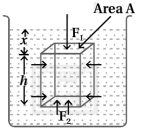
0 likes
View Solution141
Medium
State the law of floatation and describe its cases.
Solution
(N/A) The law of floatation states that a body floats on the surface of a liquid if the weight of the body is equal to the weight of the liquid displaced by the submerged part of the body.
When a body is partially or completely immersed in a liquid,it experiences two forces:
$(1)$ Weight of the body $(W)$: $W = V_s \rho_s g$ (acting downwards),where $V_s$ is the volume of the body and $\rho_s$ is the density of the body.
$(2)$ Buoyant force $(F_b)$: $F_b = V_f \rho_f g$ (acting upwards),where $V_f$ is the volume of the displaced liquid and $\rho_f$ is the density of the liquid.
Cases:
$(a)$ If $W > F_b$: The body sinks in the liquid (e.g.,an iron nail).
$(b)$ If $W = F_b$: The body remains in equilibrium at any depth (e.g.,a submarine).
$(c)$ If $W < F_b$: The body floats on the surface of the liquid (e.g.,a wooden block).
When a body is partially or completely immersed in a liquid,it experiences two forces:
$(1)$ Weight of the body $(W)$: $W = V_s \rho_s g$ (acting downwards),where $V_s$ is the volume of the body and $\rho_s$ is the density of the body.
$(2)$ Buoyant force $(F_b)$: $F_b = V_f \rho_f g$ (acting upwards),where $V_f$ is the volume of the displaced liquid and $\rho_f$ is the density of the liquid.
Cases:
$(a)$ If $W > F_b$: The body sinks in the liquid (e.g.,an iron nail).
$(b)$ If $W = F_b$: The body remains in equilibrium at any depth (e.g.,a submarine).
$(c)$ If $W < F_b$: The body floats on the surface of the liquid (e.g.,a wooden block).
0 likes
View Solution142
Easy
Determine the equation for the volume of the partially immersed part of a body floating in a fluid.
Solution
(N/A) When a body floats on the surface of a liquid,the weight of the body is equal to the weight of the liquid displaced by the body.
According to the principle of floatation: $W_{\text{body}} = W_{\text{displaced liquid}}$.
Let $V$ be the total volume of the body and $\rho$ be its density.
Let $V^{\prime}$ be the volume of the part of the body immersed in the liquid and $\rho_{l}$ be the density of the liquid.
The weight of the body is $W = V \rho g$.
The weight of the displaced liquid (buoyant force) is $F_{B} = V^{\prime} \rho_{l} g$.
Equating the two: $V \rho g = V^{\prime} \rho_{l} g$.
Thus,the ratio of the immersed volume to the total volume is given by: $\frac{V^{\prime}}{V} = \frac{\rho}{\rho_{l}}$.
Therefore,the volume of the immersed part is $V^{\prime} = V \left( \frac{\rho}{\rho_{l}} \right)$.
According to the principle of floatation: $W_{\text{body}} = W_{\text{displaced liquid}}$.
Let $V$ be the total volume of the body and $\rho$ be its density.
Let $V^{\prime}$ be the volume of the part of the body immersed in the liquid and $\rho_{l}$ be the density of the liquid.
The weight of the body is $W = V \rho g$.
The weight of the displaced liquid (buoyant force) is $F_{B} = V^{\prime} \rho_{l} g$.
Equating the two: $V \rho g = V^{\prime} \rho_{l} g$.
Thus,the ratio of the immersed volume to the total volume is given by: $\frac{V^{\prime}}{V} = \frac{\rho}{\rho_{l}}$.
Therefore,the volume of the immersed part is $V^{\prime} = V \left( \frac{\rho}{\rho_{l}} \right)$.
0 likes
View Solution143
Medium
What is buoyant force?
Solution
(N/A) Buoyant force is the upward force exerted by a fluid on an object that is wholly or partially immersed in it.
According to Archimedes' principle,the magnitude of this force is equal to the weight of the fluid displaced by the object.
Mathematically,$F_b = \rho \cdot V \cdot g$,where $\rho$ is the density of the fluid,$V$ is the volume of the displaced fluid,and $g$ is the acceleration due to gravity.
According to Archimedes' principle,the magnitude of this force is equal to the weight of the fluid displaced by the object.
Mathematically,$F_b = \rho \cdot V \cdot g$,where $\rho$ is the density of the fluid,$V$ is the volume of the displaced fluid,and $g$ is the acceleration due to gravity.
0 likes
View Solution144
EasyMCQ
What is the direction of buoyant force?
A
Downward
B
Upward
C
Horizontal
D
Tangential
Solution
(B) The buoyant force is the upward force exerted by a fluid that opposes the weight of an immersed object.
According to Archimedes' principle,this force acts in the vertical direction,specifically in the upward direction,opposite to the force of gravity.
Therefore,the direction of the buoyant force is always upward.
According to Archimedes' principle,this force acts in the vertical direction,specifically in the upward direction,opposite to the force of gravity.
Therefore,the direction of the buoyant force is always upward.
0 likes
View Solution145
Easy
State Archimedes' principle.
Solution
(N/A) Archimedes' principle states that when a body is partially or fully immersed in a fluid,it experiences an upward buoyant force equal to the weight of the fluid displaced by the body.
Mathematically,the buoyant force $F_B$ is given by $F_B = V \rho g$,where $V$ is the volume of the displaced fluid,$\rho$ is the density of the fluid,and $g$ is the acceleration due to gravity.
Mathematically,the buoyant force $F_B$ is given by $F_B = V \rho g$,where $V$ is the volume of the displaced fluid,$\rho$ is the density of the fluid,and $g$ is the acceleration due to gravity.
0 likes
View Solution146
Easy
State the law of floatation.
Solution
(N/A) The law of floatation states that a body will float in a liquid if the weight of the liquid displaced by the submerged part of the body is equal to the total weight of the body.
Mathematically, for a body of mass $M$ floating in a liquid of density $\rho$, the condition is:
$Weight \ of \ the \ body = Weight \ of \ the \ displaced \ liquid$
$Mg = V_{submerged} \rho g$
Where $V_{submerged}$ is the volume of the body submerged in the liquid.
Mathematically, for a body of mass $M$ floating in a liquid of density $\rho$, the condition is:
$Weight \ of \ the \ body = Weight \ of \ the \ displaced \ liquid$
$Mg = V_{submerged} \rho g$
Where $V_{submerged}$ is the volume of the body submerged in the liquid.
0 likes
View Solution147
Medium
Write the equation for the volume of the partially submerged part of a body floating on the surface of a liquid.
Solution
(N/A) For a body of total volume $V$ and density $\rho$ floating in a liquid of density $\sigma$,let $V_{sub}$ be the volume of the submerged part.
According to the law of floatation,the weight of the body is equal to the weight of the liquid displaced by the submerged part.
Weight of the body = $V \rho g$
Weight of the liquid displaced = $V_{sub} \sigma g$
Equating the two: $V \rho g = V_{sub} \sigma g$
Therefore,the volume of the submerged part is $V_{sub} = V \left( \frac{\rho}{\sigma} \right)$.
According to the law of floatation,the weight of the body is equal to the weight of the liquid displaced by the submerged part.
Weight of the body = $V \rho g$
Weight of the liquid displaced = $V_{sub} \sigma g$
Equating the two: $V \rho g = V_{sub} \sigma g$
Therefore,the volume of the submerged part is $V_{sub} = V \left( \frac{\rho}{\sigma} \right)$.
0 likes
View Solution148
MediumMCQ
When does a body sink in a liquid? Explain.
A
When the density of the body is greater than the density of the liquid.
B
When the density of the body is equal to the density of the liquid.
C
When the density of the body is less than the density of the liquid.
D
When the weight of the body is equal to the buoyant force.
Solution
(A) body sinks in a liquid when its weight $(W)$ is greater than the buoyant force $(F_B)$ acting on it.
Mathematically,let $\rho_b$ be the density of the body and $\rho_l$ be the density of the liquid.
The weight of the body is $W = V \rho_b g$,where $V$ is the volume of the body.
The buoyant force is $F_B = V \rho_l g$.
For the body to sink,$W > F_B$.
Substituting the expressions,$V \rho_b g > V \rho_l g$,which simplifies to $\rho_b > \rho_l$.
Therefore,a body sinks if the density of the body is greater than the density of the liquid.
Mathematically,let $\rho_b$ be the density of the body and $\rho_l$ be the density of the liquid.
The weight of the body is $W = V \rho_b g$,where $V$ is the volume of the body.
The buoyant force is $F_B = V \rho_l g$.
For the body to sink,$W > F_B$.
Substituting the expressions,$V \rho_b g > V \rho_l g$,which simplifies to $\rho_b > \rho_l$.
Therefore,a body sinks if the density of the body is greater than the density of the liquid.
0 likes
View Solution149
MediumMCQ
At what depth does a body remain in equilibrium in a liquid? Explain.
A
At the surface
B
At the bottom
C
At any depth
D
None of the above
Solution
(C) body remains in equilibrium in a liquid at any depth if its density is exactly equal to the density of the liquid.
According to the law of floatation,the weight of the body $(W = V \rho_{body} g)$ must be equal to the buoyant force $(F_B = V \rho_{liquid} g)$.
If $\rho_{body} = \rho_{liquid}$,then $W = F_B$.
Since the buoyant force depends only on the volume of the displaced liquid and the density of the liquid (which is assumed to be uniform),the buoyant force does not change with depth.
Therefore,the net force $(W - F_B)$ remains zero at any depth,allowing the body to remain in neutral equilibrium.
According to the law of floatation,the weight of the body $(W = V \rho_{body} g)$ must be equal to the buoyant force $(F_B = V \rho_{liquid} g)$.
If $\rho_{body} = \rho_{liquid}$,then $W = F_B$.
Since the buoyant force depends only on the volume of the displaced liquid and the density of the liquid (which is assumed to be uniform),the buoyant force does not change with depth.
Therefore,the net force $(W - F_B)$ remains zero at any depth,allowing the body to remain in neutral equilibrium.
0 likes
View Solution150
MediumMCQ
When does a body float on the surface of a liquid?
A
When the weight of the body is greater than the buoyant force.
B
When the weight of the body is equal to the buoyant force.
C
When the weight of the body is less than the buoyant force.
D
When the density of the body is greater than the density of the liquid.
Solution
(B) body floats on the surface of a liquid when the weight of the body is exactly balanced by the buoyant force (upthrust) exerted by the liquid.
According to the law of floatation,for a body to float in equilibrium,the weight of the body must be equal to the weight of the liquid displaced by the submerged part of the body.
Mathematically,$W_{body} = F_{buoyant}$.
If $W_{body} > F_{buoyant}$,the body will sink.
If $W_{body} < F_{buoyant}$,the body will rise to the surface and float partially submerged.
According to the law of floatation,for a body to float in equilibrium,the weight of the body must be equal to the weight of the liquid displaced by the submerged part of the body.
Mathematically,$W_{body} = F_{buoyant}$.
If $W_{body} > F_{buoyant}$,the body will sink.
If $W_{body} < F_{buoyant}$,the body will rise to the surface and float partially submerged.
0 likes
View SolutionFluid Mechanics and Surface Tension — Buoyancy, Archimedes' Principle and Laws of Floatation · Frequently Asked Questions
1Are these Fluid Mechanics and Surface Tension questions useful for JEE and NEET?
Yes. All questions in this section are mapped to JEE Main and NEET exam patterns. Previous year questions from JEE Main, NEET, GUJCET and state-level exams are included with full solutions.
2Can I switch to Hindi or Gujarati for these questions?
Yes. Use the language tabs in the hero section or the sidebar to view the same questions and solutions in English, Hindi or Gujarati.
3How do I generate a question paper from this subtopic?
Use the Vedclass Exam Paper Generator — select the chapter and subtopic, set difficulty, and generate Sets A, B, C, D automatically. First 3 chapters of every subject are free.
Vedclass Products
For Students
Vedclass Test Series
Mock tests in real JEE/NEET style with performance analysis. 5-day free trial.
Start Free TrialFor Teachers
Exam Paper Generator
Generate Set A/B/C/D papers from this chapter in 2 minutes. 3 chapters free.
Try FreeFor Institutes
Online Exam Module
Live online exams with unlimited students, 360° analytics & white-label branding.
See DemoFor Teachers & Institutes
Generate a Fluid Mechanics and Surface Tension Exam Paper in 2 Minutes
Select subtopic & difficulty — Sets A, B, C, D auto-generated with No Repeat logic.
First 3 chapters of every subject are free — no payment required.