
A English
Buoyancy, Archimedes' Principle and Laws of Floatation Questions in English
Class 11 Physics · Fluid Mechanics and Surface Tension · Buoyancy, Archimedes' Principle and Laws of Floatation
257+
Questions
English
Language
100%
With Solutions
Showing 50 of 257 questions in English
51
EasyMCQ
If $W$ is the weight of a body of density $\rho$ in vacuum,then its apparent weight in air of density $\sigma$ is:
A
$\frac{W\rho}{\sigma}$
B
$W\left(\frac{\rho}{\sigma} - 1\right)$
C
$\frac{W}{\rho}\sigma$
D
$W\left(1 - \frac{\sigma}{\rho}\right)$
Solution
(D) The weight of the body in vacuum is $W = V\rho g$,where $V$ is the volume of the body.
When the body is placed in air,it experiences an upward buoyant force (upthrust) equal to the weight of the air displaced.
The upthrust $U = V\sigma g$.
The apparent weight of the body in air is given by: $W_{\text{apparent}} = W - U$.
Substituting the values: $W_{\text{apparent}} = V\rho g - V\sigma g$.
Factoring out $V\rho g$: $W_{\text{apparent}} = V\rho g \left(1 - \frac{\sigma}{\rho}\right)$.
Since $W = V\rho g$,we get: $W_{\text{apparent}} = W\left(1 - \frac{\sigma}{\rho}\right)$.
When the body is placed in air,it experiences an upward buoyant force (upthrust) equal to the weight of the air displaced.
The upthrust $U = V\sigma g$.
The apparent weight of the body in air is given by: $W_{\text{apparent}} = W - U$.
Substituting the values: $W_{\text{apparent}} = V\rho g - V\sigma g$.
Factoring out $V\rho g$: $W_{\text{apparent}} = V\rho g \left(1 - \frac{\sigma}{\rho}\right)$.
Since $W = V\rho g$,we get: $W_{\text{apparent}} = W\left(1 - \frac{\sigma}{\rho}\right)$.
0 likes
View Solution52
MediumMCQ
$A$ pendulum has a time period $T$ in air. When it is made to oscillate in water,it acquires a time period $T' = \sqrt{2} T$. The density of the pendulum bob is (density of water $= 1$)
A
$\sqrt{2}$
B
$2$
C
$2\sqrt{2}$
D
None of these
Solution
(B) The time period of a simple pendulum in air is given by $T = 2\pi \sqrt{\frac{l}{g}}$.
When the pendulum oscillates in water,it experiences an upward buoyant force. The effective acceleration due to gravity $g'$ becomes $g' = g \left( 1 - \frac{\sigma}{\rho} \right)$,where $\sigma$ is the density of water and $\rho$ is the density of the bob.
The time period in water is $T' = 2\pi \sqrt{\frac{l}{g'}} = 2\pi \sqrt{\frac{l}{g(1 - \sigma/\rho)}}$.
Dividing the two equations,we get $\frac{T'}{T} = \sqrt{\frac{g}{g'}} = \frac{1}{\sqrt{1 - \sigma/\rho}}$.
Given $T' = \sqrt{2} T$,so $\frac{T'}{T} = \sqrt{2}$.
Thus,$\sqrt{2} = \frac{1}{\sqrt{1 - 1/\rho}}$.
Squaring both sides,$2 = \frac{1}{1 - 1/\rho}$.
$1 - 1/\rho = 1/2$.
$1/\rho = 1 - 1/2 = 1/2$.
Therefore,$\rho = 2$.
When the pendulum oscillates in water,it experiences an upward buoyant force. The effective acceleration due to gravity $g'$ becomes $g' = g \left( 1 - \frac{\sigma}{\rho} \right)$,where $\sigma$ is the density of water and $\rho$ is the density of the bob.
The time period in water is $T' = 2\pi \sqrt{\frac{l}{g'}} = 2\pi \sqrt{\frac{l}{g(1 - \sigma/\rho)}}$.
Dividing the two equations,we get $\frac{T'}{T} = \sqrt{\frac{g}{g'}} = \frac{1}{\sqrt{1 - \sigma/\rho}}$.
Given $T' = \sqrt{2} T$,so $\frac{T'}{T} = \sqrt{2}$.
Thus,$\sqrt{2} = \frac{1}{\sqrt{1 - 1/\rho}}$.
Squaring both sides,$2 = \frac{1}{1 - 1/\rho}$.
$1 - 1/\rho = 1/2$.
$1/\rho = 1 - 1/2 = 1/2$.
Therefore,$\rho = 2$.
0 likes
View Solution53
AdvancedMCQ
$A$ sphere of diameter $7 \, cm$ and mass $266.5 \, g$ floats in a bath of a liquid. As the temperature is raised,the sphere just begins to sink at a temperature $35^{\circ} C$. If the density of the liquid at $0^{\circ} C$ is $1.527 \, g/cm^3$,then neglecting the expansion of the sphere,the coefficient of cubical expansion of the liquid is:
A
$8.486 \times 10^{-4} \, ^{\circ}C^{-1}$
B
$8.486 \times 10^{-5} \, ^{\circ}C^{-1}$
C
$8.486 \times 10^{-6} \, ^{\circ}C^{-1}$
D
$8.486 \times 10^{-3} \, ^{\circ}C^{-1}$
Solution
(A) The volume of the sphere is $V = \frac{4}{3} \pi r^3 = \frac{4}{3} \pi (3.5)^3 \approx 179.59 \, cm^3$.
By the law of floatation,at $35^{\circ} C$,the weight of the sphere equals the weight of the displaced liquid:
$m = V \times \rho_{35} \implies 266.5 = 179.59 \times \rho_{35}$.
$\rho_{35} = \frac{266.5}{179.59} \approx 1.4839 \, g/cm^3$.
The density of a liquid at temperature $T$ is given by $\rho_T = \frac{\rho_0}{1 + \gamma T}$.
$1.4839 = \frac{1.527}{1 + \gamma(35)}$.
$1 + 35\gamma = \frac{1.527}{1.4839} \approx 1.02904$.
$35\gamma = 0.02904$.
$\gamma = \frac{0.02904}{35} \approx 8.3 \times 10^{-4} \, ^{\circ}C^{-1}$.
Rounding to the provided options,the closest value is $8.486 \times 10^{-4} \, ^{\circ}C^{-1}$.
By the law of floatation,at $35^{\circ} C$,the weight of the sphere equals the weight of the displaced liquid:
$m = V \times \rho_{35} \implies 266.5 = 179.59 \times \rho_{35}$.
$\rho_{35} = \frac{266.5}{179.59} \approx 1.4839 \, g/cm^3$.
The density of a liquid at temperature $T$ is given by $\rho_T = \frac{\rho_0}{1 + \gamma T}$.
$1.4839 = \frac{1.527}{1 + \gamma(35)}$.
$1 + 35\gamma = \frac{1.527}{1.4839} \approx 1.02904$.
$35\gamma = 0.02904$.
$\gamma = \frac{0.02904}{35} \approx 8.3 \times 10^{-4} \, ^{\circ}C^{-1}$.
Rounding to the provided options,the closest value is $8.486 \times 10^{-4} \, ^{\circ}C^{-1}$.
0 likes
View Solution54
AdvancedMCQ
The loss in weight of a solid when immersed in a liquid at $0^o C$ is $W_0$ and at $t^o C$ is $W$. If the cubical coefficients of expansion of the solid and the liquid are $\gamma_s$ and $\gamma_l$ respectively,then $W$ is equal to:
A
$W_0 [1 + ( \gamma _s -\gamma _l) t]$
B
$W_0 [1 - (\gamma_s -\gamma_l)t]$
C
$W_0 [(\gamma_s -\gamma_l) t]$
D
$W_0t/(\gamma_s -\gamma_l)$
Solution
(A) The loss in weight is equal to the buoyant force (upthrust),given by $U = V \rho g$,where $V$ is the volume of the solid and $\rho$ is the density of the liquid.
At $0^o C$,$W_0 = V_0 \rho_0 g$.
At $t^o C$,$W = V_t \rho_t g$.
Using the volume expansion formula $V_t = V_0(1 + \gamma_s t)$ and the density relation $\rho_t = \rho_0 / (1 + \gamma_l t)$,we get:
$W = V_0(1 + \gamma_s t) \cdot \frac{\rho_0}{1 + \gamma_l t} \cdot g$
$W = W_0 \frac{1 + \gamma_s t}{1 + \gamma_l t} = W_0 (1 + \gamma_s t)(1 + \gamma_l t)^{-1}$.
Using the binomial approximation $(1+x)^n \approx 1+nx$ for small $\gamma t$,we have:
$W \approx W_0 (1 + \gamma_s t)(1 - \gamma_l t) \approx W_0 (1 + \gamma_s t - \gamma_l t) = W_0 [1 + (\gamma_s - \gamma_l)t]$.
At $0^o C$,$W_0 = V_0 \rho_0 g$.
At $t^o C$,$W = V_t \rho_t g$.
Using the volume expansion formula $V_t = V_0(1 + \gamma_s t)$ and the density relation $\rho_t = \rho_0 / (1 + \gamma_l t)$,we get:
$W = V_0(1 + \gamma_s t) \cdot \frac{\rho_0}{1 + \gamma_l t} \cdot g$
$W = W_0 \frac{1 + \gamma_s t}{1 + \gamma_l t} = W_0 (1 + \gamma_s t)(1 + \gamma_l t)^{-1}$.
Using the binomial approximation $(1+x)^n \approx 1+nx$ for small $\gamma t$,we have:
$W \approx W_0 (1 + \gamma_s t)(1 - \gamma_l t) \approx W_0 (1 + \gamma_s t - \gamma_l t) = W_0 [1 + (\gamma_s - \gamma_l)t]$.
0 likes
View Solution55
DifficultMCQ
$A$ solid ball is completely immersed in a liquid. The coefficients of volume expansion of the ball and liquid are $3 \times 10^{-6} / ^\circ C$ and $8 \times 10^{-6} / ^\circ C$ respectively. The percentage change in upthrust when the temperature is increased by $100 ^\circ C$ is ....... $\%$
A
$0.5$
B
$0.11$
C
$1.1$
D
$0.05$
Solution
(D) The upthrust $U$ on a body immersed in a liquid is given by $U = V_b \rho_l g$,where $V_b$ is the volume of the ball and $\rho_l$ is the density of the liquid.
Since the mass of the liquid displaced is $m = V_b \rho_l$,and the mass of the liquid remains constant,we have $\rho_l = m / V_b$.
Thus,$U = V_b (m / V_b) g = m g$. However,the volume of the ball $V_b$ changes with temperature as $V_b' = V_b(1 + \gamma_b \Delta T)$.
The density of the liquid changes as $\rho_l' = \rho_l / (1 + \gamma_l \Delta T)$.
The new upthrust is $U' = V_b' \rho_l' g = V_b(1 + \gamma_b \Delta T) \cdot \frac{\rho_l}{1 + \gamma_l \Delta T} \cdot g = U \frac{1 + \gamma_b \Delta T}{1 + \gamma_l \Delta T}$.
Using the binomial approximation $(1+x)^{-1} \approx 1-x$ for small $x$,$U' \approx U(1 + \gamma_b \Delta T)(1 - \gamma_l \Delta T) \approx U(1 + (\gamma_b - \gamma_l) \Delta T)$.
The change in upthrust is $\Delta U = U' - U = U(\gamma_b - \gamma_l) \Delta T$.
The percentage change is $\frac{\Delta U}{U} \times 100 = (\gamma_b - \gamma_l) \Delta T \times 100$.
Given $\gamma_b = 3 \times 10^{-6} / ^\circ C$,$\gamma_l = 8 \times 10^{-6} / ^\circ C$,and $\Delta T = 100 ^\circ C$.
Percentage change $= (3 \times 10^{-6} - 8 \times 10^{-6}) \times 100 \times 100 = (-5 \times 10^{-6}) \times 10^4 = -0.05 \%$.
The magnitude of the percentage change is $0.05 \%$.
Since the mass of the liquid displaced is $m = V_b \rho_l$,and the mass of the liquid remains constant,we have $\rho_l = m / V_b$.
Thus,$U = V_b (m / V_b) g = m g$. However,the volume of the ball $V_b$ changes with temperature as $V_b' = V_b(1 + \gamma_b \Delta T)$.
The density of the liquid changes as $\rho_l' = \rho_l / (1 + \gamma_l \Delta T)$.
The new upthrust is $U' = V_b' \rho_l' g = V_b(1 + \gamma_b \Delta T) \cdot \frac{\rho_l}{1 + \gamma_l \Delta T} \cdot g = U \frac{1 + \gamma_b \Delta T}{1 + \gamma_l \Delta T}$.
Using the binomial approximation $(1+x)^{-1} \approx 1-x$ for small $x$,$U' \approx U(1 + \gamma_b \Delta T)(1 - \gamma_l \Delta T) \approx U(1 + (\gamma_b - \gamma_l) \Delta T)$.
The change in upthrust is $\Delta U = U' - U = U(\gamma_b - \gamma_l) \Delta T$.
The percentage change is $\frac{\Delta U}{U} \times 100 = (\gamma_b - \gamma_l) \Delta T \times 100$.
Given $\gamma_b = 3 \times 10^{-6} / ^\circ C$,$\gamma_l = 8 \times 10^{-6} / ^\circ C$,and $\Delta T = 100 ^\circ C$.
Percentage change $= (3 \times 10^{-6} - 8 \times 10^{-6}) \times 100 \times 100 = (-5 \times 10^{-6}) \times 10^4 = -0.05 \%$.
The magnitude of the percentage change is $0.05 \%$.
0 likes
View Solution56
AdvancedMCQ
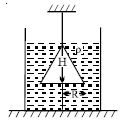
$A$ cone of radius $R$ and height $H$ is hanging inside a liquid of density $\rho$ by means of a string,as shown in the figure. The force due to the liquid acting on the slant surface of the cone is:
A
$\rho \pi gHR^2$
B
$\pi \rho HR^2$
C
$\frac{4}{3} \pi \rho gHR^2$
D
$\frac{2}{3} \pi \rho gHR^2$
Solution
(C) The force exerted by the liquid on the base of the cone is $F_{base} = P \cdot A = (\rho g H) \cdot (\pi R^2) = \pi \rho g H R^2$.
The buoyant force $F_B$ acting on the cone is equal to the weight of the displaced liquid,which is $F_B = V \rho g = \frac{1}{3} \pi R^2 H \rho g$.
The buoyant force is the net upward force exerted by the liquid on the entire surface of the cone. It is the difference between the upward force on the slant surface $(F_{slant})$ and the downward force on the base $(F_{base})$,or vice versa depending on orientation. In this configuration,the liquid exerts a downward force on the base and an upward force on the slant surface.
Thus,$F_B = F_{slant} - F_{base}$.
$F_{slant} = F_B + F_{base} = \frac{1}{3} \pi R^2 H \rho g + \pi R^2 H \rho g = \frac{4}{3} \pi \rho g H R^2$.
The buoyant force $F_B$ acting on the cone is equal to the weight of the displaced liquid,which is $F_B = V \rho g = \frac{1}{3} \pi R^2 H \rho g$.
The buoyant force is the net upward force exerted by the liquid on the entire surface of the cone. It is the difference between the upward force on the slant surface $(F_{slant})$ and the downward force on the base $(F_{base})$,or vice versa depending on orientation. In this configuration,the liquid exerts a downward force on the base and an upward force on the slant surface.
Thus,$F_B = F_{slant} - F_{base}$.
$F_{slant} = F_B + F_{base} = \frac{1}{3} \pi R^2 H \rho g + \pi R^2 H \rho g = \frac{4}{3} \pi \rho g H R^2$.
0 likes
View Solution57
DifficultMCQ
$A$ heavy hollow cone of radius $R$ and height $h$ is placed on a horizontal table surface,with its flat base on the table. The whole volume inside the cone is filled with water of density $\rho$. The circular rim of the cone's base has a watertight seal with the table's surface and the top apex of the cone has a small hole. Neglecting atmospheric pressure,find the total upward force exerted by water on the cone.
A
$(2/3) \pi R^2 h \rho g$
B
$(1/3) \pi R^2 h \rho g$
C
$\pi R^2 h \rho g$
D
None
Solution
(A) Consider the equilibrium of the water inside the cone.
The forces acting on the water are:
$1$. The weight of the water acting downwards: $W = V \rho g = (\frac{1}{3} \pi R^2 h) \rho g$.
$2$. The upward force exerted by the table on the water: $F_{\text{table}} = P \times A = (\rho g h) \times (\pi R^2) = \pi R^2 h \rho g$.
$3$. The downward force exerted by the slanted walls of the cone on the water: $F_{\text{walls}}$.
For the water to be in equilibrium,the net vertical force must be zero:
$F_{\text{table}} - W - F_{\text{walls}} = 0$
By Newton's third law,the force exerted by the water on the cone walls is equal and opposite to the force exerted by the walls on the water. Thus,the upward force exerted by the water on the cone is equal to the downward force exerted by the walls on the water:
$F_{\text{upward}} = F_{\text{walls}} = F_{\text{table}} - W$
$F_{\text{upward}} = \pi R^2 h \rho g - \frac{1}{3} \pi R^2 h \rho g$
$F_{\text{upward}} = \frac{2}{3} \pi R^2 h \rho g$.
The forces acting on the water are:
$1$. The weight of the water acting downwards: $W = V \rho g = (\frac{1}{3} \pi R^2 h) \rho g$.
$2$. The upward force exerted by the table on the water: $F_{\text{table}} = P \times A = (\rho g h) \times (\pi R^2) = \pi R^2 h \rho g$.
$3$. The downward force exerted by the slanted walls of the cone on the water: $F_{\text{walls}}$.
For the water to be in equilibrium,the net vertical force must be zero:
$F_{\text{table}} - W - F_{\text{walls}} = 0$
By Newton's third law,the force exerted by the water on the cone walls is equal and opposite to the force exerted by the walls on the water. Thus,the upward force exerted by the water on the cone is equal to the downward force exerted by the walls on the water:
$F_{\text{upward}} = F_{\text{walls}} = F_{\text{table}} - W$
$F_{\text{upward}} = \pi R^2 h \rho g - \frac{1}{3} \pi R^2 h \rho g$
$F_{\text{upward}} = \frac{2}{3} \pi R^2 h \rho g$.
0 likes
View Solution58
AdvancedMCQ
Two cubes of size $1.0 \ m$ sides,one of relative density $0.60$ and another of relative density $1.15$ are connected by a weightless wire and placed in a large tank of water. Under equilibrium,the lighter cube will project above the water surface to a height of ........ $cm$.
A
$50$
B
$25$
C
$10$
D
$0$
Solution
(B) Given two cubes of side $1 \ m$ each with relative densities $\rho_A = 0.60$ and $\rho_B = 1.15$ respectively.
Since $\rho_A < 1$ and $\rho_B > 1$,the lighter cube $(A)$ tends to float while the heavier cube $(B)$ tends to sink. In equilibrium,the system is connected by a wire,so both cubes are in the water.
Let $x$ be the height of the lighter cube $A$ above the water surface. The volume of $A$ submerged is $(1-x) \ m^3$.
The total downward force (weight) is $W = W_A + W_B = (\rho_A V + \rho_B V) \rho_w g = (0.60 + 1.15) \times 1^3 \times \rho_w g = 1.75 \rho_w g$.
The total upward force (buoyancy) is $F_B = B_A + B_B = \rho_w g V_{sub,A} + \rho_w g V_{sub,B} = \rho_w g (1-x) + \rho_w g (1) = \rho_w g (2-x)$.
Equating upward and downward forces: $\rho_w g (2-x) = 1.75 \rho_w g$.
$2 - x = 1.75$.
$x = 0.25 \ m = 25 \ cm$.
Thus,the lighter cube projects $25 \ cm$ above the water surface.
Since $\rho_A < 1$ and $\rho_B > 1$,the lighter cube $(A)$ tends to float while the heavier cube $(B)$ tends to sink. In equilibrium,the system is connected by a wire,so both cubes are in the water.
Let $x$ be the height of the lighter cube $A$ above the water surface. The volume of $A$ submerged is $(1-x) \ m^3$.
The total downward force (weight) is $W = W_A + W_B = (\rho_A V + \rho_B V) \rho_w g = (0.60 + 1.15) \times 1^3 \times \rho_w g = 1.75 \rho_w g$.
The total upward force (buoyancy) is $F_B = B_A + B_B = \rho_w g V_{sub,A} + \rho_w g V_{sub,B} = \rho_w g (1-x) + \rho_w g (1) = \rho_w g (2-x)$.
Equating upward and downward forces: $\rho_w g (2-x) = 1.75 \rho_w g$.
$2 - x = 1.75$.
$x = 0.25 \ m = 25 \ cm$.
Thus,the lighter cube projects $25 \ cm$ above the water surface.
0 likes
View Solution59
AdvancedMCQ
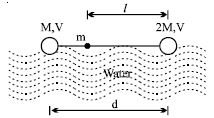
$A$ dumbbell is placed in water of density $\rho$. It is observed that by attaching a mass $m$ to the rod,the dumbbell floats with the rod horizontal on the surface of water and each sphere exactly half submerged as shown in the figure. The volume of the mass $m$ is negligible. The value of length $l$ is
A
$\frac{d(\rho V - 3M)}{2(\rho V - 2M)}$
B
$\frac{d(\rho V - 2M)}{2(\rho V - 3M)}$
C
$\frac{d(\rho V + 2M)}{2(\rho V - 3M)}$
D
$\frac{d(\rho V - 2M)}{2(\rho V + 3M)}$
Solution
(B) For equilibrium,the total downward force (weight) must equal the total upward force (buoyant force).
Let $V$ be the volume of each sphere. The buoyant force on each half-submerged sphere is $F_B = \rho (V/2) g$.
Total weight = $Mg + 2Mg + mg = (3M + m)g$.
Total buoyant force = $2 \times (\rho V/2) g = \rho V g$.
Equating forces: $(3M + m)g = \rho V g \implies m = \rho V - 3M$.
Taking torque about the position of mass $m$ (at distance $l$ from the sphere of mass $2M$ and distance $(d-l)$ from the sphere of mass $M$):
Torque due to sphere $M$: $\tau_1 = (\rho V/2 g - Mg)(d - l)$.
Torque due to sphere $2M$: $\tau_2 = (\rho V/2 g - 2Mg)l$.
For rotational equilibrium,$\tau_1 = \tau_2$:
$(\rho V/2 - M)g(d - l) = (\rho V/2 - 2M)gl$.
$(\rho V - 2M)(d - l) = (\rho V - 4M)l$.
$(\rho V - 2M)d - (\rho V - 2M)l = (\rho V - 4M)l$.
$(\rho V - 2M)d = (\rho V - 4M + \rho V - 2M)l = (2\rho V - 6M)l$.
$l = \frac{d(\rho V - 2M)}{2(\rho V - 3M)}$.
Let $V$ be the volume of each sphere. The buoyant force on each half-submerged sphere is $F_B = \rho (V/2) g$.
Total weight = $Mg + 2Mg + mg = (3M + m)g$.
Total buoyant force = $2 \times (\rho V/2) g = \rho V g$.
Equating forces: $(3M + m)g = \rho V g \implies m = \rho V - 3M$.
Taking torque about the position of mass $m$ (at distance $l$ from the sphere of mass $2M$ and distance $(d-l)$ from the sphere of mass $M$):
Torque due to sphere $M$: $\tau_1 = (\rho V/2 g - Mg)(d - l)$.
Torque due to sphere $2M$: $\tau_2 = (\rho V/2 g - 2Mg)l$.
For rotational equilibrium,$\tau_1 = \tau_2$:
$(\rho V/2 - M)g(d - l) = (\rho V/2 - 2M)gl$.
$(\rho V - 2M)(d - l) = (\rho V - 4M)l$.
$(\rho V - 2M)d - (\rho V - 2M)l = (\rho V - 4M)l$.
$(\rho V - 2M)d = (\rho V - 4M + \rho V - 2M)l = (2\rho V - 6M)l$.
$l = \frac{d(\rho V - 2M)}{2(\rho V - 3M)}$.
0 likes
View Solution60
MediumMCQ
Two bodies having volumes $V$ and $2V$ are suspended from the two arms of a common balance and they are found to balance each other. If the larger body is immersed in oil (density $d_1 = 0.9 \ gm/cm^3$) and the smaller body is immersed in an unknown liquid,the balance remains in equilibrium. The density of the unknown liquid is given by ......... $gm/cm^3$.
A
$2.4$
B
$1.8$
C
$0.45$
D
$2.7$
Solution
(B) Let the masses of the two bodies be $m_1$ and $m_2$. Since they balance each other initially,$m_1 = m_2$.
When immersed in liquids,the effective weight of each body becomes $W_{eff} = W - F_B$,where $F_B$ is the buoyant force.
For the balance to remain in equilibrium,the buoyant forces acting on the two bodies must be equal because the initial weights were equal.
Buoyant force on the larger body (volume $2V$) in oil (density $d_1 = 0.9 \ gm/cm^3$) is $F_{B1} = (2V) \times 0.9 \times g$.
Buoyant force on the smaller body (volume $V$) in the unknown liquid (density $\rho$) is $F_{B2} = V \times \rho \times g$.
Equating $F_{B1}$ and $F_{B2}$:
$2V \times 0.9 \times g = V \times \rho \times g$.
Solving for $\rho$:
$\rho = 2 \times 0.9 = 1.8 \ gm/cm^3$.
When immersed in liquids,the effective weight of each body becomes $W_{eff} = W - F_B$,where $F_B$ is the buoyant force.
For the balance to remain in equilibrium,the buoyant forces acting on the two bodies must be equal because the initial weights were equal.
Buoyant force on the larger body (volume $2V$) in oil (density $d_1 = 0.9 \ gm/cm^3$) is $F_{B1} = (2V) \times 0.9 \times g$.
Buoyant force on the smaller body (volume $V$) in the unknown liquid (density $\rho$) is $F_{B2} = V \times \rho \times g$.
Equating $F_{B1}$ and $F_{B2}$:
$2V \times 0.9 \times g = V \times \rho \times g$.
Solving for $\rho$:
$\rho = 2 \times 0.9 = 1.8 \ gm/cm^3$.
0 likes
View Solution61
AdvancedMCQ
$A$ container of large surface area is filled with a liquid of density $\rho$. $A$ cubical block of side edge $a$ and mass $M$ is floating in it with four-fifths of its volume submerged. If a coin of mass $m$ is placed gently on the top surface of the block,it is just submerged. $M$ is:
A
$4m/5$
B
$m/5$
C
$4m$
D
$5m$
Solution
(C) Let the volume of the block be $V$. When it is placed in the liquid,four-fifths of its volume is submerged.
According to the principle of floatation,the weight of the block equals the weight of the liquid displaced:
$Mg = \frac{4}{5} V \rho g$ --- $(I)$
When a coin of mass $m$ is placed gently on the top surface of the block,the block is just submerged. This means the total weight of the block and the coin is equal to the weight of the liquid displaced by the entire volume $V$ of the block:
$(M + m)g = V \rho g$ --- $(II)$
Dividing equation $(I)$ by equation $(II)$:
$\frac{Mg}{(M + m)g} = \frac{\frac{4}{5} V \rho g}{V \rho g}$
$\frac{M}{M + m} = \frac{4}{5}$
$5M = 4(M + m)$
$5M = 4M + 4m$
$M = 4m$
According to the principle of floatation,the weight of the block equals the weight of the liquid displaced:
$Mg = \frac{4}{5} V \rho g$ --- $(I)$
When a coin of mass $m$ is placed gently on the top surface of the block,the block is just submerged. This means the total weight of the block and the coin is equal to the weight of the liquid displaced by the entire volume $V$ of the block:
$(M + m)g = V \rho g$ --- $(II)$
Dividing equation $(I)$ by equation $(II)$:
$\frac{Mg}{(M + m)g} = \frac{\frac{4}{5} V \rho g}{V \rho g}$
$\frac{M}{M + m} = \frac{4}{5}$
$5M = 4(M + m)$
$5M = 4M + 4m$
$M = 4m$
0 likes
View Solution62
MediumMCQ
$A$ boy carries a fish in one hand and a bucket (not full) of water in the other hand. If he places the fish in the bucket,the weight now carried by him (assume that water does not spill) is:
A
is less than before
B
is more than before
C
is the same as before
D
depends upon his speed
Solution
(C) The total weight carried by the boy is the sum of the weights of the boy's hands,the bucket,the water,and the fish.
When the fish is placed in the bucket,the system consisting of the bucket,water,and fish remains the same in terms of total mass.
Since the total mass of the system (bucket + water + fish) does not change,the total weight exerted on the boy's hands remains constant.
The buoyant force acting on the fish is an internal force within the bucket-water-fish system and does not affect the total weight supported by the boy.
Therefore,the weight carried by him remains the same as before.
When the fish is placed in the bucket,the system consisting of the bucket,water,and fish remains the same in terms of total mass.
Since the total mass of the system (bucket + water + fish) does not change,the total weight exerted on the boy's hands remains constant.
The buoyant force acting on the fish is an internal force within the bucket-water-fish system and does not affect the total weight supported by the boy.
Therefore,the weight carried by him remains the same as before.
0 likes
View Solution63
MediumMCQ
$A$ cork of density $0.5 \, g/cm^3$ floats on a calm swimming pool. The fraction of the cork's volume which is under water is ........ $\%$
A
$0$
B
$25$
C
$10$
D
$50$
Solution
(D) Let $V$ be the total volume of the cork and $f$ be the fraction of the volume submerged under water.
According to the law of floatation, the weight of the floating object is equal to the weight of the fluid displaced by it.
Weight of cork = Weight of water displaced
$V \times \rho_{\text{cork}} \times g = (f \times V) \times \rho_{\text{water}} \times g$
Given $\rho_{\text{cork}} = 0.5 \, g/cm^3$ and $\rho_{\text{water}} = 1 \, g/cm^3$.
Substituting the values:
$V \times 0.5 \times g = f \times V \times 1 \times g$
$0.5 = f$
Therefore, the fraction of the volume submerged is $0.5$, which is $50 \%$.
According to the law of floatation, the weight of the floating object is equal to the weight of the fluid displaced by it.
Weight of cork = Weight of water displaced
$V \times \rho_{\text{cork}} \times g = (f \times V) \times \rho_{\text{water}} \times g$
Given $\rho_{\text{cork}} = 0.5 \, g/cm^3$ and $\rho_{\text{water}} = 1 \, g/cm^3$.
Substituting the values:
$V \times 0.5 \times g = f \times V \times 1 \times g$
$0.5 = f$
Therefore, the fraction of the volume submerged is $0.5$, which is $50 \%$.
0 likes
View Solution64
AdvancedMCQ
Two cylinders of same cross-section and length $L$ but made of two materials of densities $d_1$ and $d_2$ are cemented together to form a cylinder of length $2L$. The combination floats in a liquid of density $d$ with a length $L/2$ above the surface of the liquid. If $d_1 > d_2$,then:
A
$d > \frac{3}{4} d_1$
B
$\frac{d}{2} > d_1$
C
$\frac{d}{4} > d_1$
D
$d_1 > \frac{3}{4} d$
Solution
(D) According to the law of floatation,a body floats if the weight of the body is equal to the weight of the liquid displaced.
Let $A$ be the cross-sectional area of the cylinders.
The total weight of the combined cylinder is $W = (d_1 L A + d_2 L A)g = (d_1 + d_2) L A g$.
The length of the cylinder inside the liquid is $2L - L/2 = 3L/2$.
The weight of the liquid displaced is $W_{disp} = (3L/2) A d g$.
Equating the two,we get $(d_1 + d_2) L A g = (3L/2) A d g$,which simplifies to $d_1 + d_2 = \frac{3}{2} d$.
Thus,$d_2 = \frac{3}{2} d - d_1$.
Given $d_1 > d_2$,we substitute the expression for $d_2$: $d_1 > \frac{3}{2} d - d_1$.
Adding $d_1$ to both sides: $2 d_1 > \frac{3}{2} d$.
Dividing by $2$: $d_1 > \frac{3}{4} d$.
Let $A$ be the cross-sectional area of the cylinders.
The total weight of the combined cylinder is $W = (d_1 L A + d_2 L A)g = (d_1 + d_2) L A g$.
The length of the cylinder inside the liquid is $2L - L/2 = 3L/2$.
The weight of the liquid displaced is $W_{disp} = (3L/2) A d g$.
Equating the two,we get $(d_1 + d_2) L A g = (3L/2) A d g$,which simplifies to $d_1 + d_2 = \frac{3}{2} d$.
Thus,$d_2 = \frac{3}{2} d - d_1$.
Given $d_1 > d_2$,we substitute the expression for $d_2$: $d_1 > \frac{3}{2} d - d_1$.
Adding $d_1$ to both sides: $2 d_1 > \frac{3}{2} d$.
Dividing by $2$: $d_1 > \frac{3}{4} d$.
0 likes
View Solution65
DifficultMCQ
$A$ piece of steel has a weight $W$ in air,$W_1$ when completely immersed in water,and $W_2$ when completely immersed in an unknown liquid. The relative density (specific gravity) of the liquid is:
A
$\frac{W - W_1}{W - W_2}$
B
$\frac{W - W_2}{W - W_1}$
C
$\frac{W_1 - W_2}{W - W_1}$
D
$\frac{W_1 - W_2}{W - W_2}$
Solution
(B) Let $V$ be the volume of the steel piece,$\rho_w$ be the density of water,and $\rho_L$ be the density of the unknown liquid.
According to Archimedes' principle,the apparent weight of an object immersed in a fluid is $W_{apparent} = W - F_B$,where $F_B$ is the buoyant force.
For water: $W_1 = W - V \rho_w g \implies W - W_1 = V \rho_w g$ (Equation $1$).
For the unknown liquid: $W_2 = W - V \rho_L g \implies W - W_2 = V \rho_L g$ (Equation $2$).
The relative density $(RD)$ of the liquid is defined as the ratio of the density of the liquid to the density of water: $RD = \frac{\rho_L}{\rho_w}$.
Dividing Equation $2$ by Equation $1$: $\frac{W - W_2}{W - W_1} = \frac{V \rho_L g}{V \rho_w g} = \frac{\rho_L}{\rho_w}$.
Therefore,$RD = \frac{W - W_2}{W - W_1}$.
According to Archimedes' principle,the apparent weight of an object immersed in a fluid is $W_{apparent} = W - F_B$,where $F_B$ is the buoyant force.
For water: $W_1 = W - V \rho_w g \implies W - W_1 = V \rho_w g$ (Equation $1$).
For the unknown liquid: $W_2 = W - V \rho_L g \implies W - W_2 = V \rho_L g$ (Equation $2$).
The relative density $(RD)$ of the liquid is defined as the ratio of the density of the liquid to the density of water: $RD = \frac{\rho_L}{\rho_w}$.
Dividing Equation $2$ by Equation $1$: $\frac{W - W_2}{W - W_1} = \frac{V \rho_L g}{V \rho_w g} = \frac{\rho_L}{\rho_w}$.
Therefore,$RD = \frac{W - W_2}{W - W_1}$.
0 likes
View Solution66
MediumMCQ
$A$ ball of relative density $0.8$ falls into water from a height of $2 \ m$. The depth to which the ball will sink is ........ $m$ (neglect viscous forces):
A
$8$
B
$2$
C
$6$
D
$4$
Solution
(A) Let the density of the ball be $\rho_b = 0.8 \rho_w$ and the density of water be $\rho_w$. The height from which it falls is $h = 2 \ m$.
When the ball hits the water surface,its velocity $v$ is given by $v^2 = 2gh = 2 \times g \times 2 = 4g$.
Inside the water,the forces acting on the ball are gravity ($mg$ downwards) and buoyancy ($F_B = V \rho_w g$ upwards).
The net force $F_{net} = F_B - mg = V \rho_w g - (V \rho_b) g = V g (\rho_w - 0.8 \rho_w) = 0.2 V \rho_w g$.
The mass of the ball is $m = V \rho_b = 0.8 V \rho_w$.
The retardation $a$ inside the water is $a = \frac{F_{net}}{m} = \frac{0.2 V \rho_w g}{0.8 V \rho_w} = \frac{0.2}{0.8} g = \frac{g}{4}$ (upwards).
Using the equation of motion $v^2 = 2as$,where $v^2 = 4g$ and $a = -g/4$ (since it is retardation):
$0 = v^2 - 2as_{depth} \Rightarrow 4g = 2 \times (g/4) \times s_{depth}$.
$4g = \frac{g}{2} \times s_{depth} \Rightarrow s_{depth} = 8 \ m$.
When the ball hits the water surface,its velocity $v$ is given by $v^2 = 2gh = 2 \times g \times 2 = 4g$.
Inside the water,the forces acting on the ball are gravity ($mg$ downwards) and buoyancy ($F_B = V \rho_w g$ upwards).
The net force $F_{net} = F_B - mg = V \rho_w g - (V \rho_b) g = V g (\rho_w - 0.8 \rho_w) = 0.2 V \rho_w g$.
The mass of the ball is $m = V \rho_b = 0.8 V \rho_w$.
The retardation $a$ inside the water is $a = \frac{F_{net}}{m} = \frac{0.2 V \rho_w g}{0.8 V \rho_w} = \frac{0.2}{0.8} g = \frac{g}{4}$ (upwards).
Using the equation of motion $v^2 = 2as$,where $v^2 = 4g$ and $a = -g/4$ (since it is retardation):
$0 = v^2 - 2as_{depth} \Rightarrow 4g = 2 \times (g/4) \times s_{depth}$.
$4g = \frac{g}{2} \times s_{depth} \Rightarrow s_{depth} = 8 \ m$.
0 likes
View Solution67
AdvancedMCQ
$A$ small wooden ball of density $\rho$ is immersed in water of density $\sigma$ to a depth $h$ and then released. The height $H$ above the surface of water up to which the ball will jump out of water is
A
$\frac{\sigma h}{\rho}$
B
$\left( \frac{\sigma}{\rho} - 1 \right) h$
C
$h$
D
zero
Solution
(B) The net upward force acting on the body is $F = \sigma V g - \rho V g$.
Using Newton's second law,$ma = F$,where $m = \rho V$:
$\rho V a = V g(\sigma - \rho)$
$a = g \left( \frac{\sigma}{\rho} - 1 \right)$.
The velocity $v$ of the ball when it reaches the surface after traveling distance $h$ is given by $v^2 = 2ah$:
$v^2 = 2g \left( \frac{\sigma}{\rho} - 1 \right) h$.
Once the ball leaves the water,it moves under gravity. Let $H$ be the height it reaches above the surface. By conservation of energy,the kinetic energy at the surface equals the potential energy at height $H$:
$\frac{1}{2} m v^2 = m g H$
$H = \frac{v^2}{2g} = \frac{2g \left( \frac{\sigma}{\rho} - 1 \right) h}{2g}$
$H = \left( \frac{\sigma}{\rho} - 1 \right) h$.
Using Newton's second law,$ma = F$,where $m = \rho V$:
$\rho V a = V g(\sigma - \rho)$
$a = g \left( \frac{\sigma}{\rho} - 1 \right)$.
The velocity $v$ of the ball when it reaches the surface after traveling distance $h$ is given by $v^2 = 2ah$:
$v^2 = 2g \left( \frac{\sigma}{\rho} - 1 \right) h$.
Once the ball leaves the water,it moves under gravity. Let $H$ be the height it reaches above the surface. By conservation of energy,the kinetic energy at the surface equals the potential energy at height $H$:
$\frac{1}{2} m v^2 = m g H$
$H = \frac{v^2}{2g} = \frac{2g \left( \frac{\sigma}{\rho} - 1 \right) h}{2g}$
$H = \left( \frac{\sigma}{\rho} - 1 \right) h$.
0 likes
View Solution68
AdvancedMCQ
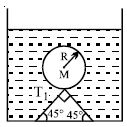
$A$ hollow sphere of mass $M$ and radius $R$ is immersed in a tank of water (density $\rho_w$). The sphere would float if it were set free. The sphere is tied to the bottom of the tank by two wires which make an angle of $45^{\circ}$ with the horizontal as shown in the figure. The tension $T_1$ in each wire is:
A
$\frac{\frac{4}{3}\pi R^3 \rho_w g - Mg}{\sqrt{2}}$
B
$\frac{2}{3}\pi R^3 \rho_w g - Mg$
C
$\frac{\frac{4}{3}\pi R^3 \rho_w g - Mg}{2}$
D
$\frac{4}{3}\pi R^3 \rho_w g + Mg$
Solution
(A) The forces acting on the sphere are:
$1$. The buoyant force $B$ acting vertically upwards,given by $B = V_{disp} \rho_w g = \frac{4}{3} \pi R^3 \rho_w g$.
$2$. The weight of the sphere $W = Mg$ acting vertically downwards.
$3$. The tension $T_1$ in each of the two wires,acting at an angle of $45^{\circ}$ with the horizontal.
For the sphere to be in equilibrium,the sum of vertical forces must be zero:
$2 T_1 \sin 45^{\circ} + Mg = B$
$2 T_1 \sin 45^{\circ} = B - Mg$
Substituting the values:
$2 T_1 \times \frac{1}{\sqrt{2}} = \frac{4}{3} \pi R^3 \rho_w g - Mg$
$T_1 \sqrt{2} = \frac{4}{3} \pi R^3 \rho_w g - Mg$
$T_1 = \frac{\frac{4}{3} \pi R^3 \rho_w g - Mg}{\sqrt{2}}$
$1$. The buoyant force $B$ acting vertically upwards,given by $B = V_{disp} \rho_w g = \frac{4}{3} \pi R^3 \rho_w g$.
$2$. The weight of the sphere $W = Mg$ acting vertically downwards.
$3$. The tension $T_1$ in each of the two wires,acting at an angle of $45^{\circ}$ with the horizontal.
For the sphere to be in equilibrium,the sum of vertical forces must be zero:
$2 T_1 \sin 45^{\circ} + Mg = B$
$2 T_1 \sin 45^{\circ} = B - Mg$
Substituting the values:
$2 T_1 \times \frac{1}{\sqrt{2}} = \frac{4}{3} \pi R^3 \rho_w g - Mg$
$T_1 \sqrt{2} = \frac{4}{3} \pi R^3 \rho_w g - Mg$
$T_1 = \frac{\frac{4}{3} \pi R^3 \rho_w g - Mg}{\sqrt{2}}$
0 likes
View Solution69
DifficultMCQ
$A$ metal ball of density $7800 \ kg/m^3$ is suspected to have a large number of cavities. It weighs $9.8 \ kg$ when weighed in air and $1.5 \ kg$ less when immersed in water. The fraction by volume of the cavities in the metal ball is approximately ....... $\%$
A
$20$
B
$30$
C
$16$
D
$11$
Solution
(C) Let $V_s$ be the volume of the solid metal and $V_c$ be the volume of the cavities. The total volume of the ball is $V = V_s + V_c$.
The mass of the ball is $M = 9.8 \ kg$. Since the density of the metal is $\rho_m = 7800 \ kg/m^3$, the volume of the solid part is $V_s = M / \rho_m = 9.8 / 7800 \ m^3$.
When immersed in water, the buoyant force equals the weight of the displaced water, which is $1.5 \ kg \times g$. Thus, the total volume $V = V_s + V_c = 1.5 / \rho_w$, where $\rho_w = 1000 \ kg/m^3$.
So, $V = 1.5 / 1000 = 0.0015 \ m^3$.
The volume of the solid part is $V_s = 9.8 / 7800 \approx 0.001256 \ m^3$.
The volume of the cavities is $V_c = V - V_s = 0.0015 - 0.001256 = 0.000244 \ m^3$.
The fraction of the volume of the cavities is $(V_c / V) \times 100 = (0.000244 / 0.0015) \times 100 \approx 16.26 \%$.
Therefore, the fraction is approximately $16 \%$.
The mass of the ball is $M = 9.8 \ kg$. Since the density of the metal is $\rho_m = 7800 \ kg/m^3$, the volume of the solid part is $V_s = M / \rho_m = 9.8 / 7800 \ m^3$.
When immersed in water, the buoyant force equals the weight of the displaced water, which is $1.5 \ kg \times g$. Thus, the total volume $V = V_s + V_c = 1.5 / \rho_w$, where $\rho_w = 1000 \ kg/m^3$.
So, $V = 1.5 / 1000 = 0.0015 \ m^3$.
The volume of the solid part is $V_s = 9.8 / 7800 \approx 0.001256 \ m^3$.
The volume of the cavities is $V_c = V - V_s = 0.0015 - 0.001256 = 0.000244 \ m^3$.
The fraction of the volume of the cavities is $(V_c / V) \times 100 = (0.000244 / 0.0015) \times 100 \approx 16.26 \%$.
Therefore, the fraction is approximately $16 \%$.
0 likes
View Solution70
AdvancedMCQ
$A$ sphere of radius $R$ made of a material of relative density $\sigma$ has a concentric cavity of radius $r$. It just floats when placed in a tank full of water. The value of the ratio $R/r$ will be:
A
$(\frac{\sigma}{\sigma - 1})^{1/3}$
B
$(\frac{\sigma - 1}{\sigma})^{1/3}$
C
$(\frac{\sigma + 1}{\sigma})^{1/3}$
D
$(\frac{\sigma - 1}{\sigma + 1})^{1/3}$
Solution
(A) According to the law of floatation,a body floats if the weight of the body is equal to the weight of the water displaced.
$W_{\text{body}} = W_{\text{water displaced}}$
$V_{\text{solid}} \cdot \rho_{\text{solid}} \cdot g = V_{\text{displaced}} \cdot \rho_{\text{water}} \cdot g$
Here,the volume of the solid material is $V_{\text{solid}} = \frac{4}{3}\pi(R^3 - r^3)$ and the volume of water displaced is $V_{\text{displaced}} = \frac{4}{3}\pi R^3$.
Given relative density $\sigma = \frac{\rho_{\text{solid}}}{\rho_{\text{water}}}$,we have $\rho_{\text{solid}} = \sigma \rho_{\text{water}}$.
Substituting these into the equation:
$\frac{4}{3}\pi(R^3 - r^3) \cdot \sigma \rho_{\text{water}} \cdot g = \frac{4}{3}\pi R^3 \cdot \rho_{\text{water}} \cdot g$
$\sigma(R^3 - r^3) = R^3$
$\sigma R^3 - \sigma r^3 = R^3$
$R^3(\sigma - 1) = \sigma r^3$
$\frac{R^3}{r^3} = \frac{\sigma}{\sigma - 1}$
$\frac{R}{r} = (\frac{\sigma}{\sigma - 1})^{1/3}$
$W_{\text{body}} = W_{\text{water displaced}}$
$V_{\text{solid}} \cdot \rho_{\text{solid}} \cdot g = V_{\text{displaced}} \cdot \rho_{\text{water}} \cdot g$
Here,the volume of the solid material is $V_{\text{solid}} = \frac{4}{3}\pi(R^3 - r^3)$ and the volume of water displaced is $V_{\text{displaced}} = \frac{4}{3}\pi R^3$.
Given relative density $\sigma = \frac{\rho_{\text{solid}}}{\rho_{\text{water}}}$,we have $\rho_{\text{solid}} = \sigma \rho_{\text{water}}$.
Substituting these into the equation:
$\frac{4}{3}\pi(R^3 - r^3) \cdot \sigma \rho_{\text{water}} \cdot g = \frac{4}{3}\pi R^3 \cdot \rho_{\text{water}} \cdot g$
$\sigma(R^3 - r^3) = R^3$
$\sigma R^3 - \sigma r^3 = R^3$
$R^3(\sigma - 1) = \sigma r^3$
$\frac{R^3}{r^3} = \frac{\sigma}{\sigma - 1}$
$\frac{R}{r} = (\frac{\sigma}{\sigma - 1})^{1/3}$
0 likes
View Solution71
DifficultMCQ
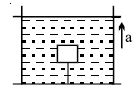
$A$ body having volume $V$ and density $\rho$ is attached to the bottom of a container as shown. The density of the liquid is $d$ (where $d > \rho$). The container has a constant upward acceleration $a$. The tension in the string is:
A
$V[d(g+a) - \rho(g+a)]$
B
$V(g+a)(d - \rho)$
C
$V(d - \rho)g$
D
None of these
Solution
(B) When a container is accelerating upwards with acceleration $a$,the effective acceleration due to gravity becomes $g_{eff} = (g+a)$.
The weight of the body in this frame is $W = m g_{eff} = (\rho V)(g+a)$.
The buoyant force (upthrust) acting on the body is $F_B = V d g_{eff} = V d (g+a)$.
Since the body is attached to the bottom by a string and $d > \rho$,the buoyant force is greater than the weight,so the string will be in tension.
Applying Newton's second law for the body in the accelerating frame:
$T + W = F_B$
$T = F_B - W$
$T = V d (g+a) - V \rho (g+a)$
$T = V(g+a)(d - \rho)$
The weight of the body in this frame is $W = m g_{eff} = (\rho V)(g+a)$.
The buoyant force (upthrust) acting on the body is $F_B = V d g_{eff} = V d (g+a)$.
Since the body is attached to the bottom by a string and $d > \rho$,the buoyant force is greater than the weight,so the string will be in tension.
Applying Newton's second law for the body in the accelerating frame:
$T + W = F_B$
$T = F_B - W$
$T = V d (g+a) - V \rho (g+a)$
$T = V(g+a)(d - \rho)$
0 likes
View Solution72
AdvancedMCQ
$A$ hollow cone floats with its axis vertical up to one-third of its height in a liquid of relative density $0.8$ and with its vertex submerged. When another liquid of relative density $\rho$ is filled in it up to one-third of its height,the cone floats up to half its vertical height. The height of the cone is $0.10 \ m$ and the radius of the circular base is $0.05 \ m$. The specific gravity $\rho$ is given by
A
$1.0$
B
$1.5$
C
$2.1$
D
$1.9$
Solution
(D) Let $H = 0.1 \ m$ be the height and $R = 0.05 \ m$ be the base radius of the cone. The radius $r$ at any height $y$ from the vertex is given by $r = (R/H)y = (0.05/0.1)y = 0.5y$.
Case $1$: The cone floats in a liquid of relative density $\sigma_1 = 0.8$ with depth $h_1 = H/3$. The volume of the submerged part is $V_1 = \frac{1}{3} \pi r_1^2 h_1$,where $r_1 = 0.5(H/3) = R/3$. Thus,$V_1 = \frac{1}{3} \pi (R/3)^2 (H/3) = \frac{1}{27} (\frac{1}{3} \pi R^2 H)$.
By the principle of floatation,the weight of the cone $W = \text{Buoyant force} = \sigma_1 \rho_w V_1 g$,where $\rho_w$ is the density of water. So,$W = 0.8 \rho_w g V_1$.
Case $2$: Liquid of relative density $\rho$ is filled inside up to $h_2 = H/3$. The weight of this liquid is $W_L = \rho \rho_w V_2 g$,where $V_2 = \frac{1}{3} \pi (R/3)^2 (H/3) = V_1$. The cone now floats with depth $h_3 = H/2$. The new buoyant force is $F_B = \sigma_1 \rho_w V_3 g$,where $V_3 = \frac{1}{3} \pi (R/2)^2 (H/2) = \frac{1}{8} (\frac{1}{3} \pi R^2 H) = \frac{27}{8} V_1$.
Force balance: $W + W_L = F_B$
$0.8 \rho_w g V_1 + \rho \rho_w g V_1 = 0.8 \rho_w g (\frac{27}{8} V_1)$
$0.8 + \rho = 0.8 \times \frac{27}{8} = 0.1 \times 27 = 2.7$
$\rho = 2.7 - 0.8 = 1.9$.
Case $1$: The cone floats in a liquid of relative density $\sigma_1 = 0.8$ with depth $h_1 = H/3$. The volume of the submerged part is $V_1 = \frac{1}{3} \pi r_1^2 h_1$,where $r_1 = 0.5(H/3) = R/3$. Thus,$V_1 = \frac{1}{3} \pi (R/3)^2 (H/3) = \frac{1}{27} (\frac{1}{3} \pi R^2 H)$.
By the principle of floatation,the weight of the cone $W = \text{Buoyant force} = \sigma_1 \rho_w V_1 g$,where $\rho_w$ is the density of water. So,$W = 0.8 \rho_w g V_1$.
Case $2$: Liquid of relative density $\rho$ is filled inside up to $h_2 = H/3$. The weight of this liquid is $W_L = \rho \rho_w V_2 g$,where $V_2 = \frac{1}{3} \pi (R/3)^2 (H/3) = V_1$. The cone now floats with depth $h_3 = H/2$. The new buoyant force is $F_B = \sigma_1 \rho_w V_3 g$,where $V_3 = \frac{1}{3} \pi (R/2)^2 (H/2) = \frac{1}{8} (\frac{1}{3} \pi R^2 H) = \frac{27}{8} V_1$.
Force balance: $W + W_L = F_B$
$0.8 \rho_w g V_1 + \rho \rho_w g V_1 = 0.8 \rho_w g (\frac{27}{8} V_1)$
$0.8 + \rho = 0.8 \times \frac{27}{8} = 0.1 \times 27 = 2.7$
$\rho = 2.7 - 0.8 = 1.9$.
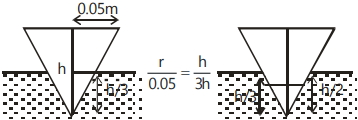
0 likes
View Solution73
MediumMCQ
$A$ beaker containing water is placed on the platform of a spring balance. The balance reads $1.5 \, kg$. $A$ stone of mass $0.5 \, kg$ and density $500 \, kg/m^3$ is immersed in water without touching the walls of the beaker. What will be the balance reading now?
A
$2$
B
$2.5$
C
$1$
D
$3$
Solution
(B) The volume of the stone is $V = \frac{m}{\rho} = \frac{0.5}{500} = 10^{-3} \, m^3$.
The buoyant force exerted by the water on the stone is $F_B = \rho_{water} V g = 1000 \times 10^{-3} \times 10 = 10 \, N$.
According to Newton's third law,the stone exerts an equal and opposite reaction force on the water,which increases the downward force on the spring balance.
The initial reading of the balance is $1.5 \, kg$,which corresponds to a weight of $1.5 \times 10 = 15 \, N$.
The new reading on the spring balance will be the sum of the initial weight and the reaction force from the stone: $F_{total} = 15 \, N + 10 \, N = 25 \, N$.
Converting this back to mass units,the balance reading is $\frac{25 \, N}{10 \, m/s^2} = 2.5 \, kg$.
The buoyant force exerted by the water on the stone is $F_B = \rho_{water} V g = 1000 \times 10^{-3} \times 10 = 10 \, N$.
According to Newton's third law,the stone exerts an equal and opposite reaction force on the water,which increases the downward force on the spring balance.
The initial reading of the balance is $1.5 \, kg$,which corresponds to a weight of $1.5 \times 10 = 15 \, N$.
The new reading on the spring balance will be the sum of the initial weight and the reaction force from the stone: $F_{total} = 15 \, N + 10 \, N = 25 \, N$.
Converting this back to mass units,the balance reading is $\frac{25 \, N}{10 \, m/s^2} = 2.5 \, kg$.
0 likes
View Solution74
MediumMCQ
$A$ metal cube is embedded inside a block of ice that is floating on the surface of water. The ice melts completely, and the metal cube sinks into the water. What happens to the water level in the container?
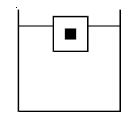
A
Rises
B
Falls
C
Remains same
D
Nothing can be concluded
Solution
(B) Let $M_i$ be the mass of the ice and $M_m$ be the mass of the metal cube.
When the ice is floating, the total weight is supported by the buoyant force: $F_B = (M_i + M_m)g$.
The volume of water displaced by the floating system is $V_1 = \frac{M_i + M_m}{\rho_w}$, where $\rho_w$ is the density of water.
After the ice melts, the ice becomes water with volume $V_{ice_melted} = \frac{M_i}{\rho_w}$.
The metal cube sinks, displacing a volume of water equal to its own volume: $V_{metal} = \frac{M_m}{\rho_m}$, where $\rho_m$ is the density of the metal.
The total volume of water displaced after melting is $V_2 = \frac{M_i}{\rho_w} + \frac{M_m}{\rho_m}$.
Since the metal sinks, its density $\rho_m > \rho_w$, which implies $\frac{M_m}{\rho_m} < \frac{M_m}{\rho_w}$.
Therefore, $V_2 < V_1$, meaning the water level falls.
When the ice is floating, the total weight is supported by the buoyant force: $F_B = (M_i + M_m)g$.
The volume of water displaced by the floating system is $V_1 = \frac{M_i + M_m}{\rho_w}$, where $\rho_w$ is the density of water.
After the ice melts, the ice becomes water with volume $V_{ice_melted} = \frac{M_i}{\rho_w}$.
The metal cube sinks, displacing a volume of water equal to its own volume: $V_{metal} = \frac{M_m}{\rho_m}$, where $\rho_m$ is the density of the metal.
The total volume of water displaced after melting is $V_2 = \frac{M_i}{\rho_w} + \frac{M_m}{\rho_m}$.
Since the metal sinks, its density $\rho_m > \rho_w$, which implies $\frac{M_m}{\rho_m} < \frac{M_m}{\rho_w}$.
Therefore, $V_2 < V_1$, meaning the water level falls.
0 likes
View Solution75
DifficultMCQ
$A$ uniform solid cylinder of density $0.8 \ g/cm^3$ floats in equilibrium in a combination of two non-mixing liquids $A$ and $B$ with its axis vertical. The densities of liquids $A$ and $B$ are $0.7 \ g/cm^3$ and $1.2 \ g/cm^3$,respectively. The height of liquid $A$ is $h_A = 1.2 \ cm$ and the length of the part of the cylinder immersed in liquid $B$ is $h_B = 0.8 \ cm$. Then the length of the part of the cylinder in air is ....... $cm$.
A
$0.21$
B
$0.25$
C
$0.35$
D
$0.4$
Solution
(B) For the cylinder to be in equilibrium,the total buoyant force must equal the weight of the cylinder.
Let $A$ be the cross-sectional area of the cylinder,$L$ be the total length of the cylinder,and $h$ be the length of the cylinder in air.
The total length of the cylinder is $L = h_A + h_B + h$.
The weight of the cylinder is $W = (A \cdot L) \cdot \rho_C \cdot g = A(h_A + h_B + h) \rho_C g$.
The buoyant force provided by liquid $A$ is $F_A = A \cdot h_A \cdot \rho_A \cdot g$.
The buoyant force provided by liquid $B$ is $F_B = A \cdot h_B \cdot \rho_B \cdot g$.
Equating the forces: $F_A + F_B = W$.
$A \cdot h_A \cdot \rho_A \cdot g + A \cdot h_B \cdot \rho_B \cdot g = A(h_A + h_B + h) \rho_C g$.
Dividing by $A \cdot g$: $h_A \rho_A + h_B \rho_B = (h_A + h_B + h) \rho_C$.
Substituting the given values: $(1.2 \times 0.7) + (0.8 \times 1.2) = (1.2 + 0.8 + h) \times 0.8$.
$0.84 + 0.96 = (2.0 + h) \times 0.8$.
$1.8 = 1.6 + 0.8h$.
$0.2 = 0.8h$.
$h = 0.2 / 0.8 = 0.25 \ cm$.
Let $A$ be the cross-sectional area of the cylinder,$L$ be the total length of the cylinder,and $h$ be the length of the cylinder in air.
The total length of the cylinder is $L = h_A + h_B + h$.
The weight of the cylinder is $W = (A \cdot L) \cdot \rho_C \cdot g = A(h_A + h_B + h) \rho_C g$.
The buoyant force provided by liquid $A$ is $F_A = A \cdot h_A \cdot \rho_A \cdot g$.
The buoyant force provided by liquid $B$ is $F_B = A \cdot h_B \cdot \rho_B \cdot g$.
Equating the forces: $F_A + F_B = W$.
$A \cdot h_A \cdot \rho_A \cdot g + A \cdot h_B \cdot \rho_B \cdot g = A(h_A + h_B + h) \rho_C g$.
Dividing by $A \cdot g$: $h_A \rho_A + h_B \rho_B = (h_A + h_B + h) \rho_C$.
Substituting the given values: $(1.2 \times 0.7) + (0.8 \times 1.2) = (1.2 + 0.8 + h) \times 0.8$.
$0.84 + 0.96 = (2.0 + h) \times 0.8$.
$1.8 = 1.6 + 0.8h$.
$0.2 = 0.8h$.
$h = 0.2 / 0.8 = 0.25 \ cm$.
0 likes
View Solution76
DifficultMCQ
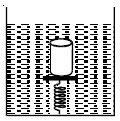
$A$ cylindrical block of area of cross-section $A$ and of material of density $\rho$ is placed in a liquid of density one-third of the density of the block. The block compresses a spring,and the compression in the spring is one-third of the length of the block. If the acceleration due to gravity is $g$,the spring constant of the spring is:
A
$\rho Ag$
B
$2\rho Ag$
C
$2\rho Ag/3$
D
$\rho Ag/3$
Solution
(B) Let $L$ be the length of the cylindrical block. The volume of the block is $V = AL$. The weight of the block is $W = V\rho g = AL\rho g$.
The block is fully submerged in the liquid. The density of the liquid is $\rho_l = \rho/3$. The buoyant force $F_b$ acting on the block is equal to the weight of the liquid displaced,which is $F_b = V\rho_l g = AL(\rho/3)g = AL\rho g/3$.
The block compresses the spring by $x = L/3$. The spring force is $F_s = kx = k(L/3)$.
Since the block is in equilibrium,the net force on it is zero:
$F_s + F_b = W$
$k(L/3) + AL\rho g/3 = AL\rho g$
$k(L/3) = AL\rho g - AL\rho g/3$
$k(L/3) = 2AL\rho g/3$
$k = 2\rho Ag$
The block is fully submerged in the liquid. The density of the liquid is $\rho_l = \rho/3$. The buoyant force $F_b$ acting on the block is equal to the weight of the liquid displaced,which is $F_b = V\rho_l g = AL(\rho/3)g = AL\rho g/3$.
The block compresses the spring by $x = L/3$. The spring force is $F_s = kx = k(L/3)$.
Since the block is in equilibrium,the net force on it is zero:
$F_s + F_b = W$
$k(L/3) + AL\rho g/3 = AL\rho g$
$k(L/3) = AL\rho g - AL\rho g/3$
$k(L/3) = 2AL\rho g/3$
$k = 2\rho Ag$
0 likes
View Solution77
DifficultMCQ
$A$ body of density $\rho'$ is dropped from rest at a height $h$ into a lake of density $\rho$,where $\rho > \rho'$. Neglecting all dissipative forces,calculate the maximum depth to which the body sinks before returning to float on the surface.
A
$\frac{h}{\rho - \rho'}$
B
$\frac{h \rho'}{\rho}$
C
$\frac{h \rho'}{\rho - \rho'}$
D
$\frac{h \rho}{\rho - \rho'}$
Solution
(C) Let the body sink to a maximum depth $H$. At this depth,the final velocity of the body becomes $v = 0$.
When the body enters the water,it experiences an upward buoyant force $F_B = V \rho g$ and a downward gravitational force $F_g = V \rho' g$,where $V$ is the volume of the body.
The net downward acceleration $a$ inside the water is given by $a = \frac{F_g - F_B}{m} = \frac{V \rho' g - V \rho g}{V \rho'} = g \left( \frac{\rho' - \rho}{\rho'} \right) = -g \left( \frac{\rho - \rho'}{\rho'} \right)$.
Using the kinematic equation $v^2 = u^2 + 2as$,where $u^2 = 2gh$ is the velocity just before entering the water,$v = 0$,and $s = H$:
$0 = 2gh + 2 \left[ -g \left( \frac{\rho - \rho'}{\rho'} \right) \right] H$.
Solving for $H$: $2gH \left( \frac{\rho - \rho'}{\rho'} \right) = 2gh$.
$H = \frac{h \rho'}{\rho - \rho'}$.
When the body enters the water,it experiences an upward buoyant force $F_B = V \rho g$ and a downward gravitational force $F_g = V \rho' g$,where $V$ is the volume of the body.
The net downward acceleration $a$ inside the water is given by $a = \frac{F_g - F_B}{m} = \frac{V \rho' g - V \rho g}{V \rho'} = g \left( \frac{\rho' - \rho}{\rho'} \right) = -g \left( \frac{\rho - \rho'}{\rho'} \right)$.
Using the kinematic equation $v^2 = u^2 + 2as$,where $u^2 = 2gh$ is the velocity just before entering the water,$v = 0$,and $s = H$:
$0 = 2gh + 2 \left[ -g \left( \frac{\rho - \rho'}{\rho'} \right) \right] H$.
Solving for $H$: $2gH \left( \frac{\rho - \rho'}{\rho'} \right) = 2gh$.
$H = \frac{h \rho'}{\rho - \rho'}$.
0 likes
View Solution78
DifficultMCQ
The weight of an empty balloon on a spring balance is $w_1$. The weight becomes $w_2$ when the balloon is filled with air. Let the weight of the air itself be $w$. Neglect the thickness of the balloon when it is filled with air. Also,neglect the difference in the densities of air inside and outside the balloon. Then:
A
$w_2 = w_1$
B
$w_2 = w_1 + w$
C
$w_2 < w_1 + w$
D
$A$ and $C$ both
Solution
(D) The weight of the empty balloon is $w_1$. When the balloon is filled with air of weight $w$,the total downward force acting on the spring balance is $w_1 + w$.
However,since the balloon is immersed in the surrounding air,it experiences an upward buoyant force $F_B$ equal to the weight of the air displaced by the balloon.
Since the density of the air inside the balloon is assumed to be the same as the density of the air outside,the weight of the displaced air is equal to the weight of the air inside the balloon,which is $w$.
Therefore,the buoyant force $F_B = w$.
The apparent weight $w_2$ measured by the spring balance is the net force: $w_2 = (w_1 + w) - F_B = w_1 + w - w = w_1$.
Since $w_1 = w_1$,option $A$ is correct.
Also,mathematically,$w_1 < w_1 + w$ is always true for any $w > 0$,so $w_2 < w_1 + w$ is also a correct statement.
Thus,both $A$ and $C$ are correct.
However,since the balloon is immersed in the surrounding air,it experiences an upward buoyant force $F_B$ equal to the weight of the air displaced by the balloon.
Since the density of the air inside the balloon is assumed to be the same as the density of the air outside,the weight of the displaced air is equal to the weight of the air inside the balloon,which is $w$.
Therefore,the buoyant force $F_B = w$.
The apparent weight $w_2$ measured by the spring balance is the net force: $w_2 = (w_1 + w) - F_B = w_1 + w - w = w_1$.
Since $w_1 = w_1$,option $A$ is correct.
Also,mathematically,$w_1 < w_1 + w$ is always true for any $w > 0$,so $w_2 < w_1 + w$ is also a correct statement.
Thus,both $A$ and $C$ are correct.
0 likes
View Solution79
DifficultMCQ
$A$ cubical block of wood of edge $10$ $cm$ and mass $0.92$ $kg$ floats in a tank of water with a layer of oil of relative density $0.6$ to a depth of $4$ $cm$ above the water. When the block attains equilibrium with four of its side edges vertical,which of the following is true?
A
$1$ $cm$ of it will be above the free surface of oil.
B
$8$ $cm$ of it will be under water.
C
$2$ $cm$ of it will be above the common surface of oil and water.
D
$B$ and $C$ both.
Solution
(D) Let $x_1$ be the length of the block submerged in oil and $x_2$ be the length submerged in water. The total length of the block is $L = 10$ $cm = 0.1$ $m$.
The density of oil $\rho_{oil} = 0.6 \times 1000 = 600$ $kg/m^3$ and the density of water $\rho_{water} = 1000$ $kg/m^3$.
At equilibrium,the weight of the block equals the total buoyant force:
$mg = F_{oil} + F_{water}$
$0.92 \times 10 = (A \times x_1 \times \rho_{oil} \times g) + (A \times x_2 \times \rho_{water} \times g)$
where $A = 0.1 \times 0.1 = 0.01$ $m^2$.
$9.2 = 0.01 \times x_1 \times 600 \times 10 + 0.01 \times x_2 \times 1000 \times 10$
$9.2 = 6x_1 + 10x_2$ (where $x_1, x_2$ are in meters).
Since the total depth of the block is $10$ $cm$,$x_1 + x_2 = 10$ $cm = 0.1$ $m$.
Substituting $x_1 = 0.1 - x_2$:
$9.2 = 6(0.1 - x_2) + 10x_2$
$9.2 = 0.6 - 6x_2 + 10x_2$
$8.6 = 4x_2 \implies x_2 = 2.15$ $cm$ (This implies the block is mostly in water).
Wait,re-evaluating the depth of oil: The oil layer is $4$ $cm$ deep. If $x_1$ is the part in oil,$x_1$ must be $\leq 4$ $cm$.
Solving $9.2 = 6x_1 + 10(10 - x_1)$ (using $cm$):
$9.2 = 6x_1 + 100 - 10x_1$
$4x_1 = 100 - 92 = 8 \implies x_1 = 2$ $cm$.
Then $x_2 = 10 - 2 = 8$ $cm$.
Thus,$8$ $cm$ is in water and $2$ $cm$ is in oil.
The density of oil $\rho_{oil} = 0.6 \times 1000 = 600$ $kg/m^3$ and the density of water $\rho_{water} = 1000$ $kg/m^3$.
At equilibrium,the weight of the block equals the total buoyant force:
$mg = F_{oil} + F_{water}$
$0.92 \times 10 = (A \times x_1 \times \rho_{oil} \times g) + (A \times x_2 \times \rho_{water} \times g)$
where $A = 0.1 \times 0.1 = 0.01$ $m^2$.
$9.2 = 0.01 \times x_1 \times 600 \times 10 + 0.01 \times x_2 \times 1000 \times 10$
$9.2 = 6x_1 + 10x_2$ (where $x_1, x_2$ are in meters).
Since the total depth of the block is $10$ $cm$,$x_1 + x_2 = 10$ $cm = 0.1$ $m$.
Substituting $x_1 = 0.1 - x_2$:
$9.2 = 6(0.1 - x_2) + 10x_2$
$9.2 = 0.6 - 6x_2 + 10x_2$
$8.6 = 4x_2 \implies x_2 = 2.15$ $cm$ (This implies the block is mostly in water).
Wait,re-evaluating the depth of oil: The oil layer is $4$ $cm$ deep. If $x_1$ is the part in oil,$x_1$ must be $\leq 4$ $cm$.
Solving $9.2 = 6x_1 + 10(10 - x_1)$ (using $cm$):
$9.2 = 6x_1 + 100 - 10x_1$
$4x_1 = 100 - 92 = 8 \implies x_1 = 2$ $cm$.
Then $x_2 = 10 - 2 = 8$ $cm$.
Thus,$8$ $cm$ is in water and $2$ $cm$ is in oil.
0 likes
View Solution80
MediumMCQ
Assertion $(A)$: $A$ helium-filled balloon does not rise indefinitely in the air but halts after a certain height.
Reason $(R)$: Viscosity opposes the motion of the balloon. Choose any one of the following four responses:
Reason $(R)$: Viscosity opposes the motion of the balloon. Choose any one of the following four responses:
A
If both $(A)$ and $(R)$ are true and $(R)$ is the correct explanation of $(A)$.
B
If both $(A)$ and $(R)$ are true but $(R)$ is not the correct explanation of $(A)$.
C
If $(A)$ is true but $(R)$ is false.
D
If $(A)$ is false but $(R)$ is true.
Solution
(C) The upward force on a balloon is the buoyant force,which is equal to the weight of the air displaced by the balloon. As the balloon rises,the density of the air decreases with altitude. Consequently,the buoyant force decreases as the balloon gains height. At a certain altitude,the buoyant force becomes equal to the weight of the balloon (including the helium and the material of the balloon),and the net force becomes zero. At this point,the balloon stops rising. Viscosity is a property of fluids that opposes the relative motion of layers,but it is not the reason why a balloon stops rising at a specific altitude. Therefore,$(A)$ is true,but $(R)$ is false.
0 likes
View Solution81
MediumMCQ
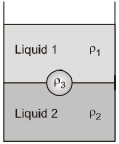
$A$ jar is filled with two non-mixing liquids $1$ and $2$ having densities $\rho_1$ and $\rho_2$ respectively. $A$ solid ball,made of a material of density $\rho_3$,is dropped in the jar. It comes to equilibrium in the position shown in the figure. Which of the following is true for $\rho_1, \rho_2$ and $\rho_3$?
A
$\rho_1 < \rho_3 < \rho_2$
B
$\rho_3 < \rho_1 < \rho_2$
C
$\rho_1 > \rho_3 > \rho_2$
D
$\rho_1 < \rho_2 < \rho_3$
Solution
(A) From the figure,it is clear that liquid $1$ floats on liquid $2$.
Since the lighter liquid floats over the heavier liquid,we can conclude that $\rho_1 < \rho_2$.
The ball is in equilibrium at the interface of the two liquids.
For an object to float in a liquid,its density must be less than the density of the liquid.
Since the ball is partially submerged in liquid $1$ and partially in liquid $2$,its density $\rho_3$ must be greater than the density of the upper liquid $(\rho_1)$ and less than the density of the lower liquid $(\rho_2)$.
Therefore,the condition for equilibrium is $\rho_1 < \rho_3 < \rho_2$.
Since the lighter liquid floats over the heavier liquid,we can conclude that $\rho_1 < \rho_2$.
The ball is in equilibrium at the interface of the two liquids.
For an object to float in a liquid,its density must be less than the density of the liquid.
Since the ball is partially submerged in liquid $1$ and partially in liquid $2$,its density $\rho_3$ must be greater than the density of the upper liquid $(\rho_1)$ and less than the density of the lower liquid $(\rho_2)$.
Therefore,the condition for equilibrium is $\rho_1 < \rho_3 < \rho_2$.
0 likes
View Solution82
DifficultMCQ
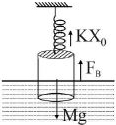
$A$ uniform cylinder of length $L$ and mass $M$ having cross-sectional area $A$ is suspended,with its length vertical,from a fixed point by a massless spring such that it is half submerged in a liquid of density $\sigma$ at equilibrium position. The extension $x_0$ of the spring when it is in equilibrium is
A
$\frac{Mg}{k}$
B
$\frac{Mg}{k}\left( 1 - \frac{LA\sigma}{M} \right)$
C
$\frac{Mg}{k}\left( 1 - \frac{LA\sigma}{2M} \right)$
D
$\frac{Mg}{k}\left( 1 + \frac{LA\sigma}{M} \right)$
Solution
(C) At equilibrium,the forces acting on the cylinder are the spring force $kx_0$ (upwards),the buoyant force $F_B$ (upwards),and the gravitational force $Mg$ (downwards).
The equation of equilibrium is: $kx_0 + F_B = Mg$.
The buoyant force $F_B$ is equal to the weight of the displaced liquid: $F_B = V_{submerged} \cdot \sigma \cdot g$.
Since the cylinder is half-submerged,the submerged volume is $V_{submerged} = A \cdot \frac{L}{2}$.
Thus,$F_B = \left( A \cdot \frac{L}{2} \right) \sigma g = \frac{LA\sigma g}{2}$.
Substituting this into the equilibrium equation:
$kx_0 + \frac{LA\sigma g}{2} = Mg$
$kx_0 = Mg - \frac{LA\sigma g}{2}$
$x_0 = \frac{Mg - \frac{LA\sigma g}{2}}{k} = \frac{Mg}{k} \left( 1 - \frac{LA\sigma}{2M} \right)$.
The equation of equilibrium is: $kx_0 + F_B = Mg$.
The buoyant force $F_B$ is equal to the weight of the displaced liquid: $F_B = V_{submerged} \cdot \sigma \cdot g$.
Since the cylinder is half-submerged,the submerged volume is $V_{submerged} = A \cdot \frac{L}{2}$.
Thus,$F_B = \left( A \cdot \frac{L}{2} \right) \sigma g = \frac{LA\sigma g}{2}$.
Substituting this into the equilibrium equation:
$kx_0 + \frac{LA\sigma g}{2} = Mg$
$kx_0 = Mg - \frac{LA\sigma g}{2}$
$x_0 = \frac{Mg - \frac{LA\sigma g}{2}}{k} = \frac{Mg}{k} \left( 1 - \frac{LA\sigma}{2M} \right)$.
0 likes
View Solution83
DifficultMCQ
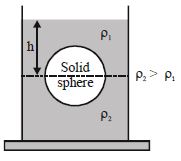
$A$ solid sphere of radius $r$ is floating at the interface of two immiscible liquids of densities $\rho_1$ and $\rho_2$ $(\rho_2 > \rho_1)$,with half of its volume lying in each. The height of the upper liquid column from the interface of the two liquids is $h$. The force exerted on the sphere by the upper liquid is (atmospheric pressure $= p_0$ and acceleration due to gravity is $g$).
A
$p_0\pi r^2 + (h - 2/3r)\pi r^2\rho_1g$
B
$(h - 2/3r)\pi r^2\rho_1g$
C
$2/3r\pi r^2\rho_1g$
D
$p_0\pi r^2$
Solution
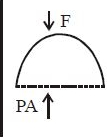
(A) Let $F$ be the downward force exerted by the upper liquid on the upper hemisphere. The upward force exerted by the liquid at the interface on the lower surface of the upper hemisphere is $P \cdot A$,where $P$ is the pressure at the interface and $A = \pi r^2$ is the cross-sectional area of the sphere at the interface.
The pressure at the interface is $P = p_0 + \rho_1gh$.
The buoyant force $F_B$ acting on the upper hemisphere due to the upper liquid is equal to the weight of the liquid displaced by the upper hemisphere:
$F_B = V_{\text{hemisphere}} \cdot \rho_1 \cdot g = (\frac{2}{3} \pi r^3) \rho_1 g$.
Considering the equilibrium of the upper hemisphere,the net upward force is the difference between the upward pressure force and the downward force $F$ exerted by the liquid:
$P \cdot A - F = F_B$
$(p_0 + \rho_1gh) \pi r^2 - F = \frac{2}{3} \pi r^3 \rho_1 g$
Rearranging to solve for $F$:
$F = (p_0 + \rho_1gh) \pi r^2 - \frac{2}{3} \pi r^3 \rho_1 g$
$F = p_0 \pi r^2 + \rho_1 g \pi r^2 (h - \frac{2}{3} r)$.
The pressure at the interface is $P = p_0 + \rho_1gh$.
The buoyant force $F_B$ acting on the upper hemisphere due to the upper liquid is equal to the weight of the liquid displaced by the upper hemisphere:
$F_B = V_{\text{hemisphere}} \cdot \rho_1 \cdot g = (\frac{2}{3} \pi r^3) \rho_1 g$.
Considering the equilibrium of the upper hemisphere,the net upward force is the difference between the upward pressure force and the downward force $F$ exerted by the liquid:
$P \cdot A - F = F_B$
$(p_0 + \rho_1gh) \pi r^2 - F = \frac{2}{3} \pi r^3 \rho_1 g$
Rearranging to solve for $F$:
$F = (p_0 + \rho_1gh) \pi r^2 - \frac{2}{3} \pi r^3 \rho_1 g$
$F = p_0 \pi r^2 + \rho_1 g \pi r^2 (h - \frac{2}{3} r)$.
0 likes
View Solution84
MediumMCQ
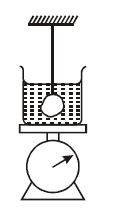
The weight indicated on a balance is $X$ when a beaker of water is placed on it. $A$ solid object has weight $Y$ in air and displaces weight $Z$ of water when completely immersed. The given diagram shows the object suspended from a light string and completely immersed in the beaker of water. What is the balance reading in the given arrangement?
A
$X$
B
$X+Z$
C
$X+Y$
D
$X+Y-Z$
Solution
(B) When the object is suspended from a string and immersed in the water,it experiences an upward buoyant force equal to the weight of the displaced water,$Z$.
By Newton's third law,the object exerts an equal and opposite downward force of magnitude $Z$ on the water.
This additional downward force is transmitted to the balance.
Therefore,the new reading on the balance is the initial weight of the beaker and water $(X)$ plus the additional downward force $(Z)$.
New reading $= X + Z$.
By Newton's third law,the object exerts an equal and opposite downward force of magnitude $Z$ on the water.
This additional downward force is transmitted to the balance.
Therefore,the new reading on the balance is the initial weight of the beaker and water $(X)$ plus the additional downward force $(Z)$.
New reading $= X + Z$.
0 likes
View Solution85
DifficultMCQ
$A$ cylindrical block of wood of base area $30 \, cm^2$ floats in a liquid of density $900 \, kg/m^3$. The block is depressed lightly and then released. The time period of the resulting oscillations of the block is equal to that of a spring with a block of the same mass. The spring constant is equal to ........ $N/m$.
A
$40$
B
$27$
C
$30$
D
$23$
Solution
(B) Let the displacement of the cylinder from its equilibrium position be $x$.
When the cylinder is depressed by $x$, the additional buoyant force acting on it is $F_b = -(\rho g A)x$, where $\rho$ is the density of the liquid, $g$ is the acceleration due to gravity, and $A$ is the base area.
Using Newton's second law, $ma = -(\rho g A)x$, which gives $a = -(\frac{\rho g A}{m})x$.
Comparing this with the standard $SHM$ equation $a = -\omega^2 x$, we get $\omega_{\text{cylinder}} = \sqrt{\frac{\rho g A}{m}}$.
For a spring-block system, the angular frequency is $\omega_{\text{spring}} = \sqrt{\frac{k}{m}}$.
Given that the time periods are equal, their angular frequencies must be equal: $\omega_{\text{cylinder}} = \omega_{\text{spring}}$.
Therefore, $\sqrt{\frac{\rho g A}{m}} = \sqrt{\frac{k}{m}}$, which implies $k = \rho g A$.
Given $\rho = 900 \, kg/m^3$, $g = 10 \, m/s^2$ (standard approximation), and $A = 30 \, cm^2 = 30 \times 10^{-4} \, m^2$.
$k = 900 \times 10 \times 30 \times 10^{-4} = 9000 \times 30 \times 10^{-4} = 27000 \times 10^{-4} = 2.7 \, N/m$.
Wait, re-evaluating the calculation: $900 \times 10 \times 30 \times 10^{-4} = 27 \, N/m$.
When the cylinder is depressed by $x$, the additional buoyant force acting on it is $F_b = -(\rho g A)x$, where $\rho$ is the density of the liquid, $g$ is the acceleration due to gravity, and $A$ is the base area.
Using Newton's second law, $ma = -(\rho g A)x$, which gives $a = -(\frac{\rho g A}{m})x$.
Comparing this with the standard $SHM$ equation $a = -\omega^2 x$, we get $\omega_{\text{cylinder}} = \sqrt{\frac{\rho g A}{m}}$.
For a spring-block system, the angular frequency is $\omega_{\text{spring}} = \sqrt{\frac{k}{m}}$.
Given that the time periods are equal, their angular frequencies must be equal: $\omega_{\text{cylinder}} = \omega_{\text{spring}}$.
Therefore, $\sqrt{\frac{\rho g A}{m}} = \sqrt{\frac{k}{m}}$, which implies $k = \rho g A$.
Given $\rho = 900 \, kg/m^3$, $g = 10 \, m/s^2$ (standard approximation), and $A = 30 \, cm^2 = 30 \times 10^{-4} \, m^2$.
$k = 900 \times 10 \times 30 \times 10^{-4} = 9000 \times 30 \times 10^{-4} = 27000 \times 10^{-4} = 2.7 \, N/m$.
Wait, re-evaluating the calculation: $900 \times 10 \times 30 \times 10^{-4} = 27 \, N/m$.
0 likes
View Solution86
DifficultMCQ
$A$ wax candle floats vertically in a liquid of density twice that of wax. The candle burns at the rate of $4\ cm/hr$. Then, with respect to the surface of the liquid, the upper end of the candle will:
A
fall at the rate of $4\ cm/hr$
B
fall at the rate of $2\ cm/hr$
C
rise at the rate of $2\ cm/hr$
D
remain at the same height
Solution
(B) Let $h$ be the total length of the candle and $h_2$ be the length of the candle submerged in the liquid. Let $\rho_w$ be the density of wax and $\rho_{\ell}$ be the density of the liquid.
Given: $\rho_{\ell} = 2\rho_w$ and $\frac{dh}{dt} = 4\ cm/hr$.
For a floating candle, the weight of the candle equals the buoyant force:
$Weight = \text{Buoyant Force}$
$A \cdot h \cdot \rho_w \cdot g = A \cdot h_2 \cdot \rho_{\ell} \cdot g$
Since $\rho_{\ell} = 2\rho_w$, we have:
$h \cdot \rho_w = h_2 \cdot (2\rho_w)$
$h = 2h_2 \Rightarrow h_2 = \frac{h}{2}$
Differentiating with respect to time $t$:
$\frac{dh_2}{dt} = \frac{1}{2} \frac{dh}{dt} = \frac{1}{2} (4\ cm/hr) = 2\ cm/hr$.
This $\frac{dh_2}{dt}$ represents the rate at which the bottom of the candle rises relative to the liquid surface.
The rate of change of the position of the upper end relative to the liquid surface is given by the rate at which the total length decreases minus the rate at which the submerged part rises:
$v_{upper} = \frac{dh}{dt} - \frac{dh_2}{dt} = 4\ cm/hr - 2\ cm/hr = 2\ cm/hr$.
Thus, the upper end falls at the rate of $2\ cm/hr$.
Given: $\rho_{\ell} = 2\rho_w$ and $\frac{dh}{dt} = 4\ cm/hr$.
For a floating candle, the weight of the candle equals the buoyant force:
$Weight = \text{Buoyant Force}$
$A \cdot h \cdot \rho_w \cdot g = A \cdot h_2 \cdot \rho_{\ell} \cdot g$
Since $\rho_{\ell} = 2\rho_w$, we have:
$h \cdot \rho_w = h_2 \cdot (2\rho_w)$
$h = 2h_2 \Rightarrow h_2 = \frac{h}{2}$
Differentiating with respect to time $t$:
$\frac{dh_2}{dt} = \frac{1}{2} \frac{dh}{dt} = \frac{1}{2} (4\ cm/hr) = 2\ cm/hr$.
This $\frac{dh_2}{dt}$ represents the rate at which the bottom of the candle rises relative to the liquid surface.
The rate of change of the position of the upper end relative to the liquid surface is given by the rate at which the total length decreases minus the rate at which the submerged part rises:
$v_{upper} = \frac{dh}{dt} - \frac{dh_2}{dt} = 4\ cm/hr - 2\ cm/hr = 2\ cm/hr$.
Thus, the upper end falls at the rate of $2\ cm/hr$.
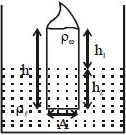
0 likes
View Solution87
MediumMCQ
Equal masses of three liquids are kept in three identical cylindrical vessels $A$, $B$ and $C$. The densities are $\rho_A$, $\rho_B$ and $\rho_C$ with $\rho_A$ < $\rho_B$ < $\rho_C$. The force on the base will be maximum in vessel:
A
$A$
B
$B$
C
$C$
D
equal in all
Solution
(D) The force exerted by a liquid on the base of a cylindrical vessel is equal to the weight of the liquid contained in it.
Since the mass $(m)$ of the liquid in all three vessels is equal, the weight $(W = mg)$ of the liquid in each vessel is also equal.
Therefore, the force on the base $(F = W = mg)$ is the same for all three vessels.
Note: While the pressure at the base $(P = \rho gh)$ might vary because the heights $(h)$ differ due to different densities, the total force on the base remains identical because the weight of the liquid is the same.
This is a classic example of the Hydrostatic Paradox.
Since the mass $(m)$ of the liquid in all three vessels is equal, the weight $(W = mg)$ of the liquid in each vessel is also equal.
Therefore, the force on the base $(F = W = mg)$ is the same for all three vessels.
Note: While the pressure at the base $(P = \rho gh)$ might vary because the heights $(h)$ differ due to different densities, the total force on the base remains identical because the weight of the liquid is the same.
This is a classic example of the Hydrostatic Paradox.
0 likes
View Solution88
DifficultMCQ
$A$ hemispherical portion of radius $R$ is removed from the bottom of a cylinder of radius $R$. The volume of the remaining cylinder is $V$ and mass $M$. It is suspended by a string in a liquid of density $\rho$,where it stays vertical. The upper surface of the cylinder is at a depth $h$ below the liquid surface. The force on the bottom of the cylinder by the liquid is
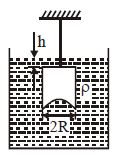
A
$\rho g (V + \pi R^2 h)$
B
$Mg$
C
$Mg - V \rho g$
D
$p_0 \pi R^2 + \rho g (V + \pi R^2 h)$
Solution
(D) Let $F_1$ be the downward force on the top surface of the cylinder and $F_2$ be the upward force on the bottom surface of the cylinder.
The force $F_1$ is due to atmospheric pressure $p_0$ and the liquid column of height $h$ above the top surface:
$F_1 = (p_0 + \rho gh) \pi R^2$
The net upward force (buoyant force or upthrust) on the object is equal to the weight of the displaced liquid:
$F_{up} = V_{displaced} \rho g = V \rho g$
By definition,the buoyant force is the difference between the upward force on the bottom and the downward force on the top:
$F_{up} = F_2 - F_1$
Therefore,the force on the bottom of the cylinder is:
$F_2 = F_1 + F_{up}$
$F_2 = (p_0 + \rho gh) \pi R^2 + V \rho g$
$F_2 = p_0 \pi R^2 + \rho g (\pi R^2 h + V)$
Thus,the correct option is $(D)$.
The force $F_1$ is due to atmospheric pressure $p_0$ and the liquid column of height $h$ above the top surface:
$F_1 = (p_0 + \rho gh) \pi R^2$
The net upward force (buoyant force or upthrust) on the object is equal to the weight of the displaced liquid:
$F_{up} = V_{displaced} \rho g = V \rho g$
By definition,the buoyant force is the difference between the upward force on the bottom and the downward force on the top:
$F_{up} = F_2 - F_1$
Therefore,the force on the bottom of the cylinder is:
$F_2 = F_1 + F_{up}$
$F_2 = (p_0 + \rho gh) \pi R^2 + V \rho g$
$F_2 = p_0 \pi R^2 + \rho g (\pi R^2 h + V)$
Thus,the correct option is $(D)$.
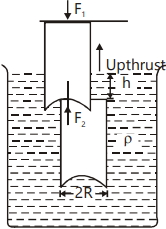
0 likes
View Solution89
MediumMCQ
$A$ cubical block is floating in a liquid with half of its volume immersed in the liquid. When the whole system accelerates upwards with a net acceleration of $g/3$,the fraction of volume immersed in the liquid will be:
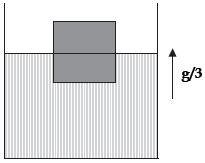
A
$1/2$
B
$3/8$
C
$2/3$
D
$3/4$
Solution
(A) Let $V$ be the total volume of the cubical block,$\rho_s$ be the density of the solid block,and $\rho_L$ be the density of the liquid.
Initially,the block is floating in equilibrium. The weight of the block is balanced by the buoyant force:
$V \rho_s g = V_{sub} \rho_L g$
Given that half of the volume is immersed,$V_{sub} = V/2$. Thus,$V \rho_s g = (V/2) \rho_L g$,which implies $\rho_s / \rho_L = 1/2$.
When the system accelerates upwards with acceleration $a = g/3$,the effective gravity becomes $g_{eff} = g + a = g + g/3 = 4g/3$.
The new equilibrium condition is:
$V \rho_s g_{eff} = V'_{sub} \rho_L g_{eff}$
Dividing both sides by $V \rho_L g_{eff}$,we get:
$V'_{sub} / V = \rho_s / \rho_L$
Since $\rho_s / \rho_L = 1/2$,the fraction of the volume immersed remains $1/2$. The fraction is independent of the acceleration of the system.
Initially,the block is floating in equilibrium. The weight of the block is balanced by the buoyant force:
$V \rho_s g = V_{sub} \rho_L g$
Given that half of the volume is immersed,$V_{sub} = V/2$. Thus,$V \rho_s g = (V/2) \rho_L g$,which implies $\rho_s / \rho_L = 1/2$.
When the system accelerates upwards with acceleration $a = g/3$,the effective gravity becomes $g_{eff} = g + a = g + g/3 = 4g/3$.
The new equilibrium condition is:
$V \rho_s g_{eff} = V'_{sub} \rho_L g_{eff}$
Dividing both sides by $V \rho_L g_{eff}$,we get:
$V'_{sub} / V = \rho_s / \rho_L$
Since $\rho_s / \rho_L = 1/2$,the fraction of the volume immersed remains $1/2$. The fraction is independent of the acceleration of the system.
0 likes
View Solution90
DifficultMCQ
$A$ cubical block of wood with a side length of $10 \ cm$ floats at the interface between oil and water,with its lower surface horizontal and $4 \ cm$ below the interface. The density of oil is $0.6 \ g/cm^3$. The mass of the block is ......... $gm$.
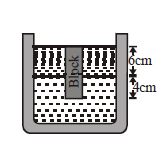
A
$706$
B
$607$
C
$760$
D
$670$
Solution
(C) For the block to be in equilibrium,the weight of the block must be equal to the total buoyant force exerted by the oil and water.
Weight of block = Weight of displaced oil + Weight of displaced water
$mg = V_{oil} \rho_{oil} g + V_{water} \rho_{water} g$
$m = V_{oil} \rho_{oil} + V_{water} \rho_{water}$
Given that the block is a cube of side $10 \ cm$,the total height is $10 \ cm$. Since $4 \ cm$ is submerged in water,the remaining $6 \ cm$ is in the oil.
$V_{oil} = 10 \ cm \times 10 \ cm \times 6 \ cm = 600 \ cm^3$
$V_{water} = 10 \ cm \times 10 \ cm \times 4 \ cm = 400 \ cm^3$
Density of oil $\rho_{oil} = 0.6 \ g/cm^3$ and density of water $\rho_{water} = 1 \ g/cm^3$.
$m = (600 \times 0.6) + (400 \times 1)$
$m = 360 + 400 = 760 \ gm$.
Weight of block = Weight of displaced oil + Weight of displaced water
$mg = V_{oil} \rho_{oil} g + V_{water} \rho_{water} g$
$m = V_{oil} \rho_{oil} + V_{water} \rho_{water}$
Given that the block is a cube of side $10 \ cm$,the total height is $10 \ cm$. Since $4 \ cm$ is submerged in water,the remaining $6 \ cm$ is in the oil.
$V_{oil} = 10 \ cm \times 10 \ cm \times 6 \ cm = 600 \ cm^3$
$V_{water} = 10 \ cm \times 10 \ cm \times 4 \ cm = 400 \ cm^3$
Density of oil $\rho_{oil} = 0.6 \ g/cm^3$ and density of water $\rho_{water} = 1 \ g/cm^3$.
$m = (600 \times 0.6) + (400 \times 1)$
$m = 360 + 400 = 760 \ gm$.
0 likes
View Solution91
MediumMCQ
$A$ wooden block floats in a liquid with $40\%$ of its volume inside the liquid. When the vessel containing the liquid starts rising upwards with an acceleration $a = g/2$, the percentage of volume inside the liquid is ......... $\%$
A
$20$
B
$60$
C
$30$
D
$40$
Solution
(D) Let $V$ be the total volume of the wooden block and $\rho_b$ be its density. Let $\rho_l$ be the density of the liquid.
In the initial state (at rest), the block floats, so the weight equals the buoyant force:
$V \rho_b g = V_{in} \rho_l g$
Given $V_{in} = 0.4 V$, we have $0.4 V \rho_l g = V \rho_b g$, which implies $\rho_b = 0.4 \rho_l$.
When the vessel accelerates upwards with $a = g/2$, the effective acceleration due to gravity becomes $g' = g + a = g + g/2 = 3g/2$.
The new buoyant force is $V'_{in} \rho_l g'$, where $V'_{in}$ is the new submerged volume.
Equating the weight and the new buoyant force:
$V \rho_b g' = V'_{in} \rho_l g'$
Since $g'$ appears on both sides, it cancels out:
$V \rho_b = V'_{in} \rho_l$
Substituting $\rho_b = 0.4 \rho_l$:
$V (0.4 \rho_l) = V'_{in} \rho_l$
$V'_{in} = 0.4 V$
Thus, the percentage of volume inside the liquid remains $40\%$.
In the initial state (at rest), the block floats, so the weight equals the buoyant force:
$V \rho_b g = V_{in} \rho_l g$
Given $V_{in} = 0.4 V$, we have $0.4 V \rho_l g = V \rho_b g$, which implies $\rho_b = 0.4 \rho_l$.
When the vessel accelerates upwards with $a = g/2$, the effective acceleration due to gravity becomes $g' = g + a = g + g/2 = 3g/2$.
The new buoyant force is $V'_{in} \rho_l g'$, where $V'_{in}$ is the new submerged volume.
Equating the weight and the new buoyant force:
$V \rho_b g' = V'_{in} \rho_l g'$
Since $g'$ appears on both sides, it cancels out:
$V \rho_b = V'_{in} \rho_l$
Substituting $\rho_b = 0.4 \rho_l$:
$V (0.4 \rho_l) = V'_{in} \rho_l$
$V'_{in} = 0.4 V$
Thus, the percentage of volume inside the liquid remains $40\%$.
0 likes
View Solution92
DifficultMCQ
The ratio of masses of a cubical block of wood and a chunk of concrete is $\frac{3}{5}$ so that the combination just floats with its entire volume submerged under water. If the specific gravity of wood is $0.5$,then the specific gravity of concrete will be:
A
$2.5$
B
$25$
C
$15$
D
$3$
Solution
(A) Let $m_1$ and $v_1$ be the mass and volume of the wood,and $m_2$ and $v_2$ be the mass and volume of the concrete.
Given the ratio of masses: $\frac{m_1}{m_2} = \frac{3}{5}$.
Let $\rho_1$ be the density of wood and $\rho_2$ be the density of concrete. The specific gravity of wood is $S_1 = \frac{\rho_1}{\rho_w} = 0.5$,so $\rho_1 = 0.5 \rho_w$.
For the combination to just float with its entire volume submerged,the total weight must equal the buoyant force:
$(m_1 + m_2)g = \rho_w (v_1 + v_2)g$
$m_1 + m_2 = \rho_w (\frac{m_1}{\rho_1} + \frac{m_2}{\rho_2})$
Dividing both sides by $m_2$:
$\frac{m_1}{m_2} + 1 = \frac{\rho_w}{\rho_1} \cdot \frac{m_1}{m_2} + \frac{\rho_w}{\rho_2}$
Since $\frac{\rho_w}{\rho_1} = \frac{1}{S_1} = \frac{1}{0.5} = 2$ and $\frac{\rho_w}{\rho_2} = S_2$ (specific gravity of concrete):
$\frac{3}{5} + 1 = 2 \cdot \frac{3}{5} + S_2$
$\frac{8}{5} = \frac{6}{5} + S_2$
$S_2 = \frac{8}{5} - \frac{6}{5} = \frac{2}{5} = 0.4$
Wait,re-evaluating the calculation: $\frac{1}{S_2} = \frac{8}{5} - \frac{6}{5} = \frac{2}{5} \Rightarrow S_2 = 2.5$.
Thus,the specific gravity of concrete is $2.5$.
Given the ratio of masses: $\frac{m_1}{m_2} = \frac{3}{5}$.
Let $\rho_1$ be the density of wood and $\rho_2$ be the density of concrete. The specific gravity of wood is $S_1 = \frac{\rho_1}{\rho_w} = 0.5$,so $\rho_1 = 0.5 \rho_w$.
For the combination to just float with its entire volume submerged,the total weight must equal the buoyant force:
$(m_1 + m_2)g = \rho_w (v_1 + v_2)g$
$m_1 + m_2 = \rho_w (\frac{m_1}{\rho_1} + \frac{m_2}{\rho_2})$
Dividing both sides by $m_2$:
$\frac{m_1}{m_2} + 1 = \frac{\rho_w}{\rho_1} \cdot \frac{m_1}{m_2} + \frac{\rho_w}{\rho_2}$
Since $\frac{\rho_w}{\rho_1} = \frac{1}{S_1} = \frac{1}{0.5} = 2$ and $\frac{\rho_w}{\rho_2} = S_2$ (specific gravity of concrete):
$\frac{3}{5} + 1 = 2 \cdot \frac{3}{5} + S_2$
$\frac{8}{5} = \frac{6}{5} + S_2$
$S_2 = \frac{8}{5} - \frac{6}{5} = \frac{2}{5} = 0.4$
Wait,re-evaluating the calculation: $\frac{1}{S_2} = \frac{8}{5} - \frac{6}{5} = \frac{2}{5} \Rightarrow S_2 = 2.5$.
Thus,the specific gravity of concrete is $2.5$.
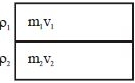
0 likes
View Solution93
AdvancedMCQ
$A$ pan balance has a container of water with an overflow spout on the right-hand pan as shown. It is full of water right up to the overflow spout. $A$ container on the left-hand pan is positioned to catch any water that overflows. The entire apparatus is adjusted so that it is balanced. $A$ brass weight on the end of a string is then lowered into the water,but not allowed to rest on the bottom of the container. What happens next?
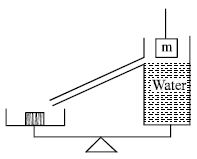
A
Water overflows and the right side of the balance tips down.
B
Water overflows and the left side of the balance tips down.
C
Water overflows but the balance remains balanced.
D
Water overflows but which side of the balance tips down depends on whether the brass weight is partly or completely submerged.
Solution
(B) When the brass weight is lowered into the water,it displaces a volume of water equal to its submerged volume. This displaced water flows out through the overflow spout into the container on the left-hand pan.
According to Archimedes' principle,the brass weight experiences an upward buoyant force equal to the weight of the displaced water. By Newton's third law,the brass weight exerts an equal and opposite downward force on the water,which is transmitted to the right-hand pan.
Since the weight of the water displaced is added to the left-hand pan,the total weight on the left side increases. The right-hand pan experiences an additional downward force equal to the buoyant force,but since the water level remains constant at the spout,the total weight on the right side remains unchanged (the weight of the brass object is supported by the string,not the pan). Therefore,the left side of the balance tips down.
According to Archimedes' principle,the brass weight experiences an upward buoyant force equal to the weight of the displaced water. By Newton's third law,the brass weight exerts an equal and opposite downward force on the water,which is transmitted to the right-hand pan.
Since the weight of the water displaced is added to the left-hand pan,the total weight on the left side increases. The right-hand pan experiences an additional downward force equal to the buoyant force,but since the water level remains constant at the spout,the total weight on the right side remains unchanged (the weight of the brass object is supported by the string,not the pan). Therefore,the left side of the balance tips down.
0 likes
View Solution94
DifficultMCQ
$A$ metallic body of material with density of $8000\ kg/m^3$ has a cavity inside. $A$ spring balance shows its mass to be $10.0\ kg$ in air and $7.5\ kg$ when immersed in water. The ratio of the volume of the cavity to the volume of the material of the body must be
A
$\frac{2}{5}$
B
$\frac{1}{2}$
C
$1$
D
$\frac{3}{4}$
Solution
(C) Let $v_2$ be the volume of the material and $v_1$ be the volume of the cavity.
Given density of material $\rho = 8000\ kg/m^3$ and density of water $\rho_w = 1000\ kg/m^3$.
Mass in air: $M = \rho v_2 = 10.0\ kg$.
Apparent mass in water: $M' = M - \text{buoyant force} = \rho v_2 - \rho_w(v_1 + v_2) = 7.5\ kg$.
Substituting $M = 10.0\ kg$ into the second equation:
$10.0 - \rho_w(v_1 + v_2) = 7.5 \implies \rho_w(v_1 + v_2) = 2.5\ kg$.
Now,take the ratio of the two equations:
$\frac{\rho_w(v_1 + v_2)}{\rho v_2} = \frac{2.5}{10.0} = \frac{1}{4}$.
Substitute the densities:
$\frac{1000}{8000} \left( \frac{v_1}{v_2} + 1 \right) = \frac{1}{4}$.
$\frac{1}{8} \left( \frac{v_1}{v_2} + 1 \right) = \frac{1}{4}$.
$\frac{v_1}{v_2} + 1 = 2$.
$\frac{v_1}{v_2} = 1$.
Given density of material $\rho = 8000\ kg/m^3$ and density of water $\rho_w = 1000\ kg/m^3$.
Mass in air: $M = \rho v_2 = 10.0\ kg$.
Apparent mass in water: $M' = M - \text{buoyant force} = \rho v_2 - \rho_w(v_1 + v_2) = 7.5\ kg$.
Substituting $M = 10.0\ kg$ into the second equation:
$10.0 - \rho_w(v_1 + v_2) = 7.5 \implies \rho_w(v_1 + v_2) = 2.5\ kg$.
Now,take the ratio of the two equations:
$\frac{\rho_w(v_1 + v_2)}{\rho v_2} = \frac{2.5}{10.0} = \frac{1}{4}$.
Substitute the densities:
$\frac{1000}{8000} \left( \frac{v_1}{v_2} + 1 \right) = \frac{1}{4}$.
$\frac{1}{8} \left( \frac{v_1}{v_2} + 1 \right) = \frac{1}{4}$.
$\frac{v_1}{v_2} + 1 = 2$.
$\frac{v_1}{v_2} = 1$.
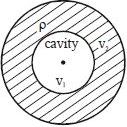
0 likes
View Solution95
MediumMCQ
The diagram shows a jar filled with two non-mixing liquids $1$ and $2$ having densities ${\rho _1}$ and ${\rho _2}$ respectively. $A$ solid ball,made of a material of density ${\rho _3}$,is dropped into the jar. It comes to equilibrium in the position shown in the figure. Which of the following is true for ${\rho _1}$,${\rho _2}$ and ${\rho _3}$?
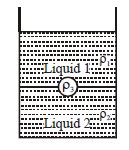
A
${\rho _3} < {\rho _1} < {\rho _2}$
B
${\rho _1} < {\rho _3} < {\rho _2}$
C
${\rho _1} < {\rho _2} < {\rho _3}$
D
${\rho _1} > {\rho _3} > {\rho _2}$
Solution
(B) $1$. In the jar,liquid $2$ is at the bottom and liquid $1$ is at the top,which implies that the density of liquid $2$ is greater than the density of liquid $1$ $({\rho _2} > {\rho _1})$.
$2$. The solid ball is floating at the interface of the two liquids.
$3$. Since the ball is partially submerged in liquid $1$ and partially in liquid $2$,its density ${\rho _3}$ must be greater than the density of the upper liquid $({\rho _3} > {\rho _1})$ and less than the density of the lower liquid $({\rho _3} < {\rho _2})$.
$4$. Combining these inequalities,we get ${\rho _1} < {\rho _3} < {\rho _2}$.
$2$. The solid ball is floating at the interface of the two liquids.
$3$. Since the ball is partially submerged in liquid $1$ and partially in liquid $2$,its density ${\rho _3}$ must be greater than the density of the upper liquid $({\rho _3} > {\rho _1})$ and less than the density of the lower liquid $({\rho _3} < {\rho _2})$.
$4$. Combining these inequalities,we get ${\rho _1} < {\rho _3} < {\rho _2}$.
0 likes
View Solution96
MediumMCQ
$A$ cube of external side length $10 \ cm$ has an inner cubical cavity of side length $5 \ cm$. The density of the inner portion is twice that of the outer portion. If this cube is just floating in a liquid of density $2 \ g/cm^3$, find the density of the inner portion.
A
$\frac{8}{9} \ g/cm^3$
B
$\frac{16}{9} \ g/cm^3$
C
$\frac{32}{9} \ g/cm^3$
D
$\frac{5}{4} \ g/cm^3$
Solution
(C) Let the density of the outer portion be $\rho_1$. Then the density of the inner portion is $2\rho_1$.
The volume of the inner cube is $V_{in} = 5^3 = 125 \ cm^3$.
The volume of the outer portion is $V_{out} = 10^3 - 5^3 = 1000 - 125 = 875 \ cm^3$.
The total mass of the cube is $M = (V_{in} \times 2\rho_1) + (V_{out} \times \rho_1) = (125 \times 2\rho_1) + (875 \times \rho_1) = 250\rho_1 + 875\rho_1 = 1125\rho_1$.
For the cube to just float in a liquid of density $\rho_L = 2 \ g/cm^3$, the weight of the cube must equal the weight of the displaced liquid:
$Mg = V_{total} \times \rho_L \times g$
$1125\rho_1 = 1000 \times 2$
$1125\rho_1 = 2000$
$\rho_1 = \frac{2000}{1125} = \frac{16}{9} \ g/cm^3$.
The density of the inner portion is $2\rho_1 = 2 \times \frac{16}{9} = \frac{32}{9} \ g/cm^3$.
The volume of the inner cube is $V_{in} = 5^3 = 125 \ cm^3$.
The volume of the outer portion is $V_{out} = 10^3 - 5^3 = 1000 - 125 = 875 \ cm^3$.
The total mass of the cube is $M = (V_{in} \times 2\rho_1) + (V_{out} \times \rho_1) = (125 \times 2\rho_1) + (875 \times \rho_1) = 250\rho_1 + 875\rho_1 = 1125\rho_1$.
For the cube to just float in a liquid of density $\rho_L = 2 \ g/cm^3$, the weight of the cube must equal the weight of the displaced liquid:
$Mg = V_{total} \times \rho_L \times g$
$1125\rho_1 = 1000 \times 2$
$1125\rho_1 = 2000$
$\rho_1 = \frac{2000}{1125} = \frac{16}{9} \ g/cm^3$.
The density of the inner portion is $2\rho_1 = 2 \times \frac{16}{9} = \frac{32}{9} \ g/cm^3$.

0 likes
View Solution97
DifficultMCQ
The weight of a sphere in air is $50 \ g$. Its weight is $40 \ g$ in a liquid at temperature $20^{\circ} C$. When the temperature increases to $70^{\circ} C$,its weight becomes $45 \ g$. The ratio of the densities of the liquid at the two given temperatures is: (in $: 1$)
A
$2$
B
$3$
C
$4$
D
$1$
Solution
(A) Let the density of the liquid at $20^{\circ} C$ be $\rho_{1}$ and at $70^{\circ} C$ be $\rho_{2}$.
The apparent weight is given by the formula: $W_{\text{apparent}} = W_{\text{air}} - V \rho g$,where $V$ is the volume of the sphere.
At $20^{\circ} C$: $40 = 50 - V \rho_{1} g \implies V \rho_{1} g = 10$.
At $70^{\circ} C$: $45 = 50 - V \rho_{2} g \implies V \rho_{2} g = 5$.
Taking the ratio of the two equations:
$\frac{V \rho_{1} g}{V \rho_{2} g} = \frac{10}{5} = \frac{2}{1}$.
Therefore,the ratio of the densities is $2 : 1$.
The apparent weight is given by the formula: $W_{\text{apparent}} = W_{\text{air}} - V \rho g$,where $V$ is the volume of the sphere.
At $20^{\circ} C$: $40 = 50 - V \rho_{1} g \implies V \rho_{1} g = 10$.
At $70^{\circ} C$: $45 = 50 - V \rho_{2} g \implies V \rho_{2} g = 5$.
Taking the ratio of the two equations:
$\frac{V \rho_{1} g}{V \rho_{2} g} = \frac{10}{5} = \frac{2}{1}$.
Therefore,the ratio of the densities is $2 : 1$.
0 likes
View Solution98
MediumMCQ
$A$ container of mass $M$ containing liquid of mass $m_0$ is kept on a weighing machine. $A$ ball of mass $m$ is released from rest from the given position. Choose the correct option just after the ball is released.
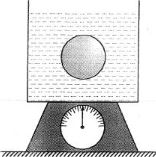
A
Reading of the weighing machine must be equal to $(M + m + m_0)g$.
B
Reading of the weighing machine > $(M + m + m_0)g$ only if the density of the ball < the density of the liquid.
C
Reading of the weighing machine > $(M + m + m_0)g$ if the density of the ball $\neq$ the density of the liquid.
D
Reading of the weighing machine < $(M + m + m_0)g$ if the density of the ball $\neq$ the density of the liquid.
Solution
(D) Let the total mass of the system be $M_{total} = M + m_0 + m$.
According to the center of mass motion, $F_{ext} = M_{total} a_{cm}$.
The external forces acting on the system are the normal force $N$ from the weighing machine and the total weight $(M + m_0 + m)g$.
Thus, $(M + m_0 + m)g - N = M_{total} a_{cm}$, where $a_{cm}$ is the downward acceleration of the center of mass of the system.
Since the ball is released from rest, it will accelerate (either downward if $\rho_{ball} > \rho_{liquid}$ or upward if $\rho_{ball} < \rho_{liquid}$).
In either case, the center of mass of the system will accelerate downward.
Therefore, $a_{cm} > 0$, which implies $N = (M + m_0 + m)g - M_{total} a_{cm}$.
Thus, the reading of the weighing machine $N$ must be less than the total weight $(M + m + m_0)g$ whenever the ball is accelerating relative to the container.
According to the center of mass motion, $F_{ext} = M_{total} a_{cm}$.
The external forces acting on the system are the normal force $N$ from the weighing machine and the total weight $(M + m_0 + m)g$.
Thus, $(M + m_0 + m)g - N = M_{total} a_{cm}$, where $a_{cm}$ is the downward acceleration of the center of mass of the system.
Since the ball is released from rest, it will accelerate (either downward if $\rho_{ball} > \rho_{liquid}$ or upward if $\rho_{ball} < \rho_{liquid}$).
In either case, the center of mass of the system will accelerate downward.
Therefore, $a_{cm} > 0$, which implies $N = (M + m_0 + m)g - M_{total} a_{cm}$.
Thus, the reading of the weighing machine $N$ must be less than the total weight $(M + m + m_0)g$ whenever the ball is accelerating relative to the container.
0 likes
View Solution99
DifficultMCQ
$A$ small solid ball is dropped from a height above the free surface of a liquid. It strikes the surface of the liquid at $t = 0$. The density of the material of the ball is $500 \ kg/m^3$ and that of the liquid is $1000 \ kg/m^3$. If the ball comes momentarily to rest at $t = 2 \ s$,then the initial height of the ball from the surface of the liquid was ..... $m$ (neglect viscosity).
A
$20$
B
$10$
C
$15$
D
$25$
Solution
(A) Let the density of the ball be $\rho_b = 500 \ kg/m^3$ and the density of the liquid be $\rho_l = 1000 \ kg/m^3$. Let $V$ be the volume of the ball.
When the ball is inside the liquid,the forces acting on it are the buoyant force $F_B = V \rho_l g$ (upwards) and the weight $W = V \rho_b g$ (downwards).
The net force $F_{net} = F_B - W = V \rho_l g - V \rho_b g = V g (\rho_l - \rho_b)$.
The acceleration $a$ of the ball inside the liquid is $a = \frac{F_{net}}{m} = \frac{V g (\rho_l - \rho_b)}{V \rho_b} = g \frac{(\rho_l - \rho_b)}{\rho_b}$.
Substituting the values: $a = 10 \times \frac{(1000 - 500)}{500} = 10 \times \frac{500}{500} = 10 \ m/s^2$ (upwards).
Let $v_0$ be the velocity of the ball when it strikes the liquid surface. Using the equation of motion $v = u + at$ for the motion inside the liquid,where the final velocity is $0$ at $t = 2 \ s$:
$0 = v_0 - a t \Rightarrow v_0 = a t = 10 \times 2 = 20 \ m/s$.
For the free fall from height $h$,$v_0^2 = 2gh$.
$20^2 = 2 \times 10 \times h \Rightarrow 400 = 20h \Rightarrow h = 20 \ m$.
When the ball is inside the liquid,the forces acting on it are the buoyant force $F_B = V \rho_l g$ (upwards) and the weight $W = V \rho_b g$ (downwards).
The net force $F_{net} = F_B - W = V \rho_l g - V \rho_b g = V g (\rho_l - \rho_b)$.
The acceleration $a$ of the ball inside the liquid is $a = \frac{F_{net}}{m} = \frac{V g (\rho_l - \rho_b)}{V \rho_b} = g \frac{(\rho_l - \rho_b)}{\rho_b}$.
Substituting the values: $a = 10 \times \frac{(1000 - 500)}{500} = 10 \times \frac{500}{500} = 10 \ m/s^2$ (upwards).
Let $v_0$ be the velocity of the ball when it strikes the liquid surface. Using the equation of motion $v = u + at$ for the motion inside the liquid,where the final velocity is $0$ at $t = 2 \ s$:
$0 = v_0 - a t \Rightarrow v_0 = a t = 10 \times 2 = 20 \ m/s$.
For the free fall from height $h$,$v_0^2 = 2gh$.
$20^2 = 2 \times 10 \times h \Rightarrow 400 = 20h \Rightarrow h = 20 \ m$.

0 likes
View Solution100
MediumMCQ
$A$ cubical block is floating in a liquid with half of its volume immersed in the liquid. When the whole system accelerates upwards with a net acceleration of $g/3$,the fraction of volume immersed in the liquid will be:
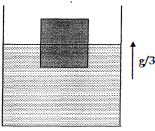
A
$\frac{1}{2}$
B
$\frac{3}{8}$
C
$\frac{2}{3}$
D
$\frac{3}{4}$
Solution
(A) Let $V$ be the total volume of the cubical block,$\rho_s$ be the density of the solid block,and $\rho_L$ be the density of the liquid.
Initially,the block is floating in equilibrium. The weight of the block is balanced by the buoyant force:
$V \rho_s g = V_{sub} \rho_L g$
Given that half of the volume is immersed,$V_{sub} = V/2$. Therefore:
$V \rho_s g = (V/2) \rho_L g \implies \rho_s = \rho_L / 2$.
When the system accelerates upwards with acceleration $a = g/3$,the effective gravity becomes $g_{eff} = g + a = g + g/3 = 4g/3$.
The new equilibrium condition is:
$V \rho_s g_{eff} = V'_{sub} \rho_L g_{eff}$
Dividing both sides by $g_{eff}$ gives:
$V \rho_s = V'_{sub} \rho_L \implies \frac{V'_{sub}}{V} = \frac{\rho_s}{\rho_L}$.
Substituting $\rho_s = \rho_L / 2$,we get:
$\frac{V'_{sub}}{V} = \frac{\rho_L / 2}{\rho_L} = \frac{1}{2}$.
Thus,the fraction of the volume immersed remains unchanged regardless of the acceleration of the system.
Initially,the block is floating in equilibrium. The weight of the block is balanced by the buoyant force:
$V \rho_s g = V_{sub} \rho_L g$
Given that half of the volume is immersed,$V_{sub} = V/2$. Therefore:
$V \rho_s g = (V/2) \rho_L g \implies \rho_s = \rho_L / 2$.
When the system accelerates upwards with acceleration $a = g/3$,the effective gravity becomes $g_{eff} = g + a = g + g/3 = 4g/3$.
The new equilibrium condition is:
$V \rho_s g_{eff} = V'_{sub} \rho_L g_{eff}$
Dividing both sides by $g_{eff}$ gives:
$V \rho_s = V'_{sub} \rho_L \implies \frac{V'_{sub}}{V} = \frac{\rho_s}{\rho_L}$.
Substituting $\rho_s = \rho_L / 2$,we get:
$\frac{V'_{sub}}{V} = \frac{\rho_L / 2}{\rho_L} = \frac{1}{2}$.
Thus,the fraction of the volume immersed remains unchanged regardless of the acceleration of the system.
0 likes
View SolutionFluid Mechanics and Surface Tension — Buoyancy, Archimedes' Principle and Laws of Floatation · Frequently Asked Questions
1Are these Fluid Mechanics and Surface Tension questions useful for JEE and NEET?
Yes. All questions in this section are mapped to JEE Main and NEET exam patterns. Previous year questions from JEE Main, NEET, GUJCET and state-level exams are included with full solutions.
2Can I switch to Hindi or Gujarati for these questions?
Yes. Use the language tabs in the hero section or the sidebar to view the same questions and solutions in English, Hindi or Gujarati.
3How do I generate a question paper from this subtopic?
Use the Vedclass Exam Paper Generator — select the chapter and subtopic, set difficulty, and generate Sets A, B, C, D automatically. First 3 chapters of every subject are free.
Vedclass Products
For Students
Vedclass Test Series
Mock tests in real JEE/NEET style with performance analysis. 5-day free trial.
Start Free TrialFor Teachers
Exam Paper Generator
Generate Set A/B/C/D papers from this chapter in 2 minutes. 3 chapters free.
Try FreeFor Institutes
Online Exam Module
Live online exams with unlimited students, 360° analytics & white-label branding.
See DemoFor Teachers & Institutes
Generate a Fluid Mechanics and Surface Tension Exam Paper in 2 Minutes
Select subtopic & difficulty — Sets A, B, C, D auto-generated with No Repeat logic.
First 3 chapters of every subject are free — no payment required.