
ChemistryQ1–41 of 41 questions
Page 1 of 1 · English
1
ChemistryMCQWBJEE · 2015
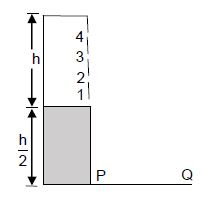
$A$ cylinder of height $h$ is filled with water and is kept on a block of height $h / 2$. The level of water in the cylinder is kept constant. Four holes numbered $1, 2, 3$ and $4$ are at the side of the cylinder and at heights $0, h / 4, h / 2$ and $3h / 4$ respectively from the base of the cylinder. When all four holes are opened together,the hole from which water will reach the farthest distance on the plane $PQ$ is the hole number
A
$1$
B
$2$
C
$3$
D
$4$
Solution
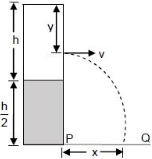
(B) Let $y$ be the depth of a hole below the water surface. The velocity of efflux is $v = \sqrt{2gy}$.
The height of the hole from the ground is $H_{hole} = h - y + h/2 = \frac{3h}{2} - y$.
The time taken for water to reach the plane $PQ$ is $t = \sqrt{\frac{2 H_{hole}}{g}} = \sqrt{\frac{2(3h/2 - y)}{g}} = \sqrt{\frac{3h - 2y}{g}}$.
The horizontal range $x$ is given by $x = v \cdot t = \sqrt{2gy} \cdot \sqrt{\frac{3h - 2y}{g}} = \sqrt{2y(3h - 2y)} = \sqrt{6hy - 4y^2}$.
To maximize $x$,we differentiate with respect to $y$ and set it to zero: $\frac{dx}{dy} = \frac{1}{2\sqrt{6hy - 4y^2}} \cdot (6h - 8y) = 0$.
This gives $6h - 8y = 0$,or $y = \frac{3h}{4}$.
The depth $y$ is measured from the top. The heights of the holes from the base are $0, h/4, h/2, 3h/4$.
Thus,the depths $y$ from the top are $h, 3h/4, h/2, h/4$ for holes $1, 2, 3, 4$ respectively.
The range is maximum when $y = 3h/4$,which corresponds to hole number $2$.
The height of the hole from the ground is $H_{hole} = h - y + h/2 = \frac{3h}{2} - y$.
The time taken for water to reach the plane $PQ$ is $t = \sqrt{\frac{2 H_{hole}}{g}} = \sqrt{\frac{2(3h/2 - y)}{g}} = \sqrt{\frac{3h - 2y}{g}}$.
The horizontal range $x$ is given by $x = v \cdot t = \sqrt{2gy} \cdot \sqrt{\frac{3h - 2y}{g}} = \sqrt{2y(3h - 2y)} = \sqrt{6hy - 4y^2}$.
To maximize $x$,we differentiate with respect to $y$ and set it to zero: $\frac{dx}{dy} = \frac{1}{2\sqrt{6hy - 4y^2}} \cdot (6h - 8y) = 0$.
This gives $6h - 8y = 0$,or $y = \frac{3h}{4}$.
The depth $y$ is measured from the top. The heights of the holes from the base are $0, h/4, h/2, 3h/4$.
Thus,the depths $y$ from the top are $h, 3h/4, h/2, h/4$ for holes $1, 2, 3, 4$ respectively.
The range is maximum when $y = 3h/4$,which corresponds to hole number $2$.
0 likesView Solution
2
ChemistryMediumMCQWBJEE · 2015
The number of lone pairs of electrons on the central atoms of $H_{2}O, SnCl_{2}, PCl_{3}$ and $XeF_{2}$ respectively,are
A
$2, 1, 1, 3$
B
$2, 2, 1, 3$
C
$3, 1, 1, 2$
D
$2, 1, 2, 3$
Solution
(A) The number of lone pairs on the central atoms are calculated as follows:
$1$. In $H_{2}O$,Oxygen has $6$ valence electrons,$2$ are used in bonding with $H$,leaving $4$ electrons or $2$ lone pairs.
$2$. In $SnCl_{2}$,Tin $(Sn)$ has $4$ valence electrons,$2$ are used in bonding with $Cl$,leaving $2$ electrons or $1$ lone pair.
$3$. In $PCl_{3}$,Phosphorus $(P)$ has $5$ valence electrons,$3$ are used in bonding with $Cl$,leaving $2$ electrons or $1$ lone pair.
$4$. In $XeF_{2}$,Xenon $(Xe)$ has $8$ valence electrons,$2$ are used in bonding with $F$,leaving $6$ electrons or $3$ lone pairs.
Thus,the number of lone pairs are $2, 1, 1$ and $3$ respectively.
$1$. In $H_{2}O$,Oxygen has $6$ valence electrons,$2$ are used in bonding with $H$,leaving $4$ electrons or $2$ lone pairs.
$2$. In $SnCl_{2}$,Tin $(Sn)$ has $4$ valence electrons,$2$ are used in bonding with $Cl$,leaving $2$ electrons or $1$ lone pair.
$3$. In $PCl_{3}$,Phosphorus $(P)$ has $5$ valence electrons,$3$ are used in bonding with $Cl$,leaving $2$ electrons or $1$ lone pair.
$4$. In $XeF_{2}$,Xenon $(Xe)$ has $8$ valence electrons,$2$ are used in bonding with $F$,leaving $6$ electrons or $3$ lone pairs.
Thus,the number of lone pairs are $2, 1, 1$ and $3$ respectively.
0 likesView Solution
3
ChemistryMediumMCQWBJEE · 2015
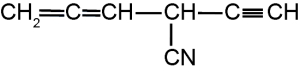
In the following compound,the number of $sp$-hybridised carbons is:
A
$2$
B
$3$
C
$4$
D
$5$
Solution
(C) To determine the number of $sp$-hybridised carbon atoms,we look for carbons involved in two double bonds (allene type) or one triple bond.
$1$. The central carbon in the $CH_2=C=CH-$ group is $sp$-hybridised.
$2$. The carbon in the $-C\equiv CH$ group is $sp$-hybridised.
$3$. The terminal carbon in the $-C\equiv CH$ group is $sp$-hybridised.
$4$. The carbon in the $-C\equiv N$ group is $sp$-hybridised.
Thus,there are $4$ $sp$-hybridised carbon atoms in the given structure.
$1$. The central carbon in the $CH_2=C=CH-$ group is $sp$-hybridised.
$2$. The carbon in the $-C\equiv CH$ group is $sp$-hybridised.
$3$. The terminal carbon in the $-C\equiv CH$ group is $sp$-hybridised.
$4$. The carbon in the $-C\equiv N$ group is $sp$-hybridised.
Thus,there are $4$ $sp$-hybridised carbon atoms in the given structure.
0 likesView Solution
4
ChemistryMediumMCQWBJEE · 2015
For the reaction,$2 SO_{2(g)} + O_{2(g)} \rightleftharpoons 2 SO_{3(g)}$ at $300 \ K$,the value of $\Delta G^{\circ}$ is $-690.9 R$. The equilibrium constant value for the reaction at that temperature is ($R$ is gas constant).
A
$10 \ atm^{-1}$
B
$10 \ atm$
C
$10$
D
$1$
Solution
(A) For the reaction,$2 SO_{2(g)} + O_{2(g)} \rightleftharpoons 2 SO_{3(g)}$.
Given that,$\Delta G^{\circ} = -690.9 R$ and $T = 300 \ K$.
The relationship between standard Gibbs free energy change and equilibrium constant is $\Delta G^{\circ} = -RT \ln K$.
Substituting the values: $-690.9 R = -R \times 300 \times \ln K$.
Dividing both sides by $-R$: $690.9 = 300 \times \ln K$.
$\ln K = \frac{690.9}{300} = 2.303$.
Since $\ln K = 2.303 \log K$,we have $2.303 \log K = 2.303$.
Therefore,$\log K = 1$,which implies $K = 10^1 = 10$.
The unit of $K$ is $(atm)^{\Delta n}$,where $\Delta n = 2 - (2 + 1) = -1$.
Thus,$K = 10 \ atm^{-1}$.
Given that,$\Delta G^{\circ} = -690.9 R$ and $T = 300 \ K$.
The relationship between standard Gibbs free energy change and equilibrium constant is $\Delta G^{\circ} = -RT \ln K$.
Substituting the values: $-690.9 R = -R \times 300 \times \ln K$.
Dividing both sides by $-R$: $690.9 = 300 \times \ln K$.
$\ln K = \frac{690.9}{300} = 2.303$.
Since $\ln K = 2.303 \log K$,we have $2.303 \log K = 2.303$.
Therefore,$\log K = 1$,which implies $K = 10^1 = 10$.
The unit of $K$ is $(atm)^{\Delta n}$,where $\Delta n = 2 - (2 + 1) = -1$.
Thus,$K = 10 \ atm^{-1}$.
0 likesView Solution
5
ChemistryEasyMCQWBJEE · 2015
Among $Be$,$B$,$Mg$ and $Al$,the second ionisation potential is maximum for
A
$B$
B
$Be$
C
$Mg$
D
$Al$
Solution
(A) The electronic configurations of the given elements are:
$Be (Z=4): 1s^2 2s^2$
$B (Z=5): 1s^2 2s^2 2p^1$
$Mg (Z=12): [Ne] 3s^2$
$Al (Z=13): [Ne] 3s^2 3p^1$
To find the second ionisation potential,we look at the configuration of the $+1$ ions:
$Be^+: 1s^2 2s^1$
$B^+: 1s^2 2s^2$
$Mg^+: [Ne] 3s^1$
$Al^+: [Ne] 3s^2$
Removing the second electron from $B^+$ $(2s^2)$ is the most difficult because it involves removing an electron from a completely filled $2s$ subshell,which is highly stable. Therefore,$B$ has the maximum second ionisation potential.
$Be (Z=4): 1s^2 2s^2$
$B (Z=5): 1s^2 2s^2 2p^1$
$Mg (Z=12): [Ne] 3s^2$
$Al (Z=13): [Ne] 3s^2 3p^1$
To find the second ionisation potential,we look at the configuration of the $+1$ ions:
$Be^+: 1s^2 2s^1$
$B^+: 1s^2 2s^2$
$Mg^+: [Ne] 3s^1$
$Al^+: [Ne] 3s^2$
Removing the second electron from $B^+$ $(2s^2)$ is the most difficult because it involves removing an electron from a completely filled $2s$ subshell,which is highly stable. Therefore,$B$ has the maximum second ionisation potential.
0 likesView Solution
6
ChemistryEasyMCQWBJEE · 2015
The reaction of methyltrichloroacetate $(Cl_{3}CCO_{2}Me)$ with sodium methoxide $(NaOMe)$ generates
A
carbocation
B
carbene
C
carbanion
D
carbon radical
Solution
(B) The reaction of methyltrichloroacetate $(Cl_{3}CCO_{2}Me)$ with sodium methoxide $(NaOMe)$ involves the nucleophilic attack of the methoxide ion $(^-OMe)$ on the carbonyl carbon of the ester.
This leads to the formation of a tetrahedral intermediate,which then collapses to eliminate the trichloromethyl carbanion $(^-CCl_{3})$.
The trichloromethyl carbanion $(^-CCl_{3})$ is unstable and subsequently loses a chloride ion $(Cl^-)$ to generate dichlorocarbene $(:CCl_{2})$.
Therefore,the final reactive intermediate generated in this process is a carbene.
This leads to the formation of a tetrahedral intermediate,which then collapses to eliminate the trichloromethyl carbanion $(^-CCl_{3})$.
The trichloromethyl carbanion $(^-CCl_{3})$ is unstable and subsequently loses a chloride ion $(Cl^-)$ to generate dichlorocarbene $(:CCl_{2})$.
Therefore,the final reactive intermediate generated in this process is a carbene.
0 likesView Solution
7
ChemistryMediumMCQWBJEE · 2015
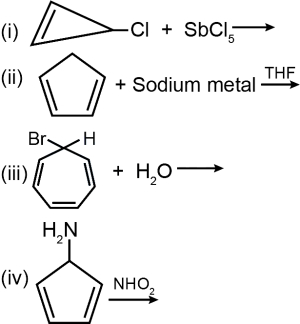
The total number of aromatic species generated in the following reactions is:
A
zero
B
$2$
C
$3$
D
$4$
Solution
(C) To determine the aromaticity,we use the Huckel rule: a cyclic,planar,fully conjugated system with $(4n+2)$ $\pi$-electrons is aromatic,where $n$ is an integer $(0, 1, 2, \dots)$.
$(i)$ Cyclopropenyl chloride reacts with $SbCl_5$ to form the cyclopropenyl cation,which has $2$ $\pi$-electrons $(n=0)$. This is aromatic.
$(ii)$ Cyclopentadiene reacts with sodium metal to form the cyclopentadienyl anion,which has $6$ $\pi$-electrons $(n=1)$. This is aromatic.
$(iii)$ $7$-Bromocyclohepta-$1,3,5$-triene reacts with water to form the tropylium cation,which has $6$ $\pi$-electrons $(n=1)$. This is aromatic.
$(iv)$ Cyclopentadienylamine reacts with $HNO_2$ to form a $4$ $\pi$-electron system (cyclopentadienyl cation),which is anti-aromatic (not aromatic).
Therefore,there are $3$ aromatic species generated.
$(i)$ Cyclopropenyl chloride reacts with $SbCl_5$ to form the cyclopropenyl cation,which has $2$ $\pi$-electrons $(n=0)$. This is aromatic.
$(ii)$ Cyclopentadiene reacts with sodium metal to form the cyclopentadienyl anion,which has $6$ $\pi$-electrons $(n=1)$. This is aromatic.
$(iii)$ $7$-Bromocyclohepta-$1,3,5$-triene reacts with water to form the tropylium cation,which has $6$ $\pi$-electrons $(n=1)$. This is aromatic.
$(iv)$ Cyclopentadienylamine reacts with $HNO_2$ to form a $4$ $\pi$-electron system (cyclopentadienyl cation),which is anti-aromatic (not aromatic).
Therefore,there are $3$ aromatic species generated.
0 likesView Solution
8
ChemistryEasyMCQWBJEE · 2015
In a mixture,two enantiomers are found to be present in $85 \%$ and $15 \%$ respectively. The enantiomeric excess $(ee)$ is (in $\%$)
A
$85$
B
$15$
C
$70$
D
$60$
Solution
(C) The enantiomeric excess $(ee)$ is defined as the difference between the percentages of the two enantiomers in a mixture.
$ee = |\% \text{ of enantiomer } 1 - \% \text{ of enantiomer } 2|$
Given the percentages are $85 \%$ and $15 \%$,the calculation is:
$ee = 85 \% - 15 \% = 70 \%$
$ee = |\% \text{ of enantiomer } 1 - \% \text{ of enantiomer } 2|$
Given the percentages are $85 \%$ and $15 \%$,the calculation is:
$ee = 85 \% - 15 \% = 70 \%$
0 likesView Solution
9
ChemistryEasyMCQWBJEE · 2015
In the Lassaigne's test for the detection of nitrogen in an organic compound,the appearance of blue coloured compound is due to
A
ferric ferricyanide
B
ferrous ferricyanide
C
ferric ferrocyanide
D
ferrous ferrocyanide
Solution
(C) In the Lassaigne's test,the sodium extract containing $NaCN$ is treated with $FeSO_4$ followed by $FeCl_3$ and acidified with $H_2SO_4$.
The chemical reactions are as follows:
$Na + C + N \rightarrow NaCN$
$FeSO_4 + 2NaCN \rightarrow Fe(CN)_2 + Na_2SO_4$
$Fe(CN)_2 + 4NaCN \rightarrow Na_4[Fe(CN)_6]$ (Sodium ferrocyanide)
$3Na_4[Fe(CN)_6] + 4FeCl_3 \rightarrow Fe_4[Fe(CN)_6]_3 + 12NaCl$
The compound $Fe_4[Fe(CN)_6]_3$ is known as ferric ferrocyanide,which gives the characteristic Prussian blue colour.
The chemical reactions are as follows:
$Na + C + N \rightarrow NaCN$
$FeSO_4 + 2NaCN \rightarrow Fe(CN)_2 + Na_2SO_4$
$Fe(CN)_2 + 4NaCN \rightarrow Na_4[Fe(CN)_6]$ (Sodium ferrocyanide)
$3Na_4[Fe(CN)_6] + 4FeCl_3 \rightarrow Fe_4[Fe(CN)_6]_3 + 12NaCl$
The compound $Fe_4[Fe(CN)_6]_3$ is known as ferric ferrocyanide,which gives the characteristic Prussian blue colour.
0 likesView Solution
10
ChemistryMediumMCQWBJEE · 2015
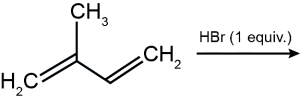
The major product of the above reaction is
A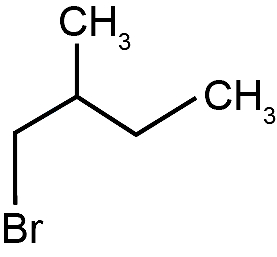
B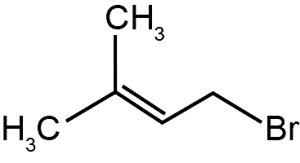
C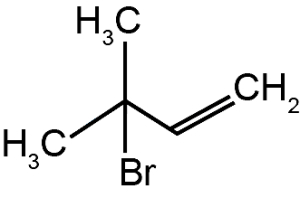
D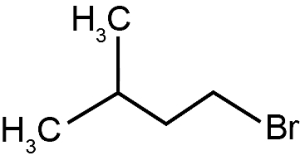
Solution
(C) The reaction of $HBr$ with $2-$methyl$-1,3-$butadiene (isoprene) involves electrophilic addition to the conjugated diene system.
$H^{+}$ adds to the terminal carbon to form the most stable carbocation,which is a resonance-stabilized allylic carbocation.
At room temperature,the thermodynamic product,which is the more substituted alkene,is the major product.
This corresponds to the $1,4-$addition product,which is $1-$bromo$-3-$methyl$-2-$butene.
$H^{+}$ adds to the terminal carbon to form the most stable carbocation,which is a resonance-stabilized allylic carbocation.
At room temperature,the thermodynamic product,which is the more substituted alkene,is the major product.
This corresponds to the $1,4-$addition product,which is $1-$bromo$-3-$methyl$-2-$butene.
0 likesView Solution
11
ChemistryMediumMCQWBJEE · 2015
$1,4-$dimethylbenzene on heating with anhydrous $AlCl_{3}$ and $HCl$ produces
A
$1,2-$dimethylbenzene
B
$1,3-$dimethylbenzene
C
$1,2,3-$trimethylbenzene
D
ethylbenzene
Solution
(B) The reaction of $1,4-$dimethylbenzene ($p-$xylene) with anhydrous $AlCl_{3}$ and $HCl$ is an example of an isomerization reaction.
Under these acidic conditions,the methyl groups undergo rearrangement to form the more thermodynamically stable isomer.
$1,3-$dimethylbenzene ($m-$xylene) is more stable than $1,4-$dimethylbenzene ($p-$xylene) due to the reduced steric hindrance and electronic factors in the meta-substituted product.
Therefore,the reaction produces $1,3-$dimethylbenzene.
Under these acidic conditions,the methyl groups undergo rearrangement to form the more thermodynamically stable isomer.
$1,3-$dimethylbenzene ($m-$xylene) is more stable than $1,4-$dimethylbenzene ($p-$xylene) due to the reduced steric hindrance and electronic factors in the meta-substituted product.
Therefore,the reaction produces $1,3-$dimethylbenzene.
0 likesView Solution
12
ChemistryDifficultMCQWBJEE · 2015
The best reagent for nuclear iodination of aromatic compounds is:
A
$KI / CH_{3}COCH_{3}$
B
$I_{2} / CH_{3}CN$
C
$KI / CH_{3}COOH$
D
$I_{2} / HNO_{3}$
Solution
(D) Nuclear iodination of aromatic compounds is a reversible electrophilic substitution reaction.
$I_{2}$ is a weak electrophile and the reaction produces $HI$ as a byproduct,which is a strong reducing agent and can reduce the iodinated product back to the starting material.
To drive the reaction forward,an oxidizing agent like $HNO_{3}$ is used to oxidize $HI$ to $I_{2}$,thereby preventing the reverse reaction.
$2HI + 2HNO_{3} \rightarrow I_{2} + 2NO_{2} + 2H_{2}O$.
Thus,$I_{2} / HNO_{3}$ is the best reagent for this purpose.
$I_{2}$ is a weak electrophile and the reaction produces $HI$ as a byproduct,which is a strong reducing agent and can reduce the iodinated product back to the starting material.
To drive the reaction forward,an oxidizing agent like $HNO_{3}$ is used to oxidize $HI$ to $I_{2}$,thereby preventing the reverse reaction.
$2HI + 2HNO_{3} \rightarrow I_{2} + 2NO_{2} + 2H_{2}O$.
Thus,$I_{2} / HNO_{3}$ is the best reagent for this purpose.
0 likesView Solution
13
ChemistryDifficultMCQWBJEE · 2015
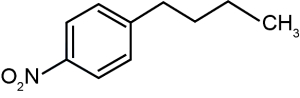
Identify the correct method for the synthesis of the compound shown below from the following alternatives.
A
Benzene $\xrightarrow{CH_3CH_2CH_2CH_2Cl, AlCl_3}$ $\xrightarrow{HNO_3, H_2SO_4}$
B
Benzene $\xrightarrow{CH_3CH_2CH_2COCl, AlCl_3}$ $\xrightarrow{Zn/Hg, HCl/\Delta}$ $\xrightarrow{HNO_3, H_2SO_4}$
C
Benzene $\xrightarrow{CH_3CH_2CH_2COCl, AlCl_3}$ $\xrightarrow{HNO_3, H_2SO_4}$ $\xrightarrow{Zn/Hg, HCl/\Delta}$
D
Benzene $\xrightarrow{CH_3CH_2CH_2COCl, AlCl_3}$ $\xrightarrow{KMnO_4, OH^-}$ $\xrightarrow{HNO_3, H_2SO_4}$
Solution
(B) The synthesis of $1$-butyl-$4$-nitrobenzene involves the following steps:
$1$. Friedel-Crafts acylation of benzene with butanoyl chloride $(CH_3CH_2CH_2COCl)$ in the presence of $AlCl_3$ gives $1$-phenylbutan-$1$-one.
$2$. Clemmensen reduction of the ketone using $Zn/Hg$ and $HCl$ with heat reduces the carbonyl group to a methylene group,yielding butylbenzene.
$3$. Nitration of butylbenzene using a mixture of concentrated $HNO_3$ and $H_2SO_4$ introduces the nitro group at the para position because the alkyl group is an ortho/para-directing group.
$1$. Friedel-Crafts acylation of benzene with butanoyl chloride $(CH_3CH_2CH_2COCl)$ in the presence of $AlCl_3$ gives $1$-phenylbutan-$1$-one.
$2$. Clemmensen reduction of the ketone using $Zn/Hg$ and $HCl$ with heat reduces the carbonyl group to a methylene group,yielding butylbenzene.
$3$. Nitration of butylbenzene using a mixture of concentrated $HNO_3$ and $H_2SO_4$ introduces the nitro group at the para position because the alkyl group is an ortho/para-directing group.
0 likesView Solution
14
ChemistryMediumMCQWBJEE · 2015
The ratio of volumes of $CH_3COOH$ $0.1 \ N$ to $CH_3COONa$ $0.1 \ N$ required to prepare a buffer solution of $pH$ $5.74$ is (Given,$pK_a$ of $CH_3COOH$ is $4.74$)
A
$10:1$
B
$5:1$
C
$1:5$
D
$1:10$
Solution
(D) Given: $pH = 5.74$,$pK_a = 4.74$.
Using the Henderson-Hasselbalch equation: $pH = pK_a + \log \frac{[Salt]}{[Acid]}$.
Substituting the values: $5.74 = 4.74 + \log \frac{[CH_3COONa]}{[CH_3COOH]}$.
$1 = \log \frac{[CH_3COONa]}{[CH_3COOH]}$.
Therefore,$\frac{[CH_3COONa]}{[CH_3COOH]} = 10^1 = 10$.
Since the concentrations of both solutions are equal $(0.1 \ N)$,the ratio of their volumes is equal to the ratio of their concentrations: $\frac{V_{acid}}{V_{salt}} = \frac{[CH_3COOH]}{[CH_3COONa]} = \frac{1}{10}$.
Using the Henderson-Hasselbalch equation: $pH = pK_a + \log \frac{[Salt]}{[Acid]}$.
Substituting the values: $5.74 = 4.74 + \log \frac{[CH_3COONa]}{[CH_3COOH]}$.
$1 = \log \frac{[CH_3COONa]}{[CH_3COOH]}$.
Therefore,$\frac{[CH_3COONa]}{[CH_3COOH]} = 10^1 = 10$.
Since the concentrations of both solutions are equal $(0.1 \ N)$,the ratio of their volumes is equal to the ratio of their concentrations: $\frac{V_{acid}}{V_{salt}} = \frac{[CH_3COOH]}{[CH_3COONa]} = \frac{1}{10}$.
0 likesView Solution
15
ChemistryEasyMCQWBJEE · 2015
Match the flame colours of the alkaline earth metal salts in the Bunsen burner:
| $A$. Calcium | $p$. Brick red |
| $B$. Strontium | $q$. Apple green |
| $C$. Barium | $r$. Crimson |
A
$A-p, B-r, C-q$
B
$A-r, B-p, C-q$
C
$A-q, B-r, C-p$
D
$A-p, B-q, C-r$
Solution
(A) Alkaline earth metals impart characteristic colours to the Bunsen flame due to the excitation of electrons to higher energy levels.
$A$. Calcium $(Ca)$ imparts a brick red colour to the flame $(p)$.
$B$. Strontium $(Sr)$ imparts a crimson red colour to the flame $(r)$.
$C$. Barium $(Ba)$ imparts an apple green colour to the flame $(q)$.
Therefore,the correct matching sequence is $A-p, B-r, C-q$.
$A$. Calcium $(Ca)$ imparts a brick red colour to the flame $(p)$.
$B$. Strontium $(Sr)$ imparts a crimson red colour to the flame $(r)$.
$C$. Barium $(Ba)$ imparts an apple green colour to the flame $(q)$.
Therefore,the correct matching sequence is $A-p, B-r, C-q$.
0 likesView Solution
16
ChemistryEasyMCQWBJEE · 2015
Consider the following salts: $NaCl, HgCl_{2}, Hg_{2}Cl_{2}, CuCl_{2}, CuCl$ and $AgCl$. Identify the correct set of insoluble salts in water.
A
$Hg_{2}Cl_{2}, CuCl, AgCl$
B
$HgCl_{2}, CuCl, AgCl$
C
$Hg_{2}Cl_{2}, CuCl_{2}, AgCl$
D
$Hg_{2}Cl_{2}, CuCl, NaCl$
Solution
(A) The solubility of metal chlorides in water depends on their lattice energy and hydration energy.
$NaCl$ is highly soluble due to high hydration energy.
$HgCl_{2}$ and $CuCl_{2}$ are soluble in water.
$Hg_{2}Cl_{2}$ (mercurous chloride),$CuCl$ (cuprous chloride),and $AgCl$ (silver chloride) are known to be insoluble in water.
$NaCl$ is highly soluble due to high hydration energy.
$HgCl_{2}$ and $CuCl_{2}$ are soluble in water.
$Hg_{2}Cl_{2}$ (mercurous chloride),$CuCl$ (cuprous chloride),and $AgCl$ (silver chloride) are known to be insoluble in water.
0 likesView Solution
17
ChemistryEasyMCQWBJEE · 2015
In aqueous alkaline solution,two electrons reduction of $HO_2^-$ gives
A
$HO^{-}$
B
$H_2O$
C
$O_2$
D
$O_2^-$
Solution
(A) In an aqueous alkaline medium,the reduction of the hydroperoxide ion $(HO_2^-)$ by two electrons produces hydroxide ions $(OH^{-})$.
The balanced half-reaction is: $HO_2^- + H_2O + 2e^- \rightarrow 3OH^{-}$.
The balanced half-reaction is: $HO_2^- + H_2O + 2e^- \rightarrow 3OH^{-}$.
0 likesView Solution
18
ChemistryEasyMCQWBJEE · 2015
The decreasing order of basic character of $K_2O$,$BaO$,$CaO$ and $MgO$ is
A
$K_2O > BaO > CaO > MgO$
B
$K_2O > CaO > BaO > MgO$
C
$MgO > BaO > CaO > K_2O$
D
$MgO > CaO > BaO > K_2O$
Solution
(A) The basic character of metal oxides depends on the electropositivity of the metal.
As we move down a group,the metallic character increases,and as we move across a period from left to right,the metallic character decreases.
$K$ is an alkali metal (Group $1$),while $Ba$,$Ca$,and $Mg$ are alkaline earth metals (Group $2$).
Within Group $2$,the metallic character increases as we go down the group: $Mg < Ca < Ba$.
Since $K$ is more electropositive than the Group $2$ metals,$K_2O$ is the most basic.
Therefore,the correct decreasing order of basic character is $K_2O > BaO > CaO > MgO$.
As we move down a group,the metallic character increases,and as we move across a period from left to right,the metallic character decreases.
$K$ is an alkali metal (Group $1$),while $Ba$,$Ca$,and $Mg$ are alkaline earth metals (Group $2$).
Within Group $2$,the metallic character increases as we go down the group: $Mg < Ca < Ba$.
Since $K$ is more electropositive than the Group $2$ metals,$K_2O$ is the most basic.
Therefore,the correct decreasing order of basic character is $K_2O > BaO > CaO > MgO$.
0 likesView Solution
19
ChemistryMediumMCQWBJEE · 2015
The $RMS$ velocity of $CO$ gas molecules at $27^{\circ} C$ is approximately $1000 \ m / s$. For molecules at $600 \ K$,the $RMS$ velocity is approximately (in $m / s$)
A
$2000$
B
$1414$
C
$1000$
D
$1500$
Solution
(B) The formula for $RMS$ velocity is $v_{rms} = \sqrt{\frac{3RT}{M}}$.
Since $v_{rms} \propto \sqrt{T}$,we have $\frac{v_1}{v_2} = \sqrt{\frac{T_1}{T_2}}$.
Given $T_1 = 27^{\circ} C = 300 \ K$ and $v_1 = 1000 \ m / s$.
Given $T_2 = 600 \ K$.
Substituting the values: $\frac{1000}{v_2} = \sqrt{\frac{300}{600}} = \sqrt{\frac{1}{2}} = \frac{1}{1.414}$.
Therefore,$v_2 = 1000 \times 1.414 = 1414 \ m / s$.
Since $v_{rms} \propto \sqrt{T}$,we have $\frac{v_1}{v_2} = \sqrt{\frac{T_1}{T_2}}$.
Given $T_1 = 27^{\circ} C = 300 \ K$ and $v_1 = 1000 \ m / s$.
Given $T_2 = 600 \ K$.
Substituting the values: $\frac{1000}{v_2} = \sqrt{\frac{300}{600}} = \sqrt{\frac{1}{2}} = \frac{1}{1.414}$.
Therefore,$v_2 = 1000 \times 1.414 = 1414 \ m / s$.
0 likesView Solution
20
ChemistryEasyMCQWBJEE · 2015
$A$ gas can be liquefied at temperature $T$ and pressure $p$ provided:
A
$T = T_{c}$ and $p < p_{c}$
B
$T < T_{c}$ and $p > p_{c}$
C
$T > T_{c}$ and $p > p_{c}$
D
$T > T_{c}$ and $p < p_{c}$
Solution
(B) gas can be liquefied at a temperature $T$ only when it is below its critical temperature,$T_{c}$.
At temperatures below $T_{c}$,the gas can be liquefied by applying sufficient pressure,specifically when the pressure $p$ is greater than the critical pressure,$p_{c}$.
Therefore,the condition for liquefaction is $T < T_{c}$ and $p > p_{c}$.
At temperatures below $T_{c}$,the gas can be liquefied by applying sufficient pressure,specifically when the pressure $p$ is greater than the critical pressure,$p_{c}$.
Therefore,the condition for liquefaction is $T < T_{c}$ and $p > p_{c}$.
0 likesView Solution
21
ChemistryEasyMCQWBJEE · 2015
The units of surface tension and viscosity of liquids respectively are
A
$kg \ m^{-1} \ s^{-1}, \ Nm^{-1}$
B
$kg \ s^{-2}, \ kg \ m^{-1} \ s^{-1}$
C
$Nm^{-1}, \ kg \ m^{-1} \ s^{-2}$
D
$kg \ s^{-1}, \ kg \ m^{-2} \ s^{-1}$
Solution
(B) Surface tension $(\gamma)$ is defined as force per unit length: $\gamma = \frac{F}{l} = \frac{N}{m} = \frac{kg \ m \ s^{-2}}{m} = kg \ s^{-2}$.
Coefficient of viscosity $(\eta)$ is defined by Newton's law of viscosity: $F = \eta A \frac{dv}{dx}$,which gives $\eta = \frac{F}{A (dv/dx)}$.
The units are $\frac{N}{m^2 (s^{-1})} = N \ s \ m^{-2} = (kg \ m \ s^{-2}) \ s \ m^{-2} = kg \ m^{-1} \ s^{-1}$.
Thus,the units are $kg \ s^{-2}$ and $kg \ m^{-1} \ s^{-1}$ respectively.
Coefficient of viscosity $(\eta)$ is defined by Newton's law of viscosity: $F = \eta A \frac{dv}{dx}$,which gives $\eta = \frac{F}{A (dv/dx)}$.
The units are $\frac{N}{m^2 (s^{-1})} = N \ s \ m^{-2} = (kg \ m \ s^{-2}) \ s \ m^{-2} = kg \ m^{-1} \ s^{-1}$.
Thus,the units are $kg \ s^{-2}$ and $kg \ m^{-1} \ s^{-1}$ respectively.
0 likesView Solution
22
ChemistryMediumMCQWBJEE · 2015
For the reaction $X_2Y_{4(l)} \rightarrow 2XY_{2(g)}$ at $300 \ K$,the values of $\Delta U$ and $\Delta S$ are $2 \ kcal$ and $20 \ cal \ K^{-1}$ respectively. The value of $\Delta G$ for the reaction is (in $cal$)
A
$-3400$
B
$3400$
C
$-2800$
D
$2000$
Solution
(C) For the reaction $X_2Y_{4(l)} \rightarrow 2XY_{2(g)}$
$\Delta n_g = \text{number of gaseous products} - \text{number of gaseous reactants} = 2 - 0 = 2$
Given,$\Delta U = 2 \ kcal = 2000 \ cal$,$\Delta S = 20 \ cal \ K^{-1}$,$T = 300 \ K$,and $R = 2 \ cal \ K^{-1} \ mol^{-1}$
Using the relation $\Delta H = \Delta U + \Delta n_g RT$
$\Delta H = 2000 + (2 \times 2 \times 300) = 2000 + 1200 = 3200 \ cal$
Now,using the Gibbs free energy equation $\Delta G = \Delta H - T \Delta S$
$\Delta G = 3200 - (300 \times 20) = 3200 - 6000 = -2800 \ cal$
$\Delta n_g = \text{number of gaseous products} - \text{number of gaseous reactants} = 2 - 0 = 2$
Given,$\Delta U = 2 \ kcal = 2000 \ cal$,$\Delta S = 20 \ cal \ K^{-1}$,$T = 300 \ K$,and $R = 2 \ cal \ K^{-1} \ mol^{-1}$
Using the relation $\Delta H = \Delta U + \Delta n_g RT$
$\Delta H = 2000 + (2 \times 2 \times 300) = 2000 + 1200 = 3200 \ cal$
Now,using the Gibbs free energy equation $\Delta G = \Delta H - T \Delta S$
$\Delta G = 3200 - (300 \times 20) = 3200 - 6000 = -2800 \ cal$
0 likesView Solution
23
ChemistryMediumMCQWBJEE · 2015
In the reaction $RMgBr + HC(OEt)_3 \xrightarrow{Ether, H_3O^{+}} P$,the product $P$ is
A
$RCHO$
B
$R_2CHOEt$
C
$R_3CH$
D
$RCH(OEt)_2$
Solution
(A) The reaction of a Grignard reagent $(RMgBr)$ with triethyl orthoformate $(HC(OEt)_3)$ proceeds via a nucleophilic substitution mechanism.
$1$. The nucleophilic $R^-$ group from the Grignard reagent attacks the electrophilic carbon of the triethyl orthoformate,displacing one ethoxide group $(-OEt)$ to form an acetal intermediate,$RCH(OEt)_2$.
$2$. Upon acidic hydrolysis $(H_3O^{+})$,the acetal intermediate undergoes hydrolysis to yield an aldehyde $(RCHO)$ as the final product $P$.
$1$. The nucleophilic $R^-$ group from the Grignard reagent attacks the electrophilic carbon of the triethyl orthoformate,displacing one ethoxide group $(-OEt)$ to form an acetal intermediate,$RCH(OEt)_2$.
$2$. Upon acidic hydrolysis $(H_3O^{+})$,the acetal intermediate undergoes hydrolysis to yield an aldehyde $(RCHO)$ as the final product $P$.
0 likesView Solution
24
ChemistryMediumMCQWBJEE · 2015
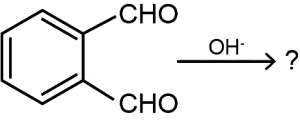
The product of the above reaction is
A
$A$ benzene ring with a $-CH_2OH$ group and a $-COOH$ group at ortho positions.
B
$A$ benzene ring with a $-CH_2O^-$ group and a $-COOH$ group at ortho positions.
C
$A$ benzene ring with a $-CH_2OH$ group and a $-COO^-$ group at ortho positions.
D
$A$ benzene ring with a $-CH_2O^-$ group and a $-COO^-$ group at ortho positions.
Solution
(C) The given reaction is an example of an intramolecular Cannizzaro reaction. In this reaction,phthalaldehyde reacts with a base $(OH^-)$ to undergo disproportionation,where one aldehyde group is reduced to a primary alcohol $(-CH_2OH)$ and the other is oxidized to a carboxylate ion $(-COO^-)$. The final product is the ortho-hydroxymethylbenzoate ion.
0 likesView Solution
25
ChemistryEasyMCQWBJEE · 2015
For the reaction $A + 2B \longrightarrow C$,the reaction rate is doubled if the concentration of $A$ is doubled. The rate is increased by four times when concentrations of both $A$ and $B$ are increased by four times. The order of the reaction is
A
$3$
B
$0$
C
$1$
D
$2$
Solution
(C) The rate law can be expressed as $Rate = k[A]^x[B]^y$.
When the concentration of $A$ is doubled,the rate doubles,which implies $2^x = 2$,so $x = 1$.
When both concentrations are increased by four times,the rate increases by four times: $4^x \times 4^y = 4$.
Substituting $x = 1$,we get $4^1 \times 4^y = 4$,which means $4^y = 1$,so $y = 0$.
The total order of the reaction is $x + y = 1 + 0 = 1$.
When the concentration of $A$ is doubled,the rate doubles,which implies $2^x = 2$,so $x = 1$.
When both concentrations are increased by four times,the rate increases by four times: $4^x \times 4^y = 4$.
Substituting $x = 1$,we get $4^1 \times 4^y = 4$,which means $4^y = 1$,so $y = 0$.
The total order of the reaction is $x + y = 1 + 0 = 1$.
0 likesView Solution
26
ChemistryEasyMCQWBJEE · 2015
The increase in rate constant of a chemical reaction with increasing temperature is due to the fact$(s)$ that:
A
the number of collisions among the reactant molecules increases with increasing temperature
B
the activation energy of the reaction decreases with increasing temperature
C
the concentration of the reactant molecules increases with increasing temperature
D
the number of reactant molecules acquiring the activation energy increases with increasing temperature
Solution
(D) According to the Arrhenius equation,$k = A e^{-E_a / RT}$,the rate constant $k$ increases with temperature $T$.
This is primarily because the fraction of molecules possessing energy equal to or greater than the activation energy $(E_a)$ increases significantly with temperature.
Additionally,the collision frequency of reactant molecules also increases with temperature,which contributes to the increase in the rate of reaction.
This is primarily because the fraction of molecules possessing energy equal to or greater than the activation energy $(E_a)$ increases significantly with temperature.
Additionally,the collision frequency of reactant molecules also increases with temperature,which contributes to the increase in the rate of reaction.
0 likesView Solution
27
ChemistryEasyMCQWBJEE · 2015
Which of the following compounds does not exhibit optical isomerism? $(en = \text{ethylenediamine})$
A
$cis-[CrCl_2(ox)_2]^{3-}$
B
$[Co(en)_3]^{3+}$
C
$trans-[CrCl_2(ox)_2]^{3-}$
D
$[Co(ox)(en)_2]^{+}$
Solution
(C) Optical isomerism is exhibited by coordination compounds that lack a plane of symmetry and a center of symmetry.
$trans-[CrCl_2(ox)_2]^{3-}$ has a plane of symmetry,making it superimposable on its mirror image,and thus it is optically inactive.
$cis-[CrCl_2(ox)_2]^{3-}$,$[Co(en)_3]^{3+}$,and $[Co(ox)(en)_2]^{+}$ lack a plane of symmetry and exhibit optical isomerism.
$trans-[CrCl_2(ox)_2]^{3-}$ has a plane of symmetry,making it superimposable on its mirror image,and thus it is optically inactive.
$cis-[CrCl_2(ox)_2]^{3-}$,$[Co(en)_3]^{3+}$,and $[Co(ox)(en)_2]^{+}$ lack a plane of symmetry and exhibit optical isomerism.
0 likesView Solution
28
ChemistryMediumMCQWBJEE · 2015
Cold ferrous sulphate solution on absorption of $NO$ develops brown colour due to the formation of
A
paramagnetic $[Fe(H_{2}O)_{5}(NO)]SO_{4}$
B
diamagnetic $[Fe(H_{2}O)_{5}(N_{3})]SO_{4}$
C
paramagnetic $[Fe(H_{2}O)_{5}(NO_{3})][SO_{4}]_{2}$
D
diamagnetic $[Fe(H_{2}O)_{4}(SO_{4})]NO_{3}$
Solution
(A) The brown ring test involves the reaction of cold $FeSO_{4}$ solution with $NO$ gas to form the brown-colored complex $[Fe(H_{2}O)_{5}(NO)]SO_{4}$.
$FeSO_{4} + NO + 5H_{2}O \rightarrow [Fe(H_{2}O)_{5}(NO)]SO_{4}$
In this complex,iron is in the $+1$ oxidation state ($d^7$ configuration). The $NO$ ligand acts as $NO^+$,making the iron center $Fe^+$. The complex exhibits a magnetic moment of $3.89 \ BM$,which corresponds to $3$ unpaired electrons,confirming it is paramagnetic.
$FeSO_{4} + NO + 5H_{2}O \rightarrow [Fe(H_{2}O)_{5}(NO)]SO_{4}$
In this complex,iron is in the $+1$ oxidation state ($d^7$ configuration). The $NO$ ligand acts as $NO^+$,making the iron center $Fe^+$. The complex exhibits a magnetic moment of $3.89 \ BM$,which corresponds to $3$ unpaired electrons,confirming it is paramagnetic.
0 likesView Solution
29
ChemistryMediumMCQWBJEE · 2015
At a temperature of $298 \ K$,the $emf$ of the following electrochemical cell: $Ag_{(s)} | Ag^{+}(0.1 \ M) || Zn^{2+}(0.1 \ M) | Zn_{(s)}$ will be (Given,$E^{\circ}_{cell} = -1.562 \ V$) (in $V$)
A
$-1.532$
B
$-1.503$
C
$1.532$
D
$-3.06$
Solution
(A) The cell reaction is: $2Ag_{(s)} + Zn^{2+}(0.1 \ M) \longrightarrow 2Ag^{+}(0.1 \ M) + Zn_{(s)}$
Using the Nernst equation at $298 \ K$:
$E_{cell} = E^{\circ}_{cell} - \frac{0.0591}{n} \log \frac{[Ag^{+}]^{2}}{[Zn^{2+}]}$
Here,$n = 2$,$[Ag^{+}] = 0.1 \ M$,and $[Zn^{2+}] = 0.1 \ M$.
$E_{cell} = -1.562 - \frac{0.0591}{2} \log \frac{(0.1)^{2}}{0.1}$
$E_{cell} = -1.562 - 0.02955 \log(0.1)$
$E_{cell} = -1.562 - 0.02955 \times (-1)$
$E_{cell} = -1.562 + 0.02955 = -1.53245 \ V \approx -1.532 \ V$
Using the Nernst equation at $298 \ K$:
$E_{cell} = E^{\circ}_{cell} - \frac{0.0591}{n} \log \frac{[Ag^{+}]^{2}}{[Zn^{2+}]}$
Here,$n = 2$,$[Ag^{+}] = 0.1 \ M$,and $[Zn^{2+}] = 0.1 \ M$.
$E_{cell} = -1.562 - \frac{0.0591}{2} \log \frac{(0.1)^{2}}{0.1}$
$E_{cell} = -1.562 - 0.02955 \log(0.1)$
$E_{cell} = -1.562 - 0.02955 \times (-1)$
$E_{cell} = -1.562 + 0.02955 = -1.53245 \ V \approx -1.532 \ V$
0 likesView Solution
30
ChemistryEasyMCQWBJEE · 2015
At a particular temperature,the ratio of equivalent conductance to specific conductance of a $0.01 \ N$ $NaCl$ solution is
A
$10^{5} \ cm^{3} \ eq^{-1}$
B
$10^{3} \ cm^{3} \ eq^{-1}$
C
$10 \ cm^{3} \ eq^{-1}$
D
$10^{5} \ cm^{2} \ eq^{-1}$
Solution
(A) The relationship between equivalent conductance $(\lambda_{eq})$,specific conductance $(K)$,and concentration $(C)$ is given by:
$\lambda_{eq} = \frac{K \times 1000}{C}$
Rearranging the formula to find the ratio of equivalent conductance to specific conductance:
$\frac{\lambda_{eq}}{K} = \frac{1000}{C}$
Given that the concentration $C = 0.01 \ N$:
$\frac{\lambda_{eq}}{K} = \frac{1000}{0.01} = 10^5 \ cm^3 \ eq^{-1}$
Therefore,the correct option is $A$.
$\lambda_{eq} = \frac{K \times 1000}{C}$
Rearranging the formula to find the ratio of equivalent conductance to specific conductance:
$\frac{\lambda_{eq}}{K} = \frac{1000}{C}$
Given that the concentration $C = 0.01 \ N$:
$\frac{\lambda_{eq}}{K} = \frac{1000}{0.01} = 10^5 \ cm^3 \ eq^{-1}$
Therefore,the correct option is $A$.
0 likesView Solution
31
ChemistryEasyMCQWBJEE · 2015
Extraction of gold $(Au)$ involves the formation of complex ions $X$ and $Y$ as shown in the reaction: $\text{Gold ore}$ $\xrightarrow{CN^-, H_2O, O_2} HO^- + X$ $\xrightarrow{Zn} Y + Au$. $X$ and $Y$ respectively are:
A
$[Au(CN)_2]^-$ and $[Zn(CN)_4]^{2-}$
B
$[Au(CN)_4]^{3-}$ and $[Zn(CN)_4]^{2-}$
C
$[Au(CN)_3]^-$ and $[Zn(CN)_6]^{4-}$
D
$[Au(CN)_4]^-$ and $[Zn(CN)_3]^-$
Solution
(A) In the extraction of gold,the metal is leached with a dilute solution of $NaCN$ in the presence of air (oxygen) to form the complex $X = [Au(CN)_2]^-$.
Then,gold is recovered by displacement with zinc,which forms the complex $Y = [Zn(CN)_4]^{2-}$.
The chemical equations are:
$4Au + 8CN^- + 2H_2O + O_2 \rightarrow 4[Au(CN)_2]^- + 4OH^-$
$2[Au(CN)_2]^- + Zn \rightarrow [Zn(CN)_4]^{2-} + 2Au$
Thus,$X$ is $[Au(CN)_2]^-$ and $Y$ is $[Zn(CN)_4]^{2-}$.
Then,gold is recovered by displacement with zinc,which forms the complex $Y = [Zn(CN)_4]^{2-}$.
The chemical equations are:
$4Au + 8CN^- + 2H_2O + O_2 \rightarrow 4[Au(CN)_2]^- + 4OH^-$
$2[Au(CN)_2]^- + Zn \rightarrow [Zn(CN)_4]^{2-} + 2Au$
Thus,$X$ is $[Au(CN)_2]^-$ and $Y$ is $[Zn(CN)_4]^{2-}$.
0 likesView Solution
32
ChemistryEasyMCQWBJEE · 2015
Roasted copper pyrite on smelting with sand produces
A
$FeSiO_{3}$ as fusible slag and $Cu_{2}S$ as matte
B
$CaSiO_{3}$ as infusible slag and $Cu_{2}O$ as matte
C
$Ca_{3}(PO_{4})_{2}$ as fusible slag and $Cu_{2}S$ as matte
D
$Fe_{3}(PO_{4})_{2}$ as infusible slag and $Cu_{2}S$ as matte
Solution
(A) Roasted copper pyrite on smelting with sand produces $FeSiO_{3}$ as fusible slag and $Cu_{2}S$ as matte.
For removing the gangue,silica $(SiO_{2})$ is added as a flux to react with iron oxide $(FeO)$ formed during the roasting process to form iron silicate $(FeSiO_{3})$ slag.
The chemical reactions are:
$2FeS + 3O_{2} \longrightarrow 2FeO + 2SO_{2}$
$FeO + SiO_{2} \longrightarrow FeSiO_{3}$
Copper matte mainly consists of a mixture of $Cu_{2}S$ and $FeS$.
For removing the gangue,silica $(SiO_{2})$ is added as a flux to react with iron oxide $(FeO)$ formed during the roasting process to form iron silicate $(FeSiO_{3})$ slag.
The chemical reactions are:
$2FeS + 3O_{2} \longrightarrow 2FeO + 2SO_{2}$
$FeO + SiO_{2} \longrightarrow FeSiO_{3}$
Copper matte mainly consists of a mixture of $Cu_{2}S$ and $FeS$.
0 likesView Solution
33
ChemistryEasyMCQWBJEE · 2015
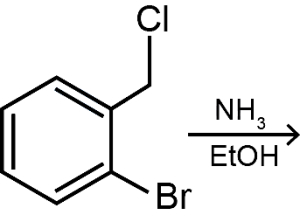
The product of the reaction is
A
$2-$bromobenzylamine
B
$3-$chloroaniline
C
$2-$bromo-$N$-methylaniline
D
$2-$ethoxybenzylamine
Solution
(A) The reaction involves the treatment of $2$-bromobenzyl chloride with ammonia $(NH_3)$ in ethanol $(EtOH)$. This is a nucleophilic substitution reaction $(S_N2)$ where the nucleophile $NH_3$ attacks the electrophilic carbon of the $-CH_2Cl$ group,displacing the chloride ion $(Cl^-)$. The bromine atom attached to the benzene ring is relatively inert towards nucleophilic substitution under these conditions. Therefore,the $-CH_2Cl$ group is converted into a $-CH_2NH_2$ group,resulting in the formation of $2$-bromobenzylamine.
0 likesView Solution
34
ChemistryMediumMCQWBJEE · 2015
Within the list shown below,the correct pair of structures of alanine in $pH$ ranges $2-4$ and $9-11$ is:
$I$. $H_{3}N^{+}CH(CH_{3})COOH$
$II$. $H_{2}NCH(CH_{3})COO^{-}$
$III$. $H_{3}N^{+}CH(CH_{3})COO^{-}$
$IV$. $H_{2}NCH(CH_{3})COOH$
$I$. $H_{3}N^{+}CH(CH_{3})COOH$
$II$. $H_{2}NCH(CH_{3})COO^{-}$
$III$. $H_{3}N^{+}CH(CH_{3})COO^{-}$
$IV$. $H_{2}NCH(CH_{3})COOH$
A
$I$ and $II$
B
$I$ and $III$
C
$II$ and $III$
D
$III$ and $IV$
Solution
(A) Alanine is a neutral amino acid with an isoelectric point $(pI)$ of approximately $6.0$.
In an acidic medium ($pH$ $2-4$),which is below the $pI$,the amino group becomes protonated,and the molecule exists as a cation: $H_{3}N^{+}CH(CH_{3})COOH$ (Structure $I$).
In a basic medium ($pH$ $9-11$),which is above the $pI$,the carboxyl group becomes deprotonated,and the molecule exists as an anion: $H_{2}NCH(CH_{3})COO^{-}$ (Structure $II$).
Therefore,the correct pair is $I$ and $II$.
In an acidic medium ($pH$ $2-4$),which is below the $pI$,the amino group becomes protonated,and the molecule exists as a cation: $H_{3}N^{+}CH(CH_{3})COOH$ (Structure $I$).
In a basic medium ($pH$ $9-11$),which is above the $pI$,the carboxyl group becomes deprotonated,and the molecule exists as an anion: $H_{2}NCH(CH_{3})COO^{-}$ (Structure $II$).
Therefore,the correct pair is $I$ and $II$.
0 likesView Solution
35
ChemistryEasyMCQWBJEE · 2015
Sulphuryl chloride $(SO_{2}Cl_{2})$ reacts with white phosphorus $(P_{4})$ to give:
A
$PCl_{5}, SO_{2}$
B
$OPCl_{3}, SOCl_{2}$
C
$PCl_{5}, SO_{2}, S_{2}Cl_{2}$
D
$OPCl_{3}, SO_{2}, S_{2}Cl_{2}$
Solution
(A) When sulphuryl chloride $(SO_{2}Cl_{2})$ reacts with white phosphorus $(P_{4})$,it produces phosphorus pentachloride $(PCl_{5})$ and sulphur dioxide $(SO_{2})$.
The balanced chemical equation for this reaction is:
$P_{4} + 10 SO_{2}Cl_{2} \longrightarrow 4 PCl_{5} + 10 SO_{2}$
The balanced chemical equation for this reaction is:
$P_{4} + 10 SO_{2}Cl_{2} \longrightarrow 4 PCl_{5} + 10 SO_{2}$
0 likesView Solution
36
ChemistryEasyMCQWBJEE · 2015
Ionisation potential values of noble gases decrease down the group with increase in atomic size. Xenon forms binary fluorides by the direct reaction of elements. Identify the correct statement$(s)$ from below.
A
Only the heavier noble gases form such compounds
B
It happens because the noble gases have higher ionisation energies
C
It happens because the compounds are formed with electronegative ligands
D
Octet of electrons provide the stable arrangements
Solution
(A) The ionisation potential of noble gases decreases down the group as the atomic size increases.
Because of the lower ionisation energy of heavier noble gases like $Xe$,they can be oxidised by highly electronegative elements like fluorine.
Therefore,only the heavier noble gases form such compounds,and this occurs because they form compounds with electronegative ligands like $F$.
While the octet rule provides stability,it is not the reason why $Xe$ forms fluorides; rather,it is the ease of ionisation of heavier noble gases.
Because of the lower ionisation energy of heavier noble gases like $Xe$,they can be oxidised by highly electronegative elements like fluorine.
Therefore,only the heavier noble gases form such compounds,and this occurs because they form compounds with electronegative ligands like $F$.
While the octet rule provides stability,it is not the reason why $Xe$ forms fluorides; rather,it is the ease of ionisation of heavier noble gases.
0 likesView Solution
37
ChemistryEasyMCQWBJEE · 2015
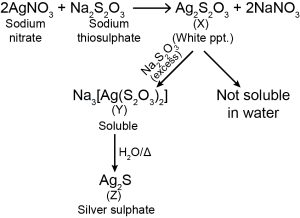
Addition of sodium thiosulphate solution to a solution of silver nitrate gives $X$ as a white precipitate,which is insoluble in water but soluble in excess thiosulphate solution to give $Y$. On boiling in water,$Y$ gives $Z$. $X$,$Y$,and $Z$ respectively are:
A
$Ag_{2}S_{2}O_{3}$,$Na_{3}[Ag(S_{2}O_{3})_{2}]$,$Ag_{2}S$
B
$Ag_{2}SO_{4}$,$Na[Ag(S_{2}O_{3})_{2}]$,$Ag_{2}S_{2}$
C
$Ag_{2}S_{2}O_{3}$,$Na_{5}[Ag(S_{2}O_{3})_{3}]$,$AgS$
D
$Ag_{2}SO_{3}$,$Na_{3}[Ag(S_{2}O_{3})_{2}]$,$Ag_{2}O$
Solution
(A) The sequence of reactions is as follows:
$1$. $2AgNO_{3} + Na_{2}S_{2}O_{3} \rightarrow Ag_{2}S_{2}O_{3} \downarrow (X) + 2NaNO_{3}$
$2$. $Ag_{2}S_{2}O_{3} + 3Na_{2}S_{2}O_{3} \rightarrow 2Na_{3}[Ag(S_{2}O_{3})_{2}] (Y)$
$3$. $2Na_{3}[Ag(S_{2}O_{3})_{2}] + H_{2}O \xrightarrow{\Delta} Ag_{2}S (Z) + Na_{2}SO_{4} + 2Na_{2}S_{2}O_{3} + H_{2}SO_{4}$
Thus,$X = Ag_{2}S_{2}O_{3}$,$Y = Na_{3}[Ag(S_{2}O_{3})_{2}]$,and $Z = Ag_{2}S$.
$1$. $2AgNO_{3} + Na_{2}S_{2}O_{3} \rightarrow Ag_{2}S_{2}O_{3} \downarrow (X) + 2NaNO_{3}$
$2$. $Ag_{2}S_{2}O_{3} + 3Na_{2}S_{2}O_{3} \rightarrow 2Na_{3}[Ag(S_{2}O_{3})_{2}] (Y)$
$3$. $2Na_{3}[Ag(S_{2}O_{3})_{2}] + H_{2}O \xrightarrow{\Delta} Ag_{2}S (Z) + Na_{2}SO_{4} + 2Na_{2}S_{2}O_{3} + H_{2}SO_{4}$
Thus,$X = Ag_{2}S_{2}O_{3}$,$Y = Na_{3}[Ag(S_{2}O_{3})_{2}]$,and $Z = Ag_{2}S$.
0 likesView Solution
38
ChemistryMediumMCQWBJEE · 2015
Suppose the mass of a single $Ag$-atom is $m$. $Ag$ metal crystallises in $fcc$ lattice with unit cell of length $a$. The density of $Ag$ metal in terms of $a$ and $m$ is
A
$\frac{4 m}{a^{3}}$
B
$\frac{2 m}{a^{3}}$
C
$\frac{m}{a^{3}}$
D
$\frac{m}{4 a^{3}}$
Solution
(A) Given that,
Mass of a single $Ag$-atom $= m$.
$Ag$ metal crystallises in an $fcc$ lattice.
The number of atoms per unit cell in an $fcc$ lattice is $Z = 4$.
Therefore,the total mass of the unit cell $= Z \times m = 4m$.
The volume of the unit cell with edge length $a$ is $V = a^{3}$.
Density $(\rho) = \frac{\text{Mass of unit cell}}{\text{Volume of unit cell}} = \frac{4m}{a^{3}}$.
Mass of a single $Ag$-atom $= m$.
$Ag$ metal crystallises in an $fcc$ lattice.
The number of atoms per unit cell in an $fcc$ lattice is $Z = 4$.
Therefore,the total mass of the unit cell $= Z \times m = 4m$.
The volume of the unit cell with edge length $a$ is $V = a^{3}$.
Density $(\rho) = \frac{\text{Mass of unit cell}}{\text{Volume of unit cell}} = \frac{4m}{a^{3}}$.
0 likesView Solution
39
ChemistryMediumMCQWBJEE · 2015
At a certain temperature,the value of the slope of the plot of osmotic pressure $(\pi)$ against concentration $(C \text{ in } mol \ L^{-1})$ of a certain polymer solution is $291 \ R.$ The temperature at which osmotic pressure is measured is: $(R \text{ is the gas constant})$
A
$271^{\circ} C$
B
$18^{\circ} C$
C
$564 \ K$
D
$18 \ K$
Solution
(B) The osmotic pressure $(\pi)$ is given by the equation: $\pi = CRT.$
Comparing this with the equation of a straight line $y = mx,$ where $y = \pi,$ $x = C,$ and the slope $m = RT.$
Given that the slope is $291 \ R,$
$RT = 291 \ R$
$T = 291 \ K$
To convert the temperature to Celsius: $T(^{\circ} C) = 291 - 273 = 18^{\circ} C.$
Comparing this with the equation of a straight line $y = mx,$ where $y = \pi,$ $x = C,$ and the slope $m = RT.$
Given that the slope is $291 \ R,$
$RT = 291 \ R$
$T = 291 \ K$
To convert the temperature to Celsius: $T(^{\circ} C) = 291 - 273 = 18^{\circ} C.$
0 likesView Solution
40
ChemistryEasyMCQWBJEE · 2015
The atomic number of cerium $(Ce)$ is $58$. The correct electronic configuration of $Ce^{3+}$ ion is
A
$[Xe] 4f^{1}$
B
$[Kr] 4f^{1}$
C
$[Xe] 4f^{13}$
D
$[Kr] 4d^{1}$
Solution
(A) The atomic number of cerium $(Ce)$ is $58$.
The ground state electronic configuration of $Ce$ is $[Xe] 4f^{1} 5d^{1} 6s^{2}$.
To form the $Ce^{3+}$ ion,three electrons are removed: two from the $6s$ orbital and one from the $5d$ orbital.
Thus,the electronic configuration of $Ce^{3+}$ is $[Xe] 4f^{1}$.
The ground state electronic configuration of $Ce$ is $[Xe] 4f^{1} 5d^{1} 6s^{2}$.
To form the $Ce^{3+}$ ion,three electrons are removed: two from the $6s$ orbital and one from the $5d$ orbital.
Thus,the electronic configuration of $Ce^{3+}$ is $[Xe] 4f^{1}$.
0 likesView Solution
41
ChemistryEasyMCQWBJEE · 2015
The dispersed phase and dispersion medium of fog respectively are
A
solid,liquid
B
liquid,liquid
C
liquid,gas
D
gas,liquid
Solution
(C) Fog is a type of colloid where a liquid is dispersed in a gas.
Therefore,the dispersed phase is $liquid$ and the dispersion medium is $gas$.
Therefore,the dispersed phase is $liquid$ and the dispersion medium is $gas$.
0 likesView Solution
Vedclass Products
For Students
Vedclass Test Series
Mock tests in real WBJEE style covering Chemistry with performance analysis. 5-day free trial.
Start Free TrialFor Teachers
Exam Paper Generator
Generate Set A/B/C/D Chemistry papers from 7.5L+ questions in 2 minutes. 3 chapters free.
Try FreeFor Institutes
Online Exam Module
Run live WBJEE mock exams with unlimited students, 360° analytics & white-label branding.
See DemoFrequently Asked Questions
How many Chemistry questions are in WBJEE 2015?
There are 41 Chemistry questions from the WBJEE 2015 paper on Vedclass, each with a detailed step-by-step solution in English.
Are WBJEE 2015 Chemistry solutions available in English?
Yes. All solutions on this page are in English. You can also switch to English or Hindi using the language buttons above the questions.
Can I practice WBJEE 2015 Chemistry as a timed test?
Yes. Use the Vedclass Test Series to attempt a full WBJEE mock test covering Chemistry with time limits and instant score analysis.
Can teachers create Chemistry papers from WBJEE previous year questions?
Yes. The Vedclass Exam Paper Generator lets teachers mix WBJEE Chemistry questions and generate Set A/B/C/D papers in minutes.
For Teachers & Institutes
Build a Custom Chemistry Paper
Pick WBJEE 2015 Chemistry questions, set difficulty, and generate Set A/B/C/D in 2 minutes.