
PhysicsQ1–39 of 39 questions
Page 1 of 1 · English
1
PhysicsEasyMCQWBJEE · 2015
$A$ large number of particles are placed around the origin,each at a distance $R$ from the origin. The distance of the center of mass of the system from the origin is
A
equal to $R$
B
less than or equal to $R$
C
greater than $R$
D
greater than or equal to $R$
Solution
(B) Let the positions of the particles be represented by vectors $\vec{r}_i$ such that $|\vec{r}_i| = R$ for all $i = 1, 2, ..., n$.
The position of the center of mass $\vec{R}_{cm}$ is given by $\vec{R}_{cm} = \frac{\sum m_i \vec{r}_i}{\sum m_i}$.
Using the triangle inequality for vectors,the magnitude of the center of mass is $|\vec{R}_{cm}| = \frac{|\sum m_i \vec{r}_i|}{\sum m_i} \le \frac{\sum m_i |\vec{r}_i|}{\sum m_i}$.
Since $|\vec{r}_i| = R$ for all particles,we have $|\vec{R}_{cm}| \le \frac{\sum m_i R}{\sum m_i} = R$.
Thus,the distance of the center of mass from the origin is always less than or equal to $R$.
The position of the center of mass $\vec{R}_{cm}$ is given by $\vec{R}_{cm} = \frac{\sum m_i \vec{r}_i}{\sum m_i}$.
Using the triangle inequality for vectors,the magnitude of the center of mass is $|\vec{R}_{cm}| = \frac{|\sum m_i \vec{r}_i|}{\sum m_i} \le \frac{\sum m_i |\vec{r}_i|}{\sum m_i}$.
Since $|\vec{r}_i| = R$ for all particles,we have $|\vec{R}_{cm}| \le \frac{\sum m_i R}{\sum m_i} = R$.
Thus,the distance of the center of mass from the origin is always less than or equal to $R$.
0 likesView Solution
2
PhysicsEasyMCQWBJEE · 2015
$A$ satellite has kinetic energy $K$,potential energy $V$,and total energy $E$. Which of the following statements is true?
A
$K = -V / 2$
B
$K = V / 2$
C
$E = K / 2$
D
$E = -K / 2$
Solution
(A) For a satellite of mass $m$ orbiting a planet of mass $M$ at a distance $a$ (orbital radius),the energies are given by:
Kinetic energy,$K = \frac{GMm}{2a}$
Potential energy,$V = -\frac{GMm}{a}$
Total energy,$E = K + V = \frac{GMm}{2a} - \frac{GMm}{a} = -\frac{GMm}{2a}$
Comparing these expressions:
$V = -\frac{GMm}{a} = -2 \left( \frac{GMm}{2a} \right) = -2K$
Therefore,$K = -V / 2$.
Kinetic energy,$K = \frac{GMm}{2a}$
Potential energy,$V = -\frac{GMm}{a}$
Total energy,$E = K + V = \frac{GMm}{2a} - \frac{GMm}{a} = -\frac{GMm}{2a}$
Comparing these expressions:
$V = -\frac{GMm}{a} = -2 \left( \frac{GMm}{2a} \right) = -2K$
Therefore,$K = -V / 2$.
0 likesView Solution
3
PhysicsMediumMCQWBJEE · 2015
Two particles of mass $m_{1}$ and $m_{2}$ approach each other due to their mutual gravitational attraction only. Then,
A
accelerations of both the particles are equal
B
acceleration of the particle of mass $m_{1}$ is proportional to $m_{1}$
C
acceleration of the particle of mass $m_{1}$ is proportional to $m_{2}$
D
acceleration of the particle of mass $m_{1}$ is inversely proportional to $m_{1}$
Solution
(C) The gravitational force acting between the two masses $m_{1}$ and $m_{2}$ separated by a distance $r$ is given by Newton's law of gravitation:
$F = \frac{G m_{1} m_{2}}{r^{2}}$
According to Newton's second law of motion,the force on mass $m_{1}$ is $F = m_{1} a_{1}$,where $a_{1}$ is the acceleration of mass $m_{1}$.
Equating the two expressions:
$m_{1} a_{1} = \frac{G m_{1} m_{2}}{r^{2}}$
$a_{1} = \frac{G m_{2}}{r^{2}}$
Since $G$ and $r$ are constant for the system at any given instant,we find that $a_{1} \propto m_{2}$.
Similarly,for mass $m_{2}$,$a_{2} = \frac{G m_{1}}{r^{2}}$,which implies $a_{2} \propto m_{1}$.
$F = \frac{G m_{1} m_{2}}{r^{2}}$
According to Newton's second law of motion,the force on mass $m_{1}$ is $F = m_{1} a_{1}$,where $a_{1}$ is the acceleration of mass $m_{1}$.
Equating the two expressions:
$m_{1} a_{1} = \frac{G m_{1} m_{2}}{r^{2}}$
$a_{1} = \frac{G m_{2}}{r^{2}}$
Since $G$ and $r$ are constant for the system at any given instant,we find that $a_{1} \propto m_{2}$.
Similarly,for mass $m_{2}$,$a_{2} = \frac{G m_{1}}{r^{2}}$,which implies $a_{2} \propto m_{1}$.
0 likesView Solution
4
PhysicsEasyMCQWBJEE · 2015
The rms speed of oxygen is $v$ at a particular temperature. If the temperature is doubled and oxygen molecules dissociate into oxygen atoms,the rms speed becomes
A
$v$
B
$\sqrt{2} v$
C
$2v$
D
$4 v$
Solution
(C) The root mean square (rms) speed of a gas is given by the formula $v_{\text{rms}} = \sqrt{\frac{3RT}{M}}$,where $R$ is the universal gas constant,$T$ is the absolute temperature,and $M$ is the molar mass.
From this,we can see that $v_{\text{rms}} \propto \sqrt{\frac{T}{M}}$.
Let the initial state be $T_1 = T$ and $M_1 = M$ (for $O_2$ molecules). Then $v_1 = v \propto \sqrt{\frac{T}{M}}$.
In the final state,the temperature is doubled,so $T_2 = 2T$. The oxygen molecules dissociate into atoms,so the molar mass becomes half,$M_2 = M/2$.
The new rms speed $v_2$ is proportional to $\sqrt{\frac{T_2}{M_2}} = \sqrt{\frac{2T}{M/2}} = \sqrt{\frac{4T}{M}} = 2 \sqrt{\frac{T}{M}}$.
Comparing the two,$v_2 = 2 \times v_1 = 2v$.
From this,we can see that $v_{\text{rms}} \propto \sqrt{\frac{T}{M}}$.
Let the initial state be $T_1 = T$ and $M_1 = M$ (for $O_2$ molecules). Then $v_1 = v \propto \sqrt{\frac{T}{M}}$.
In the final state,the temperature is doubled,so $T_2 = 2T$. The oxygen molecules dissociate into atoms,so the molar mass becomes half,$M_2 = M/2$.
The new rms speed $v_2$ is proportional to $\sqrt{\frac{T_2}{M_2}} = \sqrt{\frac{2T}{M/2}} = \sqrt{\frac{4T}{M}} = 2 \sqrt{\frac{T}{M}}$.
Comparing the two,$v_2 = 2 \times v_1 = 2v$.
0 likesView Solution
5
PhysicsMediumMCQWBJEE · 2015
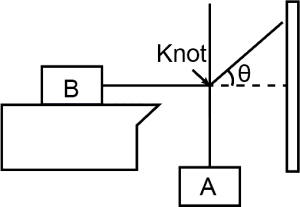
Block $B$ lying on a table weighs $W$. The coefficient of static friction between the block and the table is $\mu$. Assume that the cord between $B$ and the knot is horizontal. The maximum weight of the block $A$ for which the system will be stationary is
A
$\frac{W \tan \theta}{\mu}$
B
$\mu W \tan \theta$
C
$\mu W \sqrt{1+\tan ^{2} \theta}$
D
$\mu W \sin \theta$
Solution
(B) Let the weight of block $A$ be $W^{\prime}$.
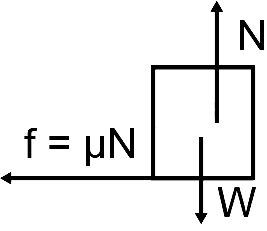
For the system to be in equilibrium,the tension $T_1$ in the horizontal cord connected to block $B$ must be equal to the limiting friction force,so $T_1 = \mu W$.
Now,consider the equilibrium of the knot. Let $T_2$ be the tension in the cord inclined at an angle $\theta$ to the horizontal,and $T_3$ be the tension in the vertical cord connected to block $A$. Thus,$T_3 = W^{\prime}$.
Resolving the forces at the knot:
Horizontal component: $T_2 \cos \theta = T_1 = \mu W$
Vertical component: $T_2 \sin \theta = T_3 = W^{\prime}$
Dividing the two equations:
$\frac{T_2 \sin \theta}{T_2 \cos \theta} = \frac{W^{\prime}}{\mu W}$
$\tan \theta = \frac{W^{\prime}}{\mu W}$
$W^{\prime} = \mu W \tan \theta$
For the system to be in equilibrium,the tension $T_1$ in the horizontal cord connected to block $B$ must be equal to the limiting friction force,so $T_1 = \mu W$.
Now,consider the equilibrium of the knot. Let $T_2$ be the tension in the cord inclined at an angle $\theta$ to the horizontal,and $T_3$ be the tension in the vertical cord connected to block $A$. Thus,$T_3 = W^{\prime}$.
Resolving the forces at the knot:
Horizontal component: $T_2 \cos \theta = T_1 = \mu W$
Vertical component: $T_2 \sin \theta = T_3 = W^{\prime}$
Dividing the two equations:
$\frac{T_2 \sin \theta}{T_2 \cos \theta} = \frac{W^{\prime}}{\mu W}$
$\tan \theta = \frac{W^{\prime}}{\mu W}$
$W^{\prime} = \mu W \tan \theta$
0 likesView Solution
6
PhysicsDifficultMCQWBJEE · 2015
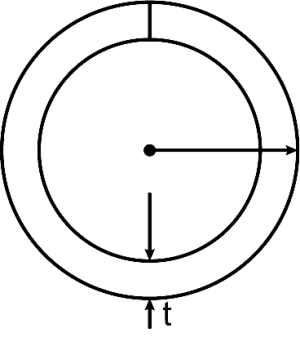
$A$ hollow sphere of external radius $R$ and thickness $t$ $(t \ll R)$ is made of a metal of density $\rho$. The sphere will float in water if:
A
$t \leq \frac{R}{\rho}$
B
$t \leq \frac{R}{3 \rho}$
C
$t \leq \frac{R}{2 \rho}$
D
$t \geq \frac{R}{3 \rho}$
Solution
(B) The density of the metal is $\rho$. The density of water is $\rho_w = 1 \text{ g/cm}^3$ (or $1000 \text{ kg/m}^3$).
For the hollow sphere to float,its weight must be less than or equal to the weight of the water displaced by the total volume of the sphere.
The volume of the metal shell is $V_m = 4 \pi R^2 t$ (since $t \ll R$).
The mass of the sphere is $m_s = V_m \times \rho = 4 \pi R^2 t \rho$.
The volume of water displaced by the sphere is $V_w = \frac{4}{3} \pi R^3$.
The mass of the displaced water is $m_w = V_w \times \rho_w = \frac{4}{3} \pi R^3 \times 1$ (assuming $\rho$ is relative to water density).
For floatation,$m_s \leq m_w$:
$4 \pi R^2 t \rho \leq \frac{4}{3} \pi R^3$
Dividing both sides by $4 \pi R^2$:
$t \rho \leq \frac{R}{3}$
$t \leq \frac{R}{3 \rho}$
For the hollow sphere to float,its weight must be less than or equal to the weight of the water displaced by the total volume of the sphere.
The volume of the metal shell is $V_m = 4 \pi R^2 t$ (since $t \ll R$).
The mass of the sphere is $m_s = V_m \times \rho = 4 \pi R^2 t \rho$.
The volume of water displaced by the sphere is $V_w = \frac{4}{3} \pi R^3$.
The mass of the displaced water is $m_w = V_w \times \rho_w = \frac{4}{3} \pi R^3 \times 1$ (assuming $\rho$ is relative to water density).
For floatation,$m_s \leq m_w$:
$4 \pi R^2 t \rho \leq \frac{4}{3} \pi R^3$
Dividing both sides by $4 \pi R^2$:
$t \rho \leq \frac{R}{3}$
$t \leq \frac{R}{3 \rho}$
0 likesView Solution
7
PhysicsMediumMCQWBJEE · 2015
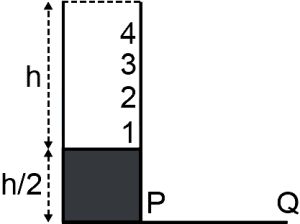
$A$ cylinder of height $h$ is filled with water and is kept on a block of height $h/2$. The level of water in the cylinder is kept constant. Four holes numbered $1, 2, 3$ and $4$ are at the side of the cylinder and at heights $0, h/4, h/2$ and $3h/4$ from the base of the cylinder, respectively. When all four holes are opened together, the hole from which water will reach the farthest distance on the plane $PQ$ is the hole number:
A
$1$
B
$2$
C
$3$
D
$4$
Solution
(C) Let the total height of the water level from the plane $PQ$ be $H$. The cylinder has height $h$ and is placed on a block of height $h/2$. Thus, $H = h + h/2 = 3h/2$.
Let $y$ be the height of a hole from the base of the cylinder. The depth of this hole from the free water surface is $d = H - y = 3h/2 - y$.
The horizontal range $R$ of the water jet is given by $R = 2\sqrt{d \cdot y_{ground}}$, where $y_{ground}$ is the height of the hole from the plane $PQ$. Here, $y_{ground} = y + h/2$.
So, $R = 2\sqrt{(3h/2 - y)(y + h/2)}$.
To maximize $R$, we maximize the product $(3h/2 - y)(y + h/2)$. Let $f(y) = (3h/2 - y)(y + h/2)$.
Taking the derivative with respect to $y$ and setting it to zero: $f'(y) = -(y + h/2) + (3h/2 - y) = 0$.
$2y = h$, which gives $y = h/2$.
Comparing the given hole heights: Hole $1$ is at $y=0$, Hole $2$ is at $y=h/4$, Hole $3$ is at $y=h/2$, and Hole $4$ is at $y=3h/4$.
Thus, Hole $3$ is at the height $y=h/2$ which provides the maximum range.
Let $y$ be the height of a hole from the base of the cylinder. The depth of this hole from the free water surface is $d = H - y = 3h/2 - y$.
The horizontal range $R$ of the water jet is given by $R = 2\sqrt{d \cdot y_{ground}}$, where $y_{ground}$ is the height of the hole from the plane $PQ$. Here, $y_{ground} = y + h/2$.
So, $R = 2\sqrt{(3h/2 - y)(y + h/2)}$.
To maximize $R$, we maximize the product $(3h/2 - y)(y + h/2)$. Let $f(y) = (3h/2 - y)(y + h/2)$.
Taking the derivative with respect to $y$ and setting it to zero: $f'(y) = -(y + h/2) + (3h/2 - y) = 0$.
$2y = h$, which gives $y = h/2$.
Comparing the given hole heights: Hole $1$ is at $y=0$, Hole $2$ is at $y=h/4$, Hole $3$ is at $y=h/2$, and Hole $4$ is at $y=3h/4$.
Thus, Hole $3$ is at the height $y=h/2$ which provides the maximum range.
0 likesView Solution
8
PhysicsMediumMCQWBJEE · 2015
$A$ $20 cm$ long capillary tube is dipped vertically in water and the liquid rises up to $10 cm$. If the entire system is kept in a freely falling platform,the length of the water column in the tube will be (in $cm$)
A
$5$
B
$10$
C
$15$
D
$20$
Solution
(D) The height of the liquid column in a capillary tube is given by the formula $h = \frac{2T \cos \theta}{r \rho g}$.
In a freely falling platform,the effective acceleration due to gravity $g_{eff}$ becomes $0$ because the system is in a state of weightlessness.
As $g_{eff} \to 0$,the height $h$ tends to infinity $(h \propto \frac{1}{g_{eff}})$.
However,the liquid cannot rise beyond the physical length of the capillary tube.
Therefore,the water will rise to fill the entire length of the capillary tube,which is $20 cm$.
In a freely falling platform,the effective acceleration due to gravity $g_{eff}$ becomes $0$ because the system is in a state of weightlessness.
As $g_{eff} \to 0$,the height $h$ tends to infinity $(h \propto \frac{1}{g_{eff}})$.
However,the liquid cannot rise beyond the physical length of the capillary tube.
Therefore,the water will rise to fill the entire length of the capillary tube,which is $20 cm$.
0 likesView Solution
9
PhysicsMediumMCQWBJEE · 2015
The length of a metal wire is $L_1$ when the tension is $T_1$ and $L_2$ when the tension is $T_2$. The unstretched length of the wire is:
A
$\frac{L_1+L_2}{2}$
B
$\sqrt{L_1 L_2}$
C
$\frac{T_2 L_1-T_1 L_2}{T_2-T_1}$
D
$\frac{T_2 L_1+T_1 L_2}{T_2+T_1}$
Solution
(C) Let the unstretched length of the metal wire be $L$ and its cross-sectional area be $A$.
According to Hooke's Law,the Young's modulus $Y$ is given by $Y = \frac{T/A}{\Delta L/L}$,where $\Delta L$ is the change in length.
For tension $T_1$,the length is $L_1$,so the extension is $\Delta L_1 = L_1 - L$. Thus,$Y = \frac{T_1 L}{A(L_1 - L)}$.
For tension $T_2$,the length is $L_2$,so the extension is $\Delta L_2 = L_2 - L$. Thus,$Y = \frac{T_2 L}{A(L_2 - L)}$.
Equating the two expressions for $Y$:
$\frac{T_1 L}{A(L_1 - L)} = \frac{T_2 L}{A(L_2 - L)}$
$\frac{T_1}{L_1 - L} = \frac{T_2}{L_2 - L}$
$T_1(L_2 - L) = T_2(L_1 - L)$
$T_1 L_2 - T_1 L = T_2 L_1 - T_2 L$
$T_2 L - T_1 L = T_2 L_1 - T_1 L_2$
$L(T_2 - T_1) = T_2 L_1 - T_1 L_2$
$L = \frac{T_2 L_1 - T_1 L_2}{T_2 - T_1}$
According to Hooke's Law,the Young's modulus $Y$ is given by $Y = \frac{T/A}{\Delta L/L}$,where $\Delta L$ is the change in length.
For tension $T_1$,the length is $L_1$,so the extension is $\Delta L_1 = L_1 - L$. Thus,$Y = \frac{T_1 L}{A(L_1 - L)}$.
For tension $T_2$,the length is $L_2$,so the extension is $\Delta L_2 = L_2 - L$. Thus,$Y = \frac{T_2 L}{A(L_2 - L)}$.
Equating the two expressions for $Y$:
$\frac{T_1 L}{A(L_1 - L)} = \frac{T_2 L}{A(L_2 - L)}$
$\frac{T_1}{L_1 - L} = \frac{T_2}{L_2 - L}$
$T_1(L_2 - L) = T_2(L_1 - L)$
$T_1 L_2 - T_1 L = T_2 L_1 - T_2 L$
$T_2 L - T_1 L = T_2 L_1 - T_1 L_2$
$L(T_2 - T_1) = T_2 L_1 - T_1 L_2$
$L = \frac{T_2 L_1 - T_1 L_2}{T_2 - T_1}$
0 likesView Solution
10
PhysicsMediumMCQWBJEE · 2015
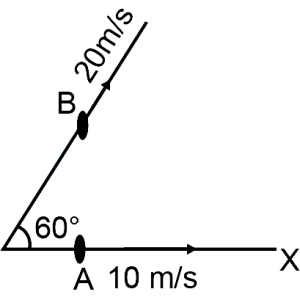
Particle $A$ moves along the $X$-axis with a uniform velocity of magnitude $10 \ m/s$. Particle $B$ moves with a uniform velocity of $20 \ m/s$ along a direction making an angle of $60^{\circ}$ with the positive direction of the $X$-axis as shown in the figure. The relative velocity of $B$ with respect to $A$ is
A
$10 \ m/s$ along the $X$-axis
B
$10 \sqrt{3} \ m/s$ along the $Y$-axis (perpendicular to the $X$-axis)
C
$10 \sqrt{5} \ m/s$ along the bisection of the velocities of $A$ and $B$
D
$30 \ m/s$ along the negative $X$-axis
Solution
(B) The velocity of particle $A$ is given by $\vec{v}_A = 10 \hat{i} \ m/s$.
The velocity of particle $B$ can be resolved into components. Its magnitude is $20 \ m/s$ at an angle of $60^{\circ}$ with the $X$-axis:
$\vec{v}_B = (20 \cos 60^{\circ}) \hat{i} + (20 \sin 60^{\circ}) \hat{j}$
$\vec{v}_B = (20 \times 0.5) \hat{i} + (20 \times \frac{\sqrt{3}}{2}) \hat{j} = 10 \hat{i} + 10 \sqrt{3} \hat{j} \ m/s$.
The relative velocity of $B$ with respect to $A$ is $\vec{v}_{BA} = \vec{v}_B - \vec{v}_A$.
$\vec{v}_{BA} = (10 \hat{i} + 10 \sqrt{3} \hat{j}) - (10 \hat{i}) = 10 \sqrt{3} \hat{j} \ m/s$.
This result indicates a velocity of magnitude $10 \sqrt{3} \ m/s$ directed along the positive $Y$-axis,which is perpendicular to the $X$-axis.
The velocity of particle $B$ can be resolved into components. Its magnitude is $20 \ m/s$ at an angle of $60^{\circ}$ with the $X$-axis:
$\vec{v}_B = (20 \cos 60^{\circ}) \hat{i} + (20 \sin 60^{\circ}) \hat{j}$
$\vec{v}_B = (20 \times 0.5) \hat{i} + (20 \times \frac{\sqrt{3}}{2}) \hat{j} = 10 \hat{i} + 10 \sqrt{3} \hat{j} \ m/s$.
The relative velocity of $B$ with respect to $A$ is $\vec{v}_{BA} = \vec{v}_B - \vec{v}_A$.
$\vec{v}_{BA} = (10 \hat{i} + 10 \sqrt{3} \hat{j}) - (10 \hat{i}) = 10 \sqrt{3} \hat{j} \ m/s$.
This result indicates a velocity of magnitude $10 \sqrt{3} \ m/s$ directed along the positive $Y$-axis,which is perpendicular to the $X$-axis.
0 likesView Solution
11
PhysicsDifficultMCQWBJEE · 2015
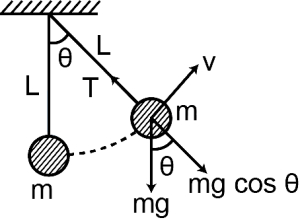
$A$ simple pendulum of length $L$ swings in a vertical plane. The tension in the string when it makes an angle $\theta$ with the vertical and the bob of mass $m$ moves with a speed $v$ is (where $g$ is the gravitational acceleration):
A
$m v^{2} / L$
B
$m g \cos \theta + m v^{2} / L$
C
$m g \cos \theta - m v^{2} / L$
D
$m g \cos \theta$
Solution
(B) For a bob of mass $m$ moving in a vertical circular path of radius $L$ with speed $v$,the forces acting on the bob along the radial direction are the tension $T$ (towards the center) and the component of weight $mg \cos \theta$ (away from the center).
The net centripetal force required for circular motion is provided by the resultant of these radial forces:
$T - mg \cos \theta = \frac{mv^2}{L}$
Rearranging the equation to solve for the tension $T$:
$T = \frac{mv^2}{L} + mg \cos \theta$
The net centripetal force required for circular motion is provided by the resultant of these radial forces:
$T - mg \cos \theta = \frac{mv^2}{L}$
Rearranging the equation to solve for the tension $T$:
$T = \frac{mv^2}{L} + mg \cos \theta$
0 likesView Solution
12
PhysicsMediumMCQWBJEE · 2015
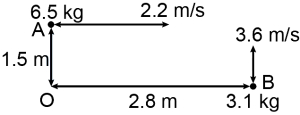
Two particles $A$ and $B$ are moving as shown in the figure. Their total angular momentum about the point $O$ is
A
$9.8 \ kg \ m^2/s$
B
zero
C
$52.7 \ kg \ m^2/s$
D
$37.9 \ kg \ m^2/s$
Solution
(A) The angular momentum $L$ of a particle about a point $O$ is given by $L = \vec{r} \times \vec{p} = m(\vec{r} \times \vec{v})$. The magnitude is $L = mvr \sin \theta$,where $r \sin \theta$ is the perpendicular distance from $O$ to the line of motion.
For particle $A$: $m_A = 6.5 \ kg$,$v_A = 2.2 \ m/s$,and the perpendicular distance $r_A = 1.5 \ m$. The motion is clockwise,so $L_A = -m_A v_A r_A = -(6.5 \times 2.2 \times 1.5) = -21.45 \ kg \ m^2/s$.
For particle $B$: $m_B = 3.1 \ kg$,$v_B = 3.6 \ m/s$,and the perpendicular distance $r_B = 2.8 \ m$. The motion is counter-clockwise,so $L_B = +m_B v_B r_B = +(3.1 \times 3.6 \times 2.8) = +31.248 \ kg \ m^2/s$.
The total angular momentum is $L = L_A + L_B = -21.45 + 31.248 = 9.798 \ kg \ m^2/s \approx 9.8 \ kg \ m^2/s$.
For particle $A$: $m_A = 6.5 \ kg$,$v_A = 2.2 \ m/s$,and the perpendicular distance $r_A = 1.5 \ m$. The motion is clockwise,so $L_A = -m_A v_A r_A = -(6.5 \times 2.2 \times 1.5) = -21.45 \ kg \ m^2/s$.
For particle $B$: $m_B = 3.1 \ kg$,$v_B = 3.6 \ m/s$,and the perpendicular distance $r_B = 2.8 \ m$. The motion is counter-clockwise,so $L_B = +m_B v_B r_B = +(3.1 \times 3.6 \times 2.8) = +31.248 \ kg \ m^2/s$.
The total angular momentum is $L = L_A + L_B = -21.45 + 31.248 = 9.798 \ kg \ m^2/s \approx 9.8 \ kg \ m^2/s$.
0 likesView Solution
13
PhysicsMediumMCQWBJEE · 2015
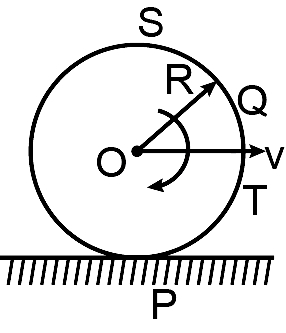
$A$ circular disc rolls on a horizontal floor without slipping and the centre of the disc moves with a uniform velocity $v$. Which of the following values can the velocity of a point on the rim of the disc have?
A
$v$
B
$-v$
C
$2v$
D
Zero
Solution
(A, C, D) For a circular disc rolling without slipping on a horizontal floor, the velocity of any point on the rim is the vector sum of the translational velocity of the centre $(v)$ and the tangential velocity due to rotation $(\omega R)$.
Since the disc rolls without slipping, $v = \omega R$.
$1$. At the point of contact $(P)$ with the floor, the velocity is $v_P = v - \omega R = v - v = 0$.
$2$. At the top point $(S)$, the velocity is $v_S = v + \omega R = v + v = 2v$.
$3$. At any other point on the rim, the magnitude of the velocity lies between $0$ and $2v$. Specifically, at the level of the centre, the velocity is $\sqrt{v^2 + v^2} = \sqrt{2}v$.
Thus, the possible values for the velocity of a point on the rim include $0$, $v$, $\sqrt{2}v$, and $2v$. Among the given options, $v$, $2v$, and $0$ are valid.
Since the disc rolls without slipping, $v = \omega R$.
$1$. At the point of contact $(P)$ with the floor, the velocity is $v_P = v - \omega R = v - v = 0$.
$2$. At the top point $(S)$, the velocity is $v_S = v + \omega R = v + v = 2v$.
$3$. At any other point on the rim, the magnitude of the velocity lies between $0$ and $2v$. Specifically, at the level of the centre, the velocity is $\sqrt{v^2 + v^2} = \sqrt{2}v$.
Thus, the possible values for the velocity of a point on the rim include $0$, $v$, $\sqrt{2}v$, and $2v$. Among the given options, $v$, $2v$, and $0$ are valid.
0 likesView Solution
14
PhysicsMediumMCQWBJEE · 2015
Three bodies of the same material and having masses $m, m$ and $3m$ are at temperatures $40^{\circ} C, 50^{\circ} C$ and $60^{\circ} C$ respectively. If the bodies are brought in thermal contact,the final temperature will be (in $^{\circ} C$)
A
$45$
B
$54$
C
$52$
D
$48$
Solution
(B) Let the final equilibrium temperature be $\theta$. According to the principle of calorimetry,the heat lost by the hotter bodies must equal the heat gained by the colder bodies.
Heat lost by the body at $60^{\circ} C$ (mass $3m$) = $3m \cdot s \cdot (60 - \theta)$
Heat gained by the body at $50^{\circ} C$ (mass $m$) = $m \cdot s \cdot (\theta - 50)$
Heat gained by the body at $40^{\circ} C$ (mass $m$) = $m \cdot s \cdot (\theta - 40)$
Equating heat lost and heat gained:
$3ms(60 - \theta) = ms(\theta - 50) + ms(\theta - 40)$
Dividing by $ms$:
$3(60 - \theta) = (\theta - 50) + (\theta - 40)$
$180 - 3\theta = 2\theta - 90$
$5\theta = 270$
$\theta = 54^{\circ} C$
Heat lost by the body at $60^{\circ} C$ (mass $3m$) = $3m \cdot s \cdot (60 - \theta)$
Heat gained by the body at $50^{\circ} C$ (mass $m$) = $m \cdot s \cdot (\theta - 50)$
Heat gained by the body at $40^{\circ} C$ (mass $m$) = $m \cdot s \cdot (\theta - 40)$
Equating heat lost and heat gained:
$3ms(60 - \theta) = ms(\theta - 50) + ms(\theta - 40)$
Dividing by $ms$:
$3(60 - \theta) = (\theta - 50) + (\theta - 40)$
$180 - 3\theta = 2\theta - 90$
$5\theta = 270$
$\theta = 54^{\circ} C$
0 likesView Solution
15
PhysicsDifficultMCQWBJEE · 2015
$A$ solid maintained at $t_{1}^{\circ} C$ is kept in an evacuated chamber at temperature $t_{2}^{\circ} C$ $(t_{2} > t_{1})$. The rate of heat absorbed by the body is proportional to
A
$t_{2}^{4}-t_{1}^{4}$
B
$(t_{2}+273)^{4}-(t_{1}+273)^{4}$
C
$t_{2}-t_{1}$
D
$t_{2}^{2}-t_{1}^{2}$
Solution
(B) According to the Stefan-Boltzmann Law,the rate of heat energy radiated by a body at absolute temperature $T$ is given by $P = \sigma A e T^{4}$.
When a body at absolute temperature $T_{1}$ is placed in an enclosure at absolute temperature $T_{2}$,the net rate of heat exchange is given by $P_{net} = \sigma A e (T_{2}^{4} - T_{1}^{4})$.
Here,the absolute temperatures are $T_{1} = (t_{1} + 273) \ K$ and $T_{2} = (t_{2} + 273) \ K$.
Since the body is absorbing heat from the chamber,the rate of heat absorption is proportional to the difference of the fourth powers of their absolute temperatures.
Therefore,the rate of heat absorbed is proportional to $(t_{2} + 273)^{4} - (t_{1} + 273)^{4}$.
When a body at absolute temperature $T_{1}$ is placed in an enclosure at absolute temperature $T_{2}$,the net rate of heat exchange is given by $P_{net} = \sigma A e (T_{2}^{4} - T_{1}^{4})$.
Here,the absolute temperatures are $T_{1} = (t_{1} + 273) \ K$ and $T_{2} = (t_{2} + 273) \ K$.
Since the body is absorbing heat from the chamber,the rate of heat absorption is proportional to the difference of the fourth powers of their absolute temperatures.
Therefore,the rate of heat absorbed is proportional to $(t_{2} + 273)^{4} - (t_{1} + 273)^{4}$.
0 likesView Solution
16
PhysicsDifficultMCQWBJEE · 2015
The pressure $p$,volume $V$ and temperature $T$ for a certain gas are related by $p=\frac{A T-B T^{2}}{V}$ where $A$ and $B$ are constants. The work done by the gas when the temperature changes from $T_{1}$ to $T_{2}$ while the pressure remains constant,is given by
A
$A\left(T_{2}-T_{1}\right)+B\left(T_{2}^{2}-T_{1}^{2}\right)$
B
$\frac{A\left(T_{2}-T_{1}\right)}{V_{2}-V_{1}}-\frac{B\left(T_{2}^{2}-T_{1}^{2}\right)}{V_{2}-V_{1}}$
C
$A\left(T_{2}-T_{1}\right)-\frac{B}{2}\left(T_{2}^{2}-T_{1}^{2}\right)$
D
$\frac{A\left(T_{2}-T_{1}^{2}\right)}{V_{2}-V_{1}}$
Solution
(A) Given the equation of state: $PV = AT - BT^2$.
Since the pressure $P$ is constant,we differentiate the equation with respect to $T$:
$P dV = A dT - B(2T) dT$.
Work done $W = \int P dV$.
Substituting $P dV$ into the integral:
$W = \int_{T_1}^{T_2} (A - 2BT) dT$.
$W = A \int_{T_1}^{T_2} dT - 2B \int_{T_1}^{T_2} T dT$.
$W = A(T_2 - T_1) - 2B \left[ \frac{T^2}{2} \right]_{T_1}^{T_2}$.
$W = A(T_2 - T_1) - B(T_2^2 - T_1^2)$.
Since the pressure $P$ is constant,we differentiate the equation with respect to $T$:
$P dV = A dT - B(2T) dT$.
Work done $W = \int P dV$.
Substituting $P dV$ into the integral:
$W = \int_{T_1}^{T_2} (A - 2BT) dT$.
$W = A \int_{T_1}^{T_2} dT - 2B \int_{T_1}^{T_2} T dT$.
$W = A(T_2 - T_1) - 2B \left[ \frac{T^2}{2} \right]_{T_1}^{T_2}$.
$W = A(T_2 - T_1) - B(T_2^2 - T_1^2)$.
0 likesView Solution
17
PhysicsMediumMCQWBJEE · 2015
$A$ train is moving with a uniform speed $33 \ m/s$ and an observer is approaching the train with the same speed. If the train blows a whistle of frequency $1000 \ Hz$ and the velocity of sound is $333 \ m/s$,then the apparent frequency of the sound that the observer hears is: (in $Hz$)
A
$1220$
B
$1099$
C
$1110$
D
$1200$
Solution
(A) The apparent frequency $f'$ heard by an observer is given by the Doppler effect formula:
$f' = f_0 \left( \frac{v + v_o}{v - v_s} \right)$
Where:
$f_0 = 1000 \ Hz$ (source frequency)
$v = 333 \ m/s$ (velocity of sound)
$v_o = 33 \ m/s$ (velocity of observer,positive as it approaches the source)
$v_s = 33 \ m/s$ (velocity of source,positive as it moves towards the observer)
Substituting the values:
$f' = 1000 \left( \frac{333 + 33}{333 - 33} \right)$
$f' = 1000 \left( \frac{366}{300} \right)$
$f' = 1000 \times 1.22 = 1220 \ Hz$
$f' = f_0 \left( \frac{v + v_o}{v - v_s} \right)$
Where:
$f_0 = 1000 \ Hz$ (source frequency)
$v = 333 \ m/s$ (velocity of sound)
$v_o = 33 \ m/s$ (velocity of observer,positive as it approaches the source)
$v_s = 33 \ m/s$ (velocity of source,positive as it moves towards the observer)
Substituting the values:
$f' = 1000 \left( \frac{333 + 33}{333 - 33} \right)$
$f' = 1000 \left( \frac{366}{300} \right)$
$f' = 1000 \times 1.22 = 1220 \ Hz$
0 likesView Solution
18
PhysicsMediumMCQWBJEE · 2015
The length of an open organ pipe is twice the length of a closed organ pipe. The fundamental frequency of the open pipe is $100 \ Hz$. The frequency of the third harmonic of the closed pipe is: (in $Hz$)
A
$100$
B
$200$
C
$300$
D
$150$
Solution
(C) Let the length of the closed organ pipe be $l$. The fundamental frequency of an open organ pipe of length $L = 2l$ is given by $f_{open} = \frac{v}{2L} = \frac{v}{2(2l)} = \frac{v}{4l} = 100 \ Hz$.
The frequencies of a closed organ pipe of length $l$ are given by $f_n = (2n - 1) \frac{v}{4l}$,where $n = 1, 2, 3, ...$.
The first harmonic (fundamental) is $f_1 = \frac{v}{4l} = 100 \ Hz$.
The third harmonic corresponds to $n = 2$ (since the harmonics of a closed pipe are odd multiples of the fundamental: $f_1, 3f_1, 5f_1, ...$).
Therefore,the frequency of the third harmonic is $f_3 = 3 \times f_1 = 3 \times 100 \ Hz = 300 \ Hz$.
The frequencies of a closed organ pipe of length $l$ are given by $f_n = (2n - 1) \frac{v}{4l}$,where $n = 1, 2, 3, ...$.
The first harmonic (fundamental) is $f_1 = \frac{v}{4l} = 100 \ Hz$.
The third harmonic corresponds to $n = 2$ (since the harmonics of a closed pipe are odd multiples of the fundamental: $f_1, 3f_1, 5f_1, ...$).
Therefore,the frequency of the third harmonic is $f_3 = 3 \times f_1 = 3 \times 100 \ Hz = 300 \ Hz$.
0 likesView Solution
19
PhysicsMediumMCQWBJEE · 2015
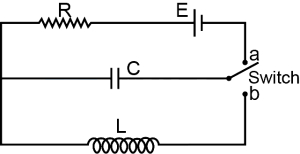
In the circuit shown below,the switch is kept in position $a$ for a long time and is then thrown to position $b$. The amplitude of the resulting oscillating current is given by
A
$E \sqrt{L/C}$
B
$E / R$
C
infinity
D
$E \sqrt{C/L}$
Solution
(D) When the switch is in position $a$,the capacitor is charged to a potential $E$. The charge on the capacitor is $q = CE$.
The energy stored in the capacitor is $U = \frac{q^2}{2C} = \frac{(CE)^2}{2C} = \frac{1}{2} CE^2$.
When the switch is thrown to position $b$,the circuit becomes an $LC$ oscillator. The total energy is conserved,oscillating between the electric field of the capacitor and the magnetic field of the inductor.
Let $I_0$ be the amplitude of the oscillating current. The maximum magnetic energy in the inductor is $\frac{1}{2} L I_0^2$.
By the law of conservation of energy,the maximum electrical energy equals the maximum magnetic energy:
$\frac{1}{2} CE^2 = \frac{1}{2} L I_0^2$
$CE^2 = L I_0^2$
$I_0^2 = \frac{C}{L} E^2$
$I_0 = E \sqrt{\frac{C}{L}}$
The energy stored in the capacitor is $U = \frac{q^2}{2C} = \frac{(CE)^2}{2C} = \frac{1}{2} CE^2$.
When the switch is thrown to position $b$,the circuit becomes an $LC$ oscillator. The total energy is conserved,oscillating between the electric field of the capacitor and the magnetic field of the inductor.
Let $I_0$ be the amplitude of the oscillating current. The maximum magnetic energy in the inductor is $\frac{1}{2} L I_0^2$.
By the law of conservation of energy,the maximum electrical energy equals the maximum magnetic energy:
$\frac{1}{2} CE^2 = \frac{1}{2} L I_0^2$
$CE^2 = L I_0^2$
$I_0^2 = \frac{C}{L} E^2$
$I_0 = E \sqrt{\frac{C}{L}}$
0 likesView Solution
20
PhysicsMediumMCQWBJEE · 2015
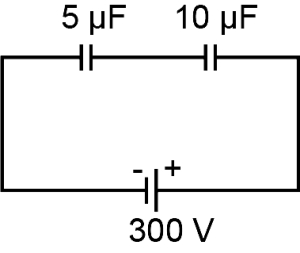
$A$ $5 \mu F$ capacitor is connected in series with a $10 \mu F$ capacitor. When a $300 \ V$ potential difference is applied across this combination,the total energy stored in the capacitors is (in $J$)
A
$18$
B
$1.5$
C
$0.15$
D
$0.10$
Solution
(C) The capacitors are connected in series. The equivalent capacitance $C_{eq}$ is given by:
$\frac{1}{C_{eq}} = \frac{1}{C_1} + \frac{1}{C_2} = \frac{1}{5 \mu F} + \frac{1}{10 \mu F} = \frac{2+1}{10 \mu F} = \frac{3}{10 \mu F}$
$C_{eq} = \frac{10}{3} \mu F = \frac{10}{3} \times 10^{-6} \ F$
The total energy $U$ stored in the series combination is given by:
$U = \frac{1}{2} C_{eq} V^2$
$U = \frac{1}{2} \times (\frac{10}{3} \times 10^{-6} \ F) \times (300 \ V)^2$
$U = \frac{1}{2} \times \frac{10}{3} \times 10^{-6} \times 90000$
$U = \frac{1}{2} \times \frac{10}{3} \times 10^{-6} \times 9 \times 10^4$
$U = \frac{1}{2} \times 30 \times 10^{-2} = 15 \times 10^{-2} \ J = 0.15 \ J$
$\frac{1}{C_{eq}} = \frac{1}{C_1} + \frac{1}{C_2} = \frac{1}{5 \mu F} + \frac{1}{10 \mu F} = \frac{2+1}{10 \mu F} = \frac{3}{10 \mu F}$
$C_{eq} = \frac{10}{3} \mu F = \frac{10}{3} \times 10^{-6} \ F$
The total energy $U$ stored in the series combination is given by:
$U = \frac{1}{2} C_{eq} V^2$
$U = \frac{1}{2} \times (\frac{10}{3} \times 10^{-6} \ F) \times (300 \ V)^2$
$U = \frac{1}{2} \times \frac{10}{3} \times 10^{-6} \times 90000$
$U = \frac{1}{2} \times \frac{10}{3} \times 10^{-6} \times 9 \times 10^4$
$U = \frac{1}{2} \times 30 \times 10^{-2} = 15 \times 10^{-2} \ J = 0.15 \ J$
0 likesView Solution
21
PhysicsMediumMCQWBJEE · 2015
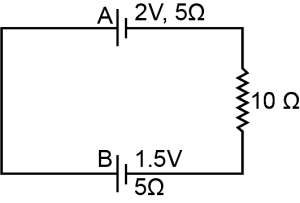
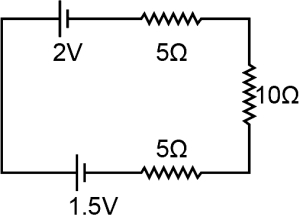
Two cells $A$ and $B$ of emf $2 \text{ V}$ and $1.5 \text{ V}$ respectively,are connected as shown in the figure through an external resistance $10 \text{ } \Omega$. The internal resistance of each cell is $5 \text{ } \Omega$. The potential difference $V_{A}$ and $V_{B}$ across the terminals of the cells $A$ and $B$ respectively are:
A
$V_{A}=2.0 \text{ V}, V_{B}=1.5 \text{ V}$
B
$V_{A}=2.125 \text{ V}, V_{B}=1.375 \text{ V}$
C
$V_{A}=1.875 \text{ V}, V_{B}=1.625 \text{ V}$
D
$V_{A}=1.875 \text{ V}, V_{B}=1.375 \text{ V}$
Solution
(C) The current $i$ flowing through the circuit is given by the net emf divided by the total resistance of the circuit.
Since the cells are connected in opposition,the net emf is $\varepsilon_{net} = 2 \text{ V} - 1.5 \text{ V} = 0.5 \text{ V}$.
The total resistance of the circuit is $R_{total} = 5 \text{ } \Omega + 5 \text{ } \Omega + 10 \text{ } \Omega = 20 \text{ } \Omega$.
Therefore,the current $i = \frac{0.5 \text{ V}}{20 \text{ } \Omega} = 0.025 \text{ A}$.
For cell $A$,which is discharging,the terminal potential difference is $V_{A} = \varepsilon_{A} - i r_{A} = 2 \text{ V} - (0.025 \text{ A} \times 5 \text{ } \Omega) = 2 - 0.125 = 1.875 \text{ V}$.
For cell $B$,which is charging,the terminal potential difference is $V_{B} = \varepsilon_{B} + i r_{B} = 1.5 \text{ V} + (0.025 \text{ A} \times 5 \text{ } \Omega) = 1.5 + 0.125 = 1.625 \text{ V}$.
Since the cells are connected in opposition,the net emf is $\varepsilon_{net} = 2 \text{ V} - 1.5 \text{ V} = 0.5 \text{ V}$.
The total resistance of the circuit is $R_{total} = 5 \text{ } \Omega + 5 \text{ } \Omega + 10 \text{ } \Omega = 20 \text{ } \Omega$.
Therefore,the current $i = \frac{0.5 \text{ V}}{20 \text{ } \Omega} = 0.025 \text{ A}$.
For cell $A$,which is discharging,the terminal potential difference is $V_{A} = \varepsilon_{A} - i r_{A} = 2 \text{ V} - (0.025 \text{ A} \times 5 \text{ } \Omega) = 2 - 0.125 = 1.875 \text{ V}$.
For cell $B$,which is charging,the terminal potential difference is $V_{B} = \varepsilon_{B} + i r_{B} = 1.5 \text{ V} + (0.025 \text{ A} \times 5 \text{ } \Omega) = 1.5 + 0.125 = 1.625 \text{ V}$.
0 likesView Solution
22
PhysicsMediumMCQWBJEE · 2015
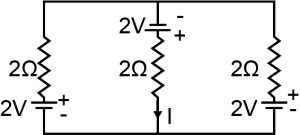
The current $I$ in the circuit shown is:
A
$1.33 A$
B
zero
C
$2.00 A$
D
$1.00 A$
Solution
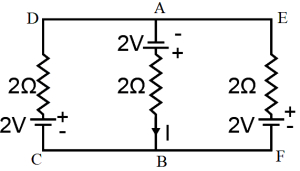
(B) Let the currents in the left and right branches be $I_1$ and $I_2$ respectively. The middle branch carries current $I = I_1 + I_2$.
Applying Kirchhoff's Voltage Law $(KVL)$ to the left loop:
$2 - 2I_1 - 2I = 0 \implies 2 - 2I_1 - 2(I_1 + I_2) = 0 \implies 2 - 4I_1 - 2I_2 = 0 \implies 2I_1 + I_2 = 1$ ---$(i)$
Applying $KVL$ to the right loop:
$-2 - 2I_2 - 2I = 0 \implies -2 - 2I_2 - 2(I_1 + I_2) = 0 \implies -2 - 2I_1 - 4I_2 = 0 \implies I_1 + 2I_2 = -1$ ---(ii)
Solving equations $(i)$ and (ii):
From $(i)$,$I_2 = 1 - 2I_1$. Substituting into (ii):
$I_1 + 2(1 - 2I_1) = -1$
$I_1 + 2 - 4I_1 = -1$
$-3I_1 = -3 \implies I_1 = 1 A$
Then $I_2 = 1 - 2(1) = -1 A$.
The current $I$ in the middle branch is $I = I_1 + I_2 = 1 + (-1) = 0 A$.
Applying Kirchhoff's Voltage Law $(KVL)$ to the left loop:
$2 - 2I_1 - 2I = 0 \implies 2 - 2I_1 - 2(I_1 + I_2) = 0 \implies 2 - 4I_1 - 2I_2 = 0 \implies 2I_1 + I_2 = 1$ ---$(i)$
Applying $KVL$ to the right loop:
$-2 - 2I_2 - 2I = 0 \implies -2 - 2I_2 - 2(I_1 + I_2) = 0 \implies -2 - 2I_1 - 4I_2 = 0 \implies I_1 + 2I_2 = -1$ ---(ii)
Solving equations $(i)$ and (ii):
From $(i)$,$I_2 = 1 - 2I_1$. Substituting into (ii):
$I_1 + 2(1 - 2I_1) = -1$
$I_1 + 2 - 4I_1 = -1$
$-3I_1 = -3 \implies I_1 = 1 A$
Then $I_2 = 1 - 2(1) = -1 A$.
The current $I$ in the middle branch is $I = I_1 + I_2 = 1 + (-1) = 0 A$.
0 likesView Solution
23
PhysicsEasyMCQWBJEE · 2015
$A$ metal wire of circular cross-section has a resistance $R_{1}$. The wire is now stretched without breaking,so that its length is doubled and the density is assumed to remain the same. If the resistance of the wire now becomes $R_{2}$,then $R_{2}: R_{1}$ is
A
$1: 1$
B
$1: 2$
C
$4: 1$
D
$1: 4$
Solution
(C) The resistance of a wire is given by $R = \rho \frac{l}{A}$.
Since the volume $V = A \cdot l$ remains constant,we can write $A = \frac{V}{l}$.
Substituting this into the resistance formula,we get $R = \rho \frac{l}{V/l} = \rho \frac{l^2}{V}$.
Since the resistivity $\rho$ and volume $V$ remain constant,we have $R \propto l^2$.
Given that the length is doubled,$l_2 = 2l_1$.
Therefore,$\frac{R_2}{R_1} = \left( \frac{l_2}{l_1} \right)^2 = \left( \frac{2l_1}{l_1} \right)^2 = 2^2 = 4$.
Thus,$R_2 : R_1 = 4 : 1$.
Since the volume $V = A \cdot l$ remains constant,we can write $A = \frac{V}{l}$.
Substituting this into the resistance formula,we get $R = \rho \frac{l}{V/l} = \rho \frac{l^2}{V}$.
Since the resistivity $\rho$ and volume $V$ remain constant,we have $R \propto l^2$.
Given that the length is doubled,$l_2 = 2l_1$.
Therefore,$\frac{R_2}{R_1} = \left( \frac{l_2}{l_1} \right)^2 = \left( \frac{2l_1}{l_1} \right)^2 = 2^2 = 4$.
Thus,$R_2 : R_1 = 4 : 1$.
0 likesView Solution
24
PhysicsMediumMCQWBJEE · 2015
Consider two particles of different masses. In which of the following situations will the heavier of the two particles have a smaller de-Broglie wavelength?
A
Both have a free fall through the same height
B
Both move with the same kinetic energy
C
Both move with the same linear momentum
D
Both move with the same speed
Solution
(D) The de-Broglie wavelength is given by $\lambda = \frac{h}{p} = \frac{h}{mv}$.
Case $A$: For free fall,$v = \sqrt{2gh}$. Since $v$ is independent of mass,$\lambda = \frac{h}{m\sqrt{2gh}} \propto \frac{1}{m}$. Thus,the heavier particle has a smaller wavelength.
Case $B$: With same kinetic energy $K$,$\lambda = \frac{h}{\sqrt{2mK}}$. Since $\lambda \propto \frac{1}{\sqrt{m}}$,the heavier particle has a smaller wavelength.
Case $C$: With same momentum $p$,$\lambda = \frac{h}{p}$. Since $p$ is the same,$\lambda$ is the same for both.
Case $D$: With same speed $v$,$\lambda = \frac{h}{mv}$. Since $\lambda \propto \frac{1}{m}$,the heavier particle has a smaller wavelength.
Note: Options $A$,$B$,and $D$ all result in the heavier particle having a smaller de-Broglie wavelength. However,in standard physics problems of this type,the most direct relationship is often associated with constant speed or constant kinetic energy. Given the options,$D$ is the most fundamental case where $\lambda \propto 1/m$ is directly observed.
Case $A$: For free fall,$v = \sqrt{2gh}$. Since $v$ is independent of mass,$\lambda = \frac{h}{m\sqrt{2gh}} \propto \frac{1}{m}$. Thus,the heavier particle has a smaller wavelength.
Case $B$: With same kinetic energy $K$,$\lambda = \frac{h}{\sqrt{2mK}}$. Since $\lambda \propto \frac{1}{\sqrt{m}}$,the heavier particle has a smaller wavelength.
Case $C$: With same momentum $p$,$\lambda = \frac{h}{p}$. Since $p$ is the same,$\lambda$ is the same for both.
Case $D$: With same speed $v$,$\lambda = \frac{h}{mv}$. Since $\lambda \propto \frac{1}{m}$,the heavier particle has a smaller wavelength.
Note: Options $A$,$B$,and $D$ all result in the heavier particle having a smaller de-Broglie wavelength. However,in standard physics problems of this type,the most direct relationship is often associated with constant speed or constant kinetic energy. Given the options,$D$ is the most fundamental case where $\lambda \propto 1/m$ is directly observed.
0 likesView Solution
25
PhysicsDifficultMCQWBJEE · 2015
$A$ photon of wavelength $300 \ nm$ interacts with a stationary hydrogen atom in the ground state. During the interaction,the whole energy of the photon is transferred to the electron of the atom. State which possibility is correct. (Consider,Planck constant $= 4 \times 10^{-15} \ eV \cdot s$,velocity of light $= 3 \times 10^{8} \ m/s$,ionisation energy of hydrogen $= 13.6 \ eV$)
A
Electron will be knocked out of the atom
B
Electron will go to any excited state of the atom
C
Electron will go only to first excited state of the atom
D
Electron will keep orbiting in the ground state of the atom
Solution
(D) The energy of the photon is given by $E = \frac{hc}{\lambda}$.
Substituting the given values:
$E = \frac{4 \times 10^{-15} \ eV \cdot s \times 3 \times 10^{8} \ m/s}{300 \times 10^{-9} \ m} = \frac{12 \times 10^{-7}}{300 \times 10^{-9}} \ eV = \frac{1200}{300} \ eV = 4 \ eV$.
The energy required to excite a hydrogen atom from the ground state $(n=1)$ to the first excited state $(n=2)$ is $\Delta E = 13.6 \ eV \times (1 - \frac{1}{4}) = 13.6 \times 0.75 = 10.2 \ eV$.
Since the energy of the photon $(4 \ eV)$ is less than the energy required for the first excitation $(10.2 \ eV)$ and also less than the ionization energy $(13.6 \ eV)$,the electron cannot absorb this energy to transition to a higher state.
Therefore,the electron will remain in the ground state.
Substituting the given values:
$E = \frac{4 \times 10^{-15} \ eV \cdot s \times 3 \times 10^{8} \ m/s}{300 \times 10^{-9} \ m} = \frac{12 \times 10^{-7}}{300 \times 10^{-9}} \ eV = \frac{1200}{300} \ eV = 4 \ eV$.
The energy required to excite a hydrogen atom from the ground state $(n=1)$ to the first excited state $(n=2)$ is $\Delta E = 13.6 \ eV \times (1 - \frac{1}{4}) = 13.6 \times 0.75 = 10.2 \ eV$.
Since the energy of the photon $(4 \ eV)$ is less than the energy required for the first excitation $(10.2 \ eV)$ and also less than the ionization energy $(13.6 \ eV)$,the electron cannot absorb this energy to transition to a higher state.
Therefore,the electron will remain in the ground state.
0 likesView Solution
26
PhysicsMediumMCQWBJEE · 2015
The work function of metals is in the range of $2 eV$ to $5 eV$. Find which of the following wavelengths of light cannot be used for the photoelectric effect (in $nm$)? (Consider,Planck constant $= 4 \times 10^{-15} eVs$,velocity of light $= 3 \times 10^{8} m/s$)
A
$510$
B
$650$
C
$400$
D
$570$
Solution
(B) The photoelectric effect occurs when the energy of incident photons $E = \frac{hc}{\lambda}$ is greater than or equal to the work function $\phi$ of the metal.
Given the range of work function $2 eV \leq \phi \leq 5 eV$,the threshold wavelength $\lambda$ must satisfy $\lambda \leq \frac{hc}{\phi}$.
For $\phi = 2 eV$,$\lambda_{\max} = \frac{4 \times 10^{-15} eVs \times 3 \times 10^{8} m/s}{2 eV} = 6 \times 10^{-7} m = 600 nm$.
For $\phi = 5 eV$,$\lambda_{\min} = \frac{4 \times 10^{-15} eVs \times 3 \times 10^{8} m/s}{5 eV} = 2.4 \times 10^{-7} m = 240 nm$.
Thus,the range of wavelengths that can cause the photoelectric effect is $240 nm \leq \lambda \leq 600 nm$.
Comparing the given options,$650 nm$ is greater than $600 nm$,so it cannot cause the photoelectric effect.
Given the range of work function $2 eV \leq \phi \leq 5 eV$,the threshold wavelength $\lambda$ must satisfy $\lambda \leq \frac{hc}{\phi}$.
For $\phi = 2 eV$,$\lambda_{\max} = \frac{4 \times 10^{-15} eVs \times 3 \times 10^{8} m/s}{2 eV} = 6 \times 10^{-7} m = 600 nm$.
For $\phi = 5 eV$,$\lambda_{\min} = \frac{4 \times 10^{-15} eVs \times 3 \times 10^{8} m/s}{5 eV} = 2.4 \times 10^{-7} m = 240 nm$.
Thus,the range of wavelengths that can cause the photoelectric effect is $240 nm \leq \lambda \leq 600 nm$.
Comparing the given options,$650 nm$ is greater than $600 nm$,so it cannot cause the photoelectric effect.
0 likesView Solution
27
PhysicsMediumMCQWBJEE · 2015
$A$ conducting loop in the form of a circle is placed in a uniform magnetic field with its plane perpendicular to the direction of the field. An emf will be induced in the loop, if
A
it is translated parallel to itself
B
it is rotated about one of its diameters
C
it is rotated about its own axis which is parallel to the field
D
the loop is deformed from the original shape
Solution
(B, D) According to Faraday's law of electromagnetic induction, an emf is induced in a loop whenever there is a change in the magnetic flux $(\Phi_B = \vec{B} \cdot \vec{A} = BA \cos \theta)$ linked with it.
$1$. If the loop is translated parallel to itself in a uniform magnetic field, the flux remains constant, so no emf is induced.
$2$. If the loop is rotated about one of its diameters, the angle $\theta$ between the area vector and the magnetic field changes, causing a change in flux, thus inducing an emf.
$3$. If the loop is rotated about its own axis (which is parallel to the field), the angle $\theta$ remains constant, so no emf is induced.
$4$. If the loop is deformed, the area $A$ changes, which also changes the magnetic flux, thus inducing an emf.
Therefore, options $B$ and $D$ both lead to an induced emf.
$1$. If the loop is translated parallel to itself in a uniform magnetic field, the flux remains constant, so no emf is induced.
$2$. If the loop is rotated about one of its diameters, the angle $\theta$ between the area vector and the magnetic field changes, causing a change in flux, thus inducing an emf.
$3$. If the loop is rotated about its own axis (which is parallel to the field), the angle $\theta$ remains constant, so no emf is induced.
$4$. If the loop is deformed, the area $A$ changes, which also changes the magnetic flux, thus inducing an emf.
Therefore, options $B$ and $D$ both lead to an induced emf.
0 likesView Solution
28
PhysicsDifficultMCQWBJEE · 2015
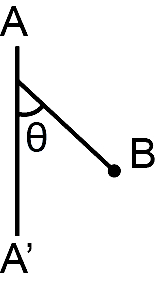
The line $AA^{\prime}$ lies on a charged infinite conducting plane which is perpendicular to the plane of the paper. The plane has a surface charge density $\sigma$. $B$ is a ball of mass $m$ with a like charge of magnitude $q$. $B$ is connected by a string to a point on the line $AA^{\prime}$. The tangent of the angle $\theta$ formed between the line $AA^{\prime}$ and the string is:
A
$\frac{q \sigma}{2 \varepsilon_{0} m g}$
B
$\frac{q \sigma}{4 \pi \varepsilon_{0} m g}$
C
$\frac{q \sigma}{2 \pi \varepsilon_{0} m g}$
D
$\frac{q \sigma}{\varepsilon_{0} m g}$
Solution
(A) The electric field $E$ due to a charged infinite conducting sheet is given by $E = \frac{\sigma}{\varepsilon_{0}}$.
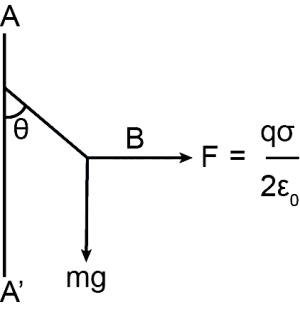
However,for a non-conducting sheet,$E = \frac{\sigma}{2\varepsilon_{0}}$. Given the context of the options and the provided solution image,the force acting on the ball is $F = qE = \frac{q\sigma}{2\varepsilon_{0}}$.
Considering the forces acting on the ball $B$: the electric force $F$ acts horizontally,and the gravitational force $mg$ acts vertically downwards.
In equilibrium,the tension in the string balances these forces.
Therefore,$\tan \theta = \frac{F}{mg} = \frac{q\sigma / 2\varepsilon_{0}}{mg} = \frac{q\sigma}{2\varepsilon_{0}mg}$.
However,for a non-conducting sheet,$E = \frac{\sigma}{2\varepsilon_{0}}$. Given the context of the options and the provided solution image,the force acting on the ball is $F = qE = \frac{q\sigma}{2\varepsilon_{0}}$.
Considering the forces acting on the ball $B$: the electric force $F$ acts horizontally,and the gravitational force $mg$ acts vertically downwards.
In equilibrium,the tension in the string balances these forces.
Therefore,$\tan \theta = \frac{F}{mg} = \frac{q\sigma / 2\varepsilon_{0}}{mg} = \frac{q\sigma}{2\varepsilon_{0}mg}$.
0 likesView Solution
29
PhysicsDifficultMCQWBJEE · 2015
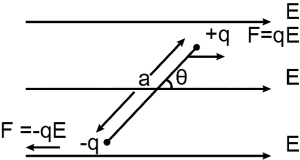
Two charges $+q$ and $-q$ are placed at a distance $a$ in a uniform electric field. The dipole moment of the combination is $2qa(\cos \theta \hat{i} + \sin \theta \hat{j})$,where $\theta$ is the angle between the direction of the field and the line joining the two charges. Which of the following statement$(s)$ is/are correct?
A
The torque exerted by the field on the dipole vanishes
B
The net force on the dipole vanishes
C
The torque is independent of the choice of coordinates
D
The net force is independent of $a$
Solution
(B, C) In a uniform electric field $\vec{E}$,the force on charge $+q$ is $\vec{F}_+ = q\vec{E}$ and the force on charge $-q$ is $\vec{F}_- = -q\vec{E}$.
The net force on the dipole is $\vec{F}_{net} = \vec{F}_+ + \vec{F}_- = q\vec{E} - q\vec{E} = 0$. Thus,the net force on the dipole always vanishes.
The torque on the dipole is given by $\vec{\tau} = \vec{p} \times \vec{E}$. Since the torque is defined as the cross product of the dipole moment and the electric field,it is a physical quantity and is independent of the choice of the coordinate system.
Therefore,statements $(b)$ and $(c)$ are correct.
The net force on the dipole is $\vec{F}_{net} = \vec{F}_+ + \vec{F}_- = q\vec{E} - q\vec{E} = 0$. Thus,the net force on the dipole always vanishes.
The torque on the dipole is given by $\vec{\tau} = \vec{p} \times \vec{E}$. Since the torque is defined as the cross product of the dipole moment and the electric field,it is a physical quantity and is independent of the choice of the coordinate system.
Therefore,statements $(b)$ and $(c)$ are correct.
0 likesView Solution
30
PhysicsEasyMCQWBJEE · 2015
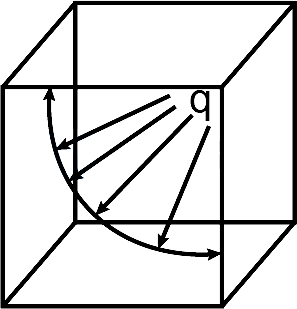
$A$ charge $q$ is placed at one corner of a cube. The electric flux through any of the three faces adjacent to the charge is zero. The flux through any one of the other three faces is
A
$q / 3 \varepsilon_{0}$
B
$q / 6 \varepsilon_{0}$
C
$q / 12 \varepsilon_{0}$
D
$q / 24 \varepsilon_{0}$
Solution
(D) According to Gauss's Law,the total electric flux through a closed surface is $\phi_{total} = q / \varepsilon_{0}$.
When a charge $q$ is placed at one corner of a cube,the cube can be considered as part of a larger Gaussian surface consisting of $8$ identical cubes to enclose the charge completely at the center.
Thus,the total flux through the entire cube is $\phi_{cube} = q / (8 \varepsilon_{0})$.
The charge $q$ lies on three faces of the cube. The electric field lines are parallel to these three faces,so the electric flux through these three faces is zero.
The remaining flux $\phi_{cube}$ is distributed equally among the other three faces of the cube.
Therefore,the flux through any one of the other three faces is $\phi = \frac{1}{3} \times \phi_{cube} = \frac{1}{3} \times \frac{q}{8 \varepsilon_{0}} = \frac{q}{24 \varepsilon_{0}}$.
When a charge $q$ is placed at one corner of a cube,the cube can be considered as part of a larger Gaussian surface consisting of $8$ identical cubes to enclose the charge completely at the center.
Thus,the total flux through the entire cube is $\phi_{cube} = q / (8 \varepsilon_{0})$.
The charge $q$ lies on three faces of the cube. The electric field lines are parallel to these three faces,so the electric flux through these three faces is zero.
The remaining flux $\phi_{cube}$ is distributed equally among the other three faces of the cube.
Therefore,the flux through any one of the other three faces is $\phi = \frac{1}{3} \times \phi_{cube} = \frac{1}{3} \times \frac{q}{8 \varepsilon_{0}} = \frac{q}{24 \varepsilon_{0}}$.
0 likesView Solution
31
PhysicsEasyMCQWBJEE · 2015
$A$ straight conductor $0.1 \ m$ long moves in a uniform magnetic field of $0.1 \ T$. The velocity of the conductor is $15 \ m/s$ and is directed perpendicular to the field. The emf induced between the two ends of the conductor is: (in $V$)
A
$0.10$
B
$0.15$
C
$1.50$
D
$15.00$
Solution
(B) Given:
Length of the conductor,$l = 0.1 \ m$
Magnetic field,$B = 0.1 \ T$
Velocity of the conductor,$v = 15 \ m/s$
The angle between the velocity vector $v$ and the magnetic field $B$ is $\theta = 90^{\circ}$.
When a conductor moves perpendicular to a uniform magnetic field,the motional emf induced is given by the formula:
$\varepsilon = B \cdot l \cdot v \cdot \sin(\theta)$
Substituting the given values:
$\varepsilon = 0.1 \times 0.1 \times 15 \times \sin(90^{\circ})$
Since $\sin(90^{\circ}) = 1$:
$\varepsilon = 0.01 \times 15 = 0.15 \ V$
Therefore,the induced emf is $0.15 \ V$.
Length of the conductor,$l = 0.1 \ m$
Magnetic field,$B = 0.1 \ T$
Velocity of the conductor,$v = 15 \ m/s$
The angle between the velocity vector $v$ and the magnetic field $B$ is $\theta = 90^{\circ}$.
When a conductor moves perpendicular to a uniform magnetic field,the motional emf induced is given by the formula:
$\varepsilon = B \cdot l \cdot v \cdot \sin(\theta)$
Substituting the given values:
$\varepsilon = 0.1 \times 0.1 \times 15 \times \sin(90^{\circ})$
Since $\sin(90^{\circ}) = 1$:
$\varepsilon = 0.01 \times 15 = 0.15 \ V$
Therefore,the induced emf is $0.15 \ V$.
0 likesView Solution
32
PhysicsMediumMCQWBJEE · 2015
Two particles,$A$ and $B$,having equal charges,after being accelerated through the same potential difference,enter into a region of uniform magnetic field and the particles describe circular paths of radii $R_{1}$ and $R_{2}$ respectively. The ratio of the masses of $A$ and $B$ is
A
$R_{1} / R_{2}$
B
$(R_{1} / R_{2})^{2}$
C
$(R_{2} / R_{1})^{2}$
D
$\sqrt{R_{1}} / R_{2}$
Solution
(B) The radius $R$ of the circular path followed by a charged particle in a magnetic field is given by $R = \frac{mv}{qB} = \frac{\sqrt{2mK}}{qB}$,where $K$ is the kinetic energy.
Since the particle is accelerated through a potential difference $V$,its kinetic energy is $K = qV$.
Substituting this into the radius formula,we get $R = \frac{\sqrt{2mqV}}{qB} = \frac{1}{B} \sqrt{\frac{2mV}{q}}$.
Given that $q$,$V$,and $B$ are the same for both particles,we have $R \propto \sqrt{m}$.
Therefore,$\frac{R_{1}}{R_{2}} = \sqrt{\frac{m_{A}}{m_{B}}}$.
Squaring both sides,we get $\frac{m_{A}}{m_{B}} = \left(\frac{R_{1}}{R_{2}}\right)^{2}$.
Since the particle is accelerated through a potential difference $V$,its kinetic energy is $K = qV$.
Substituting this into the radius formula,we get $R = \frac{\sqrt{2mqV}}{qB} = \frac{1}{B} \sqrt{\frac{2mV}{q}}$.
Given that $q$,$V$,and $B$ are the same for both particles,we have $R \propto \sqrt{m}$.
Therefore,$\frac{R_{1}}{R_{2}} = \sqrt{\frac{m_{A}}{m_{B}}}$.
Squaring both sides,we get $\frac{m_{A}}{m_{B}} = \left(\frac{R_{1}}{R_{2}}\right)^{2}$.
0 likesView Solution
33
PhysicsDifficultMCQWBJEE · 2015
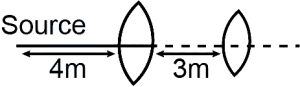
An object is located $4 \ m$ from the first of two thin converging lenses of focal lengths $2 \ m$ and $1 \ m,$ respectively. The lenses are separated by $3 \ m$. The final image formed by the second lens is located from the source at a distance of (in $m$):
A
$8.0$
B
$7.5$
C
$6.0$
D
$6.5$
Solution
(B) For the first lens:
Using the lens formula $\frac{1}{f_1} = \frac{1}{v_1} - \frac{1}{u_1}$,where $f_1 = 2 \ m$ and $u_1 = -4 \ m$:
$\frac{1}{2} = \frac{1}{v_1} - \frac{1}{-4} \Rightarrow \frac{1}{v_1} = \frac{1}{2} - \frac{1}{4} = \frac{1}{4} \Rightarrow v_1 = 4 \ m$.
This image is formed $4 \ m$ to the right of the first lens.
For the second lens:
The distance between the lenses is $3 \ m$. The image formed by the first lens acts as an object for the second lens.
Since the image is $4 \ m$ to the right of the first lens and the second lens is $3 \ m$ to the right of the first,the image is $1 \ m$ to the right of the second lens.
Thus,the object distance for the second lens is $u_2 = +1 \ m$ (virtual object).
Using the lens formula $\frac{1}{f_2} = \frac{1}{v_2} - \frac{1}{u_2}$,where $f_2 = 1 \ m$ and $u_2 = +1 \ m$:
$\frac{1}{1} = \frac{1}{v_2} - \frac{1}{1} \Rightarrow \frac{1}{v_2} = 1 + 1 = 2 \Rightarrow v_2 = 0.5 \ m$.
The final image is $0.5 \ m$ to the right of the second lens.
The total distance from the source is $4 \ m$ (to first lens) $+ 3 \ m$ (between lenses) $+ 0.5 \ m$ (from second lens) $= 7.5 \ m$.
Using the lens formula $\frac{1}{f_1} = \frac{1}{v_1} - \frac{1}{u_1}$,where $f_1 = 2 \ m$ and $u_1 = -4 \ m$:
$\frac{1}{2} = \frac{1}{v_1} - \frac{1}{-4} \Rightarrow \frac{1}{v_1} = \frac{1}{2} - \frac{1}{4} = \frac{1}{4} \Rightarrow v_1 = 4 \ m$.
This image is formed $4 \ m$ to the right of the first lens.
For the second lens:
The distance between the lenses is $3 \ m$. The image formed by the first lens acts as an object for the second lens.
Since the image is $4 \ m$ to the right of the first lens and the second lens is $3 \ m$ to the right of the first,the image is $1 \ m$ to the right of the second lens.
Thus,the object distance for the second lens is $u_2 = +1 \ m$ (virtual object).
Using the lens formula $\frac{1}{f_2} = \frac{1}{v_2} - \frac{1}{u_2}$,where $f_2 = 1 \ m$ and $u_2 = +1 \ m$:
$\frac{1}{1} = \frac{1}{v_2} - \frac{1}{1} \Rightarrow \frac{1}{v_2} = 1 + 1 = 2 \Rightarrow v_2 = 0.5 \ m$.
The final image is $0.5 \ m$ to the right of the second lens.
The total distance from the source is $4 \ m$ (to first lens) $+ 3 \ m$ (between lenses) $+ 0.5 \ m$ (from second lens) $= 7.5 \ m$.
0 likesView Solution
34
PhysicsEasyMCQWBJEE · 2015
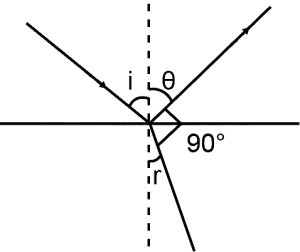
$A$ ray of light is incident at an angle $i$ on a glass slab of refractive index $\mu$. The angle between the reflected and refracted light is $90^{\circ}$. Then,the relationship between $i$ and $\mu$ is
A
$i=\tan ^{-1}\left(\frac{1}{\mu}\right)$
B
$\tan i=\mu$
C
$\sin i=\mu$
D
$\cos i=\mu$
Solution
(B) According to the law of reflection,the angle of incidence $i$ is equal to the angle of reflection $\theta$. So,$i = \theta$.
The sum of the angles on a straight line is $180^{\circ}$. Therefore,the angle of reflection $\theta$,the angle between the reflected and refracted rays $(90^{\circ})$,and the angle of refraction $r$ must satisfy:
$\theta + 90^{\circ} + r = 180^{\circ}$
Substituting $\theta = i$:
$i + 90^{\circ} + r = 180^{\circ}$
$r = 90^{\circ} - i$
According to Snell's law,$\mu = \frac{\sin i}{\sin r}$.
Substituting $r = 90^{\circ} - i$:
$\mu = \frac{\sin i}{\sin(90^{\circ} - i)}$
Since $\sin(90^{\circ} - i) = \cos i$,we get:
$\mu = \frac{\sin i}{\cos i} = \tan i$
Thus,$\tan i = \mu$.
The sum of the angles on a straight line is $180^{\circ}$. Therefore,the angle of reflection $\theta$,the angle between the reflected and refracted rays $(90^{\circ})$,and the angle of refraction $r$ must satisfy:
$\theta + 90^{\circ} + r = 180^{\circ}$
Substituting $\theta = i$:
$i + 90^{\circ} + r = 180^{\circ}$
$r = 90^{\circ} - i$
According to Snell's law,$\mu = \frac{\sin i}{\sin r}$.
Substituting $r = 90^{\circ} - i$:
$\mu = \frac{\sin i}{\sin(90^{\circ} - i)}$
Since $\sin(90^{\circ} - i) = \cos i$,we get:
$\mu = \frac{\sin i}{\cos i} = \tan i$
Thus,$\tan i = \mu$.
0 likesView Solution
35
PhysicsEasyMCQWBJEE · 2015
When light is refracted from a surface,which of its following physical parameters does not change?
A
Velocity
B
Amplitude
C
Frequency
D
Wavelength
Solution
(C) When light travels from one medium to another,its speed and wavelength change because the optical density of the medium changes. However,the frequency of light is determined by the source of the light and remains constant during refraction. Therefore,the frequency does not change.
0 likesView Solution
36
PhysicsEasyMCQWBJEE · 2015
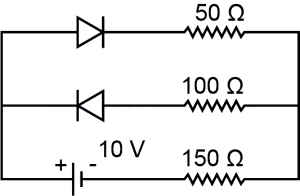
Assume that each diode as shown in the figure has a forward bias resistance of $50 \Omega$ and an infinite reverse bias resistance. The current through the $150 \Omega$ resistance is
A
$0.66 A$
B
$0.05 A$
C
zero
D
$0.04 A$
Solution
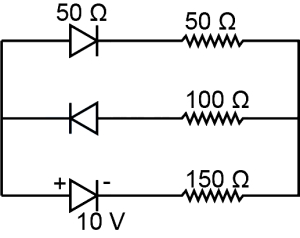
(D) In the given circuit,the top diode is forward-biased,while the middle diode is reverse-biased.
The reverse-biased diode acts as an open circuit (infinite resistance),so no current flows through the middle branch.
The circuit simplifies to a series combination of the $10 \text{ V}$ battery,the $150 \Omega$ resistor,the top diode (with $50 \Omega$ forward resistance),and the $50 \Omega$ resistor in that branch.
The total resistance of the circuit is $R_{total} = R_{diode} + R_{top} + R_{series} = 50 \Omega + 50 \Omega + 150 \Omega = 250 \Omega$.
The current $I$ flowing through the $150 \Omega$ resistor is given by Ohm's law: $I = \frac{V}{R_{total}} = \frac{10 \text{ V}}{250 \Omega} = 0.04 \text{ A}$.
The reverse-biased diode acts as an open circuit (infinite resistance),so no current flows through the middle branch.
The circuit simplifies to a series combination of the $10 \text{ V}$ battery,the $150 \Omega$ resistor,the top diode (with $50 \Omega$ forward resistance),and the $50 \Omega$ resistor in that branch.
The total resistance of the circuit is $R_{total} = R_{diode} + R_{top} + R_{series} = 50 \Omega + 50 \Omega + 150 \Omega = 250 \Omega$.
The current $I$ flowing through the $150 \Omega$ resistor is given by Ohm's law: $I = \frac{V}{R_{total}} = \frac{10 \text{ V}}{250 \Omega} = 0.04 \text{ A}$.
0 likesView Solution
37
PhysicsEasyMCQWBJEE · 2015
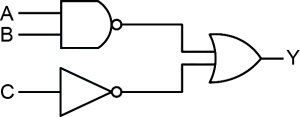
The inputs to the digital circuit are as shown below. The output $Y$ is
A
$A+B+\bar{C}$
B
$(A+B) \bar{C}$
C
$\bar{A}+\bar{B}+\bar{C}$
D
$\bar{A}+\bar{B}+C$
Solution
(C) The given digital circuit consists of a $NAND$ gate and a $NOT$ gate,whose outputs are fed into an $OR$ gate.
$1$. The output of the $NAND$ gate with inputs $A$ and $B$ is $\overline{AB}$.
$2$. The output of the $NOT$ gate with input $C$ is $\bar{C}$.
$3$. These two outputs are fed into an $OR$ gate,so the final output $Y$ is $Y = \overline{AB} + \bar{C}$.
$4$. According to De Morgan's theorem,$\overline{AB} = \bar{A} + \bar{B}$.
$5$. Substituting this into the expression for $Y$,we get $Y = \bar{A} + \bar{B} + \bar{C}$.
$1$. The output of the $NAND$ gate with inputs $A$ and $B$ is $\overline{AB}$.
$2$. The output of the $NOT$ gate with input $C$ is $\bar{C}$.
$3$. These two outputs are fed into an $OR$ gate,so the final output $Y$ is $Y = \overline{AB} + \bar{C}$.
$4$. According to De Morgan's theorem,$\overline{AB} = \bar{A} + \bar{B}$.
$5$. Substituting this into the expression for $Y$,we get $Y = \bar{A} + \bar{B} + \bar{C}$.
0 likesView Solution
38
PhysicsEasyMCQWBJEE · 2015
Find the correct condition$(s)$ for Fraunhofer diffraction due to a single slit.
A
Source is at infinite distance and the incident beam has converged at the slit
B
Source is near to the slit and the incident beam is parallel
C
Source is at infinity and the incident beam is parallel
D
Source is near to the slit and the incident beam has converged at the slit
Solution
(C) In Fraunhofer diffraction,the source of light and the screen are effectively at an infinite distance from the aperture (slit).
This implies that the wavefronts incident on the slit are plane wavefronts,which means the incident beam must be parallel.
This condition is practically achieved by placing the light source at the focus of a converging lens,or by placing the source at an infinite distance from the slit.
Therefore,the correct condition is that the source is at infinity and the incident beam is parallel.
This implies that the wavefronts incident on the slit are plane wavefronts,which means the incident beam must be parallel.
This condition is practically achieved by placing the light source at the focus of a converging lens,or by placing the source at an infinite distance from the slit.
Therefore,the correct condition is that the source is at infinity and the incident beam is parallel.
0 likesView Solution
39
PhysicsMediumMCQWBJEE · 2015
$A$ thin plastic sheet of refractive index $1.6$ is used to cover one of the slits of a double slit arrangement. The central point on the screen is now occupied by what would have been the $7^{th}$ bright fringe before the plastic was used. If the wavelength of light is $600 \ nm$, what is the thickness (in $\mu m$) of the plastic sheet?
A
$7$
B
$4$
C
$8$
D
$6$
Solution
(A) When a thin sheet of thickness $t$ and refractive index $\mu$ is placed in front of one of the slits, the path difference introduced is $\Delta x = (\mu - 1)t$.
Given that the central point on the screen is now occupied by the $7^{th}$ bright fringe, the shift in the fringe pattern is equal to $7$ fringe widths.
The condition for the shift is $(\mu - 1)t = n\lambda$, where $n = 7$ and $\lambda = 600 \ nm = 0.6 \ \mu m$.
Substituting the values: $(1.6 - 1)t = 7 \times 0.6 \ \mu m$.
$0.6 \times t = 4.2 \ \mu m$.
$t = \frac{4.2}{0.6} \ \mu m = 7 \ \mu m$.
Given that the central point on the screen is now occupied by the $7^{th}$ bright fringe, the shift in the fringe pattern is equal to $7$ fringe widths.
The condition for the shift is $(\mu - 1)t = n\lambda$, where $n = 7$ and $\lambda = 600 \ nm = 0.6 \ \mu m$.
Substituting the values: $(1.6 - 1)t = 7 \times 0.6 \ \mu m$.
$0.6 \times t = 4.2 \ \mu m$.
$t = \frac{4.2}{0.6} \ \mu m = 7 \ \mu m$.
0 likesView Solution
Vedclass Products
For Students
Vedclass Test Series
Mock tests in real WBJEE style covering Physics with performance analysis. 5-day free trial.
Start Free TrialFor Teachers
Exam Paper Generator
Generate Set A/B/C/D Physics papers from 7.5L+ questions in 2 minutes. 3 chapters free.
Try FreeFor Institutes
Online Exam Module
Run live WBJEE mock exams with unlimited students, 360° analytics & white-label branding.
See DemoFrequently Asked Questions
How many Physics questions are in WBJEE 2015?
There are 39 Physics questions from the WBJEE 2015 paper on Vedclass, each with a detailed step-by-step solution in English.
Are WBJEE 2015 Physics solutions available in English?
Yes. All solutions on this page are in English. You can also switch to English or Hindi using the language buttons above the questions.
Can I practice WBJEE 2015 Physics as a timed test?
Yes. Use the Vedclass Test Series to attempt a full WBJEE mock test covering Physics with time limits and instant score analysis.
Can teachers create Physics papers from WBJEE previous year questions?
Yes. The Vedclass Exam Paper Generator lets teachers mix WBJEE Physics questions and generate Set A/B/C/D papers in minutes.
For Teachers & Institutes
Build a Custom Physics Paper
Pick WBJEE 2015 Physics questions, set difficulty, and generate Set A/B/C/D in 2 minutes.