
ChemistryQ1–64 of 64 questions
Page 1 of 1 · English
1
ChemistryMCQWBJEE · 2014
$A$ small metal sphere of radius $a$ is falling with a velocity $v$ through a vertical column of a viscous liquid. If the coefficient of viscosity of the liquid is $\eta$,then the sphere encounters an opposing force of
A
$6\pi \eta {a^2}v$
B
$\frac{6\eta v}{\pi a}$
C
$6\pi \eta av$
D
$\frac{\pi \eta v}{6 a^3}$
Solution
(C) According to Stokes' law,when a small spherical object of radius $a$ moves through a viscous fluid with a velocity $v$,it experiences a viscous drag force $F$ that opposes its motion.
The magnitude of this force is given by the formula:
$F = 6\pi \eta av$
Where:
$F$ is the viscous force (drag force),
$\eta$ is the coefficient of viscosity of the liquid,
$a$ is the radius of the sphere,
$v$ is the velocity of the sphere.
Thus,the correct expression for the opposing force is $6\pi \eta av$.
The magnitude of this force is given by the formula:
$F = 6\pi \eta av$
Where:
$F$ is the viscous force (drag force),
$\eta$ is the coefficient of viscosity of the liquid,
$a$ is the radius of the sphere,
$v$ is the velocity of the sphere.
Thus,the correct expression for the opposing force is $6\pi \eta av$.
0 likesView Solution
2
ChemistryMCQWBJEE · 2014
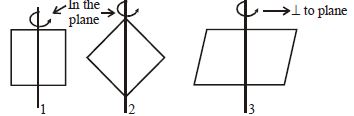
Three identical square plates rotate about the axes shown in the figure in such a way that their kinetic energies are equal. Each of the rotation axes passes through the centre of the square. Then the ratio of angular speeds $\omega _1 : \omega _2 : \omega _3$ is
A
$1 : 1 : 1$
B
$\sqrt 2 : \sqrt 2 : 1$
C
$1 : \sqrt 2 : 1$
D
$1 : 2 : \sqrt 2$
Solution
(B) The rotational kinetic energy is given by $K = \frac{1}{2} I \omega^2$. Since the kinetic energies are equal,we have $I_1 \omega_1^2 = I_2 \omega_2^2 = I_3 \omega_3^2$,which implies $\omega \propto \frac{1}{\sqrt{I}}$.
For a square plate of mass $m$ and side $l$:
$1$. For axis $1$ (in the plane,passing through the center parallel to a side),the moment of inertia is $I_1 = \frac{ml^2}{12}$.
$2$. For axis $2$ (in the plane,passing through the center along the diagonal),the moment of inertia is $I_2 = \frac{ml^2}{12}$.
$3$. For axis $3$ (perpendicular to the plane,passing through the center),the moment of inertia is $I_3 = I_1 + I_2 = \frac{ml^2}{12} + \frac{ml^2}{12} = \frac{ml^2}{6}$.
Thus,the ratio of angular speeds is $\omega_1 : \omega_2 : \omega_3 = \frac{1}{\sqrt{I_1}} : \frac{1}{\sqrt{I_2}} : \frac{1}{\sqrt{I_3}} = \frac{1}{\sqrt{ml^2/12}} : \frac{1}{\sqrt{ml^2/12}} : \frac{1}{\sqrt{ml^2/6}} = 1 : 1 : \frac{1}{\sqrt{1/2}} = 1 : 1 : \sqrt{2}$.
Wait,checking the options,the correct ratio is $1 : 1 : \frac{1}{\sqrt{2}}$ which is equivalent to $\sqrt{2} : \sqrt{2} : 1$.
For a square plate of mass $m$ and side $l$:
$1$. For axis $1$ (in the plane,passing through the center parallel to a side),the moment of inertia is $I_1 = \frac{ml^2}{12}$.
$2$. For axis $2$ (in the plane,passing through the center along the diagonal),the moment of inertia is $I_2 = \frac{ml^2}{12}$.
$3$. For axis $3$ (perpendicular to the plane,passing through the center),the moment of inertia is $I_3 = I_1 + I_2 = \frac{ml^2}{12} + \frac{ml^2}{12} = \frac{ml^2}{6}$.
Thus,the ratio of angular speeds is $\omega_1 : \omega_2 : \omega_3 = \frac{1}{\sqrt{I_1}} : \frac{1}{\sqrt{I_2}} : \frac{1}{\sqrt{I_3}} = \frac{1}{\sqrt{ml^2/12}} : \frac{1}{\sqrt{ml^2/12}} : \frac{1}{\sqrt{ml^2/6}} = 1 : 1 : \frac{1}{\sqrt{1/2}} = 1 : 1 : \sqrt{2}$.
Wait,checking the options,the correct ratio is $1 : 1 : \frac{1}{\sqrt{2}}$ which is equivalent to $\sqrt{2} : \sqrt{2} : 1$.
0 likesView Solution
3
ChemistryEasyMCQWBJEE · 2014
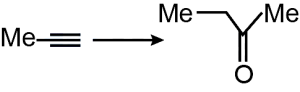
The reagents to carry out the following conversion are:
A
$HgSO_{4} / dil. \ H_{2}SO_{4}$
B
$BH_{3} ; H_{2}O_{2} / NaOH$
C
$OsO_{4} ; HIO_{4}$
D
$NaNH_{2} / CH_{3}I ; HgSO_{4} / dil. \ H_{2}SO_{4}$
Solution
(D) The starting material is $but-2-yne$ (or $CH_{3}-C \equiv C-CH_{3}$),but the image shows $prop-1-yne$ $(CH_{3}-C \equiv CH)$ being converted to $butan-2-one$ $(CH_{3}-CO-CH_{2}-CH_{3})$.
Step $1$: $CH_{3}-C \equiv CH + NaNH_{2} \rightarrow CH_{3}-C \equiv C^-Na^+ + NH_{3}$.
Step $2$: $CH_{3}-C \equiv C^-Na^+ + CH_{3}I \rightarrow CH_{3}-C \equiv C-CH_{3} + NaI$.
Step $3$: $CH_{3}-C \equiv C-CH_{3} + H_{2}O \xrightarrow{HgSO_{4} / dil. H_{2}SO_{4}} CH_{3}-C(OH)=CH-CH_{3}$ (enol form).
Step $4$: The enol form undergoes tautomerization to form $CH_{3}-CO-CH_{2}-CH_{3}$ $(butan-2-one)$.
Thus,the correct set of reagents is $NaNH_{2} / CH_{3}I ; HgSO_{4} / dil. \ H_{2}SO_{4}$.
Step $1$: $CH_{3}-C \equiv CH + NaNH_{2} \rightarrow CH_{3}-C \equiv C^-Na^+ + NH_{3}$.
Step $2$: $CH_{3}-C \equiv C^-Na^+ + CH_{3}I \rightarrow CH_{3}-C \equiv C-CH_{3} + NaI$.
Step $3$: $CH_{3}-C \equiv C-CH_{3} + H_{2}O \xrightarrow{HgSO_{4} / dil. H_{2}SO_{4}} CH_{3}-C(OH)=CH-CH_{3}$ (enol form).
Step $4$: The enol form undergoes tautomerization to form $CH_{3}-CO-CH_{2}-CH_{3}$ $(butan-2-one)$.
Thus,the correct set of reagents is $NaNH_{2} / CH_{3}I ; HgSO_{4} / dil. \ H_{2}SO_{4}$.
0 likesView Solution
4
ChemistryMCQWBJEE · 2014
$A$ parallel plate capacitor is charged and then disconnected from the charging battery. If the plates are now moved farther apart by pulling at them by means of insulating handles,then
A
the energy stored in the capacitor decreases
B
the capacitance of the capacitor increases
C
the charge on the capacitor decreases
D
the voltage across the capacitor increases
Solution
(D) The capacitance of a parallel plate capacitor is given by $C = \frac{\varepsilon_{0} A}{d}$.
When the plates are moved farther apart,the distance $d$ increases,which causes the capacitance $C$ to decrease.
Since the capacitor is disconnected from the battery,the charge $Q$ on the plates remains constant.
Using the relation $Q = CV$,we can write $V = \frac{Q}{C}$.
Since $Q$ is constant and $C$ decreases,the voltage $V$ across the capacitor must increase.
Additionally,the energy stored $U = \frac{Q^2}{2C}$ increases because $C$ decreases.
When the plates are moved farther apart,the distance $d$ increases,which causes the capacitance $C$ to decrease.
Since the capacitor is disconnected from the battery,the charge $Q$ on the plates remains constant.
Using the relation $Q = CV$,we can write $V = \frac{Q}{C}$.
Since $Q$ is constant and $C$ decreases,the voltage $V$ across the capacitor must increase.
Additionally,the energy stored $U = \frac{Q^2}{2C}$ increases because $C$ decreases.
0 likesView Solution
5
ChemistryEasyMCQWBJEE · 2014
The structure of $XeF_{6}$ is experimentally determined to be a distorted octahedron. Its structure according to $VSEPR$ theory is
A
octahedron
B
trigonal bipyramid
C
pentagonal bipyramid
D
tetragonal bipyramid
Solution
(C) In $XeF_{6}$,the central atom $Xe$ has $8$ valence electrons.
$6$ electrons are used in bonding with fluorine atoms (forming $6$ bond pairs),and the remaining $2$ electrons form $1$ lone pair.
Total electron pairs around $Xe = 6 \text{ (bond pairs)} + 1 \text{ (lone pair)} = 7$.
According to $VSEPR$ theory,a steric number of $7$ corresponds to a pentagonal bipyramidal electron geometry.
$6$ electrons are used in bonding with fluorine atoms (forming $6$ bond pairs),and the remaining $2$ electrons form $1$ lone pair.
Total electron pairs around $Xe = 6 \text{ (bond pairs)} + 1 \text{ (lone pair)} = 7$.
According to $VSEPR$ theory,a steric number of $7$ corresponds to a pentagonal bipyramidal electron geometry.
0 likesView Solution
6
ChemistryMediumMCQWBJEE · 2014
In case of heteronuclear diatomics of the type $AB$,where $A$ is more electronegative than $B$,the bonding molecular orbital resembles the character of $A$ more than that of $B$. The statement
A
is false
B
is true
C
cannot be evaluated since data is not sufficient
D
is true only for certain systems
Solution
(B) In a heteronuclear diatomic molecule $AB$,if $A$ is more electronegative than $B$,the bonding molecular orbital is closer in energy to the atomic orbital of the more electronegative atom $A$.
Consequently,the electron density in the bonding molecular orbital is concentrated more towards the more electronegative atom $A$.
Thus,the bonding molecular orbital resembles the character of $A$ more than that of $B$.
Consequently,the electron density in the bonding molecular orbital is concentrated more towards the more electronegative atom $A$.
Thus,the bonding molecular orbital resembles the character of $A$ more than that of $B$.
0 likesView Solution
7
ChemistryEasyMCQWBJEE · 2014
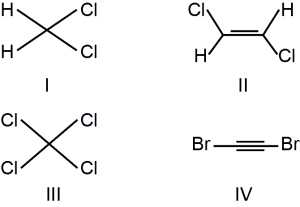
The compound that will have a permanent dipole moment among the following is
A
$I$
B
$II$
C
$III$
D
$IV$
Solution
(A) molecule has a permanent dipole moment if it is polar,meaning its net dipole moment $(\mu_{net})$ is not equal to zero.
$I$: $CH_{2}Cl_{2}$ (dichloromethane) is a non-symmetrical tetrahedral molecule. The bond dipoles of $C-H$ and $C-Cl$ bonds do not cancel each other out,resulting in a non-zero net dipole moment $(\mu_{net} \neq 0)$.
$II$: $trans-1,2-dichloroethene$ is a symmetrical molecule where the bond dipoles cancel each other out,resulting in $\mu_{net} = 0$.
$III$: $CCl_{4}$ (carbon tetrachloride) is a highly symmetrical tetrahedral molecule where all four $C-Cl$ bond dipoles cancel each other out,resulting in $\mu_{net} = 0$.
$IV$: $1,2-dibromoethyne$ is a linear,symmetrical molecule where the bond dipoles cancel each other out,resulting in $\mu_{net} = 0$.
Therefore,the compound with a permanent dipole moment is $I$.
$I$: $CH_{2}Cl_{2}$ (dichloromethane) is a non-symmetrical tetrahedral molecule. The bond dipoles of $C-H$ and $C-Cl$ bonds do not cancel each other out,resulting in a non-zero net dipole moment $(\mu_{net} \neq 0)$.
$II$: $trans-1,2-dichloroethene$ is a symmetrical molecule where the bond dipoles cancel each other out,resulting in $\mu_{net} = 0$.
$III$: $CCl_{4}$ (carbon tetrachloride) is a highly symmetrical tetrahedral molecule where all four $C-Cl$ bond dipoles cancel each other out,resulting in $\mu_{net} = 0$.
$IV$: $1,2-dibromoethyne$ is a linear,symmetrical molecule where the bond dipoles cancel each other out,resulting in $\mu_{net} = 0$.
Therefore,the compound with a permanent dipole moment is $I$.
0 likesView Solution
8
ChemistryEasyMCQWBJEE · 2014
The metal ion responsible for the Minamata disease is
A
$Co^{2+}$
B
$Hg^{2+}$
C
$Cu^{2+}$
D
$Zn^{2+}$
Solution
(B) Minamata disease is a neurological syndrome caused by severe mercury poisoning.
It is caused by the consumption of fish and shellfish contaminated with methylmercury,which is a form of mercury $(Hg^{2+})$.
The symptoms include ataxia,numbness in the hands and feet,general muscle weakness,narrowing of the field of vision,and damage to hearing and speech.
In severe cases,it leads to insanity,paralysis,coma,and death.
It is caused by the consumption of fish and shellfish contaminated with methylmercury,which is a form of mercury $(Hg^{2+})$.
The symptoms include ataxia,numbness in the hands and feet,general muscle weakness,narrowing of the field of vision,and damage to hearing and speech.
In severe cases,it leads to insanity,paralysis,coma,and death.
0 likesView Solution
9
ChemistryEasyMCQWBJEE · 2014
$({}_{32}Ge^{76}, {}_{34}Se^{76})$ and $({}_{14}Si^{30}, {}_{16}S^{32})$ are examples of
A
isotopes and isobars
B
isobars and isotones
C
isotones and isotopes
D
isobars and isotopes
Solution
(B) $({}_{32}Ge^{76}, {}_{34}Se^{76})$ have the same mass number $(A = 76)$ but different atomic numbers ($Z = 32$ and $Z = 34$),therefore they are isobars.
Number of neutrons in ${}_{14}Si^{30} = 30 - 14 = 16$.
Number of neutrons in ${}_{16}S^{32} = 32 - 16 = 16$.
Since both have the same number of neutrons,${}_{14}Si^{30}$ and ${}_{16}S^{32}$ are isotones.
Number of neutrons in ${}_{14}Si^{30} = 30 - 14 = 16$.
Number of neutrons in ${}_{16}S^{32} = 32 - 16 = 16$.
Since both have the same number of neutrons,${}_{14}Si^{30}$ and ${}_{16}S^{32}$ are isotones.
0 likesView Solution
10
ChemistryMediumMCQWBJEE · 2014
The bond angle in $NF_{3}$ $(102.3^{\circ})$ is smaller than $NH_{3}$ $(107.2^{\circ})$. This is because of
A
large size of $F$ compared to $H$
B
large size of $N$ compared to $F$
C
opposite polarity of $N$ in the two molecules
D
small size of $H$ compared to $N$
Solution
(C) In $NH_{3}$,the electronegativity of $N$ $(3.04)$ is higher than that of $H$ $(2.20)$,so the bonding electron pairs are shifted towards $N$. This increases the repulsion between the bonding pairs,leading to a larger bond angle $(107.2^{\circ})$.
In $NF_{3}$,the electronegativity of $F$ $(3.98)$ is higher than that of $N$ $(3.04)$,so the bonding electron pairs are shifted away from $N$ towards $F$. This reduces the repulsion between the bonding pairs,resulting in a smaller bond angle $(102.3^{\circ})$.
Therefore,the difference in the polarity of the $N-X$ bond (where $X = H$ or $F$) causes the difference in bond angles.
In $NF_{3}$,the electronegativity of $F$ $(3.98)$ is higher than that of $N$ $(3.04)$,so the bonding electron pairs are shifted away from $N$ towards $F$. This reduces the repulsion between the bonding pairs,resulting in a smaller bond angle $(102.3^{\circ})$.
Therefore,the difference in the polarity of the $N-X$ bond (where $X = H$ or $F$) causes the difference in bond angles.
0 likesView Solution
11
ChemistryEasyMCQWBJEE · 2014
The electronic configuration of $Cu$ is
A
$[Ne] 3s^{2}, 3p^{6}, 3d^{9}, 4s^{2}$
B
$[Ar] 3d^{10}, 4s^{1}$
C
$[Ne] 3s^{2}, 3p^{6}, 3d^{3}, 4s^{2}, 4p^{6}$
D
$[Ne] 3s^{2}, 3p^{6}, 3d^{5}, 4s^{2}, 4p^{4}$
Solution
(B) The atomic number of $Cu$ is $29$.
According to the Aufbau principle,the expected configuration is $[Ar] 3d^{9} 4s^{2}$.
However,fully filled $d$-orbitals are more stable than partially filled ones.
Therefore,one electron from the $4s$ orbital shifts to the $3d$ orbital to make it $3d^{10}$.
The correct electronic configuration is $[Ar] 3d^{10} 4s^{1}$.
According to the Aufbau principle,the expected configuration is $[Ar] 3d^{9} 4s^{2}$.
However,fully filled $d$-orbitals are more stable than partially filled ones.
Therefore,one electron from the $4s$ orbital shifts to the $3d$ orbital to make it $3d^{10}$.
The correct electronic configuration is $[Ar] 3d^{10} 4s^{1}$.
0 likesView Solution
12
ChemistryMediumMCQWBJEE · 2014
At $25^{\circ} C$,the molar conductance of $0.007 \ M$ hydrofluoric acid is $150 \ \text{mho} \ cm^{2} \ mol^{-1}$ and its $\Lambda_{m}^{\circ} = 500 \ \text{mho} \ cm^{2} \ mol^{-1}$. The value of the dissociation constant of the acid at the given concentration at $25^{\circ} C$ is
A
$7 \times 10^{-4} \ M$
B
$7 \times 10^{-5} \ M$
C
$9 \times 10^{-3} \ M$
D
$9 \times 10^{-4} \ M$
Solution
(D) Degree of dissociation,$\alpha = \frac{\Lambda_{m}^{c}}{\Lambda_{m}^{\circ}} = \frac{150}{500} = 0.3$
Given,$C = 0.007 \ M$
Hydrofluoric acid dissociates as follows:
$HF \rightleftharpoons H^{+} + F^{-}$
Initially: $C, 0, 0$
At equilibrium: $C(1 - \alpha), C\alpha, C\alpha$
Dissociation constant,$K_{a} = \frac{[H^{+}] [F^{-}]}{[HF]} = \frac{C \alpha \cdot C \alpha}{C(1 - \alpha)} = \frac{C \alpha^{2}}{(1 - \alpha)}$
On substituting the values,we get:
$K_{a} = \frac{0.007 \times (0.3)^{2}}{(1 - 0.3)} = \frac{0.007 \times 0.09}{0.7} = 0.01 \times 0.09 = 9 \times 10^{-4} \ M$
Given,$C = 0.007 \ M$
Hydrofluoric acid dissociates as follows:
$HF \rightleftharpoons H^{+} + F^{-}$
Initially: $C, 0, 0$
At equilibrium: $C(1 - \alpha), C\alpha, C\alpha$
Dissociation constant,$K_{a} = \frac{[H^{+}] [F^{-}]}{[HF]} = \frac{C \alpha \cdot C \alpha}{C(1 - \alpha)} = \frac{C \alpha^{2}}{(1 - \alpha)}$
On substituting the values,we get:
$K_{a} = \frac{0.007 \times (0.3)^{2}}{(1 - 0.3)} = \frac{0.007 \times 0.09}{0.7} = 0.01 \times 0.09 = 9 \times 10^{-4} \ M$
0 likesView Solution
13
ChemistryEasyMCQWBJEE · 2014
Among the following,the one which is not a "green house gas" is:
A
$N_{2}O$
B
$CO_{2}$
C
$CH_{4}$
D
$O_{2}$
Solution
(D) Greenhouse gases are gases that trap heat in the atmosphere,such as $CO_{2}$,$CH_{4}$,$N_{2}O$,and water vapor.
Oxygen $(O_{2})$ is a major component of the atmosphere but does not absorb infrared radiation,therefore it is not a greenhouse gas.
Oxygen $(O_{2})$ is a major component of the atmosphere but does not absorb infrared radiation,therefore it is not a greenhouse gas.
0 likesView Solution
14
ChemistryEasyMCQWBJEE · 2014
The $IUPAC$ name of the following molecule is:
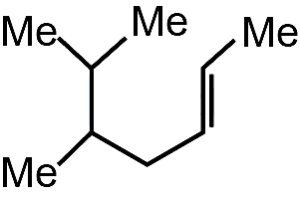
A
$2,5,6-$trimethylhept$-2-$ene
B
$2,3-$dimethylhept$-5-$ene
C
$5,6-$dimethylhept$-3-$ene
D
$2,5,6-$trimethylhept$-5-$ene
Solution
(A) To determine the $IUPAC$ name,first identify the longest carbon chain containing the double bond. The longest chain has $7$ carbon atoms,so the parent alkane is heptane. The double bond is given priority and numbered to get the lowest possible locant. Numbering from the right side gives the double bond position at $2$. The substituents are methyl groups at positions $2, 5,$ and $6$. Thus,the $IUPAC$ name is $2,5,6-$trimethylhept$-2-$ene.
0 likesView Solution
15
ChemistryEasyMCQWBJEE · 2014
The $4^{th}$ higher homologue of ethane is
A
$a.$ butane
B
$b.$ pentane
C
$c.$ hexane
D
$d.$ heptane
Solution
(C) Ethane is $C_2H_6$.
Homologues in an alkane series differ by a $-CH_2-$ unit.
The $4^{th}$ higher homologue is obtained by adding four $-CH_2-$ units to ethane.
$C_2H_6 + 4(CH_2) = C_6H_{14}$.
The compound with the molecular formula $C_6H_{14}$ is hexane.
Homologues in an alkane series differ by a $-CH_2-$ unit.
The $4^{th}$ higher homologue is obtained by adding four $-CH_2-$ units to ethane.
$C_2H_6 + 4(CH_2) = C_6H_{14}$.
The compound with the molecular formula $C_6H_{14}$ is hexane.
0 likesView Solution
16
ChemistryDifficultMCQWBJEE · 2014
The correct order of decreasing $H-C-H$ bond angle in the following molecules is:
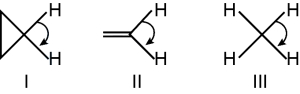
A
$I > II > III$
B
$II > I > III$
C
$III > II > I$
D
$I > III > II$
Solution
(B) To determine the $H-C-H$ bond angle,we look at the hybridization and geometry of the central carbon atom in each molecule:
$I$ (Cyclopropylidene): The central carbon atom is $sp^2$ hybridized. Due to the ring strain in the three-membered ring,the $H-C-H$ bond angle is approximately $115^{\circ}$.
$II$ (Ethene): The carbon atom is $sp^2$ hybridized. In a standard alkene,the $H-C-H$ bond angle is approximately $120^{\circ}$.
$III$ (Methane): The carbon atom is $sp^3$ hybridized with a tetrahedral geometry. The $H-C-H$ bond angle is $109^{\circ} 28^{\prime}$ (or $\approx 109.5^{\circ}$).
Comparing these values: $120^{\circ} (II) > 115^{\circ} (I) > 109.5^{\circ} (III)$.
Therefore,the correct decreasing order is $II > I > III$.
$I$ (Cyclopropylidene): The central carbon atom is $sp^2$ hybridized. Due to the ring strain in the three-membered ring,the $H-C-H$ bond angle is approximately $115^{\circ}$.
$II$ (Ethene): The carbon atom is $sp^2$ hybridized. In a standard alkene,the $H-C-H$ bond angle is approximately $120^{\circ}$.
$III$ (Methane): The carbon atom is $sp^3$ hybridized with a tetrahedral geometry. The $H-C-H$ bond angle is $109^{\circ} 28^{\prime}$ (or $\approx 109.5^{\circ}$).
Comparing these values: $120^{\circ} (II) > 115^{\circ} (I) > 109.5^{\circ} (III)$.
Therefore,the correct decreasing order is $II > I > III$.
0 likesView Solution
17
ChemistryEasyMCQWBJEE · 2014
Among the following structures,the one which is not a resonating structure of others is:
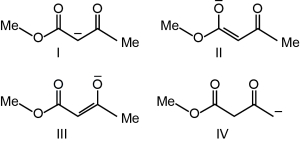
A
$I$
B
$II$
C
$III$
D
$IV$
Solution
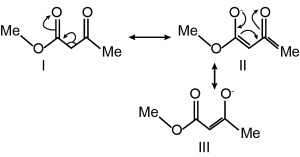
(D) Resonating structures involve the delocalization of $\pi$-electrons or lone pairs,but they do not involve the movement of atoms or groups of atoms.
In structures $I$,$II$,and $III$,the connectivity of atoms remains the same,and only the positions of electrons change.
In structure $IV$,the negative charge is on the terminal carbon atom,which implies a different connectivity compared to the enolate structures $I$,$II$,and $III$.
Thus,structure $IV$ is not a resonating structure of the others.
In structures $I$,$II$,and $III$,the connectivity of atoms remains the same,and only the positions of electrons change.
In structure $IV$,the negative charge is on the terminal carbon atom,which implies a different connectivity compared to the enolate structures $I$,$II$,and $III$.
Thus,structure $IV$ is not a resonating structure of the others.
0 likesView Solution
18
ChemistryMediumMCQWBJEE · 2014
The correct order of decreasing length of the bond as indicated by the arrow in the following structures is:
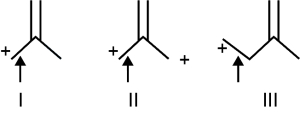
A
$I > II > III$
B
$II > I > III$
C
$III > II > I$
D
$I > III > II$
Solution
(C) The bond length is inversely proportional to the double bond character. Resonance increases the double bond character,thereby decreasing the bond length.
In structure $I$,the positive charge is in direct conjugation with the double bond,leading to significant double bond character.
In structure $II$,the positive charge is also in conjugation,but the presence of two positive charges creates a different electronic environment compared to $I$.
In structure $III$,the positive charge is separated from the double bond by a $CH_2$ group,so there is no resonance-induced double bond character.
Therefore,the bond length follows the order: $III > II > I$.
In structure $I$,the positive charge is in direct conjugation with the double bond,leading to significant double bond character.
In structure $II$,the positive charge is also in conjugation,but the presence of two positive charges creates a different electronic environment compared to $I$.
In structure $III$,the positive charge is separated from the double bond by a $CH_2$ group,so there is no resonance-induced double bond character.
Therefore,the bond length follows the order: $III > II > I$.
0 likesView Solution
19
ChemistryEasyMCQWBJEE · 2014
The most likely protonation site in the following molecule is:
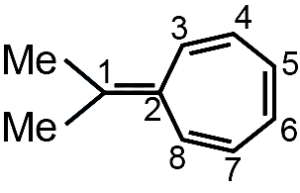
A
$C-1$
B
$C-2$
C
$C-3$
D
$C-6$
Solution
(A) The molecule is $8,8-dimethylheptafulvene$. Protonation at the $C-1$ position (the exocyclic double bond) leads to the formation of a $tropylium$ cation,which is a stable aromatic species ($6\pi$ electrons,$H$ückel's rule).
Since the resulting carbocation is aromatic and highly stable,the $C-1$ position is the most reactive site towards protonation.
Protonation at any other position on the seven-membered ring would disrupt the conjugation or fail to produce an aromatic system,making those sites less favorable.
Since the resulting carbocation is aromatic and highly stable,the $C-1$ position is the most reactive site towards protonation.
Protonation at any other position on the seven-membered ring would disrupt the conjugation or fail to produce an aromatic system,making those sites less favorable.
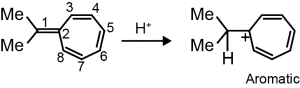
0 likesView Solution
20
ChemistryEasyMCQWBJEE · 2014
The order of decreasing ease of abstraction of hydrogen atoms in the following molecule is:
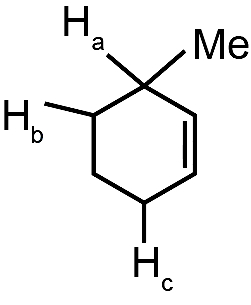
A
$H_{a} > H_{b} > H_{c}$
B
$H_{a} > H_{c} > H_{b}$
C
$H_{b} > H_{a} > H_{c}$
D
$H_{c} > H_{b} > H_{a}$
Solution
(B) The ease of abstraction of a hydrogen atom depends on the stability of the resulting radical or carbocation intermediate.
Abstraction of $H_{a}$ leads to a $3^{\circ}$ allylic radical/carbocation,which is highly stable due to resonance and hyperconjugation.
Abstraction of $H_{c}$ leads to a $2^{\circ}$ allylic radical/carbocation,which is less stable than the $3^{\circ}$ allylic species.
Abstraction of $H_{b}$ leads to a $2^{\circ}$ non-allylic radical/carbocation,which is the least stable among the three.
Therefore,the order of decreasing ease of abstraction is $H_{a} > H_{c} > H_{b}$.
Abstraction of $H_{a}$ leads to a $3^{\circ}$ allylic radical/carbocation,which is highly stable due to resonance and hyperconjugation.
Abstraction of $H_{c}$ leads to a $2^{\circ}$ allylic radical/carbocation,which is less stable than the $3^{\circ}$ allylic species.
Abstraction of $H_{b}$ leads to a $2^{\circ}$ non-allylic radical/carbocation,which is the least stable among the three.
Therefore,the order of decreasing ease of abstraction is $H_{a} > H_{c} > H_{b}$.
0 likesView Solution
21
ChemistryEasyMCQWBJEE · 2014
The correct statement regarding the following compounds is:
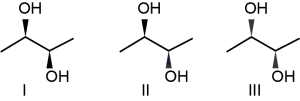
A
all three compounds are chiral
B
only $I$ and $II$ are chiral
C
$I$ and $III$ are diastereomers
D
only $I$ and $III$ are chiral
Solution
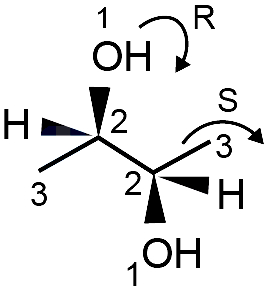
(D) The structures represent butane-$2,3$-diol isomers.
$I$ is $(2R, 3R)$-butane-$2,3$-diol,which is chiral.
$II$ is $(2R, 3S)$-butane-$2,3$-diol,which is a meso compound (achiral) due to an internal plane of symmetry.
$III$ is $(2S, 3S)$-butane-$2,3$-diol,which is chiral.
Therefore,only $I$ and $III$ are chiral.
$I$ is $(2R, 3R)$-butane-$2,3$-diol,which is chiral.
$II$ is $(2R, 3S)$-butane-$2,3$-diol,which is a meso compound (achiral) due to an internal plane of symmetry.
$III$ is $(2S, 3S)$-butane-$2,3$-diol,which is chiral.
Therefore,only $I$ and $III$ are chiral.
0 likesView Solution
22
ChemistryEasyMCQWBJEE · 2014
The hydrides of the first elements in groups $15-17$,namely $NH_3$,$H_2O$ and $HF$ respectively show abnormally high values for melting and boiling points. This is due to
A
small size of $N$,$O$ and $F$
B
the ability to form extensive intermolecular $H$-bonding
C
the ability to form extensive intramolecular $H$-bonding
D
effective van der Waals' interaction
Solution
(B) Hydrides of $N$,$O$ and $F$ possess small size and high electronegativity.
Due to this,they have the ability to form extensive intermolecular (between two molecules) hydrogen bonding.
Consequently,a large amount of energy is required to break these bonds,which results in abnormally high melting and boiling points for these hydrides.
Due to this,they have the ability to form extensive intermolecular (between two molecules) hydrogen bonding.
Consequently,a large amount of energy is required to break these bonds,which results in abnormally high melting and boiling points for these hydrides.
0 likesView Solution
23
ChemistryMediumMCQWBJEE · 2014
$A$ commercial sample of $H_{2}O_{2}$ is labeled as $10 \text{ V}$. Its percentage strength is nearly:
A
$3$
B
$6$
C
$9$
D
$12$
Solution
(A) $10 \text{ V } H_{2}O_{2}$ means $1 \text{ L}$ of this solution will produce $10 \text{ L}$ of $O_{2}$ at $STP$.
$2H_{2}O_{2} \rightarrow 2H_{2}O + O_{2}$
$68 \text{ g}$ of $H_{2}O_{2}$ produces $22.4 \text{ L}$ of $O_{2}$ at $STP$.
Therefore,$22.4 \text{ L}$ of $O_{2}$ is obtained from $68 \text{ g}$ of $H_{2}O_{2}$.
$10 \text{ L}$ of $O_{2}$ will be obtained from $H_{2}O_{2} = \frac{68}{22.4} \times 10 = 30.36 \text{ g}$.
$1000 \text{ mL}$ of the given solution contains $30.36 \text{ g}$ of $H_{2}O_{2}$.
$100 \text{ mL}$ of the given solution contains $\frac{30.36 \times 100}{1000} = 3.036 \text{ g}$ of $H_{2}O_{2}$.
Thus,the percentage strength of $H_{2}O_{2}$ is approximately $3$.
$2H_{2}O_{2} \rightarrow 2H_{2}O + O_{2}$
$68 \text{ g}$ of $H_{2}O_{2}$ produces $22.4 \text{ L}$ of $O_{2}$ at $STP$.
Therefore,$22.4 \text{ L}$ of $O_{2}$ is obtained from $68 \text{ g}$ of $H_{2}O_{2}$.
$10 \text{ L}$ of $O_{2}$ will be obtained from $H_{2}O_{2} = \frac{68}{22.4} \times 10 = 30.36 \text{ g}$.
$1000 \text{ mL}$ of the given solution contains $30.36 \text{ g}$ of $H_{2}O_{2}$.
$100 \text{ mL}$ of the given solution contains $\frac{30.36 \times 100}{1000} = 3.036 \text{ g}$ of $H_{2}O_{2}$.
Thus,the percentage strength of $H_{2}O_{2}$ is approximately $3$.
0 likesView Solution
24
ChemistryMediumMCQWBJEE · 2014
The $pH$ of $10^{-4} \ M$ $KOH$ solution will be
A
$4$
B
$11$
C
$10.5$
D
$10$
Solution
(D) $KOH$ is a strong base,so $[OH^-] = [KOH] = 10^{-4} \ M$.
$pOH = -\log[OH^-] = -\log(10^{-4}) = 4$.
At $25^\circ C$,$pH + pOH = 14$.
$pH = 14 - 4 = 10$.
$pOH = -\log[OH^-] = -\log(10^{-4}) = 4$.
At $25^\circ C$,$pH + pOH = 14$.
$pH = 14 - 4 = 10$.
0 likesView Solution
25
ChemistryEasyMCQWBJEE · 2014
If $Cl_2$ is passed through hot aqueous $NaOH$,the products formed have $Cl$ in different oxidation states. These are indicated as
A
$-1$ and $+1$
B
$-1$ and $+5$
C
$1$ and $5$
D
$-1$ and $+3$
Solution
(B) When $Cl_2$ is passed through hot aqueous $NaOH$,a disproportionation reaction occurs,resulting in the formation of sodium chloride $(NaCl)$ and sodium chlorate $(NaClO_3)$:
$6NaOH + 3Cl_2 \longrightarrow 5NaCl + NaClO_3 + 3H_2O$
In $NaCl$,the oxidation state of $Cl$ is $x$:
$(+1) + x = 0 \implies x = -1$
In $NaClO_3$,the oxidation state of $Cl$ is $y$:
$(+1) + y + 3(-2) = 0 \implies y - 5 = 0 \implies y = +5$
Thus,the $Cl$ atoms in the products exist in $-1$ and $+5$ oxidation states.
$6NaOH + 3Cl_2 \longrightarrow 5NaCl + NaClO_3 + 3H_2O$
In $NaCl$,the oxidation state of $Cl$ is $x$:
$(+1) + x = 0 \implies x = -1$
In $NaClO_3$,the oxidation state of $Cl$ is $y$:
$(+1) + y + 3(-2) = 0 \implies y - 5 = 0 \implies y = +5$
Thus,the $Cl$ atoms in the products exist in $-1$ and $+5$ oxidation states.
0 likesView Solution
26
ChemistryDifficultMCQWBJEE · 2014
The system that contains the maximum number of atoms is
A
$4.25 \text{ g}$ $NH_3$
B
$8 \text{ g}$ $O_2$
C
$2 \text{ g}$ $H_2$
D
$4 \text{ g}$ $He$
Solution
(C) $4.25 \text{ g}$ $NH_3 = (4.25 / 17) \times 4 \times N_A = 1 \times N_A$ atoms.
$(B)$ $8 \text{ g}$ $O_2 = (8 / 32) \times 2 \times N_A = 0.5 \times N_A$ atoms.
$(C)$ $2 \text{ g}$ $H_2 = (2 / 2) \times 2 \times N_A = 2 \times N_A$ atoms.
$(D)$ $4 \text{ g}$ $He = (4 / 4) \times 1 \times N_A = 1 \times N_A$ atoms.
Comparing the values,$2 \text{ g}$ $H_2$ contains the maximum number of atoms.
$(B)$ $8 \text{ g}$ $O_2 = (8 / 32) \times 2 \times N_A = 0.5 \times N_A$ atoms.
$(C)$ $2 \text{ g}$ $H_2 = (2 / 2) \times 2 \times N_A = 2 \times N_A$ atoms.
$(D)$ $4 \text{ g}$ $He = (4 / 4) \times 1 \times N_A = 1 \times N_A$ atoms.
Comparing the values,$2 \text{ g}$ $H_2$ contains the maximum number of atoms.
0 likesView Solution
27
ChemistryEasyMCQWBJEE · 2014
At a certain temperature,the time required for the complete diffusion of $200 \ mL$ of $H_2$ gas is $30 \ min$. The time required for the complete diffusion of $50 \ mL$ of $O_2$ gas at the same temperature will be: (in $min$)
A
$60$
B
$30$
C
$45$
D
$15$
Solution
(B) According to Graham's law of diffusion,the rate of diffusion $r$ is given by $r = \frac{V}{t} \propto \frac{1}{\sqrt{M}}$,where $V$ is volume,$t$ is time,and $M$ is molar mass.
For $H_2$ gas: $\frac{200}{30} = \frac{k}{\sqrt{2}}$ $(i)$
For $O_2$ gas: $\frac{50}{t} = \frac{k}{\sqrt{32}}$ $(ii)$
Dividing equation $(i)$ by $(ii)$:
$\frac{200/30}{50/t} = \frac{\sqrt{32}}{\sqrt{2}}$
$\frac{200 \cdot t}{30 \cdot 50} = \sqrt{16}$
$\frac{4t}{3} = 4$
$t = 3 \ min$ is incorrect calculation,let's re-evaluate: $\frac{4t}{3} = 4 \implies t = 3 \ min$ is wrong. Let's re-calculate: $\frac{200}{30} \cdot \frac{t}{50} = \sqrt{16} = 4$
$\frac{4t}{3} = 4 \implies t = 3 \ min$ is still wrong. Let's re-calculate: $\frac{200}{30} \cdot \frac{t}{50} = 4 \implies \frac{4t}{3} = 4 \implies t = 3 \ min$ is wrong. Correct calculation: $\frac{200}{30} \cdot \frac{t}{50} = 4 \implies \frac{4t}{3} = 4 \implies t = 3 \ min$. Wait,$\frac{200}{30} = 6.66$,$\frac{50}{t} = \frac{k}{5.65}$. $\frac{200}{30} \cdot \sqrt{2} = k$. $k = 9.428$. $\frac{50}{t} = \frac{9.428}{5.65} = 1.668$. $t = 50 / 1.668 = 29.97 \approx 30 \ min$.
For $H_2$ gas: $\frac{200}{30} = \frac{k}{\sqrt{2}}$ $(i)$
For $O_2$ gas: $\frac{50}{t} = \frac{k}{\sqrt{32}}$ $(ii)$
Dividing equation $(i)$ by $(ii)$:
$\frac{200/30}{50/t} = \frac{\sqrt{32}}{\sqrt{2}}$
$\frac{200 \cdot t}{30 \cdot 50} = \sqrt{16}$
$\frac{4t}{3} = 4$
$t = 3 \ min$ is incorrect calculation,let's re-evaluate: $\frac{4t}{3} = 4 \implies t = 3 \ min$ is wrong. Let's re-calculate: $\frac{200}{30} \cdot \frac{t}{50} = \sqrt{16} = 4$
$\frac{4t}{3} = 4 \implies t = 3 \ min$ is still wrong. Let's re-calculate: $\frac{200}{30} \cdot \frac{t}{50} = 4 \implies \frac{4t}{3} = 4 \implies t = 3 \ min$ is wrong. Correct calculation: $\frac{200}{30} \cdot \frac{t}{50} = 4 \implies \frac{4t}{3} = 4 \implies t = 3 \ min$. Wait,$\frac{200}{30} = 6.66$,$\frac{50}{t} = \frac{k}{5.65}$. $\frac{200}{30} \cdot \sqrt{2} = k$. $k = 9.428$. $\frac{50}{t} = \frac{9.428}{5.65} = 1.668$. $t = 50 / 1.668 = 29.97 \approx 30 \ min$.
0 likesView Solution
28
ChemistryMediumMCQWBJEE · 2014
Two gases $X$ (molecular weight $M_{X}$) and $Y$ (molecular weight $M_{Y}$; $M_{Y} > M_{X}$) are at the same temperature $T$ in two different containers. Their root mean square velocities are $C_{X}$ and $C_{Y}$ respectively. If the average kinetic energies per molecule of two gases $X$ and $Y$ are $E_{X}$ and $E_{Y}$ respectively,then which of the following relation$(s)$ is(are) true?
A
$E_{X} > E_{Y}$
B
$C_{X} > C_{Y}$
C
$E_{X} = E_{Y} = (3 / 2) R T$
D
$E_{X} = E_{Y} = (3 / 2) k_{B} T$
Solution
(B, D) The root mean square velocity is given by $C = \sqrt{\frac{3RT}{M}}$. Since $C \propto \frac{1}{\sqrt{M}}$ and $M_{Y} > M_{X}$,it follows that $C_{X} > C_{Y}$.
The average kinetic energy per molecule of an ideal gas is given by $E = \frac{3}{2} k_{B} T$,where $k_{B}$ is the Boltzmann constant.
Since both gases are at the same temperature $T$,their average kinetic energies per molecule are equal,i.e.,$E_{X} = E_{Y} = \frac{3}{2} k_{B} T$.
Thus,both $C_{X} > C_{Y}$ and $E_{X} = E_{Y} = \frac{3}{2} k_{B} T$ are correct relations.
The average kinetic energy per molecule of an ideal gas is given by $E = \frac{3}{2} k_{B} T$,where $k_{B}$ is the Boltzmann constant.
Since both gases are at the same temperature $T$,their average kinetic energies per molecule are equal,i.e.,$E_{X} = E_{Y} = \frac{3}{2} k_{B} T$.
Thus,both $C_{X} > C_{Y}$ and $E_{X} = E_{Y} = \frac{3}{2} k_{B} T$ are correct relations.
0 likesView Solution
29
ChemistryMediumMCQWBJEE · 2014
The compressibility factor $(Z)$ of one mole of a van der Waals' gas of negligible '$a$' value is
A
$1$
B
$\frac{b p}{R T}$
C
$1+\frac{b p}{R T}$
D
$1-\frac{b p}{R T}$
Solution
(C) The van der Waals' equation for $1$ mole of gas is $(p+\frac{a}{V^2})(V-b) = RT$.
Since '$a$' is negligible,the equation simplifies to $p(V-b) = RT$.
Expanding this,we get $pV - pb = RT$.
Dividing both sides by $RT$,we get $\frac{pV}{RT} - \frac{pb}{RT} = 1$.
Since the compressibility factor $Z = \frac{pV}{RT}$,the equation becomes $Z - \frac{pb}{RT} = 1$.
Therefore,$Z = 1 + \frac{pb}{RT}$.
Since '$a$' is negligible,the equation simplifies to $p(V-b) = RT$.
Expanding this,we get $pV - pb = RT$.
Dividing both sides by $RT$,we get $\frac{pV}{RT} - \frac{pb}{RT} = 1$.
Since the compressibility factor $Z = \frac{pV}{RT}$,the equation becomes $Z - \frac{pb}{RT} = 1$.
Therefore,$Z = 1 + \frac{pb}{RT}$.
0 likesView Solution
30
ChemistryEasyMCQWBJEE · 2014
Four gases $P, Q, R$ and $S$ have almost same values of $b$ but their $a$ values ($a, b$ are van der Waals' constants) are in the order $Q < R < S < P$. At a particular temperature among the four gases,the most liquefiable one is
A
$P$
B
$Q$
C
$R$
D
$S$
Solution
(A) The van der Waals constant $a$ represents the magnitude of intermolecular attractive forces in a gas.
Higher the value of $a$,stronger are the intermolecular forces,and consequently,the gas is more easily liquefiable.
Given the order of $a$ values is $Q < R < S < P$,the gas $P$ has the highest value of $a$.
Therefore,$P$ is the most liquefiable gas among the given options.
Higher the value of $a$,stronger are the intermolecular forces,and consequently,the gas is more easily liquefiable.
Given the order of $a$ values is $Q < R < S < P$,the gas $P$ has the highest value of $a$.
Therefore,$P$ is the most liquefiable gas among the given options.
0 likesView Solution
31
ChemistryEasyMCQWBJEE · 2014
The emission spectrum of hydrogen discovered first and the region of the electromagnetic spectrum in which it belongs,respectively,are
A
Lyman,ultraviolet
B
Lyman,visible
C
Balmer,ultraviolet
D
Balmer,visible
Solution
(D) In $1885$,Johann Balmer for the first time showed that the wave numbers of spectral lines present in the visible region of the hydrogen spectrum are given by the formula:
$\bar{v} (cm^{-1}) = 109677 \left( \frac{1}{2^2} - \frac{1}{n^2} \right)$
Here,$n = 3, 4, 5, \dots$
Thus,the Balmer series of the hydrogen spectrum was discovered first,and it lies in the visible region of the electromagnetic spectrum.
$\bar{v} (cm^{-1}) = 109677 \left( \frac{1}{2^2} - \frac{1}{n^2} \right)$
Here,$n = 3, 4, 5, \dots$
Thus,the Balmer series of the hydrogen spectrum was discovered first,and it lies in the visible region of the electromagnetic spectrum.
0 likesView Solution
32
ChemistryEasyMCQWBJEE · 2014
As per de-Broglie's formula,a macroscopic particle of mass $100 \ g$ and moving at a velocity of $100 \ cm \ s^{-1}$ will have a wavelength of
A
$6.6 \times 10^{-29} \ cm$
B
$6.6 \times 10^{-30} \ cm$
C
$6.6 \times 10^{-31} \ cm$
D
$6.6 \times 10^{-32} \ cm$
Solution
(C) According to de-Broglie's wavelength formula,$\lambda = \frac{h}{mv}$.
Given,mass $m = 100 \ g$ and velocity $v = 100 \ cm \ s^{-1}$.
Planck's constant $h$ in $CGS$ units is $6.626 \times 10^{-27} \ erg \ s$ (approximated as $6.6 \times 10^{-27} \ erg \ s$).
Substituting the values into the formula:
$\lambda = \frac{6.6 \times 10^{-27} \ erg \ s}{100 \ g \times 100 \ cm \ s^{-1}}$
$\lambda = \frac{6.6 \times 10^{-27}}{10^4} \ cm$
$\lambda = 6.6 \times 10^{-31} \ cm$.
Given,mass $m = 100 \ g$ and velocity $v = 100 \ cm \ s^{-1}$.
Planck's constant $h$ in $CGS$ units is $6.626 \times 10^{-27} \ erg \ s$ (approximated as $6.6 \times 10^{-27} \ erg \ s$).
Substituting the values into the formula:
$\lambda = \frac{6.6 \times 10^{-27} \ erg \ s}{100 \ g \times 100 \ cm \ s^{-1}}$
$\lambda = \frac{6.6 \times 10^{-27}}{10^4} \ cm$
$\lambda = 6.6 \times 10^{-31} \ cm$.
0 likesView Solution
33
ChemistryMediumMCQWBJEE · 2014
For one mole of an ideal gas,the slope of $V$ vs. $T$ curve at a constant pressure of $2 \ atm$ is $X \ L \ mol^{-1} \ K^{-1}$. The value of the ideal universal gas constant '$R$' in terms of $X$ is
A
$X \ L \ atm \ mol^{-1} \ K^{-1}$
B
$\frac{X}{2} \ L \ atm \ mol^{-1} \ K^{-1}$
C
$2 \times X \ L \ atm \ mol^{-1} \ K^{-1}$
D
$2 \ X \ atm \ L \ mol^{-1} \ K^{-1}$
Solution
(C) The ideal gas equation is $pV = nRT$.
For $n = 1 \ mol$,the equation becomes $V = (\frac{R}{p})T$.
Comparing this with the equation of a straight line $y = mx + c$,where $y = V$ and $x = T$,the slope $m$ is given by $\frac{R}{p}$.
Given that the slope is $X$ at a pressure $p = 2 \ atm$,we have $X = \frac{R}{2}$.
Therefore,$R = 2X \ L \ atm \ mol^{-1} \ K^{-1}$.
For $n = 1 \ mol$,the equation becomes $V = (\frac{R}{p})T$.
Comparing this with the equation of a straight line $y = mx + c$,where $y = V$ and $x = T$,the slope $m$ is given by $\frac{R}{p}$.
Given that the slope is $X$ at a pressure $p = 2 \ atm$,we have $X = \frac{R}{2}$.
Therefore,$R = 2X \ L \ atm \ mol^{-1} \ K^{-1}$.
0 likesView Solution
34
ChemistryMediumMCQWBJEE · 2014
The values of $\Delta H$ and $\Delta S$ of a certain reaction are $-400 \text{ kJ mol}^{-1}$ and $-20 \text{ kJ mol}^{-1} \text{ K}^{-1}$ respectively. The temperature below which the reaction is spontaneous,is
A
$100 \text{ K}$
B
$20^\circ \text{ C}$
C
$20 \text{ K}$
D
$120^\circ \text{ C}$
Solution
(C) For a reaction to be spontaneous,$\Delta G < 0$.
Since $\Delta G = \Delta H - T\Delta S$,the condition for spontaneity is $\Delta H - T\Delta S < 0$.
Given: $\Delta H = -400 \text{ kJ mol}^{-1}$ and $\Delta S = -20 \text{ kJ mol}^{-1} \text{ K}^{-1}$.
Substituting the values: $-400 - T(-20) < 0$.
$-400 + 20T < 0$.
$20T < 400$.
$T < 20 \text{ K}$.
Therefore,the reaction is spontaneous below $20 \text{ K}$.
Since $\Delta G = \Delta H - T\Delta S$,the condition for spontaneity is $\Delta H - T\Delta S < 0$.
Given: $\Delta H = -400 \text{ kJ mol}^{-1}$ and $\Delta S = -20 \text{ kJ mol}^{-1} \text{ K}^{-1}$.
Substituting the values: $-400 - T(-20) < 0$.
$-400 + 20T < 0$.
$20T < 400$.
$T < 20 \text{ K}$.
Therefore,the reaction is spontaneous below $20 \text{ K}$.
0 likesView Solution
35
ChemistryEasyMCQWBJEE · 2014
The value of $\Delta H$ for cooling $2 \ mol$ of an ideal monoatomic gas from $225^{\circ} C$ to $125^{\circ} C$ at constant pressure will be [given $C_{p} = \frac{5}{2} R$]. (in $R$)
A
$250$
B
$-500$
C
$500$
D
$-250$
Solution
(B) The change in enthalpy $\Delta H$ for an ideal gas at constant pressure is given by the formula: $\Delta H = n C_{p} \Delta T$.
Given: $n = 2 \ mol$,$C_{p} = \frac{5}{2} R$,$T_{1} = 225^{\circ} C$,$T_{2} = 125^{\circ} C$.
Change in temperature $\Delta T = T_{2} - T_{1} = 125 - 225 = -100 \ K$.
Substituting the values: $\Delta H = 2 \times (\frac{5}{2} R) \times (-100) = 5 R \times (-100) = -500 R$.
Given: $n = 2 \ mol$,$C_{p} = \frac{5}{2} R$,$T_{1} = 225^{\circ} C$,$T_{2} = 125^{\circ} C$.
Change in temperature $\Delta T = T_{2} - T_{1} = 125 - 225 = -100 \ K$.
Substituting the values: $\Delta H = 2 \times (\frac{5}{2} R) \times (-100) = 5 R \times (-100) = -500 R$.
0 likesView Solution
36
ChemistryMediumMCQWBJEE · 2014
Given that $C + O_{2} \longrightarrow CO_{2} ; \Delta H^{\circ} = -x \ kJ$ and $2 CO + O_{2} \longrightarrow 2 CO_{2} ; \Delta H^{\circ} = -y \ kJ$. The heat of formation of carbon monoxide will be
A
$\frac{y-2x}{2}$
B
$y+2x$
C
$2x-y$
D
$\frac{2x-y}{2}$
Solution
(A) The given equations are:
$(i) \ C + O_{2} \longrightarrow CO_{2} ; \Delta H^{\circ} = -x \ kJ$
$(ii) \ 2 CO + O_{2} \longrightarrow 2 CO_{2} ; \Delta H^{\circ} = -y \ kJ$
We need the heat of formation of $CO$,which is represented by the equation:
$C + \frac{1}{2} O_{2} \longrightarrow CO ; \Delta H_{f}^{\circ} = ?$
Reverse equation $(ii)$ and divide by $2$:
$CO_{2} \longrightarrow CO + \frac{1}{2} O_{2} ; \Delta H^{\circ} = +\frac{y}{2} \ kJ \ (iii)$
Add equation $(i)$ and $(iii)$:
$(C + O_{2}) + (CO_{2}) \longrightarrow (CO_{2}) + (CO + \frac{1}{2} O_{2})$
$C + \frac{1}{2} O_{2} \longrightarrow CO$
The enthalpy change is $\Delta H_{f}^{\circ} = -x + \frac{y}{2} = \frac{y-2x}{2} \ kJ$.
$(i) \ C + O_{2} \longrightarrow CO_{2} ; \Delta H^{\circ} = -x \ kJ$
$(ii) \ 2 CO + O_{2} \longrightarrow 2 CO_{2} ; \Delta H^{\circ} = -y \ kJ$
We need the heat of formation of $CO$,which is represented by the equation:
$C + \frac{1}{2} O_{2} \longrightarrow CO ; \Delta H_{f}^{\circ} = ?$
Reverse equation $(ii)$ and divide by $2$:
$CO_{2} \longrightarrow CO + \frac{1}{2} O_{2} ; \Delta H^{\circ} = +\frac{y}{2} \ kJ \ (iii)$
Add equation $(i)$ and $(iii)$:
$(C + O_{2}) + (CO_{2}) \longrightarrow (CO_{2}) + (CO + \frac{1}{2} O_{2})$
$C + \frac{1}{2} O_{2} \longrightarrow CO$
The enthalpy change is $\Delta H_{f}^{\circ} = -x + \frac{y}{2} = \frac{y-2x}{2} \ kJ$.
0 likesView Solution
37
ChemistryMediumMCQWBJEE · 2014
The enthalpy of vaporisation of a certain liquid at its boiling point of $35^{\circ} C$ is $24.64 \ kJ \ mol^{-1}$. The value of change in entropy for the process is
A
$80 \ J \ K^{-1} \ mol^{-1}$
B
$70 \ J \ K^{-1} \ mol^{-1}$
C
$24.64 \ J \ K^{-1} \ mol^{-1}$
D
$7.04 \ J \ K^{-1} \ mol^{-1}$
Solution
(A) The entropy of vaporisation $(\Delta S_{vap})$ is given by the formula: $\Delta S_{vap} = \frac{\Delta H_{vap}}{T_b}$
Given: $\Delta H_{vap} = 24.64 \ kJ \ mol^{-1} = 24640 \ J \ mol^{-1}$
Boiling point $T_b = 35 + 273 = 308 \ K$
Substituting the values: $\Delta S_{vap} = \frac{24640 \ J \ mol^{-1}}{308 \ K} = 80 \ J \ K^{-1} \ mol^{-1}$
Given: $\Delta H_{vap} = 24.64 \ kJ \ mol^{-1} = 24640 \ J \ mol^{-1}$
Boiling point $T_b = 35 + 273 = 308 \ K$
Substituting the values: $\Delta S_{vap} = \frac{24640 \ J \ mol^{-1}}{308 \ K} = 80 \ J \ K^{-1} \ mol^{-1}$
0 likesView Solution
38
ChemistryEasyMCQWBJEE · 2014
For a spontaneous process,the correct statement$(s)$ is (are):
A
$(\Delta G_{\text{system}})_{T, p} > 0$
B
$(\Delta S_{\text{system}}) + (\Delta S_{\text{surroundings}}) > 0$
C
$(\Delta G_{\text{system}})_{T, p} < 0$
D
$(\Delta U_{\text{system}})_{T, V} > 0$
Solution
(B, C) For a process to be spontaneous,the total entropy change of the universe must be positive: $(\Delta S_{\text{system}}) + (\Delta S_{\text{surroundings}}) > 0$.
At constant temperature and pressure,the Gibbs free energy change must be negative: $(\Delta G_{\text{system}})_{T, p} < 0$.
At constant temperature and volume,the internal energy change must be negative: $(\Delta U_{\text{system}})_{T, V} < 0$.
Therefore,the correct statements are $B$ and $C$.
At constant temperature and pressure,the Gibbs free energy change must be negative: $(\Delta G_{\text{system}})_{T, p} < 0$.
At constant temperature and volume,the internal energy change must be negative: $(\Delta U_{\text{system}})_{T, V} < 0$.
Therefore,the correct statements are $B$ and $C$.
0 likesView Solution
39
ChemistryMCQWBJEE · 2014
Let $f: R-\{3\} \rightarrow R-\{1\}$ be defined by $f(x) = \frac{x-2}{x-3}$. Let $g: R \rightarrow R$ be given as $g(x) = 2x-3$. Then,the sum of all the values of $x$ for which $f^{-1}(x) + g^{-1}(x) = \frac{13}{2}$ is equal to
A
$7$
B
$2$
C
$5$
D
$3$
Solution
(C) Given $f(x) = \frac{x-2}{x-3}$. Let $y = \frac{x-2}{x-3}$.
$y(x-3) = x-2 \implies xy - 3y = x - 2 \implies x(y-1) = 3y - 2 \implies x = \frac{3y-2}{y-1}$.
Thus,$f^{-1}(x) = \frac{3x-2}{x-1}$.
Given $g(x) = 2x-3$. Let $y = 2x-3$.
$y+3 = 2x \implies x = \frac{y+3}{2}$.
Thus,$g^{-1}(x) = \frac{x+3}{2}$.
We are given $f^{-1}(x) + g^{-1}(x) = \frac{13}{2}$.
$\frac{3x-2}{x-1} + \frac{x+3}{2} = \frac{13}{2}$.
Multiply by $2(x-1)$: $2(3x-2) + (x+3)(x-1) = 13(x-1)$.
$6x - 4 + x^2 + 2x - 3 = 13x - 13$.
$x^2 + 8x - 7 = 13x - 13$.
$x^2 - 5x + 6 = 0$.
$(x-2)(x-3) = 0$.
The roots are $x = 2$ and $x = 3$. However,$f^{-1}(x)$ is defined for $x \neq 1$. Since $x=3$ is in the domain of $f^{-1}$,we check the original function $f(x)$. The domain of $f$ is $R-\{3\}$,so $f^{-1}$ is defined on $R-\{1\}$. Both $x=2$ and $x=3$ are valid. The sum of the roots is $2+3 = 5$.
$y(x-3) = x-2 \implies xy - 3y = x - 2 \implies x(y-1) = 3y - 2 \implies x = \frac{3y-2}{y-1}$.
Thus,$f^{-1}(x) = \frac{3x-2}{x-1}$.
Given $g(x) = 2x-3$. Let $y = 2x-3$.
$y+3 = 2x \implies x = \frac{y+3}{2}$.
Thus,$g^{-1}(x) = \frac{x+3}{2}$.
We are given $f^{-1}(x) + g^{-1}(x) = \frac{13}{2}$.
$\frac{3x-2}{x-1} + \frac{x+3}{2} = \frac{13}{2}$.
Multiply by $2(x-1)$: $2(3x-2) + (x+3)(x-1) = 13(x-1)$.
$6x - 4 + x^2 + 2x - 3 = 13x - 13$.
$x^2 + 8x - 7 = 13x - 13$.
$x^2 - 5x + 6 = 0$.
$(x-2)(x-3) = 0$.
The roots are $x = 2$ and $x = 3$. However,$f^{-1}(x)$ is defined for $x \neq 1$. Since $x=3$ is in the domain of $f^{-1}$,we check the original function $f(x)$. The domain of $f$ is $R-\{3\}$,so $f^{-1}$ is defined on $R-\{1\}$. Both $x=2$ and $x=3$ are valid. The sum of the roots is $2+3 = 5$.
0 likesView Solution
40
ChemistryEasyMCQWBJEE · 2014
In the following reaction,the product $E$ is
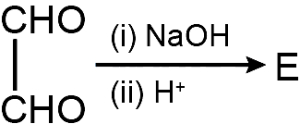
A
$CH_2OH-CHO$
B
$CHO-CO_2H$
C
$CH_2OH-CO_2H$
D
$CO_2H-CO_2H$
Solution
(C) Aldehydes lacking $\alpha-H$ atoms undergo the Cannizzaro reaction when treated with concentrated alkali $(NaOH)$. In this reaction,one part of the molecule is reduced to an alcohol,and the other part is oxidized to a salt of a carboxylic acid.
Glyoxal $(CHO-CHO)$ lacks $\alpha-H$ atoms and undergoes an intramolecular Cannizzaro reaction.
Upon treatment with $NaOH$ followed by acidification with $H^+$,one aldehyde group is reduced to a $-CH_2OH$ group,and the other is oxidized to a $-CO_2H$ group,resulting in glycolic acid $(CH_2OH-CO_2H)$.
Glyoxal $(CHO-CHO)$ lacks $\alpha-H$ atoms and undergoes an intramolecular Cannizzaro reaction.
Upon treatment with $NaOH$ followed by acidification with $H^+$,one aldehyde group is reduced to a $-CH_2OH$ group,and the other is oxidized to a $-CO_2H$ group,resulting in glycolic acid $(CH_2OH-CO_2H)$.
0 likesView Solution
41
ChemistryDifficultMCQWBJEE · 2014
The intermediate $J$ in the following Wittig reaction is

A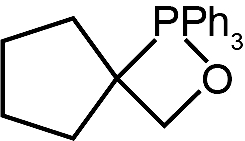
B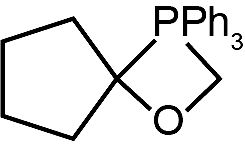
C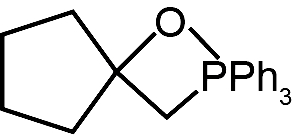
D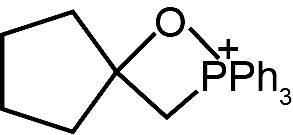
Solution
(A) The Wittig reaction involves the reaction of a phosphonium ylide with a carbonyl compound to form an alkene.
$1$. The phosphonium salt reacts with a strong base like $n-BuLi$ to form the phosphorus ylide.
$2$. The ylide then undergoes a $[2+2]$ cycloaddition with the carbonyl compound (formaldehyde,$CH_2=O$) to form a four-membered ring intermediate known as an oxaphosphetane.
$3$. This oxaphosphetane intermediate $J$ subsequently decomposes to form the alkene and triphenylphosphine oxide.
$4$. The structure of the oxaphosphetane intermediate $J$ is a four-membered ring containing carbon,oxygen,and phosphorus atoms,where the carbon is also attached to the cyclopentyl group. Option $A$ correctly represents this oxaphosphetane structure.
$1$. The phosphonium salt reacts with a strong base like $n-BuLi$ to form the phosphorus ylide.
$2$. The ylide then undergoes a $[2+2]$ cycloaddition with the carbonyl compound (formaldehyde,$CH_2=O$) to form a four-membered ring intermediate known as an oxaphosphetane.
$3$. This oxaphosphetane intermediate $J$ subsequently decomposes to form the alkene and triphenylphosphine oxide.
$4$. The structure of the oxaphosphetane intermediate $J$ is a four-membered ring containing carbon,oxygen,and phosphorus atoms,where the carbon is also attached to the cyclopentyl group. Option $A$ correctly represents this oxaphosphetane structure.
0 likesView Solution
42
ChemistryEasyMCQWBJEE · 2014
An amine $C_{3}H_{9}N$ reacts with benzene sulphonyl chloride to form a white precipitate which is insoluble in $aq. NaOH$. The amine is
A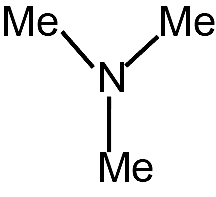
B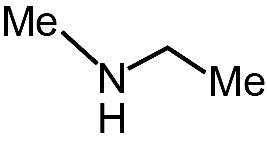
C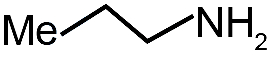
D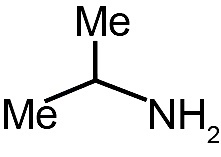
Solution
(B) The reaction of amines with benzene sulphonyl chloride (Hinsberg's reagent) is used to distinguish between primary,secondary,and tertiary amines.
$1$. Primary amines $(R-NH_2)$ form a sulfonamide that is soluble in $aq. NaOH$ due to the presence of an acidic hydrogen on the nitrogen atom.
$2$. Secondary amines $(R_2NH)$ form a sulfonamide that is insoluble in $aq. NaOH$ because they lack an acidic hydrogen on the nitrogen atom.
$3$. Tertiary amines $(R_3N)$ do not react with benzene sulphonyl chloride.
Since the given amine forms a white precipitate that is insoluble in $aq. NaOH$,it must be a secondary amine.
The molecular formula $C_3H_9N$ corresponds to a secondary amine,$N$-methylethanamine $(CH_3-NH-CH_2CH_3)$.
$1$. Primary amines $(R-NH_2)$ form a sulfonamide that is soluble in $aq. NaOH$ due to the presence of an acidic hydrogen on the nitrogen atom.
$2$. Secondary amines $(R_2NH)$ form a sulfonamide that is insoluble in $aq. NaOH$ because they lack an acidic hydrogen on the nitrogen atom.
$3$. Tertiary amines $(R_3N)$ do not react with benzene sulphonyl chloride.
Since the given amine forms a white precipitate that is insoluble in $aq. NaOH$,it must be a secondary amine.
The molecular formula $C_3H_9N$ corresponds to a secondary amine,$N$-methylethanamine $(CH_3-NH-CH_2CH_3)$.
0 likesView Solution
43
ChemistryEasyMCQWBJEE · 2014
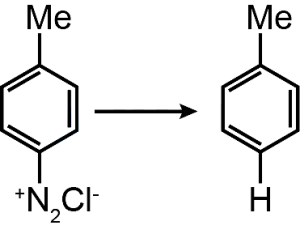
The reagent with which the following reaction is best accomplished is:
A
$H_{3}PO_{2}$
B
$H_{3}PO_{3}$
C
$H_{3}PO_{4}$
D
$NaHSO_{3}$
Solution
(A) The reaction shows the removal of the diazonium group $(-N_{2}^{+}Cl^{-})$ and its replacement with a hydrogen atom $(H)$.
This is a reductive deamination reaction.
$H_{3}PO_{2}$ (hypophosphorous acid) in the presence of water is the standard reagent used to reduce diazonium salts to the corresponding arene.
The reaction is: $Ar-N_{2}^{+}Cl^{-} + H_{3}PO_{2} + H_{2}O \rightarrow Ar-H + N_{2} + H_{3}PO_{3} + HCl$.
Therefore,the correct reagent is $H_{3}PO_{2}$.
This is a reductive deamination reaction.
$H_{3}PO_{2}$ (hypophosphorous acid) in the presence of water is the standard reagent used to reduce diazonium salts to the corresponding arene.
The reaction is: $Ar-N_{2}^{+}Cl^{-} + H_{3}PO_{2} + H_{2}O \rightarrow Ar-H + N_{2} + H_{3}PO_{3} + HCl$.
Therefore,the correct reagent is $H_{3}PO_{2}$.
0 likesView Solution
44
ChemistryEasyMCQWBJEE · 2014
The number of amino acids and number of peptide bonds in a linear tetrapeptide (made of different amino acids) are respectively
A
$4$ and $4$
B
$5$ and $5$
C
$5$ and $4$
D
$4$ and $3$
Solution
(D) tetrapeptide is formed by the condensation of $4$ amino acid units.
In a linear polypeptide chain,the number of peptide bonds is always one less than the number of amino acid units.
Therefore,for a tetrapeptide,the number of amino acids = $4$ and the number of peptide bonds = $4 - 1 = 3$.
In a linear polypeptide chain,the number of peptide bonds is always one less than the number of amino acid units.
Therefore,for a tetrapeptide,the number of amino acids = $4$ and the number of peptide bonds = $4 - 1 = 3$.
0 likesView Solution
45
ChemistryEasyMCQWBJEE · 2014
In $DNA$,the consecutive deoxynucleotides are connected via
A
phosphodiester linkage
B
phosphomonoester linkage
C
phosphotriester linkage
D
amide linkage
Solution
(A) In $DNA$,the consecutive deoxynucleotides are linked through a phosphodiester linkage. This linkage is formed between the $3'$-hydroxyl group of one sugar and the $5'$-phosphate group of the next sugar.
0 likesView Solution
46
ChemistryEasyMCQWBJEE · 2014
The rate of a certain reaction is given by,$Rate = k[H^{+}]^n$. The rate increases $100$ times when the $pH$ changes from $3$ to $1$. The order $(n)$ of the reaction is:
A
$2$
B
$0$
C
$1$
D
$1.5$
Solution
(C) Given the rate law: $Rate = k[H^{+}]^n$.
At $pH = 3$,the concentration of hydrogen ions is $[H^{+}]_1 = 10^{-3} \ M$.
At $pH = 1$,the concentration of hydrogen ions is $[H^{+}]_2 = 10^{-1} \ M$.
It is given that the rate increases $100$ times,so $Rate_2 = 100 \times Rate_1$.
Using the ratio: $\frac{Rate_2}{Rate_1} = \left(\frac{[H^{+}]_2}{[H^{+}]_1}\right)^n$.
Substituting the values: $100 = \left(\frac{10^{-1}}{10^{-3}}\right)^n$.
$100 = (10^2)^n$.
$10^2 = 10^{2n}$.
Comparing the exponents,$2 = 2n$,which gives $n = 1$.
At $pH = 3$,the concentration of hydrogen ions is $[H^{+}]_1 = 10^{-3} \ M$.
At $pH = 1$,the concentration of hydrogen ions is $[H^{+}]_2 = 10^{-1} \ M$.
It is given that the rate increases $100$ times,so $Rate_2 = 100 \times Rate_1$.
Using the ratio: $\frac{Rate_2}{Rate_1} = \left(\frac{[H^{+}]_2}{[H^{+}]_1}\right)^n$.
Substituting the values: $100 = \left(\frac{10^{-1}}{10^{-3}}\right)^n$.
$100 = (10^2)^n$.
$10^2 = 10^{2n}$.
Comparing the exponents,$2 = 2n$,which gives $n = 1$.
0 likesView Solution
47
ChemistryMediumMCQWBJEE · 2014
$A$ piece of wood from an archaeological sample has $5.0 \text{ counts min}^{-1} \text{ g}^{-1}$ of $^{14}C$,while a fresh sample of wood has a count of $15.0 \text{ counts min}^{-1} \text{ g}^{-1}$. If the half-life of $^{14}C$ is $5770 \text{ yr}$,the age of the archaeological sample is:
A
$8,500 \text{ yr}$
B
$9,200 \text{ yr}$
C
$10,000 \text{ yr}$
D
$11,000 \text{ yr}$
Solution
(B) Given:
Initial activity $(A_0)$ = $15.0 \text{ counts min}^{-1} \text{ g}^{-1}$
Final activity $(A)$ = $5.0 \text{ counts min}^{-1} \text{ g}^{-1}$
Half-life $(t_{1/2})$ = $5770 \text{ yr}$
The age of the sample $(t)$ is given by the radioactive decay formula:
$t = \frac{2.303}{\lambda} \log\left(\frac{A_0}{A}\right)$
Since $\lambda = \frac{0.693}{t_{1/2}}$,
$t = \frac{2.303 \times t_{1/2}}{0.693} \log\left(\frac{A_0}{A}\right)$
$t = \frac{2.303 \times 5770}{0.693} \log\left(\frac{15.0}{5.0}\right)$
$t = \frac{2.303 \times 5770}{0.693} \log(3)$
Using $\log(3) \approx 0.4771$:
$t = \frac{2.303 \times 5770 \times 0.4771}{0.693} \approx 9148 \text{ yr}$
The closest value is $9,200 \text{ yr}$.
Initial activity $(A_0)$ = $15.0 \text{ counts min}^{-1} \text{ g}^{-1}$
Final activity $(A)$ = $5.0 \text{ counts min}^{-1} \text{ g}^{-1}$
Half-life $(t_{1/2})$ = $5770 \text{ yr}$
The age of the sample $(t)$ is given by the radioactive decay formula:
$t = \frac{2.303}{\lambda} \log\left(\frac{A_0}{A}\right)$
Since $\lambda = \frac{0.693}{t_{1/2}}$,
$t = \frac{2.303 \times t_{1/2}}{0.693} \log\left(\frac{A_0}{A}\right)$
$t = \frac{2.303 \times 5770}{0.693} \log\left(\frac{15.0}{5.0}\right)$
$t = \frac{2.303 \times 5770}{0.693} \log(3)$
Using $\log(3) \approx 0.4771$:
$t = \frac{2.303 \times 5770 \times 0.4771}{0.693} \approx 9148 \text{ yr}$
The closest value is $9,200 \text{ yr}$.
0 likesView Solution
48
ChemistryEasyMCQWBJEE · 2014
During the emission of a positron from a nucleus,the mass number of the daughter element remains the same but the atomic number
A
is decreased by $1$ unit
B
is decreased by $2$ units
C
is increased by $1$ unit
D
remains unchanged
Solution
(A) When a positron is emitted,a proton is converted into a neutron,a positron,and a neutrino as shown in the reaction: $^1_1H \rightarrow ^1_0n + ^0_{+1}e + \nu$.
Since a proton is converted into a neutron,the total number of nucleons (mass number) remains constant,but the number of protons (atomic number) decreases by $1$ unit.
Since a proton is converted into a neutron,the total number of nucleons (mass number) remains constant,but the number of protons (atomic number) decreases by $1$ unit.
0 likesView Solution
49
ChemistryEasyMCQWBJEE · 2014
$\beta$-emission is always accompanied by
A
formation of antineutrino and $\alpha$-particle
B
emission of $\alpha$-particle and $\gamma$-ray
C
formation of antineutrino and $\gamma$-ray
D
formation of antineutrino and positron
Solution
(C) During $\beta$-emission,a neutron is converted into a proton,an electron ($\beta$-particle),and an antineutrino $(\bar{\nu})$.
Often,the daughter nucleus is formed in an excited state,which then releases energy in the form of $\gamma$-rays to reach the ground state.
The nuclear reaction is: $_0n^1 \rightarrow _1H^1 + _{-1}e^0 + \bar{\nu} + \gamma$-ray.
Often,the daughter nucleus is formed in an excited state,which then releases energy in the form of $\gamma$-rays to reach the ground state.
The nuclear reaction is: $_0n^1 \rightarrow _1H^1 + _{-1}e^0 + \bar{\nu} + \gamma$-ray.
0 likesView Solution
50
ChemistryEasyMCQWBJEE · 2014
An atomic nucleus having a low $n/p$ ratio tries to find stability by:
A
the emission of an $\alpha$-particle
B
the emission of a positron
C
capturing an orbital electron ($K$-electron capture)
D
the emission of a $\beta$-particle
Solution
(B) Nuclei with a low $n/p$ ratio are proton-rich and unstable. They achieve stability by increasing the $n/p$ ratio. This can occur through two primary processes:
$1$. Positron emission: $^1_1p \rightarrow ^1_0n + ^0_{+1}e + \nu$
$2$. $K$-electron capture: $^1_1p + ^0_{-1}e \rightarrow ^1_0n + \nu$
Both processes convert a proton into a neutron,thereby decreasing the number of protons and increasing the number of neutrons,which increases the $n/p$ ratio. Since both options $(B)$ and $(C)$ are correct,in many contexts,positron emission is the primary answer provided for this specific question type.
$1$. Positron emission: $^1_1p \rightarrow ^1_0n + ^0_{+1}e + \nu$
$2$. $K$-electron capture: $^1_1p + ^0_{-1}e \rightarrow ^1_0n + \nu$
Both processes convert a proton into a neutron,thereby decreasing the number of protons and increasing the number of neutrons,which increases the $n/p$ ratio. Since both options $(B)$ and $(C)$ are correct,in many contexts,positron emission is the primary answer provided for this specific question type.
0 likesView Solution
51
ChemistryEasyMCQWBJEE · 2014
$_{98}Cf^{246}$ was formed along with a neutron when an unknown radioactive substance was bombarded with $_{6}C^{12}$. The unknown substance was:
A
$_{91}Pa^{234}$
B
$_{90}Th^{234}$
C
$_{92}U^{235}$
D
$_{92}U^{238}$
Solution
(C) Let the unknown substance be $_{Z}X^{A}$.
The nuclear reaction is: $_{Z}X^{A} + _{6}C^{12} \rightarrow _{98}Cf^{246} + _{0}n^{1}$.
According to the law of conservation of mass number: $A + 12 = 246 + 1$,which gives $A = 235$.
According to the law of conservation of atomic number: $Z + 6 = 98$,which gives $Z = 92$.
The element with atomic number $92$ is Uranium $(U)$.
Therefore,the unknown substance is $_{92}U^{235}$.
The nuclear reaction is: $_{Z}X^{A} + _{6}C^{12} \rightarrow _{98}Cf^{246} + _{0}n^{1}$.
According to the law of conservation of mass number: $A + 12 = 246 + 1$,which gives $A = 235$.
According to the law of conservation of atomic number: $Z + 6 = 98$,which gives $Z = 92$.
The element with atomic number $92$ is Uranium $(U)$.
Therefore,the unknown substance is $_{92}U^{235}$.
0 likesView Solution
52
ChemistryEasyMCQWBJEE · 2014
The provided image shows four chemical compounds: $(CH_3CO)_2O$ $(I)$,$CH_3COOH$ $(II)$,$PhOH$ $(III)$,and $CH_3COCHO$ $(IV)$. Identify the correct statement regarding these compounds.
A
Compound $I$ is an anhydride.
B
Compound $II$ is a phenol.
C
Compound $III$ is a carboxylic acid.
D
Compound $IV$ is an ester.
Solution
(A) Analyzing the given compounds:
$I$: $(CH_3CO)_2O$ is acetic anhydride.
$II$: $CH_3COOH$ is acetic acid (a carboxylic acid).
$III$: $PhOH$ is phenol.
$IV$: $CH_3COCHO$ is methylglyoxal (a dicarbonyl compound).
Therefore,the correct statement is that compound $I$ is an anhydride.
$I$: $(CH_3CO)_2O$ is acetic anhydride.
$II$: $CH_3COOH$ is acetic acid (a carboxylic acid).
$III$: $PhOH$ is phenol.
$IV$: $CH_3COCHO$ is methylglyoxal (a dicarbonyl compound).
Therefore,the correct statement is that compound $I$ is an anhydride.
0 likesView Solution
53
ChemistryEasyMCQWBJEE · 2014
Among the following compounds,the one$(s)$ that give$(s)$ effervescence with aqueous $NaHCO_{3}$ solution is (are):
$I. (CH_{3}CO)_{2}O$
$II. CH_{3}COOH$
$III. PhOH$
$IV. CH_{3}COCHO$
$I. (CH_{3}CO)_{2}O$
$II. CH_{3}COOH$
$III. PhOH$
$IV. CH_{3}COCHO$
A
$I$ and $II$
B
$I$ and $III$
C
Only $II$
D
$I$ and $IV$
Solution
(A) Compounds that are more acidic than carbonic acid $(H_{2}CO_{3})$ react with aqueous $NaHCO_{3}$ to release $CO_{2}$ gas,which causes effervescence.
$I. (CH_{3}CO)_{2}O$ (Acetic anhydride) reacts with $NaHCO_{3}$ to form acetic acid,which then reacts further to release $CO_{2}$.
$II. CH_{3}COOH$ (Acetic acid) is more acidic than $H_{2}CO_{3}$ and readily releases $CO_{2}$.
$III. PhOH$ (Phenol) is less acidic than $H_{2}CO_{3}$ and does not give effervescence.
$IV. CH_{3}COCHO$ (Methylglyoxal) is not acidic enough to react with $NaHCO_{3}$.
Therefore,both $I$ and $II$ give effervescence.
$I. (CH_{3}CO)_{2}O$ (Acetic anhydride) reacts with $NaHCO_{3}$ to form acetic acid,which then reacts further to release $CO_{2}$.
$II. CH_{3}COOH$ (Acetic acid) is more acidic than $H_{2}CO_{3}$ and readily releases $CO_{2}$.
$III. PhOH$ (Phenol) is less acidic than $H_{2}CO_{3}$ and does not give effervescence.
$IV. CH_{3}COCHO$ (Methylglyoxal) is not acidic enough to react with $NaHCO_{3}$.
Therefore,both $I$ and $II$ give effervescence.
0 likesView Solution
54
ChemistryEasyMCQWBJEE · 2014
Cupric compounds are more stable than their cuprous counterparts in the solid state. This is because
A
the endothermic character of the $2^{nd}$ $IP$ of $Cu$ is not so high
B
size of $Cu^{2+}$ is less than $Cu^{+}$
C
$Cu^{2+}$ has a more stable electronic configuration compared to $Cu^{+}$
D
the lattice energy released for cupric compounds is much higher than for cuprous compounds
Solution
(D) The electronic configurations of cuprous $(Cu^{+})$ and cupric $(Cu^{2+})$ ions are as follows:
$Cu^{+} = [Ar] 3d^{10} 4s^{0}$
$Cu^{2+} = [Ar] 3d^{9} 4s^{0}$
Although $Cu^{+}$ has a more stable electronic configuration,$Cu^{2+}$ compounds are more stable in the solid state.
This is primarily because the $2^{nd}$ ionization potential $(IP)$ of $Cu$ is not sufficiently high to prevent the formation of $Cu^{2+}$,and the higher charge density of $Cu^{2+}$ leads to a significantly higher lattice energy in ionic compounds compared to $Cu^{+}$ compounds.
This large release of lattice energy compensates for the energy required to remove the second electron.
$Cu^{+} = [Ar] 3d^{10} 4s^{0}$
$Cu^{2+} = [Ar] 3d^{9} 4s^{0}$
Although $Cu^{+}$ has a more stable electronic configuration,$Cu^{2+}$ compounds are more stable in the solid state.
This is primarily because the $2^{nd}$ ionization potential $(IP)$ of $Cu$ is not sufficiently high to prevent the formation of $Cu^{2+}$,and the higher charge density of $Cu^{2+}$ leads to a significantly higher lattice energy in ionic compounds compared to $Cu^{+}$ compounds.
This large release of lattice energy compensates for the energy required to remove the second electron.
0 likesView Solution
55
ChemistryMediumMCQWBJEE · 2014
The quantity of electricity needed to separately electrolyze $1 \ M$ solution of $ZnSO_{4}$,$AlCl_{3}$ and $AgNO_{3}$ completely is in the ratio of
A
$2: 3: 1$
B
$2: 1: 1$
C
$2: 1: 3$
D
$2: 2: 1$
Solution
(A) To electrolyze $1 \ mol$ of each metal ion,the amount of electricity required is equal to the charge (valency) of the metal ion.
For $ZnSO_{4}$,the reaction is: $Zn^{2+} + 2e^{-} \rightarrow Zn$. Thus,$2 \ F$ of electricity is required.
For $AlCl_{3}$,the reaction is: $Al^{3+} + 3e^{-} \rightarrow Al$. Thus,$3 \ F$ of electricity is required.
For $AgNO_{3}$,the reaction is: $Ag^{+} + e^{-} \rightarrow Ag$. Thus,$1 \ F$ of electricity is required.
Therefore,the ratio of electricity required is $2: 3: 1$.
For $ZnSO_{4}$,the reaction is: $Zn^{2+} + 2e^{-} \rightarrow Zn$. Thus,$2 \ F$ of electricity is required.
For $AlCl_{3}$,the reaction is: $Al^{3+} + 3e^{-} \rightarrow Al$. Thus,$3 \ F$ of electricity is required.
For $AgNO_{3}$,the reaction is: $Ag^{+} + e^{-} \rightarrow Ag$. Thus,$1 \ F$ of electricity is required.
Therefore,the ratio of electricity required is $2: 3: 1$.
0 likesView Solution
56
ChemistryMediumMCQWBJEE · 2014
The two half-cell reactions of an electrochemical cell are given as: $Ag^{+} + e^{-} \rightarrow Ag$; $E^{\circ}_{Ag^{+}/Ag} = 0.7995 \ V$ and $Fe^{2+} \rightarrow Fe^{3+} + e^{-}$; $E^{\circ}_{Fe^{3+}/Fe^{2+}} = 0.7710 \ V$. The value of cell $EMF$ will be: (in $V$)
A
$0.0285$
B
$1.5705$
C
$-0.0285$
D
$-1.5705$
Solution
(A) The standard $EMF$ of the cell is calculated as: $E^{\circ}_{cell} = E^{\circ}_{cathode} - E^{\circ}_{anode}$.
Given reduction potentials are $E^{\circ}_{Ag^{+}/Ag} = 0.7995 \ V$ and $E^{\circ}_{Fe^{3+}/Fe^{2+}} = 0.7710 \ V$.
Since $E^{\circ}_{Ag^{+}/Ag} > E^{\circ}_{Fe^{3+}/Fe^{2+}}$,the silver electrode acts as the cathode and the iron electrode acts as the anode.
$E^{\circ}_{cell} = 0.7995 \ V - 0.7710 \ V = 0.0285 \ V$.
Given reduction potentials are $E^{\circ}_{Ag^{+}/Ag} = 0.7995 \ V$ and $E^{\circ}_{Fe^{3+}/Fe^{2+}} = 0.7710 \ V$.
Since $E^{\circ}_{Ag^{+}/Ag} > E^{\circ}_{Fe^{3+}/Fe^{2+}}$,the silver electrode acts as the cathode and the iron electrode acts as the anode.
$E^{\circ}_{cell} = 0.7995 \ V - 0.7710 \ V = 0.0285 \ V$.
0 likesView Solution
57
ChemistryMediumMCQWBJEE · 2014
The formal potential of $Fe^{3+}/Fe^{2+}$ in a sulphuric acid and phosphoric acid mixture $(E^{\circ}=+0.61 \ V)$ is much lower than the standard potential $(E^{\circ}=+0.77 \ V)$. This is due to
A
formation of the species $[FeHPO_{4}]^{+}$
B
lowering of potential upon complexation
C
formation of the species $[FeSO_{4}]^{+}$
D
high acidity of the medium
Solution
(A) The standard reduction potential of $Fe^{3+}/Fe^{2+}$ is $+0.77 \ V$.
In a mixture of $H_{2}SO_{4}$ and $H_{3}PO_{4}$,$Fe^{3+}$ ions react with phosphate ions to form a stable complex,$[FeHPO_{4}]^{+}$.
According to the Nernst equation,$E = E^{\circ} - (0.059/n) \log(1/[Fe^{3+}])$.
As the concentration of free $Fe^{3+}$ ions decreases due to complex formation,the reduction potential decreases from $+0.77 \ V$ to $+0.61 \ V$.
In a mixture of $H_{2}SO_{4}$ and $H_{3}PO_{4}$,$Fe^{3+}$ ions react with phosphate ions to form a stable complex,$[FeHPO_{4}]^{+}$.
According to the Nernst equation,$E = E^{\circ} - (0.059/n) \log(1/[Fe^{3+}])$.
As the concentration of free $Fe^{3+}$ ions decreases due to complex formation,the reduction potential decreases from $+0.77 \ V$ to $+0.61 \ V$.
0 likesView Solution
58
ChemistryEasyMCQWBJEE · 2014
When phenol is treated with $D_{2}SO_{4} / D_{2}O$,some of the hydrogens get exchanged. The final product in this exchange reaction is
A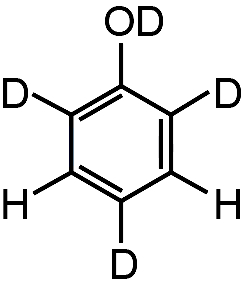
B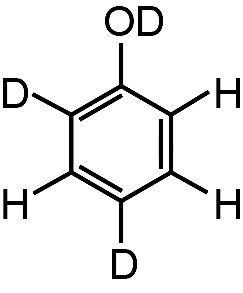
C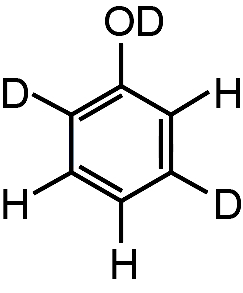
D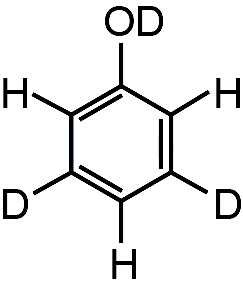
Solution
(A) In an acidic medium,phenol exists in equilibrium with its protonated form,and the $-OH$ group activates the benzene ring towards electrophilic substitution.
The $-OH$ group is an electron-donating group by resonance,which increases the electron density at the $ortho$ and $para$ positions.
When treated with $D_{2}SO_{4} / D_{2}O$,the $D^+$ acts as an electrophile.
The electrophile $(D^+)$ attacks the electron-rich $ortho$ and $para$ positions of the benzene ring.
Additionally,the phenolic hydrogen is acidic and readily exchanges with $D$ in $D_{2}O$ to form $-OD$.
Therefore,the hydrogen atoms at the $ortho$ and $para$ positions are replaced by deuterium atoms,and the $-OH$ group becomes $-OD$.
The final product is $2,4,6-trideuterophenol-d_1$ (where the phenolic hydrogen is also replaced).
The $-OH$ group is an electron-donating group by resonance,which increases the electron density at the $ortho$ and $para$ positions.
When treated with $D_{2}SO_{4} / D_{2}O$,the $D^+$ acts as an electrophile.
The electrophile $(D^+)$ attacks the electron-rich $ortho$ and $para$ positions of the benzene ring.
Additionally,the phenolic hydrogen is acidic and readily exchanges with $D$ in $D_{2}O$ to form $-OD$.
Therefore,the hydrogen atoms at the $ortho$ and $para$ positions are replaced by deuterium atoms,and the $-OH$ group becomes $-OD$.
The final product is $2,4,6-trideuterophenol-d_1$ (where the phenolic hydrogen is also replaced).
0 likesView Solution
59
ChemistryEasyMCQWBJEE · 2014
Among the following statements about the molecules $X$ and $Y$,which one$(s)$ is/are correct?
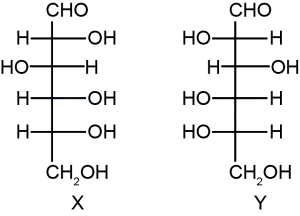
A
$X$ and $Y$ are diastereomers
B
$X$ and $Y$ are enantiomers
C
$X$ and $Y$ are both aldohexoses
D
$X$ is a $D$-sugar and $Y$ is an $L$-sugar
Solution
(B, C, D) Both the given molecules contain $6$ carbon atoms with an aldehyde group,so these are called aldohexoses.
In $X$,the $-OH$ group attached to the second-last carbon ($C$-$5$) is on the right-hand side,so it is a $D$-sugar.
In $Y$,the $-OH$ group attached to the second-last carbon ($C$-$5$) is on the left-hand side,so it is an $L$-sugar.
Since $X$ and $Y$ are non-superimposable mirror images of each other,they are enantiomers.
Therefore,statements $B$,$C$,and $D$ are correct.
In $X$,the $-OH$ group attached to the second-last carbon ($C$-$5$) is on the right-hand side,so it is a $D$-sugar.
In $Y$,the $-OH$ group attached to the second-last carbon ($C$-$5$) is on the left-hand side,so it is an $L$-sugar.
Since $X$ and $Y$ are non-superimposable mirror images of each other,they are enantiomers.
Therefore,statements $B$,$C$,and $D$ are correct.
0 likesView Solution
60
ChemistryMediumMCQWBJEE · 2014
The reaction of aniline with chloroform under alkaline conditions leads to the formation of
A
phenylcyanide
B
phenylisonitrile
C
phenylcyanate
D
phenylisocyanate
Solution
(B) Aniline is a primary amine (contains $-NH_{2}$ group).
When it is treated with chloroform $(CHCl_{3})$ under alkaline conditions (using $KOH$),it results in the formation of a bad-smelling compound known as phenyl isonitrile (or phenyl carbylamine).
The chemical reaction is:
$C_{6}H_{5}NH_{2} + CHCl_{3} + 3KOH(alc.) \rightarrow C_{6}H_{5}NC + 3KCl + 3H_{2}O$.
This reaction is known as the carbylamine reaction.
When it is treated with chloroform $(CHCl_{3})$ under alkaline conditions (using $KOH$),it results in the formation of a bad-smelling compound known as phenyl isonitrile (or phenyl carbylamine).
The chemical reaction is:
$C_{6}H_{5}NH_{2} + CHCl_{3} + 3KOH(alc.) \rightarrow C_{6}H_{5}NC + 3KCl + 3H_{2}O$.
This reaction is known as the carbylamine reaction.
0 likesView Solution
61
ChemistryEasyMCQWBJEE · 2014
Among the following observations,the correct one that differentiates between $SO_{3}^{2-}$ and $SO_{4}^{2-}$ is:
A
Both form precipitate with $BaCl_{2}$,$SO_{3}^{2-}$ dissolves in $HCl$ but $SO_{4}^{2-}$ does not.
B
$SO_{3}^{2-}$ forms precipitate with $BaCl_{2}$,$SO_{4}^{2-}$ does not.
C
$SO_{4}^{2-}$ forms precipitate with $BaCl_{2}$,$SO_{3}^{2-}$ does not.
D
Both form precipitate with $BaCl_{2}$,$SO_{4}^{2-}$ dissolves in $HCl$ but $SO_{3}^{2-}$ does not.
Solution
(A) $SO_{3}^{2-}$ and $SO_{4}^{2-}$ ions react with $BaCl_{2}$ to form white precipitates of $BaSO_{3}$ and $BaSO_{4}$ respectively.
$Ba^{2+} + SO_{3}^{2-} \longrightarrow BaSO_{3} (s)$ (White precipitate)
$Ba^{2+} + SO_{4}^{2-} \longrightarrow BaSO_{4} (s)$ (White precipitate)
$BaSO_{3}$ is a salt of a weak acid $(H_{2}SO_{3})$,so it dissolves in dilute $HCl$ due to the formation of $SO_{2}$ gas.
$BaSO_{3} + 2HCl \longrightarrow BaCl_{2} + H_{2}O + SO_{2} \uparrow$
$BaSO_{4}$ is a salt of a strong acid $(H_{2}SO_{4})$ and is insoluble in dilute $HCl$.
$Ba^{2+} + SO_{3}^{2-} \longrightarrow BaSO_{3} (s)$ (White precipitate)
$Ba^{2+} + SO_{4}^{2-} \longrightarrow BaSO_{4} (s)$ (White precipitate)
$BaSO_{3}$ is a salt of a weak acid $(H_{2}SO_{3})$,so it dissolves in dilute $HCl$ due to the formation of $SO_{2}$ gas.
$BaSO_{3} + 2HCl \longrightarrow BaCl_{2} + H_{2}O + SO_{2} \uparrow$
$BaSO_{4}$ is a salt of a strong acid $(H_{2}SO_{4})$ and is insoluble in dilute $HCl$.
0 likesView Solution
62
ChemistryMediumMCQWBJEE · 2014
To observe an elevation of boiling point of $0.05^{\circ} C$,the amount of a solute (mol. wt. $= 100$) to be added to $100 \ g$ of water $(K_{b} = 0.5)$ is (in $g$)
A
$2$
B
$0.5$
C
$1$
D
$0.75$
Solution
(C) The formula for elevation of boiling point is $\Delta T_{b} = \frac{w \times K_{b} \times 1000}{M \times W}$.
Here,$w$ is the weight of the solute,$W$ is the weight of the solvent $(100 \ g)$,$M$ is the molecular weight of the solute $(100)$,and $K_{b}$ is the ebullioscopic constant $(0.5 \ K \ kg \ mol^{-1})$.
Given $\Delta T_{b} = 0.05^{\circ} C$.
Substituting the values into the formula:
$0.05 = \frac{w \times 0.5 \times 1000}{100 \times 100}$.
$0.05 = \frac{w \times 500}{10000} = \frac{w}{20}$.
$w = 0.05 \times 20 = 1 \ g$.
Here,$w$ is the weight of the solute,$W$ is the weight of the solvent $(100 \ g)$,$M$ is the molecular weight of the solute $(100)$,and $K_{b}$ is the ebullioscopic constant $(0.5 \ K \ kg \ mol^{-1})$.
Given $\Delta T_{b} = 0.05^{\circ} C$.
Substituting the values into the formula:
$0.05 = \frac{w \times 0.5 \times 1000}{100 \times 100}$.
$0.05 = \frac{w \times 500}{10000} = \frac{w}{20}$.
$w = 0.05 \times 20 = 1 \ g$.
0 likesView Solution
63
ChemistryDifficultMCQWBJEE · 2014
The volume of ethyl alcohol (density $1.15 \text{ g/cc}$) that has to be added to prepare $100 \text{ cc}$ of $0.5 \text{ M}$ ethyl alcohol solution in water is: (in $\text{ cc}$)
A
$1.15$
B
$2$
C
$2.15$
D
$2.30$
Solution
(B) Molarity $(M)$ = $0.5 \text{ M}$,Volume of solution = $100 \text{ cc} = 0.1 \text{ L}$.
Moles of ethyl alcohol = $M \times V = 0.5 \times 0.1 = 0.05 \text{ mol}$.
Molar mass of ethyl alcohol $(C_2H_5OH)$ = $46 \text{ g/mol}$.
Mass of ethyl alcohol = $0.05 \times 46 = 2.3 \text{ g}$.
Density = $1.15 \text{ g/cc}$.
Volume = $\frac{\text{Mass}}{\text{Density}} = \frac{2.3}{1.15} = 2 \text{ cc}$.
Moles of ethyl alcohol = $M \times V = 0.5 \times 0.1 = 0.05 \text{ mol}$.
Molar mass of ethyl alcohol $(C_2H_5OH)$ = $46 \text{ g/mol}$.
Mass of ethyl alcohol = $0.05 \times 46 = 2.3 \text{ g}$.
Density = $1.15 \text{ g/cc}$.
Volume = $\frac{\text{Mass}}{\text{Density}} = \frac{2.3}{1.15} = 2 \text{ cc}$.
0 likesView Solution
64
ChemistryEasyMCQWBJEE · 2014
The amount of electrolytes required to coagulate a given amount of $AgI$ colloidal solution ($-ve$ charge) will be in the order:
A
$NaNO_{3} > Al(NO_{3})_{3} > Ba(NO_{3})_{2}$
B
$Al(NO_{3})_{3} > Ba(NO_{3})_{2} > NaNO_{3}$
C
$Al(NO_{3})_{3} > NaNO_{3} > Ba(NO_{3})_{2}$
D
$NaNO_{3} > Ba(NO_{3})_{2} > Al(NO_{3})_{3}$
Solution
(D) According to the Hardy-Schulze law,the coagulating power of an electrolyte depends on the valency of the active ion (the ion with a charge opposite to that of the colloidal particles).
For a negatively charged $AgI$ sol,the coagulating power depends on the positive ions: $Na^{+}$,$Ba^{2+}$,and $Al^{3+}$.
The coagulating power increases with the increase in the magnitude of the charge: $Na^{+} < Ba^{2+} < Al^{3+}$.
Since the amount of electrolyte required is inversely proportional to its coagulating power,the order of the amount required is: $NaNO_{3} > Ba(NO_{3})_{2} > Al(NO_{3})_{3}$.
For a negatively charged $AgI$ sol,the coagulating power depends on the positive ions: $Na^{+}$,$Ba^{2+}$,and $Al^{3+}$.
The coagulating power increases with the increase in the magnitude of the charge: $Na^{+} < Ba^{2+} < Al^{3+}$.
Since the amount of electrolyte required is inversely proportional to its coagulating power,the order of the amount required is: $NaNO_{3} > Ba(NO_{3})_{2} > Al(NO_{3})_{3}$.
0 likesView Solution
Vedclass Products
For Students
Vedclass Test Series
Mock tests in real WBJEE style covering Chemistry with performance analysis. 5-day free trial.
Start Free TrialFor Teachers
Exam Paper Generator
Generate Set A/B/C/D Chemistry papers from 7.5L+ questions in 2 minutes. 3 chapters free.
Try FreeFor Institutes
Online Exam Module
Run live WBJEE mock exams with unlimited students, 360° analytics & white-label branding.
See DemoFrequently Asked Questions
How many Chemistry questions are in WBJEE 2014?
There are 64 Chemistry questions from the WBJEE 2014 paper on Vedclass, each with a detailed step-by-step solution in English.
Are WBJEE 2014 Chemistry solutions available in English?
Yes. All solutions on this page are in English. You can also switch to English or Hindi using the language buttons above the questions.
Can I practice WBJEE 2014 Chemistry as a timed test?
Yes. Use the Vedclass Test Series to attempt a full WBJEE mock test covering Chemistry with time limits and instant score analysis.
Can teachers create Chemistry papers from WBJEE previous year questions?
Yes. The Vedclass Exam Paper Generator lets teachers mix WBJEE Chemistry questions and generate Set A/B/C/D papers in minutes.
For Teachers & Institutes
Build a Custom Chemistry Paper
Pick WBJEE 2014 Chemistry questions, set difficulty, and generate Set A/B/C/D in 2 minutes.