
PhysicsQ301–400 of 788 questions
Page 7 of 9 · English
301
PhysicsDifficultMCQMHT CET · 2024
The frequencies of two tuning forks $A$ and $B$ are respectively $1.4 \%$ more and $2.6 \%$ less than that of the tuning fork $C$. When $A$ and $B$ are sounded together, $10$ beats are produced in $1 \text{ s}$. The frequency of tuning fork $C$ is: (in $\text{ Hz}$)
A
$250$
B
$300$
C
$340$
D
$400$
Solution
(A) Let $n$ be the frequency of tuning fork $C$.
Given that the frequency of $A$ is $1.4 \%$ more than $C$, so $n_A = n + 0.014n = 1.014n$.
Given that the frequency of $B$ is $2.6 \%$ less than $C$, so $n_B = n - 0.026n = 0.974n$.
When $A$ and $B$ are sounded together, the number of beats produced per second is the difference in their frequencies: $|n_A - n_B| = 10$.
Substituting the values: $1.014n - 0.974n = 10$.
$0.04n = 10$.
$n = \frac{10}{0.04} = \frac{1000}{4} = 250 \text{ Hz}$.
Given that the frequency of $A$ is $1.4 \%$ more than $C$, so $n_A = n + 0.014n = 1.014n$.
Given that the frequency of $B$ is $2.6 \%$ less than $C$, so $n_B = n - 0.026n = 0.974n$.
When $A$ and $B$ are sounded together, the number of beats produced per second is the difference in their frequencies: $|n_A - n_B| = 10$.
Substituting the values: $1.014n - 0.974n = 10$.
$0.04n = 10$.
$n = \frac{10}{0.04} = \frac{1000}{4} = 250 \text{ Hz}$.
0 likesView Solution
302
PhysicsEasyMCQMHT CET · 2024
If two waves of the same amplitude,having frequencies $340 \ Hz$ and $335 \ Hz$,are moving in the same direction,then the time interval between two successive maxima formed (in seconds) is:
A
$0.1$
B
$0.2$
C
$0.3$
D
$0.5$
Solution
(B) The beat frequency is defined as the difference between the frequencies of the two waves: $f_{beat} = |f_2 - f_1|$.
Given $f_1 = 340 \ Hz$ and $f_2 = 335 \ Hz$.
$f_{beat} = 340 \ Hz - 335 \ Hz = 5 \ Hz$.
The time interval between two successive maxima is the reciprocal of the beat frequency:
$T = \frac{1}{f_{beat}} = \frac{1}{5} \ s = 0.2 \ s$.
Given $f_1 = 340 \ Hz$ and $f_2 = 335 \ Hz$.
$f_{beat} = 340 \ Hz - 335 \ Hz = 5 \ Hz$.
The time interval between two successive maxima is the reciprocal of the beat frequency:
$T = \frac{1}{f_{beat}} = \frac{1}{5} \ s = 0.2 \ s$.
0 likesView Solution
303
PhysicsDifficultMCQMHT CET · 2024
An open organ pipe of length $l$ is sounded together with another open organ pipe of length $(l+l_1)$ in their fundamental modes. Speed of sound in air is $V$. The beat frequency heard will be $(l_1 \ll l)$
A
$\frac{V l_1^2}{2 l}$
B
$\frac{V l_1}{2 l^2}$
C
$\frac{V l_1}{4 l^2}$
D
$\frac{V l^2}{2 l_1}$
Solution
(B) For an open organ pipe of length $L$,the fundamental frequency is given by $f = \frac{V}{2L}$.
For the first pipe of length $l$,the fundamental frequency is $f_1 = \frac{V}{2l}$.
For the second pipe of length $(l+l_1)$,the fundamental frequency is $f_2 = \frac{V}{2(l+l_1)}$.
The beat frequency $f_b$ is the difference between the two frequencies: $f_b = f_1 - f_2 = \frac{V}{2l} - \frac{V}{2(l+l_1)}$.
Simplifying the expression: $f_b = \frac{V}{2} \left[ \frac{(l+l_1) - l}{l(l+l_1)} \right] = \frac{V l_1}{2l(l+l_1)}$.
Given the condition $l_1 \ll l$,we can approximate $(l+l_1) \approx l$ in the denominator.
Therefore,$f_b \approx \frac{V l_1}{2l^2}$.
For the first pipe of length $l$,the fundamental frequency is $f_1 = \frac{V}{2l}$.
For the second pipe of length $(l+l_1)$,the fundamental frequency is $f_2 = \frac{V}{2(l+l_1)}$.
The beat frequency $f_b$ is the difference between the two frequencies: $f_b = f_1 - f_2 = \frac{V}{2l} - \frac{V}{2(l+l_1)}$.
Simplifying the expression: $f_b = \frac{V}{2} \left[ \frac{(l+l_1) - l}{l(l+l_1)} \right] = \frac{V l_1}{2l(l+l_1)}$.
Given the condition $l_1 \ll l$,we can approximate $(l+l_1) \approx l$ in the denominator.
Therefore,$f_b \approx \frac{V l_1}{2l^2}$.
0 likesView Solution
304
PhysicsEasyMCQMHT CET · 2024
Two sound waves having frequencies $250 \,Hz$ and $256 \,Hz$ superimpose to produce a beat wave. The resultant beat wave has intensity maximum at $t=0$. After how much time will an intensity minimum be produced at the same point?
A
$\frac{1}{6} \,s$
B
$\frac{1}{24} \,s$
C
$\frac{1}{18} \,s$
D
$\frac{1}{12} \,s$
Solution
(D) The beat frequency is given by $f_b = |f_2 - f_1| = |256 \,Hz - 250 \,Hz| = 6 \,Hz$.
The time period of the beat wave is $T_b = \frac{1}{f_b} = \frac{1}{6} \,s$.
The intensity is maximum at $t=0$. The intensity becomes minimum at half the time period of the beat, which corresponds to the interval between a maximum and the subsequent minimum.
Therefore, the time required is $t = \frac{T_b}{2} = \frac{1}{6 \times 2} = \frac{1}{12} \,s$.
The time period of the beat wave is $T_b = \frac{1}{f_b} = \frac{1}{6} \,s$.
The intensity is maximum at $t=0$. The intensity becomes minimum at half the time period of the beat, which corresponds to the interval between a maximum and the subsequent minimum.
Therefore, the time required is $t = \frac{T_b}{2} = \frac{1}{6 \times 2} = \frac{1}{12} \,s$.
0 likesView Solution
305
PhysicsMediumMCQMHT CET · 2024
An observer moves towards a stationary source of sound with a velocity of one-fifth of the velocity of sound. The percentage increase in the apparent frequency is (in $\%$)
A
$5$
B
$10$
C
$20$
D
$25$
Solution
(C) Let the velocity of sound be $v$ and the frequency of the source be $f$. The observer moves towards the stationary source with a velocity $v_o = v/5$.
According to the Doppler effect,the apparent frequency $f'$ heard by the observer is given by the formula: $f' = f \left( \frac{v + v_o}{v} \right)$.
Substituting the given values: $f' = f \left( \frac{v + v/5}{v} \right) = f \left( \frac{6v/5}{v} \right) = 1.2f$.
The increase in frequency is $\Delta f = f' - f = 1.2f - f = 0.2f$.
The percentage increase is given by $\left( \frac{\Delta f}{f} \right) \times 100 = \left( \frac{0.2f}{f} \right) \times 100 = 20 \%$.
Therefore,the correct option is $C$.
According to the Doppler effect,the apparent frequency $f'$ heard by the observer is given by the formula: $f' = f \left( \frac{v + v_o}{v} \right)$.
Substituting the given values: $f' = f \left( \frac{v + v/5}{v} \right) = f \left( \frac{6v/5}{v} \right) = 1.2f$.
The increase in frequency is $\Delta f = f' - f = 1.2f - f = 0.2f$.
The percentage increase is given by $\left( \frac{\Delta f}{f} \right) \times 100 = \left( \frac{0.2f}{f} \right) \times 100 = 20 \%$.
Therefore,the correct option is $C$.
0 likesView Solution
306
PhysicsEasyMCQMHT CET · 2024
The driver of a car travelling with a speed $V_1 \ m/s$ towards a wall sounds a siren of frequency $n \ Hz$. If the velocity of sound in air is $V \ m/s$,then the frequency of the sound reflected from the wall and as heard by the driver in $Hz$ is
A
$\left(\frac{V_1}{V-V_1}\right) n$
B
$\left(\frac{V_1-V}{V+V_1}\right) n$
C
$\left(\frac{V+V_1}{V-V_1}\right) n$
D
$\left(\frac{V-V_1}{V+V_1}\right) n$
Solution
(C) Step $1$: The sound from the siren travels towards the wall. The wall acts as a stationary observer. The frequency $n_1$ received by the wall is given by the Doppler effect formula for a moving source and stationary observer: $n_1 = n \left( \frac{V}{V - V_1} \right)$.
Step $2$: The wall reflects this sound. Now,the wall acts as a stationary source of frequency $n_1$,and the driver acts as an observer moving towards the wall with speed $V_1$. The frequency $n_2$ heard by the driver is given by: $n_2 = n_1 \left( \frac{V + V_1}{V} \right)$.
Step $3$: Substituting the value of $n_1$ into the equation for $n_2$: $n_2 = \left( n \frac{V}{V - V_1} \right) \left( \frac{V + V_1}{V} \right) = n \left( \frac{V + V_1}{V - V_1} \right)$.
Step $2$: The wall reflects this sound. Now,the wall acts as a stationary source of frequency $n_1$,and the driver acts as an observer moving towards the wall with speed $V_1$. The frequency $n_2$ heard by the driver is given by: $n_2 = n_1 \left( \frac{V + V_1}{V} \right)$.
Step $3$: Substituting the value of $n_1$ into the equation for $n_2$: $n_2 = \left( n \frac{V}{V - V_1} \right) \left( \frac{V + V_1}{V} \right) = n \left( \frac{V + V_1}{V - V_1} \right)$.
0 likesView Solution
307
PhysicsEasyMCQMHT CET · 2024
The pitch of a whistle of an engine appears to drop by $30 \%$ of its original value when it passes a stationary observer. If the speed of sound in air is $350 \ m/s$,then the speed of the engine in $m/s$ is:
A
$840$
B
$700$
C
$175$
D
$150$
Solution
(D) Let the original frequency of the whistle be $n$ and the observed frequency be $n^{\prime}$.
Given that the frequency drops by $30 \%$,the observed frequency is $n^{\prime} = n - 0.30n = 0.7n$.
According to the Doppler effect,when a source moves away from a stationary observer,the observed frequency is given by $n^{\prime} = n \left( \frac{v}{v + v_s} \right)$,where $v = 350 \ m/s$ is the speed of sound and $v_s$ is the speed of the engine.
Substituting the values: $0.7n = n \left( \frac{350}{350 + v_s} \right)$.
Dividing both sides by $n$: $0.7 = \frac{350}{350 + v_s}$.
$0.7(350 + v_s) = 350$.
$245 + 0.7v_s = 350$.
$0.7v_s = 350 - 245 = 105$.
$v_s = \frac{105}{0.7} = 150 \ m/s$.
Given that the frequency drops by $30 \%$,the observed frequency is $n^{\prime} = n - 0.30n = 0.7n$.
According to the Doppler effect,when a source moves away from a stationary observer,the observed frequency is given by $n^{\prime} = n \left( \frac{v}{v + v_s} \right)$,where $v = 350 \ m/s$ is the speed of sound and $v_s$ is the speed of the engine.
Substituting the values: $0.7n = n \left( \frac{350}{350 + v_s} \right)$.
Dividing both sides by $n$: $0.7 = \frac{350}{350 + v_s}$.
$0.7(350 + v_s) = 350$.
$245 + 0.7v_s = 350$.
$0.7v_s = 350 - 245 = 105$.
$v_s = \frac{105}{0.7} = 150 \ m/s$.
0 likesView Solution
308
PhysicsMediumMCQMHT CET · 2024
$A$ train sounding a whistle of frequency $510 \,Hz$ approaches a station at $72 \,km/hr$. The frequency of the note heard by an observer on the platform as the train $(1)$ approaches the station and then $(2)$ recedes from the station are respectively (in hertz) (velocity of sound in air $= 320 \,m/s$).
A
$544, 480$
B
$480, 544$
C
$612, 544$
D
$544, 612$
Solution
(A) Given:
Frequency of source $(n_0) = 510 \,Hz$.
Velocity of source $(v_s) = 72 \,km/hr = 72 \times \frac{5}{18} = 20 \,m/s$.
Velocity of sound in air $(v) = 320 \,m/s$.
$(1)$ When the source is approaching a stationary listener,the apparent frequency $(n_1)$ is given by:
$n_1 = n_0 \left( \frac{v}{v - v_s} \right)$
$n_1 = 510 \times \left( \frac{320}{320 - 20} \right) = 510 \times \left( \frac{320}{300} \right) = 544 \,Hz$.
$(2)$ When the source is moving away from a stationary listener,the apparent frequency $(n_2)$ is given by:
$n_2 = n_0 \left( \frac{v}{v + v_s} \right)$
$n_2 = 510 \times \left( \frac{320}{320 + 20} \right) = 510 \times \left( \frac{320}{340} \right) = 480 \,Hz$.
Thus,the frequencies are $544 \,Hz$ and $480 \,Hz$.
Frequency of source $(n_0) = 510 \,Hz$.
Velocity of source $(v_s) = 72 \,km/hr = 72 \times \frac{5}{18} = 20 \,m/s$.
Velocity of sound in air $(v) = 320 \,m/s$.
$(1)$ When the source is approaching a stationary listener,the apparent frequency $(n_1)$ is given by:
$n_1 = n_0 \left( \frac{v}{v - v_s} \right)$
$n_1 = 510 \times \left( \frac{320}{320 - 20} \right) = 510 \times \left( \frac{320}{300} \right) = 544 \,Hz$.
$(2)$ When the source is moving away from a stationary listener,the apparent frequency $(n_2)$ is given by:
$n_2 = n_0 \left( \frac{v}{v + v_s} \right)$
$n_2 = 510 \times \left( \frac{320}{320 + 20} \right) = 510 \times \left( \frac{320}{340} \right) = 480 \,Hz$.
Thus,the frequencies are $544 \,Hz$ and $480 \,Hz$.
0 likesView Solution
309
PhysicsEasyMCQMHT CET · 2024
When the listener moves towards a stationary source with velocity $V_1$,the apparent frequency of the emitted note is $F_1$. When the observer moves away from the source with velocity $V_1$,the apparent frequency is $F_2$. If $V$ is the velocity of sound in air and $\frac{F_1}{F_2} = 2$,then find the ratio $\frac{V}{V_1}$.
A
$2$
B
$3$
C
$4$
D
$5$
Solution
(B) According to the Doppler effect,when the listener moves towards a stationary source with velocity $V_1$,the apparent frequency $F_1$ is given by:
$F_1 = F \left( \frac{V + V_1}{V} \right)$
When the listener moves away from the stationary source with velocity $V_1$,the apparent frequency $F_2$ is given by:
$F_2 = F \left( \frac{V - V_1}{V} \right)$
Given the ratio $\frac{F_1}{F_2} = 2$,we substitute the expressions:
$\frac{F_1}{F_2} = \frac{V + V_1}{V - V_1} = 2$
$V + V_1 = 2(V - V_1)$
$V + V_1 = 2V - 2V_1$
$3V_1 = V$
Therefore,$\frac{V}{V_1} = 3$.
$F_1 = F \left( \frac{V + V_1}{V} \right)$
When the listener moves away from the stationary source with velocity $V_1$,the apparent frequency $F_2$ is given by:
$F_2 = F \left( \frac{V - V_1}{V} \right)$
Given the ratio $\frac{F_1}{F_2} = 2$,we substitute the expressions:
$\frac{F_1}{F_2} = \frac{V + V_1}{V - V_1} = 2$
$V + V_1 = 2(V - V_1)$
$V + V_1 = 2V - 2V_1$
$3V_1 = V$
Therefore,$\frac{V}{V_1} = 3$.
0 likesView Solution
310
PhysicsEasyMCQMHT CET · 2024
With what velocity an observer should move relative to a stationary source so that a sound of triple the frequency of source is heard by an observer?
A
Same as velocity of sound towards the source.
B
Same as velocity of sound away from the source.
C
Half the velocity of sound towards the source.
D
Twice the velocity of sound towards the source.
Solution
(D) Applying Doppler's effect to sound waves,the observed frequency $n^{\prime}$ is given by $n^{\prime} = n \left( \frac{v + v_0}{v} \right) = n \left( 1 + \frac{v_0}{v} \right)$,where $v$ is the velocity of sound and $v_0$ is the velocity of the observer moving towards the source.
Given that the observed frequency is triple the source frequency,$n^{\prime} = 3n$.
Substituting this into the equation: $3n = n \left( 1 + \frac{v_0}{v} \right)$.
Dividing both sides by $n$: $3 = 1 + \frac{v_0}{v}$.
Solving for $v_0$: $\frac{v_0}{v} = 2$,which implies $v_0 = 2v$.
Therefore,the observer must move with twice the velocity of sound towards the source.
Given that the observed frequency is triple the source frequency,$n^{\prime} = 3n$.
Substituting this into the equation: $3n = n \left( 1 + \frac{v_0}{v} \right)$.
Dividing both sides by $n$: $3 = 1 + \frac{v_0}{v}$.
Solving for $v_0$: $\frac{v_0}{v} = 2$,which implies $v_0 = 2v$.
Therefore,the observer must move with twice the velocity of sound towards the source.
0 likesView Solution
311
PhysicsMediumMCQMHT CET · 2024
The driver of a car travelling with a speed $V_1 \ m/s$ towards a wall sounds a siren of frequency $n \ Hz$. If the velocity of sound in air is $V \ m/s$,then the frequency of sound reflected from the wall and as heard by the driver,in $Hz$,is
A
$\left(\frac{V+V_1}{V-V_1}\right) n$
B
$\left(\frac{V-V_1}{V+V_1}\right) n$
C
$\left(\frac{V_1-V}{V_1+V}\right) n$
D
$\left(\frac{V_1}{V_1-V}\right) n$
Solution
(A) The wall acts as a stationary source of reflected sound. The frequency of sound received by the wall is $n_w = n \left(\frac{V}{V-V_1}\right)$.
This reflected sound acts as a source for the driver. Since the driver is moving towards the wall (source),the frequency heard by the driver is $n' = n_w \left(\frac{V+V_1}{V}\right)$.
Substituting $n_w$,we get $n' = n \left(\frac{V}{V-V_1}\right) \left(\frac{V+V_1}{V}\right) = n \left(\frac{V+V_1}{V-V_1}\right)$.
This reflected sound acts as a source for the driver. Since the driver is moving towards the wall (source),the frequency heard by the driver is $n' = n_w \left(\frac{V+V_1}{V}\right)$.
Substituting $n_w$,we get $n' = n \left(\frac{V}{V-V_1}\right) \left(\frac{V+V_1}{V}\right) = n \left(\frac{V+V_1}{V-V_1}\right)$.
0 likesView Solution
312
PhysicsEasyMCQMHT CET · 2024
$A$ source and a listener are both moving towards each other with a speed of $\frac{V}{10}$ (where $V$ is the speed of sound). If the frequency of the sound note emitted by the source is $n$,then the frequency heard by the listener would be nearly:
A
$1.1 n$
B
$1.22 n$
C
$n$
D
$1.27 n$
Solution
(B) According to the Doppler effect,the observed frequency $n^{\prime}$ is given by the formula:
$n^{\prime} = \left( \frac{V + V_{L}}{V - V_{S}} \right) n$
Here,the speed of the listener $V_{L} = \frac{V}{10}$ and the speed of the source $V_{S} = \frac{V}{10}$.
Substituting these values into the formula:
$n^{\prime} = \left( \frac{V + \frac{V}{10}}{V - \frac{V}{10}} \right) n$
$n^{\prime} = \left( \frac{\frac{11V}{10}}{\frac{9V}{10}} \right) n$
$n^{\prime} = \frac{11}{9} n$
$n^{\prime} \approx 1.22 n$
$n^{\prime} = \left( \frac{V + V_{L}}{V - V_{S}} \right) n$
Here,the speed of the listener $V_{L} = \frac{V}{10}$ and the speed of the source $V_{S} = \frac{V}{10}$.
Substituting these values into the formula:
$n^{\prime} = \left( \frac{V + \frac{V}{10}}{V - \frac{V}{10}} \right) n$
$n^{\prime} = \left( \frac{\frac{11V}{10}}{\frac{9V}{10}} \right) n$
$n^{\prime} = \frac{11}{9} n$
$n^{\prime} \approx 1.22 n$
0 likesView Solution
313
PhysicsEasyMCQMHT CET · 2024
Two sound waves having the same amplitude '$A$' and angular frequency '$\omega$',but having a phase difference of '$\frac{\pi}{2}$' radians,are superimposed. What is the maximum amplitude of the resultant wave?
A
$\frac{A}{\sqrt{2}}$
B
$\frac{A}{2}$
C
$\sqrt{2} A$
D
$2 A$
Solution
(C) The resultant amplitude '$R$' of two waves with amplitudes '$A_1$' and '$A_2$' and a phase difference '$\phi$' is given by the formula: $R = \sqrt{A_1^2 + A_2^2 + 2A_1 A_2 \cos(\phi)}$.
Given: $A_1 = A$,$A_2 = A$,and $\phi = \frac{\pi}{2}$.
Substituting these values into the formula:
$R = \sqrt{A^2 + A^2 + 2(A)(A) \cos(\frac{\pi}{2})}$
Since $\cos(\frac{\pi}{2}) = 0$,the expression simplifies to:
$R = \sqrt{A^2 + A^2 + 0} = \sqrt{2A^2} = \sqrt{2} A$.
Therefore,the maximum amplitude of the resultant wave is $\sqrt{2} A$.
Given: $A_1 = A$,$A_2 = A$,and $\phi = \frac{\pi}{2}$.
Substituting these values into the formula:
$R = \sqrt{A^2 + A^2 + 2(A)(A) \cos(\frac{\pi}{2})}$
Since $\cos(\frac{\pi}{2}) = 0$,the expression simplifies to:
$R = \sqrt{A^2 + A^2 + 0} = \sqrt{2A^2} = \sqrt{2} A$.
Therefore,the maximum amplitude of the resultant wave is $\sqrt{2} A$.
0 likesView Solution
314
PhysicsMediumMCQMHT CET · 2024
The equations of two waves are given as
$\begin{aligned}
& y_1=a \sin \left(\omega t+\phi_1\right) \\
& y_2=a \sin \left(\omega t+\phi_2\right)
\end{aligned}$
If the amplitude and time period of the resultant wave are the same as those of the individual waves,then $(\phi_1-\phi_2)$ is
$\begin{aligned}
& y_1=a \sin \left(\omega t+\phi_1\right) \\
& y_2=a \sin \left(\omega t+\phi_2\right)
\end{aligned}$
If the amplitude and time period of the resultant wave are the same as those of the individual waves,then $(\phi_1-\phi_2)$ is
A
$\cos ^{-1}\left(-\frac{1}{2}\right)$
B
$\cos ^{-1}\left(-\frac{1}{4}\right)$
C
$\cos ^{-1}\left(-\frac{1}{6}\right)$
D
$\cos ^{-1}\left(-\frac{1}{8}\right)$
Solution
(A) The resultant amplitude $A$ of two waves with amplitudes $a_1$ and $a_2$ and phase difference $\phi = \phi_1 - \phi_2$ is given by the formula:
$A^2 = a_1^2 + a_2^2 + 2a_1 a_2 \cos \phi$
Given that $a_1 = a_2 = a$ and the resultant amplitude $A = a$,we substitute these into the equation:
$a^2 = a^2 + a^2 + 2(a)(a) \cos \phi$
$a^2 = 2a^2 + 2a^2 \cos \phi$
Subtracting $2a^2$ from both sides:
$-a^2 = 2a^2 \cos \phi$
Dividing by $2a^2$:
$\cos \phi = -\frac{1}{2}$
Therefore,the phase difference is:
$\phi = \phi_1 - \phi_2 = \cos ^{-1}\left(-\frac{1}{2}\right)$
$A^2 = a_1^2 + a_2^2 + 2a_1 a_2 \cos \phi$
Given that $a_1 = a_2 = a$ and the resultant amplitude $A = a$,we substitute these into the equation:
$a^2 = a^2 + a^2 + 2(a)(a) \cos \phi$
$a^2 = 2a^2 + 2a^2 \cos \phi$
Subtracting $2a^2$ from both sides:
$-a^2 = 2a^2 \cos \phi$
Dividing by $2a^2$:
$\cos \phi = -\frac{1}{2}$
Therefore,the phase difference is:
$\phi = \phi_1 - \phi_2 = \cos ^{-1}\left(-\frac{1}{2}\right)$
0 likesView Solution
315
PhysicsMediumMCQMHT CET · 2024
Two sound waves each of wavelength $\lambda$ and having the same amplitude $A$ from two sources $S_1$ and $S_2$ interfere at a point $P$. If the path difference $S_2P - S_1P = \lambda/3$,then the amplitude of the resultant wave at point $P$ will be $[\cos(120^{\circ}) = -0.5]$.
A
$A$
B
$2A$
C
$A/2$
D
$3A/2$
Solution
(A) The path difference is given as $\Delta x = \lambda/3$.
The phase difference $\phi$ is related to path difference by the formula $\phi = \frac{2\pi}{\lambda} \times \Delta x$.
Substituting the value,$\phi = \frac{2\pi}{\lambda} \times \frac{\lambda}{3} = \frac{2\pi}{3} = 120^{\circ}$.
The resultant amplitude $R$ of two waves with equal amplitude $A$ is given by $R = \sqrt{A^2 + A^2 + 2A^2 \cos \phi}$.
Substituting $\phi = 120^{\circ}$ and $\cos(120^{\circ}) = -0.5$:
$R = \sqrt{A^2 + A^2 + 2A^2(-0.5)}$
$R = \sqrt{2A^2 - A^2}$
$R = \sqrt{A^2} = A$.
The phase difference $\phi$ is related to path difference by the formula $\phi = \frac{2\pi}{\lambda} \times \Delta x$.
Substituting the value,$\phi = \frac{2\pi}{\lambda} \times \frac{\lambda}{3} = \frac{2\pi}{3} = 120^{\circ}$.
The resultant amplitude $R$ of two waves with equal amplitude $A$ is given by $R = \sqrt{A^2 + A^2 + 2A^2 \cos \phi}$.
Substituting $\phi = 120^{\circ}$ and $\cos(120^{\circ}) = -0.5$:
$R = \sqrt{A^2 + A^2 + 2A^2(-0.5)}$
$R = \sqrt{2A^2 - A^2}$
$R = \sqrt{A^2} = A$.
0 likesView Solution
316
PhysicsMediumMCQMHT CET · 2024
An air column in a closed organ pipe vibrating in unison with a tuning fork produces the second overtone. The vibrating air column has:
A
three nodes and two antinodes.
B
three nodes and three antinodes.
C
four nodes and three antinodes.
D
three nodes and four antinodes.
Solution
(B) In a closed organ pipe,the fundamental frequency is $f_1 = \frac{v}{4L}$.
The frequencies of the overtones are given by $f_n = (2n-1)f_1$,where $n$ is the harmonic number.
The first overtone is the $3^{\text{rd}}$ harmonic $(n=2)$,and the second overtone is the $5^{\text{th}}$ harmonic $(n=3)$.
For the $n^{\text{th}}$ harmonic in a closed pipe,the number of nodes is $n$ and the number of antinodes is $n$.
Since the second overtone corresponds to the $5^{\text{th}}$ harmonic ($n=3$ in the overtone sequence,but it is the $3^{\text{rd}}$ mode of vibration),we look at the mode $n=3$.
In the $3^{\text{rd}}$ mode of vibration for a closed pipe,there are $3$ nodes and $3$ antinodes.
The frequencies of the overtones are given by $f_n = (2n-1)f_1$,where $n$ is the harmonic number.
The first overtone is the $3^{\text{rd}}$ harmonic $(n=2)$,and the second overtone is the $5^{\text{th}}$ harmonic $(n=3)$.
For the $n^{\text{th}}$ harmonic in a closed pipe,the number of nodes is $n$ and the number of antinodes is $n$.
Since the second overtone corresponds to the $5^{\text{th}}$ harmonic ($n=3$ in the overtone sequence,but it is the $3^{\text{rd}}$ mode of vibration),we look at the mode $n=3$.
In the $3^{\text{rd}}$ mode of vibration for a closed pipe,there are $3$ nodes and $3$ antinodes.
0 likesView Solution
317
PhysicsMediumMCQMHT CET · 2024
The fundamental frequency of an air column in a pipe open at both ends is $f_1$. Now $80\%$ of its length is immersed in water,the fundamental frequency of the air column becomes $f_2$. The ratio of $f_1:f_2$ is
A
$5:2$
B
$5:4$
C
$4:5$
D
$2:5$
Solution
(D) The fundamental frequency of an open pipe of length $L$ is given by $f_1 = \frac{V}{2L}$.
When $80\%$ of the pipe is immersed in water,the length of the air column remaining above the water level is $l = L - 0.8L = 0.2L = \frac{L}{5}$.
Since the pipe is now closed at one end (by the water surface),it behaves as a closed organ pipe of length $l$.
The fundamental frequency of a closed pipe is $f_2 = \frac{V}{4l}$.
Substituting $l = \frac{L}{5}$,we get $f_2 = \frac{V}{4(L/5)} = \frac{5V}{4L}$.
Now,the ratio $f_1:f_2$ is $\frac{f_1}{f_2} = \frac{V/2L}{5V/4L} = \frac{V}{2L} \times \frac{4L}{5V} = \frac{4}{10} = \frac{2}{5}$.
When $80\%$ of the pipe is immersed in water,the length of the air column remaining above the water level is $l = L - 0.8L = 0.2L = \frac{L}{5}$.
Since the pipe is now closed at one end (by the water surface),it behaves as a closed organ pipe of length $l$.
The fundamental frequency of a closed pipe is $f_2 = \frac{V}{4l}$.
Substituting $l = \frac{L}{5}$,we get $f_2 = \frac{V}{4(L/5)} = \frac{5V}{4L}$.
Now,the ratio $f_1:f_2$ is $\frac{f_1}{f_2} = \frac{V/2L}{5V/4L} = \frac{V}{2L} \times \frac{4L}{5V} = \frac{4}{10} = \frac{2}{5}$.
0 likesView Solution
318
PhysicsEasyMCQMHT CET · 2024
If '$l$' is the length of a pipe,'$r$' is the internal radius of the pipe,and '$v$' is the velocity of sound in air,then the fundamental frequency of an open pipe is:
A
$\frac{v}{2(l+1.2r)}$
B
$\frac{v}{(l+1.2r)}$
C
$\frac{v}{(l+0.3r)}$
D
$\frac{v}{(l+0.6r)}$
Solution
(A) For an open organ pipe,the effective length $(L)$ considering the end correction $(e)$ at both ends is given by:
$L = l + 2e$
Since the end correction for an open pipe is $e = 0.6r$,we have:
$L = l + 2(0.6r) = l + 1.2r$
The fundamental frequency $(f)$ of an open pipe is given by the formula:
$f = \frac{v}{2L}$
Substituting the value of $L$:
$f = \frac{v}{2(l + 1.2r)}$
$L = l + 2e$
Since the end correction for an open pipe is $e = 0.6r$,we have:
$L = l + 2(0.6r) = l + 1.2r$
The fundamental frequency $(f)$ of an open pipe is given by the formula:
$f = \frac{v}{2L}$
Substituting the value of $L$:
$f = \frac{v}{2(l + 1.2r)}$
0 likesView Solution
319
PhysicsEasyMCQMHT CET · 2024
The end correction of a resonance tube is $1 \ cm$. If the shortest length resonating with a tuning fork is $15 \ cm$,the next resonating length will be: (in $cm$)
A
$35$
B
$40$
C
$47$
D
$64$
Solution
(C) Let the shortest resonating length be $l_1 = 15 \ cm$ and the end correction be $e = 1 \ cm$.
For the first resonance (fundamental mode) in a tube closed at one end:
$l_1 + e = \frac{\lambda}{4}$
Substituting the values:
$15 + 1 = \frac{\lambda}{4} \implies 16 = \frac{\lambda}{4} \implies \lambda = 64 \ cm$
For the next resonating length $l_2$ (first overtone):
$l_2 + e = \frac{3\lambda}{4}$
Substituting the values:
$l_2 + 1 = \frac{3 \times 64}{4}$
$l_2 + 1 = 3 \times 16$
$l_2 + 1 = 48$
$l_2 = 47 \ cm$
For the first resonance (fundamental mode) in a tube closed at one end:
$l_1 + e = \frac{\lambda}{4}$
Substituting the values:
$15 + 1 = \frac{\lambda}{4} \implies 16 = \frac{\lambda}{4} \implies \lambda = 64 \ cm$
For the next resonating length $l_2$ (first overtone):
$l_2 + e = \frac{3\lambda}{4}$
Substituting the values:
$l_2 + 1 = \frac{3 \times 64}{4}$
$l_2 + 1 = 3 \times 16$
$l_2 + 1 = 48$
$l_2 = 47 \ cm$
0 likesView Solution
320
PhysicsDifficultMCQMHT CET · 2024
$A$ tuning fork of frequency $340 \ Hz$ is vibrated just above a tube of $120 \ cm$ height. Water is slowly poured in the tube. What is the minimum height of water necessary for resonance (in $cm$)?
A
$45$
B
$30$
C
$35$
D
$25$
Solution
(A) The tuning fork is in resonance with an air column in a pipe closed at one end. The resonant frequency is given by $n = \frac{(2N-1)v}{4l}$,where $N = 1, 2, 3, \dots$ corresponds to different modes of vibration.
Substituting $n = 340 \ Hz$ and $v = 340 \ m/s$ (speed of sound in air),the length of the air column $l$ is:
$l = \frac{(2N-1)v}{4n} = \frac{(2N-1) \times 340}{4 \times 340} = \frac{2N-1}{4} \ m = (2N-1) \times 25 \ cm$.
For $N = 1, 2, 3, \dots$,the possible lengths of the air column are $l = 25 \ cm, 75 \ cm, 125 \ cm, \dots$.
Since the tube is only $120 \ cm$ long,the possible lengths of the air column are $25 \ cm$ and $75 \ cm$.
The corresponding height of the water column is $h = \text{Total height} - l$.
For $l = 25 \ cm$,$h = 120 - 25 = 95 \ cm$.
For $l = 75 \ cm$,$h = 120 - 75 = 45 \ cm$.
The minimum height of water required for resonance is $45 \ cm$.
Substituting $n = 340 \ Hz$ and $v = 340 \ m/s$ (speed of sound in air),the length of the air column $l$ is:
$l = \frac{(2N-1)v}{4n} = \frac{(2N-1) \times 340}{4 \times 340} = \frac{2N-1}{4} \ m = (2N-1) \times 25 \ cm$.
For $N = 1, 2, 3, \dots$,the possible lengths of the air column are $l = 25 \ cm, 75 \ cm, 125 \ cm, \dots$.
Since the tube is only $120 \ cm$ long,the possible lengths of the air column are $25 \ cm$ and $75 \ cm$.
The corresponding height of the water column is $h = \text{Total height} - l$.
For $l = 25 \ cm$,$h = 120 - 25 = 95 \ cm$.
For $l = 75 \ cm$,$h = 120 - 75 = 45 \ cm$.
The minimum height of water required for resonance is $45 \ cm$.
0 likesView Solution
321
PhysicsEasyMCQMHT CET · 2024
When a string is stretched between two rigid supports,kept under a certain tension,and vibrated,what is the nature of the standing wave formed?
A
Antinodes at both ends and at least one node in between
B
Nodes at both ends and at least one antinode in between
C
Nodes at both ends and no antinode in between
D
Antinodes at both ends and no node in between
Solution
(B) When a string is fixed at both ends (rigid supports),the displacement at these points must be zero because they cannot move.
Points with zero displacement are called nodes.
Therefore,nodes are formed at both ends.
For the string to vibrate,there must be at least one point of maximum displacement between the two fixed ends,which is called an antinode.
Thus,the simplest mode of vibration (the fundamental mode) consists of nodes at both ends and at least one antinode in between.
Points with zero displacement are called nodes.
Therefore,nodes are formed at both ends.
For the string to vibrate,there must be at least one point of maximum displacement between the two fixed ends,which is called an antinode.
Thus,the simplest mode of vibration (the fundamental mode) consists of nodes at both ends and at least one antinode in between.
0 likesView Solution
322
PhysicsDifficultMCQMHT CET · 2024
At the poles of the earth,a stretched wire of a given length vibrates in unison with a tuning fork. At the equator of the earth,for the same setting,to produce resonance with the same fork,the vibrating length of the wire
A
should be decreased.
B
should be increased.
C
should be same.
D
should be three times the original.
Solution
(A) The frequency of vibration of a stretched wire is given by $n = \frac{1}{2l} \sqrt{\frac{T}{m}}$.
Here,$T$ is the tension in the wire,which is provided by the weight of a mass $M$ suspended from it,so $T = Mg$.
Thus,$n = \frac{1}{2l} \sqrt{\frac{Mg}{m}}$.
For the frequency $n$ to remain constant with the same tuning fork,we have $\frac{1}{l} \sqrt{g} = \text{constant}$.
This implies $l \propto \sqrt{g}$.
Since the acceleration due to gravity $g$ is greater at the poles $(g_p)$ than at the equator $(g_e)$,i.e.,$g_p > g_e$,it follows that the length $l$ must be adjusted.
To maintain the same frequency at the equator where $g$ is smaller,the length $l$ must be decreased to compensate for the decrease in $g$ such that the ratio $\frac{\sqrt{g}}{l}$ remains constant.
Therefore,the vibrating length of the wire should be decreased.
Here,$T$ is the tension in the wire,which is provided by the weight of a mass $M$ suspended from it,so $T = Mg$.
Thus,$n = \frac{1}{2l} \sqrt{\frac{Mg}{m}}$.
For the frequency $n$ to remain constant with the same tuning fork,we have $\frac{1}{l} \sqrt{g} = \text{constant}$.
This implies $l \propto \sqrt{g}$.
Since the acceleration due to gravity $g$ is greater at the poles $(g_p)$ than at the equator $(g_e)$,i.e.,$g_p > g_e$,it follows that the length $l$ must be adjusted.
To maintain the same frequency at the equator where $g$ is smaller,the length $l$ must be decreased to compensate for the decrease in $g$ such that the ratio $\frac{\sqrt{g}}{l}$ remains constant.
Therefore,the vibrating length of the wire should be decreased.
0 likesView Solution
323
PhysicsMediumMCQMHT CET · 2024
$A$ resonance tube closed at one end is of height $1.5 \ m$. $A$ tuning fork of frequency $340 \ Hz$ is vibrating above the tube. Water is poured in the tube gradually. The minimum height of water column for which resonance is obtained is . (Neglect end correction,speed of sound in air $= 340 \ m/s$) (in $cm$)
A
$75$
B
$50$
C
$30$
D
$25$
Solution
(D) The wavelength $\lambda$ of the sound wave is given by $\lambda = \frac{v}{f} = \frac{340}{340} = 1 \ m = 100 \ cm$.
For a tube closed at one end,resonance occurs when the length of the air column $L$ is an odd multiple of $\frac{\lambda}{4}$,i.e.,$L = \frac{\lambda}{4}, \frac{3\lambda}{4}, \frac{5\lambda}{4}, \dots$
The possible lengths of the air column are $25 \ cm, 75 \ cm, 125 \ cm, \dots$
The total height of the tube is $150 \ cm$.
To obtain resonance,the air column length must be one of the values above. To have the minimum height of the water column,we must choose the maximum possible air column length that fits in the tube,which is $125 \ cm$.
Minimum height of water column $= \text{Total height} - \text{Maximum air column length} = 150 \ cm - 125 \ cm = 25 \ cm$.
For a tube closed at one end,resonance occurs when the length of the air column $L$ is an odd multiple of $\frac{\lambda}{4}$,i.e.,$L = \frac{\lambda}{4}, \frac{3\lambda}{4}, \frac{5\lambda}{4}, \dots$
The possible lengths of the air column are $25 \ cm, 75 \ cm, 125 \ cm, \dots$
The total height of the tube is $150 \ cm$.
To obtain resonance,the air column length must be one of the values above. To have the minimum height of the water column,we must choose the maximum possible air column length that fits in the tube,which is $125 \ cm$.
Minimum height of water column $= \text{Total height} - \text{Maximum air column length} = 150 \ cm - 125 \ cm = 25 \ cm$.
0 likesView Solution
324
PhysicsMediumMCQMHT CET · 2024
The frequency of the third overtone of a pipe of length $L_c$,closed at one end,is the same as the frequency of the sixth overtone of a pipe of length $L_o$,open at both ends. Then the ratio $L_c : L_o$ is
A
$1: 4$
B
$1: 2$
C
$2: 1$
D
$4: 1$
Solution
(B) For a pipe closed at one end,the frequency of the $n^{th}$ overtone is given by $f = \frac{(2n+1)V}{4L_c}$.
For the third overtone,$n=3$,so $f = \frac{(2 \times 3 + 1)V}{4L_c} = \frac{7V}{4L_c}$.
For a pipe open at both ends,the frequency of the $n^{th}$ overtone is given by $f = \frac{(n+1)V}{2L_o}$.
For the sixth overtone,$n=6$,so $f = \frac{(6+1)V}{2L_o} = \frac{7V}{2L_o}$.
Equating the two frequencies: $\frac{7V}{4L_c} = \frac{7V}{2L_o}$.
Simplifying,we get $\frac{1}{4L_c} = \frac{1}{2L_o}$,which implies $\frac{L_c}{L_o} = \frac{2}{4} = \frac{1}{2}$.
For the third overtone,$n=3$,so $f = \frac{(2 \times 3 + 1)V}{4L_c} = \frac{7V}{4L_c}$.
For a pipe open at both ends,the frequency of the $n^{th}$ overtone is given by $f = \frac{(n+1)V}{2L_o}$.
For the sixth overtone,$n=6$,so $f = \frac{(6+1)V}{2L_o} = \frac{7V}{2L_o}$.
Equating the two frequencies: $\frac{7V}{4L_c} = \frac{7V}{2L_o}$.
Simplifying,we get $\frac{1}{4L_c} = \frac{1}{2L_o}$,which implies $\frac{L_c}{L_o} = \frac{2}{4} = \frac{1}{2}$.
0 likesView Solution
325
PhysicsEasyMCQMHT CET · 2024
$A$ pipe $60 \ cm$ long and open at both ends produces harmonics. Which harmonic mode of the pipe resonates with a $2.2 \ kHz$ source? (Speed of sound in air $= 330 \ m/s$) (Neglect end correction)
A
First
B
Eighth
C
Third
D
Second
Solution
(B) Given: Length of the pipe $l = 60 \ cm = 0.6 \ m$,Frequency of source $f = 2.2 \ kHz = 2200 \ Hz$,Speed of sound $v = 330 \ m/s$.
For an open pipe,the frequency of the $n^{\text{th}}$ harmonic is given by $f_n = n \frac{v}{2l}$.
Substituting the given values into the formula:
$2200 = n \left[ \frac{330}{2 \times 0.6} \right]$
$2200 = n \left[ \frac{330}{1.2} \right]$
$2200 = n \times 275$
$n = \frac{2200}{275} = 8$.
Therefore,the $8^{\text{th}}$ harmonic mode of the pipe resonates with the source.
For an open pipe,the frequency of the $n^{\text{th}}$ harmonic is given by $f_n = n \frac{v}{2l}$.
Substituting the given values into the formula:
$2200 = n \left[ \frac{330}{2 \times 0.6} \right]$
$2200 = n \left[ \frac{330}{1.2} \right]$
$2200 = n \times 275$
$n = \frac{2200}{275} = 8$.
Therefore,the $8^{\text{th}}$ harmonic mode of the pipe resonates with the source.
0 likesView Solution
326
PhysicsMediumMCQMHT CET · 2024
$A$ musical instrument $P$ produces sound waves of frequency $n$ and amplitude $A_P$. Another musical instrument $Q$ produces sound waves of frequency $\frac{n}{4}$. The waves produced by $P$ and $Q$ have equal energies. If the amplitude of waves produced by $P$ is $A_P$,the amplitude of waves produced by $Q$ will be: (in $A_P$)
A
$2$
B
$4$
C
$6$
D
$8$
Solution
(B) The energy $E$ of a sound wave is proportional to the square of its amplitude $A$ and the square of its frequency $n$. Mathematically,$E \propto A^2 n^2$.
Since the energies of the waves produced by $P$ and $Q$ are equal,we have $E_P = E_Q$.
This implies $A_P^2 n_P^2 = A_Q^2 n_Q^2$.
Given $n_P = n$ and $n_Q = \frac{n}{4}$,we substitute these values into the equation:
$A_P^2 n^2 = A_Q^2 (\frac{n}{4})^2$.
$A_P^2 n^2 = A_Q^2 (\frac{n^2}{16})$.
Dividing both sides by $n^2$,we get $A_P^2 = \frac{A_Q^2}{16}$.
$A_Q^2 = 16 A_P^2$.
Taking the square root of both sides,we get $A_Q = 4 A_P$.
Since the energies of the waves produced by $P$ and $Q$ are equal,we have $E_P = E_Q$.
This implies $A_P^2 n_P^2 = A_Q^2 n_Q^2$.
Given $n_P = n$ and $n_Q = \frac{n}{4}$,we substitute these values into the equation:
$A_P^2 n^2 = A_Q^2 (\frac{n}{4})^2$.
$A_P^2 n^2 = A_Q^2 (\frac{n^2}{16})$.
Dividing both sides by $n^2$,we get $A_P^2 = \frac{A_Q^2}{16}$.
$A_Q^2 = 16 A_P^2$.
Taking the square root of both sides,we get $A_Q = 4 A_P$.
0 likesView Solution
327
PhysicsEasyMCQMHT CET · 2024
How many times more intense is a $60 \ dB$ sound than a $30 \ dB$ sound?
A
$2$
B
$4$
C
$1000$
D
$10000$
Solution
(C) The loudness of two sounds is given as $L_2 = 60 \ dB$ and $L_1 = 30 \ dB$.
The formula for the loudness of sound is $L = 10 \log_{10} \left( \frac{I}{I_0} \right)$.
The difference in loudness is given by $L_2 - L_1 = 10 \log_{10} \left( \frac{I_2}{I_1} \right)$.
Substituting the values: $60 - 30 = 10 \log_{10} \left( \frac{I_2}{I_1} \right)$.
$30 = 10 \log_{10} \left( \frac{I_2}{I_1} \right)$.
$\log_{10} \left( \frac{I_2}{I_1} \right) = 3$.
Therefore,$\frac{I_2}{I_1} = 10^3 = 1000$.
Thus,the $60 \ dB$ sound is $1000$ times more intense than the $30 \ dB$ sound.
The formula for the loudness of sound is $L = 10 \log_{10} \left( \frac{I}{I_0} \right)$.
The difference in loudness is given by $L_2 - L_1 = 10 \log_{10} \left( \frac{I_2}{I_1} \right)$.
Substituting the values: $60 - 30 = 10 \log_{10} \left( \frac{I_2}{I_1} \right)$.
$30 = 10 \log_{10} \left( \frac{I_2}{I_1} \right)$.
$\log_{10} \left( \frac{I_2}{I_1} \right) = 3$.
Therefore,$\frac{I_2}{I_1} = 10^3 = 1000$.
Thus,the $60 \ dB$ sound is $1000$ times more intense than the $30 \ dB$ sound.
0 likesView Solution
328
PhysicsEasyMCQMHT CET · 2024
The ratio of the velocity of sound in hydrogen gas $(\gamma = 7/5)$ to that in helium gas $(\gamma = 5/3)$ at the same temperature is
A
$1: 1$
B
$7: 3$
C
$21: 25$
D
$\sqrt{42}: 5$
Solution
(D) The velocity of sound in an ideal gas is given by $v = \sqrt{\frac{\gamma RT}{M}}$.
For the same temperature $T$,the ratio of the velocity of sound in hydrogen $(v_H)$ to helium $(v_{He})$ is:
$\frac{v_H}{v_{He}} = \sqrt{\frac{\gamma_H R T / M_H}{\gamma_{He} R T / M_{He}}} = \sqrt{\frac{\gamma_H M_{He}}{\gamma_{He} M_H}}$.
Given:
$\gamma_H = 7/5$,$\gamma_{He} = 5/3$,
$M_H = 2 \text{ g/mol}$,$M_{He} = 4 \text{ g/mol}$.
Substituting these values:
$\frac{v_H}{v_{He}} = \sqrt{\frac{(7/5) \times 4}{(5/3) \times 2}} = \sqrt{\frac{28/5}{10/3}} = \sqrt{\frac{28}{5} \times \frac{3}{10}} = \sqrt{\frac{84}{50}} = \sqrt{\frac{42}{25}} = \frac{\sqrt{42}}{5}$.
Thus,the ratio is $\sqrt{42}: 5$.
For the same temperature $T$,the ratio of the velocity of sound in hydrogen $(v_H)$ to helium $(v_{He})$ is:
$\frac{v_H}{v_{He}} = \sqrt{\frac{\gamma_H R T / M_H}{\gamma_{He} R T / M_{He}}} = \sqrt{\frac{\gamma_H M_{He}}{\gamma_{He} M_H}}$.
Given:
$\gamma_H = 7/5$,$\gamma_{He} = 5/3$,
$M_H = 2 \text{ g/mol}$,$M_{He} = 4 \text{ g/mol}$.
Substituting these values:
$\frac{v_H}{v_{He}} = \sqrt{\frac{(7/5) \times 4}{(5/3) \times 2}} = \sqrt{\frac{28/5}{10/3}} = \sqrt{\frac{28}{5} \times \frac{3}{10}} = \sqrt{\frac{84}{50}} = \sqrt{\frac{42}{25}} = \frac{\sqrt{42}}{5}$.
Thus,the ratio is $\sqrt{42}: 5$.
0 likesView Solution
329
PhysicsDifficultMCQMHT CET · 2024
$A$ stationary wave is represented by $y = 12 \cos \left(\frac{\pi}{6} x\right) \sin (8 \pi t)$,where $x$ and $y$ are in $cm$ and $t$ is in seconds. The distance between two successive antinodes is (in $cm$)
A
$12$
B
$10$
C
$6$
D
$2$
Solution
(C) The given equation for the stationary wave is $y = 12 \cos \left(\frac{\pi}{6} x\right) \sin (8 \pi t)$.
Comparing this with the standard form $y = A_0 \cos(kx) \sin(\omega t)$,we identify the wave number $k = \frac{2\pi}{\lambda}$.
From the equation,$k = \frac{\pi}{6}$.
Equating the two,we get $\frac{2\pi}{\lambda} = \frac{\pi}{6}$.
Solving for $\lambda$,we find $\lambda = 12 \ cm$.
The distance between two successive antinodes in a stationary wave is given by $\frac{\lambda}{2}$.
Therefore,the distance $= \frac{12 \ cm}{2} = 6 \ cm$.
Comparing this with the standard form $y = A_0 \cos(kx) \sin(\omega t)$,we identify the wave number $k = \frac{2\pi}{\lambda}$.
From the equation,$k = \frac{\pi}{6}$.
Equating the two,we get $\frac{2\pi}{\lambda} = \frac{\pi}{6}$.
Solving for $\lambda$,we find $\lambda = 12 \ cm$.
The distance between two successive antinodes in a stationary wave is given by $\frac{\lambda}{2}$.
Therefore,the distance $= \frac{12 \ cm}{2} = 6 \ cm$.
0 likesView Solution
330
PhysicsEasyMCQMHT CET · 2024
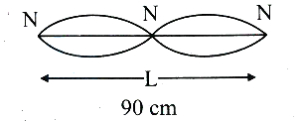
$A$ stationary wave is formed with $3$ nodes along the length of a string of $90 \ cm$. The wavelength of the wave is: (in $cm$)
A
$60$
B
$75$
C
$90$
D
$30$
Solution
(C) The length of the string is $L = 90 \ cm$.
There are $3$ nodes $(N)$ in the stationary wave.
The distance between two consecutive nodes is $\frac{\lambda}{2}$.
Since there are $3$ nodes,there are $2$ such segments (loops) between them.
Therefore,the total length $L = 2 \times \frac{\lambda}{2} = \lambda$.
Given $L = 90 \ cm$,we have $\lambda = 90 \ cm$.
There are $3$ nodes $(N)$ in the stationary wave.
The distance between two consecutive nodes is $\frac{\lambda}{2}$.
Since there are $3$ nodes,there are $2$ such segments (loops) between them.
Therefore,the total length $L = 2 \times \frac{\lambda}{2} = \lambda$.
Given $L = 90 \ cm$,we have $\lambda = 90 \ cm$.
0 likesView Solution
331
PhysicsEasyMCQMHT CET · 2024
$A$ stationary wave is produced along a stretched string of length $80 \,cm$. The resonant frequencies of the string are $90 \,Hz$, $150 \,Hz$, and $210 \,Hz$. The speed of the transverse wave in the string is: (in $\,m/s$)
A
$45$
B
$75$
C
$48$
D
$80$
Solution
(C) The resonant frequencies are given as $f_1 = 90 \,Hz$, $f_2 = 150 \,Hz$, and $f_3 = 210 \,Hz$.
The difference between consecutive resonant frequencies is $\Delta f = 150 - 90 = 60 \,Hz$ and $210 - 150 = 60 \,Hz$.
For a string fixed at both ends, the resonant frequencies are integer multiples of the fundamental frequency $f_0$. Thus, $\Delta f = f_0 = 60 \,Hz$.
The given frequencies are $f_1 = 1.5 f_0$ (not possible for both ends fixed) or they are harmonics of a string fixed at one end. However, if we assume the fundamental frequency $f_0 = 30 \,Hz$ (since $90 = 3 \times 30$, $150 = 5 \times 30$, $210 = 7 \times 30$), these are odd harmonics of a string fixed at both ends where the fundamental is $30 \,Hz$.
Using $f_n = \frac{n v}{2L}$, for $n=3$, $f_3 = \frac{3v}{2L} = 90 \,Hz$.
Given $L = 0.8 \,m$, we have $90 = \frac{3v}{2 \times 0.8}$.
$90 = \frac{3v}{1.6} \implies 3v = 144 \implies v = 48 \,m/s$.
The difference between consecutive resonant frequencies is $\Delta f = 150 - 90 = 60 \,Hz$ and $210 - 150 = 60 \,Hz$.
For a string fixed at both ends, the resonant frequencies are integer multiples of the fundamental frequency $f_0$. Thus, $\Delta f = f_0 = 60 \,Hz$.
The given frequencies are $f_1 = 1.5 f_0$ (not possible for both ends fixed) or they are harmonics of a string fixed at one end. However, if we assume the fundamental frequency $f_0 = 30 \,Hz$ (since $90 = 3 \times 30$, $150 = 5 \times 30$, $210 = 7 \times 30$), these are odd harmonics of a string fixed at both ends where the fundamental is $30 \,Hz$.
Using $f_n = \frac{n v}{2L}$, for $n=3$, $f_3 = \frac{3v}{2L} = 90 \,Hz$.
Given $L = 0.8 \,m$, we have $90 = \frac{3v}{2 \times 0.8}$.
$90 = \frac{3v}{1.6} \implies 3v = 144 \implies v = 48 \,m/s$.
0 likesView Solution
332
PhysicsDifficultMCQMHT CET · 2024
Two progressive waves $Y_1 = \sin 2 \pi \left( \frac{t}{0.4} - \frac{x}{4} \right)$ and $Y_2 = \sin 2 \pi \left( \frac{t}{0.4} + \frac{x}{4} \right)$ superpose to form a standing wave. $x$ and $y$ are in $SI$ units. The amplitude of the particle at $x = 0.5 \ m$ is $\left[ \sin 45^{\circ} = \cos 45^{\circ} = \frac{1}{\sqrt{2}} \right]$.
A
$\sqrt{3} \ m$
B
$3 \sqrt{3} \ m$
C
$\sqrt{2} \ m$
D
$2 \sqrt{2} \ m$
Solution
(C) The resultant displacement $Y$ is given by the superposition principle: $Y = Y_1 + Y_2$.
Using the trigonometric identity $\sin(A - B) + \sin(A + B) = 2 \sin A \cos B$,where $A = \frac{2 \pi t}{0.4}$ and $B = \frac{2 \pi x}{4}$,we get:
$Y = 2 \sin \left( \frac{2 \pi t}{0.4} \right) \cos \left( \frac{2 \pi x}{4} \right)$.
The amplitude $R$ of the standing wave at any position $x$ is given by $R = |2 \cos \left( \frac{2 \pi x}{4} \right)|$.
Substituting $x = 0.5 \ m$:
$R = 2 \cos \left( \frac{2 \pi \times 0.5}{4} \right) = 2 \cos \left( \frac{\pi}{4} \right)$.
Since $\cos \left( \frac{\pi}{4} \right) = \frac{1}{\sqrt{2}}$,we have $R = 2 \times \frac{1}{\sqrt{2}} = \sqrt{2} \ m$.
Using the trigonometric identity $\sin(A - B) + \sin(A + B) = 2 \sin A \cos B$,where $A = \frac{2 \pi t}{0.4}$ and $B = \frac{2 \pi x}{4}$,we get:
$Y = 2 \sin \left( \frac{2 \pi t}{0.4} \right) \cos \left( \frac{2 \pi x}{4} \right)$.
The amplitude $R$ of the standing wave at any position $x$ is given by $R = |2 \cos \left( \frac{2 \pi x}{4} \right)|$.
Substituting $x = 0.5 \ m$:
$R = 2 \cos \left( \frac{2 \pi \times 0.5}{4} \right) = 2 \cos \left( \frac{\pi}{4} \right)$.
Since $\cos \left( \frac{\pi}{4} \right) = \frac{1}{\sqrt{2}}$,we have $R = 2 \times \frac{1}{\sqrt{2}} = \sqrt{2} \ m$.
0 likesView Solution
333
PhysicsEasyMCQMHT CET · 2024
The displacement of a wave is given by $y=0.002 \sin (100t + x)$,where $x$ and $y$ are in meters and $t$ is in seconds. This represents a wave:
A
of wavelength $1 \ m$
B
travelling with a velocity of $100 \ m/s$ in the negative $x$-direction
C
of frequency $(\frac{100}{\pi}) \ Hz$
D
travelling with a velocity of $(\frac{50}{\pi}) \ m/s$ in the positive $x$-direction
Solution
(B) The standard equation for a progressive wave is $y = a \sin(\omega t + kx)$.
Comparing the given equation $y = 0.002 \sin(100t + x)$ with the standard form,we get:
Angular frequency $\omega = 100 \ rad/s$
Wave number $k = 1 \ rad/m$
Amplitude $a = 0.002 \ m$
Frequency $f = \frac{\omega}{2\pi} = \frac{100}{2\pi} = \frac{50}{\pi} \ Hz$.
Wave velocity $v = \frac{\omega}{k} = \frac{100}{1} = 100 \ m/s$.
Since the sign between $\omega t$ and $kx$ is positive,the wave is travelling in the negative $x$-direction.
Therefore,the wave is travelling with a velocity of $100 \ m/s$ in the negative $x$-direction.
Comparing the given equation $y = 0.002 \sin(100t + x)$ with the standard form,we get:
Angular frequency $\omega = 100 \ rad/s$
Wave number $k = 1 \ rad/m$
Amplitude $a = 0.002 \ m$
Frequency $f = \frac{\omega}{2\pi} = \frac{100}{2\pi} = \frac{50}{\pi} \ Hz$.
Wave velocity $v = \frac{\omega}{k} = \frac{100}{1} = 100 \ m/s$.
Since the sign between $\omega t$ and $kx$ is positive,the wave is travelling in the negative $x$-direction.
Therefore,the wave is travelling with a velocity of $100 \ m/s$ in the negative $x$-direction.
0 likesView Solution
334
PhysicsMediumMCQMHT CET · 2024
$A$ progressive wave of frequency $400 \ Hz$ is travelling with a velocity $336 \ m/s$. How far apart are the two points which are $60^{\circ}$ out of phase (in $m$)?
A
$0.14$
B
$0.21$
C
$0.24$
D
$0.28$
Solution
(A) Given: Frequency $(n) = 400 \ Hz$,Velocity $(v) = 336 \ m/s$,Phase difference $(\phi) = 60^{\circ} = \frac{\pi}{3} \ rad$.
First,calculate the wavelength $(\lambda)$ using the formula $v = n \lambda$:
$\lambda = \frac{v}{n} = \frac{336}{400} = 0.84 \ m$.
The relationship between path difference $(\Delta x)$ and phase difference $(\phi)$ is given by $\Delta x = \frac{\lambda}{2\pi} \times \phi$.
Substituting the values:
$\Delta x = \frac{0.84}{2\pi} \times \frac{\pi}{3} = \frac{0.84}{6} = 0.14 \ m$.
Therefore,the two points are $0.14 \ m$ apart.
First,calculate the wavelength $(\lambda)$ using the formula $v = n \lambda$:
$\lambda = \frac{v}{n} = \frac{336}{400} = 0.84 \ m$.
The relationship between path difference $(\Delta x)$ and phase difference $(\phi)$ is given by $\Delta x = \frac{\lambda}{2\pi} \times \phi$.
Substituting the values:
$\Delta x = \frac{0.84}{2\pi} \times \frac{\pi}{3} = \frac{0.84}{6} = 0.14 \ m$.
Therefore,the two points are $0.14 \ m$ apart.
0 likesView Solution
335
PhysicsMediumMCQMHT CET · 2024
$A$ transverse wave travelling along a stretched string has a speed of $30 \ m/s$ and a frequency of $250 \ Hz$. The phase difference between two points on the string $10 \ cm$ apart at the same instant is
A
$0 \ radian$
B
$\frac{\pi}{2} \ radian$
C
$\frac{5\pi}{3} \ radian$
D
$\frac{8\pi}{3} \ radian$
Solution
(C) The wavelength $\lambda$ of the wave is given by the formula $\lambda = \frac{v}{f}$,where $v$ is the speed and $f$ is the frequency.
Substituting the given values,$\lambda = \frac{30}{250} = 0.12 \ m$.
The phase difference $\Delta\phi$ between two points separated by a path difference $\Delta x$ is given by $\Delta\phi = \frac{2\pi}{\lambda} \times \Delta x$.
Given the path difference $\Delta x = 10 \ cm = 0.1 \ m$.
Substituting the values,$\Delta\phi = \frac{2\pi}{0.12} \times 0.1$.
$\Delta\phi = \frac{0.2\pi}{0.12} = \frac{20\pi}{12} = \frac{5\pi}{3} \ radian$.
Substituting the given values,$\lambda = \frac{30}{250} = 0.12 \ m$.
The phase difference $\Delta\phi$ between two points separated by a path difference $\Delta x$ is given by $\Delta\phi = \frac{2\pi}{\lambda} \times \Delta x$.
Given the path difference $\Delta x = 10 \ cm = 0.1 \ m$.
Substituting the values,$\Delta\phi = \frac{2\pi}{0.12} \times 0.1$.
$\Delta\phi = \frac{0.2\pi}{0.12} = \frac{20\pi}{12} = \frac{5\pi}{3} \ radian$.
0 likesView Solution
336
PhysicsMediumMCQMHT CET · 2024
$A$ string of mass $0.2 \ kg$ is under a tension of $2.5 \ N$. The length of the string is $2 \ m$. $A$ transverse wave starts from one end of the string. The time taken by the wave to reach the other end is: (in $s$)
A
$0.2$
B
$0.4$
C
$0.6$
D
$0.8$
Solution
(B) Mass per unit length $(m)$:
$m = \frac{M}{l} = \frac{0.2 \ kg}{2 \ m} = 0.1 \ kg/m$
Velocity of the transverse wave $(v)$:
$v = \sqrt{\frac{T}{m}} = \sqrt{\frac{2.5 \ N}{0.1 \ kg/m}} = \sqrt{25} = 5 \ m/s$
Time taken $(t)$ by the wave to reach the other end:
$t = \frac{l}{v} = \frac{2 \ m}{5 \ m/s} = 0.4 \ s$
$m = \frac{M}{l} = \frac{0.2 \ kg}{2 \ m} = 0.1 \ kg/m$
Velocity of the transverse wave $(v)$:
$v = \sqrt{\frac{T}{m}} = \sqrt{\frac{2.5 \ N}{0.1 \ kg/m}} = \sqrt{25} = 5 \ m/s$
Time taken $(t)$ by the wave to reach the other end:
$t = \frac{l}{v} = \frac{2 \ m}{5 \ m/s} = 0.4 \ s$
0 likesView Solution
337
PhysicsMediumMCQMHT CET · 2024
$A$ prong of a vibrating tuning fork is in contact with the water surface. It produces concentric circular waves on the surface of the water. The distance between five consecutive crests is $0.8 \ m$ and the velocity of the wave on the water surface is $56 \ m/s$. The frequency of the tuning fork is: (in $Hz$)
A
$256$
B
$280$
C
$341$
D
$512$
Solution
(B) The distance between $N$ consecutive crests is given by $(N-1) \lambda$,where $\lambda$ is the wavelength.
Given that the distance between $5$ consecutive crests is $0.8 \ m$,we have:
$4 \lambda = 0.8 \ m$
$\lambda = \frac{0.8}{4} = 0.2 \ m$
Using the wave equation $v = n \lambda$,where $v$ is the velocity and $n$ is the frequency:
$n = \frac{v}{\lambda}$
Substituting the given values $v = 56 \ m/s$ and $\lambda = 0.2 \ m$:
$n = \frac{56}{0.2} = 280 \ Hz$
Therefore,the frequency of the tuning fork is $280 \ Hz$.
Given that the distance between $5$ consecutive crests is $0.8 \ m$,we have:
$4 \lambda = 0.8 \ m$
$\lambda = \frac{0.8}{4} = 0.2 \ m$
Using the wave equation $v = n \lambda$,where $v$ is the velocity and $n$ is the frequency:
$n = \frac{v}{\lambda}$
Substituting the given values $v = 56 \ m/s$ and $\lambda = 0.2 \ m$:
$n = \frac{56}{0.2} = 280 \ Hz$
Therefore,the frequency of the tuning fork is $280 \ Hz$.
0 likesView Solution
338
PhysicsMediumMCQMHT CET · 2024
$A$ stretched string is fixed at both ends. It is made to vibrate so that the total number of nodes formed in it is '$x$'. The length of the string in terms of the wavelength of waves formed in it is $(\lambda = \text{wavelength})$
A
$\frac{x \lambda}{2}$
B
$\left(x+\frac{1}{2}\right) \frac{\lambda}{2}$
C
$(x-1) \frac{\lambda}{2}$
D
$(x+1) \frac{\lambda}{2}$
Solution
(C) For a string fixed at both ends,the wave forms a stationary wave pattern.
Let $L$ be the length of the string and $\lambda$ be the wavelength.
The number of loops formed in the string is $n$,where $n = x - 1$ (since there are $x$ nodes including the two fixed ends).
The length of the string is given by $L = n \frac{\lambda}{2}$.
Substituting $n = x - 1$,we get $L = (x - 1) \frac{\lambda}{2}$.
Let $L$ be the length of the string and $\lambda$ be the wavelength.
The number of loops formed in the string is $n$,where $n = x - 1$ (since there are $x$ nodes including the two fixed ends).
The length of the string is given by $L = n \frac{\lambda}{2}$.
Substituting $n = x - 1$,we get $L = (x - 1) \frac{\lambda}{2}$.
0 likesView Solution
339
PhysicsEasyMCQMHT CET · 2024
In a vibrating string with fixed ends,the waves are of type:
A
stationary longitudinal.
B
stationary transverse.
C
progressive transverse.
D
progressive longitudinal.
Solution
(B) When a string is fixed at both ends,waves travel along the string and reflect back from the fixed boundaries. The superposition of the incident and reflected waves results in the formation of stationary (standing) waves. Since the displacement of the string particles is perpendicular to the direction of wave propagation,these waves are transverse in nature. Therefore,the waves are stationary transverse waves.
0 likesView Solution
340
PhysicsMediumMCQMHT CET · 2024
$A$ string $A$ has twice the length,twice the diameter,twice the tension,and twice the density of another string $B$. The overtone of $A$ which will have the same fundamental frequency as that of $B$ is:
A
first
B
second
C
third
D
fourth
Solution
(C) The fundamental frequency of a string is given by $n = \frac{1}{2l} \sqrt{\frac{T}{\mu}}$,where $\mu = \rho \pi r^2$.
For string $B$: $n_B = \frac{1}{2l_B} \sqrt{\frac{T_B}{\mu_B}}$.
Given for string $A$: $l_A = 2l_B$,$d_A = 2d_B \Rightarrow r_A = 2r_B$,$T_A = 2T_B$,and $\rho_A = 2\rho_B$.
Calculating $\mu_A$: $\mu_A = \rho_A \pi r_A^2 = (2\rho_B) \pi (2r_B)^2 = 8 \rho_B \pi r_B^2 = 8\mu_B$.
Now,the fundamental frequency of string $A$ is: $n_A = \frac{1}{2l_A} \sqrt{\frac{T_A}{\mu_A}} = \frac{1}{2(2l_B)} \sqrt{\frac{2T_B}{8\mu_B}} = \frac{1}{4} \left( \frac{1}{2l_B} \sqrt{\frac{T_B}{\mu_B}} \right) = \frac{1}{4} n_B$.
The frequency of the $p^{\text{th}}$ overtone of string $A$ is $f_p = (p+1)n_A$.
We want $f_p = n_B$,so $(p+1) \frac{n_B}{4} = n_B$.
This gives $p+1 = 4$,or $p = 3$.
Thus,the $3^{\text{rd}}$ overtone of string $A$ has the same frequency as the fundamental frequency of string $B$.
For string $B$: $n_B = \frac{1}{2l_B} \sqrt{\frac{T_B}{\mu_B}}$.
Given for string $A$: $l_A = 2l_B$,$d_A = 2d_B \Rightarrow r_A = 2r_B$,$T_A = 2T_B$,and $\rho_A = 2\rho_B$.
Calculating $\mu_A$: $\mu_A = \rho_A \pi r_A^2 = (2\rho_B) \pi (2r_B)^2 = 8 \rho_B \pi r_B^2 = 8\mu_B$.
Now,the fundamental frequency of string $A$ is: $n_A = \frac{1}{2l_A} \sqrt{\frac{T_A}{\mu_A}} = \frac{1}{2(2l_B)} \sqrt{\frac{2T_B}{8\mu_B}} = \frac{1}{4} \left( \frac{1}{2l_B} \sqrt{\frac{T_B}{\mu_B}} \right) = \frac{1}{4} n_B$.
The frequency of the $p^{\text{th}}$ overtone of string $A$ is $f_p = (p+1)n_A$.
We want $f_p = n_B$,so $(p+1) \frac{n_B}{4} = n_B$.
This gives $p+1 = 4$,or $p = 3$.
Thus,the $3^{\text{rd}}$ overtone of string $A$ has the same frequency as the fundamental frequency of string $B$.
0 likesView Solution
341
PhysicsDifficultMCQMHT CET · 2024
$A$ sonometer wire is stretched by hanging a metal bob,the fundamental frequency of the wire is $n_1$. When the bob is completely immersed in water,the frequency of vibration of the wire becomes $n_2$. The relative density of the metal of the bob is
A
$\frac{n_1^2}{n_1^2-n_2^2}$
B
$\frac{n_2^2}{n_1^2-n_2^2}$
C
$\frac{n_1^2}{n_1^2+n_2^2}$
D
$\frac{n_2^2}{n_1^2+n_2^2}$
Solution
(A) The fundamental frequency of a sonometer wire is given by $n = \frac{1}{2L} \sqrt{\frac{T}{\mu}}$,where $T$ is the tension in the wire.
When the bob of weight $W$ is in air,the tension $T_1 = W$. Thus,$n_1 = \frac{1}{2L} \sqrt{\frac{W}{\mu}}$.
When the bob is immersed in water,the buoyant force $F_B$ acts on it,reducing the tension to $T_2 = W - F_B$. Thus,$n_2 = \frac{1}{2L} \sqrt{\frac{W - F_B}{\mu}}$.
Taking the ratio: $\frac{n_1}{n_2} = \sqrt{\frac{W}{W - F_B}} \implies \frac{n_1^2}{n_2^2} = \frac{W}{W - F_B}$.
Relative density $\sigma = \frac{W}{F_B}$.
Rearranging the ratio: $\frac{n_1^2}{n_2^2} = \frac{W}{W - (W/\sigma)} = \frac{\sigma}{\sigma - 1}$.
Solving for $\sigma$: $n_1^2(\sigma - 1) = n_2^2 \sigma \implies \sigma(n_1^2 - n_2^2) = n_1^2$.
Therefore,$\sigma = \frac{n_1^2}{n_1^2 - n_2^2}$.
When the bob of weight $W$ is in air,the tension $T_1 = W$. Thus,$n_1 = \frac{1}{2L} \sqrt{\frac{W}{\mu}}$.
When the bob is immersed in water,the buoyant force $F_B$ acts on it,reducing the tension to $T_2 = W - F_B$. Thus,$n_2 = \frac{1}{2L} \sqrt{\frac{W - F_B}{\mu}}$.
Taking the ratio: $\frac{n_1}{n_2} = \sqrt{\frac{W}{W - F_B}} \implies \frac{n_1^2}{n_2^2} = \frac{W}{W - F_B}$.
Relative density $\sigma = \frac{W}{F_B}$.
Rearranging the ratio: $\frac{n_1^2}{n_2^2} = \frac{W}{W - (W/\sigma)} = \frac{\sigma}{\sigma - 1}$.
Solving for $\sigma$: $n_1^2(\sigma - 1) = n_2^2 \sigma \implies \sigma(n_1^2 - n_2^2) = n_1^2$.
Therefore,$\sigma = \frac{n_1^2}{n_1^2 - n_2^2}$.
0 likesView Solution
342
PhysicsMediumMCQMHT CET · 2024
When the tension in a string is increased by $3 \ kg \ wt$,the frequency of the fundamental mode increases in the ratio $2:3$. The initial tension in the string is: (in $kg \ wt$)
A
$1.6$
B
$2.0$
C
$2.4$
D
$2.8$
Solution
(C) The frequency of the fundamental mode of a stretched string is given by $f = \frac{1}{2l} \sqrt{\frac{T}{m}}$,where $T$ is the tension and $m$ is the linear mass density.
Let the initial tension be $T$. The initial frequency is $f = \frac{1}{2l} \sqrt{\frac{T}{m}}$.
When the tension is increased by $3 \ kg \ wt$,the new tension becomes $T' = T + 3$. The new frequency is $f' = \frac{1}{2l} \sqrt{\frac{T+3}{m}}$.
Given the ratio of frequencies is $f : f' = 2 : 3$,we have:
$\frac{f}{f'} = \sqrt{\frac{T}{T+3}} = \frac{2}{3}$
Squaring both sides:
$\frac{T}{T+3} = \frac{4}{9}$
$9T = 4(T + 3)$
$9T = 4T + 12$
$5T = 12$
$T = 2.4 \ kg \ wt$
Thus,the initial tension in the string is $2.4 \ kg \ wt$.
Let the initial tension be $T$. The initial frequency is $f = \frac{1}{2l} \sqrt{\frac{T}{m}}$.
When the tension is increased by $3 \ kg \ wt$,the new tension becomes $T' = T + 3$. The new frequency is $f' = \frac{1}{2l} \sqrt{\frac{T+3}{m}}$.
Given the ratio of frequencies is $f : f' = 2 : 3$,we have:
$\frac{f}{f'} = \sqrt{\frac{T}{T+3}} = \frac{2}{3}$
Squaring both sides:
$\frac{T}{T+3} = \frac{4}{9}$
$9T = 4(T + 3)$
$9T = 4T + 12$
$5T = 12$
$T = 2.4 \ kg \ wt$
Thus,the initial tension in the string is $2.4 \ kg \ wt$.
0 likesView Solution
343
PhysicsDifficultMCQMHT CET · 2024
$A$ sonometer wire is in unison with a tuning fork of frequency '$n$' when it is stretched by a weight of specific gravity '$d$'. When the weight is completely immersed in water,'$x$' beats are produced per second,then
A
$\frac{n}{n-x}=\frac{d}{d-1}$
B
$\frac{n}{n-x}=\sqrt{\frac{d}{d-1}}$
C
$\frac{n-x}{n}=\frac{d-1}{d}$
D
$\frac{n-x}{n}=\sqrt{\frac{d}{d-1}}$
Solution
(B) For a sonometer,the frequency of vibration $n$ is proportional to the square root of the tension $T$,i.e.,$n \propto \sqrt{T}$.
When the weight is in air,the tension $T_1 = V \cdot d \cdot \rho_w \cdot g$,where $V$ is the volume of the weight,$d$ is its specific gravity,and $\rho_w$ is the density of water.
Thus,$n \propto \sqrt{V \cdot d \cdot \rho_w \cdot g}$.
When the weight is immersed in water,the effective weight (tension) becomes $T_2 = V \cdot (d - 1) \cdot \rho_w \cdot g$ due to the buoyant force.
The new frequency $n'$ is given by $n' = n - x$ (since beats are produced).
Thus,$n' \propto \sqrt{V \cdot (d - 1) \cdot \rho_w \cdot g}$.
Taking the ratio of the two frequencies:
$\frac{n}{n-x} = \sqrt{\frac{V \cdot d \cdot \rho_w \cdot g}{V \cdot (d - 1) \cdot \rho_w \cdot g}}$
$\frac{n}{n-x} = \sqrt{\frac{d}{d-1}}$.
When the weight is in air,the tension $T_1 = V \cdot d \cdot \rho_w \cdot g$,where $V$ is the volume of the weight,$d$ is its specific gravity,and $\rho_w$ is the density of water.
Thus,$n \propto \sqrt{V \cdot d \cdot \rho_w \cdot g}$.
When the weight is immersed in water,the effective weight (tension) becomes $T_2 = V \cdot (d - 1) \cdot \rho_w \cdot g$ due to the buoyant force.
The new frequency $n'$ is given by $n' = n - x$ (since beats are produced).
Thus,$n' \propto \sqrt{V \cdot (d - 1) \cdot \rho_w \cdot g}$.
Taking the ratio of the two frequencies:
$\frac{n}{n-x} = \sqrt{\frac{V \cdot d \cdot \rho_w \cdot g}{V \cdot (d - 1) \cdot \rho_w \cdot g}}$
$\frac{n}{n-x} = \sqrt{\frac{d}{d-1}}$.
0 likesView Solution
344
PhysicsEasyMCQMHT CET · 2024
$A$ pipe open at both ends and a pipe closed at one end have the same length and both are vibrating in their fundamental mode. If the air column vibrating in the open pipe has a resonance frequency $n_1$ and the air column vibrating in the closed pipe has a resonance frequency $n_2$,then:
A
$n_1 = 2 n_2$
B
$n_1 = n_2$
C
$2 n_1 = n_2$
D
$3 n_1 = 4 n_2$
Solution
(A) The fundamental resonant frequency for a pipe open at both ends of length $L$ is given by $n_1 = \frac{V}{2L}$,where $V$ is the speed of sound in air.
The fundamental resonant frequency for a pipe closed at one end of length $L$ is given by $n_2 = \frac{V}{4L}$.
Comparing the two equations:
$n_2 = \frac{V}{4L} = \frac{1}{2} \left( \frac{V}{2L} \right)$
$n_2 = \frac{n_1}{2}$
Therefore,$n_1 = 2 n_2$.
The fundamental resonant frequency for a pipe closed at one end of length $L$ is given by $n_2 = \frac{V}{4L}$.
Comparing the two equations:
$n_2 = \frac{V}{4L} = \frac{1}{2} \left( \frac{V}{2L} \right)$
$n_2 = \frac{n_1}{2}$
Therefore,$n_1 = 2 n_2$.
0 likesView Solution
345
PhysicsMediumMCQMHT CET · 2024
The length of a sonometer wire ' $AB$ ' is $110 \ cm$. Where should the two bridges be placed from end ' $A$ ' to divide the wire into three segments whose fundamental frequencies are in the ratio $1: 2: 3$?
A
$60 \ cm$ and $90 \ cm$
B
$90 \ cm$ and $100 \ cm$
C
$40 \ cm$ and $80 \ cm$
D
$50 \ cm$ and $90 \ cm$
Solution
(A) Let the lengths of the three segments be $L_1$,$L_2$,and $L_3$ respectively. The total length is $L_1 + L_2 + L_3 = 110 \ cm$.
For a sonometer wire under constant tension,the fundamental frequency $n$ is inversely proportional to the length $L$ $(n \propto 1/L)$,so $n_1 L_1 = n_2 L_2 = n_3 L_3 = k$.
Given the ratio of frequencies $n_1 : n_2 : n_3 = 1 : 2 : 3$,we have:
$n_1 = x, n_2 = 2x, n_3 = 3x$.
Substituting these into the relation:
$x L_1 = 2x L_2 = 3x L_3$.
This gives $L_2 = L_1/2$ and $L_3 = L_1/3$.
Substituting into the total length equation:
$L_1 + L_1/2 + L_1/3 = 110 \ cm$.
Multiplying by $6$ to clear denominators: $6 L_1 + 3 L_1 + 2 L_1 = 660 \ cm$.
$11 L_1 = 660 \ cm \Rightarrow L_1 = 60 \ cm$.
Then $L_2 = 30 \ cm$ and $L_3 = 20 \ cm$.
The first bridge is placed at $60 \ cm$ from end $A$. The second bridge is placed at $60 + 30 = 90 \ cm$ from end $A$.
For a sonometer wire under constant tension,the fundamental frequency $n$ is inversely proportional to the length $L$ $(n \propto 1/L)$,so $n_1 L_1 = n_2 L_2 = n_3 L_3 = k$.
Given the ratio of frequencies $n_1 : n_2 : n_3 = 1 : 2 : 3$,we have:
$n_1 = x, n_2 = 2x, n_3 = 3x$.
Substituting these into the relation:
$x L_1 = 2x L_2 = 3x L_3$.
This gives $L_2 = L_1/2$ and $L_3 = L_1/3$.
Substituting into the total length equation:
$L_1 + L_1/2 + L_1/3 = 110 \ cm$.
Multiplying by $6$ to clear denominators: $6 L_1 + 3 L_1 + 2 L_1 = 660 \ cm$.
$11 L_1 = 660 \ cm \Rightarrow L_1 = 60 \ cm$.
Then $L_2 = 30 \ cm$ and $L_3 = 20 \ cm$.
The first bridge is placed at $60 \ cm$ from end $A$. The second bridge is placed at $60 + 30 = 90 \ cm$ from end $A$.
0 likesView Solution
346
PhysicsMediumMCQMHT CET · 2024
$A$ wire of length $L$ and linear density $m$ is stretched between two rigid supports with tension $T$. It is observed that the wire resonates in the $P^{th}$ harmonic at a frequency of $320 \ Hz$ and resonates again at the next higher frequency of $400 \ Hz$. The value of $p$ is:
A
$2$
B
$4$
C
$8$
D
$10$
Solution
(B) The frequency of the $p^{th}$ harmonic for a string fixed at both ends is given by $f_p = \frac{p}{2L} \sqrt{\frac{T}{m}}$.
Given $f_p = 320 \ Hz$ and the next higher frequency $f_{p+1} = 400 \ Hz$.
We have the ratio: $\frac{f_{p+1}}{f_p} = \frac{p+1}{p}$.
Substituting the values: $\frac{400}{320} = \frac{p+1}{p}$.
Simplifying the fraction: $\frac{5}{4} = \frac{p+1}{p}$.
Cross-multiplying gives: $5p = 4(p+1) \Rightarrow 5p = 4p + 4$.
Therefore,$p = 4$.
Given $f_p = 320 \ Hz$ and the next higher frequency $f_{p+1} = 400 \ Hz$.
We have the ratio: $\frac{f_{p+1}}{f_p} = \frac{p+1}{p}$.
Substituting the values: $\frac{400}{320} = \frac{p+1}{p}$.
Simplifying the fraction: $\frac{5}{4} = \frac{p+1}{p}$.
Cross-multiplying gives: $5p = 4(p+1) \Rightarrow 5p = 4p + 4$.
Therefore,$p = 4$.
0 likesView Solution
347
PhysicsEasyMCQMHT CET · 2024
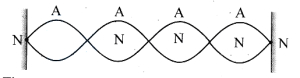
When a sonometer wire vibrates in the third overtone,there are:
A
$4$ nodes and $3$ antinodes.
B
$6$ nodes and $5$ antinodes.
C
$5$ nodes and $4$ antinodes.
D
$4$ nodes and $5$ antinodes.
Solution
(C) For a string fixed at both ends,the frequency of the $n$-th harmonic is given by $f_n = n \cdot f_1$,where $f_1$ is the fundamental frequency.
The $n$-th harmonic corresponds to $(n-1)$-th overtone.
Therefore,the third overtone corresponds to the $4$-th harmonic $(n = 4)$.
In the $n$-th harmonic,the number of loops is $n$.
For the $4$-th harmonic,there are $4$ loops.
The number of nodes is $(n + 1) = 4 + 1 = 5$.
The number of antinodes is $n = 4$.
Thus,there are $5$ nodes and $4$ antinodes.
The $n$-th harmonic corresponds to $(n-1)$-th overtone.
Therefore,the third overtone corresponds to the $4$-th harmonic $(n = 4)$.
In the $n$-th harmonic,the number of loops is $n$.
For the $4$-th harmonic,there are $4$ loops.
The number of nodes is $(n + 1) = 4 + 1 = 5$.
The number of antinodes is $n = 4$.
Thus,there are $5$ nodes and $4$ antinodes.
0 likesView Solution
348
PhysicsEasyMCQMHT CET · 2024
The end correction for the vibrations of air column in a tube of circular cross-section will be more if the tube is
A
reduced in length.
B
increased in length.
C
made thinner.
D
widened.
Solution
(D) The end correction $e$ for a tube of circular cross-section is given by the formula $e = 0.6r$ or $e = 0.3d$,where $r$ is the radius and $d$ is the diameter of the tube.
Since the end correction $e$ is directly proportional to the diameter $d$ of the tube $(e \propto d)$,increasing the diameter of the tube will result in a larger end correction.
Therefore,the end correction will be more if the tube is widened.
Since the end correction $e$ is directly proportional to the diameter $d$ of the tube $(e \propto d)$,increasing the diameter of the tube will result in a larger end correction.
Therefore,the end correction will be more if the tube is widened.
0 likesView Solution
349
PhysicsMediumMCQMHT CET · 2024
$A$ string is under tension of $180 \ N$ and mass per unit length $2 \times 10^{-3} \ kg/m$. It produces two consecutive resonant frequencies with a tuning fork,which are $375 \ Hz$ and $450 \ Hz$. The mass of the string is: (in $g$)
A
$1$
B
$2$
C
$3$
D
$4$
Solution
(D) The difference between two consecutive resonant frequencies of a stretched string is equal to the fundamental frequency $(f_0)$.
$f_0 = f_2 - f_1 = 450 \ Hz - 375 \ Hz = 75 \ Hz$.
The formula for the fundamental frequency is $f_0 = \frac{1}{2L} \sqrt{\frac{T}{\mu}}$,where $T = 180 \ N$ and $\mu = 2 \times 10^{-3} \ kg/m$.
Substituting the values: $75 = \frac{1}{2L} \sqrt{\frac{180}{2 \times 10^{-3}}} = \frac{1}{2L} \sqrt{90000} = \frac{300}{2L} = \frac{150}{L}$.
Thus,$L = \frac{150}{75} = 2 \ m$.
The total mass of the string is $m = \mu \times L = (2 \times 10^{-3} \ kg/m) \times (2 \ m) = 4 \times 10^{-3} \ kg = 4 \ g$.
$f_0 = f_2 - f_1 = 450 \ Hz - 375 \ Hz = 75 \ Hz$.
The formula for the fundamental frequency is $f_0 = \frac{1}{2L} \sqrt{\frac{T}{\mu}}$,where $T = 180 \ N$ and $\mu = 2 \times 10^{-3} \ kg/m$.
Substituting the values: $75 = \frac{1}{2L} \sqrt{\frac{180}{2 \times 10^{-3}}} = \frac{1}{2L} \sqrt{90000} = \frac{300}{2L} = \frac{150}{L}$.
Thus,$L = \frac{150}{75} = 2 \ m$.
The total mass of the string is $m = \mu \times L = (2 \times 10^{-3} \ kg/m) \times (2 \ m) = 4 \times 10^{-3} \ kg = 4 \ g$.
0 likesView Solution
350
PhysicsDifficultMCQMHT CET · 2024
Two uniform strings $A$ and $B$ made of steel are made to vibrate under the same tension. If the first overtone of $A$ is equal to the second overtone of $B$ and if the radius of $A$ is twice that of $B$,the ratio of the length of string $B$ to that of $A$ is
A
$1: 2$
B
$4: 3$
C
$2: 3$
D
$3: 1$
Solution
(D) Given: $T_A = T_B = T$,$r_A = 2r_B$.
The frequency of the $n$-th overtone for a string is given by $f_n = (n+1) \frac{1}{2L} \sqrt{\frac{T}{\mu}}$,where $\mu = \pi r^2 \rho$.
First overtone of $A$ $(n=1)$: $f_{A,1} = 2 \times \frac{1}{2L_A} \sqrt{\frac{T}{\pi r_A^2 \rho}} = \frac{1}{L_A r_A} \sqrt{\frac{T}{\pi \rho}}$.
Second overtone of $B$ $(n=2)$: $f_{B,2} = 3 \times \frac{1}{2L_B} \sqrt{\frac{T}{\pi r_B^2 \rho}} = \frac{3}{2L_B r_B} \sqrt{\frac{T}{\pi \rho}}$.
Equating the two frequencies: $\frac{1}{L_A r_A} = \frac{3}{2L_B r_B}$.
Substituting $r_A = 2r_B$: $\frac{1}{L_A (2r_B)} = \frac{3}{2L_B r_B}$.
Simplifying: $\frac{1}{2L_A} = \frac{3}{2L_B} \implies \frac{L_B}{L_A} = \frac{3}{1}$.
The frequency of the $n$-th overtone for a string is given by $f_n = (n+1) \frac{1}{2L} \sqrt{\frac{T}{\mu}}$,where $\mu = \pi r^2 \rho$.
First overtone of $A$ $(n=1)$: $f_{A,1} = 2 \times \frac{1}{2L_A} \sqrt{\frac{T}{\pi r_A^2 \rho}} = \frac{1}{L_A r_A} \sqrt{\frac{T}{\pi \rho}}$.
Second overtone of $B$ $(n=2)$: $f_{B,2} = 3 \times \frac{1}{2L_B} \sqrt{\frac{T}{\pi r_B^2 \rho}} = \frac{3}{2L_B r_B} \sqrt{\frac{T}{\pi \rho}}$.
Equating the two frequencies: $\frac{1}{L_A r_A} = \frac{3}{2L_B r_B}$.
Substituting $r_A = 2r_B$: $\frac{1}{L_A (2r_B)} = \frac{3}{2L_B r_B}$.
Simplifying: $\frac{1}{2L_A} = \frac{3}{2L_B} \implies \frac{L_B}{L_A} = \frac{3}{1}$.
0 likesView Solution
351
PhysicsEasyMCQMHT CET · 2024
$A$ radioactive substance has a half-life of $60 \text{ minutes}$. During $3 \text{ hours}$,the amount of substance decayed would be: (in $\%$)
A
$8.5$
B
$12.5$
C
$25$
D
$87.5$
Solution
(D) The number of half-lives $n$ in time $t$ is given by $n = \frac{t}{T_{1/2}}$.
Given $t = 3 \text{ hours} = 180 \text{ minutes}$ and $T_{1/2} = 60 \text{ minutes}$.
So,$n = \frac{180}{60} = 3$.
The fraction of substance remaining is $\frac{N}{N_0} = \left(\frac{1}{2}\right)^n = \left(\frac{1}{2}\right)^3 = \frac{1}{8}$.
The fraction of substance decayed is $1 - \frac{N}{N_0} = 1 - \frac{1}{8} = \frac{7}{8}$.
Converting to percentage: $\frac{7}{8} \times 100 \% = 87.5 \%$.
Given $t = 3 \text{ hours} = 180 \text{ minutes}$ and $T_{1/2} = 60 \text{ minutes}$.
So,$n = \frac{180}{60} = 3$.
The fraction of substance remaining is $\frac{N}{N_0} = \left(\frac{1}{2}\right)^n = \left(\frac{1}{2}\right)^3 = \frac{1}{8}$.
The fraction of substance decayed is $1 - \frac{N}{N_0} = 1 - \frac{1}{8} = \frac{7}{8}$.
Converting to percentage: $\frac{7}{8} \times 100 \% = 87.5 \%$.
0 likesView Solution
352
PhysicsMediumMCQMHT CET · 2024
In the given reaction sequence ${ }_z X^A \rightarrow{ }_{z+1} Y^A \rightarrow{ }_{z-1} K^{A-4} \rightarrow{ }_{z-1} K^{A-4}$,identify the radioactive radiations emitted in order.
A
$\alpha, \beta, \gamma$
B
$\beta, \alpha, \gamma$
C
$\gamma, \alpha, \beta$
D
$\beta, \gamma, \alpha$
Solution
(B) $1$. In the first step,${ }_z X^A \rightarrow{ }_{z+1} Y^A$,the atomic number increases by $1$ while the mass number remains the same. This corresponds to the emission of a $\beta^-$ particle $(-1\beta^0)$.
$2$. In the second step,${ }_{z+1} Y^A \rightarrow{ }_{z-1} K^{A-4}$,the atomic number decreases by $2$ and the mass number decreases by $4$. This corresponds to the emission of an $\alpha$ particle $(2\text{He}^4)$.
$3$. In the third step,${ }_{z-1} K^{A-4} \rightarrow{ }_{z-1} K^{A-4}$,there is no change in atomic number or mass number,which corresponds to the emission of a $\gamma$ ray $(0\gamma^0)$.
$4$. Therefore,the sequence of emissions is $\beta, \alpha, \gamma$.
$2$. In the second step,${ }_{z+1} Y^A \rightarrow{ }_{z-1} K^{A-4}$,the atomic number decreases by $2$ and the mass number decreases by $4$. This corresponds to the emission of an $\alpha$ particle $(2\text{He}^4)$.
$3$. In the third step,${ }_{z-1} K^{A-4} \rightarrow{ }_{z-1} K^{A-4}$,there is no change in atomic number or mass number,which corresponds to the emission of a $\gamma$ ray $(0\gamma^0)$.
$4$. Therefore,the sequence of emissions is $\beta, \alpha, \gamma$.
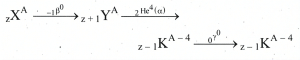
0 likesView Solution
353
PhysicsMediumMCQMHT CET · 2024
Two radioactive substances $A$ and $B$ have decay constants $5 \lambda$ and $\lambda$ respectively. At $t=0$,they have the same number of nuclei. The ratio of the number of nuclei of $A$ to those of $B$ will be $(1/e)^2$ after a time interval of:
A
$1/(4 \lambda)$
B
$4 \lambda$
C
$2 \lambda$
D
$1/(2 \lambda)$
Solution
(D) The number of nuclei remaining after time $t$ is given by $N = N_0 e^{-\lambda t}$.
For substance $A$,$N_A = N_0 e^{-5 \lambda t} \dots (i)$.
For substance $B$,$N_B = N_0 e^{-\lambda t} \dots (ii)$.
Dividing equation $(i)$ by equation $(ii)$,we get:
$\frac{N_A}{N_B} = \frac{N_0 e^{-5 \lambda t}}{N_0 e^{-\lambda t}} = e^{-5 \lambda t + \lambda t} = e^{-4 \lambda t}$.
Given that the ratio $\frac{N_A}{N_B} = (1/e)^2 = e^{-2}$.
Equating the exponents: $-4 \lambda t = -2$.
Therefore,$t = \frac{2}{4 \lambda} = \frac{1}{2 \lambda}$.
For substance $A$,$N_A = N_0 e^{-5 \lambda t} \dots (i)$.
For substance $B$,$N_B = N_0 e^{-\lambda t} \dots (ii)$.
Dividing equation $(i)$ by equation $(ii)$,we get:
$\frac{N_A}{N_B} = \frac{N_0 e^{-5 \lambda t}}{N_0 e^{-\lambda t}} = e^{-5 \lambda t + \lambda t} = e^{-4 \lambda t}$.
Given that the ratio $\frac{N_A}{N_B} = (1/e)^2 = e^{-2}$.
Equating the exponents: $-4 \lambda t = -2$.
Therefore,$t = \frac{2}{4 \lambda} = \frac{1}{2 \lambda}$.
0 likesView Solution
354
PhysicsDifficultMCQMHT CET · 2024
Two thin lenses have a combined power of $+9 \text{ D}$. When they are separated by a distance of $20 \text{ cm}$,their equivalent power becomes $+\frac{27}{5} \text{ D}$. The power of both the lenses in dioptre are respectively:
A
$4, 5$
B
$3, 6$
C
$2, 7$
D
$1, 8$
Solution
(B) The equivalent power $P_{eq}$ of two thin lenses with powers $P_1$ and $P_2$ separated by a distance $d$ is given by the formula: $P_{eq} = P_1 + P_2 - d P_1 P_2$.
Given $P_1 + P_2 = 9 \text{ D}$ and $d = 20 \text{ cm} = 0.2 \text{ m}$.
Substituting the given values into the formula:
$9 - (0.2) P_1 P_2 = \frac{27}{5} = 5.4$.
Rearranging the terms to solve for $P_1 P_2$:
$0.2 P_1 P_2 = 9 - 5.4 = 3.6$.
$P_1 P_2 = \frac{3.6}{0.2} = 18$.
We have a system of two equations: $P_1 + P_2 = 9$ and $P_1 P_2 = 18$.
These are the roots of the quadratic equation $x^2 - 9x + 18 = 0$.
Factoring the quadratic: $(x - 3)(x - 6) = 0$.
Thus,the powers of the two lenses are $3 \text{ D}$ and $6 \text{ D}$.
Given $P_1 + P_2 = 9 \text{ D}$ and $d = 20 \text{ cm} = 0.2 \text{ m}$.
Substituting the given values into the formula:
$9 - (0.2) P_1 P_2 = \frac{27}{5} = 5.4$.
Rearranging the terms to solve for $P_1 P_2$:
$0.2 P_1 P_2 = 9 - 5.4 = 3.6$.
$P_1 P_2 = \frac{3.6}{0.2} = 18$.
We have a system of two equations: $P_1 + P_2 = 9$ and $P_1 P_2 = 18$.
These are the roots of the quadratic equation $x^2 - 9x + 18 = 0$.
Factoring the quadratic: $(x - 3)(x - 6) = 0$.
Thus,the powers of the two lenses are $3 \text{ D}$ and $6 \text{ D}$.
0 likesView Solution
355
PhysicsEasyMCQMHT CET · 2024
White light is incident on the interface of glass and air as shown in the figure. If green light is just totally internally reflected,then the reflected rays inside the glass contain:
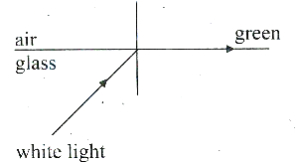
A
yellow,orange,red
B
violet,indigo,blue
C
green,yellow,orange
D
all colours except green
Solution
(B) The critical angle $i_c$ is given by $i_c = \sin^{-1}(1/n)$.
According to Cauchy's equation,the refractive index $n$ is inversely proportional to the wavelength $\lambda$ $(n \propto 1/\lambda)$.
Violet,indigo,and blue light have smaller wavelengths than green light,so the refractive index $n$ for these colors is higher than that for green light.
Since $i_c = \sin^{-1}(1/n)$,a higher refractive index $n$ results in a smaller critical angle $i_c$.
Therefore,the critical angle for violet,indigo,and blue light is smaller than the angle of incidence (which is equal to the critical angle for green light).
Consequently,these colors will undergo total internal reflection.
Conversely,red,orange,and yellow light have longer wavelengths than green light,resulting in a lower refractive index and a larger critical angle,so they will emerge out into the air.
According to Cauchy's equation,the refractive index $n$ is inversely proportional to the wavelength $\lambda$ $(n \propto 1/\lambda)$.
Violet,indigo,and blue light have smaller wavelengths than green light,so the refractive index $n$ for these colors is higher than that for green light.
Since $i_c = \sin^{-1}(1/n)$,a higher refractive index $n$ results in a smaller critical angle $i_c$.
Therefore,the critical angle for violet,indigo,and blue light is smaller than the angle of incidence (which is equal to the critical angle for green light).
Consequently,these colors will undergo total internal reflection.
Conversely,red,orange,and yellow light have longer wavelengths than green light,resulting in a lower refractive index and a larger critical angle,so they will emerge out into the air.
0 likesView Solution
356
PhysicsEasyMCQMHT CET · 2024
For a light ray to undergo total internal reflection ($i =$ angle of incidence,$i_c =$ critical angle):
A
light travels from denser to rarer medium and $i < i_c$.
B
light travels from rarer to denser medium and $i < i_c$.
C
light travels from denser to rarer medium and $i > i_c$.
D
light travels from rarer to denser medium and $i > i_c$.
Solution
(C) For total internal reflection to occur,two conditions must be satisfied:
$1$. The light ray must travel from a denser medium to a rarer medium.
$2$. The angle of incidence $(i)$ must be greater than the critical angle $(i_c)$.
$1$. The light ray must travel from a denser medium to a rarer medium.
$2$. The angle of incidence $(i)$ must be greater than the critical angle $(i_c)$.
0 likesView Solution
357
PhysicsMediumMCQMHT CET · 2024
The critical angle of light passing from glass to air is minimum for which wavelength?
A
red colour
B
yellow colour
C
green colour
D
blue colour
Solution
(D) The critical angle $i_{c}$ is given by the formula $\sin i_{c} = \frac{1}{n}$,where $n$ is the refractive index of the medium.
From this relation,it is clear that $i_{c}$ is minimum when the refractive index $n$ is maximum.
According to Cauchy's dispersion formula,the refractive index $n$ is inversely proportional to the wavelength $\lambda$ $(n \propto \frac{1}{\lambda^2})$.
Since blue light has the shortest wavelength among the given options,it has the highest refractive index in glass.
Therefore,the critical angle $i_{c}$ is minimum for blue light.
From this relation,it is clear that $i_{c}$ is minimum when the refractive index $n$ is maximum.
According to Cauchy's dispersion formula,the refractive index $n$ is inversely proportional to the wavelength $\lambda$ $(n \propto \frac{1}{\lambda^2})$.
Since blue light has the shortest wavelength among the given options,it has the highest refractive index in glass.
Therefore,the critical angle $i_{c}$ is minimum for blue light.
0 likesView Solution
358
PhysicsEasyMCQMHT CET · 2024
For a ray of light,the critical angle is minimum,when it travels from
A
glass to air
B
air to glass
C
glass to water
D
water to glass
Solution
(A) The critical angle $c$ for total internal reflection $(TIR)$ when light travels from a medium of refractive index $n_1$ to a medium of lower refractive index $n_2$ is given by $\sin c = \frac{n_2}{n_1}$,where $n_1 > n_2$.
The smaller the ratio $\frac{n_2}{n_1}$,the smaller $\sin c$,and hence the smaller the critical angle $c$.
From the options,the valid scenarios for $TIR$ are only those in which the first medium has a higher index than the second.
For glass to air $(n_{\text{glass}} \approx 1.5, n_{\text{air}} \approx 1.0)$: $\sin c = \frac{1.0}{1.5} = \frac{2}{3} \approx 0.667$,which gives $c \approx 41.8^{\circ}$.
For glass to water $(n_{\text{glass}} \approx 1.5, n_{\text{water}} \approx 1.33)$: $\sin c = \frac{1.33}{1.5} \approx 0.887$,which gives $c \approx 62.5^{\circ}$.
Clearly,the critical angle is smaller for glass-to-air.
Hence,the critical angle is minimum when light travels from glass to air.
The smaller the ratio $\frac{n_2}{n_1}$,the smaller $\sin c$,and hence the smaller the critical angle $c$.
From the options,the valid scenarios for $TIR$ are only those in which the first medium has a higher index than the second.
For glass to air $(n_{\text{glass}} \approx 1.5, n_{\text{air}} \approx 1.0)$: $\sin c = \frac{1.0}{1.5} = \frac{2}{3} \approx 0.667$,which gives $c \approx 41.8^{\circ}$.
For glass to water $(n_{\text{glass}} \approx 1.5, n_{\text{water}} \approx 1.33)$: $\sin c = \frac{1.33}{1.5} \approx 0.887$,which gives $c \approx 62.5^{\circ}$.
Clearly,the critical angle is smaller for glass-to-air.
Hence,the critical angle is minimum when light travels from glass to air.
0 likesView Solution
359
PhysicsEasyMCQMHT CET · 2024
The focal length of a combination of lenses formed with lenses having powers of $+2.50 \ D$ and $-3.75 \ D$ will be:
A
-$20$ cm
B
-$40$ cm
C
-$60$ cm
D
-$80$ cm
Solution
(D) The power of a combination of lenses in contact is the algebraic sum of the individual powers of the lenses.
$P = P_1 + P_2$
Given $P_1 = +2.50 \ D$ and $P_2 = -3.75 \ D$.
$P = 2.50 + (-3.75) = -1.25 \ D$.
The focal length $f$ is given by the reciprocal of the power $P$ in meters:
$f = \frac{1}{P} = \frac{1}{-1.25} \ m$.
$f = -0.8 \ m$.
Since $1 \ m = 100 \ cm$,we have:
$f = -0.8 \times 100 \ cm = -80 \ cm$.
$P = P_1 + P_2$
Given $P_1 = +2.50 \ D$ and $P_2 = -3.75 \ D$.
$P = 2.50 + (-3.75) = -1.25 \ D$.
The focal length $f$ is given by the reciprocal of the power $P$ in meters:
$f = \frac{1}{P} = \frac{1}{-1.25} \ m$.
$f = -0.8 \ m$.
Since $1 \ m = 100 \ cm$,we have:
$f = -0.8 \times 100 \ cm = -80 \ cm$.
0 likesView Solution
360
PhysicsEasyMCQMHT CET · 2024
$A$ convex lens of focal length $f$ $m$ forms a real,inverted image twice the size of the object. The object distance from the lens in metres is:
A
$0.5 f$
B
$0.66 f$
C
$f$
D
$1.5 f$
Solution
(D) Given: Focal length $= f$,Magnification $m = -2$ (since the image is real and inverted).
Using the magnification formula $m = \frac{v}{u}$,we get $v = -2u$.
Applying the lens formula $\frac{1}{v} - \frac{1}{u} = \frac{1}{f}$:
$\frac{1}{-2u} - \frac{1}{u} = \frac{1}{f}$
$\frac{-1 - 2}{2u} = \frac{1}{f}$
$\frac{-3}{2u} = \frac{1}{f}$
$2u = -3f$
$u = -1.5f$.
The magnitude of the object distance is $1.5f$.
Using the magnification formula $m = \frac{v}{u}$,we get $v = -2u$.
Applying the lens formula $\frac{1}{v} - \frac{1}{u} = \frac{1}{f}$:
$\frac{1}{-2u} - \frac{1}{u} = \frac{1}{f}$
$\frac{-1 - 2}{2u} = \frac{1}{f}$
$\frac{-3}{2u} = \frac{1}{f}$
$2u = -3f$
$u = -1.5f$.
The magnitude of the object distance is $1.5f$.
0 likesView Solution
361
PhysicsEasyMCQMHT CET · 2024
$A$ convex lens of focal length $f$ produces a real image whose size is $n$ times the size of an object. The distance of the object from the lens is
A
$\frac{n+1}{nf}$
B
$f(1-\frac{1}{n})$
C
$\frac{nf}{n+1}$
D
$f(1+\frac{1}{n})$
Solution
(D) Given that the magnification $m = -n$ (since the image is real).
By definition of magnification,$m = \frac{v}{u} = -n$,which implies $v = -nu$.
Using the lens formula: $\frac{1}{f} = \frac{1}{v} - \frac{1}{u}$.
Substituting the values: $\frac{1}{f} = \frac{1}{-nu} - \frac{1}{u}$.
$\frac{1}{f} = \frac{-1 - n}{nu} = -\frac{n+1}{nu}$.
Since $f$ is positive for a convex lens,we consider the magnitude of the object distance $u$ (where $u$ is negative,so let $u = -x$):
$\frac{1}{f} = \frac{n+1}{nx} \implies x = f(\frac{n+1}{n}) = f(1 + \frac{1}{n})$.
Thus,the distance of the object from the lens is $f(1 + \frac{1}{n})$.
By definition of magnification,$m = \frac{v}{u} = -n$,which implies $v = -nu$.
Using the lens formula: $\frac{1}{f} = \frac{1}{v} - \frac{1}{u}$.
Substituting the values: $\frac{1}{f} = \frac{1}{-nu} - \frac{1}{u}$.
$\frac{1}{f} = \frac{-1 - n}{nu} = -\frac{n+1}{nu}$.
Since $f$ is positive for a convex lens,we consider the magnitude of the object distance $u$ (where $u$ is negative,so let $u = -x$):
$\frac{1}{f} = \frac{n+1}{nx} \implies x = f(\frac{n+1}{n}) = f(1 + \frac{1}{n})$.
Thus,the distance of the object from the lens is $f(1 + \frac{1}{n})$.
0 likesView Solution
362
PhysicsMediumMCQMHT CET · 2024
$A$ convex lens of refractive index $\frac{3}{2}$ has a power of $2.5 \ D$. If it is placed in a liquid of refractive index $2$, the new power of the lens is: (in $D$)
A
$2.5$
B
$-2.5$
C
$1.25$
D
$-1.25$
Solution
(D) Using the Lens Maker's formula, the power $P$ of a lens in air is given by:
$P = (\mu - 1) \left( \frac{1}{R_1} - \frac{1}{R_2} \right) = 2.5 \ D$
When the lens is placed in a liquid of refractive index $\mu_l$, the effective refractive index of the lens relative to the liquid is $\mu' = \frac{\mu}{\mu_l}$.
The new power $P'$ is given by:
$P' = (\mu' - 1) \left( \frac{1}{R_1} - \frac{1}{R_2} \right)$
Taking the ratio of the two equations:
$\frac{P'}{P} = \frac{\mu' - 1}{\mu - 1}$
Given $\mu = 1.5$ and $\mu_l = 2$, we have $\mu' = \frac{1.5}{2} = 0.75$.
Substituting the values:
$\frac{P'}{2.5} = \frac{0.75 - 1}{1.5 - 1} = \frac{-0.25}{0.5} = -0.5$
$P' = -0.5 \times 2.5 = -1.25 \ D$
$P = (\mu - 1) \left( \frac{1}{R_1} - \frac{1}{R_2} \right) = 2.5 \ D$
When the lens is placed in a liquid of refractive index $\mu_l$, the effective refractive index of the lens relative to the liquid is $\mu' = \frac{\mu}{\mu_l}$.
The new power $P'$ is given by:
$P' = (\mu' - 1) \left( \frac{1}{R_1} - \frac{1}{R_2} \right)$
Taking the ratio of the two equations:
$\frac{P'}{P} = \frac{\mu' - 1}{\mu - 1}$
Given $\mu = 1.5$ and $\mu_l = 2$, we have $\mu' = \frac{1.5}{2} = 0.75$.
Substituting the values:
$\frac{P'}{2.5} = \frac{0.75 - 1}{1.5 - 1} = \frac{-0.25}{0.5} = -0.5$
$P' = -0.5 \times 2.5 = -1.25 \ D$
0 likesView Solution
363
PhysicsDifficultMCQMHT CET · 2024
$A$ point object is kept at $P$ in front of a glass sphere of radius $R$. Its image is formed at $Q$ such that $PO = QO$. The refractive index of the material of the glass sphere is $1.4$. The distance $PO$ is equal to:
A
$\frac{R}{2}$
B
$2R$
C
$5R$
D
$6R$
Solution
(D) Let $PO = QO = x$.
According to the sign convention,the object distance $u = -x$ and the image distance $v = +x$ (since the image is formed on the other side of the refracting surface).
The formula for refraction at a spherical surface is:
$\frac{n_2}{v} - \frac{n_1}{u} = \frac{n_2 - n_1}{R}$
Here,$n_1 = 1$ (air) and $n_2 = 1.4$ (glass).
Substituting the values:
$\frac{1.4}{x} - \frac{1}{-x} = \frac{1.4 - 1}{R}$
$\frac{1.4}{x} + \frac{1}{x} = \frac{0.4}{R}$
$\frac{2.4}{x} = \frac{0.4}{R}$
$x = \frac{2.4}{0.4} R$
$x = 6R$
Therefore,the distance $PO = 6R$.
According to the sign convention,the object distance $u = -x$ and the image distance $v = +x$ (since the image is formed on the other side of the refracting surface).
The formula for refraction at a spherical surface is:
$\frac{n_2}{v} - \frac{n_1}{u} = \frac{n_2 - n_1}{R}$
Here,$n_1 = 1$ (air) and $n_2 = 1.4$ (glass).
Substituting the values:
$\frac{1.4}{x} - \frac{1}{-x} = \frac{1.4 - 1}{R}$
$\frac{1.4}{x} + \frac{1}{x} = \frac{0.4}{R}$
$\frac{2.4}{x} = \frac{0.4}{R}$
$x = \frac{2.4}{0.4} R$
$x = 6R$
Therefore,the distance $PO = 6R$.
0 likesView Solution
364
PhysicsDifficultMCQMHT CET · 2024
Concave and convex lenses are placed touching each other. The ratio of magnitudes of their power is $2:3$. The focal length of the system is $30 \ cm$. The focal lengths of individual lenses are
A
$5 \ cm, -10 \ cm$
B
$10 \ cm, -15 \ cm$
C
$10 \ cm, -20 \ cm$
D
$20 \ cm, -30 \ cm$
Solution
(B) Power $(P) = \frac{1}{f} \dots (i)$
Given,the ratio of magnitudes of power is $\frac{|P_{\text{concave}}|}{|P_{\text{convex}}|} = \frac{2}{3} \dots (ii)$
Let the focal length of the convex lens be $f_{\text{convex}} = f$ (positive) and the focal length of the concave lens be $f_{\text{concave}} = -f'$ (negative).
Since $P = \frac{1}{f}$,the ratio of powers is $\frac{1/f'}{1/f} = \frac{f}{f'} = \frac{2}{3}$,which implies $f' = \frac{3}{2}f$.
Thus,$f_{\text{convex}} = f$ and $f_{\text{concave}} = -\frac{3}{2}f$.
Using the formula for equivalent focal length of two lenses in contact: $\frac{1}{f_{eq}} = \frac{1}{f_{\text{convex}}} + \frac{1}{f_{\text{concave}}}$
$\frac{1}{30} = \frac{1}{f} - \frac{1}{\frac{3}{2}f} = \frac{1}{f} - \frac{2}{3f} = \frac{3-2}{3f} = \frac{1}{3f}$
$\frac{1}{30} = \frac{1}{3f} \Rightarrow 3f = 30 \Rightarrow f = 10 \ cm$.
Therefore,$f_{\text{convex}} = 10 \ cm$ and $f_{\text{concave}} = -\frac{3}{2}(10) = -15 \ cm$.
Given,the ratio of magnitudes of power is $\frac{|P_{\text{concave}}|}{|P_{\text{convex}}|} = \frac{2}{3} \dots (ii)$
Let the focal length of the convex lens be $f_{\text{convex}} = f$ (positive) and the focal length of the concave lens be $f_{\text{concave}} = -f'$ (negative).
Since $P = \frac{1}{f}$,the ratio of powers is $\frac{1/f'}{1/f} = \frac{f}{f'} = \frac{2}{3}$,which implies $f' = \frac{3}{2}f$.
Thus,$f_{\text{convex}} = f$ and $f_{\text{concave}} = -\frac{3}{2}f$.
Using the formula for equivalent focal length of two lenses in contact: $\frac{1}{f_{eq}} = \frac{1}{f_{\text{convex}}} + \frac{1}{f_{\text{concave}}}$
$\frac{1}{30} = \frac{1}{f} - \frac{1}{\frac{3}{2}f} = \frac{1}{f} - \frac{2}{3f} = \frac{3-2}{3f} = \frac{1}{3f}$
$\frac{1}{30} = \frac{1}{3f} \Rightarrow 3f = 30 \Rightarrow f = 10 \ cm$.
Therefore,$f_{\text{convex}} = 10 \ cm$ and $f_{\text{concave}} = -\frac{3}{2}(10) = -15 \ cm$.
0 likesView Solution
365
PhysicsEasyMCQMHT CET · 2024
$A$ convex lens of focal length $40 \ cm$ is in contact with a concave lens of focal length $25 \ cm$. The power of the combination is:
A
$-1.5 \ D$
B
$-6.5 \ D$
C
$+6.5 \ D$
D
$+1.5 \ D$
Solution
(A) The power of a lens is given by $P = \frac{1}{f}$ (where $f$ is in meters).
For a convex lens,$f_1 = +40 \ cm = +0.4 \ m$.
For a concave lens,$f_2 = -25 \ cm = -0.25 \ m$.
The power of the combination of thin lenses in contact is $P = P_1 + P_2 = \frac{1}{f_1} + \frac{1}{f_2}$.
Substituting the values: $P = \frac{1}{0.4} + \frac{1}{-0.25}$.
$P = 2.5 - 4.0 = -1.5 \ D$.
For a convex lens,$f_1 = +40 \ cm = +0.4 \ m$.
For a concave lens,$f_2 = -25 \ cm = -0.25 \ m$.
The power of the combination of thin lenses in contact is $P = P_1 + P_2 = \frac{1}{f_1} + \frac{1}{f_2}$.
Substituting the values: $P = \frac{1}{0.4} + \frac{1}{-0.25}$.
$P = 2.5 - 4.0 = -1.5 \ D$.
0 likesView Solution
366
PhysicsMediumMCQMHT CET · 2024
An optician makes spectacles having a combination of a convex lens of focal length $40 \ cm$ in contact with a concave lens of focal length $25 \ cm$. The power of this combination of lenses in dioptre is:
A
-$6.67$
B
-$1.5$
C
$6.67$
D
$1.5$
Solution
(B) The power $P$ of a lens is given by $P = \frac{1}{f(m)}$,where $f$ is the focal length in meters.
For a convex lens,$f_1 = +40 \ cm = +0.4 \ m$. Thus,$P_1 = \frac{1}{0.4} = +2.5 \ D$.
For a concave lens,$f_2 = -25 \ cm = -0.25 \ m$. Thus,$P_2 = \frac{1}{-0.25} = -4.0 \ D$.
The power of the combination of lenses in contact is $P = P_1 + P_2$.
$P = 2.5 \ D + (-4.0 \ D) = -1.5 \ D$.
For a convex lens,$f_1 = +40 \ cm = +0.4 \ m$. Thus,$P_1 = \frac{1}{0.4} = +2.5 \ D$.
For a concave lens,$f_2 = -25 \ cm = -0.25 \ m$. Thus,$P_2 = \frac{1}{-0.25} = -4.0 \ D$.
The power of the combination of lenses in contact is $P = P_1 + P_2$.
$P = 2.5 \ D + (-4.0 \ D) = -1.5 \ D$.
0 likesView Solution
367
PhysicsMediumMCQMHT CET · 2024
$A$ concave mirror of focal length '$f$' produces an image '$n$' times the size of the object. If the image is real, then the distance of the object from the mirror is
A
$(n-1) f$
B
$\left(\frac{n-1}{n}\right) f$
C
$\left(\frac{n+1}{n}\right) f$
D
$(n+1) f$
Solution
(C) For a concave mirror, the magnification $m$ for a real image is negative, so $m = -n$.
By definition of magnification, $m = -\frac{v}{u}$, where $v$ is the image distance and $u$ is the object distance.
Thus, $-n = -\frac{v}{u} \implies v = nu$.
Using the mirror formula: $\frac{1}{f} = \frac{1}{v} + \frac{1}{u}$.
Since the mirror is concave, the focal length $f$ is negative, i.e., $-f$. The object distance $u$ is also negative, i.e., $-u$.
Substituting these values: $\frac{1}{-f} = \frac{1}{-nu} + \frac{1}{-u}$.
Multiplying by $-1$: $\frac{1}{f} = \frac{1}{nu} + \frac{1}{u} = \frac{1+n}{nu}$.
Rearranging for $u$: $u = \left(\frac{n+1}{n}\right) f$.
By definition of magnification, $m = -\frac{v}{u}$, where $v$ is the image distance and $u$ is the object distance.
Thus, $-n = -\frac{v}{u} \implies v = nu$.
Using the mirror formula: $\frac{1}{f} = \frac{1}{v} + \frac{1}{u}$.
Since the mirror is concave, the focal length $f$ is negative, i.e., $-f$. The object distance $u$ is also negative, i.e., $-u$.
Substituting these values: $\frac{1}{-f} = \frac{1}{-nu} + \frac{1}{-u}$.
Multiplying by $-1$: $\frac{1}{f} = \frac{1}{nu} + \frac{1}{u} = \frac{1+n}{nu}$.
Rearranging for $u$: $u = \left(\frac{n+1}{n}\right) f$.
0 likesView Solution
368
PhysicsEasyMCQMHT CET · 2024
For a given wavelength,telescopes with large aperture objectives are used for:
A
greater magnification.
B
greater resolution.
C
reducing lens aberration.
D
ease of manufacture.
Solution
(B) The resolving power $(R.P.)$ of a telescope is given by the formula $R.P. = \frac{D}{1.22\lambda}$,where $D$ is the diameter of the objective lens (aperture) and $\lambda$ is the wavelength of light.
Since the wavelength $(\lambda)$ is fixed for a given observation,the resolving power is directly proportional to the aperture $(D)$ of the objective lens $(R.P. \propto D)$.
Therefore,to achieve greater resolution (the ability to distinguish between two closely spaced objects),telescopes are designed with large aperture objectives.
Since the wavelength $(\lambda)$ is fixed for a given observation,the resolving power is directly proportional to the aperture $(D)$ of the objective lens $(R.P. \propto D)$.
Therefore,to achieve greater resolution (the ability to distinguish between two closely spaced objects),telescopes are designed with large aperture objectives.
0 likesView Solution
369
PhysicsMediumMCQMHT CET · 2024
Two points separated by a distance of $0.1 \ mm$ can just be seen in a microscope when light of wavelength $6000 \ Å$ is used. If the light of wavelength $4800 \ Å$ is used,the limit of resolution will become: (in $mm$)
A
$0.8$
B
$0.12$
C
$0.10$
D
$0.08$
Solution
(D) The limit of resolution $(d)$ of a microscope is directly proportional to the wavelength $(\lambda)$ of the light used,given by the relation $d \propto \lambda$.
Therefore,we can write the ratio as: $\frac{d_1}{d_2} = \frac{\lambda_1}{\lambda_2}$.
Given: $d_1 = 0.1 \ mm$,$\lambda_1 = 6000 \ Å$,and $\lambda_2 = 4800 \ Å$.
Substituting the values: $\frac{0.1}{d_2} = \frac{6000}{4800}$.
Simplifying the fraction: $\frac{6000}{4800} = \frac{60}{48} = \frac{5}{4} = 1.25$.
Thus,$d_2 = \frac{0.1}{1.25} = 0.08 \ mm$.
Therefore,we can write the ratio as: $\frac{d_1}{d_2} = \frac{\lambda_1}{\lambda_2}$.
Given: $d_1 = 0.1 \ mm$,$\lambda_1 = 6000 \ Å$,and $\lambda_2 = 4800 \ Å$.
Substituting the values: $\frac{0.1}{d_2} = \frac{6000}{4800}$.
Simplifying the fraction: $\frac{6000}{4800} = \frac{60}{48} = \frac{5}{4} = 1.25$.
Thus,$d_2 = \frac{0.1}{1.25} = 0.08 \ mm$.
0 likesView Solution
370
PhysicsEasyMCQMHT CET · 2024
The focal length of the objective of an astronomical telescope is $1.5 \ m$. Under normal adjustment,the length of the telescope is $1.56 \ m$. The focal length of the eyepiece is: (in $m$)
A
$0.06$
B
$1.04$
C
$2.34$
D
$3.06$
Solution
(A) For an astronomical telescope in normal adjustment,the length of the telescope $L$ is given by the sum of the focal length of the objective $(f_0)$ and the focal length of the eyepiece $(f_e)$:
$L = f_0 + f_e$
Given:
$f_0 = 1.5 \ m$
$L = 1.56 \ m$
Substituting the values into the formula:
$1.56 = 1.5 + f_e$
$f_e = 1.56 - 1.5$
$f_e = 0.06 \ m$
Therefore,the focal length of the eyepiece is $0.06 \ m$.
$L = f_0 + f_e$
Given:
$f_0 = 1.5 \ m$
$L = 1.56 \ m$
Substituting the values into the formula:
$1.56 = 1.5 + f_e$
$f_e = 1.56 - 1.5$
$f_e = 0.06 \ m$
Therefore,the focal length of the eyepiece is $0.06 \ m$.
0 likesView Solution
371
PhysicsEasyMCQMHT CET · 2024
$A$ person is observing a bacteria through a compound microscope. For better analysis and to improve the resolving power,he should:
A
increase the wavelength of light.
B
increase the refractive index of the medium between the object and objective lens.
C
decrease the focal length of the eye-piece.
D
decrease the diameter of the objective lens.
Solution
(B) The resolving power $(P)$ of a compound microscope is given by the formula: $P = \frac{2 \mu \sin \theta}{1.22 \lambda}$.
Here,$\mu$ is the refractive index of the medium between the object and the objective lens,$\theta$ is the half-angle of the cone of light from the object,and $\lambda$ is the wavelength of light used.
To improve the resolving power,one must increase the numerator or decrease the denominator.
Therefore,increasing the refractive index $(\mu)$ of the medium between the object and the objective lens increases the resolving power.
Here,$\mu$ is the refractive index of the medium between the object and the objective lens,$\theta$ is the half-angle of the cone of light from the object,and $\lambda$ is the wavelength of light used.
To improve the resolving power,one must increase the numerator or decrease the denominator.
Therefore,increasing the refractive index $(\mu)$ of the medium between the object and the objective lens increases the resolving power.
0 likesView Solution
372
PhysicsEasyMCQMHT CET · 2024
An astronomical telescope has a large aperture to
A
have high resolution.
B
have low dispersion.
C
increase the span of observation.
D
have large wavelength.
Solution
(A) The resolving power $(R.P.)$ of a telescope is given by the formula $R.P. = \frac{D}{1.22 \lambda}$,where $D$ is the diameter of the objective lens (aperture) and $\lambda$ is the wavelength of light used.
Since the wavelength of light from celestial objects is fixed,the only way to increase the resolving power is by increasing the diameter $(D)$ of the objective lens.
$A$ larger aperture also allows more light to enter the telescope,making faint objects more visible.
Therefore,an astronomical telescope has a large aperture to have high resolution.
Since the wavelength of light from celestial objects is fixed,the only way to increase the resolving power is by increasing the diameter $(D)$ of the objective lens.
$A$ larger aperture also allows more light to enter the telescope,making faint objects more visible.
Therefore,an astronomical telescope has a large aperture to have high resolution.
0 likesView Solution
373
PhysicsEasyMCQMHT CET · 2024
$A$ simple microscope is used to see an object first in blue light and then in red light. Due to the change from blue to red light, its magnifying power
A
decreases
B
increases
C
remains same
D
first increases and then decreases
Solution
(A) The magnifying power $(M)$ of a simple microscope is given by the formula: $M = 1 + \frac{D}{f}$, where $D$ is the least distance of distinct vision and $f$ is the focal length of the convex lens.
According to Cauchy's dispersion formula, the refractive index $(\mu)$ of a material is higher for shorter wavelengths (blue light) and lower for longer wavelengths (red light).
Since the focal length $f$ of a lens is related to the refractive index by the lens maker's formula, $f$ increases as the wavelength of light increases.
Therefore, the focal length for red light $(f_{red})$ is greater than the focal length for blue light $(f_{blue})$.
As $M = 1 + \frac{D}{f}$, an increase in focal length $f$ results in a decrease in the magnifying power $M$.
Thus, when changing from blue light to red light, the magnifying power decreases.
According to Cauchy's dispersion formula, the refractive index $(\mu)$ of a material is higher for shorter wavelengths (blue light) and lower for longer wavelengths (red light).
Since the focal length $f$ of a lens is related to the refractive index by the lens maker's formula, $f$ increases as the wavelength of light increases.
Therefore, the focal length for red light $(f_{red})$ is greater than the focal length for blue light $(f_{blue})$.
As $M = 1 + \frac{D}{f}$, an increase in focal length $f$ results in a decrease in the magnifying power $M$.
Thus, when changing from blue light to red light, the magnifying power decreases.
0 likesView Solution
374
PhysicsEasyMCQMHT CET · 2024
In a compound microscope,the focal length and the aperture of the objective lens used are respectively:
A
large and large
B
large and small
C
small and large
D
small and small
Solution
(C) In a compound microscope,the objective lens is placed very close to the object to form a real,inverted,and magnified image.
To achieve high magnification and high resolving power,the objective lens must have a small focal length $(f_o)$.
Additionally,to collect as much light as possible from the small object and to improve resolution,the objective lens is designed with a large aperture.
Therefore,the objective lens of a compound microscope has a small focal length and a large aperture.
To achieve high magnification and high resolving power,the objective lens must have a small focal length $(f_o)$.
Additionally,to collect as much light as possible from the small object and to improve resolution,the objective lens is designed with a large aperture.
Therefore,the objective lens of a compound microscope has a small focal length and a large aperture.
0 likesView Solution
375
PhysicsEasyMCQMHT CET · 2024
$A$ ray of light is incident at $60^{\circ}$ on one face of a prism of angle $30^{\circ}$ and the emergent ray makes $30^{\circ}$ with the incident ray. The refractive index of the prism is $(\sin 30^{\circ}=0.5, \sin 60^{\circ}=\sqrt{3}/2)$.
A
$1.732$
B
$1.414$
C
$1.5$
D
$1.33$
Solution
(A) Given: Prism angle $A = 30^{\circ}$,angle of incidence $i_1 = 60^{\circ}$,and angle of deviation $\delta = 30^{\circ}$.
For a prism,the deviation formula is $\delta = (i_1 + i_2) - A$.
Substituting the values: $30^{\circ} = (60^{\circ} + i_2) - 30^{\circ}$.
$30^{\circ} = 30^{\circ} + i_2$,which gives $i_2 = 0^{\circ}$.
Since the emergent angle $i_2 = 0^{\circ}$,the emergent ray is normal to the second face,implying the angle of refraction at the second face $r_2 = 0^{\circ}$.
Using the relation $r_1 + r_2 = A$,we get $r_1 + 0^{\circ} = 30^{\circ}$,so $r_1 = 30^{\circ}$.
Applying Snell's law at the first face: $\mu_1 \sin i_1 = \mu_2 \sin r_1$.
Assuming the surrounding medium is air $(\mu_1 = 1)$: $1 \cdot \sin 60^{\circ} = \mu_2 \sin 30^{\circ}$.
$\frac{\sqrt{3}}{2} = \mu_2 \cdot \frac{1}{2}$.
Therefore,$\mu_2 = \sqrt{3} \approx 1.732$.
For a prism,the deviation formula is $\delta = (i_1 + i_2) - A$.
Substituting the values: $30^{\circ} = (60^{\circ} + i_2) - 30^{\circ}$.
$30^{\circ} = 30^{\circ} + i_2$,which gives $i_2 = 0^{\circ}$.
Since the emergent angle $i_2 = 0^{\circ}$,the emergent ray is normal to the second face,implying the angle of refraction at the second face $r_2 = 0^{\circ}$.
Using the relation $r_1 + r_2 = A$,we get $r_1 + 0^{\circ} = 30^{\circ}$,so $r_1 = 30^{\circ}$.
Applying Snell's law at the first face: $\mu_1 \sin i_1 = \mu_2 \sin r_1$.
Assuming the surrounding medium is air $(\mu_1 = 1)$: $1 \cdot \sin 60^{\circ} = \mu_2 \sin 30^{\circ}$.
$\frac{\sqrt{3}}{2} = \mu_2 \cdot \frac{1}{2}$.
Therefore,$\mu_2 = \sqrt{3} \approx 1.732$.
0 likesView Solution
376
PhysicsEasyMCQMHT CET · 2024
In an equilateral prism,the ray undergoes minimum deviation when it is incident at an angle of $50^{\circ}$. The angle of minimum deviation is (in $^{\circ}$)
A
$50$
B
$40$
C
$25$
D
$20$
Solution
(B) For a prism,the condition for minimum deviation is given by the formula $i = \frac{A + \delta_m}{2}$.
In an equilateral prism,the angle of the prism $A = 60^{\circ}$.
Given that the angle of incidence $i = 50^{\circ}$.
Substituting these values into the formula:
$50^{\circ} = \frac{60^{\circ} + \delta_m}{2}$
$100^{\circ} = 60^{\circ} + \delta_m$
$\delta_m = 100^{\circ} - 60^{\circ} = 40^{\circ}$.
Thus,the angle of minimum deviation is $40^{\circ}$.
In an equilateral prism,the angle of the prism $A = 60^{\circ}$.
Given that the angle of incidence $i = 50^{\circ}$.
Substituting these values into the formula:
$50^{\circ} = \frac{60^{\circ} + \delta_m}{2}$
$100^{\circ} = 60^{\circ} + \delta_m$
$\delta_m = 100^{\circ} - 60^{\circ} = 40^{\circ}$.
Thus,the angle of minimum deviation is $40^{\circ}$.
0 likesView Solution
377
PhysicsMediumMCQMHT CET · 2024
$A$ ray of light is incident on a medium of refractive index $\mu$ at an angle of incidence $i$. On refraction in the medium,$\delta$ is the angle of deviation. Then:
A
$\frac{1}{\mu} = \cos \delta - \frac{\sin \delta}{\tan i}$
B
$\frac{1}{\mu} = \sin \delta - \frac{\cos \delta}{\tan i}$
C
$\frac{1}{\mu} = \cos \delta - \sin \delta \cdot \tan i$
D
$\frac{1}{\mu} = \sin \delta - \cos \delta \cdot \tan i$
Solution
(A) The angle of deviation $\delta$ for refraction is given by $\delta = i - r$,where $i$ is the angle of incidence and $r$ is the angle of refraction.
From Snell's Law,$\mu = \frac{\sin i}{\sin r}$,which implies $\sin r = \frac{\sin i}{\mu}$.
Since $\delta = i - r$,we have $r = i - \delta$.
Substituting $r$ in the expression for $\mu$:
$\mu = \frac{\sin i}{\sin(i - \delta)}$
Taking the reciprocal:
$\frac{1}{\mu} = \frac{\sin(i - \delta)}{\sin i}$
Using the trigonometric identity $\sin(A - B) = \sin A \cos B - \cos A \sin B$:
$\frac{1}{\mu} = \frac{\sin i \cos \delta - \cos i \sin \delta}{\sin i}$
$\frac{1}{\mu} = \frac{\sin i \cos \delta}{\sin i} - \frac{\cos i \sin \delta}{\sin i}$
$\frac{1}{\mu} = \cos \delta - \frac{\sin \delta}{\tan i}$
From Snell's Law,$\mu = \frac{\sin i}{\sin r}$,which implies $\sin r = \frac{\sin i}{\mu}$.
Since $\delta = i - r$,we have $r = i - \delta$.
Substituting $r$ in the expression for $\mu$:
$\mu = \frac{\sin i}{\sin(i - \delta)}$
Taking the reciprocal:
$\frac{1}{\mu} = \frac{\sin(i - \delta)}{\sin i}$
Using the trigonometric identity $\sin(A - B) = \sin A \cos B - \cos A \sin B$:
$\frac{1}{\mu} = \frac{\sin i \cos \delta - \cos i \sin \delta}{\sin i}$
$\frac{1}{\mu} = \frac{\sin i \cos \delta}{\sin i} - \frac{\cos i \sin \delta}{\sin i}$
$\frac{1}{\mu} = \cos \delta - \frac{\sin \delta}{\tan i}$
0 likesView Solution
378
PhysicsEasyMCQMHT CET · 2024
For a symmetric (equilateral) prism,the prism formula can be written as
A
$2 \sin \left(30^{\circ}+\frac{\delta_m}{2}\right)$
B
$\frac{2}{\sqrt{3}} \sin \left(30^{\circ}+\frac{\delta_m}{2}\right)$
C
$2 \sin \left(60^{\circ}+\frac{\delta_m}{2}\right)$
D
$\frac{2}{\sqrt{3}} \sin \left(60^{\circ}+\frac{\delta_m}{2}\right)$
Solution
(A) The general prism formula is given by $\mu = \frac{\sin \left(\frac{A+\delta_m}{2}\right)}{\sin \left(\frac{A}{2}\right)}$.
For a symmetric (equilateral) prism,the prism angle $A = 60^{\circ}$.
Substituting $A = 60^{\circ}$ into the formula:
$\mu = \frac{\sin \left(\frac{60^{\circ}+\delta_m}{2}\right)}{\sin \left(\frac{60^{\circ}}{2}\right)}$
$\mu = \frac{\sin \left(30^{\circ}+\frac{\delta_m}{2}\right)}{\sin 30^{\circ}}$
Since $\sin 30^{\circ} = \frac{1}{2}$,we have:
$\mu = \frac{\sin \left(30^{\circ}+\frac{\delta_m}{2}\right)}{1/2}$
$\mu = 2 \sin \left(30^{\circ}+\frac{\delta_m}{2}\right)$.
For a symmetric (equilateral) prism,the prism angle $A = 60^{\circ}$.
Substituting $A = 60^{\circ}$ into the formula:
$\mu = \frac{\sin \left(\frac{60^{\circ}+\delta_m}{2}\right)}{\sin \left(\frac{60^{\circ}}{2}\right)}$
$\mu = \frac{\sin \left(30^{\circ}+\frac{\delta_m}{2}\right)}{\sin 30^{\circ}}$
Since $\sin 30^{\circ} = \frac{1}{2}$,we have:
$\mu = \frac{\sin \left(30^{\circ}+\frac{\delta_m}{2}\right)}{1/2}$
$\mu = 2 \sin \left(30^{\circ}+\frac{\delta_m}{2}\right)$.
0 likesView Solution
379
PhysicsEasyMCQMHT CET · 2024
The angle of minimum deviation produced by a thin prism in air is $\delta_1$. If it is immersed in water,the angle of minimum deviation is $\left[_{a}\mu_{g}=\frac{3}{2}, _{a}\mu_{w}=\frac{4}{3}\right]$.
A
$2 \delta_1$
B
$\frac{\delta_1}{2}$
C
$\frac{\delta_1}{3}$
D
$\frac{\delta_1}{4}$
Solution
(D) For a thin prism,the angle of minimum deviation is given by $\delta = (\mu - 1)A$,where $\mu$ is the refractive index of the prism material relative to the surrounding medium and $A$ is the prism angle.
In air,the refractive index of glass relative to air is $_{a}\mu_{g} = \frac{3}{2}$. Thus,$\delta_1 = (_{a}\mu_{g} - 1)A = (\frac{3}{2} - 1)A = \frac{1}{2}A$.
When immersed in water,the refractive index of glass relative to water is $_{w}\mu_{g} = \frac{_{a}\mu_{g}}{_{a}\mu_{w}} = \frac{3/2}{4/3} = \frac{9}{8}$.
The new angle of minimum deviation is $\delta_2 = (_{w}\mu_{g} - 1)A = (\frac{9}{8} - 1)A = \frac{1}{8}A$.
Comparing $\delta_2$ with $\delta_1$: $\frac{\delta_2}{\delta_1} = \frac{\frac{1}{8}A}{\frac{1}{2}A} = \frac{2}{8} = \frac{1}{4}$.
Therefore,$\delta_2 = \frac{\delta_1}{4}$.
In air,the refractive index of glass relative to air is $_{a}\mu_{g} = \frac{3}{2}$. Thus,$\delta_1 = (_{a}\mu_{g} - 1)A = (\frac{3}{2} - 1)A = \frac{1}{2}A$.
When immersed in water,the refractive index of glass relative to water is $_{w}\mu_{g} = \frac{_{a}\mu_{g}}{_{a}\mu_{w}} = \frac{3/2}{4/3} = \frac{9}{8}$.
The new angle of minimum deviation is $\delta_2 = (_{w}\mu_{g} - 1)A = (\frac{9}{8} - 1)A = \frac{1}{8}A$.
Comparing $\delta_2$ with $\delta_1$: $\frac{\delta_2}{\delta_1} = \frac{\frac{1}{8}A}{\frac{1}{2}A} = \frac{2}{8} = \frac{1}{4}$.
Therefore,$\delta_2 = \frac{\delta_1}{4}$.
0 likesView Solution
380
PhysicsDifficultMCQMHT CET · 2024
$A$ glass prism $A$ deviates the red and blue rays through $10^{\circ}$ and $12^{\circ}$ respectively. $A$ second prism $B$ deviates them through $8^{\circ}$ and $10^{\circ}$ respectively. The ratio of their dispersive powers is ($A$ to $B$):
A
$9:13$
B
$4:5$
C
$9:11$
D
$8:9$
Solution
(C) The dispersive power $\omega$ is given by the formula $\omega = \frac{\delta_v - \delta_R}{\delta_y}$,where $\delta_y = \frac{\delta_v + \delta_R}{2}$ is the mean deviation.
For prism $A$:
$\delta_y = \frac{12^{\circ} + 10^{\circ}}{2} = 11^{\circ}$.
$\omega_A = \frac{12^{\circ} - 10^{\circ}}{11^{\circ}} = \frac{2}{11}$.
For prism $B$:
$\delta_y = \frac{10^{\circ} + 8^{\circ}}{2} = 9^{\circ}$.
$\omega_B = \frac{10^{\circ} - 8^{\circ}}{9^{\circ}} = \frac{2}{9}$.
The ratio of their dispersive powers is $\frac{\omega_A}{\omega_B} = \frac{2/11}{2/9} = \frac{9}{11}$.
For prism $A$:
$\delta_y = \frac{12^{\circ} + 10^{\circ}}{2} = 11^{\circ}$.
$\omega_A = \frac{12^{\circ} - 10^{\circ}}{11^{\circ}} = \frac{2}{11}$.
For prism $B$:
$\delta_y = \frac{10^{\circ} + 8^{\circ}}{2} = 9^{\circ}$.
$\omega_B = \frac{10^{\circ} - 8^{\circ}}{9^{\circ}} = \frac{2}{9}$.
The ratio of their dispersive powers is $\frac{\omega_A}{\omega_B} = \frac{2/11}{2/9} = \frac{9}{11}$.
0 likesView Solution
381
PhysicsEasyMCQMHT CET · 2024
$A$ plane mirror produces a magnification of
A
-$1$
B
$1$
C
zero
D
$2$
Solution
(B) The magnification $(m)$ of a plane mirror is $+1$.
This is because a plane mirror creates an image that is the same size as the object $(h_i = h_o)$.
The image formed by a plane mirror is virtual and erect,which means the magnification must be positive.
Since the height of the image is equal to the height of the object,the ratio is $1$.
Therefore,the magnification is calculated as:
$m = \frac{h_i}{h_o} = 1$.
This is because a plane mirror creates an image that is the same size as the object $(h_i = h_o)$.
The image formed by a plane mirror is virtual and erect,which means the magnification must be positive.
Since the height of the image is equal to the height of the object,the ratio is $1$.
Therefore,the magnification is calculated as:
$m = \frac{h_i}{h_o} = 1$.
0 likesView Solution
382
PhysicsEasyMCQMHT CET · 2024
$A$ ray of light is incident normally on a glass slab of thickness $5 \ cm$ and refractive index $1.6$. The time taken by a ray to travel from the source of light to the surface of the slab is the same as the time taken to travel through the glass slab. The distance of the source from the surface is: (in $cm$)
A
$5$
B
$8$
C
$12$
D
$24$
Solution
(B) Let $s_1$ be the distance of the source from the surface and $c$ be the speed of light in air. The time taken to reach the surface is $T_1 = \frac{s_1}{c}$.
Let $s_2$ be the thickness of the glass slab $(5 \ cm)$ and $v$ be the speed of light in glass. The time taken to travel through the slab is $T_2 = \frac{s_2}{v}$.
Given that $T_1 = T_2$,we have $\frac{s_1}{c} = \frac{s_2}{v}$.
Since the refractive index $\mu = \frac{c}{v}$,we can write $v = \frac{c}{\mu}$.
Substituting this into the equation: $\frac{s_1}{c} = \frac{s_2}{c/\mu} = \frac{s_2 \times \mu}{c}$.
Therefore,$s_1 = s_2 \times \mu$.
Given $s_2 = 5 \ cm$ and $\mu = 1.6$,we get $s_1 = 5 \times 1.6 = 8 \ cm$.
Let $s_2$ be the thickness of the glass slab $(5 \ cm)$ and $v$ be the speed of light in glass. The time taken to travel through the slab is $T_2 = \frac{s_2}{v}$.
Given that $T_1 = T_2$,we have $\frac{s_1}{c} = \frac{s_2}{v}$.
Since the refractive index $\mu = \frac{c}{v}$,we can write $v = \frac{c}{\mu}$.
Substituting this into the equation: $\frac{s_1}{c} = \frac{s_2}{c/\mu} = \frac{s_2 \times \mu}{c}$.
Therefore,$s_1 = s_2 \times \mu$.
Given $s_2 = 5 \ cm$ and $\mu = 1.6$,we get $s_1 = 5 \times 1.6 = 8 \ cm$.
0 likesView Solution
383
PhysicsDifficultMCQMHT CET · 2024
Some water is filled in a container of height $30 \, cm$. If it is to appear half-filled to the observer when viewed from the top of the container, the height up to which water should be filled in it is [Refractive index of water $= \frac{4}{3}$] (in $cm$)
A
$15$
B
$18$
C
$20$
D
$24$
Solution
(C) Let the height of the water filled in the container be $x$.
The apparent depth of the bottom of the container as seen from the top is given by $d' = \frac{x}{n}$, where $n$ is the refractive index of water.
Given $n = \frac{4}{3}$, the apparent depth is $d' = \frac{x}{4/3} = \frac{3x}{4}$.
The container appears half-filled, which means the apparent depth of the bottom from the top surface of the water is equal to the height of the empty part of the container.
The height of the empty part is $30 - x$.
Therefore, we set $d' = 30 - x$.
$\frac{3x}{4} = 30 - x$
$3x = 120 - 4x$
$7x = 120$
$x = \frac{120}{7} \approx 17.14 \, cm$.
Wait, re-evaluating the condition "appears half-filled": If the total height is $30 \, cm$, half-filled means the apparent position of the bottom is at $15 \, cm$ from the top.
So, $(30 - x) + d' = 15$ is not correct. The condition "appears half-filled" means the apparent depth of the bottom is $15 \, cm$.
$d' = 15 \, cm$.
Since $d' = \frac{x}{n}$, we have $15 = \frac{x}{4/3}$.
$x = 15 \times \frac{4}{3} = 20 \, cm$.
Thus, the height of the water should be $20 \, cm$.
The apparent depth of the bottom of the container as seen from the top is given by $d' = \frac{x}{n}$, where $n$ is the refractive index of water.
Given $n = \frac{4}{3}$, the apparent depth is $d' = \frac{x}{4/3} = \frac{3x}{4}$.
The container appears half-filled, which means the apparent depth of the bottom from the top surface of the water is equal to the height of the empty part of the container.
The height of the empty part is $30 - x$.
Therefore, we set $d' = 30 - x$.
$\frac{3x}{4} = 30 - x$
$3x = 120 - 4x$
$7x = 120$
$x = \frac{120}{7} \approx 17.14 \, cm$.
Wait, re-evaluating the condition "appears half-filled": If the total height is $30 \, cm$, half-filled means the apparent position of the bottom is at $15 \, cm$ from the top.
So, $(30 - x) + d' = 15$ is not correct. The condition "appears half-filled" means the apparent depth of the bottom is $15 \, cm$.
$d' = 15 \, cm$.
Since $d' = \frac{x}{n}$, we have $15 = \frac{x}{4/3}$.
$x = 15 \times \frac{4}{3} = 20 \, cm$.
Thus, the height of the water should be $20 \, cm$.
0 likesView Solution
384
PhysicsMediumMCQMHT CET · 2024
The velocity of light in diamond is $\left(\frac{5}{12}\right)$ times that in air. The velocity of light in water is $\left(\frac{3}{4}\right)$ times that in air. Find the angle of incidence for a ray of light travelling from water to diamond,given that the angle of refraction $r = 30^{\circ}$ and $\sin 30^{\circ} = \frac{1}{2}$.
A
$\sin^{-1}(9/10)$
B
$\sin^{-1}(3/4)$
C
$\sin^{-1}(5/12)$
D
$\sin^{-1}(9/5)$
Solution
(A) Given that the velocity of light in diamond is $v_d = \frac{5}{12}c$ and in water is $v_w = \frac{3}{4}c$,where $c$ is the speed of light in air.
Refractive index of diamond with respect to water is given by ${}_w n_d = \frac{n_d}{n_w} = \frac{c/v_d}{c/v_w} = \frac{v_w}{v_d}$.
Substituting the values: ${}_w n_d = \frac{3/4 c}{5/12 c} = \frac{3}{4} \times \frac{12}{5} = \frac{9}{5}$.
Using Snell's Law: ${}_w n_d = \frac{\sin i}{\sin r}$.
Therefore,$\sin i = {}_w n_d \times \sin r = \frac{9}{5} \times \sin 30^{\circ}$.
Since $\sin 30^{\circ} = \frac{1}{2}$,we get $\sin i = \frac{9}{5} \times \frac{1}{2} = \frac{9}{10}$.
Thus,$i = \sin^{-1}\left(\frac{9}{10}\right)$.
Refractive index of diamond with respect to water is given by ${}_w n_d = \frac{n_d}{n_w} = \frac{c/v_d}{c/v_w} = \frac{v_w}{v_d}$.
Substituting the values: ${}_w n_d = \frac{3/4 c}{5/12 c} = \frac{3}{4} \times \frac{12}{5} = \frac{9}{5}$.
Using Snell's Law: ${}_w n_d = \frac{\sin i}{\sin r}$.
Therefore,$\sin i = {}_w n_d \times \sin r = \frac{9}{5} \times \sin 30^{\circ}$.
Since $\sin 30^{\circ} = \frac{1}{2}$,we get $\sin i = \frac{9}{5} \times \frac{1}{2} = \frac{9}{10}$.
Thus,$i = \sin^{-1}\left(\frac{9}{10}\right)$.
0 likesView Solution
385
PhysicsMediumMCQMHT CET · 2024
Three immiscible transparent liquids with uniform refractive indices $\frac{3}{2}, \frac{4}{3}$ and $\frac{6}{5}$ are arranged one on top of another. The depths of the liquids are $3 \ cm, 4 \ cm$ and $6 \ cm$ respectively. The apparent depth of the vessel is (in $cm$)
A
$10$
B
$9$
C
$8$
D
$7$
Solution
(A) The formula for apparent depth of a single layer is given by $\text{Apparent depth} = \frac{\text{Real depth} (R)}{\text{Refractive index} (\mu)}$.
For a combination of multiple immiscible liquids,the total apparent depth is the sum of the apparent depths of individual layers:
$\text{Total Apparent depth} = \frac{R_1}{\mu_1} + \frac{R_2}{\mu_2} + \frac{R_3}{\mu_3}$
Given:
$R_1 = 3 \ cm, \mu_1 = \frac{3}{2}$
$R_2 = 4 \ cm, \mu_2 = \frac{4}{3}$
$R_3 = 6 \ cm, \mu_3 = \frac{6}{5}$
Substituting these values:
$\text{Apparent depth} = \frac{3}{3/2} + \frac{4}{4/3} + \frac{6}{6/5}$
$= (3 \times \frac{2}{3}) + (4 \times \frac{3}{4}) + (6 \times \frac{5}{6})$
$= 2 + 3 + 5$
$= 10 \ cm$.
For a combination of multiple immiscible liquids,the total apparent depth is the sum of the apparent depths of individual layers:
$\text{Total Apparent depth} = \frac{R_1}{\mu_1} + \frac{R_2}{\mu_2} + \frac{R_3}{\mu_3}$
Given:
$R_1 = 3 \ cm, \mu_1 = \frac{3}{2}$
$R_2 = 4 \ cm, \mu_2 = \frac{4}{3}$
$R_3 = 6 \ cm, \mu_3 = \frac{6}{5}$
Substituting these values:
$\text{Apparent depth} = \frac{3}{3/2} + \frac{4}{4/3} + \frac{6}{6/5}$
$= (3 \times \frac{2}{3}) + (4 \times \frac{3}{4}) + (6 \times \frac{5}{6})$
$= 2 + 3 + 5$
$= 10 \ cm$.
0 likesView Solution
386
PhysicsMediumMCQMHT CET · 2024
When the same monochromatic ray of light travels through a glass slab and through water,the number of waves in a glass slab of thickness $5 \ cm$ is the same as in a water column of height $6 \ cm$. If the refractive index of glass is $1.56$,then the refractive index of water is:
A
$1.28$
B
$1.29$
C
$1.3$
D
$1.32$
Solution
(C) Given: The number of waves in glass $(N_g)$ is equal to the number of waves in water $(N_w)$.
$N_g = N_w$
Since the number of waves $N = \frac{d}{\lambda}$,where $d$ is the thickness of the medium and $\lambda$ is the wavelength in that medium:
$\frac{d_g}{\lambda_g} = \frac{d_w}{\lambda_w}$
We know that $\lambda = \frac{\lambda_{\text{air}}}{\mu}$,where $\mu$ is the refractive index.
Substituting this into the equation:
$\frac{d_g \cdot \mu_g}{\lambda_{\text{air}}} = \frac{d_w \cdot \mu_w}{\lambda_{\text{air}}}$
$\mu_g \cdot d_g = \mu_w \cdot d_w$
Given $d_g = 5 \ cm$,$d_w = 6 \ cm$,and $\mu_g = 1.56$:
$1.56 \times 5 = \mu_w \times 6$
$\mu_w = \frac{1.56 \times 5}{6} = \frac{7.8}{6} = 1.30$
Thus,the refractive index of water is $1.30$.
$N_g = N_w$
Since the number of waves $N = \frac{d}{\lambda}$,where $d$ is the thickness of the medium and $\lambda$ is the wavelength in that medium:
$\frac{d_g}{\lambda_g} = \frac{d_w}{\lambda_w}$
We know that $\lambda = \frac{\lambda_{\text{air}}}{\mu}$,where $\mu$ is the refractive index.
Substituting this into the equation:
$\frac{d_g \cdot \mu_g}{\lambda_{\text{air}}} = \frac{d_w \cdot \mu_w}{\lambda_{\text{air}}}$
$\mu_g \cdot d_g = \mu_w \cdot d_w$
Given $d_g = 5 \ cm$,$d_w = 6 \ cm$,and $\mu_g = 1.56$:
$1.56 \times 5 = \mu_w \times 6$
$\mu_w = \frac{1.56 \times 5}{6} = \frac{7.8}{6} = 1.30$
Thus,the refractive index of water is $1.30$.
0 likesView Solution
387
PhysicsEasyMCQMHT CET · 2024
An ink mark is made on a piece of paper. $A$ glass slab of thickness $t$ is placed on it. The ink mark appears to be raised up through a distance $x$ when viewed at nearly normal incidence. If the refractive index of the material of the glass slab is $\mu$,then the thickness of the glass slab $t$ is given by:
A
$\frac{(\mu-1)}{\mu x}$
B
$\frac{\mu x}{(\mu-1)}$
C
$\frac{(\mu-1) x}{\mu}$
D
$\frac{\mu}{(\mu-1) x}$
Solution
(B) The normal shift $x$ produced by a glass slab of thickness $t$ and refractive index $\mu$ is given by the formula:
$x = t \left(1 - \frac{1}{\mu}\right)$
Rearranging the formula to solve for $t$:
$x = t \left(\frac{\mu - 1}{\mu}\right)$
$t = \frac{x \cdot \mu}{\mu - 1}$
Therefore,the thickness of the glass slab is $t = \frac{\mu x}{\mu - 1}$.
$x = t \left(1 - \frac{1}{\mu}\right)$
Rearranging the formula to solve for $t$:
$x = t \left(\frac{\mu - 1}{\mu}\right)$
$t = \frac{x \cdot \mu}{\mu - 1}$
Therefore,the thickness of the glass slab is $t = \frac{\mu x}{\mu - 1}$.
0 likesView Solution
388
PhysicsMediumMCQMHT CET · 2024
$A$ vessel is filled with two different liquids which do not mix. One liquid is $40 \ cm$ deep with a refractive index of $1.6$,and the other is $30 \ cm$ deep with a refractive index of $1.5$. What is the apparent depth of the vessel when viewed normally (in $cm$)?
A
$37.5$
B
$50$
C
$45$
D
$40$
Solution
(C) The apparent depth of a vessel containing multiple layers of non-mixing liquids is given by the sum of the apparent depths of each individual layer.
The formula for apparent depth is $d_{app} = \sum \frac{d_i}{n_i}$,where $d_i$ is the real depth and $n_i$ is the refractive index of the $i$-th layer.
Given:
Layer $1$: $d_1 = 40 \ cm$,$n_1 = 1.6$
Layer $2$: $d_2 = 30 \ cm$,$n_2 = 1.5$
Calculating the apparent depth:
$d_{app} = \frac{40}{1.6} + \frac{30}{1.5}$
$d_{app} = 25 \ cm + 20 \ cm$
$d_{app} = 45 \ cm$
Therefore,the apparent depth of the vessel is $45 \ cm$.
The formula for apparent depth is $d_{app} = \sum \frac{d_i}{n_i}$,where $d_i$ is the real depth and $n_i$ is the refractive index of the $i$-th layer.
Given:
Layer $1$: $d_1 = 40 \ cm$,$n_1 = 1.6$
Layer $2$: $d_2 = 30 \ cm$,$n_2 = 1.5$
Calculating the apparent depth:
$d_{app} = \frac{40}{1.6} + \frac{30}{1.5}$
$d_{app} = 25 \ cm + 20 \ cm$
$d_{app} = 45 \ cm$
Therefore,the apparent depth of the vessel is $45 \ cm$.
0 likesView Solution
389
PhysicsEasyMCQMHT CET · 2024
$A$ glass slab of thickness $4.8 \text{ cm}$ is placed on a piece of paper on which an ink dot is marked. By how much distance would the ink dot appear to be raised (in $\text{ cm}$)? (The refractive index of glass $= 1.5$)
A
$1.6$
B
$2.4$
C
$3.2$
D
$4.8$
Solution
(A) The formula for the apparent shift $(h)$ due to a glass slab is given by:
$h = t \left(1 - \frac{1}{n}\right)$
where $t$ is the real thickness of the slab and $n$ is the refractive index.
Given:
$t = 4.8 \text{ cm}$
$n = 1.5$
Substituting the values:
$h = 4.8 \left(1 - \frac{1}{1.5}\right)$
$h = 4.8 \left(1 - \frac{2}{3}\right)$
$h = 4.8 \left(\frac{1}{3}\right)$
$h = 1.6 \text{ cm}$
Therefore, the ink dot appears to be raised by $1.6 \text{ cm}$.
$h = t \left(1 - \frac{1}{n}\right)$
where $t$ is the real thickness of the slab and $n$ is the refractive index.
Given:
$t = 4.8 \text{ cm}$
$n = 1.5$
Substituting the values:
$h = 4.8 \left(1 - \frac{1}{1.5}\right)$
$h = 4.8 \left(1 - \frac{2}{3}\right)$
$h = 4.8 \left(\frac{1}{3}\right)$
$h = 1.6 \text{ cm}$
Therefore, the ink dot appears to be raised by $1.6 \text{ cm}$.
0 likesView Solution
390
PhysicsDifficultMCQMHT CET · 2024
The angle of incidence is found to be twice the angle of refraction when a ray of light passes from vacuum into a medium of refractive index $\mu$. The angle of incidence will be
A
$\cos^{-1}\left(\frac{\mu}{2}\right)$
B
$2 \cos^{-1}\left(\frac{\mu}{2}\right)$
C
$\sin^{-1}\left(\frac{\mu}{2}\right)$
D
$2 \sin^{-1}\left(\frac{\mu}{2}\right)$
Solution
(B) According to Snell's law,the refractive index $\mu$ is given by $\mu = \frac{\sin i}{\sin r}$.
Given that the angle of incidence $i$ is twice the angle of refraction $r$,so $i = 2r$ or $r = \frac{i}{2}$.
Substituting this into Snell's law:
$\mu = \frac{\sin i}{\sin(i/2)}$.
Using the trigonometric identity $\sin i = 2 \sin(i/2) \cos(i/2)$,we get:
$\mu = \frac{2 \sin(i/2) \cos(i/2)}{\sin(i/2)}$.
$\mu = 2 \cos(i/2)$.
Rearranging for $i$:
$\frac{\mu}{2} = \cos(i/2)$.
$i/2 = \cos^{-1}\left(\frac{\mu}{2}\right)$.
Therefore,$i = 2 \cos^{-1}\left(\frac{\mu}{2}\right)$.
Given that the angle of incidence $i$ is twice the angle of refraction $r$,so $i = 2r$ or $r = \frac{i}{2}$.
Substituting this into Snell's law:
$\mu = \frac{\sin i}{\sin(i/2)}$.
Using the trigonometric identity $\sin i = 2 \sin(i/2) \cos(i/2)$,we get:
$\mu = \frac{2 \sin(i/2) \cos(i/2)}{\sin(i/2)}$.
$\mu = 2 \cos(i/2)$.
Rearranging for $i$:
$\frac{\mu}{2} = \cos(i/2)$.
$i/2 = \cos^{-1}\left(\frac{\mu}{2}\right)$.
Therefore,$i = 2 \cos^{-1}\left(\frac{\mu}{2}\right)$.
0 likesView Solution
391
PhysicsEasyMCQMHT CET · 2024
The optical path of a particular ray of light that has travelled a distance of $3 \ cm$ in flint glass is the same as that of a ray travelling a distance of '$x$' $cm$ through another medium. The value of '$x$' is [refractive index of flint glass $= 1.6$, refractive index of another medium $= 1.25$]. (in $cm$)
A
$3.84$
B
$2.84$
C
$1.84$
D
$4.84$
Solution
(A) The optical path length is defined as the product of the refractive index $(\mu)$ and the geometric distance $(d)$ travelled by the light in that medium.
Given that the optical paths are equal:
$\mu_{g} x_{g} = \mu_{m} x_{m}$
Where $\mu_{g} = 1.6$ is the refractive index of flint glass, $x_{g} = 3 \ cm$ is the distance in flint glass, $\mu_{m} = 1.25$ is the refractive index of the other medium, and $x_{m} = x$ is the distance in the other medium.
Substituting the values:
$1.6 \times 3 = 1.25 \times x$
$4.8 = 1.25 \times x$
$x = \frac{4.8}{1.25} = 3.84 \ cm$
Therefore, the value of '$x$' is $3.84 \ cm$.
Given that the optical paths are equal:
$\mu_{g} x_{g} = \mu_{m} x_{m}$
Where $\mu_{g} = 1.6$ is the refractive index of flint glass, $x_{g} = 3 \ cm$ is the distance in flint glass, $\mu_{m} = 1.25$ is the refractive index of the other medium, and $x_{m} = x$ is the distance in the other medium.
Substituting the values:
$1.6 \times 3 = 1.25 \times x$
$4.8 = 1.25 \times x$
$x = \frac{4.8}{1.25} = 3.84 \ cm$
Therefore, the value of '$x$' is $3.84 \ cm$.
0 likesView Solution
392
PhysicsMediumMCQMHT CET · 2024
$A$ plane mirror is placed at the bottom of a tank containing a liquid of refractive index ' $\mu$ '. ' $P$ ' is a small object at a height ' $h$ ' above the mirror. An observer ' $O$ ' vertically above ' $P$ ' outside the liquid sees ' $P$ ' and its image in the mirror. The apparent distance between these two will be
A
$2 \mu h$
B
$\frac{2 h}{\mu}$
C
$\frac{2 h}{(\mu-1)}$
D
$h(1+\frac{1}{\mu})$
Solution
(B) Let the total depth of the liquid in the tank be $H$. The object $P$ is at a height $h$ above the mirror,so its depth from the liquid surface is $(H-h)$.
The apparent depth of the object $P$ as seen by the observer $O$ is $d_1 = \frac{H-h}{\mu}$.
The image of the object $P$ formed by the plane mirror is at a distance $h$ below the mirror. The total depth of this image from the liquid surface is $(H+h)$.
The apparent depth of the image as seen by the observer $O$ is $d_2 = \frac{H+h}{\mu}$.
The apparent distance between the object $P$ and its image is the difference between their apparent depths:
$\text{Apparent distance} = d_2 - d_1 = \frac{H+h}{\mu} - \frac{H-h}{\mu} = \frac{H+h-H+h}{\mu} = \frac{2h}{\mu}$.
The apparent depth of the object $P$ as seen by the observer $O$ is $d_1 = \frac{H-h}{\mu}$.
The image of the object $P$ formed by the plane mirror is at a distance $h$ below the mirror. The total depth of this image from the liquid surface is $(H+h)$.
The apparent depth of the image as seen by the observer $O$ is $d_2 = \frac{H+h}{\mu}$.
The apparent distance between the object $P$ and its image is the difference between their apparent depths:
$\text{Apparent distance} = d_2 - d_1 = \frac{H+h}{\mu} - \frac{H-h}{\mu} = \frac{H+h-H+h}{\mu} = \frac{2h}{\mu}$.
0 likesView Solution
393
PhysicsMediumMCQMHT CET · 2024
$A$ ray of light travelling through a rarer medium is incident at a very small angle '$i$' on a glass slab,and after refraction,its velocity is reduced by $25 \%$. The angle of deviation is:
A
$\frac{3 i}{4}$
B
$\frac{i}{4}$
C
$\frac{i}{3}$
D
$\frac{4 i}{3}$
Solution
(B) For small angles,Snell's law is given by $n = \frac{\sin i}{\sin r} \approx \frac{i}{r}$.
Given that the velocity is reduced by $25 \%$,the new velocity $v = c - 0.25c = 0.75c = \frac{3}{4}c$.
The refractive index $n$ is defined as $n = \frac{c}{v} = \frac{c}{0.75c} = \frac{1}{0.75} = \frac{4}{3}$.
Equating the two expressions for $n$: $\frac{i}{r} = \frac{4}{3} \implies r = \frac{3}{4}i$.
The angle of deviation $\delta$ is given by $\delta = i - r$.
Substituting the value of $r$: $\delta = i - \frac{3}{4}i = \frac{i}{4}$.
Given that the velocity is reduced by $25 \%$,the new velocity $v = c - 0.25c = 0.75c = \frac{3}{4}c$.
The refractive index $n$ is defined as $n = \frac{c}{v} = \frac{c}{0.75c} = \frac{1}{0.75} = \frac{4}{3}$.
Equating the two expressions for $n$: $\frac{i}{r} = \frac{4}{3} \implies r = \frac{3}{4}i$.
The angle of deviation $\delta$ is given by $\delta = i - r$.
Substituting the value of $r$: $\delta = i - \frac{3}{4}i = \frac{i}{4}$.
0 likesView Solution
394
PhysicsDifficultMCQMHT CET · 2024
In the following circuit,the current flowing through the Zener diode is (in $\text{ mA}$)
A
$35$
B
$25$
C
$15$
D
$5$
Solution
(B) The Zener diode is connected in parallel with resistor $R_2$. Therefore,the voltage across $R_2$ is equal to the Zener breakdown voltage,$V_Z = 8 \text{ V}$.
The current flowing through resistor $R_2$ is:
$I_{R_2} = \frac{V_Z}{R_2} = \frac{8 \text{ V}}{1600 \text{ }\Omega} = 5 \times 10^{-3} \text{ A} = 5 \text{ mA} \quad \dots(i)$
The total voltage supplied is $20 \text{ V}$. The voltage drop across resistor $R_1$ is:
$V_{R_1} = V_{\text{source}} - V_Z = 20 \text{ V} - 8 \text{ V} = 12 \text{ V}$
The total current flowing through the circuit (which passes through $R_1$) is:
$I_{R_1} = \frac{V_{R_1}}{R_1} = \frac{12 \text{ V}}{400 \text{ }\Omega} = 3 \times 10^{-2} \text{ A} = 30 \text{ mA} \quad \dots(ii)$
Applying Kirchhoff's Current Law at the junction,the current through the Zener diode $I_Z$ is:
$I_Z = I_{R_1} - I_{R_2}$
$I_Z = 30 \text{ mA} - 5 \text{ mA} = 25 \text{ mA}$
The current flowing through resistor $R_2$ is:
$I_{R_2} = \frac{V_Z}{R_2} = \frac{8 \text{ V}}{1600 \text{ }\Omega} = 5 \times 10^{-3} \text{ A} = 5 \text{ mA} \quad \dots(i)$
The total voltage supplied is $20 \text{ V}$. The voltage drop across resistor $R_1$ is:
$V_{R_1} = V_{\text{source}} - V_Z = 20 \text{ V} - 8 \text{ V} = 12 \text{ V}$
The total current flowing through the circuit (which passes through $R_1$) is:
$I_{R_1} = \frac{V_{R_1}}{R_1} = \frac{12 \text{ V}}{400 \text{ }\Omega} = 3 \times 10^{-2} \text{ A} = 30 \text{ mA} \quad \dots(ii)$
Applying Kirchhoff's Current Law at the junction,the current through the Zener diode $I_Z$ is:
$I_Z = I_{R_1} - I_{R_2}$
$I_Z = 30 \text{ mA} - 5 \text{ mA} = 25 \text{ mA}$
0 likesView Solution
395
PhysicsEasyMCQMHT CET · 2024
The potential barrier in a $p-n$ junction diode is due to
A
depletion of positive charges near the junction.
B
accumulation of positive charges near the junction.
C
depletion of negative charges near the junction.
D
accumulation of positive and negative charges near the junction.
Solution
(D) When a $p-n$ junction is formed,electrons from the $n$-region diffuse into the $p$-region,and holes from the $p$-region diffuse into the $n$-region.
This diffusion leaves behind immobile ionized donor atoms (positive charges) in the $n$-side and immobile ionized acceptor atoms (negative charges) in the $p$-side near the junction.
This region,which is devoid of mobile charge carriers,is called the depletion region.
The accumulation of these fixed positive and negative charges creates an electric field that opposes further diffusion,resulting in a potential barrier.
This diffusion leaves behind immobile ionized donor atoms (positive charges) in the $n$-side and immobile ionized acceptor atoms (negative charges) in the $p$-side near the junction.
This region,which is devoid of mobile charge carriers,is called the depletion region.
The accumulation of these fixed positive and negative charges creates an electric field that opposes further diffusion,resulting in a potential barrier.
0 likesView Solution
396
PhysicsEasyMCQMHT CET · 2024
Find the magnitude of current in the given circuit. (in $A$)

A
$0$
B
$1$
C
$0.1$
D
$0.2$
Solution
(A) In the given circuit,the $p$-terminal of the diode is connected to the negative terminal of the $4 \ V$ battery,and the $n$-terminal is connected towards the $1 \ V$ battery.
Specifically,the potential at the $p$-side is $-4 \ V$ and the potential at the $n$-side is $-1 \ V$.
Since the potential at the $p$-side is lower than the potential at the $n$-side $(-4 \ V < -1 \ V)$,the diode is in a reverse-biased condition.
An ideal diode in reverse bias acts as an open circuit,meaning it offers infinite resistance.
Therefore,no current will flow through the circuit.
The magnitude of the current is $0 \ A$.
Specifically,the potential at the $p$-side is $-4 \ V$ and the potential at the $n$-side is $-1 \ V$.
Since the potential at the $p$-side is lower than the potential at the $n$-side $(-4 \ V < -1 \ V)$,the diode is in a reverse-biased condition.
An ideal diode in reverse bias acts as an open circuit,meaning it offers infinite resistance.
Therefore,no current will flow through the circuit.
The magnitude of the current is $0 \ A$.
0 likesView Solution
397
PhysicsEasyMCQMHT CET · 2024
$A$ semiconductor device $X$ is connected in series with a battery and a resistor. $A$ current of $10 \ mA$ is found to pass through the circuit. If the terminals of $X$ are connected in reverse,the current drops to almost zero. $X$ may be
A
a zener diode
B
a p-n junction diode
C
an intrinsic semiconductor
D
an extrinsic semiconductor
Solution
(B) $p-n$ junction diode allows current to flow easily when it is forward biased.
When the terminals are reversed,the diode becomes reverse biased.
In a reverse biased state,the depletion region widens,offering very high resistance to the flow of charge carriers.
Consequently,the current drops to almost zero.
Therefore,the device $X$ is a $p-n$ junction diode.
When the terminals are reversed,the diode becomes reverse biased.
In a reverse biased state,the depletion region widens,offering very high resistance to the flow of charge carriers.
Consequently,the current drops to almost zero.
Therefore,the device $X$ is a $p-n$ junction diode.
0 likesView Solution
398
PhysicsEasyMCQMHT CET · 2024
$A$ Zener diode, having a breakdown voltage of $15 \text{ V}$, is used in a voltage regulator circuit as shown. The current through the Zener diode is (in $\text{ mA}$)
A
$20$
B
$5$
C
$10$
D
$15$
Solution
(B) The Zener diode is in parallel with the load resistor of $1 \text{ k}\Omega$. Since the Zener breakdown voltage is $15 \text{ V}$, the voltage across the load resistor is $V_L = 15 \text{ V}$.
The current through the load resistor is $I_L = \frac{V_L}{R_L} = \frac{15 \text{ V}}{1000 \Omega} = 15 \times 10^{-3} \text{ A} = 15 \text{ mA}$.
The voltage drop across the series resistor $R_s = 250 \Omega$ is $V_s = V_{in} - V_L = 20 \text{ V} - 15 \text{ V} = 5 \text{ V}$.
The total current supplied by the source is $I = \frac{V_s}{R_s} = \frac{5 \text{ V}}{250 \Omega} = 0.02 \text{ A} = 20 \text{ mA}$.
Applying Kirchhoff's Current Law at the junction, the current through the Zener diode $I_z$ is $I_z = I - I_L = 20 \text{ mA} - 15 \text{ mA} = 5 \text{ mA}$.
The current through the load resistor is $I_L = \frac{V_L}{R_L} = \frac{15 \text{ V}}{1000 \Omega} = 15 \times 10^{-3} \text{ A} = 15 \text{ mA}$.
The voltage drop across the series resistor $R_s = 250 \Omega$ is $V_s = V_{in} - V_L = 20 \text{ V} - 15 \text{ V} = 5 \text{ V}$.
The total current supplied by the source is $I = \frac{V_s}{R_s} = \frac{5 \text{ V}}{250 \Omega} = 0.02 \text{ A} = 20 \text{ mA}$.
Applying Kirchhoff's Current Law at the junction, the current through the Zener diode $I_z$ is $I_z = I - I_L = 20 \text{ mA} - 15 \text{ mA} = 5 \text{ mA}$.
0 likesView Solution
399
PhysicsEasyMCQMHT CET · 2024
The depletion layer in $p-n$ junction region is caused by
A
drift of electrons.
B
migration of impurity ions.
C
diffusion of charge carriers.
D
drift of holes.
Solution
(C) The correct option is $C$.
When a $p-n$ junction is formed,there is a high concentration of electrons in the $n$-region and a high concentration of holes in the $p$-region.
Due to this concentration gradient,electrons diffuse from the $n$-side to the $p$-side,and holes diffuse from the $p$-side to the $n$-side.
As these charge carriers cross the junction,they recombine near the junction interface.
This recombination leaves behind immobile ionized impurity atoms (positive ions on the $n$-side and negative ions on the $p$-side),which create an electric field that opposes further diffusion.
This region,depleted of mobile charge carriers,is known as the depletion layer.
When a $p-n$ junction is formed,there is a high concentration of electrons in the $n$-region and a high concentration of holes in the $p$-region.
Due to this concentration gradient,electrons diffuse from the $n$-side to the $p$-side,and holes diffuse from the $p$-side to the $n$-side.
As these charge carriers cross the junction,they recombine near the junction interface.
This recombination leaves behind immobile ionized impurity atoms (positive ions on the $n$-side and negative ions on the $p$-side),which create an electric field that opposes further diffusion.
This region,depleted of mobile charge carriers,is known as the depletion layer.
0 likesView Solution
400
PhysicsDifficultMCQMHT CET · 2024
In the circuit diagram shown in the figure,the current through the zener diode is (in $mA$)
A
$30$
B
$17.5$
C
$15$
D
$12.5$
Solution
(B) The zener diode is in parallel with the load resistor $R_L = 1200 \Omega$. Since the zener breakdown voltage is $15 \text{ V}$,the voltage across the load resistor is $V_L = 15 \text{ V}$.
The current through the load resistor is $I_L = \frac{V_L}{R_L} = \frac{15 \text{ V}}{1200 \Omega} = 0.0125 \text{ A} = 12.5 \text{ mA}$.
The voltage across the series resistor $R_S = 300 \Omega$ is $V_S = V_{in} - V_L = 24 \text{ V} - 15 \text{ V} = 9 \text{ V}$.
The total current supplied by the source is $I = \frac{V_S}{R_S} = \frac{9 \text{ V}}{300 \Omega} = 0.03 \text{ A} = 30 \text{ mA}$.
Applying Kirchhoff's Current Law at the junction,the current through the zener diode $I_Z$ is given by $I_Z = I - I_L$.
$I_Z = 30 \text{ mA} - 12.5 \text{ mA} = 17.5 \text{ mA}$.
The current through the load resistor is $I_L = \frac{V_L}{R_L} = \frac{15 \text{ V}}{1200 \Omega} = 0.0125 \text{ A} = 12.5 \text{ mA}$.
The voltage across the series resistor $R_S = 300 \Omega$ is $V_S = V_{in} - V_L = 24 \text{ V} - 15 \text{ V} = 9 \text{ V}$.
The total current supplied by the source is $I = \frac{V_S}{R_S} = \frac{9 \text{ V}}{300 \Omega} = 0.03 \text{ A} = 30 \text{ mA}$.
Applying Kirchhoff's Current Law at the junction,the current through the zener diode $I_Z$ is given by $I_Z = I - I_L$.
$I_Z = 30 \text{ mA} - 12.5 \text{ mA} = 17.5 \text{ mA}$.
0 likesView Solution
Vedclass Products
For Students
Vedclass Test Series
Mock tests in real MHT CET style covering Physics with performance analysis. 5-day free trial.
Start Free TrialFor Teachers
Exam Paper Generator
Generate Set A/B/C/D Physics papers from 7.5L+ questions in 2 minutes. 3 chapters free.
Try FreeFor Institutes
Online Exam Module
Run live MHT CET mock exams with unlimited students, 360° analytics & white-label branding.
See DemoFrequently Asked Questions
How many Physics questions are in MHT CET 2024?
There are 788 Physics questions from the MHT CET 2024 paper on Vedclass, each with a detailed step-by-step solution in English.
Are MHT CET 2024 Physics solutions available in English?
Yes. All solutions on this page are in English. You can also switch to English or Hindi using the language buttons above the questions.
Can I practice MHT CET 2024 Physics as a timed test?
Yes. Use the Vedclass Test Series to attempt a full MHT CET mock test covering Physics with time limits and instant score analysis.
Can teachers create Physics papers from MHT CET previous year questions?
Yes. The Vedclass Exam Paper Generator lets teachers mix MHT CET Physics questions and generate Set A/B/C/D papers in minutes.
For Teachers & Institutes
Build a Custom Physics Paper
Pick MHT CET 2024 Physics questions, set difficulty, and generate Set A/B/C/D in 2 minutes.