
PhysicsQ151–250 of 788 questions
Page 4 of 9 · English
151
PhysicsDifficultMCQMHT CET · 2024
$A$ particle starts oscillating simple harmonically from its equilibrium position with time period $T$. What is the ratio of potential energy to kinetic energy of the particle at time $t = \frac{T}{12}$? (Given: $\sin(\frac{\pi}{6}) = \frac{1}{2}$)
A
$1: 3$
B
$3: 1$
C
$1: 2$
D
$2: 1$
Solution
(A) For a particle in simple harmonic motion $(SHM)$ starting from the equilibrium position,the displacement is given by $x = A \sin(\omega t)$.
Given $t = \frac{T}{12}$ and $\omega = \frac{2\pi}{T}$,the displacement is $x = A \sin(\frac{2\pi}{T} \cdot \frac{T}{12}) = A \sin(\frac{\pi}{6}) = \frac{A}{2}$.
The potential energy ($P$.$E$.) is given by $U = \frac{1}{2} k x^2 = \frac{1}{2} m \omega^2 x^2$.
Substituting $x = \frac{A}{2}$,we get $U = \frac{1}{2} m \omega^2 (\frac{A^2}{4}) = \frac{1}{8} m \omega^2 A^2$.
The kinetic energy ($K$.$E$.) is given by $K = \frac{1}{2} m \omega^2 (A^2 - x^2)$.
Substituting $x = \frac{A}{2}$,we get $K = \frac{1}{2} m \omega^2 (A^2 - \frac{A^2}{4}) = \frac{1}{2} m \omega^2 (\frac{3A^2}{4}) = \frac{3}{8} m \omega^2 A^2$.
The ratio of potential energy to kinetic energy is $\frac{U}{K} = \frac{\frac{1}{8} m \omega^2 A^2}{\frac{3}{8} m \omega^2 A^2} = \frac{1}{3}$.
Given $t = \frac{T}{12}$ and $\omega = \frac{2\pi}{T}$,the displacement is $x = A \sin(\frac{2\pi}{T} \cdot \frac{T}{12}) = A \sin(\frac{\pi}{6}) = \frac{A}{2}$.
The potential energy ($P$.$E$.) is given by $U = \frac{1}{2} k x^2 = \frac{1}{2} m \omega^2 x^2$.
Substituting $x = \frac{A}{2}$,we get $U = \frac{1}{2} m \omega^2 (\frac{A^2}{4}) = \frac{1}{8} m \omega^2 A^2$.
The kinetic energy ($K$.$E$.) is given by $K = \frac{1}{2} m \omega^2 (A^2 - x^2)$.
Substituting $x = \frac{A}{2}$,we get $K = \frac{1}{2} m \omega^2 (A^2 - \frac{A^2}{4}) = \frac{1}{2} m \omega^2 (\frac{3A^2}{4}) = \frac{3}{8} m \omega^2 A^2$.
The ratio of potential energy to kinetic energy is $\frac{U}{K} = \frac{\frac{1}{8} m \omega^2 A^2}{\frac{3}{8} m \omega^2 A^2} = \frac{1}{3}$.
0 likesView Solution
152
PhysicsEasyMCQMHT CET · 2024
$A$ simple pendulum of length $L$ has mass $M$ and it oscillates freely with amplitude $A$. At the extreme position,its potential energy is:
A
$\frac{MgA^2}{L}$
B
$\frac{2MgA^2}{L}$
C
$\frac{MgA}{2L}$
D
$\frac{MgA^2}{2L}$
Solution
(D) For a simple harmonic oscillator,the potential energy $PE$ at displacement $x$ is given by $PE = \frac{1}{2} k x^2$,where $k$ is the force constant.
At the extreme position,the displacement $x = A$,so $PE = \frac{1}{2} k A^2$.
For a simple pendulum,the restoring force is $F = -\frac{Mg}{L} x$,so the force constant $k = \frac{Mg}{L}$.
Substituting the value of $k$ into the potential energy formula:
$PE = \frac{1}{2} \left( \frac{Mg}{L} \right) A^2$.
$PE = \frac{MgA^2}{2L}$.
At the extreme position,the displacement $x = A$,so $PE = \frac{1}{2} k A^2$.
For a simple pendulum,the restoring force is $F = -\frac{Mg}{L} x$,so the force constant $k = \frac{Mg}{L}$.
Substituting the value of $k$ into the potential energy formula:
$PE = \frac{1}{2} \left( \frac{Mg}{L} \right) A^2$.
$PE = \frac{MgA^2}{2L}$.
0 likesView Solution
153
PhysicsMediumMCQMHT CET · 2024
Starting from the mean position,a body oscillates simple harmonically with a period $T$. After what time will its kinetic energy be $75 \%$ of the total energy? $(\sin 30^{\circ} = 0.5)$
A
$\frac{T}{8}$
B
$\frac{T}{12}$
C
$\frac{T}{16}$
D
$\frac{T}{24}$
Solution
(B) The kinetic energy $(KE)$ of a particle in simple harmonic motion is given by $KE = \frac{1}{2} k A^2 \cos^2(\omega t)$,where $A$ is the amplitude and $\omega$ is the angular frequency.
Given that the body starts from the mean position,the displacement is $x = A \sin(\omega t)$,and the velocity is $v = A \omega \cos(\omega t)$.
The total energy $(TE)$ is $\frac{1}{2} k A^2$.
We are given $KE = 75 \% \text{ of } TE = \frac{3}{4} TE$.
So,$\frac{1}{2} k (A \cos(\omega t))^2 = \frac{3}{4} (\frac{1}{2} k A^2)$.
$\cos^2(\omega t) = \frac{3}{4}$.
$\cos(\omega t) = \frac{\sqrt{3}}{2}$.
Since $\cos(30^{\circ}) = \frac{\sqrt{3}}{2}$,we have $\omega t = 30^{\circ} = \frac{\pi}{6} \text{ radians}$.
Substituting $\omega = \frac{2\pi}{T}$,we get $\frac{2\pi}{T} t = \frac{\pi}{6}$.
Solving for $t$,we get $t = \frac{T}{12}$.
Given that the body starts from the mean position,the displacement is $x = A \sin(\omega t)$,and the velocity is $v = A \omega \cos(\omega t)$.
The total energy $(TE)$ is $\frac{1}{2} k A^2$.
We are given $KE = 75 \% \text{ of } TE = \frac{3}{4} TE$.
So,$\frac{1}{2} k (A \cos(\omega t))^2 = \frac{3}{4} (\frac{1}{2} k A^2)$.
$\cos^2(\omega t) = \frac{3}{4}$.
$\cos(\omega t) = \frac{\sqrt{3}}{2}$.
Since $\cos(30^{\circ}) = \frac{\sqrt{3}}{2}$,we have $\omega t = 30^{\circ} = \frac{\pi}{6} \text{ radians}$.
Substituting $\omega = \frac{2\pi}{T}$,we get $\frac{2\pi}{T} t = \frac{\pi}{6}$.
Solving for $t$,we get $t = \frac{T}{12}$.
0 likesView Solution
154
PhysicsEasyMCQMHT CET · 2024
$A$ simple pendulum of length $L$ has mass $m$ and it oscillates freely with amplitude $A$. At the extreme position,its potential energy is ($g =$ acceleration due to gravity).
A
$\frac{mgA}{2L}$
B
$\frac{mgA^2}{L}$
C
$\frac{mgA}{L}$
D
$\frac{mgA^2}{2L}$
Solution
(D) The potential energy $(P.E.)$ of a simple harmonic oscillator at its extreme position is given by the formula:
$P.E. = \frac{1}{2} m \omega^2 A^2$
For a simple pendulum,the angular frequency $\omega$ is given by $\omega = \sqrt{\frac{g}{L}}$.
Substituting this value into the potential energy equation:
$P.E. = \frac{1}{2} m \left(\sqrt{\frac{g}{L}}\right)^2 A^2$
$P.E. = \frac{1}{2} m \left(\frac{g}{L}\right) A^2$
$P.E. = \frac{mgA^2}{2L}$
$P.E. = \frac{1}{2} m \omega^2 A^2$
For a simple pendulum,the angular frequency $\omega$ is given by $\omega = \sqrt{\frac{g}{L}}$.
Substituting this value into the potential energy equation:
$P.E. = \frac{1}{2} m \left(\sqrt{\frac{g}{L}}\right)^2 A^2$
$P.E. = \frac{1}{2} m \left(\frac{g}{L}\right) A^2$
$P.E. = \frac{mgA^2}{2L}$
0 likesView Solution
155
PhysicsMediumMCQMHT CET · 2024
The kinetic energy of a particle,executing simple harmonic motion is $16 \ J$ when it is in the mean position. If the amplitude of motion is $25 \ cm$ and the mass of the particle is $5.12 \ kg$,the period of oscillation is
A
$\frac{\pi}{5} \ s$
B
$2 \pi \ s$
C
$20 \pi \ s$
D
$5 \pi \ s$
Solution
(A) Given: Kinetic Energy $(K.E.)$ at mean position $= 16 \ J$,Amplitude $(A)$ $= 25 \ cm = 0.25 \ m$,Mass $(m)$ $= 5.12 \ kg$.
The kinetic energy at the mean position is equal to the total energy $(E)$ of the particle in simple harmonic motion.
The formula for total energy is $E = \frac{1}{2} m \omega^2 A^2$.
Substituting the values: $16 = \frac{1}{2} \times 5.12 \times \omega^2 \times (0.25)^2$.
Solving for $\omega^2$: $\omega^2 = \frac{16 \times 2}{5.12 \times 0.0625} = \frac{32}{0.32} = 100$.
Therefore,$\omega = \sqrt{100} = 10 \ rad/s$.
The period of oscillation $(T)$ is given by $T = \frac{2 \pi}{\omega}$.
Substituting $\omega$: $T = \frac{2 \pi}{10} = \frac{\pi}{5} \ s$.
The kinetic energy at the mean position is equal to the total energy $(E)$ of the particle in simple harmonic motion.
The formula for total energy is $E = \frac{1}{2} m \omega^2 A^2$.
Substituting the values: $16 = \frac{1}{2} \times 5.12 \times \omega^2 \times (0.25)^2$.
Solving for $\omega^2$: $\omega^2 = \frac{16 \times 2}{5.12 \times 0.0625} = \frac{32}{0.32} = 100$.
Therefore,$\omega = \sqrt{100} = 10 \ rad/s$.
The period of oscillation $(T)$ is given by $T = \frac{2 \pi}{\omega}$.
Substituting $\omega$: $T = \frac{2 \pi}{10} = \frac{\pi}{5} \ s$.
0 likesView Solution
156
PhysicsEasyMCQMHT CET · 2024
$A$ particle is performing uniform circular motion along the circumference of a circle of diameter $1 \ m$ with a frequency of $4 \ Hz$. The acceleration of the particle in $m/s^2$ is (in $\pi^2$)
A
$8$
B
$16$
C
$24$
D
$32$
Solution
(D) For a particle performing uniform circular motion, the centripetal acceleration is given by $a = \omega^2 r$.
Given, diameter $d = 1 \ m$, so the radius $r = d/2 = 0.5 \ m$.
The frequency $f = 4 \ Hz$.
The angular velocity $\omega = 2 \pi f = 2 \pi (4) = 8 \pi \ rad/s$.
Substituting these values into the acceleration formula:
$a = (8 \pi)^2 \times 0.5$
$a = 64 \pi^2 \times 0.5$
$a = 32 \pi^2 \ m/s^2$.
Given, diameter $d = 1 \ m$, so the radius $r = d/2 = 0.5 \ m$.
The frequency $f = 4 \ Hz$.
The angular velocity $\omega = 2 \pi f = 2 \pi (4) = 8 \pi \ rad/s$.
Substituting these values into the acceleration formula:
$a = (8 \pi)^2 \times 0.5$
$a = 64 \pi^2 \times 0.5$
$a = 32 \pi^2 \ m/s^2$.
0 likesView Solution
157
PhysicsMediumMCQMHT CET · 2024
Two simple harmonic progressive waves have displacements $y_1 = a_1 \sin \left(\frac{2 \pi x}{\lambda} - \omega t\right)$ and $y_2 = a_2 \cos \left(\frac{2 \pi x}{\lambda} - \omega t + \phi\right)$. What is the phase difference between the two waves?
A
$\left(\phi + \frac{\pi}{2}\right)$
B
$\phi$
C
$\left(\phi - \frac{\pi}{2}\right)$
D
$(\phi + \pi)$
Solution
(A) Given the displacement equations:
$y_1 = a_1 \sin \left(\frac{2 \pi x}{\lambda} - \omega t\right) \quad \dots(i)$
$y_2 = a_2 \cos \left(\frac{2 \pi x}{\lambda} - \omega t + \phi\right) \quad \dots(ii)$
To compare the phases,we convert the cosine function into a sine function using the identity $\cos(\theta) = \sin(\theta + \frac{\pi}{2})$:
$y_2 = a_2 \sin \left(\frac{2 \pi x}{\lambda} - \omega t + \phi + \frac{\pi}{2}\right) \quad \dots(iii)$
Comparing the phase of $y_1$ (which is $\frac{2 \pi x}{\lambda} - \omega t$) with the phase of $y_2$ (which is $\frac{2 \pi x}{\lambda} - \omega t + \phi + \frac{\pi}{2}$),the phase difference is:
$\Delta \phi = \left(\frac{2 \pi x}{\lambda} - \omega t + \phi + \frac{\pi}{2}\right) - \left(\frac{2 \pi x}{\lambda} - \omega t\right)$
$\Delta \phi = \phi + \frac{\pi}{2}$
$y_1 = a_1 \sin \left(\frac{2 \pi x}{\lambda} - \omega t\right) \quad \dots(i)$
$y_2 = a_2 \cos \left(\frac{2 \pi x}{\lambda} - \omega t + \phi\right) \quad \dots(ii)$
To compare the phases,we convert the cosine function into a sine function using the identity $\cos(\theta) = \sin(\theta + \frac{\pi}{2})$:
$y_2 = a_2 \sin \left(\frac{2 \pi x}{\lambda} - \omega t + \phi + \frac{\pi}{2}\right) \quad \dots(iii)$
Comparing the phase of $y_1$ (which is $\frac{2 \pi x}{\lambda} - \omega t$) with the phase of $y_2$ (which is $\frac{2 \pi x}{\lambda} - \omega t + \phi + \frac{\pi}{2}$),the phase difference is:
$\Delta \phi = \left(\frac{2 \pi x}{\lambda} - \omega t + \phi + \frac{\pi}{2}\right) - \left(\frac{2 \pi x}{\lambda} - \omega t\right)$
$\Delta \phi = \phi + \frac{\pi}{2}$
0 likesView Solution
158
PhysicsEasyMCQMHT CET · 2024
$A$ particle is performing simple harmonic motion. If the oscillations are damped oscillations,then the angular frequency is given by:
A
$\sqrt{\frac{k}{m}+\left(\frac{b}{2 m}\right)^2}$
B
$\frac{k}{m}+\left(\frac{b}{2 m}\right)^2$
C
$\sqrt{\frac{k}{m}-\left(\frac{b}{2 m}\right)^2}$
D
$\frac{k}{m}-\left(\frac{b}{2 m}\right)^2$
Solution
(C) For a damped harmonic oscillator,the equation of motion is $m \frac{d^2x}{dt^2} + b \frac{dx}{dt} + kx = 0$.
Defining the natural angular frequency $\omega_0 = \sqrt{\frac{k}{m}}$ and the damping constant $r = \frac{b}{2m}$,the angular frequency of the damped oscillations $\omega^{\prime}$ is given by:
$\omega^{\prime} = \sqrt{\omega_0^2 - r^2}$
Substituting the values:
$\omega^{\prime} = \sqrt{\frac{k}{m} - \left(\frac{b}{2m}\right)^2}$
Defining the natural angular frequency $\omega_0 = \sqrt{\frac{k}{m}}$ and the damping constant $r = \frac{b}{2m}$,the angular frequency of the damped oscillations $\omega^{\prime}$ is given by:
$\omega^{\prime} = \sqrt{\omega_0^2 - r^2}$
Substituting the values:
$\omega^{\prime} = \sqrt{\frac{k}{m} - \left(\frac{b}{2m}\right)^2}$
0 likesView Solution
159
PhysicsMediumMCQMHT CET · 2024
The displacement of a particle performing $S.H.M.$ is given by $Y = A \cos [\pi(t + \phi)]$. If at $t = 0$,the displacement is $y = 2 \text{ cm}$ and velocity is $v = 2\pi \text{ cm/s}$,the value of amplitude $A$ in $\text{cm}$ is:
A
$2$
B
$\sqrt{2}$
C
$2\sqrt{2}$
D
$\frac{1}{\sqrt{2}}$
Solution
(C) The displacement equation is $y = A \cos(\pi t + \pi \phi)$.
Taking the derivative with respect to time,the velocity is $v = \frac{dy}{dt} = -A\pi \sin(\pi t + \pi \phi)$.
At $t = 0$,we have $y_0 = A \cos(\pi \phi)$ and $v_0 = -A\pi \sin(\pi \phi)$.
From these,we get $\cos(\pi \phi) = \frac{y_0}{A}$ and $\sin(\pi \phi) = -\frac{v_0}{A\pi}$.
Using the identity $\cos^2(\pi \phi) + \sin^2(\pi \phi) = 1$,we get $\left(\frac{y_0}{A}\right)^2 + \left(-\frac{v_0}{A\pi}\right)^2 = 1$.
This simplifies to $y_0^2 + \frac{v_0^2}{\pi^2} = A^2$.
Substituting the given values $y_0 = 2 \text{ cm}$ and $v_0 = 2\pi \text{ cm/s}$:
$2^2 + \frac{(2\pi)^2}{\pi^2} = A^2$.
$4 + 4 = A^2$.
$A^2 = 8$.
$A = \sqrt{8} = 2\sqrt{2} \text{ cm}$.
Taking the derivative with respect to time,the velocity is $v = \frac{dy}{dt} = -A\pi \sin(\pi t + \pi \phi)$.
At $t = 0$,we have $y_0 = A \cos(\pi \phi)$ and $v_0 = -A\pi \sin(\pi \phi)$.
From these,we get $\cos(\pi \phi) = \frac{y_0}{A}$ and $\sin(\pi \phi) = -\frac{v_0}{A\pi}$.
Using the identity $\cos^2(\pi \phi) + \sin^2(\pi \phi) = 1$,we get $\left(\frac{y_0}{A}\right)^2 + \left(-\frac{v_0}{A\pi}\right)^2 = 1$.
This simplifies to $y_0^2 + \frac{v_0^2}{\pi^2} = A^2$.
Substituting the given values $y_0 = 2 \text{ cm}$ and $v_0 = 2\pi \text{ cm/s}$:
$2^2 + \frac{(2\pi)^2}{\pi^2} = A^2$.
$4 + 4 = A^2$.
$A^2 = 8$.
$A = \sqrt{8} = 2\sqrt{2} \text{ cm}$.
0 likesView Solution
160
PhysicsEasyMCQMHT CET · 2024
When a particle in linear $S.H.M.$ completes two oscillations,its phase increases by
A
$\pi \ rad$.
B
$2 \pi \ rad$.
C
$3 \pi \ rad$.
D
$4 \pi \ rad$.
Solution
(D) In $S.H.M.$,one complete oscillation corresponds to a phase change of $2 \pi \ rad$.
Therefore,for $n$ oscillations,the total phase change is given by $\Delta \phi = n \times 2 \pi \ rad$.
Given that the particle completes $n = 2$ oscillations.
Thus,the phase change $= 2 \times 2 \pi \ rad = 4 \pi \ rad$.
Therefore,for $n$ oscillations,the total phase change is given by $\Delta \phi = n \times 2 \pi \ rad$.
Given that the particle completes $n = 2$ oscillations.
Thus,the phase change $= 2 \times 2 \pi \ rad = 4 \pi \ rad$.
0 likesView Solution
161
PhysicsDifficultMCQMHT CET · 2024
Frequency of a particle performing $S.H.M.$ is $10 \ Hz$. The particle is suspended from a vertical spring. At the highest point of its oscillation,the spring is unstretched. The maximum speed of the particle is $(g = 10 \ m/s^2)$.
A
$\frac{1}{\pi} \ m/s$
B
$\frac{1}{2 \pi} \ m/s$
C
$\frac{1}{4 \pi} \ m/s$
D
$2 \pi \ m/s$
Solution
(B) The frequency of oscillation is $n = 10 \ Hz$. The angular frequency is $\omega = 2 \pi n = 20 \pi \ rad/s$.
For a vertical spring-mass system,the equilibrium position is at a distance $x_0 = \frac{mg}{k}$ below the unstretched position.
Since the spring is unstretched at the highest point,the amplitude $A$ of the oscillation is equal to the displacement of the equilibrium position from the unstretched position,so $A = x_0 = \frac{mg}{k}$.
We know that $\omega^2 = \frac{k}{m}$,so $k = m \omega^2$.
Substituting $k$ into the expression for $A$: $A = \frac{mg}{m \omega^2} = \frac{g}{\omega^2}$.
The maximum speed is $v_{\max} = \omega A = \omega \left( \frac{g}{\omega^2} \right) = \frac{g}{\omega}$.
Substituting the values: $v_{\max} = \frac{10}{20 \pi} = \frac{1}{2 \pi} \ m/s$.
For a vertical spring-mass system,the equilibrium position is at a distance $x_0 = \frac{mg}{k}$ below the unstretched position.
Since the spring is unstretched at the highest point,the amplitude $A$ of the oscillation is equal to the displacement of the equilibrium position from the unstretched position,so $A = x_0 = \frac{mg}{k}$.
We know that $\omega^2 = \frac{k}{m}$,so $k = m \omega^2$.
Substituting $k$ into the expression for $A$: $A = \frac{mg}{m \omega^2} = \frac{g}{\omega^2}$.
The maximum speed is $v_{\max} = \omega A = \omega \left( \frac{g}{\omega^2} \right) = \frac{g}{\omega}$.
Substituting the values: $v_{\max} = \frac{10}{20 \pi} = \frac{1}{2 \pi} \ m/s$.
0 likesView Solution
162
PhysicsEasyMCQMHT CET · 2024
The maximum velocity and maximum acceleration of a particle performing a linear $S.H.M.$ are $\alpha$ and $\beta$ respectively. Then the path length of the particle is
A
$\frac{\alpha^2}{\beta}$
B
$\frac{\beta \alpha^2}{2 \alpha^2}$
C
$\frac{2 \alpha^2}{\beta}$
D
$\frac{2 \beta}{\alpha^2}$
Solution
(C) For $S.H.M.$,the maximum velocity is given by $\alpha = A \omega$,where $A$ is the amplitude and $\omega$ is the angular frequency.
From this,we get $\omega = \frac{\alpha}{A}$ ... $(i)$
The maximum acceleration is given by $\beta = A \omega^2$.
Substituting the value of $\omega$ from equation $(i)$ into the acceleration formula:
$\beta = A \left( \frac{\alpha}{A} \right)^2 = A \left( \frac{\alpha^2}{A^2} \right) = \frac{\alpha^2}{A}$
Rearranging for amplitude $A$,we get $A = \frac{\alpha^2}{\beta}$.
The path length of a particle in $S.H.M.$ is equal to the total distance between the two extreme positions,which is $2A$.
Therefore,Path length $= 2A = \frac{2 \alpha^2}{\beta}$.
From this,we get $\omega = \frac{\alpha}{A}$ ... $(i)$
The maximum acceleration is given by $\beta = A \omega^2$.
Substituting the value of $\omega$ from equation $(i)$ into the acceleration formula:
$\beta = A \left( \frac{\alpha}{A} \right)^2 = A \left( \frac{\alpha^2}{A^2} \right) = \frac{\alpha^2}{A}$
Rearranging for amplitude $A$,we get $A = \frac{\alpha^2}{\beta}$.
The path length of a particle in $S.H.M.$ is equal to the total distance between the two extreme positions,which is $2A$.
Therefore,Path length $= 2A = \frac{2 \alpha^2}{\beta}$.
0 likesView Solution
163
PhysicsEasyMCQMHT CET · 2024
$A$ particle is performing $S.H.M.$ with an amplitude $4 \,cm$. At the mean position, the velocity of the particle is $12 \,cm/s$. When the speed of the particle becomes $6 \,cm/s$, the distance of the particle from the mean position is:
A
$\sqrt{3} \,cm$
B
$\sqrt{6} \,cm$
C
$2 \sqrt{3} \,cm$
D
$2 \sqrt{6} \,cm$
Solution
(C) At the mean position, the velocity is maximum, given by $v_{\max} = A\omega$.
Given $A = 4 \,cm$ and $v_{\max} = 12 \,cm/s$.
$\omega = \frac{v_{\max}}{A} = \frac{12}{4} = 3 \,rad/s$.
The velocity $v$ at any displacement $x$ is given by $v = \omega \sqrt{A^2 - x^2}$.
Squaring both sides: $v^2 = \omega^2 (A^2 - x^2)$.
Rearranging for $x$: $x^2 = A^2 - \frac{v^2}{\omega^2}$.
Substituting the values $A = 4$, $v = 6$, and $\omega = 3$:
$x^2 = 4^2 - \frac{6^2}{3^2} = 16 - \frac{36}{9} = 16 - 4 = 12$.
$x = \sqrt{12} = 2\sqrt{3} \,cm$.
Given $A = 4 \,cm$ and $v_{\max} = 12 \,cm/s$.
$\omega = \frac{v_{\max}}{A} = \frac{12}{4} = 3 \,rad/s$.
The velocity $v$ at any displacement $x$ is given by $v = \omega \sqrt{A^2 - x^2}$.
Squaring both sides: $v^2 = \omega^2 (A^2 - x^2)$.
Rearranging for $x$: $x^2 = A^2 - \frac{v^2}{\omega^2}$.
Substituting the values $A = 4$, $v = 6$, and $\omega = 3$:
$x^2 = 4^2 - \frac{6^2}{3^2} = 16 - \frac{36}{9} = 16 - 4 = 12$.
$x = \sqrt{12} = 2\sqrt{3} \,cm$.
0 likesView Solution
164
PhysicsMediumMCQMHT CET · 2024
In $S.H.M.$,the displacement of a particle at an instant is $Y = A \cos 30^{\circ}$,where $A = 40 \ cm$ and kinetic energy is $200 \ J$. If the force constant is $1 \times 10^{x} \ N/m$,then $x$ will be $(\cos 30^{\circ} = \sqrt{3}/2)$.
A
$4$
B
$3$
C
$2$
D
$1$
Solution
(A) Given: Displacement $Y = A \cos 30^{\circ} = 40 \times \frac{\sqrt{3}}{2} = 20\sqrt{3} \ cm = 0.2\sqrt{3} \ m$.
Amplitude $A = 40 \ cm = 0.4 \ m$.
Kinetic Energy $K.E. = \frac{1}{2} k(A^2 - Y^2)$.
Substituting the values: $200 = \frac{1}{2} k((0.4)^2 - (0.2\sqrt{3})^2)$.
$200 = \frac{1}{2} k(0.16 - 0.12)$.
$200 = \frac{1}{2} k(0.04)$.
$200 = k(0.02)$.
$k = \frac{200}{0.02} = 10000 \ N/m = 1 \times 10^4 \ N/m$.
Comparing with $1 \times 10^x \ N/m$,we get $x = 4$.
Amplitude $A = 40 \ cm = 0.4 \ m$.
Kinetic Energy $K.E. = \frac{1}{2} k(A^2 - Y^2)$.
Substituting the values: $200 = \frac{1}{2} k((0.4)^2 - (0.2\sqrt{3})^2)$.
$200 = \frac{1}{2} k(0.16 - 0.12)$.
$200 = \frac{1}{2} k(0.04)$.
$200 = k(0.02)$.
$k = \frac{200}{0.02} = 10000 \ N/m = 1 \times 10^4 \ N/m$.
Comparing with $1 \times 10^x \ N/m$,we get $x = 4$.
0 likesView Solution
165
PhysicsDifficultMCQMHT CET · 2024
$A$ particle is executing a linear simple harmonic motion. Let $V_1$ and $V_2$ be its speeds at distances $x_1$ and $x_2$ from the equilibrium position,respectively. The amplitude of oscillation is
A
$\sqrt{\frac{V_1^2 x_2^2-V_2^2 x_2^2}{V_1^2-V_2^2}}$
B
$\sqrt{\frac{V_1^2-V_2^2}{V_1^2 x_2^2-V_2^2 x_1^2}}$
C
$\sqrt{\frac{V_1^2 x_2^2-V_2^2 x_1^2}{V_1^2-V_2^2}}$
D
$\sqrt{\frac{V_1^2 x_1^2-V_2^2 x_2^2}{V_1^2-V_2^2}}$
Solution
(C) For a particle in Simple Harmonic Motion $(SHM)$,the velocity $V$ at a displacement $x$ is given by the formula: $V = \omega \sqrt{A^2 - x^2}$,where $A$ is the amplitude and $\omega$ is the angular frequency. Squaring both sides,we get $V^2 = \omega^2(A^2 - x^2)$.
Applying this to the given conditions:
$V_1^2 = \omega^2(A^2 - x_1^2)$ --- $(1)$
$V_2^2 = \omega^2(A^2 - x_2^2)$ --- $(2)$
Dividing equation $(1)$ by equation $(2)$:
$\frac{V_1^2}{V_2^2} = \frac{A^2 - x_1^2}{A^2 - x_2^2}$
Cross-multiplying gives:
$V_1^2(A^2 - x_2^2) = V_2^2(A^2 - x_1^2)$
$V_1^2 A^2 - V_1^2 x_2^2 = V_2^2 A^2 - V_2^2 x_1^2$
Rearranging terms to solve for $A^2$:
$A^2(V_1^2 - V_2^2) = V_1^2 x_2^2 - V_2^2 x_1^2$
$A^2 = \frac{V_1^2 x_2^2 - V_2^2 x_1^2}{V_1^2 - V_2^2}$
Taking the square root,we find the amplitude:
$A = \sqrt{\frac{V_1^2 x_2^2 - V_2^2 x_1^2}{V_1^2 - V_2^2}}$
Applying this to the given conditions:
$V_1^2 = \omega^2(A^2 - x_1^2)$ --- $(1)$
$V_2^2 = \omega^2(A^2 - x_2^2)$ --- $(2)$
Dividing equation $(1)$ by equation $(2)$:
$\frac{V_1^2}{V_2^2} = \frac{A^2 - x_1^2}{A^2 - x_2^2}$
Cross-multiplying gives:
$V_1^2(A^2 - x_2^2) = V_2^2(A^2 - x_1^2)$
$V_1^2 A^2 - V_1^2 x_2^2 = V_2^2 A^2 - V_2^2 x_1^2$
Rearranging terms to solve for $A^2$:
$A^2(V_1^2 - V_2^2) = V_1^2 x_2^2 - V_2^2 x_1^2$
$A^2 = \frac{V_1^2 x_2^2 - V_2^2 x_1^2}{V_1^2 - V_2^2}$
Taking the square root,we find the amplitude:
$A = \sqrt{\frac{V_1^2 x_2^2 - V_2^2 x_1^2}{V_1^2 - V_2^2}}$
0 likesView Solution
166
PhysicsEasyMCQMHT CET · 2024
$A$ particle is performing $S.H.M.$ with a maximum velocity $V$. If the amplitude is doubled and the periodic time is reduced to $\left(\frac{1}{3}\right)^{\text{rd}}$ of its original value,then the new maximum velocity is:
A
$\frac{V}{2}$
B
$\frac{V}{3}$
C
$6V$
D
$\frac{2V}{3}$
Solution
(C) Given:
- The initial maximum velocity is $V = A\omega$.
- The amplitude doubles: $A' = 2A$.
- The period becomes one-third: $T' = \frac{T}{3}$.
Step $1$: Calculate the new angular frequency $\omega'$.
Since $\omega = \frac{2\pi}{T}$,the new angular frequency is:
$\omega' = \frac{2\pi}{T'} = \frac{2\pi}{T/3} = 3 \left(\frac{2\pi}{T}\right) = 3\omega$.
Step $2$: Calculate the new maximum velocity $V'$.
The formula for maximum velocity is $V_{\max} = A\omega$.
$V' = A' \omega' = (2A)(3\omega) = 6(A\omega)$.
Since $V = A\omega$,we get:
$V' = 6V$.
- The initial maximum velocity is $V = A\omega$.
- The amplitude doubles: $A' = 2A$.
- The period becomes one-third: $T' = \frac{T}{3}$.
Step $1$: Calculate the new angular frequency $\omega'$.
Since $\omega = \frac{2\pi}{T}$,the new angular frequency is:
$\omega' = \frac{2\pi}{T'} = \frac{2\pi}{T/3} = 3 \left(\frac{2\pi}{T}\right) = 3\omega$.
Step $2$: Calculate the new maximum velocity $V'$.
The formula for maximum velocity is $V_{\max} = A\omega$.
$V' = A' \omega' = (2A)(3\omega) = 6(A\omega)$.
Since $V = A\omega$,we get:
$V' = 6V$.
0 likesView Solution
167
PhysicsDifficultMCQMHT CET · 2024
$A$ particle performs linear $SHM$. At a particular instant,the velocity of the particle is $u$ and the acceleration is $a_1$. At another instant,the velocity is $V$ and the acceleration is $a_2$ $(0 < a_1 < a_2)$. The distance between the two positions is:
A
$\frac{V^2 - u^2}{a_1 - a_2}$
B
$\frac{V^2 + u^2}{a_1 + a_2}$
C
$\frac{u^2 + V^2}{a_1 - a_2}$
D
$\frac{u^2 - V^2}{a_1 + a_2}$
Solution
(D) Let the positions of the particle be $x_1$ and $x_2$ at the two instants.
The acceleration in $SHM$ is given by $a = -\omega^2 x$. Considering magnitudes,$a_1 = \omega^2 |x_1|$ and $a_2 = \omega^2 |x_2|$.
The velocity in $SHM$ is given by $v^2 = \omega^2 (A^2 - x^2)$.
For the first instant: $u^2 = \omega^2 A^2 - \omega^2 x_1^2$ . . . $(i)$
For the second instant: $V^2 = \omega^2 A^2 - \omega^2 x_2^2$ . . . $(ii)$
Subtracting $(ii)$ from $(i)$: $u^2 - V^2 = \omega^2 (x_2^2 - x_1^2) = \omega^2 (x_2 - x_1)(x_2 + x_1)$ . . . $(iii)$
From the acceleration equations: $a_2 - a_1 = \omega^2 (x_2 - x_1)$ (assuming $x_2 > x_1$).
However,the distance between positions is $|x_2 - x_1|$.
Using $a_1 = \omega^2 x_1$ and $a_2 = \omega^2 x_2$,we have $x_1 = a_1/\omega^2$ and $x_2 = a_2/\omega^2$.
Substituting into the velocity difference: $u^2 - V^2 = \omega^2 (x_2^2 - x_1^2) = \omega^2 (a_2^2/\omega^4 - a_1^2/\omega^4) = \frac{1}{\omega^2} (a_2^2 - a_1^2)$.
This implies $\omega^2 = \frac{a_2^2 - a_1^2}{u^2 - V^2}$.
The distance $d = |x_2 - x_1| = |\frac{a_2 - a_1}{\omega^2}| = |\frac{a_2 - a_1}{(a_2^2 - a_1^2)/(u^2 - V^2)}| = |\frac{u^2 - V^2}{a_2 + a_1}|$.
Thus,the distance is $\frac{u^2 - V^2}{a_1 + a_2}$.
The acceleration in $SHM$ is given by $a = -\omega^2 x$. Considering magnitudes,$a_1 = \omega^2 |x_1|$ and $a_2 = \omega^2 |x_2|$.
The velocity in $SHM$ is given by $v^2 = \omega^2 (A^2 - x^2)$.
For the first instant: $u^2 = \omega^2 A^2 - \omega^2 x_1^2$ . . . $(i)$
For the second instant: $V^2 = \omega^2 A^2 - \omega^2 x_2^2$ . . . $(ii)$
Subtracting $(ii)$ from $(i)$: $u^2 - V^2 = \omega^2 (x_2^2 - x_1^2) = \omega^2 (x_2 - x_1)(x_2 + x_1)$ . . . $(iii)$
From the acceleration equations: $a_2 - a_1 = \omega^2 (x_2 - x_1)$ (assuming $x_2 > x_1$).
However,the distance between positions is $|x_2 - x_1|$.
Using $a_1 = \omega^2 x_1$ and $a_2 = \omega^2 x_2$,we have $x_1 = a_1/\omega^2$ and $x_2 = a_2/\omega^2$.
Substituting into the velocity difference: $u^2 - V^2 = \omega^2 (x_2^2 - x_1^2) = \omega^2 (a_2^2/\omega^4 - a_1^2/\omega^4) = \frac{1}{\omega^2} (a_2^2 - a_1^2)$.
This implies $\omega^2 = \frac{a_2^2 - a_1^2}{u^2 - V^2}$.
The distance $d = |x_2 - x_1| = |\frac{a_2 - a_1}{\omega^2}| = |\frac{a_2 - a_1}{(a_2^2 - a_1^2)/(u^2 - V^2)}| = |\frac{u^2 - V^2}{a_2 + a_1}|$.
Thus,the distance is $\frac{u^2 - V^2}{a_1 + a_2}$.
0 likesView Solution
168
PhysicsEasyMCQMHT CET · 2024
$A$ particle is performing $S.H.M.$ about its mean position with an amplitude $a$ and periodic time $T$. The speed of the particle when its displacement from the mean position is $\frac{a}{3}$ will be:
A
$\frac{2 \pi a}{T}$
B
$\frac{4 \sqrt{2} \pi a}{3 T}$
C
$\frac{4 \pi^2 a}{3 T}$
D
$\frac{\sqrt{3} \pi^2 a}{2 T}$
Solution
(B) The speed $V$ of a particle performing $S.H.M.$ at a displacement $x$ from the mean position is given by the formula: $V = \omega \sqrt{a^2 - x^2}$.
Given,angular frequency $\omega = \frac{2 \pi}{T}$ and displacement $x = \frac{a}{3}$.
Substituting these values into the formula:
$V = \frac{2 \pi}{T} \sqrt{a^2 - (\frac{a}{3})^2}$
$V = \frac{2 \pi}{T} \sqrt{a^2 - \frac{a^2}{9}}$
$V = \frac{2 \pi}{T} \sqrt{\frac{8 a^2}{9}}$
$V = \frac{2 \pi}{T} \times \frac{2 \sqrt{2} a}{3}$
$V = \frac{4 \sqrt{2} \pi a}{3 T}$
Given,angular frequency $\omega = \frac{2 \pi}{T}$ and displacement $x = \frac{a}{3}$.
Substituting these values into the formula:
$V = \frac{2 \pi}{T} \sqrt{a^2 - (\frac{a}{3})^2}$
$V = \frac{2 \pi}{T} \sqrt{a^2 - \frac{a^2}{9}}$
$V = \frac{2 \pi}{T} \sqrt{\frac{8 a^2}{9}}$
$V = \frac{2 \pi}{T} \times \frac{2 \sqrt{2} a}{3}$
$V = \frac{4 \sqrt{2} \pi a}{3 T}$
0 likesView Solution
169
PhysicsMediumMCQMHT CET · 2024
$A$ wave is given by $Y = 3 \sin 2 \pi \left( \frac{t}{0.04} - \frac{x}{0.01} \right)$ where $Y$ is in $cm$. The frequency of the wave and the maximum acceleration will be $(\pi^2 = 10)$.
A
$100 \ Hz, 4.7 \times 10^4 \ cm/s^2$
B
$50 \ Hz, 7.5 \times 10^3 \ cm/s^2$
C
$25 \ Hz, 4.7 \times 10^4 \ cm/s^2$
D
$25 \ Hz, 7.5 \times 10^4 \ cm/s^2$
Solution
(D) The given wave equation is $Y = 3 \sin 2 \pi \left( \frac{t}{0.04} - \frac{x}{0.01} \right)$.
Comparing this with the standard wave equation $Y = A \sin 2 \pi \left( ft - \frac{x}{\lambda} \right)$,we get the frequency $f = \frac{1}{0.04} = 25 \ Hz$.
The angular frequency is $\omega = 2 \pi f = 2 \pi \times 25 = 50 \pi \ rad/s$.
The maximum acceleration $a_{\max}$ is given by $a_{\max} = \omega^2 A$.
Substituting the values: $a_{\max} = (50 \pi)^2 \times 3 = 2500 \times \pi^2 \times 3$.
Given $\pi^2 = 10$,we have $a_{\max} = 2500 \times 10 \times 3 = 75000 \ cm/s^2 = 7.5 \times 10^4 \ cm/s^2$.
Comparing this with the standard wave equation $Y = A \sin 2 \pi \left( ft - \frac{x}{\lambda} \right)$,we get the frequency $f = \frac{1}{0.04} = 25 \ Hz$.
The angular frequency is $\omega = 2 \pi f = 2 \pi \times 25 = 50 \pi \ rad/s$.
The maximum acceleration $a_{\max}$ is given by $a_{\max} = \omega^2 A$.
Substituting the values: $a_{\max} = (50 \pi)^2 \times 3 = 2500 \times \pi^2 \times 3$.
Given $\pi^2 = 10$,we have $a_{\max} = 2500 \times 10 \times 3 = 75000 \ cm/s^2 = 7.5 \times 10^4 \ cm/s^2$.
0 likesView Solution
170
PhysicsMediumMCQMHT CET · 2024
For a particle executing $S.H.M.$ having amplitude $A$,the speed of the particle is $\left(\frac{1}{3}\right)^{rd}$ of its maximum speed when the displacement from the mean position is
A
$\frac{3 A}{\sqrt{2}}$
B
$\frac{2 A}{3}$
C
$\frac{2 \sqrt{2}}{3} A$
D
$\frac{\sqrt{2}}{3} A$
Solution
(C) The velocity of a particle in $S.H.M.$ at displacement $x$ is given by $V = \omega \sqrt{A^2 - x^2}$.
Maximum velocity is $V_{\max} = \omega A$.
Given that the speed $V = \frac{V_{\max}}{3} = \frac{\omega A}{3}$.
Equating the two expressions: $\frac{\omega A}{3} = \omega \sqrt{A^2 - x^2}$.
Squaring both sides: $\frac{A^2}{9} = A^2 - x^2$.
Rearranging for $x^2$: $x^2 = A^2 - \frac{A^2}{9} = \frac{8A^2}{9}$.
Taking the square root: $x = \sqrt{\frac{8}{9} A^2} = \frac{2\sqrt{2}}{3} A$.
Maximum velocity is $V_{\max} = \omega A$.
Given that the speed $V = \frac{V_{\max}}{3} = \frac{\omega A}{3}$.
Equating the two expressions: $\frac{\omega A}{3} = \omega \sqrt{A^2 - x^2}$.
Squaring both sides: $\frac{A^2}{9} = A^2 - x^2$.
Rearranging for $x^2$: $x^2 = A^2 - \frac{A^2}{9} = \frac{8A^2}{9}$.
Taking the square root: $x = \sqrt{\frac{8}{9} A^2} = \frac{2\sqrt{2}}{3} A$.
0 likesView Solution
171
PhysicsMediumMCQMHT CET · 2024
$A$ particle performs linear $S.H.M.$ At a particular instant,velocity of the particle is $u$ and acceleration is $\alpha$ while at another instant,velocity is $v$ and acceleration is $\beta$ $(0 < \alpha < \beta)$. The distance between the two positions is
A
$\frac{u^2 - v^2}{\alpha + \beta}$
B
$\frac{u^2 + v^2}{\alpha + \beta}$
C
$\frac{u^2 - v^2}{\alpha - \beta}$
D
$\frac{u^2 + v^2}{\alpha - \beta}$
Solution
(A) Let the positions of the particle be $x_1$ and $x_2$ at the two instants.
In $S.H.M.$,acceleration $a = -\omega^2 x$. Considering magnitudes,$\alpha = \omega^2 |x_1|$ and $\beta = \omega^2 |x_2|$.
Thus,$|x_1| = \frac{\alpha}{\omega^2}$ and $|x_2| = \frac{\beta}{\omega^2}$.
The velocity in $S.H.M.$ is given by $v^2 = \omega^2(A^2 - x^2)$.
For the first instant: $u^2 = \omega^2 A^2 - \omega^2 x_1^2$ . . . $(i)$
For the second instant: $v^2 = \omega^2 A^2 - \omega^2 x_2^2$ . . . $(ii)$
Subtracting $(ii)$ from $(i)$: $u^2 - v^2 = \omega^2(x_2^2 - x_1^2) = \omega^2(x_2 - x_1)(x_2 + x_1)$.
Since $\alpha = \omega^2 x_1$ and $\beta = \omega^2 x_2$,we have $\alpha + \beta = \omega^2(x_1 + x_2)$.
Substituting this into the equation: $u^2 - v^2 = \omega^2(x_2 - x_1) \cdot \frac{\alpha + \beta}{\omega^2}$.
Therefore,the distance between the two positions is $|x_2 - x_1| = \frac{u^2 - v^2}{\alpha + \beta}$.
In $S.H.M.$,acceleration $a = -\omega^2 x$. Considering magnitudes,$\alpha = \omega^2 |x_1|$ and $\beta = \omega^2 |x_2|$.
Thus,$|x_1| = \frac{\alpha}{\omega^2}$ and $|x_2| = \frac{\beta}{\omega^2}$.
The velocity in $S.H.M.$ is given by $v^2 = \omega^2(A^2 - x^2)$.
For the first instant: $u^2 = \omega^2 A^2 - \omega^2 x_1^2$ . . . $(i)$
For the second instant: $v^2 = \omega^2 A^2 - \omega^2 x_2^2$ . . . $(ii)$
Subtracting $(ii)$ from $(i)$: $u^2 - v^2 = \omega^2(x_2^2 - x_1^2) = \omega^2(x_2 - x_1)(x_2 + x_1)$.
Since $\alpha = \omega^2 x_1$ and $\beta = \omega^2 x_2$,we have $\alpha + \beta = \omega^2(x_1 + x_2)$.
Substituting this into the equation: $u^2 - v^2 = \omega^2(x_2 - x_1) \cdot \frac{\alpha + \beta}{\omega^2}$.
Therefore,the distance between the two positions is $|x_2 - x_1| = \frac{u^2 - v^2}{\alpha + \beta}$.
0 likesView Solution
172
PhysicsEasyMCQMHT CET · 2024
Choose the correct answer. When the point of suspension of a pendulum is moved vertically upward with an acceleration '$a$',its period of oscillation:
A
decreases
B
increases
C
remains same
D
sometimes increases and sometimes decreases
Solution
(A) The time period of a simple pendulum is given by the formula $T = 2 \pi \sqrt{\frac{l}{g_{eff}}}$,where $l$ is the length of the pendulum and $g_{eff}$ is the effective acceleration due to gravity.
When the point of suspension moves vertically upward with an acceleration '$a$',the effective acceleration due to gravity becomes $g_{eff} = g + a$.
Substituting this into the formula,we get $T' = 2 \pi \sqrt{\frac{l}{g + a}}$.
Since $g + a > g$,the denominator increases,which causes the time period $T'$ to decrease compared to the original time period $T$.
When the point of suspension moves vertically upward with an acceleration '$a$',the effective acceleration due to gravity becomes $g_{eff} = g + a$.
Substituting this into the formula,we get $T' = 2 \pi \sqrt{\frac{l}{g + a}}$.
Since $g + a > g$,the denominator increases,which causes the time period $T'$ to decrease compared to the original time period $T$.
0 likesView Solution
173
PhysicsMediumMCQMHT CET · 2024
$A$ violin emits sound waves of frequency $n_1$ under tension $T$. When tension is increased by $44\%$,keeping the length and mass per unit length constant,the frequency of sound waves becomes $n_2$. The ratio of frequency $n_2$ to frequency $n_1$ is:
A
$5: 6$
B
$6: 7$
C
$6: 5$
D
$7: 6$
Solution
(C) The frequency of a stretched string is given by the formula $n = \frac{1}{2L} \sqrt{\frac{T}{\mu}}$,where $L$ is the length,$T$ is the tension,and $\mu$ is the mass per unit length.
Initially,the frequency is $n_1 = \frac{1}{2L} \sqrt{\frac{T_1}{\mu}}$.
When the tension is increased by $44\%$,the new tension $T_2$ becomes $T_2 = T_1 + 0.44T_1 = 1.44T_1$.
The new frequency $n_2$ is given by $n_2 = \frac{1}{2L} \sqrt{\frac{1.44T_1}{\mu}}$.
Taking the ratio of $n_2$ to $n_1$:
$\frac{n_2}{n_1} = \frac{\frac{1}{2L} \sqrt{\frac{1.44T_1}{\mu}}}{\frac{1}{2L} \sqrt{\frac{T_1}{\mu}}} = \sqrt{\frac{1.44T_1}{T_1}} = \sqrt{1.44} = 1.2$.
Converting $1.2$ to a fraction,we get $1.2 = \frac{12}{10} = \frac{6}{5}$.
Thus,the ratio $n_2:n_1$ is $6:5$.
Initially,the frequency is $n_1 = \frac{1}{2L} \sqrt{\frac{T_1}{\mu}}$.
When the tension is increased by $44\%$,the new tension $T_2$ becomes $T_2 = T_1 + 0.44T_1 = 1.44T_1$.
The new frequency $n_2$ is given by $n_2 = \frac{1}{2L} \sqrt{\frac{1.44T_1}{\mu}}$.
Taking the ratio of $n_2$ to $n_1$:
$\frac{n_2}{n_1} = \frac{\frac{1}{2L} \sqrt{\frac{1.44T_1}{\mu}}}{\frac{1}{2L} \sqrt{\frac{T_1}{\mu}}} = \sqrt{\frac{1.44T_1}{T_1}} = \sqrt{1.44} = 1.2$.
Converting $1.2$ to a fraction,we get $1.2 = \frac{12}{10} = \frac{6}{5}$.
Thus,the ratio $n_2:n_1$ is $6:5$.
0 likesView Solution
174
PhysicsEasyMCQMHT CET · 2024
The period of a simple pendulum gets doubled when
A
its length is doubled.
B
its length is made four times.
C
its length is made half.
D
the mass of the bob is doubled.
Solution
(B) We know that the time period $T$ of a simple pendulum is given by the formula:
$T = 2 \pi \sqrt{\frac{l}{g}}$
From this relation,we can see that $T \propto \sqrt{l}$.
Let the initial time period be $T_1$ with length $l_1$,and the final time period be $T_2$ with length $l_2$.
We want the period to be doubled,so $T_2 = 2 T_1$.
Using the ratio:
$\frac{T_2}{T_1} = \sqrt{\frac{l_2}{l_1}}$
Substituting $T_2 = 2 T_1$:
$2 = \sqrt{\frac{l_2}{l_1}}$
Squaring both sides:
$4 = \frac{l_2}{l_1} \Rightarrow l_2 = 4 l_1$
Therefore,the period of a simple pendulum is doubled when its length is made four times the original length.
$T = 2 \pi \sqrt{\frac{l}{g}}$
From this relation,we can see that $T \propto \sqrt{l}$.
Let the initial time period be $T_1$ with length $l_1$,and the final time period be $T_2$ with length $l_2$.
We want the period to be doubled,so $T_2 = 2 T_1$.
Using the ratio:
$\frac{T_2}{T_1} = \sqrt{\frac{l_2}{l_1}}$
Substituting $T_2 = 2 T_1$:
$2 = \sqrt{\frac{l_2}{l_1}}$
Squaring both sides:
$4 = \frac{l_2}{l_1} \Rightarrow l_2 = 4 l_1$
Therefore,the period of a simple pendulum is doubled when its length is made four times the original length.
0 likesView Solution
175
PhysicsMediumMCQMHT CET · 2024
$A$ simple pendulum of length $l_1$ has time period $T_1$. Another simple pendulum of length $l_2$ $(l_1 > l_2)$ has time period $T_2$. Then the time period of the pendulum of length $(l_1 - l_2)$ will be
A
$T_1 - T_2$
B
$\sqrt{\frac{T_1}{T_2}}$
C
$\sqrt{T_1^2 - T_2^2}$
D
$\sqrt{\frac{T_2}{T_1}}$
Solution
(C) For a simple pendulum,the time period is given by $T = 2 \pi \sqrt{\frac{l}{g}}$.
Thus,$T_1 = 2 \pi \sqrt{\frac{l_1}{g}}$ and $T_2 = 2 \pi \sqrt{\frac{l_2}{g}}$.
Squaring both sides,we get $T_1^2 = 4 \pi^2 \frac{l_1}{g}$ and $T_2^2 = 4 \pi^2 \frac{l_2}{g}$.
From these,we can express the lengths as $l_1 = \frac{T_1^2 g}{4 \pi^2}$ and $l_2 = \frac{T_2^2 g}{4 \pi^2}$.
Now,for a pendulum of length $(l_1 - l_2)$,the time period $T$ is given by $T = 2 \pi \sqrt{\frac{l_1 - l_2}{g}}$.
Substituting the expressions for $l_1$ and $l_2$:
$T = 2 \pi \sqrt{\frac{1}{g} \left( \frac{T_1^2 g}{4 \pi^2} - \frac{T_2^2 g}{4 \pi^2} \right)}$.
$T = 2 \pi \sqrt{\frac{g}{g \cdot 4 \pi^2} (T_1^2 - T_2^2)}$.
$T = 2 \pi \sqrt{\frac{1}{4 \pi^2} (T_1^2 - T_2^2)}$.
$T = 2 \pi \cdot \frac{1}{2 \pi} \sqrt{T_1^2 - T_2^2}$.
$T = \sqrt{T_1^2 - T_2^2}$.
Thus,$T_1 = 2 \pi \sqrt{\frac{l_1}{g}}$ and $T_2 = 2 \pi \sqrt{\frac{l_2}{g}}$.
Squaring both sides,we get $T_1^2 = 4 \pi^2 \frac{l_1}{g}$ and $T_2^2 = 4 \pi^2 \frac{l_2}{g}$.
From these,we can express the lengths as $l_1 = \frac{T_1^2 g}{4 \pi^2}$ and $l_2 = \frac{T_2^2 g}{4 \pi^2}$.
Now,for a pendulum of length $(l_1 - l_2)$,the time period $T$ is given by $T = 2 \pi \sqrt{\frac{l_1 - l_2}{g}}$.
Substituting the expressions for $l_1$ and $l_2$:
$T = 2 \pi \sqrt{\frac{1}{g} \left( \frac{T_1^2 g}{4 \pi^2} - \frac{T_2^2 g}{4 \pi^2} \right)}$.
$T = 2 \pi \sqrt{\frac{g}{g \cdot 4 \pi^2} (T_1^2 - T_2^2)}$.
$T = 2 \pi \sqrt{\frac{1}{4 \pi^2} (T_1^2 - T_2^2)}$.
$T = 2 \pi \cdot \frac{1}{2 \pi} \sqrt{T_1^2 - T_2^2}$.
$T = \sqrt{T_1^2 - T_2^2}$.
0 likesView Solution
176
PhysicsMediumMCQMHT CET · 2024
The velocity of a particle executing $S.H.M.$ varies with displacement $(x)$ as $4V^2 = 50 - x^2$. The time period of oscillation is $\frac{x}{7}$ seconds. The value of '$x$' is (Take $\pi = \frac{22}{7}$)
A
$22$
B
$44$
C
$66$
D
$88$
Solution
(D) Given the equation for velocity in $S.H.M.$: $4V^2 = 50 - x^2$.
Rearranging this,we get $V^2 = \frac{1}{4}(50 - x^2) = \frac{1}{4}(50 - x^2)$.
Comparing this with the standard $S.H.M.$ velocity equation $V^2 = \omega^2(A^2 - x^2)$,we can rewrite the given equation as $V^2 = \frac{1}{4} \cdot 50 - \frac{1}{4}x^2$.
This implies $\omega^2 = \frac{1}{4}$,so $\omega = \frac{1}{2} \text{ rad/s}$.
The time period $T$ is given by $T = \frac{2\pi}{\omega} = \frac{2\pi}{1/2} = 4\pi$.
Substituting $\pi = \frac{22}{7}$,we get $T = 4 \times \frac{22}{7} = \frac{88}{7} \text{ seconds}$.
Comparing this with the given time period $\frac{x}{7}$,we find $x = 88$.
Rearranging this,we get $V^2 = \frac{1}{4}(50 - x^2) = \frac{1}{4}(50 - x^2)$.
Comparing this with the standard $S.H.M.$ velocity equation $V^2 = \omega^2(A^2 - x^2)$,we can rewrite the given equation as $V^2 = \frac{1}{4} \cdot 50 - \frac{1}{4}x^2$.
This implies $\omega^2 = \frac{1}{4}$,so $\omega = \frac{1}{2} \text{ rad/s}$.
The time period $T$ is given by $T = \frac{2\pi}{\omega} = \frac{2\pi}{1/2} = 4\pi$.
Substituting $\pi = \frac{22}{7}$,we get $T = 4 \times \frac{22}{7} = \frac{88}{7} \text{ seconds}$.
Comparing this with the given time period $\frac{x}{7}$,we find $x = 88$.
0 likesView Solution
177
PhysicsEasyMCQMHT CET · 2024
$A$ simple pendulum of length $l$ has a brass bob attached at its lower end. Its period is $T$. $A$ steel bob of the same size,having density $x$ times that of brass,replaces the brass bob. Its length is then changed such that the period becomes $2T$. What is the new length?
A
$4/x$
B
$4l/x$
C
$4l$
D
$2l$
Solution
(C) The time period of a simple pendulum is given by the formula $T = 2\pi \sqrt{\frac{l}{g}}$.
From this formula,we can see that the time period $T$ is directly proportional to the square root of the length $l$,i.e.,$T \propto \sqrt{l}$.
The time period of a simple pendulum is independent of the mass,size,or density of the bob.
Let the initial length be $l_1 = l$ and the initial time period be $T_1 = T$.
Let the new length be $l_2$ and the new time period be $T_2 = 2T$.
Using the proportionality $T \propto \sqrt{l}$,we have $\frac{T_2}{T_1} = \sqrt{\frac{l_2}{l_1}}$.
Substituting the given values: $\frac{2T}{T} = \sqrt{\frac{l_2}{l}}$.
$2 = \sqrt{\frac{l_2}{l}}$.
Squaring both sides,we get $4 = \frac{l_2}{l}$.
Therefore,the new length $l_2 = 4l$.
From this formula,we can see that the time period $T$ is directly proportional to the square root of the length $l$,i.e.,$T \propto \sqrt{l}$.
The time period of a simple pendulum is independent of the mass,size,or density of the bob.
Let the initial length be $l_1 = l$ and the initial time period be $T_1 = T$.
Let the new length be $l_2$ and the new time period be $T_2 = 2T$.
Using the proportionality $T \propto \sqrt{l}$,we have $\frac{T_2}{T_1} = \sqrt{\frac{l_2}{l_1}}$.
Substituting the given values: $\frac{2T}{T} = \sqrt{\frac{l_2}{l}}$.
$2 = \sqrt{\frac{l_2}{l}}$.
Squaring both sides,we get $4 = \frac{l_2}{l}$.
Therefore,the new length $l_2 = 4l$.
0 likesView Solution
178
PhysicsDifficultMCQMHT CET · 2024
$A$ particle performs linear $S.H.M.$ When the displacement of the particle from the mean position is $3 \ cm$ and $4 \ cm$,the corresponding velocities are $8 \ cm/s$ and $6 \ cm/s$ respectively. Its periodic time is
A
$2 \pi \ s$
B
$\pi \ s$
C
$3 \pi \ s$
D
$4 \pi \ s$
Solution
(B) The velocity of a particle in $S.H.M.$ is given by $v = \omega \sqrt{A^2 - x^2}$.
Substituting the given values:
For $x_1 = 3 \ cm$,$v_1 = 8 \ cm/s$: $8 = \omega \sqrt{A^2 - 3^2} \implies 8 = \omega \sqrt{A^2 - 9}$ ... $(i)$
For $x_2 = 4 \ cm$,$v_2 = 6 \ cm/s$: $6 = \omega \sqrt{A^2 - 4^2} \implies 6 = \omega \sqrt{A^2 - 16}$ ... (ii)
Dividing equation $(i)$ by (ii):
$\frac{8}{6} = \frac{\sqrt{A^2 - 9}}{\sqrt{A^2 - 16}} \implies \frac{4}{3} = \frac{\sqrt{A^2 - 9}}{\sqrt{A^2 - 16}}$
Squaring both sides:
$\frac{16}{9} = \frac{A^2 - 9}{A^2 - 16} \implies 16(A^2 - 16) = 9(A^2 - 9)$
$16A^2 - 256 = 9A^2 - 81 \implies 7A^2 = 175 \implies A^2 = 25 \ cm^2$.
Substituting $A^2 = 25$ into equation (ii):
$6 = \omega \sqrt{25 - 16} = \omega \sqrt{9} = 3\omega \implies \omega = 2 \ rad/s$.
The periodic time $T$ is given by $T = \frac{2\pi}{\omega} = \frac{2\pi}{2} = \pi \ s$.
Substituting the given values:
For $x_1 = 3 \ cm$,$v_1 = 8 \ cm/s$: $8 = \omega \sqrt{A^2 - 3^2} \implies 8 = \omega \sqrt{A^2 - 9}$ ... $(i)$
For $x_2 = 4 \ cm$,$v_2 = 6 \ cm/s$: $6 = \omega \sqrt{A^2 - 4^2} \implies 6 = \omega \sqrt{A^2 - 16}$ ... (ii)
Dividing equation $(i)$ by (ii):
$\frac{8}{6} = \frac{\sqrt{A^2 - 9}}{\sqrt{A^2 - 16}} \implies \frac{4}{3} = \frac{\sqrt{A^2 - 9}}{\sqrt{A^2 - 16}}$
Squaring both sides:
$\frac{16}{9} = \frac{A^2 - 9}{A^2 - 16} \implies 16(A^2 - 16) = 9(A^2 - 9)$
$16A^2 - 256 = 9A^2 - 81 \implies 7A^2 = 175 \implies A^2 = 25 \ cm^2$.
Substituting $A^2 = 25$ into equation (ii):
$6 = \omega \sqrt{25 - 16} = \omega \sqrt{9} = 3\omega \implies \omega = 2 \ rad/s$.
The periodic time $T$ is given by $T = \frac{2\pi}{\omega} = \frac{2\pi}{2} = \pi \ s$.
0 likesView Solution
179
PhysicsMediumMCQMHT CET · 2024
$A$ particle performing $S.H.M.$ starts from the equilibrium position and its time period is $12 \ s$. After $2 \ s$,its velocity is $\pi \ m/s$. The amplitude of the oscillation is: $[\sin 30^{\circ}=\cos 60^{\circ}=0.5, \sin 60^{\circ}=\cos 30^{\circ}=\sqrt{3}/2]$
A
$6 \ m$
B
$12 \ m$
C
$12 \sqrt{3} \ m$
D
$6 \sqrt{3} \ m$
Solution
(B) The displacement of a particle performing $S.H.M.$ starting from the equilibrium position is given by $x = A \sin(\omega t)$.
Velocity of the particle is $v = \frac{dx}{dt} = A \omega \cos(\omega t) \dots (i)$.
Given: $v = \pi \ m/s$,$T = 12 \ s$,and $t = 2 \ s$.
Angular frequency $\omega = \frac{2 \pi}{T} = \frac{2 \pi}{12} = \frac{\pi}{6} \ rad/s$.
Substituting these values into equation $(i)$:
$\pi = A \times \frac{\pi}{6} \times \cos\left(\frac{\pi}{6} \times 2\right)$
$\pi = A \times \frac{\pi}{6} \times \cos\left(\frac{\pi}{3}\right)$
Since $\cos(60^{\circ}) = 0.5 = \frac{1}{2}$,we have:
$1 = \frac{A}{6} \times \frac{1}{2}$
$1 = \frac{A}{12}$
$A = 12 \ m$.
Velocity of the particle is $v = \frac{dx}{dt} = A \omega \cos(\omega t) \dots (i)$.
Given: $v = \pi \ m/s$,$T = 12 \ s$,and $t = 2 \ s$.
Angular frequency $\omega = \frac{2 \pi}{T} = \frac{2 \pi}{12} = \frac{\pi}{6} \ rad/s$.
Substituting these values into equation $(i)$:
$\pi = A \times \frac{\pi}{6} \times \cos\left(\frac{\pi}{6} \times 2\right)$
$\pi = A \times \frac{\pi}{6} \times \cos\left(\frac{\pi}{3}\right)$
Since $\cos(60^{\circ}) = 0.5 = \frac{1}{2}$,we have:
$1 = \frac{A}{6} \times \frac{1}{2}$
$1 = \frac{A}{12}$
$A = 12 \ m$.
0 likesView Solution
180
PhysicsDifficultMCQMHT CET · 2024
$A$ piece of wood has length,breadth and height,'$a$','$b$' and '$c$' respectively. Its relative density is '$d$'. It is floating in water such that the side '$a$' is vertical. It is pushed down a little and released. The time period of $S.H.M.$ executed by it is ($g=$ acceleration due to gravity).
A
$2 \pi \sqrt{\frac{a b c}{g}}$
B
$2 \pi \sqrt{\frac{b c}{d g}}$
C
$2 \pi \sqrt{\frac{g}{d a}}$
D
$2 \pi \sqrt{\frac{ad}{g}}$
Solution
(D) The time period of $S.H.M.$ for small vertical oscillations of a floating body is given by $T = 2 \pi \sqrt{\frac{h'}{g}}$,where $h'$ is the depth of the object submerged in the liquid.
For a floating body,the weight of the object equals the weight of the displaced liquid.
Let $V$ be the volume of the wood,$V = a \times b \times c$.
Mass of wood $= V \times d \times \rho_w = (abc) \times d \times \rho_w$ (where $\rho_w$ is the density of water).
Volume of displaced water $V_{disp} = b \times c \times h'$.
Weight of displaced water $= (bc h') \times \rho_w \times g$.
Equating the two: $(abc) \times d \times \rho_w \times g = (bc h') \times \rho_w \times g$.
Solving for $h'$,we get $h' = ad$.
Substituting this into the time period formula: $T = 2 \pi \sqrt{\frac{ad}{g}}$.
For a floating body,the weight of the object equals the weight of the displaced liquid.
Let $V$ be the volume of the wood,$V = a \times b \times c$.
Mass of wood $= V \times d \times \rho_w = (abc) \times d \times \rho_w$ (where $\rho_w$ is the density of water).
Volume of displaced water $V_{disp} = b \times c \times h'$.
Weight of displaced water $= (bc h') \times \rho_w \times g$.
Equating the two: $(abc) \times d \times \rho_w \times g = (bc h') \times \rho_w \times g$.
Solving for $h'$,we get $h' = ad$.
Substituting this into the time period formula: $T = 2 \pi \sqrt{\frac{ad}{g}}$.
0 likesView Solution
181
PhysicsEasyMCQMHT CET · 2024
The maximum velocity of a particle,executing $S$.$H$.$M$. with an amplitude $7 \ mm$ is $4.4 \ ms^{-1}$. The period of oscillation is $\left[\pi=\frac{22}{7}\right]$. (in $s$)
A
$100$
B
$10$
C
$0.1$
D
$0.01$
Solution
(D) The maximum velocity $(V_{\max})$ of a particle in Simple Harmonic Motion ($S$.$H$.$M$.) is given by the formula: $V_{\max} = A \omega$,where $A$ is the amplitude and $\omega$ is the angular frequency.
Given: Amplitude $A = 7 \ mm = 7 \times 10^{-3} \ m$,Maximum velocity $V_{\max} = 4.4 \ ms^{-1}$,and $\pi = \frac{22}{7}$.
We know that $\omega = \frac{2\pi}{T}$,where $T$ is the time period.
Substituting the values into the formula: $4.4 = (7 \times 10^{-3}) \times \left(\frac{2 \times 22/7}{T}\right)$.
Simplifying the expression: $4.4 = (7 \times 10^{-3}) \times \left(\frac{44}{7T}\right)$.
$4.4 = \frac{44 \times 10^{-3}}{T}$.
$T = \frac{44 \times 10^{-3}}{4.4} = 10 \times 10^{-3} = 0.01 \ s$.
Given: Amplitude $A = 7 \ mm = 7 \times 10^{-3} \ m$,Maximum velocity $V_{\max} = 4.4 \ ms^{-1}$,and $\pi = \frac{22}{7}$.
We know that $\omega = \frac{2\pi}{T}$,where $T$ is the time period.
Substituting the values into the formula: $4.4 = (7 \times 10^{-3}) \times \left(\frac{2 \times 22/7}{T}\right)$.
Simplifying the expression: $4.4 = (7 \times 10^{-3}) \times \left(\frac{44}{7T}\right)$.
$4.4 = \frac{44 \times 10^{-3}}{T}$.
$T = \frac{44 \times 10^{-3}}{4.4} = 10 \times 10^{-3} = 0.01 \ s$.
0 likesView Solution
182
PhysicsMediumMCQMHT CET · 2024
$A$ horizontal platform with a small object placed on it executes a linear $S.H.M.$ in the vertical direction. The amplitude of oscillation is $40 \text{ cm}$. What should be the least period of these oscillations, so that the object is not detached from the platform (in $\pi \text{ s}$)? [Take $g = 10 \text{ m/s}^2$]
A
$0.2$
B
$0.3$
C
$0.4$
D
$0.5$
Solution
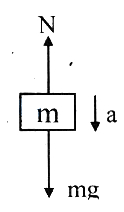
(C) For the object to remain on the platform, the normal force $N$ must be greater than or equal to zero. The equation of motion for the object of mass $m$ is given by $mg - N = ma$, where $a$ is the acceleration of the platform.
For the object to just lose contact with the surface, the normal force $N$ becomes $0$.
Thus, $mg = ma$, which implies $a = g$.
The acceleration of a particle in $S.H.M.$ is given by $a = A\omega^2$, where $A$ is the amplitude and $\omega$ is the angular frequency.
To avoid detachment, the maximum downward acceleration of the platform must not exceed $g$.
Therefore, $A\omega^2 \leq g$.
Substituting the given values, $A = 40 \text{ cm} = 0.4 \text{ m}$ and $g = 10 \text{ m/s}^2$:
$0.4 \omega^2 = 10$
$\omega^2 = \frac{10}{0.4} = 25$
$\omega = 5 \text{ rad/s}$.
Since $\omega = \frac{2\pi}{T}$, we have:
$T = \frac{2\pi}{\omega} = \frac{2\pi}{5} = 0.4\pi \text{ s}$.
Thus, the least period of oscillation is $0.4\pi \text{ s}$.
For the object to just lose contact with the surface, the normal force $N$ becomes $0$.
Thus, $mg = ma$, which implies $a = g$.
The acceleration of a particle in $S.H.M.$ is given by $a = A\omega^2$, where $A$ is the amplitude and $\omega$ is the angular frequency.
To avoid detachment, the maximum downward acceleration of the platform must not exceed $g$.
Therefore, $A\omega^2 \leq g$.
Substituting the given values, $A = 40 \text{ cm} = 0.4 \text{ m}$ and $g = 10 \text{ m/s}^2$:
$0.4 \omega^2 = 10$
$\omega^2 = \frac{10}{0.4} = 25$
$\omega = 5 \text{ rad/s}$.
Since $\omega = \frac{2\pi}{T}$, we have:
$T = \frac{2\pi}{\omega} = \frac{2\pi}{5} = 0.4\pi \text{ s}$.
Thus, the least period of oscillation is $0.4\pi \text{ s}$.
0 likesView Solution
183
PhysicsMediumMCQMHT CET · 2024
The motion of a particle is described by the equation $a = -bx$,where $a$ is the acceleration,$x$ is the displacement from the equilibrium position,and $b$ is a constant. The periodic time will be
A
$\frac{2 \pi}{b}$
B
$\frac{2 \pi}{\sqrt{b}}$
C
$2 \pi \sqrt{b}$
D
$2 \sqrt{\frac{\pi}{b}}$
Solution
(B) Given the equation of motion for the particle is $a = -bx$.
Comparing this with the standard equation for Simple Harmonic Motion $(SHM)$,which is $a = -\omega^2 x$,where $\omega$ is the angular frequency.
Equating the two expressions,we get $\omega^2 = b$,which implies $\omega = \sqrt{b}$.
The time period $T$ of an $SHM$ is given by the formula $T = \frac{2 \pi}{\omega}$.
Substituting the value of $\omega$,we get $T = \frac{2 \pi}{\sqrt{b}}$.
Comparing this with the standard equation for Simple Harmonic Motion $(SHM)$,which is $a = -\omega^2 x$,where $\omega$ is the angular frequency.
Equating the two expressions,we get $\omega^2 = b$,which implies $\omega = \sqrt{b}$.
The time period $T$ of an $SHM$ is given by the formula $T = \frac{2 \pi}{\omega}$.
Substituting the value of $\omega$,we get $T = \frac{2 \pi}{\sqrt{b}}$.
0 likesView Solution
184
PhysicsMediumMCQMHT CET · 2024
$A$ particle executing $S.H.M.$ has velocities $V_1$ and $V_2$ at distances $x_1$ and $x_2$ respectively,from the mean position. Its frequency is
A
$\frac{1}{2 \pi} \sqrt{\frac{V_1^2-V_2^2}{x_1^2-x_2^2}}$
B
$2 \pi \sqrt{\frac{x_1^2-x_2^2}{V_1^2-V_2^2}}$
C
$\frac{1}{2 \pi} \sqrt{\frac{V_2^2-V_1^2}{x_1^2-x_2^2}}$
D
$2 \pi \sqrt{\frac{x_1^2-x_2^2}{V_2^2-V_1^2}}$
Solution
(C) The velocity of a particle in $S.H.M.$ at a distance $x$ from the mean position is given by $V = \omega \sqrt{A^2 - x^2}$,where $A$ is the amplitude and $\omega$ is the angular frequency.
Squaring both sides,we get $V^2 = \omega^2(A^2 - x^2)$.
For the given conditions:
$V_1^2 = \omega^2(A^2 - x_1^2)$ $(i)$
$V_2^2 = \omega^2(A^2 - x_2^2)$ $(ii)$
Subtracting equation $(i)$ from $(ii)$:
$V_2^2 - V_1^2 = \omega^2(A^2 - x_2^2 - A^2 + x_1^2)$
$V_2^2 - V_1^2 = \omega^2(x_1^2 - x_2^2)$
$\omega^2 = \frac{V_2^2 - V_1^2}{x_1^2 - x_2^2}$
$\omega = \sqrt{\frac{V_2^2 - V_1^2}{x_1^2 - x_2^2}}$
Since the frequency $f = \frac{\omega}{2\pi}$,we have:
$f = \frac{1}{2\pi} \sqrt{\frac{V_2^2 - V_1^2}{x_1^2 - x_2^2}}$
Squaring both sides,we get $V^2 = \omega^2(A^2 - x^2)$.
For the given conditions:
$V_1^2 = \omega^2(A^2 - x_1^2)$ $(i)$
$V_2^2 = \omega^2(A^2 - x_2^2)$ $(ii)$
Subtracting equation $(i)$ from $(ii)$:
$V_2^2 - V_1^2 = \omega^2(A^2 - x_2^2 - A^2 + x_1^2)$
$V_2^2 - V_1^2 = \omega^2(x_1^2 - x_2^2)$
$\omega^2 = \frac{V_2^2 - V_1^2}{x_1^2 - x_2^2}$
$\omega = \sqrt{\frac{V_2^2 - V_1^2}{x_1^2 - x_2^2}}$
Since the frequency $f = \frac{\omega}{2\pi}$,we have:
$f = \frac{1}{2\pi} \sqrt{\frac{V_2^2 - V_1^2}{x_1^2 - x_2^2}}$
0 likesView Solution
185
PhysicsEasyMCQMHT CET · 2024
The Earth is assumed to be a sphere of radius $R$ and mass $M$ having a period of rotation $T$. The angular momentum of the Earth about its axis of rotation is
A
$\frac{2 \pi MR^2}{5 T}$
B
$\frac{4 \pi MR^2}{5 T}$
C
$\frac{MR^2 T}{2 \pi}$
D
$\frac{MR^2 T}{4 \pi}$
Solution
(B) The angular momentum $L$ is given by the formula $L = I \omega$,where $I$ is the moment of inertia and $\omega$ is the angular velocity.
For a solid sphere,the moment of inertia about its axis of rotation is $I = \frac{2}{5} MR^2$.
The angular velocity $\omega$ in terms of the period of rotation $T$ is given by $\omega = \frac{2 \pi}{T}$.
Substituting these values into the angular momentum formula:
$L = I \omega = \left( \frac{2}{5} MR^2 \right) \left( \frac{2 \pi}{T} \right)$.
Therefore,$L = \frac{4 \pi MR^2}{5 T}$.
For a solid sphere,the moment of inertia about its axis of rotation is $I = \frac{2}{5} MR^2$.
The angular velocity $\omega$ in terms of the period of rotation $T$ is given by $\omega = \frac{2 \pi}{T}$.
Substituting these values into the angular momentum formula:
$L = I \omega = \left( \frac{2}{5} MR^2 \right) \left( \frac{2 \pi}{T} \right)$.
Therefore,$L = \frac{4 \pi MR^2}{5 T}$.
0 likesView Solution
186
PhysicsEasyMCQMHT CET · 2024
$A$ rotating body has angular momentum $L$. If its frequency is doubled and its kinetic energy is halved,what will be its new angular momentum?
A
$\frac{L}{4}$
B
$\frac{L}{2}$
C
$2L$
D
$4L$
Solution
(A) The angular momentum $L$ of a rotating body is given by $L = I\omega$,where $I$ is the moment of inertia and $\omega$ is the angular velocity.
Kinetic energy $K$ is given by $K = \frac{1}{2}I\omega^2$.
We can express $L$ in terms of $K$ and $\omega$ as $L = \frac{2K}{\omega}$.
Given that the frequency $f$ is doubled,the angular velocity $\omega = 2\pi f$ is also doubled. Let the initial state be $(L_1, K_1, \omega_1)$ and the final state be $(L_2, K_2, \omega_2)$.
We have $K_2 = \frac{K_1}{2}$ and $\omega_2 = 2\omega_1$.
Using the relation $\frac{L_2}{L_1} = \frac{K_2}{K_1} \times \frac{\omega_1}{\omega_2}$,we get:
$\frac{L_2}{L} = \frac{K_1/2}{K_1} \times \frac{\omega_1}{2\omega_1} = \frac{1}{2} \times \frac{1}{2} = \frac{1}{4}$.
Therefore,$L_2 = \frac{L}{4}$.
Kinetic energy $K$ is given by $K = \frac{1}{2}I\omega^2$.
We can express $L$ in terms of $K$ and $\omega$ as $L = \frac{2K}{\omega}$.
Given that the frequency $f$ is doubled,the angular velocity $\omega = 2\pi f$ is also doubled. Let the initial state be $(L_1, K_1, \omega_1)$ and the final state be $(L_2, K_2, \omega_2)$.
We have $K_2 = \frac{K_1}{2}$ and $\omega_2 = 2\omega_1$.
Using the relation $\frac{L_2}{L_1} = \frac{K_2}{K_1} \times \frac{\omega_1}{\omega_2}$,we get:
$\frac{L_2}{L} = \frac{K_1/2}{K_1} \times \frac{\omega_1}{2\omega_1} = \frac{1}{2} \times \frac{1}{2} = \frac{1}{4}$.
Therefore,$L_2 = \frac{L}{4}$.
0 likesView Solution
187
PhysicsDifficultMCQMHT CET · 2024
$A$ thin uniform circular disc of mass $M$ and radius $R$ is rotating with angular velocity $\omega$ in a horizontal plane about an axis passing through its centre and perpendicular to its plane. Another disc of the same radius but of mass $\frac{M}{3}$ is placed gently on the first disc co-axially. The new angular velocity will be:
A
$\frac{2}{3} \omega$
B
$\frac{3}{4} \omega$
C
$\frac{4}{3} \omega$
D
$\frac{5}{4} \omega$
Solution
(B) The angular momentum of the system is conserved because no external torque acts on the system.
Initial angular momentum $L_i = I_1 \omega_1$,where $I_1 = \frac{1}{2} M R^2$ and $\omega_1 = \omega$.
Final moment of inertia $I_2 = I_{\text{disc1}} + I_{\text{disc2}} = \frac{1}{2} M R^2 + \frac{1}{2} (\frac{M}{3}) R^2 = \frac{1}{2} R^2 (M + \frac{M}{3}) = \frac{1}{2} R^2 (\frac{4M}{3}) = \frac{2}{3} M R^2$.
By the law of conservation of angular momentum,$I_1 \omega_1 = I_2 \omega_2$.
Substituting the values: $(\frac{1}{2} M R^2) \omega = (\frac{2}{3} M R^2) \omega_2$.
Solving for $\omega_2$: $\omega_2 = \frac{1/2}{2/3} \omega = \frac{3}{4} \omega$.
Initial angular momentum $L_i = I_1 \omega_1$,where $I_1 = \frac{1}{2} M R^2$ and $\omega_1 = \omega$.
Final moment of inertia $I_2 = I_{\text{disc1}} + I_{\text{disc2}} = \frac{1}{2} M R^2 + \frac{1}{2} (\frac{M}{3}) R^2 = \frac{1}{2} R^2 (M + \frac{M}{3}) = \frac{1}{2} R^2 (\frac{4M}{3}) = \frac{2}{3} M R^2$.
By the law of conservation of angular momentum,$I_1 \omega_1 = I_2 \omega_2$.
Substituting the values: $(\frac{1}{2} M R^2) \omega = (\frac{2}{3} M R^2) \omega_2$.
Solving for $\omega_2$: $\omega_2 = \frac{1/2}{2/3} \omega = \frac{3}{4} \omega$.
0 likesView Solution
188
PhysicsMediumMCQMHT CET · 2024
$A$ particle of mass $m$ is rotating in a circular path of radius $r$. Its angular momentum is $L$. The centripetal force acting on it is $F$. The relation between $F$,$L$,$r$,and $m$ is
A
$F=\frac{L}{mr^2}$
B
$L=m^2 Fr^2$
C
$\frac{L^2}{m}=Fr^3$
D
$\frac{F}{L^3}=mr^2$
Solution
(C) For a particle of mass $m$ moving in a circular path of radius $r$ with velocity $v$,the angular momentum $L$ is given by $L = mvr$.
From this,we can express velocity as $v = \frac{L}{mr}$.
The centripetal force $F$ acting on the particle is given by $F = \frac{mv^2}{r}$.
Substituting the expression for $v$ into the force equation:
$F = \frac{m}{r} \left( \frac{L}{mr} \right)^2$
$F = \frac{m}{r} \cdot \frac{L^2}{m^2 r^2}$
$F = \frac{L^2}{mr^3}$
Rearranging the terms,we get $\frac{L^2}{m} = Fr^3$.
From this,we can express velocity as $v = \frac{L}{mr}$.
The centripetal force $F$ acting on the particle is given by $F = \frac{mv^2}{r}$.
Substituting the expression for $v$ into the force equation:
$F = \frac{m}{r} \left( \frac{L}{mr} \right)^2$
$F = \frac{m}{r} \cdot \frac{L^2}{m^2 r^2}$
$F = \frac{L^2}{mr^3}$
Rearranging the terms,we get $\frac{L^2}{m} = Fr^3$.
0 likesView Solution
189
PhysicsEasyMCQMHT CET · 2024
$A$ particle of mass '$m$' is performing uniform circular motion along a circular path of radius '$r$'. Its angular momentum about the axis passing through the centre and perpendicular to the plane is '$L$'. The kinetic energy of the particle is
A
$\frac{L^2}{2 mr^2}$
B
$\frac{2 L^2}{mr^2}$
C
$\frac{L^2}{mr^2}$
D
$\frac{2 L^2}{3 mr^2}$
Solution
(A) The kinetic energy $E$ of a particle in rotational motion is given by $E = \frac{1}{2} I \omega^2$.
Angular momentum $L$ is defined as $L = I \omega$,which implies $L^2 = I^2 \omega^2$.
Substituting $\omega^2 = \frac{L^2}{I^2}$ into the kinetic energy equation,we get $E = \frac{1}{2} I \left( \frac{L^2}{I^2} \right) = \frac{L^2}{2I}$.
For a particle of mass '$m$' moving in a circle of radius '$r$',the moment of inertia about the axis passing through the center is $I = mr^2$.
Substituting $I = mr^2$ into the expression for kinetic energy,we get $E = \frac{L^2}{2(mr^2)} = \frac{L^2}{2 mr^2}$.
Angular momentum $L$ is defined as $L = I \omega$,which implies $L^2 = I^2 \omega^2$.
Substituting $\omega^2 = \frac{L^2}{I^2}$ into the kinetic energy equation,we get $E = \frac{1}{2} I \left( \frac{L^2}{I^2} \right) = \frac{L^2}{2I}$.
For a particle of mass '$m$' moving in a circle of radius '$r$',the moment of inertia about the axis passing through the center is $I = mr^2$.
Substituting $I = mr^2$ into the expression for kinetic energy,we get $E = \frac{L^2}{2(mr^2)} = \frac{L^2}{2 mr^2}$.
0 likesView Solution
190
PhysicsMediumMCQMHT CET · 2024
If the angular velocity of a body rotating about a given axis increases by $20 \%$,then its kinetic energy of rotation will increase by: (in $\%$)
A
$20$
B
$30$
C
$44$
D
$66$
Solution
(C) The rotational kinetic energy $(KE)$ of a body is given by $KE = \frac{1}{2} I \omega^2$,where $I$ is the moment of inertia and $\omega$ is the angular velocity.
Since $I$ remains constant,$KE \propto \omega^2$.
Given that the angular velocity increases by $20 \%$,the new angular velocity $\omega_2$ is:
$\omega_2 = \omega_1 + 0.20 \omega_1 = 1.2 \omega_1$.
The ratio of the new kinetic energy $(KE_2)$ to the initial kinetic energy $(KE_1)$ is:
$\frac{KE_2}{KE_1} = \frac{\omega_2^2}{\omega_1^2} = \frac{(1.2 \omega_1)^2}{\omega_1^2} = (1.2)^2 = 1.44$.
Therefore,$KE_2 = 1.44 KE_1$.
The percentage increase in kinetic energy is:
$\text{Percentage Increase} = \left( \frac{KE_2 - KE_1}{KE_1} \right) \times 100 = (1.44 - 1) \times 100 = 0.44 \times 100 = 44 \%$.
Since $I$ remains constant,$KE \propto \omega^2$.
Given that the angular velocity increases by $20 \%$,the new angular velocity $\omega_2$ is:
$\omega_2 = \omega_1 + 0.20 \omega_1 = 1.2 \omega_1$.
The ratio of the new kinetic energy $(KE_2)$ to the initial kinetic energy $(KE_1)$ is:
$\frac{KE_2}{KE_1} = \frac{\omega_2^2}{\omega_1^2} = \frac{(1.2 \omega_1)^2}{\omega_1^2} = (1.2)^2 = 1.44$.
Therefore,$KE_2 = 1.44 KE_1$.
The percentage increase in kinetic energy is:
$\text{Percentage Increase} = \left( \frac{KE_2 - KE_1}{KE_1} \right) \times 100 = (1.44 - 1) \times 100 = 0.44 \times 100 = 44 \%$.
0 likesView Solution
191
PhysicsDifficultMCQMHT CET · 2024
An annular ring has mass $10 \ kg$ and inner and outer radii are $5 \ m$ and $10 \ m$ respectively. Its moment of inertia about an axis passing through its centre and perpendicular to its plane is
A
$525 \ kg \cdot m^2$
B
$625 \ kg \cdot m^2$
C
$525 \ g \cdot cm^2$
D
$625 \ g \cdot cm^2$
Solution
(B) The moment of inertia $I$ of an annular ring (or hollow disk) about an axis passing through its centre and perpendicular to its plane is given by the formula:
$I = \frac{1}{2} M(R_1^2 + R_2^2)$
where $M$ is the mass,$R_1$ is the inner radius,and $R_2$ is the outer radius.
Given:
$M = 10 \ kg$
$R_1 = 5 \ m$
$R_2 = 10 \ m$
Substituting the values:
$I = \frac{1}{2} \times 10 \times (5^2 + 10^2)$
$I = 5 \times (25 + 100)$
$I = 5 \times 125 = 625 \ kg \cdot m^2$
$I = \frac{1}{2} M(R_1^2 + R_2^2)$
where $M$ is the mass,$R_1$ is the inner radius,and $R_2$ is the outer radius.
Given:
$M = 10 \ kg$
$R_1 = 5 \ m$
$R_2 = 10 \ m$
Substituting the values:
$I = \frac{1}{2} \times 10 \times (5^2 + 10^2)$
$I = 5 \times (25 + 100)$
$I = 5 \times 125 = 625 \ kg \cdot m^2$
0 likesView Solution
192
PhysicsMediumMCQMHT CET · 2024
$A$ solid sphere of mass $m$,radius $R$,having moment of inertia about an axis passing through its center of mass as $I$ is recast into a disc of thickness $t$ whose moment of inertia about an axis passing through the rim (edge) and perpendicular to its plane remains $I$. Then the radius of the disc is:
A
$\frac{2 R}{\sqrt{15}}$
B
$\sqrt{\frac{2}{15}} R$
C
$\frac{4 R}{\sqrt{15}}$
D
$\frac{R}{4}$
Solution
(A) The moment of inertia of a solid sphere about its center of mass is $I = \frac{2}{5} m R^2$.
The moment of inertia of a disc of mass $m$ and radius $r$ about an axis passing through its rim and perpendicular to its plane is given by the parallel axis theorem: $I_{rim} = I_{cm} + m r^2 = \frac{1}{2} m r^2 + m r^2 = \frac{3}{2} m r^2$.
Given that the moment of inertia remains the same $(I_{sphere} = I_{disc})$:
$\frac{2}{5} m R^2 = \frac{3}{2} m r^2$.
Solving for $r$:
$r^2 = \frac{2}{5} \times \frac{2}{3} R^2 = \frac{4}{15} R^2$.
Therefore,$r = \sqrt{\frac{4}{15}} R = \frac{2 R}{\sqrt{15}}$.
The moment of inertia of a disc of mass $m$ and radius $r$ about an axis passing through its rim and perpendicular to its plane is given by the parallel axis theorem: $I_{rim} = I_{cm} + m r^2 = \frac{1}{2} m r^2 + m r^2 = \frac{3}{2} m r^2$.
Given that the moment of inertia remains the same $(I_{sphere} = I_{disc})$:
$\frac{2}{5} m R^2 = \frac{3}{2} m r^2$.
Solving for $r$:
$r^2 = \frac{2}{5} \times \frac{2}{3} R^2 = \frac{4}{15} R^2$.
Therefore,$r = \sqrt{\frac{4}{15}} R = \frac{2 R}{\sqrt{15}}$.
0 likesView Solution
193
PhysicsMediumMCQMHT CET · 2024
Two circular loops $P$ and $Q$ of radii $r$ and $nr$ are made respectively from a uniform wire. The moment of inertia of loop $Q$ about its axis is four times that of loop $P$ about its axis. The value of $n$ is
A
$(2)^{1/3}$
B
$(2)^{2/3}$
C
$(2)^{3/4}$
D
$(2)^{1/4}$
Solution
(B) The two loops are formed from the same uniform wire,so the linear mass density $\lambda$ is constant.
Mass of loop $P$ is $M_P = \lambda \times (2\pi r) = 2\pi r\lambda$.
Mass of loop $Q$ is $M_Q = \lambda \times (2\pi nr) = 2\pi nr\lambda$.
The moment of inertia of a circular loop about its axis is $I = Mr^2$.
For loop $P$,$I_P = M_P r^2 = (2\pi r\lambda) r^2 = 2\pi r^3 \lambda$.
For loop $Q$,$I_Q = M_Q (nr)^2 = (2\pi nr\lambda) (nr)^2 = 2\pi n^3 r^3 \lambda$.
Given that $I_Q = 4 I_P$,we have:
$2\pi n^3 r^3 \lambda = 4 \times (2\pi r^3 \lambda)$.
$n^3 = 4$.
$n = (4)^{1/3} = (2^2)^{1/3} = (2)^{2/3}$.
Mass of loop $P$ is $M_P = \lambda \times (2\pi r) = 2\pi r\lambda$.
Mass of loop $Q$ is $M_Q = \lambda \times (2\pi nr) = 2\pi nr\lambda$.
The moment of inertia of a circular loop about its axis is $I = Mr^2$.
For loop $P$,$I_P = M_P r^2 = (2\pi r\lambda) r^2 = 2\pi r^3 \lambda$.
For loop $Q$,$I_Q = M_Q (nr)^2 = (2\pi nr\lambda) (nr)^2 = 2\pi n^3 r^3 \lambda$.
Given that $I_Q = 4 I_P$,we have:
$2\pi n^3 r^3 \lambda = 4 \times (2\pi r^3 \lambda)$.
$n^3 = 4$.
$n = (4)^{1/3} = (2^2)^{1/3} = (2)^{2/3}$.
0 likesView Solution
194
PhysicsEasyMCQMHT CET · 2024
The ratio of the radius of gyration of a circular disc to that of a circular ring,each of the same mass and radius,about their respective central axes is:
A
$1 : \sqrt{2}$
B
$\sqrt{2} : 1$
C
$\sqrt{2} : \sqrt{3}$
D
$\sqrt{3} : \sqrt{2}$
Solution
(A) Let $M$ be the mass and $R$ be the radius of both the circular disc and the circular ring.
For a circular disc,the moment of inertia about its central axis is $I_d = \frac{1}{2} MR^2$.
If $K_d$ is the radius of gyration for the disc,then $I_d = MK_d^2$.
Equating the two,we get $MK_d^2 = \frac{1}{2} MR^2$,which simplifies to $K_d = \frac{R}{\sqrt{2}}$.
For a circular ring,the moment of inertia about its central axis is $I_r = MR^2$.
If $K_r$ is the radius of gyration for the ring,then $I_r = MK_r^2$.
Equating the two,we get $MK_r^2 = MR^2$,which simplifies to $K_r = R$.
The ratio of the radius of gyration of the disc to that of the ring is $\frac{K_d}{K_r} = \frac{R/\sqrt{2}}{R} = \frac{1}{\sqrt{2}}$.
Thus,the ratio is $1 : \sqrt{2}$.
For a circular disc,the moment of inertia about its central axis is $I_d = \frac{1}{2} MR^2$.
If $K_d$ is the radius of gyration for the disc,then $I_d = MK_d^2$.
Equating the two,we get $MK_d^2 = \frac{1}{2} MR^2$,which simplifies to $K_d = \frac{R}{\sqrt{2}}$.
For a circular ring,the moment of inertia about its central axis is $I_r = MR^2$.
If $K_r$ is the radius of gyration for the ring,then $I_r = MK_r^2$.
Equating the two,we get $MK_r^2 = MR^2$,which simplifies to $K_r = R$.
The ratio of the radius of gyration of the disc to that of the ring is $\frac{K_d}{K_r} = \frac{R/\sqrt{2}}{R} = \frac{1}{\sqrt{2}}$.
Thus,the ratio is $1 : \sqrt{2}$.
0 likesView Solution
195
PhysicsMediumMCQMHT CET · 2024
Two loops $A$ and $B$ of radii $R_1$ and $R_2$ are made from a uniform wire. If the moment of inertia of $A$ is $I_A$ and that of $B$ is $I_B$,then find the ratio $R_2 / R_1$ given that $I_A / I_B = 27$.
A
$1: 6$
B
$1: 4$
C
$1: 3$
D
$1: 2$
Solution
(C) The moment of inertia of a loop (ring) about its central axis is given by $I = MR^2$.
Thus,$I_A = M_1 R_1^2$ and $I_B = M_2 R_2^2$ ... $(i)$
Since the loops are made from a uniform wire,the mass $M$ is proportional to the circumference $(2 \pi R)$.
Let $m$ be the mass per unit length. Then $M_1 = 2 \pi R_1 m$ and $M_2 = 2 \pi R_2 m$.
Therefore,$\frac{M_1}{M_2} = \frac{R_1}{R_2}$ ... (ii)
Substituting (ii) into the ratio of moments of inertia:
$\frac{I_A}{I_B} = \frac{M_1 R_1^2}{M_2 R_2^2} = \left(\frac{M_1}{M_2}\right) \left(\frac{R_1}{R_2}\right)^2 = \left(\frac{R_1}{R_2}\right) \left(\frac{R_1}{R_2}\right)^2 = \left(\frac{R_1}{R_2}\right)^3$.
Given $\frac{I_A}{I_B} = 27$,we have $\left(\frac{R_1}{R_2}\right)^3 = 27$.
Taking the cube root on both sides,$\frac{R_1}{R_2} = 3$.
Therefore,$\frac{R_2}{R_1} = \frac{1}{3}$.
Thus,$I_A = M_1 R_1^2$ and $I_B = M_2 R_2^2$ ... $(i)$
Since the loops are made from a uniform wire,the mass $M$ is proportional to the circumference $(2 \pi R)$.
Let $m$ be the mass per unit length. Then $M_1 = 2 \pi R_1 m$ and $M_2 = 2 \pi R_2 m$.
Therefore,$\frac{M_1}{M_2} = \frac{R_1}{R_2}$ ... (ii)
Substituting (ii) into the ratio of moments of inertia:
$\frac{I_A}{I_B} = \frac{M_1 R_1^2}{M_2 R_2^2} = \left(\frac{M_1}{M_2}\right) \left(\frac{R_1}{R_2}\right)^2 = \left(\frac{R_1}{R_2}\right) \left(\frac{R_1}{R_2}\right)^2 = \left(\frac{R_1}{R_2}\right)^3$.
Given $\frac{I_A}{I_B} = 27$,we have $\left(\frac{R_1}{R_2}\right)^3 = 27$.
Taking the cube root on both sides,$\frac{R_1}{R_2} = 3$.
Therefore,$\frac{R_2}{R_1} = \frac{1}{3}$.
0 likesView Solution
196
PhysicsMediumMCQMHT CET · 2024
$A$ disc and a ring both have the same mass and radius. The ratio of the moment of inertia of the disc about its diameter to that of a ring about a tangent in its plane is
A
$1: 2$
B
$1: 4$
C
$1: 6$
D
$1: 8$
Solution
(C) For a disc of mass $M$ and radius $R$,the moment of inertia about its diameter $(I_D)$ is given by:
$I_D = \frac{MR^2}{4}$
For a ring of mass $M$ and radius $R$,the moment of inertia about a tangent in its plane $(I_T)$ is calculated using the parallel axis theorem:
$I_T = I_{CM} + MR^2$
Since the moment of inertia of a ring about its diameter is $I_{CM} = \frac{MR^2}{2}$,we have:
$I_T = \frac{MR^2}{2} + MR^2 = \frac{3}{2} MR^2$
The ratio of the moment of inertia of the disc about its diameter to that of the ring about a tangent in its plane is:
$\frac{I_D}{I_T} = \frac{\frac{MR^2}{4}}{\frac{3}{2} MR^2} = \frac{1}{4} \times \frac{2}{3} = \frac{1}{6}$
Thus,the ratio is $1: 6$.
$I_D = \frac{MR^2}{4}$
For a ring of mass $M$ and radius $R$,the moment of inertia about a tangent in its plane $(I_T)$ is calculated using the parallel axis theorem:
$I_T = I_{CM} + MR^2$
Since the moment of inertia of a ring about its diameter is $I_{CM} = \frac{MR^2}{2}$,we have:
$I_T = \frac{MR^2}{2} + MR^2 = \frac{3}{2} MR^2$
The ratio of the moment of inertia of the disc about its diameter to that of the ring about a tangent in its plane is:
$\frac{I_D}{I_T} = \frac{\frac{MR^2}{4}}{\frac{3}{2} MR^2} = \frac{1}{4} \times \frac{2}{3} = \frac{1}{6}$
Thus,the ratio is $1: 6$.
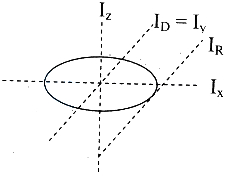
0 likesView Solution
197
PhysicsDifficultMCQMHT CET · 2024
Two solid spheres ($A$ and $B$) are made of metals having densities $\rho_A$ and $\rho_B$ respectively. If their masses are equal,then the ratio of their moments of inertia $(\frac{I_B}{I_A})$ about their respective diameters is:
A
$(\frac{\rho_B}{\rho_A})^{2/3}$
B
$(\frac{\rho_A}{\rho_B})^{2/3}$
C
$\frac{\rho_A}{\rho_B}$
D
$\frac{\rho_B}{\rho_A}$
Solution
(B) Mass $=$ Volume $\times$ Density.
Let the masses be $M_A$ and $M_B$,and radii be $R_A$ and $R_B$.
Since $M_A = M_B = M$,we have:
$M = \frac{4}{3} \pi R_A^3 \rho_A = \frac{4}{3} \pi R_B^3 \rho_B$.
From this,$\frac{R_B^3}{R_A^3} = \frac{\rho_A}{\rho_B}$,which implies $\frac{R_B}{R_A} = (\frac{\rho_A}{\rho_B})^{1/3}$.
The moment of inertia of a solid sphere about its diameter is $I = \frac{2}{5} MR^2$.
Therefore,$\frac{I_B}{I_A} = \frac{\frac{2}{5} M R_B^2}{\frac{2}{5} M R_A^2} = \frac{R_B^2}{R_A^2}$.
Substituting the ratio of radii:
$\frac{I_B}{I_A} = ((\frac{\rho_A}{\rho_B})^{1/3})^2 = (\frac{\rho_A}{\rho_B})^{2/3}$.
Let the masses be $M_A$ and $M_B$,and radii be $R_A$ and $R_B$.
Since $M_A = M_B = M$,we have:
$M = \frac{4}{3} \pi R_A^3 \rho_A = \frac{4}{3} \pi R_B^3 \rho_B$.
From this,$\frac{R_B^3}{R_A^3} = \frac{\rho_A}{\rho_B}$,which implies $\frac{R_B}{R_A} = (\frac{\rho_A}{\rho_B})^{1/3}$.
The moment of inertia of a solid sphere about its diameter is $I = \frac{2}{5} MR^2$.
Therefore,$\frac{I_B}{I_A} = \frac{\frac{2}{5} M R_B^2}{\frac{2}{5} M R_A^2} = \frac{R_B^2}{R_A^2}$.
Substituting the ratio of radii:
$\frac{I_B}{I_A} = ((\frac{\rho_A}{\rho_B})^{1/3})^2 = (\frac{\rho_A}{\rho_B})^{2/3}$.
0 likesView Solution
198
PhysicsDifficultMCQMHT CET · 2024
$A$ circular disc of radius $R$ and thickness $R/8$ has a moment of inertia $I$ about an axis passing through its centre and perpendicular to its plane. It is melted and recast into a solid sphere. The moment of inertia of the sphere about an axis passing through its diameter is:
A
$I$
B
$\frac{2I}{3}$
C
$\frac{I}{5}$
D
$\frac{I}{10}$
Solution
(C) The moment of inertia of a disc about its central axis is $I = \frac{1}{2} M R_d^2$.
Since the mass $M$ remains constant,we equate the volumes:
$V_{\text{disc}} = V_{\text{sphere}}$
$\pi R_d^2 \times (R_d/8) = \frac{4}{3} \pi R_s^3$
$\frac{R_d^3}{8} = \frac{4}{3} R_s^3 \implies R_s^3 = \frac{3}{32} R_d^3 \implies R_s^2 = \left(\frac{3}{32}\right)^{2/3} R_d^2$.
The moment of inertia of a solid sphere about its diameter is $I_{\text{sphere}} = \frac{2}{5} M R_s^2$.
Substituting $R_s^2$:
$I_{\text{sphere}} = \frac{2}{5} M \left(\frac{3}{32}\right)^{2/3} R_d^2$.
Since $M R_d^2 = 2I$,we have:
$I_{\text{sphere}} = \frac{2}{5} (2I) \left(\frac{3}{32}\right)^{2/3} = \frac{4I}{5} \left(\frac{9}{1024}\right)^{1/3} \approx \frac{I}{5}$.
Since the mass $M$ remains constant,we equate the volumes:
$V_{\text{disc}} = V_{\text{sphere}}$
$\pi R_d^2 \times (R_d/8) = \frac{4}{3} \pi R_s^3$
$\frac{R_d^3}{8} = \frac{4}{3} R_s^3 \implies R_s^3 = \frac{3}{32} R_d^3 \implies R_s^2 = \left(\frac{3}{32}\right)^{2/3} R_d^2$.
The moment of inertia of a solid sphere about its diameter is $I_{\text{sphere}} = \frac{2}{5} M R_s^2$.
Substituting $R_s^2$:
$I_{\text{sphere}} = \frac{2}{5} M \left(\frac{3}{32}\right)^{2/3} R_d^2$.
Since $M R_d^2 = 2I$,we have:
$I_{\text{sphere}} = \frac{2}{5} (2I) \left(\frac{3}{32}\right)^{2/3} = \frac{4I}{5} \left(\frac{9}{1024}\right)^{1/3} \approx \frac{I}{5}$.
0 likesView Solution
199
PhysicsMediumMCQMHT CET · 2024
The moment of inertia of a thin square plate $PQRS$ of uniform thickness,about an axis passing through the centre '$O$' and perpendicular to the plane of the plate is (where $I_1, I_2, I_3, I_4$ are respectively the moments of inertia about axes $1, 2, 3, 4$ which are in the plane of the plate as shown in the figure):
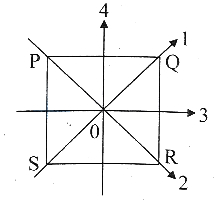
A
$I_1+I_2+I_3$
B
$I_1+I_3+I_4$
C
$I_1+I_2+I_3+I_4$
D
$I_1+I_3$
Solution
(D) Let $I$ be the moment of inertia of the square plate about an axis passing through the centre '$O$' and perpendicular to the plane of the plate.
According to the perpendicular axis theorem,for any two mutually perpendicular axes in the plane of the plate intersecting at the centre,the sum of the moments of inertia about these axes equals the moment of inertia about the axis perpendicular to the plane.
For axes $1$ and $2$ (diagonals),$I = I_1 + I_2$.
For axes $3$ and $4$ (mid-lines),$I = I_3 + I_4$.
Since the plate is a square,by symmetry,$I_1 = I_2$ and $I_3 = I_4$.
Thus,$I = 2I_1$ and $I = 2I_3$,which implies $I_1 = I_3$.
Therefore,the moment of inertia about the perpendicular axis is $I = I_1 + I_3$ (or $I_2 + I_4$,or $I_1 + I_4$,etc.).
Comparing with the given options,the correct expression is $I_1 + I_3$.
According to the perpendicular axis theorem,for any two mutually perpendicular axes in the plane of the plate intersecting at the centre,the sum of the moments of inertia about these axes equals the moment of inertia about the axis perpendicular to the plane.
For axes $1$ and $2$ (diagonals),$I = I_1 + I_2$.
For axes $3$ and $4$ (mid-lines),$I = I_3 + I_4$.
Since the plate is a square,by symmetry,$I_1 = I_2$ and $I_3 = I_4$.
Thus,$I = 2I_1$ and $I = 2I_3$,which implies $I_1 = I_3$.
Therefore,the moment of inertia about the perpendicular axis is $I = I_1 + I_3$ (or $I_2 + I_4$,or $I_1 + I_4$,etc.).
Comparing with the given options,the correct expression is $I_1 + I_3$.
0 likesView Solution
200
PhysicsMediumMCQMHT CET · 2024
Three thin rods,each of mass $2M$ and length $L$,are placed along the $x, y,$ and $z$ axes,which are mutually perpendicular. One end of each rod is at the origin. The moment of inertia of the system about the $x$-axis is:
A
$\frac{4ML^2}{3}$
B
$\frac{ML^2}{12}$
C
$\frac{ML^2}{6}$
D
$\frac{2ML^2}{3}$
Solution
(A) The total moment of inertia of the system about the $x$-axis is the sum of the moments of inertia of the three individual rods about the $x$-axis: $I_{\text{total}} = I_x + I_y + I_z$.
For a thin rod of mass $m$ and length $L$ rotating about an axis passing through one end and perpendicular to the rod,the moment of inertia is $I = \frac{mL^2}{3}$.
$1$. For the rod along the $x$-axis: Since the rod lies on the $x$-axis,its distance from the $x$-axis is zero for all points. Thus,$I_x = 0$.
$2$. For the rod along the $y$-axis: The axis of rotation ($x$-axis) is perpendicular to the rod and passes through one end (the origin). Here,$m = 2M$,so $I_y = \frac{(2M)L^2}{3} = \frac{2ML^2}{3}$.
$3$. For the rod along the $z$-axis: Similarly,the $x$-axis is perpendicular to this rod and passes through one end. Here,$m = 2M$,so $I_z = \frac{(2M)L^2}{3} = \frac{2ML^2}{3}$.
Summing these values: $I_{\text{total}} = 0 + \frac{2ML^2}{3} + \frac{2ML^2}{3} = \frac{4ML^2}{3}$.
For a thin rod of mass $m$ and length $L$ rotating about an axis passing through one end and perpendicular to the rod,the moment of inertia is $I = \frac{mL^2}{3}$.
$1$. For the rod along the $x$-axis: Since the rod lies on the $x$-axis,its distance from the $x$-axis is zero for all points. Thus,$I_x = 0$.
$2$. For the rod along the $y$-axis: The axis of rotation ($x$-axis) is perpendicular to the rod and passes through one end (the origin). Here,$m = 2M$,so $I_y = \frac{(2M)L^2}{3} = \frac{2ML^2}{3}$.
$3$. For the rod along the $z$-axis: Similarly,the $x$-axis is perpendicular to this rod and passes through one end. Here,$m = 2M$,so $I_z = \frac{(2M)L^2}{3} = \frac{2ML^2}{3}$.
Summing these values: $I_{\text{total}} = 0 + \frac{2ML^2}{3} + \frac{2ML^2}{3} = \frac{4ML^2}{3}$.
0 likesView Solution
201
PhysicsEasyMCQMHT CET · 2024
$A$ photosensitive metallic surface has a work function $\phi$. If a photon of energy $3 \phi$ falls on the surface,the electron is emitted with a maximum velocity of $6 \times 10^6 \ m/s$. When the photon energy is increased to $9 \phi$,the maximum velocity of the photoelectrons will be:
A
$12 \times 10^6 \ m/s$
B
$6 \times 10^6 \ m/s$
C
$3 \times 10^6 \ m/s$
D
$24 \times 10^6 \ m/s$
Solution
(A) According to Einstein's photoelectric equation,the maximum kinetic energy is given by $K.E_{\max} = E - \phi$.
For the first case,$E_1 = 3\phi$,so $K.E_1 = 3\phi - \phi = 2\phi$.
For the second case,$E_2 = 9\phi$,so $K.E_2 = 9\phi - \phi = 8\phi$.
Since $K.E = \frac{1}{2}mv^2$,we have the ratio $\frac{K.E_1}{K.E_2} = \frac{v_1^2}{v_2^2}$.
Substituting the values,$\frac{2\phi}{8\phi} = \frac{1}{4} = \frac{v_1^2}{v_2^2}$.
Taking the square root,$\frac{v_1}{v_2} = \frac{1}{2}$,which implies $v_2 = 2v_1$.
Given $v_1 = 6 \times 10^6 \ m/s$,then $v_2 = 2 \times 6 \times 10^6 = 12 \times 10^6 \ m/s$.
For the first case,$E_1 = 3\phi$,so $K.E_1 = 3\phi - \phi = 2\phi$.
For the second case,$E_2 = 9\phi$,so $K.E_2 = 9\phi - \phi = 8\phi$.
Since $K.E = \frac{1}{2}mv^2$,we have the ratio $\frac{K.E_1}{K.E_2} = \frac{v_1^2}{v_2^2}$.
Substituting the values,$\frac{2\phi}{8\phi} = \frac{1}{4} = \frac{v_1^2}{v_2^2}$.
Taking the square root,$\frac{v_1}{v_2} = \frac{1}{2}$,which implies $v_2 = 2v_1$.
Given $v_1 = 6 \times 10^6 \ m/s$,then $v_2 = 2 \times 6 \times 10^6 = 12 \times 10^6 \ m/s$.
0 likesView Solution
202
PhysicsDifficultMCQMHT CET · 2024
Two identical photocathodes receive light of frequencies $n_1$ and $n_2$. If the velocities of the emitted photoelectrons of mass $m$ are $V_1$ and $V_2$ respectively,then ($h=$ Planck's constant):
A
$V_1+V_2=\left[\frac{2h}{m}(n_1+n_2)\right]^{1/2}$
B
$V_1-V_2=\left[\frac{2h}{m}(n_1-n_2)\right]^{1/2}$
C
$V_1^2+V_2^2=\frac{2h}{m}(n_1+n_2)$
D
$V_1^2-V_2^2=\frac{2h}{m}(n_1-n_2)$
Solution
(D) According to Einstein's photoelectric equation,the maximum kinetic energy of emitted photoelectrons is given by $K.E. = h n - \phi$,where $\phi$ is the work function of the metal.
For the first photocathode: $\frac{1}{2}mV_1^2 = hn_1 - \phi$ $(1)$
For the second photocathode: $\frac{1}{2}mV_2^2 = hn_2 - \phi$ $(2)$
Subtracting equation $(2)$ from equation $(1)$:
$\frac{1}{2}mV_1^2 - \frac{1}{2}mV_2^2 = (hn_1 - \phi) - (hn_2 - \phi)$
$\frac{1}{2}m(V_1^2 - V_2^2) = h(n_1 - n_2)$
$V_1^2 - V_2^2 = \frac{2h}{m}(n_1 - n_2)$
For the first photocathode: $\frac{1}{2}mV_1^2 = hn_1 - \phi$ $(1)$
For the second photocathode: $\frac{1}{2}mV_2^2 = hn_2 - \phi$ $(2)$
Subtracting equation $(2)$ from equation $(1)$:
$\frac{1}{2}mV_1^2 - \frac{1}{2}mV_2^2 = (hn_1 - \phi) - (hn_2 - \phi)$
$\frac{1}{2}m(V_1^2 - V_2^2) = h(n_1 - n_2)$
$V_1^2 - V_2^2 = \frac{2h}{m}(n_1 - n_2)$
0 likesView Solution
203
PhysicsEasyMCQMHT CET · 2024
The figure shows the variation of photocurrent with anode potential for four different radiations. Let $f_a$,$f_b$,$f_c$ and $f_d$ be the frequencies for the curves $a$,$b$,$c$ and $d$ respectively.
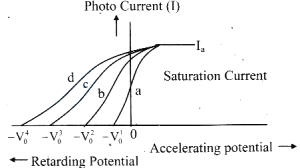
A
$f_a > f_b > f_c > f_d$
B
$f_a < f_b < f_c < f_d$
C
$f_a > f_b < f_c = f_d$
D
$f_a = f_b > f_c > f_d$
Solution
(A) According to Einstein's photoelectric equation,the stopping potential $V_0$ is related to the frequency $f$ of the incident radiation by the equation: $eV_0 = hf - \Phi$,where $e$ is the charge of an electron,$h$ is Planck's constant,and $\Phi$ is the work function of the metal.
From the graph,the stopping potentials are $|V_0^1| < |V_0^2| < |V_0^3| < |V_0^4|$.
Since the stopping potential $V_0$ is directly proportional to the frequency $f$ for a given metal,a larger magnitude of stopping potential corresponds to a higher frequency of incident radiation.
Therefore,the order of frequencies is $f_a > f_b > f_c > f_d$.
From the graph,the stopping potentials are $|V_0^1| < |V_0^2| < |V_0^3| < |V_0^4|$.
Since the stopping potential $V_0$ is directly proportional to the frequency $f$ for a given metal,a larger magnitude of stopping potential corresponds to a higher frequency of incident radiation.
Therefore,the order of frequencies is $f_a > f_b > f_c > f_d$.
0 likesView Solution
204
PhysicsEasyMCQMHT CET · 2024
Using Einstein's photoelectric equation,the graph between the maximum kinetic energy $(K_{max})$ of emitted photoelectrons and the frequency $(v)$ of incident radiation is shown correctly by which graph?
A
Graph $(1)$
B
Graph $(2)$
C
Graph $(3)$
D
Graph $(4)$
Solution
(A) According to Einstein's photoelectric equation,the maximum kinetic energy of emitted photoelectrons is given by: $K_{max} = hv - \phi$,where $h$ is Planck's constant,$v$ is the frequency of incident radiation,and $\phi$ is the work function of the metal.
Comparing this equation with the equation of a straight line,$y = mx + c$,we have $y = K_{max}$,$x = v$,slope $m = h$,and intercept $c = -\phi$.
Since the slope $h$ is positive and the intercept $-\phi$ is negative,the graph is a straight line starting from a threshold frequency $v_0$ (where $K_{max} = 0$) and increasing linearly with frequency $v$.
This corresponds to graph $(1)$.
Comparing this equation with the equation of a straight line,$y = mx + c$,we have $y = K_{max}$,$x = v$,slope $m = h$,and intercept $c = -\phi$.
Since the slope $h$ is positive and the intercept $-\phi$ is negative,the graph is a straight line starting from a threshold frequency $v_0$ (where $K_{max} = 0$) and increasing linearly with frequency $v$.
This corresponds to graph $(1)$.
0 likesView Solution
205
PhysicsEasyMCQMHT CET · 2024
In the photoelectric effect,the photocurrent:
A
decreases with an increase in the frequency of the incident photon.
B
increases with an increase in the frequency of the incident photon.
C
does not depend on the frequency of the photon but depends only on the intensity of the incident light.
D
depends on both the intensity and frequency of the incident radiation.
Solution
(C) The photocurrent is independent of the frequency of the incident photon,provided the frequency is above the threshold frequency.
However,when the intensity of the incident light increases,the number of photons incident per unit area per unit time increases.
This leads to an increase in the number of photoelectrons emitted from the metal surface,thereby increasing the photocurrent.
However,when the intensity of the incident light increases,the number of photons incident per unit area per unit time increases.
This leads to an increase in the number of photoelectrons emitted from the metal surface,thereby increasing the photocurrent.
0 likesView Solution
206
PhysicsEasyMCQMHT CET · 2024
When a photosensitive surface is irradiated by light of wavelengths $\lambda_1$ and $\lambda_2$,the kinetic energies of the emitted photoelectrons are $E_1$ and $E_2$ respectively. The work function of the photosensitive surface is:
A
$\frac{(E_2 \lambda_2 - E_1 \lambda_1)}{(\lambda_2 - \lambda_1)}$
B
$\frac{(E_1 \lambda_1 + E_2 \lambda_2)}{(\lambda_2 - \lambda_1)}$
C
$\frac{(E_1 \lambda_1 - E_2 \lambda_2)}{(\lambda_2 - \lambda_1)}$
D
$\frac{(E_2 \lambda_2 + E_1 \lambda_1)}{(\lambda_1 - \lambda_2)}$
Solution
(C) According to Einstein's photoelectric equation,the kinetic energy $E$ of an emitted photoelectron is given by $E = \frac{hc}{\lambda} - W_0$,where $W_0$ is the work function.
For wavelength $\lambda_1$,$E_1 = \frac{hc}{\lambda_1} - W_0 \implies E_1 \lambda_1 = hc - W_0 \lambda_1 \implies hc = E_1 \lambda_1 + W_0 \lambda_1$ ... $(i)$
For wavelength $\lambda_2$,$E_2 = \frac{hc}{\lambda_2} - W_0 \implies E_2 \lambda_2 = hc - W_0 \lambda_2 \implies hc = E_2 \lambda_2 + W_0 \lambda_2$ ... (ii)
Equating $(i)$ and (ii):
$E_1 \lambda_1 + W_0 \lambda_1 = E_2 \lambda_2 + W_0 \lambda_2$
$E_1 \lambda_1 - E_2 \lambda_2 = W_0 \lambda_2 - W_0 \lambda_1$
$E_1 \lambda_1 - E_2 \lambda_2 = W_0 (\lambda_2 - \lambda_1)$
$W_0 = \frac{E_1 \lambda_1 - E_2 \lambda_2}{\lambda_2 - \lambda_1}$
For wavelength $\lambda_1$,$E_1 = \frac{hc}{\lambda_1} - W_0 \implies E_1 \lambda_1 = hc - W_0 \lambda_1 \implies hc = E_1 \lambda_1 + W_0 \lambda_1$ ... $(i)$
For wavelength $\lambda_2$,$E_2 = \frac{hc}{\lambda_2} - W_0 \implies E_2 \lambda_2 = hc - W_0 \lambda_2 \implies hc = E_2 \lambda_2 + W_0 \lambda_2$ ... (ii)
Equating $(i)$ and (ii):
$E_1 \lambda_1 + W_0 \lambda_1 = E_2 \lambda_2 + W_0 \lambda_2$
$E_1 \lambda_1 - E_2 \lambda_2 = W_0 \lambda_2 - W_0 \lambda_1$
$E_1 \lambda_1 - E_2 \lambda_2 = W_0 (\lambda_2 - \lambda_1)$
$W_0 = \frac{E_1 \lambda_1 - E_2 \lambda_2}{\lambda_2 - \lambda_1}$
0 likesView Solution
207
PhysicsMediumMCQMHT CET · 2024
$A$ photoelectric surface is illuminated successively by monochromatic light of wavelength $\lambda$ and $\frac{\lambda}{2}$. If the maximum kinetic energy of the emitted photoelectrons in the first case is one-fourth that in the second case,the work function of the surface of the material is ($c=$ speed of light,$h=$ Planck's constant).
A
$\frac{2 hc}{\lambda}$
B
$\frac{hc}{\lambda}$
C
$\frac{2 hc}{3 \lambda}$
D
$\frac{hc}{3 \lambda}$
Solution
(C) According to Einstein's photoelectric equation,the maximum kinetic energy $E_k$ is given by $E_k = \frac{hc}{\lambda} - \phi$,where $\phi$ is the work function.
For the first case with wavelength $\lambda$:
$E_1 = \frac{hc}{\lambda} - \phi$ ... $(i)$
For the second case with wavelength $\frac{\lambda}{2}$:
$E_2 = \frac{hc}{\lambda/2} - \phi = \frac{2hc}{\lambda} - \phi$ ... (ii)
Given that $E_1 = \frac{1}{4} E_2$,which implies $4E_1 = E_2$ ... (iii)
Substituting $(i)$ and (ii) into (iii):
$4\left(\frac{hc}{\lambda} - \phi\right) = \frac{2hc}{\lambda} - \phi$
$\frac{4hc}{\lambda} - 4\phi = \frac{2hc}{\lambda} - \phi$
$\frac{4hc}{\lambda} - \frac{2hc}{\lambda} = 4\phi - \phi$
$\frac{2hc}{\lambda} = 3\phi$
$\phi = \frac{2hc}{3\lambda}$
For the first case with wavelength $\lambda$:
$E_1 = \frac{hc}{\lambda} - \phi$ ... $(i)$
For the second case with wavelength $\frac{\lambda}{2}$:
$E_2 = \frac{hc}{\lambda/2} - \phi = \frac{2hc}{\lambda} - \phi$ ... (ii)
Given that $E_1 = \frac{1}{4} E_2$,which implies $4E_1 = E_2$ ... (iii)
Substituting $(i)$ and (ii) into (iii):
$4\left(\frac{hc}{\lambda} - \phi\right) = \frac{2hc}{\lambda} - \phi$
$\frac{4hc}{\lambda} - 4\phi = \frac{2hc}{\lambda} - \phi$
$\frac{4hc}{\lambda} - \frac{2hc}{\lambda} = 4\phi - \phi$
$\frac{2hc}{\lambda} = 3\phi$
$\phi = \frac{2hc}{3\lambda}$
0 likesView Solution
208
PhysicsEasyMCQMHT CET · 2024
If the frequency of incident radiation $(v)$ is increased,keeping other factors constant,the stopping potential ($v > v_0$,threshold frequency) will:
A
increase
B
decrease
C
remain constant
D
suddenly become zero
Solution
(A) According to Einstein's photoelectric equation,the maximum kinetic energy of emitted photoelectrons is given by $K_{max} = hv - W_0$,where $h$ is Planck's constant,$v$ is the frequency of incident radiation,and $W_0$ is the work function of the metal.
Since the stopping potential $V_s$ is related to the maximum kinetic energy by $eV_s = K_{max}$,we have $eV_s = hv - W_0$.
Rearranging for $V_s$,we get $V_s = \frac{h}{e}v - \frac{W_0}{e}$.
From this equation,it is clear that the stopping potential $V_s$ is directly proportional to the frequency $v$ of the incident radiation.
Therefore,if the frequency $v$ is increased,the stopping potential $V_s$ will also increase.
Since the stopping potential $V_s$ is related to the maximum kinetic energy by $eV_s = K_{max}$,we have $eV_s = hv - W_0$.
Rearranging for $V_s$,we get $V_s = \frac{h}{e}v - \frac{W_0}{e}$.
From this equation,it is clear that the stopping potential $V_s$ is directly proportional to the frequency $v$ of the incident radiation.
Therefore,if the frequency $v$ is increased,the stopping potential $V_s$ will also increase.
0 likesView Solution
209
PhysicsMediumMCQMHT CET · 2024
$A$ photoelectric surface is illuminated successively by monochromatic light of wavelength $\lambda$ and $(\lambda / 3)$. If the maximum kinetic energy of the emitted photoelectrons in the second case is $4$ times that in the first case,the work function of the surface of the material is ($h=$ Planck's constant,$c=$ speed of light).
A
$\frac{hc}{\lambda}$
B
$\frac{hc}{2 \lambda}$
C
$\frac{hc}{3 \lambda}$
D
$\frac{3 hc}{\lambda}$
Solution
(C) According to Einstein's photoelectric equation,the maximum kinetic energy $K_{max}$ is given by $K_{max} = \frac{hc}{\lambda} - \phi$,where $\phi$ is the work function.
For the first case with wavelength $\lambda$:
$K_1 = \frac{hc}{\lambda} - \phi$ ... $(i)$
For the second case with wavelength $\lambda / 3$:
$K_2 = \frac{hc}{\lambda / 3} - \phi = \frac{3hc}{\lambda} - \phi$ ... $(ii)$
Given that $K_2 = 4K_1$,we substitute the expressions:
$\frac{3hc}{\lambda} - \phi = 4 \left( \frac{hc}{\lambda} - \phi \right)$
Expanding the equation:
$\frac{3hc}{\lambda} - \phi = \frac{4hc}{\lambda} - 4\phi$
Rearranging to solve for $\phi$:
$4\phi - \phi = \frac{4hc}{\lambda} - \frac{3hc}{\lambda}$
$3\phi = \frac{hc}{\lambda}$
$\phi = \frac{hc}{3\lambda}$
For the first case with wavelength $\lambda$:
$K_1 = \frac{hc}{\lambda} - \phi$ ... $(i)$
For the second case with wavelength $\lambda / 3$:
$K_2 = \frac{hc}{\lambda / 3} - \phi = \frac{3hc}{\lambda} - \phi$ ... $(ii)$
Given that $K_2 = 4K_1$,we substitute the expressions:
$\frac{3hc}{\lambda} - \phi = 4 \left( \frac{hc}{\lambda} - \phi \right)$
Expanding the equation:
$\frac{3hc}{\lambda} - \phi = \frac{4hc}{\lambda} - 4\phi$
Rearranging to solve for $\phi$:
$4\phi - \phi = \frac{4hc}{\lambda} - \frac{3hc}{\lambda}$
$3\phi = \frac{hc}{\lambda}$
$\phi = \frac{hc}{3\lambda}$
0 likesView Solution
210
PhysicsMediumMCQMHT CET · 2024
In the case of the photoelectric effect,the graph of measured stopping potential $(V_0)$ against the frequency $(\nu)$ of incident light is a straight line. The slope of this line multiplied by the charge of an electron $(e)$ gives:
A
the work function of the metal.
B
the Planck's constant.
C
the maximum kinetic energy of the ejected electrons.
D
the threshold frequency for photoejection from the metal.
Solution
(B) According to Einstein's photoelectric equation,the maximum kinetic energy $(K_{max})$ is given by: $K_{max} = h\nu - \Phi_0$,where $\Phi_0$ is the work function.
Since $K_{max} = eV_0$,we can write: $eV_0 = h\nu - \Phi_0$.
Dividing by $e$,we get: $V_0 = (\frac{h}{e})\nu - \frac{\Phi_0}{e}$.
Comparing this with the equation of a straight line $y = mx + c$,where $y = V_0$ and $x = \nu$,the slope $(m)$ is $\frac{h}{e}$.
Multiplying the slope by the charge of the electron $(e)$,we get: $m \times e = (\frac{h}{e}) \times e = h$.
Thus,the product gives the Planck's constant $(h)$.
Since $K_{max} = eV_0$,we can write: $eV_0 = h\nu - \Phi_0$.
Dividing by $e$,we get: $V_0 = (\frac{h}{e})\nu - \frac{\Phi_0}{e}$.
Comparing this with the equation of a straight line $y = mx + c$,where $y = V_0$ and $x = \nu$,the slope $(m)$ is $\frac{h}{e}$.
Multiplying the slope by the charge of the electron $(e)$,we get: $m \times e = (\frac{h}{e}) \times e = h$.
Thus,the product gives the Planck's constant $(h)$.
0 likesView Solution
211
PhysicsMediumMCQMHT CET · 2024
Two photons having energies twice and thrice the work function of a metal are incident one after another on the metal surface. Then the ratio of maximum velocities of the photoelectrons emitted in the two cases is respectively:
A
$1: \sqrt{2}$
B
$1: 2$
C
$\sqrt{2}: 1$
D
$1: \sqrt{3}$
Solution
(A) According to Einstein's photoelectric equation,the maximum kinetic energy is given by $K.E_{\max} = E - \phi_0$,where $E$ is the energy of the incident photon and $\phi_0$ is the work function.
For the first case,$E_1 = 2\phi_0$,so $K.E_1 = 2\phi_0 - \phi_0 = \phi_0$.
For the second case,$E_2 = 3\phi_0$,so $K.E_2 = 3\phi_0 - \phi_0 = 2\phi_0$.
Since $K.E. = \frac{1}{2}mv^2$,we have $\frac{K.E_1}{K.E_2} = \frac{v_1^2}{v_2^2}$.
Substituting the values,$\frac{v_1^2}{v_2^2} = \frac{\phi_0}{2\phi_0} = \frac{1}{2}$.
Therefore,the ratio of maximum velocities is $\frac{v_1}{v_2} = \sqrt{\frac{1}{2}} = \frac{1}{\sqrt{2}}$.
For the first case,$E_1 = 2\phi_0$,so $K.E_1 = 2\phi_0 - \phi_0 = \phi_0$.
For the second case,$E_2 = 3\phi_0$,so $K.E_2 = 3\phi_0 - \phi_0 = 2\phi_0$.
Since $K.E. = \frac{1}{2}mv^2$,we have $\frac{K.E_1}{K.E_2} = \frac{v_1^2}{v_2^2}$.
Substituting the values,$\frac{v_1^2}{v_2^2} = \frac{\phi_0}{2\phi_0} = \frac{1}{2}$.
Therefore,the ratio of maximum velocities is $\frac{v_1}{v_2} = \sqrt{\frac{1}{2}} = \frac{1}{\sqrt{2}}$.
0 likesView Solution
212
PhysicsEasyMCQMHT CET · 2024
The stopping potential as a function of frequency of incident radiation is plotted for two different photoelectric surfaces $A$ and $B$. The graph shows that the work function of $A$ is
A
greater than that of $B$.
B
smaller than that of $B$.
C
same as that of $B$.
D
that no comparison can be made from the graphs.
Solution
(B) According to Einstein's photoelectric equation, the stopping potential $V_s$ is given by:
$e V_s = h \nu - \Phi_0$
$V_s = \frac{h}{e} \nu - \frac{\Phi_0}{e}$
where $\Phi_0$ is the work function and $\nu_0$ is the threshold frequency, such that $\Phi_0 = h \nu_0$.
From the given graph, the intercept on the frequency axis represents the threshold frequency $\nu_0$.
Since the threshold frequency $\nu_{0,A}$ for surface $A$ is less than the threshold frequency $\nu_{0,B}$ for surface $B$ ( $\nu_{0,A} < \nu_{0,B}$ ),
it follows that the work function $\Phi_{0,A} = h \nu_{0,A}$ is smaller than the work function $\Phi_{0,B} = h \nu_{0,B}$.
Therefore, the work function of $A$ is smaller than that of $B$.
$e V_s = h \nu - \Phi_0$
$V_s = \frac{h}{e} \nu - \frac{\Phi_0}{e}$
where $\Phi_0$ is the work function and $\nu_0$ is the threshold frequency, such that $\Phi_0 = h \nu_0$.
From the given graph, the intercept on the frequency axis represents the threshold frequency $\nu_0$.
Since the threshold frequency $\nu_{0,A}$ for surface $A$ is less than the threshold frequency $\nu_{0,B}$ for surface $B$ ( $\nu_{0,A} < \nu_{0,B}$ ),
it follows that the work function $\Phi_{0,A} = h \nu_{0,A}$ is smaller than the work function $\Phi_{0,B} = h \nu_{0,B}$.
Therefore, the work function of $A$ is smaller than that of $B$.
0 likesView Solution
213
PhysicsMediumMCQMHT CET · 2024
When a certain metallic surface is illuminated with monochromatic light of wavelength $\lambda$,the stopping potential for photoelectric current is $4 V_0$. When the same surface is illuminated with light of wavelength $3 \lambda$,the stopping potential is $V_0$. The threshold wavelength for this surface for the photoelectric effect is
A
$9 \lambda$
B
$\frac{\lambda}{9}$
C
$3 \lambda$
D
$\frac{\lambda}{3}$
Solution
(A) Using Einstein's photoelectric equation,$h \nu = \phi_0 + KE_{\text{max}}$.
Since $KE_{\text{max}} = eV_s$,we have $\frac{hc}{\lambda} = \phi_0 + e(4V_0)$ ....$(i)$
Similarly,for wavelength $3\lambda$,we have $\frac{hc}{3\lambda} = \phi_0 + eV_0$ ....(ii)
Multiply equation (ii) by $4$:
$\frac{4hc}{3\lambda} = 4\phi_0 + 4eV_0$ ....(iii)
Subtract equation $(i)$ from equation (iii):
$\frac{4hc}{3\lambda} - \frac{hc}{\lambda} = (4\phi_0 + 4eV_0) - (\phi_0 + 4eV_0)$
$\frac{hc}{3\lambda} = 3\phi_0$
$\phi_0 = \frac{hc}{9\lambda}$
Since the work function $\phi_0 = \frac{hc}{\lambda_0}$,where $\lambda_0$ is the threshold wavelength,we get $\lambda_0 = 9\lambda$.
Thus,option $(A)$ is correct.
Since $KE_{\text{max}} = eV_s$,we have $\frac{hc}{\lambda} = \phi_0 + e(4V_0)$ ....$(i)$
Similarly,for wavelength $3\lambda$,we have $\frac{hc}{3\lambda} = \phi_0 + eV_0$ ....(ii)
Multiply equation (ii) by $4$:
$\frac{4hc}{3\lambda} = 4\phi_0 + 4eV_0$ ....(iii)
Subtract equation $(i)$ from equation (iii):
$\frac{4hc}{3\lambda} - \frac{hc}{\lambda} = (4\phi_0 + 4eV_0) - (\phi_0 + 4eV_0)$
$\frac{hc}{3\lambda} = 3\phi_0$
$\phi_0 = \frac{hc}{9\lambda}$
Since the work function $\phi_0 = \frac{hc}{\lambda_0}$,where $\lambda_0$ is the threshold wavelength,we get $\lambda_0 = 9\lambda$.
Thus,option $(A)$ is correct.
0 likesView Solution
214
PhysicsEasyMCQMHT CET · 2024
The figure shows the variation of photocurrent with anode potential for four different radiations. Let $I_a, I_b, I_c$ and $I_d$ be the intensities for the curves $a, b, c$ and $d$ respectively $[f_a, f_b, f_c$ and $f_d$ are frequencies respectively].
A
$f_a = f_b > f_c > f_d$ and $I_a = I_b > I_c > I_d$
B
$f_a < f_b > f_c = f_d$ and $I_a = I_b > I_c > I_d$
C
$f_a = f_b = f_c = f_d$ and $I_a < I_b < I_c < I_d$
D
$f_a > f_b > f_c > f_d$ and $I_a = I_b = I_c = I_d$
Solution
(C) In the photoelectric effect,the stopping potential depends only on the frequency of the incident radiation and the work function of the metal surface. Since all four curves intersect the potential axis at the same point (the same stopping potential),the frequency of all four radiations must be the same. Therefore,$f_a = f_b = f_c = f_d$.
The saturation photocurrent is directly proportional to the intensity of the incident radiation. From the graph,the saturation current values are $I_a < I_b < I_c < I_d$. Therefore,the intensities follow the same order: $I_a < I_b < I_c < I_d$.
The saturation photocurrent is directly proportional to the intensity of the incident radiation. From the graph,the saturation current values are $I_a < I_b < I_c < I_d$. Therefore,the intensities follow the same order: $I_a < I_b < I_c < I_d$.
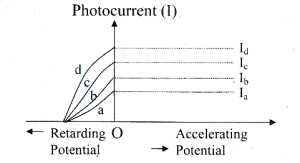
0 likesView Solution
215
PhysicsEasyMCQMHT CET · 2024
$A$ point source of light is used in a photoelectric effect experiment. If the source is moved farther from the emitting metal, then the stopping potential will
A
increase.
B
decrease.
C
remain constant.
D
either increase or decrease.
Solution
(C) The stopping potential $(V_0)$ in the photoelectric effect is determined by the maximum kinetic energy of the emitted photoelectrons, which depends solely on the frequency of the incident light and the work function of the metal surface, as given by Einstein's photoelectric equation: $eV_0 = h\nu - \Phi$.
Moving the point source of light farther away changes the intensity of the light incident on the metal surface, but it does not change the frequency of the incident photons.
Since the stopping potential is independent of the intensity of the incident light, it will remain constant.
Moving the point source of light farther away changes the intensity of the light incident on the metal surface, but it does not change the frequency of the incident photons.
Since the stopping potential is independent of the intensity of the incident light, it will remain constant.
0 likesView Solution
216
PhysicsMediumMCQMHT CET · 2024
$A$ coil of self-inductance $L$ is connected in series with a bulb and an a.c. source. Brightness of the bulb decreases when
A
an iron rod is inserted in the coil.
B
frequency of a.c. source is decreased.
C
number of turns in the coil is reduced.
D
a capacitance of reactance $(X_C - X_L)$ is included in the same circuit.
Solution
(A) The brightness of the bulb depends on the current $I$ flowing through the circuit,where $I = \frac{V}{Z}$. The impedance $Z$ of the $LR$ circuit is given by $Z = \sqrt{R^2 + X_L^2}$,where $X_L = \omega L = 2\pi f L$. For the brightness to decrease,the current $I$ must decrease,which means the impedance $Z$ must increase.
$1$. When an iron rod is inserted into the coil,the self-inductance $L$ increases due to the increase in permeability. Consequently,$X_L$ increases,$Z$ increases,and the current $I$ decreases,leading to a decrease in brightness.
$2$. If the frequency $f$ is decreased,$X_L$ decreases,$Z$ decreases,and the current $I$ increases,leading to an increase in brightness.
$3$. If the number of turns $N$ is reduced,$L$ decreases (since $L \propto N^2$),$X_L$ decreases,$Z$ decreases,and the current $I$ increases,leading to an increase in brightness.
$4$. Adding a capacitor such that the net reactance becomes zero (resonance) would increase the current,not decrease it.
Therefore,the correct option is $A$.
$1$. When an iron rod is inserted into the coil,the self-inductance $L$ increases due to the increase in permeability. Consequently,$X_L$ increases,$Z$ increases,and the current $I$ decreases,leading to a decrease in brightness.
$2$. If the frequency $f$ is decreased,$X_L$ decreases,$Z$ decreases,and the current $I$ increases,leading to an increase in brightness.
$3$. If the number of turns $N$ is reduced,$L$ decreases (since $L \propto N^2$),$X_L$ decreases,$Z$ decreases,and the current $I$ increases,leading to an increase in brightness.
$4$. Adding a capacitor such that the net reactance becomes zero (resonance) would increase the current,not decrease it.
Therefore,the correct option is $A$.
0 likesView Solution
217
PhysicsMediumMCQMHT CET · 2024
$A$ circuit having a self-inductance of $1 \text{ H}$ carries a current of $1 \text{ A}$. To prevent sparking when the circuit is broken,a capacitor which can withstand $500 \text{ V}$ is connected across the switch. What is the minimum value of the capacitance of the capacitor (in $\mu \text{ F}$)?
A
$2$
B
$4$
C
$6$
D
$8$
Solution
(B) The energy stored in the inductor is given by $U = \frac{1}{2} LI^2$.
Substituting the given values,$U = \frac{1}{2} \times 1 \times 1^2 = 0.5 \text{ J}$.
When the circuit is broken,this energy is transferred to the capacitor to prevent sparking.
The energy stored in a capacitor is $U = \frac{1}{2} CV^2$.
Equating the two energies: $\frac{1}{2} CV^2 = \frac{1}{2} LI^2$.
Solving for $C$: $C = L \left( \frac{I}{V} \right)^2$.
Substituting the values: $C = 1 \times \left( \frac{1}{500} \right)^2 = \frac{1}{250000} \text{ F}$.
$C = 4 \times 10^{-6} \text{ F} = 4 \mu \text{ F}$.
Substituting the given values,$U = \frac{1}{2} \times 1 \times 1^2 = 0.5 \text{ J}$.
When the circuit is broken,this energy is transferred to the capacitor to prevent sparking.
The energy stored in a capacitor is $U = \frac{1}{2} CV^2$.
Equating the two energies: $\frac{1}{2} CV^2 = \frac{1}{2} LI^2$.
Solving for $C$: $C = L \left( \frac{I}{V} \right)^2$.
Substituting the values: $C = 1 \times \left( \frac{1}{500} \right)^2 = \frac{1}{250000} \text{ F}$.
$C = 4 \times 10^{-6} \text{ F} = 4 \mu \text{ F}$.
0 likesView Solution
218
PhysicsEasyMCQMHT CET · 2024
The magnetic energy stored in an inductor of inductance $5 \mu H$ carrying a current of $2 \ A$ is
A
$10 \ mJ$
B
$5 \ mJ$
C
$10 \mu J$
D
$5 \mu J$
Solution
(C) The magnetic energy $U$ stored in an inductor is given by the formula: $U = \frac{1}{2} LI^2$.
Given: Inductance $L = 5 \mu H = 5 \times 10^{-6} \ H$ and current $I = 2 \ A$.
Substituting the values: $U = \frac{1}{2} \times (5 \times 10^{-6}) \times (2)^2$.
$U = \frac{1}{2} \times 5 \times 10^{-6} \times 4$.
$U = 10 \times 10^{-6} \ J = 10 \mu J$.
Given: Inductance $L = 5 \mu H = 5 \times 10^{-6} \ H$ and current $I = 2 \ A$.
Substituting the values: $U = \frac{1}{2} \times (5 \times 10^{-6}) \times (2)^2$.
$U = \frac{1}{2} \times 5 \times 10^{-6} \times 4$.
$U = 10 \times 10^{-6} \ J = 10 \mu J$.
0 likesView Solution
219
PhysicsEasyMCQMHT CET · 2024
The magnetic energy in an inductor changes from maximum value to minimum value in $5 \ ms$. When connected to an $A.C.$ source,the frequency of the source is (in $Hz$)
A
$50$
B
$200$
C
$500$
D
$20$
Solution
(A) The magnetic energy $U_B$ in an inductor is given by $U_B = \frac{1}{2} L I^2$. Since the current $I$ in an $A.C.$ circuit varies as $I = I_0 \sin(\omega t)$,the energy varies as $U_B \propto \sin^2(\omega t)$.
Energy changes from maximum to minimum in $\frac{1}{4}$ of a time period $T$.
Given,$\frac{T}{4} = 5 \ ms = 5 \times 10^{-3} \ s$.
Therefore,$T = 20 \times 10^{-3} \ s = 0.02 \ s$.
The frequency $f$ is given by $f = \frac{1}{T} = \frac{1}{0.02} = 50 \ Hz$.
Energy changes from maximum to minimum in $\frac{1}{4}$ of a time period $T$.
Given,$\frac{T}{4} = 5 \ ms = 5 \times 10^{-3} \ s$.
Therefore,$T = 20 \times 10^{-3} \ s = 0.02 \ s$.
The frequency $f$ is given by $f = \frac{1}{T} = \frac{1}{0.02} = 50 \ Hz$.
0 likesView Solution
220
PhysicsEasyMCQMHT CET · 2024
Three inductances are connected as shown in the figure. The equivalent inductance is
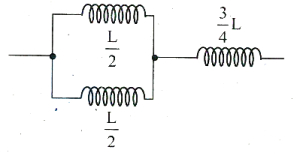
A
$\frac{L}{4}$
B
$\frac{5}{4} L$
C
$\frac{7}{4} L$
D
$L$
Solution
(D) The circuit consists of two inductors,each of inductance $L/2$,connected in parallel,which are then connected in series with an inductor of inductance $3L/4$.
First,calculate the equivalent inductance $L_p$ of the two inductors in parallel:
$\frac{1}{L_p} = \frac{1}{L/2} + \frac{1}{L/2} = \frac{2}{L} + \frac{2}{L} = \frac{4}{L}$
$\therefore L_p = \frac{L}{4}$
Now,calculate the total equivalent inductance $L_{eq}$ by adding the series inductor:
$L_{eq} = L_p + \frac{3L}{4} = \frac{L}{4} + \frac{3L}{4} = \frac{4L}{4} = L$
First,calculate the equivalent inductance $L_p$ of the two inductors in parallel:
$\frac{1}{L_p} = \frac{1}{L/2} + \frac{1}{L/2} = \frac{2}{L} + \frac{2}{L} = \frac{4}{L}$
$\therefore L_p = \frac{L}{4}$
Now,calculate the total equivalent inductance $L_{eq}$ by adding the series inductor:
$L_{eq} = L_p + \frac{3L}{4} = \frac{L}{4} + \frac{3L}{4} = \frac{4L}{4} = L$
0 likesView Solution
221
PhysicsEasyMCQMHT CET · 2024
The magnetic potential energy stored in a certain inductor is $64 \times 10^{-3} \ J$,when the current in the inductor is $80 \ mA$. The inductance of this inductor is: (in $H$)
A
$0.20$
B
$2.0$
C
$20$
D
$200$
Solution
(C) The energy stored in an inductor is given by the formula: $E = \frac{1}{2} LI^2$.
Given: Energy $E = 64 \times 10^{-3} \ J$ and current $I = 80 \ mA = 80 \times 10^{-3} \ A$.
Rearranging the formula to solve for inductance $L$: $L = \frac{2E}{I^2}$.
Substituting the values: $L = \frac{2 \times 64 \times 10^{-3}}{(80 \times 10^{-3})^2}$.
$L = \frac{128 \times 10^{-3}}{6400 \times 10^{-6}} = \frac{128 \times 10^{-3}}{6.4 \times 10^{-3}} = \frac{128}{6.4} = 20 \ H$.
Given: Energy $E = 64 \times 10^{-3} \ J$ and current $I = 80 \ mA = 80 \times 10^{-3} \ A$.
Rearranging the formula to solve for inductance $L$: $L = \frac{2E}{I^2}$.
Substituting the values: $L = \frac{2 \times 64 \times 10^{-3}}{(80 \times 10^{-3})^2}$.
$L = \frac{128 \times 10^{-3}}{6400 \times 10^{-6}} = \frac{128 \times 10^{-3}}{6.4 \times 10^{-3}} = \frac{128}{6.4} = 20 \ H$.
0 likesView Solution
222
PhysicsEasyMCQMHT CET · 2024
An inductor coil of inductance $L$ is divided into two parts and both parts are connected in parallel. The net inductance is
A
$L$
B
$2 L$
C
$\frac{L}{2}$
D
$\frac{L}{4}$
Solution
(D) The inductance of a coil is directly proportional to its length $(L \propto l)$.
When the coil is divided into two equal parts,each part has an inductance of $L_1 = L_2 = \frac{L}{2}$.
When these two inductors are connected in parallel,the equivalent inductance $L_{eq}$ is given by the formula:
$\frac{1}{L_{eq}} = \frac{1}{L_1} + \frac{1}{L_2}$
Substituting the values:
$\frac{1}{L_{eq}} = \frac{1}{L/2} + \frac{1}{L/2} = \frac{2}{L} + \frac{2}{L} = \frac{4}{L}$
Therefore,$L_{eq} = \frac{L}{4}$.
When the coil is divided into two equal parts,each part has an inductance of $L_1 = L_2 = \frac{L}{2}$.
When these two inductors are connected in parallel,the equivalent inductance $L_{eq}$ is given by the formula:
$\frac{1}{L_{eq}} = \frac{1}{L_1} + \frac{1}{L_2}$
Substituting the values:
$\frac{1}{L_{eq}} = \frac{1}{L/2} + \frac{1}{L/2} = \frac{2}{L} + \frac{2}{L} = \frac{4}{L}$
Therefore,$L_{eq} = \frac{L}{4}$.
0 likesView Solution
223
PhysicsEasyMCQMHT CET · 2024
If a current of $4 \ A$ produces a magnetic flux of $3 \times 10^{-3} \ Wb$ through a coil of $400$ turns,the energy stored in the coil will be: (in $J$)
A
$1.2$
B
$2.4$
C
$24$
D
$240$
Solution
(B) Given: Current $I = 4 \ A$,Number of turns $N = 400$,Magnetic flux $\phi = 3 \times 10^{-3} \ Wb$.
The magnetic flux linkage is given by $N\phi = LI$,where $L$ is the self-inductance of the coil.
First,calculate the self-inductance $L$:
$L = \frac{N\phi}{I} = \frac{400 \times 3 \times 10^{-3}}{4} = 100 \times 3 \times 10^{-3} = 0.3 \ H$.
The energy stored in an inductor is given by the formula $U = \frac{1}{2} LI^2$.
Substituting the values:
$U = \frac{1}{2} \times 0.3 \times (4)^2$
$U = \frac{1}{2} \times 0.3 \times 16$
$U = 0.3 \times 8 = 2.4 \ J$.
The magnetic flux linkage is given by $N\phi = LI$,where $L$ is the self-inductance of the coil.
First,calculate the self-inductance $L$:
$L = \frac{N\phi}{I} = \frac{400 \times 3 \times 10^{-3}}{4} = 100 \times 3 \times 10^{-3} = 0.3 \ H$.
The energy stored in an inductor is given by the formula $U = \frac{1}{2} LI^2$.
Substituting the values:
$U = \frac{1}{2} \times 0.3 \times (4)^2$
$U = \frac{1}{2} \times 0.3 \times 16$
$U = 0.3 \times 8 = 2.4 \ J$.
0 likesView Solution
224
PhysicsEasyMCQMHT CET · 2024
$A$ coil has inductance $L$. The ratio of its reactance when it is connected first to an $A.C.$ source and then to a $D.C.$ source is
A
$\infty$
B
zero
C
one
D
two
Solution
(A) The reactance of an inductor in an $A.C.$ circuit is given by $X_L = \omega L = 2\pi f L$,where $f$ is the frequency of the $A.C.$ source.
For a $D.C.$ source,the frequency $f = 0$.
Therefore,the inductive reactance in a $D.C.$ circuit is $X_L = 2\pi (0) L = 0$.
The ratio of reactance in an $A.C.$ source to that in a $D.C.$ source is $\frac{X_{L(ac)}}{X_{L(dc)}} = \frac{\omega L}{0} = \infty$.
For a $D.C.$ source,the frequency $f = 0$.
Therefore,the inductive reactance in a $D.C.$ circuit is $X_L = 2\pi (0) L = 0$.
The ratio of reactance in an $A.C.$ source to that in a $D.C.$ source is $\frac{X_{L(ac)}}{X_{L(dc)}} = \frac{\omega L}{0} = \infty$.
0 likesView Solution
225
PhysicsMediumMCQMHT CET · 2024
The coil and magnet are moved in the same direction with the same speed $V$. The induced e.m.f. is
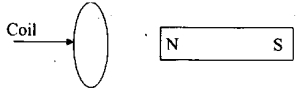
A
zero.
B
proportional to $V$.
C
proportional to $V^{-1}$.
D
finite but does not depend on $V$.
Solution
(A) According to Faraday's law of electromagnetic induction,the induced electromotive force $(e)$ is given by $e = -N \frac{d\phi}{dt}$.
Since the coil and the magnet are moving in the same direction with the same speed $V$,their relative velocity is zero.
As a result,the magnetic flux $(\phi)$ linked with the coil remains constant over time.
Therefore,$\frac{d\phi}{dt} = 0$.
Consequently,the induced e.m.f. is zero.
Since the coil and the magnet are moving in the same direction with the same speed $V$,their relative velocity is zero.
As a result,the magnetic flux $(\phi)$ linked with the coil remains constant over time.
Therefore,$\frac{d\phi}{dt} = 0$.
Consequently,the induced e.m.f. is zero.
0 likesView Solution
226
PhysicsMediumMCQMHT CET · 2024
Two coils are kept near each other. When no current passes through the first coil and the current in the $2^{nd}$ coil increases at the rate of $10 \,A/s$, the e.m.f. in the $1^{st}$ coil is $20 \,mV$. When no current passes through the $2^{nd}$ coil and $3.6 \,A$ current passes through the $1^{st}$ coil, the flux linkage in coil $2$ is:
A
$1.2 \times 10^{-3} \,Wb$
B
$1.8 \times 10^{-3} \,Wb$
C
$3.6 \times 10^{-3} \,Wb$
D
$7.2 \times 10^{-3} \,Wb$
Solution
(D) The induced e.m.f. in the first coil is given by $e_1 = M \frac{dI_2}{dt}$.
Given $e_1 = 20 \,mV = 20 \times 10^{-3} \,V$ and $\frac{dI_2}{dt} = 10 \,A/s$.
Substituting these values, we get $M = \frac{e_1}{dI_2/dt} = \frac{20 \times 10^{-3}}{10} = 2 \times 10^{-3} \,H$.
The flux linkage in the second coil when current $I_1$ flows through the first coil is given by $\phi_2 = M I_1$.
Given $I_1 = 3.6 \,A$, we have $\phi_2 = (2 \times 10^{-3} \,H) \times (3.6 \,A) = 7.2 \times 10^{-3} \,Wb$.
Given $e_1 = 20 \,mV = 20 \times 10^{-3} \,V$ and $\frac{dI_2}{dt} = 10 \,A/s$.
Substituting these values, we get $M = \frac{e_1}{dI_2/dt} = \frac{20 \times 10^{-3}}{10} = 2 \times 10^{-3} \,H$.
The flux linkage in the second coil when current $I_1$ flows through the first coil is given by $\phi_2 = M I_1$.
Given $I_1 = 3.6 \,A$, we have $\phi_2 = (2 \times 10^{-3} \,H) \times (3.6 \,A) = 7.2 \times 10^{-3} \,Wb$.
0 likesView Solution
227
PhysicsMediumMCQMHT CET · 2024
$A$ magnetic field of $2 \times 10^{-2} \,T$ acts at right angles to a coil of area $100 \,cm^2$ with $50$ turns. The average e.m.f. induced in the coil is $0.1 \,V$, when it is removed from the field in time $t$. The value of $t$ is (in seconds): (in $s$)
A
$0.1$
B
$0.01$
C
$1$
D
$20$
Solution
(A) According to Faraday's law of electromagnetic induction, the magnitude of induced e.m.f. is given by $|e| = N \frac{|\Delta \phi|}{\Delta t}$.
Here, $N = 50$, $B_1 = 2 \times 10^{-2} \,T$, $B_2 = 0 \,T$, $A = 100 \,cm^2 = 100 \times 10^{-4} \,m^2 = 10^{-2} \,m^2$, and $|e| = 0.1 \,V$.
The change in magnetic flux is $\Delta \phi = (B_2 - B_1) A \cos 0^{\circ} = (0 - 2 \times 10^{-2}) \times 10^{-2} = -2 \times 10^{-4} \,Wb$.
Substituting the values into the formula:
$0.1 = 50 \times \frac{2 \times 10^{-4}}{t}$.
$t = \frac{50 \times 2 \times 10^{-4}}{0.1} = \frac{100 \times 10^{-4}}{0.1} = \frac{10^{-2}}{10^{-1}} = 0.1 \,s$.
Here, $N = 50$, $B_1 = 2 \times 10^{-2} \,T$, $B_2 = 0 \,T$, $A = 100 \,cm^2 = 100 \times 10^{-4} \,m^2 = 10^{-2} \,m^2$, and $|e| = 0.1 \,V$.
The change in magnetic flux is $\Delta \phi = (B_2 - B_1) A \cos 0^{\circ} = (0 - 2 \times 10^{-2}) \times 10^{-2} = -2 \times 10^{-4} \,Wb$.
Substituting the values into the formula:
$0.1 = 50 \times \frac{2 \times 10^{-4}}{t}$.
$t = \frac{50 \times 2 \times 10^{-4}}{0.1} = \frac{100 \times 10^{-4}}{0.1} = \frac{10^{-2}}{10^{-1}} = 0.1 \,s$.
0 likesView Solution
228
PhysicsMediumMCQMHT CET · 2024
The magnetic flux through a coil of resistance $R$ changes by an amount $\Delta \phi$ in time $\Delta t$. The amount of induced current and induced charge in the coil are respectively:
A
$\left(\frac{\Delta \phi}{\Delta t}\right) R$ and $\frac{R}{\Delta \phi}$
B
$\frac{\Delta \phi}{R}$ and $R\left(\frac{\Delta t}{\Delta \phi}\right)$
C
$\frac{\Delta \phi}{R}+R$ and $\frac{\Delta \phi}{\Delta t}$
D
$\left(\frac{\Delta \phi}{\Delta t}\right) \times \frac{1}{R}$ and $\frac{\Delta \phi}{R}$
Solution
(D) According to Faraday's law of electromagnetic induction,the magnitude of induced electromotive force $(EMF)$ is given by $|e| = \frac{\Delta \phi}{\Delta t}$.
Since the coil has resistance $R$,the induced current $I$ is given by $I = \frac{|e|}{R} = \left(\frac{\Delta \phi}{\Delta t}\right) \frac{1}{R}$.
The total induced charge $Q$ passing through the circuit is given by $Q = I \times \Delta t$.
Substituting the value of $I$,we get $Q = \left(\frac{\Delta \phi}{\Delta t} \cdot \frac{1}{R}\right) \times \Delta t = \frac{\Delta \phi}{R}$.
Thus,the induced current is $\left(\frac{\Delta \phi}{\Delta t}\right) \frac{1}{R}$ and the induced charge is $\frac{\Delta \phi}{R}$.
Since the coil has resistance $R$,the induced current $I$ is given by $I = \frac{|e|}{R} = \left(\frac{\Delta \phi}{\Delta t}\right) \frac{1}{R}$.
The total induced charge $Q$ passing through the circuit is given by $Q = I \times \Delta t$.
Substituting the value of $I$,we get $Q = \left(\frac{\Delta \phi}{\Delta t} \cdot \frac{1}{R}\right) \times \Delta t = \frac{\Delta \phi}{R}$.
Thus,the induced current is $\left(\frac{\Delta \phi}{\Delta t}\right) \frac{1}{R}$ and the induced charge is $\frac{\Delta \phi}{R}$.
0 likesView Solution
229
PhysicsMediumMCQMHT CET · 2024
Two coils have a mutual inductance $5 \times 10^{-3} \text{ H}$. The current changes in the first coil according to the equation $I_1 = I_0 \sin \omega t$, where $I_0 = 10 \text{ A}$ and $\omega = 100 \pi \text{ rad/s}$. What is the value of the maximum e.m.f. in the second coil (in $\pi \text{ V}$)?
A
$2$
B
$3$
C
$4$
D
$5$
Solution
(D) The induced e.m.f. in the second coil is given by the formula: $e = M \frac{dI_1}{dt} \dots (i)$
Given $I_1 = I_0 \sin \omega t$, we differentiate with respect to time $t$:
$\frac{dI_1}{dt} = I_0 \omega \cos \omega t$
Substituting this into equation $(i)$, we get:
$e = M I_0 \omega \cos \omega t$
The maximum value of e.m.f. $(e_{max})$ occurs when $\cos \omega t = 1$:
$e_{max} = M I_0 \omega$
Given values: $M = 5 \times 10^{-3} \text{ H}$, $I_0 = 10 \text{ A}$, and $\omega = 100 \pi \text{ rad/s}$.
Substituting these values:
$e_{max} = (5 \times 10^{-3}) \times 10 \times 100 \pi$
$e_{max} = 5 \times 10^{-3} \times 10^3 \pi$
$e_{max} = 5 \pi \text{ V}$
Given $I_1 = I_0 \sin \omega t$, we differentiate with respect to time $t$:
$\frac{dI_1}{dt} = I_0 \omega \cos \omega t$
Substituting this into equation $(i)$, we get:
$e = M I_0 \omega \cos \omega t$
The maximum value of e.m.f. $(e_{max})$ occurs when $\cos \omega t = 1$:
$e_{max} = M I_0 \omega$
Given values: $M = 5 \times 10^{-3} \text{ H}$, $I_0 = 10 \text{ A}$, and $\omega = 100 \pi \text{ rad/s}$.
Substituting these values:
$e_{max} = (5 \times 10^{-3}) \times 10 \times 100 \pi$
$e_{max} = 5 \times 10^{-3} \times 10^3 \pi$
$e_{max} = 5 \pi \text{ V}$
0 likesView Solution
230
PhysicsDifficultMCQMHT CET · 2024
An alternating current of peak value $\left(\frac{2}{\pi}\right) \text{ A}$ flows through the primary coil of a transformer. The coefficient of mutual inductance between the primary and secondary coils is $1 \text{ H}$. What is the peak electromotive force (e.m.f.) induced in the secondary coil (in $\text{ V}$)? (Frequency of a.c. $= 50 \text{ Hz}$)
A
$50$
B
$150$
C
$100$
D
$200$
Solution
(D) The instantaneous current in the primary coil is given by $I = I_0 \sin(\omega t)$.
Given peak current $I_0 = \frac{2}{\pi} \text{ A}$ and frequency $v = 50 \text{ Hz}$.
The angular frequency is $\omega = 2 \pi v = 2 \pi(50) = 100 \pi \text{ rad/s}$.
The rate of change of current is $\frac{dI}{dt} = I_0 \omega \cos(\omega t)$.
The maximum value of the rate of change of current is $\left(\frac{dI}{dt}\right)_{\text{max}} = I_0 \omega$.
Substituting the values: $\left(\frac{dI}{dt}\right)_{\text{max}} = \left(\frac{2}{\pi}\right) \times (100 \pi) = 200 \text{ A/s}$.
The induced e.m.f. in the secondary coil is $E = M \left|\frac{dI}{dt}\right|$,where $M = 1 \text{ H}$.
Therefore,the peak induced e.m.f. is $E_0 = 1 \times 200 = 200 \text{ V}$.
Given peak current $I_0 = \frac{2}{\pi} \text{ A}$ and frequency $v = 50 \text{ Hz}$.
The angular frequency is $\omega = 2 \pi v = 2 \pi(50) = 100 \pi \text{ rad/s}$.
The rate of change of current is $\frac{dI}{dt} = I_0 \omega \cos(\omega t)$.
The maximum value of the rate of change of current is $\left(\frac{dI}{dt}\right)_{\text{max}} = I_0 \omega$.
Substituting the values: $\left(\frac{dI}{dt}\right)_{\text{max}} = \left(\frac{2}{\pi}\right) \times (100 \pi) = 200 \text{ A/s}$.
The induced e.m.f. in the secondary coil is $E = M \left|\frac{dI}{dt}\right|$,where $M = 1 \text{ H}$.
Therefore,the peak induced e.m.f. is $E_0 = 1 \times 200 = 200 \text{ V}$.
0 likesView Solution
231
PhysicsMediumMCQMHT CET · 2024
$A$ coil of resistance $250 \Omega$ is placed in a magnetic field. If the magnetic flux $(\phi)$ linked with the coil varies with time $t$ $(s)$ as $\phi = 50t^2 + 7$,the current in the coil at $t = 4 \ s$ is: (in $A$)
A
$1.3$
B
$1.4$
C
$1.5$
D
$1.6$
Solution
(D) The induced electromotive force (e.m.f.) is given by Faraday's law: $|e| = \frac{d\phi}{dt}$.
Given the magnetic flux $\phi = 50t^2 + 7$.
Taking the derivative with respect to time $t$,we get $|e| = \frac{d}{dt}(50t^2 + 7) = 100t$.
At time $t = 4 \ s$,the induced e.m.f. is $|e| = 100(4) = 400 \ V$.
The current $I$ in the coil is given by Ohm's law: $I = \frac{e}{R}$.
Substituting the values,$I = \frac{400 \ V}{250 \ \Omega} = 1.6 \ A$.
Given the magnetic flux $\phi = 50t^2 + 7$.
Taking the derivative with respect to time $t$,we get $|e| = \frac{d}{dt}(50t^2 + 7) = 100t$.
At time $t = 4 \ s$,the induced e.m.f. is $|e| = 100(4) = 400 \ V$.
The current $I$ in the coil is given by Ohm's law: $I = \frac{e}{R}$.
Substituting the values,$I = \frac{400 \ V}{250 \ \Omega} = 1.6 \ A$.
0 likesView Solution
232
PhysicsDifficultMCQMHT CET · 2024
$A$ metal rod of length $l$ rotates about one of its ends in a plane perpendicular to a magnetic field of induction $B$. If the e.m.f. induced between the ends of the rod is $e$,then the number of revolutions made by the rod per second is:
A
$\frac{\pi l^2}{eB}$
B
$\frac{e}{B \pi l^2}$
C
$\frac{e}{B \pi^2 l}$
D
$\frac{B^2}{e \pi l}$
Solution
(B) The induced e.m.f. $e$ in a rotating rod is given by the rate of change of magnetic flux $\phi$ linked with the area swept by the rod.
$e = \frac{d\phi}{dt} = B \frac{dA}{dt}$
In one complete revolution,the rod sweeps an area $A = \pi l^2$.
If the rod makes $f$ revolutions per second,the area swept per unit time is $\frac{dA}{dt} = f \cdot A = f \cdot \pi l^2$.
Substituting this into the e.m.f. equation:
$e = B \cdot (f \cdot \pi l^2)$
Rearranging to solve for the frequency $f$ (number of revolutions per second):
$f = \frac{e}{B \pi l^2}$
$e = \frac{d\phi}{dt} = B \frac{dA}{dt}$
In one complete revolution,the rod sweeps an area $A = \pi l^2$.
If the rod makes $f$ revolutions per second,the area swept per unit time is $\frac{dA}{dt} = f \cdot A = f \cdot \pi l^2$.
Substituting this into the e.m.f. equation:
$e = B \cdot (f \cdot \pi l^2)$
Rearranging to solve for the frequency $f$ (number of revolutions per second):
$f = \frac{e}{B \pi l^2}$
0 likesView Solution
233
PhysicsMediumMCQMHT CET · 2024
$A$ bicycle wheel of radius $R$ has $n$ spokes. It is rotating at the rate of $F$ r.p.m. perpendicular to the horizontal component of earth's magnetic field $\vec{B}$. The e.m.f. induced between the rim and the centre of the wheel is
A
$\frac{1}{2} B \pi F R^2$
B
$B \pi F R^2$
C
$\frac{1}{n} B \pi F R$
D
$B \pi F R^2 n$
Solution
(A) The angular velocity $\omega$ in radians per second is given by $\omega = 2 \pi f$,where $f$ is the frequency in revolutions per second. Since $F$ is in r.p.m.,$f = \frac{F}{60}$.
Thus,$\omega = 2 \pi \frac{F}{60} = \frac{\pi F}{30}$.
Consider a small element $dr$ at a distance $r$ from the center. The motional e.m.f. $dE$ induced across this element is $dE = B v dr = B (r \omega) dr$.
Integrating from $r = 0$ to $r = R$:
$E = \int_{0}^{R} B \omega r dr = B \omega \left[ \frac{r^2}{2} \right]_{0}^{R} = \frac{1}{2} B \omega R^2$.
Substituting $\omega = \frac{2 \pi F}{60}$:
$E = \frac{1}{2} B \left( \frac{2 \pi F}{60} \right) R^2 = \frac{B \pi F R^2}{60}$.
Note: If $F$ is treated as revolutions per second (rps) in the context of standard physics problems of this type,the answer is $\frac{1}{2} B \pi F R^2$. Given the options,the intended answer is $A$.
Thus,$\omega = 2 \pi \frac{F}{60} = \frac{\pi F}{30}$.
Consider a small element $dr$ at a distance $r$ from the center. The motional e.m.f. $dE$ induced across this element is $dE = B v dr = B (r \omega) dr$.
Integrating from $r = 0$ to $r = R$:
$E = \int_{0}^{R} B \omega r dr = B \omega \left[ \frac{r^2}{2} \right]_{0}^{R} = \frac{1}{2} B \omega R^2$.
Substituting $\omega = \frac{2 \pi F}{60}$:
$E = \frac{1}{2} B \left( \frac{2 \pi F}{60} \right) R^2 = \frac{B \pi F R^2}{60}$.
Note: If $F$ is treated as revolutions per second (rps) in the context of standard physics problems of this type,the answer is $\frac{1}{2} B \pi F R^2$. Given the options,the intended answer is $A$.
0 likesView Solution
234
PhysicsEasyMCQMHT CET · 2024
In an $A.C.$ generator,when the plane of the coil is perpendicular to the magnetic field:
A
magnetic flux is zero and induced $e.m.f.$ is maximum.
B
magnetic flux is maximum and induced $e.m.f.$ is zero.
C
both magnetic flux and induced $e.m.f.$ are maximum.
D
both magnetic flux and induced $e.m.f.$ are zero.
Solution
(B) The magnetic flux linked with the coil is given by $\phi_B = B A \cos \theta$,where $\theta$ is the angle between the normal to the plane of the coil and the magnetic field vector $B$.
When the plane of the coil is perpendicular to the magnetic field,the normal to the coil is parallel to the magnetic field,so $\theta = 0^{\circ}$.
Thus,the magnetic flux $\phi_B = B A \cos(0^{\circ}) = B A$,which is the maximum value.
The induced $e.m.f.$ is given by $\varepsilon = -\frac{d\phi_B}{dt} = B A \omega \sin(\omega t)$.
At $\theta = 0^{\circ}$,$\omega t = 0$,so $\varepsilon = B A \omega \sin(0^{\circ}) = 0$.
Therefore,the magnetic flux is maximum and the induced $e.m.f.$ is zero.
When the plane of the coil is perpendicular to the magnetic field,the normal to the coil is parallel to the magnetic field,so $\theta = 0^{\circ}$.
Thus,the magnetic flux $\phi_B = B A \cos(0^{\circ}) = B A$,which is the maximum value.
The induced $e.m.f.$ is given by $\varepsilon = -\frac{d\phi_B}{dt} = B A \omega \sin(\omega t)$.
At $\theta = 0^{\circ}$,$\omega t = 0$,so $\varepsilon = B A \omega \sin(0^{\circ}) = 0$.
Therefore,the magnetic flux is maximum and the induced $e.m.f.$ is zero.
0 likesView Solution
235
PhysicsEasyMCQMHT CET · 2024
$A$ rod of length $l$ is rotated with angular velocity $\omega$ about one of its ends,in a region perpendicular to a uniform magnetic field of induction $B$. The induced e.m.f. in the rod is:
A
$B l^2 \omega$
B
$0.5 B l^2 \omega$
C
$B / \omega$
D
$0.5 B / \omega$
Solution
(B) Consider a small element of length $dr$ at a distance $r$ from the fixed end of the rod.
The velocity of this element is $v = r \omega$.
The motional e.m.f. induced across this small element is $de = B v dr = B (r \omega) dr$.
To find the total induced e.m.f. across the entire length of the rod,we integrate from $r = 0$ to $r = l$:
$e = \int_{0}^{l} B \omega r dr$
$e = B \omega \left[ \frac{r^2}{2} \right]_{0}^{l}$
$e = \frac{1}{2} B l^2 \omega = 0.5 B l^2 \omega$.
The velocity of this element is $v = r \omega$.
The motional e.m.f. induced across this small element is $de = B v dr = B (r \omega) dr$.
To find the total induced e.m.f. across the entire length of the rod,we integrate from $r = 0$ to $r = l$:
$e = \int_{0}^{l} B \omega r dr$
$e = B \omega \left[ \frac{r^2}{2} \right]_{0}^{l}$
$e = \frac{1}{2} B l^2 \omega = 0.5 B l^2 \omega$.
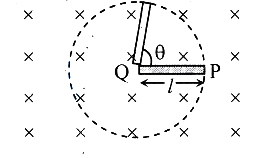
0 likesView Solution
236
PhysicsDifficultMCQMHT CET · 2024
$A$ circular coil of resistance $R$,area $A$,and number of turns $N$ is rotated about its vertical diameter with angular speed $\omega$ in a uniform magnetic field of magnitude $B$. The average power dissipated in a complete cycle is:
A
$\frac{N^2 A^2 B^2 \omega^2}{2 R}$
B
$\frac{BNA \omega}{R}$
C
$\frac{N^2 A B}{2 R \omega^2}$
D
$\frac{BA \omega}{2 NR}$
Solution
(A) The induced electromotive force $(e)$ in a rotating coil is given by $e = NAB \omega \sin(\omega t)$.
The peak value of the induced $EMF$ is $e_0 = NAB \omega$.
The peak current is $i_0 = \frac{e_0}{R} = \frac{NAB \omega}{R}$.
The average power dissipated in an $AC$ circuit is given by $P_{av} = \frac{e_0 i_0}{2}$ or $P_{av} = \frac{e_0^2}{2R}$.
Substituting the value of $e_0$:
$P_{av} = \frac{(NAB \omega)^2}{2R} = \frac{N^2 A^2 B^2 \omega^2}{2R}$.
The peak value of the induced $EMF$ is $e_0 = NAB \omega$.
The peak current is $i_0 = \frac{e_0}{R} = \frac{NAB \omega}{R}$.
The average power dissipated in an $AC$ circuit is given by $P_{av} = \frac{e_0 i_0}{2}$ or $P_{av} = \frac{e_0^2}{2R}$.
Substituting the value of $e_0$:
$P_{av} = \frac{(NAB \omega)^2}{2R} = \frac{N^2 A^2 B^2 \omega^2}{2R}$.
0 likesView Solution
237
PhysicsMediumMCQMHT CET · 2024
$A$ square loop $ABCD$ is moving with constant velocity $\vec{v}$ in a uniform magnetic field $\vec{B}$ which is perpendicular to the plane of paper and directed outward. The resistance of the coil is $R$. What is the rate of production of heat energy in the loop? [$L$ = length of side of the loop]
A
$\frac{B^2 L^2 V}{R}$
B
$\frac{B^2 L^2 V^2}{R}$
C
$\frac{B^2 LV^2}{R}$
D
$\frac{BLV^2}{R}$
Solution
(B) When a conductor of length $L$ moves with velocity $V$ in a uniform magnetic field $B$ perpendicular to it,the motional electromotive force $(e.m.f.)$ induced is given by $e = BLV$.
Since the loop is moving in a uniform magnetic field,the magnetic flux linked with the loop remains constant if the entire loop is within the field. However,if the loop is entering or leaving the field,an $e.m.f.$ is induced across the side cutting the field lines.
The rate of production of heat energy (power dissipated) in the loop is given by $P = \frac{e^2}{R}$.
Substituting the value of $e = BLV$,we get:
$P = \frac{(BLV)^2}{R} = \frac{B^2 L^2 V^2}{R}$.
Since the loop is moving in a uniform magnetic field,the magnetic flux linked with the loop remains constant if the entire loop is within the field. However,if the loop is entering or leaving the field,an $e.m.f.$ is induced across the side cutting the field lines.
The rate of production of heat energy (power dissipated) in the loop is given by $P = \frac{e^2}{R}$.
Substituting the value of $e = BLV$,we get:
$P = \frac{(BLV)^2}{R} = \frac{B^2 L^2 V^2}{R}$.
0 likesView Solution
238
PhysicsEasyMCQMHT CET · 2024
$A$ boat is moving due east in a region where the earth's magnetic field is $3.6 \times 10^{-5} \text{ T}$ due north and horizontal. The boat carries a vertical conducting rod $2 \text{ m}$ long. If the speed of the boat is $2.00 \text{ m/s}$, the magnitude of the induced e.m.f. in the rod is: (in $\text{ mV}$)
A
$1.4$
B
$0.54$
C
$0.72$
D
$0.144$
Solution
(D) The induced electromotive force $(e)$ in a conductor moving through a magnetic field is given by the formula: $e = B \cdot v \cdot l$, where $B$ is the magnetic field, $v$ is the velocity, and $l$ is the length of the rod.
Given:
$B = 3.6 \times 10^{-5} \text{ T}$
$v = 2.00 \text{ m/s}$
$l = 2 \text{ m}$
Substituting these values into the formula:
$e = (3.6 \times 10^{-5}) \times 2.00 \times 2$
$e = 14.4 \times 10^{-5} \text{ V}$
$e = 0.144 \times 10^{-3} \text{ V}$
$e = 0.144 \text{ mV}$
Given:
$B = 3.6 \times 10^{-5} \text{ T}$
$v = 2.00 \text{ m/s}$
$l = 2 \text{ m}$
Substituting these values into the formula:
$e = (3.6 \times 10^{-5}) \times 2.00 \times 2$
$e = 14.4 \times 10^{-5} \text{ V}$
$e = 0.144 \times 10^{-3} \text{ V}$
$e = 0.144 \text{ mV}$
0 likesView Solution
239
PhysicsMediumMCQMHT CET · 2024
$A$ metal disc of radius $R$ rotates with an angular velocity $\omega$ about an axis perpendicular to its plane passing through its centre in a magnetic field of induction $B$ acting perpendicular to the plane of the disc. The induced e.m.f. between the rim and axis of the disc is:
A
$B \pi R^2$
B
$\frac{2 B \pi^2 R^2}{\omega}$
C
$B \pi R^2 \omega$
D
$\frac{BR^2 \omega}{2}$
Solution
(D) Consider a small radial element of length $dr$ at a distance $r$ from the centre of the disc.
As the disc rotates,this element moves with a linear velocity $v = r\omega$ perpendicular to the magnetic field $B$.
The motional e.m.f. $de$ induced across this small element is given by $de = Bv dr = B(r\omega) dr$.
To find the total induced e.m.f. $e$ between the centre (axis) and the rim (radius $R$),we integrate the expression from $r = 0$ to $r = R$:
$e = \int_{0}^{R} B\omega r dr$
$e = B\omega \left[ \frac{r^2}{2} \right]_{0}^{R}$
$e = \frac{1}{2} B\omega R^2$.
As the disc rotates,this element moves with a linear velocity $v = r\omega$ perpendicular to the magnetic field $B$.
The motional e.m.f. $de$ induced across this small element is given by $de = Bv dr = B(r\omega) dr$.
To find the total induced e.m.f. $e$ between the centre (axis) and the rim (radius $R$),we integrate the expression from $r = 0$ to $r = R$:
$e = \int_{0}^{R} B\omega r dr$
$e = B\omega \left[ \frac{r^2}{2} \right]_{0}^{R}$
$e = \frac{1}{2} B\omega R^2$.
0 likesView Solution
240
PhysicsEasyMCQMHT CET · 2024
$A$ circular coil of resistance $R$,area $A$,and number of turns $N$ is rotated about its vertical diameter with angular speed $\omega$ in a uniform magnetic field of magnitude $B$. The average power dissipated in a complete cycle is:
A
$\frac{N^2 A^2 B^2 \omega^2}{2 R}$
B
$\frac{B N A \omega}{R}$
C
$\frac{B N A \omega}{2 R}$
D
$\frac{N^2 A^2 B^2 \omega^2}{R}$
Solution
(A) The magnetic flux through the coil at any time $t$ is given by $\phi = N A B \cos(\omega t)$.
According to Faraday's law,the induced electromotive force $(EMF)$ is $e = -\frac{d\phi}{dt} = N A B \omega \sin(\omega t)$.
The peak $EMF$ is $e_0 = N A B \omega$.
The peak current is $i_0 = \frac{e_0}{R} = \frac{N A B \omega}{R}$.
The average power dissipated in a complete cycle is given by $P_{avg} = \frac{1}{2} e_0 i_0$.
Substituting the values,$P_{avg} = \frac{1}{2} (N A B \omega) \left( \frac{N A B \omega}{R} \right) = \frac{N^2 A^2 B^2 \omega^2}{2 R}$.
According to Faraday's law,the induced electromotive force $(EMF)$ is $e = -\frac{d\phi}{dt} = N A B \omega \sin(\omega t)$.
The peak $EMF$ is $e_0 = N A B \omega$.
The peak current is $i_0 = \frac{e_0}{R} = \frac{N A B \omega}{R}$.
The average power dissipated in a complete cycle is given by $P_{avg} = \frac{1}{2} e_0 i_0$.
Substituting the values,$P_{avg} = \frac{1}{2} (N A B \omega) \left( \frac{N A B \omega}{R} \right) = \frac{N^2 A^2 B^2 \omega^2}{2 R}$.
0 likesView Solution
241
PhysicsEasyMCQMHT CET · 2024
$A$ graph of magnetic flux ( $\phi$ ) versus current $(I)$ is shown for four inductors $A, B, C, D$. The smaller value of self-inductance is for inductor:
A
$A$
B
$B$
C
$C$
D
$D$
Solution
(A) The magnetic flux $\phi$ linked with an inductor is given by $\phi = LI$,where $L$ is the self-inductance of the inductor.
Comparing this equation with the equation of a straight line $y = mx$,where $y = \phi$ and $x = I$,we get the slope $m = L$.
Since the slope of the graph represents the self-inductance $L$,the inductor with the smallest slope will have the smallest value of self-inductance.
Looking at the graph,the line $D$ makes the smallest angle with the current axis ($I$-axis),meaning it has the lowest slope.
Therefore,inductor $D$ has the smallest self-inductance.
Comparing this equation with the equation of a straight line $y = mx$,where $y = \phi$ and $x = I$,we get the slope $m = L$.
Since the slope of the graph represents the self-inductance $L$,the inductor with the smallest slope will have the smallest value of self-inductance.
Looking at the graph,the line $D$ makes the smallest angle with the current axis ($I$-axis),meaning it has the lowest slope.
Therefore,inductor $D$ has the smallest self-inductance.
0 likesView Solution
242
PhysicsEasyMCQMHT CET · 2024
$A$ current of $0.5 \ A$ is passed through the winding of a long solenoid having $400$ turns. The magnetic flux linked with each turn is $3 \times 10^{-3} \ Wb$. The self-inductance of the solenoid is: (in $H$)
A
$2.4$
B
$2.0$
C
$1.2$
D
$0.6$
Solution
(A) The formula for self-inductance $L$ is given by $L = \frac{N \phi}{i}$,where $N$ is the number of turns,$\phi$ is the magnetic flux per turn,and $i$ is the current.
Given:
$N = 400$
$\phi = 3 \times 10^{-3} \ Wb$
$i = 0.5 \ A$
Substituting the values into the formula:
$L = \frac{400 \times 3 \times 10^{-3}}{0.5}$
$L = \frac{1200 \times 10^{-3}}{0.5}$
$L = \frac{1.2}{0.5} = 2.4 \ H$
Therefore,the self-inductance of the solenoid is $2.4 \ H$.
Given:
$N = 400$
$\phi = 3 \times 10^{-3} \ Wb$
$i = 0.5 \ A$
Substituting the values into the formula:
$L = \frac{400 \times 3 \times 10^{-3}}{0.5}$
$L = \frac{1200 \times 10^{-3}}{0.5}$
$L = \frac{1.2}{0.5} = 2.4 \ H$
Therefore,the self-inductance of the solenoid is $2.4 \ H$.
0 likesView Solution
243
PhysicsMediumMCQMHT CET · 2024
The planar concentric rings of metal wire having radii $r_1$ and $r_2$ (with $r_1 > r_2$) are placed in air. The current $I$ is flowing through the coil of larger radius. The mutual inductance between the coils is given by $(\mu_0 = \text{permeability of free space})$
A
$\frac{\mu_0 \pi (r_1 + r_2)^2}{2 r_2}$
B
$\frac{\mu_0 \pi (r_1 - r_2)^2}{2 r_1}$
C
$\frac{\mu_0 \pi r_1^2}{2 r_2}$
D
$\frac{\mu_0 \pi r_2^2}{2 r_1}$
Solution
(D) The magnetic field at the center of a circular loop of radius $r_1$ carrying current $I$ is given by $B = \frac{\mu_0 I}{2 r_1}$.
Since the rings are concentric and coplanar,the magnetic field $B$ is uniform over the area of the smaller ring (radius $r_2$).
The magnetic flux $\phi$ linked with the smaller ring is $\phi = B \times A_2$,where $A_2 = \pi r_2^2$ is the area of the smaller ring.
$\phi = \left( \frac{\mu_0 I}{2 r_1} \right) \times \pi r_2^2 = \frac{\mu_0 \pi r_2^2}{2 r_1} I$.
The mutual inductance $M$ is defined as $M = \frac{\phi}{I}$.
Therefore,$M = \frac{\mu_0 \pi r_2^2}{2 r_1}$.
Since the rings are concentric and coplanar,the magnetic field $B$ is uniform over the area of the smaller ring (radius $r_2$).
The magnetic flux $\phi$ linked with the smaller ring is $\phi = B \times A_2$,where $A_2 = \pi r_2^2$ is the area of the smaller ring.
$\phi = \left( \frac{\mu_0 I}{2 r_1} \right) \times \pi r_2^2 = \frac{\mu_0 \pi r_2^2}{2 r_1} I$.
The mutual inductance $M$ is defined as $M = \frac{\phi}{I}$.
Therefore,$M = \frac{\mu_0 \pi r_2^2}{2 r_1}$.
0 likesView Solution
244
PhysicsEasyMCQMHT CET · 2024
Two coils of self-inductance $25 \ mH$ and $9 \ mH$ are placed close together such that the effective flux in one coil is completely linked with the other. The mutual inductance between these coils is (in $mH$)
A
$34$
B
$16$
C
$15$
D
$6$
Solution
(C) The mutual inductance $M$ between two coils with self-inductances $L_1$ and $L_2$ is given by the formula $M = k \sqrt{L_1 L_2}$,where $k$ is the coefficient of coupling.
Since the flux in one coil is completely linked with the other,the coupling is perfect,meaning $k = 1$.
Given $L_1 = 25 \ mH$ and $L_2 = 9 \ mH$.
Substituting these values into the formula:
$M = \sqrt{25 \ mH \times 9 \ mH} = \sqrt{225 \ mH^2} = 15 \ mH$.
Since the flux in one coil is completely linked with the other,the coupling is perfect,meaning $k = 1$.
Given $L_1 = 25 \ mH$ and $L_2 = 9 \ mH$.
Substituting these values into the formula:
$M = \sqrt{25 \ mH \times 9 \ mH} = \sqrt{225 \ mH^2} = 15 \ mH$.
0 likesView Solution
245
PhysicsMediumMCQMHT CET · 2024
Two coils have a mutual inductance $0.003 \ H$. The current changes in the first coil according to the equation $I = I_0 \sin \omega t$, where $I_0 = 8 \ A$ and $\omega = 100 \pi \ rad \ s^{-1}$. The maximum value of e.m.f. in the second coil is (in $\pi \ V$)
A
$2$
B
$2.4$
C
$5$
D
$7.2$
Solution
(B) The induced e.m.f. in the second coil is given by the formula: $|e_s| = M \left| \frac{dI_p}{dt} \right|$.
Given $I_p = I_0 \sin \omega t$, we differentiate with respect to time $t$:
$\frac{dI_p}{dt} = I_0 \omega \cos \omega t$.
Substituting this into the e.m.f. equation:
$|e_s| = M I_0 \omega \cos \omega t$.
The maximum value of e.m.f. occurs when $\cos \omega t = 1$:
$|e_s|_{\max} = M I_0 \omega$.
Substituting the given values $M = 0.003 \ H$, $I_0 = 8 \ A$, and $\omega = 100 \pi \ rad \ s^{-1}$:
$|e_s|_{\max} = 0.003 \times 8 \times 100 \pi = 2.4 \pi \ V$.
Given $I_p = I_0 \sin \omega t$, we differentiate with respect to time $t$:
$\frac{dI_p}{dt} = I_0 \omega \cos \omega t$.
Substituting this into the e.m.f. equation:
$|e_s| = M I_0 \omega \cos \omega t$.
The maximum value of e.m.f. occurs when $\cos \omega t = 1$:
$|e_s|_{\max} = M I_0 \omega$.
Substituting the given values $M = 0.003 \ H$, $I_0 = 8 \ A$, and $\omega = 100 \pi \ rad \ s^{-1}$:
$|e_s|_{\max} = 0.003 \times 8 \times 100 \pi = 2.4 \pi \ V$.
0 likesView Solution
246
PhysicsMediumMCQMHT CET · 2024
Two concentric circular coils having radii $r_1$ and $r_2$ $(r_2 \ll r_1)$ are placed co-axially with centres coinciding. The mutual inductance of the arrangement is ($\mu_0 =$ permeability of free space) (Both coils have single turn).
A
$\frac{\mu_0 \pi r_2}{2 r_1}$
B
$\frac{\mu_0 \pi}{2 r_1 r_2}$
C
$\frac{\mu_0 \pi r_1}{2 r_2}$
D
$\frac{\mu_0 \pi r_2^2}{2 r_1}$
Solution
(D) The magnetic field at the center of a circular loop of radius $r_1$ carrying current $I$ is given by $B = \frac{\mu_0 I}{2 r_1}$.
Since $r_2 \ll r_1$,the magnetic field $B$ is approximately uniform over the area of the smaller loop.
The magnetic flux $\phi$ linked with the smaller loop of radius $r_2$ is $\phi = B \times A_2$,where $A_2 = \pi r_2^2$ is the area of the smaller loop.
Substituting the values,we get $\phi = \left( \frac{\mu_0 I}{2 r_1} \right) \times (\pi r_2^2) = \frac{\mu_0 \pi r_2^2}{2 r_1} I$.
The mutual inductance $M$ is defined by the relation $\phi = M I$.
Therefore,$M = \frac{\phi}{I} = \frac{\mu_0 \pi r_2^2}{2 r_1}$.
Since $r_2 \ll r_1$,the magnetic field $B$ is approximately uniform over the area of the smaller loop.
The magnetic flux $\phi$ linked with the smaller loop of radius $r_2$ is $\phi = B \times A_2$,where $A_2 = \pi r_2^2$ is the area of the smaller loop.
Substituting the values,we get $\phi = \left( \frac{\mu_0 I}{2 r_1} \right) \times (\pi r_2^2) = \frac{\mu_0 \pi r_2^2}{2 r_1} I$.
The mutual inductance $M$ is defined by the relation $\phi = M I$.
Therefore,$M = \frac{\phi}{I} = \frac{\mu_0 \pi r_2^2}{2 r_1}$.
0 likesView Solution
247
PhysicsEasyMCQMHT CET · 2024
The coefficient of mutual induction is $2 \ H$ and the induced e.m.f. across the secondary coil is $2 \ kV$. The current in the primary coil is reduced from $6 \ A$ to $3 \ A$. The time required for the change of current is:
A
$3 \times 10^{-3} \ s$
B
$3 \times 10^{-2} \ s$
C
$6 \times 10^{-3} \ s$
D
$1 \times 10^{-3} \ s$
Solution
(A) The formula for induced e.m.f. in the secondary coil due to mutual induction is given by:
$e_s = M \cdot \frac{dI_p}{dt}$
Where:
$M = 2 \ H$ (coefficient of mutual induction)
$e_s = 2 \ kV = 2 \times 10^3 \ V$
$dI_p = 6 \ A - 3 \ A = 3 \ A$
Rearranging the formula to solve for time $(dt)$:
$dt = M \cdot \frac{dI_p}{e_s}$
Substituting the values:
$dt = 2 \times \frac{3}{2 \times 10^3} \ s$
$dt = 3 \times 10^{-3} \ s$
$e_s = M \cdot \frac{dI_p}{dt}$
Where:
$M = 2 \ H$ (coefficient of mutual induction)
$e_s = 2 \ kV = 2 \times 10^3 \ V$
$dI_p = 6 \ A - 3 \ A = 3 \ A$
Rearranging the formula to solve for time $(dt)$:
$dt = M \cdot \frac{dI_p}{e_s}$
Substituting the values:
$dt = 2 \times \frac{3}{2 \times 10^3} \ s$
$dt = 3 \times 10^{-3} \ s$
0 likesView Solution
248
PhysicsEasyMCQMHT CET · 2024
When the number of turns in a coil is doubled without any change in the length of the coil,its self-inductance
A
becomes $4$ times.
B
becomes $2$ times.
C
gets halved.
D
remains unchanged.
Solution
(A) The self-inductance $L$ of a solenoid is given by the formula:
$L = \frac{\mu_0 N^2 A}{l}$
where $N$ is the total number of turns,$A$ is the cross-sectional area,and $l$ is the length of the coil.
From this formula,we can see that $L \propto N^2$ when $A$ and $l$ remain constant.
Given that the number of turns is doubled,i.e.,$N_2 = 2N_1$.
Therefore,the new self-inductance $L_2$ is:
$L_2 = L_1 \times \left(\frac{N_2}{N_1}\right)^2$
$L_2 = L_1 \times (2)^2$
$L_2 = 4 L_1$
Thus,the self-inductance becomes $4$ times the original value.
$L = \frac{\mu_0 N^2 A}{l}$
where $N$ is the total number of turns,$A$ is the cross-sectional area,and $l$ is the length of the coil.
From this formula,we can see that $L \propto N^2$ when $A$ and $l$ remain constant.
Given that the number of turns is doubled,i.e.,$N_2 = 2N_1$.
Therefore,the new self-inductance $L_2$ is:
$L_2 = L_1 \times \left(\frac{N_2}{N_1}\right)^2$
$L_2 = L_1 \times (2)^2$
$L_2 = 4 L_1$
Thus,the self-inductance becomes $4$ times the original value.
0 likesView Solution
249
PhysicsMediumMCQMHT CET · 2024
$A$ closely wound coil of $100$ turns and of cross-section $1 \,cm^2$ has a coefficient of self-inductance $1 \,mH$. The magnetic induction at the centre of the core of the coil when a current of $2 \,A$ flows in it will be (in $Wb/m^2$):
A
$0.2$
B
$0.4$
C
$0.8$
D
$1$
Solution
(A) Given: $N = 100$, $A = 1 \,cm^2 = 1 \times 10^{-4} \,m^2$, $L = 1 \,mH = 1 \times 10^{-3} \,H$, and $I = 2 \,A$.
Self-inductance of a solenoid is given by $L = \frac{\mu_0 N^2 A}{l}$, where $l$ is the length of the coil.
From this, the length $l$ is:
$l = \frac{\mu_0 N^2 A}{L} = \frac{(4 \pi \times 10^{-7}) \times (100)^2 \times (1 \times 10^{-4})}{1 \times 10^{-3}} = 4 \pi \times 10^{-3} \,m$.
The magnetic induction $B$ at the centre of the solenoid is given by $B = \frac{\mu_0 N I}{l}$.
Substituting the value of $l$:
$B = \frac{(4 \pi \times 10^{-7}) \times 100 \times 2}{4 \pi \times 10^{-3}} = 10^{-7} \times 200 \times 10^3 = 0.2 \,Wb/m^2$.
Self-inductance of a solenoid is given by $L = \frac{\mu_0 N^2 A}{l}$, where $l$ is the length of the coil.
From this, the length $l$ is:
$l = \frac{\mu_0 N^2 A}{L} = \frac{(4 \pi \times 10^{-7}) \times (100)^2 \times (1 \times 10^{-4})}{1 \times 10^{-3}} = 4 \pi \times 10^{-3} \,m$.
The magnetic induction $B$ at the centre of the solenoid is given by $B = \frac{\mu_0 N I}{l}$.
Substituting the value of $l$:
$B = \frac{(4 \pi \times 10^{-7}) \times 100 \times 2}{4 \pi \times 10^{-3}} = 10^{-7} \times 200 \times 10^3 = 0.2 \,Wb/m^2$.
0 likesView Solution
250
PhysicsMediumMCQMHT CET · 2024
If the number of turns per unit length in a solenoid is tripled,the self-inductance of the solenoid will
A
remain constant
B
be halved
C
become $9$ times
D
become $\frac{1}{9}$ times
Solution
(C) The self-inductance $L$ of a solenoid is given by the formula $L = \mu_0 n^2 A l$,where $n$ is the number of turns per unit length,$A$ is the cross-sectional area,and $l$ is the length of the solenoid.
Since $L \propto n^2$,if the number of turns per unit length $n$ is tripled $(n' = 3n)$,the new self-inductance $L'$ will be:
$L' = \mu_0 (3n)^2 A l = 9 (\mu_0 n^2 A l) = 9L$.
Therefore,the self-inductance becomes $9$ times the original value.
Since $L \propto n^2$,if the number of turns per unit length $n$ is tripled $(n' = 3n)$,the new self-inductance $L'$ will be:
$L' = \mu_0 (3n)^2 A l = 9 (\mu_0 n^2 A l) = 9L$.
Therefore,the self-inductance becomes $9$ times the original value.
0 likesView Solution
Vedclass Products
For Students
Vedclass Test Series
Mock tests in real MHT CET style covering Physics with performance analysis. 5-day free trial.
Start Free TrialFor Teachers
Exam Paper Generator
Generate Set A/B/C/D Physics papers from 7.5L+ questions in 2 minutes. 3 chapters free.
Try FreeFor Institutes
Online Exam Module
Run live MHT CET mock exams with unlimited students, 360° analytics & white-label branding.
See DemoFrequently Asked Questions
How many Physics questions are in MHT CET 2024?
There are 788 Physics questions from the MHT CET 2024 paper on Vedclass, each with a detailed step-by-step solution in English.
Are MHT CET 2024 Physics solutions available in English?
Yes. All solutions on this page are in English. You can also switch to English or Hindi using the language buttons above the questions.
Can I practice MHT CET 2024 Physics as a timed test?
Yes. Use the Vedclass Test Series to attempt a full MHT CET mock test covering Physics with time limits and instant score analysis.
Can teachers create Physics papers from MHT CET previous year questions?
Yes. The Vedclass Exam Paper Generator lets teachers mix MHT CET Physics questions and generate Set A/B/C/D papers in minutes.
For Teachers & Institutes
Build a Custom Physics Paper
Pick MHT CET 2024 Physics questions, set difficulty, and generate Set A/B/C/D in 2 minutes.