
PhysicsQ251–324 of 593 questions
Page 6 of 7 · English
251
PhysicsEasyMCQMHT CET · 2023
$A$ closed pipe and an open pipe have their first overtone equal in frequency. Then the lengths of these pipes are in the ratio
A
$1: 2$
B
$2: 3$
C
$3: 4$
D
$4: 5$
Solution
(C) The fundamental frequency of an open pipe is $f_{o,fund} = \frac{v}{2L_o}$. The first overtone of an open pipe is the second harmonic,given by $f_{o,1} = 2 \times \frac{v}{2L_o} = \frac{v}{L_o}$.
The fundamental frequency of a closed pipe is $f_{c,fund} = \frac{v}{4L_c}$. The first overtone of a closed pipe is the third harmonic,given by $f_{c,1} = 3 \times \frac{v}{4L_c} = \frac{3v}{4L_c}$.
Given that the frequencies of the first overtones are equal:
$\frac{v}{L_o} = \frac{3v}{4L_c}$
Rearranging the terms to find the ratio of the length of the closed pipe $(L_c)$ to the open pipe $(L_o)$:
$\frac{L_c}{L_o} = \frac{3}{4}$
Therefore,the ratio of the length of the closed pipe to the open pipe is $3:4$.
The fundamental frequency of a closed pipe is $f_{c,fund} = \frac{v}{4L_c}$. The first overtone of a closed pipe is the third harmonic,given by $f_{c,1} = 3 \times \frac{v}{4L_c} = \frac{3v}{4L_c}$.
Given that the frequencies of the first overtones are equal:
$\frac{v}{L_o} = \frac{3v}{4L_c}$
Rearranging the terms to find the ratio of the length of the closed pipe $(L_c)$ to the open pipe $(L_o)$:
$\frac{L_c}{L_o} = \frac{3}{4}$
Therefore,the ratio of the length of the closed pipe to the open pipe is $3:4$.
0 likesView Solution
252
PhysicsDifficultMCQMHT CET · 2023
If '$l$' is the length of the open pipe,'$r$' is the internal radius of the pipe and '$V$' is the velocity of sound in air,then the fundamental frequency of the open pipe is:
A
$\frac{V}{(l+0.3 r)}$
B
$\frac{V}{(l+1.2 r)}$
C
$\frac{V}{(l+0.6 r)}$
D
$\frac{V}{2(l+1.2 r)}$
Solution
(D) For an open organ pipe,the effective length $(L)$ considering the end correction $(e)$ at both ends is given by:
$L = l + 2e$
Since the end correction for an open pipe is $e = 0.6r$ at each end,the effective length becomes:
$L = l + 2(0.6r) = l + 1.2r$
The fundamental frequency $(f)$ of an open organ pipe is given by the formula:
$f = \frac{V}{2L}$
Substituting the value of $L$ into the frequency formula:
$f = \frac{V}{2(l + 1.2r)}$
$L = l + 2e$
Since the end correction for an open pipe is $e = 0.6r$ at each end,the effective length becomes:
$L = l + 2(0.6r) = l + 1.2r$
The fundamental frequency $(f)$ of an open organ pipe is given by the formula:
$f = \frac{V}{2L}$
Substituting the value of $L$ into the frequency formula:
$f = \frac{V}{2(l + 1.2r)}$
0 likesView Solution
253
PhysicsMediumMCQMHT CET · 2023
Sound waves of frequency $600 \,Hz$ fall normally on a perfectly reflecting wall. The shortest distance from the wall at which all particles will have maximum amplitude of vibration is (speed of sound $= 300 \,ms^{-1}$)
A
$1/4 \,m$
B
$1/8 \,m$
C
$3/8 \,m$
D
$7/8 \,m$
Solution
(B) When sound waves fall normally on a perfectly reflecting wall, a stationary wave is formed due to the superposition of incident and reflected waves.
At a perfectly reflecting wall, a node is formed because the wall is a rigid boundary.
The nodes are points of zero displacement, while antinodes are points of maximum displacement (maximum amplitude).
The distance of the first antinode from the wall (node) is given by $d = \lambda/4$.
First, calculate the wavelength $\lambda$ using the formula $\lambda = v/f$, where $v = 300 \,ms^{-1}$ and $f = 600 \,Hz$.
$\lambda = 300/600 = 0.5 \,m$.
Now, calculate the distance $d = \lambda/4 = 0.5/4 = 0.125 \,m = 1/8 \,m$.
Thus, the shortest distance from the wall where particles have maximum amplitude is $1/8 \,m$.
At a perfectly reflecting wall, a node is formed because the wall is a rigid boundary.
The nodes are points of zero displacement, while antinodes are points of maximum displacement (maximum amplitude).
The distance of the first antinode from the wall (node) is given by $d = \lambda/4$.
First, calculate the wavelength $\lambda$ using the formula $\lambda = v/f$, where $v = 300 \,ms^{-1}$ and $f = 600 \,Hz$.
$\lambda = 300/600 = 0.5 \,m$.
Now, calculate the distance $d = \lambda/4 = 0.5/4 = 0.125 \,m = 1/8 \,m$.
Thus, the shortest distance from the wall where particles have maximum amplitude is $1/8 \,m$.
0 likesView Solution
254
PhysicsMediumMCQMHT CET · 2023
$A$ sound of frequency $480 \,Hz$ is emitted from a stringed instrument. The velocity of sound in air is $320 \,m/s$. After completing $180$ vibrations, the distance covered by the wave is: (in $\,m$)
A
$60$
B
$90$
C
$120$
D
$180$
Solution
(C) Given: Velocity of sound $v = 320 \,m/s$, Frequency $f = 480 \,Hz$, Number of vibrations $N = 180$.
The relationship between velocity, frequency, and wavelength is $v = f \lambda$.
Therefore, the wavelength $\lambda = \frac{v}{f} = \frac{320}{480} = \frac{2}{3} \,m$.
The total distance $D$ covered by the wave after $N$ vibrations is given by $D = N \times \lambda$.
Substituting the values: $D = 180 \times \frac{2}{3} = 120 \,m$.
The relationship between velocity, frequency, and wavelength is $v = f \lambda$.
Therefore, the wavelength $\lambda = \frac{v}{f} = \frac{320}{480} = \frac{2}{3} \,m$.
The total distance $D$ covered by the wave after $N$ vibrations is given by $D = N \times \lambda$.
Substituting the values: $D = 180 \times \frac{2}{3} = 120 \,m$.
0 likesView Solution
255
PhysicsEasyMCQMHT CET · 2023
Stationary waves can be produced in
A
only solid and gaseous media
B
only liquid and gaseous media
C
only solid and liquid media
D
solid,liquid and gaseous media
Solution
(D) Stationary waves (also known as standing waves) are formed by the superposition of two identical waves traveling in opposite directions in a bounded medium.
These waves require a medium for propagation and reflection to occur at the boundaries.
Since mechanical waves can propagate through all three states of matter (solids,liquids,and gases),stationary waves can be produced in all these media.
For example,stationary waves are produced in a stretched string (solid),in a column of water (liquid),and in an air column (gas).
These waves require a medium for propagation and reflection to occur at the boundaries.
Since mechanical waves can propagate through all three states of matter (solids,liquids,and gases),stationary waves can be produced in all these media.
For example,stationary waves are produced in a stretched string (solid),in a column of water (liquid),and in an air column (gas).
0 likesView Solution
256
PhysicsMediumMCQMHT CET · 2023
$A$ simple harmonic progressive wave is represented by $y=A \sin (100 \pi t+3 x)$. The distance between two points on the wave at a phase difference of $\frac{\pi}{3}$ radian is
A
$\frac{\pi}{8} \ m$
B
$\frac{\pi}{9} \ m$
C
$\frac{\pi}{6} \ m$
D
$\frac{\pi}{3} \ m$
Solution
(B) The given equation of the harmonic progressive wave is $y=A \sin (100 \pi t+3 x)$.
Comparing this with the standard wave equation $y=A \sin (\omega t+kx)$,we get the wave number $k=3 \ m^{-1}$.
The relationship between wave number $k$ and wavelength $\lambda$ is $k = \frac{2 \pi}{\lambda}$.
Substituting the value of $k$,we have $3 = \frac{2 \pi}{\lambda}$,which gives $\lambda = \frac{2 \pi}{3} \ m$.
The path difference $\Delta x$ and phase difference $\Delta \phi$ are related by the formula $\Delta x = \frac{\lambda}{2 \pi} \times \Delta \phi$.
Given the phase difference $\Delta \phi = \frac{\pi}{3}$ radian.
Substituting the values,we get $\Delta x = \frac{2 \pi / 3}{2 \pi} \times \frac{\pi}{3} = \frac{1}{3} \times \frac{\pi}{3} = \frac{\pi}{9} \ m$.
Comparing this with the standard wave equation $y=A \sin (\omega t+kx)$,we get the wave number $k=3 \ m^{-1}$.
The relationship between wave number $k$ and wavelength $\lambda$ is $k = \frac{2 \pi}{\lambda}$.
Substituting the value of $k$,we have $3 = \frac{2 \pi}{\lambda}$,which gives $\lambda = \frac{2 \pi}{3} \ m$.
The path difference $\Delta x$ and phase difference $\Delta \phi$ are related by the formula $\Delta x = \frac{\lambda}{2 \pi} \times \Delta \phi$.
Given the phase difference $\Delta \phi = \frac{\pi}{3}$ radian.
Substituting the values,we get $\Delta x = \frac{2 \pi / 3}{2 \pi} \times \frac{\pi}{3} = \frac{1}{3} \times \frac{\pi}{3} = \frac{\pi}{9} \ m$.
0 likesView Solution
257
PhysicsMediumMCQMHT CET · 2023
$A$ uniform wire $20 \,m$ long and weighing $50 \,N$ hangs vertically. The speed of the wave at the midpoint of the wire is (acceleration due to gravity $= g = 10 \,ms^{-2}$)
A
$4 \,ms^{-1}$
B
$10 \sqrt{2} \,ms^{-1}$
C
$10 \,ms^{-1}$
D
Zero $ms^{-1}$
Solution
(C) The mass of the wire is $m = \frac{W}{g} = \frac{50}{10} = 5 \,kg$.
The linear mass density of the wire is $\mu = \frac{m}{L} = \frac{5}{20} = 0.25 \,kg/m$.
At the midpoint of the wire,the tension $T$ is equal to the weight of the lower half of the wire.
The mass of the lower half is $m' = \frac{m}{2} = 2.5 \,kg$.
Thus,$T = m'g = 2.5 \times 10 = 25 \,N$.
The speed of the wave $v$ is given by $v = \sqrt{\frac{T}{\mu}}$.
Substituting the values: $v = \sqrt{\frac{25}{0.25}} = \sqrt{100} = 10 \,ms^{-1}$.
The linear mass density of the wire is $\mu = \frac{m}{L} = \frac{5}{20} = 0.25 \,kg/m$.
At the midpoint of the wire,the tension $T$ is equal to the weight of the lower half of the wire.
The mass of the lower half is $m' = \frac{m}{2} = 2.5 \,kg$.
Thus,$T = m'g = 2.5 \times 10 = 25 \,N$.
The speed of the wave $v$ is given by $v = \sqrt{\frac{T}{\mu}}$.
Substituting the values: $v = \sqrt{\frac{25}{0.25}} = \sqrt{100} = 10 \,ms^{-1}$.
0 likesView Solution
258
PhysicsMediumMCQMHT CET · 2023
$A$ uniform rope of length $L$ and mass $m_1$ hangs vertically from a rigid support. $A$ block of mass $m_2$ is attached to the free end of the rope. $A$ transverse wave of wavelength $\lambda_1$ is produced at the lower end of the rope. The wavelength of the wave when it reaches the top of the rope is $\lambda_2$. The ratio $\frac{\lambda_1}{\lambda_2}$ is
A
$\left[\frac{m_2}{m_1+m_2}\right]^{\frac{1}{2}}$
B
$\left[\frac{m_1+m_2}{m_2}\right]^{\frac{1}{2}}$
C
$\left[\frac{m_1}{m_1+m_2}\right]^{\frac{1}{2}}$
D
$\left[\frac{m_2}{m_1-m_2}\right]^{\frac{1}{2}}$
Solution
(A) Let the velocity of the pulse at the lower end be $v_1$ and at the top be $v_2$.
Since the frequency $n$ of the wave remains constant,we have $\lambda = \frac{v}{n}$,which implies $\frac{\lambda_2}{\lambda_1} = \frac{v_2}{v_1}$.
The velocity of a transverse wave on a string is given by $v = \sqrt{\frac{T}{\mu}}$,where $T$ is the tension and $\mu$ is the linear mass density.
Thus,$v \propto \sqrt{T}$.
At the lower end,the tension $T_1$ is due to the block of mass $m_2$,so $T_1 = m_2 g$.
At the top end,the tension $T_2$ is due to the total mass of the rope and the block,so $T_2 = (m_1 + m_2) g$.
Therefore,$\frac{\lambda_2}{\lambda_1} = \frac{v_2}{v_1} = \sqrt{\frac{T_2}{T_1}} = \sqrt{\frac{(m_1 + m_2)g}{m_2 g}} = \sqrt{\frac{m_1 + m_2}{m_2}}$.
Taking the reciprocal,we get $\frac{\lambda_1}{\lambda_2} = \sqrt{\frac{m_2}{m_1 + m_2}} = \left[\frac{m_2}{m_1+m_2}\right]^{\frac{1}{2}}$.
Since the frequency $n$ of the wave remains constant,we have $\lambda = \frac{v}{n}$,which implies $\frac{\lambda_2}{\lambda_1} = \frac{v_2}{v_1}$.
The velocity of a transverse wave on a string is given by $v = \sqrt{\frac{T}{\mu}}$,where $T$ is the tension and $\mu$ is the linear mass density.
Thus,$v \propto \sqrt{T}$.
At the lower end,the tension $T_1$ is due to the block of mass $m_2$,so $T_1 = m_2 g$.
At the top end,the tension $T_2$ is due to the total mass of the rope and the block,so $T_2 = (m_1 + m_2) g$.
Therefore,$\frac{\lambda_2}{\lambda_1} = \frac{v_2}{v_1} = \sqrt{\frac{T_2}{T_1}} = \sqrt{\frac{(m_1 + m_2)g}{m_2 g}} = \sqrt{\frac{m_1 + m_2}{m_2}}$.
Taking the reciprocal,we get $\frac{\lambda_1}{\lambda_2} = \sqrt{\frac{m_2}{m_1 + m_2}} = \left[\frac{m_2}{m_1+m_2}\right]^{\frac{1}{2}}$.
0 likesView Solution
259
PhysicsEasyMCQMHT CET · 2023
The displacement of two sinusoidal waves is given by the equations:
$y_1 = 8 \sin(20x - 30t)$
$y_2 = 8 \sin(25x - 40t)$
Then the phase difference between the waves at time $t = 2 \ s$ and distance $x = 5 \ cm$ will be:
$y_1 = 8 \sin(20x - 30t)$
$y_2 = 8 \sin(25x - 40t)$
Then the phase difference between the waves at time $t = 2 \ s$ and distance $x = 5 \ cm$ will be:
A
$2 \ \text{radian}$
B
$3 \ \text{radian}$
C
$4 \ \text{radian}$
D
$5 \ \text{radian}$
Solution
(D) The phase of a wave is given by the argument of the sine function,$\phi = kx - \omega t$.
For the first wave,$\phi_1 = 20x - 30t$.
For the second wave,$\phi_2 = 25x - 40t$.
Given $x = 5 \ cm$ and $t = 2 \ s$:
$\phi_1 = 20(5) - 30(2) = 100 - 60 = 40 \ \text{radians}$.
$\phi_2 = 25(5) - 40(2) = 125 - 80 = 45 \ \text{radians}$.
The phase difference $\Delta \phi = |\phi_2 - \phi_1| = |45 - 40| = 5 \ \text{radians}$.
For the first wave,$\phi_1 = 20x - 30t$.
For the second wave,$\phi_2 = 25x - 40t$.
Given $x = 5 \ cm$ and $t = 2 \ s$:
$\phi_1 = 20(5) - 30(2) = 100 - 60 = 40 \ \text{radians}$.
$\phi_2 = 25(5) - 40(2) = 125 - 80 = 45 \ \text{radians}$.
The phase difference $\Delta \phi = |\phi_2 - \phi_1| = |45 - 40| = 5 \ \text{radians}$.
0 likesView Solution
260
PhysicsMediumMCQMHT CET · 2023
$A$ tuning fork of frequency $220 \,Hz$ produces sound waves of wavelength $1.5 \,m$ in air at $N.T.P$. The increase in wavelength when the temperature of air is $27^{\circ} C$ is nearly $\left(\sqrt{\frac{300}{273}}=1.05\right)$ (in $\,m$)
A
$0.06$
B
$0.10$
C
$0.09$
D
$0.07$
Solution
(D) At $N.T.P$, the temperature $T_0 = 273 \,K$. The velocity of sound $v_0$ is given by $v_0 = f \lambda_0 = 220 \,Hz \times 1.5 \,m = 330 \,m/s$.
When the temperature increases to $27^{\circ} C$, the new temperature $T = 273 + 27 = 300 \,K$.
The velocity of sound in air is proportional to the square root of the absolute temperature: $\frac{v}{v_0} = \sqrt{\frac{T}{T_0}}$.
Substituting the values: $v = 330 \times \sqrt{\frac{300}{273}} = 330 \times 1.05 = 346.5 \,m/s$.
The new wavelength $\lambda$ is given by $\lambda = \frac{v}{f} = \frac{346.5}{220} = 1.575 \,m$.
The increase in wavelength $\Delta \lambda = \lambda - \lambda_0 = 1.575 \,m - 1.5 \,m = 0.075 \,m$.
Rounding to the nearest value provided, we get $0.07 \,m$.
When the temperature increases to $27^{\circ} C$, the new temperature $T = 273 + 27 = 300 \,K$.
The velocity of sound in air is proportional to the square root of the absolute temperature: $\frac{v}{v_0} = \sqrt{\frac{T}{T_0}}$.
Substituting the values: $v = 330 \times \sqrt{\frac{300}{273}} = 330 \times 1.05 = 346.5 \,m/s$.
The new wavelength $\lambda$ is given by $\lambda = \frac{v}{f} = \frac{346.5}{220} = 1.575 \,m$.
The increase in wavelength $\Delta \lambda = \lambda - \lambda_0 = 1.575 \,m - 1.5 \,m = 0.075 \,m$.
Rounding to the nearest value provided, we get $0.07 \,m$.
0 likesView Solution
261
PhysicsMediumMCQMHT CET · 2023
$A$ progressive wave is given by $Y = 12 \sin (5t - 4x)$. On this wave,how far away are the two points having a phase difference of $90^{\circ}$?
A
$\frac{\pi}{4}$
B
$\frac{\pi}{8}$
C
$\frac{\pi}{16}$
D
$\frac{\pi}{32}$
Solution
(B) The given equation of the progressive wave is $y = 12 \sin (5t - 4x)$.
The standard form of a progressive wave is $y = A \sin (\omega t - kx)$,where $k = \frac{2\pi}{\lambda}$.
Comparing the given equation with the standard form,we get the wave number $k = 4$.
The relationship between phase difference $(\Delta \phi)$ and path difference $(\Delta x)$ is given by $\Delta \phi = k \cdot \Delta x$.
Given phase difference $\Delta \phi = 90^{\circ} = \frac{\pi}{2}$ radians.
Substituting the values: $\frac{\pi}{2} = 4 \cdot \Delta x$.
Therefore,$\Delta x = \frac{\pi}{2 \cdot 4} = \frac{\pi}{8}$.
The standard form of a progressive wave is $y = A \sin (\omega t - kx)$,where $k = \frac{2\pi}{\lambda}$.
Comparing the given equation with the standard form,we get the wave number $k = 4$.
The relationship between phase difference $(\Delta \phi)$ and path difference $(\Delta x)$ is given by $\Delta \phi = k \cdot \Delta x$.
Given phase difference $\Delta \phi = 90^{\circ} = \frac{\pi}{2}$ radians.
Substituting the values: $\frac{\pi}{2} = 4 \cdot \Delta x$.
Therefore,$\Delta x = \frac{\pi}{2 \cdot 4} = \frac{\pi}{8}$.
0 likesView Solution
262
PhysicsMediumMCQMHT CET · 2023
If the length of a stretched string is reduced by $40 \%$ and the tension is increased by $44 \%$,then the ratio of the final to the initial frequencies of the stretched string is:
A
$2:1$
B
$3:2$
C
$3:4$
D
$1:3$
Solution
(A) Let the initial length and tension be $l$ and $T$ respectively. The mass per unit length $m$ remains constant.
The fundamental frequency is given by $n = \frac{1}{2l} \sqrt{\frac{T}{m}}$.
After the changes:
New length $l' = l - 0.40l = 0.6l = \frac{3}{5}l$.
New tension $T' = T + 0.44T = 1.44T = \frac{144}{100}T$.
The new frequency $n'$ is given by $n' = \frac{1}{2l'} \sqrt{\frac{T'}{m}}$.
Taking the ratio of final to initial frequency:
$\frac{n'}{n} = \frac{l}{l'} \sqrt{\frac{T'}{T}} = \frac{l}{0.6l} \sqrt{\frac{1.44T}{T}} = \frac{1}{0.6} \times \sqrt{1.44} = \frac{1}{0.6} \times 1.2 = \frac{1.2}{0.6} = 2$.
Therefore,the ratio of final to initial frequency is $2:1$.
The fundamental frequency is given by $n = \frac{1}{2l} \sqrt{\frac{T}{m}}$.
After the changes:
New length $l' = l - 0.40l = 0.6l = \frac{3}{5}l$.
New tension $T' = T + 0.44T = 1.44T = \frac{144}{100}T$.
The new frequency $n'$ is given by $n' = \frac{1}{2l'} \sqrt{\frac{T'}{m}}$.
Taking the ratio of final to initial frequency:
$\frac{n'}{n} = \frac{l}{l'} \sqrt{\frac{T'}{T}} = \frac{l}{0.6l} \sqrt{\frac{1.44T}{T}} = \frac{1}{0.6} \times \sqrt{1.44} = \frac{1}{0.6} \times 1.2 = \frac{1.2}{0.6} = 2$.
Therefore,the ratio of final to initial frequency is $2:1$.
0 likesView Solution
263
PhysicsDifficultMCQMHT CET · 2023
Two uniform wires of the same material are vibrating under the same tension. If the first overtone of the first wire is equal to the $2^{\text{nd}}$ overtone of the $2^{\text{nd}}$ wire and the radius of the first wire is twice the radius of the $2^{\text{nd}}$ wire,then the ratio of the length of the first wire to the $2^{\text{nd}}$ wire is:
A
$1: 3$
B
$3: 1$
C
$1: 9$
D
$9: 1$
Solution
(A) The fundamental frequency of a stretched wire is given by $n = \frac{1}{2l} \sqrt{\frac{T}{\mu}}$,where $\mu = \pi r^2 \rho$.
Thus,$n = \frac{1}{2lr} \sqrt{\frac{T}{\pi \rho}}$.
The first overtone of the first wire is $n_1 = 2 \times n_{1, \text{fund}} = 2 \times \frac{1}{2l_1 r_1} \sqrt{\frac{T}{\pi \rho}} = \frac{1}{l_1 r_1} \sqrt{\frac{T}{\pi \rho}}$.
The second overtone of the second wire is $n_2 = 3 \times n_{2, \text{fund}} = 3 \times \frac{1}{2l_2 r_2} \sqrt{\frac{T}{\pi \rho}} = \frac{3}{2l_2 r_2} \sqrt{\frac{T}{\pi \rho}}$.
Given $n_1 = n_2$,we have $\frac{1}{l_1 r_1} = \frac{3}{2l_2 r_2}$.
Rearranging for the ratio of lengths: $\frac{l_1}{l_2} = \frac{2r_2}{3r_1}$.
Since $r_1 = 2r_2$,substituting this gives $\frac{l_1}{l_2} = \frac{2r_2}{3(2r_2)} = \frac{1}{3}$.
Thus,$n = \frac{1}{2lr} \sqrt{\frac{T}{\pi \rho}}$.
The first overtone of the first wire is $n_1 = 2 \times n_{1, \text{fund}} = 2 \times \frac{1}{2l_1 r_1} \sqrt{\frac{T}{\pi \rho}} = \frac{1}{l_1 r_1} \sqrt{\frac{T}{\pi \rho}}$.
The second overtone of the second wire is $n_2 = 3 \times n_{2, \text{fund}} = 3 \times \frac{1}{2l_2 r_2} \sqrt{\frac{T}{\pi \rho}} = \frac{3}{2l_2 r_2} \sqrt{\frac{T}{\pi \rho}}$.
Given $n_1 = n_2$,we have $\frac{1}{l_1 r_1} = \frac{3}{2l_2 r_2}$.
Rearranging for the ratio of lengths: $\frac{l_1}{l_2} = \frac{2r_2}{3r_1}$.
Since $r_1 = 2r_2$,substituting this gives $\frac{l_1}{l_2} = \frac{2r_2}{3(2r_2)} = \frac{1}{3}$.
0 likesView Solution
264
PhysicsMediumMCQMHT CET · 2023
$A$ transverse wave $Y=2 \sin (0.01 x+30 t)$ moves on a stretched string from one end to another end in $0.5 \ s$. If $x$ and $y$ are in $cm$ and $t$ in $s$,then the length of the string is: (in $m$)
A
$5$
B
$10$
C
$15$
D
$20$
Solution
(C) The given wave equation is $Y=2 \sin (0.01 x+30 t)$.
Comparing this with the standard wave equation $Y=A \sin (kx+\omega t)$:
We get the wave number $k = 0.01 \ cm^{-1}$ and angular frequency $\omega = 30 \ rad/s$.
The wave velocity $v$ is given by $v = \frac{\omega}{k} = \frac{30}{0.01} = 3000 \ cm/s$.
Converting the velocity to meters per second: $v = 30 \ m/s$.
The length of the string $L$ is the distance traveled by the wave in time $t = 0.5 \ s$.
$L = v \times t = 30 \ m/s \times 0.5 \ s = 15 \ m$.
Comparing this with the standard wave equation $Y=A \sin (kx+\omega t)$:
We get the wave number $k = 0.01 \ cm^{-1}$ and angular frequency $\omega = 30 \ rad/s$.
The wave velocity $v$ is given by $v = \frac{\omega}{k} = \frac{30}{0.01} = 3000 \ cm/s$.
Converting the velocity to meters per second: $v = 30 \ m/s$.
The length of the string $L$ is the distance traveled by the wave in time $t = 0.5 \ s$.
$L = v \times t = 30 \ m/s \times 0.5 \ s = 15 \ m$.
0 likesView Solution
265
PhysicsDifficultMCQMHT CET · 2023
$A$ sonometer wire '$A$' of diameter '$d$' under tension '$T$' having density '$\rho_1$' vibrates with fundamental frequency '$n$'. If we use another wire '$B$' which vibrates with the same frequency under tension '$2T$' and diameter '$2d$',then the density '$\rho_2$' of wire '$B$' will be:
A
$\rho_2=2\rho_1$
B
$\rho_2=\rho_1$
C
$\rho_2=\frac{\rho_1}{2}$
D
$\rho_2=\frac{\rho_1}{4}$
Solution
(C) The fundamental frequency of a sonometer wire is given by $f = \frac{1}{2l} \sqrt{\frac{T}{\mu}}$,where $\mu = \text{mass per unit length} = \rho \cdot A = \rho \cdot \pi \cdot (\frac{d}{2})^2 = \frac{\rho \pi d^2}{4}$.
Substituting $\mu$,we get $f = \frac{1}{2l} \sqrt{\frac{T}{\frac{\rho \pi d^2}{4}}} = \frac{1}{ld} \sqrt{\frac{T}{\pi \rho}}$.
For wire $A$: $n = \frac{1}{ld} \sqrt{\frac{T}{\pi \rho_1}}$.
For wire $B$: $n = \frac{1}{l(2d)} \sqrt{\frac{2T}{\pi \rho_2}}$.
Equating the frequencies: $\frac{1}{ld} \sqrt{\frac{T}{\pi \rho_1}} = \frac{1}{2ld} \sqrt{\frac{2T}{\pi \rho_2}}$.
Canceling common terms: $\sqrt{\frac{1}{\rho_1}} = \frac{1}{2} \sqrt{\frac{2}{\rho_2}}$.
Squaring both sides: $\frac{1}{\rho_1} = \frac{1}{4} \cdot \frac{2}{\rho_2} = \frac{1}{2\rho_2}$.
Therefore,$2\rho_2 = \rho_1$,which gives $\rho_2 = \frac{\rho_1}{2}$.
Substituting $\mu$,we get $f = \frac{1}{2l} \sqrt{\frac{T}{\frac{\rho \pi d^2}{4}}} = \frac{1}{ld} \sqrt{\frac{T}{\pi \rho}}$.
For wire $A$: $n = \frac{1}{ld} \sqrt{\frac{T}{\pi \rho_1}}$.
For wire $B$: $n = \frac{1}{l(2d)} \sqrt{\frac{2T}{\pi \rho_2}}$.
Equating the frequencies: $\frac{1}{ld} \sqrt{\frac{T}{\pi \rho_1}} = \frac{1}{2ld} \sqrt{\frac{2T}{\pi \rho_2}}$.
Canceling common terms: $\sqrt{\frac{1}{\rho_1}} = \frac{1}{2} \sqrt{\frac{2}{\rho_2}}$.
Squaring both sides: $\frac{1}{\rho_1} = \frac{1}{4} \cdot \frac{2}{\rho_2} = \frac{1}{2\rho_2}$.
Therefore,$2\rho_2 = \rho_1$,which gives $\rho_2 = \frac{\rho_1}{2}$.
0 likesView Solution
266
PhysicsDifficultMCQMHT CET · 2023
$41$ tuning forks are arranged in increasing order of frequency such that each produces $5 \text{ beats/second}$ with the next tuning fork. If the frequency of the last tuning fork is double that of the frequency of the first fork,then the frequency of the first and last fork is:
A
$400, 200 \text{ Hz}$
B
$200, 400 \text{ Hz}$
C
$100, 200 \text{ Hz}$
D
$205, 410 \text{ Hz}$
Solution
(B) Let the frequency of the $1^{\text{st}}$ tuning fork be $n_1$.
The frequencies are in an arithmetic progression with common difference $d = 5 \text{ Hz}$.
The frequency of the $41^{\text{st}}$ tuning fork is given by $n_{41} = n_1 + (41 - 1) \times d$.
$n_{41} = n_1 + 40 \times 5 = n_1 + 200$.
Given that the frequency of the last fork is double the first,$n_{41} = 2n_1$.
Substituting this into the equation: $2n_1 = n_1 + 200$.
Solving for $n_1$: $n_1 = 200 \text{ Hz}$.
Therefore,$n_{41} = 2 \times 200 = 400 \text{ Hz}$.
The frequencies are in an arithmetic progression with common difference $d = 5 \text{ Hz}$.
The frequency of the $41^{\text{st}}$ tuning fork is given by $n_{41} = n_1 + (41 - 1) \times d$.
$n_{41} = n_1 + 40 \times 5 = n_1 + 200$.
Given that the frequency of the last fork is double the first,$n_{41} = 2n_1$.
Substituting this into the equation: $2n_1 = n_1 + 200$.
Solving for $n_1$: $n_1 = 200 \text{ Hz}$.
Therefore,$n_{41} = 2 \times 200 = 400 \text{ Hz}$.
0 likesView Solution
267
PhysicsMediumMCQMHT CET · 2023
$A$ uniform string is vibrating with a fundamental frequency '$n$'. If the radius and length of the string are both doubled while keeping the tension constant,then the new frequency of vibration is:
A
$2n$
B
$3n$
C
$\frac{n}{4}$
D
$\frac{n}{3}$
Solution
(C) The fundamental frequency of a vibrating string is given by $n = \frac{1}{2l} \sqrt{\frac{T}{m}}$,where $l$ is the length,$T$ is the tension,and $m$ is the mass per unit length.
Mass per unit length $m = \frac{\text{Volume} \times \text{density}}{l} = \frac{(\pi R^2 l) \rho}{l} = \pi R^2 \rho$.
Since $\pi$ and $\rho$ are constant,$m \propto R^2$.
Substituting this into the frequency formula,we get $n \propto \frac{1}{l \sqrt{R^2}} \propto \frac{1}{lR}$.
Given $l_2 = 2l_1$ and $R_2 = 2R_1$,the ratio of the new frequency $n_2$ to the original frequency $n_1$ is:
$\frac{n_2}{n_1} = \frac{l_1 R_1}{l_2 R_2} = \frac{l_1 R_1}{(2l_1)(2R_1)} = \frac{1}{4}$.
Therefore,the new frequency $n_2 = \frac{n}{4}$.
Mass per unit length $m = \frac{\text{Volume} \times \text{density}}{l} = \frac{(\pi R^2 l) \rho}{l} = \pi R^2 \rho$.
Since $\pi$ and $\rho$ are constant,$m \propto R^2$.
Substituting this into the frequency formula,we get $n \propto \frac{1}{l \sqrt{R^2}} \propto \frac{1}{lR}$.
Given $l_2 = 2l_1$ and $R_2 = 2R_1$,the ratio of the new frequency $n_2$ to the original frequency $n_1$ is:
$\frac{n_2}{n_1} = \frac{l_1 R_1}{l_2 R_2} = \frac{l_1 R_1}{(2l_1)(2R_1)} = \frac{1}{4}$.
Therefore,the new frequency $n_2 = \frac{n}{4}$.
0 likesView Solution
268
PhysicsDifficultMCQMHT CET · 2023
The fundamental frequency of a sonometer wire carrying a block of mass '$M$' and density '$\rho$' is '$n$' Hz. When the block is completely immersed in a liquid of density '$\sigma$',the new frequency will be:
A
$n\left[\frac{\rho-\sigma}{\rho}\right]^{\frac{1}{2}}$
B
$n\left[\frac{\rho-\sigma}{\sigma}\right]^{\frac{1}{2}}$
C
$n\left[\frac{\rho}{\rho-\sigma}\right]^{\frac{1}{2}}$
D
$n\left[\frac{\sigma}{\rho-\sigma}\right]^{\frac{1}{2}}$
Solution
(A) The fundamental frequency of a sonometer wire is given by $n = \frac{1}{2L} \sqrt{\frac{T}{\mu}}$,where $T$ is the tension in the wire.
Since the wire carries a block of mass $M$,the tension $T = Mg = V\rho g$,where $V$ is the volume of the block.
Thus,$n \propto \sqrt{T} \propto \sqrt{\rho Vg}$.
When the block is immersed in a liquid of density $\sigma$,the effective weight (tension) becomes $T' = V(\rho - \sigma)g$.
The new frequency $n'$ is given by $n' \propto \sqrt{T'}$.
Taking the ratio: $\frac{n'}{n} = \sqrt{\frac{T'}{T}} = \sqrt{\frac{V(\rho - \sigma)g}{V\rho g}} = \sqrt{\frac{\rho - \sigma}{\rho}}$.
Therefore,$n' = n \left[\frac{\rho - \sigma}{\rho}\right]^{\frac{1}{2}}$.
Since the wire carries a block of mass $M$,the tension $T = Mg = V\rho g$,where $V$ is the volume of the block.
Thus,$n \propto \sqrt{T} \propto \sqrt{\rho Vg}$.
When the block is immersed in a liquid of density $\sigma$,the effective weight (tension) becomes $T' = V(\rho - \sigma)g$.
The new frequency $n'$ is given by $n' \propto \sqrt{T'}$.
Taking the ratio: $\frac{n'}{n} = \sqrt{\frac{T'}{T}} = \sqrt{\frac{V(\rho - \sigma)g}{V\rho g}} = \sqrt{\frac{\rho - \sigma}{\rho}}$.
Therefore,$n' = n \left[\frac{\rho - \sigma}{\rho}\right]^{\frac{1}{2}}$.
0 likesView Solution
269
PhysicsMediumMCQMHT CET · 2023
When two tuning forks are sounded together,$5$ beats per second are heard. One of the forks is in unison with $0.97 \ m$ length of sonometer wire and the other is in unison with $0.96 \ m$ length of the same wire. The frequencies of the two tuning forks are
A
$383 \ Hz, 388 \ Hz$
B
$388 \ Hz, 392 \ Hz$
C
$475 \ Hz, 480 \ Hz$
D
$480 \ Hz, 485 \ Hz$
Solution
(D) The frequency of a sonometer wire is given by $f = \frac{1}{2l} \sqrt{\frac{T}{\mu}}$.
Since the tension $T$ and mass per unit length $\mu$ are constant,$f \propto \frac{1}{l}$.
Let $f_1$ and $f_2$ be the frequencies of the two tuning forks corresponding to lengths $l_1 = 0.97 \ m$ and $l_2 = 0.96 \ m$ respectively.
Thus,$f_1 = \frac{k}{0.97}$ and $f_2 = \frac{k}{0.96}$,where $k = \frac{1}{2} \sqrt{\frac{T}{\mu}}$.
Given the beat frequency is $f_2 - f_1 = 5 \ Hz$.
Substituting the values: $\frac{k}{0.96} - \frac{k}{0.97} = 5$.
$k \left( \frac{0.97 - 0.96}{0.96 \times 0.97} \right) = 5$.
$k \left( \frac{0.01}{0.9312} \right) = 5 \implies k = 5 \times 93.12 = 465.6$.
Now,$f_1 = \frac{465.6}{0.97} = 480 \ Hz$.
And $f_2 = \frac{465.6}{0.96} = 485 \ Hz$.
Since the tension $T$ and mass per unit length $\mu$ are constant,$f \propto \frac{1}{l}$.
Let $f_1$ and $f_2$ be the frequencies of the two tuning forks corresponding to lengths $l_1 = 0.97 \ m$ and $l_2 = 0.96 \ m$ respectively.
Thus,$f_1 = \frac{k}{0.97}$ and $f_2 = \frac{k}{0.96}$,where $k = \frac{1}{2} \sqrt{\frac{T}{\mu}}$.
Given the beat frequency is $f_2 - f_1 = 5 \ Hz$.
Substituting the values: $\frac{k}{0.96} - \frac{k}{0.97} = 5$.
$k \left( \frac{0.97 - 0.96}{0.96 \times 0.97} \right) = 5$.
$k \left( \frac{0.01}{0.9312} \right) = 5 \implies k = 5 \times 93.12 = 465.6$.
Now,$f_1 = \frac{465.6}{0.97} = 480 \ Hz$.
And $f_2 = \frac{465.6}{0.96} = 485 \ Hz$.
0 likesView Solution
270
PhysicsMediumMCQMHT CET · 2023
The equation of the wave is $Y = 10 \sin \left(\frac{2 \pi t}{30} + \alpha\right)$. If the displacement is $5 \text{ cm}$ at $t = 0$,then the total phase at $t = 7.5 \text{ s}$ will be (Given: $\sin 30^{\circ} = 0.5$)
A
$\frac{\pi}{3} \text{ rad}$
B
$\frac{\pi}{2} \text{ rad}$
C
$\frac{2 \pi}{5} \text{ rad}$
D
$\frac{2 \pi}{3} \text{ rad}$
Solution
(D) The given wave equation is $Y = 10 \sin \left(\frac{2 \pi t}{30} + \alpha\right)$.
At $t = 0$,the displacement $Y = 5 \text{ cm}$.
Substituting these values: $5 = 10 \sin \left(\frac{2 \pi \times 0}{30} + \alpha\right)$.
$5 = 10 \sin \alpha \implies \sin \alpha = 0.5$.
Since $\sin 30^{\circ} = 0.5$,we have $\alpha = 30^{\circ} = \frac{\pi}{6} \text{ rad}$.
The total phase $\phi$ at any time $t$ is given by $\phi = \frac{2 \pi t}{30} + \alpha$.
At $t = 7.5 \text{ s}$:
$\phi = \frac{2 \pi \times 7.5}{30} + \frac{\pi}{6}$.
$\phi = \frac{15 \pi}{30} + \frac{\pi}{6} = \frac{\pi}{2} + \frac{\pi}{6}$.
$\phi = \frac{3 \pi + \pi}{6} = \frac{4 \pi}{6} = \frac{2 \pi}{3} \text{ rad}$.
At $t = 0$,the displacement $Y = 5 \text{ cm}$.
Substituting these values: $5 = 10 \sin \left(\frac{2 \pi \times 0}{30} + \alpha\right)$.
$5 = 10 \sin \alpha \implies \sin \alpha = 0.5$.
Since $\sin 30^{\circ} = 0.5$,we have $\alpha = 30^{\circ} = \frac{\pi}{6} \text{ rad}$.
The total phase $\phi$ at any time $t$ is given by $\phi = \frac{2 \pi t}{30} + \alpha$.
At $t = 7.5 \text{ s}$:
$\phi = \frac{2 \pi \times 7.5}{30} + \frac{\pi}{6}$.
$\phi = \frac{15 \pi}{30} + \frac{\pi}{6} = \frac{\pi}{2} + \frac{\pi}{6}$.
$\phi = \frac{3 \pi + \pi}{6} = \frac{4 \pi}{6} = \frac{2 \pi}{3} \text{ rad}$.
0 likesView Solution
271
PhysicsMediumMCQMHT CET · 2023
$A$ string is stretched between two rigid supports separated by $75 \,cm$. There are no resonant frequencies between $420 \,Hz$ and $315 \,Hz$. The lowest resonant frequency for the string is (in $\,Hz$)
A
$210$
B
$180$
C
$105$
D
$1050$
Solution
(C) The resonant frequencies of a string fixed at both ends are given by $f_n = n f_0$,where $f_0$ is the fundamental frequency (lowest resonant frequency) and $n = 1, 2, 3, \dots$.
Given that there are no resonant frequencies between $315 \,Hz$ and $420 \,Hz$,these two frequencies must be consecutive harmonics,i.e.,$f_n = 315 \,Hz$ and $f_{n+1} = 420 \,Hz$.
Thus,$n f_0 = 315$ and $(n+1) f_0 = 420$.
Subtracting the two equations: $(n+1) f_0 - n f_0 = 420 - 315$,which gives $f_0 = 105 \,Hz$.
Therefore,the lowest resonant frequency is $105 \,Hz$.
Given that there are no resonant frequencies between $315 \,Hz$ and $420 \,Hz$,these two frequencies must be consecutive harmonics,i.e.,$f_n = 315 \,Hz$ and $f_{n+1} = 420 \,Hz$.
Thus,$n f_0 = 315$ and $(n+1) f_0 = 420$.
Subtracting the two equations: $(n+1) f_0 - n f_0 = 420 - 315$,which gives $f_0 = 105 \,Hz$.
Therefore,the lowest resonant frequency is $105 \,Hz$.
0 likesView Solution
272
PhysicsEasyMCQMHT CET · 2023
$A$ stone is projected vertically upwards with speed '$v$'. Another stone of same mass is projected at an angle of $60^{\circ}$ with the vertical with the same speed '$v$'. The ratio of their potential energies at the highest points of their journey is $\left[\sin 30^{\circ}=\cos 60^{\circ}=0.5, \cos 30^{\circ}=\sin 60^{\circ}=\frac{\sqrt{3}}{2}\right]$
A
$4:1$
B
$3:2$
C
$2:1$
D
$1:1$
Solution
(A) For the first stone projected vertically upwards,the maximum height reached is $h_1 = \frac{v^2}{2g}$.
The potential energy at the highest point is $PE_1 = mgh_1 = mg \left( \frac{v^2}{2g} \right) = \frac{mv^2}{2}$.
For the second stone,the angle with the vertical is $60^{\circ}$,which means the angle with the horizontal is $\theta = 90^{\circ} - 60^{\circ} = 30^{\circ}$.
The maximum height reached by the second stone is $h_2 = \frac{v^2 \sin^2 \theta}{2g} = \frac{v^2 \sin^2 30^{\circ}}{2g} = \frac{v^2 (0.5)^2}{2g} = \frac{v^2}{8g}$.
The potential energy at the highest point is $PE_2 = mgh_2 = mg \left( \frac{v^2}{8g} \right) = \frac{mv^2}{8}$.
The ratio of their potential energies is $\frac{PE_1}{PE_2} = \frac{mv^2/2}{mv^2/8} = \frac{8}{2} = 4:1$.
The potential energy at the highest point is $PE_1 = mgh_1 = mg \left( \frac{v^2}{2g} \right) = \frac{mv^2}{2}$.
For the second stone,the angle with the vertical is $60^{\circ}$,which means the angle with the horizontal is $\theta = 90^{\circ} - 60^{\circ} = 30^{\circ}$.
The maximum height reached by the second stone is $h_2 = \frac{v^2 \sin^2 \theta}{2g} = \frac{v^2 \sin^2 30^{\circ}}{2g} = \frac{v^2 (0.5)^2}{2g} = \frac{v^2}{8g}$.
The potential energy at the highest point is $PE_2 = mgh_2 = mg \left( \frac{v^2}{8g} \right) = \frac{mv^2}{8}$.
The ratio of their potential energies is $\frac{PE_1}{PE_2} = \frac{mv^2/2}{mv^2/8} = \frac{8}{2} = 4:1$.
0 likesView Solution
273
PhysicsMediumMCQMHT CET · 2023
$A$ ball of mass $m$ is dropped from a height $s$ on a horizontal platform fixed at the top of a vertical spring. The platform is depressed by a distance $h$. The spring constant is ($g=$ acceleration due to gravity):
A
$\frac{2 mg(s-h)}{h^2}$
B
$\frac{2 mg(s+h)}{h^2}$
C
$\frac{mg(s-h)}{h}$
D
$\frac{mg(s+h)}{h}$
Solution
(B) The total vertical distance fallen by the ball is $(s+h)$.
Since the ball starts from rest,the loss in gravitational potential energy is $mg(s+h)$.
This energy is stored as elastic potential energy in the spring when it is compressed by a distance $h$.
The elastic potential energy stored in the spring is given by $\frac{1}{2} kh^2$.
According to the law of conservation of energy,the loss in potential energy of the ball equals the gain in potential energy of the spring:
$mg(s+h) = \frac{1}{2} kh^2$
Solving for the spring constant $k$:
$k = \frac{2mg(s+h)}{h^2}$
Since the ball starts from rest,the loss in gravitational potential energy is $mg(s+h)$.
This energy is stored as elastic potential energy in the spring when it is compressed by a distance $h$.
The elastic potential energy stored in the spring is given by $\frac{1}{2} kh^2$.
According to the law of conservation of energy,the loss in potential energy of the ball equals the gain in potential energy of the spring:
$mg(s+h) = \frac{1}{2} kh^2$
Solving for the spring constant $k$:
$k = \frac{2mg(s+h)}{h^2}$
0 likesView Solution
274
PhysicsMediumMCQMHT CET · 2023
$A$ body of mass $m$ attached at the end of a string is just completing the loop in a vertical circle. The apparent weight of the body at the lowest point in its path is ($g =$ gravitational acceleration).
A
zero
B
$mg$
C
$3 mg$
D
$6 mg$
Solution
(D) At the lowest point of a vertical circle,the tension $T$ in the string provides the necessary centripetal force and balances the weight of the body.
The equation for tension at the lowest point is $T = \frac{mv^2}{r} + mg$.
To just complete the vertical loop,the minimum velocity $v$ at the lowest point must be $v = \sqrt{5gr}$.
Substituting this value of $v$ into the tension equation:
$T = \frac{m(\sqrt{5gr})^2}{r} + mg$
$T = \frac{m(5gr)}{r} + mg$
$T = 5mg + mg$
$T = 6mg$.
Thus,the apparent weight (tension) at the lowest point is $6mg$.
The equation for tension at the lowest point is $T = \frac{mv^2}{r} + mg$.
To just complete the vertical loop,the minimum velocity $v$ at the lowest point must be $v = \sqrt{5gr}$.
Substituting this value of $v$ into the tension equation:
$T = \frac{m(\sqrt{5gr})^2}{r} + mg$
$T = \frac{m(5gr)}{r} + mg$
$T = 5mg + mg$
$T = 6mg$.
Thus,the apparent weight (tension) at the lowest point is $6mg$.
0 likesView Solution
275
PhysicsEasyMCQMHT CET · 2023
Identify the mismatch out of the following.
A
Zener diode - voltage regulator.
B
Photodiode - optocouplers.
C
Solar cell - Electrical energy into light.
D
Light emitting diode - optical communication.
Solution
(C) solar cell is a $P-N$ junction device that converts light energy into electrical energy. Option $C$ states that it converts electrical energy into light,which is incorrect. Therefore,it is the mismatch.
0 likesView Solution
276
PhysicsMediumMCQMHT CET · 2023
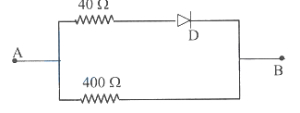
For the diagram shown,the resistances between points $A$ and $B$ when the ideal diode $D$ is forward biased is $R_1$ and when it is reverse biased is $R_2$. The ratio $R_1: R_2$ is
A
$2: 1$
B
$1: 1$
C
$1: 2$
D
$1: 11$
Solution
(D) When the diode $D$ is forward biased,it acts as a short circuit (zero resistance). The circuit consists of two resistors of $40 \ \Omega$ and $400 \ \Omega$ in parallel.
Therefore,the effective resistance $R_1$ is given by:
$R_1 = \frac{40 \times 400}{40 + 400} = \frac{16000}{440} = \frac{1600}{44} = \frac{400}{11} \ \Omega$
When the diode $D$ is reverse biased,it acts as an open circuit (infinite resistance). No current flows through the upper branch.
Therefore,the effective resistance $R_2$ is simply the resistance of the lower branch:
$R_2 = 400 \ \Omega$
Now,calculating the ratio $R_1: R_2$:
$\frac{R_1}{R_2} = \frac{400/11}{400} = \frac{1}{11}$
Thus,the ratio $R_1: R_2$ is $1: 11$.
Therefore,the effective resistance $R_1$ is given by:
$R_1 = \frac{40 \times 400}{40 + 400} = \frac{16000}{440} = \frac{1600}{44} = \frac{400}{11} \ \Omega$
When the diode $D$ is reverse biased,it acts as an open circuit (infinite resistance). No current flows through the upper branch.
Therefore,the effective resistance $R_2$ is simply the resistance of the lower branch:
$R_2 = 400 \ \Omega$
Now,calculating the ratio $R_1: R_2$:
$\frac{R_1}{R_2} = \frac{400/11}{400} = \frac{1}{11}$
Thus,the ratio $R_1: R_2$ is $1: 11$.
0 likesView Solution
277
PhysicsEasyMCQMHT CET · 2023
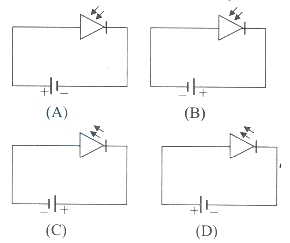
Identify the correct circuit diagrams for the normal operation from the following.
A
$(A), (B)$
B
$(B), (C)$
C
$(A), (C)$
D
$(B), (D)$
Solution
(D) photodiode is operated under reverse bias conditions. In circuit $(B)$,the $p$-side is connected to the negative terminal and the $n$-side to the positive terminal,which is reverse bias. Thus,$(B)$ is correct for a photodiode.
An $LED$ (Light Emitting Diode) is operated under forward bias conditions. In circuit $(D)$,the $p$-side is connected to the positive terminal and the $n$-side to the negative terminal,which is forward bias. Thus,$(D)$ is correct for an $LED$.
Therefore,the correct circuit diagrams for normal operation are $(B)$ and $(D)$.
An $LED$ (Light Emitting Diode) is operated under forward bias conditions. In circuit $(D)$,the $p$-side is connected to the positive terminal and the $n$-side to the negative terminal,which is forward bias. Thus,$(D)$ is correct for an $LED$.
Therefore,the correct circuit diagrams for normal operation are $(B)$ and $(D)$.
0 likesView Solution
278
PhysicsEasyMCQMHT CET · 2023
If a $p-n$ junction diode is in forward bias,then:
A
width of depletion layer increases
B
electric conduction is not possible at all
C
barrier voltage increases
D
width of depletion layer decreases
Solution
(D) In a $p-n$ junction diode,when it is in forward bias,the positive terminal of the battery is connected to the $p$-region and the negative terminal to the $n$-region.
This external electric field opposes the internal barrier electric field.
As a result,the majority charge carriers are pushed towards the junction,which reduces the width of the depletion layer.
Therefore,the barrier potential decreases,allowing current to flow easily through the diode.
This external electric field opposes the internal barrier electric field.
As a result,the majority charge carriers are pushed towards the junction,which reduces the width of the depletion layer.
Therefore,the barrier potential decreases,allowing current to flow easily through the diode.
0 likesView Solution
279
PhysicsEasyMCQMHT CET · 2023
When forward bias is applied to a $p-n$ junction,then what happens to the potential barrier $(V_B)$ and the width $(X)$ of the depletion region?
A
$V_B$ increases,$X$ decreases
B
$V_B$ decreases,$X$ increases
C
$V_B$ increases,$X$ increases
D
$V_B$ decreases,$X$ decreases
Solution
(D) When a $p-n$ junction is forward biased,the positive terminal of the external battery is connected to the $p$-type region and the negative terminal to the $n$-type region.
This external electric field opposes the internal electric field of the depletion region.
As a result,the effective potential barrier $(V_B)$ decreases.
Due to the reduction in the potential barrier,the majority charge carriers are pushed towards the junction,which causes the width $(X)$ of the depletion region to decrease.
Therefore,both the potential barrier and the width of the depletion region decrease.
This external electric field opposes the internal electric field of the depletion region.
As a result,the effective potential barrier $(V_B)$ decreases.
Due to the reduction in the potential barrier,the majority charge carriers are pushed towards the junction,which causes the width $(X)$ of the depletion region to decrease.
Therefore,both the potential barrier and the width of the depletion region decrease.
0 likesView Solution
280
PhysicsEasyMCQMHT CET · 2023
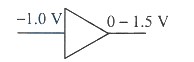
In which figure,the junction diode is forward biased?
A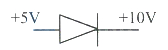
B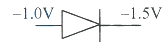
C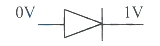
D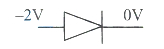
Solution
(B) junction diode is forward biased when the potential at the $P$-terminal $(V_P)$ is higher than the potential at the $N$-terminal $(V_N)$,i.e.,$V_P > V_N$.
Let us analyze each option:
$A$: $V_P = +5 \ V$,$V_N = +10 \ V$. Here $V_P < V_N$,so it is reverse biased.
$B$: $V_P = -1.0 \ V$,$V_N = -1.5 \ V$. Here $V_P > V_N$ (since $-1.0 > -1.5$),so it is forward biased.
$C$: $V_P = 0 \ V$,$V_N = +1 \ V$. Here $V_P < V_N$,so it is reverse biased.
$D$: $V_P = -2 \ V$,$V_N = 0 \ V$. Here $V_P < V_N$,so it is reverse biased.
Therefore,the correct option is $B$.
Let us analyze each option:
$A$: $V_P = +5 \ V$,$V_N = +10 \ V$. Here $V_P < V_N$,so it is reverse biased.
$B$: $V_P = -1.0 \ V$,$V_N = -1.5 \ V$. Here $V_P > V_N$ (since $-1.0 > -1.5$),so it is forward biased.
$C$: $V_P = 0 \ V$,$V_N = +1 \ V$. Here $V_P < V_N$,so it is reverse biased.
$D$: $V_P = -2 \ V$,$V_N = 0 \ V$. Here $V_P < V_N$,so it is reverse biased.
Therefore,the correct option is $B$.
0 likesView Solution
281
PhysicsEasyMCQMHT CET · 2023
On increasing the reverse bias to a large value in a $P-N$ junction diode,current
A
increase slowly.
B
remains fixed.
C
suddenly increases.
D
decreases slowly.
Solution
(C) In a $P-N$ junction diode,when the reverse bias voltage is increased to a large value,it eventually reaches the breakdown voltage.
At this point,the covalent bonds in the crystal lattice break,leading to a rapid generation of charge carriers.
Consequently,the current through the diode suddenly increases.
At this point,the covalent bonds in the crystal lattice break,leading to a rapid generation of charge carriers.
Consequently,the current through the diode suddenly increases.
0 likesView Solution
282
PhysicsEasyMCQMHT CET · 2023
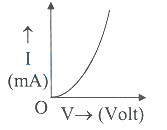
The following graph represents:
A
forward bias characteristics of a solar cell
B
reverse bias characteristics of a Zener diode
C
reverse bias characteristics of a photodiode
D
forward bias characteristics of a $LED$
Solution
(D) The graph shows current $I$ in $mA$ on the $y$-axis and voltage $V$ in $Volt$ on the $x$-axis in the first quadrant,indicating forward bias characteristics.
Among the given options,a Light Emitting Diode $(LED)$ operates in forward bias,where the current increases exponentially with voltage after the threshold voltage is reached,leading to light emission due to the recombination of charge carriers.
Therefore,the graph represents the forward bias characteristics of an $LED$.
Among the given options,a Light Emitting Diode $(LED)$ operates in forward bias,where the current increases exponentially with voltage after the threshold voltage is reached,leading to light emission due to the recombination of charge carriers.
Therefore,the graph represents the forward bias characteristics of an $LED$.
0 likesView Solution
283
PhysicsEasyMCQMHT CET · 2023
In insulators,which of the following statements is correct regarding their energy bands?
A
valence band is empty and conduction band is filled with electrons.
B
conduction band is empty and valence band is completely filled with electrons.
C
valence band is partially filled.
D
conduction band is partially filled with electrons.
Solution
(B) In insulators,the energy gap between the valence band and the conduction band is very large (typically $> 3 \ eV$).
At absolute zero temperature,the valence band is completely filled with electrons,and the conduction band is completely empty.
Due to the large energy gap,electrons cannot jump from the valence band to the conduction band even at room temperature,which is why insulators do not conduct electricity.
At absolute zero temperature,the valence band is completely filled with electrons,and the conduction band is completely empty.
Due to the large energy gap,electrons cannot jump from the valence band to the conduction band even at room temperature,which is why insulators do not conduct electricity.
0 likesView Solution
284
PhysicsEasyMCQMHT CET · 2023
In the energy band diagram of insulators,the band gap and the conduction band are respectively:
A
very low and partially filled.
B
very high and completely filled.
C
very high and empty.
D
very low and empty.
Solution
(C) In insulators,the valence band is completely filled with electrons,and the conduction band is completely empty.
There is a very large energy band gap (typically $E_g > 3 \ eV$) between the valence band and the conduction band.
Because of this large energy gap,electrons cannot easily jump from the valence band to the conduction band,even at room temperature.
Therefore,the band gap is very high and the conduction band is empty.
Thus,the correct option is $C$.
There is a very large energy band gap (typically $E_g > 3 \ eV$) between the valence band and the conduction band.
Because of this large energy gap,electrons cannot easily jump from the valence band to the conduction band,even at room temperature.
Therefore,the band gap is very high and the conduction band is empty.
Thus,the correct option is $C$.
0 likesView Solution
285
PhysicsEasyMCQMHT CET · 2023
In semiconductors at room temperature,
A
the valence band is completely filled
B
the conduction band is completely filled
C
the conduction band is partially filled and valence band is partially empty
D
the valence band is completely filled and the conduction band is partially filled
Solution
(D) At room temperature,thermal energy is sufficient to excite some electrons from the valence band to the conduction band in a semiconductor.
However,the number of electrons excited is very small compared to the total number of electrons in the valence band.
Therefore,the valence band remains almost completely filled,and the conduction band contains only a small number of electrons,making it partially filled.
Thus,the correct description is that the valence band is almost completely filled and the conduction band is partially filled.
However,the number of electrons excited is very small compared to the total number of electrons in the valence band.
Therefore,the valence band remains almost completely filled,and the conduction band contains only a small number of electrons,making it partially filled.
Thus,the correct description is that the valence band is almost completely filled and the conduction band is partially filled.
0 likesView Solution
286
PhysicsMediumMCQMHT CET · 2023
In a transistor,in common emitter configuration,the ratio of power gain to voltage gain is
A
$\alpha$
B
$\frac{\beta}{\alpha}$
C
$\beta \alpha$
D
$\beta$
Solution
(D) The power gain of an amplifier is defined as the product of voltage gain and current gain.
$\text{Power Gain} = \text{Voltage Gain} \times \text{Current Gain}$
Therefore,the ratio of power gain to voltage gain is equal to the current gain.
In a common emitter configuration,the current gain is denoted by $\beta$.
Thus,$\frac{\text{Power Gain}}{\text{Voltage Gain}} = \beta$.
$\text{Power Gain} = \text{Voltage Gain} \times \text{Current Gain}$
Therefore,the ratio of power gain to voltage gain is equal to the current gain.
In a common emitter configuration,the current gain is denoted by $\beta$.
Thus,$\frac{\text{Power Gain}}{\text{Voltage Gain}} = \beta$.
0 likesView Solution
287
PhysicsEasyMCQMHT CET · 2023
Which one of the operations of $n-p-n$ transistor differs from that of $p-n-p$ transistor?
A
The emitter-base junction is reverse biased in $n-p-n$ transistor.
B
The emitter injects minority carriers into the base region of the $p-n-p$ transistor.
C
The emitter injects holes into the base of the $p-n-p$ transistor and electrons into the base region of $n-p-n$ transistor.
D
The emitter injects holes into the base of $n-p-n$ transistor.
Solution
(C) In a transistor,the emitter-base junction is always forward-biased to allow charge carriers to move into the base.
In an $n-p-n$ transistor,the emitter is $n$-type,so it injects electrons (majority carriers) into the base.
In a $p-n-p$ transistor,the emitter is $p$-type,so it injects holes (majority carriers) into the base.
Therefore,the primary difference in operation is the type of charge carrier injected by the emitter into the base region: $p-n-p$ injects holes,while $n-p-n$ injects electrons.
In an $n-p-n$ transistor,the emitter is $n$-type,so it injects electrons (majority carriers) into the base.
In a $p-n-p$ transistor,the emitter is $p$-type,so it injects holes (majority carriers) into the base.
Therefore,the primary difference in operation is the type of charge carrier injected by the emitter into the base region: $p-n-p$ injects holes,while $n-p-n$ injects electrons.
0 likesView Solution
288
PhysicsMediumMCQMHT CET · 2023
In the study of a transistor as an amplifier,if $\alpha = \frac{I_C}{I_E} = 0.98$ and $\beta = \frac{I_C}{I_B} = 49$,where $I_C, I_B,$ and $I_E$ are collector,base,and emitter currents respectively,then $\left(\frac{1}{\alpha} - \frac{1}{\beta}\right)$ is equal to:
A
zero
B
$\frac{1}{2}$
C
$2$
D
$1$
Solution
(D) We know the relationship between current gains $\alpha$ and $\beta$ is given by $\beta = \frac{\alpha}{1 - \alpha}$.
Alternatively,we can use the fundamental current relation $I_E = I_C + I_B$.
Dividing by $I_C$,we get $\frac{I_E}{I_C} = 1 + \frac{I_B}{I_C}$.
This implies $\frac{1}{\alpha} = 1 + \frac{1}{\beta}$.
Rearranging the terms,we get $\frac{1}{\alpha} - \frac{1}{\beta} = 1$.
Substituting the given values: $\frac{1}{0.98} - \frac{1}{49} \approx 1.0204 - 0.0204 = 1$.
Alternatively,we can use the fundamental current relation $I_E = I_C + I_B$.
Dividing by $I_C$,we get $\frac{I_E}{I_C} = 1 + \frac{I_B}{I_C}$.
This implies $\frac{1}{\alpha} = 1 + \frac{1}{\beta}$.
Rearranging the terms,we get $\frac{1}{\alpha} - \frac{1}{\beta} = 1$.
Substituting the given values: $\frac{1}{0.98} - \frac{1}{49} \approx 1.0204 - 0.0204 = 1$.
0 likesView Solution
289
PhysicsMediumMCQMHT CET · 2023
In an $n-p-n$ transistor, the collector current is $28 \,mA$. If $80 \%$ of electrons reach the collector, its base current in $mA$ is
A
$35$
B
$24$
C
$14$
D
$7$
Solution
(D) It is given that $80 \%$ of the emitted electrons reach the collector, which means the collector current $I_c$ is $80 \%$ of the emitter current $I_e$.
$I_c = 0.80 \times I_e$
Given $I_c = 28 \,mA$, we have $28 = 0.80 \times I_e$.
$I_e = \frac{28}{0.80} = 35 \,mA$.
Using the relation for transistor currents, $I_e = I_c + I_b$, we can find the base current $I_b$.
$I_b = I_e - I_c = 35 \,mA - 28 \,mA = 7 \,mA$.
$I_c = 0.80 \times I_e$
Given $I_c = 28 \,mA$, we have $28 = 0.80 \times I_e$.
$I_e = \frac{28}{0.80} = 35 \,mA$.
Using the relation for transistor currents, $I_e = I_c + I_b$, we can find the base current $I_b$.
$I_b = I_e - I_c = 35 \,mA - 28 \,mA = 7 \,mA$.
0 likesView Solution
290
PhysicsMediumMCQMHT CET · 2023
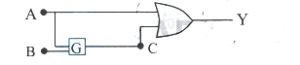
To get the truth table shown, from the following logic circuit, the Gate $G$ should be
| $A$ | $B$ | $Y$ |
| $0$ | $0$ | $0$ |
| $0$ | $1$ | $0$ |
| $1$ | $0$ | $1$ |
| $1$ | $1$ | $1$ |
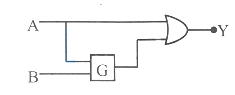
A
$OR$
B
$AND$
C
$NOR$
D
$NAND$
Solution
(B) The circuit consists of an $OR$ gate with inputs $A$ and $C$, where $C$ is the output of gate $G$ with inputs $A$ and $B$. Thus, the output is $Y = A + C = A + (A \text{ gate } B)$.
Let's test the options for gate $G$:
$1$. If $G$ is $AND$, then $C = A \cdot B$. The output $Y = A + (A \cdot B)$.
For $(A, B) = (0, 0)$, $Y = 0 + (0 \cdot 0) = 0$.
For $(A, B) = (0, 1)$, $Y = 0 + (0 \cdot 1) = 0$.
For $(A, B) = (1, 0)$, $Y = 1 + (1 \cdot 0) = 1$.
For $(A, B) = (1, 1)$, $Y = 1 + (1 \cdot 1) = 1$.
This matches the given truth table perfectly. Therefore, $G$ must be an $AND$ gate.
Let's test the options for gate $G$:
$1$. If $G$ is $AND$, then $C = A \cdot B$. The output $Y = A + (A \cdot B)$.
For $(A, B) = (0, 0)$, $Y = 0 + (0 \cdot 0) = 0$.
For $(A, B) = (0, 1)$, $Y = 0 + (0 \cdot 1) = 0$.
For $(A, B) = (1, 0)$, $Y = 1 + (1 \cdot 0) = 1$.
For $(A, B) = (1, 1)$, $Y = 1 + (1 \cdot 1) = 1$.
This matches the given truth table perfectly. Therefore, $G$ must be an $AND$ gate.
0 likesView Solution
291
PhysicsEasyMCQMHT CET · 2023
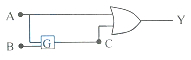
To obtain the truth-table shown, from the following logic circuit, the gate $G$ should be
| $A$ | $B$ | $Y$ |
|---|---|---|
| $0$ | $0$ | $1$ |
| $0$ | $1$ | $0$ |
| $1$ | $0$ | $1$ |
| $1$ | $1$ | $1$ |
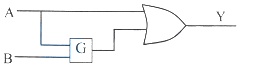
A
$AND$
B
$NAND$
C
$OR$
D
$NOR$
Solution
(D) The output of the circuit is given by $Y = A + C$, where $C$ is the output of gate $G$ with inputs $A$ and $B$. Thus, $C = A \text{ (gate } G) B$.
Let us test the options for gate $G$:
If $G$ is $NOR$, then $C = \overline{A+B}$.
The output $Y = A + \overline{A+B}$.
Let's verify this for all inputs:
$1$. For $A=0, B=0$: $C = \overline{0+0} = 1$. Then $Y = 0 + 1 = 1$. (Matches)
$2$. For $A=0, B=1$: $C = \overline{0+1} = 0$. Then $Y = 0 + 0 = 0$. (Matches)
$3$. For $A=1, B=0$: $C = \overline{1+0} = 0$. Then $Y = 1 + 0 = 1$. (Matches)
$4$. For $A=1, B=1$: $C = \overline{1+1} = 0$. Then $Y = 1 + 0 = 1$. (Matches)
Since all values match the given truth table, the gate $G$ is $NOR$.
Let us test the options for gate $G$:
If $G$ is $NOR$, then $C = \overline{A+B}$.
The output $Y = A + \overline{A+B}$.
Let's verify this for all inputs:
$1$. For $A=0, B=0$: $C = \overline{0+0} = 1$. Then $Y = 0 + 1 = 1$. (Matches)
$2$. For $A=0, B=1$: $C = \overline{0+1} = 0$. Then $Y = 0 + 0 = 0$. (Matches)
$3$. For $A=1, B=0$: $C = \overline{1+0} = 0$. Then $Y = 1 + 0 = 1$. (Matches)
$4$. For $A=1, B=1$: $C = \overline{1+1} = 0$. Then $Y = 1 + 0 = 1$. (Matches)
Since all values match the given truth table, the gate $G$ is $NOR$.
0 likesView Solution
292
PhysicsEasyMCQMHT CET · 2023
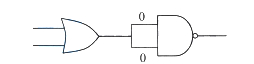
The output of an '$OR$' gate is connected to both the inputs of a '$NAND$' gate. The combination will serve as
A
$OR$ gate
B
$NOT$ gate
C
$NOR$ gate
D
$AND$ gate
Solution
(C) Let the inputs of the $OR$ gate be $A$ and $B$. The output of the $OR$ gate is $Y_1 = A + B$.
This output $Y_1$ is connected to both inputs of a $NAND$ gate. Let the inputs of the $NAND$ gate be $X_1 = Y_1$ and $X_2 = Y_1$.
The output of the $NAND$ gate is $Y = \overline{X_1 \cdot X_2} = \overline{Y_1 \cdot Y_1} = \overline{Y_1}$.
Since $Y_1 = A + B$,the final output is $Y = \overline{A + B}$.
This is the Boolean expression for a $NOR$ gate.
The truth table matches that of a $NOR$ gate.
This output $Y_1$ is connected to both inputs of a $NAND$ gate. Let the inputs of the $NAND$ gate be $X_1 = Y_1$ and $X_2 = Y_1$.
The output of the $NAND$ gate is $Y = \overline{X_1 \cdot X_2} = \overline{Y_1 \cdot Y_1} = \overline{Y_1}$.
Since $Y_1 = A + B$,the final output is $Y = \overline{A + B}$.
This is the Boolean expression for a $NOR$ gate.
| Input $(A, B)$ | Output of $OR$ gate $(Y_1 = A+B)$ | Final Output $(Y = \overline{Y_1})$ |
| $0, 0$ | $0$ | $1$ |
| $0, 1$ | $1$ | $0$ |
| $1, 0$ | $1$ | $0$ |
| $1, 1$ | $1$ | $0$ |
The truth table matches that of a $NOR$ gate.
0 likesView Solution
293
PhysicsEasyMCQMHT CET · 2023
In the case of a $NAND$ gate,if $A$ and $B$ are the inputs and $Y$ is the output,then:
A
$Y=A \cdot B$
B
$Y=\overline{A-B}$
C
$Y=\overline{A+B}$
D
$Y=\overline{A \cdot B}$
Solution
(D) $NAND$ gate is a combination of an $AND$ gate followed by a $NOT$ gate.
First,the $AND$ operation is performed on inputs $A$ and $B$,which results in $A \cdot B$.
Then,the $NOT$ operation is applied to this result,which inverts the output.
Therefore,the output $Y$ of a $NAND$ gate is given by the Boolean expression $Y = \overline{A \cdot B}$.
First,the $AND$ operation is performed on inputs $A$ and $B$,which results in $A \cdot B$.
Then,the $NOT$ operation is applied to this result,which inverts the output.
Therefore,the output $Y$ of a $NAND$ gate is given by the Boolean expression $Y = \overline{A \cdot B}$.
0 likesView Solution
294
PhysicsEasyMCQMHT CET · 2023
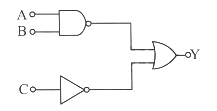
In the digital circuit,the inputs are as shown in the figure. The Boolean expression for output $Y$ is
A
$\overline{A+B}+\overline{C}$
B
$\overline{A \cdot B} \cdot \overline{C}$
C
$\overline{A \cdot B}+\overline{C}$
D
$\overline{A+B} \cdot \overline{C}$
Solution
(C) The given circuit consists of a $NAND$ gate and a $NOT$ gate,whose outputs are fed into an $OR$ gate.
$1$. The inputs $A$ and $B$ are fed into a $NAND$ gate. The output of the $NAND$ gate is $\overline{A \cdot B}$.
$2$. The input $C$ is fed into a $NOT$ gate. The output of the $NOT$ gate is $\overline{C}$.
$3$. These two outputs are then fed into an $OR$ gate. The $OR$ operation of two inputs $X$ and $Z$ is $X+Z$.
$4$. Therefore,the final output $Y$ is the $OR$ sum of the two previous outputs: $Y = \overline{A \cdot B} + \overline{C}$.
$1$. The inputs $A$ and $B$ are fed into a $NAND$ gate. The output of the $NAND$ gate is $\overline{A \cdot B}$.
$2$. The input $C$ is fed into a $NOT$ gate. The output of the $NOT$ gate is $\overline{C}$.
$3$. These two outputs are then fed into an $OR$ gate. The $OR$ operation of two inputs $X$ and $Z$ is $X+Z$.
$4$. Therefore,the final output $Y$ is the $OR$ sum of the two previous outputs: $Y = \overline{A \cdot B} + \overline{C}$.
0 likesView Solution
295
PhysicsEasyMCQMHT CET · 2023
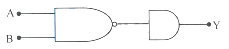
The logic gate combination circuit shown in the figure performs the logic function of
A
$AND$ gate
B
$NAND$ gate
C
$OR$ gate
D
The gate is not operational
Solution
(D) The circuit consists of a $NAND$ gate followed by an $AND$ gate.
In the provided diagram,the output of the $NAND$ gate is connected to only one input terminal of the $AND$ gate.
An $AND$ gate is a multi-input logic gate that requires at least two input signals to perform its logical operation.
Since the $AND$ gate in this circuit is receiving only one input,it cannot function as a standard logic gate.
Therefore,the gate is not operational.
In the provided diagram,the output of the $NAND$ gate is connected to only one input terminal of the $AND$ gate.
An $AND$ gate is a multi-input logic gate that requires at least two input signals to perform its logical operation.
Since the $AND$ gate in this circuit is receiving only one input,it cannot function as a standard logic gate.
Therefore,the gate is not operational.
0 likesView Solution
296
PhysicsEasyMCQMHT CET · 2023
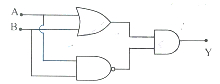
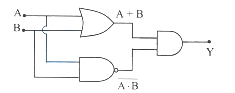
The following logic gate combination is equivalent to
A
$NAND$ gate
B
$OR$ gate
C
$XOR$ gate
D
$NOT$ gate
Solution
(C) The given circuit consists of an $OR$ gate and a $NAND$ gate whose outputs are fed into an $AND$ gate.
Let the inputs be $A$ and $B$.
The output of the $OR$ gate is $(A + B)$.
The output of the $NAND$ gate is $(\overline{A \cdot B})$.
These are the inputs to the final $AND$ gate.
Therefore,the final output $Y$ is given by:
$Y = (A + B) \cdot (\overline{A \cdot B})$
Using De Morgan's theorem,$\overline{A \cdot B} = \bar{A} + \bar{B}$.
$Y = (A + B) \cdot (\bar{A} + \bar{B})$
$Y = A \cdot \bar{A} + A \cdot \bar{B} + B \cdot \bar{A} + B \cdot \bar{B}$
Since $A \cdot \bar{A} = 0$ and $B \cdot \bar{B} = 0$,we have:
$Y = 0 + A \cdot \bar{B} + B \cdot \bar{A} + 0$
$Y = A \cdot \bar{B} + \bar{A} \cdot B$
This is the Boolean expression for an $XOR$ gate.
Let the inputs be $A$ and $B$.
The output of the $OR$ gate is $(A + B)$.
The output of the $NAND$ gate is $(\overline{A \cdot B})$.
These are the inputs to the final $AND$ gate.
Therefore,the final output $Y$ is given by:
$Y = (A + B) \cdot (\overline{A \cdot B})$
Using De Morgan's theorem,$\overline{A \cdot B} = \bar{A} + \bar{B}$.
$Y = (A + B) \cdot (\bar{A} + \bar{B})$
$Y = A \cdot \bar{A} + A \cdot \bar{B} + B \cdot \bar{A} + B \cdot \bar{B}$
Since $A \cdot \bar{A} = 0$ and $B \cdot \bar{B} = 0$,we have:
$Y = 0 + A \cdot \bar{B} + B \cdot \bar{A} + 0$
$Y = A \cdot \bar{B} + \bar{A} \cdot B$
This is the Boolean expression for an $XOR$ gate.
0 likesView Solution
297
PhysicsEasyMCQMHT CET · 2023
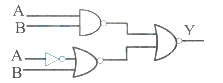
In the following digital logic circuit,the output $Y$ will be ' $1$ ' for inputs:
A
$A=0, B=0$
B
$A=0, B=1$
C
$A=1, B=0$
D
$A=1, B=1$
Solution
(D) The circuit consists of one $NAND$ gate,one $NOT$ gate,one $NOR$ gate,and one final $NOR$ gate.
Let the output of the top $NAND$ gate be $Y_1 = \overline{A \cdot B}$.
Let the output of the bottom branch ($NOT$ gate followed by $NOR$ gate) be $Y_2 = \overline{\overline{A} + B}$.
The final output $Y$ is the output of a $NOR$ gate with inputs $Y_1$ and $Y_2$,so $Y = \overline{Y_1 + Y_2} = \overline{(\overline{A \cdot B}) + (\overline{\overline{A} + B})}$.
Testing the options:
For $A=1, B=1$:
$Y_1 = \overline{1 \cdot 1} = 0$
$Y_2 = \overline{\overline{1} + 1} = \overline{0 + 1} = 0$
$Y = \overline{0 + 0} = 1$.
Thus,for $A=1, B=1$,the output $Y$ is $1$.
Let the output of the top $NAND$ gate be $Y_1 = \overline{A \cdot B}$.
Let the output of the bottom branch ($NOT$ gate followed by $NOR$ gate) be $Y_2 = \overline{\overline{A} + B}$.
The final output $Y$ is the output of a $NOR$ gate with inputs $Y_1$ and $Y_2$,so $Y = \overline{Y_1 + Y_2} = \overline{(\overline{A \cdot B}) + (\overline{\overline{A} + B})}$.
Testing the options:
For $A=1, B=1$:
$Y_1 = \overline{1 \cdot 1} = 0$
$Y_2 = \overline{\overline{1} + 1} = \overline{0 + 1} = 0$
$Y = \overline{0 + 0} = 1$.
Thus,for $A=1, B=1$,the output $Y$ is $1$.
0 likesView Solution
298
PhysicsEasyMCQMHT CET · 2023
If two inputs of a $NAND$ gate are shorted,the resulting gate is
A
an $OR$ gate
B
a $AND$ gate
C
an $NOT$ gate
D
a $NOR$ gate
Solution
(C) $NAND$ gate has two inputs,say $A$ and $B$,and its output is given by $Y = \overline{A \cdot B}$.
If the two inputs are shorted,then $A = B$. Let this common input be $A$.
Substituting this into the $NAND$ expression,we get $Y = \overline{A \cdot A}$.
Since $A \cdot A = A$ in Boolean algebra,the expression becomes $Y = \overline{A}$.
The expression $Y = \overline{A}$ represents the operation of a $NOT$ gate.
Therefore,when the inputs of a $NAND$ gate are shorted,it functions as a $NOT$ gate.
If the two inputs are shorted,then $A = B$. Let this common input be $A$.
Substituting this into the $NAND$ expression,we get $Y = \overline{A \cdot A}$.
Since $A \cdot A = A$ in Boolean algebra,the expression becomes $Y = \overline{A}$.
The expression $Y = \overline{A}$ represents the operation of a $NOT$ gate.
Therefore,when the inputs of a $NAND$ gate are shorted,it functions as a $NOT$ gate.
0 likesView Solution
299
PhysicsEasyMCQMHT CET · 2023
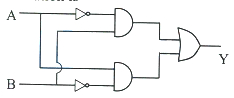
The Boolean expression for the following combination is
A
$(\overline{A+B})\cdot(A+B)$
B
$(\overline{A \cdot B})+(A \cdot B)$
C
$(\overline{A} \cdot B)+(A \cdot \overline{B})$
D
$(\overline{A}+B)\cdot(A+\overline{B})$
Solution
(C) The given circuit consists of two $NOT$ gates,two $AND$ gates,and one $OR$ gate.
$1$. The input $A$ passes through a $NOT$ gate to become $\overline{A}$,and input $B$ goes directly to the first $AND$ gate. The output of this $AND$ gate is $\overline{A} \cdot B$.
$2$. The input $B$ passes through a $NOT$ gate to become $\overline{B}$,and input $A$ goes directly to the second $AND$ gate. The output of this $AND$ gate is $A \cdot \overline{B}$.
$3$. These two outputs are then fed into an $OR$ gate. The final output $Y$ is the sum of these two expressions: $Y = (\overline{A} \cdot B) + (A \cdot \overline{B})$.
This is the Boolean expression for an $XOR$ gate.
$1$. The input $A$ passes through a $NOT$ gate to become $\overline{A}$,and input $B$ goes directly to the first $AND$ gate. The output of this $AND$ gate is $\overline{A} \cdot B$.
$2$. The input $B$ passes through a $NOT$ gate to become $\overline{B}$,and input $A$ goes directly to the second $AND$ gate. The output of this $AND$ gate is $A \cdot \overline{B}$.
$3$. These two outputs are then fed into an $OR$ gate. The final output $Y$ is the sum of these two expressions: $Y = (\overline{A} \cdot B) + (A \cdot \overline{B})$.
This is the Boolean expression for an $XOR$ gate.
0 likesView Solution
300
PhysicsEasyMCQMHT CET · 2023
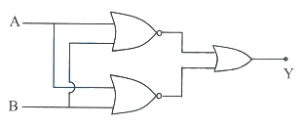
The output of the following combination is the same as that of:
A
$AND$ gate
B
$OR$ gate
C
$NAND$ gate
D
$NOR$ gate
Solution
(D) The given circuit consists of two $NOR$ gates whose outputs are fed into an $OR$ gate. Let the inputs be $A$ and $B$. The output of the top $NOR$ gate is $C = \overline{A+B}$ and the output of the bottom $NOR$ gate is $D = \overline{A+B}$. These are fed into an $OR$ gate,so the final output is $Y = C + D = \overline{A+B} + \overline{A+B} = \overline{A+B}$.
The truth table for this combination is:
Comparing this with the truth table of standard logic gates,the output $Y$ is $1$ only when both $A$ and $B$ are $0$,which is the characteristic behavior of a $NOR$ gate.
The truth table for this combination is:
| $A$ | $B$ | $C = \overline{A+B}$ | $D = \overline{A+B}$ | $Y = C + D$ |
|---|---|---|---|---|
| $0$ | $0$ | $1$ | $1$ | $1$ |
| $0$ | $1$ | $0$ | $0$ | $0$ |
| $1$ | $0$ | $0$ | $0$ | $0$ |
| $1$ | $1$ | $0$ | $0$ | $0$ |
Comparing this with the truth table of standard logic gates,the output $Y$ is $1$ only when both $A$ and $B$ are $0$,which is the characteristic behavior of a $NOR$ gate.
0 likesView Solution
301
PhysicsMediumMCQMHT CET · 2023
If the frequency of the input voltage is $50 \,Hz$, applied to a $(a)$ half-wave rectifier and $(b)$ full-wave rectifier, what is the output frequency in both cases, respectively?
A
$50 \,Hz, 50 \,Hz$
B
$50 \,Hz, 100 \,Hz$
C
$100 \,Hz, 100 \,Hz$
D
$100 \,Hz, 50 \,Hz$
Solution
(B) In a half-wave rectifier, the output pulse occurs once per input cycle. Therefore, the output frequency is equal to the input frequency, which is $50 \,Hz$.
In a full-wave rectifier, the output pulse occurs twice per input cycle (once for each half-cycle). Therefore, the output frequency is double the input frequency, which is $2 \times 50 \,Hz = 100 \,Hz$.
Thus, the output frequencies are $50 \,Hz$ and $100 \,Hz$ respectively.
In a full-wave rectifier, the output pulse occurs twice per input cycle (once for each half-cycle). Therefore, the output frequency is double the input frequency, which is $2 \times 50 \,Hz = 100 \,Hz$.
Thus, the output frequencies are $50 \,Hz$ and $100 \,Hz$ respectively.
0 likesView Solution
302
PhysicsEasyMCQMHT CET · 2023
If the maximum efficiency of a full wave rectifier is $x \%$ and that of a half wave rectifier is $y \%$,then the relation between $x$ and $y$ is
A
$x=y$
B
$y=2x$
C
$x=2y$
D
$y=4x$
Solution
(C) The maximum efficiency of a full wave rectifier is given by $x = 81.2 \%$.
The maximum efficiency of a half wave rectifier is given by $y = 40.6 \%$.
Comparing these two values,we find that $x = 2 \times 40.6 \% = 2y$.
Therefore,the correct relation is $x = 2y$.
The maximum efficiency of a half wave rectifier is given by $y = 40.6 \%$.
Comparing these two values,we find that $x = 2 \times 40.6 \% = 2y$.
Therefore,the correct relation is $x = 2y$.
0 likesView Solution
303
PhysicsMediumMCQMHT CET · 2023
For an intrinsic semiconductor,where $n_{h}$ and $n_{e}$ are the number of holes per unit volume and the number of electrons per unit volume respectively,which of the following relations holds true?
A
$n_{h} < n_{e}$
B
$n_{h} = n_{e}$
C
$n_{h} = \frac{n_{e}}{2}$
D
$n_{h} > n_{e}$
Solution
(B) An intrinsic semiconductor is a pure semiconductor without any significant dopant species present.
In an intrinsic semiconductor,charge carriers are generated solely due to thermal excitation.
When a covalent bond breaks due to thermal energy,an electron is excited from the valence band to the conduction band,leaving behind a hole in the valence band.
Since each electron-hole pair is created simultaneously,the number of electrons in the conduction band $(n_{e})$ must be equal to the number of holes in the valence band $(n_{h})$.
Therefore,for an intrinsic semiconductor,$n_{h} = n_{e}$.
In an intrinsic semiconductor,charge carriers are generated solely due to thermal excitation.
When a covalent bond breaks due to thermal energy,an electron is excited from the valence band to the conduction band,leaving behind a hole in the valence band.
Since each electron-hole pair is created simultaneously,the number of electrons in the conduction band $(n_{e})$ must be equal to the number of holes in the valence band $(n_{h})$.
Therefore,for an intrinsic semiconductor,$n_{h} = n_{e}$.
0 likesView Solution
304
PhysicsMediumMCQMHT CET · 2023
$A$ pure $Si$ crystal has $4 \times 10^{28}$ atoms per $m^3$. It is doped with $1 \text{ ppm}$ concentration of antimony. The number of free electrons available will be
A
$4 \times 10^{34} \ m^{-3}$
B
$4 \times 10^{28} \ m^{-3}$
C
$4 \times 10^{22} \ m^{-3}$
D
$4 \times 10^{20} \ m^{-3}$
Solution
(C) Given: Density of $Si$ atoms $= 4 \times 10^{28} \text{ atoms}/m^3$.
After doping with $1 \text{ ppm}$ (part per million) of $Sb$ (antimony),the concentration of $Sb$ atoms is:
$\text{Number of } Sb \text{ atoms} = \frac{4 \times 10^{28}}{10^6} = 4 \times 10^{22} \text{ atoms}/m^3$.
Since $Sb$ is a pentavalent impurity,each $Sb$ atom donates one free electron to the crystal lattice.
Therefore,the total number of free electrons available will be $4 \times 10^{22} \ m^{-3}$.
After doping with $1 \text{ ppm}$ (part per million) of $Sb$ (antimony),the concentration of $Sb$ atoms is:
$\text{Number of } Sb \text{ atoms} = \frac{4 \times 10^{28}}{10^6} = 4 \times 10^{22} \text{ atoms}/m^3$.
Since $Sb$ is a pentavalent impurity,each $Sb$ atom donates one free electron to the crystal lattice.
Therefore,the total number of free electrons available will be $4 \times 10^{22} \ m^{-3}$.
0 likesView Solution
305
PhysicsEasyMCQMHT CET · 2023
Doping of a semiconductor (with small impurity atoms) generally changes the resistivity as follows.
A
Decreases
B
Does not change
C
May increase or decrease depending on the dopant
D
Increases
Solution
(A) The resistivity of a semiconductor is given by $\rho = \frac{1}{\sigma} = \frac{1}{e(n_e \mu_e + n_h \mu_h)}$.
When a semiconductor is doped with impurity atoms,the concentration of charge carriers ($n_e$ or $n_h$) increases significantly.
Since the conductivity $\sigma$ is directly proportional to the carrier concentration,the conductivity increases.
Because resistivity $\rho$ is the reciprocal of conductivity,an increase in conductivity leads to a decrease in resistivity.
Therefore,doping generally decreases the resistivity of a semiconductor.
When a semiconductor is doped with impurity atoms,the concentration of charge carriers ($n_e$ or $n_h$) increases significantly.
Since the conductivity $\sigma$ is directly proportional to the carrier concentration,the conductivity increases.
Because resistivity $\rho$ is the reciprocal of conductivity,an increase in conductivity leads to a decrease in resistivity.
Therefore,doping generally decreases the resistivity of a semiconductor.
0 likesView Solution
306
PhysicsMediumMCQMHT CET · 2023
For a common emitter configuration,if $\alpha$ and $\beta$ have their usual meanings,the incorrect relation between $\alpha$ and $\beta$ is
A
$\frac{1}{\alpha} = \frac{1}{\beta} + 1$
B
$\alpha = \frac{\beta}{1 - \beta}$
C
$\alpha = \frac{\beta}{1 + \beta}$
D
$\frac{1}{\beta} = \frac{1}{\alpha} - 1$
Solution
(B) In a transistor,the current gain parameters are defined as $\beta = \frac{I_C}{I_B}$ and $\alpha = \frac{I_C}{I_E}$.
Since $I_E = I_B + I_C$,we can write $\alpha = \frac{I_C}{I_B + I_C}$.
Dividing the numerator and denominator by $I_C$,we get $\alpha = \frac{1}{\frac{I_B}{I_C} + 1} = \frac{1}{\frac{1}{\beta} + 1} = \frac{\beta}{1 + \beta}$.
From this,we can derive $\frac{1}{\alpha} = \frac{1 + \beta}{\beta} = \frac{1}{\beta} + 1$,which implies $\frac{1}{\beta} = \frac{1}{\alpha} - 1$.
Comparing these with the given options,the relation $\alpha = \frac{\beta}{1 - \beta}$ is incorrect.
Since $I_E = I_B + I_C$,we can write $\alpha = \frac{I_C}{I_B + I_C}$.
Dividing the numerator and denominator by $I_C$,we get $\alpha = \frac{1}{\frac{I_B}{I_C} + 1} = \frac{1}{\frac{1}{\beta} + 1} = \frac{\beta}{1 + \beta}$.
From this,we can derive $\frac{1}{\alpha} = \frac{1 + \beta}{\beta} = \frac{1}{\beta} + 1$,which implies $\frac{1}{\beta} = \frac{1}{\alpha} - 1$.
Comparing these with the given options,the relation $\alpha = \frac{\beta}{1 - \beta}$ is incorrect.
0 likesView Solution
307
PhysicsEasyMCQMHT CET · 2023
When the conductivity of a semiconductor is only due to the breaking of the covalent bonds,the semiconductor is called
A
donor
B
intrinsic
C
acceptor
D
extrinsic
Solution
(B) semiconductor in which the conductivity is solely due to the thermal excitation of electrons from the valence band to the conduction band,resulting in the breaking of covalent bonds,is known as an intrinsic semiconductor. In this state,the number of free electrons is equal to the number of holes $(n_e = n_h)$. Therefore,the correct option is $B$.
0 likesView Solution
308
PhysicsEasyMCQMHT CET · 2023
Which one of the following statements is $WRONG$ regarding $LED$?
A
LEDs are energy efficient.
B
LEDs have a long lifespan if properly manufactured.
C
Brightness of light emitted by $LED$ cannot be controlled.
D
Colours produced by $LED$ do not fade out.
Solution
(C) The correct answer is $C$.
$1$. LEDs are highly energy-efficient compared to conventional light sources.
$2$. LEDs have a very long operational lifespan when manufactured with high quality.
$3$. The brightness of light emitted by an $LED$ can be easily controlled by varying the forward current passing through it. Therefore,the statement that it cannot be controlled is incorrect.
$4$. The light emitted by LEDs is monochromatic and does not fade over time.
$1$. LEDs are highly energy-efficient compared to conventional light sources.
$2$. LEDs have a very long operational lifespan when manufactured with high quality.
$3$. The brightness of light emitted by an $LED$ can be easily controlled by varying the forward current passing through it. Therefore,the statement that it cannot be controlled is incorrect.
$4$. The light emitted by LEDs is monochromatic and does not fade over time.
0 likesView Solution
309
PhysicsEasyMCQMHT CET · 2023
For the emission of light,a light emitting diode $(LED)$ is:
A
always used in reverse biased condition
B
never used in forward or reverse biased condition
C
used both in forward and reverse biased condition depending upon its application
D
always used in forward biased condition
Solution
(D) light emitting diode $(LED)$ is a heavily doped $p-n$ junction diode which emits spontaneous radiation when forward biased.
In the forward biased condition,the potential barrier is reduced,allowing electrons from the $n$-region and holes from the $p$-region to cross the junction.
These charge carriers recombine at the junction,releasing energy in the form of photons (light).
Therefore,an $LED$ is always operated in the forward biased condition to emit light.
In the forward biased condition,the potential barrier is reduced,allowing electrons from the $n$-region and holes from the $p$-region to cross the junction.
These charge carriers recombine at the junction,releasing energy in the form of photons (light).
Therefore,an $LED$ is always operated in the forward biased condition to emit light.
0 likesView Solution
310
PhysicsMediumMCQMHT CET · 2023
In a biprism experiment,if the $5^{\text{th}}$ bright band with wavelength $\lambda_1$ coincides with the $6^{\text{th}}$ dark band with wavelength $\lambda_2$,then the ratio $(\lambda_1 / \lambda_2)$ is:
A
$\frac{7}{9}$
B
$\frac{10}{11}$
C
$\frac{11}{10}$
D
$\frac{9}{7}$
Solution
(C) The position of the $n^{\text{th}}$ bright fringe is given by $y_n = \frac{n \lambda_1 D}{d}$.
The position of the $m^{\text{th}}$ dark fringe is given by $y'_m = \frac{(2m - 1) \lambda_2 D}{2d}$.
Given that the $5^{\text{th}}$ bright band coincides with the $6^{\text{th}}$ dark band,we set $n = 5$ and $m = 6$:
$\frac{5 \lambda_1 D}{d} = \frac{(2 \times 6 - 1) \lambda_2 D}{2d}$
$\frac{5 \lambda_1 D}{d} = \frac{11 \lambda_2 D}{2d}$
Canceling $D$ and $d$ from both sides:
$5 \lambda_1 = \frac{11 \lambda_2}{2}$
$\frac{\lambda_1}{\lambda_2} = \frac{11}{5 \times 2} = \frac{11}{10}$
The position of the $m^{\text{th}}$ dark fringe is given by $y'_m = \frac{(2m - 1) \lambda_2 D}{2d}$.
Given that the $5^{\text{th}}$ bright band coincides with the $6^{\text{th}}$ dark band,we set $n = 5$ and $m = 6$:
$\frac{5 \lambda_1 D}{d} = \frac{(2 \times 6 - 1) \lambda_2 D}{2d}$
$\frac{5 \lambda_1 D}{d} = \frac{11 \lambda_2 D}{2d}$
Canceling $D$ and $d$ from both sides:
$5 \lambda_1 = \frac{11 \lambda_2}{2}$
$\frac{\lambda_1}{\lambda_2} = \frac{11}{5 \times 2} = \frac{11}{10}$
0 likesView Solution
311
PhysicsEasyMCQMHT CET · 2023
$A$ parallel beam of monochromatic light falls normally on a single narrow slit. The angular width of the central maximum in the resulting diffraction pattern
A
increases with increase of slit width.
B
decreases with increase of slit width.
C
decreases with decrease of slit width.
D
may increase or decrease with decrease of slit width.
Solution
(B) The angular width of the central maximum in a single-slit diffraction pattern is given by the formula $\theta = \frac{2\lambda}{a}$,where $\lambda$ is the wavelength of the light and $a$ is the width of the slit.
From this relation,it is clear that the angular width $\theta$ is inversely proportional to the slit width $a$,i.e.,$\theta \propto \frac{1}{a}$.
Therefore,as the slit width $a$ increases,the angular width of the central maximum decreases.
From this relation,it is clear that the angular width $\theta$ is inversely proportional to the slit width $a$,i.e.,$\theta \propto \frac{1}{a}$.
Therefore,as the slit width $a$ increases,the angular width of the central maximum decreases.
0 likesView Solution
312
PhysicsEasyMCQMHT CET · 2023
In the experiment of diffraction due to a single slit,if the slit width is decreased,the width of the central maximum
A
becomes zero.
B
does not change.
C
increases.
D
decreases.
Solution
(C) The angular width of the central maximum in a single-slit diffraction experiment is given by the formula $\beta = \frac{2\lambda D}{a}$,where $\lambda$ is the wavelength of light,$D$ is the distance of the screen from the slit,and $a$ is the slit width.
From this relation,it is clear that the width of the central maximum is inversely proportional to the slit width $(a)$.
Therefore,when the slit width $a$ is decreased,the width of the central maximum increases.
From this relation,it is clear that the width of the central maximum is inversely proportional to the slit width $(a)$.
Therefore,when the slit width $a$ is decreased,the width of the central maximum increases.
0 likesView Solution
313
PhysicsMediumMCQMHT CET · 2023
If $I_0$ is the intensity of the principal maximum in the single slit diffraction pattern,then what will be the intensity when the slit width is doubled?
A
$\frac{I_0}{2}$
B
$I_0$
C
$4 I_0$
D
$2 I_0$
Solution
(C) In a single-slit diffraction pattern,the intensity of the principal maximum is proportional to the square of the slit width $(a^2)$ and inversely proportional to the square of the wavelength. However,the total energy incident on the slit also increases as the slit width increases. Specifically,the intensity at the central maximum is given by $I_0 \propto a^2$. When the slit width $a$ is doubled to $2a$,the amplitude of the wavelets increases by a factor of $2$,and since intensity is proportional to the square of the amplitude,the intensity becomes $I \propto (2a)^2 = 4I_0$. However,the width of the central maximum decreases by half $(w = \frac{2\lambda D}{a})$,concentrating the energy into a smaller region. For a standard single-slit diffraction experiment where the source is coherent and the slit width is increased,the intensity of the central maximum increases by a factor of $4$.
0 likesView Solution
314
PhysicsMediumMCQMHT CET · 2023
Light waves from two coherent sources arrive at two points on a screen with path difference of $0$ and $\frac{\lambda}{2}$. The ratio of intensities at the points is $(\cos 0^{\circ}=1, \cos \pi=-1)$.
A
$2: 1$
B
$1: 1$
C
$1: 2$
D
$\infty: 1$
Solution
(D) The phase difference $\Delta \phi$ is related to the path difference $\Delta x$ by the formula $\Delta \phi = \frac{2 \pi}{\lambda} \cdot \Delta x$.
For the first point,$\Delta x_1 = 0$,so $\Delta \phi_1 = 0$. The intensity is $I_1 = I_{max} \cos^2(\frac{\Delta \phi_1}{2}) = I_{max} \cos^2(0) = I_{max}$.
For the second point,$\Delta x_2 = \frac{\lambda}{2}$,so $\Delta \phi_2 = \frac{2 \pi}{\lambda} \cdot \frac{\lambda}{2} = \pi$. The intensity is $I_2 = I_{max} \cos^2(\frac{\pi}{2}) = 0$.
The ratio of intensities is $\frac{I_1}{I_2} = \frac{I_{max}}{0} = \infty$.
Thus,the ratio is $\infty: 1$.
For the first point,$\Delta x_1 = 0$,so $\Delta \phi_1 = 0$. The intensity is $I_1 = I_{max} \cos^2(\frac{\Delta \phi_1}{2}) = I_{max} \cos^2(0) = I_{max}$.
For the second point,$\Delta x_2 = \frac{\lambda}{2}$,so $\Delta \phi_2 = \frac{2 \pi}{\lambda} \cdot \frac{\lambda}{2} = \pi$. The intensity is $I_2 = I_{max} \cos^2(\frac{\pi}{2}) = 0$.
The ratio of intensities is $\frac{I_1}{I_2} = \frac{I_{max}}{0} = \infty$.
Thus,the ratio is $\infty: 1$.
0 likesView Solution
315
PhysicsDifficultMCQMHT CET · 2023
$A$ and $B$ are two interfering sources where $A$ is ahead in phase by $54^{\circ}$ relative to $B$. The observation is taken from point $P$ such that $PB-PA=2.5 \lambda$. Then the phase difference between the waves from $A$ and $B$ reaching point $P$ is (in rad) (in $\pi$)
A
$3.5$
B
$4.3$
C
$5.3$
D
$5.8$
Solution
(C) The total phase difference $\Delta \phi$ at point $P$ is given by the sum of the initial phase difference between the sources and the phase difference due to the path difference.
Let $\phi_1$ be the initial phase difference between the sources $A$ and $B$. Given $\phi_1 = 54^{\circ}$.
Converting to radians: $\phi_1 = 54 \times \frac{\pi}{180} = 0.3 \pi \text{ rad}$.
Let $\phi_2$ be the phase difference due to the path difference $\Delta x = PB - PA = 2.5 \lambda$.
The formula for phase difference due to path difference is $\phi_2 = \frac{2 \pi}{\lambda} \times \Delta x$.
Substituting the values: $\phi_2 = \frac{2 \pi}{\lambda} \times 2.5 \lambda = 5 \pi \text{ rad}$.
Since source $A$ is ahead in phase, the total phase difference is $\Delta \phi = \phi_2 + \phi_1 = 5 \pi + 0.3 \pi = 5.3 \pi \text{ rad}$.
Let $\phi_1$ be the initial phase difference between the sources $A$ and $B$. Given $\phi_1 = 54^{\circ}$.
Converting to radians: $\phi_1 = 54 \times \frac{\pi}{180} = 0.3 \pi \text{ rad}$.
Let $\phi_2$ be the phase difference due to the path difference $\Delta x = PB - PA = 2.5 \lambda$.
The formula for phase difference due to path difference is $\phi_2 = \frac{2 \pi}{\lambda} \times \Delta x$.
Substituting the values: $\phi_2 = \frac{2 \pi}{\lambda} \times 2.5 \lambda = 5 \pi \text{ rad}$.
Since source $A$ is ahead in phase, the total phase difference is $\Delta \phi = \phi_2 + \phi_1 = 5 \pi + 0.3 \pi = 5.3 \pi \text{ rad}$.
0 likesView Solution
316
PhysicsDifficultMCQMHT CET · 2023
In a biprism experiment,monochromatic light of wavelength $\lambda$ is used. The distance between two coherent sources $d$ is kept constant. If the distance between the slit and the eyepiece $D$ is varied as $D_1, D_2, D_3$ and $D_4$,and the corresponding measured fringe widths are $Z_1, Z_2, Z_3$ and $Z_4$,then:
A
$Z_1 D_1 = Z_2 D_2 = Z_3 D_3 = Z_4 D_4$
B
$\frac{Z_1}{D_1} = \frac{Z_2}{D_2} = \frac{Z_3}{D_3} = \frac{Z_4}{D_4}$
C
$D_1 \sqrt{Z_1} = D_2 \sqrt{Z_2} = D_3 \sqrt{Z_3} = D_4 \sqrt{Z_4}$
D
$Z_1 \sqrt{D_1} = Z_2 \sqrt{D_2} = Z_3 \sqrt{D_3} = Z_4 \sqrt{D_4}$
Solution
(B) The formula for fringe width in a biprism experiment is given by $Z = \frac{\lambda D}{d}$.
Since the wavelength $\lambda$ and the distance between the coherent sources $d$ are kept constant,the ratio $\frac{\lambda}{d}$ is a constant value.
Therefore,we can write $\frac{Z}{D} = \frac{\lambda}{d} = \text{constant}$.
This implies that for different values of $D$ and $Z$,the ratio remains the same:
$\frac{Z_1}{D_1} = \frac{Z_2}{D_2} = \frac{Z_3}{D_3} = \frac{Z_4}{D_4}$.
Since the wavelength $\lambda$ and the distance between the coherent sources $d$ are kept constant,the ratio $\frac{\lambda}{d}$ is a constant value.
Therefore,we can write $\frac{Z}{D} = \frac{\lambda}{d} = \text{constant}$.
This implies that for different values of $D$ and $Z$,the ratio remains the same:
$\frac{Z_1}{D_1} = \frac{Z_2}{D_2} = \frac{Z_3}{D_3} = \frac{Z_4}{D_4}$.
0 likesView Solution
317
PhysicsEasyMCQMHT CET · 2023
Of the two slits producing interference in Young's experiment,one is covered with glass so that light intensity passing is reduced to $50 \%$ of its original value. Which of the following is correct?
A
Intensity of fringes remains unaltered
B
Intensity of bright fringe decreases and that of dark fringe increases
C
Intensity of bright fringe increases and that of dark fringe decreases
D
Intensity of both bright and dark fringes decreases
Solution
(B) In Young's double-slit experiment,the intensity of interference fringes is given by $I = I_1 + I_2 + 2\sqrt{I_1 I_2} \cos \phi$.
Initially,$I_1 = I_2 = I_0$,so $I_{max} = 4I_0$ and $I_{min} = 0$.
When one slit is covered,the intensity of light from that slit becomes $I_1' = 0.5 I_0$,while $I_2 = I_0$.
Now,the new maximum intensity is $I_{max}' = (\sqrt{0.5 I_0} + \sqrt{I_0})^2 = I_0(0.5 + 1 + 2\sqrt{0.5}) \approx 2.91 I_0$,which is less than $4I_0$.
The new minimum intensity is $I_{min}' = (\sqrt{I_0} - \sqrt{0.5 I_0})^2 = I_0(1 + 0.5 - 2\sqrt{0.5}) \approx 0.086 I_0$,which is greater than $0$.
Therefore,the intensity of the bright fringe decreases and the intensity of the dark fringe increases.
Initially,$I_1 = I_2 = I_0$,so $I_{max} = 4I_0$ and $I_{min} = 0$.
When one slit is covered,the intensity of light from that slit becomes $I_1' = 0.5 I_0$,while $I_2 = I_0$.
Now,the new maximum intensity is $I_{max}' = (\sqrt{0.5 I_0} + \sqrt{I_0})^2 = I_0(0.5 + 1 + 2\sqrt{0.5}) \approx 2.91 I_0$,which is less than $4I_0$.
The new minimum intensity is $I_{min}' = (\sqrt{I_0} - \sqrt{0.5 I_0})^2 = I_0(1 + 0.5 - 2\sqrt{0.5}) \approx 0.086 I_0$,which is greater than $0$.
Therefore,the intensity of the bright fringe decreases and the intensity of the dark fringe increases.
0 likesView Solution
318
PhysicsMediumMCQMHT CET · 2023
$A$ beam of unpolarized light passes through a tourmaline crystal $A$ and then it passes through a second tourmaline crystal $B$ oriented so that its principal plane is parallel to that of $A$. The intensity of emergent light is $I_0$. Now $B$ is rotated by $45^{\circ}$ about the ray. The emergent light will have intensity $(\cos 45^{\circ} = \frac{1}{\sqrt{2}})$.
A
$\frac{I_0}{2}$
B
$\frac{I_0}{\sqrt{2}}$
C
$\frac{\sqrt{2}}{I_0}$
D
$\frac{2}{I_0}$
Solution
(A) According to Malus' Law,the intensity of light transmitted through a polarizer is given by $I = I_{max} \cos^2 \theta$,where $\theta$ is the angle between the transmission axes of the two polarizers.
Initially,the principal planes are parallel,so $\theta = 0^{\circ}$ and the intensity is $I_0 = I_{max}$.
When crystal $B$ is rotated by $45^{\circ}$,the new angle between the transmission axes becomes $\theta = 45^{\circ}$.
Substituting the values into the formula:
$I = I_0 \cos^2(45^{\circ})$
$I = I_0 \left(\frac{1}{\sqrt{2}}\right)^2$
$I = I_0 \left(\frac{1}{2}\right) = \frac{I_0}{2}$.
Initially,the principal planes are parallel,so $\theta = 0^{\circ}$ and the intensity is $I_0 = I_{max}$.
When crystal $B$ is rotated by $45^{\circ}$,the new angle between the transmission axes becomes $\theta = 45^{\circ}$.
Substituting the values into the formula:
$I = I_0 \cos^2(45^{\circ})$
$I = I_0 \left(\frac{1}{\sqrt{2}}\right)^2$
$I = I_0 \left(\frac{1}{2}\right) = \frac{I_0}{2}$.
0 likesView Solution
319
PhysicsDifficultMCQMHT CET · 2023
$A$ beam of light is incident on a glass plate at an angle of $60^{\circ}$. The reflected ray is polarized. If the angle of incidence is $45^{\circ}$,then the angle of refraction is:
A
$\sin^{-1}\left(\frac{1}{\sqrt{6}}\right)$
B
$\sin^{-1}\left(\frac{1}{\sqrt{3}}\right)$
C
$\sin^{-1}\left(\sqrt{\frac{3}{2}}\right)$
D
$\cos^{-1}\left(\sqrt{\frac{3}{2}}\right)$
Solution
(A) According to Brewster's law,the refractive index $n$ is given by $\tan \theta_{B} = n$,where $\theta_{B}$ is the Brewster angle.
Given $\theta_{B} = 60^{\circ}$,we have $n = \tan 60^{\circ} = \sqrt{3}$.
Now,using Snell's law,$\frac{\sin i}{\sin r} = n$,where $i = 45^{\circ}$ is the angle of incidence and $r$ is the angle of refraction.
Substituting the values,$\sin r = \frac{\sin 45^{\circ}}{n} = \frac{1/\sqrt{2}}{\sqrt{3}} = \frac{1}{\sqrt{6}}$.
Therefore,the angle of refraction is $r = \sin^{-1}\left(\frac{1}{\sqrt{6}}\right)$.
Given $\theta_{B} = 60^{\circ}$,we have $n = \tan 60^{\circ} = \sqrt{3}$.
Now,using Snell's law,$\frac{\sin i}{\sin r} = n$,where $i = 45^{\circ}$ is the angle of incidence and $r$ is the angle of refraction.
Substituting the values,$\sin r = \frac{\sin 45^{\circ}}{n} = \frac{1/\sqrt{2}}{\sqrt{3}} = \frac{1}{\sqrt{6}}$.
Therefore,the angle of refraction is $r = \sin^{-1}\left(\frac{1}{\sqrt{6}}\right)$.
0 likesView Solution
320
PhysicsMediumMCQMHT CET · 2023
The angle of a prism is $A$ and one of its refracting surfaces is silvered. Light rays falling at an angle of incidence '$2A$' on the first surface return back through the same path after suffering reflection at the silvered surface. The refractive index of the material of the prism is
A
$2 \sin \left(\frac{A}{2}\right)$
B
$2 \tan A$
C
$2 \cos A$
D
$2 \sin A$
Solution
(C) Given: Angle of prism $= A$,Angle of incidence $i = 2A$.
For the light ray to retrace its path after reflection from the silvered surface,it must strike the silvered surface normally.
Let $r$ be the angle of refraction at the first surface. In the triangle formed by the ray inside the prism,the angle at the silvered surface is $90^{\circ}$. Thus,the angle of refraction $r$ is related to the prism angle $A$ by $r + A = 90^{\circ}$ is incorrect here; rather,from the geometry,$r = A$.
Using Snell's law at the first surface:
$\mu = \frac{\sin i}{\sin r} = \frac{\sin 2A}{\sin A}$
Using the trigonometric identity $\sin 2A = 2 \sin A \cos A$:
$\mu = \frac{2 \sin A \cos A}{\sin A} = 2 \cos A$
For the light ray to retrace its path after reflection from the silvered surface,it must strike the silvered surface normally.
Let $r$ be the angle of refraction at the first surface. In the triangle formed by the ray inside the prism,the angle at the silvered surface is $90^{\circ}$. Thus,the angle of refraction $r$ is related to the prism angle $A$ by $r + A = 90^{\circ}$ is incorrect here; rather,from the geometry,$r = A$.
Using Snell's law at the first surface:
$\mu = \frac{\sin i}{\sin r} = \frac{\sin 2A}{\sin A}$
Using the trigonometric identity $\sin 2A = 2 \sin A \cos A$:
$\mu = \frac{2 \sin A \cos A}{\sin A} = 2 \cos A$
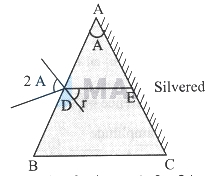
0 likesView Solution
321
PhysicsEasyMCQMHT CET · 2023
In a single slit diffraction experiment,the width of the slit is doubled. Which one of the following statements is correct?
A
The intensity and width of the central maximum are unaffected.
B
The intensity remains same and angular width becomes half.
C
The intensity and angular width both are doubled.
D
The intensity increases by a factor of $4$ and the angular width decreases by a factor of $\frac{1}{2}$.
Solution
(D) In a single slit diffraction experiment,the angular width of the central maximum is given by $\theta = \frac{2\lambda}{a}$,where $a$ is the slit width. If the slit width $a$ is doubled $(a' = 2a)$,the new angular width becomes $\theta' = \frac{2\lambda}{2a} = \frac{\theta}{2}$. Thus,the angular width is halved.
Regarding intensity,the intensity of the central maximum is proportional to the square of the slit width $(I \propto a^2)$. If the slit width is doubled,the new intensity $I'$ becomes $I' \propto (2a)^2 = 4a^2 = 4I$. Therefore,the intensity increases by a factor of $4$.
Regarding intensity,the intensity of the central maximum is proportional to the square of the slit width $(I \propto a^2)$. If the slit width is doubled,the new intensity $I'$ becomes $I' \propto (2a)^2 = 4a^2 = 4I$. Therefore,the intensity increases by a factor of $4$.
0 likesView Solution
322
PhysicsMediumMCQMHT CET · 2023
In a diffraction pattern due to a single slit of width '$a$',the first minimum is observed at an angle of $30^{\circ}$ when light of wavelength $5400 \ \text{Å}$ is incident on the slit. The first secondary maximum is observed at an angle of:
A
$\sin ^{-1}\left(\frac{3}{4}\right)$
B
$\sin ^{-1}\left(\frac{2}{3}\right)$
C
$\sin ^{-1}\left(\frac{1}{2}\right)$
D
$\sin ^{-1}\left(\frac{1}{4}\right)$
Solution
(A) For the $n^{\text{th}}$ minimum in a single-slit diffraction pattern,the condition is $a \sin \theta = n \lambda$,where $n = 1, 2, 3, \dots$
For the $n^{\text{th}}$ secondary maximum,the condition is $a \sin \theta = (2n + 1) \frac{\lambda}{2}$,where $n = 1, 2, 3, \dots$
Given for the first minimum $(n=1)$: $a \sin 30^{\circ} = \lambda \Rightarrow a(1/2) = \lambda \Rightarrow a = 2\lambda$.
For the first secondary maximum $(n=1)$: $a \sin \theta = (2(1) + 1) \frac{\lambda}{2} = \frac{3\lambda}{2}$.
Substituting $a = 2\lambda$ into the equation: $(2\lambda) \sin \theta = \frac{3\lambda}{2}$.
$\sin \theta = \frac{3}{4} \Rightarrow \theta = \sin^{-1}\left(\frac{3}{4}\right)$.
For the $n^{\text{th}}$ secondary maximum,the condition is $a \sin \theta = (2n + 1) \frac{\lambda}{2}$,where $n = 1, 2, 3, \dots$
Given for the first minimum $(n=1)$: $a \sin 30^{\circ} = \lambda \Rightarrow a(1/2) = \lambda \Rightarrow a = 2\lambda$.
For the first secondary maximum $(n=1)$: $a \sin \theta = (2(1) + 1) \frac{\lambda}{2} = \frac{3\lambda}{2}$.
Substituting $a = 2\lambda$ into the equation: $(2\lambda) \sin \theta = \frac{3\lambda}{2}$.
$\sin \theta = \frac{3}{4} \Rightarrow \theta = \sin^{-1}\left(\frac{3}{4}\right)$.
0 likesView Solution
323
PhysicsDifficultMCQMHT CET · 2023
In Young's double slit experiment, the fringe width is $2 \, mm$. The separation between the $13^{\text{th}}$ bright fringe and the $4^{\text{th}}$ dark fringe from the centre of the screen on the same side will be: (in $mm$.)
A
$13$
B
$17$
C
$19$
D
$23$
Solution
(C) Given: Fringe width $W = 2 \, mm$.
The distance of the $n^{\text{th}}$ bright fringe from the centre of the screen is $y_n = nW$.
The distance of the $n^{\text{th}}$ dark fringe from the centre of the screen is $y'_n = (n - 0.5)W$.
For the $13^{\text{th}}$ bright fringe, $n = 13$: $y_{13} = 13 \times 2 = 26 \, mm$.
For the $4^{\text{th}}$ dark fringe, $n = 4$: $y'_4 = (4 - 0.5) \times 2 = 3.5 \times 2 = 7 \, mm$.
The separation between them is $y_{13} - y'_4 = 26 \, mm - 7 \, mm = 19 \, mm$.
The distance of the $n^{\text{th}}$ bright fringe from the centre of the screen is $y_n = nW$.
The distance of the $n^{\text{th}}$ dark fringe from the centre of the screen is $y'_n = (n - 0.5)W$.
For the $13^{\text{th}}$ bright fringe, $n = 13$: $y_{13} = 13 \times 2 = 26 \, mm$.
For the $4^{\text{th}}$ dark fringe, $n = 4$: $y'_4 = (4 - 0.5) \times 2 = 3.5 \times 2 = 7 \, mm$.
The separation between them is $y_{13} - y'_4 = 26 \, mm - 7 \, mm = 19 \, mm$.
0 likesView Solution
324
PhysicsDifficultMCQMHT CET · 2023
In Young's double slit experiment,the wavelength of light used is $\lambda$. The intensity at a point is $I$ where the path difference is $\frac{\lambda}{4}$. If $I_0$ denotes the maximum intensity,then the ratio $\frac{I}{I_0}$ is: (Given: $\sin \frac{\pi}{4} = \cos \frac{\pi}{4} = \frac{1}{\sqrt{2}}$)
A
$\frac{1}{\sqrt{2}}$
B
$\frac{1}{2}$
C
$\frac{3}{4}$
D
$\frac{\sqrt{3}}{2}$
Solution
(B) The relationship between phase difference $\Delta \phi$ and path difference $\Delta x$ is given by $\Delta \phi = \frac{2\pi}{\lambda} \Delta x$.
For a path difference $\Delta x = \frac{\lambda}{4}$,the phase difference is $\Delta \phi = \frac{2\pi}{\lambda} \times \frac{\lambda}{4} = \frac{\pi}{2}$.
The intensity $I$ at any point in an interference pattern is given by $I = I_0 \cos^2 \left( \frac{\Delta \phi}{2} \right)$,where $I_0$ is the maximum intensity.
Substituting the value of $\Delta \phi = \frac{\pi}{2}$ into the formula:
$\frac{I}{I_0} = \cos^2 \left( \frac{\pi/2}{2} \right) = \cos^2 \left( \frac{\pi}{4} \right)$.
Since $\cos \left( \frac{\pi}{4} \right) = \frac{1}{\sqrt{2}}$,we have $\frac{I}{I_0} = \left( \frac{1}{\sqrt{2}} \right)^2 = \frac{1}{2}$.
For a path difference $\Delta x = \frac{\lambda}{4}$,the phase difference is $\Delta \phi = \frac{2\pi}{\lambda} \times \frac{\lambda}{4} = \frac{\pi}{2}$.
The intensity $I$ at any point in an interference pattern is given by $I = I_0 \cos^2 \left( \frac{\Delta \phi}{2} \right)$,where $I_0$ is the maximum intensity.
Substituting the value of $\Delta \phi = \frac{\pi}{2}$ into the formula:
$\frac{I}{I_0} = \cos^2 \left( \frac{\pi/2}{2} \right) = \cos^2 \left( \frac{\pi}{4} \right)$.
Since $\cos \left( \frac{\pi}{4} \right) = \frac{1}{\sqrt{2}}$,we have $\frac{I}{I_0} = \left( \frac{1}{\sqrt{2}} \right)^2 = \frac{1}{2}$.
0 likesView Solution
Vedclass Products
For Students
Vedclass Test Series
Mock tests in real MHT CET style covering Physics with performance analysis. 5-day free trial.
Start Free TrialFor Teachers
Exam Paper Generator
Generate Set A/B/C/D Physics papers from 7.5L+ questions in 2 minutes. 3 chapters free.
Try FreeFor Institutes
Online Exam Module
Run live MHT CET mock exams with unlimited students, 360° analytics & white-label branding.
See DemoFrequently Asked Questions
How many Physics questions are in MHT CET 2023?
There are 593 Physics questions from the MHT CET 2023 paper on Vedclass, each with a detailed step-by-step solution in English.
Are MHT CET 2023 Physics solutions available in English?
Yes. All solutions on this page are in English. You can also switch to English or Hindi using the language buttons above the questions.
Can I practice MHT CET 2023 Physics as a timed test?
Yes. Use the Vedclass Test Series to attempt a full MHT CET mock test covering Physics with time limits and instant score analysis.
Can teachers create Physics papers from MHT CET previous year questions?
Yes. The Vedclass Exam Paper Generator lets teachers mix MHT CET Physics questions and generate Set A/B/C/D papers in minutes.
For Teachers & Institutes
Build a Custom Physics Paper
Pick MHT CET 2023 Physics questions, set difficulty, and generate Set A/B/C/D in 2 minutes.