
PhysicsQ201–300 of 593 questions
Page 5 of 7 · English
201
PhysicsDifficultMCQMHT CET · 2023
$A$ sample of gas at temperature $T$ is adiabatically expanded to double its volume. The work done by the gas in the process is (given $\frac{C_{P}}{C_{V}}=\gamma=\frac{3}{2}$,$R=$ gas constant).
A
$TR(\sqrt{2}-2)$
B
$\frac{T}{R}(\sqrt{2}-2)$
C
$\frac{R}{T}(2-\sqrt{2})$
D
$RT(2-\sqrt{2})$
Solution
(D) For an adiabatic process,the relation between temperature and volume is $T_1 V_1^{\gamma-1} = T_2 V_2^{\gamma-1}$.
Given $T_1 = T$,$V_1 = V$,$V_2 = 2V$,and $\gamma = 3/2$.
Substituting these values: $T V^{\gamma-1} = T_2 (2V)^{\gamma-1}$.
$T_2 = T \left(\frac{V}{2V}\right)^{\gamma-1} = T \left(\frac{1}{2}\right)^{3/2-1} = T \left(\frac{1}{2}\right)^{1/2} = \frac{T}{\sqrt{2}}$.
The work done in an adiabatic process is $W = \frac{R(T_1 - T_2)}{\gamma - 1}$.
Substituting the values: $W = \frac{R(T - T/\sqrt{2})}{3/2 - 1} = \frac{R T (1 - 1/\sqrt{2})}{1/2}$.
$W = 2 R T \left(\frac{\sqrt{2}-1}{\sqrt{2}}\right) = \sqrt{2} R T (\sqrt{2}-1) = R T (2 - \sqrt{2})$.
Given $T_1 = T$,$V_1 = V$,$V_2 = 2V$,and $\gamma = 3/2$.
Substituting these values: $T V^{\gamma-1} = T_2 (2V)^{\gamma-1}$.
$T_2 = T \left(\frac{V}{2V}\right)^{\gamma-1} = T \left(\frac{1}{2}\right)^{3/2-1} = T \left(\frac{1}{2}\right)^{1/2} = \frac{T}{\sqrt{2}}$.
The work done in an adiabatic process is $W = \frac{R(T_1 - T_2)}{\gamma - 1}$.
Substituting the values: $W = \frac{R(T - T/\sqrt{2})}{3/2 - 1} = \frac{R T (1 - 1/\sqrt{2})}{1/2}$.
$W = 2 R T \left(\frac{\sqrt{2}-1}{\sqrt{2}}\right) = \sqrt{2} R T (\sqrt{2}-1) = R T (2 - \sqrt{2})$.
0 likesView Solution
202
PhysicsEasyMCQMHT CET · 2023
$dQ$ is the heat energy supplied to an ideal gas under isochoric conditions. If $dU$ and $dW$ denote the change in internal energy and the work done respectively,then:
A
$dQ = dW$
B
$dQ > dU$
C
$dQ < dU$
D
$dQ = dU$
Solution
(D) Under isochoric (constant volume) conditions,the volume change $dV = 0$.
Since work done $dW = P \cdot dV$,it follows that $dW = 0$.
According to the First Law of Thermodynamics,$dQ = dU + dW$.
Substituting $dW = 0$,we get $dQ = dU$.
Since work done $dW = P \cdot dV$,it follows that $dW = 0$.
According to the First Law of Thermodynamics,$dQ = dU + dW$.
Substituting $dW = 0$,we get $dQ = dU$.
0 likesView Solution
203
PhysicsMediumMCQMHT CET · 2023
$A$ Carnot engine with efficiency $50 \%$ takes heat from a source at $600 \ K$. To increase the efficiency to $70 \%$,keeping the temperature of the sink same,the new temperature of the source will be (in $K$)
A
$360$
B
$1000$
C
$900$
D
$300$
Solution
(B) The efficiency of a Carnot engine is given by $\eta = 1 - \frac{T_C}{T_H}$.
Given initial efficiency $\eta_1 = 50 \% = 0.5$ and source temperature $T_{H1} = 600 \ K$.
$0.5 = 1 - \frac{T_C}{600} \implies \frac{T_C}{600} = 0.5 \implies T_C = 300 \ K$.
Now,the efficiency is increased to $\eta_2 = 70 \% = 0.7$ while keeping the sink temperature $T_C = 300 \ K$ constant.
$0.7 = 1 - \frac{300}{T_{H2}}$.
$\frac{300}{T_{H2}} = 1 - 0.7 = 0.3$.
$T_{H2} = \frac{300}{0.3} = 1000 \ K$.
Thus,the new temperature of the source is $1000 \ K$.
Given initial efficiency $\eta_1 = 50 \% = 0.5$ and source temperature $T_{H1} = 600 \ K$.
$0.5 = 1 - \frac{T_C}{600} \implies \frac{T_C}{600} = 0.5 \implies T_C = 300 \ K$.
Now,the efficiency is increased to $\eta_2 = 70 \% = 0.7$ while keeping the sink temperature $T_C = 300 \ K$ constant.
$0.7 = 1 - \frac{300}{T_{H2}}$.
$\frac{300}{T_{H2}} = 1 - 0.7 = 0.3$.
$T_{H2} = \frac{300}{0.3} = 1000 \ K$.
Thus,the new temperature of the source is $1000 \ K$.
0 likesView Solution
204
PhysicsMediumMCQMHT CET · 2023
Compare the rate of loss of heat from a metal sphere at $627^{\circ} C$ with the rate of loss of heat from the same sphere at $327^{\circ} C$,if the temperature of the surrounding is $27^{\circ} C$. (nearly)
A
$6.2$
B
$5.3$
C
$4.8$
D
$7.4$
Solution
(B) According to Stefan-Boltzmann law,the rate of heat loss $R$ is given by $R = e \sigma A (T^4 - T_0^4)$.
Here,$T$ is the temperature of the sphere and $T_0$ is the temperature of the surroundings.
Given: $T_1 = 627^{\circ} C = 627 + 273 = 900 \ K$,$T_2 = 327^{\circ} C = 327 + 273 = 600 \ K$,and $T_0 = 27^{\circ} C = 27 + 273 = 300 \ K$.
The ratio of the rates of heat loss is $\frac{R_1}{R_2} = \frac{T_1^4 - T_0^4}{T_2^4 - T_0^4}$.
Substituting the values: $\frac{R_1}{R_2} = \frac{900^4 - 300^4}{600^4 - 300^4} = \frac{(300 \times 3)^4 - 300^4}{(300 \times 2)^4 - 300^4}$.
$\frac{R_1}{R_2} = \frac{300^4 (3^4 - 1)}{300^4 (2^4 - 1)} = \frac{81 - 1}{16 - 1} = \frac{80}{15} = \frac{16}{3} \approx 5.33$.
Thus,the ratio is approximately $5.3$.
Here,$T$ is the temperature of the sphere and $T_0$ is the temperature of the surroundings.
Given: $T_1 = 627^{\circ} C = 627 + 273 = 900 \ K$,$T_2 = 327^{\circ} C = 327 + 273 = 600 \ K$,and $T_0 = 27^{\circ} C = 27 + 273 = 300 \ K$.
The ratio of the rates of heat loss is $\frac{R_1}{R_2} = \frac{T_1^4 - T_0^4}{T_2^4 - T_0^4}$.
Substituting the values: $\frac{R_1}{R_2} = \frac{900^4 - 300^4}{600^4 - 300^4} = \frac{(300 \times 3)^4 - 300^4}{(300 \times 2)^4 - 300^4}$.
$\frac{R_1}{R_2} = \frac{300^4 (3^4 - 1)}{300^4 (2^4 - 1)} = \frac{81 - 1}{16 - 1} = \frac{80}{15} = \frac{16}{3} \approx 5.33$.
Thus,the ratio is approximately $5.3$.
0 likesView Solution
205
PhysicsDifficultMCQMHT CET · 2023
$A$ Carnot engine has the same efficiency between $(i)$ $100 \ K$ and $600 \ K$ and (ii) $T \ K$ and $960 \ K$. The temperature $T$ in kelvin of the sink is
A
$120$
B
$160$
C
$240$
D
$320$
Solution
(B) The efficiency of a Carnot engine is given by $\eta = 1 - \frac{T_C}{T_H}$.
For case $(i)$,the sink temperature $T_C = 100 \ K$ and the source temperature $T_H = 600 \ K$.
Therefore,$\eta_1 = 1 - \frac{100}{600} = 1 - \frac{1}{6} = \frac{5}{6}$.
For case $(ii)$,the sink temperature $T_C = T \ K$ and the source temperature $T_H = 960 \ K$.
Therefore,$\eta_2 = 1 - \frac{T}{960}$.
Since the efficiency is the same in both cases,$\eta_1 = \eta_2$.
$\frac{5}{6} = 1 - \frac{T}{960}$.
$\frac{T}{960} = 1 - \frac{5}{6} = \frac{1}{6}$.
$T = \frac{960}{6} = 160 \ K$.
For case $(i)$,the sink temperature $T_C = 100 \ K$ and the source temperature $T_H = 600 \ K$.
Therefore,$\eta_1 = 1 - \frac{100}{600} = 1 - \frac{1}{6} = \frac{5}{6}$.
For case $(ii)$,the sink temperature $T_C = T \ K$ and the source temperature $T_H = 960 \ K$.
Therefore,$\eta_2 = 1 - \frac{T}{960}$.
Since the efficiency is the same in both cases,$\eta_1 = \eta_2$.
$\frac{5}{6} = 1 - \frac{T}{960}$.
$\frac{T}{960} = 1 - \frac{5}{6} = \frac{1}{6}$.
$T = \frac{960}{6} = 160 \ K$.
0 likesView Solution
206
PhysicsMediumMCQMHT CET · 2023
$A$ Carnot engine operates with a source at $227^{\circ}C$ and a sink at $27^{\circ}C$. If the source supplies $50 \ kJ$ of heat energy,the work done by the engine is (in $kJ$)
A
$2$
B
$5$
C
$10$
D
$20$
Solution
(D) The efficiency of a Carnot engine is given by the formula: $\eta = 1 - \frac{T_2}{T_1}$
Here,the temperature of the source $T_1 = 227^{\circ}C = 227 + 273 = 500 \ K$.
The temperature of the sink $T_2 = 27^{\circ}C = 27 + 273 = 300 \ K$.
Substituting these values: $\eta = 1 - \frac{300}{500} = 1 - 0.6 = 0.4$ or $\frac{2}{5}$.
We know that efficiency $\eta = \frac{W}{Q_1}$,where $W$ is the work done and $Q_1$ is the heat supplied.
Given $Q_1 = 50 \ kJ$,we have $W = \eta \times Q_1$.
$W = 0.4 \times 50 \ kJ = 20 \ kJ$.
Here,the temperature of the source $T_1 = 227^{\circ}C = 227 + 273 = 500 \ K$.
The temperature of the sink $T_2 = 27^{\circ}C = 27 + 273 = 300 \ K$.
Substituting these values: $\eta = 1 - \frac{300}{500} = 1 - 0.6 = 0.4$ or $\frac{2}{5}$.
We know that efficiency $\eta = \frac{W}{Q_1}$,where $W$ is the work done and $Q_1$ is the heat supplied.
Given $Q_1 = 50 \ kJ$,we have $W = \eta \times Q_1$.
$W = 0.4 \times 50 \ kJ = 20 \ kJ$.
0 likesView Solution
207
PhysicsEasyMCQMHT CET · 2023
The efficiency of a heat engine is $\eta$ and the coefficient of performance of a refrigerator is $\beta$. Then:
A
$\eta = \frac{1}{\beta}$
B
$\eta = \frac{1}{\beta + 1}$
C
$\eta \beta = \frac{1}{2}$
D
$\eta = \frac{1}{\beta - 1}$
Solution
(B) The coefficient of performance of a refrigerator is given by $\beta = \frac{T_2}{T_1 - T_2}$,where $T_1$ is the temperature of the hot reservoir and $T_2$ is the temperature of the cold reservoir.
The efficiency of a heat engine is given by $\eta = 1 - \frac{T_2}{T_1} = \frac{T_1 - T_2}{T_1}$.
We can rewrite the efficiency as $\eta = \frac{1}{\frac{T_1}{T_1 - T_2}}$.
Since $\frac{T_1}{T_1 - T_2} = \frac{(T_1 - T_2) + T_2}{T_1 - T_2} = 1 + \frac{T_2}{T_1 - T_2} = 1 + \beta$,
Substituting this into the efficiency equation,we get $\eta = \frac{1}{1 + \beta}$.
The efficiency of a heat engine is given by $\eta = 1 - \frac{T_2}{T_1} = \frac{T_1 - T_2}{T_1}$.
We can rewrite the efficiency as $\eta = \frac{1}{\frac{T_1}{T_1 - T_2}}$.
Since $\frac{T_1}{T_1 - T_2} = \frac{(T_1 - T_2) + T_2}{T_1 - T_2} = 1 + \frac{T_2}{T_1 - T_2} = 1 + \beta$,
Substituting this into the efficiency equation,we get $\eta = \frac{1}{1 + \beta}$.
0 likesView Solution
208
PhysicsMediumMCQMHT CET · 2023
An ideal refrigerator has a freezer at a temperature of $-13^{\circ} C$. The coefficient of performance of the refrigerator is $5$. The temperature of the air (to which heat is rejected) is:
A
$320^{\circ} C$
B
$39^{\circ} C$
C
$325 K$
D
$325^{\circ} C$
Solution
(B) The coefficient of performance $(COP)$,$\beta$,for an ideal refrigerator is given by the formula: $\beta = \frac{T_2}{T_1 - T_2}$,where $T_2$ is the temperature of the freezer and $T_1$ is the temperature of the surroundings (sink).
Given: $\beta = 5$ and $T_2 = -13^{\circ} C = (-13 + 273) K = 260 K$.
Substituting the values into the formula:
$5 = \frac{260}{T_1 - 260}$
$5(T_1 - 260) = 260$
$5T_1 - 1300 = 260$
$5T_1 = 1560$
$T_1 = 312 K$
Converting back to Celsius: $T_1 = (312 - 273)^{\circ} C = 39^{\circ} C$.
Given: $\beta = 5$ and $T_2 = -13^{\circ} C = (-13 + 273) K = 260 K$.
Substituting the values into the formula:
$5 = \frac{260}{T_1 - 260}$
$5(T_1 - 260) = 260$
$5T_1 - 1300 = 260$
$5T_1 = 1560$
$T_1 = 312 K$
Converting back to Celsius: $T_1 = (312 - 273)^{\circ} C = 39^{\circ} C$.
0 likesView Solution
209
PhysicsMediumMCQMHT CET · 2023
$A$ diatomic gas $\left(\gamma = \frac{7}{5}\right)$ is compressed adiabatically to volume $\frac{V_0}{32}$,where $V_0$ is its initial volume. The initial temperature of the gas is $T_i$ in Kelvin and the final temperature is $xT_i$ in Kelvin. The value of $x$ is:
A
$5$
B
$4$
C
$3$
D
$2$
Solution
(B) For an adiabatic process,the relationship between temperature and volume is given by $TV^{\gamma-1} = \text{constant}$.
Thus,$T_i V_i^{\gamma-1} = T_f V_f^{\gamma-1}$.
Given $V_i = V_0$,$V_f = \frac{V_0}{32}$,and $\gamma = \frac{7}{5}$.
Then $\gamma - 1 = \frac{7}{5} - 1 = \frac{2}{5}$.
Substituting the values: $T_i (V_0)^{2/5} = T_f \left(\frac{V_0}{32}\right)^{2/5}$.
$T_f = T_i \left(\frac{V_0}{V_0/32}\right)^{2/5} = T_i (32)^{2/5}$.
Since $32 = 2^5$,we have $T_f = T_i (2^5)^{2/5} = T_i (2^2) = 4T_i$.
Comparing $T_f = xT_i$ with $T_f = 4T_i$,we get $x = 4$.
Thus,$T_i V_i^{\gamma-1} = T_f V_f^{\gamma-1}$.
Given $V_i = V_0$,$V_f = \frac{V_0}{32}$,and $\gamma = \frac{7}{5}$.
Then $\gamma - 1 = \frac{7}{5} - 1 = \frac{2}{5}$.
Substituting the values: $T_i (V_0)^{2/5} = T_f \left(\frac{V_0}{32}\right)^{2/5}$.
$T_f = T_i \left(\frac{V_0}{V_0/32}\right)^{2/5} = T_i (32)^{2/5}$.
Since $32 = 2^5$,we have $T_f = T_i (2^5)^{2/5} = T_i (2^2) = 4T_i$.
Comparing $T_f = xT_i$ with $T_f = 4T_i$,we get $x = 4$.
0 likesView Solution
210
PhysicsEasyMCQMHT CET · 2023
The radii of two soap bubbles are $r_1$ and $r_2$. In isothermal condition,they combine with each other to form a single bubble. The radius of the resultant bubble is
A
$R=\frac{r_1+r_2}{2}$
B
$R=r_1(r_1+r_2)$
C
$R=\sqrt{r_1^2+r_2^2}$
D
$R=r_1+r_2$
Solution
(C) Under isothermal conditions,the temperature $T$ remains constant.
Since the process is isothermal,the total number of moles of air inside the bubbles remains constant.
Assuming the pressure inside a soap bubble of radius $r$ is $P = P_0 + \frac{4S}{r}$,where $P_0$ is atmospheric pressure and $S$ is surface tension.
For small bubbles,$P \approx \frac{4S}{r}$.
Using $PV = nRT$,for constant $T$ and $n$,$PV$ is constant.
$P_1 V_1 + P_2 V_2 = P_R V_R$
$\left(\frac{4S}{r_1}\right) \left(\frac{4}{3} \pi r_1^3\right) + \left(\frac{4S}{r_2}\right) \left(\frac{4}{3} \pi r_2^3\right) = \left(\frac{4S}{R}\right) \left(\frac{4}{3} \pi R^3\right)$
$\frac{16}{3} \pi S r_1^2 + \frac{16}{3} \pi S r_2^2 = \frac{16}{3} \pi S R^2$
$r_1^2 + r_2^2 = R^2$
$R = \sqrt{r_1^2 + r_2^2}$
Since the process is isothermal,the total number of moles of air inside the bubbles remains constant.
Assuming the pressure inside a soap bubble of radius $r$ is $P = P_0 + \frac{4S}{r}$,where $P_0$ is atmospheric pressure and $S$ is surface tension.
For small bubbles,$P \approx \frac{4S}{r}$.
Using $PV = nRT$,for constant $T$ and $n$,$PV$ is constant.
$P_1 V_1 + P_2 V_2 = P_R V_R$
$\left(\frac{4S}{r_1}\right) \left(\frac{4}{3} \pi r_1^3\right) + \left(\frac{4S}{r_2}\right) \left(\frac{4}{3} \pi r_2^3\right) = \left(\frac{4S}{R}\right) \left(\frac{4}{3} \pi R^3\right)$
$\frac{16}{3} \pi S r_1^2 + \frac{16}{3} \pi S r_2^2 = \frac{16}{3} \pi S R^2$
$r_1^2 + r_2^2 = R^2$
$R = \sqrt{r_1^2 + r_2^2}$
0 likesView Solution
211
PhysicsDifficultMCQMHT CET · 2023
$A$ jar $P$ is filled with a gas having pressure,volume,and temperature $P, V, T$ respectively. Another gas jar $Q$ is filled with a gas having pressure $2P$,volume $\frac{V}{4}$,and temperature $2T$. The ratio of the number of molecules in jar $P$ to those in jar $Q$ is:
A
$1:1$
B
$1:2$
C
$2:1$
D
$4:1$
Solution
(D) According to the ideal gas equation,$PV = Nk_B T$,where $N$ is the number of molecules and $k_B$ is the Boltzmann constant.
For jar $P$,the equation is: $PV = N_P k_B T$ ... $(i)$
For jar $Q$,the equation is: $(2P) \left( \frac{V}{4} \right) = N_Q k_B (2T)$
Simplifying the left side: $\frac{PV}{2} = N_Q k_B (2T)$
$\Rightarrow PV = 4 N_Q k_B T$ ... $(ii)$
Comparing equations $(i)$ and $(ii)$:
$N_P k_B T = 4 N_Q k_B T$
$N_P = 4 N_Q$
Therefore,the ratio of the number of molecules in jar $P$ to those in jar $Q$ is $\frac{N_P}{N_Q} = 4:1$.
For jar $P$,the equation is: $PV = N_P k_B T$ ... $(i)$
For jar $Q$,the equation is: $(2P) \left( \frac{V}{4} \right) = N_Q k_B (2T)$
Simplifying the left side: $\frac{PV}{2} = N_Q k_B (2T)$
$\Rightarrow PV = 4 N_Q k_B T$ ... $(ii)$
Comparing equations $(i)$ and $(ii)$:
$N_P k_B T = 4 N_Q k_B T$
$N_P = 4 N_Q$
Therefore,the ratio of the number of molecules in jar $P$ to those in jar $Q$ is $\frac{N_P}{N_Q} = 4:1$.
0 likesView Solution
212
PhysicsMediumMCQMHT CET · 2023
$A$ gas at $N.T.P.$ is suddenly compressed to one-fourth of its original volume. If $\gamma = 1.5$,then the final pressure is
A
$4$ times
B
$1.5$ times
C
$8$ times
D
$\frac{1}{4}$ times
Solution
(C) Since the compression is sudden,the process is adiabatic.
For an adiabatic process,the relation between pressure and volume is given by $P_1 V_1^\gamma = P_2 V_2^\gamma$.
Given: $V_2 = \frac{V_1}{4}$,so $\frac{V_1}{V_2} = 4$.
Given: $\gamma = 1.5 = \frac{3}{2}$.
Substituting these values into the equation:
$\frac{P_2}{P_1} = \left( \frac{V_1}{V_2} \right)^\gamma = (4)^{3/2}$.
Calculating the value: $(4)^{3/2} = (2^2)^{3/2} = 2^3 = 8$.
Therefore,the final pressure $P_2 = 8 P_1$,which is $8$ times the initial pressure.
For an adiabatic process,the relation between pressure and volume is given by $P_1 V_1^\gamma = P_2 V_2^\gamma$.
Given: $V_2 = \frac{V_1}{4}$,so $\frac{V_1}{V_2} = 4$.
Given: $\gamma = 1.5 = \frac{3}{2}$.
Substituting these values into the equation:
$\frac{P_2}{P_1} = \left( \frac{V_1}{V_2} \right)^\gamma = (4)^{3/2}$.
Calculating the value: $(4)^{3/2} = (2^2)^{3/2} = 2^3 = 8$.
Therefore,the final pressure $P_2 = 8 P_1$,which is $8$ times the initial pressure.
0 likesView Solution
213
PhysicsMediumMCQMHT CET · 2023
An insulated container contains a monoatomic gas of molar mass '$M$'. The container is moving with velocity '$V$'. If it is stopped suddenly,the change in temperature of the gas is [$R$ is the gas constant].
A
$\frac{MV^2}{R}$
B
$\frac{MV^2}{2R}$
C
$\frac{MV^2}{3R}$
D
$\frac{3MV^2}{2R}$
Solution
(C) The kinetic energy of the gas is converted into internal energy when the container is stopped suddenly.
Let $n$ be the number of moles of the gas. The total mass of the gas is $m_{total} = nM$.
The kinetic energy of the gas is $K = \frac{1}{2} (nM) V^2$.
The change in internal energy of a monoatomic gas is $\Delta U = n C_V \Delta T$.
For a monoatomic gas,the molar heat capacity at constant volume is $C_V = \frac{3}{2} R$.
Equating the kinetic energy to the change in internal energy:
$\frac{1}{2} n M V^2 = n \left( \frac{3}{2} R \right) \Delta T$
Dividing both sides by $n$:
$\frac{1}{2} M V^2 = \frac{3}{2} R \Delta T$
Solving for $\Delta T$:
$\Delta T = \frac{MV^2}{3R}$
Let $n$ be the number of moles of the gas. The total mass of the gas is $m_{total} = nM$.
The kinetic energy of the gas is $K = \frac{1}{2} (nM) V^2$.
The change in internal energy of a monoatomic gas is $\Delta U = n C_V \Delta T$.
For a monoatomic gas,the molar heat capacity at constant volume is $C_V = \frac{3}{2} R$.
Equating the kinetic energy to the change in internal energy:
$\frac{1}{2} n M V^2 = n \left( \frac{3}{2} R \right) \Delta T$
Dividing both sides by $n$:
$\frac{1}{2} M V^2 = \frac{3}{2} R \Delta T$
Solving for $\Delta T$:
$\Delta T = \frac{MV^2}{3R}$
0 likesView Solution
214
PhysicsEasyMCQMHT CET · 2023
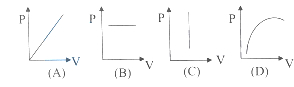
Which of the following graphs between pressure $(P)$ and volume $(V)$ correctly shows isochoric changes?
A
$A$
B
$B$
C
$C$
D
$D$
Solution
(C) An isochoric process is a thermodynamic process in which the volume $(V)$ of the system remains constant.
In a $P-V$ diagram,a constant volume process is represented by a vertical line,because for a single value of $V$,the pressure $(P)$ can vary.
Looking at the given options:
Graph $(A)$ shows $P$ proportional to $V$.
Graph $(B)$ shows constant pressure (isobaric).
Graph $(C)$ shows a vertical line,which indicates that $V$ is constant while $P$ changes.
Graph $(D)$ shows a curve.
Therefore,graph $(C)$ represents an isochoric process.
In a $P-V$ diagram,a constant volume process is represented by a vertical line,because for a single value of $V$,the pressure $(P)$ can vary.
Looking at the given options:
Graph $(A)$ shows $P$ proportional to $V$.
Graph $(B)$ shows constant pressure (isobaric).
Graph $(C)$ shows a vertical line,which indicates that $V$ is constant while $P$ changes.
Graph $(D)$ shows a curve.
Therefore,graph $(C)$ represents an isochoric process.
0 likesView Solution
215
PhysicsMediumMCQMHT CET · 2023
An ideal gas expands adiabatically $(\gamma = 1.5)$. To reduce the root-mean-square (r.m.s.) velocity of the molecules $3$ times, the gas has to be expanded by a factor of: (in $times$)
A
$81$
B
$27$
C
$9$
D
$3$
Solution
(A) The root-mean-square velocity of an ideal gas is given by $V_{\text{rms}} = \sqrt{\frac{3RT}{M_0}}$.
Since $V_{\text{rms}} \propto \sqrt{T}$, we have $T \propto V_{\text{rms}}^2$.
If $V_{\text{rms}}$ is reduced by a factor of $3$, then $T_2 = \frac{T_1}{3^2} = \frac{T_1}{9}$, so $\frac{T_1}{T_2} = 9$.
For an adiabatic process, $TV^{\gamma-1} = \text{constant}$, which implies $T_1 V_1^{\gamma-1} = T_2 V_2^{\gamma-1}$.
Rearranging gives $\frac{V_2}{V_1} = \left(\frac{T_1}{T_2}\right)^{\frac{1}{\gamma-1}}$.
Given $\gamma = 1.5$, then $\gamma - 1 = 0.5 = \frac{1}{2}$.
Substituting the values: $\frac{V_2}{V_1} = (9)^{\frac{1}{1/2}} = (9)^2 = 81$.
Thus, the gas must be expanded $81$ times.
Since $V_{\text{rms}} \propto \sqrt{T}$, we have $T \propto V_{\text{rms}}^2$.
If $V_{\text{rms}}$ is reduced by a factor of $3$, then $T_2 = \frac{T_1}{3^2} = \frac{T_1}{9}$, so $\frac{T_1}{T_2} = 9$.
For an adiabatic process, $TV^{\gamma-1} = \text{constant}$, which implies $T_1 V_1^{\gamma-1} = T_2 V_2^{\gamma-1}$.
Rearranging gives $\frac{V_2}{V_1} = \left(\frac{T_1}{T_2}\right)^{\frac{1}{\gamma-1}}$.
Given $\gamma = 1.5$, then $\gamma - 1 = 0.5 = \frac{1}{2}$.
Substituting the values: $\frac{V_2}{V_1} = (9)^{\frac{1}{1/2}} = (9)^2 = 81$.
Thus, the gas must be expanded $81$ times.
0 likesView Solution
216
PhysicsEasyMCQMHT CET · 2023
For an adiabatic process,which one of the following is a '$WRONG$' statement?
A
Equation of state is $PV=$ constant.
B
There is exchange of heat with surrounding.
C
All the work is utilized to change the internal energy of the system.
D
Temperature of the system changes,i.e.,$\Delta T \neq 0$.
Solution
(A) In an adiabatic process,the system is thermally insulated from its surroundings,meaning no heat exchange occurs $(Q = 0)$.
According to the first law of thermodynamics,$\Delta U = Q - W$. Since $Q = 0$,we have $\Delta U = -W$,which means all work done is at the expense of internal energy.
The equation of state for an adiabatic process is $PV^{\gamma} = \text{constant}$,where $\gamma$ is the adiabatic index. The statement $PV = \text{constant}$ describes an isothermal process,not an adiabatic one.
Therefore,the statement '$PV=$ constant' is incorrect.
According to the first law of thermodynamics,$\Delta U = Q - W$. Since $Q = 0$,we have $\Delta U = -W$,which means all work done is at the expense of internal energy.
The equation of state for an adiabatic process is $PV^{\gamma} = \text{constant}$,where $\gamma$ is the adiabatic index. The statement $PV = \text{constant}$ describes an isothermal process,not an adiabatic one.
Therefore,the statement '$PV=$ constant' is incorrect.
0 likesView Solution
217
PhysicsEasyMCQMHT CET · 2023
In a thermodynamic system,$\Delta U$ represents the increase in its internal energy and $dW$ is the work done by the system. Then,which of the following statements is correct?
A
$\Delta U = dW$ is an isothermal process
B
$\Delta U = -dW$ is an adiabatic process
C
$\Delta U = -dW$ is an isothermal process
D
$\Delta U = dW$ is an adiabatic process
Solution
(B) According to the first law of thermodynamics,the heat supplied to the system $\Delta Q$ is given by $\Delta Q = \Delta U + dW$.
For an adiabatic process,there is no exchange of heat with the surroundings,so $\Delta Q = 0$.
Substituting this into the first law equation: $0 = \Delta U + dW$.
Rearranging the terms,we get $\Delta U = -dW$.
Therefore,the condition $\Delta U = -dW$ corresponds to an adiabatic process.
For an adiabatic process,there is no exchange of heat with the surroundings,so $\Delta Q = 0$.
Substituting this into the first law equation: $0 = \Delta U + dW$.
Rearranging the terms,we get $\Delta U = -dW$.
Therefore,the condition $\Delta U = -dW$ corresponds to an adiabatic process.
0 likesView Solution
218
PhysicsDifficultMCQMHT CET · 2023
The pressure and density of a diatomic gas $\left(\gamma=\frac{7}{5}\right)$ change adiabatically from $(P, \rho)$ to $(P^{\prime}, \rho^{\prime})$. If $\frac{\rho^{\prime}}{\rho}=32$,then $\frac{P^{\prime}}{P}$ is:
A
$\frac{1}{128}$
B
$128$
C
$32$
D
$64$
Solution
(B) For an adiabatic process,the relation between pressure $P$ and volume $V$ is $PV^{\gamma} = \text{constant}$.
Since density $\rho = \frac{m}{V}$,we have $V = \frac{m}{\rho}$. Substituting this into the adiabatic equation:
$P \left(\frac{m}{\rho}\right)^{\gamma} = \text{constant}$
$P \rho^{-\gamma} = \text{constant}$
Therefore,$\frac{P^{\prime}}{P} = \left(\frac{\rho^{\prime}}{\rho}\right)^{\gamma}$.
Given $\frac{\rho^{\prime}}{\rho} = 32$ and $\gamma = \frac{7}{5}$,we substitute these values:
$\frac{P^{\prime}}{P} = (32)^{\frac{7}{5}}$
$\frac{P^{\prime}}{P} = (2^5)^{\frac{7}{5}} = 2^7 = 128$.
Since density $\rho = \frac{m}{V}$,we have $V = \frac{m}{\rho}$. Substituting this into the adiabatic equation:
$P \left(\frac{m}{\rho}\right)^{\gamma} = \text{constant}$
$P \rho^{-\gamma} = \text{constant}$
Therefore,$\frac{P^{\prime}}{P} = \left(\frac{\rho^{\prime}}{\rho}\right)^{\gamma}$.
Given $\frac{\rho^{\prime}}{\rho} = 32$ and $\gamma = \frac{7}{5}$,we substitute these values:
$\frac{P^{\prime}}{P} = (32)^{\frac{7}{5}}$
$\frac{P^{\prime}}{P} = (2^5)^{\frac{7}{5}} = 2^7 = 128$.
0 likesView Solution
219
PhysicsDifficultMCQMHT CET · 2023
At constant temperature,increasing the pressure of a gas by $5 \%$ its volume will decrease by (in $\%$)
A
$5$
B
$5.26$
C
$4.20$
D
$4.76$
Solution
(D) According to Boyle's Law at constant temperature,$P \propto \frac{1}{V}$,which implies $P_1 V_1 = P_2 V_2$.
Let the initial pressure be $P_1 = P$.
The new pressure is $P_2 = P + 0.05P = 1.05P$.
Substituting these into the equation: $P V_1 = 1.05P V_2$.
Solving for the new volume: $V_2 = \frac{V_1}{1.05} \approx 0.9524 V_1$.
The change in volume is $\Delta V = V_2 - V_1 = 0.9524 V_1 - V_1 = -0.0476 V_1$.
The percentage decrease in volume is $\frac{|\Delta V|}{V_1} \times 100 = 0.0476 \times 100 = 4.76 \%$.
Let the initial pressure be $P_1 = P$.
The new pressure is $P_2 = P + 0.05P = 1.05P$.
Substituting these into the equation: $P V_1 = 1.05P V_2$.
Solving for the new volume: $V_2 = \frac{V_1}{1.05} \approx 0.9524 V_1$.
The change in volume is $\Delta V = V_2 - V_1 = 0.9524 V_1 - V_1 = -0.0476 V_1$.
The percentage decrease in volume is $\frac{|\Delta V|}{V_1} \times 100 = 0.0476 \times 100 = 4.76 \%$.
0 likesView Solution
220
PhysicsEasyMCQMHT CET · 2023
In a thermodynamic process,there is no exchange of heat between the system and surroundings. Then the thermodynamic process is
A
isothermal
B
isobaric
C
isochoric
D
adiabatic
Solution
(D) thermodynamic process in which there is no exchange of heat between the system and the surroundings is defined as an adiabatic process.
In this process,the heat exchange $dQ = 0$.
According to the first law of thermodynamics,$dQ = dU + dW$,so for an adiabatic process,$dU = -dW$.
In this process,the heat exchange $dQ = 0$.
According to the first law of thermodynamics,$dQ = dU + dW$,so for an adiabatic process,$dU = -dW$.
0 likesView Solution
221
PhysicsEasyMCQMHT CET · 2023
Select the $WRONG$ statement from the following. For an isothermal process:
A
Energy exchanged is used to do work.
B
Perfect thermal equilibrium with the environment.
C
Equation of state $PV$ is not constant.
D
No change in internal energy.
Solution
(C) For an isothermal process,the temperature $T$ remains constant.
Since internal energy $U$ of an ideal gas depends only on temperature $(U = f(T))$,the change in internal energy $\Delta U = 0$.
According to the first law of thermodynamics,$\Delta Q = \Delta U + \Delta W$. Since $\Delta U = 0$,$\Delta Q = \Delta W$,meaning all energy exchanged is used to do work.
An isothermal process requires the system to be in perfect thermal equilibrium with the environment to maintain a constant temperature.
The equation of state for an ideal gas is $PV = nRT$. Since $n$,$R$,and $T$ are constant,$PV$ must be constant.
Therefore,the statement '$PV$ is not constant' is incorrect.
Since internal energy $U$ of an ideal gas depends only on temperature $(U = f(T))$,the change in internal energy $\Delta U = 0$.
According to the first law of thermodynamics,$\Delta Q = \Delta U + \Delta W$. Since $\Delta U = 0$,$\Delta Q = \Delta W$,meaning all energy exchanged is used to do work.
An isothermal process requires the system to be in perfect thermal equilibrium with the environment to maintain a constant temperature.
The equation of state for an ideal gas is $PV = nRT$. Since $n$,$R$,and $T$ are constant,$PV$ must be constant.
Therefore,the statement '$PV$ is not constant' is incorrect.
0 likesView Solution
222
PhysicsMediumMCQMHT CET · 2023
When a string of length $l$ is divided into three segments of length $l_1, l_2$ and $l_3$,the fundamental frequencies of the three segments are $n_1, n_2$ and $n_3$ respectively. The original fundamental frequency $n$ of the string is:
A
$n = n_1 + n_2 + n_3$
B
$\sqrt{n} = \sqrt{n_1} + \sqrt{n_2} + \sqrt{n_3}$
C
$\frac{1}{n} = \frac{1}{n_1} + \frac{1}{n_2} + \frac{1}{n_3}$
D
$\frac{1}{\sqrt{n}} = \frac{1}{\sqrt{n_1}} + \frac{1}{\sqrt{n_2}} + \frac{1}{\sqrt{n_3}}$
Solution
(C) The fundamental frequency of a stretched string is given by $n = \frac{1}{2l} \sqrt{\frac{T}{\mu}}$,where $T$ is tension and $\mu$ is mass per unit length.
Since $T$ and $\mu$ are constant for the segments,we have $n \propto \frac{1}{l}$,which implies $nl = k$ (constant).
Given that the total length $l = l_1 + l_2 + l_3$,we can express each segment length as $l_1 = \frac{k}{n_1}$,$l_2 = \frac{k}{n_2}$,and $l_3 = \frac{k}{n_3}$.
The original length is $l = \frac{k}{n}$.
Substituting these into the length equation: $\frac{k}{n} = \frac{k}{n_1} + \frac{k}{n_2} + \frac{k}{n_3}$.
Dividing both sides by $k$,we get $\frac{1}{n} = \frac{1}{n_1} + \frac{1}{n_2} + \frac{1}{n_3}$.
Since $T$ and $\mu$ are constant for the segments,we have $n \propto \frac{1}{l}$,which implies $nl = k$ (constant).
Given that the total length $l = l_1 + l_2 + l_3$,we can express each segment length as $l_1 = \frac{k}{n_1}$,$l_2 = \frac{k}{n_2}$,and $l_3 = \frac{k}{n_3}$.
The original length is $l = \frac{k}{n}$.
Substituting these into the length equation: $\frac{k}{n} = \frac{k}{n_1} + \frac{k}{n_2} + \frac{k}{n_3}$.
Dividing both sides by $k$,we get $\frac{1}{n} = \frac{1}{n_1} + \frac{1}{n_2} + \frac{1}{n_3}$.
0 likesView Solution
223
PhysicsMediumMCQMHT CET · 2023
The equation of a simple harmonic progressive wave is given by $y=a \sin 2 \pi(b t-c x)$. The maximum particle velocity will be half the wave velocity,if $c=$
A
$2 \pi a$
B
$\frac{1}{4 \pi a}$
C
$\frac{1}{2 \pi a}$
D
$4 \pi a$
Solution
(B) The general equation of a simple harmonic progressive wave is $y=A \sin 2 \pi \left( \frac{t}{T} - \frac{x}{\lambda} \right)$.
Given equation: $y=a \sin 2 \pi(b t-c x)$.
Comparing the two,we get amplitude $A=a$,frequency $n = \frac{1}{T} = b$,and wave number $\frac{1}{\lambda} = c$.
The maximum particle velocity is given by $(v_p)_{\max} = A \omega = A(2 \pi n) = a(2 \pi b) = 2 \pi ab$.
The wave velocity is given by $v = n \lambda = \frac{n}{1/\lambda} = \frac{b}{c}$.
According to the problem,$(v_p)_{\max} = \frac{1}{2} v$.
Substituting the values: $2 \pi ab = \frac{1}{2} \left( \frac{b}{c} \right)$.
Canceling $b$ from both sides: $2 \pi a = \frac{1}{2c}$.
Solving for $c$: $c = \frac{1}{4 \pi a}$.
Given equation: $y=a \sin 2 \pi(b t-c x)$.
Comparing the two,we get amplitude $A=a$,frequency $n = \frac{1}{T} = b$,and wave number $\frac{1}{\lambda} = c$.
The maximum particle velocity is given by $(v_p)_{\max} = A \omega = A(2 \pi n) = a(2 \pi b) = 2 \pi ab$.
The wave velocity is given by $v = n \lambda = \frac{n}{1/\lambda} = \frac{b}{c}$.
According to the problem,$(v_p)_{\max} = \frac{1}{2} v$.
Substituting the values: $2 \pi ab = \frac{1}{2} \left( \frac{b}{c} \right)$.
Canceling $b$ from both sides: $2 \pi a = \frac{1}{2c}$.
Solving for $c$: $c = \frac{1}{4 \pi a}$.
0 likesView Solution
224
PhysicsDifficultMCQMHT CET · 2023
The equation of a wave is $Y = 6 \sin(12 \pi t - 0.02 \pi x + \frac{\pi}{3})$,where $x$ is in $m$ and $t$ is in $s$. The velocity of the wave is: (in $m/s$)
A
$200$
B
$300$
C
$400$
D
$600$
Solution
(D) The standard equation of a traveling wave is given by $Y = A \sin(\omega t - kx + \phi)$.
Comparing this with the given equation $Y = 6 \sin(12 \pi t - 0.02 \pi x + \frac{\pi}{3})$:
We have angular frequency $\omega = 12 \pi \ rad/s$ and wave number $k = 0.02 \pi \ rad/m$.
The velocity of the wave $v$ is given by the ratio of angular frequency to wave number:
$v = \frac{\omega}{k}$
$v = \frac{12 \pi}{0.02 \pi}$
$v = \frac{12}{0.02} = \frac{1200}{2} = 600 \ m/s$.
Comparing this with the given equation $Y = 6 \sin(12 \pi t - 0.02 \pi x + \frac{\pi}{3})$:
We have angular frequency $\omega = 12 \pi \ rad/s$ and wave number $k = 0.02 \pi \ rad/m$.
The velocity of the wave $v$ is given by the ratio of angular frequency to wave number:
$v = \frac{\omega}{k}$
$v = \frac{12 \pi}{0.02 \pi}$
$v = \frac{12}{0.02} = \frac{1200}{2} = 600 \ m/s$.
0 likesView Solution
225
PhysicsMediumMCQMHT CET · 2023
$A$ string fixed at both the ends forms a standing wave with a node separation of $5 \,cm$. If the velocity of the wave on the string is $2 \,m/s$, then the frequency of vibration of the string is (in $\,Hz$)
A
$0.2$
B
$10$
C
$20$
D
$40$
Solution
(C) The separation between two consecutive nodes in a standing wave is given by $\frac{\lambda}{2}$.
Given, $\frac{\lambda}{2} = 5 \,cm = 0.05 \,m$.
Therefore, the wavelength $\lambda = 2 \times 0.05 \,m = 0.1 \,m$.
The frequency of vibration $f$ is related to the wave velocity $v$ and wavelength $\lambda$ by the formula $f = \frac{v}{\lambda}$.
Substituting the given values, $f = \frac{2 \,m/s}{0.1 \,m} = 20 \,Hz$.
Given, $\frac{\lambda}{2} = 5 \,cm = 0.05 \,m$.
Therefore, the wavelength $\lambda = 2 \times 0.05 \,m = 0.1 \,m$.
The frequency of vibration $f$ is related to the wave velocity $v$ and wavelength $\lambda$ by the formula $f = \frac{v}{\lambda}$.
Substituting the given values, $f = \frac{2 \,m/s}{0.1 \,m} = 20 \,Hz$.
0 likesView Solution
226
PhysicsDifficultMCQMHT CET · 2023
The path difference between two waves,represented by $y_1 = a_1 \sin \left(\omega t - \frac{2 \pi x}{\lambda}\right)$ and $y_2 = a_2 \cos \left(\omega t - \frac{2 \pi x}{\lambda} + \phi\right)$ is
A
$\frac{\lambda}{2 \pi}(\phi)$
B
$\frac{\lambda}{2 \pi}\left(\phi + \frac{\pi}{2}\right)$
C
$\frac{2 \pi}{\lambda}\left(\phi - \frac{\pi}{2}\right)$
D
$\frac{2 \pi}{\lambda}(\phi)$
Solution
(B) Given equations are:
$y_1 = a_1 \sin \left(\omega t - \frac{2 \pi x}{\lambda}\right)$
$y_2 = a_2 \cos \left(\omega t - \frac{2 \pi x}{\lambda} + \phi\right)$
We know that $\cos \theta = \sin \left(\theta + \frac{\pi}{2}\right)$.
Therefore,$y_2$ can be rewritten as:
$y_2 = a_2 \sin \left(\omega t - \frac{2 \pi x}{\lambda} + \phi + \frac{\pi}{2}\right)$
The phase difference $\Delta \Phi$ between the two waves is the difference in their arguments:
$\Delta \Phi = \left(\omega t - \frac{2 \pi x}{\lambda} + \phi + \frac{\pi}{2}\right) - \left(\omega t - \frac{2 \pi x}{\lambda}\right) = \phi + \frac{\pi}{2}$
The relationship between path difference $\Delta x$ and phase difference $\Delta \Phi$ is given by:
$\Delta x = \frac{\lambda}{2 \pi} \times \Delta \Phi$
Substituting the value of $\Delta \Phi$:
$\Delta x = \frac{\lambda}{2 \pi} \left(\phi + \frac{\pi}{2}\right)$
$y_1 = a_1 \sin \left(\omega t - \frac{2 \pi x}{\lambda}\right)$
$y_2 = a_2 \cos \left(\omega t - \frac{2 \pi x}{\lambda} + \phi\right)$
We know that $\cos \theta = \sin \left(\theta + \frac{\pi}{2}\right)$.
Therefore,$y_2$ can be rewritten as:
$y_2 = a_2 \sin \left(\omega t - \frac{2 \pi x}{\lambda} + \phi + \frac{\pi}{2}\right)$
The phase difference $\Delta \Phi$ between the two waves is the difference in their arguments:
$\Delta \Phi = \left(\omega t - \frac{2 \pi x}{\lambda} + \phi + \frac{\pi}{2}\right) - \left(\omega t - \frac{2 \pi x}{\lambda}\right) = \phi + \frac{\pi}{2}$
The relationship between path difference $\Delta x$ and phase difference $\Delta \Phi$ is given by:
$\Delta x = \frac{\lambda}{2 \pi} \times \Delta \Phi$
Substituting the value of $\Delta \Phi$:
$\Delta x = \frac{\lambda}{2 \pi} \left(\phi + \frac{\pi}{2}\right)$
0 likesView Solution
227
PhysicsMediumMCQMHT CET · 2023
$A$ transverse wave in a medium is given by $y = A \sin 2(\omega t - kx)$. It is found that the magnitude of the maximum velocity of particles in the medium is equal to the magnitude of the wave velocity. What is the value of $A$?
A
$\frac{2 \lambda}{\pi}$
B
$\frac{\lambda}{\pi}$
C
$\frac{\lambda}{2 \pi}$
D
$\frac{\lambda}{4 \pi}$
Solution
(D) The given wave equation is $y = A \sin(2\omega t - 2kx)$.
Comparing this with the standard wave equation $y = A \sin(\omega' t - k' x)$,we have angular frequency $\omega' = 2\omega$ and wave number $k' = 2k$.
The velocity of the particle is $v_p = \frac{dy}{dt} = A \cdot (2\omega) \cos(2\omega t - 2kx)$.
The maximum particle velocity is $v_{p,max} = 2A\omega$.
The wave velocity is $v_w = \frac{\omega'}{k'} = \frac{2\omega}{2k} = \frac{\omega}{k}$.
Given that $v_{p,max} = v_w$,we have $2A\omega = \frac{\omega}{k}$.
Thus,$A = \frac{1}{2k}$.
Since the wave number $k = \frac{2\pi}{\lambda}$,we substitute this into the expression for $A$:
$A = \frac{1}{2(2\pi / \lambda)} = \frac{\lambda}{4\pi}$.
Comparing this with the standard wave equation $y = A \sin(\omega' t - k' x)$,we have angular frequency $\omega' = 2\omega$ and wave number $k' = 2k$.
The velocity of the particle is $v_p = \frac{dy}{dt} = A \cdot (2\omega) \cos(2\omega t - 2kx)$.
The maximum particle velocity is $v_{p,max} = 2A\omega$.
The wave velocity is $v_w = \frac{\omega'}{k'} = \frac{2\omega}{2k} = \frac{\omega}{k}$.
Given that $v_{p,max} = v_w$,we have $2A\omega = \frac{\omega}{k}$.
Thus,$A = \frac{1}{2k}$.
Since the wave number $k = \frac{2\pi}{\lambda}$,we substitute this into the expression for $A$:
$A = \frac{1}{2(2\pi / \lambda)} = \frac{\lambda}{4\pi}$.
0 likesView Solution
228
PhysicsMediumMCQMHT CET · 2023
The equation of wave motion is $Y = 5 \sin (10 \pi t - 0.02 \pi x + \pi / 3)$ where $x$ is in $m$ and $t$ is in $s$. The velocity of the wave is (in $m/s$)
A
$300$
B
$400$
C
$500$
D
$600$
Solution
(C) The standard equation of a traveling wave is given by $y = A \sin (\omega t - kx + \phi)$ or $y = A \sin (kx - \omega t + \phi)$.
Comparing the given equation $Y = 5 \sin (10 \pi t - 0.02 \pi x + \pi / 3)$ with the standard form,we identify the angular frequency $\omega$ and the wave number $k$:
$\omega = 10 \pi \ rad/s$
$k = 0.02 \pi \ rad/m$
The velocity of the wave $v$ is given by the ratio of angular frequency to wave number:
$v = \frac{\omega}{k}$
Substituting the values:
$v = \frac{10 \pi}{0.02 \pi}$
$v = \frac{10}{0.02} = \frac{1000}{2} = 500 \ m/s$
Therefore,the velocity of the wave is $500 \ m/s$.
Comparing the given equation $Y = 5 \sin (10 \pi t - 0.02 \pi x + \pi / 3)$ with the standard form,we identify the angular frequency $\omega$ and the wave number $k$:
$\omega = 10 \pi \ rad/s$
$k = 0.02 \pi \ rad/m$
The velocity of the wave $v$ is given by the ratio of angular frequency to wave number:
$v = \frac{\omega}{k}$
Substituting the values:
$v = \frac{10 \pi}{0.02 \pi}$
$v = \frac{10}{0.02} = \frac{1000}{2} = 500 \ m/s$
Therefore,the velocity of the wave is $500 \ m/s$.
0 likesView Solution
229
PhysicsDifficultMCQMHT CET · 2023
The equation of a progressive wave is $Y = a \sin 2 \pi (n t - \frac{x}{5})$. The ratio of maximum particle velocity to wave velocity is
A
$\frac{\pi a}{5}$
B
$\frac{2 \pi a}{5}$
C
$\frac{3 \pi a}{5}$
D
$\frac{4 \pi a}{5}$
Solution
(B) The general equation for a progressive wave is $Y = a \sin (\omega t - kx)$.
Comparing this with the given equation $Y = a \sin (2 \pi n t - \frac{2 \pi x}{5})$:
Angular frequency $\omega = 2 \pi n$.
Wave number $k = \frac{2 \pi}{5}$.
Wave velocity $v = \frac{\omega}{k} = \frac{2 \pi n}{2 \pi / 5} = 5n$.
Particle velocity $v_p = \frac{dY}{dt} = a \omega \cos (\omega t - kx)$.
Maximum particle velocity $v_m = a \omega = a (2 \pi n) = 2 \pi n a$.
The ratio of maximum particle velocity to wave velocity is $\frac{v_m}{v} = \frac{2 \pi n a}{5n} = \frac{2 \pi a}{5}$.
Comparing this with the given equation $Y = a \sin (2 \pi n t - \frac{2 \pi x}{5})$:
Angular frequency $\omega = 2 \pi n$.
Wave number $k = \frac{2 \pi}{5}$.
Wave velocity $v = \frac{\omega}{k} = \frac{2 \pi n}{2 \pi / 5} = 5n$.
Particle velocity $v_p = \frac{dY}{dt} = a \omega \cos (\omega t - kx)$.
Maximum particle velocity $v_m = a \omega = a (2 \pi n) = 2 \pi n a$.
The ratio of maximum particle velocity to wave velocity is $\frac{v_m}{v} = \frac{2 \pi n a}{5n} = \frac{2 \pi a}{5}$.
0 likesView Solution
230
PhysicsEasyMCQMHT CET · 2023
$A$ transverse wave strikes against a rigid wall. What happens to its phase and velocity?
A
Its phase changes by $180^{\circ}$,but velocity does not change.
B
Its phase does not change,but velocity changes.
C
Its velocity changes and phase changes by $180^{\circ}$.
D
Nothing can be predicted about changes in its velocity and phase.
Solution
(A) When a transverse wave strikes a rigid wall,it undergoes reflection. According to the boundary conditions for a rigid support,the wave experiences a phase reversal of $180^{\circ}$ (or $\pi$ radians). Since the medium remains the same,the speed of the wave does not change,although the direction of propagation is reversed. Therefore,the phase changes by $180^{\circ}$,but the magnitude of the velocity remains the same.
0 likesView Solution
231
PhysicsMediumMCQMHT CET · 2023
$A$ wire $PQ$ has length $4.8 \ m$ and mass $0.06 \ kg$. Another wire $QR$ has length $2.56 \ m$ and mass $0.2 \ kg$. Both wires have the same radii and are joined as a single wire. This wire is under a tension of $80 \ N$. $A$ wave pulse of amplitude $3.5 \ cm$ is sent along the wire $PQ$ from end $P$. The time taken by the wave to reach the other end of the single wire is (No power is dissipated during propagation). (in $s$)
A
$0.1$
B
$0.12$
C
$0.14$
D
$0.16$
Solution
(C) Mass per unit length for wire $PQ$ is $m_{PQ} = \frac{0.06}{4.8} = \frac{1}{80} \ kg/m$.
Mass per unit length for wire $QR$ is $m_{QR} = \frac{0.2}{2.56} = \frac{5}{64} \ kg/m$.
The velocity of the wave in wire $PQ$ is $v_{PQ} = \sqrt{\frac{T}{m_{PQ}}} = \sqrt{\frac{80}{1/80}} = \sqrt{6400} = 80 \ m/s$.
The time taken to travel through wire $PQ$ is $t_1 = \frac{L_{PQ}}{v_{PQ}} = \frac{4.8}{80} = 0.06 \ s$.
The velocity of the wave in wire $QR$ is $v_{QR} = \sqrt{\frac{T}{m_{QR}}} = \sqrt{\frac{80}{5/64}} = \sqrt{\frac{80 \times 64}{5}} = \sqrt{16 \times 64} = 4 \times 8 = 32 \ m/s$.
The time taken to travel through wire $QR$ is $t_2 = \frac{L_{QR}}{v_{QR}} = \frac{2.56}{32} = 0.08 \ s$.
The total time taken is $t = t_1 + t_2 = 0.06 + 0.08 = 0.14 \ s$.
Mass per unit length for wire $QR$ is $m_{QR} = \frac{0.2}{2.56} = \frac{5}{64} \ kg/m$.
The velocity of the wave in wire $PQ$ is $v_{PQ} = \sqrt{\frac{T}{m_{PQ}}} = \sqrt{\frac{80}{1/80}} = \sqrt{6400} = 80 \ m/s$.
The time taken to travel through wire $PQ$ is $t_1 = \frac{L_{PQ}}{v_{PQ}} = \frac{4.8}{80} = 0.06 \ s$.
The velocity of the wave in wire $QR$ is $v_{QR} = \sqrt{\frac{T}{m_{QR}}} = \sqrt{\frac{80}{5/64}} = \sqrt{\frac{80 \times 64}{5}} = \sqrt{16 \times 64} = 4 \times 8 = 32 \ m/s$.
The time taken to travel through wire $QR$ is $t_2 = \frac{L_{QR}}{v_{QR}} = \frac{2.56}{32} = 0.08 \ s$.
The total time taken is $t = t_1 + t_2 = 0.06 + 0.08 = 0.14 \ s$.
0 likesView Solution
232
PhysicsMediumMCQMHT CET · 2023
$A$ tuning fork gives $3$ beats with $50 \ cm$ length of sonometer wire. If the length of the wire is shortened by $1 \ cm$,the number of beats is still the same. The frequency of the fork is (in $Hz$)
A
$256$
B
$288$
C
$297$
D
$320$
Solution
(C) The frequency of a vibrating wire is given by $f = \frac{1}{2l} \sqrt{\frac{T}{m}}$.
Since $T$ and $m$ are constant,$f \propto \frac{1}{l}$,which implies $fl = \text{constant}$.
Let $f$ be the frequency of the tuning fork.
Initially,the length $l_1 = 50 \ cm$ and the beat frequency is $3$,so the wire frequency $f_1 = f - 3$ (or $f + 3$).
After shortening the length by $1 \ cm$,$l_2 = 49 \ cm$. The beat frequency remains $3$,so the wire frequency $f_2 = f + 3$ (or $f - 3$).
Since $f_1 l_1 = f_2 l_2$,we have $(f - 3) \times 50 = (f + 3) \times 49$.
$50f - 150 = 49f + 147$.
$50f - 49f = 147 + 150$.
$f = 297 \ Hz$.
Since $T$ and $m$ are constant,$f \propto \frac{1}{l}$,which implies $fl = \text{constant}$.
Let $f$ be the frequency of the tuning fork.
Initially,the length $l_1 = 50 \ cm$ and the beat frequency is $3$,so the wire frequency $f_1 = f - 3$ (or $f + 3$).
After shortening the length by $1 \ cm$,$l_2 = 49 \ cm$. The beat frequency remains $3$,so the wire frequency $f_2 = f + 3$ (or $f - 3$).
Since $f_1 l_1 = f_2 l_2$,we have $(f - 3) \times 50 = (f + 3) \times 49$.
$50f - 150 = 49f + 147$.
$50f - 49f = 147 + 150$.
$f = 297 \ Hz$.
0 likesView Solution
233
PhysicsMediumMCQMHT CET · 2023
$A$ sonometer wire $49 \ cm$ long is in unison with a tuning fork of frequency '$n$'. If the length of the wire is decreased by $1 \ cm$ and it is vibrated with the same tuning fork,$6$ beats are heard per second. The value of '$n$' is (in $Hz$)
A
$256$
B
$288$
C
$320$
D
$384$
Solution
(B) For a sonometer wire,the frequency $n$ is inversely proportional to the length $L$ $(n \propto 1/L)$,so $n_1 L_1 = n_2 L_2$.
Given $L_1 = 49 \ cm$ and $L_2 = 48 \ cm$,and the initial frequency $n_1 = n$.
Then $n \times 49 = n_2 \times 48$,which gives $n_2 = \frac{49}{48} n$.
Since the length is decreased,the frequency increases,so $n_2 > n_1$.
The beat frequency is given by $n_2 - n_1 = 6$.
Substituting the value of $n_2$: $\frac{49}{48} n - n = 6$.
$\frac{n}{48} = 6$.
$n = 6 \times 48 = 288 \ Hz$.
Given $L_1 = 49 \ cm$ and $L_2 = 48 \ cm$,and the initial frequency $n_1 = n$.
Then $n \times 49 = n_2 \times 48$,which gives $n_2 = \frac{49}{48} n$.
Since the length is decreased,the frequency increases,so $n_2 > n_1$.
The beat frequency is given by $n_2 - n_1 = 6$.
Substituting the value of $n_2$: $\frac{49}{48} n - n = 6$.
$\frac{n}{48} = 6$.
$n = 6 \times 48 = 288 \ Hz$.
0 likesView Solution
234
PhysicsMediumMCQMHT CET · 2023
When both source and listener are approaching each other,the observed frequency of sound is given by (where $V$ is the speed of sound,$V_L$ and $V_S$ are the velocities of the listener and source respectively,and $n_0$ is the radiated frequency):
A
$n=n_0\left[\frac{V+V_{L}}{V-V_{s}}\right]$
B
$n=n_0\left[\frac{V-V_{L}}{V+V_{s}}\right]$
C
$n=n_0\left[\frac{V-V_{L}}{V-V_{s}}\right]$
D
$n=n_0\left[\frac{V+V_{L}}{V+V_{s}}\right]$
Solution
(A) According to the Doppler effect,when the listener moves towards the source,the apparent frequency increases,so the numerator is $(V+V_L)$.
When the source moves towards the listener,the apparent wavelength decreases,which increases the frequency,so the denominator is $(V-V_S)$.
Therefore,the observed frequency $n$ is given by the formula:
$n=n_0\left[\frac{V+V_{L}}{V-V_{s}}\right]$
When the source moves towards the listener,the apparent wavelength decreases,which increases the frequency,so the denominator is $(V-V_S)$.
Therefore,the observed frequency $n$ is given by the formula:
$n=n_0\left[\frac{V+V_{L}}{V-V_{s}}\right]$
0 likesView Solution
235
PhysicsEasyMCQMHT CET · 2023
Consider the Doppler effect in two cases. In the first case,an observer moves towards a stationary source of sound with a speed of $50 \,m/s$. In the second case,the observer is at rest and the source moves towards the observer with the same speed of $50 \,m/s$. Then the frequency heard by the observer will be [velocity of sound in air $= 330 \,m/s$.]
A
same in both the cases.
B
more in the second case than in the first case.
C
less in the second case than in the first case.
D
less than the actual frequency in both the cases.
Solution
(B) For an observer moving towards a stationary source,the observed frequency is given by $n_1 = n_0 \left[ \frac{v + v_L}{v} \right]$.
For a source moving towards a stationary observer,the observed frequency is given by $n_2 = n_0 \left[ \frac{v}{v - v_s} \right]$.
Substituting the values $v = 330 \,m/s$,$v_L = 50 \,m/s$,and $v_s = 50 \,m/s$:
$n_1 = n_0 \left[ \frac{330 + 50}{330} \right] = n_0 \left[ \frac{380}{330} \right] \approx 1.151 n_0$.
$n_2 = n_0 \left[ \frac{330}{330 - 50} \right] = n_0 \left[ \frac{330}{280} \right] \approx 1.178 n_0$.
Comparing the two results,we find that $n_2 > n_1$.
Therefore,the frequency heard will be more in the second case than in the first case.
For a source moving towards a stationary observer,the observed frequency is given by $n_2 = n_0 \left[ \frac{v}{v - v_s} \right]$.
Substituting the values $v = 330 \,m/s$,$v_L = 50 \,m/s$,and $v_s = 50 \,m/s$:
$n_1 = n_0 \left[ \frac{330 + 50}{330} \right] = n_0 \left[ \frac{380}{330} \right] \approx 1.151 n_0$.
$n_2 = n_0 \left[ \frac{330}{330 - 50} \right] = n_0 \left[ \frac{330}{280} \right] \approx 1.178 n_0$.
Comparing the two results,we find that $n_2 > n_1$.
Therefore,the frequency heard will be more in the second case than in the first case.
0 likesView Solution
236
PhysicsMediumMCQMHT CET · 2023
$A$ car sounding a horn of frequency $1000 \ Hz$ passes a stationary observer. The ratio of frequencies of the horn noted by the observer before and after passing the car is $11:9$. If the speed of sound is $v$,the speed of the car is:
A
$v$
B
$\frac{v}{2}$
C
$\frac{v}{5}$
D
$\frac{v}{10}$
Solution
(D) The frequency heard by a stationary observer when the source is approaching is given by $n_b = \left( \frac{v}{v - v_s} \right) n$.
When the source is moving away from the stationary observer,the frequency heard is $n_a = \left( \frac{v}{v + v_s} \right) n$.
Taking the ratio of these two frequencies:
$\frac{n_b}{n_a} = \frac{v + v_s}{v - v_s}$.
Given the ratio $\frac{n_b}{n_a} = \frac{11}{9}$,we have:
$\frac{11}{9} = \frac{v + v_s}{v - v_s}$.
Cross-multiplying gives:
$11(v - v_s) = 9(v + v_s)$
$11v - 11v_s = 9v + 9v_s$
$2v = 20v_s$
$v_s = \frac{2v}{20} = \frac{v}{10}$.
When the source is moving away from the stationary observer,the frequency heard is $n_a = \left( \frac{v}{v + v_s} \right) n$.
Taking the ratio of these two frequencies:
$\frac{n_b}{n_a} = \frac{v + v_s}{v - v_s}$.
Given the ratio $\frac{n_b}{n_a} = \frac{11}{9}$,we have:
$\frac{11}{9} = \frac{v + v_s}{v - v_s}$.
Cross-multiplying gives:
$11(v - v_s) = 9(v + v_s)$
$11v - 11v_s = 9v + 9v_s$
$2v = 20v_s$
$v_s = \frac{2v}{20} = \frac{v}{10}$.
0 likesView Solution
237
PhysicsMediumMCQMHT CET · 2023
Two sounding sources send waves at a certain temperature in air of wavelength $50 \ cm$ and $50.5 \ cm$ respectively. The frequency of the sources differs by $6 \ Hz$. The velocity of sound in air at the same temperature is (in $m/s$)
A
$300$
B
$303$
C
$313$
D
$330$
Solution
(B) The relationship between velocity $(v)$,frequency $(n)$,and wavelength $(\lambda)$ is given by $v = n \lambda$.
Since both sound sources are at the same temperature,the velocity of sound $(v)$ is the same for both waves.
Let the frequencies be $n_1$ and $n_2$ corresponding to wavelengths $\lambda_1 = 50 \ cm = 0.5 \ m$ and $\lambda_2 = 50.5 \ cm = 0.505 \ m$.
We have $v = n_1 \lambda_1 = n_2 \lambda_2$.
Thus,$n_1 (0.5) = n_2 (0.505)$,which implies $\frac{n_1}{n_2} = \frac{0.505}{0.5} = 1.01$.
Given $|n_1 - n_2| = 6 \ Hz$,we can write $n_1 = n_2 + 6$.
Substituting this into the ratio: $\frac{n_2 + 6}{n_2} = 1.01$.
$1 + \frac{6}{n_2} = 1.01 \implies \frac{6}{n_2} = 0.01$.
$n_2 = \frac{6}{0.01} = 600 \ Hz$.
Now,calculate the velocity: $v = n_2 \lambda_2 = 600 \times 0.505 \ m = 303 \ m/s$.
Since both sound sources are at the same temperature,the velocity of sound $(v)$ is the same for both waves.
Let the frequencies be $n_1$ and $n_2$ corresponding to wavelengths $\lambda_1 = 50 \ cm = 0.5 \ m$ and $\lambda_2 = 50.5 \ cm = 0.505 \ m$.
We have $v = n_1 \lambda_1 = n_2 \lambda_2$.
Thus,$n_1 (0.5) = n_2 (0.505)$,which implies $\frac{n_1}{n_2} = \frac{0.505}{0.5} = 1.01$.
Given $|n_1 - n_2| = 6 \ Hz$,we can write $n_1 = n_2 + 6$.
Substituting this into the ratio: $\frac{n_2 + 6}{n_2} = 1.01$.
$1 + \frac{6}{n_2} = 1.01 \implies \frac{6}{n_2} = 0.01$.
$n_2 = \frac{6}{0.01} = 600 \ Hz$.
Now,calculate the velocity: $v = n_2 \lambda_2 = 600 \times 0.505 \ m = 303 \ m/s$.
0 likesView Solution
238
PhysicsMediumMCQMHT CET · 2023
$A$ passenger is sitting in a train which is moving fast. The engine of the train blows a whistle of frequency $n$. If the apparent frequency of sound heard by the passenger is $f$, then:
A
$f=n$
B
$f > n$
C
$f < n$
D
$f \leq n$
Solution
(A) The Doppler effect depends on the relative motion between the source of sound and the observer.
In this case, the passenger (observer) and the engine (source) are both in the same train.
Since they are moving together at the same velocity, there is no relative motion between the source and the listener.
Therefore, the apparent frequency $f$ heard by the passenger is equal to the actual frequency $n$ of the whistle.
Thus, $f = n$.
In this case, the passenger (observer) and the engine (source) are both in the same train.
Since they are moving together at the same velocity, there is no relative motion between the source and the listener.
Therefore, the apparent frequency $f$ heard by the passenger is equal to the actual frequency $n$ of the whistle.
Thus, $f = n$.
0 likesView Solution
239
PhysicsDifficultMCQMHT CET · 2023
$A$ source of sound is moving towards a stationary observer with $\frac{1}{10}$ of the speed of sound. The ratio of apparent to real frequency is
A
$10:9$
B
$11:10$
C
$(11)^2:(10)^2$
D
$(9)^2:(10)^2$
Solution
(A) The apparent frequency $n$ heard by a stationary observer when the source moves towards them with speed $v_S$ is given by the Doppler effect formula: $n = n_0 \left( \frac{v}{v - v_S} \right)$,where $n_0$ is the real frequency and $v$ is the speed of sound.
Given that $v_S = \frac{v}{10}$,we substitute this into the formula:
$\frac{n}{n_0} = \frac{v}{v - \frac{v}{10}}$
$\frac{n}{n_0} = \frac{v}{\frac{9v}{10}}$
$\frac{n}{n_0} = \frac{10}{9}$
Thus,the ratio of apparent to real frequency is $10:9$.
Given that $v_S = \frac{v}{10}$,we substitute this into the formula:
$\frac{n}{n_0} = \frac{v}{v - \frac{v}{10}}$
$\frac{n}{n_0} = \frac{v}{\frac{9v}{10}}$
$\frac{n}{n_0} = \frac{10}{9}$
Thus,the ratio of apparent to real frequency is $10:9$.
0 likesView Solution
240
PhysicsMediumMCQMHT CET · 2023
$A$ closed organ pipe of length $L_1$ and an open organ pipe contain diatomic gases of densities $\rho_1$ and $\rho_2$ respectively. The compressibilities of the gases are same in both pipes,which are vibrating in their first overtone with the same frequency. The length of the open organ pipe is (Neglect end correction).
A
$\frac{4 L_1}{3}$
B
$\frac{4 L_1}{3} \sqrt{\frac{\rho_1}{\rho_2}}$
C
$\frac{4 L_1}{3} \sqrt{\frac{\rho_2}{\rho_1}}$
D
$\frac{3}{4 L_1} \sqrt{\frac{\rho_1}{\rho_2}}$
Solution
(B) For a closed organ pipe,the frequency of the first overtone is given by $f_1 = \frac{3v_1}{4L_1}$.
For an open organ pipe,the frequency of the first overtone is given by $f_2 = \frac{2v_2}{2L_2} = \frac{v_2}{L_2}$.
Given that the frequencies are equal,we have $\frac{3v_1}{4L_1} = \frac{v_2}{L_2}$.
The speed of sound in a gas is $v = \sqrt{\frac{1}{\rho K}}$,where $K$ is the compressibility. Since $K$ is the same for both gases,$v \propto \frac{1}{\sqrt{\rho}}$.
Thus,$\frac{v_1}{v_2} = \sqrt{\frac{\rho_2}{\rho_1}}$.
Substituting this into the frequency equation: $\frac{3}{4L_1} \sqrt{\frac{\rho_2}{\rho_1}} = \frac{1}{L_2}$.
Solving for $L_2$,we get $L_2 = \frac{4L_1}{3} \sqrt{\frac{\rho_1}{\rho_2}}$.
For an open organ pipe,the frequency of the first overtone is given by $f_2 = \frac{2v_2}{2L_2} = \frac{v_2}{L_2}$.
Given that the frequencies are equal,we have $\frac{3v_1}{4L_1} = \frac{v_2}{L_2}$.
The speed of sound in a gas is $v = \sqrt{\frac{1}{\rho K}}$,where $K$ is the compressibility. Since $K$ is the same for both gases,$v \propto \frac{1}{\sqrt{\rho}}$.
Thus,$\frac{v_1}{v_2} = \sqrt{\frac{\rho_2}{\rho_1}}$.
Substituting this into the frequency equation: $\frac{3}{4L_1} \sqrt{\frac{\rho_2}{\rho_1}} = \frac{1}{L_2}$.
Solving for $L_2$,we get $L_2 = \frac{4L_1}{3} \sqrt{\frac{\rho_1}{\rho_2}}$.
0 likesView Solution
241
PhysicsMediumMCQMHT CET · 2023
If the end correction of an open pipe is $0.8 \,cm$, then the inner radius of that pipe is
A
$1/3 \,cm$
B
$2/3 \,cm$
C
$3/2 \,cm$
D
$0.2 \,cm$
Solution
(B) For an open pipe, the end correction $e$ is given by the formula $e = 0.6 \times d$, where $d$ is the inner diameter of the pipe.
Given that the end correction $e = 0.8 \,cm$.
Substituting the value in the formula: $0.8 = 0.6 \times d$.
Therefore, $d = \frac{0.8}{0.6} = \frac{4}{3} \,cm$.
Since the inner radius $r$ is half of the diameter $d$, we have $r = \frac{d}{2}$.
$r = \frac{4/3}{2} = \frac{4}{6} = \frac{2}{3} \,cm$.
Thus, the inner radius of the pipe is $\frac{2}{3} \,cm$.
Given that the end correction $e = 0.8 \,cm$.
Substituting the value in the formula: $0.8 = 0.6 \times d$.
Therefore, $d = \frac{0.8}{0.6} = \frac{4}{3} \,cm$.
Since the inner radius $r$ is half of the diameter $d$, we have $r = \frac{d}{2}$.
$r = \frac{4/3}{2} = \frac{4}{6} = \frac{2}{3} \,cm$.
Thus, the inner radius of the pipe is $\frac{2}{3} \,cm$.
0 likesView Solution
242
PhysicsDifficultMCQMHT CET · 2023
If the length of an open organ pipe is $33.3 \,cm$, then the frequency of the fifth overtone is [Neglect end correction, velocity of sound $= 333 \,m/s$]. (in $\,Hz$)
A
$3500$
B
$3000$
C
$2500$
D
$2000$
Solution
(B) For an open organ pipe of length $l$, the fundamental frequency is given by $f_0 = \frac{v}{2l}$.
Given $v = 333 \,m/s$ and $l = 33.3 \,cm = 0.333 \,m$.
$f_0 = \frac{333}{2 \times 0.333} = \frac{333}{0.666} = 500 \,Hz$.
In an open organ pipe, all harmonics are present, so the $n^{\text{th}}$ overtone is the $(n+1)^{\text{th}}$ harmonic.
The $5^{\text{th}}$ overtone corresponds to the $6^{\text{th}}$ harmonic.
Frequency of $5^{\text{th}}$ overtone $f_5 = 6 \times f_0 = 6 \times 500 \,Hz = 3000 \,Hz$.
Given $v = 333 \,m/s$ and $l = 33.3 \,cm = 0.333 \,m$.
$f_0 = \frac{333}{2 \times 0.333} = \frac{333}{0.666} = 500 \,Hz$.
In an open organ pipe, all harmonics are present, so the $n^{\text{th}}$ overtone is the $(n+1)^{\text{th}}$ harmonic.
The $5^{\text{th}}$ overtone corresponds to the $6^{\text{th}}$ harmonic.
Frequency of $5^{\text{th}}$ overtone $f_5 = 6 \times f_0 = 6 \times 500 \,Hz = 3000 \,Hz$.
0 likesView Solution
243
PhysicsDifficultMCQMHT CET · 2023
The height of a liquid column raised in a capillary tube of a certain radius when dipped in liquid '$A$' vertically is $5 \,cm$. If the tube is dipped in a similar manner in another liquid '$B$' of surface tension and density double the values of liquid '$A$',the height of the liquid column raised in liquid '$B$' would be (Assume the angle of contact is the same). (in $\,m$)
A
$0.20$
B
$0.5$
C
$0.05$
D
$0.10$
Solution
(C) The height of a liquid column in a capillary tube is given by the formula: $h = \frac{2T \cos \theta}{r \rho g}$.
Given for liquid '$A$': $h_1 = 5 \,cm$,surface tension = $T_1$,density = $\rho_1$.
Given for liquid '$B$': surface tension $T_2 = 2T_1$,density $\rho_2 = 2\rho_1$,and the radius $r$ and angle of contact $\theta$ remain the same.
Substituting these into the formula for liquid '$B$':
$h_2 = \frac{2T_2 \cos \theta}{r \rho_2 g} = \frac{2(2T_1) \cos \theta}{r(2\rho_1) g} = \frac{4T_1 \cos \theta}{2r \rho_1 g} = \frac{2T_1 \cos \theta}{r \rho_1 g}$.
Since $h_1 = \frac{2T_1 \cos \theta}{r \rho_1 g} = 5 \,cm$,it follows that $h_2 = h_1 = 5 \,cm$.
Converting to meters: $5 \,cm = 0.05 \,m$.
Given for liquid '$A$': $h_1 = 5 \,cm$,surface tension = $T_1$,density = $\rho_1$.
Given for liquid '$B$': surface tension $T_2 = 2T_1$,density $\rho_2 = 2\rho_1$,and the radius $r$ and angle of contact $\theta$ remain the same.
Substituting these into the formula for liquid '$B$':
$h_2 = \frac{2T_2 \cos \theta}{r \rho_2 g} = \frac{2(2T_1) \cos \theta}{r(2\rho_1) g} = \frac{4T_1 \cos \theta}{2r \rho_1 g} = \frac{2T_1 \cos \theta}{r \rho_1 g}$.
Since $h_1 = \frac{2T_1 \cos \theta}{r \rho_1 g} = 5 \,cm$,it follows that $h_2 = h_1 = 5 \,cm$.
Converting to meters: $5 \,cm = 0.05 \,m$.
0 likesView Solution
244
PhysicsEasyMCQMHT CET · 2023
In case of a stationary wave pattern,which of the following statements is $CORRECT$?
A
The distance between consecutive nodes is equal to the wavelength.
B
In a pipe open at both ends,only even harmonics are present in an air column.
C
In a pipe closed at one end,all harmonics are present in an air column.
D
In the case of a stretched string when vibrated,the frequency of the first overtone is the same as the second harmonic.
Solution
(D) For a stretched string,the fundamental frequency (first harmonic) is $n = \frac{v}{2l} = \frac{1}{2l} \sqrt{\frac{T}{m}}$.
The frequency of the second harmonic is $2n = \frac{1}{l} \sqrt{\frac{T}{m}}$.
The first overtone is the next possible frequency above the fundamental,which is $n_1 = \frac{2v}{2l} = \frac{v}{l} = \frac{1}{l} \sqrt{\frac{T}{m}}$.
Comparing these,the frequency of the first overtone is equal to the frequency of the second harmonic.
Therefore,option $D$ is correct.
The frequency of the second harmonic is $2n = \frac{1}{l} \sqrt{\frac{T}{m}}$.
The first overtone is the next possible frequency above the fundamental,which is $n_1 = \frac{2v}{2l} = \frac{v}{l} = \frac{1}{l} \sqrt{\frac{T}{m}}$.
Comparing these,the frequency of the first overtone is equal to the frequency of the second harmonic.
Therefore,option $D$ is correct.
0 likesView Solution
245
PhysicsMediumMCQMHT CET · 2023
An open organ pipe having fundamental frequency $(n)$ is in unison with a vibrating string. If the tube is dipped in water so that $75 \%$ of the length of the tube is inside the water,then the ratio of the fundamental frequency of the air column of the dipped tube to that of the string will be (Neglect end corrections).
A
$1: 1$
B
$2: 1$
C
$2: 3$
D
$3: 2$
Solution
(B) The fundamental frequency of an open organ pipe of length $L$ is given by $n_{\text{open}} = \frac{v}{2L} = n$ ... $(i)$
Since the pipe is in unison with the string,the frequency of the string is $n_s = n = \frac{v}{2L}$.
When the tube is dipped in water such that $75 \%$ of its length is inside,the remaining length of the air column is $l_1 = 25 \% \times L = \frac{L}{4}$.
The pipe now acts as a closed organ pipe (closed at one end).
The fundamental frequency of this closed pipe is $n_{\text{closed}} = \frac{v}{4l_1} = \frac{v}{4(L/4)} = \frac{v}{L}$.
We need the ratio of the fundamental frequency of the air column of the dipped tube $(n_{\text{closed}})$ to that of the string $(n_s)$:
Ratio $= \frac{n_{\text{closed}}}{n_s} = \frac{v/L}{v/2L} = \frac{2}{1}$.
Since the pipe is in unison with the string,the frequency of the string is $n_s = n = \frac{v}{2L}$.
When the tube is dipped in water such that $75 \%$ of its length is inside,the remaining length of the air column is $l_1 = 25 \% \times L = \frac{L}{4}$.
The pipe now acts as a closed organ pipe (closed at one end).
The fundamental frequency of this closed pipe is $n_{\text{closed}} = \frac{v}{4l_1} = \frac{v}{4(L/4)} = \frac{v}{L}$.
We need the ratio of the fundamental frequency of the air column of the dipped tube $(n_{\text{closed}})$ to that of the string $(n_s)$:
Ratio $= \frac{n_{\text{closed}}}{n_s} = \frac{v/L}{v/2L} = \frac{2}{1}$.
0 likesView Solution
246
PhysicsMediumMCQMHT CET · 2023
The fundamental frequency of an air column in pipe $A$ closed at one end is in unison with the second overtone of an air column in pipe $B$ open at both ends. The ratio of the length of the air column in pipe $A$ to that of the air column in pipe $B$ is:
A
$1: 6$
B
$3: 8$
C
$2: 3$
D
$3: 4$
Solution
(A) The fundamental frequency of a closed pipe $A$ of length $L_1$ is given by $n_1 = \frac{v}{4L_1}$.
For an open pipe $B$ of length $L_2$,the frequencies are $n = \frac{mv}{2L_2}$ where $m = 1, 2, 3, \dots$. The first overtone is $m=2$ and the second overtone is $m=3$.
Thus,the frequency of the second overtone of pipe $B$ is $n_2 = \frac{3v}{2L_2}$.
Given that the frequencies are in unison,$n_1 = n_2$.
Therefore,$\frac{v}{4L_1} = \frac{3v}{2L_2}$.
Rearranging the terms to find the ratio $\frac{L_1}{L_2}$,we get $\frac{L_1}{L_2} = \frac{2}{4 \times 3} = \frac{2}{12} = \frac{1}{6}$.
So,the ratio is $1:6$.
For an open pipe $B$ of length $L_2$,the frequencies are $n = \frac{mv}{2L_2}$ where $m = 1, 2, 3, \dots$. The first overtone is $m=2$ and the second overtone is $m=3$.
Thus,the frequency of the second overtone of pipe $B$ is $n_2 = \frac{3v}{2L_2}$.
Given that the frequencies are in unison,$n_1 = n_2$.
Therefore,$\frac{v}{4L_1} = \frac{3v}{2L_2}$.
Rearranging the terms to find the ratio $\frac{L_1}{L_2}$,we get $\frac{L_1}{L_2} = \frac{2}{4 \times 3} = \frac{2}{12} = \frac{1}{6}$.
So,the ratio is $1:6$.
0 likesView Solution
247
PhysicsMediumMCQMHT CET · 2023
The second overtone of an open pipe has the same frequency as the first overtone of a closed pipe of length $L$. The length of the open pipe will be
A
$\frac{L}{2}$
B
$L$
C
$2L$
D
$4L$
Solution
(C) Let $l$ be the length of the open pipe and $L$ be the length of the closed pipe. Let $v$ be the speed of sound in air.
For an open pipe,the frequency of the $p$-th overtone is given by $f_p = (p+1) \frac{v}{2l}$. The second overtone corresponds to $p=2$,so $f_{o} = 3 \frac{v}{2l}$.
For a closed pipe,the frequency of the $p$-th overtone is given by $f_p = (2p+1) \frac{v}{4L}$. The first overtone corresponds to $p=1$,so $f_{c} = 3 \frac{v}{4L}$.
Given that the frequencies are equal: $f_{o} = f_{c}$.
$\frac{3v}{2l} = \frac{3v}{4L}$.
Canceling $3v$ from both sides,we get $\frac{1}{2l} = \frac{1}{4L}$.
Therefore,$2l = 4L$,which simplifies to $l = 2L$.
For an open pipe,the frequency of the $p$-th overtone is given by $f_p = (p+1) \frac{v}{2l}$. The second overtone corresponds to $p=2$,so $f_{o} = 3 \frac{v}{2l}$.
For a closed pipe,the frequency of the $p$-th overtone is given by $f_p = (2p+1) \frac{v}{4L}$. The first overtone corresponds to $p=1$,so $f_{c} = 3 \frac{v}{4L}$.
Given that the frequencies are equal: $f_{o} = f_{c}$.
$\frac{3v}{2l} = \frac{3v}{4L}$.
Canceling $3v$ from both sides,we get $\frac{1}{2l} = \frac{1}{4L}$.
Therefore,$2l = 4L$,which simplifies to $l = 2L$.
0 likesView Solution
248
PhysicsMediumMCQMHT CET · 2023
Two progressive waves are travelling towards each other with velocity $50 \,m/s$ and frequency $200 \,Hz$. The distance between two consecutive antinodes is (in $\,m$)
A
$0.125$
B
$0.150$
C
$0.175$
D
$0.200$
Solution
(A) The velocity of the wave is given by $v = f \lambda$.
Given $v = 50 \,m/s$ and $f = 200 \,Hz$.
Calculating the wavelength $\lambda$:
$\lambda = \frac{v}{f} = \frac{50}{200} = 0.25 \,m$.
In a stationary wave, the distance between two consecutive antinodes is equal to half of the wavelength $(\frac{\lambda}{2})$.
Distance $= \frac{0.25 \,m}{2} = 0.125 \,m$.
Given $v = 50 \,m/s$ and $f = 200 \,Hz$.
Calculating the wavelength $\lambda$:
$\lambda = \frac{v}{f} = \frac{50}{200} = 0.25 \,m$.
In a stationary wave, the distance between two consecutive antinodes is equal to half of the wavelength $(\frac{\lambda}{2})$.
Distance $= \frac{0.25 \,m}{2} = 0.125 \,m$.
0 likesView Solution
249
PhysicsMediumMCQMHT CET · 2023
End correction at open end for air column in a pipe of length '$l$' is '$e$'. For its second overtone of an open pipe,the wavelength of the wave is
A
$\frac{2(l+e)}{3}$
B
$\frac{2(l+2e)}{3}$
C
$\frac{4(l+e)}{5}$
D
$\frac{4(l+2e)}{5}$
Solution
(B) For an open pipe of length '$l$' with end correction '$e$' at both ends,the effective length is $L_{eff} = l + 2e$.
For an open pipe,the fundamental frequency is $n_1 = \frac{v}{2L_{eff}}$.
The harmonics are given by $n_p = p \cdot n_1$,where $p = 1, 2, 3, \dots$.
The first overtone is $p=2$,and the second overtone is $p=3$.
Thus,the frequency of the second overtone is $n_3 = \frac{3v}{2(l+2e)}$.
Using the relation $v = n_3 \lambda_3$,we get $\lambda_3 = \frac{v}{n_3}$.
Substituting the value of $n_3$,we have $\lambda_3 = \frac{v}{\frac{3v}{2(l+2e)}} = \frac{2(l+2e)}{3}$.
For an open pipe,the fundamental frequency is $n_1 = \frac{v}{2L_{eff}}$.
The harmonics are given by $n_p = p \cdot n_1$,where $p = 1, 2, 3, \dots$.
The first overtone is $p=2$,and the second overtone is $p=3$.
Thus,the frequency of the second overtone is $n_3 = \frac{3v}{2(l+2e)}$.
Using the relation $v = n_3 \lambda_3$,we get $\lambda_3 = \frac{v}{n_3}$.
Substituting the value of $n_3$,we have $\lambda_3 = \frac{v}{\frac{3v}{2(l+2e)}} = \frac{2(l+2e)}{3}$.
0 likesView Solution
250
PhysicsMediumMCQMHT CET · 2023
In a resonance tube,the first and second resonances are obtained at depths $22.7 \,cm$ and $70.2 \,cm$ respectively. The third resonance will be obtained at a depth of: (in $\,cm$)
A
$117.7$
B
$92.9$
C
$115.5$
D
$113.5$
Solution
(A) Let $l_1$ and $l_2$ be the lengths for the first and second resonance,and $x$ be the end correction.
For the first resonance: $l_1 + x = \frac{\lambda}{4}$
For the second resonance: $l_2 + x = \frac{3\lambda}{4}$
Dividing the two equations: $\frac{l_2 + x}{l_1 + x} = 3 \implies l_2 + x = 3l_1 + 3x \implies 2x = l_2 - 3l_1$
$2x = 70.2 - 3(22.7) = 70.2 - 68.1 = 2.1 \,cm \implies x = 1.05 \,cm$
For the third resonance: $l_3 + x = \frac{5\lambda}{4} = 5(l_1 + x)$
$l_3 = 5l_1 + 4x = 5(22.7) + 4(1.05) = 113.5 + 4.2 = 117.7 \,cm$
For the first resonance: $l_1 + x = \frac{\lambda}{4}$
For the second resonance: $l_2 + x = \frac{3\lambda}{4}$
Dividing the two equations: $\frac{l_2 + x}{l_1 + x} = 3 \implies l_2 + x = 3l_1 + 3x \implies 2x = l_2 - 3l_1$
$2x = 70.2 - 3(22.7) = 70.2 - 68.1 = 2.1 \,cm \implies x = 1.05 \,cm$
For the third resonance: $l_3 + x = \frac{5\lambda}{4} = 5(l_1 + x)$
$l_3 = 5l_1 + 4x = 5(22.7) + 4(1.05) = 113.5 + 4.2 = 117.7 \,cm$
0 likesView Solution
251
PhysicsMediumMCQMHT CET · 2023
$A$ thin rod of length $L$ has magnetic moment $M$ when magnetised. If the rod is bent into a semicircular arc,what is the magnetic moment in the new shape?
A
$\frac{M}{L}$
B
$\frac{M}{\pi}$
C
$\frac{M}{2 \pi}$
D
$\frac{2 M}{\pi}$
Solution
(D) The magnetic moment of the straight rod is $M = m \times L$,where $m$ is the pole strength.
When the rod is bent into a semicircular arc,the length $L$ becomes the arc length of the semicircle.
Thus,$L = \pi r$,which gives the radius $r = \frac{L}{\pi}$.
The new magnetic moment $M_{\text{new}}$ is the product of the pole strength $m$ and the effective length (the distance between the two ends,which is the diameter $2r$).
$M_{\text{new}} = m \times (2r) = m \times \left( \frac{2L}{\pi} \right)$.
Since $m = \frac{M}{L}$,we substitute this into the equation:
$M_{\text{new}} = \left( \frac{M}{L} \right) \times \left( \frac{2L}{\pi} \right) = \frac{2M}{\pi}$.
When the rod is bent into a semicircular arc,the length $L$ becomes the arc length of the semicircle.
Thus,$L = \pi r$,which gives the radius $r = \frac{L}{\pi}$.
The new magnetic moment $M_{\text{new}}$ is the product of the pole strength $m$ and the effective length (the distance between the two ends,which is the diameter $2r$).
$M_{\text{new}} = m \times (2r) = m \times \left( \frac{2L}{\pi} \right)$.
Since $m = \frac{M}{L}$,we substitute this into the equation:
$M_{\text{new}} = \left( \frac{M}{L} \right) \times \left( \frac{2L}{\pi} \right) = \frac{2M}{\pi}$.
0 likesView Solution
252
PhysicsMediumMCQMHT CET · 2023
$A$ cylindrical magnetic rod has length $5 \ cm$ and diameter $1 \ cm$. It has uniform magnetization $5.3 \times 10^3 \ A/m$. Its net magnetic dipole moment is nearly
A
$1 \times 10^{-2} \ J/T$
B
$0.5 \times 10^{-2} \ J/T$
C
$2.5 \times 10^{-2} \ J/T$
D
$2.08 \times 10^{-2} \ J/T$
Solution
(D) The magnetization $M$ is defined as the magnetic dipole moment per unit volume,$M = \frac{m_{net}}{V}$.
Therefore,the net magnetic dipole moment is $m_{net} = M \times V$.
The volume $V$ of a cylindrical rod is given by $V = \pi r^2 l = \pi \left(\frac{d}{2}\right)^2 l$.
Given: $M = 5.3 \times 10^3 \ A/m$,$l = 5 \ cm = 0.05 \ m$,$d = 1 \ cm = 0.01 \ m$.
Radius $r = \frac{d}{2} = 0.005 \ m$.
$V = 3.142 \times (0.005)^2 \times 0.05 = 3.142 \times 25 \times 10^{-6} \times 0.05 = 3.9275 \times 10^{-6} \ m^3$.
$m_{net} = (5.3 \times 10^3) \times (3.9275 \times 10^{-6}) \approx 2.08 \times 10^{-2} \ J/T$.
Therefore,the net magnetic dipole moment is $m_{net} = M \times V$.
The volume $V$ of a cylindrical rod is given by $V = \pi r^2 l = \pi \left(\frac{d}{2}\right)^2 l$.
Given: $M = 5.3 \times 10^3 \ A/m$,$l = 5 \ cm = 0.05 \ m$,$d = 1 \ cm = 0.01 \ m$.
Radius $r = \frac{d}{2} = 0.005 \ m$.
$V = 3.142 \times (0.005)^2 \times 0.05 = 3.142 \times 25 \times 10^{-6} \times 0.05 = 3.9275 \times 10^{-6} \ m^3$.
$m_{net} = (5.3 \times 10^3) \times (3.9275 \times 10^{-6}) \approx 2.08 \times 10^{-2} \ J/T$.
0 likesView Solution
253
PhysicsEasyMCQMHT CET · 2023
The orbital magnetic moment associated with an orbiting electron of charge '$e$' is
A
inversely proportional to angular momentum
B
directly proportional to mass of electron
C
directly proportional to angular momentum
D
inversely proportional to charge on electron
Solution
(C) The orbital magnetic moment $M_0$ of an electron orbiting in a circular path is given by the relation:
$M_0 = \frac{-e}{2m_e} L$
where '$e$' is the charge of the electron,'$m_e$' is the mass of the electron,and '$L$' is the angular momentum.
From this expression,it is clear that the orbital magnetic moment $M_0$ is directly proportional to the angular momentum $L$ of the electron.
$M_0 = \frac{-e}{2m_e} L$
where '$e$' is the charge of the electron,'$m_e$' is the mass of the electron,and '$L$' is the angular momentum.
From this expression,it is clear that the orbital magnetic moment $M_0$ is directly proportional to the angular momentum $L$ of the electron.
0 likesView Solution
254
PhysicsEasyMCQMHT CET · 2023
The magnetic moment of a current $(I)$ carrying circular coil of radius '$r$' and number of turns '$n$' depends on
A
$n$ only
B
$I$ only
C
$r$ only
D
$n$,$I$ and $r$
Solution
(D) The magnetic moment $(m)$ of a current-carrying coil is given by the formula:
$m = nIA$
where $n$ is the number of turns,$I$ is the current,and $A$ is the area of the coil.
For a circular coil of radius $r$,the area $A = \pi r^2$.
Substituting this into the formula,we get:
$m = nI(\pi r^2)$
Thus,the magnetic moment depends on the number of turns $(n)$,the current $(I)$,and the radius $(r)$ of the coil.
$m = nIA$
where $n$ is the number of turns,$I$ is the current,and $A$ is the area of the coil.
For a circular coil of radius $r$,the area $A = \pi r^2$.
Substituting this into the formula,we get:
$m = nI(\pi r^2)$
Thus,the magnetic moment depends on the number of turns $(n)$,the current $(I)$,and the radius $(r)$ of the coil.
0 likesView Solution
255
PhysicsMediumMCQMHT CET · 2023
Two electric dipoles of moment $P$ and $27 P$ are placed on a line with their centres $24 \,cm$ apart. Their dipole moments are in opposite directions. At which point between the dipoles, measured from the centre of the dipole of moment $P$, will the electric field be zero (in $\,cm$)?
A
$6$
B
$8$
C
$10$
D
$12$
Solution
(A) Let the point where the electric field is zero be at a distance $x$ from the centre of the dipole with moment $P$. The distance from the dipole with moment $27P$ is $(24 - x)$.
For an axial point of a dipole, the electric field magnitude is given by $E = \frac{1}{4 \pi \varepsilon_0} \cdot \frac{2p}{r^3}$.
At the point where the net electric field is zero, the magnitudes of the electric fields due to both dipoles must be equal:
$\frac{1}{4 \pi \varepsilon_0} \cdot \frac{2P}{x^3} = \frac{1}{4 \pi \varepsilon_0} \cdot \frac{2(27P)}{(24 - x)^3}$
$\frac{1}{x^3} = \frac{27}{(24 - x)^3}$
Taking the cube root on both sides:
$\frac{1}{x} = \frac{3}{24 - x}$
$24 - x = 3x$
$4x = 24$
$x = 6 \,cm$.
For an axial point of a dipole, the electric field magnitude is given by $E = \frac{1}{4 \pi \varepsilon_0} \cdot \frac{2p}{r^3}$.
At the point where the net electric field is zero, the magnitudes of the electric fields due to both dipoles must be equal:
$\frac{1}{4 \pi \varepsilon_0} \cdot \frac{2P}{x^3} = \frac{1}{4 \pi \varepsilon_0} \cdot \frac{2(27P)}{(24 - x)^3}$
$\frac{1}{x^3} = \frac{27}{(24 - x)^3}$
Taking the cube root on both sides:
$\frac{1}{x} = \frac{3}{24 - x}$
$24 - x = 3x$
$4x = 24$
$x = 6 \,cm$.
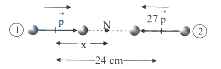
0 likesView Solution
256
PhysicsMediumMCQMHT CET · 2023
$A$ coil of $n$ turns and radius $R$ carries a current $I$. It is unwound and rewound again to make another coil of radius $\frac{R}{3}$,with the current remaining the same. The ratio of the magnetic moment of the new coil to that of the original coil is:
A
$3: 1$
B
$1: 3$
C
$9: 1$
D
$1: 9$
Solution
(B) The length of the wire remains constant. Let $N_1 = n$ and $N_2$ be the number of turns in the new coil.
Since the total length of the wire $L = N_1 (2 \pi R) = N_2 (2 \pi R_2)$,where $R_2 = \frac{R}{3}$:
$N_1 (2 \pi R) = N_2 (2 \pi \frac{R}{3})$
$N_1 = \frac{N_2}{3} \implies N_2 = 3 N_1$.
The magnetic moment $\mu$ of a coil is given by $\mu = N I A$,where $A = \pi R^2$.
For the original coil: $\mu_1 = N_1 I (\pi R^2)$.
For the new coil: $\mu_2 = N_2 I (\pi R_2^2) = (3 N_1) I \pi (\frac{R}{3})^2 = 3 N_1 I \pi \frac{R^2}{9} = \frac{1}{3} N_1 I \pi R^2$.
Therefore,the ratio $\frac{\mu_2}{\mu_1} = \frac{\frac{1}{3} N_1 I \pi R^2}{N_1 I \pi R^2} = \frac{1}{3}$.
Since the total length of the wire $L = N_1 (2 \pi R) = N_2 (2 \pi R_2)$,where $R_2 = \frac{R}{3}$:
$N_1 (2 \pi R) = N_2 (2 \pi \frac{R}{3})$
$N_1 = \frac{N_2}{3} \implies N_2 = 3 N_1$.
The magnetic moment $\mu$ of a coil is given by $\mu = N I A$,where $A = \pi R^2$.
For the original coil: $\mu_1 = N_1 I (\pi R^2)$.
For the new coil: $\mu_2 = N_2 I (\pi R_2^2) = (3 N_1) I \pi (\frac{R}{3})^2 = 3 N_1 I \pi \frac{R^2}{9} = \frac{1}{3} N_1 I \pi R^2$.
Therefore,the ratio $\frac{\mu_2}{\mu_1} = \frac{\frac{1}{3} N_1 I \pi R^2}{N_1 I \pi R^2} = \frac{1}{3}$.
0 likesView Solution
257
PhysicsMediumMCQMHT CET · 2023
The ratio of the magnetic field at the centre of a current-carrying circular loop to its magnetic moment is '$x$'. When both the current and the radius are doubled,the new ratio will be:
A
$2x$
B
$\frac{x}{2}$
C
$\frac{x}{4}$
D
$\frac{x}{8}$
Solution
(D) The magnetic field at the center of a circular loop is $B = \frac{\mu_0 i}{2r}$.
The magnetic moment of the loop is $M = i \pi r^2$.
The ratio is $x = \frac{B}{M} = \frac{\mu_0 i / 2r}{i \pi r^2} = \frac{\mu_0}{2 \pi r^3}$.
When the current $i$ becomes $2i$ and the radius $r$ becomes $2r$,the new magnetic field $B'$ is $B' = \frac{\mu_0 (2i)}{2(2r)} = \frac{\mu_0 i}{2r} = B$.
The new magnetic moment $M'$ is $M' = (2i) \pi (2r)^2 = (2i) \pi (4r^2) = 8(i \pi r^2) = 8M$.
The new ratio $x'$ is $x' = \frac{B'}{M'} = \frac{B}{8M} = \frac{1}{8} \left( \frac{B}{M} \right) = \frac{x}{8}$.
The magnetic moment of the loop is $M = i \pi r^2$.
The ratio is $x = \frac{B}{M} = \frac{\mu_0 i / 2r}{i \pi r^2} = \frac{\mu_0}{2 \pi r^3}$.
When the current $i$ becomes $2i$ and the radius $r$ becomes $2r$,the new magnetic field $B'$ is $B' = \frac{\mu_0 (2i)}{2(2r)} = \frac{\mu_0 i}{2r} = B$.
The new magnetic moment $M'$ is $M' = (2i) \pi (2r)^2 = (2i) \pi (4r^2) = 8(i \pi r^2) = 8M$.
The new ratio $x'$ is $x' = \frac{B'}{M'} = \frac{B}{8M} = \frac{1}{8} \left( \frac{B}{M} \right) = \frac{x}{8}$.
0 likesView Solution
258
PhysicsDifficultMCQMHT CET · 2023
$A$ straight wire carrying a current $I$ is turned into a circular loop. If the magnitude of the magnetic moment associated with it is $M$,then the length of the wire will be
A
$\frac{M \pi}{4 I}$
B
$\left[\frac{4 \pi I}{M}\right]^{\frac{1}{2}}$
C
$\left[\frac{4 M \pi}{I}\right]^{\frac{1}{2}}$
D
$4 \pi MI$
Solution
(C) The magnetic moment $M$ of a circular loop is given by the formula $M = I A$,where $I$ is the current and $A$ is the area of the loop.
For a circular loop of radius $R$,the area is $A = \pi R^2$.
Thus,$M = I (\pi R^2)$.
The length of the wire $L$ forms the circumference of the loop,so $L = 2 \pi R$,which implies $R = \frac{L}{2 \pi}$.
Substituting the value of $R$ into the magnetic moment equation:
$M = I \pi \left( \frac{L}{2 \pi} \right)^2$
$M = I \pi \left( \frac{L^2}{4 \pi^2} \right)$
$M = \frac{I L^2}{4 \pi}$
Rearranging to solve for $L$:
$L^2 = \frac{4 M \pi}{I}$
$L = \sqrt{\frac{4 M \pi}{I}}$ or $\left[ \frac{4 M \pi}{I} \right]^{\frac{1}{2}}$.
For a circular loop of radius $R$,the area is $A = \pi R^2$.
Thus,$M = I (\pi R^2)$.
The length of the wire $L$ forms the circumference of the loop,so $L = 2 \pi R$,which implies $R = \frac{L}{2 \pi}$.
Substituting the value of $R$ into the magnetic moment equation:
$M = I \pi \left( \frac{L}{2 \pi} \right)^2$
$M = I \pi \left( \frac{L^2}{4 \pi^2} \right)$
$M = \frac{I L^2}{4 \pi}$
Rearranging to solve for $L$:
$L^2 = \frac{4 M \pi}{I}$
$L = \sqrt{\frac{4 M \pi}{I}}$ or $\left[ \frac{4 M \pi}{I} \right]^{\frac{1}{2}}$.
0 likesView Solution
259
PhysicsDifficultMCQMHT CET · 2023
An electron of mass '$m$' and charge '$q$' is travelling with speed '$v$' along a circular path of radius '$R$' at right angles to a uniform magnetic field of intensity '$B$'. If the speed of the electron is halved and the magnetic field is doubled,the resulting path would have a radius of:
A
$\frac{R}{2}$
B
$\frac{R}{4}$
C
$2R$
D
$4R$
Solution
(B) For a charged particle moving in a uniform magnetic field,the magnetic Lorentz force provides the necessary centripetal force for circular motion.
$qvB = \frac{mv^2}{R}$
$\therefore R = \frac{mv}{qB}$ ... $(i)$
Given the new speed $v' = \frac{v}{2}$ and the new magnetic field $B' = 2B$.
The new radius $R'$ is given by:
$R' = \frac{mv'}{qB'} = \frac{m(v/2)}{q(2B)}$
$R' = \frac{mv}{4qB}$
Substituting equation $(i)$ into the expression for $R'$:
$R' = \frac{R}{4}$
$qvB = \frac{mv^2}{R}$
$\therefore R = \frac{mv}{qB}$ ... $(i)$
Given the new speed $v' = \frac{v}{2}$ and the new magnetic field $B' = 2B$.
The new radius $R'$ is given by:
$R' = \frac{mv'}{qB'} = \frac{m(v/2)}{q(2B)}$
$R' = \frac{mv}{4qB}$
Substituting equation $(i)$ into the expression for $R'$:
$R' = \frac{R}{4}$
0 likesView Solution
260
PhysicsMediumMCQMHT CET · 2023
$A$ long straight wire carrying a current of $25 \,A$ rests on a table. Another wire $PQ$ of length $1 \,m$ and mass $2.5 \,g$ carries the same current but in the opposite direction. The wire $PQ$ is free to slide up and down. To what height $h$ will wire $PQ$ rise (in $\,mm$)? (Take $g = 9.8 \,m/s^2$ and $\mu_0 = 4 \pi \times 10^{-7} \,T \cdot m/A$)
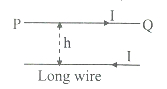
A
$3$
B
$4$
C
$5$
D
$8$
Solution
(C) The magnetic force per unit length between two parallel wires carrying currents $I_1$ and $I_2$ separated by a distance $h$ is given by $F/l = \frac{\mu_0 I_1 I_2}{2 \pi h}$.
Since the currents are in opposite directions,the force is repulsive.
At equilibrium,the repulsive magnetic force balances the gravitational force acting on wire $PQ$:
$F = mg$
$\frac{\mu_0 I^2 l}{2 \pi h} = mg$
Given: $I = 25 \,A$,$l = 1 \,m$,$m = 2.5 \,g = 2.5 \times 10^{-3} \,kg$,$g = 9.8 \,m/s^2$,$\mu_0 = 4 \pi \times 10^{-7} \,T \cdot m/A$.
Substituting the values:
$h = \frac{\mu_0 I^2 l}{2 \pi m g} = \frac{(4 \pi \times 10^{-7}) \times (25)^2 \times 1}{2 \pi \times (2.5 \times 10^{-3}) \times 9.8}$
$h = \frac{2 \times 10^{-7} \times 625}{2.5 \times 10^{-3} \times 9.8} = \frac{1250 \times 10^{-7}}{24.5 \times 10^{-3}} = \frac{1250}{24.5} \times 10^{-4} \,m \approx 51 \times 10^{-4} \,m \approx 5.1 \,mm$.
Rounding to the nearest given option,the height is $5 \,mm$.
Since the currents are in opposite directions,the force is repulsive.
At equilibrium,the repulsive magnetic force balances the gravitational force acting on wire $PQ$:
$F = mg$
$\frac{\mu_0 I^2 l}{2 \pi h} = mg$
Given: $I = 25 \,A$,$l = 1 \,m$,$m = 2.5 \,g = 2.5 \times 10^{-3} \,kg$,$g = 9.8 \,m/s^2$,$\mu_0 = 4 \pi \times 10^{-7} \,T \cdot m/A$.
Substituting the values:
$h = \frac{\mu_0 I^2 l}{2 \pi m g} = \frac{(4 \pi \times 10^{-7}) \times (25)^2 \times 1}{2 \pi \times (2.5 \times 10^{-3}) \times 9.8}$
$h = \frac{2 \times 10^{-7} \times 625}{2.5 \times 10^{-3} \times 9.8} = \frac{1250 \times 10^{-7}}{24.5 \times 10^{-3}} = \frac{1250}{24.5} \times 10^{-4} \,m \approx 51 \times 10^{-4} \,m \approx 5.1 \,mm$.
Rounding to the nearest given option,the height is $5 \,mm$.
0 likesView Solution
261
PhysicsEasyMCQMHT CET · 2023
An electron is projected along the axis of a circular conductor carrying current $I$. The electron will experience:
A
a force perpendicular to the axis
B
a force along the axis
C
a force at an angle $30^{\circ}$ with the axis
D
no force
Solution
(D) The magnetic field produced by a circular current-carrying loop at any point on its axis is directed along the axis of the loop.
Since the electron is projected along the same axis,its velocity vector $\vec{v}$ is parallel or anti-parallel to the magnetic field vector $\vec{B}$.
Therefore,the angle $\theta$ between the velocity and the magnetic field is either $0^{\circ}$ or $180^{\circ}$.
The magnetic force on a moving charge is given by the Lorentz force formula: $F = qvB \sin \theta$.
Substituting $\theta = 0^{\circ}$ or $180^{\circ}$,we get $\sin(0^{\circ}) = 0$ or $\sin(180^{\circ}) = 0$.
Thus,$F = 0$. The electron experiences no force.
Since the electron is projected along the same axis,its velocity vector $\vec{v}$ is parallel or anti-parallel to the magnetic field vector $\vec{B}$.
Therefore,the angle $\theta$ between the velocity and the magnetic field is either $0^{\circ}$ or $180^{\circ}$.
The magnetic force on a moving charge is given by the Lorentz force formula: $F = qvB \sin \theta$.
Substituting $\theta = 0^{\circ}$ or $180^{\circ}$,we get $\sin(0^{\circ}) = 0$ or $\sin(180^{\circ}) = 0$.
Thus,$F = 0$. The electron experiences no force.
0 likesView Solution
262
PhysicsMediumMCQMHT CET · 2023
An aircraft of wing span $40 \ m$ flies horizontally in the Earth's magnetic field of $5 \times 10^{-5} \ T$ at a speed of $500 \ m/s$. The electromotive force (e.m.f.) generated between the tips of the wings of the aircraft is: (in $V$)
A
$0.5$
B
$1$
C
$1.2$
D
$1.0$
Solution
(B) The motional e.m.f. induced in a conductor moving through a magnetic field is given by the formula: $\varepsilon = B \cdot l \cdot v$.
Given values:
Magnetic field $B = 5 \times 10^{-5} \ T$,
Wing span (length) $l = 40 \ m$,
Speed $v = 500 \ m/s$.
Substituting these values into the formula:
$\varepsilon = (5 \times 10^{-5} \ T) \times (40 \ m) \times (500 \ m/s)$
$\varepsilon = 5 \times 10^{-5} \times 20000$
$\varepsilon = 5 \times 10^{-5} \times 2 \times 10^4$
$\varepsilon = 10 \times 10^{-1} \ V$
$\varepsilon = 1 \ V$.
Therefore,the e.m.f. generated is $1 \ V$.
Given values:
Magnetic field $B = 5 \times 10^{-5} \ T$,
Wing span (length) $l = 40 \ m$,
Speed $v = 500 \ m/s$.
Substituting these values into the formula:
$\varepsilon = (5 \times 10^{-5} \ T) \times (40 \ m) \times (500 \ m/s)$
$\varepsilon = 5 \times 10^{-5} \times 20000$
$\varepsilon = 5 \times 10^{-5} \times 2 \times 10^4$
$\varepsilon = 10 \times 10^{-1} \ V$
$\varepsilon = 1 \ V$.
Therefore,the e.m.f. generated is $1 \ V$.
0 likesView Solution
263
PhysicsMediumMCQMHT CET · 2023
According to Curie's law in magnetism,the correct relation is $(M=$ magnetization in paramagnetic sample,$B=$ applied magnetic field,$T=$ absolute temperature of the material,$C=$ Curie's constant $)$
A
$M=\frac{T}{CB}$
B
$M=\frac{CB}{T}$
C
$C=\frac{MB}{T}$
D
$C=\frac{T^2}{MB}$
Solution
(B) According to Curie's law,the magnetization $M$ of a paramagnetic material is directly proportional to the applied magnetic field $B$ and inversely proportional to the absolute temperature $T$.
Mathematically,this is expressed as $M \propto \frac{B}{T}$.
Introducing Curie's constant $C$,we get the relation $M = C \frac{B}{T}$,which can be rewritten as $M = \frac{CB}{T}$.
Therefore,the correct option is $B$.
Mathematically,this is expressed as $M \propto \frac{B}{T}$.
Introducing Curie's constant $C$,we get the relation $M = C \frac{B}{T}$,which can be rewritten as $M = \frac{CB}{T}$.
Therefore,the correct option is $B$.
0 likesView Solution
264
PhysicsEasyMCQMHT CET · 2023
In the hysteresis curve,the value of magnetic induction $(B)$ which remains in a substance when the value of the magnetizing force $(H)$ is made zero $(H=0)$ is called
A
coercivity
B
retentivity
C
domain
D
saturation
Solution
(B) Retentivity or remanence is the ability of a magnetic substance to retain magnetism even in the absence of an external magnetizing field.
When the magnetizing force $(H)$ is reduced to zero,the residual magnetic induction $(B)$ present in the material is known as retentivity.
Therefore,retentivity corresponds to the value of $B$ when $H = 0$.
When the magnetizing force $(H)$ is reduced to zero,the residual magnetic induction $(B)$ present in the material is known as retentivity.
Therefore,retentivity corresponds to the value of $B$ when $H = 0$.
0 likesView Solution
265
PhysicsMediumMCQMHT CET · 2023
The coil of an $A.C.$ generator has $100$ turns, each of cross-sectional area $2 \, m^2$. It is rotating at a constant angular speed of $30 \, rad/s$ in a uniform magnetic field of $2 \times 10^{-2} \, T$. If the total resistance of the circuit is $600 \, \Omega$, then the maximum power dissipated in the circuit is: (in $W$)
A
$6$
B
$9$
C
$12$
D
$24$
Solution
(C) Given: $N = 100$, $A = 2 \, m^2$, $\omega = 30 \, rad/s$, $B = 2 \times 10^{-2} \, T$, $R = 600 \, \Omega$.
The peak electromotive force $(E_0)$ induced in the coil is given by:
$E_0 = N A B \omega$
$E_0 = 100 \times 2 \times (2 \times 10^{-2}) \times 30$
$E_0 = 100 \times 2 \times 0.02 \times 30 = 120 \, V$.
The maximum power dissipated in an $A.C.$ circuit is given by:
$P_{\max} = \frac{E_0^2}{2R}$
Substituting the values:
$P_{\max} = \frac{120 \times 120}{2 \times 600}$
$P_{\max} = \frac{14400}{1200} = 12 \, W$.
The peak electromotive force $(E_0)$ induced in the coil is given by:
$E_0 = N A B \omega$
$E_0 = 100 \times 2 \times (2 \times 10^{-2}) \times 30$
$E_0 = 100 \times 2 \times 0.02 \times 30 = 120 \, V$.
The maximum power dissipated in an $A.C.$ circuit is given by:
$P_{\max} = \frac{E_0^2}{2R}$
Substituting the values:
$P_{\max} = \frac{120 \times 120}{2 \times 600}$
$P_{\max} = \frac{14400}{1200} = 12 \, W$.
0 likesView Solution
266
PhysicsEasyMCQMHT CET · 2023
$A$ charge '$q$' moves with velocity '$\overrightarrow{v}$' through an electric field '$\overrightarrow{E}$' as well as a magnetic field '$\overrightarrow{B}$'. Then the force acting on it is:
A
$q(\overrightarrow{v} \times \overrightarrow{B})$
B
$q(\overrightarrow{B} \times \overrightarrow{v})$
C
$q(\overrightarrow{E} \times \overrightarrow{v})$
D
$q\overrightarrow{E} + q(\overrightarrow{v} \times \overrightarrow{B})$
Solution
(D) When a charge '$q$' moves with velocity '$\overrightarrow{v}$' in a region where both electric field '$\overrightarrow{E}$' and magnetic field '$\overrightarrow{B}$' are present,it experiences two forces:
$1$. Electric force: $\overrightarrow{F}_e = q\overrightarrow{E}$
$2$. Magnetic force (Lorentz force): $\overrightarrow{F}_m = q(\overrightarrow{v} \times \overrightarrow{B})$
The total force acting on the charge is the vector sum of these two forces,known as the Lorentz force:
$\overrightarrow{F} = \overrightarrow{F}_e + \overrightarrow{F}_m = q\overrightarrow{E} + q(\overrightarrow{v} \times \overrightarrow{B})$
Therefore,the correct option is $D$.
$1$. Electric force: $\overrightarrow{F}_e = q\overrightarrow{E}$
$2$. Magnetic force (Lorentz force): $\overrightarrow{F}_m = q(\overrightarrow{v} \times \overrightarrow{B})$
The total force acting on the charge is the vector sum of these two forces,known as the Lorentz force:
$\overrightarrow{F} = \overrightarrow{F}_e + \overrightarrow{F}_m = q\overrightarrow{E} + q(\overrightarrow{v} \times \overrightarrow{B})$
Therefore,the correct option is $D$.
0 likesView Solution
267
PhysicsEasyMCQMHT CET · 2023
$A$ hollow metal pipe is held vertically and a bar magnet is dropped through it with its length along the axis of the pipe. The acceleration of the falling magnet is ($g=$ acceleration due to gravity).
A
equal to $g$.
B
less than $g$.
C
more than $g$.
D
zero.
Solution
(B) As the bar magnet falls through the hollow metal pipe,the magnetic flux linked with the pipe changes continuously.
According to Faraday's law of electromagnetic induction,this change in magnetic flux induces an electromotive force $(emf)$ in the pipe.
Since the pipe is a conductor,this induced $emf$ causes eddy currents to flow within the body of the pipe.
According to Lenz's law,these eddy currents create a magnetic field that opposes the motion of the falling magnet.
This opposing force acts upwards,reducing the net downward force on the magnet.
Consequently,the net acceleration of the magnet is less than the acceleration due to gravity $(g)$.
According to Faraday's law of electromagnetic induction,this change in magnetic flux induces an electromotive force $(emf)$ in the pipe.
Since the pipe is a conductor,this induced $emf$ causes eddy currents to flow within the body of the pipe.
According to Lenz's law,these eddy currents create a magnetic field that opposes the motion of the falling magnet.
This opposing force acts upwards,reducing the net downward force on the magnet.
Consequently,the net acceleration of the magnet is less than the acceleration due to gravity $(g)$.
0 likesView Solution
268
PhysicsEasyMCQMHT CET · 2023
For which of the following substances, the magnetic susceptibility is independent of temperature?
A
Diamagnetic only.
B
Paramagnetic only.
C
Ferromagnetic only.
D
Diamagnetic and paramagnetic both.
Solution
(A) The magnetic susceptibility $(\chi)$ of diamagnetic substances is small and negative. It arises due to the orbital motion of electrons and is essentially independent of temperature. In contrast, the magnetic susceptibility of paramagnetic and ferromagnetic substances depends on temperature according to Curie's Law and the Curie-Weiss Law, respectively.
0 likesView Solution
269
PhysicsEasyMCQMHT CET · 2023
Magnetic shielding is done by surrounding the instrument to be protected from magnetic field by
A
soft ferromagnetic substance (soft iron).
B
diamagnetic substance (fine copper gauge).
C
paramagnetic substance (aluminum).
D
paramagnetic material (tantalum).
Solution
(A) Magnetic shielding is achieved by enclosing the sensitive instrument within a shell made of a material with high magnetic permeability,such as soft iron.
When an external magnetic field is applied,the magnetic field lines prefer to pass through the high-permeability material rather than the air or the interior space.
This effectively diverts the magnetic flux around the protected region,thereby shielding the instrument from the external magnetic field.
When an external magnetic field is applied,the magnetic field lines prefer to pass through the high-permeability material rather than the air or the interior space.
This effectively diverts the magnetic flux around the protected region,thereby shielding the instrument from the external magnetic field.
0 likesView Solution
270
PhysicsEasyMCQMHT CET · 2023
$A$ horizontal wire of mass $m$,length $l$,and resistance $R$ is sliding on vertical rails in a uniform magnetic field $B$ directed perpendicularly. The terminal speed of the wire as it falls under the force of gravity is ($g =$ acceleration due to gravity).
A
$\frac{mgl}{BR}$
B
$\frac{B^2 l^2}{mgR}$
C
$\frac{mgR}{Bl}$
D
$\frac{mgR}{B^2 l^2}$
Solution
(D) When the wire attains terminal velocity,the net force acting on it becomes zero.
Therefore,the magnetic force equals the gravitational force.
$iBl = mg$
Since the induced current $i = \frac{e}{R}$ and the induced electromotive force $e = Bvl$,we substitute these into the equation:
$\frac{Bvl}{R} \cdot Bl = mg$
$\frac{B^2 l^2 v}{R} = mg$
Solving for terminal velocity $v$:
$v = \frac{mgR}{B^2 l^2}$
Therefore,the magnetic force equals the gravitational force.
$iBl = mg$
Since the induced current $i = \frac{e}{R}$ and the induced electromotive force $e = Bvl$,we substitute these into the equation:
$\frac{Bvl}{R} \cdot Bl = mg$
$\frac{B^2 l^2 v}{R} = mg$
Solving for terminal velocity $v$:
$v = \frac{mgR}{B^2 l^2}$
0 likesView Solution
271
PhysicsEasyMCQMHT CET · 2023
In a radioactive disintegration,the ratio of the initial number of atoms to the number of atoms present at time $t = \frac{1}{2 \lambda}$ is $[\lambda = \text{decay constant}]$
A
$\frac{1}{e}$
B
$\sqrt{e}$
C
$e$
D
$2e$
Solution
(B) According to the radioactive disintegration law,the number of atoms $N$ at time $t$ is given by $N = N_0 e^{-\lambda t}$.
Here,$N_0$ is the initial number of atoms.
We need to find the ratio $\frac{N_0}{N}$ at time $t = \frac{1}{2 \lambda}$.
Substituting the value of $t$ in the equation:
$\frac{N}{N_0} = e^{-\lambda \times \frac{1}{2 \lambda}}$
$\frac{N}{N_0} = e^{-\frac{1}{2}}$
Taking the reciprocal to find $\frac{N_0}{N}$:
$\frac{N_0}{N} = e^{\frac{1}{2}}$
$\frac{N_0}{N} = \sqrt{e}$
Here,$N_0$ is the initial number of atoms.
We need to find the ratio $\frac{N_0}{N}$ at time $t = \frac{1}{2 \lambda}$.
Substituting the value of $t$ in the equation:
$\frac{N}{N_0} = e^{-\lambda \times \frac{1}{2 \lambda}}$
$\frac{N}{N_0} = e^{-\frac{1}{2}}$
Taking the reciprocal to find $\frac{N_0}{N}$:
$\frac{N_0}{N} = e^{\frac{1}{2}}$
$\frac{N_0}{N} = \sqrt{e}$
0 likesView Solution
272
PhysicsMediumMCQMHT CET · 2023
Two different radioactive elements with half-lives $T_1$ and $T_2$ have undecayed atoms $N_1$ and $N_2$ respectively present at a given instant. The ratio of their activities at that instant is
A
$\frac{N_1 T_1}{N_2 T_2}$
B
$\frac{N_2 T_2}{N_1 T_1}$
C
$\frac{N_1 T_2}{N_2 T_1}$
D
$\frac{N_1 N_2}{T_1 T_2}$
Solution
(C) The activity $A$ of a radioactive sample is given by the formula $A = \lambda N$,where $\lambda$ is the decay constant and $N$ is the number of undecayed atoms.
The decay constant $\lambda$ is related to the half-life $T$ by the relation $\lambda = \frac{\ln 2}{T}$.
For the two radioactive elements,the activities are:
$A_1 = \lambda_1 N_1 = \frac{\ln 2}{T_1} N_1$
$A_2 = \lambda_2 N_2 = \frac{\ln 2}{T_2} N_2$
The ratio of their activities is:
$\frac{A_1}{A_2} = \frac{(\frac{\ln 2}{T_1}) N_1}{(\frac{\ln 2}{T_2}) N_2}$
Simplifying the expression:
$\frac{A_1}{A_2} = \frac{N_1}{T_1} \times \frac{T_2}{N_2} = \frac{N_1 T_2}{N_2 T_1}$
The decay constant $\lambda$ is related to the half-life $T$ by the relation $\lambda = \frac{\ln 2}{T}$.
For the two radioactive elements,the activities are:
$A_1 = \lambda_1 N_1 = \frac{\ln 2}{T_1} N_1$
$A_2 = \lambda_2 N_2 = \frac{\ln 2}{T_2} N_2$
The ratio of their activities is:
$\frac{A_1}{A_2} = \frac{(\frac{\ln 2}{T_1}) N_1}{(\frac{\ln 2}{T_2}) N_2}$
Simplifying the expression:
$\frac{A_1}{A_2} = \frac{N_1}{T_1} \times \frac{T_2}{N_2} = \frac{N_1 T_2}{N_2 T_1}$
0 likesView Solution
273
PhysicsEasyMCQMHT CET · 2023
An isotope of the original nucleus can be formed in a radioactive decay,with the emission of which of the following particles?
A
one $\alpha$ and one $\beta$
B
one $\alpha$ and two $\beta$
C
one $\alpha$ and four $\beta$
D
four $\alpha$ and one $\beta$
Solution
(B) Let the original nucleus be ${ }_{Z} X^{A}$.
When one $\alpha$ particle $({ }_{2} He^{4})$ is emitted,the nucleus becomes ${ }_{Z-2} Y^{A-4}$.
When one $\beta^{-}$ particle $({ }_{-1} e^{0})$ is emitted,the atomic number increases by $1$ $(Z-2+1 = Z-1)$.
When two $\beta^{-}$ particles are emitted,the atomic number increases by $2$ $(Z-2+2 = Z)$.
Thus,the final nucleus is ${ }_{Z} X^{A-4}$,which is an isotope of the original nucleus ${ }_{Z} X^{A}$ because they have the same atomic number $Z$ but different mass numbers.
When one $\alpha$ particle $({ }_{2} He^{4})$ is emitted,the nucleus becomes ${ }_{Z-2} Y^{A-4}$.
When one $\beta^{-}$ particle $({ }_{-1} e^{0})$ is emitted,the atomic number increases by $1$ $(Z-2+1 = Z-1)$.
When two $\beta^{-}$ particles are emitted,the atomic number increases by $2$ $(Z-2+2 = Z)$.
Thus,the final nucleus is ${ }_{Z} X^{A-4}$,which is an isotope of the original nucleus ${ }_{Z} X^{A}$ because they have the same atomic number $Z$ but different mass numbers.
0 likesView Solution
274
PhysicsMediumMCQMHT CET · 2023
$A$ radioactive sample has a half-life of $5$ years. The percentage of the fraction decayed in $10$ years will be (in $\%$)
A
$25$
B
$50$
C
$75$
D
$100$
Solution
(C) Given:
Total time,$T = 10$ years
Half-life,$T_{1/2} = 5$ years
Number of half-lives,$n = \frac{T}{T_{1/2}} = \frac{10}{5} = 2$
Using the radioactive decay law,the fraction remaining is given by $\frac{N}{N_0} = \left(\frac{1}{2}\right)^n$
Substituting the value of $n$,we get $\frac{N}{N_0} = \left(\frac{1}{2}\right)^2 = \frac{1}{4}$
This means $\frac{1}{4}$ of the original substance remains after $10$ years.
The fraction decayed is $1 - \frac{N}{N_0} = 1 - \frac{1}{4} = \frac{3}{4}$
To express this as a percentage,we multiply by $100$: $\frac{3}{4} \times 100 = 75 \%$
Therefore,$75 \%$ of the sample will decay in $10$ years.
Total time,$T = 10$ years
Half-life,$T_{1/2} = 5$ years
Number of half-lives,$n = \frac{T}{T_{1/2}} = \frac{10}{5} = 2$
Using the radioactive decay law,the fraction remaining is given by $\frac{N}{N_0} = \left(\frac{1}{2}\right)^n$
Substituting the value of $n$,we get $\frac{N}{N_0} = \left(\frac{1}{2}\right)^2 = \frac{1}{4}$
This means $\frac{1}{4}$ of the original substance remains after $10$ years.
The fraction decayed is $1 - \frac{N}{N_0} = 1 - \frac{1}{4} = \frac{3}{4}$
To express this as a percentage,we multiply by $100$: $\frac{3}{4} \times 100 = 75 \%$
Therefore,$75 \%$ of the sample will decay in $10$ years.
0 likesView Solution
275
PhysicsMediumMCQMHT CET · 2023
The half-life of a radioactive element is $1600$ years. The fraction of the sample that remains undecayed after $6400$ years will be:
A
$\frac{1}{16}$
B
$\frac{1}{4}$
C
$\frac{1}{8}$
D
$\frac{1}{24}$
Solution
(A) The law of radioactive decay states that the fraction of the sample remaining undecayed is given by the formula: $\frac{N}{N_0} = \left(\frac{1}{2}\right)^{\frac{t}{T}}$
Here,the total time elapsed is $t = 6400$ years and the half-life is $T = 1600$ years.
Substituting these values into the formula:
$\frac{N}{N_0} = \left(\frac{1}{2}\right)^{\frac{6400}{1600}}$
$\frac{N}{N_0} = \left(\frac{1}{2}\right)^4$
$\frac{N}{N_0} = \frac{1}{16}$
Thus,the fraction of the sample remaining undecayed after $6400$ years is $\frac{1}{16}$.
Here,the total time elapsed is $t = 6400$ years and the half-life is $T = 1600$ years.
Substituting these values into the formula:
$\frac{N}{N_0} = \left(\frac{1}{2}\right)^{\frac{6400}{1600}}$
$\frac{N}{N_0} = \left(\frac{1}{2}\right)^4$
$\frac{N}{N_0} = \frac{1}{16}$
Thus,the fraction of the sample remaining undecayed after $6400$ years is $\frac{1}{16}$.
0 likesView Solution
276
PhysicsEasyMCQMHT CET · 2023
The rays of different colours fail to converge at a point after passing through a thick converging lens. This defect is called
A
spherical aberration
B
distortion
C
coma
D
chromatic aberration
Solution
(D) When light passes through a lens,the refractive index of the lens material depends on the wavelength of the light. Since different colours have different wavelengths,they are refracted by different amounts. Consequently,rays of different colours do not focus at the same point after passing through a lens. This phenomenon is known as chromatic aberration.
0 likesView Solution
277
PhysicsMediumMCQMHT CET · 2023
The angle of deviation produced by a thin prism when placed in air is $\delta_1$ and that when immersed in water is $\delta_2$. The refractive indices of glass and water are $\frac{3}{2}$ and $\frac{4}{3}$ respectively. The ratio $\delta_1 : \delta_2$ is
A
$1 : 2$
B
$2 : 1$
C
$1 : 4$
D
$4 : 1$
Solution
(D) For a thin prism,the angle of deviation is given by $\delta = (\mu - 1)A$,where $\mu$ is the relative refractive index of the prism material with respect to the surrounding medium.
$1$. When the prism is in air:
$\mu_1 = \frac{\mu_{\text{glass}}}{\mu_{\text{air}}} = \frac{3/2}{1} = \frac{3}{2}$
$\delta_1 = (\frac{3}{2} - 1)A = \frac{1}{2}A$
$2$. When the prism is in water:
$\mu_2 = \frac{\mu_{\text{glass}}}{\mu_{\text{water}}} = \frac{3/2}{4/3} = \frac{9}{8}$
$\delta_2 = (\frac{9}{8} - 1)A = \frac{1}{8}A$
$3$. Calculating the ratio:
$\frac{\delta_1}{\delta_2} = \frac{\frac{1}{2}A}{\frac{1}{8}A} = \frac{1}{2} \times 8 = 4$
Therefore,the ratio $\delta_1 : \delta_2$ is $4 : 1$.
$1$. When the prism is in air:
$\mu_1 = \frac{\mu_{\text{glass}}}{\mu_{\text{air}}} = \frac{3/2}{1} = \frac{3}{2}$
$\delta_1 = (\frac{3}{2} - 1)A = \frac{1}{2}A$
$2$. When the prism is in water:
$\mu_2 = \frac{\mu_{\text{glass}}}{\mu_{\text{water}}} = \frac{3/2}{4/3} = \frac{9}{8}$
$\delta_2 = (\frac{9}{8} - 1)A = \frac{1}{8}A$
$3$. Calculating the ratio:
$\frac{\delta_1}{\delta_2} = \frac{\frac{1}{2}A}{\frac{1}{8}A} = \frac{1}{2} \times 8 = 4$
Therefore,the ratio $\delta_1 : \delta_2$ is $4 : 1$.
0 likesView Solution
278
PhysicsMediumMCQMHT CET · 2023
The refractive index of a glass convex lens is $1.5$. The radius of curvature of each of the two surfaces of the lens is $40 \ cm$. The ratio of the power of the lens when immersed in a liquid of refractive index $1.25$ to that when placed in air is:
A
$2$:$3$
B
$3$:$2$
C
$2$:$5$
D
$5$:$2$
Solution
(C) The power of a lens is given by $P = \frac{1}{f} = (n_l - 1) \left( \frac{1}{R_1} - \frac{1}{R_2} \right)$.
For a convex lens,$R_1 = +40 \ cm$ and $R_2 = -40 \ cm$.
In air $(n_a = 1)$: $P_{air} = (1.5 - 1) \left( \frac{1}{40} - \frac{1}{-40} \right) = 0.5 \times \frac{2}{40} = \frac{0.5}{20} = \frac{1}{40} \ cm^{-1}$.
In liquid $(n_l = 1.25)$: The effective refractive index is $n_{rel} = \frac{n_g}{n_l} = \frac{1.5}{1.25} = 1.2$.
$P_{liquid} = (1.2 - 1) \left( \frac{1}{40} - \frac{1}{-40} \right) = 0.2 \times \frac{2}{40} = \frac{0.4}{40} = \frac{1}{100} \ cm^{-1}$.
The ratio of power in liquid to air is $\frac{P_{liquid}}{P_{air}} = \frac{1/100}{1/40} = \frac{40}{100} = \frac{2}{5}$.
For a convex lens,$R_1 = +40 \ cm$ and $R_2 = -40 \ cm$.
In air $(n_a = 1)$: $P_{air} = (1.5 - 1) \left( \frac{1}{40} - \frac{1}{-40} \right) = 0.5 \times \frac{2}{40} = \frac{0.5}{20} = \frac{1}{40} \ cm^{-1}$.
In liquid $(n_l = 1.25)$: The effective refractive index is $n_{rel} = \frac{n_g}{n_l} = \frac{1.5}{1.25} = 1.2$.
$P_{liquid} = (1.2 - 1) \left( \frac{1}{40} - \frac{1}{-40} \right) = 0.2 \times \frac{2}{40} = \frac{0.4}{40} = \frac{1}{100} \ cm^{-1}$.
The ratio of power in liquid to air is $\frac{P_{liquid}}{P_{air}} = \frac{1/100}{1/40} = \frac{40}{100} = \frac{2}{5}$.
0 likesView Solution
279
PhysicsMediumMCQMHT CET · 2023
Two lenses of power $-15 D$ and $+5 D$ are in contact with each other. The focal length of the combination is
A
$-0.1 \,cm$
B
$-10 \,cm$
C
$-20 \,cm$
D
$+10 \,cm$
Solution
(B) The power of a lens is given by $P = \frac{1}{f}$, where $f$ is the focal length in meters.
For a combination of thin lenses in contact, the equivalent power $P$ is the algebraic sum of the individual powers:
$P = P_1 + P_2$
Given:
$P_1 = -15 D$
$P_2 = +5 D$
Substituting the values:
$P = -15 D + 5 D = -10 D$
Now, calculate the focal length $f$:
$f = \frac{1}{P} = \frac{1}{-10} \,m$
$f = -0.1 \,m$
Converting to centimeters $(1 \,m = 100 \,cm)$:
$f = -0.1 \times 100 \,cm = -10 \,cm$
Thus, the focal length of the combination is $-10 \,cm$.
For a combination of thin lenses in contact, the equivalent power $P$ is the algebraic sum of the individual powers:
$P = P_1 + P_2$
Given:
$P_1 = -15 D$
$P_2 = +5 D$
Substituting the values:
$P = -15 D + 5 D = -10 D$
Now, calculate the focal length $f$:
$f = \frac{1}{P} = \frac{1}{-10} \,m$
$f = -0.1 \,m$
Converting to centimeters $(1 \,m = 100 \,cm)$:
$f = -0.1 \times 100 \,cm = -10 \,cm$
Thus, the focal length of the combination is $-10 \,cm$.
0 likesView Solution
280
PhysicsMediumMCQMHT CET · 2023
The size of the real image produced by a convex lens of focal length $F$ is '$m$' times the size of the object. The image distance from the lens is
A
$\frac{F}{(m-1)}$
B
$\frac{(m-1)}{F}$
C
$F(m+1)$
D
$F(m-1)$
Solution
(C) For a real image formed by a convex lens,the magnification $m$ is given by $m = \frac{v}{u}$,where $v$ is the image distance and $u$ is the object distance. Since the image is real,$m$ is negative. Let the magnitude of magnification be $M = |m|$. Then $v = M u$.
Using the lens formula: $\frac{1}{v} - \frac{1}{u} = \frac{1}{F}$.
Substituting $u = \frac{v}{M}$ (taking magnitudes): $\frac{1}{v} - \frac{M}{v} = \frac{1}{F}$.
$\frac{1-M}{v} = \frac{1}{F} \implies v = F(1-M)$.
However,in standard convention where $m$ is defined as the ratio of image size to object size,for a real image,$v = F(1+m)$ is the standard result derived from $\frac{1}{v} - \frac{1}{u} = \frac{1}{F}$ with $m = \frac{v}{u}$ (where $u$ is negative).
Thus,$v = F(1+m)$.
Using the lens formula: $\frac{1}{v} - \frac{1}{u} = \frac{1}{F}$.
Substituting $u = \frac{v}{M}$ (taking magnitudes): $\frac{1}{v} - \frac{M}{v} = \frac{1}{F}$.
$\frac{1-M}{v} = \frac{1}{F} \implies v = F(1-M)$.
However,in standard convention where $m$ is defined as the ratio of image size to object size,for a real image,$v = F(1+m)$ is the standard result derived from $\frac{1}{v} - \frac{1}{u} = \frac{1}{F}$ with $m = \frac{v}{u}$ (where $u$ is negative).
Thus,$v = F(1+m)$.
0 likesView Solution
281
PhysicsDifficultMCQMHT CET · 2023
$A$ double convex lens of focal length $F$ is cut into two equal parts along the vertical axis. The focal length of each part will be
A
$2 F$
B
$F$
C
$F/2$
D
$4 F$
Solution
(A) For a double convex lens, the lens maker's formula is given by $\frac{1}{F} = (\mu - 1) \left( \frac{1}{R_1} + \frac{1}{R_2} \right)$.
Assuming $R_1 = R_2 = R$, we have $\frac{1}{F} = (\mu - 1) \left( \frac{2}{R} \right)$.
When the lens is cut into two equal parts along the vertical axis, each part becomes a plano-convex lens.
For a plano-convex lens, one radius of curvature is $R$ and the other is $\infty$.
Applying the lens maker's formula for the new focal length $F'$:
$\frac{1}{F'} = (\mu - 1) \left( \frac{1}{R} + \frac{1}{\infty} \right) = \frac{\mu - 1}{R}$.
Comparing the two equations:
$\frac{1/F}{1/F'} = \frac{(\mu - 1) \times (2/R)}{(\mu - 1) / R} = 2$.
Therefore, $\frac{F'}{F} = 2$, which gives $F' = 2 F$.
Assuming $R_1 = R_2 = R$, we have $\frac{1}{F} = (\mu - 1) \left( \frac{2}{R} \right)$.
When the lens is cut into two equal parts along the vertical axis, each part becomes a plano-convex lens.
For a plano-convex lens, one radius of curvature is $R$ and the other is $\infty$.
Applying the lens maker's formula for the new focal length $F'$:
$\frac{1}{F'} = (\mu - 1) \left( \frac{1}{R} + \frac{1}{\infty} \right) = \frac{\mu - 1}{R}$.
Comparing the two equations:
$\frac{1/F}{1/F'} = \frac{(\mu - 1) \times (2/R)}{(\mu - 1) / R} = 2$.
Therefore, $\frac{F'}{F} = 2$, which gives $F' = 2 F$.
0 likesView Solution
282
PhysicsEasyMCQMHT CET · 2023
The converging or diverging ability of a lens or mirror is called
A
focal power
B
focal length
C
magnifying power
D
linear magnification
Solution
(A) The ability of a lens or mirror to converge or diverge light rays is defined as its power.
For a lens,the power $P$ is given by the reciprocal of the focal length $f$ in meters,i.e.,$P = 1/f$.
Therefore,the correct term for this ability is focal power (or simply power).
For a lens,the power $P$ is given by the reciprocal of the focal length $f$ in meters,i.e.,$P = 1/f$.
Therefore,the correct term for this ability is focal power (or simply power).
0 likesView Solution
283
PhysicsDifficultMCQMHT CET · 2023
The radii of curvature of both the surfaces of a convex lens of focal length $f$ and focal power $P$ are equal. One of the surfaces is made plane by grinding. The new focal length and focal power of the lens are:
A
$\frac{2}{3} f, \frac{2}{3} P$
B
$\sqrt{\frac{2}{f}}, \sqrt{\frac{P}{2}}$
C
$\frac{f}{2}, 2 P$
D
$2 f, \frac{P}{2}$
Solution
(D) From the lens maker's formula,$\frac{1}{f} = (\mu - 1) \left( \frac{1}{R_1} - \frac{1}{R_2} \right)$.
For a convex lens with equal radii of curvature $R$,we have $R_1 = R$ and $R_2 = -R$. Thus,$\frac{1}{f} = (\mu - 1) \left( \frac{1}{R} - \frac{1}{-R} \right) = (\mu - 1) \left( \frac{2}{R} \right)$.
So,$\frac{1}{f} = \frac{2(\mu - 1)}{R}$.
When one surface is made plane by grinding,the new radii are $R_1 = R$ and $R_2 = \infty$.
The new focal length $f'$ is given by $\frac{1}{f'} = (\mu - 1) \left( \frac{1}{R} - \frac{1}{\infty} \right) = \frac{\mu - 1}{R}$.
Comparing the two equations,we see that $\frac{1}{f'} = \frac{1}{2} \left( \frac{1}{f} \right)$,which implies $f' = 2f$.
Since focal power $P = \frac{1}{f}$,the new power $P' = \frac{1}{f'} = \frac{1}{2f} = \frac{P}{2}$.
Therefore,the new focal length is $2f$ and the new power is $\frac{P}{2}$.
For a convex lens with equal radii of curvature $R$,we have $R_1 = R$ and $R_2 = -R$. Thus,$\frac{1}{f} = (\mu - 1) \left( \frac{1}{R} - \frac{1}{-R} \right) = (\mu - 1) \left( \frac{2}{R} \right)$.
So,$\frac{1}{f} = \frac{2(\mu - 1)}{R}$.
When one surface is made plane by grinding,the new radii are $R_1 = R$ and $R_2 = \infty$.
The new focal length $f'$ is given by $\frac{1}{f'} = (\mu - 1) \left( \frac{1}{R} - \frac{1}{\infty} \right) = \frac{\mu - 1}{R}$.
Comparing the two equations,we see that $\frac{1}{f'} = \frac{1}{2} \left( \frac{1}{f} \right)$,which implies $f' = 2f$.
Since focal power $P = \frac{1}{f}$,the new power $P' = \frac{1}{f'} = \frac{1}{2f} = \frac{P}{2}$.
Therefore,the new focal length is $2f$ and the new power is $\frac{P}{2}$.
0 likesView Solution
284
PhysicsMediumMCQMHT CET · 2023
$A$ combination of two thin lenses in contact has a power of $+10 D$. The power reduces to $+6 D$ when the lenses are $0.25 m$ apart. The power of each individual lens is:
A
$5 D, 5 D$
B
$6 D, 4 D$
C
$7 D, 3 D$
D
$8 D, 2 D$
Solution
(D) Let the powers of the two lenses be $P_1$ and $P_2$. When the lenses are in contact,the equivalent power is given by $P = P_1 + P_2 = 10 D$.
When the lenses are separated by a distance $d = 0.25 m$,the equivalent power is given by $P = P_1 + P_2 - d P_1 P_2 = 6 D$.
Substituting $P_1 + P_2 = 10$ into the second equation: $10 - 0.25 P_1 P_2 = 6$.
This simplifies to $0.25 P_1 P_2 = 4$,so $P_1 P_2 = 16$.
We know that $(P_1 - P_2)^2 = (P_1 + P_2)^2 - 4 P_1 P_2$.
$(P_1 - P_2)^2 = (10)^2 - 4(16) = 100 - 64 = 36$.
Thus,$P_1 - P_2 = 6 D$.
Solving the system $P_1 + P_2 = 10$ and $P_1 - P_2 = 6$,we get $2 P_1 = 16 \Rightarrow P_1 = 8 D$ and $P_2 = 2 D$.
When the lenses are separated by a distance $d = 0.25 m$,the equivalent power is given by $P = P_1 + P_2 - d P_1 P_2 = 6 D$.
Substituting $P_1 + P_2 = 10$ into the second equation: $10 - 0.25 P_1 P_2 = 6$.
This simplifies to $0.25 P_1 P_2 = 4$,so $P_1 P_2 = 16$.
We know that $(P_1 - P_2)^2 = (P_1 + P_2)^2 - 4 P_1 P_2$.
$(P_1 - P_2)^2 = (10)^2 - 4(16) = 100 - 64 = 36$.
Thus,$P_1 - P_2 = 6 D$.
Solving the system $P_1 + P_2 = 10$ and $P_1 - P_2 = 6$,we get $2 P_1 = 16 \Rightarrow P_1 = 8 D$ and $P_2 = 2 D$.
0 likesView Solution
285
PhysicsEasyMCQMHT CET · 2023
$A$ person is observing a bacteria through a compound microscope. For better analysis and to improve the resolving power,he should:
A
increase the wavelength of light.
B
increase the refractive index of the medium between the object and objective lens.
C
decrease the focal length of the eye-piece.
D
decrease the diameter of the objective lens.
Solution
(B) The resolving power $(P)$ of a compound microscope is given by the formula: $P = \frac{2 \mu \sin \theta}{1.22 \lambda}$.
Here,$\mu$ is the refractive index of the medium between the object and the objective lens,$\theta$ is the half-angle of the cone of light from the object,and $\lambda$ is the wavelength of light used.
To improve the resolving power,one must increase the numerator or decrease the denominator.
Therefore,increasing the refractive index $(\mu)$ of the medium between the object and the objective lens increases the resolving power.
Here,$\mu$ is the refractive index of the medium between the object and the objective lens,$\theta$ is the half-angle of the cone of light from the object,and $\lambda$ is the wavelength of light used.
To improve the resolving power,one must increase the numerator or decrease the denominator.
Therefore,increasing the refractive index $(\mu)$ of the medium between the object and the objective lens increases the resolving power.
0 likesView Solution
286
PhysicsEasyMCQMHT CET · 2023
Which of the following is $NOT$ involved in the formation of a secondary rainbow?
A
Refraction
B
Angular dispersion
C
Interference
D
Total internal reflection
Solution
(C) The formation of a secondary rainbow involves two refractions,two total internal reflections,and angular dispersion of light within the water droplets.
Interference is a wave phenomenon that is not a primary mechanism in the geometric optics description of rainbow formation.
Therefore,interference is $NOT$ involved in the formation of a secondary rainbow.
Interference is a wave phenomenon that is not a primary mechanism in the geometric optics description of rainbow formation.
Therefore,interference is $NOT$ involved in the formation of a secondary rainbow.
0 likesView Solution
287
PhysicsMediumMCQMHT CET · 2023
$A$ prism has a refracting angle '$A$'. The second refracting surface of the prism is silvered. $A$ light ray falling on the first refracting surface with an angle of incidence '$2A$' reaches the second surface and returns back through the same path due to reflection at the silvered surface. The refractive index of the material of the prism is:
A
$\frac{1}{2} \sin A$
B
$\frac{1}{2} \cos A$
C
$2 \sin A$
D
$2 \cos A$
Solution
(D) For the light ray to retrace its path after reflection from the silvered surface,it must strike the silvered surface normally.
In the prism,the angle of refraction at the first surface is '$r_1$'. From the geometry of the prism,the angle of incidence at the second surface is '$r_2$'. Since the ray strikes normally,'$r_2 = 0$'.
Using the relation '$A = r_1 + r_2$',we get '$A = r_1 + 0$',so '$r_1 = A$'.
Applying Snell's law at the first surface: '$\mu = \frac{\sin i}{\sin r_1}$'.
Given the angle of incidence '$i = 2A$',we have '$\mu = \frac{\sin 2A}{\sin A}$'.
Using the trigonometric identity '$\sin 2A = 2 \sin A \cos A$',we get '$\mu = \frac{2 \sin A \cos A}{\sin A} = 2 \cos A$'.
Thus,the refractive index of the material of the prism is '$2 \cos A$'.
In the prism,the angle of refraction at the first surface is '$r_1$'. From the geometry of the prism,the angle of incidence at the second surface is '$r_2$'. Since the ray strikes normally,'$r_2 = 0$'.
Using the relation '$A = r_1 + r_2$',we get '$A = r_1 + 0$',so '$r_1 = A$'.
Applying Snell's law at the first surface: '$\mu = \frac{\sin i}{\sin r_1}$'.
Given the angle of incidence '$i = 2A$',we have '$\mu = \frac{\sin 2A}{\sin A}$'.
Using the trigonometric identity '$\sin 2A = 2 \sin A \cos A$',we get '$\mu = \frac{2 \sin A \cos A}{\sin A} = 2 \cos A$'.
Thus,the refractive index of the material of the prism is '$2 \cos A$'.
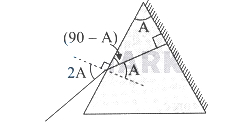
0 likesView Solution
288
PhysicsMediumMCQMHT CET · 2023
$A$ glass prism deviates the red and violet rays through $9^{\circ}$ and $11^{\circ}$ respectively. $A$ second prism of equal angle deviates them through $11^{\circ}$ and $13^{\circ}$ respectively. The ratio of dispersive power of the second prism to the first prism is
A
$5: 6$
B
$6: 5$
C
$9: 13$
D
$13: 9$
Solution
(A) The dispersive power $\omega$ of a prism is given by the formula $\omega = \frac{\delta_v - \delta_r}{\delta_y}$,where $\delta_v$ is the deviation for violet light,$\delta_r$ is the deviation for red light,and $\delta_y$ is the mean deviation,calculated as $\delta_y = \frac{\delta_v + \delta_r}{2}$.
For the first prism:
$\delta_v = 11^{\circ}$,$\delta_r = 9^{\circ}$.
$\delta_{y1} = \frac{11 + 9}{2} = 10^{\circ}$.
$\omega_1 = \frac{11 - 9}{10} = \frac{2}{10} = \frac{1}{5}$.
For the second prism:
$\delta_v = 13^{\circ}$,$\delta_r = 11^{\circ}$.
$\delta_{y2} = \frac{13 + 11}{2} = 12^{\circ}$.
$\omega_2 = \frac{13 - 11}{12} = \frac{2}{12} = \frac{1}{6}$.
The ratio of the dispersive power of the second prism to the first prism is $\frac{\omega_2}{\omega_1} = \frac{1/6}{1/5} = \frac{5}{6}$.
Thus,the ratio is $5: 6$.
For the first prism:
$\delta_v = 11^{\circ}$,$\delta_r = 9^{\circ}$.
$\delta_{y1} = \frac{11 + 9}{2} = 10^{\circ}$.
$\omega_1 = \frac{11 - 9}{10} = \frac{2}{10} = \frac{1}{5}$.
For the second prism:
$\delta_v = 13^{\circ}$,$\delta_r = 11^{\circ}$.
$\delta_{y2} = \frac{13 + 11}{2} = 12^{\circ}$.
$\omega_2 = \frac{13 - 11}{12} = \frac{2}{12} = \frac{1}{6}$.
The ratio of the dispersive power of the second prism to the first prism is $\frac{\omega_2}{\omega_1} = \frac{1/6}{1/5} = \frac{5}{6}$.
Thus,the ratio is $5: 6$.
0 likesView Solution
289
PhysicsMediumMCQMHT CET · 2023
$A$ ray of light is incident at an angle of incidence '$i$' on one surface of a prism of small angle '$A$' and emerges normally from the other surface. If the refractive index of the material of the prism is '$\mu$',then the angle of incidence is equal to
A
$\frac{A}{2 \mu}$
B
$\frac{A \mu}{2}$
C
$A \mu$
D
$\frac{A}{\mu}$
Solution
(C) Given: The ray emerges normally from the second surface,so the angle of emergence $e = 0$.
Since $e = 0$,the angle of refraction at the second surface $r_2 = 0$.
For a prism,the angle of the prism $A = r_1 + r_2$. Substituting $r_2 = 0$,we get $A = r_1$.
According to Snell's law at the first surface,$\mu = \frac{\sin i}{\sin r_1}$.
Since the prism angle $A$ is small,$i$ and $r_1$ are also small,so $\sin i \approx i$ and $\sin r_1 \approx r_1$.
Thus,$\mu = \frac{i}{r_1}$.
Substituting $r_1 = A$,we get $\mu = \frac{i}{A}$,which implies $i = \mu A$.
Since $e = 0$,the angle of refraction at the second surface $r_2 = 0$.
For a prism,the angle of the prism $A = r_1 + r_2$. Substituting $r_2 = 0$,we get $A = r_1$.
According to Snell's law at the first surface,$\mu = \frac{\sin i}{\sin r_1}$.
Since the prism angle $A$ is small,$i$ and $r_1$ are also small,so $\sin i \approx i$ and $\sin r_1 \approx r_1$.
Thus,$\mu = \frac{i}{r_1}$.
Substituting $r_1 = A$,we get $\mu = \frac{i}{A}$,which implies $i = \mu A$.
0 likesView Solution
290
PhysicsMediumMCQMHT CET · 2023
$A$ ray of light passes through an equilateral prism such that the angle of incidence $(i)$ is equal to the angle of emergence $(e)$. The angle of emergence is equal to $\left(\frac{3}{4}\right)$ of the angle of the prism. The angle of deviation is: (in $^{\circ}$)
A
$20$
B
$30$
C
$39$
D
$45$
Solution
(B) For an equilateral prism,the angle of the prism is $A = 60^{\circ}$.
Given that the angle of incidence $(i)$ is equal to the angle of emergence $(e)$,and $e = \frac{3}{4} A$.
Substituting the value of $A$:
$e = \frac{3}{4} \times 60^{\circ} = 45^{\circ}$.
Since $i = e$,we have $i = 45^{\circ}$.
The formula for the angle of deviation $(\delta)$ is $\delta = i + e - A$.
Substituting the values:
$\delta = 45^{\circ} + 45^{\circ} - 60^{\circ} = 90^{\circ} - 60^{\circ} = 30^{\circ}$.
Therefore,the angle of deviation is $30^{\circ}$.
Given that the angle of incidence $(i)$ is equal to the angle of emergence $(e)$,and $e = \frac{3}{4} A$.
Substituting the value of $A$:
$e = \frac{3}{4} \times 60^{\circ} = 45^{\circ}$.
Since $i = e$,we have $i = 45^{\circ}$.
The formula for the angle of deviation $(\delta)$ is $\delta = i + e - A$.
Substituting the values:
$\delta = 45^{\circ} + 45^{\circ} - 60^{\circ} = 90^{\circ} - 60^{\circ} = 30^{\circ}$.
Therefore,the angle of deviation is $30^{\circ}$.
0 likesView Solution
291
PhysicsMediumMCQMHT CET · 2023
If a ray of light in a denser medium strikes a rarer medium at an angle of incidence $i$,the angles of reflection and refraction are $r$ and $r^{\prime}$ respectively. If the reflected and refracted rays are at right angles to each other,the critical angle for the given pair of media is
A
$\sin ^{-1}(\tan r^{\prime})$
B
$\tan ^{-1}(\sin i)$
C
$\sin ^{-1}(\tan r)$
D
$\cot ^{-1}(\tan i)$
Solution
(C) According to the law of reflection,the angle of incidence $i$ is equal to the angle of reflection $r$,so $i = r$.
According to Snell's Law,for light traveling from a denser medium to a rarer medium with refractive index $n$ (where $n$ is the refractive index of the denser medium relative to the rarer medium,$n > 1$):
$\frac{\sin i}{\sin r^{\prime}} = \frac{1}{n}$
Since $i = r$,we have $\frac{\sin r}{\sin r^{\prime}} = \frac{1}{n}$.
Given that the reflected and refracted rays are at right angles to each other,the sum of the angles on the straight line is $r + 90^{\circ} + r^{\prime} = 180^{\circ}$.
Therefore,$r^{\prime} = 90^{\circ} - r$.
Substituting this into Snell's Law:
$\frac{\sin r}{\sin(90^{\circ} - r)} = \frac{1}{n}$
$\frac{\sin r}{\cos r} = \frac{1}{n}$
$\tan r = \frac{1}{n}$
The critical angle $i_c$ is defined by $\sin i_c = \frac{1}{n}$.
Comparing the two equations,we get $\sin i_c = \tan r$.
Therefore,$i_c = \sin^{-1}(\tan r)$.
According to Snell's Law,for light traveling from a denser medium to a rarer medium with refractive index $n$ (where $n$ is the refractive index of the denser medium relative to the rarer medium,$n > 1$):
$\frac{\sin i}{\sin r^{\prime}} = \frac{1}{n}$
Since $i = r$,we have $\frac{\sin r}{\sin r^{\prime}} = \frac{1}{n}$.
Given that the reflected and refracted rays are at right angles to each other,the sum of the angles on the straight line is $r + 90^{\circ} + r^{\prime} = 180^{\circ}$.
Therefore,$r^{\prime} = 90^{\circ} - r$.
Substituting this into Snell's Law:
$\frac{\sin r}{\sin(90^{\circ} - r)} = \frac{1}{n}$
$\frac{\sin r}{\cos r} = \frac{1}{n}$
$\tan r = \frac{1}{n}$
The critical angle $i_c$ is defined by $\sin i_c = \frac{1}{n}$.
Comparing the two equations,we get $\sin i_c = \tan r$.
Therefore,$i_c = \sin^{-1}(\tan r)$.
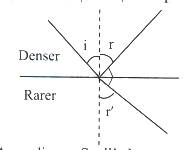
0 likesView Solution
292
PhysicsMediumMCQMHT CET · 2023
To get three images of a single object, the angle between the two plane mirrors should be (in $^{\circ}$)
A
$50$
B
$60$
C
$72$
D
$90$
Solution
(D) The number of images $n$ formed by two plane mirrors inclined at an angle $\theta$ is given by the formula $n = \left( \frac{360^{\circ}}{\theta} - 1 \right)$ if $\frac{360^{\circ}}{\theta}$ is an even integer.
Given that the number of images $n = 3$, we substitute this into the formula:
$3 = \frac{360^{\circ}}{\theta} - 1$
$4 = \frac{360^{\circ}}{\theta}$
$\theta = \frac{360^{\circ}}{4} = 90^{\circ}$
Thus, the angle between the two plane mirrors should be $90^{\circ}$.
Given that the number of images $n = 3$, we substitute this into the formula:
$3 = \frac{360^{\circ}}{\theta} - 1$
$4 = \frac{360^{\circ}}{\theta}$
$\theta = \frac{360^{\circ}}{4} = 90^{\circ}$
Thus, the angle between the two plane mirrors should be $90^{\circ}$.
0 likesView Solution
293
PhysicsEasyMCQMHT CET · 2023
One of the necessary conditions for total internal reflection to take place is ($i =$ angle of incidence,$i_{c} =$ critical angle).
A
$i < i_{c}$
B
$i = i_{c}$
C
$i = \frac{\pi}{2}$
D
$i > i_{c}$
Solution
(D) Total internal reflection $(TIR)$ occurs when light travels from a denser medium to a rarer medium.
For $TIR$ to occur,two conditions must be met:
$1$. The light must travel from an optically denser medium to an optically rarer medium.
$2$. The angle of incidence $(i)$ must be greater than the critical angle $(i_{c})$ for the given pair of media.
Therefore,the correct condition is $i > i_{c}$.
For $TIR$ to occur,two conditions must be met:
$1$. The light must travel from an optically denser medium to an optically rarer medium.
$2$. The angle of incidence $(i)$ must be greater than the critical angle $(i_{c})$ for the given pair of media.
Therefore,the correct condition is $i > i_{c}$.
0 likesView Solution
294
PhysicsEasyMCQMHT CET · 2023
An ink mark is made on a piece of paper. $A$ glass slab of thickness $t$ is placed on it. The ink mark appears to be raised up through a distance $x$ when viewed at nearly normal incidence. If the refractive index of the material of the glass slab is $\mu$,then the thickness of the glass slab $t$ is given by:
A
$\frac{(\mu-1)}{\mu x}$
B
$\frac{\mu x}{(\mu-1)}$
C
$\frac{(\mu-1) x}{\mu}$
D
$\frac{\mu}{(\mu-1) x}$
Solution
(B) The normal shift $x$ produced by a glass slab of thickness $t$ and refractive index $\mu$ is given by the formula:
$x = t \left(1 - \frac{1}{\mu}\right)$
Rearranging the formula to solve for $t$:
$x = t \left(\frac{\mu - 1}{\mu}\right)$
$t = \frac{x \cdot \mu}{\mu - 1}$
Therefore,the thickness of the glass slab is $t = \frac{\mu x}{\mu - 1}$.
$x = t \left(1 - \frac{1}{\mu}\right)$
Rearranging the formula to solve for $t$:
$x = t \left(\frac{\mu - 1}{\mu}\right)$
$t = \frac{x \cdot \mu}{\mu - 1}$
Therefore,the thickness of the glass slab is $t = \frac{\mu x}{\mu - 1}$.
0 likesView Solution
295
PhysicsMediumMCQMHT CET · 2023
$A$ transparent glass cube of length $24 \,cm$ has a small air bubble trapped inside. When seen normally through one surface from air outside, its apparent distance is $10 \,cm$ from the surface. When seen normally from the opposite surface, its apparent distance is $6 \,cm$. The distance of the air bubble from the first surface is (in $\,cm$)
A
$15$
B
$14$
C
$12$
D
$8$
Solution
(A) Let the distance of the air bubble from the first surface be $l_1$ and from the second surface be $l_2$. The total length of the cube is $L = 24 \,cm$. Thus, $l_1 + l_2 = 24 \,cm$, which implies $l_2 = 24 - l_1$.
The formula for apparent depth is given by $\mu = \frac{\text{Real depth}}{\text{Apparent depth}}$.
For the first surface:
$\mu = \frac{l_1}{10} \quad \dots(i)$
For the second surface:
$\mu = \frac{l_2}{6} = \frac{24 - l_1}{6} \quad \dots(ii)$
Equating $(i)$ and $(ii)$:
$\frac{l_1}{10} = \frac{24 - l_1}{6}$
$6l_1 = 10(24 - l_1)$
$6l_1 = 240 - 10l_1$
$16l_1 = 240$
$l_1 = \frac{240}{16} = 15 \,cm$
Therefore, the distance of the air bubble from the first surface is $15 \,cm$.
The formula for apparent depth is given by $\mu = \frac{\text{Real depth}}{\text{Apparent depth}}$.
For the first surface:
$\mu = \frac{l_1}{10} \quad \dots(i)$
For the second surface:
$\mu = \frac{l_2}{6} = \frac{24 - l_1}{6} \quad \dots(ii)$
Equating $(i)$ and $(ii)$:
$\frac{l_1}{10} = \frac{24 - l_1}{6}$
$6l_1 = 10(24 - l_1)$
$6l_1 = 240 - 10l_1$
$16l_1 = 240$
$l_1 = \frac{240}{16} = 15 \,cm$
Therefore, the distance of the air bubble from the first surface is $15 \,cm$.
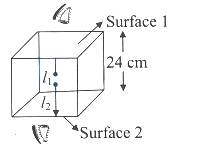
0 likesView Solution
296
PhysicsEasyMCQMHT CET · 2023
$A$ double convex air bubble in water behaves as
A
convergent lens
B
divergent lens
C
plane slab
D
concave mirror
Solution
(B) The refractive index of water is $\mu_w = 1.33$ and the refractive index of air is $\mu_a = 1.0$.
According to the Lens Maker's Formula,the focal length $f$ is given by $\frac{1}{f} = (\frac{\mu_l}{\mu_m} - 1)(\frac{1}{R_1} - \frac{1}{R_2})$,where $\mu_l$ is the refractive index of the lens material and $\mu_m$ is the refractive index of the surrounding medium.
For a double convex air bubble,$R_1 > 0$ and $R_2 < 0$,so $(\frac{1}{R_1} - \frac{1}{R_2}) > 0$.
Here,$\mu_l = \mu_a = 1.0$ and $\mu_m = \mu_w = 1.33$.
Since $\frac{\mu_a}{\mu_w} = \frac{1.0}{1.33} < 1$,the term $(\frac{\mu_a}{\mu_w} - 1)$ is negative.
Therefore,the focal length $f$ is negative,which indicates that the air bubble behaves as a divergent lens.
According to the Lens Maker's Formula,the focal length $f$ is given by $\frac{1}{f} = (\frac{\mu_l}{\mu_m} - 1)(\frac{1}{R_1} - \frac{1}{R_2})$,where $\mu_l$ is the refractive index of the lens material and $\mu_m$ is the refractive index of the surrounding medium.
For a double convex air bubble,$R_1 > 0$ and $R_2 < 0$,so $(\frac{1}{R_1} - \frac{1}{R_2}) > 0$.
Here,$\mu_l = \mu_a = 1.0$ and $\mu_m = \mu_w = 1.33$.
Since $\frac{\mu_a}{\mu_w} = \frac{1.0}{1.33} < 1$,the term $(\frac{\mu_a}{\mu_w} - 1)$ is negative.
Therefore,the focal length $f$ is negative,which indicates that the air bubble behaves as a divergent lens.
0 likesView Solution
297
PhysicsDifficultMCQMHT CET · 2023
$A$ spherical surface of radius of curvature $R$ separates air from glass of refractive index $1.5$. The centre of curvature is in the glass. $A$ point object $P$ placed in air forms a real image $Q$ in the glass. The line $PQ$ cuts the surface at point $O$ and $PO = OQ = x$. Hence the distance $x$ is equal to (in $R$)
A
$1.5$
B
$2$
C
$3$
D
$5$
Solution
(D) Given: $u = -x$ (object is in air),$v = +x$ (image is in glass),$n_1 = 1$ (refractive index of air),$n_2 = 1.5$ (refractive index of glass),and $R$ is the radius of curvature.
Using the refraction formula for a spherical surface:
$\frac{n_2}{v} - \frac{n_1}{u} = \frac{n_2 - n_1}{R}$
Substituting the given values:
$\frac{1.5}{x} - \frac{1}{-x} = \frac{1.5 - 1}{R}$
$\frac{1.5}{x} + \frac{1}{x} = \frac{0.5}{R}$
$\frac{2.5}{x} = \frac{0.5}{R}$
$x = \frac{2.5}{0.5} R = 5 R$
Therefore,the distance $x$ is equal to $5 R$.
Using the refraction formula for a spherical surface:
$\frac{n_2}{v} - \frac{n_1}{u} = \frac{n_2 - n_1}{R}$
Substituting the given values:
$\frac{1.5}{x} - \frac{1}{-x} = \frac{1.5 - 1}{R}$
$\frac{1.5}{x} + \frac{1}{x} = \frac{0.5}{R}$
$\frac{2.5}{x} = \frac{0.5}{R}$
$x = \frac{2.5}{0.5} R = 5 R$
Therefore,the distance $x$ is equal to $5 R$.
0 likesView Solution
298
PhysicsEasyMCQMHT CET · 2023
When a monochromatic ray of light is passed through an equilateral glass prism,it is found that the refracted ray in glass is parallel to the base of the prism. If '$i$' and '$e$' denote the angles of incidence and emergence respectively,then
A
$i > e$
B
$i < e$
C
$i = e$
D
$i + e = 90^{\circ}$
Solution
(C) For a prism,the angle of deviation is given by $\delta = i + e - A$. When the refracted ray inside the prism is parallel to the base,the prism is in the position of minimum deviation. In the position of minimum deviation,the angle of incidence is equal to the angle of emergence,i.e.,$i = e$. Therefore,the correct option is $C$.
0 likesView Solution
299
PhysicsDifficultMCQMHT CET · 2023
$A$ $5.0 \, V$ stabilized power supply is required to be designed using a $12 \, V$ $DC$ power supply as an input source. The maximum power rating of the zener diode is $2.0 \, W$. The minimum value of resistance $R_{s}$ in $\Omega$ connected in series with the zener diode will be (in $.5$)
A
$16$
B
$17$
C
$18$
D
$15$
Solution
(B) The zener diode operates at a constant voltage $V_{Z} = 5.0 \, V$.
Given the input voltage $V_{S} = 12 \, V$ and the maximum power rating $P_{Z} = 2.0 \, W$.
The maximum current $I_{Z_{\max}}$ that the zener diode can handle is calculated as:
$I_{Z_{\max}} = \frac{P_{Z}}{V_{Z}} = \frac{2.0 \, W}{5.0 \, V} = 0.4 \, A = 400 \, mA$.
The series resistance $R_{S}$ is used to drop the excess voltage $(V_{S} - V_{Z})$ and limit the current to $I_{Z_{\max}}$.
$R_{S} = \frac{V_{S} - V_{Z}}{I_{Z_{\max}}} = \frac{12 \, V - 5.0 \, V}{0.4 \, A} = \frac{7}{0.4} \, \Omega = 17.5 \, \Omega$.
Given the input voltage $V_{S} = 12 \, V$ and the maximum power rating $P_{Z} = 2.0 \, W$.
The maximum current $I_{Z_{\max}}$ that the zener diode can handle is calculated as:
$I_{Z_{\max}} = \frac{P_{Z}}{V_{Z}} = \frac{2.0 \, W}{5.0 \, V} = 0.4 \, A = 400 \, mA$.
The series resistance $R_{S}$ is used to drop the excess voltage $(V_{S} - V_{Z})$ and limit the current to $I_{Z_{\max}}$.
$R_{S} = \frac{V_{S} - V_{Z}}{I_{Z_{\max}}} = \frac{12 \, V - 5.0 \, V}{0.4 \, A} = \frac{7}{0.4} \, \Omega = 17.5 \, \Omega$.
0 likesView Solution
300
PhysicsEasyMCQMHT CET · 2023
In the reverse biasing of a $p-n$ junction diode,
A
the width of the depletion layer decreases.
B
the width of the depletion layer increases.
C
the number of minority charge carriers increase.
D
the number of majority charge carriers increase.
Solution
(B) When a $p-n$ junction diode is reverse biased,the positive terminal of the battery is connected to the $n$-region and the negative terminal to the $p$-region.
This configuration pulls the majority charge carriers (holes in $p$-region and electrons in $n$-region) away from the junction.
As a result,the depletion layer is depleted of charge carriers even further,causing its width to increase.
Therefore,the correct option is $B$.
This configuration pulls the majority charge carriers (holes in $p$-region and electrons in $n$-region) away from the junction.
As a result,the depletion layer is depleted of charge carriers even further,causing its width to increase.
Therefore,the correct option is $B$.
0 likesView Solution
Vedclass Products
For Students
Vedclass Test Series
Mock tests in real MHT CET style covering Physics with performance analysis. 5-day free trial.
Start Free TrialFor Teachers
Exam Paper Generator
Generate Set A/B/C/D Physics papers from 7.5L+ questions in 2 minutes. 3 chapters free.
Try FreeFor Institutes
Online Exam Module
Run live MHT CET mock exams with unlimited students, 360° analytics & white-label branding.
See DemoFrequently Asked Questions
How many Physics questions are in MHT CET 2023?
There are 593 Physics questions from the MHT CET 2023 paper on Vedclass, each with a detailed step-by-step solution in English.
Are MHT CET 2023 Physics solutions available in English?
Yes. All solutions on this page are in English. You can also switch to English or Hindi using the language buttons above the questions.
Can I practice MHT CET 2023 Physics as a timed test?
Yes. Use the Vedclass Test Series to attempt a full MHT CET mock test covering Physics with time limits and instant score analysis.
Can teachers create Physics papers from MHT CET previous year questions?
Yes. The Vedclass Exam Paper Generator lets teachers mix MHT CET Physics questions and generate Set A/B/C/D papers in minutes.
For Teachers & Institutes
Build a Custom Physics Paper
Pick MHT CET 2023 Physics questions, set difficulty, and generate Set A/B/C/D in 2 minutes.