
ChemistryQ51–150 of 563 questions
Page 2 of 7 · English
51
ChemistryMediumMCQMHT CET · 2021
In the carbinol system,isobutyl alcohol is named as:
A
Ethyl methyl carbinol
B
Isobutyl carbinol
C
Isopropyl carbinol
D
Diethyl carbinol
Solution
(C) The carbinol system names alcohols as derivatives of methanol,which is called $carbinol$ $(CH_3OH)$.
For isobutyl alcohol,the structure is $(CH_3)_2CH-CH_2OH$.
To name this in the carbinol system,we identify the group attached to the $CH_2OH$ unit.
Here,the group attached to the $-CH_2OH$ group is an isopropyl group,$(CH_3)_2CH-$.
Therefore,the name is isopropyl carbinol.
For isobutyl alcohol,the structure is $(CH_3)_2CH-CH_2OH$.
To name this in the carbinol system,we identify the group attached to the $CH_2OH$ unit.
Here,the group attached to the $-CH_2OH$ group is an isopropyl group,$(CH_3)_2CH-$.
Therefore,the name is isopropyl carbinol.
0 likesView Solution
52
ChemistryMediumMCQMHT CET · 2021
Identify the total number of carbon atoms present in undecane.
A
$9$
B
$11$
C
$10$
D
$20$
Solution
(B) The general formula for an alkane is $C_nH_{2n+2}$.
Undecane is an alkane with $n = 11$.
Therefore,the chemical formula for undecane is $C_{11}H_{24}$.
Thus,the total number of carbon atoms in undecane is $11$.
Undecane is an alkane with $n = 11$.
Therefore,the chemical formula for undecane is $C_{11}H_{24}$.
Thus,the total number of carbon atoms in undecane is $11$.
0 likesView Solution
53
ChemistryMediumMCQMHT CET · 2021
What is the number of $-CH_2-$ groups present in dodecane?
A
$12$
B
$10$
C
$15$
D
$13$
Solution
(B) The chemical formula for dodecane is $C_{12}H_{26}$.
It is a straight-chain alkane with the structural formula $CH_3-(CH_2)_{10}-CH_3$.
In this structure,the two terminal carbons are $-CH_3$ groups,and the remaining carbons are $-CH_2-$ groups.
Therefore,the number of $-CH_2-$ groups is $10$.
It is a straight-chain alkane with the structural formula $CH_3-(CH_2)_{10}-CH_3$.
In this structure,the two terminal carbons are $-CH_3$ groups,and the remaining carbons are $-CH_2-$ groups.
Therefore,the number of $-CH_2-$ groups is $10$.
0 likesView Solution
54
ChemistryEasyMCQMHT CET · 2021
Which among the following statements is $NOT$ true about a homologous series of organic compounds?
A
Each member of a series differs by two carbon atoms and two $H$ atoms from the neighboring member.
B
All members have similar chemical properties.
C
All members of a series are represented by the same general formula.
D
None of these.
Solution
(A) homologous series is a group of organic compounds having the same functional group and similar chemical properties,in which all members can be represented by the same general formula.
Each successive member of a homologous series differs from the previous one by a $CH_2$ group,which corresponds to one carbon atom and two hydrogen atoms.
Option $A$ states that members differ by two carbon atoms,which is incorrect.
Therefore,the statement in option $A$ is not true.
Each successive member of a homologous series differs from the previous one by a $CH_2$ group,which corresponds to one carbon atom and two hydrogen atoms.
Option $A$ states that members differ by two carbon atoms,which is incorrect.
Therefore,the statement in option $A$ is not true.
0 likesView Solution
55
ChemistryMediumMCQMHT CET · 2021
What is the $IUPAC$ name of the following compound?
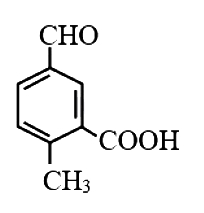
A
$3-$Carboxy$-4-$methylbenzoic acid
B
$5-$Carboxy$-4-$methylbenzoic acid
C
$3-$Formyl$-6-$methylbenzoic acid
D
$5-$Formyl$-2-$methylbenzoic acid
Solution
(D) $1$. Identify the principal functional group $(PFG)$. Here,the carboxylic acid group $(-COOH)$ has higher priority than the aldehyde $(-CHO)$ and methyl $(-CH_3)$ groups. Therefore,the parent chain is benzoic acid.
$2$. Number the benzene ring starting from the carbon attached to the $-COOH$ group as $1$.
$3$. Proceed in the direction that gives the lowest locants to the other substituents. Moving towards the methyl group gives it position $2$,and the formyl group gets position $5$.
$4$. The substituents are $5-$formyl and $2-$methyl.
$5$. Combining these,the $IUPAC$ name is $5-$formyl$-2-$methylbenzoic acid.
$2$. Number the benzene ring starting from the carbon attached to the $-COOH$ group as $1$.
$3$. Proceed in the direction that gives the lowest locants to the other substituents. Moving towards the methyl group gives it position $2$,and the formyl group gets position $5$.
$4$. The substituents are $5-$formyl and $2-$methyl.
$5$. Combining these,the $IUPAC$ name is $5-$formyl$-2-$methylbenzoic acid.
0 likesView Solution
56
ChemistryDifficultMCQMHT CET · 2021
What is the $IUPAC$ name of the following compound?
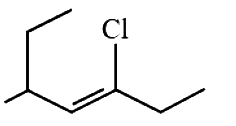
A
$5-$Chloro$-3-$methylhept$-4-$ene
B
$3-$Chloro$-5-$methylhept$-3-$ene
C
$3-$Chloro$-5-$ethylhex$-3-$ene
D
$4-$Chloro$-2-$ethylhex$-3-$ene
Solution
(B) $1$. Identify the longest carbon chain containing the double bond. The longest chain has $7$ carbon atoms,so the parent alkane is heptane,and the alkene is heptene.
$2$. Number the chain from the end that gives the double bond the lowest possible locant. Numbering from the right gives the double bond position $3$.
$3$. Identify the substituents: there is a chloro group $(-Cl)$ at position $3$ and a methyl group $(-CH_3)$ at position $5$.
$4$. Combine these to get the $IUPAC$ name: $3-$chloro$-5-$methylhept$-3-$ene.
$2$. Number the chain from the end that gives the double bond the lowest possible locant. Numbering from the right gives the double bond position $3$.
$3$. Identify the substituents: there is a chloro group $(-Cl)$ at position $3$ and a methyl group $(-CH_3)$ at position $5$.
$4$. Combine these to get the $IUPAC$ name: $3-$chloro$-5-$methylhept$-3-$ene.
0 likesView Solution
57
ChemistryMCQMHT CET · 2021
The common name of $Benzene-1,2-diol$ is
A
Pyrogallol
B
Resorcinol
C
Catechol
D
Quinol
Solution
(C) The structure of $Benzene-1,2-diol$ consists of a benzene ring with two hydroxyl $(-OH)$ groups attached at the $1$ and $2$ positions.
This compound is commonly known as $Catechol$.
This compound is commonly known as $Catechol$.
0 likesView Solution
58
ChemistryEasyMCQMHT CET · 2021
What is the difference in molar mass of a member of a homologous series from its neighboring members in grams per mole?
A
$14$
B
$18$
C
$30$
D
$25$
Solution
(A) Neighboring members of a homologous series differ by a $CH_2$ group.
The molar mass of $C$ is $12 \ g/mol$ and $H$ is $1 \ g/mol$.
Therefore,the difference in molar mass is $12 + (2 \times 1) = 14 \ g/mol$.
The molar mass of $C$ is $12 \ g/mol$ and $H$ is $1 \ g/mol$.
Therefore,the difference in molar mass is $12 + (2 \times 1) = 14 \ g/mol$.
0 likesView Solution
59
ChemistryEasyMCQMHT CET · 2021
What is the $IUPAC$ name of glyoxal?
A
Propanedial
B
Ethanedial
C
$2-$Methyl propanal
D
Prop$-2-$enal
Solution
(B) The chemical formula of glyoxal is $CHO-CHO$.
The structure consists of two carbon atoms,each attached to an aldehyde group $(-CHO)$.
Since there are two carbon atoms in the parent chain,the prefix is 'eth-'.
The suffix for a dialdehyde is '-dial'.
Therefore,the $IUPAC$ name is Ethanedial.
The structure consists of two carbon atoms,each attached to an aldehyde group $(-CHO)$.
Since there are two carbon atoms in the parent chain,the prefix is 'eth-'.
The suffix for a dialdehyde is '-dial'.
Therefore,the $IUPAC$ name is Ethanedial.
0 likesView Solution
60
ChemistryEasyMCQMHT CET · 2021
The $IUPAC$ name of the compound $(CH_3)_4 C$ is
A
$2-$Methylbutane
B
Neopentane
C
$2, 2-$Dimethylpropane
D
$2-$Methylpentene
Solution
(C) The given compound is $(CH_3)_4 C$,which can be represented as a central carbon atom bonded to four methyl groups.
To determine the $IUPAC$ name,we first identify the longest carbon chain,which contains $3$ carbon atoms (propane).
There are two methyl groups attached to the second carbon atom.
Therefore,the $IUPAC$ name is $2, 2-$dimethylpropane.
To determine the $IUPAC$ name,we first identify the longest carbon chain,which contains $3$ carbon atoms (propane).
There are two methyl groups attached to the second carbon atom.
Therefore,the $IUPAC$ name is $2, 2-$dimethylpropane.
0 likesView Solution
61
ChemistryEasyMCQMHT CET · 2021
The $IUPAC$ name of the following compound is:
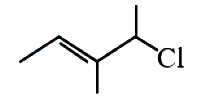
A
$2-$Chloro$-3-$methylpent$-3-$ene
B
$4-$Chloro$-3-$methylpent$-2-$ene
C
$1-$Chloro$-1,2-$dimethylbut$-2-$ene
D
$4-$Chloro$-3,4-$dimethylbut$-2-$ene
Solution
(B) $1$. Identify the longest carbon chain containing the double bond. The chain has $5$ carbon atoms,so the parent alkane is pentane,and with the double bond,it is pentene.
$2$. Number the chain from the end that gives the double bond the lowest possible locant. Numbering from the left gives the double bond at position $2$.
$3$. Identify the substituents: there is a chloro group at position $4$ and a methyl group at position $3$.
$4$. Combining these,the $IUPAC$ name is $4-$chloro$-3-$methylpent$-2-$ene.
$2$. Number the chain from the end that gives the double bond the lowest possible locant. Numbering from the left gives the double bond at position $2$.
$3$. Identify the substituents: there is a chloro group at position $4$ and a methyl group at position $3$.
$4$. Combining these,the $IUPAC$ name is $4-$chloro$-3-$methylpent$-2-$ene.
0 likesView Solution
62
ChemistryEasyMCQMHT CET · 2021
What is the $IUPAC$ name of phloroglucinol?
A
Benzene-$1,3$-diol
B
Benzene-$1,4$-diol
C
Benzene-$1,3,5$-triol
D
Benzene-$1,2,3$-triol
Solution
(C) Phloroglucinol is a benzene ring substituted with three hydroxyl $(-OH)$ groups at the $1$,$3$,and $5$ positions.
According to $IUPAC$ nomenclature,the parent hydrocarbon is benzene,and the substituents are indicated by their positions followed by the suffix 'triol' for three hydroxyl groups.
Therefore,the $IUPAC$ name is benzene-$1,3,5$-triol.
According to $IUPAC$ nomenclature,the parent hydrocarbon is benzene,and the substituents are indicated by their positions followed by the suffix 'triol' for three hydroxyl groups.
Therefore,the $IUPAC$ name is benzene-$1,3,5$-triol.
0 likesView Solution
63
ChemistryMediumMCQMHT CET · 2021
What is the $IUPAC$ name of the following compound?
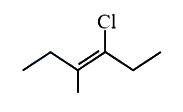
A
$4-$Chloro$-4-$ethyl$-3-$methylbut$-3-$ene
B
$4-$Chloro$-3-$methylhex$-3-$ene
C
$3-$Chloro$-4-$ethylbut$-3-$ene
D
$3-$Chloro$-4-$methylhex$-3-$ene
Solution
(D) $1$. Identify the longest carbon chain containing the double bond. The longest chain has $6$ carbon atoms,so the parent alkane is hexane. Since there is a double bond at position $3$,it is a hex$-3-$ene derivative.
$2$. Number the chain from the end that gives the double bond the lowest possible number. Numbering from right to left gives the double bond position $3$.
$3$. Identify substituents: There is a chloro group $(-Cl)$ at position $3$ and a methyl group $(-CH_3)$ at position $4$.
$4$. Combine these to get the $IUPAC$ name: $3-$Chloro$-4-$methylhex$-3-$ene.
$2$. Number the chain from the end that gives the double bond the lowest possible number. Numbering from right to left gives the double bond position $3$.
$3$. Identify substituents: There is a chloro group $(-Cl)$ at position $3$ and a methyl group $(-CH_3)$ at position $4$.
$4$. Combine these to get the $IUPAC$ name: $3-$Chloro$-4-$methylhex$-3-$ene.
0 likesView Solution
64
ChemistryMediumMCQMHT CET · 2021
Which among the following compounds is $NOT$ a carbocyclic compound?
A
Benzene
B
Naphthalene
C
Pyridine
D
Cyclopentane
Solution
(C) carbocyclic compound is one in which the ring is made up of only carbon atoms.
$Benzene$,$Naphthalene$,and $Cyclopentane$ are all carbocyclic compounds because their rings consist solely of carbon atoms.
$Pyridine$ contains a nitrogen atom within its ring structure,making it a heterocyclic compound.
$Benzene$,$Naphthalene$,and $Cyclopentane$ are all carbocyclic compounds because their rings consist solely of carbon atoms.
$Pyridine$ contains a nitrogen atom within its ring structure,making it a heterocyclic compound.
0 likesView Solution
65
ChemistryEasyMCQMHT CET · 2021
Which of the following statements is true for tetrahydrofuran?
A
It is homocyclic aromatic
B
It is heterocyclic aromatic
C
It is aromatic non-benzenoid
D
It is heterocyclic nonaromatic
Solution
(D) Tetrahydrofuran $(THF)$ is a cyclic ether with the formula $(CH_2)_4O$.
It contains an oxygen atom within the ring,making it a heterocyclic compound.
It does not satisfy $H$ückel's rule for aromaticity (it lacks a continuous system of $p$-orbitals and is not planar),therefore it is non-aromatic.
Thus,it is a heterocyclic non-aromatic compound.
It contains an oxygen atom within the ring,making it a heterocyclic compound.
It does not satisfy $H$ückel's rule for aromaticity (it lacks a continuous system of $p$-orbitals and is not planar),therefore it is non-aromatic.
Thus,it is a heterocyclic non-aromatic compound.
0 likesView Solution
66
ChemistryEasyMCQMHT CET · 2021
Which of the following statements about tropone is true?
A
It is heterocyclic having molecular formula $C_5H_{10}O$
B
It is benzenoid having molecular formula $C_{10}H_8O$
C
It is non-benzenoid having molecular formula $C_7H_6O$
D
It is heterocyclic having molecular formula $C_7H_6O$
Solution
(C) Tropone is a cyclic organic compound with a seven-membered ring containing a ketone group.
It is classified as a non-benzenoid aromatic compound because it does not contain a benzene ring.
The molecular formula of tropone is $C_7H_6O$.
It is classified as a non-benzenoid aromatic compound because it does not contain a benzene ring.
The molecular formula of tropone is $C_7H_6O$.
0 likesView Solution
67
ChemistryEasyMCQMHT CET · 2021
Identify the heteroatom and the number of double bonds present in furan,respectively.
A
$S, 2$
B
$O, 2$
C
$N, 2$
D
$O, 1$
Solution
(B) Furan is a heterocyclic aromatic compound with the chemical formula $C_4H_4O$.
In the furan ring,the heteroatom (an atom other than carbon in the ring) is oxygen $(O)$.
By observing the structure of furan,there are two carbon-carbon double bonds present in the five-membered ring.
Therefore,the heteroatom is $O$ and the number of double bonds is $2$.
In the furan ring,the heteroatom (an atom other than carbon in the ring) is oxygen $(O)$.
By observing the structure of furan,there are two carbon-carbon double bonds present in the five-membered ring.
Therefore,the heteroatom is $O$ and the number of double bonds is $2$.
0 likesView Solution
68
ChemistryMediumMCQMHT CET · 2021
Identify the molecular formula of pyridine from the following.
A
$C_5H_{11}N$
B
$C_4H_4S$
C
$C_4H_4O$
D
$C_5H_5N$
Solution
(D) Pyridine is a heterocyclic aromatic organic compound with the chemical formula $C_5H_5N$.
It consists of a six-membered ring containing five carbon atoms and one nitrogen atom.
It consists of a six-membered ring containing five carbon atoms and one nitrogen atom.
0 likesView Solution
69
ChemistryMediumMCQMHT CET · 2021
Which of the following statements is $NOT$ correct for heterolysis?
A
In this,electron-rich and electron-deficient species are formed.
B
Heterolysis of methyl bromide forms a methyl carbocation.
C
It occurs when bonded atoms have different electronegativity.
D
Movement of a single electron from a shared pair of covalent bond occurs.
Solution
(D) Heterolysis is a type of bond cleavage where the shared pair of electrons remains with one of the fragments.
This process results in the formation of an anion (electron-rich) and a cation (electron-deficient).
It typically occurs in bonds between atoms with different electronegativities,such as in $CH_3Br$,where the $C-Br$ bond breaks to form $CH_3^+$ and $Br^-$.
Option $D$ is incorrect because the movement of a single electron is characteristic of homolysis,whereas heterolysis involves the movement of a shared electron pair (represented by a full-headed curved arrow).
This process results in the formation of an anion (electron-rich) and a cation (electron-deficient).
It typically occurs in bonds between atoms with different electronegativities,such as in $CH_3Br$,where the $C-Br$ bond breaks to form $CH_3^+$ and $Br^-$.
Option $D$ is incorrect because the movement of a single electron is characteristic of homolysis,whereas heterolysis involves the movement of a shared electron pair (represented by a full-headed curved arrow).
0 likesView Solution
70
ChemistryMediumMCQMHT CET · 2021
Identify the $-I$ effect causing group from the following.
A
$-COOR$
B
$-CH_3$
C
$-C_2H_5$
D
$-C_3H_7$
Solution
(A) The inductive effect ($-I$ effect) is the permanent displacement of shared electron pairs along a carbon chain due to the difference in electronegativity of the atoms or groups attached to it.
Groups that are more electronegative than carbon exert an electron-withdrawing effect,known as the $-I$ effect.
In the given options,$-COOR$ contains an electronegative oxygen atom attached to a carbonyl carbon,which makes it an electron-withdrawing group ($-I$ effect).
Conversely,alkyl groups like $-CH_3$,$-C_2H_5$,and $-C_3H_7$ exhibit a $+I$ (electron-donating) effect.
Therefore,the correct option is $A$.
Groups that are more electronegative than carbon exert an electron-withdrawing effect,known as the $-I$ effect.
In the given options,$-COOR$ contains an electronegative oxygen atom attached to a carbonyl carbon,which makes it an electron-withdrawing group ($-I$ effect).
Conversely,alkyl groups like $-CH_3$,$-C_2H_5$,and $-C_3H_7$ exhibit a $+I$ (electron-donating) effect.
Therefore,the correct option is $A$.
0 likesView Solution
71
ChemistryMediumMCQMHT CET · 2021
Identify the lowest positive charge developed (indicated by $\delta, \delta_1, \delta_2, \delta_3$) due to the inductive effect in the following compound: $CH_3-CH_2-CH_2-CH_2-Cl$.
A
$\delta_2$
B
$\delta_3$
C
$\delta$
D
$\delta_1$
Solution
(B) The inductive effect is a distance-dependent phenomenon where the electron-withdrawing group $(-Cl)$ pulls electron density towards itself,creating a partial positive charge on the adjacent carbon atoms.
As the distance from the source of the inductive effect (the electronegative atom) increases,the magnitude of the induced partial positive charge decreases.
The order of magnitude of the positive charge is $\delta > \delta_1 > \delta_2 > \delta_3$.
Therefore,the lowest positive charge is $\delta_3$.
As the distance from the source of the inductive effect (the electronegative atom) increases,the magnitude of the induced partial positive charge decreases.
The order of magnitude of the positive charge is $\delta > \delta_1 > \delta_2 > \delta_3$.
Therefore,the lowest positive charge is $\delta_3$.
0 likesView Solution
72
ChemistryEasyMCQMHT CET · 2021
Which group from the following is responsible for the $(-R)$ effect?
A
$-COOR$
B
$-OR$
C
$-OH$
D
$-NHR$
Solution
(A) The $(-R)$ effect or negative resonance effect occurs when a group withdraws electron density from the conjugated system through resonance.
Groups like $-OR$,$-OH$,and $-NHR$ have lone pairs on the atom directly attached to the conjugated system,which they donate,thus exhibiting a $(+R)$ effect.
The group $-COOR$ contains a carbonyl group $(C=O)$ conjugated with the rest of the molecule. The oxygen atom of the carbonyl group is more electronegative,pulling electron density away from the conjugated system,which results in a $(-R)$ effect.
Groups like $-OR$,$-OH$,and $-NHR$ have lone pairs on the atom directly attached to the conjugated system,which they donate,thus exhibiting a $(+R)$ effect.
The group $-COOR$ contains a carbonyl group $(C=O)$ conjugated with the rest of the molecule. The oxygen atom of the carbonyl group is more electronegative,pulling electron density away from the conjugated system,which results in a $(-R)$ effect.
0 likesView Solution
73
ChemistryMediumMCQMHT CET · 2021
Identify the most stable free radical from the following.
A
$CH_3-CH_2\cdot$
B
$(CH_3)_3C\cdot$
C
$(CH_3)_2CH\cdot$
D
$CH_3\cdot$
Solution
(B) The stability of free radicals is determined by the number of alkyl groups attached to the carbon atom bearing the odd electron,due to the inductive effect and hyperconjugation.
The order of stability of alkyl free radicals is: $Tertiary (3^{\circ}) > Secondary (2^{\circ}) > Primary (1^{\circ}) > Methyl (CH_3\cdot)$.
$1$. $(CH_3)_3C\cdot$ is a tertiary $(3^{\circ})$ free radical,which is stabilized by $9$ hyperconjugative structures.
$2$. $(CH_3)_2CH\cdot$ is a secondary $(2^{\circ})$ free radical,which is stabilized by $6$ hyperconjugative structures.
$3$. $CH_3-CH_2\cdot$ is a primary $(1^{\circ})$ free radical,which is stabilized by $3$ hyperconjugative structures.
$4$. $CH_3\cdot$ is a methyl free radical,which has no hyperconjugative stabilization.
Therefore,the tertiary free radical $(CH_3)_3C\cdot$ is the most stable.
The order of stability of alkyl free radicals is: $Tertiary (3^{\circ}) > Secondary (2^{\circ}) > Primary (1^{\circ}) > Methyl (CH_3\cdot)$.
$1$. $(CH_3)_3C\cdot$ is a tertiary $(3^{\circ})$ free radical,which is stabilized by $9$ hyperconjugative structures.
$2$. $(CH_3)_2CH\cdot$ is a secondary $(2^{\circ})$ free radical,which is stabilized by $6$ hyperconjugative structures.
$3$. $CH_3-CH_2\cdot$ is a primary $(1^{\circ})$ free radical,which is stabilized by $3$ hyperconjugative structures.
$4$. $CH_3\cdot$ is a methyl free radical,which has no hyperconjugative stabilization.
Therefore,the tertiary free radical $(CH_3)_3C\cdot$ is the most stable.
0 likesView Solution
74
ChemistryMediumMCQMHT CET · 2021
What is the $O-O$ bond length in the resonance hybrid of ozone (in $pm$)?
A
$131$
B
$121$
C
$128$
D
$148$
Solution
(C) In the ozone molecule $(O_3)$, the two $O-O$ bonds are equivalent due to resonance.
The resonance hybrid structure shows that both $O-O$ bonds have a bond length of $128 \ pm$ and a bond angle of $117^{\circ}$.
The resonance hybrid structure shows that both $O-O$ bonds have a bond length of $128 \ pm$ and a bond angle of $117^{\circ}$.
0 likesView Solution
75
ChemistryMediumMCQMHT CET · 2021
Which among the following functional groups exhibits $-R$ effect?
A
$-CHO$
B
$-Br$
C
$-OR$
D
$-NHR$
Solution
(A) The $-R$ effect (negative resonance effect) is shown by groups that withdraw electron density from the conjugated system through resonance.
Among the given options,the aldehyde group $(-CHO)$ contains a $\pi$-bond between carbon and oxygen,where oxygen is more electronegative,allowing it to withdraw electrons via resonance.
Therefore,$-CHO$ exhibits the $-R$ effect.
Groups like $-Br$,$-OR$,and $-NHR$ possess lone pairs of electrons and typically exhibit the $+R$ effect.
Among the given options,the aldehyde group $(-CHO)$ contains a $\pi$-bond between carbon and oxygen,where oxygen is more electronegative,allowing it to withdraw electrons via resonance.
Therefore,$-CHO$ exhibits the $-R$ effect.
Groups like $-Br$,$-OR$,and $-NHR$ possess lone pairs of electrons and typically exhibit the $+R$ effect.
0 likesView Solution
76
ChemistryEasyMCQMHT CET · 2021
Identify the species from the following that exhibits no-bond resonance.
A
$CH_3 CH_2 Br$
B
$CH_3 CH_2^{(+)}$
C
$CH_3 CH_2 NO_2$
D
$C_6 H_6$
Solution
(A) No-bond resonance is another term for hyperconjugation.
Hyperconjugation occurs in species having $\alpha$-hydrogen atoms attached to an $sp^2$ hybridized carbon atom (such as in carbocations,free radicals,or alkenes).
$1$. $CH_3 CH_2^{(+)}$ (Ethyl carbocation): It has three $\alpha$-hydrogen atoms on the adjacent carbon,so it exhibits hyperconjugation (no-bond resonance).
$2$. $CH_3 CH_2 Br$: This is an alkyl halide and does not possess the necessary electronic structure for hyperconjugation.
$3$. $CH_3 CH_2 NO_2$: This molecule does not exhibit hyperconjugation.
$4$. $C_6 H_6$ (Benzene): It exhibits resonance,but not hyperconjugation.
However,in the context of standard chemistry problems,$CH_3 CH_2 Br$ is the most appropriate choice as it is a saturated alkane derivative lacking the $\alpha$-hydrogen requirement for hyperconjugation.
Hyperconjugation occurs in species having $\alpha$-hydrogen atoms attached to an $sp^2$ hybridized carbon atom (such as in carbocations,free radicals,or alkenes).
$1$. $CH_3 CH_2^{(+)}$ (Ethyl carbocation): It has three $\alpha$-hydrogen atoms on the adjacent carbon,so it exhibits hyperconjugation (no-bond resonance).
$2$. $CH_3 CH_2 Br$: This is an alkyl halide and does not possess the necessary electronic structure for hyperconjugation.
$3$. $CH_3 CH_2 NO_2$: This molecule does not exhibit hyperconjugation.
$4$. $C_6 H_6$ (Benzene): It exhibits resonance,but not hyperconjugation.
However,in the context of standard chemistry problems,$CH_3 CH_2 Br$ is the most appropriate choice as it is a saturated alkane derivative lacking the $\alpha$-hydrogen requirement for hyperconjugation.
0 likesView Solution
77
ChemistryMediumMCQMHT CET · 2021
Which among the following pairs of electronic effect and its example is $NOT$ correct?
A
Hyperconjugation: Propene
B
Resonance: Nitromethane
C
$(-)$ $R$ effect: $C_6H_5NH_2$
D
Electromeric effect: Acetone
Solution
(C) In $C_6H_5NH_2$,the $-NH_2$ group has a lone pair of electrons on the nitrogen atom,which it donates to the benzene ring through resonance.
Therefore,it exhibits a $+R$ (or $+M$) effect,not a $-R$ effect.
Thus,the pair given in option $C$ is incorrect.
Therefore,it exhibits a $+R$ (or $+M$) effect,not a $-R$ effect.
Thus,the pair given in option $C$ is incorrect.
0 likesView Solution
78
ChemistryMCQMHT CET · 2021
Which of the following compounds is an optically inactive compound?
A
$3-$chlorohexane
B
$2-$chloro$-2-$methylbutane
C
$2-$chloropentane
D
$2-$chloro$-3-$methylbutane
Solution
(B) compound is optically inactive if it does not contain a chiral center (an asymmetric carbon atom bonded to four different groups).
$1$. $3$-chlorohexane: $CH_3CH_2CH(Cl)CH_2CH_2CH_3$ has a chiral center at $C3$.
$2$. $2$-chloro-$2$-methylbutane: $CH_3C(Cl)(CH_3)CH_2CH_3$. The $C2$ atom is bonded to two identical methyl groups $(-CH_3)$,so it is achiral and optically inactive.
$3$. $2$-chloropentane: $CH_3CH(Cl)CH_2CH_2CH_3$ has a chiral center at $C2$.
$4$. $2$-chloro-$3$-methylbutane: $CH_3CH(Cl)CH(CH_3)_2$ has a chiral center at $C2$.
Therefore,$2$-chloro-$2$-methylbutane is the optically inactive compound.
$1$. $3$-chlorohexane: $CH_3CH_2CH(Cl)CH_2CH_2CH_3$ has a chiral center at $C3$.
$2$. $2$-chloro-$2$-methylbutane: $CH_3C(Cl)(CH_3)CH_2CH_3$. The $C2$ atom is bonded to two identical methyl groups $(-CH_3)$,so it is achiral and optically inactive.
$3$. $2$-chloropentane: $CH_3CH(Cl)CH_2CH_2CH_3$ has a chiral center at $C2$.
$4$. $2$-chloro-$3$-methylbutane: $CH_3CH(Cl)CH(CH_3)_2$ has a chiral center at $C2$.
Therefore,$2$-chloro-$2$-methylbutane is the optically inactive compound.
0 likesView Solution
79
ChemistryMCQMHT CET · 2021
Identify the chiral molecule from the following.
A
$2-$Bromopropane
B
$2-$Bromo$-2-$methylbutane
C
$2-$Bromo$-3-$methylbutane
D
$3-$Bromopentane
Solution
(C) molecule is chiral if it contains at least one chiral carbon atom,which is a carbon atom bonded to four different groups.
$A$. $2-$Bromopropane: $CH_3-CH(Br)-CH_3$. The central carbon is bonded to two identical methyl groups. It is achiral.
$B$. $2-$Bromo$-2-$methylbutane: $CH_3-C(Br)(CH_3)-CH_2-CH_3$. The $C-2$ carbon is bonded to two identical methyl groups. It is achiral.
$C$. $2-$Bromo$-3-$methylbutane: $CH_3-CH(Br)-CH(CH_3)-CH_3$. The $C-2$ carbon is bonded to $-H$,$-Br$,$-CH_3$,and $-CH(CH_3)_2$ groups. Since all four groups are different,it is a chiral molecule.
$D$. $3-$Bromopentane: $CH_3-CH_2-CH(Br)-CH_2-CH_3$. The $C-3$ carbon is bonded to two identical ethyl groups. It is achiral.
Therefore,the correct option is $C$.
$A$. $2-$Bromopropane: $CH_3-CH(Br)-CH_3$. The central carbon is bonded to two identical methyl groups. It is achiral.
$B$. $2-$Bromo$-2-$methylbutane: $CH_3-C(Br)(CH_3)-CH_2-CH_3$. The $C-2$ carbon is bonded to two identical methyl groups. It is achiral.
$C$. $2-$Bromo$-3-$methylbutane: $CH_3-CH(Br)-CH(CH_3)-CH_3$. The $C-2$ carbon is bonded to $-H$,$-Br$,$-CH_3$,and $-CH(CH_3)_2$ groups. Since all four groups are different,it is a chiral molecule.
$D$. $3-$Bromopentane: $CH_3-CH_2-CH(Br)-CH_2-CH_3$. The $C-3$ carbon is bonded to two identical ethyl groups. It is achiral.
Therefore,the correct option is $C$.
0 likesView Solution
80
ChemistryDifficultMCQMHT CET · 2021
Which of the following compounds does $NOT$ exhibit optical isomerism?
A
$2-$Iodo$-3-$methylbutane
B
$3-$Iodohexane
C
$2-$Iodopentane
D
$2-$Iodo$-2-$methylbutane
Solution
(D) Optical isomerism is exhibited by compounds that contain at least one chiral carbon atom (a carbon atom bonded to four different groups).
$A$. $2-$Iodo$-3-$methylbutane: The carbon at position $2$ is bonded to $-H$,$-I$,$-CH_3$,and $-CH(CH_3)_2$. It is chiral.
$B$. $3-$Iodohexane: The carbon at position $3$ is bonded to $-H$,$-I$,$-CH_2CH_3$,and $-CH_2CH_2CH_3$. It is chiral.
$C$. $2-$Iodopentane: The carbon at position $2$ is bonded to $-H$,$-I$,$-CH_3$,and $-CH_2CH_2CH_3$. It is chiral.
$D$. $2-$Iodo$-2-$methylbutane: The carbon at position $2$ is bonded to two identical $-CH_3$ groups,$-I$,and $-CH_2CH_3$. Since it is not bonded to four different groups,it is achiral and does not exhibit optical isomerism.
$A$. $2-$Iodo$-3-$methylbutane: The carbon at position $2$ is bonded to $-H$,$-I$,$-CH_3$,and $-CH(CH_3)_2$. It is chiral.
$B$. $3-$Iodohexane: The carbon at position $3$ is bonded to $-H$,$-I$,$-CH_2CH_3$,and $-CH_2CH_2CH_3$. It is chiral.
$C$. $2-$Iodopentane: The carbon at position $2$ is bonded to $-H$,$-I$,$-CH_3$,and $-CH_2CH_2CH_3$. It is chiral.
$D$. $2-$Iodo$-2-$methylbutane: The carbon at position $2$ is bonded to two identical $-CH_3$ groups,$-I$,and $-CH_2CH_3$. Since it is not bonded to four different groups,it is achiral and does not exhibit optical isomerism.
0 likesView Solution
81
ChemistryMediumMCQMHT CET · 2021
Which of the following pairs of alkenes is an example of position isomers?
A
$but-1-ene$ and $2-methylprop-1-ene$
B
$but-1-ene$ and $2-methylbut-1-ene$
C
$but-1-ene$ and $but-2-ene$
D
$but-2-ene$ and $2-methylprop-1-ene$
Solution
(C) Position isomers are compounds that have the same molecular formula but differ in the position of the functional group or multiple bond on the carbon chain.
In $but-1-ene$ $(CH_3-CH_2-CH=CH_2)$,the double bond is at the $1^{st}$ position.
In $but-2-ene$ $(CH_3-CH=CH-CH_3)$,the double bond is at the $2^{nd}$ position.
Since the position of the double bond is different while the carbon skeleton remains the same,they are position isomers.
In $but-1-ene$ $(CH_3-CH_2-CH=CH_2)$,the double bond is at the $1^{st}$ position.
In $but-2-ene$ $(CH_3-CH=CH-CH_3)$,the double bond is at the $2^{nd}$ position.
Since the position of the double bond is different while the carbon skeleton remains the same,they are position isomers.
0 likesView Solution
82
ChemistryEasyMCQMHT CET · 2021
Identify the isomerism exhibited by methoxyethane and propan-$1$-ol.
A
Position isomerism
B
Chain isomerism
C
Functional group isomerism
D
Metamerism
Solution
(C) The molecular formula for both methoxyethane $(CH_3-O-CH_2-CH_3)$ and propan-$1$-ol $(CH_3-CH_2-CH_2-OH)$ is $C_3H_8O$.
Methoxyethane is an ether,while propan-$1$-ol is an alcohol.
Since they have the same molecular formula but different functional groups,they exhibit functional group isomerism.
Methoxyethane is an ether,while propan-$1$-ol is an alcohol.
Since they have the same molecular formula but different functional groups,they exhibit functional group isomerism.
0 likesView Solution
83
ChemistryMediumMCQMHT CET · 2021
How many chiral carbon atoms are present in $2-$Bromo$-3, 4, 5-$trimethylhexane?
A
$2$
B
$3$
C
$4$
D
$1$
Solution
(C) The structure of $2-$Bromo$-3, 4, 5-$trimethylhexane is $CH_3-CH(Br)-CH(CH_3)-CH(CH_3)-CH(CH_3)-CH_3$.
$A$ chiral carbon atom is a carbon atom bonded to four different groups.
Let us analyze each carbon atom in the chain:
- $C2$: Bonded to $-H, -Br, -CH_3$,and $-CH(CH_3)CH(CH_3)CH(CH_3)CH_3$. This is chiral.
- $C3$: Bonded to $-H, -CH_3, -CH(Br)CH_3$,and $-CH(CH_3)CH(CH_3)CH_3$. This is chiral.
- $C4$: Bonded to $-H, -CH_3, -CH(CH_3)CH(Br)CH_3$,and $-CH(CH_3)CH_3$. This is chiral.
- $C5$: Bonded to $-H, -CH_3, -CH(CH_3)CH(CH_3)CH(Br)CH_3$,and $-CH_3$. This is chiral.
All four carbons $(C2, C3, C4, C5)$ are chiral centers.
Therefore,there are $4$ chiral carbon atoms.
$A$ chiral carbon atom is a carbon atom bonded to four different groups.
Let us analyze each carbon atom in the chain:
- $C2$: Bonded to $-H, -Br, -CH_3$,and $-CH(CH_3)CH(CH_3)CH(CH_3)CH_3$. This is chiral.
- $C3$: Bonded to $-H, -CH_3, -CH(Br)CH_3$,and $-CH(CH_3)CH(CH_3)CH_3$. This is chiral.
- $C4$: Bonded to $-H, -CH_3, -CH(CH_3)CH(Br)CH_3$,and $-CH(CH_3)CH_3$. This is chiral.
- $C5$: Bonded to $-H, -CH_3, -CH(CH_3)CH(CH_3)CH(Br)CH_3$,and $-CH_3$. This is chiral.
All four carbons $(C2, C3, C4, C5)$ are chiral centers.
Therefore,there are $4$ chiral carbon atoms.
0 likesView Solution
84
ChemistryMediumMCQMHT CET · 2021
What type of isomers are $CH_3-CH_2-O-CH_2-CH_3$ (ethoxy ethane) and $CH_3-O-CH_2-CH_2-CH_3$ (methoxy propane)?
A
Tautomers
B
Metamers
C
Position isomers
D
Functional group isomers
Solution
(B) Metamerism arises due to the difference in the nature of alkyl groups attached to the same polyvalent functional group (in this case,the ether oxygen atom,$-O-$).
In $CH_3-CH_2-O-CH_2-CH_3$ (ethoxy ethane),the alkyl groups attached to the oxygen are two ethyl groups $(-C_2H_5)$.
In $CH_3-O-CH_2-CH_2-CH_3$ (methoxy propane),the alkyl groups attached to the oxygen are a methyl group $(-CH_3)$ and a propyl group $(-C_3H_7)$.
Since the distribution of alkyl groups around the oxygen atom is different,these compounds are metamers.
In $CH_3-CH_2-O-CH_2-CH_3$ (ethoxy ethane),the alkyl groups attached to the oxygen are two ethyl groups $(-C_2H_5)$.
In $CH_3-O-CH_2-CH_2-CH_3$ (methoxy propane),the alkyl groups attached to the oxygen are a methyl group $(-CH_3)$ and a propyl group $(-C_3H_7)$.
Since the distribution of alkyl groups around the oxygen atom is different,these compounds are metamers.
0 likesView Solution
85
ChemistryMediumMCQMHT CET · 2021
Which of the following alkanes is optically active?
A
$2-$Methylbutane
B
$2,3-$Dimethylbutane
C
$2,3-$Dimethylpentane
D
$2-$Methylpropane
Solution
(C) molecule is optically active if it contains at least one chiral carbon atom (a carbon atom bonded to four different groups).
In $2,3-$dimethylpentane,the carbon at position $3$ is bonded to a hydrogen atom,a methyl group $(-CH_3)$,an ethyl group $(-CH_2CH_3)$,and an isopropyl group $(-CH(CH_3)_2)$.
Since all four groups attached to the $C-3$ atom are different,it is a chiral center.
Therefore,$2,3-$dimethylpentane is optically active.
In $2,3-$dimethylpentane,the carbon at position $3$ is bonded to a hydrogen atom,a methyl group $(-CH_3)$,an ethyl group $(-CH_2CH_3)$,and an isopropyl group $(-CH(CH_3)_2)$.
Since all four groups attached to the $C-3$ atom are different,it is a chiral center.
Therefore,$2,3-$dimethylpentane is optically active.
0 likesView Solution
86
ChemistryMCQMHT CET · 2021
Identify the chiral molecule from the following:
A
$2-$Bromo-$2-$methylbutane
B
$2-$Bromo-$3-$methylbutane
C
$3-$Bromopentane
D
$2-$Bromopropane
Solution
(B) molecule is chiral if it contains at least one chiral carbon atom (a carbon atom bonded to four different groups).
$1$. $2-$Bromo-$2-$methylbutane: $CH_3-C(Br)(CH_3)-CH_2-CH_3$. The $C2$ atom is bonded to two identical methyl groups,so it is achiral.
$2$. $2-$Bromo-$3-$methylbutane: $CH_3-CH(Br)-CH(CH_3)-CH_3$. The $C2$ atom is bonded to $-H, -Br, -CH_3$,and $-CH(CH_3)_2$. Since all four groups are different,$C2$ is a chiral center. Thus,the molecule is chiral.
$3$. $3-$Bromopentane: $CH_3-CH_2-CH(Br)-CH_2-CH_3$. The $C3$ atom is bonded to two identical ethyl groups,so it is achiral.
$4$. $2-$Bromopropane: $CH_3-CH(Br)-CH_3$. The $C2$ atom is bonded to two identical methyl groups,so it is achiral.
Therefore,the correct option is $B$.
$1$. $2-$Bromo-$2-$methylbutane: $CH_3-C(Br)(CH_3)-CH_2-CH_3$. The $C2$ atom is bonded to two identical methyl groups,so it is achiral.
$2$. $2-$Bromo-$3-$methylbutane: $CH_3-CH(Br)-CH(CH_3)-CH_3$. The $C2$ atom is bonded to $-H, -Br, -CH_3$,and $-CH(CH_3)_2$. Since all four groups are different,$C2$ is a chiral center. Thus,the molecule is chiral.
$3$. $3-$Bromopentane: $CH_3-CH_2-CH(Br)-CH_2-CH_3$. The $C3$ atom is bonded to two identical ethyl groups,so it is achiral.
$4$. $2-$Bromopropane: $CH_3-CH(Br)-CH_3$. The $C2$ atom is bonded to two identical methyl groups,so it is achiral.
Therefore,the correct option is $B$.
0 likesView Solution
87
ChemistryMediumMCQMHT CET · 2021
Select the catalyst used in the hydrogenation of ethene.
A
$Fe-Cr$
B
$MnO_2$
C
$Ni$ (finely divided)
D
$Co-Th$ alloy
Solution
(C) The hydrogenation of ethene $(CH_2=CH_2)$ involves the addition of hydrogen in the presence of a metal catalyst such as finely divided $Ni$,$Pd$,or $Pt$.
The reaction is: $CH_2=CH_2 + H_2 \xrightarrow{Ni} CH_3-CH_3$.
The reaction is: $CH_2=CH_2 + H_2 \xrightarrow{Ni} CH_3-CH_3$.
0 likesView Solution
88
ChemistryMediumMCQMHT CET · 2021
Which among the following molecules exhibits strong London forces?
A
$neo$-pentane
B
$n$-pentane
C
isobutane
D
isopentane
Solution
(B) London dispersion forces are directly proportional to the surface area of the molecule.
For isomers,the strength of London forces decreases with an increase in branching because the molecule becomes more spherical,reducing the surface area available for intermolecular contact.
$n$-pentane is a straight-chain isomer with the largest surface area among the given pentane isomers,leading to the strongest London forces.
$neo$-pentane is the most branched and has the smallest surface area,resulting in the weakest London forces.
For isomers,the strength of London forces decreases with an increase in branching because the molecule becomes more spherical,reducing the surface area available for intermolecular contact.
$n$-pentane is a straight-chain isomer with the largest surface area among the given pentane isomers,leading to the strongest London forces.
$neo$-pentane is the most branched and has the smallest surface area,resulting in the weakest London forces.
0 likesView Solution
89
ChemistryMediumMCQMHT CET · 2021
Which of the following is $NOT$ formed when a mixture of methyl bromide and $n$-propyl bromide is treated with sodium metal in dry ether?
A
Butane
B
Propane
C
Ethane
D
Hexane
Solution
(B) The reaction of a mixture of alkyl halides with sodium metal in dry ether is known as the Wurtz reaction. When a mixture of methyl bromide $(CH_3Br)$ and $n$-propyl bromide $(CH_3CH_2CH_2Br)$ is treated with sodium in dry ether,the following products are formed:
$1$. Coupling of two methyl bromide molecules: $CH_3-CH_3$ (Ethane)
$2$. Coupling of two $n$-propyl bromide molecules: $CH_3-CH_2-CH_2-CH_2-CH_2-CH_3$ ($n$-Hexane)
$3$. Cross-coupling of methyl bromide and $n$-propyl bromide: $CH_3-CH_2-CH_2-CH_3$ ($n$-Butane)
Thus,propane $(CH_3-CH_2-CH_3)$ is not formed in this reaction.
$1$. Coupling of two methyl bromide molecules: $CH_3-CH_3$ (Ethane)
$2$. Coupling of two $n$-propyl bromide molecules: $CH_3-CH_2-CH_2-CH_2-CH_2-CH_3$ ($n$-Hexane)
$3$. Cross-coupling of methyl bromide and $n$-propyl bromide: $CH_3-CH_2-CH_2-CH_3$ ($n$-Butane)
Thus,propane $(CH_3-CH_2-CH_3)$ is not formed in this reaction.
0 likesView Solution
90
ChemistryEasyMCQMHT CET · 2021
Which isomer of $C_6H_{14}$ has the highest boiling point?
A
Hexane
B
$3-$Methylpentane
C
$2-$Methylpentane
D
$2,2-$Dimethylbutane
Solution
(A) The boiling point of alkanes depends on the surface area of the molecule.
As the number of branches increases,the surface area decreases,leading to weaker van der Waals forces and a lower boiling point.
Among the isomers of $C_6H_{14}$,$n-$hexane is a straight-chain alkane with the maximum surface area.
Therefore,$n-$hexane has the highest boiling point compared to its branched isomers like $2-$methylpentane,$3-$methylpentane,and $2,2-$dimethylbutane.
As the number of branches increases,the surface area decreases,leading to weaker van der Waals forces and a lower boiling point.
Among the isomers of $C_6H_{14}$,$n-$hexane is a straight-chain alkane with the maximum surface area.
Therefore,$n-$hexane has the highest boiling point compared to its branched isomers like $2-$methylpentane,$3-$methylpentane,and $2,2-$dimethylbutane.
0 likesView Solution
91
ChemistryMediumMCQMHT CET · 2021
Which of the following is $NOT$ obtained when a mixture of bromomethane and bromoethane is treated with sodium in dry ether?
A
Propane
B
Butane
C
Methane
D
Ethane
Solution
(C) In the $Wurtz$ reaction,a mixture of two different alkyl halides gives a mixture of alkanes.
Bromomethane $(CH_3Br)$ and bromoethane $(CH_3CH_2Br)$ react with sodium in dry ether to form ethane $(CH_3CH_3)$,propane $(CH_3CH_2CH_3)$,and butane $(CH_3CH_2CH_2CH_3)$.
Methane $(CH_4)$ is not formed in this reaction because the $Wurtz$ reaction involves the coupling of two alkyl groups to form a higher alkane.
Bromomethane $(CH_3Br)$ and bromoethane $(CH_3CH_2Br)$ react with sodium in dry ether to form ethane $(CH_3CH_3)$,propane $(CH_3CH_2CH_3)$,and butane $(CH_3CH_2CH_2CH_3)$.
Methane $(CH_4)$ is not formed in this reaction because the $Wurtz$ reaction involves the coupling of two alkyl groups to form a higher alkane.
0 likesView Solution
92
ChemistryMediumMCQMHT CET · 2021
The reaction of propane with bromine in the presence of $UV$ light predominantly forms
A
$1-$Bromopropane
B
$2-$Bromopropane
C
$1,2-$dibromopropane
D
$1,3-$dibromopropane
Solution
(B) The reaction of propane $(CH_3-CH_2-CH_3)$ with bromine $(Br_2)$ in the presence of $UV$ light is a free radical substitution reaction.
Bromination is highly selective compared to chlorination.
The stability of the intermediate free radical determines the major product.
Secondary $(2^{\circ})$ free radicals are more stable than primary $(1^{\circ})$ free radicals.
Propane has two primary carbons and one secondary carbon.
Abstraction of a hydrogen atom from the secondary carbon leads to the formation of a $2^{\circ}$ propyl radical $(CH_3-dot{C}H-CH_3)$,which is more stable.
Therefore,the reaction predominantly forms $2-$bromopropane $(CH_3-CH(Br)-CH_3)$.
Bromination is highly selective compared to chlorination.
The stability of the intermediate free radical determines the major product.
Secondary $(2^{\circ})$ free radicals are more stable than primary $(1^{\circ})$ free radicals.
Propane has two primary carbons and one secondary carbon.
Abstraction of a hydrogen atom from the secondary carbon leads to the formation of a $2^{\circ}$ propyl radical $(CH_3-dot{C}H-CH_3)$,which is more stable.
Therefore,the reaction predominantly forms $2-$bromopropane $(CH_3-CH(Br)-CH_3)$.
0 likesView Solution
93
ChemistryEasyMCQMHT CET · 2021
Identify the reagent $R$ used in the following reaction:
$CH_3-CH(CH_3)-CH_3 \xrightarrow{R} CH_3-C(Br)(CH_3)-CH_3$
$CH_3-CH(CH_3)-CH_3 \xrightarrow{R} CH_3-C(Br)(CH_3)-CH_3$
A
$HBr / UV$ light
B
$HBr$
C
$Br_2$
D
$Br_2 / UV$ light
Solution
(D) The given reaction is the free radical bromination of an alkane.
In this reaction,isobutane ($2$-methylpropane) reacts with bromine $(Br_2)$ in the presence of $UV$ light to form $2$-bromo-$2$-methylpropane.
This is a substitution reaction where a hydrogen atom is replaced by a bromine atom.
The reagent $R$ is $Br_2 / UV$ light.
Therefore,the correct option is $D$.
In this reaction,isobutane ($2$-methylpropane) reacts with bromine $(Br_2)$ in the presence of $UV$ light to form $2$-bromo-$2$-methylpropane.
This is a substitution reaction where a hydrogen atom is replaced by a bromine atom.
The reagent $R$ is $Br_2 / UV$ light.
Therefore,the correct option is $D$.
0 likesView Solution
94
ChemistryMCQMHT CET · 2021
The reaction of propane with bromine in the presence of $UV$ light predominantly forms
A
$2-$bromopropane
B
$1,2-$dibromopropane
C
$1,3-$dibromopropane
D
$1-$bromopropane
Solution
(A) The reaction of propane $(CH_3-CH_2-CH_3)$ with bromine $(Br_2)$ in the presence of $UV$ light is a free radical substitution reaction.
Bromination is highly selective compared to chlorination.
The secondary $(2^{\circ})$ free radical formed from the middle carbon atom is more stable than the primary $(1^{\circ})$ free radical formed from the terminal carbon atoms.
Therefore,the reaction proceeds through the more stable $2^{\circ}$ radical intermediate to yield $2-$bromopropane as the major product.
Reaction: $CH_3-CH_2-CH_3 + Br_2 \xrightarrow{h\nu} CH_3-CH(Br)-CH_3 + HBr$.
Bromination is highly selective compared to chlorination.
The secondary $(2^{\circ})$ free radical formed from the middle carbon atom is more stable than the primary $(1^{\circ})$ free radical formed from the terminal carbon atoms.
Therefore,the reaction proceeds through the more stable $2^{\circ}$ radical intermediate to yield $2-$bromopropane as the major product.
Reaction: $CH_3-CH_2-CH_3 + Br_2 \xrightarrow{h\nu} CH_3-CH(Br)-CH_3 + HBr$.
0 likesView Solution
95
ChemistryMCQMHT CET · 2021
Identify the major product formed when $2-$Methylhexan$-3-$ol is heated with concentrated sulphuric acid.
A
$2-$Methylhex$-2-$ene
B
$3-$Methylhex$-2-$ene
C
$2-$Methylhex$-3-$ene
D
$5-$Methylhex$-2-$ene
Solution
(A) The dehydration of $2-$Methylhexan$-3-$ol with concentrated $H_2SO_4$ proceeds via an $E1$ mechanism involving the formation of a carbocation intermediate.
Upon protonation of the $-OH$ group and loss of water,a secondary carbocation is formed at the $C-3$ position.
This carbocation can undergo a $1,2-$hydride shift to form a more stable tertiary carbocation at the $C-2$ position.
According to the $Saytzeff$ rule,the major product is the most substituted alkene,which is formed by the elimination of a proton from the adjacent carbon to the tertiary carbocation.
The resulting major product is $2-$Methylhex$-2-$ene.
Upon protonation of the $-OH$ group and loss of water,a secondary carbocation is formed at the $C-3$ position.
This carbocation can undergo a $1,2-$hydride shift to form a more stable tertiary carbocation at the $C-2$ position.
According to the $Saytzeff$ rule,the major product is the most substituted alkene,which is formed by the elimination of a proton from the adjacent carbon to the tertiary carbocation.
The resulting major product is $2-$Methylhex$-2-$ene.
0 likesView Solution
96
ChemistryEasyMCQMHT CET · 2021
Which of the following catalyst/reagent is used to convert $C \equiv C$ triple bond to $C = C$ double bond to form $cis$ isomer of alkene?
A
$Na / \text{liquid } NH_3$
B
$Pd-C, \text{ quinoline}$
C
$ZnCl_2 / HCl$
D
$Na / Hg \text{ in } H_2O$
Solution
(B) The reduction of an alkyne to a $cis$-alkene is achieved using Lindlar's catalyst,which consists of $Pd$ supported on $CaCO_3$ or $BaSO_4$ and poisoned with quinoline or lead acetate. This process is known as partial hydrogenation. Therefore,the correct reagent is $Pd-C, \text{ quinoline}$.
0 likesView Solution
97
ChemistryEasyMCQMHT CET · 2021
When $2-$Methylbut$-2-$ene is treated with hydrogen chloride,the major product obtained is
A
$2-$Chlorobutane
B
$2-$Chloro$-2-$methylbutane
C
$1-$Chloro$-2-$methylbutane
D
$2-$Chloro$-3-$methylbutane
Solution
(B) The reaction of $2-$Methylbut$-2-$ene with $HCl$ follows Markovnikov's rule.
According to Markovnikov's rule,the negative part of the addendum $(Cl^-)$ attaches to the carbon atom of the double bond that has fewer hydrogen atoms.
In $CH_3-C(CH_3)=CH-CH_3$,the carbon at position $2$ has no hydrogen,while the carbon at position $3$ has one hydrogen.
Therefore,the $Cl^-$ ion attacks the carbon at position $2$,leading to the formation of $2-$Chloro$-2-$methylbutane as the major product.
According to Markovnikov's rule,the negative part of the addendum $(Cl^-)$ attaches to the carbon atom of the double bond that has fewer hydrogen atoms.
In $CH_3-C(CH_3)=CH-CH_3$,the carbon at position $2$ has no hydrogen,while the carbon at position $3$ has one hydrogen.
Therefore,the $Cl^-$ ion attacks the carbon at position $2$,leading to the formation of $2-$Chloro$-2-$methylbutane as the major product.
0 likesView Solution
98
ChemistryEasyMCQMHT CET · 2021
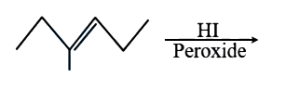
The major product obtained in the following reaction is
A
$3-$Iodo$-3-$methylhexane
B
$4-$Iodo$-3-$methylhexane
C
$3-$Iodo$-4-$methylhexane
D
$4-$Iodo$-4-$methylhexane
Solution
(A) The reaction of $HI$ with an alkene in the presence of peroxide does not follow the anti-Markownikoff rule because the addition of $I^{\bullet}$ radical is endothermic and reversible. Therefore,the reaction proceeds via the standard electrophilic addition mechanism following the Markownikoff rule.
According to the Markownikoff rule,the hydrogen atom attaches to the carbon atom of the double bond that already has more hydrogen atoms,and the iodine atom attaches to the more substituted carbon atom.
The reactant is $3-$methylhex$-3-$ene. Upon reaction with $HI$,the iodine atom attaches to the $C3$ position,which is more substituted,resulting in $3-$iodo$-3-$methylhexane as the major product.
According to the Markownikoff rule,the hydrogen atom attaches to the carbon atom of the double bond that already has more hydrogen atoms,and the iodine atom attaches to the more substituted carbon atom.
The reactant is $3-$methylhex$-3-$ene. Upon reaction with $HI$,the iodine atom attaches to the $C3$ position,which is more substituted,resulting in $3-$iodo$-3-$methylhexane as the major product.
0 likesView Solution
99
ChemistryDifficultMCQMHT CET · 2021
Which of the following processes does not involve the use of dihydrogen?
A
Gasification of coal
B
Formation of vanaspati ghee
C
Preparation of $HCl$
D
Preparation of metal hydride
Solution
(A) $1$. Gasification of coal: $C(s) + H_2O(g) \xrightarrow{1270 K} CO(g) + H_2(g)$. This process produces $H_2$ (syngas),but the question asks for processes involving the use of dihydrogen.
$2$. Formation of vanaspati ghee: This is the hydrogenation of vegetable oils using $H_2$ gas in the presence of a nickel catalyst.
$3$. Preparation of $HCl$: $H_2(g) + Cl_2(g) \xrightarrow{h\nu} 2HCl(g)$. This process uses $H_2$.
$4$. Preparation of metal hydride: $2M(s) + nH_2(g) \rightarrow 2MH_n(s)$. This process uses $H_2$.
$5$. Gasification of coal (specifically the water-gas shift reaction) is often confused,but the primary gasification step produces $H_2$ rather than consuming it as a reactant in the same way hydrogenation or synthesis does. However,in the context of industrial processes,gasification is a method of production,not a consumption process for $H_2$.
$2$. Formation of vanaspati ghee: This is the hydrogenation of vegetable oils using $H_2$ gas in the presence of a nickel catalyst.
$3$. Preparation of $HCl$: $H_2(g) + Cl_2(g) \xrightarrow{h\nu} 2HCl(g)$. This process uses $H_2$.
$4$. Preparation of metal hydride: $2M(s) + nH_2(g) \rightarrow 2MH_n(s)$. This process uses $H_2$.
$5$. Gasification of coal (specifically the water-gas shift reaction) is often confused,but the primary gasification step produces $H_2$ rather than consuming it as a reactant in the same way hydrogenation or synthesis does. However,in the context of industrial processes,gasification is a method of production,not a consumption process for $H_2$.
0 likesView Solution
100
ChemistryEasyMCQMHT CET · 2021
$A$ substance containing hydrogen and releasing $H^{+}$ in aqueous medium is an acid. Identify the theory suggesting this concept from the following.
A
Ostwald theory
B
Bronsted-Lowry theory
C
Arrhenius theory
D
Lewis theory
Solution
(C) According to the Arrhenius theory,an acid is a substance that contains hydrogen and dissociates to give $H^{+}$ ions in an aqueous solution.
Lewis acid is defined as a lone pair acceptor.
Bronsted-Lowry acid is a substance that donates a proton ($H^{+}$ ion) to another compound to form a conjugate base.
Lewis acid is defined as a lone pair acceptor.
Bronsted-Lowry acid is a substance that donates a proton ($H^{+}$ ion) to another compound to form a conjugate base.
0 likesView Solution
101
ChemistryMediumMCQMHT CET · 2021
Identify the sugar containing $\alpha, \beta-1,2-$ glycosidic linkage.
A
Sucrose
B
Maltose
C
Lactose
D
Raffinose
Solution
(A) Sucrose is a disaccharide composed of $\alpha-D-$glucose and $\beta-D-$fructose units.
These two monosaccharide units are joined by a glycosidic linkage between $C-1$ of $\alpha-D-$glucose and $C-2$ of $\beta-D-$fructose.
This specific linkage is known as the $\alpha, \beta-1,2-$ glycosidic linkage.
Therefore,the correct answer is $A$ (Sucrose).
These two monosaccharide units are joined by a glycosidic linkage between $C-1$ of $\alpha-D-$glucose and $C-2$ of $\beta-D-$fructose.
This specific linkage is known as the $\alpha, \beta-1,2-$ glycosidic linkage.
Therefore,the correct answer is $A$ (Sucrose).
0 likesView Solution
102
ChemistryMediumMCQMHT CET · 2021
Which is the $C$-terminal residue in glycyl alanine?
A
Alanine
B
Glutamine
C
Arginine
D
Glycine
Solution
(A) In a dipeptide,the amino acid with a free carboxyl group $(-COO^-)$ is called the $C$-terminal residue.
In glycyl alanine,the structure is $NH_3^+-CH_2-CO-NH-CH(CH_3)-COO^-$.
The $N$-terminal residue is glycine,and the $C$-terminal residue is alanine.
In glycyl alanine,the structure is $NH_3^+-CH_2-CO-NH-CH(CH_3)-COO^-$.
The $N$-terminal residue is glycine,and the $C$-terminal residue is alanine.
0 likesView Solution
103
ChemistryDifficultMCQMHT CET · 2021
Which among the following is a double ring containing nitrogen base present in nucleic acids?
A
Thymine
B
Adenine
C
Cytosine
D
Uracil
Solution
(B) Nitrogenous bases in nucleic acids are classified into two types: Purines and Pyrimidines.
Purines are bicyclic (double ring) structures,which include Adenine $(A)$ and Guanine $(G)$.
Pyrimidines are monocyclic (single ring) structures,which include Cytosine $(C)$,Thymine $(T)$,and Uracil $(U)$.
Among the given options,Adenine is a purine,which contains a double ring structure.
Therefore,the correct option is $B$.
Purines are bicyclic (double ring) structures,which include Adenine $(A)$ and Guanine $(G)$.
Pyrimidines are monocyclic (single ring) structures,which include Cytosine $(C)$,Thymine $(T)$,and Uracil $(U)$.
Among the given options,Adenine is a purine,which contains a double ring structure.
Therefore,the correct option is $B$.
0 likesView Solution
104
ChemistryEasyMCQMHT CET · 2021
Identify the basic $\alpha$-amino acid from the following.
A
Alanine
B
Lysine
C
Asparagine
D
Glycine
Solution
(B) An $\alpha$-amino acid is classified as basic if it contains more amino groups than carboxyl groups in its structure.
Lysine has the structure $H_2N-(CH_2)_4-CH(NH_2)-COOH$,which contains two amino groups and one carboxyl group,making it a basic $\alpha$-amino acid.
Lysine has the structure $H_2N-(CH_2)_4-CH(NH_2)-COOH$,which contains two amino groups and one carboxyl group,making it a basic $\alpha$-amino acid.
0 likesView Solution
105
ChemistryDifficultMCQMHT CET · 2021
Identify the $N$-terminal and $C$-terminal $\alpha$-amino acids respectively in the following polypeptide fragment: $Ala-Gly-Ser-Tyr-Gly$.
A
$Gly$ and $Tyr$
B
$Gly$ and $Gly$
C
$Ala$ and $Ser$
D
$Ala$ and $Gly$
Solution
(D) By convention,the polypeptide chain is written with the $N$-terminal amino acid on the left and the $C$-terminal amino acid on the right.
In the given polypeptide fragment $Ala-Gly-Ser-Tyr-Gly$:
$1$. The amino acid at the $N$-terminal (left end) is $Ala$ (Alanine).
$2$. The amino acid at the $C$-terminal (right end) is $Gly$ (Glycine).
Therefore,the $N$-terminal and $C$-terminal amino acids are $Ala$ and $Gly$ respectively.
In the given polypeptide fragment $Ala-Gly-Ser-Tyr-Gly$:
$1$. The amino acid at the $N$-terminal (left end) is $Ala$ (Alanine).
$2$. The amino acid at the $C$-terminal (right end) is $Gly$ (Glycine).
Therefore,the $N$-terminal and $C$-terminal amino acids are $Ala$ and $Gly$ respectively.
0 likesView Solution
106
ChemistryEasyMCQMHT CET · 2021
Identify the protein present in nail.
A
Albumin
B
Keratin
C
Myosin
D
Legumelin
Solution
(B) $Keratin$ is a type of protein that forms the cells that make up the tissue in nails and other parts of the human body.
$Keratin$ plays an important role in nail health.
It protects nails from damage by making them strong and resilient.
$Keratin$ plays an important role in nail health.
It protects nails from damage by making them strong and resilient.
0 likesView Solution
107
ChemistryMediumMCQMHT CET · 2021
Which among the following is a source of wool?
A
Goat
B
Silkworm
C
Sheep
D
Blended cotton
Solution
(C) Wool is a natural protein fiber obtained primarily from sheep. While some other animals like goats (e.g.,Cashmere,Mohair) also produce wool,sheep are the primary and most common source.
0 likesView Solution
108
ChemistryMediumMCQMHT CET · 2021
Which of the following is the correct abbreviation for deoxyriboadenosine monophosphate?
A
$AMP$
B
$dAMP$
C
$dTMP$
D
$UMP$
Solution
(B) The correct abbreviation for deoxyriboadenosine monophosphate is $dAMP$.
$d$ stands for deoxyribose,$A$ stands for adenosine,$M$ stands for monophosphate,and $P$ stands for phosphate.
$d$ stands for deoxyribose,$A$ stands for adenosine,$M$ stands for monophosphate,and $P$ stands for phosphate.
0 likesView Solution
109
ChemistryMediumMCQMHT CET · 2021
Identify the product $P$ of the following reaction:
Ethanoyl chloride $\stackrel{H_2O}{\longrightarrow} P$
Ethanoyl chloride $\stackrel{H_2O}{\longrightarrow} P$
A
Ethyl ethanoate
B
Ethanoic acid
C
Ethanol
D
Ethanal
Solution
(B) The reaction of ethanoyl chloride $(CH_3COCl)$ with water $(H_2O)$ is a hydrolysis reaction.
The chlorine atom is replaced by a hydroxyl group $(-OH)$ from water,releasing hydrogen chloride $(HCl)$ as a byproduct.
The chemical equation is: $CH_3COCl + H_2O \longrightarrow CH_3COOH + HCl$.
The product $P$ is ethanoic acid $(CH_3COOH)$.
The chlorine atom is replaced by a hydroxyl group $(-OH)$ from water,releasing hydrogen chloride $(HCl)$ as a byproduct.
The chemical equation is: $CH_3COCl + H_2O \longrightarrow CH_3COOH + HCl$.
The product $P$ is ethanoic acid $(CH_3COOH)$.
0 likesView Solution
110
ChemistryMediumMCQMHT CET · 2021
Which among the following compounds has the highest boiling point?
A
$C_4H_9NH_2$
B
$C_2H_5COOH$
C
$CH_3(CH_2)_2CH_2OH$
D
$C_2H_5CH(CH_3)_2$
Solution
(B) The boiling point of organic compounds depends on the strength of intermolecular forces.
$C_2H_5COOH$ (propanoic acid) can form stable intermolecular hydrogen-bonded dimers,which significantly increases its boiling point compared to alcohols $(C_4H_9OH)$ and amines $(C_4H_9NH_2)$ of similar molecular mass.
Alkanes like $C_2H_5CH(CH_3)_2$ only have weak London dispersion forces.
Therefore,carboxylic acids exhibit the highest boiling point among these functional groups.
$C_2H_5COOH$ (propanoic acid) can form stable intermolecular hydrogen-bonded dimers,which significantly increases its boiling point compared to alcohols $(C_4H_9OH)$ and amines $(C_4H_9NH_2)$ of similar molecular mass.
Alkanes like $C_2H_5CH(CH_3)_2$ only have weak London dispersion forces.
Therefore,carboxylic acids exhibit the highest boiling point among these functional groups.
0 likesView Solution
111
ChemistryDifficultMCQMHT CET · 2021
Identify product '$B$' in the following reaction.
$Cumene$ $\xrightarrow[\Delta]{KMnO_4, KOH} A$ $\xrightarrow{H_3O^{+}} B$
$Cumene$ $\xrightarrow[\Delta]{KMnO_4, KOH} A$ $\xrightarrow{H_3O^{+}} B$
A
Benzoic acid
B
Benzophenone
C
Phenol
D
Benzaldehyde
Solution
(A) The reaction of $Cumene$ (isopropylbenzene) with alkaline $KMnO_4$ followed by acidification is a standard method for the oxidation of alkylbenzenes.
$1$. In the first step,$Cumene$ is oxidized to potassium benzoate $(A)$ by alkaline $KMnO_4$ under heating.
$2$. In the second step,acidification with $H_3O^{+}$ converts potassium benzoate into $Benzoic \ acid$ $(B)$.
Therefore,the final product $B$ is $Benzoic \ acid$.
$1$. In the first step,$Cumene$ is oxidized to potassium benzoate $(A)$ by alkaline $KMnO_4$ under heating.
$2$. In the second step,acidification with $H_3O^{+}$ converts potassium benzoate into $Benzoic \ acid$ $(B)$.
Therefore,the final product $B$ is $Benzoic \ acid$.
0 likesView Solution
112
ChemistryEasyMCQMHT CET · 2021
Which of the following carboxylic acids has the lowest boiling point?
A
Butyric acid
B
Propionic acid
C
Acetic acid
D
Valeric acid
Solution
(C) The boiling point of carboxylic acids is directly proportional to their molar mass due to the increase in van der Waals forces with increasing chain length.
Among the given options,the molar masses are:
$CH_3COOH$ (Acetic acid) = $60 \ g/mol$
$CH_3CH_2COOH$ (Propionic acid) = $74 \ g/mol$
$CH_3CH_2CH_2COOH$ (Butyric acid) = $88 \ g/mol$
$CH_3CH_2CH_2CH_2COOH$ (Valeric acid) = $102 \ g/mol$
Since Acetic acid has the lowest molar mass,it has the lowest boiling point.
Among the given options,the molar masses are:
$CH_3COOH$ (Acetic acid) = $60 \ g/mol$
$CH_3CH_2COOH$ (Propionic acid) = $74 \ g/mol$
$CH_3CH_2CH_2COOH$ (Butyric acid) = $88 \ g/mol$
$CH_3CH_2CH_2CH_2COOH$ (Valeric acid) = $102 \ g/mol$
Since Acetic acid has the lowest molar mass,it has the lowest boiling point.
0 likesView Solution
113
ChemistryEasyMCQMHT CET · 2021
Identify the product $B$ in the following series of reaction.
$CH_3COOH + CH_3CH_2OH \rightleftharpoons{H^{+}} CH_3COOCH_2CH_3{_{\text{(A)}}} \xrightarrow[Ni/Pd, \Delta]{H_2} CH_3CH_2OH + CH_3CH_2OH{_{\text{(B)}}}$
$CH_3COOH + CH_3CH_2OH \rightleftharpoons{H^{+}} CH_3COOCH_2CH_3{_{\text{(A)}}} \xrightarrow[Ni/Pd, \Delta]{H_2} CH_3CH_2OH + CH_3CH_2OH{_{\text{(B)}}}$
A
$CH_3OH$
B
$CH_3CH_2OH$
C
$CH_3CH_2-O-CH_3$
D
$CH_3CH_2-O-CH_2CH_3$
Solution
(B) Step $1$: The reaction between $CH_3COOH$ and $CH_3CH_2OH$ in the presence of $H^{+}$ is an esterification reaction,which produces ethyl acetate $(A)$ as the product.
$CH_3COOH + CH_3CH_2OH \rightleftharpoons[H^{+}]{H^{+}} CH_3COOCH_2CH_3 (A) + H_2O$
Step $2$: The reduction of an ester $(A)$ using $H_2/Ni, \Delta$ leads to the formation of alcohols.
$CH_3COOCH_2CH_3 + 2H_2 \xrightarrow{Ni, \Delta} CH_3CH_2OH + CH_3CH_2OH$
Thus,the product $B$ is $CH_3CH_2OH$ (ethanol).
$CH_3COOH + CH_3CH_2OH \rightleftharpoons[H^{+}]{H^{+}} CH_3COOCH_2CH_3 (A) + H_2O$
Step $2$: The reduction of an ester $(A)$ using $H_2/Ni, \Delta$ leads to the formation of alcohols.
$CH_3COOCH_2CH_3 + 2H_2 \xrightarrow{Ni, \Delta} CH_3CH_2OH + CH_3CH_2OH$
Thus,the product $B$ is $CH_3CH_2OH$ (ethanol).
0 likesView Solution
114
ChemistryMediumMCQMHT CET · 2021
Identify the products of the following reaction:
$C_6H_5COOC_2H_5 \xrightarrow{\text{dil. } H_2SO_4} ?$
$C_6H_5COOC_2H_5 \xrightarrow{\text{dil. } H_2SO_4} ?$
A
$C_6H_5OH + C_2H_5OH$
B
$C_6H_5COOH + C_2H_5COOH$
C
$C_6H_5COOH + C_2H_5OH$
D
$C_6H_5OH + C_2H_5COOH$
Solution
(C) The reaction $C_6H_5COOC_2H_5 \xrightarrow{\text{dil. } H_2SO_4} ?$ represents the acidic hydrolysis of an ester.
In acidic hydrolysis,an ester reacts with water in the presence of an acid catalyst (like $dil. H_2SO_4$) to produce a carboxylic acid and an alcohol.
The general reaction is: $RCOOR' + H_2O \xrightarrow{H^+} RCOOH + R'OH$.
For the given ester,ethyl benzoate $(C_6H_5COOC_2H_5)$,the hydrolysis yields benzoic acid $(C_6H_5COOH)$ and ethanol $(C_2H_5OH)$.
In acidic hydrolysis,an ester reacts with water in the presence of an acid catalyst (like $dil. H_2SO_4$) to produce a carboxylic acid and an alcohol.
The general reaction is: $RCOOR' + H_2O \xrightarrow{H^+} RCOOH + R'OH$.
For the given ester,ethyl benzoate $(C_6H_5COOC_2H_5)$,the hydrolysis yields benzoic acid $(C_6H_5COOH)$ and ethanol $(C_2H_5OH)$.
0 likesView Solution
115
ChemistryEasyMCQMHT CET · 2021
Identify compound $A$ used in the following reaction: Benzoic acid $\xrightarrow[\Delta]{A}$ Benzoyl chloride + Phosphorous oxychloride + Hydrogen chloride
A
$SO_2Cl_2$
B
$PCl_3$
C
$HCl$
D
$PCl_5$
Solution
(D) The reaction of carboxylic acids with phosphorus pentachloride $(PCl_5)$ yields acid chlorides,phosphorus oxychloride $(POCl_3)$,and hydrogen chloride $(HCl)$.
The chemical equation is:
$C_6H_5COOH + PCl_5 \xrightarrow{\Delta} C_6H_5COCl + POCl_3 + HCl$
Therefore,the compound $A$ is $PCl_5$.
The chemical equation is:
$C_6H_5COOH + PCl_5 \xrightarrow{\Delta} C_6H_5COCl + POCl_3 + HCl$
Therefore,the compound $A$ is $PCl_5$.
0 likesView Solution
116
ChemistryDifficultMCQMHT CET · 2021
Identify product $C$ in the following conversion sequence: $m$-Hydroxybenzaldehyde $\xrightarrow[\text{Protection of } -OH \text{ group}]{C_6H_5CH_2Cl} A$ $\xrightarrow{[O]} B$ $\xrightarrow{\text{deprotection}} C$.
A
Benzoic acid
B
$m$-Hydroxybenzoic acid
C
Phenol
D
Phenyl benzoate
Solution
(B) Step $1$: Protection of the $-OH$ group of $m$-hydroxybenzaldehyde with benzyl chloride $(C_6H_5CH_2Cl)$ gives $m$-benzyloxybenzaldehyde $(A)$.
Step $2$: Oxidation of the aldehyde group in $A$ using an oxidizing agent $[O]$ yields $m$-benzyloxybenzoic acid $(B)$.
Step $3$: Deprotection of the benzyl group (usually via catalytic hydrogenation or acid-catalyzed cleavage) removes the protecting group to yield $m$-hydroxybenzoic acid $(C)$.
Step $2$: Oxidation of the aldehyde group in $A$ using an oxidizing agent $[O]$ yields $m$-benzyloxybenzoic acid $(B)$.
Step $3$: Deprotection of the benzyl group (usually via catalytic hydrogenation or acid-catalyzed cleavage) removes the protecting group to yield $m$-hydroxybenzoic acid $(C)$.
0 likesView Solution
117
ChemistryDifficultMCQMHT CET · 2021
Identify the compound obtained in the following reaction:
A
$Ar-Cl$
B
$Ar-CO-OR$
C
$Ar-O-R$
D
$R-CO-OAr$
Solution
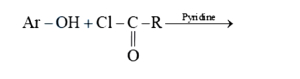
(D) The reaction between a phenol $(Ar-OH)$ and an acid chloride $(R-CO-Cl)$ in the presence of a base like pyridine is known as acylation.
Pyridine acts as a base to neutralize the $HCl$ produced during the reaction,which helps in driving the reaction forward.
The reaction is:
$Ar-OH + R-CO-Cl \xrightarrow{\text{Pyridine}} R-CO-OAr + HCl$
Thus,the product formed is an ester,specifically $R-CO-OAr$.
Pyridine acts as a base to neutralize the $HCl$ produced during the reaction,which helps in driving the reaction forward.
The reaction is:
$Ar-OH + R-CO-Cl \xrightarrow{\text{Pyridine}} R-CO-OAr + HCl$
Thus,the product formed is an ester,specifically $R-CO-OAr$.
0 likesView Solution
118
ChemistryDifficultMCQMHT CET · 2021
What type of hybridization is exhibited by $[CoF_6]^{3-}$?
A
$sp^3$
B
$sp^3 d^2$
C
$dsp^2$
D
$d^2 sp^3$
Solution
(B) In $[CoF_6]^{3-}$,the oxidation state of $Co$ is $+3$. The electronic configuration of $Co^{3+}$ is $[Ar] 3d^6$.
Since $F^-$ is a weak field ligand,it does not cause pairing of electrons in the $3d$ orbitals.
Therefore,the $4s$,$4p$,and $4d$ orbitals hybridize to form six equivalent $sp^3 d^2$ hybrid orbitals.
This results in an outer orbital octahedral complex.
Since $F^-$ is a weak field ligand,it does not cause pairing of electrons in the $3d$ orbitals.
Therefore,the $4s$,$4p$,and $4d$ orbitals hybridize to form six equivalent $sp^3 d^2$ hybrid orbitals.
This results in an outer orbital octahedral complex.
0 likesView Solution
119
ChemistryDifficultMCQMHT CET · 2021
In which of the following salts,the solubility increases appreciably with an increase in temperature?
A
$KBr$
B
$NaBr$
C
$NaCl$
D
$KCl$
Solution
(A) The solubility of solid solutes in a liquid solvent depends on temperature.
Based on the solubility curve provided:
- The solubility of $NaCl$ and $KCl$ changes only slightly with an increase in temperature.
- The solubility of $NaBr$ also shows a relatively small increase compared to nitrates.
- Among the given options,$KBr$ shows a more significant (appreciable) increase in solubility with temperature compared to $NaCl$,$NaBr$,and $KCl$.
- Salts like $KNO_3$ and $NaNO_3$ show the most dramatic increase in solubility with temperature.
Based on the solubility curve provided:
- The solubility of $NaCl$ and $KCl$ changes only slightly with an increase in temperature.
- The solubility of $NaBr$ also shows a relatively small increase compared to nitrates.
- Among the given options,$KBr$ shows a more significant (appreciable) increase in solubility with temperature compared to $NaCl$,$NaBr$,and $KCl$.
- Salts like $KNO_3$ and $NaNO_3$ show the most dramatic increase in solubility with temperature.
0 likesView Solution
120
ChemistryMediumMCQMHT CET · 2021
For the reaction $2 \ NO + Cl_2 \rightarrow 2 \ NOCl$,what is the relation between $\frac{d[NO]}{dt}$ and $\frac{d[NOCl]}{dt}$?
A
$\frac{d[NO]}{dt} = 2 \frac{d[NOCl]}{dt}$
B
$\frac{d[NO]}{dt} = -\frac{d[NOCl]}{dt}$
C
$\frac{d[NO]}{dt} = \frac{d[NOCl]}{dt}$
D
$\frac{d[NO]}{dt} = -\frac{1}{2} \frac{d[NOCl]}{dt}$
Solution
(B) For the reaction $2 \ NO + Cl_2 \rightarrow 2 \ NOCl$,the rate of reaction is given by:
Rate $= -\frac{1}{2} \frac{d[NO]}{dt} = -\frac{d[Cl_2]}{dt} = \frac{1}{2} \frac{d[NOCl]}{dt}$.
Since $NO$ is a reactant,its rate of disappearance is $-\frac{d[NO]}{dt}$.
Since $NOCl$ is a product,its rate of appearance is $\frac{d[NOCl]}{dt}$.
From the rate expression: $-\frac{1}{2} \frac{d[NO]}{dt} = \frac{1}{2} \frac{d[NOCl]}{dt}$.
Therefore,$-\frac{d[NO]}{dt} = \frac{d[NOCl]}{dt}$,or $\frac{d[NO]}{dt} = -\frac{d[NOCl]}{dt}$.
Rate $= -\frac{1}{2} \frac{d[NO]}{dt} = -\frac{d[Cl_2]}{dt} = \frac{1}{2} \frac{d[NOCl]}{dt}$.
Since $NO$ is a reactant,its rate of disappearance is $-\frac{d[NO]}{dt}$.
Since $NOCl$ is a product,its rate of appearance is $\frac{d[NOCl]}{dt}$.
From the rate expression: $-\frac{1}{2} \frac{d[NO]}{dt} = \frac{1}{2} \frac{d[NOCl]}{dt}$.
Therefore,$-\frac{d[NO]}{dt} = \frac{d[NOCl]}{dt}$,or $\frac{d[NO]}{dt} = -\frac{d[NOCl]}{dt}$.
0 likesView Solution
121
ChemistryEasyMCQMHT CET · 2021
The instantaneous rate of a reaction is given by $-\frac{1}{2} \frac{d[x]}{dt} = -\frac{d[y]}{dt} = \frac{1}{2} \frac{d[z]}{dt}$. Identify the reaction.
A
$2x + y \longrightarrow 2z$
B
$x + 2y \longrightarrow 2z$
C
$2z + y \longrightarrow 2x$
D
$2x + 2y \longrightarrow z$
Solution
(A) The rate of a reaction $aA + bB \longrightarrow cC$ is expressed as: $-\frac{1}{a} \frac{d[A]}{dt} = -\frac{1}{b} \frac{d[B]}{dt} = \frac{1}{c} \frac{d[C]}{dt}$.
Given the expression: $-\frac{1}{2} \frac{d[x]}{dt} = -\frac{d[y]}{dt} = \frac{1}{2} \frac{d[z]}{dt}$.
Comparing the coefficients,we get $a = 2$,$b = 1$,and $c = 2$.
Therefore,the balanced chemical equation is $2x + y \longrightarrow 2z$.
Given the expression: $-\frac{1}{2} \frac{d[x]}{dt} = -\frac{d[y]}{dt} = \frac{1}{2} \frac{d[z]}{dt}$.
Comparing the coefficients,we get $a = 2$,$b = 1$,and $c = 2$.
Therefore,the balanced chemical equation is $2x + y \longrightarrow 2z$.
0 likesView Solution
122
ChemistryMediumMCQMHT CET · 2021
For the reaction,$3 I_{(aq)}^{-} + S_2 O_{8_{(aq)}}^{2-} \longrightarrow I_{3_{(aq)}}^{-} + 2 SO_{4_{(aq)}}^{2-}$,the rate of formation of $SO_4^{2-}$ is $0.022 \ mol \ dm^{-3} \ sec^{-1}$. What is the rate of formation of $I_{3_{(aq)}}^{-}$?
A
$0.022 \ mol \ dm^{-3} \ sec^{-1}$
B
$0.11 \ mol \ dm^{-3} \ sec^{-1}$
C
$0.011 \ mol \ dm^{-3} \ sec^{-1}$
D
$0.033 \ mol \ dm^{-3} \ sec^{-1}$
Solution
(C) The given balanced chemical equation is: $3 I_{(aq)}^{-} + S_2 O_{8_{(aq)}}^{2-} \longrightarrow I_{3_{(aq)}}^{-} + 2 SO_{4_{(aq)}}^{2-}$
According to the rate law expression for the reaction,the rate of reaction is given by:
$Rate = -\frac{1}{3} \frac{d[I^-]}{dt} = -\frac{d[S_2 O_8^{2-}]}{dt} = \frac{d[I_3^-]}{dt} = \frac{1}{2} \frac{d[SO_4^{2-}]}{dt}$
Given that the rate of formation of $SO_4^{2-}$ is $\frac{d[SO_4^{2-}]}{dt} = 0.022 \ mol \ dm^{-3} \ sec^{-1}$.
Equating the rates:
$\frac{d[I_3^-]}{dt} = \frac{1}{2} \frac{d[SO_4^{2-}]}{dt}$
$\frac{d[I_3^-]}{dt} = \frac{1}{2} \times 0.022 \ mol \ dm^{-3} \ sec^{-1} = 0.011 \ mol \ dm^{-3} \ sec^{-1}$
According to the rate law expression for the reaction,the rate of reaction is given by:
$Rate = -\frac{1}{3} \frac{d[I^-]}{dt} = -\frac{d[S_2 O_8^{2-}]}{dt} = \frac{d[I_3^-]}{dt} = \frac{1}{2} \frac{d[SO_4^{2-}]}{dt}$
Given that the rate of formation of $SO_4^{2-}$ is $\frac{d[SO_4^{2-}]}{dt} = 0.022 \ mol \ dm^{-3} \ sec^{-1}$.
Equating the rates:
$\frac{d[I_3^-]}{dt} = \frac{1}{2} \frac{d[SO_4^{2-}]}{dt}$
$\frac{d[I_3^-]}{dt} = \frac{1}{2} \times 0.022 \ mol \ dm^{-3} \ sec^{-1} = 0.011 \ mol \ dm^{-3} \ sec^{-1}$
0 likesView Solution
123
ChemistryEasyMCQMHT CET · 2021
What is the rate of appearance of $Z$ in the following reaction? $3 X \rightarrow 2 Y + Z$,if the rate of disappearance of $X$ is $0.072 \ mol \ s^{-1}$.
A
$0.072 \ mol \ s^{-1}$
B
$0.048 \ mol \ s^{-1}$
C
$0.024 \ mol \ s^{-1}$
D
$0.096 \ mol \ s^{-1}$
Solution
(C) For the reaction: $3 X \rightarrow 2 Y + Z$
The rate of reaction is expressed as: $-\frac{1}{3} \frac{d[X]}{dt} = \frac{d[Z]}{dt}$
Given that the rate of disappearance of $X$ $(-\frac{d[X]}{dt})$ is $0.072 \ mol \ s^{-1}$.
Therefore,the rate of appearance of $Z$ $(\frac{d[Z]}{dt})$ is:
$\frac{d[Z]}{dt} = \frac{1}{3} \times (0.072 \ mol \ s^{-1}) = 0.024 \ mol \ s^{-1}$.
The rate of reaction is expressed as: $-\frac{1}{3} \frac{d[X]}{dt} = \frac{d[Z]}{dt}$
Given that the rate of disappearance of $X$ $(-\frac{d[X]}{dt})$ is $0.072 \ mol \ s^{-1}$.
Therefore,the rate of appearance of $Z$ $(\frac{d[Z]}{dt})$ is:
$\frac{d[Z]}{dt} = \frac{1}{3} \times (0.072 \ mol \ s^{-1}) = 0.024 \ mol \ s^{-1}$.
0 likesView Solution
124
ChemistryMediumMCQMHT CET · 2021
What is the rate of disappearance of $B$ in the following reaction? $2A + B \rightarrow 3C$,if the rate of appearance of $C$ is $1.3 \times 10^{-4} \ mol \ L^{-1} \ s^{-1}$.
A
$4.33 \times 10^{-5} \ mol \ L^{-1} \ s^{-1}$
B
$8.6 \times 10^{-5} \ mol \ L^{-1} \ s^{-1}$
C
$2.6 \times 10^{-4} \ mol \ L^{-1} \ s^{-1}$
D
$5.2 \times 10^{-5} \ mol \ L^{-1} \ s^{-1}$
Solution
(A) For the reaction $2A + B \rightarrow 3C$,the rate of reaction is given by: $\text{Rate} = -\frac{1}{2} \frac{d[A]}{dt} = -\frac{d[B]}{dt} = \frac{1}{3} \frac{d[C]}{dt}$.
Given that the rate of appearance of $C$ is $\frac{d[C]}{dt} = 1.3 \times 10^{-4} \ mol \ L^{-1} \ s^{-1}$.
Equating the rate of disappearance of $B$ to the rate of appearance of $C$: $-\frac{d[B]}{dt} = \frac{1}{3} \frac{d[C]}{dt}$.
$-\frac{d[B]}{dt} = \frac{1}{3} \times 1.3 \times 10^{-4} \ mol \ L^{-1} \ s^{-1} = 4.33 \times 10^{-5} \ mol \ L^{-1} \ s^{-1}$.
Given that the rate of appearance of $C$ is $\frac{d[C]}{dt} = 1.3 \times 10^{-4} \ mol \ L^{-1} \ s^{-1}$.
Equating the rate of disappearance of $B$ to the rate of appearance of $C$: $-\frac{d[B]}{dt} = \frac{1}{3} \frac{d[C]}{dt}$.
$-\frac{d[B]}{dt} = \frac{1}{3} \times 1.3 \times 10^{-4} \ mol \ L^{-1} \ s^{-1} = 4.33 \times 10^{-5} \ mol \ L^{-1} \ s^{-1}$.
0 likesView Solution
125
ChemistryMediumMCQMHT CET · 2021
For the reaction $N_{2(g)} + 3 H_{2(g)} \rightarrow 2 NH_{3(g)}$,what is the relation between $\frac{d[N_2]}{dt}$ and $\frac{d[H_2]}{dt}$?
A
$3 \frac{d[H_2]}{dt} = \frac{d[N_2]}{dt}$
B
$\frac{d[H_2]}{dt} = 3 \frac{d[N_2]}{dt}$
C
$3 \frac{d[H_2]}{dt} = 2 \frac{d[N_2]}{dt}$
D
$\frac{d[H_2]}{dt} = \frac{d[N_2]}{dt}$
Solution
(B) For the reaction $N_{2(g)} + 3 H_{2(g)} \rightarrow 2 NH_{3(g)}$,the rate of reaction is given by:
Rate $= -\frac{d[N_2]}{dt} = -\frac{1}{3} \frac{d[H_2]}{dt} = \frac{1}{2} \frac{d[NH_3]}{dt}$
Considering the terms for $N_2$ and $H_2$:
$-\frac{d[N_2]}{dt} = -\frac{1}{3} \frac{d[H_2]}{dt}$
Multiplying both sides by $-1$:
$\frac{d[N_2]}{dt} = \frac{1}{3} \frac{d[H_2]}{dt}$
Rearranging the equation to express $\frac{d[H_2]}{dt}$ in terms of $\frac{d[N_2]}{dt}$:
$\frac{d[H_2]}{dt} = 3 \frac{d[N_2]}{dt}$
Rate $= -\frac{d[N_2]}{dt} = -\frac{1}{3} \frac{d[H_2]}{dt} = \frac{1}{2} \frac{d[NH_3]}{dt}$
Considering the terms for $N_2$ and $H_2$:
$-\frac{d[N_2]}{dt} = -\frac{1}{3} \frac{d[H_2]}{dt}$
Multiplying both sides by $-1$:
$\frac{d[N_2]}{dt} = \frac{1}{3} \frac{d[H_2]}{dt}$
Rearranging the equation to express $\frac{d[H_2]}{dt}$ in terms of $\frac{d[N_2]}{dt}$:
$\frac{d[H_2]}{dt} = 3 \frac{d[N_2]}{dt}$
0 likesView Solution
126
ChemistryMediumMCQMHT CET · 2021
Ammonia and oxygen react at high temperature as $4 NH_{3(g)} + 5 O_{2(g)} \longrightarrow 4 NO_{(g)} + 6 H_2 O_{(g)}$. If the rate of formation of $NO_{(g)}$ is $3.6 \times 10^{-3} \ mol \ L^{-1} \ s^{-1}$,then the rate of disappearance of ammonia is:
A
$7.2 \times 10^{-3} \ mol \ L^{-1} \ s^{-1}$
B
$1.2 \times 10^{-3} \ mol \ L^{-1} \ s^{-1}$
C
$2.4 \times 10^{-3} \ mol \ L^{-1} \ s^{-1}$
D
$3.6 \times 10^{-3} \ mol \ L^{-1} \ s^{-1}$
Solution
(D) For the reaction: $4 NH_{3(g)} + 5 O_{2(g)} \longrightarrow 4 NO_{(g)} + 6 H_2 O_{(g)}$
The rate of reaction is given by the expression:
$Rate = -\frac{1}{4} \frac{d[NH_3]}{dt} = -\frac{1}{5} \frac{d[O_2]}{dt} = \frac{1}{4} \frac{d[NO]}{dt} = \frac{1}{6} \frac{d[H_2O]}{dt}$
Given that the rate of formation of $NO$ is $\frac{d[NO]}{dt} = 3.6 \times 10^{-3} \ mol \ L^{-1} \ s^{-1}$.
From the rate expression,we have:
$-\frac{1}{4} \frac{d[NH_3]}{dt} = \frac{1}{4} \frac{d[NO]}{dt}$
Therefore,the rate of disappearance of $NH_3$ is:
$-\frac{d[NH_3]}{dt} = \frac{d[NO]}{dt} = 3.6 \times 10^{-3} \ mol \ L^{-1} \ s^{-1}$.
The rate of reaction is given by the expression:
$Rate = -\frac{1}{4} \frac{d[NH_3]}{dt} = -\frac{1}{5} \frac{d[O_2]}{dt} = \frac{1}{4} \frac{d[NO]}{dt} = \frac{1}{6} \frac{d[H_2O]}{dt}$
Given that the rate of formation of $NO$ is $\frac{d[NO]}{dt} = 3.6 \times 10^{-3} \ mol \ L^{-1} \ s^{-1}$.
From the rate expression,we have:
$-\frac{1}{4} \frac{d[NH_3]}{dt} = \frac{1}{4} \frac{d[NO]}{dt}$
Therefore,the rate of disappearance of $NH_3$ is:
$-\frac{d[NH_3]}{dt} = \frac{d[NO]}{dt} = 3.6 \times 10^{-3} \ mol \ L^{-1} \ s^{-1}$.
0 likesView Solution
127
ChemistryMediumMCQMHT CET · 2021
For the reaction $2A + B \rightarrow 2C$,the rate of disappearance of $A$ is $0.076 \ mol \ s^{-1}$. What is the rate of disappearance of $B$?
A
$0.076 \ mol \ s^{-1}$
B
$0.038 \ mol \ s^{-1}$
C
$0.019 \ mol \ s^{-1}$
D
$0.095 \ mol \ s^{-1}$
Solution
(B) The given reaction is $2A + B \longrightarrow 2C$.
According to the rate law expression for the reaction:
$-\frac{1}{2} \frac{d[A]}{dt} = -\frac{d[B]}{dt} = \frac{1}{2} \frac{d[C]}{dt}$.
Given that the rate of disappearance of $A$ is $-\frac{d[A]}{dt} = 0.076 \ mol \ s^{-1}$.
Substituting this into the rate expression:
$-\frac{d[B]}{dt} = \frac{1}{2} \times (-\frac{d[A]}{dt}) = \frac{1}{2} \times 0.076 \ mol \ s^{-1} = 0.038 \ mol \ s^{-1}$.
Therefore,the rate of disappearance of $B$ is $0.038 \ mol \ s^{-1}$.
According to the rate law expression for the reaction:
$-\frac{1}{2} \frac{d[A]}{dt} = -\frac{d[B]}{dt} = \frac{1}{2} \frac{d[C]}{dt}$.
Given that the rate of disappearance of $A$ is $-\frac{d[A]}{dt} = 0.076 \ mol \ s^{-1}$.
Substituting this into the rate expression:
$-\frac{d[B]}{dt} = \frac{1}{2} \times (-\frac{d[A]}{dt}) = \frac{1}{2} \times 0.076 \ mol \ s^{-1} = 0.038 \ mol \ s^{-1}$.
Therefore,the rate of disappearance of $B$ is $0.038 \ mol \ s^{-1}$.
0 likesView Solution
128
ChemistryMediumMCQMHT CET · 2021
For the reaction $2A + 2B \rightarrow 2C + D$,if $r = k[A]^2[B]^0$,then the rate of reaction is:
A
inversely proportional to the square of the concentration of $A$
B
independent of the concentration of $A$
C
independent of the concentration of $B$
D
directly proportional to the concentration of $B$
Solution
(C) The rate law is given by $r = k[A]^2[B]^0$.
Since the order of the reaction with respect to $B$ is $0$,the rate of the reaction does not depend on the concentration of $B$.
Therefore,the rate of reaction is independent of the concentration of $B$.
Since the order of the reaction with respect to $B$ is $0$,the rate of the reaction does not depend on the concentration of $B$.
Therefore,the rate of reaction is independent of the concentration of $B$.
0 likesView Solution
129
ChemistryMediumMCQMHT CET · 2021
Identify the order of reaction if its rate constant is $x \ sec^{-1}$.
A
$3$
B
$2$
C
$0$
D
$1$
Solution
(D) The unit of the rate constant $(k)$ is given by the formula $M^{(1-n)} \cdot sec^{-1}$,where $n$ is the order of the reaction.
Given that the rate constant $k = x \ sec^{-1}$,we can compare the units.
$M^{(1-n)} \cdot sec^{-1} = M^0 \cdot sec^{-1}$.
Equating the exponents of $M$,we get $1 - n = 0$.
Therefore,$n = 1$.
Given that the rate constant $k = x \ sec^{-1}$,we can compare the units.
$M^{(1-n)} \cdot sec^{-1} = M^0 \cdot sec^{-1}$.
Equating the exponents of $M$,we get $1 - n = 0$.
Therefore,$n = 1$.
0 likesView Solution
130
ChemistryMediumMCQMHT CET · 2021
Which of the following statements is $NOT$ true for a reaction having rate law $r=k[H_2][I_2]$?
A
The reaction is first order in $H_2$
B
Overall order of reaction is $1$
C
The reaction is first order in $I_2$
D
Overall order of reaction is $2$
Solution
(B) The given rate law is $r=k[H_2][I_2]$.
$1$. The order of reaction with respect to $H_2$ is $1$.
$2$. The order of reaction with respect to $I_2$ is $1$.
$3$. The overall order of reaction is the sum of the powers of the concentration terms in the rate law,which is $1 + 1 = 2$.
Therefore,the statement that the overall order of reaction is $1$ is $NOT$ true.
$1$. The order of reaction with respect to $H_2$ is $1$.
$2$. The order of reaction with respect to $I_2$ is $1$.
$3$. The overall order of reaction is the sum of the powers of the concentration terms in the rate law,which is $1 + 1 = 2$.
Therefore,the statement that the overall order of reaction is $1$ is $NOT$ true.
0 likesView Solution
131
ChemistryMediumMCQMHT CET · 2021
For the reaction $A + B \rightarrow$ product,the rate of reaction is $3.6 \times 10^{-2} \ mol \ dm^{-3} \ sec^{-1}$. When $[A] = 0.2 \ mol \ dm^{-3}$ and $[B] = 0.1 \ mol \ dm^{-3}$,find the rate constant of the reaction if it is second order with respect to both reactants.
A
$18 \ mol^{-3} \ dm^9 \ sec^{-1}$
B
$90 \ mol^{-3} \ dm^9 \ sec^{-1}$
C
$72 \ mol^{-3} \ dm^9 \ sec^{-1}$
D
$36 \ mol^{-3} \ dm^9 \ sec^{-1}$
Solution
(B) The rate law for the reaction is given by:
$r = k[A]^2 [B]^2$
Substituting the given values:
$3.6 \times 10^{-2} = k(0.2)^2 (0.1)^2$
$3.6 \times 10^{-2} = k(0.04)(0.01)$
$3.6 \times 10^{-2} = k(4 \times 10^{-4})$
$k = \frac{3.6 \times 10^{-2}}{4 \times 10^{-4}} = 0.9 \times 10^2 = 90 \ mol^{-3} \ dm^9 \ sec^{-1}$
$r = k[A]^2 [B]^2$
Substituting the given values:
$3.6 \times 10^{-2} = k(0.2)^2 (0.1)^2$
$3.6 \times 10^{-2} = k(0.04)(0.01)$
$3.6 \times 10^{-2} = k(4 \times 10^{-4})$
$k = \frac{3.6 \times 10^{-2}}{4 \times 10^{-4}} = 0.9 \times 10^2 = 90 \ mol^{-3} \ dm^9 \ sec^{-1}$
0 likesView Solution
132
ChemistryEasyMCQMHT CET · 2021
If the decomposition of hydrogen peroxide is a first-order reaction,its rate law equation can be represented as:
A
$r = \frac{k}{[H_2O_2]}$
B
$r = k[H_2O_2]$
C
$r = k \frac{[H_2O][O_2]^{1/2}}{[H_2O_2]}$
D
$r = k \frac{[H_2O_2]}{[H_2O_2][O_2]^{1/2}}$
Solution
(B) The decomposition reaction of hydrogen peroxide is given by: $H_2O_2 \longrightarrow H_2O + \frac{1}{2} O_2$.
Since the reaction is of the first order,the rate of reaction depends on the first power of the concentration of the reactant.
Therefore,the rate law equation is expressed as: $r = k[H_2O_2]^1$ or $r = k[H_2O_2]$.
Since the reaction is of the first order,the rate of reaction depends on the first power of the concentration of the reactant.
Therefore,the rate law equation is expressed as: $r = k[H_2O_2]^1$ or $r = k[H_2O_2]$.
0 likesView Solution
133
ChemistryMediumMCQMHT CET · 2021
The rate law equation for a reaction between $A$,$B$ and $C$ is $r = k[A][B][C]^2$. What will be the new rate of reaction if the concentration of both $A$ and $B$ are doubled (in $r$)?
A
$2$
B
$4$
C
$6$
D
$8$
Solution
(B) The initial rate law is given by $r = k[A][B][C]^2$.
When the concentrations of $A$ and $B$ are doubled,the new concentrations become $[A]' = 2[A]$ and $[B]' = 2[B]$.
The new rate $r_{\text{new}}$ is given by $r_{\text{new}} = k[2A][2B][C]^2$.
Simplifying this,we get $r_{\text{new}} = 4 \times k[A][B][C]^2$.
Since $r = k[A][B][C]^2$,we have $r_{\text{new}} = 4r$.
When the concentrations of $A$ and $B$ are doubled,the new concentrations become $[A]' = 2[A]$ and $[B]' = 2[B]$.
The new rate $r_{\text{new}}$ is given by $r_{\text{new}} = k[2A][2B][C]^2$.
Simplifying this,we get $r_{\text{new}} = 4 \times k[A][B][C]^2$.
Since $r = k[A][B][C]^2$,we have $r_{\text{new}} = 4r$.
0 likesView Solution
134
ChemistryMediumMCQMHT CET · 2021
The order of reaction for which the units of rate constant are $mol \ dm^{-3} \ s^{-1}$ is
A
$2$
B
$1$
C
$0$
D
$3$
Solution
(C) The general formula for the units of the rate constant $k$ for a reaction of order $n$ is given by $(mol \ L^{-1})^{1-n} \ s^{-1}$.
Since $1 \ L^{-1} = 1 \ dm^{-3}$,the unit can be written as $(mol \ dm^{-3})^{1-n} \ s^{-1}$.
We are given the unit as $mol \ dm^{-3} \ s^{-1}$,which is equivalent to $(mol \ dm^{-3})^{1} \ s^{-1}$.
Comparing the exponents of $(mol \ dm^{-3})$,we get $1-n = 1$,which implies $n = 0$.
Therefore,the reaction is a zero-order reaction.
Since $1 \ L^{-1} = 1 \ dm^{-3}$,the unit can be written as $(mol \ dm^{-3})^{1-n} \ s^{-1}$.
We are given the unit as $mol \ dm^{-3} \ s^{-1}$,which is equivalent to $(mol \ dm^{-3})^{1} \ s^{-1}$.
Comparing the exponents of $(mol \ dm^{-3})$,we get $1-n = 1$,which implies $n = 0$.
Therefore,the reaction is a zero-order reaction.
0 likesView Solution
135
ChemistryMediumMCQMHT CET · 2021
What type of reaction order is followed by radioactive processes?
A
$0$
B
$1$
C
$2$
D
$1.5$
Solution
(B) All radioactive decay processes follow first-order kinetics because the rate of decay is directly proportional to the number of radioactive nuclei present at that time.
0 likesView Solution
136
ChemistryMediumMCQMHT CET · 2021
In a first order reaction,the concentration of the reactant decreases from $20 \ mmol$ to $10 \ mmol$ in $1.151 \ min$. What is the rate constant (in $min^{-1}$)?
A
$1.15$
B
$3.0$
C
$5.50$
D
$0.60$
Solution
(D) For a $1^{st}$ order reaction:
$k = \frac{2.303}{t} \log \frac{a_0}{a_t}$
Given:
$a_0 = 20 \ mmol$
$a_t = 10 \ mmol$
$t = 1.151 \ min$
Substituting the values:
$k = \frac{2.303}{1.151} \log \left( \frac{20}{10} \right)$
$k = \frac{2.303}{1.151} \times \log 2$
$k = \frac{2.303 \times 0.3010}{1.151}$
$k = 0.60 \ min^{-1}$
Alternatively,since the concentration reduces to half ($20 \ mmol$ to $10 \ mmol$),the time taken is the half-life $(t_{1/2})$:
$t_{1/2} = 1.151 \ min$
$k = \frac{0.693}{t_{1/2}} = \frac{0.693}{1.151} \approx 0.60 \ min^{-1}$
$k = \frac{2.303}{t} \log \frac{a_0}{a_t}$
Given:
$a_0 = 20 \ mmol$
$a_t = 10 \ mmol$
$t = 1.151 \ min$
Substituting the values:
$k = \frac{2.303}{1.151} \log \left( \frac{20}{10} \right)$
$k = \frac{2.303}{1.151} \times \log 2$
$k = \frac{2.303 \times 0.3010}{1.151}$
$k = 0.60 \ min^{-1}$
Alternatively,since the concentration reduces to half ($20 \ mmol$ to $10 \ mmol$),the time taken is the half-life $(t_{1/2})$:
$t_{1/2} = 1.151 \ min$
$k = \frac{0.693}{t_{1/2}} = \frac{0.693}{1.151} \approx 0.60 \ min^{-1}$
0 likesView Solution
137
ChemistryMediumMCQMHT CET · 2021
Half-life for a first order reaction is $6.93 \ hour$. What is the time required for $80 \%$ completion of the reaction (in $hours$)?
A
$12$
B
$18$
C
$6$
D
$16$
Solution
(D) For a first order reaction,the rate constant $k$ is given by $k = \frac{0.693}{t_{1/2}}$.
Substituting the given value,$k = \frac{0.693}{6.93} = 0.1 \ hour^{-1}$.
For $80 \%$ completion,the remaining concentration $[A]_t = [A]_0 - 0.80[A]_0 = 0.20[A]_0$.
The time $t$ is calculated using the formula $t = \frac{2.303}{k} \log_{10} \frac{[A]_0}{[A]_t}$.
$t = \frac{2.303}{0.1} \log_{10} \frac{100}{20} = 23.03 \times \log_{10} 5$.
Using $\log_{10} 5 \approx 0.699$,we get $t = 23.03 \times 0.699 \approx 16.10 \ hours$.
Substituting the given value,$k = \frac{0.693}{6.93} = 0.1 \ hour^{-1}$.
For $80 \%$ completion,the remaining concentration $[A]_t = [A]_0 - 0.80[A]_0 = 0.20[A]_0$.
The time $t$ is calculated using the formula $t = \frac{2.303}{k} \log_{10} \frac{[A]_0}{[A]_t}$.
$t = \frac{2.303}{0.1} \log_{10} \frac{100}{20} = 23.03 \times \log_{10} 5$.
Using $\log_{10} 5 \approx 0.699$,we get $t = 23.03 \times 0.699 \approx 16.10 \ hours$.
0 likesView Solution
138
ChemistryMediumMCQMHT CET · 2021
The slope of the graph between rate ($Y$-axis) and $[A]$ ($X$-axis) for a first-order reaction is equal to:
A
$k$
B
$\frac{2.303}{k}$
C
$\frac{k}{2.303}$
D
$-k$
Solution
(A) For a first-order reaction,the rate law is given by:
$Rate = k[A]^1$
Comparing this with the equation of a straight line passing through the origin,$y = mx$,where $y = \text{Rate}$,$x = [A]$,and $m = \text{slope}$:
$Rate = k[A]$
Thus,the slope $m = k$.
$Rate = k[A]^1$
Comparing this with the equation of a straight line passing through the origin,$y = mx$,where $y = \text{Rate}$,$x = [A]$,and $m = \text{slope}$:
$Rate = k[A]$
Thus,the slope $m = k$.
0 likesView Solution
139
ChemistryEasyMCQMHT CET · 2021
In a first order reaction,the concentration of the reactant is reduced to $(1/8)^{th}$ of its initial concentration in $23.03 \ min$. What is the half-life period of the reaction (in $min$)?
A
$25$
B
$7.7$
C
$15$
D
$30$
Solution
(B) For a first order reaction,the rate constant $k$ is given by: $k = \frac{2.303}{t} \log \frac{[A]_0}{[A]_t}$.
Given: $[A]_t = \frac{[A]_0}{8}$ and $t = 23.03 \ min$.
Substituting the values: $k = \frac{2.303}{23.03} \log \frac{[A]_0}{[A]_0/8} = 0.1 \log 8 = 0.1 \times 3 \log 2 = 0.3 \times 0.3010 = 0.0903 \ min^{-1}$.
The half-life period $t_{1/2}$ is given by: $t_{1/2} = \frac{0.693}{k}$.
$t_{1/2} = \frac{0.693}{0.0903} \approx 7.67 \ min \approx 7.7 \ min$.
Given: $[A]_t = \frac{[A]_0}{8}$ and $t = 23.03 \ min$.
Substituting the values: $k = \frac{2.303}{23.03} \log \frac{[A]_0}{[A]_0/8} = 0.1 \log 8 = 0.1 \times 3 \log 2 = 0.3 \times 0.3010 = 0.0903 \ min^{-1}$.
The half-life period $t_{1/2}$ is given by: $t_{1/2} = \frac{0.693}{k}$.
$t_{1/2} = \frac{0.693}{0.0903} \approx 7.67 \ min \approx 7.7 \ min$.
0 likesView Solution
140
ChemistryEasyMCQMHT CET · 2021
Identify the product $(X)$ formed in the following reaction:
$C_{6}H_{5}OH + CH_{3}COOH \xrightarrow{H^{+}} X$
$C_{6}H_{5}OH + CH_{3}COOH \xrightarrow{H^{+}} X$
A
$C_{6}H_{5}OCOCH_{3}$
B
$C_{6}H_{5}CH_{3}$
C
$C_{6}H_{5}OCH_{3}$
D
$C_{6}H_{5}COOCH_{3}$
Solution
(A) The reaction between phenol $(C_{6}H_{5}OH)$ and acetic acid $(CH_{3}COOH)$ in the presence of an acid catalyst $(H^{+})$ is an esterification reaction.
In this reaction,the hydroxyl group of the phenol reacts with the carboxyl group of the acetic acid to form an ester,phenyl acetate $(C_{6}H_{5}OCOCH_{3})$,and water $(H_{2}O)$.
The reaction is: $C_{6}H_{5}OH + CH_{3}COOH \xrightarrow{H^{+}} C_{6}H_{5}OCOCH_{3} + H_{2}O$.
Therefore,the product $(X)$ is $C_{6}H_{5}OCOCH_{3}$.
In this reaction,the hydroxyl group of the phenol reacts with the carboxyl group of the acetic acid to form an ester,phenyl acetate $(C_{6}H_{5}OCOCH_{3})$,and water $(H_{2}O)$.
The reaction is: $C_{6}H_{5}OH + CH_{3}COOH \xrightarrow{H^{+}} C_{6}H_{5}OCOCH_{3} + H_{2}O$.
Therefore,the product $(X)$ is $C_{6}H_{5}OCOCH_{3}$.
0 likesView Solution
141
ChemistryEasyMCQMHT CET · 2021
What is the half-life of a first order reaction if the time required to decrease the concentration of the reactant from $1.0 \ M$ to $0.25 \ M$ is $10 \ hours$ (in $hours$)?
A
$12$
B
$4$
C
$5$
D
$10$
Solution
(C) For a first order reaction,the rate constant $k$ is given by $k = \frac{1}{t} \ln \frac{[A]_0}{[A]_t}$.
Given $[A]_0 = 1.0 \ M$,$[A]_t = 0.25 \ M$,and $t = 10 \ hours$.
$k = \frac{1}{10} \ln \frac{1.0}{0.25} = \frac{\ln 4}{10} \ h^{-1}$.
The half-life $t_{1/2}$ is given by $t_{1/2} = \frac{\ln 2}{k}$.
Substituting the value of $k$: $t_{1/2} = \frac{\ln 2}{(\ln 4) / 10} = \frac{10 \ln 2}{2 \ln 2} = 5 \ hours$.
Given $[A]_0 = 1.0 \ M$,$[A]_t = 0.25 \ M$,and $t = 10 \ hours$.
$k = \frac{1}{10} \ln \frac{1.0}{0.25} = \frac{\ln 4}{10} \ h^{-1}$.
The half-life $t_{1/2}$ is given by $t_{1/2} = \frac{\ln 2}{k}$.
Substituting the value of $k$: $t_{1/2} = \frac{\ln 2}{(\ln 4) / 10} = \frac{10 \ln 2}{2 \ln 2} = 5 \ hours$.
0 likesView Solution
142
ChemistryEasyMCQMHT CET · 2021
For a first order reaction,the intercept of the graph between $\log \left(\frac{[A]_0}{[A]_t}\right)$ ($Y$-axis) and time ($X$-axis) is equal to
A
$-\frac{k}{2.303}$
B
$-\log [A]_0$
C
zero
D
$\frac{2.303}{k}$
Solution
(C) For a $1^{st}$ order reaction,the integrated rate equation is given by:
$2.303 \log \left(\frac{[A]_0}{[A]_t}\right) = kt$
Rearranging this equation,we get:
$\log \left(\frac{[A]_0}{[A]_t}\right) = \left(\frac{k}{2.303}\right) t$
Comparing this with the linear equation $y = mx + c$,where $y = \log \left(\frac{[A]_0}{[A]_t}\right)$,$x = t$,$m = \frac{k}{2.303}$,and $c$ is the intercept.
Since there is no constant term added,the intercept $c = 0$.
$2.303 \log \left(\frac{[A]_0}{[A]_t}\right) = kt$
Rearranging this equation,we get:
$\log \left(\frac{[A]_0}{[A]_t}\right) = \left(\frac{k}{2.303}\right) t$
Comparing this with the linear equation $y = mx + c$,where $y = \log \left(\frac{[A]_0}{[A]_t}\right)$,$x = t$,$m = \frac{k}{2.303}$,and $c$ is the intercept.
Since there is no constant term added,the intercept $c = 0$.
0 likesView Solution
143
ChemistryMediumMCQMHT CET · 2021
For a reaction $A \rightarrow$ product,the rate constant is $2 \times 10^{-2} \ s^{-1}$. The initial concentration of $A$ is $1.0 \ mol \ dm^{-3}$. What is the value of $\log \frac{1}{[A]_{t}}$ after $100 \ s$?
A
$0.423$
B
$0.135$
C
$0.270$
D
$0.868$
Solution
(D) The given rate constant $k = 2 \times 10^{-2} \ s^{-1}$ indicates a first-order reaction.
The integrated rate equation for a first-order reaction is $\ln \frac{[A]_0}{[A]_t} = kt$,which can be written as $2.303 \log \frac{[A]_0}{[A]_t} = kt$.
Given $[A]_0 = 1.0 \ mol \ dm^{-3}$,$t = 100 \ s$,and $k = 2 \times 10^{-2} \ s^{-1}$.
Substituting the values: $\log \frac{1}{[A]_t} = \frac{kt}{2.303} = \frac{2 \times 10^{-2} \times 100}{2.303} = \frac{2}{2.303} \approx 0.868$.
The integrated rate equation for a first-order reaction is $\ln \frac{[A]_0}{[A]_t} = kt$,which can be written as $2.303 \log \frac{[A]_0}{[A]_t} = kt$.
Given $[A]_0 = 1.0 \ mol \ dm^{-3}$,$t = 100 \ s$,and $k = 2 \times 10^{-2} \ s^{-1}$.
Substituting the values: $\log \frac{1}{[A]_t} = \frac{kt}{2.303} = \frac{2 \times 10^{-2} \times 100}{2.303} = \frac{2}{2.303} \approx 0.868$.
0 likesView Solution
144
ChemistryEasyMCQMHT CET · 2021
What is the rate constant of a first-order reaction if $0.08 \ mol$ of reactant reduces to $0.02 \ mol$ in $23.03 \ min$ (in $min^{-1}$)?
A
$0.2303$
B
$1.6021$
C
$0.4031$
D
$0.06021$
Solution
(D) For a first-order reaction,the rate constant $K$ is given by the formula:
$K = \frac{2.303}{t} \log \frac{[A]_0}{[A]_t}$
Given: $[A]_0 = 0.08 \ mol$,$[A]_t = 0.02 \ mol$,$t = 23.03 \ min$.
Substituting the values:
$K = \frac{2.303}{23.03} \log \frac{0.08}{0.02}$
$K = 0.1 \times \log 4$
Since $\log 4 = 2 \log 2 \approx 2 \times 0.3010 = 0.6020$:
$K = 0.1 \times 0.6020 = 0.0602 \ min^{-1}$.
$K = \frac{2.303}{t} \log \frac{[A]_0}{[A]_t}$
Given: $[A]_0 = 0.08 \ mol$,$[A]_t = 0.02 \ mol$,$t = 23.03 \ min$.
Substituting the values:
$K = \frac{2.303}{23.03} \log \frac{0.08}{0.02}$
$K = 0.1 \times \log 4$
Since $\log 4 = 2 \log 2 \approx 2 \times 0.3010 = 0.6020$:
$K = 0.1 \times 0.6020 = 0.0602 \ min^{-1}$.
0 likesView Solution
145
ChemistryMediumMCQMHT CET · 2021
Which of the following equations represents the integrated rate law for a zero order reaction?
A
$k = \frac{[A]_t - [A]_0}{t}$
B
$k = \frac{1}{t} \log_{10} \frac{[A]_0}{[A]_t}$
C
$k = \frac{[A]_0 - [A]_t}{t}$
D
$k = \frac{t}{2.303} \times \log_{10} \frac{[A]_0}{[A]_t}$
Solution
(C) For a zero order reaction,the rate of reaction is independent of the concentration of the reactant.
Rate $= -\frac{d[A]}{dt} = k[A]^0 = k$
Integrating this expression:
$-\int d[A] = \int k dt$
$-[A] = kt + C$
At $t = 0$,$[A] = [A]_0$,so $C = -[A]_0$.
Substituting $C$ back into the equation:
$-[A]_t = kt - [A]_0$
$[A]_t = [A]_0 - kt$
Rearranging for $k$:
$kt = [A]_0 - [A]_t$
$k = \frac{[A]_0 - [A]_t}{t}$
Rate $= -\frac{d[A]}{dt} = k[A]^0 = k$
Integrating this expression:
$-\int d[A] = \int k dt$
$-[A] = kt + C$
At $t = 0$,$[A] = [A]_0$,so $C = -[A]_0$.
Substituting $C$ back into the equation:
$-[A]_t = kt - [A]_0$
$[A]_t = [A]_0 - kt$
Rearranging for $k$:
$kt = [A]_0 - [A]_t$
$k = \frac{[A]_0 - [A]_t}{t}$
0 likesView Solution
146
ChemistryEasyMCQMHT CET · 2021
Which of the following represents the integrated rate law equation for the gas-phase first-order reaction,$A_{(g)} \rightarrow B_{(g)} + C_{(g)}$? If $P_{i}$ is the initial pressure of $A$ and $P$ is the total pressure of the reaction mixture at time $t$.
A
$k = 2.303 \times \log_{10} \frac{P_{i}}{2P_{i} - P}$
B
$k = \frac{2.303}{t} \times \log_{10} \frac{P_{i}}{2P_{i} - P}$
C
$k = \frac{1}{t} \ln \frac{2P_{i} - P}{P_{i}}$
D
$k = \frac{2.303}{t} \times \log_{10} \frac{P_{i} - P}{P_{i}}$
Solution
(B) For the reaction: $A_{(g)} \rightarrow B_{(g)} + C_{(g)}$
At $t = 0$: Pressure of $A = P_{i}$,$B = 0$,$C = 0$.
At $t = t$: Pressure of $A = P_{i} - x$,$B = x$,$C = x$.
Total pressure $P = (P_{i} - x) + x + x = P_{i} + x$.
Therefore,$x = P - P_{i}$.
The pressure of $A$ at time $t$ is $P_{A} = P_{i} - x = P_{i} - (P - P_{i}) = 2P_{i} - P$.
For a first-order reaction,the integrated rate law is $k = \frac{2.303}{t} \log_{10} \frac{P_{i}}{P_{A}}$.
Substituting $P_{A}$,we get $k = \frac{2.303}{t} \log_{10} \frac{P_{i}}{2P_{i} - P}$.
At $t = 0$: Pressure of $A = P_{i}$,$B = 0$,$C = 0$.
At $t = t$: Pressure of $A = P_{i} - x$,$B = x$,$C = x$.
Total pressure $P = (P_{i} - x) + x + x = P_{i} + x$.
Therefore,$x = P - P_{i}$.
The pressure of $A$ at time $t$ is $P_{A} = P_{i} - x = P_{i} - (P - P_{i}) = 2P_{i} - P$.
For a first-order reaction,the integrated rate law is $k = \frac{2.303}{t} \log_{10} \frac{P_{i}}{P_{A}}$.
Substituting $P_{A}$,we get $k = \frac{2.303}{t} \log_{10} \frac{P_{i}}{2P_{i} - P}$.
0 likesView Solution
147
ChemistryMediumMCQMHT CET · 2021
In a first order reaction,$60 \%$ of the reactant decomposes in $4.606 \ min$. What is the half-life of the reaction (in $min$)? (Given: $k = 0.1989 \ min^{-1}$)
A
$3.48$
B
$2.4$
C
$3.0$
D
$1.74$
Solution
(A) For a $1^{st}$ order reaction,the half-life $(t_{1/2})$ is calculated using the rate constant $(k)$:
$t_{1/2} = \frac{\ln 2}{k} = \frac{0.693}{k}$
Given $k = 0.1989 \ min^{-1}$,
$t_{1/2} = \frac{0.693}{0.1989} \approx 3.48 \ min$.
$t_{1/2} = \frac{\ln 2}{k} = \frac{0.693}{k}$
Given $k = 0.1989 \ min^{-1}$,
$t_{1/2} = \frac{0.693}{0.1989} \approx 3.48 \ min$.
0 likesView Solution
148
ChemistryEasyMCQMHT CET · 2021
Half-life and rate constant for a first-order reaction are related by the equation:
A
$t_{1/2} = \frac{k}{0.693}$
B
$k = \frac{[A]_0 - [A]_t}{t_{1/2}}$
C
$t_{1/2} = \frac{0.693}{k}$
D
$t_{1/2} = \frac{[A]_t - [A]_0}{k}$
Solution
(C) For a first-order reaction,the integrated rate equation is:
$t = \frac{2.303}{k} \log \frac{[A]_0}{[A]_t}$
At half-life $(t_{1/2})$,the concentration of the reactant becomes half of its initial concentration,i.e.,$[A]_t = \frac{[A]_0}{2}$.
Substituting this in the equation:
$t_{1/2} = \frac{2.303}{k} \log \frac{[A]_0}{[A]_0 / 2} = \frac{2.303}{k} \log 2$
Since $\log 2 \approx 0.3010$,we get:
$t_{1/2} = \frac{2.303 \times 0.3010}{k} = \frac{0.693}{k}$
$t = \frac{2.303}{k} \log \frac{[A]_0}{[A]_t}$
At half-life $(t_{1/2})$,the concentration of the reactant becomes half of its initial concentration,i.e.,$[A]_t = \frac{[A]_0}{2}$.
Substituting this in the equation:
$t_{1/2} = \frac{2.303}{k} \log \frac{[A]_0}{[A]_0 / 2} = \frac{2.303}{k} \log 2$
Since $\log 2 \approx 0.3010$,we get:
$t_{1/2} = \frac{2.303 \times 0.3010}{k} = \frac{0.693}{k}$
0 likesView Solution
149
ChemistryMediumMCQMHT CET · 2021
$A$ reaction is first order with respect to $A$ and second order with respect to $B$. What is the effect on the reaction rate if the concentration of $B$ is increased $3$ times?
A
Rate increases $6$ times
B
Rate increases $9$ times
C
Rate increases $2$ times
D
Rate increases $3$ times
Solution
(B) The rate law for the reaction is given by: $r = k[A]^1[B]^2$.
If the concentration of $B$ is increased $3$ times,the new concentration becomes $[B'] = 3[B]$.
The new rate is $r_{new} = k[A][3B]^2$.
$r_{new} = k[A] \times 9[B]^2 = 9 \times (k[A][B]^2)$.
$r_{new} = 9r$.
Therefore,the reaction rate increases $9$ times.
If the concentration of $B$ is increased $3$ times,the new concentration becomes $[B'] = 3[B]$.
The new rate is $r_{new} = k[A][3B]^2$.
$r_{new} = k[A] \times 9[B]^2 = 9 \times (k[A][B]^2)$.
$r_{new} = 9r$.
Therefore,the reaction rate increases $9$ times.
0 likesView Solution
150
ChemistryEasyMCQMHT CET · 2021
Which element from the following belongs to the oxygen family?
A
$Ba$
B
$Se$
C
$Rb$
D
$Ca$
Solution
(B) The oxygen family,also known as group $16$ or the chalcogens,consists of the elements oxygen $(O)$,sulfur $(S)$,selenium $(Se)$,tellurium $(Te)$,polonium $(Po)$,and livermorium $(Lv)$.
Among the given options,$Se$ (selenium) belongs to this group.
Among the given options,$Se$ (selenium) belongs to this group.
0 likesView Solution
Vedclass Products
For Students
Vedclass Test Series
Mock tests in real MHT CET style covering Chemistry with performance analysis. 5-day free trial.
Start Free TrialFor Teachers
Exam Paper Generator
Generate Set A/B/C/D Chemistry papers from 7.5L+ questions in 2 minutes. 3 chapters free.
Try FreeFor Institutes
Online Exam Module
Run live MHT CET mock exams with unlimited students, 360° analytics & white-label branding.
See DemoFrequently Asked Questions
How many Chemistry questions are in MHT CET 2021?
There are 563 Chemistry questions from the MHT CET 2021 paper on Vedclass, each with a detailed step-by-step solution in English.
Are MHT CET 2021 Chemistry solutions available in English?
Yes. All solutions on this page are in English. You can also switch to English or Hindi using the language buttons above the questions.
Can I practice MHT CET 2021 Chemistry as a timed test?
Yes. Use the Vedclass Test Series to attempt a full MHT CET mock test covering Chemistry with time limits and instant score analysis.
Can teachers create Chemistry papers from MHT CET previous year questions?
Yes. The Vedclass Exam Paper Generator lets teachers mix MHT CET Chemistry questions and generate Set A/B/C/D papers in minutes.
For Teachers & Institutes
Build a Custom Chemistry Paper
Pick MHT CET 2021 Chemistry questions, set difficulty, and generate Set A/B/C/D in 2 minutes.