
ChemistryQ201–290 of 563 questions
Page 5 of 7 · English
201
ChemistryMCQMHT CET · 2021
$A$ stone is dropped in a quiet lake and it is observed that waves move in circles. If the radius of a circular wave increases at the rate of $2 \text{ cm/sec}$,then the rate of increase in its area at the instant when its radius is $10 \text{ cm}$,is (in $\text{cm}^2/\text{sec}$): (in $pi$)
A
$40$
B
$80$
C
$10$
D
$20$
Solution
(A) Given that the rate of change of the radius is $\frac{dr}{dt} = 2 \text{ cm/sec}$.
We need to find the rate of change of the area $A$ when the radius $r = 10 \text{ cm}$.
The area of a circle is given by $A = \pi r^2$.
Differentiating both sides with respect to time $t$,we get:
$\frac{dA}{dt} = 2 \pi r \frac{dr}{dt}$.
Substituting the given values $r = 10 \text{ cm}$ and $\frac{dr}{dt} = 2 \text{ cm/sec}$:
$\frac{dA}{dt} = 2 \pi \times 10 \times 2 = 40 \pi \text{ cm}^2/\text{sec}$.
We need to find the rate of change of the area $A$ when the radius $r = 10 \text{ cm}$.
The area of a circle is given by $A = \pi r^2$.
Differentiating both sides with respect to time $t$,we get:
$\frac{dA}{dt} = 2 \pi r \frac{dr}{dt}$.
Substituting the given values $r = 10 \text{ cm}$ and $\frac{dr}{dt} = 2 \text{ cm/sec}$:
$\frac{dA}{dt} = 2 \pi \times 10 \times 2 = 40 \pi \text{ cm}^2/\text{sec}$.
0 likesView Solution
202
ChemistryMCQMHT CET · 2021
The function $f(x)=\log (1+x)-\frac{2 x}{2+x}$ is increasing on
A
$(-\infty, \infty)$
B
$(-5, \infty)$
C
$(-\infty, 0)$
D
$(-1, \infty)$
Solution
(D) Given the function $f(x) = \log(1+x) - \frac{2x}{2+x}$. The domain of the function requires $1+x > 0$,so $x > -1$.
First,we find the derivative $f'(x)$:
$f'(x) = \frac{d}{dx} [\log(1+x)] - \frac{d}{dx} \left[ \frac{2x}{2+x} \right]$
$f'(x) = \frac{1}{1+x} - \left[ \frac{(2+x)(2) - (2x)(1)}{(2+x)^2} \right]$
$f'(x) = \frac{1}{1+x} - \frac{4}{(2+x)^2}$
Simplifying the expression:
$f'(x) = \frac{(2+x)^2 - 4(1+x)}{(1+x)(2+x)^2} = \frac{4 + 4x + x^2 - 4 - 4x}{(1+x)(2+x)^2} = \frac{x^2}{(1+x)(2+x)^2}$
For the function to be increasing,we require $f'(x) > 0$.
Since $x^2 > 0$ and $(2+x)^2 > 0$ for all $x > -1$ (excluding $x=0$),the condition $f'(x) > 0$ is satisfied when $1+x > 0$,which implies $x > -1$.
Therefore,the function is increasing on $(-1, \infty)$.
First,we find the derivative $f'(x)$:
$f'(x) = \frac{d}{dx} [\log(1+x)] - \frac{d}{dx} \left[ \frac{2x}{2+x} \right]$
$f'(x) = \frac{1}{1+x} - \left[ \frac{(2+x)(2) - (2x)(1)}{(2+x)^2} \right]$
$f'(x) = \frac{1}{1+x} - \frac{4}{(2+x)^2}$
Simplifying the expression:
$f'(x) = \frac{(2+x)^2 - 4(1+x)}{(1+x)(2+x)^2} = \frac{4 + 4x + x^2 - 4 - 4x}{(1+x)(2+x)^2} = \frac{x^2}{(1+x)(2+x)^2}$
For the function to be increasing,we require $f'(x) > 0$.
Since $x^2 > 0$ and $(2+x)^2 > 0$ for all $x > -1$ (excluding $x=0$),the condition $f'(x) > 0$ is satisfied when $1+x > 0$,which implies $x > -1$.
Therefore,the function is increasing on $(-1, \infty)$.
0 likesView Solution
203
ChemistryMCQMHT CET · 2021
For all real $x$,the minimum value of the function $f(x)=\frac{1-x+x^2}{1+x+x^2}$ is
A
$\frac{1}{3}$
B
$0$
C
$3$
D
$1$
Solution
(A) We have $f(x)=\frac{1-x+x^2}{1+x+x^2}$.
To find the critical points,we differentiate $f(x)$ with respect to $x$ using the quotient rule:
$f^{\prime}(x)=\frac{(1+x+x^2)(2x-1)-(1-x+x^2)(2x+1)}{(1+x+x^2)^2}$.
Expanding the numerator:
$f^{\prime}(x)=\frac{(2x^3+x^2+x-1)-(2x^3-x^2+x+1)}{(1+x+x^2)^2} = \frac{2x^2-2}{(1+x+x^2)^2}$.
Setting $f^{\prime}(x)=0$ gives $2(x^2-1)=0$,which implies $x=1$ or $x=-1$.
Evaluating the function at these points:
For $x=1$,$f(1)=\frac{1-1+1}{1+1+1} = \frac{1}{3}$.
For $x=-1$,$f(-1)=\frac{1-(-1)+(-1)^2}{1+(-1)+(-1)^2} = \frac{3}{1} = 3$.
Comparing these values,the minimum value of $f(x)$ is $\frac{1}{3}$.
To find the critical points,we differentiate $f(x)$ with respect to $x$ using the quotient rule:
$f^{\prime}(x)=\frac{(1+x+x^2)(2x-1)-(1-x+x^2)(2x+1)}{(1+x+x^2)^2}$.
Expanding the numerator:
$f^{\prime}(x)=\frac{(2x^3+x^2+x-1)-(2x^3-x^2+x+1)}{(1+x+x^2)^2} = \frac{2x^2-2}{(1+x+x^2)^2}$.
Setting $f^{\prime}(x)=0$ gives $2(x^2-1)=0$,which implies $x=1$ or $x=-1$.
Evaluating the function at these points:
For $x=1$,$f(1)=\frac{1-1+1}{1+1+1} = \frac{1}{3}$.
For $x=-1$,$f(-1)=\frac{1-(-1)+(-1)^2}{1+(-1)+(-1)^2} = \frac{3}{1} = 3$.
Comparing these values,the minimum value of $f(x)$ is $\frac{1}{3}$.
0 likesView Solution
204
ChemistryMCQMHT CET · 2021
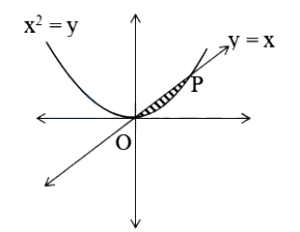
The area bounded by the parabola $y=x^2$ and the line $y=x$ is
A
$\frac{1}{2}$ sq. units
B
$\frac{1}{3}$ sq. units
C
$\frac{2}{3}$ sq. units
D
$\frac{1}{6}$ sq. units
Solution
(D) To find the area bounded by the parabola $y=x^2$ and the line $y=x$,we first determine their points of intersection by setting $x^2 = x$.
This gives $x^2 - x = 0$,which implies $x(x-1) = 0$.
Thus,the points of intersection are $x=0$ and $x=1$.
For $x \in [0, 1]$,the line $y=x$ lies above the parabola $y=x^2$.
The required area $A$ is given by the integral:
$A = \int_0^1 (x - x^2) dx$
$A = \left[ \frac{x^2}{2} - \frac{x^3}{3} \right]_0^1$
$A = \left( \frac{1^2}{2} - \frac{1^3}{3} \right) - (0 - 0)$
$A = \frac{1}{2} - \frac{1}{3} = \frac{3-2}{6} = \frac{1}{6}$ sq. units.
This gives $x^2 - x = 0$,which implies $x(x-1) = 0$.
Thus,the points of intersection are $x=0$ and $x=1$.
For $x \in [0, 1]$,the line $y=x$ lies above the parabola $y=x^2$.
The required area $A$ is given by the integral:
$A = \int_0^1 (x - x^2) dx$
$A = \left[ \frac{x^2}{2} - \frac{x^3}{3} \right]_0^1$
$A = \left( \frac{1^2}{2} - \frac{1^3}{3} \right) - (0 - 0)$
$A = \frac{1}{2} - \frac{1}{3} = \frac{3-2}{6} = \frac{1}{6}$ sq. units.
0 likesView Solution
205
ChemistryMCQMHT CET · 2021
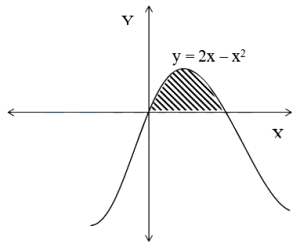
The area of the region bounded by the curve $y=2x-x^2$ and the $X$-axis is
A
$\frac{2}{3}$ sq. units
B
$\frac{4}{3}$ sq. units
C
$\frac{5}{3}$ sq. units
D
$\frac{8}{3}$ sq. units
Solution
(B) To find the area bounded by the curve $y=2x-x^2$ and the $X$-axis,we first find the intersection points by setting $y=0$:
$0 = 2x - x^2$
$x(2-x) = 0$
So,$x=0$ and $x=2$.
The required area $A$ is given by the integral of the curve from $x=0$ to $x=2$:
$A = \int_{0}^{2} (2x - x^2) dx$
$A = \left[ \frac{2x^2}{2} - \frac{x^3}{3} \right]_{0}^{2}$
$A = \left[ x^2 - \frac{x^3}{3} \right]_{0}^{2}$
$A = (2^2 - \frac{2^3}{3}) - (0^2 - \frac{0^3}{3})$
$A = (4 - \frac{8}{3}) - 0$
$A = \frac{12-8}{3} = \frac{4}{3}$ sq. units.
$0 = 2x - x^2$
$x(2-x) = 0$
So,$x=0$ and $x=2$.
The required area $A$ is given by the integral of the curve from $x=0$ to $x=2$:
$A = \int_{0}^{2} (2x - x^2) dx$
$A = \left[ \frac{2x^2}{2} - \frac{x^3}{3} \right]_{0}^{2}$
$A = \left[ x^2 - \frac{x^3}{3} \right]_{0}^{2}$
$A = (2^2 - \frac{2^3}{3}) - (0^2 - \frac{0^3}{3})$
$A = (4 - \frac{8}{3}) - 0$
$A = \frac{12-8}{3} = \frac{4}{3}$ sq. units.
0 likesView Solution
206
ChemistryMCQMHT CET · 2021
The value of $\int_0^1 \tan ^{-1}\left(\frac{2 x-1}{1+x-x^2}\right) d x$ is
A
$2$
B
$-1$
C
$1$
D
$0$
Solution
(D) Let $I = \int_0^1 \tan ^{-1}\left(\frac{2x-1}{1+x-x^2}\right) dx$.
Using the property $\tan^{-1}(a) - \tan^{-1}(b) = \tan^{-1}\left(\frac{a-b}{1+ab}\right)$,we can rewrite the integrand:
$\frac{2x-1}{1+x-x^2} = \frac{x - (1-x)}{1 + x(1-x)}$.
Thus,$\tan^{-1}\left(\frac{x-(1-x)}{1+x(1-x)}\right) = \tan^{-1}(x) - \tan^{-1}(1-x)$.
So,$I = \int_0^1 \tan^{-1}(x) dx - \int_0^1 \tan^{-1}(1-x) dx$.
Let $J = \int_0^1 \tan^{-1}(1-x) dx$. Using the property $\int_0^a f(x) dx = \int_0^a f(a-x) dx$,we get $J = \int_0^1 \tan^{-1}(1-(1-x)) dx = \int_0^1 \tan^{-1}(x) dx$.
Therefore,$I = \int_0^1 \tan^{-1}(x) dx - \int_0^1 \tan^{-1}(x) dx = 0$.
Using the property $\tan^{-1}(a) - \tan^{-1}(b) = \tan^{-1}\left(\frac{a-b}{1+ab}\right)$,we can rewrite the integrand:
$\frac{2x-1}{1+x-x^2} = \frac{x - (1-x)}{1 + x(1-x)}$.
Thus,$\tan^{-1}\left(\frac{x-(1-x)}{1+x(1-x)}\right) = \tan^{-1}(x) - \tan^{-1}(1-x)$.
So,$I = \int_0^1 \tan^{-1}(x) dx - \int_0^1 \tan^{-1}(1-x) dx$.
Let $J = \int_0^1 \tan^{-1}(1-x) dx$. Using the property $\int_0^a f(x) dx = \int_0^a f(a-x) dx$,we get $J = \int_0^1 \tan^{-1}(1-(1-x)) dx = \int_0^1 \tan^{-1}(x) dx$.
Therefore,$I = \int_0^1 \tan^{-1}(x) dx - \int_0^1 \tan^{-1}(x) dx = 0$.
0 likesView Solution
207
ChemistryMCQMHT CET · 2021
If $p \rightarrow (\sim p \vee q)$ is false,then the truth values of $p$ and $q$ are,respectively
A
$T, F$
B
$F, F$
C
$F, T$
D
$T, T$
Solution
(A) The implication $p \rightarrow (\sim p \vee q)$ is false only when the antecedent is true and the consequent is false.
Thus,$p \equiv T$ and $(\sim p \vee q) \equiv F$.
Since $p \equiv T$,then $\sim p \equiv F$.
Substituting this into the second condition: $F \vee q \equiv F$.
For a disjunction to be false,both components must be false,so $q \equiv F$.
Therefore,the truth values are $p \equiv T$ and $q \equiv F$.
Thus,$p \equiv T$ and $(\sim p \vee q) \equiv F$.
Since $p \equiv T$,then $\sim p \equiv F$.
Substituting this into the second condition: $F \vee q \equiv F$.
For a disjunction to be false,both components must be false,so $q \equiv F$.
Therefore,the truth values are $p \equiv T$ and $q \equiv F$.
0 likesView Solution
208
ChemistryMCQMHT CET · 2021
The expression $[(p \wedge \sim q) \vee q] \vee (\sim p \wedge q)$ is equivalent to
A
$p \vee q$
B
$p \wedge q$
C
$p \rightarrow q$
D
$p \leftrightarrow q$
Solution
(A) Let the given expression be $E = [(p \wedge \sim q) \vee q] \vee (\sim p \wedge q)$.
Using the distributive law,$(p \wedge \sim q) \vee q = (p \vee q) \wedge (\sim q \vee q)$.
Since $(\sim q \vee q) = T$ (a tautology),we have $(p \vee q) \wedge T = p \vee q$.
Now,the expression becomes $E = (p \vee q) \vee (\sim p \wedge q)$.
Using the distributive law again,$(p \vee q) \vee (\sim p \wedge q) = (p \vee q \vee \sim p) \wedge (p \vee q \vee q)$.
Since $(p \vee \sim p) = T$,we have $(T \vee q) \wedge (p \vee q) = T \wedge (p \vee q) = p \vee q$.
Thus,the expression is equivalent to $p \vee q$.
Using the distributive law,$(p \wedge \sim q) \vee q = (p \vee q) \wedge (\sim q \vee q)$.
Since $(\sim q \vee q) = T$ (a tautology),we have $(p \vee q) \wedge T = p \vee q$.
Now,the expression becomes $E = (p \vee q) \vee (\sim p \wedge q)$.
Using the distributive law again,$(p \vee q) \vee (\sim p \wedge q) = (p \vee q \vee \sim p) \wedge (p \vee q \vee q)$.
Since $(p \vee \sim p) = T$,we have $(T \vee q) \wedge (p \vee q) = T \wedge (p \vee q) = p \vee q$.
Thus,the expression is equivalent to $p \vee q$.
0 likesView Solution
209
ChemistryMCQMHT CET · 2021
If the slopes of the lines given by the equation $ax^2+2hxy+by^2=0$ are in the ratio $5:3$,then the ratio $h^2:ab$ is:
A
$15:16$
B
$5:3$
C
$3:5$
D
$16:15$
Solution
(D) Let the slopes of the lines be $m_1$ and $m_2$. The equation $ax^2+2hxy+by^2=0$ represents two lines passing through the origin.
We have the sum of slopes $m_1+m_2 = -\frac{2h}{b}$ and the product of slopes $m_1m_2 = \frac{a}{b}$.
Given the ratio of slopes is $m_1:m_2 = 5:3$,let $m_1 = 5k$ and $m_2 = 3k$.
Then $m_1+m_2 = 8k = -\frac{2h}{b} \Rightarrow k = -\frac{h}{4b}$.
And $m_1m_2 = 15k^2 = \frac{a}{b}$.
Substituting $k$ in the product equation: $15(-\frac{h}{4b})^2 = \frac{a}{b}$.
$15 \times \frac{h^2}{16b^2} = \frac{a}{b}$.
$\frac{15h^2}{16b^2} = \frac{a}{b} \Rightarrow \frac{h^2}{ab} = \frac{16}{15}$.
Thus,the ratio $h^2:ab$ is $16:15$.
We have the sum of slopes $m_1+m_2 = -\frac{2h}{b}$ and the product of slopes $m_1m_2 = \frac{a}{b}$.
Given the ratio of slopes is $m_1:m_2 = 5:3$,let $m_1 = 5k$ and $m_2 = 3k$.
Then $m_1+m_2 = 8k = -\frac{2h}{b} \Rightarrow k = -\frac{h}{4b}$.
And $m_1m_2 = 15k^2 = \frac{a}{b}$.
Substituting $k$ in the product equation: $15(-\frac{h}{4b})^2 = \frac{a}{b}$.
$15 \times \frac{h^2}{16b^2} = \frac{a}{b}$.
$\frac{15h^2}{16b^2} = \frac{a}{b} \Rightarrow \frac{h^2}{ab} = \frac{16}{15}$.
Thus,the ratio $h^2:ab$ is $16:15$.
0 likesView Solution
210
ChemistryMCQMHT CET · 2021
If $\sin (y+z-x), \sin (z+x-y)$ and $\sin (x+y-z)$ are in $AP$,then
A
$\tan y=\tan x+\tan z$
B
$\tan y=\tan x-\tan z$
C
$2 \tan y=\tan x+\tan z$
D
$2 \tan y=\tan x-\tan z$
Solution
(C) Given that $\sin (y+z-x), \sin (z+x-y), \sin (x+y-z)$ are in $AP$.
Therefore,$2 \sin (z+x-y) = \sin (y+z-x) + \sin (x+y-z)$.
Using the sum-to-product formula $\sin A + \sin B = 2 \sin \frac{A+B}{2} \cos \frac{A-B}{2}$,we get:
$2 \sin (z+x-y) = 2 \sin \frac{(y+z-x) + (x+y-z)}{2} \cos \frac{(y+z-x) - (x+y-z)}{2}$
$2 \sin (z+x-y) = 2 \sin y \cos (z-x)$.
Since $\sin (z+x-y) = \sin (z-(y-x)) = \sin z \cos (y-x) - \cos z \sin (y-x)$,this approach is complex.
Alternatively,using $\sin A - \sin B = 2 \cos \frac{A+B}{2} \sin \frac{A-B}{2}$:
$\sin (z+x-y) - \sin (y+z-x) = \sin (x+y-z) - \sin (z+x-y)$
$2 \cos z \sin (x-y) = 2 \cos x \sin (y-z)$
$\cos z (\sin x \cos y - \cos x \sin y) = \cos x (\sin y \cos z - \cos y \sin z)$
$\cos z \sin x \cos y - \cos z \cos x \sin y = \cos x \sin y \cos z - \cos x \cos y \sin z$
$2 \cos z \cos x \sin y = \cos x \cos y \sin z + \sin x \cos y \cos z$
Dividing by $\cos x \cos y \cos z$:
$2 \tan y = \tan z + \tan x$.
Therefore,$2 \sin (z+x-y) = \sin (y+z-x) + \sin (x+y-z)$.
Using the sum-to-product formula $\sin A + \sin B = 2 \sin \frac{A+B}{2} \cos \frac{A-B}{2}$,we get:
$2 \sin (z+x-y) = 2 \sin \frac{(y+z-x) + (x+y-z)}{2} \cos \frac{(y+z-x) - (x+y-z)}{2}$
$2 \sin (z+x-y) = 2 \sin y \cos (z-x)$.
Since $\sin (z+x-y) = \sin (z-(y-x)) = \sin z \cos (y-x) - \cos z \sin (y-x)$,this approach is complex.
Alternatively,using $\sin A - \sin B = 2 \cos \frac{A+B}{2} \sin \frac{A-B}{2}$:
$\sin (z+x-y) - \sin (y+z-x) = \sin (x+y-z) - \sin (z+x-y)$
$2 \cos z \sin (x-y) = 2 \cos x \sin (y-z)$
$\cos z (\sin x \cos y - \cos x \sin y) = \cos x (\sin y \cos z - \cos y \sin z)$
$\cos z \sin x \cos y - \cos z \cos x \sin y = \cos x \sin y \cos z - \cos x \cos y \sin z$
$2 \cos z \cos x \sin y = \cos x \cos y \sin z + \sin x \cos y \cos z$
Dividing by $\cos x \cos y \cos z$:
$2 \tan y = \tan z + \tan x$.
0 likesView Solution
211
ChemistryMCQMHT CET · 2021
If the population grows at the rate of $8 \%$ per year,then the time taken for the population to be doubled is (Given $\log 2=0.6912$ ) (in $text{ years}$)
A
$6.8$
B
$4.3$
C
$10.27$
D
$8.64$
Solution
(D) Let the initial population be $P$ and the rate of increase be $8 \%$ per year.
The differential equation representing the growth is $\frac{dP}{dt} = \frac{8}{100} P = 0.08 P$.
Separating the variables,we get $\frac{dP}{P} = 0.08 dt$.
Integrating both sides,we have $\int \frac{dP}{P} = \int 0.08 dt$,which gives $\log P = 0.08 t + C$.
At $t = 0$,the population is $P_0$,so $C = \log P_0$.
Thus,$\log P = 0.08 t + \log P_0$,or $\log \left( \frac{P}{P_0} \right) = 0.08 t$.
For the population to double,$P = 2 P_0$,so $\log 2 = 0.08 t$.
Given $\log 2 = 0.6912$,we have $0.6912 = 0.08 t$.
Therefore,$t = \frac{0.6912}{0.08} = 8.64 \text{ years}$.
The differential equation representing the growth is $\frac{dP}{dt} = \frac{8}{100} P = 0.08 P$.
Separating the variables,we get $\frac{dP}{P} = 0.08 dt$.
Integrating both sides,we have $\int \frac{dP}{P} = \int 0.08 dt$,which gives $\log P = 0.08 t + C$.
At $t = 0$,the population is $P_0$,so $C = \log P_0$.
Thus,$\log P = 0.08 t + \log P_0$,or $\log \left( \frac{P}{P_0} \right) = 0.08 t$.
For the population to double,$P = 2 P_0$,so $\log 2 = 0.08 t$.
Given $\log 2 = 0.6912$,we have $0.6912 = 0.08 t$.
Therefore,$t = \frac{0.6912}{0.08} = 8.64 \text{ years}$.
0 likesView Solution
212
ChemistryMCQMHT CET · 2021
If $\bar{a}, \bar{b}, \bar{c}$ are mutually perpendicular vectors having magnitudes $1, 2, 3$ respectively,then $[\bar{a}+\bar{b}+\bar{c} \quad \bar{b}-\bar{a} \quad \bar{c}] = $
A
$12$
B
$18$
C
$0$
D
$6$
Solution
(A) Given that $\bar{a}, \bar{b}, \bar{c}$ are mutually perpendicular vectors,we have $\bar{a} \cdot \bar{b} = 0, \bar{b} \cdot \bar{c} = 0, \bar{c} \cdot \bar{a} = 0$ and magnitudes $|\bar{a}|=1, |\bar{b}|=2, |\bar{c}|=3$.
The scalar triple product is defined as $[\bar{a}+\bar{b}+\bar{c} \quad \bar{b}-\bar{a} \quad \bar{c}] = (\bar{a}+\bar{b}+\bar{c}) \cdot ((\bar{b}-\bar{a}) \times \bar{c})$.
Expanding the cross product: $(\bar{b}-\bar{a}) \times \bar{c} = (\bar{b} \times \bar{c}) - (\bar{a} \times \bar{c})$.
Now,the dot product becomes: $(\bar{a}+\bar{b}+\bar{c}) \cdot ((\bar{b} \times \bar{c}) - (\bar{a} \times \bar{c}))$.
Since $\bar{a}, \bar{b}, \bar{c}$ are mutually perpendicular,$\bar{b} \times \bar{c}$ is parallel to $\bar{a}$ and $\bar{a} \times \bar{c}$ is parallel to $\bar{b}$.
Specifically,$\bar{a} \cdot (\bar{b} \times \bar{c}) = [\bar{a} \bar{b} \bar{c}]$ and $\bar{b} \cdot (\bar{a} \times \bar{c}) = -[\bar{a} \bar{b} \bar{c}]$.
The expression simplifies to: $\bar{a} \cdot (\bar{b} \times \bar{c}) - \bar{a} \cdot (\bar{a} \times \bar{c}) + \bar{b} \cdot (\bar{b} \times \bar{c}) - \bar{b} \cdot (\bar{a} \times \bar{c}) + \bar{c} \cdot (\bar{b} \times \bar{c}) - \bar{c} \cdot (\bar{a} \times \bar{c})$.
Terms like $\bar{a} \cdot (\bar{a} \times \bar{c}) = 0$ and $\bar{c} \cdot (\bar{b} \times \bar{c}) = 0$.
Thus,we are left with $\bar{a} \cdot (\bar{b} \times \bar{c}) - \bar{b} \cdot (\bar{a} \times \bar{c}) = [\bar{a} \bar{b} \bar{c}] - (-[\bar{a} \bar{b} \bar{c}]) = 2[\bar{a} \bar{b} \bar{c}]$.
Since they are mutually perpendicular,$[\bar{a} \bar{b} \bar{c}] = |\bar{a}| |\bar{b}| |\bar{c}| = 1 \times 2 \times 3 = 6$.
Therefore,$2 \times 6 = 12$.
The scalar triple product is defined as $[\bar{a}+\bar{b}+\bar{c} \quad \bar{b}-\bar{a} \quad \bar{c}] = (\bar{a}+\bar{b}+\bar{c}) \cdot ((\bar{b}-\bar{a}) \times \bar{c})$.
Expanding the cross product: $(\bar{b}-\bar{a}) \times \bar{c} = (\bar{b} \times \bar{c}) - (\bar{a} \times \bar{c})$.
Now,the dot product becomes: $(\bar{a}+\bar{b}+\bar{c}) \cdot ((\bar{b} \times \bar{c}) - (\bar{a} \times \bar{c}))$.
Since $\bar{a}, \bar{b}, \bar{c}$ are mutually perpendicular,$\bar{b} \times \bar{c}$ is parallel to $\bar{a}$ and $\bar{a} \times \bar{c}$ is parallel to $\bar{b}$.
Specifically,$\bar{a} \cdot (\bar{b} \times \bar{c}) = [\bar{a} \bar{b} \bar{c}]$ and $\bar{b} \cdot (\bar{a} \times \bar{c}) = -[\bar{a} \bar{b} \bar{c}]$.
The expression simplifies to: $\bar{a} \cdot (\bar{b} \times \bar{c}) - \bar{a} \cdot (\bar{a} \times \bar{c}) + \bar{b} \cdot (\bar{b} \times \bar{c}) - \bar{b} \cdot (\bar{a} \times \bar{c}) + \bar{c} \cdot (\bar{b} \times \bar{c}) - \bar{c} \cdot (\bar{a} \times \bar{c})$.
Terms like $\bar{a} \cdot (\bar{a} \times \bar{c}) = 0$ and $\bar{c} \cdot (\bar{b} \times \bar{c}) = 0$.
Thus,we are left with $\bar{a} \cdot (\bar{b} \times \bar{c}) - \bar{b} \cdot (\bar{a} \times \bar{c}) = [\bar{a} \bar{b} \bar{c}] - (-[\bar{a} \bar{b} \bar{c}]) = 2[\bar{a} \bar{b} \bar{c}]$.
Since they are mutually perpendicular,$[\bar{a} \bar{b} \bar{c}] = |\bar{a}| |\bar{b}| |\bar{c}| = 1 \times 2 \times 3 = 6$.
Therefore,$2 \times 6 = 12$.
0 likesView Solution
213
ChemistryMCQMHT CET · 2021
If $\vec{a}, \vec{b}, \vec{c}$ are mutually perpendicular vectors having magnitudes $1, 2, 3$ respectively,then $[\vec{a}+\vec{b}+\vec{c} \quad \vec{b}-\vec{a} \quad \vec{c}]=$
A
$0$
B
$6$
C
$12$
D
$18$
Solution
(C) Given that $\vec{a}, \vec{b}, \vec{c}$ are mutually perpendicular vectors,we have $|\vec{a}|=1, |\vec{b}|=2, |\vec{c}|=3$ and $\vec{a} \cdot \vec{b} = \vec{b} \cdot \vec{c} = \vec{c} \cdot \vec{a} = 0$.
The scalar triple product is defined as $[\vec{x} \quad \vec{y} \quad \vec{z}] = (\vec{x} \times \vec{y}) \cdot \vec{z}$.
We need to evaluate $[\vec{a}+\vec{b}+\vec{c} \quad \vec{b}-\vec{a} \quad \vec{c}] = ((\vec{a}+\vec{b}+\vec{c}) \times (\vec{b}-\vec{a})) \cdot \vec{c}$.
Expanding the cross product: $(\vec{a}+\vec{b}+\vec{c}) \times (\vec{b}-\vec{a}) = \vec{a} \times \vec{b} - \vec{a} \times \vec{a} + \vec{b} \times \vec{b} - \vec{b} \times \vec{a} + \vec{c} \times \vec{b} - \vec{c} \times \vec{a}$.
Since $\vec{x} \times \vec{x} = 0$ and $\vec{b} \times \vec{a} = -(\vec{a} \times \vec{b})$,we get $\vec{a} \times \vec{b} + \vec{a} \times \vec{b} + \vec{c} \times \vec{b} - \vec{c} \times \vec{a} = 2(\vec{a} \times \vec{b}) + \vec{c} \times \vec{b} - \vec{c} \times \vec{a}$.
Now,taking the dot product with $\vec{c}$: $(2(\vec{a} \times \vec{b}) + \vec{c} \times \vec{b} - \vec{c} \times \vec{a}) \cdot \vec{c} = 2(\vec{a} \times \vec{b}) \cdot \vec{c} + (\vec{c} \times \vec{b}) \cdot \vec{c} - (\vec{c} \times \vec{a}) \cdot \vec{c}$.
Since the scalar triple product is zero if any two vectors are the same,$(\vec{c} \times \vec{b}) \cdot \vec{c} = 0$ and $(\vec{c} \times \vec{a}) \cdot \vec{c} = 0$.
Thus,the expression simplifies to $2(\vec{a} \times \vec{b}) \cdot \vec{c} = 2[\vec{a} \quad \vec{b} \quad \vec{c}]$.
Since $\vec{a}, \vec{b}, \vec{c}$ are mutually perpendicular,$[\vec{a} \quad \vec{b} \quad \vec{c}] = |\vec{a}| |\vec{b}| |\vec{c}| = 1 \times 2 \times 3 = 6$.
Therefore,the result is $2 \times 6 = 12$.
The scalar triple product is defined as $[\vec{x} \quad \vec{y} \quad \vec{z}] = (\vec{x} \times \vec{y}) \cdot \vec{z}$.
We need to evaluate $[\vec{a}+\vec{b}+\vec{c} \quad \vec{b}-\vec{a} \quad \vec{c}] = ((\vec{a}+\vec{b}+\vec{c}) \times (\vec{b}-\vec{a})) \cdot \vec{c}$.
Expanding the cross product: $(\vec{a}+\vec{b}+\vec{c}) \times (\vec{b}-\vec{a}) = \vec{a} \times \vec{b} - \vec{a} \times \vec{a} + \vec{b} \times \vec{b} - \vec{b} \times \vec{a} + \vec{c} \times \vec{b} - \vec{c} \times \vec{a}$.
Since $\vec{x} \times \vec{x} = 0$ and $\vec{b} \times \vec{a} = -(\vec{a} \times \vec{b})$,we get $\vec{a} \times \vec{b} + \vec{a} \times \vec{b} + \vec{c} \times \vec{b} - \vec{c} \times \vec{a} = 2(\vec{a} \times \vec{b}) + \vec{c} \times \vec{b} - \vec{c} \times \vec{a}$.
Now,taking the dot product with $\vec{c}$: $(2(\vec{a} \times \vec{b}) + \vec{c} \times \vec{b} - \vec{c} \times \vec{a}) \cdot \vec{c} = 2(\vec{a} \times \vec{b}) \cdot \vec{c} + (\vec{c} \times \vec{b}) \cdot \vec{c} - (\vec{c} \times \vec{a}) \cdot \vec{c}$.
Since the scalar triple product is zero if any two vectors are the same,$(\vec{c} \times \vec{b}) \cdot \vec{c} = 0$ and $(\vec{c} \times \vec{a}) \cdot \vec{c} = 0$.
Thus,the expression simplifies to $2(\vec{a} \times \vec{b}) \cdot \vec{c} = 2[\vec{a} \quad \vec{b} \quad \vec{c}]$.
Since $\vec{a}, \vec{b}, \vec{c}$ are mutually perpendicular,$[\vec{a} \quad \vec{b} \quad \vec{c}] = |\vec{a}| |\vec{b}| |\vec{c}| = 1 \times 2 \times 3 = 6$.
Therefore,the result is $2 \times 6 = 12$.
0 likesView Solution
214
ChemistryMCQMHT CET · 2021
If the charge on the capacitor is increased by $2 \ C$,the energy stored in it increases by $21 \%$. The original charge on the capacitor is: (in $C$)
A
$10$
B
$15$
C
$20$
D
$5$
Solution
(C) Concept: The energy $U$ stored in a capacitor is given by the formula:
$U = \frac{q^2}{2C}$
where $q$ is the charge and $C$ is the capacitance.
Let the original charge be $q$. The initial energy is $U = \frac{q^2}{2C}$.
When the charge is increased by $\Delta q = 2 \ C$,the new charge becomes $(q + 2)$.
The new energy $U'$ is given as $U' = U + 21\% \text{ of } U = 1.21U$.
Substituting the formula for energy:
$1.21 \left( \frac{q^2}{2C} \right) = \frac{(q + 2)^2}{2C}$
$1.21 q^2 = (q + 2)^2$
Taking the square root on both sides:
$\sqrt{1.21} q = q + 2$
$1.1q = q + 2$
$0.1q = 2$
$q = \frac{2}{0.1} = 20 \ C$.
Therefore,the original charge on the capacitor is $20 \ C$.
$U = \frac{q^2}{2C}$
where $q$ is the charge and $C$ is the capacitance.
Let the original charge be $q$. The initial energy is $U = \frac{q^2}{2C}$.
When the charge is increased by $\Delta q = 2 \ C$,the new charge becomes $(q + 2)$.
The new energy $U'$ is given as $U' = U + 21\% \text{ of } U = 1.21U$.
Substituting the formula for energy:
$1.21 \left( \frac{q^2}{2C} \right) = \frac{(q + 2)^2}{2C}$
$1.21 q^2 = (q + 2)^2$
Taking the square root on both sides:
$\sqrt{1.21} q = q + 2$
$1.1q = q + 2$
$0.1q = 2$
$q = \frac{2}{0.1} = 20 \ C$.
Therefore,the original charge on the capacitor is $20 \ C$.
0 likesView Solution
215
ChemistryMCQMHT CET · 2021
If the charge on the capacitor is increased by $2 \ C$,the energy stored in it increases by $21 \%$. The total original charge on the capacitor is: (in $C$)
A
$10$
B
$5$
C
$20$
D
$15$
Solution
(C) The energy stored in a capacitor is given by $U = \frac{q^2}{2C}$.
Let the original charge be $q$. The original energy is $U = \frac{q^2}{2C}$.
When the charge is increased by $2 \ C$,the new charge becomes $(q + 2) \ C$.
The new energy $U'$ is $21 \%$ more than the original energy,so $U' = U + 0.21U = 1.21U$.
Substituting the expressions for energy: $\frac{(q + 2)^2}{2C} = 1.21 \times \frac{q^2}{2C}$.
Canceling $2C$ from both sides,we get $(q + 2)^2 = 1.21q^2$.
Taking the square root of both sides: $q + 2 = 1.1q$.
Rearranging the terms: $1.1q - q = 2$,which gives $0.1q = 2$.
Therefore,$q = \frac{2}{0.1} = 20 \ C$.
Let the original charge be $q$. The original energy is $U = \frac{q^2}{2C}$.
When the charge is increased by $2 \ C$,the new charge becomes $(q + 2) \ C$.
The new energy $U'$ is $21 \%$ more than the original energy,so $U' = U + 0.21U = 1.21U$.
Substituting the expressions for energy: $\frac{(q + 2)^2}{2C} = 1.21 \times \frac{q^2}{2C}$.
Canceling $2C$ from both sides,we get $(q + 2)^2 = 1.21q^2$.
Taking the square root of both sides: $q + 2 = 1.1q$.
Rearranging the terms: $1.1q - q = 2$,which gives $0.1q = 2$.
Therefore,$q = \frac{2}{0.1} = 20 \ C$.
0 likesView Solution
216
ChemistryMCQMHT CET · 2021
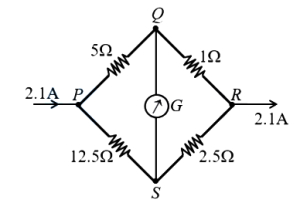
The current through the $1 \Omega$ resistance in the following circuit is (in $A$)
A
$0.6$
B
$1.5$
C
$0.1$
D
$0.5$
Solution
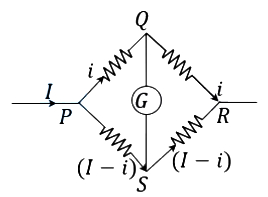
(B) Let the total current $I = 2.1 \text{ A}$ enter at point $P$ and leave at point $R$. Let the current through the branch $PQ$ be $i$. Then the current through the branch $QR$ is also $i$ (assuming the galvanometer branch $QS$ has zero current,which is true if the bridge is balanced,but here we must check the potentials).
Applying Kirchhoff's Voltage Law $(KVL)$ to the loops or using the potential divider principle:
The potential difference between $P$ and $R$ is the same for both parallel paths $PQR$ and $PSR$.
For path $PQR$,the total resistance is $R_1 = 5 \Omega + 1 \Omega = 6 \Omega$.
For path $PSR$,the total resistance is $R_2 = 12.5 \Omega + 2.5 \Omega = 15 \Omega$.
Let $i_1$ be the current through path $PQR$ and $i_2$ be the current through path $PSR$.
Since $i_1 + i_2 = 2.1 \text{ A}$ and $i_1 R_1 = i_2 R_2$:
$i_1 (6) = i_2 (15) \Rightarrow i_2 = \frac{6}{15} i_1 = 0.4 i_1$.
Substituting into the total current equation:
$i_1 + 0.4 i_1 = 2.1 \text{ A} \Rightarrow 1.4 i_1 = 2.1 \text{ A} \Rightarrow i_1 = \frac{2.1}{1.4} = 1.5 \text{ A}$.
However,looking at the provided diagram,the current $i$ is flowing through the $1 \Omega$ resistor. The current $i_1$ calculated above is the current through the entire branch $PQR$,which includes the $1 \Omega$ resistor. Thus,the current through the $1 \Omega$ resistor is $1.5 \text{ A}$.
Applying Kirchhoff's Voltage Law $(KVL)$ to the loops or using the potential divider principle:
The potential difference between $P$ and $R$ is the same for both parallel paths $PQR$ and $PSR$.
For path $PQR$,the total resistance is $R_1 = 5 \Omega + 1 \Omega = 6 \Omega$.
For path $PSR$,the total resistance is $R_2 = 12.5 \Omega + 2.5 \Omega = 15 \Omega$.
Let $i_1$ be the current through path $PQR$ and $i_2$ be the current through path $PSR$.
Since $i_1 + i_2 = 2.1 \text{ A}$ and $i_1 R_1 = i_2 R_2$:
$i_1 (6) = i_2 (15) \Rightarrow i_2 = \frac{6}{15} i_1 = 0.4 i_1$.
Substituting into the total current equation:
$i_1 + 0.4 i_1 = 2.1 \text{ A} \Rightarrow 1.4 i_1 = 2.1 \text{ A} \Rightarrow i_1 = \frac{2.1}{1.4} = 1.5 \text{ A}$.
However,looking at the provided diagram,the current $i$ is flowing through the $1 \Omega$ resistor. The current $i_1$ calculated above is the current through the entire branch $PQR$,which includes the $1 \Omega$ resistor. Thus,the current through the $1 \Omega$ resistor is $1.5 \text{ A}$.
0 likesView Solution
217
ChemistryMCQMHT CET · 2021
$A$ coil of radius '$r$' is placed on another coil (whose radius is '$R$' and current through it is changing) so that their centers coincide. $(R \gg r)$. If both are coplanar,then the mutual inductance between them is proportional to
A
$\frac{R}{r^2}$
B
$\frac{r}{R}$
C
$\frac{R}{r}$
D
$\frac{r^2}{R}$
Solution
(D) The magnetic field produced by the larger coil of radius '$R$' at its center is given by $B = \frac{\mu_0 I}{2R}$.
Since the smaller coil of radius '$r$' is placed at the center and $R \gg r$,we can assume the magnetic field is uniform over the area of the smaller coil.
The magnetic flux $\phi$ passing through the smaller coil is $\phi = B \times A$,where $A = \pi r^2$ is the area of the smaller coil.
$\phi = \left( \frac{\mu_0 I}{2R} \right) \times (\pi r^2) = \frac{\mu_0 \pi r^2 I}{2R}$.
The mutual inductance $M$ is defined as $M = \frac{\phi}{I}$.
Substituting the expression for $\phi$,we get $M = \frac{\mu_0 \pi r^2}{2R}$.
Therefore,the mutual inductance $M$ is proportional to $\frac{r^2}{R}$.
Since the smaller coil of radius '$r$' is placed at the center and $R \gg r$,we can assume the magnetic field is uniform over the area of the smaller coil.
The magnetic flux $\phi$ passing through the smaller coil is $\phi = B \times A$,where $A = \pi r^2$ is the area of the smaller coil.
$\phi = \left( \frac{\mu_0 I}{2R} \right) \times (\pi r^2) = \frac{\mu_0 \pi r^2 I}{2R}$.
The mutual inductance $M$ is defined as $M = \frac{\phi}{I}$.
Substituting the expression for $\phi$,we get $M = \frac{\mu_0 \pi r^2}{2R}$.
Therefore,the mutual inductance $M$ is proportional to $\frac{r^2}{R}$.
0 likesView Solution
218
ChemistryMCQMHT CET · 2021
$A$ pendulum is oscillating with frequency $n$ on the surface of the earth. It is taken to a depth $d = \frac{R}{2}$ below the surface of the earth. What is the new frequency of oscillation at this depth? [$R$ is the radius of the earth]
A
$\frac{n}{3}$
B
$\frac{n}{\sqrt{2}}$
C
$2n$
D
$\frac{n}{2}$
Solution
(B) The frequency of a simple pendulum is given by $n = \frac{1}{2\pi} \sqrt{\frac{g}{\ell}}$.
Since $n \propto \sqrt{g}$,the ratio of the new frequency $n'$ to the original frequency $n$ is $\frac{n'}{n} = \sqrt{\frac{g'}{g}}$.
The acceleration due to gravity at a depth $d$ is given by $g' = g(1 - \frac{d}{R})$.
Substituting $d = \frac{R}{2}$,we get $g' = g(1 - \frac{R/2}{R}) = g(1 - \frac{1}{2}) = \frac{g}{2}$.
Therefore,$\frac{n'}{n} = \sqrt{\frac{g/2}{g}} = \sqrt{\frac{1}{2}} = \frac{1}{\sqrt{2}}$.
Thus,the new frequency is $n' = \frac{n}{\sqrt{2}}$.
Since $n \propto \sqrt{g}$,the ratio of the new frequency $n'$ to the original frequency $n$ is $\frac{n'}{n} = \sqrt{\frac{g'}{g}}$.
The acceleration due to gravity at a depth $d$ is given by $g' = g(1 - \frac{d}{R})$.
Substituting $d = \frac{R}{2}$,we get $g' = g(1 - \frac{R/2}{R}) = g(1 - \frac{1}{2}) = \frac{g}{2}$.
Therefore,$\frac{n'}{n} = \sqrt{\frac{g/2}{g}} = \sqrt{\frac{1}{2}} = \frac{1}{\sqrt{2}}$.
Thus,the new frequency is $n' = \frac{n}{\sqrt{2}}$.
0 likesView Solution
219
ChemistryMCQMHT CET · 2021
If '$E$' is the kinetic energy per mole of an ideal gas and '$T$' is the absolute temperature,then the universal gas constant is given as
A
$\frac{2 T}{3 E}$
B
$\frac{2 E}{3 T}$
C
$\frac{3 T}{2 E}$
D
$\frac{3 E}{2 T}$
Solution
(B) The kinetic energy per mole of an ideal gas is given by the formula $E = \frac{3}{2} R T$.
Here,$E$ is the kinetic energy per mole,$R$ is the universal gas constant,and $T$ is the absolute temperature.
To find the universal gas constant $R$,we rearrange the equation:
$R = \frac{2 E}{3 T}$.
Therefore,the correct option is $B$.
Here,$E$ is the kinetic energy per mole,$R$ is the universal gas constant,and $T$ is the absolute temperature.
To find the universal gas constant $R$,we rearrange the equation:
$R = \frac{2 E}{3 T}$.
Therefore,the correct option is $B$.
0 likesView Solution
220
ChemistryMCQMHT CET · 2021
$A$ spring balance is attached to the ceiling of a lift. $A$ man hangs his bag on the spring and the spring balance reads $49 ~N$,when the lift is stationary. If the lift moves downward with an acceleration of $5 ~m/s^2$,the reading of the spring balance will be (in $N$)
A
$74$
B
$15$
C
$24$
D
$49$
Solution
(C) When the lift is stationary,the reading of the spring balance is equal to the weight of the bag,$W = mg = 49 ~N$.
Taking $g = 9.8 ~m/s^2$,the mass of the bag is $m = \frac{49}{9.8} = 5 ~kg$.
When the lift moves downward with an acceleration $a = 5 ~m/s^2$,the apparent weight $W'$ is given by the formula $W' = m(g - a)$.
Substituting the values,we get $W' = 5 \times (9.8 - 5) = 5 \times 4.8 = 24 ~N$.
Therefore,the reading of the spring balance will be $24 ~N$.
Taking $g = 9.8 ~m/s^2$,the mass of the bag is $m = \frac{49}{9.8} = 5 ~kg$.
When the lift moves downward with an acceleration $a = 5 ~m/s^2$,the apparent weight $W'$ is given by the formula $W' = m(g - a)$.
Substituting the values,we get $W' = 5 \times (9.8 - 5) = 5 \times 4.8 = 24 ~N$.
Therefore,the reading of the spring balance will be $24 ~N$.
0 likesView Solution
221
ChemistryMCQMHT CET · 2021
Two long conductors,separated by a distance $d$,carry currents $I_1$ and $I_2$ in the same directions. They exert a force $F$ on each other. Now,the current in one of them is increased to two times its original value and its direction is reversed. The distance is also increased to $3d$. The new value of the force between them is:
A
$-2F$
B
$-F$
C
$-\frac{2F}{3}$
D
$\frac{F}{3}$
Solution
(C) The force per unit length between two parallel conductors carrying currents $I_1$ and $I_2$ separated by distance $d$ is given by $F = \frac{\mu_0 I_1 I_2}{2 \pi d}$.
Since the currents are in the same direction,the force is attractive. Let the initial force be $F = k \frac{I_1 I_2}{d}$,where $k = \frac{\mu_0}{2 \pi}$.
In the new scenario,the current in one conductor becomes $2I_1$ (or $2I_2$) and the direction is reversed,making the force repulsive (negative sign).
The new distance is $d' = 3d$.
The new force $F'$ is given by $F' = -k \frac{(2I_1) I_2}{3d} = -\frac{2}{3} \left( k \frac{I_1 I_2}{d} \right) = -\frac{2}{3} F$.
Since the currents are in the same direction,the force is attractive. Let the initial force be $F = k \frac{I_1 I_2}{d}$,where $k = \frac{\mu_0}{2 \pi}$.
In the new scenario,the current in one conductor becomes $2I_1$ (or $2I_2$) and the direction is reversed,making the force repulsive (negative sign).
The new distance is $d' = 3d$.
The new force $F'$ is given by $F' = -k \frac{(2I_1) I_2}{3d} = -\frac{2}{3} \left( k \frac{I_1 I_2}{d} \right) = -\frac{2}{3} F$.
0 likesView Solution
222
ChemistryMCQMHT CET · 2021
$A$ particle of charge '$q$' and mass '$m$' moves in a circular orbit of radius '$r$' with angular speed '$\omega$'. The ratio of the magnitude of its magnetic moment to that of its angular momentum depends on
A
$\omega$ and $q$
B
$\omega$ and $m$
C
$q$ and $m$
D
$\omega, q$ and $m$
Solution
(C) The angular momentum $L$ of a particle of mass $m$ moving in a circular orbit of radius $r$ with angular speed $\omega$ is given by $L = I\omega = (mr^2)\omega$.
The magnetic moment $M$ associated with the circulating charge is given by $M = IA$,where $I$ is the equivalent current and $A$ is the area of the orbit.
The current $I = \frac{q}{T} = \frac{q}{2\pi/\omega} = \frac{q\omega}{2\pi}$.
The area $A = \pi r^2$.
Thus,$M = \left(\frac{q\omega}{2\pi}\right)(\pi r^2) = \frac{1}{2}q\omega r^2$.
The ratio of the magnetic moment to the angular momentum is $\frac{M}{L} = \frac{\frac{1}{2}q\omega r^2}{mr^2\omega} = \frac{q}{2m}$.
Therefore,the ratio depends only on the charge '$q$' and the mass '$m$' of the particle.
The magnetic moment $M$ associated with the circulating charge is given by $M = IA$,where $I$ is the equivalent current and $A$ is the area of the orbit.
The current $I = \frac{q}{T} = \frac{q}{2\pi/\omega} = \frac{q\omega}{2\pi}$.
The area $A = \pi r^2$.
Thus,$M = \left(\frac{q\omega}{2\pi}\right)(\pi r^2) = \frac{1}{2}q\omega r^2$.
The ratio of the magnetic moment to the angular momentum is $\frac{M}{L} = \frac{\frac{1}{2}q\omega r^2}{mr^2\omega} = \frac{q}{2m}$.
Therefore,the ratio depends only on the charge '$q$' and the mass '$m$' of the particle.
0 likesView Solution
223
ChemistryMCQMHT CET · 2021
Two small drops of mercury,each of radius $R$,coalesce to form a single large drop. The ratio of the total surface energies before and after the change is
A
$\sqrt{2}: 1$
B
$2^{2/3}: 1$
C
$2^{1/3}: 1$
D
$2: 1$
Solution
(C) Let $T$ be the surface tension of mercury.
Total surface energy before coalescence $(E_1)$: Since there are two drops of radius $R$,$E_1 = 2 \times (4 \pi R^2 T) = 8 \pi R^2 T$.
Let the radius of the new large drop be $R'$. By conservation of volume: $\frac{4}{3} \pi R'^3 = 2 \times \frac{4}{3} \pi R^3$,which gives $R'^3 = 2R^3$,or $R' = 2^{1/3} R$.
Total surface energy after coalescence $(E_2)$: $E_2 = 4 \pi R'^2 T = 4 \pi (2^{1/3} R)^2 T = 4 \pi (2^{2/3}) R^2 T$.
The ratio of surface energies is $\frac{E_1}{E_2} = \frac{8 \pi R^2 T}{4 \pi (2^{2/3}) R^2 T} = \frac{2}{2^{2/3}} = 2^{1 - 2/3} = 2^{1/3}$.
Thus,the ratio is $2^{1/3} : 1$.
Total surface energy before coalescence $(E_1)$: Since there are two drops of radius $R$,$E_1 = 2 \times (4 \pi R^2 T) = 8 \pi R^2 T$.
Let the radius of the new large drop be $R'$. By conservation of volume: $\frac{4}{3} \pi R'^3 = 2 \times \frac{4}{3} \pi R^3$,which gives $R'^3 = 2R^3$,or $R' = 2^{1/3} R$.
Total surface energy after coalescence $(E_2)$: $E_2 = 4 \pi R'^2 T = 4 \pi (2^{1/3} R)^2 T = 4 \pi (2^{2/3}) R^2 T$.
The ratio of surface energies is $\frac{E_1}{E_2} = \frac{8 \pi R^2 T}{4 \pi (2^{2/3}) R^2 T} = \frac{2}{2^{2/3}} = 2^{1 - 2/3} = 2^{1/3}$.
Thus,the ratio is $2^{1/3} : 1$.
0 likesView Solution
224
ChemistryMCQMHT CET · 2021
In a capillary tube having an area of cross-section '$A$',water rises to a height '$h$'. If the cross-sectional area is reduced to $\frac{A}{9}$,the rise of water in the capillary tube is:
A
$h$
B
$4h$
C
$3h$
D
$2h$
Solution
(C) The height of water rise in a capillary tube is given by the formula: $h = \frac{2T \cos \theta}{r \rho g}$.
From this,we see that $h \propto \frac{1}{r}$.
The cross-sectional area $A$ is given by $A = \pi r^2$,which implies $r \propto \sqrt{A}$.
Substituting this into the proportionality for $h$,we get $h \propto \frac{1}{\sqrt{A}}$.
Let the initial height be $h_1 = h$ and initial area be $A_1 = A$. Let the new height be $h_2$ and new area be $A_2 = \frac{A}{9}$.
Using the ratio: $\frac{h_2}{h_1} = \sqrt{\frac{A_1}{A_2}}$.
Substituting the values: $\frac{h_2}{h} = \sqrt{\frac{A}{A/9}} = \sqrt{9} = 3$.
Therefore,$h_2 = 3h$.
From this,we see that $h \propto \frac{1}{r}$.
The cross-sectional area $A$ is given by $A = \pi r^2$,which implies $r \propto \sqrt{A}$.
Substituting this into the proportionality for $h$,we get $h \propto \frac{1}{\sqrt{A}}$.
Let the initial height be $h_1 = h$ and initial area be $A_1 = A$. Let the new height be $h_2$ and new area be $A_2 = \frac{A}{9}$.
Using the ratio: $\frac{h_2}{h_1} = \sqrt{\frac{A_1}{A_2}}$.
Substituting the values: $\frac{h_2}{h} = \sqrt{\frac{A}{A/9}} = \sqrt{9} = 3$.
Therefore,$h_2 = 3h$.
0 likesView Solution
225
ChemistryMCQMHT CET · 2021
Water rises in a capillary tube of radius $r$ to a height $h$. The mass of water in the capillary is $m$. What will be the mass of water that rises in a capillary tube of radius $\frac{r}{3}$?
A
$3m$
B
$\frac{m}{3}$
C
$m$
D
$\frac{2m}{3}$
Solution
(B) The height $h$ to which water rises in a capillary tube is given by $h = \frac{2T \cos \theta}{r \rho g}$,which implies $h \propto \frac{1}{r}$.
If the radius changes from $r_1 = r$ to $r_2 = \frac{r}{3}$,the new height $h_2$ becomes $h_2 = h_1 \times \frac{r_1}{r_2} = h \times \frac{r}{r/3} = 3h$.
The mass of water in the capillary is given by $m = V \rho = (\pi r^2 h) \rho$.
For the first tube,$m_1 = \pi r^2 h \rho = m$.
For the second tube,$m_2 = \pi (r_2)^2 h_2 \rho = \pi (\frac{r}{3})^2 (3h) \rho$.
$m_2 = \pi (\frac{r^2}{9}) (3h) \rho = \frac{1}{3} \pi r^2 h \rho$.
Therefore,$m_2 = \frac{m}{3}$.
If the radius changes from $r_1 = r$ to $r_2 = \frac{r}{3}$,the new height $h_2$ becomes $h_2 = h_1 \times \frac{r_1}{r_2} = h \times \frac{r}{r/3} = 3h$.
The mass of water in the capillary is given by $m = V \rho = (\pi r^2 h) \rho$.
For the first tube,$m_1 = \pi r^2 h \rho = m$.
For the second tube,$m_2 = \pi (r_2)^2 h_2 \rho = \pi (\frac{r}{3})^2 (3h) \rho$.
$m_2 = \pi (\frac{r^2}{9}) (3h) \rho = \frac{1}{3} \pi r^2 h \rho$.
Therefore,$m_2 = \frac{m}{3}$.
0 likesView Solution
226
ChemistryMCQMHT CET · 2021
Two bodies $A$ and $B$ start from the same point at the same instant and move along a straight line. $A$ moves with uniform acceleration $a$ and $B$ moves with uniform velocity $V$. They meet after time $t$. The value of $t$ is:
A
$\frac{2V}{a}$
B
$\sqrt{\frac{V}{a}}$
C
$\frac{a}{2V}$
D
$\frac{V}{2a}$
Solution
(A) For body $B$,the distance traveled is $x = V t$.
For body $A$,starting from rest,the distance traveled is $x = \frac{1}{2} a t^2$.
Since they start from the same point and meet at time $t$,their displacements must be equal:
$\frac{1}{2} a t^2 = V t$
Dividing both sides by $t$ (assuming $t \neq 0$):
$\frac{1}{2} a t = V$
$t = \frac{2V}{a}$
For body $A$,starting from rest,the distance traveled is $x = \frac{1}{2} a t^2$.
Since they start from the same point and meet at time $t$,their displacements must be equal:
$\frac{1}{2} a t^2 = V t$
Dividing both sides by $t$ (assuming $t \neq 0$):
$\frac{1}{2} a t = V$
$t = \frac{2V}{a}$
0 likesView Solution
227
ChemistryMCQMHT CET · 2021
$A$ driver applies the brakes on seeing the red traffic signal $400 ~m$ ahead. At the time of applying the brakes,the vehicle was moving with $15 ~m/s$ and retarding at $0.3 ~m/s^2$. The distance covered by the vehicle from the traffic light $1$ minute after the application of brakes is (in $~m$)
A
$25$
B
$360$
C
$40$
D
$375$
Solution
(A) Given: Initial velocity $u = 15 ~m/s$,acceleration $a = -0.3 ~m/s^2$,time $t = 60 ~s$.
First,we calculate the time taken to stop: $v = u + at \implies 0 = 15 - 0.3t \implies t = 50 ~s$.
Since the driver applies brakes for $60 ~s$,the vehicle stops at $t = 50 ~s$ and remains at rest for the remaining $10 ~s$.
Distance covered in $50 ~s$: $s = ut + \frac{1}{2}at^2 = 15(50) + \frac{1}{2}(-0.3)(50)^2 = 750 - 375 = 375 ~m$.
Distance from the traffic light $= 400 ~m - 375 ~m = 25 ~m$.
First,we calculate the time taken to stop: $v = u + at \implies 0 = 15 - 0.3t \implies t = 50 ~s$.
Since the driver applies brakes for $60 ~s$,the vehicle stops at $t = 50 ~s$ and remains at rest for the remaining $10 ~s$.
Distance covered in $50 ~s$: $s = ut + \frac{1}{2}at^2 = 15(50) + \frac{1}{2}(-0.3)(50)^2 = 750 - 375 = 375 ~m$.
Distance from the traffic light $= 400 ~m - 375 ~m = 25 ~m$.
0 likesView Solution
228
ChemistryMCQMHT CET · 2021
$A$ particle is moving along a circular path with constant speed and centripetal acceleration $a$. If the speed is doubled,the ratio of its acceleration after and before the change is
A
$2$:$1$
B
$4$:$1$
C
$3$:$1$
D
$1$:$4$
Solution
(B) The centripetal acceleration $a$ of a particle moving in a circular path of radius $R$ with speed $v$ is given by the formula: $a = \frac{v^2}{R}$.
Since the radius $R$ of the circular path remains constant,the acceleration is directly proportional to the square of the speed: $a \propto v^2$.
Let the initial speed be $v_1 = v$ and the initial acceleration be $a_1 = a = \frac{v^2}{R}$.
When the speed is doubled,the new speed is $v_2 = 2v$.
The new acceleration $a_2$ is given by: $a_2 = \frac{(2v)^2}{R} = \frac{4v^2}{R} = 4a$.
Therefore,the ratio of the acceleration after the change to the acceleration before the change is: $\frac{a_2}{a_1} = \frac{4a}{a} = \frac{4}{1}$.
Thus,the ratio is $4:1$.
Since the radius $R$ of the circular path remains constant,the acceleration is directly proportional to the square of the speed: $a \propto v^2$.
Let the initial speed be $v_1 = v$ and the initial acceleration be $a_1 = a = \frac{v^2}{R}$.
When the speed is doubled,the new speed is $v_2 = 2v$.
The new acceleration $a_2$ is given by: $a_2 = \frac{(2v)^2}{R} = \frac{4v^2}{R} = 4a$.
Therefore,the ratio of the acceleration after the change to the acceleration before the change is: $\frac{a_2}{a_1} = \frac{4a}{a} = \frac{4}{1}$.
Thus,the ratio is $4:1$.
0 likesView Solution
229
ChemistryMCQMHT CET · 2021
$A$ particle is suspended from a vertical spring which is executing $S.H.M.$ of frequency $5 \ Hz$. The spring is unstretched at the highest point of oscillation. What is the maximum speed of the particle? (Take $g = 10 \ m/s^2$)
A
$\frac{1}{\pi} \ m/s$
B
$\frac{1}{4\pi} \ m/s$
C
$\frac{1}{2\pi} \ m/s$
D
$\pi \ m/s$
Solution
(A) The frequency of the $S.H.M.$ is $f = 5 \ Hz$.
Angular frequency $\omega = 2\pi f = 2\pi \times 5 = 10\pi \ rad/s$.
At the highest point of oscillation,the spring is unstretched,which means the extension at the equilibrium position is equal to the amplitude $A$ of the oscillation.
Thus,$A = \Delta l = \frac{mg}{k}$.
Since $\omega^2 = \frac{k}{m}$,we have $\frac{g}{\omega^2} = \frac{mg}{k} = A$.
Substituting the values: $A = \frac{10}{(10\pi)^2} = \frac{10}{100\pi^2} = \frac{1}{10\pi^2} \ m$.
The maximum speed is given by $V_{\max} = A\omega$.
$V_{\max} = \left(\frac{1}{10\pi^2}\right) \times (10\pi) = \frac{1}{\pi} \ m/s$.
Angular frequency $\omega = 2\pi f = 2\pi \times 5 = 10\pi \ rad/s$.
At the highest point of oscillation,the spring is unstretched,which means the extension at the equilibrium position is equal to the amplitude $A$ of the oscillation.
Thus,$A = \Delta l = \frac{mg}{k}$.
Since $\omega^2 = \frac{k}{m}$,we have $\frac{g}{\omega^2} = \frac{mg}{k} = A$.
Substituting the values: $A = \frac{10}{(10\pi)^2} = \frac{10}{100\pi^2} = \frac{1}{10\pi^2} \ m$.
The maximum speed is given by $V_{\max} = A\omega$.
$V_{\max} = \left(\frac{1}{10\pi^2}\right) \times (10\pi) = \frac{1}{\pi} \ m/s$.
0 likesView Solution
230
ChemistryMCQMHT CET · 2021
The moment of inertia of a body about a given axis is $1.2 ~kg \cdot m^2$. Initially,the body is at rest. In order to produce a rotational kinetic energy of $1500 ~J$,an angular acceleration of $25 ~rad/s^2$ must be applied about the axis for a time duration of: (in $~s$)
A
$8$
B
$2$
C
$4$
D
$1$
Solution
(B) Given: Moment of inertia $I = 1.2 ~kg \cdot m^2$,Rotational Kinetic Energy $K.E. = 1500 ~J$,Angular acceleration $\alpha = 25 ~rad/s^2$,Initial angular velocity $\omega_0 = 0$.
Step $1$: Calculate the final angular velocity $\omega$ using the rotational kinetic energy formula:
$K.E. = \frac{1}{2} I \omega^2$
$1500 = \frac{1}{2} \times 1.2 \times \omega^2$
$1500 = 0.6 \times \omega^2$
$\omega^2 = \frac{1500}{0.6} = 2500$
$\omega = 50 ~rad/s$.
Step $2$: Calculate the time $t$ using the kinematic equation for rotation:
$\omega = \omega_0 + \alpha t$
$50 = 0 + 25 \times t$
$t = \frac{50}{25} = 2 ~s$.
Step $1$: Calculate the final angular velocity $\omega$ using the rotational kinetic energy formula:
$K.E. = \frac{1}{2} I \omega^2$
$1500 = \frac{1}{2} \times 1.2 \times \omega^2$
$1500 = 0.6 \times \omega^2$
$\omega^2 = \frac{1500}{0.6} = 2500$
$\omega = 50 ~rad/s$.
Step $2$: Calculate the time $t$ using the kinematic equation for rotation:
$\omega = \omega_0 + \alpha t$
$50 = 0 + 25 \times t$
$t = \frac{50}{25} = 2 ~s$.
0 likesView Solution
231
ChemistryMCQMHT CET · 2021
$A$ solid sphere of mass $M$ and radius $R$ is rotating about its diameter. $A$ solid cylinder of the same mass and radius is also rotating about its geometrical axis with an angular speed twice that of the sphere. The ratio of their kinetic energies of rotation ($K_{\text{sphere}}$ to $K_{\text{cylinder}}$) will be
A
$1: 8$
B
$1: 6$
C
$1: 3$
D
$1: 5$
Solution
(D) The rotational kinetic energy is given by $K = \frac{1}{2} I \omega^2$.
For a solid sphere rotating about its diameter,the moment of inertia is $I_{\text{sphere}} = \frac{2}{5} M R^2$.
Thus,$K_{\text{sphere}} = \frac{1}{2} \left( \frac{2}{5} M R^2 \right) \omega_{\text{sphere}}^2 = \frac{1}{5} M R^2 \omega_{\text{sphere}}^2$.
For a solid cylinder rotating about its geometrical axis,the moment of inertia is $I_{\text{cylinder}} = \frac{1}{2} M R^2$.
Given that $\omega_{\text{cylinder}} = 2 \omega_{\text{sphere}}$,the kinetic energy is $K_{\text{cylinder}} = \frac{1}{2} \left( \frac{1}{2} M R^2 \right) (2 \omega_{\text{sphere}})^2 = \frac{1}{4} M R^2 (4 \omega_{\text{sphere}}^2) = M R^2 \omega_{\text{sphere}}^2$.
The ratio is $\frac{K_{\text{sphere}}}{K_{\text{cylinder}}} = \frac{\frac{1}{5} M R^2 \omega_{\text{sphere}}^2}{M R^2 \omega_{\text{sphere}}^2} = \frac{1}{5}$.
For a solid sphere rotating about its diameter,the moment of inertia is $I_{\text{sphere}} = \frac{2}{5} M R^2$.
Thus,$K_{\text{sphere}} = \frac{1}{2} \left( \frac{2}{5} M R^2 \right) \omega_{\text{sphere}}^2 = \frac{1}{5} M R^2 \omega_{\text{sphere}}^2$.
For a solid cylinder rotating about its geometrical axis,the moment of inertia is $I_{\text{cylinder}} = \frac{1}{2} M R^2$.
Given that $\omega_{\text{cylinder}} = 2 \omega_{\text{sphere}}$,the kinetic energy is $K_{\text{cylinder}} = \frac{1}{2} \left( \frac{1}{2} M R^2 \right) (2 \omega_{\text{sphere}})^2 = \frac{1}{4} M R^2 (4 \omega_{\text{sphere}}^2) = M R^2 \omega_{\text{sphere}}^2$.
The ratio is $\frac{K_{\text{sphere}}}{K_{\text{cylinder}}} = \frac{\frac{1}{5} M R^2 \omega_{\text{sphere}}^2}{M R^2 \omega_{\text{sphere}}^2} = \frac{1}{5}$.
0 likesView Solution
232
ChemistryMCQMHT CET · 2021
$A$ body of mass $m$ and radius of gyration $K$ has an angular momentum $L$. Then its angular velocity is
A
$\frac{L}{mK^2}$
B
$\frac{mK^2}{L}$
C
$\frac{K^2}{mL}$
D
$mK^2 L$
Solution
(A) The moment of inertia $I$ of a body in terms of its mass $m$ and radius of gyration $K$ is given by $I = mK^2$.
Angular momentum $L$ is related to moment of inertia $I$ and angular velocity $\omega$ by the formula $L = I\omega$.
Substituting the expression for $I$,we get $L = (mK^2)\omega$.
Rearranging to solve for angular velocity $\omega$,we get $\omega = \frac{L}{mK^2}$.
Angular momentum $L$ is related to moment of inertia $I$ and angular velocity $\omega$ by the formula $L = I\omega$.
Substituting the expression for $I$,we get $L = (mK^2)\omega$.
Rearranging to solve for angular velocity $\omega$,we get $\omega = \frac{L}{mK^2}$.
0 likesView Solution
233
ChemistryMCQMHT CET · 2021
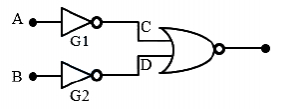
The resultant gate and its Boolean expression in the given circuit is
A
$NOR, \overline{A+B}$
B
$AND, A \cdot B$
C
$OR, A+B$
D
$NAND, \overline{AB}$
Solution
(B) The circuit consists of two $NOT$ gates ($G1$ and $G2$) followed by a $NOR$ gate. The inputs to the $NOT$ gates are $A$ and $B$. Thus,the outputs of the $NOT$ gates are $C = \overline{A}$ and $D = \overline{B}$. These are fed into a $NOR$ gate. The output $Y$ of the $NOR$ gate is given by $Y = \overline{C+D}$. Substituting the values of $C$ and $D$,we get $Y = \overline{\overline{A} + \overline{B}}$. By De Morgan's theorem,$\overline{\overline{A} + \overline{B}} = \overline{\overline{A}} \cdot \overline{\overline{B}} = A \cdot B$. This is the Boolean expression for an $AND$ gate. The truth table is as follows:
| $A$ | $B$ | $C=\overline{A}$ | $D=\overline{B}$ | $Y=\overline{C+D}$ |
| $0$ | $0$ | $1$ | $1$ | $0$ |
| $0$ | $1$ | $1$ | $0$ | $0$ |
| $1$ | $0$ | $0$ | $1$ | $0$ |
| $1$ | $1$ | $0$ | $0$ | $1$ |
0 likesView Solution
234
ChemistryMCQMHT CET · 2021
For a perfectly black body,the coefficient of emission (emissivity) is:
A
zero
B
infinity
C
unity
D
less than one (non-zero)
Solution
(C) perfectly black body is defined as an ideal body that absorbs all incident radiation of any wavelength.
According to Kirchhoff's law of thermal radiation,for an arbitrary body in thermal equilibrium,the emissivity $(e)$ is equal to its absorptivity $(a)$.
Since a perfectly black body has an absorptivity of $a = 1$,its emissivity must also be $e = 1$.
Therefore,the coefficient of emission for a perfectly black body is unity.
According to Kirchhoff's law of thermal radiation,for an arbitrary body in thermal equilibrium,the emissivity $(e)$ is equal to its absorptivity $(a)$.
Since a perfectly black body has an absorptivity of $a = 1$,its emissivity must also be $e = 1$.
Therefore,the coefficient of emission for a perfectly black body is unity.
0 likesView Solution
235
ChemistryMCQMHT CET · 2021
Find the value of $-197^{\circ} C$ temperature in Kelvin. (in $~K$)
A
$47$
B
$76$
C
$470$
D
$760$
Solution
(B) The relationship between temperature in Kelvin $(T_K)$ and temperature in Celsius $(T_C)$ is given by the formula:
$T_K = T_C + 273$
Given $T_C = -197^{\circ} C$.
Substituting the value:
$T_K = -197 + 273$
$T_K = 76 ~K$
$T_K = T_C + 273$
Given $T_C = -197^{\circ} C$.
Substituting the value:
$T_K = -197 + 273$
$T_K = 76 ~K$
0 likesView Solution
236
ChemistryMCQMHT CET · 2021
$A$ monoatomic gas is suddenly compressed to $(1/8)^{\text{th}}$ of its initial volume adiabatically. The ratio of the final pressure to initial pressure of the gas is (given $\gamma = 5/3$).
A
$32$
B
$8$
C
$40$/$3$
D
$24$/$5$
Solution
(A) For an adiabatic process,the relation between pressure and volume is given by $P_1 V_1^\gamma = P_2 V_2^\gamma$.
Given that the final volume $V_2 = V_1 / 8$,so the ratio $V_1 / V_2 = 8$.
The adiabatic index for a monoatomic gas is $\gamma = 5/3$.
Substituting these values into the equation:
$\frac{P_2}{P_1} = \left( \frac{V_1}{V_2} \right)^\gamma = (8)^{5/3}$.
Since $8 = 2^3$,we have $(2^3)^{5/3} = 2^5 = 32$.
Therefore,the ratio of the final pressure to the initial pressure is $32$.
Given that the final volume $V_2 = V_1 / 8$,so the ratio $V_1 / V_2 = 8$.
The adiabatic index for a monoatomic gas is $\gamma = 5/3$.
Substituting these values into the equation:
$\frac{P_2}{P_1} = \left( \frac{V_1}{V_2} \right)^\gamma = (8)^{5/3}$.
Since $8 = 2^3$,we have $(2^3)^{5/3} = 2^5 = 32$.
Therefore,the ratio of the final pressure to the initial pressure is $32$.
0 likesView Solution
237
ChemistryMCQMHT CET · 2021
Specific heats of an ideal gas at constant pressure and volume are denoted by $C_p$ and $C_v$ respectively. If $\gamma = \frac{C_p}{C_v}$ and $R$ is the universal gas constant,then $C_v$ is equal to:
A
$\frac{(\gamma-1)}{(\gamma+1)}$
B
$\frac{(\gamma-1)}{R}$
C
$R \gamma$
D
$\frac{R}{(\gamma-1)}$
Solution
(D) We know that for an ideal gas,the relationship between specific heats is given by Mayer's relation: $C_p - C_v = R$.
Given that the ratio of specific heats is $\gamma = \frac{C_p}{C_v}$,we can write $C_p = \gamma C_v$.
Substituting this into Mayer's relation: $\gamma C_v - C_v = R$.
Factoring out $C_v$,we get $C_v(\gamma - 1) = R$.
Therefore,$C_v = \frac{R}{\gamma - 1}$.
Given that the ratio of specific heats is $\gamma = \frac{C_p}{C_v}$,we can write $C_p = \gamma C_v$.
Substituting this into Mayer's relation: $\gamma C_v - C_v = R$.
Factoring out $C_v$,we get $C_v(\gamma - 1) = R$.
Therefore,$C_v = \frac{R}{\gamma - 1}$.
0 likesView Solution
238
ChemistryMCQMHT CET · 2021
$A$ double slit experiment is immersed in water of refractive index $1.33$. The slit separation is $1 ~mm$ and the distance between the slit and the screen is $1.33 ~m$. The slits are illuminated by light of wavelength $6300 ~Å$. The fringe width is:
A
$4.9 \times 10^{-4} ~m$
B
$6.3 \times 10^{-4} ~m$
C
$8.6 \times 10^{-4} ~m$
D
$5.8 \times 10^{-4} ~m$
Solution
(B) Given:
Slit separation $d = 1 ~mm = 10^{-3} ~m$
Distance between slit and screen $D = 1.33 ~m$
Refractive index of water $\mu = 1.33$
Wavelength of light in air $\lambda = 6300 ~Å = 6.3 \times 10^{-7} ~m$
The wavelength of light in water is given by $\lambda_w = \frac{\lambda}{\mu} = \frac{6.3 \times 10^{-7}}{1.33} ~m$.
The fringe width $X$ is given by the formula:
$X = \frac{\lambda_w D}{d}$
Substituting the values:
$X = \frac{(6.3 \times 10^{-7} / 1.33) \times 1.33}{10^{-3}}$
$X = \frac{6.3 \times 10^{-7}}{10^{-3}} = 6.3 \times 10^{-4} ~m$.
Thus,the fringe width is $6.3 \times 10^{-4} ~m$.
Slit separation $d = 1 ~mm = 10^{-3} ~m$
Distance between slit and screen $D = 1.33 ~m$
Refractive index of water $\mu = 1.33$
Wavelength of light in air $\lambda = 6300 ~Å = 6.3 \times 10^{-7} ~m$
The wavelength of light in water is given by $\lambda_w = \frac{\lambda}{\mu} = \frac{6.3 \times 10^{-7}}{1.33} ~m$.
The fringe width $X$ is given by the formula:
$X = \frac{\lambda_w D}{d}$
Substituting the values:
$X = \frac{(6.3 \times 10^{-7} / 1.33) \times 1.33}{10^{-3}}$
$X = \frac{6.3 \times 10^{-7}}{10^{-3}} = 6.3 \times 10^{-4} ~m$.
Thus,the fringe width is $6.3 \times 10^{-4} ~m$.
0 likesView Solution
239
ChemistryMCQMHT CET · 2021
In Young's double slit experiment,the intensity at a point where path difference is $\frac{\lambda}{6}$ ($\lambda$ being the wavelength of light used) is $I$. If $I_0$ denotes the maximum intensity,then $\frac{I}{I_0}$ is equal to
A
$\frac{\sqrt{3}}{2}$
B
$\frac{3}{4}$
C
$\frac{1}{\sqrt{2}}$
D
$\frac{1}{2}$
Solution
(B) The resultant intensity $I$ at any point in Young's double slit experiment is given by the formula $I = I_{max} \cos^2(\frac{\phi}{2})$,where $\phi$ is the phase difference.
Given that $I_0$ is the maximum intensity,we have $I = I_0 \cos^2(\frac{\phi}{2})$.
The relationship between phase difference $\phi$ and path difference $\Delta x$ is $\phi = \frac{2\pi}{\lambda} \Delta x$.
Given the path difference $\Delta x = \frac{\lambda}{6}$,the phase difference is $\phi = \frac{2\pi}{\lambda} \times \frac{\lambda}{6} = \frac{\pi}{3}$.
Substituting this into the intensity formula:
$\frac{I}{I_0} = \cos^2(\frac{\pi/3}{2}) = \cos^2(\frac{\pi}{6})$.
Since $\cos(\frac{\pi}{6}) = \frac{\sqrt{3}}{2}$,we get $\frac{I}{I_0} = (\frac{\sqrt{3}}{2})^2 = \frac{3}{4}$.
Given that $I_0$ is the maximum intensity,we have $I = I_0 \cos^2(\frac{\phi}{2})$.
The relationship between phase difference $\phi$ and path difference $\Delta x$ is $\phi = \frac{2\pi}{\lambda} \Delta x$.
Given the path difference $\Delta x = \frac{\lambda}{6}$,the phase difference is $\phi = \frac{2\pi}{\lambda} \times \frac{\lambda}{6} = \frac{\pi}{3}$.
Substituting this into the intensity formula:
$\frac{I}{I_0} = \cos^2(\frac{\pi/3}{2}) = \cos^2(\frac{\pi}{6})$.
Since $\cos(\frac{\pi}{6}) = \frac{\sqrt{3}}{2}$,we get $\frac{I}{I_0} = (\frac{\sqrt{3}}{2})^2 = \frac{3}{4}$.
0 likesView Solution
240
ChemistryMCQMHT CET · 2021
Two waves $Y_1 = 0.25 \sin 316 t$ and $Y_2 = 0.25 \sin 310 t$ are propagating in the same direction. The number of beats produced per second is
A
$\frac{3}{\pi}$
B
$\frac{\pi}{3}$
C
$\frac{\pi}{2}$
D
$\frac{2}{\pi}$
Solution
(A) The general equation for a wave is $Y = A \sin(\omega t)$,where $\omega = 2 \pi f$.
Given $Y_1 = 0.25 \sin 316 t$,we have $\omega_1 = 316 \text{ rad/s}$.
Thus,$2 \pi f_1 = 316 \implies f_1 = \frac{316}{2 \pi} = \frac{158}{\pi} \text{ Hz}$.
Given $Y_2 = 0.25 \sin 310 t$,we have $\omega_2 = 310 \text{ rad/s}$.
Thus,$2 \pi f_2 = 310 \implies f_2 = \frac{310}{2 \pi} = \frac{155}{\pi} \text{ Hz}$.
The beat frequency is the difference between the two frequencies:
$\text{Beat frequency} = f_1 - f_2 = \frac{158}{\pi} - \frac{155}{\pi} = \frac{3}{\pi} \text{ Hz}$.
Given $Y_1 = 0.25 \sin 316 t$,we have $\omega_1 = 316 \text{ rad/s}$.
Thus,$2 \pi f_1 = 316 \implies f_1 = \frac{316}{2 \pi} = \frac{158}{\pi} \text{ Hz}$.
Given $Y_2 = 0.25 \sin 310 t$,we have $\omega_2 = 310 \text{ rad/s}$.
Thus,$2 \pi f_2 = 310 \implies f_2 = \frac{310}{2 \pi} = \frac{155}{\pi} \text{ Hz}$.
The beat frequency is the difference between the two frequencies:
$\text{Beat frequency} = f_1 - f_2 = \frac{158}{\pi} - \frac{155}{\pi} = \frac{3}{\pi} \text{ Hz}$.
0 likesView Solution
241
ChemistryMediumMCQMHT CET · 2021
The conversion of benzene diazonium chloride to chlorobenzene in the presence of $CuCl / HCl$ is known as:
A
Sandmeyer reaction
B
Medius reaction
C
Gattermann reaction
D
Hoffmann degradation
Solution
(A) The reaction of benzene diazonium chloride with cuprous chloride $(CuCl)$ in the presence of hydrochloric acid $(HCl)$ to form chlorobenzene is a classic example of the Sandmeyer reaction.
In this reaction,the diazonium group $(-N_2^+Cl^-)$ is replaced by a chlorine atom.
In this reaction,the diazonium group $(-N_2^+Cl^-)$ is replaced by a chlorine atom.
0 likesView Solution
242
ChemistryMediumMCQMHT CET · 2021
Identify '$A$' in the following reaction.
$2A \xrightarrow{Na / \text{dry ether}} 3,4-$diethyl$-3,4-$dimethylhexane $+ 2NaCl$
$2A \xrightarrow{Na / \text{dry ether}} 3,4-$diethyl$-3,4-$dimethylhexane $+ 2NaCl$
A
$3-$Chloro$-3-$methylpentane
B
$3-$Chloro$-2-$methylpentane
C
$2-$Chloro$-3-$methylpentane
D
$2-$Chloro$-2-$methylpentane
Solution
(A) The given reaction is a Wurtz reaction: $2R-Cl + 2Na \xrightarrow{\text{dry ether}} R-R + 2NaCl$.
To find '$A$',we split the product $3,4-$diethyl$-3,4-$dimethylhexane at the bond between $C3$ and $C4$.
The product is $CH_3CH_2-C(CH_3)(CH_2CH_3)-C(CH_3)(CH_2CH_3)-CH_2CH_3$.
Splitting this at the central $C-C$ bond gives two identical fragments: $CH_3CH_2-C(CH_3)(CH_2CH_3)-$.
Replacing the radical with a chlorine atom gives $CH_3CH_2-C(Cl)(CH_3)-CH_2CH_3$,which is $3-$chloro$-3-$methylpentane.
To find '$A$',we split the product $3,4-$diethyl$-3,4-$dimethylhexane at the bond between $C3$ and $C4$.
The product is $CH_3CH_2-C(CH_3)(CH_2CH_3)-C(CH_3)(CH_2CH_3)-CH_2CH_3$.
Splitting this at the central $C-C$ bond gives two identical fragments: $CH_3CH_2-C(CH_3)(CH_2CH_3)-$.
Replacing the radical with a chlorine atom gives $CH_3CH_2-C(Cl)(CH_3)-CH_2CH_3$,which is $3-$chloro$-3-$methylpentane.
0 likesView Solution
243
ChemistryEasyMCQMHT CET · 2021
Which of the following reactions converts the carbonyl group of aldehydes and ketones to a methylene group on treatment with zinc amalgam and concentrated $HCl$?
A
Wolff-Kishner reduction
B
Stephen reduction
C
Clemmensen reduction
D
Rosenmund reduction
Solution
(C) The reaction that converts the carbonyl group $(>C=O)$ of aldehydes and ketones into a methylene group $(>CH_2)$ using zinc amalgam $(Zn-Hg)$ and concentrated hydrochloric acid $(HCl)$ is known as the Clemmensen reduction.
The general reaction is:
$R-CO-R' \xrightarrow{Zn-Hg/HCl} R-CH_2-R'$
Therefore,the correct option is $C$.
The general reaction is:
$R-CO-R' \xrightarrow{Zn-Hg/HCl} R-CH_2-R'$
Therefore,the correct option is $C$.
0 likesView Solution
244
ChemistryMediumMCQMHT CET · 2021
Which of the following alkyl halide is treated with sodium metal to obtain $2,2,3,3-$tetramethylbutane?
A
$tert-$Butyl bromide
B
$n-$Propyl bromide
C
$sec-$Butyl bromide
D
$n-$Butyl bromide
Solution
(A) The Wurtz reaction involves the coupling of two alkyl halide molecules in the presence of sodium metal to form a symmetrical alkane.
To obtain $2,2,3,3-$tetramethylbutane,we must identify the alkyl group that,when doubled,forms this structure.
The structure of $2,2,3,3-$tetramethylbutane is $(CH_3)_3C-C(CH_3)_3$.
Splitting this molecule at the central $C-C$ bond gives two $(CH_3)_3C-$ groups.
Therefore,the required alkyl halide is $tert-$butyl bromide,$(CH_3)_3C-Br$.
To obtain $2,2,3,3-$tetramethylbutane,we must identify the alkyl group that,when doubled,forms this structure.
The structure of $2,2,3,3-$tetramethylbutane is $(CH_3)_3C-C(CH_3)_3$.
Splitting this molecule at the central $C-C$ bond gives two $(CH_3)_3C-$ groups.
Therefore,the required alkyl halide is $tert-$butyl bromide,$(CH_3)_3C-Br$.
0 likesView Solution
245
ChemistryEasyMCQMHT CET · 2021
Which of the following reactions yields biphenyl from chlorobenzene?
A
Swartz reaction
B
Wurtz reaction
C
Fittig reaction
D
Finkelstein reaction
Solution
(C) The reaction of two molecules of aryl halides (like chlorobenzene) with sodium metal in the presence of dry ether to form diaryl compounds (like biphenyl) is known as the Fittig reaction.
The chemical equation is:
$2C_6H_5Cl + 2Na \xrightarrow{\text{dry ether}} C_6H_5-C_6H_5 + 2NaCl$
Therefore,the correct option is $C$.
The chemical equation is:
$2C_6H_5Cl + 2Na \xrightarrow{\text{dry ether}} C_6H_5-C_6H_5 + 2NaCl$
Therefore,the correct option is $C$.
0 likesView Solution
246
ChemistryMediumMCQMHT CET · 2021
Which of the following reactions is used for the conversion of alkyl chloride to alkyl iodide?
A
$A$. Fittig reaction
B
$B$. Finkelstein reaction
C
$C$. Swartz reaction
D
$D$. Friedel-Crafts reaction
Solution
(B) The conversion of alkyl chlorides or alkyl bromides to alkyl iodides is known as the Finkelstein reaction.
In this reaction,the alkyl halide is treated with sodium iodide $(NaI)$ in the presence of dry acetone.
The reaction is: $R-X + NaI \xrightarrow{\text{dry acetone}} R-I + NaX$ (where $X = Cl, Br$).
In this reaction,the alkyl halide is treated with sodium iodide $(NaI)$ in the presence of dry acetone.
The reaction is: $R-X + NaI \xrightarrow{\text{dry acetone}} R-I + NaX$ (where $X = Cl, Br$).
0 likesView Solution
247
ChemistryMediumMCQMHT CET · 2021
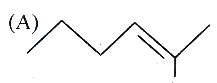
Identify the major product formed when $2-$Methylhexan$-3-$ol is heated with concentrated sulphuric acid.
A
$2-$Methylhex$-2-$ene
B
$2-$Methylhex$-3-$ene
C
$3-$Methylhex$-2-$ene
D
$3-$Methylhex$-3-$ene
Solution
(A) The dehydration of $2-$Methylhexan$-3-$ol with concentrated $H_2SO_4$ proceeds via the formation of a carbocation intermediate.
Upon elimination of a proton,multiple alkenes can be formed.
According to the Saytzeff rule,the more substituted alkene is the major product.
$2-$Methylhexan$-3-$ol undergoes dehydration to form $2-$Methylhex$-2-$ene as the major product because it is a trisubstituted alkene,which is more stable than the disubstituted $2-$Methylhex$-3-$ene.
Upon elimination of a proton,multiple alkenes can be formed.
According to the Saytzeff rule,the more substituted alkene is the major product.
$2-$Methylhexan$-3-$ol undergoes dehydration to form $2-$Methylhex$-2-$ene as the major product because it is a trisubstituted alkene,which is more stable than the disubstituted $2-$Methylhex$-3-$ene.
0 likesView Solution
248
ChemistryEasyMCQMHT CET · 2021
Identify the product $B$ in the following sequence of reactions:
$CH_3-CH_2-CH_2-OH$ $\xrightarrow[623 \ K]{Al_2O_3} A$ $\xrightarrow[(ii) H_2O, \Delta]{(i) conc. H_2SO_4} B$
$CH_3-CH_2-CH_2-OH$ $\xrightarrow[623 \ K]{Al_2O_3} A$ $\xrightarrow[(ii) H_2O, \Delta]{(i) conc. H_2SO_4} B$
A
Propan$-2-$ol
B
Propan$-1-$ol
C
Isopropyl hydrogen sulphate
D
Propene
Solution
(A) Step $1$: Dehydration of $Propan-1-ol$ with $Al_2O_3$ at $623 \ K$ gives propene $(A)$ as the product.
$CH_3-CH_2-CH_2-OH \xrightarrow[623 \ K]{Al_2O_3} CH_3-CH=CH_2 (A)$
Step $2$: Addition of $conc. H_2SO_4$ to propene follows $Markovnikov's$ rule to form isopropyl hydrogen sulphate,which upon hydrolysis with water $(H_2O, \Delta)$ yields $Propan-2-ol$ $(B)$.
$CH_3-CH=CH_2$ $\xrightarrow{conc. H_2SO_4} CH_3-CH(OSO_3H)-CH_3$ $\xrightarrow{H_2O, \Delta} CH_3-CH(OH)-CH_3 (B)$
Thus,the final product $B$ is $Propan-2-ol$.
$CH_3-CH_2-CH_2-OH \xrightarrow[623 \ K]{Al_2O_3} CH_3-CH=CH_2 (A)$
Step $2$: Addition of $conc. H_2SO_4$ to propene follows $Markovnikov's$ rule to form isopropyl hydrogen sulphate,which upon hydrolysis with water $(H_2O, \Delta)$ yields $Propan-2-ol$ $(B)$.
$CH_3-CH=CH_2$ $\xrightarrow{conc. H_2SO_4} CH_3-CH(OSO_3H)-CH_3$ $\xrightarrow{H_2O, \Delta} CH_3-CH(OH)-CH_3 (B)$
Thus,the final product $B$ is $Propan-2-ol$.
0 likesView Solution
249
ChemistryMediumMCQMHT CET · 2021
Identify the product formed when tertiary butyl bromide reacts with alcoholic $NH_3$ solution?
A
$2-$Methylpropene
B
$2-$Methylpropane
C
but$-1-$ene
D
$2-$Methylpropan$-1-$ol
Solution
(A) Tertiary butyl bromide $(CH_3)_3C-Br$ is a tertiary alkyl halide. When it reacts with an alcoholic solution of $NH_3$,it undergoes a dehydrohalogenation reaction ($\alpha, \beta-$elimination).
In this reaction,the base (ammonia) abstracts a proton from the $\beta-$carbon,leading to the elimination of $HBr$ and the formation of an alkene.
The reaction is: $(CH_3)_3C-Br \xrightarrow{alc. NH_3} CH_3-C(CH_3)=CH_2 + HBr$.
The product formed is $2-$methylpropene.
In this reaction,the base (ammonia) abstracts a proton from the $\beta-$carbon,leading to the elimination of $HBr$ and the formation of an alkene.
The reaction is: $(CH_3)_3C-Br \xrightarrow{alc. NH_3} CH_3-C(CH_3)=CH_2 + HBr$.
The product formed is $2-$methylpropene.
0 likesView Solution
250
ChemistryEasyMCQMHT CET · 2021
Identify the product $B$ in the following series of reactions.
$CH_3-CH_2-CH_2-OH$ $\xrightarrow{Al_2 O_3, 623 \ K} A$ $\xrightarrow[(ii) H_2 O]{(i) \text{conc. } H_2 SO_4} B$
$CH_3-CH_2-CH_2-OH$ $\xrightarrow{Al_2 O_3, 623 \ K} A$ $\xrightarrow[(ii) H_2 O]{(i) \text{conc. } H_2 SO_4} B$
A
Propanal
B
Propan$-2-$ol
C
Propene
D
Propanone
Solution
(B) Step $1$: Dehydration of $CH_3-CH_2-CH_2-OH$ (Propan$-1-$ol) with $Al_2 O_3$ at $623 \ K$ gives $A$,which is Propene $(CH_3-CH=CH_2)$.
Step $2$: Propene reacts with conc. $H_2 SO_4$ followed by hydrolysis $(H_2 O)$ to undergo hydration according to Markovnikov's rule.
Step $3$: The reaction follows the mechanism: $CH_3-CH=CH_2 + H_2 SO_4$ $\rightarrow CH_3-CH(OSO_3 H)-CH_3$ $\xrightarrow{H_2 O} CH_3-CH(OH)-CH_3$ (Propan$-2-$ol).
Thus,the product $B$ is Propan$-2-$ol.
Step $2$: Propene reacts with conc. $H_2 SO_4$ followed by hydrolysis $(H_2 O)$ to undergo hydration according to Markovnikov's rule.
Step $3$: The reaction follows the mechanism: $CH_3-CH=CH_2 + H_2 SO_4$ $\rightarrow CH_3-CH(OSO_3 H)-CH_3$ $\xrightarrow{H_2 O} CH_3-CH(OH)-CH_3$ (Propan$-2-$ol).
Thus,the product $B$ is Propan$-2-$ol.
0 likesView Solution
251
ChemistryMediumMCQMHT CET · 2021
Identify reactant $(A)$ used in the following conversion.
Chlorobenzene $+ A \xrightarrow[anhydrous]{AlCl_3} 2-\text{chloroacetophenone} + 4-\text{chloroacetophenone}$
Chlorobenzene $+ A \xrightarrow[anhydrous]{AlCl_3} 2-\text{chloroacetophenone} + 4-\text{chloroacetophenone}$
A
Ethyl acetate
B
Acetophenone
C
Acetic acid
D
Acetyl chloride
Solution
(D) The given reaction is a Friedel-Crafts acylation reaction.
In this reaction,chlorobenzene reacts with an acylating agent in the presence of an anhydrous Lewis acid catalyst like $AlCl_3$.
The reaction is:
$\text{Chlorobenzene} + CH_3COCl$ $\xrightarrow[anhydrous]{AlCl_3} 2-\text{chloroacetophenone} + 4-\text{chloroacetophenone}$
Here,the reactant $(A)$ is acetyl chloride $(CH_3COCl)$.
In this reaction,chlorobenzene reacts with an acylating agent in the presence of an anhydrous Lewis acid catalyst like $AlCl_3$.
The reaction is:
$\text{Chlorobenzene} + CH_3COCl$ $\xrightarrow[anhydrous]{AlCl_3} 2-\text{chloroacetophenone} + 4-\text{chloroacetophenone}$
Here,the reactant $(A)$ is acetyl chloride $(CH_3COCl)$.
0 likesView Solution
252
ChemistryMediumMCQMHT CET · 2021
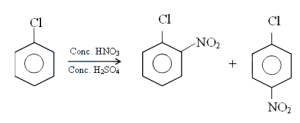
Chlorobenzene on heating with concentrated $HNO_3$ in the presence of concentrated $H_2SO_4$ gives:
A
$1-$chloro$-2,4-$dinitrobenzene
B
$2-$chloronitrobenzene and $4-$chloronitrobenzene
C
$1-$chloro$-4-$nitrobenzene
D
$2,4,6-$trinitrochlorobenzene
Solution
(B) Chlorobenzene undergoes electrophilic aromatic substitution (nitration) when treated with a mixture of concentrated $HNO_3$ and $H_2SO_4$.
Since the chlorine atom is ortho/para-directing,the reaction yields a mixture of $2-$chloronitrobenzene and $4-$chloronitrobenzene.
Since the chlorine atom is ortho/para-directing,the reaction yields a mixture of $2-$chloronitrobenzene and $4-$chloronitrobenzene.
0 likesView Solution
253
ChemistryEasyMCQMHT CET · 2021
Identify the name of the following reaction:
$Toluene + CrO_2Cl_2$ $\xrightarrow{CS_2} \text{complex}$ $\xrightarrow{H_3O^+} \text{Benzaldehyde}$
$Toluene + CrO_2Cl_2$ $\xrightarrow{CS_2} \text{complex}$ $\xrightarrow{H_3O^+} \text{Benzaldehyde}$
A
Stephen reaction
B
Rosenmund reaction
C
Etard reaction
D
Wolf-Kishner reaction
Solution
(C) The reaction of $Toluene$ with $Chromyl chloride$ $(CrO_2Cl_2)$ in the presence of $Carbon disulfide$ $(CS_2)$ followed by acid hydrolysis $(H_3O^+)$ to form $Benzaldehyde$ is known as the $Etard reaction$.
0 likesView Solution
254
ChemistryMediumMCQMHT CET · 2021
Identify the product formed when ethyl benzene reacts with nitric acid.
A
$o-$Nitro ethylbenzene
B
Ethoxy benzene
C
$p-$Nitro ethylbenzene
D
Benzoic acid
Solution
(D) When ethyl benzene is treated with strong oxidizing agents like $HNO_3$ or $KMnO_4$,the alkyl side chain attached to the benzene ring is oxidized to a carboxylic acid group $(-COOH)$.
Thus,ethyl benzene undergoes strong oxidation to form benzoic acid.
Thus,ethyl benzene undergoes strong oxidation to form benzoic acid.
0 likesView Solution
255
ChemistryEasyMCQMHT CET · 2021
Which among the following oxides is acidic in nature?
A
$N_2O_5$
B
$NO$
C
$Na_2O$
D
$CO$
Solution
(A) $N_2O_5$ is a non-metallic oxide of nitrogen in a high oxidation state $(+5)$,which makes it acidic in nature.
$NO$ is a neutral oxide.
$Na_2O$ is a metallic oxide,which makes it basic in nature.
$CO$ is a neutral oxide.
$NO$ is a neutral oxide.
$Na_2O$ is a metallic oxide,which makes it basic in nature.
$CO$ is a neutral oxide.
0 likesView Solution
256
ChemistryDifficultMCQMHT CET · 2021
What is the number of allotropes of selenium?
A
$2$
B
$4$
C
$5$
D
$6$
Solution
(A) Selenium exists in two allotropic forms: red (non-metallic) and grey (metallic).
0 likesView Solution
257
ChemistryMediumMCQMHT CET · 2021
Which among the following is $NOT$ the use of $SO_2$ gas?
A
As a preservative
B
In manufacture of $H_2SO_4$
C
With conc. $H_2SO_4$ it forms oleum
D
As an antichlor
Solution
(C) $SO_2$ is used as a food preservative,as an antichlor,and in the manufacture of $H_2SO_4$ (via the contact process).
However,$SO_2$ does not form oleum with concentrated $H_2SO_4$.
Oleum $(H_2S_2O_7)$ is formed by the reaction of sulfur trioxide $(SO_3)$ with concentrated $H_2SO_4$.
However,$SO_2$ does not form oleum with concentrated $H_2SO_4$.
Oleum $(H_2S_2O_7)$ is formed by the reaction of sulfur trioxide $(SO_3)$ with concentrated $H_2SO_4$.
0 likesView Solution
258
ChemistryEasyMCQMHT CET · 2021
Which among the following is the formula of mustard gas?
A
$COCl_2$
B
$SO_2Cl_2$
C
$S(CH_2CH_2Cl)_2$
D
$CCl_3NO_2$
Solution
(C) Mustard gas,also known as sulfur mustard,has the chemical formula $S(CH_2CH_2Cl)_2$.
It is a potent vesicant chemical warfare agent that causes severe blistering and burning of the skin,eyes,and respiratory tract.
It is a potent vesicant chemical warfare agent that causes severe blistering and burning of the skin,eyes,and respiratory tract.
0 likesView Solution
259
ChemistryEasyMCQMHT CET · 2021
Which of the following elements of the halogen family is in a liquid state at room temperature?
A
Iodine
B
Astatine
C
Bromine
D
Fluorine
Solution
(C) At room temperature,$F_2$ and $Cl_2$ are gases,$Br_2$ is a liquid,and $I_2$ and $At$ are solids. Therefore,the correct answer is $Bromine$.
0 likesView Solution
260
ChemistryMediumMCQMHT CET · 2021
Which among the following compounds is $NOT$ a colourless gas?
A
$ClF$
B
$IF_7$
C
$IF_3$
D
$ClF_3$
Solution
(C) $IF_3$ (Iodine trifluoride) is an interhalogen compound.
It is a yellow solid at room temperature,whereas $ClF$,$IF_7$,and $ClF_3$ are colourless gases.
It is a yellow solid at room temperature,whereas $ClF$,$IF_7$,and $ClF_3$ are colourless gases.
0 likesView Solution
261
ChemistryEasyMCQMHT CET · 2021
Which element from the following combines with hydrogen to form a compound having the lowest acidic strength?
A
$Cl$
B
$Br$
C
$F$
D
$I$
Solution
(C) The acidic strength of hydrogen halides depends on the bond dissociation enthalpy of the $H-X$ bond.
As we move down the group from $F$ to $I$,the atomic size increases,which leads to a decrease in the bond dissociation enthalpy.
Consequently,the ease of releasing an $H^{+}$ ion increases down the group.
Therefore,the acidic strength increases in the order: $HF < HCl < HBr < HI$.
Thus,$HF$ has the lowest acidic strength.
As we move down the group from $F$ to $I$,the atomic size increases,which leads to a decrease in the bond dissociation enthalpy.
Consequently,the ease of releasing an $H^{+}$ ion increases down the group.
Therefore,the acidic strength increases in the order: $HF < HCl < HBr < HI$.
Thus,$HF$ has the lowest acidic strength.
0 likesView Solution
262
ChemistryMediumMCQMHT CET · 2021
Which among the following compounds of chlorine possesses the $Cl$ atom in the highest oxidation state?
A
Chlorous acid
B
Chloric acid
C
Perchloric acid
D
Hypochlorous acid
Solution
(C) The oxidation states of $Cl$ in the given acids are as follows:
$1$. Hypochlorous acid $(HClO)$: $+1$
$2$. Chlorous acid $(HClO_2)$: $+3$
$3$. Chloric acid $(HClO_3)$: $+5$
$4$. Perchloric acid $(HClO_4)$: $+7$
Therefore,the $Cl$ atom in Perchloric acid $(HClO_4)$ has the highest oxidation state of $+7$.
$1$. Hypochlorous acid $(HClO)$: $+1$
$2$. Chlorous acid $(HClO_2)$: $+3$
$3$. Chloric acid $(HClO_3)$: $+5$
$4$. Perchloric acid $(HClO_4)$: $+7$
Therefore,the $Cl$ atom in Perchloric acid $(HClO_4)$ has the highest oxidation state of $+7$.
0 likesView Solution
263
ChemistryMediumMCQMHT CET · 2021
Which among the following noble gases reacts with fluorine to give crystalline fluorides?
A
$Ne$
B
$He$
C
$Xe$
D
$Ar$
Solution
(C) Ionization enthalpy decreases on moving down the group,and $Xe$ has the lowest ionization enthalpy among the given noble gases.
Due to this low ionization energy,$Xe$ can easily form stable crystalline fluorides such as $XeF_2$,$XeF_4$,and $XeF_6$ upon reaction with fluorine.
Due to this low ionization energy,$Xe$ can easily form stable crystalline fluorides such as $XeF_2$,$XeF_4$,and $XeF_6$ upon reaction with fluorine.
0 likesView Solution
264
ChemistryMediumMCQMHT CET · 2021
Identify the use of argon from the following.
A
In supersonic wind tunnels
B
For magnetic resonance imaging
C
For producing an inert atmosphere in welding
D
For the production of lasers
Solution
(C) Argon is used in the welding of specialty alloys as well as in the welding of automobile frames,mufflers,and other automotive parts. It is called a shield gas because it does not react with the gases and metals in the vicinity of the welding process. It merely takes up space and prevents unwanted reactions from occurring due to reactive gases such as $N_2$ and $O_2$.
0 likesView Solution
265
ChemistryEasyMCQMHT CET · 2021
Identify the use of a mixture of $Ar$ and $N_2$ from the following.
A
For magnetic resonance imaging
B
For production of lasers
C
To fill in electric bulbs
D
To produce low temperature for research work
Solution
(C) The filament in an electric bulb is made using tungsten,which would burn quickly when it comes in contact with oxygen in the air.
This is the reason why unreactive gases such as $Ar$ and $N_2$ are used for filling electric bulbs.
These gases are chemically inactive and prevent the oxidation of the tungsten filament,thereby increasing the lifespan of the bulb.
This is the reason why unreactive gases such as $Ar$ and $N_2$ are used for filling electric bulbs.
These gases are chemically inactive and prevent the oxidation of the tungsten filament,thereby increasing the lifespan of the bulb.
0 likesView Solution
266
ChemistryMediumMCQMHT CET · 2021
Which of the following polymers is used in the preparation of cinema films?
A
Semisynthetic polymers
B
Isobutyl carbinol
C
Isopropyl carbinol
D
Diethyl carbinol
Solution
(A) Semisynthetic polymers,such as cellulose acetate,are used in the preparation of cinema films.
0 likesView Solution
267
ChemistryEasyMCQMHT CET · 2021
Which free radical initiator is used for the polymerization of tetrafluoroethylene?
A
Zinc acetate
B
Titanium tetrachloride
C
Ammonium persulphate
D
Acetyl peroxide
Solution
(C) The polymerization of tetrafluoroethylene to produce polytetrafluoroethylene $(PTFE)$ is carried out by heating or exposing tetrafluoroethylene to a free radical initiator such as ammonium persulphate or hydrogen peroxide under high pressure.
0 likesView Solution
268
ChemistryEasyMCQMHT CET · 2021
Which of the following compounds does not undergo vinyl polymerization?
A
$\varepsilon$-Caprolactam
B
Vinyl cyanide
C
Tetrafluoroethylene
D
Ethylene
Solution
(A) $\varepsilon$-Caprolactam does not undergo vinyl polymerization.
It undergoes ring-opening polymerization to form Nylon-$6$.
It undergoes ring-opening polymerization to form Nylon-$6$.
0 likesView Solution
269
ChemistryMediumMCQMHT CET · 2021
Which of the following monomers is used for the preparation of $Nylon-6$?
A
Isobutylene
B
Hexamethylene diammonium adipate
C
Caprolactam
D
Acrylonitrile
Solution
(C) $Nylon-6$ is prepared by heating caprolactam with water at a high temperature.
In this process,the ring of caprolactam opens to form aminocaproic acid,which then undergoes polymerization to form $Nylon-6$.
The reaction is as follows:
$\text{Caprolactam}$ $\xrightarrow{H_2O, \text{Heat}} H_2N-(CH_2)_5-COOH$ $\xrightarrow{\text{Heat}} (-NH-(CH_2)_5-CO-)_n \text{ (Nylon-6)}$
In this process,the ring of caprolactam opens to form aminocaproic acid,which then undergoes polymerization to form $Nylon-6$.
The reaction is as follows:
$\text{Caprolactam}$ $\xrightarrow{H_2O, \text{Heat}} H_2N-(CH_2)_5-COOH$ $\xrightarrow{\text{Heat}} (-NH-(CH_2)_5-CO-)_n \text{ (Nylon-6)}$
0 likesView Solution
270
ChemistryMediumMCQMHT CET · 2021
Which of the following polymers is used in electrophoresis in the form of gel?
A
Glyptal
B
Buna-$N$
C
Polyacrylamide
D
$PVC$
Solution
(C) Polyacrylamide is a synthetic polymer that forms a cross-linked gel structure when polymerized. This gel is widely used in gel electrophoresis to separate biological molecules like proteins and nucleic acids based on their size and charge.
0 likesView Solution
271
ChemistryMediumMCQMHT CET · 2021
Identify the use of $Buna-N$ from the following:
A
To obtain decorative items
B
To prepare lenses
C
To prepare adhesives
D
To prepare paints
Solution
(C) $Buna-N$ is a synthetic rubber copolymer of $1,3-butadiene$ and $acrylonitrile$. It is highly resistant to the action of petrol,lubricating oil,and organic solvents. Due to these properties,it is primarily used in the manufacture of oil seals,tank linings,and adhesives.
0 likesView Solution
272
ChemistryEasyMCQMHT CET · 2021
Which among the following monomers is used to prepare $PVC$?
A
$Vinyl$ $chloride$
B
$Methyl$ $methacrylate$
C
$Acrylamide$
D
$Vinyl$ $chloride$ (structure)
Solution
(A) $Polyvinyl$ $chloride$ $(PVC)$ is a polymer formed by the polymerization of $vinyl$ $chloride$ monomer. The chemical formula for $vinyl$ $chloride$ is $CH_2=CHCl$. The polymerization reaction is as follows:
$n(CH_2=CHCl) \xrightarrow{\text{catalyst}} -[CH_2-CHCl]_n-$
$n(CH_2=CHCl) \xrightarrow{\text{catalyst}} -[CH_2-CHCl]_n-$
0 likesView Solution
273
ChemistryEasyMCQMHT CET · 2021
Identify the homopolymer from the following.
A
Teflon
B
Nylon $2-$nylon $6$
C
$PHBV$
D
Bakelite
Solution
(A) homopolymer is a polymer formed from only one type of monomer unit.
$Teflon$ is a homopolymer of tetrafluoroethene $(CF_2=CF_2)$.
$Nylon$ $2-$nylon $6$,$PHBV$,and $Bakelite$ are copolymers because they are formed from two or more different types of monomer units.
$Teflon$ is a homopolymer of tetrafluoroethene $(CF_2=CF_2)$.
$Nylon$ $2-$nylon $6$,$PHBV$,and $Bakelite$ are copolymers because they are formed from two or more different types of monomer units.
0 likesView Solution
274
ChemistryMediumMCQMHT CET · 2021
Which of the following elements forms crosslinks in the vulcanization of $SBR$ rubber?
A
$P$
B
$O$
C
$S$
D
$N$
Solution
(C) In the process of vulcanization,sulfur $(S)$ is added to the rubber to form crosslinks between polymer chains,which improves the mechanical properties of the rubber. Therefore,$S$ forms crosslinks in the vulcanization of $SBR$ rubber.
0 likesView Solution
275
ChemistryEasyMCQMHT CET · 2021
Which among the following statements is $NOT$ true for neoprene?
A
It is resistant to petroleum
B
It is obtained from styrene
C
It is a synthetic rubber
D
It is a condensation polymer
Solution
(D) Neoprene is a synthetic rubber formed by the free-radical polymerization of chloroprene ($2$-chloro-$1,3$-butadiene).
It is an addition polymer,not a condensation polymer.
It is highly resistant to petroleum,vegetable oils,and light.
Therefore,the statement that it is a condensation polymer is incorrect.
It is an addition polymer,not a condensation polymer.
It is highly resistant to petroleum,vegetable oils,and light.
Therefore,the statement that it is a condensation polymer is incorrect.
0 likesView Solution
276
ChemistryEasyMCQMHT CET · 2021
Which of the following polymers is obtained from $\varepsilon$-caprolactam?
A
Polyacrylonitrile
B
Neoprene
C
Terylene
D
Nylon-$6$
Solution
(D) The polymer obtained from $\varepsilon$-caprolactam is Nylon-$6$.
When $\varepsilon$-caprolactam is heated with water at high temperature,it undergoes ring-opening polymerization to form Nylon-$6$.
When $\varepsilon$-caprolactam is heated with water at high temperature,it undergoes ring-opening polymerization to form Nylon-$6$.
0 likesView Solution
277
ChemistryEasyMCQMHT CET · 2021
Which of the following is an example of a copolymer?
A
Polyvinyl chloride
B
Nylon-$6$
C
Buna-$S$
D
Polyethylene
Solution
(C) copolymer is a polymer formed from two or more different types of monomer units.
Buna-$S$ is a copolymer formed by the polymerization of $1,3-$butadiene and styrene.
Buna-$S$ is a copolymer formed by the polymerization of $1,3-$butadiene and styrene.
0 likesView Solution
278
ChemistryMediumMCQMHT CET · 2021
Identify the polymer used in making floor tiles.
A
$PETE$
B
$PVC$
C
$HDPE$
D
$LDPE$
Solution
(B) $PVC$ (Polyvinyl chloride) is widely used in the manufacturing of floor tiles,pipes,and various construction materials due to its durability and chemical resistance.
0 likesView Solution
279
ChemistryMediumMCQMHT CET · 2021
Buna-$S$ is obtained from
A
Styrene and $2-$chloro$-1,3-$butadiene
B
Adipic acid and hexamethylene diamine
C
Styrene and butadiene
D
Glycine and $\varepsilon-$amino caproic acid
Solution
(C) Buna-$S$ is a copolymer of $1,3-$butadiene and styrene.
It is obtained by the polymerization of $1,3-$butadiene and styrene in the ratio of $3:1$ in the presence of a catalyst (often sodium or free radical initiator).
The reaction is represented as:
$nCH_2=CH-CH=CH_2 + nC_6H_5CH=CH_2 \xrightarrow{\text{Polymerization}} (-CH_2-CH=CH-CH_2-CH(C_6H_5)-CH_2-)_n$
It is obtained by the polymerization of $1,3-$butadiene and styrene in the ratio of $3:1$ in the presence of a catalyst (often sodium or free radical initiator).
The reaction is represented as:
$nCH_2=CH-CH=CH_2 + nC_6H_5CH=CH_2 \xrightarrow{\text{Polymerization}} (-CH_2-CH=CH-CH_2-CH(C_6H_5)-CH_2-)_n$
0 likesView Solution
280
ChemistryEasyMCQMHT CET · 2021
Which of the following polymers is used to manufacture tyres?
A
Neoprene
B
$SBR$
C
Bakelite
D
Polyacrylonitrile
Solution
(B) $SBR$ (Styrene-Butadiene Rubber) is a synthetic rubber used extensively in the manufacture of automobile tyres due to its high abrasion resistance and durability.
0 likesView Solution
281
ChemistryEasyMCQMHT CET · 2021
Which of the following polymers is used to obtain shopping bags?
A
$HDPE$
B
$LDPE$
C
Polypropylene
D
$PVC$
Solution
(B) $LDPE$ (Low Density Polyethylene) is used to obtain shopping bags because of its flexibility and toughness.
0 likesView Solution
282
ChemistryEasyMCQMHT CET · 2021
Which among the following is an example of a cyclic amide?
A
$PAN$
B
Terylene
C
$\varepsilon$-caprolactam
D
Teflon
Solution
(C) cyclic amide is also known as a lactam.
$\varepsilon$-caprolactam is a seven-membered cyclic amide that is used as a monomer for the preparation of Nylon-$6$.
Therefore,the correct option is $C$.
$\varepsilon$-caprolactam is a seven-membered cyclic amide that is used as a monomer for the preparation of Nylon-$6$.
Therefore,the correct option is $C$.
0 likesView Solution
283
ChemistryMediumMCQMHT CET · 2021
Identify the catalyst used in the manufacturing of $HDP$.
A
Ziegler-Natta
B
Peroxides
C
Lindlar's
D
Magnesium oxide
Solution
(A) $HDP$ stands for high-density polyethylene. It is a linear polymer with high density due to close packing.
$HDP$ is obtained by the polymerization of ethene in the presence of a Ziegler-Natta catalyst,which is a combination of triethylaluminium and titanium tetrachloride,at a temperature of $333 \ K$ to $343 \ K$ and a pressure of $6-7 \ atm$.
$HDP$ is obtained by the polymerization of ethene in the presence of a Ziegler-Natta catalyst,which is a combination of triethylaluminium and titanium tetrachloride,at a temperature of $333 \ K$ to $343 \ K$ and a pressure of $6-7 \ atm$.
0 likesView Solution
284
ChemistryEasyMCQMHT CET · 2021
Which among the following compounds is used as a monomer in the preparation of Teflon?
A
Tetrabromoethylene
B
Tetrafluoroethylene
C
Tetrachloroethylene
D
Tetraiodoethylene
Solution
(B) Teflon is a polymer formed by the polymerization of tetrafluoroethylene $(CF_2=CF_2)$.
The reaction is carried out by heating tetrafluoroethylene with a free radical or persulphate catalyst at high pressure.
The chemical equation is: $nCF_2=CF_2 \xrightarrow[(NH_4)_2S_2O_8]{\text{Heat, pressure}} -[CF_2-CF_2]_n-$
Thus,the monomer used is tetrafluoroethylene.
The reaction is carried out by heating tetrafluoroethylene with a free radical or persulphate catalyst at high pressure.
The chemical equation is: $nCF_2=CF_2 \xrightarrow[(NH_4)_2S_2O_8]{\text{Heat, pressure}} -[CF_2-CF_2]_n-$
Thus,the monomer used is tetrafluoroethylene.
0 likesView Solution
285
ChemistryEasyMCQMHT CET · 2021
Identify the monomers used for the manufacturing of $Terylene$.
A
Propylene glycol and Terephthalic acid
B
Ethylene glycol and Terephthalic acid
C
Propylene glycol and Phthalic acid
D
Ethylene glycol and Phthalic acid
Solution
(B) $Terylene$ (also known as $Dacron$) is a polyester fiber.
It is prepared by the condensation polymerization of $Ethylene \ glycol$ $(HO-CH_2-CH_2-OH)$ and $Terephthalic \ acid$ $(HOOC-C_6H_4-COOH)$.
The reaction is as follows:
$n(HO-CH_2-CH_2-OH) + n(HOOC-C_6H_4-COOH) \rightarrow -[O-CH_2-CH_2-O-CO-C_6H_4-CO]_n- + 2nH_2O$
Therefore,the correct monomers are $Ethylene \ glycol$ and $Terephthalic \ acid$.
It is prepared by the condensation polymerization of $Ethylene \ glycol$ $(HO-CH_2-CH_2-OH)$ and $Terephthalic \ acid$ $(HOOC-C_6H_4-COOH)$.
The reaction is as follows:
$n(HO-CH_2-CH_2-OH) + n(HOOC-C_6H_4-COOH) \rightarrow -[O-CH_2-CH_2-O-CO-C_6H_4-CO]_n- + 2nH_2O$
Therefore,the correct monomers are $Ethylene \ glycol$ and $Terephthalic \ acid$.
0 likesView Solution
286
ChemistryMediumMCQMHT CET · 2021
Which of the following is an example of cross-linked polymers?
A
$PVC$
B
Acetate rayon
C
High density polyethylene
D
Melamine
Solution
(D) Melamine-formaldehyde resin is formed by the co-polymerisation of melamine and formaldehyde.
It is a classic example of a cross-linked polymer,where the polymer chains are connected by covalent bonds to form a three-dimensional network structure.
It is a classic example of a cross-linked polymer,where the polymer chains are connected by covalent bonds to form a three-dimensional network structure.
0 likesView Solution
287
ChemistryEasyMCQMHT CET · 2021
Which among the following reactions exhibits the reducing property of ozone?
A
$PbS_{(s)} + 4 O_{3(g)} \rightarrow PbSO_{4(s)} + 4 O_{2(g)}$
B
$BaO_{2(s)} + O_{3(g)} \rightarrow BaO_{(s)} + 2 O_{2(g)}$
C
$NO_{(g)} + O_{3(g)} \rightarrow NO_{2(g)} + O_{2(g)}$
D
$2 KI_{(aq)} + H_2O_{(l)} + O_{3(g)} \rightarrow 2 KOH_{(aq)} + I_{2(s)} + O_{2(g)}$
Solution
(B) Ozone acts as a reducing agent in reactions where it reduces peroxides to oxides,while itself being reduced to oxygen.
In the reaction $BaO_{2(s)} + O_{3(g)} \rightarrow BaO_{(s)} + 2 O_{2(g)}$,ozone reduces barium peroxide $(BaO_2)$ to barium oxide $(BaO)$.
In the reaction $BaO_{2(s)} + O_{3(g)} \rightarrow BaO_{(s)} + 2 O_{2(g)}$,ozone reduces barium peroxide $(BaO_2)$ to barium oxide $(BaO)$.
0 likesView Solution
288
ChemistryMediumMCQMHT CET · 2021
What is the total number of Bravais lattices present in seven types of crystal system?
A
$12$
B
$7$
C
$10$
D
$14$
Solution
(D) There are $14$ distinct Bravais lattices that can be formed within the $7$ crystal systems.
0 likesView Solution
289
ChemistryEasyMCQMHT CET · 2021
Which of the following instruments is used to determine the crystal structure?
A
Scanning electron microscope
B
$FTIR$ spectrophotometer
C
$X$-ray diffractometer
D
Transmission electron microscope
Solution
(C) $X$-ray crystallography is used to identify the molecular and atomic structure of a crystal.
The crystal diffracts the incident $X$-ray beam.
By measuring the intensities and angles of these diffracted beams,the molecular structure of the crystal can be evaluated.
The instrument used for this purpose is known as an $X$-ray diffractometer.
The crystal diffracts the incident $X$-ray beam.
By measuring the intensities and angles of these diffracted beams,the molecular structure of the crystal can be evaluated.
The instrument used for this purpose is known as an $X$-ray diffractometer.
0 likesView Solution
290
ChemistryMediumMCQMHT CET · 2021
Which of the following pairs of compounds is isomorphous?
A
$NaCl, KCl$
B
$NaF, NaNO_3$
C
$CaCl_2, NaNO_3$
D
$CaCO_3, NaNO_3$
Solution
(D) Two or more substances having the same crystal structure are called isomorphous.
They show the same atomic ratio (Iso- Same,Morphous- Form).
Examples include $NaF$ and $MgO$ ($1:1$ ratio),and $NaNO_3$ and $CaCO_3$ ($1:1:3$ ratio).
$NaCl$ and $KCl$ have similar properties but different crystal structures.
They show the same atomic ratio (Iso- Same,Morphous- Form).
Examples include $NaF$ and $MgO$ ($1:1$ ratio),and $NaNO_3$ and $CaCO_3$ ($1:1:3$ ratio).
$NaCl$ and $KCl$ have similar properties but different crystal structures.
0 likesView Solution
Vedclass Products
For Students
Vedclass Test Series
Mock tests in real MHT CET style covering Chemistry with performance analysis. 5-day free trial.
Start Free TrialFor Teachers
Exam Paper Generator
Generate Set A/B/C/D Chemistry papers from 7.5L+ questions in 2 minutes. 3 chapters free.
Try FreeFor Institutes
Online Exam Module
Run live MHT CET mock exams with unlimited students, 360° analytics & white-label branding.
See DemoFrequently Asked Questions
How many Chemistry questions are in MHT CET 2021?
There are 563 Chemistry questions from the MHT CET 2021 paper on Vedclass, each with a detailed step-by-step solution in English.
Are MHT CET 2021 Chemistry solutions available in English?
Yes. All solutions on this page are in English. You can also switch to English or Hindi using the language buttons above the questions.
Can I practice MHT CET 2021 Chemistry as a timed test?
Yes. Use the Vedclass Test Series to attempt a full MHT CET mock test covering Chemistry with time limits and instant score analysis.
Can teachers create Chemistry papers from MHT CET previous year questions?
Yes. The Vedclass Exam Paper Generator lets teachers mix MHT CET Chemistry questions and generate Set A/B/C/D papers in minutes.
For Teachers & Institutes
Build a Custom Chemistry Paper
Pick MHT CET 2021 Chemistry questions, set difficulty, and generate Set A/B/C/D in 2 minutes.