
ChemistryQ1–63 of 63 questions
Page 1 of 1 · English
1
ChemistryMCQKCET · 2012
Chemiosmotic theory of $ATP$ synthesis in mitochondrion is based on
A
$K^+$ gradient
B
$H^+$ gradient
C
$Na^+$ gradient
D
$Ca^{2+}$ gradient
Solution
(B) The chemiosmotic theory,proposed by Peter Mitchell,explains the mechanism of $ATP$ synthesis in mitochondria and chloroplasts.
In mitochondria,the electron transport system $(ETS)$ pumps protons ($H^+$ ions) from the mitochondrial matrix into the intermembrane space.
This creates a proton gradient (or $H^+$ gradient) across the inner mitochondrial membrane.
The potential energy stored in this electrochemical gradient is used by the enzyme $ATP$ synthase to phosphorylate $ADP$ into $ATP$ as protons flow back into the matrix through the $F_0-F_1$ particle.
Therefore,the synthesis of $ATP$ is directly dependent on the $H^+$ gradient.
In mitochondria,the electron transport system $(ETS)$ pumps protons ($H^+$ ions) from the mitochondrial matrix into the intermembrane space.
This creates a proton gradient (or $H^+$ gradient) across the inner mitochondrial membrane.
The potential energy stored in this electrochemical gradient is used by the enzyme $ATP$ synthase to phosphorylate $ADP$ into $ATP$ as protons flow back into the matrix through the $F_0-F_1$ particle.
Therefore,the synthesis of $ATP$ is directly dependent on the $H^+$ gradient.
0 likesView Solution
2
ChemistryMediumMCQKCET · 2012
Power alcohol is a mixture of
A
$80 \% \text{ petrol} + 20 \% \text{ ethanol} + \text{small quantity of benzene}$
B
$80 \% \text{ ethanol} + 20 \% \text{ benzene} + \text{small quantity of petrol}$
C
$50 \% \text{ petrol} + 50 \% \text{ ethanol} + \text{small quantity of benzene}$
D
$80 \% \text{ petrol} + 20 \% \text{ benzene} + \text{small quantity of ethanol}$
Solution
(A) Power alcohol is defined as a mixture of $80 \% \text{ petrol}$ and $20 \% \text{ ethanol}$ with a small amount of benzene added to act as a co-solvent to prevent phase separation.
It is primarily used as a fuel in internal combustion engines.
It is primarily used as a fuel in internal combustion engines.
0 likesView Solution
3
ChemistryEasyMCQKCET · 2012
Which one of the following contains ionic,covalent,and coordinate bonds?
A
$NaCl$
B
$NaCN$
C
$NaNC$
D
$NaOH$
Solution
(C) The compound $NaNC$ (sodium isocyanide) contains the following bonds:
$1$. Ionic bond: Between $Na^+$ and $[NC]^-$ ions.
$2$. Covalent bond: Between $N$ and $C$ atoms (triple bond).
$3$. Coordinate bond: The lone pair of electrons on $N$ is donated to $C$ to form the triple bond structure in the isocyanide ion $[N \equiv C]^-$.
Thus,$NaNC$ contains all three types of bonds.
$1$. Ionic bond: Between $Na^+$ and $[NC]^-$ ions.
$2$. Covalent bond: Between $N$ and $C$ atoms (triple bond).
$3$. Coordinate bond: The lone pair of electrons on $N$ is donated to $C$ to form the triple bond structure in the isocyanide ion $[N \equiv C]^-$.
Thus,$NaNC$ contains all three types of bonds.
0 likesView Solution
4
ChemistryMediumMCQKCET · 2012
Which of the following is not a characteristic of a covalent compound?
A
No definite geometry
B
Insoluble in polar solvent
C
Small difference in electronegativity between the combining atoms
D
Low melting point
Solution
(A) Covalent bonds are directional in nature.
Therefore,covalent compounds possess a definite geometry,such as $CH_4$ being tetrahedral and $C_2H_2$ being linear.
Thus,the statement 'No definite geometry' is incorrect for covalent compounds.
Therefore,covalent compounds possess a definite geometry,such as $CH_4$ being tetrahedral and $C_2H_2$ being linear.
Thus,the statement 'No definite geometry' is incorrect for covalent compounds.
0 likesView Solution
5
ChemistryEasyMCQKCET · 2012
The $C-H$ bond and $C-C$ bond in ethane are formed by which of the following types of overlap?
A
$sp^{2}-s$ and $sp^{2}-sp^{2}$
B
$sp-s$ and $sp-sp$
C
$p-s$ and $p-p$
D
$sp^{3}-s$ and $sp^{3}-sp^{3}$
Solution
(D) In ethane $(C_2H_6)$,each carbon atom is $sp^3$ hybridized.
The $C-H$ bond is formed by the overlap of the $sp^3$ hybrid orbital of carbon and the $1s$ orbital of hydrogen,which is an $sp^3-s$ overlap.
The $C-C$ bond is formed by the overlap of the $sp^3$ hybrid orbital of one carbon atom with the $sp^3$ hybrid orbital of the other carbon atom,which is an $sp^3-sp^3$ overlap.
Therefore,the correct types of overlap are $sp^3-s$ and $sp^3-sp^3$.
The $C-H$ bond is formed by the overlap of the $sp^3$ hybrid orbital of carbon and the $1s$ orbital of hydrogen,which is an $sp^3-s$ overlap.
The $C-C$ bond is formed by the overlap of the $sp^3$ hybrid orbital of one carbon atom with the $sp^3$ hybrid orbital of the other carbon atom,which is an $sp^3-sp^3$ overlap.
Therefore,the correct types of overlap are $sp^3-s$ and $sp^3-sp^3$.
0 likesView Solution
6
ChemistryEasyMCQKCET · 2012
The percentage of $p$-character of the hybrid orbitals in graphite and diamond are respectively
A
$50$ and $75$
B
$67$ and $75$
C
$33$ and $75$
D
$33$ and $25$
Solution
(B) In graphite,each $C$ atom is $sp^{2}$ hybridized.
$\therefore$ $p$-character $= \frac{2}{3} \times 100 \approx 67 \%$.
In diamond,each $C$ atom is $sp^{3}$ hybridized.
$\therefore$ $p$-character $= \frac{3}{4} \times 100 = 75 \%$.
Thus,the values are $67 \%$ and $75 \%$ respectively.
$\therefore$ $p$-character $= \frac{2}{3} \times 100 \approx 67 \%$.
In diamond,each $C$ atom is $sp^{3}$ hybridized.
$\therefore$ $p$-character $= \frac{3}{4} \times 100 = 75 \%$.
Thus,the values are $67 \%$ and $75 \%$ respectively.
0 likesView Solution
7
ChemistryEasyMCQKCET · 2012
Which one of the following has no unpaired electrons?
A
$O_{2}^{-}$
B
$O_{2}^{+}$
C
$O_{2}^{2-}$
D
$O_{2}$
Solution
(C) According to Molecular Orbital Theory $(MOT)$,the electronic configuration of $O_2$ ($16$ electrons) is: $KK, \sigma 2s^2, \sigma^{*} 2s^2, \sigma 2p_z^2, \pi 2p_x^2 = \pi 2p_y^2, \pi^{*} 2p_x^1 = \pi^{*} 2p_y^1$. It has $2$ unpaired electrons.
$(a)$ $O_{2}^{-}$ ($17$ electrons): Configuration ends with $\pi^{*} 2p_x^2, \pi^{*} 2p_y^1$. It has $1$ unpaired electron.
$(b)$ $O_{2}^{+}$ ($15$ electrons): Configuration ends with $\pi^{*} 2p_x^1$. It has $1$ unpaired electron.
$(c)$ $O_{2}^{2-}$ ($18$ electrons): Configuration ends with $\pi^{*} 2p_x^2, \pi^{*} 2p_y^2$. All electrons are paired.
$(d)$ $O_{2}$ ($16$ electrons): As shown above,it has $2$ unpaired electrons.
Therefore,$O_{2}^{2-}$ has no unpaired electrons.
$(a)$ $O_{2}^{-}$ ($17$ electrons): Configuration ends with $\pi^{*} 2p_x^2, \pi^{*} 2p_y^1$. It has $1$ unpaired electron.
$(b)$ $O_{2}^{+}$ ($15$ electrons): Configuration ends with $\pi^{*} 2p_x^1$. It has $1$ unpaired electron.
$(c)$ $O_{2}^{2-}$ ($18$ electrons): Configuration ends with $\pi^{*} 2p_x^2, \pi^{*} 2p_y^2$. All electrons are paired.
$(d)$ $O_{2}$ ($16$ electrons): As shown above,it has $2$ unpaired electrons.
Therefore,$O_{2}^{2-}$ has no unpaired electrons.
0 likesView Solution
8
ChemistryEasyMCQKCET · 2012
The correct order of electronegativities of $N$,$O$,$F$,and $P$ is
A
$F > O > P > N$
B
$F > O > N > P$
C
$N > O > F > P$
D
$F > N > P > O$
Solution
(B) Electronegativity increases across a period from left to right and decreases down a group.
Comparing the elements:
$F$ $(Z=9)$ is in period $2$,group $17$.
$O$ $(Z=8)$ is in period $2$,group $16$.
$N$ $(Z=7)$ is in period $2$,group $15$.
$P$ $(Z=15)$ is in period $3$,group $15$.
Since $F$,$O$,and $N$ are in the same period $(2)$,their electronegativity follows the order $F > O > N$.
$P$ is below $N$ in group $15$,so its electronegativity is lower than $N$.
Thus,the correct order is $F > O > N > P$.
Comparing the elements:
$F$ $(Z=9)$ is in period $2$,group $17$.
$O$ $(Z=8)$ is in period $2$,group $16$.
$N$ $(Z=7)$ is in period $2$,group $15$.
$P$ $(Z=15)$ is in period $3$,group $15$.
Since $F$,$O$,and $N$ are in the same period $(2)$,their electronegativity follows the order $F > O > N$.
$P$ is below $N$ in group $15$,so its electronegativity is lower than $N$.
Thus,the correct order is $F > O > N > P$.
0 likesView Solution
9
ChemistryEasyMCQKCET · 2012
The correct order of ionisation energy of $C$,$N$,$O$,and $F$ is
A
$C < N < O < F$
B
$C < O < N < F$
C
$F < O < N < C$
D
$F < N < C < O$
Solution
(B) On moving from left to right in a period,ionisation energy generally increases due to an increase in effective nuclear charge.
Thus,the expected order of ionisation energy for $C$,$N$,$O$,and $F$ is $C < N < O < F$.
However,the ionisation energy of $N$ $(1s^2 2s^2 2p^3)$ is greater than that of $O$ $(1s^2 2s^2 2p^4)$.
This is because $N$ has a stable half-filled $p$-orbital configuration,which requires more energy to remove an electron.
Therefore,the correct order is $C < O < N < F$.
Thus,the expected order of ionisation energy for $C$,$N$,$O$,and $F$ is $C < N < O < F$.
However,the ionisation energy of $N$ $(1s^2 2s^2 2p^3)$ is greater than that of $O$ $(1s^2 2s^2 2p^4)$.
This is because $N$ has a stable half-filled $p$-orbital configuration,which requires more energy to remove an electron.
Therefore,the correct order is $C < O < N < F$.
0 likesView Solution
10
ChemistryMCQKCET · 2012
If $a, b$ and $c$ are three non-coplanar vectors and $p, q$ and $r$ are vectors defined by $p=\frac{b \times c}{[a b c]}, q=\frac{c \times a}{[a b c]}$ and $r=\frac{a \times b}{[a b c]}$,then the value of $(a+b) \cdot p+(b+c) \cdot q+(c+a) \cdot r$ is equal to
A
$0$
B
$1$
C
$2$
D
$3$
Solution
(D) Given that $p=\frac{b \times c}{[a b c]}, q=\frac{c \times a}{[a b c]}, r=\frac{a \times b}{[a b c]}$.
We know that $[a b c] = a \cdot (b \times c) = b \cdot (c \times a) = c \cdot (a \times b)$.
Let $T_{1} = (a+b) \cdot p = a \cdot p + b \cdot p$.
$T_{1} = a \cdot \frac{b \times c}{[a b c]} + b \cdot \frac{b \times c}{[a b c]} = \frac{[a b c]}{[a b c]} + \frac{[b b c]}{[a b c]} = 1 + 0 = 1$.
Similarly,$T_{2} = (b+c) \cdot q = b \cdot q + c \cdot q = b \cdot \frac{c \times a}{[a b c]} + c \cdot \frac{c \times a}{[a b c]} = \frac{[b c a]}{[a b c]} + 0 = 1$.
Similarly,$T_{3} = (c+a) \cdot r = c \cdot r + a \cdot r = c \cdot \frac{a \times b}{[a b c]} + a \cdot \frac{a \times b}{[a b c]} = \frac{[c a b]}{[a b c]} + 0 = 1$.
Therefore,$(a+b) \cdot p + (b+c) \cdot q + (c+a) \cdot r = T_{1} + T_{2} + T_{3} = 1 + 1 + 1 = 3$.
We know that $[a b c] = a \cdot (b \times c) = b \cdot (c \times a) = c \cdot (a \times b)$.
Let $T_{1} = (a+b) \cdot p = a \cdot p + b \cdot p$.
$T_{1} = a \cdot \frac{b \times c}{[a b c]} + b \cdot \frac{b \times c}{[a b c]} = \frac{[a b c]}{[a b c]} + \frac{[b b c]}{[a b c]} = 1 + 0 = 1$.
Similarly,$T_{2} = (b+c) \cdot q = b \cdot q + c \cdot q = b \cdot \frac{c \times a}{[a b c]} + c \cdot \frac{c \times a}{[a b c]} = \frac{[b c a]}{[a b c]} + 0 = 1$.
Similarly,$T_{3} = (c+a) \cdot r = c \cdot r + a \cdot r = c \cdot \frac{a \times b}{[a b c]} + a \cdot \frac{a \times b}{[a b c]} = \frac{[c a b]}{[a b c]} + 0 = 1$.
Therefore,$(a+b) \cdot p + (b+c) \cdot q + (c+a) \cdot r = T_{1} + T_{2} + T_{3} = 1 + 1 + 1 = 3$.
0 likesView Solution
11
ChemistryMediumMCQKCET · 2012
The equilibrium constant of a reaction is $0.008$ at $298 \ K$. The standard free energy change of the reaction at the same temperature is
A
$-11.96 \ kJ$
B
$-5.43 \ kJ$
C
$-8.46 \ kJ$
D
$+11.96 \ kJ$
Solution
(D) The standard free energy change is given by the formula: $\Delta G^{\circ} = -RT \ln K = -2.303 RT \log K$.
Given: $R = 8.314 \ J \ K^{-1} \ mol^{-1}$,$T = 298 \ K$,$K = 0.008$.
Substituting the values: $\Delta G^{\circ} = -2.303 \times 8.314 \times 298 \times \log(0.008)$.
Since $\log(0.008) = \log(8 \times 10^{-3}) = \log 8 - 3 = 0.903 - 3 = -2.097$.
$\Delta G^{\circ} = -2.303 \times 8.314 \times 298 \times (-2.097) \approx 11965 \ J \ mol^{-1} = +11.96 \ kJ \ mol^{-1}$.
Given: $R = 8.314 \ J \ K^{-1} \ mol^{-1}$,$T = 298 \ K$,$K = 0.008$.
Substituting the values: $\Delta G^{\circ} = -2.303 \times 8.314 \times 298 \times \log(0.008)$.
Since $\log(0.008) = \log(8 \times 10^{-3}) = \log 8 - 3 = 0.903 - 3 = -2.097$.
$\Delta G^{\circ} = -2.303 \times 8.314 \times 298 \times (-2.097) \approx 11965 \ J \ mol^{-1} = +11.96 \ kJ \ mol^{-1}$.
0 likesView Solution
12
ChemistryDifficultMCQKCET · 2012
$100 \ mL$ of $0.1 \ M$ acetic acid is completely neutralized using a standard solution of $NaOH$. The volume of ethane obtained at $STP$ after the complete electrolysis of the resulting solution is (in $mL$)
A
$56$
B
$224$
C
$560$
D
$112$
Solution
(D) The neutralization reaction is: $CH_3COOH + NaOH \rightarrow CH_3COONa + H_2O$.
Moles of $CH_3COOH = 0.1 \ M \times 0.1 \ L = 0.01 \ mol$.
Thus,$0.01 \ mol$ of $CH_3COONa$ is formed.
Kolbe's electrolysis reaction is: $2CH_3COONa + 2H_2O \rightarrow C_2H_6 + 2CO_2 + H_2 + 2NaOH$.
According to the stoichiometry,$2 \ mol$ of $CH_3COONa$ produces $1 \ mol$ of $C_2H_6$.
Therefore,$0.01 \ mol$ of $CH_3COONa$ produces $0.005 \ mol$ of $C_2H_6$.
Volume of $C_2H_6$ at $STP = 0.005 \ mol \times 22400 \ mL/mol = 112 \ mL$.
Moles of $CH_3COOH = 0.1 \ M \times 0.1 \ L = 0.01 \ mol$.
Thus,$0.01 \ mol$ of $CH_3COONa$ is formed.
Kolbe's electrolysis reaction is: $2CH_3COONa + 2H_2O \rightarrow C_2H_6 + 2CO_2 + H_2 + 2NaOH$.
According to the stoichiometry,$2 \ mol$ of $CH_3COONa$ produces $1 \ mol$ of $C_2H_6$.
Therefore,$0.01 \ mol$ of $CH_3COONa$ produces $0.005 \ mol$ of $C_2H_6$.
Volume of $C_2H_6$ at $STP = 0.005 \ mol \times 22400 \ mL/mol = 112 \ mL$.
0 likesView Solution
13
ChemistryMCQKCET · 2012
In a Ruby laser, the colour of laser light is due to ______ atom.
A
chromium
B
oxygen
C
aluminium
D
xenon
Solution
$(A)$ A Ruby laser uses a synthetic ruby crystal ($Al_2O_3$) doped with chromium ($Cr^{3+}$) ions. These chromium ions are the active centers that undergo population inversion. The specific red color (wavelength of $694.3$ nm) is emitted when these chromium ions transition between energy levels.
0 likesView Solution
14
ChemistryEasyMCQKCET · 2012
The $IUPAC$ name of $CH_3COCH_2CH(OH)CH_3$ is
A
$4-$hydroxy$2-$pentanone
B
$2-$oxo$4-$pentanol
C
$4-$keto$2-$pentanol
D
$3-$hydroxy$2-$pentanone
Solution
(A) The given compound is $CH_3COCH_2CH(OH)CH_3$.
$1$. Identify the principal functional group: The ketone group $(-CO-)$ has higher priority than the hydroxyl group $(-OH)$.
$2$. Number the carbon chain starting from the end that gives the ketone group the lowest possible number: The ketone carbon gets position $2$.
$3$. The chain has $5$ carbons,so the parent alkane is pentane. With the ketone group,it is pentan$-2-$one.
$4$. The hydroxyl group is at position $4$,so it is named as a hydroxy substituent.
$5$. Combining these,the $IUPAC$ name is $4-$hydroxy$2-$pentanone.
$1$. Identify the principal functional group: The ketone group $(-CO-)$ has higher priority than the hydroxyl group $(-OH)$.
$2$. Number the carbon chain starting from the end that gives the ketone group the lowest possible number: The ketone carbon gets position $2$.
$3$. The chain has $5$ carbons,so the parent alkane is pentane. With the ketone group,it is pentan$-2-$one.
$4$. The hydroxyl group is at position $4$,so it is named as a hydroxy substituent.
$5$. Combining these,the $IUPAC$ name is $4-$hydroxy$2-$pentanone.
0 likesView Solution
15
ChemistryEasyMCQKCET · 2012
Which one of the following is not true regarding electromeric effect?
A
It is a temporary effect
B
It operates on multiple bonds
C
It requires an attacking reagent
D
It results in the appearance of partial charges on the carbon atoms
Solution
(D) In the electromeric effect,there is a complete transfer of $\pi$-electrons from one atom to another to produce temporary full charges on the atoms joined by multiple bonds.
Therefore,the statement that it results in the appearance of partial charges is incorrect,as it produces full charges (formal charges) on the atoms.
Therefore,the statement that it results in the appearance of partial charges is incorrect,as it produces full charges (formal charges) on the atoms.
0 likesView Solution
16
ChemistryDifficultMCQKCET · 2012
An oxygen-containing organic compound was found to contain $52 \%$ carbon and $13 \%$ hydrogen. Its vapour density is $23$. The compound reacts with sodium metal to liberate hydrogen. $A$ functional isomer of this compound is
A
ethanal
B
methoxy methane
C
methoxy ethane
D
ethanol
Solution
(B) The percentage of oxygen $= 100 - (52 + 13) = 35 \%$.
Calculating the empirical formula:
$C: 52/12 = 4.33 \rightarrow 2$
$H: 13/1 = 13.00 \rightarrow 6$
$O: 35/16 = 2.18 \rightarrow 1$
Empirical formula $= C_2H_6O$.
Empirical formula weight $= 2 \times 12 + 6 \times 1 + 16 = 46$.
Molecular weight $= 2 \times \text{vapour density} = 2 \times 23 = 46$.
Since molecular weight equals empirical formula weight,the molecular formula is $C_2H_6O$.
Since the compound reacts with sodium metal to liberate $H_2$ gas,it must be an alcohol,which is $C_2H_5OH$ (ethanol).
The functional isomer of ethanol $(C_2H_5OH)$ is methoxy methane $(CH_3OCH_3)$.
Calculating the empirical formula:
$C: 52/12 = 4.33 \rightarrow 2$
$H: 13/1 = 13.00 \rightarrow 6$
$O: 35/16 = 2.18 \rightarrow 1$
Empirical formula $= C_2H_6O$.
Empirical formula weight $= 2 \times 12 + 6 \times 1 + 16 = 46$.
Molecular weight $= 2 \times \text{vapour density} = 2 \times 23 = 46$.
Since molecular weight equals empirical formula weight,the molecular formula is $C_2H_6O$.
Since the compound reacts with sodium metal to liberate $H_2$ gas,it must be an alcohol,which is $C_2H_5OH$ (ethanol).
The functional isomer of ethanol $(C_2H_5OH)$ is methoxy methane $(CH_3OCH_3)$.
0 likesView Solution
17
ChemistryDifficultMCQKCET · 2012
$5 \ mL$ of $0.4 \ N$ $NaOH$ is mixed with $20 \ mL$ of $0.1 \ N$ $HCl$. The $pH$ of the resulting solution will be
A
$7$
B
$8$
C
$5$
D
$6$
Solution
(A) Calculate the milliequivalents $(meq)$ of $NaOH$ and $HCl$ present in the solution.
$meq \ of \ NaOH = N_1 \times V_1 = 0.4 \times 5 = 2.0 \ meq$.
$meq \ of \ HCl = N_2 \times V_2 = 0.1 \times 20 = 2.0 \ meq$.
Since the number of milliequivalents of the strong base $(NaOH)$ is equal to the number of milliequivalents of the strong acid $(HCl)$,the neutralization reaction is complete.
The resulting solution contains only the salt $(NaCl)$ and water,making the solution neutral.
Therefore,the $pH$ of the resulting solution is $7$.
$meq \ of \ NaOH = N_1 \times V_1 = 0.4 \times 5 = 2.0 \ meq$.
$meq \ of \ HCl = N_2 \times V_2 = 0.1 \times 20 = 2.0 \ meq$.
Since the number of milliequivalents of the strong base $(NaOH)$ is equal to the number of milliequivalents of the strong acid $(HCl)$,the neutralization reaction is complete.
The resulting solution contains only the salt $(NaCl)$ and water,making the solution neutral.
Therefore,the $pH$ of the resulting solution is $7$.
0 likesView Solution
18
ChemistryMediumMCQKCET · 2012
On adding which of the following,the $pH$ of $20 \ mL$ of $0.1 \ N \ HCl$ will not alter?
A
$20 \ mL$ of distilled water
B
$1 \ mL$ of $0.1 \ N \ NaOH$
C
$500 \ mL$ of $HCl$ of $pH = 1$
D
$1 \ mL$ of $1 \ N \ HCl$
Solution
(C) The $pH$ of a solution is determined by the concentration of $H^+$ ions. Adding a solution with the same $pH$ (i.e.,same concentration of $H^+$ ions) will not change the $pH$ of the original solution.
For $20 \ mL$ of $0.1 \ N \ HCl$,the concentration of $H^+$ is $0.1 \ M$,which corresponds to $pH = -\log(0.1) = 1$.
Option $(c)$ provides $500 \ mL$ of $HCl$ with $pH = 1$. Since the concentration of $H^+$ ions in this solution is the same as the original solution $(0.1 \ M)$,adding it will not change the $pH$ of the original $20 \ mL$ of $0.1 \ N \ HCl$ solution.
For $20 \ mL$ of $0.1 \ N \ HCl$,the concentration of $H^+$ is $0.1 \ M$,which corresponds to $pH = -\log(0.1) = 1$.
Option $(c)$ provides $500 \ mL$ of $HCl$ with $pH = 1$. Since the concentration of $H^+$ ions in this solution is the same as the original solution $(0.1 \ M)$,adding it will not change the $pH$ of the original $20 \ mL$ of $0.1 \ N \ HCl$ solution.
0 likesView Solution
19
ChemistryDifficultMCQKCET · 2012
The $pH$ of the solution obtained by mixing $100 \ mL$ of a solution of $pH=3$ with $400 \ mL$ of a solution of $pH=4$ is
A
$7-\log 2.8$
B
$4-\log 2.8$
C
$5-\log 2.8$
D
$3-\log 2.8$
Solution
(B) For solution $I, pH=3$
$\Rightarrow [H^{+}] = 10^{-3} \ M$
$V_{1} = 100 \ mL$
For solution $II, pH = 4$
$\Rightarrow [H^{+}] = 10^{-4} \ M$
$V_{2} = 400 \ mL$
Concentration of resulting solution $M = \frac{M_{1}V_{1} + M_{2}V_{2}}{V_{1} + V_{2}}$
$M = \frac{10^{-3} \times 100 + 10^{-4} \times 400}{100 + 400}$
$M = \frac{0.1 + 0.04}{500} = \frac{0.14}{500} = 2.8 \times 10^{-4} \ M$
$[H^{+}] = 2.8 \times 10^{-4} \ M$
$pH = -\log [H^{+}] = -\log (2.8 \times 10^{-4})$
$pH = 4 - \log 2.8$
$\Rightarrow [H^{+}] = 10^{-3} \ M$
$V_{1} = 100 \ mL$
For solution $II, pH = 4$
$\Rightarrow [H^{+}] = 10^{-4} \ M$
$V_{2} = 400 \ mL$
Concentration of resulting solution $M = \frac{M_{1}V_{1} + M_{2}V_{2}}{V_{1} + V_{2}}$
$M = \frac{10^{-3} \times 100 + 10^{-4} \times 400}{100 + 400}$
$M = \frac{0.1 + 0.04}{500} = \frac{0.14}{500} = 2.8 \times 10^{-4} \ M$
$[H^{+}] = 2.8 \times 10^{-4} \ M$
$pH = -\log [H^{+}] = -\log (2.8 \times 10^{-4})$
$pH = 4 - \log 2.8$
0 likesView Solution
20
ChemistryMediumMCQKCET · 2012
The equivalent mass of a certain bivalent metal is $20$. The molecular mass of its anhydrous chloride is
A
$111$
B
$55.5$
C
$75.5$
D
$91$
Solution
(A) The atomic weight of a metal is calculated as: $\text{Atomic weight} = \text{Equivalent weight} \times \text{Valency}$.
Given that the metal is bivalent,its valency is $2$.
$\text{Atomic weight} = 20 \times 2 = 40 \ g \ mol^{-1}$.
The molecular formula of the anhydrous chloride of a bivalent metal $M$ is $MCl_2$.
The molecular mass of $MCl_2 = \text{Atomic mass of } M + 2 \times \text{Atomic mass of } Cl$.
$\text{Molecular mass} = 40 + 2 \times 35.5 = 40 + 71 = 111 \ g \ mol^{-1}$.
Given that the metal is bivalent,its valency is $2$.
$\text{Atomic weight} = 20 \times 2 = 40 \ g \ mol^{-1}$.
The molecular formula of the anhydrous chloride of a bivalent metal $M$ is $MCl_2$.
The molecular mass of $MCl_2 = \text{Atomic mass of } M + 2 \times \text{Atomic mass of } Cl$.
$\text{Molecular mass} = 40 + 2 \times 35.5 = 40 + 71 = 111 \ g \ mol^{-1}$.
0 likesView Solution
21
ChemistryMediumMCQKCET · 2012
The volume of $0.1 \ M$ oxalic acid that can be completely oxidized by $20 \ mL$ of $0.025 \ M$ $KMnO_4$ solution is (in $mL$)
A
$25$
B
$12.5$
C
$37.5$
D
$125$
Solution
(B) The balanced chemical equation for the reaction is: $2KMnO_4 + 3H_2SO_4 + 5H_2C_2O_4 \rightarrow K_2SO_4 + 2MnSO_4 + 8H_2O + 10CO_2$.
From the stoichiometry,$2 \text{ moles of } KMnO_4$ react with $5 \text{ moles of } H_2C_2O_4$.
Using the equivalence concept: $n_{factor} \times M \times V = \text{constant}$.
For $KMnO_4$ in acidic medium,$n_{factor} = 5$.
For $H_2C_2O_4$,$n_{factor} = 2$.
Equating equivalents: $n_{factor,1} \times M_1 \times V_1 = n_{factor,2} \times M_2 \times V_2$.
$5 \times 0.025 \times 20 = 2 \times 0.1 \times V$.
$2.5 = 0.2 \times V$.
$V = \frac{2.5}{0.2} = 12.5 \ mL$.
From the stoichiometry,$2 \text{ moles of } KMnO_4$ react with $5 \text{ moles of } H_2C_2O_4$.
Using the equivalence concept: $n_{factor} \times M \times V = \text{constant}$.
For $KMnO_4$ in acidic medium,$n_{factor} = 5$.
For $H_2C_2O_4$,$n_{factor} = 2$.
Equating equivalents: $n_{factor,1} \times M_1 \times V_1 = n_{factor,2} \times M_2 \times V_2$.
$5 \times 0.025 \times 20 = 2 \times 0.1 \times V$.
$2.5 = 0.2 \times V$.
$V = \frac{2.5}{0.2} = 12.5 \ mL$.
0 likesView Solution
22
ChemistryMediumMCQKCET · 2012
The reaction between sodium and water can be made less vigorous by
A
adding a little alcohol
B
amalgamating sodium
C
adding a little acetic acid
D
lowering the temperature
Solution
(B) The reaction of sodium with water is highly exothermic and vigorous.
By forming an amalgam of sodium with mercury $(Na-Hg)$,the activity of sodium is reduced,which makes the reaction with water less vigorous.
By forming an amalgam of sodium with mercury $(Na-Hg)$,the activity of sodium is reduced,which makes the reaction with water less vigorous.
0 likesView Solution
23
ChemistryMediumMCQKCET · 2012
The total number of electrons in $18 \ mL$ of water (density $= 1 \ g \ mL^{-1}$) is
A
$6.02 \times 10^{25}$
B
$6.02 \times 10^{24}$
C
$6.02 \times 18 \times 10^{23}$
D
$6.02 \times 10^{23}$
Solution
(B) Given volume of water $= 18 \ mL$ and density $= 1 \ g \ mL^{-1}$.
Mass of water $= \text{density} \times \text{volume} = 1 \ g \ mL^{-1} \times 18 \ mL = 18 \ g$.
Molar mass of $H_2O = (2 \times 1) + 16 = 18 \ g \ mol^{-1}$.
Number of moles of $H_2O = \frac{18 \ g}{18 \ g \ mol^{-1}} = 1 \ mol$.
One molecule of $H_2O$ contains $2 \times 1 (\text{from } H) + 8 (\text{from } O) = 10$ electrons.
Total number of electrons in $1 \ mol$ of $H_2O = 1 \ mol \times 6.022 \times 10^{23} \text{ molecules/mol} \times 10 \text{ electrons/molecule}$.
Total number of electrons $= 6.022 \times 10^{24}$.
Mass of water $= \text{density} \times \text{volume} = 1 \ g \ mL^{-1} \times 18 \ mL = 18 \ g$.
Molar mass of $H_2O = (2 \times 1) + 16 = 18 \ g \ mol^{-1}$.
Number of moles of $H_2O = \frac{18 \ g}{18 \ g \ mol^{-1}} = 1 \ mol$.
One molecule of $H_2O$ contains $2 \times 1 (\text{from } H) + 8 (\text{from } O) = 10$ electrons.
Total number of electrons in $1 \ mol$ of $H_2O = 1 \ mol \times 6.022 \times 10^{23} \text{ molecules/mol} \times 10 \text{ electrons/molecule}$.
Total number of electrons $= 6.022 \times 10^{24}$.
0 likesView Solution
24
ChemistryMediumMCQKCET · 2012
$2 \ mol$ of $N_2O_{4(g)}$ is kept in a closed container at $298 \ K$ and under $1 \ atm$ pressure. It is heated to $596 \ K$ when $20 \%$ by mass of $N_2O_{4(g)}$ decomposes to $NO_2$. The resulting pressure is (in $atm$)
A
$1.2$
B
$4.8$
C
$2.8$
D
$2.4$
Solution
(D) The reaction is $N_2O_{4(g)} \rightleftharpoons 2NO_2(g)$.
Initially,$n_1 = 2 \ mol$ at $T_1 = 298 \ K$ and $P_1 = 1 \ atm$.
$20 \%$ by mass of $N_2O_4$ decomposes. Since molar mass is constant,this corresponds to $20 \%$ of moles decomposing.
Moles of $N_2O_4$ reacted $= 2 \times 0.2 = 0.4 \ mol$.
Moles of $N_2O_4$ remaining $= 2 - 0.4 = 1.6 \ mol$.
Moles of $NO_2$ produced $= 2 \times 0.4 = 0.8 \ mol$.
Total moles at equilibrium,$n_2 = 1.6 + 0.8 = 2.4 \ mol$.
Using the ideal gas law for a constant volume container: $\frac{P_1}{n_1 T_1} = \frac{P_2}{n_2 T_2}$.
$\frac{1}{2 \times 298} = \frac{P_2}{2.4 \times 596}$.
$P_2 = \frac{2.4 \times 596}{2 \times 298} = \frac{2.4 \times 596}{596} = 2.4 \ atm$.
Initially,$n_1 = 2 \ mol$ at $T_1 = 298 \ K$ and $P_1 = 1 \ atm$.
$20 \%$ by mass of $N_2O_4$ decomposes. Since molar mass is constant,this corresponds to $20 \%$ of moles decomposing.
Moles of $N_2O_4$ reacted $= 2 \times 0.2 = 0.4 \ mol$.
Moles of $N_2O_4$ remaining $= 2 - 0.4 = 1.6 \ mol$.
Moles of $NO_2$ produced $= 2 \times 0.4 = 0.8 \ mol$.
Total moles at equilibrium,$n_2 = 1.6 + 0.8 = 2.4 \ mol$.
Using the ideal gas law for a constant volume container: $\frac{P_1}{n_1 T_1} = \frac{P_2}{n_2 T_2}$.
$\frac{1}{2 \times 298} = \frac{P_2}{2.4 \times 596}$.
$P_2 = \frac{2.4 \times 596}{2 \times 298} = \frac{2.4 \times 596}{596} = 2.4 \ atm$.
0 likesView Solution
25
ChemistryMediumMCQKCET · 2012
$20 \ mL$ of methane is completely burnt using $50 \ mL$ of oxygen. The volume of the gas left after cooling to room temperature is (in $mL$)
A
$40$
B
$60$
C
$30$
D
$80$
Solution
(C) The combustion reaction of methane is: $CH_{4(g)} + 2O_{2(g)} \rightarrow CO_{2(g)} + 2H_2O_{(l)}$
Initially: $20 \ mL$ of $CH_4$ and $50 \ mL$ of $O_2$ are taken.
According to the stoichiometry,$1 \ volume$ of $CH_4$ requires $2 \ volumes$ of $O_2$.
So,$20 \ mL$ of $CH_4$ will react with $2 \times 20 = 40 \ mL$ of $O_2$.
Remaining $O_2 = 50 \ mL - 40 \ mL = 10 \ mL$.
Volume of $CO_2$ produced = $20 \ mL$.
Since $H_2O$ is produced as a liquid at room temperature,its volume is negligible.
Total volume of gas left = $Volume \ of \ remaining \ O_2 + Volume \ of \ CO_2 = 10 \ mL + 20 \ mL = 30 \ mL$.
Initially: $20 \ mL$ of $CH_4$ and $50 \ mL$ of $O_2$ are taken.
According to the stoichiometry,$1 \ volume$ of $CH_4$ requires $2 \ volumes$ of $O_2$.
So,$20 \ mL$ of $CH_4$ will react with $2 \times 20 = 40 \ mL$ of $O_2$.
Remaining $O_2 = 50 \ mL - 40 \ mL = 10 \ mL$.
Volume of $CO_2$ produced = $20 \ mL$.
Since $H_2O$ is produced as a liquid at room temperature,its volume is negligible.
Total volume of gas left = $Volume \ of \ remaining \ O_2 + Volume \ of \ CO_2 = 10 \ mL + 20 \ mL = 30 \ mL$.
0 likesView Solution
26
ChemistryDifficultMCQKCET · 2012
Which of the following orbitals is impossible?
A
$3f$
B
$2p$
C
$4d$
D
$2s$
Solution
(A) For any orbital,the principal quantum number $n$ and the azimuthal quantum number $l$ must satisfy the condition $l < n$.
For the $3f$ orbital,$n = 3$ and for an $f$-subshell,$l = 3$.
Since $l$ cannot be equal to or greater than $n$ ($l < n$ is required),the $3f$ orbital is impossible.
In the other options:
$2p$: $n=2, l=1$ ($1 < 2$ is valid).
$4d$: $n=4, l=2$ ($2 < 4$ is valid).
$2s$: $n=2, l=0$ ($0 < 2$ is valid).
For the $3f$ orbital,$n = 3$ and for an $f$-subshell,$l = 3$.
Since $l$ cannot be equal to or greater than $n$ ($l < n$ is required),the $3f$ orbital is impossible.
In the other options:
$2p$: $n=2, l=1$ ($1 < 2$ is valid).
$4d$: $n=4, l=2$ ($2 < 4$ is valid).
$2s$: $n=2, l=0$ ($0 < 2$ is valid).
0 likesView Solution
27
ChemistryEasyMCQKCET · 2012
The correct set of four quantum numbers for the outermost electron of sodium $(Z=11)$ is
A
$3, 1, 1, \frac{1}{2}$
B
$3, 2, 1, \frac{1}{2}$
C
$3, 0, 0, \frac{1}{2}$
D
$3, 1, 0, \frac{1}{2}$
Solution
(C) The electronic configuration of sodium $(Z=11)$ is $1s^2, 2s^2, 2p^6, 3s^1$.
For the outermost electron,which is in the $3s$ orbital:
Principal quantum number $(n) = 3$.
Azimuthal quantum number $(l)$ for $s$-orbital $= 0$.
Magnetic quantum number $(m_l) = 0$.
Spin quantum number $(m_s) = +\frac{1}{2}$ (or $-\frac{1}{2}$).
Thus,the set of quantum numbers is $(3, 0, 0, \frac{1}{2})$.
For the outermost electron,which is in the $3s$ orbital:
Principal quantum number $(n) = 3$.
Azimuthal quantum number $(l)$ for $s$-orbital $= 0$.
Magnetic quantum number $(m_l) = 0$.
Spin quantum number $(m_s) = +\frac{1}{2}$ (or $-\frac{1}{2}$).
Thus,the set of quantum numbers is $(3, 0, 0, \frac{1}{2})$.
0 likesView Solution
28
ChemistryMediumMCQKCET · 2012
$A$ gas expands from a volume of $1 \ m^{3}$ to a volume of $2 \ m^{3}$ against an external pressure of $10^{5} \ Nm^{-2}$. The work done by the gas will be
A
$10^{2} \ kJ$
B
$10^{2} \ J$
C
$10^{3} \ J$
D
$10^{5} \ kJ$
Solution
(A) The work done during expansion is given by the formula $W = -P_{ext} \Delta V$.
Since the gas is expanding against an external pressure,the work done by the gas is $W = P_{ext} \Delta V$.
Given $P_{ext} = 10^{5} \ Nm^{-2}$,$V_{1} = 1 \ m^{3}$,and $V_{2} = 2 \ m^{3}$.
$\Delta V = V_{2} - V_{1} = 2 \ m^{3} - 1 \ m^{3} = 1 \ m^{3}$.
$W = 10^{5} \ Nm^{-2} \times 1 \ m^{3} = 10^{5} \ J$.
Converting to kilojoules,$10^{5} \ J = 100 \ kJ = 10^{2} \ kJ$.
Since the gas is expanding against an external pressure,the work done by the gas is $W = P_{ext} \Delta V$.
Given $P_{ext} = 10^{5} \ Nm^{-2}$,$V_{1} = 1 \ m^{3}$,and $V_{2} = 2 \ m^{3}$.
$\Delta V = V_{2} - V_{1} = 2 \ m^{3} - 1 \ m^{3} = 1 \ m^{3}$.
$W = 10^{5} \ Nm^{-2} \times 1 \ m^{3} = 10^{5} \ J$.
Converting to kilojoules,$10^{5} \ J = 100 \ kJ = 10^{2} \ kJ$.
0 likesView Solution
29
ChemistryMediumMCQKCET · 2012
Which of the following statements is true regarding the universe according to the laws of thermodynamics?
A
The total entropy of the universe is continuously decreasing.
B
The total energy of the universe is continuously decreasing.
C
The total energy of the universe remains constant.
D
The total entropy of the universe remains constant.
Solution
(C) According to the $1^{st}$ Law of Thermodynamics,energy can neither be created nor destroyed,meaning the total energy of the universe remains constant.
According to the $2^{nd}$ Law of Thermodynamics,the entropy of the universe is continuously increasing for any spontaneous process.
Therefore,the statement that the total energy of the universe remains constant is true.
According to the $2^{nd}$ Law of Thermodynamics,the entropy of the universe is continuously increasing for any spontaneous process.
Therefore,the statement that the total energy of the universe remains constant is true.
0 likesView Solution
30
ChemistryMediumMCQKCET · 2012
$HCHO$ was treated with a reagent $X$. The product formed upon hydrolysis in the presence of an acid gave $C_{2}H_{5}OH$. The reagent $X$ is
A
alcoholic $KOH$
B
alcoholic $KCN$
C
$CH_{3}MgI$
D
aqueous $KOH$
Solution
(C) The reaction of formaldehyde $(HCHO)$ with a Grignard reagent $(RMgX)$ followed by acid hydrolysis yields a primary alcohol.
In this case,the product is ethanol $(C_{2}H_{5}OH)$,which contains two carbon atoms.
Since formaldehyde provides one carbon atom,the Grignard reagent must provide the other methyl group $(CH_{3})$.
Therefore,the reagent $X$ is methylmagnesium iodide $(CH_{3}MgI)$.
The reaction is: $HCHO + CH_{3}MgI$ $\rightarrow CH_{3}CH_{2}OMgI$ $\xrightarrow{H_{3}O^{+}} CH_{3}CH_{2}OH + Mg(OH)I$.
In this case,the product is ethanol $(C_{2}H_{5}OH)$,which contains two carbon atoms.
Since formaldehyde provides one carbon atom,the Grignard reagent must provide the other methyl group $(CH_{3})$.
Therefore,the reagent $X$ is methylmagnesium iodide $(CH_{3}MgI)$.
The reaction is: $HCHO + CH_{3}MgI$ $\rightarrow CH_{3}CH_{2}OMgI$ $\xrightarrow{H_{3}O^{+}} CH_{3}CH_{2}OH + Mg(OH)I$.
0 likesView Solution
31
ChemistryEasyMCQKCET · 2012
Benzylamine is a stronger base than aniline because
A
the lone pair of electrons on the nitrogen atom in aniline is delocalised
B
the lone pair of electrons on the nitrogen atom in aniline is not involved in resonance
C
benzylamine has a higher molecular mass than aniline
D
the lone pair of electrons on the nitrogen atom in benzylamine is delocalised
Solution
(A) In aniline $(C_6H_5NH_2)$,the lone pair of electrons on the nitrogen atom is in conjugation with the benzene ring and is delocalised due to resonance. This makes the lone pair less available for protonation,resulting in lower basicity.
In benzylamine $(C_6H_5CH_2NH_2)$,the lone pair of electrons on the nitrogen atom is not involved in resonance with the benzene ring because the nitrogen atom is separated from the ring by a $CH_2$ group. Thus,the lone pair is more available for protonation,making benzylamine a stronger base than aniline.
In benzylamine $(C_6H_5CH_2NH_2)$,the lone pair of electrons on the nitrogen atom is not involved in resonance with the benzene ring because the nitrogen atom is separated from the ring by a $CH_2$ group. Thus,the lone pair is more available for protonation,making benzylamine a stronger base than aniline.
0 likesView Solution
32
ChemistryEasyMCQKCET · 2012
Sucrose is not a reducing sugar since
A
it contains no free aldehyde or keto group adjacent to $ >CHOH $ group
B
it is built up of a fructose unit
C
it is optically active
D
it is chemically stable
Solution
(A) Carbohydrates that can reduce Tollen's reagent or Fehling's solution are called reducing sugars. All monosaccharides and most disaccharides (except sucrose) are reducing sugars.
In sucrose,the glycosidic linkage is formed between the $C1$ of glucose and $C2$ of fructose. Since both the anomeric carbons are involved in the linkage,there is no free aldehyde or keto group available to act as a reducing agent. Therefore,it fails to react with Tollen's reagent and Fehling's solution.
In sucrose,the glycosidic linkage is formed between the $C1$ of glucose and $C2$ of fructose. Since both the anomeric carbons are involved in the linkage,there is no free aldehyde or keto group available to act as a reducing agent. Therefore,it fails to react with Tollen's reagent and Fehling's solution.
0 likesView Solution
33
ChemistryEasyMCQKCET · 2012
The relative acidic strengths of benzoic acid,$o-$toluic acid and $p-$toluic acid are in the decreasing order:
A
$o-$toluic acid $> p-$toluic acid $>$ benzoic acid
B
$p-$toluic acid $>$ benzoic acid $> o-$toluic acid
C
$o-$toluic acid $>$ benzoic acid $> p-$toluic acid
D
$p-$toluic acid $> o-$toluic acid $>$ benzoic acid
Solution
(C) The acidic strength of substituted benzoic acids is influenced by electronic effects and the ortho effect.
$1$. The $CH_3$ group is an electron-donating group ($+I$ effect),which decreases the acidity of benzoic acid when present at the $meta$ or $para$ positions.
$2$. $p-$toluic acid has a $CH_3$ group at the $para$ position,which destabilizes the carboxylate anion via the $+I$ effect,making it less acidic than benzoic acid.
$3$. $o-$toluic acid experiences the 'ortho effect',which significantly increases its acidity compared to benzoic acid,regardless of the electronic nature of the substituent.
$4$. Therefore,the decreasing order of acidic strength is: $o-$toluic acid $>$ benzoic acid $>$ $p-$toluic acid.
$1$. The $CH_3$ group is an electron-donating group ($+I$ effect),which decreases the acidity of benzoic acid when present at the $meta$ or $para$ positions.
$2$. $p-$toluic acid has a $CH_3$ group at the $para$ position,which destabilizes the carboxylate anion via the $+I$ effect,making it less acidic than benzoic acid.
$3$. $o-$toluic acid experiences the 'ortho effect',which significantly increases its acidity compared to benzoic acid,regardless of the electronic nature of the substituent.
$4$. Therefore,the decreasing order of acidic strength is: $o-$toluic acid $>$ benzoic acid $>$ $p-$toluic acid.
0 likesView Solution
34
ChemistryEasyMCQKCET · 2012
Oil of wintergreen is
A
a carboxylic acid
B
an alcohol
C
a ketone
D
an ester
Solution
(D) $Methyl$ salicylate is also known as oil of wintergreen.
It is an organic ester with the chemical structure $C_6H_4(OH)(COOCH_3)$.
It is an organic ester with the chemical structure $C_6H_4(OH)(COOCH_3)$.
0 likesView Solution
35
ChemistryMediumMCQKCET · 2012
$A$ first order reaction is $60 \%$ complete in $20 \ min$. How long will the reaction take to be $84 \%$ complete (in $min$)?
A
$68$
B
$40$
C
$76$
D
$54$
Solution
(B) For a first order reaction,the rate constant is given by $k = \frac{2.303}{t} \log \frac{a}{a-x}$.
Case $I$: Given $x = 60 \%$,$t = 20 \ min$,so $a-x = 40$.
$k = \frac{2.303}{20} \log \frac{100}{40} = \frac{2.303}{20} \log 2.5$.
$k = \frac{2.303}{20} \times 0.3979 \approx 0.0458 \ min^{-1}$.
Case $II$: For $84 \%$ completion,$x = 84$,so $a-x = 16$.
$t = \frac{2.303}{k} \log \frac{100}{16} = \frac{2.303}{0.0458} \log 6.25$.
$t = \frac{2.303}{0.0458} \times 0.7959 \approx 40 \ min$.
Case $I$: Given $x = 60 \%$,$t = 20 \ min$,so $a-x = 40$.
$k = \frac{2.303}{20} \log \frac{100}{40} = \frac{2.303}{20} \log 2.5$.
$k = \frac{2.303}{20} \times 0.3979 \approx 0.0458 \ min^{-1}$.
Case $II$: For $84 \%$ completion,$x = 84$,so $a-x = 16$.
$t = \frac{2.303}{k} \log \frac{100}{16} = \frac{2.303}{0.0458} \log 6.25$.
$t = \frac{2.303}{0.0458} \times 0.7959 \approx 40 \ min$.
0 likesView Solution
36
ChemistryMediumMCQKCET · 2012
At $300 \ K$,a gaseous reaction $A(g) \longrightarrow B(g) + C(g)$ follows first-order kinetics. Starting with pure $A$,the total pressure at the end of $20 \ min$ is $100 \ mm \ of \ Hg$. The total pressure after the completion of the reaction is $180 \ mm \ of \ Hg$. The partial pressure of $A$ at $20 \ min$ (in $mm \ of \ Hg$) is:
A
$90$
B
$180$
C
$80$
D
$100$
Solution
(C) The reaction is $A(g) \longrightarrow B(g) + C(g)$.
Let the initial pressure of $A$ be $P_i$.
At $t = 0$: $P_A = P_i$,$P_B = 0$,$P_C = 0$. Total pressure $P_{total} = P_i = 180 \ mm \ of \ Hg$ (at completion).
At $t = 20 \ min$: $P_A = P_i - x$,$P_B = x$,$P_C = x$.
Total pressure $P_t = (P_i - x) + x + x = P_i + x = 100 \ mm \ of \ Hg$.
Since $P_i = 180 \ mm \ of \ Hg$,we have $180 + x = 100$,which is not possible as $x$ must be positive. Re-evaluating the data: The total pressure at completion is $2P_i = 180 \ mm \ of \ Hg$,so $P_i = 90 \ mm \ of \ Hg$.
At $t = 20 \ min$: $P_t = P_i + x = 100 \ mm \ of \ Hg$.
$90 + x = 100 \implies x = 10 \ mm \ of \ Hg$.
The partial pressure of $A$ at $20 \ min$ is $P_A = P_i - x = 90 - 10 = 80 \ mm \ of \ Hg$.
Let the initial pressure of $A$ be $P_i$.
At $t = 0$: $P_A = P_i$,$P_B = 0$,$P_C = 0$. Total pressure $P_{total} = P_i = 180 \ mm \ of \ Hg$ (at completion).
At $t = 20 \ min$: $P_A = P_i - x$,$P_B = x$,$P_C = x$.
Total pressure $P_t = (P_i - x) + x + x = P_i + x = 100 \ mm \ of \ Hg$.
Since $P_i = 180 \ mm \ of \ Hg$,we have $180 + x = 100$,which is not possible as $x$ must be positive. Re-evaluating the data: The total pressure at completion is $2P_i = 180 \ mm \ of \ Hg$,so $P_i = 90 \ mm \ of \ Hg$.
At $t = 20 \ min$: $P_t = P_i + x = 100 \ mm \ of \ Hg$.
$90 + x = 100 \implies x = 10 \ mm \ of \ Hg$.
The partial pressure of $A$ at $20 \ min$ is $P_A = P_i - x = 90 - 10 = 80 \ mm \ of \ Hg$.
0 likesView Solution
37
ChemistryEasyMCQKCET · 2012
For a reaction,$A + B \rightarrow$ products,the rate of the reaction at various concentrations is given below. The rate law for the above reaction is:
| Expt. no. | $[A]$ | $[B]$ | Rate $(\text{mol} \ \text{dm}^{-3} \ \text{s}^{-1})$ |
|---|---|---|---|
| $1$ | $0.2$ | $0.2$ | $2$ |
| $2$ | $0.2$ | $0.4$ | $4$ |
| $3$ | $0.6$ | $0.4$ | $36$ |
A
$r=k[A][B]^{2}$
B
$r=k[A]^{3}[B]$
C
$r=k[A]^{2}[B]^{2}$
D
$r=k[A]^{2}[B]$
Solution
(D) Let the order of reaction with respect to $A$ and $B$ be $m$ and $n$ respectively.
Then,$rate = k[A]^{m}[B]^{n}$
From the table:
$2 = k[0.2]^{m}[0.2]^{n}$ $(i)$
$4 = k[0.2]^{m}[0.4]^{n}$ $(ii)$
$36 = k[0.6]^{m}[0.4]^{n}$ $(iii)$
On comparing Eqs. $(i)$ and $(ii)$:
$\frac{4}{2} = \frac{k[0.2]^{m}[0.4]^{n}}{k[0.2]^{m}[0.2]^{n}}$
$2 = (\frac{0.4}{0.2})^{n} = 2^{n}$
$n = 1$
On comparing Eqs. $(ii)$ and $(iii)$:
$\frac{36}{4} = \frac{k[0.6]^{m}[0.4]^{n}}{k[0.2]^{m}[0.4]^{n}}$
$9 = (\frac{0.6}{0.2})^{m} = 3^{m}$
$3^{2} = 3^{m}$
$m = 2$
Therefore,the rate law is $r = k[A]^{2}[B]$.
Then,$rate = k[A]^{m}[B]^{n}$
From the table:
$2 = k[0.2]^{m}[0.2]^{n}$ $(i)$
$4 = k[0.2]^{m}[0.4]^{n}$ $(ii)$
$36 = k[0.6]^{m}[0.4]^{n}$ $(iii)$
On comparing Eqs. $(i)$ and $(ii)$:
$\frac{4}{2} = \frac{k[0.2]^{m}[0.4]^{n}}{k[0.2]^{m}[0.2]^{n}}$
$2 = (\frac{0.4}{0.2})^{n} = 2^{n}$
$n = 1$
On comparing Eqs. $(ii)$ and $(iii)$:
$\frac{36}{4} = \frac{k[0.6]^{m}[0.4]^{n}}{k[0.2]^{m}[0.4]^{n}}$
$9 = (\frac{0.6}{0.2})^{m} = 3^{m}$
$3^{2} = 3^{m}$
$m = 2$
Therefore,the rate law is $r = k[A]^{2}[B]$.
0 likesView Solution
38
ChemistryEasyMCQKCET · 2012
$A$ given sample of milk turns sour at room temperature $(27^{\circ} C)$ in $5 \ h$. In a refrigerator at $-3^{\circ} C$,it can be stored $10$ times longer. The energy of activation for the souring of milk is
A
$2.303 \times 5 R \ kJ \cdot mol^{-1}$
B
$2.303 \times 3 R \ kJ \cdot mol^{-1}$
C
$2.303 \times 2.7 R \ kJ \cdot mol^{-1}$
D
$2.303 \times 10 R \ kJ \cdot mol^{-1}$
Solution
(C) The rate constant $k$ is inversely proportional to the time $t$ taken for the reaction to occur $(k \propto 1/t)$.
Given $t_1 = 5 \ h$ at $T_1 = 300 \ K$ and $t_2 = 50 \ h$ at $T_2 = 270 \ K$.
Thus,$k_1/k_2 = t_2/t_1 = 50/5 = 10$,which means $k_2/k_1 = 1/10$.
Using the Arrhenius equation: $\log(k_2/k_1) = \frac{E_a}{2.303 R} \left[ \frac{T_2 - T_1}{T_1 T_2} \right]$.
Substituting the values: $\log(1/10) = \frac{E_a}{2.303 R} \left[ \frac{270 - 300}{270 \times 300} \right]$.
$-1 = \frac{E_a}{2.303 R} \left[ \frac{-30}{81000} \right]$.
$-1 = \frac{E_a}{2.303 R} \left[ \frac{-1}{2700} \right]$.
$E_a = 2.303 \times 2700 \times R \ J \cdot mol^{-1} = 2.303 \times 2.7 \times R \ kJ \cdot mol^{-1}$.
Given $t_1 = 5 \ h$ at $T_1 = 300 \ K$ and $t_2 = 50 \ h$ at $T_2 = 270 \ K$.
Thus,$k_1/k_2 = t_2/t_1 = 50/5 = 10$,which means $k_2/k_1 = 1/10$.
Using the Arrhenius equation: $\log(k_2/k_1) = \frac{E_a}{2.303 R} \left[ \frac{T_2 - T_1}{T_1 T_2} \right]$.
Substituting the values: $\log(1/10) = \frac{E_a}{2.303 R} \left[ \frac{270 - 300}{270 \times 300} \right]$.
$-1 = \frac{E_a}{2.303 R} \left[ \frac{-30}{81000} \right]$.
$-1 = \frac{E_a}{2.303 R} \left[ \frac{-1}{2700} \right]$.
$E_a = 2.303 \times 2700 \times R \ J \cdot mol^{-1} = 2.303 \times 2.7 \times R \ kJ \cdot mol^{-1}$.
0 likesView Solution
39
ChemistryEasyMCQKCET · 2012
Saccharin,an artificial sweetener,is manufactured from
A
$toluene$
B
$cyclohexane$
C
$starch$
D
$cellulose$
Solution
(A) Saccharin is manufactured from $toluene$ through a series of chemical reactions as shown below:
$1$. $Toluene$ is reacted with $ClSO_3H$ to form $o$-toluenesulphonyl chloride and $p$-toluenesulphonyl chloride.
$2$. The $o$-isomer is treated with $NH_3$ to form $o$-toluenesulphonamide.
$3$. This is then oxidized using alkaline $KMnO_4$ to form $o$-sulphamoylbenzoic acid.
$4$. Finally,upon heating,it undergoes dehydration to form $Saccharin$.
$1$. $Toluene$ is reacted with $ClSO_3H$ to form $o$-toluenesulphonyl chloride and $p$-toluenesulphonyl chloride.
$2$. The $o$-isomer is treated with $NH_3$ to form $o$-toluenesulphonamide.
$3$. This is then oxidized using alkaline $KMnO_4$ to form $o$-sulphamoylbenzoic acid.
$4$. Finally,upon heating,it undergoes dehydration to form $Saccharin$.
0 likesView Solution
40
ChemistryMediumMCQKCET · 2012
The atomic number of cobalt is $27$. The $EAN$ of cobalt in $Na_{3}[Co(NO_{2})_{4} Cl_{2}]$ is
A
$24$
B
$36$
C
$34$
D
$35$
Solution
(B) The oxidation state of $Co$ in $Na_{3}[Co(NO_{2})_{4} Cl_{2}]$ is calculated as follows:
$3(+1) + x + 4(-1) + 2(-1) = 0$
$3 + x - 4 - 2 = 0$
$x - 3 = 0$
$x = +3$
The $EAN$ (Effective Atomic Number) is given by the formula:
$EAN = (\text{Atomic number of metal}) - (\text{Oxidation state of metal}) + 2 \times (\text{Coordination number})$
$EAN = (27 - 3) + 2 \times 6$
$EAN = 24 + 12 = 36$.
$3(+1) + x + 4(-1) + 2(-1) = 0$
$3 + x - 4 - 2 = 0$
$x - 3 = 0$
$x = +3$
The $EAN$ (Effective Atomic Number) is given by the formula:
$EAN = (\text{Atomic number of metal}) - (\text{Oxidation state of metal}) + 2 \times (\text{Coordination number})$
$EAN = (27 - 3) + 2 \times 6$
$EAN = 24 + 12 = 36$.
0 likesView Solution
41
ChemistryEasyMCQKCET · 2012
$A$ ligand is a
A
Bronsted acid
B
either a Lewis acid or a Lewis base
C
Lewis base
D
Lewis acid
Solution
(C) Ligands are species that donate at least one lone pair of electrons to the central metal atom or ion to form a coordinate covalent bond.
According to the Lewis theory,an electron pair donor is defined as a Lewis base.
Therefore,a ligand acts as a Lewis base.
According to the Lewis theory,an electron pair donor is defined as a Lewis base.
Therefore,a ligand acts as a Lewis base.
0 likesView Solution
42
ChemistryDifficultMCQKCET · 2012
Which of the following is a negatively charged bidentate ligand?
A
Cyano
B
Ethylene diamine
C
Acetato
D
Dimethyl glyoximato
Solution
(D) Bidentate ligands are those that have two donor atoms to coordinate with the central metal ion.
$1$. Cyano $(CN^-)$ is a negatively charged monodentate ligand.
$2$. Ethylene diamine ($en$ or $NH_2CH_2CH_2NH_2$) is a neutral bidentate ligand.
$3$. Acetato $(CH_3COO^-)$ is a negatively charged monodentate ligand.
$4$. Dimethyl glyoximato $(dmg^-)$ is a negatively charged bidentate ligand.
Therefore,the correct option is $D$.
$1$. Cyano $(CN^-)$ is a negatively charged monodentate ligand.
$2$. Ethylene diamine ($en$ or $NH_2CH_2CH_2NH_2$) is a neutral bidentate ligand.
$3$. Acetato $(CH_3COO^-)$ is a negatively charged monodentate ligand.
$4$. Dimethyl glyoximato $(dmg^-)$ is a negatively charged bidentate ligand.
Therefore,the correct option is $D$.
0 likesView Solution
43
ChemistryMediumMCQKCET · 2012
The secondary valency of platinum in tetra-amminedichloroplatinum$(IV)$ chloride is
A
$2$
B
$3$
C
$6$
D
$4$
Solution
(C) Secondary valency corresponds to the coordination number of the central metal atom.
The formula of the given complex is $[Pt(NH_{3})_{4}Cl_{2}]Cl_{2}$.
In this complex,the central metal atom $Pt$ is bonded to $4$ ammonia ligands and $2$ chloride ligands.
Therefore,the coordination number of $Pt = 4 + 2 = 6$.
$\therefore$ The secondary valency of $Pt$ is $6$.
The formula of the given complex is $[Pt(NH_{3})_{4}Cl_{2}]Cl_{2}$.
In this complex,the central metal atom $Pt$ is bonded to $4$ ammonia ligands and $2$ chloride ligands.
Therefore,the coordination number of $Pt = 4 + 2 = 6$.
$\therefore$ The secondary valency of $Pt$ is $6$.
0 likesView Solution
44
ChemistryEasyMCQKCET · 2012
The "spin only" magnetic moment of $Ni^{2+}$ in aqueous solution would be [At. no. of $Ni = 28$]
A
$\sqrt{15} \ BM$
B
$\sqrt{2} \ BM$
C
$\sqrt{8} \ BM$
D
$\sqrt{6} \ BM$
Solution
(C) The electronic configuration of $Ni$ $(Z=28)$ is $[Ar] 3d^8 4s^2$.
$Ni^{2+}$ ion has the configuration $[Ar] 3d^8$.
In an aqueous solution,$Ni^{2+}$ forms the octahedral complex $[Ni(H_2O)_6]^{2+}$.
In the $3d$ subshell,the $8$ electrons are arranged as follows: three orbitals are doubly occupied and two orbitals are singly occupied.
Therefore,the number of unpaired electrons $(n)$ $= 2$.
The spin-only magnetic moment is calculated using the formula $\mu = \sqrt{n(n + 2)} \ BM$.
Substituting $n = 2$,we get $\mu = \sqrt{2(2 + 2)} = \sqrt{8} \ BM$.
$Ni^{2+}$ ion has the configuration $[Ar] 3d^8$.
In an aqueous solution,$Ni^{2+}$ forms the octahedral complex $[Ni(H_2O)_6]^{2+}$.
In the $3d$ subshell,the $8$ electrons are arranged as follows: three orbitals are doubly occupied and two orbitals are singly occupied.
Therefore,the number of unpaired electrons $(n)$ $= 2$.
The spin-only magnetic moment is calculated using the formula $\mu = \sqrt{n(n + 2)} \ BM$.
Substituting $n = 2$,we get $\mu = \sqrt{2(2 + 2)} = \sqrt{8} \ BM$.
0 likesView Solution
45
ChemistryEasyMCQKCET · 2012
Which one of the following has a magnetic moment of $1.75 \ BM$?
A
$V^{3+}$
B
$Cr^{3+}$
C
$Fe^{3+}$
D
$Ti^{3+}$
Solution
(D) The magnetic moment $(\mu)$ is calculated using the formula: $\mu = \sqrt{n(n+2)} \ BM$,where $n$ is the number of unpaired electrons.
For $Ti^{3+}$ $(3d^1)$,$n = 1$. Thus,$\mu = \sqrt{1(1+2)} = \sqrt{3} \approx 1.73 \ BM$.
For $V^{3+}$ $(3d^2)$,$n = 2$. Thus,$\mu = \sqrt{2(2+2)} = \sqrt{8} \approx 2.82 \ BM$.
For $Cr^{3+}$ $(3d^3)$,$n = 3$. Thus,$\mu = \sqrt{3(3+2)} = \sqrt{15} \approx 3.87 \ BM$.
For $Fe^{3+}$ $(3d^5)$,$n = 5$. Thus,$\mu = \sqrt{5(5+2)} = \sqrt{35} \approx 5.91 \ BM$.
Therefore,$Ti^{3+}$ has a magnetic moment of approximately $1.73-1.75 \ BM$.
For $Ti^{3+}$ $(3d^1)$,$n = 1$. Thus,$\mu = \sqrt{1(1+2)} = \sqrt{3} \approx 1.73 \ BM$.
For $V^{3+}$ $(3d^2)$,$n = 2$. Thus,$\mu = \sqrt{2(2+2)} = \sqrt{8} \approx 2.82 \ BM$.
For $Cr^{3+}$ $(3d^3)$,$n = 3$. Thus,$\mu = \sqrt{3(3+2)} = \sqrt{15} \approx 3.87 \ BM$.
For $Fe^{3+}$ $(3d^5)$,$n = 5$. Thus,$\mu = \sqrt{5(5+2)} = \sqrt{35} \approx 5.91 \ BM$.
Therefore,$Ti^{3+}$ has a magnetic moment of approximately $1.73-1.75 \ BM$.
0 likesView Solution
46
ChemistryEasyMCQKCET · 2012
Silver iodide is used for producing artificial rain because $AgI$
A
is easy to synthesize
B
has crystal structure similar to ice
C
is insoluble in water
D
is easy to spray at high altitude
Solution
(B) Silver iodide $(AgI)$ has a crystal structure similar to that of ice.
Due to this structural similarity,it acts as an effective nucleating agent for water droplets in clouds.
This procedure is known as 'Cloud seeding' and is used to induce artificial rain.
Due to this structural similarity,it acts as an effective nucleating agent for water droplets in clouds.
This procedure is known as 'Cloud seeding' and is used to induce artificial rain.
0 likesView Solution
47
ChemistryEasyMCQKCET · 2012
Which one of the following has a potential more than zero?
A
$Pt, \frac{1}{2} H_{2}(1 \ atm) \mid HCl(2 \ M)$
B
$Pt, \frac{1}{2} H_{2}(1 \ atm) \mid HCl(0.1 \ M)$
C
$Pt, \frac{1}{2} H_{2}(1 \ atm) \mid HCl(0.5 \ M)$
D
$Pt, \frac{1}{2} H_{2}(1 \ atm) \mid HCl(1 \ M)$
Solution
(A) For the hydrogen electrode $Pt, \frac{1}{2} H_{2}(1 \ atm) \mid H^{+}(aq)$,the reduction potential is given by the Nernst equation:
$E = E^{\circ} - \frac{0.0591}{1} \log \frac{1}{[H^{+}]}$
Since $E^{\circ} = 0 \ V$ for the Standard Hydrogen Electrode $(SHE)$,the equation simplifies to:
$E = 0.0591 \log [H^{+}]$
For $HCl$ solutions,$[H^{+}] = [HCl]$.
$(A)$ For $[HCl] = 2 \ M$:
$E = 0.0591 \log(2) \approx 0.0591 \times 0.3010 = 0.0178 \ V$
$(B)$ For $[HCl] = 0.1 \ M$:
$E = 0.0591 \log(0.1) = 0.0591 \times (-1) = -0.0591 \ V$
$(C)$ For $[HCl] = 0.5 \ M$:
$E = 0.0591 \log(0.5) \approx 0.0591 \times (-0.3010) = -0.0178 \ V$
$(D)$ For $[HCl] = 1 \ M$:
$E = 0.0591 \log(1) = 0 \ V$
Thus,only the electrode in option $(A)$ has a potential greater than zero.
$E = E^{\circ} - \frac{0.0591}{1} \log \frac{1}{[H^{+}]}$
Since $E^{\circ} = 0 \ V$ for the Standard Hydrogen Electrode $(SHE)$,the equation simplifies to:
$E = 0.0591 \log [H^{+}]$
For $HCl$ solutions,$[H^{+}] = [HCl]$.
$(A)$ For $[HCl] = 2 \ M$:
$E = 0.0591 \log(2) \approx 0.0591 \times 0.3010 = 0.0178 \ V$
$(B)$ For $[HCl] = 0.1 \ M$:
$E = 0.0591 \log(0.1) = 0.0591 \times (-1) = -0.0591 \ V$
$(C)$ For $[HCl] = 0.5 \ M$:
$E = 0.0591 \log(0.5) \approx 0.0591 \times (-0.3010) = -0.0178 \ V$
$(D)$ For $[HCl] = 1 \ M$:
$E = 0.0591 \log(1) = 0 \ V$
Thus,only the electrode in option $(A)$ has a potential greater than zero.
0 likesView Solution
48
ChemistryMediumMCQKCET · 2012
The approximate time duration in hours to electroplate $30 \ g$ of calcium from molten calcium chloride using a current of $5 \ A$ is [At. mass of $Ca=40$]
A
$80$
B
$10$
C
$16$
D
$8$
Solution
(D) The reduction reaction at the cathode is: $Ca^{2+} + 2e^{-} \longrightarrow Ca$.
From the stoichiometry,$1 \ mol$ of $Ca$ requires $2 \ F$ of charge.
Number of moles of $Ca$ $(n)$ = $\frac{\text{mass}}{\text{molar mass}} = \frac{30 \ g}{40 \ g/mol} = 0.75 \ mol$.
Total charge required $(Q)$ = $n \times 2 \ F = 0.75 \times 2 \times 96500 \ C = 144750 \ C$.
Using the relation $Q = i \times t$,where $i = 5 \ A$:
$t = \frac{Q}{i} = \frac{144750 \ C}{5 \ A} = 28950 \ s$.
To convert time into hours: $t = \frac{28950}{3600} \ h \approx 8.04 \ h$.
Thus,the approximate time is $8 \ h$.
From the stoichiometry,$1 \ mol$ of $Ca$ requires $2 \ F$ of charge.
Number of moles of $Ca$ $(n)$ = $\frac{\text{mass}}{\text{molar mass}} = \frac{30 \ g}{40 \ g/mol} = 0.75 \ mol$.
Total charge required $(Q)$ = $n \times 2 \ F = 0.75 \times 2 \times 96500 \ C = 144750 \ C$.
Using the relation $Q = i \times t$,where $i = 5 \ A$:
$t = \frac{Q}{i} = \frac{144750 \ C}{5 \ A} = 28950 \ s$.
To convert time into hours: $t = \frac{28950}{3600} \ h \approx 8.04 \ h$.
Thus,the approximate time is $8 \ h$.
0 likesView Solution
49
ChemistryMediumMCQKCET · 2012
The equilibrium constant of the reaction $A_{(s)} + 2B^{2+}_{(aq)} \rightleftharpoons A^{2+}_{(aq)} + 2B_{(s)}$ with $E^{\circ}_{\text{cell}} = 0.0295 \ V$ is (Given: $\frac{2.303RT}{F} = 0.059$)
A
$2 \times 10^{2}$
B
$3 \times 10^{2}$
C
$2 \times 10^{5}$
D
$10$
Solution
(D) The given reaction is $A_{(s)} + 2B^{2+}_{(aq)} \rightleftharpoons A^{2+}_{(aq)} + 2B_{(s)}$.
Here,the number of electrons transferred,$n = 2$.
Given $E^{\circ}_{\text{cell}} = 0.0295 \ V$.
The relationship between equilibrium constant $K_c$ and $E^{\circ}_{\text{cell}}$ is given by the Nernst equation at equilibrium:
$E^{\circ}_{\text{cell}} = \frac{0.059}{n} \log K_c$.
Substituting the values:
$0.0295 = \frac{0.059}{2} \log K_c$.
$0.0295 = 0.0295 \log K_c$.
$\log K_c = 1$.
$K_c = 10^1 = 10$.
Here,the number of electrons transferred,$n = 2$.
Given $E^{\circ}_{\text{cell}} = 0.0295 \ V$.
The relationship between equilibrium constant $K_c$ and $E^{\circ}_{\text{cell}}$ is given by the Nernst equation at equilibrium:
$E^{\circ}_{\text{cell}} = \frac{0.059}{n} \log K_c$.
Substituting the values:
$0.0295 = \frac{0.059}{2} \log K_c$.
$0.0295 = 0.0295 \log K_c$.
$\log K_c = 1$.
$K_c = 10^1 = 10$.
0 likesView Solution
50
ChemistryEasyMCQKCET · 2012
The function of potassium ethyl xanthate in the froth floatation process is to make the ore
A
water repellant
B
lighter
C
heavier
D
attracted towards water
Solution
(A) In the froth floatation process,potassium ethyl xanthate acts as a collector.
It attaches itself by its polar group to the grains of minerals,making the mineral surface hydrophobic.
This increases the non-wettability of the mineral particles,effectively making the ore water repellant.
It attaches itself by its polar group to the grains of minerals,making the mineral surface hydrophobic.
This increases the non-wettability of the mineral particles,effectively making the ore water repellant.
0 likesView Solution
51
ChemistryEasyMCQKCET · 2012
From the Ellingham graphs on carbon,which of the following statements is false?
A
$CO$ reduces $Fe_{2}O_{3}$ to $Fe$ at less than $983 \ K$.
B
$CO$ is less stable than $CO_{2}$ at more than $983 \ K$.
C
$CO$ reduces $Fe_{2}O_{3}$ to $Fe$ in the reduction zone of blast furnace.
D
$CO_{2}$ is more stable than $CO$ at less than $983 \ K$.
Solution
(B) In the Ellingham diagram,the line for the formation of $CO$ from $C$ and $O_{2}$ intersects the line for the formation of $CO_{2}$ at $983 \ K$.
Below $983 \ K$,the formation of $CO_{2}$ is more spontaneous (more negative $\Delta_{f}G^{\circ}$),meaning $CO_{2}$ is more stable than $CO$.
Above $983 \ K$,the formation of $CO$ becomes more spontaneous (more negative $\Delta_{f}G^{\circ}$),meaning $CO$ is more stable than $CO_{2}$.
Therefore,the statement that '$CO$ is less stable than $CO_{2}$ at more than $983 \ K$' is false.
Below $983 \ K$,the formation of $CO_{2}$ is more spontaneous (more negative $\Delta_{f}G^{\circ}$),meaning $CO_{2}$ is more stable than $CO$.
Above $983 \ K$,the formation of $CO$ becomes more spontaneous (more negative $\Delta_{f}G^{\circ}$),meaning $CO$ is more stable than $CO_{2}$.
Therefore,the statement that '$CO$ is less stable than $CO_{2}$ at more than $983 \ K$' is false.
0 likesView Solution
52
ChemistryEasyMCQKCET · 2012
The ore that is concentrated by the froth floatation process is
A
cryolite
B
cuprite
C
calamine
D
chalcopyrites
Solution
(D) The froth floatation process is primarily used for the concentration of sulphide ores.
Among the given options,chalcopyrites $(CuFeS_{2})$ is a sulphide ore,whereas cryolite $(Na_{3}AlF_{6})$,cuprite $(Cu_{2}O)$,and calamine $(ZnCO_{3})$ are not.
Therefore,chalcopyrites is concentrated by the froth floatation process.
Among the given options,chalcopyrites $(CuFeS_{2})$ is a sulphide ore,whereas cryolite $(Na_{3}AlF_{6})$,cuprite $(Cu_{2}O)$,and calamine $(ZnCO_{3})$ are not.
Therefore,chalcopyrites is concentrated by the froth floatation process.
0 likesView Solution
53
ChemistryMediumMCQKCET · 2012
Which of the following is not true for $S_{N}1$ reaction?
A
$3^{\circ}$-alkyl halides generally react through $S_{N}1$ reaction
B
The rate of the reaction does not depend upon the molar concentration of the nucleophile
C
$1^{\circ}$-alkyl halides generally react through $S_{N}1$ reaction
D
It is favoured by polar solvents
Solution
(C) $S_{N}1$ reactions proceed via the formation of a carbocation intermediate.
The rate of the reaction depends only on the concentration of the substrate,not on the concentration of the nucleophile.
$3^{\circ}$-alkyl halides are most reactive towards $S_{N}1$ due to the stability of the resulting carbocation.
$1^{\circ}$-alkyl halides generally undergo $S_{N}2$ reactions because they form unstable carbocations.
Polar solvents stabilize the transition state and the carbocation intermediate,thus favouring $S_{N}1$ reactions.
Therefore,the statement that $1^{\circ}$-alkyl halides generally react through $S_{N}1$ reaction is incorrect.
The rate of the reaction depends only on the concentration of the substrate,not on the concentration of the nucleophile.
$3^{\circ}$-alkyl halides are most reactive towards $S_{N}1$ due to the stability of the resulting carbocation.
$1^{\circ}$-alkyl halides generally undergo $S_{N}2$ reactions because they form unstable carbocations.
Polar solvents stabilize the transition state and the carbocation intermediate,thus favouring $S_{N}1$ reactions.
Therefore,the statement that $1^{\circ}$-alkyl halides generally react through $S_{N}1$ reaction is incorrect.
0 likesView Solution
54
ChemistryEasyMCQKCET · 2012
Which one of the following is not formed when a mixture of methyl bromide and bromobenzene is heated with sodium metal in the presence of dry ether?
A
Diphenyl
B
Propane
C
Toluene
D
Ethane
Solution
(B) The reaction of a mixture of methyl bromide $(CH_3Br)$ and bromobenzene $(C_6H_5Br)$ with sodium metal in dry ether is a combination of Wurtz and Fittig reactions,known as the Wurtz-Fittig reaction.
Possible products include:
$1$. Wurtz reaction: $2CH_3Br + 2Na \rightarrow CH_3-CH_3 + 2NaBr$ (Ethane is formed).
$2$. Wurtz-Fittig reaction: $C_6H_5Br + CH_3Br + 2Na \rightarrow C_6H_5-CH_3 + 2NaBr$ (Toluene is formed).
$3$. Fittig reaction: $2C_6H_5Br + 2Na \rightarrow C_6H_5-C_6H_5 + 2NaBr$ (Diphenyl is formed).
Propane $(C_3H_8)$ cannot be formed in this reaction as there is no source of a three-carbon chain.
Possible products include:
$1$. Wurtz reaction: $2CH_3Br + 2Na \rightarrow CH_3-CH_3 + 2NaBr$ (Ethane is formed).
$2$. Wurtz-Fittig reaction: $C_6H_5Br + CH_3Br + 2Na \rightarrow C_6H_5-CH_3 + 2NaBr$ (Toluene is formed).
$3$. Fittig reaction: $2C_6H_5Br + 2Na \rightarrow C_6H_5-C_6H_5 + 2NaBr$ (Diphenyl is formed).
Propane $(C_3H_8)$ cannot be formed in this reaction as there is no source of a three-carbon chain.
0 likesView Solution
55
ChemistryMediumMCQKCET · 2012
Identify $C$ in the following reaction sequence:
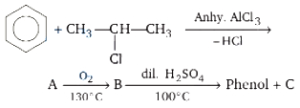
A
ethanol
B
propanone
C
cumene hydroperoxide
D
water
Solution
(B) The reaction sequence is the industrial preparation of phenol from cumene:
$1$. Benzene reacts with isopropyl chloride in the presence of anhydrous $AlCl_3$ to form cumene $(A)$.
$2$. Cumene $(A)$ is oxidized by $O_2$ at $130^{\circ}C$ to form cumene hydroperoxide $(B)$.
$3$. Cumene hydroperoxide $(B)$ is treated with dilute $H_2SO_4$ at $100^{\circ}C$ to yield phenol and propanone $(C)$.
Therefore,$C$ is propanone.
$1$. Benzene reacts with isopropyl chloride in the presence of anhydrous $AlCl_3$ to form cumene $(A)$.
$2$. Cumene $(A)$ is oxidized by $O_2$ at $130^{\circ}C$ to form cumene hydroperoxide $(B)$.
$3$. Cumene hydroperoxide $(B)$ is treated with dilute $H_2SO_4$ at $100^{\circ}C$ to yield phenol and propanone $(C)$.
Therefore,$C$ is propanone.
0 likesView Solution
56
ChemistryDifficultMCQKCET · 2012
The number of moles of hydrogen that can be added to $1$ mole of an oil is the highest in
A
groundnut oil
B
sunflower seed oil
C
mustard oil
D
linseed oil
Solution
(D) $1$ mole of linseed oil has the maximum number of moles of hydrogen added because it contains the highest degree of unsaturation.
Linseed oil is a typical drying oil.
It consists primarily of linolenic acid esters (polyunsaturated fatty acids),which have multiple double bonds,allowing for the addition of more hydrogen compared to other oils listed.
Linseed oil is a typical drying oil.
It consists primarily of linolenic acid esters (polyunsaturated fatty acids),which have multiple double bonds,allowing for the addition of more hydrogen compared to other oils listed.
0 likesView Solution
57
ChemistryEasyMCQKCET · 2012
An organic compound '$A$' burns with a sooty flame. It is negative towards Tollen's reagent test and positive for Borsche's reagent test. The compound '$A$' is
A
Acetophenone
B
Acetone
C
Salicylic acid
D
Benzaldehyde
Solution
(A) Since the given compound '$A$' burns with a sooty flame,it must be an aromatic compound.
When it reacts with Borsche's reagent (acidic $2,4-$dinitrophenylhydrazine solution),it yields an orange precipitate,which indicates that it is a carbonyl compound (aldehyde or ketone).
Since '$A$' gives a negative result for Tollen's reagent test,it cannot be an aldehyde.
Therefore,it must be an aromatic ketone.
Hence,'$A$' is acetophenone.
When it reacts with Borsche's reagent (acidic $2,4-$dinitrophenylhydrazine solution),it yields an orange precipitate,which indicates that it is a carbonyl compound (aldehyde or ketone).
Since '$A$' gives a negative result for Tollen's reagent test,it cannot be an aldehyde.
Therefore,it must be an aromatic ketone.
Hence,'$A$' is acetophenone.
0 likesView Solution
58
ChemistryEasyMCQKCET · 2012
The $s$-block element used as a catalyst in the manufacture of $Buna-S$ rubber is
A
$Ca$
B
$Mg$
C
$Na$
D
All of the above
Solution
(C) $Buna-S$ rubber is a copolymer of $1,3-butadiene$ and styrene.
It is prepared by the polymerization of $1,3-butadiene$ $(75 \%)$ and styrene $(25 \%)$ in the presence of sodium $(Na)$ as a catalyst.
Thus,the $s$-block element used is $Na$.
It is prepared by the polymerization of $1,3-butadiene$ $(75 \%)$ and styrene $(25 \%)$ in the presence of sodium $(Na)$ as a catalyst.
Thus,the $s$-block element used is $Na$.
0 likesView Solution
59
ChemistryEasyMCQKCET · 2012
The vapour pressures of two liquids $A$ and $B$ in their pure states are in the ratio of $1:2$. $A$ binary solution of $A$ and $B$ contains $A$ and $B$ in the mole proportion of $1:2$. The mole fraction of $A$ in the vapour phase of the solution will be
A
$0.2$
B
$0.25$
C
$0.52$
D
$0.33$
Solution
(A) Given: $\frac{P_A^0}{P_B^0} = \frac{1}{2}$ and $\frac{n_A}{n_B} = \frac{1}{2}$.
Mole fraction of $A$ in liquid phase,$x_A = \frac{n_A}{n_A + n_B} = \frac{1}{1+2} = \frac{1}{3}$.
Mole fraction of $B$ in liquid phase,$x_B = \frac{n_B}{n_A + n_B} = \frac{2}{1+2} = \frac{2}{3}$.
According to Raoult's law,partial pressures are:
$P_A = x_A P_A^0 = \frac{1}{3} P_A^0$
$P_B = x_B P_B^0 = \frac{2}{3} P_B^0 = \frac{2}{3} (2 P_A^0) = \frac{4}{3} P_A^0$
Total pressure $P_{total} = P_A + P_B = \frac{1}{3} P_A^0 + \frac{4}{3} P_A^0 = \frac{5}{3} P_A^0$.
Mole fraction of $A$ in vapour phase,$y_A = \frac{P_A}{P_{total}} = \frac{\frac{1}{3} P_A^0}{\frac{5}{3} P_A^0} = \frac{1}{5} = 0.2$.
Mole fraction of $A$ in liquid phase,$x_A = \frac{n_A}{n_A + n_B} = \frac{1}{1+2} = \frac{1}{3}$.
Mole fraction of $B$ in liquid phase,$x_B = \frac{n_B}{n_A + n_B} = \frac{2}{1+2} = \frac{2}{3}$.
According to Raoult's law,partial pressures are:
$P_A = x_A P_A^0 = \frac{1}{3} P_A^0$
$P_B = x_B P_B^0 = \frac{2}{3} P_B^0 = \frac{2}{3} (2 P_A^0) = \frac{4}{3} P_A^0$
Total pressure $P_{total} = P_A + P_B = \frac{1}{3} P_A^0 + \frac{4}{3} P_A^0 = \frac{5}{3} P_A^0$.
Mole fraction of $A$ in vapour phase,$y_A = \frac{P_A}{P_{total}} = \frac{\frac{1}{3} P_A^0}{\frac{5}{3} P_A^0} = \frac{1}{5} = 0.2$.
0 likesView Solution
60
ChemistryMediumMCQKCET · 2012
The mass of a non-volatile solute of molar mass $40 \ g \ mol^{-1}$ that should be dissolved in $114 \ g$ of octane to lower its vapour pressure by $20 \%$ is (in $g$)
A
$11.4$
B
$9.8$
C
$12.8$
D
$10$
Solution
(D) According to Raoult's law for relative lowering of vapour pressure:
$\frac{p^{\circ} - p}{p^{\circ}} = \frac{n}{n + N} \approx \frac{n}{N} = \frac{w \times M}{m \times W}$
Given:
$p^{\circ} = 100, \quad p = 100 - 20 = 80$
$m = 40 \ g \ mol^{-1}, \quad M(C_{8}H_{18}) = 8 \times 12 + 18 \times 1 = 114 \ g \ mol^{-1}$
$W = 114 \ g, \quad w = ?$
Substituting the values:
$\frac{100 - 80}{100} = \frac{w \times 114}{40 \times 114}$
$\frac{20}{100} = \frac{w}{40}$
$w = \frac{0.2 \times 40} = 8 \ g$
Wait,checking the formula $\frac{p^{\circ} - p}{p} = \frac{w \times M}{m \times W}$:
$\frac{20}{80} = \frac{w \times 114}{40 \times 114}$
$0.25 = \frac{w}{40}$
$w = 0.25 \times 40 = 10 \ g$
$\frac{p^{\circ} - p}{p^{\circ}} = \frac{n}{n + N} \approx \frac{n}{N} = \frac{w \times M}{m \times W}$
Given:
$p^{\circ} = 100, \quad p = 100 - 20 = 80$
$m = 40 \ g \ mol^{-1}, \quad M(C_{8}H_{18}) = 8 \times 12 + 18 \times 1 = 114 \ g \ mol^{-1}$
$W = 114 \ g, \quad w = ?$
Substituting the values:
$\frac{100 - 80}{100} = \frac{w \times 114}{40 \times 114}$
$\frac{20}{100} = \frac{w}{40}$
$w = \frac{0.2 \times 40} = 8 \ g$
Wait,checking the formula $\frac{p^{\circ} - p}{p} = \frac{w \times M}{m \times W}$:
$\frac{20}{80} = \frac{w \times 114}{40 \times 114}$
$0.25 = \frac{w}{40}$
$w = 0.25 \times 40 = 10 \ g$
0 likesView Solution
61
ChemistryMediumMCQKCET · 2012
All colloidal dispersions have
A
low osmotic pressure
B
no osmotic pressure
C
high osmotic pressure
D
very high osmotic pressure
Solution
(A) Colloidal particles are larger aggregates compared to solute particles in a true solution.
Since the number of particles in a colloidal dispersion is significantly smaller than in a true solution at the same concentration,the colligative properties,such as osmotic pressure,are of a low order.
Therefore,colloidal dispersions exhibit low osmotic pressure.
Since the number of particles in a colloidal dispersion is significantly smaller than in a true solution at the same concentration,the colligative properties,such as osmotic pressure,are of a low order.
Therefore,colloidal dispersions exhibit low osmotic pressure.
0 likesView Solution
62
ChemistryMediumMCQKCET · 2012
Dialysis can be used to separate
A
protein and starch
B
glucose and protein
C
glucose and $NaCl$
D
glucose and fructose
Solution
(B) Dialysis is a process used to separate colloidal particles from crystalloids through a semi-permeable membrane.
Colloidal particles (like proteins) cannot pass through the membrane,while crystalloids (like glucose) can pass through.
Therefore,dialysis is used to separate $glucose$ and $protein$.
Colloidal particles (like proteins) cannot pass through the membrane,while crystalloids (like glucose) can pass through.
Therefore,dialysis is used to separate $glucose$ and $protein$.
0 likesView Solution
63
ChemistryEasyMCQKCET · 2012
During the adsorption of a gas on the surface of a solid,which of the following is true?
A
$\Delta G > 0, \Delta H < 0, \Delta S < 0$
B
$\Delta G < 0, \Delta H < 0, \Delta S < 0$
C
$\Delta G < 0, \Delta H < 0, \Delta S > 0$
D
$\Delta G < 0, \Delta H > 0, \Delta S < 0$
Solution
(B) During the adsorption of a gas on the surface of a solid,there is a decrease in surface energy,which means it is an exothermic process. Therefore,$\Delta H < 0$.
When a gas is adsorbed,the freedom of movement of its molecules becomes restricted,leading to a decrease in the entropy of the system. Therefore,$\Delta S < 0$.
According to the Gibbs free energy equation,$\Delta G = \Delta H - T \Delta S$. For a spontaneous process,$\Delta G$ must be negative. Since adsorption is a spontaneous process,$\Delta G < 0$.
When a gas is adsorbed,the freedom of movement of its molecules becomes restricted,leading to a decrease in the entropy of the system. Therefore,$\Delta S < 0$.
According to the Gibbs free energy equation,$\Delta G = \Delta H - T \Delta S$. For a spontaneous process,$\Delta G$ must be negative. Since adsorption is a spontaneous process,$\Delta G < 0$.
0 likesView Solution
Vedclass Products
For Students
Vedclass Test Series
Mock tests in real KCET style covering Chemistry with performance analysis. 5-day free trial.
Start Free TrialFor Teachers
Exam Paper Generator
Generate Set A/B/C/D Chemistry papers from 7.5L+ questions in 2 minutes. 3 chapters free.
Try FreeFor Institutes
Online Exam Module
Run live KCET mock exams with unlimited students, 360° analytics & white-label branding.
See DemoFrequently Asked Questions
How many Chemistry questions are in KCET 2012?
There are 63 Chemistry questions from the KCET 2012 paper on Vedclass, each with a detailed step-by-step solution in English.
Are KCET 2012 Chemistry solutions available in English?
Yes. All solutions on this page are in English. You can also switch to English or Hindi using the language buttons above the questions.
Can I practice KCET 2012 Chemistry as a timed test?
Yes. Use the Vedclass Test Series to attempt a full KCET mock test covering Chemistry with time limits and instant score analysis.
Can teachers create Chemistry papers from KCET previous year questions?
Yes. The Vedclass Exam Paper Generator lets teachers mix KCET Chemistry questions and generate Set A/B/C/D papers in minutes.
For Teachers & Institutes
Build a Custom Chemistry Paper
Pick KCET 2012 Chemistry questions, set difficulty, and generate Set A/B/C/D in 2 minutes.