
BiologyQ1–29 of 29 questions
Page 1 of 1 · English
1
BiologyEasyMCQKCET · 2012
Read the statements given below and identify the incorrect statement.
A
Scientific names are used all over the world.
B
Scientific names are often descriptive and tell us some important character of an organism.
C
Scientific names indicate relationship between species.
D
Scientific names favour multiple naming for the same kind of an organism.
Solution
(D) is the incorrect statement because scientific names do not favor multiple naming for the same kind of organism.
Instead,they ensure that each organism has a unique and universally accepted name.
This system avoids confusion and maintains consistency in scientific communication globally.
Instead,they ensure that each organism has a unique and universally accepted name.
This system avoids confusion and maintains consistency in scientific communication globally.
0 likesView Solution
2
BiologyEasyMCQKCET · 2012
Point out the correct method of writing the scientific name of the coconut palm derived by binomial nomenclature.
A
Cocos nucifera
B
Cocos Nucifera
C
cocos Nicifera
D
cocos nicifera
Solution
(A) The correct answer is $A$.
According to the rules of binomial nomenclature:
$1$. The scientific name consists of two parts: the genus name and the species epithet.
$2$. The genus name starts with a capital letter, while the species epithet starts with a small letter.
$3$. When printed, the scientific name should be in italics.
Therefore, $Cocos \text{ } nucifera$ is the correct representation.
According to the rules of binomial nomenclature:
$1$. The scientific name consists of two parts: the genus name and the species epithet.
$2$. The genus name starts with a capital letter, while the species epithet starts with a small letter.
$3$. When printed, the scientific name should be in italics.
Therefore, $Cocos \text{ } nucifera$ is the correct representation.
0 likesView Solution
3
BiologyEasyMCQKCET · 2012
Visible expression of the genetic phenomenon of crossing over is called
A
recombination
B
condensation
C
chiasmata
D
spiralisation
Solution
(C) The correct answer is $C$.
Crossing over is the process of exchange of genetic material between non-sister chromatids of homologous chromosomes during the $pachytene$ stage of $prophase-I$ of $meiosis$.
The visible manifestation or expression of this crossing over,which can be observed under a microscope during the $diplotene$ stage,is known as $chiasmata$ (singular: $chiasma$).
These $X$-shaped structures represent the sites where the physical exchange of $DNA$ segments has occurred.
Crossing over is the process of exchange of genetic material between non-sister chromatids of homologous chromosomes during the $pachytene$ stage of $prophase-I$ of $meiosis$.
The visible manifestation or expression of this crossing over,which can be observed under a microscope during the $diplotene$ stage,is known as $chiasmata$ (singular: $chiasma$).
These $X$-shaped structures represent the sites where the physical exchange of $DNA$ segments has occurred.
0 likesView Solution
4
BiologyEasyMCQKCET · 2012
In the condensed schematic representation of the dark reaction of photosynthesis given below,steps are indicated by alphabets. Select the option where the alphabets are correctly identified.
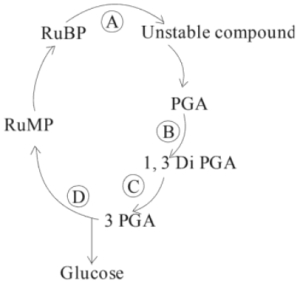
A
$A = CO_2$ fixation,$B =$ Phosphorylation,$C =$ Reduction,$D =$ Regeneration
B
$A =$ Regeneration,$B = CO_2$ fixation,$C =$ Reduction,$D =$ Phosphorylation
C
$A = CO_2$ fixation,$B =$ Reduction,$C =$ Phosphorylation,$D =$ Regeneration
D
$A =$ Phosphorylation,$B = CO_2$ fixation,$C =$ Reduction,$D =$ Regeneration
Solution
(A) The correct option is $A$.
In the Calvin cycle (dark reaction),the process consists of three main stages:
$1$. Carboxylation $(A)$: $CO_2$ is fixed by $RuBP$ to form an unstable compound which breaks down into $PGA$.
$2$. Reduction ($B$ and $C$): This involves two steps:
- Phosphorylation $(B)$: $PGA$ is converted to $1,3$-bisphosphoglycerate using $ATP$.
- Reduction $(C)$: $1,3$-bisphosphoglycerate is reduced to $G3P$ (or $3-PGA$ aldehyde) using $NADPH$.
$3$. Regeneration $(D)$: $RuBP$ is regenerated from $RuMP$ using $ATP$ to continue the cycle.
In the Calvin cycle (dark reaction),the process consists of three main stages:
$1$. Carboxylation $(A)$: $CO_2$ is fixed by $RuBP$ to form an unstable compound which breaks down into $PGA$.
$2$. Reduction ($B$ and $C$): This involves two steps:
- Phosphorylation $(B)$: $PGA$ is converted to $1,3$-bisphosphoglycerate using $ATP$.
- Reduction $(C)$: $1,3$-bisphosphoglycerate is reduced to $G3P$ (or $3-PGA$ aldehyde) using $NADPH$.
$3$. Regeneration $(D)$: $RuBP$ is regenerated from $RuMP$ using $ATP$ to continue the cycle.
0 likesView Solution
5
BiologyEasyMCQKCET · 2012
Chemiosmotic theory of $ATP$ synthesis in the mitochondrion is based on
A
$Ca^{++}$ gradient
B
$K^{+}$ gradient
C
$H^{+}$ gradient
D
$Na^{+}$ gradient
Solution
(C) The correct answer is $C$.
According to the chemiosmotic hypothesis,the synthesis of $ATP$ in both mitochondria and chloroplasts is driven by a proton $(H^{+})$ gradient across the membrane.
In mitochondria,this gradient is established across the inner mitochondrial membrane during the electron transport chain,creating a higher concentration of protons in the intermembrane space compared to the matrix.
This electrochemical gradient provides the energy required for $ATP$ synthase to phosphorylate $ADP$ into $ATP$.
According to the chemiosmotic hypothesis,the synthesis of $ATP$ in both mitochondria and chloroplasts is driven by a proton $(H^{+})$ gradient across the membrane.
In mitochondria,this gradient is established across the inner mitochondrial membrane during the electron transport chain,creating a higher concentration of protons in the intermembrane space compared to the matrix.
This electrochemical gradient provides the energy required for $ATP$ synthase to phosphorylate $ADP$ into $ATP$.
0 likesView Solution
6
BiologyEasyMCQKCET · 2012
Select a suitable name for the following process: $C_6H_{12}O_6 + 2ADP + 2Pi \rightarrow 2C_2H_5OH + 2ATP + 2CO_2\uparrow$

A
Alcoholic fermentation
B
Photorespiration
C
Lactate fermentation
D
Aerobic respiration
Solution
(A) Alcoholic fermentation.
The equation provided represents the process of alcoholic fermentation,where glucose $(C_6H_{12}O_6)$ is converted into ethanol $(2C_2H_5OH)$,carbon dioxide $(2CO_2)$,and a small amount of $ATP$ $(2ATP)$.
This is an anaerobic process that occurs in yeast and some bacteria,where ethanol and carbon dioxide are produced as byproducts.
The equation provided represents the process of alcoholic fermentation,where glucose $(C_6H_{12}O_6)$ is converted into ethanol $(2C_2H_5OH)$,carbon dioxide $(2CO_2)$,and a small amount of $ATP$ $(2ATP)$.
This is an anaerobic process that occurs in yeast and some bacteria,where ethanol and carbon dioxide are produced as byproducts.
0 likesView Solution
7
BiologyEasyMCQKCET · 2012
The site of Krebs cycle is
A
cytoplasm
B
mitochondrial matrix
C
intermembrane space of mitochondria
D
Racker's particles
Solution
(B) The correct answer is $B$ (mitochondrial matrix).
The Krebs cycle,also known as the citric acid cycle or $TCA$ cycle,takes place in the mitochondrial matrix.
During the cycle,acetyl $CoA$ is oxidized to produce $ATP$,$NADH$,$FADH_2$,and $CO_2$,which are essential for energy production in cells.
The mitochondrial matrix provides the necessary environment and enzymes for this process to occur efficiently.
The Krebs cycle,also known as the citric acid cycle or $TCA$ cycle,takes place in the mitochondrial matrix.
During the cycle,acetyl $CoA$ is oxidized to produce $ATP$,$NADH$,$FADH_2$,and $CO_2$,which are essential for energy production in cells.
The mitochondrial matrix provides the necessary environment and enzymes for this process to occur efficiently.
0 likesView Solution
8
BiologyEasyMCQKCET · 2012
Perishable vegetables can be maintained fresh for a longer period by spraying them with a solution of
A
$ABA$
B
cytokinin
C
ethephon
D
phenylmercuric acetate
Solution
(B) The correct answer is $B$ (cytokinin).
Cytokinins are plant hormones that promote cell division and delay the process of senescence (aging) in plant tissues.
By spraying perishable vegetables with a cytokinin solution,the degradation of chlorophyll and proteins is slowed down,thereby maintaining their freshness and extending their shelf life.
Cytokinins are plant hormones that promote cell division and delay the process of senescence (aging) in plant tissues.
By spraying perishable vegetables with a cytokinin solution,the degradation of chlorophyll and proteins is slowed down,thereby maintaining their freshness and extending their shelf life.
0 likesView Solution
9
BiologyEasyMCQKCET · 2012
The condition of erythroblastosis fetalis occurs only when
A
the husband is $Rh^{+}$ and the wife is $Rh^{-}$
B
the husband is $Rh^{-}$ and the wife is $Rh^{+}$
C
the mother is $Rh^{+}$ and the father is $Rh^{-}$
D
the mother is $Rh^{-}$ and the father is $Rh^{+}$
Solution
(D) The correct answer is $D$.
Erythroblastosis fetalis is a hemolytic disease of the newborn that occurs when an $Rh^{-}$ mother carries an $Rh^{+}$ fetus.
During the first delivery,fetal blood containing $Rh$ antigens may enter the mother's circulation,causing her to produce anti-$Rh$ antibodies.
In subsequent pregnancies,these maternal antibodies can cross the placenta and destroy the red blood cells of the $Rh^{+}$ fetus,leading to severe anemia and jaundice.
Erythroblastosis fetalis is a hemolytic disease of the newborn that occurs when an $Rh^{-}$ mother carries an $Rh^{+}$ fetus.
During the first delivery,fetal blood containing $Rh$ antigens may enter the mother's circulation,causing her to produce anti-$Rh$ antibodies.
In subsequent pregnancies,these maternal antibodies can cross the placenta and destroy the red blood cells of the $Rh^{+}$ fetus,leading to severe anemia and jaundice.
0 likesView Solution
10
BiologyEasyMCQKCET · 2012
Study the diagram given below and identify the cells labelled as $A$, $B$, $C$ and $D$, and choose the correct option.
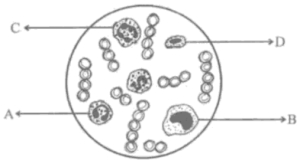
A
$A = \text{Eosinophil}, B = \text{Erythrocyte}, C = \text{Neutrophil} \text{ and } D = \text{Basophil}$
B
$A = \text{Eosinophil}, B = \text{Lymphocyte}, C = \text{Neutrophil} \text{ and } D = \text{Monocyte}$
C
$A = \text{Erythrocyte}, B = \text{Basophil}, C = \text{Neutrophil} \text{ and } D = \text{Lymphocyte}$
D
$A = \text{Eosinophil}, B = \text{Monocyte}, C = \text{Neutrophil} \text{ and } D = \text{Lymphocyte}$
Solution
(D) The correct option is $D$.
The given image shows the following blood cells:
• $A = \text{Eosinophil}$, characterized by its bilobed nucleus.
• $B = \text{Monocyte}$, identifiable by its large, kidney-shaped or bean-shaped nucleus and abundant cytoplasm.
• $C = \text{Neutrophil}$, identifiable by its multi-lobed nucleus.
• $D = \text{Lymphocyte}$, recognized by its large, round nucleus and minimal cytoplasm.
The given image shows the following blood cells:
• $A = \text{Eosinophil}$, characterized by its bilobed nucleus.
• $B = \text{Monocyte}$, identifiable by its large, kidney-shaped or bean-shaped nucleus and abundant cytoplasm.
• $C = \text{Neutrophil}$, identifiable by its multi-lobed nucleus.
• $D = \text{Lymphocyte}$, recognized by its large, round nucleus and minimal cytoplasm.
0 likesView Solution
11
BiologyEasyMCQKCET · 2012
The frequency of heartbeat in our body is maintained by:
A
$AV$ Node
B
$SA$ Node
C
Node of Ranvier
D
Chordae tendineae
Solution
(B) The correct answer is $B$.
The sinoatrial $(SA)$ node,often referred to as the natural pacemaker of the heart,is located in the right atrium.
It generates rhythmic electrical impulses that initiate each heartbeat.
These impulses spread through the heart muscle,causing the atria to contract and setting the pace for the heart rate,thereby maintaining the frequency of heartbeats.
The sinoatrial $(SA)$ node,often referred to as the natural pacemaker of the heart,is located in the right atrium.
It generates rhythmic electrical impulses that initiate each heartbeat.
These impulses spread through the heart muscle,causing the atria to contract and setting the pace for the heart rate,thereby maintaining the frequency of heartbeats.
0 likesView Solution
12
BiologyEasyMCQKCET · 2012
Hypothalamus of the brain is not involved in this function.
A
Sleep-wake cycle
B
Osmoregulation and thirst
C
Temperature control
D
Accuracy of muscular movement
Solution
(D) The correct answer is $D$.
$1$. The hypothalamus is a vital part of the diencephalon that regulates several homeostatic functions,including the sleep-wake cycle,osmoregulation,thirst,and body temperature control.
$2$. The accuracy of muscular movement,coordination,posture,and balance are primarily controlled by the cerebellum,which is a part of the hindbrain.
$3$. Therefore,the hypothalamus is not involved in the regulation of muscular movement accuracy.
$1$. The hypothalamus is a vital part of the diencephalon that regulates several homeostatic functions,including the sleep-wake cycle,osmoregulation,thirst,and body temperature control.
$2$. The accuracy of muscular movement,coordination,posture,and balance are primarily controlled by the cerebellum,which is a part of the hindbrain.
$3$. Therefore,the hypothalamus is not involved in the regulation of muscular movement accuracy.
0 likesView Solution
13
BiologyEasyMCQKCET · 2012
Choose the mismatched pair from the following:
A
Insulin-Gluconeogenesis
B
Glucagon-Glycogenolysis
C
Oxytocin-Contraction of uterine muscles
D
Prolactin-Milk production in mammary glands
Solution
(A) is the mismatched pair.
Insulin is a hormone that lowers blood glucose levels by primarily promoting glucose uptake into cells and glycogen synthesis,while simultaneously inhibiting gluconeogenesis.
Gluconeogenesis,which is the synthesis of glucose from non-carbohydrate sources,is stimulated by hormones like glucagon and cortisol,not insulin.
Insulin is a hormone that lowers blood glucose levels by primarily promoting glucose uptake into cells and glycogen synthesis,while simultaneously inhibiting gluconeogenesis.
Gluconeogenesis,which is the synthesis of glucose from non-carbohydrate sources,is stimulated by hormones like glucagon and cortisol,not insulin.
0 likesView Solution
14
BiologyEasyMCQKCET · 2012
Which of the following statements is not true for $Nostoc$?
A
It is prokaryotic
B
It is autotrophic
C
It is filamentous
D
It is macroscopic
Solution
(D) is the correct answer.
$Nostoc$ is a genus of cyanobacteria that is prokaryotic,autotrophic,and filamentous.
However,it is not macroscopic.
Although it forms colonies that appear as gelatinous masses visible to the naked eye,these masses are composed of microscopic filaments of cells.
Therefore,the individual organism $Nostoc$ remains microscopic.
$Nostoc$ is a genus of cyanobacteria that is prokaryotic,autotrophic,and filamentous.
However,it is not macroscopic.
Although it forms colonies that appear as gelatinous masses visible to the naked eye,these masses are composed of microscopic filaments of cells.
Therefore,the individual organism $Nostoc$ remains microscopic.
0 likesView Solution
15
BiologyEasyMCQKCET · 2012
Pteridophytes are called vascular cryptogams because they are non-seeded plants containing:
A
xylem and phloem
B
xylem only
C
phloem only
D
neither xylem nor phloem
Solution
(A) - xylem and phloem.
Pteridophytes are known as vascular cryptogams because they are seedless plants that possess a well-developed vascular system consisting of both xylem and phloem.
The xylem is responsible for the conduction of water and minerals,while the phloem is responsible for the translocation of food materials.
This vascular tissue allows them to grow taller and survive in diverse terrestrial habitats compared to bryophytes.
Pteridophytes are known as vascular cryptogams because they are seedless plants that possess a well-developed vascular system consisting of both xylem and phloem.
The xylem is responsible for the conduction of water and minerals,while the phloem is responsible for the translocation of food materials.
This vascular tissue allows them to grow taller and survive in diverse terrestrial habitats compared to bryophytes.
0 likesView Solution
16
BiologyEasyMCQKCET · 2012
The adult animal in this phylum is radially symmetrical; but its larva exhibits bilateral symmetry.
A
Echinodermata
B
Coelenterata
C
Arthropoda
D
Protozoa
Solution
(A) The correct answer is $A$.
In the phylum $Echinodermata$,adult animals exhibit radial symmetry,while their larval stages show bilateral symmetry.
This transition from bilateral symmetry in the larval stage to radial symmetry in the adult form is a unique and characteristic feature of echinoderms.
In the phylum $Echinodermata$,adult animals exhibit radial symmetry,while their larval stages show bilateral symmetry.
This transition from bilateral symmetry in the larval stage to radial symmetry in the adult form is a unique and characteristic feature of echinoderms.
0 likesView Solution
17
BiologyEasyMCQKCET · 2012
$A$ fruit that develops from a single flower with a syncarpous pistil is
A
simple fruit
B
aggregate fruit
C
multiple fruit
D
pseudocarp
Solution
(A) The correct answer is $A$.
$A$ simple fruit develops from a single flower with a syncarpous pistil,where the carpels are fused together.
In contrast,an aggregate fruit develops from a single flower with multiple free carpels (apocarpous),and a multiple fruit develops from an entire inflorescence.
Depending on the nature of the pericarp,a simple fruit can be either dry or succulent.
$A$ simple fruit develops from a single flower with a syncarpous pistil,where the carpels are fused together.
In contrast,an aggregate fruit develops from a single flower with multiple free carpels (apocarpous),and a multiple fruit develops from an entire inflorescence.
Depending on the nature of the pericarp,a simple fruit can be either dry or succulent.
0 likesView Solution
18
BiologyEasyMCQKCET · 2012
Find out the wrong statement about angiosperm roots.
A
Cuticle is absent in young stages.
B
The apex is protected by root cap.
C
Vascular bundle are collateral.
D
Xylem is centripetal in growth in the young roots.
Solution
(C) The correct answer is $C$. In angiosperm roots,the vascular bundles are radial,not collateral.
In a radial arrangement,$Xylem$ and $Phloem$ are present in separate bundles along different radii.
In contrast,a collateral arrangement (found in stems) involves $Xylem$ and $Phloem$ being arranged together in a single bundle along the same radius.
In a radial arrangement,$Xylem$ and $Phloem$ are present in separate bundles along different radii.
In contrast,a collateral arrangement (found in stems) involves $Xylem$ and $Phloem$ being arranged together in a single bundle along the same radius.
0 likesView Solution
19
BiologyEasyMCQKCET · 2012
Which of the following parts of the vertebrate body arises from the mesoderm?
A
Spinal cord
B
Bony skeleton
C
Epidermis
D
Lens of the eye
Solution
(B) Bony skeleton.
The mesoderm,which is the middle layer of cells in the gastrula located between the ectoderm and endoderm,develops into the bony skeleton,muscles,circulatory system,and dermis of the skin.
In contrast,the spinal cord,epidermis,and lens of the eye are derived from the ectoderm.
The mesoderm,which is the middle layer of cells in the gastrula located between the ectoderm and endoderm,develops into the bony skeleton,muscles,circulatory system,and dermis of the skin.
In contrast,the spinal cord,epidermis,and lens of the eye are derived from the ectoderm.
0 likesView Solution
20
BiologyEasyMCQKCET · 2012
With regard to the $ABO$ blood typing system,if a man who has type $B$ blood and a woman who has type $O$ blood were to have children,what blood types could the children have?
A
$A$ or $O$
B
$B$ or $O$
C
$AB$ or $O$
D
$A, B, AB$ or $O$
Solution
(B) The $ABO$ blood group system is determined by three alleles: $I^A, I^B$,and $i$.
Individuals with type $B$ blood can have the genotype $I^B I^B$ (homozygous) or $I^B i$ (heterozygous).
Individuals with type $O$ blood must have the genotype $ii$.
If the man is $I^B I^B$,the cross is $I^B I^B \times ii$,resulting in all offspring having the genotype $I^B i$ (Type $B$ blood).
If the man is $I^B i$,the cross is $I^B i \times ii$,resulting in offspring with genotypes $I^B i$ (Type $B$ blood) and $ii$ (Type $O$ blood).
Therefore,the children could have either Type $B$ or Type $O$ blood.
Individuals with type $B$ blood can have the genotype $I^B I^B$ (homozygous) or $I^B i$ (heterozygous).
Individuals with type $O$ blood must have the genotype $ii$.
If the man is $I^B I^B$,the cross is $I^B I^B \times ii$,resulting in all offspring having the genotype $I^B i$ (Type $B$ blood).
If the man is $I^B i$,the cross is $I^B i \times ii$,resulting in offspring with genotypes $I^B i$ (Type $B$ blood) and $ii$ (Type $O$ blood).
Therefore,the children could have either Type $B$ or Type $O$ blood.
0 likesView Solution
21
BiologyEasyMCQKCET · 2012
Usually,the whorl in a flower that attracts insects and protects the essential parts is
A
calyx
B
androecium
C
gynoecium
D
corolla
Solution
(D) The correct answer is $D$.
The corolla,which is composed of petals,is the whorl that typically attracts insects through its bright colors and scent,facilitating pollination.
Additionally,the corolla serves a protective function for the essential reproductive organs,namely the androecium and gynoecium,during the early stages of floral development.
The corolla,which is composed of petals,is the whorl that typically attracts insects through its bright colors and scent,facilitating pollination.
Additionally,the corolla serves a protective function for the essential reproductive organs,namely the androecium and gynoecium,during the early stages of floral development.
0 likesView Solution
22
BiologyEasyMCQKCET · 2012
The fourth cleavage plane during the development of a frog's egg is:
A
Latitudinal
B
Meridional
C
Equatorial
D
Vertical
Solution
(B) In the development of a frog's egg,the cleavage pattern is holoblastic and unequal.
$1$. The first two cleavages are meridional and perpendicular to each other.
$2$. The third cleavage is latitudinal (horizontal) and slightly above the equator.
$3$. The fourth cleavage consists of two simultaneous meridional planes,one in each of the four blastomeres.
Therefore,the fourth cleavage plane is meridional.
$1$. The first two cleavages are meridional and perpendicular to each other.
$2$. The third cleavage is latitudinal (horizontal) and slightly above the equator.
$3$. The fourth cleavage consists of two simultaneous meridional planes,one in each of the four blastomeres.
Therefore,the fourth cleavage plane is meridional.
0 likesView Solution
23
BiologyEasyMCQKCET · 2012
Match the entries in Column-$I$ with those of Column-$II$ and choose the correct answer.
| Column-$I$ | Column-$II$ |
|---|---|
| $A$. Cleistogamy | $m$. Insect pollination |
| $B$. Geitonogamy | $n$. Bud pollination |
| $C$. Entomophily | $o$. Pollination between flowers in the same plant |
| $D$. Xenogamy | $p$. Wind pollination |
| $q$. Cross pollination |
A
$A-n, B-o, C-m, D-q$
B
$A-m, B-q, C-n, D-o$
C
$A-n, B-o, C-m, D-n$
D
$A-q, B-p, C-o, D-n$
Solution
(A) . Cleistogamy: It is a condition where flowers do not open,leading to bud pollination $(n)$.
$B$. Geitonogamy: It is the transfer of pollen grains from the anther to the stigma of another flower of the same plant $(o)$.
$C$. Entomophily: It is the process of pollination by insects $(m)$.
$D$. Xenogamy: It is the transfer of pollen grains from the anther to the stigma of a different plant,which is a type of cross-pollination $(q)$.
Therefore,the correct matching is $A-n, B-o, C-m, D-q$.
$B$. Geitonogamy: It is the transfer of pollen grains from the anther to the stigma of another flower of the same plant $(o)$.
$C$. Entomophily: It is the process of pollination by insects $(m)$.
$D$. Xenogamy: It is the transfer of pollen grains from the anther to the stigma of a different plant,which is a type of cross-pollination $(q)$.
Therefore,the correct matching is $A-n, B-o, C-m, D-q$.
0 likesView Solution
24
BiologyEasyMCQKCET · 2012
Which one of the following is not a wildlife conservation project?
A
Project Dodo
B
Project Indian Bustard
C
Project Tiger
D
Project Hangul
Solution
(A) $Project Dodo$ is not a real wildlife conservation initiative.
The dodo is an extinct species and has no current conservation project.
$Project Indian Bustard$,$Project Tiger$,and $Project Hangul$ are genuine conservation efforts in India aimed at protecting endangered species like the Indian bustard,tigers,and the Hangul deer.
The dodo is an extinct species and has no current conservation project.
$Project Indian Bustard$,$Project Tiger$,and $Project Hangul$ are genuine conservation efforts in India aimed at protecting endangered species like the Indian bustard,tigers,and the Hangul deer.
0 likesView Solution
25
BiologyEasyMCQKCET · 2012
Match the contraceptive methods given under column-$I$ with their examples given under column-$II$. Select the correct choice from those given below.
| Column $I$ | Column $II$ |
| $A$. Chemical | $p$. Tubectomy and vasectomy |
| $B$. $IUDs$ | $q$. Copper $T$ and loop |
| $C$. Barriers | $r$. Condom and cervical cap |
| $D$. Sterilisation | $s$. Spermicidal jelly and foam |
| $t$. Coitus interruptus and calendar method |
A
$A = s, B = q, C = r, D = p$
B
$A = s, B = t, C = q, D = r$
C
$A = p, B = r, C = q, D = t$
D
$A = s, B = q, C = t, D = p$
Solution
(A) The correct matching is as follows:
$A$. Chemical methods involve the use of chemicals like spermicidal jellies, creams, and foams to kill sperms. Thus, $A = s$.
$B$. $IUDs$ (Intrauterine Devices) include devices like Copper $T$, Copper $7$, and Lippes loop. Thus, $B = q$.
$C$. Barrier methods prevent the physical meeting of sperm and ovum, such as condoms, diaphragms, and cervical caps. Thus, $C = r$.
$D$. Sterilisation methods are surgical procedures to block gamete transport, such as tubectomy (in females) and vasectomy (in males). Thus, $D = p$.
Therefore, the correct sequence is $A = s, B = q, C = r, D = p$.
$A$. Chemical methods involve the use of chemicals like spermicidal jellies, creams, and foams to kill sperms. Thus, $A = s$.
$B$. $IUDs$ (Intrauterine Devices) include devices like Copper $T$, Copper $7$, and Lippes loop. Thus, $B = q$.
$C$. Barrier methods prevent the physical meeting of sperm and ovum, such as condoms, diaphragms, and cervical caps. Thus, $C = r$.
$D$. Sterilisation methods are surgical procedures to block gamete transport, such as tubectomy (in females) and vasectomy (in males). Thus, $D = p$.
Therefore, the correct sequence is $A = s, B = q, C = r, D = p$.
0 likesView Solution
26
BiologyEasyMCQKCET · 2012
The time for optimum chances of conception in a woman is . . . . . . starting from the day of menstruation.
A
$1^{\text{st}}$ day
B
$4^{\text{th}}$ day
C
$14^{\text{th}}$ day
D
$26^{\text{th}}$ day
Solution
(C) $14^{\text{th}}$ day.
In a typical $28$-day menstrual cycle,ovulation occurs around the $14^{\text{th}}$ day.
This is the time when the mature ovum is released from the ovary into the fallopian tube.
Since the ovum remains viable for about $24$ hours and sperm can survive for $2-3$ days in the female reproductive tract,the period around the $14^{\text{th}}$ day offers the highest probability of fertilization and conception.
In a typical $28$-day menstrual cycle,ovulation occurs around the $14^{\text{th}}$ day.
This is the time when the mature ovum is released from the ovary into the fallopian tube.
Since the ovum remains viable for about $24$ hours and sperm can survive for $2-3$ days in the female reproductive tract,the period around the $14^{\text{th}}$ day offers the highest probability of fertilization and conception.
0 likesView Solution
27
BiologyEasyMCQKCET · 2012
The sexually transmitted disease that can affect both the male and the female genitals and may damage the eyes of babies born of infected mothers is
A
$AIDS$
B
Syphilis
C
Gonorrhoea
D
Hepatitis
Solution
(C) Gonorrhoea.
$Gonorrhoea$ is a sexually transmitted infection caused by the bacterium $Neisseria$ $gonorrhoeae$.
It affects the mucous membranes of the reproductive tract in both males and females.
If a pregnant woman is infected with $gonorrhoea$,the bacteria can be transmitted to the baby during childbirth,leading to $ophthalmia$ $neonatorum$ (a severe eye infection in newborns) which can cause blindness if left untreated.
$AIDS$ is caused by $HIV$ and affects the immune system.
$Syphilis$ is caused by $Treponema$ $pallidum$ and affects various organs but is not the primary cause of neonatal eye damage compared to $gonorrhoea$.
$Hepatitis$ primarily affects the liver.
$Gonorrhoea$ is a sexually transmitted infection caused by the bacterium $Neisseria$ $gonorrhoeae$.
It affects the mucous membranes of the reproductive tract in both males and females.
If a pregnant woman is infected with $gonorrhoea$,the bacteria can be transmitted to the baby during childbirth,leading to $ophthalmia$ $neonatorum$ (a severe eye infection in newborns) which can cause blindness if left untreated.
$AIDS$ is caused by $HIV$ and affects the immune system.
$Syphilis$ is caused by $Treponema$ $pallidum$ and affects various organs but is not the primary cause of neonatal eye damage compared to $gonorrhoea$.
$Hepatitis$ primarily affects the liver.
0 likesView Solution
28
BiologyEasyMCQKCET · 2012
The Hardy-Weinberg principle cannot operate if
A
the population is very large
B
frequent mutations occur in the population
C
the population has no chance of interaction with other populations
D
free interbreeding occurs among all members of the population
Solution
(B) frequent mutations occur in the population.
The Hardy-Weinberg principle cannot operate if frequent mutations occur in the population.
This principle assumes no mutations,no genetic drift,no gene flow,no natural selection,and random mating.
Frequent mutations alter allele frequencies,thereby disrupting the genetic equilibrium.
Other options,such as a large population size,lack of gene flow,and random mating,are actually requirements for the Hardy-Weinberg equilibrium to be maintained.
The Hardy-Weinberg principle cannot operate if frequent mutations occur in the population.
This principle assumes no mutations,no genetic drift,no gene flow,no natural selection,and random mating.
Frequent mutations alter allele frequencies,thereby disrupting the genetic equilibrium.
Other options,such as a large population size,lack of gene flow,and random mating,are actually requirements for the Hardy-Weinberg equilibrium to be maintained.
0 likesView Solution
29
BiologyEasyMCQKCET · 2012
The enzymes which are absolutely necessary for recombinant $DNA$ technology are
A
restriction endonucleases and topoisomerases
B
endonucleases and polymerases
C
restriction endonucleases and ligases
D
peptidases and ligases
Solution
(C) restriction endonucleases and ligases.
The enzymes absolutely necessary for recombinant $DNA$ technology are restriction endonucleases and ligases.
$1$. Restriction endonucleases act as molecular scissors that cut $DNA$ at specific recognition sequences.
$2$. Ligases act as molecular glue that joins $DNA$ fragments together to form recombinant $DNA$ molecules.
$3$. Topoisomerases are involved in relieving $DNA$ supercoiling but are not the primary tools for recombination.
$4$. Polymerases are used for $DNA$ amplification $(PCR)$ but are distinct from the cutting and joining enzymes required for basic recombinant construction.
$5$. Peptidases are enzymes that break down proteins and have no role in $DNA$ manipulation.
The enzymes absolutely necessary for recombinant $DNA$ technology are restriction endonucleases and ligases.
$1$. Restriction endonucleases act as molecular scissors that cut $DNA$ at specific recognition sequences.
$2$. Ligases act as molecular glue that joins $DNA$ fragments together to form recombinant $DNA$ molecules.
$3$. Topoisomerases are involved in relieving $DNA$ supercoiling but are not the primary tools for recombination.
$4$. Polymerases are used for $DNA$ amplification $(PCR)$ but are distinct from the cutting and joining enzymes required for basic recombinant construction.
$5$. Peptidases are enzymes that break down proteins and have no role in $DNA$ manipulation.
0 likesView Solution
Vedclass Products
For Students
Vedclass Test Series
Mock tests in real KCET style covering Biology with performance analysis. 5-day free trial.
Start Free TrialFor Teachers
Exam Paper Generator
Generate Set A/B/C/D Biology papers from 7.5L+ questions in 2 minutes. 3 chapters free.
Try FreeFor Institutes
Online Exam Module
Run live KCET mock exams with unlimited students, 360° analytics & white-label branding.
See DemoFrequently Asked Questions
How many Biology questions are in KCET 2012?
There are 29 Biology questions from the KCET 2012 paper on Vedclass, each with a detailed step-by-step solution in English.
Are KCET 2012 Biology solutions available in English?
Yes. All solutions on this page are in English. You can also switch to English or Hindi using the language buttons above the questions.
Can I practice KCET 2012 Biology as a timed test?
Yes. Use the Vedclass Test Series to attempt a full KCET mock test covering Biology with time limits and instant score analysis.
Can teachers create Biology papers from KCET previous year questions?
Yes. The Vedclass Exam Paper Generator lets teachers mix KCET Biology questions and generate Set A/B/C/D papers in minutes.
For Teachers & Institutes
Build a Custom Biology Paper
Pick KCET 2012 Biology questions, set difficulty, and generate Set A/B/C/D in 2 minutes.