
MathematicsQ1–60 of 60 questions
Page 1 of 1 · English
1
MathematicsDifficultMCQKCET · 2012
If $\log _{2}\left(9^{x-1}+7\right)-\log _{2}\left(3^{x-1}+1\right)=2$,then $x$ values are
A
$0, 2$
B
$0, 1$
C
$1, 4$
D
$1, 2$
Solution
(D) Given: $\log _{2}\left(9^{x-1}+7\right)-\log _{2}\left(3^{x-1}+1\right)=2$
Using the property $\log_{a} m - \log_{a} n = \log_{a} (\frac{m}{n})$:
$\log _{2}\left(\frac{9^{x-1}+7}{3^{x-1}+1}\right)=2$
Converting to exponential form:
$\frac{9^{x-1}+7}{3^{x-1}+1}=2^{2}=4$
Let $y = 3^{x-1}$. Then $9^{x-1} = (3^{2})^{x-1} = (3^{x-1})^{2} = y^{2}$.
Substituting $y$ into the equation:
$\frac{y^{2}+7}{y+1}=4$
$y^{2}+7=4(y+1)$
$y^{2}-4y+3=0$
$(y-3)(y-1)=0$
So,$y=3$ or $y=1$.
Case $1$: $3^{x-1}=3^{1}$ $\Rightarrow x-1=1$ $\Rightarrow x=2$.
Case $2$: $3^{x-1}=3^{0}$ $\Rightarrow x-1=0$ $\Rightarrow x=1$.
Thus,the values of $x$ are $1, 2$.
Using the property $\log_{a} m - \log_{a} n = \log_{a} (\frac{m}{n})$:
$\log _{2}\left(\frac{9^{x-1}+7}{3^{x-1}+1}\right)=2$
Converting to exponential form:
$\frac{9^{x-1}+7}{3^{x-1}+1}=2^{2}=4$
Let $y = 3^{x-1}$. Then $9^{x-1} = (3^{2})^{x-1} = (3^{x-1})^{2} = y^{2}$.
Substituting $y$ into the equation:
$\frac{y^{2}+7}{y+1}=4$
$y^{2}+7=4(y+1)$
$y^{2}-4y+3=0$
$(y-3)(y-1)=0$
So,$y=3$ or $y=1$.
Case $1$: $3^{x-1}=3^{1}$ $\Rightarrow x-1=1$ $\Rightarrow x=2$.
Case $2$: $3^{x-1}=3^{0}$ $\Rightarrow x-1=0$ $\Rightarrow x=1$.
Thus,the values of $x$ are $1, 2$.
0 likesView Solution
2
MathematicsMediumMCQKCET · 2012
If $(24, 92) = 24m + 92n$,then $(m, n)$ is
A
$(-1, 4)$
B
$(4, -1)$
C
$(4, -3)$
D
$(-4, 3)$
Solution
(B) To find the greatest common divisor $(24, 92)$,we use the Euclidean algorithm:
$92 = 3 \times 24 + 20$
$24 = 1 \times 20 + 4$
$20 = 5 \times 4 + 0$
Thus,$(24, 92) = 4$.
Now,express $4$ as a linear combination of $24$ and $92$:
$4 = 24 - 1 \times 20$
Substitute $20 = 92 - 3 \times 24$:
$4 = 24 - 1 \times (92 - 3 \times 24)$
$4 = 24 - 92 + 3 \times 24$
$4 = 4 \times 24 - 1 \times 92$
Comparing this with $24m + 92n = 4$,we get $m = 4$ and $n = -1$.
Therefore,$(m, n) = (4, -1)$.
$92 = 3 \times 24 + 20$
$24 = 1 \times 20 + 4$
$20 = 5 \times 4 + 0$
Thus,$(24, 92) = 4$.
Now,express $4$ as a linear combination of $24$ and $92$:
$4 = 24 - 1 \times 20$
Substitute $20 = 92 - 3 \times 24$:
$4 = 24 - 1 \times (92 - 3 \times 24)$
$4 = 24 - 92 + 3 \times 24$
$4 = 4 \times 24 - 1 \times 92$
Comparing this with $24m + 92n = 4$,we get $m = 4$ and $n = -1$.
Therefore,$(m, n) = (4, -1)$.
0 likesView Solution
3
MathematicsEasyMCQKCET · 2012
If $\alpha, \beta$ and $\gamma$ are the roots of the equation $x^{3}+4x+2=0$,then $\alpha^{3}+\beta^{3}+\gamma^{3}$ is equal to
A
$2$
B
$6$
C
$-2$
D
$-6$
Solution
(D) Given the cubic equation $x^{3}+4x+2=0$.
Let the roots be $\alpha, \beta, \gamma$.
From the properties of roots of a cubic equation $ax^{3}+bx^{2}+cx+d=0$:
Sum of roots $\Sigma \alpha = -\frac{b}{a} = 0$.
Sum of roots taken two at a time $\Sigma \alpha \beta = \frac{c}{a} = 4$.
Product of roots $\alpha \beta \gamma = -\frac{d}{a} = -2$.
We know the identity $\alpha^{3}+\beta^{3}+\gamma^{3}-3 \alpha \beta \gamma = (\alpha+\beta+\gamma)(\alpha^{2}+\beta^{2}+\gamma^{2}-\alpha \beta-\beta \gamma-\gamma \alpha)$.
Since $\Sigma \alpha = 0$,the right side becomes $0$.
Therefore,$\alpha^{3}+\beta^{3}+\gamma^{3} = 3 \alpha \beta \gamma$.
Substituting the value of the product of roots:
$\alpha^{3}+\beta^{3}+\gamma^{3} = 3(-2) = -6$.
Let the roots be $\alpha, \beta, \gamma$.
From the properties of roots of a cubic equation $ax^{3}+bx^{2}+cx+d=0$:
Sum of roots $\Sigma \alpha = -\frac{b}{a} = 0$.
Sum of roots taken two at a time $\Sigma \alpha \beta = \frac{c}{a} = 4$.
Product of roots $\alpha \beta \gamma = -\frac{d}{a} = -2$.
We know the identity $\alpha^{3}+\beta^{3}+\gamma^{3}-3 \alpha \beta \gamma = (\alpha+\beta+\gamma)(\alpha^{2}+\beta^{2}+\gamma^{2}-\alpha \beta-\beta \gamma-\gamma \alpha)$.
Since $\Sigma \alpha = 0$,the right side becomes $0$.
Therefore,$\alpha^{3}+\beta^{3}+\gamma^{3} = 3 \alpha \beta \gamma$.
Substituting the value of the product of roots:
$\alpha^{3}+\beta^{3}+\gamma^{3} = 3(-2) = -6$.
0 likesView Solution
4
MathematicsMediumMCQKCET · 2012
If $(x-1)$ is a factor of the polynomial $x^{5}-4 x^{3}+2 x^{2}-3 x+k=0$,then the value of $k$ is:
A
$4$
B
$-4$
C
$2$
D
$3$
Solution
(A) Since $(x-1)$ is a factor of $x^{5}-4 x^{3}+2 x^{2}-3 x+k=0$,by the factor theorem,$x=1$ must satisfy the given equation.
Substituting $x=1$ into the equation:
$(1)^{5}-4(1)^{3}+2(1)^{2}-3(1)+k=0$
$1-4+2-3+k=0$
$-4+k=0$
$k=4$
Substituting $x=1$ into the equation:
$(1)^{5}-4(1)^{3}+2(1)^{2}-3(1)+k=0$
$1-4+2-3+k=0$
$-4+k=0$
$k=4$
0 likesView Solution
5
MathematicsEasyMCQKCET · 2012
The number of solutions of the equation $z^{2}+\overline{z}=0$,where $z \in \mathbb{C}$,is
A
$1$
B
$4$
C
$5$
D
$6$
Solution
(B) Let $z = x + iy$.
Then $z^{2} = x^{2} - y^{2} + 2ixy$.
Given $z^{2} + \overline{z} = 0$,we have $(x^{2} - y^{2} + 2ixy) + (x - iy) = 0$.
Grouping real and imaginary parts: $(x^{2} + x - y^{2}) + i(2xy - y) = 0$.
Equating real and imaginary parts to zero:
$x^{2} + x - y^{2} = 0$ $(i)$
$y(2x - 1) = 0$ (ii)
From (ii),either $y = 0$ or $x = 1/2$.
Case $1$: If $y = 0$,then $x^{2} + x = 0 \Rightarrow x(x + 1) = 0$,so $x = 0$ or $x = -1$. This gives solutions $z = 0$ and $z = -1$.
Case $2$: If $x = 1/2$,then $(1/2)^{2} + 1/2 - y^{2} = 0$ $\Rightarrow 1/4 + 1/2 = y^{2}$ $\Rightarrow y^{2} = 3/4$ $\Rightarrow y = \pm \sqrt{3}/2$. This gives solutions $z = 1/2 + i\sqrt{3}/2$ and $z = 1/2 - i\sqrt{3}/2$.
Thus,there are $4$ solutions in total.
Then $z^{2} = x^{2} - y^{2} + 2ixy$.
Given $z^{2} + \overline{z} = 0$,we have $(x^{2} - y^{2} + 2ixy) + (x - iy) = 0$.
Grouping real and imaginary parts: $(x^{2} + x - y^{2}) + i(2xy - y) = 0$.
Equating real and imaginary parts to zero:
$x^{2} + x - y^{2} = 0$ $(i)$
$y(2x - 1) = 0$ (ii)
From (ii),either $y = 0$ or $x = 1/2$.
Case $1$: If $y = 0$,then $x^{2} + x = 0 \Rightarrow x(x + 1) = 0$,so $x = 0$ or $x = -1$. This gives solutions $z = 0$ and $z = -1$.
Case $2$: If $x = 1/2$,then $(1/2)^{2} + 1/2 - y^{2} = 0$ $\Rightarrow 1/4 + 1/2 = y^{2}$ $\Rightarrow y^{2} = 3/4$ $\Rightarrow y = \pm \sqrt{3}/2$. This gives solutions $z = 1/2 + i\sqrt{3}/2$ and $z = 1/2 - i\sqrt{3}/2$.
Thus,there are $4$ solutions in total.
0 likesView Solution
6
MathematicsDifficultMCQKCET · 2012
If the conjugate of $(x + iy)(1 - 2i)$ is $1 + i$,then
A
$x - iy = \frac{1 + i}{1 - 2i}$
B
$x + iy = \frac{1 - i}{1 - 2i}$
C
$x = \frac{1}{5}$
D
$x = -\frac{1}{5}$
Solution
(B) Given that the conjugate of $(x + iy)(1 - 2i)$ is $1 + i$.
Let $z = (x + iy)(1 - 2i)$.
Then $\bar{z} = 1 + i$.
Taking the conjugate on both sides of $z = (x + iy)(1 - 2i)$,we get $\bar{z} = \overline{(x + iy)(1 - 2i)} = \overline{(x + iy)} \cdot \overline{(1 - 2i)}$.
Since $\bar{z} = 1 + i$,we have $(x - iy)(1 + 2i) = 1 + i$.
Alternatively,we can write $z = \overline{1 + i} = 1 - i$.
Thus,$(x + iy)(1 - 2i) = 1 - i$.
Dividing both sides by $(1 - 2i)$,we get $x + iy = \frac{1 - i}{1 - 2i}$.
This matches Option $(B)$.
Let $z = (x + iy)(1 - 2i)$.
Then $\bar{z} = 1 + i$.
Taking the conjugate on both sides of $z = (x + iy)(1 - 2i)$,we get $\bar{z} = \overline{(x + iy)(1 - 2i)} = \overline{(x + iy)} \cdot \overline{(1 - 2i)}$.
Since $\bar{z} = 1 + i$,we have $(x - iy)(1 + 2i) = 1 + i$.
Alternatively,we can write $z = \overline{1 + i} = 1 - i$.
Thus,$(x + iy)(1 - 2i) = 1 - i$.
Dividing both sides by $(1 - 2i)$,we get $x + iy = \frac{1 - i}{1 - 2i}$.
This matches Option $(B)$.
0 likesView Solution
7
MathematicsEasyMCQKCET · 2012
If $\alpha$ and $\beta$ are different complex numbers with $|\beta|=1$,then $\left|\frac{\beta-\alpha}{1-\bar{\alpha} \beta}\right|$ is equal to
A
$1/2$
B
$1$
C
$1/3$
D
$2$
Solution
(B) Given that $|\beta|=1$,we have $|\beta|^2 = \beta \bar{\beta} = 1$.
Consider the expression $\left|\frac{\beta-\alpha}{1-\bar{\alpha} \beta}\right|$.
Substituting $1 = \beta \bar{\beta}$ in the denominator,we get:
$\left|\frac{\beta-\alpha}{\beta \bar{\beta}-\bar{\alpha} \beta}\right| = \left|\frac{\beta-\alpha}{\beta(\bar{\beta}-\bar{\alpha})}\right|$.
Using the property of modulus $|z_1/z_2| = |z_1|/|z_2|$ and $|z_1 z_2| = |z_1||z_2|$,we have:
$= \frac{|\beta-\alpha|}{ |\beta| |\bar{\beta}-\bar{\alpha}| }$.
Since $|\beta|=1$ and $|\bar{z}| = |z|$,we know $|\bar{\beta}-\bar{\alpha}| = |\overline{\beta-\alpha}| = |\beta-\alpha|$.
Therefore,the expression becomes $\frac{|\beta-\alpha|}{1 \cdot |\beta-\alpha|} = 1$.
Consider the expression $\left|\frac{\beta-\alpha}{1-\bar{\alpha} \beta}\right|$.
Substituting $1 = \beta \bar{\beta}$ in the denominator,we get:
$\left|\frac{\beta-\alpha}{\beta \bar{\beta}-\bar{\alpha} \beta}\right| = \left|\frac{\beta-\alpha}{\beta(\bar{\beta}-\bar{\alpha})}\right|$.
Using the property of modulus $|z_1/z_2| = |z_1|/|z_2|$ and $|z_1 z_2| = |z_1||z_2|$,we have:
$= \frac{|\beta-\alpha|}{ |\beta| |\bar{\beta}-\bar{\alpha}| }$.
Since $|\beta|=1$ and $|\bar{z}| = |z|$,we know $|\bar{\beta}-\bar{\alpha}| = |\overline{\beta-\alpha}| = |\beta-\alpha|$.
Therefore,the expression becomes $\frac{|\beta-\alpha|}{1 \cdot |\beta-\alpha|} = 1$.
0 likesView Solution
8
MathematicsDifficultMCQKCET · 2012
If $\alpha$ is a complex number such that $\alpha^{2}-\alpha+1=0$,then $\alpha^{2011}$ is equal to
A
$-\alpha$
B
$\alpha^{2}$
C
$\alpha$
D
$1$
Solution
(C) Given,$\alpha^{2}-\alpha+1=0$.
Multiplying by $(\alpha+1)$,we get $(\alpha+1)(\alpha^{2}-\alpha+1)=0$,which implies $\alpha^{3}+1=0$,so $\alpha^{3}=-1$.
Therefore,$\alpha^{6}=1$.
We need to find $\alpha^{2011}$.
Since $2011 = 6 \times 335 + 1$,we have $\alpha^{2011} = (\alpha^{6})^{335} \times \alpha^{1} = (1)^{335} \times \alpha = \alpha$.
Thus,$\alpha^{2011} = \alpha$.
Multiplying by $(\alpha+1)$,we get $(\alpha+1)(\alpha^{2}-\alpha+1)=0$,which implies $\alpha^{3}+1=0$,so $\alpha^{3}=-1$.
Therefore,$\alpha^{6}=1$.
We need to find $\alpha^{2011}$.
Since $2011 = 6 \times 335 + 1$,we have $\alpha^{2011} = (\alpha^{6})^{335} \times \alpha^{1} = (1)^{335} \times \alpha = \alpha$.
Thus,$\alpha^{2011} = \alpha$.
0 likesView Solution
9
MathematicsEasyMCQKCET · 2012
The $13^{th}$ term in the expansion of $\left(x^{2}+\frac{2}{x}\right)^{n}$ is independent of $x$. Then the sum of the divisors of $n$ is:
A
$36$
B
$37$
C
$38$
D
$39$
Solution
(D) The $13^{th}$ term in the expansion of $\left(x^{2}+\frac{2}{x}\right)^{n}$ is given by the general term formula $T_{r+1} = {}^{n}C_{r} a^{n-r} b^{r}$.
For $r = 12$,we have:
$T_{13} = {}^{n}C_{12} (x^{2})^{n-12} (\frac{2}{x})^{12}$
$T_{13} = {}^{n}C_{12} x^{2n-24} \cdot \frac{2^{12}}{x^{12}}$
$T_{13} = {}^{n}C_{12} \cdot 2^{12} \cdot x^{2n-24-12}$
$T_{13} = {}^{n}C_{12} \cdot 2^{12} \cdot x^{2n-36}$
Since the term is independent of $x$,the exponent of $x$ must be $0$:
$2n - 36 = 0$ $\Rightarrow 2n = 36$ $\Rightarrow n = 18$.
The divisors of $n = 18$ are $1, 2, 3, 6, 9, 18$.
The sum of the divisors is $1 + 2 + 3 + 6 + 9 + 18 = 39$.
For $r = 12$,we have:
$T_{13} = {}^{n}C_{12} (x^{2})^{n-12} (\frac{2}{x})^{12}$
$T_{13} = {}^{n}C_{12} x^{2n-24} \cdot \frac{2^{12}}{x^{12}}$
$T_{13} = {}^{n}C_{12} \cdot 2^{12} \cdot x^{2n-24-12}$
$T_{13} = {}^{n}C_{12} \cdot 2^{12} \cdot x^{2n-36}$
Since the term is independent of $x$,the exponent of $x$ must be $0$:
$2n - 36 = 0$ $\Rightarrow 2n = 36$ $\Rightarrow n = 18$.
The divisors of $n = 18$ are $1, 2, 3, 6, 9, 18$.
The sum of the divisors is $1 + 2 + 3 + 6 + 9 + 18 = 39$.
0 likesView Solution
10
MathematicsEasyMCQKCET · 2012
The last digit of the number $7^{886}$ is
A
$9$
B
$7$
C
$3$
D
$1$
Solution
(A) To find the last digit of $7^{886}$,we observe the pattern of the last digits of powers of $7$:
$7^{1} = 7$
$7^{2} = 49$ (last digit $9$)
$7^{3} = 343$ (last digit $3$)
$7^{4} = 2401$ (last digit $1$)
The cycle of last digits is $(7, 9, 3, 1)$ with a period of $4$.
We divide the exponent $886$ by $4$:
$886 = 4 \times 221 + 2$
Thus,$7^{886} = (7^{4})^{221} \times 7^{2}$.
The last digit of $(7^{4})^{221}$ is $1^{221} = 1$.
The last digit of $7^{2}$ is $9$.
Therefore,the last digit of $7^{886}$ is $1 \times 9 = 9$.
$7^{1} = 7$
$7^{2} = 49$ (last digit $9$)
$7^{3} = 343$ (last digit $3$)
$7^{4} = 2401$ (last digit $1$)
The cycle of last digits is $(7, 9, 3, 1)$ with a period of $4$.
We divide the exponent $886$ by $4$:
$886 = 4 \times 221 + 2$
Thus,$7^{886} = (7^{4})^{221} \times 7^{2}$.
The last digit of $(7^{4})^{221}$ is $1^{221} = 1$.
The last digit of $7^{2}$ is $9$.
Therefore,the last digit of $7^{886}$ is $1 \times 9 = 9$.
0 likesView Solution
11
MathematicsEasyMCQKCET · 2012
The value of ${ }^{10} C_{1}+{ }^{10} C_{2}+{ }^{10} C_{3}+\ldots+{ }^{10} C_{9}$ is
A
$2^{10}$
B
$2^{11}$
C
$2^{10}-2$
D
$2^{10}-1$
Solution
(C) We know that the binomial expansion is given by $(1+x)^{n} = { }^{n} C_{0} + { }^{n} C_{1} x + { }^{n} C_{2} x^{2} + \ldots + { }^{n} C_{n} x^{n}$.
Putting $x=1$ and $n=10$,we get:
$2^{10} = { }^{10} C_{0} + { }^{10} C_{1} + { }^{10} C_{2} + \ldots + { }^{10} C_{9} + { }^{10} C_{10}$.
Since ${ }^{10} C_{0} = 1$ and ${ }^{10} C_{10} = 1$,the equation becomes:
$2^{10} = 1 + ({ }^{10} C_{1} + { }^{10} C_{2} + \ldots + { }^{10} C_{9}) + 1$.
$2^{10} = 2 + ({ }^{10} C_{1} + { }^{10} C_{2} + \ldots + { }^{10} C_{9})$.
Therefore,${ }^{10} C_{1} + { }^{10} C_{2} + \ldots + { }^{10} C_{9} = 2^{10} - 2$.
Putting $x=1$ and $n=10$,we get:
$2^{10} = { }^{10} C_{0} + { }^{10} C_{1} + { }^{10} C_{2} + \ldots + { }^{10} C_{9} + { }^{10} C_{10}$.
Since ${ }^{10} C_{0} = 1$ and ${ }^{10} C_{10} = 1$,the equation becomes:
$2^{10} = 1 + ({ }^{10} C_{1} + { }^{10} C_{2} + \ldots + { }^{10} C_{9}) + 1$.
$2^{10} = 2 + ({ }^{10} C_{1} + { }^{10} C_{2} + \ldots + { }^{10} C_{9})$.
Therefore,${ }^{10} C_{1} + { }^{10} C_{2} + \ldots + { }^{10} C_{9} = 2^{10} - 2$.
0 likesView Solution
12
MathematicsEasyMCQKCET · 2012
The value of $\frac{\sin 70^{\circ}+\cos 40^{\circ}}{\cos 70^{\circ}+\sin 40^{\circ}}$ is equal to
A
$\frac{1}{\sqrt{3}}$
B
$\sqrt{3}$
C
$\frac{1}{2}$
D
$1$
Solution
(B) We have the expression $\frac{\sin 70^{\circ}+\cos 40^{\circ}}{\cos 70^{\circ}+\sin 40^{\circ}}$.
Using the identity $\cos \theta = \sin(90^{\circ}-\theta)$ and $\sin \theta = \cos(90^{\circ}-\theta)$:
$\frac{\sin 70^{\circ}+\sin 50^{\circ}}{\cos 70^{\circ}+\cos 50^{\circ}}$
Using sum-to-product formulas $\sin C + \sin D = 2 \sin(\frac{C+D}{2}) \cos(\frac{C-D}{2})$ and $\cos C + \cos D = 2 \cos(\frac{C+D}{2}) \cos(\frac{C-D}{2})$:
$= \frac{2 \sin(\frac{70^{\circ}+50^{\circ}}{2}) \cos(\frac{70^{\circ}-50^{\circ}}{2})}{2 \cos(\frac{70^{\circ}+50^{\circ}}{2}) \cos(\frac{70^{\circ}-50^{\circ}}{2})}$
$= \frac{2 \sin 60^{\circ} \cos 10^{\circ}}{2 \cos 60^{\circ} \cos 10^{\circ}}$
$= \frac{\sin 60^{\circ}}{\cos 60^{\circ}} = \tan 60^{\circ} = \sqrt{3}$.
Using the identity $\cos \theta = \sin(90^{\circ}-\theta)$ and $\sin \theta = \cos(90^{\circ}-\theta)$:
$\frac{\sin 70^{\circ}+\sin 50^{\circ}}{\cos 70^{\circ}+\cos 50^{\circ}}$
Using sum-to-product formulas $\sin C + \sin D = 2 \sin(\frac{C+D}{2}) \cos(\frac{C-D}{2})$ and $\cos C + \cos D = 2 \cos(\frac{C+D}{2}) \cos(\frac{C-D}{2})$:
$= \frac{2 \sin(\frac{70^{\circ}+50^{\circ}}{2}) \cos(\frac{70^{\circ}-50^{\circ}}{2})}{2 \cos(\frac{70^{\circ}+50^{\circ}}{2}) \cos(\frac{70^{\circ}-50^{\circ}}{2})}$
$= \frac{2 \sin 60^{\circ} \cos 10^{\circ}}{2 \cos 60^{\circ} \cos 10^{\circ}}$
$= \frac{\sin 60^{\circ}}{\cos 60^{\circ}} = \tan 60^{\circ} = \sqrt{3}$.
0 likesView Solution
13
MathematicsMediumMCQKCET · 2012
If $\cos \alpha + 2 \cos \beta + 3 \cos \gamma = 0$,$\sin \alpha + 2 \sin \beta + 3 \sin \gamma = 0$ and $\alpha + \beta + \gamma = \pi$,then $\sin 3 \alpha + 8 \sin 3 \beta + 27 \sin 3 \gamma$ is equal to
A
$-18$
B
$0$
C
$3$
D
$9$
Solution
(B) Let $z_1 = e^{i\alpha} = \cos \alpha + i \sin \alpha$,$z_2 = e^{i\beta} = \cos \beta + i \sin \beta$,and $z_3 = e^{i\gamma} = \cos \gamma + i \sin \gamma$.
Given that $z_1 + 2z_2 + 3z_3 = (\cos \alpha + 2 \cos \beta + 3 \cos \gamma) + i(\sin \alpha + 2 \sin \beta + 3 \sin \gamma) = 0 + i(0) = 0$.
Let $x = z_1$,$y = 2z_2$,and $z = 3z_3$. Then $x + y + z = 0$.
Using the identity if $x + y + z = 0$,then $x^3 + y^3 + z^3 = 3xyz$.
Thus,$z_1^3 + (2z_2)^3 + (3z_3)^3 = 3(z_1)(2z_2)(3z_3) = 18z_1 z_2 z_3$.
Substituting the exponential forms: $e^{i3\alpha} + 8e^{i3\beta} + 27e^{i3\gamma} = 18e^{i(\alpha + \beta + \gamma)}$.
Since $\alpha + \beta + \gamma = \pi$,we have $e^{i3\alpha} + 8e^{i3\beta} + 27e^{i3\gamma} = 18e^{i\pi} = 18(\cos \pi + i \sin \pi) = -18 + 0i$.
Equating the imaginary parts,we get $\sin 3 \alpha + 8 \sin 3 \beta + 27 \sin 3 \gamma = 0$.
Given that $z_1 + 2z_2 + 3z_3 = (\cos \alpha + 2 \cos \beta + 3 \cos \gamma) + i(\sin \alpha + 2 \sin \beta + 3 \sin \gamma) = 0 + i(0) = 0$.
Let $x = z_1$,$y = 2z_2$,and $z = 3z_3$. Then $x + y + z = 0$.
Using the identity if $x + y + z = 0$,then $x^3 + y^3 + z^3 = 3xyz$.
Thus,$z_1^3 + (2z_2)^3 + (3z_3)^3 = 3(z_1)(2z_2)(3z_3) = 18z_1 z_2 z_3$.
Substituting the exponential forms: $e^{i3\alpha} + 8e^{i3\beta} + 27e^{i3\gamma} = 18e^{i(\alpha + \beta + \gamma)}$.
Since $\alpha + \beta + \gamma = \pi$,we have $e^{i3\alpha} + 8e^{i3\beta} + 27e^{i3\gamma} = 18e^{i\pi} = 18(\cos \pi + i \sin \pi) = -18 + 0i$.
Equating the imaginary parts,we get $\sin 3 \alpha + 8 \sin 3 \beta + 27 \sin 3 \gamma = 0$.
0 likesView Solution
14
MathematicsEasyMCQKCET · 2012
If $\sin 2x = 4 \cos x$,then $x$ is equal to
A
$n \pi \pm \frac{\pi}{4}, n \in Z$
B
no value
C
$n \pi + (-1)^n \frac{\pi}{4}, n \in Z$
D
$2n \pi \pm \frac{\pi}{2}, n \in Z$
Solution
(D) Given,$\sin 2x = 4 \cos x$.
Using the identity $\sin 2x = 2 \sin x \cos x$,we have:
$2 \sin x \cos x = 4 \cos x$
$2 \sin x \cos x - 4 \cos x = 0$
$2 \cos x (\sin x - 2) = 0$
This implies either $\cos x = 0$ or $\sin x = 2$.
Since the range of $\sin x$ is $[-1, 1]$,$\sin x = 2$ has no real solution.
Thus,$\cos x = 0$.
The general solution for $\cos x = 0$ is $x = (2n + 1) \frac{\pi}{2}$,which can be written as $x = n \pi + \frac{\pi}{2}$ or $x = 2n \pi \pm \frac{\pi}{2}$ for $n \in Z$.
Using the identity $\sin 2x = 2 \sin x \cos x$,we have:
$2 \sin x \cos x = 4 \cos x$
$2 \sin x \cos x - 4 \cos x = 0$
$2 \cos x (\sin x - 2) = 0$
This implies either $\cos x = 0$ or $\sin x = 2$.
Since the range of $\sin x$ is $[-1, 1]$,$\sin x = 2$ has no real solution.
Thus,$\cos x = 0$.
The general solution for $\cos x = 0$ is $x = (2n + 1) \frac{\pi}{2}$,which can be written as $x = n \pi + \frac{\pi}{2}$ or $x = 2n \pi \pm \frac{\pi}{2}$ for $n \in Z$.
0 likesView Solution
15
MathematicsDifficultMCQKCET · 2012
If one of the slopes of the pair of lines $ax^{2}+2hxy+by^{2}=0$ is $n$ times the other,then
A
$4(n+1)^{2}ab=nab$
B
$4h^{2}=(n+1)^{2}ab$
C
$4nh^{2}=(n+1)^{2}ab$
D
$4ab=(n+1)^{2}h$
Solution
(C) Let the slopes of the lines $ax^{2}+2hxy+by^{2}=0$ be $m_{1}$ and $m_{2}$.
According to the problem,$m_{1} = nm_{2}$.
We know that $m_{1}+m_{2} = -\frac{2h}{b}$ and $m_{1}m_{2} = \frac{a}{b}$.
Substituting $m_{1} = nm_{2}$ into the sum and product equations:
$m_{2}(n+1) = -\frac{2h}{b} \implies m_{2} = -\frac{2h}{b(n+1)}$.
$nm_{2}^{2} = \frac{a}{b}$.
Substituting the value of $m_{2}$ into the product equation:
$n \left( -\frac{2h}{b(n+1)} \right)^{2} = \frac{a}{b}$.
$n \left( \frac{4h^{2}}{b^{2}(n+1)^{2}} \right) = \frac{a}{b}$.
$4nh^{2} = ab(n+1)^{2}$.
According to the problem,$m_{1} = nm_{2}$.
We know that $m_{1}+m_{2} = -\frac{2h}{b}$ and $m_{1}m_{2} = \frac{a}{b}$.
Substituting $m_{1} = nm_{2}$ into the sum and product equations:
$m_{2}(n+1) = -\frac{2h}{b} \implies m_{2} = -\frac{2h}{b(n+1)}$.
$nm_{2}^{2} = \frac{a}{b}$.
Substituting the value of $m_{2}$ into the product equation:
$n \left( -\frac{2h}{b(n+1)} \right)^{2} = \frac{a}{b}$.
$n \left( \frac{4h^{2}}{b^{2}(n+1)^{2}} \right) = \frac{a}{b}$.
$4nh^{2} = ab(n+1)^{2}$.
0 likesView Solution
16
MathematicsMediumMCQKCET · 2012
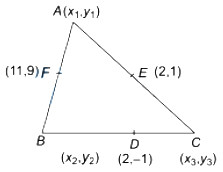
The points $(11,9), (2,1)$ and $(2,-1)$ are the mid-points of the sides of a triangle. Then,the centroid is
A
$(-5,-3)$
B
$(5,-3)$
C
$(3,5)$
D
$(5,3)$
Solution
(D) Let the vertices of the triangle be $A(x_1, y_1)$,$B(x_2, y_2)$,and $C(x_3, y_3)$.
Given mid-points are $F(11, 9)$,$E(2, 1)$,and $D(2, -1)$.
Since the centroid of a triangle formed by joining the mid-points of the sides of a triangle is the same as the centroid of the original triangle,we can directly calculate it.
The centroid $(G)$ of the triangle with vertices $(x_1, y_1), (x_2, y_2), (x_3, y_3)$ is given by $\left(\frac{x_1+x_2+x_3}{3}, \frac{y_1+y_2+y_3}{3}\right)$.
Let the mid-points be $(x_a, y_a) = (11, 9)$,$(x_b, y_b) = (2, 1)$,and $(x_c, y_c) = (2, -1)$.
The centroid of the triangle formed by these mid-points is $\left(\frac{11+2+2}{3}, \frac{9+1-1}{3}\right) = \left(\frac{15}{3}, \frac{9}{3}\right) = (5, 3)$.
Thus,the centroid of the original triangle is $(5, 3)$.
Given mid-points are $F(11, 9)$,$E(2, 1)$,and $D(2, -1)$.
Since the centroid of a triangle formed by joining the mid-points of the sides of a triangle is the same as the centroid of the original triangle,we can directly calculate it.
The centroid $(G)$ of the triangle with vertices $(x_1, y_1), (x_2, y_2), (x_3, y_3)$ is given by $\left(\frac{x_1+x_2+x_3}{3}, \frac{y_1+y_2+y_3}{3}\right)$.
Let the mid-points be $(x_a, y_a) = (11, 9)$,$(x_b, y_b) = (2, 1)$,and $(x_c, y_c) = (2, -1)$.
The centroid of the triangle formed by these mid-points is $\left(\frac{11+2+2}{3}, \frac{9+1-1}{3}\right) = \left(\frac{15}{3}, \frac{9}{3}\right) = (5, 3)$.
Thus,the centroid of the original triangle is $(5, 3)$.
0 likesView Solution
17
MathematicsMediumMCQKCET · 2012
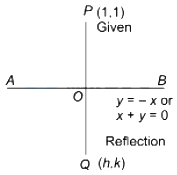
The reflection of the point $(1, 1)$ along the line $y = -x$ is
A
$(0, 0)$
B
$(-1, 1)$
C
$(-1, -1)$
D
$(1, -1)$
Solution
(C) Let the reflection of the point $P(1, 1)$ be $Q(h, k)$.
The line of reflection is $x + y = 0$.
The mid-point of $PQ$ is $\left(\frac{h+1}{2}, \frac{k+1}{2}\right)$,which must lie on the line $x + y = 0$.
$\frac{h+1}{2} + \frac{k+1}{2} = 0 \Rightarrow h + k + 2 = 0 \quad \dots(i)$
The line $PQ$ is perpendicular to the line $x + y = 0$ (which has slope $-1$).
The slope of $PQ$ is $\frac{k-1}{h-1}$.
Since $PQ$ is perpendicular to $x + y = 0$,the product of their slopes is $-1$.
$\left(\frac{k-1}{h-1}\right) \times (-1) = -1$ $\Rightarrow \frac{k-1}{h-1} = 1$ $\Rightarrow k - 1 = h - 1$ $\Rightarrow k = h$.
Substituting $k = h$ into equation $(i)$:
$h + h + 2 = 0$ $\Rightarrow 2h = -2$ $\Rightarrow h = -1$.
Since $k = h$,we have $k = -1$.
Thus,the reflection of the point $(1, 1)$ along the line $y = -x$ is $(-1, -1)$.
The line of reflection is $x + y = 0$.
The mid-point of $PQ$ is $\left(\frac{h+1}{2}, \frac{k+1}{2}\right)$,which must lie on the line $x + y = 0$.
$\frac{h+1}{2} + \frac{k+1}{2} = 0 \Rightarrow h + k + 2 = 0 \quad \dots(i)$
The line $PQ$ is perpendicular to the line $x + y = 0$ (which has slope $-1$).
The slope of $PQ$ is $\frac{k-1}{h-1}$.
Since $PQ$ is perpendicular to $x + y = 0$,the product of their slopes is $-1$.
$\left(\frac{k-1}{h-1}\right) \times (-1) = -1$ $\Rightarrow \frac{k-1}{h-1} = 1$ $\Rightarrow k - 1 = h - 1$ $\Rightarrow k = h$.
Substituting $k = h$ into equation $(i)$:
$h + h + 2 = 0$ $\Rightarrow 2h = -2$ $\Rightarrow h = -1$.
Since $k = h$,we have $k = -1$.
Thus,the reflection of the point $(1, 1)$ along the line $y = -x$ is $(-1, -1)$.
0 likesView Solution
18
MathematicsEasyMCQKCET · 2012
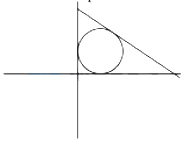
The number of circles that touch the coordinate axes and the line with slope $-1$ and $y$-intercept $1$ is:
A
$1$
B
$4$
C
$2$
D
$3$
Solution
(B) The equation of the line with slope $m = -1$ and $y$-intercept $c = 1$ is $y = -x + 1$,which simplifies to $x + y - 1 = 0$.
Let the circle have radius $r$. Since the circle touches both coordinate axes,its center must be $(\pm r, \pm r)$.
The distance from the center $(\pm r, \pm r)$ to the line $x + y - 1 = 0$ must be equal to the radius $r$.
Using the distance formula: $\frac{|\pm r \pm r - 1|}{\sqrt{1^2 + 1^2}} = r$.
Case $1$: Center $(r, r)$. Then $\frac{|2r - 1|}{\sqrt{2}} = r \implies |2r - 1| = r\sqrt{2}$.
$2r - 1 = r\sqrt{2} \implies r(2 - \sqrt{2}) = 1 \implies r = \frac{1}{2 - \sqrt{2}} = \frac{2 + \sqrt{2}}{2} = 1 + \frac{1}{\sqrt{2}}$.
$2r - 1 = -r\sqrt{2} \implies r(2 + \sqrt{2}) = 1 \implies r = \frac{1}{2 + \sqrt{2}} = \frac{2 - \sqrt{2}}{2} = 1 - \frac{1}{\sqrt{2}}$.
Both values of $r$ are positive,giving two circles in the first quadrant.
Case $2$: Center $(-r, r)$. Then $\frac{|-r + r - 1|}{\sqrt{2}} = r \implies \frac{|-1|}{\sqrt{2}} = r \implies r = \frac{1}{\sqrt{2}}$.
This gives one circle in the second quadrant.
Case $3$: Center $(r, -r)$. Then $\frac{|r - r - 1|}{\sqrt{2}} = r \implies \frac{|-1|}{\sqrt{2}} = r \implies r = \frac{1}{\sqrt{2}}$.
This gives one circle in the fourth quadrant.
Case $4$: Center $(-r, -r)$. Then $\frac{|-2r - 1|}{\sqrt{2}} = r \implies |2r + 1| = r\sqrt{2}$. Since $r > 0$,$2r + 1 > r\sqrt{2}$,so no solution for $r > 0$.
Thus,there are $2 + 1 + 1 = 4$ such circles.
Let the circle have radius $r$. Since the circle touches both coordinate axes,its center must be $(\pm r, \pm r)$.
The distance from the center $(\pm r, \pm r)$ to the line $x + y - 1 = 0$ must be equal to the radius $r$.
Using the distance formula: $\frac{|\pm r \pm r - 1|}{\sqrt{1^2 + 1^2}} = r$.
Case $1$: Center $(r, r)$. Then $\frac{|2r - 1|}{\sqrt{2}} = r \implies |2r - 1| = r\sqrt{2}$.
$2r - 1 = r\sqrt{2} \implies r(2 - \sqrt{2}) = 1 \implies r = \frac{1}{2 - \sqrt{2}} = \frac{2 + \sqrt{2}}{2} = 1 + \frac{1}{\sqrt{2}}$.
$2r - 1 = -r\sqrt{2} \implies r(2 + \sqrt{2}) = 1 \implies r = \frac{1}{2 + \sqrt{2}} = \frac{2 - \sqrt{2}}{2} = 1 - \frac{1}{\sqrt{2}}$.
Both values of $r$ are positive,giving two circles in the first quadrant.
Case $2$: Center $(-r, r)$. Then $\frac{|-r + r - 1|}{\sqrt{2}} = r \implies \frac{|-1|}{\sqrt{2}} = r \implies r = \frac{1}{\sqrt{2}}$.
This gives one circle in the second quadrant.
Case $3$: Center $(r, -r)$. Then $\frac{|r - r - 1|}{\sqrt{2}} = r \implies \frac{|-1|}{\sqrt{2}} = r \implies r = \frac{1}{\sqrt{2}}$.
This gives one circle in the fourth quadrant.
Case $4$: Center $(-r, -r)$. Then $\frac{|-2r - 1|}{\sqrt{2}} = r \implies |2r + 1| = r\sqrt{2}$. Since $r > 0$,$2r + 1 > r\sqrt{2}$,so no solution for $r > 0$.
Thus,there are $2 + 1 + 1 = 4$ such circles.
0 likesView Solution
19
MathematicsMediumMCQKCET · 2012
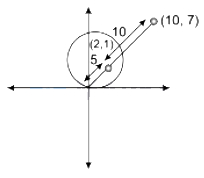
The least and the greatest distances of the point $(10, 7)$ from the circle $x^{2} + y^{2} - 4x - 2y - 20 = 0$ are
A
$5, 15$
B
$15, 20$
C
$12, 16$
D
$10, 5$
Solution
(A) Given the circle equation: $x^{2} + y^{2} - 4x - 2y - 20 = 0$.
Comparing with $x^{2} + y^{2} + 2gx + 2fy + c = 0$,we get $g = -2, f = -1, c = -20$.
Centre of the circle is $(-g, -f) = (2, 1)$.
Radius $r = \sqrt{g^{2} + f^{2} - c} = \sqrt{(-2)^{2} + (-1)^{2} - (-20)} = \sqrt{4 + 1 + 20} = \sqrt{25} = 5$.
Let $P$ be the point $(10, 7)$ and $C$ be the centre $(2, 1)$.
The distance $d$ between $P$ and $C$ is $\sqrt{(10 - 2)^{2} + (7 - 1)^{2}} = \sqrt{8^{2} + 6^{2}} = \sqrt{64 + 36} = \sqrt{100} = 10$.
The least distance of the point from the circle is $d - r = 10 - 5 = 5$.
The greatest distance of the point from the circle is $d + r = 10 + 5 = 15$.
Thus,the least and greatest distances are $5$ and $15$ respectively.
Comparing with $x^{2} + y^{2} + 2gx + 2fy + c = 0$,we get $g = -2, f = -1, c = -20$.
Centre of the circle is $(-g, -f) = (2, 1)$.
Radius $r = \sqrt{g^{2} + f^{2} - c} = \sqrt{(-2)^{2} + (-1)^{2} - (-20)} = \sqrt{4 + 1 + 20} = \sqrt{25} = 5$.
Let $P$ be the point $(10, 7)$ and $C$ be the centre $(2, 1)$.
The distance $d$ between $P$ and $C$ is $\sqrt{(10 - 2)^{2} + (7 - 1)^{2}} = \sqrt{8^{2} + 6^{2}} = \sqrt{64 + 36} = \sqrt{100} = 10$.
The least distance of the point from the circle is $d - r = 10 - 5 = 5$.
The greatest distance of the point from the circle is $d + r = 10 + 5 = 15$.
Thus,the least and greatest distances are $5$ and $15$ respectively.
0 likesView Solution
20
MathematicsMediumMCQKCET · 2012
If the straight line $3x + 4y = k$ touches the circle $x^2 + y^2 = 16x$,then the value of $k$ is
A
$16, 64$
B
$-16, -64$
C
$-16, 64$
D
$16, -64$
Solution
(C) Given the circle equation: $x^2 + y^2 = 16x$
Rearranging the terms: $x^2 - 16x + y^2 = 0$
Completing the square: $(x - 8)^2 + y^2 = 64$
Thus,the center is $(8, 0)$ and the radius $r = 8$.
Since the line $3x + 4y - k = 0$ touches the circle,the perpendicular distance from the center $(8, 0)$ to the line must equal the radius $r = 8$.
Using the distance formula: $d = \frac{|ax_1 + by_1 + c|}{\sqrt{a^2 + b^2}}$
$8 = \frac{|3(8) + 4(0) - k|}{\sqrt{3^2 + 4^2}}$
$8 = \frac{|24 - k|}{\sqrt{25}}$
$8 = \frac{|24 - k|}{5}$
$|24 - k| = 40$
Case $1$: $24 - k = 40 \Rightarrow k = -16$
Case $2$: $24 - k = -40 \Rightarrow k = 64$
Therefore,the values of $k$ are $-16$ and $64$.
Rearranging the terms: $x^2 - 16x + y^2 = 0$
Completing the square: $(x - 8)^2 + y^2 = 64$
Thus,the center is $(8, 0)$ and the radius $r = 8$.
Since the line $3x + 4y - k = 0$ touches the circle,the perpendicular distance from the center $(8, 0)$ to the line must equal the radius $r = 8$.
Using the distance formula: $d = \frac{|ax_1 + by_1 + c|}{\sqrt{a^2 + b^2}}$
$8 = \frac{|3(8) + 4(0) - k|}{\sqrt{3^2 + 4^2}}$
$8 = \frac{|24 - k|}{\sqrt{25}}$
$8 = \frac{|24 - k|}{5}$
$|24 - k| = 40$
Case $1$: $24 - k = 40 \Rightarrow k = -16$
Case $2$: $24 - k = -40 \Rightarrow k = 64$
Therefore,the values of $k$ are $-16$ and $64$.
0 likesView Solution
21
MathematicsDifficultMCQKCET · 2012
The equations of the two tangents from $(-5, -4)$ to the circle $x^{2}+y^{2}+4x+6y+8=0$ are
A
$x+2y+13=0, 2x-y+6=0$
B
$2x+y+13=0, x-2y=6$
C
$3x+2y+23=0, 2x-3y+4=0$
D
$x-7y=23, 6x+13y=4$
Solution
(A) Any line passing through the point $(-5, -4)$ with slope $m$ is given by $y+4 = m(x+5)$,which simplifies to $mx - y + (5m - 4) = 0$.
For the circle $x^{2}+y^{2}+4x+6y+8=0$,the center is $(-2, -3)$ and the radius $r = \sqrt{(-2)^{2} + (-3)^{2} - 8} = \sqrt{4+9-8} = \sqrt{5}$.
Since the line is a tangent,the perpendicular distance from the center $(-2, -3)$ to the line must equal the radius:
$\frac{|m(-2) - (-3) + (5m - 4)|}{\sqrt{m^{2} + (-1)^{2}}} = \sqrt{5}$
$\frac{|3m - 1|}{\sqrt{m^{2} + 1}} = \sqrt{5}$
Squaring both sides: $(3m - 1)^{2} = 5(m^{2} + 1)$
$9m^{2} - 6m + 1 = 5m^{2} + 5$
$4m^{2} - 6m - 4 = 0$
$2m^{2} - 3m - 2 = 0$
$(2m + 1)(m - 2) = 0$
So,$m = 2$ or $m = -\frac{1}{2}$.
For $m = 2$: $2x - y + (5(2) - 4) = 0 \Rightarrow 2x - y + 6 = 0$.
For $m = -\frac{1}{2}$: $-\frac{1}{2}x - y + (5(-\frac{1}{2}) - 4) = 0$ $\Rightarrow -x - 2y - 5 - 8 = 0$ $\Rightarrow x + 2y + 13 = 0$.
For the circle $x^{2}+y^{2}+4x+6y+8=0$,the center is $(-2, -3)$ and the radius $r = \sqrt{(-2)^{2} + (-3)^{2} - 8} = \sqrt{4+9-8} = \sqrt{5}$.
Since the line is a tangent,the perpendicular distance from the center $(-2, -3)$ to the line must equal the radius:
$\frac{|m(-2) - (-3) + (5m - 4)|}{\sqrt{m^{2} + (-1)^{2}}} = \sqrt{5}$
$\frac{|3m - 1|}{\sqrt{m^{2} + 1}} = \sqrt{5}$
Squaring both sides: $(3m - 1)^{2} = 5(m^{2} + 1)$
$9m^{2} - 6m + 1 = 5m^{2} + 5$
$4m^{2} - 6m - 4 = 0$
$2m^{2} - 3m - 2 = 0$
$(2m + 1)(m - 2) = 0$
So,$m = 2$ or $m = -\frac{1}{2}$.
For $m = 2$: $2x - y + (5(2) - 4) = 0 \Rightarrow 2x - y + 6 = 0$.
For $m = -\frac{1}{2}$: $-\frac{1}{2}x - y + (5(-\frac{1}{2}) - 4) = 0$ $\Rightarrow -x - 2y - 5 - 8 = 0$ $\Rightarrow x + 2y + 13 = 0$.
0 likesView Solution
22
MathematicsEasyMCQKCET · 2012
If $x = t^{2} + 2$ and $y = 2t$ represent the parametric equations of a parabola,find its Cartesian equation.
A
$x^{2} = 4(y - 2)$
B
$(y - 2)^{2} = 4x$
C
$y^{2} = 4(x - 2)$
D
$(x - 2)^{2} = 4y$
Solution
(C) Given the parametric equations:
$x = t^{2} + 2$
$y = 2t$
From the second equation,we have $t = \frac{y}{2}$.
Substituting this value of $t$ into the first equation:
$x = (\frac{y}{2})^{2} + 2$
$x = \frac{y^{2}}{4} + 2$
$x - 2 = \frac{y^{2}}{4}$
$y^{2} = 4(x - 2)$
Thus,the correct option is $C$.
$x = t^{2} + 2$
$y = 2t$
From the second equation,we have $t = \frac{y}{2}$.
Substituting this value of $t$ into the first equation:
$x = (\frac{y}{2})^{2} + 2$
$x = \frac{y^{2}}{4} + 2$
$x - 2 = \frac{y^{2}}{4}$
$y^{2} = 4(x - 2)$
Thus,the correct option is $C$.
0 likesView Solution
23
MathematicsDifficultMCQKCET · 2012
The locus of the point of intersection of perpendicular tangents to the ellipse is called
A
hyperbola
B
ellipse
C
auxiliary circle
D
director circle
Solution
(D) The equation of a pair of tangents from $(\alpha, \beta)$ to the ellipse $\frac{x^{2}}{a^{2}}+\frac{y^{2}}{b^{2}}=1$ is given by the condition $SS_{1}=T^{2}$.
The tangents are perpendicular if the sum of the coefficients of $x^{2}$ and $y^{2}$ in the combined equation is zero.
Expanding the condition,we get:
$\left(\frac{1}{a^{2}}\right)\left(\frac{\alpha^{2}}{a^{2}}+\frac{\beta^{2}}{b^{2}}-1\right) - \frac{\alpha^{2}}{a^{4}} + \left(\frac{1}{b^{2}}\right)\left(\frac{\alpha^{2}}{a^{2}}+\frac{\beta^{2}}{b^{2}}-1\right) - \frac{\beta^{2}}{b^{4}} = 0$
Simplifying this expression:
$\frac{\beta^{2}}{a^{2}b^{2}} - \frac{1}{a^{2}} + \frac{\alpha^{2}}{a^{2}b^{2}} - \frac{1}{b^{2}} = 0$
$\alpha^{2} + \beta^{2} = a^{2}b^{2}\left(\frac{1}{a^{2}} + \frac{1}{b^{2}}\right) = a^{2} + b^{2}$
Thus,the locus of the point $(\alpha, \beta)$ is $x^{2} + y^{2} = a^{2} + b^{2}$,which is known as the director circle.
The tangents are perpendicular if the sum of the coefficients of $x^{2}$ and $y^{2}$ in the combined equation is zero.
Expanding the condition,we get:
$\left(\frac{1}{a^{2}}\right)\left(\frac{\alpha^{2}}{a^{2}}+\frac{\beta^{2}}{b^{2}}-1\right) - \frac{\alpha^{2}}{a^{4}} + \left(\frac{1}{b^{2}}\right)\left(\frac{\alpha^{2}}{a^{2}}+\frac{\beta^{2}}{b^{2}}-1\right) - \frac{\beta^{2}}{b^{4}} = 0$
Simplifying this expression:
$\frac{\beta^{2}}{a^{2}b^{2}} - \frac{1}{a^{2}} + \frac{\alpha^{2}}{a^{2}b^{2}} - \frac{1}{b^{2}} = 0$
$\alpha^{2} + \beta^{2} = a^{2}b^{2}\left(\frac{1}{a^{2}} + \frac{1}{b^{2}}\right) = a^{2} + b^{2}$
Thus,the locus of the point $(\alpha, \beta)$ is $x^{2} + y^{2} = a^{2} + b^{2}$,which is known as the director circle.
0 likesView Solution
24
MathematicsMediumMCQKCET · 2012
If $x-y=1$ is a tangent to the hyperbola $\frac{x^{2}}{4}-\frac{y^{2}}{3}=1$,then the point of contact is
A
$(4,3)$
B
$(3,4)$
C
$(2,1)$
D
$(5,4)$
Solution
(A) Given,$x-y=1$ $(i)$ and $\frac{x^{2}}{4}-\frac{y^{2}}{3}=1$ (ii).
Substitute $y=x-1$ from $(i)$ into (ii):
$\frac{x^{2}}{4}-\frac{(x-1)^{2}}{3}=1$
Multiply by $12$:
$3x^{2}-4(x-1)^{2}=12$
$3x^{2}-4(x^{2}-2x+1)=12$
$3x^{2}-4x^{2}+8x-4=12$
$-x^{2}+8x-16=0$
$x^{2}-8x+16=0$
$(x-4)^{2}=0$
$x=4$.
Substitute $x=4$ into $(i)$:
$4-y=1 \Rightarrow y=3$.
Therefore,the point of contact is $(4,3)$.
Substitute $y=x-1$ from $(i)$ into (ii):
$\frac{x^{2}}{4}-\frac{(x-1)^{2}}{3}=1$
Multiply by $12$:
$3x^{2}-4(x-1)^{2}=12$
$3x^{2}-4(x^{2}-2x+1)=12$
$3x^{2}-4x^{2}+8x-4=12$
$-x^{2}+8x-16=0$
$x^{2}-8x+16=0$
$(x-4)^{2}=0$
$x=4$.
Substitute $x=4$ into $(i)$:
$4-y=1 \Rightarrow y=3$.
Therefore,the point of contact is $(4,3)$.
0 likesView Solution
25
MathematicsEasyMCQKCET · 2012
$\lim _{x \rightarrow 0} \frac{x 2^{x}-x}{1-\cos x}$ is equal to
A
$2 \log 2$
B
$\log 2$
C
$\frac{1}{2} \log 2$
D
$\frac{1}{2}$
Solution
(A) Given limit: $L = \lim _{x \rightarrow 0} \frac{x(2^{x}-1)}{1-\cos x}$
Since this is a $\frac{0}{0}$ form,we apply $L$'Hopital's rule:
$L = \lim _{x \rightarrow 0} \frac{\frac{d}{dx}(x 2^{x}-x)}{\frac{d}{dx}(1-\cos x)}$
$L = \lim _{x \rightarrow 0} \frac{2^{x} + x 2^{x} \ln 2 - 1}{\sin x}$
This is still a $\frac{0}{0}$ form. Applying $L$'Hopital's rule again:
$L = \lim _{x \rightarrow 0} \frac{2^{x} \ln 2 + 2^{x} \ln 2 + x 2^{x} (\ln 2)^{2}}{\cos x}$
Substituting $x = 0$:
$L = \frac{2^{0} \ln 2 + 2^{0} \ln 2 + 0}{\cos 0} = \frac{\ln 2 + \ln 2}{1} = 2 \ln 2$
Thus,the correct option is $A$.
Since this is a $\frac{0}{0}$ form,we apply $L$'Hopital's rule:
$L = \lim _{x \rightarrow 0} \frac{\frac{d}{dx}(x 2^{x}-x)}{\frac{d}{dx}(1-\cos x)}$
$L = \lim _{x \rightarrow 0} \frac{2^{x} + x 2^{x} \ln 2 - 1}{\sin x}$
This is still a $\frac{0}{0}$ form. Applying $L$'Hopital's rule again:
$L = \lim _{x \rightarrow 0} \frac{2^{x} \ln 2 + 2^{x} \ln 2 + x 2^{x} (\ln 2)^{2}}{\cos x}$
Substituting $x = 0$:
$L = \frac{2^{0} \ln 2 + 2^{0} \ln 2 + 0}{\cos 0} = \frac{\ln 2 + \ln 2}{1} = 2 \ln 2$
Thus,the correct option is $A$.
0 likesView Solution
26
MathematicsEasyMCQKCET · 2012
Which of the following is incorrect? If $a \equiv b \pmod{m}$ and $x$ is an integer,then
A
$(a+x) \equiv (b+x) \pmod{m}$
B
$(a-x) \equiv (b-x) \pmod{m}$
C
$ax \equiv bx \pmod{m}$
D
$(a+x) \equiv (b \div x) \pmod{m}$
Solution
(D) Given $a \equiv b \pmod{m}$,we have $m \mid (a-b)$.
$(i)$ For $(a+x) \equiv (b+x) \pmod{m}$,we check $(a+x) - (b+x) = a-b$. Since $m \mid (a-b)$,this is correct.
(ii) For $(a-x) \equiv (b-x) \pmod{m}$,we check $(a-x) - (b-x) = a-b$. Since $m \mid (a-b)$,this is correct.
(iii) For $ax \equiv bx \pmod{m}$,we check $ax - bx = x(a-b)$. Since $m \mid (a-b)$,it follows that $m \mid x(a-b)$,so this is correct.
(iv) For $(a+x) \equiv (b \div x) \pmod{m}$,this is not generally true because division is not defined in modular arithmetic in the same way as addition or multiplication,and $b \div x$ may not even be an integer. Thus,this statement is incorrect.
$(i)$ For $(a+x) \equiv (b+x) \pmod{m}$,we check $(a+x) - (b+x) = a-b$. Since $m \mid (a-b)$,this is correct.
(ii) For $(a-x) \equiv (b-x) \pmod{m}$,we check $(a-x) - (b-x) = a-b$. Since $m \mid (a-b)$,this is correct.
(iii) For $ax \equiv bx \pmod{m}$,we check $ax - bx = x(a-b)$. Since $m \mid (a-b)$,it follows that $m \mid x(a-b)$,so this is correct.
(iv) For $(a+x) \equiv (b \div x) \pmod{m}$,this is not generally true because division is not defined in modular arithmetic in the same way as addition or multiplication,and $b \div x$ may not even be an integer. Thus,this statement is incorrect.
0 likesView Solution
27
MathematicsEasyMCQKCET · 2012
$p \rightarrow \sim q$ can also be written as
A
$p \rightarrow q$
B
$\sim p \vee \sim q$
C
$q \rightarrow p$
D
$\sim q \rightarrow \sim p$
Solution
(B) We know that the implication $A \rightarrow B$ is logically equivalent to $\sim A \vee B$.
Applying this rule to $p \rightarrow \sim q$,we get:
$p \rightarrow \sim q \equiv \sim p \vee \sim q$.
This can also be verified using the truth table:
| $p$ | $q$ | $\sim p$ | $\sim q$ | $p \rightarrow \sim q$ | $\sim p \vee \sim q$ |
|---|---|---|---|---|---|
| $T$ | $T$ | $F$ | $F$ | $F$ | $F$ |
| $T$ | $F$ | $F$ | $T$ | $T$ | $T$ |
| $F$ | $T$ | $T$ | $F$ | $T$ | $T$ |
| $F$ | $F$ | $T$ | $T$ | $T$ | $T$ |
Since the truth values of $p \rightarrow \sim q$ and $\sim p \vee \sim q$ are identical for all possible truth values of $p$ and $q$,they are logically equivalent.
Applying this rule to $p \rightarrow \sim q$,we get:
$p \rightarrow \sim q \equiv \sim p \vee \sim q$.
This can also be verified using the truth table:
| $p$ | $q$ | $\sim p$ | $\sim q$ | $p \rightarrow \sim q$ | $\sim p \vee \sim q$ |
|---|---|---|---|---|---|
| $T$ | $T$ | $F$ | $F$ | $F$ | $F$ |
| $T$ | $F$ | $F$ | $T$ | $T$ | $T$ |
| $F$ | $T$ | $T$ | $F$ | $T$ | $T$ |
| $F$ | $F$ | $T$ | $T$ | $T$ | $T$ |
Since the truth values of $p \rightarrow \sim q$ and $\sim p \vee \sim q$ are identical for all possible truth values of $p$ and $q$,they are logically equivalent.
0 likesView Solution
28
MathematicsEasyMCQKCET · 2012
If $A$ and $B$ have $n$ elements in common,then the number of elements common to $A \times B$ and $B \times A$ is
A
$n$
B
$2n$
C
$n^{2}$
D
$0$
Solution
(C) Let $C = A \cap B$. Since $A$ and $B$ have $n$ elements in common,the set $C$ has $n$ elements.
We know that $(A \times B) \cap (B \times A) = (A \cap B) \times (B \cap A)$.
Substituting $C = A \cap B$,we get $(A \times B) \cap (B \times A) = C \times C$.
The number of elements in $C \times C$ is given by $n(C) \times n(C) = n \times n = n^{2}$.
Therefore,the number of elements common to $A \times B$ and $B \times A$ is $n^{2}$.
We know that $(A \times B) \cap (B \times A) = (A \cap B) \times (B \cap A)$.
Substituting $C = A \cap B$,we get $(A \times B) \cap (B \times A) = C \times C$.
The number of elements in $C \times C$ is given by $n(C) \times n(C) = n \times n = n^{2}$.
Therefore,the number of elements common to $A \times B$ and $B \times A$ is $n^{2}$.
0 likesView Solution
29
MathematicsDifficultMCQKCET · 2012
The sum of two positive numbers is given. If the sum of their cubes is minimum,then
A
they are equal
B
one is twice the other
C
they are unequal
D
one is thrice the other
Solution
(A) Let $x$ and $y$ be two positive numbers.
Given that their sum is constant,$x + y = a$.
Let $z = x^3 + y^3$.
Substituting $y = a - x$,we get $z = x^3 + (a - x)^3$.
Differentiating with respect to $x$: $\frac{dz}{dx} = 3x^2 - 3(a - x)^2 = 3(x^2 - (a^2 - 2ax + x^2)) = 3(2ax - a^2) = 3a(2x - a)$.
Setting $\frac{dz}{dx} = 0$,we find $2x - a = 0$,which implies $x = \frac{a}{2}$.
Since $y = a - x$,we get $y = a - \frac{a}{2} = \frac{a}{2}$.
Checking the second derivative: $\frac{d^2z}{dx^2} = 6a$. Since $a > 0$,$\frac{d^2z}{dx^2} > 0$,confirming a minimum at $x = \frac{a}{2}$.
Thus,$x = y$,meaning the numbers are equal.
Given that their sum is constant,$x + y = a$.
Let $z = x^3 + y^3$.
Substituting $y = a - x$,we get $z = x^3 + (a - x)^3$.
Differentiating with respect to $x$: $\frac{dz}{dx} = 3x^2 - 3(a - x)^2 = 3(x^2 - (a^2 - 2ax + x^2)) = 3(2ax - a^2) = 3a(2x - a)$.
Setting $\frac{dz}{dx} = 0$,we find $2x - a = 0$,which implies $x = \frac{a}{2}$.
Since $y = a - x$,we get $y = a - \frac{a}{2} = \frac{a}{2}$.
Checking the second derivative: $\frac{d^2z}{dx^2} = 6a$. Since $a > 0$,$\frac{d^2z}{dx^2} > 0$,confirming a minimum at $x = \frac{a}{2}$.
Thus,$x = y$,meaning the numbers are equal.
0 likesView Solution
30
MathematicsEasyMCQKCET · 2012
If $y=e^{\log _{e}\left[1+x+x^{2}+\ldots\right]}$,then $\frac{d y}{d x}$ is equal to
A
$\frac{1}{(1+x)^{2}}$
B
$\frac{1}{(1-x)^{2}}$
C
$\frac{-1}{(1+x)^{2}}$
D
$\frac{-1}{(1-x)^{2}}$
Solution
(B) Given,$y=e^{\log _{e} [1+x+x^{2}+\ldots]}$
We know that the sum of an infinite geometric series is given by $1+x+x^{2}+\ldots = \frac{1}{1-x}$ for $|x| < 1$.
Therefore,$y = e^{\log _{e} (1-x)^{-1}}$.
Using the property $e^{\log _{e} f(x)} = f(x)$,we get $y = (1-x)^{-1}$.
Now,differentiating with respect to $x$ using the chain rule:
$\frac{d y}{d x} = \frac{d}{d x} (1-x)^{-1} = -1(1-x)^{-2} \cdot \frac{d}{d x}(1-x)$
$\frac{d y}{d x} = -1(1-x)^{-2} \cdot (-1) = (1-x)^{-2} = \frac{1}{(1-x)^{2}}$.
We know that the sum of an infinite geometric series is given by $1+x+x^{2}+\ldots = \frac{1}{1-x}$ for $|x| < 1$.
Therefore,$y = e^{\log _{e} (1-x)^{-1}}$.
Using the property $e^{\log _{e} f(x)} = f(x)$,we get $y = (1-x)^{-1}$.
Now,differentiating with respect to $x$ using the chain rule:
$\frac{d y}{d x} = \frac{d}{d x} (1-x)^{-1} = -1(1-x)^{-2} \cdot \frac{d}{d x}(1-x)$
$\frac{d y}{d x} = -1(1-x)^{-2} \cdot (-1) = (1-x)^{-2} = \frac{1}{(1-x)^{2}}$.
0 likesView Solution
31
MathematicsDifficultMCQKCET · 2012
The perimeter of a sector is a constant. If its area is to be maximum,then the sectorial angle is
A
$ \frac{\pi^{c}}{6} $
B
$ \frac{\pi^{c}}{4} $
C
$ 4^{c} $
D
$ 2^{c} $
Solution
(D) Let $r$ be the radius and $\theta$ be the sectorial angle in radians. The perimeter $P$ is given by $P = 2r + r\theta = k$ (constant).
Thus,$r = \frac{k}{2+\theta}$.
The area $A$ of the sector is $A = \frac{1}{2}r^{2}\theta$.
Substituting $r$,we get $A = \frac{1}{2} \left( \frac{k}{2+\theta} \right)^{2} \theta = \frac{k^{2}}{2} \frac{\theta}{(2+\theta)^{2}}$.
To maximize $A$,we differentiate with respect to $\theta$:
$\frac{dA}{d\theta} = \frac{k^{2}}{2} \left[ \frac{(2+\theta)^{2}(1) - \theta(2)(2+\theta)}{(2+\theta)^{4}} \right] = \frac{k^{2}}{2} \left[ \frac{2+\theta - 2\theta}{(2+\theta)^{3}} \right] = \frac{k^{2}}{2} \frac{2-\theta}{(2+\theta)^{3}}$.
Setting $\frac{dA}{d\theta} = 0$,we get $2-\theta = 0$,so $\theta = 2^{c}$.
Since the second derivative is negative at $\theta = 2$,the area is maximum.
Thus,$r = \frac{k}{2+\theta}$.
The area $A$ of the sector is $A = \frac{1}{2}r^{2}\theta$.
Substituting $r$,we get $A = \frac{1}{2} \left( \frac{k}{2+\theta} \right)^{2} \theta = \frac{k^{2}}{2} \frac{\theta}{(2+\theta)^{2}}$.
To maximize $A$,we differentiate with respect to $\theta$:
$\frac{dA}{d\theta} = \frac{k^{2}}{2} \left[ \frac{(2+\theta)^{2}(1) - \theta(2)(2+\theta)}{(2+\theta)^{4}} \right] = \frac{k^{2}}{2} \left[ \frac{2+\theta - 2\theta}{(2+\theta)^{3}} \right] = \frac{k^{2}}{2} \frac{2-\theta}{(2+\theta)^{3}}$.
Setting $\frac{dA}{d\theta} = 0$,we get $2-\theta = 0$,so $\theta = 2^{c}$.
Since the second derivative is negative at $\theta = 2$,the area is maximum.
0 likesView Solution
32
MathematicsEasyMCQKCET · 2012
If a ball is thrown vertically upwards and the height $s$ reached in time $t$ is given by $s = 22t - 11t^{2}$, then the total distance travelled by the ball is (in $\text{ units}$)
A
$44$
B
$33$
C
$11$
D
$22$
Solution
(C) Given the displacement equation: $s = 22t - 11t^{2}$.
To find the maximum height, we differentiate $s$ with respect to $t$ to find the velocity $v = \frac{ds}{dt}$.
$\frac{ds}{dt} = 22 - 22t$.
At the maximum height, the velocity is zero, so $22 - 22t = 0$, which gives $t = 1 \text{ s}$.
Substituting $t = 1$ into the displacement equation:
$s = 22(1) - 11(1)^{2} = 22 - 11 = 11 \text{ units}$.
Since the ball starts from $s=0$ and reaches a maximum height of $11 \text{ units}$, the total distance travelled is $11 \text{ units}$.
To find the maximum height, we differentiate $s$ with respect to $t$ to find the velocity $v = \frac{ds}{dt}$.
$\frac{ds}{dt} = 22 - 22t$.
At the maximum height, the velocity is zero, so $22 - 22t = 0$, which gives $t = 1 \text{ s}$.
Substituting $t = 1$ into the displacement equation:
$s = 22(1) - 11(1)^{2} = 22 - 11 = 11 \text{ units}$.
Since the ball starts from $s=0$ and reaches a maximum height of $11 \text{ units}$, the total distance travelled is $11 \text{ units}$.
0 likesView Solution
33
MathematicsDifficultMCQKCET · 2012
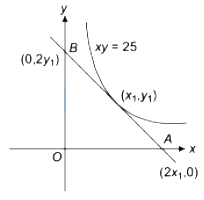
The tangent to the curve $xy = 25$ at any point on it cuts the coordinate axes at $A$ and $B$. Then the area of the $\triangle OAB$ is
A
$50$ sq units
B
$25$ sq units
C
$75$ sq units
D
$100$ sq units
Solution
(A) Given curve is $xy = 25$. Let the point of tangency be $P(x_1, y_1)$. Since $P$ lies on the curve,$x_1 y_1 = 25$.
Differentiating $xy = 25$ with respect to $x$,we get $y + x \frac{dy}{dx} = 0$,so $\frac{dy}{dx} = -\frac{y}{x}$.
At $(x_1, y_1)$,the slope of the tangent is $m = -\frac{y_1}{x_1}$.
The equation of the tangent is $y - y_1 = -\frac{y_1}{x_1}(x - x_1)$.
Multiplying by $x_1$,we get $x_1 y - x_1 y_1 = -y_1 x + x_1 y_1$,which simplifies to $x_1 y + y_1 x = 2 x_1 y_1$.
Dividing by $2 x_1 y_1$,we get $\frac{x}{2 x_1} + \frac{y}{2 y_1} = 1$.
The tangent cuts the $x$-axis at $A(2 x_1, 0)$ and the $y$-axis at $B(0, 2 y_1)$.
The area of $\triangle OAB = \frac{1}{2} \times \text{base} \times \text{height} = \frac{1}{2} \times (2 x_1) \times (2 y_1) = 2 x_1 y_1$.
Since $x_1 y_1 = 25$,the area is $2(25) = 50$ sq units.
Differentiating $xy = 25$ with respect to $x$,we get $y + x \frac{dy}{dx} = 0$,so $\frac{dy}{dx} = -\frac{y}{x}$.
At $(x_1, y_1)$,the slope of the tangent is $m = -\frac{y_1}{x_1}$.
The equation of the tangent is $y - y_1 = -\frac{y_1}{x_1}(x - x_1)$.
Multiplying by $x_1$,we get $x_1 y - x_1 y_1 = -y_1 x + x_1 y_1$,which simplifies to $x_1 y + y_1 x = 2 x_1 y_1$.
Dividing by $2 x_1 y_1$,we get $\frac{x}{2 x_1} + \frac{y}{2 y_1} = 1$.
The tangent cuts the $x$-axis at $A(2 x_1, 0)$ and the $y$-axis at $B(0, 2 y_1)$.
The area of $\triangle OAB = \frac{1}{2} \times \text{base} \times \text{height} = \frac{1}{2} \times (2 x_1) \times (2 y_1) = 2 x_1 y_1$.
Since $x_1 y_1 = 25$,the area is $2(25) = 50$ sq units.
0 likesView Solution
34
MathematicsDifficultMCQKCET · 2012
If $f(x) = \left| \begin{array}{ccc} \sin x & \cos x & \tan x \\ x^3 & x^2 & x \\ 2x & 1 & x \end{array} \right|$,then $\lim_{x \to 0} \frac{f(x)}{x^2}$ is equal to
A
$0$
B
$3$
C
$2$
D
$1$
Solution
(D) Given $f(x) = \left| \begin{array}{ccc} \sin x & \cos x & \tan x \\ x^3 & x^2 & x \\ 2x & 1 & x \end{array} \right|$.
Expanding along the first row:
$f(x) = \sin x(x^3 - x) - \cos x(x^4 - 2x^2) + \tan x(x^3 - 2x^4)$.
We need to find $\lim_{x \to 0} \frac{f(x)}{x^2}$.
$\frac{f(x)}{x^2} = \frac{\sin x}{x} \cdot \frac{x^3 - x}{x} - \cos x \cdot \frac{x^4 - 2x^2}{x^2} + \frac{\tan x}{x} \cdot \frac{x^3 - 2x^4}{x}$.
$\frac{f(x)}{x^2} = \frac{\sin x}{x} (x^2 - 1) - \cos x (x^2 - 2) + \frac{\tan x}{x} (x^2 - 2x^3)$.
Taking the limit as $x \to 0$:
$= (1)(0 - 1) - (1)(0 - 2) + (1)(0 - 0)$.
$= -1 + 2 + 0 = 1$.
Expanding along the first row:
$f(x) = \sin x(x^3 - x) - \cos x(x^4 - 2x^2) + \tan x(x^3 - 2x^4)$.
We need to find $\lim_{x \to 0} \frac{f(x)}{x^2}$.
$\frac{f(x)}{x^2} = \frac{\sin x}{x} \cdot \frac{x^3 - x}{x} - \cos x \cdot \frac{x^4 - 2x^2}{x^2} + \frac{\tan x}{x} \cdot \frac{x^3 - 2x^4}{x}$.
$\frac{f(x)}{x^2} = \frac{\sin x}{x} (x^2 - 1) - \cos x (x^2 - 2) + \frac{\tan x}{x} (x^2 - 2x^3)$.
Taking the limit as $x \to 0$:
$= (1)(0 - 1) - (1)(0 - 2) + (1)(0 - 0)$.
$= -1 + 2 + 0 = 1$.
0 likesView Solution
35
MathematicsEasyMCQKCET · 2012
Which of the following statements is false?
A
$(N, \cdot)$ is a group
B
$(N, +)$ is a semi-group
C
$(Z, +)$ is a group
D
Set of even integers is a group under usual addition
Solution
(A) set $G$ with a binary operation $\cdot$ is a group if it satisfies closure,associativity,identity,and inverse properties.
For $(N, \cdot)$,where $N$ is the set of natural numbers,the multiplicative inverse of an element $a \in N$ (where $a \neq 1$) is $1/a$,which is not in $N$.
Thus,$(N, \cdot)$ fails the inverse property and is not a group.
$(N, +)$ is a semi-group because it is closed and associative under addition.
$(Z, +)$ is a group as it satisfies all group axioms.
The set of even integers $2Z = \{..., -4, -2, 0, 2, 4, ...\}$ forms a group under addition because it contains the identity $0$,inverses for all elements,and is closed and associative.
Therefore,the statement $(N, \cdot)$ is a group is false.
For $(N, \cdot)$,where $N$ is the set of natural numbers,the multiplicative inverse of an element $a \in N$ (where $a \neq 1$) is $1/a$,which is not in $N$.
Thus,$(N, \cdot)$ fails the inverse property and is not a group.
$(N, +)$ is a semi-group because it is closed and associative under addition.
$(Z, +)$ is a group as it satisfies all group axioms.
The set of even integers $2Z = \{..., -4, -2, 0, 2, 4, ...\}$ forms a group under addition because it contains the identity $0$,inverses for all elements,and is closed and associative.
Therefore,the statement $(N, \cdot)$ is a group is false.
0 likesView Solution
36
MathematicsMediumMCQKCET · 2012
Which of the following is a subgroup of the group $G = \{2^{n} \mid n \in \mathbb{Z}\}$ under multiplication?
A
$\{4^{n} \mid n \in \mathbb{N}\}$
B
$\{3^{n} \mid n \in \mathbb{Z}\}$
C
$\{6^{n} \mid n \in \mathbb{N}\}$
D
$\{4^{n} \mid n \in \mathbb{Z}\}$
Solution
(D) subset $H$ of a group $G$ is a subgroup if it is itself a group under the same operation.
For $H = \{4^{n} \mid n \in \mathbb{Z}\}$,we note that $4^{n} = (2^{2})^{n} = 2^{2n}$. Since $2n \in \mathbb{Z}$ for all $n \in \mathbb{Z}$,$H \subset G$.
$1.$ Closure: $4^{n} \cdot 4^{m} = 4^{n+m} \in H$.
$2.$ Identity: $4^{0} = 1 = 2^{0} \in H$.
$3.$ Inverse: For $4^{n} \in H$,the inverse is $4^{-n} \in H$.
Thus,$\{4^{n} \mid n \in \mathbb{Z}\}$ is a subgroup of $G$.
For $H = \{4^{n} \mid n \in \mathbb{Z}\}$,we note that $4^{n} = (2^{2})^{n} = 2^{2n}$. Since $2n \in \mathbb{Z}$ for all $n \in \mathbb{Z}$,$H \subset G$.
$1.$ Closure: $4^{n} \cdot 4^{m} = 4^{n+m} \in H$.
$2.$ Identity: $4^{0} = 1 = 2^{0} \in H$.
$3.$ Inverse: For $4^{n} \in H$,the inverse is $4^{-n} \in H$.
Thus,$\{4^{n} \mid n \in \mathbb{Z}\}$ is a subgroup of $G$.
0 likesView Solution
37
MathematicsMediumMCQKCET · 2012
In the group $G = \{1, 2, 3, 4, 5, 6\}$ under $\otimes_{7}$,the solution of $4 \otimes_{7} x = 5$ is
A
$3$
B
$2$
C
$4$
D
$5$
Solution
(A) We are given the equation $4 \otimes_{7} x = 5$ in the group $G = \{1, 2, 3, 4, 5, 6\}$ under multiplication modulo $7$.
To find $x$,we test the elements of the group:
$4 \otimes_{7} 1 = 4$
$4 \otimes_{7} 2 = 8 \equiv 1 \pmod{7}$
$4 \otimes_{7} 3 = 12 \equiv 5 \pmod{7}$
$4 \otimes_{7} 4 = 16 \equiv 2 \pmod{7}$
$4 \otimes_{7} 5 = 20 \equiv 6 \pmod{7}$
$4 \otimes_{7} 6 = 24 \equiv 3 \pmod{7}$
Comparing this with the given equation $4 \otimes_{7} x = 5$,we find that $x = 3$.
To find $x$,we test the elements of the group:
$4 \otimes_{7} 1 = 4$
$4 \otimes_{7} 2 = 8 \equiv 1 \pmod{7}$
$4 \otimes_{7} 3 = 12 \equiv 5 \pmod{7}$
$4 \otimes_{7} 4 = 16 \equiv 2 \pmod{7}$
$4 \otimes_{7} 5 = 20 \equiv 6 \pmod{7}$
$4 \otimes_{7} 6 = 24 \equiv 3 \pmod{7}$
Comparing this with the given equation $4 \otimes_{7} x = 5$,we find that $x = 3$.
0 likesView Solution
38
MathematicsEasyMCQKCET · 2012
The characteristic equation of a matrix $A$ is $\lambda^{3}-5 \lambda^{2}-3 \lambda+2=0$. Then $|\text{adj}(A)|$ is equal to:
A
$9$
B
$25$
C
$\frac{1}{2}$
D
$4$
Solution
(D) The characteristic equation of a $3 \times 3$ matrix $A$ is given by $|A - \lambda I| = 0$,which results in $-\lambda^3 + \text{tr}(A)\lambda^2 - (\dots)\lambda + |A| = 0$.
Given the characteristic equation $\lambda^{3}-5 \lambda^{2}-3 \lambda+2=0$,we compare this with the standard form $\lambda^3 - \text{tr}(A)\lambda^2 + (\dots)\lambda - |A| = 0$.
Comparing the constant terms,we get $-|A| = 2$,which implies $|A| = -2$.
We know that for a square matrix $A$ of order $n$,$|\text{adj}(A)| = |A|^{n-1}$.
Here,$n = 3$,so $|\text{adj}(A)| = |A|^{3-1} = |A|^2$.
Substituting the value of $|A|$,we get $|\text{adj}(A)| = (-2)^2 = 4$.
Given the characteristic equation $\lambda^{3}-5 \lambda^{2}-3 \lambda+2=0$,we compare this with the standard form $\lambda^3 - \text{tr}(A)\lambda^2 + (\dots)\lambda - |A| = 0$.
Comparing the constant terms,we get $-|A| = 2$,which implies $|A| = -2$.
We know that for a square matrix $A$ of order $n$,$|\text{adj}(A)| = |A|^{n-1}$.
Here,$n = 3$,so $|\text{adj}(A)| = |A|^{3-1} = |A|^2$.
Substituting the value of $|A|$,we get $|\text{adj}(A)| = (-2)^2 = 4$.
0 likesView Solution
39
MathematicsMediumMCQKCET · 2012
The inverse of a diagonal non-singular matrix is:
A
scalar matrix
B
skew symmetric matrix
C
zero matrix
D
diagonal matrix
Solution
(D) Let $A$ be a diagonal matrix of order $n \times n$ defined as $A = \text{diag}(a_1, a_2, \dots, a_n)$,where $a_i \neq 0$ for all $i$ because the matrix is non-singular.
The inverse of a diagonal matrix $A$ is given by $A^{-1} = \text{diag}(1/a_1, 1/a_2, \dots, 1/a_n)$.
Since all off-diagonal elements of $A^{-1}$ remain $0$,the resulting matrix $A^{-1}$ is also a diagonal matrix.
Thus,the inverse of a diagonal non-singular matrix is a diagonal matrix.
The inverse of a diagonal matrix $A$ is given by $A^{-1} = \text{diag}(1/a_1, 1/a_2, \dots, 1/a_n)$.
Since all off-diagonal elements of $A^{-1}$ remain $0$,the resulting matrix $A^{-1}$ is also a diagonal matrix.
Thus,the inverse of a diagonal non-singular matrix is a diagonal matrix.
0 likesView Solution
40
MathematicsEasyMCQKCET · 2012
If $a x^{4}+b x^{3}+c x^{2}+d x+e = \left|\begin{array}{ccc}x^{3}+3 x & x-1 & x+3 \\ x+1 & -2 x & x-4 \\ x-3 & x+4 & 3 x\end{array}\right|$,then $e$ is equal to
A
$1$
B
$0$
C
$2$
D
$-1$
Solution
(B) Given the equation: $a x^{4}+b x^{3}+c x^{2}+d x+e = \left|\begin{array}{ccc}x^{3}+3 x & x-1 & x+3 \\ x+1 & -2 x & x-4 \\ x-3 & x+4 & 3 x\end{array}\right|$.
To find the value of $e$,we set $x = 0$ on both sides of the equation.
Substituting $x = 0$ into the determinant,we get:
$e = \left|\begin{array}{ccc}0+3(0) & 0-1 & 0+3 \\ 0+1 & -2(0) & 0-4 \\ 0-3 & 0+4 & 3(0)\end{array}\right| = \left|\begin{array}{ccc}0 & -1 & 3 \\ 1 & 0 & -4 \\ -3 & 4 & 0\end{array}\right|$.
Expanding the determinant along the first row:
$e = 0(0 - (-16)) - (-1)(0 - 12) + 3(4 - 0)$
$e = 0(16) + 1(-12) + 3(4)$
$e = 0 - 12 + 12 = 0$.
Thus,$e = 0$.
To find the value of $e$,we set $x = 0$ on both sides of the equation.
Substituting $x = 0$ into the determinant,we get:
$e = \left|\begin{array}{ccc}0+3(0) & 0-1 & 0+3 \\ 0+1 & -2(0) & 0-4 \\ 0-3 & 0+4 & 3(0)\end{array}\right| = \left|\begin{array}{ccc}0 & -1 & 3 \\ 1 & 0 & -4 \\ -3 & 4 & 0\end{array}\right|$.
Expanding the determinant along the first row:
$e = 0(0 - (-16)) - (-1)(0 - 12) + 3(4 - 0)$
$e = 0(16) + 1(-12) + 3(4)$
$e = 0 - 12 + 12 = 0$.
Thus,$e = 0$.
0 likesView Solution
41
MathematicsMediumMCQKCET · 2012
$2 \cos ^{-1} x = \sin ^{-1} \left( 2 x \sqrt{1 - x^2} \right)$ is valid for all values of $x$ satisfying
A
$-1 \leq x \leq 1$
B
$0 \leq x \leq 1$
C
$\frac{1}{\sqrt{2}} \leq x \leq 1$
D
$0 \leq x \leq \frac{1}{\sqrt{2}}$
Solution
(C) Let $\cos ^{-1} x = y$,then $x = \cos y$. Since the range of $\cos ^{-1} x$ is $[0, \pi]$,we have $0 \leq y \leq \pi$.
The given equation is $2y = \sin ^{-1} (2 \cos y \sin y) = \sin ^{-1} (\sin 2y)$.
For $\sin ^{-1} (\sin 2y) = 2y$,we must have $-\frac{\pi}{2} \leq 2y \leq \frac{\pi}{2}$,which implies $-\frac{\pi}{4} \leq y \leq \frac{\pi}{4}$.
Combining $0 \leq y \leq \pi$ and $-\frac{\pi}{4} \leq y \leq \frac{\pi}{4}$,we get $0 \leq y \leq \frac{\pi}{4}$.
Since $y = \cos ^{-1} x$,we have $0 \leq \cos ^{-1} x \leq \frac{\pi}{4}$.
Taking cosine on all sides (noting that cosine is a decreasing function in $[0, \pi]$),we get $\cos(0) \geq x \geq \cos(\frac{\pi}{4})$.
Thus,$1 \geq x \geq \frac{1}{\sqrt{2}}$,or $\frac{1}{\sqrt{2}} \leq x \leq 1$.
The given equation is $2y = \sin ^{-1} (2 \cos y \sin y) = \sin ^{-1} (\sin 2y)$.
For $\sin ^{-1} (\sin 2y) = 2y$,we must have $-\frac{\pi}{2} \leq 2y \leq \frac{\pi}{2}$,which implies $-\frac{\pi}{4} \leq y \leq \frac{\pi}{4}$.
Combining $0 \leq y \leq \pi$ and $-\frac{\pi}{4} \leq y \leq \frac{\pi}{4}$,we get $0 \leq y \leq \frac{\pi}{4}$.
Since $y = \cos ^{-1} x$,we have $0 \leq \cos ^{-1} x \leq \frac{\pi}{4}$.
Taking cosine on all sides (noting that cosine is a decreasing function in $[0, \pi]$),we get $\cos(0) \geq x \geq \cos(\frac{\pi}{4})$.
Thus,$1 \geq x \geq \frac{1}{\sqrt{2}}$,or $\frac{1}{\sqrt{2}} \leq x \leq 1$.
0 likesView Solution
42
MathematicsMediumMCQKCET · 2012
The number of real solutions of the equation $\tan ^{-1} \sqrt{x(x+1)}+\sin ^{-1} \sqrt{x^{2}+x+1}=\frac{\pi}{2}$ is
A
one
B
four
C
two
D
infinitely many
Solution
(C) Given equation is $\tan ^{-1} \sqrt{x(x+1)}+\sin ^{-1} \sqrt{x^{2}+x+1}=\frac{\pi}{2}$.
For the domain,we must have $x(x+1) \ge 0$ and $0 \le x^2+x+1 \le 1$.
The condition $x^2+x+1 \le 1$ implies $x^2+x \le 0$,which means $x(x+1) \le 0$.
Combining $x(x+1) \ge 0$ and $x(x+1) \le 0$,we get $x(x+1) = 0$,so $x=0$ or $x=-1$.
If $x=0$,the equation becomes $\tan ^{-1} (0) + \sin ^{-1} (1) = 0 + \frac{\pi}{2} = \frac{\pi}{2}$. This is a solution.
If $x=-1$,the equation becomes $\tan ^{-1} (0) + \sin ^{-1} (1) = 0 + \frac{\pi}{2} = \frac{\pi}{2}$. This is also a solution.
Thus,there are $2$ real solutions.
For the domain,we must have $x(x+1) \ge 0$ and $0 \le x^2+x+1 \le 1$.
The condition $x^2+x+1 \le 1$ implies $x^2+x \le 0$,which means $x(x+1) \le 0$.
Combining $x(x+1) \ge 0$ and $x(x+1) \le 0$,we get $x(x+1) = 0$,so $x=0$ or $x=-1$.
If $x=0$,the equation becomes $\tan ^{-1} (0) + \sin ^{-1} (1) = 0 + \frac{\pi}{2} = \frac{\pi}{2}$. This is a solution.
If $x=-1$,the equation becomes $\tan ^{-1} (0) + \sin ^{-1} (1) = 0 + \frac{\pi}{2} = \frac{\pi}{2}$. This is also a solution.
Thus,there are $2$ real solutions.
0 likesView Solution
43
MathematicsDifficultMCQKCET · 2012
If $y = \tan ^{-1}\left(\frac{1}{1+x+x^{2}}\right) + \tan ^{-1}\left(\frac{1}{x^{2}+2x+3}\right) + \tan ^{-1}\left(\frac{1}{x^{2}+5x+7}\right) + \dots + n \text{ terms}$,then $y'(0)$ is
A
$\frac{\pi}{2}$
B
$\frac{2n}{1+n^{2}}$
C
$\frac{n^{2}}{1+n^{2}}$
D
$-\frac{n^{2}}{1+n^{2}}$
Solution
(D) The general term of the series is $T_r = \tan^{-1}\left(\frac{1}{x^2 + (2r-1)x + (r^2-r+1)}\right)$ for $r=1, 2, \dots, n$.
We can rewrite the argument as:
$\frac{1}{1 + (x+r)(x+r-1)} = \frac{(x+r) - (x+r-1)}{1 + (x+r)(x+r-1)}$.
Thus,$T_r = \tan^{-1}(x+r) - \tan^{-1}(x+r-1)$.
Summing these terms from $r=1$ to $n$:
$y = \sum_{r=1}^{n} [\tan^{-1}(x+r) - \tan^{-1}(x+r-1)]$.
This is a telescoping series:
$y = (\tan^{-1}(x+1) - \tan^{-1}(x)) + (\tan^{-1}(x+2) - \tan^{-1}(x+1)) + \dots + (\tan^{-1}(x+n) - \tan^{-1}(x+n-1))$.
$y = \tan^{-1}(x+n) - \tan^{-1}(x)$.
Differentiating with respect to $x$:
$\frac{dy}{dx} = \frac{1}{1+(x+n)^2} - \frac{1}{1+x^2}$.
Evaluating at $x=0$:
$y'(0) = \frac{1}{1+n^2} - \frac{1}{1+0^2} = \frac{1}{1+n^2} - 1 = \frac{1 - 1 - n^2}{1+n^2} = -\frac{n^2}{1+n^2}$.
We can rewrite the argument as:
$\frac{1}{1 + (x+r)(x+r-1)} = \frac{(x+r) - (x+r-1)}{1 + (x+r)(x+r-1)}$.
Thus,$T_r = \tan^{-1}(x+r) - \tan^{-1}(x+r-1)$.
Summing these terms from $r=1$ to $n$:
$y = \sum_{r=1}^{n} [\tan^{-1}(x+r) - \tan^{-1}(x+r-1)]$.
This is a telescoping series:
$y = (\tan^{-1}(x+1) - \tan^{-1}(x)) + (\tan^{-1}(x+2) - \tan^{-1}(x+1)) + \dots + (\tan^{-1}(x+n) - \tan^{-1}(x+n-1))$.
$y = \tan^{-1}(x+n) - \tan^{-1}(x)$.
Differentiating with respect to $x$:
$\frac{dy}{dx} = \frac{1}{1+(x+n)^2} - \frac{1}{1+x^2}$.
Evaluating at $x=0$:
$y'(0) = \frac{1}{1+n^2} - \frac{1}{1+0^2} = \frac{1}{1+n^2} - 1 = \frac{1 - 1 - n^2}{1+n^2} = -\frac{n^2}{1+n^2}$.
0 likesView Solution
44
MathematicsEasyMCQKCET · 2012
If $f(x)$ is an even function,then $f^{\prime}(x)$ is
A
an odd function
B
an even function
C
may be even or may be odd
D
nothing can be said
Solution
(A) By definition,a function $f(x)$ is even if $f(-x) = f(x)$.
Differentiating both sides with respect to $x$ using the chain rule,we get:
$\frac{d}{dx}[f(-x)] = \frac{d}{dx}[f(x)]$
$f^{\prime}(-x) \cdot (-1) = f^{\prime}(x)$
$-f^{\prime}(-x) = f^{\prime}(x)$
$f^{\prime}(-x) = -f^{\prime}(x)$
Since $f^{\prime}(-x) = -f^{\prime}(x)$,the derivative $f^{\prime}(x)$ is an odd function.
Differentiating both sides with respect to $x$ using the chain rule,we get:
$\frac{d}{dx}[f(-x)] = \frac{d}{dx}[f(x)]$
$f^{\prime}(-x) \cdot (-1) = f^{\prime}(x)$
$-f^{\prime}(-x) = f^{\prime}(x)$
$f^{\prime}(-x) = -f^{\prime}(x)$
Since $f^{\prime}(-x) = -f^{\prime}(x)$,the derivative $f^{\prime}(x)$ is an odd function.
0 likesView Solution
45
MathematicsMediumMCQKCET · 2012
If $f: R \rightarrow R$ is defined by $f(x)=2x+3$,then $f^{-1}(x)$
A
is given by $\frac{x-3}{2}$
B
is given by $\frac{1}{2x+3}$
C
does not exist because $f$ is not injective
D
does not exist because $f$ is not surjective
Solution
(A) Let $x_{1}, x_{2} \in R$.
For injectivity,let $f(x_{1}) = f(x_{2})$.
$2x_{1} + 3 = 2x_{2} + 3$
$2x_{1} = 2x_{2}$
$x_{1} = x_{2}$.
Hence,$f$ is injective.
For surjectivity,let $y \in \text{codomain } R$.
Let $y = f(x) = 2x + 3$.
$y - 3 = 2x$
$x = \frac{y-3}{2}$.
Since for every $y \in R$,there exists an $x = \frac{y-3}{2} \in R$,$f$ is surjective.
Since $f$ is both injective and surjective,$f^{-1}$ exists.
Replacing $y$ with $x$,we get $f^{-1}(x) = \frac{x-3}{2}$.
For injectivity,let $f(x_{1}) = f(x_{2})$.
$2x_{1} + 3 = 2x_{2} + 3$
$2x_{1} = 2x_{2}$
$x_{1} = x_{2}$.
Hence,$f$ is injective.
For surjectivity,let $y \in \text{codomain } R$.
Let $y = f(x) = 2x + 3$.
$y - 3 = 2x$
$x = \frac{y-3}{2}$.
Since for every $y \in R$,there exists an $x = \frac{y-3}{2} \in R$,$f$ is surjective.
Since $f$ is both injective and surjective,$f^{-1}$ exists.
Replacing $y$ with $x$,we get $f^{-1}(x) = \frac{x-3}{2}$.
0 likesView Solution
46
MathematicsEasyMCQKCET · 2012
If $f(x) = \begin{cases} \frac{x^2 - (a+2)x + a}{x-2} & x \neq 2 \\ 2 & x = 2 \end{cases}$ is continuous at $x = 2$,then the value of $a$ is
A
$-6$
B
$0$
C
$1$
D
$-1$
Solution
(B) For a function $f(x)$ to be continuous at $x = 2$,the limit of $f(x)$ as $x \to 2$ must equal $f(2)$.
Given $f(2) = 2$.
We evaluate the limit: $\lim_{x \to 2} \frac{x^2 - (a+2)x + a}{x-2}$.
Since the limit exists and the denominator approaches $0$,the numerator must also approach $0$ at $x = 2$ for the limit to be finite.
Substituting $x = 2$ in the numerator: $2^2 - (a+2)(2) + a = 0$.
$4 - 2a - 4 + a = 0$.
$-a = 0 \implies a = 0$.
Alternatively,using $L$'Hospital's rule: $\lim_{x \to 2} \frac{2x - (a+2)}{1} = 2(2) - a - 2 = 2 - a$.
Equating to $f(2)$: $2 - a = 2 \implies a = 0$.
Given $f(2) = 2$.
We evaluate the limit: $\lim_{x \to 2} \frac{x^2 - (a+2)x + a}{x-2}$.
Since the limit exists and the denominator approaches $0$,the numerator must also approach $0$ at $x = 2$ for the limit to be finite.
Substituting $x = 2$ in the numerator: $2^2 - (a+2)(2) + a = 0$.
$4 - 2a - 4 + a = 0$.
$-a = 0 \implies a = 0$.
Alternatively,using $L$'Hospital's rule: $\lim_{x \to 2} \frac{2x - (a+2)}{1} = 2(2) - a - 2 = 2 - a$.
Equating to $f(2)$: $2 - a = 2 \implies a = 0$.
0 likesView Solution
47
MathematicsMediumMCQKCET · 2012
If $f(x) = \sin([\pi^{2}]x) + \cos([-\pi^{2}]x)$,then find $f'(x)$,where $[\cdot]$ denotes the greatest integer function.
A
$\sin(9x) + \cos(9x)$
B
$9 \cos(9x) - 10 \sin(10x)$
C
$0$
D
$-1$
Solution
(B) We know that $\pi^{2} \approx 9.86$.
Since $[\cdot]$ is the greatest integer function:
$[\pi^{2}] = [9.86] = 9$.
$[-\pi^{2}] = [-9.86] = -10$.
Substituting these values into the function $f(x)$:
$f(x) = \sin(9x) + \cos(-10x)$.
Since $\cos(-\theta) = \cos(\theta)$,we have:
$f(x) = \sin(9x) + \cos(10x)$.
Now,differentiating $f(x)$ with respect to $x$:
$f'(x) = \frac{d}{dx}(\sin(9x)) + \frac{d}{dx}(\cos(10x))$.
Using the chain rule:
$f'(x) = 9 \cos(9x) - 10 \sin(10x)$.
Since $[\cdot]$ is the greatest integer function:
$[\pi^{2}] = [9.86] = 9$.
$[-\pi^{2}] = [-9.86] = -10$.
Substituting these values into the function $f(x)$:
$f(x) = \sin(9x) + \cos(-10x)$.
Since $\cos(-\theta) = \cos(\theta)$,we have:
$f(x) = \sin(9x) + \cos(10x)$.
Now,differentiating $f(x)$ with respect to $x$:
$f'(x) = \frac{d}{dx}(\sin(9x)) + \frac{d}{dx}(\cos(10x))$.
Using the chain rule:
$f'(x) = 9 \cos(9x) - 10 \sin(10x)$.
0 likesView Solution
48
MathematicsMediumMCQKCET · 2012
Length of the subtangent at $(x_{1}, y_{1})$ on $x^{n} y^{m}=a^{m+n}, m, n>0$,is
A
$\frac{n}{m} x_{1}$
B
$\frac{m}{n}|x_{1}|$
C
$\frac{n}{m}|y_{1}|$
D
$\frac{n}{m}|x_{1}|$
Solution
(B) Given the curve $x^{n} y^{m}=a^{m+n}$,where $m, n > 0$. Taking the natural logarithm on both sides:
$n \ln x + m \ln y = (m+n) \ln a$.
Differentiating with respect to $x$:
$\frac{n}{x} + \frac{m}{y} \frac{dy}{dx} = 0$.
Solving for the derivative:
$\frac{dy}{dx} = -\frac{n}{m} \cdot \frac{y}{x}$.
The length of the subtangent is defined as $|\frac{y}{dy/dx}|$.
Substituting the derivative:
$|\frac{y}{-(n/m)(y/x)}| = |-\frac{m}{n} x| = \frac{m}{n} |x|$.
Thus,at the point $(x_{1}, y_{1})$,the length of the subtangent is $\frac{m}{n} |x_{1}|$.
$n \ln x + m \ln y = (m+n) \ln a$.
Differentiating with respect to $x$:
$\frac{n}{x} + \frac{m}{y} \frac{dy}{dx} = 0$.
Solving for the derivative:
$\frac{dy}{dx} = -\frac{n}{m} \cdot \frac{y}{x}$.
The length of the subtangent is defined as $|\frac{y}{dy/dx}|$.
Substituting the derivative:
$|\frac{y}{-(n/m)(y/x)}| = |-\frac{m}{n} x| = \frac{m}{n} |x|$.
Thus,at the point $(x_{1}, y_{1})$,the length of the subtangent is $\frac{m}{n} |x_{1}|$.
0 likesView Solution
49
MathematicsEasyMCQKCET · 2012
The length of the subtangent,ordinate,and the subnormal are in
A
$AP$
B
$HP$
C
$GP$
D
$Arithmetico-geometric \text{ } progression$
Solution
(C) Let the curve be $y = f(x)$. The length of the subtangent is given by $|y \frac{dx}{dy}|$ and the length of the subnormal is given by $|y \frac{dy}{dx}|$.
Let the ordinate be $y$.
Then,the product of the subtangent and the subnormal is:
$\text{Subtangent} \times \text{Subnormal} = |y \frac{dx}{dy}| \times |y \frac{dy}{dx}| = |y^2| = y^2$.
Since the product of the first and third terms equals the square of the second term (the ordinate),the three quantities form a Geometric Progression $(GP)$.
Let the ordinate be $y$.
Then,the product of the subtangent and the subnormal is:
$\text{Subtangent} \times \text{Subnormal} = |y \frac{dx}{dy}| \times |y \frac{dy}{dx}| = |y^2| = y^2$.
Since the product of the first and third terms equals the square of the second term (the ordinate),the three quantities form a Geometric Progression $(GP)$.
0 likesView Solution
50
MathematicsMediumMCQKCET · 2012
The maximum value of $x e^{-x}$ is
A
$e$
B
$\frac{1}{e}$
C
$-e$
D
$-\frac{1}{e}$
Solution
(B) Let $y = x e^{-x}$.
On differentiating with respect to $x$,we get:
$\frac{dy}{dx} = x \cdot (-e^{-x}) + e^{-x} \cdot (1) = e^{-x}(1 - x)$.
For maximum or minimum values,we set $\frac{dy}{dx} = 0$:
$e^{-x}(1 - x) = 0$.
Since $e^{-x} \neq 0$ for any real $x$,we have $1 - x = 0$,which implies $x = 1$.
Now,we find the second derivative to check for maxima:
$\frac{d^2y}{dx^2} = e^{-x}(-1) + (1 - x)(-e^{-x}) = -e^{-x} - e^{-x} + x e^{-x} = e^{-x}(x - 2)$.
At $x = 1$:
$\frac{d^2y}{dx^2} = e^{-1}(1 - 2) = -\frac{1}{e} < 0$.
Since the second derivative is negative at $x = 1$,the function has a local maximum at $x = 1$.
The maximum value is $y(1) = 1 \cdot e^{-1} = \frac{1}{e}$.
On differentiating with respect to $x$,we get:
$\frac{dy}{dx} = x \cdot (-e^{-x}) + e^{-x} \cdot (1) = e^{-x}(1 - x)$.
For maximum or minimum values,we set $\frac{dy}{dx} = 0$:
$e^{-x}(1 - x) = 0$.
Since $e^{-x} \neq 0$ for any real $x$,we have $1 - x = 0$,which implies $x = 1$.
Now,we find the second derivative to check for maxima:
$\frac{d^2y}{dx^2} = e^{-x}(-1) + (1 - x)(-e^{-x}) = -e^{-x} - e^{-x} + x e^{-x} = e^{-x}(x - 2)$.
At $x = 1$:
$\frac{d^2y}{dx^2} = e^{-1}(1 - 2) = -\frac{1}{e} < 0$.
Since the second derivative is negative at $x = 1$,the function has a local maximum at $x = 1$.
The maximum value is $y(1) = 1 \cdot e^{-1} = \frac{1}{e}$.
0 likesView Solution
51
MathematicsEasyMCQKCET · 2012
If $\frac{3x+1}{(x-1)(x+3)}=\frac{A}{x-1}+\frac{B}{x+3}$,then $\sin^{-1} \frac{A}{B}$ is equal to
A
$\frac{\pi}{2}$
B
$\frac{\pi}{3}$
C
$\frac{\pi}{6}$
D
$\frac{\pi}{4}$
Solution
(C) Given,$\frac{3x+1}{(x-1)(x+3)}=\frac{A}{x-1}+\frac{B}{x+3}$
Multiplying both sides by $(x-1)(x+3)$,we get:
$3x+1 = A(x+3) + B(x-1)$
Expanding the right side:
$3x+1 = (A+B)x + (3A-B)$
Comparing the coefficients of $x$ and the constant terms:
$A+B = 3$ $(i)$
$3A-B = 1$ (ii)
Adding equations $(i)$ and (ii):
$(A+B) + (3A-B) = 3+1$
$4A = 4 \Rightarrow A = 1$
Substituting $A=1$ into equation $(i)$:
$1+B = 3 \Rightarrow B = 2$
Now,calculate $\sin^{-1} \frac{A}{B}$:
$\sin^{-1} \frac{1}{2} = \frac{\pi}{6}$
Multiplying both sides by $(x-1)(x+3)$,we get:
$3x+1 = A(x+3) + B(x-1)$
Expanding the right side:
$3x+1 = (A+B)x + (3A-B)$
Comparing the coefficients of $x$ and the constant terms:
$A+B = 3$ $(i)$
$3A-B = 1$ (ii)
Adding equations $(i)$ and (ii):
$(A+B) + (3A-B) = 3+1$
$4A = 4 \Rightarrow A = 1$
Substituting $A=1$ into equation $(i)$:
$1+B = 3 \Rightarrow B = 2$
Now,calculate $\sin^{-1} \frac{A}{B}$:
$\sin^{-1} \frac{1}{2} = \frac{\pi}{6}$
0 likesView Solution
52
MathematicsMediumMCQKCET · 2012
If $n \in N$ and $I_{n}=\int(\log x)^{n} dx$,then $I_{n}+n I_{n-1}$ is equal to
A
$\frac{(\log x)^{n+1}}{n+1}$
B
$x(\log x)^{n}+C$
C
$(\log x)^{n-1}$
D
$\frac{(\log x)^{n}}{n}$
Solution
(B) Given $I_{n}=\int(\log x)^{n} dx$.
Using integration by parts,let $u = (\log x)^{n}$ and $dv = dx$.
Then $du = n(\log x)^{n-1} \cdot \frac{1}{x} dx$ and $v = x$.
Applying the formula $\int u dv = uv - \int v du$:
$I_{n} = x(\log x)^{n} - \int x \cdot n(\log x)^{n-1} \cdot \frac{1}{x} dx$
$I_{n} = x(\log x)^{n} - n \int (\log x)^{n-1} dx$
$I_{n} = x(\log x)^{n} - n I_{n-1}$
Rearranging the terms,we get:
$I_{n} + n I_{n-1} = x(\log x)^{n} + C$.
Using integration by parts,let $u = (\log x)^{n}$ and $dv = dx$.
Then $du = n(\log x)^{n-1} \cdot \frac{1}{x} dx$ and $v = x$.
Applying the formula $\int u dv = uv - \int v du$:
$I_{n} = x(\log x)^{n} - \int x \cdot n(\log x)^{n-1} \cdot \frac{1}{x} dx$
$I_{n} = x(\log x)^{n} - n \int (\log x)^{n-1} dx$
$I_{n} = x(\log x)^{n} - n I_{n-1}$
Rearranging the terms,we get:
$I_{n} + n I_{n-1} = x(\log x)^{n} + C$.
0 likesView Solution
53
MathematicsEasyMCQKCET · 2012
$\int_{\pi / 6}^{\pi / 3} \frac{\sin ^{3} x}{\sin ^{3} x+\cos ^{3} x} d x$ is equal to
A
$\frac{\pi}{2}$
B
$\frac{\pi}{3}$
C
$\frac{\pi}{12}$
D
$\frac{\pi}{6}$
Solution
(C) Let $I = \int_{\pi / 6}^{\pi / 3} \frac{\sin ^{3} x}{\sin ^{3} x+\cos ^{3} x} d x$ $(i)$
Using the property $\int_{a}^{b} f(x) d x = \int_{a}^{b} f(a+b-x) d x$,we have:
$I = \int_{\pi / 6}^{\pi / 3} \frac{\sin ^{3}(\frac{\pi}{3} + \frac{\pi}{6} - x)}{\sin ^{3}(\frac{\pi}{3} + \frac{\pi}{6} - x) + \cos ^{3}(\frac{\pi}{3} + \frac{\pi}{6} - x)} d x$
$I = \int_{\pi / 6}^{\pi / 3} \frac{\sin ^{3}(\frac{\pi}{2} - x)}{\sin ^{3}(\frac{\pi}{2} - x) + \cos ^{3}(\frac{\pi}{2} - x)} d x$
Since $\sin(\frac{\pi}{2} - x) = \cos x$ and $\cos(\frac{\pi}{2} - x) = \sin x$,we get:
$I = \int_{\pi / 6}^{\pi / 3} \frac{\cos ^{3} x}{\cos ^{3} x + \sin ^{3} x} d x$ (ii)
Adding $(i)$ and (ii):
$2I = \int_{\pi / 6}^{\pi / 3} \frac{\sin ^{3} x + \cos ^{3} x}{\sin ^{3} x + \cos ^{3} x} d x$
$2I = \int_{\pi / 6}^{\pi / 3} 1 d x$
$2I = [x]_{\pi / 6}^{\pi / 3} = \frac{\pi}{3} - \frac{\pi}{6} = \frac{\pi}{6}$
$I = \frac{\pi}{12}$
Using the property $\int_{a}^{b} f(x) d x = \int_{a}^{b} f(a+b-x) d x$,we have:
$I = \int_{\pi / 6}^{\pi / 3} \frac{\sin ^{3}(\frac{\pi}{3} + \frac{\pi}{6} - x)}{\sin ^{3}(\frac{\pi}{3} + \frac{\pi}{6} - x) + \cos ^{3}(\frac{\pi}{3} + \frac{\pi}{6} - x)} d x$
$I = \int_{\pi / 6}^{\pi / 3} \frac{\sin ^{3}(\frac{\pi}{2} - x)}{\sin ^{3}(\frac{\pi}{2} - x) + \cos ^{3}(\frac{\pi}{2} - x)} d x$
Since $\sin(\frac{\pi}{2} - x) = \cos x$ and $\cos(\frac{\pi}{2} - x) = \sin x$,we get:
$I = \int_{\pi / 6}^{\pi / 3} \frac{\cos ^{3} x}{\cos ^{3} x + \sin ^{3} x} d x$ (ii)
Adding $(i)$ and (ii):
$2I = \int_{\pi / 6}^{\pi / 3} \frac{\sin ^{3} x + \cos ^{3} x}{\sin ^{3} x + \cos ^{3} x} d x$
$2I = \int_{\pi / 6}^{\pi / 3} 1 d x$
$2I = [x]_{\pi / 6}^{\pi / 3} = \frac{\pi}{3} - \frac{\pi}{6} = \frac{\pi}{6}$
$I = \frac{\pi}{12}$
0 likesView Solution
54
MathematicsMediumMCQKCET · 2012
If $[x]$ is the greatest integer function not greater than $x$,then $\int_{0}^{11} [x] dx$ is equal to
A
$45$
B
$66$
C
$35$
D
$55$
Solution
(D) The integral $\int_{0}^{11} [x] dx$ can be split into intervals of unit length where $[x]$ is constant:
$\int_{0}^{11} [x] dx = \sum_{k=0}^{10} \int_{k}^{k+1} [x] dx$
Since for $x \in [k, k+1)$,$[x] = k$,we have:
$\int_{k}^{k+1} [x] dx = \int_{k}^{k+1} k dx = k(k+1 - k) = k$
Therefore,the sum becomes:
$\int_{0}^{11} [x] dx = \sum_{k=0}^{10} k = 0 + 1 + 2 + 3 + 4 + 5 + 6 + 7 + 8 + 9 + 10$
Using the sum formula for the first $n$ natural numbers,$\sum_{k=1}^{n} k = \frac{n(n+1)}{2}$:
$\sum_{k=1}^{10} k = \frac{10 \times 11}{2} = 55$
Thus,the value of the integral is $55$.
$\int_{0}^{11} [x] dx = \sum_{k=0}^{10} \int_{k}^{k+1} [x] dx$
Since for $x \in [k, k+1)$,$[x] = k$,we have:
$\int_{k}^{k+1} [x] dx = \int_{k}^{k+1} k dx = k(k+1 - k) = k$
Therefore,the sum becomes:
$\int_{0}^{11} [x] dx = \sum_{k=0}^{10} k = 0 + 1 + 2 + 3 + 4 + 5 + 6 + 7 + 8 + 9 + 10$
Using the sum formula for the first $n$ natural numbers,$\sum_{k=1}^{n} k = \frac{n(n+1)}{2}$:
$\sum_{k=1}^{10} k = \frac{10 \times 11}{2} = 55$
Thus,the value of the integral is $55$.
0 likesView Solution
55
MathematicsMediumMCQKCET · 2012
If $m \sin ^{-1} x = \log _{e} y$,then $(1 - x^{2}) y'' - x y'$ is equal to
A
$m^{2} y$
B
$-m^{2} y$
C
$2 y$
D
$-2 y$
Solution
(A) Given,$m \sin ^{-1} x = \log _{e} y$
$\Rightarrow y = e^{m \sin ^{-1} x}$
Differentiating with respect to $x$,we get:
$y' = e^{m \sin ^{-1} x} \times \frac{m}{\sqrt{1 - x^{2}}}$
$\Rightarrow \sqrt{1 - x^{2}} \cdot y' = m y$
Squaring both sides,we get:
$(1 - x^{2}) (y')^{2} = m^{2} y^{2}$
Differentiating again with respect to $x$:
$(1 - x^{2}) \cdot 2 y' \cdot y'' + (y')^{2} (-2 x) = m^{2} \cdot 2 y y' $
Dividing both sides by $2 y'$,we get:
$(1 - x^{2}) y'' - x y' = m^{2} y$
$\Rightarrow y = e^{m \sin ^{-1} x}$
Differentiating with respect to $x$,we get:
$y' = e^{m \sin ^{-1} x} \times \frac{m}{\sqrt{1 - x^{2}}}$
$\Rightarrow \sqrt{1 - x^{2}} \cdot y' = m y$
Squaring both sides,we get:
$(1 - x^{2}) (y')^{2} = m^{2} y^{2}$
Differentiating again with respect to $x$:
$(1 - x^{2}) \cdot 2 y' \cdot y'' + (y')^{2} (-2 x) = m^{2} \cdot 2 y y' $
Dividing both sides by $2 y'$,we get:
$(1 - x^{2}) y'' - x y' = m^{2} y$
0 likesView Solution
56
MathematicsMediumMCQKCET · 2012
The solution of $e^{dy/dx} = x$ with the initial conditions $x = 1$ and $y = 0$ is:
A
$y = x(\log x - 1) + 4$
B
$y = x(\log x - 1) + 3$
C
$y = x(\log x + 1) + 1$
D
$y = x(\log x - 1) + 1$
Solution
(D) Given the differential equation $e^{dy/dx} = x$.
Taking the natural logarithm on both sides,we get:
$\frac{dy}{dx} = \log x$
Integrating both sides with respect to $x$:
$\int dy = \int \log x \, dx$
Using integration by parts,$\int u \, dv = uv - \int v \, du$,where $u = \log x$ and $dv = dx$:
$y = x \log x - \int x \cdot \frac{1}{x} \, dx$
$y = x \log x - \int 1 \, dx$
$y = x \log x - x + C$
$y = x(\log x - 1) + C$ (Equation $i$)
Given the initial conditions $x = 1$ and $y = 0$,substitute these into Equation $i$:
$0 = 1(\log 1 - 1) + C$
$0 = 1(0 - 1) + C$
$0 = -1 + C$
$C = 1$
Substituting $C = 1$ back into Equation $i$,we get:
$y = x(\log x - 1) + 1$
Taking the natural logarithm on both sides,we get:
$\frac{dy}{dx} = \log x$
Integrating both sides with respect to $x$:
$\int dy = \int \log x \, dx$
Using integration by parts,$\int u \, dv = uv - \int v \, du$,where $u = \log x$ and $dv = dx$:
$y = x \log x - \int x \cdot \frac{1}{x} \, dx$
$y = x \log x - \int 1 \, dx$
$y = x \log x - x + C$
$y = x(\log x - 1) + C$ (Equation $i$)
Given the initial conditions $x = 1$ and $y = 0$,substitute these into Equation $i$:
$0 = 1(\log 1 - 1) + C$
$0 = 1(0 - 1) + C$
$0 = -1 + C$
$C = 1$
Substituting $C = 1$ back into Equation $i$,we get:
$y = x(\log x - 1) + 1$
0 likesView Solution
57
MathematicsEasyMCQKCET · 2012
If $\vec{a} = \hat{i}+\hat{j}-\hat{k}$ and $\vec{b} = 2\hat{i}-3\hat{j}+\hat{k}$ are adjacent sides of a parallelogram,then the lengths of its diagonals are
A
$\sqrt{3}, \sqrt{14}$
B
$\sqrt{13}, \sqrt{14}$
C
$\sqrt{21}, \sqrt{3}$
D
$\sqrt{21}, \sqrt{13}$
Solution
(D) Let the adjacent sides of the parallelogram be $\vec{a} = \hat{i}+\hat{j}-\hat{k}$ and $\vec{b} = 2\hat{i}-3\hat{j}+\hat{k}$.
The diagonals of the parallelogram are given by $\vec{d_1} = \vec{a} + \vec{b}$ and $\vec{d_2} = \vec{a} - \vec{b}$.
First diagonal: $\vec{d_1} = (\hat{i}+\hat{j}-\hat{k}) + (2\hat{i}-3\hat{j}+\hat{k}) = 3\hat{i}-2\hat{j}$.
Length of the first diagonal: $|\vec{d_1}| = \sqrt{3^2 + (-2)^2 + 0^2} = \sqrt{9+4} = \sqrt{13}$.
Second diagonal: $\vec{d_2} = (\hat{i}+\hat{j}-\hat{k}) - (2\hat{i}-3\hat{j}+\hat{k}) = -\hat{i}+4\hat{j}-2\hat{k}$.
Length of the second diagonal: $|\vec{d_2}| = \sqrt{(-1)^2 + 4^2 + (-2)^2} = \sqrt{1+16+4} = \sqrt{21}$.
Thus,the lengths of the diagonals are $\sqrt{13}$ and $\sqrt{21}$.
The diagonals of the parallelogram are given by $\vec{d_1} = \vec{a} + \vec{b}$ and $\vec{d_2} = \vec{a} - \vec{b}$.
First diagonal: $\vec{d_1} = (\hat{i}+\hat{j}-\hat{k}) + (2\hat{i}-3\hat{j}+\hat{k}) = 3\hat{i}-2\hat{j}$.
Length of the first diagonal: $|\vec{d_1}| = \sqrt{3^2 + (-2)^2 + 0^2} = \sqrt{9+4} = \sqrt{13}$.
Second diagonal: $\vec{d_2} = (\hat{i}+\hat{j}-\hat{k}) - (2\hat{i}-3\hat{j}+\hat{k}) = -\hat{i}+4\hat{j}-2\hat{k}$.
Length of the second diagonal: $|\vec{d_2}| = \sqrt{(-1)^2 + 4^2 + (-2)^2} = \sqrt{1+16+4} = \sqrt{21}$.
Thus,the lengths of the diagonals are $\sqrt{13}$ and $\sqrt{21}$.
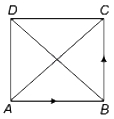
0 likesView Solution
58
MathematicsEasyMCQKCET · 2012
If $(a \times b)^{2} + (a \cdot b)^{2} = 144$ and $|a| = 4$,then $|b|$ is equal to
A
$16$
B
$8$
C
$3$
D
$12$
Solution
(C) We know that for any two vectors $a$ and $b$,$(a \times b)^{2} + (a \cdot b)^{2} = |a|^{2} |b|^{2} \sin^{2} \theta + |a|^{2} |b|^{2} \cos^{2} \theta$.
Since $\sin^{2} \theta + \cos^{2} \theta = 1$,this simplifies to $|a|^{2} |b|^{2}$.
Given the equation $(a \times b)^{2} + (a \cdot b)^{2} = 144$,we have $|a|^{2} |b|^{2} = 144$.
Given $|a| = 4$,we substitute $|a|^{2} = 16$ into the equation:
$16 |b|^{2} = 144$.
Dividing both sides by $16$,we get $|b|^{2} = 9$.
Taking the square root,we find $|b| = 3$.
Since $\sin^{2} \theta + \cos^{2} \theta = 1$,this simplifies to $|a|^{2} |b|^{2}$.
Given the equation $(a \times b)^{2} + (a \cdot b)^{2} = 144$,we have $|a|^{2} |b|^{2} = 144$.
Given $|a| = 4$,we substitute $|a|^{2} = 16$ into the equation:
$16 |b|^{2} = 144$.
Dividing both sides by $16$,we get $|b|^{2} = 9$.
Taking the square root,we find $|b| = 3$.
0 likesView Solution
59
MathematicsMediumMCQKCET · 2012
If the volume of the parallelepiped formed by three non-coplanar vectors $\vec{a}, \vec{b}$ and $\vec{c}$ is $4$ cubic units,then $[\vec{a} \times \vec{b} \quad \vec{b} \times \vec{c} \quad \vec{c} \times \vec{a}]$ is equal to
A
$64$
B
$16$
C
$4$
D
$8$
Solution
(B) The volume of a parallelepiped formed by vectors $\vec{a}, \vec{b}, \vec{c}$ is given by the scalar triple product $[\vec{a} \vec{b} \vec{c}] = 4$.
We need to find the value of $[\vec{a} \times \vec{b} \quad \vec{b} \times \vec{c} \quad \vec{c} \times \vec{a}]$.
Using the property of the scalar triple product of cross products: $[\vec{a} \times \vec{b} \quad \vec{b} \times \vec{c} \quad \vec{c} \times \vec{a}] = [\vec{a} \vec{b} \vec{c}]^2$.
Substituting the given value: $[\vec{a} \vec{b} \vec{c}]^2 = (4)^2 = 16$.
Thus,the value is $16$.
We need to find the value of $[\vec{a} \times \vec{b} \quad \vec{b} \times \vec{c} \quad \vec{c} \times \vec{a}]$.
Using the property of the scalar triple product of cross products: $[\vec{a} \times \vec{b} \quad \vec{b} \times \vec{c} \quad \vec{c} \times \vec{a}] = [\vec{a} \vec{b} \vec{c}]^2$.
Substituting the given value: $[\vec{a} \vec{b} \vec{c}]^2 = (4)^2 = 16$.
Thus,the value is $16$.
0 likesView Solution
60
MathematicsMediumMCQKCET · 2012
If $a, b$ and $c$ are three non-coplanar vectors and $p, q$ and $r$ are vectors defined by $p=\frac{b \times c}{[a b c]}, q=\frac{c \times a}{[a b c]}, r=\frac{a \times b}{[a b c]}$,then $(a+b) \cdot p+(b+c) \cdot q+(c+a) \cdot r$ is
A
$0$
B
$1$
C
$2$
D
$3$
Solution
(D) Given $p=\frac{b \times c}{[a b c]}, q=\frac{c \times a}{[a b c]}, r=\frac{a \times b}{[a b c]}$.
We need to evaluate the expression $E = (a+b) \cdot p + (b+c) \cdot q + (c+a) \cdot r$.
Substituting the values of $p, q, r$:
$E = (a+b) \cdot \frac{b \times c}{[a b c]} + (b+c) \cdot \frac{c \times a}{[a b c]} + (c+a) \cdot \frac{a \times b}{[a b c]}$
$E = \frac{1}{[a b c]} [a \cdot (b \times c) + b \cdot (b \times c) + b \cdot (c \times a) + c \cdot (c \times a) + c \cdot (a \times b) + a \cdot (a \times b)]$
Using the property of scalar triple product $[x y z] = x \cdot (y \times z)$:
$E = \frac{1}{[a b c]} [[a b c] + 0 + [b c a] + 0 + [c a b] + 0]$
Since $[a b c] = [b c a] = [c a b]$:
$E = \frac{[a b c] + [a b c] + [a b c]}{[a b c]} = \frac{3[a b c]}{[a b c]} = 3$.
We need to evaluate the expression $E = (a+b) \cdot p + (b+c) \cdot q + (c+a) \cdot r$.
Substituting the values of $p, q, r$:
$E = (a+b) \cdot \frac{b \times c}{[a b c]} + (b+c) \cdot \frac{c \times a}{[a b c]} + (c+a) \cdot \frac{a \times b}{[a b c]}$
$E = \frac{1}{[a b c]} [a \cdot (b \times c) + b \cdot (b \times c) + b \cdot (c \times a) + c \cdot (c \times a) + c \cdot (a \times b) + a \cdot (a \times b)]$
Using the property of scalar triple product $[x y z] = x \cdot (y \times z)$:
$E = \frac{1}{[a b c]} [[a b c] + 0 + [b c a] + 0 + [c a b] + 0]$
Since $[a b c] = [b c a] = [c a b]$:
$E = \frac{[a b c] + [a b c] + [a b c]}{[a b c]} = \frac{3[a b c]}{[a b c]} = 3$.
0 likesView Solution
Vedclass Products
For Students
Vedclass Test Series
Mock tests in real KCET style covering Mathematics with performance analysis. 5-day free trial.
Start Free TrialFor Teachers
Exam Paper Generator
Generate Set A/B/C/D Mathematics papers from 7.5L+ questions in 2 minutes. 3 chapters free.
Try FreeFor Institutes
Online Exam Module
Run live KCET mock exams with unlimited students, 360° analytics & white-label branding.
See DemoFrequently Asked Questions
How many Mathematics questions are in KCET 2012?
There are 60 Mathematics questions from the KCET 2012 paper on Vedclass, each with a detailed step-by-step solution in English.
Are KCET 2012 Mathematics solutions available in English?
Yes. All solutions on this page are in English. You can also switch to English or Hindi using the language buttons above the questions.
Can I practice KCET 2012 Mathematics as a timed test?
Yes. Use the Vedclass Test Series to attempt a full KCET mock test covering Mathematics with time limits and instant score analysis.
Can teachers create Mathematics papers from KCET previous year questions?
Yes. The Vedclass Exam Paper Generator lets teachers mix KCET Mathematics questions and generate Set A/B/C/D papers in minutes.
For Teachers & Institutes
Build a Custom Mathematics Paper
Pick KCET 2012 Mathematics questions, set difficulty, and generate Set A/B/C/D in 2 minutes.