
ChemistryQ1–72 of 72 questions
Page 1 of 1 · English
1
ChemistryMCQKCET · 2008
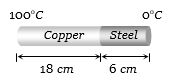
The coefficient of thermal conductivity of copper is nine times that of steel. In the composite cylindrical bar shown in the figure,what will be the temperature at the junction of copper and steel in $^oC$?
A
$75$
B
$67$
C
$33$
D
$25$
Solution
(A) In a steady state,the rate of heat flow through the copper rod must equal the rate of heat flow through the steel rod.
Let $\theta$ be the temperature at the junction.
Let $K_{Cu}$ and $K_S$ be the thermal conductivities,$A$ be the cross-sectional area,and $L_{Cu}$ and $L_S$ be the lengths of the copper and steel rods respectively.
Given: $K_{Cu} = 9K_S$,$L_{Cu} = 18 \text{ cm}$,$L_S = 6 \text{ cm}$,$T_{Cu} = 100^\circ C$,$T_S = 0^\circ C$.
The rate of heat flow is given by $H = \frac{KA(T_1 - T_2)}{L}$.
Equating the heat flow rates: $\frac{K_{Cu} A (100 - \theta)}{L_{Cu}} = \frac{K_S A (\theta - 0)}{L_S}$.
Substituting the values: $\frac{9K_S (100 - \theta)}{18} = \frac{K_S (\theta - 0)}{6}$.
Simplifying: $\frac{9(100 - \theta)}{18} = \frac{\theta}{6}$.
$\frac{100 - \theta}{2} = \frac{\theta}{6}$.
$3(100 - \theta) = \theta$.
$300 - 3\theta = \theta$.
$4\theta = 300$.
$\theta = 75^\circ C$.
Let $\theta$ be the temperature at the junction.
Let $K_{Cu}$ and $K_S$ be the thermal conductivities,$A$ be the cross-sectional area,and $L_{Cu}$ and $L_S$ be the lengths of the copper and steel rods respectively.
Given: $K_{Cu} = 9K_S$,$L_{Cu} = 18 \text{ cm}$,$L_S = 6 \text{ cm}$,$T_{Cu} = 100^\circ C$,$T_S = 0^\circ C$.
The rate of heat flow is given by $H = \frac{KA(T_1 - T_2)}{L}$.
Equating the heat flow rates: $\frac{K_{Cu} A (100 - \theta)}{L_{Cu}} = \frac{K_S A (\theta - 0)}{L_S}$.
Substituting the values: $\frac{9K_S (100 - \theta)}{18} = \frac{K_S (\theta - 0)}{6}$.
Simplifying: $\frac{9(100 - \theta)}{18} = \frac{\theta}{6}$.
$\frac{100 - \theta}{2} = \frac{\theta}{6}$.
$3(100 - \theta) = \theta$.
$300 - 3\theta = \theta$.
$4\theta = 300$.
$\theta = 75^\circ C$.
0 likesView Solution
2
ChemistryMCQKCET · 2008
When carbon monoxide is passed over solid caustic soda heated to $200^\circ C$,it forms
A
$Na_2CO_3$
B
$NaHCO_3$
C
$HCOONa$
D
$CH_3COONa$
Solution
(C) When carbon monoxide $(CO)$ is passed over solid caustic soda $(NaOH)$ at $200^\circ C$ and $6-10 \text{ atmospheric pressure}$,it undergoes a chemical reaction to form sodium formate $(HCOONa)$.
The chemical equation is: $CO + NaOH \xrightarrow{200^\circ C} HCOONa$.
The chemical equation is: $CO + NaOH \xrightarrow{200^\circ C} HCOONa$.
0 likesView Solution
3
ChemistryMCQKCET · 2008
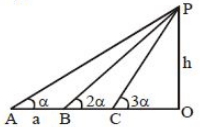
The angle of elevation of the top of a $T.V.$ tower from three points $A, B, C$ in a straight line through the foot of the tower are $\alpha, 2\alpha, 3\alpha$ respectively. If $AB = a$,the height of the tower is
A
$a \sin \alpha$
B
$a \sin 2\alpha$
C
$a \sin 3\alpha$
D
$a \tan \alpha$
Solution
(B) Let $OP = h$ be the height of the tower. Let $O$ be the foot of the tower.
In $\triangle OAP$,$\angle OAP = \alpha$. So,$OA = h \cot \alpha$.
In $\triangle OBP$,$\angle OBP = 2\alpha$. So,$OB = h \cot 2\alpha$.
Given $AB = a$,we have $OA - OB = a$.
Therefore,$h(\cot \alpha - \cot 2\alpha) = a$.
$h \left( \frac{\cos \alpha}{\sin \alpha} - \frac{\cos 2\alpha}{\sin 2\alpha} \right) = a$
$h \left( \frac{\sin 2\alpha \cos \alpha - \cos 2\alpha \sin \alpha}{\sin \alpha \sin 2\alpha} \right) = a$
$h \left( \frac{\sin(2\alpha - \alpha)}{\sin \alpha \sin 2\alpha} \right) = a$
$h \left( \frac{\sin \alpha}{\sin \alpha \sin 2\alpha} \right) = a$
$h \left( \frac{1}{\sin 2\alpha} \right) = a$
$h = a \sin 2\alpha$.
In $\triangle OAP$,$\angle OAP = \alpha$. So,$OA = h \cot \alpha$.
In $\triangle OBP$,$\angle OBP = 2\alpha$. So,$OB = h \cot 2\alpha$.
Given $AB = a$,we have $OA - OB = a$.
Therefore,$h(\cot \alpha - \cot 2\alpha) = a$.
$h \left( \frac{\cos \alpha}{\sin \alpha} - \frac{\cos 2\alpha}{\sin 2\alpha} \right) = a$
$h \left( \frac{\sin 2\alpha \cos \alpha - \cos 2\alpha \sin \alpha}{\sin \alpha \sin 2\alpha} \right) = a$
$h \left( \frac{\sin(2\alpha - \alpha)}{\sin \alpha \sin 2\alpha} \right) = a$
$h \left( \frac{\sin \alpha}{\sin \alpha \sin 2\alpha} \right) = a$
$h \left( \frac{1}{\sin 2\alpha} \right) = a$
$h = a \sin 2\alpha$.
0 likesView Solution
4
ChemistryMCQKCET · 2008
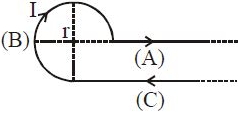
Current $I$ is flowing in a conductor shaped as shown in the figure. The radius of the curved part is $r$ and the length of the straight portions is very large. The value of the magnetic field at the centre $O$ will be
A
$\frac{\mu_0 I}{4\pi r} \left( \frac{3\pi}{2} + 1 \right)$
B
$\frac{\mu_0 I}{4\pi r} \left( \frac{3\pi}{2} - 1 \right)$
C
$\frac{\mu_0 I}{4\pi r} \left( \frac{\pi}{2} + 1 \right)$
D
$\frac{\mu_0 I}{4\pi r} \left( \frac{\pi}{2} - 1 \right)$
Solution
(A) The conductor consists of three parts: two semi-infinite straight wires ($A$ and $C$) and a three-quarter circular arc $(B)$.
$1$. For the straight wire $A$,the point $O$ lies on its axis,so the magnetic field $B_A = 0$.
$2$. For the straight wire $C$,the distance from $O$ is $r$. The magnetic field due to a semi-infinite wire at a perpendicular distance $r$ is $B_C = \frac{\mu_0 I}{4\pi r}$. Using the right-hand rule,the direction is into the page $(\otimes)$.
$3$. For the three-quarter circular arc $B$,the angle subtended is $\theta = \frac{3\pi}{2}$. The magnetic field is $B_B = \frac{\mu_0 I \theta}{4\pi r} = \frac{\mu_0 I (3\pi/2)}{4\pi r}$. The direction is also into the page $(\otimes)$.
$4$. The net magnetic field at $O$ is $B_{net} = B_A + B_B + B_C = 0 + \frac{\mu_0 I}{4\pi r} \left( \frac{3\pi}{2} \right) + \frac{\mu_0 I}{4\pi r} = \frac{\mu_0 I}{4\pi r} \left( \frac{3\pi}{2} + 1 \right)$.
$1$. For the straight wire $A$,the point $O$ lies on its axis,so the magnetic field $B_A = 0$.
$2$. For the straight wire $C$,the distance from $O$ is $r$. The magnetic field due to a semi-infinite wire at a perpendicular distance $r$ is $B_C = \frac{\mu_0 I}{4\pi r}$. Using the right-hand rule,the direction is into the page $(\otimes)$.
$3$. For the three-quarter circular arc $B$,the angle subtended is $\theta = \frac{3\pi}{2}$. The magnetic field is $B_B = \frac{\mu_0 I \theta}{4\pi r} = \frac{\mu_0 I (3\pi/2)}{4\pi r}$. The direction is also into the page $(\otimes)$.
$4$. The net magnetic field at $O$ is $B_{net} = B_A + B_B + B_C = 0 + \frac{\mu_0 I}{4\pi r} \left( \frac{3\pi}{2} \right) + \frac{\mu_0 I}{4\pi r} = \frac{\mu_0 I}{4\pi r} \left( \frac{3\pi}{2} + 1 \right)$.
0 likesView Solution
5
ChemistryMCQKCET · 2008
The magnetic field at the centre of a circular current-carrying conductor of radius $r$ is $B_c$. The magnetic field on its axis at a distance $r$ from the centre is $B_a$. The value of $B_c : B_a$ will be:
A
$1 : \sqrt{2}$
B
$1 : 2\sqrt{2}$
C
$2\sqrt{2} : 1$
D
$\sqrt{2} : 1$
Solution
(C) The magnetic field at the centre of a circular current-carrying coil is given by:
$B_c = \frac{\mu_0 I}{2r} \quad \dots(i)$
The magnetic field on the axis of a circular coil at a distance $d$ from the centre is given by:
$B_a = \frac{\mu_0 I r^2}{2(r^2 + d^2)^{3/2}}$
Given $d = r$,we substitute this into the formula:
$B_a = \frac{\mu_0 I r^2}{2(r^2 + r^2)^{3/2}} = \frac{\mu_0 I r^2}{2(2r^2)^{3/2}} = \frac{\mu_0 I r^2}{2(2\sqrt{2} r^3)} = \frac{\mu_0 I}{4\sqrt{2} r} \quad \dots(ii)$
Now,calculating the ratio $B_c : B_a$:
$\frac{B_c}{B_a} = \left( \frac{\mu_0 I}{2r} \right) \div \left( \frac{\mu_0 I}{4\sqrt{2} r} \right) = \frac{4\sqrt{2} r}{2r} = 2\sqrt{2}$
Therefore,$B_c : B_a = 2\sqrt{2} : 1$.
$B_c = \frac{\mu_0 I}{2r} \quad \dots(i)$
The magnetic field on the axis of a circular coil at a distance $d$ from the centre is given by:
$B_a = \frac{\mu_0 I r^2}{2(r^2 + d^2)^{3/2}}$
Given $d = r$,we substitute this into the formula:
$B_a = \frac{\mu_0 I r^2}{2(r^2 + r^2)^{3/2}} = \frac{\mu_0 I r^2}{2(2r^2)^{3/2}} = \frac{\mu_0 I r^2}{2(2\sqrt{2} r^3)} = \frac{\mu_0 I}{4\sqrt{2} r} \quad \dots(ii)$
Now,calculating the ratio $B_c : B_a$:
$\frac{B_c}{B_a} = \left( \frac{\mu_0 I}{2r} \right) \div \left( \frac{\mu_0 I}{4\sqrt{2} r} \right) = \frac{4\sqrt{2} r}{2r} = 2\sqrt{2}$
Therefore,$B_c : B_a = 2\sqrt{2} : 1$.
0 likesView Solution
6
ChemistryMCQKCET · 2008
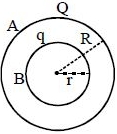
$A$ small conducting sphere of radius $r$ is lying concentrically inside a bigger hollow conducting sphere of radius $R$. The bigger and smaller spheres are charged with $Q$ and $q$ $(Q > q)$ respectively and are insulated from each other. The potential difference between the spheres will be
A
$\frac{1}{4\pi \epsilon_0} \left( \frac{q}{r} - \frac{q}{R} \right)$
B
$\frac{1}{4\pi \epsilon_0} \left( \frac{Q}{R} + \frac{q}{r} \right)$
C
$\frac{1}{4\pi \epsilon_0} \left( \frac{q}{r} - \frac{Q}{R} \right)$
D
$\frac{1}{4\pi \epsilon_0} \left( \frac{q}{R} - \frac{Q}{r} \right)$
Solution
(A) Let $V_A$ be the potential of the outer sphere (radius $R$,charge $Q$) and $V_B$ be the potential of the inner sphere (radius $r$,charge $q$).
The potential at the surface of the outer sphere $(A)$ is due to its own charge $Q$ and the charge $q$ on the inner sphere:
$V_A = \frac{1}{4\pi \epsilon_0} \frac{Q}{R} + \frac{1}{4\pi \epsilon_0} \frac{q}{R} = \frac{1}{4\pi \epsilon_0} \left( \frac{Q+q}{R} \right)$
The potential at the surface of the inner sphere $(B)$ is due to its own charge $q$ and the potential due to the outer sphere (which is constant inside it):
$V_B = \frac{1}{4\pi \epsilon_0} \frac{q}{r} + \frac{1}{4\pi \epsilon_0} \frac{Q}{R} = \frac{1}{4\pi \epsilon_0} \left( \frac{q}{r} + \frac{Q}{R} \right)$
The potential difference between the spheres is $V_B - V_A$:
$V_B - V_A = \frac{1}{4\pi \epsilon_0} \left( \frac{q}{r} + \frac{Q}{R} \right) - \frac{1}{4\pi \epsilon_0} \left( \frac{Q+q}{R} \right)$
$V_B - V_A = \frac{1}{4\pi \epsilon_0} \left( \frac{q}{r} + \frac{Q}{R} - \frac{Q}{R} - \frac{q}{R} \right)$
$V_B - V_A = \frac{1}{4\pi \epsilon_0} \left( \frac{q}{r} - \frac{q}{R} \right)$
The potential at the surface of the outer sphere $(A)$ is due to its own charge $Q$ and the charge $q$ on the inner sphere:
$V_A = \frac{1}{4\pi \epsilon_0} \frac{Q}{R} + \frac{1}{4\pi \epsilon_0} \frac{q}{R} = \frac{1}{4\pi \epsilon_0} \left( \frac{Q+q}{R} \right)$
The potential at the surface of the inner sphere $(B)$ is due to its own charge $q$ and the potential due to the outer sphere (which is constant inside it):
$V_B = \frac{1}{4\pi \epsilon_0} \frac{q}{r} + \frac{1}{4\pi \epsilon_0} \frac{Q}{R} = \frac{1}{4\pi \epsilon_0} \left( \frac{q}{r} + \frac{Q}{R} \right)$
The potential difference between the spheres is $V_B - V_A$:
$V_B - V_A = \frac{1}{4\pi \epsilon_0} \left( \frac{q}{r} + \frac{Q}{R} \right) - \frac{1}{4\pi \epsilon_0} \left( \frac{Q+q}{R} \right)$
$V_B - V_A = \frac{1}{4\pi \epsilon_0} \left( \frac{q}{r} + \frac{Q}{R} - \frac{Q}{R} - \frac{q}{R} \right)$
$V_B - V_A = \frac{1}{4\pi \epsilon_0} \left( \frac{q}{r} - \frac{q}{R} \right)$
0 likesView Solution
7
ChemistryMCQKCET · 2008
The magnetic field at the centre of a circular current-carrying conductor of radius $r$ is $B_c$. The magnetic field on its axis at a distance $r$ from the centre is $B_a$. The value of $B_c : B_a$ will be
A
$1:\sqrt{2}$
B
$1:2\sqrt{2}$
C
$2\sqrt{2}:1$
D
$\sqrt{2}:1$
Solution
(C) The magnetic field at the centre of a circular current-carrying coil of radius $r$ is given by:
$B_c = \frac{\mu_0 I}{2r} \quad \dots(i)$
The magnetic field on the axis of a circular coil at a distance $x$ from the centre is given by:
$B_a = \frac{\mu_0 I r^2}{2(r^2 + x^2)^{3/2}}$
Given $x = r$,we substitute this into the formula:
$B_a = \frac{\mu_0 I r^2}{2(r^2 + r^2)^{3/2}} = \frac{\mu_0 I r^2}{2(2r^2)^{3/2}} = \frac{\mu_0 I r^2}{2(2\sqrt{2}r^3)} = \frac{\mu_0 I}{4\sqrt{2}r} \quad \dots(ii)$
Now,taking the ratio $B_c : B_a$:
$\frac{B_c}{B_a} = \frac{\frac{\mu_0 I}{2r}}{\frac{\mu_0 I}{4\sqrt{2}r}} = \frac{4\sqrt{2}r}{2r} = 2\sqrt{2}$
Therefore,$B_c : B_a = 2\sqrt{2} : 1$.
$B_c = \frac{\mu_0 I}{2r} \quad \dots(i)$
The magnetic field on the axis of a circular coil at a distance $x$ from the centre is given by:
$B_a = \frac{\mu_0 I r^2}{2(r^2 + x^2)^{3/2}}$
Given $x = r$,we substitute this into the formula:
$B_a = \frac{\mu_0 I r^2}{2(r^2 + r^2)^{3/2}} = \frac{\mu_0 I r^2}{2(2r^2)^{3/2}} = \frac{\mu_0 I r^2}{2(2\sqrt{2}r^3)} = \frac{\mu_0 I}{4\sqrt{2}r} \quad \dots(ii)$
Now,taking the ratio $B_c : B_a$:
$\frac{B_c}{B_a} = \frac{\frac{\mu_0 I}{2r}}{\frac{\mu_0 I}{4\sqrt{2}r}} = \frac{4\sqrt{2}r}{2r} = 2\sqrt{2}$
Therefore,$B_c : B_a = 2\sqrt{2} : 1$.
0 likesView Solution
8
ChemistryMCQKCET · 2008
$A$ current of $5 ~A$ is flowing at $220 ~V$ in the primary coil of a transformer. If the voltage produced in the secondary coil is $2200 ~V$ and $50 \%$ of power is lost,then the current in the secondary coil will be: (in $~A$)
A
$2.5$
B
$5$
C
$0.25$
D
$0.5$
Solution
(C) Given: Primary voltage $V_{p} = 220 ~V$,Primary current $I_{p} = 5 ~A$,Secondary voltage $V_{s} = 2200 ~V$,Power loss $= 50 \%$.
Efficiency $\eta = 100 \% - 50 \% = 50 \%$.
The efficiency of a transformer is defined as the ratio of output power to input power:
$\eta = \frac{P_{out}}{P_{in}} = \frac{V_{s} I_{s}}{V_{p} I_{p}}$
Substituting the given values:
$0.5 = \frac{2200 \times I_{s}}{220 \times 5}$
$0.5 = \frac{2200 \times I_{s}}{1100}$
$0.5 = 2 \times I_{s}$
$I_{s} = \frac{0.5}{2} = 0.25 ~A$.
Therefore,the current in the secondary coil is $0.25 ~A$.
Efficiency $\eta = 100 \% - 50 \% = 50 \%$.
The efficiency of a transformer is defined as the ratio of output power to input power:
$\eta = \frac{P_{out}}{P_{in}} = \frac{V_{s} I_{s}}{V_{p} I_{p}}$
Substituting the given values:
$0.5 = \frac{2200 \times I_{s}}{220 \times 5}$
$0.5 = \frac{2200 \times I_{s}}{1100}$
$0.5 = 2 \times I_{s}$
$I_{s} = \frac{0.5}{2} = 0.25 ~A$.
Therefore,the current in the secondary coil is $0.25 ~A$.
0 likesView Solution
9
ChemistryMCQKCET · 2008
The ratio of minimum wavelengths of Lyman and Balmer series will be
A
$1.25$
B
$0.25$
C
$5$
D
$10$
Solution
(B) The wavelength of spectral lines in the hydrogen atom is given by the Rydberg formula: $\frac{1}{\lambda} = R \left( \frac{1}{n_1^2} - \frac{1}{n_2^2} \right)$.
For the minimum wavelength,the transition must be from $n_2 = \infty$ to $n_1$.
For the Lyman series,$n_1 = 1$,so $\frac{1}{\lambda_L} = R \left( \frac{1}{1^2} - \frac{1}{\infty^2} \right) = R$,which gives $\lambda_L = \frac{1}{R}$.
For the Balmer series,$n_1 = 2$,so $\frac{1}{\lambda_B} = R \left( \frac{1}{2^2} - \frac{1}{\infty^2} \right) = \frac{R}{4}$,which gives $\lambda_B = \frac{4}{R}$.
The ratio of the minimum wavelengths is $\frac{\lambda_L}{\lambda_B} = \frac{1/R}{4/R} = \frac{1}{4} = 0.25$.
For the minimum wavelength,the transition must be from $n_2 = \infty$ to $n_1$.
For the Lyman series,$n_1 = 1$,so $\frac{1}{\lambda_L} = R \left( \frac{1}{1^2} - \frac{1}{\infty^2} \right) = R$,which gives $\lambda_L = \frac{1}{R}$.
For the Balmer series,$n_1 = 2$,so $\frac{1}{\lambda_B} = R \left( \frac{1}{2^2} - \frac{1}{\infty^2} \right) = \frac{R}{4}$,which gives $\lambda_B = \frac{4}{R}$.
The ratio of the minimum wavelengths is $\frac{\lambda_L}{\lambda_B} = \frac{1/R}{4/R} = \frac{1}{4} = 0.25$.
0 likesView Solution
10
ChemistryMCQKCET · 2008
The ratio of minimum wavelengths of Lyman and Balmer series will be
A
$1.25$
B
$0.25$
C
$5$
D
$10$
Solution
(B) The minimum wavelength of a spectral series corresponds to the transition from $n_{i}=\infty$ to the final orbit $n_{f}$.
For the Lyman series,$n_{f}=1$:
$\frac{1}{(\lambda_{\min})_{L}} = R \left[ \frac{1}{1^2} - \frac{1}{\infty^2} \right] = R$
$\Rightarrow (\lambda_{\min})_{L} = \frac{1}{R}$ --- $(i)$
For the Balmer series,$n_{f}=2$:
$\frac{1}{(\lambda_{\min})_{B}} = R \left[ \frac{1}{2^2} - \frac{1}{\infty^2} \right] = \frac{R}{4}$
$\Rightarrow (\lambda_{\min})_{B} = \frac{4}{R}$ --- (ii)
Dividing equation $(i)$ by (ii):
$\frac{(\lambda_{\min})_{L}}{(\lambda_{\min})_{B}} = \frac{1/R}{4/R} = \frac{1}{4} = 0.25$
For the Lyman series,$n_{f}=1$:
$\frac{1}{(\lambda_{\min})_{L}} = R \left[ \frac{1}{1^2} - \frac{1}{\infty^2} \right] = R$
$\Rightarrow (\lambda_{\min})_{L} = \frac{1}{R}$ --- $(i)$
For the Balmer series,$n_{f}=2$:
$\frac{1}{(\lambda_{\min})_{B}} = R \left[ \frac{1}{2^2} - \frac{1}{\infty^2} \right] = \frac{R}{4}$
$\Rightarrow (\lambda_{\min})_{B} = \frac{4}{R}$ --- (ii)
Dividing equation $(i)$ by (ii):
$\frac{(\lambda_{\min})_{L}}{(\lambda_{\min})_{B}} = \frac{1/R}{4/R} = \frac{1}{4} = 0.25$
0 likesView Solution
11
ChemistryEasyMCQKCET · 2008
The overlapping of orbitals in benzene is of the type
A
$sp-sp$
B
$sp^{2}-sp^{3}$
C
$sp^{2}-sp^{2}$
D
$sp^{3}-sp^{3}$
Solution
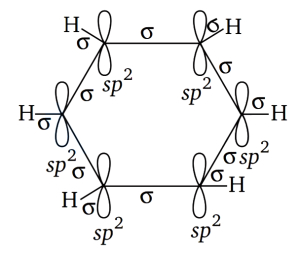
(C) The molecular orbital picture of benzene shows that all six carbon atoms are $sp^{2}$ hybridized.
Out of these three $sp^{2}$ hybrid orbitals of each $C$ atom,two orbitals overlap with $sp^{2}$ hybrid orbitals of adjacent $C$ atoms to form six $C-C$ single bonds.
The remaining $sp^{2}$ orbital of each $C$ atom overlaps with the $s$-orbital of each hydrogen atom to form six $C-H$ single sigma bonds.
Each $C$ atom is now left with one unhybridized $p$-orbital perpendicular to the plane of the ring.
Out of these three $sp^{2}$ hybrid orbitals of each $C$ atom,two orbitals overlap with $sp^{2}$ hybrid orbitals of adjacent $C$ atoms to form six $C-C$ single bonds.
The remaining $sp^{2}$ orbital of each $C$ atom overlaps with the $s$-orbital of each hydrogen atom to form six $C-H$ single sigma bonds.
Each $C$ atom is now left with one unhybridized $p$-orbital perpendicular to the plane of the ring.
0 likesView Solution
12
ChemistryEasyMCQKCET · 2008
The number of nodal planes present in $\sigma^{*}s$ antibonding orbitals is
A
$1$
B
$2$
C
$0$
D
$3$
Solution
(A) In an antibonding molecular orbital,such as $\sigma^{*}s$,the wave functions of the atomic orbitals interfere destructively.
This results in a region of zero electron density between the two nuclei,which is known as a nodal plane.
As shown in the diagram,there is exactly $1$ nodal plane perpendicular to the internuclear axis for the $\sigma^{*}s$ antibonding molecular orbital.
This results in a region of zero electron density between the two nuclei,which is known as a nodal plane.
As shown in the diagram,there is exactly $1$ nodal plane perpendicular to the internuclear axis for the $\sigma^{*}s$ antibonding molecular orbital.
0 likesView Solution
13
ChemistryEasyMCQKCET · 2008
The calculated bond order of superoxide ion $(O_{2}^{-})$ is
A
$2.5$
B
$2$
C
$1.5$
D
$1$
Solution
(C) The molecular orbital $(MO)$ configuration of the superoxide ion,$O_{2}^{-} (17 \ e^{-})$,is: $\sigma 1s^2, \sigma^* 1s^2, \sigma 2s^2, \sigma^* 2s^2, \sigma 2p_z^2, \pi 2p_x^2 = \pi 2p_y^2, \pi^* 2p_x^2 = \pi^* 2p_y^1$.
Bond order is calculated as: $\text{Bond order} = \frac{1}{2} (N_b - N_a) = \frac{1}{2} (10 - 7) = \frac{3}{2} = 1.5$.
Bond order is calculated as: $\text{Bond order} = \frac{1}{2} (N_b - N_a) = \frac{1}{2} (10 - 7) = \frac{3}{2} = 1.5$.
0 likesView Solution
14
ChemistryEasyMCQKCET · 2008
The maximum number of hydrogen bonds that a molecule of water can have is
A
$1$
B
$2$
C
$3$
D
$4$
Solution
(D) single water molecule $(H_2O)$ has two hydrogen atoms that can act as donors for hydrogen bonding and two lone pairs on the oxygen atom that can act as acceptors for hydrogen bonding.
Thus,one water molecule can form a maximum of four hydrogen bonds with surrounding water molecules.
This is represented by the structure where the central oxygen atom is bonded to two hydrogen atoms via covalent bonds and interacts with two other hydrogen atoms from neighboring water molecules via hydrogen bonds,while the two hydrogen atoms of the central molecule interact with the oxygen atoms of two other neighboring water molecules.
Thus,one water molecule can form a maximum of four hydrogen bonds with surrounding water molecules.
This is represented by the structure where the central oxygen atom is bonded to two hydrogen atoms via covalent bonds and interacts with two other hydrogen atoms from neighboring water molecules via hydrogen bonds,while the two hydrogen atoms of the central molecule interact with the oxygen atoms of two other neighboring water molecules.
0 likesView Solution
15
ChemistryEasyMCQKCET · 2008
For the reaction $2 \ HI_{(g)} \rightleftharpoons H_{2(g)} + I_{2(g)} - Q \ kJ$,the equilibrium constant depends upon
A
temperature
B
pressure
C
catalyst
D
Volume
Solution
(A) The given reaction is $2 \ HI_{(g)} \rightleftharpoons H_{2(g)} + I_{2(g)} - Q \ kJ$.
For this reaction,the change in the number of moles of gaseous species is $\Delta n_g = n_p - n_R = 2 - 2 = 0$.
Since $\Delta n_g = 0$,the equilibrium constant is not affected by changes in pressure or volume.
$A$ catalyst only speeds up the attainment of equilibrium and does not alter the value of the equilibrium constant.
The equilibrium constant ($K_c$ or $K_p$) is a function of temperature only,as described by the van't Hoff equation. Therefore,for this reaction,the equilibrium constant depends only upon the temperature.
For this reaction,the change in the number of moles of gaseous species is $\Delta n_g = n_p - n_R = 2 - 2 = 0$.
Since $\Delta n_g = 0$,the equilibrium constant is not affected by changes in pressure or volume.
$A$ catalyst only speeds up the attainment of equilibrium and does not alter the value of the equilibrium constant.
The equilibrium constant ($K_c$ or $K_p$) is a function of temperature only,as described by the van't Hoff equation. Therefore,for this reaction,the equilibrium constant depends only upon the temperature.
0 likesView Solution
16
ChemistryEasyMCQKCET · 2008
$N_{2} + 3H_{2} \rightleftharpoons 2NH_{3} + \text{heat}$. What is the effect of the increase of temperature on the equilibrium of the reaction?
A
Equilibrium is shifted to the left
B
Equilibrium is shifted to the right
C
Equilibrium is unaltered
D
Reaction rate does not change
Solution
(A) $N_{2} + 3H_{2} \rightleftharpoons 2NH_{3} + \text{heat}$
According to Le Chatelier's principle,for an exothermic reaction,an increase in temperature shifts the equilibrium in the direction that absorbs heat.
Since the forward reaction is exothermic,increasing the temperature will favour the backward reaction.
Therefore,the equilibrium shifts to the left.
According to Le Chatelier's principle,for an exothermic reaction,an increase in temperature shifts the equilibrium in the direction that absorbs heat.
Since the forward reaction is exothermic,increasing the temperature will favour the backward reaction.
Therefore,the equilibrium shifts to the left.
0 likesView Solution
17
ChemistryMediumMCQKCET · 2008
Malleability and ductility of metals can be accounted for due to
A
the presence of electrostatic force
B
the crystalline structure in metal
C
the capacity of layers of metal ions to slide over each other
D
the interaction of electrons with metal ions in the lattice
Solution
(C) In metallic bonds,the valence shell electrons are delocalised and shared between many atoms.
These delocalised electrons allow the metal atoms to slide past one another without being subjected to strong repulsive forces.
The malleability and ductility of metals is due to this sliding capacity of the layers of metal ions.
These delocalised electrons allow the metal atoms to slide past one another without being subjected to strong repulsive forces.
The malleability and ductility of metals is due to this sliding capacity of the layers of metal ions.
0 likesView Solution
18
ChemistryEasyMCQKCET · 2008
Which metal has a greater tendency to form metal oxide?
A
$Cr$
B
$Fe$
C
$Al$
D
$Ca$
Solution
(D) The tendency to form a metal oxide is related to the stability of the oxide formed and the reactivity of the metal.
According to the Ellingham diagram,metals that are more reactive and have a more negative Gibbs free energy of formation $(\Delta G_f^\circ)$ for their oxides have a greater tendency to form oxides.
Among the given metals ($Cr$,$Fe$,$Al$,$Ca$),$Ca$ is the most reactive alkaline earth metal.
$Ca$ forms a highly stable ionic oxide $(CaO)$ with a very large negative value of $\Delta G_f^\circ$.
Therefore,$Ca$ has the greatest tendency to form its oxide.
According to the Ellingham diagram,metals that are more reactive and have a more negative Gibbs free energy of formation $(\Delta G_f^\circ)$ for their oxides have a greater tendency to form oxides.
Among the given metals ($Cr$,$Fe$,$Al$,$Ca$),$Ca$ is the most reactive alkaline earth metal.
$Ca$ forms a highly stable ionic oxide $(CaO)$ with a very large negative value of $\Delta G_f^\circ$.
Therefore,$Ca$ has the greatest tendency to form its oxide.
0 likesView Solution
19
ChemistryEasyMCQKCET · 2008
When sulphur dioxide is passed in an acidified $K_{2}Cr_{2}O_{7}$ solution,the oxidation state of sulphur is changed from
A
$+4$ to $0$
B
$+4$ to $+2$
C
$+4$ to $+6$
D
$+6$ to $+4$
Solution
(C) Acidified $K_{2}Cr_{2}O_{7}$ acts as a strong oxidizing agent and oxidizes $SO_{2}$ to $SO_{4}^{2-}$ ions (present in $Cr_{2}(SO_{4})_{3}$).
The balanced chemical equation is:
$3SO_{2} + K_{2}Cr_{2}O_{7} + H_{2}SO_{4} \longrightarrow K_{2}SO_{4} + Cr_{2}(SO_{4})_{3} + H_{2}O$
In $SO_{2}$,the oxidation state of sulphur is $+4$.
In $Cr_{2}(SO_{4})_{3}$,the sulphate ion $(SO_{4}^{2-})$ contains sulphur in the $+6$ oxidation state.
Thus,the oxidation state of sulphur changes from $+4$ to $+6$.
The balanced chemical equation is:
$3SO_{2} + K_{2}Cr_{2}O_{7} + H_{2}SO_{4} \longrightarrow K_{2}SO_{4} + Cr_{2}(SO_{4})_{3} + H_{2}O$
In $SO_{2}$,the oxidation state of sulphur is $+4$.
In $Cr_{2}(SO_{4})_{3}$,the sulphate ion $(SO_{4}^{2-})$ contains sulphur in the $+6$ oxidation state.
Thus,the oxidation state of sulphur changes from $+4$ to $+6$.
0 likesView Solution
20
ChemistryMCQKCET · 2008
If an electron and a proton have the same de-Broglie wavelength,then the kinetic energy of the electron is
A
zero
B
less than that of a proton
C
more than that of a proton
D
equal to that of a proton
Solution
(C) The de-Broglie wavelength $\lambda$ is related to the kinetic energy $KE$ by the formula: $\lambda = \frac{h}{\sqrt{2mKE}}$.
Rearranging this for kinetic energy,we get: $KE = \frac{h^2}{2m\lambda^2}$.
Since the de-Broglie wavelength $\lambda$ and Planck's constant $h$ are the same for both particles,we have $KE \propto \frac{1}{m}$.
Because the mass of an electron $(m_e \approx 9.11 \times 10^{-31} \ kg)$ is much smaller than the mass of a proton $(m_p \approx 1.67 \times 10^{-27} \ kg)$,the kinetic energy of the electron will be greater than that of the proton.
Rearranging this for kinetic energy,we get: $KE = \frac{h^2}{2m\lambda^2}$.
Since the de-Broglie wavelength $\lambda$ and Planck's constant $h$ are the same for both particles,we have $KE \propto \frac{1}{m}$.
Because the mass of an electron $(m_e \approx 9.11 \times 10^{-31} \ kg)$ is much smaller than the mass of a proton $(m_p \approx 1.67 \times 10^{-27} \ kg)$,the kinetic energy of the electron will be greater than that of the proton.
0 likesView Solution
21
ChemistryEasyMCQKCET · 2008
Mesomeric effect involves delocalisation of
A
$\pi$ electrons
B
$\sigma$ electrons
C
protons
D
None of these
Solution
(A) The mesomeric effect involves the permanent transfer of $\pi$ electrons or lone pair of electrons through a conjugated system to an adjacent atom or covalent bond. Therefore, it involves the delocalisation of $\pi$ electrons.
0 likesView Solution
22
ChemistryEasyMCQKCET · 2008
Which of the following species does not exert a resonance effect?
A
$C_{6}H_{5}NH_{2}$
B
$C_{6}H_{5}NH_{3}^{+}$
C
$C_{6}H_{5}OH$
D
$C_{6}H_{5}Cl$
Solution
(B) In $C_{6}H_{5}NH_{2}$,$C_{6}H_{5}OH$,and $C_{6}H_{5}Cl$,the substituent attached to the benzene ring has at least one lone pair of electrons,which can participate in resonance with the $\pi$-system of the ring.
In $C_{6}H_{5}NH_{3}^{+}$,the nitrogen atom has four bonds and no lone pair of electrons available for resonance.
As shown in the figure,structure $(II)$ is not a valid resonance contributor because the nitrogen atom would have $10$ valence electrons,which violates the octet rule.
Therefore,$C_{6}H_{5}NH_{3}^{+}$ does not exert a resonance effect.
In $C_{6}H_{5}NH_{3}^{+}$,the nitrogen atom has four bonds and no lone pair of electrons available for resonance.
As shown in the figure,structure $(II)$ is not a valid resonance contributor because the nitrogen atom would have $10$ valence electrons,which violates the octet rule.
Therefore,$C_{6}H_{5}NH_{3}^{+}$ does not exert a resonance effect.
0 likesView Solution
23
ChemistryMediumMCQKCET · 2008
How many optically active stereoisomers are possible for butan-$2,3$-diol?
A
$1$
B
$2$
C
$3$
D
$4$
Solution
(B) The structure of butan-$2,3$-diol is $CH_3-CH(OH)-CH(OH)-CH_3$.
It has two chiral centers $(n=2)$.
Since the molecule is symmetrical,the number of optically active stereoisomers is given by $2^{n-1}$.
Here,$n=2$,so the number of optically active isomers $= 2^{2-1} = 2^{1} = 2$.
These two optically active isomers are the $(2R, 3R)$ and $(2S, 3S)$ forms. The $(2R, 3S)$ form is a meso compound and is optically inactive.
It has two chiral centers $(n=2)$.
Since the molecule is symmetrical,the number of optically active stereoisomers is given by $2^{n-1}$.
Here,$n=2$,so the number of optically active isomers $= 2^{2-1} = 2^{1} = 2$.
These two optically active isomers are the $(2R, 3R)$ and $(2S, 3S)$ forms. The $(2R, 3S)$ form is a meso compound and is optically inactive.
0 likesView Solution
24
ChemistryMediumMCQKCET · 2008
The angle strain in cyclobutane is
A
$24^{\circ} 44^{\prime}$
B
$29^{\circ} 16^{\prime}$
C
$19^{\circ} 22^{\prime}$
D
$9^{\circ} 44^{\prime}$
Solution
(D) In an ideal $sp^3$ hybridized carbon atom,the bond angle is $109^{\circ} 28^{\prime}$.
In cyclobutane,the carbon atoms form a square,so the internal bond angle is $90^{\circ}$.
The total deviation from the tetrahedral angle is $109^{\circ} 28^{\prime} - 90^{\circ} = 19^{\circ} 28^{\prime}$.
According to Baeyer's strain theory,the angle strain is half of this deviation.
$\text{Angle strain} = \frac{1}{2} \times (109^{\circ} 28^{\prime} - 90^{\circ}) = \frac{19^{\circ} 28^{\prime}}{2} = 9^{\circ} 44^{\prime}$.
In cyclobutane,the carbon atoms form a square,so the internal bond angle is $90^{\circ}$.
The total deviation from the tetrahedral angle is $109^{\circ} 28^{\prime} - 90^{\circ} = 19^{\circ} 28^{\prime}$.
According to Baeyer's strain theory,the angle strain is half of this deviation.
$\text{Angle strain} = \frac{1}{2} \times (109^{\circ} 28^{\prime} - 90^{\circ}) = \frac{19^{\circ} 28^{\prime}}{2} = 9^{\circ} 44^{\prime}$.
0 likesView Solution
25
ChemistryEasyMCQKCET · 2008
Methoxy methane and ethanol are:
A
position isomers
B
chain isomers
C
functional isomers
D
optical isomers
Solution
(C) Methoxy methane $(CH_3-O-CH_3)$ and ethanol $(CH_3-CH_2-OH)$ have the same molecular formula $(C_2H_6O)$ but different functional groups (ether and alcohol).
Therefore,they are functional isomers.
Therefore,they are functional isomers.
0 likesView Solution
26
ChemistryEasyMCQKCET · 2008
In order to increase the volume of a gas by $10 \%$,the pressure of the gas should be
A
increased by $10 \%$
B
increased by $1 \%$
C
decreased by $10 \%$
D
decreased by $1 \%$
Solution
(C) According to Boyle's law,at constant temperature,$P_1 V_1 = P_2 V_2$.
Let the initial volume be $V_1 = V$ and initial pressure be $P_1 = P$.
To increase the volume by $10 \%$,the new volume $V_2 = V + 0.1V = 1.1V$.
Substituting these values in the equation: $P \times V = P_2 \times 1.1V$.
$P_2 = \frac{P}{1.1} \approx 0.909P$.
The change in pressure is $P_2 - P_1 = 0.909P - P = -0.091P$.
This represents a decrease of approximately $9.1 \%$.
However,in the context of simple proportional relationships often tested in this format,if $V$ increases by $10 \%$,the pressure must decrease. Among the given options,the most appropriate choice based on the inverse relationship $P \propto \frac{1}{V}$ is a decrease.
Let the initial volume be $V_1 = V$ and initial pressure be $P_1 = P$.
To increase the volume by $10 \%$,the new volume $V_2 = V + 0.1V = 1.1V$.
Substituting these values in the equation: $P \times V = P_2 \times 1.1V$.
$P_2 = \frac{P}{1.1} \approx 0.909P$.
The change in pressure is $P_2 - P_1 = 0.909P - P = -0.091P$.
This represents a decrease of approximately $9.1 \%$.
However,in the context of simple proportional relationships often tested in this format,if $V$ increases by $10 \%$,the pressure must decrease. Among the given options,the most appropriate choice based on the inverse relationship $P \propto \frac{1}{V}$ is a decrease.
0 likesView Solution
27
ChemistryEasyMCQKCET · 2008
Dalda is prepared from oils by
A
oxidation
B
reduction
C
hydrolysis
D
distillation
Solution
(B) Oils (liquid glycerides) react with hydrogen in the presence of a metal catalyst (like $Ni$) to give saturated glycerides (semi-solid fats). This process is known as hydrogenation,which is a type of reduction reaction. Thus,vegetable ghee (Dalda) is obtained by the hydrogenation (reduction) of oils.
$Oils + H_{2} \xrightarrow{Ni} Dalda$
$Oils + H_{2} \xrightarrow{Ni} Dalda$
0 likesView Solution
28
ChemistryMediumMCQKCET · 2008
When carbon monoxide is passed over solid caustic soda heated to $200^{\circ} C$,it forms
A
$Na_{2}CO_{3}$
B
$NaHCO_{3}$
C
$HCOONa$
D
$CH_{3}COONa$
Solution
(C) When carbon monoxide $(CO)$ is passed over solid caustic soda $(NaOH)$ at $200^{\circ} C$ and high pressure,it undergoes an addition reaction to form sodium formate $(HCOONa)$.
$CO + NaOH \xrightarrow{200^{\circ} C, \ 10 \ atm} HCOONa$
$CO + NaOH \xrightarrow{200^{\circ} C, \ 10 \ atm} HCOONa$
0 likesView Solution
29
ChemistryMCQKCET · 2008
The monomers of $Buna-S$ rubber are
A
vinyl chloride and sulphur
B
butadiene
C
styrene and butadiene
D
isoprene and butadiene
Solution
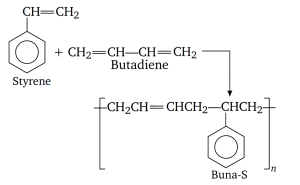
(C) $Buna-S$ rubber is also called $SBR$ (styrene-butadiene rubber).
It is a copolymer of $75 \%$ butadiene $(CH_2=CH-CH=CH_2)$ and $25 \%$ styrene $(C_6H_5-CH=CH_2)$.
It is a copolymer of $75 \%$ butadiene $(CH_2=CH-CH=CH_2)$ and $25 \%$ styrene $(C_6H_5-CH=CH_2)$.
0 likesView Solution
30
ChemistryEasyMCQKCET · 2008
Mass of $0.1 \ mol$ of methane is (in $g$)
A
$1$
B
$16$
C
$1.6$
D
$0.1$
Solution
(C) The molar mass of methane $(CH_{4})$ is calculated as: $12 + (4 \times 1) = 16 \ g/mol$.
Mass of $0.1 \ mol$ of methane $= \text{Number of moles} \times \text{Molar mass}$.
Mass $= 0.1 \ mol \times 16 \ g/mol = 1.6 \ g$.
Mass of $0.1 \ mol$ of methane $= \text{Number of moles} \times \text{Molar mass}$.
Mass $= 0.1 \ mol \times 16 \ g/mol = 1.6 \ g$.
0 likesView Solution
31
ChemistryEasyMCQKCET · 2008
$80 \ g$ of oxygen contains as many atoms as in
A
$80 \ g$ of hydrogen
B
$1 \ g$ of hydrogen
C
$10 \ g$ of hydrogen
D
$5 \ g$ of hydrogen
Solution
(D) The molar mass of oxygen atoms $(O)$ is $16 \ g/mol$. However,oxygen gas exists as $O_2$.
Number of moles of $O_2 = \frac{80 \ g}{32 \ g/mol} = 2.5 \ mol$.
Number of oxygen atoms $= 2.5 \ mol \times 2 \times N_A = 5 \times N_A$.
For hydrogen gas $(H_2)$,the molar mass is $2 \ g/mol$.
Number of atoms in $5 \ g$ of $H_2$:
Moles of $H_2 = \frac{5 \ g}{2 \ g/mol} = 2.5 \ mol$.
Number of hydrogen atoms $= 2.5 \ mol \times 2 \times N_A = 5 \times N_A$.
Thus,$80 \ g$ of oxygen contains the same number of atoms as $5 \ g$ of hydrogen.
Number of moles of $O_2 = \frac{80 \ g}{32 \ g/mol} = 2.5 \ mol$.
Number of oxygen atoms $= 2.5 \ mol \times 2 \times N_A = 5 \times N_A$.
For hydrogen gas $(H_2)$,the molar mass is $2 \ g/mol$.
Number of atoms in $5 \ g$ of $H_2$:
Moles of $H_2 = \frac{5 \ g}{2 \ g/mol} = 2.5 \ mol$.
Number of hydrogen atoms $= 2.5 \ mol \times 2 \times N_A = 5 \times N_A$.
Thus,$80 \ g$ of oxygen contains the same number of atoms as $5 \ g$ of hydrogen.
0 likesView Solution
32
ChemistryMediumMCQKCET · 2008
Three moles of $PCl_{5}$,three moles of $PCl_{3}$ and two moles of $Cl_{2}$ are taken in a closed vessel. If at equilibrium the vessel has $1.5$ moles of $PCl_{5}$,the number of moles of $PCl_{3}$ present in it is
A
$5$
B
$3$
C
$6$
D
$4.5$
Solution
(D) The chemical equilibrium reaction is: $PCl_{5} \rightleftharpoons PCl_{3} + Cl_{2}$
Initially: $PCl_{5} = 3 \ mol$,$PCl_{3} = 3 \ mol$,$Cl_{2} = 2 \ mol$
At equilibrium: $PCl_{5} = (3 - x) \ mol$,$PCl_{3} = (3 + x) \ mol$,$Cl_{2} = (2 + x) \ mol$
Given that at equilibrium,$PCl_{5} = 1.5 \ mol$:
$3 - x = 1.5$
$x = 1.5$
Therefore,the number of moles of $PCl_{3}$ at equilibrium is:
$PCl_{3} = 3 + x = 3 + 1.5 = 4.5 \ mol$
Initially: $PCl_{5} = 3 \ mol$,$PCl_{3} = 3 \ mol$,$Cl_{2} = 2 \ mol$
At equilibrium: $PCl_{5} = (3 - x) \ mol$,$PCl_{3} = (3 + x) \ mol$,$Cl_{2} = (2 + x) \ mol$
Given that at equilibrium,$PCl_{5} = 1.5 \ mol$:
$3 - x = 1.5$
$x = 1.5$
Therefore,the number of moles of $PCl_{3}$ at equilibrium is:
$PCl_{3} = 3 + x = 3 + 1.5 = 4.5 \ mol$
0 likesView Solution
33
ChemistryMediumMCQKCET · 2008
For the reaction $Fe_{2}O_{3} + 3 CO \longrightarrow 2 Fe + 3 CO_{2}$,the volume of carbon monoxide required to reduce one mole of ferric oxide is (in $dm^{3}$)
A
$22.4$
B
$44.8$
C
$67.2$
D
$11.2$
Solution
(C) The balanced chemical equation is: $Fe_{2}O_{3} + 3 CO \longrightarrow 2 Fe + 3 CO_{2}$.
According to the stoichiometry of the reaction,$1 \ mole$ of $Fe_{2}O_{3}$ reacts with $3 \ moles$ of $CO$.
At $STP$,the volume of $1 \ mole$ of any ideal gas is $22.4 \ dm^{3}$.
Therefore,the volume of $3 \ moles$ of $CO = 3 \times 22.4 \ dm^{3} = 67.2 \ dm^{3}$.
According to the stoichiometry of the reaction,$1 \ mole$ of $Fe_{2}O_{3}$ reacts with $3 \ moles$ of $CO$.
At $STP$,the volume of $1 \ mole$ of any ideal gas is $22.4 \ dm^{3}$.
Therefore,the volume of $3 \ moles$ of $CO = 3 \times 22.4 \ dm^{3} = 67.2 \ dm^{3}$.
0 likesView Solution
34
ChemistryMediumMCQKCET · 2008
$A$ gas deviates from ideal behaviour at a high pressure because its molecules
A
attract one another
B
show the Tyndall effect
C
have kinetic energy
D
are bound by covalent bonds
Solution
(A) At high pressure,the volume of the gas is decreased significantly,which brings the molecules closer to each other.
Due to this proximity,the intermolecular attractive forces become significant.
Consequently,the gas deviates from ideal behaviour as the assumption of negligible intermolecular forces in the kinetic molecular theory of gases no longer holds true.
Due to this proximity,the intermolecular attractive forces become significant.
Consequently,the gas deviates from ideal behaviour as the assumption of negligible intermolecular forces in the kinetic molecular theory of gases no longer holds true.
0 likesView Solution
35
ChemistryEasyMCQKCET · 2008
When the azimuthal quantum number has the value of $2$,the number of orbitals possible are
A
$7$
B
$5$
C
$3$
D
$0$
Solution
(B) Given,azimuthal quantum number $(l) = 2$.
The number of orbitals is given by the formula $(2l + 1)$.
Substituting the value of $l$:
Number of orbitals $= (2 \times 2 + 1) = 4 + 1 = 5$.
The number of orbitals is given by the formula $(2l + 1)$.
Substituting the value of $l$:
Number of orbitals $= (2 \times 2 + 1) = 4 + 1 = 5$.
0 likesView Solution
36
ChemistryMediumMCQKCET · 2008
The correct order in which the first ionisation potential increases is
A
$Na, K, Be$
B
$K, Na, Be$
C
$K, Be, Na$
D
$Be, Na, K$
Solution
(B) The first ionisation potential generally increases in a period from left to right and decreases in a group from top to bottom.
Comparing the elements: $K$ (Group $1$,Period $4$),$Na$ (Group $1$,Period $3$),and $Be$ (Group $2$,Period $2$).
Since $K$ and $Na$ are in the same group,$IE_1$ of $K < Na$.
$Be$ is in Period $2$ and Group $2$,which has a higher $IE_1$ than elements in Group $1$ of the same or lower periods.
Thus,the correct order of first ionisation potential is $K < Na < Be$.
Comparing the elements: $K$ (Group $1$,Period $4$),$Na$ (Group $1$,Period $3$),and $Be$ (Group $2$,Period $2$).
Since $K$ and $Na$ are in the same group,$IE_1$ of $K < Na$.
$Be$ is in Period $2$ and Group $2$,which has a higher $IE_1$ than elements in Group $1$ of the same or lower periods.
Thus,the correct order of first ionisation potential is $K < Na < Be$.
0 likesView Solution
37
ChemistryMediumMCQKCET · 2008
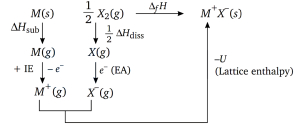
Consider the Born-Haber cycle for the formation of an ionic compound given below and identify the compound $Z$ formed.
$M_{(s)}$ $\xrightarrow{\Delta H_1} M_{(g)}$ $\xrightarrow{\Delta H_2} M^{+}_{(g)}$
$\frac{1}{2} X_{2(g)}$ $\xrightarrow{\Delta H_3} X_{(g)}$ $\xrightarrow{\Delta H_4} X^{-}_{(g)}$
$M^{+}_{(g)} + X^{-}_{(g)} \xrightarrow{\Delta H_5} Z$
$M_{(s)}$ $\xrightarrow{\Delta H_1} M_{(g)}$ $\xrightarrow{\Delta H_2} M^{+}_{(g)}$
$\frac{1}{2} X_{2(g)}$ $\xrightarrow{\Delta H_3} X_{(g)}$ $\xrightarrow{\Delta H_4} X^{-}_{(g)}$
$M^{+}_{(g)} + X^{-}_{(g)} \xrightarrow{\Delta H_5} Z$
A
$M^{+} X^{-}$
B
$M^{+} X^{-}_{(s)}$
C
$MX$
D
$M^{+} X^{-}_{(g)}$
Solution
(B) In the Born-Haber cycle,the final step $(\Delta H_5)$ represents the lattice enthalpy,where gaseous ions $M^{+}_{(g)}$ and $X^{-}_{(g)}$ combine to form one mole of a solid ionic compound $M^{+} X^{-}_{(s)}$.
Thus,$Z$ is $M^{+} X^{-}_{(s)}$.
Thus,$Z$ is $M^{+} X^{-}_{(s)}$.
0 likesView Solution
38
ChemistryMediumMCQKCET · 2008
One mole of which of the following has the highest entropy?
A
Liquid nitrogen
B
Hydrogen gas
C
Mercury
D
Diamond
Solution
(B) Entropy is the measure of the degree of disorder (or randomness) of a system.
In general,the entropy of a substance follows the order: $Gas > Liquid > Solid$.
Among the given options,$Hydrogen$ $gas$ is in the gaseous state,while $Liquid$ $nitrogen$ is a liquid,$Mercury$ is a liquid,and $Diamond$ is a solid.
Therefore,$Hydrogen$ $gas$ has the highest entropy.
In general,the entropy of a substance follows the order: $Gas > Liquid > Solid$.
Among the given options,$Hydrogen$ $gas$ is in the gaseous state,while $Liquid$ $nitrogen$ is a liquid,$Mercury$ is a liquid,and $Diamond$ is a solid.
Therefore,$Hydrogen$ $gas$ has the highest entropy.
0 likesView Solution
39
ChemistryEasyMCQKCET · 2008
If one mole of ammonia and one mole of hydrogen chloride are mixed in a closed container to form ammonium chloride gas,then
A
$\Delta H > \Delta U$
B
$\Delta H = \Delta U$
C
$\Delta H < \Delta U$
D
there is no relationship
Solution
(C) The chemical reaction is: $NH_3(g) + HCl(g) \rightarrow NH_4Cl(g)$
The relationship between enthalpy change $(\Delta H)$ and internal energy change $(\Delta U)$ is given by: $\Delta H = \Delta U + \Delta n_g RT$
Where $\Delta n_g$ is the change in the number of moles of gaseous species.
$\Delta n_g = (\text{moles of gaseous products}) - (\text{moles of gaseous reactants})$
$\Delta n_g = 1 - (1 + 1) = 1 - 2 = -1$
Substituting this into the equation: $\Delta H = \Delta U - RT$
Since $RT$ is positive,it follows that $\Delta H < \Delta U$.
The relationship between enthalpy change $(\Delta H)$ and internal energy change $(\Delta U)$ is given by: $\Delta H = \Delta U + \Delta n_g RT$
Where $\Delta n_g$ is the change in the number of moles of gaseous species.
$\Delta n_g = (\text{moles of gaseous products}) - (\text{moles of gaseous reactants})$
$\Delta n_g = 1 - (1 + 1) = 1 - 2 = -1$
Substituting this into the equation: $\Delta H = \Delta U - RT$
Since $RT$ is positive,it follows that $\Delta H < \Delta U$.
0 likesView Solution
40
ChemistryEasyMCQKCET · 2008
The reagent used to convert an alkyne to an alkene is:
A
$Zn / HCl$
B
$Sn / HCl$
C
$Zn(Hg) / HCl$
D
$H_{2} / Pd-CaCO_{3}$ (Lindlar's catalyst)
Solution
(D) Alkynes are converted into cis-alkenes by partial hydrogenation using Lindlar's catalyst,which is $H_{2}$ gas in the presence of $Pd$ supported on $CaCO_{3}$ and poisoned with lead or quinoline. The reaction is represented as:
$R-C \equiv C-R \xrightarrow{H_{2} / Pd-CaCO_{3}} R-CH=CH-R$ (cis-alkene).
$R-C \equiv C-R \xrightarrow{H_{2} / Pd-CaCO_{3}} R-CH=CH-R$ (cis-alkene).
0 likesView Solution
41
ChemistryEasyMCQKCET · 2008
Catalytic dehydrogenation of a primary alcohol gives a
A
secondary alcohol
B
aldehyde
C
ketone
D
ester
Solution
(B) When vapors of a primary alcohol are passed over reduced copper catalyst at $573 \ K$,dehydrogenation occurs to form an aldehyde.
The reaction is represented as:
$R-CH_2OH \xrightarrow{Cu, 573 \ K} R-CHO + H_2$
Thus,the correct product is an aldehyde.
The reaction is represented as:
$R-CH_2OH \xrightarrow{Cu, 573 \ K} R-CHO + H_2$
Thus,the correct product is an aldehyde.
0 likesView Solution
42
ChemistryMediumMCQKCET · 2008
The compound on dehydrogenation gives a ketone. The original compound is
A
primary alcohol
B
secondary alcohol
C
tertiary alcohol
D
carboxylic acid
Solution
(B) When vapors of secondary alcohols are passed over heated copper $(Cu)$ catalyst at $573 \ K$,they undergo dehydrogenation to form ketones.
The general reaction is:
$R_2CH-OH \xrightarrow{Cu, 573 \ K} R_2C=O + H_2$
The general reaction is:
$R_2CH-OH \xrightarrow{Cu, 573 \ K} R_2C=O + H_2$
0 likesView Solution
43
ChemistryMediumMCQKCET · 2008
Which of the following organic compounds answers to both iodoform test and Fehling's test?
A
Ethanol
B
Methanal
C
Ethanal
D
Propanone
Solution
(C) The compound which contains a $CH_3CO-$ group in its structure gives a positive iodoform test,and the compound which contains an aldehyde group $(-CHO)$ gives a positive Fehling's test.
In ethanal $(CH_3CHO)$,both the $CH_3CO-$ group and the $-CHO$ group are present.
Therefore,it responds to both the iodoform test and Fehling's test.
$CH_3CHO + 3I_2 + 4NaOH \rightarrow CHI_3 + HCOONa + 3NaI + 3H_2O$ (Iodoform test)
$CH_3CHO + 2Cu(OH)_2 + NaOH \rightarrow CH_3COONa + Cu_2O \downarrow + 3H_2O$ (Fehling's test)
In ethanal $(CH_3CHO)$,both the $CH_3CO-$ group and the $-CHO$ group are present.
Therefore,it responds to both the iodoform test and Fehling's test.
$CH_3CHO + 3I_2 + 4NaOH \rightarrow CHI_3 + HCOONa + 3NaI + 3H_2O$ (Iodoform test)
$CH_3CHO + 2Cu(OH)_2 + NaOH \rightarrow CH_3COONa + Cu_2O \downarrow + 3H_2O$ (Fehling's test)
0 likesView Solution
44
ChemistryEasyMCQKCET · 2008
Amines behave as
A
Lewis acid
B
Lewis base
C
aprotic acid
D
neutral compound
Solution
(B) The substance which can donate a pair of electrons is called a $Lewis$ base.
Amines contain a lone pair of electrons on the nitrogen atom,which they can donate to an electron-deficient species.
Therefore,amines behave as $Lewis$ bases.
Amines contain a lone pair of electrons on the nitrogen atom,which they can donate to an electron-deficient species.
Therefore,amines behave as $Lewis$ bases.
0 likesView Solution
45
ChemistryMediumMCQKCET · 2008
Waxes are esters of
A
glycerol
B
long chain alcohols
C
glycerol and fatty acid
D
long chain alcohols and long chain fatty acids
Solution
(D) Waxes are esters formed by the reaction of long-chain fatty acids with long-chain monohydric alcohols,such as myricyl alcohol or cetyl alcohol.
0 likesView Solution
46
ChemistryEasyMCQKCET · 2008
An octahedral complex is formed when hybrid orbitals of the following type are involved:
A
$sp^3$
B
$dsp^2$
C
$d^2sp^3$
D
$sp^2d^2$
Solution
(C) The geometry of a coordination complex is determined by the hybridization of the central metal atom. The relationship is as follows:
Thus,$d^2sp^3$ hybridization results in an octahedral geometry.
| Hybridization | Geometry of Complex |
|---|---|
| $sp^3$ | Tetrahedral |
| $dsp^2$ | Square planar |
| $d^2sp^3$ | Octahedral |
| $sp^3d^2$ | Octahedral |
Thus,$d^2sp^3$ hybridization results in an octahedral geometry.
0 likesView Solution
47
ChemistryEasyMCQKCET · 2008
The basic principle of Cottrell's precipitator is
A
Le $Chatelier's$ principle
B
peptisation
C
neutralisation of charge on colloidal particles
D
scattering of light
Solution
(C) In $Cottrell's$ precipitator,the charged colloidal particles are attracted towards the oppositely charged plates (walls of the precipitator).
Upon contact,they lose their charge and undergo coagulation.
Hence,the basic principle of $Cottrell's$ precipitator is the neutralisation of charge on colloidal particles.
Upon contact,they lose their charge and undergo coagulation.
Hence,the basic principle of $Cottrell's$ precipitator is the neutralisation of charge on colloidal particles.
0 likesView Solution
48
ChemistryMediumMCQKCET · 2008
The number of disulphide linkages present in insulin are
A
$1$
B
$2$
C
$3$
D
$4$
Solution
(C) Insulin is composed of two peptide chains referred to as the $A$ chain and $B$ chain.
The $A$ chain consists of $21$ amino acid residues and the $B$ chain consists of $30$ amino acid residues.
These two chains are linked together by two inter-chain disulphide bridges.
Additionally,there is one intra-chain disulphide bridge within the $A$ chain.
Therefore,the total number of disulphide linkages in insulin is $3$.
The $A$ chain consists of $21$ amino acid residues and the $B$ chain consists of $30$ amino acid residues.
These two chains are linked together by two inter-chain disulphide bridges.
Additionally,there is one intra-chain disulphide bridge within the $A$ chain.
Therefore,the total number of disulphide linkages in insulin is $3$.
0 likesView Solution
49
ChemistryMediumMCQKCET · 2008
An element with atomic number $21$ is a
A
halogen
B
representative element
C
transition element
D
alkali metal
Solution
(C) The electronic configuration of the element with atomic number $21$ $(Sc)$ is $1s^2, 2s^2, 2p^6, 3s^2, 3p^6, 4s^2, 3d^1$.
Since this element contains a partially filled $d$-orbital in its ground state,it is classified as a $d$-block element.
$d$-block elements are also known as transition elements.
Since this element contains a partially filled $d$-orbital in its ground state,it is classified as a $d$-block element.
$d$-block elements are also known as transition elements.
0 likesView Solution
50
ChemistryEasyMCQKCET · 2008
Which of the following has the maximum number of unpaired '$d$' electrons?
A
$Zn^{2+}$
B
$Fe^{2+}$
C
$Ni^{3+}$
D
$Cu^{+}$
Solution
(B) The electronic configurations and the number of unpaired electrons are as follows:
$Zn (Z=30): [Ar] \ 3d^{10} 4s^{2} \implies Zn^{2+}: [Ar] \ 3d^{10}$ (Number of unpaired electrons = $0$)
$Fe (Z=26): [Ar] \ 3d^{6} 4s^{2} \implies Fe^{2+}: [Ar] \ 3d^{6}$ (Number of unpaired electrons = $4$)
$Ni (Z=28): [Ar] \ 3d^{8} 4s^{2} \implies Ni^{3+}: [Ar] \ 3d^{7}$ (Number of unpaired electrons = $3$)
$Cu (Z=29): [Ar] \ 3d^{10} 4s^{1} \implies Cu^{+}: [Ar] \ 3d^{10}$ (Number of unpaired electrons = $0$)
Thus,$Fe^{2+}$ has the maximum number of unpaired '$d$' electrons.
$Zn (Z=30): [Ar] \ 3d^{10} 4s^{2} \implies Zn^{2+}: [Ar] \ 3d^{10}$ (Number of unpaired electrons = $0$)
$Fe (Z=26): [Ar] \ 3d^{6} 4s^{2} \implies Fe^{2+}: [Ar] \ 3d^{6}$ (Number of unpaired electrons = $4$)
$Ni (Z=28): [Ar] \ 3d^{8} 4s^{2} \implies Ni^{3+}: [Ar] \ 3d^{7}$ (Number of unpaired electrons = $3$)
$Cu (Z=29): [Ar] \ 3d^{10} 4s^{1} \implies Cu^{+}: [Ar] \ 3d^{10}$ (Number of unpaired electrons = $0$)
Thus,$Fe^{2+}$ has the maximum number of unpaired '$d$' electrons.
0 likesView Solution
51
ChemistryEasyMCQKCET · 2008
$A$ complex compound in which the oxidation number of a metal is zero is
A
$K_4[Fe(CN)_6]$
B
$K_3[Fe(CN)_6]$
C
$[Ni(CO)_4]$
D
$[Pt(NH_3)_4]Cl_2$
Solution
(C) In $[Ni(CO)_4]$,the oxidation state of $Ni$ is calculated as:
$x + 4(0) = 0 \Rightarrow x = 0$ (since $CO$ is a neutral ligand).
For other options:
$(a)$ $K_4[Fe(CN)_6]: 4(+1) + x + 6(-1) = 0 \Rightarrow x = +2$
$(b)$ $K_3[Fe(CN)_6]: 3(+1) + x + 6(-1) = 0 \Rightarrow x = +3$
$(d)$ $[Pt(NH_3)_4]Cl_2: x + 4(0) + 2(-1) = 0 \Rightarrow x = +2$
$x + 4(0) = 0 \Rightarrow x = 0$ (since $CO$ is a neutral ligand).
For other options:
$(a)$ $K_4[Fe(CN)_6]: 4(+1) + x + 6(-1) = 0 \Rightarrow x = +2$
$(b)$ $K_3[Fe(CN)_6]: 3(+1) + x + 6(-1) = 0 \Rightarrow x = +3$
$(d)$ $[Pt(NH_3)_4]Cl_2: x + 4(0) + 2(-1) = 0 \Rightarrow x = +2$
0 likesView Solution
52
ChemistryEasyMCQKCET · 2008
$A$ ligand can also be regarded as
A
Lewis acid
B
Bronsted base
C
Lewis base
D
Bronsted acid
Solution
(C) ligand is a chemical species that is capable of donating one or more electron pairs to a central metal ion to form a coordinate bond.
According to the Lewis theory of acids and bases,a substance that acts as an electron pair donor is defined as a Lewis base.
Therefore,a ligand is considered a Lewis base.
According to the Lewis theory of acids and bases,a substance that acts as an electron pair donor is defined as a Lewis base.
Therefore,a ligand is considered a Lewis base.
0 likesView Solution
53
ChemistryEasyMCQKCET · 2008
Mercury is a liquid metal because
A
it has a completely filled orbital
B
it has a small atomic size
C
it has a completely filled orbital that prevents $d-d$ overlapping of orbitals
D
it has a completely filled orbital that causes $d-d$ overlapping
Solution
(C) The electronic configuration of mercury ($Hg$,$Z=80$) is $[Xe] 4f^{14} 5d^{10} 6s^{2}$.
Since the $5d$ subshell is completely filled,the electrons are held tightly by the nucleus and do not participate in metallic bonding through $d-d$ overlapping.
This weak metallic bonding results in a low melting point,making mercury a liquid at room temperature.
Since the $5d$ subshell is completely filled,the electrons are held tightly by the nucleus and do not participate in metallic bonding through $d-d$ overlapping.
This weak metallic bonding results in a low melting point,making mercury a liquid at room temperature.
0 likesView Solution
54
ChemistryEasyMCQKCET · 2008
Which of the following electrolytic solutions has the least specific conductance (in $N$)?
A
$0.02$
B
$0.2$
C
$2$
D
$0.002$
Solution
(D) Specific conductance (also known as conductivity,$\kappa$) is defined as the conductance of $1 \ cm^3$ of an electrolytic solution.
Upon dilution,the number of ions per unit volume $(1 \ cm^3)$ decreases,which leads to a decrease in specific conductance.
Therefore,specific conductance is directly proportional to the concentration of the electrolyte.
Among the given options,$0.002 \ N$ is the lowest concentration,so it will have the least specific conductance.
Upon dilution,the number of ions per unit volume $(1 \ cm^3)$ decreases,which leads to a decrease in specific conductance.
Therefore,specific conductance is directly proportional to the concentration of the electrolyte.
Among the given options,$0.002 \ N$ is the lowest concentration,so it will have the least specific conductance.
0 likesView Solution
55
ChemistryEasyMCQKCET · 2008
The $IUPAC$ name for tertiary butyl iodide is
A
$4-$iodo butane
B
$2-$iodo butane
C
$1-$iodo$-3-$methyl propane
D
$2-$iodo$-2-$methyl propane
Solution
(D) The structure of tertiary butyl iodide is $(CH_3)_3CI$.
To name it according to $IUPAC$ rules:
$1$. Identify the longest carbon chain containing the functional group. The longest chain has $3$ carbon atoms (propane).
$2$. Number the chain such that the substituent gets the lowest possible number. The iodine atom is at position $2$,and a methyl group is also at position $2$.
$3$. The $IUPAC$ name is $2-$iodo$-2-$methyl propane.
To name it according to $IUPAC$ rules:
$1$. Identify the longest carbon chain containing the functional group. The longest chain has $3$ carbon atoms (propane).
$2$. Number the chain such that the substituent gets the lowest possible number. The iodine atom is at position $2$,and a methyl group is also at position $2$.
$3$. The $IUPAC$ name is $2-$iodo$-2-$methyl propane.
0 likesView Solution
56
ChemistryEasyMCQKCET · 2008
The chemical name of anisole is
A
ethanoic acid
B
methoxy benzene
C
propanone
D
acetone
Solution
(B) Anisole is an aromatic ether with the chemical formula $C_6H_5OCH_3$.
According to $IUPAC$ nomenclature,ethers are named as alkoxyalkanes.
In this structure,a methoxy group $(-OCH_3)$ is attached to a benzene ring.
Therefore,the $IUPAC$ name of anisole is methoxybenzene.
According to $IUPAC$ nomenclature,ethers are named as alkoxyalkanes.
In this structure,a methoxy group $(-OCH_3)$ is attached to a benzene ring.
Therefore,the $IUPAC$ name of anisole is methoxybenzene.
0 likesView Solution
57
ChemistryEasyMCQKCET · 2008
Among the following,which is least acidic?
A
phenol
B
$o-$cresol
C
$o-$nitrophenol
D
$o-$chlorophenol
Solution
(B) The acidity of phenols depends on the stability of the phenoxide ion formed after the loss of a proton.
Electron-withdrawing groups $(EWG)$ like $-NO_{2}$ and $-Cl$ stabilize the phenoxide ion through the inductive effect and resonance,thereby increasing acidity.
Electron-donating groups $(EDG)$ like $-CH_{3}$ (as in $o-$cresol) destabilize the phenoxide ion by increasing the electron density on the oxygen atom,thereby decreasing acidity.
Comparing the given compounds:
$1$. $o-$nitrophenol: Contains $-NO_{2}$ (strong $EWG$),most acidic.
$2$. $o-$chlorophenol: Contains $-Cl$ $(EWG)$,acidic.
$3$. Phenol: Standard reference.
$4$. $o-$cresol: Contains $-CH_{3}$ $(EDG)$,least acidic.
Therefore,the correct order of acidic strength is $o-$nitrophenol > $o-$chlorophenol > phenol > $o-$cresol.
Electron-withdrawing groups $(EWG)$ like $-NO_{2}$ and $-Cl$ stabilize the phenoxide ion through the inductive effect and resonance,thereby increasing acidity.
Electron-donating groups $(EDG)$ like $-CH_{3}$ (as in $o-$cresol) destabilize the phenoxide ion by increasing the electron density on the oxygen atom,thereby decreasing acidity.
Comparing the given compounds:
$1$. $o-$nitrophenol: Contains $-NO_{2}$ (strong $EWG$),most acidic.
$2$. $o-$chlorophenol: Contains $-Cl$ $(EWG)$,acidic.
$3$. Phenol: Standard reference.
$4$. $o-$cresol: Contains $-CH_{3}$ $(EDG)$,least acidic.
Therefore,the correct order of acidic strength is $o-$nitrophenol > $o-$chlorophenol > phenol > $o-$cresol.
0 likesView Solution
58
ChemistryMediumMCQKCET · 2008
Identify the reaction that does not take place in a blast furnace.
A
$CaCO_3 \longrightarrow CaO + CO_2$
B
$CaO + SiO_2 \longrightarrow CaSiO_3$
C
$2Fe_2O_3 + 3C \longrightarrow 4Fe + 3CO_2$
D
$CO_2 + C \longrightarrow 2CO$
Solution
(C) In the blast furnace,the reduction of iron oxide is primarily carried out by $CO$ (carbon monoxide) rather than direct reduction by solid carbon as shown in option $C$.
The reaction $2Fe_2O_3 + 3C \longrightarrow 4Fe + 3CO_2$ is not the primary mechanism in the blast furnace.
The other reactions listed: $(A)$ decomposition of limestone,$(B)$ slag formation,and $(D)$ the Boudouard reaction,all occur within the furnace.
The reaction $2Fe_2O_3 + 3C \longrightarrow 4Fe + 3CO_2$ is not the primary mechanism in the blast furnace.
The other reactions listed: $(A)$ decomposition of limestone,$(B)$ slag formation,and $(D)$ the Boudouard reaction,all occur within the furnace.
0 likesView Solution
59
ChemistryMediumMCQKCET · 2008
Anisole can be prepared by the action of methyl iodide on sodium phenate. The reaction is called:
A
Wurtz's reaction
B
Williamson's reaction
C
Fittig's reaction
D
Etard's reaction
Solution
(B) The reaction of an alkyl halide with a sodium alkoxide (or sodium phenoxide) to form an ether is known as Williamson's synthesis.
In this reaction,$CH_3I$ (methyl iodide) reacts with $C_6H_5ONa$ (sodium phenate) to produce $C_6H_5OCH_3$ (anisole) and $NaI$.
Since this follows the general mechanism of $R-X + R'-ONa \rightarrow R-O-R' + NaX$,it is classified as Williamson's synthesis.
In this reaction,$CH_3I$ (methyl iodide) reacts with $C_6H_5ONa$ (sodium phenate) to produce $C_6H_5OCH_3$ (anisole) and $NaI$.
Since this follows the general mechanism of $R-X + R'-ONa \rightarrow R-O-R' + NaX$,it is classified as Williamson's synthesis.
0 likesView Solution
60
ChemistryEasyMCQKCET · 2008
Hydrogen gas is not liberated when the following metal is added to dil $HCl$.
A
$Ag$
B
$Zn$
C
$Mg$
D
$Sn$
Solution
(A) The metals that are present below hydrogen in the electrochemical series cannot displace hydrogen from dilute acids.
Among the given metals, only $Ag$ is present below hydrogen in the electrochemical series.
Therefore, $Ag$ does not react with dilute $HCl$ to evolve hydrogen gas.
$Ag + \text{dil } HCl \longrightarrow \text{No reaction}$
Among the given metals, only $Ag$ is present below hydrogen in the electrochemical series.
Therefore, $Ag$ does not react with dilute $HCl$ to evolve hydrogen gas.
$Ag + \text{dil } HCl \longrightarrow \text{No reaction}$
0 likesView Solution
61
ChemistryMediumMCQKCET · 2008
Excess of $PCl_{5}$ reacts with conc $H_{2}SO_{4}$ to give:
A
chlorosulphonic acid
B
thionyl chloride
C
sulphuryl chloride
D
sulphurous acid
Solution
(C) The reaction between excess $PCl_{5}$ and concentrated $H_{2}SO_{4}$ is as follows:
$SO_{2}(OH)_{2} + 2PCl_{5} \rightarrow SO_{2}Cl_{2} + 2POCl_{3} + 2HCl$
In this reaction,$PCl_{5}$ acts as a chlorinating agent and replaces the hydroxyl groups of $H_{2}SO_{4}$ with chlorine atoms to form sulphuryl chloride $(SO_{2}Cl_{2})$.
$SO_{2}(OH)_{2} + 2PCl_{5} \rightarrow SO_{2}Cl_{2} + 2POCl_{3} + 2HCl$
In this reaction,$PCl_{5}$ acts as a chlorinating agent and replaces the hydroxyl groups of $H_{2}SO_{4}$ with chlorine atoms to form sulphuryl chloride $(SO_{2}Cl_{2})$.
0 likesView Solution
62
ChemistryEasyMCQKCET · 2008
Helium is used in balloons in place of hydrogen because it is
A
incombustible
B
lighter than hydrogen
C
radioactive
D
more abundant than hydrogen
Solution
(A) Helium $(He)$ is a non-flammable (incombustible) gas.
Its lifting power is $93 \%$ as compared to flammable hydrogen gas.
Due to these reasons,it is safer and preferred for filling balloons and other lighter-than-air crafts.
Its lifting power is $93 \%$ as compared to flammable hydrogen gas.
Due to these reasons,it is safer and preferred for filling balloons and other lighter-than-air crafts.
0 likesView Solution
63
ChemistryMediumMCQKCET · 2008
In the brown ring test,the brown colour of the ring is due to
A
ferrous nitrate
B
ferric nitrate
C
a mixture of $NO$ and $NO_{2}$
D
nitrosoferrous sulphate
Solution
(D) The brown ring test is used to detect the presence of nitrate ions $(NO_{3}^{-})$.
When a nitrate salt is treated with freshly prepared $FeSO_{4}$ solution followed by the careful addition of concentrated $H_{2}SO_{4}$ along the sides of the test tube,a dark brown ring is formed at the junction of the two layers.
The chemical reactions involved are:
$NaNO_{3} + H_{2}SO_{4} \rightarrow NaHSO_{4} + HNO_{3}$
$2HNO_{3} + 6FeSO_{4} + 3H_{2}SO_{4} \rightarrow 3Fe_{2}(SO_{4})_{3} + 2NO + 4H_{2}O$
$FeSO_{4} + NO \rightarrow [Fe(H_{2}O)_{5}(NO)]SO_{4}$
The brown ring is due to the formation of the complex $[Fe(H_{2}O)_{5}(NO)]SO_{4}$,which is known as nitrosoferrous sulphate.
When a nitrate salt is treated with freshly prepared $FeSO_{4}$ solution followed by the careful addition of concentrated $H_{2}SO_{4}$ along the sides of the test tube,a dark brown ring is formed at the junction of the two layers.
The chemical reactions involved are:
$NaNO_{3} + H_{2}SO_{4} \rightarrow NaHSO_{4} + HNO_{3}$
$2HNO_{3} + 6FeSO_{4} + 3H_{2}SO_{4} \rightarrow 3Fe_{2}(SO_{4})_{3} + 2NO + 4H_{2}O$
$FeSO_{4} + NO \rightarrow [Fe(H_{2}O)_{5}(NO)]SO_{4}$
The brown ring is due to the formation of the complex $[Fe(H_{2}O)_{5}(NO)]SO_{4}$,which is known as nitrosoferrous sulphate.
0 likesView Solution
64
ChemistryMediumMCQKCET · 2008
$n-$propyl bromide on treating with alcoholic $KOH$ produces
A
propane
B
propene
C
propyne
D
propanol
Solution
(B) Alcoholic $KOH$ acts as a dehydrohalogenating agent, which removes a molecule of $HBr$ from the alkyl halide to form an alkene.
When $n-$propyl bromide $(CH_{3}CH_{2}CH_{2}Br)$ reacts with alcoholic $KOH$, it undergoes dehydrohalogenation to produce propene $(CH_{3}CH=CH_{2})$.
The reaction is: $CH_{3}CH_{2}CH_{2}Br + \text{alc. } KOH \longrightarrow CH_{3}CH=CH_{2} + KBr + H_{2}O$.
When $n-$propyl bromide $(CH_{3}CH_{2}CH_{2}Br)$ reacts with alcoholic $KOH$, it undergoes dehydrohalogenation to produce propene $(CH_{3}CH=CH_{2})$.
The reaction is: $CH_{3}CH_{2}CH_{2}Br + \text{alc. } KOH \longrightarrow CH_{3}CH=CH_{2} + KBr + H_{2}O$.
0 likesView Solution
65
ChemistryEasyMCQKCET · 2008
$A$ compound is formed by elements $A$ and $B$. This crystallises in the cubic structure where the $A$ atoms are at the corners of the cube and $B$ atoms are at the body centres. The simplest formula of the compound is
A
$AB$
B
$A_{6}B$
C
$A_{8}B_{4}$
D
$AB_{6}$
Solution
(A) Since $A$ atoms are present at the corners of the cube,the number of $A$ atoms per unit cell $= 8 \times \frac{1}{8} = 1$.
Since $B$ atoms are present at the body centre of the cube,the number of $B$ atoms per unit cell $= 1$.
Therefore,the ratio of $A:B = 1:1$.
Hence,the simplest formula of the compound is $AB$.
Since $B$ atoms are present at the body centre of the cube,the number of $B$ atoms per unit cell $= 1$.
Therefore,the ratio of $A:B = 1:1$.
Hence,the simplest formula of the compound is $AB$.
0 likesView Solution
66
ChemistryMediumMCQKCET · 2008
An ionic compound is expected to have a tetrahedral structure if the radius ratio $r_{+} / r_{-}$ lies in the range of:
A
$0.414$ to $0.732$
B
$0.225$ to $0.414$
C
$0.155$ to $0.225$
D
$0.732$ to $1$
Solution
(B) The structure of an ionic compound is determined by the radius ratio of the cation to the anion $(r_{+} / r_{-})$. Based on the standard radius ratio rules for coordination geometry:
- For $r_{+} / r_{-} < 0.155$,the structure is linear.
- For $0.155 - 0.225$,the structure is planar triangular.
- For $0.225 - 0.414$,the structure is tetrahedral.
- For $0.414 - 0.732$,the structure is octahedral.
- For $0.732 - 1$,the structure is body-centered cubic $(bcc)$.
Therefore,the tetrahedral structure corresponds to the range $0.225$ to $0.414$.
- For $r_{+} / r_{-} < 0.155$,the structure is linear.
- For $0.155 - 0.225$,the structure is planar triangular.
- For $0.225 - 0.414$,the structure is tetrahedral.
- For $0.414 - 0.732$,the structure is octahedral.
- For $0.732 - 1$,the structure is body-centered cubic $(bcc)$.
Therefore,the tetrahedral structure corresponds to the range $0.225$ to $0.414$.
0 likesView Solution
67
ChemistryEasyMCQKCET · 2008
Which of the following can be measured by the Ostwald-Walker dynamic method?
A
Relative lowering of vapour pressure
B
Lowering of vapour pressure
C
Vapour pressure of the solvent
D
All of the above
Solution
(D) The Ostwald-Walker dynamic method is used to measure the relative lowering of vapour pressure,the lowering of vapour pressure,and the vapour pressure of the solvent.
In this method,the apparatus consists of two sets of bulbs: the first set contains the solution and the second set contains the pure solvent.
The loss of weight in the solution bulbs corresponds to the lowering of vapour pressure,while the total loss of weight in both sets of bulbs corresponds to the vapour pressure of the solvent.
Thus,the relative lowering of vapour pressure is calculated as $\frac{\text{lowering of vapour pressure}}{\text{vapour pressure of solvent}}$.
In this method,the apparatus consists of two sets of bulbs: the first set contains the solution and the second set contains the pure solvent.
The loss of weight in the solution bulbs corresponds to the lowering of vapour pressure,while the total loss of weight in both sets of bulbs corresponds to the vapour pressure of the solvent.
Thus,the relative lowering of vapour pressure is calculated as $\frac{\text{lowering of vapour pressure}}{\text{vapour pressure of solvent}}$.
0 likesView Solution
68
ChemistryMediumMCQKCET · 2008
$10 \ cm^{3}$ of $0.1 \ N$ monobasic acid requires $15 \ cm^{3}$ of sodium hydroxide solution whose normality is: (in $N$)
A
$1.5$
B
$0.15$
C
$0.066$
D
$0.66$
Solution
(C) The neutralization reaction follows the principle of equivalence: $N_{1}V_{1} = N_{2}V_{2}$.
Given:
Volume of monobasic acid $(V_{1})$ = $10 \ cm^{3}$
Normality of monobasic acid $(N_{1})$ = $0.1 \ N$
Volume of $NaOH$ solution $(V_{2})$ = $15 \ cm^{3}$
Normality of $NaOH$ solution $(N_{2})$ = ?
Substituting the values in the formula:
$10 \ cm^{3} \times 0.1 \ N = 15 \ cm^{3} \times N_{2}$
$1 = 15 \times N_{2}$
$N_{2} = \frac{1}{15} \ N = 0.066 \ N$.
Given:
Volume of monobasic acid $(V_{1})$ = $10 \ cm^{3}$
Normality of monobasic acid $(N_{1})$ = $0.1 \ N$
Volume of $NaOH$ solution $(V_{2})$ = $15 \ cm^{3}$
Normality of $NaOH$ solution $(N_{2})$ = ?
Substituting the values in the formula:
$10 \ cm^{3} \times 0.1 \ N = 15 \ cm^{3} \times N_{2}$
$1 = 15 \times N_{2}$
$N_{2} = \frac{1}{15} \ N = 0.066 \ N$.
0 likesView Solution
69
ChemistryMediumMCQKCET · 2008
Which is the most easily liquefiable rare gas?
A
$Xe$
B
$Kr$
C
$Ar$
D
$Ne$
Solution
(A) $Xe$ is the most easily liquefiable rare gas.
This is because the magnitude of van der Waals forces (interatomic interactions) increases with an increase in atomic size and atomic number,which facilitates easier liquefaction.
This is because the magnitude of van der Waals forces (interatomic interactions) increases with an increase in atomic size and atomic number,which facilitates easier liquefaction.
0 likesView Solution
70
ChemistryEasyMCQKCET · 2008
The colour of the sky is due to
A
transmission of light
B
wavelength of scattered light
C
absorption of light by atmospheric gases
D
All of the above
Solution
(B) The blue colour of the sky is due to the $Tyndall$ effect. The colloidal particles present in the atmosphere scatter light of different wavelengths in all possible directions. According to $Rayleigh$ scattering,the intensity of scattered light is inversely proportional to the fourth power of its wavelength $(I \propto 1/\lambda^4)$. Since blue light has a shorter wavelength,it is scattered more strongly than other colours.
0 likesView Solution
71
ChemistryEasyMCQKCET · 2008
When compared to $\Delta G^{\circ}$ for the formation of $Al_{2}O_{3}$,the $\Delta G^{\circ}$ for the formation of $Cr_{2}O_{3}$ is
A
higher
B
lower
C
same
D
unpredicted
Solution
(A) The stability of an oxide is determined by the magnitude of its standard Gibbs free energy of formation,$\Delta G^{\circ}$.
$Al_{2}O_{3}$ is more stable than $Cr_{2}O_{3}$,which means the $\Delta G^{\circ}$ value for the formation of $Al_{2}O_{3}$ is more negative (lower) than that of $Cr_{2}O_{3}$.
Therefore,the $\Delta G^{\circ}$ for the formation of $Cr_{2}O_{3}$ is higher than that of $Al_{2}O_{3}$.
$Al_{2}O_{3}$ is more stable than $Cr_{2}O_{3}$,which means the $\Delta G^{\circ}$ value for the formation of $Al_{2}O_{3}$ is more negative (lower) than that of $Cr_{2}O_{3}$.
Therefore,the $\Delta G^{\circ}$ for the formation of $Cr_{2}O_{3}$ is higher than that of $Al_{2}O_{3}$.
0 likesView Solution
72
ChemistryEasyMCQKCET · 2008
The monomers of buna-$S$ rubber are
A
Isoprene and butadiene
B
Butadiene and phenol
C
Styrene and butadiene
D
Vinyl chloride and sulphur
Solution
(C) Buna-$S$ is a synthetic copolymer formed by the polymerization of two monomers:
$(I)$ $1,3-$butadiene $(CH_2=CH-CH=CH_2)$
$(II)$ Styrene $(C_6H_5-CH=CH_2)$
Thus,the correct option is $C$.
$(I)$ $1,3-$butadiene $(CH_2=CH-CH=CH_2)$
$(II)$ Styrene $(C_6H_5-CH=CH_2)$
Thus,the correct option is $C$.
0 likesView Solution
Vedclass Products
For Students
Vedclass Test Series
Mock tests in real KCET style covering Chemistry with performance analysis. 5-day free trial.
Start Free TrialFor Teachers
Exam Paper Generator
Generate Set A/B/C/D Chemistry papers from 7.5L+ questions in 2 minutes. 3 chapters free.
Try FreeFor Institutes
Online Exam Module
Run live KCET mock exams with unlimited students, 360° analytics & white-label branding.
See DemoFrequently Asked Questions
How many Chemistry questions are in KCET 2008?
There are 72 Chemistry questions from the KCET 2008 paper on Vedclass, each with a detailed step-by-step solution in English.
Are KCET 2008 Chemistry solutions available in English?
Yes. All solutions on this page are in English. You can also switch to English or Hindi using the language buttons above the questions.
Can I practice KCET 2008 Chemistry as a timed test?
Yes. Use the Vedclass Test Series to attempt a full KCET mock test covering Chemistry with time limits and instant score analysis.
Can teachers create Chemistry papers from KCET previous year questions?
Yes. The Vedclass Exam Paper Generator lets teachers mix KCET Chemistry questions and generate Set A/B/C/D papers in minutes.
For Teachers & Institutes
Build a Custom Chemistry Paper
Pick KCET 2008 Chemistry questions, set difficulty, and generate Set A/B/C/D in 2 minutes.