
PhysicsQ1–60 of 60 questions
Page 1 of 1 · English
1
PhysicsMediumMCQKCET · 2008
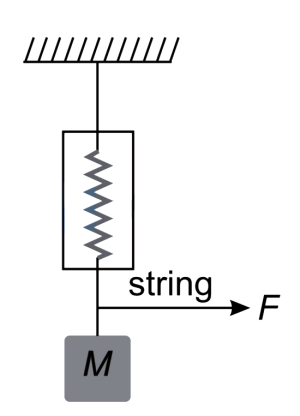
$A$ mass of $10 \ kg$ is suspended from a spring balance. It is pulled aside by a horizontal string so that it makes an angle of $60^{\circ}$ with the vertical. The new reading of the balance is
A
$20 \ kg-wt$
B
$10 \ kg-wt$
C
$10 \sqrt{3} \ kg-wt$
D
$20 \sqrt{3} \ kg-wt$
Solution
(A) Let $T$ be the tension in the spring balance. The forces acting on the mass $M$ are the tension $T$ along the string,the gravitational force $mg$ acting vertically downwards,and the horizontal force $F$ applied by the string.
In equilibrium,the vertical component of the tension $T$ must balance the weight of the mass.
$T \cos \theta = mg$
Given $m = 10 \ kg$,$\theta = 60^{\circ}$,and $g$ is the acceleration due to gravity.
The reading of the spring balance corresponds to the tension $T$ in $kg-wt$.
$T = \frac{mg}{\cos 60^{\circ}}$
Since $1 \ kg-wt = 1 \ kg \times g$,the reading in $kg-wt$ is simply $T/g = m / \cos 60^{\circ}$.
$T_{reading} = \frac{10}{\cos 60^{\circ}} = \frac{10}{1/2} = 20 \ kg-wt$.
In equilibrium,the vertical component of the tension $T$ must balance the weight of the mass.
$T \cos \theta = mg$
Given $m = 10 \ kg$,$\theta = 60^{\circ}$,and $g$ is the acceleration due to gravity.
The reading of the spring balance corresponds to the tension $T$ in $kg-wt$.
$T = \frac{mg}{\cos 60^{\circ}}$
Since $1 \ kg-wt = 1 \ kg \times g$,the reading in $kg-wt$ is simply $T/g = m / \cos 60^{\circ}$.
$T_{reading} = \frac{10}{\cos 60^{\circ}} = \frac{10}{1/2} = 20 \ kg-wt$.
0 likesView Solution
2
PhysicsEasyMCQKCET · 2008
$A$ body of mass $4 \,kg$ is accelerated by a constant force. It travels a distance of $5 \,m$ in the first second and a distance of $2 \,m$ in the third second. The force acting on the body is: (in $\,N$)
A
$2$
B
$4$
C
$6$
D
$8$
Solution
(C) The distance travelled by a body in the $n^{\text{th}}$ second is given by the formula: $S_n = u + \frac{a}{2}(2n - 1)$.
For the first second $(n=1)$: $5 = u + \frac{a}{2}(2(1) - 1) \implies 5 = u + \frac{a}{2}$ (Eq. $i$).
For the third second $(n=3)$: $2 = u + \frac{a}{2}(2(3) - 1) \implies 2 = u + \frac{5a}{2}$ (Eq. $ii$).
Subtracting Eq. $i$ from Eq. $ii$: $(2 - 5) = (u + \frac{5a}{2}) - (u + \frac{a}{2}) \implies -3 = 2a \implies a = -1.5 \,m/s^2$.
The negative sign indicates deceleration.
The magnitude of the force is $F = |m \times a| = 4 \,kg \times 1.5 \,m/s^2 = 6 \,N$.
For the first second $(n=1)$: $5 = u + \frac{a}{2}(2(1) - 1) \implies 5 = u + \frac{a}{2}$ (Eq. $i$).
For the third second $(n=3)$: $2 = u + \frac{a}{2}(2(3) - 1) \implies 2 = u + \frac{5a}{2}$ (Eq. $ii$).
Subtracting Eq. $i$ from Eq. $ii$: $(2 - 5) = (u + \frac{5a}{2}) - (u + \frac{a}{2}) \implies -3 = 2a \implies a = -1.5 \,m/s^2$.
The negative sign indicates deceleration.
The magnitude of the force is $F = |m \times a| = 4 \,kg \times 1.5 \,m/s^2 = 6 \,N$.
0 likesView Solution
3
PhysicsEasyMCQKCET · 2008
$A$ body weighs $50 \,g$ in air and $40 \,g$ in water. How much would it weigh in a liquid of specific gravity $1.5$ (in $\,g$)?
A
$30$
B
$35$
C
$65$
D
$45$
Solution
(B) The upthrust on a body is given by the weight of the liquid displaced. The ratio of upthrusts is equal to the ratio of the densities (or specific gravities) of the liquids.
$\frac{\text{Upthrust in liquid}}{\text{Upthrust in water}} = \frac{\text{Specific gravity of liquid}}{\text{Specific gravity of water}}$
Upthrust in water $= 50 \,g - 40 \,g = 10 \,g$.
Let the upthrust in the liquid be $x$.
$\frac{x}{10 \,g} = \frac{1.5}{1}$
$x = 15 \,g$.
The weight of the body in the liquid is given by: $\text{Weight in air} - \text{Upthrust in liquid}$.
Weight $= 50 \,g - 15 \,g = 35 \,g$.
$\frac{\text{Upthrust in liquid}}{\text{Upthrust in water}} = \frac{\text{Specific gravity of liquid}}{\text{Specific gravity of water}}$
Upthrust in water $= 50 \,g - 40 \,g = 10 \,g$.
Let the upthrust in the liquid be $x$.
$\frac{x}{10 \,g} = \frac{1.5}{1}$
$x = 15 \,g$.
The weight of the body in the liquid is given by: $\text{Weight in air} - \text{Upthrust in liquid}$.
Weight $= 50 \,g - 15 \,g = 35 \,g$.
0 likesView Solution
4
PhysicsDifficultMCQKCET · 2008
$A$ body is projected vertically upwards. The times corresponding to a specific height while ascending and while descending are $t_{1}$ and $t_{2}$ respectively. Then the velocity of projection is (where $g$ is acceleration due to gravity).
A
$g \sqrt{t_{1} t_{2}}$
B
$\frac{g t_{1} t_{2}}{t_{1}+t_{2}}$
C
$\frac{g \sqrt{t_{1} t_{2}}}{2}$
D
$\frac{g(t_{1}+t_{2})}{2}$
Solution
(D) Let the body be projected with initial velocity $u$. The equation of motion for a height $h$ is given by $h = ut - \frac{1}{2}gt^2$.
Rearranging this,we get a quadratic equation in $t$: $\frac{1}{2}gt^2 - ut + h = 0$.
The roots of this equation are $t_1$ and $t_2$,which represent the times at which the body reaches height $h$ during ascent and descent.
From the properties of quadratic equations,the sum of the roots is $t_1 + t_2 = \frac{-(-u)}{\frac{1}{2}g} = \frac{2u}{g}$.
Solving for $u$,we get $u = \frac{g(t_1 + t_2)}{2}$.
Rearranging this,we get a quadratic equation in $t$: $\frac{1}{2}gt^2 - ut + h = 0$.
The roots of this equation are $t_1$ and $t_2$,which represent the times at which the body reaches height $h$ during ascent and descent.
From the properties of quadratic equations,the sum of the roots is $t_1 + t_2 = \frac{-(-u)}{\frac{1}{2}g} = \frac{2u}{g}$.
Solving for $u$,we get $u = \frac{g(t_1 + t_2)}{2}$.
0 likesView Solution
5
PhysicsDifficultMCQKCET · 2008
$A$ simple pendulum is suspended from the ceiling of a lift. When the lift is at rest,its time period is $T$. With what acceleration should the lift be accelerated upwards in order to reduce its period to $T/2$ (in $g$)? ($g$ is acceleration due to gravity).
A
$2$
B
$3$
C
$4$
D
$6$
Solution
(B) The time period of a simple pendulum at rest is given by $T = 2\pi \sqrt{\frac{l}{g}}$.
When the lift accelerates upwards with an acceleration $a$,the effective acceleration due to gravity becomes $g_{eff} = g + a$.
The new time period is $T' = 2\pi \sqrt{\frac{l}{g+a}}$.
Given that $T' = T/2$,we have $\frac{T}{2} = 2\pi \sqrt{\frac{l}{g+a}}$.
Dividing the expression for $T'$ by $T$,we get $\frac{1}{2} = \sqrt{\frac{g}{g+a}}$.
Squaring both sides,$\frac{1}{4} = \frac{g}{g+a}$.
This implies $g + a = 4g$,so $a = 3g$.
When the lift accelerates upwards with an acceleration $a$,the effective acceleration due to gravity becomes $g_{eff} = g + a$.
The new time period is $T' = 2\pi \sqrt{\frac{l}{g+a}}$.
Given that $T' = T/2$,we have $\frac{T}{2} = 2\pi \sqrt{\frac{l}{g+a}}$.
Dividing the expression for $T'$ by $T$,we get $\frac{1}{2} = \sqrt{\frac{g}{g+a}}$.
Squaring both sides,$\frac{1}{4} = \frac{g}{g+a}$.
This implies $g + a = 4g$,so $a = 3g$.
0 likesView Solution
6
PhysicsMediumMCQKCET · 2008
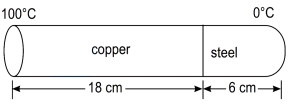
The coefficient of thermal conductivity of copper is $9$ times that of steel. In the composite cylindrical bar shown in the figure,what will be the temperature at the junction of copper and steel (in $^{\circ} C$)?
A
$75$
B
$67$
C
$25$
D
$33$
Solution
(D) Let the temperature at the junction be $\theta$. In steady state,the rate of heat flow through the copper rod must be equal to the rate of heat flow through the steel rod.
$H_{Cu} = H_{steel}$
$\frac{K_{Cu} A (100 - \theta)}{L_{Cu}} = \frac{K_{steel} A (\theta - 0)}{L_{steel}}$
Given that $K_{Cu} = 9 K_{steel}$,$L_{Cu} = 18 \text{ cm}$,and $L_{steel} = 6 \text{ cm}$.
Substituting the values:
$\frac{9 K_{steel} (100 - \theta)}{18} = \frac{K_{steel} (\theta - 0)}{6}$
$\frac{100 - \theta}{2} = \theta$
$100 - \theta = 2\theta$
$3\theta = 100$
$\theta = \frac{100}{3} \approx 33.3^{\circ} C$
Thus,the temperature at the junction is approximately $33^{\circ} C$.
$H_{Cu} = H_{steel}$
$\frac{K_{Cu} A (100 - \theta)}{L_{Cu}} = \frac{K_{steel} A (\theta - 0)}{L_{steel}}$
Given that $K_{Cu} = 9 K_{steel}$,$L_{Cu} = 18 \text{ cm}$,and $L_{steel} = 6 \text{ cm}$.
Substituting the values:
$\frac{9 K_{steel} (100 - \theta)}{18} = \frac{K_{steel} (\theta - 0)}{6}$
$\frac{100 - \theta}{2} = \theta$
$100 - \theta = 2\theta$
$3\theta = 100$
$\theta = \frac{100}{3} \approx 33.3^{\circ} C$
Thus,the temperature at the junction is approximately $33^{\circ} C$.
0 likesView Solution
7
PhysicsEasyMCQKCET · 2008
If a black body emits $0.5 \ J$ of energy per second when it is at $27^{\circ} C$,then the amount of energy emitted by it when it is at $627^{\circ} C$ will be (in $J$)
A
$40.5$
B
$162$
C
$13.5$
D
$135$
Solution
(A) According to Stefan-Boltzmann law,the power radiated by a black body is proportional to the fourth power of its absolute temperature: $E \propto T^{4}$.
Given:
Initial temperature $T_{1} = 27^{\circ} C = 27 + 273 = 300 \ K$.
Final temperature $T_{2} = 627^{\circ} C = 627 + 273 = 900 \ K$.
Initial energy emitted $E_{1} = 0.5 \ J/s$.
Using the ratio formula: $\frac{E_{2}}{E_{1}} = \left(\frac{T_{2}}{T_{1}}\right)^{4}$.
Substituting the values: $\frac{E_{2}}{0.5} = \left(\frac{900}{300}\right)^{4}$.
$\frac{E_{2}}{0.5} = (3)^{4} = 81$.
$E_{2} = 81 \times 0.5 = 40.5 \ J/s$.
Given:
Initial temperature $T_{1} = 27^{\circ} C = 27 + 273 = 300 \ K$.
Final temperature $T_{2} = 627^{\circ} C = 627 + 273 = 900 \ K$.
Initial energy emitted $E_{1} = 0.5 \ J/s$.
Using the ratio formula: $\frac{E_{2}}{E_{1}} = \left(\frac{T_{2}}{T_{1}}\right)^{4}$.
Substituting the values: $\frac{E_{2}}{0.5} = \left(\frac{900}{300}\right)^{4}$.
$\frac{E_{2}}{0.5} = (3)^{4} = 81$.
$E_{2} = 81 \times 0.5 = 40.5 \ J/s$.
0 likesView Solution
8
PhysicsMediumMCQKCET · 2008
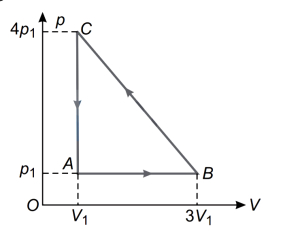
An ideal gas follows the path shown in the figure. The net work done in the whole cycle is
A
$3 p_{1} V_{1}$
B
$-3 p_{1} V_{1}$
C
$6 p_{1} V_{1}$
D
Zero
Solution
(B) The net work done in a cyclic process is equal to the area enclosed by the $p-V$ diagram.
For the given triangle $ABC$,the base is $(3 V_{1} - V_{1}) = 2 V_{1}$ and the height is $(4 p_{1} - p_{1}) = 3 p_{1}$.
The magnitude of the area is $\text{Area} = \frac{1}{2} \times \text{base} \times \text{height} = \frac{1}{2} \times (2 V_{1}) \times (3 p_{1}) = 3 p_{1} V_{1}$.
Since the cycle $A \rightarrow B \rightarrow C \rightarrow A$ is traversed in an anticlockwise direction,the work done by the gas is negative.
Therefore,the net work done is $W_{\text{cycle}} = -3 p_{1} V_{1}$.
For the given triangle $ABC$,the base is $(3 V_{1} - V_{1}) = 2 V_{1}$ and the height is $(4 p_{1} - p_{1}) = 3 p_{1}$.
The magnitude of the area is $\text{Area} = \frac{1}{2} \times \text{base} \times \text{height} = \frac{1}{2} \times (2 V_{1}) \times (3 p_{1}) = 3 p_{1} V_{1}$.
Since the cycle $A \rightarrow B \rightarrow C \rightarrow A$ is traversed in an anticlockwise direction,the work done by the gas is negative.
Therefore,the net work done is $W_{\text{cycle}} = -3 p_{1} V_{1}$.
0 likesView Solution
9
PhysicsEasyMCQKCET · 2008
In which of the processes does the internal energy of the system remain constant?
A
Adiabatic
B
Isochoric
C
Isobaric
D
Isothermal
Solution
(D) In an isothermal process,the temperature of the system remains constant. Since the internal energy of an ideal gas is a function of temperature only $(U = f(T))$,the internal energy remains constant in an isothermal process. Any heat supplied to the system is entirely converted into work done by the system,and vice versa.
0 likesView Solution
10
PhysicsEasyMCQKCET · 2008
If $\gamma$ is the ratio of specific heats and $R$ is the universal gas constant,then the molar specific heat at constant volume $C_{V}$ is given by
A
$\gamma R$
B
$\frac{(\gamma-1) R}{\gamma}$
C
$\frac{R}{\gamma-1}$
D
$\frac{\gamma R}{\gamma-1}$
Solution
(C) According to Mayer's relation for an ideal gas:
$C_{p} - C_{V} = R$ $(i)$
where $C_{p}$ is the molar specific heat at constant pressure and $C_{V}$ is the molar specific heat at constant volume.
By definition,the ratio of specific heats is:
$\gamma = \frac{C_{p}}{C_{V}}$
This implies $C_{p} = \gamma C_{V}$ (ii)
Substituting equation (ii) into equation $(i)$:
$\gamma C_{V} - C_{V} = R$
$C_{V}(\gamma - 1) = R$
Therefore,$C_{V} = \frac{R}{\gamma - 1}$
$C_{p} - C_{V} = R$ $(i)$
where $C_{p}$ is the molar specific heat at constant pressure and $C_{V}$ is the molar specific heat at constant volume.
By definition,the ratio of specific heats is:
$\gamma = \frac{C_{p}}{C_{V}}$
This implies $C_{p} = \gamma C_{V}$ (ii)
Substituting equation (ii) into equation $(i)$:
$\gamma C_{V} - C_{V} = R$
$C_{V}(\gamma - 1) = R$
Therefore,$C_{V} = \frac{R}{\gamma - 1}$
0 likesView Solution
11
PhysicsEasyMCQKCET · 2008
Dimensional formula for the universal gravitational constant is
A
$[M^{-1} L^{3} T^{-2}]$
B
$[M^{0} L^{0} T^{0}]$
C
$[M^{-1} L^{2} T^{-2}]$
D
$[M^{-1} L^{3} T^{-1}]$
Solution
(A) According to Newton's law of gravitation,the force $F$ between two masses $M_1$ and $M_2$ separated by a distance $R$ is given by:
$F = \frac{G M_1 M_2}{R^2}$
Rearranging the formula to solve for the universal gravitational constant $G$:
$G = \frac{F R^2}{M_1 M_2}$
Substituting the dimensional formulas for force $[F] = [MLT^{-2}]$,distance $[R] = [L]$,and mass $[M] = [M]$:
$[G] = \frac{[MLT^{-2}] [L^2]}{[M] [M]} = \frac{[ML^3 T^{-2}]}{[M^2]} = [M^{-1} L^3 T^{-2}]$
$F = \frac{G M_1 M_2}{R^2}$
Rearranging the formula to solve for the universal gravitational constant $G$:
$G = \frac{F R^2}{M_1 M_2}$
Substituting the dimensional formulas for force $[F] = [MLT^{-2}]$,distance $[R] = [L]$,and mass $[M] = [M]$:
$[G] = \frac{[MLT^{-2}] [L^2]}{[M] [M]} = \frac{[ML^3 T^{-2}]}{[M^2]} = [M^{-1} L^3 T^{-2}]$
0 likesView Solution
12
PhysicsMediumMCQKCET · 2008
$A$ string vibrates with a frequency of $200 \ Hz$. When its length is doubled and tension is altered,it begins to vibrate with a frequency of $300 \ Hz$. The ratio of the new tension to the original tension is
A
$9: 1$
B
$1: 9$
C
$3: 1$
D
$1: 3$
Solution
(A) The frequency of a vibrating string is given by the formula: $v = \frac{1}{2l} \sqrt{\frac{T}{m}}$,where $l$ is the length,$T$ is the tension,and $m$ is the linear mass density.
From this,we can see that $v \propto \frac{\sqrt{T}}{l}$.
Let the initial state be $v_1 = 200 \ Hz$,$l_1 = l$,and $T_1 = T$. Let the final state be $v_2 = 300 \ Hz$,$l_2 = 2l$,and $T_2 = T'$.
Taking the ratio: $\frac{v_2}{v_1} = \frac{\sqrt{T'}/l_2}{\sqrt{T}/l_1} = \sqrt{\frac{T'}{T}} \cdot \frac{l_1}{l_2}$.
Substituting the values: $\frac{300}{200} = \sqrt{\frac{T'}{T}} \cdot \frac{l}{2l}$.
$1.5 = \sqrt{\frac{T'}{T}} \cdot 0.5$.
$\sqrt{\frac{T'}{T}} = \frac{1.5}{0.5} = 3$.
Squaring both sides,we get $\frac{T'}{T} = 3^2 = 9$.
Therefore,the ratio of the new tension to the original tension is $9: 1$.
From this,we can see that $v \propto \frac{\sqrt{T}}{l}$.
Let the initial state be $v_1 = 200 \ Hz$,$l_1 = l$,and $T_1 = T$. Let the final state be $v_2 = 300 \ Hz$,$l_2 = 2l$,and $T_2 = T'$.
Taking the ratio: $\frac{v_2}{v_1} = \frac{\sqrt{T'}/l_2}{\sqrt{T}/l_1} = \sqrt{\frac{T'}{T}} \cdot \frac{l_1}{l_2}$.
Substituting the values: $\frac{300}{200} = \sqrt{\frac{T'}{T}} \cdot \frac{l}{2l}$.
$1.5 = \sqrt{\frac{T'}{T}} \cdot 0.5$.
$\sqrt{\frac{T'}{T}} = \frac{1.5}{0.5} = 3$.
Squaring both sides,we get $\frac{T'}{T} = 3^2 = 9$.
Therefore,the ratio of the new tension to the original tension is $9: 1$.
0 likesView Solution
13
PhysicsMediumMCQKCET · 2008
With what velocity should an observer approach a stationary sound source,so that the apparent frequency of sound appears double the actual frequency? (Let $v$ be the velocity of sound).
A
$v/2$
B
$3v$
C
$2v$
D
None of these
Solution
(D) The formula for the apparent frequency $v'$ heard by an observer moving towards a stationary source is given by:
$v' = v \left( \frac{v + v_o}{v} \right)$
Given that the apparent frequency $v'$ is double the actual frequency $v$,we have $v' = 2v$.
Substituting this into the equation:
$2v = v \left( \frac{v + v_o}{v} \right)$
$2 = \frac{v + v_o}{v}$
$2v = v + v_o$
$v_o = v$
Therefore,the observer should approach the source with a velocity equal to the velocity of sound,$v$.
$v' = v \left( \frac{v + v_o}{v} \right)$
Given that the apparent frequency $v'$ is double the actual frequency $v$,we have $v' = 2v$.
Substituting this into the equation:
$2v = v \left( \frac{v + v_o}{v} \right)$
$2 = \frac{v + v_o}{v}$
$2v = v + v_o$
$v_o = v$
Therefore,the observer should approach the source with a velocity equal to the velocity of sound,$v$.
0 likesView Solution
14
PhysicsEasyMCQKCET · 2008
How many times more intense is a $60 \ dB$ sound than a $30 \ dB$ sound?
A
$1000$
B
$2$
C
$100$
D
$4$
Solution
(A) The sound intensity level $L$ in decibels $(dB)$ is given by the formula $L = 10 \log_{10} \left( \frac{I}{I_0} \right)$,where $I$ is the intensity of the sound and $I_0$ is the reference intensity.
For a $60 \ dB$ sound: $60 = 10 \log_{10} \left( \frac{I_1}{I_0} \right) \Rightarrow 6 = \log_{10} \left( \frac{I_1}{I_0} \right) \Rightarrow \frac{I_1}{I_0} = 10^6$.
For a $30 \ dB$ sound: $30 = 10 \log_{10} \left( \frac{I_2}{I_0} \right) \Rightarrow 3 = \log_{10} \left( \frac{I_2}{I_0} \right) \Rightarrow \frac{I_2}{I_0} = 10^3$.
To find how many times more intense the $60 \ dB$ sound is compared to the $30 \ dB$ sound,we calculate the ratio $\frac{I_1}{I_2}$:
$\frac{I_1}{I_2} = \frac{I_1 / I_0}{I_2 / I_0} = \frac{10^6}{10^3} = 10^3 = 1000$.
Thus,a $60 \ dB$ sound is $1000$ times more intense than a $30 \ dB$ sound.
For a $60 \ dB$ sound: $60 = 10 \log_{10} \left( \frac{I_1}{I_0} \right) \Rightarrow 6 = \log_{10} \left( \frac{I_1}{I_0} \right) \Rightarrow \frac{I_1}{I_0} = 10^6$.
For a $30 \ dB$ sound: $30 = 10 \log_{10} \left( \frac{I_2}{I_0} \right) \Rightarrow 3 = \log_{10} \left( \frac{I_2}{I_0} \right) \Rightarrow \frac{I_2}{I_0} = 10^3$.
To find how many times more intense the $60 \ dB$ sound is compared to the $30 \ dB$ sound,we calculate the ratio $\frac{I_1}{I_2}$:
$\frac{I_1}{I_2} = \frac{I_1 / I_0}{I_2 / I_0} = \frac{10^6}{10^3} = 10^3 = 1000$.
Thus,a $60 \ dB$ sound is $1000$ times more intense than a $30 \ dB$ sound.
0 likesView Solution
15
PhysicsMediumMCQKCET · 2008
The equation of a simple harmonic wave is given by $y = 6 \sin 2 \pi (2t - 0.1x)$,where $y$ and $x$ are in $mm$ and $t$ is in seconds. The phase difference between two particles $2 \ mm$ apart at any instant is (in $^{\circ}$)
A
$18$
B
$36$
C
$54$
D
$72$
Solution
(D) The standard equation of a progressive wave is $y = A \sin(2\pi ft - kx)$.
Comparing the given equation $y = 6 \sin 2\pi(2t - 0.1x)$ with the standard form,we get the wave number $k = 2\pi \times 0.1 = 0.2\pi \ rad/mm$.
The relationship between phase difference $\Delta \phi$ and path difference $\Delta x$ is given by $\Delta \phi = k \Delta x$.
Given the separation between particles $\Delta x = 2 \ mm$.
Substituting the values,$\Delta \phi = (0.2\pi) \times 2 = 0.4\pi \ rad$.
To convert radians to degrees,multiply by $\frac{180^{\circ}}{\pi}$:
$\Delta \phi = 0.4\pi \times \frac{180^{\circ}}{\pi} = 0.4 \times 180^{\circ} = 72^{\circ}$.
Comparing the given equation $y = 6 \sin 2\pi(2t - 0.1x)$ with the standard form,we get the wave number $k = 2\pi \times 0.1 = 0.2\pi \ rad/mm$.
The relationship between phase difference $\Delta \phi$ and path difference $\Delta x$ is given by $\Delta \phi = k \Delta x$.
Given the separation between particles $\Delta x = 2 \ mm$.
Substituting the values,$\Delta \phi = (0.2\pi) \times 2 = 0.4\pi \ rad$.
To convert radians to degrees,multiply by $\frac{180^{\circ}}{\pi}$:
$\Delta \phi = 0.4\pi \times \frac{180^{\circ}}{\pi} = 0.4 \times 180^{\circ} = 72^{\circ}$.
0 likesView Solution
16
PhysicsEasyMCQKCET · 2008
$A$ current of $5 \,A$ is flowing at $220 \,V$ in the primary coil of a transformer. If the voltage produced in the secondary coil is $2200 \,V$ and $50 \%$ of power is lost, then the current in the secondary will be (in $A$)
A
$2.5$
B
$0.5$
C
$0.25$
D
$5$
Solution
(C) Let $I$ be the current flowing through the secondary coil.
Input power in the primary coil is $P_{in} = V \times i = 220 \,V \times 5 \,A = 1100 \,W$.
Since $50 \%$ of the power is lost, the output power $P_{out}$ is $50 \%$ of the input power.
$P_{out} = 0.50 \times P_{in} = 0.50 \times 1100 \,W = 550 \,W$.
The output power is also given by $P_{out} = V^{\prime} \times I$, where $V^{\prime} = 2200 \,V$.
Therefore, $2200 \,V \times I = 550 \,W$.
$I = \frac{550}{2200} \,A = 0.25 \,A$.
Input power in the primary coil is $P_{in} = V \times i = 220 \,V \times 5 \,A = 1100 \,W$.
Since $50 \%$ of the power is lost, the output power $P_{out}$ is $50 \%$ of the input power.
$P_{out} = 0.50 \times P_{in} = 0.50 \times 1100 \,W = 550 \,W$.
The output power is also given by $P_{out} = V^{\prime} \times I$, where $V^{\prime} = 2200 \,V$.
Therefore, $2200 \,V \times I = 550 \,W$.
$I = \frac{550}{2200} \,A = 0.25 \,A$.
0 likesView Solution
17
PhysicsMediumMCQKCET · 2008
The ratio of minimum wavelengths of Lyman and Balmer series will be
A
$1.25$
B
$5$
C
$0.25$
D
$10$
Solution
(C) The wavelength $\lambda$ is given by the Rydberg formula: $\frac{1}{\lambda} = R \left( \frac{1}{n^2} - \frac{1}{m^2} \right)$.
For the minimum wavelength (shortest wavelength),the transition occurs from $m = \infty$ to the ground state $n$ of the series.
For the Lyman series,$n = 1$ and $m = \infty$:
$\frac{1}{\lambda_{L}} = R \left( \frac{1}{1^2} - \frac{1}{\infty^2} \right) = R \implies \lambda_{L} = \frac{1}{R}$.
For the Balmer series,$n = 2$ and $m = \infty$:
$\frac{1}{\lambda_{B}} = R \left( \frac{1}{2^2} - \frac{1}{\infty^2} \right) = \frac{R}{4} \implies \lambda_{B} = \frac{4}{R}$.
The ratio of the minimum wavelengths is $\frac{\lambda_{L}}{\lambda_{B}} = \frac{1/R}{4/R} = \frac{1}{4} = 0.25$.
For the minimum wavelength (shortest wavelength),the transition occurs from $m = \infty$ to the ground state $n$ of the series.
For the Lyman series,$n = 1$ and $m = \infty$:
$\frac{1}{\lambda_{L}} = R \left( \frac{1}{1^2} - \frac{1}{\infty^2} \right) = R \implies \lambda_{L} = \frac{1}{R}$.
For the Balmer series,$n = 2$ and $m = \infty$:
$\frac{1}{\lambda_{B}} = R \left( \frac{1}{2^2} - \frac{1}{\infty^2} \right) = \frac{R}{4} \implies \lambda_{B} = \frac{4}{R}$.
The ratio of the minimum wavelengths is $\frac{\lambda_{L}}{\lambda_{B}} = \frac{1/R}{4/R} = \frac{1}{4} = 0.25$.
0 likesView Solution
18
PhysicsMediumMCQKCET · 2008
If an electron and a proton have the same de-Broglie wavelength,then the kinetic energy of the electron is
A
Zero
B
Less than that of a proton
C
More than that of a proton
D
Equal to that of a proton
Solution
(C) The de-Broglie wavelength $\lambda$ is given by the relation $\lambda = \frac{h}{p} = \frac{h}{\sqrt{2mKE}}$.
From this,the kinetic energy $KE$ can be expressed as $KE = \frac{h^2}{2m\lambda^2}$.
Since the de-Broglie wavelength $\lambda$ is the same for both the electron and the proton,we have $KE \propto \frac{1}{m}$.
Because the mass of an electron $(m_e \approx 9.11 \times 10^{-31} \ kg)$ is much smaller than the mass of a proton $(m_p \approx 1.67 \times 10^{-27} \ kg)$,the kinetic energy of the electron will be greater than that of the proton.
From this,the kinetic energy $KE$ can be expressed as $KE = \frac{h^2}{2m\lambda^2}$.
Since the de-Broglie wavelength $\lambda$ is the same for both the electron and the proton,we have $KE \propto \frac{1}{m}$.
Because the mass of an electron $(m_e \approx 9.11 \times 10^{-31} \ kg)$ is much smaller than the mass of a proton $(m_p \approx 1.67 \times 10^{-27} \ kg)$,the kinetic energy of the electron will be greater than that of the proton.
0 likesView Solution
19
PhysicsDifficultMCQKCET · 2008
For a series $LCR$ circuit at resonance,the statement which is not true is:
A
Peak energy stored by a capacitor = peak energy stored by an inductor.
B
Average power = apparent power.
C
Wattless current is zero.
D
Power factor is zero.
Solution
(D) In a series $LCR$ circuit at resonance,the inductive reactance $X_L$ is equal to the capacitive reactance $X_C$ $(X_L = X_C)$.
At resonance,the phase difference $\phi$ between voltage and current is $0^{\circ}$.
$1$. The power factor is $\cos \phi = \cos 0^{\circ} = 1$. Thus,option $D$ is incorrect.
$2$. Average power $P_{avg} = V_{rms} I_{rms} \cos \phi = V_{rms} I_{rms} (1) = V_{rms} I_{rms}$,which is equal to the apparent power. Thus,option $B$ is true.
$3$. Peak energy stored in the capacitor is $\frac{1}{2} C V_0^2$ and in the inductor is $\frac{1}{2} L I_0^2$. At resonance,these values are equal. Thus,option $A$ is true.
$4$. Wattless current is $I_{rms} \sin \phi$. Since $\phi = 0^{\circ}$,$\sin 0^{\circ} = 0$,so wattless current is zero. Thus,option $C$ is true.
Therefore,the statement that is not true is that the power factor is zero.
At resonance,the phase difference $\phi$ between voltage and current is $0^{\circ}$.
$1$. The power factor is $\cos \phi = \cos 0^{\circ} = 1$. Thus,option $D$ is incorrect.
$2$. Average power $P_{avg} = V_{rms} I_{rms} \cos \phi = V_{rms} I_{rms} (1) = V_{rms} I_{rms}$,which is equal to the apparent power. Thus,option $B$ is true.
$3$. Peak energy stored in the capacitor is $\frac{1}{2} C V_0^2$ and in the inductor is $\frac{1}{2} L I_0^2$. At resonance,these values are equal. Thus,option $A$ is true.
$4$. Wattless current is $I_{rms} \sin \phi$. Since $\phi = 0^{\circ}$,$\sin 0^{\circ} = 0$,so wattless current is zero. Thus,option $C$ is true.
Therefore,the statement that is not true is that the power factor is zero.
0 likesView Solution
20
PhysicsDifficultMCQKCET · 2008
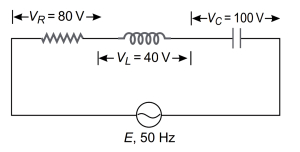
The value of the alternating emf in the given series $LCR$ circuit is: (in $V$)
A
$220$
B
$140$
C
$100$
D
$20$
Solution
(C) In a series $LCR$ circuit,the total alternating emf $(V)$ is given by the phasor sum of the individual voltages across the resistor $(V_R)$,inductor $(V_L)$,and capacitor $(V_C)$.
The formula is:
$V = \sqrt{V_R^2 + (V_L - V_C)^2}$
Given values:
$V_R = 80 \ V$
$V_L = 40 \ V$
$V_C = 100 \ V$
Substituting these values into the formula:
$V = \sqrt{(80)^2 + (40 - 100)^2}$
$V = \sqrt{6400 + (-60)^2}$
$V = \sqrt{6400 + 3600}$
$V = \sqrt{10000}$
$V = 100 \ V$
Therefore,the value of the alternating emf is $100 \ V$.
The formula is:
$V = \sqrt{V_R^2 + (V_L - V_C)^2}$
Given values:
$V_R = 80 \ V$
$V_L = 40 \ V$
$V_C = 100 \ V$
Substituting these values into the formula:
$V = \sqrt{(80)^2 + (40 - 100)^2}$
$V = \sqrt{6400 + (-60)^2}$
$V = \sqrt{6400 + 3600}$
$V = \sqrt{10000}$
$V = 100 \ V$
Therefore,the value of the alternating emf is $100 \ V$.
0 likesView Solution
21
PhysicsEasyMCQKCET · 2008
The solar spectrum is an example of
A
line emission spectrum
B
continuous emission spectrum
C
band absorption spectrum
D
line absorption spectrum
Solution
(D) The solar spectrum consists of a continuous spectrum of light emitted by the hot interior of the Sun,which is crossed by numerous dark lines known as Fraunhofer lines. These dark lines are produced because the cooler gases in the Sun's outer atmosphere (the photosphere and chromosphere) absorb specific wavelengths of light from the continuous spectrum. Therefore,the solar spectrum is classified as a line absorption spectrum.
0 likesView Solution
22
PhysicsMediumMCQKCET · 2008
$A$ hydrogen atom does not emit $X$-rays because
A
it contains only a single electron
B
energy levels in it are far apart
C
its size is very small
D
energy levels in it are very close to each other
Solution
(D) $X$-rays are high-energy electromagnetic radiations produced by transitions between inner electron shells (like $K$-shell to $L$-shell) in atoms with high atomic numbers $(Z)$.
In a hydrogen atom,there is only one electron and the energy difference between its energy levels is very small (in the order of $eV$).
$X$-ray emission requires energy transitions in the order of $keV$.
Therefore,a hydrogen atom cannot emit $X$-rays because the energy levels are too close to each other to produce such high-energy photons.
In a hydrogen atom,there is only one electron and the energy difference between its energy levels is very small (in the order of $eV$).
$X$-ray emission requires energy transitions in the order of $keV$.
Therefore,a hydrogen atom cannot emit $X$-rays because the energy levels are too close to each other to produce such high-energy photons.
0 likesView Solution
23
PhysicsMediumMCQKCET · 2008
How many $6 \mu F, 200 \ V$ capacitors are needed to make a capacitor of $18 \mu F, 600 \ V$?
A
$9$
B
$18$
C
$3$
D
$27$
Solution
(D) To achieve a potential difference of $600 \ V$ using capacitors rated at $200 \ V$ each,we must connect $n$ capacitors in series such that $n \times 200 \ V = 600 \ V$. Thus,$n = 3$.
The equivalent capacitance of these $3$ capacitors in series is given by $\frac{1}{C_s} = \frac{1}{6} + \frac{1}{6} + \frac{1}{6} = \frac{3}{6} = \frac{1}{2}$,so $C_s = 2 \ \mu F$.
To achieve a total capacitance of $18 \ \mu F$,we need to connect $m$ such series branches in parallel,where $m \times C_s = 18 \ \mu F$.
Thus,$m \times 2 \ \mu F = 18 \ \mu F$,which gives $m = 9$.
The total number of capacitors required is $n \times m = 3 \times 9 = 27$.
The equivalent capacitance of these $3$ capacitors in series is given by $\frac{1}{C_s} = \frac{1}{6} + \frac{1}{6} + \frac{1}{6} = \frac{3}{6} = \frac{1}{2}$,so $C_s = 2 \ \mu F$.
To achieve a total capacitance of $18 \ \mu F$,we need to connect $m$ such series branches in parallel,where $m \times C_s = 18 \ \mu F$.
Thus,$m \times 2 \ \mu F = 18 \ \mu F$,which gives $m = 9$.
The total number of capacitors required is $n \times m = 3 \times 9 = 27$.
0 likesView Solution
24
PhysicsDifficultMCQKCET · 2008
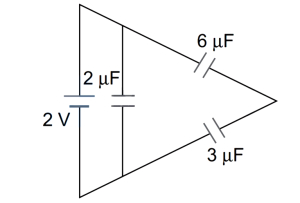
The total energy stored in the capacitor system shown in the figure will be (in $\mu J$)
A
$2$
B
$4$
C
$8$
D
$16$
Solution
(C) The $6 \mu F$ and $3 \mu F$ capacitors are connected in series.
Therefore,the equivalent capacitance $C_1$ is given by $\frac{1}{C_1} = \frac{1}{6} + \frac{1}{3} = \frac{1+2}{6} = \frac{3}{6} = \frac{1}{2}$.
Thus,$C_1 = 2 \mu F$.
This equivalent capacitor $C_1$ is in parallel with the $2 \mu F$ capacitor.
Therefore,the total equivalent capacitance of the system is $C_{eq} = C_1 + 2 \mu F = 2 \mu F + 2 \mu F = 4 \mu F$.
The total energy $U$ stored in the system is given by $U = \frac{1}{2} C_{eq} V^2$.
Given $V = 2 \text{ V}$,we have $U = \frac{1}{2} \times 4 \mu F \times (2 \text{ V})^2 = 2 \times 4 = 8 \mu J$.
Therefore,the equivalent capacitance $C_1$ is given by $\frac{1}{C_1} = \frac{1}{6} + \frac{1}{3} = \frac{1+2}{6} = \frac{3}{6} = \frac{1}{2}$.
Thus,$C_1 = 2 \mu F$.
This equivalent capacitor $C_1$ is in parallel with the $2 \mu F$ capacitor.
Therefore,the total equivalent capacitance of the system is $C_{eq} = C_1 + 2 \mu F = 2 \mu F + 2 \mu F = 4 \mu F$.
The total energy $U$ stored in the system is given by $U = \frac{1}{2} C_{eq} V^2$.
Given $V = 2 \text{ V}$,we have $U = \frac{1}{2} \times 4 \mu F \times (2 \text{ V})^2 = 2 \times 4 = 8 \mu J$.
0 likesView Solution
25
PhysicsDifficultMCQKCET · 2008
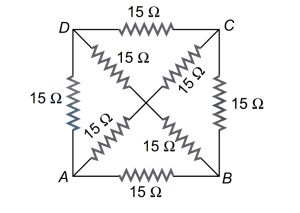
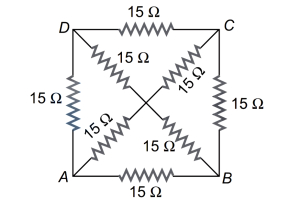
The equivalent resistance between the points $A$ and $B$ will be (each resistance is $15 \Omega$): (in $Omega$)
A
$30$
B
$8$
C
$10$
D
$40$
Solution
(C) The circuit is a Wheatstone bridge-like structure. Due to symmetry,the potential at the center point is the same as the potential at the midpoint of the diagonals. However,a simpler way to solve this is by using the symmetry of the circuit.
Let the points be $A, B, C, D$. The resistance between $A$ and $B$ is to be found.
By symmetry,the circuit can be simplified. The resistors connected to the center point can be treated as parallel branches.
Alternatively,using the symmetry of the circuit,the equivalent resistance $R_{eq}$ between $A$ and $B$ is given by the parallel combination of the paths.
For this specific symmetric circuit with all resistors equal to $R = 15 \Omega$,the equivalent resistance between any two adjacent corners is $R_{eq} = \frac{2}{3}R$.
$R_{eq} = \frac{2}{3} \times 15 \Omega = 10 \Omega$.
Let the points be $A, B, C, D$. The resistance between $A$ and $B$ is to be found.
By symmetry,the circuit can be simplified. The resistors connected to the center point can be treated as parallel branches.
Alternatively,using the symmetry of the circuit,the equivalent resistance $R_{eq}$ between $A$ and $B$ is given by the parallel combination of the paths.
For this specific symmetric circuit with all resistors equal to $R = 15 \Omega$,the equivalent resistance between any two adjacent corners is $R_{eq} = \frac{2}{3}R$.
$R_{eq} = \frac{2}{3} \times 15 \Omega = 10 \Omega$.
0 likesView Solution
26
PhysicsDifficultMCQKCET · 2008
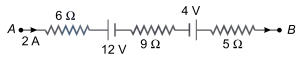
The potential difference between $A$ and $B$ in the following figure is (in $V$)
A
$32$
B
$48$
C
$24$
D
$14$
Solution
(B) To find the potential difference between $A$ and $B$,we apply Kirchhoff's Voltage Law $(KVL)$ along the path from $A$ to $B$.
Starting from point $A$,the current $I = 2 \ A$ flows through the circuit.
The potential at $A$ is $V_A$.
Moving through the $6 \ \Omega$ resistor in the direction of current,the potential drop is $I \times R = 2 \times 6 = 12 \ V$.
Moving through the $12 \ V$ battery from positive to negative terminal,the potential drop is $12 \ V$.
Moving through the $9 \ \Omega$ resistor,the potential drop is $2 \times 9 = 18 \ V$.
Moving through the $4 \ V$ battery from negative to positive terminal,the potential gain is $4 \ V$.
Moving through the $5 \ \Omega$ resistor,the potential drop is $2 \times 5 = 10 \ V$.
Equating this to the potential at $B$ $(V_B)$:
$V_A - (2 \times 6) - 12 - (2 \times 9) + 4 - (2 \times 5) = V_B$
$V_A - 12 - 12 - 18 + 4 - 10 = V_B$
$V_A - 48 = V_B$
$V_A - V_B = 48 \ V$
Starting from point $A$,the current $I = 2 \ A$ flows through the circuit.
The potential at $A$ is $V_A$.
Moving through the $6 \ \Omega$ resistor in the direction of current,the potential drop is $I \times R = 2 \times 6 = 12 \ V$.
Moving through the $12 \ V$ battery from positive to negative terminal,the potential drop is $12 \ V$.
Moving through the $9 \ \Omega$ resistor,the potential drop is $2 \times 9 = 18 \ V$.
Moving through the $4 \ V$ battery from negative to positive terminal,the potential gain is $4 \ V$.
Moving through the $5 \ \Omega$ resistor,the potential drop is $2 \times 5 = 10 \ V$.
Equating this to the potential at $B$ $(V_B)$:
$V_A - (2 \times 6) - 12 - (2 \times 9) + 4 - (2 \times 5) = V_B$
$V_A - 12 - 12 - 18 + 4 - 10 = V_B$
$V_A - 48 = V_B$
$V_A - V_B = 48 \ V$
0 likesView Solution
27
PhysicsMediumMCQKCET · 2008
$A$ metal wire is subjected to a constant potential difference. When the temperature of the metal wire increases,the drift velocity of the electron in it
A
increases,thermal velocity of the electron decreases
B
decreases,thermal velocity of the electron decreases
C
increases,thermal velocity of the electron increases
D
decreases,thermal velocity of the electron increases
Solution
(D) The drift velocity $v_d$ is given by the formula $v_d = \frac{eE\tau}{m}$,where $e$ is the charge of the electron,$E$ is the electric field,$\tau$ is the relaxation time,and $m$ is the mass of the electron.
When the temperature of the metal wire increases,the atoms in the metal lattice vibrate with greater amplitude.
This leads to more frequent collisions between the electrons and the lattice ions,which decreases the relaxation time $\tau$.
Since $v_d \propto \tau$,the drift velocity $v_d$ decreases.
Additionally,the thermal velocity of the electrons is proportional to the square root of the absolute temperature $(v_{th} \propto \sqrt{T})$,so as the temperature increases,the thermal velocity of the electrons increases.
When the temperature of the metal wire increases,the atoms in the metal lattice vibrate with greater amplitude.
This leads to more frequent collisions between the electrons and the lattice ions,which decreases the relaxation time $\tau$.
Since $v_d \propto \tau$,the drift velocity $v_d$ decreases.
Additionally,the thermal velocity of the electrons is proportional to the square root of the absolute temperature $(v_{th} \propto \sqrt{T})$,so as the temperature increases,the thermal velocity of the electrons increases.
0 likesView Solution
28
PhysicsMediumMCQKCET · 2008
In the Bohr model of the hydrogen atom, the electron is pictured to rotate in a circular orbit of radius $5 \times 10^{-11} \, m$, at a speed of $2.2 \times 10^{6} \, m/s$. What is the current associated with the electron's motion (in $ \, mA$)?
A
$1.12$
B
$3$
C
$0.75$
D
$2.25$
Solution
(A) The frequency of revolution of the electron is given by $f = \frac{v}{2 \pi r}$.
Substituting the given values: $f = \frac{2.2 \times 10^{6}}{2 \pi (5 \times 10^{-11})} \approx 7.0 \times 10^{15} \, Hz$.
The current $i$ associated with the motion of the electron is $i = qf$, where $q$ is the charge of the electron $(1.6 \times 10^{-19} \, C)$.
$i = (1.6 \times 10^{-19} \, C) \times (7.0 \times 10^{15} \, Hz) = 11.2 \times 10^{-4} \, A$.
Converting to milliamperes: $i = 1.12 \times 10^{-3} \, A = 1.12 \, mA$.
Substituting the given values: $f = \frac{2.2 \times 10^{6}}{2 \pi (5 \times 10^{-11})} \approx 7.0 \times 10^{15} \, Hz$.
The current $i$ associated with the motion of the electron is $i = qf$, where $q$ is the charge of the electron $(1.6 \times 10^{-19} \, C)$.
$i = (1.6 \times 10^{-19} \, C) \times (7.0 \times 10^{15} \, Hz) = 11.2 \times 10^{-4} \, A$.
Converting to milliamperes: $i = 1.12 \times 10^{-3} \, A = 1.12 \, mA$.
0 likesView Solution
29
PhysicsMediumMCQKCET · 2008
Two tangent galvanometers $A$ and $B$ are identical except in their number of turns. They are connected in series. On passing a current through them,deflections of $60^{\circ}$ and $30^{\circ}$ are produced. The ratio of the number of turns in $A$ and $B$ is
A
$1: 3$
B
$3: 1$
C
$1: 2$
D
$2: 1$
Solution
(A) The principle of a tangent galvanometer is given by $I = K \tan \theta$,where $K = \frac{2rB_H}{\mu_0 N}$.
Since the galvanometers are identical except for the number of turns $N$ and are connected in series,the current $I$ flowing through them is the same.
Thus,$I = \frac{2rB_H}{\mu_0 N} \tan \theta$,which implies $N \tan \theta = \text{constant}$.
Therefore,$N_A \tan \theta_A = N_B \tan \theta_B$.
The ratio of the number of turns is $\frac{N_A}{N_B} = \frac{\tan \theta_B}{\tan \theta_A}$.
Given $\theta_A = 60^{\circ}$ and $\theta_B = 30^{\circ}$,we have $\frac{N_A}{N_B} = \frac{\tan 30^{\circ}}{\tan 60^{\circ}}$.
$\frac{N_A}{N_B} = \frac{1/\sqrt{3}}{\sqrt{3}} = \frac{1}{3}$.
Thus,the ratio is $1: 3$.
Since the galvanometers are identical except for the number of turns $N$ and are connected in series,the current $I$ flowing through them is the same.
Thus,$I = \frac{2rB_H}{\mu_0 N} \tan \theta$,which implies $N \tan \theta = \text{constant}$.
Therefore,$N_A \tan \theta_A = N_B \tan \theta_B$.
The ratio of the number of turns is $\frac{N_A}{N_B} = \frac{\tan \theta_B}{\tan \theta_A}$.
Given $\theta_A = 60^{\circ}$ and $\theta_B = 30^{\circ}$,we have $\frac{N_A}{N_B} = \frac{\tan 30^{\circ}}{\tan 60^{\circ}}$.
$\frac{N_A}{N_B} = \frac{1/\sqrt{3}}{\sqrt{3}} = \frac{1}{3}$.
Thus,the ratio is $1: 3$.
0 likesView Solution
30
PhysicsEasyMCQKCET · 2008
$A$ certain current passing through a galvanometer produces a deflection of $100$ divisions. When a shunt of $1 \ \Omega$ is connected, the deflection reduces to $1$ division. The galvanometer resistance is: (in $\Omega$)
A
$100$
B
$99$
C
$10$
D
$9.9$
Solution
(B) Let the initial current be $I$ and the galvanometer resistance be $G$. The deflection is proportional to the current, so $I = k \times 100$, where $k$ is a constant.
When a shunt $S = 1 \ \Omega$ is connected in parallel, the new current through the galvanometer $I_g$ is given by the current divider rule: $I_g = I \left( \frac{S}{S+G} \right)$.
The new deflection is $1$ division, so $I_g = k \times 1$.
Substituting the values: $k = (k \times 100) \left( \frac{1}{1+G} \right)$.
Dividing both sides by $k$: $1 = \frac{100}{1+G}$.
$1+G = 100$.
$G = 99 \ \Omega$.
When a shunt $S = 1 \ \Omega$ is connected in parallel, the new current through the galvanometer $I_g$ is given by the current divider rule: $I_g = I \left( \frac{S}{S+G} \right)$.
The new deflection is $1$ division, so $I_g = k \times 1$.
Substituting the values: $k = (k \times 100) \left( \frac{1}{1+G} \right)$.
Dividing both sides by $k$: $1 = \frac{100}{1+G}$.
$1+G = 100$.
$G = 99 \ \Omega$.
0 likesView Solution
31
PhysicsMediumMCQKCET · 2008
When a piece of metal is illuminated by a monochromatic light of wavelength $\lambda$,the stopping potential is $3 V_{s}$. When the same surface is illuminated by light of wavelength $2 \lambda$,the stopping potential becomes $V_{s}$. The value of the threshold wavelength for photoelectric emission is:
A
$4 \lambda$
B
$8 \lambda$
C
$\frac{4}{3} \lambda$
D
$6 \lambda$
Solution
(A) According to Einstein's photoelectric equation: $eV = \frac{hc}{\lambda} - \frac{hc}{\lambda_{0}} = hc \left( \frac{1}{\lambda} - \frac{1}{\lambda_{0}} \right)$.
For the first case: $3 eV_{s} = hc \left( \frac{1}{\lambda} - \frac{1}{\lambda_{0}} \right)$ --- $(i)$
For the second case: $eV_{s} = hc \left( \frac{1}{2 \lambda} - \frac{1}{\lambda_{0}} \right)$ --- (ii)
Dividing equation $(i)$ by equation (ii):
$\frac{3 eV_{s}}{eV_{s}} = \frac{hc \left( \frac{1}{\lambda} - \frac{1}{\lambda_{0}} \right)}{hc \left( \frac{1}{2 \lambda} - \frac{1}{\lambda_{0}} \right)}$
$3 = \frac{\frac{1}{\lambda} - \frac{1}{\lambda_{0}}}{\frac{1}{2 \lambda} - \frac{1}{\lambda_{0}}}$
$3 \left( \frac{1}{2 \lambda} - \frac{1}{\lambda_{0}} \right) = \frac{1}{\lambda} - \frac{1}{\lambda_{0}}$
$\frac{3}{2 \lambda} - \frac{3}{\lambda_{0}} = \frac{1}{\lambda} - \frac{1}{\lambda_{0}}$
$\frac{3}{2 \lambda} - \frac{1}{\lambda} = \frac{3}{\lambda_{0}} - \frac{1}{\lambda_{0}}$
$\frac{1}{2 \lambda} = \frac{2}{\lambda_{0}}$
$\lambda_{0} = 4 \lambda$.
For the first case: $3 eV_{s} = hc \left( \frac{1}{\lambda} - \frac{1}{\lambda_{0}} \right)$ --- $(i)$
For the second case: $eV_{s} = hc \left( \frac{1}{2 \lambda} - \frac{1}{\lambda_{0}} \right)$ --- (ii)
Dividing equation $(i)$ by equation (ii):
$\frac{3 eV_{s}}{eV_{s}} = \frac{hc \left( \frac{1}{\lambda} - \frac{1}{\lambda_{0}} \right)}{hc \left( \frac{1}{2 \lambda} - \frac{1}{\lambda_{0}} \right)}$
$3 = \frac{\frac{1}{\lambda} - \frac{1}{\lambda_{0}}}{\frac{1}{2 \lambda} - \frac{1}{\lambda_{0}}}$
$3 \left( \frac{1}{2 \lambda} - \frac{1}{\lambda_{0}} \right) = \frac{1}{\lambda} - \frac{1}{\lambda_{0}}$
$\frac{3}{2 \lambda} - \frac{3}{\lambda_{0}} = \frac{1}{\lambda} - \frac{1}{\lambda_{0}}$
$\frac{3}{2 \lambda} - \frac{1}{\lambda} = \frac{3}{\lambda_{0}} - \frac{1}{\lambda_{0}}$
$\frac{1}{2 \lambda} = \frac{2}{\lambda_{0}}$
$\lambda_{0} = 4 \lambda$.
0 likesView Solution
32
PhysicsEasyMCQKCET · 2008
The maximum kinetic energy of emitted electrons in a photoelectric effect does not depend upon
A
wavelength
B
frequency
C
intensity
D
work function
Solution
(C) According to Einstein's photoelectric equation, the maximum kinetic energy $K_{max}$ of emitted electrons is given by $K_{max} = h\nu - \Phi_0$, where $h$ is Planck's constant, $\nu$ is the frequency of incident light, and $\Phi_0$ is the work function of the metal.
Since $\nu = c / \lambda$, the kinetic energy depends on the frequency $\nu$ and the wavelength $\lambda$ of the incident light, as well as the work function $\Phi_0$ of the material.
The intensity of incident light determines the number of photons striking the surface per unit time, which affects the number of emitted electrons (photoelectric current), but it does not affect the maximum kinetic energy of individual emitted electrons.
Since $\nu = c / \lambda$, the kinetic energy depends on the frequency $\nu$ and the wavelength $\lambda$ of the incident light, as well as the work function $\Phi_0$ of the material.
The intensity of incident light determines the number of photons striking the surface per unit time, which affects the number of emitted electrons (photoelectric current), but it does not affect the maximum kinetic energy of individual emitted electrons.
0 likesView Solution
33
PhysicsMediumMCQKCET · 2008
Two similar circular loops carry equal currents in the same direction. On moving the coils further apart,the electric current will
A
increase in both
B
decrease in both
C
remain unaltered
D
increase in one and decrease in the second
Solution
(A) When two circular loops carrying current in the same direction are moved further apart,the magnetic field produced by one coil at the location of the other decreases.
This results in a decrease in the magnetic flux linked with each coil.
According to Lenz's law,the system opposes this change in flux by inducing an electromotive force $(EMF)$ that acts to increase the current in the coils.
Therefore,the electric current will increase in both coils to maintain the magnetic flux.
This results in a decrease in the magnetic flux linked with each coil.
According to Lenz's law,the system opposes this change in flux by inducing an electromotive force $(EMF)$ that acts to increase the current in the coils.
Therefore,the electric current will increase in both coils to maintain the magnetic flux.
0 likesView Solution
34
PhysicsEasyMCQKCET · 2008
If $\mu_{0}$ is permeability of free space and $\varepsilon_{0}$ is permittivity of free space,the speed of light in vacuum is given by
A
$\sqrt{\mu_{0} \varepsilon_{0}}$
B
$\sqrt{\frac{\mu_{0}}{\varepsilon_{0}}}$
C
$\sqrt{\frac{1}{\mu_{0} \varepsilon_{0}}}$
D
$\sqrt{\frac{\varepsilon_{0}}{\mu_{0}}}$
Solution
(C) The speed of light in vacuum $(c)$ is related to the fundamental electromagnetic constants of free space,namely the permeability of free space $(\mu_{0})$ and the permittivity of free space $(\varepsilon_{0})$.
According to Maxwell's equations,the speed of electromagnetic waves in vacuum is given by the formula:
$c = \frac{1}{\sqrt{\mu_{0} \varepsilon_{0}}}$
Thus,the correct expression is $\sqrt{\frac{1}{\mu_{0} \varepsilon_{0}}}$.
According to Maxwell's equations,the speed of electromagnetic waves in vacuum is given by the formula:
$c = \frac{1}{\sqrt{\mu_{0} \varepsilon_{0}}}$
Thus,the correct expression is $\sqrt{\frac{1}{\mu_{0} \varepsilon_{0}}}$.
0 likesView Solution
35
PhysicsMediumMCQKCET · 2008
Two identical metal spheres charged with $+12 \mu C$ and $-8 \mu C$ are kept at a certain distance in air. They are brought into contact and then kept at the same distance. The ratio of the magnitudes of electrostatic forces between them before and after contact is (in $: 1$)
A
$12$
B
$8$
C
$24$
D
$4$
Solution
(C) The initial electrostatic force between the spheres is given by Coulomb's law: $F_{\text{initial}} = \frac{1}{4 \pi \varepsilon_0} \frac{|q_1 q_2|}{r^2} = \frac{1}{4 \pi \varepsilon_0} \frac{|12 \times (-8)|}{r^2} = \frac{1}{4 \pi \varepsilon_0} \frac{96}{r^2}$.
When the spheres are brought into contact,the total charge is redistributed equally because the spheres are identical: $q_{\text{new}} = \frac{q_1 + q_2}{2} = \frac{12 + (-8)}{2} = \frac{4}{2} = 2 \mu C$.
After contact,the new electrostatic force is: $F_{\text{final}} = \frac{1}{4 \pi \varepsilon_0} \frac{|q_{\text{new}} q_{\text{new}}|}{r^2} = \frac{1}{4 \pi \varepsilon_0} \frac{2 \times 2}{r^2} = \frac{1}{4 \pi \varepsilon_0} \frac{4}{r^2}$.
The ratio of the magnitudes of the forces is: $\frac{|F_{\text{initial}}|}{|F_{\text{final}}|} = \frac{96/r^2}{4/r^2} = \frac{96}{4} = 24$.
Thus,the ratio is $24: 1$.
When the spheres are brought into contact,the total charge is redistributed equally because the spheres are identical: $q_{\text{new}} = \frac{q_1 + q_2}{2} = \frac{12 + (-8)}{2} = \frac{4}{2} = 2 \mu C$.
After contact,the new electrostatic force is: $F_{\text{final}} = \frac{1}{4 \pi \varepsilon_0} \frac{|q_{\text{new}} q_{\text{new}}|}{r^2} = \frac{1}{4 \pi \varepsilon_0} \frac{2 \times 2}{r^2} = \frac{1}{4 \pi \varepsilon_0} \frac{4}{r^2}$.
The ratio of the magnitudes of the forces is: $\frac{|F_{\text{initial}}|}{|F_{\text{final}}|} = \frac{96/r^2}{4/r^2} = \frac{96}{4} = 24$.
Thus,the ratio is $24: 1$.
0 likesView Solution
36
PhysicsDifficultMCQKCET · 2008
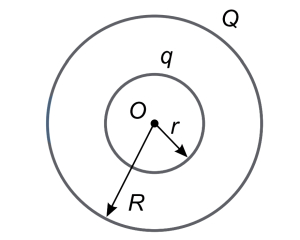
$A$ small conducting sphere of radius $r$ is lying concentrically inside a bigger hollow conducting sphere of radius $R$. The bigger and smaller spheres are charged with $Q$ and $q$ respectively $(Q > q)$ and are insulated from each other. The potential difference between the spheres will be
A
$\frac{1}{4 \pi \varepsilon_{0}}\left(\frac{q}{r}-\frac{q}{R}\right)$
B
$\frac{1}{4 \pi \varepsilon_{0}}\left(\frac{q}{R}-\frac{Q}{r}\right)$
C
$\frac{1}{4 \pi \varepsilon_{0}}\left(\frac{q}{r}-\frac{Q}{R}\right)$
D
$\frac{1}{4 \pi \varepsilon_{0}}\left(\frac{Q}{R}+\frac{q}{r}\right)$
Solution
(A) The potential $V_{1}$ of the smaller sphere (radius $r$,charge $q$) is due to its own charge and the potential due to the outer sphere (radius $R$,charge $Q$).
$V_{1} = \frac{1}{4 \pi \varepsilon_{0}} \cdot \frac{q}{r} + \frac{1}{4 \pi \varepsilon_{0}} \cdot \frac{Q}{R}$
The potential $V_{2}$ of the bigger sphere (radius $R$,charge $Q$) is due to its own charge and the potential due to the inner sphere (which acts as a point charge at the center for points outside it).
$V_{2} = \frac{1}{4 \pi \varepsilon_{0}} \cdot \frac{Q}{R} + \frac{1}{4 \pi \varepsilon_{0}} \cdot \frac{q}{R}$
The potential difference between the spheres is $V = V_{1} - V_{2}$.
$V = \left( \frac{1}{4 \pi \varepsilon_{0}} \cdot \frac{q}{r} + \frac{1}{4 \pi \varepsilon_{0}} \cdot \frac{Q}{R} \right) - \left( \frac{1}{4 \pi \varepsilon_{0}} \cdot \frac{Q}{R} + \frac{1}{4 \pi \varepsilon_{0}} \cdot \frac{q}{R} \right)$
$V = \frac{1}{4 \pi \varepsilon_{0}} \cdot \frac{q}{r} + \frac{1}{4 \pi \varepsilon_{0}} \cdot \frac{Q}{R} - \frac{1}{4 \pi \varepsilon_{0}} \cdot \frac{Q}{R} - \frac{1}{4 \pi \varepsilon_{0}} \cdot \frac{q}{R}$
$V = \frac{1}{4 \pi \varepsilon_{0}} \left( \frac{q}{r} - \frac{q}{R} \right)$
$V_{1} = \frac{1}{4 \pi \varepsilon_{0}} \cdot \frac{q}{r} + \frac{1}{4 \pi \varepsilon_{0}} \cdot \frac{Q}{R}$
The potential $V_{2}$ of the bigger sphere (radius $R$,charge $Q$) is due to its own charge and the potential due to the inner sphere (which acts as a point charge at the center for points outside it).
$V_{2} = \frac{1}{4 \pi \varepsilon_{0}} \cdot \frac{Q}{R} + \frac{1}{4 \pi \varepsilon_{0}} \cdot \frac{q}{R}$
The potential difference between the spheres is $V = V_{1} - V_{2}$.
$V = \left( \frac{1}{4 \pi \varepsilon_{0}} \cdot \frac{q}{r} + \frac{1}{4 \pi \varepsilon_{0}} \cdot \frac{Q}{R} \right) - \left( \frac{1}{4 \pi \varepsilon_{0}} \cdot \frac{Q}{R} + \frac{1}{4 \pi \varepsilon_{0}} \cdot \frac{q}{R} \right)$
$V = \frac{1}{4 \pi \varepsilon_{0}} \cdot \frac{q}{r} + \frac{1}{4 \pi \varepsilon_{0}} \cdot \frac{Q}{R} - \frac{1}{4 \pi \varepsilon_{0}} \cdot \frac{Q}{R} - \frac{1}{4 \pi \varepsilon_{0}} \cdot \frac{q}{R}$
$V = \frac{1}{4 \pi \varepsilon_{0}} \left( \frac{q}{r} - \frac{q}{R} \right)$
0 likesView Solution
37
PhysicsEasyMCQKCET · 2008
The charges $+q$,$+q$,and $Q$ are placed at the vertices of an equilateral triangle of side $a$. If the net electrostatic potential energy of the system is zero,then $Q$ is equal to:
A
$-\frac{q}{2}$
B
$-q$
C
$\frac{+q}{2}$
D
Zero
Solution
(A) The electrostatic potential energy $U$ of a system of three charges $q_1, q_2, q_3$ separated by distances $r_{12}, r_{23}, r_{31}$ is given by $U = \frac{1}{4\pi\epsilon_0} [\frac{q_1q_2}{r_{12}} + \frac{q_2q_3}{r_{23}} + \frac{q_3q_1}{r_{31}}]$.
Here,the charges are $q_1 = +q$,$q_2 = +q$,and $q_3 = Q$. The distance between each pair is $a$.
Substituting these values into the formula,we get:
$U = \frac{K}{a} [q \cdot q + q \cdot Q + Q \cdot q] = 0$
Since $K/a \neq 0$,the term inside the bracket must be zero:
$q^2 + 2qQ = 0$
$2qQ = -q^2$
$Q = -\frac{q^2}{2q} = -\frac{q}{2}$
Here,the charges are $q_1 = +q$,$q_2 = +q$,and $q_3 = Q$. The distance between each pair is $a$.
Substituting these values into the formula,we get:
$U = \frac{K}{a} [q \cdot q + q \cdot Q + Q \cdot q] = 0$
Since $K/a \neq 0$,the term inside the bracket must be zero:
$q^2 + 2qQ = 0$
$2qQ = -q^2$
$Q = -\frac{q^2}{2q} = -\frac{q}{2}$
0 likesView Solution
38
PhysicsDifficultMCQKCET · 2008
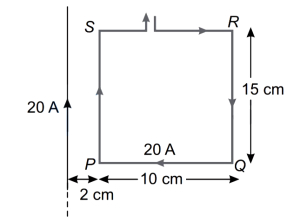
$A$ long current-carrying conductor is placed near a rectangular current loop as shown in the figure. Calculate the resultant force on the current loop.
A
$10^{-4} \text{ N}$
B
$3.6 \times 10^{-4} \text{ N}$
C
$1.8 \times 10^{-4} \text{ N}$
D
$5 \times 10^{-4} \text{ N}$
Solution
(D) The force on the horizontal segments $PQ$ and $RS$ are equal in magnitude but opposite in direction,so their net force is zero.
The force between two parallel current-carrying conductors is given by $F = \frac{\mu_0 I_1 I_2 l}{2 \pi r}$,where $r$ is the distance between the conductors.
For segment $PS$ (at distance $r_1 = 2 \text{ cm} = 0.02 \text{ m}$):
$F_{PS} = \frac{2 \times 10^{-7} \times 20 \times 20 \times 0.15}{0.02} = 6 \times 10^{-4} \text{ N}$ (Attractive force towards the wire).
For segment $QR$ (at distance $r_2 = 2 \text{ cm} + 10 \text{ cm} = 12 \text{ cm} = 0.12 \text{ m}$):
$F_{QR} = \frac{2 \times 10^{-7} \times 20 \times 20 \times 0.15}{0.12} = 1 \times 10^{-4} \text{ N}$ (Repulsive force away from the wire).
The net force is $F_{\text{net}} = F_{PS} - F_{QR} = 6 \times 10^{-4} - 1 \times 10^{-4} = 5 \times 10^{-4} \text{ N}$.
The force between two parallel current-carrying conductors is given by $F = \frac{\mu_0 I_1 I_2 l}{2 \pi r}$,where $r$ is the distance between the conductors.
For segment $PS$ (at distance $r_1 = 2 \text{ cm} = 0.02 \text{ m}$):
$F_{PS} = \frac{2 \times 10^{-7} \times 20 \times 20 \times 0.15}{0.02} = 6 \times 10^{-4} \text{ N}$ (Attractive force towards the wire).
For segment $QR$ (at distance $r_2 = 2 \text{ cm} + 10 \text{ cm} = 12 \text{ cm} = 0.12 \text{ m}$):
$F_{QR} = \frac{2 \times 10^{-7} \times 20 \times 20 \times 0.15}{0.12} = 1 \times 10^{-4} \text{ N}$ (Repulsive force away from the wire).
The net force is $F_{\text{net}} = F_{PS} - F_{QR} = 6 \times 10^{-4} - 1 \times 10^{-4} = 5 \times 10^{-4} \text{ N}$.
0 likesView Solution
39
PhysicsMediumMCQKCET · 2008
The magnetic field at the centre of a circular current-carrying conductor of radius $r$ is $B_{c}$. The magnetic field on its axis at a distance $r$ from the centre is $B_{a}$. The value of $B_{c} : B_{a}$ will be
A
$1 : \sqrt{2}$
B
$1 : 2\sqrt{2}$
C
$2\sqrt{2} : 1$
D
$\sqrt{2} : 1$
Solution
(C) The magnetic field at the centre of a circular coil of radius $r$ carrying current $I$ is given by:
$B_{c} = \frac{\mu_{0} I}{2r}$
The magnetic field on the axis of the circular coil at a distance $x$ from the centre is given by:
$B_{a} = \frac{\mu_{0} I r^{2}}{2(r^{2} + x^{2})^{3/2}}$
Given that the distance $x = r$,we substitute this into the expression for $B_{a}$:
$B_{a} = \frac{\mu_{0} I r^{2}}{2(r^{2} + r^{2})^{3/2}} = \frac{\mu_{0} I r^{2}}{2(2r^{2})^{3/2}} = \frac{\mu_{0} I r^{2}}{2(2^{3/2} r^{3})} = \frac{\mu_{0} I}{2 \cdot 2\sqrt{2} \cdot r} = \frac{\mu_{0} I}{4\sqrt{2} r}$
Now,calculating the ratio $B_{c} : B_{a}$:
$\frac{B_{c}}{B_{a}} = \frac{\frac{\mu_{0} I}{2r}}{\frac{\mu_{0} I}{4\sqrt{2} r}} = \frac{4\sqrt{2} r}{2r} = 2\sqrt{2}$
Therefore,the ratio $B_{c} : B_{a}$ is $2\sqrt{2} : 1$.
$B_{c} = \frac{\mu_{0} I}{2r}$
The magnetic field on the axis of the circular coil at a distance $x$ from the centre is given by:
$B_{a} = \frac{\mu_{0} I r^{2}}{2(r^{2} + x^{2})^{3/2}}$
Given that the distance $x = r$,we substitute this into the expression for $B_{a}$:
$B_{a} = \frac{\mu_{0} I r^{2}}{2(r^{2} + r^{2})^{3/2}} = \frac{\mu_{0} I r^{2}}{2(2r^{2})^{3/2}} = \frac{\mu_{0} I r^{2}}{2(2^{3/2} r^{3})} = \frac{\mu_{0} I}{2 \cdot 2\sqrt{2} \cdot r} = \frac{\mu_{0} I}{4\sqrt{2} r}$
Now,calculating the ratio $B_{c} : B_{a}$:
$\frac{B_{c}}{B_{a}} = \frac{\frac{\mu_{0} I}{2r}}{\frac{\mu_{0} I}{4\sqrt{2} r}} = \frac{4\sqrt{2} r}{2r} = 2\sqrt{2}$
Therefore,the ratio $B_{c} : B_{a}$ is $2\sqrt{2} : 1$.
0 likesView Solution
40
PhysicsDifficultMCQKCET · 2008
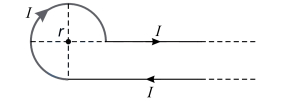
Current $I$ is flowing in a conductor shaped as shown in the figure. The radius of the curved part is $r$ and the length of the straight portions is very large. The value of the magnetic field at the centre $O$ will be
A
$\frac{\mu_{0} I}{4 \pi r}\left(\frac{3 \pi}{2}+1\right)$
B
$\frac{\mu_{0} I}{4 \pi r}\left(\frac{3 \pi}{2}-1\right)$
C
$\frac{\mu_{0} I}{4 \pi r}\left(\frac{\pi}{2}+1\right)$
D
$\frac{\mu_{0} I}{4 \pi r}\left(\frac{\pi}{2}-1\right)$
Solution
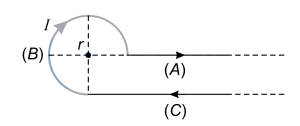
(A) The conductor consists of three parts: two semi-infinite straight wires and a circular arc of $270^\circ$ (or $\frac{3\pi}{2}$ radians).
$1$. For the straight wire $(A)$,the point $O$ lies on its axis,so the magnetic field $B_A = 0$.
$2$. For the circular arc $(B)$,the magnetic field at the centre is $B_B = \frac{\mu_0 I \theta}{4 \pi r} = \frac{\mu_0 I (3\pi/2)}{4 \pi r} = \frac{3 \mu_0 I}{8 r}$. The direction is inwards (using the right-hand rule).
$3$. For the straight wire $(C)$,the point $O$ is at a perpendicular distance $r$ from the wire. The magnetic field due to a semi-infinite wire is $B_C = \frac{\mu_0 I}{4 \pi r}$. The direction is also inwards.
$4$. The total magnetic field $B = B_A + B_B + B_C = 0 + \frac{3 \mu_0 I}{8 r} + \frac{\mu_0 I}{4 \pi r}$.
Factoring out $\frac{\mu_0 I}{4 \pi r}$,we get $B = \frac{\mu_0 I}{4 \pi r} \left( \frac{3\pi}{2} + 1 \right)$.
$1$. For the straight wire $(A)$,the point $O$ lies on its axis,so the magnetic field $B_A = 0$.
$2$. For the circular arc $(B)$,the magnetic field at the centre is $B_B = \frac{\mu_0 I \theta}{4 \pi r} = \frac{\mu_0 I (3\pi/2)}{4 \pi r} = \frac{3 \mu_0 I}{8 r}$. The direction is inwards (using the right-hand rule).
$3$. For the straight wire $(C)$,the point $O$ is at a perpendicular distance $r$ from the wire. The magnetic field due to a semi-infinite wire is $B_C = \frac{\mu_0 I}{4 \pi r}$. The direction is also inwards.
$4$. The total magnetic field $B = B_A + B_B + B_C = 0 + \frac{3 \mu_0 I}{8 r} + \frac{\mu_0 I}{4 \pi r}$.
Factoring out $\frac{\mu_0 I}{4 \pi r}$,we get $B = \frac{\mu_0 I}{4 \pi r} \left( \frac{3\pi}{2} + 1 \right)$.
0 likesView Solution
41
PhysicsMediumMCQKCET · 2008
On bombarding $U^{235}$ by slow neutrons,$200 \text{ MeV}$ of energy is released. If the power output of an atomic reactor is $1.6 \text{ MW}$,then the rate of fission will be:
A
$5 \times 10^{22} / s$
B
$5 \times 10^{16} / s$
C
$8 \times 10^{16} / s$
D
$20 \times 10^{16} / s$
Solution
(B) The energy released per fission is $E = 200 \text{ MeV} = 200 \times 10^6 \times 1.6 \times 10^{-19} \text{ J} = 3.2 \times 10^{-11} \text{ J}$.
Given power output $P = 1.6 \text{ MW} = 1.6 \times 10^6 \text{ W}$.
The rate of fission $R$ is given by the formula $R = P / E$.
Substituting the values: $R = (1.6 \times 10^6) / (3.2 \times 10^{-11})$.
$R = 0.5 \times 10^{17} = 5 \times 10^{16} \text{ fissions/s}$.
Given power output $P = 1.6 \text{ MW} = 1.6 \times 10^6 \text{ W}$.
The rate of fission $R$ is given by the formula $R = P / E$.
Substituting the values: $R = (1.6 \times 10^6) / (3.2 \times 10^{-11})$.
$R = 0.5 \times 10^{17} = 5 \times 10^{16} \text{ fissions/s}$.
0 likesView Solution
42
PhysicsEasyMCQKCET · 2008
${ }_{92} U^{235}$ undergoes successive disintegrations with the end product of ${ }_{82} Pb^{203}$. The number of $\alpha$ and $\beta$ particles emitted are
A
$\alpha=6, \beta=4$
B
$\alpha=6, \beta=0$
C
$\alpha=8, \beta=6$
D
$\alpha=3, \beta=3$
Solution
(C) Let the number of $\alpha$ particles emitted be $x$ and the number of $\beta$ particles emitted be $y$.
The nuclear decay reaction is represented as:
${ }_{92} U^{235} \longrightarrow x({ }_{2} \alpha^{4}) + y({ }_{-1} \beta^{0}) + { }_{82} Pb^{203}$
Equating the mass numbers on both sides:
$235 = 4x + 203$
$4x = 235 - 203 = 32$
$x = 8$
Equating the atomic numbers on both sides:
$92 = 2x - y + 82$
Substituting $x = 8$ into the equation:
$92 = 2(8) - y + 82$
$92 = 16 - y + 82$
$92 = 98 - y$
$y = 98 - 92 = 6$
Therefore,$8$ $\alpha$ particles and $6$ $\beta$ particles are emitted.
The nuclear decay reaction is represented as:
${ }_{92} U^{235} \longrightarrow x({ }_{2} \alpha^{4}) + y({ }_{-1} \beta^{0}) + { }_{82} Pb^{203}$
Equating the mass numbers on both sides:
$235 = 4x + 203$
$4x = 235 - 203 = 32$
$x = 8$
Equating the atomic numbers on both sides:
$92 = 2x - y + 82$
Substituting $x = 8$ into the equation:
$92 = 2(8) - y + 82$
$92 = 16 - y + 82$
$92 = 98 - y$
$y = 98 - 92 = 6$
Therefore,$8$ $\alpha$ particles and $6$ $\beta$ particles are emitted.
0 likesView Solution
43
PhysicsEasyMCQKCET · 2008
Two protons are kept at a separation of $40 \text{ Å}$. $F_{n}$ is the nuclear force and $F_{e}$ is the electrostatic force between them. Then:
A
$F_{n} \gg F_{e}$
B
$F_{n} = F_{e}$
C
$F_{n} \ll F_{e}$
D
$F_{n} \approx F_{e}$
Solution
(C) The nuclear force $F_{n}$ is a short-range force that acts effectively only within the range of approximately $10^{-15} \text{ m}$ (or $1 \text{ fm}$).
Beyond this distance,the nuclear force decreases exponentially and becomes negligible.
The given separation is $40 \text{ Å} = 40 \times 10^{-10} \text{ m} = 4 \times 10^{-9} \text{ m}$.
Since $4 \times 10^{-9} \text{ m} \gg 10^{-15} \text{ m}$,the nuclear force $F_{n}$ is essentially zero at this distance.
However,the electrostatic force $F_{e}$ follows the inverse-square law $(F_{e} \propto 1/r^2)$ and remains significant even at this distance.
Therefore,$F_{n} \ll F_{e}$.
Beyond this distance,the nuclear force decreases exponentially and becomes negligible.
The given separation is $40 \text{ Å} = 40 \times 10^{-10} \text{ m} = 4 \times 10^{-9} \text{ m}$.
Since $4 \times 10^{-9} \text{ m} \gg 10^{-15} \text{ m}$,the nuclear force $F_{n}$ is essentially zero at this distance.
However,the electrostatic force $F_{e}$ follows the inverse-square law $(F_{e} \propto 1/r^2)$ and remains significant even at this distance.
Therefore,$F_{n} \ll F_{e}$.
0 likesView Solution
44
PhysicsEasyMCQKCET · 2008
The ratio of the nuclear radii of elements with mass numbers $216$ and $125$ is
A
$216: 125$
B
$\sqrt{216}: \sqrt{125}$
C
$6: 5$
D
None of these
Solution
(C) The nuclear radius $R$ is given by the formula $R = R_0 A^{1/3}$,where $A$ is the mass number and $R_0$ is a constant.
Given mass numbers are $A_1 = 216$ and $A_2 = 125$.
The ratio of the radii is $\frac{R_1}{R_2} = \frac{R_0 (A_1)^{1/3}}{R_0 (A_2)^{1/3}}$.
Substituting the values,$\frac{R_1}{R_2} = \frac{(216)^{1/3}}{(125)^{1/3}}$.
Since $216 = 6^3$ and $125 = 5^3$,we have $\frac{R_1}{R_2} = \frac{6}{5}$ or $6:5$.
Given mass numbers are $A_1 = 216$ and $A_2 = 125$.
The ratio of the radii is $\frac{R_1}{R_2} = \frac{R_0 (A_1)^{1/3}}{R_0 (A_2)^{1/3}}$.
Substituting the values,$\frac{R_1}{R_2} = \frac{(216)^{1/3}}{(125)^{1/3}}$.
Since $216 = 6^3$ and $125 = 5^3$,we have $\frac{R_1}{R_2} = \frac{6}{5}$ or $6:5$.
0 likesView Solution
45
PhysicsEasyMCQKCET · 2008
The most stable particle in the Baryon group is
A
neutron
B
omega-particle
C
proton
D
lambda-particle
Solution
(C) Baryons are a family of subatomic particles made of three quarks.
Among all baryons,the proton is the only stable particle that does not decay into other particles.
While the free neutron decays into a proton,an electron,and an antineutrino with a mean life of approximately $880 \ s$,the proton is considered stable with a lifetime exceeding $10^{34}$ years.
Therefore,the proton is the most stable particle in the Baryon group.
Among all baryons,the proton is the only stable particle that does not decay into other particles.
While the free neutron decays into a proton,an electron,and an antineutrino with a mean life of approximately $880 \ s$,the proton is considered stable with a lifetime exceeding $10^{34}$ years.
Therefore,the proton is the most stable particle in the Baryon group.
0 likesView Solution
46
PhysicsEasyMCQKCET · 2008
The masses of two radioactive substances are same and their half-lives are $1 \ yr$ and $2 \ yr$ respectively. The ratio of their activities after $4 \ yr$ will be
A
$1: 4$
B
$1: 2$
C
$1: 3$
D
$1: 6$
Solution
(A) The activity $R$ of a radioactive substance is given by $R = \lambda N$,where $N$ is the number of radioactive nuclei present at time $t$. Since the initial masses are the same,the initial number of nuclei $N_0$ is the same for both substances.
The activity at time $t$ is given by $R = R_0 \left( \frac{1}{2} \right)^{t / T_{1/2}}$,where $T_{1/2}$ is the half-life.
For the first substance: $T_{1/2, 1} = 1 \ yr$,$t = 4 \ yr$.
$R_1 = R_0 \left( \frac{1}{2} \right)^{4/1} = R_0 \left( \frac{1}{2} \right)^4$.
For the second substance: $T_{1/2, 2} = 2 \ yr$,$t = 4 \ yr$.
$R_2 = R_0 \left( \frac{1}{2} \right)^{4/2} = R_0 \left( \frac{1}{2} \right)^2$.
The ratio of their activities is:
$\frac{R_1}{R_2} = \frac{R_0 (1/2)^4}{R_0 (1/2)^2} = \left( \frac{1}{2} \right)^{4-2} = \left( \frac{1}{2} \right)^2 = \frac{1}{4}$.
Thus,the ratio is $1: 4$.
The activity at time $t$ is given by $R = R_0 \left( \frac{1}{2} \right)^{t / T_{1/2}}$,where $T_{1/2}$ is the half-life.
For the first substance: $T_{1/2, 1} = 1 \ yr$,$t = 4 \ yr$.
$R_1 = R_0 \left( \frac{1}{2} \right)^{4/1} = R_0 \left( \frac{1}{2} \right)^4$.
For the second substance: $T_{1/2, 2} = 2 \ yr$,$t = 4 \ yr$.
$R_2 = R_0 \left( \frac{1}{2} \right)^{4/2} = R_0 \left( \frac{1}{2} \right)^2$.
The ratio of their activities is:
$\frac{R_1}{R_2} = \frac{R_0 (1/2)^4}{R_0 (1/2)^2} = \left( \frac{1}{2} \right)^{4-2} = \left( \frac{1}{2} \right)^2 = \frac{1}{4}$.
Thus,the ratio is $1: 4$.
0 likesView Solution
47
PhysicsMediumMCQKCET · 2008
$A$ convex and a concave lens separated by a distance are then put in contact. How does the focal length of the combination change?
A
decreases
B
increases
C
becomes $0$
D
remains the same
Solution
(B) The equivalent focal length $F$ of two thin lenses separated by a distance $d$ is given by the formula:
$\frac{1}{F} = \frac{1}{f_1} + \frac{1}{f_2} - \frac{d}{f_1 f_2}$
Here,$f_1$ is the focal length of the convex lens (positive) and $f_2$ is the focal length of the concave lens (negative).
When the lenses are put in contact,the separation distance $d = 0$.
Substituting $d = 0$ into the formula,we get:
$\frac{1}{F} = \frac{1}{f_1} + \frac{1}{f_2}$
Since $f_1 > 0$ and $f_2 < 0$,let $f_1 = f$ and $f_2 = -f'$ (where $f, f' > 0$).
$\frac{1}{F} = \frac{1}{f} - \frac{1}{f'}$
As the lenses are brought from a separated state to contact,the term $-\frac{d}{f_1 f_2}$ (which was negative since $f_1 f_2 < 0$) is removed. Effectively,the power of the combination changes such that the focal length increases compared to the separated state.
$\frac{1}{F} = \frac{1}{f_1} + \frac{1}{f_2} - \frac{d}{f_1 f_2}$
Here,$f_1$ is the focal length of the convex lens (positive) and $f_2$ is the focal length of the concave lens (negative).
When the lenses are put in contact,the separation distance $d = 0$.
Substituting $d = 0$ into the formula,we get:
$\frac{1}{F} = \frac{1}{f_1} + \frac{1}{f_2}$
Since $f_1 > 0$ and $f_2 < 0$,let $f_1 = f$ and $f_2 = -f'$ (where $f, f' > 0$).
$\frac{1}{F} = \frac{1}{f} - \frac{1}{f'}$
As the lenses are brought from a separated state to contact,the term $-\frac{d}{f_1 f_2}$ (which was negative since $f_1 f_2 < 0$) is removed. Effectively,the power of the combination changes such that the focal length increases compared to the separated state.
0 likesView Solution
48
PhysicsDifficultMCQKCET · 2008
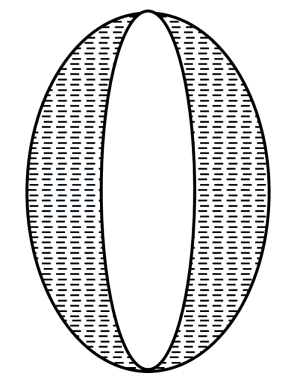
$A$ convex lens is made of $3$ layers of glass of $3$ different materials as shown in the figure. $A$ point object is placed on its axis. The number of images of the object formed is:
A
$1$
B
$2$
C
$3$
D
$4$
Solution
(C) The lens is composed of $3$ different materials,each having a different refractive index.
Since the lens is formed by $3$ distinct parts,each part acts as an independent lens with its own focal length.
When a point object is placed on the principal axis,light rays passing through each of the $3$ different sections will be refracted differently.
Consequently,each section will form an image of the object at a position determined by its specific focal length.
Therefore,$3$ distinct images will be formed,one by each section of the lens.
Since the lens is formed by $3$ distinct parts,each part acts as an independent lens with its own focal length.
When a point object is placed on the principal axis,light rays passing through each of the $3$ different sections will be refracted differently.
Consequently,each section will form an image of the object at a position determined by its specific focal length.
Therefore,$3$ distinct images will be formed,one by each section of the lens.
0 likesView Solution
49
PhysicsMediumMCQKCET · 2008
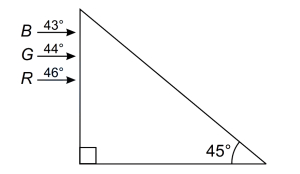
The figure shows a mixture of blue,green,and red colored rays incident normally on a right-angled prism. The critical angles of the material of the prism for red,green,and blue are $46^{\circ}$,$44^{\circ}$,and $43^{\circ}$ respectively. The arrangement will separate:
A
red color from blue and green
B
blue color from red and green
C
green color from red and blue
D
all the three colors
Solution
(A) The rays are incident normally on the first surface of the prism,so they pass undeviated and strike the hypotenuse at an angle of incidence $i = 45^{\circ}$.
For total internal reflection to occur at the second surface,the angle of incidence must be greater than the critical angle $(i > C)$.
Given critical angles are $C_{red} = 46^{\circ}$,$C_{green} = 44^{\circ}$,and $C_{blue} = 43^{\circ}$.
For red light: $i = 45^{\circ} < C_{red} = 46^{\circ}$. Thus,red light will emerge from the prism.
For green light: $i = 45^{\circ} > C_{green} = 44^{\circ}$. Thus,green light will undergo total internal reflection.
For blue light: $i = 45^{\circ} > C_{blue} = 43^{\circ}$. Thus,blue light will undergo total internal reflection.
Since green and blue light undergo total internal reflection while red light emerges,the arrangement separates red color from blue and green colors.
For total internal reflection to occur at the second surface,the angle of incidence must be greater than the critical angle $(i > C)$.
Given critical angles are $C_{red} = 46^{\circ}$,$C_{green} = 44^{\circ}$,and $C_{blue} = 43^{\circ}$.
For red light: $i = 45^{\circ} < C_{red} = 46^{\circ}$. Thus,red light will emerge from the prism.
For green light: $i = 45^{\circ} > C_{green} = 44^{\circ}$. Thus,green light will undergo total internal reflection.
For blue light: $i = 45^{\circ} > C_{blue} = 43^{\circ}$. Thus,blue light will undergo total internal reflection.
Since green and blue light undergo total internal reflection while red light emerges,the arrangement separates red color from blue and green colors.
0 likesView Solution
50
PhysicsMediumMCQKCET · 2008
$A$ ray of light enters from a rarer to a denser medium. The angle of incidence is $i$. Then the reflected and refracted rays are mutually perpendicular to each other. The critical angle for the pair of media is
A
$\sin ^{-1}(\tan i)$
B
$\tan ^{-1}(\sin i)$
C
$\sin ^{-1}(\cot i)$
D
$\cos ^{-1}(\tan i)$
Solution
(C) According to the law of reflection,the angle of incidence $i$ is equal to the angle of reflection $r$,so $i = r$.
Given that the reflected and refracted rays are mutually perpendicular,the sum of the angle of reflection $r$,the angle between them $(90^{\circ})$,and the angle of refraction $r'$ is $180^{\circ}$.
Thus,$r + 90^{\circ} + r' = 180^{\circ}$.
Since $r = i$,we have $i + 90^{\circ} + r' = 180^{\circ}$,which implies $r' = 90^{\circ} - i$.
Applying Snell's Law at the interface: $\mu_r \sin i = \mu_d \sin r'$.
Substituting $r' = 90^{\circ} - i$,we get $\mu_r \sin i = \mu_d \sin(90^{\circ} - i) = \mu_d \cos i$.
Therefore,$\frac{\mu_d}{\mu_r} = \frac{\sin i}{\cos i} = \tan i$.
For the critical angle $C$,we know that $\sin C = \frac{\mu_r}{\mu_d}$.
Thus,$\sin C = \frac{1}{\tan i} = \cot i$.
Hence,the critical angle is $C = \sin^{-1}(\cot i)$.
Given that the reflected and refracted rays are mutually perpendicular,the sum of the angle of reflection $r$,the angle between them $(90^{\circ})$,and the angle of refraction $r'$ is $180^{\circ}$.
Thus,$r + 90^{\circ} + r' = 180^{\circ}$.
Since $r = i$,we have $i + 90^{\circ} + r' = 180^{\circ}$,which implies $r' = 90^{\circ} - i$.
Applying Snell's Law at the interface: $\mu_r \sin i = \mu_d \sin r'$.
Substituting $r' = 90^{\circ} - i$,we get $\mu_r \sin i = \mu_d \sin(90^{\circ} - i) = \mu_d \cos i$.
Therefore,$\frac{\mu_d}{\mu_r} = \frac{\sin i}{\cos i} = \tan i$.
For the critical angle $C$,we know that $\sin C = \frac{\mu_r}{\mu_d}$.
Thus,$\sin C = \frac{1}{\tan i} = \cot i$.
Hence,the critical angle is $C = \sin^{-1}(\cot i)$.
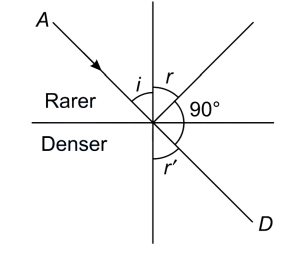
0 likesView Solution
51
PhysicsDifficultMCQKCET · 2008
$A$ fish in water (refractive index $n$) looks at a bird vertically above in the air. If $y$ is the height of the bird and $x$ is the depth of the fish from the surface,then the distance of the bird as estimated by the fish is
A
$x+y(1-1/n)$
B
$x+ny$
C
$x+y(1+1/n)$
D
$y+x(1-1/n)$
Solution
(B) When an observer is in a denser medium (water,refractive index $n$) and the object (bird) is in a rarer medium (air,refractive index $1$),the apparent height of the object is increased.
For an observer in a medium of refractive index $n$,the apparent height $h'$ of an object at a real height $h$ is given by $h' = n \times h$.
Here,the bird is at a height $y$ above the water surface.
Therefore,the apparent height of the bird as seen by the fish from the water surface is $h' = n \times y$.
The fish is at a depth $x$ below the water surface.
Thus,the total distance of the bird as estimated by the fish is the sum of the depth of the fish and the apparent height of the bird: $D = x + ny$.
For an observer in a medium of refractive index $n$,the apparent height $h'$ of an object at a real height $h$ is given by $h' = n \times h$.
Here,the bird is at a height $y$ above the water surface.
Therefore,the apparent height of the bird as seen by the fish from the water surface is $h' = n \times y$.
The fish is at a depth $x$ below the water surface.
Thus,the total distance of the bird as estimated by the fish is the sum of the depth of the fish and the apparent height of the bird: $D = x + ny$.
0 likesView Solution
52
PhysicsEasyMCQKCET · 2008
In an unbiased $p-n$ junction:
A
Potential at $p$ is more than that at $n$.
B
Potential at $p$ is less than that at $n$.
C
Potential at $p$ is equal to that at $n$.
D
Potential at $p$ is $+ve$ and that at $n$ is $-ve$.
Solution
(B) In an unbiased $p-n$ junction,a depletion region is formed at the junction due to the diffusion of charge carriers.
This creates a built-in potential barrier.
According to the potential-distance graph for a $p-n$ junction,the potential in the $n$-region is higher than the potential in the $p$-region.
Therefore,the potential at $p$ is less than that at $n$.
This creates a built-in potential barrier.
According to the potential-distance graph for a $p-n$ junction,the potential in the $n$-region is higher than the potential in the $p$-region.
Therefore,the potential at $p$ is less than that at $n$.
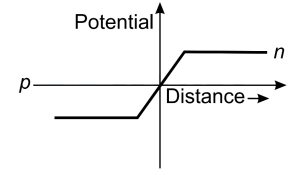
0 likesView Solution
53
PhysicsEasyMCQKCET · 2008
To get an output $Y=1$ from the circuit shown,the inputs $A, B,$ and $C$ must be respectively:
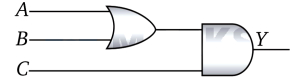
A
$0, 1, 0$
B
$1, 0, 0$
C
$1, 0, 1$
D
$1, 1, 0$
Solution
(C) The given circuit consists of an $OR$ gate followed by an $AND$ gate. The Boolean expression for the output $Y$ is given by $Y = (A + B) \cdot C$.
For the output to be $Y = 1$,both inputs to the $AND$ gate must be $1$. Therefore,$(A + B) = 1$ and $C = 1$.
Checking the options:
For option $C$: $A = 1, B = 0, C = 1$.
Substituting these values: $Y = (1 + 0) \cdot 1 = 1 \cdot 1 = 1$.
Thus,the inputs $A = 1, B = 0, C = 1$ result in an output $Y = 1$.
For the output to be $Y = 1$,both inputs to the $AND$ gate must be $1$. Therefore,$(A + B) = 1$ and $C = 1$.
Checking the options:
For option $C$: $A = 1, B = 0, C = 1$.
Substituting these values: $Y = (1 + 0) \cdot 1 = 1 \cdot 1 = 1$.
Thus,the inputs $A = 1, B = 0, C = 1$ result in an output $Y = 1$.
0 likesView Solution
54
PhysicsDifficultMCQKCET · 2008
In a Fraunhofer diffraction experiment at a single slit using light of wavelength $400 \ nm$,the first minimum is formed at an angle of $30^{\circ}$. The direction $\theta'$ of the first secondary maximum is given by
A
$\sin^{-1}\left(\frac{2}{3}\right)$
B
$\sin^{-1}\left(\frac{3}{4}\right)$
C
$\sin^{-1}\left(\frac{1}{4}\right)$
D
$\tan^{-1}\left(\frac{2}{3}\right)$
Solution
(B) For the first diffraction minimum,the condition is given by $a \sin \theta = n\lambda$. For $n=1$,$a \sin \theta = \lambda$.
Given $\theta = 30^{\circ}$,we have $a = \frac{\lambda}{\sin 30^{\circ}} = 2\lambda$.
For the first secondary maximum,the condition is $a \sin \theta' = \frac{3\lambda}{2}$.
Substituting the value of $a = 2\lambda$ into the equation:
$2\lambda \sin \theta' = \frac{3\lambda}{2}$
$\sin \theta' = \frac{3\lambda}{2 \times 2\lambda} = \frac{3}{4}$.
Therefore,$\theta' = \sin^{-1}\left(\frac{3}{4}\right)$.
Given $\theta = 30^{\circ}$,we have $a = \frac{\lambda}{\sin 30^{\circ}} = 2\lambda$.
For the first secondary maximum,the condition is $a \sin \theta' = \frac{3\lambda}{2}$.
Substituting the value of $a = 2\lambda$ into the equation:
$2\lambda \sin \theta' = \frac{3\lambda}{2}$
$\sin \theta' = \frac{3\lambda}{2 \times 2\lambda} = \frac{3}{4}$.
Therefore,$\theta' = \sin^{-1}\left(\frac{3}{4}\right)$.
0 likesView Solution
55
PhysicsEasyMCQKCET · 2008
Maximum diffraction takes place in a given slit for
A
$\gamma$-rays
B
ultraviolet light
C
infrared light
D
radiowaves
Solution
(D) The degree of diffraction is directly proportional to the wavelength of the incident wave.
Since diffraction occurs when the size of the obstacle or aperture is comparable to the wavelength of the wave,waves with longer wavelengths exhibit more pronounced diffraction effects.
Among the given options,radiowaves have the longest wavelength.
Therefore,radiowaves undergo maximum diffraction.
Since diffraction occurs when the size of the obstacle or aperture is comparable to the wavelength of the wave,waves with longer wavelengths exhibit more pronounced diffraction effects.
Among the given options,radiowaves have the longest wavelength.
Therefore,radiowaves undergo maximum diffraction.
0 likesView Solution
56
PhysicsEasyMCQKCET · 2008
Blue colour of sea water is due to
A
interference of sunlight reflected from the water surface
B
scattering of sunlight by the water molecules
C
image of sky in water
D
refraction of sunlight
Solution
(B) The blue colour of sea water is primarily due to the scattering of sunlight by water molecules. When sunlight enters the water,the shorter wavelengths (blue light) are scattered more effectively by the water molecules compared to longer wavelengths,which gives the sea its characteristic blue appearance.
0 likesView Solution
57
PhysicsEasyMCQKCET · 2008
An unpolarised beam of intensity $I_{0}$ falls on a polaroid. The intensity of the emergent light is
A
$\frac{I_{0}}{2}$
B
$I_{0}$
C
$\frac{I_{0}}{4}$
D
Zero
Solution
(A) When an unpolarised light beam of intensity $I_{0}$ passes through a polaroid,it becomes plane-polarised.
According to the properties of polaroids,the intensity of the emergent plane-polarised light is exactly half of the intensity of the incident unpolarised light.
Therefore,the intensity of the emergent light is $I = \frac{I_{0}}{2}$.
According to the properties of polaroids,the intensity of the emergent plane-polarised light is exactly half of the intensity of the incident unpolarised light.
Therefore,the intensity of the emergent light is $I = \frac{I_{0}}{2}$.
0 likesView Solution
58
PhysicsEasyMCQKCET · 2008
Which of the following is a dichroic crystal?
A
Quartz
B
Tourmaline
C
Mica
D
Selenite
Solution
(B) dichroic crystal is a material that exhibits the property of dichroism,which is the selective absorption of light based on its polarization direction.
Some crystals,such as tourmaline,have the property of strongly absorbing light with vibrations perpendicular to a specific direction (called the transmission axis) while transmitting light with vibrations parallel to it.
This selective absorption of light is known as dichroism.
Therefore,tourmaline is a well-known example of a dichroic crystal.
Some crystals,such as tourmaline,have the property of strongly absorbing light with vibrations perpendicular to a specific direction (called the transmission axis) while transmitting light with vibrations parallel to it.
This selective absorption of light is known as dichroism.
Therefore,tourmaline is a well-known example of a dichroic crystal.
0 likesView Solution
59
PhysicsMediumMCQKCET · 2008
In Young's double slit experiment,a third slit is made in between the double slits. Then
A
intensity of fringes totally disappears
B
only bright light is observed on the screen
C
fringes of unequal width are formed
D
contrast between bright and dark fringes is reduced
Solution
(D) In Young's double slit experiment,the interference pattern is formed by the superposition of light waves from two coherent sources. If a third slit is introduced between the two slits,it acts as an additional source of light. This additional light contributes to the background illumination on the screen,which does not participate in the interference pattern. As a result,the intensity of the dark fringes increases,while the intensity of the bright fringes remains relatively unchanged. This leads to a decrease in the visibility or contrast between the bright and dark fringes.
0 likesView Solution
60
PhysicsMediumMCQKCET · 2008
In a two-slit experiment with monochromatic light, fringes are obtained on a screen placed at some distance from the slits. If the screen is moved by $5 \times 10^{-2} \, m$ towards the slits, the change in fringe width is $3 \times 10^{-5} \, m$. If the separation between the slits is $10^{-3} \, m$, the wavelength of light used is: (in $\text{Å}$)
A
$6000$
B
$5000$
C
$3000$
D
$4500$
Solution
(A) The fringe width $\beta$ in a Young's double-slit experiment is given by $\beta = \frac{\lambda D}{d}$, where $\lambda$ is the wavelength, $D$ is the distance of the screen from the slits, and $d$ is the slit separation.
When the screen is moved by $\Delta D = 5 \times 10^{-2} \, m$, the change in fringe width is $\Delta \beta = 3 \times 10^{-5} \, m$.
From the formula, the change in fringe width is $\Delta \beta = \frac{\lambda}{d} \Delta D$.
Rearranging for $\lambda$, we get $\lambda = \frac{\Delta \beta \cdot d}{\Delta D}$.
Substituting the given values:
$\lambda = \frac{(3 \times 10^{-5} \, m) \times (10^{-3} \, m)}{5 \times 10^{-2} \, m}$.
$\lambda = \frac{3 \times 10^{-8}}{5 \times 10^{-2}} \, m = 0.6 \times 10^{-6} \, m = 6 \times 10^{-7} \, m$.
Converting to $\text{Å}$ $(1 \, \text{Å} = 10^{-10} \, m)$:
$\lambda = 6000 \times 10^{-10} \, m = 6000 \, \text{Å}$.
When the screen is moved by $\Delta D = 5 \times 10^{-2} \, m$, the change in fringe width is $\Delta \beta = 3 \times 10^{-5} \, m$.
From the formula, the change in fringe width is $\Delta \beta = \frac{\lambda}{d} \Delta D$.
Rearranging for $\lambda$, we get $\lambda = \frac{\Delta \beta \cdot d}{\Delta D}$.
Substituting the given values:
$\lambda = \frac{(3 \times 10^{-5} \, m) \times (10^{-3} \, m)}{5 \times 10^{-2} \, m}$.
$\lambda = \frac{3 \times 10^{-8}}{5 \times 10^{-2}} \, m = 0.6 \times 10^{-6} \, m = 6 \times 10^{-7} \, m$.
Converting to $\text{Å}$ $(1 \, \text{Å} = 10^{-10} \, m)$:
$\lambda = 6000 \times 10^{-10} \, m = 6000 \, \text{Å}$.
0 likesView Solution
Vedclass Products
For Students
Vedclass Test Series
Mock tests in real KCET style covering Physics with performance analysis. 5-day free trial.
Start Free TrialFor Teachers
Exam Paper Generator
Generate Set A/B/C/D Physics papers from 7.5L+ questions in 2 minutes. 3 chapters free.
Try FreeFor Institutes
Online Exam Module
Run live KCET mock exams with unlimited students, 360° analytics & white-label branding.
See DemoFrequently Asked Questions
How many Physics questions are in KCET 2008?
There are 60 Physics questions from the KCET 2008 paper on Vedclass, each with a detailed step-by-step solution in English.
Are KCET 2008 Physics solutions available in English?
Yes. All solutions on this page are in English. You can also switch to English or Hindi using the language buttons above the questions.
Can I practice KCET 2008 Physics as a timed test?
Yes. Use the Vedclass Test Series to attempt a full KCET mock test covering Physics with time limits and instant score analysis.
Can teachers create Physics papers from KCET previous year questions?
Yes. The Vedclass Exam Paper Generator lets teachers mix KCET Physics questions and generate Set A/B/C/D papers in minutes.
For Teachers & Institutes
Build a Custom Physics Paper
Pick KCET 2008 Physics questions, set difficulty, and generate Set A/B/C/D in 2 minutes.