
MathematicsQ201–278 of 478 questions
Page 5 of 5 · English
201
MathematicsDifficultMCQJEE Main · 2019
The number of real roots of the equation $5 + |2^x - 1| = 2^x(2^x - 2)$ is
A
$4$
B
$3$
C
$2$
D
$1$
Solution
(D) Let $2^x = t$. Since $2^x > 0$,we must have $t > 0$.
The equation becomes $5 + |t - 1| = t(t - 2) = t^2 - 2t$.
Rearranging,we get $|t - 1| = t^2 - 2t - 5$.
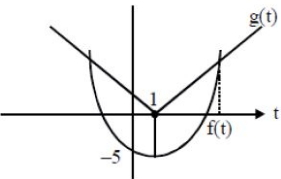
Let $g(t) = |t - 1|$ and $f(t) = t^2 - 2t - 5$.
We look for solutions where $t > 0$.
Case $1$: $t \ge 1$.
$t - 1 = t^2 - 2t - 5$ $\Rightarrow t^2 - 3t - 4 = 0$ $\Rightarrow (t - 4)(t + 1) = 0$.
Since $t \ge 1$,we have $t = 4$. Thus $2^x = 4 \Rightarrow x = 2$.
Case $2$: $0 < t < 1$.
$-(t - 1) = t^2 - 2t - 5$ $\Rightarrow -t + 1 = t^2 - 2t - 5$ $\Rightarrow t^2 - t - 6 = 0$ $\Rightarrow (t - 3)(t + 2) = 0$.
Neither $t = 3$ nor $t = -2$ satisfy $0 < t < 1$.
Thus,there is only $1$ real root.
The equation becomes $5 + |t - 1| = t(t - 2) = t^2 - 2t$.
Rearranging,we get $|t - 1| = t^2 - 2t - 5$.
Let $g(t) = |t - 1|$ and $f(t) = t^2 - 2t - 5$.
We look for solutions where $t > 0$.
Case $1$: $t \ge 1$.
$t - 1 = t^2 - 2t - 5$ $\Rightarrow t^2 - 3t - 4 = 0$ $\Rightarrow (t - 4)(t + 1) = 0$.
Since $t \ge 1$,we have $t = 4$. Thus $2^x = 4 \Rightarrow x = 2$.
Case $2$: $0 < t < 1$.
$-(t - 1) = t^2 - 2t - 5$ $\Rightarrow -t + 1 = t^2 - 2t - 5$ $\Rightarrow t^2 - t - 6 = 0$ $\Rightarrow (t - 3)(t + 2) = 0$.
Neither $t = 3$ nor $t = -2$ satisfy $0 < t < 1$.
Thus,there is only $1$ real root.
0 likesView Solution
202
MathematicsDifficultMCQJEE Main · 2019
The tangent and normal to the ellipse $3x^2 + 5y^2 = 32$ at the point $P(2, 2)$ meet the $x$-axis at $Q$ and $R$,respectively. Then the area (in sq. units) of the triangle $PQR$ is
A
$\frac{34}{15}$
B
$\frac{68}{15}$
C
$\frac{14}{3}$
D
$\frac{16}{3}$
Solution
(B) Given the ellipse equation: $3x^2 + 5y^2 = 32$.
Differentiating with respect to $x$: $6x + 10y \frac{dy}{dx} = 0$,which gives $\frac{dy}{dx} = -\frac{3x}{5y}$.
At point $P(2, 2)$,the slope of the tangent is $m = -\frac{3(2)}{5(2)} = -\frac{3}{5}$.
The equation of the tangent at $P(2, 2)$ is $y - 2 = -\frac{3}{5}(x - 2)$. Setting $y = 0$ to find $Q$,we get $-2 = -\frac{3}{5}(x - 2)$ $\Rightarrow x - 2 = \frac{10}{3}$ $\Rightarrow x = \frac{16}{3}$. Thus,$Q = (\frac{16}{3}, 0)$.
The slope of the normal at $P(2, 2)$ is $m' = -\frac{1}{m} = \frac{5}{3}$.
The equation of the normal at $P(2, 2)$ is $y - 2 = \frac{5}{3}(x - 2)$. Setting $y = 0$ to find $R$,we get $-2 = \frac{5}{3}(x - 2)$ $\Rightarrow x - 2 = -\frac{6}{5}$ $\Rightarrow x = \frac{4}{5}$. Thus,$R = (\frac{4}{5}, 0)$.
The area of triangle $PQR$ with base $QR$ on the $x$-axis and height equal to the $y$-coordinate of $P$ is:
Area $= \frac{1}{2} \times |x_Q - x_R| \times |y_P| = \frac{1}{2} \times |\frac{16}{3} - \frac{4}{5}| \times 2 = |\frac{80 - 12}{15}| = \frac{68}{15}$ sq. units.
Differentiating with respect to $x$: $6x + 10y \frac{dy}{dx} = 0$,which gives $\frac{dy}{dx} = -\frac{3x}{5y}$.
At point $P(2, 2)$,the slope of the tangent is $m = -\frac{3(2)}{5(2)} = -\frac{3}{5}$.
The equation of the tangent at $P(2, 2)$ is $y - 2 = -\frac{3}{5}(x - 2)$. Setting $y = 0$ to find $Q$,we get $-2 = -\frac{3}{5}(x - 2)$ $\Rightarrow x - 2 = \frac{10}{3}$ $\Rightarrow x = \frac{16}{3}$. Thus,$Q = (\frac{16}{3}, 0)$.
The slope of the normal at $P(2, 2)$ is $m' = -\frac{1}{m} = \frac{5}{3}$.
The equation of the normal at $P(2, 2)$ is $y - 2 = \frac{5}{3}(x - 2)$. Setting $y = 0$ to find $R$,we get $-2 = \frac{5}{3}(x - 2)$ $\Rightarrow x - 2 = -\frac{6}{5}$ $\Rightarrow x = \frac{4}{5}$. Thus,$R = (\frac{4}{5}, 0)$.
The area of triangle $PQR$ with base $QR$ on the $x$-axis and height equal to the $y$-coordinate of $P$ is:
Area $= \frac{1}{2} \times |x_Q - x_R| \times |y_P| = \frac{1}{2} \times |\frac{16}{3} - \frac{4}{5}| \times 2 = |\frac{80 - 12}{15}| = \frac{68}{15}$ sq. units.
0 likesView Solution
203
MathematicsDifficultMCQJEE Main · 2019
The angles $A, B$ and $C$ of a triangle $ABC$ are in $A.P.$ and $a : b = 1 : \sqrt{3}$. If $c = 4 \text{ cm}$,then the area (in $\text{sq. cm}$) of this triangle is:
A
$2\sqrt{3}$
B
$\frac{4}{\sqrt{3}}$
C
$4\sqrt{3}$
D
$\frac{2}{\sqrt{3}}$
Solution
(A) Given that angles $A, B, C$ are in $A.P.$,we have $2B = A + C$. Since $A + B + C = 180^{\circ}$,we get $3B = 180^{\circ}$,so $B = 60^{\circ}$.
Using the Sine Rule,$\frac{a}{\sin A} = \frac{b}{\sin B} = \frac{c}{\sin C}$.
Given $\frac{a}{b} = \frac{1}{\sqrt{3}}$,we have $\frac{\sin A}{\sin B} = \frac{1}{\sqrt{3}}$.
Since $B = 60^{\circ}$,$\sin B = \frac{\sqrt{3}}{2}$,so $\sin A = \frac{1}{\sqrt{3}} \times \frac{\sqrt{3}}{2} = \frac{1}{2}$,which means $A = 30^{\circ}$.
Then $C = 180^{\circ} - (30^{\circ} + 60^{\circ}) = 90^{\circ}$.
Given $c = 4$,we have $a = c \sin A = 4 \sin 30^{\circ} = 2$ and $b = c \sin B = 4 \sin 60^{\circ} = 2\sqrt{3}$.
The area of the triangle is $\Delta = \frac{1}{2} ab \sin C = \frac{1}{2} \times 2 \times 2\sqrt{3} \times \sin 90^{\circ} = 2\sqrt{3} \text{ sq. cm}$.
Using the Sine Rule,$\frac{a}{\sin A} = \frac{b}{\sin B} = \frac{c}{\sin C}$.
Given $\frac{a}{b} = \frac{1}{\sqrt{3}}$,we have $\frac{\sin A}{\sin B} = \frac{1}{\sqrt{3}}$.
Since $B = 60^{\circ}$,$\sin B = \frac{\sqrt{3}}{2}$,so $\sin A = \frac{1}{\sqrt{3}} \times \frac{\sqrt{3}}{2} = \frac{1}{2}$,which means $A = 30^{\circ}$.
Then $C = 180^{\circ} - (30^{\circ} + 60^{\circ}) = 90^{\circ}$.
Given $c = 4$,we have $a = c \sin A = 4 \sin 30^{\circ} = 2$ and $b = c \sin B = 4 \sin 60^{\circ} = 2\sqrt{3}$.
The area of the triangle is $\Delta = \frac{1}{2} ab \sin C = \frac{1}{2} \times 2 \times 2\sqrt{3} \times \sin 90^{\circ} = 2\sqrt{3} \text{ sq. cm}$.
0 likesView Solution
204
MathematicsDifficultMCQJEE Main · 2019
Let $a, b$ and $c$ be in $G.P.$ with common ratio $r,$ where $a \ne 0$ and $0 < r \le \frac{1}{2}.$ If $3a, 7b$ and $15c$ are the first three terms of an $A.P.,$ then the $4^{th}$ term of this $A.P.$ is
A
$\frac{2}{3}a$
B
$\frac{7}{3}a$
C
$5a$
D
$a$
Solution
(D) Given $a, b, c$ are in $G.P.$ with common ratio $r,$ so $b = ar$ and $c = ar^2.$
Since $3a, 7b, 15c$ are in $A.P.,$ the middle term property gives $2(7b) = 3a + 15c.$
Substituting $b$ and $c$: $14(ar) = 3a + 15ar^2.$
Since $a \ne 0,$ we divide by $a$: $15r^2 - 14r + 3 = 0.$
Factoring the quadratic: $(3r - 1)(5r - 1) = 0,$ so $r = \frac{1}{3}$ or $r = \frac{1}{5}.$
Given $0 < r \le \frac{1}{2},$ both values are acceptable. However,checking the options,we use $r = \frac{1}{3}.$
The common difference $d = 7b - 3a = 7a(\frac{1}{3}) - 3a = \frac{7a}{3} - \frac{9a}{3} = -\frac{2a}{3}.$
The $4^{th}$ term is $15c + d = 15a(\frac{1}{3})^2 - \frac{2a}{3} = \frac{15a}{9} - \frac{2a}{3} = \frac{5a}{3} - \frac{2a}{3} = a.$
Since $3a, 7b, 15c$ are in $A.P.,$ the middle term property gives $2(7b) = 3a + 15c.$
Substituting $b$ and $c$: $14(ar) = 3a + 15ar^2.$
Since $a \ne 0,$ we divide by $a$: $15r^2 - 14r + 3 = 0.$
Factoring the quadratic: $(3r - 1)(5r - 1) = 0,$ so $r = \frac{1}{3}$ or $r = \frac{1}{5}.$
Given $0 < r \le \frac{1}{2},$ both values are acceptable. However,checking the options,we use $r = \frac{1}{3}.$
The common difference $d = 7b - 3a = 7a(\frac{1}{3}) - 3a = \frac{7a}{3} - \frac{9a}{3} = -\frac{2a}{3}.$
The $4^{th}$ term is $15c + d = 15a(\frac{1}{3})^2 - \frac{2a}{3} = \frac{15a}{9} - \frac{2a}{3} = \frac{5a}{3} - \frac{2a}{3} = a.$
0 likesView Solution
205
MathematicsDifficultMCQJEE Main · 2019
$1 + \frac{1^3 + 2^3}{1 + 2} + \frac{1^3 + 2^3 + 3^3}{1 + 2 + 3} + \dots + \frac{1^3 + 2^3 + 3^3 + \dots + 15^3}{1 + 2 + 3 + \dots + 15} - \frac{1}{2}(1 + 2 + 3 + \dots + 15)$ is equal to
A
$620$
B
$1860$
C
$1240$
D
$660$
Solution
(A) Let the given sum be $S$. The $n^{th}$ term of the series is $T_n = \frac{\sum_{k=1}^n k^3}{\sum_{k=1}^n k}$.
Using the formulas $\sum_{k=1}^n k^3 = \left[\frac{n(n+1)}{2}\right]^2$ and $\sum_{k=1}^n k = \frac{n(n+1)}{2}$,we get $T_n = \frac{[n(n+1)/2]^2}{n(n+1)/2} = \frac{n(n+1)}{2}$.
The sum of the first $15$ terms is $\sum_{n=1}^{15} T_n = \sum_{n=1}^{15} \frac{n(n+1)}{2} = \frac{1}{2} \left[ \sum_{n=1}^{15} n^2 + \sum_{n=1}^{15} n \right]$.
Using $\sum n^2 = \frac{n(n+1)(2n+1)}{6}$ and $\sum n = \frac{n(n+1)}{2}$,for $n=15$:
Sum $= \frac{1}{2} \left[ \frac{15 \times 16 \times 31}{6} + \frac{15 \times 16}{2} \right] = \frac{1}{2} [1240 + 120] = \frac{1360}{2} = 680$.
The expression is $\sum_{n=1}^{15} T_n - \frac{1}{2} \sum_{n=1}^{15} n = 680 - \frac{1}{2} \times 120 = 680 - 60 = 620$.
Using the formulas $\sum_{k=1}^n k^3 = \left[\frac{n(n+1)}{2}\right]^2$ and $\sum_{k=1}^n k = \frac{n(n+1)}{2}$,we get $T_n = \frac{[n(n+1)/2]^2}{n(n+1)/2} = \frac{n(n+1)}{2}$.
The sum of the first $15$ terms is $\sum_{n=1}^{15} T_n = \sum_{n=1}^{15} \frac{n(n+1)}{2} = \frac{1}{2} \left[ \sum_{n=1}^{15} n^2 + \sum_{n=1}^{15} n \right]$.
Using $\sum n^2 = \frac{n(n+1)(2n+1)}{6}$ and $\sum n = \frac{n(n+1)}{2}$,for $n=15$:
Sum $= \frac{1}{2} \left[ \frac{15 \times 16 \times 31}{6} + \frac{15 \times 16}{2} \right] = \frac{1}{2} [1240 + 120] = \frac{1360}{2} = 680$.
The expression is $\sum_{n=1}^{15} T_n - \frac{1}{2} \sum_{n=1}^{15} n = 680 - \frac{1}{2} \times 120 = 680 - 60 = 620$.
0 likesView Solution
206
MathematicsDifficultMCQJEE Main · 2019
The negation of the Boolean expression $\sim s \vee (\sim r \wedge s)$ is equivalent to
A
$s \vee r$
B
$\sim s \wedge \sim r$
C
$r$
D
$s \wedge r$
Solution
(D) We want to find the negation of the expression $\sim s \vee (\sim r \wedge s)$.
Applying De Morgan's Law: $\sim (\sim s \vee (\sim r \wedge s)) = \sim (\sim s) \wedge \sim (\sim r \wedge s)$.
This simplifies to $s \wedge (\sim (\sim r) \vee \sim s)$,which is $s \wedge (r \vee \sim s)$.
Using the Distributive Law: $(s \wedge r) \vee (s \wedge \sim s)$.
Since $s \wedge \sim s = \phi$ (a contradiction),the expression becomes $(s \wedge r) \vee \phi$.
Thus,the result is $s \wedge r$.
Applying De Morgan's Law: $\sim (\sim s \vee (\sim r \wedge s)) = \sim (\sim s) \wedge \sim (\sim r \wedge s)$.
This simplifies to $s \wedge (\sim (\sim r) \vee \sim s)$,which is $s \wedge (r \vee \sim s)$.
Using the Distributive Law: $(s \wedge r) \vee (s \wedge \sim s)$.
Since $s \wedge \sim s = \phi$ (a contradiction),the expression becomes $(s \wedge r) \vee \phi$.
Thus,the result is $s \wedge r$.
0 likesView Solution
207
MathematicsDifficultMCQJEE Main · 2019
If $z$ and $w$ are two complex numbers such that $|zw| = 1$ and $\arg(z) - \arg(w) = \frac{\pi}{2}$,then
A
$\bar{z}w = i$
B
$z\bar{w} = \frac{-1 + i}{\sqrt{2}}$
C
$z\bar{w} = \frac{1 - i}{\sqrt{2}}$
D
$\bar{z}w = -i$
Solution
(D) Let $z = r_1 e^{i\theta_1}$ and $w = r_2 e^{i\theta_2}$.
Given $|zw| = |z||w| = r_1 r_2 = 1$,so $r_2 = \frac{1}{r_1}$.
Given $\arg(z) - \arg(w) = \theta_1 - \theta_2 = \frac{\pi}{2}$,so $\theta_1 = \theta_2 + \frac{\pi}{2}$.
Now,consider $\bar{z}w = (r_1 e^{-i\theta_1})(r_2 e^{i\theta_2}) = (r_1 r_2) e^{i(\theta_2 - \theta_1)}$.
Substituting the values,$\bar{z}w = (1) e^{i(-\pi/2)} = \cos(-\pi/2) + i\sin(-\pi/2) = -i$.
Thus,$\bar{z}w = -i$.
Given $|zw| = |z||w| = r_1 r_2 = 1$,so $r_2 = \frac{1}{r_1}$.
Given $\arg(z) - \arg(w) = \theta_1 - \theta_2 = \frac{\pi}{2}$,so $\theta_1 = \theta_2 + \frac{\pi}{2}$.
Now,consider $\bar{z}w = (r_1 e^{-i\theta_1})(r_2 e^{i\theta_2}) = (r_1 r_2) e^{i(\theta_2 - \theta_1)}$.
Substituting the values,$\bar{z}w = (1) e^{i(-\pi/2)} = \cos(-\pi/2) + i\sin(-\pi/2) = -i$.
Thus,$\bar{z}w = -i$.
0 likesView Solution
208
MathematicsDifficultMCQJEE Main · 2019
Let $P$ be the point of intersection of the common tangents to the parabola $y^2 = 12x$ and the hyperbola $8x^2 - y^2 = 8$. If $S$ and $S'$ denote the foci of the hyperbola where $S$ lies on the positive $x$-axis,then $P$ divides $SS'$ in the ratio:
A
$2 : 1$
B
$13 : 11$
C
$5 : 4$
D
$14 : 13$
Solution
(C) The equation of the parabola is $y^2 = 12x$,so $a = 3$. The tangent is $y = mx + \frac{3}{m}$.
The equation of the hyperbola is $8x^2 - y^2 = 8$,which simplifies to $x^2 - \frac{y^2}{8} = 1$. Here $a^2 = 1$ and $b^2 = 8$.
The tangent is $y = mx \pm \sqrt{a^2m^2 - b^2} = mx \pm \sqrt{m^2 - 8}$.
For common tangents,$\frac{3}{m} = \pm \sqrt{m^2 - 8}$.
Squaring both sides,$\frac{9}{m^2} = m^2 - 8 \Rightarrow m^4 - 8m^2 - 9 = 0$.
$(m^2 - 9)(m^2 + 1) = 0$. Since $m$ is real,$m^2 = 9$,so $m = \pm 3$.
The common tangents are $y = 3x + 1$ and $y = -3x - 1$.
Solving these,the intersection point $P$ is $(-1/3, 0)$.
For the hyperbola $x^2 - \frac{y^2}{8} = 1$,$e = \sqrt{1 + \frac{b^2}{a^2}} = \sqrt{1 + 8} = 3$.
The foci are $S(ae, 0) = (3, 0)$ and $S'(-ae, 0) = (-3, 0)$.
Let $P$ divide $SS'$ in the ratio $k : 1$. Then $P = \left( \frac{k(-3) + 1(3)}{k+1}, 0 \right) = \left( \frac{3-3k}{k+1}, 0 \right)$.
Equating to $P(-1/3, 0)$,we get $\frac{3-3k}{k+1} = -\frac{1}{3}$.
$9 - 9k = -k - 1$ $\Rightarrow 8k = 10$ $\Rightarrow k = \frac{10}{8} = \frac{5}{4}$.
Thus,the ratio is $5 : 4$.
The equation of the hyperbola is $8x^2 - y^2 = 8$,which simplifies to $x^2 - \frac{y^2}{8} = 1$. Here $a^2 = 1$ and $b^2 = 8$.
The tangent is $y = mx \pm \sqrt{a^2m^2 - b^2} = mx \pm \sqrt{m^2 - 8}$.
For common tangents,$\frac{3}{m} = \pm \sqrt{m^2 - 8}$.
Squaring both sides,$\frac{9}{m^2} = m^2 - 8 \Rightarrow m^4 - 8m^2 - 9 = 0$.
$(m^2 - 9)(m^2 + 1) = 0$. Since $m$ is real,$m^2 = 9$,so $m = \pm 3$.
The common tangents are $y = 3x + 1$ and $y = -3x - 1$.
Solving these,the intersection point $P$ is $(-1/3, 0)$.
For the hyperbola $x^2 - \frac{y^2}{8} = 1$,$e = \sqrt{1 + \frac{b^2}{a^2}} = \sqrt{1 + 8} = 3$.
The foci are $S(ae, 0) = (3, 0)$ and $S'(-ae, 0) = (-3, 0)$.
Let $P$ divide $SS'$ in the ratio $k : 1$. Then $P = \left( \frac{k(-3) + 1(3)}{k+1}, 0 \right) = \left( \frac{3-3k}{k+1}, 0 \right)$.
Equating to $P(-1/3, 0)$,we get $\frac{3-3k}{k+1} = -\frac{1}{3}$.
$9 - 9k = -k - 1$ $\Rightarrow 8k = 10$ $\Rightarrow k = \frac{10}{8} = \frac{5}{4}$.
Thus,the ratio is $5 : 4$.
0 likesView Solution
209
MathematicsDifficultMCQJEE Main · 2019
If three of the six vertices of a regular hexagon are chosen at random,then the probability that the triangle formed with these chosen vertices is equilateral is
A
$\frac{3}{10}$
B
$\frac{1}{5}$
C
$\frac{1}{10}$
D
$\frac{3}{20}$
Solution
(C) The total number of ways to choose $3$ vertices out of $6$ is given by $^{6}C_{3} = \frac{6 \times 5 \times 4}{3 \times 2 \times 1} = 20$.
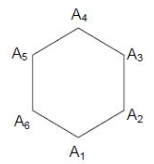
In a regular hexagon,an equilateral triangle is formed by choosing vertices that are separated by one vertex each. The possible equilateral triangles are $\triangle A_{1}A_{3}A_{5}$ and $\triangle A_{2}A_{4}A_{6}$.
Thus,there are $2$ such equilateral triangles.
The probability is $\frac{\text{Number of favorable outcomes}}{\text{Total number of outcomes}} = \frac{2}{20} = \frac{1}{10}$.
In a regular hexagon,an equilateral triangle is formed by choosing vertices that are separated by one vertex each. The possible equilateral triangles are $\triangle A_{1}A_{3}A_{5}$ and $\triangle A_{2}A_{4}A_{6}$.
Thus,there are $2$ such equilateral triangles.
The probability is $\frac{\text{Number of favorable outcomes}}{\text{Total number of outcomes}} = \frac{2}{20} = \frac{1}{10}$.
0 likesView Solution
210
MathematicsDifficultMCQJEE Main · 2019
The coefficient of $x^{18}$ in the product $(1+ x)(1- x)^{10} (1+ x + x^2 )^9$ is
A
$84$
B
$126$
C
$-126$
D
$-84$
Solution
(A) Given expression: $(1+x)(1-x)^{10}(1+x+x^2)^9$
We know that $(1-x)(1+x+x^2) = (1-x^3)$.
Rewrite the expression as: $(1-x)(1-x^2)(1-x^3)^9$
$= (1-x-x^2+x^3)(1-x^3)^9$
$= (1-x-x^2+x^3) \sum_{k=0}^{9} \binom{9}{k} (1)^ {9-k} (-x^3)^k$
$= (1-x-x^2+x^3) \sum_{k=0}^{9} \binom{9}{k} (-1)^k x^{3k}$
We need the coefficient of $x^{18}$. This occurs when $3k = 18$,i.e.,$k=6$.
The term corresponding to $k=6$ is $\binom{9}{6} (-1)^6 x^{18} = 84 x^{18}$.
Thus,the coefficient is $84$.
We know that $(1-x)(1+x+x^2) = (1-x^3)$.
Rewrite the expression as: $(1-x)(1-x^2)(1-x^3)^9$
$= (1-x-x^2+x^3)(1-x^3)^9$
$= (1-x-x^2+x^3) \sum_{k=0}^{9} \binom{9}{k} (1)^ {9-k} (-x^3)^k$
$= (1-x-x^2+x^3) \sum_{k=0}^{9} \binom{9}{k} (-1)^k x^{3k}$
We need the coefficient of $x^{18}$. This occurs when $3k = 18$,i.e.,$k=6$.
The term corresponding to $k=6$ is $\binom{9}{6} (-1)^6 x^{18} = 84 x^{18}$.
Thus,the coefficient is $84$.
0 likesView Solution
211
MathematicsDifficultMCQJEE Main · 2019
The number of ways of choosing $10$ objects out of $31$ objects,of which $10$ are identical and the remaining $21$ are distinct,is
A
$2^{20}$
B
$2^{20}+1$
C
$2^{21}$
D
$2^{20}-1$
Solution
(A) Let the $10$ identical objects be $I$ and the $21$ distinct objects be $D_1, D_2, ..., D_{21}$.
To choose $10$ objects,we can select $k$ objects from the $21$ distinct objects and $(10-k)$ objects from the $10$ identical objects,where $0 \le k \le 10$.
Since the $10$ identical objects are indistinguishable,there is only $1$ way to choose any number of them.
Thus,the number of ways is the sum of the ways to choose $k$ distinct objects for all possible $k$ from $0$ to $10$:
Total ways = $\sum_{k=0}^{10} \binom{21}{k} = \binom{21}{0} + \binom{21}{1} + ... + \binom{21}{10}$.
We know that the sum of binomial coefficients is $\sum_{k=0}^{21} \binom{21}{k} = 2^{21}$.
Since $\binom{21}{k} = \binom{21}{21-k}$,we have $\sum_{k=0}^{10} \binom{21}{k} = \sum_{k=11}^{21} \binom{21}{k}$.
Let $S = \sum_{k=0}^{10} \binom{21}{k}$. Then $S + S = \sum_{k=0}^{21} \binom{21}{k} = 2^{21}$.
Therefore,$2S = 2^{21}$,which implies $S = 2^{20}$.
To choose $10$ objects,we can select $k$ objects from the $21$ distinct objects and $(10-k)$ objects from the $10$ identical objects,where $0 \le k \le 10$.
Since the $10$ identical objects are indistinguishable,there is only $1$ way to choose any number of them.
Thus,the number of ways is the sum of the ways to choose $k$ distinct objects for all possible $k$ from $0$ to $10$:
Total ways = $\sum_{k=0}^{10} \binom{21}{k} = \binom{21}{0} + \binom{21}{1} + ... + \binom{21}{10}$.
We know that the sum of binomial coefficients is $\sum_{k=0}^{21} \binom{21}{k} = 2^{21}$.
Since $\binom{21}{k} = \binom{21}{21-k}$,we have $\sum_{k=0}^{10} \binom{21}{k} = \sum_{k=11}^{21} \binom{21}{k}$.
Let $S = \sum_{k=0}^{10} \binom{21}{k}$. Then $S + S = \sum_{k=0}^{21} \binom{21}{k} = 2^{21}$.
Therefore,$2S = 2^{21}$,which implies $S = 2^{20}$.
0 likesView Solution
212
MathematicsDifficultMCQJEE Main · 2019
The equation $|z - i| = |z - 1|$,where $i = \sqrt{-1}$,represents:
A
a circle of radius $\frac{1}{2}$
B
the line through the origin with slope $1$
C
a circle of radius $1$
D
the line through the origin with slope $-1$
Solution
(B) Let $z = x + iy$. Then the equation becomes $|x + iy - i| = |x + iy - 1|$.
This simplifies to $|x + i(y - 1)| = |(x - 1) + iy|$.
Squaring both sides,we get $x^2 + (y - 1)^2 = (x - 1)^2 + y^2$.
Expanding the terms: $x^2 + y^2 - 2y + 1 = x^2 - 2x + 1 + y^2$.
Canceling $x^2, y^2,$ and $1$ from both sides,we get $-2y = -2x$,which simplifies to $y = x$.
This is the equation of a line passing through the origin with slope $1$.
This simplifies to $|x + i(y - 1)| = |(x - 1) + iy|$.
Squaring both sides,we get $x^2 + (y - 1)^2 = (x - 1)^2 + y^2$.
Expanding the terms: $x^2 + y^2 - 2y + 1 = x^2 - 2x + 1 + y^2$.
Canceling $x^2, y^2,$ and $1$ from both sides,we get $-2y = -2x$,which simplifies to $y = x$.
This is the equation of a line passing through the origin with slope $1$.
0 likesView Solution
213
MathematicsDifficultMCQJEE Main · 2019
If the data $x_1, x_2, ..., x_{10}$ is such that the mean of the first four of these is $11$,the mean of the remaining six is $16$,and the sum of squares of all of these is $2,000$; then the standard deviation of this data is
A
$2\sqrt{2}$
B
$2$
C
$4$
D
$\sqrt{2}$
Solution
(B) Given that the mean of the first four observations is $11$,so $\sum_{i=1}^{4} x_i = 4 \times 11 = 44$.
The mean of the remaining six observations is $16$,so $\sum_{i=5}^{10} x_i = 6 \times 16 = 96$.
The total sum of the observations is $\sum_{i=1}^{10} x_i = 44 + 96 = 140$.
The mean of the data is $\bar{x} = \frac{140}{10} = 14$.
The variance is given by $\sigma^2 = \frac{\sum_{i=1}^{10} x_i^2}{n} - (\bar{x})^2$.
Substituting the given values,$\sigma^2 = \frac{2000}{10} - (14)^2 = 200 - 196 = 4$.
Therefore,the standard deviation is $\sigma = \sqrt{4} = 2$.
The mean of the remaining six observations is $16$,so $\sum_{i=5}^{10} x_i = 6 \times 16 = 96$.
The total sum of the observations is $\sum_{i=1}^{10} x_i = 44 + 96 = 140$.
The mean of the data is $\bar{x} = \frac{140}{10} = 14$.
The variance is given by $\sigma^2 = \frac{\sum_{i=1}^{10} x_i^2}{n} - (\bar{x})^2$.
Substituting the given values,$\sigma^2 = \frac{2000}{10} - (14)^2 = 200 - 196 = 4$.
Therefore,the standard deviation is $\sigma = \sqrt{4} = 2$.
0 likesView Solution
214
MathematicsDifficultMCQJEE Main · 2019
If $\alpha$ and $\beta$ are the roots of the equation $375x^2 - 25x - 2 = 0$,then $\lim_{n \to \infty} \sum_{r=1}^n \alpha^r + \lim_{n \to \infty} \sum_{r=1}^n \beta^r$ is equal to
A
$\frac{1}{12}$
B
$\frac{29}{358}$
C
$\frac{7}{116}$
D
$\frac{21}{346}$
Solution
(A) Given the quadratic equation $375x^2 - 25x - 2 = 0$.
By Vieta's formulas,the sum of the roots is $\alpha + \beta = -(\frac{-25}{375}) = \frac{25}{375} = \frac{1}{15}$ and the product of the roots is $\alpha \beta = \frac{-2}{375}$.
The expression is $\sum_{r=1}^{\infty} \alpha^r + \sum_{r=1}^{\infty} \beta^r = \frac{\alpha}{1-\alpha} + \frac{\beta}{1-\beta}$.
This simplifies to $\frac{\alpha(1-\beta) + \beta(1-\alpha)}{(1-\alpha)(1-\beta)} = \frac{\alpha - \alpha\beta + \beta - \alpha\beta}{1 - (\alpha+\beta) + \alpha\beta}$.
Substituting the values: $\frac{(\alpha+\beta) - 2\alpha\beta}{1 - (\alpha+\beta) + \alpha\beta} = \frac{\frac{1}{15} - 2(\frac{-2}{375})}{1 - \frac{1}{15} + (\frac{-2}{375})} = \frac{\frac{25}{375} + \frac{4}{375}}{\frac{375 - 25 - 2}{375}} = \frac{29}{348} = \frac{1}{12}$.
By Vieta's formulas,the sum of the roots is $\alpha + \beta = -(\frac{-25}{375}) = \frac{25}{375} = \frac{1}{15}$ and the product of the roots is $\alpha \beta = \frac{-2}{375}$.
The expression is $\sum_{r=1}^{\infty} \alpha^r + \sum_{r=1}^{\infty} \beta^r = \frac{\alpha}{1-\alpha} + \frac{\beta}{1-\beta}$.
This simplifies to $\frac{\alpha(1-\beta) + \beta(1-\alpha)}{(1-\alpha)(1-\beta)} = \frac{\alpha - \alpha\beta + \beta - \alpha\beta}{1 - (\alpha+\beta) + \alpha\beta}$.
Substituting the values: $\frac{(\alpha+\beta) - 2\alpha\beta}{1 - (\alpha+\beta) + \alpha\beta} = \frac{\frac{1}{15} - 2(\frac{-2}{375})}{1 - \frac{1}{15} + (\frac{-2}{375})} = \frac{\frac{25}{375} + \frac{4}{375}}{\frac{375 - 25 - 2}{375}} = \frac{29}{348} = \frac{1}{12}$.
0 likesView Solution
215
MathematicsDifficultMCQJEE Main · 2019
The number of solutions of the equation $1 + \sin^4 x = \cos^2 3x$ for $x \in [-\frac{5\pi}{2}, \frac{5\pi}{2}]$ is
A
$3$
B
$4$
C
$5$
D
$7$
Solution
(C) Given the equation $1 + \sin^4 x = \cos^2 3x$.
Since $\sin^4 x \ge 0$,the left side $1 + \sin^4 x \ge 1$.
Since $\cos^2 3x \le 1$,the right side $\cos^2 3x \le 1$.
For the equality to hold,we must have $1 + \sin^4 x = 1$ and $\cos^2 3x = 1$.
$1 + \sin^4 x = 1 \implies \sin^4 x = 0 \implies \sin x = 0 \implies x = n\pi$ for $n \in \mathbb{Z}$.
Now check $\cos^2 3x = 1$ for $x = n\pi$:
$\cos^2(3n\pi) = (\pm 1)^2 = 1$. This is always true for any integer $n$.
We need $x \in [-\frac{5\pi}{2}, \frac{5\pi}{2}]$,which is $[-2.5\pi, 2.5\pi]$.
The possible values for $x = n\pi$ in this interval are:
$n = -2 \implies x = -2\pi$
$n = -1 \implies x = -\pi$
$n = 0 \implies x = 0$
$n = 1 \implies x = \pi$
$n = 2 \implies x = 2\pi$
The solutions are $\{-2\pi, -\pi, 0, \pi, 2\pi\}$.
There are $5$ solutions.
Since $\sin^4 x \ge 0$,the left side $1 + \sin^4 x \ge 1$.
Since $\cos^2 3x \le 1$,the right side $\cos^2 3x \le 1$.
For the equality to hold,we must have $1 + \sin^4 x = 1$ and $\cos^2 3x = 1$.
$1 + \sin^4 x = 1 \implies \sin^4 x = 0 \implies \sin x = 0 \implies x = n\pi$ for $n \in \mathbb{Z}$.
Now check $\cos^2 3x = 1$ for $x = n\pi$:
$\cos^2(3n\pi) = (\pm 1)^2 = 1$. This is always true for any integer $n$.
We need $x \in [-\frac{5\pi}{2}, \frac{5\pi}{2}]$,which is $[-2.5\pi, 2.5\pi]$.
The possible values for $x = n\pi$ in this interval are:
$n = -2 \implies x = -2\pi$
$n = -1 \implies x = -\pi$
$n = 0 \implies x = 0$
$n = 1 \implies x = \pi$
$n = 2 \implies x = 2\pi$
The solutions are $\{-2\pi, -\pi, 0, \pi, 2\pi\}$.
There are $5$ solutions.
0 likesView Solution
216
MathematicsDifficultMCQJEE Main · 2019
If the normal to the ellipse $3x^2 + 4y^2 = 12$ at a point $P$ on it is parallel to the line $2x + y = 4$,and the tangent to the ellipse at $P$ passes through $Q(4, 4)$,then $PQ$ is equal to
A
$\frac{\sqrt{157}}{2}$
B
$\frac{5\sqrt{5}}{2}$
C
$\frac{\sqrt{221}}{2}$
D
$\frac{\sqrt{61}}{2}$
Solution
(B) The equation of the ellipse is $3x^2 + 4y^2 = 12$,which can be written as $\frac{x^2}{4} + \frac{y^2}{3} = 1$. Here $a^2 = 4$ and $b^2 = 3$.
Let the point $P$ be $(2\cos \theta, \sqrt{3}\sin \theta)$.
The equation of the normal at $P$ is $\frac{a^2x}{x_1} - \frac{b^2y}{y_1} = a^2 - b^2$,which simplifies to $\frac{4x}{2\cos \theta} - \frac{3y}{\sqrt{3}\sin \theta} = 4 - 3$,or $2x\sec \theta - \sqrt{3}y\csc \theta = 1$.
The slope of this normal is $\frac{2\sec \theta}{\sqrt{3}\csc \theta} = \frac{2}{\sqrt{3}}\tan \theta$.
Since the normal is parallel to $2x + y = 4$,its slope is $-2$. Thus,$\frac{2}{\sqrt{3}}\tan \theta = -2$,which gives $\tan \theta = -\sqrt{3}$.
For $\tan \theta = -\sqrt{3}$,we have $\cos \theta = \pm \frac{1}{2}$ and $\sin \theta = \mp \frac{\sqrt{3}}{2}$.
The equation of the tangent at $P$ is $\frac{x\cos \theta}{2} + \frac{y\sin \theta}{\sqrt{3}} = 1$,or $x\cos \theta + \frac{2y\sin \theta}{\sqrt{3}} = 2$.
Since the tangent passes through $Q(4, 4)$,we have $4\cos \theta + \frac{8\sin \theta}{\sqrt{3}} = 2$,or $2\sqrt{3}\cos \theta + 4\sin \theta = \sqrt{3}$.
Substituting $\sin \theta = -\sqrt{3}\cos \theta$,we get $2\sqrt{3}\cos \theta - 4\sqrt{3}\cos \theta = \sqrt{3}$,so $-2\sqrt{3}\cos \theta = \sqrt{3}$,which means $\cos \theta = -\frac{1}{2}$ and $\sin \theta = \frac{\sqrt{3}}{2}$.
Thus,$P = (2(-1/2), \sqrt{3}(\sqrt{3}/2)) = (-1, 3/2)$.
$PQ = \sqrt{(4 - (-1))^2 + (4 - 3/2)^2} = \sqrt{5^2 + (5/2)^2} = \sqrt{25 + 25/4} = \sqrt{125/4} = \frac{5\sqrt{5}}{2}$.
Let the point $P$ be $(2\cos \theta, \sqrt{3}\sin \theta)$.
The equation of the normal at $P$ is $\frac{a^2x}{x_1} - \frac{b^2y}{y_1} = a^2 - b^2$,which simplifies to $\frac{4x}{2\cos \theta} - \frac{3y}{\sqrt{3}\sin \theta} = 4 - 3$,or $2x\sec \theta - \sqrt{3}y\csc \theta = 1$.
The slope of this normal is $\frac{2\sec \theta}{\sqrt{3}\csc \theta} = \frac{2}{\sqrt{3}}\tan \theta$.
Since the normal is parallel to $2x + y = 4$,its slope is $-2$. Thus,$\frac{2}{\sqrt{3}}\tan \theta = -2$,which gives $\tan \theta = -\sqrt{3}$.
For $\tan \theta = -\sqrt{3}$,we have $\cos \theta = \pm \frac{1}{2}$ and $\sin \theta = \mp \frac{\sqrt{3}}{2}$.
The equation of the tangent at $P$ is $\frac{x\cos \theta}{2} + \frac{y\sin \theta}{\sqrt{3}} = 1$,or $x\cos \theta + \frac{2y\sin \theta}{\sqrt{3}} = 2$.
Since the tangent passes through $Q(4, 4)$,we have $4\cos \theta + \frac{8\sin \theta}{\sqrt{3}} = 2$,or $2\sqrt{3}\cos \theta + 4\sin \theta = \sqrt{3}$.
Substituting $\sin \theta = -\sqrt{3}\cos \theta$,we get $2\sqrt{3}\cos \theta - 4\sqrt{3}\cos \theta = \sqrt{3}$,so $-2\sqrt{3}\cos \theta = \sqrt{3}$,which means $\cos \theta = -\frac{1}{2}$ and $\sin \theta = \frac{\sqrt{3}}{2}$.
Thus,$P = (2(-1/2), \sqrt{3}(\sqrt{3}/2)) = (-1, 3/2)$.
$PQ = \sqrt{(4 - (-1))^2 + (4 - 3/2)^2} = \sqrt{5^2 + (5/2)^2} = \sqrt{25 + 25/4} = \sqrt{125/4} = \frac{5\sqrt{5}}{2}$.
0 likesView Solution
217
MathematicsDifficultMCQJEE Main · 2019
The equation $y = \sin \,x \sin \,(x + 2) - \sin^2 \,(x + 1)$ represents a straight line lying in
A
first,third and fourth quadrants
B
first,second and fourth quadrants
C
third and fourth quadrants only
D
second and third quadrants only
Solution
(C) Given equation: $y = \sin \,x \sin \,(x + 2) - \sin^2 \,(x + 1)$
Multiply by $2$: $2y = 2 \sin \,x \sin \,(x + 2) - 2 \sin^2 \,(x + 1)$
Using the identity $2 \sin \,A \sin \,B = \cos(A - B) - \cos(A + B)$:
$2 \sin \,x \sin \,(x + 2) = \cos(x - (x + 2)) - \cos(x + x + 2) = \cos(-2) - \cos(2x + 2) = \cos \,2 - \cos(2x + 2)$
Using the identity $2 \sin^2 \,A = 1 - \cos(2A)$:
$2 \sin^2 \,(x + 1) = 1 - \cos(2(x + 1)) = 1 - \cos(2x + 2)$
Substituting these into the equation:
$2y = (\cos \,2 - \cos(2x + 2)) - (1 - \cos(2x + 2))$
$2y = \cos \,2 - 1$
Since $\cos \,2 \approx -0.416$,we have $2y \approx -1.416$,so $y \approx -0.708$.
This represents a horizontal line $y = k$ where $k < 0$.
$A$ horizontal line with a negative $y$-intercept passes through the third and fourth quadrants.
Multiply by $2$: $2y = 2 \sin \,x \sin \,(x + 2) - 2 \sin^2 \,(x + 1)$
Using the identity $2 \sin \,A \sin \,B = \cos(A - B) - \cos(A + B)$:
$2 \sin \,x \sin \,(x + 2) = \cos(x - (x + 2)) - \cos(x + x + 2) = \cos(-2) - \cos(2x + 2) = \cos \,2 - \cos(2x + 2)$
Using the identity $2 \sin^2 \,A = 1 - \cos(2A)$:
$2 \sin^2 \,(x + 1) = 1 - \cos(2(x + 1)) = 1 - \cos(2x + 2)$
Substituting these into the equation:
$2y = (\cos \,2 - \cos(2x + 2)) - (1 - \cos(2x + 2))$
$2y = \cos \,2 - 1$
Since $\cos \,2 \approx -0.416$,we have $2y \approx -1.416$,so $y \approx -0.708$.
This represents a horizontal line $y = k$ where $k < 0$.
$A$ horizontal line with a negative $y$-intercept passes through the third and fourth quadrants.
0 likesView Solution
218
MathematicsDifficultMCQJEE Main · 2019
If the angle of intersection at a point where the two circles with radii $5 \ cm$ and $12 \ cm$ intersect is $90^o$,then the length (in $cm$) of their common chord is
A
$\frac{13}{2}$
B
$\frac{120}{13}$
C
$\frac{13}{5}$
D
$\frac{60}{13}$
Solution
(B) Let the radii of the two circles be $r_1 = 5 \ cm$ and $r_2 = 12 \ cm$. Since the circles intersect at $90^o$,the distance between their centers $d$ is given by $d = \sqrt{r_1^2 + r_2^2} = \sqrt{5^2 + 12^2} = \sqrt{25 + 144} = \sqrt{169} = 13 \ cm$.
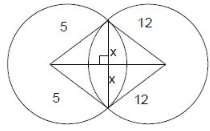
Let the common chord have length $2x$. The common chord is perpendicular to the line joining the centers.
In the triangle formed by the two centers and one of the intersection points,the altitude to the hypotenuse is $x$.
Using the area of the triangle: $\text{Area} = \frac{1}{2} \times r_1 \times r_2 = \frac{1}{2} \times d \times x$.
$\frac{1}{2} \times 5 \times 12 = \frac{1}{2} \times 13 \times x$.
$60 = 13x \implies x = \frac{60}{13}$.
The length of the common chord is $2x = 2 \times \frac{60}{13} = \frac{120}{13} \ cm$.
Let the common chord have length $2x$. The common chord is perpendicular to the line joining the centers.
In the triangle formed by the two centers and one of the intersection points,the altitude to the hypotenuse is $x$.
Using the area of the triangle: $\text{Area} = \frac{1}{2} \times r_1 \times r_2 = \frac{1}{2} \times d \times x$.
$\frac{1}{2} \times 5 \times 12 = \frac{1}{2} \times 13 \times x$.
$60 = 13x \implies x = \frac{60}{13}$.
The length of the common chord is $2x = 2 \times \frac{60}{13} = \frac{120}{13} \ cm$.
0 likesView Solution
219
MathematicsDifficultMCQJEE Main · 2019
Let $S_n$ denote the sum of the first $n$ terms of an $A.P$. If $S_4 = 16$ and $S_6 = -48$,then $S_{10}$ is equal to
A
$-410$
B
$-260$
C
$-320$
D
$-380$
Solution
(C) The sum of the first $n$ terms of an $A.P.$ is given by $S_n = \frac{n}{2} \{2a + (n-1)d\}$.
For $S_4 = 16$,we have $\frac{4}{2} \{2a + 3d\} = 16$,which simplifies to $2a + 3d = 8$ (Equation $1$).
For $S_6 = -48$,we have $\frac{6}{2} \{2a + 5d\} = -48$,which simplifies to $2a + 5d = -16$ (Equation $2$).
Subtracting Equation $1$ from Equation $2$: $(2a + 5d) - (2a + 3d) = -16 - 8$,so $2d = -24$,which gives $d = -12$.
Substituting $d = -12$ into Equation $1$: $2a + 3(-12) = 8$,so $2a - 36 = 8$,which gives $2a = 44$,so $a = 22$.
Now,$S_{10} = \frac{10}{2} \{2a + 9d\} = 5 \{2(22) + 9(-12)\} = 5 \{44 - 108\} = 5 \{-64\} = -320$.
For $S_4 = 16$,we have $\frac{4}{2} \{2a + 3d\} = 16$,which simplifies to $2a + 3d = 8$ (Equation $1$).
For $S_6 = -48$,we have $\frac{6}{2} \{2a + 5d\} = -48$,which simplifies to $2a + 5d = -16$ (Equation $2$).
Subtracting Equation $1$ from Equation $2$: $(2a + 5d) - (2a + 3d) = -16 - 8$,so $2d = -24$,which gives $d = -12$.
Substituting $d = -12$ into Equation $1$: $2a + 3(-12) = 8$,so $2a - 36 = 8$,which gives $2a = 44$,so $a = 22$.
Now,$S_{10} = \frac{10}{2} \{2a + 9d\} = 5 \{2(22) + 9(-12)\} = 5 \{44 - 108\} = 5 \{-64\} = -320$.
0 likesView Solution
220
MathematicsDifficultMCQJEE Main · 2019
If the truth value of the statement $p \to (\sim q \vee r)$ is false $(F)$,then the truth values of the statements $p, q, r$ are respectively:
A
$T, T, F$
B
$F, T, T$
C
$T, F, T$
D
$T, F, F$
Solution
(A) The implication $p \to (\sim q \vee r)$ is false $(F)$ only when the antecedent is true $(T)$ and the consequent is false $(F)$.
$1$. $p = T$
$2$. $(\sim q \vee r) = F$
For the disjunction $(\sim q \vee r)$ to be false,both components must be false:
$\sim q = F \implies q = T$
$r = F$
Therefore,the truth values are $p = T, q = T, r = F$.
$1$. $p = T$
$2$. $(\sim q \vee r) = F$
For the disjunction $(\sim q \vee r)$ to be false,both components must be false:
$\sim q = F \implies q = T$
$r = F$
Therefore,the truth values are $p = T, q = T, r = F$.
0 likesView Solution
221
MathematicsDifficultMCQJEE Main · 2019
For $x \in \mathbb{R}$,let $[x]$ denote the greatest integer $\le x$. Find the sum of the series $\left[ -\frac{1}{3} \right] + \left[ -\frac{1}{3} - \frac{1}{100} \right] + \left[ -\frac{1}{3} - \frac{2}{100} \right] + \dots + \left[ -\frac{1}{3} - \frac{99}{100} \right]$.
A
$-135$
B
$-153$
C
$-133$
D
$-131$
Solution
(C) Let $S = \sum_{k=0}^{99} \left[ -\frac{1}{3} - \frac{k}{100} \right]$.
We know that $[x] = -1$ if $-1 \le x < 0$ and $[x] = -2$ if $-2 \le x < -1$.
For the term $\left[ -\frac{1}{3} - \frac{k}{100} \right]$,the value is $-1$ when $-\frac{1}{3} - \frac{k}{100} \ge -1$,which implies $\frac{k}{100} \le 1 - \frac{1}{3} = \frac{2}{3}$,so $k \le \frac{200}{3} \approx 66.66$.
Thus,for $k = 0, 1, 2, \dots, 66$ (total $67$ terms),the value is $-1$.
For $k = 67, 68, \dots, 99$ (total $99 - 67 + 1 = 33$ terms),the value is $-2$.
Sum $= 67 \times (-1) + 33 \times (-2) = -67 - 66 = -133$.
We know that $[x] = -1$ if $-1 \le x < 0$ and $[x] = -2$ if $-2 \le x < -1$.
For the term $\left[ -\frac{1}{3} - \frac{k}{100} \right]$,the value is $-1$ when $-\frac{1}{3} - \frac{k}{100} \ge -1$,which implies $\frac{k}{100} \le 1 - \frac{1}{3} = \frac{2}{3}$,so $k \le \frac{200}{3} \approx 66.66$.
Thus,for $k = 0, 1, 2, \dots, 66$ (total $67$ terms),the value is $-1$.
For $k = 67, 68, \dots, 99$ (total $99 - 67 + 1 = 33$ terms),the value is $-2$.
Sum $= 67 \times (-1) + 33 \times (-2) = -67 - 66 = -133$.
0 likesView Solution
222
MathematicsDifficultMCQJEE Main · 2019
Let $S$ be the set of all $\alpha \in \mathbb{R}$ such that the equation $\cos 2x + \alpha \sin x = 2\alpha - 7$ has a solution. Then $S$ is equal to
A
$[3, 7]$
B
$\mathbb{R}$
C
$[2, 6]$
D
$[1, 4]$
Solution
(C) Given equation: $\cos 2x + \alpha \sin x = 2\alpha - 7$
Using $\cos 2x = 1 - 2 \sin^2 x$,we get:
$1 - 2 \sin^2 x + \alpha \sin x = 2\alpha - 7$
$2 \sin^2 x - \alpha \sin x + 2\alpha - 8 = 0$
This is a quadratic equation in $\sin x$. Using the quadratic formula $\sin x = \frac{-b \pm \sqrt{b^2 - 4ac}}{2a}$:
$\sin x = \frac{\alpha \pm \sqrt{\alpha^2 - 4(2)(2\alpha - 8)}}{4}$
$\sin x = \frac{\alpha \pm \sqrt{\alpha^2 - 16\alpha + 64}}{4}$
$\sin x = \frac{\alpha \pm \sqrt{(\alpha - 8)^2}}{4}$
$\sin x = \frac{\alpha \pm (\alpha - 8)}{4}$
Case $1$: $\sin x = \frac{\alpha + \alpha - 8}{4} = \frac{2\alpha - 8}{4} = \frac{\alpha - 4}{2}$
Case $2$: $\sin x = \frac{\alpha - (\alpha - 8)}{4} = \frac{8}{4} = 2$ (Not possible as $\sin x \in [-1, 1]$)
For a solution to exist,we must have $-1 \leq \frac{\alpha - 4}{2} \leq 1$
$-2 \leq \alpha - 4 \leq 2$
$2 \leq \alpha \leq 6$
Thus,$S = [2, 6]$.
Using $\cos 2x = 1 - 2 \sin^2 x$,we get:
$1 - 2 \sin^2 x + \alpha \sin x = 2\alpha - 7$
$2 \sin^2 x - \alpha \sin x + 2\alpha - 8 = 0$
This is a quadratic equation in $\sin x$. Using the quadratic formula $\sin x = \frac{-b \pm \sqrt{b^2 - 4ac}}{2a}$:
$\sin x = \frac{\alpha \pm \sqrt{\alpha^2 - 4(2)(2\alpha - 8)}}{4}$
$\sin x = \frac{\alpha \pm \sqrt{\alpha^2 - 16\alpha + 64}}{4}$
$\sin x = \frac{\alpha \pm \sqrt{(\alpha - 8)^2}}{4}$
$\sin x = \frac{\alpha \pm (\alpha - 8)}{4}$
Case $1$: $\sin x = \frac{\alpha + \alpha - 8}{4} = \frac{2\alpha - 8}{4} = \frac{\alpha - 4}{2}$
Case $2$: $\sin x = \frac{\alpha - (\alpha - 8)}{4} = \frac{8}{4} = 2$ (Not possible as $\sin x \in [-1, 1]$)
For a solution to exist,we must have $-1 \leq \frac{\alpha - 4}{2} \leq 1$
$-2 \leq \alpha - 4 \leq 2$
$2 \leq \alpha \leq 6$
Thus,$S = [2, 6]$.
0 likesView Solution
223
MathematicsDifficultMCQJEE Main · 2019
Let $f(x) = 5 - |x - 2|$ and $g(x) = |x + 1|$,where $x \in R$. If $f(x)$ attains its maximum value at $\alpha$ and $g(x)$ attains its minimum value at $\beta$,then $\lim_{x \to \alpha \beta} \frac{(x - 1)(x^2 - 5x + 6)}{x^2 - 6x + 8}$ is equal to:
A
$\frac{3}{2}$
B
$\frac{-3}{2}$
C
$\frac{1}{2}$
D
$\frac{-1}{2}$
Solution
(C) $f(x) = 5 - |x - 2|$.
$f(x)$ attains its maximum value when $|x - 2| = 0$,which gives $x = 2 = \alpha$.
$g(x) = |x + 1|$.
$g(x)$ attains its minimum value when $x + 1 = 0$,which gives $x = -1 = \beta$.
We need to evaluate $\lim_{x \to \alpha \beta} \frac{(x - 1)(x^2 - 5x + 6)}{x^2 - 6x + 8}$.
Since $\alpha \beta = (2)(-1) = -2$,the limit is $\lim_{x \to -2} \frac{(x - 1)(x - 2)(x - 3)}{(x - 2)(x - 4)}$.
Canceling the common factor $(x - 2)$,we get $\lim_{x \to -2} \frac{(x - 1)(x - 3)}{x - 4}$.
Substituting $x = -2$,we get $\frac{(-2 - 1)(-2 - 3)}{-2 - 4} = \frac{(-3)(-5)}{-6} = \frac{15}{-6} = -\frac{5}{2}$.
Wait,re-evaluating the limit target: $\alpha \beta = -2$. The expression simplifies to $\frac{(x-1)(x-3)}{x-4}$. At $x=-2$,this is $\frac{(-3)(-5)}{-6} = -2.5$. Checking the provided options,there might be a typo in the question's target limit. If the target was $\alpha + \beta = 1$,the limit is $\frac{(0)(-2)}{-3} = 0$. If the target was $\alpha = 2$,the limit is $\frac{(1)(-1)}{-2} = \frac{1}{2}$. Given the options,the intended limit was likely $x \to \alpha = 2$.
$f(x)$ attains its maximum value when $|x - 2| = 0$,which gives $x = 2 = \alpha$.
$g(x) = |x + 1|$.
$g(x)$ attains its minimum value when $x + 1 = 0$,which gives $x = -1 = \beta$.
We need to evaluate $\lim_{x \to \alpha \beta} \frac{(x - 1)(x^2 - 5x + 6)}{x^2 - 6x + 8}$.
Since $\alpha \beta = (2)(-1) = -2$,the limit is $\lim_{x \to -2} \frac{(x - 1)(x - 2)(x - 3)}{(x - 2)(x - 4)}$.
Canceling the common factor $(x - 2)$,we get $\lim_{x \to -2} \frac{(x - 1)(x - 3)}{x - 4}$.
Substituting $x = -2$,we get $\frac{(-2 - 1)(-2 - 3)}{-2 - 4} = \frac{(-3)(-5)}{-6} = \frac{15}{-6} = -\frac{5}{2}$.
Wait,re-evaluating the limit target: $\alpha \beta = -2$. The expression simplifies to $\frac{(x-1)(x-3)}{x-4}$. At $x=-2$,this is $\frac{(-3)(-5)}{-6} = -2.5$. Checking the provided options,there might be a typo in the question's target limit. If the target was $\alpha + \beta = 1$,the limit is $\frac{(0)(-2)}{-3} = 0$. If the target was $\alpha = 2$,the limit is $\frac{(1)(-1)}{-2} = \frac{1}{2}$. Given the options,the intended limit was likely $x \to \alpha = 2$.
0 likesView Solution
224
MathematicsDifficultMCQJEE Main · 2019
Let $z \in \mathbb{C}$ with $Im(z) = 10$ and it satisfies $\frac{2z - n}{2z + n} = 2i - 1$ for some natural number $n$. Then
A
$n = 40$ and $Re(z) = 10$
B
$n = 20$ and $Re(z) = 10$
C
$n = 40$ and $Re(z) = -10$
D
$n = 20$ and $Re(z) = -10$
Solution
(C) Let $z = x + 10i$.
Given $\frac{2z - n}{2z + n} = 2i - 1$.
Substituting $z = x + 10i$:
$\frac{2(x + 10i) - n}{2(x + 10i) + n} = 2i - 1$
$(2x - n) + 20i = (2i - 1)((2x + n) + 20i)$
$(2x - n) + 20i = 2i(2x + n) + 40i^2 - (2x + n) - 20i$
$(2x - n) + 20i = (2i(2x + n) - 20i) - 40 - (2x + n)$
Equating real and imaginary parts:
Real part: $2x - n = -40 - (2x + n)$ $\Rightarrow$ $2x - n = -40 - 2x - n$ $\Rightarrow$ $4x = -40$ $\Rightarrow$ $x = -10$.
Imaginary part: $20 = 2(2x + n) - 20$ $\Rightarrow$ $40 = 2(2x + n)$ $\Rightarrow$ $20 = 2x + n$.
Substituting $x = -10$ into $20 = 2x + n$:
$20 = 2(-10) + n$ $\Rightarrow$ $20 = -20 + n$ $\Rightarrow$ $n = 40$.
Thus, $n = 40$ and $Re(z) = -10$.
Given $\frac{2z - n}{2z + n} = 2i - 1$.
Substituting $z = x + 10i$:
$\frac{2(x + 10i) - n}{2(x + 10i) + n} = 2i - 1$
$(2x - n) + 20i = (2i - 1)((2x + n) + 20i)$
$(2x - n) + 20i = 2i(2x + n) + 40i^2 - (2x + n) - 20i$
$(2x - n) + 20i = (2i(2x + n) - 20i) - 40 - (2x + n)$
Equating real and imaginary parts:
Real part: $2x - n = -40 - (2x + n)$ $\Rightarrow$ $2x - n = -40 - 2x - n$ $\Rightarrow$ $4x = -40$ $\Rightarrow$ $x = -10$.
Imaginary part: $20 = 2(2x + n) - 20$ $\Rightarrow$ $40 = 2(2x + n)$ $\Rightarrow$ $20 = 2x + n$.
Substituting $x = -10$ into $20 = 2x + n$:
$20 = 2(-10) + n$ $\Rightarrow$ $20 = -20 + n$ $\Rightarrow$ $n = 40$.
Thus, $n = 40$ and $Re(z) = -10$.
0 likesView Solution
225
MathematicsDifficultMCQJEE Main · 2019
The term independent of $x$ in the expansion of $\left( \frac{1}{60} - \frac{x^8}{81} \right) \left( 2x^2 - \frac{3}{x^2} \right)^6$ is equal to
A
$36$
B
$-36$
C
$-108$
D
$-72$
Solution
(B) The given expression is $\left( \frac{1}{60} - \frac{x^8}{81} \right) \left( 2x^2 - \frac{3}{x^2} \right)^6$.
The general term $T_{r+1}$ in the expansion of $\left( 2x^2 - \frac{3}{x^2} \right)^6$ is given by:
$T_{r+1} = {^6C_r} (2x^2)^{6-r} \left( -\frac{3}{x^2} \right)^r = {^6C_r} 2^{6-r} (-3)^r x^{12-2r-2r} = {^6C_r} 2^{6-r} (-3)^r x^{12-4r}$.
To find the term independent of $x$ in the product $\left( \frac{1}{60} - \frac{x^8}{81} \right) \left( 2x^2 - \frac{3}{x^2} \right)^6$,we need:
$1$. The term independent of $x$ from the expansion of $\left( 2x^2 - \frac{3}{x^2} \right)^6$,which occurs when $12-4r = 0 \Rightarrow r = 3$.
For $r=3$,the term is ${^6C_3} 2^{6-3} (-3)^3 = 20 \times 8 \times (-27) = -4320$.
Multiplying by $\frac{1}{60}$,we get $\frac{1}{60} \times (-4320) = -72$.
$2$. The term containing $x^{-8}$ from the expansion of $\left( 2x^2 - \frac{3}{x^2} \right)^6$,which occurs when $12-4r = -8$ $\Rightarrow 4r = 20$ $\Rightarrow r = 5$.
For $r=5$,the term is ${^6C_5} 2^{6-5} (-3)^5 = 6 \times 2 \times (-243) = -2916$.
Multiplying by $-\frac{x^8}{81}$,we get $-\frac{1}{81} \times (-2916) = 36$.
Adding these results,the total term independent of $x$ is $-72 + 36 = -36$.
Thus,the correct answer is option $(B)$.
The general term $T_{r+1}$ in the expansion of $\left( 2x^2 - \frac{3}{x^2} \right)^6$ is given by:
$T_{r+1} = {^6C_r} (2x^2)^{6-r} \left( -\frac{3}{x^2} \right)^r = {^6C_r} 2^{6-r} (-3)^r x^{12-2r-2r} = {^6C_r} 2^{6-r} (-3)^r x^{12-4r}$.
To find the term independent of $x$ in the product $\left( \frac{1}{60} - \frac{x^8}{81} \right) \left( 2x^2 - \frac{3}{x^2} \right)^6$,we need:
$1$. The term independent of $x$ from the expansion of $\left( 2x^2 - \frac{3}{x^2} \right)^6$,which occurs when $12-4r = 0 \Rightarrow r = 3$.
For $r=3$,the term is ${^6C_3} 2^{6-3} (-3)^3 = 20 \times 8 \times (-27) = -4320$.
Multiplying by $\frac{1}{60}$,we get $\frac{1}{60} \times (-4320) = -72$.
$2$. The term containing $x^{-8}$ from the expansion of $\left( 2x^2 - \frac{3}{x^2} \right)^6$,which occurs when $12-4r = -8$ $\Rightarrow 4r = 20$ $\Rightarrow r = 5$.
For $r=5$,the term is ${^6C_5} 2^{6-5} (-3)^5 = 6 \times 2 \times (-243) = -2916$.
Multiplying by $-\frac{x^8}{81}$,we get $-\frac{1}{81} \times (-2916) = 36$.
Adding these results,the total term independent of $x$ is $-72 + 36 = -36$.
Thus,the correct answer is option $(B)$.
0 likesView Solution
226
MathematicsDifficultMCQJEE Main · 2019
If $a_1, a_2, a_3, \dots$ are in $A.P.$ such that $a_1 + a_7 + a_{16} = 40$,then the sum of the first $15$ terms of this $A.P.$ is
A
$200$
B
$280$
C
$150$
D
$120$
Solution
(A) Let the first term be $a$ and the common difference be $d$.
Given that $a_1 + a_7 + a_{16} = 40$.
Using the formula for the $n^{th}$ term of an $A.P.$,$a_n = a + (n-1)d$,we have:
$a + (a + 6d) + (a + 15d) = 40$
$3a + 21d = 40$
$3(a + 7d) = 40$
$a + 7d = \frac{40}{3}$
We need to find the sum of the first $15$ terms,$S_{15}$.
$S_{15} = \frac{15}{2} [2a + (15-1)d]$
$S_{15} = \frac{15}{2} [2a + 14d]$
$S_{15} = 15(a + 7d)$
Substituting the value of $(a + 7d)$:
$S_{15} = 15 \times \frac{40}{3} = 5 \times 40 = 200$.
Given that $a_1 + a_7 + a_{16} = 40$.
Using the formula for the $n^{th}$ term of an $A.P.$,$a_n = a + (n-1)d$,we have:
$a + (a + 6d) + (a + 15d) = 40$
$3a + 21d = 40$
$3(a + 7d) = 40$
$a + 7d = \frac{40}{3}$
We need to find the sum of the first $15$ terms,$S_{15}$.
$S_{15} = \frac{15}{2} [2a + (15-1)d]$
$S_{15} = \frac{15}{2} [2a + 14d]$
$S_{15} = 15(a + 7d)$
Substituting the value of $(a + 7d)$:
$S_{15} = 15 \times \frac{40}{3} = 5 \times 40 = 200$.
0 likesView Solution
227
MathematicsDifficultMCQJEE Main · 2019
An ellipse,with foci at $(0, 2)$ and $(0, -2)$ and minor axis of length $4$,passes through which of the following points?
A
$(2, \sqrt{2})$
B
$(2, 2\sqrt{2})$
C
$(1, 2\sqrt{2})$
D
$(\sqrt{2}, 2)$
Solution
(D) The foci are at $(0, \pm c)$ where $c = 2$. Since the foci lie on the $y$-axis,the ellipse is vertical.
The length of the minor axis is $2a = 4$,so $a = 2$.
For an ellipse,$c^2 = b^2 - a^2$,where $b$ is the semi-major axis.
$2^2 = b^2 - 2^2$ $\Rightarrow 4 = b^2 - 4$ $\Rightarrow b^2 = 8$.
The equation of the ellipse is $\frac{x^2}{a^2} + \frac{y^2}{b^2} = 1$,which is $\frac{x^2}{4} + \frac{y^2}{8} = 1$.
Testing option $(D)$: $\frac{(\sqrt{2})^2}{4} + \frac{2^2}{8} = \frac{2}{4} + \frac{4}{8} = \frac{1}{2} + \frac{1}{2} = 1$.
Thus,the point $(\sqrt{2}, 2)$ lies on the ellipse.
The length of the minor axis is $2a = 4$,so $a = 2$.
For an ellipse,$c^2 = b^2 - a^2$,where $b$ is the semi-major axis.
$2^2 = b^2 - 2^2$ $\Rightarrow 4 = b^2 - 4$ $\Rightarrow b^2 = 8$.
The equation of the ellipse is $\frac{x^2}{a^2} + \frac{y^2}{b^2} = 1$,which is $\frac{x^2}{4} + \frac{y^2}{8} = 1$.
Testing option $(D)$: $\frac{(\sqrt{2})^2}{4} + \frac{2^2}{8} = \frac{2}{4} + \frac{4}{8} = \frac{1}{2} + \frac{1}{2} = 1$.
Thus,the point $(\sqrt{2}, 2)$ lies on the ellipse.
0 likesView Solution
228
MathematicsDifficultMCQJEE Main · 2019
Let $A, B$ and $C$ be sets such that $\phi \ne A \cap B \subseteq C$. Then which of the following statements is not true?
A
If $(A - C) \subseteq B$ then $A \subseteq B$
B
If $(A - B) \subseteq C$ then $A \subseteq C$
C
$(C \cup A) \cap (C \cup B) = C$
D
$B \cap C \ne \phi$
Solution
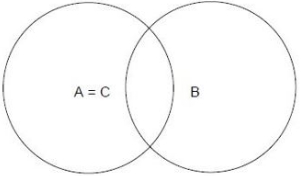
(A) Given $\phi \ne A \cap B \subseteq C$.
Check option $(A)$: If $(A - C) \subseteq B$ then $A \subseteq B$.
Let $A = \{1, 2\}$,$B = \{2, 3\}$,$C = \{2\}$.
Here $A \cap B = \{2\} \subseteq C$ and $A \cap B \ne \phi$.
$A - C = \{1\}$. Since ${1} \not\subseteq \{2, 3\}$,the condition $(A - C) \subseteq B$ is not satisfied for this example.
However,consider $A = \{1, 2\}$,$B = \{1, 3\}$,$C = \{2\}$.
$A \cap B = \{1\} \subseteq C$ is false.
Let $A = \{1, 2\}$,$B = \{2, 3\}$,$C = \{1, 2\}$.
$A \cap B = \{2\} \subseteq C$.
$A - C = \phi \subseteq B$ is true.
But $A = \{1, 2\} \not\subseteq B = \{2, 3\}$.
Thus,the statement in option $(A)$ is not true.
Check option $(A)$: If $(A - C) \subseteq B$ then $A \subseteq B$.
Let $A = \{1, 2\}$,$B = \{2, 3\}$,$C = \{2\}$.
Here $A \cap B = \{2\} \subseteq C$ and $A \cap B \ne \phi$.
$A - C = \{1\}$. Since ${1} \not\subseteq \{2, 3\}$,the condition $(A - C) \subseteq B$ is not satisfied for this example.
However,consider $A = \{1, 2\}$,$B = \{1, 3\}$,$C = \{2\}$.
$A \cap B = \{1\} \subseteq C$ is false.
Let $A = \{1, 2\}$,$B = \{2, 3\}$,$C = \{1, 2\}$.
$A \cap B = \{2\} \subseteq C$.
$A - C = \phi \subseteq B$ is true.
But $A = \{1, 2\} \not\subseteq B = \{2, 3\}$.
Thus,the statement in option $(A)$ is not true.
0 likesView Solution
229
MathematicsDifficultMCQJEE Main · 2019
If $\alpha, \beta$ and $\gamma$ are three consecutive terms of a non-constant $G.P.$ such that the equations $\alpha x^2 + 2\beta x + \gamma = 0$ and $x^2 + x - 1 = 0$ have a common root,then $\alpha(\beta + \gamma)$ is equal to
A
$\alpha\gamma$
B
$0$
C
$\alpha\beta$
D
$\beta\gamma$
Solution
(D) Since $\alpha, \beta, \gamma$ are in $G.P.$,we have $\beta^2 = \alpha\gamma$.
Given that the equations $\alpha x^2 + 2\beta x + \gamma = 0$ and $x^2 + x - 1 = 0$ have a common root,and the coefficients are proportional,both roots must be common.
Thus,$\frac{\alpha}{1} = \frac{2\beta}{1} = \frac{\gamma}{-1} = k$.
This implies $\alpha = k$,$\beta = \frac{k}{2}$,and $\gamma = -k$.
Substituting these into the expression $\alpha(\beta + \gamma)$:
$\alpha(\beta + \gamma) = k(\frac{k}{2} - k) = k(-\frac{k}{2}) = -\frac{k^2}{2}$.
Also,$\beta\gamma = (\frac{k}{2})(-k) = -\frac{k^2}{2}$.
Therefore,$\alpha(\beta + \gamma) = \beta\gamma$.
Given that the equations $\alpha x^2 + 2\beta x + \gamma = 0$ and $x^2 + x - 1 = 0$ have a common root,and the coefficients are proportional,both roots must be common.
Thus,$\frac{\alpha}{1} = \frac{2\beta}{1} = \frac{\gamma}{-1} = k$.
This implies $\alpha = k$,$\beta = \frac{k}{2}$,and $\gamma = -k$.
Substituting these into the expression $\alpha(\beta + \gamma)$:
$\alpha(\beta + \gamma) = k(\frac{k}{2} - k) = k(-\frac{k}{2}) = -\frac{k^2}{2}$.
Also,$\beta\gamma = (\frac{k}{2})(-k) = -\frac{k^2}{2}$.
Therefore,$\alpha(\beta + \gamma) = \beta\gamma$.
0 likesView Solution
230
MathematicsDifficultMCQJEE Main · 2019
The tangents to the curve $y = (x - 2)^2 - 1$ at its points of intersection with the line $x - y = 3$ intersect at the point:
A
$\left( \frac{5}{3}, 1 \right)$
B
$\left( -\frac{5}{2}, -1 \right)$
C
$\left( -\frac{5}{2}, 1 \right)$
D
$\left( \frac{5}{2}, -1 \right)$
Solution
(D) The given curve is $y = (x - 2)^2 - 1$,which can be written as $(x - 2)^2 = y + 1$.
Let the point of intersection of the tangents be $P(x_1, y_1)$.
The chord of contact of the parabola $(x - 2)^2 = y + 1$ from the point $P(x_1, y_1)$ is given by the equation $T = 0$:
$(x - 2)(x_1 - 2) = \frac{1}{2}(y + y_1 + 2)$
$2(x - 2)(x_1 - 2) = y + y_1 + 2$
$2x(x_1 - 2) - 4(x_1 - 2) = y + y_1 + 2$
$2(x_1 - 2)x - y - (4x_1 - 8 + y_1 + 2) = 0$
$2(x_1 - 2)x - y - (4x_1 + y_1 - 6) = 0 \quad ......(i)$
We are given that the chord of contact is the line $x - y - 3 = 0 \quad ......(ii)$
Comparing the coefficients of equations $(i)$ and $(ii)$:
$\frac{2(x_1 - 2)}{1} = \frac{-1}{-1} = \frac{-(4x_1 + y_1 - 6)}{-3}$
From $\frac{2(x_1 - 2)}{1} = 1$,we get $2x_1 - 4 = 1$ $\Rightarrow 2x_1 = 5$ $\Rightarrow x_1 = \frac{5}{2}$.
From $\frac{-(4x_1 + y_1 - 6)}{-3} = 1$,we get $4x_1 + y_1 - 6 = 3 \Rightarrow 4x_1 + y_1 = 9$.
Substituting $x_1 = \frac{5}{2}$ into the equation: $4(\frac{5}{2}) + y_1 = 9$ $\Rightarrow 10 + y_1 = 9$ $\Rightarrow y_1 = -1$.
Thus,the point of intersection is $\left( \frac{5}{2}, -1 \right)$.
Let the point of intersection of the tangents be $P(x_1, y_1)$.
The chord of contact of the parabola $(x - 2)^2 = y + 1$ from the point $P(x_1, y_1)$ is given by the equation $T = 0$:
$(x - 2)(x_1 - 2) = \frac{1}{2}(y + y_1 + 2)$
$2(x - 2)(x_1 - 2) = y + y_1 + 2$
$2x(x_1 - 2) - 4(x_1 - 2) = y + y_1 + 2$
$2(x_1 - 2)x - y - (4x_1 - 8 + y_1 + 2) = 0$
$2(x_1 - 2)x - y - (4x_1 + y_1 - 6) = 0 \quad ......(i)$
We are given that the chord of contact is the line $x - y - 3 = 0 \quad ......(ii)$
Comparing the coefficients of equations $(i)$ and $(ii)$:
$\frac{2(x_1 - 2)}{1} = \frac{-1}{-1} = \frac{-(4x_1 + y_1 - 6)}{-3}$
From $\frac{2(x_1 - 2)}{1} = 1$,we get $2x_1 - 4 = 1$ $\Rightarrow 2x_1 = 5$ $\Rightarrow x_1 = \frac{5}{2}$.
From $\frac{-(4x_1 + y_1 - 6)}{-3} = 1$,we get $4x_1 + y_1 - 6 = 3 \Rightarrow 4x_1 + y_1 = 9$.
Substituting $x_1 = \frac{5}{2}$ into the equation: $4(\frac{5}{2}) + y_1 = 9$ $\Rightarrow 10 + y_1 = 9$ $\Rightarrow y_1 = -1$.
Thus,the point of intersection is $\left( \frac{5}{2}, -1 \right)$.
0 likesView Solution
231
MathematicsDifficultMCQJEE Main · 2019
The angle of elevation of the top of a vertical tower standing on a horizontal plane is observed to be $45^o$ from a point $A$ on the plane. Let $B$ be a point $30 \, m$ vertically above the point $A$. If the angle of elevation of the top of the tower from $B$ is $30^o$,then the distance (in $m$) of the foot of the tower from the point $A$ is:
A
$15(1 + \sqrt{3})$
B
$15(3 - \sqrt{3})$
C
$15(3 + \sqrt{3})$
D
$15(5 - \sqrt{3})$
Solution
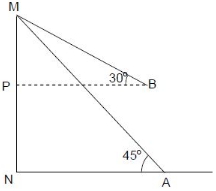
(C) Let $MN$ be the tower of height $h$ and $AN = x$ be the distance of the foot of the tower from point $A$.
In $\Delta ANM$,$\tan(45^o) = \frac{MN}{AN} = \frac{h}{x} = 1 \Rightarrow h = x$.
Point $B$ is $30 \, m$ above $A$,so $PB = AN = x$ and $PM = MN - NP = h - 30 = x - 30$.
In $\Delta BPM$,$\tan(30^o) = \frac{PM}{PB} = \frac{x - 30}{x}$.
$\frac{1}{\sqrt{3}} = \frac{x - 30}{x} \Rightarrow x = \sqrt{3}x - 30\sqrt{3}$.
$x(\sqrt{3} - 1) = 30\sqrt{3} \Rightarrow x = \frac{30\sqrt{3}}{\sqrt{3} - 1}$.
Rationalizing the denominator: $x = \frac{30\sqrt{3}(\sqrt{3} + 1)}{(\sqrt{3} - 1)(\sqrt{3} + 1)} = \frac{30(3 + \sqrt{3})}{3 - 1} = \frac{30(3 + \sqrt{3})}{2} = 15(3 + \sqrt{3}) \, m$.
In $\Delta ANM$,$\tan(45^o) = \frac{MN}{AN} = \frac{h}{x} = 1 \Rightarrow h = x$.
Point $B$ is $30 \, m$ above $A$,so $PB = AN = x$ and $PM = MN - NP = h - 30 = x - 30$.
In $\Delta BPM$,$\tan(30^o) = \frac{PM}{PB} = \frac{x - 30}{x}$.
$\frac{1}{\sqrt{3}} = \frac{x - 30}{x} \Rightarrow x = \sqrt{3}x - 30\sqrt{3}$.
$x(\sqrt{3} - 1) = 30\sqrt{3} \Rightarrow x = \frac{30\sqrt{3}}{\sqrt{3} - 1}$.
Rationalizing the denominator: $x = \frac{30\sqrt{3}(\sqrt{3} + 1)}{(\sqrt{3} - 1)(\sqrt{3} + 1)} = \frac{30(3 + \sqrt{3})}{3 - 1} = \frac{30(3 + \sqrt{3})}{2} = 15(3 + \sqrt{3}) \, m$.
0 likesView Solution
232
MathematicsDifficultMCQJEE Main · 2019
$A$ triangle has a vertex at $(1, 2)$ and the midpoints of the two sides through it are $(-1, 1)$ and $(2, 3)$. Then the centroid of this triangle is
A
$\left( 1, \frac{7}{3} \right)$
B
$\left( \frac{1}{3}, 1 \right)$
C
$\left( \frac{1}{3}, 2 \right)$
D
$\left( \frac{1}{3}, \frac{5}{3} \right)$
Solution
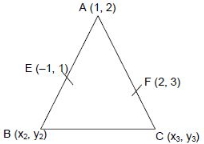
(C) Let the vertices of the triangle be $A(1, 2)$,$B(x_2, y_2)$,and $C(x_3, y_3)$.
Given that the midpoints of sides $AB$ and $AC$ are $E(-1, 1)$ and $F(2, 3)$ respectively.
Using the midpoint formula for $AB$:
$\frac{x_2 + 1}{2} = -1 \implies x_2 + 1 = -2 \implies x_2 = -3$
$\frac{y_2 + 2}{2} = 1 \implies y_2 + 2 = 2 \implies y_2 = 0$
So,$B = (-3, 0)$.
Using the midpoint formula for $AC$:
$\frac{x_3 + 1}{2} = 2 \implies x_3 + 1 = 4 \implies x_3 = 3$
$\frac{y_3 + 2}{2} = 3 \implies y_3 + 2 = 6 \implies y_3 = 4$
So,$C = (3, 4)$.
The centroid $G$ of a triangle with vertices $(x_1, y_1)$,$(x_2, y_2)$,and $(x_3, y_3)$ is given by $\left( \frac{x_1 + x_2 + x_3}{3}, \frac{y_1 + y_2 + y_3}{3} \right)$.
$G = \left( \frac{1 - 3 + 3}{3}, \frac{2 + 0 + 4}{3} \right) = \left( \frac{1}{3}, \frac{6}{3} \right) = \left( \frac{1}{3}, 2 \right)$.
Given that the midpoints of sides $AB$ and $AC$ are $E(-1, 1)$ and $F(2, 3)$ respectively.
Using the midpoint formula for $AB$:
$\frac{x_2 + 1}{2} = -1 \implies x_2 + 1 = -2 \implies x_2 = -3$
$\frac{y_2 + 2}{2} = 1 \implies y_2 + 2 = 2 \implies y_2 = 0$
So,$B = (-3, 0)$.
Using the midpoint formula for $AC$:
$\frac{x_3 + 1}{2} = 2 \implies x_3 + 1 = 4 \implies x_3 = 3$
$\frac{y_3 + 2}{2} = 3 \implies y_3 + 2 = 6 \implies y_3 = 4$
So,$C = (3, 4)$.
The centroid $G$ of a triangle with vertices $(x_1, y_1)$,$(x_2, y_2)$,and $(x_3, y_3)$ is given by $\left( \frac{x_1 + x_2 + x_3}{3}, \frac{y_1 + y_2 + y_3}{3} \right)$.
$G = \left( \frac{1 - 3 + 3}{3}, \frac{2 + 0 + 4}{3} \right) = \left( \frac{1}{3}, \frac{6}{3} \right) = \left( \frac{1}{3}, 2 \right)$.
0 likesView Solution
233
MathematicsDifficultMCQJEE Main · 2019
If $1^2 \cdot ^{20}C_1 + 2^2 \cdot ^{20}C_2 + 3^2 \cdot ^{20}C_3 + \dots + 20^2 \cdot ^{20}C_{20} = A(2^\beta)$,then the ordered pair $(A, \beta)$ is equal to
A
$(420, 18)$
B
$(380, 18)$
C
$(420, 19)$
D
$(380, 19)$
Solution
(A) We know that $(1+x)^{20} = \sum_{r=0}^{20} {^{20}C_r} x^r = {^{20}C_0} + {^{20}C_1} x + {^{20}C_2} x^2 + \dots + {^{20}C_{20}} x^{20} \dots (i)$
Differentiating with respect to $x$:
$20(1+x)^{19} = ^{20}C_1 + 2 \cdot ^{20}C_2 x + 3 \cdot ^{20}C_3 x^2 + \dots + 20 \cdot ^{20}C_{20} x^{19} \dots (ii)$
Multiplying equation $(ii)$ by $x$:
$20x(1+x)^{19} = ^{20}C_1 x + 2 \cdot ^{20}C_2 x^2 + 3 \cdot ^{20}C_3 x^3 + \dots + 20 \cdot ^{20}C_{20} x^{20} \dots (iii)$
Differentiating equation $(iii)$ with respect to $x$:
$20[(1+x)^{19} + 19x(1+x)^{18}] = ^{20}C_1 + 2^2 \cdot ^{20}C_2 x + 3^2 \cdot ^{20}C_3 x^2 + \dots + 20^2 \cdot ^{20}C_{20} x^{19} \dots (iv)$
Putting $x=1$ in equation $(iv)$:
$20[2^{19} + 19(2^{18})] = 1^2 \cdot ^{20}C_1 + 2^2 \cdot ^{20}C_2 + \dots + 20^2 \cdot ^{20}C_{20}$
$= 20 \cdot 2^{18} [2 + 19] = 20 \cdot 21 \cdot 2^{18} = 420 \cdot 2^{18}$
Comparing with $A(2^\beta)$,we get $A = 420$ and $\beta = 18$.
Thus,the ordered pair is $(420, 18)$.
Differentiating with respect to $x$:
$20(1+x)^{19} = ^{20}C_1 + 2 \cdot ^{20}C_2 x + 3 \cdot ^{20}C_3 x^2 + \dots + 20 \cdot ^{20}C_{20} x^{19} \dots (ii)$
Multiplying equation $(ii)$ by $x$:
$20x(1+x)^{19} = ^{20}C_1 x + 2 \cdot ^{20}C_2 x^2 + 3 \cdot ^{20}C_3 x^3 + \dots + 20 \cdot ^{20}C_{20} x^{20} \dots (iii)$
Differentiating equation $(iii)$ with respect to $x$:
$20[(1+x)^{19} + 19x(1+x)^{18}] = ^{20}C_1 + 2^2 \cdot ^{20}C_2 x + 3^2 \cdot ^{20}C_3 x^2 + \dots + 20^2 \cdot ^{20}C_{20} x^{19} \dots (iv)$
Putting $x=1$ in equation $(iv)$:
$20[2^{19} + 19(2^{18})] = 1^2 \cdot ^{20}C_1 + 2^2 \cdot ^{20}C_2 + \dots + 20^2 \cdot ^{20}C_{20}$
$= 20 \cdot 2^{18} [2 + 19] = 20 \cdot 21 \cdot 2^{18} = 420 \cdot 2^{18}$
Comparing with $A(2^\beta)$,we get $A = 420$ and $\beta = 18$.
Thus,the ordered pair is $(420, 18)$.
0 likesView Solution
234
MathematicsDifficultMCQJEE Main · 2019
$A$ circle touching the $x-$ axis at $(3, 0)$ and making an intercept of length $8$ on the $y-$ axis passes through the point:
A
$(3, 5)$
B
$(1, 5)$
C
$(3, 10)$
D
$(2, 3)$
Solution
(C) Let the center of the circle be $(3, r)$ or $(3, -r)$ and the radius be $r$.
Since the circle touches the $x-$ axis at $(3, 0)$,its equation is $(x - 3)^2 + (y - r)^2 = r^2$ or $(x - 3)^2 + (y + r)^2 = r^2$.
Expanding this,we get $x^2 - 6x + 9 + y^2 \mp 2ry + r^2 = r^2$,which simplifies to $x^2 + y^2 - 6x \mp 2ry + 9 = 0$.
The $y-$ intercept is given by $2\sqrt{f^2 - c}$,where $f = \mp r$ and $c = 9$.
Given the intercept length is $8$,we have $2\sqrt{r^2 - 9} = 8$.
$\sqrt{r^2 - 9} = 4 \implies r^2 - 9 = 16 \implies r^2 = 25 \implies r = 5$.
The equations of the circles are $x^2 + y^2 - 6x + 10y + 9 = 0$ and $x^2 + y^2 - 6x - 10y + 9 = 0$.
Checking the point $(3, 10)$ in the second equation: $(3)^2 + (10)^2 - 6(3) - 10(10) + 9 = 9 + 100 - 18 - 100 + 9 = 0$.
Thus,the circle passes through $(3, 10)$.
Since the circle touches the $x-$ axis at $(3, 0)$,its equation is $(x - 3)^2 + (y - r)^2 = r^2$ or $(x - 3)^2 + (y + r)^2 = r^2$.
Expanding this,we get $x^2 - 6x + 9 + y^2 \mp 2ry + r^2 = r^2$,which simplifies to $x^2 + y^2 - 6x \mp 2ry + 9 = 0$.
The $y-$ intercept is given by $2\sqrt{f^2 - c}$,where $f = \mp r$ and $c = 9$.
Given the intercept length is $8$,we have $2\sqrt{r^2 - 9} = 8$.
$\sqrt{r^2 - 9} = 4 \implies r^2 - 9 = 16 \implies r^2 = 25 \implies r = 5$.
The equations of the circles are $x^2 + y^2 - 6x + 10y + 9 = 0$ and $x^2 + y^2 - 6x - 10y + 9 = 0$.
Checking the point $(3, 10)$ in the second equation: $(3)^2 + (10)^2 - 6(3) - 10(10) + 9 = 9 + 100 - 18 - 100 + 9 = 0$.
Thus,the circle passes through $(3, 10)$.
0 likesView Solution
235
MathematicsDifficultMCQJEE Main · 2019
The equation of a common tangent to the curves $y^2 = 16x$ and $xy = -4$ is:
A
$x - 2y + 16 = 0$
B
$2x - y + 2 = 0$
C
$x + y + 4 = 0$
D
$x - y + 4 = 0$
Solution
(D) The equation of a tangent to the parabola $y^2 = 16x$ is of the form $y = mx + \frac{a}{m}$,where $a = 4$. So,$y = mx + \frac{4}{m} \dots (i)$.
If this line is also a tangent to the hyperbola $xy = -4$,then substituting $y$ from $(i)$ into the hyperbola equation gives $x(mx + \frac{4}{m}) = -4$.
This simplifies to $mx^2 + \frac{4}{m}x + 4 = 0$,or $m^2x^2 + 4x + 4m = 0$.
For the line to be a tangent,the discriminant $D$ must be zero: $D = (4)^2 - 4(m^2)(4m) = 0$.
$16 - 16m^3 = 0$ $\Rightarrow m^3 = 1$ $\Rightarrow m = 1$.
Substituting $m = 1$ into equation $(i)$,we get $y = x + 4$,which can be rewritten as $x - y + 4 = 0$.
Thus,the correct option is $(D)$.
If this line is also a tangent to the hyperbola $xy = -4$,then substituting $y$ from $(i)$ into the hyperbola equation gives $x(mx + \frac{4}{m}) = -4$.
This simplifies to $mx^2 + \frac{4}{m}x + 4 = 0$,or $m^2x^2 + 4x + 4m = 0$.
For the line to be a tangent,the discriminant $D$ must be zero: $D = (4)^2 - 4(m^2)(4m) = 0$.
$16 - 16m^3 = 0$ $\Rightarrow m^3 = 1$ $\Rightarrow m = 1$.
Substituting $m = 1$ into equation $(i)$,we get $y = x + 4$,which can be rewritten as $x - y + 4 = 0$.
Thus,the correct option is $(D)$.
0 likesView Solution
236
MathematicsDifficultMCQJEE Main · 2019
$A$ group of students comprises $5$ boys and $n$ girls. If the number of ways,in which a team of $3$ students can be randomly selected from this group such that there is at least one boy and at least one girl in each team,is $1750$,then $n$ is equal to
A
$24$
B
$28$
C
$27$
D
$25$
Solution
(D) Total students = $5 + n$.
We need to select $3$ students such that there is at least one boy and at least one girl.
The possible cases are:
Case $1$: $1$ boy and $2$ girls: $^5C_1 \times ^nC_2 = 5 \times \frac{n(n-1)}{2} = \frac{5n(n-1)}{2}$.
Case $2$: $2$ boys and $1$ girl: $^5C_2 \times ^nC_1 = 10 \times n = 10n$.
Sum of ways = $\frac{5n(n-1)}{2} + 10n = 1750$.
Multiply by $2$: $5n(n-1) + 20n = 3500$.
Divide by $5$: $n(n-1) + 4n = 700$.
$n^2 - n + 4n = 700 \Rightarrow n^2 + 3n - 700 = 0$.
Solving the quadratic equation: $(n + 28)(n - 25) = 0$.
Since $n$ must be positive,$n = 25$.
We need to select $3$ students such that there is at least one boy and at least one girl.
The possible cases are:
Case $1$: $1$ boy and $2$ girls: $^5C_1 \times ^nC_2 = 5 \times \frac{n(n-1)}{2} = \frac{5n(n-1)}{2}$.
Case $2$: $2$ boys and $1$ girl: $^5C_2 \times ^nC_1 = 10 \times n = 10n$.
Sum of ways = $\frac{5n(n-1)}{2} + 10n = 1750$.
Multiply by $2$: $5n(n-1) + 20n = 3500$.
Divide by $5$: $n(n-1) + 4n = 700$.
$n^2 - n + 4n = 700 \Rightarrow n^2 + 3n - 700 = 0$.
Solving the quadratic equation: $(n + 28)(n - 25) = 0$.
Since $n$ must be positive,$n = 25$.
0 likesView Solution
237
MathematicsDifficultMCQJEE Main · 2019
$A$ straight line $L$ at a distance of $4$ units from the origin makes positive intercepts on the coordinate axes and the perpendicular from the origin to this line makes an angle of $60^o$ with the line $x + y = 0$. Then an equation of the line $L$ is
A
$\left( {\sqrt 3 - 1} \right)x + \left( {\sqrt 3 + 1} \right)y = 8\sqrt 2 $
B
$\sqrt 3 x + y = 8$
C
$x + \sqrt 3 y = 8$
D
$\left( {\sqrt 3 + 1} \right)x + \left( {\sqrt 3 - 1} \right)y = 8\sqrt 2 $
Solution
(A) The normal form of a line is $x \cos \alpha + y \sin \alpha = p$,where $p = 4$ is the perpendicular distance from the origin and $\alpha$ is the angle the normal makes with the positive $x$-axis.
The line $x + y = 0$ has a slope of $-1$,which corresponds to an angle of $135^o$ with the positive $x$-axis.
The perpendicular from the origin to line $L$ makes an angle of $60^o$ with $x + y = 0$. Thus,$\alpha = 135^o \pm 60^o$.
Case $1$: $\alpha = 135^o - 60^o = 75^o$.
$\cos 75^o = \cos(45^o + 30^o) = \frac{\sqrt 3 - 1}{2\sqrt 2}$ and $\sin 75^o = \sin(45^o + 30^o) = \frac{\sqrt 3 + 1}{2\sqrt 2}$.
The equation is $x \left( \frac{\sqrt 3 - 1}{2\sqrt 2} \right) + y \left( \frac{\sqrt 3 + 1}{2\sqrt 2} \right) = 4$,which simplifies to $(\sqrt 3 - 1)x + (\sqrt 3 + 1)y = 8\sqrt 2$.
Case $2$: $\alpha = 135^o + 60^o = 195^o$. Since the line makes positive intercepts,$\alpha$ must be in the first quadrant $(0^o < \alpha < 90^o)$. Thus,we reject this case.
Comparing with the options,the correct equation is $(\sqrt 3 - 1)x + (\sqrt 3 + 1)y = 8\sqrt 2$.
The line $x + y = 0$ has a slope of $-1$,which corresponds to an angle of $135^o$ with the positive $x$-axis.
The perpendicular from the origin to line $L$ makes an angle of $60^o$ with $x + y = 0$. Thus,$\alpha = 135^o \pm 60^o$.
Case $1$: $\alpha = 135^o - 60^o = 75^o$.
$\cos 75^o = \cos(45^o + 30^o) = \frac{\sqrt 3 - 1}{2\sqrt 2}$ and $\sin 75^o = \sin(45^o + 30^o) = \frac{\sqrt 3 + 1}{2\sqrt 2}$.
The equation is $x \left( \frac{\sqrt 3 - 1}{2\sqrt 2} \right) + y \left( \frac{\sqrt 3 + 1}{2\sqrt 2} \right) = 4$,which simplifies to $(\sqrt 3 - 1)x + (\sqrt 3 + 1)y = 8\sqrt 2$.
Case $2$: $\alpha = 135^o + 60^o = 195^o$. Since the line makes positive intercepts,$\alpha$ must be in the first quadrant $(0^o < \alpha < 90^o)$. Thus,we reject this case.
Comparing with the options,the correct equation is $(\sqrt 3 - 1)x + (\sqrt 3 + 1)y = 8\sqrt 2$.
0 likesView Solution
238
MathematicsDifficultMCQJEE Main · 2019
$\mathop {\lim }\limits_{x \to 0} \frac{{x + 2\sin x}}{{\sqrt {{x^2} + 2\sin x + 1} - \sqrt {{{\sin }^2}x - x + 1} }}$ is
A
$2$
B
$6$
C
$3$
D
$1$
Solution
(A) Let $L = \mathop {\lim }\limits_{x \to 0} \frac{{x + 2\sin x}}{{\sqrt {{x^2} + 2\sin x + 1} - \sqrt {{{\sin }^2}x - x + 1} }}$.
Rationalizing the denominator:
$L = \mathop {\lim }\limits_{x \to 0} \frac{{(x + 2\sin x)(\sqrt {{x^2} + 2\sin x + 1} + \sqrt {{{\sin }^2}x - x + 1} )}}{({x^2} + 2\sin x + 1) - ({{\sin }^2}x - x + 1)}$
$L = \mathop {\lim }\limits_{x \to 0} \frac{{(x + 2\sin x)(\sqrt {{x^2} + 2\sin x + 1} + \sqrt {{{\sin }^2}x - x + 1} )}}{{x^2 + x + 2\sin x - {{\sin }^2}x}}$
Dividing numerator and denominator by $x$:
$L = \mathop {\lim }\limits_{x \to 0} \frac{{(1 + 2\frac{\sin x}{x})(\sqrt {{x^2} + 2\sin x + 1} + \sqrt {{{\sin }^2}x - x + 1} )}}{{x + 1 + 2\frac{\sin x}{x} - \sin x \frac{\sin x}{x}}}$
As $x \to 0$,$\frac{\sin x}{x} \to 1$ and $\sin x \to 0$:
$L = \frac{{(1 + 2(1))(\sqrt {0 + 0 + 1} + \sqrt {0 - 0 + 1} )}}{{0 + 1 + 2(1) - 0(1)}} = \frac{{3(1 + 1)}}{3} = 2$.
Hence,the correct answer is option $(A)$.
Rationalizing the denominator:
$L = \mathop {\lim }\limits_{x \to 0} \frac{{(x + 2\sin x)(\sqrt {{x^2} + 2\sin x + 1} + \sqrt {{{\sin }^2}x - x + 1} )}}{({x^2} + 2\sin x + 1) - ({{\sin }^2}x - x + 1)}$
$L = \mathop {\lim }\limits_{x \to 0} \frac{{(x + 2\sin x)(\sqrt {{x^2} + 2\sin x + 1} + \sqrt {{{\sin }^2}x - x + 1} )}}{{x^2 + x + 2\sin x - {{\sin }^2}x}}$
Dividing numerator and denominator by $x$:
$L = \mathop {\lim }\limits_{x \to 0} \frac{{(1 + 2\frac{\sin x}{x})(\sqrt {{x^2} + 2\sin x + 1} + \sqrt {{{\sin }^2}x - x + 1} )}}{{x + 1 + 2\frac{\sin x}{x} - \sin x \frac{\sin x}{x}}}$
As $x \to 0$,$\frac{\sin x}{x} \to 1$ and $\sin x \to 0$:
$L = \frac{{(1 + 2(1))(\sqrt {0 + 0 + 1} + \sqrt {0 - 0 + 1} )}}{{0 + 1 + 2(1) - 0(1)}} = \frac{{3(1 + 1)}}{3} = 2$.
Hence,the correct answer is option $(A)$.
0 likesView Solution
239
MathematicsDifficultMCQJEE Main · 2019
The Boolean expression $\sim (p \Rightarrow (\sim q))$ is equivalent to
A
$(\sim p) \Rightarrow q$
B
$p \vee q$
C
$p \wedge q$
D
$q \Rightarrow \sim p$
Solution
(C) We know that the implication $p \Rightarrow r$ is equivalent to $(\sim p) \vee r$.
Therefore,$p \Rightarrow (\sim q)$ is equivalent to $(\sim p) \vee (\sim q)$.
Now,applying the negation: $\sim (p \Rightarrow (\sim q)) = \sim ((\sim p) \vee (\sim q))$.
Using De Morgan's Law,$\sim (A \vee B) = (\sim A) \wedge (\sim B)$.
So,$\sim ((\sim p) \vee (\sim q)) = (\sim (\sim p)) \wedge (\sim (\sim q)) = p \wedge q$.
Hence,the correct answer is option $(C)$.
Therefore,$p \Rightarrow (\sim q)$ is equivalent to $(\sim p) \vee (\sim q)$.
Now,applying the negation: $\sim (p \Rightarrow (\sim q)) = \sim ((\sim p) \vee (\sim q))$.
Using De Morgan's Law,$\sim (A \vee B) = (\sim A) \wedge (\sim B)$.
So,$\sim ((\sim p) \vee (\sim q)) = (\sim (\sim p)) \wedge (\sim (\sim q)) = p \wedge q$.
Hence,the correct answer is option $(C)$.
0 likesView Solution
240
MathematicsMediumMCQJEE Main · 2019
$\lim _{x \rightarrow 0} \frac{\sin ^2 x}{\sqrt{2}-\sqrt{1+\cos x}}$ equals
A
$\sqrt{2}$
B
$4 \sqrt{2}$
C
$2 \sqrt{2}$
D
$4$
Solution
(B) We evaluate the limit: $\lim _{x \rightarrow 0} \frac{\sin ^2 x}{\sqrt{2}-\sqrt{1+\cos x}}$
Rationalizing the denominator:
$= \lim _{x \rightarrow 0} \frac{\sin ^2 x (\sqrt{2}+\sqrt{1+\cos x})}{2-(1+\cos x)}$
$= \lim _{x \rightarrow 0} \frac{\sin ^2 x (\sqrt{2}+\sqrt{1+\cos x})}{1-\cos x}$
Using the identity $\sin ^2 x = 1-\cos ^2 x = (1-\cos x)(1+\cos x)$:
$= \lim _{x \rightarrow 0} \frac{(1-\cos x)(1+\cos x)(\sqrt{2}+\sqrt{1+\cos x})}{1-\cos x}$
$= \lim _{x \rightarrow 0} (1+\cos x)(\sqrt{2}+\sqrt{1+\cos x})$
Substituting $x = 0$:
$= (1+\cos 0)(\sqrt{2}+\sqrt{1+\cos 0})$
$= (1+1)(\sqrt{2}+\sqrt{1+1})$
$= 2 \times (\sqrt{2}+\sqrt{2})$
$= 2 \times 2 \sqrt{2} = 4 \sqrt{2}$
Rationalizing the denominator:
$= \lim _{x \rightarrow 0} \frac{\sin ^2 x (\sqrt{2}+\sqrt{1+\cos x})}{2-(1+\cos x)}$
$= \lim _{x \rightarrow 0} \frac{\sin ^2 x (\sqrt{2}+\sqrt{1+\cos x})}{1-\cos x}$
Using the identity $\sin ^2 x = 1-\cos ^2 x = (1-\cos x)(1+\cos x)$:
$= \lim _{x \rightarrow 0} \frac{(1-\cos x)(1+\cos x)(\sqrt{2}+\sqrt{1+\cos x})}{1-\cos x}$
$= \lim _{x \rightarrow 0} (1+\cos x)(\sqrt{2}+\sqrt{1+\cos x})$
Substituting $x = 0$:
$= (1+\cos 0)(\sqrt{2}+\sqrt{1+\cos 0})$
$= (1+1)(\sqrt{2}+\sqrt{1+1})$
$= 2 \times (\sqrt{2}+\sqrt{2})$
$= 2 \times 2 \sqrt{2} = 4 \sqrt{2}$
0 likesView Solution
241
MathematicsMediumMCQJEE Main · 2019
The logical statement $[\sim(\sim p \vee q) \vee (p \wedge r) \wedge (\sim q \wedge r)]$ is equivalent to
A
$(p \wedge r) \wedge \sim q$
B
$(\sim p \wedge \sim q) \wedge r$
C
$\sim p \vee r$
D
$(p \wedge \sim q) \vee r$
Solution
(A) Given expression: $[\sim(\sim p \vee q) \vee (p \wedge r) \wedge (\sim q \wedge r)]$.
Applying De Morgan's Law to the first part: $\sim(\sim p \vee q) \equiv (p \wedge \sim q)$.
Now the expression becomes: $[(p \wedge \sim q) \vee ((p \wedge r) \wedge (\sim q \wedge r))]$.
Using the associative and commutative properties: $(p \wedge r) \wedge (\sim q \wedge r) \equiv (p \wedge \sim q) \wedge (r \wedge r) \equiv (p \wedge \sim q) \wedge r$.
Substituting this back: $(p \wedge \sim q) \vee ((p \wedge \sim q) \wedge r)$.
Using the absorption law: $A \vee (A \wedge B) \equiv A$,where $A = (p \wedge \sim q)$ and $B = r$.
Therefore,the expression simplifies to $(p \wedge \sim q)$.
Applying De Morgan's Law to the first part: $\sim(\sim p \vee q) \equiv (p \wedge \sim q)$.
Now the expression becomes: $[(p \wedge \sim q) \vee ((p \wedge r) \wedge (\sim q \wedge r))]$.
Using the associative and commutative properties: $(p \wedge r) \wedge (\sim q \wedge r) \equiv (p \wedge \sim q) \wedge (r \wedge r) \equiv (p \wedge \sim q) \wedge r$.
Substituting this back: $(p \wedge \sim q) \vee ((p \wedge \sim q) \wedge r)$.
Using the absorption law: $A \vee (A \wedge B) \equiv A$,where $A = (p \wedge \sim q)$ and $B = r$.
Therefore,the expression simplifies to $(p \wedge \sim q)$.
0 likesView Solution
242
MathematicsEasyMCQJEE Main · 2019
If $q$ is false and $p \wedge q \leftrightarrow r$ is true,then which of the following is a tautology?
A
$p \vee r$
B
$(p \wedge r) \rightarrow (p \vee r)$
C
$(p \vee r) \rightarrow (p \wedge r)$
D
$p \wedge r$
Solution
(B) Given that $q$ is false and $p \wedge q \leftrightarrow r$ is true.
Since $q \equiv F$,then $p \wedge q \equiv F$.
For the biconditional $p \wedge q \leftrightarrow r$ to be true,$r$ must have the same truth value as $p \wedge q$.
Therefore,$r \equiv F$.
Now,let us evaluate the options:
$(A)$ $p \vee r \equiv p \vee F \equiv p$,which is not a tautology.
$(B)$ $(p \wedge r)$ $\rightarrow (p \vee r) \equiv (p \wedge F)$ $\rightarrow (p \vee F) \equiv F$ $\rightarrow p$. Since $F \rightarrow p$ is always true for any truth value of $p$,this is a tautology.
$(C)$ $(p \vee r)$ $\rightarrow (p \wedge r) \equiv (p \vee F)$ $\rightarrow (p \wedge F) \equiv p$ $\rightarrow F$,which is not a tautology.
$(D)$ $p \wedge r \equiv p \wedge F \equiv F$,which is a contradiction.
Since $q \equiv F$,then $p \wedge q \equiv F$.
For the biconditional $p \wedge q \leftrightarrow r$ to be true,$r$ must have the same truth value as $p \wedge q$.
Therefore,$r \equiv F$.
Now,let us evaluate the options:
$(A)$ $p \vee r \equiv p \vee F \equiv p$,which is not a tautology.
$(B)$ $(p \wedge r)$ $\rightarrow (p \vee r) \equiv (p \wedge F)$ $\rightarrow (p \vee F) \equiv F$ $\rightarrow p$. Since $F \rightarrow p$ is always true for any truth value of $p$,this is a tautology.
$(C)$ $(p \vee r)$ $\rightarrow (p \wedge r) \equiv (p \vee F)$ $\rightarrow (p \wedge F) \equiv p$ $\rightarrow F$,which is not a tautology.
$(D)$ $p \wedge r \equiv p \wedge F \equiv F$,which is a contradiction.
0 likesView Solution
243
MathematicsEasyMCQJEE Main · 2019
If the sum of the deviations of $50$ observations from $30$ is $50$,then the mean of these observations is:
A
$30$
B
$51$
C
$50$
D
$31$
Solution
(D) Let the observations be $x_1, x_2, x_3, \ldots, x_{50}$.
Given that the sum of deviations from $30$ is $50$,we have:
$\sum_{i=1}^{50} (x_i - 30) = 50$
Expanding the summation:
$\sum_{i=1}^{50} x_i - \sum_{i=1}^{50} 30 = 50$
$\sum_{i=1}^{50} x_i - (50 \times 30) = 50$
$\sum_{i=1}^{50} x_i - 1500 = 50$
$\sum_{i=1}^{50} x_i = 1550$
Now,the mean $\bar{x}$ is given by:
$\bar{x} = \frac{\sum_{i=1}^{50} x_i}{n} = \frac{1550}{50} = 31$
Given that the sum of deviations from $30$ is $50$,we have:
$\sum_{i=1}^{50} (x_i - 30) = 50$
Expanding the summation:
$\sum_{i=1}^{50} x_i - \sum_{i=1}^{50} 30 = 50$
$\sum_{i=1}^{50} x_i - (50 \times 30) = 50$
$\sum_{i=1}^{50} x_i - 1500 = 50$
$\sum_{i=1}^{50} x_i = 1550$
Now,the mean $\bar{x}$ is given by:
$\bar{x} = \frac{\sum_{i=1}^{50} x_i}{n} = \frac{1550}{50} = 31$
0 likesView Solution
244
MathematicsMediumMCQJEE Main · 2019
Suppose that the points $(h, k)$,$(1, 2)$,and $(-3, 4)$ lie on the line $l_1$. If a line $l_2$ passing through the points $(h, k)$ and $(4, 3)$ is perpendicular to $l_1$,then $\left(\frac{k}{h}\right)$ equals
A
$\frac{1}{3}$
B
$0$
C
$3$
D
$-\frac{1}{7}$
Solution
(A) Slope of line $l_1 = \frac{4-2}{-3-1} = \frac{2}{-4} = -\frac{1}{2}$.
Since $(h, k)$ lies on $l_1$,the slope between $(h, k)$ and $(1, 2)$ must be $-\frac{1}{2}$:
$\frac{k-2}{h-1} = -\frac{1}{2}$ $\Rightarrow 2k-4 = -h+1$ $\Rightarrow h+2k = 5$ ... $(i)$.
Since $l_2$ passes through $(h, k)$ and $(4, 3)$ and is perpendicular to $l_1$,its slope is $m_2 = -\frac{1}{m_1} = -\frac{1}{-1/2} = 2$.
Thus,$\frac{3-k}{4-h} = 2$ $\Rightarrow 3-k = 8-2h$ $\Rightarrow 2h-k = 5$ ... $(ii)$.
Multiplying $(ii)$ by $2$: $4h-2k = 10$ ... $(iii)$.
Adding $(i)$ and $(iii)$: $(h+2k) + (4h-2k) = 5+10$ $\Rightarrow 5h = 15$ $\Rightarrow h = 3$.
Substituting $h=3$ into $(i)$: $3+2k = 5$ $\Rightarrow 2k = 2$ $\Rightarrow k = 1$.
Therefore,$\frac{k}{h} = \frac{1}{3}$.
Since $(h, k)$ lies on $l_1$,the slope between $(h, k)$ and $(1, 2)$ must be $-\frac{1}{2}$:
$\frac{k-2}{h-1} = -\frac{1}{2}$ $\Rightarrow 2k-4 = -h+1$ $\Rightarrow h+2k = 5$ ... $(i)$.
Since $l_2$ passes through $(h, k)$ and $(4, 3)$ and is perpendicular to $l_1$,its slope is $m_2 = -\frac{1}{m_1} = -\frac{1}{-1/2} = 2$.
Thus,$\frac{3-k}{4-h} = 2$ $\Rightarrow 3-k = 8-2h$ $\Rightarrow 2h-k = 5$ ... $(ii)$.
Multiplying $(ii)$ by $2$: $4h-2k = 10$ ... $(iii)$.
Adding $(i)$ and $(iii)$: $(h+2k) + (4h-2k) = 5+10$ $\Rightarrow 5h = 15$ $\Rightarrow h = 3$.
Substituting $h=3$ into $(i)$: $3+2k = 5$ $\Rightarrow 2k = 2$ $\Rightarrow k = 1$.
Therefore,$\frac{k}{h} = \frac{1}{3}$.
0 likesView Solution
245
MathematicsEasyMCQJEE Main · 2019
If the standard deviation of the numbers $-1, 0, 1, k$ is $\sqrt{5}$ where $k > 0$,then $k$ is equal to
A
$4 \sqrt{\frac{5}{3}}$
B
$\sqrt{6}$
C
$2 \sqrt{\frac{10}{3}}$
D
$2 \sqrt{6}$
Solution
(D) Given,the numbers are $-1, 0, 1, k$.
Standard deviation,$\sigma = \sqrt{5}$.
We know that the variance $\sigma^2$ is given by $\sigma^2 = \frac{\sum x_i^2}{n} - \left(\frac{\sum x_i}{n}\right)^2$.
Here,$n = 4$.
$\sigma^2 = 5 = \frac{(-1)^2 + 0^2 + 1^2 + k^2}{4} - \left(\frac{-1 + 0 + 1 + k}{4}\right)^2$.
$5 = \frac{2 + k^2}{4} - \left(\frac{k}{4}\right)^2$.
$5 = \frac{2 + k^2}{4} - \frac{k^2}{16}$.
Multiply the entire equation by $16$:
$80 = 4(2 + k^2) - k^2$.
$80 = 8 + 4k^2 - k^2$.
$72 = 3k^2$.
$k^2 = 24$.
Since $k > 0$,$k = \sqrt{24} = 2 \sqrt{6}$.
Standard deviation,$\sigma = \sqrt{5}$.
We know that the variance $\sigma^2$ is given by $\sigma^2 = \frac{\sum x_i^2}{n} - \left(\frac{\sum x_i}{n}\right)^2$.
Here,$n = 4$.
$\sigma^2 = 5 = \frac{(-1)^2 + 0^2 + 1^2 + k^2}{4} - \left(\frac{-1 + 0 + 1 + k}{4}\right)^2$.
$5 = \frac{2 + k^2}{4} - \left(\frac{k}{4}\right)^2$.
$5 = \frac{2 + k^2}{4} - \frac{k^2}{16}$.
Multiply the entire equation by $16$:
$80 = 4(2 + k^2) - k^2$.
$80 = 8 + 4k^2 - k^2$.
$72 = 3k^2$.
$k^2 = 24$.
Since $k > 0$,$k = \sqrt{24} = 2 \sqrt{6}$.
0 likesView Solution
246
MathematicsMediumMCQJEE Main · 2019
All the pairs $(x, y)$ that satisfy the inequality $2^{\sqrt{\sin^2 x - 2 \sin x + 5}} \cdot \frac{1}{4^{\sin^2 y}} \leq 1$ also satisfy the equation
A
$2|\sin x| = \sin y$
B
$2 \sin x = \sin y$
C
$\sin x = 2 \sin y$
D
$\sin x = |\sin y|$
Solution
(D) The given inequality is $2^{\sqrt{\sin^2 x - 2 \sin x + 5}} \cdot 2^{-2 \sin^2 y} \leq 1$.
This simplifies to $2^{\sqrt{(\sin x - 1)^2 + 4}} \leq 2^{2 \sin^2 y}$.
Since the base $2 > 1$,we have $\sqrt{(\sin x - 1)^2 + 4} \leq 2 \sin^2 y$.
We know that $(\sin x - 1)^2 \geq 0$,so $\sqrt{(\sin x - 1)^2 + 4} \geq \sqrt{4} = 2$.
Thus,$2 \sin^2 y \geq 2$,which implies $\sin^2 y \geq 1$.
Since the maximum value of $\sin^2 y$ is $1$,we must have $\sin^2 y = 1$,which means $\sin y = \pm 1$.
Substituting $\sin^2 y = 1$ into the inequality,we get $\sqrt{(\sin x - 1)^2 + 4} \leq 2(1) = 2$.
This implies $(\sin x - 1)^2 + 4 \leq 4$,so $(\sin x - 1)^2 \leq 0$.
Since a square cannot be negative,we must have $(\sin x - 1)^2 = 0$,which means $\sin x = 1$.
Since $\sin x = 1$ and $|\sin y| = 1$,we conclude $\sin x = |\sin y|$.
This simplifies to $2^{\sqrt{(\sin x - 1)^2 + 4}} \leq 2^{2 \sin^2 y}$.
Since the base $2 > 1$,we have $\sqrt{(\sin x - 1)^2 + 4} \leq 2 \sin^2 y$.
We know that $(\sin x - 1)^2 \geq 0$,so $\sqrt{(\sin x - 1)^2 + 4} \geq \sqrt{4} = 2$.
Thus,$2 \sin^2 y \geq 2$,which implies $\sin^2 y \geq 1$.
Since the maximum value of $\sin^2 y$ is $1$,we must have $\sin^2 y = 1$,which means $\sin y = \pm 1$.
Substituting $\sin^2 y = 1$ into the inequality,we get $\sqrt{(\sin x - 1)^2 + 4} \leq 2(1) = 2$.
This implies $(\sin x - 1)^2 + 4 \leq 4$,so $(\sin x - 1)^2 \leq 0$.
Since a square cannot be negative,we must have $(\sin x - 1)^2 = 0$,which means $\sin x = 1$.
Since $\sin x = 1$ and $|\sin y| = 1$,we conclude $\sin x = |\sin y|$.
0 likesView Solution
247
MathematicsDifficultMCQJEE Main · 2019
If a circle $C$ passing through the point $(4, 0)$ touches the circle $x^2+y^2+4x-6y=12$ externally at the point $(1, -1)$,then the radius of $C$ is
A
$\sqrt{5}$
B
$2\sqrt{5}$
C
$\sqrt{57}$
D
$4$
Solution
(A) Given equation of the circle: $x^2+y^2+4x-6y-12=0$.
Let the center of this circle be $O_1 = (-2, 3)$ and radius $r_1 = \sqrt{(-2)^2 + 3^2 - (-12)} = \sqrt{4+9+12} = 5$.
The center of the required circle $C$ lies on the line passing through $O_1(-2, 3)$ and the point of contact $P(1, -1)$.
The slope of the line $O_1P$ is $m = \frac{-1-3}{1-(-2)} = \frac{-4}{3}$.
The line passing through $P(1, -1)$ and the center of circle $C$ (let it be $(h, k)$) must be perpendicular to the common tangent at $P$. The slope of the normal line is $m' = \frac{-1}{-4/3} = \frac{3}{4}$.
The equation of this normal line is $y+1 = \frac{3}{4}(x-1) \Rightarrow 3x-4y-7=0$.
Since the center $(h, k)$ lies on this line,$3h-4k=7$.
Also,the distance from $(h, k)$ to $P(1, -1)$ is the radius $R$,and the distance from $(h, k)$ to $(4, 0)$ is also $R$. Thus,$(h-1)^2 + (k+1)^2 = (h-4)^2 + k^2$.
Expanding this: $h^2-2h+1 + k^2+2k+1 = h^2-8h+16 + k^2$.
Simplifying: $6h+2k=14 \Rightarrow 3h+k=7$.
Solving the system $3h-4k=7$ and $3h+k=7$ by subtracting: $5k=0 \Rightarrow k=0$.
Then $3h=7 \Rightarrow h=7/3$.
The radius $R = \sqrt{(7/3-1)^2 + (0+1)^2} = \sqrt{(4/3)^2 + 1^2} = \sqrt{16/9 + 1} = \sqrt{25/9} = 5/3$. Wait,re-evaluating the distance condition: the circle touches externally,so the distance between centers is $R+r_1$. The center of $C$ is at distance $R$ from $P(1, -1)$ along the normal. The normal line is $3x-4y-7=0$. The center $(h, k)$ is $(1+R(3/5), -1+R(-4/5))$ or similar. Using the distance to $(4, 0)$ as $R$: $(h-4)^2 + k^2 = R^2$. Substituting $h=1+3R/5, k=-1-4R/5$: $(1+3R/5-4)^2 + (-1-4R/5)^2 = R^2 \Rightarrow (3R/5-3)^2 + (4R/5+1)^2 = R^2 \Rightarrow 9R^2/25 - 18R/5 + 9 + 16R^2/25 + 8R/5 + 1 = R^2 \Rightarrow R^2 - 2R + 10 = R^2 \Rightarrow 2R = 10 \Rightarrow R = 5$.
Let the center of this circle be $O_1 = (-2, 3)$ and radius $r_1 = \sqrt{(-2)^2 + 3^2 - (-12)} = \sqrt{4+9+12} = 5$.
The center of the required circle $C$ lies on the line passing through $O_1(-2, 3)$ and the point of contact $P(1, -1)$.
The slope of the line $O_1P$ is $m = \frac{-1-3}{1-(-2)} = \frac{-4}{3}$.
The line passing through $P(1, -1)$ and the center of circle $C$ (let it be $(h, k)$) must be perpendicular to the common tangent at $P$. The slope of the normal line is $m' = \frac{-1}{-4/3} = \frac{3}{4}$.
The equation of this normal line is $y+1 = \frac{3}{4}(x-1) \Rightarrow 3x-4y-7=0$.
Since the center $(h, k)$ lies on this line,$3h-4k=7$.
Also,the distance from $(h, k)$ to $P(1, -1)$ is the radius $R$,and the distance from $(h, k)$ to $(4, 0)$ is also $R$. Thus,$(h-1)^2 + (k+1)^2 = (h-4)^2 + k^2$.
Expanding this: $h^2-2h+1 + k^2+2k+1 = h^2-8h+16 + k^2$.
Simplifying: $6h+2k=14 \Rightarrow 3h+k=7$.
Solving the system $3h-4k=7$ and $3h+k=7$ by subtracting: $5k=0 \Rightarrow k=0$.
Then $3h=7 \Rightarrow h=7/3$.
The radius $R = \sqrt{(7/3-1)^2 + (0+1)^2} = \sqrt{(4/3)^2 + 1^2} = \sqrt{16/9 + 1} = \sqrt{25/9} = 5/3$. Wait,re-evaluating the distance condition: the circle touches externally,so the distance between centers is $R+r_1$. The center of $C$ is at distance $R$ from $P(1, -1)$ along the normal. The normal line is $3x-4y-7=0$. The center $(h, k)$ is $(1+R(3/5), -1+R(-4/5))$ or similar. Using the distance to $(4, 0)$ as $R$: $(h-4)^2 + k^2 = R^2$. Substituting $h=1+3R/5, k=-1-4R/5$: $(1+3R/5-4)^2 + (-1-4R/5)^2 = R^2 \Rightarrow (3R/5-3)^2 + (4R/5+1)^2 = R^2 \Rightarrow 9R^2/25 - 18R/5 + 9 + 16R^2/25 + 8R/5 + 1 = R^2 \Rightarrow R^2 - 2R + 10 = R^2 \Rightarrow 2R = 10 \Rightarrow R = 5$.
0 likesView Solution
248
MathematicsDifficultMCQJEE Main · 2019
Let $\vec{a} = 3\hat{i} + 2\hat{j} + 2\hat{k}$ and $\vec{b} = \hat{i} + 2\hat{j} - 2\hat{k}$ be two vectors. If a vector perpendicular to both the vectors $\vec{a} + \vec{b}$ and $\vec{a} - \vec{b}$ has the magnitude $12$,then one such vector is
A
$4(2\hat{i} - 2\hat{j} - \hat{k})$
B
$4(2\hat{i} - 2\hat{j} + \hat{k})$
C
$4(2\hat{i} + 2\hat{j} + \hat{k})$
D
$4(2\hat{i} + 2\hat{j} - \hat{k})$
Solution
(A) First,calculate $\vec{a} + \vec{b} = (3+1)\hat{i} + (2+2)\hat{j} + (2-2)\hat{k} = 4\hat{i} + 4\hat{j}$.
Next,calculate $\vec{a} - \vec{b} = (3-1)\hat{i} + (2-2)\hat{j} + (2-(-2))\hat{k} = 2\hat{i} + 4\hat{k}$.
$A$ vector perpendicular to both $\vec{a} + \vec{b}$ and $\vec{a} - \vec{b}$ is given by their cross product:
$\vec{v} = (\vec{a} + \vec{b}) \times (\vec{a} - \vec{b}) = \begin{vmatrix} \hat{i} & \hat{j} & \hat{k} \\ 4 & 4 & 0 \\ 2 & 0 & 4 \end{vmatrix} = \hat{i}(16 - 0) - \hat{j}(16 - 0) + \hat{k}(0 - 8) = 16\hat{i} - 16\hat{j} - 8\hat{k}$.
Simplify the vector: $8(2\hat{i} - 2\hat{j} - \hat{k})$.
The magnitude of this vector is $8 \sqrt{2^2 + (-2)^2 + (-1)^2} = 8 \sqrt{4+4+1} = 8 \times 3 = 24$.
We need a vector with magnitude $12$,which is half of the magnitude of $\vec{v}$.
Thus,the required vector is $\pm \frac{12}{24} \times 8(2\hat{i} - 2\hat{j} - \hat{k}) = \pm 4(2\hat{i} - 2\hat{j} - \hat{k})$.
Comparing with the options,$4(2\hat{i} - 2\hat{j} - \hat{k})$ is the correct choice.
Next,calculate $\vec{a} - \vec{b} = (3-1)\hat{i} + (2-2)\hat{j} + (2-(-2))\hat{k} = 2\hat{i} + 4\hat{k}$.
$A$ vector perpendicular to both $\vec{a} + \vec{b}$ and $\vec{a} - \vec{b}$ is given by their cross product:
$\vec{v} = (\vec{a} + \vec{b}) \times (\vec{a} - \vec{b}) = \begin{vmatrix} \hat{i} & \hat{j} & \hat{k} \\ 4 & 4 & 0 \\ 2 & 0 & 4 \end{vmatrix} = \hat{i}(16 - 0) - \hat{j}(16 - 0) + \hat{k}(0 - 8) = 16\hat{i} - 16\hat{j} - 8\hat{k}$.
Simplify the vector: $8(2\hat{i} - 2\hat{j} - \hat{k})$.
The magnitude of this vector is $8 \sqrt{2^2 + (-2)^2 + (-1)^2} = 8 \sqrt{4+4+1} = 8 \times 3 = 24$.
We need a vector with magnitude $12$,which is half of the magnitude of $\vec{v}$.
Thus,the required vector is $\pm \frac{12}{24} \times 8(2\hat{i} - 2\hat{j} - \hat{k}) = \pm 4(2\hat{i} - 2\hat{j} - \hat{k})$.
Comparing with the options,$4(2\hat{i} - 2\hat{j} - \hat{k})$ is the correct choice.
0 likesView Solution
249
MathematicsDifficultMCQJEE Main · 2019
For $x \in \left( 0, \frac{3}{2} \right)$,let $f(x) = \sqrt{x}$,$g(x) = \tan x$,and $h(x) = \frac{1 - x^2}{1 + x^2}$. If $\phi(x) = ((h \circ f) \circ g)(x)$,then $\phi\left( \frac{\pi}{3} \right)$ is equal to
A
$\tan \frac{11\pi}{12}$
B
$\tan \frac{\pi}{12}$
C
$\tan \frac{5\pi}{12}$
D
$\tan \frac{7\pi}{12}$
Solution
(A) Given functions are $f(x) = \sqrt{x}$,$g(x) = \tan x$,and $h(x) = \frac{1 - x^2}{1 + x^2}$.
First,find $(f \circ g)(x) = f(g(x)) = \sqrt{\tan x}$.
Next,find $\phi(x) = (h \circ (f \circ g))(x) = h(\sqrt{\tan x})$.
Substituting $\sqrt{\tan x}$ into $h(x)$,we get $\phi(x) = \frac{1 - (\sqrt{\tan x})^2}{1 + (\sqrt{\tan x})^2} = \frac{1 - \tan x}{1 + \tan x}$.
Using the trigonometric identity $\tan(A - B) = \frac{\tan A - \tan B}{1 + \tan A \tan B}$,we can write $\frac{1 - \tan x}{1 + \tan x} = \tan\left( \frac{\pi}{4} - x \right)$.
Now,calculate $\phi\left( \frac{\pi}{3} \right) = \tan\left( \frac{\pi}{4} - \frac{\pi}{3} \right) = \tan\left( \frac{3\pi - 4\pi}{12} \right) = \tan\left( -\frac{\pi}{12} \right) = -\tan\left( \frac{\pi}{12} \right)$.
Since $\tan(\pi - \theta) = -\tan \theta$,we have $-\tan\left( \frac{\pi}{12} \right) = \tan\left( \pi - \frac{\pi}{12} \right) = \tan\left( \frac{11\pi}{12} \right)$.
First,find $(f \circ g)(x) = f(g(x)) = \sqrt{\tan x}$.
Next,find $\phi(x) = (h \circ (f \circ g))(x) = h(\sqrt{\tan x})$.
Substituting $\sqrt{\tan x}$ into $h(x)$,we get $\phi(x) = \frac{1 - (\sqrt{\tan x})^2}{1 + (\sqrt{\tan x})^2} = \frac{1 - \tan x}{1 + \tan x}$.
Using the trigonometric identity $\tan(A - B) = \frac{\tan A - \tan B}{1 + \tan A \tan B}$,we can write $\frac{1 - \tan x}{1 + \tan x} = \tan\left( \frac{\pi}{4} - x \right)$.
Now,calculate $\phi\left( \frac{\pi}{3} \right) = \tan\left( \frac{\pi}{4} - \frac{\pi}{3} \right) = \tan\left( \frac{3\pi - 4\pi}{12} \right) = \tan\left( -\frac{\pi}{12} \right) = -\tan\left( \frac{\pi}{12} \right)$.
Since $\tan(\pi - \theta) = -\tan \theta$,we have $-\tan\left( \frac{\pi}{12} \right) = \tan\left( \pi - \frac{\pi}{12} \right) = \tan\left( \frac{11\pi}{12} \right)$.
0 likesView Solution
250
MathematicsDifficultMCQJEE Main · 2019
If $\int_0^{\frac{\pi}{2}} \frac{\cot x}{\cot x + \csc x} dx = m(\pi + n)$,then $m \cdot n$ is equal to
A
$1$
B
$\frac{1}{2}$
C
$-\frac{1}{2}$
D
$-1$
Solution
(D) Let $I = \int_0^{\frac{\pi}{2}} \frac{\cot x}{\cot x + \csc x} dx$.
Simplify the integrand: $\frac{\cot x}{\cot x + \csc x} = \frac{\frac{\cos x}{\sin x}}{\frac{\cos x}{\sin x} + \frac{1}{\sin x}} = \frac{\cos x}{\cos x + 1}$.
Using the identity $\cos x = 2 \cos^2 \frac{x}{2} - 1$,we get $\frac{\cos x}{\cos x + 1} = \frac{2 \cos^2 \frac{x}{2} - 1}{2 \cos^2 \frac{x}{2}} = 1 - \frac{1}{2} \sec^2 \frac{x}{2}$.
Now integrate: $I = \int_0^{\frac{\pi}{2}} (1 - \frac{1}{2} \sec^2 \frac{x}{2}) dx$.
$I = [x - \tan \frac{x}{2}]_0^{\frac{\pi}{2}}$.
Evaluating at the limits: $I = (\frac{\pi}{2} - \tan \frac{\pi}{4}) - (0 - \tan 0) = \frac{\pi}{2} - 1$.
We can write this as $I = \frac{1}{2}(\pi - 2) = \frac{1}{2}(\pi + (-2))$.
Comparing with $m(\pi + n)$,we get $m = \frac{1}{2}$ and $n = -2$.
Therefore,$m \cdot n = \frac{1}{2} \times (-2) = -1$.
Simplify the integrand: $\frac{\cot x}{\cot x + \csc x} = \frac{\frac{\cos x}{\sin x}}{\frac{\cos x}{\sin x} + \frac{1}{\sin x}} = \frac{\cos x}{\cos x + 1}$.
Using the identity $\cos x = 2 \cos^2 \frac{x}{2} - 1$,we get $\frac{\cos x}{\cos x + 1} = \frac{2 \cos^2 \frac{x}{2} - 1}{2 \cos^2 \frac{x}{2}} = 1 - \frac{1}{2} \sec^2 \frac{x}{2}$.
Now integrate: $I = \int_0^{\frac{\pi}{2}} (1 - \frac{1}{2} \sec^2 \frac{x}{2}) dx$.
$I = [x - \tan \frac{x}{2}]_0^{\frac{\pi}{2}}$.
Evaluating at the limits: $I = (\frac{\pi}{2} - \tan \frac{\pi}{4}) - (0 - \tan 0) = \frac{\pi}{2} - 1$.
We can write this as $I = \frac{1}{2}(\pi - 2) = \frac{1}{2}(\pi + (-2))$.
Comparing with $m(\pi + n)$,we get $m = \frac{1}{2}$ and $n = -2$.
Therefore,$m \cdot n = \frac{1}{2} \times (-2) = -1$.
0 likesView Solution
251
MathematicsDifficultMCQJEE Main · 2019
If $B = \begin{bmatrix} 5 & 2\alpha & 1 \\ 0 & 2 & 1 \\ \alpha & 3 & -1 \end{bmatrix}$ is the inverse of a $3 \times 3$ matrix $A$,then the sum of all values of $\alpha$ for which $\det(A) + 1 = 0$ is:
A
$0$
B
$-1$
C
$1$
D
$2$
Solution
(C) Given that $B = A^{-1}$,we know that $\det(B) = \frac{1}{\det(A)}$.
First,calculate the determinant of matrix $B$:
$\det(B) = 5(2(-1) - 3(1)) - 2\alpha(0(-1) - \alpha(1)) + 1(0(3) - \alpha(2))$
$\det(B) = 5(-2 - 3) - 2\alpha(-\alpha) + 1(-2\alpha)$
$\det(B) = 5(-5) + 2\alpha^2 - 2\alpha = 2\alpha^2 - 2\alpha - 25$.
Given the condition $\det(A) + 1 = 0$,we have $\det(A) = -1$.
Since $\det(B) = \frac{1}{\det(A)}$,we have $\det(B) = \frac{1}{-1} = -1$.
Equating the two expressions for $\det(B)$:
$2\alpha^2 - 2\alpha - 25 = -1$
$2\alpha^2 - 2\alpha - 24 = 0$
Dividing by $2$:
$\alpha^2 - \alpha - 12 = 0$
$(\alpha - 4)(\alpha + 3) = 0$.
The values of $\alpha$ are $4$ and $-3$.
The sum of these values is $4 + (-3) = 1$.
First,calculate the determinant of matrix $B$:
$\det(B) = 5(2(-1) - 3(1)) - 2\alpha(0(-1) - \alpha(1)) + 1(0(3) - \alpha(2))$
$\det(B) = 5(-2 - 3) - 2\alpha(-\alpha) + 1(-2\alpha)$
$\det(B) = 5(-5) + 2\alpha^2 - 2\alpha = 2\alpha^2 - 2\alpha - 25$.
Given the condition $\det(A) + 1 = 0$,we have $\det(A) = -1$.
Since $\det(B) = \frac{1}{\det(A)}$,we have $\det(B) = \frac{1}{-1} = -1$.
Equating the two expressions for $\det(B)$:
$2\alpha^2 - 2\alpha - 25 = -1$
$2\alpha^2 - 2\alpha - 24 = 0$
Dividing by $2$:
$\alpha^2 - \alpha - 12 = 0$
$(\alpha - 4)(\alpha + 3) = 0$.
The values of $\alpha$ are $4$ and $-3$.
The sum of these values is $4 + (-3) = 1$.
0 likesView Solution
252
MathematicsDifficultMCQJEE Main · 2019
If the line $\frac{x - 2}{3} = \frac{y + 1}{2} = \frac{z - 1}{-1}$ intersects the plane $2x + 3y - z + 13 = 0$ at a point $P$ and the plane $3x + y + 4z = 16$ at a point $Q$,then $PQ$ is equal to
A
$2\sqrt{14}$
B
$14$
C
$2\sqrt{7}$
D
$\sqrt{14}$
Solution
(A) Let the line be $\frac{x-2}{3}=\frac{y+1}{2}=\frac{z-1}{-1}=\lambda$.
Then,any point on the line is given by $x=3\lambda+2, y=2\lambda-1, z=-\lambda+1$.
For the intersection with the plane $2x+3y-z+13=0$:
$2(3\lambda+2)+3(2\lambda-1)-(-\lambda+1)+13=0$
$6\lambda+4+6\lambda-3+\lambda-1+13=0$
$13\lambda+13=0 \implies \lambda=-1$.
Substituting $\lambda=-1$,we get $P(-1, -3, 2)$.
For the intersection with the plane $3x+y+4z=16$:
$3(3\lambda+2)+(2\lambda-1)+4(-\lambda+1)=16$
$9\lambda+6+2\lambda-1-4\lambda+4=16$
$7\lambda+9=16 \implies 7\lambda=7 \implies \lambda=1$.
Substituting $\lambda=1$,we get $Q(5, 1, 0)$.
The distance $PQ$ is given by $\sqrt{(5 - (-1))^2 + (1 - (-3))^2 + (0 - 2)^2}$.
$PQ = \sqrt{6^2 + 4^2 + (-2)^2} = \sqrt{36 + 16 + 4} = \sqrt{56} = 2\sqrt{14}$.
Then,any point on the line is given by $x=3\lambda+2, y=2\lambda-1, z=-\lambda+1$.
For the intersection with the plane $2x+3y-z+13=0$:
$2(3\lambda+2)+3(2\lambda-1)-(-\lambda+1)+13=0$
$6\lambda+4+6\lambda-3+\lambda-1+13=0$
$13\lambda+13=0 \implies \lambda=-1$.
Substituting $\lambda=-1$,we get $P(-1, -3, 2)$.
For the intersection with the plane $3x+y+4z=16$:
$3(3\lambda+2)+(2\lambda-1)+4(-\lambda+1)=16$
$9\lambda+6+2\lambda-1-4\lambda+4=16$
$7\lambda+9=16 \implies 7\lambda=7 \implies \lambda=1$.
Substituting $\lambda=1$,we get $Q(5, 1, 0)$.
The distance $PQ$ is given by $\sqrt{(5 - (-1))^2 + (1 - (-3))^2 + (0 - 2)^2}$.
$PQ = \sqrt{6^2 + 4^2 + (-2)^2} = \sqrt{36 + 16 + 4} = \sqrt{56} = 2\sqrt{14}$.
0 likesView Solution
253
MathematicsDifficultMCQJEE Main · 2019
If the volume of the parallelepiped formed by the vectors $\hat{i} + \lambda \hat{j} + \hat{k}$,$\hat{j} + \lambda \hat{k}$ and $\lambda \hat{i} + \hat{k}$ is minimum,then $\lambda$ is equal to
A
$\sqrt{3}$
B
$\frac{1}{\sqrt{3}}$
C
$-\frac{1}{\sqrt{3}}$
D
None of these
Solution
(D) The volume $V$ of the parallelepiped formed by vectors $\vec{a} = \hat{i} + \lambda \hat{j} + \hat{k}$,$\vec{b} = \hat{j} + \lambda \hat{k}$,and $\vec{c} = \lambda \hat{i} + \hat{k}$ is given by the absolute value of the scalar triple product:
$V = |\vec{a} \cdot (\vec{b} \times \vec{c})| = \left| \det \begin{bmatrix} 1 & \lambda & 1 \\ 0 & 1 & \lambda \\ \lambda & 0 & 1 \end{bmatrix} \right|$
Expanding the determinant along the first row:
$\det = 1(1 - 0) - \lambda(0 - \lambda^2) + 1(0 - \lambda) = 1 + \lambda^3 - \lambda$
So,$V(\lambda) = |\lambda^3 - \lambda + 1|$.
To find the minimum,let $f(\lambda) = \lambda^3 - \lambda + 1$. We find the critical points by setting $f'(\lambda) = 0$:
$f'(\lambda) = 3\lambda^2 - 1 = 0 \implies \lambda^2 = \frac{1}{3} \implies \lambda = \pm \frac{1}{\sqrt{3}}$.
Evaluating $f(\lambda)$ at these points:
For $\lambda = \frac{1}{\sqrt{3}}$,$f\left(\frac{1}{\sqrt{3}}\right) = \frac{1}{3\sqrt{3}} - \frac{1}{\sqrt{3}} + 1 = 1 - \frac{2}{3\sqrt{3}} \approx 1 - 0.385 = 0.615$.
For $\lambda = -\frac{1}{\sqrt{3}}$,$f\left(-\frac{1}{\sqrt{3}}\right) = -\frac{1}{3\sqrt{3}} + \frac{1}{\sqrt{3}} + 1 = 1 + \frac{2}{3\sqrt{3}} \approx 1.385$.
Since the volume $V = |f(\lambda)|$,we look for the minimum of $|f(\lambda)|$. The function $f(\lambda)$ has a local minimum at $\lambda = \frac{1}{\sqrt{3}}$ with value $\approx 0.615$. Since $f(\lambda) \to -\infty$ as $\lambda \to -\infty$ and $f(\lambda) \to \infty$ as $\lambda \to \infty$,the function $f(\lambda)$ crosses zero at some $\lambda < -1$. At this point,the volume $V = 0$,which is the absolute minimum.
Since none of the provided options correspond to the root of $\lambda^3 - \lambda + 1 = 0$,the correct option is $D$.
$V = |\vec{a} \cdot (\vec{b} \times \vec{c})| = \left| \det \begin{bmatrix} 1 & \lambda & 1 \\ 0 & 1 & \lambda \\ \lambda & 0 & 1 \end{bmatrix} \right|$
Expanding the determinant along the first row:
$\det = 1(1 - 0) - \lambda(0 - \lambda^2) + 1(0 - \lambda) = 1 + \lambda^3 - \lambda$
So,$V(\lambda) = |\lambda^3 - \lambda + 1|$.
To find the minimum,let $f(\lambda) = \lambda^3 - \lambda + 1$. We find the critical points by setting $f'(\lambda) = 0$:
$f'(\lambda) = 3\lambda^2 - 1 = 0 \implies \lambda^2 = \frac{1}{3} \implies \lambda = \pm \frac{1}{\sqrt{3}}$.
Evaluating $f(\lambda)$ at these points:
For $\lambda = \frac{1}{\sqrt{3}}$,$f\left(\frac{1}{\sqrt{3}}\right) = \frac{1}{3\sqrt{3}} - \frac{1}{\sqrt{3}} + 1 = 1 - \frac{2}{3\sqrt{3}} \approx 1 - 0.385 = 0.615$.
For $\lambda = -\frac{1}{\sqrt{3}}$,$f\left(-\frac{1}{\sqrt{3}}\right) = -\frac{1}{3\sqrt{3}} + \frac{1}{\sqrt{3}} + 1 = 1 + \frac{2}{3\sqrt{3}} \approx 1.385$.
Since the volume $V = |f(\lambda)|$,we look for the minimum of $|f(\lambda)|$. The function $f(\lambda)$ has a local minimum at $\lambda = \frac{1}{\sqrt{3}}$ with value $\approx 0.615$. Since $f(\lambda) \to -\infty$ as $\lambda \to -\infty$ and $f(\lambda) \to \infty$ as $\lambda \to \infty$,the function $f(\lambda)$ crosses zero at some $\lambda < -1$. At this point,the volume $V = 0$,which is the absolute minimum.
Since none of the provided options correspond to the root of $\lambda^3 - \lambda + 1 = 0$,the correct option is $D$.
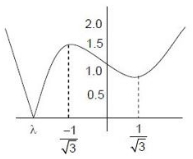
0 likesView Solution
254
MathematicsDifficultMCQJEE Main · 2019
If $A$ is a symmetric matrix and $B$ is a skew-symmetric matrix such that $A + B = \begin{bmatrix} 2 & 3 \\ 5 & -1 \end{bmatrix}$,then $AB$ is equal to
A
$\begin{bmatrix} 4 & -2 \\ 1 & -4 \end{bmatrix}$
B
$\begin{bmatrix} 4 & -2 \\ -1 & -4 \end{bmatrix}$
C
$\begin{bmatrix} -4 & 2 \\ 1 & 4 \end{bmatrix}$
D
$\begin{bmatrix} -4 & -2 \\ -1 & 4 \end{bmatrix}$
Solution
(B) Given that $A$ is a symmetric matrix,$A^T = A$.
Given that $B$ is a skew-symmetric matrix,$B^T = -B$.
We are given $A + B = \begin{bmatrix} 2 & 3 \\ 5 & -1 \end{bmatrix} \quad (1)$.
Taking the transpose of both sides:
$(A + B)^T = \begin{bmatrix} 2 & 3 \\ 5 & -1 \end{bmatrix}^T \implies A^T + B^T = \begin{bmatrix} 2 & 5 \\ 3 & -1 \end{bmatrix}$.
Substituting $A^T = A$ and $B^T = -B$,we get $A - B = \begin{bmatrix} 2 & 5 \\ 3 & -1 \end{bmatrix} \quad (2)$.
Adding equations $(1)$ and $(2)$:
$2A = \begin{bmatrix} 2+2 & 3+5 \\ 5+3 & -1-1 \end{bmatrix} = \begin{bmatrix} 4 & 8 \\ 8 & -2 \end{bmatrix} \implies A = \begin{bmatrix} 2 & 4 \\ 4 & -1 \end{bmatrix}$.
Subtracting equation $(2)$ from $(1)$:
$2B = \begin{bmatrix} 2-2 & 3-5 \\ 5-3 & -1-(-1) \end{bmatrix} = \begin{bmatrix} 0 & -2 \\ 2 & 0 \end{bmatrix} \implies B = \begin{bmatrix} 0 & -1 \\ 1 & 0 \end{bmatrix}$.
Now,calculating $AB$:
$AB = \begin{bmatrix} 2 & 4 \\ 4 & -1 \end{bmatrix} \begin{bmatrix} 0 & -1 \\ 1 & 0 \end{bmatrix} = \begin{bmatrix} (2)(0) + (4)(1) & (2)(-1) + (4)(0) \\ (4)(0) + (-1)(1) & (4)(-1) + (-1)(0) \end{bmatrix} = \begin{bmatrix} 4 & -2 \\ -1 & -4 \end{bmatrix}$.
Given that $B$ is a skew-symmetric matrix,$B^T = -B$.
We are given $A + B = \begin{bmatrix} 2 & 3 \\ 5 & -1 \end{bmatrix} \quad (1)$.
Taking the transpose of both sides:
$(A + B)^T = \begin{bmatrix} 2 & 3 \\ 5 & -1 \end{bmatrix}^T \implies A^T + B^T = \begin{bmatrix} 2 & 5 \\ 3 & -1 \end{bmatrix}$.
Substituting $A^T = A$ and $B^T = -B$,we get $A - B = \begin{bmatrix} 2 & 5 \\ 3 & -1 \end{bmatrix} \quad (2)$.
Adding equations $(1)$ and $(2)$:
$2A = \begin{bmatrix} 2+2 & 3+5 \\ 5+3 & -1-1 \end{bmatrix} = \begin{bmatrix} 4 & 8 \\ 8 & -2 \end{bmatrix} \implies A = \begin{bmatrix} 2 & 4 \\ 4 & -1 \end{bmatrix}$.
Subtracting equation $(2)$ from $(1)$:
$2B = \begin{bmatrix} 2-2 & 3-5 \\ 5-3 & -1-(-1) \end{bmatrix} = \begin{bmatrix} 0 & -2 \\ 2 & 0 \end{bmatrix} \implies B = \begin{bmatrix} 0 & -1 \\ 1 & 0 \end{bmatrix}$.
Now,calculating $AB$:
$AB = \begin{bmatrix} 2 & 4 \\ 4 & -1 \end{bmatrix} \begin{bmatrix} 0 & -1 \\ 1 & 0 \end{bmatrix} = \begin{bmatrix} (2)(0) + (4)(1) & (2)(-1) + (4)(0) \\ (4)(0) + (-1)(1) & (4)(-1) + (-1)(0) \end{bmatrix} = \begin{bmatrix} 4 & -2 \\ -1 & -4 \end{bmatrix}$.
0 likesView Solution
255
MathematicsDifficultMCQJEE Main · 2019
The general solution of the differential equation $(y^2 - x^3) dx - xy dy = 0, (x \neq 0)$ is (where $c$ is a constant of integration)
A
$y^2 + 2x^3 + cx^2 = 0$
B
$y^2 - 2x^3 + cx^2 = 0$
C
$y^2 + 2x^2 + cx^3 = 0$
D
$y^2 - 2x^2 + cx^3 = 0$
Solution
(B) Given differential equation: $(y^2 - x^3) dx - xy dy = 0$
Divide by $dx$ (assuming $dx \neq 0$):
$y^2 - x^3 - xy \frac{dy}{dx} = 0$
$xy \frac{dy}{dx} - y^2 = -x^3$
Divide by $x$:
$y \frac{dy}{dx} - \frac{1}{x} y^2 = -x^2$ ......$(i)$
Let $y^2 = v$,then $2y \frac{dy}{dx} = \frac{dv}{dx}$,so $y \frac{dy}{dx} = \frac{1}{2} \frac{dv}{dx}$.
Substituting into $(i)$:
$\frac{1}{2} \frac{dv}{dx} - \frac{1}{x} v = -x^2$
$\frac{dv}{dx} - \frac{2}{x} v = -2x^2$ ......$(ii)$
This is a linear differential equation of the form $\frac{dv}{dx} + P(x)v = Q(x)$,where $P(x) = -\frac{2}{x}$ and $Q(x) = -2x^2$.
Integrating factor $I.F. = e^{\int P(x) dx} = e^{\int -\frac{2}{x} dx} = e^{-2 \ln |x|} = x^{-2} = \frac{1}{x^2}$.
The solution is $v \cdot I.F. = \int Q(x) \cdot I.F. dx + c$.
$v \cdot \frac{1}{x^2} = \int (-2x^2) \cdot \frac{1}{x^2} dx + c$
$\frac{v}{x^2} = \int -2 dx + c$
$\frac{v}{x^2} = -2x + c$
Since $v = y^2$,we have $\frac{y^2}{x^2} = -2x + c$.
$y^2 = -2x^3 + cx^2$,which implies $y^2 - 2x^3 + cx^2 = 0$.
Thus,the correct option is $B$.
Divide by $dx$ (assuming $dx \neq 0$):
$y^2 - x^3 - xy \frac{dy}{dx} = 0$
$xy \frac{dy}{dx} - y^2 = -x^3$
Divide by $x$:
$y \frac{dy}{dx} - \frac{1}{x} y^2 = -x^2$ ......$(i)$
Let $y^2 = v$,then $2y \frac{dy}{dx} = \frac{dv}{dx}$,so $y \frac{dy}{dx} = \frac{1}{2} \frac{dv}{dx}$.
Substituting into $(i)$:
$\frac{1}{2} \frac{dv}{dx} - \frac{1}{x} v = -x^2$
$\frac{dv}{dx} - \frac{2}{x} v = -2x^2$ ......$(ii)$
This is a linear differential equation of the form $\frac{dv}{dx} + P(x)v = Q(x)$,where $P(x) = -\frac{2}{x}$ and $Q(x) = -2x^2$.
Integrating factor $I.F. = e^{\int P(x) dx} = e^{\int -\frac{2}{x} dx} = e^{-2 \ln |x|} = x^{-2} = \frac{1}{x^2}$.
The solution is $v \cdot I.F. = \int Q(x) \cdot I.F. dx + c$.
$v \cdot \frac{1}{x^2} = \int (-2x^2) \cdot \frac{1}{x^2} dx + c$
$\frac{v}{x^2} = \int -2 dx + c$
$\frac{v}{x^2} = -2x + c$
Since $v = y^2$,we have $\frac{y^2}{x^2} = -2x + c$.
$y^2 = -2x^3 + cx^2$,which implies $y^2 - 2x^3 + cx^2 = 0$.
Thus,the correct option is $B$.
0 likesView Solution
256
MathematicsDifficultMCQJEE Main · 2019
Let $\alpha \in \mathbb{R}$ and the three vectors $\vec{a} = \alpha \hat{i} + \hat{j} + 3\hat{k}$,$\vec{b} = 2\hat{i} + \hat{j} - \alpha \hat{k}$,and $\vec{c} = \alpha \hat{i} - 2\hat{j} + 3\hat{k}$. Then the set $S = \{ \alpha : \vec{a}, \vec{b}, \text{ and } \vec{c} \text{ are coplanar} \}$
A
Contains exactly two numbers only one of which is positive
B
is empty
C
Contains exactly two positive numbers
D
is singleton
Solution
(B) Three vectors $\vec{a}, \vec{b}, \text{ and } \vec{c}$ are coplanar if and only if their scalar triple product is zero,i.e.,$[\vec{a} \vec{b} \vec{c}] = 0$.
The scalar triple product is given by the determinant of the components:
$\begin{vmatrix} \alpha & 1 & 3 \\ 2 & 1 & -\alpha \\ \alpha & -2 & 3 \end{vmatrix} = 0$
Expanding along the first row:
$\alpha(1(3) - (-2)(-\alpha)) - 1(2(3) - \alpha(-\alpha)) + 3(2(-2) - \alpha(1)) = 0$
$\alpha(3 - 2\alpha) - 1(6 + \alpha^2) + 3(-4 - \alpha) = 0$
$3\alpha - 2\alpha^2 - 6 - \alpha^2 - 12 - 3\alpha = 0$
$-3\alpha^2 - 18 = 0$
$-3(\alpha^2 + 6) = 0$
$\alpha^2 + 6 = 0$
Since $\alpha \in \mathbb{R}$,$\alpha^2$ must be non-negative,so $\alpha^2 + 6 \geq 6$. Thus,there is no real value of $\alpha$ that satisfies this equation.
Therefore,the set $S$ is an empty set.
The scalar triple product is given by the determinant of the components:
$\begin{vmatrix} \alpha & 1 & 3 \\ 2 & 1 & -\alpha \\ \alpha & -2 & 3 \end{vmatrix} = 0$
Expanding along the first row:
$\alpha(1(3) - (-2)(-\alpha)) - 1(2(3) - \alpha(-\alpha)) + 3(2(-2) - \alpha(1)) = 0$
$\alpha(3 - 2\alpha) - 1(6 + \alpha^2) + 3(-4 - \alpha) = 0$
$3\alpha - 2\alpha^2 - 6 - \alpha^2 - 12 - 3\alpha = 0$
$-3\alpha^2 - 18 = 0$
$-3(\alpha^2 + 6) = 0$
$\alpha^2 + 6 = 0$
Since $\alpha \in \mathbb{R}$,$\alpha^2$ must be non-negative,so $\alpha^2 + 6 \geq 6$. Thus,there is no real value of $\alpha$ that satisfies this equation.
Therefore,the set $S$ is an empty set.
0 likesView Solution
257
MathematicsDifficultMCQJEE Main · 2019
Let $\alpha \in (0, \pi /2)$ be fixed. If the integral $\int \frac{\tan x + \tan \alpha}{\tan x - \tan \alpha} dx = A(x) \cos 2\alpha + B(x) \sin 2\alpha + C$,where $C$ is a constant of integration,then the functions $A(x)$ and $B(x)$ are respectively:
A
$x + \alpha$ and $\log_e |\sin (x - \alpha)|$
B
$x - \alpha$ and $\log_e |\cos (x - \alpha)|$
C
$x - \alpha$ and $\log_e |\sin (x - \alpha)|$
D
$x + \alpha$ and $\log_e |\sin (x + \alpha)|$
Solution
(C) We are given the integral $I = \int \frac{\tan x + \tan \alpha}{\tan x - \tan \alpha} dx$.
Using the identity $\tan x \pm \tan \alpha = \frac{\sin(x \pm \alpha)}{\cos x \cos \alpha}$,we have:
$I = \int \frac{\sin(x + \alpha) / (\cos x \cos \alpha)}{\sin(x - \alpha) / (\cos x \cos \alpha)} dx = \int \frac{\sin(x + \alpha)}{\sin(x - \alpha)} dx$.
Let $t = x - \alpha$,then $x = t + \alpha$ and $dx = dt$. Substituting these into the integral:
$I = \int \frac{\sin(t + 2\alpha)}{\sin t} dt$.
Using the expansion $\sin(t + 2\alpha) = \sin t \cos 2\alpha + \cos t \sin 2\alpha$:
$I = \int \frac{\sin t \cos 2\alpha + \cos t \sin 2\alpha}{\sin t} dt$
$I = \int \cos 2\alpha dt + \int \cot t \sin 2\alpha dt$
$I = t \cos 2\alpha + \sin 2\alpha \ln |\sin t| + C$.
Substituting $t = x - \alpha$ back:
$I = (x - \alpha) \cos 2\alpha + \ln |\sin (x - \alpha)| \sin 2\alpha + C$.
Comparing this with $A(x) \cos 2\alpha + B(x) \sin 2\alpha + C$,we get $A(x) = x - \alpha$ and $B(x) = \ln |\sin (x - \alpha)|$.
Thus,the correct option is $(C)$.
Using the identity $\tan x \pm \tan \alpha = \frac{\sin(x \pm \alpha)}{\cos x \cos \alpha}$,we have:
$I = \int \frac{\sin(x + \alpha) / (\cos x \cos \alpha)}{\sin(x - \alpha) / (\cos x \cos \alpha)} dx = \int \frac{\sin(x + \alpha)}{\sin(x - \alpha)} dx$.
Let $t = x - \alpha$,then $x = t + \alpha$ and $dx = dt$. Substituting these into the integral:
$I = \int \frac{\sin(t + 2\alpha)}{\sin t} dt$.
Using the expansion $\sin(t + 2\alpha) = \sin t \cos 2\alpha + \cos t \sin 2\alpha$:
$I = \int \frac{\sin t \cos 2\alpha + \cos t \sin 2\alpha}{\sin t} dt$
$I = \int \cos 2\alpha dt + \int \cot t \sin 2\alpha dt$
$I = t \cos 2\alpha + \sin 2\alpha \ln |\sin t| + C$.
Substituting $t = x - \alpha$ back:
$I = (x - \alpha) \cos 2\alpha + \ln |\sin (x - \alpha)| \sin 2\alpha + C$.
Comparing this with $A(x) \cos 2\alpha + B(x) \sin 2\alpha + C$,we get $A(x) = x - \alpha$ and $B(x) = \ln |\sin (x - \alpha)|$.
Thus,the correct option is $(C)$.
0 likesView Solution
258
MathematicsDifficultMCQJEE Main · 2019
If the area (in sq. units) bounded by the parabola $y^2 = 4\lambda x$ and the line $y = \lambda x$,$\lambda > 0$,is $\frac{1}{9}$,then $\lambda$ is equal to
A
$48$
B
$4\sqrt{3}$
C
$2\sqrt{6}$
D
$24$
Solution
(D) Given the equations of the parabola $y^2 = 4\lambda x$ and the line $y = \lambda x$.
To find the points of intersection,substitute $y = \lambda x$ into the parabola equation:
$(\lambda x)^2 = 4\lambda x$
$\lambda^2 x^2 - 4\lambda x = 0$
$\lambda x(\lambda x - 4) = 0$
Since $\lambda > 0$,we have $x = 0$ and $x = \frac{4}{\lambda}$.
The area bounded by the curves is given by:
$A = \int_{0}^{4/\lambda} (\sqrt{4\lambda x} - \lambda x) dx = \frac{1}{9}$
$A = 2\sqrt{\lambda} \int_{0}^{4/\lambda} \sqrt{x} dx - \lambda \int_{0}^{4/\lambda} x dx$
$A = 2\sqrt{\lambda} \left[ \frac{x^{3/2}}{3/2} \right]_{0}^{4/\lambda} - \lambda \left[ \frac{x^2}{2} \right]_{0}^{4/\lambda}$
$A = \frac{4}{3} \sqrt{\lambda} \left( \frac{4}{\lambda} \right)^{3/2} - \frac{\lambda}{2} \left( \frac{4}{\lambda} \right)^2$
$A = \frac{4}{3} \sqrt{\lambda} \cdot \frac{8}{\lambda \sqrt{\lambda}} - \frac{\lambda}{2} \cdot \frac{16}{\lambda^2}$
$A = \frac{32}{3\lambda} - \frac{8}{\lambda} = \frac{32 - 24}{3\lambda} = \frac{8}{3\lambda}$
Given $A = \frac{1}{9}$,we have:
$\frac{8}{3\lambda} = \frac{1}{9}$
$3\lambda = 72$
$\lambda = 24$
To find the points of intersection,substitute $y = \lambda x$ into the parabola equation:
$(\lambda x)^2 = 4\lambda x$
$\lambda^2 x^2 - 4\lambda x = 0$
$\lambda x(\lambda x - 4) = 0$
Since $\lambda > 0$,we have $x = 0$ and $x = \frac{4}{\lambda}$.
The area bounded by the curves is given by:
$A = \int_{0}^{4/\lambda} (\sqrt{4\lambda x} - \lambda x) dx = \frac{1}{9}$
$A = 2\sqrt{\lambda} \int_{0}^{4/\lambda} \sqrt{x} dx - \lambda \int_{0}^{4/\lambda} x dx$
$A = 2\sqrt{\lambda} \left[ \frac{x^{3/2}}{3/2} \right]_{0}^{4/\lambda} - \lambda \left[ \frac{x^2}{2} \right]_{0}^{4/\lambda}$
$A = \frac{4}{3} \sqrt{\lambda} \left( \frac{4}{\lambda} \right)^{3/2} - \frac{\lambda}{2} \left( \frac{4}{\lambda} \right)^2$
$A = \frac{4}{3} \sqrt{\lambda} \cdot \frac{8}{\lambda \sqrt{\lambda}} - \frac{\lambda}{2} \cdot \frac{16}{\lambda^2}$
$A = \frac{32}{3\lambda} - \frac{8}{\lambda} = \frac{32 - 24}{3\lambda} = \frac{8}{3\lambda}$
Given $A = \frac{1}{9}$,we have:
$\frac{8}{3\lambda} = \frac{1}{9}$
$3\lambda = 72$
$\lambda = 24$
0 likesView Solution
259
MathematicsDifficultMCQJEE Main · 2019
If $[x]$ denotes the greatest integer $\leq x$,then the system of linear equations
$[\sin \theta ] x + [-\cos \theta ] y = 0$
$[\cot \theta ] x + y = 0$
$[\sin \theta ] x + [-\cos \theta ] y = 0$
$[\cot \theta ] x + y = 0$
A
have infinitely many solutions if $\theta \in \left( {\frac{\pi }{2},\frac{{2\pi }}{3}} \right)$ and has a unique solution if $\theta \in \left( {\pi ,\frac{{7\pi }}{6}} \right)$
B
have infinitely many solutions if $\theta \in \left( {\frac{\pi }{2},\frac{{2\pi }}{3}} \right) \cup \left( {\pi ,\frac{{7\pi }}{6}} \right)$
C
has a unique solution if $\theta \in \left( {\frac{\pi }{2},\frac{{2\pi }}{3}} \right)$ and have infinitely many solutions if $\theta \in \left( {\pi ,\frac{{7\pi }}{6}} \right)$
D
has a unique solution if $\theta \in \left( {\frac{\pi }{2},\frac{{2\pi }}{3}} \right) \cup \left( {\pi ,\frac{{7\pi }}{6}} \right)$
Solution
(A) The given system of equations is:
$[\sin \theta ]x + [-\cos \theta ]y = 0 \dots (1)$
$[\cot \theta ]x + y = 0 \dots (2)$
Case $I$: When $\theta \in \left( \frac{\pi }{2}, \frac{2\pi }{3} \right)$
$\sin \theta \in \left( \frac{\sqrt{3}}{2}, 1 \right) \implies [\sin \theta ] = 0$
$-\cos \theta \in \left( 0, \frac{1}{2} \right) \implies [-\cos \theta ] = 0$
$\cot \theta \in \left( -\frac{1}{\sqrt{3}}, 0 \right) \implies [\cot \theta ] = -1$
Substituting these into the equations:
$0x + 0y = 0$
$-x + y = 0$
The first equation is satisfied for all $(x, y)$,and the second implies $y = x$. Thus,the system has infinitely many solutions.
Case $II$: When $\theta \in \left( \pi, \frac{7\pi}{6} \right)$
$\sin \theta \in \left( -\frac{1}{2}, 0 \right) \implies [\sin \theta ] = -1$
$-\cos \theta \in \left( -\frac{\sqrt{3}}{2}, 1 \right) \implies [-\cos \theta ] = 0$
$\cot \theta \in (\sqrt{3}, \infty) \implies [\cot \theta ] = k$,where $k \in \{1, 2, 3, \dots\}$
Substituting these into the equations:
$-x + 0y = 0 \implies x = 0$
$kx + y = 0 \implies k(0) + y = 0 \implies y = 0$
Thus,the system has a unique solution $(0, 0)$.
$[\sin \theta ]x + [-\cos \theta ]y = 0 \dots (1)$
$[\cot \theta ]x + y = 0 \dots (2)$
Case $I$: When $\theta \in \left( \frac{\pi }{2}, \frac{2\pi }{3} \right)$
$\sin \theta \in \left( \frac{\sqrt{3}}{2}, 1 \right) \implies [\sin \theta ] = 0$
$-\cos \theta \in \left( 0, \frac{1}{2} \right) \implies [-\cos \theta ] = 0$
$\cot \theta \in \left( -\frac{1}{\sqrt{3}}, 0 \right) \implies [\cot \theta ] = -1$
Substituting these into the equations:
$0x + 0y = 0$
$-x + y = 0$
The first equation is satisfied for all $(x, y)$,and the second implies $y = x$. Thus,the system has infinitely many solutions.
Case $II$: When $\theta \in \left( \pi, \frac{7\pi}{6} \right)$
$\sin \theta \in \left( -\frac{1}{2}, 0 \right) \implies [\sin \theta ] = -1$
$-\cos \theta \in \left( -\frac{\sqrt{3}}{2}, 1 \right) \implies [-\cos \theta ] = 0$
$\cot \theta \in (\sqrt{3}, \infty) \implies [\cot \theta ] = k$,where $k \in \{1, 2, 3, \dots\}$
Substituting these into the equations:
$-x + 0y = 0 \implies x = 0$
$kx + y = 0 \implies k(0) + y = 0 \implies y = 0$
Thus,the system has a unique solution $(0, 0)$.
0 likesView Solution
260
MathematicsDifficultMCQJEE Main · 2019
For an initial screening of an admission test,a candidate is given $50$ problems to solve. If the probability that the candidate can solve any problem is $\frac{4}{5}$,then the probability that he is unable to solve less than two problems is
A
$\frac{164}{25} \left( \frac{1}{5} \right)^{48}$
B
$\frac{201}{5} \left( \frac{1}{5} \right)^{49}$
C
$\frac{54}{5} \left( \frac{4}{5} \right)^{49}$
D
$\frac{316}{25} \left( \frac{4}{5} \right)^{48}$
Solution
(C) Let $n = 50$ be the total number of problems.
Let $p$ be the probability of solving a problem,so $p = \frac{4}{5}$.
Let $q$ be the probability of not solving a problem,so $q = 1 - p = \frac{1}{5}$.
We want to find the probability that the candidate is unable to solve less than two problems,which means the number of problems not solved $(X)$ is $0$ or $1$.
Using the binomial distribution formula $P(X = k) = ^{n}C_{k} q^{k} p^{n-k}$:
$P(X < 2) = P(X = 0) + P(X = 1)$
$P(X = 0) = ^{50}C_{0} \left( \frac{1}{5} \right)^{0} \left( \frac{4}{5} \right)^{50} = 1 \cdot 1 \cdot \left( \frac{4}{5} \right)^{50} = \left( \frac{4}{5} \right)^{50}$
$P(X = 1) = ^{50}C_{1} \left( \frac{1}{5} \right)^{1} \left( \frac{4}{5} \right)^{49} = 50 \cdot \frac{1}{5} \cdot \left( \frac{4}{5} \right)^{49} = 10 \cdot \left( \frac{4}{5} \right)^{49}$
Summing these probabilities:
$P(X < 2) = \left( \frac{4}{5} \right)^{50} + 10 \cdot \left( \frac{4}{5} \right)^{49}$
$= \left( \frac{4}{5} \right)^{49} \left( \frac{4}{5} + 10 \right)$
$= \left( \frac{4}{5} \right)^{49} \left( \frac{4 + 50}{5} \right)$
$= \frac{54}{5} \left( \frac{4}{5} \right)^{49}$
Let $p$ be the probability of solving a problem,so $p = \frac{4}{5}$.
Let $q$ be the probability of not solving a problem,so $q = 1 - p = \frac{1}{5}$.
We want to find the probability that the candidate is unable to solve less than two problems,which means the number of problems not solved $(X)$ is $0$ or $1$.
Using the binomial distribution formula $P(X = k) = ^{n}C_{k} q^{k} p^{n-k}$:
$P(X < 2) = P(X = 0) + P(X = 1)$
$P(X = 0) = ^{50}C_{0} \left( \frac{1}{5} \right)^{0} \left( \frac{4}{5} \right)^{50} = 1 \cdot 1 \cdot \left( \frac{4}{5} \right)^{50} = \left( \frac{4}{5} \right)^{50}$
$P(X = 1) = ^{50}C_{1} \left( \frac{1}{5} \right)^{1} \left( \frac{4}{5} \right)^{49} = 50 \cdot \frac{1}{5} \cdot \left( \frac{4}{5} \right)^{49} = 10 \cdot \left( \frac{4}{5} \right)^{49}$
Summing these probabilities:
$P(X < 2) = \left( \frac{4}{5} \right)^{50} + 10 \cdot \left( \frac{4}{5} \right)^{49}$
$= \left( \frac{4}{5} \right)^{49} \left( \frac{4}{5} + 10 \right)$
$= \left( \frac{4}{5} \right)^{49} \left( \frac{4 + 50}{5} \right)$
$= \frac{54}{5} \left( \frac{4}{5} \right)^{49}$
0 likesView Solution
261
MathematicsDifficultMCQJEE Main · 2019
The length of the perpendicular drawn from the point $(2, 1, 4)$ to the plane containing the lines $\vec r = (\hat i + \hat j) + \lambda (\hat i + 2\hat j - \hat k)$ and $\vec r = (\hat i + \hat j) + \mu (-\hat i + \hat j - 2\hat k)$ is
A
$\frac{1}{3}$
B
$\sqrt{3}$
C
$\frac{1}{\sqrt{3}}$
D
$3$
Solution
(B) The plane contains the point $(1, 1, 0)$ and is parallel to the vectors $\vec{b_1} = \hat{i} + 2\hat{j} - \hat{k}$ and $\vec{b_2} = -\hat{i} + \hat{j} - 2\hat{k}$.
The normal vector to the plane is $\vec{n} = \vec{b_1} \times \vec{b_2} = \begin{vmatrix} \hat{i} & \hat{j} & \hat{k} \\ 1 & 2 & -1 \\ -1 & 1 & -2 \end{vmatrix} = \hat{i}(-4+1) - \hat{j}(-2-1) + \hat{k}(1+2) = -3\hat{i} + 3\hat{j} + 3\hat{k}$.
Dividing by $-3$,we can take the normal vector as $\vec{n} = \hat{i} - \hat{j} - \hat{k}$.
The equation of the plane is $1(x-1) - 1(y-1) - 1(z-0) = 0$,which simplifies to $x - y - z = 0$.
The perpendicular distance from the point $(2, 1, 4)$ to the plane $x - y - z = 0$ is given by $d = \frac{|2 - 1 - 4|}{\sqrt{1^2 + (-1)^2 + (-1)^2}} = \frac{|-3|}{\sqrt{3}} = \sqrt{3}$.
The normal vector to the plane is $\vec{n} = \vec{b_1} \times \vec{b_2} = \begin{vmatrix} \hat{i} & \hat{j} & \hat{k} \\ 1 & 2 & -1 \\ -1 & 1 & -2 \end{vmatrix} = \hat{i}(-4+1) - \hat{j}(-2-1) + \hat{k}(1+2) = -3\hat{i} + 3\hat{j} + 3\hat{k}$.
Dividing by $-3$,we can take the normal vector as $\vec{n} = \hat{i} - \hat{j} - \hat{k}$.
The equation of the plane is $1(x-1) - 1(y-1) - 1(z-0) = 0$,which simplifies to $x - y - z = 0$.
The perpendicular distance from the point $(2, 1, 4)$ to the plane $x - y - z = 0$ is given by $d = \frac{|2 - 1 - 4|}{\sqrt{1^2 + (-1)^2 + (-1)^2}} = \frac{|-3|}{\sqrt{3}} = \sqrt{3}$.
0 likesView Solution
262
MathematicsDifficultMCQJEE Main · 2019
$A$ person throws two fair dice. He wins $Rs.\, 15$ for throwing a doublet (same numbers on the two dice),wins $Rs.\, 12$ when the throw results in the sum of $9$,and loses $Rs.\, 6$ for any other outcome on the throw. Then the expected gain/loss (in $Rs.$) of the person is
A
$\frac{1}{4}$ loss
B
$2$ gain
C
$\frac{1}{2}$ gain
D
$\frac{1}{2}$ loss
Solution
(D) The total number of outcomes when throwing two dice is $6 \times 6 = 36$.
$1$. For a doublet: The outcomes are $(1,1), (2,2), (3,3), (4,4), (5,5), (6,6)$. There are $6$ such outcomes.
Probability $P(\text{doublet}) = \frac{6}{36}$. Gain $= +15$.
$2$. For a sum of $9$: The outcomes are $(3,6), (4,5), (5,4), (6,3)$. There are $4$ such outcomes.
Probability $P(\text{sum } 9) = \frac{4}{36}$. Gain $= +12$.
$3$. For any other outcome: The number of outcomes is $36 - (6 + 4) = 26$.
Probability $P(\text{other}) = \frac{26}{36}$. Loss $= -6$.
Expected value $E(X) = \sum x_i p_i = (15 \times \frac{6}{36}) + (12 \times \frac{4}{36}) + (-6 \times \frac{26}{36})$
$E(X) = \frac{90}{36} + \frac{48}{36} - \frac{156}{36} = \frac{90 + 48 - 156}{36} = \frac{-18}{36} = -\frac{1}{2}$.
Since the result is negative,it represents a loss of $\frac{1}{2}$ $Rs$.
Thus,the correct option is $(D)$.
$1$. For a doublet: The outcomes are $(1,1), (2,2), (3,3), (4,4), (5,5), (6,6)$. There are $6$ such outcomes.
Probability $P(\text{doublet}) = \frac{6}{36}$. Gain $= +15$.
$2$. For a sum of $9$: The outcomes are $(3,6), (4,5), (5,4), (6,3)$. There are $4$ such outcomes.
Probability $P(\text{sum } 9) = \frac{4}{36}$. Gain $= +12$.
$3$. For any other outcome: The number of outcomes is $36 - (6 + 4) = 26$.
Probability $P(\text{other}) = \frac{26}{36}$. Loss $= -6$.
Expected value $E(X) = \sum x_i p_i = (15 \times \frac{6}{36}) + (12 \times \frac{4}{36}) + (-6 \times \frac{26}{36})$
$E(X) = \frac{90}{36} + \frac{48}{36} - \frac{156}{36} = \frac{90 + 48 - 156}{36} = \frac{-18}{36} = -\frac{1}{2}$.
Since the result is negative,it represents a loss of $\frac{1}{2}$ $Rs$.
Thus,the correct option is $(D)$.
0 likesView Solution
263
MathematicsDifficultMCQJEE Main · 2019
The derivative of ${\tan ^{ - 1}}\left( {\frac{{\sin x - \cos x}}{{\sin x + \cos x}}} \right)$ with respect to $\frac{x}{2}$,where $x \in \left( {0, \frac{\pi }{2}} \right)$,is
A
$2$
B
$\frac{1}{2}$
C
$1$
D
$\frac{2}{3}$
Solution
(A) Let $y = {\tan ^{ - 1}}\left( {\frac{{\sin x - \cos x}}{{\sin x + \cos x}}} \right)$.
Dividing numerator and denominator by $\cos x$,we get:
$y = {\tan ^{ - 1}}\left( {\frac{{\tan x - 1}}{{\tan x + 1}}} \right) = {\tan ^{ - 1}}\left( {\frac{{\tan x - \tan(\frac{\pi}{4})}}{{1 + \tan x \cdot \tan(\frac{\pi}{4})}}} \right)$.
Using the formula $\tan(A - B) = \frac{\tan A - \tan B}{1 + \tan A \tan B}$,we have:
$y = {\tan ^{ - 1}}\left( {\tan \left( {x - \frac{\pi }{4}} \right)} \right)$.
Since $x \in \left( {0, \frac{\pi }{2}} \right)$,then $x - \frac{\pi }{4} \in \left( {-\frac{\pi }{4}, \frac{\pi }{4}} \right)$,which is within the principal range of $\tan^{-1}$.
Thus,$y = x - \frac{\pi }{4}$.
Now,we need to find the derivative of $y$ with respect to $u = \frac{x}{2}$.
Since $u = \frac{x}{2}$,we have $x = 2u$.
Substituting $x$ in $y$,we get $y = 2u - \frac{\pi }{4}$.
Therefore,$\frac{dy}{du} = \frac{d}{du}(2u - \frac{\pi }{4}) = 2$.
Dividing numerator and denominator by $\cos x$,we get:
$y = {\tan ^{ - 1}}\left( {\frac{{\tan x - 1}}{{\tan x + 1}}} \right) = {\tan ^{ - 1}}\left( {\frac{{\tan x - \tan(\frac{\pi}{4})}}{{1 + \tan x \cdot \tan(\frac{\pi}{4})}}} \right)$.
Using the formula $\tan(A - B) = \frac{\tan A - \tan B}{1 + \tan A \tan B}$,we have:
$y = {\tan ^{ - 1}}\left( {\tan \left( {x - \frac{\pi }{4}} \right)} \right)$.
Since $x \in \left( {0, \frac{\pi }{2}} \right)$,then $x - \frac{\pi }{4} \in \left( {-\frac{\pi }{4}, \frac{\pi }{4}} \right)$,which is within the principal range of $\tan^{-1}$.
Thus,$y = x - \frac{\pi }{4}$.
Now,we need to find the derivative of $y$ with respect to $u = \frac{x}{2}$.
Since $u = \frac{x}{2}$,we have $x = 2u$.
Substituting $x$ in $y$,we get $y = 2u - \frac{\pi }{4}$.
Therefore,$\frac{dy}{du} = \frac{d}{du}(2u - \frac{\pi }{4}) = 2$.
0 likesView Solution
264
MathematicsDifficultMCQJEE Main · 2019
$A$ plane which bisects the angle between the two given planes $2x - y + 2z - 4 = 0$ and $x + 2y + 2z - 2 = 0$,passes through the point
A
$(1, 4, -1)$
B
$(2, -4, 1)$
C
$(2, 4, 1)$
D
$(1, -4, 1)$
Solution
(B) The equation of the angle bisectors of two planes $A_1x + B_1y + C_1z + D_1 = 0$ and $A_2x + B_2y + C_2z + D_2 = 0$ is given by $\frac{A_1x + B_1y + C_1z + D_1}{\sqrt{A_1^2 + B_1^2 + C_1^2}} = \pm \frac{A_2x + B_2y + C_2z + D_2}{\sqrt{A_2^2 + B_2^2 + C_2^2}}$.
For the given planes $2x - y + 2z - 4 = 0$ and $x + 2y + 2z - 2 = 0$,the equation is:
$\frac{2x - y + 2z - 4}{\sqrt{2^2 + (-1)^2 + 2^2}} = \pm \frac{x + 2y + 2z - 2}{\sqrt{1^2 + 2^2 + 2^2}}$
$\frac{2x - y + 2z - 4}{3} = \pm \frac{x + 2y + 2z - 2}{3}$
$2x - y + 2z - 4 = \pm(x + 2y + 2z - 2)$.
Case $I$ (Positive sign):
$2x - y + 2z - 4 = x + 2y + 2z - 2$
$x - 3y - 2 = 0$.
Case $II$ (Negative sign):
$2x - y + 2z - 4 = -(x + 2y + 2z - 2)$
$2x - y + 2z - 4 = -x - 2y - 2z + 2$
$3x + y + 4z - 6 = 0$.
Checking the options for equation $3x + y + 4z - 6 = 0$:
For $(2, -4, 1)$: $3(2) + (-4) + 4(1) - 6 = 6 - 4 + 4 - 6 = 0$. This satisfies the equation.
For the given planes $2x - y + 2z - 4 = 0$ and $x + 2y + 2z - 2 = 0$,the equation is:
$\frac{2x - y + 2z - 4}{\sqrt{2^2 + (-1)^2 + 2^2}} = \pm \frac{x + 2y + 2z - 2}{\sqrt{1^2 + 2^2 + 2^2}}$
$\frac{2x - y + 2z - 4}{3} = \pm \frac{x + 2y + 2z - 2}{3}$
$2x - y + 2z - 4 = \pm(x + 2y + 2z - 2)$.
Case $I$ (Positive sign):
$2x - y + 2z - 4 = x + 2y + 2z - 2$
$x - 3y - 2 = 0$.
Case $II$ (Negative sign):
$2x - y + 2z - 4 = -(x + 2y + 2z - 2)$
$2x - y + 2z - 4 = -x - 2y - 2z + 2$
$3x + y + 4z - 6 = 0$.
Checking the options for equation $3x + y + 4z - 6 = 0$:
For $(2, -4, 1)$: $3(2) + (-4) + 4(1) - 6 = 6 - 4 + 4 - 6 = 0$. This satisfies the equation.
0 likesView Solution
265
MathematicsDifficultMCQJEE Main · 2019
$A$ value of $\alpha$ such that $\int_{\alpha}^{\alpha+1} \frac{dx}{(x+\alpha)(x+\alpha+1)} = \log_{e}\left(\frac{9}{8}\right)$ is
A
$-\frac{1}{2}$
B
$-2$
C
$\frac{1}{2}$
D
$2$
Solution
(B) Given the integral $\int_{\alpha}^{\alpha+1} \frac{dx}{(x+\alpha)(x+\alpha+1)} = \log_{e}\left(\frac{9}{8}\right)$.
Using partial fractions,$\frac{1}{(x+\alpha)(x+\alpha+1)} = \frac{1}{x+\alpha} - \frac{1}{x+\alpha+1}$.
Integrating both terms:
$\int_{\alpha}^{\alpha+1} \left( \frac{1}{x+\alpha} - \frac{1}{x+\alpha+1} \right) dx = \left[ \log_{e}|x+\alpha| - \log_{e}|x+\alpha+1| \right]_{\alpha}^{\alpha+1} = \left[ \log_{e}\left| \frac{x+\alpha}{x+\alpha+1} \right| \right]_{\alpha}^{\alpha+1}$.
Evaluating at the limits:
$\log_{e}\left( \frac{2\alpha+1}{2\alpha+2} \right) - \log_{e}\left( \frac{2\alpha}{2\alpha+1} \right) = \log_{e}\left( \frac{(2\alpha+1)^2}{2\alpha(2\alpha+2)} \right) = \log_{e}\left( \frac{9}{8} \right)$.
Equating the arguments:
$\frac{(2\alpha+1)^2}{4\alpha(\alpha+1)} = \frac{9}{8} \Rightarrow 8(4\alpha^2 + 4\alpha + 1) = 9(4\alpha^2 + 4\alpha)$.
$32\alpha^2 + 32\alpha + 8 = 36\alpha^2 + 36\alpha \Rightarrow 4\alpha^2 + 4\alpha - 8 = 0$.
$\alpha^2 + \alpha - 2 = 0 \Rightarrow (\alpha+2)(\alpha-1) = 0$.
Thus,$\alpha = 1$ or $\alpha = -2$. Comparing with the options,the correct answer is $-2$.
Using partial fractions,$\frac{1}{(x+\alpha)(x+\alpha+1)} = \frac{1}{x+\alpha} - \frac{1}{x+\alpha+1}$.
Integrating both terms:
$\int_{\alpha}^{\alpha+1} \left( \frac{1}{x+\alpha} - \frac{1}{x+\alpha+1} \right) dx = \left[ \log_{e}|x+\alpha| - \log_{e}|x+\alpha+1| \right]_{\alpha}^{\alpha+1} = \left[ \log_{e}\left| \frac{x+\alpha}{x+\alpha+1} \right| \right]_{\alpha}^{\alpha+1}$.
Evaluating at the limits:
$\log_{e}\left( \frac{2\alpha+1}{2\alpha+2} \right) - \log_{e}\left( \frac{2\alpha}{2\alpha+1} \right) = \log_{e}\left( \frac{(2\alpha+1)^2}{2\alpha(2\alpha+2)} \right) = \log_{e}\left( \frac{9}{8} \right)$.
Equating the arguments:
$\frac{(2\alpha+1)^2}{4\alpha(\alpha+1)} = \frac{9}{8} \Rightarrow 8(4\alpha^2 + 4\alpha + 1) = 9(4\alpha^2 + 4\alpha)$.
$32\alpha^2 + 32\alpha + 8 = 36\alpha^2 + 36\alpha \Rightarrow 4\alpha^2 + 4\alpha - 8 = 0$.
$\alpha^2 + \alpha - 2 = 0 \Rightarrow (\alpha+2)(\alpha-1) = 0$.
Thus,$\alpha = 1$ or $\alpha = -2$. Comparing with the options,the correct answer is $-2$.
0 likesView Solution
266
MathematicsDifficultMCQJEE Main · 2019
$A$ value of $\theta \in (0, \pi /3)$,for which $\left| \begin{array}{ccc} 1 + \cos^2 \theta & \sin^2 \theta & 4 \cos 6\theta \\ \cos^2 \theta & 1 + \sin^2 \theta & 4 \cos 6\theta \\ \cos^2 \theta & \sin^2 \theta & 1 + 4 \cos 6\theta \end{array} \right| = 0$,is
A
$\frac{\pi }{18}$
B
$\frac{\pi }{9}$
C
$\frac{7\pi }{36}$
D
$\frac{7\pi }{24}$
Solution
(B) Given $\theta \in (0, \frac{\pi}{3})$.
Let the determinant be $\Delta = \left| \begin{array}{ccc} 1 + \cos^2 \theta & \sin^2 \theta & 4 \cos 6\theta \\ \cos^2 \theta & 1 + \sin^2 \theta & 4 \cos 6\theta \\ \cos^2 \theta & \sin^2 \theta & 1 + 4 \cos 6\theta \end{array} \right| = 0$.
Applying row operations $R_2 \to R_2 - R_1$ and $R_3 \to R_3 - R_1$:
$\Delta = \left| \begin{array}{ccc} 1 + \cos^2 \theta & \sin^2 \theta & 4 \cos 6\theta \\ -1 & 1 & 0 \\ -1 & 0 & 1 \end{array} \right| = 0$.
Applying column operation $C_1 \to C_1 + C_2$:
$\Delta = \left| \begin{array}{ccc} 1 + \cos^2 \theta + \sin^2 \theta & \sin^2 \theta & 4 \cos 6\theta \\ 0 & 1 & 0 \\ -1 & 0 & 1 \end{array} \right| = \left| \begin{array}{ccc} 2 & \sin^2 \theta & 4 \cos 6\theta \\ 0 & 1 & 0 \\ -1 & 0 & 1 \end{array} \right| = 0$.
Expanding along the first column:
$2(1 - 0) - 0 + (-1)(0 - 4 \cos 6\theta) = 0$.
$2 + 4 \cos 6\theta = 0$.
$4 \cos 6\theta = -2 \Rightarrow \cos 6\theta = -\frac{1}{2}$.
Since $\theta \in (0, \frac{\pi}{3})$,$6\theta \in (0, 2\pi)$.
$\cos 6\theta = -\frac{1}{2} \Rightarrow 6\theta = \frac{2\pi}{3}$ or $6\theta = \frac{4\pi}{3}$.
$\theta = \frac{\pi}{9}$ or $\theta = \frac{2\pi}{9}$.
Comparing with the options,$\theta = \frac{\pi}{9}$ is the correct value.
Let the determinant be $\Delta = \left| \begin{array}{ccc} 1 + \cos^2 \theta & \sin^2 \theta & 4 \cos 6\theta \\ \cos^2 \theta & 1 + \sin^2 \theta & 4 \cos 6\theta \\ \cos^2 \theta & \sin^2 \theta & 1 + 4 \cos 6\theta \end{array} \right| = 0$.
Applying row operations $R_2 \to R_2 - R_1$ and $R_3 \to R_3 - R_1$:
$\Delta = \left| \begin{array}{ccc} 1 + \cos^2 \theta & \sin^2 \theta & 4 \cos 6\theta \\ -1 & 1 & 0 \\ -1 & 0 & 1 \end{array} \right| = 0$.
Applying column operation $C_1 \to C_1 + C_2$:
$\Delta = \left| \begin{array}{ccc} 1 + \cos^2 \theta + \sin^2 \theta & \sin^2 \theta & 4 \cos 6\theta \\ 0 & 1 & 0 \\ -1 & 0 & 1 \end{array} \right| = \left| \begin{array}{ccc} 2 & \sin^2 \theta & 4 \cos 6\theta \\ 0 & 1 & 0 \\ -1 & 0 & 1 \end{array} \right| = 0$.
Expanding along the first column:
$2(1 - 0) - 0 + (-1)(0 - 4 \cos 6\theta) = 0$.
$2 + 4 \cos 6\theta = 0$.
$4 \cos 6\theta = -2 \Rightarrow \cos 6\theta = -\frac{1}{2}$.
Since $\theta \in (0, \frac{\pi}{3})$,$6\theta \in (0, 2\pi)$.
$\cos 6\theta = -\frac{1}{2} \Rightarrow 6\theta = \frac{2\pi}{3}$ or $6\theta = \frac{4\pi}{3}$.
$\theta = \frac{\pi}{9}$ or $\theta = \frac{2\pi}{9}$.
Comparing with the options,$\theta = \frac{\pi}{9}$ is the correct value.
0 likesView Solution
267
MathematicsEasyMCQJEE Main · 2019
If the tangent to the curve $y = \frac{x}{x^2-3}$,$x \in R, (x \neq \pm \sqrt{3})$ at a point $(\alpha, \beta) \neq (0,0)$ on it,is parallel to the line $2x + 6y - 11 = 0$,then
A
$|2\alpha + 6\beta| = 11$
B
$|6\alpha + 2\beta| = 9$
C
$|6\alpha + 2\beta| = 19$
D
$|2\alpha + 6\beta| = 19$
Solution
(C) Given the curve $y = \frac{x}{x^2-3}$.
Finding the derivative: $\frac{dy}{dx} = \frac{(x^2-3)(1) - x(2x)}{(x^2-3)^2} = \frac{x^2-3-2x^2}{(x^2-3)^2} = \frac{-(x^2+3)}{(x^2-3)^2}$.
The slope of the line $2x + 6y - 11 = 0$ is $m = -\frac{2}{6} = -\frac{1}{3}$.
Since the tangent is parallel to the line,the slope of the tangent at $(\alpha, \beta)$ is $-\frac{1}{3}$.
So,$\frac{-(\alpha^2+3)}{(\alpha^2-3)^2} = -\frac{1}{3} \Rightarrow 3(\alpha^2+3) = (\alpha^2-3)^2$.
Let $t = \alpha^2$. Then $3t + 9 = t^2 - 6t + 9 \Rightarrow t^2 - 9t = 0$.
Since $(\alpha, \beta) \neq (0,0)$,$\alpha^2 \neq 0$,so $\alpha^2 = 9$,which means $\alpha = \pm 3$.
If $\alpha = 3$,$\beta = \frac{3}{3^2-3} = \frac{3}{6} = \frac{1}{2}$.
If $\alpha = -3$,$\beta = \frac{-3}{(-3)^2-3} = \frac{-3}{6} = -\frac{1}{2}$.
Now,calculate $|6\alpha + 2\beta|$:
For $(\alpha, \beta) = (3, 1/2)$,$|6(3) + 2(1/2)| = |18 + 1| = 19$.
For $(\alpha, \beta) = (-3, -1/2)$,$|6(-3) + 2(-1/2)| = |-18 - 1| = |-19| = 19$.
Thus,$|6\alpha + 2\beta| = 19$.
Finding the derivative: $\frac{dy}{dx} = \frac{(x^2-3)(1) - x(2x)}{(x^2-3)^2} = \frac{x^2-3-2x^2}{(x^2-3)^2} = \frac{-(x^2+3)}{(x^2-3)^2}$.
The slope of the line $2x + 6y - 11 = 0$ is $m = -\frac{2}{6} = -\frac{1}{3}$.
Since the tangent is parallel to the line,the slope of the tangent at $(\alpha, \beta)$ is $-\frac{1}{3}$.
So,$\frac{-(\alpha^2+3)}{(\alpha^2-3)^2} = -\frac{1}{3} \Rightarrow 3(\alpha^2+3) = (\alpha^2-3)^2$.
Let $t = \alpha^2$. Then $3t + 9 = t^2 - 6t + 9 \Rightarrow t^2 - 9t = 0$.
Since $(\alpha, \beta) \neq (0,0)$,$\alpha^2 \neq 0$,so $\alpha^2 = 9$,which means $\alpha = \pm 3$.
If $\alpha = 3$,$\beta = \frac{3}{3^2-3} = \frac{3}{6} = \frac{1}{2}$.
If $\alpha = -3$,$\beta = \frac{-3}{(-3)^2-3} = \frac{-3}{6} = -\frac{1}{2}$.
Now,calculate $|6\alpha + 2\beta|$:
For $(\alpha, \beta) = (3, 1/2)$,$|6(3) + 2(1/2)| = |18 + 1| = 19$.
For $(\alpha, \beta) = (-3, -1/2)$,$|6(-3) + 2(-1/2)| = |-18 - 1| = |-19| = 19$.
Thus,$|6\alpha + 2\beta| = 19$.
0 likesView Solution
268
MathematicsEasyMCQJEE Main · 2019
The maximum value of the function $f(x)=3x^3-18x^2+27x-40$ on the set $S=\{x \in R : x^2+30 \leq 11x\}$ is
A
$-122$
B
$-222$
C
$222$
D
$122$
Solution
(D) Given the set $S = \{x \in R : x^2+30 \leq 11x\}$.
Solving the inequality: $x^2-11x+30 \leq 0$.
$(x-5)(x-6) \leq 0$,which implies $x \in [5, 6]$.
Now,consider the function $f(x) = 3x^3-18x^2+27x-40$.
Find the derivative: $f'(x) = 9x^2-36x+27 = 9(x^2-4x+3) = 9(x-1)(x-3)$.
For $x \in [5, 6]$,both $(x-1)$ and $(x-3)$ are positive,so $f'(x) > 0$.
Since $f'(x) > 0$ for all $x \in [5, 6]$,the function $f(x)$ is strictly increasing on the interval $[5, 6]$.
The maximum value occurs at the right endpoint $x = 6$.
$f(6) = 3(6)^3 - 18(6)^2 + 27(6) - 40 = 3(216) - 18(36) + 162 - 40 = 648 - 648 + 162 - 40 = 122$.
Solving the inequality: $x^2-11x+30 \leq 0$.
$(x-5)(x-6) \leq 0$,which implies $x \in [5, 6]$.
Now,consider the function $f(x) = 3x^3-18x^2+27x-40$.
Find the derivative: $f'(x) = 9x^2-36x+27 = 9(x^2-4x+3) = 9(x-1)(x-3)$.
For $x \in [5, 6]$,both $(x-1)$ and $(x-3)$ are positive,so $f'(x) > 0$.
Since $f'(x) > 0$ for all $x \in [5, 6]$,the function $f(x)$ is strictly increasing on the interval $[5, 6]$.
The maximum value occurs at the right endpoint $x = 6$.
$f(6) = 3(6)^3 - 18(6)^2 + 27(6) - 40 = 3(216) - 18(36) + 162 - 40 = 648 - 648 + 162 - 40 = 122$.
0 likesView Solution
269
MathematicsMediumMCQJEE Main · 2019
If the function $f$ defined on $\left(\frac{\pi}{6}, \frac{\pi}{3}\right)$ by $f(x)=\begin{cases} \frac{\sqrt{2} \cos x-1}{\cot x-1}, & x \neq \frac{\pi}{4} \\ k, & x=\frac{\pi}{4} \end{cases}$ is continuous,then $k$ is equal to
A
$\frac{1}{2}$
B
$2$
C
$1$
D
$\frac{1}{\sqrt{2}}$
Solution
(A) Since $f(x)$ is continuous on $\left(\frac{\pi}{6}, \frac{\pi}{3}\right)$,it must be continuous at $x=\frac{\pi}{4}$.
Therefore,$f\left(\frac{\pi}{4}\right) = \lim_{x \rightarrow \frac{\pi}{4}} f(x) = \lim_{x \rightarrow \frac{\pi}{4}} \frac{\sqrt{2} \cos x-1}{\cot x-1}$.
This is a $\frac{0}{0}$ indeterminate form.
Applying $L$'Hospital's rule,we differentiate the numerator and denominator with respect to $x$:
$k = \lim_{x \rightarrow \frac{\pi}{4}} \frac{\frac{d}{dx}(\sqrt{2} \cos x - 1)}{\frac{d}{dx}(\cot x - 1)} = \lim_{x \rightarrow \frac{\pi}{4}} \frac{-\sqrt{2} \sin x}{-\operatorname{cosec}^2 x} = \lim_{x \rightarrow \frac{\pi}{4}} \frac{\sqrt{2} \sin x}{\operatorname{cosec}^2 x}$.
Substituting $x = \frac{\pi}{4}$:
$k = \frac{\sqrt{2} \sin(\frac{\pi}{4})}{\operatorname{cosec}^2(\frac{\pi}{4})} = \frac{\sqrt{2} \cdot \frac{1}{\sqrt{2}}}{(\sqrt{2})^2} = \frac{1}{2}$.
Therefore,$f\left(\frac{\pi}{4}\right) = \lim_{x \rightarrow \frac{\pi}{4}} f(x) = \lim_{x \rightarrow \frac{\pi}{4}} \frac{\sqrt{2} \cos x-1}{\cot x-1}$.
This is a $\frac{0}{0}$ indeterminate form.
Applying $L$'Hospital's rule,we differentiate the numerator and denominator with respect to $x$:
$k = \lim_{x \rightarrow \frac{\pi}{4}} \frac{\frac{d}{dx}(\sqrt{2} \cos x - 1)}{\frac{d}{dx}(\cot x - 1)} = \lim_{x \rightarrow \frac{\pi}{4}} \frac{-\sqrt{2} \sin x}{-\operatorname{cosec}^2 x} = \lim_{x \rightarrow \frac{\pi}{4}} \frac{\sqrt{2} \sin x}{\operatorname{cosec}^2 x}$.
Substituting $x = \frac{\pi}{4}$:
$k = \frac{\sqrt{2} \sin(\frac{\pi}{4})}{\operatorname{cosec}^2(\frac{\pi}{4})} = \frac{\sqrt{2} \cdot \frac{1}{\sqrt{2}}}{(\sqrt{2})^2} = \frac{1}{2}$.
0 likesView Solution
270
MathematicsMediumMCQJEE Main · 2019
If $\int_{0}^{\frac{\pi}{3}} \frac{\tan \theta}{\sqrt{2 k \sec \theta}} d \theta = 1 - \frac{1}{\sqrt{2}}$,$(k > 0)$,then the value of $k$ is
A
$2$
B
$1$
C
$\frac{1}{2}$
D
$4$
Solution
(A) Let $I = \int_{0}^{\frac{\pi}{3}} \frac{\tan \theta}{\sqrt{2 k \sec \theta}} d \theta$.
$= \frac{1}{\sqrt{2 k}} \int_{0}^{\frac{\pi}{3}} \frac{\sin \theta}{\cos \theta} \times \sqrt{\cos \theta} d \theta$.
$= \frac{1}{\sqrt{2 k}} \int_{0}^{\frac{\pi}{3}} \frac{\sin \theta}{\sqrt{\cos \theta}} d \theta$.
Let $\cos \theta = t$,then $-\sin \theta d \theta = dt$,so $\sin \theta d \theta = -dt$.
When $\theta = 0$,$t = 1$. When $\theta = \frac{\pi}{3}$,$t = \frac{1}{2}$.
$I = \frac{-1}{\sqrt{2 k}} \int_{1}^{\frac{1}{2}} t^{-\frac{1}{2}} dt = \frac{1}{\sqrt{2 k}} \int_{\frac{1}{2}}^{1} t^{-\frac{1}{2}} dt$.
$I = \frac{1}{\sqrt{2 k}} [2\sqrt{t}]_{\frac{1}{2}}^{1} = \frac{2}{\sqrt{2 k}} (1 - \frac{1}{\sqrt{2}}) = \frac{\sqrt{2}}{\sqrt{k}} (1 - \frac{1}{\sqrt{2}})$.
Given $I = 1 - \frac{1}{\sqrt{2}}$,we have $\frac{\sqrt{2}}{\sqrt{k}} = 1$,which implies $\sqrt{k} = \sqrt{2}$,so $k = 2$.
$= \frac{1}{\sqrt{2 k}} \int_{0}^{\frac{\pi}{3}} \frac{\sin \theta}{\cos \theta} \times \sqrt{\cos \theta} d \theta$.
$= \frac{1}{\sqrt{2 k}} \int_{0}^{\frac{\pi}{3}} \frac{\sin \theta}{\sqrt{\cos \theta}} d \theta$.
Let $\cos \theta = t$,then $-\sin \theta d \theta = dt$,so $\sin \theta d \theta = -dt$.
When $\theta = 0$,$t = 1$. When $\theta = \frac{\pi}{3}$,$t = \frac{1}{2}$.
$I = \frac{-1}{\sqrt{2 k}} \int_{1}^{\frac{1}{2}} t^{-\frac{1}{2}} dt = \frac{1}{\sqrt{2 k}} \int_{\frac{1}{2}}^{1} t^{-\frac{1}{2}} dt$.
$I = \frac{1}{\sqrt{2 k}} [2\sqrt{t}]_{\frac{1}{2}}^{1} = \frac{2}{\sqrt{2 k}} (1 - \frac{1}{\sqrt{2}}) = \frac{\sqrt{2}}{\sqrt{k}} (1 - \frac{1}{\sqrt{2}})$.
Given $I = 1 - \frac{1}{\sqrt{2}}$,we have $\frac{\sqrt{2}}{\sqrt{k}} = 1$,which implies $\sqrt{k} = \sqrt{2}$,so $k = 2$.
0 likesView Solution
271
MathematicsMediumMCQJEE Main · 2019
Let $f$ and $g$ be continuous functions on $[0, a]$ such that $f(x)=f(a-x)$ and $g(x)+g(a-x)=4$,then $\int_0^a f(x) g(x) d x$ is equal to
A
$4 \int_0^a f(x) d x$
B
$\int_0^a f(x) d x$
C
$2 \int_0^{a} f(x) d x$
D
$-3 \int_0^a f(x) d x$
Solution
(C) Let $I = \int_0^a f(x) g(x) dx$.
Using the property $\int_0^a h(x) dx = \int_0^a h(a-x) dx$,we have:
$I = \int_0^a f(a-x) g(a-x) dx$.
Since $f(x) = f(a-x)$ and $g(a-x) = 4 - g(x)$,we substitute these into the integral:
$I = \int_0^a f(x) (4 - g(x)) dx$.
$I = 4 \int_0^a f(x) dx - \int_0^a f(x) g(x) dx$.
$I = 4 \int_0^a f(x) dx - I$.
$2I = 4 \int_0^a f(x) dx$.
$I = 2 \int_0^a f(x) dx$.
Using the property $\int_0^a h(x) dx = \int_0^a h(a-x) dx$,we have:
$I = \int_0^a f(a-x) g(a-x) dx$.
Since $f(x) = f(a-x)$ and $g(a-x) = 4 - g(x)$,we substitute these into the integral:
$I = \int_0^a f(x) (4 - g(x)) dx$.
$I = 4 \int_0^a f(x) dx - \int_0^a f(x) g(x) dx$.
$I = 4 \int_0^a f(x) dx - I$.
$2I = 4 \int_0^a f(x) dx$.
$I = 2 \int_0^a f(x) dx$.
0 likesView Solution
272
MathematicsMediumMCQJEE Main · 2019
Given that the slope of the tangent to a curve $y=y(x)$ at any point $(x, y)$ is $\frac{2y}{x^2}$. If the curve passes through the centre of the circle $x^2+y^2-2x-2y=0$,then its equation is
A
$x \log |y|=x-1$
B
$x \log |y|=-2(x-1)$
C
$x \log |y|=2(x-1)$
D
$x^2 \log |y|=-2(x-1)$
Solution
(C) The equation of the given circle is $x^2+y^2-2x-2y=0$.
Completing the square,we get $(x-1)^2+(y-1)^2=2$.
Thus,the centre of the circle is $(1, 1)$.
The slope of the tangent to the curve is given by $\frac{dy}{dx} = \frac{2y}{x^2}$.
Separating the variables,we have $\int \frac{1}{y} dy = \int \frac{2}{x^2} dx$.
Integrating both sides,we get $\log |y| = -\frac{2}{x} + c$.
Since the curve passes through $(1, 1)$,we substitute $x=1$ and $y=1$:
$\log |1| = -\frac{2}{1} + c \implies 0 = -2 + c \implies c = 2$.
Substituting $c=2$ into the general solution,we get $\log |y| = -\frac{2}{x} + 2$.
Multiplying by $x$,we get $x \log |y| = -2 + 2x = 2(x-1)$.
Completing the square,we get $(x-1)^2+(y-1)^2=2$.
Thus,the centre of the circle is $(1, 1)$.
The slope of the tangent to the curve is given by $\frac{dy}{dx} = \frac{2y}{x^2}$.
Separating the variables,we have $\int \frac{1}{y} dy = \int \frac{2}{x^2} dx$.
Integrating both sides,we get $\log |y| = -\frac{2}{x} + c$.
Since the curve passes through $(1, 1)$,we substitute $x=1$ and $y=1$:
$\log |1| = -\frac{2}{1} + c \implies 0 = -2 + c \implies c = 2$.
Substituting $c=2$ into the general solution,we get $\log |y| = -\frac{2}{x} + 2$.
Multiplying by $x$,we get $x \log |y| = -2 + 2x = 2(x-1)$.
0 likesView Solution
273
MathematicsMediumMCQJEE Main · 2019
If $y=y(x)$ is the solution of the differential equation $x \frac{dy}{dx} + 2y = x^2$ satisfying $y(1) = 1$,then the value of $y\left(\frac{1}{2}\right)$ is
A
$\frac{7}{64}$
B
$\frac{1}{4}$
C
$\frac{13}{6}$
D
$\frac{49}{16}$
Solution
(D) The given differential equation is $x \frac{dy}{dx} + 2y = x^2$.
Dividing by $x$,we get $\frac{dy}{dx} + \left(\frac{2}{x}\right)y = x$.
This is a linear differential equation of the form $\frac{dy}{dx} + Py = Q$,where $P = \frac{2}{x}$ and $Q = x$.
The Integrating Factor ($I$.$F$.) is $e^{\int P dx} = e^{\int \frac{2}{x} dx} = e^{2 \ln|x|} = x^2$.
The general solution is $y \cdot (I.F.) = \int Q \cdot (I.F.) dx + C$.
$y \cdot x^2 = \int x \cdot x^2 dx + C = \int x^3 dx + C = \frac{x^4}{4} + C$.
Given $y(1) = 1$,we substitute $x = 1$ and $y = 1$: $1(1)^2 = \frac{1^4}{4} + C \implies 1 = \frac{1}{4} + C \implies C = \frac{3}{4}$.
Thus,the particular solution is $y x^2 = \frac{x^4}{4} + \frac{3}{4}$,or $y = \frac{x^2}{4} + \frac{3}{4x^2}$.
Now,we find $y\left(\frac{1}{2}\right) = \frac{(\frac{1}{2})^2}{4} + \frac{3}{4(\frac{1}{2})^2} = \frac{1/4}{4} + \frac{3}{4(1/4)} = \frac{1}{16} + 3 = \frac{1 + 48}{16} = \frac{49}{16}$.
Dividing by $x$,we get $\frac{dy}{dx} + \left(\frac{2}{x}\right)y = x$.
This is a linear differential equation of the form $\frac{dy}{dx} + Py = Q$,where $P = \frac{2}{x}$ and $Q = x$.
The Integrating Factor ($I$.$F$.) is $e^{\int P dx} = e^{\int \frac{2}{x} dx} = e^{2 \ln|x|} = x^2$.
The general solution is $y \cdot (I.F.) = \int Q \cdot (I.F.) dx + C$.
$y \cdot x^2 = \int x \cdot x^2 dx + C = \int x^3 dx + C = \frac{x^4}{4} + C$.
Given $y(1) = 1$,we substitute $x = 1$ and $y = 1$: $1(1)^2 = \frac{1^4}{4} + C \implies 1 = \frac{1}{4} + C \implies C = \frac{3}{4}$.
Thus,the particular solution is $y x^2 = \frac{x^4}{4} + \frac{3}{4}$,or $y = \frac{x^2}{4} + \frac{3}{4x^2}$.
Now,we find $y\left(\frac{1}{2}\right) = \frac{(\frac{1}{2})^2}{4} + \frac{3}{4(\frac{1}{2})^2} = \frac{1/4}{4} + \frac{3}{4(1/4)} = \frac{1}{16} + 3 = \frac{1 + 48}{16} = \frac{49}{16}$.
0 likesView Solution
274
MathematicsMediumMCQJEE Main · 2019
For $x > 1$,if $(2x)^{2y} = 4e^{2x-2y}$,then $(1 + \log_e 2x)^2 \frac{dy}{dx}$ is equal to
A
$x \log_e 2x$
B
$\log_e 2x$
C
$\frac{x \log_e 2x + \log_e 2}{x}$
D
$\frac{x \log_e 2x - \log_e 2}{x}$
Solution
(D) Given the equation: $(2x)^{2y} = 4e^{2x-2y}$
Taking the natural logarithm on both sides:
$2y \log_e(2x) = \log_e(4) + 2x - 2y$
$2y \log_e(2x) + 2y = 2x + \log_e(4)$
$2y(1 + \log_e(2x)) = 2x + 2 \log_e(2)$
$y(1 + \log_e(2x)) = x + \log_e(2)$
$y = \frac{x + \log_e(2)}{1 + \log_e(2x)}$
Differentiating both sides with respect to $x$ using the quotient rule:
$\frac{dy}{dx} = \frac{(1 + \log_e(2x)) \cdot \frac{d}{dx}(x + \log_e(2)) - (x + \log_e(2)) \cdot \frac{d}{dx}(1 + \log_e(2x))}{(1 + \log_e(2x))^2}$
$\frac{dy}{dx} = \frac{(1 + \log_e(2x)) \cdot 1 - (x + \log_e(2)) \cdot \frac{1}{2x} \cdot 2}{(1 + \log_e(2x))^2}$
$\frac{dy}{dx} = \frac{1 + \log_e(2x) - \frac{x + \log_e(2)}{x}}{(1 + \log_e(2x))^2}$
$(1 + \log_e(2x))^2 \frac{dy}{dx} = 1 + \log_e(2x) - 1 - \frac{\log_e(2)}{x}$
$(1 + \log_e(2x))^2 \frac{dy}{dx} = \log_e(2x) - \frac{\log_e(2)}{x} = \frac{x \log_e(2x) - \log_e(2)}{x}$
Taking the natural logarithm on both sides:
$2y \log_e(2x) = \log_e(4) + 2x - 2y$
$2y \log_e(2x) + 2y = 2x + \log_e(4)$
$2y(1 + \log_e(2x)) = 2x + 2 \log_e(2)$
$y(1 + \log_e(2x)) = x + \log_e(2)$
$y = \frac{x + \log_e(2)}{1 + \log_e(2x)}$
Differentiating both sides with respect to $x$ using the quotient rule:
$\frac{dy}{dx} = \frac{(1 + \log_e(2x)) \cdot \frac{d}{dx}(x + \log_e(2)) - (x + \log_e(2)) \cdot \frac{d}{dx}(1 + \log_e(2x))}{(1 + \log_e(2x))^2}$
$\frac{dy}{dx} = \frac{(1 + \log_e(2x)) \cdot 1 - (x + \log_e(2)) \cdot \frac{1}{2x} \cdot 2}{(1 + \log_e(2x))^2}$
$\frac{dy}{dx} = \frac{1 + \log_e(2x) - \frac{x + \log_e(2)}{x}}{(1 + \log_e(2x))^2}$
$(1 + \log_e(2x))^2 \frac{dy}{dx} = 1 + \log_e(2x) - 1 - \frac{\log_e(2)}{x}$
$(1 + \log_e(2x))^2 \frac{dy}{dx} = \log_e(2x) - \frac{\log_e(2)}{x} = \frac{x \log_e(2x) - \log_e(2)}{x}$
0 likesView Solution
275
MathematicsMediumMCQJEE Main · 2019
The integral $\int \frac{3 x^{13}+2 x^{11}}{\left(2 x^4+3 x^2+1\right)^4} d x$ is equal to (where $C$ is a constant of integration.)
A
$\frac{x^{12}}{\left(2 x^4+3 x^2+1\right)^3}+C$
B
$\frac{x^4}{\left(2 x^4+3 x^2+1\right)^3}+C$
C
$\frac{x^4}{6\left(2 x^4+3 x^2+1\right)^3}+C$
D
$\frac{x^{12}}{6\left(2 x^4+3 x^2+1\right)^3}+C$
Solution
(D) Let $I = \int \frac{3 x^{13}+2 x^{11}}{\left(2 x^4+3 x^2+1\right)^4} d x$.
Divide the numerator and denominator by $x^{16}$ inside the integral:
$I = \int \frac{3 x^{-3}+2 x^{-5}}{\left(2+3 x^{-2}+x^{-4}\right)^4} d x$.
Let $u = 2+3 x^{-2}+x^{-4}$.
Then $du = (-6 x^{-3}-4 x^{-5}) d x = -2(3 x^{-3}+2 x^{-5}) d x$.
So,$(3 x^{-3}+2 x^{-5}) d x = -\frac{1}{2} du$.
Substituting these into the integral:
$I = \int \frac{-1/2}{u^4} du = -\frac{1}{2} \int u^{-4} du = -\frac{1}{2} \left( \frac{u^{-3}}{-3} \right) + C = \frac{1}{6 u^3} + C$.
Substituting $u$ back:
$I = \frac{1}{6(2+3 x^{-2}+x^{-4})^3} + C = \frac{1}{6(\frac{2x^4+3x^2+1}{x^4})^3} + C = \frac{x^{12}}{6(2 x^4+3 x^2+1)^3} + C$.
Divide the numerator and denominator by $x^{16}$ inside the integral:
$I = \int \frac{3 x^{-3}+2 x^{-5}}{\left(2+3 x^{-2}+x^{-4}\right)^4} d x$.
Let $u = 2+3 x^{-2}+x^{-4}$.
Then $du = (-6 x^{-3}-4 x^{-5}) d x = -2(3 x^{-3}+2 x^{-5}) d x$.
So,$(3 x^{-3}+2 x^{-5}) d x = -\frac{1}{2} du$.
Substituting these into the integral:
$I = \int \frac{-1/2}{u^4} du = -\frac{1}{2} \int u^{-4} du = -\frac{1}{2} \left( \frac{u^{-3}}{-3} \right) + C = \frac{1}{6 u^3} + C$.
Substituting $u$ back:
$I = \frac{1}{6(2+3 x^{-2}+x^{-4})^3} + C = \frac{1}{6(\frac{2x^4+3x^2+1}{x^4})^3} + C = \frac{x^{12}}{6(2 x^4+3 x^2+1)^3} + C$.
0 likesView Solution
276
MathematicsMediumMCQJEE Main · 2019
If $f(x) = \int \frac{5x^8 + 7x^6}{(x^2 + 1 + 2x^7)^2} dx, x \geq 0$ and $f(0) = 0$,then the value of $f(1)$ is
A
$-\frac{1}{2}$
B
$\frac{1}{4}$
C
$-\frac{1}{4}$
D
$\frac{1}{2}$
Solution
(B) Given $f(x) = \int \frac{5x^8 + 7x^6}{(x^2 + 1 + 2x^7)^2} dx$.
Divide the numerator and denominator by $x^{14}$ inside the integral:
$f(x) = \int \frac{5x^{-6} + 7x^{-8}}{(x^{-5} + x^{-7} + 2)^2} dx$.
Let $t = x^{-5} + x^{-7} + 2$. Then $dt = (-5x^{-6} - 7x^{-8}) dx$,which implies $-(5x^{-6} + 7x^{-8}) dx = dt$.
Substituting this into the integral:
$f(x) = -\int \frac{dt}{t^2} = \frac{1}{t} + C = \frac{1}{x^{-5} + x^{-7} + 2} + C$.
Simplifying the expression:
$f(x) = \frac{x^7}{1 + x^2 + 2x^7} + C$.
Given $f(0) = 0$,we have $0 = \frac{0}{1} + C$,so $C = 0$.
Thus,$f(x) = \frac{x^7}{x^2 + 1 + 2x^7}$.
Evaluating at $x = 1$:
$f(1) = \frac{1^7}{1^2 + 1 + 2(1)^7} = \frac{1}{1 + 1 + 2} = \frac{1}{4}$.
Divide the numerator and denominator by $x^{14}$ inside the integral:
$f(x) = \int \frac{5x^{-6} + 7x^{-8}}{(x^{-5} + x^{-7} + 2)^2} dx$.
Let $t = x^{-5} + x^{-7} + 2$. Then $dt = (-5x^{-6} - 7x^{-8}) dx$,which implies $-(5x^{-6} + 7x^{-8}) dx = dt$.
Substituting this into the integral:
$f(x) = -\int \frac{dt}{t^2} = \frac{1}{t} + C = \frac{1}{x^{-5} + x^{-7} + 2} + C$.
Simplifying the expression:
$f(x) = \frac{x^7}{1 + x^2 + 2x^7} + C$.
Given $f(0) = 0$,we have $0 = \frac{0}{1} + C$,so $C = 0$.
Thus,$f(x) = \frac{x^7}{x^2 + 1 + 2x^7}$.
Evaluating at $x = 1$:
$f(1) = \frac{1^7}{1^2 + 1 + 2(1)^7} = \frac{1}{1 + 1 + 2} = \frac{1}{4}$.
0 likesView Solution
277
MathematicsMediumMCQJEE Main · 2019
Let a random variable $X$ have a Binomial distribution with mean $8$ and variance $4$. If $P(X \leqslant 2) = \frac{k}{2^{16}}$,then $k$ is equal to:
A
$17$
B
$121$
C
$1$
D
$137$
Solution
(D) Let $X \sim B(n, p)$.
Given that the mean $np = 8$ and the variance $npq = 4$.
Since $q = 1 - p$,we have $8q = 4$,which implies $q = \frac{1}{2}$ and $p = \frac{1}{2}$.
Substituting $p = \frac{1}{2}$ into $np = 8$,we get $n = 16$.
We need to find $P(X \leqslant 2) = P(X=0) + P(X=1) + P(X=2)$.
Using the formula $P(X=r) = {}^{n}C_{r} p^{r} q^{n-r}$,we have:
$P(X=0) = {}^{16}C_{0} (\frac{1}{2})^{0} (\frac{1}{2})^{16} = \frac{1}{2^{16}}$.
$P(X=1) = {}^{16}C_{1} (\frac{1}{2})^{1} (\frac{1}{2})^{15} = \frac{16}{2^{16}}$.
$P(X=2) = {}^{16}C_{2} (\frac{1}{2})^{2} (\frac{1}{2})^{14} = \frac{120}{2^{16}}$.
Summing these probabilities: $P(X \leqslant 2) = \frac{1 + 16 + 120}{2^{16}} = \frac{137}{2^{16}}$.
Comparing this with $\frac{k}{2^{16}}$,we get $k = 137$.
Given that the mean $np = 8$ and the variance $npq = 4$.
Since $q = 1 - p$,we have $8q = 4$,which implies $q = \frac{1}{2}$ and $p = \frac{1}{2}$.
Substituting $p = \frac{1}{2}$ into $np = 8$,we get $n = 16$.
We need to find $P(X \leqslant 2) = P(X=0) + P(X=1) + P(X=2)$.
Using the formula $P(X=r) = {}^{n}C_{r} p^{r} q^{n-r}$,we have:
$P(X=0) = {}^{16}C_{0} (\frac{1}{2})^{0} (\frac{1}{2})^{16} = \frac{1}{2^{16}}$.
$P(X=1) = {}^{16}C_{1} (\frac{1}{2})^{1} (\frac{1}{2})^{15} = \frac{16}{2^{16}}$.
$P(X=2) = {}^{16}C_{2} (\frac{1}{2})^{2} (\frac{1}{2})^{14} = \frac{120}{2^{16}}$.
Summing these probabilities: $P(X \leqslant 2) = \frac{1 + 16 + 120}{2^{16}} = \frac{137}{2^{16}}$.
Comparing this with $\frac{k}{2^{16}}$,we get $k = 137$.
0 likesView Solution
278
MathematicsEasyMCQJEE Main · 2019
On which of the following lines does the point of intersection of the line $\frac{x-4}{2}=\frac{y-5}{2}=\frac{z-3}{1}$ and the plane $x+y+z=2$ lie?
A
$\frac{x-1}{1}=\frac{y-3}{2}=\frac{z+4}{-5}$
B
$\frac{x-4}{1}=\frac{y-5}{1}=\frac{z-5}{-1}$
C
$\frac{x-2}{2}=\frac{y-3}{2}=\frac{z+3}{3}$
D
$\frac{x+3}{3}=\frac{4-y}{3}=\frac{z+1}{-2}$
Solution
(A) Let the line be $\frac{x-4}{2}=\frac{y-5}{2}=\frac{z-3}{1}=\lambda$.
Any point on this line is given by $(2\lambda+4, 2\lambda+5, \lambda+3)$.
Since this point lies on the plane $x+y+z=2$,we substitute the coordinates into the plane equation:
$(2\lambda+4) + (2\lambda+5) + (\lambda+3) = 2$.
$5\lambda + 12 = 2$.
$5\lambda = -10$,so $\lambda = -2$.
Substituting $\lambda = -2$ back into the point coordinates:
$x = 2(-2) + 4 = 0$,
$y = 2(-2) + 5 = 1$,
$z = (-2) + 3 = 1$.
The point of intersection is $(0, 1, 1)$.
Now,check which option satisfies the point $(0, 1, 1)$:
For option $(A)$: $\frac{0-1}{1} = -1$,$\frac{1-3}{2} = -1$,$\frac{1+4}{-5} = -1$.
Since all ratios are equal to $-1$,the point $(0, 1, 1)$ lies on the line given in option $(A)$.
Any point on this line is given by $(2\lambda+4, 2\lambda+5, \lambda+3)$.
Since this point lies on the plane $x+y+z=2$,we substitute the coordinates into the plane equation:
$(2\lambda+4) + (2\lambda+5) + (\lambda+3) = 2$.
$5\lambda + 12 = 2$.
$5\lambda = -10$,so $\lambda = -2$.
Substituting $\lambda = -2$ back into the point coordinates:
$x = 2(-2) + 4 = 0$,
$y = 2(-2) + 5 = 1$,
$z = (-2) + 3 = 1$.
The point of intersection is $(0, 1, 1)$.
Now,check which option satisfies the point $(0, 1, 1)$:
For option $(A)$: $\frac{0-1}{1} = -1$,$\frac{1-3}{2} = -1$,$\frac{1+4}{-5} = -1$.
Since all ratios are equal to $-1$,the point $(0, 1, 1)$ lies on the line given in option $(A)$.
0 likesView Solution
Vedclass Products
For Students
Vedclass Test Series
Mock tests in real JEE Main style covering Mathematics with performance analysis. 5-day free trial.
Start Free TrialFor Teachers
Exam Paper Generator
Generate Set A/B/C/D Mathematics papers from 7.5L+ questions in 2 minutes. 3 chapters free.
Try FreeFor Institutes
Online Exam Module
Run live JEE Main mock exams with unlimited students, 360° analytics & white-label branding.
See DemoFrequently Asked Questions
How many Mathematics questions are in JEE Main 2019?
There are 478 Mathematics questions from the JEE Main 2019 paper on Vedclass, each with a detailed step-by-step solution in English.
Are JEE Main 2019 Mathematics solutions available in English?
Yes. All solutions on this page are in English. You can also switch to English or Hindi using the language buttons above the questions.
Can I practice JEE Main 2019 Mathematics as a timed test?
Yes. Use the Vedclass Test Series to attempt a full JEE Main mock test covering Mathematics with time limits and instant score analysis.
Can teachers create Mathematics papers from JEE Main previous year questions?
Yes. The Vedclass Exam Paper Generator lets teachers mix JEE Main Mathematics questions and generate Set A/B/C/D papers in minutes.
For Teachers & Institutes
Build a Custom Mathematics Paper
Pick JEE Main 2019 Mathematics questions, set difficulty, and generate Set A/B/C/D in 2 minutes.