
For a diatomic ideal gas in a closed system,which of the following plots does not correctly describe the relation between various thermodynamic quantities?
- A
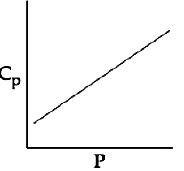
- B
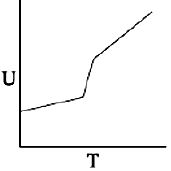
- C
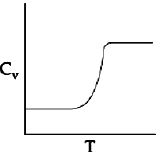
- D
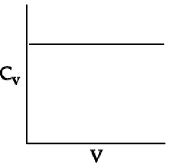
Explore More
Similar Questions
The reaction of cyanamide,$NH_{2}CN_{(s)}$ with oxygen was run in a bomb calorimeter and $\Delta U$ was found to be $-742.24 \ kJ \ mol^{-1}$. The magnitude of $\Delta H_{298}$ for the reaction
$NH_{2}CN_{(s)} + \frac{3}{2} O_{2(g)} \rightarrow N_{2(g)} + CO_{2(g)} + H_{2}O_{(l)}$
is $............ \ kJ$. (Rounded off to the nearest integer)
[Assume ideal gases and $R = 8.314 \ J \ mol^{-1} K^{-1}$]
$NH_{2}CN_{(s)} + \frac{3}{2} O_{2(g)} \rightarrow N_{2(g)} + CO_{2(g)} + H_{2}O_{(l)}$
is $............ \ kJ$. (Rounded off to the nearest integer)
[Assume ideal gases and $R = 8.314 \ J \ mol^{-1} K^{-1}$]
If the standard enthalpy change $\left(\Delta_{r} H^{\theta}\right)$ for a certain reaction at $298 \ K$ and constant pressure is $-1860 \ kJ \ mol^{-1}$,and the standard entropy change $\left(\Delta_{\text{sys}} S^{\theta}\right)$ of the same reaction is $-550 \ J \ K^{-1} \ mol^{-1}$,which one of the following statements is correct?
The quantity of heat (in $J$) required to raise the temperature of $1.0 \, kg$ of ethanol from $293.45 \, K$ to the boiling point and then change the liquid to vapor at that temperature is closest to
[Given,boiling point of ethanol $351.45 \, K$. Specific heat capacity of liquid ethanol $2.44 \, J \, g^{-1} \, K^{-1}$. Latent heat of vaporisation of ethanol $855 \, J \, g^{-1}$ ]
[Given,boiling point of ethanol $351.45 \, K$. Specific heat capacity of liquid ethanol $2.44 \, J \, g^{-1} \, K^{-1}$. Latent heat of vaporisation of ethanol $855 \, J \, g^{-1}$ ]
MediumKVPY 2018
View SolutionAn ideal gas is expanded from $(p_1, V_1, T_1)$ to $(p_2, V_2, T_2)$ under different conditions. The correct statement$(s)$ among the following is(are):
[$A$] The work done on the gas is maximum when it is compressed irreversibly from $(p_2, V_2)$ to $(p_1, V_1)$ against constant pressure $p_1$.
[$B$] The work done by the gas is less when it is expanded reversibly from $V_1$ to $V_2$ under adiabatic conditions as compared to that when expanded reversibly from $V_1$ to $V_2$ under isothermal conditions.
[$C$] The change in internal energy of the gas is $(i)$ zero,if it is expanded reversibly with $T_1=T_2$,and $(ii)$ positive,if it is expanded reversibly under adiabatic conditions with $T_1 \neq T_2$.
[$D$] If the expansion is carried out freely,it is simultaneously both isothermal as well as adiabatic.
[$A$] The work done on the gas is maximum when it is compressed irreversibly from $(p_2, V_2)$ to $(p_1, V_1)$ against constant pressure $p_1$.
[$B$] The work done by the gas is less when it is expanded reversibly from $V_1$ to $V_2$ under adiabatic conditions as compared to that when expanded reversibly from $V_1$ to $V_2$ under isothermal conditions.
[$C$] The change in internal energy of the gas is $(i)$ zero,if it is expanded reversibly with $T_1=T_2$,and $(ii)$ positive,if it is expanded reversibly under adiabatic conditions with $T_1 \neq T_2$.
[$D$] If the expansion is carried out freely,it is simultaneously both isothermal as well as adiabatic.
MediumIIT 2017
View SolutionFor a certain thermochemical reaction $M \rightarrow N$ at $T = 400 \ K$,$\Delta H^{\ominus} = 77.2 \ kJ \ mol^{-1}$ and $\Delta S = 122 \ J \ K^{-1} \ mol^{-1}$,the value of $\log K$ is $ . . . . . . \times 10^{-1}$.
DifficultJEE MAIN 2024
View SolutionVedclass Products
For Students
Vedclass Test Series
Mock tests in real JEE/NEET style with performance analysis. 5-day free trial.
Start Free TrialFor Teachers
Exam Paper Generator
Generate Set A/B/C/D exam papers from 7.5L+ questions in 2 minutes. 3 chapters free.
Try FreeFor Institutes
Online Exam Module
Live online exams with unlimited students, 360° analytics & white-label branding.
See Demo