
ChemistryQ1–100 of 176 questions
Page 1 of 2 · English
1
ChemistryMCQJEE Main · 2013
Smoke is an example of
A
Gas dispersed in liquid
B
Gas dispersed in solid
C
Solid dispersed in gas
D
Solid dispersed in solid
Solution
(C) Smoke is a colloidal system where solid particles are dispersed in a gas. Therefore,it is an example of $Solid$ dispersed in $Gas$.
0 likesView Solution
2
ChemistryMCQJEE Main · 2013
In a hydrogen-like atom,an electron makes a transition from an energy level with quantum number $n$ to another with quantum number $(n - 1)$. If $n >> 1$,the frequency of the emitted radiation is proportional to:
A
$1/n$
B
$1/n^2$
C
$1/n^{3/2}$
D
$1/n^3$
Solution
(D) The energy of an electron in the $n^{th}$ orbit of a hydrogen-like atom is given by $E_n = -\frac{Z^2 R_y h c}{n^2}$,where $R_y$ is the Rydberg constant.
The energy difference between the levels $n$ and $(n - 1)$ is $\Delta E = E_n - E_{n-1} = Z^2 R_y h c \left( \frac{1}{(n-1)^2} - \frac{1}{n^2} \right)$.
Simplifying the expression: $\Delta E = Z^2 R_y h c \left( \frac{n^2 - (n-1)^2}{n^2(n-1)^2} \right) = Z^2 R_y h c \left( \frac{2n - 1}{n^2(n-1)^2} \right)$.
Since $n >> 1$,we can approximate $(n-1) \approx n$ and $(2n-1) \approx 2n$.
Thus,$\Delta E \approx Z^2 R_y h c \left( \frac{2n}{n^2 \cdot n^2} \right) = \frac{2 Z^2 R_y h c}{n^3}$.
Since $\Delta E = h \nu$,the frequency $\nu = \frac{\Delta E}{h} \approx \frac{2 Z^2 R_y c}{n^3}$.
Therefore,the frequency $\nu \propto 1/n^3$.
The energy difference between the levels $n$ and $(n - 1)$ is $\Delta E = E_n - E_{n-1} = Z^2 R_y h c \left( \frac{1}{(n-1)^2} - \frac{1}{n^2} \right)$.
Simplifying the expression: $\Delta E = Z^2 R_y h c \left( \frac{n^2 - (n-1)^2}{n^2(n-1)^2} \right) = Z^2 R_y h c \left( \frac{2n - 1}{n^2(n-1)^2} \right)$.
Since $n >> 1$,we can approximate $(n-1) \approx n$ and $(2n-1) \approx 2n$.
Thus,$\Delta E \approx Z^2 R_y h c \left( \frac{2n}{n^2 \cdot n^2} \right) = \frac{2 Z^2 R_y h c}{n^3}$.
Since $\Delta E = h \nu$,the frequency $\nu = \frac{\Delta E}{h} \approx \frac{2 Z^2 R_y c}{n^3}$.
Therefore,the frequency $\nu \propto 1/n^3$.
0 likesView Solution
3
ChemistryMCQJEE Main · 2013
Two capacitors $C_1$ and $C_2$ are charged to $120 \ V$ and $200 \ V$ respectively. It is found that by connecting them together,the potential on each can be made zero. Then:
A
$5C_1 = 3C_2$
B
$3C_1 = 5C_2$
C
$3C_1 + 5C_2 = 0$
D
$9C_1 = 4C_2$
Solution
(B) When two capacitors are connected such that the positive plate of one is connected to the negative plate of the other,the common potential $V$ is given by $V = \frac{C_1V_1 - C_2V_2}{C_1 + C_2}$.
For the potential to be zero,the numerator must be zero:
$C_1V_1 - C_2V_2 = 0$
$C_1(120) = C_2(200)$
Dividing both sides by $40$,we get:
$3C_1 = 5C_2$.
For the potential to be zero,the numerator must be zero:
$C_1V_1 - C_2V_2 = 0$
$C_1(120) = C_2(200)$
Dividing both sides by $40$,we get:
$3C_1 = 5C_2$.
0 likesView Solution
4
ChemistryMCQJEE Main · 2013
If $P = \begin{bmatrix} 1 & \alpha & 3 \\ 1 & 3 & 3 \\ 2 & 4 & 4 \end{bmatrix}$ is the adjoint of a $3 \times 3$ matrix $A$ and $|A| = 4$,then $\alpha$ is equal to:
A
$4$
B
$11$
C
$5$
D
$0$
Solution
(B) We know that for a $3 \times 3$ matrix $A$,the determinant of its adjoint matrix $P$ is given by $|P| = |A|^{n-1}$,where $n$ is the order of the matrix.
Here,$n = 3$ and $|A| = 4$,so $|P| = |A|^{3-1} = |A|^2 = 4^2 = 16$.
Now,calculate the determinant of $P = \begin{bmatrix} 1 & \alpha & 3 \\ 1 & 3 & 3 \\ 2 & 4 & 4 \end{bmatrix}$:
$|P| = 1(3 \times 4 - 3 \times 4) - \alpha(1 \times 4 - 3 \times 2) + 3(1 \times 4 - 3 \times 2)$
$|P| = 1(12 - 12) - \alpha(4 - 6) + 3(4 - 6)$
$|P| = 0 - \alpha(-2) + 3(-2)$
$|P| = 2\alpha - 6$.
Equating the two values of $|P|$:
$2\alpha - 6 = 16$
$2\alpha = 22$
$\alpha = 11$.
Here,$n = 3$ and $|A| = 4$,so $|P| = |A|^{3-1} = |A|^2 = 4^2 = 16$.
Now,calculate the determinant of $P = \begin{bmatrix} 1 & \alpha & 3 \\ 1 & 3 & 3 \\ 2 & 4 & 4 \end{bmatrix}$:
$|P| = 1(3 \times 4 - 3 \times 4) - \alpha(1 \times 4 - 3 \times 2) + 3(1 \times 4 - 3 \times 2)$
$|P| = 1(12 - 12) - \alpha(4 - 6) + 3(4 - 6)$
$|P| = 0 - \alpha(-2) + 3(-2)$
$|P| = 2\alpha - 6$.
Equating the two values of $|P|$:
$2\alpha - 6 = 16$
$2\alpha = 22$
$\alpha = 11$.
0 likesView Solution
5
ChemistryMCQJEE Main · 2013
If $y = \sec(\tan^{-1}x)$,then $\frac{dy}{dx}$ at $x = 1$ is equal to:
A
$\frac{1}{\sqrt{2}}$
B
$\frac{1}{2}$
C
$1$
D
$\sqrt{2}$
Solution
(A) Given $y = \sec(\tan^{-1}x)$.
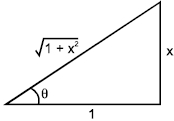
Let $\tan^{-1}x = \theta$,then $x = \tan\theta$.
Since $\sec^2\theta = 1 + \tan^2\theta$,we have $\sec\theta = \sqrt{1 + \tan^2\theta} = \sqrt{1 + x^2}$.
Thus,$y = \sqrt{1 + x^2}$.
Differentiating with respect to $x$:
$\frac{dy}{dx} = \frac{d}{dx}(\sqrt{1 + x^2}) = \frac{1}{2\sqrt{1 + x^2}} \cdot \frac{d}{dx}(1 + x^2) = \frac{1}{2\sqrt{1 + x^2}} \cdot 2x = \frac{x}{\sqrt{1 + x^2}}$.
At $x = 1$:
$\frac{dy}{dx} = \frac{1}{\sqrt{1 + (1)^2}} = \frac{1}{\sqrt{2}}$.
Let $\tan^{-1}x = \theta$,then $x = \tan\theta$.
Since $\sec^2\theta = 1 + \tan^2\theta$,we have $\sec\theta = \sqrt{1 + \tan^2\theta} = \sqrt{1 + x^2}$.
Thus,$y = \sqrt{1 + x^2}$.
Differentiating with respect to $x$:
$\frac{dy}{dx} = \frac{d}{dx}(\sqrt{1 + x^2}) = \frac{1}{2\sqrt{1 + x^2}} \cdot \frac{d}{dx}(1 + x^2) = \frac{1}{2\sqrt{1 + x^2}} \cdot 2x = \frac{x}{\sqrt{1 + x^2}}$.
At $x = 1$:
$\frac{dy}{dx} = \frac{1}{\sqrt{1 + (1)^2}} = \frac{1}{\sqrt{2}}$.
1 likesView Solution
6
ChemistryMCQJEE Main · 2013
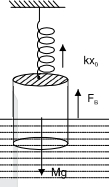
$A$ uniform cylinder of length $L$ and mass $M$ having cross-sectional area $A$ is suspended,with its length vertical,from a fixed point by a massless spring such that it is half-submerged in a liquid of density $\sigma$ at equilibrium position. The extension $x_0$ of the spring when it is in equilibrium is:
A
$\frac{Mg}{k}\left( 1 + \frac{LA\sigma}{M} \right)$
B
$\frac{Mg}{k}$
C
$\frac{Mg}{k}\left( 1 - \frac{LA\sigma}{M} \right)$
D
$\frac{Mg}{k}\left( 1 - \frac{LA\sigma}{2M} \right)$
Solution
(D) At equilibrium,the forces acting on the cylinder are the gravitational force $(Mg)$ acting downwards,the spring force $(kx_0)$ acting upwards,and the buoyant force $(F_B)$ acting upwards.
The buoyant force is given by $F_B = V_{submerged} \cdot \sigma \cdot g$,where $V_{submerged} = A \cdot \frac{L}{2}$.
Thus,$F_B = \frac{LA\sigma g}{2}$.
For the cylinder to be in equilibrium,the net force must be zero:
$kx_0 + F_B = Mg$
Substituting the value of $F_B$:
$kx_0 + \frac{LA\sigma g}{2} = Mg$
$kx_0 = Mg - \frac{LA\sigma g}{2}$
$x_0 = \frac{Mg - \frac{LA\sigma g}{2}}{k}$
$x_0 = \frac{Mg}{k} \left( 1 - \frac{LA\sigma}{2M} \right)$
The buoyant force is given by $F_B = V_{submerged} \cdot \sigma \cdot g$,where $V_{submerged} = A \cdot \frac{L}{2}$.
Thus,$F_B = \frac{LA\sigma g}{2}$.
For the cylinder to be in equilibrium,the net force must be zero:
$kx_0 + F_B = Mg$
Substituting the value of $F_B$:
$kx_0 + \frac{LA\sigma g}{2} = Mg$
$kx_0 = Mg - \frac{LA\sigma g}{2}$
$x_0 = \frac{Mg - \frac{LA\sigma g}{2}}{k}$
$x_0 = \frac{Mg}{k} \left( 1 - \frac{LA\sigma}{2M} \right)$
0 likesView Solution
7
ChemistryMediumMCQJEE Main · 2013
Consider the following reaction:
$xMnO_4^{-} + yC_2O_4^{2-} + zH^{+} \rightarrow xMn^{2+} + 2yCO_2 + \frac{z}{2}H_2O$
The values of $x, y$ and $z$ in the reaction are,respectively:
$xMnO_4^{-} + yC_2O_4^{2-} + zH^{+} \rightarrow xMn^{2+} + 2yCO_2 + \frac{z}{2}H_2O$
The values of $x, y$ and $z$ in the reaction are,respectively:
A
$5, 2$ and $16$
B
$2, 5$ and $8$
C
$2, 5$ and $16$
D
$5, 2$ and $8$
Solution
(C) The half-equations of the reaction are:
$MnO_4^{-} \rightarrow Mn^{2+}$
$C_2O_4^{2-} \rightarrow CO_2$
The balanced half-equations are:
$(MnO_4^{-} + 8H^{+} + 5e^{-} \rightarrow Mn^{2+} + 4H_2O) \times 2$
$(C_2O_4^{2-} \rightarrow 2CO_2 + 2e^{-}) \times 5$
Equating the number of electrons,we get:
$2MnO_4^{-} + 16H^{+} + 10e^{-} \rightarrow 2Mn^{2+} + 8H_2O$
$5C_2O_4^{2-} \rightarrow 10CO_2 + 10e^{-}$
On adding both the equations,we get:
$2MnO_4^{-} + 5C_2O_4^{2-} + 16H^{+} \rightarrow 2Mn^{2+} + 10CO_2 + 8H_2O$
Thus,the values of $x, y$ and $z$ are $2, 5$ and $16,$ respectively.
$MnO_4^{-} \rightarrow Mn^{2+}$
$C_2O_4^{2-} \rightarrow CO_2$
The balanced half-equations are:
$(MnO_4^{-} + 8H^{+} + 5e^{-} \rightarrow Mn^{2+} + 4H_2O) \times 2$
$(C_2O_4^{2-} \rightarrow 2CO_2 + 2e^{-}) \times 5$
Equating the number of electrons,we get:
$2MnO_4^{-} + 16H^{+} + 10e^{-} \rightarrow 2Mn^{2+} + 8H_2O$
$5C_2O_4^{2-} \rightarrow 10CO_2 + 10e^{-}$
On adding both the equations,we get:
$2MnO_4^{-} + 5C_2O_4^{2-} + 16H^{+} \rightarrow 2Mn^{2+} + 10CO_2 + 8H_2O$
Thus,the values of $x, y$ and $z$ are $2, 5$ and $16,$ respectively.
0 likesView Solution
8
ChemistryDifficultMCQJEE Main · 2013
$A$ gaseous hydrocarbon gives upon combustion $0.72 \ g$ of water and $3.08 \ g$ of $CO_{2}$. The empirical formula of the hydrocarbon is:
A
$C_{2}H_{4}$
B
$C_{3}H_{4}$
C
$C_{6}H_{5}$
D
$C_{7}H_{8}$
Solution
(D) The molar mass of $H_{2}O$ is $18 \ g/mol$,which contains $2 \ g$ of $H$.
Therefore,$0.72 \ g$ of $H_{2}O$ contains $\frac{2}{18} \times 0.72 = 0.08 \ g$ of $H$.
The molar mass of $CO_{2}$ is $44 \ g/mol$,which contains $12 \ g$ of $C$.
Therefore,$3.08 \ g$ of $CO_{2}$ contains $\frac{12}{44} \times 3.08 = 0.84 \ g$ of $C$.
The molar ratio of $C:H$ is $\frac{0.84}{12} : \frac{0.08}{1} = 0.07 : 0.08 = 7 : 8$.
Thus,the empirical formula is $C_{7}H_{8}$.
Therefore,$0.72 \ g$ of $H_{2}O$ contains $\frac{2}{18} \times 0.72 = 0.08 \ g$ of $H$.
The molar mass of $CO_{2}$ is $44 \ g/mol$,which contains $12 \ g$ of $C$.
Therefore,$3.08 \ g$ of $CO_{2}$ contains $\frac{12}{44} \times 3.08 = 0.84 \ g$ of $C$.
The molar ratio of $C:H$ is $\frac{0.84}{12} : \frac{0.08}{1} = 0.07 : 0.08 = 7 : 8$.
Thus,the empirical formula is $C_{7}H_{8}$.
1 likesView Solution
9
ChemistryDifficultMCQJEE Main · 2013
Energy of an electron is given by $E = -2.178 \times 10^{-18} \ J \left( \frac{Z^2}{n^2} \right)$. Wavelength of light required to excite an electron in a hydrogen atom from level $n = 1$ to $n = 2$ will be:
A
$1.214 \times 10^{-7} \ m$
B
$2.816 \times 10^{-7} \ m$
C
$6.500 \times 10^{-7} \ m$
D
$8.500 \times 10^{-7} \ m$
Solution
(A) The energy difference between two levels is given by $\Delta E = E_2 - E_1 = 2.178 \times 10^{-18} \times Z^2 \left( \frac{1}{n_1^2} - \frac{1}{n_2^2} \right) \ J$.
For a hydrogen atom,$Z = 1$,$n_1 = 1$,and $n_2 = 2$.
$\Delta E = 2.178 \times 10^{-18} \times 1^2 \left( \frac{1}{1^2} - \frac{1}{2^2} \right) = 2.178 \times 10^{-18} \times \left( 1 - 0.25 \right) = 2.178 \times 10^{-18} \times 0.75 = 1.6335 \times 10^{-18} \ J$.
Using the relation $\Delta E = \frac{hc}{\lambda}$,we get $\lambda = \frac{hc}{\Delta E}$.
$\lambda = \frac{6.62 \times 10^{-34} \times 3.0 \times 10^8}{1.6335 \times 10^{-18}} = \frac{19.86 \times 10^{-26}}{1.6335 \times 10^{-18}} \approx 1.216 \times 10^{-7} \ m$.
Rounding to the nearest provided option,the correct answer is $1.214 \times 10^{-7} \ m$.
For a hydrogen atom,$Z = 1$,$n_1 = 1$,and $n_2 = 2$.
$\Delta E = 2.178 \times 10^{-18} \times 1^2 \left( \frac{1}{1^2} - \frac{1}{2^2} \right) = 2.178 \times 10^{-18} \times \left( 1 - 0.25 \right) = 2.178 \times 10^{-18} \times 0.75 = 1.6335 \times 10^{-18} \ J$.
Using the relation $\Delta E = \frac{hc}{\lambda}$,we get $\lambda = \frac{hc}{\Delta E}$.
$\lambda = \frac{6.62 \times 10^{-34} \times 3.0 \times 10^8}{1.6335 \times 10^{-18}} = \frac{19.86 \times 10^{-26}}{1.6335 \times 10^{-18}} \approx 1.216 \times 10^{-7} \ m$.
Rounding to the nearest provided option,the correct answer is $1.214 \times 10^{-7} \ m$.
0 likesView Solution
10
ChemistryDifficultMCQJEE Main · 2013
Which of the following represents the correct order of increasing first ionization enthalpy for $Ca, Ba, S, Se$ and $Ar$?
A
$Ca < S < Ba < Se < Ar$
B
$S < Se < Ca < Ba < Ar$
C
$Ba < Ca < Se < S < Ar$
D
$Ca < Ba < S < Se < Ar$
Solution
(C) The first ionization enthalpy $(IE_1)$ generally increases across a period due to an increase in effective nuclear charge and decreases down a group due to an increase in atomic size and shielding effect.
$1$. Comparing elements in the same period: $S$ (Group $16$,Period $3$) and $Ar$ (Group $18$,Period $3$). $Ar$ has a stable noble gas configuration,so it has the highest $IE_1$ among the given elements.
$2$. Comparing elements in the same group: $Ca$ (Group $2$,Period $4$) and $Ba$ (Group $2$,Period $6$). Since $Ba$ is below $Ca$,$IE_1$ of $Ba < Ca$.
$3$. Comparing $S$ and $Se$: $S$ (Period $3$) and $Se$ (Period $4$). Since $Se$ is below $S$,$IE_1$ of $Se < S$.
$4$. Combining the trends: $Ba < Ca < Se < S < Ar$.
Therefore,the correct order is $Ba < Ca < Se < S < Ar$.
$1$. Comparing elements in the same period: $S$ (Group $16$,Period $3$) and $Ar$ (Group $18$,Period $3$). $Ar$ has a stable noble gas configuration,so it has the highest $IE_1$ among the given elements.
$2$. Comparing elements in the same group: $Ca$ (Group $2$,Period $4$) and $Ba$ (Group $2$,Period $6$). Since $Ba$ is below $Ca$,$IE_1$ of $Ba < Ca$.
$3$. Comparing $S$ and $Se$: $S$ (Period $3$) and $Se$ (Period $4$). Since $Se$ is below $S$,$IE_1$ of $Se < S$.
$4$. Combining the trends: $Ba < Ca < Se < S < Ar$.
Therefore,the correct order is $Ba < Ca < Se < S < Ar$.
0 likesView Solution
11
ChemistryDifficultMCQJEE Main · 2013
The first ionisation potential of $Na$ is $5.1 \, eV$. The value of electron gain enthalpy of $Na^{+}$ will be : ............... $eV$
A
$-2.55$
B
$-5.1$
C
$-10.2$
D
$+2.55$
Solution
(B) The first ionization process is represented as: $Na \rightarrow Na^{+} + e^{-}$,where $IE = 5.1 \, eV$.
The electron gain enthalpy of $Na^{+}$ corresponds to the reverse process: $Na^{+} + e^{-} \rightarrow Na$.
Since the second reaction is the exact inverse of the first reaction,the energy change is equal in magnitude but opposite in sign.
Therefore,the electron gain enthalpy of $Na^{+}$ is $\Delta H_{eg} = -IE = -5.1 \, eV$.
The electron gain enthalpy of $Na^{+}$ corresponds to the reverse process: $Na^{+} + e^{-} \rightarrow Na$.
Since the second reaction is the exact inverse of the first reaction,the energy change is equal in magnitude but opposite in sign.
Therefore,the electron gain enthalpy of $Na^{+}$ is $\Delta H_{eg} = -IE = -5.1 \, eV$.
0 likesView Solution
12
ChemistryMediumMCQJEE Main · 2013
Which one of the following molecules is expected to exhibit diamagnetic behaviour?
A
$C_2$
B
$F_2$
C
$O_2$
D
$S_2$
Solution
(A) According to Molecular Orbital Theory $(MOT)$,a molecule is diamagnetic if all its electrons are paired.
For $C_2$ ($12$ electrons): $\sigma 1s^2, \sigma^* 1s^2, \sigma 2s^2, \sigma^* 2s^2, \pi 2p_x^2 = \pi 2p_y^2$. All electrons are paired,so it is diamagnetic.
For $F_2$ ($18$ electrons): $\sigma 1s^2, \sigma^* 1s^2, \sigma 2s^2, \sigma^* 2s^2, \sigma 2p_z^2, \pi 2p_x^2 = \pi 2p_y^2, \pi^* 2p_x^2 = \pi^* 2p_y^2$. All electrons are paired,so it is diamagnetic.
For $O_2$ ($16$ electrons): The configuration ends with $\pi^* 2p_x^1 = \pi^* 2p_y^1$,having $2$ unpaired electrons,making it paramagnetic.
For $S_2$ ($32$ electrons): Similar to $O_2$,it has $2$ unpaired electrons in the $\pi^*$ orbitals,making it paramagnetic.
Note: Both $C_2$ and $F_2$ are diamagnetic. However,in standard textbook contexts for this specific question,$C_2$ is frequently cited as the primary example of a molecule with a unique bonding structure exhibiting diamagnetism due to the $\pi$ bonding.
For $C_2$ ($12$ electrons): $\sigma 1s^2, \sigma^* 1s^2, \sigma 2s^2, \sigma^* 2s^2, \pi 2p_x^2 = \pi 2p_y^2$. All electrons are paired,so it is diamagnetic.
For $F_2$ ($18$ electrons): $\sigma 1s^2, \sigma^* 1s^2, \sigma 2s^2, \sigma^* 2s^2, \sigma 2p_z^2, \pi 2p_x^2 = \pi 2p_y^2, \pi^* 2p_x^2 = \pi^* 2p_y^2$. All electrons are paired,so it is diamagnetic.
For $O_2$ ($16$ electrons): The configuration ends with $\pi^* 2p_x^1 = \pi^* 2p_y^1$,having $2$ unpaired electrons,making it paramagnetic.
For $S_2$ ($32$ electrons): Similar to $O_2$,it has $2$ unpaired electrons in the $\pi^*$ orbitals,making it paramagnetic.
Note: Both $C_2$ and $F_2$ are diamagnetic. However,in standard textbook contexts for this specific question,$C_2$ is frequently cited as the primary example of a molecule with a unique bonding structure exhibiting diamagnetism due to the $\pi$ bonding.
0 likesView Solution
13
ChemistryMediumMCQJEE Main · 2013
In which of the following pairs of molecules/ions,both the species are not likely to exist?
A
$H_{2}^{+}, He_{2}^{2-}$
B
$H_{2}^{-}, He_{2}^{2-}$
C
$H_{2}^{2+}, He_{2}$
D
$H_{2}^{-}, He_{2}^{2+}$
Solution
(C) According to Molecular Orbital Theory,species with a bond order of $0$ or less do not exist.
For $H_{2}^{2+}$: Total electrons $= 1 + 1 - 2 = 0$. Electronic configuration $= \sigma 1s^{0}$. Bond order $= 0$.
For $He_{2}$: Total electrons $= 2 + 2 = 4$. Electronic configuration $= \sigma 1s^{2}, \sigma^* 1s^{2}$. Bond order $= \frac{2 - 2}{2} = 0$.
Since both $H_{2}^{2+}$ and $He_{2}$ have a bond order of $0$,they are not likely to exist.
For $H_{2}^{2+}$: Total electrons $= 1 + 1 - 2 = 0$. Electronic configuration $= \sigma 1s^{0}$. Bond order $= 0$.
For $He_{2}$: Total electrons $= 2 + 2 = 4$. Electronic configuration $= \sigma 1s^{2}, \sigma^* 1s^{2}$. Bond order $= \frac{2 - 2}{2} = 0$.
Since both $H_{2}^{2+}$ and $He_{2}$ have a bond order of $0$,they are not likely to exist.
0 likesView Solution
14
ChemistryMediumMCQJEE Main · 2013
Stability of the species $Li_2$, $Li_2^-$, and $Li_2^+$ increases in the order of:
A
$Li_2 < Li_2^+ < Li_2^-$
B
$Li_2^- < Li_2^+ < Li_2$
C
$Li_2 < Li_2^- < Li_2^+$
D
$Li_2^- < Li_2 < Li_2^+$
Solution
(B) The stability of a molecule is directly proportional to its bond order. If bond orders are equal, the species with more electrons in antibonding orbitals is less stable.
$Li_2$ ($6$ electrons): $\sigma 1s^2, \sigma^* 1s^2, \sigma 2s^2$. Bond order $= \frac{4 - 2}{2} = 1.0$.
$Li_2^+$ ($5$ electrons): $\sigma 1s^2, \sigma^* 1s^2, \sigma 2s^1$. Bond order $= \frac{3 - 2}{2} = 0.5$.
$Li_2^-$ ($7$ electrons): $\sigma 1s^2, \sigma^* 1s^2, \sigma 2s^2, \sigma^* 2s^1$. Bond order $= \frac{4 - 3}{2} = 0.5$.
Comparing $Li_2^+$ and $Li_2^-$, both have a bond order of $0.5$, but $Li_2^-$ has more electrons in the antibonding orbital $(\sigma^* 2s^1)$, making it less stable than $Li_2^+$.
Therefore, the stability order is $Li_2^- < Li_2^+ < Li_2$.
$Li_2$ ($6$ electrons): $\sigma 1s^2, \sigma^* 1s^2, \sigma 2s^2$. Bond order $= \frac{4 - 2}{2} = 1.0$.
$Li_2^+$ ($5$ electrons): $\sigma 1s^2, \sigma^* 1s^2, \sigma 2s^1$. Bond order $= \frac{3 - 2}{2} = 0.5$.
$Li_2^-$ ($7$ electrons): $\sigma 1s^2, \sigma^* 1s^2, \sigma 2s^2, \sigma^* 2s^1$. Bond order $= \frac{4 - 3}{2} = 0.5$.
Comparing $Li_2^+$ and $Li_2^-$, both have a bond order of $0.5$, but $Li_2^-$ has more electrons in the antibonding orbital $(\sigma^* 2s^1)$, making it less stable than $Li_2^+$.
Therefore, the stability order is $Li_2^- < Li_2^+ < Li_2$.
0 likesView Solution
15
ChemistryMediumMCQJEE Main · 2013
For a gaseous state,if the most probable speed is denoted by $C^*$,average speed by $\overline{C}$,and root mean square speed by $C$,then for a large number of molecules,the ratio of these speeds is:
A
$C^* : \overline{C} : C = 1.225 : 1.128 : 1$
B
$C^* : \overline{C} : C = 1.128 : 1.225 : 1$
C
$C^* : \overline{C} : C = 1 : 1.128 : 1.225$
D
$C^* : \overline{C} : C = 1 : 1.225 : 1.128$
Solution
(C) The expressions for the speeds are:
Most probable speed $(C^*)$ = $\sqrt{\frac{2RT}{M}}$
Average speed $(\overline{C})$ = $\sqrt{\frac{8RT}{\pi M}}$
Root mean square speed $(C)$ = $\sqrt{\frac{3RT}{M}}$
The ratio is $C^* : \overline{C} : C = \sqrt{2} : \sqrt{\frac{8}{\pi}} : \sqrt{3}$.
Dividing by $\sqrt{2} \approx 1.414$:
$1 : \sqrt{\frac{4}{\pi}} : \sqrt{1.5} \approx 1 : 1.128 : 1.225$.
Most probable speed $(C^*)$ = $\sqrt{\frac{2RT}{M}}$
Average speed $(\overline{C})$ = $\sqrt{\frac{8RT}{\pi M}}$
Root mean square speed $(C)$ = $\sqrt{\frac{3RT}{M}}$
The ratio is $C^* : \overline{C} : C = \sqrt{2} : \sqrt{\frac{8}{\pi}} : \sqrt{3}$.
Dividing by $\sqrt{2} \approx 1.414$:
$1 : \sqrt{\frac{4}{\pi}} : \sqrt{1.5} \approx 1 : 1.128 : 1.225$.
0 likesView Solution
16
ChemistryMediumMCQJEE Main · 2013
$A$ piston filled with $0.04 \ mol$ of an ideal gas expands reversibly from $50.0 \ mL$ to $375 \ mL$ at a constant temperature of $37.0 \ ^oC$. As it does so,it absorbs $208 \ J$ of heat. The values of $q$ and $w$ for the process will be
$(R = 8.314 \ J/mol \ K) \ (\ln 7.5 = 2.01)$
$(R = 8.314 \ J/mol \ K) \ (\ln 7.5 = 2.01)$
A
$q = +208 \ J, \ w = -208 \ J$
B
$q = -208 \ J, \ w = -208 \ J$
C
$q = -208 \ J, \ w = +208 \ J$
D
$q = +208 \ J, \ w = +208 \ J$
Solution
(A) For an isothermal reversible expansion of an ideal gas,the change in internal energy $\Delta U = 0$.
According to the first law of thermodynamics,$\Delta U = q + w$.
Since $\Delta U = 0$,we have $q = -w$.
Given that the system absorbs $208 \ J$ of heat,$q = +208 \ J$.
Therefore,$w = -q = -208 \ J$.
Thus,the values are $q = +208 \ J$ and $w = -208 \ J$.
According to the first law of thermodynamics,$\Delta U = q + w$.
Since $\Delta U = 0$,we have $q = -w$.
Given that the system absorbs $208 \ J$ of heat,$q = +208 \ J$.
Therefore,$w = -q = -208 \ J$.
Thus,the values are $q = +208 \ J$ and $w = -208 \ J$.
0 likesView Solution
17
ChemistryDifficultMCQJEE Main · 2013
$L$ litres of water must be added to $1 \, L$ of an aqueous solution of $HCl$ with a $pH$ of $1$ to create an aqueous solution with $pH$ of $2$?
A
$0.1$
B
$0.9$
C
$2$
D
$9$
Solution
(D) For the initial solution: $pH = 1$,so $[H^{+}]_1 = 10^{-1} = 0.1 \, M$.
For the final solution: $pH = 2$,so $[H^{+}]_2 = 10^{-2} = 0.01 \, M$.
Using the dilution formula $M_1 V_1 = M_2 V_2$:
$0.1 \, M \times 1 \, L = 0.01 \, M \times V_2$.
$V_2 = \frac{0.1}{0.01} = 10 \, L$.
The volume of water to be added is $V_2 - V_1 = 10 \, L - 1 \, L = 9 \, L$.
For the final solution: $pH = 2$,so $[H^{+}]_2 = 10^{-2} = 0.01 \, M$.
Using the dilution formula $M_1 V_1 = M_2 V_2$:
$0.1 \, M \times 1 \, L = 0.01 \, M \times V_2$.
$V_2 = \frac{0.1}{0.01} = 10 \, L$.
The volume of water to be added is $V_2 - V_1 = 10 \, L - 1 \, L = 9 \, L$.
0 likesView Solution
18
ChemistryMediumMCQJEE Main · 2013
The order of stability of the following carbocations is:
$I$. $CH_2 = CH - CH_2^+$
$II$. $CH_3 - CH_2 - CH_2^+$
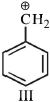
$III$. $C_6H_5CH_2^+$
$I$. $CH_2 = CH - CH_2^+$
$II$. $CH_3 - CH_2 - CH_2^+$
$III$. $C_6H_5CH_2^+$
A
$III > I > II$
B
$I > II > III$
C
$II > III > I$
D
$III > II > I$
Solution
(A) The stability of carbocations is determined by resonance and inductive effects.
$III$ $(C_6H_5CH_2^+)$ is a benzyl carbocation,which is highly stabilized by resonance with the benzene ring.
$I$ $(CH_2 = CH - CH_2^+)$ is an allyl carbocation,which is stabilized by resonance with the double bond.
$II$ $(CH_3 - CH_2 - CH_2^+)$ is a primary $(1^\circ)$ alkyl carbocation,which is the least stable among the three as it lacks resonance stabilization.
Therefore,the order of stability is $III > I > II$.
$III$ $(C_6H_5CH_2^+)$ is a benzyl carbocation,which is highly stabilized by resonance with the benzene ring.
$I$ $(CH_2 = CH - CH_2^+)$ is an allyl carbocation,which is stabilized by resonance with the double bond.
$II$ $(CH_3 - CH_2 - CH_2^+)$ is a primary $(1^\circ)$ alkyl carbocation,which is the least stable among the three as it lacks resonance stabilization.
Therefore,the order of stability is $III > I > II$.
0 likesView Solution
19
ChemistryMCQJEE Main · 2013
$A$ circular loop of radius $0.3 \ cm$ lies parallel to a much bigger circular loop of radius $20 \ cm$. The centre of the small loop is on the axis of the bigger loop. The distance between their centres is $15 \ cm$. If a current of $2.0 \ A$ flows through the smaller loop,then the flux linked with the bigger loop is:
A
$6.6 \times 10^{-9} \ Wb$
B
$9.1 \times 10^{-11} \ Wb$
C
$6.0 \times 10^{-11} \ Wb$
D
$3.3 \times 10^{-11} \ Wb$
Solution
(B) The magnetic flux linked with the bigger loop due to the smaller loop is given by $\phi = M I$,where $M$ is the mutual inductance.
Since the smaller loop is very small compared to the bigger loop,we can treat it as a magnetic dipole with magnetic moment $m = I_s A_s = I_s (\pi r^2)$.
The magnetic field $B$ produced by the smaller loop at the center of the bigger loop is $B = \frac{\mu_0 m}{2(d^2 + R^2)^{3/2}}$,where $d = 0.15 \ m$,$R = 0.2 \ m$,and $r = 0.003 \ m$.
However,it is easier to use the reciprocity theorem: $\phi_B = M I_s$,where $M$ is the same as the flux through the small loop due to unit current in the big loop.
The magnetic field at the center of the small loop due to the big loop is $B_{big} = \frac{\mu_0 I_b R^2}{2(R^2 + d^2)^{3/2}}$.
Flux $\phi = B_{big} \times A_{small} = \frac{\mu_0 I_b R^2}{2(R^2 + d^2)^{3/2}} \times \pi r^2$.
Given $I_b = 2.0 \ A$,$R = 0.2 \ m$,$r = 0.003 \ m$,$d = 0.15 \ m$,and $\mu_0 = 4\pi \times 10^{-7} \ T \cdot m/A$.
$\phi = \frac{(4\pi \times 10^{-7}) \times 2.0 \times (0.2)^2}{2((0.2)^2 + (0.15)^2)^{3/2}} \times \pi (0.003)^2$.
$\phi = \frac{4\pi^2 \times 10^{-7} \times 2.0 \times 0.04}{2(0.04 + 0.0225)^{3/2}} \times 9 \times 10^{-6} = \frac{8\pi^2 \times 10^{-7} \times 0.04}{2(0.0625)^{3/2}} \times 9 \times 10^{-6}$.
$(0.0625)^{3/2} = (0.25^2)^{3/2} = 0.25^3 = 0.015625$.
$\phi = \frac{3.158 \times 10^{-7}}{0.03125} \times 9 \times 10^{-6} \approx 9.1 \times 10^{-11} \ Wb$.
Since the smaller loop is very small compared to the bigger loop,we can treat it as a magnetic dipole with magnetic moment $m = I_s A_s = I_s (\pi r^2)$.
The magnetic field $B$ produced by the smaller loop at the center of the bigger loop is $B = \frac{\mu_0 m}{2(d^2 + R^2)^{3/2}}$,where $d = 0.15 \ m$,$R = 0.2 \ m$,and $r = 0.003 \ m$.
However,it is easier to use the reciprocity theorem: $\phi_B = M I_s$,where $M$ is the same as the flux through the small loop due to unit current in the big loop.
The magnetic field at the center of the small loop due to the big loop is $B_{big} = \frac{\mu_0 I_b R^2}{2(R^2 + d^2)^{3/2}}$.
Flux $\phi = B_{big} \times A_{small} = \frac{\mu_0 I_b R^2}{2(R^2 + d^2)^{3/2}} \times \pi r^2$.
Given $I_b = 2.0 \ A$,$R = 0.2 \ m$,$r = 0.003 \ m$,$d = 0.15 \ m$,and $\mu_0 = 4\pi \times 10^{-7} \ T \cdot m/A$.
$\phi = \frac{(4\pi \times 10^{-7}) \times 2.0 \times (0.2)^2}{2((0.2)^2 + (0.15)^2)^{3/2}} \times \pi (0.003)^2$.
$\phi = \frac{4\pi^2 \times 10^{-7} \times 2.0 \times 0.04}{2(0.04 + 0.0225)^{3/2}} \times 9 \times 10^{-6} = \frac{8\pi^2 \times 10^{-7} \times 0.04}{2(0.0625)^{3/2}} \times 9 \times 10^{-6}$.
$(0.0625)^{3/2} = (0.25^2)^{3/2} = 0.25^3 = 0.015625$.
$\phi = \frac{3.158 \times 10^{-7}}{0.03125} \times 9 \times 10^{-6} \approx 9.1 \times 10^{-11} \ Wb$.
0 likesView Solution
20
ChemistryMCQJEE Main · 2013
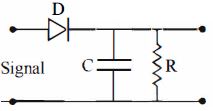
$A$ diode detector is used to detect an amplitude-modulated wave of $60\%$ modulation by using a capacitor of capacity $250 \text{ pF}$ in parallel with a load resistance of $100 \text{ k}\Omega$. Find the maximum modulation frequency which could be detected by it.
A
$5.31 \text{ kHz}$
B
$10.62 \text{ MHz}$
C
$10.62 \text{ kHz}$
D
$5.31 \text{ MHz}$
Solution
(C) Given:
Modulation index,$m_a = 60\% = 0.6$
Capacitance,$C = 250 \text{ pF} = 250 \times 10^{-12} \text{ F}$
Resistance,$R = 100 \text{ k}\Omega = 100 \times 10^3 \text{ }\Omega$
The condition for proper detection of an amplitude-modulated signal without distortion is that the time constant $RC$ must be less than or equal to $\frac{1}{\omega_m m_a}$,where $\omega_m = 2\pi f_m$ is the angular frequency of the modulating signal.
Thus,$RC \leq \frac{1}{2\pi f_m m_a}$.
Rearranging for the maximum modulation frequency $f_m$:
$f_m = \frac{1}{2\pi m_a RC}$
Substituting the values:
$f_m = \frac{1}{2 \times 3.14 \times 0.6 \times (100 \times 10^3) \times (250 \times 10^{-12})}$
$f_m = \frac{1}{2 \times 3.14 \times 0.6 \times 2.5 \times 10^{-5}}$
$f_m = \frac{1}{9.42 \times 10^{-5}} \approx 10615.7 \text{ Hz} \approx 10.62 \text{ kHz}$.
Modulation index,$m_a = 60\% = 0.6$
Capacitance,$C = 250 \text{ pF} = 250 \times 10^{-12} \text{ F}$
Resistance,$R = 100 \text{ k}\Omega = 100 \times 10^3 \text{ }\Omega$
The condition for proper detection of an amplitude-modulated signal without distortion is that the time constant $RC$ must be less than or equal to $\frac{1}{\omega_m m_a}$,where $\omega_m = 2\pi f_m$ is the angular frequency of the modulating signal.
Thus,$RC \leq \frac{1}{2\pi f_m m_a}$.
Rearranging for the maximum modulation frequency $f_m$:
$f_m = \frac{1}{2\pi m_a RC}$
Substituting the values:
$f_m = \frac{1}{2 \times 3.14 \times 0.6 \times (100 \times 10^3) \times (250 \times 10^{-12})}$
$f_m = \frac{1}{2 \times 3.14 \times 0.6 \times 2.5 \times 10^{-5}}$
$f_m = \frac{1}{9.42 \times 10^{-5}} \approx 10615.7 \text{ Hz} \approx 10.62 \text{ kHz}$.
0 likesView Solution
21
ChemistryMCQJEE Main · 2013
$A$ molecule $M$ associates in a given solvent according to the equation $nM \rightleftharpoons (M)_n$. For a certain concentration of $M$,the van't Hoff factor was found to be $0.9$ and the fraction of associated molecules was $0.2$. The value of $n$ is:
A
$2$
B
$4$
C
$5$
D
$3$
Solution
(A) For the association reaction $nM \rightleftharpoons (M)_n$,the van't Hoff factor $i$ is related to the degree of association $\alpha$ by the formula: $i = 1 - \alpha + \frac{\alpha}{n}$.
Given values are $i = 0.9$ and $\alpha = 0.2$.
Substituting these values into the equation:
$0.9 = 1 - 0.2 + \frac{0.2}{n}$
$0.9 = 0.8 + \frac{0.2}{n}$
$0.1 = \frac{0.2}{n}$
$n = \frac{0.2}{0.1} = 2$.
Therefore,the value of $n$ is $2$.
Given values are $i = 0.9$ and $\alpha = 0.2$.
Substituting these values into the equation:
$0.9 = 1 - 0.2 + \frac{0.2}{n}$
$0.9 = 0.8 + \frac{0.2}{n}$
$0.1 = \frac{0.2}{n}$
$n = \frac{0.2}{0.1} = 2$.
Therefore,the value of $n$ is $2$.
0 likesView Solution
22
ChemistryMCQJEE Main · 2013
Assume that a drop of liquid evaporates by decrease in its surface energy,so that its temperature remains unchanged. What should be the minimum radius of the drop for this to be possible? The surface tension is $T$,density of liquid is $\rho$ and $L$ is its latent heat of vaporization.
A
$\frac{\rho L}{T}$
B
$\sqrt{\frac{T}{\rho L}}$
C
$\frac{T}{\rho L}$
D
$\frac{2T}{\rho L}$
Solution
(D) The energy required for the evaporation of a mass $dm$ of the liquid is given by $dQ = L \cdot dm$.
Since the mass of the drop is $m = \rho \cdot V = \rho \cdot (\frac{4}{3} \pi r^3)$,the change in mass for a change in radius $dr$ is $dm = \rho \cdot (4 \pi r^2) dr$.
Thus,the energy required is $dQ = L \cdot \rho \cdot (4 \pi r^2) dr$.
This energy is supplied by the decrease in surface energy. The surface area of a drop is $A = 4 \pi r^2$,so the surface energy is $U = T \cdot A = T \cdot (4 \pi r^2)$.
The change in surface energy for a change in radius $dr$ is $dU = T \cdot d(4 \pi r^2) = T \cdot (8 \pi r) dr$.
Equating the energy required for evaporation to the decrease in surface energy:
$L \cdot \rho \cdot (4 \pi r^2) dr = T \cdot (8 \pi r) dr$.
Solving for $r$:
$4 \pi \rho L r^2 = 8 \pi T r$
$r = \frac{8 \pi T}{4 \pi \rho L} = \frac{2T}{\rho L}$.
Since the mass of the drop is $m = \rho \cdot V = \rho \cdot (\frac{4}{3} \pi r^3)$,the change in mass for a change in radius $dr$ is $dm = \rho \cdot (4 \pi r^2) dr$.
Thus,the energy required is $dQ = L \cdot \rho \cdot (4 \pi r^2) dr$.
This energy is supplied by the decrease in surface energy. The surface area of a drop is $A = 4 \pi r^2$,so the surface energy is $U = T \cdot A = T \cdot (4 \pi r^2)$.
The change in surface energy for a change in radius $dr$ is $dU = T \cdot d(4 \pi r^2) = T \cdot (8 \pi r) dr$.
Equating the energy required for evaporation to the decrease in surface energy:
$L \cdot \rho \cdot (4 \pi r^2) dr = T \cdot (8 \pi r) dr$.
Solving for $r$:
$4 \pi \rho L r^2 = 8 \pi T r$
$r = \frac{8 \pi T}{4 \pi \rho L} = \frac{2T}{\rho L}$.
0 likesView Solution
23
ChemistryMCQJEE Main · 2013
What is the minimum energy required to launch a satellite of mass $m$ from the surface of a planet of mass $M$ and radius $R$ into a circular orbit at an altitude of $2R$?
A
$\frac{5GmM}{6R}$
B
$\frac{2GmM}{3R}$
C
$\frac{GmM}{2R}$
D
$\frac{GmM}{3R}$
Solution
(A) The total energy of the satellite on the surface of the planet is $E_i = -\frac{GMm}{R}$.
The satellite is to be placed in a circular orbit at an altitude of $h = 2R$. The orbital radius is $r = R + h = R + 2R = 3R$.
The potential energy of the satellite in the orbit is $U_f = -\frac{GMm}{3R}$.
The orbital velocity $v_0$ is given by $v_0 = \sqrt{\frac{GM}{3R}}$.
The kinetic energy of the satellite in the orbit is $K_f = \frac{1}{2}mv_0^2 = \frac{1}{2}m\left(\frac{GM}{3R}\right) = \frac{GMm}{6R}$.
The total energy in the orbit is $E_f = U_f + K_f = -\frac{GMm}{3R} + \frac{GMm}{6R} = -\frac{GMm}{6R}$.
The energy required to launch the satellite is $E = E_f - E_i = -\frac{GMm}{6R} - \left(-\frac{GMm}{R}\right) = \frac{GMm}{R} - \frac{GMm}{6R} = \frac{5GMm}{6R}$.
The satellite is to be placed in a circular orbit at an altitude of $h = 2R$. The orbital radius is $r = R + h = R + 2R = 3R$.
The potential energy of the satellite in the orbit is $U_f = -\frac{GMm}{3R}$.
The orbital velocity $v_0$ is given by $v_0 = \sqrt{\frac{GM}{3R}}$.
The kinetic energy of the satellite in the orbit is $K_f = \frac{1}{2}mv_0^2 = \frac{1}{2}m\left(\frac{GM}{3R}\right) = \frac{GMm}{6R}$.
The total energy in the orbit is $E_f = U_f + K_f = -\frac{GMm}{3R} + \frac{GMm}{6R} = -\frac{GMm}{6R}$.
The energy required to launch the satellite is $E = E_f - E_i = -\frac{GMm}{6R} - \left(-\frac{GMm}{R}\right) = \frac{GMm}{R} - \frac{GMm}{6R} = \frac{5GMm}{6R}$.
0 likesView Solution
24
ChemistryMCQJEE Main · 2013
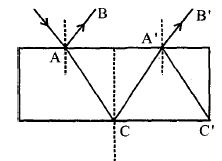
$A$ ray of light of intensity $I$ is incident on a parallel glass slab at point $A$ as shown in the diagram. It undergoes partial reflection and refraction. At each reflection, $25\%$ of incident energy is reflected. The rays $AB$ and $A'B'$ undergo interference. The ratio of $I_{max}$ and $I_{min}$ is (in $: 1$)
A
$49$
B
$7$
C
$4$
D
$8$
Solution
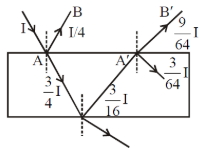
(A) The intensity of the first reflected ray $AB$ is $I_1 = 25\% \text{ of } I = \frac{I}{4}$.
The intensity of the second ray $A'B'$ is determined by the transmission and reflection processes:
$1$. At point $A$, $75\%$ of $I$ is transmitted into the slab: $I_{trans} = \frac{3}{4}I$.
$2$. At point $C$, $25\%$ of $I_{trans}$ is reflected: $I_{refl} = \frac{1}{4} \times \frac{3}{4}I = \frac{3}{16}I$.
$3$. At point $A'$, $75\%$ of $I_{refl}$ is transmitted out of the slab: $I_2 = \frac{3}{4} \times \frac{3}{16}I = \frac{9}{64}I$.
The ratio of maximum to minimum intensity is given by:
$\frac{I_{max}}{I_{min}} = \left( \frac{\sqrt{I_1} + \sqrt{I_2}}{\sqrt{I_1} - \sqrt{I_2}} \right)^2$
Substituting the values:
$\sqrt{I_1} = \sqrt{\frac{I}{4}} = \frac{1}{2}\sqrt{I}$
$\sqrt{I_2} = \sqrt{\frac{9}{64}I} = \frac{3}{8}\sqrt{I}$
$\frac{I_{max}}{I_{min}} = \left( \frac{\frac{1}{2} + \frac{3}{8}}{\frac{1}{2} - \frac{3}{8}} \right)^2 = \left( \frac{\frac{4+3}{8}}{\frac{4-3}{8}} \right)^2 = \left( \frac{7}{1} \right)^2 = \frac{49}{1}$
The intensity of the second ray $A'B'$ is determined by the transmission and reflection processes:
$1$. At point $A$, $75\%$ of $I$ is transmitted into the slab: $I_{trans} = \frac{3}{4}I$.
$2$. At point $C$, $25\%$ of $I_{trans}$ is reflected: $I_{refl} = \frac{1}{4} \times \frac{3}{4}I = \frac{3}{16}I$.
$3$. At point $A'$, $75\%$ of $I_{refl}$ is transmitted out of the slab: $I_2 = \frac{3}{4} \times \frac{3}{16}I = \frac{9}{64}I$.
The ratio of maximum to minimum intensity is given by:
$\frac{I_{max}}{I_{min}} = \left( \frac{\sqrt{I_1} + \sqrt{I_2}}{\sqrt{I_1} - \sqrt{I_2}} \right)^2$
Substituting the values:
$\sqrt{I_1} = \sqrt{\frac{I}{4}} = \frac{1}{2}\sqrt{I}$
$\sqrt{I_2} = \sqrt{\frac{9}{64}I} = \frac{3}{8}\sqrt{I}$
$\frac{I_{max}}{I_{min}} = \left( \frac{\frac{1}{2} + \frac{3}{8}}{\frac{1}{2} - \frac{3}{8}} \right)^2 = \left( \frac{\frac{4+3}{8}}{\frac{4-3}{8}} \right)^2 = \left( \frac{7}{1} \right)^2 = \frac{49}{1}$
0 likesView Solution
25
ChemistryDifficultMCQJEE Main · 2013
What is the product $X$ in the following reaction?
$C_6H_5-CH_2-CH=CH_2 + HCl \rightarrow X$
$C_6H_5-CH_2-CH=CH_2 + HCl \rightarrow X$
A
$C_6H_5-CH_2-CH(Cl)-CH_3$
B
$C_6H_5-CH_2-CH_2-CH_2Cl$
C
$C_6H_5-CH(Cl)-CH_2-CH_3$
D
$C_6H_5(Cl)CH-CH=CH_2$
Solution
(C) The reaction of $C_6H_5-CH_2-CH=CH_2$ with $HCl$ follows electrophilic addition.
First,the proton $(H^+)$ from $HCl$ adds to the terminal carbon to form the most stable carbocation.
The intermediate formed is a benzylic carbocation,$C_6H_5-CH^+-CH_2-CH_3$,which is highly stable due to resonance with the phenyl ring.
Finally,the chloride ion $(Cl^-)$ attacks this carbocation to form the product $X$,which is $C_6H_5-CH(Cl)-CH_2-CH_3$.
First,the proton $(H^+)$ from $HCl$ adds to the terminal carbon to form the most stable carbocation.
The intermediate formed is a benzylic carbocation,$C_6H_5-CH^+-CH_2-CH_3$,which is highly stable due to resonance with the phenyl ring.
Finally,the chloride ion $(Cl^-)$ attacks this carbocation to form the product $X$,which is $C_6H_5-CH(Cl)-CH_2-CH_3$.
0 likesView Solution
26
ChemistryMediumMCQJEE Main · 2013
Given the redox reaction:
$X Na_2HAsO_3 + Y NaBrO_3 + Z HCl \longrightarrow NaBr + H_3AsO_4 + NaCl$
The values of $X$,$Y$,and $Z$ in the balanced equation are respectively:
$X Na_2HAsO_3 + Y NaBrO_3 + Z HCl \longrightarrow NaBr + H_3AsO_4 + NaCl$
The values of $X$,$Y$,and $Z$ in the balanced equation are respectively:
A
$2, 1, 2$
B
$2, 1, 3$
C
$3, 1, 6$
D
$3, 1, 4$
Solution
(C) The unbalanced equation is: $Na_2HAsO_3 + NaBrO_3 + HCl \longrightarrow NaBr + H_3AsO_4 + NaCl$
$1$. Identify oxidation states:
$As$ in $Na_2HAsO_3$ is $+3$,and in $H_3AsO_4$ is $+5$ (oxidation,change of $+2$).
$Br$ in $NaBrO_3$ is $+5$,and in $NaBr$ is $-1$ (reduction,change of $-6$).
$2$. Balance the change in oxidation states:
To balance the electron transfer,multiply the $As$ half-reaction by $3$ and the $Br$ half-reaction by $1$.
$3 Na_2HAsO_3 + 1 NaBrO_3 \longrightarrow 3 H_3AsO_4 + 1 NaBr$
$3$. Balance the remaining atoms:
Total $Na$ on the left is $3 \times 2 + 1 = 7$. On the right,we have $1$ from $NaBr$ and $6$ from $NaCl$ to make $7$.
Total $Cl$ on the right is $6$,so $Z = 6$.
The balanced equation is: $3 Na_2HAsO_3 + 1 NaBrO_3 + 6 HCl \longrightarrow 1 NaBr + 3 H_3AsO_4 + 6 NaCl$
Thus,$X = 3$,$Y = 1$,and $Z = 6$.
$1$. Identify oxidation states:
$As$ in $Na_2HAsO_3$ is $+3$,and in $H_3AsO_4$ is $+5$ (oxidation,change of $+2$).
$Br$ in $NaBrO_3$ is $+5$,and in $NaBr$ is $-1$ (reduction,change of $-6$).
$2$. Balance the change in oxidation states:
To balance the electron transfer,multiply the $As$ half-reaction by $3$ and the $Br$ half-reaction by $1$.
$3 Na_2HAsO_3 + 1 NaBrO_3 \longrightarrow 3 H_3AsO_4 + 1 NaBr$
$3$. Balance the remaining atoms:
Total $Na$ on the left is $3 \times 2 + 1 = 7$. On the right,we have $1$ from $NaBr$ and $6$ from $NaCl$ to make $7$.
Total $Cl$ on the right is $6$,so $Z = 6$.
The balanced equation is: $3 Na_2HAsO_3 + 1 NaBrO_3 + 6 HCl \longrightarrow 1 NaBr + 3 H_3AsO_4 + 6 NaCl$
Thus,$X = 3$,$Y = 1$,and $Z = 6$.
0 likesView Solution
27
ChemistryDifficultMCQJEE Main · 2013
The addition of $HI$ in the presence of peroxide catalyst does not follow anti-Markovnikov's rule because
A
$HI$ is a strong reducing agent
B
$H-I$ bond is too strong to be broken homolytically
C
$I$ atom combines with $H$ atom to give back $HI$
D
Iodine atom is not reactive enough to add across a double bond
Solution
(D) The peroxide effect (anti-Markovnikov addition) is observed only with $HBr$.
For $HI$,the $H-I$ bond dissociation energy is low,allowing for homolytic cleavage to form $I^{\bullet}$ radicals.
However,the iodine radical $(I^{\bullet})$ is not reactive enough to add across the double bond of an alkene.
Instead,two iodine radicals recombine to form $I_2$ molecules,thus preventing the chain propagation step required for anti-Markovnikov addition.
For $HI$,the $H-I$ bond dissociation energy is low,allowing for homolytic cleavage to form $I^{\bullet}$ radicals.
However,the iodine radical $(I^{\bullet})$ is not reactive enough to add across the double bond of an alkene.
Instead,two iodine radicals recombine to form $I_2$ molecules,thus preventing the chain propagation step required for anti-Markovnikov addition.
0 likesView Solution
28
ChemistryDifficultMCQJEE Main · 2013
In reaction $A + 2B \rightleftharpoons 2C + D$,the initial concentration of $B$ was $1.5$ times that of $[A]$,but at equilibrium,the concentrations of $A$ and $B$ became equal. The equilibrium constant for the reaction is:
A
$8$
B
$4$
C
$12$
D
$6$
Solution
(B) The reaction is $A + 2B \rightleftharpoons 2C + D$.
Let the initial concentration of $A$ be $a$. Then the initial concentration of $B$ is $1.5a$.
At equilibrium,let $x$ be the amount of $A$ reacted. The concentrations at equilibrium are:
$[A] = a - x$
$[B] = 1.5a - 2x$
$[C] = 2x$
$[D] = x$
Given that at equilibrium $[A] = [B]$,we have $a - x = 1.5a - 2x$,which simplifies to $x = 0.5a$ or $a = 2x$.
Substituting $a = 2x$ into the equilibrium concentrations:
$[A] = 2x - x = x$
$[B] = 1.5(2x) - 2x = 3x - 2x = x$
$[C] = 2x$
$[D] = x$
The equilibrium constant $K_C$ is given by:
$K_C = \frac{[C]^2 [D]}{[A] [B]^2} = \frac{(2x)^2 (x)}{(x) (x)^2} = \frac{4x^2 \cdot x}{x \cdot x^2} = \frac{4x^3}{x^3} = 4$.
Let the initial concentration of $A$ be $a$. Then the initial concentration of $B$ is $1.5a$.
At equilibrium,let $x$ be the amount of $A$ reacted. The concentrations at equilibrium are:
$[A] = a - x$
$[B] = 1.5a - 2x$
$[C] = 2x$
$[D] = x$
Given that at equilibrium $[A] = [B]$,we have $a - x = 1.5a - 2x$,which simplifies to $x = 0.5a$ or $a = 2x$.
Substituting $a = 2x$ into the equilibrium concentrations:
$[A] = 2x - x = x$
$[B] = 1.5(2x) - 2x = 3x - 2x = x$
$[C] = 2x$
$[D] = x$
The equilibrium constant $K_C$ is given by:
$K_C = \frac{[C]^2 [D]}{[A] [B]^2} = \frac{(2x)^2 (x)}{(x) (x)^2} = \frac{4x^2 \cdot x}{x \cdot x^2} = \frac{4x^3}{x^3} = 4$.
0 likesView Solution
29
ChemistryDifficultMCQJEE Main · 2013
Trigonal bipyramidal geometry is shown by
A
$XeOF_2$
B
$XeO_3F_2$
C
$FXeOSO_2F$
D
$[XeF_8]^{2-}$
Solution
(B) The central atom $Xe$ in $XeO_3F_2$ has $5$ valence electrons involved in bonding ($3$ double bonds with $O$ and $2$ single bonds with $F$).
This corresponds to a steric number of $5$,which implies $sp^3d$ hybridization.
The geometry is trigonal bipyramidal,where the three oxygen atoms occupy the equatorial positions and the two fluorine atoms occupy the axial positions.
This corresponds to a steric number of $5$,which implies $sp^3d$ hybridization.
The geometry is trigonal bipyramidal,where the three oxygen atoms occupy the equatorial positions and the two fluorine atoms occupy the axial positions.
0 likesView Solution
30
ChemistryDifficultMCQJEE Main · 2013
Which one of the following is most stable?
A
B
C
D
Solution
(A) The stability of carbocations is determined by factors such as resonance,hyperconjugation,and inductive effects.
Option $A$ represents a carbocation where the positive charge is in conjugation with a double bond and is further stabilized by a phenyl group $(Ph)$ attached to the double bond,allowing for extended resonance.
Option $B$ is a simple cyclohexyl carbocation.
Option $C$ is a cyclohexenyl carbocation where the positive charge is in conjugation with the double bond.
Option $D$ is not a carbocation.
Comparing the structures,the carbocation in option $A$ has the most extensive delocalization of the positive charge due to resonance with both the double bond and the phenyl ring,making it the most stable.
Option $A$ represents a carbocation where the positive charge is in conjugation with a double bond and is further stabilized by a phenyl group $(Ph)$ attached to the double bond,allowing for extended resonance.
Option $B$ is a simple cyclohexyl carbocation.
Option $C$ is a cyclohexenyl carbocation where the positive charge is in conjugation with the double bond.
Option $D$ is not a carbocation.
Comparing the structures,the carbocation in option $A$ has the most extensive delocalization of the positive charge due to resonance with both the double bond and the phenyl ring,making it the most stable.
0 likesView Solution
31
ChemistryMediumMCQJEE Main · 2013
In an atom,how many orbital$(s)$ will have the quantum numbers $n = 3, l = 2$ and $m_l = +2$?
A
$5$
B
$3$
C
$1$
D
$7$
Solution
(C) The given quantum numbers are $n = 3$ and $l = 2$,which corresponds to the $3d$ subshell.
For a given subshell,the magnetic quantum number $m_l$ can take values from $-l$ to $+l$.
For $l = 2$,the possible values of $m_l$ are $-2, -1, 0, +1, +2$.
Each specific value of $m_l$ corresponds to exactly one orbital.
Therefore,for $m_l = +2$,there is only $1$ orbital.
For a given subshell,the magnetic quantum number $m_l$ can take values from $-l$ to $+l$.
For $l = 2$,the possible values of $m_l$ are $-2, -1, 0, +1, +2$.
Each specific value of $m_l$ corresponds to exactly one orbital.
Therefore,for $m_l = +2$,there is only $1$ orbital.
0 likesView Solution
32
ChemistryDifficultMCQJEE Main · 2013
Given:
$(I) \ H_{2(g)} + \frac{1}{2}O_{2(g)} \to H_2O_{(l)}; \Delta H^o_{298\ K} = -285.9 \ kJ \ mol^{-1}$
$(II) \ H_{2(g)} + \frac{1}{2}O_{2(g)} \to H_2O_{(g)}; \Delta H^o_{298\ K} = -241.8 \ kJ \ mol^{-1}$
The molar enthalpy of vaporisation of water will be $kJ \ mol^{-1}$.
$(I) \ H_{2(g)} + \frac{1}{2}O_{2(g)} \to H_2O_{(l)}; \Delta H^o_{298\ K} = -285.9 \ kJ \ mol^{-1}$
$(II) \ H_{2(g)} + \frac{1}{2}O_{2(g)} \to H_2O_{(g)}; \Delta H^o_{298\ K} = -241.8 \ kJ \ mol^{-1}$
The molar enthalpy of vaporisation of water will be $kJ \ mol^{-1}$.
A
$241.8$
B
$22$
C
$44.1$
D
$527.7$
Solution
(C) The molar enthalpy of vaporisation is the enthalpy change for the process: $H_2O_{(l)} \to H_2O_{(g)}$.
We are given:
$(I) \ H_{2(g)} + \frac{1}{2}O_{2(g)} \to H_2O_{(l)}; \Delta H^o_1 = -285.9 \ kJ \ mol^{-1}$
$(II) \ H_{2(g)} + \frac{1}{2}O_{2(g)} \to H_2O_{(g)}; \Delta H^o_2 = -241.8 \ kJ \ mol^{-1}$
To obtain the target equation,subtract equation $(I)$ from equation $(II)$:
$(II) - (I): H_2O_{(l)} \to H_2O_{(g)}$
$\Delta H^o_{vap} = \Delta H^o_2 - \Delta H^o_1$
$\Delta H^o_{vap} = -241.8 - (-285.9) \ kJ \ mol^{-1}$
$\Delta H^o_{vap} = 44.1 \ kJ \ mol^{-1}$
We are given:
$(I) \ H_{2(g)} + \frac{1}{2}O_{2(g)} \to H_2O_{(l)}; \Delta H^o_1 = -285.9 \ kJ \ mol^{-1}$
$(II) \ H_{2(g)} + \frac{1}{2}O_{2(g)} \to H_2O_{(g)}; \Delta H^o_2 = -241.8 \ kJ \ mol^{-1}$
To obtain the target equation,subtract equation $(I)$ from equation $(II)$:
$(II) - (I): H_2O_{(l)} \to H_2O_{(g)}$
$\Delta H^o_{vap} = \Delta H^o_2 - \Delta H^o_1$
$\Delta H^o_{vap} = -241.8 - (-285.9) \ kJ \ mol^{-1}$
$\Delta H^o_{vap} = 44.1 \ kJ \ mol^{-1}$
0 likesView Solution
33
ChemistryDifficultMCQJEE Main · 2013
Which one of the following molecules is polar?
A
$XeF_4$
B
$IF_5$
C
$SbF_5$
D
$CF_4$
Solution
(B) To determine the polarity of a molecule,we look at its molecular geometry and dipole moment.
$XeF_4$ has a square planar geometry,which is symmetric,resulting in a net dipole moment of zero (non-polar).
$IF_5$ has a square pyramidal geometry with one lone pair on the central iodine atom. This unsymmetric distribution of charge leads to a non-zero net dipole moment,making it polar.
$SbF_5$ has a trigonal bipyramidal geometry,which is symmetric,resulting in a net dipole moment of zero (non-polar).
$CF_4$ has a tetrahedral geometry,which is symmetric,resulting in a net dipole moment of zero (non-polar).
Therefore,$IF_5$ is the polar molecule.
$XeF_4$ has a square planar geometry,which is symmetric,resulting in a net dipole moment of zero (non-polar).
$IF_5$ has a square pyramidal geometry with one lone pair on the central iodine atom. This unsymmetric distribution of charge leads to a non-zero net dipole moment,making it polar.
$SbF_5$ has a trigonal bipyramidal geometry,which is symmetric,resulting in a net dipole moment of zero (non-polar).
$CF_4$ has a tetrahedral geometry,which is symmetric,resulting in a net dipole moment of zero (non-polar).
Therefore,$IF_5$ is the polar molecule.
0 likesView Solution
34
ChemistryMediumMCQJEE Main · 2013
In which of the following ionization processes has the bond energy increased and the magnetic behaviour changed from paramagnetic to diamagnetic?
A
$NO \to NO^{+}$
B
$N_2 \to N_2^{+}$
C
$C_2 \to C_2^{+}$
D
$O_2 \to O_2^{+}$
Solution
(A) For $NO$ (total $15$ electrons): Bond order $(B.O)$ $= 2.5$,magnetic behaviour is paramagnetic.
For $NO^{+}$ (total $14$ electrons): Bond order $(B.O)$ $= 3.0$,magnetic behaviour is diamagnetic.
Since the bond order increases,the bond energy also increases.
Thus,the process $NO \to NO^{+}$ satisfies both conditions.
For $NO^{+}$ (total $14$ electrons): Bond order $(B.O)$ $= 3.0$,magnetic behaviour is diamagnetic.
Since the bond order increases,the bond energy also increases.
Thus,the process $NO \to NO^{+}$ satisfies both conditions.
0 likesView Solution
35
ChemistryMediumMCQJEE Main · 2013
The electron gain enthalpy (with negative sign) of fluorine is less than that of chlorine due to:
A
High ionization enthalpy of fluorine
B
Smaller size of chlorine atom
C
Smaller size of fluorine atom
D
Bigger size of $2p$ orbital of fluorine
Solution
(C) The electron gain enthalpy order for halogens is $Cl > F > Br > I$.
Due to the small size of the fluorine atom,the incoming electron experiences significant inter-electronic repulsion from the existing electrons in the compact $2p$ subshell.
Therefore,the energy released upon adding an electron to fluorine is less than that for chlorine,resulting in a lower electron gain enthalpy value for fluorine.
Due to the small size of the fluorine atom,the incoming electron experiences significant inter-electronic repulsion from the existing electrons in the compact $2p$ subshell.
Therefore,the energy released upon adding an electron to fluorine is less than that for chlorine,resulting in a lower electron gain enthalpy value for fluorine.
0 likesView Solution
36
ChemistryMediumMCQJEE Main · 2013
Solid $Ba(NO_3)_2$ is gradually dissolved in a $1.0 \times 10^{-4} \ M \ Na_2CO_3$ solution. At which concentration of $Ba^{2+}$,precipitate of $BaCO_3$ begins to form? ($K_{sp}$ for $BaCO_3 = 5.1 \times 10^{-9}$)
A
$5.1 \times 10^{-5} \ M$
B
$7.1 \times 10^{-8} \ M$
C
$4.1 \times 10^{-5} \ M$
D
$8.1 \times 10^{-7} \ M$
Solution
(A) Given concentration of $Na_2CO_3 = 1.0 \times 10^{-4} \ M$.
Since $Na_2CO_3$ is a strong electrolyte,$[CO_3^{2-}] = 1.0 \times 10^{-4} \ M$.
Precipitation of $BaCO_3$ begins when the ionic product exceeds the solubility product $(K_{sp})$.
At the point of precipitation,$[Ba^{2+}][CO_3^{2-}] = K_{sp} = 5.1 \times 10^{-9}$.
Therefore,$[Ba^{2+}] = \frac{K_{sp}}{[CO_3^{2-}]} = \frac{5.1 \times 10^{-9}}{1.0 \times 10^{-4}} = 5.1 \times 10^{-5} \ M$.
Since $Na_2CO_3$ is a strong electrolyte,$[CO_3^{2-}] = 1.0 \times 10^{-4} \ M$.
Precipitation of $BaCO_3$ begins when the ionic product exceeds the solubility product $(K_{sp})$.
At the point of precipitation,$[Ba^{2+}][CO_3^{2-}] = K_{sp} = 5.1 \times 10^{-9}$.
Therefore,$[Ba^{2+}] = \frac{K_{sp}}{[CO_3^{2-}]} = \frac{5.1 \times 10^{-9}}{1.0 \times 10^{-4}} = 5.1 \times 10^{-5} \ M$.
0 likesView Solution
37
ChemistryDifficultMCQJEE Main · 2013
Which of the following compounds is not expected to show Lassaigne's test for nitrogen?
A
Propanenitrile
B
Hydroxylamine hydrochloride
C
Nitromethane
D
Ethanamine
Solution
(B) Lassaigne's test is used for the detection of nitrogen in organic compounds.
This test involves the fusion of the organic compound with metallic sodium to convert nitrogen into sodium cyanide $(NaCN)$.
Therefore,the compound must contain both carbon $(C)$ and nitrogen $(N)$ atoms to form $NaCN$.
Hydroxylamine hydrochloride $(H_2NOH \cdot HCl)$ contains nitrogen but lacks carbon,so it cannot form $NaCN$ and will not show a positive result for Lassaigne's test.
This test involves the fusion of the organic compound with metallic sodium to convert nitrogen into sodium cyanide $(NaCN)$.
Therefore,the compound must contain both carbon $(C)$ and nitrogen $(N)$ atoms to form $NaCN$.
Hydroxylamine hydrochloride $(H_2NOH \cdot HCl)$ contains nitrogen but lacks carbon,so it cannot form $NaCN$ and will not show a positive result for Lassaigne's test.
0 likesView Solution
38
ChemistryMediumMCQJEE Main · 2013
By how many folds will the temperature of a gas increase when the root mean square velocity of the gas molecules in a container of fixed volume is increased from $5 \times 10^4 \ cm/s$ to $10 \times 10^4 \ cm/s$?
A
$2$
B
$3$
C
$6$
D
$4$
Solution
(D) The root mean square velocity $(V_{rms})$ is given by the formula: $V_{rms} = \sqrt{\frac{3RT}{M}}$.
Since $R$ and $M$ are constant,$V_{rms} \propto \sqrt{T}$,which implies $\frac{V_1}{V_2} = \sqrt{\frac{T_1}{T_2}}$.
Given $V_1 = 5 \times 10^4 \ cm/s$ and $V_2 = 10 \times 10^4 \ cm/s$,we have $\frac{5 \times 10^4}{10 \times 10^4} = \frac{1}{2} = \sqrt{\frac{T_1}{T_2}}$.
Squaring both sides,we get $\frac{1}{4} = \frac{T_1}{T_2}$,which means $T_2 = 4T_1$.
Therefore,the temperature increases by $4$ folds.
Since $R$ and $M$ are constant,$V_{rms} \propto \sqrt{T}$,which implies $\frac{V_1}{V_2} = \sqrt{\frac{T_1}{T_2}}$.
Given $V_1 = 5 \times 10^4 \ cm/s$ and $V_2 = 10 \times 10^4 \ cm/s$,we have $\frac{5 \times 10^4}{10 \times 10^4} = \frac{1}{2} = \sqrt{\frac{T_1}{T_2}}$.
Squaring both sides,we get $\frac{1}{4} = \frac{T_1}{T_2}$,which means $T_2 = 4T_1$.
Therefore,the temperature increases by $4$ folds.
0 likesView Solution
39
ChemistryMediumMCQJEE Main · 2013
The oxidation state of sulfur in the anions $SO_3^{2-}$,$S_2O_4^{2-}$,and $S_2O_6^{2-}$ increases in the order:
A
$S_2O_6^{2-} < S_2O_4^{2-} < SO_3^{2-}$
B
$SO_3^{2-} < S_2O_4^{2-} < S_2O_6^{2-}$
C
$S_2O_4^{2-} < SO_3^{2-} < S_2O_6^{2-}$
D
$S_2O_4^{2-} < S_2O_6^{2-} < SO_3^{2-}$
Solution
(C) For $SO_3^{2-}$: $x + 3(-2) = -2 \implies x = +4$.
For $S_2O_4^{2-}$: $2x + 4(-2) = -2 \implies 2x = +6 \implies x = +3$.
For $S_2O_6^{2-}$: $2x + 6(-2) = -2 \implies 2x = +10 \implies x = +5$.
Comparing the oxidation states: $+3 < +4 < +5$.
Thus,the increasing order is $S_2O_4^{2-} < SO_3^{2-} < S_2O_6^{2-}$.
For $S_2O_4^{2-}$: $2x + 4(-2) = -2 \implies 2x = +6 \implies x = +3$.
For $S_2O_6^{2-}$: $2x + 6(-2) = -2 \implies 2x = +10 \implies x = +5$.
Comparing the oxidation states: $+3 < +4 < +5$.
Thus,the increasing order is $S_2O_4^{2-} < SO_3^{2-} < S_2O_6^{2-}$.
0 likesView Solution
40
ChemistryDifficultMCQJEE Main · 2013
Given the following data:
Based on the data provided,the value of electron gain enthalpy of fluorine would be $kJ\ mol^{-1}$.
| Reaction | Energy Change (in $kJ$) |
| $Li_{(s)} \to Li_{(g)}$ | $161$ |
| $Li_{(g)} \to Li^{+}_{(g)}$ | $520$ |
| $\frac{1}{2} F_{2(g)} \to F_{(g)}$ | $77$ |
| $F_{(g)} + e^- \to F^{-}_{(g)}$ | (Electron gain enthalpy) |
| $Li^{+}_{(g)} + F^{-}_{(g)} \to LiF_{(s)}$ | $-1047$ |
| $Li_{(s)} + \frac{1}{2} F_{2(g)} \to LiF_{(s)}$ | $-617$ |
Based on the data provided,the value of electron gain enthalpy of fluorine would be $kJ\ mol^{-1}$.
A
$-300$
B
$-350$
C
$-328$
D
$-228$
Solution
(C) According to the Born-Haber cycle (Hess's Law):
$\Delta_f H^o = \Delta_{sub}H(Li) + I.E.(Li) + \frac{1}{2}\Delta_{diss}H(F_2) + E.A.(F) + \Delta_{lattice}H(LiF)$
Substituting the given values:
$-617 = 161 + 520 + 77 + E.A. - 1047$
$-617 = 758 - 1047 + E.A.$
$-617 = -289 + E.A.$
$E.A. = -617 + 289 = -328 \ kJ \ mol^{-1}$
$\Delta_f H^o = \Delta_{sub}H(Li) + I.E.(Li) + \frac{1}{2}\Delta_{diss}H(F_2) + E.A.(F) + \Delta_{lattice}H(LiF)$
Substituting the given values:
$-617 = 161 + 520 + 77 + E.A. - 1047$
$-617 = 758 - 1047 + E.A.$
$-617 = -289 + E.A.$
$E.A. = -617 + 289 = -328 \ kJ \ mol^{-1}$
0 likesView Solution
41
ChemistryDifficultMCQJEE Main · 2013
The solubility order for alkali metal fluoride in water is
A
$LiF < RbF < KF < NaF$
B
$RbF < KF < NaF < LiF$
C
$LiF > NaF > KF > RbF$
D
$LiF < NaF < KF < RbF$
Solution
(D) The solubility of ionic compounds in water is determined by the balance between lattice enthalpy and hydration enthalpy.
For alkali metal fluorides,the lattice enthalpy decreases significantly as the size of the cation increases from $Li^+$ to $Cs^+$.
Since lattice enthalpy is inversely proportional to solubility,the solubility increases as the size of the alkali metal cation increases.
Therefore,the correct order of solubility is $LiF < NaF < KF < RbF$.
For alkali metal fluorides,the lattice enthalpy decreases significantly as the size of the cation increases from $Li^+$ to $Cs^+$.
Since lattice enthalpy is inversely proportional to solubility,the solubility increases as the size of the alkali metal cation increases.
Therefore,the correct order of solubility is $LiF < NaF < KF < RbF$.
0 likesView Solution
42
ChemistryMCQJEE Main · 2013
$XeO_4$ molecule is tetrahedral having
A
Two $p\pi - d\pi$ bonds
B
One $p\pi - d\pi$ bonds
C
Four $p\pi - d\pi$ bonds
D
Three $p\pi - d\pi$ bonds
Solution
(C) In $XeO_4$,the central $Xe$ atom undergoes $sp^{3}$ hybridization.
Four $sp^{3}$ hybrid orbitals of $Xe$ overlap with $2p$ orbitals of four oxygen atoms to form four $\sigma$ bonds.
Additionally,the remaining $d$-orbitals of $Xe$ overlap with the $p$-orbitals of oxygen atoms to form four $p\pi - d\pi$ bonds.
Thus,there are four $p\pi - d\pi$ bonds in the $XeO_4$ molecule.
Four $sp^{3}$ hybrid orbitals of $Xe$ overlap with $2p$ orbitals of four oxygen atoms to form four $\sigma$ bonds.
Additionally,the remaining $d$-orbitals of $Xe$ overlap with the $p$-orbitals of oxygen atoms to form four $p\pi - d\pi$ bonds.
Thus,there are four $p\pi - d\pi$ bonds in the $XeO_4$ molecule.
0 likesView Solution
43
ChemistryMediumMCQJEE Main · 2013
For which of the following compounds can the Kjeldahl method be used to determine the percentage of nitrogen?
A
Nitrobenzene
B
Pyridine
C
Alanine
D
Diazomethane
Solution
(C) The Kjeldahl method is not applicable to compounds containing nitrogen in nitro $(-NO_2)$ groups,azo $(-N=N-)$ groups,or nitrogen present in a heterocyclic ring (like pyridine).
In these cases,nitrogen is not quantitatively converted to ammonium sulphate under the reaction conditions.
Alanine $(CH_3CH(NH_2)COOH)$ is an amino acid where nitrogen is present as an amino group $(-NH_2)$,which is readily converted to ammonium sulphate.
Therefore,the Kjeldahl method is suitable for Alanine.
In these cases,nitrogen is not quantitatively converted to ammonium sulphate under the reaction conditions.
Alanine $(CH_3CH(NH_2)COOH)$ is an amino acid where nitrogen is present as an amino group $(-NH_2)$,which is readily converted to ammonium sulphate.
Therefore,the Kjeldahl method is suitable for Alanine.
0 likesView Solution
44
ChemistryDifficultMCQJEE Main · 2013
Bond order normally gives an idea of the stability of a molecular species. All the molecules,namely $H_2$,$Li_2$,and $B_2$,have the same bond order,yet they are not equally stable. Their stability order is:
A
$H_2 > B_2 > Li_2$
B
$Li_2 > H_2 > B_2$
C
$Li_2 > B_2 > H_2$
D
$H_2 > Li_2 > B_2$
Solution
(D) The bond order for all three molecules is $1$.
The molecular orbital configurations are:
$H_2: (\sigma 1s)^2$ ($0$ anti-bonding electrons)
$Li_2: (\sigma 1s)^2 (\sigma^* 1s)^2 (\sigma 2s)^2$ ($2$ anti-bonding electrons)
$B_2: (\sigma 1s)^2 (\sigma^* 1s)^2 (\sigma 2s)^2 (\sigma^* 2s)^2 (\pi 2p_y)^1 (\pi 2p_z)^1$ ($4$ anti-bonding electrons)
Stability is inversely proportional to the number of anti-bonding electrons.
Therefore,the correct order of stability is $H_2 > Li_2 > B_2$.
The molecular orbital configurations are:
$H_2: (\sigma 1s)^2$ ($0$ anti-bonding electrons)
$Li_2: (\sigma 1s)^2 (\sigma^* 1s)^2 (\sigma 2s)^2$ ($2$ anti-bonding electrons)
$B_2: (\sigma 1s)^2 (\sigma^* 1s)^2 (\sigma 2s)^2 (\sigma^* 2s)^2 (\pi 2p_y)^1 (\pi 2p_z)^1$ ($4$ anti-bonding electrons)
Stability is inversely proportional to the number of anti-bonding electrons.
Therefore,the correct order of stability is $H_2 > Li_2 > B_2$.
0 likesView Solution
45
ChemistryDifficultMCQJEE Main · 2013
Which one of the following arrangements represents the correct order of solubilities of sparingly soluble salts $Hg_2Cl_2$,$Cr_2(SO_4)_3$,$BaSO_4$ and $CrCl_3$ respectively?
A
$BaSO_4 > Hg_2Cl_2 > Cr_2(SO_4)_3 > CrCl_3$
B
$BaSO_4 > Hg_2Cl_2 > CrCl_3 > Cr_2(SO_4)_3$
C
$BaSO_4 > CrCl_3 > Hg_2Cl_2 > Cr_2(SO_4)_3$
D
$Hg_2Cl_2 > BaSO_4 > CrCl_3 > Cr_2(SO_4)_3$
Solution
(B) The solubility $(s)$ of a sparingly soluble salt depends on its $K_{sp}$ and its stoichiometric dissociation.
For $BaSO_4$ ($1:1$ type): $K_{sp} = s^2 \implies s = (K_{sp})^{1/2}$.
For $Hg_2Cl_2$ ($1:2$ type): $K_{sp} = (s)(2s)^2 = 4s^3 \implies s = (K_{sp}/4)^{1/3}$.
For $CrCl_3$ ($1:3$ type): $K_{sp} = (s)(3s)^3 = 27s^4 \implies s = (K_{sp}/27)^{1/4}$.
For $Cr_2(SO_4)_3$ ($2:3$ type): $K_{sp} = (2s)^2(3s)^3 = 108s^5 \implies s = (K_{sp}/108)^{1/5}$.
Comparing the powers of solubility,the order of solubility for these salts is $BaSO_4 > Hg_2Cl_2 > CrCl_3 > Cr_2(SO_4)_3$.
For $BaSO_4$ ($1:1$ type): $K_{sp} = s^2 \implies s = (K_{sp})^{1/2}$.
For $Hg_2Cl_2$ ($1:2$ type): $K_{sp} = (s)(2s)^2 = 4s^3 \implies s = (K_{sp}/4)^{1/3}$.
For $CrCl_3$ ($1:3$ type): $K_{sp} = (s)(3s)^3 = 27s^4 \implies s = (K_{sp}/27)^{1/4}$.
For $Cr_2(SO_4)_3$ ($2:3$ type): $K_{sp} = (2s)^2(3s)^3 = 108s^5 \implies s = (K_{sp}/108)^{1/5}$.
Comparing the powers of solubility,the order of solubility for these salts is $BaSO_4 > Hg_2Cl_2 > CrCl_3 > Cr_2(SO_4)_3$.
0 likesView Solution
46
ChemistryMediumMCQJEE Main · 2013
The wave number of the first emission line in the Balmer series of $H$ atom spectrum is ($R =$ Rydberg constant).
A
$\frac{5}{36} R$
B
$\frac{9}{400} R$
C
$\frac{7}{6} R$
D
$\frac{3}{4} R$
Solution
(A) The wave number $\bar{\nu}$ for a hydrogen-like species is given by the Rydberg formula: $\bar{\nu} = R Z^2 \left( \frac{1}{n_1^2} - \frac{1}{n_2^2} \right)$.
For the Balmer series,$n_1 = 2$.
The first emission line corresponds to the transition from $n_2 = 3$ to $n_1 = 2$.
For the $H$ atom,$Z = 1$.
Substituting these values: $\bar{\nu} = R (1)^2 \left( \frac{1}{2^2} - \frac{1}{3^2} \right)$.
$\bar{\nu} = R \left( \frac{1}{4} - \frac{1}{9} \right) = R \left( \frac{9 - 4}{36} \right) = \frac{5}{36} R$.
For the Balmer series,$n_1 = 2$.
The first emission line corresponds to the transition from $n_2 = 3$ to $n_1 = 2$.
For the $H$ atom,$Z = 1$.
Substituting these values: $\bar{\nu} = R (1)^2 \left( \frac{1}{2^2} - \frac{1}{3^2} \right)$.
$\bar{\nu} = R \left( \frac{1}{4} - \frac{1}{9} \right) = R \left( \frac{9 - 4}{36} \right) = \frac{5}{36} R$.
0 likesView Solution
47
ChemistryMediumMCQJEE Main · 2013
$NaOH$ is a strong base. What will be the $pH$ of a $5.0 \times 10^{-2} \ M$ $NaOH$ solution? (Given: $\log \ 2 = 0.3$)
A
$14$
B
$13.70$
C
$13$
D
$12.70$
Solution
(D) Given that $NaOH$ is a strong base,it dissociates completely as: $NaOH \rightarrow Na^+ + OH^-$.
Therefore,$[OH^-] = [NaOH] = 5.0 \times 10^{-2} \ M$.
Now,calculate $pOH$:
$pOH = -\log [OH^-] = -\log (5.0 \times 10^{-2})$
$pOH = -(\log 5 + \log 10^{-2}) = -(\log (10/2) - 2)$
$pOH = -(1 - \log 2 - 2) = -(-1 - 0.3) = 1.30$.
Using the relation $pH + pOH = 14$ at $25^{\circ}C$:
$pH = 14 - pOH = 14 - 1.30 = 12.70$.
Therefore,$[OH^-] = [NaOH] = 5.0 \times 10^{-2} \ M$.
Now,calculate $pOH$:
$pOH = -\log [OH^-] = -\log (5.0 \times 10^{-2})$
$pOH = -(\log 5 + \log 10^{-2}) = -(\log (10/2) - 2)$
$pOH = -(1 - \log 2 - 2) = -(-1 - 0.3) = 1.30$.
Using the relation $pH + pOH = 14$ at $25^{\circ}C$:
$pH = 14 - pOH = 14 - 1.30 = 12.70$.
0 likesView Solution
48
ChemistryDifficultMCQJEE Main · 2013
Values of dissociation constant,$K_a$ are given as follows:
Correct order of increasing base strength of the bases $CN^{-}$,$F^{-}$ and $NO_2^-$ will be:
| Acid | $K_a$ |
| $HCN$ | $6.2 \times 10^{-10}$ |
| $HF$ | $7.2 \times 10^{-4}$ |
| $HNO_2$ | $4.0 \times 10^{-4}$ |
Correct order of increasing base strength of the bases $CN^{-}$,$F^{-}$ and $NO_2^-$ will be:
A
$F^{-} < CN^{-} < NO_2^-$
B
$NO_2^- < CN^{-} < F^{-}$
C
$F^{-} < NO_2^- < CN^{-}$
D
$NO_2^- < F^{-} < CN^{-}$
Solution
(C) The strength of an acid is directly proportional to its dissociation constant $K_a$.
Given $K_a$ values: $HCN$ $(6.2 \times 10^{-10})$,$HNO_2$ $(4.0 \times 10^{-4})$,$HF$ $(7.2 \times 10^{-4})$.
Thus,the order of acidic strength is $HCN < HNO_2 < HF$.
Since the conjugate base of a stronger acid is a weaker base,the order of base strength is the inverse of the acidic strength.
Therefore,the order of increasing base strength is $F^{-} < NO_2^- < CN^{-}$.
Given $K_a$ values: $HCN$ $(6.2 \times 10^{-10})$,$HNO_2$ $(4.0 \times 10^{-4})$,$HF$ $(7.2 \times 10^{-4})$.
Thus,the order of acidic strength is $HCN < HNO_2 < HF$.
Since the conjugate base of a stronger acid is a weaker base,the order of base strength is the inverse of the acidic strength.
Therefore,the order of increasing base strength is $F^{-} < NO_2^- < CN^{-}$.
0 likesView Solution
49
ChemistryDifficultMCQJEE Main · 2013
The order of increasing sizes of atomic radii among the elements $O$,$S$,$Se$ and $As$ is
A
$As < S < O < Se$
B
$Se < S < As < O$
C
$O < S < Se < As$
D
$O < S < As < Se$
Solution
(C) In a group,atomic radii increase down the group due to the addition of new shells. Thus,the order for group $16$ elements is $O < S < Se$.
$As$ (Arsenic) belongs to group $15$ and is located to the left of the group $16$ elements in the periodic table. Across a period from left to right,atomic radii decrease due to an increase in effective nuclear charge. Therefore,$As$ has a larger atomic radius than the elements of group $16$ in the same period.
Comparing the sizes,$O < S < Se$ and $Se < As$. Thus,the overall order of increasing atomic radii is $O < S < Se < As$.
$As$ (Arsenic) belongs to group $15$ and is located to the left of the group $16$ elements in the periodic table. Across a period from left to right,atomic radii decrease due to an increase in effective nuclear charge. Therefore,$As$ has a larger atomic radius than the elements of group $16$ in the same period.
Comparing the sizes,$O < S < Se$ and $Se < As$. Thus,the overall order of increasing atomic radii is $O < S < Se < As$.
0 likesView Solution
50
ChemistryDifficultMCQJEE Main · 2013
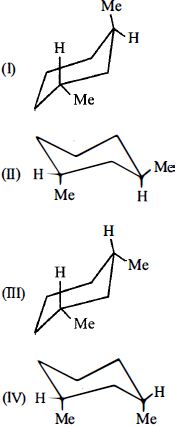
Arrange the following molecules in the correct order of stability (decreasing order):
A
$I > II \approx III > IV$
B
$IV > III > II \approx I$
C
$I > II > III > IV$
D
$III > I \approx II > IV$
Solution
(A) The stability of dimethylcyclohexane isomers depends on the number of equatorial methyl groups and steric interactions.
$1$. Structure $(I)$ is $trans-1,3-$dimethylcyclohexane in the diequatorial conformation,which is the most stable.
$2$. Structures $(II)$ and $(III)$ are $cis-1,3-$dimethylcyclohexane (one equatorial,one axial) and $trans-1,4-$dimethylcyclohexane (one equatorial,one axial) respectively. These have similar stability due to one axial methyl group.
$3$. Structure $(IV)$ is $cis-1,4-$dimethylcyclohexane in the diaxial conformation,which is the least stable due to severe $1,3-$diaxial interactions.
Therefore,the decreasing order of stability is $I > II \approx III > IV$.
$1$. Structure $(I)$ is $trans-1,3-$dimethylcyclohexane in the diequatorial conformation,which is the most stable.
$2$. Structures $(II)$ and $(III)$ are $cis-1,3-$dimethylcyclohexane (one equatorial,one axial) and $trans-1,4-$dimethylcyclohexane (one equatorial,one axial) respectively. These have similar stability due to one axial methyl group.
$3$. Structure $(IV)$ is $cis-1,4-$dimethylcyclohexane in the diaxial conformation,which is the least stable due to severe $1,3-$diaxial interactions.
Therefore,the decreasing order of stability is $I > II \approx III > IV$.
0 likesView Solution
51
ChemistryDifficultMCQJEE Main · 2013
Experimentally,it was found that a metal oxide has the formula $M_{0.98}O$. The metal $M$ is present as $M^{2+}$ and $M^{3+}$ in its oxide. The fraction of the metal which exists as $M^{3+}$ would be: .................... $\%$
A
$7.01$
B
$4.08$
C
$6.05$
D
$5.08$
Solution
(B) Given the formula of the metal oxide is $M_{0.98}O$.
Consider $1 \text{ mole}$ of the oxide.
Moles of $M = 0.98$ and moles of $O^{2-} = 1$.
Let the moles of $M^{3+} = x$.
Then,the moles of $M^{2+} = 0.98 - x$.
Since the compound is electrically neutral,the total positive charge must equal the total negative charge:
$(0.98 - x) \times 2 + x \times 3 = 1 \times 2$
$1.96 - 2x + 3x = 2$
$x = 2 - 1.96 = 0.04$.
Therefore,the fraction of metal existing as $M^{3+} = \frac{0.04}{0.98} \times 100 = 4.08 \%$.
Consider $1 \text{ mole}$ of the oxide.
Moles of $M = 0.98$ and moles of $O^{2-} = 1$.
Let the moles of $M^{3+} = x$.
Then,the moles of $M^{2+} = 0.98 - x$.
Since the compound is electrically neutral,the total positive charge must equal the total negative charge:
$(0.98 - x) \times 2 + x \times 3 = 1 \times 2$
$1.96 - 2x + 3x = 2$
$x = 2 - 1.96 = 0.04$.
Therefore,the fraction of metal existing as $M^{3+} = \frac{0.04}{0.98} \times 100 = 4.08 \%$.
0 likesView Solution
52
ChemistryMediumMCQJEE Main · 2013
Which of the following is the wrong statement?
A
$ONCl$ and $ONO^{-}$ are isoelectronic.
B
$O_3$ molecule is bent.
C
Ozone is violet-black in solid state.
D
Ozone is a diamagnetic gas.
Solution
(A) $ONCl$ has $8 + 7 + 17 = 32$ electrons,while $ONO^{-}$ $(NO_2^-)$ has $7 + 8 + 8 + 1 = 24$ electrons. Therefore,they are not isoelectronic.
$O_3$ has a bent structure due to the presence of a lone pair on the central oxygen atom.
Ozone is indeed violet-black in the solid state.
Ozone is diamagnetic as all electrons are paired.
Thus,the statement in option $A$ is incorrect.
$O_3$ has a bent structure due to the presence of a lone pair on the central oxygen atom.
Ozone is indeed violet-black in the solid state.
Ozone is diamagnetic as all electrons are paired.
Thus,the statement in option $A$ is incorrect.
0 likesView Solution
53
ChemistryDifficultMCQJEE Main · 2013
$A$ solution of $(-)-1-$chloro$-1-$phenylethane in toluene racemises slowly in the presence of a small amount of $SbCl_5$,due to the formation of:
A
carbanion
B
carbene
C
carbocation
D
free radical
Solution
(C) $SbCl_5$ acts as a Lewis acid and abstracts the chloride ion from $(-)-1-$chloro$-1-$phenylethane to form a stable benzylic carbocation intermediate: $Ph-CH(Cl)-CH_3 + SbCl_5 \to [Ph-CH^+-CH_3] + SbCl_6^-$.
Since the carbocation is planar,the nucleophilic attack by $Cl^-$ can occur from either side,leading to the formation of a racemic mixture.
Since the carbocation is planar,the nucleophilic attack by $Cl^-$ can occur from either side,leading to the formation of a racemic mixture.
0 likesView Solution
54
ChemistryEasyMCQJEE Main · 2013
Which of the following exists as covalent crystals in the solid state?
A
Iodine
B
Silicon
C
Sulphur
D
Phosphorus
Solution
(B) In the solid state,$I_2$ (Iodine),$S_8$ (Sulphur),and $P_4$ (Phosphorus) exist as molecular solids held together by weak van der Waals forces.
Silicon $(Si)$ forms a giant network structure where atoms are linked by covalent bonds,thus existing as a covalent (network) crystal.
Silicon $(Si)$ forms a giant network structure where atoms are linked by covalent bonds,thus existing as a covalent (network) crystal.
0 likesView Solution
55
ChemistryMediumMCQJEE Main · 2013
The coagulating power of electrolytes having ions $Na^{+}$,$Ba^{2+}$ and $Al^{3+}$ for arsenic sulphide sol increases in the order:
A
$Al^{3+} < Ba^{2+} < Na^{+}$
B
$Na^{+} < Ba^{2+} < Al^{3+}$
C
$Ba^{2+} < Na^{+} < Al^{3+}$
D
$Al^{3+} < Na^{+} < Ba^{2+}$
Solution
(B) According to the Hardy-Schulze rule,the coagulating power of an ion is directly proportional to the magnitude of its charge for a given sol.
Arsenic sulphide $(As_2S_3)$ sol is a negatively charged sol.
Therefore,the coagulating power depends on the charge of the cation.
The charges on the given ions are $+1$ for $Na^{+}$,$+2$ for $Ba^{2+}$,and $+3$ for $Al^{3+}$.
Thus,the increasing order of coagulating power is $Na^{+} < Ba^{2+} < Al^{3+}$.
Arsenic sulphide $(As_2S_3)$ sol is a negatively charged sol.
Therefore,the coagulating power depends on the charge of the cation.
The charges on the given ions are $+1$ for $Na^{+}$,$+2$ for $Ba^{2+}$,and $+3$ for $Al^{3+}$.
Thus,the increasing order of coagulating power is $Na^{+} < Ba^{2+} < Al^{3+}$.
0 likesView Solution
56
ChemistryMediumMCQJEE Main · 2013
The molarity of a solution obtained by mixing $750 \, mL$ of $0.5 \, M \, HCl$ with $250 \, mL$ of $2 \, M \, HCl$ will be $......... \, M$.
A
$0.875$
B
$1.00$
C
$1.75$
D
$0.97$
Solution
(A) The molarity of the final mixture is calculated using the formula:
$M_{mix} = \frac{M_{1}V_{1} + M_{2}V_{2}}{V_{1} + V_{2}}$
Given:
$M_{1} = 0.5 \, M$,$V_{1} = 750 \, mL$
$M_{2} = 2 \, M$,$V_{2} = 250 \, mL$
Total volume $V = 750 \, mL + 250 \, mL = 1000 \, mL$
Substituting the values:
$M_{mix} = \frac{(0.5 \times 750) + (2 \times 250)}{1000}$
$M_{mix} = \frac{375 + 500}{1000} = \frac{875}{1000} = 0.875 \, M$
$M_{mix} = \frac{M_{1}V_{1} + M_{2}V_{2}}{V_{1} + V_{2}}$
Given:
$M_{1} = 0.5 \, M$,$V_{1} = 750 \, mL$
$M_{2} = 2 \, M$,$V_{2} = 250 \, mL$
Total volume $V = 750 \, mL + 250 \, mL = 1000 \, mL$
Substituting the values:
$M_{mix} = \frac{(0.5 \times 750) + (2 \times 250)}{1000}$
$M_{mix} = \frac{375 + 500}{1000} = \frac{875}{1000} = 0.875 \, M$
0 likesView Solution
57
ChemistryDifficultMCQJEE Main · 2013
Given:
$E^o_{Cr^{3+}/Cr} = -0.74 \ V$,$E^o_{MnO_4^-/Mn^{2+}} = 1.51 \ V$
$E^o_{Cr_2O_7^{2-}/Cr^{3+}} = 1.33 \ V$,$E^o_{Cl_2/Cl^{-}} = 1.36 \ V$
Based on the data given above,the strongest oxidising agent will be:
$E^o_{Cr^{3+}/Cr} = -0.74 \ V$,$E^o_{MnO_4^-/Mn^{2+}} = 1.51 \ V$
$E^o_{Cr_2O_7^{2-}/Cr^{3+}} = 1.33 \ V$,$E^o_{Cl_2/Cl^{-}} = 1.36 \ V$
Based on the data given above,the strongest oxidising agent will be:
A
$Cl_2$
B
$Cr^{3+}$
C
$Mn^{2+}$
D
$MnO_4^-$
Solution
(D) The strength of an oxidising agent is directly proportional to its standard reduction potential $(E^o)$.
Comparing the given values:
$E^o_{Cr^{3+}/Cr} = -0.74 \ V$
$E^o_{MnO_4^-/Mn^{2+}} = 1.51 \ V$
$E^o_{Cr_2O_7^{2-}/Cr^{3+}} = 1.33 \ V$
$E^o_{Cl_2/Cl^{-}} = 1.36 \ V$
Since $MnO_4^-$ has the highest standard reduction potential $(1.51 \ V)$,it is the strongest oxidising agent.
Comparing the given values:
$E^o_{Cr^{3+}/Cr} = -0.74 \ V$
$E^o_{MnO_4^-/Mn^{2+}} = 1.51 \ V$
$E^o_{Cr_2O_7^{2-}/Cr^{3+}} = 1.33 \ V$
$E^o_{Cl_2/Cl^{-}} = 1.36 \ V$
Since $MnO_4^-$ has the highest standard reduction potential $(1.51 \ V)$,it is the strongest oxidising agent.
0 likesView Solution
58
ChemistryDifficultMCQJEE Main · 2013
The rate of a reaction doubles when its temperature changes from $300 \, K$ to $310 \, K.$ Activation energy of such a reaction will be .......... $kJ \, mol^{-1}$. $(R= 8.314 \, J \, K^{-1} \, mol^{-1}$ and $\log 2=0.301)$
A
$53.6$
B
$48.6$
C
$58.5$
D
$60.5$
Solution
(A) The Arrhenius equation is given by $\log \frac{k_{2}}{k_{1}} = \frac{E_{a}}{2.303 R} \left( \frac{T_{2} - T_{1}}{T_{1} T_{2}} \right).$
Given: $\frac{k_{2}}{k_{1}} = 2, T_{1} = 300 \, K, T_{2} = 310 \, K, R = 8.314 \, J \, K^{-1} \, mol^{-1}, \log 2 = 0.301.$
Substituting the values:
$0.301 = \frac{E_{a}}{2.303 \times 8.314} \left( \frac{310 - 300}{310 \times 300} \right)$
$0.301 = \frac{E_{a}}{19.147} \times \frac{10}{93000}$
$E_{a} = \frac{0.301 \times 19.147 \times 93000}{10}$
$E_{a} = 53598.6 \, J \, mol^{-1} = 53.6 \, kJ \, mol^{-1}.$
Given: $\frac{k_{2}}{k_{1}} = 2, T_{1} = 300 \, K, T_{2} = 310 \, K, R = 8.314 \, J \, K^{-1} \, mol^{-1}, \log 2 = 0.301.$
Substituting the values:
$0.301 = \frac{E_{a}}{2.303 \times 8.314} \left( \frac{310 - 300}{310 \times 300} \right)$
$0.301 = \frac{E_{a}}{19.147} \times \frac{10}{93000}$
$E_{a} = \frac{0.301 \times 19.147 \times 93000}{10}$
$E_{a} = 53598.6 \, J \, mol^{-1} = 53.6 \, kJ \, mol^{-1}.$
0 likesView Solution
59
ChemistryAdvancedMCQJEE Main · 2013
In which of the following complexes of the $Co$ (at. no. $27$),will the magnitude of $\Delta_o$ be the highest?
A
$[Co(CN)_6]^{3-}$
B
$[Co(C_2O_4)_3]^{3-}$
C
$[Co(H_2O)_6]^{3+}$
D
$[Co(NH_3)_6]^{3+}$
Solution
(A) The magnitude of crystal field splitting energy $(\Delta_o)$ depends on the strength of the ligand field.
According to the spectrochemical series,the strength of ligands increases in the order: $I^- < Br^- < Cl^- < F^- < OH^- < C_2O_4^{2-} < H_2O < NH_3 < en < NO_2^- < CN^-$.
Among the given ligands,$CN^-$ is the strongest field ligand.
Therefore,the complex containing $CN^-$ will have the highest crystal field splitting energy.
The order of $\Delta_o$ for the given complexes is: $[Co(H_2O)_6]^{3+} < [Co(C_2O_4)_3]^{3-} < [Co(NH_3)_6]^{3+} < [Co(CN)_6]^{3-}$.
Thus,the correct option is $A$.
According to the spectrochemical series,the strength of ligands increases in the order: $I^- < Br^- < Cl^- < F^- < OH^- < C_2O_4^{2-} < H_2O < NH_3 < en < NO_2^- < CN^-$.
Among the given ligands,$CN^-$ is the strongest field ligand.
Therefore,the complex containing $CN^-$ will have the highest crystal field splitting energy.
The order of $\Delta_o$ for the given complexes is: $[Co(H_2O)_6]^{3+} < [Co(C_2O_4)_3]^{3-} < [Co(NH_3)_6]^{3+} < [Co(CN)_6]^{3-}$.
Thus,the correct option is $A$.
0 likesView Solution
60
ChemistryMediumMCQJEE Main · 2013
Which of the following complex species is not expected to exhibit optical isomerism? $(en = \text{ethylenediamine})$
A
$[Co(en)_3]^{3+}$
B
$[Co(en)_2Cl_2]^{+}$
C
$[Co(NH_3)_3Cl_3]$
D
$[Co(en)(NH_3)_2Cl_2]^{+}$
Solution
(C) Optical isomerism is exhibited by only those complexes which lack elements of symmetry (plane of symmetry or center of symmetry).
$[Co(en)_3]^{3+}$ is a chiral complex and exhibits optical isomerism.
$[Co(en)_2Cl_2]^{+}$ exists in $cis$ and $trans$ forms; the $cis$ form is optically active.
$[Co(NH_3)_3Cl_3]$ exists in facial $(fac)$ and meridional $(mer)$ isomeric forms. Both these forms possess a plane of symmetry,hence they are optically inactive.
$[Co(en)(NH_3)_2Cl_2]^{+}$ can exist in optically active forms depending on the arrangement of ligands.
Therefore,$[Co(NH_3)_3Cl_3]$ is the complex that does not exhibit optical isomerism.
$[Co(en)_3]^{3+}$ is a chiral complex and exhibits optical isomerism.
$[Co(en)_2Cl_2]^{+}$ exists in $cis$ and $trans$ forms; the $cis$ form is optically active.
$[Co(NH_3)_3Cl_3]$ exists in facial $(fac)$ and meridional $(mer)$ isomeric forms. Both these forms possess a plane of symmetry,hence they are optically inactive.
$[Co(en)(NH_3)_2Cl_2]^{+}$ can exist in optically active forms depending on the arrangement of ligands.
Therefore,$[Co(NH_3)_3Cl_3]$ is the complex that does not exhibit optical isomerism.
0 likesView Solution
61
ChemistryMediumMCQJEE Main · 2013
Which of the following arrangements does not represent the correct order of the property stated against it?
A
$V^{2+} < Cr^{2+} < Mn^{2+} < Fe^{2+}$ : paramagnetic behaviour
B
$Ni^{2+} < Co^{2+} < Fe^{2+} < Mn^{2+}$ : ionic size
C
$Co^{3+} < Fe^{3+} < Cr^{3+} < Sc^{3+}$ : stability in aqueous solution
D
$Sc < Ti < Cr < Mn$ : number of oxidation states
Solution
(A) Paramagnetic behavior is determined by the number of unpaired electrons $(n)$. The magnetic moment is given by $\mu = \sqrt{n(n+2)} \ \text{BM}$.
$V^{2+} (3d^3): n = 3$
$Cr^{2+} (3d^4): n = 4$
$Mn^{2+} (3d^5): n = 5$
$Fe^{2+} (3d^6): n = 4$
The correct order of paramagnetic behavior is $V^{2+} < Cr^{2+} = Fe^{2+} < Mn^{2+}$.
Thus,the arrangement in option $(A)$ is incorrect.
$V^{2+} (3d^3): n = 3$
$Cr^{2+} (3d^4): n = 4$
$Mn^{2+} (3d^5): n = 5$
$Fe^{2+} (3d^6): n = 4$
The correct order of paramagnetic behavior is $V^{2+} < Cr^{2+} = Fe^{2+} < Mn^{2+}$.
Thus,the arrangement in option $(A)$ is incorrect.
0 likesView Solution
62
ChemistryMediumMCQJEE Main · 2013
Four successive members of the first row transition elements are listed below with their atomic numbers. Which one of them is expected to have the highest $E^{o}_{M^{3+} / M^{2+}}$ value?
A
$Cr$ $(Z=24)$
B
$Mn$ $(Z=25)$
C
$Fe$ $(Z=26)$
D
$Co$ $(Z=27)$
Solution
(D) The standard electrode potential $E^{o}_{M^{3+} / M^{2+}}$ depends on the stability of the $M^{3+}$ and $M^{2+}$ oxidation states.
The values for the given elements are:
$Cr^{3+} / Cr^{2+} = -0.41 \ V$
$Mn^{3+} / Mn^{2+} = +1.57 \ V$
$Fe^{3+} / Fe^{2+} = +0.77 \ V$
$Co^{3+} / Co^{2+} = +1.97 \ V$
Comparing these values,$Co^{3+} / Co^{2+}$ has the highest positive value of $+1.97 \ V$,indicating that $Co^{3+}$ is the most easily reduced to $Co^{2+}$ among the given elements.
The values for the given elements are:
$Cr^{3+} / Cr^{2+} = -0.41 \ V$
$Mn^{3+} / Mn^{2+} = +1.57 \ V$
$Fe^{3+} / Fe^{2+} = +0.77 \ V$
$Co^{3+} / Co^{2+} = +1.97 \ V$
Comparing these values,$Co^{3+} / Co^{2+}$ has the highest positive value of $+1.97 \ V$,indicating that $Co^{3+}$ is the most easily reduced to $Co^{2+}$ among the given elements.
0 likesView Solution
63
ChemistryDifficultMCQJEE Main · 2013
Compound $(A), \, C_8H_9Br,$ gives a white precipitate when warmed with alcoholic $AgNO_3.$ Oxidation of $(A)$ gives an acid $(B), \, C_8H_6O_4.$ $(B)$ easily forms anhydride on heating. Identify the compound $(A).$
A
o-Methylbenzyl bromide
B
o-Ethylphenyl bromide
C
p-Methylbenzyl bromide
D
m-Methylbenzyl bromide
Solution
(A) $1$. Compound $(A)$ has the formula $C_8H_9Br.$ The formation of a white precipitate with alcoholic $AgNO_3$ indicates the presence of a reactive bromine atom,likely a benzylic bromide $(-CH_2Br)$.
$2$. Oxidation of $(A)$ gives an acid $(B)$ with formula $C_8H_6O_4.$ This acid readily forms an anhydride upon heating,which is a characteristic property of phthalic acid (benzene$-1,2-$dicarboxylic acid).
$3$. For $(A)$ to yield phthalic acid upon oxidation,it must have two substituents at the ortho positions on the benzene ring that can be oxidized to carboxylic acid groups. One is the $-CH_2Br$ group (which oxidizes to $-COOH$) and the other must be a methyl group $(-CH_3)$ at the ortho position.
$4$. Therefore,$(A)$ is $o$-methylbenzyl bromide ($1$-bromo$-2-$methylbenzene derivative). The reaction sequence is: $o$-methylbenzyl bromide $\xrightarrow{Oxidation}$ phthalic acid $\xrightarrow{\Delta}$ phthalic anhydride.
$2$. Oxidation of $(A)$ gives an acid $(B)$ with formula $C_8H_6O_4.$ This acid readily forms an anhydride upon heating,which is a characteristic property of phthalic acid (benzene$-1,2-$dicarboxylic acid).
$3$. For $(A)$ to yield phthalic acid upon oxidation,it must have two substituents at the ortho positions on the benzene ring that can be oxidized to carboxylic acid groups. One is the $-CH_2Br$ group (which oxidizes to $-COOH$) and the other must be a methyl group $(-CH_3)$ at the ortho position.
$4$. Therefore,$(A)$ is $o$-methylbenzyl bromide ($1$-bromo$-2-$methylbenzene derivative). The reaction sequence is: $o$-methylbenzyl bromide $\xrightarrow{Oxidation}$ phthalic acid $\xrightarrow{\Delta}$ phthalic anhydride.
1 likesView Solution
64
ChemistryMediumMCQJEE Main · 2013
Arrange the following compounds in order of decreasing acidity:
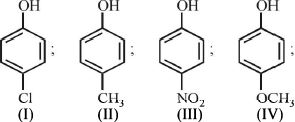
A
$II > IV > I > III$
B
$I > II > III > IV$
C
$III > I > II > IV$
D
$IV > III > I > II$
Solution
(C) The acidity of substituted phenols depends on the nature of the substituent group attached to the benzene ring.
Electron-withdrawing groups $(EWG)$ stabilize the phenoxide ion through $-I$ and $-M$ effects,thereby increasing acidity.
Electron-releasing groups $(ERG)$ destabilize the phenoxide ion through $+I$ and $+M$ effects,thereby decreasing acidity.
Comparing the substituents:
$III$ $(NO_2)$: Strong $-M$ and $-I$ effect (Strongest acid).
$I$ $(Cl)$: $-I$ effect (Weakly acidic).
$II$ $(CH_3)$: $+I$ effect and hyperconjugation (Electron releasing).
$IV$ $(OCH_3)$: Strong $+M$ effect (Strongest electron releasing group,weakest acid).
Thus,the order of decreasing acidity is $III > I > II > IV$.
Electron-withdrawing groups $(EWG)$ stabilize the phenoxide ion through $-I$ and $-M$ effects,thereby increasing acidity.
Electron-releasing groups $(ERG)$ destabilize the phenoxide ion through $+I$ and $+M$ effects,thereby decreasing acidity.
Comparing the substituents:
$III$ $(NO_2)$: Strong $-M$ and $-I$ effect (Strongest acid).
$I$ $(Cl)$: $-I$ effect (Weakly acidic).
$II$ $(CH_3)$: $+I$ effect and hyperconjugation (Electron releasing).
$IV$ $(OCH_3)$: Strong $+M$ effect (Strongest electron releasing group,weakest acid).
Thus,the order of decreasing acidity is $III > I > II > IV$.
0 likesView Solution
65
ChemistryDifficultMCQJEE Main · 2013
An unknown alcohol is treated with the "Lucas reagent" to determine whether the alcohol is primary,secondary,or tertiary. Which alcohol reacts fastest and by what mechanism?
A
secondary alcohol by $S_N1$
B
tertiary alcohol by $S_N1$
C
secondary alcohol by $S_N2$
D
tertiary alcohol by $S_N2$
Solution
(B) The reaction of an alcohol with Lucas reagent $(conc. \ HCl + ZnCl_2)$ proceeds via an $S_N1$ mechanism.
In this reaction,the rate-determining step is the formation of a carbocation intermediate.
The stability of the carbocation follows the order: $3^{\circ} > 2^{\circ} > 1^{\circ}$.
Since a tertiary $(3^{\circ})$ alcohol forms the most stable carbocation,it reacts the fastest with the Lucas reagent.
In this reaction,the rate-determining step is the formation of a carbocation intermediate.
The stability of the carbocation follows the order: $3^{\circ} > 2^{\circ} > 1^{\circ}$.
Since a tertiary $(3^{\circ})$ alcohol forms the most stable carbocation,it reacts the fastest with the Lucas reagent.
0 likesView Solution
66
ChemistryDifficultMCQJEE Main · 2013
$A$ compound with molecular mass $180$ is acylated with $CH_3COCl$ to get a compound with molecular mass $390$. The number of amino groups present per molecule of the former compound is:
A
$2$
B
$5$
C
$4$
D
$6$
Solution
(B) During acetylation,one $H$ atom (atomic mass $1 \, u$) of an $-NH_2$ group is replaced by an acetyl group $(CH_3CO-)$ with a molecular mass of $43 \, u$.
The reaction is: $-NH_2 + CH_3COCl \longrightarrow -NHCOCH_3 + HCl$.
This indicates that the acylation of each $-NH_2$ group increases the molecular mass of the compound by $(43 - 1) = 42 \, u$.
Given that the initial molecular mass is $180 \, u$ and the final molecular mass is $390 \, u$,the total increase in mass is $390 - 180 = 210 \, u$.
Therefore,the number of $-NH_2$ groups present is $\frac{210}{42} = 5$.
The reaction is: $-NH_2 + CH_3COCl \longrightarrow -NHCOCH_3 + HCl$.
This indicates that the acylation of each $-NH_2$ group increases the molecular mass of the compound by $(43 - 1) = 42 \, u$.
Given that the initial molecular mass is $180 \, u$ and the final molecular mass is $390 \, u$,the total increase in mass is $390 - 180 = 210 \, u$.
Therefore,the number of $-NH_2$ groups present is $\frac{210}{42} = 5$.
0 likesView Solution
67
ChemistryDifficultMCQJEE Main · 2013
An organic compound $A$ upon reacting with $NH_3$ gives $B$. On heating $B$ gives $C$. $C$ in presence of $KOH$ reacts with $Br_2$ to give $CH_3CH_2NH_2$. $A$ is:
A
$CH_3COOH$
B
$CH_3CH_2CH_2COOH$
C
$CH_3-CH(CH_3)-COOH$
D
$CH_3CH_2COOH$
Solution
(D) The reaction sequence is as follows:
$CH_3CH_2COOH (A)$ $\xrightarrow{NH_3} CH_3CH_2COONH_4 (B)$ $\xrightarrow{\Delta} CH_3CH_2CONH_2 (C)$ $\xrightarrow{Br_2/KOH} CH_3CH_2NH_2$
The final step is the Hoffmann Bromamide degradation reaction,where an amide $(C)$ is converted into an amine with one less carbon atom.
Since the product is ethylamine $(CH_3CH_2NH_2)$,the amide $C$ must be propanamide $(CH_3CH_2CONH_2)$.
This amide is formed by heating the ammonium salt of propanoic acid.
Therefore,compound $A$ is propanoic acid $(CH_3CH_2COOH)$.
$CH_3CH_2COOH (A)$ $\xrightarrow{NH_3} CH_3CH_2COONH_4 (B)$ $\xrightarrow{\Delta} CH_3CH_2CONH_2 (C)$ $\xrightarrow{Br_2/KOH} CH_3CH_2NH_2$
The final step is the Hoffmann Bromamide degradation reaction,where an amide $(C)$ is converted into an amine with one less carbon atom.
Since the product is ethylamine $(CH_3CH_2NH_2)$,the amide $C$ must be propanamide $(CH_3CH_2CONH_2)$.
This amide is formed by heating the ammonium salt of propanoic acid.
Therefore,compound $A$ is propanoic acid $(CH_3CH_2COOH)$.
0 likesView Solution
68
ChemistryMediumMCQJEE Main · 2013
The gas leaked from a storage tank of the Union Carbide plant in the Bhopal gas tragedy was:
A
Methyl isocyanate
B
Methylamine
C
Ammonia
D
Phosgene
Solution
(A) The gas that leaked from the storage tank of the Union Carbide plant during the Bhopal gas tragedy was Methyl isocyanate ($CH_3-N=C=O$,also known as $MIC$).
0 likesView Solution
69
ChemistryMediumMCQJEE Main · 2013
Synthesis of each molecule of glucose in photosynthesis involves:
A
$18$ molecules of $ATP$
B
$10$ molecules of $ATP$
C
$8$ molecules of $ATP$
D
$6$ molecules of $ATP$
Solution
(A) The synthesis of $1$ molecule of glucose $(C_{6}H_{12}O_{6})$ during the Calvin cycle in photosynthesis requires $18$ molecules of $ATP$ and $12$ molecules of $NADPH$.
The balanced equation for the process is:
$6CO_{2} + 12NADPH + 18ATP \rightarrow C_{6}H_{12}O_{6} + 12NADP^{+} + 18ADP + 18Pi + 6H_{2}O$
The balanced equation for the process is:
$6CO_{2} + 12NADPH + 18ATP \rightarrow C_{6}H_{12}O_{6} + 12NADP^{+} + 18ADP + 18Pi + 6H_{2}O$
0 likesView Solution
70
ChemistryEasyMCQJEE Main · 2013
The migration of dispersion medium under the influence of an electric potential is called
A
Cataphoresis
B
Electroosmosis
C
Electrophoresis
D
Sedimentation
Solution
(B) The movement of the dispersion medium under the influence of an applied electric field is known as electro-osmosis.
In contrast,the movement of colloidal particles under an electric field is called electrophoresis or cataphoresis.
In contrast,the movement of colloidal particles under an electric field is called electrophoresis or cataphoresis.
0 likesView Solution
71
ChemistryDifficultMCQJEE Main · 2013
If a polythene sample contains two monodisperse fractions in the ratio $2:3$ with degree of polymerization $100$ and $200$,respectively,then its weight average molecular weight will be
A
$4900$
B
$4600$
C
$4300$
D
$5200$
Solution
(A) Given,
Degree of polymerization of first polymer $= 100$
Degree of polymerization of second polymer $= 200$
Number of moles ratio $n_1 : n_2 = 2 : 3$
The monomer of polythene is ethylene $(C_2H_4)$ with molar mass $M_0 = 28 \ g/mol$.
Molar mass of first polymer fraction: $M_1 = 100 \times 28 = 2800 \ g/mol$.
Molar mass of second polymer fraction: $M_2 = 200 \times 28 = 5600 \ g/mol$.
The weight average molecular weight is given by the formula:
$\overline{M}_w = \frac{\sum n_i M_i^2}{\sum n_i M_i} = \frac{n_1 M_1^2 + n_2 M_2^2}{n_1 M_1 + n_2 M_2}$
Substituting the values:
$\overline{M}_w = \frac{2 \times (2800)^2 + 3 \times (5600)^2}{2 \times 2800 + 3 \times 5600}$
$\overline{M}_w = \frac{2 \times 7840000 + 3 \times 31360000}{5600 + 16800}$
$\overline{M}_w = \frac{15680000 + 94080000}{22400}$
$\overline{M}_w = \frac{109760000}{22400} = 4900 \ g/mol$.
Degree of polymerization of first polymer $= 100$
Degree of polymerization of second polymer $= 200$
Number of moles ratio $n_1 : n_2 = 2 : 3$
The monomer of polythene is ethylene $(C_2H_4)$ with molar mass $M_0 = 28 \ g/mol$.
Molar mass of first polymer fraction: $M_1 = 100 \times 28 = 2800 \ g/mol$.
Molar mass of second polymer fraction: $M_2 = 200 \times 28 = 5600 \ g/mol$.
The weight average molecular weight is given by the formula:
$\overline{M}_w = \frac{\sum n_i M_i^2}{\sum n_i M_i} = \frac{n_1 M_1^2 + n_2 M_2^2}{n_1 M_1 + n_2 M_2}$
Substituting the values:
$\overline{M}_w = \frac{2 \times (2800)^2 + 3 \times (5600)^2}{2 \times 2800 + 3 \times 5600}$
$\overline{M}_w = \frac{2 \times 7840000 + 3 \times 31360000}{5600 + 16800}$
$\overline{M}_w = \frac{15680000 + 94080000}{22400}$
$\overline{M}_w = \frac{109760000}{22400} = 4900 \ g/mol$.
0 likesView Solution
72
ChemistryDifficultMCQJEE Main · 2013
The instantaneous rate of disappearance of $MnO_4^-$ ion in the following reaction is $4.56 \times 10^{-3} \ M s^{-1}$.
$2MnO_4^- + 10I^{-} + 16H^{+} \to 2Mn^{2+} + 5I_2 + 8H_2O$
The rate of appearance of $I_2$ is $...... \times 10^{-2} \ M s^{-1}$.
$2MnO_4^- + 10I^{-} + 16H^{+} \to 2Mn^{2+} + 5I_2 + 8H_2O$
The rate of appearance of $I_2$ is $...... \times 10^{-2} \ M s^{-1}$.
A
$0.0456$
B
$1.14$
C
$0.114$
D
$0.57$
Solution
(B) Given: The rate of disappearance of $MnO_4^-$ is $-\frac{d[MnO_4^-]}{dt} = 4.56 \times 10^{-3} \ M s^{-1}$.
From the stoichiometry of the reaction $2MnO_4^- + 10I^{-} + 16H^{+} \to 2Mn^{2+} + 5I_2 + 8H_2O$,the rate expression is:
$-\frac{1}{2} \frac{d[MnO_4^-]}{dt} = \frac{1}{5} \frac{d[I_2]}{dt}$.
Rearranging to find the rate of appearance of $I_2$:
$\frac{d[I_2]}{dt} = -\frac{5}{2} \frac{d[MnO_4^-]}{dt}$.
Substituting the given value:
$\frac{d[I_2]}{dt} = \frac{5}{2} \times (4.56 \times 10^{-3}) \ M s^{-1} = 2.5 \times 4.56 \times 10^{-3} \ M s^{-1} = 11.4 \times 10^{-3} \ M s^{-1} = 1.14 \times 10^{-2} \ M s^{-1}$.
From the stoichiometry of the reaction $2MnO_4^- + 10I^{-} + 16H^{+} \to 2Mn^{2+} + 5I_2 + 8H_2O$,the rate expression is:
$-\frac{1}{2} \frac{d[MnO_4^-]}{dt} = \frac{1}{5} \frac{d[I_2]}{dt}$.
Rearranging to find the rate of appearance of $I_2$:
$\frac{d[I_2]}{dt} = -\frac{5}{2} \frac{d[MnO_4^-]}{dt}$.
Substituting the given value:
$\frac{d[I_2]}{dt} = \frac{5}{2} \times (4.56 \times 10^{-3}) \ M s^{-1} = 2.5 \times 4.56 \times 10^{-3} \ M s^{-1} = 11.4 \times 10^{-3} \ M s^{-1} = 1.14 \times 10^{-2} \ M s^{-1}$.
0 likesView Solution
73
ChemistryDifficultMCQJEE Main · 2013
Potassium dichromate when heated with concentrated sulphuric acid and a soluble chloride,gives brown-red vapours of:
A
$CrO_3$
B
$CrCl_3$
C
$CrO_2Cl_2$
D
$Cr_2O_3$
Solution
(C) When potassium dichromate $(K_2Cr_2O_7)$ is heated with concentrated sulphuric acid $(H_2SO_4)$ and a soluble chloride (like $NaCl$),it produces reddish-brown vapours of chromyl chloride $(CrO_2Cl_2)$.
This is known as the chromyl chloride test.
The reaction is: $K_2Cr_2O_7 + 4NaCl + 6H_2SO_4 \rightarrow 2KHSO_4 + 4NaHSO_4 + 2CrO_2Cl_2 + 3H_2O$.
This is known as the chromyl chloride test.
The reaction is: $K_2Cr_2O_7 + 4NaCl + 6H_2SO_4 \rightarrow 2KHSO_4 + 4NaHSO_4 + 2CrO_2Cl_2 + 3H_2O$.
0 likesView Solution
74
ChemistryDifficultMCQJEE Main · 2013
Rate of dehydration of alcohols follows the order
A
$2^o > 1^o > CH_3OH > 3^o$
B
$3^o > 2^o > 1^o > CH_3OH$
C
$2^o > 3^o > 1^o > CH_3OH$
D
$CH_3OH > 1^o > 2^o > 3^o$
Solution
(B) The dehydration of alcohols proceeds via the formation of a carbocation intermediate.
Since the stability of carbocations follows the order $3^o > 2^o > 1^o > CH_3^+$,the rate of dehydration of alcohols follows the same order: $3^o > 2^o > 1^o > CH_3OH$.
Since the stability of carbocations follows the order $3^o > 2^o > 1^o > CH_3^+$,the rate of dehydration of alcohols follows the same order: $3^o > 2^o > 1^o > CH_3OH$.
0 likesView Solution
75
ChemistryMediumMCQJEE Main · 2013
Calcination is the process in which
A
ore is heated above its melting point to expel $H_2O$ or $CO_2$ or $SO_2$
B
ore is heated below its melting point to expel volatile impurities
C
ore is heated above its melting point to remove $S, As$ and $Sb$ as $SO_2, As_2O_3$ and $Sb_2O_3$ respectively
D
ore is heated below its melting point to expel $H_2O$ or $CO_2$
Solution
(D) Calcination is a process of heating an ore to a high temperature,but below its melting point,in the absence of air or in a limited supply of air.
This process is primarily used to remove volatile impurities like moisture $(H_2O)$ and carbon dioxide $(CO_2)$ from carbonate ores.
This process is primarily used to remove volatile impurities like moisture $(H_2O)$ and carbon dioxide $(CO_2)$ from carbonate ores.
0 likesView Solution
76
ChemistryDifficultMCQJEE Main · 2013
Sodium Carbonate cannot be used in place of $(NH_4)_2CO_3$ for the identification of $Ca^{2+}$,$Ba^{2+}$,and $Sr^{2+}$ ions (in group $V$) during mixture analysis because
A
$Mg^{2+}$ ions will also be precipitated
B
Concentration of $CO_3^{2-}$ ions is very low
C
Sodium ions will react with acid radicals
D
$Na^{+}$ ions will interfere with the detection of $Ca^{2+}$,$Ba^{2+}$,$Sr^{2+}$ ions
Solution
(A) In the analysis of group $V$ cations,$(NH_4)_2CO_3$ is used as a group reagent in the presence of $NH_4Cl$ and $NH_4OH$.
$NH_4Cl$ suppresses the ionization of $(NH_4)_2CO_3$ due to the common ion effect,keeping the concentration of $CO_3^{2-}$ low enough to exceed only the solubility product $(K_{sp})$ of $Ca^{2+}$,$Ba^{2+}$,and $Sr^{2+}$ carbonates.
If $Na_2CO_3$ is used instead,it is a strong electrolyte and dissociates completely to provide a high concentration of $CO_3^{2-}$ ions.
This high concentration of $CO_3^{2-}$ exceeds the $K_{sp}$ of $MgCO_3$ as well,causing $Mg^{2+}$ ions to precipitate along with the group $V$ cations.
$NH_4Cl$ suppresses the ionization of $(NH_4)_2CO_3$ due to the common ion effect,keeping the concentration of $CO_3^{2-}$ low enough to exceed only the solubility product $(K_{sp})$ of $Ca^{2+}$,$Ba^{2+}$,and $Sr^{2+}$ carbonates.
If $Na_2CO_3$ is used instead,it is a strong electrolyte and dissociates completely to provide a high concentration of $CO_3^{2-}$ ions.
This high concentration of $CO_3^{2-}$ exceeds the $K_{sp}$ of $MgCO_3$ as well,causing $Mg^{2+}$ ions to precipitate along with the group $V$ cations.
0 likesView Solution
77
ChemistryDifficultMCQJEE Main · 2013
The type of isomerism which exists between $[Pd(C_6H_5)_2(SCN)_2]$ and $[Pd(C_6H_5)_2(NCS)_2]$ is
A
Linkage isomerism
B
Coordination isomerism
C
Ionisation isomerism
D
Solvate isomerism
Solution
(A) The given compounds exhibit linkage isomerism.
Linkage isomerism occurs in coordination compounds containing ambidentate ligands,which can coordinate to the central metal atom through different donor atoms.
In the given pair,the ligand $SCN^-$ (thiocyanate) coordinates through the sulfur atom,while $NCS^-$ (isothiocyanate) coordinates through the nitrogen atom.
Therefore,the correct answer is $A$.
Linkage isomerism occurs in coordination compounds containing ambidentate ligands,which can coordinate to the central metal atom through different donor atoms.
In the given pair,the ligand $SCN^-$ (thiocyanate) coordinates through the sulfur atom,while $NCS^-$ (isothiocyanate) coordinates through the nitrogen atom.
Therefore,the correct answer is $A$.
0 likesView Solution
78
ChemistryMediumMCQJEE Main · 2013
$12 \ g$ of a nonvolatile solute dissolved in $108 \ g$ of water produces the relative lowering of vapour pressure of $0.1$. The molecular mass of the solute is
A
$80$
B
$60$
C
$20$
D
$40$
Solution
(C) The relative lowering of vapour pressure is given by the formula: $\frac{P^o - P_s}{P^o} = \frac{n}{N} = \frac{w}{m} \times \frac{M}{W}$
Here,$w = 12 \ g$ (mass of solute),$W = 108 \ g$ (mass of solvent),$M = 18 \ g/mol$ (molar mass of water),and the relative lowering of vapour pressure is $0.1$.
Substituting the values: $0.1 = \frac{12}{m} \times \frac{18}{108}$
Simplifying the expression: $0.1 = \frac{12}{m} \times \frac{1}{6}$
$0.1 = \frac{2}{m}$
$m = \frac{2}{0.1} = 20 \ g/mol$.
Here,$w = 12 \ g$ (mass of solute),$W = 108 \ g$ (mass of solvent),$M = 18 \ g/mol$ (molar mass of water),and the relative lowering of vapour pressure is $0.1$.
Substituting the values: $0.1 = \frac{12}{m} \times \frac{18}{108}$
Simplifying the expression: $0.1 = \frac{12}{m} \times \frac{1}{6}$
$0.1 = \frac{2}{m}$
$m = \frac{2}{0.1} = 20 \ g/mol$.
0 likesView Solution
79
ChemistryMediumMCQJEE Main · 2013
Which of the following enzymes converts starch into maltose?
A
Diastase
B
Maltase
C
Zymase
D
Invertase
Solution
(A) Maltose is obtained by the partial hydrolysis of starch using the enzyme $Diastase$,which is present in malt.
The chemical reaction is:
$2(C_6H_{10}O_5)_n + nH_2O \xrightarrow{Diastase} nC_{12}H_{22}O_{11} \text{ (Maltose)}$
The chemical reaction is:
$2(C_6H_{10}O_5)_n + nH_2O \xrightarrow{Diastase} nC_{12}H_{22}O_{11} \text{ (Maltose)}$
0 likesView Solution
80
ChemistryDifficultMCQJEE Main · 2013
Electrode potentials $(E^o)$ are given below:
$Cu^{+}/Cu = +0.52 \ V$
$Fe^{3+}/Fe^{2+} = +0.77 \ V$
$\frac{1}{2} I_{2(s)}/I^{-} = +0.54 \ V$
$Ag^{+}/Ag = +0.88 \ V$
Based on the above potentials,the strongest oxidizing agent will be:
$Cu^{+}/Cu = +0.52 \ V$
$Fe^{3+}/Fe^{2+} = +0.77 \ V$
$\frac{1}{2} I_{2(s)}/I^{-} = +0.54 \ V$
$Ag^{+}/Ag = +0.88 \ V$
Based on the above potentials,the strongest oxidizing agent will be:
A
$Cu^{+}$
B
$Fe^{3+}$
C
$Ag^{+}$
D
$I_2$
Solution
(C) The strength of an oxidizing agent is directly proportional to its standard reduction potential $(E^o)$.
Comparing the given values:
$E^o(Cu^{+}/Cu) = +0.52 \ V$
$E^o(Fe^{3+}/Fe^{2+}) = +0.77 \ V$
$E^o(\frac{1}{2} I_2/I^{-}) = +0.54 \ V$
$E^o(Ag^{+}/Ag) = +0.88 \ V$
Since $Ag^{+}$ has the highest reduction potential $(+0.88 \ V)$,it is the strongest oxidizing agent.
Comparing the given values:
$E^o(Cu^{+}/Cu) = +0.52 \ V$
$E^o(Fe^{3+}/Fe^{2+}) = +0.77 \ V$
$E^o(\frac{1}{2} I_2/I^{-}) = +0.54 \ V$
$E^o(Ag^{+}/Ag) = +0.88 \ V$
Since $Ag^{+}$ has the highest reduction potential $(+0.88 \ V)$,it is the strongest oxidizing agent.
0 likesView Solution
81
ChemistryDifficultMCQJEE Main · 2013
Aryl fluoride may be prepared from arene diazonium chloride using
A
$HBF_4 / \Delta$
B
$HBF_4 / NaNO_2, Cu, \Delta$
C
$CuF / HF$
D
$Cu / HF$
Solution
(A) Aryl fluorides are prepared by the Balz-Schiemann reaction. In this reaction,arene diazonium chloride is treated with fluoroboric acid $(HBF_4)$ to form arene diazonium fluoroborate,which upon heating decomposes to give aryl fluoride,nitrogen gas,and boron trifluoride $(BF_3)$. The reaction is: $Ar-N_2^+Cl^- + HBF_4$ $\rightarrow Ar-N_2^+BF_4^- + HCl$ $\rightarrow Ar-F + N_2 + BF_3$.
0 likesView Solution
82
ChemistryDifficultMCQJEE Main · 2013
An ether $(A)$,$C_5H_{12}O$,when heated with excess of hot concentrated $HI$ produced two alkyl halides which when treated with $NaOH$ yielded compounds $(B)$ and $(C)$. Oxidation of $(B)$ and $(C)$ gave a propanone and an ethanoic acid respectively. The $IUPAC$ name of the ether $(A)$ is
A
$2-$ethoxypropane
B
ethoxypropane
C
methoxybutane
D
$2-$methoxybutane
Solution
(A) The ether $(A)$ has the molecular formula $C_5H_{12}O$.
Reaction with excess $HI$ produces two alkyl halides.
Treatment of these alkyl halides with $NaOH$ yields alcohols $(B)$ and $(C)$.
Oxidation of $(B)$ produces propanone $(CH_3COCH_3)$,which indicates that $(B)$ is propan-$2$-ol $(CH_3CH(OH)CH_3)$.
Oxidation of $(C)$ produces ethanoic acid $(CH_3COOH)$,which indicates that $(C)$ is ethanol $(CH_3CH_2OH)$.
Therefore,the ether $(A)$ is formed by the combination of an isopropyl group and an ethyl group,which is $CH_3CH_2OCH(CH_3)_2$.
The $IUPAC$ name of this ether is $2-$ethoxypropane.
Reaction with excess $HI$ produces two alkyl halides.
Treatment of these alkyl halides with $NaOH$ yields alcohols $(B)$ and $(C)$.
Oxidation of $(B)$ produces propanone $(CH_3COCH_3)$,which indicates that $(B)$ is propan-$2$-ol $(CH_3CH(OH)CH_3)$.
Oxidation of $(C)$ produces ethanoic acid $(CH_3COOH)$,which indicates that $(C)$ is ethanol $(CH_3CH_2OH)$.
Therefore,the ether $(A)$ is formed by the combination of an isopropyl group and an ethyl group,which is $CH_3CH_2OCH(CH_3)_2$.
The $IUPAC$ name of this ether is $2-$ethoxypropane.
0 likesView Solution
83
ChemistryMediumMCQJEE Main · 2013
An element having an atomic radius of $0.14 \ nm$ crystallizes in an $fcc$ unit cell. What is the length of a side of the cell in $nm$?
A
$0.56$
B
$0.24$
C
$0.96$
D
$0.4$
Solution
(D) For an $fcc$ unit cell,the relationship between the edge length $a$ and the atomic radius $r$ is given by:
$r = \frac{\sqrt{2}a}{4}$
Rearranging for $a$:
$a = \frac{4r}{\sqrt{2}} = 2\sqrt{2} \times r$
Given $r = 0.14 \ nm$:
$a = 2 \times 1.414 \times 0.14 \ nm$
$a = 2.828 \times 0.14 \ nm$
$a \approx 0.3959 \ nm$
Rounding to the nearest value,we get $a \approx 0.4 \ nm$.
$r = \frac{\sqrt{2}a}{4}$
Rearranging for $a$:
$a = \frac{4r}{\sqrt{2}} = 2\sqrt{2} \times r$
Given $r = 0.14 \ nm$:
$a = 2 \times 1.414 \times 0.14 \ nm$
$a = 2.828 \times 0.14 \ nm$
$a \approx 0.3959 \ nm$
Rounding to the nearest value,we get $a \approx 0.4 \ nm$.
0 likesView Solution
84
ChemistryDifficultMCQJEE Main · 2013
Formaldehyde can be distinguished from acetaldehyde by the use of
A
Schiff's reagent
B
Tollen's reagent
C
$I_2 / \text{Alkali}$
D
Fehling's solution
Solution
(C) Acetaldehyde contains a $CH_3CO-$ group,which gives a positive iodoform test with $I_2 / \text{Alkali}$.
Formaldehyde does not contain a $CH_3CO-$ group and therefore does not give the iodoform test.
Thus,$I_2 / \text{Alkali}$ is used to distinguish between them.
Formaldehyde does not contain a $CH_3CO-$ group and therefore does not give the iodoform test.
Thus,$I_2 / \text{Alkali}$ is used to distinguish between them.
0 likesView Solution
85
ChemistryMediumMCQJEE Main · 2013
The element with which of the following outer electron configuration may exhibit the largest number of oxidation states in its compounds?
A
$3d^5\, 4s^2$
B
$3d^8\, 4s^2$
C
$3d^7\, 4s^2$
D
$3d^6\, 4s^2$
Solution
(A) The element with the outer electron configuration $3d^5\, 4s^2$ is Manganese $(Mn)$.
This configuration corresponds to the $3d$ transition series.
$Mn$ has $7$ valence electrons ($5$ in $d$-orbital and $2$ in $s$-orbital),allowing it to exhibit a wide range of oxidation states from $+2$ to $+7$ in its compounds.
This is the largest number of oxidation states among the given options.
This configuration corresponds to the $3d$ transition series.
$Mn$ has $7$ valence electrons ($5$ in $d$-orbital and $2$ in $s$-orbital),allowing it to exhibit a wide range of oxidation states from $+2$ to $+7$ in its compounds.
This is the largest number of oxidation states among the given options.
0 likesView Solution
86
ChemistryDifficultMCQJEE Main · 2013
$A$ major component of Borsch reagent is obtained by reacting hydrazine hydrate with which of the following?
A
B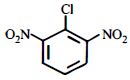
C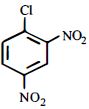
D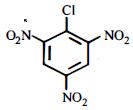
Solution
(C) The major component of Borsch reagent is $2,4-$dinitrophenylhydrazine.
It is synthesized via the nucleophilic aromatic substitution reaction between $2,4-$dinitrochlorobenzene and hydrazine hydrate $(NH_2NH_2 \cdot H_2O)$.
The reaction involves the displacement of the chlorine atom by the hydrazine group.
It is synthesized via the nucleophilic aromatic substitution reaction between $2,4-$dinitrochlorobenzene and hydrazine hydrate $(NH_2NH_2 \cdot H_2O)$.
The reaction involves the displacement of the chlorine atom by the hydrazine group.
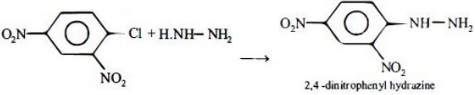
0 likesView Solution
87
ChemistryMediumMCQJEE Main · 2013
$A$ molecule $M$ associates in a given solvent according to the equation $M \rightleftharpoons (M)_n$. For a certain concentration of $M,$ the van't Hoff factor was found to be $0.9$ and the fraction of associated molecules was $0.2.$ The value of $n$ is
A
$3$
B
$5$
C
$2$
D
$4$
Solution
(C) The van't Hoff factor $(i)$ and the degree of association $(\alpha)$ are related by the formula:
$i = 1 - \alpha \left( 1 - \frac{1}{n} \right)$
Given: $i = 0.9$ and $\alpha = 0.2$.
Substituting the values:
$0.9 = 1 - 0.2 \left( 1 - \frac{1}{n} \right)$
$0.2 \left( 1 - \frac{1}{n} \right) = 1 - 0.9$
$0.2 \left( 1 - \frac{1}{n} \right) = 0.1$
$1 - \frac{1}{n} = \frac{0.1}{0.2} = 0.5$
$1 - 0.5 = \frac{1}{n}$
$0.5 = \frac{1}{n}$
$n = \frac{1}{0.5} = 2$
Therefore,the value of $n$ is $2$.
$i = 1 - \alpha \left( 1 - \frac{1}{n} \right)$
Given: $i = 0.9$ and $\alpha = 0.2$.
Substituting the values:
$0.9 = 1 - 0.2 \left( 1 - \frac{1}{n} \right)$
$0.2 \left( 1 - \frac{1}{n} \right) = 1 - 0.9$
$0.2 \left( 1 - \frac{1}{n} \right) = 0.1$
$1 - \frac{1}{n} = \frac{0.1}{0.2} = 0.5$
$1 - 0.5 = \frac{1}{n}$
$0.5 = \frac{1}{n}$
$n = \frac{1}{0.5} = 2$
Therefore,the value of $n$ is $2$.
0 likesView Solution
88
ChemistryDifficultMCQJEE Main · 2013
The reaction $X \to Y$ is an exothermic reaction. The activation energy of the forward reaction $X \to Y$ is $150\,kJ\,mol^{-1}$. The enthalpy of the reaction is $-135\,kJ\,mol^{-1}$. The activation energy for the reverse reaction,$Y \to X$,will be $.......\,kJ\,mol^{-1}$.
A
$280$
B
$285$
C
$270$
D
$15$
Solution
(B) For a reaction $X \to Y$,the enthalpy change $\Delta H$ is given by the difference between the activation energy of the forward reaction $(E_{a(f)})$ and the activation energy of the reverse reaction $(E_{a(b)})$.
$\Delta H = E_{a(f)} - E_{a(b)}$
Given:
$E_{a(f)} = 150\,kJ\,mol^{-1}$
$\Delta H = -135\,kJ\,mol^{-1}$
Substituting the values into the equation:
$-135 = 150 - E_{a(b)}$
Rearranging to solve for $E_{a(b)}$:
$E_{a(b)} = 150 + 135 = 285\,kJ\,mol^{-1}$
$\Delta H = E_{a(f)} - E_{a(b)}$
Given:
$E_{a(f)} = 150\,kJ\,mol^{-1}$
$\Delta H = -135\,kJ\,mol^{-1}$
Substituting the values into the equation:
$-135 = 150 - E_{a(b)}$
Rearranging to solve for $E_{a(b)}$:
$E_{a(b)} = 150 + 135 = 285\,kJ\,mol^{-1}$
0 likesView Solution
89
ChemistryDifficultMCQJEE Main · 2013
Which of the following statements about aspirin is not true?
A
It is effective in relieving pain.
B
It is a neurologically active drug.
C
It has antiblood clotting action.
D
It belongs to narcotic analgesics.
Solution
(D) Aspirin is a non-narcotic analgesic,not a narcotic analgesic. It is used to relieve pain and reduce fever,and it also has anti-blood clotting properties.
0 likesView Solution
90
ChemistryDifficultMCQJEE Main · 2013
The density of $3 \text{ M}$ solution of sodium chloride is $1.252 \text{ g mL}^{-1}$. The molality of the solution will be ............. $\text{m}$. (molar mass,$NaCl = 58.5 \text{ g mol}^{-1}$)
A
$2.60$
B
$2.18$
C
$2.79$
D
$3.00$
Solution
(C) The relation between molarity $(M)$ and molality $(m)$ is given by the formula: $d = M \left( \frac{1}{m} + \frac{M_2}{1000} \right)$,where $d$ is density in $\text{g mL}^{-1}$,$M$ is molarity,$m$ is molality,and $M_2$ is the molar mass of the solute.
Given: $M = 3 \text{ M}$,$d = 1.252 \text{ g mL}^{-1}$,$M_2 = 58.5 \text{ g mol}^{-1}$.
Substituting the values: $1.252 = 3 \left( \frac{1}{m} + \frac{58.5}{1000} \right)$.
$1.252 / 3 = \frac{1}{m} + 0.0585$.
$0.41733 = \frac{1}{m} + 0.0585$.
$\frac{1}{m} = 0.41733 - 0.0585 = 0.35883$.
$m = 1 / 0.35883 \approx 2.79 \text{ m}$.
Given: $M = 3 \text{ M}$,$d = 1.252 \text{ g mL}^{-1}$,$M_2 = 58.5 \text{ g mol}^{-1}$.
Substituting the values: $1.252 = 3 \left( \frac{1}{m} + \frac{58.5}{1000} \right)$.
$1.252 / 3 = \frac{1}{m} + 0.0585$.
$0.41733 = \frac{1}{m} + 0.0585$.
$\frac{1}{m} = 0.41733 - 0.0585 = 0.35883$.
$m = 1 / 0.35883 \approx 2.79 \text{ m}$.
0 likesView Solution
91
ChemistryDifficultMCQJEE Main · 2013
Which of the following structures represents thymine?
A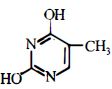
B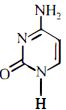
C
D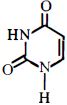
Solution
(D) Thymine is $5$-methyluracil. Its chemical structure consists of a pyrimidine ring with carbonyl groups at the $2$ and $4$ positions and a methyl group at the $5$ position. Among the given options,the structure representing thymine is the one with two carbonyl groups and a methyl group at the $5$-position. Since the provided images do not explicitly show the correct structure for thymine (which should be $5$-methyluracil),we identify the correct chemical description as the answer.
0 likesView Solution
92
ChemistryMediumMCQJEE Main · 2013
The polymer used for optical lenses is
A
polypropylene
B
polyvinyl chloride
C
polythene
D
polymethyl methacrylate
Solution
(D) Polymethyl methacrylate $(PMMA)$ is a transparent and rigid thermoplastic. Due to its high optical clarity and resistance to shattering,it is widely used in the manufacturing of optical lenses.
0 likesView Solution
93
ChemistryDifficultMCQJEE Main · 2013
Which of the following is diamagnetic?
A
$[Fe(CN)_6]^{3-}$
B
$[Co(C_2O_4)_3]^{3-}$
C
$[FeF_6]^{3-}$
D
$[CoF_6]^{3-}$
Solution
(B) To determine the magnetic nature,we analyze the electronic configuration of the central metal ion in each complex:
$1$. In $[Fe(CN)_6]^{3-}$,$Fe^{3+}$ is $d^5$. $CN^-$ is a strong field ligand,causing pairing. It has $1$ unpaired electron (paramagnetic).
$2$. In $[Co(C_2O_4)_3]^{3-}$,$Co^{3+}$ is $d^6$. $C_2O_4^{2-}$ is a strong field ligand,causing pairing. It has $0$ unpaired electrons ($d^2sp^3$ hybridization),making it diamagnetic.
$3$. In $[FeF_6]^{3-}$,$Fe^{3+}$ is $d^5$. $F^-$ is a weak field ligand,resulting in $5$ unpaired electrons (paramagnetic).
$4$. In $[CoF_6]^{3-}$,$Co^{3+}$ is $d^6$. $F^-$ is a weak field ligand,resulting in $4$ unpaired electrons (paramagnetic).
Therefore,$[Co(C_2O_4)_3]^{3-}$ is the diamagnetic complex.
$1$. In $[Fe(CN)_6]^{3-}$,$Fe^{3+}$ is $d^5$. $CN^-$ is a strong field ligand,causing pairing. It has $1$ unpaired electron (paramagnetic).
$2$. In $[Co(C_2O_4)_3]^{3-}$,$Co^{3+}$ is $d^6$. $C_2O_4^{2-}$ is a strong field ligand,causing pairing. It has $0$ unpaired electrons ($d^2sp^3$ hybridization),making it diamagnetic.
$3$. In $[FeF_6]^{3-}$,$Fe^{3+}$ is $d^5$. $F^-$ is a weak field ligand,resulting in $5$ unpaired electrons (paramagnetic).
$4$. In $[CoF_6]^{3-}$,$Co^{3+}$ is $d^6$. $F^-$ is a weak field ligand,resulting in $4$ unpaired electrons (paramagnetic).
Therefore,$[Co(C_2O_4)_3]^{3-}$ is the diamagnetic complex.
0 likesView Solution
94
ChemistryMediumMCQJEE Main · 2013
What is the structure of the major product when phenol is treated with bromine water?
A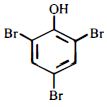
B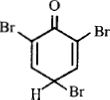
C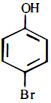
D
Solution
(A) Phenol has an activating (electron-releasing) $-OH$ group,which strongly activates the benzene ring towards electrophilic substitution. Bromine water provides $Br^{+}$ ions easily. Due to the high reactivity of phenol,the reaction does not stop at the mono- or di-bromo stage but proceeds to form a fully brominated product,$2,4,6-\text{tribromophenol}$,as a white precipitate.
0 likesView Solution
95
ChemistryDifficultMCQJEE Main · 2013
Flocculation value of $BaCl_2$ is much less than that of $KCl$ for sol $A$ and flocculation value of $Na_2SO_4$ is much less than that of $NaBr$ for sol $B.$ The correct statement among the following is
A
Both the sols $A$ and $B$ are negatively charged.
B
Sol $A$ is positively charged and Sol $B$ is negatively charged.
C
Both the sols $A$ and $B$ are positively charged.
D
Sol $A$ is negatively charged and sol $B$ is positively charged.
Solution
(D) According to the Hardy-Schulze rule,the coagulating power of an ion is directly proportional to its valence.
For sol $A$,the flocculation value of $BaCl_2$ $(Ba^{2+})$ is less than $KCl$ $(K^+)$,which implies that the cation $Ba^{2+}$ is more effective at coagulation than $K^+$. Therefore,sol $A$ must be negatively charged.
For sol $B$,the flocculation value of $Na_2SO_4$ $(SO_4^{2-})$ is less than $NaBr$ $(Br^-)$,which implies that the anion $SO_4^{2-}$ is more effective at coagulation than $Br^-$. Therefore,sol $B$ must be positively charged.
Thus,sol $A$ is negatively charged and sol $B$ is positively charged.
For sol $A$,the flocculation value of $BaCl_2$ $(Ba^{2+})$ is less than $KCl$ $(K^+)$,which implies that the cation $Ba^{2+}$ is more effective at coagulation than $K^+$. Therefore,sol $A$ must be negatively charged.
For sol $B$,the flocculation value of $Na_2SO_4$ $(SO_4^{2-})$ is less than $NaBr$ $(Br^-)$,which implies that the anion $SO_4^{2-}$ is more effective at coagulation than $Br^-$. Therefore,sol $B$ must be positively charged.
Thus,sol $A$ is negatively charged and sol $B$ is positively charged.
0 likesView Solution
96
ChemistryDifficultMCQJEE Main · 2013
Amongst the following alcohols,which would react fastest with conc. $HCl$ and $ZnCl_2$?
A
pentan-$1$-ol
B
$2$-methylbutan-$1$-ol
C
pentan-$2$-ol
D
$2$-methylbutan-$2$-ol
Solution
(D) The mixture of conc. $HCl$ and anhydrous $ZnCl_2$ is known as Lucas reagent.
This reaction proceeds via the formation of a carbocation intermediate.
The reactivity order of alcohols towards Lucas reagent is $3^o > 2^o > 1^o$.
$2$-methylbutan-$2$-ol is a tertiary $(3^o)$ alcohol,while the others are primary or secondary alcohols.
Therefore,$2$-methylbutan-$2$-ol reacts fastest with Lucas reagent,producing immediate turbidity.
This reaction proceeds via the formation of a carbocation intermediate.
The reactivity order of alcohols towards Lucas reagent is $3^o > 2^o > 1^o$.
$2$-methylbutan-$2$-ol is a tertiary $(3^o)$ alcohol,while the others are primary or secondary alcohols.
Therefore,$2$-methylbutan-$2$-ol reacts fastest with Lucas reagent,producing immediate turbidity.
0 likesView Solution
97
ChemistryDifficultMCQJEE Main · 2013
Clemmensen reduction of a ketone is carried out in the presence of
A
$LiAlH_4$
B
$Zn-Hg$ with $HCl$
C
Glycol with $KOH$
D
$H_2$ with $Pt$ as catalyst
Solution
(B) The Clemmensen reduction is a chemical reaction where a ketone or aldehyde is reduced to an alkane using zinc amalgam $(Zn-Hg)$ and concentrated hydrochloric acid $(HCl)$.
The general reaction is: $\text{>C=O} \xrightarrow{Zn-Hg/HCl} \text{>CH}_2 + H_2O$.
The general reaction is: $\text{>C=O} \xrightarrow{Zn-Hg/HCl} \text{>CH}_2 + H_2O$.
0 likesView Solution
98
ChemistryDifficultMCQJEE Main · 2013
Which of the following statements is incorrect?
A
$Fe^{3+}$ ion also gives blood red colour with $SCN^{-}$ ion.
B
$Fe^{2+}$ ion also gives blood red colour with $SCN^{-}$ ion.
C
On passing $H_2S$ into $Na_2ZnO_2$ solution a white ppt of $ZnS$ is formed.
D
Cupric ion reacts with excess of ammonia solution to give deep blue colour of $[Cu(NH_3)_4]^{2+}$ ion.
Solution
(B) The reaction of $Fe^{3+}$ with $SCN^{-}$ produces a blood-red complex $[Fe(SCN)]^{2+}$.
$Fe^{2+}$ does not form this complex,making statement $B$ incorrect.
$Na_2ZnO_2$ reacts with $H_2S$ to form a white precipitate of $ZnS$.
$Cu^{2+}$ reacts with excess $NH_3$ to form the deep blue $[Cu(NH_3)_4]^{2+}$ complex.
$Fe^{2+}$ does not form this complex,making statement $B$ incorrect.
$Na_2ZnO_2$ reacts with $H_2S$ to form a white precipitate of $ZnS$.
$Cu^{2+}$ reacts with excess $NH_3$ to form the deep blue $[Cu(NH_3)_4]^{2+}$ complex.
0 likesView Solution
99
ChemistryDifficultMCQJEE Main · 2013
In Williamson synthesis of mixed ether having a primary and a tertiary alkyl group,if a tertiary halide is used,then:
A
Rate of reaction will be slow due to slow cleavage of carbon-halogen bond.
B
Alkene will be the main product.
C
Simple ether will form instead of mixed ether.
D
Expected mixed ether will be formed.
Solution
(B) In Williamson synthesis,the reaction between an alkoxide ion and an alkyl halide follows the $S_N2$ mechanism.
For ether formation,the alkyl halide should ideally be primary.
If a tertiary $(3^\circ)$ alkyl halide is used,the alkoxide ion (which is a strong base) promotes elimination $(E2)$ over substitution $(S_N2)$ due to steric hindrance.
Consequently,an alkene is formed as the major product instead of an ether.
For ether formation,the alkyl halide should ideally be primary.
If a tertiary $(3^\circ)$ alkyl halide is used,the alkoxide ion (which is a strong base) promotes elimination $(E2)$ over substitution $(S_N2)$ due to steric hindrance.
Consequently,an alkene is formed as the major product instead of an ether.
0 likesView Solution
100
ChemistryDifficultMCQJEE Main · 2013
Which of the following would not give $2-$phenylbutane as the major product in a Friedel-Crafts alkylation reaction?
A
$1-$butene $+ HF$
B
$2-$butanol $+ H_2SO_4$
C
Butanoyl chloride $+ AlCl_3$ then $Zn, HCl$
D
Butyl chloride $+ AlCl_3$
Solution
(C) Friedel-Crafts alkylation of benzene with $1-$butene or $2-$butanol (via carbocation rearrangement) yields $2-$phenylbutane as the major product.
Butyl chloride $+ AlCl_3$ undergoes rearrangement of the primary carbocation to a secondary carbocation,also yielding $2-$phenylbutane.
However,the reaction of butanoyl chloride with $AlCl_3$ is a Friedel-Crafts acylation,which produces $1-$phenylbutan$-1-$one. Subsequent Clemmensen reduction $(Zn-Hg/HCl)$ yields $n-$butylbenzene ($1-$phenylbutane),not $2-$phenylbutane.
Butyl chloride $+ AlCl_3$ undergoes rearrangement of the primary carbocation to a secondary carbocation,also yielding $2-$phenylbutane.
However,the reaction of butanoyl chloride with $AlCl_3$ is a Friedel-Crafts acylation,which produces $1-$phenylbutan$-1-$one. Subsequent Clemmensen reduction $(Zn-Hg/HCl)$ yields $n-$butylbenzene ($1-$phenylbutane),not $2-$phenylbutane.
0 likesView Solution
Vedclass Products
For Students
Vedclass Test Series
Mock tests in real JEE Main style covering Chemistry with performance analysis. 5-day free trial.
Start Free TrialFor Teachers
Exam Paper Generator
Generate Set A/B/C/D Chemistry papers from 7.5L+ questions in 2 minutes. 3 chapters free.
Try FreeFor Institutes
Online Exam Module
Run live JEE Main mock exams with unlimited students, 360° analytics & white-label branding.
See DemoFrequently Asked Questions
How many Chemistry questions are in JEE Main 2013?
There are 176 Chemistry questions from the JEE Main 2013 paper on Vedclass, each with a detailed step-by-step solution in English.
Are JEE Main 2013 Chemistry solutions available in English?
Yes. All solutions on this page are in English. You can also switch to English or Hindi using the language buttons above the questions.
Can I practice JEE Main 2013 Chemistry as a timed test?
Yes. Use the Vedclass Test Series to attempt a full JEE Main mock test covering Chemistry with time limits and instant score analysis.
Can teachers create Chemistry papers from JEE Main previous year questions?
Yes. The Vedclass Exam Paper Generator lets teachers mix JEE Main Chemistry questions and generate Set A/B/C/D papers in minutes.
For Teachers & Institutes
Build a Custom Chemistry Paper
Pick JEE Main 2013 Chemistry questions, set difficulty, and generate Set A/B/C/D in 2 minutes.