
ChemistryQ51–126 of 176 questions
Page 2 of 2 · English
51
ChemistryMCQJEE Main · 2013
Which one of the following statements about packing in solids is incorrect?
A
Coordination number in $bcc$ mode of packing is $8$.
B
Coordination number in $hcp$ mode of packing is $12$.
C
Void space in $hcp$ mode of packing is $32\%$.
D
Void space in $ccp$ mode of packing is $26\%$.
Solution
(C) In $hcp$ and $ccp$ packing arrangements,the packing efficiency is $74\%$.
Therefore,the void space (empty space) is $100\% - 74\% = 26\%$.
Option $C$ states that the void space in $hcp$ is $32\%$,which is incorrect.
Therefore,the void space (empty space) is $100\% - 74\% = 26\%$.
Option $C$ states that the void space in $hcp$ is $32\%$,which is incorrect.
0 likesView Solution
52
ChemistryDifficultMCQJEE Main · 2013
Equimolar solutions of the following compounds are prepared separately in water. Which will have the lowest $pH$ value?
A
$BeCl_2$
B
$SrCl_2$
C
$CaCl_2$
D
$MgCl_2$
Solution
(A) Metal halides undergo hydrolysis in water to form their corresponding hydroxides and hydrochloric acid $(HCl)$.
The acidity of the resulting solution depends on the nature of the metal hydroxide formed.
As we move down the group in the periodic table,the basic strength of the metal hydroxides increases due to the increase in atomic size and the decrease in ionization energy,which weakens the $M-OH$ bond.
$Be(OH)_2$ is amphoteric in nature,while $Mg(OH)_2$,$Ca(OH)_2$,and $Sr(OH)_2$ are basic.
Since $BeCl_2$ produces the least basic (or amphoteric) hydroxide,the solution containing $BeCl_2$ will have the highest concentration of $H^+$ ions due to the hydrolysis of the $Be^{2+}$ ion,resulting in the lowest $pH$ value.
The acidity of the resulting solution depends on the nature of the metal hydroxide formed.
As we move down the group in the periodic table,the basic strength of the metal hydroxides increases due to the increase in atomic size and the decrease in ionization energy,which weakens the $M-OH$ bond.
$Be(OH)_2$ is amphoteric in nature,while $Mg(OH)_2$,$Ca(OH)_2$,and $Sr(OH)_2$ are basic.
Since $BeCl_2$ produces the least basic (or amphoteric) hydroxide,the solution containing $BeCl_2$ will have the highest concentration of $H^+$ ions due to the hydrolysis of the $Be^{2+}$ ion,resulting in the lowest $pH$ value.
0 likesView Solution
53
ChemistryDifficultMCQJEE Main · 2013
The numbers of protons,electrons and neutrons in a molecule of heavy water are respectively
A
$8, 10, 11$
B
$10, 10, 10$
C
$10, 11, 10$
D
$11, 10, 10$
Solution
(B) Heavy water is $D_2O$.
In $D_2O$,there are two deuterium atoms $(D)$ and one oxygen atom $(O)$.
Each $D$ atom has $1$ proton,$1$ electron,and $1$ neutron.
Each $O$ atom has $8$ protons,$8$ electrons,and $8$ neutrons.
Total number of protons $= (2 \times 1) + 8 = 10$.
Total number of electrons $= (2 \times 1) + 8 = 10$.
Total number of neutrons $= (2 \times 1) + 8 = 10$.
Thus,the numbers of protons,electrons,and neutrons are $10, 10, 10$ respectively.
In $D_2O$,there are two deuterium atoms $(D)$ and one oxygen atom $(O)$.
Each $D$ atom has $1$ proton,$1$ electron,and $1$ neutron.
Each $O$ atom has $8$ protons,$8$ electrons,and $8$ neutrons.
Total number of protons $= (2 \times 1) + 8 = 10$.
Total number of electrons $= (2 \times 1) + 8 = 10$.
Total number of neutrons $= (2 \times 1) + 8 = 10$.
Thus,the numbers of protons,electrons,and neutrons are $10, 10, 10$ respectively.
0 likesView Solution
54
ChemistryDifficultMCQJEE Main · 2013
Number of atoms in the following samples of substances is largest in
A
$4.0 \ g$ of hydrogen
B
$71.0 \ g$ of chlorine
C
$127.0 \ g$ of iodine
D
$48.0 \ g$ of magnesium
Solution
(A) To find the number of atoms,we calculate the moles and multiply by the atomicity and Avogadro's number $(N_A = 6.023 \times 10^{23} \ mol^{-1})$.
$A$) $4.0 \ g$ of $H_2$: Moles $= \frac{4}{2} = 2 \ mol$. Atoms $= 2 \times 2 \times N_A = 4 N_A$.
$B$) $71.0 \ g$ of $Cl_2$: Moles $= \frac{71}{71} = 1 \ mol$. Atoms $= 1 \times 2 \times N_A = 2 N_A$.
$C$) $127.0 \ g$ of $I_2$: Moles $= \frac{127}{254} = 0.5 \ mol$. Atoms $= 0.5 \times 2 \times N_A = 1 N_A$.
$D$) $48.0 \ g$ of $Mg$: Moles $= \frac{48}{24} = 2 \ mol$. Atoms $= 2 \times 1 \times N_A = 2 N_A$.
Comparing the values,$4.0 \ g$ of hydrogen has the largest number of atoms $(4 N_A)$.
$A$) $4.0 \ g$ of $H_2$: Moles $= \frac{4}{2} = 2 \ mol$. Atoms $= 2 \times 2 \times N_A = 4 N_A$.
$B$) $71.0 \ g$ of $Cl_2$: Moles $= \frac{71}{71} = 1 \ mol$. Atoms $= 1 \times 2 \times N_A = 2 N_A$.
$C$) $127.0 \ g$ of $I_2$: Moles $= \frac{127}{254} = 0.5 \ mol$. Atoms $= 0.5 \times 2 \times N_A = 1 N_A$.
$D$) $48.0 \ g$ of $Mg$: Moles $= \frac{48}{24} = 2 \ mol$. Atoms $= 2 \times 1 \times N_A = 2 N_A$.
Comparing the values,$4.0 \ g$ of hydrogen has the largest number of atoms $(4 N_A)$.
0 likesView Solution
55
ChemistryDifficultMCQJEE Main · 2013
Which of the following has a trigonal bipyramidal shape?
A
$XeOF_4$
B
$XeO_3$
C
$XeO_3F_2$
D
$XeOF_2$
Solution
(C) To determine the shape,we calculate the steric number of the central atom $Xe$ in $XeO_3F_2$.
$Xe$ has $8$ valence electrons.
It forms $3$ double bonds with $O$ atoms and $2$ single bonds with $F$ atoms.
Total electron pairs around $Xe = 3 + 2 = 5$.
$A$ steric number of $5$ corresponds to $sp^3d$ hybridization,which results in a trigonal bipyramidal geometry.
Thus,$XeO_3F_2$ has a trigonal bipyramidal shape.
$Xe$ has $8$ valence electrons.
It forms $3$ double bonds with $O$ atoms and $2$ single bonds with $F$ atoms.
Total electron pairs around $Xe = 3 + 2 = 5$.
$A$ steric number of $5$ corresponds to $sp^3d$ hybridization,which results in a trigonal bipyramidal geometry.
Thus,$XeO_3F_2$ has a trigonal bipyramidal shape.
0 likesView Solution
56
ChemistryMediumMCQJEE Main · 2013
Which is the correct order of second ionization potential of $C, N, O$ and $F$ in the following?
A
$O > N > F > C$
B
$O > F > N > C$
C
$F > O > N > C$
D
$C > N > O > F$
Solution
(B) The second ionization potential involves the removal of an electron from a unipositive cation $(M^+)$.
The electronic configurations of the cations are:
$C^+ (Z=6): 1s^2 2s^2 2p^1$
$N^+ (Z=7): 1s^2 2s^2 2p^2$
$O^+ (Z=8): 1s^2 2s^2 2p^3$
$F^+ (Z=9): 1s^2 2s^2 2p^4$
Ionization potential increases with effective nuclear charge across a period.
However,$O^+$ has a stable half-filled $2p^3$ configuration,which makes it harder to remove an electron compared to $F^+$.
Thus,the order of second ionization potential is $O > F > N > C$.
The electronic configurations of the cations are:
$C^+ (Z=6): 1s^2 2s^2 2p^1$
$N^+ (Z=7): 1s^2 2s^2 2p^2$
$O^+ (Z=8): 1s^2 2s^2 2p^3$
$F^+ (Z=9): 1s^2 2s^2 2p^4$
Ionization potential increases with effective nuclear charge across a period.
However,$O^+$ has a stable half-filled $2p^3$ configuration,which makes it harder to remove an electron compared to $F^+$.
Thus,the order of second ionization potential is $O > F > N > C$.
0 likesView Solution
57
ChemistryMediumMCQJEE Main · 2013
The shape of $IF_6^-$ is
A
Trigonally distorted octahedron
B
Pyramidal
C
Octahedral
D
Square antiprism
Solution
(A) The central iodine atom in $IF_6^-$ has $7$ valence electrons.
It forms $6$ bonds with fluorine atoms and has $1$ lone pair of electrons,resulting in a total of $7$ electron pairs ($sp^3d^3$ hybridization).
According to $VSEPR$ theory,the presence of this lone pair causes a distortion in the octahedral geometry,leading to a distorted octahedral shape.
It forms $6$ bonds with fluorine atoms and has $1$ lone pair of electrons,resulting in a total of $7$ electron pairs ($sp^3d^3$ hybridization).
According to $VSEPR$ theory,the presence of this lone pair causes a distortion in the octahedral geometry,leading to a distorted octahedral shape.
0 likesView Solution
58
ChemistryDifficultMCQJEE Main · 2013
$(1) \ N_{2(g)} + 3H_{2(g)} \rightleftharpoons 2NH_{3(g)} \ ; \ K_1$
$(2) \ N_{2(g)} + O_{2(g)} \rightleftharpoons 2NO_{(g)} \ ; \ K_2$
$(3) \ H_{2(g)} + \frac{1}{2}O_{2(g)} \rightleftharpoons H_2O_{(g)} \ ; \ K_3$
The equation for the equilibrium constant of the reaction
$2NH_{3(g)} + \frac{5}{2}O_{2(g)} \rightleftharpoons 2NO_{(g)} + 3H_2O_{(g)}$
$(K_4)$ in terms of $K_1$,$K_2$,and $K_3$ is
$(2) \ N_{2(g)} + O_{2(g)} \rightleftharpoons 2NO_{(g)} \ ; \ K_2$
$(3) \ H_{2(g)} + \frac{1}{2}O_{2(g)} \rightleftharpoons H_2O_{(g)} \ ; \ K_3$
The equation for the equilibrium constant of the reaction
$2NH_{3(g)} + \frac{5}{2}O_{2(g)} \rightleftharpoons 2NO_{(g)} + 3H_2O_{(g)}$
$(K_4)$ in terms of $K_1$,$K_2$,and $K_3$ is
A
$\frac{K_1 K_2}{K_3}$
B
$\frac{K_1 K_3^2}{K_2}$
C
$K_1 K_2 K_3$
D
$\frac{K_2 K_3^3}{K_1}$
Solution
(D) To obtain the target reaction $2NH_{3(g)} + \frac{5}{2}O_{2(g)} \rightleftharpoons 2NO_{(g)} + 3H_2O_{(g)}$,we manipulate the given equations:
Reverse equation $(1)$: $2NH_{3(g)} \rightleftharpoons N_{2(g)} + 3H_{2(g)}$ with equilibrium constant $K_1^{-1}$.
Keep equation $(2)$ as is: $N_{2(g)} + O_{2(g)} \rightleftharpoons 2NO_{(g)}$ with equilibrium constant $K_2$.
Multiply equation $(3)$ by $3$: $3H_{2(g)} + \frac{3}{2}O_{2(g)} \rightleftharpoons 3H_2O_{(g)}$ with equilibrium constant $K_3^3$.
Adding these three equations:
$(2NH_{3(g)}) + (N_{2(g)} + O_{2(g)}) + (3H_{2(g)} + \frac{3}{2}O_{2(g)}) \rightleftharpoons (N_{2(g)} + 3H_{2(g)}) + (2NO_{(g)}) + (3H_2O_{(g)})$
Canceling common terms ($N_{2(g)}$ and $3H_{2(g)}$) gives:
$2NH_{3(g)} + \frac{5}{2}O_{2(g)} \rightleftharpoons 2NO_{(g)} + 3H_2O_{(g)}$
The equilibrium constant $K_4$ is given by $K_4 = K_1^{-1} \times K_2 \times K_3^3 = \frac{K_2 K_3^3}{K_1}$.
Reverse equation $(1)$: $2NH_{3(g)} \rightleftharpoons N_{2(g)} + 3H_{2(g)}$ with equilibrium constant $K_1^{-1}$.
Keep equation $(2)$ as is: $N_{2(g)} + O_{2(g)} \rightleftharpoons 2NO_{(g)}$ with equilibrium constant $K_2$.
Multiply equation $(3)$ by $3$: $3H_{2(g)} + \frac{3}{2}O_{2(g)} \rightleftharpoons 3H_2O_{(g)}$ with equilibrium constant $K_3^3$.
Adding these three equations:
$(2NH_{3(g)}) + (N_{2(g)} + O_{2(g)}) + (3H_{2(g)} + \frac{3}{2}O_{2(g)}) \rightleftharpoons (N_{2(g)} + 3H_{2(g)}) + (2NO_{(g)}) + (3H_2O_{(g)})$
Canceling common terms ($N_{2(g)}$ and $3H_{2(g)}$) gives:
$2NH_{3(g)} + \frac{5}{2}O_{2(g)} \rightleftharpoons 2NO_{(g)} + 3H_2O_{(g)}$
The equilibrium constant $K_4$ is given by $K_4 = K_1^{-1} \times K_2 \times K_3^3 = \frac{K_2 K_3^3}{K_1}$.
0 likesView Solution
59
ChemistryDifficultMCQJEE Main · 2013
The correct order of viscosity of the following liquids will be:
A
$Water < \text{methyl alcohol} < \text{dimethyl ether} < \text{glycerol}$
B
$\text{methyl alcohol} < \text{glycerol} < \text{water} < \text{dimethyl ether}$
C
$\text{dimethyl ether} < \text{methyl alcohol} < \text{water} < \text{glycerol}$
D
$\text{glycerol} < \text{dimethyl ether} < \text{water} < \text{methyl alcohol}$
Solution
(C) Viscosity is primarily determined by the extent of intermolecular hydrogen bonding.
Dimethyl ether $(CH_3OCH_3)$ has no hydrogen bonding,so it has the lowest viscosity.
Methyl alcohol $(CH_3OH)$ has one $-OH$ group,allowing for some hydrogen bonding.
Water $(H_2O)$ has two $-OH$ groups per molecule,leading to more extensive hydrogen bonding than methyl alcohol.
Glycerol $(CH_2(OH)CH(OH)CH_2OH)$ has three $-OH$ groups,resulting in the most extensive hydrogen bonding network,making it the most viscous.
Therefore,the correct order is: $\text{dimethyl ether} < \text{methyl alcohol} < \text{water} < \text{glycerol}$.
Dimethyl ether $(CH_3OCH_3)$ has no hydrogen bonding,so it has the lowest viscosity.
Methyl alcohol $(CH_3OH)$ has one $-OH$ group,allowing for some hydrogen bonding.
Water $(H_2O)$ has two $-OH$ groups per molecule,leading to more extensive hydrogen bonding than methyl alcohol.
Glycerol $(CH_2(OH)CH(OH)CH_2OH)$ has three $-OH$ groups,resulting in the most extensive hydrogen bonding network,making it the most viscous.
Therefore,the correct order is: $\text{dimethyl ether} < \text{methyl alcohol} < \text{water} < \text{glycerol}$.
0 likesView Solution
60
ChemistryMediumMCQJEE Main · 2013
What is the $pH$ of a $10^{-4} \ M \ OH^{-}$ solution at $330 \ K$,if $K_w$ at $330 \ K$ is $10^{-13.6}$?
A
$4$
B
$9$
C
$10$
D
$9.6$
Solution
(D) Given at $330 \ K$,$K_w = 10^{-13.6}$.
We know that $pK_w = pH + pOH$.
Since $pK_w = - \log K_w$,we have $pK_w = 13.6$.
Given $[OH^{-}] = 10^{-4} \ M$,so $pOH = - \log [OH^{-}] = - \log 10^{-4} = 4$.
Using the relation $pH + pOH = pK_w$:
$pH + 4 = 13.6$
$pH = 13.6 - 4 = 9.6$.
We know that $pK_w = pH + pOH$.
Since $pK_w = - \log K_w$,we have $pK_w = 13.6$.
Given $[OH^{-}] = 10^{-4} \ M$,so $pOH = - \log [OH^{-}] = - \log 10^{-4} = 4$.
Using the relation $pH + pOH = pK_w$:
$pH + 4 = 13.6$
$pH = 13.6 - 4 = 9.6$.
0 likesView Solution
61
ChemistryDifficultMCQJEE Main · 2013
Identify the incorrect statement.
A
In $(Si_3O_9)^{6-}$,tetrahedral $SiO_4$ units share two oxygen atoms.
B
Trialkylchlorosilane on hydrolysis gives $R_3SiOH$.
C
$SiCl_4$ undergoes hydrolysis to give $H_4SiO_4$.
D
$(Si_3O_9)^{6-}$ has cyclic structure.
Solution
(B) The hydrolysis of trialkylchlorosilane $(R_3SiCl)$ yields a disiloxane $(R_3Si-O-SiR_3)$ and $HCl$,not $R_3SiOH$. Therefore,the statement in option $B$ is incorrect.
0 likesView Solution
62
ChemistryMediumMCQJEE Main · 2013
The de Broglie wavelength of a car of mass $1000 \ kg$ and velocity $36 \ km/hr$ is
A
$6.626 \times 10^{-34} \ m$
B
$6.626 \times 10^{-38} \ m$
C
$6.626 \times 10^{-31} \ m$
D
$6.626 \times 10^{-30} \ m$
Solution
(B) The de Broglie wavelength formula is $\lambda = \frac{h}{mv}$.
Given mass $m = 1000 \ kg = 10^3 \ kg$.
Velocity $v = 36 \ km/hr = \frac{36 \times 1000 \ m}{3600 \ s} = 10 \ m/s$.
Planck's constant $h = 6.626 \times 10^{-34} \ J \ s$.
Substituting the values:
$\lambda = \frac{6.626 \times 10^{-34}}{10^3 \times 10} = \frac{6.626 \times 10^{-34}}{10^4} = 6.626 \times 10^{-38} \ m$.
Given mass $m = 1000 \ kg = 10^3 \ kg$.
Velocity $v = 36 \ km/hr = \frac{36 \times 1000 \ m}{3600 \ s} = 10 \ m/s$.
Planck's constant $h = 6.626 \times 10^{-34} \ J \ s$.
Substituting the values:
$\lambda = \frac{6.626 \times 10^{-34}}{10^3 \times 10} = \frac{6.626 \times 10^{-34}}{10^4} = 6.626 \times 10^{-38} \ m$.
0 likesView Solution
63
ChemistryDifficultMCQJEE Main · 2013
Which of the following statements or relationships is not correct in thermodynamic changes?
A
$\Delta U = 0$ (isothermal reversible expansion of a gas)
B
$w = - nRT \ln \frac{V_2}{V_1}$ (isothermal reversible expansion of an ideal gas)
C
$w = nRT \ln \frac{V_2}{V_1}$ (isothermal reversible expansion of an ideal gas)
D
For a system of constant volume,heat involved directly changes to internal energy.
Solution
(C) For an isothermal reversible expansion of an ideal gas,the work done is given by the formula $w = - nRT \ln \frac{V_2}{V_1}$.
Option $A$ is correct because for an ideal gas,internal energy $U$ is a function of temperature only,so $\Delta U = 0$ for isothermal processes.
Option $B$ is the correct formula for work done.
Option $C$ is incorrect because it lacks the negative sign,which represents work done by the system.
Option $D$ is correct because at constant volume,$w = 0$,so $\Delta U = q_v$.
Option $A$ is correct because for an ideal gas,internal energy $U$ is a function of temperature only,so $\Delta U = 0$ for isothermal processes.
Option $B$ is the correct formula for work done.
Option $C$ is incorrect because it lacks the negative sign,which represents work done by the system.
Option $D$ is correct because at constant volume,$w = 0$,so $\Delta U = q_v$.
0 likesView Solution
64
ChemistryDifficultMCQJEE Main · 2013
Bond distance in $HF$ is $9.17 \times 10^{-11} \ m$. Dipole moment of $HF$ is $6.104 \times 10^{-30} \ Cm$. The percentage ionic character in $HF$ will be : .............. $\%$
(electron charge $= 1.60 \times 10^{-19} \ C$)
(electron charge $= 1.60 \times 10^{-19} \ C$)
A
$61$
B
$38$
C
$35.5$
D
$41.5$
Solution
(D) Given:
Charge $e = 1.60 \times 10^{-19} \ C$
Bond distance $d = 9.17 \times 10^{-11} \ m$
Observed dipole moment $\mu_{obs} = 6.104 \times 10^{-30} \ Cm$
Calculate theoretical dipole moment for $100\%$ ionic character $(\mu_{theo})$:
$\mu_{theo} = e \times d$
$\mu_{theo} = 1.60 \times 10^{-19} \times 9.17 \times 10^{-11} = 14.672 \times 10^{-30} \ Cm$
Calculate percentage ionic character:
$\text{Percentage ionic character} = \frac{\mu_{obs}}{\mu_{theo}} \times 100$
$= \frac{6.104 \times 10^{-30}}{14.672 \times 10^{-30}} \times 100$
$= 0.416 \times 100 \approx 41.5\%$
Charge $e = 1.60 \times 10^{-19} \ C$
Bond distance $d = 9.17 \times 10^{-11} \ m$
Observed dipole moment $\mu_{obs} = 6.104 \times 10^{-30} \ Cm$
Calculate theoretical dipole moment for $100\%$ ionic character $(\mu_{theo})$:
$\mu_{theo} = e \times d$
$\mu_{theo} = 1.60 \times 10^{-19} \times 9.17 \times 10^{-11} = 14.672 \times 10^{-30} \ Cm$
Calculate percentage ionic character:
$\text{Percentage ionic character} = \frac{\mu_{obs}}{\mu_{theo}} \times 100$
$= \frac{6.104 \times 10^{-30}}{14.672 \times 10^{-30}} \times 100$
$= 0.416 \times 100 \approx 41.5\%$
0 likesView Solution
65
ChemistryMediumMCQJEE Main · 2013
The catenation tendency of $C, Si$ and $Ge$ is in the order $Ge < Si < C$. The bond energies (in $kJ \ mol^{-1}$) of $C-C, Si-Si$ and $Ge-Ge$ bonds are respectively:
A
$348, 297, 260$
B
$297, 348, 260$
C
$348, 260, 297$
D
$260, 297, 348$
Solution
(A) The ability of atoms of the same element to link together to form long chains or rings is known as catenation.
This property is primarily dependent on the bond dissociation energy of the $M-M$ bond.
As we move down the group from $C$ to $Ge$,the atomic size increases,which leads to a decrease in the strength of the $M-M$ bond.
The bond dissociation energies for $C-C$,$Si-Si$,and $Ge-Ge$ are approximately $348 \ kJ \ mol^{-1}$,$297 \ kJ \ mol^{-1}$,and $260 \ kJ \ mol^{-1}$ respectively.
Therefore,the order of catenation tendency follows the order of bond energies: $C > Si > Ge$.
This property is primarily dependent on the bond dissociation energy of the $M-M$ bond.
As we move down the group from $C$ to $Ge$,the atomic size increases,which leads to a decrease in the strength of the $M-M$ bond.
The bond dissociation energies for $C-C$,$Si-Si$,and $Ge-Ge$ are approximately $348 \ kJ \ mol^{-1}$,$297 \ kJ \ mol^{-1}$,and $260 \ kJ \ mol^{-1}$ respectively.
Therefore,the order of catenation tendency follows the order of bond energies: $C > Si > Ge$.
0 likesView Solution
66
ChemistryDifficultMCQJEE Main · 2013
In which of the following exothermic reactions,the heat liberated per mole is the highest?
A
$CaO + H_2O \to Ca(OH)_2$
B
$SrO + H_2O \to Sr(OH)_2$
C
$BaO + H_2O \to Ba(OH)_2$
D
$MgO + H_2O \to Mg(OH)_2$
Solution
(D) The reaction of alkaline earth metal oxides with water is exothermic. The enthalpy of hydration (or heat of reaction) depends on the lattice energy of the oxide and the hydration energy of the resulting hydroxide.
As we move down the group from $Mg$ to $Ba$,the lattice energy of the oxides decreases significantly due to the increase in the size of the metal cation.
Since the hydration energy of the metal ions also decreases down the group but at a slower rate than the lattice energy,the net enthalpy change (heat liberated) is highest for the oxide with the highest lattice energy.
$MgO$ has the smallest cation size among the given options,resulting in the highest lattice energy. Therefore,the reaction $MgO + H_2O \to Mg(OH)_2$ releases the most heat per mole.
As we move down the group from $Mg$ to $Ba$,the lattice energy of the oxides decreases significantly due to the increase in the size of the metal cation.
Since the hydration energy of the metal ions also decreases down the group but at a slower rate than the lattice energy,the net enthalpy change (heat liberated) is highest for the oxide with the highest lattice energy.
$MgO$ has the smallest cation size among the given options,resulting in the highest lattice energy. Therefore,the reaction $MgO + H_2O \to Mg(OH)_2$ releases the most heat per mole.
0 likesView Solution
67
ChemistryMediumMCQJEE Main · 2013
Given:
$(A)\ n = 5, m_l = +1$
$(B)\ n = 2, l = 1, m_l = -1, m_s = -1/2$
The maximum number of electron$(s)$ in an atom that can have the quantum numbers as given in $(A)$ and $(B)$ are respectively:
$(A)\ n = 5, m_l = +1$
$(B)\ n = 2, l = 1, m_l = -1, m_s = -1/2$
The maximum number of electron$(s)$ in an atom that can have the quantum numbers as given in $(A)$ and $(B)$ are respectively:
A
$25$ and $1$
B
$8$ and $1$
C
$2$ and $4$
D
$4$ and $1$
Solution
(B) $(A)\ n = 5$ implies $l$ can be $0, 1, 2, 3, 4$ ($s, p, d, f, g$ orbitals).
For a given $m_l = +1$,the orbitals that can have this value are $p$ $(l=1)$,$d$ $(l=2)$,$f$ $(l=3)$,and $g$ $(l=4)$.
Each orbital can hold $2$ electrons $(m_s = +1/2, -1/2)$.
Total electrons $= 2 (p) + 2 (d) + 2 (f) + 2 (g) = 8$ electrons.
$(B)\ n = 2, l = 1, m_l = -1, m_s = -1/2$ represents a specific electron in the $2p$ orbital.
Since all four quantum numbers are specified,it corresponds to exactly $1$ electron.
For a given $m_l = +1$,the orbitals that can have this value are $p$ $(l=1)$,$d$ $(l=2)$,$f$ $(l=3)$,and $g$ $(l=4)$.
Each orbital can hold $2$ electrons $(m_s = +1/2, -1/2)$.
Total electrons $= 2 (p) + 2 (d) + 2 (f) + 2 (g) = 8$ electrons.
$(B)\ n = 2, l = 1, m_l = -1, m_s = -1/2$ represents a specific electron in the $2p$ orbital.
Since all four quantum numbers are specified,it corresponds to exactly $1$ electron.
0 likesView Solution
68
ChemistryMediumMCQJEE Main · 2013
Which one of the following cannot function as an oxidising agent?
A
$I^{-}$
B
$S_{(s)}$
C
$NO_3^{-} (aq)$
D
$Cr_2O_7^{2-}$
Solution
(A) An oxidising agent is a substance that gains electrons and undergoes reduction,meaning its oxidation state must be able to decrease.
In $I^{-}$,the iodine atom is in its lowest possible oxidation state of $-1$. Therefore,it cannot lose electrons to be reduced further; it can only act as a reducing agent by losing electrons to become $I_2$.
Conversely,$S_{(s)}$,$NO_3^{-}$,and $Cr_2O_7^{2-}$ contain elements in oxidation states that can be reduced further.
In $I^{-}$,the iodine atom is in its lowest possible oxidation state of $-1$. Therefore,it cannot lose electrons to be reduced further; it can only act as a reducing agent by losing electrons to become $I_2$.
Conversely,$S_{(s)}$,$NO_3^{-}$,and $Cr_2O_7^{2-}$ contain elements in oxidation states that can be reduced further.
0 likesView Solution
69
ChemistryDifficultMCQJEE Main · 2013
In the given compounds,the correct order of reactivity in electrophilic substitution reactions will be:
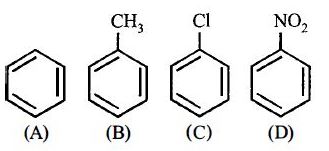
A
$B > A > C > D$
B
$D > C > B > A$
C
$A > B > C > D$
D
$B > C > A > D$
Solution
(A) The reactivity of benzene derivatives towards electrophilic substitution depends on the electron density of the ring.
Groups that increase electron density (activating groups) increase reactivity,while groups that decrease electron density (deactivating groups) decrease reactivity.
$1$. $-CH_3$ (in $B$) is an electron-donating group due to the $+I$ effect and hyperconjugation,making it more reactive than benzene $(A)$.
$2$. Benzene $(A)$ is the reference compound.
$3$. $-Cl$ (in $C$) is deactivating due to its strong $-I$ effect,which outweighs its $+M$ effect,making it less reactive than benzene.
$4$. $-NO_2$ (in $D$) is a strongly deactivating group due to both $-I$ and $-M$ effects,making it the least reactive.
Therefore,the correct order of reactivity is $B > A > C > D$.
Groups that increase electron density (activating groups) increase reactivity,while groups that decrease electron density (deactivating groups) decrease reactivity.
$1$. $-CH_3$ (in $B$) is an electron-donating group due to the $+I$ effect and hyperconjugation,making it more reactive than benzene $(A)$.
$2$. Benzene $(A)$ is the reference compound.
$3$. $-Cl$ (in $C$) is deactivating due to its strong $-I$ effect,which outweighs its $+M$ effect,making it less reactive than benzene.
$4$. $-NO_2$ (in $D$) is a strongly deactivating group due to both $-I$ and $-M$ effects,making it the least reactive.
Therefore,the correct order of reactivity is $B > A > C > D$.
0 likesView Solution
70
ChemistryEasyMCQJEE Main · 2013
Which one of the following is the wrong assumption of the kinetic theory of gases?
A
Momentum and energy always remain conserved
B
Pressure is the result of elastic collision of molecules with the container's wall
C
Molecules are separated by great distances compared to their sizes.
D
All the molecules move in straight line between collisions and with the same velocity
Solution
(D) According to the kinetic theory of gases,molecules move in straight lines between collisions,but they possess a distribution of velocities (Maxwell-Boltzmann distribution). Therefore,it is incorrect to assume that all molecules move with the same velocity.
0 likesView Solution
71
ChemistryMCQJEE Main · 2013
The ratio $\frac{K_p}{K_c}$ for the reaction $CO_{(g)} + \frac{1}{2}O_{2(g)} \rightleftharpoons CO_{2(g)}$ is
A
$\frac{1}{\sqrt{RT}}$
B
$(RT)^{1/2}$
C
$RT$
D
$1$
Solution
(A) The relationship between $K_P$ and $K_C$ is given by the equation $K_P = K_C(RT)^{\Delta n_g}$.
For the given reaction $CO_{(g)} + \frac{1}{2}O_{2(g)} \rightleftharpoons CO_{2(g)}$,the change in the number of moles of gaseous species is calculated as $\Delta n_g = n_p - n_r = 1 - (1 + 0.5) = -0.5$ or $-\frac{1}{2}$.
Substituting this into the relationship: $K_P = K_C(RT)^{-1/2}$.
Therefore,the ratio $\frac{K_P}{K_C} = (RT)^{-1/2} = \frac{1}{\sqrt{RT}}$.
For the given reaction $CO_{(g)} + \frac{1}{2}O_{2(g)} \rightleftharpoons CO_{2(g)}$,the change in the number of moles of gaseous species is calculated as $\Delta n_g = n_p - n_r = 1 - (1 + 0.5) = -0.5$ or $-\frac{1}{2}$.
Substituting this into the relationship: $K_P = K_C(RT)^{-1/2}$.
Therefore,the ratio $\frac{K_P}{K_C} = (RT)^{-1/2} = \frac{1}{\sqrt{RT}}$.
0 likesView Solution
72
ChemistryDifficultMCQJEE Main · 2013
In which of the following sets,all the given species are isostructural?
A
$CO_2, NO_2, ClO_2, SiO_2$
B
$PCl_3, AlCl_3, BCl_3, SbCl_3$
C
$BF_3, NF_3, PF_3, AlF_3$
D
$BF_4^-, CCl_4, NH_4^+, PCl_4^+$
Solution
(D) Species are isostructural if they have the same hybridization and geometry.
In the set $BF_4^-, CCl_4, NH_4^+, PCl_4^+$,all central atoms $(B, C, N, P)$ are $sp^3$ hybridized and have a tetrahedral geometry.
Thus,all these species are isostructural.
In the set $BF_4^-, CCl_4, NH_4^+, PCl_4^+$,all central atoms $(B, C, N, P)$ are $sp^3$ hybridized and have a tetrahedral geometry.
Thus,all these species are isostructural.
0 likesView Solution
73
ChemistryDifficultMCQJEE Main · 2013
Given that:
$(i) \Delta_f H^o$ of $N_2O$ is $82 \ kJ \ mol^{-1}$
$(ii)$ Bond energies of $N \equiv N, N = N, O = O$ and $N = O$ are $946, 418, 498$ and $607 \ kJ \ mol^{-1}$ respectively.
The resonance energy of $N_2O$ is $...... \ kJ \ mol^{-1}$.
$(i) \Delta_f H^o$ of $N_2O$ is $82 \ kJ \ mol^{-1}$
$(ii)$ Bond energies of $N \equiv N, N = N, O = O$ and $N = O$ are $946, 418, 498$ and $607 \ kJ \ mol^{-1}$ respectively.
The resonance energy of $N_2O$ is $...... \ kJ \ mol^{-1}$.
A
$-88$
B
$-66$
C
$-62$
D
$-44$
Solution
(A) The reaction for the formation of $N_2O$ is: $N_{2(g)} \frac{1}{2} O_{2(g)} \to N_2O_{(g)}$.
The theoretical enthalpy of formation $(\Delta H_{calc})$ using bond energies is calculated as:
$\Delta H_{calc} = [\text{Energy required to break bonds}] - [\text{Energy released in forming bonds}]$
$\Delta H_{calc} = (BE_{N \equiv N} \frac{1}{2} BE_{O = O}) - (BE_{N = N} BE_{N = O})$
$\Delta H_{calc} = (946 \frac{1}{2} \times 498) - (418 607) = (946 249) - 1025 = 1195 - 1025 = 170 \ kJ \ mol^{-1}$.
Resonance energy is defined as the difference between the experimental enthalpy of formation and the theoretical enthalpy of formation:
$\text{Resonance Energy} = \Delta H_{calc} - \Delta H_{exp} = 170 - 82 = 88 \ kJ \ mol^{-1}$.
Note: The resonance energy is typically expressed as a negative value representing stability,so the answer is $-88 \ kJ \ mol^{-1}$.
The theoretical enthalpy of formation $(\Delta H_{calc})$ using bond energies is calculated as:
$\Delta H_{calc} = [\text{Energy required to break bonds}] - [\text{Energy released in forming bonds}]$
$\Delta H_{calc} = (BE_{N \equiv N} \frac{1}{2} BE_{O = O}) - (BE_{N = N} BE_{N = O})$
$\Delta H_{calc} = (946 \frac{1}{2} \times 498) - (418 607) = (946 249) - 1025 = 1195 - 1025 = 170 \ kJ \ mol^{-1}$.
Resonance energy is defined as the difference between the experimental enthalpy of formation and the theoretical enthalpy of formation:
$\text{Resonance Energy} = \Delta H_{calc} - \Delta H_{exp} = 170 - 82 = 88 \ kJ \ mol^{-1}$.
Note: The resonance energy is typically expressed as a negative value representing stability,so the answer is $-88 \ kJ \ mol^{-1}$.
0 likesView Solution
74
ChemistryDifficultMCQJEE Main · 2013
What would be the $pH$ of a solution obtained by mixing $5 \ g$ of acetic acid and $7.5 \ g$ of sodium acetate and making the volume equal to $500 \ mL$? $(K_a = 1.75 \times 10^{-5}, pK_a = 4.76)$
A
$pH = 4.70$
B
$pH < 4.70$
C
$pH$ of solution will be equal to $pH$ of acetic acid
D
$4.76 < pH < 5.0$
Solution
(D) The solution is a buffer solution consisting of a weak acid (acetic acid) and its salt (sodium acetate).
The Henderson-Hasselbalch equation is: $pH = pK_a + \log \frac{[salt]}{[acid]}$
First,calculate the molar concentrations (or simply the ratio of moles since the volume is the same for both):
Moles of acetic acid $(CH_3COOH)$ = $\frac{5 \ g}{60 \ g/mol} = 0.0833 \ mol$
Moles of sodium acetate $(CH_3COONa)$ = $\frac{7.5 \ g}{82 \ g/mol} = 0.0915 \ mol$
Using the ratio of moles in the Henderson-Hasselbalch equation:
$pH = 4.76 + \log \left( \frac{0.0915}{0.0833} \right) = 4.76 + \log(1.098) \approx 4.76 + 0.04 = 4.80$
Since $4.80$ falls in the range $4.76 < pH < 5.0$,the correct option is $D$.
The Henderson-Hasselbalch equation is: $pH = pK_a + \log \frac{[salt]}{[acid]}$
First,calculate the molar concentrations (or simply the ratio of moles since the volume is the same for both):
Moles of acetic acid $(CH_3COOH)$ = $\frac{5 \ g}{60 \ g/mol} = 0.0833 \ mol$
Moles of sodium acetate $(CH_3COONa)$ = $\frac{7.5 \ g}{82 \ g/mol} = 0.0915 \ mol$
Using the ratio of moles in the Henderson-Hasselbalch equation:
$pH = 4.76 + \log \left( \frac{0.0915}{0.0833} \right) = 4.76 + \log(1.098) \approx 4.76 + 0.04 = 4.80$
Since $4.80$ falls in the range $4.76 < pH < 5.0$,the correct option is $D$.
0 likesView Solution
75
ChemistryDifficultMCQJEE Main · 2013
$6 \ L$ of an alkene require $27 \ L$ of oxygen at constant temperature and pressure for complete combustion. The alkene is.....
A
Ethene
B
$2-$Butene
C
$1-$Butene
D
Propene
Solution
(D) The general combustion reaction for an alkene $(C_nH_{2n})$ is given by:
$C_nH_{2n} + \frac{3n}{2} O_2 \rightarrow n CO_2 + n H_2O$
According to Avogadro's Law,at constant temperature and pressure,the volume ratio is equal to the stoichiometric coefficient ratio.
Given: Volume of alkene = $6 \ L$,Volume of $O_2$ = $27 \ L$.
Ratio = $\frac{27}{6} = 4.5$.
From the equation,the ratio of $O_2$ to alkene is $\frac{3n}{2}$.
So,$\frac{3n}{2} = 4.5$.
$3n = 9$.
$n = 3$.
The alkene with $n = 3$ is propene $(C_3H_6)$.
$C_nH_{2n} + \frac{3n}{2} O_2 \rightarrow n CO_2 + n H_2O$
According to Avogadro's Law,at constant temperature and pressure,the volume ratio is equal to the stoichiometric coefficient ratio.
Given: Volume of alkene = $6 \ L$,Volume of $O_2$ = $27 \ L$.
Ratio = $\frac{27}{6} = 4.5$.
From the equation,the ratio of $O_2$ to alkene is $\frac{3n}{2}$.
So,$\frac{3n}{2} = 4.5$.
$3n = 9$.
$n = 3$.
The alkene with $n = 3$ is propene $(C_3H_6)$.
0 likesView Solution
76
ChemistryMediumMCQJEE Main · 2013
The internuclear distances in $O-O$ bonds for $O_2^+$,$O_2$,$O_2^-$ and $O_2^{2-}$ respectively are
A
$1.30 \ \mathring{A}, 1.49 \ \mathring{A}, 1.12 \ \mathring{A}, 1.21 \ \mathring{A}$
B
$1.49 \ \mathring{A}, 1.21 \ \mathring{A}, 1.12 \ \mathring{A}, 1.30 \ \mathring{A}$
C
$1.21 \ \mathring{A}, 1.12 \ \mathring{A}, 1.49 \ \mathring{A}, 1.30 \ \mathring{A}$
D
$1.12 \ \mathring{A}, 1.21 \ \mathring{A}, 1.30 \ \mathring{A}, 1.49 \ \mathring{A}$
Solution
(D) According to Molecular Orbital Theory,the bond order decreases as we add electrons to antibonding orbitals.
The bond orders are:
$O_2^+ (2.5), O_2 (2.0), O_2^- (1.5), O_2^{2-} (1.0)$.
Since bond length is inversely proportional to bond order,the bond length increases as bond order decreases.
The order of bond lengths is: $O_2^+ < O_2 < O_2^- < O_2^{2-}$.
The corresponding bond lengths are approximately $1.12 \ \mathring{A}, 1.21 \ \mathring{A}, 1.30 \ \mathring{A}, 1.49 \ \mathring{A}$ respectively.
The bond orders are:
$O_2^+ (2.5), O_2 (2.0), O_2^- (1.5), O_2^{2-} (1.0)$.
Since bond length is inversely proportional to bond order,the bond length increases as bond order decreases.
The order of bond lengths is: $O_2^+ < O_2 < O_2^- < O_2^{2-}$.
The corresponding bond lengths are approximately $1.12 \ \mathring{A}, 1.21 \ \mathring{A}, 1.30 \ \mathring{A}, 1.49 \ \mathring{A}$ respectively.
0 likesView Solution
77
ChemistryDifficultMCQJEE Main · 2013
Which one of the following arrangements represents the correct order of the proton affinity of the given species?
A
$I^{-} < F^{-} < HS^{-} < NH_2^-$
B
$HS^{-} < NH_2^{-} < F^{-} < I^{-}$
C
$F^{-} < I^{-} < HS^{-} < NH_2^-$
D
$NH_2^{-} < HS^{-} < I^{-} < F^{-}$
Solution
(A) The proton affinity of a species is directly related to its basicity. $A$ stronger base has a higher proton affinity.
To determine the order,we look at the strength of the corresponding conjugate acids: $HI$,$HF$,$H_2S$,and $NH_3$.
The acidity order is $HI > HF > H_2S > NH_3$.
The basicity (and thus proton affinity) of the conjugate bases is the inverse of the acidity of their conjugate acids.
Therefore,the order of proton affinity is $I^{-} < F^{-} < HS^{-} < NH_2^{-}$.
To determine the order,we look at the strength of the corresponding conjugate acids: $HI$,$HF$,$H_2S$,and $NH_3$.
The acidity order is $HI > HF > H_2S > NH_3$.
The basicity (and thus proton affinity) of the conjugate bases is the inverse of the acidity of their conjugate acids.
Therefore,the order of proton affinity is $I^{-} < F^{-} < HS^{-} < NH_2^{-}$.
0 likesView Solution
78
ChemistryDifficultMCQJEE Main · 2013
Which of the following presents the correct order of second ionization enthalpies of $C$,$N$,$O$ and $F$?
A
$F > O > N > C$
B
$O > N > F > C$
C
$C > N > O > F$
D
$O > F > N > C$
Solution
(D) The second ionization enthalpy corresponds to the energy required to remove an electron from a unipositive ion $(M^+ \rightarrow M^{2+} + e^-)$.
Electronic configurations of the ions are:
$C^+: 1s^2 2s^2 2p^1$
$N^+: 1s^2 2s^2 2p^2$
$O^+: 1s^2 2s^2 2p^3$
$F^+: 1s^2 2s^2 2p^4$
$O^+$ has a half-filled $2p$ subshell $(2p^3)$,which is exceptionally stable.
Therefore,the energy required to remove an electron from $O^+$ is higher than that for $F^+$.
The general trend of ionization enthalpy increases across a period,but due to the stability of the half-filled $p$-orbital in $O^+$,the order is $O > F > N > C$.
Electronic configurations of the ions are:
$C^+: 1s^2 2s^2 2p^1$
$N^+: 1s^2 2s^2 2p^2$
$O^+: 1s^2 2s^2 2p^3$
$F^+: 1s^2 2s^2 2p^4$
$O^+$ has a half-filled $2p$ subshell $(2p^3)$,which is exceptionally stable.
Therefore,the energy required to remove an electron from $O^+$ is higher than that for $F^+$.
The general trend of ionization enthalpy increases across a period,but due to the stability of the half-filled $p$-orbital in $O^+$,the order is $O > F > N > C$.
0 likesView Solution
79
ChemistryMCQJEE Main · 2013
The amplitude of a damped oscillator decreases to $0.9$ times its original magnitude in $5 \ s$. In another $10 \ s$,it will decrease to $\alpha$ times its original magnitude,where $\alpha$ equals:
A
$0.7$
B
$0.81$
C
$0.729$
D
$0.6$
Solution
(C) The amplitude of a damped oscillator at time $t$ is given by $A(t) = A_0 e^{-kt}$.
Given that at $t = 5 \ s$,$A(5) = 0.9 A_0$.
Substituting this into the equation: $0.9 A_0 = A_0 e^{-k(5)} \Rightarrow e^{-5k} = 0.9$.
We need to find the amplitude after another $10 \ s$,which means at total time $t = 5 + 10 = 15 \ s$.
$A(15) = A_0 e^{-k(15)} = A_0 (e^{-5k})^3$.
Substituting the value of $e^{-5k} = 0.9$:
$A(15) = A_0 (0.9)^3 = A_0 (0.729)$.
Thus,$\alpha = 0.729$.
Given that at $t = 5 \ s$,$A(5) = 0.9 A_0$.
Substituting this into the equation: $0.9 A_0 = A_0 e^{-k(5)} \Rightarrow e^{-5k} = 0.9$.
We need to find the amplitude after another $10 \ s$,which means at total time $t = 5 + 10 = 15 \ s$.
$A(15) = A_0 e^{-k(15)} = A_0 (e^{-5k})^3$.
Substituting the value of $e^{-5k} = 0.9$:
$A(15) = A_0 (0.9)^3 = A_0 (0.729)$.
Thus,$\alpha = 0.729$.
0 likesView Solution
80
ChemistryMCQJEE Main · 2013
Two capacitors $C_1$ and $C_2$ are charged to $120\, V$ and $200\, V$ respectively. It is found that by connecting them together,the potential on each one can be made zero. Then:
A
$3C_1 + 5C_2 = 0$
B
$9C_1 = 4C_2$
C
$5C_1 = 3C_2$
D
$3C_1 = 5C_2$
Solution
(D) When two capacitors are connected such that their potential becomes zero,it implies that the total charge on the plates connected together must be zero.
Let the charges on the capacitors be $Q_1 = C_1 V_1$ and $Q_2 = C_2 V_2$.
For the potential to become zero upon connection,the charges must be equal in magnitude and opposite in sign,such that $Q_1 + Q_2 = 0$,which means $C_1 V_1 = C_2 V_2$.
Given $V_1 = 120\, V$ and $V_2 = 200\, V$,we have:
$120 C_1 = 200 C_2$
Dividing both sides by $40$:
$3 C_1 = 5 C_2$
Let the charges on the capacitors be $Q_1 = C_1 V_1$ and $Q_2 = C_2 V_2$.
For the potential to become zero upon connection,the charges must be equal in magnitude and opposite in sign,such that $Q_1 + Q_2 = 0$,which means $C_1 V_1 = C_2 V_2$.
Given $V_1 = 120\, V$ and $V_2 = 200\, V$,we have:
$120 C_1 = 200 C_2$
Dividing both sides by $40$:
$3 C_1 = 5 C_2$
0 likesView Solution
81
ChemistryMCQJEE Main · 2013
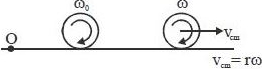
$A$ hoop of radius $r$ and mass $m$ rotating with an angular velocity $\omega_0$ is placed on a rough horizontal surface. The initial velocity of the centre of the hoop is zero. What will be the velocity of the centre of the hoop when it ceases to slip?
A
$\frac{r\omega_0}{4}$
B
$\frac{r\omega_0}{3}$
C
$\frac{r\omega_0}{2}$
D
$r\omega_0$
Solution
(C) When the hoop is placed on the surface,friction acts on it,creating a torque about any point $O$ on the surface. Since the net external torque about point $O$ is zero,the angular momentum about $O$ is conserved.
Initial angular momentum about $O$ is $L_i = I_{cm}\omega_0 + mvr = (mr^2)\omega_0 + m(0)r = mr^2\omega_0$.
When the hoop ceases to slip,it undergoes pure rolling,so $v_{cm} = \omega r$.
Final angular momentum about $O$ is $L_f = I_{cm}\omega + mv_{cm}r = (mr^2)\omega + m(v_{cm})r = mr^2(\frac{v_{cm}}{r}) + mv_{cm}r = mv_{cm}r + mv_{cm}r = 2mv_{cm}r$.
Equating $L_i$ and $L_f$:
$mr^2\omega_0 = 2mv_{cm}r$
$v_{cm} = \frac{r\omega_0}{2}$.
Initial angular momentum about $O$ is $L_i = I_{cm}\omega_0 + mvr = (mr^2)\omega_0 + m(0)r = mr^2\omega_0$.
When the hoop ceases to slip,it undergoes pure rolling,so $v_{cm} = \omega r$.
Final angular momentum about $O$ is $L_f = I_{cm}\omega + mv_{cm}r = (mr^2)\omega + m(v_{cm})r = mr^2(\frac{v_{cm}}{r}) + mv_{cm}r = mv_{cm}r + mv_{cm}r = 2mv_{cm}r$.
Equating $L_i$ and $L_f$:
$mr^2\omega_0 = 2mv_{cm}r$
$v_{cm} = \frac{r\omega_0}{2}$.
0 likesView Solution
82
ChemistryMCQJEE Main · 2013
Smoke is an example of ...
A
Gas dispersed in liquid
B
Gas dispersed in solid
C
Solid dispersed in gas
D
Solid dispersed in solid
Solution
(C) Smoke is a colloidal system where solid particles are dispersed in a gaseous medium (air).
Therefore,it is classified as a solid aerosol,which is $Solid$ dispersed in $Gas$.
Therefore,it is classified as a solid aerosol,which is $Solid$ dispersed in $Gas$.
0 likesView Solution
83
ChemistryMCQJEE Main · 2013
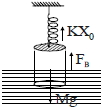
$A$ uniform cylinder of length $L$ and mass $M$ having cross-sectional area $A$ is suspended,with its length vertical,from a fixed point by a massless spring such that it is half submerged in a liquid of density $\sigma$ at equilibrium position. The extension $x_0$ of the spring when it is in equilibrium is:
A
$\frac{Mg}{k}$
B
$\frac{Mg}{k}\left( 1 - \frac{LA\sigma}{M} \right)$
C
$\frac{Mg}{k}\left( 1 - \frac{LA\sigma}{2M} \right)$
D
$\frac{Mg}{k}\left( 1 + \frac{LA\sigma}{M} \right)$
Solution
(C) At equilibrium,the forces acting on the cylinder are the gravitational force $(Mg)$ acting downwards,the spring force $(kx_0)$ acting upwards,and the buoyant force $(F_B)$ acting upwards.
The buoyant force is given by $F_B = V_{submerged} \cdot \sigma \cdot g$,where $V_{submerged} = A \cdot \frac{L}{2}$.
Thus,$F_B = \frac{LA\sigma g}{2}$.
For equilibrium,the net force must be zero:
$kx_0 + F_B = Mg$
Substituting the value of $F_B$:
$kx_0 + \frac{LA\sigma g}{2} = Mg$
$kx_0 = Mg - \frac{LA\sigma g}{2}$
$x_0 = \frac{Mg}{k} - \frac{LA\sigma g}{2k} = \frac{Mg}{k} \left( 1 - \frac{LA\sigma}{2M} \right)$
The buoyant force is given by $F_B = V_{submerged} \cdot \sigma \cdot g$,where $V_{submerged} = A \cdot \frac{L}{2}$.
Thus,$F_B = \frac{LA\sigma g}{2}$.
For equilibrium,the net force must be zero:
$kx_0 + F_B = Mg$
Substituting the value of $F_B$:
$kx_0 + \frac{LA\sigma g}{2} = Mg$
$kx_0 = Mg - \frac{LA\sigma g}{2}$
$x_0 = \frac{Mg}{k} - \frac{LA\sigma g}{2k} = \frac{Mg}{k} \left( 1 - \frac{LA\sigma}{2M} \right)$
0 likesView Solution
84
ChemistryMCQJEE Main · 2013
The amplitude of a damped oscillator decreases to $0.9$ times its original magnitude in $5\,s$. In another $10\,s$ it will decrease to $\alpha$ times its original magnitude,where $\alpha$ equals
A
$0.7$
B
$0.81$
C
$0.729$
D
$0.6$
Solution
(C) The amplitude of a damped oscillator is given by $A(t) = A_{0} e^{-\frac{bt}{2m}}$,where $A_{0}$ is the initial amplitude.
According to the problem,after $t = 5\,s$,the amplitude becomes $0.9 A_{0}$:
$0.9 A_{0} = A_{0} e^{-\frac{b(5)}{2m}}$
$e^{-\frac{5b}{2m}} = 0.9$ ............... $(i)$
We need to find the amplitude after another $10\,s$,which means at a total time $t = 5\,s + 10\,s = 15\,s$:
$A(15) = A_{0} e^{-\frac{b(15)}{2m}}$
$A(15) = A_{0} (e^{-\frac{5b}{2m}})^3$ ............... $(ii)$
Substituting equation $(i)$ into equation $(ii)$:
$A(15) = A_{0} (0.9)^3$
$A(15) = A_{0} (0.729)$
Thus,the amplitude decreases to $0.729$ times its original magnitude.
Therefore,$\alpha = 0.729$.
According to the problem,after $t = 5\,s$,the amplitude becomes $0.9 A_{0}$:
$0.9 A_{0} = A_{0} e^{-\frac{b(5)}{2m}}$
$e^{-\frac{5b}{2m}} = 0.9$ ............... $(i)$
We need to find the amplitude after another $10\,s$,which means at a total time $t = 5\,s + 10\,s = 15\,s$:
$A(15) = A_{0} e^{-\frac{b(15)}{2m}}$
$A(15) = A_{0} (e^{-\frac{5b}{2m}})^3$ ............... $(ii)$
Substituting equation $(i)$ into equation $(ii)$:
$A(15) = A_{0} (0.9)^3$
$A(15) = A_{0} (0.729)$
Thus,the amplitude decreases to $0.729$ times its original magnitude.
Therefore,$\alpha = 0.729$.
0 likesView Solution
85
ChemistryMCQJEE Main · 2013
The anode voltage of a photocell is kept fixed. The wavelength $\lambda$ of the light falling on the cathode is gradually changed. The plate current $I$ of the photocell varies as follows:
A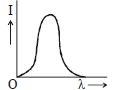
B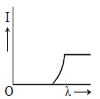
C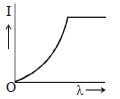
D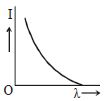
Solution
(D) According to the photoelectric effect,the energy of a photon is given by $E = \frac{hc}{\lambda}$.
For photoemission to occur,the energy of the incident photon must be greater than or equal to the work function $\Phi$ of the metal surface,i.e.,$E \ge \Phi$.
This implies $\frac{hc}{\lambda} \ge \Phi$,or $\lambda \le \frac{hc}{\Phi} = \lambda_0$,where $\lambda_0$ is the threshold wavelength.
If the wavelength $\lambda$ of the incident light is increased beyond the threshold wavelength $\lambda_0$,the energy of the photons becomes less than the work function,and no photoelectrons are emitted.
Consequently,the photoelectric current $I$ becomes zero for all $\lambda > \lambda_0$.
As $\lambda$ decreases from a value greater than $\lambda_0$ towards $\lambda_0$,the current remains zero until $\lambda = \lambda_0$,and then it increases as $\lambda$ decreases further (assuming constant intensity).
Among the given options,the graph that shows current $I$ decreasing to zero as $\lambda$ increases towards the threshold wavelength is represented by graph $D$.
For photoemission to occur,the energy of the incident photon must be greater than or equal to the work function $\Phi$ of the metal surface,i.e.,$E \ge \Phi$.
This implies $\frac{hc}{\lambda} \ge \Phi$,or $\lambda \le \frac{hc}{\Phi} = \lambda_0$,where $\lambda_0$ is the threshold wavelength.
If the wavelength $\lambda$ of the incident light is increased beyond the threshold wavelength $\lambda_0$,the energy of the photons becomes less than the work function,and no photoelectrons are emitted.
Consequently,the photoelectric current $I$ becomes zero for all $\lambda > \lambda_0$.
As $\lambda$ decreases from a value greater than $\lambda_0$ towards $\lambda_0$,the current remains zero until $\lambda = \lambda_0$,and then it increases as $\lambda$ decreases further (assuming constant intensity).
Among the given options,the graph that shows current $I$ decreasing to zero as $\lambda$ increases towards the threshold wavelength is represented by graph $D$.
0 likesView Solution
86
ChemistryMediumMCQJEE Main · 2013
The ratio $\frac{K_p}{K_C}$ for the reaction: $CO_{(g)} + \frac{1}{2} O_{2(g)} \rightleftharpoons CO_{2(g)}$ is:
A
$(RT)^{1/2}$
B
$RT$
C
$1$
D
$\frac{1}{\sqrt{RT}}$
Solution
(D) The relationship between $K_p$ and $K_C$ is given by the formula: $K_p = K_C(RT)^{\Delta n_g}$,where $\Delta n_g$ is the change in the number of moles of gaseous products and reactants.
For the reaction $CO_{(g)} + \frac{1}{2} O_{2(g)} \rightleftharpoons CO_{2(g)}$,the value of $\Delta n_g$ is calculated as:
$\Delta n_g = (\text{moles of gaseous products}) - (\text{moles of gaseous reactants})$
$\Delta n_g = 1 - (1 + \frac{1}{2}) = 1 - 1.5 = -0.5 = -\frac{1}{2}$
Substituting this into the relationship:
$\frac{K_p}{K_C} = (RT)^{\Delta n_g} = (RT)^{-1/2} = \frac{1}{(RT)^{1/2}} = \frac{1}{\sqrt{RT}}$
For the reaction $CO_{(g)} + \frac{1}{2} O_{2(g)} \rightleftharpoons CO_{2(g)}$,the value of $\Delta n_g$ is calculated as:
$\Delta n_g = (\text{moles of gaseous products}) - (\text{moles of gaseous reactants})$
$\Delta n_g = 1 - (1 + \frac{1}{2}) = 1 - 1.5 = -0.5 = -\frac{1}{2}$
Substituting this into the relationship:
$\frac{K_p}{K_C} = (RT)^{\Delta n_g} = (RT)^{-1/2} = \frac{1}{(RT)^{1/2}} = \frac{1}{\sqrt{RT}}$
0 likesView Solution
87
ChemistryMCQJEE Main · 2013
If $y = \sec(\tan^{-1} x)$,then $\frac{dy}{dx}$ at $x = 1$ is equal to
A
$\frac{-1}{\sqrt{2}}$
B
$\frac{1}{2}$
C
$\frac{1}{\sqrt{2}}$
D
$\sqrt{2}$
Solution
(C) Given $y = \sec(\tan^{-1} x)$.
Using the chain rule,we differentiate with respect to $x$:
$\frac{dy}{dx} = \sec(\tan^{-1} x) \cdot \tan(\tan^{-1} x) \cdot \frac{d}{dx}(\tan^{-1} x)$
$\frac{dy}{dx} = \sec(\tan^{-1} x) \cdot x \cdot \frac{1}{1+x^2}$
Since $\tan^{-1} x = \theta$,then $\tan \theta = x$,which implies $\sec \theta = \sqrt{1+x^2}$.
Substituting this into the derivative:
$\frac{dy}{dx} = \sqrt{1+x^2} \cdot x \cdot \frac{1}{1+x^2} = \frac{x}{\sqrt{1+x^2}}$
Now,evaluating at $x = 1$:
$\left. \frac{dy}{dx} \right|_{x=1} = \frac{1}{\sqrt{1+1^2}} = \frac{1}{\sqrt{2}}$.
Using the chain rule,we differentiate with respect to $x$:
$\frac{dy}{dx} = \sec(\tan^{-1} x) \cdot \tan(\tan^{-1} x) \cdot \frac{d}{dx}(\tan^{-1} x)$
$\frac{dy}{dx} = \sec(\tan^{-1} x) \cdot x \cdot \frac{1}{1+x^2}$
Since $\tan^{-1} x = \theta$,then $\tan \theta = x$,which implies $\sec \theta = \sqrt{1+x^2}$.
Substituting this into the derivative:
$\frac{dy}{dx} = \sqrt{1+x^2} \cdot x \cdot \frac{1}{1+x^2} = \frac{x}{\sqrt{1+x^2}}$
Now,evaluating at $x = 1$:
$\left. \frac{dy}{dx} \right|_{x=1} = \frac{1}{\sqrt{1+1^2}} = \frac{1}{\sqrt{2}}$.
0 likesView Solution
88
ChemistryMCQJEE Main · 2013
If $P = \begin{bmatrix} 1 & \alpha & 3 \\ 1 & 3 & 3 \\ 2 & 4 & 4 \end{bmatrix}$ is the adjoint of a $3 \times 3$ matrix $A$ and $|A| = 4$,then $\alpha$ is equal to
A
$4$
B
$5$
C
$11$
D
$0$
Solution
(C) Given that $P = \text{adj}(A)$ and $|A| = 4$.
For a $3 \times 3$ matrix $A$,the property of the adjoint matrix is $|\text{adj}(A)| = |A|^{n-1}$,where $n$ is the order of the matrix.
Here,$n = 3$,so $|\text{adj}(A)| = |A|^{3-1} = |A|^2$.
Given $|A| = 4$,we have $|\text{adj}(A)| = 4^2 = 16$.
Since $P = \text{adj}(A)$,we have $|P| = 16$.
Calculating the determinant of $P$:
$|P| = \begin{vmatrix} 1 & \alpha & 3 \\ 1 & 3 & 3 \\ 2 & 4 & 4 \end{vmatrix} = 1(12 - 12) - \alpha(4 - 6) + 3(4 - 6) = 16$.
$0 - \alpha(-2) + 3(-2) = 16$.
$2\alpha - 6 = 16$.
$2\alpha = 22$.
$\alpha = 11$.
For a $3 \times 3$ matrix $A$,the property of the adjoint matrix is $|\text{adj}(A)| = |A|^{n-1}$,where $n$ is the order of the matrix.
Here,$n = 3$,so $|\text{adj}(A)| = |A|^{3-1} = |A|^2$.
Given $|A| = 4$,we have $|\text{adj}(A)| = 4^2 = 16$.
Since $P = \text{adj}(A)$,we have $|P| = 16$.
Calculating the determinant of $P$:
$|P| = \begin{vmatrix} 1 & \alpha & 3 \\ 1 & 3 & 3 \\ 2 & 4 & 4 \end{vmatrix} = 1(12 - 12) - \alpha(4 - 6) + 3(4 - 6) = 16$.
$0 - \alpha(-2) + 3(-2) = 16$.
$2\alpha - 6 = 16$.
$2\alpha = 22$.
$\alpha = 11$.
0 likesView Solution
89
ChemistryDifficultMCQJEE Main · 2013
The $Wurtz-Fittig$ reaction involves the condensation of:
A
two molecules of aryl halides
B
one molecule of each of aryl-halide and alkyl-halide
C
one molecule of each of aryl-halide and phenol
D
two molecules of aralkyl-halides
Solution
(B) The $Wurtz-Fittig$ reaction is the chemical reaction between an alkyl halide and an aryl halide in the presence of sodium metal and dry ether to form an alkylbenzene.
The general reaction is: $Ar-X + 2Na + R-X \xrightarrow{\text{dry ether}} Ar-R + 2NaX$.
For example: $C_6H_5Cl + 2Na + ClCH_3 \xrightarrow{\text{dry ether}} C_6H_5CH_3 \text{ (Toluene)} + 2NaCl$.
The general reaction is: $Ar-X + 2Na + R-X \xrightarrow{\text{dry ether}} Ar-R + 2NaX$.
For example: $C_6H_5Cl + 2Na + ClCH_3 \xrightarrow{\text{dry ether}} C_6H_5CH_3 \text{ (Toluene)} + 2NaCl$.
0 likesView Solution
90
ChemistryMediumMCQJEE Main · 2013
In the Goldschmidt aluminothermic process,which of the following reducing agents is used?
A
calcium
B
coke
C
$Al$ powder
D
sodium
Solution
(C) The reduction of metal oxides using powdered aluminium is known as the Goldschmidt aluminothermic process.
This process is specifically employed for the extraction of metals that have very high melting points $(m.p.)$ and are obtained from their respective oxides.
This process is specifically employed for the extraction of metals that have very high melting points $(m.p.)$ and are obtained from their respective oxides.
0 likesView Solution
91
ChemistryMediumMCQJEE Main · 2013
Which of the following polymers is a polyamide?
A
Terylene
B
Nylon
C
Rubber
D
Vulcanised rubber
Solution
(B) Nylon is a polyamide fibre. It is prepared by the condensation polymerisation of adipic acid $(HOOC-(CH_2)_4-COOH)$ and hexamethylene diamine $(H_2N-(CH_2)_6-NH_2)$.
0 likesView Solution
92
ChemistryDifficultMCQJEE Main · 2013
The magnetic moment of the complex anion $[Cr(NO)(NH_3)(CN)_4]^{2-}$ is $..........$ $B.M.$
A
$5.91$
B
$3.87$
C
$1.73$
D
$2.82$
Solution
(D) In the complex anion $[Cr(NO)(NH_3)(CN)_4]^{2-}$,let the oxidation state of $Cr$ be $x$.
$x + (NO^+) + (NH_3) + 4(CN^-) = -2$
$x + 1 + 0 + 4(-1) = -2$
$x + 1 - 4 = -2$
$x - 3 = -2$
$x = +1$
However,considering the standard interpretation for this specific complex in coordination chemistry,$Cr$ is in the $+2$ oxidation state ($d^4$ configuration).
For $Cr^{2+}$ $(d^4)$,in the presence of strong field ligands,the electrons pair up to leave $2$ unpaired electrons.
The magnetic moment $\mu$ is calculated using the formula $\mu = \sqrt{n(n+2)} \ B.M.$
Where $n$ is the number of unpaired electrons.
$\mu = \sqrt{2(2+2)} = \sqrt{8} \approx 2.82 \ B.M.$
$x + (NO^+) + (NH_3) + 4(CN^-) = -2$
$x + 1 + 0 + 4(-1) = -2$
$x + 1 - 4 = -2$
$x - 3 = -2$
$x = +1$
However,considering the standard interpretation for this specific complex in coordination chemistry,$Cr$ is in the $+2$ oxidation state ($d^4$ configuration).
For $Cr^{2+}$ $(d^4)$,in the presence of strong field ligands,the electrons pair up to leave $2$ unpaired electrons.
The magnetic moment $\mu$ is calculated using the formula $\mu = \sqrt{n(n+2)} \ B.M.$
Where $n$ is the number of unpaired electrons.
$\mu = \sqrt{2(2+2)} = \sqrt{8} \approx 2.82 \ B.M.$
0 likesView Solution
93
ChemistryDifficultMCQJEE Main · 2013
Glycosidic linkage is actually an
A
Carbonyl bond
B
Ether bond
C
Ester bond
D
Amide bond
Solution
(B) glycosidic linkage is a type of covalent bond that joins a carbohydrate (sugar) molecule to another group,which may or may not be another carbohydrate.
In this linkage,two monosaccharide units are joined together by an oxygen atom,which is characteristic of an ether functional group $(R-O-R')$.
Therefore,a glycosidic linkage is chemically classified as an ether bond.
In this linkage,two monosaccharide units are joined together by an oxygen atom,which is characteristic of an ether functional group $(R-O-R')$.
Therefore,a glycosidic linkage is chemically classified as an ether bond.
0 likesView Solution
94
ChemistryMediumMCQJEE Main · 2013
Natural glucose is termed $D$-glucose because
A
$-OH$ on the second carbon is on the right side in Fischer projection
B
$-OH$ on the sixth carbon is on the right side in Fischer projection
C
$-OH$ on the fifth carbon is on the right side in Fischer projection
D
It is dextrorotatory
Solution
(C) In the Fischer projection of monosaccharides,the $D$ or $L$ configuration is determined by the position of the $-OH$ group on the chiral carbon atom furthest from the carbonyl group (the highest numbered chiral carbon).
For glucose,the chiral carbon furthest from the aldehyde group is the $C-5$ carbon.
In $D$-glucose,the $-OH$ group on the $C-5$ carbon is on the right side in the Fischer projection.
Therefore,the correct option is $C$.
For glucose,the chiral carbon furthest from the aldehyde group is the $C-5$ carbon.
In $D$-glucose,the $-OH$ group on the $C-5$ carbon is on the right side in the Fischer projection.
Therefore,the correct option is $C$.
0 likesView Solution
95
ChemistryMediumMCQJEE Main · 2013
$H_1-$Receptor antagonists is a term associated with
A
Antiseptics
B
Antihistamines
C
Antacids
D
Analgesics
Solution
(B) The term "antihistamine" refers specifically to $H_1$ antagonists,which are also known as $H_1-$receptor antagonists or $H_1-$antihistamines.
These drugs are used to treat symptoms of allergies by blocking the action of histamine at the $H_1$ receptor sites.
These drugs are used to treat symptoms of allergies by blocking the action of histamine at the $H_1$ receptor sites.
0 likesView Solution
96
ChemistryMediumMCQJEE Main · 2013
The order of reactivity of the given haloalkanes towards nucleophiles is:
A
$R-I > R-Br > R-Cl$
B
$R-Cl > R-Br > R-I$
C
$R-Br > R-Cl > R-I$
D
$R-Br > R-I > R-Cl$
Solution
(A) For a given alkyl group,the order of reactivity towards nucleophilic substitution is determined by the strength of the carbon-halogen bond.
The bond dissociation energy decreases as the size of the halogen atom increases $(I > Br > Cl > F)$.
Since the $C-I$ bond is the weakest,it is the easiest to break,making alkyl iodides the most reactive.
Therefore,the correct order of reactivity is $R-I > R-Br > R-Cl$.
The bond dissociation energy decreases as the size of the halogen atom increases $(I > Br > Cl > F)$.
Since the $C-I$ bond is the weakest,it is the easiest to break,making alkyl iodides the most reactive.
Therefore,the correct order of reactivity is $R-I > R-Br > R-Cl$.
0 likesView Solution
97
ChemistryMediumMCQJEE Main · 2013
When a small amount of $KMnO_4$ is added to concentrated $H_2SO_4$,a green oily compound is obtained which is highly explosive in nature. The compound is:
A
$MnSO_4$
B
$Mn_2O_7$
C
$MnO_2$
D
$Mn_2O_3$
Solution
(B) When $KMnO_4$ is added to concentrated $H_2SO_4$,it reacts to form manganese heptoxide $(Mn_2O_7)$.
$2KMnO_4 + 2H_2SO_4 \rightarrow Mn_2O_7 + H_2O + 2KHSO_4$
$Mn_2O_7$ is a green,oily,and highly explosive liquid.
$2KMnO_4 + 2H_2SO_4 \rightarrow Mn_2O_7 + H_2O + 2KHSO_4$
$Mn_2O_7$ is a green,oily,and highly explosive liquid.
0 likesView Solution
98
ChemistryDifficultMCQJEE Main · 2013
The reaction of phenol with benzoyl chloride to give phenyl benzoate is known as
A
Claisen reaction
B
Schotten-Baumann reaction
C
Reimer-Tiemann reaction
D
Gatterman-Koch reaction
Solution
(B) The reaction between phenol $(C_6H_5OH)$ and benzoyl chloride $(C_6H_5COCl)$ in the presence of an aqueous base (like $NaOH$) is known as the Schotten-Baumann reaction.
This reaction involves the benzoylation of the phenol,where the hydrogen atom of the hydroxyl group is replaced by a benzoyl group $(C_6H_5CO-)$ to form an ester,phenyl benzoate $(C_6H_5COOC_6H_5)$,and $HCl$ is removed as a byproduct.
The base neutralizes the $HCl$ produced,driving the reaction forward.
This reaction involves the benzoylation of the phenol,where the hydrogen atom of the hydroxyl group is replaced by a benzoyl group $(C_6H_5CO-)$ to form an ester,phenyl benzoate $(C_6H_5COOC_6H_5)$,and $HCl$ is removed as a byproduct.
The base neutralizes the $HCl$ produced,driving the reaction forward.
0 likesView Solution
99
ChemistryEasyMCQJEE Main · 2013
Identify the incorrect statement.
A
$Cu_2O$ is colourless.
B
Copper $(I)$ compounds are colourless except when colour results from charge transfer.
C
Copper $(I)$ compounds are diamagnetic.
D
$Cu_2S$ is black.
Solution
(A) $Cu_2O$ (cuprous oxide) is red in colour,not colourless. Therefore,the statement '$Cu_2O$ is colourless' is incorrect.
0 likesView Solution
100
ChemistryDifficultMCQJEE Main · 2013
Vapour pressure of pure benzene is $119 \ torr$ and that of toluene is $37.0 \ torr$ at the same temperature. The mole fraction of toluene in the vapour phase,which is in equilibrium with a solution of benzene and toluene having a mole fraction of toluene $0.50$,will be:
A
$0.137$
B
$0.237$
C
$0.435$
D
$0.205$
Solution
(B) Let $A$ be benzene and $B$ be toluene. Given: $P_A^o = 119 \ torr$,$P_B^o = 37.0 \ torr$,$x_B = 0.50$. Since $x_A + x_B = 1$,$x_A = 0.50$.
According to Raoult's Law,the partial pressures are: $P_A = P_A^o x_A = 119 \times 0.50 = 59.5 \ torr$ and $P_B = P_B^o x_B = 37.0 \times 0.50 = 18.5 \ torr$.
The total pressure $P_{total} = P_A + P_B = 59.5 + 18.5 = 78.0 \ torr$.
In the vapour phase,the mole fraction of toluene $(y_B)$ is given by Dalton's Law: $y_B = \frac{P_B}{P_{total}} = \frac{18.5}{78.0} \approx 0.237$.
According to Raoult's Law,the partial pressures are: $P_A = P_A^o x_A = 119 \times 0.50 = 59.5 \ torr$ and $P_B = P_B^o x_B = 37.0 \times 0.50 = 18.5 \ torr$.
The total pressure $P_{total} = P_A + P_B = 59.5 + 18.5 = 78.0 \ torr$.
In the vapour phase,the mole fraction of toluene $(y_B)$ is given by Dalton's Law: $y_B = \frac{P_B}{P_{total}} = \frac{18.5}{78.0} \approx 0.237$.
0 likesView Solution
101
ChemistryMediumMCQJEE Main · 2013
In a face-centred cubic $(FCC)$ lattice,atoms of $A$ form the corner points and atoms of $B$ form the face-centred points. If two atoms of $A$ are missing from the corner points,the formula of the ionic compound is
A
$AB_3$
B
$AB_4$
C
$A_2B_5$
D
$AB_2$
Solution
(B) In an $FCC$ unit cell,there are $8$ corners and $6$ face centres.
Number of atoms of $A$ at corners = $8 - 2 = 6$ atoms.
Contribution of each corner atom = $\frac{1}{8}$.
Total atoms of $A = 6 \times \frac{1}{8} = \frac{6}{8} = \frac{3}{4}$.
Number of atoms of $B$ at face centres = $6$.
Contribution of each face-centred atom = $\frac{1}{2}$.
Total atoms of $B = 6 \times \frac{1}{2} = 3$.
Ratio of $A:B = \frac{3}{4} : 3 = 3 : 12 = 1 : 4$.
Therefore,the formula of the compound is $AB_4$.
Number of atoms of $A$ at corners = $8 - 2 = 6$ atoms.
Contribution of each corner atom = $\frac{1}{8}$.
Total atoms of $A = 6 \times \frac{1}{8} = \frac{6}{8} = \frac{3}{4}$.
Number of atoms of $B$ at face centres = $6$.
Contribution of each face-centred atom = $\frac{1}{2}$.
Total atoms of $B = 6 \times \frac{1}{2} = 3$.
Ratio of $A:B = \frac{3}{4} : 3 = 3 : 12 = 1 : 4$.
Therefore,the formula of the compound is $AB_4$.
0 likesView Solution
102
ChemistryDifficultMCQJEE Main · 2013
Given
$E^o_{\frac{1}{2}Cl_2/Cl^-} = 1.36 \ V$,$E^o_{Cr^{3+}/Cr} = -0.74 \ V$
$E^o_{Cr_2O_7^{2-}/Cr^{3+}} = 1.33 \ V$,$E^o_{MnO_4^-/Mn^{2+}} = 1.51 \ V$
The correct order of reducing power of the species $(Cr, Cr^{3+}, Mn^{2+}, Cl^-)$ will be:
$E^o_{\frac{1}{2}Cl_2/Cl^-} = 1.36 \ V$,$E^o_{Cr^{3+}/Cr} = -0.74 \ V$
$E^o_{Cr_2O_7^{2-}/Cr^{3+}} = 1.33 \ V$,$E^o_{MnO_4^-/Mn^{2+}} = 1.51 \ V$
The correct order of reducing power of the species $(Cr, Cr^{3+}, Mn^{2+}, Cl^-)$ will be:
A
$Mn^{2+} < Cl^- < Cr^{3+} < Cr$
B
$Mn^{2+} < Cr^{3+} < Cl^- < Cr$
C
$Cr^{3+} < Cl^- < Mn^{2+} < Cr$
D
$Cr^{3+} < Cl^- < Cr < Mn^{2+}$
Solution
(A) The reducing power of a species is inversely proportional to its standard reduction potential $(E^o)$.
Comparing the reduction potentials of the corresponding half-reactions:
$1$. For $Cr^{3+} + 3e^- \rightarrow Cr$,$E^o = -0.74 \ V$
$2$. For $Cl_2 + 2e^- \rightarrow 2Cl^-$,$E^o = 1.36 \ V$
$3$. For $Cr_2O_7^{2-} + 14H^+ + 6e^- \rightarrow 2Cr^{3+} + 7H_2O$,$E^o = 1.33 \ V$
$4$. For $MnO_4^- + 8H^+ + 5e^- \rightarrow Mn^{2+} + 4H_2O$,$E^o = 1.51 \ V$
To determine the reducing power of the species $(Cr, Cr^{3+}, Mn^{2+}, Cl^-)$,we look at their oxidation potentials (which is $-E^o$ of the reduction reaction):
- $Cr \rightarrow Cr^{3+} + 3e^-$,$E^o_{ox} = +0.74 \ V$
- $Cl^- \rightarrow \frac{1}{2}Cl_2 + e^-$,$E^o_{ox} = -1.36 \ V$
- $Cr^{3+} \rightarrow Cr_2O_7^{2-}$,$E^o_{ox} = -1.33 \ V$
- $Mn^{2+} \rightarrow MnO_4^-$,$E^o_{ox} = -1.51 \ V$
Arranging these in increasing order of oxidation potential (reducing power): $Mn^{2+} < Cl^- < Cr^{3+} < Cr$.
Comparing the reduction potentials of the corresponding half-reactions:
$1$. For $Cr^{3+} + 3e^- \rightarrow Cr$,$E^o = -0.74 \ V$
$2$. For $Cl_2 + 2e^- \rightarrow 2Cl^-$,$E^o = 1.36 \ V$
$3$. For $Cr_2O_7^{2-} + 14H^+ + 6e^- \rightarrow 2Cr^{3+} + 7H_2O$,$E^o = 1.33 \ V$
$4$. For $MnO_4^- + 8H^+ + 5e^- \rightarrow Mn^{2+} + 4H_2O$,$E^o = 1.51 \ V$
To determine the reducing power of the species $(Cr, Cr^{3+}, Mn^{2+}, Cl^-)$,we look at their oxidation potentials (which is $-E^o$ of the reduction reaction):
- $Cr \rightarrow Cr^{3+} + 3e^-$,$E^o_{ox} = +0.74 \ V$
- $Cl^- \rightarrow \frac{1}{2}Cl_2 + e^-$,$E^o_{ox} = -1.36 \ V$
- $Cr^{3+} \rightarrow Cr_2O_7^{2-}$,$E^o_{ox} = -1.33 \ V$
- $Mn^{2+} \rightarrow MnO_4^-$,$E^o_{ox} = -1.51 \ V$
Arranging these in increasing order of oxidation potential (reducing power): $Mn^{2+} < Cl^- < Cr^{3+} < Cr$.
0 likesView Solution
103
ChemistryDifficultMCQJEE Main · 2013
Smoke is an example of
A
Solid dispersed in solid
B
Gas dispersed in liquid
C
Solid dispersed in gas
D
Gas dispersed in solid
Solution
(C) Smoke is a colloidal system where solid particles are dispersed in a gas medium.
0 likesView Solution
104
ChemistryMediumMCQJEE Main · 2013
The rate constant of a zero order reaction is $2.0 \times 10^{-2} \ mol \ L^{-1} \ s^{-1}$. If the concentration of the reactant after $25 \ s$ is $0.5 \ M$,then find the initial concentration of the reactant. (in $M$)
A
$0.5$
B
$1.25$
C
$12.5$
D
$1.0$
Solution
(D) For a zero order reaction,the integrated rate equation is given by:
$[A]_t = [A]_0 - kt$
Where $[A]_t$ is the concentration at time $t$,$[A]_0$ is the initial concentration,$k$ is the rate constant,and $t$ is the time.
Given:
$k = 2.0 \times 10^{-2} \ mol \ L^{-1} \ s^{-1}$
$[A]_t = 0.5 \ M$
$t = 25 \ s$
Substituting the values into the equation:
$0.5 = [A]_0 - (2.0 \times 10^{-2} \times 25)$
$0.5 = [A]_0 - 0.5$
$[A]_0 = 0.5 + 0.5 = 1.0 \ M$
$[A]_t = [A]_0 - kt$
Where $[A]_t$ is the concentration at time $t$,$[A]_0$ is the initial concentration,$k$ is the rate constant,and $t$ is the time.
Given:
$k = 2.0 \times 10^{-2} \ mol \ L^{-1} \ s^{-1}$
$[A]_t = 0.5 \ M$
$t = 25 \ s$
Substituting the values into the equation:
$0.5 = [A]_0 - (2.0 \times 10^{-2} \times 25)$
$0.5 = [A]_0 - 0.5$
$[A]_0 = 0.5 + 0.5 = 1.0 \ M$
0 likesView Solution
105
ChemistryDifficultMCQJEE Main · 2013
Which of the following is the product of aldol condensation?
A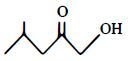
B
C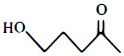
D
Solution
(B) Aldol condensation involves the reaction of two molecules of an aldehyde or ketone having at least one $\alpha$-hydrogen atom in the presence of a dilute base to form a $\beta$-hydroxy aldehyde (aldol) or $\beta$-hydroxy ketone (ketol).
In the given options,option $(b)$ represents $4$-hydroxy-$4$-methylpentan-$2$-one,which is the product of the self-aldol condensation of acetone $(CH_3COCH_3)$.
$2CH_3COCH_3 \xrightarrow{dil. Ba(OH)_2} CH_3-C(OH)(CH_3)-CH_2-COCH_3$
In the given options,option $(b)$ represents $4$-hydroxy-$4$-methylpentan-$2$-one,which is the product of the self-aldol condensation of acetone $(CH_3COCH_3)$.
$2CH_3COCH_3 \xrightarrow{dil. Ba(OH)_2} CH_3-C(OH)(CH_3)-CH_2-COCH_3$
0 likesView Solution
106
ChemistryDifficultMCQJEE Main · 2013
The order of basicity of amines in the gaseous state is
A
$1^o > 2^o > 3^o > NH_3$
B
$3^o > 2^o > NH_3 > 1^o$
C
$3^o > 2^o > 1^o > NH_3$
D
$NH_3 > 1^o > 2^o > 3^o$
Solution
(C) In the gaseous phase,the basicity of amines is determined solely by the inductive effect of the alkyl groups.
Alkyl groups are electron-donating ($+I$ effect),which increases the electron density on the nitrogen atom,making the lone pair more available for donation.
As the number of alkyl groups increases,the electron density on the nitrogen atom increases.
Therefore,the order of basicity in the gaseous phase is $3^o > 2^o > 1^o > NH_3$.
Alkyl groups are electron-donating ($+I$ effect),which increases the electron density on the nitrogen atom,making the lone pair more available for donation.
As the number of alkyl groups increases,the electron density on the nitrogen atom increases.
Therefore,the order of basicity in the gaseous phase is $3^o > 2^o > 1^o > NH_3$.
0 likesView Solution
107
ChemistryMediumMCQJEE Main · 2013
Monocarboxylic acids are functional isomers of
A
Ethers
B
Amines
C
Esters
D
Alcohols
Solution
(C) Functional isomers are compounds that have the same molecular formula but different functional groups.
Monocarboxylic acids (general formula $C_nH_{2n}O_2$) are functional isomers of esters (general formula $C_nH_{2n}O_2$).
For example,$CH_3COOH$ (Acetic acid) and $HCOOCH_3$ (Methyl formate) both have the molecular formula $C_2H_4O_2$.
Monocarboxylic acids (general formula $C_nH_{2n}O_2$) are functional isomers of esters (general formula $C_nH_{2n}O_2$).
For example,$CH_3COOH$ (Acetic acid) and $HCOOCH_3$ (Methyl formate) both have the molecular formula $C_2H_4O_2$.
0 likesView Solution
108
ChemistryDifficultMCQJEE Main · 2013
$A$ radioactive isotope having a half-life period of $3 \ days$ was received after $12 \ days$. If $3 \ g$ of the isotope is left in the container,what would be the initial mass of the isotope?.......... $g$
A
$12$
B
$36$
C
$48$
D
$24$
Solution
(C) Given half-life $t_{1/2} = 3 \ days$.
Total time elapsed $T = 12 \ days$.
Number of half-lives $(n) = \frac{T}{t_{1/2}} = \frac{12}{3} = 4$.
The relationship between initial mass $(N_0)$ and remaining mass $(N)$ is given by $N = N_0 \times (\frac{1}{2})^n$.
Substituting the values: $3 = N_0 \times (\frac{1}{2})^4$.
$3 = N_0 \times \frac{1}{16}$.
$N_0 = 3 \times 16 = 48 \ g$.
Total time elapsed $T = 12 \ days$.
Number of half-lives $(n) = \frac{T}{t_{1/2}} = \frac{12}{3} = 4$.
The relationship between initial mass $(N_0)$ and remaining mass $(N)$ is given by $N = N_0 \times (\frac{1}{2})^n$.
Substituting the values: $3 = N_0 \times (\frac{1}{2})^4$.
$3 = N_0 \times \frac{1}{16}$.
$N_0 = 3 \times 16 = 48 \ g$.
0 likesView Solution
109
ChemistryMediumMCQJEE Main · 2013
Which of the following statements is not correct?
A
Amylopectin is a branched polymer of $\alpha-glucose$.
B
Cellulose is a linear polymer of $\beta-glucose$.
C
Glycogen is the food reserve of plants.
D
All proteins are polymers of $\alpha-amino$ acids.
Solution
(C) Glycogen is known as animal starch and is the primary carbohydrate storage form in animals,not plants. Plants store energy primarily as starch. Therefore,the statement that glycogen is the food reserve of plants is incorrect.
0 likesView Solution
110
ChemistryDifficultMCQJEE Main · 2013
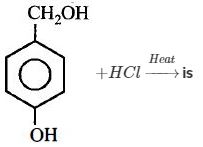
The major product in the following reaction is:
A
$4-$chloromethylphenol
B
$3-$chloro$-4-$hydroxybenzyl alcohol
C
$4-$chlorophenol
D
$4-$chloromethylchlorobenzene
Solution
(A) The reaction involves $p$-hydroxybenzyl alcohol reacting with $HCl$ under heating conditions.
In this molecule,there are two hydroxyl groups: one is a phenolic $-OH$ group and the other is an alcoholic $-CH_2OH$ group.
Phenolic $-OH$ groups are generally less reactive towards nucleophilic substitution with $HCl$ because the $C-O$ bond has partial double bond character due to resonance.
However,the alcoholic $-CH_2OH$ group is a primary benzylic alcohol. Benzylic alcohols are highly reactive towards substitution reactions because the resulting carbocation intermediate is stabilized by resonance with the benzene ring.
Therefore,the $-CH_2OH$ group undergoes substitution with $HCl$ to form $-CH_2Cl$,while the phenolic $-OH$ group remains unaffected.
The major product is $4$-chloromethylphenol.
In this molecule,there are two hydroxyl groups: one is a phenolic $-OH$ group and the other is an alcoholic $-CH_2OH$ group.
Phenolic $-OH$ groups are generally less reactive towards nucleophilic substitution with $HCl$ because the $C-O$ bond has partial double bond character due to resonance.
However,the alcoholic $-CH_2OH$ group is a primary benzylic alcohol. Benzylic alcohols are highly reactive towards substitution reactions because the resulting carbocation intermediate is stabilized by resonance with the benzene ring.
Therefore,the $-CH_2OH$ group undergoes substitution with $HCl$ to form $-CH_2Cl$,while the phenolic $-OH$ group remains unaffected.
The major product is $4$-chloromethylphenol.
0 likesView Solution
111
ChemistryMediumMCQJEE Main · 2013
Copper crystallises in $fcc$ with a unit cell edge length of $361 \ pm$. What is the radius of the copper atom in $pm$?
A
$157$
B
$128$
C
$108$
D
$181$
Solution
(B) For an $fcc$ (face-centered cubic) unit cell, the relationship between the edge length $a$ and the atomic radius $r$ is given by:
$r = \frac{\sqrt{2} a}{4} = \frac{a}{2\sqrt{2}}$
Given the edge length $a = 361 \ pm$:
$r = \frac{361}{2 \times 1.414}$
$r = \frac{361}{2.828}$
$r \approx 127.65 \ pm$
Rounding to the nearest whole number, we get $r = 128 \ pm$.
$r = \frac{\sqrt{2} a}{4} = \frac{a}{2\sqrt{2}}$
Given the edge length $a = 361 \ pm$:
$r = \frac{361}{2 \times 1.414}$
$r = \frac{361}{2.828}$
$r \approx 127.65 \ pm$
Rounding to the nearest whole number, we get $r = 128 \ pm$.
0 likesView Solution
112
ChemistryEasyMCQJEE Main · 2013
Bakelite is obtained from phenol by reacting with
A
Acetal
B
$CH_3CHO$
C
$HCHO$
D
Chlorobenzene
Solution
(C) Bakelite is a thermosetting polymer formed by the condensation polymerization of phenol and formaldehyde $(HCHO)$ in the presence of an acid or base catalyst.
The reaction involves the formation of ortho- and para-hydroxybenzyl alcohol derivatives,which further undergo cross-linking to form the complex structure of Bakelite.
The reaction involves the formation of ortho- and para-hydroxybenzyl alcohol derivatives,which further undergo cross-linking to form the complex structure of Bakelite.
0 likesView Solution
113
ChemistryMediumMCQJEE Main · 2013
How many grams of methyl alcohol should be added to a $10 \, L$ tank of water to prevent its freezing at $268 \, K$? ($K_f$ for water is $1.86 \, K \, kg \, mol^{-1}$,density of water is $1 \, kg/L$)
A
$880.07$
B
$899.04$
C
$886.02$
D
$868.06$
Solution
(D) The depression in freezing point is given by $\Delta T_f = K_f \times m$,where $m$ is the molality of the solution.
Given: $\Delta T_f = 273 \, K - 268 \, K = 5 \, K$,$K_f = 1.86 \, K \, kg \, mol^{-1}$,volume of water = $10 \, L$,mass of water $(W)$ = $10 \, kg$,molar mass of methyl alcohol $(CH_3OH)$ = $32 \, g/mol$.
Molality $m = \frac{w \times 1000}{M \times W_{solvent(g)}} = \frac{w}{32 \times 10}$.
Substituting the values: $5 = 1.86 \times \frac{w}{32 \times 10}$.
$w = \frac{5 \times 32 \times 10}{1.86} = \frac{1600}{1.86} \approx 860.22 \, g$.
Comparing with the given options,the closest value is $868.06 \, g$.
Given: $\Delta T_f = 273 \, K - 268 \, K = 5 \, K$,$K_f = 1.86 \, K \, kg \, mol^{-1}$,volume of water = $10 \, L$,mass of water $(W)$ = $10 \, kg$,molar mass of methyl alcohol $(CH_3OH)$ = $32 \, g/mol$.
Molality $m = \frac{w \times 1000}{M \times W_{solvent(g)}} = \frac{w}{32 \times 10}$.
Substituting the values: $5 = 1.86 \times \frac{w}{32 \times 10}$.
$w = \frac{5 \times 32 \times 10}{1.86} = \frac{1600}{1.86} \approx 860.22 \, g$.
Comparing with the given options,the closest value is $868.06 \, g$.
0 likesView Solution
114
ChemistryDifficultMCQJEE Main · 2013
In which of the following octahedral complex species the magnitude of $\Delta_0$ will be maximum?
A
$[Co(H_2O)_6]^{2+}$
B
$[Co(CN)_6]^{3-}$
C
$[Co(C_2O_4)_3]^{3-}$
D
$[Co(NH_3)_6]^{3+}$
Solution
(B) The magnitude of crystal field splitting energy,$\Delta_0$,depends on the oxidation state of the central metal ion and the nature of the ligand.
$1$. Higher oxidation state of the metal ion leads to larger $\Delta_0$. Here,$Co$ is in $+3$ state in options $B, C,$ and $D$,while it is in $+2$ state in option $A$.
$2$. Among ligands,the spectrochemical series follows the order: $C_2O_4^{2-} < H_2O < NH_3 < CN^-$.
$3$. Since $CN^-$ is a strong field ligand,it causes the maximum splitting.
Therefore,the magnitude of $\Delta_0$ is maximum for $[Co(CN)_6]^{3-}$.
$1$. Higher oxidation state of the metal ion leads to larger $\Delta_0$. Here,$Co$ is in $+3$ state in options $B, C,$ and $D$,while it is in $+2$ state in option $A$.
$2$. Among ligands,the spectrochemical series follows the order: $C_2O_4^{2-} < H_2O < NH_3 < CN^-$.
$3$. Since $CN^-$ is a strong field ligand,it causes the maximum splitting.
Therefore,the magnitude of $\Delta_0$ is maximum for $[Co(CN)_6]^{3-}$.
0 likesView Solution
115
ChemistryMediumMCQJEE Main · 2013
In a nucleophilic substitution reaction,the order of halogens as incoming (attacking) nucleophiles is: $I^{-} > Br^{-} > Cl^{-}$. The order of halogens as departing (leaving) nucleophiles should be:
A
$Br^{-} > I^{-} > Cl^{-}$
B
$I^{-} > Br^{-} > Cl^{-}$
C
$Cl^{-} > Br^{-} > I^{-}$
D
$Cl^{-} > I^{-} > Br^{-}$
Solution
(B) In a nucleophilic substitution reaction,the leaving group ability is inversely proportional to the basic strength of the group.
Weaker bases are better leaving groups because they are more stable in the solution after departing.
The basic strength order of the given halide ions is: $I^{-} < Br^{-} < Cl^{-}$.
Since $I^{-}$ is the weakest base among the three,it is the best leaving group.
Therefore,the order of leaving group ability is: $I^{-} > Br^{-} > Cl^{-}$.
Weaker bases are better leaving groups because they are more stable in the solution after departing.
The basic strength order of the given halide ions is: $I^{-} < Br^{-} < Cl^{-}$.
Since $I^{-}$ is the weakest base among the three,it is the best leaving group.
Therefore,the order of leaving group ability is: $I^{-} > Br^{-} > Cl^{-}$.
0 likesView Solution
116
ChemistryDifficultMCQJEE Main · 2013
The Gibbs energy for the decomposition of $Al_2O_3$ at $500\,^oC$ is as follows:
$\frac{2}{3}Al_2O_3 \to \frac{4}{3}Al + O_2, \Delta_rG = +940\,kJ\,mol^{-1}$
The potential difference needed for the electrolytic reduction of aluminium oxide is ............... $V$.
$\frac{2}{3}Al_2O_3 \to \frac{4}{3}Al + O_2, \Delta_rG = +940\,kJ\,mol^{-1}$
The potential difference needed for the electrolytic reduction of aluminium oxide is ............... $V$.
A
$4.5$
B
$3.0$
C
$5.0$
D
$2.5$
Solution
(D) The reaction is $\frac{2}{3}Al_2O_3 \to \frac{4}{3}Al + O_2$.
In $Al_2O_3$,the oxidation state of $Al$ is $+3$. The reduction half-reaction is $Al^{3+} + 3e^- \to Al$.
For the overall reaction,the number of electrons transferred $(n)$ is $4$ (since $\frac{4}{3} \times 3 = 4$).
Using the formula $\Delta_rG = -nFE^o$,where $\Delta_rG = 940 \times 10^3\,J\,mol^{-1}$,$n = 4$,and $F = 96500\,C\,mol^{-1}$:
$E^o = -\frac{\Delta_rG}{nF} = -\frac{940 \times 10^3}{4 \times 96500} \approx -2.43\,V$.
The potential difference required for the electrolytic reduction is the magnitude of this value,which is approximately $2.5\,V$.
In $Al_2O_3$,the oxidation state of $Al$ is $+3$. The reduction half-reaction is $Al^{3+} + 3e^- \to Al$.
For the overall reaction,the number of electrons transferred $(n)$ is $4$ (since $\frac{4}{3} \times 3 = 4$).
Using the formula $\Delta_rG = -nFE^o$,where $\Delta_rG = 940 \times 10^3\,J\,mol^{-1}$,$n = 4$,and $F = 96500\,C\,mol^{-1}$:
$E^o = -\frac{\Delta_rG}{nF} = -\frac{940 \times 10^3}{4 \times 96500} \approx -2.43\,V$.
The potential difference required for the electrolytic reduction is the magnitude of this value,which is approximately $2.5\,V$.
0 likesView Solution
117
ChemistryDifficultMCQJEE Main · 2013
Cannizzaro's reaction is not given by
A
$C_6H_5CHO$
B
$HCHO$
C
$CH_3CHO$
D
$CCl_3CHO$
Solution
(C) Only those aldehydes which do not have $\alpha-H$ atoms undergo Cannizzaro's reaction.
$CH_3CHO$ (acetaldehyde) contains $3$ $\alpha-H$ atoms attached to the $\alpha$-carbon.
Therefore,it undergoes aldol condensation instead of Cannizzaro's reaction.
$C_6H_5CHO$,$HCHO$,and $CCl_3CHO$ do not have any $\alpha-H$ atoms and thus undergo Cannizzaro's reaction.
$CH_3CHO$ (acetaldehyde) contains $3$ $\alpha-H$ atoms attached to the $\alpha$-carbon.
Therefore,it undergoes aldol condensation instead of Cannizzaro's reaction.
$C_6H_5CHO$,$HCHO$,and $CCl_3CHO$ do not have any $\alpha-H$ atoms and thus undergo Cannizzaro's reaction.
0 likesView Solution
118
ChemistryEasyMCQJEE Main · 2013
Phenol on heating with $CHCl_3$ and $NaOH$ gives salicylaldehyde. The reaction is called
A
Reimer - Tiemann reaction
B
Claisen reaction
C
Cannizzaro's reaction
D
Hell - Volhard - Zelinsky reaction
Solution
(A) The reaction of phenol with chloroform $(CHCl_3)$ in the presence of aqueous sodium hydroxide $(NaOH)$ followed by acidification leads to the formation of salicylaldehyde (o-hydroxybenzaldehyde) as the major product. This specific chemical transformation is known as the Reimer - Tiemann reaction.
0 likesView Solution
119
ChemistryEasyMCQJEE Main · 2013
Among the following vitamins,the one whose deficiency causes rickets (bone deficiency) is:
A
Vitamin $A$
B
Vitamin $B$
C
Vitamin $D$
D
Vitamin $C$
Solution
(C) The deficiency of Vitamin $D$ leads to the softening and weakening of bones,a condition known as rickets.
0 likesView Solution
120
ChemistryDifficultMCQJEE Main · 2013
Carbylamine is formed from aliphatic or aromatic primary amine via which of the following intermediates?
A
Carbanion
B
Carbene
C
Carbocation
D
Carbon radical
Solution
(B) The carbylamine reaction (also known as the isocyanide test) involves the reaction of a primary amine $(RNH_2)$ with chloroform $(CHCl_3)$ in the presence of a base like $KOH$.
In the first step of the mechanism,chloroform undergoes $\alpha$-elimination in the presence of a base to form dichlorocarbene $(:CCl_2)$,which acts as the reactive intermediate.
This dichlorocarbene then undergoes nucleophilic attack by the nitrogen atom of the primary amine to eventually yield the isocyanide $(RNC)$.
Therefore,the correct intermediate is a carbene.
In the first step of the mechanism,chloroform undergoes $\alpha$-elimination in the presence of a base to form dichlorocarbene $(:CCl_2)$,which acts as the reactive intermediate.
This dichlorocarbene then undergoes nucleophilic attack by the nitrogen atom of the primary amine to eventually yield the isocyanide $(RNC)$.
Therefore,the correct intermediate is a carbene.
0 likesView Solution
121
ChemistryMediumMCQJEE Main · 2013
$10 \, mL$ of $2 \, M \, NaOH$ solution is added to $200 \, mL$ of $0.5 \, M \, NaOH$ solution. What is the final concentration? $............ \, M$
A
$0.57$
B
$5.7$
C
$11.4$
D
$1.14$
Solution
(A) Using the molarity equation for mixing two solutions of the same solute:
$M_1V_1 + M_2V_2 = M_{final}V_{total}$
Given:
$M_1 = 2 \, M, V_1 = 10 \, mL$
$M_2 = 0.5 \, M, V_2 = 200 \, mL$
$V_{total} = 10 \, mL + 200 \, mL = 210 \, mL$
Substituting the values:
$(2 \times 10) + (0.5 \times 200) = M_{final} \times 210$
$20 + 100 = M_{final} \times 210$
$120 = M_{final} \times 210$
$M_{final} = \frac{120}{210} = \frac{12}{21} = \frac{4}{7} \approx 0.57 \, M$
$M_1V_1 + M_2V_2 = M_{final}V_{total}$
Given:
$M_1 = 2 \, M, V_1 = 10 \, mL$
$M_2 = 0.5 \, M, V_2 = 200 \, mL$
$V_{total} = 10 \, mL + 200 \, mL = 210 \, mL$
Substituting the values:
$(2 \times 10) + (0.5 \times 200) = M_{final} \times 210$
$20 + 100 = M_{final} \times 210$
$120 = M_{final} \times 210$
$M_{final} = \frac{120}{210} = \frac{12}{21} = \frac{4}{7} \approx 0.57 \, M$
0 likesView Solution
122
ChemistryDifficultMCQJEE Main · 2013
The structure of which of the following chloro species can be explained on the basis of $dsp^2$ hybridization?
A
$PdCl_4^{2-}$
B
$FeCl_4^{2-}$
C
$CoCl_4^{2-}$
D
$NiCl_4^{2-}$
Solution
(A) The complex $[PdCl_4]^{2-}$ involves $Pd^{2+}$ ion which has a $4d^8$ configuration.
Since $Pd$ is a $4d$ series element,the crystal field splitting energy is high,forcing the pairing of electrons.
This results in $dsp^2$ hybridization,leading to a square planar geometry.
Since $Pd$ is a $4d$ series element,the crystal field splitting energy is high,forcing the pairing of electrons.
This results in $dsp^2$ hybridization,leading to a square planar geometry.
0 likesView Solution
123
ChemistryDifficultMCQJEE Main · 2013
Which of the following reagent$(s)$ is/are used for the given conversion?

A
glycol$/LiAlH_4/H_3O^{+}$
B
glycol$/NaH/H_3O^{+}$
C
$LiAlH_4$
D
$NaBH_4$
Solution
(A) The starting material is an ester containing a ketone group. Direct reduction with $LiAlH_4$ would reduce both the ketone and the ester groups to alcohols. To selectively reduce the ester to an alcohol while keeping the ketone intact,we must first protect the ketone.
$1$. The ketone is protected by forming a cyclic acetal using ethylene glycol (glycol) in the presence of an acid catalyst.
$2$. The ester group is then reduced to a primary alcohol using $LiAlH_4$.
$3$. Finally,the cyclic acetal is deprotected (hydrolyzed) back to the ketone using $H_3O^{+}$.
$1$. The ketone is protected by forming a cyclic acetal using ethylene glycol (glycol) in the presence of an acid catalyst.
$2$. The ester group is then reduced to a primary alcohol using $LiAlH_4$.
$3$. Finally,the cyclic acetal is deprotected (hydrolyzed) back to the ketone using $H_3O^{+}$.
0 likesView Solution
124
ChemistryDifficultMCQJEE Main · 2013
$A$ solution of copper sulphate $(CuSO_4)$ is electrolysed for $10 \, \text{minutes}$ with a current of $1.5 \, \text{amperes}$. The mass of copper deposited at the cathode (atomic mass of $Cu = 63 \, u$) is ............ $g$.
A
$0.3892$
B
$0.2938$
C
$0.2398$
D
$0.3928$
Solution
(B) According to Faraday's law of electrolysis,the mass $W$ deposited is given by $W = Z \times i \times t$.
Here,$Z$ is the electrochemical equivalent,$i$ is the current in amperes,and $t$ is the time in seconds.
For $Cu^{2+} + 2e^- \rightarrow Cu$,the equivalent weight of copper is $\frac{63}{2} = 31.5 \, g \, \text{eq}^{-1}$.
$Z = \frac{\text{Equivalent weight}}{96500} = \frac{31.5}{96500}$.
Given $i = 1.5 \, A$ and $t = 10 \, \text{minutes} = 600 \, \text{seconds}$.
$W = \frac{31.5}{96500} \times 1.5 \times 600 = 0.2938 \, g$.
Here,$Z$ is the electrochemical equivalent,$i$ is the current in amperes,and $t$ is the time in seconds.
For $Cu^{2+} + 2e^- \rightarrow Cu$,the equivalent weight of copper is $\frac{63}{2} = 31.5 \, g \, \text{eq}^{-1}$.
$Z = \frac{\text{Equivalent weight}}{96500} = \frac{31.5}{96500}$.
Given $i = 1.5 \, A$ and $t = 10 \, \text{minutes} = 600 \, \text{seconds}$.
$W = \frac{31.5}{96500} \times 1.5 \times 600 = 0.2938 \, g$.
0 likesView Solution
125
ChemistryDifficultMCQJEE Main · 2013
$XeO_4$ molecule is tetrahedral having
A
Two $p\pi-d\pi$ bonds
B
One $p\pi-d\pi$ bonds
C
Four $p\pi-d\pi$ bonds
D
Three $p\pi-d\pi$ bonds
Solution
(C) In $XeO_4$,the central atom $Xe$ is in its $8^{th}$ oxidation state.
It undergoes $sp^{3}$ hybridization involving one $5s$ and three $5p$ orbitals.
These four $sp^{3}$ hybrid orbitals form four $\sigma$ bonds with four oxygen atoms.
Additionally,the four unpaired electrons in the $5d$ orbitals of $Xe$ form four $p\pi-d\pi$ bonds with the $2p$ orbitals of the oxygen atoms.
Therefore,the molecule contains four $p\pi-d\pi$ bonds.
It undergoes $sp^{3}$ hybridization involving one $5s$ and three $5p$ orbitals.
These four $sp^{3}$ hybrid orbitals form four $\sigma$ bonds with four oxygen atoms.
Additionally,the four unpaired electrons in the $5d$ orbitals of $Xe$ form four $p\pi-d\pi$ bonds with the $2p$ orbitals of the oxygen atoms.
Therefore,the molecule contains four $p\pi-d\pi$ bonds.
0 likesView Solution
126
ChemistryMediumMCQJEE Main · 2013
Which one of the following statements about packing in solids is incorrect?
A
Coordination number in $bcc$ mode of packing is $8$.
B
Coordination number in $hcp$ mode of packing is $12$.
C
Void space in $hcp$ mode of packing is $32\%$.
D
Void space in $ccp$ mode of packing is $26\%$.
Solution
(C) In $hcp$ and $ccp$ arrangements,the packing efficiency is $74\%$.
Therefore,the void space (empty space) is $100\% - 74\% = 26\%$.
Statement $C$ claims the void space in $hcp$ is $32\%$,which is incorrect.
Therefore,the void space (empty space) is $100\% - 74\% = 26\%$.
Statement $C$ claims the void space in $hcp$ is $32\%$,which is incorrect.
0 likesView Solution
Vedclass Products
For Students
Vedclass Test Series
Mock tests in real JEE Main style covering Chemistry with performance analysis. 5-day free trial.
Start Free TrialFor Teachers
Exam Paper Generator
Generate Set A/B/C/D Chemistry papers from 7.5L+ questions in 2 minutes. 3 chapters free.
Try FreeFor Institutes
Online Exam Module
Run live JEE Main mock exams with unlimited students, 360° analytics & white-label branding.
See DemoFrequently Asked Questions
How many Chemistry questions are in JEE Main 2013?
There are 176 Chemistry questions from the JEE Main 2013 paper on Vedclass, each with a detailed step-by-step solution in English.
Are JEE Main 2013 Chemistry solutions available in English?
Yes. All solutions on this page are in English. You can also switch to English or Hindi using the language buttons above the questions.
Can I practice JEE Main 2013 Chemistry as a timed test?
Yes. Use the Vedclass Test Series to attempt a full JEE Main mock test covering Chemistry with time limits and instant score analysis.
Can teachers create Chemistry papers from JEE Main previous year questions?
Yes. The Vedclass Exam Paper Generator lets teachers mix JEE Main Chemistry questions and generate Set A/B/C/D papers in minutes.
For Teachers & Institutes
Build a Custom Chemistry Paper
Pick JEE Main 2013 Chemistry questions, set difficulty, and generate Set A/B/C/D in 2 minutes.