
PhysicsQ1–28 of 28 questions
Page 1 of 1 · English
1
PhysicsEasyMCQGUJCET · 2018
The dimensional formula of $\mu_{0} \varepsilon_{0}$ is . . . . . . .
A
$M^{0} L^{-2} T^{2}$
B
$M^{0} L^{2} T^{-2}$
C
$M^{0} L^{1} T^{-1}$
D
$M^{0} L^{-1} T^{1}$
Solution
(A) The speed of light in vacuum is given by the relation $c = \frac{1}{\sqrt{\mu_{0} \varepsilon_{0}}}$.
Squaring both sides,we get $c^{2} = \frac{1}{\mu_{0} \varepsilon_{0}}$.
Therefore,$\mu_{0} \varepsilon_{0} = \frac{1}{c^{2}}$.
The dimensional formula for the speed of light $c$ is $[M^{0} L^{1} T^{-1}]$.
Substituting this into the expression,we get $\mu_{0} \varepsilon_{0} = \frac{1}{(M^{0} L^{1} T^{-1})^{2}}$.
$\mu_{0} \varepsilon_{0} = \frac{1}{M^{0} L^{2} T^{-2}} = M^{0} L^{-2} T^{2}$.
Squaring both sides,we get $c^{2} = \frac{1}{\mu_{0} \varepsilon_{0}}$.
Therefore,$\mu_{0} \varepsilon_{0} = \frac{1}{c^{2}}$.
The dimensional formula for the speed of light $c$ is $[M^{0} L^{1} T^{-1}]$.
Substituting this into the expression,we get $\mu_{0} \varepsilon_{0} = \frac{1}{(M^{0} L^{1} T^{-1})^{2}}$.
$\mu_{0} \varepsilon_{0} = \frac{1}{M^{0} L^{2} T^{-2}} = M^{0} L^{-2} T^{2}$.
0 likesView Solution
2
PhysicsEasyMCQGUJCET · 2018
$A$ capacitor '$C$' is connected across a $DC$ source,the reactance of the capacitance will be . . . . . . .
A
Zero
B
High
C
Low
D
Infinite
Solution
(D) The capacitive reactance $X_C$ is given by the formula $X_C = \frac{1}{2 \pi \nu C}$,where $\nu$ is the frequency of the source.
For a $DC$ source,the frequency $\nu = 0 \ Hz$.
Substituting this value into the formula,we get $X_C = \frac{1}{2 \pi (0) C} = \frac{1}{0}$.
Therefore,the reactance of the capacitor in a $DC$ circuit is infinite.
For a $DC$ source,the frequency $\nu = 0 \ Hz$.
Substituting this value into the formula,we get $X_C = \frac{1}{2 \pi (0) C} = \frac{1}{0}$.
Therefore,the reactance of the capacitor in a $DC$ circuit is infinite.
0 likesView Solution
3
PhysicsEasyMCQGUJCET · 2018
$A$ lamp consumes only $50 \%$ of maximum power in an $AC$ circuit. What is the phase difference between the applied voltage and the circuit current?
A
$\frac{\pi}{6} \ rad$
B
$\frac{\pi}{3} \ rad$
C
$\frac{\pi}{4} \ rad$
D
$\frac{\pi}{2} \ rad$
Solution
(B) The power consumed in an $AC$ circuit is given by $P = V_{rms} I_{rms} \cos \phi$,where $\phi$ is the phase difference between voltage and current.
Maximum power $P_{max}$ occurs when $\cos \phi = 1$,so $P_{max} = V_{rms} I_{rms}$.
Given that the lamp consumes $50 \%$ of the maximum power:
$P = 0.5 \times P_{max}$
$V_{rms} I_{rms} \cos \phi = 0.5 \times V_{rms} I_{rms}$
$\cos \phi = 0.5 = \frac{1}{2}$
$\phi = \cos^{-1}(\frac{1}{2}) = \frac{\pi}{3} \ rad$.
Maximum power $P_{max}$ occurs when $\cos \phi = 1$,so $P_{max} = V_{rms} I_{rms}$.
Given that the lamp consumes $50 \%$ of the maximum power:
$P = 0.5 \times P_{max}$
$V_{rms} I_{rms} \cos \phi = 0.5 \times V_{rms} I_{rms}$
$\cos \phi = 0.5 = \frac{1}{2}$
$\phi = \cos^{-1}(\frac{1}{2}) = \frac{\pi}{3} \ rad$.
0 likesView Solution
4
PhysicsEasyMCQGUJCET · 2018
The dimensional formula of mobility is . . . . . .
A
$M^1 L^{-1} T^{-2} A^{-1}$
B
$M^1 L^0 T^{-2} A^{-1}$
C
$M^{-1} L^1 T^2 A^1$
D
$M^{-1} L^0 T^2 A^1$
Solution
(D) Mobility $\mu$ is defined as the ratio of drift velocity $v_d$ to the applied electric field $E$: $\mu = \frac{v_d}{E}$.
The dimensional formula for drift velocity $v_d$ is $[L^1 T^{-1}]$.
The dimensional formula for electric field $E$ is $[M^1 L^1 T^{-3} A^{-1}]$.
Substituting these into the formula: $\mu = \frac{[L^1 T^{-1}]}{[M^1 L^1 T^{-3} A^{-1}]}$.
Simplifying the expression: $\mu = [M^{-1} L^{1-1} T^{-1 - (-3)} A^1] = [M^{-1} L^0 T^2 A^1]$.
The dimensional formula for drift velocity $v_d$ is $[L^1 T^{-1}]$.
The dimensional formula for electric field $E$ is $[M^1 L^1 T^{-3} A^{-1}]$.
Substituting these into the formula: $\mu = \frac{[L^1 T^{-1}]}{[M^1 L^1 T^{-3} A^{-1}]}$.
Simplifying the expression: $\mu = [M^{-1} L^{1-1} T^{-1 - (-3)} A^1] = [M^{-1} L^0 T^2 A^1]$.
0 likesView Solution
5
PhysicsEasyMCQGUJCET · 2018
You are given $10$ resistors each of resistance $2 \ \Omega$. First,they are connected to obtain the possible minimum resistance. Then,they are connected to obtain the possible maximum resistance. The ratio of maximum and minimum resistance is . . . . . . .
A
$2.5$
B
$10$
C
$100$
D
$25$
Solution
(C) To obtain the minimum resistance,the resistors must be connected in parallel.
$R_{\min} = \frac{R}{n} = \frac{2}{10} = 0.2 \ \Omega$
To obtain the maximum resistance,the resistors must be connected in series.
$R_{\max} = n \times R = 10 \times 2 = 20 \ \Omega$
The ratio of maximum to minimum resistance is:
$\frac{R_{\max}}{R_{\min}} = \frac{20}{0.2} = 100$
$R_{\min} = \frac{R}{n} = \frac{2}{10} = 0.2 \ \Omega$
To obtain the maximum resistance,the resistors must be connected in series.
$R_{\max} = n \times R = 10 \times 2 = 20 \ \Omega$
The ratio of maximum to minimum resistance is:
$\frac{R_{\max}}{R_{\min}} = \frac{20}{0.2} = 100$
0 likesView Solution
6
PhysicsEasyMCQGUJCET · 2018
When the temperature of a conductor increases, the ratio of conductivity and resistivity . . . . . . .
A
decreases
B
increases
C
remains constant
D
increases or decreases
Solution
(A) The ratio of conductivity $(\sigma)$ to resistivity $(\rho)$ is given by $\frac{\sigma}{\rho}$.
Since $\sigma = \frac{1}{\rho}$, we can write the ratio as $\frac{1/\rho}{\rho} = \frac{1}{\rho^2}$.
For a conductor, as the temperature increases, the resistivity $(\rho)$ increases due to increased collisions of electrons with the lattice ions.
Since $\rho$ is in the denominator and is squared, as $\rho$ increases, the value of $\frac{1}{\rho^2}$ decreases.
Therefore, the ratio of conductivity to resistivity decreases.
Since $\sigma = \frac{1}{\rho}$, we can write the ratio as $\frac{1/\rho}{\rho} = \frac{1}{\rho^2}$.
For a conductor, as the temperature increases, the resistivity $(\rho)$ increases due to increased collisions of electrons with the lattice ions.
Since $\rho$ is in the denominator and is squared, as $\rho$ increases, the value of $\frac{1}{\rho^2}$ decreases.
Therefore, the ratio of conductivity to resistivity decreases.
0 likesView Solution
7
PhysicsEasyMCQGUJCET · 2018
If the energy of a photon corresponding to a wavelength of $6000 \mathring{A}$ is $3.2 \times 10^{-19} \ J$,the photon energy for a wavelength of $4000 \mathring{A}$ will be . . . . . . .
A
$4.44 \times 10^{-19} \ J$
B
$2.22 \times 10^{-19} \ J$
C
$1.11 \times 10^{-19} \ J$
D
$4.80 \times 10^{-19} \ J$
Solution
(D) The energy of a photon is given by the formula $E = \frac{hc}{\lambda}$.
Since $h$ and $c$ are constants,the energy $E$ is inversely proportional to the wavelength $\lambda$,i.e.,$E \propto \frac{1}{\lambda}$.
Therefore,we can write the ratio as $\frac{E_{2}}{E_{1}} = \frac{\lambda_{1}}{\lambda_{2}}$.
Given: $E_{1} = 3.2 \times 10^{-19} \ J$,$\lambda_{1} = 6000 \mathring{A}$,and $\lambda_{2} = 4000 \mathring{A}$.
Substituting the values: $\frac{E_{2}}{3.2 \times 10^{-19}} = \frac{6000}{4000} = \frac{6}{4} = 1.5$.
$E_{2} = 1.5 \times 3.2 \times 10^{-19} \ J$.
$E_{2} = 4.80 \times 10^{-19} \ J$.
Since $h$ and $c$ are constants,the energy $E$ is inversely proportional to the wavelength $\lambda$,i.e.,$E \propto \frac{1}{\lambda}$.
Therefore,we can write the ratio as $\frac{E_{2}}{E_{1}} = \frac{\lambda_{1}}{\lambda_{2}}$.
Given: $E_{1} = 3.2 \times 10^{-19} \ J$,$\lambda_{1} = 6000 \mathring{A}$,and $\lambda_{2} = 4000 \mathring{A}$.
Substituting the values: $\frac{E_{2}}{3.2 \times 10^{-19}} = \frac{6000}{4000} = \frac{6}{4} = 1.5$.
$E_{2} = 1.5 \times 3.2 \times 10^{-19} \ J$.
$E_{2} = 4.80 \times 10^{-19} \ J$.
0 likesView Solution
8
PhysicsEasyMCQGUJCET · 2018
The wavelength of a photon with energy $35 \text{ keV}$ is . . . . . . .
$(h = 6.625 \times 10^{-34} \text{ J s}, c = 3 \times 10^{8} \text{ m/s}, 1 \text{ eV} = 1.6 \times 10^{-19} \text{ J})$
$(h = 6.625 \times 10^{-34} \text{ J s}, c = 3 \times 10^{8} \text{ m/s}, 1 \text{ eV} = 1.6 \times 10^{-19} \text{ J})$
A
$35 \times 10^{-12} \text{ m}$
B
$35 \text{ Å}$
C
$3.5 \text{ nm}$
D
$3.5 \text{ Å}$
Solution
(A) Given:
Energy $E = 35 \text{ keV} = 35 \times 10^{3} \times 1.6 \times 10^{-19} \text{ J} = 56 \times 10^{-16} \text{ J}$.
Using the formula for the wavelength of a photon:
$E = \frac{hc}{\lambda} \implies \lambda = \frac{hc}{E}$
Substituting the values:
$\lambda = \frac{6.625 \times 10^{-34} \times 3 \times 10^{8}}{35 \times 10^{3} \times 1.6 \times 10^{-19}}$
$\lambda = \frac{19.875 \times 10^{-26}}{56 \times 10^{-16}}$
$\lambda \approx 0.3549 \times 10^{-10} \text{ m} \approx 0.355 \times 10^{-10} \text{ m} = 35.5 \times 10^{-12} \text{ m}$.
Rounding to the nearest provided option,the correct value is $35 \times 10^{-12} \text{ m}$.
Energy $E = 35 \text{ keV} = 35 \times 10^{3} \times 1.6 \times 10^{-19} \text{ J} = 56 \times 10^{-16} \text{ J}$.
Using the formula for the wavelength of a photon:
$E = \frac{hc}{\lambda} \implies \lambda = \frac{hc}{E}$
Substituting the values:
$\lambda = \frac{6.625 \times 10^{-34} \times 3 \times 10^{8}}{35 \times 10^{3} \times 1.6 \times 10^{-19}}$
$\lambda = \frac{19.875 \times 10^{-26}}{56 \times 10^{-16}}$
$\lambda \approx 0.3549 \times 10^{-10} \text{ m} \approx 0.355 \times 10^{-10} \text{ m} = 35.5 \times 10^{-12} \text{ m}$.
Rounding to the nearest provided option,the correct value is $35 \times 10^{-12} \text{ m}$.
0 likesView Solution
9
PhysicsEasyMCQGUJCET · 2018
The electric force acting between two point charges kept at a certain distance in vacuum is $16 \ N$. If the same two charges are kept at the same distance in a medium of dielectric constant $8$,the electric force acting between them is . . . . . . .
A
$1024$
B
$128$
C
$16$
D
$2$
Solution
(D) The electric force between two point charges in vacuum is given by $F_{\text{air}} = \frac{1}{4\pi\epsilon_0} \frac{q_1q_2}{r^2} = 16 \ N$.
When the same charges are placed in a medium with dielectric constant $K$,the force is given by $F_{\text{medium}} = \frac{F_{\text{air}}}{K}$.
Given $F_{\text{air}} = 16 \ N$ and $K = 8$.
Therefore,$F_{\text{medium}} = \frac{16}{8} = 2 \ N$.
Thus,the correct option is $D$.
When the same charges are placed in a medium with dielectric constant $K$,the force is given by $F_{\text{medium}} = \frac{F_{\text{air}}}{K}$.
Given $F_{\text{air}} = 16 \ N$ and $K = 8$.
Therefore,$F_{\text{medium}} = \frac{16}{8} = 2 \ N$.
Thus,the correct option is $D$.
0 likesView Solution
10
PhysicsEasyMCQGUJCET · 2018
When a $10 \mu C$ charge is enclosed by a closed surface,the flux passing through the surface is $\phi$. Now,another $10 \mu C$ charge is placed inside the closed surface,then the flux passing through the surface is . . . . . . .
A
$4 \phi$
B
$\phi$
C
$2 \phi$
D
zero
Solution
(C) According to Gauss's Law,the electric flux $\phi$ through a closed surface is given by $\phi = \frac{q_{enclosed}}{\varepsilon_0}$.
Initially,the charge enclosed is $q = 10 \mu C$,so $\phi = \frac{q}{\varepsilon_0} \quad ... (1)$.
When another $10 \mu C$ charge is placed inside,the total charge enclosed becomes $Q = 10 \mu C + 10 \mu C = 20 \mu C = 2q$.
The new flux $\phi'$ passing through the surface is $\phi' = \frac{Q}{\varepsilon_0} = \frac{2q}{\varepsilon_0}$.
Substituting from equation $(1)$,we get $\phi' = 2 \phi$.
Initially,the charge enclosed is $q = 10 \mu C$,so $\phi = \frac{q}{\varepsilon_0} \quad ... (1)$.
When another $10 \mu C$ charge is placed inside,the total charge enclosed becomes $Q = 10 \mu C + 10 \mu C = 20 \mu C = 2q$.
The new flux $\phi'$ passing through the surface is $\phi' = \frac{Q}{\varepsilon_0} = \frac{2q}{\varepsilon_0}$.
Substituting from equation $(1)$,we get $\phi' = 2 \phi$.
0 likesView Solution
11
PhysicsEasyMCQGUJCET · 2018
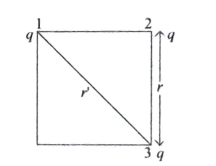
Three identical charges are placed on three vertices of a square. If the force acting between $q_1$ and $q_2$ is $F_{12}$ and between $q_1$ and $q_3$ is $F_{13}$,then $\frac{F_{13}}{F_{12}} = $ . . . . . . .
A
$\frac{1}{2}$
B
$2$
C
$\frac{1}{\sqrt{2}}$
D
$\sqrt{2}$
Solution
(A) Let the side length of the square be $r$. The charges at vertices $1, 2,$ and $3$ are identical,so $q_1 = q_2 = q_3 = q$.
The distance between charges $q_1$ and $q_2$ is the side of the square,$r_{12} = r$.
According to Coulomb's Law,the force $F_{12}$ is:
$F_{12} = \frac{k q_1 q_2}{r_{12}^2} = \frac{k q^2}{r^2} \quad \dots (1)$
The distance between charges $q_1$ and $q_3$ is the diagonal of the square,$r_{13} = \sqrt{r^2 + r^2} = r\sqrt{2}$.
According to Coulomb's Law,the force $F_{13}$ is:
$F_{13} = \frac{k q_1 q_3}{r_{13}^2} = \frac{k q^2}{(r\sqrt{2})^2} = \frac{k q^2}{2r^2} \quad \dots (2)$
Taking the ratio of equation $(2)$ to equation $(1)$:
$\frac{F_{13}}{F_{12}} = \frac{\frac{k q^2}{2r^2}}{\frac{k q^2}{r^2}} = \frac{1}{2}$
Thus,the correct option is $A$.
The distance between charges $q_1$ and $q_2$ is the side of the square,$r_{12} = r$.
According to Coulomb's Law,the force $F_{12}$ is:
$F_{12} = \frac{k q_1 q_2}{r_{12}^2} = \frac{k q^2}{r^2} \quad \dots (1)$
The distance between charges $q_1$ and $q_3$ is the diagonal of the square,$r_{13} = \sqrt{r^2 + r^2} = r\sqrt{2}$.
According to Coulomb's Law,the force $F_{13}$ is:
$F_{13} = \frac{k q_1 q_3}{r_{13}^2} = \frac{k q^2}{(r\sqrt{2})^2} = \frac{k q^2}{2r^2} \quad \dots (2)$
Taking the ratio of equation $(2)$ to equation $(1)$:
$\frac{F_{13}}{F_{12}} = \frac{\frac{k q^2}{2r^2}}{\frac{k q^2}{r^2}} = \frac{1}{2}$
Thus,the correct option is $A$.
0 likesView Solution
12
PhysicsEasyMCQGUJCET · 2018
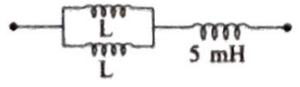
Two inductors,each of inductance $L$,are connected in parallel. One more inductor of value $5 \text{ mH}$ is connected in series with this configuration,and the effective inductance is $15 \text{ mH}$. The value of $L$ is . . . . . . $\text{mH}$.
A
$10$
B
$5.0$
C
$2.5$
D
$20$
Solution
(D) The equivalent inductance of two inductors $L$ connected in parallel is given by:
$L_p = \frac{L \times L}{L + L} = \frac{L^2}{2L} = \frac{L}{2}$
This parallel combination is connected in series with an inductor of $5 \text{ mH}$. The total effective inductance $L_{eq}$ is:
$L_{eq} = L_p + 5 \text{ mH}$
Given $L_{eq} = 15 \text{ mH}$,we have:
$15 = \frac{L}{2} + 5$
$10 = \frac{L}{2}$
$L = 20 \text{ mH}$
Therefore,the correct option is $D$.
$L_p = \frac{L \times L}{L + L} = \frac{L^2}{2L} = \frac{L}{2}$
This parallel combination is connected in series with an inductor of $5 \text{ mH}$. The total effective inductance $L_{eq}$ is:
$L_{eq} = L_p + 5 \text{ mH}$
Given $L_{eq} = 15 \text{ mH}$,we have:
$15 = \frac{L}{2} + 5$
$10 = \frac{L}{2}$
$L = 20 \text{ mH}$
Therefore,the correct option is $D$.
0 likesView Solution
13
PhysicsEasyMCQGUJCET · 2018
$A$ coil having $200$ turns has a surface area of $0.15 \ m^2$. $A$ magnetic field of strength $0.2 \ T$ applied perpendicular to this changes to $0.6 \ T$ in $0.4 \ s$,then the induced emf in the coil is . . . . . . $V$.
A
$45$
B
$30$
C
$15$
D
$60$
Solution
(B) According to Faraday's law of electromagnetic induction,the magnitude of induced electromotive force (emf) is given by:
$|\varepsilon| = N \frac{\Delta \phi}{\Delta t}$
Since the magnetic field is perpendicular to the area,the magnetic flux $\phi = B \cdot A$. Thus,the change in flux is $\Delta \phi = A(B_2 - B_1)$.
Substituting the given values:
$N = 200$,$A = 0.15 \ m^2$,$B_1 = 0.2 \ T$,$B_2 = 0.6 \ T$,$\Delta t = 0.4 \ s$
$|\varepsilon| = \frac{N \cdot A \cdot (B_2 - B_1)}{\Delta t}$
$|\varepsilon| = \frac{200 \times 0.15 \times (0.6 - 0.2)}{0.4}$
$|\varepsilon| = \frac{200 \times 0.15 \times 0.4}{0.4}$
$|\varepsilon| = 200 \times 0.15 = 30 \ V$
Therefore,the induced emf is $30 \ V$.
$|\varepsilon| = N \frac{\Delta \phi}{\Delta t}$
Since the magnetic field is perpendicular to the area,the magnetic flux $\phi = B \cdot A$. Thus,the change in flux is $\Delta \phi = A(B_2 - B_1)$.
Substituting the given values:
$N = 200$,$A = 0.15 \ m^2$,$B_1 = 0.2 \ T$,$B_2 = 0.6 \ T$,$\Delta t = 0.4 \ s$
$|\varepsilon| = \frac{N \cdot A \cdot (B_2 - B_1)}{\Delta t}$
$|\varepsilon| = \frac{200 \times 0.15 \times (0.6 - 0.2)}{0.4}$
$|\varepsilon| = \frac{200 \times 0.15 \times 0.4}{0.4}$
$|\varepsilon| = 200 \times 0.15 = 30 \ V$
Therefore,the induced emf is $30 \ V$.
0 likesView Solution
14
PhysicsEasyMCQGUJCET · 2018
Frequencies of various radiations are given as:
$v_v \rightarrow$ Visible light
$v_r \rightarrow$ Radio Wave
$v_{uv} \rightarrow$ Ultraviolet Waves
Then which of the following is true?
$v_v \rightarrow$ Visible light
$v_r \rightarrow$ Radio Wave
$v_{uv} \rightarrow$ Ultraviolet Waves
Then which of the following is true?
A
$v_{uv} < v_v < v_r$
B
$v_r < v_v < v_{uv}$
C
$v_v < v_r < v_{uv}$
D
$v_{uv} < v_r < v_v$
Solution
(B) The correct order is $v_r < v_v < v_{uv}$.
In the electromagnetic spectrum,waves are arranged in increasing order of frequency as follows:
Radio Waves $\rightarrow$ Microwaves $\rightarrow$ Infrared rays $\rightarrow$ Visible light $\rightarrow$ Ultraviolet rays $\rightarrow$ $X$-rays $\rightarrow$ Gamma rays.
Since Radio waves have the lowest frequency and Ultraviolet waves have a higher frequency than Visible light,the correct relationship is $v_r < v_v < v_{uv}$.
In the electromagnetic spectrum,waves are arranged in increasing order of frequency as follows:
Radio Waves $\rightarrow$ Microwaves $\rightarrow$ Infrared rays $\rightarrow$ Visible light $\rightarrow$ Ultraviolet rays $\rightarrow$ $X$-rays $\rightarrow$ Gamma rays.
Since Radio waves have the lowest frequency and Ultraviolet waves have a higher frequency than Visible light,the correct relationship is $v_r < v_v < v_{uv}$.
0 likesView Solution
15
PhysicsEasyMCQGUJCET · 2018
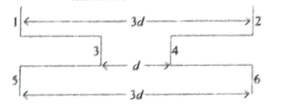
Six identical square metallic plates are arranged as shown in the figure. The length of each plate is $l$. The equivalent capacitance of this arrangement would be . . . . . . .
A
$\frac{3 \varepsilon_0 l^2}{2 d}$
B
$\frac{5 \varepsilon_0 l^2}{3 d}$
C
$\frac{3 \varepsilon_0 l^2}{d}$
D
$\frac{4 \varepsilon_0 l^2}{d}$
Solution
(B) The arrangement consists of three parallel plate capacitors connected in parallel.
Let the area of each plate be $A = l^2$.
The capacitance of a parallel plate capacitor is given by $C = \frac{\varepsilon_0 A}{d}$.
From the figure,we identify three capacitors:
$C_1$ formed by plates $1$ and $2$ with separation $3d$: $C_1 = \frac{\varepsilon_0 l^2}{3d}$.
$C_2$ formed by plates $3$ and $4$ with separation $d$: $C_2 = \frac{\varepsilon_0 l^2}{d}$.
$C_3$ formed by plates $5$ and $6$ with separation $3d$: $C_3 = \frac{\varepsilon_0 l^2}{3d}$.
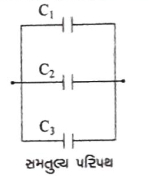
Since these capacitors are connected in parallel,the equivalent capacitance $C_{eq}$ is:
$C_{eq} = C_1 + C_2 + C_3$
$C_{eq} = \frac{\varepsilon_0 l^2}{3d} + \frac{\varepsilon_0 l^2}{d} + \frac{\varepsilon_0 l^2}{3d}$
$C_{eq} = \frac{\varepsilon_0 l^2}{d} (\frac{1}{3} + 1 + \frac{1}{3}) = \frac{\varepsilon_0 l^2}{d} (\frac{1+3+1}{3}) = \frac{5 \varepsilon_0 l^2}{3d}$.
Thus,the correct option is $(B)$.
Let the area of each plate be $A = l^2$.
The capacitance of a parallel plate capacitor is given by $C = \frac{\varepsilon_0 A}{d}$.
From the figure,we identify three capacitors:
$C_1$ formed by plates $1$ and $2$ with separation $3d$: $C_1 = \frac{\varepsilon_0 l^2}{3d}$.
$C_2$ formed by plates $3$ and $4$ with separation $d$: $C_2 = \frac{\varepsilon_0 l^2}{d}$.
$C_3$ formed by plates $5$ and $6$ with separation $3d$: $C_3 = \frac{\varepsilon_0 l^2}{3d}$.
Since these capacitors are connected in parallel,the equivalent capacitance $C_{eq}$ is:
$C_{eq} = C_1 + C_2 + C_3$
$C_{eq} = \frac{\varepsilon_0 l^2}{3d} + \frac{\varepsilon_0 l^2}{d} + \frac{\varepsilon_0 l^2}{3d}$
$C_{eq} = \frac{\varepsilon_0 l^2}{d} (\frac{1}{3} + 1 + \frac{1}{3}) = \frac{\varepsilon_0 l^2}{d} (\frac{1+3+1}{3}) = \frac{5 \varepsilon_0 l^2}{3d}$.
Thus,the correct option is $(B)$.
0 likesView Solution
16
PhysicsEasyMCQGUJCET · 2018
On the axis and on the equator of an electric dipole for all points . . . . . . .
A
on both of them $V \neq 0$
B
on both of them $V = 0$
C
on the axis $V = 0$ and on equator $V \neq 0$
D
on the axis $V \neq 0$ and on equator $V = 0$
Solution
(D) The electric potential $V$ due to an electric dipole at a point $(r, \theta)$ is given by the formula:
$V(r, \theta) = \frac{1}{4 \pi \varepsilon_0} \frac{p \cos \theta}{r^2}$
$1$. On the axis of the dipole,the angle $\theta$ is either $0$ or $\pi$ radians. Substituting this into the formula:
$V = \frac{1}{4 \pi \varepsilon_0} \frac{p \cos(0)}{r^2} = \frac{p}{4 \pi \varepsilon_0 r^2}$ or $V = \frac{1}{4 \pi \varepsilon_0} \frac{p \cos(\pi)}{r^2} = -\frac{p}{4 \pi \varepsilon_0 r^2}$
Thus,on the axis,$V \neq 0$.
$2$. On the equatorial plane of the dipole,the angle $\theta = \frac{\pi}{2}$ radians. Substituting this into the formula:
$V = \frac{1}{4 \pi \varepsilon_0} \frac{p \cos(\pi/2)}{r^2} = 0$ (since $\cos(\pi/2) = 0$)
Thus,on the equator,$V = 0$.
Therefore,the correct option is $D$.
$V(r, \theta) = \frac{1}{4 \pi \varepsilon_0} \frac{p \cos \theta}{r^2}$
$1$. On the axis of the dipole,the angle $\theta$ is either $0$ or $\pi$ radians. Substituting this into the formula:
$V = \frac{1}{4 \pi \varepsilon_0} \frac{p \cos(0)}{r^2} = \frac{p}{4 \pi \varepsilon_0 r^2}$ or $V = \frac{1}{4 \pi \varepsilon_0} \frac{p \cos(\pi)}{r^2} = -\frac{p}{4 \pi \varepsilon_0 r^2}$
Thus,on the axis,$V \neq 0$.
$2$. On the equatorial plane of the dipole,the angle $\theta = \frac{\pi}{2}$ radians. Substituting this into the formula:
$V = \frac{1}{4 \pi \varepsilon_0} \frac{p \cos(\pi/2)}{r^2} = 0$ (since $\cos(\pi/2) = 0$)
Thus,on the equator,$V = 0$.
Therefore,the correct option is $D$.
0 likesView Solution
17
PhysicsEasyMCQGUJCET · 2018
The unit of polarizability of the molecule is . . . . . . .
A
$C^2 m N^{-1}$
B
$C^{-2} m^{-1} N^1$
C
$C^2 m^{-1} N^{-1}$
D
$C^{-2} m N^{-1}$
Solution
(A) The induced dipole moment $\vec{p}$ is proportional to the applied electric field $\vec{E_0}$,given by the relation $\vec{p} = \alpha \vec{E_0}$,where $\alpha$ is the polarizability of the molecule.
From this,we can express polarizability as $\alpha = \frac{\vec{p}}{\vec{E_0}}$.
The unit of dipole moment $\vec{p}$ is Coulomb-meter $(C \cdot m)$.
The unit of electric field $\vec{E_0}$ is Newton per Coulomb ($N/C$ or $N \cdot C^{-1}$).
Therefore,the unit of $\alpha = \frac{C \cdot m}{N \cdot C^{-1}} = \frac{C^2 \cdot m}{N} = C^2 \cdot m \cdot N^{-1}$.
From this,we can express polarizability as $\alpha = \frac{\vec{p}}{\vec{E_0}}$.
The unit of dipole moment $\vec{p}$ is Coulomb-meter $(C \cdot m)$.
The unit of electric field $\vec{E_0}$ is Newton per Coulomb ($N/C$ or $N \cdot C^{-1}$).
Therefore,the unit of $\alpha = \frac{C \cdot m}{N \cdot C^{-1}} = \frac{C^2 \cdot m}{N} = C^2 \cdot m \cdot N^{-1}$.
0 likesView Solution
18
PhysicsEasyMCQGUJCET · 2018
The relation between $Z_E, H_E$,and $B_E$ is . . . . . . .
A
$B_E = \sqrt{Z_E^2 + H_E^2}$
B
$B_E = Z_E \cdot H_E$
C
$B_E = \frac{Z_E}{H_E}$
D
$B_E = \frac{H_E}{Z_E}$
Solution
(A) In the context of the Earth's magnetic field,$B_E$ represents the total magnetic field intensity,$H_E$ represents the horizontal component,and $Z_E$ represents the vertical component.
According to the vector resolution of the Earth's magnetic field,the total magnetic field $B_E$ is the vector sum of its horizontal and vertical components.
Since these components are perpendicular to each other,the magnitude is given by the Pythagorean theorem: $B_E = \sqrt{Z_E^2 + H_E^2}$.
According to the vector resolution of the Earth's magnetic field,the total magnetic field $B_E$ is the vector sum of its horizontal and vertical components.
Since these components are perpendicular to each other,the magnitude is given by the Pythagorean theorem: $B_E = \sqrt{Z_E^2 + H_E^2}$.
0 likesView Solution
19
PhysicsEasyMCQGUJCET · 2018
$A$ substance is placed in a non-uniform magnetic field. It experiences a weak force towards the strong field. The substance is . . . . . . type.
A
Ferromagnetic
B
Diamagnetic
C
Paramagnetic
D
None of the above.
Solution
(C) substance that experiences a weak force towards the region of a stronger magnetic field when placed in a non-uniform magnetic field is classified as a $Paramagnetic$ substance.
$1$. $Diamagnetic$ substances are weakly repelled by a magnetic field and move towards the weaker field region.
$2$. $Paramagnetic$ substances are weakly attracted by a magnetic field and move towards the stronger field region.
$3$. $Ferromagnetic$ substances are strongly attracted by a magnetic field.
Therefore,the correct option is $C$.
$1$. $Diamagnetic$ substances are weakly repelled by a magnetic field and move towards the weaker field region.
$2$. $Paramagnetic$ substances are weakly attracted by a magnetic field and move towards the stronger field region.
$3$. $Ferromagnetic$ substances are strongly attracted by a magnetic field.
Therefore,the correct option is $C$.
0 likesView Solution
20
PhysicsEasyMCQGUJCET · 2018
$A$ very long straight wire of radius $r$ carries current $I$. The intensity of the magnetic field $B$ at a point,lying at a perpendicular distance $a$ from the axis is proportional to: (where $a < r$)
A
$a^2$
B
$1/a^2$
C
$1/a$
D
$a$
Solution
(D) For a long straight wire of radius $r$ carrying a uniform current $I$,the magnetic field $B$ at a distance $a$ from the axis inside the wire $(a < r)$ is given by Ampere's Law.
Using Ampere's circuital law: $\oint B \cdot dl = \mu_0 I_{enclosed}$.
For a point inside the wire,the enclosed current $I_{enclosed} = I \times (\frac{\pi a^2}{\pi r^2}) = I \frac{a^2}{r^2}$.
Thus,$B(2 \pi a) = \mu_0 I \frac{a^2}{r^2}$.
Solving for $B$,we get $B = \frac{\mu_0 I a}{2 \pi r^2}$.
Since $\mu_0$,$I$,and $r$ are constants,$B \propto a$.
Using Ampere's circuital law: $\oint B \cdot dl = \mu_0 I_{enclosed}$.
For a point inside the wire,the enclosed current $I_{enclosed} = I \times (\frac{\pi a^2}{\pi r^2}) = I \frac{a^2}{r^2}$.
Thus,$B(2 \pi a) = \mu_0 I \frac{a^2}{r^2}$.
Solving for $B$,we get $B = \frac{\mu_0 I a}{2 \pi r^2}$.
Since $\mu_0$,$I$,and $r$ are constants,$B \propto a$.
0 likesView Solution
21
PhysicsEasyMCQGUJCET · 2018
Two parallel very long straight wires carrying current of $5 \text{ A}$ each are kept at a separation of $1 \text{ m}$. If the currents are in the same direction,the force per unit length between them is . . . . . . $\text{N/m}$. $(\mu_0 = 4\pi \times 10^{-7} \text{ SI units})$
A
$5 \times 10^{-5}$,attractive
B
$5 \times 10^{-6}$,attractive
C
$5 \times 10^{-5}$,repulsive
D
$5 \times 10^{-6}$,repulsive
Solution
(B) The force per unit length between two parallel current-carrying wires is given by the formula: $\frac{F}{l} = \frac{\mu_0 I_1 I_2}{2 \pi d}$.
Given: $I_1 = I_2 = 5 \text{ A}$,$d = 1 \text{ m}$,and $\mu_0 = 4\pi \times 10^{-7} \text{ T m/A}$.
Substituting the values: $\frac{F}{l} = \frac{4\pi \times 10^{-7} \times 5 \times 5}{2 \pi \times 1}$.
Simplifying the expression: $\frac{F}{l} = 2 \times 10^{-7} \times 25 = 50 \times 10^{-7} \text{ N/m}$.
Thus,$\frac{F}{l} = 5 \times 10^{-6} \text{ N/m}$.
Since the currents are in the same direction,the force between the wires is attractive.
Given: $I_1 = I_2 = 5 \text{ A}$,$d = 1 \text{ m}$,and $\mu_0 = 4\pi \times 10^{-7} \text{ T m/A}$.
Substituting the values: $\frac{F}{l} = \frac{4\pi \times 10^{-7} \times 5 \times 5}{2 \pi \times 1}$.
Simplifying the expression: $\frac{F}{l} = 2 \times 10^{-7} \times 25 = 50 \times 10^{-7} \text{ N/m}$.
Thus,$\frac{F}{l} = 5 \times 10^{-6} \text{ N/m}$.
Since the currents are in the same direction,the force between the wires is attractive.
0 likesView Solution
22
PhysicsEasyMCQGUJCET · 2018
$A$ galvanometer of resistance $50 \ \Omega$ giving full scale deflection for a current of $10 \ mA$ is to be changed into a voltmeter of range $100 \ V$. $A$ resistance of . . . . . . $\Omega$ has to be connected in series with the galvanometer.
A
$9950$
B
$10025$
C
$10000$
D
$9975$
Solution
(A) To convert a galvanometer into a voltmeter,a high resistance $R_s$ must be connected in series with the galvanometer.
The formula for the series resistance is given by $R_s = \frac{V}{I_G} - G$,where $V$ is the required voltage range,$I_G$ is the full-scale deflection current,and $G$ is the resistance of the galvanometer.
Given values: $V = 100 \ V$,$I_G = 10 \ mA = 10 \times 10^{-3} \ A$,and $G = 50 \ \Omega$.
Substituting these values into the formula:
$R_s = \frac{100}{10 \times 10^{-3}} - 50$
$R_s = 10000 - 50$
$R_s = 9950 \ \Omega$.
The formula for the series resistance is given by $R_s = \frac{V}{I_G} - G$,where $V$ is the required voltage range,$I_G$ is the full-scale deflection current,and $G$ is the resistance of the galvanometer.
Given values: $V = 100 \ V$,$I_G = 10 \ mA = 10 \times 10^{-3} \ A$,and $G = 50 \ \Omega$.
Substituting these values into the formula:
$R_s = \frac{100}{10 \times 10^{-3}} - 50$
$R_s = 10000 - 50$
$R_s = 9950 \ \Omega$.
0 likesView Solution
23
PhysicsEasyMCQGUJCET · 2018
An electron having mass $9.1 \times 10^{-31} \ kg$,charge $1.6 \times 10^{-19} \ C$ and moving with velocity of $10^6 \ ms^{-1}$ enters a region where a magnetic field exists. If it describes a circle of radius $0.2 \ m$,then the intensity of the magnetic field must be . . . . . . $\times 10^{-5} \ T$.
A
$14.4$
B
$5.65$
C
$2.84$
D
$1.32$
Solution
(C) The radius $r$ of the circular path of a charged particle in a magnetic field is given by the formula: $r = \frac{mv}{Bq}$.
Rearranging the formula to solve for the magnetic field intensity $B$,we get: $B = \frac{mv}{qr}$.
Given values are:
Mass $m = 9.1 \times 10^{-31} \ kg$
Velocity $v = 10^6 \ ms^{-1}$
Charge $q = 1.6 \times 10^{-19} \ C$
Radius $r = 0.2 \ m$
Substituting these values into the equation:
$B = \frac{9.1 \times 10^{-31} \times 10^6}{1.6 \times 10^{-19} \times 0.2}$
$B = \frac{9.1 \times 10^{-25}}{0.32 \times 10^{-19}}$
$B = 28.4375 \times 10^{-6} \ T = 2.84 \times 10^{-5} \ T$.
Thus,the intensity of the magnetic field is $2.84 \times 10^{-5} \ T$.
Rearranging the formula to solve for the magnetic field intensity $B$,we get: $B = \frac{mv}{qr}$.
Given values are:
Mass $m = 9.1 \times 10^{-31} \ kg$
Velocity $v = 10^6 \ ms^{-1}$
Charge $q = 1.6 \times 10^{-19} \ C$
Radius $r = 0.2 \ m$
Substituting these values into the equation:
$B = \frac{9.1 \times 10^{-31} \times 10^6}{1.6 \times 10^{-19} \times 0.2}$
$B = \frac{9.1 \times 10^{-25}}{0.32 \times 10^{-19}}$
$B = 28.4375 \times 10^{-6} \ T = 2.84 \times 10^{-5} \ T$.
Thus,the intensity of the magnetic field is $2.84 \times 10^{-5} \ T$.
0 likesView Solution
24
PhysicsEasyMCQGUJCET · 2018
The energy of the fast neutrons emitted in a nuclear fission reactor is approximately $\qquad$ .
A
$2 \text{ MeV}$
B
$2 \text{ keV}$
C
$10 \text{ MeV}$
D
$20 \text{ MeV}$
Solution
(A) In a nuclear fission reaction,such as the fission of $U^{235}$ by thermal neutrons,the neutrons released are known as fast neutrons.
These neutrons possess high kinetic energy,which is typically around $2 \text{ MeV}$.
These fast neutrons must be slowed down to thermal energies (approximately $0.025 \text{ eV}$) by a moderator to sustain the chain reaction.
Therefore,the correct option is $A$.
These neutrons possess high kinetic energy,which is typically around $2 \text{ MeV}$.
These fast neutrons must be slowed down to thermal energies (approximately $0.025 \text{ eV}$) by a moderator to sustain the chain reaction.
Therefore,the correct option is $A$.
0 likesView Solution
25
PhysicsEasyMCQGUJCET · 2018
$A$ plano-convex lens is made of material having refractive index $1.5$. The radius of curvature of the curved surface is $60 \ cm$. The focal length of the lens is . . . . . . $cm$.
A
-$60$
B
$120$
C
$60$
D
-$120$
Solution
(B) Using the lens maker's formula:
$\frac{1}{f} = (n-1) \left( \frac{1}{R_1} - \frac{1}{R_2} \right)$
For a plano-convex lens,one surface is plane $(R_1 = \infty)$ and the other is convex ($R_2 = -60 \ cm$ according to sign convention).
Given $n = 1.5$.
Substituting the values:
$\frac{1}{f} = (1.5 - 1) \left( \frac{1}{\infty} - \frac{1}{-60} \right)$
$\frac{1}{f} = 0.5 \times \left( 0 + \frac{1}{60} \right)$
$\frac{1}{f} = \frac{0.5}{60} = \frac{1}{120}$
Therefore,$f = 120 \ cm$.
$\frac{1}{f} = (n-1) \left( \frac{1}{R_1} - \frac{1}{R_2} \right)$
For a plano-convex lens,one surface is plane $(R_1 = \infty)$ and the other is convex ($R_2 = -60 \ cm$ according to sign convention).
Given $n = 1.5$.
Substituting the values:
$\frac{1}{f} = (1.5 - 1) \left( \frac{1}{\infty} - \frac{1}{-60} \right)$
$\frac{1}{f} = 0.5 \times \left( 0 + \frac{1}{60} \right)$
$\frac{1}{f} = \frac{0.5}{60} = \frac{1}{120}$
Therefore,$f = 120 \ cm$.
0 likesView Solution
26
PhysicsEasyMCQGUJCET · 2018
$A$ small angled prism of refractive index $1.6$ gives a deviation of $3.6^{\circ}$. The angle of prism is . . . . . . . (in $^{\circ}$)
A
$7$
B
$6$
C
$5$
D
$8$
Solution
(B) For a small angled prism,the angle of deviation $\delta$ is given by the formula: $\delta = A(n - 1)$,where $A$ is the angle of the prism and $n$ is the refractive index of the material of the prism.
Given:
Refractive index $n = 1.6$
Angle of deviation $\delta = 3.6^{\circ}$
Substituting the values in the formula:
$3.6^{\circ} = A(1.6 - 1)$
$3.6^{\circ} = A(0.6)$
$A = \frac{3.6^{\circ}}{0.6}$
$A = 6^{\circ}$
Therefore,the angle of the prism is $6^{\circ}$.
Given:
Refractive index $n = 1.6$
Angle of deviation $\delta = 3.6^{\circ}$
Substituting the values in the formula:
$3.6^{\circ} = A(1.6 - 1)$
$3.6^{\circ} = A(0.6)$
$A = \frac{3.6^{\circ}}{0.6}$
$A = 6^{\circ}$
Therefore,the angle of the prism is $6^{\circ}$.
0 likesView Solution
27
PhysicsEasyMCQGUJCET · 2018
Two thin lenses of focal length $f_{1}$ and $f_{2}$ are in contact and coaxial. The power of the combination is . . . . . . .
A
$\frac{1}{\sqrt{f_{1} f_{2}}}$
B
$\frac{f_{1}+f_{2}}{2}$
C
$\frac{f_{1} f_{2}}{f_{1}+f_{2}}$
D
$\frac{f_{1}+f_{2}}{f_{1} f_{2}}$
Solution
(D) When two thin lenses of focal lengths $f_{1}$ and $f_{2}$ are placed in contact,the equivalent focal length $f$ of the combination is given by the formula: $\frac{1}{f} = \frac{1}{f_{1}} + \frac{1}{f_{2}}$.
Since the power of a lens is defined as $P = \frac{1}{f}$ (where $f$ is in meters),the power of the combination $P$ is the sum of the individual powers: $P = P_{1} + P_{2}$.
Substituting the expressions for power,we get: $P = \frac{1}{f_{1}} + \frac{1}{f_{2}}$.
Taking the common denominator,we obtain: $P = \frac{f_{1} + f_{2}}{f_{1} f_{2}}$.
Thus,the correct option is $D$.
Since the power of a lens is defined as $P = \frac{1}{f}$ (where $f$ is in meters),the power of the combination $P$ is the sum of the individual powers: $P = P_{1} + P_{2}$.
Substituting the expressions for power,we get: $P = \frac{1}{f_{1}} + \frac{1}{f_{2}}$.
Taking the common denominator,we obtain: $P = \frac{f_{1} + f_{2}}{f_{1} f_{2}}$.
Thus,the correct option is $D$.
0 likesView Solution
28
PhysicsEasyMCQGUJCET · 2018
Which of the following statements is incorrect regarding interference fringes?
A
Fringes are due to a limited portion of the wavefront.
B
All bright fringes are equally bright.
C
The distance between two consecutive fringes is constant.
D
Fringes are due to the use of coherent sources.
Solution
(B) In an ideal Young's Double Slit Experiment $(YDSE)$,the intensity of all bright fringes is considered equal. However,in real-world interference patterns,the intensity of bright fringes decreases as we move away from the central maximum due to the diffraction effect caused by the finite width of the slits. Therefore,the statement that 'all bright fringes are equally bright' is technically incorrect in a practical physical context compared to the other fundamental properties of interference.
0 likesView Solution
Vedclass Products
For Students
Vedclass Test Series
Mock tests in real GUJCET style covering Physics with performance analysis. 5-day free trial.
Start Free TrialFor Teachers
Exam Paper Generator
Generate Set A/B/C/D Physics papers from 7.5L+ questions in 2 minutes. 3 chapters free.
Try FreeFor Institutes
Online Exam Module
Run live GUJCET mock exams with unlimited students, 360° analytics & white-label branding.
See DemoFrequently Asked Questions
How many Physics questions are in GUJCET 2018?
There are 28 Physics questions from the GUJCET 2018 paper on Vedclass, each with a detailed step-by-step solution in English.
Are GUJCET 2018 Physics solutions available in English?
Yes. All solutions on this page are in English. You can also switch to English or Hindi using the language buttons above the questions.
Can I practice GUJCET 2018 Physics as a timed test?
Yes. Use the Vedclass Test Series to attempt a full GUJCET mock test covering Physics with time limits and instant score analysis.
Can teachers create Physics papers from GUJCET previous year questions?
Yes. The Vedclass Exam Paper Generator lets teachers mix GUJCET Physics questions and generate Set A/B/C/D papers in minutes.
For Teachers & Institutes
Build a Custom Physics Paper
Pick GUJCET 2018 Physics questions, set difficulty, and generate Set A/B/C/D in 2 minutes.