
PhysicsQ1–40 of 40 questions
Page 1 of 1 · English
1
PhysicsMediumMCQGUJCET · 2025
What is the approximate percentage value of the ratio of maximum voltage to its rms value in an $LCR$ $AC$ circuit (in $\%$)?
A
$22.8$
B
$70.7$
C
$50$
D
$141.4$
Solution
(D) The relationship between maximum (peak) voltage $V_0$ and root mean square (rms) voltage $V_{rms}$ for a sinusoidal $AC$ circuit is given by $V_{rms} = \frac{V_0}{\sqrt{2}}$.
Rearranging this formula,we get the ratio of maximum voltage to $rms$ voltage as $\frac{V_0}{V_{rms}} = \sqrt{2}$.
Given that $\sqrt{2} \approx 1.414$,we convert this ratio into a percentage by multiplying by $100\%$.
Therefore,the percentage value is $1.414 \times 100\% = 141.4\%$.
Rearranging this formula,we get the ratio of maximum voltage to $rms$ voltage as $\frac{V_0}{V_{rms}} = \sqrt{2}$.
Given that $\sqrt{2} \approx 1.414$,we convert this ratio into a percentage by multiplying by $100\%$.
Therefore,the percentage value is $1.414 \times 100\% = 141.4\%$.
0 likesView Solution
2
PhysicsMediumMCQGUJCET · 2025
In which of the following $AC$ circuit,we get the value of power factor $1$ at resonance condition?
A
$LCR$ series circuit
B
$CR$ series circuit
C
Only inductor $(L)$ circuit
D
$LR$ series circuit
Solution
(A) In an $LCR$ series circuit,resonance occurs when the inductive reactance $X_L$ equals the capacitive reactance $X_C$ $(X_L = X_C)$.
At this condition,the total impedance $Z$ is equal to the resistance $R$,meaning the circuit behaves purely resistively.
The power factor is given by $\cos \phi = \frac{R}{Z}$.
At resonance,$Z = R$,so $\cos \phi = \frac{R}{R} = 1$.
At this condition,the total impedance $Z$ is equal to the resistance $R$,meaning the circuit behaves purely resistively.
The power factor is given by $\cos \phi = \frac{R}{Z}$.
At resonance,$Z = R$,so $\cos \phi = \frac{R}{R} = 1$.
0 likesView Solution
3
PhysicsDifficultMCQGUJCET · 2025
The output voltage of a step-down transformer is measured to be $24 \text{ V}$,when connected to a $12 \text{ W}$ light bulb. The value of the peak current is . . . . . . .
A
$2\sqrt{2} \text{ A}$
B
$\sqrt{2} \text{ A}$
C
$2 \text{ A}$
D
$\frac{1}{\sqrt{2}} \text{ A}$
Solution
(D) The power $P$ is given by the formula $P = V_{rms} \times I_{rms}$.
Given $P = 12 \text{ W}$ and $V_{rms} = 24 \text{ V}$,we can calculate the root mean square current $I_{rms}$ as:
$I_{rms} = \frac{P}{V_{rms}} = \frac{12}{24} = 0.5 \text{ A}$.
The peak current $I_0$ is related to the $I_{rms}$ by the formula $I_0 = I_{rms} \times \sqrt{2}$.
Substituting the value of $I_{rms}$,we get:
$I_0 = 0.5 \times \sqrt{2} = \frac{1}{2} \times \sqrt{2} = \frac{1}{\sqrt{2}} \text{ A}$.
Given $P = 12 \text{ W}$ and $V_{rms} = 24 \text{ V}$,we can calculate the root mean square current $I_{rms}$ as:
$I_{rms} = \frac{P}{V_{rms}} = \frac{12}{24} = 0.5 \text{ A}$.
The peak current $I_0$ is related to the $I_{rms}$ by the formula $I_0 = I_{rms} \times \sqrt{2}$.
Substituting the value of $I_{rms}$,we get:
$I_0 = 0.5 \times \sqrt{2} = \frac{1}{2} \times \sqrt{2} = \frac{1}{\sqrt{2}} \text{ A}$.
0 likesView Solution
4
PhysicsEasyMCQGUJCET · 2025
. . . . . . are used in medicine to destroy cancer cells.
A
Microwaves
B
Gamma rays
C
Ultraviolet rays
D
Visible rays
Solution
(B) Gamma rays possess high energy and high penetrating power. They are widely used in medical treatments such as radiotherapy to destroy or inhibit the growth of cancer cells by damaging their $DNA$.
0 likesView Solution
5
PhysicsMediumMCQGUJCET · 2025
The speed of light in a medium is $200 \times 10^8 \text{ cm/s}$. The refractive index of the medium is . . . . . . $(c = 3 \times 10^8 \text{ m/s})$.
A
$2.42$
B
$1$
C
$1.5$
D
$1.33$
Solution
(C) The speed of light in a vacuum is $c = 3 \times 10^8 \text{ m/s}$.
The speed of light in the medium is $v = 200 \times 10^8 \text{ cm/s}$.
First,convert the speed in the medium to $\text{m/s}$:
$v = 200 \times 10^8 \times 10^{-2} \text{ m/s} = 2 \times 10^8 \text{ m/s}$.
The refractive index $n$ is given by the formula $n = \frac{c}{v}$.
Substituting the values: $n = \frac{3 \times 10^8 \text{ m/s}}{2 \times 10^8 \text{ m/s}} = 1.5$.
The speed of light in the medium is $v = 200 \times 10^8 \text{ cm/s}$.
First,convert the speed in the medium to $\text{m/s}$:
$v = 200 \times 10^8 \times 10^{-2} \text{ m/s} = 2 \times 10^8 \text{ m/s}$.
The refractive index $n$ is given by the formula $n = \frac{c}{v}$.
Substituting the values: $n = \frac{3 \times 10^8 \text{ m/s}}{2 \times 10^8 \text{ m/s}} = 1.5$.
0 likesView Solution
6
PhysicsMediumMCQGUJCET · 2025
What is the power of the combination of a convex lens and a concave lens of equal focal length $25 \text{ cm}$?
A
Zero
B
$25 \text{ D}$
C
Infinite
D
$8 \text{ D}$
Solution
(A) The power of a lens is given by the formula $P = \frac{1}{f(m)}$,where $f$ is the focal length in meters.
For a convex lens,the focal length is positive,so $f_1 = +0.25 \text{ m}$. Thus,$P_1 = \frac{1}{0.25} = +4 \text{ D}$.
For a concave lens,the focal length is negative,so $f_2 = -0.25 \text{ m}$. Thus,$P_2 = \frac{1}{-0.25} = -4 \text{ D}$.
The power of the combination of lenses in contact is the algebraic sum of their individual powers: $P = P_1 + P_2$.
Substituting the values,$P = 4 \text{ D} + (-4 \text{ D}) = 0 \text{ D}$.
For a convex lens,the focal length is positive,so $f_1 = +0.25 \text{ m}$. Thus,$P_1 = \frac{1}{0.25} = +4 \text{ D}$.
For a concave lens,the focal length is negative,so $f_2 = -0.25 \text{ m}$. Thus,$P_2 = \frac{1}{-0.25} = -4 \text{ D}$.
The power of the combination of lenses in contact is the algebraic sum of their individual powers: $P = P_1 + P_2$.
Substituting the values,$P = 4 \text{ D} + (-4 \text{ D}) = 0 \text{ D}$.
0 likesView Solution
7
PhysicsMediumMCQGUJCET · 2025
At what angle of incidence should a ray of light be incident on a face of an equilateral prism if the angle of minimum deviation is $46^{\circ}$ (in $^{\circ}$)?
A
$35$
B
$38$
C
$40$
D
$53$
Solution
(D) For the condition of minimum deviation in an equilateral prism,the angle of incidence $i$ is equal to the angle of emergence $e$.
The relationship is given by $i = e = \frac{A + \delta_m}{2}$.
For an equilateral prism,the angle of the prism $A = 60^{\circ}$.
Given the angle of minimum deviation $\delta_m = 46^{\circ}$.
Substituting these values into the formula:
$i = \frac{60^{\circ} + 46^{\circ}}{2} = \frac{106^{\circ}}{2} = 53^{\circ}$.
Therefore,the angle of incidence is $53^{\circ}$.
The relationship is given by $i = e = \frac{A + \delta_m}{2}$.
For an equilateral prism,the angle of the prism $A = 60^{\circ}$.
Given the angle of minimum deviation $\delta_m = 46^{\circ}$.
Substituting these values into the formula:
$i = \frac{60^{\circ} + 46^{\circ}}{2} = \frac{106^{\circ}}{2} = 53^{\circ}$.
Therefore,the angle of incidence is $53^{\circ}$.
0 likesView Solution
8
PhysicsMediumMCQGUJCET · 2025
If the tube-length $(L)$ of a compound microscope increases,then its magnification . . . . . . .
A
First increases and then decreases
B
Increases
C
Remains constant
D
Decreases
Solution
(B) The magnification $(M)$ of a compound microscope is given by the formula $M \approx \frac{L}{f_o} \times \frac{D}{f_e}$,where $L$ is the length of the tube,$f_o$ is the focal length of the objective lens,$f_e$ is the focal length of the eyepiece,and $D$ is the least distance of distinct vision.
Since $M$ is directly proportional to the tube length $L$ $(M \propto L)$,increasing the tube length $L$ results in an increase in the magnification of the compound microscope.
Since $M$ is directly proportional to the tube length $L$ $(M \propto L)$,increasing the tube length $L$ results in an increase in the magnification of the compound microscope.
0 likesView Solution
9
PhysicsMediumMCQGUJCET · 2025
Two waves of same intensity $I_0$ emitted from two sources having same phase difference $(\phi)$. Due to superposition of two waves,the intensity of resultant wave is directly proportional to . . . . . . .
A
$\sin^2(\frac{\phi}{2})$
B
$\sin^2 \phi$
C
$\cos^2(\frac{\phi}{2})$
D
$\cos^2 \phi$
Solution
(C) The resultant intensity $I_R$ for two waves of intensity $I_0$ with a phase difference $\phi$ is given by the formula:
$I_R = I_1 + I_2 + 2\sqrt{I_1 I_2} \cos \phi$
Since $I_1 = I_2 = I_0$,we substitute these values:
$I_R = I_0 + I_0 + 2\sqrt{I_0 \cdot I_0} \cos \phi$
$I_R = 2I_0 + 2I_0 \cos \phi = 2I_0(1 + \cos \phi)$
Using the trigonometric identity $1 + \cos \phi = 2 \cos^2(\frac{\phi}{2})$:
$I_R = 2I_0 \cdot 2 \cos^2(\frac{\phi}{2}) = 4I_0 \cos^2(\frac{\phi}{2})$
Therefore,the resultant intensity $I_R$ is directly proportional to $\cos^2(\frac{\phi}{2})$.
$I_R = I_1 + I_2 + 2\sqrt{I_1 I_2} \cos \phi$
Since $I_1 = I_2 = I_0$,we substitute these values:
$I_R = I_0 + I_0 + 2\sqrt{I_0 \cdot I_0} \cos \phi$
$I_R = 2I_0 + 2I_0 \cos \phi = 2I_0(1 + \cos \phi)$
Using the trigonometric identity $1 + \cos \phi = 2 \cos^2(\frac{\phi}{2})$:
$I_R = 2I_0 \cdot 2 \cos^2(\frac{\phi}{2}) = 4I_0 \cos^2(\frac{\phi}{2})$
Therefore,the resultant intensity $I_R$ is directly proportional to $\cos^2(\frac{\phi}{2})$.
0 likesView Solution
10
PhysicsMediumMCQGUJCET · 2025
For light diverging from a point source,
A
the intensity at the wavefront does not depend on the distance
B
the intensity increases in proportion to the distance squared
C
the wavefront is parabolic
D
the wavefront is spherical
Solution
(D) When light diverges from a point source in a homogeneous isotropic medium,the energy spreads out uniformly in all directions. The locus of points having the same phase forms a sphere centered at the source. Hence,the wavefront is spherical.
0 likesView Solution
11
PhysicsDifficultMCQGUJCET · 2025
In Young's double slit experiment,the slits are separated by $0.54$ mm and the screen is placed $1.8$ m away. The distance between the central bright fringe and the sixth bright fringe is measured to be $1.2$ cm. Determine the wavelength of light used in the experiment.
A
$5000$ $\mathring{A}$
B
$600$ nm
C
$8000$ nm
D
$800$ nm
Solution
(B) Given: Slit separation $d = 0.54$ mm $= 0.54 \times 10^{-3}$ m.
Distance of screen $D = 1.8$ m.
Distance of the $n^{th}$ bright fringe from the central fringe is given by $y_n = \frac{n\lambda D}{d}$.
For the $6^{th}$ bright fringe,$n = 6$ and $y_6 = 1.2$ cm $= 1.2 \times 10^{-2}$ m.
Rearranging the formula for wavelength $\lambda$: $\lambda = \frac{y_n d}{n D}$.
Substituting the values: $\lambda = \frac{1.2 \times 10^{-2} \times 0.54 \times 10^{-3}}{6 \times 1.8}$.
$\lambda = \frac{0.648 \times 10^{-5}}{10.8} = 0.06 \times 10^{-5}$ m.
$\lambda = 600 \times 10^{-9}$ m $= 600$ nm.
Distance of screen $D = 1.8$ m.
Distance of the $n^{th}$ bright fringe from the central fringe is given by $y_n = \frac{n\lambda D}{d}$.
For the $6^{th}$ bright fringe,$n = 6$ and $y_6 = 1.2$ cm $= 1.2 \times 10^{-2}$ m.
Rearranging the formula for wavelength $\lambda$: $\lambda = \frac{y_n d}{n D}$.
Substituting the values: $\lambda = \frac{1.2 \times 10^{-2} \times 0.54 \times 10^{-3}}{6 \times 1.8}$.
$\lambda = \frac{0.648 \times 10^{-5}}{10.8} = 0.06 \times 10^{-5}$ m.
$\lambda = 600 \times 10^{-9}$ m $= 600$ nm.
0 likesView Solution
12
PhysicsEasyMCQGUJCET · 2025
The minimum value of electric field required to pull out electrons from a metal is approximately . . . . . . $V$/cm.
A
$10^9$
B
$10^6$
C
$10^{10}$
D
$10^8$
Solution
(B) The electric field required to pull out an electron from a metal surface (a process known as field emission) is typically of the order of $10^6 \text{ V/cm}$.
This value is derived from the electrostatic force required to overcome the work function of the metal,allowing electrons to tunnel through the potential barrier.
This value is derived from the electrostatic force required to overcome the work function of the metal,allowing electrons to tunnel through the potential barrier.
0 likesView Solution
13
PhysicsDifficultMCQGUJCET · 2025
Monochromatic light of frequency $6 \times 10^{14} \text{ Hz}$ is produced by a laser. The power emitted is $4 \times 10^{-3} \text{ W}$. How many photons per second on an average are emitted by the source? $[h = 6.63 \times 10^{-34} \text{ Js}]$
A
$1 \times 10^{16} \text{ photons per second}$
B
$5 \times 10^{16} \text{ photons per second}$
C
$3 \times 10^{15} \text{ photons per second}$
D
$5 \times 10^{15} \text{ photons per second}$
Solution
(A) The power $P$ emitted by a source is given by the product of the number of photons emitted per second $(n)$ and the energy of a single photon $(E = h\nu)$.
Given: Power $P = 4 \times 10^{-3} \text{ W}$,frequency $\nu = 6 \times 10^{14} \text{ Hz}$,and Planck's constant $h = 6.63 \times 10^{-34} \text{ Js}$.
The formula is $P = n \cdot h\nu$.
Rearranging for $n$: $n = \frac{P}{h\nu}$.
Substituting the values: $n = \frac{4 \times 10^{-3}}{6.63 \times 10^{-34} \times 6 \times 10^{14}}$.
$n = \frac{4 \times 10^{-3}}{39.78 \times 10^{-20}} = \frac{4}{39.78} \times 10^{17} \approx 0.10055 \times 10^{17} = 1.0055 \times 10^{16}$.
Rounding to the nearest significant figure,we get $n \approx 1 \times 10^{16} \text{ photons per second}$.
Given: Power $P = 4 \times 10^{-3} \text{ W}$,frequency $\nu = 6 \times 10^{14} \text{ Hz}$,and Planck's constant $h = 6.63 \times 10^{-34} \text{ Js}$.
The formula is $P = n \cdot h\nu$.
Rearranging for $n$: $n = \frac{P}{h\nu}$.
Substituting the values: $n = \frac{4 \times 10^{-3}}{6.63 \times 10^{-34} \times 6 \times 10^{14}}$.
$n = \frac{4 \times 10^{-3}}{39.78 \times 10^{-20}} = \frac{4}{39.78} \times 10^{17} \approx 0.10055 \times 10^{17} = 1.0055 \times 10^{16}$.
Rounding to the nearest significant figure,we get $n \approx 1 \times 10^{16} \text{ photons per second}$.
0 likesView Solution
14
PhysicsDifficultMCQGUJCET · 2025
What is the de-Broglie wavelength of a bullet of mass $0.033$ kg travelling at the speed of $1$ km/s? $(h = 6.6 \times 10^{-34} \text{ Js})$
A
$3 \times 10^{-25} \text{ m}$
B
$2 \times 10^{-35} \text{ m}$
C
$1.1 \times 10^{-32} \text{ m}$
D
$1.7 \times 10^{-35} \text{ m}$
Solution
(B) The de-Broglie wavelength $\lambda$ is given by the formula $\lambda = \frac{h}{mv}$.
Given:
Mass $m = 0.033 \text{ kg}$
Velocity $v = 1 \text{ km/s} = 1000 \text{ m/s} = 10^3 \text{ m/s}$
Planck's constant $h = 6.6 \times 10^{-34} \text{ Js}$
Substituting the values into the formula:
$\lambda = \frac{6.6 \times 10^{-34}}{0.033 \times 1000}$
$\lambda = \frac{6.6 \times 10^{-34}}{33}$
$\lambda = 0.2 \times 10^{-34} \text{ m}$
$\lambda = 2 \times 10^{-35} \text{ m}$.
Given:
Mass $m = 0.033 \text{ kg}$
Velocity $v = 1 \text{ km/s} = 1000 \text{ m/s} = 10^3 \text{ m/s}$
Planck's constant $h = 6.6 \times 10^{-34} \text{ Js}$
Substituting the values into the formula:
$\lambda = \frac{6.6 \times 10^{-34}}{0.033 \times 1000}$
$\lambda = \frac{6.6 \times 10^{-34}}{33}$
$\lambda = 0.2 \times 10^{-34} \text{ m}$
$\lambda = 2 \times 10^{-35} \text{ m}$.
0 likesView Solution
15
PhysicsMediumMCQGUJCET · 2025
According to Bohr's model,the orbital angular momentum of an electron in the third excited state is . . . . . . $[h = 6.63 \times 10^{-34} \text{ Js}]$
A
$4.22 \times 10^{-34} \text{ kg m}^2\text{s}^{-1}$
B
$12.350 \times 10^{-34} \text{ kg m}^2\text{s}^{-1}$
C
$1.625 \times 10^{-26} \text{ erg-s}$
D
$6.63 \times 10^{-34} \text{ kg m}^2\text{s}^{-1}$
Solution
(A) According to Bohr's model,the orbital angular momentum $L$ is given by the formula $L = n \frac{h}{2\pi}$.
The ground state corresponds to $n = 1$.
The first excited state is $n = 2$,the second excited state is $n = 3$,and the third excited state is $n = 4$.
Substituting $n = 4$ into the formula:
$L = 4 \times \frac{h}{2\pi} = 2 \times \frac{h}{\pi}$.
Given $h = 6.63 \times 10^{-34} \text{ Js}$ and $\pi \approx 3.14$:
$L = 2 \times \frac{6.63 \times 10^{-34}}{3.14} \approx 2 \times 2.111 \times 10^{-34} = 4.222 \times 10^{-34} \text{ kg m}^2\text{s}^{-1}$.
The ground state corresponds to $n = 1$.
The first excited state is $n = 2$,the second excited state is $n = 3$,and the third excited state is $n = 4$.
Substituting $n = 4$ into the formula:
$L = 4 \times \frac{h}{2\pi} = 2 \times \frac{h}{\pi}$.
Given $h = 6.63 \times 10^{-34} \text{ Js}$ and $\pi \approx 3.14$:
$L = 2 \times \frac{6.63 \times 10^{-34}}{3.14} \approx 2 \times 2.111 \times 10^{-34} = 4.222 \times 10^{-34} \text{ kg m}^2\text{s}^{-1}$.
0 likesView Solution
16
PhysicsMediumMCQGUJCET · 2025
$13.6 \text{ eV}$ energy is required to separate a hydrogen atom into a proton and an electron. If the orbital radius of an electron in a hydrogen atom is $5.3 \times 10^{-11} \text{ m}$,then the velocity of the electron is . . . . . . .
A
$6.25 \times 10^7 \text{ ms}^{-1}$
B
$1.36 \times 10^5 \text{ ms}^{-1}$
C
$2.4 \times 10^8 \text{ ms}^{-1}$
D
$2.2 \times 10^6 \text{ ms}^{-1}$
Solution
(D) For a hydrogen atom in the ground state $(n=1)$,Bohr's quantization condition for angular momentum is given by $mvr = \frac{nh}{2\pi}$.
Here,$m$ is the mass of the electron $(9.1 \times 10^{-31} \text{ kg})$,$v$ is the velocity,$r$ is the orbital radius $(5.3 \times 10^{-11} \text{ m})$,and $h$ is Planck's constant $(6.63 \times 10^{-34} \text{ Js})$.
Rearranging the formula for velocity $v$,we get $v = \frac{h}{2\pi mr}$.
Substituting the values: $v = \frac{6.63 \times 10^{-34}}{2 \times 3.14159 \times 9.1 \times 10^{-31} \times 5.3 \times 10^{-11}}$.
Calculating this,$v \approx 2.18 \times 10^6 \text{ ms}^{-1}$.
Rounding to two significant figures,we get $v \approx 2.2 \times 10^6 \text{ ms}^{-1}$.
Here,$m$ is the mass of the electron $(9.1 \times 10^{-31} \text{ kg})$,$v$ is the velocity,$r$ is the orbital radius $(5.3 \times 10^{-11} \text{ m})$,and $h$ is Planck's constant $(6.63 \times 10^{-34} \text{ Js})$.
Rearranging the formula for velocity $v$,we get $v = \frac{h}{2\pi mr}$.
Substituting the values: $v = \frac{6.63 \times 10^{-34}}{2 \times 3.14159 \times 9.1 \times 10^{-31} \times 5.3 \times 10^{-11}}$.
Calculating this,$v \approx 2.18 \times 10^6 \text{ ms}^{-1}$.
Rounding to two significant figures,we get $v \approx 2.2 \times 10^6 \text{ ms}^{-1}$.
0 likesView Solution
17
PhysicsMediumMCQGUJCET · 2025
The ground state energy of a hydrogen atom is $-13.6 \text{ eV}$. The potential and kinetic energies of the electron in this state are . . . . . . .
A
$-13.6 \text{ eV}, -27.2 \text{ eV}$
B
$-27.2 \text{ eV}, -13.6 \text{ eV}$
C
$-27.2 \text{ eV}, +13.6 \text{ eV}$
D
$-13.6 \text{ eV}, +27.2 \text{ eV}$
Solution
(C) In the Bohr model,the Total Energy $(TE)$ of an electron in the ground state is $-13.6 \text{ eV}$.
Kinetic Energy $(KE)$ is given by the relation $KE = -TE$. Therefore,$KE = -(-13.6 \text{ eV}) = +13.6 \text{ eV}$.
Potential Energy $(PE)$ is given by the relation $PE = 2 \times TE$. Therefore,$PE = 2 \times (-13.6 \text{ eV}) = -27.2 \text{ eV}$.
Thus,the potential energy is $-27.2 \text{ eV}$ and the kinetic energy is $+13.6 \text{ eV}$.
Kinetic Energy $(KE)$ is given by the relation $KE = -TE$. Therefore,$KE = -(-13.6 \text{ eV}) = +13.6 \text{ eV}$.
Potential Energy $(PE)$ is given by the relation $PE = 2 \times TE$. Therefore,$PE = 2 \times (-13.6 \text{ eV}) = -27.2 \text{ eV}$.
Thus,the potential energy is $-27.2 \text{ eV}$ and the kinetic energy is $+13.6 \text{ eV}$.
0 likesView Solution
18
PhysicsDifficultMCQGUJCET · 2025
Calculate the height of the potential barrier for a head-on collision of two deuterons. (Radius of deuteron is $2$ fm).
A
$7.2 \times 10^{-19}$ $J$
B
$7.2 \times 10^{-14}$ $J$
C
$3.6 \times 10^{-19}$ $J$
D
$5.76 \times 10^{-14}$ $J$
Solution
(D) The potential energy of the barrier at the point of contact is given by $U = k \frac{q_1 q_2}{r}$.
Here,the charge of each deuteron is $q_1 = q_2 = e = 1.6 \times 10^{-19}$ $C$.
The distance between the centers of the two deuterons at the point of contact is $r = R_1 + R_2 = 2 \text{ fm} + 2 \text{ fm} = 4 \text{ fm} = 4 \times 10^{-15}$ m.
Substituting the values into the formula:
$U = \frac{(9 \times 10^9 \text{ N m}^2/\text{C}^2) \times (1.6 \times 10^{-19} \text{ C})^2}{4 \times 10^{-15} \text{ m}}$
$U = \frac{9 \times 10^9 \times 2.56 \times 10^{-38}}{4 \times 10^{-15}}$
$U = \frac{23.04 \times 10^{-29}}{4 \times 10^{-15}}$
$U = 5.76 \times 10^{-14}$ $J$.
Here,the charge of each deuteron is $q_1 = q_2 = e = 1.6 \times 10^{-19}$ $C$.
The distance between the centers of the two deuterons at the point of contact is $r = R_1 + R_2 = 2 \text{ fm} + 2 \text{ fm} = 4 \text{ fm} = 4 \times 10^{-15}$ m.
Substituting the values into the formula:
$U = \frac{(9 \times 10^9 \text{ N m}^2/\text{C}^2) \times (1.6 \times 10^{-19} \text{ C})^2}{4 \times 10^{-15} \text{ m}}$
$U = \frac{9 \times 10^9 \times 2.56 \times 10^{-38}}{4 \times 10^{-15}}$
$U = \frac{23.04 \times 10^{-29}}{4 \times 10^{-15}}$
$U = 5.76 \times 10^{-14}$ $J$.
0 likesView Solution
19
PhysicsMediumMCQGUJCET · 2025
Choose the correct option to complete the net effect of the fusion reaction that occurs in the Sun: $4_1^1H + 2e^- \rightarrow$ . . . . . . $+ 2\nu + 6\gamma +$ . . . . . .
A
$^3_2He, 5.49 \text{ MeV}$
B
$^4_2He, 26.7 \text{ MeV}$
C
$^4_2He, 22.86 \text{ MeV}$
D
$^3_2He, 0.42 \text{ MeV}$
Solution
(B) The proton-proton chain reaction,which is the primary fusion process in the Sun,can be represented by the net equation:
$4_1^1H + 2e^- \rightarrow ^4_2He + 2\nu_e + 26.7 \text{ MeV}$.
In this process,four hydrogen nuclei (protons) fuse to form one helium nucleus $(^4_2He)$,releasing two neutrinos $(
u_e)$ and a total energy of approximately $26.7 \text{ MeV}$.
$4_1^1H + 2e^- \rightarrow ^4_2He + 2\nu_e + 26.7 \text{ MeV}$.
In this process,four hydrogen nuclei (protons) fuse to form one helium nucleus $(^4_2He)$,releasing two neutrinos $(
u_e)$ and a total energy of approximately $26.7 \text{ MeV}$.
0 likesView Solution
20
PhysicsMediumMCQGUJCET · 2025
Which of the following pairs is called isotones?
A
$^{198}_{80}\text{Hg}, ^{197}_{79}\text{Au}$
B
$^3_1\text{H}, ^3_2\text{He}$
C
$^{214}_{82}\text{Pb}, ^{214}_{83}\text{Bi}$
D
$^{12}_6\text{C}, ^{14}_6\text{C}$
Solution
(A) Isotones are atoms of different elements that have the same number of neutrons.
To find the number of neutrons $(N)$,we use the formula $N = A - Z$,where $A$ is the mass number and $Z$ is the atomic number.
For $^{198}_{80}\text{Hg}$: $N = 198 - 80 = 118$.
For $^{197}_{79}\text{Au}$: $N = 197 - 79 = 118$.
Since both atoms have the same number of neutrons $(118)$,they are isotones.
For other options:
- $^3_1\text{H}$ $(N=2)$ and $^3_2\text{He}$ $(N=1)$ are not isotones.
- $^{214}_{82}\text{Pb}$ $(N=132)$ and $^{214}_{83}\text{Bi}$ $(N=131)$ are not isotones.
- $^{12}_6\text{C}$ $(N=6)$ and $^{14}_6\text{C}$ $(N=8)$ are isotopes,not isotones.
To find the number of neutrons $(N)$,we use the formula $N = A - Z$,where $A$ is the mass number and $Z$ is the atomic number.
For $^{198}_{80}\text{Hg}$: $N = 198 - 80 = 118$.
For $^{197}_{79}\text{Au}$: $N = 197 - 79 = 118$.
Since both atoms have the same number of neutrons $(118)$,they are isotones.
For other options:
- $^3_1\text{H}$ $(N=2)$ and $^3_2\text{He}$ $(N=1)$ are not isotones.
- $^{214}_{82}\text{Pb}$ $(N=132)$ and $^{214}_{83}\text{Bi}$ $(N=131)$ are not isotones.
- $^{12}_6\text{C}$ $(N=6)$ and $^{14}_6\text{C}$ $(N=8)$ are isotopes,not isotones.
0 likesView Solution
21
PhysicsMediumMCQGUJCET · 2025
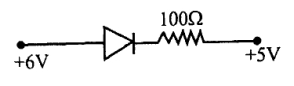
What is the current flowing through the given circuit? $A$ given diode is an ideal diode.
A
$0.1$ $A$
B
$100$ mA
C
$50$ mA
D
$10$ mA
Solution
(D) The diode is ideal and forward-biased because the potential at the anode $(+6 \text{ V})$ is greater than the potential at the cathode $(+5 \text{ V})$.
In forward bias,an ideal diode acts as a short circuit (zero resistance).
Thus,the current $I$ flowing through the circuit is determined by Ohm's law:
$I = \frac{V_{\text{applied}}}{R} = \frac{6 \text{ V} - 5 \text{ V}}{100 \text{ } \Omega} = \frac{1 \text{ V}}{100 \text{ } \Omega} = 0.01 \text{ A} = 10 \text{ mA}$.
Therefore,the correct option is $(D)$.
In forward bias,an ideal diode acts as a short circuit (zero resistance).
Thus,the current $I$ flowing through the circuit is determined by Ohm's law:
$I = \frac{V_{\text{applied}}}{R} = \frac{6 \text{ V} - 5 \text{ V}}{100 \text{ } \Omega} = \frac{1 \text{ V}}{100 \text{ } \Omega} = 0.01 \text{ A} = 10 \text{ mA}$.
Therefore,the correct option is $(D)$.
0 likesView Solution
22
PhysicsMediumMCQGUJCET · 2025
When a reverse bias is applied to a p-n junction,it . . . . . . .
A
increases the majority carrier current and lowers the potential barrier
B
increases the majority carrier current
C
lowers the potential barrier
D
raises the potential barrier
Solution
(D) When a reverse bias is applied to a $p-n$ junction,the negative terminal of the external battery is connected to the $p$-region and the positive terminal to the $n$-region.
This configuration increases the width of the depletion layer.
As the depletion layer widens,the potential barrier at the junction increases,which makes it more difficult for the majority charge carriers to cross the junction.
Therefore,the correct option is $D$.
This configuration increases the width of the depletion layer.
As the depletion layer widens,the potential barrier at the junction increases,which makes it more difficult for the majority charge carriers to cross the junction.
Therefore,the correct option is $D$.
0 likesView Solution
23
PhysicsMediumMCQGUJCET · 2025
$A$ filter circuit used in a rectifier has a load resistance of $200 \Omega$ and a capacitance of $15 \mu\text{F}$. The value of the time constant is . . . . . . .
A
$1.33 \text{ ms}$
B
$3 \text{ ms}$
C
$7.5 \text{ ms}$
D
$0.3 \mu\text{s}$
Solution
(B) The time constant $\tau$ for an $RC$ circuit is defined as the product of resistance $R$ and capacitance $C$: $\tau = R \times C$.
Given values are $R = 200 \Omega$ and $C = 15 \mu\text{F} = 15 \times 10^{-6} \text{ F}$.
Substituting these values into the formula:
$\tau = 200 \Omega \times 15 \times 10^{-6} \text{ F}$
$\tau = 3000 \times 10^{-6} \text{ s}$
$\tau = 3 \times 10^{-3} \text{ s} = 3 \text{ ms}$.
Therefore,the correct option is $(B)$.
Given values are $R = 200 \Omega$ and $C = 15 \mu\text{F} = 15 \times 10^{-6} \text{ F}$.
Substituting these values into the formula:
$\tau = 200 \Omega \times 15 \times 10^{-6} \text{ F}$
$\tau = 3000 \times 10^{-6} \text{ s}$
$\tau = 3 \times 10^{-3} \text{ s} = 3 \text{ ms}$.
Therefore,the correct option is $(B)$.
0 likesView Solution
24
PhysicsMediumMCQGUJCET · 2025
The electric field due to a point charge $2q$ at a distance $r$ is $E$. Now,if charge $q$ is uniformly distributed over a thin spherical shell of radius $R$,the electric field at a distance $\frac{r}{2}$ $(r \gg R)$ from the center of the thin spherical shell is $E'=$ . . . . . . .
A
$4E$
B
$2E$
C
$E$
D
$\frac{E}{2}$
Solution
(B) For a point charge $2q$ at distance $r$,the electric field is $E = k \frac{2q}{r^2}$.
For a thin spherical shell of charge $q$ and radius $R$,the electric field at a distance $r' = \frac{r}{2}$ from the center is considered. Since $r \gg R$,the condition $r' > R$ is satisfied,meaning the shell acts as a point charge at its center.
Thus,$E' = k \frac{q}{(r/2)^2} = k \frac{q}{r^2/4} = 4k \frac{q}{r^2}$.
From the first equation,$k \frac{q}{r^2} = \frac{E}{2}$.
Substituting this into the expression for $E'$,we get $E' = 4 \times \frac{E}{2} = 2E$.
Therefore,the correct option is $B$.
For a thin spherical shell of charge $q$ and radius $R$,the electric field at a distance $r' = \frac{r}{2}$ from the center is considered. Since $r \gg R$,the condition $r' > R$ is satisfied,meaning the shell acts as a point charge at its center.
Thus,$E' = k \frac{q}{(r/2)^2} = k \frac{q}{r^2/4} = 4k \frac{q}{r^2}$.
From the first equation,$k \frac{q}{r^2} = \frac{E}{2}$.
Substituting this into the expression for $E'$,we get $E' = 4 \times \frac{E}{2} = 2E$.
Therefore,the correct option is $B$.
0 likesView Solution
25
PhysicsMediumMCQGUJCET · 2025
$15$ charges,each of value $q$,are placed on the $X$-axis at an equal distance of $0.5R$. The electric flux associated with a spherical closed surface of radius $1.5R$,which has one of the charges at its center,is:
A
$\frac{5q}{\epsilon_0}$
B
$\frac{7q}{\epsilon_0}$
C
Zero
D
$\frac{15q}{\epsilon_0}$
Solution
(A) The charges are placed at $0.5R$ intervals along the $X$-axis. Given that one charge is at the origin (center of the sphere),the positions of the charges are $x = 0, \pm 0.5R, \pm 1.0R, \pm 1.5R, \dots$.
For a spherical surface of radius $1.5R$,the charges enclosed are those located at $x = 0$,$x = +0.5R$,$x = -0.5R$,$x = +1.0R$,and $x = -1.0R$.
The total number of enclosed charges is $1 + 2 + 2 = 5$.
According to Gauss's Law,the electric flux $\phi$ is given by $\phi = \frac{Q_{\text{enclosed}}}{\epsilon_0}$.
Substituting the value of enclosed charge,we get $\phi = \frac{5q}{\epsilon_0}$.
Therefore,option $(A)$ is correct.
For a spherical surface of radius $1.5R$,the charges enclosed are those located at $x = 0$,$x = +0.5R$,$x = -0.5R$,$x = +1.0R$,and $x = -1.0R$.
The total number of enclosed charges is $1 + 2 + 2 = 5$.
According to Gauss's Law,the electric flux $\phi$ is given by $\phi = \frac{Q_{\text{enclosed}}}{\epsilon_0}$.
Substituting the value of enclosed charge,we get $\phi = \frac{5q}{\epsilon_0}$.
Therefore,option $(A)$ is correct.
0 likesView Solution
26
PhysicsDifficultMCQGUJCET · 2025
In the absence of gravity,a charge $q$ and mass $2m$ is placed stationary in a uniform electric field of intensity $E$. When the charge is released,its speed after $n$ seconds is . . . . . . .
A
$2mqE$
B
$\frac{qEn}{m}$
C
$\frac{qEn}{2m}$
D
$\frac{2qEn}{m}$
Solution
(C) The force on the charge is $F = qE$.
Using Newton's second law,the acceleration $a$ is given by $a = \frac{F}{M} = \frac{qE}{2m}$.
Starting from rest $(u = 0)$,the speed $v$ after $n$ seconds is calculated using the equation of motion $v = u + at$.
Substituting the values,we get $v = 0 + (\frac{qE}{2m}) \times n = \frac{qEn}{2m}$.
Therefore,the correct option is $C$.
Using Newton's second law,the acceleration $a$ is given by $a = \frac{F}{M} = \frac{qE}{2m}$.
Starting from rest $(u = 0)$,the speed $v$ after $n$ seconds is calculated using the equation of motion $v = u + at$.
Substituting the values,we get $v = 0 + (\frac{qE}{2m}) \times n = \frac{qEn}{2m}$.
Therefore,the correct option is $C$.
0 likesView Solution
27
PhysicsDifficultMCQGUJCET · 2025
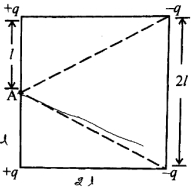
As shown in the figure,charges $+q, +q, -q$ and $-q$ are placed on the vertices of a square,each side length is $2l$. The electric potential at the mid-point '$A$' of the charges $+q$ and $+q$ is . . . . . . .
A
Zero
B
$\frac{2kq}{l}[1+\frac{1}{\sqrt{5}}]$
C
$\frac{kq}{l}[1-\frac{1}{\sqrt{5}}]$
D
$\frac{2kq}{l}[1-\frac{1}{\sqrt{5}}]$
Solution
(D) Point '$A$' is at a distance $l$ from the top $+q$ charge and the bottom $+q$ charge.
The distance from point '$A$' to both $-q$ charges is $\sqrt{(2l)^2 + l^2} = \sqrt{4l^2 + l^2} = \sqrt{5l^2} = l\sqrt{5}$.
The electric potential $V$ at point '$A$' due to all four charges is given by the sum of potentials from each charge:
$V_A = k(\frac{q}{l} + \frac{q}{l} - \frac{q}{l\sqrt{5}} - \frac{q}{l\sqrt{5}})$
$V_A = k(\frac{2q}{l} - \frac{2q}{l\sqrt{5}})$
$V_A = \frac{2kq}{l}(1 - \frac{1}{\sqrt{5}})$
Therefore,option $(D)$ is correct.
The distance from point '$A$' to both $-q$ charges is $\sqrt{(2l)^2 + l^2} = \sqrt{4l^2 + l^2} = \sqrt{5l^2} = l\sqrt{5}$.
The electric potential $V$ at point '$A$' due to all four charges is given by the sum of potentials from each charge:
$V_A = k(\frac{q}{l} + \frac{q}{l} - \frac{q}{l\sqrt{5}} - \frac{q}{l\sqrt{5}})$
$V_A = k(\frac{2q}{l} - \frac{2q}{l\sqrt{5}})$
$V_A = \frac{2kq}{l}(1 - \frac{1}{\sqrt{5}})$
Therefore,option $(D)$ is correct.
0 likesView Solution
28
PhysicsMediumMCQGUJCET · 2025
Charge $1.6 \times 10^{-7} \text{ C}$ is distributed uniformly over the surface of a spherical conductor of radius $R$. The ratio of the electric potential inside the spherical conductor to the electric field on the surface is . . . . . . .
A
$1.6 \times 10^{-7} R^2$
B
$R$
C
$1.6 \times 10^{-7} R$
D
$\frac{1}{R}$
Solution
(B) The electric potential $V$ inside a spherical conductor is constant and equal to the potential on its surface,given by $V = \frac{kq}{R}$.
The electric field $E$ on the surface of the spherical conductor is given by $E = \frac{kq}{R^2}$.
To find the ratio of the electric potential inside to the electric field on the surface,we calculate:
$\frac{V}{E} = \frac{kq/R}{kq/R^2} = \frac{kq}{R} \times \frac{R^2}{kq} = R$.
Therefore,the ratio is $R$. Option $(B)$ is correct.
The electric field $E$ on the surface of the spherical conductor is given by $E = \frac{kq}{R^2}$.
To find the ratio of the electric potential inside to the electric field on the surface,we calculate:
$\frac{V}{E} = \frac{kq/R}{kq/R^2} = \frac{kq}{R} \times \frac{R^2}{kq} = R$.
Therefore,the ratio is $R$. Option $(B)$ is correct.
0 likesView Solution
29
PhysicsMediumMCQGUJCET · 2025
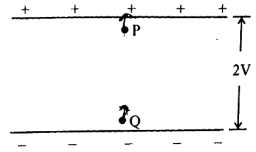
The potential difference between two plates of a parallel plate capacitor is $2V$. As shown in the figure,electrons are placed at point $P$ and $Q$. So,
A
Electric forces acting on both the electrons are same.
B
Electric force acting on the electron at point $P$ is greater than the electron at point $Q$.
C
Electric force acting on the electron at point $P$ is less than the electron at point $Q$.
D
Electric forces acting on both the electrons are zero.
Solution
(A) In a parallel plate capacitor,the electric field between the plates is uniform.
Since the force $F = eE$,where $e$ is the charge of the electron and $E$ is the uniform electric field,the force experienced by an electron at any point between the plates is constant.
Thus,the forces acting on the electrons at both points $P$ and $Q$ are the same.
Therefore,option $(A)$ is correct.
Since the force $F = eE$,where $e$ is the charge of the electron and $E$ is the uniform electric field,the force experienced by an electron at any point between the plates is constant.
Thus,the forces acting on the electrons at both points $P$ and $Q$ are the same.
Therefore,option $(A)$ is correct.
0 likesView Solution
30
PhysicsMediumMCQGUJCET · 2025
The drift velocity of an electron is $v_d$ in a conductor of area of cross-section $A$ and carries a current $I$. Now,the area of cross-section and current flowing through the conductor are doubled,then the new drift velocity of the electron is . . . . . . .
A
$\frac{v_d}{2}$
B
$\frac{v_d}{4}$
C
$4v_d$
D
$v_d$
Solution
(D) The relation between current $I$ and drift velocity $v_d$ is given by the formula $I = n e A v_d$,where $n$ is the electron density and $e$ is the charge of an electron.
From this,the drift velocity is expressed as $v_d = \frac{I}{neA}$.
Given that the new current $I' = 2I$ and the new area of cross-section $A' = 2A$,the new drift velocity $v'_d$ is calculated as:
$v'_d = \frac{I'}{neA'} = \frac{2I}{ne(2A)} = \frac{I}{neA} = v_d$.
Therefore,the drift velocity remains unchanged. Option $(D)$ is correct.
From this,the drift velocity is expressed as $v_d = \frac{I}{neA}$.
Given that the new current $I' = 2I$ and the new area of cross-section $A' = 2A$,the new drift velocity $v'_d$ is calculated as:
$v'_d = \frac{I'}{neA'} = \frac{2I}{ne(2A)} = \frac{I}{neA} = v_d$.
Therefore,the drift velocity remains unchanged. Option $(D)$ is correct.
0 likesView Solution
31
PhysicsDifficultMCQGUJCET · 2025
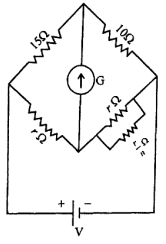
As shown in the figure,for the balanced condition of the Wheatstone bridge,the value of $n$ is . . . . . .
A
$\frac{3}{2}$
B
$\frac{2}{5}$
C
$\frac{1}{2}$
D
$\frac{5}{2}$
Solution
(D) In a balanced Wheatstone bridge,the ratio of resistances in opposite arms is equal.
From the figure,the arms of the bridge are $15 \Omega$,$10 \Omega$,$r \Omega$,and the parallel combination of $r \Omega$ and $n \Omega$.
Let $R_1 = 15 \Omega$,$R_2 = 10 \Omega$,$R_3 = r \Omega$,and $R_4 = \frac{r \cdot n}{r + n} \Omega$.
The condition for a balanced Wheatstone bridge is $\frac{R_1}{R_3} = \frac{R_2}{R_4}$.
Substituting the values: $\frac{15}{r} = \frac{10}{\frac{rn}{r+n}}$.
This simplifies to $\frac{15}{r} = \frac{10(r+n)}{rn}$.
Canceling $r$ from both sides: $15 = \frac{10(r+n)}{n}$.
$15n = 10r + 10n \implies 5n = 10r \implies n = 2r$.
Assuming the question implies a specific ratio or standard values where $r$ is given as $1.25 \Omega$ (or similar context from standard problems),if $r = 1.25 \Omega$,then $n = 2(1.25) = 2.5 = \frac{5}{2} \Omega$.
Thus,the correct option is $D$.
From the figure,the arms of the bridge are $15 \Omega$,$10 \Omega$,$r \Omega$,and the parallel combination of $r \Omega$ and $n \Omega$.
Let $R_1 = 15 \Omega$,$R_2 = 10 \Omega$,$R_3 = r \Omega$,and $R_4 = \frac{r \cdot n}{r + n} \Omega$.
The condition for a balanced Wheatstone bridge is $\frac{R_1}{R_3} = \frac{R_2}{R_4}$.
Substituting the values: $\frac{15}{r} = \frac{10}{\frac{rn}{r+n}}$.
This simplifies to $\frac{15}{r} = \frac{10(r+n)}{rn}$.
Canceling $r$ from both sides: $15 = \frac{10(r+n)}{n}$.
$15n = 10r + 10n \implies 5n = 10r \implies n = 2r$.
Assuming the question implies a specific ratio or standard values where $r$ is given as $1.25 \Omega$ (or similar context from standard problems),if $r = 1.25 \Omega$,then $n = 2(1.25) = 2.5 = \frac{5}{2} \Omega$.
Thus,the correct option is $D$.
0 likesView Solution
32
PhysicsDifficultMCQGUJCET · 2025
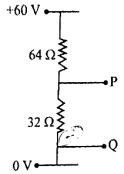
In the given circuit,the potential difference between points $P$ and $Q$ is . . . . . . (in $\text{ V}$)
A
$128$
B
$20$
C
$96$
D
$60$
Solution
(B) The circuit is a voltage divider with two resistors in series,$R_1 = 64 \, \Omega$ and $R_2 = 32 \, \Omega$,connected across a potential difference of $60 \text{ V} - 0 \text{ V} = 60 \text{ V}$.
The total resistance of the circuit is $R_{eq} = R_1 + R_2 = 64 \, \Omega + 32 \, \Omega = 96 \, \Omega$.
The current flowing through the circuit is $I = \frac{V}{R_{eq}} = \frac{60 \text{ V}}{96 \, \Omega} = \frac{5}{8} \text{ A}$.
The potential difference between points $P$ and $Q$ is the voltage across the $32 \, \Omega$ resistor.
$V_{PQ} = I \cdot R_2 = \left( \frac{5}{8} \text{ A} \right) \times 32 \, \Omega = 5 \times 4 = 20 \text{ V}$.
The total resistance of the circuit is $R_{eq} = R_1 + R_2 = 64 \, \Omega + 32 \, \Omega = 96 \, \Omega$.
The current flowing through the circuit is $I = \frac{V}{R_{eq}} = \frac{60 \text{ V}}{96 \, \Omega} = \frac{5}{8} \text{ A}$.
The potential difference between points $P$ and $Q$ is the voltage across the $32 \, \Omega$ resistor.
$V_{PQ} = I \cdot R_2 = \left( \frac{5}{8} \text{ A} \right) \times 32 \, \Omega = 5 \times 4 = 20 \text{ V}$.
0 likesView Solution
33
PhysicsDifficultMCQGUJCET · 2025
The ratio of the magnetic field at the centre of a circular ring of radius $R$ to the magnetic field at a point on its axis at a distance $2\sqrt{2}R$ from its centre is . . . . . .
A
$27:1$
B
$81:1$
C
$1:9$
D
$1:2\sqrt{2}$
Solution
(A) The magnetic field at the centre of a circular ring carrying current $I$ is given by $B_c = \frac{\mu_0 I}{2R}$.
The magnetic field at a point on the axis of the ring at a distance $x$ from the centre is given by $B_a = \frac{\mu_0 I R^2}{2(R^2+x^2)^{3/2}}$.
Given $x = 2\sqrt{2}R$,we calculate the term $(R^2+x^2)$:
$R^2 + x^2 = R^2 + (2\sqrt{2}R)^2 = R^2 + 8R^2 = 9R^2$.
Substituting this into the expression for $B_a$:
$B_a = \frac{\mu_0 I R^2}{2(9R^2)^{3/2}} = \frac{\mu_0 I R^2}{2(27R^3)} = \frac{\mu_0 I}{54R}$.
Now,the ratio $B_c/B_a$ is:
$\frac{B_c}{B_a} = \frac{\mu_0 I}{2R} \div \frac{\mu_0 I}{54R} = \frac{54}{2} = 27$.
Therefore,the ratio is $27:1$.
The magnetic field at a point on the axis of the ring at a distance $x$ from the centre is given by $B_a = \frac{\mu_0 I R^2}{2(R^2+x^2)^{3/2}}$.
Given $x = 2\sqrt{2}R$,we calculate the term $(R^2+x^2)$:
$R^2 + x^2 = R^2 + (2\sqrt{2}R)^2 = R^2 + 8R^2 = 9R^2$.
Substituting this into the expression for $B_a$:
$B_a = \frac{\mu_0 I R^2}{2(9R^2)^{3/2}} = \frac{\mu_0 I R^2}{2(27R^3)} = \frac{\mu_0 I}{54R}$.
Now,the ratio $B_c/B_a$ is:
$\frac{B_c}{B_a} = \frac{\mu_0 I}{2R} \div \frac{\mu_0 I}{54R} = \frac{54}{2} = 27$.
Therefore,the ratio is $27:1$.
0 likesView Solution
34
PhysicsMediumMCQGUJCET · 2025
The dimensional formula of current sensitivity of a moving coil galvanometer is
A
$[L^2]$
B
$[M^1L^2T^{-2}A^{-1}]$
C
$[A^{-1}]$
D
$[M^1L^2T^{-2}]$
Solution
(C) Current sensitivity $I_s$ is defined as the deflection per unit current,given by $I_s = \frac{\theta}{I} = \frac{NAB}{k}$.
Here,$N$ is the number of turns (dimensionless),$A$ is the area $[L^2]$,$B$ is the magnetic field,and $k$ is the restoring torque per unit twist.
The dimensions of magnetic field $B$ are $[MT^{-2}A^{-1}]$.
The dimensions of restoring torque constant $k$ are the same as torque,which is $[ML^2T^{-2}]$.
Substituting these dimensions into the formula: $[I_s] = \frac{[L^2] \cdot [MT^{-2}A^{-1}]}{[ML^2T^{-2}]}$.
Simplifying the expression: $[I_s] = \frac{L^2 MT^{-2}A^{-1}}{ML^2T^{-2}} = [A^{-1}]$.
Thus,the dimensional formula of current sensitivity is $[A^{-1}]$.
Here,$N$ is the number of turns (dimensionless),$A$ is the area $[L^2]$,$B$ is the magnetic field,and $k$ is the restoring torque per unit twist.
The dimensions of magnetic field $B$ are $[MT^{-2}A^{-1}]$.
The dimensions of restoring torque constant $k$ are the same as torque,which is $[ML^2T^{-2}]$.
Substituting these dimensions into the formula: $[I_s] = \frac{[L^2] \cdot [MT^{-2}A^{-1}]}{[ML^2T^{-2}]}$.
Simplifying the expression: $[I_s] = \frac{L^2 MT^{-2}A^{-1}}{ML^2T^{-2}} = [A^{-1}]$.
Thus,the dimensional formula of current sensitivity is $[A^{-1}]$.
0 likesView Solution
35
PhysicsMediumMCQGUJCET · 2025
The horizontal component of the Earth's magnetic field at a certain place is $3 \times 10^{-5} \text{T}$ and the direction of the field is from the geographic South to the geographic North. $A$ very long straight conductor is carrying a steady current of $1 \text{A}$. What is the force per unit length on it when it is placed on a horizontal table and the direction of current is South to North?
A
zero
B
$1 \times 10^{-5} \text{Nm}^{-1}$
C
$6 \times 10^{-5} \text{Nm}^{-1}$
D
$9 \times 10^{-5} \text{Nm}^{-1}$
Solution
(A) The force $\vec{F}$ on a conductor of length $L$ carrying current $I$ in a magnetic field $\vec{B}$ is given by $\vec{F} = I(\vec{L} \times \vec{B})$.
The magnitude of the force per unit length $f$ is given by $f = I B \sin\theta$,where $\theta$ is the angle between the direction of the current and the magnetic field.
In this case,the magnetic field $\vec{B}$ is directed from South to North,and the current $I$ is also flowing from South to North.
Therefore,the angle $\theta$ between the current and the magnetic field is $0^\circ$.
Since $\sin(0^\circ) = 0$,the force per unit length $f = I \times B \times \sin(0^\circ) = 0 \text{ N/m}$.
The magnitude of the force per unit length $f$ is given by $f = I B \sin\theta$,where $\theta$ is the angle between the direction of the current and the magnetic field.
In this case,the magnetic field $\vec{B}$ is directed from South to North,and the current $I$ is also flowing from South to North.
Therefore,the angle $\theta$ between the current and the magnetic field is $0^\circ$.
Since $\sin(0^\circ) = 0$,the force per unit length $f = I \times B \times \sin(0^\circ) = 0 \text{ N/m}$.
0 likesView Solution
36
PhysicsMediumMCQGUJCET · 2025
The magnetic field produced by a very long straight conducting wire of radius '$a$' carrying current '$I$' is '$B$'. Then,the graph of magnetic field $(B)$ versus distance $(r)$ (perpendicular to the axis of the wire) is . . . . . .
A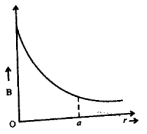
B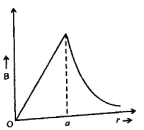
C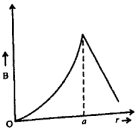
D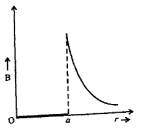
Solution
(B) For a long cylindrical wire of radius '$a$' carrying current '$I$':
$1$. Inside the wire $(r < a)$,the magnetic field is given by $B = \frac{\mu_0 I r}{2\pi a^2}$. This shows that $B$ is directly proportional to $r$ $(B \propto r)$,resulting in a linear increase from the center to the surface.
$2$. Outside the wire $(r > a)$,the magnetic field is given by $B = \frac{\mu_0 I}{2\pi r}$. This shows that $B$ is inversely proportional to $r$ $(B \propto 1/r)$,resulting in a hyperbolic decrease as distance increases.
$3$. Combining these,the graph shows a linear increase up to $r = a$ and a hyperbolic decrease for $r > a$. This corresponds to Graph $B$.
$1$. Inside the wire $(r < a)$,the magnetic field is given by $B = \frac{\mu_0 I r}{2\pi a^2}$. This shows that $B$ is directly proportional to $r$ $(B \propto r)$,resulting in a linear increase from the center to the surface.
$2$. Outside the wire $(r > a)$,the magnetic field is given by $B = \frac{\mu_0 I}{2\pi r}$. This shows that $B$ is inversely proportional to $r$ $(B \propto 1/r)$,resulting in a hyperbolic decrease as distance increases.
$3$. Combining these,the graph shows a linear increase up to $r = a$ and a hyperbolic decrease for $r > a$. This corresponds to Graph $B$.
0 likesView Solution
37
PhysicsMediumMCQGUJCET · 2025
$A$ paramagnetic substance is placed in a non-uniform magnetic field,then
A
perform continuous rotation
B
to move from a region of weak magnetic field to strong magnetic field
C
remain stationary
D
to move from a region of strong magnetic field to weak magnetic field
Solution
(B) Paramagnetic substances possess a small positive magnetic susceptibility. When placed in a non-uniform magnetic field,they experience a net force directed towards the region of higher magnetic field intensity. Therefore,a paramagnetic substance tends to move from a region of weak magnetic field to a region of strong magnetic field.
0 likesView Solution
38
PhysicsMediumMCQGUJCET · 2025
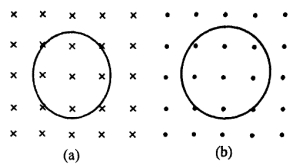
As shown in the figure,two identical conducting rings of radius $r$ are placed in a magnetic field. In figure $(a)$,the magnetic field is increasing at the rate of $0.3 \text{ T/s}$,and in figure $(b)$,the magnetic field is decreasing at the rate of $0.2 \text{ T/s}$. The direction of the current in ring $(a)$ and ring $(b)$,when observed from the top,is . . . . . .
A
Clockwise,Anticlockwise
B
Anticlockwise,Anticlockwise
C
Clockwise,Clockwise
D
Anticlockwise,Clockwise
Solution
According to Lenz's law, the induced current creates a magnetic field that opposes the change in magnetic flux.
In figure (a), the magnetic field is directed into the page $(\times)$ and is increasing. To oppose this increase, the induced current must create a magnetic field directed out of the page $(\bullet)$. According to the right-hand rule, an outward magnetic field corresponds to an anticlockwise current.
In figure (b), the magnetic field is directed out of the page $(\bullet)$ and is decreasing. To oppose this decrease, the induced current must create a magnetic field into the page $(\times)$. According to the right-hand rule, this corresponds to a clockwise current.
Therefore, the direction of current in ring (a) is anticlockwise and in ring (b) is clockwise.
In figure (a), the magnetic field is directed into the page $(\times)$ and is increasing. To oppose this increase, the induced current must create a magnetic field directed out of the page $(\bullet)$. According to the right-hand rule, an outward magnetic field corresponds to an anticlockwise current.
In figure (b), the magnetic field is directed out of the page $(\bullet)$ and is decreasing. To oppose this decrease, the induced current must create a magnetic field into the page $(\times)$. According to the right-hand rule, this corresponds to a clockwise current.
Therefore, the direction of current in ring (a) is anticlockwise and in ring (b) is clockwise.
0 likesView Solution
39
PhysicsMediumMCQGUJCET · 2025
$A$ pair of adjacent coils has a mutual inductance of $2 \text{H}$. If the current in one coil changes from $0 \text{A}$ to $30 \text{A}$ in $0.15 \text{s}$,what is the change of flux linkage with the other coil (in $\text{ Wb}$)?
A
$300$
B
$6$
C
$60$
D
$15$
Solution
(C) The magnetic flux linkage $\phi$ in the secondary coil is related to the current $I$ in the primary coil by the formula $\phi = M I$,where $M$ is the mutual inductance.
To find the change in flux linkage $\Delta \phi$,we use the formula $\Delta \phi = M \Delta I$.
Given:
Mutual inductance $M = 2 \text{H}$.
Change in current $\Delta I = I_f - I_i = 30 \text{A} - 0 \text{A} = 30 \text{A}$.
Substituting these values into the formula:
$\Delta \phi = 2 \text{H} \times 30 \text{A} = 60 \text{ Wb}$.
Thus,the change in flux linkage with the other coil is $60 \text{ Wb}$.
To find the change in flux linkage $\Delta \phi$,we use the formula $\Delta \phi = M \Delta I$.
Given:
Mutual inductance $M = 2 \text{H}$.
Change in current $\Delta I = I_f - I_i = 30 \text{A} - 0 \text{A} = 30 \text{A}$.
Substituting these values into the formula:
$\Delta \phi = 2 \text{H} \times 30 \text{A} = 60 \text{ Wb}$.
Thus,the change in flux linkage with the other coil is $60 \text{ Wb}$.
0 likesView Solution
40
PhysicsMediumMCQGUJCET · 2025
In an $AC$ generator,induced emf $\varepsilon = 0$ at $t = 0$,then its value . . . . . .
A
minimum at time $\frac{2\pi}{3\omega}$
B
minimum at time $\frac{\pi}{2\omega}$
C
maximum at time $\frac{2\pi}{\omega}$
D
maximum at time $\frac{\pi}{2\omega}$
Solution
(D) The induced emf in an $AC$ generator is given by the equation $\varepsilon = \varepsilon_0 \sin(\omega t)$.
At $t = 0$,$\varepsilon = \varepsilon_0 \sin(0) = 0$.
The emf reaches its maximum value when $\sin(\omega t) = 1$.
This occurs when $\omega t = \frac{\pi}{2}$.
Solving for $t$,we get $t = \frac{\pi}{2\omega}$.
Therefore,the induced emf is maximum at time $t = \frac{\pi}{2\omega}$.
At $t = 0$,$\varepsilon = \varepsilon_0 \sin(0) = 0$.
The emf reaches its maximum value when $\sin(\omega t) = 1$.
This occurs when $\omega t = \frac{\pi}{2}$.
Solving for $t$,we get $t = \frac{\pi}{2\omega}$.
Therefore,the induced emf is maximum at time $t = \frac{\pi}{2\omega}$.
0 likesView Solution
Vedclass Products
For Students
Vedclass Test Series
Mock tests in real GUJCET style covering Physics with performance analysis. 5-day free trial.
Start Free TrialFor Teachers
Exam Paper Generator
Generate Set A/B/C/D Physics papers from 7.5L+ questions in 2 minutes. 3 chapters free.
Try FreeFor Institutes
Online Exam Module
Run live GUJCET mock exams with unlimited students, 360° analytics & white-label branding.
See DemoFrequently Asked Questions
How many Physics questions are in GUJCET 2025?
There are 40 Physics questions from the GUJCET 2025 paper on Vedclass, each with a detailed step-by-step solution in English.
Are GUJCET 2025 Physics solutions available in English?
Yes. All solutions on this page are in English. You can also switch to English or Hindi using the language buttons above the questions.
Can I practice GUJCET 2025 Physics as a timed test?
Yes. Use the Vedclass Test Series to attempt a full GUJCET mock test covering Physics with time limits and instant score analysis.
Can teachers create Physics papers from GUJCET previous year questions?
Yes. The Vedclass Exam Paper Generator lets teachers mix GUJCET Physics questions and generate Set A/B/C/D papers in minutes.
For Teachers & Institutes
Build a Custom Physics Paper
Pick GUJCET 2025 Physics questions, set difficulty, and generate Set A/B/C/D in 2 minutes.