
PhysicsQ1–27 of 27 questions
Page 1 of 1 · English
1
PhysicsEasyMCQGUJCET · 2021
For a series $LCR$ circuit with $L=2 \ H, C=18 \ \mu F$ and $R=10 \ \Omega$. What is the value of the $Q$ factor of this circuit?
A
$55.55$
B
$44.44$
C
$22.22$
D
$33.33$
Solution
(D) The $Q$ factor of a series $LCR$ circuit is given by the formula:
$Q = \frac{1}{R} \sqrt{\frac{L}{C}}$
Given values are $L = 2 \ H$,$C = 18 \ \mu F = 18 \times 10^{-6} \ F$,and $R = 10 \ \Omega$.
Substituting these values into the formula:
$Q = \frac{1}{10} \sqrt{\frac{2}{18 \times 10^{-6}}}$
$Q = \frac{1}{10} \sqrt{\frac{1}{9 \times 10^{-6}}}$
$Q = \frac{1}{10} \times \frac{1}{3 \times 10^{-3}}$
$Q = \frac{1}{10} \times \frac{1000}{3}$
$Q = \frac{100}{3} \approx 33.33$
Therefore,the correct option is $D$.
$Q = \frac{1}{R} \sqrt{\frac{L}{C}}$
Given values are $L = 2 \ H$,$C = 18 \ \mu F = 18 \times 10^{-6} \ F$,and $R = 10 \ \Omega$.
Substituting these values into the formula:
$Q = \frac{1}{10} \sqrt{\frac{2}{18 \times 10^{-6}}}$
$Q = \frac{1}{10} \sqrt{\frac{1}{9 \times 10^{-6}}}$
$Q = \frac{1}{10} \times \frac{1}{3 \times 10^{-3}}$
$Q = \frac{1}{10} \times \frac{1000}{3}$
$Q = \frac{100}{3} \approx 33.33$
Therefore,the correct option is $D$.
0 likesView Solution
2
PhysicsEasyMCQGUJCET · 2021
For an $LCR$ series $AC$ circuit, $L = 25 \, mH$, $R = 3 \, \Omega$, and $C = 62.5 \, \mu F$. What is the frequency of the source at which resonance occurs (in $Hz$)?
A
$35.40$
B
$100$
C
$127.39$
D
$21$
Solution
(C) The resonance frequency $v_{0}$ for an $LCR$ series circuit is given by the formula:
$v_{0} = \frac{1}{2 \pi \sqrt{LC}}$
Given values are $L = 25 \times 10^{-3} \, H$, $C = 62.5 \times 10^{-6} \, F$.
Substituting these values into the formula:
$v_{0} = \frac{1}{2 \times 3.14159 \times \sqrt{25 \times 10^{-3} \times 62.5 \times 10^{-6}}}$
$v_{0} = \frac{1}{2 \times 3.14159 \times \sqrt{1562.5 \times 10^{-9}}}$
$v_{0} = \frac{1}{2 \times 3.14159 \times \sqrt{1.5625 \times 10^{-6}}}$
$v_{0} = \frac{1}{2 \times 3.14159 \times 1.25 \times 10^{-3}}$
$v_{0} = \frac{1}{7.85398 \times 10^{-3}}$
$v_{0} \approx 127.39 \, Hz$
Thus, the correct option is $C$.
$v_{0} = \frac{1}{2 \pi \sqrt{LC}}$
Given values are $L = 25 \times 10^{-3} \, H$, $C = 62.5 \times 10^{-6} \, F$.
Substituting these values into the formula:
$v_{0} = \frac{1}{2 \times 3.14159 \times \sqrt{25 \times 10^{-3} \times 62.5 \times 10^{-6}}}$
$v_{0} = \frac{1}{2 \times 3.14159 \times \sqrt{1562.5 \times 10^{-9}}}$
$v_{0} = \frac{1}{2 \times 3.14159 \times \sqrt{1.5625 \times 10^{-6}}}$
$v_{0} = \frac{1}{2 \times 3.14159 \times 1.25 \times 10^{-3}}$
$v_{0} = \frac{1}{7.85398 \times 10^{-3}}$
$v_{0} \approx 127.39 \, Hz$
Thus, the correct option is $C$.
0 likesView Solution
3
PhysicsEasyMCQGUJCET · 2021
$A$ $50 \mu F$ capacitor is connected to a $110 V, 60 Hz$ $AC$ supply. Determine the rms value of the current in the circuit. (in $A$)
A
$2.5$
B
$3.8$
C
$5.2$
D
$2.1$
Solution
(D) Given: Capacitance $C = 50 \mu F = 50 \times 10^{-6} F$,Voltage $V_{rms} = 110 V$,Frequency $\nu = 60 Hz$.
First,calculate the capacitive reactance $X_C$ using the formula $X_C = \frac{1}{2 \pi \nu C}$.
$X_C = \frac{1}{2 \times 3.1416 \times 60 \times 50 \times 10^{-6}} \approx 53.05 \Omega$.
The rms current $I_{rms}$ is given by $I_{rms} = \frac{V_{rms}}{X_C}$.
$I_{rms} = \frac{110}{53.05} \approx 2.07 A$.
Rounding to one decimal place,we get $I_{rms} = 2.1 A$.
First,calculate the capacitive reactance $X_C$ using the formula $X_C = \frac{1}{2 \pi \nu C}$.
$X_C = \frac{1}{2 \times 3.1416 \times 60 \times 50 \times 10^{-6}} \approx 53.05 \Omega$.
The rms current $I_{rms}$ is given by $I_{rms} = \frac{V_{rms}}{X_C}$.
$I_{rms} = \frac{110}{53.05} \approx 2.07 A$.
Rounding to one decimal place,we get $I_{rms} = 2.1 A$.
0 likesView Solution
4
PhysicsEasyMCQGUJCET · 2021
The radius of the innermost electron orbit of a hydrogen atom is $5.3 \times 10^{-11} \ m$. What is the radius of the $n=4$ state?
A
$8.48 \times 10^{-10} \ m$
B
$4.24 \times 10^{-10} \ m$
C
$2.12 \times 10^{-10} \ m$
D
$10.6 \times 10^{-10} \ m$
Solution
(A) The radius of an electron orbit in a hydrogen-like atom is given by the formula: $r_n = n^2 a_0$,where $n$ is the principal quantum number and $a_0$ is the Bohr radius $(5.3 \times 10^{-11} \ m)$.
For the $n=4$ state,we substitute the values into the formula:
$r_4 = (4)^2 \times (5.3 \times 10^{-11} \ m)$
$r_4 = 16 \times 5.3 \times 10^{-11} \ m$
$r_4 = 84.8 \times 10^{-11} \ m$
$r_4 = 8.48 \times 10^{-10} \ m$
Therefore,the correct option is $A$.
For the $n=4$ state,we substitute the values into the formula:
$r_4 = (4)^2 \times (5.3 \times 10^{-11} \ m)$
$r_4 = 16 \times 5.3 \times 10^{-11} \ m$
$r_4 = 84.8 \times 10^{-11} \ m$
$r_4 = 8.48 \times 10^{-10} \ m$
Therefore,the correct option is $A$.
0 likesView Solution
5
PhysicsEasyMCQGUJCET · 2021
The ground state energy of a hydrogen atom is $-13.6 \text{ eV}$. What is the kinetic energy of the electron in this state (in $\text{ eV}$)?
A
$27.2$
B
$-13.6$
C
$13.6$
D
$-27.2$
Solution
(C) The total energy $E$ of an electron in a hydrogen atom is given by the sum of its kinetic energy $K$ and potential energy $U$.
For a hydrogen atom, the total energy $E$ is related to the kinetic energy $K$ by the relation $E = -K$.
Given that the ground state energy $E = -13.6 \text{ eV}$.
Therefore, the kinetic energy $K = -E = -(-13.6 \text{ eV}) = 13.6 \text{ eV}$.
Thus, the correct option is $C$.
For a hydrogen atom, the total energy $E$ is related to the kinetic energy $K$ by the relation $E = -K$.
Given that the ground state energy $E = -13.6 \text{ eV}$.
Therefore, the kinetic energy $K = -E = -(-13.6 \text{ eV}) = 13.6 \text{ eV}$.
Thus, the correct option is $C$.
0 likesView Solution
6
PhysicsEasyMCQGUJCET · 2021
In a potentiometer arrangement,a cell of emf $1.5 \ V$ gives a balance point at $150 \ cm$ length of the wire. If the cell is replaced by another cell and the balance point shifts to $210 \ cm$,what is the emf of the second cell (in $V$)?
A
$1.2$
B
$4.4$
C
$3.2$
D
$2.1$
Solution
(D) In a potentiometer,the emf $\varepsilon$ of a cell is directly proportional to the balancing length $l$ of the wire,given by $\varepsilon \propto l$ or $\varepsilon = kl$,where $k$ is the potential gradient of the wire.
For two different cells,we have the ratio: $\frac{\varepsilon_1}{\varepsilon_2} = \frac{l_1}{l_2}$.
Given: $\varepsilon_1 = 1.5 \ V$,$l_1 = 150 \ cm$,and $l_2 = 210 \ cm$.
Substituting the values: $\frac{1.5}{\varepsilon_2} = \frac{150}{210}$.
Solving for $\varepsilon_2$: $\varepsilon_2 = \frac{1.5 \times 210}{150}$.
$\varepsilon_2 = \frac{1.5}{150} \times 210 = 0.01 \times 210 = 2.1 \ V$.
Thus,the emf of the second cell is $2.1 \ V$.
For two different cells,we have the ratio: $\frac{\varepsilon_1}{\varepsilon_2} = \frac{l_1}{l_2}$.
Given: $\varepsilon_1 = 1.5 \ V$,$l_1 = 150 \ cm$,and $l_2 = 210 \ cm$.
Substituting the values: $\frac{1.5}{\varepsilon_2} = \frac{150}{210}$.
Solving for $\varepsilon_2$: $\varepsilon_2 = \frac{1.5 \times 210}{150}$.
$\varepsilon_2 = \frac{1.5}{150} \times 210 = 0.01 \times 210 = 2.1 \ V$.
Thus,the emf of the second cell is $2.1 \ V$.
0 likesView Solution
7
PhysicsEasyMCQGUJCET · 2021
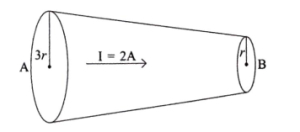
As shown in the figure,a current is passing through a conducting wire. The radius of the cross-section of the wire at point $A$ is $3r$ and at point $B$ is $r$. Find the ratio of the drift velocity at point $A$ to that at point $B$.
A
$3$
B
$\frac{1}{9}$
C
$\frac{1}{3}$
D
$9$
Solution
(B) The current $I$ flowing through a conductor is given by the relation: $I = n A v_d e$,where $n$ is the number density of electrons,$A$ is the cross-sectional area,$v_d$ is the drift velocity,and $e$ is the charge of an electron.
Since the current $I$ is constant throughout the wire,we have $v_d = \frac{I}{n A e}$.
Since $I$,$n$,and $e$ are constant,$v_d \propto \frac{1}{A}$.
Since the cross-section is circular,$A = \pi r^2$,therefore $v_d \propto \frac{1}{r^2}$.
Now,calculating the ratio of drift velocities at points $A$ and $B$:
$\frac{(v_d)_A}{(v_d)_B} = \frac{r_B^2}{r_A^2} = \frac{(r)^2}{(3r)^2} = \frac{r^2}{9r^2} = \frac{1}{9}$.
Thus,the ratio is $\frac{1}{9}$.
Since the current $I$ is constant throughout the wire,we have $v_d = \frac{I}{n A e}$.
Since $I$,$n$,and $e$ are constant,$v_d \propto \frac{1}{A}$.
Since the cross-section is circular,$A = \pi r^2$,therefore $v_d \propto \frac{1}{r^2}$.
Now,calculating the ratio of drift velocities at points $A$ and $B$:
$\frac{(v_d)_A}{(v_d)_B} = \frac{r_B^2}{r_A^2} = \frac{(r)^2}{(3r)^2} = \frac{r^2}{9r^2} = \frac{1}{9}$.
Thus,the ratio is $\frac{1}{9}$.
0 likesView Solution
8
PhysicsEasyMCQGUJCET · 2021
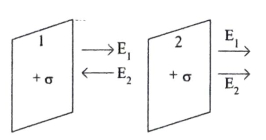
Two large,thin metal plates are parallel and close to each other. Their inner faces have surface charge densities of the same sign and magnitude $17.7 \times 10^{-22} \ C/m^2$. What is the electric field $E$ in the outer region of the second plate?
A
$2 \times 10^{-10} \ N/C$
B
$1 \times 10^{-10} \ N/C$
C
$4 \times 10^{-10} \ N/C$
D
Zero
Solution
(A) The electric field due to a thin infinite sheet of charge with surface charge density $\sigma$ is given by $E = \frac{\sigma}{2\varepsilon_0}$.
Since both plates have the same positive surface charge density $\sigma = 17.7 \times 10^{-22} \ C/m^2$,the electric fields produced by both plates in the outer region of the second plate point in the same direction (away from the plates).
Therefore,the total electric field $E$ in the outer region is the sum of the fields from both plates:
$E = E_1 + E_2 = \frac{\sigma}{2\varepsilon_0} + \frac{\sigma}{2\varepsilon_0} = \frac{\sigma}{\varepsilon_0}$.
Given $\varepsilon_0 = 8.85 \times 10^{-12} \ C^2/(N \cdot m^2)$:
$E = \frac{17.7 \times 10^{-22}}{8.85 \times 10^{-12}} = 2 \times 10^{-10} \ N/C$.
Since both plates have the same positive surface charge density $\sigma = 17.7 \times 10^{-22} \ C/m^2$,the electric fields produced by both plates in the outer region of the second plate point in the same direction (away from the plates).
Therefore,the total electric field $E$ in the outer region is the sum of the fields from both plates:
$E = E_1 + E_2 = \frac{\sigma}{2\varepsilon_0} + \frac{\sigma}{2\varepsilon_0} = \frac{\sigma}{\varepsilon_0}$.
Given $\varepsilon_0 = 8.85 \times 10^{-12} \ C^2/(N \cdot m^2)$:
$E = \frac{17.7 \times 10^{-22}}{8.85 \times 10^{-12}} = 2 \times 10^{-10} \ N/C$.
0 likesView Solution
9
PhysicsEasyMCQGUJCET · 2021
Electrical field intensity due to an electric dipole on its axis at distance $x$ $(x \gg a)$ and on the equatorial line at distance $y$ $(y \gg a)$ are same. What is the ratio of $x$ and $y$?
A
$ \sqrt{2} : 1 $
B
$ 1 : \sqrt[3]{2} $
C
$ \sqrt[3]{2} : 1 $
D
$ 1 : 2 $
Solution
(C) The electric field intensity due to an electric dipole on its axis at a large distance $x$ is given by $E_{\text{axis}} = \frac{2kp}{x^3}$.
The electric field intensity due to an electric dipole on its equatorial line at a large distance $y$ is given by $E_{\text{equator}} = \frac{kp}{y^3}$.
Given that the magnitudes are equal: $E_{\text{axis}} = E_{\text{equator}}$.
Substituting the formulas: $\frac{2kp}{x^3} = \frac{kp}{y^3}$.
Canceling $kp$ from both sides: $\frac{2}{x^3} = \frac{1}{y^3}$.
Rearranging the terms: $\frac{x^3}{y^3} = 2$.
Taking the cube root on both sides: $\frac{x}{y} = \sqrt[3]{2} : 1$.
The electric field intensity due to an electric dipole on its equatorial line at a large distance $y$ is given by $E_{\text{equator}} = \frac{kp}{y^3}$.
Given that the magnitudes are equal: $E_{\text{axis}} = E_{\text{equator}}$.
Substituting the formulas: $\frac{2kp}{x^3} = \frac{kp}{y^3}$.
Canceling $kp$ from both sides: $\frac{2}{x^3} = \frac{1}{y^3}$.
Rearranging the terms: $\frac{x^3}{y^3} = 2$.
Taking the cube root on both sides: $\frac{x}{y} = \sqrt[3]{2} : 1$.
0 likesView Solution
10
PhysicsEasyMCQGUJCET · 2021
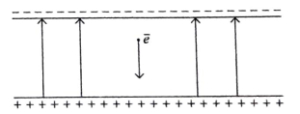
As shown in the following figure,an electron falls through a distance of $1.5 \ cm$ in a uniform electric field of magnitude $2.0 \times 10^4 \ NC^{-1}$. Find the acceleration of the electron due to the electric field.
A
$1.67 \times 10^{27} \ ms^{-2}$
B
$3.52 \times 10^{15} \ ms^{-2}$
C
$2.90 \times 10^{19} \ ms^{-2}$
D
$6.62 \times 10^{34} \ ms^{-2}$
Solution
(B) The force $F$ experienced by an electron of charge $e$ in an electric field $E$ is given by $F = eE$.
According to Newton's second law of motion,$F = ma$,where $m_e$ is the mass of the electron and $a$ is its acceleration.
Equating the two expressions for force: $ma = eE$.
Therefore,the acceleration $a$ is given by $a = \frac{eE}{m_e}$.
Given:
Charge of electron $e = 1.6 \times 10^{-19} \ C$
Electric field $E = 2.0 \times 10^4 \ NC^{-1}$
Mass of electron $m_e = 9.1 \times 10^{-31} \ kg$
Substituting the values:
$a = \frac{(1.6 \times 10^{-19} \ C) \times (2.0 \times 10^4 \ NC^{-1})}{9.1 \times 10^{-31} \ kg}$
$a = \frac{3.2 \times 10^{-15}}{9.1 \times 10^{-31}} \ ms^{-2}$
$a \approx 0.3516 \times 10^{16} \ ms^{-2}$
$a \approx 3.52 \times 10^{15} \ ms^{-2}$.
According to Newton's second law of motion,$F = ma$,where $m_e$ is the mass of the electron and $a$ is its acceleration.
Equating the two expressions for force: $ma = eE$.
Therefore,the acceleration $a$ is given by $a = \frac{eE}{m_e}$.
Given:
Charge of electron $e = 1.6 \times 10^{-19} \ C$
Electric field $E = 2.0 \times 10^4 \ NC^{-1}$
Mass of electron $m_e = 9.1 \times 10^{-31} \ kg$
Substituting the values:
$a = \frac{(1.6 \times 10^{-19} \ C) \times (2.0 \times 10^4 \ NC^{-1})}{9.1 \times 10^{-31} \ kg}$
$a = \frac{3.2 \times 10^{-15}}{9.1 \times 10^{-31}} \ ms^{-2}$
$a \approx 0.3516 \times 10^{16} \ ms^{-2}$
$a \approx 3.52 \times 10^{15} \ ms^{-2}$.
0 likesView Solution
11
PhysicsEasyMCQGUJCET · 2021
$A$ pair of adjacent coils has a mutual inductance of $1.5 \ H$. If the current in one coil changes from $0$ to $20 \ A$ in $0.5 \ s$,what is the change of flux linkage with the other coil (in $Wb$)?
A
$45$
B
$30$
C
$15$
D
$60$
Solution
(B) The flux linkage $\phi$ in a coil due to current $I$ in an adjacent coil is given by $\phi = M I$,where $M$ is the mutual inductance.
The change in flux linkage $\Delta \phi$ is given by:
$\Delta \phi = M \Delta I$
Given:
Mutual inductance $M = 1.5 \ H$
Change in current $\Delta I = I_{final} - I_{initial} = 20 \ A - 0 \ A = 20 \ A$
Substituting the values:
$\Delta \phi = 1.5 \times 20$
$\Delta \phi = 30 \ Wb$
Therefore,the change in flux linkage is $30 \ Wb$.
The change in flux linkage $\Delta \phi$ is given by:
$\Delta \phi = M \Delta I$
Given:
Mutual inductance $M = 1.5 \ H$
Change in current $\Delta I = I_{final} - I_{initial} = 20 \ A - 0 \ A = 20 \ A$
Substituting the values:
$\Delta \phi = 1.5 \times 20$
$\Delta \phi = 30 \ Wb$
Therefore,the change in flux linkage is $30 \ Wb$.
0 likesView Solution
12
PhysicsEasyMCQGUJCET · 2021
The self-inductance $L$ of a solenoid of length $l$ and area of cross-section $A$ increases . . . . . . (Here with a fixed number of turns $N$).
A
$l$ increases and $A$ decreases.
B
$l$ decreases and $A$ increases.
C
$l$ and $A$ increase.
D
Both $l$ and $A$ decrease.
Solution
(B) The formula for the self-inductance $L$ of a solenoid is given by $L = \frac{\mu_0 N^2 A}{l}$.
From this expression,we can see that $L \propto \frac{A}{l}$.
To increase the self-inductance $L$,the numerator $A$ (area of cross-section) must increase and the denominator $l$ (length of the solenoid) must decrease.
Therefore,the correct option is $B$.
From this expression,we can see that $L \propto \frac{A}{l}$.
To increase the self-inductance $L$,the numerator $A$ (area of cross-section) must increase and the denominator $l$ (length of the solenoid) must decrease.
Therefore,the correct option is $B$.
0 likesView Solution
13
PhysicsEasyMCQGUJCET · 2021
For a long current-carrying solenoid,the magnetic field inside is $0.6 \ T$. The magnetic energy per unit volume is . . . . . . .
A
$5.23 \times 10^4 \ J/m^3$
B
$2.86 \times 10^4 \ J/m^3$
C
$1.43 \times 10^5 \ J/m^3$
D
zero
Solution
(C) The magnetic energy density $(u)$ stored in a magnetic field is given by the formula:
$u = \frac{B^2}{2\mu_0}$
Given:
$B = 0.6 \ T$
$\mu_0 = 4\pi \times 10^{-7} \ T \cdot m/A \approx 12.56 \times 10^{-7} \ T \cdot m/A$
Substituting the values:
$u = \frac{(0.6)^2}{2 \times 4 \times 3.14 \times 10^{-7}}$
$u = \frac{0.36}{25.12 \times 10^{-7}}$
$u = \frac{0.36}{2.512 \times 10^{-6}}$
$u \approx 0.1433 \times 10^6 \ J/m^3$
$u = 1.43 \times 10^5 \ J/m^3$
$u = \frac{B^2}{2\mu_0}$
Given:
$B = 0.6 \ T$
$\mu_0 = 4\pi \times 10^{-7} \ T \cdot m/A \approx 12.56 \times 10^{-7} \ T \cdot m/A$
Substituting the values:
$u = \frac{(0.6)^2}{2 \times 4 \times 3.14 \times 10^{-7}}$
$u = \frac{0.36}{25.12 \times 10^{-7}}$
$u = \frac{0.36}{2.512 \times 10^{-6}}$
$u \approx 0.1433 \times 10^6 \ J/m^3$
$u = 1.43 \times 10^5 \ J/m^3$
0 likesView Solution
14
PhysicsEasyMCQGUJCET · 2021
$A$ plane electromagnetic wave of frequency $25 \text{ MHz}$ travels in free space along the $X$-direction. At a particular point in space and time,the magnetic field is $\overrightarrow{B} = 2.1 \times 10^{-8} \hat{k} \text{ T}$. Find the electric field $\overrightarrow{E}$ at this point.
A
$-2.1 \hat{j} \text{ Vm}^{-1}$
B
$6.3 \hat{j} \text{ Vm}^{-1}$
C
$4.2 \hat{j} \text{ Vm}^{-1}$
D
$-3.2 \hat{j} \text{ Vm}^{-1}$
Solution
(B) The relationship between the magnitudes of the electric field $(E)$ and the magnetic field $(B)$ in an electromagnetic wave is given by $E = cB$,where $c$ is the speed of light in free space $(c = 3 \times 10^8 \text{ ms}^{-1})$.
Substituting the given values: $E = (3 \times 10^8 \text{ ms}^{-1}) \times (2.1 \times 10^{-8} \text{ T}) = 6.3 \text{ Vm}^{-1}$.
The direction of propagation of the electromagnetic wave is given by the direction of the vector $\overrightarrow{E} \times \overrightarrow{B}$.
Given that the wave travels along the $X$-direction $(\hat{i})$ and $\overrightarrow{B}$ is along the $Z$-direction $(\hat{k})$,we have $\overrightarrow{E} \times \hat{k} = \hat{i}$.
Since $\hat{j} \times \hat{k} = \hat{i}$,the electric field $\overrightarrow{E}$ must be in the $Y$-direction $(\hat{j})$.
Therefore,$\overrightarrow{E} = 6.3 \hat{j} \text{ Vm}^{-1}$.
Substituting the given values: $E = (3 \times 10^8 \text{ ms}^{-1}) \times (2.1 \times 10^{-8} \text{ T}) = 6.3 \text{ Vm}^{-1}$.
The direction of propagation of the electromagnetic wave is given by the direction of the vector $\overrightarrow{E} \times \overrightarrow{B}$.
Given that the wave travels along the $X$-direction $(\hat{i})$ and $\overrightarrow{B}$ is along the $Z$-direction $(\hat{k})$,we have $\overrightarrow{E} \times \hat{k} = \hat{i}$.
Since $\hat{j} \times \hat{k} = \hat{i}$,the electric field $\overrightarrow{E}$ must be in the $Y$-direction $(\hat{j})$.
Therefore,$\overrightarrow{E} = 6.3 \hat{j} \text{ Vm}^{-1}$.
0 likesView Solution
15
PhysicsEasyMCQGUJCET · 2021
What is the range of the radio frequency band for $FM$ (Frequency Modulated) broadcasting?
A
$500 \text{ kHz}$ to $1000 \text{ MHz}$
B
$54 \text{ MHz}$ to $890 \text{ MHz}$
C
$530 \text{ kHz}$ to $1710 \text{ kHz}$
D
$88 \text{ MHz}$ to $108 \text{ MHz}$
Solution
(D) The standard frequency range allocated for $FM$ (Frequency Modulated) radio broadcasting is $88 \text{ MHz}$ to $108 \text{ MHz}$.
This band is part of the Very High Frequency $(VHF)$ spectrum.
Therefore,the correct option is $D$.
This band is part of the Very High Frequency $(VHF)$ spectrum.
Therefore,the correct option is $D$.
0 likesView Solution
16
PhysicsEasyMCQGUJCET · 2021
Which of the following options is a pair of polar molecules?
A
$[HCl, H_2]$
B
$[HCl, H_2O]$
C
$[H_2O, O_2]$
D
$[H_2, O_2]$
Solution
(B) polar molecule is one that possesses a permanent electric dipole moment due to an uneven distribution of charge,resulting from differences in electronegativity between the bonded atoms and an asymmetric molecular geometry.
$1$. $HCl$: Chlorine is more electronegative than Hydrogen,creating a dipole moment. It is a polar molecule.
$2$. $H_2O$: The bent geometry of the water molecule and the high electronegativity of Oxygen result in a net dipole moment. It is a polar molecule.
$3$. $H_2$ and $O_2$: These are homonuclear diatomic molecules with zero dipole moment. They are non-polar.
Therefore,the pair $[HCl, H_2O]$ consists of two polar molecules.
$1$. $HCl$: Chlorine is more electronegative than Hydrogen,creating a dipole moment. It is a polar molecule.
$2$. $H_2O$: The bent geometry of the water molecule and the high electronegativity of Oxygen result in a net dipole moment. It is a polar molecule.
$3$. $H_2$ and $O_2$: These are homonuclear diatomic molecules with zero dipole moment. They are non-polar.
Therefore,the pair $[HCl, H_2O]$ consists of two polar molecules.
0 likesView Solution
17
PhysicsEasyMCQGUJCET · 2021
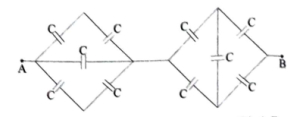
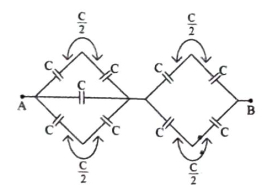
Find the equivalent capacitance between two points $A$ and $B$ for the given circuit. (Capacitance of each capacitor is $C = 3 \mu F$.) (in $\mu F$)
A
$3$
B
$2$
C
$1$
D
$4$
Solution
(B) The circuit consists of two parts connected in series.
First part (left): Two capacitors of capacitance $C$ are in series on the top branch,and two are in series on the bottom branch. The middle capacitor is in parallel with these branches.
Equivalent capacitance of the top branch = $C/2$.
Equivalent capacitance of the bottom branch = $C/2$.
These two branches are in parallel with the middle capacitor $C$.
So,$C_{eq1} = C/2 + C/2 + C = 2C$.
Second part (right): Two capacitors of capacitance $C$ are in series on the top branch,and two are in series on the bottom branch.
Equivalent capacitance of the top branch = $C/2$.
Equivalent capacitance of the bottom branch = $C/2$.
These two branches are in parallel.
So,$C_{eq2} = C/2 + C/2 = C$.
Now,$C_{eq1}$ and $C_{eq2}$ are in series.
$C_{eq} = \frac{C_{eq1} \times C_{eq2}}{C_{eq1} + C_{eq2}} = \frac{2C \times C}{2C + C} = \frac{2C^2}{3C} = \frac{2C}{3}$.
Given $C = 3 \mu F$,we have:
$C_{eq} = \frac{2 \times 3 \mu F}{3} = 2 \mu F$.
First part (left): Two capacitors of capacitance $C$ are in series on the top branch,and two are in series on the bottom branch. The middle capacitor is in parallel with these branches.
Equivalent capacitance of the top branch = $C/2$.
Equivalent capacitance of the bottom branch = $C/2$.
These two branches are in parallel with the middle capacitor $C$.
So,$C_{eq1} = C/2 + C/2 + C = 2C$.
Second part (right): Two capacitors of capacitance $C$ are in series on the top branch,and two are in series on the bottom branch.
Equivalent capacitance of the top branch = $C/2$.
Equivalent capacitance of the bottom branch = $C/2$.
These two branches are in parallel.
So,$C_{eq2} = C/2 + C/2 = C$.
Now,$C_{eq1}$ and $C_{eq2}$ are in series.
$C_{eq} = \frac{C_{eq1} \times C_{eq2}}{C_{eq1} + C_{eq2}} = \frac{2C \times C}{2C + C} = \frac{2C^2}{3C} = \frac{2C}{3}$.
Given $C = 3 \mu F$,we have:
$C_{eq} = \frac{2 \times 3 \mu F}{3} = 2 \mu F$.
0 likesView Solution
18
PhysicsEasyMCQGUJCET · 2021
What is the magnitude of the equatorial magnetic field due to a bar magnet of length $5.0 \ cm$ at a distance $75 \ cm$ from its midpoint? The magnetic moment of the bar magnet is $0.75 \ A \ m^2$.
A
$1.78 \times 10^{-7} \ T$
B
$6.4 \times 10^{-7} \ T$
C
$3.2 \times 10^{-7} \ T$
D
$3.56 \times 10^{-7} \ T$
Solution
(A) The magnetic field $B$ on the equatorial line of a short bar magnet is given by the formula:
$B = \frac{\mu_0}{4\pi} \cdot \frac{m}{r^3}$
Given:
Magnetic moment $m = 0.75 \ A \ m^2$
Distance $r = 75 \ cm = 0.75 \ m$
Constant $\frac{\mu_0}{4\pi} = 10^{-7} \ T \ m/A$
Substituting the values:
$B = 10^{-7} \times \frac{0.75}{(0.75)^3}$
$B = 10^{-7} \times \frac{1}{(0.75)^2}$
$B = 10^{-7} \times \frac{1}{0.5625}$
$B \approx 1.78 \times 10^{-7} \ T$
$B = \frac{\mu_0}{4\pi} \cdot \frac{m}{r^3}$
Given:
Magnetic moment $m = 0.75 \ A \ m^2$
Distance $r = 75 \ cm = 0.75 \ m$
Constant $\frac{\mu_0}{4\pi} = 10^{-7} \ T \ m/A$
Substituting the values:
$B = 10^{-7} \times \frac{0.75}{(0.75)^3}$
$B = 10^{-7} \times \frac{1}{(0.75)^2}$
$B = 10^{-7} \times \frac{1}{0.5625}$
$B \approx 1.78 \times 10^{-7} \ T$
0 likesView Solution
19
PhysicsEasyMCQGUJCET · 2021
At a certain place on the surface of the earth,the horizontal component of the earth's magnetic field is the same as the vertical component of the earth's magnetic field. What will be the angle of dip at that place (in $^{\circ}$)?
A
$60$
B
$45$
C
$30$
D
$90$
Solution
(B) The angle of dip $(I)$ is defined by the relationship between the vertical component $(Z_E)$ and the horizontal component $(H_E)$ of the earth's magnetic field as:
$\tan I = \frac{Z_E}{H_E}$
Given that the horizontal component is equal to the vertical component,we have:
$Z_E = H_E$
Substituting this into the formula:
$\tan I = \frac{Z_E}{Z_E} = 1$
Therefore,the angle of dip is:
$I = \tan^{-1}(1) = 45^{\circ}$
$\tan I = \frac{Z_E}{H_E}$
Given that the horizontal component is equal to the vertical component,we have:
$Z_E = H_E$
Substituting this into the formula:
$\tan I = \frac{Z_E}{Z_E} = 1$
Therefore,the angle of dip is:
$I = \tan^{-1}(1) = 45^{\circ}$
0 likesView Solution
20
PhysicsEasyMCQGUJCET · 2021
$A$ circular loop having radius $r$,carrying current $I$,produces a magnetic field at the centre of the loop equal to $B$. What will be the magnetic dipole moment of this loop?
A
$\frac{2 \pi B r^3}{\mu_0}$
B
$\frac{\pi B r^3}{\mu_0}$
C
$\frac{4 \pi B r^3}{\mu_0}$
D
$\frac{\pi B r^3}{4 \mu_0}$
Solution
(A) The magnetic dipole moment $M$ of a current loop is given by $M = I A$,where $I$ is the current and $A$ is the area of the loop.
For a circular loop of radius $r$,the area is $A = \pi r^2$.
Thus,$M = I (\pi r^2) \quad \dots(1)$
The magnetic field $B$ at the centre of a circular loop carrying current $I$ is given by $B = \frac{\mu_0 I}{2r}$.
Rearranging this formula to solve for current $I$,we get $I = \frac{2rB}{\mu_0}$.
Substituting the expression for $I$ into equation $(1)$:
$M = \left( \frac{2rB}{\mu_0} \right) (\pi r^2)$
$M = \frac{2 \pi B r^3}{\mu_0}$.
For a circular loop of radius $r$,the area is $A = \pi r^2$.
Thus,$M = I (\pi r^2) \quad \dots(1)$
The magnetic field $B$ at the centre of a circular loop carrying current $I$ is given by $B = \frac{\mu_0 I}{2r}$.
Rearranging this formula to solve for current $I$,we get $I = \frac{2rB}{\mu_0}$.
Substituting the expression for $I$ into equation $(1)$:
$M = \left( \frac{2rB}{\mu_0} \right) (\pi r^2)$
$M = \frac{2 \pi B r^3}{\mu_0}$.
0 likesView Solution
21
PhysicsEasyMCQGUJCET · 2021
$A$ solenoid of length $0.5 \ m$ has a radius of $1 \ cm$ and is made up of $1000$ turns. It carries a current of $10 \ A$. What is the magnitude of the magnetic field inside the solenoid?
A
$2.51 \times 10^{-2} \ T$
B
$1.71 \times 10^{-2} \ T$
C
$6.28 \times 10^{-3} \ T$
D
$7.23 \times 10^{-3} \ T$
Solution
(A) The magnetic field $B$ inside a long solenoid is given by the formula: $B = \mu_0 n I$,where $n = \frac{N}{l}$ is the number of turns per unit length.
Given:
Length $l = 0.5 \ m$
Number of turns $N = 1000$
Current $I = 10 \ A$
Permeability of free space $\mu_0 = 4\pi \times 10^{-7} \ T \cdot m/A$
Substituting the values:
$n = \frac{1000}{0.5} = 2000 \ turns/m$
$B = (4\pi \times 10^{-7}) \times 2000 \times 10$
$B = 8\pi \times 10^{-3} \ T$
$B \approx 25.12 \times 10^{-3} \ T = 2.51 \times 10^{-2} \ T$.
Given:
Length $l = 0.5 \ m$
Number of turns $N = 1000$
Current $I = 10 \ A$
Permeability of free space $\mu_0 = 4\pi \times 10^{-7} \ T \cdot m/A$
Substituting the values:
$n = \frac{1000}{0.5} = 2000 \ turns/m$
$B = (4\pi \times 10^{-7}) \times 2000 \times 10$
$B = 8\pi \times 10^{-3} \ T$
$B \approx 25.12 \times 10^{-3} \ T = 2.51 \times 10^{-2} \ T$.
0 likesView Solution
22
PhysicsEasyMCQGUJCET · 2021
The horizontal component of the Earth's magnetic field at a certain place is $3.0 \times 10^{-5} \text{ T}$ and the direction of the field is from the geographic south to the geographic north. $A$ long straight conductor is carrying a steady current of $2 \text{ A}$. What is the force per unit length on it when it is placed on a horizontal table and the direction of the current is from east to west?
A
$9 \times 10^{-5} \text{ N/m}$
B
$6 \times 10^{-5} \text{ N/m}$
C
$3 \times 10^{-5} \text{ N/m}$
D
$2 \times 10^{-5} \text{ N/m}$
Solution
(B) The magnetic force on a current-carrying conductor is given by the formula $F = i l B \sin(\theta)$.
Here,the current $i = 2 \text{ A}$,the magnetic field $B = 3.0 \times 10^{-5} \text{ T}$,and the angle $\theta$ between the current (east-west) and the magnetic field (south-north) is $90^\circ$.
Since $\sin(90^\circ) = 1$,the force per unit length is given by:
$\frac{F}{l} = i B \sin(90^\circ)$
$\frac{F}{l} = 2 \times 3.0 \times 10^{-5} \times 1$
$\frac{F}{l} = 6 \times 10^{-5} \text{ N/m}$.
Here,the current $i = 2 \text{ A}$,the magnetic field $B = 3.0 \times 10^{-5} \text{ T}$,and the angle $\theta$ between the current (east-west) and the magnetic field (south-north) is $90^\circ$.
Since $\sin(90^\circ) = 1$,the force per unit length is given by:
$\frac{F}{l} = i B \sin(90^\circ)$
$\frac{F}{l} = 2 \times 3.0 \times 10^{-5} \times 1$
$\frac{F}{l} = 6 \times 10^{-5} \text{ N/m}$.
0 likesView Solution
23
PhysicsEasyMCQGUJCET · 2021
$A$ tank is filled with water to a height of $16 \text{ cm}$. Find the apparent depth of a needle lying at the bottom of the tank as measured by a microscope. The refractive index of water $(\mu_{w})$ is $\frac{4}{3}$. (in $\text{ cm}$)
A
$8.0$
B
$10.6$
C
$12.0$
D
$9.4$
Solution
(C) The formula for apparent depth is given by:
$\mu = \frac{\text{Real depth}}{\text{Apparent depth}}$
Given:
Real depth $(h_2) = 16 \text{ cm}$
Refractive index $(\mu) = \frac{4}{3}$
Let the apparent depth be $h_1$.
Substituting the values in the formula:
$\frac{4}{3} = \frac{16}{h_1}$
$h_1 = \frac{16 \times 3}{4}$
$h_1 = 4 \times 3 = 12 \text{ cm}$
Therefore, the apparent depth of the needle is $12.0 \text{ cm}$.
$\mu = \frac{\text{Real depth}}{\text{Apparent depth}}$
Given:
Real depth $(h_2) = 16 \text{ cm}$
Refractive index $(\mu) = \frac{4}{3}$
Let the apparent depth be $h_1$.
Substituting the values in the formula:
$\frac{4}{3} = \frac{16}{h_1}$
$h_1 = \frac{16 \times 3}{4}$
$h_1 = 4 \times 3 = 12 \text{ cm}$
Therefore, the apparent depth of the needle is $12.0 \text{ cm}$.
0 likesView Solution
24
PhysicsEasyMCQGUJCET · 2021
Find the equivalent focal length of a combination of two convex lenses in contact,each having a focal length of $30 \ cm$. (in $cm$)
A
$40$
B
$20$
C
$30$
D
$15$
Solution
(D) The formula for the equivalent focal length $f$ of two thin lenses in contact is given by:
$\frac{1}{f} = \frac{1}{f_1} + \frac{1}{f_2}$
Given that both lenses are convex with focal lengths $f_1 = 30 \ cm$ and $f_2 = 30 \ cm$:
$\frac{1}{f} = \frac{1}{30} + \frac{1}{30}$
$\frac{1}{f} = \frac{2}{30} = \frac{1}{15}$
Therefore,$f = 15 \ cm$.
The correct option is $D$.
$\frac{1}{f} = \frac{1}{f_1} + \frac{1}{f_2}$
Given that both lenses are convex with focal lengths $f_1 = 30 \ cm$ and $f_2 = 30 \ cm$:
$\frac{1}{f} = \frac{1}{30} + \frac{1}{30}$
$\frac{1}{f} = \frac{2}{30} = \frac{1}{15}$
Therefore,$f = 15 \ cm$.
The correct option is $D$.
0 likesView Solution
25
PhysicsEasyMCQGUJCET · 2021
The radii of curvature of the faces of a double convex lens are $10 \ cm$ and $15 \ cm$. Its focal length is $12 \ cm$. What is the refractive index of the material of the lens?
A
$2.42$
B
$1.5$
C
$1.62$
D
$1.33$
Solution
(B) Using the lens maker's formula:
$\frac{1}{f} = (\mu - 1) \left( \frac{1}{R_1} - \frac{1}{R_2} \right)$
Given:
$f = 12 \ cm$,$R_1 = 10 \ cm$,$R_2 = -15 \ cm$ (for a double convex lens,the second surface has a negative radius of curvature in the sign convention).
Substituting the values:
$\frac{1}{12} = (\mu - 1) \left( \frac{1}{10} - \frac{1}{-15} \right)$
$\frac{1}{12} = (\mu - 1) \left( \frac{1}{10} + \frac{1}{15} \right)$
$\frac{1}{12} = (\mu - 1) \left( \frac{3 + 2}{30} \right)$
$\frac{1}{12} = (\mu - 1) \times \frac{5}{30}$
$\frac{1}{12} = (\mu - 1) \times \frac{1}{6}$
$\frac{6}{12} = \mu - 1$
$0.5 = \mu - 1$
$\mu = 1.5$
Thus,the refractive index of the material of the lens is $1.5$.
$\frac{1}{f} = (\mu - 1) \left( \frac{1}{R_1} - \frac{1}{R_2} \right)$
Given:
$f = 12 \ cm$,$R_1 = 10 \ cm$,$R_2 = -15 \ cm$ (for a double convex lens,the second surface has a negative radius of curvature in the sign convention).
Substituting the values:
$\frac{1}{12} = (\mu - 1) \left( \frac{1}{10} - \frac{1}{-15} \right)$
$\frac{1}{12} = (\mu - 1) \left( \frac{1}{10} + \frac{1}{15} \right)$
$\frac{1}{12} = (\mu - 1) \left( \frac{3 + 2}{30} \right)$
$\frac{1}{12} = (\mu - 1) \times \frac{5}{30}$
$\frac{1}{12} = (\mu - 1) \times \frac{1}{6}$
$\frac{6}{12} = \mu - 1$
$0.5 = \mu - 1$
$\mu = 1.5$
Thus,the refractive index of the material of the lens is $1.5$.
0 likesView Solution
26
PhysicsEasyMCQGUJCET · 2021
$A$ glass prism having a refractive index $\mu$ is placed in air. If the angle of minimum deviation of the prism is equal to the angle of the prism,what is the value of the angle of the prism?
A
$\cos ^{-1}(\mu)$
B
$\cos ^{-1}\left(\frac{\mu}{2}\right)$
C
$2 \cos ^{-1}(\mu)$
D
$2 \cos ^{-1}\left(\frac{\mu}{2}\right)$
Solution
(D) The formula for the refractive index of a prism is given by $\mu = \frac{\sin \left(\frac{A+D_m}{2}\right)}{\sin \frac{A}{2}}$,where $A$ is the angle of the prism and $D_m$ is the angle of minimum deviation.
Given that $D_m = A$,we substitute this into the formula:
$\mu = \frac{\sin \left(\frac{A+A}{2}\right)}{\sin \frac{A}{2}}$
$\mu = \frac{\sin A}{\sin \frac{A}{2}}$
Using the trigonometric identity $\sin A = 2 \sin \frac{A}{2} \cos \frac{A}{2}$,we get:
$\mu = \frac{2 \sin \frac{A}{2} \cos \frac{A}{2}}{\sin \frac{A}{2}}$
$\mu = 2 \cos \frac{A}{2}$
$\frac{\mu}{2} = \cos \frac{A}{2}$
$\frac{A}{2} = \cos ^{-1}\left(\frac{\mu}{2}\right)$
$A = 2 \cos ^{-1}\left(\frac{\mu}{2}\right)$
Given that $D_m = A$,we substitute this into the formula:
$\mu = \frac{\sin \left(\frac{A+A}{2}\right)}{\sin \frac{A}{2}}$
$\mu = \frac{\sin A}{\sin \frac{A}{2}}$
Using the trigonometric identity $\sin A = 2 \sin \frac{A}{2} \cos \frac{A}{2}$,we get:
$\mu = \frac{2 \sin \frac{A}{2} \cos \frac{A}{2}}{\sin \frac{A}{2}}$
$\mu = 2 \cos \frac{A}{2}$
$\frac{\mu}{2} = \cos \frac{A}{2}$
$\frac{A}{2} = \cos ^{-1}\left(\frac{\mu}{2}\right)$
$A = 2 \cos ^{-1}\left(\frac{\mu}{2}\right)$
0 likesView Solution
27
PhysicsEasyMCQGUJCET · 2021
The wavelength of light $500 \, nm$ is used in a Young's double slit experiment. The distance between the slits and the screen is $100 \, cm$ and the slits are separated by $1 \, mm$. Find the distance between the fifth $(5^{th})$ and third $(3^{rd})$ bright fringes. (in $mm$)
A
$3$
B
$2$
C
$1$
D
$4$
Solution
(C) The position of the $n^{th}$ bright fringe in a Young's double slit experiment is given by $y_n = \frac{n \lambda D}{d}$.
Given:
$\lambda = 500 \, nm = 500 \times 10^{-9} \, m = 5 \times 10^{-7} \, m$
$D = 100 \, cm = 1 \, m$
$d = 1 \, mm = 10^{-3} \, m$
The distance between the fifth $(n=5)$ and third $(n=3)$ bright fringes is $\Delta y = y_5 - y_3$.
$\Delta y = \frac{5 \lambda D}{d} - \frac{3 \lambda D}{d} = \frac{2 \lambda D}{d}$.
Substituting the values:
$\Delta y = \frac{2 \times (5 \times 10^{-7} \, m) \times (1 \, m)}{10^{-3} \, m}$.
$\Delta y = 10 \times 10^{-4} \, m = 10^{-3} \, m$.
$\Delta y = 1 \, mm$.
Given:
$\lambda = 500 \, nm = 500 \times 10^{-9} \, m = 5 \times 10^{-7} \, m$
$D = 100 \, cm = 1 \, m$
$d = 1 \, mm = 10^{-3} \, m$
The distance between the fifth $(n=5)$ and third $(n=3)$ bright fringes is $\Delta y = y_5 - y_3$.
$\Delta y = \frac{5 \lambda D}{d} - \frac{3 \lambda D}{d} = \frac{2 \lambda D}{d}$.
Substituting the values:
$\Delta y = \frac{2 \times (5 \times 10^{-7} \, m) \times (1 \, m)}{10^{-3} \, m}$.
$\Delta y = 10 \times 10^{-4} \, m = 10^{-3} \, m$.
$\Delta y = 1 \, mm$.
0 likesView Solution
Vedclass Products
For Students
Vedclass Test Series
Mock tests in real GUJCET style covering Physics with performance analysis. 5-day free trial.
Start Free TrialFor Teachers
Exam Paper Generator
Generate Set A/B/C/D Physics papers from 7.5L+ questions in 2 minutes. 3 chapters free.
Try FreeFor Institutes
Online Exam Module
Run live GUJCET mock exams with unlimited students, 360° analytics & white-label branding.
See DemoFrequently Asked Questions
How many Physics questions are in GUJCET 2021?
There are 27 Physics questions from the GUJCET 2021 paper on Vedclass, each with a detailed step-by-step solution in English.
Are GUJCET 2021 Physics solutions available in English?
Yes. All solutions on this page are in English. You can also switch to English or Hindi using the language buttons above the questions.
Can I practice GUJCET 2021 Physics as a timed test?
Yes. Use the Vedclass Test Series to attempt a full GUJCET mock test covering Physics with time limits and instant score analysis.
Can teachers create Physics papers from GUJCET previous year questions?
Yes. The Vedclass Exam Paper Generator lets teachers mix GUJCET Physics questions and generate Set A/B/C/D papers in minutes.
For Teachers & Institutes
Build a Custom Physics Paper
Pick GUJCET 2021 Physics questions, set difficulty, and generate Set A/B/C/D in 2 minutes.