
PhysicsQ1–29 of 29 questions
Page 1 of 1 · English
1
PhysicsEasyMCQGUJCET · 2019
The dimensional formula of $\sqrt{\mu_{r} \varepsilon_{r}}$ is . . . . . . .
A
$M^{0} L^{-1} T^{1} A^{0}$
B
$M^{1} L^{-1} T^{1} A^{0}$
C
$M^{0} L^{1} T^{-1} A^{0}$
D
None of these.
Solution
(D) The refractive index $n$ of a medium is given by the ratio of the speed of light in vacuum $c$ to the speed of light in the medium $v$,i.e.,$n = \frac{c}{v}$.
We know that $c = \frac{1}{\sqrt{\mu_{0} \varepsilon_{0}}}$ and $v = \frac{1}{\sqrt{\mu \varepsilon}} = \frac{1}{\sqrt{\mu_{0} \mu_{r} \varepsilon_{0} \varepsilon_{r}}}$.
Substituting these values,we get $n = \frac{1/\sqrt{\mu_{0} \varepsilon_{0}}}{1/\sqrt{\mu_{0} \mu_{r} \varepsilon_{0} \varepsilon_{r}}} = \sqrt{\mu_{r} \varepsilon_{r}}$.
Since the refractive index $n$ is a ratio of two speeds,it is a dimensionless quantity.
Therefore,the dimensional formula is $M^{0} L^{0} T^{0} A^{0}$,which is not listed in the options.
Thus,the correct option is $D$.
We know that $c = \frac{1}{\sqrt{\mu_{0} \varepsilon_{0}}}$ and $v = \frac{1}{\sqrt{\mu \varepsilon}} = \frac{1}{\sqrt{\mu_{0} \mu_{r} \varepsilon_{0} \varepsilon_{r}}}$.
Substituting these values,we get $n = \frac{1/\sqrt{\mu_{0} \varepsilon_{0}}}{1/\sqrt{\mu_{0} \mu_{r} \varepsilon_{0} \varepsilon_{r}}} = \sqrt{\mu_{r} \varepsilon_{r}}$.
Since the refractive index $n$ is a ratio of two speeds,it is a dimensionless quantity.
Therefore,the dimensional formula is $M^{0} L^{0} T^{0} A^{0}$,which is not listed in the options.
Thus,the correct option is $D$.
0 likesView Solution
2
PhysicsEasyMCQGUJCET · 2019
The dimensional formula of the effective torsional constant of a spring is . . . . . . .
A
$M^1 L^0 T^{-2}$
B
$M^1 L^2 T^{-2}$
C
$M^1 L^2 T^{-3}$
D
$M^0 L^0 T^0$
Solution
(B) The torsional constant $(k)$ for a spring or a wire is defined by the relation $\tau = k\theta$,where $\tau$ is the torque and $\theta$ is the angular displacement in radians.
Since $\theta$ is dimensionless,the dimensions of the torsional constant $(k)$ are the same as the dimensions of torque $(\tau)$.
Torque is defined as the product of force and perpendicular distance: $\tau = F \times d$.
The dimensional formula for force $(F)$ is $[M^1 L^1 T^{-2}]$.
The dimensional formula for distance $(d)$ is $[L^1]$.
Therefore,the dimensional formula for torque $(\tau)$ is $[M^1 L^1 T^{-2}] \times [L^1] = [M^1 L^2 T^{-2}]$.
Thus,the dimensional formula of the effective torsional constant is $[M^1 L^2 T^{-2}]$.
Since $\theta$ is dimensionless,the dimensions of the torsional constant $(k)$ are the same as the dimensions of torque $(\tau)$.
Torque is defined as the product of force and perpendicular distance: $\tau = F \times d$.
The dimensional formula for force $(F)$ is $[M^1 L^1 T^{-2}]$.
The dimensional formula for distance $(d)$ is $[L^1]$.
Therefore,the dimensional formula for torque $(\tau)$ is $[M^1 L^1 T^{-2}] \times [L^1] = [M^1 L^2 T^{-2}]$.
Thus,the dimensional formula of the effective torsional constant is $[M^1 L^2 T^{-2}]$.
0 likesView Solution
3
PhysicsEasyMCQGUJCET · 2019
In an $L-C-R$ series $AC$ circuit,$L = 9 \ H$,$R = 10 \ \Omega$,and $C = 100 \ \mu F$. The $Q$-factor of the circuit is . . . . . . .
A
$35$
B
$25$
C
$45$
D
$30$
Solution
(D) The $Q$-factor (Quality factor) of an $L-C-R$ series circuit is given by the formula:
$Q = \frac{1}{R} \sqrt{\frac{L}{C}}$
Given values:
$L = 9 \ H$
$R = 10 \ \Omega$
$C = 100 \ \mu F = 100 \times 10^{-6} \ F = 10^{-4} \ F$
Substituting these values into the formula:
$Q = \frac{1}{10} \sqrt{\frac{9}{10^{-4}}}$
$Q = \frac{1}{10} \times \frac{3}{10^{-2}}$
$Q = \frac{1}{10} \times 300$
$Q = 30$
Therefore,the correct option is $D$.
$Q = \frac{1}{R} \sqrt{\frac{L}{C}}$
Given values:
$L = 9 \ H$
$R = 10 \ \Omega$
$C = 100 \ \mu F = 100 \times 10^{-6} \ F = 10^{-4} \ F$
Substituting these values into the formula:
$Q = \frac{1}{10} \sqrt{\frac{9}{10^{-4}}}$
$Q = \frac{1}{10} \times \frac{3}{10^{-2}}$
$Q = \frac{1}{10} \times 300$
$Q = 30$
Therefore,the correct option is $D$.
0 likesView Solution
4
PhysicsEasyMCQGUJCET · 2019
The dimensional formula of $j \omega L$ is . . . . . . . Take $Q$ as the dimension of charge.
A
$M^{1} L^{2} T^{-1} Q^{-2}$
B
$M^{-1} L^{2} T^{-1} Q^{-2}$
C
$M^{1} L^{-2} T^{-1} Q^{-2}$
D
$M^{1} L^{2} T^{1} Q^{-2}$
Solution
(A) The term $j \omega L$ represents inductive reactance $(X_L)$,which has the same dimensions as resistance $(R)$.
Resistance is defined as $R = \frac{V}{I}$.
Since $V = \frac{W}{Q}$ (where $W$ is work/energy and $Q$ is charge) and $I = \frac{Q}{t}$ (where $t$ is time),
$R = \frac{W/Q}{Q/t} = \frac{W \cdot t}{Q^2}$.
The dimensional formula for work $(W)$ is $[M^1 L^2 T^{-2}]$.
Substituting the dimensions: $R = \frac{[M^1 L^2 T^{-2}] \cdot [T^1]}{[Q^2]} = [M^1 L^2 T^{-1} Q^{-2}]$.
Therefore,the correct option is $A$.
Resistance is defined as $R = \frac{V}{I}$.
Since $V = \frac{W}{Q}$ (where $W$ is work/energy and $Q$ is charge) and $I = \frac{Q}{t}$ (where $t$ is time),
$R = \frac{W/Q}{Q/t} = \frac{W \cdot t}{Q^2}$.
The dimensional formula for work $(W)$ is $[M^1 L^2 T^{-2}]$.
Substituting the dimensions: $R = \frac{[M^1 L^2 T^{-2}] \cdot [T^1]}{[Q^2]} = [M^1 L^2 T^{-1} Q^{-2}]$.
Therefore,the correct option is $A$.
0 likesView Solution
5
PhysicsEasyMCQGUJCET · 2019
If in an $AC$,$LC$ series circuit $X_{C} > X_{L}$,then the potential . . . . . . .
A
Leads the current by $\frac{\pi}{2}$ in phase.
B
Lags behind the current by $\frac{\pi}{2}$ in phase.
C
Leads the current by $\pi$ in phase.
D
Lags behind the current by $\pi$ in phase.
Solution
(B) In an $LC$ series circuit,the net reactance is $X = X_{L} - X_{C}$.
Given that $X_{C} > X_{L}$,the net reactance $X$ is negative,meaning the circuit is capacitive in nature.
In a purely capacitive circuit,the voltage lags behind the current by a phase angle of $\frac{\pi}{2}$.
Therefore,the potential lags behind the current by $\frac{\pi}{2}$ in phase.
Given that $X_{C} > X_{L}$,the net reactance $X$ is negative,meaning the circuit is capacitive in nature.
In a purely capacitive circuit,the voltage lags behind the current by a phase angle of $\frac{\pi}{2}$.
Therefore,the potential lags behind the current by $\frac{\pi}{2}$ in phase.
0 likesView Solution
6
PhysicsEasyMCQGUJCET · 2019
Kinetic energy of the electron in a hydrogen atom is $\frac{e^{2}}{8 \pi \varepsilon_{0} r}$. Then its potential energy is . . . . . . .
A
$\frac{e^{2}}{4 \pi \varepsilon_{0} r}$
B
$-\frac{e^{2}}{4 \pi \varepsilon_{0} r}$
C
$\frac{e^{2}}{8 \pi \varepsilon_{0} r}$
D
$-\frac{e^{2}}{8 \pi \varepsilon_{0} r}$
Solution
(B) For an electron in a hydrogen atom,the electrostatic potential energy $U$ and kinetic energy $K$ are related by the virial theorem.
$U = -2K$
Given that the kinetic energy $K = \frac{e^{2}}{8 \pi \varepsilon_{0} r}$.
Substituting this value into the relation:
$U = -2 \times \left( \frac{e^{2}}{8 \pi \varepsilon_{0} r} \right)$
$U = -\frac{e^{2}}{4 \pi \varepsilon_{0} r}$
Thus,the potential energy is $-\frac{e^{2}}{4 \pi \varepsilon_{0} r}$.
$U = -2K$
Given that the kinetic energy $K = \frac{e^{2}}{8 \pi \varepsilon_{0} r}$.
Substituting this value into the relation:
$U = -2 \times \left( \frac{e^{2}}{8 \pi \varepsilon_{0} r} \right)$
$U = -\frac{e^{2}}{4 \pi \varepsilon_{0} r}$
Thus,the potential energy is $-\frac{e^{2}}{4 \pi \varepsilon_{0} r}$.
0 likesView Solution
7
PhysicsMediumMCQGUJCET · 2019
Shunt wire should be . . . . . . .
A
Thin and long
B
Thick and long
C
Thick and short
D
Thin and short
Solution
(C) The resistance of a shunt wire must be very low to allow the majority of the current to pass through it,thereby protecting the galvanometer.
From the formula for resistance,$R = \frac{\rho l}{A}$,where $\rho$ is resistivity,$l$ is length,and $A$ is the cross-sectional area.
To minimize $R$,the length $l$ should be short and the area $A$ should be large (thick).
Therefore,the shunt wire should be thick and short.
From the formula for resistance,$R = \frac{\rho l}{A}$,where $\rho$ is resistivity,$l$ is length,and $A$ is the cross-sectional area.
To minimize $R$,the length $l$ should be short and the area $A$ should be large (thick).
Therefore,the shunt wire should be thick and short.
0 likesView Solution
8
PhysicsEasyMCQGUJCET · 2019
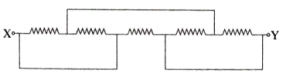
In the network shown in the figure,the equivalent resistance between points $X$ and $Y$ will be . . . . . . $\Omega$. The value of each resistor is $2 \Omega$.
A
$1$
B
$2$
C
$4$
D
$\frac{2}{3}$
Solution
(A) To find the equivalent resistance between points $X$ and $Y$,we first simplify the circuit by identifying parallel and series combinations.
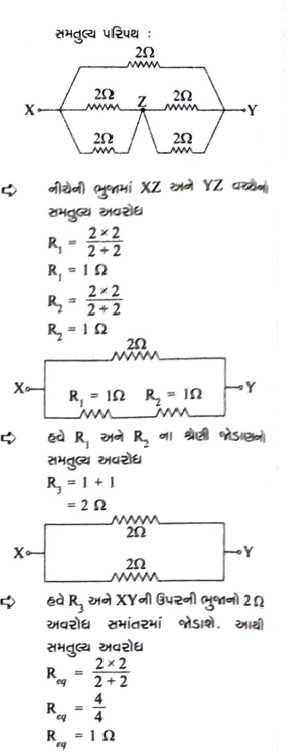
$1$. The circuit can be redrawn by identifying nodes. Let the node between the middle resistors be $Z$.
$2$. The resistors connected in parallel between $X$ and $Z$ have a resistance of $R_1 = \frac{2 \times 2}{2 + 2} = 1 \Omega$.
$3$. Similarly,the resistors connected in parallel between $Z$ and $Y$ have a resistance of $R_2 = \frac{2 \times 2}{2 + 2} = 1 \Omega$.
$4$. Now,$R_1$ and $R_2$ are in series,so their equivalent resistance is $R_3 = R_1 + R_2 = 1 + 1 = 2 \Omega$.
$5$. Finally,this $R_3$ is in parallel with the top resistor of $2 \Omega$ connected directly between $X$ and $Y$. Thus,the total equivalent resistance $R_{eq}$ is:
$R_{eq} = \frac{R_3 \times 2}{R_3 + 2} = \frac{2 \times 2}{2 + 2} = \frac{4}{4} = 1 \Omega$.
$1$. The circuit can be redrawn by identifying nodes. Let the node between the middle resistors be $Z$.
$2$. The resistors connected in parallel between $X$ and $Z$ have a resistance of $R_1 = \frac{2 \times 2}{2 + 2} = 1 \Omega$.
$3$. Similarly,the resistors connected in parallel between $Z$ and $Y$ have a resistance of $R_2 = \frac{2 \times 2}{2 + 2} = 1 \Omega$.
$4$. Now,$R_1$ and $R_2$ are in series,so their equivalent resistance is $R_3 = R_1 + R_2 = 1 + 1 = 2 \Omega$.
$5$. Finally,this $R_3$ is in parallel with the top resistor of $2 \Omega$ connected directly between $X$ and $Y$. Thus,the total equivalent resistance $R_{eq}$ is:
$R_{eq} = \frac{R_3 \times 2}{R_3 + 2} = \frac{2 \times 2}{2 + 2} = \frac{4}{4} = 1 \Omega$.
0 likesView Solution
9
PhysicsEasyMCQGUJCET · 2019
The heat produced per unit time,on passing electric current through a conductor at a given temperature,is directly proportional to . . . . . . .
A
square of electric current
B
electric current
C
reciprocal of electric current
D
reciprocal of square of electric current.
Solution
(A) The heat produced per unit time in a conductor is defined as the electric power $P$ dissipated in the conductor.
According to Joule's law of heating,the power dissipated is given by the formula:
$P = I^2 R$
where $I$ is the electric current and $R$ is the resistance of the conductor.
Since the temperature is constant,the resistance $R$ remains constant.
Therefore,the heat produced per unit time is directly proportional to the square of the electric current $(P \propto I^2)$.
Thus,the correct option is $A$.
According to Joule's law of heating,the power dissipated is given by the formula:
$P = I^2 R$
where $I$ is the electric current and $R$ is the resistance of the conductor.
Since the temperature is constant,the resistance $R$ remains constant.
Therefore,the heat produced per unit time is directly proportional to the square of the electric current $(P \propto I^2)$.
Thus,the correct option is $A$.
0 likesView Solution
10
PhysicsEasyMCQGUJCET · 2019
An electric dipole is placed in a non-uniform electric field,then . . . . . . .
A
The resultant force acting on the dipole may be zero.
B
The resultant force acting on the dipole is always zero.
C
Torque acting on it may be zero.
D
Torque acting on it is always zero.
Solution
(C) In a non-uniform electric field,the electric field strength varies at different points.
For an electric dipole,the force on the positive charge $(+q)$ is $F_+ = qE_+$ and on the negative charge $(-q)$ is $F_- = -qE_-$.
The net force is $F_{net} = q(E_+ - E_-)$. Since the field is non-uniform,$E_+ \neq E_-$,so the net force is generally non-zero.
However,if the dipole is placed such that the field strength at both charges is equal (even if the field is non-uniform elsewhere),the net force could be zero.
Regarding torque,$\tau = p \times E$. If the dipole moment $p$ is parallel or anti-parallel to the electric field $E$ at the location of the dipole,the torque $\tau = pE \sin(\theta)$ becomes zero because $\theta = 0^\circ$ or $180^\circ$.
Thus,the torque acting on the dipole may be zero.
For an electric dipole,the force on the positive charge $(+q)$ is $F_+ = qE_+$ and on the negative charge $(-q)$ is $F_- = -qE_-$.
The net force is $F_{net} = q(E_+ - E_-)$. Since the field is non-uniform,$E_+ \neq E_-$,so the net force is generally non-zero.
However,if the dipole is placed such that the field strength at both charges is equal (even if the field is non-uniform elsewhere),the net force could be zero.
Regarding torque,$\tau = p \times E$. If the dipole moment $p$ is parallel or anti-parallel to the electric field $E$ at the location of the dipole,the torque $\tau = pE \sin(\theta)$ becomes zero because $\theta = 0^\circ$ or $180^\circ$.
Thus,the torque acting on the dipole may be zero.
0 likesView Solution
11
PhysicsEasyMCQGUJCET · 2019
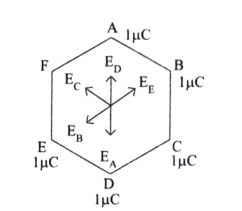
$A$ charge of $1 \mu C$ each is placed on five corners of a regular hexagon of side $1 \ m$. The electric field at its centre is . . . . . . $N$/$C$.
A
$\frac{6}{5} \times 10^{-6} k$
B
$\frac{5}{6} \times 10^{-6} k$
C
$5 \times 10^{-6} k$
D
$10^{-6} k$
Solution
(D) In a regular hexagon,the distance from each corner to the centre is equal to the side length of the hexagon,$r = 1 \ m$.
Let the corners be $A, B, C, D, E, F$ and let the charge be missing at corner $F$.
The electric field due to a charge $q$ at a corner is $E = \frac{kq}{r^2}$ directed away from the charge.
The electric field due to the charge at $A$ $(E_A)$ and the charge at $D$ $(E_D)$ are equal in magnitude and opposite in direction,so they cancel each other out.
Similarly,the electric field due to the charge at $B$ $(E_B)$ and the charge at $E$ $(E_E)$ are equal in magnitude and opposite in direction,so they cancel each other out.
The net electric field at the centre is due to the charge at corner $C$ only.
$E_{net} = E_C = \frac{kq}{r^2}$
Given $q = 1 \mu C = 10^{-6} \ C$ and $r = 1 \ m$:
$E_{net} = \frac{k \times 10^{-6}}{(1)^2} = 10^{-6} k \ N/C$.
Let the corners be $A, B, C, D, E, F$ and let the charge be missing at corner $F$.
The electric field due to a charge $q$ at a corner is $E = \frac{kq}{r^2}$ directed away from the charge.
The electric field due to the charge at $A$ $(E_A)$ and the charge at $D$ $(E_D)$ are equal in magnitude and opposite in direction,so they cancel each other out.
Similarly,the electric field due to the charge at $B$ $(E_B)$ and the charge at $E$ $(E_E)$ are equal in magnitude and opposite in direction,so they cancel each other out.
The net electric field at the centre is due to the charge at corner $C$ only.
$E_{net} = E_C = \frac{kq}{r^2}$
Given $q = 1 \mu C = 10^{-6} \ C$ and $r = 1 \ m$:
$E_{net} = \frac{k \times 10^{-6}}{(1)^2} = 10^{-6} k \ N/C$.
0 likesView Solution
12
PhysicsEasyMCQGUJCET · 2019
When two spheres having $4 Q$ and $-2 Q$ charge are placed at a certain distance,the force acting between them is $F$. Now they are connected by a conducting wire and again separated from each other. Now they are kept at a distance half of the previous one. The force acting between them is . . . . . . .
A
$\frac{F}{2}$
B
$F$
C
$\frac{F}{4}$
D
$\frac{F}{8}$
Solution
(A) Initial force between the spheres is given by Coulomb's law:
$F = \frac{k(4Q)(2Q)}{r^2} = \frac{8kQ^2}{r^2} \quad \dots(1)$
When the spheres are connected by a conducting wire,the total charge is redistributed equally between them:
$Q_{new} = \frac{4Q + (-2Q)}{2} = \frac{2Q}{2} = Q$
Now,the new distance is $r' = \frac{r}{2}$. The new force $F'$ is:
$F' = \frac{k(Q)(Q)}{(r/2)^2} = \frac{kQ^2}{r^2/4} = \frac{4kQ^2}{r^2}$
From equation $(1)$,we know $\frac{kQ^2}{r^2} = \frac{F}{8}$.
Substituting this into the expression for $F'$:
$F' = 4 \times \left(\frac{F}{8}\right) = \frac{F}{2}$
$F = \frac{k(4Q)(2Q)}{r^2} = \frac{8kQ^2}{r^2} \quad \dots(1)$
When the spheres are connected by a conducting wire,the total charge is redistributed equally between them:
$Q_{new} = \frac{4Q + (-2Q)}{2} = \frac{2Q}{2} = Q$
Now,the new distance is $r' = \frac{r}{2}$. The new force $F'$ is:
$F' = \frac{k(Q)(Q)}{(r/2)^2} = \frac{kQ^2}{r^2/4} = \frac{4kQ^2}{r^2}$
From equation $(1)$,we know $\frac{kQ^2}{r^2} = \frac{F}{8}$.
Substituting this into the expression for $F'$:
$F' = 4 \times \left(\frac{F}{8}\right) = \frac{F}{2}$
0 likesView Solution
13
PhysicsEasyMCQGUJCET · 2019
$A$ coil of surface area $200 \ cm^2$ having $25$ turns is held perpendicular to the magnetic field of intensity $0.02 \ Wb/m^2$. The resistance of the coil is $1 \ \Omega$. If it is removed from the magnetic field in $1 \ s$,the induced charge in the coil is . . . . . . $C$.
A
$0.1$
B
$1.0$
C
$0.01$
D
$0.001$
Solution
(C) The induced charge $Q$ in a coil is given by the formula $Q = \frac{\Delta \phi}{R}$,where $\Delta \phi$ is the change in magnetic flux and $R$ is the resistance of the coil.
Given:
Number of turns $N = 25$
Area $A = 200 \ cm^2 = 200 \times 10^{-4} \ m^2 = 0.02 \ m^2$
Magnetic field $B = 0.02 \ Wb/m^2$
Resistance $R = 1 \ \Omega$
Time $t = 1 \ s$
Initial flux $\phi_i = N B A \cos(0^\circ) = 25 \times 0.02 \times 0.02 = 0.01 \ Wb$
Final flux $\phi_f = 0 \ Wb$ (since it is removed from the field)
Change in flux $\Delta \phi = |\phi_f - \phi_i| = 0.01 \ Wb$
Induced charge $Q = \frac{\Delta \phi}{R} = \frac{0.01 \ Wb}{1 \ \Omega} = 0.01 \ C$.
Given:
Number of turns $N = 25$
Area $A = 200 \ cm^2 = 200 \times 10^{-4} \ m^2 = 0.02 \ m^2$
Magnetic field $B = 0.02 \ Wb/m^2$
Resistance $R = 1 \ \Omega$
Time $t = 1 \ s$
Initial flux $\phi_i = N B A \cos(0^\circ) = 25 \times 0.02 \times 0.02 = 0.01 \ Wb$
Final flux $\phi_f = 0 \ Wb$ (since it is removed from the field)
Change in flux $\Delta \phi = |\phi_f - \phi_i| = 0.01 \ Wb$
Induced charge $Q = \frac{\Delta \phi}{R} = \frac{0.01 \ Wb}{1 \ \Omega} = 0.01 \ C$.
0 likesView Solution
14
PhysicsEasyMCQGUJCET · 2019
$A$ wheel of radius $2 \, m$ having $8$ conducting concentric spokes is rotating about its geometrical axis with an angular velocity of $10 \, rad \, s^{-1}$ in a uniform magnetic field of $0.2 \, T$ perpendicular to its plane. The value of induced emf between the rim of the wheel and the centre is . . . . . . $V$.
A
$4$
B
$2$
C
$6$
D
$8$
Solution
(A) The induced electromotive force $(\varepsilon)$ across a rotating conducting spoke in a magnetic field is given by the formula: $\varepsilon = \frac{1}{2} B \omega R^2$.
Given values are:
Magnetic field $(B)$ = $0.2 \, T$
Angular velocity $(\omega)$ = $10 \, rad \, s^{-1}$
Radius $(R)$ = $2 \, m$
Substituting these values into the formula:
$\varepsilon = \frac{1}{2} \times 0.2 \times 10 \times (2)^2$
$\varepsilon = 0.1 \times 10 \times 4$
$\varepsilon = 4 \, V$
The number of spokes does not affect the potential difference between the rim and the center, as they are connected in parallel.
Given values are:
Magnetic field $(B)$ = $0.2 \, T$
Angular velocity $(\omega)$ = $10 \, rad \, s^{-1}$
Radius $(R)$ = $2 \, m$
Substituting these values into the formula:
$\varepsilon = \frac{1}{2} \times 0.2 \times 10 \times (2)^2$
$\varepsilon = 0.1 \times 10 \times 4$
$\varepsilon = 4 \, V$
The number of spokes does not affect the potential difference between the rim and the center, as they are connected in parallel.
0 likesView Solution
15
PhysicsEasyMCQGUJCET · 2019
The range of wavelength for $X$-rays is from . . . . . . .
A
$1 \, mm$ to $700 \, nm$
B
$700 \, nm$ to $400 \, nm$
C
$400 \, nm$ to $1 \, nm$
D
$1 \, nm$ to $10^{-3} \, nm$
Solution
(D) The electromagnetic spectrum classifies waves based on their wavelength and frequency. $X$-rays are high-energy electromagnetic waves that occupy the region between ultraviolet rays and gamma rays. The typical wavelength range for $X$-rays is approximately $1 \, nm$ to $10^{-3} \, nm$ ($0.1 \, \text{\AA}$ to $10 \, \text{\AA}$). Therefore, option $D$ is the correct answer.
0 likesView Solution
16
PhysicsEasyMCQGUJCET · 2019
$A$ moving positive charge approaches a negative charge. What will happen to the potential energy of the system?
A
will increase
B
will remain constant
C
will decrease
D
May increase or decrease
Solution
(C) The electrostatic potential energy $U$ of a system of two point charges $q_1$ and $q_2$ separated by a distance $r$ is given by the formula: $U = \frac{k q_1 q_2}{r}$.
Here,the charges are $q_1 = +q$ and $q_2 = -q$. Therefore,the potential energy is $U = \frac{k(q)(-q)}{r} = -\frac{k q^2}{r}$.
As the positive charge approaches the negative charge,the separation distance $r$ decreases.
Since $r$ is in the denominator and the potential energy is negative,as $r$ decreases,the magnitude of the negative value increases,which means the value of $U$ becomes more negative.
Therefore,the potential energy of the system decreases.
Here,the charges are $q_1 = +q$ and $q_2 = -q$. Therefore,the potential energy is $U = \frac{k(q)(-q)}{r} = -\frac{k q^2}{r}$.
As the positive charge approaches the negative charge,the separation distance $r$ decreases.
Since $r$ is in the denominator and the potential energy is negative,as $r$ decreases,the magnitude of the negative value increases,which means the value of $U$ becomes more negative.
Therefore,the potential energy of the system decreases.
0 likesView Solution
17
PhysicsEasyMCQGUJCET · 2019
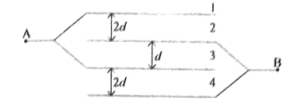
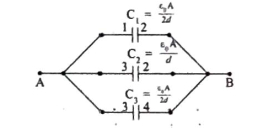
In the figure,the area of each plate is $A$ and the distance between consecutive plates is as shown in the figure. What is the effective capacitance between points $A$ and $B$?
A
$\frac{2 A \varepsilon_0}{d}$
B
$\frac{A \varepsilon_0}{d}$
C
$\frac{3 A \varepsilon_0}{d}$
D
$\frac{4 A \varepsilon_0}{d}$
Solution
(A) The given system consists of four plates. Let the plates be numbered $1, 2, 3, 4$ from top to bottom.
From the figure,plates $1$ and $3$ are connected to point $A$,and plates $2$ and $4$ are connected to point $B$.
This forms three parallel plate capacitors connected in parallel:
$1$. Capacitor formed by plates $1$ and $2$ with separation $2d$: $C_1 = \frac{A \varepsilon_0}{2d}$
$2$. Capacitor formed by plates $2$ and $3$ with separation $d$: $C_2 = \frac{A \varepsilon_0}{d}$
$3$. Capacitor formed by plates $3$ and $4$ with separation $2d$: $C_3 = \frac{A \varepsilon_0}{2d}$
Since these capacitors are connected in parallel,the equivalent capacitance $C_{AB}$ is:
$C_{AB} = C_1 + C_2 + C_3$
$C_{AB} = \frac{A \varepsilon_0}{2d} + \frac{A \varepsilon_0}{d} + \frac{A \varepsilon_0}{2d}$
$C_{AB} = \frac{A \varepsilon_0 + 2A \varepsilon_0 + A \varepsilon_0}{2d} = \frac{4A \varepsilon_0}{2d} = \frac{2A \varepsilon_0}{d}$
Thus,the correct option is $(A)$.
From the figure,plates $1$ and $3$ are connected to point $A$,and plates $2$ and $4$ are connected to point $B$.
This forms three parallel plate capacitors connected in parallel:
$1$. Capacitor formed by plates $1$ and $2$ with separation $2d$: $C_1 = \frac{A \varepsilon_0}{2d}$
$2$. Capacitor formed by plates $2$ and $3$ with separation $d$: $C_2 = \frac{A \varepsilon_0}{d}$
$3$. Capacitor formed by plates $3$ and $4$ with separation $2d$: $C_3 = \frac{A \varepsilon_0}{2d}$
Since these capacitors are connected in parallel,the equivalent capacitance $C_{AB}$ is:
$C_{AB} = C_1 + C_2 + C_3$
$C_{AB} = \frac{A \varepsilon_0}{2d} + \frac{A \varepsilon_0}{d} + \frac{A \varepsilon_0}{2d}$
$C_{AB} = \frac{A \varepsilon_0 + 2A \varepsilon_0 + A \varepsilon_0}{2d} = \frac{4A \varepsilon_0}{2d} = \frac{2A \varepsilon_0}{d}$
Thus,the correct option is $(A)$.
0 likesView Solution
18
PhysicsEasyMCQGUJCET · 2019
The unit of intensity of polarization is . . . . . . .
A
$C^2/m$
B
$C/m^2$
C
$C^2/m^2$
D
$m^2/C$
Solution
(B) The intensity of polarization $P$ is defined as the dipole moment per unit volume.
$P = \frac{p_{\text{total}}}{V} = \frac{q \cdot d}{A \cdot d} = \frac{q}{A}$
Since the unit of charge $q$ is Coulomb $(C)$ and the unit of area $A$ is square meter $(m^2)$,the unit of intensity of polarization is $C/m^2$.
Therefore,the correct option is $B$.
$P = \frac{p_{\text{total}}}{V} = \frac{q \cdot d}{A \cdot d} = \frac{q}{A}$
Since the unit of charge $q$ is Coulomb $(C)$ and the unit of area $A$ is square meter $(m^2)$,the unit of intensity of polarization is $C/m^2$.
Therefore,the correct option is $B$.
0 likesView Solution
19
PhysicsEasyMCQGUJCET · 2019
Alnico is an alloy of . . . . . . .
A
Al,Ni,As,$P$
B
$Al, Ni, Cu, P$
C
$Al, Ni, Cu, Co$
D
$Al, As, P, Pt$
Solution
(C) The correct option is $C$.
Alnico is a family of iron alloys which are primarily composed of Aluminum $(Al)$,Nickel $(Ni)$,Copper $(Cu)$,and Cobalt $(Co)$.
It is widely used for making permanent magnets due to its high coercivity and remanence.
Alnico is a family of iron alloys which are primarily composed of Aluminum $(Al)$,Nickel $(Ni)$,Copper $(Cu)$,and Cobalt $(Co)$.
It is widely used for making permanent magnets due to its high coercivity and remanence.
0 likesView Solution
20
PhysicsEasyMCQGUJCET · 2019
The gyromagnetic ratio of an electron is equal to . . . . . . times the specific charge of an electron.
A
$1/2$
B
$1$
C
$2$
D
$4$
Solution
(A) The gyromagnetic ratio is defined as the ratio of the magnetic dipole moment $\mu$ to the angular momentum $L$ of an electron.
For an electron orbiting a nucleus,$\mu = \frac{e}{2m} L$.
Therefore,the gyromagnetic ratio $\gamma = \frac{\mu}{L} = \frac{e}{2m}$.
The specific charge of an electron is defined as $\frac{e}{m}$.
Comparing the two expressions,we get $\gamma = \frac{1}{2} \times (\frac{e}{m})$.
Thus,the gyromagnetic ratio is $1/2$ times the specific charge of an electron.
For an electron orbiting a nucleus,$\mu = \frac{e}{2m} L$.
Therefore,the gyromagnetic ratio $\gamma = \frac{\mu}{L} = \frac{e}{2m}$.
The specific charge of an electron is defined as $\frac{e}{m}$.
Comparing the two expressions,we get $\gamma = \frac{1}{2} \times (\frac{e}{m})$.
Thus,the gyromagnetic ratio is $1/2$ times the specific charge of an electron.
0 likesView Solution
21
PhysicsEasyMCQGUJCET · 2019
There are $50$ turns per $cm$ length in a very long solenoid. It carries a current of $2.5 \ A$. The magnetic field at its centre on the axis is . . . . . . $T$.
A
$2 \pi \times 10^{-3}$
B
$5 \pi \times 10^{-3}$
C
$6 \pi \times 10^{-3}$
D
$4 \pi \times 10^{-3}$
Solution
(B) The magnetic field $B$ at the center of a long solenoid is given by the formula $B = \mu_0 n I$,where $n$ is the number of turns per unit length and $I$ is the current.
Given:
Number of turns per unit length $n = 50 \text{ turns/cm} = 50 \times 10^2 \text{ turns/m} = 5000 \text{ turns/m}$.
Current $I = 2.5 \ A$.
Permeability of free space $\mu_0 = 4 \pi \times 10^{-7} \ T \cdot m/A$.
Substituting the values:
$B = (4 \pi \times 10^{-7}) \times (5000) \times (2.5)$
$B = 4 \pi \times 10^{-7} \times 12500$
$B = 4 \pi \times 1.25 \times 10^{-3}$
$B = 5 \pi \times 10^{-3} \ T$.
Given:
Number of turns per unit length $n = 50 \text{ turns/cm} = 50 \times 10^2 \text{ turns/m} = 5000 \text{ turns/m}$.
Current $I = 2.5 \ A$.
Permeability of free space $\mu_0 = 4 \pi \times 10^{-7} \ T \cdot m/A$.
Substituting the values:
$B = (4 \pi \times 10^{-7}) \times (5000) \times (2.5)$
$B = 4 \pi \times 10^{-7} \times 12500$
$B = 4 \pi \times 1.25 \times 10^{-3}$
$B = 5 \pi \times 10^{-3} \ T$.
0 likesView Solution
22
PhysicsEasyMCQGUJCET · 2019
If the radii of ${}_{13}^{27}Al$ and ${}_{30}^{64}Zn$ nuclei are $R_{1}$ and $R_{2}$ respectively,then $\frac{R_{1}}{R_{2}} = $
A
$\frac{64}{27}$
B
$\frac{3}{4}$
C
$\frac{27}{64}$
D
$\frac{4}{3}$
Solution
(B) The radius of a nucleus is given by the formula $R = R_{0} A^{1/3}$,where $A$ is the mass number and $R_{0}$ is a constant.
For ${}_{13}^{27}Al$,the mass number $A_{1} = 27$.
For ${}_{30}^{64}Zn$,the mass number $A_{2} = 64$.
Taking the ratio of the radii:
$\frac{R_{1}}{R_{2}} = \frac{R_{0} A_{1}^{1/3}}{R_{0} A_{2}^{1/3}} = \left(\frac{A_{1}}{A_{2}}\right)^{1/3}$
Substituting the values:
$\frac{R_{1}}{R_{2}} = \left(\frac{27}{64}\right)^{1/3}$
Since $27 = 3^{3}$ and $64 = 4^{3}$,we have:
$\frac{R_{1}}{R_{2}} = \left(\frac{3^{3}}{4^{3}}\right)^{1/3} = \frac{3}{4}$
Thus,the correct option is $B$.
For ${}_{13}^{27}Al$,the mass number $A_{1} = 27$.
For ${}_{30}^{64}Zn$,the mass number $A_{2} = 64$.
Taking the ratio of the radii:
$\frac{R_{1}}{R_{2}} = \frac{R_{0} A_{1}^{1/3}}{R_{0} A_{2}^{1/3}} = \left(\frac{A_{1}}{A_{2}}\right)^{1/3}$
Substituting the values:
$\frac{R_{1}}{R_{2}} = \left(\frac{27}{64}\right)^{1/3}$
Since $27 = 3^{3}$ and $64 = 4^{3}$,we have:
$\frac{R_{1}}{R_{2}} = \left(\frac{3^{3}}{4^{3}}\right)^{1/3} = \frac{3}{4}$
Thus,the correct option is $B$.
0 likesView Solution
23
PhysicsEasyMCQGUJCET · 2019
If the tube length of an astronomical telescope is $96 \ cm$ and the magnifying power is $15$ for normal setting,then the focal length of the objective is . . . . . . $cm$.
A
$92$
B
$105$
C
$90$
D
$100$
Solution
(C) For an astronomical telescope in normal adjustment,the tube length $L$ is given by $L = f_o + f_e = 96 \ cm$.
The magnifying power $m$ is given by $m = \frac{f_o}{f_e} = 15$.
From the second equation,$f_e = \frac{f_o}{15}$.
Substituting this into the first equation: $f_o + \frac{f_o}{15} = 96$.
$\frac{16 f_o}{15} = 96$.
$f_o = \frac{96 \times 15}{16} = 6 \times 15 = 90 \ cm$.
The magnifying power $m$ is given by $m = \frac{f_o}{f_e} = 15$.
From the second equation,$f_e = \frac{f_o}{15}$.
Substituting this into the first equation: $f_o + \frac{f_o}{15} = 96$.
$\frac{16 f_o}{15} = 96$.
$f_o = \frac{96 \times 15}{16} = 6 \times 15 = 90 \ cm$.
0 likesView Solution
24
PhysicsEasyMCQGUJCET · 2019
Time taken by the sunlight to pass through a slab of $4 \ cm$ and refractive index $1.5$ is . . . . . . $s$.
A
$2 \times 10^{-11}$
B
$2 \times 10^{-10}$
C
$2 \times 10^{-12}$
D
$2 \times 10^{-8}$
Solution
(B) The refractive index $n$ is defined as the ratio of the speed of light in vacuum $c$ to the speed of light in the medium $v$,given by $n = \frac{c}{v}$.
Since the speed $v$ is the distance $d$ traveled per unit time $t$,we have $v = \frac{d}{t}$.
Substituting this into the refractive index formula: $n = \frac{c}{d/t} = \frac{ct}{d}$.
Rearranging to solve for time $t$: $t = \frac{nd}{c}$.
Given: $n = 1.5$,$d = 4 \ cm = 4 \times 10^{-2} \ m$,and $c = 3 \times 10^{8} \ m/s$.
Substituting the values: $t = \frac{1.5 \times 4 \times 10^{-2}}{3 \times 10^{8}}$.
$t = \frac{6 \times 10^{-2}}{3 \times 10^{8}} = 2 \times 10^{-10} \ s$.
Since the speed $v$ is the distance $d$ traveled per unit time $t$,we have $v = \frac{d}{t}$.
Substituting this into the refractive index formula: $n = \frac{c}{d/t} = \frac{ct}{d}$.
Rearranging to solve for time $t$: $t = \frac{nd}{c}$.
Given: $n = 1.5$,$d = 4 \ cm = 4 \times 10^{-2} \ m$,and $c = 3 \times 10^{8} \ m/s$.
Substituting the values: $t = \frac{1.5 \times 4 \times 10^{-2}}{3 \times 10^{8}}$.
$t = \frac{6 \times 10^{-2}}{3 \times 10^{8}} = 2 \times 10^{-10} \ s$.
0 likesView Solution
25
PhysicsEasyMCQGUJCET · 2019
The focal length of a thin lens made from a material of refractive index $1.5$ is $15 \ cm$. When it is placed in a liquid of refractive index $\frac{4}{3}$,its focal length will be $..........\ cm$.
A
$78.23$
B
$80.31$
C
$50$
D
$60$
Solution
(D) The Lens Maker's Formula is given by $\frac{1}{f} = (n_{rel} - 1) \left( \frac{1}{R_1} - \frac{1}{R_2} \right)$,where $n_{rel} = \frac{n_{lens}}{n_{medium}}$.
In air $(n_a = 1)$: $\frac{1}{15} = (1.5 - 1) \left( \frac{1}{R_1} - \frac{1}{R_2} \right) = 0.5 \left( \frac{1}{R_1} - \frac{1}{R_2} \right)$.
Thus,$\left( \frac{1}{R_1} - \frac{1}{R_2} \right) = \frac{1}{15 \times 0.5} = \frac{1}{7.5} \ cm^{-1}$.
In liquid $(n_w = \frac{4}{3})$: $\frac{1}{f_w} = \left( \frac{1.5}{4/3} - 1 \right) \left( \frac{1}{R_1} - \frac{1}{R_2} \right)$.
$\frac{1}{f_w} = \left( \frac{4.5}{4} - 1 \right) \left( \frac{1}{7.5} \right) = \left( \frac{0.5}{4} \right) \left( \frac{1}{7.5} \right) = \frac{1}{8} \times \frac{1}{7.5} = \frac{1}{60}$.
Therefore,$f_w = 60 \ cm$.
In air $(n_a = 1)$: $\frac{1}{15} = (1.5 - 1) \left( \frac{1}{R_1} - \frac{1}{R_2} \right) = 0.5 \left( \frac{1}{R_1} - \frac{1}{R_2} \right)$.
Thus,$\left( \frac{1}{R_1} - \frac{1}{R_2} \right) = \frac{1}{15 \times 0.5} = \frac{1}{7.5} \ cm^{-1}$.
In liquid $(n_w = \frac{4}{3})$: $\frac{1}{f_w} = \left( \frac{1.5}{4/3} - 1 \right) \left( \frac{1}{R_1} - \frac{1}{R_2} \right)$.
$\frac{1}{f_w} = \left( \frac{4.5}{4} - 1 \right) \left( \frac{1}{7.5} \right) = \left( \frac{0.5}{4} \right) \left( \frac{1}{7.5} \right) = \frac{1}{8} \times \frac{1}{7.5} = \frac{1}{60}$.
Therefore,$f_w = 60 \ cm$.
0 likesView Solution
26
PhysicsEasyMCQGUJCET · 2019
For a $pn$ junction,the width of the space charge region (depletion layer) is approximately $\qquad$ $\mu m$.
A
$0.5$
B
$6$
C
$5$
D
$0.05$
Solution
(A) The space charge region,also known as the depletion layer,is formed at the interface of $p$-type and $n$-type semiconductors.
In a typical $pn$ junction diode,the width of this depletion layer is very small.
It is generally on the order of $10^{-6} \ m$,which is equivalent to $1 \ \mu m$.
Specifically,the width of the depletion region is typically in the range of $0.1 \ \mu m$ to $1 \ \mu m$.
Among the given options,$0.5 \ \mu m$ is the most appropriate value representing the typical width of the space charge region.
In a typical $pn$ junction diode,the width of this depletion layer is very small.
It is generally on the order of $10^{-6} \ m$,which is equivalent to $1 \ \mu m$.
Specifically,the width of the depletion region is typically in the range of $0.1 \ \mu m$ to $1 \ \mu m$.
Among the given options,$0.5 \ \mu m$ is the most appropriate value representing the typical width of the space charge region.
0 likesView Solution
27
PhysicsEasyMCQGUJCET · 2019
For a $p-n$ junction,the intensity of the electric field is $1 \times 10^{6} \text{ V/m}$ and the width of the depletion region is $5000 \text{ Å}$. The value of the potential barrier is $\dots \text{ V}$.
A
$0.05$
B
$0.005$
C
$0.5$
D
$5$
Solution
(C) The potential barrier $V$ is related to the electric field $E$ and the width of the depletion region $d$ by the formula $V = E \cdot d$.
Given:
Electric field $E = 1 \times 10^{6} \text{ V/m}$
Width $d = 5000 \text{ Å} = 5000 \times 10^{-10} \text{ m} = 5 \times 10^{-7} \text{ m}$
Substituting the values:
$V = (1 \times 10^{6} \text{ V/m}) \times (5 \times 10^{-7} \text{ m})$
$V = 5 \times 10^{-1} \text{ V}$
$V = 0.5 \text{ V}$
Therefore,the correct option is $C$.
Given:
Electric field $E = 1 \times 10^{6} \text{ V/m}$
Width $d = 5000 \text{ Å} = 5000 \times 10^{-10} \text{ m} = 5 \times 10^{-7} \text{ m}$
Substituting the values:
$V = (1 \times 10^{6} \text{ V/m}) \times (5 \times 10^{-7} \text{ m})$
$V = 5 \times 10^{-1} \text{ V}$
$V = 0.5 \text{ V}$
Therefore,the correct option is $C$.
0 likesView Solution
28
PhysicsEasyMCQGUJCET · 2019
The angular spread of the central maximum in a diffraction pattern does not depend on . . . . . . .
A
wavelength of light
B
the distance between the slit and the source
C
width of the slit
D
frequency of light
Solution
(B) The angular width of the central maximum in a single-slit diffraction pattern is given by the formula $\theta = \frac{2\lambda}{a}$,where $\lambda$ is the wavelength of light and $a$ is the width of the slit.
Since the frequency $f$ is related to wavelength by $\lambda = \frac{c}{f}$,the angular width also depends on the frequency.
The formula shows that the angular spread depends on the wavelength (and thus frequency) and the slit width.
It does not depend on the distance between the slit and the source or the distance between the slit and the screen.
Therefore,the correct option is $B$.
Since the frequency $f$ is related to wavelength by $\lambda = \frac{c}{f}$,the angular width also depends on the frequency.
The formula shows that the angular spread depends on the wavelength (and thus frequency) and the slit width.
It does not depend on the distance between the slit and the source or the distance between the slit and the screen.
Therefore,the correct option is $B$.
0 likesView Solution
29
PhysicsEasyMCQGUJCET · 2019
In Young's experiment,the fourth bright fringe produced by light of $5000 \mathring{A}$ superposes on the fifth bright fringe of an unknown wavelength. The unknown wavelength is . . . . . . $\mathring{A}$.
A
$5000$
B
$4000$
C
$6000$
D
$8000$
Solution
(B) The condition for the $n$-th bright fringe in Young's Double Slit Experiment is given by $y_n = \frac{n \lambda D}{d}$.
Since the fringes superpose,their positions must be equal: $y_4 = y_5$.
Therefore,$n_1 \lambda_1 = n_2 \lambda_2$.
Given $n_1 = 4$,$\lambda_1 = 5000 \ \mathring{A}$,and $n_2 = 5$.
Substituting the values: $4 \times 5000 = 5 \times \lambda_2$.
$\lambda_2 = \frac{4 \times 5000}{5} = 4000 \ \mathring{A}$.
Since the fringes superpose,their positions must be equal: $y_4 = y_5$.
Therefore,$n_1 \lambda_1 = n_2 \lambda_2$.
Given $n_1 = 4$,$\lambda_1 = 5000 \ \mathring{A}$,and $n_2 = 5$.
Substituting the values: $4 \times 5000 = 5 \times \lambda_2$.
$\lambda_2 = \frac{4 \times 5000}{5} = 4000 \ \mathring{A}$.
0 likesView Solution
Vedclass Products
For Students
Vedclass Test Series
Mock tests in real GUJCET style covering Physics with performance analysis. 5-day free trial.
Start Free TrialFor Teachers
Exam Paper Generator
Generate Set A/B/C/D Physics papers from 7.5L+ questions in 2 minutes. 3 chapters free.
Try FreeFor Institutes
Online Exam Module
Run live GUJCET mock exams with unlimited students, 360° analytics & white-label branding.
See DemoFrequently Asked Questions
How many Physics questions are in GUJCET 2019?
There are 29 Physics questions from the GUJCET 2019 paper on Vedclass, each with a detailed step-by-step solution in English.
Are GUJCET 2019 Physics solutions available in English?
Yes. All solutions on this page are in English. You can also switch to English or Hindi using the language buttons above the questions.
Can I practice GUJCET 2019 Physics as a timed test?
Yes. Use the Vedclass Test Series to attempt a full GUJCET mock test covering Physics with time limits and instant score analysis.
Can teachers create Physics papers from GUJCET previous year questions?
Yes. The Vedclass Exam Paper Generator lets teachers mix GUJCET Physics questions and generate Set A/B/C/D papers in minutes.
For Teachers & Institutes
Build a Custom Physics Paper
Pick GUJCET 2019 Physics questions, set difficulty, and generate Set A/B/C/D in 2 minutes.