
PhysicsQ1–40 of 40 questions
Page 1 of 1 · English
1
PhysicsMediumMCQGUJCET · 2026
The dimensional formula of $\frac{B^2}{2\mu_0}$ is . . . . . . .
A
$M^1 L^{-1} T^{-2}$
B
$M^0 L^{-1} T^{-2}$
C
$M^1 L^2 T^{-2}$
D
$M^1 L^1 T^{-2}$
Solution
(A) The quantity $\frac{B^2}{2\mu_0}$ represents the magnetic energy density $(u_B)$,which is defined as the energy stored per unit volume in a magnetic field.
Energy $(E)$ has the dimensional formula $[ML^2T^{-2}]$.
Volume $(V)$ has the dimensional formula $[L^3]$.
Therefore,the dimensional formula for magnetic energy density is $\frac{[ML^2T^{-2}]}{[L^3]} = [ML^{-1}T^{-2}]$.
Thus,the correct option is $A$.
Energy $(E)$ has the dimensional formula $[ML^2T^{-2}]$.
Volume $(V)$ has the dimensional formula $[L^3]$.
Therefore,the dimensional formula for magnetic energy density is $\frac{[ML^2T^{-2}]}{[L^3]} = [ML^{-1}T^{-2}]$.
Thus,the correct option is $A$.
0 likesView Solution
2
PhysicsMediumMCQGUJCET · 2026
Out of the following physical quantities,which quantity has the same unit as that of Planck's constant?
A
moment of force
B
power
C
angular momentum
D
moment of inertia
Solution
(C) Planck's constant $(h)$ has the dimensions of action,which is defined as energy multiplied by time $(E \times t)$.
The $SI$ unit of energy is Joule $(J)$ and time is second $(s)$,so the unit of Planck's constant is $J \cdot s$.
Angular momentum $(L)$ is defined as the product of moment of inertia $(I)$ and angular velocity $(\omega)$,or $L = mvr$.
The dimensions of angular momentum are $[M L^2 T^{-1}]$,which are identical to the dimensions of Planck's constant.
Therefore,both Planck's constant and angular momentum have the same $SI$ unit,which is $kg \cdot m^2/s$ or $J \cdot s$.
Thus,the correct option is $C$.
The $SI$ unit of energy is Joule $(J)$ and time is second $(s)$,so the unit of Planck's constant is $J \cdot s$.
Angular momentum $(L)$ is defined as the product of moment of inertia $(I)$ and angular velocity $(\omega)$,or $L = mvr$.
The dimensions of angular momentum are $[M L^2 T^{-1}]$,which are identical to the dimensions of Planck's constant.
Therefore,both Planck's constant and angular momentum have the same $SI$ unit,which is $kg \cdot m^2/s$ or $J \cdot s$.
Thus,the correct option is $C$.
0 likesView Solution
3
PhysicsMediumMCQGUJCET · 2026
The nuclides of $^{197}_{79} \text{Au}$ and $^{198}_{80} \text{Hg}$ are called . . . . . . of each other.
A
isotopes
B
isotones
C
isobars
D
isomers
Solution
(B) To determine the relationship,we calculate the number of neutrons $(N)$ for each nuclide using the formula $N = A - Z$,where $A$ is the mass number and $Z$ is the atomic number.
For $^{197}_{79} \text{Au}$: $A = 197$,$Z = 79$. Thus,$N = 197 - 79 = 118$.
For $^{198}_{80} \text{Hg}$: $A = 198$,$Z = 80$. Thus,$N = 198 - 80 = 118$.
Since both nuclides have the same number of neutrons $(N = 118)$,they are classified as isotones.
For $^{197}_{79} \text{Au}$: $A = 197$,$Z = 79$. Thus,$N = 197 - 79 = 118$.
For $^{198}_{80} \text{Hg}$: $A = 198$,$Z = 80$. Thus,$N = 198 - 80 = 118$.
Since both nuclides have the same number of neutrons $(N = 118)$,they are classified as isotones.
0 likesView Solution
4
PhysicsMediumMCQGUJCET · 2026
$A$ charged particle oscillates about its mean equilibrium position with a frequency of $8 \times 10^9 \text{ Hz}$. What is the frequency of the electromagnetic waves produced by the oscillator?
A
$4 \times 10^9 \text{ Hz}$
B
$1.6 \times 10^{10} \text{ Hz}$
C
$8 \times 10^9 \text{ Hz}$
D
$2 \times 10^9 \text{ Hz}$
Solution
(C) An oscillating charge produces electromagnetic waves of the same frequency as the frequency of oscillation of the charge.
Since the frequency of the oscillating particle is $8 \times 10^9 \text{ Hz}$,the frequency of the electromagnetic waves produced will also be $8 \times 10^9 \text{ Hz}$.
Since the frequency of the oscillating particle is $8 \times 10^9 \text{ Hz}$,the frequency of the electromagnetic waves produced will also be $8 \times 10^9 \text{ Hz}$.
0 likesView Solution
5
PhysicsDifficultMCQGUJCET · 2026
In an ideal step-up transformer,the number of turns in the primary coil and secondary coil are $100$ and $200$ respectively. If the output current is found to be $5 \text{ A}$,then the input current will be . . . . . . . (in $\text{ A}$)
A
$2.5$
B
$100$
C
$5.0$
D
$10$
Solution
(D) In an ideal transformer,the input power is equal to the output power,so $V_p I_p = V_s I_s$.
For a transformer,the relationship between voltage,current,and number of turns is given by $\frac{V_s}{V_p} = \frac{N_s}{N_p} = \frac{I_p}{I_s}$.
Given values are $N_p = 100$,$N_s = 200$,and $I_s = 5 \text{ A}$.
Using the relation $\frac{I_p}{I_s} = \frac{N_s}{N_p}$,we get $I_p = I_s \times \frac{N_s}{N_p}$.
Substituting the values: $I_p = 5 \times \frac{200}{100} = 5 \times 2 = 10 \text{ A}$.
Therefore,the input current is $10 \text{ A}$.
For a transformer,the relationship between voltage,current,and number of turns is given by $\frac{V_s}{V_p} = \frac{N_s}{N_p} = \frac{I_p}{I_s}$.
Given values are $N_p = 100$,$N_s = 200$,and $I_s = 5 \text{ A}$.
Using the relation $\frac{I_p}{I_s} = \frac{N_s}{N_p}$,we get $I_p = I_s \times \frac{N_s}{N_p}$.
Substituting the values: $I_p = 5 \times \frac{200}{100} = 5 \times 2 = 10 \text{ A}$.
Therefore,the input current is $10 \text{ A}$.
0 likesView Solution
6
PhysicsDifficultMCQGUJCET · 2026
$A$ charged $30 \mu\text{F}$ capacitor is connected to a $27 \text{ mH}$ inductor. What is the angular frequency of free oscillations of the circuit (in $\text{ rad/s}$)?
A
$11$
B
$1100$
C
$110$
D
$11000$
Solution
(B) The angular frequency $\omega$ of free oscillations in an $LC$ circuit is given by the formula $\omega = \frac{1}{\sqrt{LC}}$.
Given values are $L = 27 \text{ mH} = 27 \times 10^{-3} \text{ H}$ and $C = 30 \mu\text{F} = 30 \times 10^{-6} \text{ F}$.
Substituting these values into the formula:
$\omega = \frac{1}{\sqrt{27 \times 10^{-3} \times 30 \times 10^{-6}}}$
$\omega = \frac{1}{\sqrt{810 \times 10^{-9}}}$
$\omega = \frac{1}{\sqrt{81 \times 10^{-8}}}$
$\omega = \frac{1}{9 \times 10^{-4}}$
$\omega = \frac{10^4}{9} \approx 1111.11 \text{ rad/s}$.
The closest option is $1100 \text{ rad/s}$.
Given values are $L = 27 \text{ mH} = 27 \times 10^{-3} \text{ H}$ and $C = 30 \mu\text{F} = 30 \times 10^{-6} \text{ F}$.
Substituting these values into the formula:
$\omega = \frac{1}{\sqrt{27 \times 10^{-3} \times 30 \times 10^{-6}}}$
$\omega = \frac{1}{\sqrt{810 \times 10^{-9}}}$
$\omega = \frac{1}{\sqrt{81 \times 10^{-8}}}$
$\omega = \frac{1}{9 \times 10^{-4}}$
$\omega = \frac{10^4}{9} \approx 1111.11 \text{ rad/s}$.
The closest option is $1100 \text{ rad/s}$.
0 likesView Solution
7
PhysicsDifficultMCQGUJCET · 2026
$A$ $15.0 \mu\text{F}$ capacitor is connected to a $220 \text{ V}$,$50 \text{ Hz}$ source. The capacitive reactance of the circuit is . . . . . . $\Omega$.
A
$2.12$
B
$212$
C
$21.2$
D
$2120$
Solution
(B) The capacitive reactance $X_C$ is given by the formula $X_C = \frac{1}{2\pi f C}$.
Given values are frequency $f = 50 \text{ Hz}$ and capacitance $C = 15.0 \mu\text{F} = 15.0 \times 10^{-6} \text{ F}$.
Substituting these values into the formula:
$X_C = \frac{1}{2 \times 3.14159 \times 50 \times 15.0 \times 10^{-6}}$
$X_C = \frac{1}{314.159 \times 15.0 \times 10^{-6}}$
$X_C = \frac{1}{4712.385 \times 10^{-6}}$
$X_C = \frac{10^6}{4712.385} \approx 212.2 \Omega$.
Rounding to the nearest integer,the capacitive reactance is $212 \Omega$.
Given values are frequency $f = 50 \text{ Hz}$ and capacitance $C = 15.0 \mu\text{F} = 15.0 \times 10^{-6} \text{ F}$.
Substituting these values into the formula:
$X_C = \frac{1}{2 \times 3.14159 \times 50 \times 15.0 \times 10^{-6}}$
$X_C = \frac{1}{314.159 \times 15.0 \times 10^{-6}}$
$X_C = \frac{1}{4712.385 \times 10^{-6}}$
$X_C = \frac{10^6}{4712.385} \approx 212.2 \Omega$.
Rounding to the nearest integer,the capacitive reactance is $212 \Omega$.
0 likesView Solution
8
PhysicsMediumMCQGUJCET · 2026
$A$ coil has $N$ turns and the current passing through it is $I$ ampere,resulting in a self-inductance of $L$ Henry. If the current is doubled,the new self-inductance will be . . . . . . $H$.
A
$L/2$
B
$2L$
C
$L$
D
$4L$
Solution
(C) The self-inductance $L$ of a coil is a property that depends solely on its physical geometry,such as the number of turns $N$,the cross-sectional area,the length of the coil,and the magnetic permeability of the core material.
It does not depend on the magnitude of the current $I$ flowing through the coil.
Therefore,if the current is doubled,the self-inductance remains unchanged.
Thus,the new self-inductance is $L$.
It does not depend on the magnitude of the current $I$ flowing through the coil.
Therefore,if the current is doubled,the self-inductance remains unchanged.
Thus,the new self-inductance is $L$.
0 likesView Solution
9
PhysicsMediumMCQGUJCET · 2026
Two concentric circular coils,one of small radius $r_1$ and the other of large radius $r_2$,such that $r_1 \ll r_2$,are placed co-axially with their centres coinciding. The mutual inductance $M$ of the arrangement is proportional to . . . . . . .
A
$\frac{r_1}{r_2}$
B
$\frac{r_2}{r_1}$
C
$\frac{r_1^2}{r_2}$
D
$\frac{r_2^2}{r_1}$
Solution
(C) The magnetic field $B$ at the center of a large circular coil of radius $r_2$ carrying current $I$ is given by $B = \frac{\mu_0 I}{2r_2}$.
Since $r_1 \ll r_2$,the magnetic field produced by the larger coil is approximately uniform over the area of the smaller coil.
The magnetic flux $\phi$ linked with the smaller coil of radius $r_1$ is $\phi = B \times A = \frac{\mu_0 I}{2r_2} \times (\pi r_1^2)$.
By definition,the mutual inductance $M$ is given by $M = \frac{\phi}{I}$.
Substituting the expression for $\phi$,we get $M = \frac{\mu_0 \pi r_1^2}{2r_2}$.
Therefore,the mutual inductance $M$ is proportional to $\frac{r_1^2}{r_2}$.
Since $r_1 \ll r_2$,the magnetic field produced by the larger coil is approximately uniform over the area of the smaller coil.
The magnetic flux $\phi$ linked with the smaller coil of radius $r_1$ is $\phi = B \times A = \frac{\mu_0 I}{2r_2} \times (\pi r_1^2)$.
By definition,the mutual inductance $M$ is given by $M = \frac{\phi}{I}$.
Substituting the expression for $\phi$,we get $M = \frac{\mu_0 \pi r_1^2}{2r_2}$.
Therefore,the mutual inductance $M$ is proportional to $\frac{r_1^2}{r_2}$.
0 likesView Solution
10
PhysicsMediumMCQGUJCET · 2026
The magnetic susceptibility $\chi$ for superconductors is . . . . . . .
A
Zero
B
$1$
C
$0.1$
D
-$1$
Solution
(D) Superconductors exhibit the Meissner effect,which means they are perfect diamagnetic materials.
For a perfect diamagnetic material,the internal magnetic field $B$ is equal to $0$.
Since $B = \mu_0(H + M) = 0$,we have $M = -H$.
The magnetic susceptibility $\chi$ is defined as the ratio of magnetization $M$ to the magnetic field intensity $H$,i.e.,$\chi = M/H$.
Substituting $M = -H$,we get $\chi = -H/H = -1$.
For a perfect diamagnetic material,the internal magnetic field $B$ is equal to $0$.
Since $B = \mu_0(H + M) = 0$,we have $M = -H$.
The magnetic susceptibility $\chi$ is defined as the ratio of magnetization $M$ to the magnetic field intensity $H$,i.e.,$\chi = M/H$.
Substituting $M = -H$,we get $\chi = -H/H = -1$.
0 likesView Solution
11
PhysicsMediumMCQGUJCET · 2026
$A$ closely wound solenoid of $800$ turns and area of cross section $2.5 \times 10^{-4} \text{ m}^2$ carries a current of $3.0 \text{ A}$. The magnetic moment associated with it is . . . . . . . (in $\text{ JT}^{-1}$)
A
$60$
B
$0.60$
C
$6$
D
$0.06$
Solution
(B) The magnetic moment $m$ of a solenoid is given by the formula $m = N \cdot I \cdot A$.
Here,the number of turns $N = 800$,the current $I = 3.0 \text{ A}$,and the area of cross-section $A = 2.5 \times 10^{-4} \text{ m}^2$.
Substituting these values into the formula:
$m = 800 \times 3.0 \times 2.5 \times 10^{-4}$
$m = 2400 \times 2.5 \times 10^{-4}$
$m = 6000 \times 10^{-4}$
$m = 0.6 \text{ JT}^{-1}$.
Thus,the magnetic moment associated with the solenoid is $0.60 \text{ JT}^{-1}$.
Here,the number of turns $N = 800$,the current $I = 3.0 \text{ A}$,and the area of cross-section $A = 2.5 \times 10^{-4} \text{ m}^2$.
Substituting these values into the formula:
$m = 800 \times 3.0 \times 2.5 \times 10^{-4}$
$m = 2400 \times 2.5 \times 10^{-4}$
$m = 6000 \times 10^{-4}$
$m = 0.6 \text{ JT}^{-1}$.
Thus,the magnetic moment associated with the solenoid is $0.60 \text{ JT}^{-1}$.
0 likesView Solution
12
PhysicsMediumMCQGUJCET · 2026
$A$ charged particle having charge $q$ is moving perpendicularly to a uniform magnetic field with linear speed $v$ on a circular path of radius $R$. The periodic time of revolution of the particle . . . . . . .
A
depends on $v$ but does not depend on $R$.
B
does not depend on $v$ and $R$ both.
C
depends on $R$ but does not depend on $v$.
D
depends on $v$ and $R$ both.
Solution
(B) The magnetic Lorentz force experienced by a charged particle moving in a magnetic field is $F = qvB$.
This magnetic force provides the necessary centripetal force for circular motion: $qvB = \frac{mv^2}{R}$.
Solving for the radius $R$,we get $R = \frac{mv}{qB}$.
The period of revolution $T$ is defined as the time taken to complete one full circle,given by $T = \frac{2\pi R}{v}$.
Substituting the expression for $R$ into the formula for $T$,we get $T = \frac{2\pi}{v} \cdot \frac{mv}{qB} = \frac{2\pi m}{qB}$.
Since $T$ depends only on the mass $m$,charge $q$,and magnetic field $B$,it is independent of both the linear speed $v$ and the radius $R$.
This magnetic force provides the necessary centripetal force for circular motion: $qvB = \frac{mv^2}{R}$.
Solving for the radius $R$,we get $R = \frac{mv}{qB}$.
The period of revolution $T$ is defined as the time taken to complete one full circle,given by $T = \frac{2\pi R}{v}$.
Substituting the expression for $R$ into the formula for $T$,we get $T = \frac{2\pi}{v} \cdot \frac{mv}{qB} = \frac{2\pi m}{qB}$.
Since $T$ depends only on the mass $m$,charge $q$,and magnetic field $B$,it is independent of both the linear speed $v$ and the radius $R$.
0 likesView Solution
13
PhysicsDifficultMCQGUJCET · 2026
$A$ horizontal overhead power line carries a current of $90 \text{ A}$ in east to west direction. What is the magnitude and direction of the magnetic field due to the current $1.5 \text{ m}$ above the line?
A
$1.2 \times 10^{-5} \text{ T}$,towards north
B
$1.2\pi \times 10^{-5} \text{ T}$,towards north
C
$1.2 \times 10^{-5} \text{ T}$,towards south
D
$1.2\pi \times 10^{-5} \text{ T}$,towards south
Solution
(A) The magnetic field $B$ due to a long straight current-carrying wire at a distance $r$ is given by the formula $B = \frac{\mu_0 I}{2\pi r}$.
Given values are current $I = 90 \text{ A}$ and distance $r = 1.5 \text{ m}$.
The permeability of free space is $\mu_0 = 4\pi \times 10^{-7} \text{ T m/A}$.
Substituting these values into the formula:
$B = \frac{4\pi \times 10^{-7} \times 90}{2\pi \times 1.5}$
$B = \frac{2 \times 10^{-7} \times 90}{1.5}$
$B = 2 \times 10^{-7} \times 60 = 120 \times 10^{-7} = 1.2 \times 10^{-5} \text{ T}$.
According to the right-hand thumb rule,if the current flows from east to west,the magnetic field at a point above the wire points towards the north.
Given values are current $I = 90 \text{ A}$ and distance $r = 1.5 \text{ m}$.
The permeability of free space is $\mu_0 = 4\pi \times 10^{-7} \text{ T m/A}$.
Substituting these values into the formula:
$B = \frac{4\pi \times 10^{-7} \times 90}{2\pi \times 1.5}$
$B = \frac{2 \times 10^{-7} \times 90}{1.5}$
$B = 2 \times 10^{-7} \times 60 = 120 \times 10^{-7} = 1.2 \times 10^{-5} \text{ T}$.
According to the right-hand thumb rule,if the current flows from east to west,the magnetic field at a point above the wire points towards the north.
0 likesView Solution
14
PhysicsMediumMCQGUJCET · 2026
In the moving coil galvanometer,if the number of turns in the coil is doubled,then the current sensitivity . . . . . . and the voltage sensitivity . . . . . . .
A
remains unchanged,will be doubled
B
will be halved,will be doubled
C
will be doubled,remains unchanged
D
will be halved,remains unchanged
Solution
(C) Current sensitivity is defined as $I_s = \frac{NAB}{k}$,where $N$ is the number of turns,$A$ is the area,$B$ is the magnetic field,and $k$ is the torsional constant.
If $N$ is doubled,$I_s$ becomes $2 \times I_s$,meaning it is doubled.
Voltage sensitivity is defined as $V_s = \frac{I_s}{R} = \frac{NAB}{kR}$,where $R$ is the resistance of the coil.
Since the resistance $R$ is directly proportional to the length of the wire,and the length is proportional to the number of turns $(R \propto N)$,doubling $N$ also doubles $R$.
Substituting these into the formula: $V_s = \frac{(2N)AB}{k(2R)} = \frac{NAB}{kR}$.
Thus,the voltage sensitivity remains unchanged.
If $N$ is doubled,$I_s$ becomes $2 \times I_s$,meaning it is doubled.
Voltage sensitivity is defined as $V_s = \frac{I_s}{R} = \frac{NAB}{kR}$,where $R$ is the resistance of the coil.
Since the resistance $R$ is directly proportional to the length of the wire,and the length is proportional to the number of turns $(R \propto N)$,doubling $N$ also doubles $R$.
Substituting these into the formula: $V_s = \frac{(2N)AB}{k(2R)} = \frac{NAB}{kR}$.
Thus,the voltage sensitivity remains unchanged.
0 likesView Solution
15
PhysicsDifficultMCQGUJCET · 2026
The Wheatstone bridge is in a balanced condition in the given figure,then $X = (in $Omega$)?$
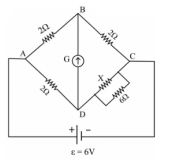
A
$12$
B
$4$
C
$6$
D
$3$
Solution
(D) For a balanced Wheatstone bridge,the ratio of resistances in opposite arms must be equal,i.e.,$\frac{P}{Q} = \frac{R}{S}$.
From the given figure,the resistances are $P = 2\Omega$,$Q = 2\Omega$,$R = 6\Omega$,and the arm $S$ consists of a resistor $X$ in parallel with a $6\Omega$ resistor.
The equivalent resistance of the parallel combination in arm $S$ is $S = \frac{X \cdot 6}{X + 6}$.
Applying the balanced bridge condition: $\frac{2}{2} = \frac{6}{\left(\frac{6X}{X + 6}\right)}$.
This simplifies to $1 = \frac{6(X + 6)}{6X}$.
$1 = \frac{X + 6}{X}$.
$X = X + 6$ is not possible,let us re-examine the circuit. The arm $CD$ has $X$ and $6\Omega$ in parallel. The condition is $\frac{AB}{BC} = \frac{AD}{CD_{eq}}$.
Here $AB=2\Omega, BC=2\Omega, AD=2\Omega$. So,$CD_{eq} = 2\Omega$.
Since $CD_{eq} = \frac{X \cdot 6}{X + 6} = 2$,we have $6X = 2(X + 6)$.
$6X = 2X + 12$.
$4X = 12$,which gives $X = 3\Omega$.
From the given figure,the resistances are $P = 2\Omega$,$Q = 2\Omega$,$R = 6\Omega$,and the arm $S$ consists of a resistor $X$ in parallel with a $6\Omega$ resistor.
The equivalent resistance of the parallel combination in arm $S$ is $S = \frac{X \cdot 6}{X + 6}$.
Applying the balanced bridge condition: $\frac{2}{2} = \frac{6}{\left(\frac{6X}{X + 6}\right)}$.
This simplifies to $1 = \frac{6(X + 6)}{6X}$.
$1 = \frac{X + 6}{X}$.
$X = X + 6$ is not possible,let us re-examine the circuit. The arm $CD$ has $X$ and $6\Omega$ in parallel. The condition is $\frac{AB}{BC} = \frac{AD}{CD_{eq}}$.
Here $AB=2\Omega, BC=2\Omega, AD=2\Omega$. So,$CD_{eq} = 2\Omega$.
Since $CD_{eq} = \frac{X \cdot 6}{X + 6} = 2$,we have $6X = 2(X + 6)$.
$6X = 2X + 12$.
$4X = 12$,which gives $X = 3\Omega$.
0 likesView Solution
16
PhysicsMediumMCQGUJCET · 2026
The emf of a storage battery of a car is $6.0 \ V$. If the internal resistance of the battery is $0.2 \ \Omega$,then the maximum power drawn from the battery is . . . . . . $W$.
A
$2.4$
B
$180$
C
$45$
D
Zero
Solution
(C) The maximum power is drawn from a battery when the external resistance $R$ is equal to the internal resistance $r$ of the battery $(R = r)$.
The power delivered to the external resistor is given by the formula: $P = I^2 R = \left(\frac{E}{R+r}\right)^2 \cdot R$.
Substituting $R = r$ for maximum power,we get:
$P_{max} = \frac{E^2 r}{(r+r)^2} = \frac{E^2 r}{4r^2} = \frac{E^2}{4r}$.
Given values are $E = 6.0 \ V$ and $r = 0.2 \ \Omega$.
Substituting these values into the formula:
$P_{max} = \frac{(6.0)^2}{4 \times 0.2} = \frac{36}{0.8} = 45 \ W$.
Therefore,the maximum power drawn is $45 \ W$.
The power delivered to the external resistor is given by the formula: $P = I^2 R = \left(\frac{E}{R+r}\right)^2 \cdot R$.
Substituting $R = r$ for maximum power,we get:
$P_{max} = \frac{E^2 r}{(r+r)^2} = \frac{E^2 r}{4r^2} = \frac{E^2}{4r}$.
Given values are $E = 6.0 \ V$ and $r = 0.2 \ \Omega$.
Substituting these values into the formula:
$P_{max} = \frac{(6.0)^2}{4 \times 0.2} = \frac{36}{0.8} = 45 \ W$.
Therefore,the maximum power drawn is $45 \ W$.
0 likesView Solution
17
PhysicsMediumMCQGUJCET · 2026
$A$ metal rod of length $10 \text{ cm}$ and a rectangular cross-section of $1 \text{ cm} \times 0.5 \text{ cm}$ is connected to a battery across opposite faces. The resistance will be . . . . . . .
A
Maximum when the battery is connected across $1 \text{ cm} \times 0.5 \text{ cm}$ faces.
B
Maximum when the battery is connected across $10 \text{ cm} \times 0.5 \text{ cm}$ faces.
C
Maximum when the battery is connected across $10 \text{ cm} \times 1 \text{ cm}$ faces.
D
Same irrespective of the three faces.
Solution
(A) The resistance of a conductor is given by the formula $R = \rho \frac{l}{A}$,where $\rho$ is the resistivity,$l$ is the length of the conductor in the direction of current flow,and $A$ is the cross-sectional area perpendicular to the current flow.
To maximize the resistance $R$,we need to maximize the length $l$ and minimize the cross-sectional area $A$.
When the battery is connected across the $1 \text{ cm} \times 0.5 \text{ cm}$ faces,the current flows along the length of $10 \text{ cm}$. Thus,$l = 10 \text{ cm}$ and $A = 1 \text{ cm} \times 0.5 \text{ cm} = 0.5 \text{ cm}^2$.
The resistance is $R = \rho \frac{10}{0.5} = 20\rho$.
For the other two orientations,the length $l$ will be either $1 \text{ cm}$ or $0.5 \text{ cm}$,and the area $A$ will be larger,which results in a smaller resistance value.
Therefore,the resistance is maximum when the battery is connected across the $1 \text{ cm} \times 0.5 \text{ cm}$ faces.
To maximize the resistance $R$,we need to maximize the length $l$ and minimize the cross-sectional area $A$.
When the battery is connected across the $1 \text{ cm} \times 0.5 \text{ cm}$ faces,the current flows along the length of $10 \text{ cm}$. Thus,$l = 10 \text{ cm}$ and $A = 1 \text{ cm} \times 0.5 \text{ cm} = 0.5 \text{ cm}^2$.
The resistance is $R = \rho \frac{10}{0.5} = 20\rho$.
For the other two orientations,the length $l$ will be either $1 \text{ cm}$ or $0.5 \text{ cm}$,and the area $A$ will be larger,which results in a smaller resistance value.
Therefore,the resistance is maximum when the battery is connected across the $1 \text{ cm} \times 0.5 \text{ cm}$ faces.
0 likesView Solution
18
PhysicsMediumMCQGUJCET · 2026
An electric dipole of dipole moment $P$ is placed parallel to a uniform electric field of intensity $E$. On rotating it through an angle of $90^\circ$ from this position,the amount of work done is . . . . . . .
A
$2PE$
B
$PE/2$
C
$PE$
D
Zero
Solution
(C) The work done $W$ in rotating an electric dipole in a uniform electric field is given by the formula: $W = PE(\cos \theta_1 - \cos \theta_2)$.
Initially,the dipole is parallel to the electric field,so the initial angle $\theta_1 = 0^\circ$.
Finally,the dipole is rotated by an angle of $90^\circ$,so the final angle $\theta_2 = 90^\circ$.
Substituting these values into the formula:
$W = PE(\cos 0^\circ - \cos 90^\circ)$
Since $\cos 0^\circ = 1$ and $\cos 90^\circ = 0$,we get:
$W = PE(1 - 0) = PE$.
Initially,the dipole is parallel to the electric field,so the initial angle $\theta_1 = 0^\circ$.
Finally,the dipole is rotated by an angle of $90^\circ$,so the final angle $\theta_2 = 90^\circ$.
Substituting these values into the formula:
$W = PE(\cos 0^\circ - \cos 90^\circ)$
Since $\cos 0^\circ = 1$ and $\cos 90^\circ = 0$,we get:
$W = PE(1 - 0) = PE$.
0 likesView Solution
19
PhysicsMediumMCQGUJCET · 2026
The total charge on a uniformly charged spherical shell having radius $R$ is $Q$. Then electric potential at a distance $r = R/2$ from the centre of the shell is . . . . . . .
A
$Q / 4\pi\epsilon_0 R$
B
$Q / \pi\epsilon_0 R$
C
$Q / 2\pi\epsilon_0 R$
D
$Q / 8\pi\epsilon_0 R$
Solution
(A) For a uniformly charged spherical shell,the electric potential at any point inside the shell is constant and equal to the potential at its surface.
The potential at the surface of the shell is given by $V = \frac{1}{4\pi \epsilon_0} \frac{Q}{R}$.
Since the distance $r = R/2$ is less than the radius $R$ (i.e.,the point is inside the shell),the electric potential at this point is the same as the potential at the surface.
Therefore,the potential at $r = R/2$ is $V = \frac{Q}{4\pi \epsilon_0 R}$.
The potential at the surface of the shell is given by $V = \frac{1}{4\pi \epsilon_0} \frac{Q}{R}$.
Since the distance $r = R/2$ is less than the radius $R$ (i.e.,the point is inside the shell),the electric potential at this point is the same as the potential at the surface.
Therefore,the potential at $r = R/2$ is $V = \frac{Q}{4\pi \epsilon_0 R}$.
0 likesView Solution
20
PhysicsMediumMCQGUJCET · 2026
$A$ parallel plate capacitor with air between the plates has a capacitance of $1.0 \text{ pF}$. If the distance between the plates is doubled and the space between them is filled with a dielectric substance,the capacitance becomes $2.0 \text{ pF}$. Then the value of the dielectric constant of the dielectric substance is . . . . . . .
A
$1.5$
B
$3$
C
$2$
D
$4$
Solution
(D) The initial capacitance of the parallel plate capacitor with air is given by $C_0 = \frac{\epsilon_0 A}{d} = 1.0 \text{ pF}$.
When the distance between the plates is doubled $(d' = 2d)$ and the space is filled with a dielectric of constant $K$,the new capacitance is $C = \frac{K \epsilon_0 A}{d'}$.
Substituting $d' = 2d$ into the equation,we get $C = \frac{K \epsilon_0 A}{2d} = \frac{K}{2} \times C_0$.
Given that $C = 2.0 \text{ pF}$ and $C_0 = 1.0 \text{ pF}$,we have $2.0 = \frac{K}{2} \times 1.0$.
Solving for $K$,we get $K = 2.0 \times 2 = 4.0$.
When the distance between the plates is doubled $(d' = 2d)$ and the space is filled with a dielectric of constant $K$,the new capacitance is $C = \frac{K \epsilon_0 A}{d'}$.
Substituting $d' = 2d$ into the equation,we get $C = \frac{K \epsilon_0 A}{2d} = \frac{K}{2} \times C_0$.
Given that $C = 2.0 \text{ pF}$ and $C_0 = 1.0 \text{ pF}$,we have $2.0 = \frac{K}{2} \times 1.0$.
Solving for $K$,we get $K = 2.0 \times 2 = 4.0$.
0 likesView Solution
21
PhysicsMediumMCQGUJCET · 2026
Two infinitely long thin straight parallel wires are kept at a perpendicular distance of $2R$,having uniform linear charge densities $+\lambda$ and $-\lambda$ respectively. The magnitude of the electric field at the midpoint between the two wires will be . . . . . . .
A
$\lambda / \pi \epsilon_0 R$
B
$\lambda / 2\pi \epsilon_0 R$
C
$2\lambda / \pi \epsilon_0 R$
D
$\lambda / 4\pi \epsilon_0 R$
Solution
(A) The electric field due to an infinitely long line charge at a distance $r$ is given by $E = \frac{\lambda}{2\pi \epsilon_0 r}$.
At the midpoint between the two wires,the distance from each wire is $r = R$.
The electric field due to the positively charged wire $(+\lambda)$ points away from it,and the electric field due to the negatively charged wire $(-\lambda)$ points towards it.
Since the midpoint is between the wires,both electric field vectors point in the same direction (from the positive wire towards the negative wire).
Therefore,the total electric field $E_{total} = E_1 + E_2 = \frac{\lambda}{2\pi \epsilon_0 R} + \frac{\lambda}{2\pi \epsilon_0 R} = \frac{2\lambda}{2\pi \epsilon_0 R} = \frac{\lambda}{\pi \epsilon_0 R}$.
At the midpoint between the two wires,the distance from each wire is $r = R$.
The electric field due to the positively charged wire $(+\lambda)$ points away from it,and the electric field due to the negatively charged wire $(-\lambda)$ points towards it.
Since the midpoint is between the wires,both electric field vectors point in the same direction (from the positive wire towards the negative wire).
Therefore,the total electric field $E_{total} = E_1 + E_2 = \frac{\lambda}{2\pi \epsilon_0 R} + \frac{\lambda}{2\pi \epsilon_0 R} = \frac{2\lambda}{2\pi \epsilon_0 R} = \frac{\lambda}{\pi \epsilon_0 R}$.
0 likesView Solution
22
PhysicsMediumMCQGUJCET · 2026
If charge $q$ is placed on one of the vertex of a cube,then total electric flux passing through the cube is . . . . . . .
A
$\frac{q}{\varepsilon_0}$
B
$\frac{q}{8\varepsilon_0}$
C
$\frac{q}{4\varepsilon_0}$
D
$\frac{q}{24\varepsilon_0}$
Solution
(B) According to Gauss's law,the total electric flux through a closed surface is $\frac{q_{enclosed}}{\varepsilon_0}$.
When a charge $q$ is placed at a vertex of a cube,the cube occupies only $\frac{1}{8}$ of the total space surrounding the charge because $8$ identical cubes are required to enclose the charge completely at the center of a larger cube.
Therefore,the electric flux passing through the cube is $\Phi = \frac{1}{8} \times \frac{q}{\varepsilon_0} = \frac{q}{8\varepsilon_0}$.
When a charge $q$ is placed at a vertex of a cube,the cube occupies only $\frac{1}{8}$ of the total space surrounding the charge because $8$ identical cubes are required to enclose the charge completely at the center of a larger cube.
Therefore,the electric flux passing through the cube is $\Phi = \frac{1}{8} \times \frac{q}{\varepsilon_0} = \frac{q}{8\varepsilon_0}$.
0 likesView Solution
23
PhysicsMediumMCQGUJCET · 2026
$A$ proton and an $\alpha$-particle are placed in a uniform electric field. The accelerations produced in them are $a_p$ and $a_\alpha$ respectively. Then $a_p : a_\alpha$ will be . . . . . . .
A
$1$ : $2$
B
$4$ : $1$
C
$2$ : $1$
D
$1$ : $4$
Solution
(C) The force on a charged particle in an electric field is given by $F = qE$.
According to Newton's second law of motion,$F = ma$,therefore $a = \frac{qE}{m}$.
For a proton,the charge is $q_p = e$ and the mass is $m_p$. Thus,$a_p = \frac{eE}{m_p}$.
For an $\alpha$-particle,the charge is $q_\alpha = 2e$ and the mass is $m_\alpha = 4m_p$.
Substituting these values,$a_\alpha = \frac{2eE}{4m_p} = \frac{1}{2} \frac{eE}{m_p} = \frac{a_p}{2}$.
Therefore,the ratio $\frac{a_p}{a_\alpha} = 2$,which means $a_p : a_\alpha = 2 : 1$.
According to Newton's second law of motion,$F = ma$,therefore $a = \frac{qE}{m}$.
For a proton,the charge is $q_p = e$ and the mass is $m_p$. Thus,$a_p = \frac{eE}{m_p}$.
For an $\alpha$-particle,the charge is $q_\alpha = 2e$ and the mass is $m_\alpha = 4m_p$.
Substituting these values,$a_\alpha = \frac{2eE}{4m_p} = \frac{1}{2} \frac{eE}{m_p} = \frac{a_p}{2}$.
Therefore,the ratio $\frac{a_p}{a_\alpha} = 2$,which means $a_p : a_\alpha = 2 : 1$.
0 likesView Solution
24
PhysicsMediumMCQGUJCET · 2026
Out of the following impurities,which impurity is not a trivalent?
A
Aluminium $(Al)$
B
Antimony $(Sb)$
C
Indium $(In)$
D
Boron $(B)$
Solution
(B) Trivalent impurities have $3$ valence electrons and belong to Group $13$ of the periodic table (e.g.,$B, Al, Ga, In$).
Pentavalent impurities have $5$ valence electrons and belong to Group $15$ of the periodic table (e.g.,$N, P, As, Sb$).
Antimony $(Sb)$ belongs to Group $15$ and is therefore a pentavalent impurity,not a trivalent one.
Pentavalent impurities have $5$ valence electrons and belong to Group $15$ of the periodic table (e.g.,$N, P, As, Sb$).
Antimony $(Sb)$ belongs to Group $15$ and is therefore a pentavalent impurity,not a trivalent one.
0 likesView Solution
25
PhysicsMediumMCQGUJCET · 2026
If the output frequency of a full-wave rectifier is $100 \text{ Hz}$,then the input frequency will be . . . . . . . (in $\text{ Hz}$)
A
$50$
B
$200$
C
$100$
D
$25$
Solution
(A) For a full-wave rectifier,the output frequency $(f_{out})$ is twice the input frequency $(f_{in})$.
The relationship is given by the formula: $f_{out} = 2 \times f_{in}$.
Given that the output frequency $(f_{out})$ is $100 \text{ Hz}$.
Substituting the value into the formula: $100 \text{ Hz} = 2 \times f_{in}$.
Therefore,$f_{in} = \frac{100 \text{ Hz}}{2} = 50 \text{ Hz}$.
The relationship is given by the formula: $f_{out} = 2 \times f_{in}$.
Given that the output frequency $(f_{out})$ is $100 \text{ Hz}$.
Substituting the value into the formula: $100 \text{ Hz} = 2 \times f_{in}$.
Therefore,$f_{in} = \frac{100 \text{ Hz}}{2} = 50 \text{ Hz}$.
0 likesView Solution
26
PhysicsMediumMCQGUJCET · 2026
When a forward bias is applied to a $p-n$ junction,it . . . . . . .
A
raises the potential barrier
B
lowers the potential barrier
C
reduces the majority carrier current to zero
D
none of the above
Solution
(B) In forward biasing,the positive terminal of the external battery is connected to the $p$-type region and the negative terminal to the $n$-type region.
This configuration pushes the majority charge carriers toward the junction.
As a result,the width of the depletion region decreases,which effectively lowers the potential barrier across the $p-n$ junction.
This configuration pushes the majority charge carriers toward the junction.
As a result,the width of the depletion region decreases,which effectively lowers the potential barrier across the $p-n$ junction.
0 likesView Solution
27
PhysicsMediumMCQGUJCET · 2026
An object is placed at $10 \text{ cm}$ in front of a concave mirror of focal length $15 \text{ cm}$. The image formed will be . . . . . . .
A
virtual,erect and magnified
B
real,inverted and diminished
C
virtual,erect and diminished
D
real,inverted and magnified
Solution
(A) For a concave mirror,the focal length $f = -15 \text{ cm}$ and the object distance $u = -10 \text{ cm}$.
Using the mirror formula $\frac{1}{v} + \frac{1}{u} = \frac{1}{f}$:
$\frac{1}{v} = \frac{1}{f} - \frac{1}{u} = \frac{1}{-15} - \frac{1}{-10} = -\frac{1}{15} + \frac{1}{10} = \frac{-2 + 3}{30} = \frac{1}{30}$.
Thus,$v = +30 \text{ cm}$.
Since $v$ is positive,the image is formed behind the mirror,which means it is virtual and erect.
The magnification $m = -\frac{v}{u} = -\frac{30}{-10} = +3$.
Since the magnification $m$ is positive and $|m| > 1$,the image is virtual,erect,and magnified.
Using the mirror formula $\frac{1}{v} + \frac{1}{u} = \frac{1}{f}$:
$\frac{1}{v} = \frac{1}{f} - \frac{1}{u} = \frac{1}{-15} - \frac{1}{-10} = -\frac{1}{15} + \frac{1}{10} = \frac{-2 + 3}{30} = \frac{1}{30}$.
Thus,$v = +30 \text{ cm}$.
Since $v$ is positive,the image is formed behind the mirror,which means it is virtual and erect.
The magnification $m = -\frac{v}{u} = -\frac{30}{-10} = +3$.
Since the magnification $m$ is positive and $|m| > 1$,the image is virtual,erect,and magnified.
0 likesView Solution
28
PhysicsDifficultMCQGUJCET · 2026
If in a compound microscope,the objective has a focal length of $1.0 \text{ cm}$,the eyepiece has a focal length of $2.0 \text{ cm}$,the tube length is $20 \text{ cm}$,and the near point for an observer is $25 \text{ cm}$,then the value of the magnification of the compound microscope will be . . . . . . .
A
$2.5$
B
$250$
C
$25$
D
$2500$
Solution
(B) The magnification $M$ of a compound microscope is given by the formula $M \approx \frac{L}{f_o} \times \frac{D}{f_e}$.
Here,$L = 20 \text{ cm}$ (tube length),$f_o = 1.0 \text{ cm}$ (focal length of objective),$f_e = 2.0 \text{ cm}$ (focal length of eyepiece),and $D = 25 \text{ cm}$ (near point distance).
Substituting these values into the formula:
$M = \frac{20}{1.0} \times \frac{25}{2.0}$
$M = 20 \times 12.5$
$M = 250$.
Therefore,the magnification is $250$.
Here,$L = 20 \text{ cm}$ (tube length),$f_o = 1.0 \text{ cm}$ (focal length of objective),$f_e = 2.0 \text{ cm}$ (focal length of eyepiece),and $D = 25 \text{ cm}$ (near point distance).
Substituting these values into the formula:
$M = \frac{20}{1.0} \times \frac{25}{2.0}$
$M = 20 \times 12.5$
$M = 250$.
Therefore,the magnification is $250$.
0 likesView Solution
29
PhysicsMediumMCQGUJCET · 2026
Two thin convex lenses of focal length $f_1$ and $f_2$ are placed in contact with each other. The equivalent power of the lens combination is . . . . . . .
A
$f_1 \times f_2$
B
$\frac{f_1+f_2}{f_1 \times f_2}$
C
$f_1 + f_2$
D
$\frac{f_1 \times f_2}{f_1 + f_2}$
Solution
(B) When two thin lenses are placed in contact,the equivalent focal length $F$ is given by the formula $\frac{1}{F} = \frac{1}{f_1} + \frac{1}{f_2}$.
By simplifying this,we get $\frac{1}{F} = \frac{f_1 + f_2}{f_1 f_2}$.
The power $P$ of a lens is defined as the reciprocal of its focal length in meters,i.e.,$P = \frac{1}{F}$.
Therefore,the equivalent power $P$ of the combination is $P = P_1 + P_2 = \frac{1}{f_1} + \frac{1}{f_2} = \frac{f_1 + f_2}{f_1 f_2}$.
By simplifying this,we get $\frac{1}{F} = \frac{f_1 + f_2}{f_1 f_2}$.
The power $P$ of a lens is defined as the reciprocal of its focal length in meters,i.e.,$P = \frac{1}{F}$.
Therefore,the equivalent power $P$ of the combination is $P = P_1 + P_2 = \frac{1}{f_1} + \frac{1}{f_2} = \frac{f_1 + f_2}{f_1 f_2}$.
0 likesView Solution
30
PhysicsDifficultMCQGUJCET · 2026
Find the value of the angle of emergence for an emergent ray from the prism in the figure given below. (Refractive index of the material of the prism is $\sqrt{3}$ and the refractive index of air is $1$) (in $^\circ$)
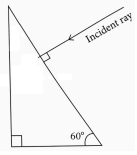
A
$60$
B
$45$
C
$30$
D
$90$
Solution
(A) $1$. From the figure,the incident ray strikes the first surface of the prism normally. Therefore,the angle of incidence $i = 0^\circ$,and the ray passes undeviated into the prism.
$2$. The prism is a right-angled triangle with one angle $60^\circ$. The angle at the top vertex is $180^\circ - 90^\circ - 60^\circ = 30^\circ$.
$3$. Inside the prism,the ray hits the second surface (the hypotenuse). The angle of incidence at this surface $(r_2)$ is the angle between the normal and the ray. Since the ray is perpendicular to the first surface,the angle of incidence at the second surface is $r_2 = 30^\circ$.
$4$. Applying Snell's law at the second surface: $n_1 \sin(r_2) = n_2 \sin(e)$,where $n_1 = \sqrt{3}$,$n_2 = 1$,and $r_2 = 30^\circ$.
$5$. $\sqrt{3} \sin(30^\circ) = 1 \times \sin(e)$.
$6$. $\sqrt{3} \times \frac{1}{2} = \sin(e) \implies \sin(e) = \frac{\sqrt{3}}{2}$.
$7$. Therefore,$e = 60^\circ$.
$2$. The prism is a right-angled triangle with one angle $60^\circ$. The angle at the top vertex is $180^\circ - 90^\circ - 60^\circ = 30^\circ$.
$3$. Inside the prism,the ray hits the second surface (the hypotenuse). The angle of incidence at this surface $(r_2)$ is the angle between the normal and the ray. Since the ray is perpendicular to the first surface,the angle of incidence at the second surface is $r_2 = 30^\circ$.
$4$. Applying Snell's law at the second surface: $n_1 \sin(r_2) = n_2 \sin(e)$,where $n_1 = \sqrt{3}$,$n_2 = 1$,and $r_2 = 30^\circ$.
$5$. $\sqrt{3} \sin(30^\circ) = 1 \times \sin(e)$.
$6$. $\sqrt{3} \times \frac{1}{2} = \sin(e) \implies \sin(e) = \frac{\sqrt{3}}{2}$.
$7$. Therefore,$e = 60^\circ$.
0 likesView Solution
31
PhysicsEasyMCQGUJCET · 2026
According to Huygens principle,the phase difference between oscillations of any two particles on the same wave front is . . . . . . rad.
A
$\frac{\pi}{2}$
B
$\pi$
C
$0$
D
$2\pi$
Solution
(C) wave front is defined as the locus of all points that oscillate in phase.
Since every point on the same wave front vibrates in phase,the phase difference between any two particles on the same wave front is $0$.
Since every point on the same wave front vibrates in phase,the phase difference between any two particles on the same wave front is $0$.
0 likesView Solution
32
PhysicsMediumMCQGUJCET · 2026
If wavelengths of visible rays,microwaves,and $X$-rays are $\lambda_v$,$\lambda_m$,and $\lambda_x$ respectively,then which of the following relations is correct?
A
$\lambda_m > \lambda_v > \lambda_x$
B
$\lambda_v > \lambda_m > \lambda_x$
C
$\lambda_m < \lambda_v < \lambda_x$
D
$\lambda_v = \lambda_m = \lambda_x$
Solution
(A) The electromagnetic spectrum is arranged in order of increasing frequency or decreasing wavelength.
The general order of wavelengths for these radiations is: $\lambda_{\text{microwave}} > \lambda_{\text{visible}} > \lambda_{\text{X-rays}}$.
Given that $\lambda_m$ represents the wavelength of microwaves,$\lambda_v$ represents the wavelength of visible rays,and $\lambda_x$ represents the wavelength of $X$-rays.
Therefore,the correct relation is $\lambda_m > \lambda_v > \lambda_x$.
Thus,the correct option is $A$.
The general order of wavelengths for these radiations is: $\lambda_{\text{microwave}} > \lambda_{\text{visible}} > \lambda_{\text{X-rays}}$.
Given that $\lambda_m$ represents the wavelength of microwaves,$\lambda_v$ represents the wavelength of visible rays,and $\lambda_x$ represents the wavelength of $X$-rays.
Therefore,the correct relation is $\lambda_m > \lambda_v > \lambda_x$.
Thus,the correct option is $A$.
0 likesView Solution
33
PhysicsDifficultMCQGUJCET · 2026
In a Young's double slit experiment,the slits are separated by $0.2 \text{ mm}$ and the screen is placed $2.0 \text{ m}$ away. The distance between the central bright fringe and the third bright fringe is measured to be $1.5 \text{ cm}$. Determine the wavelength of light used in the experiment.
A
$4200 \mathring{A}$
B
$5000 \mathring{A}$
C
$4600 \mathring{A}$
D
$6000 \mathring{A}$
Solution
(B) Given: Slit separation $d = 0.2 \text{ mm} = 2 \times 10^{-4} \text{ m}$.
Distance to screen $D = 2.0 \text{ m}$.
Order of fringe $n = 3$.
Distance of $n^{th}$ bright fringe $y_n = 1.5 \text{ cm} = 1.5 \times 10^{-2} \text{ m}$.
The formula for the position of the $n^{th}$ bright fringe is $y_n = \frac{n \lambda D}{d}$.
Rearranging for wavelength $\lambda$: $\lambda = \frac{y_n d}{n D}$.
Substituting the values: $\lambda = \frac{1.5 \times 10^{-2} \times 2 \times 10^{-4}}{3 \times 2.0}$.
$\lambda = \frac{3 \times 10^{-6}}{6} = 0.5 \times 10^{-6} \text{ m}$.
Converting to $ \mathring{A}$s: $\lambda = 0.5 \times 10^{-6} \times 10^{10} \mathring{A} = 5000 \mathring{A}$.
Thus,the wavelength of light used is $5000 \mathring{A}$.
Distance to screen $D = 2.0 \text{ m}$.
Order of fringe $n = 3$.
Distance of $n^{th}$ bright fringe $y_n = 1.5 \text{ cm} = 1.5 \times 10^{-2} \text{ m}$.
The formula for the position of the $n^{th}$ bright fringe is $y_n = \frac{n \lambda D}{d}$.
Rearranging for wavelength $\lambda$: $\lambda = \frac{y_n d}{n D}$.
Substituting the values: $\lambda = \frac{1.5 \times 10^{-2} \times 2 \times 10^{-4}}{3 \times 2.0}$.
$\lambda = \frac{3 \times 10^{-6}}{6} = 0.5 \times 10^{-6} \text{ m}$.
Converting to $ \mathring{A}$s: $\lambda = 0.5 \times 10^{-6} \times 10^{10} \mathring{A} = 5000 \mathring{A}$.
Thus,the wavelength of light used is $5000 \mathring{A}$.
0 likesView Solution
34
PhysicsMediumMCQGUJCET · 2026
In photoelectric effect,the graph of stopping potential $(V_0)$ versus frequency $(\nu)$ is a straight line. The slope of this graph is . . . . . . .
A
$h$
B
$\frac{e}{h}$
C
$\frac{V_0}{e}$
D
$\frac{h}{e}$
Solution
(D) Einstein's photoelectric equation is given by $eV_0 = h\nu - \Phi$,where $\Phi$ is the work function.
Rearranging the equation to the form $y = mx + c$,we get $V_0 = (\frac{h}{e})\nu - \frac{\Phi}{e}$.
Comparing this with the equation of a straight line $y = mx + c$,where $y = V_0$ and $x = \nu$,the slope $m$ is equal to $\frac{h}{e}$.
Therefore,the correct option is $D$.
Rearranging the equation to the form $y = mx + c$,we get $V_0 = (\frac{h}{e})\nu - \frac{\Phi}{e}$.
Comparing this with the equation of a straight line $y = mx + c$,where $y = V_0$ and $x = \nu$,the slope $m$ is equal to $\frac{h}{e}$.
Therefore,the correct option is $D$.
0 likesView Solution
35
PhysicsMediumMCQGUJCET · 2026
The photoelectric cut-off voltage in a certain experiment is $1.5 \text{ V}$. The maximum kinetic energy of photoelectrons emitted will be . . . . . . .
A
$1.5 \text{ J}$
B
$1.5 \text{ eV}$
C
$2.4 \text{ eV}$
D
$2.4 \text{ J}$
Solution
(B) The maximum kinetic energy $(K_{max})$ of photoelectrons is related to the stopping potential $(V_0)$ by the equation $K_{max} = eV_0$.
Given that the cut-off voltage (stopping potential) $V_0 = 1.5 \text{ V}$.
Substituting the value into the equation,we get $K_{max} = e \times 1.5 \text{ V} = 1.5 \text{ eV}$.
Therefore,the maximum kinetic energy is $1.5 \text{ eV}$.
Given that the cut-off voltage (stopping potential) $V_0 = 1.5 \text{ V}$.
Substituting the value into the equation,we get $K_{max} = e \times 1.5 \text{ V} = 1.5 \text{ eV}$.
Therefore,the maximum kinetic energy is $1.5 \text{ eV}$.
0 likesView Solution
36
PhysicsMediumMCQGUJCET · 2026
The relation between the wavelength of electromagnetic radiation $(\lambda)$ and the de Broglie wavelength of its quantum (photon) $(\lambda')$ is . . . . . . .
A
$\lambda' > \lambda$
B
$\lambda' = \lambda$
C
$\lambda' < \lambda$
D
$\lambda' = \frac{\lambda}{2}$
Solution
(B) For a photon,the momentum $p$ is given by $p = \frac{h}{\lambda}$,where $h$ is Planck's constant.
According to the de Broglie relation,the wavelength $\lambda'$ associated with a particle of momentum $p$ is $\lambda' = \frac{h}{p}$.
Substituting the expression for $p$ into the de Broglie equation,we get $\lambda' = \frac{h}{h/\lambda} = \lambda$.
Therefore,the de Broglie wavelength of a photon is equal to the wavelength of the electromagnetic radiation associated with it.
Thus,the correct option is $B$.
According to the de Broglie relation,the wavelength $\lambda'$ associated with a particle of momentum $p$ is $\lambda' = \frac{h}{p}$.
Substituting the expression for $p$ into the de Broglie equation,we get $\lambda' = \frac{h}{h/\lambda} = \lambda$.
Therefore,the de Broglie wavelength of a photon is equal to the wavelength of the electromagnetic radiation associated with it.
Thus,the correct option is $B$.
0 likesView Solution
37
PhysicsMediumMCQGUJCET · 2026
The ground state energy of a hydrogen atom is $-13.6 \text{ eV}$. What is the ratio of the kinetic energy to the potential energy of the electron in this state?
A
$-\frac{1}{2}$
B
$\frac{1}{2}$
C
$-1$
D
$-2$
Solution
(A) In a hydrogen-like atom,the total energy $E$ of an electron is related to its kinetic energy $K$ and potential energy $U$ by the following relations:
$E = -K$
$U = 2E$
Given that the total energy $E = -13.6 \text{ eV}$,we can find $K$ and $U$:
$K = -E = -(-13.6 \text{ eV}) = 13.6 \text{ eV}$
$U = 2E = 2 \times (-13.6 \text{ eV}) = -27.2 \text{ eV}$
The ratio of kinetic energy to potential energy is $\frac{K}{U} = \frac{13.6 \text{ eV}}{-27.2 \text{ eV}} = -\frac{1}{2}$.
Thus,the correct option is $A$.
$E = -K$
$U = 2E$
Given that the total energy $E = -13.6 \text{ eV}$,we can find $K$ and $U$:
$K = -E = -(-13.6 \text{ eV}) = 13.6 \text{ eV}$
$U = 2E = 2 \times (-13.6 \text{ eV}) = -27.2 \text{ eV}$
The ratio of kinetic energy to potential energy is $\frac{K}{U} = \frac{13.6 \text{ eV}}{-27.2 \text{ eV}} = -\frac{1}{2}$.
Thus,the correct option is $A$.
0 likesView Solution
38
PhysicsMediumMCQGUJCET · 2026
The radius of the innermost electron orbit of a hydrogen atom is $5.3 \times 10^{-11} \text{ m}$. What is the radius of the $n = 3$ orbit?
A
$1.59 \times 10^{-10} \text{ m}$
B
$1.06 \times 10^{-10} \text{ m}$
C
$1.43 \times 10^{-9} \text{ m}$
D
$4.77 \times 10^{-10} \text{ m}$
Solution
(D) The radius of the $n$-th orbit in a hydrogen atom is given by the formula $r_n = n^2 r_1$,where $r_1$ is the radius of the first orbit (Bohr radius).
Given $r_1 = 5.3 \times 10^{-11} \text{ m}$ and $n = 3$.
Substituting these values into the formula:
$r_3 = 3^2 \times (5.3 \times 10^{-11} \text{ m})$
$r_3 = 9 \times 5.3 \times 10^{-11} \text{ m}$
$r_3 = 47.7 \times 10^{-11} \text{ m}$
$r_3 = 4.77 \times 10^{-10} \text{ m}$.
Thus,the radius of the $n = 3$ orbit is $4.77 \times 10^{-10} \text{ m}$.
Therefore,the correct option is $D$.
Given $r_1 = 5.3 \times 10^{-11} \text{ m}$ and $n = 3$.
Substituting these values into the formula:
$r_3 = 3^2 \times (5.3 \times 10^{-11} \text{ m})$
$r_3 = 9 \times 5.3 \times 10^{-11} \text{ m}$
$r_3 = 47.7 \times 10^{-11} \text{ m}$
$r_3 = 4.77 \times 10^{-10} \text{ m}$.
Thus,the radius of the $n = 3$ orbit is $4.77 \times 10^{-10} \text{ m}$.
Therefore,the correct option is $D$.
0 likesView Solution
39
PhysicsMediumMCQGUJCET · 2026
The energy equivalent of $1.0 \text{ kg}$ of substance is . . . . . . .
A
$9 \times 10^{13} \text{ J}$
B
$3 \times 10^{13} \text{ J}$
C
$9 \times 10^{16} \text{ J}$
D
$9 \times 10^{18} \text{ J}$
Solution
(C) According to Einstein's mass-energy equivalence principle,the energy $E$ is given by the formula $E = mc^2$.
Here,$m$ is the mass of the substance and $c$ is the speed of light in a vacuum.
Given:
Mass $m = 1.0 \text{ kg}$
Speed of light $c = 3 \times 10^8 \text{ m/s}$
Substituting these values into the formula:
$E = 1.0 \text{ kg} \times (3 \times 10^8 \text{ m/s})^2$
$E = 1.0 \times 9 \times 10^{16} \text{ J}$
$E = 9 \times 10^{16} \text{ J}$
Therefore,the energy equivalent of $1.0 \text{ kg}$ of substance is $9 \times 10^{16} \text{ J}$.
The correct option is $C$.
Here,$m$ is the mass of the substance and $c$ is the speed of light in a vacuum.
Given:
Mass $m = 1.0 \text{ kg}$
Speed of light $c = 3 \times 10^8 \text{ m/s}$
Substituting these values into the formula:
$E = 1.0 \text{ kg} \times (3 \times 10^8 \text{ m/s})^2$
$E = 1.0 \times 9 \times 10^{16} \text{ J}$
$E = 9 \times 10^{16} \text{ J}$
Therefore,the energy equivalent of $1.0 \text{ kg}$ of substance is $9 \times 10^{16} \text{ J}$.
The correct option is $C$.
0 likesView Solution
40
PhysicsMediumMCQGUJCET · 2026
The nuclear radius of a hydrogen atom is approximately . . . . . . . (in $fm$)
A
$1.5$
B
$1.2$
C
$2.3$
D
$3.2$
Solution
(B) The nuclear radius $R$ is calculated using the formula $R = R_0 A^{1/3}$,where $R_0 \approx 1.2 \text{ fm}$ and $A$ is the mass number of the nucleus.
For a hydrogen atom,the nucleus consists of a single proton,so the mass number $A = 1$.
Substituting the value of $A$ into the formula:
$R = 1.2 \times (1)^{1/3} \text{ fm}$
$R = 1.2 \times 1 \text{ fm} = 1.2 \text{ fm}$.
Therefore,the nuclear radius of a hydrogen atom is $1.2 \text{ fm}$.
The correct option is $B$.
For a hydrogen atom,the nucleus consists of a single proton,so the mass number $A = 1$.
Substituting the value of $A$ into the formula:
$R = 1.2 \times (1)^{1/3} \text{ fm}$
$R = 1.2 \times 1 \text{ fm} = 1.2 \text{ fm}$.
Therefore,the nuclear radius of a hydrogen atom is $1.2 \text{ fm}$.
The correct option is $B$.
0 likesView Solution
Vedclass Products
For Students
Vedclass Test Series
Mock tests in real GUJCET style covering Physics with performance analysis. 5-day free trial.
Start Free TrialFor Teachers
Exam Paper Generator
Generate Set A/B/C/D Physics papers from 7.5L+ questions in 2 minutes. 3 chapters free.
Try FreeFor Institutes
Online Exam Module
Run live GUJCET mock exams with unlimited students, 360° analytics & white-label branding.
See DemoFrequently Asked Questions
How many Physics questions are in GUJCET 2026?
There are 40 Physics questions from the GUJCET 2026 paper on Vedclass, each with a detailed step-by-step solution in English.
Are GUJCET 2026 Physics solutions available in English?
Yes. All solutions on this page are in English. You can also switch to English or Hindi using the language buttons above the questions.
Can I practice GUJCET 2026 Physics as a timed test?
Yes. Use the Vedclass Test Series to attempt a full GUJCET mock test covering Physics with time limits and instant score analysis.
Can teachers create Physics papers from GUJCET previous year questions?
Yes. The Vedclass Exam Paper Generator lets teachers mix GUJCET Physics questions and generate Set A/B/C/D papers in minutes.
For Teachers & Institutes
Build a Custom Physics Paper
Pick GUJCET 2026 Physics questions, set difficulty, and generate Set A/B/C/D in 2 minutes.