
PhysicsQ1–34 of 34 questions
Page 1 of 1 · English
1
PhysicsEasyMCQGUJCET · 2024
$J s$ is the unit of . . . . . . physical quantity.
A
Work function
B
Rydberg constant
C
Moment of inertia
D
Angular momentum
Solution
(D) The correct option is $D$.
Angular momentum is defined as $L = r \times p$.
The $SI$ unit of angular momentum is $kg \cdot m^2/s$,which is equivalent to $J \cdot s$.
According to Bohr's quantization condition,$L = \frac{n h}{2 \pi}$.
Since $n$ and $2 \pi$ are dimensionless,the unit of angular momentum $L$ is the same as the unit of Planck's constant $h$,which is $J \cdot s$.
Angular momentum is defined as $L = r \times p$.
The $SI$ unit of angular momentum is $kg \cdot m^2/s$,which is equivalent to $J \cdot s$.
According to Bohr's quantization condition,$L = \frac{n h}{2 \pi}$.
Since $n$ and $2 \pi$ are dimensionless,the unit of angular momentum $L$ is the same as the unit of Planck's constant $h$,which is $J \cdot s$.
0 likesView Solution
2
PhysicsEasyMCQGUJCET · 2024
$A$ pure inductor of $50.0 \ mH$ is connected to a source of $220 \ V$. The frequency of the source is $50 \ Hz$. The rms current in the circuit (in $A$) will be $......$.
A
$28$
B
$7$
C
$14$
D
$21$
Solution
(C) Step $1$: Given values:
$V = 220 \ V$
$L = 50 \ mH = 50 \times 10^{-3} \ H$
$\nu = 50 \ Hz$
Step $2$: The inductive reactance $X_L$ is given by $X_L = \omega L = 2 \pi \nu L$.
Step $3$: The rms current $I$ is given by $I = \frac{V}{X_L} = \frac{V}{2 \pi \nu L}$.
Step $4$: Substituting the values:
$I = \frac{220}{2 \times 3.14159 \times 50 \times 50 \times 10^{-3}}$
$I = \frac{220}{15.70795} \approx 14.005 \ A$.
Thus,the rms current is approximately $14 \ A$.
$V = 220 \ V$
$L = 50 \ mH = 50 \times 10^{-3} \ H$
$\nu = 50 \ Hz$
Step $2$: The inductive reactance $X_L$ is given by $X_L = \omega L = 2 \pi \nu L$.
Step $3$: The rms current $I$ is given by $I = \frac{V}{X_L} = \frac{V}{2 \pi \nu L}$.
Step $4$: Substituting the values:
$I = \frac{220}{2 \times 3.14159 \times 50 \times 50 \times 10^{-3}}$
$I = \frac{220}{15.70795} \approx 14.005 \ A$.
Thus,the rms current is approximately $14 \ A$.
0 likesView Solution
3
PhysicsEasyMCQGUJCET · 2024
In the Geiger-Marsden scattering experiment,the thickness of the thin gold foil is . . . . . . m.
A
$5.5 \times 10^{-7}$
B
$4.2 \times 10^{-7}$
C
$2.1 \times 10^{-7}$
D
$6.2 \times 10^{-7}$
Solution
(C) In the classic Geiger-Marsden experiment (also known as the Rutherford gold foil experiment),Hans Geiger and Ernest Marsden used a very thin gold foil to observe the scattering of alpha particles.
The thickness of the gold foil used in this experiment was approximately $2.1 \times 10^{-7} \ m$ (or $2.1 \times 10^{-5} \ cm$).
Therefore,the correct option is $C$.
The thickness of the gold foil used in this experiment was approximately $2.1 \times 10^{-7} \ m$ (or $2.1 \times 10^{-5} \ cm$).
Therefore,the correct option is $C$.
0 likesView Solution
4
PhysicsEasyMCQGUJCET · 2024
The ratio of the radii of the second and third orbits of an $H$-atom is . . . . . . .
A
$3: 2$
B
$2: 3$
C
$9: 4$
D
$4: 9$
Solution
(D) The radius of the $n^{th}$ orbit is given by $r_{n} \propto \frac{n^{2}}{Z}$.
For an $H$-atom,the atomic number $Z = 1$.
Therefore,the radius is proportional to the square of the principal quantum number: $r_{n} \propto n^{2}$.
For the second orbit $(n_{2} = 2)$ and the third orbit $(n_{3} = 3)$:
$\frac{r_{2}}{r_{3}} = \left(\frac{n_{2}}{n_{3}}\right)^{2} = \left(\frac{2}{3}\right)^{2} = \frac{4}{9}$.
Thus,the ratio is $4: 9$.
For an $H$-atom,the atomic number $Z = 1$.
Therefore,the radius is proportional to the square of the principal quantum number: $r_{n} \propto n^{2}$.
For the second orbit $(n_{2} = 2)$ and the third orbit $(n_{3} = 3)$:
$\frac{r_{2}}{r_{3}} = \left(\frac{n_{2}}{n_{3}}\right)^{2} = \left(\frac{2}{3}\right)^{2} = \frac{4}{9}$.
Thus,the ratio is $4: 9$.
0 likesView Solution
5
PhysicsEasyMCQGUJCET · 2024
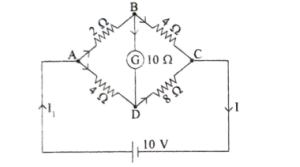
As shown in the circuit diagram,find the value of $I = \text{ . . . . . . }$. (in $\text{ A}$)
A
$0.4$
B
$2.5$
C
$1.8$
D
$2.8$
Solution
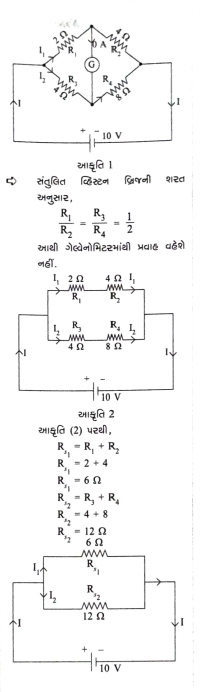
(B) For a balanced Wheatstone bridge,the condition is $\frac{R_1}{R_3} = \frac{R_2}{R_4}$. Here,$\frac{2}{4} = \frac{4}{8} = \frac{1}{2}$.
Since the bridge is balanced,no current flows through the galvanometer.
The circuit simplifies to two parallel branches:
Branch $1$: $R_{s1} = R_1 + R_2 = 2 \Omega + 4 \Omega = 6 \Omega$.
Branch $2$: $R_{s2} = R_3 + R_4 = 4 \Omega + 8 \Omega = 12 \Omega$.
The equivalent resistance $R_{eq}$ of the parallel combination is:
$R_{eq} = \frac{R_{s1} \times R_{s2}}{R_{s1} + R_{s2}} = \frac{6 \times 12}{6 + 12} = \frac{72}{18} = 4 \Omega$.
The total current $I$ flowing through the circuit is:
$I = \frac{V}{R_{eq}} = \frac{10 \text{ V}}{4 \Omega} = 2.5 \text{ A}$.
Since the bridge is balanced,no current flows through the galvanometer.
The circuit simplifies to two parallel branches:
Branch $1$: $R_{s1} = R_1 + R_2 = 2 \Omega + 4 \Omega = 6 \Omega$.
Branch $2$: $R_{s2} = R_3 + R_4 = 4 \Omega + 8 \Omega = 12 \Omega$.
The equivalent resistance $R_{eq}$ of the parallel combination is:
$R_{eq} = \frac{R_{s1} \times R_{s2}}{R_{s1} + R_{s2}} = \frac{6 \times 12}{6 + 12} = \frac{72}{18} = 4 \Omega$.
The total current $I$ flowing through the circuit is:
$I = \frac{V}{R_{eq}} = \frac{10 \text{ V}}{4 \Omega} = 2.5 \text{ A}$.
0 likesView Solution
6
PhysicsEasyMCQGUJCET · 2024
The magnitude of the drift velocity per unit electric field is known as . . . . . . .
A
Conductivity
B
Obstructionism
C
Mobility
D
Electric charge density
Solution
(C) The drift velocity $v_d$ of a charge carrier is directly proportional to the applied electric field $E$,given by $v_d = \mu E$.
Here,$\mu$ is defined as the mobility of the charge carrier.
Therefore,mobility $\mu = \frac{v_d}{E}$.
It represents the magnitude of the drift velocity per unit electric field.
Here,$\mu$ is defined as the mobility of the charge carrier.
Therefore,mobility $\mu = \frac{v_d}{E}$.
It represents the magnitude of the drift velocity per unit electric field.
0 likesView Solution
7
PhysicsEasyMCQGUJCET · 2024
The $SI$ unit of the current density is . . . . . . .
A
$A \ m^{-1}$
B
$A \ m^{2}$
C
$A \ m^{3}$
D
$A \ m^{-2}$
Solution
(D) Current density $(J)$ is defined as the current $(I)$ flowing per unit area $(A)$ perpendicular to the direction of flow.
Mathematically,$J = \frac{I}{A}$.
The $SI$ unit of current $(I)$ is Ampere $(A)$ and the $SI$ unit of area $(A)$ is square meter $(m^{2})$.
Therefore,the $SI$ unit of current density is $\frac{A}{m^{2}} = A \ m^{-2}$.
Thus,the correct option is $(D)$.
Mathematically,$J = \frac{I}{A}$.
The $SI$ unit of current $(I)$ is Ampere $(A)$ and the $SI$ unit of area $(A)$ is square meter $(m^{2})$.
Therefore,the $SI$ unit of current density is $\frac{A}{m^{2}} = A \ m^{-2}$.
Thus,the correct option is $(D)$.
0 likesView Solution
8
PhysicsEasyMCQGUJCET · 2024
$A$ silver wire has a resistance of $2.1 \Omega$ at $27.5^{\circ} C$ and a resistance of $2.7 \Omega$ at $100^{\circ} C$. Then the temperature coefficient of the resistivity of silver will be . . . . . . .
A
$3.9 \times 10^{-3} {}^{\circ} C^{-1}$
B
$3.9 \times 10^{3} {}^{\circ} C^{-1}$
C
$3.9 \times 10^{-3} {}^{\circ} C$
D
$3.9 \times 10^{3} {}^{\circ} C$
Solution
(A) Given:
Resistance at $T_0 = 27.5^{\circ} C$ is $R_0 = 2.1 \Omega$.
Resistance at $T = 100^{\circ} C$ is $R = 2.7 \Omega$.
The formula for temperature dependence of resistance is $R = R_0[1 + \alpha(T - T_0)]$.
Substituting the values:
$2.7 = 2.1[1 + \alpha(100 - 27.5)]$
$2.7 = 2.1[1 + \alpha(72.5)]$
$\frac{2.7}{2.1} = 1 + \alpha(72.5)$
$\frac{9}{7} = 1 + \alpha(72.5)$
$\frac{9}{7} - 1 = \alpha(72.5)$
$\frac{2}{7} = \alpha(72.5)$
$\alpha = \frac{2}{7 \times 72.5} = \frac{2}{507.5} \approx 0.00394 \approx 3.9 \times 10^{-3} {}^{\circ} C^{-1}$.
Thus,the correct option is $A$.
Resistance at $T_0 = 27.5^{\circ} C$ is $R_0 = 2.1 \Omega$.
Resistance at $T = 100^{\circ} C$ is $R = 2.7 \Omega$.
The formula for temperature dependence of resistance is $R = R_0[1 + \alpha(T - T_0)]$.
Substituting the values:
$2.7 = 2.1[1 + \alpha(100 - 27.5)]$
$2.7 = 2.1[1 + \alpha(72.5)]$
$\frac{2.7}{2.1} = 1 + \alpha(72.5)$
$\frac{9}{7} = 1 + \alpha(72.5)$
$\frac{9}{7} - 1 = \alpha(72.5)$
$\frac{2}{7} = \alpha(72.5)$
$\alpha = \frac{2}{7 \times 72.5} = \frac{2}{507.5} \approx 0.00394 \approx 3.9 \times 10^{-3} {}^{\circ} C^{-1}$.
Thus,the correct option is $A$.
0 likesView Solution
9
PhysicsEasyMCQGUJCET · 2024
$A$ ball of mass $0.12 \ kg$ is moving with a speed $20 \ m \ s^{-1}$. Then its de Broglie wavelength is . . . . . . . ( $h = 6.63 \times 10^{-34} \ J \ s$ )
A
$2.76 \times 10^{-34} \ m$
B
$1.76 \times 10^{-34} \ m$
C
$3.76 \times 10^{-34} \ m$
D
$4.76 \times 10^{-34} \ m$
Solution
(A) The de Broglie wavelength $\lambda$ is given by the formula $\lambda = \frac{h}{mv}$.
Given:
Mass $m = 0.12 \ kg$
Velocity $v = 20 \ m \ s^{-1}$
Planck's constant $h = 6.63 \times 10^{-34} \ J \ s$
Substituting the values into the formula:
$\lambda = \frac{6.63 \times 10^{-34}}{0.12 \times 20}$
$\lambda = \frac{6.63 \times 10^{-34}}{2.4}$
$\lambda = 2.7625 \times 10^{-34} \ m$
Rounding to two decimal places,we get $\lambda = 2.76 \times 10^{-34} \ m$.
Given:
Mass $m = 0.12 \ kg$
Velocity $v = 20 \ m \ s^{-1}$
Planck's constant $h = 6.63 \times 10^{-34} \ J \ s$
Substituting the values into the formula:
$\lambda = \frac{6.63 \times 10^{-34}}{0.12 \times 20}$
$\lambda = \frac{6.63 \times 10^{-34}}{2.4}$
$\lambda = 2.7625 \times 10^{-34} \ m$
Rounding to two decimal places,we get $\lambda = 2.76 \times 10^{-34} \ m$.
0 likesView Solution
10
PhysicsEasyMCQGUJCET · 2024
To emit an electron from a metal surface, the minimum electric field required is . . . . . . .
A
$10^{6} \,V \,m^{-1}$
B
$10^{8} \,V \,m^{-1}$
C
$10^{5} \,V \,m^{-1}$
D
$10^{4} \,V \,m^{-1}$
Solution
(B) The process of emitting electrons from a metal surface by applying a strong external electric field is known as field emission. For a typical metal, the work function is a few electron volts $(eV)$. To overcome this potential barrier and pull an electron out of the metal surface, an electric field of the order of $10^{8} \,V \,m^{-1}$ is required. Therefore, the correct option is $B$.
0 likesView Solution
11
PhysicsEasyMCQGUJCET · 2024
An infinite line charge produces a field of $9 \times 10^4 \text{ N/C}$ at a distance of $2 \text{ cm}$. The linear charge density is . . . . . . . $\left(k = 9 \times 10^9 \text{ Nm}^2/\text{C}^2\right)$ (in $\text{ } \mu\text{C/m}$)
A
$1$
B
$10$
C
$0.01$
D
$0.1$
Solution
(D) Given:
Electric field $E = 9 \times 10^4 \text{ N/C}$
Distance $r = 2 \text{ cm} = 2 \times 10^{-2} \text{ m}$
Coulomb constant $k = 9 \times 10^9 \text{ Nm}^2/\text{C}^2$
The electric field due to an infinite line charge is given by the formula:
$E = \frac{\lambda}{2 \pi \varepsilon_0 r} = \frac{2k\lambda}{r}$
Rearranging for linear charge density $\lambda$:
$\lambda = \frac{E \cdot r}{2k}$
Substituting the values:
$\lambda = \frac{(9 \times 10^4) \times (2 \times 10^{-2})}{2 \times (9 \times 10^9)}$
$\lambda = \frac{18 \times 10^2}{18 \times 10^9}$
$\lambda = 10^{-7} \text{ C/m}$
Converting to $\mu\text{C/m}$:
$\lambda = 0.1 \times 10^{-6} \text{ C/m} = 0.1 \mu\text{C/m}$
Therefore,the correct option is $D$.
Electric field $E = 9 \times 10^4 \text{ N/C}$
Distance $r = 2 \text{ cm} = 2 \times 10^{-2} \text{ m}$
Coulomb constant $k = 9 \times 10^9 \text{ Nm}^2/\text{C}^2$
The electric field due to an infinite line charge is given by the formula:
$E = \frac{\lambda}{2 \pi \varepsilon_0 r} = \frac{2k\lambda}{r}$
Rearranging for linear charge density $\lambda$:
$\lambda = \frac{E \cdot r}{2k}$
Substituting the values:
$\lambda = \frac{(9 \times 10^4) \times (2 \times 10^{-2})}{2 \times (9 \times 10^9)}$
$\lambda = \frac{18 \times 10^2}{18 \times 10^9}$
$\lambda = 10^{-7} \text{ C/m}$
Converting to $\mu\text{C/m}$:
$\lambda = 0.1 \times 10^{-6} \text{ C/m} = 0.1 \mu\text{C/m}$
Therefore,the correct option is $D$.
0 likesView Solution
12
PhysicsEasyMCQGUJCET · 2024
The angle between the electric field and the dipole moment at any point on the equatorial plane of an electric dipole is . . . . . . . (in $^{\circ}$)
A
$90$
B
$180$
C
$0$
D
$45$
Solution
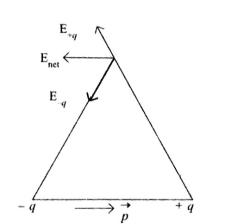
(B) The electric dipole moment $\vec{p}$ is directed from the negative charge $(-q)$ to the positive charge $(+q)$.
On the equatorial plane of an electric dipole,the net electric field $\vec{E}_{net}$ is directed anti-parallel to the dipole moment vector $\vec{p}$.
Mathematically,the electric field on the equatorial plane is given by $\vec{E} = -\frac{1}{4\pi\epsilon_0} \frac{\vec{p}}{r^3}$.
Since the electric field vector is in the opposite direction to the dipole moment vector,the angle between them is $180^{\circ}$.
Therefore,the correct option is $B$.
On the equatorial plane of an electric dipole,the net electric field $\vec{E}_{net}$ is directed anti-parallel to the dipole moment vector $\vec{p}$.
Mathematically,the electric field on the equatorial plane is given by $\vec{E} = -\frac{1}{4\pi\epsilon_0} \frac{\vec{p}}{r^3}$.
Since the electric field vector is in the opposite direction to the dipole moment vector,the angle between them is $180^{\circ}$.
Therefore,the correct option is $B$.
0 likesView Solution
13
PhysicsEasyMCQGUJCET · 2024
$A$ coil has $N$ turns and the current passing through it is $I$ ampere,resulting in a self-inductance of $L$ Henry. If the current changes to $5I$ $A$,the new self-inductance will be . . . . . . $H$.
A
$5L$
B
$\frac{1}{5}L$
C
$25L$
D
$L$
Solution
(D) The self-inductance $L$ of a coil is given by the formula $L = \frac{\mu_0 N^2 A}{l}$,where $\mu_0$ is the permeability of free space,$N$ is the number of turns,$A$ is the cross-sectional area,and $l$ is the length of the coil.
From this formula,it is evident that the self-inductance $L$ depends only on the geometric parameters of the coil (number of turns,area,and length) and the core material.
It is independent of the current $I$ flowing through the coil.
Therefore,if the current changes from $I$ to $5I$,the self-inductance remains unchanged.
Thus,the new self-inductance is $L$ $H$.
From this formula,it is evident that the self-inductance $L$ depends only on the geometric parameters of the coil (number of turns,area,and length) and the core material.
It is independent of the current $I$ flowing through the coil.
Therefore,if the current changes from $I$ to $5I$,the self-inductance remains unchanged.
Thus,the new self-inductance is $L$ $H$.
0 likesView Solution
14
PhysicsEasyMCQGUJCET · 2024
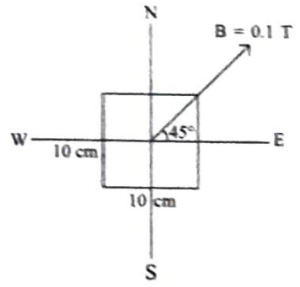
$A$ square loop of side $10 \ cm$ and resistance $0.5 \ \Omega$ is placed vertically in the east-west plane. $A$ uniform magnetic field of $0.10 \ T$ is set across the plane in the north-east direction. The magnetic field decreases to zero at $0.70 \ s$ at a steady rate. Then the magnitude of the induced current during this time interval will be . . . . . . .
A
$2 \times 10^{-3} \ A$
B
$4.0 \times 10^{-3} \ A$
C
$6.0 \times 10^{-3} \ A$
D
$8.0 \times 10^{-3} \ A$
Solution
(A) Given:
Side of square loop,$l = 10 \ cm = 0.1 \ m$
Area of loop,$A = l^2 = (0.1 \ m)^2 = 0.01 \ m^2 = 100 \ cm^2$
Resistance,$R = 0.5 \ \Omega$
Initial magnetic field,$B_1 = 0.10 \ T$
Final magnetic field,$B_2 = 0 \ T$
Time interval,$\Delta t = 0.70 \ s$
Angle between the area vector (normal to the loop) and the magnetic field vector,$\theta = 45^{\circ}$
The magnetic flux $\phi$ is given by $\phi = BA \cos \theta$.
Initial flux,$\phi_1 = B_1 A \cos 45^{\circ} = 0.10 \times 0.01 \times \frac{1}{\sqrt{2}} \ Wb$.
Final flux,$\phi_2 = 0 \ Wb$.
Change in flux,$\Delta \phi = \phi_2 - \phi_1 = -\phi_1 = -\frac{0.001}{\sqrt{2}} \ Wb$.
Induced emf,$\varepsilon = -\frac{\Delta \phi}{\Delta t} = -\left( -\frac{0.001}{\sqrt{2} \times 0.70} \right) = \frac{0.001}{0.70 \times 1.414} \approx 1.01 \times 10^{-3} \ V$.
Using the provided approximation in the original problem: $\varepsilon = \frac{0.1 \times 100 \times 10^{-4} \times \cos 45^{\circ}}{0.70} = \frac{0.001 \times 0.707}{0.70} \approx 10^{-3} \ V$.
Induced current,$I = \frac{\varepsilon}{R} = \frac{10^{-3} \ V}{0.5 \ \Omega} = 2 \times 10^{-3} \ A$.
Side of square loop,$l = 10 \ cm = 0.1 \ m$
Area of loop,$A = l^2 = (0.1 \ m)^2 = 0.01 \ m^2 = 100 \ cm^2$
Resistance,$R = 0.5 \ \Omega$
Initial magnetic field,$B_1 = 0.10 \ T$
Final magnetic field,$B_2 = 0 \ T$
Time interval,$\Delta t = 0.70 \ s$
Angle between the area vector (normal to the loop) and the magnetic field vector,$\theta = 45^{\circ}$
The magnetic flux $\phi$ is given by $\phi = BA \cos \theta$.
Initial flux,$\phi_1 = B_1 A \cos 45^{\circ} = 0.10 \times 0.01 \times \frac{1}{\sqrt{2}} \ Wb$.
Final flux,$\phi_2 = 0 \ Wb$.
Change in flux,$\Delta \phi = \phi_2 - \phi_1 = -\phi_1 = -\frac{0.001}{\sqrt{2}} \ Wb$.
Induced emf,$\varepsilon = -\frac{\Delta \phi}{\Delta t} = -\left( -\frac{0.001}{\sqrt{2} \times 0.70} \right) = \frac{0.001}{0.70 \times 1.414} \approx 1.01 \times 10^{-3} \ V$.
Using the provided approximation in the original problem: $\varepsilon = \frac{0.1 \times 100 \times 10^{-4} \times \cos 45^{\circ}}{0.70} = \frac{0.001 \times 0.707}{0.70} \approx 10^{-3} \ V$.
Induced current,$I = \frac{\varepsilon}{R} = \frac{10^{-3} \ V}{0.5 \ \Omega} = 2 \times 10^{-3} \ A$.
0 likesView Solution
15
PhysicsEasyMCQGUJCET · 2024
Cellular phones use radio waves to transmit voice communication in the . . . . . . band.
A
$UHF$
B
$HF$
C
$VHF$
D
$LF$
Solution
(A) Cellular phones operate by transmitting and receiving signals within the Ultra High Frequency $(UHF)$ band,which typically ranges from $300 \ MHz$ to $3 \ GHz$. This frequency range is ideal for mobile communication because it allows for high data rates and supports the compact antenna sizes required for portable devices. Therefore,the correct option is $A$.
0 likesView Solution
16
PhysicsEasyMCQGUJCET · 2024
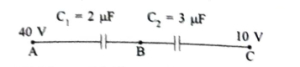
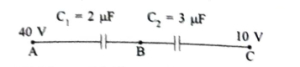
The potential at the point $B$ in the given figure is . . . . . . $V$.
A
$25$
B
$30$
C
$22$
D
$50$
Solution
(C) Let the potential at point $B$ be $V$.
Since the capacitors $C_1 = 2 \ \mu F$ and $C_2 = 3 \ \mu F$ are in series,the charge $Q$ on both capacitors is the same.
The potential difference across $C_1$ is $V_A - V_B = 40 - V$.
Thus,$Q = C_1(V_A - V_B) = 2(40 - V)$.
The potential difference across $C_2$ is $V_B - V_C = V - 10$.
Thus,$Q = C_2(V_B - V_C) = 3(V - 10)$.
Since the charges are equal:
$2(40 - V) = 3(V - 10)$
$80 - 2V = 3V - 30$
$5V = 110$
$V = 22 \ V$.
Since the capacitors $C_1 = 2 \ \mu F$ and $C_2 = 3 \ \mu F$ are in series,the charge $Q$ on both capacitors is the same.
The potential difference across $C_1$ is $V_A - V_B = 40 - V$.
Thus,$Q = C_1(V_A - V_B) = 2(40 - V)$.
The potential difference across $C_2$ is $V_B - V_C = V - 10$.
Thus,$Q = C_2(V_B - V_C) = 3(V - 10)$.
Since the charges are equal:
$2(40 - V) = 3(V - 10)$
$80 - 2V = 3V - 30$
$5V = 110$
$V = 22 \ V$.
0 likesView Solution
17
PhysicsEasyMCQGUJCET · 2024
$A$ parallel plate capacitor with air between the plates has a capacitance of $4 \ pF$. If the distance between the plates is reduced by half and the space between them is filled with a substance of dielectric constant $K = 6$,then the value of capacitance will be . . . . . . . (in $pF$)
A
$8$
B
$24$
C
$12$
D
$48$
Solution
(D) The initial capacitance of the parallel plate capacitor with air is given by:
$C_0 = \frac{A \varepsilon_0}{d} = 4 \ pF$
When the distance between the plates is reduced by half,the new distance is $d' = \frac{d}{2}$.
When the space is filled with a dielectric of constant $K = 6$,the new capacitance $C$ is given by:
$C = K \frac{A \varepsilon_0}{d'}$
Substituting $d' = \frac{d}{2}$ and $K = 6$:
$C = 6 \times \frac{A \varepsilon_0}{d/2} = 12 \times \frac{A \varepsilon_0}{d}$
Since $\frac{A \varepsilon_0}{d} = C_0 = 4 \ pF$,we have:
$C = 12 \times 4 \ pF = 48 \ pF$.
$C_0 = \frac{A \varepsilon_0}{d} = 4 \ pF$
When the distance between the plates is reduced by half,the new distance is $d' = \frac{d}{2}$.
When the space is filled with a dielectric of constant $K = 6$,the new capacitance $C$ is given by:
$C = K \frac{A \varepsilon_0}{d'}$
Substituting $d' = \frac{d}{2}$ and $K = 6$:
$C = 6 \times \frac{A \varepsilon_0}{d/2} = 12 \times \frac{A \varepsilon_0}{d}$
Since $\frac{A \varepsilon_0}{d} = C_0 = 4 \ pF$,we have:
$C = 12 \times 4 \ pF = 48 \ pF$.
0 likesView Solution
18
PhysicsEasyMCQGUJCET · 2024
$A$ radius of a spherical charged shell is $10 \ cm$ and the electric potential on its surface is $100 \ V$. Then,the potential at $2 \ cm$ from the centre of the shell will be $.......$ (in $V$)
A
$100$
B
$1$
C
$200$
D
$0$
Solution
(A) For a spherical charged shell,the electric potential at any point inside the shell is constant and equal to the potential at its surface.
Given that the radius of the shell is $R = 10 \ cm$ and the potential on the surface is $V_{surface} = 100 \ V$.
Since $2 \ cm < 10 \ cm$,the point is inside the shell.
Therefore,the potential at $2 \ cm$ from the centre is the same as the potential on the surface,which is $100 \ V$.
Given that the radius of the shell is $R = 10 \ cm$ and the potential on the surface is $V_{surface} = 100 \ V$.
Since $2 \ cm < 10 \ cm$,the point is inside the shell.
Therefore,the potential at $2 \ cm$ from the centre is the same as the potential on the surface,which is $100 \ V$.
0 likesView Solution
19
PhysicsEasyMCQGUJCET · 2024
An electron is accelerated through a potential difference of $2.5 \ V$. The energy gained by the electron is . . . . . . . (Charge of an electron = $1.6 \times 10^{-19} \ C$)
A
$2.5 \ J$
B
$2.5 \ MeV$
C
$2.5 \ eV$
D
$2.5 \ erg$
Solution
(C) The energy gained by a charged particle accelerated through a potential difference $V$ is given by the formula: $E = qV$.
Here,the charge of an electron is $q = e = 1.6 \times 10^{-19} \ C$ and the potential difference is $V = 2.5 \ V$.
Therefore,the energy gained is $E = e \times 2.5 \ V = 2.5 \ eV$.
Since $1 \ eV$ is the energy gained by an electron when accelerated through a potential difference of $1 \ V$,the energy gained is $2.5 \ eV$.
Here,the charge of an electron is $q = e = 1.6 \times 10^{-19} \ C$ and the potential difference is $V = 2.5 \ V$.
Therefore,the energy gained is $E = e \times 2.5 \ V = 2.5 \ eV$.
Since $1 \ eV$ is the energy gained by an electron when accelerated through a potential difference of $1 \ V$,the energy gained is $2.5 \ eV$.
0 likesView Solution
20
PhysicsEasyMCQGUJCET · 2024
$A$ short bar magnet placed with its axis at $30^{\circ}$ to a uniform external magnetic field of $0.5 \ T$ experiences a torque of magnitude equal to $4.5 \times 10^{-2} \ J$. The magnitude of the magnetic moment is . . . . . . .
A
$3.6 \times 10^2 \ J \ T^{-1}$
B
$36 \times 10^{-2} \ J \ T^{-1}$
C
$1.8 \times 10^2 \ J \ T^{-1}$
D
$18 \times 10^{-2} \ J \ T^{-1}$
Solution
(D) The torque $\tau$ acting on a magnetic dipole in a uniform magnetic field $B$ is given by the formula: $\tau = m B \sin \theta$.
Given:
Torque $\tau = 4.5 \times 10^{-2} \ J$
Magnetic field $B = 0.5 \ T$
Angle $\theta = 30^{\circ}$
Substituting the values into the formula:
$4.5 \times 10^{-2} = m \times 0.5 \times \sin 30^{\circ}$
Since $\sin 30^{\circ} = 0.5$:
$4.5 \times 10^{-2} = m \times 0.5 \times 0.5$
$4.5 \times 10^{-2} = m \times 0.25$
$m = \frac{4.5 \times 10^{-2}}{0.25}$
$m = 18 \times 10^{-2} \ J \ T^{-1}$.
Given:
Torque $\tau = 4.5 \times 10^{-2} \ J$
Magnetic field $B = 0.5 \ T$
Angle $\theta = 30^{\circ}$
Substituting the values into the formula:
$4.5 \times 10^{-2} = m \times 0.5 \times \sin 30^{\circ}$
Since $\sin 30^{\circ} = 0.5$:
$4.5 \times 10^{-2} = m \times 0.5 \times 0.5$
$4.5 \times 10^{-2} = m \times 0.25$
$m = \frac{4.5 \times 10^{-2}}{0.25}$
$m = 18 \times 10^{-2} \ J \ T^{-1}$.
0 likesView Solution
21
PhysicsEasyMCQGUJCET · 2024
$A$ solenoid has a core of a material with relative permeability of $400$. The solenoid windings are insulated from the core and carry a current of $2 \text{ A}$. If the number of turns is $1000$ per meter,then the value of magnetic intensity will be . . . . . . .
A
$8 \times 10^5 \text{ A m}^{-1}$
B
$2 \times 10^3 \text{ A m}^{-1}$
C
$2 \times 10^{-3} \text{ A m}^{-1}$
D
$8 \times 10^{-5} \text{ A m}^{-1}$
Solution
(B) The magnetic intensity $H$ inside a solenoid is given by the formula $H = nI$,where $n$ is the number of turns per unit length and $I$ is the current flowing through the solenoid.
Given:
Number of turns per unit length $n = 1000 \text{ m}^{-1}$
Current $I = 2 \text{ A}$
Relative permeability $\mu_r = 400$ (Note: This value is not required to calculate magnetic intensity $H$,as $H$ depends only on the geometry and current).
Substituting the values into the formula:
$H = 1000 \times 2$
$H = 2000 \text{ A m}^{-1}$
$H = 2 \times 10^3 \text{ A m}^{-1}$
Therefore,the correct option is $B$.
Given:
Number of turns per unit length $n = 1000 \text{ m}^{-1}$
Current $I = 2 \text{ A}$
Relative permeability $\mu_r = 400$ (Note: This value is not required to calculate magnetic intensity $H$,as $H$ depends only on the geometry and current).
Substituting the values into the formula:
$H = 1000 \times 2$
$H = 2000 \text{ A m}^{-1}$
$H = 2 \times 10^3 \text{ A m}^{-1}$
Therefore,the correct option is $B$.
0 likesView Solution
22
PhysicsEasyMCQGUJCET · 2024
An ideal ammeter and an ideal voltmeter have resistances of . . . . . . $\Omega$ and . . . . . . $\Omega$ respectively.
A
$(0, 0)$
B
$(\infty, 0)$
C
$(\infty, \infty)$
D
$(0, \infty)$
Solution
(D) An ideal ammeter is designed to measure current without affecting the circuit,which requires it to have zero resistance. Thus,the resistance of an ideal ammeter is $0 \ \Omega$.
An ideal voltmeter is designed to measure potential difference without drawing any current from the circuit,which requires it to have infinite resistance. Thus,the resistance of an ideal voltmeter is $\infty \ \Omega$.
Therefore,the correct option is $(0, \infty)$.
An ideal voltmeter is designed to measure potential difference without drawing any current from the circuit,which requires it to have infinite resistance. Thus,the resistance of an ideal voltmeter is $\infty \ \Omega$.
Therefore,the correct option is $(0, \infty)$.
0 likesView Solution
23
PhysicsEasyMCQGUJCET · 2024
$\frac{V \cdot s}{A \cdot m}$ is the unit of which physical quantity?
A
$\varepsilon_0$
B
$\mu_0$
C
$\chi_0$
D
$\chi_m$
Solution
(B) The unit of magnetic permeability of free space,$\mu_0$,is given by the formula $B = \frac{\mu_0 I}{2\pi r}$.
Rearranging for $\mu_0$,we get $\mu_0 = \frac{B \cdot 2\pi r}{I}$.
The unit of magnetic field $B$ is Tesla $(T)$,which is equivalent to $\frac{V \cdot s}{m^2}$.
Substituting this into the expression for $\mu_0$,the units are $\frac{(V \cdot s / m^2) \cdot m}{A} = \frac{V \cdot s}{A \cdot m}$.
Therefore,$\frac{V \cdot s}{A \cdot m}$ is the unit of $\mu_0$ (permeability of free space).
Rearranging for $\mu_0$,we get $\mu_0 = \frac{B \cdot 2\pi r}{I}$.
The unit of magnetic field $B$ is Tesla $(T)$,which is equivalent to $\frac{V \cdot s}{m^2}$.
Substituting this into the expression for $\mu_0$,the units are $\frac{(V \cdot s / m^2) \cdot m}{A} = \frac{V \cdot s}{A \cdot m}$.
Therefore,$\frac{V \cdot s}{A \cdot m}$ is the unit of $\mu_0$ (permeability of free space).
0 likesView Solution
24
PhysicsEasyMCQGUJCET · 2024
Find the value of $x$ and $y$ in the following nuclear reaction:
${}_{92}^{235} U + {}_{0}^{1} n \rightarrow {}_{x}^{133} Sb + {}_{41}^{y} Nb + 4 {}_{0}^{1} n$
${}_{92}^{235} U + {}_{0}^{1} n \rightarrow {}_{x}^{133} Sb + {}_{41}^{y} Nb + 4 {}_{0}^{1} n$
A
$(51, 95)$
B
$(51, 99)$
C
$(92, 1)$
D
$(133, 41)$
Solution
(B) In a nuclear reaction,both the total atomic number $(Z)$ and the total mass number $(A)$ are conserved.
< strong>Conservation of atomic number $(Z)$:
$92 + 0 = x + 41 + 4(0)$
$92 = x + 41 \Rightarrow x = 51$.
< strong>Conservation of mass number $(A)$:
$235 + 1 = 133 + y + 4(1)$
$236 = 137 + y \Rightarrow y = 99$.
Therefore,the values are $x = 51$ and $y = 99$.
< strong>Conservation of atomic number $(Z)$:
$92 + 0 = x + 41 + 4(0)$
$92 = x + 41 \Rightarrow x = 51$.
< strong>Conservation of mass number $(A)$:
$235 + 1 = 133 + y + 4(1)$
$236 = 137 + y \Rightarrow y = 99$.
Therefore,the values are $x = 51$ and $y = 99$.
0 likesView Solution
25
PhysicsEasyMCQGUJCET · 2024
Atoms of the same element with different mass numbers are known as $\qquad$ .
A
isotones
B
isobars
C
isomers
D
isotopes
Solution
(D) Atoms of the same element have the same atomic number $(Z)$ but different mass numbers $(A)$. These atoms are defined as isotopes. For example,hydrogen has three naturally occurring isotopes: protium $(^1H_1)$,deuterium $(^2H_1)$,and tritium $(^3H_1)$.
0 likesView Solution
26
PhysicsEasyMCQGUJCET · 2024
The refractive index of glass is $1.6$ and the speed of light in glass will be . . . . . . . Speed of light in vacuum is $3 \times 10^{8} \,m \,s^{-1}$.
A
$1.66 \times 10^{8} \,m \,s^{-1}$
B
$1.88 \times 10^{8} \,m \,s^{-1}$
C
$1.22 \times 10^{6} \,m \,s^{-1}$
D
$1.48 \times 10^{8} \,m \,s^{-1}$
Solution
(B) The refractive index $n$ is defined as the ratio of the speed of light in vacuum $c$ to the speed of light in the medium $v$.
$n = \frac{c}{v}$
Given:
$n = 1.6$
$c = 3 \times 10^{8} \,m \,s^{-1}$
Rearranging the formula to solve for $v$:
$v = \frac{c}{n}$
$v = \frac{3 \times 10^{8}}{1.6}$
$v = 1.875 \times 10^{8} \,m \,s^{-1} \approx 1.88 \times 10^{8} \,m \,s^{-1}$
Thus,the correct option is $B$.
$n = \frac{c}{v}$
Given:
$n = 1.6$
$c = 3 \times 10^{8} \,m \,s^{-1}$
Rearranging the formula to solve for $v$:
$v = \frac{c}{n}$
$v = \frac{3 \times 10^{8}}{1.6}$
$v = 1.875 \times 10^{8} \,m \,s^{-1} \approx 1.88 \times 10^{8} \,m \,s^{-1}$
Thus,the correct option is $B$.
0 likesView Solution
27
PhysicsEasyMCQGUJCET · 2024
Consider a refracting telescope whose objective has a focal length of $1 \ m$ and the eyepiece has a focal length of $1 \ cm$. The magnifying power of this telescope will be . . . . . . .
A
$1$
B
$50$
C
$200$
D
$100$
Solution
(D) The magnifying power $(m)$ of a refracting telescope is given by the formula $m = \frac{f_o}{f_e}$,where $f_o$ is the focal length of the objective lens and $f_e$ is the focal length of the eyepiece.
Given:
Focal length of objective $f_o = 1 \ m = 100 \ cm$.
Focal length of eyepiece $f_e = 1 \ cm$.
Substituting these values into the formula:
$m = \frac{100 \ cm}{1 \ cm} = 100$.
Therefore,the magnifying power of the telescope is $100$.
Given:
Focal length of objective $f_o = 1 \ m = 100 \ cm$.
Focal length of eyepiece $f_e = 1 \ cm$.
Substituting these values into the formula:
$m = \frac{100 \ cm}{1 \ cm} = 100$.
Therefore,the magnifying power of the telescope is $100$.
0 likesView Solution
28
PhysicsEasyMCQGUJCET · 2024
For a thin prism,if the angle of prism is $4^{\circ}$ and the refractive index is $1.6$,then the angle of minimum deviation will be . . . . . . . (in $^{\circ}$)
A
$1.6$
B
$2.0$
C
$2.4$
D
$0.4$
Solution
(C) For a thin prism,the angle of minimum deviation $(D_{m})$ is given by the formula:
$D_{m} = A(n - 1)$
where $A$ is the angle of the prism and $n$ is the refractive index.
Given:
$A = 4^{\circ}$
$n = 1.6$
Substituting the values into the formula:
$D_{m} = 4^{\circ}(1.6 - 1)$
$D_{m} = 4^{\circ}(0.6)$
$D_{m} = 2.4^{\circ}$
Therefore,the angle of minimum deviation is $2.4^{\circ}$.
$D_{m} = A(n - 1)$
where $A$ is the angle of the prism and $n$ is the refractive index.
Given:
$A = 4^{\circ}$
$n = 1.6$
Substituting the values into the formula:
$D_{m} = 4^{\circ}(1.6 - 1)$
$D_{m} = 4^{\circ}(0.6)$
$D_{m} = 2.4^{\circ}$
Therefore,the angle of minimum deviation is $2.4^{\circ}$.
0 likesView Solution
29
PhysicsEasyMCQGUJCET · 2024
$A$ ray coming from an object which is situated at infinity in the air falls on a spherical glass surface $(n=1.5)$. The distance of the image will be . . . . . . . ($R$ is the radius of curvature of the spherical glass surface.)
A
$2 R$
B
$R$
C
$3 R$
D
$1.5 R$
Solution
(C) The formula for refraction at a spherical surface is given by $\frac{n_{2}}{v} - \frac{n_{1}}{u} = \frac{n_{2}-n_{1}}{R}$.
Given that the object is at infinity,$u = \infty$.
The refractive index of air is $n_{1} = 1$ and the refractive index of glass is $n_{2} = 1.5$.
Substituting these values into the formula:
$\frac{1.5}{v} - \frac{1}{\infty} = \frac{1.5-1}{R}$
Since $\frac{1}{\infty} = 0$,we have:
$\frac{1.5}{v} = \frac{0.5}{R}$
$v = \frac{1.5 R}{0.5} = 3 R$.
Thus,the distance of the image is $3 R$.
Given that the object is at infinity,$u = \infty$.
The refractive index of air is $n_{1} = 1$ and the refractive index of glass is $n_{2} = 1.5$.
Substituting these values into the formula:
$\frac{1.5}{v} - \frac{1}{\infty} = \frac{1.5-1}{R}$
Since $\frac{1}{\infty} = 0$,we have:
$\frac{1.5}{v} = \frac{0.5}{R}$
$v = \frac{1.5 R}{0.5} = 3 R$.
Thus,the distance of the image is $3 R$.
0 likesView Solution
30
PhysicsEasyMCQGUJCET · 2024
For a plane mirror,the focal length is . . . . . . $m$.
A
$0$
B
$1$
C
$-1$
D
$\infty$
Solution
(D) The focal length $f$ of a spherical mirror is related to its radius of curvature $R$ by the formula $f = R/2$. $A$ plane mirror can be considered as a spherical mirror with an infinite radius of curvature $(R = \infty)$. Therefore,the focal length of a plane mirror is $f = \infty/2 = \infty$. Thus,the correct option is $D$.
0 likesView Solution
31
PhysicsEasyMCQGUJCET · 2024
The energy required for an electron to jump the forbidden band for germanium at room temperature is $........... eV$.
A
$0.72$
B
$1.1$
C
$5.4$
D
$0.05$
Solution
(A) The forbidden energy gap $(E_g)$ represents the minimum energy required for an electron to jump from the valence band to the conduction band.
For Germanium $(Ge)$ at room temperature $(300 \ K)$,the forbidden energy gap is approximately $0.72 \ eV$.
For Silicon $(Si)$ at room temperature $(300 \ K)$,the forbidden energy gap is approximately $1.1 \ eV$.
Therefore,the correct value for Germanium is $0.72 \ eV$.
For Germanium $(Ge)$ at room temperature $(300 \ K)$,the forbidden energy gap is approximately $0.72 \ eV$.
For Silicon $(Si)$ at room temperature $(300 \ K)$,the forbidden energy gap is approximately $1.1 \ eV$.
Therefore,the correct value for Germanium is $0.72 \ eV$.
0 likesView Solution
32
PhysicsEasyMCQGUJCET · 2024
Which type of impurity is to be added to a pure semiconductor to get a $p$-type semiconductor?
A
Antimony
B
Arsenic
C
Indium
D
Phosphorus
Solution
(C) The correct answer is $C$. Indium.
To obtain a $p$-type semiconductor,a trivalent impurity (an element from group $13$ of the periodic table) must be added to a pure (intrinsic) semiconductor like Silicon or Germanium.
Trivalent impurities include Boron $(B)$,Gallium $(Ga)$,Indium $(In)$,and Aluminium $(Al)$.
Antimony $(Sb)$,Arsenic $(As)$,and Phosphorus $(P)$ are pentavalent impurities,which are used to create $n$-type semiconductors.
To obtain a $p$-type semiconductor,a trivalent impurity (an element from group $13$ of the periodic table) must be added to a pure (intrinsic) semiconductor like Silicon or Germanium.
Trivalent impurities include Boron $(B)$,Gallium $(Ga)$,Indium $(In)$,and Aluminium $(Al)$.
Antimony $(Sb)$,Arsenic $(As)$,and Phosphorus $(P)$ are pentavalent impurities,which are used to create $n$-type semiconductors.
0 likesView Solution
33
PhysicsEasyMCQGUJCET · 2024
In Young's double-slit experiment,the slits are separated by $0.28 \ mm$ and the screen is placed $1.4 \ m$ away. The distance between the central bright fringe and the fourth bright fringe is measured to be $1.2 \ cm$. Then the wavelength of light used in the experiment is . . . . . . . (in $nm$)
A
$660$
B
$550$
C
$600$
D
$500$
Solution
(C) Given:
Slit separation $d = 0.28 \ mm = 0.28 \times 10^{-3} \ m$
Distance to screen $D = 1.4 \ m$
Distance of $n^{th}$ bright fringe $x_n = 1.2 \ cm = 1.2 \times 10^{-2} \ m$
Order of fringe $n = 4$
The formula for the position of the $n^{th}$ bright fringe is given by:
$x_n = \frac{n \lambda D}{d}$
Rearranging for wavelength $\lambda$:
$\lambda = \frac{x_n d}{n D}$
Substituting the values:
$\lambda = \frac{(1.2 \times 10^{-2} \ m) \times (0.28 \times 10^{-3} \ m)}{4 \times 1.4 \ m}$
$\lambda = \frac{0.336 \times 10^{-5}}{5.6} \ m$
$\lambda = 0.06 \times 10^{-5} \ m = 6 \times 10^{-7} \ m$
Converting to nanometers $(1 \ nm = 10^{-9} \ m)$:
$\lambda = 600 \times 10^{-9} \ m = 600 \ \text{nm}$
Therefore,the correct option is $C$.
Slit separation $d = 0.28 \ mm = 0.28 \times 10^{-3} \ m$
Distance to screen $D = 1.4 \ m$
Distance of $n^{th}$ bright fringe $x_n = 1.2 \ cm = 1.2 \times 10^{-2} \ m$
Order of fringe $n = 4$
The formula for the position of the $n^{th}$ bright fringe is given by:
$x_n = \frac{n \lambda D}{d}$
Rearranging for wavelength $\lambda$:
$\lambda = \frac{x_n d}{n D}$
Substituting the values:
$\lambda = \frac{(1.2 \times 10^{-2} \ m) \times (0.28 \times 10^{-3} \ m)}{4 \times 1.4 \ m}$
$\lambda = \frac{0.336 \times 10^{-5}}{5.6} \ m$
$\lambda = 0.06 \times 10^{-5} \ m = 6 \times 10^{-7} \ m$
Converting to nanometers $(1 \ nm = 10^{-9} \ m)$:
$\lambda = 600 \times 10^{-9} \ m = 600 \ \text{nm}$
Therefore,the correct option is $C$.
0 likesView Solution
34
PhysicsEasyMCQGUJCET · 2024
The phase difference between any two particles in a given wavefront is . . . . . . rad.
A
$0$
B
$\pi$
C
$\frac{\pi}{2}$
D
$\frac{\pi}{4}$
Solution
(A) wavefront is defined as the locus of all points that are in the same phase of vibration. Since all particles on a given wavefront oscillate in phase,the phase difference between any two particles on the same wavefront is $0 \ rad$.
0 likesView Solution
Vedclass Products
For Students
Vedclass Test Series
Mock tests in real GUJCET style covering Physics with performance analysis. 5-day free trial.
Start Free TrialFor Teachers
Exam Paper Generator
Generate Set A/B/C/D Physics papers from 7.5L+ questions in 2 minutes. 3 chapters free.
Try FreeFor Institutes
Online Exam Module
Run live GUJCET mock exams with unlimited students, 360° analytics & white-label branding.
See DemoFrequently Asked Questions
How many Physics questions are in GUJCET 2024?
There are 34 Physics questions from the GUJCET 2024 paper on Vedclass, each with a detailed step-by-step solution in English.
Are GUJCET 2024 Physics solutions available in English?
Yes. All solutions on this page are in English. You can also switch to English or Hindi using the language buttons above the questions.
Can I practice GUJCET 2024 Physics as a timed test?
Yes. Use the Vedclass Test Series to attempt a full GUJCET mock test covering Physics with time limits and instant score analysis.
Can teachers create Physics papers from GUJCET previous year questions?
Yes. The Vedclass Exam Paper Generator lets teachers mix GUJCET Physics questions and generate Set A/B/C/D papers in minutes.
For Teachers & Institutes
Build a Custom Physics Paper
Pick GUJCET 2024 Physics questions, set difficulty, and generate Set A/B/C/D in 2 minutes.