
PhysicsQ1–25 of 25 questions
Page 1 of 1 · English
1
PhysicsEasyMCQGUJCET · 2022
$A$ light bulb is rated at $200 \text{ W}$ for a $220 \text{ V}$ supply. Find the resistance of the bulb. (in $Omega$)
A
$220$
B
$484$
C
$242$
D
$400$
Solution
(C) The power rating of the bulb is $P = 200 \text{ W}$ and the voltage supply is $V = 220 \text{ V}$.
Using the power formula $P = \frac{V^2}{R}$,we can rearrange it to solve for resistance $R$:
$R = \frac{V^2}{P}$
Substituting the given values:
$R = \frac{(220)^2}{200} = \frac{48400}{200} = 242 \ \Omega$.
Therefore,the resistance of the bulb is $242 \ \Omega$.
Using the power formula $P = \frac{V^2}{R}$,we can rearrange it to solve for resistance $R$:
$R = \frac{V^2}{P}$
Substituting the given values:
$R = \frac{(220)^2}{200} = \frac{48400}{200} = 242 \ \Omega$.
Therefore,the resistance of the bulb is $242 \ \Omega$.
0 likesView Solution
2
PhysicsEasyMCQGUJCET · 2022
$A$ charged $10 \mu F$ capacitor is connected to a $16 \text{ mH}$ inductor. What is the angular frequency of free oscillations of the circuit?
A
$250 \text{ rad s}^{-1}$
B
$25 \text{ rad s}^{-1}$
C
$1111 \text{ rad s}^{-1}$
D
$2500 \text{ rad s}^{-1}$
Solution
(D) The angular frequency of free oscillations for an $LC$ circuit is given by the formula $\omega_{0} = \frac{1}{\sqrt{LC}}$.
Given values are $L = 16 \text{ mH} = 16 \times 10^{-3} \text{ H}$ and $C = 10 \mu F = 10 \times 10^{-6} \text{ F}$.
Substituting these values into the formula:
$\omega_{0} = \frac{1}{\sqrt{16 \times 10^{-3} \times 10 \times 10^{-6}}}$
$\omega_{0} = \frac{1}{\sqrt{16 \times 10^{-8}}}$
$\omega_{0} = \frac{1}{4 \times 10^{-4}}$
$\omega_{0} = \frac{10^{4}}{4} = 2500 \text{ rad s}^{-1}$.
Given values are $L = 16 \text{ mH} = 16 \times 10^{-3} \text{ H}$ and $C = 10 \mu F = 10 \times 10^{-6} \text{ F}$.
Substituting these values into the formula:
$\omega_{0} = \frac{1}{\sqrt{16 \times 10^{-3} \times 10 \times 10^{-6}}}$
$\omega_{0} = \frac{1}{\sqrt{16 \times 10^{-8}}}$
$\omega_{0} = \frac{1}{4 \times 10^{-4}}$
$\omega_{0} = \frac{10^{4}}{4} = 2500 \text{ rad s}^{-1}$.
0 likesView Solution
3
PhysicsEasyMCQGUJCET · 2022
For an ideal transformer,if $N_S > N_P$,then . . . . . . .
A
$V_S < V_P$
B
$V_S > V_P$
C
$V_S = V_P$
D
None of these.
Solution
(B) For an ideal transformer,the relationship between the voltage and the number of turns in the primary and secondary coils is given by the transformer equation: $\frac{V_S}{V_P} = \frac{N_S}{N_P}$.
Given that $N_S > N_P$,it follows that $\frac{N_S}{N_P} > 1$.
Therefore,$\frac{V_S}{V_P} > 1$,which implies $V_S > V_P$.
This type of transformer is known as a step-up transformer.
Given that $N_S > N_P$,it follows that $\frac{N_S}{N_P} > 1$.
Therefore,$\frac{V_S}{V_P} > 1$,which implies $V_S > V_P$.
This type of transformer is known as a step-up transformer.
0 likesView Solution
4
PhysicsEasyMCQGUJCET · 2022
What is the shortest wavelength present in the Paschen series of spectral lines (in $nm$)?
A
$840$
B
$320$
C
$720$
D
$820$
Solution
(D) For the Paschen series,the Rydberg formula is given by $\frac{1}{\lambda} = R \left[ \frac{1}{3^2} - \frac{1}{n^2} \right]$,where $n = 4, 5, 6, \dots$
To find the shortest wavelength,we consider the limit where $n = \infty$.
Substituting $n = \infty$ into the formula:
$\frac{1}{\lambda_{\min}} = R \left[ \frac{1}{9} - 0 \right] = \frac{R}{9}$.
Thus,$\lambda_{\min} = \frac{9}{R}$.
Given the Rydberg constant $R \approx 1.097 \times 10^7 \ m^{-1}$:
$\lambda_{\min} = \frac{9}{1.097 \times 10^7} \approx 8.204 \times 10^{-7} \ m$.
Converting to nanometers:
$\lambda_{\min} \approx 820.4 \ nm \approx 820 \ nm$.
To find the shortest wavelength,we consider the limit where $n = \infty$.
Substituting $n = \infty$ into the formula:
$\frac{1}{\lambda_{\min}} = R \left[ \frac{1}{9} - 0 \right] = \frac{R}{9}$.
Thus,$\lambda_{\min} = \frac{9}{R}$.
Given the Rydberg constant $R \approx 1.097 \times 10^7 \ m^{-1}$:
$\lambda_{\min} = \frac{9}{1.097 \times 10^7} \approx 8.204 \times 10^{-7} \ m$.
Converting to nanometers:
$\lambda_{\min} \approx 820.4 \ nm \approx 820 \ nm$.
0 likesView Solution
5
PhysicsEasyMCQGUJCET · 2022
$A$ difference of $5.4 \ eV$ separates two energy levels in an atom. What is the frequency of radiation emitted when the atom makes a transition from the upper level to the lower level? (Take $1 \ eV = 1.6 \times 10^{-19} \ J$,$h = 6.625 \times 10^{-34} \ Js$)
A
$5.6 \times 10^{14} \ Hz$
B
$1.304 \times 10^{15} \ Hz$
C
$5.6 \times 10^{15} \ Hz$
D
$1.304 \times 10^{14} \ Hz$
Solution
(B) The energy difference between the two levels is given by $\Delta E = 5.4 \ eV$.
Converting this energy into Joules: $\Delta E = 5.4 \times 1.6 \times 10^{-19} \ J = 8.64 \times 10^{-19} \ J$.
The energy of the emitted photon is related to the frequency $\nu$ by the equation $\Delta E = h\nu$.
Therefore,the frequency $\nu = \frac{\Delta E}{h}$.
Substituting the values: $\nu = \frac{8.64 \times 10^{-19}}{6.625 \times 10^{-34}} \ Hz$.
Calculating the result: $\nu \approx 1.304 \times 10^{15} \ Hz$.
Converting this energy into Joules: $\Delta E = 5.4 \times 1.6 \times 10^{-19} \ J = 8.64 \times 10^{-19} \ J$.
The energy of the emitted photon is related to the frequency $\nu$ by the equation $\Delta E = h\nu$.
Therefore,the frequency $\nu = \frac{\Delta E}{h}$.
Substituting the values: $\nu = \frac{8.64 \times 10^{-19}}{6.625 \times 10^{-34}} \ Hz$.
Calculating the result: $\nu \approx 1.304 \times 10^{15} \ Hz$.
0 likesView Solution
6
PhysicsEasyMCQGUJCET · 2022
The number density of free electrons in a copper conductor is estimated to be $8.5 \times 10^{28} \ m^{-3}$. How long does an electron take to drift from one end of a wire $6 \ m$ long to its other end? The area of cross-section of the wire is $1.0 \times 10^{-6} \ m^2$ and it is carrying a current of $1.5 \ A$.
A
$8.1 \times 10^4 \ s$
B
$5.4 \times 10^4 \ s$
C
$12.7 \times 10^4 \ s$
D
$4.5 \times 10^4 \ s$
Solution
(B) The relationship between current $I$ and drift velocity $v_d$ is given by $I = n A v_d e$,where $n$ is the number density,$A$ is the cross-sectional area,and $e$ is the elementary charge.
Since $v_d = \frac{l}{t}$,where $l$ is the length of the wire and $t$ is the time taken,we can write:
$I = n A \left( \frac{l}{t} \right) e$
Rearranging for $t$:
$t = \frac{n A l e}{I}$
Given values:
$n = 8.5 \times 10^{28} \ m^{-3}$
$A = 1.0 \times 10^{-6} \ m^2$
$l = 6 \ m$
$e = 1.6 \times 10^{-19} \ C$
$I = 1.5 \ A$
Substituting these values:
$t = \frac{8.5 \times 10^{28} \times 1.0 \times 10^{-6} \times 6 \times 1.6 \times 10^{-19}}{1.5}$
$t = \frac{81.6 \times 10^3}{1.5} = 54.4 \times 10^3 \ s$
$t = 5.44 \times 10^4 \ s$
Thus,the correct option is $B$.
Since $v_d = \frac{l}{t}$,where $l$ is the length of the wire and $t$ is the time taken,we can write:
$I = n A \left( \frac{l}{t} \right) e$
Rearranging for $t$:
$t = \frac{n A l e}{I}$
Given values:
$n = 8.5 \times 10^{28} \ m^{-3}$
$A = 1.0 \times 10^{-6} \ m^2$
$l = 6 \ m$
$e = 1.6 \times 10^{-19} \ C$
$I = 1.5 \ A$
Substituting these values:
$t = \frac{8.5 \times 10^{28} \times 1.0 \times 10^{-6} \times 6 \times 1.6 \times 10^{-19}}{1.5}$
$t = \frac{81.6 \times 10^3}{1.5} = 54.4 \times 10^3 \ s$
$t = 5.44 \times 10^4 \ s$
Thus,the correct option is $B$.
0 likesView Solution
7
PhysicsEasyMCQGUJCET · 2022
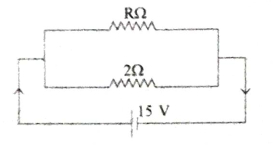
For the given circuit diagram,if the dissipated electrical power is $150 \text{ W}$,find the value of resistance $R$. (in $Omega$)
A
$5$
B
$8$
C
$6$
D
$3$
Solution
(C) The power dissipated in the circuit is given by the formula $P = \frac{V^2}{R_{eq}}$.
Given $P = 150 \text{ W}$ and $V = 15 \text{ V}$.
Substituting the values:
$150 = \frac{(15)^2}{R_{eq}}$
$150 = \frac{225}{R_{eq}}$
$R_{eq} = \frac{225}{150} = 1.5 \Omega$.
The two resistors $R$ and $2 \Omega$ are connected in parallel.
Therefore,$\frac{1}{R_{eq}} = \frac{1}{R} + \frac{1}{2}$.
$\frac{1}{1.5} = \frac{1}{R} + \frac{1}{2}$.
$\frac{1}{R} = \frac{1}{1.5} - \frac{1}{2} = \frac{2}{3} - \frac{1}{2} = \frac{4-3}{6} = \frac{1}{6}$.
Thus,$R = 6 \Omega$.
Given $P = 150 \text{ W}$ and $V = 15 \text{ V}$.
Substituting the values:
$150 = \frac{(15)^2}{R_{eq}}$
$150 = \frac{225}{R_{eq}}$
$R_{eq} = \frac{225}{150} = 1.5 \Omega$.
The two resistors $R$ and $2 \Omega$ are connected in parallel.
Therefore,$\frac{1}{R_{eq}} = \frac{1}{R} + \frac{1}{2}$.
$\frac{1}{1.5} = \frac{1}{R} + \frac{1}{2}$.
$\frac{1}{R} = \frac{1}{1.5} - \frac{1}{2} = \frac{2}{3} - \frac{1}{2} = \frac{4-3}{6} = \frac{1}{6}$.
Thus,$R = 6 \Omega$.
0 likesView Solution
8
PhysicsEasyMCQGUJCET · 2022
At room temperature $(27^\circ \text{C})$ the resistance of a heating element is $100 \ \Omega$. What is the temperature of the element if the resistance is found to be $137 \ \Omega$,given that the temperature coefficient of the material of the resistor is $1.35 \times 10^{-4} \ ^\circ \text{C}^{-1}$ (in $^\circ \text{C}$)?
A
$2767$
B
$1227$
C
$1027$
D
$2327$
Solution
(A) The relationship between resistance and temperature is given by the formula: $R_\theta = R_0 [1 + \alpha (\theta - \theta_0)]$
Given values are: $R_0 = 100 \ \Omega$,$\theta_0 = 27^\circ \text{C}$,$R_\theta = 137 \ \Omega$,and $\alpha = 1.35 \times 10^{-4} \ ^\circ \text{C}^{-1}$.
Substituting these values into the equation:
$137 = 100 [1 + 1.35 \times 10^{-4} (\theta - 27)]$
$1.37 = 1 + 1.35 \times 10^{-4} (\theta - 27)$
$0.37 = 1.35 \times 10^{-4} (\theta - 27)$
$\theta - 27 = \frac{0.37}{1.35 \times 10^{-4}}$
$\theta - 27 \approx 2740.74$
$\theta \approx 2740.74 + 27 = 2767.74^\circ \text{C}$
Rounding to the nearest integer,we get $\theta \approx 2767^\circ \text{C}$.
Given values are: $R_0 = 100 \ \Omega$,$\theta_0 = 27^\circ \text{C}$,$R_\theta = 137 \ \Omega$,and $\alpha = 1.35 \times 10^{-4} \ ^\circ \text{C}^{-1}$.
Substituting these values into the equation:
$137 = 100 [1 + 1.35 \times 10^{-4} (\theta - 27)]$
$1.37 = 1 + 1.35 \times 10^{-4} (\theta - 27)$
$0.37 = 1.35 \times 10^{-4} (\theta - 27)$
$\theta - 27 = \frac{0.37}{1.35 \times 10^{-4}}$
$\theta - 27 \approx 2740.74$
$\theta \approx 2740.74 + 27 = 2767.74^\circ \text{C}$
Rounding to the nearest integer,we get $\theta \approx 2767^\circ \text{C}$.
0 likesView Solution
9
PhysicsEasyMCQGUJCET · 2022
What is the de-Broglie wavelength associated with an electron moving with a speed of $6.4 \times 10^{6} \ m/s$ (in $nm$)? $(m_{e} = 9.11 \times 10^{-31} \ kg, h = 6.63 \times 10^{-34} \ J \cdot s)$
A
$0.124$
B
$0.114$
C
$0.135$
D
$0.145$
Solution
(B) The de-Broglie wavelength $\lambda$ is given by the formula: $\lambda = \frac{h}{mv}$.
Given values are $h = 6.63 \times 10^{-34} \ J \cdot s$,$m_{e} = 9.11 \times 10^{-31} \ kg$,and $v = 6.4 \times 10^{6} \ m/s$.
Substituting these values into the formula:
$\lambda = \frac{6.63 \times 10^{-34}}{9.11 \times 10^{-31} \times 6.4 \times 10^{6}}$
$\lambda = \frac{6.63 \times 10^{-34}}{58.304 \times 10^{-25}}$
$\lambda \approx 0.1137 \times 10^{-9} \ m$
Since $1 \ nm = 10^{-9} \ m$,we get $\lambda \approx 0.114 \ nm$.
Given values are $h = 6.63 \times 10^{-34} \ J \cdot s$,$m_{e} = 9.11 \times 10^{-31} \ kg$,and $v = 6.4 \times 10^{6} \ m/s$.
Substituting these values into the formula:
$\lambda = \frac{6.63 \times 10^{-34}}{9.11 \times 10^{-31} \times 6.4 \times 10^{6}}$
$\lambda = \frac{6.63 \times 10^{-34}}{58.304 \times 10^{-25}}$
$\lambda \approx 0.1137 \times 10^{-9} \ m$
Since $1 \ nm = 10^{-9} \ m$,we get $\lambda \approx 0.114 \ nm$.
0 likesView Solution
10
PhysicsEasyMCQGUJCET · 2022
An infinite line charge produces a field of $9 \times 10^4 \text{ NC}^{-1}$ at a distance of $2 \text{ cm}$. Calculate the electric field produced at a distance of $3 \text{ cm}$.
A
$6 \times 10^4 \text{ NC}^{-1}$
B
$6 \times 10^3 \text{ NC}^{-1}$
C
$6 \times 10^{-5} \text{ NC}^{-1}$
D
$6 \times 10^2 \text{ NC}^{-1}$
Solution
(A) Given:
$E_1 = 9 \times 10^4 \text{ NC}^{-1}$
$r_1 = 2 \text{ cm}$
$r_2 = 3 \text{ cm}$
The electric field $E$ due to an infinite line charge is given by the formula:
$E = \frac{\lambda}{2 \pi \varepsilon_0 r}$
From this relation,we can see that $E \propto \frac{1}{r}$.
Therefore,the ratio of the fields at two different distances is:
$\frac{E_2}{E_1} = \frac{r_1}{r_2}$
Substituting the given values:
$\frac{E_2}{9 \times 10^4} = \frac{2 \text{ cm}}{3 \text{ cm}}$
Solving for $E_2$:
$E_2 = \frac{9 \times 10^4 \times 2}{3}$
$E_2 = 3 \times 10^4 \times 2$
$E_2 = 6 \times 10^4 \text{ NC}^{-1}$
Thus,the electric field at a distance of $3 \text{ cm}$ is $6 \times 10^4 \text{ NC}^{-1}$.
$E_1 = 9 \times 10^4 \text{ NC}^{-1}$
$r_1 = 2 \text{ cm}$
$r_2 = 3 \text{ cm}$
The electric field $E$ due to an infinite line charge is given by the formula:
$E = \frac{\lambda}{2 \pi \varepsilon_0 r}$
From this relation,we can see that $E \propto \frac{1}{r}$.
Therefore,the ratio of the fields at two different distances is:
$\frac{E_2}{E_1} = \frac{r_1}{r_2}$
Substituting the given values:
$\frac{E_2}{9 \times 10^4} = \frac{2 \text{ cm}}{3 \text{ cm}}$
Solving for $E_2$:
$E_2 = \frac{9 \times 10^4 \times 2}{3}$
$E_2 = 3 \times 10^4 \times 2$
$E_2 = 6 \times 10^4 \text{ NC}^{-1}$
Thus,the electric field at a distance of $3 \text{ cm}$ is $6 \times 10^4 \text{ NC}^{-1}$.
0 likesView Solution
11
PhysicsEasyMCQGUJCET · 2022
An electric dipole with dipole moment $4 \times 10^{-9} \text{ Cm}$ is aligned at $60^{\circ}$ with the direction of a uniform electric field of magnitude $5 \times 10^4 \text{ NC}^{-1}$. Calculate the magnitude of the torque acting on the dipole.
A
$17.3 \times 10^{-6} \text{ Nm}$
B
$1.73 \times 10^{-4} \text{ Nm}$
C
$1.73 \times 10^{-6} \text{ Nm}$
D
$17.3 \times 10^{-4} \text{ Nm}$
Solution
(B) The torque $\tau$ acting on an electric dipole in a uniform electric field is given by the formula: $\tau = pE \sin \theta$.
Given values are:
Dipole moment $p = 4 \times 10^{-9} \text{ Cm}$
Electric field $E = 5 \times 10^4 \text{ NC}^{-1}$
Angle $\theta = 60^{\circ}$
Substituting these values into the formula:
$\tau = (4 \times 10^{-9}) \times (5 \times 10^4) \times \sin 60^{\circ}$
$\tau = 20 \times 10^{-5} \times \frac{\sqrt{3}}{2}$
$\tau = 10 \times 10^{-5} \times 1.732$
$\tau = 1.732 \times 10^{-4} \text{ Nm}$
Thus,the magnitude of the torque is $1.73 \times 10^{-4} \text{ Nm}$.
Given values are:
Dipole moment $p = 4 \times 10^{-9} \text{ Cm}$
Electric field $E = 5 \times 10^4 \text{ NC}^{-1}$
Angle $\theta = 60^{\circ}$
Substituting these values into the formula:
$\tau = (4 \times 10^{-9}) \times (5 \times 10^4) \times \sin 60^{\circ}$
$\tau = 20 \times 10^{-5} \times \frac{\sqrt{3}}{2}$
$\tau = 10 \times 10^{-5} \times 1.732$
$\tau = 1.732 \times 10^{-4} \text{ Nm}$
Thus,the magnitude of the torque is $1.73 \times 10^{-4} \text{ Nm}$.
0 likesView Solution
12
PhysicsEasyMCQGUJCET · 2022
An air-cored solenoid with $30 \ cm$ length,area of cross-section $25 \ cm^2$,and $500$ turns carries a current of $2.5 \ A$. The current is suddenly switched off in a brief time of $10^{-3} \ s$. How much is the average back emf induced across the ends of the open switch in the circuit (in $V$)? (Ignore the variation in magnetic field near the ends of the solenoid.)
A
$6.54$
B
$65.4$
C
$654$
D
$0.654$
Solution
(A) The magnetic field inside an air-cored solenoid is given by $B = \frac{\mu_0 NI}{l}$.
Initial magnetic flux linkage $\phi_1 = N B A = N \left( \frac{\mu_0 NI}{l} \right) A = \frac{\mu_0 N^2 AI}{l}$.
Given values: $N = 500$,$I = 2.5 \ A$,$l = 0.3 \ m$,$A = 25 \times 10^{-4} \ m^2$,$\Delta t = 10^{-3} \ s$,and $\mu_0 = 4\pi \times 10^{-7} \ T \cdot m/A$.
When the current is switched off,the final flux $\phi_2 = 0$.
The magnitude of induced emf is $|\varepsilon| = \frac{|\Delta \phi|}{\Delta t} = \frac{|\phi_2 - \phi_1|}{\Delta t} = \frac{\mu_0 N^2 AI}{l \Delta t}$.
Substituting the values:
$|\varepsilon| = \frac{4\pi \times 10^{-7} \times (500)^2 \times 25 \times 10^{-4} \times 2.5}{0.3 \times 10^{-3}}$.
$|\varepsilon| = \frac{4 \times 3.1416 \times 10^{-7} \times 250000 \times 25 \times 10^{-4} \times 2.5}{3 \times 10^{-4}}$.
$|\varepsilon| = \frac{1.9635 \times 10^{-3}}{3 \times 10^{-4}} \approx 6.54 \ V$.
Initial magnetic flux linkage $\phi_1 = N B A = N \left( \frac{\mu_0 NI}{l} \right) A = \frac{\mu_0 N^2 AI}{l}$.
Given values: $N = 500$,$I = 2.5 \ A$,$l = 0.3 \ m$,$A = 25 \times 10^{-4} \ m^2$,$\Delta t = 10^{-3} \ s$,and $\mu_0 = 4\pi \times 10^{-7} \ T \cdot m/A$.
When the current is switched off,the final flux $\phi_2 = 0$.
The magnitude of induced emf is $|\varepsilon| = \frac{|\Delta \phi|}{\Delta t} = \frac{|\phi_2 - \phi_1|}{\Delta t} = \frac{\mu_0 N^2 AI}{l \Delta t}$.
Substituting the values:
$|\varepsilon| = \frac{4\pi \times 10^{-7} \times (500)^2 \times 25 \times 10^{-4} \times 2.5}{0.3 \times 10^{-3}}$.
$|\varepsilon| = \frac{4 \times 3.1416 \times 10^{-7} \times 250000 \times 25 \times 10^{-4} \times 2.5}{3 \times 10^{-4}}$.
$|\varepsilon| = \frac{1.9635 \times 10^{-3}}{3 \times 10^{-4}} \approx 6.54 \ V$.
0 likesView Solution
13
PhysicsEasyMCQGUJCET · 2022
$A$ pair of adjacent coils has a mutual inductance of $1.5 \ H$. If the current in one coil changes from $0 \ A$ to $10 \ A$ in $0.5 \ s$,what is the change of flux linkage with the other coil (in $Wb$)?
A
$15$
B
$30$
C
$1.5$
D
$0.15$
Solution
(A) The magnetic flux linkage $\phi$ in the second coil is related to the current $I$ in the first coil by the relation $\phi = M I$,where $M$ is the mutual inductance.
For a change in current $\Delta I$,the change in flux linkage $\Delta \phi$ is given by:
$\Delta \phi = M \Delta I$
Given:
$M = 1.5 \ H$
$\Delta I = I_f - I_i = 10 \ A - 0 \ A = 10 \ A$
Substituting the values:
$\Delta \phi = 1.5 \ H \times 10 \ A$
$\Delta \phi = 15 \ Wb$
Therefore,the change in flux linkage is $15 \ Wb$.
For a change in current $\Delta I$,the change in flux linkage $\Delta \phi$ is given by:
$\Delta \phi = M \Delta I$
Given:
$M = 1.5 \ H$
$\Delta I = I_f - I_i = 10 \ A - 0 \ A = 10 \ A$
Substituting the values:
$\Delta \phi = 1.5 \ H \times 10 \ A$
$\Delta \phi = 15 \ Wb$
Therefore,the change in flux linkage is $15 \ Wb$.
0 likesView Solution
14
PhysicsEasyMCQGUJCET · 2022
"The polarity of induced emf is such that it tends to produce a current which opposes the change in magnetic flux that produced it." This statement is known as . . . . . . law.
A
Faraday
B
Maxwell
C
Kirchhoff
D
Lenz
Solution
(D) The correct answer is $D$.
According to Lenz's law, the direction of the induced current in a circuit is always such that it opposes the change in magnetic flux that produces it. This law is a direct consequence of the law of conservation of energy.
According to Lenz's law, the direction of the induced current in a circuit is always such that it opposes the change in magnetic flux that produces it. This law is a direct consequence of the law of conservation of energy.
0 likesView Solution
15
PhysicsEasyMCQGUJCET · 2022
$A$ radio can tune into any station in the $6 \text{ MHz}$ to $12 \text{ MHz}$ band. What is the corresponding wavelength band? ( $c = 3 \times 10^{8} \text{ m/s}$ )
A
$25 \text{ m}$ to $50 \text{ m}$
B
$20 \text{ m}$ to $30 \text{ m}$
C
$40 \text{ m}$ to $60 \text{ m}$
D
$10 \text{ m}$ to $20 \text{ m}$
Solution
(A) The relationship between speed of light $(c)$, frequency $(\nu)$, and wavelength $(\lambda)$ is given by $c = \nu \lambda$.
Therefore, the wavelength is $\lambda = \frac{c}{\nu}$.
For the lower frequency limit $\nu_1 = 6 \text{ MHz} = 6 \times 10^6 \text{ Hz}$, the wavelength is:
$\lambda_1 = \frac{3 \times 10^8}{6 \times 10^6} = \frac{300}{6} = 50 \text{ m}$.
For the upper frequency limit $\nu_2 = 12 \text{ MHz} = 12 \times 10^6 \text{ Hz}$, the wavelength is:
$\lambda_2 = \frac{3 \times 10^8}{12 \times 10^6} = \frac{300}{12} = 25 \text{ m}$.
Thus, the corresponding wavelength band is $25 \text{ m}$ to $50 \text{ m}$.
Therefore, the wavelength is $\lambda = \frac{c}{\nu}$.
For the lower frequency limit $\nu_1 = 6 \text{ MHz} = 6 \times 10^6 \text{ Hz}$, the wavelength is:
$\lambda_1 = \frac{3 \times 10^8}{6 \times 10^6} = \frac{300}{6} = 50 \text{ m}$.
For the upper frequency limit $\nu_2 = 12 \text{ MHz} = 12 \times 10^6 \text{ Hz}$, the wavelength is:
$\lambda_2 = \frac{3 \times 10^8}{12 \times 10^6} = \frac{300}{12} = 25 \text{ m}$.
Thus, the corresponding wavelength band is $25 \text{ m}$ to $50 \text{ m}$.
0 likesView Solution
16
PhysicsEasyMCQGUJCET · 2022
$A$ charged particle oscillates about its mean equilibrium position with a frequency of $10^{9} \,Hz$. The frequency of electromagnetic waves produced by the oscillator is . . . . . . .
A
$10^{9} \,Hz$
B
$10^{-9} \,Hz$
C
$10^{18} \,Hz$
D
$10^{10} \,Hz$
Solution
(A) According to the theory of electromagnetic waves, an oscillating charge is a source of electromagnetic radiation.
When a charged particle oscillates with a frequency $f$, it produces electromagnetic waves of the same frequency $f$.
Given that the frequency of the oscillating particle is $10^{9} \,Hz$, the frequency of the electromagnetic waves produced will also be $10^{9} \,Hz$.
Therefore, the correct option is $A$.
When a charged particle oscillates with a frequency $f$, it produces electromagnetic waves of the same frequency $f$.
Given that the frequency of the oscillating particle is $10^{9} \,Hz$, the frequency of the electromagnetic waves produced will also be $10^{9} \,Hz$.
Therefore, the correct option is $A$.
0 likesView Solution
17
PhysicsEasyMCQGUJCET · 2022
$A$ molecule of a substance has a permanent electric dipole moment of magnitude $10^{-29} \text{ C m}$. $2 \text{ mole}$ of this substance is polarized (at low temperature) by applying a strong electrostatic field of magnitude $10^6 \text{ V m}^{-1}$. What is the potential energy of the system? ($1 \text{ mole}$ of substance contains $6 \times 10^{23}$ molecules.)
A
-$6$ $J$
B
-$12$ $J$
C
$12$ $J$
D
$6$ $J$
Solution
(B) The dipole moment of a single molecule is $p_0 = 10^{-29} \text{ C m}$.
Since $1 \text{ mole}$ contains $6 \times 10^{23}$ molecules,the total number of molecules in $2 \text{ moles}$ is $N = 2 \times 6 \times 10^{23} = 12 \times 10^{23}$ molecules.
The total dipole moment $P$ of the substance when all dipoles are aligned with the field is $P = N \times p_0 = 12 \times 10^{23} \times 10^{-29} = 12 \times 10^{-6} \text{ C m}$.
The potential energy $U$ of a dipole in an external electric field $E$ is given by $U = -P E \cos \theta$. For maximum polarization at low temperature,the dipoles align with the field,so $\theta = 0^{\circ}$.
Substituting the values: $U = -(12 \times 10^{-6} \text{ C m}) \times (10^6 \text{ V m}^{-1}) \times \cos(0^{\circ}) = -12 \times 1 \times 1 = -12 \text{ J}$.
Since $1 \text{ mole}$ contains $6 \times 10^{23}$ molecules,the total number of molecules in $2 \text{ moles}$ is $N = 2 \times 6 \times 10^{23} = 12 \times 10^{23}$ molecules.
The total dipole moment $P$ of the substance when all dipoles are aligned with the field is $P = N \times p_0 = 12 \times 10^{23} \times 10^{-29} = 12 \times 10^{-6} \text{ C m}$.
The potential energy $U$ of a dipole in an external electric field $E$ is given by $U = -P E \cos \theta$. For maximum polarization at low temperature,the dipoles align with the field,so $\theta = 0^{\circ}$.
Substituting the values: $U = -(12 \times 10^{-6} \text{ C m}) \times (10^6 \text{ V m}^{-1}) \times \cos(0^{\circ}) = -12 \times 1 \times 1 = -12 \text{ J}$.
0 likesView Solution
18
PhysicsEasyMCQGUJCET · 2022
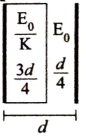
$A$ slab of material with a dielectric constant of $3$ has the same area as the plates of a parallel plate capacitor but has a thickness of $\left(\frac{3}{4}\right) d$,where $d$ is the separation between the plates. What is the electrical potential difference between the plates when the slab is inserted? The initial electrical potential difference is $V_0$.
A
$\frac{V_0}{6}$
B
$\frac{V_0}{4}$
C
$\frac{V_0}{2}$
D
$\frac{V_0}{3}$
Solution
(C) In the absence of a dielectric,the electric field between the two plates is $E_0 = \frac{V_0}{d}$.
When the dielectric slab is inserted,the electric field inside the dielectric becomes $E = \frac{E_0}{K}$,where $K=3$ is the dielectric constant.
The thickness of the dielectric slab is $t = \frac{3}{4}d$,and the thickness of the air gap is $d - t = d - \frac{3}{4}d = \frac{1}{4}d$.
The new potential difference $V$ is the sum of the potential drops across the air gap and the dielectric slab:
$V = E_0 \left(\frac{1}{4}d\right) + E \left(\frac{3}{4}d\right)$
$V = E_0 \left(\frac{1}{4}d\right) + \frac{E_0}{K} \left(\frac{3}{4}d\right)$
$V = E_0 d \left[ \frac{1}{4} + \frac{3}{4K} \right]$
Since $E_0 d = V_0$ and $K = 3$:
$V = V_0 \left[ \frac{1}{4} + \frac{3}{4 \times 3} \right]$
$V = V_0 \left[ \frac{1}{4} + \frac{1}{4} \right]$
$V = V_0 \left( \frac{2}{4} \right) = \frac{V_0}{2}$
When the dielectric slab is inserted,the electric field inside the dielectric becomes $E = \frac{E_0}{K}$,where $K=3$ is the dielectric constant.
The thickness of the dielectric slab is $t = \frac{3}{4}d$,and the thickness of the air gap is $d - t = d - \frac{3}{4}d = \frac{1}{4}d$.
The new potential difference $V$ is the sum of the potential drops across the air gap and the dielectric slab:
$V = E_0 \left(\frac{1}{4}d\right) + E \left(\frac{3}{4}d\right)$
$V = E_0 \left(\frac{1}{4}d\right) + \frac{E_0}{K} \left(\frac{3}{4}d\right)$
$V = E_0 d \left[ \frac{1}{4} + \frac{3}{4K} \right]$
Since $E_0 d = V_0$ and $K = 3$:
$V = V_0 \left[ \frac{1}{4} + \frac{3}{4 \times 3} \right]$
$V = V_0 \left[ \frac{1}{4} + \frac{1}{4} \right]$
$V = V_0 \left( \frac{2}{4} \right) = \frac{V_0}{2}$
0 likesView Solution
19
PhysicsEasyMCQGUJCET · 2022
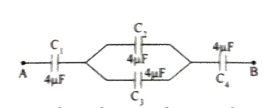
How will you connect four capacitors,each of capacitance $4 \mu F$,to obtain an equivalent capacitance of $1.6 \mu F$?
A
Two in parallel and two in series
B
All four in series
C
All four in parallel
D
Three in parallel and one in series
Solution
(A) The correct configuration is shown in the figure,where two capacitors ($C_2$ and $C_3$) are connected in parallel,and this combination is connected in series with two other capacitors ($C_1$ and $C_4$).
Given: $C_1 = C_2 = C_3 = C_4 = 4 \mu F$.
First,calculate the equivalent capacitance of the parallel combination $(C_p)$:
$C_p = C_2 + C_3 = 4 \mu F + 4 \mu F = 8 \mu F$.
Now,the total equivalent capacitance $(C_{eq})$ is the series combination of $C_1$,$C_p$,and $C_4$:
$\frac{1}{C_{eq}} = \frac{1}{C_1} + \frac{1}{C_p} + \frac{1}{C_4} = \frac{1}{4} + \frac{1}{8} + \frac{1}{4}$.
$\frac{1}{C_{eq}} = \frac{2 + 1 + 2}{8} = \frac{5}{8} \mu F^{-1}$.
$C_{eq} = \frac{8}{5} \mu F = 1.6 \mu F$.
Given: $C_1 = C_2 = C_3 = C_4 = 4 \mu F$.
First,calculate the equivalent capacitance of the parallel combination $(C_p)$:
$C_p = C_2 + C_3 = 4 \mu F + 4 \mu F = 8 \mu F$.
Now,the total equivalent capacitance $(C_{eq})$ is the series combination of $C_1$,$C_p$,and $C_4$:
$\frac{1}{C_{eq}} = \frac{1}{C_1} + \frac{1}{C_p} + \frac{1}{C_4} = \frac{1}{4} + \frac{1}{8} + \frac{1}{4}$.
$\frac{1}{C_{eq}} = \frac{2 + 1 + 2}{8} = \frac{5}{8} \mu F^{-1}$.
$C_{eq} = \frac{8}{5} \mu F = 1.6 \mu F$.
0 likesView Solution
20
PhysicsEasyMCQGUJCET · 2022
$A$ solenoid has a core of a material with relative permeability $400$. The windings of the solenoid are insulated from the core and carry a current of $1 \text{ A}$. If the number of turns is $1000 \text{ per metre}$,the magnetic field $(B)$ is . . . . . . $\text{T}$. (Given: $\mu_0 = 4\pi \times 10^{-7} \text{ SI units}$)
A
$1.6\pi \times 10^2$
B
$16\pi \times 10^2$
C
$16\pi \times 10^{-2}$
D
$0.16\pi \times 10^{-2}$
Solution
(C) The magnetic field inside a solenoid with a magnetic core is given by the formula:
$B = \mu_0 \mu_r n I$
Where:
$\mu_0 = 4\pi \times 10^{-7} \text{ T m/A}$
$\mu_r = 400$
$n = 1000 \text{ turns/m}$
$I = 1 \text{ A}$
Substituting the values:
$B = (4\pi \times 10^{-7}) \times 400 \times 1000 \times 1$
$B = 4\pi \times 4 \times 10^5 \times 10^{-7}$
$B = 16\pi \times 10^{-2} \text{ T}$
$B = \mu_0 \mu_r n I$
Where:
$\mu_0 = 4\pi \times 10^{-7} \text{ T m/A}$
$\mu_r = 400$
$n = 1000 \text{ turns/m}$
$I = 1 \text{ A}$
Substituting the values:
$B = (4\pi \times 10^{-7}) \times 400 \times 1000 \times 1$
$B = 4\pi \times 4 \times 10^5 \times 10^{-7}$
$B = 16\pi \times 10^{-2} \text{ T}$
0 likesView Solution
21
PhysicsEasyMCQGUJCET · 2022
Two long and parallel straight wires $A$ and $B$ carrying currents of $10 \ A$ and $4 \ A$ in the same direction are separated by a distance of $2 \ cm$. Estimate the force on a $4 \ cm$ section of wire $A$. ( $\mu_0 = 4 \pi \times 10^{-7} \ SI$ ).
A
$1.6 \times 10^{-4} \ N$
B
$1.6 \times 10^{-5} \ N$
C
$1.6 \times 10^{-6} \ N$
D
$1.6 \times 10^{-3} \ N$
Solution
(B) The force per unit length between two parallel current-carrying wires is given by the formula: $F = \frac{\mu_0 I_1 I_2 l}{2 \pi d}$.
Given:
$I_1 = 10 \ A$
$I_2 = 4 \ A$
$d = 2 \ cm = 2 \times 10^{-2} \ m$
$l = 4 \ cm = 4 \times 10^{-2} \ m$
$\mu_0 = 4 \pi \times 10^{-7} \ T \cdot m/A$
Substituting the values into the formula:
$F = \frac{(4 \pi \times 10^{-7}) \times 10 \times 4 \times (4 \times 10^{-2})}{2 \pi \times (2 \times 10^{-2})}$
$F = \frac{2 \times 10^{-7} \times 40 \times 4 \times 10^{-2}}{2 \times 10^{-2}}$
$F = 2 \times 10^{-7} \times 40 \times 2$
$F = 160 \times 10^{-7} \ N = 1.6 \times 10^{-5} \ N$.
Thus,the correct option is $B$.
Given:
$I_1 = 10 \ A$
$I_2 = 4 \ A$
$d = 2 \ cm = 2 \times 10^{-2} \ m$
$l = 4 \ cm = 4 \times 10^{-2} \ m$
$\mu_0 = 4 \pi \times 10^{-7} \ T \cdot m/A$
Substituting the values into the formula:
$F = \frac{(4 \pi \times 10^{-7}) \times 10 \times 4 \times (4 \times 10^{-2})}{2 \pi \times (2 \times 10^{-2})}$
$F = \frac{2 \times 10^{-7} \times 40 \times 4 \times 10^{-2}}{2 \times 10^{-2}}$
$F = 2 \times 10^{-7} \times 40 \times 2$
$F = 160 \times 10^{-7} \ N = 1.6 \times 10^{-5} \ N$.
Thus,the correct option is $B$.
0 likesView Solution
22
PhysicsEasyMCQGUJCET · 2022
$A$ solenoid of length $0.25 \ m$ has a radius of $1 \ cm$ and is made up of $500$ turns. It carries a current of $2.5 \ A$. What is the magnitude of the magnetic field inside the solenoid? (Take $\mu_0 = 4 \pi \times 10^{-7} \ SI$ units).
A
$6.28 \times 10^{-3} \ T$
B
$6.28 \times 10^{-2} \ T$
C
$6.28 \times 10^{-4} \ T$
D
$6.28 \times 10^{-1} \ T$
Solution
(A) The magnetic field $B$ inside a long solenoid is given by the formula $B = \mu_0 n I$, where $n = N/l$ is the number of turns per unit length.
Given:
Length $l = 0.25 \ m$
Number of turns $N = 500$
Current $I = 2.5 \ A$
Permeability $\mu_0 = 4 \pi \times 10^{-7} \ T \cdot m/A$
Calculation:
$n = \frac{500}{0.25} = 2000 \ turns/m$
$B = (4 \pi \times 10^{-7}) \times 2000 \times 2.5$
$B = 4 \times 3.14 \times 10^{-7} \times 5000$
$B = 12.56 \times 10^{-4} \ T = 6.28 \times 2 \times 10^{-4} \ T = 6.28 \times 10^{-3} \ T$.
Given:
Length $l = 0.25 \ m$
Number of turns $N = 500$
Current $I = 2.5 \ A$
Permeability $\mu_0 = 4 \pi \times 10^{-7} \ T \cdot m/A$
Calculation:
$n = \frac{500}{0.25} = 2000 \ turns/m$
$B = (4 \pi \times 10^{-7}) \times 2000 \times 2.5$
$B = 4 \times 3.14 \times 10^{-7} \times 5000$
$B = 12.56 \times 10^{-4} \ T = 6.28 \times 2 \times 10^{-4} \ T = 6.28 \times 10^{-3} \ T$.
0 likesView Solution
23
PhysicsEasyMCQGUJCET · 2022
What is the focal length of a convex lens of focal length $30 \ cm$ in contact with a concave lens of focal length $10 \ cm$? (Ignore the thickness of the lenses.)
A
-$15$ cm
B
-$40$ cm
C
-$20$ cm
D
-$30$ cm
Solution
(A) The focal length of a convex lens is $f_1 = +30 \ cm$.
The focal length of a concave lens is $f_2 = -10 \ cm$.
When two thin lenses are placed in contact,the equivalent focal length $f$ is given by the formula:
$\frac{1}{f} = \frac{1}{f_1} + \frac{1}{f_2}$
Substituting the given values:
$\frac{1}{f} = \frac{1}{30} + \frac{1}{-10}$
$\frac{1}{f} = \frac{1 - 3}{30}$
$\frac{1}{f} = \frac{-2}{30}$
$\frac{1}{f} = \frac{-1}{15}$
Therefore,$f = -15 \ cm$.
The focal length of a concave lens is $f_2 = -10 \ cm$.
When two thin lenses are placed in contact,the equivalent focal length $f$ is given by the formula:
$\frac{1}{f} = \frac{1}{f_1} + \frac{1}{f_2}$
Substituting the given values:
$\frac{1}{f} = \frac{1}{30} + \frac{1}{-10}$
$\frac{1}{f} = \frac{1 - 3}{30}$
$\frac{1}{f} = \frac{-2}{30}$
$\frac{1}{f} = \frac{-1}{15}$
Therefore,$f = -15 \ cm$.
0 likesView Solution
24
PhysicsEasyMCQGUJCET · 2022
Double convex lenses are to be manufactured from a glass of refractive index $1.55$ with both faces of the same radius of curvature. What is the radius of curvature required if the focal length is to be $20 \ cm$ (in $cm$)?
A
$44$
B
$2.2$
C
$22$
D
$4.4$
Solution
(C) Given:
Focal length $f = +20 \ cm$
Refractive index $n = 1.55$
For a double convex lens with equal radii of curvature,$R_1 = +R$ and $R_2 = -R$.
Using the lens maker's formula:
$\frac{1}{f} = (n - 1) \left( \frac{1}{R_1} - \frac{1}{R_2} \right)$
Substituting the values:
$\frac{1}{20} = (1.55 - 1) \left( \frac{1}{R} - \frac{1}{-R} \right)$
$\frac{1}{20} = 0.55 \times \left( \frac{2}{R} \right)$
$\frac{1}{20} = \frac{1.1}{R}$
$R = 20 \times 1.1 = 22 \ cm$
Therefore,the required radius of curvature is $22 \ cm$.
Focal length $f = +20 \ cm$
Refractive index $n = 1.55$
For a double convex lens with equal radii of curvature,$R_1 = +R$ and $R_2 = -R$.
Using the lens maker's formula:
$\frac{1}{f} = (n - 1) \left( \frac{1}{R_1} - \frac{1}{R_2} \right)$
Substituting the values:
$\frac{1}{20} = (1.55 - 1) \left( \frac{1}{R} - \frac{1}{-R} \right)$
$\frac{1}{20} = 0.55 \times \left( \frac{2}{R} \right)$
$\frac{1}{20} = \frac{1.1}{R}$
$R = 20 \times 1.1 = 22 \ cm$
Therefore,the required radius of curvature is $22 \ cm$.
0 likesView Solution
25
PhysicsEasyMCQGUJCET · 2022
Light from a point source in air falls on a spherical glass surface ($n = 1.5$ and radius of curvature $R = 20 \ cm$). The distance of the light source from the glass surface is $100 \ cm$. Find the image distance. (in $cm$)
A
$-100$
B
$-200$
C
$200$
D
$100$
Solution
(D) Given: Refractive index of air $n_1 = 1$,refractive index of glass $n_2 = 1.5$,radius of curvature $R = +20 \ cm$,and object distance $u = -100 \ cm$.
Using the formula for refraction at a spherical surface:
$\frac{n_2}{v} - \frac{n_1}{u} = \frac{n_2 - n_1}{R}$
Substituting the values:
$\frac{1.5}{v} - \frac{1}{-100} = \frac{1.5 - 1}{20}$
$\frac{1.5}{v} + \frac{1}{100} = \frac{0.5}{20}$
$\frac{1.5}{v} = \frac{0.5}{20} - \frac{1}{100}$
$\frac{1.5}{v} = \frac{2.5 - 1}{100}$
$\frac{1.5}{v} = \frac{1.5}{100}$
$v = +100 \ cm$
Thus,the image is formed at a distance of $100 \ cm$ from the surface.
Using the formula for refraction at a spherical surface:
$\frac{n_2}{v} - \frac{n_1}{u} = \frac{n_2 - n_1}{R}$
Substituting the values:
$\frac{1.5}{v} - \frac{1}{-100} = \frac{1.5 - 1}{20}$
$\frac{1.5}{v} + \frac{1}{100} = \frac{0.5}{20}$
$\frac{1.5}{v} = \frac{0.5}{20} - \frac{1}{100}$
$\frac{1.5}{v} = \frac{2.5 - 1}{100}$
$\frac{1.5}{v} = \frac{1.5}{100}$
$v = +100 \ cm$
Thus,the image is formed at a distance of $100 \ cm$ from the surface.
0 likesView Solution
Vedclass Products
For Students
Vedclass Test Series
Mock tests in real GUJCET style covering Physics with performance analysis. 5-day free trial.
Start Free TrialFor Teachers
Exam Paper Generator
Generate Set A/B/C/D Physics papers from 7.5L+ questions in 2 minutes. 3 chapters free.
Try FreeFor Institutes
Online Exam Module
Run live GUJCET mock exams with unlimited students, 360° analytics & white-label branding.
See DemoFrequently Asked Questions
How many Physics questions are in GUJCET 2022?
There are 25 Physics questions from the GUJCET 2022 paper on Vedclass, each with a detailed step-by-step solution in English.
Are GUJCET 2022 Physics solutions available in English?
Yes. All solutions on this page are in English. You can also switch to English or Hindi using the language buttons above the questions.
Can I practice GUJCET 2022 Physics as a timed test?
Yes. Use the Vedclass Test Series to attempt a full GUJCET mock test covering Physics with time limits and instant score analysis.
Can teachers create Physics papers from GUJCET previous year questions?
Yes. The Vedclass Exam Paper Generator lets teachers mix GUJCET Physics questions and generate Set A/B/C/D papers in minutes.
For Teachers & Institutes
Build a Custom Physics Paper
Pick GUJCET 2022 Physics questions, set difficulty, and generate Set A/B/C/D in 2 minutes.