
ChemistryQ1–27 of 27 questions
Page 1 of 1 · English
1
ChemistryEasyMCQGUJCET · 2018
Which of the following compounds upon oxidation gives isophthalic acid?
A
$p-$xylene
B
$m-$xylene
C
$o-$xylene
D
$m-$cresol
Solution
(B) The oxidation of alkyl benzenes with strong oxidizing agents like $KMnO_4$ in an alkaline medium followed by acidification leads to the formation of aromatic carboxylic acids.
$m-$xylene ($1$,$3$-dimethylbenzene) contains two methyl groups at the meta positions.
Upon vigorous oxidation with $KMnO_4/KOH$ followed by $H_3O^+$,both methyl groups are oxidized to carboxylic acid $(-COOH)$ groups.
This reaction converts $m-$xylene into benzene$-1,3-$dicarboxylic acid,which is commonly known as isophthalic acid.
Therefore,the correct option is $B$.
$m-$xylene ($1$,$3$-dimethylbenzene) contains two methyl groups at the meta positions.
Upon vigorous oxidation with $KMnO_4/KOH$ followed by $H_3O^+$,both methyl groups are oxidized to carboxylic acid $(-COOH)$ groups.
This reaction converts $m-$xylene into benzene$-1,3-$dicarboxylic acid,which is commonly known as isophthalic acid.
Therefore,the correct option is $B$.
0 likesView Solution
2
ChemistryEasyMCQGUJCET · 2018
Which one of the following compounds is optically inactive?
A
$3-$chlorobut$-1-$ene
B
$2,3-$dichlorobutane
C
$2-$hydroxypropanoic acid
D
$2,2-$dichloropentane
Solution
(D) compound is optically inactive if it lacks a chiral center or possesses a plane of symmetry (meso compound).
$1$. $3-$chlorobut$-1-$ene: The $C3$ atom is bonded to a hydrogen,a chlorine,a methyl group,and a vinyl group. It is chiral.
$2$. $2,3-$dichlorobutane: This can exist as a meso form (achiral) or chiral enantiomers. However,$2,2-$dichloropentane is definitively achiral.
$3$. $2-$hydroxypropanoic acid (lactic acid): The $C2$ atom is bonded to a hydrogen,a hydroxyl group,a methyl group,and a carboxyl group. It is chiral.
$4$. $2,2-$dichloropentane: The $C2$ atom is bonded to two identical chlorine atoms. Since it lacks a chiral center,it is optically inactive.
$1$. $3-$chlorobut$-1-$ene: The $C3$ atom is bonded to a hydrogen,a chlorine,a methyl group,and a vinyl group. It is chiral.
$2$. $2,3-$dichlorobutane: This can exist as a meso form (achiral) or chiral enantiomers. However,$2,2-$dichloropentane is definitively achiral.
$3$. $2-$hydroxypropanoic acid (lactic acid): The $C2$ atom is bonded to a hydrogen,a hydroxyl group,a methyl group,and a carboxyl group. It is chiral.
$4$. $2,2-$dichloropentane: The $C2$ atom is bonded to two identical chlorine atoms. Since it lacks a chiral center,it is optically inactive.
0 likesView Solution
3
ChemistryEasyMCQGUJCET · 2018
What is the normality of an aqueous solution of $H_2SO_4$ having $pH = 1$ (in $N$)?
A
$0.1$
B
$0.05$
C
$1$
D
$0.5$
Solution
(A) The dissociation of $H_2SO_4$ is given by: $H_2SO_4 \rightarrow 2H^+ + SO_4^{2-}$.
Given $pH = 1$,we know that $[H^+] = 10^{-pH} = 10^{-1} = 0.1 \ M$.
Since $1 \ mol$ of $H_2SO_4$ produces $2 \ mol$ of $H^+$,the molarity $(M)$ of $H_2SO_4$ is $[H^+] / 2 = 0.1 / 2 = 0.05 \ M$.
Normality $(N)$ is calculated as $Molarity \times n$-factor.
For $H_2SO_4$,the $n$-factor is $2$.
Therefore,$N = 0.05 \times 2 = 0.1 \ N$.
Given $pH = 1$,we know that $[H^+] = 10^{-pH} = 10^{-1} = 0.1 \ M$.
Since $1 \ mol$ of $H_2SO_4$ produces $2 \ mol$ of $H^+$,the molarity $(M)$ of $H_2SO_4$ is $[H^+] / 2 = 0.1 / 2 = 0.05 \ M$.
Normality $(N)$ is calculated as $Molarity \times n$-factor.
For $H_2SO_4$,the $n$-factor is $2$.
Therefore,$N = 0.05 \times 2 = 0.1 \ N$.
0 likesView Solution
4
ChemistryEasyMCQGUJCET · 2018
Choose the correct option by putting $T$ for the true statement and $F$ for the false statement.
$(i)$ Phenol is more acidic as compared to ethanol.
$(ii)$ Melting point of $o$-nitrophenol is lesser than $p$-nitrophenol.
$(iii)$ Neutralization of phenol is done with $NaHCO_3$.
$(iv)$ Nucleophilic substitution reaction is taking place in the aromatic ring of phenol.
$(i)$ Phenol is more acidic as compared to ethanol.
$(ii)$ Melting point of $o$-nitrophenol is lesser than $p$-nitrophenol.
$(iii)$ Neutralization of phenol is done with $NaHCO_3$.
$(iv)$ Nucleophilic substitution reaction is taking place in the aromatic ring of phenol.
A
$TTFT$
B
$TFTF$
C
$TTFF$
D
$TFFT$
Solution
(C) $(i)$ Phenol is more acidic than ethanol because the phenoxide ion is stabilized by resonance,while the ethoxide ion is destabilized by the $+I$ effect of the alkyl group. Statement is $T$.
$(ii)$ $o$-Nitrophenol exhibits intramolecular hydrogen bonding,whereas $p$-nitrophenol exhibits intermolecular hydrogen bonding,leading to higher association and higher melting point for $p$-nitrophenol. Statement is $T$.
$(iii)$ Phenol is a weaker acid than carbonic acid $(H_2CO_3)$,so it does not react with $NaHCO_3$ to evolve $CO_2$. Statement is $F$.
$(iv)$ The aromatic ring of phenol is electron-rich due to the $+M$ effect of the $-OH$ group,making it susceptible to electrophilic substitution,not nucleophilic substitution. Statement is $F$.
Therefore,the correct sequence is $TTFF$.
$(ii)$ $o$-Nitrophenol exhibits intramolecular hydrogen bonding,whereas $p$-nitrophenol exhibits intermolecular hydrogen bonding,leading to higher association and higher melting point for $p$-nitrophenol. Statement is $T$.
$(iii)$ Phenol is a weaker acid than carbonic acid $(H_2CO_3)$,so it does not react with $NaHCO_3$ to evolve $CO_2$. Statement is $F$.
$(iv)$ The aromatic ring of phenol is electron-rich due to the $+M$ effect of the $-OH$ group,making it susceptible to electrophilic substitution,not nucleophilic substitution. Statement is $F$.
Therefore,the correct sequence is $TTFF$.
0 likesView Solution
5
ChemistryEasyMCQGUJCET · 2018
Which is the correct structural formula of Aspirin?
A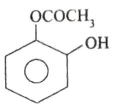
B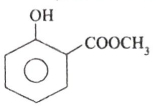
C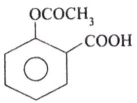
D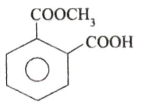
Solution
(C) Aspirin is chemically known as $2$-acetoxybenzoic acid.
It is prepared by the acetylation of salicylic acid ($2$-hydroxybenzoic acid) using acetic anhydride.
The structure consists of a benzene ring with a carboxylic acid group $(-COOH)$ and an acetoxy group $(-OCOCH_3)$ at the ortho position.
Therefore,the correct structural formula is represented by option $C$.
It is prepared by the acetylation of salicylic acid ($2$-hydroxybenzoic acid) using acetic anhydride.
The structure consists of a benzene ring with a carboxylic acid group $(-COOH)$ and an acetoxy group $(-OCOCH_3)$ at the ortho position.
Therefore,the correct structural formula is represented by option $C$.
0 likesView Solution
6
ChemistryEasyMCQGUJCET · 2018
Which is the final product obtained by the reaction of Grignard reagent ethyl magnesium bromide with propanone?
A
$2-$Methylbutan$-1-$ol
B
$2-$Methylbutan$-2-$ol
C
Pentan$-1-$ol
D
$3-$Methylbutan$-2-$ol
Solution
(B) The reaction between a Grignard reagent $(CH_3CH_2MgBr)$ and a ketone $(CH_3COCH_3)$ proceeds via nucleophilic addition to the carbonyl group.
$1$. The ethyl group $(CH_3CH_2^-)$ acts as a nucleophile and attacks the electrophilic carbonyl carbon of propanone.
$2$. This forms an intermediate magnesium alkoxide: $(CH_3)_2C(OMgBr)(CH_2CH_3)$.
$3$. Subsequent acid hydrolysis of this intermediate yields the tertiary alcohol: $(CH_3)_2C(OH)(CH_2CH_3)$.
$4$. The $IUPAC$ name of the product $(CH_3)_2C(OH)CH_2CH_3$ is $2-$methylbutan$-2-$ol.
Therefore,the correct option is $B$.
$1$. The ethyl group $(CH_3CH_2^-)$ acts as a nucleophile and attacks the electrophilic carbonyl carbon of propanone.
$2$. This forms an intermediate magnesium alkoxide: $(CH_3)_2C(OMgBr)(CH_2CH_3)$.
$3$. Subsequent acid hydrolysis of this intermediate yields the tertiary alcohol: $(CH_3)_2C(OH)(CH_2CH_3)$.
$4$. The $IUPAC$ name of the product $(CH_3)_2C(OH)CH_2CH_3$ is $2-$methylbutan$-2-$ol.
Therefore,the correct option is $B$.
0 likesView Solution
7
ChemistryEasyMCQGUJCET · 2018
Which of the following reactions produces an organic product with the lowest boiling point?
A
$A$. $CH_3-CH_2-COOH \xrightarrow[H_2O]{LiAlH_4} CH_3-CH_2-CH_2OH$
B
$B$. $CH_3-CO-CH_3 \xrightarrow[H_2O]{NaBH_4} CH_3-CH(OH)-CH_3$
C
$C$. $CH_3-CH_2-CHO \xrightarrow[H_2O]{NaBH_4} CH_3-CH_2-CH_2OH$
D
$D$. $CH_3-CH=CH_2 \xrightarrow[H_2O_2, OH^-]{(BH_3)_2} CH_3-CH_2-CH_2OH$
Solution
(B) The products of the reactions are:
$A$. $CH_3-CH_2-CH_2OH$ (propan$-1-$ol,boiling point $\approx 97 \ ^\circ C$)
$B$. $CH_3-CH(OH)-CH_3$ (propan$-2-$ol,boiling point $\approx 82 \ ^\circ C$)
$C$. $CH_3-CH_2-CH_2OH$ (propan$-1-$ol,boiling point $\approx 97 \ ^\circ C$)
$D$. $CH_3-CH_2-CH_2OH$ (propan$-1-$ol,boiling point $\approx 97 \ ^\circ C$)
Among the isomers,branched-chain alcohols have a lower boiling point than straight-chain alcohols due to a smaller surface area,which leads to weaker van der Waals forces.
Therefore,propan$-2-$ol $(B)$ has the lowest boiling point.
$A$. $CH_3-CH_2-CH_2OH$ (propan$-1-$ol,boiling point $\approx 97 \ ^\circ C$)
$B$. $CH_3-CH(OH)-CH_3$ (propan$-2-$ol,boiling point $\approx 82 \ ^\circ C$)
$C$. $CH_3-CH_2-CH_2OH$ (propan$-1-$ol,boiling point $\approx 97 \ ^\circ C$)
$D$. $CH_3-CH_2-CH_2OH$ (propan$-1-$ol,boiling point $\approx 97 \ ^\circ C$)
Among the isomers,branched-chain alcohols have a lower boiling point than straight-chain alcohols due to a smaller surface area,which leads to weaker van der Waals forces.
Therefore,propan$-2-$ol $(B)$ has the lowest boiling point.
0 likesView Solution
8
ChemistryEasyMCQGUJCET · 2018
Which of the following compounds is the least reactive towards nucleophilic addition reactions?
A
Acetophenone
B
Benzaldehyde
C
Formaldehyde
D
Benzophenone
Solution
(D) The reactivity of carbonyl compounds towards nucleophilic addition depends on steric hindrance and electronic effects.
$1$. Steric hindrance: As the number and size of alkyl or aryl groups attached to the carbonyl carbon increase,the attack of the nucleophile becomes more difficult.
$2$. Electronic effects: Electron-donating groups decrease the electrophilicity of the carbonyl carbon.
Formaldehyde $(HCHO)$ is the most reactive due to the absence of bulky groups.
Benzaldehyde $(C_6H_5CHO)$ is more reactive than ketones.
Among ketones,Acetophenone $(C_6H_5COCH_3)$ has one phenyl and one methyl group,while Benzophenone $(C_6H_5COC_6H_5)$ has two bulky phenyl groups.
Due to maximum steric hindrance and the resonance stabilization of the carbonyl group by two phenyl rings,Benzophenone is the least reactive.
$1$. Steric hindrance: As the number and size of alkyl or aryl groups attached to the carbonyl carbon increase,the attack of the nucleophile becomes more difficult.
$2$. Electronic effects: Electron-donating groups decrease the electrophilicity of the carbonyl carbon.
Formaldehyde $(HCHO)$ is the most reactive due to the absence of bulky groups.
Benzaldehyde $(C_6H_5CHO)$ is more reactive than ketones.
Among ketones,Acetophenone $(C_6H_5COCH_3)$ has one phenyl and one methyl group,while Benzophenone $(C_6H_5COC_6H_5)$ has two bulky phenyl groups.
Due to maximum steric hindrance and the resonance stabilization of the carbonyl group by two phenyl rings,Benzophenone is the least reactive.
0 likesView Solution
9
ChemistryEasyMCQGUJCET · 2018
Which is the main functional group in Acrolein?
A
Aldehyde
B
Alkene
C
Nitrile
D
Ester
Solution
(A) The chemical formula of Acrolein is $CH_2=CH-CHO$.
It contains both a carbon-carbon double bond (alkene) and an aldehyde group $(-CHO)$.
According to the $IUPAC$ priority order for functional groups,the aldehyde group has higher priority than the alkene group.
Therefore,the main functional group in Acrolein is the aldehyde group.
It contains both a carbon-carbon double bond (alkene) and an aldehyde group $(-CHO)$.
According to the $IUPAC$ priority order for functional groups,the aldehyde group has higher priority than the alkene group.
Therefore,the main functional group in Acrolein is the aldehyde group.
0 likesView Solution
10
ChemistryEasyMCQGUJCET · 2018
Which of the following is not a final product obtained by cross aldol condensation of ethanal and propanal?
A
$3-$Methylbut$-2-$enal
B
$2-$Methylpent$-2-$enal
C
But$-2-$enal
D
Pent$-2-$enal
Solution
(A) The cross aldol condensation of ethanal $(CH_3CHO)$ and propanal $(CH_3CH_2CHO)$ involves four possible products:
$1$. Self-aldol of ethanal: $CH_3CH=CHCHO$ (But$-2-$enal)
$2$. Self-aldol of propanal: $CH_3CH_2CH=C(CH_3)CHO$ ($2-$Methylpent$-2-$enal)
$3$. Cross-aldol (ethanal as nucleophile): $CH_3CH_2CH=CHCHO$ (Pent$-2-$enal)
$4$. Cross-aldol (propanal as nucleophile): $CH_3CH=C(CH_3)CHO$ ($2-$Methylbut$-2-$enal)
Comparing these with the options,$3-$Methylbut$-2-$enal is not formed.
$1$. Self-aldol of ethanal: $CH_3CH=CHCHO$ (But$-2-$enal)
$2$. Self-aldol of propanal: $CH_3CH_2CH=C(CH_3)CHO$ ($2-$Methylpent$-2-$enal)
$3$. Cross-aldol (ethanal as nucleophile): $CH_3CH_2CH=CHCHO$ (Pent$-2-$enal)
$4$. Cross-aldol (propanal as nucleophile): $CH_3CH=C(CH_3)CHO$ ($2-$Methylbut$-2-$enal)
Comparing these with the options,$3-$Methylbut$-2-$enal is not formed.
0 likesView Solution
11
ChemistryEasyMCQGUJCET · 2018
Which one of the following amino acids has an isoelectric pH greater than $7$?
A
Glutamic acid
B
Lysine
C
Glycine
D
Alanine
Solution
(B)
Lysine is a basic amino acid because it contains two amino groups and one carboxyl group,which results in an isoelectric point $(pI)$ greater than $7$.
Lysine is a basic amino acid because it contains two amino groups and one carboxyl group,which results in an isoelectric point $(pI)$ greater than $7$.
0 likesView Solution
12
ChemistryEasyMCQGUJCET · 2018
Which one is a purine base?
A
Uracil
B
Thymine
C
Cytosine
D
Guanine
Solution
(D) Nitrogenous bases are classified into two types: purines and pyrimidines.
Purines include $Adenine$ $(A)$ and $Guanine$ $(G)$.
Pyrimidines include $Cytosine$ $(C)$,$Thymine$ $(T)$,and $Uracil$ $(U)$.
Therefore,$Guanine$ is a purine base.
The correct option is $D$.
Purines include $Adenine$ $(A)$ and $Guanine$ $(G)$.
Pyrimidines include $Cytosine$ $(C)$,$Thymine$ $(T)$,and $Uracil$ $(U)$.
Therefore,$Guanine$ is a purine base.
The correct option is $D$.
0 likesView Solution
13
ChemistryEasyMCQGUJCET · 2018
Which statement is incorrect for a catalyst?
A
It decreases the activation energy of a reaction.
B
It increases the rate of production of products in less time.
C
It does not affect the equilibrium constant.
D
It increases the free energy change for the reaction.
Solution
(D) catalyst is a substance that increases the rate of a chemical reaction by providing an alternative pathway with lower activation energy.
It does not change the thermodynamic properties of the reaction,such as the Gibbs free energy change $(\Delta G)$ or the equilibrium constant $(K_{eq})$.
Therefore,the statement that it increases the free energy change for the reaction is incorrect.
It does not change the thermodynamic properties of the reaction,such as the Gibbs free energy change $(\Delta G)$ or the equilibrium constant $(K_{eq})$.
Therefore,the statement that it increases the free energy change for the reaction is incorrect.
0 likesView Solution
14
ChemistryEasyMCQGUJCET · 2018
At $27^{\circ} C$ temperature,the time required for $75 \%$ completion of a first order reaction is $20 \ s$. What will be its rate constant?
A
$0.693 \ s^{-1}$
B
$0.0693 \ s^{-1}$
C
$0.693 \ s^{-1} \ mol^{-1} \ L$
D
$0.0693 \ s^{-1} \ mol^{-1} \ L$
Solution
(B) For a $1^{st}$ order reaction,the rate constant $K$ is given by the formula: $K = \frac{2.303}{t} \log \left( \frac{[A]_0}{[A]_t} \right)$.
Given that the reaction is $75 \%$ complete,the remaining concentration $[A]_t = [A]_0 - 0.75 [A]_0 = 0.25 [A]_0$.
Substituting the values: $K = \frac{2.303}{20} \log \left( \frac{[A]_0}{0.25 [A]_0} \right)$.
$K = \frac{2.303}{20} \log (4) = \frac{2.303}{20} \times 0.6021 \approx \frac{1.386}{20} = 0.0693 \ s^{-1}$.
Alternatively,$t_{75\%} = 2 \times t_{1/2}$. Since $t_{1/2} = \frac{0.693}{K}$,then $20 = 2 \times \frac{0.693}{K}$,which gives $K = \frac{1.386}{20} = 0.0693 \ s^{-1}$.
Given that the reaction is $75 \%$ complete,the remaining concentration $[A]_t = [A]_0 - 0.75 [A]_0 = 0.25 [A]_0$.
Substituting the values: $K = \frac{2.303}{20} \log \left( \frac{[A]_0}{0.25 [A]_0} \right)$.
$K = \frac{2.303}{20} \log (4) = \frac{2.303}{20} \times 0.6021 \approx \frac{1.386}{20} = 0.0693 \ s^{-1}$.
Alternatively,$t_{75\%} = 2 \times t_{1/2}$. Since $t_{1/2} = \frac{0.693}{K}$,then $20 = 2 \times \frac{0.693}{K}$,which gives $K = \frac{1.386}{20} = 0.0693 \ s^{-1}$.
0 likesView Solution
15
ChemistryEasyMCQGUJCET · 2018
The units for the rate constant and the rate of reaction are same for a reaction. What will be the order of the reaction?
A
First
B
Zero
C
Second
D
Third
Solution
(B)
Unit of rate constant $(k) = (\text{mol L}^{-1})^{1-n} \text{s}^{-1}$
Unit of rate of reaction $= \text{mol L}^{-1} \text{s}^{-1}$
Given that the units are the same,we equate them:
$(\text{mol L}^{-1})^{1-n} \text{s}^{-1} = \text{mol L}^{-1} \text{s}^{-1}$
This implies $1-n = 1$,which gives $n = 0$.
Therefore,the order of the reaction is $0$.
Unit of rate constant $(k) = (\text{mol L}^{-1})^{1-n} \text{s}^{-1}$
Unit of rate of reaction $= \text{mol L}^{-1} \text{s}^{-1}$
Given that the units are the same,we equate them:
$(\text{mol L}^{-1})^{1-n} \text{s}^{-1} = \text{mol L}^{-1} \text{s}^{-1}$
This implies $1-n = 1$,which gives $n = 0$.
Therefore,the order of the reaction is $0$.
0 likesView Solution
16
ChemistryEasyMCQGUJCET · 2018
Which complex possesses a facial $(fac)$ isomer?
A
$[Co(NH_3)_4CO_3]Cl$
B
$[Co(NH_3)_3(NO_2)_3]$
C
$K[Fe(NH_3)_2(CN)_4]$
D
$[Ni(H_2O)_4(NH_3)_2]SO_4$
Solution
(B) The facial $(fac)$ isomer is a type of geometric isomerism observed in octahedral complexes of the type $[MA_3B_3]$.
In the $fac$ isomer,the three identical ligands occupy the corners of one triangular face of the octahedron.
Among the given options,$[Co(NH_3)_3(NO_2)_3]$ is an octahedral complex of the type $[MA_3B_3]$,where $A = NH_3$ and $B = NO_2^-$.
Therefore,it can exhibit both $fac$ (facial) and $mer$ (meridional) isomerism.
In the $fac$ isomer,the three identical ligands occupy the corners of one triangular face of the octahedron.
Among the given options,$[Co(NH_3)_3(NO_2)_3]$ is an octahedral complex of the type $[MA_3B_3]$,where $A = NH_3$ and $B = NO_2^-$.
Therefore,it can exhibit both $fac$ (facial) and $mer$ (meridional) isomerism.
0 likesView Solution
17
ChemistryEasyMCQGUJCET · 2018
The aqueous solution of which of the following complexes has the least conductivity under identical conditions?
A
$[Cr(H_2O)_6]Cl_3$
B
$[Cr(H_2O)_4Cl_2]Cl \cdot 2H_2O$
C
$[Cr(H_2O)_5Cl]Cl_2 \cdot H_2O$
D
$[Cr(H_2O)_3Cl_3]$
Solution
(D) The conductivity of an aqueous solution of a coordination complex depends on the number of ions produced upon dissociation in water.
$1$. $[Cr(H_2O)_6]Cl_3 \rightarrow [Cr(H_2O)_6]^{3+} + 3Cl^-$ (Total $4$ ions)
$2$. $[Cr(H_2O)_5Cl]Cl_2 \cdot H_2O \rightarrow [Cr(H_2O)_5Cl]^{2+} + 2Cl^-$ (Total $3$ ions)
$3$. $[Cr(H_2O)_4Cl_2]Cl \cdot 2H_2O \rightarrow [Cr(H_2O)_4Cl_2]^+ + Cl^-$ (Total $2$ ions)
$4$. $[Cr(H_2O)_3Cl_3]$ does not dissociate into ions in aqueous solution (Total $0$ ions).
Since $[Cr(H_2O)_3Cl_3]$ produces no ions,it has the least conductivity.
$1$. $[Cr(H_2O)_6]Cl_3 \rightarrow [Cr(H_2O)_6]^{3+} + 3Cl^-$ (Total $4$ ions)
$2$. $[Cr(H_2O)_5Cl]Cl_2 \cdot H_2O \rightarrow [Cr(H_2O)_5Cl]^{2+} + 2Cl^-$ (Total $3$ ions)
$3$. $[Cr(H_2O)_4Cl_2]Cl \cdot 2H_2O \rightarrow [Cr(H_2O)_4Cl_2]^+ + Cl^-$ (Total $2$ ions)
$4$. $[Cr(H_2O)_3Cl_3]$ does not dissociate into ions in aqueous solution (Total $0$ ions).
Since $[Cr(H_2O)_3Cl_3]$ produces no ions,it has the least conductivity.
0 likesView Solution
18
ChemistryEasyMCQGUJCET · 2018
Which of the following statements is incorrect?
A
$K_4[Ni(CN)_4]$ is square planar while $K_2[Ni(CN)_4]$ is paramagnetic.
B
$K_2[Ni(CN)_4]$ is diamagnetic while $K_2[NiCl_4]$ is paramagnetic.
C
$K_4[Ni(CN)_4]$ and $K_2[Ni(CN)_4]$ both have same magnetic moment.
D
$K_2[NiCl_4]$ and $K_4[Ni(CN)_4]$ both have same geometrical shapes.
Solution
(A) $1$. In $K_4[Ni(CN)_4]$,the oxidation state of $Ni$ is $0$. The configuration is $[Ar] 3d^8 4s^2$. Due to the strong field ligand $CN^-$,the $4s$ electrons pair up in the $3d$ orbital,resulting in a $d^{10}$ configuration. It is tetrahedral and diamagnetic.
$2$. In $K_2[Ni(CN)_4]$,the oxidation state of $Ni$ is $+2$. The configuration is $[Ar] 3d^8$. $CN^-$ is a strong field ligand,causing pairing of electrons,resulting in $dsp^2$ hybridization (square planar) and it is diamagnetic.
$3$. In $K_2[NiCl_4]$,the oxidation state of $Ni$ is $+2$. The configuration is $[Ar] 3d^8$. $Cl^-$ is a weak field ligand,resulting in $sp^3$ hybridization (tetrahedral) and it is paramagnetic.
$4$. Evaluating the options: Option $A$ is incorrect because $K_4[Ni(CN)_4]$ is tetrahedral,not square planar,and $K_2[Ni(CN)_4]$ is diamagnetic,not paramagnetic. Option $C$ is also incorrect as one is diamagnetic and the other is diamagnetic (both have $\mu = 0$),but the statement implies they are the same,which is true,yet $A$ is fundamentally incorrect regarding geometry and magnetism.
$2$. In $K_2[Ni(CN)_4]$,the oxidation state of $Ni$ is $+2$. The configuration is $[Ar] 3d^8$. $CN^-$ is a strong field ligand,causing pairing of electrons,resulting in $dsp^2$ hybridization (square planar) and it is diamagnetic.
$3$. In $K_2[NiCl_4]$,the oxidation state of $Ni$ is $+2$. The configuration is $[Ar] 3d^8$. $Cl^-$ is a weak field ligand,resulting in $sp^3$ hybridization (tetrahedral) and it is paramagnetic.
$4$. Evaluating the options: Option $A$ is incorrect because $K_4[Ni(CN)_4]$ is tetrahedral,not square planar,and $K_2[Ni(CN)_4]$ is diamagnetic,not paramagnetic. Option $C$ is also incorrect as one is diamagnetic and the other is diamagnetic (both have $\mu = 0$),but the statement implies they are the same,which is true,yet $A$ is fundamentally incorrect regarding geometry and magnetism.
0 likesView Solution
19
ChemistryEasyMCQGUJCET · 2018
Which of the following mixtures can form an alloy?
A
$Fe, Mn, Mg$
B
$Cr, Co, Na$
C
$Fe, Ni, Cr$
D
$Ni, Mg, Na$
Solution
(C) An alloy is a homogeneous mixture of two or more metals or a metal and a non-metal.
Transition metals,due to their similar atomic sizes,readily form alloys with each other.
$Fe$,$Ni$,and $Cr$ are all transition metals with comparable atomic radii,allowing them to form a stable solid solution known as stainless steel.
Therefore,the correct mixture is $Fe, Ni, Cr$.
Transition metals,due to their similar atomic sizes,readily form alloys with each other.
$Fe$,$Ni$,and $Cr$ are all transition metals with comparable atomic radii,allowing them to form a stable solid solution known as stainless steel.
Therefore,the correct mixture is $Fe, Ni, Cr$.
0 likesView Solution
20
ChemistryEasyMCQGUJCET · 2018
Which ion has the least value of theoretical magnetic moment?
A
$Ti^{3+}$
B
$Co^{3+}$
C
$Cr^{3+}$
D
$V^{3+}$
Solution
(A) The theoretical magnetic moment is calculated using the formula $\mu = \sqrt{n(n+2)} \text{ BM}$,where $n$ is the number of unpaired electrons.
$1$. For $Ti^{3+}$ $(3d^1)$: $n = 1$,$\mu = \sqrt{1(1+2)} = \sqrt{3} \approx 1.73 \text{ BM}$.
$2$. For $Co^{3+}$ $(3d^6)$: In an octahedral field,$n = 4$ (high spin) or $n = 0$ (low spin). Assuming high spin,$n = 4$,$\mu = \sqrt{4(6)} = \sqrt{24} \approx 4.90 \text{ BM}$.
$3$. For $Cr^{3+}$ $(3d^3)$: $n = 3$,$\mu = \sqrt{3(5)} = \sqrt{15} \approx 3.87 \text{ BM}$.
$4$. For $V^{3+}$ $(3d^2)$: $n = 2$,$\mu = \sqrt{2(4)} = \sqrt{8} \approx 2.83 \text{ BM}$.
Comparing the values,$Ti^{3+}$ has the least number of unpaired electrons $(n=1)$,hence it has the least magnetic moment.
$1$. For $Ti^{3+}$ $(3d^1)$: $n = 1$,$\mu = \sqrt{1(1+2)} = \sqrt{3} \approx 1.73 \text{ BM}$.
$2$. For $Co^{3+}$ $(3d^6)$: In an octahedral field,$n = 4$ (high spin) or $n = 0$ (low spin). Assuming high spin,$n = 4$,$\mu = \sqrt{4(6)} = \sqrt{24} \approx 4.90 \text{ BM}$.
$3$. For $Cr^{3+}$ $(3d^3)$: $n = 3$,$\mu = \sqrt{3(5)} = \sqrt{15} \approx 3.87 \text{ BM}$.
$4$. For $V^{3+}$ $(3d^2)$: $n = 2$,$\mu = \sqrt{2(4)} = \sqrt{8} \approx 2.83 \text{ BM}$.
Comparing the values,$Ti^{3+}$ has the least number of unpaired electrons $(n=1)$,hence it has the least magnetic moment.
0 likesView Solution
21
ChemistryEasyMCQGUJCET · 2018
What will be the oxidation potential for the following hydrogen half cell at $1 \ bar$ pressure and $25^{\circ} C$ temperature (in $V$)?
$Pt \mid H_{2(g)} (1 \ bar) \mid HCl_{(aq)} \ pH = 3$
$Pt \mid H_{2(g)} (1 \ bar) \mid HCl_{(aq)} \ pH = 3$
A
$0.177$
B
$0.188$
C
$0.059$
D
$0.000$
Solution
(A) The oxidation half-reaction for the hydrogen electrode is:
$H_{2(g)} \rightarrow 2H^+_{(aq)} + 2e^-$
Using the Nernst equation for oxidation potential:
$E_{ox} = E^{\circ}_{ox} - \frac{0.0591}{n} \log Q$
For the standard hydrogen electrode,$E^{\circ}_{ox} = 0.00 \ V$ and $n = 2$.
The reaction quotient $Q$ is given by $[H^+]^2 / P_{H_2}$.
Given $pH = 3$,so $[H^+] = 10^{-3} \ M$.
$Q = \frac{(10^{-3})^2}{1} = 10^{-6}$.
$E_{ox} = 0 - \frac{0.0591}{2} \log(10^{-6})$
$E_{ox} = -0.02955 \times (-6) = 0.1773 \ V$.
Thus,the oxidation potential is approximately $0.177 \ V$.
$H_{2(g)} \rightarrow 2H^+_{(aq)} + 2e^-$
Using the Nernst equation for oxidation potential:
$E_{ox} = E^{\circ}_{ox} - \frac{0.0591}{n} \log Q$
For the standard hydrogen electrode,$E^{\circ}_{ox} = 0.00 \ V$ and $n = 2$.
The reaction quotient $Q$ is given by $[H^+]^2 / P_{H_2}$.
Given $pH = 3$,so $[H^+] = 10^{-3} \ M$.
$Q = \frac{(10^{-3})^2}{1} = 10^{-6}$.
$E_{ox} = 0 - \frac{0.0591}{2} \log(10^{-6})$
$E_{ox} = -0.02955 \times (-6) = 0.1773 \ V$.
Thus,the oxidation potential is approximately $0.177 \ V$.
0 likesView Solution
22
ChemistryEasyMCQGUJCET · 2018
For how much time,$10 \ A$ electric current should be passed through a dilute aqueous $NiSO_4$ solution during electrolysis using inert electrode,in order to get $5.85 \ g$ Nickel (in $s$)?
[At. mass of $Ni = 58.5 \ g/mol$]
[At. mass of $Ni = 58.5 \ g/mol$]
A
$1930$
B
$3860$
C
$965$
D
$9650$
Solution
(A) The reduction reaction for $Ni^{2+}$ is: $Ni^{2+} + 2e^- \rightarrow Ni(s)$.
The number of moles of $Ni$ produced is $n = \frac{\text{mass}}{\text{molar mass}} = \frac{5.85 \ g}{58.5 \ g/mol} = 0.1 \ mol$.
According to the reaction,$1 \ mol$ of $Ni$ requires $2 \ mol$ of electrons.
Therefore,$0.1 \ mol$ of $Ni$ requires $0.2 \ mol$ of electrons.
Total charge $Q = n \times F = 0.2 \times 96500 \ C = 19300 \ C$.
Since $Q = I \times t$,we have $t = \frac{Q}{I} = \frac{19300 \ C}{10 \ A} = 1930 \ s$.
Thus,the correct option is $A$.
The number of moles of $Ni$ produced is $n = \frac{\text{mass}}{\text{molar mass}} = \frac{5.85 \ g}{58.5 \ g/mol} = 0.1 \ mol$.
According to the reaction,$1 \ mol$ of $Ni$ requires $2 \ mol$ of electrons.
Therefore,$0.1 \ mol$ of $Ni$ requires $0.2 \ mol$ of electrons.
Total charge $Q = n \times F = 0.2 \times 96500 \ C = 19300 \ C$.
Since $Q = I \times t$,we have $t = \frac{Q}{I} = \frac{19300 \ C}{10 \ A} = 1930 \ s$.
Thus,the correct option is $A$.
0 likesView Solution
23
ChemistryEasyMCQGUJCET · 2018
In which metal container can an aqueous solution of $CuSO_4$ be stored?
$E^0_{Cu^{2+}/Cu} = 0.34 \ V$,$E^0_{Fe/Fe^{2+}} = 0.44 \ V$,$E^0_{Al/Al^{3+}} = 1.66 \ V$,$E^0_{Ni/Ni^{2+}} = 0.25 \ V$,$E^0_{Ag^{+}/Ag} = 0.80 \ V$
$E^0_{Cu^{2+}/Cu} = 0.34 \ V$,$E^0_{Fe/Fe^{2+}} = 0.44 \ V$,$E^0_{Al/Al^{3+}} = 1.66 \ V$,$E^0_{Ni/Ni^{2+}} = 0.25 \ V$,$E^0_{Ag^{+}/Ag} = 0.80 \ V$
A
$Fe$
B
$Ni$
C
$Ag$
D
$Al$
Solution
(C) To store an aqueous solution of $CuSO_4$,the metal of the container must not react with $Cu^{2+}$ ions.
$A$ reaction will occur if the reduction potential of the container metal is lower than that of $Cu^{2+}/Cu$ $(0.34 \ V)$.
The reduction potentials $(E^0_{M^{n+}/M})$ are:
$E^0_{Fe^{2+}/Fe} = -0.44 \ V$
$E^0_{Ni^{2+}/Ni} = -0.25 \ V$
$E^0_{Al^{3+}/Al} = -1.66 \ V$
$E^0_{Ag^{+}/Ag} = 0.80 \ V$
For the reaction $M + Cu^{2+} \rightarrow M^{n+} + Cu$ to be non-spontaneous,the $E^0_{cell}$ must be negative.
$E^0_{cell} = E^0_{cathode} - E^0_{anode} = E^0_{Cu^{2+}/Cu} - E^0_{M^{n+}/M}$.
For $E^0_{cell} < 0$,we require $E^0_{M^{n+}/M} > E^0_{Cu^{2+}/Cu}$.
Comparing values,only $Ag$ has a reduction potential $(0.80 \ V)$ greater than $Cu$ $(0.34 \ V)$.
Therefore,$CuSO_4$ can be stored in an $Ag$ container.
$A$ reaction will occur if the reduction potential of the container metal is lower than that of $Cu^{2+}/Cu$ $(0.34 \ V)$.
The reduction potentials $(E^0_{M^{n+}/M})$ are:
$E^0_{Fe^{2+}/Fe} = -0.44 \ V$
$E^0_{Ni^{2+}/Ni} = -0.25 \ V$
$E^0_{Al^{3+}/Al} = -1.66 \ V$
$E^0_{Ag^{+}/Ag} = 0.80 \ V$
For the reaction $M + Cu^{2+} \rightarrow M^{n+} + Cu$ to be non-spontaneous,the $E^0_{cell}$ must be negative.
$E^0_{cell} = E^0_{cathode} - E^0_{anode} = E^0_{Cu^{2+}/Cu} - E^0_{M^{n+}/M}$.
For $E^0_{cell} < 0$,we require $E^0_{M^{n+}/M} > E^0_{Cu^{2+}/Cu}$.
Comparing values,only $Ag$ has a reduction potential $(0.80 \ V)$ greater than $Cu$ $(0.34 \ V)$.
Therefore,$CuSO_4$ can be stored in an $Ag$ container.
0 likesView Solution
24
ChemistryEasyMCQGUJCET · 2018
Which is the main organic product obtained by the reaction of $2,2,2-$trichloroethanol with calcium hydroxide?
A
Methylene chloride
B
Carbon tetrachloride
C
Chloroform
D
Trichloroethane
Solution
(C) The reaction of $2,2,2-$trichloroethanol $(CCl_3CH_2OH)$ with calcium hydroxide $(Ca(OH)_2)$ is a base-catalyzed decomposition reaction.
$2CCl_3CH_2OH + Ca(OH)_2 \rightarrow 2CHCl_3 + Ca(HCOO)_2 + H_2O$.
In this reaction,$2,2,2-$trichloroethanol undergoes haloform-like cleavage to produce chloroform $(CHCl_3)$ as the main organic product.
$2CCl_3CH_2OH + Ca(OH)_2 \rightarrow 2CHCl_3 + Ca(HCOO)_2 + H_2O$.
In this reaction,$2,2,2-$trichloroethanol undergoes haloform-like cleavage to produce chloroform $(CHCl_3)$ as the main organic product.
0 likesView Solution
25
ChemistryEasyMCQGUJCET · 2018
Which one is not an allylic halide?
A
$3-$chloro cyclohexa$-1-$ene
B
$1-$chlorobut$-1-$ene
C
$1-$chlorobut$-2-$ene
D
$3-$chloroprop$-1-$ene
Solution
(B) An allylic halide is a compound in which the halogen atom is bonded to an $sp^3$ hybridized carbon atom next to a carbon-carbon double bond $(C=C)$.
$A$: $3-$chlorocyclohexa$-1-$ene has the chlorine on a carbon adjacent to the double bond (Allylic).
$B$: $1-$chlorobut$-1-$ene has the chlorine directly attached to one of the carbons of the double bond ($sp^2$ hybridized),which is a vinylic halide,not allylic.
$C$: $1-$chlorobut$-2-$ene is not allylic; however,the question asks for the non-allylic structure. Checking $1-$chlorobut$-2-$ene $(CH_3-CH=CH-CH_2Cl)$,the $Cl$ is on an $sp^3$ carbon,but it is not adjacent to the double bond in the standard allylic sense $(C=C-C-X)$. Wait,$1-$chlorobut$-2-$ene is actually a primary alkyl halide,not allylic.
$D$: $3-$chloroprop$-1-$ene $(CH_2=CH-CH_2Cl)$ is the classic allylic halide.
Comparing the options,$1-$chlorobut$-1-$ene is a vinylic halide,and $1-$chlorobut$-2-$ene is a primary alkyl halide. Given the standard classification,$1-$chlorobut$-1-$ene is the most distinct non-allylic example provided.
$A$: $3-$chlorocyclohexa$-1-$ene has the chlorine on a carbon adjacent to the double bond (Allylic).
$B$: $1-$chlorobut$-1-$ene has the chlorine directly attached to one of the carbons of the double bond ($sp^2$ hybridized),which is a vinylic halide,not allylic.
$C$: $1-$chlorobut$-2-$ene is not allylic; however,the question asks for the non-allylic structure. Checking $1-$chlorobut$-2-$ene $(CH_3-CH=CH-CH_2Cl)$,the $Cl$ is on an $sp^3$ carbon,but it is not adjacent to the double bond in the standard allylic sense $(C=C-C-X)$. Wait,$1-$chlorobut$-2-$ene is actually a primary alkyl halide,not allylic.
$D$: $3-$chloroprop$-1-$ene $(CH_2=CH-CH_2Cl)$ is the classic allylic halide.
Comparing the options,$1-$chlorobut$-1-$ene is a vinylic halide,and $1-$chlorobut$-2-$ene is a primary alkyl halide. Given the standard classification,$1-$chlorobut$-1-$ene is the most distinct non-allylic example provided.
0 likesView Solution
26
ChemistryEasyMCQGUJCET · 2018
Which solution is isotonic with $6 \% \ w/v$ aqueous solution of urea (in $M \ NaCl$)? [Molar mass of Urea $= 60 \ g \ mol^{-1}$]
A
$0.1$
B
$0.5$
C
$0.25$
D
$1$
Solution
(B) For two solutions to be isotonic,their molar concentrations (osmolarity) must be equal.
First,calculate the molarity of the $6 \% \ w/v$ urea solution:
$M = \frac{\text{mass of solute (g)}}{\text{molar mass (g/mol)} \times \text{volume of solution (L)}} = \frac{6 \ g}{60 \ g \ mol^{-1} \times 0.1 \ L} = 1 \ M$.
Since urea is a non-electrolyte,its van't Hoff factor $i = 1$.
For $NaCl$,which is a strong electrolyte,$i = 2$.
The condition for isotonicity is $i_1 C_1 = i_2 C_2$.
$1 \times 1 \ M = 2 \times C_2$.
$C_2 = 0.5 \ M$.
Therefore,a $0.5 \ M \ NaCl$ solution is isotonic with the $1 \ M$ urea solution.
First,calculate the molarity of the $6 \% \ w/v$ urea solution:
$M = \frac{\text{mass of solute (g)}}{\text{molar mass (g/mol)} \times \text{volume of solution (L)}} = \frac{6 \ g}{60 \ g \ mol^{-1} \times 0.1 \ L} = 1 \ M$.
Since urea is a non-electrolyte,its van't Hoff factor $i = 1$.
For $NaCl$,which is a strong electrolyte,$i = 2$.
The condition for isotonicity is $i_1 C_1 = i_2 C_2$.
$1 \times 1 \ M = 2 \times C_2$.
$C_2 = 0.5 \ M$.
Therefore,a $0.5 \ M \ NaCl$ solution is isotonic with the $1 \ M$ urea solution.
0 likesView Solution
27
ChemistryEasyMCQGUJCET · 2018
Which of the following mixtures is a non-ideal solution?
A
Chlorobenzene and bromobenzene
B
Benzene and toluene
C
Chloroform and acetone
D
Bromoethane and chloroethane
Solution
(C) non-ideal solution is one that does not obey Raoult's law over the entire range of concentration.
Chloroform $(CHCl_3)$ and acetone $(CH_3COCH_3)$ form a non-ideal solution with negative deviation from Raoult's law.
This is because the hydrogen bonding between chloroform and acetone is stronger than the intermolecular forces in the pure components.
Chlorobenzene and bromobenzene,benzene and toluene,and bromoethane and chloroethane are examples of ideal solutions.
Chloroform $(CHCl_3)$ and acetone $(CH_3COCH_3)$ form a non-ideal solution with negative deviation from Raoult's law.
This is because the hydrogen bonding between chloroform and acetone is stronger than the intermolecular forces in the pure components.
Chlorobenzene and bromobenzene,benzene and toluene,and bromoethane and chloroethane are examples of ideal solutions.
0 likesView Solution
Vedclass Products
For Students
Vedclass Test Series
Mock tests in real GUJCET style covering Chemistry with performance analysis. 5-day free trial.
Start Free TrialFor Teachers
Exam Paper Generator
Generate Set A/B/C/D Chemistry papers from 7.5L+ questions in 2 minutes. 3 chapters free.
Try FreeFor Institutes
Online Exam Module
Run live GUJCET mock exams with unlimited students, 360° analytics & white-label branding.
See DemoFrequently Asked Questions
How many Chemistry questions are in GUJCET 2018?
There are 27 Chemistry questions from the GUJCET 2018 paper on Vedclass, each with a detailed step-by-step solution in English.
Are GUJCET 2018 Chemistry solutions available in English?
Yes. All solutions on this page are in English. You can also switch to English or Hindi using the language buttons above the questions.
Can I practice GUJCET 2018 Chemistry as a timed test?
Yes. Use the Vedclass Test Series to attempt a full GUJCET mock test covering Chemistry with time limits and instant score analysis.
Can teachers create Chemistry papers from GUJCET previous year questions?
Yes. The Vedclass Exam Paper Generator lets teachers mix GUJCET Chemistry questions and generate Set A/B/C/D papers in minutes.
For Teachers & Institutes
Build a Custom Chemistry Paper
Pick GUJCET 2018 Chemistry questions, set difficulty, and generate Set A/B/C/D in 2 minutes.