
ChemistryQ201–214 of 414 questions
Page 5 of 5 · English
201
ChemistryMCQAP EAMCET · 2023
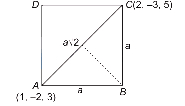
If the extremities of a diagonal of a square are $(1, -2, 3)$ and $(2, -3, 5)$,then the length of its side is
A
$\sqrt{6}$
B
$\sqrt{3}$
C
$\sqrt{5}$
D
$\sqrt{7}$
Solution
(B) Let the side of the square be $a$.
The length of the diagonal $d$ of a square with side $a$ is given by $d = a\sqrt{2}$.
The distance between the two given points $(1, -2, 3)$ and $(2, -3, 5)$ is the length of the diagonal $d$.
$d = \sqrt{(2-1)^2 + (-3 - (-2))^2 + (5-3)^2}$
$d = \sqrt{(1)^2 + (-1)^2 + (2)^2}$
$d = \sqrt{1 + 1 + 4} = \sqrt{6}$
Since $d = a\sqrt{2}$,we have:
$a\sqrt{2} = \sqrt{6}$
$a = \frac{\sqrt{6}}{\sqrt{2}} = \sqrt{3}$
Therefore,the length of the side of the square is $\sqrt{3}$.
The length of the diagonal $d$ of a square with side $a$ is given by $d = a\sqrt{2}$.
The distance between the two given points $(1, -2, 3)$ and $(2, -3, 5)$ is the length of the diagonal $d$.
$d = \sqrt{(2-1)^2 + (-3 - (-2))^2 + (5-3)^2}$
$d = \sqrt{(1)^2 + (-1)^2 + (2)^2}$
$d = \sqrt{1 + 1 + 4} = \sqrt{6}$
Since $d = a\sqrt{2}$,we have:
$a\sqrt{2} = \sqrt{6}$
$a = \frac{\sqrt{6}}{\sqrt{2}} = \sqrt{3}$
Therefore,the length of the side of the square is $\sqrt{3}$.
0 likesView Solution
202
ChemistryMediumMCQAP EAMCET · 2023
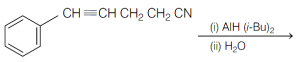
The major product formed in the following reaction is:
A
$Ph-CH_2-CH_2-CH_2-CH_2-CH_2-NH_2$
B
$Ph-CH_2-CH_2-CH_2-CH_2-CH_2-OH$
C
$Ph-CH=CH-CH_2-CH_2-CH_2-NH_2$
D
$Ph-CH=CH-CH_2-CH_2-CHO$
Solution
(D) The reagent $DIBAL-H$ (diisobutylaluminium hydride,$AlH(i-Bu)_2$) is a selective reducing agent. It reduces nitriles $(-CN)$ to aldehydes $(-CHO)$ after hydrolysis,while leaving other functional groups like carbon-carbon double bonds $(C=C)$ unaffected. Therefore,the reaction of $Ph-CH=CH-CH_2-CH_2-CN$ with $DIBAL-H$ followed by $H_2O$ yields $Ph-CH=CH-CH_2-CH_2-CHO$.
0 likesView Solution
203
ChemistryDifficultMCQAP EAMCET · 2023
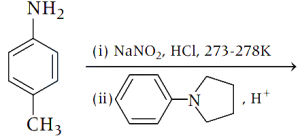
The major product in the following reaction is:
A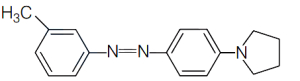
B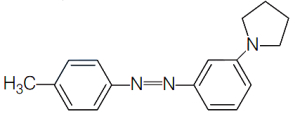
C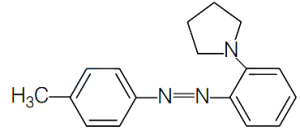
D
Solution
(D) In the given reaction,$p$-toluidine reacts with $NaNO_2$ and $HCl$ at $273-278 \ K$ to form a diazonium salt,which is $p$-methylbenzenediazonium chloride.
This diazonium salt then undergoes an electrophilic aromatic substitution (coupling reaction) with $N$-phenylpyrrolidine in the presence of $H^+$.
The coupling reaction occurs at the para-position of the $N$-phenylpyrrolidine ring because the pyrrolidinyl group is a strong ortho/para-directing group and the para-position is sterically less hindered.
Thus,the major product is the para-coupled azo dye as shown in option $D$.
This diazonium salt then undergoes an electrophilic aromatic substitution (coupling reaction) with $N$-phenylpyrrolidine in the presence of $H^+$.
The coupling reaction occurs at the para-position of the $N$-phenylpyrrolidine ring because the pyrrolidinyl group is a strong ortho/para-directing group and the para-position is sterically less hindered.
Thus,the major product is the para-coupled azo dye as shown in option $D$.
0 likesView Solution
204
ChemistryMediumMCQAP EAMCET · 2023
The major product of the following reaction is:
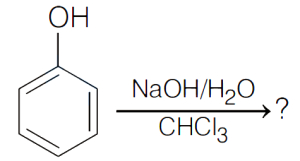
A
Sodium $2-$chlorophenolate
B
Sodium $2-$carboxyphenolate
C
Sodium $2-$formylphenolate
D
Sodium $2-$hydroxyphenolate
Solution
(C) The reaction of phenol with $CHCl_3$ in the presence of aqueous $NaOH$ is known as the $Reimer-Tiemann$ reaction.
In this reaction,$CHCl_3$ reacts with $NaOH$ to generate a dichlorocarbene intermediate $(:CCl_2)$.
This electrophilic carbene attacks the phenoxide ion at the ortho position.
The intermediate formed undergoes hydrolysis to yield salicylaldehyde ($2$-hydroxybenzaldehyde) in its salt form,which is sodium $2-$formylphenolate.
In this reaction,$CHCl_3$ reacts with $NaOH$ to generate a dichlorocarbene intermediate $(:CCl_2)$.
This electrophilic carbene attacks the phenoxide ion at the ortho position.
The intermediate formed undergoes hydrolysis to yield salicylaldehyde ($2$-hydroxybenzaldehyde) in its salt form,which is sodium $2-$formylphenolate.
0 likesView Solution
205
ChemistryMediumMCQAP EAMCET · 2023
Identify $X$ and $Y$ in the following reactions:
$Nitrobenzene \xrightarrow{Zn/NH_4Cl} X$
$Nitrobenzene \xrightarrow{Zn + KOH/C_2H_5OH} Y$
$Nitrobenzene \xrightarrow{Zn/NH_4Cl} X$
$Nitrobenzene \xrightarrow{Zn + KOH/C_2H_5OH} Y$
A
$X = Nitrosobenzene, Y = Hydrazobenzene$
B
$X = Aniline, Y = Hydrazobenzene$
C
$X = Phenylhydroxylamine, Y = Hydrazobenzene$
D
$X = Hydrazobenzene, Y = Phenylhydroxylamine$
Solution
(C) The reduction of nitrobenzene depends on the medium used:
$1$. In neutral medium $(Zn/NH_4Cl)$: Nitrobenzene is reduced to phenylhydroxylamine $(C_6H_5NHOH)$. Thus,$X$ is phenylhydroxylamine.
$2$. In alkaline medium $(Zn + KOH/C_2H_5OH)$: Nitrobenzene undergoes reduction to form azoxybenzene,azobenzene,and finally hydrazobenzene $(C_6H_5NH-NHC_6H_5)$. Thus,$Y$ is hydrazobenzene.
Therefore,the correct option is $C$.
$1$. In neutral medium $(Zn/NH_4Cl)$: Nitrobenzene is reduced to phenylhydroxylamine $(C_6H_5NHOH)$. Thus,$X$ is phenylhydroxylamine.
$2$. In alkaline medium $(Zn + KOH/C_2H_5OH)$: Nitrobenzene undergoes reduction to form azoxybenzene,azobenzene,and finally hydrazobenzene $(C_6H_5NH-NHC_6H_5)$. Thus,$Y$ is hydrazobenzene.
Therefore,the correct option is $C$.
0 likesView Solution
206
ChemistryMediumMCQAP EAMCET · 2023
The major product formed in the following reaction is
$C_6H_5CH=CH_2$ $\xrightarrow[(ii) H_3O^+]{(i) KMnO_4, KOH, \Delta}$ $\xrightarrow{(iii) Br_2/FeBr_3} \text{Product}$
$C_6H_5CH=CH_2$ $\xrightarrow[(ii) H_3O^+]{(i) KMnO_4, KOH, \Delta}$ $\xrightarrow{(iii) Br_2/FeBr_3} \text{Product}$
A
$p$-bromophenylacetic acid
B
$o$-bromobenzoic acid
C
$m$-bromoacetophenone
D
$m$-bromobenzoic acid
Solution
(D) Step $(i)$ and $(ii)$: The oxidation of styrene $(C_6H_5CH=CH_2)$ with alkaline $KMnO_4$ followed by acidic workup $(H_3O^+)$ results in the formation of benzoic acid $(C_6H_5COOH)$.
Step $(iii)$: Benzoic acid contains a $-COOH$ group,which is a deactivating and meta-directing group. Therefore,electrophilic aromatic substitution with $Br_2/FeBr_3$ will direct the bromine atom to the meta position.
The final product is $m$-bromobenzoic acid.
Step $(iii)$: Benzoic acid contains a $-COOH$ group,which is a deactivating and meta-directing group. Therefore,electrophilic aromatic substitution with $Br_2/FeBr_3$ will direct the bromine atom to the meta position.
The final product is $m$-bromobenzoic acid.
0 likesView Solution
207
ChemistryMediumMCQAP EAMCET · 2023
In a first order reaction,the concentration of the reactant decreases from $0.6 \ M$ to $0.3 \ M$ in $15 \ min$. The time taken for the concentration to change from $0.1 \ M$ to $0.025 \ M$ in minutes is
A
$1.2$
B
$12$
C
$30$
D
$3$
Solution
(C) Since the concentration of the reactant decreases from $0.6 \ M$ to $0.3 \ M$ (i.e.,halved) in $15 \ min$,the half-life $(t_{1/2})$ for this reaction is $15 \ min$.
For a first-order reaction,the concentration decreases by half in each successive half-life interval.
Starting from $0.1 \ M$:
$0.1 \ M$ $\xrightarrow{15 \ min} 0.05 \ M$ $\xrightarrow{15 \ min} 0.025 \ M$.
Total time taken $= 15 \ min + 15 \ min = 30 \ min$.
For a first-order reaction,the concentration decreases by half in each successive half-life interval.
Starting from $0.1 \ M$:
$0.1 \ M$ $\xrightarrow{15 \ min} 0.05 \ M$ $\xrightarrow{15 \ min} 0.025 \ M$.
Total time taken $= 15 \ min + 15 \ min = 30 \ min$.
0 likesView Solution
208
ChemistryDifficultMCQAP EAMCET · 2023
The major product in the following reaction is:
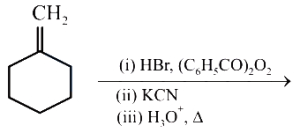
A
Cyclohexanecarboxylic acid with a methyl group at the alpha position.
B
$1-$methylcyclohexanecarboxylic acid.
C
Cyclohexylacetic acid.
D
$3-$cyclohexylpropanoic acid.
Solution
(C) The reaction proceeds as follows:
$1$. The first step is the anti-Markovnikov addition of $HBr$ to methylenecyclohexane in the presence of a peroxide,$(C_6H_5CO)_2O_2$. This yields (cyclohexylmethyl) bromide,$C_6H_{11}CH_2Br$.
$2$. The second step is a nucleophilic substitution reaction with $KCN$,where the bromide ion is replaced by a cyanide group,yielding cyclohexylacetonitrile,$C_6H_{11}CH_2CN$.
$3$. The third step is the acid-catalyzed hydrolysis of the nitrile group followed by heating,which converts the $-CN$ group into a carboxylic acid group,$-COOH$. The final product is cyclohexylacetic acid,$C_6H_{11}CH_2COOH$.
$1$. The first step is the anti-Markovnikov addition of $HBr$ to methylenecyclohexane in the presence of a peroxide,$(C_6H_5CO)_2O_2$. This yields (cyclohexylmethyl) bromide,$C_6H_{11}CH_2Br$.
$2$. The second step is a nucleophilic substitution reaction with $KCN$,where the bromide ion is replaced by a cyanide group,yielding cyclohexylacetonitrile,$C_6H_{11}CH_2CN$.
$3$. The third step is the acid-catalyzed hydrolysis of the nitrile group followed by heating,which converts the $-CN$ group into a carboxylic acid group,$-COOH$. The final product is cyclohexylacetic acid,$C_6H_{11}CH_2COOH$.
0 likesView Solution
209
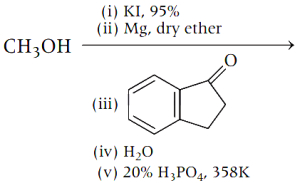
ChemistryDifficultMCQAP EAMCET · 2023
The major product formed in the following reaction is:
A
$1-$methyl-1H-indene
B
$1-$methylene$-2,3-$dihydro-1H-indene
C
$3-$methyl-1H-indene
D
$1-$methyl$-2,3-$dihydro-1H-inden$-1-$ol
Solution
(A) The reaction proceeds as follows:
$(i)$ $CH_3OH$ reacts with $KI$ to form $CH_3I$.
(ii) $CH_3I$ reacts with $Mg$ in dry ether to form the Grignard reagent $CH_3MgI$.
(iii) $CH_3MgI$ undergoes nucleophilic addition to the carbonyl group of $1-$indanone ($2$,$3$-dihydro-1H-inden$-1-$one).
(iv) Subsequent hydrolysis with $H_2O$ yields $1-$methyl$-2,3-$dihydro-1H-inden$-1-$ol.
$(v)$ Dehydration of the alcohol using $20\% H_3PO_4$ at $358 \ K$ results in the formation of the more stable conjugated alkene,$1$-methyl-1H-indene,as the major product.
$(i)$ $CH_3OH$ reacts with $KI$ to form $CH_3I$.
(ii) $CH_3I$ reacts with $Mg$ in dry ether to form the Grignard reagent $CH_3MgI$.
(iii) $CH_3MgI$ undergoes nucleophilic addition to the carbonyl group of $1-$indanone ($2$,$3$-dihydro-1H-inden$-1-$one).
(iv) Subsequent hydrolysis with $H_2O$ yields $1-$methyl$-2,3-$dihydro-1H-inden$-1-$ol.
$(v)$ Dehydration of the alcohol using $20\% H_3PO_4$ at $358 \ K$ results in the formation of the more stable conjugated alkene,$1$-methyl-1H-indene,as the major product.
0 likesView Solution
210
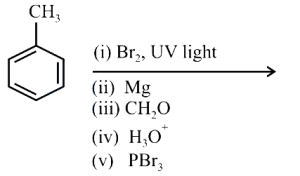
ChemistryDifficultMCQAP EAMCET · 2023
The major product in the following reaction sequence is:
A
$1-$bromo$-1-$phenylethane
B
o-bromomethyltoluene
C
($2$-bromoethyl)benzene
D
p-bromomethyltoluene
Solution
(C) The reaction sequence is as follows:
$1$. Toluene reacts with $Br_2$ in the presence of $UV$ light to undergo free-radical substitution at the benzylic position,forming benzyl bromide $(C_6H_5CH_2Br)$.
$2$. Benzyl bromide reacts with $Mg$ in dry ether to form the Grignard reagent,benzylmagnesium bromide $(C_6H_5CH_2MgBr)$.
$3$. The Grignard reagent reacts with formaldehyde $(CH_2O)$ followed by acidic hydrolysis $(H_3O^+)$ to form $2-$phenylethanol $(C_6H_5CH_2CH_2OH)$.
$4$. Finally,$2$-phenylethanol reacts with $PBr_3$ to replace the hydroxyl group with a bromine atom,yielding ($2$-bromoethyl)benzene $(C_6H_5CH_2CH_2Br)$.
$1$. Toluene reacts with $Br_2$ in the presence of $UV$ light to undergo free-radical substitution at the benzylic position,forming benzyl bromide $(C_6H_5CH_2Br)$.
$2$. Benzyl bromide reacts with $Mg$ in dry ether to form the Grignard reagent,benzylmagnesium bromide $(C_6H_5CH_2MgBr)$.
$3$. The Grignard reagent reacts with formaldehyde $(CH_2O)$ followed by acidic hydrolysis $(H_3O^+)$ to form $2-$phenylethanol $(C_6H_5CH_2CH_2OH)$.
$4$. Finally,$2$-phenylethanol reacts with $PBr_3$ to replace the hydroxyl group with a bromine atom,yielding ($2$-bromoethyl)benzene $(C_6H_5CH_2CH_2Br)$.
0 likesView Solution
211
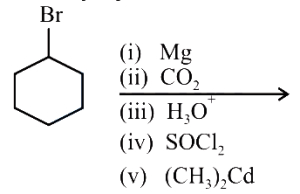
ChemistryDifficultMCQAP EAMCET · 2023
The major product in the following reaction is
A
Cyclohexyl ethanol
B
Cyclohexyl methyl ketone
C
$1-$Cyclohexyl ethanol
D
$2-$Cyclohexyl propan$-2-$ol
Solution
(B) The reaction proceeds as follows:
$1$. Bromocyclohexane reacts with $Mg$ in dry ether to form cyclohexylmagnesium bromide (a Grignard reagent).
$2$. The Grignard reagent reacts with $CO_2$ followed by acidic workup $(H_3O^+)$ to form cyclohexanecarboxylic acid.
$3$. Cyclohexanecarboxylic acid reacts with $SOCl_2$ to form cyclohexanecarbonyl chloride.
$4$. Finally,the reaction of cyclohexanecarbonyl chloride with dimethylcadmium,$(CH_3)_2Cd$,yields cyclohexyl methyl ketone as the major product. This is a standard method for the preparation of ketones from acid chlorides.
$1$. Bromocyclohexane reacts with $Mg$ in dry ether to form cyclohexylmagnesium bromide (a Grignard reagent).
$2$. The Grignard reagent reacts with $CO_2$ followed by acidic workup $(H_3O^+)$ to form cyclohexanecarboxylic acid.
$3$. Cyclohexanecarboxylic acid reacts with $SOCl_2$ to form cyclohexanecarbonyl chloride.
$4$. Finally,the reaction of cyclohexanecarbonyl chloride with dimethylcadmium,$(CH_3)_2Cd$,yields cyclohexyl methyl ketone as the major product. This is a standard method for the preparation of ketones from acid chlorides.
0 likesView Solution
212
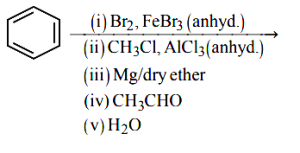
ChemistryDifficultMCQAP EAMCET · 2023
The major product of the following reaction is:
A
$1-$($4$-methylphenyl)propan$-2-$ol
B
$1-$($4$-methylphenyl)ethanol
C
$2-$($2$-methylphenyl)propan$-2-$ol
D
$1-$($2$-methylphenyl)ethanol
Solution
(B) Step $(i)$: Benzene reacts with $Br_2$ in the presence of anhydrous $FeBr_3$ to form bromobenzene via electrophilic aromatic substitution.
Step (ii): Bromobenzene undergoes Friedel-Crafts alkylation with $CH_3Cl$ and anhydrous $AlCl_3$. Since the $-Br$ group is ortho/para directing,the major product is $p$-bromotoluene.
Step (iii): $p$-Bromotoluene reacts with $Mg$ in dry ether to form the Grignard reagent,$p$-tolylmagnesium bromide $(CH_3-C_6H_4-MgBr)$.
Step (iv) and $(v)$: The Grignard reagent reacts with acetaldehyde $(CH_3CHO)$ followed by hydrolysis $(H_2O)$ to form a secondary alcohol. The nucleophilic carbon of the Grignard reagent attacks the carbonyl carbon of acetaldehyde,resulting in $1-(4-methylphenyl)ethanol$.
Step (ii): Bromobenzene undergoes Friedel-Crafts alkylation with $CH_3Cl$ and anhydrous $AlCl_3$. Since the $-Br$ group is ortho/para directing,the major product is $p$-bromotoluene.
Step (iii): $p$-Bromotoluene reacts with $Mg$ in dry ether to form the Grignard reagent,$p$-tolylmagnesium bromide $(CH_3-C_6H_4-MgBr)$.
Step (iv) and $(v)$: The Grignard reagent reacts with acetaldehyde $(CH_3CHO)$ followed by hydrolysis $(H_2O)$ to form a secondary alcohol. The nucleophilic carbon of the Grignard reagent attacks the carbonyl carbon of acetaldehyde,resulting in $1-(4-methylphenyl)ethanol$.
0 likesView Solution
213
ChemistryMediumMCQAP EAMCET · 2023
The major product of the following reaction is:
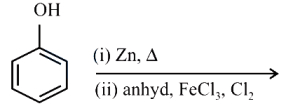
A
$4-$chlorophenol
B
$2-$chlorophenol
C
$2,4-$dichlorophenol
D
chlorobenzene
Solution
(D) Step $1$: Phenol reacts with zinc dust $(Zn)$ under heating $(\Delta)$ to undergo reduction,resulting in the formation of benzene.
$C_6H_5OH Zn \xrightarrow{\Delta} C_6H_6 ZnO$
Step $2$: Benzene then undergoes electrophilic aromatic substitution (chlorination) in the presence of anhydrous ferric chloride $(FeCl_3)$ and chlorine $(Cl_2)$ to form chlorobenzene.
$C_6H_6 Cl_2 \xrightarrow{\text{anhyd. } FeCl_3} C_6H_5Cl HCl$
Therefore,the major product is chlorobenzene.
$C_6H_5OH Zn \xrightarrow{\Delta} C_6H_6 ZnO$
Step $2$: Benzene then undergoes electrophilic aromatic substitution (chlorination) in the presence of anhydrous ferric chloride $(FeCl_3)$ and chlorine $(Cl_2)$ to form chlorobenzene.
$C_6H_6 Cl_2 \xrightarrow{\text{anhyd. } FeCl_3} C_6H_5Cl HCl$
Therefore,the major product is chlorobenzene.
0 likesView Solution
214
ChemistryDifficultMCQAP EAMCET · 2023
The major product formed in the following reaction is:
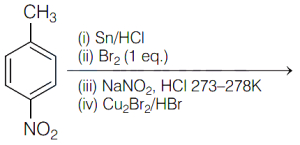
A
$1-$methyl$-3,5-$dibromobenzene
B
$1-$methyl$-2,6-$dibromobenzene
C
$1-$methyl$-3,4-$dibromobenzene
D
$1-$methyl$-2,4-$dibromobenzene
Solution
(C) The reaction proceeds as follows:
$(i)$ $Sn/HCl$ reduces the $-NO_2$ group to an $-NH_2$ group,forming $p$-toluidine.
(ii) $Br_2$ $(1 \ eq.)$ in the presence of the strongly activating $-NH_2$ group leads to ortho-bromination,yielding $2$-bromo-$4$-methylaniline.
(iii) $NaNO_2/HCl$ at $273-278 \ K$ converts the $-NH_2$ group into a diazonium salt,$-N_2^+Cl^-$.
(iv) $Cu_2Br_2/HBr$ (Sandmeyer reaction) replaces the diazonium group with a $-Br$ atom,resulting in $1,2$-dibromo-$4$-methylbenzene (also known as $3,4$-dibromotoluene).
$(i)$ $Sn/HCl$ reduces the $-NO_2$ group to an $-NH_2$ group,forming $p$-toluidine.
(ii) $Br_2$ $(1 \ eq.)$ in the presence of the strongly activating $-NH_2$ group leads to ortho-bromination,yielding $2$-bromo-$4$-methylaniline.
(iii) $NaNO_2/HCl$ at $273-278 \ K$ converts the $-NH_2$ group into a diazonium salt,$-N_2^+Cl^-$.
(iv) $Cu_2Br_2/HBr$ (Sandmeyer reaction) replaces the diazonium group with a $-Br$ atom,resulting in $1,2$-dibromo-$4$-methylbenzene (also known as $3,4$-dibromotoluene).
0 likesView Solution
Vedclass Products
For Students
Vedclass Test Series
Mock tests in real AP EAMCET style covering Chemistry with performance analysis. 5-day free trial.
Start Free TrialFor Teachers
Exam Paper Generator
Generate Set A/B/C/D Chemistry papers from 7.5L+ questions in 2 minutes. 3 chapters free.
Try FreeFor Institutes
Online Exam Module
Run live AP EAMCET mock exams with unlimited students, 360° analytics & white-label branding.
See DemoFrequently Asked Questions
How many Chemistry questions are in AP EAMCET 2023?
There are 414 Chemistry questions from the AP EAMCET 2023 paper on Vedclass, each with a detailed step-by-step solution in English.
Are AP EAMCET 2023 Chemistry solutions available in English?
Yes. All solutions on this page are in English. You can also switch to English or Hindi using the language buttons above the questions.
Can I practice AP EAMCET 2023 Chemistry as a timed test?
Yes. Use the Vedclass Test Series to attempt a full AP EAMCET mock test covering Chemistry with time limits and instant score analysis.
Can teachers create Chemistry papers from AP EAMCET previous year questions?
Yes. The Vedclass Exam Paper Generator lets teachers mix AP EAMCET Chemistry questions and generate Set A/B/C/D papers in minutes.
For Teachers & Institutes
Build a Custom Chemistry Paper
Pick AP EAMCET 2023 Chemistry questions, set difficulty, and generate Set A/B/C/D in 2 minutes.