
ChemistryQ51–150 of 414 questions
Page 2 of 5 · English
51
ChemistryEasyMCQAP EAMCET · 2023
Which of the following oxides is highly basic?
A
$Cr_2O_3$
B
$Al_2O_3$
C
$MgO$
D
$Na_2O$
Solution
(D) Strongly electropositive metals form strongly basic oxides that dissolve in water to give alkalis.
$Na_2O$ contains the strongly electropositive $Na$ metal,which reacts with water to form $NaOH$,a strong base.
$Na_2O + H_2O \rightarrow 2NaOH$.
$Na_2O$ contains the strongly electropositive $Na$ metal,which reacts with water to form $NaOH$,a strong base.
$Na_2O + H_2O \rightarrow 2NaOH$.
0 likesView Solution
52
ChemistryEasyMCQAP EAMCET · 2023
Match the following:
| List-$I$ | List-$II$ |
|---|---|
| $A$. Alkali metals | $I$. $ns^2 np^6$ |
| $B$. Alkaline earth metals | $II$. $ns^1$ |
| $C$. Halogens | $III$. $ns^2 np^5$ |
| $D$. Noble gases | $IV$. $ns^2$ |
A
$A-II, B-IV, C-III, D-I$
B
$A-IV, B-III, C-II, D-I$
C
$A-II, B-I, C-III, D-IV$
D
$A-IV, B-I, C-III, D-II$
Solution
(A) The general valence shell electronic configurations are as follows:
$A$. Alkali metals (Group $1$) have the configuration $ns^1$.
$B$. Alkaline earth metals (Group $2$) have the configuration $ns^2$.
$C$. Halogens (Group $17$) have the configuration $ns^2 np^5$.
$D$. Noble gases (Group $18$) have the configuration $ns^2 np^6$.
Therefore,the correct matching is $A-II, B-IV, C-III, D-I$.
$A$. Alkali metals (Group $1$) have the configuration $ns^1$.
$B$. Alkaline earth metals (Group $2$) have the configuration $ns^2$.
$C$. Halogens (Group $17$) have the configuration $ns^2 np^5$.
$D$. Noble gases (Group $18$) have the configuration $ns^2 np^6$.
Therefore,the correct matching is $A-II, B-IV, C-III, D-I$.
0 likesView Solution
53
ChemistryEasyMCQAP EAMCET · 2023
The correct order of bond enthalpy of given molecules is
A
$O_2 < N_2 < H_2$
B
$N_2 < O_2 < H_2$
C
$H_2 < N_2 < O_2$
D
$H_2 < O_2 < N_2$
Solution
(D) The bond enthalpy depends on the bond order and bond length. The bond orders for $H_2$,$O_2$,and $N_2$ are $1$,$2$,and $3$ respectively.
As the bond order increases,the bond strength increases,and consequently,the bond enthalpy increases.
The bond types are $H-H$ (single bond),$O=O$ (double bond),and $N \equiv N$ (triple bond).
Therefore,the correct order of bond enthalpy is $H_2 < O_2 < N_2$.
As the bond order increases,the bond strength increases,and consequently,the bond enthalpy increases.
The bond types are $H-H$ (single bond),$O=O$ (double bond),and $N \equiv N$ (triple bond).
Therefore,the correct order of bond enthalpy is $H_2 < O_2 < N_2$.
0 likesView Solution
54
ChemistryEasyMCQAP EAMCET · 2023
The correct order of electron gain enthalpy of $N$,$O$,$Cl$,$Al$ is
A
$Cl < N < O < Al$
B
$Al < N < O < Cl$
C
$O < N < Al < Cl$
D
$N < O < Cl < Al$
Solution
(B) The electron gain enthalpy is the energy released when an electron is added to a neutral gaseous atom.
For the given elements,the values are:
$N$: $+7 \ kJ/mol$ (positive due to stable half-filled $2p^3$ configuration)
$O$: $-141 \ kJ/mol$
$Cl$: $-349 \ kJ/mol$
$Al$: $-43 \ kJ/mol$
Comparing the magnitudes,the order of electron gain enthalpy (most negative to least negative) is $Cl < O < Al < N$.
However,considering the standard convention where more negative values are considered 'higher' in terms of energy release,the order of increasing electron gain enthalpy is $Al < N < O < Cl$.
For the given elements,the values are:
$N$: $+7 \ kJ/mol$ (positive due to stable half-filled $2p^3$ configuration)
$O$: $-141 \ kJ/mol$
$Cl$: $-349 \ kJ/mol$
$Al$: $-43 \ kJ/mol$
Comparing the magnitudes,the order of electron gain enthalpy (most negative to least negative) is $Cl < O < Al < N$.
However,considering the standard convention where more negative values are considered 'higher' in terms of energy release,the order of increasing electron gain enthalpy is $Al < N < O < Cl$.
0 likesView Solution
55
ChemistryEasyMCQAP EAMCET · 2023
In which one of the following pairs,both oxides are acidic?
A
$CO, CO_2$
B
$SnO, PbO_2$
C
$GeO_2, SiO_2$
D
$SnO, PbO$
Solution
(C) Acidic oxides are typically non-metal oxides or oxides of metals in high oxidation states.
$CO_2$,$SiO_2$,and $GeO_2$ are acidic oxides.
$SnO$,$PbO$,and $PbO_2$ are amphoteric oxides.
$CO$ is a neutral oxide.
Therefore,in the pair $GeO_2$ and $SiO_2$,both oxides are acidic.
$CO_2$,$SiO_2$,and $GeO_2$ are acidic oxides.
$SnO$,$PbO$,and $PbO_2$ are amphoteric oxides.
$CO$ is a neutral oxide.
Therefore,in the pair $GeO_2$ and $SiO_2$,both oxides are acidic.
0 likesView Solution
56
ChemistryEasyMCQAP EAMCET · 2023
Which of the following elements exhibit metallic nature among $C$,$Si$,$Ge$,$Sn$,and $Pb$?
A
$Ge, Pb$
B
$Ge, Sn$
C
$C, Ge$
D
$Sn, Pb$
Solution
(D) In Group $14$ of the periodic table:
$C$ (Carbon) is a non-metal.
$Si$ (Silicon) is a metalloid.
$Ge$ (Germanium) is a metalloid.
$Sn$ (Tin) is a metal.
$Pb$ (Lead) is a metal.
Therefore,the elements with metallic nature are $Sn$ and $Pb$.
$C$ (Carbon) is a non-metal.
$Si$ (Silicon) is a metalloid.
$Ge$ (Germanium) is a metalloid.
$Sn$ (Tin) is a metal.
$Pb$ (Lead) is a metal.
Therefore,the elements with metallic nature are $Sn$ and $Pb$.
0 likesView Solution
57
ChemistryEasyMCQAP EAMCET · 2023
Which one of the following indicates the correct order of atomic size of the given elements?
A
$Li > B > F > N$
B
$N > F > Li > B$
C
$F > N > B > Li$
D
$Li > B > N > F$
Solution
(D) The atomic size or radius decreases in a period from left to right due to an increase in effective nuclear charge.
For the given elements in the second period,the order of atomic number is $Li (3) < B (5) < N (7) < F (9)$.
Therefore,the correct order of atomic size is $Li > B > N > F$.
For the given elements in the second period,the order of atomic number is $Li (3) < B (5) < N (7) < F (9)$.
Therefore,the correct order of atomic size is $Li > B > N > F$.
0 likesView Solution
58
ChemistryEasyMCQAP EAMCET · 2023
The correct order of atomic radii of $B, Be, N$ and $C$ is
A
$Be < B < C < N$
B
$N < B < C < Be$
C
$N < C < B < Be$
D
$Be < C < B < N$
Solution
(C) Atomic radii generally decrease in a period from left to right due to an increase in the effective nuclear charge.
In the second period,the elements are arranged as $Be (Z=4), B (Z=5), C (Z=6), N (Z=7)$.
As we move from left to right,the effective nuclear charge increases,which pulls the valence electrons closer to the nucleus,resulting in a decrease in atomic size.
Therefore,the correct order of atomic radii is $N < C < B < Be$.
In the second period,the elements are arranged as $Be (Z=4), B (Z=5), C (Z=6), N (Z=7)$.
As we move from left to right,the effective nuclear charge increases,which pulls the valence electrons closer to the nucleus,resulting in a decrease in atomic size.
Therefore,the correct order of atomic radii is $N < C < B < Be$.
0 likesView Solution
59
ChemistryEasyMCQAP EAMCET · 2023
The correct order of the metallic nature of the following elements is
A
$Si > Al > Na > Hg$
B
$Na > Mg > Al > Si$
C
$Al > Mg > Na > Si$
D
$Mg > Na > Al > Si$
Solution
(B) Metallic nature decreases in a period from left to right due to an increase in the effective nuclear charge.
Across the third period,the elements are $Na$,$Mg$,$Al$,and $Si$.
Since metallic character decreases from left to right,the correct order is $Na > Mg > Al > Si$.
Across the third period,the elements are $Na$,$Mg$,$Al$,and $Si$.
Since metallic character decreases from left to right,the correct order is $Na > Mg > Al > Si$.
0 likesView Solution
60
ChemistryMediumMCQAP EAMCET · 2023
Consider the reactions:
$I$. $CO + 3 H_2 \xrightarrow{A} CH_4 + H_2 O$
$II$. $CO + 2 H_2 \xrightarrow{B} CH_3 OH$
$III$. $O_2 + 2 H_2 \xrightarrow{C} 2 H_2 O$
The catalysts $A, B, C$ are respectively:
$I$. $CO + 3 H_2 \xrightarrow{A} CH_4 + H_2 O$
$II$. $CO + 2 H_2 \xrightarrow{B} CH_3 OH$
$III$. $O_2 + 2 H_2 \xrightarrow{C} 2 H_2 O$
The catalysts $A, B, C$ are respectively:
A
$Ni, ZnO-Cr_2 O_3, Pt$
B
$Pt, ZnO-Cr_2 O_3, Ni$
C
$CuCl_2, Ni, V_2 O_5$
D
$Pd, Pt, ZnO-Cr_2 O_3$
Solution
(A) The reaction of carbon monoxide with hydrogen yields different products depending on the catalyst used:
$1$. $CO + 3 H_2 \xrightarrow{Ni} CH_4 + H_2 O$ (Catalyst $A = Ni$)
$2$. $CO + 2 H_2 \xrightarrow{ZnO-Cr_2 O_3} CH_3 OH$ (Catalyst $B = ZnO-Cr_2 O_3$)
$3$. $O_2 + 2 H_2 \xrightarrow{Pt} 2 H_2 O$ (Catalyst $C = Pt$)
Therefore,the catalysts $A, B, C$ are $Ni, ZnO-Cr_2 O_3, Pt$ respectively.
$1$. $CO + 3 H_2 \xrightarrow{Ni} CH_4 + H_2 O$ (Catalyst $A = Ni$)
$2$. $CO + 2 H_2 \xrightarrow{ZnO-Cr_2 O_3} CH_3 OH$ (Catalyst $B = ZnO-Cr_2 O_3$)
$3$. $O_2 + 2 H_2 \xrightarrow{Pt} 2 H_2 O$ (Catalyst $C = Pt$)
Therefore,the catalysts $A, B, C$ are $Ni, ZnO-Cr_2 O_3, Pt$ respectively.
0 likesView Solution
61
ChemistryMediumMCQAP EAMCET · 2023
In neutral or faintly alkaline medium,$MnO_4^{-}$ oxidizes $I^{-}$ to iodate. What is the number of moles of $KMnO_4$ required to completely convert $1 \ L$ of $0.5 \ M \ KI$ to iodate?
A
$0.5$
B
$4.0$
C
$2.0$
D
$1.0$
Solution
(D) The balanced chemical equation for the reaction in a neutral or faintly alkaline medium is:
$2KMnO_4 + H_2O + KI \rightarrow 2MnO_2 + 2KOH + KIO_3$
From the stoichiometry of the balanced equation,$1 \ mole$ of $KI$ reacts with $2 \ moles$ of $KMnO_4$.
Given,the amount of $KI = \text{Molarity} \times \text{Volume} = 0.5 \ M \times 1 \ L = 0.5 \ moles$.
Since $1 \ mole$ of $KI$ requires $2 \ moles$ of $KMnO_4$,then $0.5 \ moles$ of $KI$ will require:
$0.5 \times 2 = 1.0 \ mole$ of $KMnO_4$.
$2KMnO_4 + H_2O + KI \rightarrow 2MnO_2 + 2KOH + KIO_3$
From the stoichiometry of the balanced equation,$1 \ mole$ of $KI$ reacts with $2 \ moles$ of $KMnO_4$.
Given,the amount of $KI = \text{Molarity} \times \text{Volume} = 0.5 \ M \times 1 \ L = 0.5 \ moles$.
Since $1 \ mole$ of $KI$ requires $2 \ moles$ of $KMnO_4$,then $0.5 \ moles$ of $KI$ will require:
$0.5 \times 2 = 1.0 \ mole$ of $KMnO_4$.
0 likesView Solution
62
ChemistryEasyMCQAP EAMCET · 2023
The autocatalyst in the redox reaction involving acidified potassium permanganate and oxalic acid is
A
$Mn^{2+}$
B
$SO_4^{2-}$
C
$CO_2$
D
$H_2 O$
Solution
(A) The balanced redox reaction is: $5 C_2 O_4^{2-} + 2 MnO_4^{-} + 16 H^{+} \rightarrow 2 Mn^{2+} + 8 H_2 O + 10 CO_2$.
In this reaction,the $Mn^{2+}$ ions produced act as an autocatalyst.
Initially,the reaction is slow,but as the concentration of $Mn^{2+}$ increases,the rate of the reaction increases significantly.
In this reaction,the $Mn^{2+}$ ions produced act as an autocatalyst.
Initially,the reaction is slow,but as the concentration of $Mn^{2+}$ increases,the rate of the reaction increases significantly.
0 likesView Solution
63
ChemistryMediumMCQAP EAMCET · 2023
In neutral or faintly alkaline medium,$MnO_4^{-}$ oxidizes $I^{-}$ to iodate. What is the volume (in $L$) of $0.02 \ M \ KMnO_4$ required to completely convert $1 \ L$ of $0.5 \ M \ KI$ solution to iodate in neutral or faintly alkaline medium?
A
$5$
B
$50$
C
$20$
D
$30$
Solution
(B) The balanced chemical equation for the reaction in neutral or faintly alkaline medium is:
$2 \ KMnO_4 + H_2O + KI \rightarrow 2 \ MnO_2 + 2 \ KOH + KIO_3$
From the stoichiometry,$1 \ \text{mole}$ of $I^-$ requires $2 \ \text{moles}$ of $MnO_4^-$.
Number of moles of $KI = 1 \ L \times 0.5 \ M = 0.5 \ \text{mol}$.
Therefore,the number of moles of $MnO_4^-$ required $= 2 \times 0.5 = 1.0 \ \text{mol}$.
Volume of $0.02 \ M \ KMnO_4$ solution $= \frac{\text{moles}}{\text{Molarity}} = \frac{1.0 \ \text{mol}}{0.02 \ M} = 50 \ L$.
$2 \ KMnO_4 + H_2O + KI \rightarrow 2 \ MnO_2 + 2 \ KOH + KIO_3$
From the stoichiometry,$1 \ \text{mole}$ of $I^-$ requires $2 \ \text{moles}$ of $MnO_4^-$.
Number of moles of $KI = 1 \ L \times 0.5 \ M = 0.5 \ \text{mol}$.
Therefore,the number of moles of $MnO_4^-$ required $= 2 \times 0.5 = 1.0 \ \text{mol}$.
Volume of $0.02 \ M \ KMnO_4$ solution $= \frac{\text{moles}}{\text{Molarity}} = \frac{1.0 \ \text{mol}}{0.02 \ M} = 50 \ L$.
0 likesView Solution
64
ChemistryMediumMCQAP EAMCET · 2023
The $IUPAC$ name of the following molecule is:
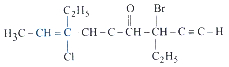
A
$6-$Bromo$-4-$chloro$-3,7-$diethyl$-5-$oxo$-8-$yn$-2-$nonene
B
$6-$Chloro$-4-$bromo$-3,7-$diethyl$-5-$keto$-7-$en$-1-$nonene
C
$4-$Chloro$-6-$bromo$-3,7-$diethyl$-5-$keto$-8-$yn$-2-$nonene
D
$4-$Bromo$-6-$chloro$-3,7-$diethylnon$-7-$en$-1-$yn$-5-$one
Solution
(D) $1$. Identify the longest carbon chain containing the principal functional group (ketone),double bond,and triple bond. The chain has $9$ carbons,so the parent alkane is nonane.
$2$. Number the chain from the end that gives the lowest locants to the functional groups. The ketone group gets priority,so we number from right to left to give the ketone the lowest possible locant $(5)$.
$3$. The substituents are $4-$bromo,$6-$chloro,and $3,7-$diethyl.
$4$. The double bond is at position $7$ and the triple bond is at position $1$.
$5$. Combining these,the $IUPAC$ name is $4-$Bromo$-6-$chloro$-3,7-$diethylnon$-7-$en$-1-$yn$-5-$one.
$2$. Number the chain from the end that gives the lowest locants to the functional groups. The ketone group gets priority,so we number from right to left to give the ketone the lowest possible locant $(5)$.
$3$. The substituents are $4-$bromo,$6-$chloro,and $3,7-$diethyl.
$4$. The double bond is at position $7$ and the triple bond is at position $1$.
$5$. Combining these,the $IUPAC$ name is $4-$Bromo$-6-$chloro$-3,7-$diethylnon$-7-$en$-1-$yn$-5-$one.
0 likesView Solution
65
ChemistryEasyMCQAP EAMCET · 2023
The $IUPAC$ symbol for the element with atomic number $108$ is
A
$Hs$
B
$Bh$
C
$Mt$
D
$Sg$
Solution
(A) The element with atomic number $Z = 108$ is hassium,which is represented by the $IUPAC$ symbol $Hs$.
0 likesView Solution
66
ChemistryMediumMCQAP EAMCET · 2023
The decreasing order of priority for the following functional groups in the $IUPAC$ Nomenclature is $-SO_3H$,$-CN$,$-COOH$,$-OH$,$-CHO$.
A
$-COOH > -SO_3H > -CN > -CHO > -OH$
B
$-SO_3H > -COOH > -CN > -CHO > -OH$
C
$-COOH > -SO_3H > -CHO > -CN > -OH$
D
$-SO_3H > -COOH > -CHO > -CN > -OH$
Solution
(A) According to the $IUPAC$ priority rules for functional groups,the order of priority is determined by the oxidation state and chemical reactivity.
The correct decreasing order of priority is: $-COOH > -SO_3H > -CN > -CHO > -OH$.
The correct decreasing order of priority is: $-COOH > -SO_3H > -CN > -CHO > -OH$.
0 likesView Solution
67
ChemistryEasyMCQAP EAMCET · 2023
The $IUPAC$ name of the following molecule is
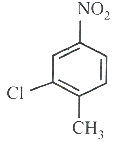
A
$2-$Methyl$-5-$nitro$-1-$chlorobenzene
B
$3-$Chloro$-4-$methyl$-1-$nitrobenzene
C
$2-$Chloro$-1-$methyl$-4-$nitrobenzene
D
$2-$Chloro$-4-$nitro$-1-$methylbenzene
Solution
(C) The parent compound is toluene (methylbenzene). The methyl group is assigned position $1$. The substituents $-Cl$ and $-NO_2$ are then numbered to give the lowest possible locants. Starting from the methyl group at position $1$,the chlorine atom is at position $2$ and the nitro group is at position $4$. Thus,the $IUPAC$ name is $2-$chloro$-1-$methyl$-4-$nitrobenzene.
0 likesView Solution
68
ChemistryMediumMCQAP EAMCET · 2023
Arrange the following free radicals in the correct order of their stability:
$(i)$ $CH_2=\dot{C}H$
$(ii)$ $\dot{C}H_3$
$(iii)$ $CH_3-\dot{C}H-CH_3$
$(iv)$ $(CH_3)_3\dot{C}$
$(i)$ $CH_2=\dot{C}H$
$(ii)$ $\dot{C}H_3$
$(iii)$ $CH_3-\dot{C}H-CH_3$
$(iv)$ $(CH_3)_3\dot{C}$
A
$i > ii > iii > iv$
B
$iv > iii > ii > i$
C
$i < ii < iii < iv$
D
$iv > iii > i > ii$
Solution
(B) The stability of alkyl free radicals is determined by the number of alkyl groups attached to the radical carbon,which provide stability through the inductive effect and hyperconjugation.
$3^{\circ}$ free radicals are the most stable,followed by $2^{\circ}$,$1^{\circ}$,and methyl radicals.
Vinyl free radicals $(CH_2=\dot{C}H)$ are significantly less stable because the unpaired electron is in an $sp^2$ hybridized orbital,which has more $s$-character and is more electronegative.
Thus,the stability order is: $(CH_3)_3\dot{C} (3^{\circ}) > CH_3-\dot{C}H-CH_3 (2^{\circ}) > \dot{C}H_3 (1^{\circ}) > CH_2=\dot{C}H$ (vinyl).
The correct order is $iv > iii > ii > i$.
$3^{\circ}$ free radicals are the most stable,followed by $2^{\circ}$,$1^{\circ}$,and methyl radicals.
Vinyl free radicals $(CH_2=\dot{C}H)$ are significantly less stable because the unpaired electron is in an $sp^2$ hybridized orbital,which has more $s$-character and is more electronegative.
Thus,the stability order is: $(CH_3)_3\dot{C} (3^{\circ}) > CH_3-\dot{C}H-CH_3 (2^{\circ}) > \dot{C}H_3 (1^{\circ}) > CH_2=\dot{C}H$ (vinyl).
The correct order is $iv > iii > ii > i$.
0 likesView Solution
69
ChemistryEasyMCQAP EAMCET · 2023
Which of the following molecules is not aromatic?
A
Cyclopentadienyl anion
B
Tropylium cation
C
Cyclopropenyl cation
D
Cycloheptatriene
Solution
(D) An aromatic species must be planar,cyclic,fully conjugated,and possess $(4n+2) \pi$ electrons,where $n$ is an integer.
$A$. Cyclopentadienyl anion: It is cyclic,planar,fully conjugated,and has $6 \pi$ electrons $(n=1)$,so it is aromatic.
$B$. Tropylium cation: It is cyclic,planar,fully conjugated,and has $6 \pi$ electrons $(n=1)$,so it is aromatic.
$C$. Cyclopropenyl cation: It is cyclic,planar,fully conjugated,and has $2 \pi$ electrons $(n=0)$,so it is aromatic.
$D$. Cycloheptatriene: It has a $sp^3$-hybridized carbon atom in the ring,which breaks the continuous conjugation of the $\pi$ system. Therefore,it is not aromatic.
$A$. Cyclopentadienyl anion: It is cyclic,planar,fully conjugated,and has $6 \pi$ electrons $(n=1)$,so it is aromatic.
$B$. Tropylium cation: It is cyclic,planar,fully conjugated,and has $6 \pi$ electrons $(n=1)$,so it is aromatic.
$C$. Cyclopropenyl cation: It is cyclic,planar,fully conjugated,and has $2 \pi$ electrons $(n=0)$,so it is aromatic.
$D$. Cycloheptatriene: It has a $sp^3$-hybridized carbon atom in the ring,which breaks the continuous conjugation of the $\pi$ system. Therefore,it is not aromatic.
0 likesView Solution
70
ChemistryMediumMCQAP EAMCET · 2023
In the above reaction,the electrophile is substituted at the meta position only,due to:
$I$. Electron density is more at ortho $\&$ para positions
$II$. Electron density is relatively less at ortho $\&$ para positions
$III$. Electron density is less at meta position
$IV$. Electron density is relatively more at meta position
The correct answer is:
$I$. Electron density is more at ortho $\&$ para positions
$II$. Electron density is relatively less at ortho $\&$ para positions
$III$. Electron density is less at meta position
$IV$. Electron density is relatively more at meta position
The correct answer is:
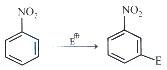
A
$I, III$ only
B
$II, IV$ only
C
$I$ only
D
$III$ only
Solution
(B) The $-NO_2$ group is a strong electron-withdrawing group ($-I$ and $-M$ effect).
Due to the resonance effect,the electron density in the benzene ring is significantly reduced,especially at the ortho and para positions,where positive charges appear in the resonance structures.
Consequently,the electron density is relatively less at the ortho and para positions compared to the meta position.
This makes the meta position the most favorable site for electrophilic substitution,as it is relatively less deactivated than the ortho and para positions.
Therefore,statements $II$ and $IV$ are correct.
Due to the resonance effect,the electron density in the benzene ring is significantly reduced,especially at the ortho and para positions,where positive charges appear in the resonance structures.
Consequently,the electron density is relatively less at the ortho and para positions compared to the meta position.
This makes the meta position the most favorable site for electrophilic substitution,as it is relatively less deactivated than the ortho and para positions.
Therefore,statements $II$ and $IV$ are correct.
0 likesView Solution
71
ChemistryEasyMCQAP EAMCET · 2023
Which of the following is an ambident nucleophile?
A
Ammonia
B
Chloride ion
C
Water
D
Cyanide ion
Solution
(D) An ambident nucleophile is a species that has two or more nucleophilic sites through which it can attack an electrophile.
In the cyanide ion $(CN^-)$,both the carbon atom (which carries a negative charge) and the nitrogen atom (which has a lone pair of electrons) can act as nucleophilic sites.
Therefore,the cyanide ion is an example of an ambident nucleophile.
In the cyanide ion $(CN^-)$,both the carbon atom (which carries a negative charge) and the nitrogen atom (which has a lone pair of electrons) can act as nucleophilic sites.
Therefore,the cyanide ion is an example of an ambident nucleophile.
0 likesView Solution
72
ChemistryMediumMCQAP EAMCET · 2023
The optically inactive compound from the following is
A
$2-$Bromopropanal
B
$3-$Bromopropanal
C
$3-$Bromo-$2-$iodopropanal
D
$2-$Bromo-$3-$iodopropanal
Solution
(B) An optically inactive compound is one that does not contain any chiral centers (asymmetric carbon atoms).
$2-$Bromopropanal: $CH_3-CH(Br)-CHO$ (The $C-2$ carbon is chiral).
$3-$Bromopropanal: $Br-CH_2-CH_2-CHO$ (No chiral carbon exists).
$3-$Bromo-$2-$iodopropanal: $Br-CH_2-CH(I)-CHO$ (The $C-2$ carbon is chiral).
$2-$Bromo-$3-$iodopropanal: $CH_2(I)-CH(Br)-CHO$ (The $C-2$ carbon is chiral).
Therefore,$3-$Bromopropanal is the optically inactive compound.
$2-$Bromopropanal: $CH_3-CH(Br)-CHO$ (The $C-2$ carbon is chiral).
$3-$Bromopropanal: $Br-CH_2-CH_2-CHO$ (No chiral carbon exists).
$3-$Bromo-$2-$iodopropanal: $Br-CH_2-CH(I)-CHO$ (The $C-2$ carbon is chiral).
$2-$Bromo-$3-$iodopropanal: $CH_2(I)-CH(Br)-CHO$ (The $C-2$ carbon is chiral).
Therefore,$3-$Bromopropanal is the optically inactive compound.
0 likesView Solution
73
ChemistryEasyMCQAP EAMCET · 2023
Identify the correct statements with respect to $cis/trans$-but$-2$-ene from the following:
$I$. $cis$-but$-2$-ene is more polar than $trans$-but$-2$-ene
$II$. Melting point of $cis$-but$-2$-ene is greater than that of $trans$-but$-2$-ene
$III$. Boiling point of $cis$-but$-2$-ene is greater than that of $trans$-but$-2$-ene
Correct answer is
$I$. $cis$-but$-2$-ene is more polar than $trans$-but$-2$-ene
$II$. Melting point of $cis$-but$-2$-ene is greater than that of $trans$-but$-2$-ene
$III$. Boiling point of $cis$-but$-2$-ene is greater than that of $trans$-but$-2$-ene
Correct answer is
A
$I, II$ only
B
$II, III$ only
C
$I, III$ only
D
$I, II, III$
Solution
(C) $cis$-but$-2$-ene is more polar than $trans$-but$-2$-ene because the bond dipole moments cancel out in the symmetric $trans$-but$-2$-ene isomer. Thus,statement $I$ is correct.
Due to its higher polarity,$cis$-but$-2$-ene has stronger intermolecular dipole-dipole interactions,resulting in a higher boiling point. Thus,statement $III$ is correct.
The $trans$-isomer is more symmetric and packs better in the crystal lattice,leading to a higher melting point compared to the $cis$-isomer. Thus,statement $II$ is incorrect.
Due to its higher polarity,$cis$-but$-2$-ene has stronger intermolecular dipole-dipole interactions,resulting in a higher boiling point. Thus,statement $III$ is correct.
The $trans$-isomer is more symmetric and packs better in the crystal lattice,leading to a higher melting point compared to the $cis$-isomer. Thus,statement $II$ is incorrect.
0 likesView Solution
74
ChemistryMediumMCQAP EAMCET · 2023
Which of the following compounds does not exhibit geometrical isomerism?
A
$2-$Butene
B
$3-$Hexene
C
But$-2-$enal
D
Styrene
Solution
(D) Geometrical isomerism is exhibited by alkenes where each carbon atom of the double bond is attached to two different groups.
In $2-$Butene $(CH_3-CH=CH-CH_3)$,$3-$Hexene $(CH_3-CH_2-CH=CH-CH_2-CH_3)$,and But$-2-$enal $(CH_3-CH=CH-CHO)$,the carbon atoms of the double bond are attached to different groups.
Styrene $(C_6H_5-CH=CH_2)$ does not exhibit geometrical isomerism because one of the doubly-bonded carbon atoms is attached to two identical hydrogen atoms.
In $2-$Butene $(CH_3-CH=CH-CH_3)$,$3-$Hexene $(CH_3-CH_2-CH=CH-CH_2-CH_3)$,and But$-2-$enal $(CH_3-CH=CH-CHO)$,the carbon atoms of the double bond are attached to different groups.
Styrene $(C_6H_5-CH=CH_2)$ does not exhibit geometrical isomerism because one of the doubly-bonded carbon atoms is attached to two identical hydrogen atoms.
0 likesView Solution
75
ChemistryEasyMCQAP EAMCET · 2023
How many asymmetric carbons are present in the following molecule? $HOCH_2-CH(Br)-CH(Br)-CH_2OH$
A
$3$
B
$1$
C
$4$
D
$2$
Solution
(D) The molecule is $2,3-$dibromobutane$-1,4-$diol. The structure is $HOCH_2-CH(Br)-CH(Br)-CH_2OH$.
An asymmetric carbon (chiral center) is a carbon atom bonded to four different groups.
In the given molecule,the carbons at the $2$nd and $3$rd positions are bonded to $-H$,$-Br$,$-CH_2OH$,and the other $-CH(Br)CH_2OH$ group.
Since each of these two carbons is bonded to four distinct groups,they are asymmetric carbons.
Thus,there are $2$ asymmetric carbons.
An asymmetric carbon (chiral center) is a carbon atom bonded to four different groups.
In the given molecule,the carbons at the $2$nd and $3$rd positions are bonded to $-H$,$-Br$,$-CH_2OH$,and the other $-CH(Br)CH_2OH$ group.
Since each of these two carbons is bonded to four distinct groups,they are asymmetric carbons.
Thus,there are $2$ asymmetric carbons.
0 likesView Solution
76
ChemistryEasyMCQAP EAMCET · 2023
Identify the chirality of the molecules $X$ and $Y$ shown below:
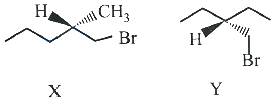
A
$X=Y=$ Achiral
B
$X=Y=$ Chiral
C
$X=$ Chiral,$Y=$ Achiral
D
$X=$ Achiral,$Y=$ Chiral
Solution
(C) molecule is chiral if it contains at least one chiral carbon atom (a carbon atom bonded to four different groups).
In molecule $X$,the central carbon is bonded to $-H$,$-CH_3$,$-CH_2CH_2CH_3$,and $-CH_2Br$. Since all four groups are different,the carbon is chiral,making molecule $X$ chiral.
In molecule $Y$,the central carbon is bonded to $-H$,$-Br$,and two identical $-CH_2CH_3$ (ethyl) groups. Since two groups are identical,the carbon is not chiral,making molecule $Y$ achiral.
Therefore,$X$ is chiral and $Y$ is achiral.
In molecule $X$,the central carbon is bonded to $-H$,$-CH_3$,$-CH_2CH_2CH_3$,and $-CH_2Br$. Since all four groups are different,the carbon is chiral,making molecule $X$ chiral.
In molecule $Y$,the central carbon is bonded to $-H$,$-Br$,and two identical $-CH_2CH_3$ (ethyl) groups. Since two groups are identical,the carbon is not chiral,making molecule $Y$ achiral.
Therefore,$X$ is chiral and $Y$ is achiral.
0 likesView Solution
77
ChemistryMediumMCQAP EAMCET · 2023
What are $X$ and $Y$ respectively in the following sets of reactions?
$I. \ CH_3CH_2CH_2OH \xrightarrow{PBr_3} X$
$II. \ CH_3CH=CH_2 \xrightarrow{HBr, (C_6H_5COO)_2} Y \text{ (major)}$
$I. \ CH_3CH_2CH_2OH \xrightarrow{PBr_3} X$
$II. \ CH_3CH=CH_2 \xrightarrow{HBr, (C_6H_5COO)_2} Y \text{ (major)}$
A
$CH_3CH(Br)CH_3, \ CH_3CH_2CH_2Br$
B
$CH_3CH_2CH_2Br, \ CH_3CH_2CH_2Br$
C
$CH_3CH_2CH_2Br, \ CH_3CH(Br)CH_3$
D
$CH_3CH(Br)CH_3, \ CH_3CH(Br)CH_3$
Solution
(B) In reaction $I$,the reaction of $n$-propanol with $PBr_3$ is a nucleophilic substitution reaction ($S_N2$ mechanism) which converts the alcohol group into a bromide,yielding $n$-propyl bromide $(CH_3CH_2CH_2Br)$.
In reaction $II$,the reaction of propene with $HBr$ in the presence of benzoyl peroxide $((C_6H_5COO)_2)$ proceeds via the anti-Markovnikov addition mechanism (peroxide effect or Kharasch effect). This results in the formation of $n$-propyl bromide $(CH_3CH_2CH_2Br)$ as the major product.
Therefore,$X = CH_3CH_2CH_2Br$ and $Y = CH_3CH_2CH_2Br$.
In reaction $II$,the reaction of propene with $HBr$ in the presence of benzoyl peroxide $((C_6H_5COO)_2)$ proceeds via the anti-Markovnikov addition mechanism (peroxide effect or Kharasch effect). This results in the formation of $n$-propyl bromide $(CH_3CH_2CH_2Br)$ as the major product.
Therefore,$X = CH_3CH_2CH_2Br$ and $Y = CH_3CH_2CH_2Br$.
0 likesView Solution
78
ChemistryEasyMCQAP EAMCET · 2023
Which is the correct option for the following reaction?
$ 2 CH_3 CH_2 Br \xrightarrow{2 Na / \text{Dry ether}} ? $
$ 2 CH_3 CH_2 Br \xrightarrow{2 Na / \text{Dry ether}} ? $
A
Wurtz reaction; $CH_3 CH_2 CH_2 CH_3$
B
Wurtz-Fittig reaction; $CH_3 CH_2 CH_2 CH_3$
C
Wurtz reaction; $CH_3 CH_2 CH_2 CH_2 CH_3$
D
Wurtz-Fittig reaction; $CH_3 CH_2 CH_2 CH_2 CH_3$
Solution
(A) The given reaction is: $2 CH_3 CH_2 Br + 2 Na \xrightarrow{\text{Dry ether}} CH_3 CH_2 CH_2 CH_3 + 2 NaBr$.
This reaction involves the coupling of two alkyl halide molecules in the presence of sodium metal and dry ether to form a higher alkane.
This specific reaction is known as the Wurtz reaction.
The product formed is $n$-butane $(CH_3 CH_2 CH_2 CH_3)$.
This reaction involves the coupling of two alkyl halide molecules in the presence of sodium metal and dry ether to form a higher alkane.
This specific reaction is known as the Wurtz reaction.
The product formed is $n$-butane $(CH_3 CH_2 CH_2 CH_3)$.
0 likesView Solution
79
ChemistryEasyMCQAP EAMCET · 2023
The correct order of boiling points of the following molecules is:
$(i)$ $n$-Hexane
$(ii)$ $2$-methylpentane
$(iii)$ $2,3$-dimethylbutane
$(i)$ $n$-Hexane
$(ii)$ $2$-methylpentane
$(iii)$ $2,3$-dimethylbutane
A
$i > ii > iii$
B
$iii > ii > i$
C
$iii > i > ii$
D
$i > iii > ii$
Solution
(A) The boiling point of isomeric alkanes decreases with increasing branching due to a decrease in the exposed surface area,which leads to weaker van der Waals forces.
$n$-Hexane $(i)$ is a straight-chain alkane with the largest surface area,hence it has the highest boiling point.
$2$-methylpentane $(ii)$ has one branch,reducing its surface area compared to $n$-hexane.
$2,3$-dimethylbutane $(iii)$ has two branches,resulting in the most compact structure and the smallest surface area,hence it has the lowest boiling point.
Therefore,the correct order is $i > ii > iii$.
$n$-Hexane $(i)$ is a straight-chain alkane with the largest surface area,hence it has the highest boiling point.
$2$-methylpentane $(ii)$ has one branch,reducing its surface area compared to $n$-hexane.
$2,3$-dimethylbutane $(iii)$ has two branches,resulting in the most compact structure and the smallest surface area,hence it has the lowest boiling point.
Therefore,the correct order is $i > ii > iii$.
0 likesView Solution
80
ChemistryMediumMCQAP EAMCET · 2023
Ethane on heating with a regulated supply of air at high pressure in the presence of manganese acetate forms '$Q$'. '$Q$' is:
A
$CH_3 CH_2 OH$
B
$CH_3 CHO$
C
$HCOOH$
D
$CH_3 COOH$
Solution
(D) The controlled catalytic oxidation of ethane with air at high pressure in the presence of manganese acetate $(CH_3 COO)_2 Mn$ yields acetic acid as the final product.
The chemical equation is:
$2 CH_3-CH_3 + 3 O_2 \xrightarrow[\Delta]{(CH_3 COO)_2 Mn} 2 CH_3 COOH + 2 H_2 O$
Therefore,'$Q$' is $CH_3 COOH$.
The chemical equation is:
$2 CH_3-CH_3 + 3 O_2 \xrightarrow[\Delta]{(CH_3 COO)_2 Mn} 2 CH_3 COOH + 2 H_2 O$
Therefore,'$Q$' is $CH_3 COOH$.
0 likesView Solution
81
ChemistryMediumMCQAP EAMCET · 2023
What are $X$ and $Y$ in the following reaction sequence?
$CH_3(CH_2)_5CH_3 \stackrel{X}{\longrightarrow} C_7H_8 \stackrel{Br_2}{\Delta} Y$
$CH_3(CH_2)_5CH_3 \stackrel{X}{\longrightarrow} C_7H_8 \stackrel{Br_2}{\Delta} Y$
A
$X = Cr_2O_3, 773 \ K, 10-20 \ atm$,$Y = \text{p-bromotoluene}$
B
$X = V_2O_5, 773 \ K, 10-20 \ atm$,$Y = \text{benzyl bromide}$
C
$X = KMnO_4$,$Y = \text{p-bromotoluene}$
D
$X = \text{Anhydrous } AlCl_3$,$Y = \text{p-bromotoluene}$
Solution
(B) $1$. The reaction of $n$-heptane $(CH_3(CH_2)_5CH_3)$ with $V_2O_5$ or $Cr_2O_3$ or $Mo_2O_3$ at $773 \ K$ and $10-20 \ atm$ pressure leads to aromatization,producing toluene $(C_7H_8)$.
$2$. The subsequent reaction of toluene with $Br_2$ in the presence of heat $(\Delta)$ or light undergoes free radical substitution at the benzylic position to form benzyl bromide $(C_6H_5CH_2Br)$.
$2$. The subsequent reaction of toluene with $Br_2$ in the presence of heat $(\Delta)$ or light undergoes free radical substitution at the benzylic position to form benzyl bromide $(C_6H_5CH_2Br)$.
0 likesView Solution
82
ChemistryDifficultMCQAP EAMCET · 2023
Which of the following reactions is not correct?
A
$CH_2Br-CH_2Br \xrightarrow{Zn} CH_2=CH_2$
B
$CH_3-C \equiv C-CH_3 \xrightarrow{H_2, Pd/BaSO_4} cis-CH_3-CH=CH-CH_3$
C
$CH_3-C \equiv CH \xrightarrow{Hg^{2+}, H^+} CH_3-CO-CH_3$
D
$Ph-CH_2-Br \xrightarrow{Na, \text{dry ether}} Ph-CH_2-CH_2-Ph$
Solution
(C) Let us analyze each reaction:
$(A)$ $CH_2Br-CH_2Br + Zn \rightarrow CH_2=CH_2 + ZnBr_2$. This is a correct dehalogenation reaction.
$(B)$ $CH_3-C \equiv C-CH_3 + H_2 \xrightarrow{Pd/BaSO_4} cis-CH_3-CH=CH-CH_3$. This is a correct Lindlar's catalyst reduction.
$(C)$ $CH_3-C \equiv CH + H_2O \xrightarrow{Hg^{2+}, H^+} CH_3-CO-CH_3$ (acetone). The given product $CH_3-CH_2-CHO$ (propanal) is incorrect. Hydration of propyne yields acetone.
$(D)$ $2Ph-CH_2-Br + 2Na \xrightarrow{\text{dry ether}} Ph-CH_2-CH_2-Ph + 2NaBr$. This is a correct Wurtz reaction.
Therefore,option $(C)$ is the incorrect reaction.
$(A)$ $CH_2Br-CH_2Br + Zn \rightarrow CH_2=CH_2 + ZnBr_2$. This is a correct dehalogenation reaction.
$(B)$ $CH_3-C \equiv C-CH_3 + H_2 \xrightarrow{Pd/BaSO_4} cis-CH_3-CH=CH-CH_3$. This is a correct Lindlar's catalyst reduction.
$(C)$ $CH_3-C \equiv CH + H_2O \xrightarrow{Hg^{2+}, H^+} CH_3-CO-CH_3$ (acetone). The given product $CH_3-CH_2-CHO$ (propanal) is incorrect. Hydration of propyne yields acetone.
$(D)$ $2Ph-CH_2-Br + 2Na \xrightarrow{\text{dry ether}} Ph-CH_2-CH_2-Ph + 2NaBr$. This is a correct Wurtz reaction.
Therefore,option $(C)$ is the incorrect reaction.
0 likesView Solution
83
ChemistryMediumMCQAP EAMCET · 2023
How many distinct alkenes are obtained from $3-$bromo$-3-$methylhexane upon treatment with alcoholic $KOH$?
A
$2$
B
$3$
C
$4$
D
$5$
Solution
(B) The reaction of $3-$bromo$-3-$methylhexane with alcoholic $KOH$ proceeds via an $E2$ elimination mechanism.
$3-$bromo$-3-$methylhexane has the structure $CH_3-CH_2-C(Br)(CH_3)-CH_2-CH_2-CH_3$.
The $\beta$-carbons are the carbons adjacent to the carbon bearing the bromine atom.
There are three distinct types of $\beta$-hydrogens available for elimination:
$1$. Elimination from the $C2$ position ($CH_2$ group) gives $3-$methylhex$-2-$ene.
$2$. Elimination from the $C4$ position ($CH_2$ group) gives $3-$methylhex$-3-$ene.
$3$. Elimination from the methyl group attached to $C3$ gives $2-$ethylpent$-1-$ene.
Thus,$3$ distinct alkenes are obtained.
$3-$bromo$-3-$methylhexane has the structure $CH_3-CH_2-C(Br)(CH_3)-CH_2-CH_2-CH_3$.
The $\beta$-carbons are the carbons adjacent to the carbon bearing the bromine atom.
There are three distinct types of $\beta$-hydrogens available for elimination:
$1$. Elimination from the $C2$ position ($CH_2$ group) gives $3-$methylhex$-2-$ene.
$2$. Elimination from the $C4$ position ($CH_2$ group) gives $3-$methylhex$-3-$ene.
$3$. Elimination from the methyl group attached to $C3$ gives $2-$ethylpent$-1-$ene.
Thus,$3$ distinct alkenes are obtained.
0 likesView Solution
84
ChemistryMediumMCQAP EAMCET · 2023
Match the following reactions in List-$I$ with their products in List-$II$:
| List-$I$ | List-$II$ |
| :--- | :--- |
| $A. HC \equiv CH \xrightarrow{Hg^{2+}, H^{+}/H_{2}O}$ | $I. H_{3}C-COOH$ |
| $B. CH_{4} \xrightarrow{O_{2}, Mo_{2}O_{3}, \Delta}$ | $II. CH_{3}-CO-CH_{3}$ |
| $C. (CH_{3})_{2}C=C(CH_{3})_{2} \xrightarrow{O_{3}, Zn, H_{2}O}$ | $III. H_{3}C-CHO$ |
| $D. CH_{3}-CH=CH-CH_{3} \xrightarrow{KMnO_{4}, H^{+}}$ | $IV. HCHO$ |
| List-$I$ | List-$II$ |
| :--- | :--- |
| $A. HC \equiv CH \xrightarrow{Hg^{2+}, H^{+}/H_{2}O}$ | $I. H_{3}C-COOH$ |
| $B. CH_{4} \xrightarrow{O_{2}, Mo_{2}O_{3}, \Delta}$ | $II. CH_{3}-CO-CH_{3}$ |
| $C. (CH_{3})_{2}C=C(CH_{3})_{2} \xrightarrow{O_{3}, Zn, H_{2}O}$ | $III. H_{3}C-CHO$ |
| $D. CH_{3}-CH=CH-CH_{3} \xrightarrow{KMnO_{4}, H^{+}}$ | $IV. HCHO$ |
A
$A-I, B-II, C-III, D-IV$
B
$A-III, B-IV, C-II, D-I$
C
$A-I, B-IV, C-III, D-II$
D
$A-III, B-II, C-IV, D-I$
Solution
(B) The reactions are analyzed as follows:
$A$. Hydration of ethyne $(HC \equiv CH)$ in the presence of $Hg^{2+}$ and $H^{+}$ gives acetaldehyde $(CH_{3}CHO)$,which corresponds to $III$.
$B$. Controlled oxidation of methane $(CH_{4})$ with $O_{2}$ in the presence of $Mo_{2}O_{3}$ and heat gives formaldehyde $(HCHO)$,which corresponds to $IV$.
$C$. Ozonolysis of $2,3-$dimethylbut$-2-$ene $((CH_{3})_{2}C=C(CH_{3})_{2})$ gives two molecules of acetone $(CH_{3}COCH_{3})$,which corresponds to $II$.
$D$. Oxidative cleavage of but$-2-$ene $(CH_{3}CH=CHCH_{3})$ with acidic $KMnO_{4}$ gives acetic acid $(CH_{3}COOH)$,which corresponds to $I$.
Therefore,the correct matching is $A-III, B-IV, C-II, D-I$.
$A$. Hydration of ethyne $(HC \equiv CH)$ in the presence of $Hg^{2+}$ and $H^{+}$ gives acetaldehyde $(CH_{3}CHO)$,which corresponds to $III$.
$B$. Controlled oxidation of methane $(CH_{4})$ with $O_{2}$ in the presence of $Mo_{2}O_{3}$ and heat gives formaldehyde $(HCHO)$,which corresponds to $IV$.
$C$. Ozonolysis of $2,3-$dimethylbut$-2-$ene $((CH_{3})_{2}C=C(CH_{3})_{2})$ gives two molecules of acetone $(CH_{3}COCH_{3})$,which corresponds to $II$.
$D$. Oxidative cleavage of but$-2-$ene $(CH_{3}CH=CHCH_{3})$ with acidic $KMnO_{4}$ gives acetic acid $(CH_{3}COOH)$,which corresponds to $I$.
Therefore,the correct matching is $A-III, B-IV, C-II, D-I$.
0 likesView Solution
85
ChemistryDifficultMCQAP EAMCET · 2023
Which of the following reactions are not feasible?
$I$. $CH_3CH=CH_2 \xrightarrow{HCl, (C_6H_5CO)_2O_2} CH_3CH_2CH_2Cl$
$II$. $C_6H_6 + CH_3CH_2CH_2Cl \xrightarrow{AlCl_3} C_6H_5CH(CH_3)_2$
$III$. $CH_3CHClCH_2Cl \xrightarrow{KOH, \Delta} CH_3C \equiv CH$
$IV$. $CH_3CH=CHCH_3 \xrightarrow{KMnO_4 / H^+} CH_3COOH$
$I$. $CH_3CH=CH_2 \xrightarrow{HCl, (C_6H_5CO)_2O_2} CH_3CH_2CH_2Cl$
$II$. $C_6H_6 + CH_3CH_2CH_2Cl \xrightarrow{AlCl_3} C_6H_5CH(CH_3)_2$
$III$. $CH_3CHClCH_2Cl \xrightarrow{KOH, \Delta} CH_3C \equiv CH$
$IV$. $CH_3CH=CHCH_3 \xrightarrow{KMnO_4 / H^+} CH_3COOH$
A
$I$ & $IV$ only
B
$II$ & $III$ only
C
$II$ & $IV$ only
D
$I$ & $III$ only
Solution
(D) $I$. The reaction $CH_3CH=CH_2 \xrightarrow{HCl, (C_6H_5CO)_2O_2} CH_3CH_2CH_2Cl$ is not feasible because the peroxide effect (Kharasch effect) is only observed with $HBr$,not with $HCl$ or $HI$.
$II$. The reaction $C_6H_6 + CH_3CH_2CH_2Cl \xrightarrow{AlCl_3} C_6H_5CH(CH_3)_2$ is feasible. The $n$-propyl carbocation formed initially rearranges to the more stable isopropyl carbocation,which then undergoes Friedel-Crafts alkylation to yield isopropylbenzene.
$III$. The reaction $CH_3CHClCH_2Cl \xrightarrow{KOH, \Delta} CH_3C \equiv CH$ is not feasible. Dehydrohalogenation of vicinal dihalides with $KOH$ typically yields a vinyl halide or an alkene. To obtain an alkyne,a stronger base like $NaNH_2$ is required.
$IV$. The reaction $CH_3CH=CHCH_3 \xrightarrow{KMnO_4 / H^+} CH_3COOH$ is feasible as it involves the oxidative cleavage of the alkene.
Thus,reactions $I$ and $III$ are not feasible.
$II$. The reaction $C_6H_6 + CH_3CH_2CH_2Cl \xrightarrow{AlCl_3} C_6H_5CH(CH_3)_2$ is feasible. The $n$-propyl carbocation formed initially rearranges to the more stable isopropyl carbocation,which then undergoes Friedel-Crafts alkylation to yield isopropylbenzene.
$III$. The reaction $CH_3CHClCH_2Cl \xrightarrow{KOH, \Delta} CH_3C \equiv CH$ is not feasible. Dehydrohalogenation of vicinal dihalides with $KOH$ typically yields a vinyl halide or an alkene. To obtain an alkyne,a stronger base like $NaNH_2$ is required.
$IV$. The reaction $CH_3CH=CHCH_3 \xrightarrow{KMnO_4 / H^+} CH_3COOH$ is feasible as it involves the oxidative cleavage of the alkene.
Thus,reactions $I$ and $III$ are not feasible.
0 likesView Solution
86
ChemistryEasyMCQAP EAMCET · 2023
Among the following,the correct statement is
A
Tritium is radioactive and emits low energy $\gamma$-rays
B
$H^{+}$ does not exist freely
C
Tritium is about one atom per $10^8$ atoms of protium
D
Hydrogen is very reactive compared to halogen
Solution
(B) Tritium is radioactive and emits low-energy $\beta$-particles,not $\gamma$-rays.
$H^{+}$ does not exist freely in aqueous solution; it exists as the hydronium ion,$H_3O^{+}$.
Tritium is found in the ratio of $1$ atom per $10^{18}$ atoms of protium.
Hydrogen is less reactive than halogens,which are strong oxidizing agents.
Therefore,the correct statement is that $H^{+}$ does not exist freely.
$H^{+}$ does not exist freely in aqueous solution; it exists as the hydronium ion,$H_3O^{+}$.
Tritium is found in the ratio of $1$ atom per $10^{18}$ atoms of protium.
Hydrogen is less reactive than halogens,which are strong oxidizing agents.
Therefore,the correct statement is that $H^{+}$ does not exist freely.
0 likesView Solution
87
ChemistryMediumMCQAP EAMCET · 2023
Given below are two statements:
Assertion $(A)$: Protium and deuterium differ in their rates of reactions.
Reason $(R)$: They have different enthalpies of bond dissociation.
The correct answer is:
Assertion $(A)$: Protium and deuterium differ in their rates of reactions.
Reason $(R)$: They have different enthalpies of bond dissociation.
The correct answer is:
A
Both $(A)$ and $(R)$ are correct and $(R)$ is the correct explanation of $(A)$
B
Both $(A)$ and $(R)$ are correct but $(R)$ is not the correct explanation of $(A)$
C
$(A)$ is correct but $(R)$ is incorrect
D
$(A)$ is incorrect but $(R)$ is correct
Solution
(A) $H-H$ bond enthalpy $= 435.88 \ kJ \ mol^{-1}$.
$D-D$ bond enthalpy $= 443.35 \ kJ \ mol^{-1}$.
Due to the difference in their bond dissociation enthalpies,the rates of reactions involving protium and deuterium differ significantly.
Thus,both $(A)$ and $(R)$ are true and $(R)$ is the correct explanation of $(A)$.
$D-D$ bond enthalpy $= 443.35 \ kJ \ mol^{-1}$.
Due to the difference in their bond dissociation enthalpies,the rates of reactions involving protium and deuterium differ significantly.
Thus,both $(A)$ and $(R)$ are true and $(R)$ is the correct explanation of $(A)$.
0 likesView Solution
88
ChemistryEasyMCQAP EAMCET · 2023
Among the following,the correctly matched pair is
A
electron deficient hydride - $SiH_4$
B
saline hydride - $CrH$
C
electron precise hydride - $HF$
D
electron rich hydride - $NH_3$
Solution
(D) $NH_3$ is an electron-rich hydride because the $N$-atom belongs to group $15$ and uses three of its valence electrons to form three $N-H$ bonds,while the remaining two electrons form a lone pair.
$SiH_4$ is an electron-precise hydride.
$CrH$ is a metallic (interstitial) hydride.
$HF$ is an electron-rich hydride due to the presence of lone pairs on the $F$-atom.
$SiH_4$ is an electron-precise hydride.
$CrH$ is a metallic (interstitial) hydride.
$HF$ is an electron-rich hydride due to the presence of lone pairs on the $F$-atom.
0 likesView Solution
89
ChemistryEasyMCQAP EAMCET · 2023
Among the following,the correct statements are:
$I$. $LiH, BeH_2$ and $MgH_2$ are saline hydrides with significant covalent character.
$II$. Saline hydrides are volatile.
$III$. Electron-precise hydrides are Lewis bases.
$IV$. The formula for chromium hydride is $CrH$.
The correct option is:
$I$. $LiH, BeH_2$ and $MgH_2$ are saline hydrides with significant covalent character.
$II$. Saline hydrides are volatile.
$III$. Electron-precise hydrides are Lewis bases.
$IV$. The formula for chromium hydride is $CrH$.
The correct option is:
A
$I, III$ only
B
$II, IV$ only
C
$I, IV$ only
D
$III, IV$ only
Solution
(C) Statement $I$ is correct: $LiH, BeH_2$,and $MgH_2$ are saline (ionic) hydrides that exhibit significant covalent character due to the small size and high polarizing power of the cations.
Statement $II$ is incorrect: Saline hydrides are non-volatile,high-melting crystalline solids due to strong electrostatic forces of attraction between ions.
Statement $III$ is incorrect: Electron-precise hydrides (e.g.,$CH_4, SiH_4$) have the required number of electrons to form normal covalent bonds and do not act as Lewis bases.
Statement $IV$ is correct: Chromium forms a non-stoichiometric interstitial hydride with the formula $CrH$ (or $CrH_{1.7}$ depending on conditions).
Therefore,statements $I$ and $IV$ are correct.
Statement $II$ is incorrect: Saline hydrides are non-volatile,high-melting crystalline solids due to strong electrostatic forces of attraction between ions.
Statement $III$ is incorrect: Electron-precise hydrides (e.g.,$CH_4, SiH_4$) have the required number of electrons to form normal covalent bonds and do not act as Lewis bases.
Statement $IV$ is correct: Chromium forms a non-stoichiometric interstitial hydride with the formula $CrH$ (or $CrH_{1.7}$ depending on conditions).
Therefore,statements $I$ and $IV$ are correct.
0 likesView Solution
90
ChemistryEasyMCQAP EAMCET · 2023
Which of the following statement$(s)$ is/are correct:
$A$. $NaH$ is a non-volatile hydride
$B$. $MgH_2$ is a polymeric hydride
$C$. $NH_3$ is an electron-precise hydride
$D$. $H_2O$ is an electron-rich hydride
$A$. $NaH$ is a non-volatile hydride
$B$. $MgH_2$ is a polymeric hydride
$C$. $NH_3$ is an electron-precise hydride
$D$. $H_2O$ is an electron-rich hydride
A
$A, B$ & $D$ only
B
$A, B$ & $C$ only
C
$B$ only
D
$C$ & $D$ only
Solution
(A) $NaH$ is an ionic (saline) hydride,which is non-volatile and crystalline.
Thus,statement $(A)$ is correct.
$MgH_2$ is a polymeric hydride,as shown by its structure containing bridging hydrogen atoms.
Thus,statement $(B)$ is correct.
$NH_3$ has a lone pair on the $N$-atom,making it an electron-rich hydride,not electron-precise.
Thus,statement $(C)$ is incorrect.
$H_2O$ has two lone pairs on the $O$-atom,making it an electron-rich hydride.
Thus,statement $(D)$ is correct.
Therefore,statements $(A)$,$(B)$,and $(D)$ are correct.
Thus,statement $(A)$ is correct.
$MgH_2$ is a polymeric hydride,as shown by its structure containing bridging hydrogen atoms.
Thus,statement $(B)$ is correct.
$NH_3$ has a lone pair on the $N$-atom,making it an electron-rich hydride,not electron-precise.
Thus,statement $(C)$ is incorrect.
$H_2O$ has two lone pairs on the $O$-atom,making it an electron-rich hydride.
Thus,statement $(D)$ is correct.
Therefore,statements $(A)$,$(B)$,and $(D)$ are correct.
0 likesView Solution
91
ChemistryMediumMCQAP EAMCET · 2023
Arrange the hydrides $NH_3$,$HF$,$H_2O$,and $HCl$ in the increasing order of their boiling points.
A
$HCl < NH_3 < HF < H_2O$
B
$HCl < NH_3 < H_2O < HF$
C
$NH_3 < HCl < H_2O < HF$
D
$HCl < NH_3 < HF < H_2O$
Solution
(A) $H_2O$,$HF$,and $NH_3$ exhibit hydrogen bonding as the intermolecular force,whereas $HCl$ possesses weaker dipole-dipole interactions.
Thus,$HCl$ has the lowest boiling point.
Among $H_2O$,$HF$,and $NH_3$,$H_2O$ has the highest boiling point due to an extensive network of hydrogen bonds.
Between $NH_3$ and $HF$,$HF$ forms stronger hydrogen bonds due to the very high electronegativity of fluorine.
Therefore,the increasing order of boiling points is: $HCl < NH_3 < HF < H_2O$.
Thus,$HCl$ has the lowest boiling point.
Among $H_2O$,$HF$,and $NH_3$,$H_2O$ has the highest boiling point due to an extensive network of hydrogen bonds.
Between $NH_3$ and $HF$,$HF$ forms stronger hydrogen bonds due to the very high electronegativity of fluorine.
Therefore,the increasing order of boiling points is: $HCl < NH_3 < HF < H_2O$.
0 likesView Solution
92
ChemistryEasyMCQAP EAMCET · 2023
The following methods can not be used to remove permanent hardness of water:
A
Treatment with washing soda
B
Ion-exchange method
C
Treating with Calgon
D
Adding calculated amount of lime
Solution
(D) Lime $(Ca(OH)_2)$ is typically used to remove temporary hardness of water,a process known as Clark's method.
$Ca(HCO_3)_2 + Ca(OH)_2 \rightarrow 2CaCO_3 \downarrow + 2H_2O$
Permanent hardness is caused by the presence of chlorides and sulfates of magnesium and calcium,which cannot be removed by adding lime.
$Ca(HCO_3)_2 + Ca(OH)_2 \rightarrow 2CaCO_3 \downarrow + 2H_2O$
Permanent hardness is caused by the presence of chlorides and sulfates of magnesium and calcium,which cannot be removed by adding lime.
0 likesView Solution
93
ChemistryEasyMCQAP EAMCET · 2023
Conjugate acid and conjugate base of $HCO_3^{-}$ are respectively
A
$H_2CO_3, H_3CO_3^{+}$
B
$H_2CO_3, CO_3^{2-}$
C
$CO_3^{2-}, H_2CO_3$
D
$CO_3^{2-}, CO_2$
Solution
(B) The conjugate acid is formed by adding a proton $(H^{+})$ to the species: $HCO_3^{-} + H^{+} \rightarrow H_2CO_3$.
The conjugate base is formed by removing a proton $(H^{+})$ from the species: $HCO_3^{-} - H^{+} \rightarrow CO_3^{2-}$.
Therefore,the conjugate acid and conjugate base of $HCO_3^{-}$ are $H_2CO_3$ and $CO_3^{2-}$ respectively.
The conjugate base is formed by removing a proton $(H^{+})$ from the species: $HCO_3^{-} - H^{+} \rightarrow CO_3^{2-}$.
Therefore,the conjugate acid and conjugate base of $HCO_3^{-}$ are $H_2CO_3$ and $CO_3^{2-}$ respectively.
0 likesView Solution
94
ChemistryMediumMCQAP EAMCET · 2023
Observe the following species: $AlCl_3, NH_3, H^{+}, Co^{3+}, OH^{-}, H^{-}, Mg^{2+}, BF_3, Cl^{-}$. How many Lewis bases are present in the above list?
A
$2$
B
$5$
C
$4$
D
$3$
Solution
(C) Lewis bases are species that can donate a lone pair of electrons (electron-rich species).
In the given list,the Lewis bases are: $NH_3$ (has a lone pair on $N$),$OH^{-}$ (has lone pairs on $O$),$H^{-}$ (has a lone pair),and $Cl^{-}$ (has lone pairs).
Thus,there are $4$ Lewis bases.
Lewis acids are electron-deficient species: $AlCl_3, H^{+}, Co^{3+}, Mg^{2+}, BF_3$.
In the given list,the Lewis bases are: $NH_3$ (has a lone pair on $N$),$OH^{-}$ (has lone pairs on $O$),$H^{-}$ (has a lone pair),and $Cl^{-}$ (has lone pairs).
Thus,there are $4$ Lewis bases.
Lewis acids are electron-deficient species: $AlCl_3, H^{+}, Co^{3+}, Mg^{2+}, BF_3$.
0 likesView Solution
95
ChemistryMediumMCQAP EAMCET · 2023
Observe the following species: $AlCl_3, NH_3, H^{+}, Co^{3+}, OH^{-}, Mg^{2+}, BF_3, Cl^{-}$. How many Lewis acids are present in the above list?
A
$5$
B
$4$
C
$2$
D
$3$
Solution
(A) Lewis acids are electron-pair acceptors.
$AlCl_3$ (incomplete octet),$H^{+}$ (cation),$Co^{3+}$ (cation),$Mg^{2+}$ (cation),and $BF_3$ (incomplete octet) are all Lewis acids.
$NH_3$ (lone pair donor),$OH^{-}$ (lone pair donor),and $Cl^{-}$ (lone pair donor) are Lewis bases.
Therefore,there are $5$ Lewis acids in the given list.
$AlCl_3$ (incomplete octet),$H^{+}$ (cation),$Co^{3+}$ (cation),$Mg^{2+}$ (cation),and $BF_3$ (incomplete octet) are all Lewis acids.
$NH_3$ (lone pair donor),$OH^{-}$ (lone pair donor),and $Cl^{-}$ (lone pair donor) are Lewis bases.
Therefore,there are $5$ Lewis acids in the given list.
0 likesView Solution
96
ChemistryMediumMCQAP EAMCET · 2023
The $pH$ of $0.01 \ M \ BOH$ solution is $10$. What is its degree of dissociation (in $\%$)? (Given $K_{b}$ of $BOH$ is $1 \times 10^{-6}$)
A
$10$
B
$5$
C
$2$
D
$1$
Solution
(D) For a weak base $BOH$,the dissociation is: $BOH \rightleftharpoons B^{+} + OH^{-}$.
Given concentration $C = 0.01 \ M = 10^{-2} \ M$ and $pH = 10$.
$pOH = 14 - pH = 14 - 10 = 4$.
Therefore,$[OH^{-}] = 10^{-pOH} = 10^{-4} \ M$.
For a weak base,$[OH^{-}] = C \alpha$,where $\alpha$ is the degree of dissociation.
$10^{-4} = 10^{-2} \times \alpha$.
$\alpha = \frac{10^{-4}}{10^{-2}} = 10^{-2} = 0.01$.
Percentage degree of dissociation = $\alpha \times 100 = 0.01 \times 100 = 1 \%$.
Given concentration $C = 0.01 \ M = 10^{-2} \ M$ and $pH = 10$.
$pOH = 14 - pH = 14 - 10 = 4$.
Therefore,$[OH^{-}] = 10^{-pOH} = 10^{-4} \ M$.
For a weak base,$[OH^{-}] = C \alpha$,where $\alpha$ is the degree of dissociation.
$10^{-4} = 10^{-2} \times \alpha$.
$\alpha = \frac{10^{-4}}{10^{-2}} = 10^{-2} = 0.01$.
Percentage degree of dissociation = $\alpha \times 100 = 0.01 \times 100 = 1 \%$.
0 likesView Solution
97
ChemistryEasyMCQAP EAMCET · 2023
Observe the following solutions:
$I$. Black coffee
$II$. $0.2 \ M \ NaOH$
$III$. Lemon juice
$IV$. Lime water
$V$. Human saliva
$VI$. Tomato juice
The number of solutions having $pH$ range of $1-7$ and $7-14$,in the above list,is respectively.
$I$. Black coffee
$II$. $0.2 \ M \ NaOH$
$III$. Lemon juice
$IV$. Lime water
$V$. Human saliva
$VI$. Tomato juice
The number of solutions having $pH$ range of $1-7$ and $7-14$,in the above list,is respectively.
A
$1, 5$
B
$3, 3$
C
$2, 4$
D
$4, 2$
Solution
(D) The $pH$ range $1-7$ represents acidic solutions,while the $pH$ range $7-14$ represents basic solutions.
$I$. Black coffee: Acidic $(pH \approx 5)$
$II$. $0.2 \ M \ NaOH$: Basic $(pH > 7)$
$III$. Lemon juice: Acidic $(pH \approx 2)$
$IV$. Lime water $(Ca(OH)_2)$: Basic $(pH > 7)$
$V$. Human saliva: Acidic $(pH \approx 6.5)$
$VI$. Tomato juice: Acidic $(pH \approx 4)$
Acidic solutions $(pH \ 1-7)$: $I, III, V, VI$ (Total $4$)
Basic solutions $(pH \ 7-14)$: $II, IV$ (Total $2$)
Therefore,the number of solutions is $4$ and $2$ respectively.
$I$. Black coffee: Acidic $(pH \approx 5)$
$II$. $0.2 \ M \ NaOH$: Basic $(pH > 7)$
$III$. Lemon juice: Acidic $(pH \approx 2)$
$IV$. Lime water $(Ca(OH)_2)$: Basic $(pH > 7)$
$V$. Human saliva: Acidic $(pH \approx 6.5)$
$VI$. Tomato juice: Acidic $(pH \approx 4)$
Acidic solutions $(pH \ 1-7)$: $I, III, V, VI$ (Total $4$)
Basic solutions $(pH \ 7-14)$: $II, IV$ (Total $2$)
Therefore,the number of solutions is $4$ and $2$ respectively.
0 likesView Solution
98
ChemistryEasyMCQAP EAMCET · 2023
Observe the following solutions:
$I$. Black coffee
$II$. $0.2 \ M \ NaOH$
$III$. Lemon juice
$IV$. Lime water
$V$. Human Saliva
$VI$. Tomato juice
The number of solutions with $pH$ less than $7$ is
$I$. Black coffee
$II$. $0.2 \ M \ NaOH$
$III$. Lemon juice
$IV$. Lime water
$V$. Human Saliva
$VI$. Tomato juice
The number of solutions with $pH$ less than $7$ is
A
$2$
B
$5$
C
$4$
D
$3$
Solution
(C) The $pH$ values of the given solutions are as follows:
$I$. Black coffee: $pH \approx 5$ (Acidic)
$II$. $0.2 \ M \ NaOH$: $pH \approx 13.3$ (Basic)
$III$. Lemon juice: $pH \approx 2$ (Acidic)
$IV$. Lime water: $pH \approx 12$ (Basic)
$V$. Human Saliva: $pH \approx 6.5$ (Acidic)
$VI$. Tomato juice: $pH \approx 4$ (Acidic)
Solutions with $pH < 7$ are $I$,$III$,$V$,and $VI$.
Therefore,the total number of acidic solutions is $4$.
$I$. Black coffee: $pH \approx 5$ (Acidic)
$II$. $0.2 \ M \ NaOH$: $pH \approx 13.3$ (Basic)
$III$. Lemon juice: $pH \approx 2$ (Acidic)
$IV$. Lime water: $pH \approx 12$ (Basic)
$V$. Human Saliva: $pH \approx 6.5$ (Acidic)
$VI$. Tomato juice: $pH \approx 4$ (Acidic)
Solutions with $pH < 7$ are $I$,$III$,$V$,and $VI$.
Therefore,the total number of acidic solutions is $4$.
0 likesView Solution
99
ChemistryEasyMCQAP EAMCET · 2023
$2$. Given below are two statements:
Statement $I$: The changes in $pH$ with temperature are so small that we often ignore them.
Statement $II$: When the hydrogen ion concentration changes by a factor of $100$,the $pH$ changes by one unit.
In the light of the above statements,identify the correct answer from the options given below:
Statement $I$: The changes in $pH$ with temperature are so small that we often ignore them.
Statement $II$: When the hydrogen ion concentration changes by a factor of $100$,the $pH$ changes by one unit.
In the light of the above statements,identify the correct answer from the options given below:
A
Both statements $I$ and $II$ are correct.
B
Both statements $I$ and $II$ are not correct.
C
Statement $I$ is correct but statement $II$ is not correct.
D
Statement $I$ is not correct but statement $II$ is correct.
Solution
(C) small change in temperature has little impact on the $pH$ of a solution as the concentration of the $H^{+}$ ions does not change significantly.
Thus,statement $I$ is correct.
$pH = -\log [H^{+}]$.
If the hydrogen ion concentration $[H^{+}]$ changes by a factor of $100$,let the initial concentration be $[H^{+}]_1$ and the final be $[H^{+}]_2 = 100 [H^{+}]_1$.
The change in $pH$ is $\Delta pH = pH_2 - pH_1 = -\log (100 [H^{+}]_1) - (-\log [H^{+}]_1) = -\log (100) - \log [H^{+}]_1 + \log [H^{+}]_1 = -2$.
Thus,the $pH$ changes by $2$ units,not $1$ unit.
Therefore,statement $II$ is incorrect.
Thus,statement $I$ is correct.
$pH = -\log [H^{+}]$.
If the hydrogen ion concentration $[H^{+}]$ changes by a factor of $100$,let the initial concentration be $[H^{+}]_1$ and the final be $[H^{+}]_2 = 100 [H^{+}]_1$.
The change in $pH$ is $\Delta pH = pH_2 - pH_1 = -\log (100 [H^{+}]_1) - (-\log [H^{+}]_1) = -\log (100) - \log [H^{+}]_1 + \log [H^{+}]_1 = -2$.
Thus,the $pH$ changes by $2$ units,not $1$ unit.
Therefore,statement $II$ is incorrect.
0 likesView Solution
100
ChemistryEasyMCQAP EAMCET · 2023
Match the following:
The correct answer is:
| List-$I$ (Group $13$ element) | List-$II$ (Metallic radius,$pm$) |
|---|---|
| $A$. $Al$ | $I$. $135$ |
| $B$. $Ga$ | $II$. $143$ |
| $C$. $In$ | $III$. $170$ |
| $D$. $Tl$ | $IV$. $167$ |
The correct answer is:
A
$A-I, B-II, C-IV, D-III$
B
$A-II, B-I, C-IV, D-III$
C
$A-III, B-IV, C-II, D-I$
D
$A-II, B-I, C-III, D-IV$
Solution
(B) The metallic radii of Group $13$ elements are as follows:
$Al = 143 \ pm$
$Ga = 135 \ pm$
$In = 167 \ pm$
$Tl = 170 \ pm$
The metallic radius generally increases down the group, but $Ga$ has a smaller radius than $Al$ due to the poor shielding effect of $d$-electrons, which increases the effective nuclear charge.
Therefore, the correct matching is $A-II, B-I, C-IV, D-III$.
$Al = 143 \ pm$
$Ga = 135 \ pm$
$In = 167 \ pm$
$Tl = 170 \ pm$
The metallic radius generally increases down the group, but $Ga$ has a smaller radius than $Al$ due to the poor shielding effect of $d$-electrons, which increases the effective nuclear charge.
Therefore, the correct matching is $A-II, B-I, C-IV, D-III$.
0 likesView Solution
101
ChemistryEasyMCQAP EAMCET · 2023
From the following,the number of fat-soluble and water-soluble vitamins respectively are $A, D, C, B_1, K, B_6$.
A
$2, 4$
B
$4, 2$
C
$3, 3$
D
$6, 0$
Solution
(C) Fat-soluble vitamins are those that dissolve in fats and oils. These include vitamins $A, D, E,$ and $K$.
Water-soluble vitamins are those that dissolve in water. These include vitamins of the $B$ group and vitamin $C$.
Given vitamins: $A, D, C, B_1, K, B_6$.
Fat-soluble vitamins: $A, D, K$ (Total $= 3$).
Water-soluble vitamins: $C, B_1, B_6$ (Total $= 3$).
Therefore,the number of fat-soluble and water-soluble vitamins are $3$ and $3$ respectively.
Water-soluble vitamins are those that dissolve in water. These include vitamins of the $B$ group and vitamin $C$.
Given vitamins: $A, D, C, B_1, K, B_6$.
Fat-soluble vitamins: $A, D, K$ (Total $= 3$).
Water-soluble vitamins: $C, B_1, B_6$ (Total $= 3$).
Therefore,the number of fat-soluble and water-soluble vitamins are $3$ and $3$ respectively.
0 likesView Solution
102
ChemistryMediumMCQAP EAMCET · 2023
Vinegar and butter are the sources for which of the following carboxylic acids respectively?
A
$CH_3 COOH, CH_3 CH_2 CH_2 CH_2 COOH$
B
$CH_3 COOH, CH_3 CH_2 CH_2 COOH$
C
$CH_3 CH_2 COOH, (CH_3)_2 CHCOOH$
D
$CH_3 CH_2 CH_2 COOH, (CH_3)_2 CHCOOH$
Solution
(B) Vinegar is a dilute solution of acetic acid $(CH_3 COOH)$.
Butter contains butyric acid $(CH_3 CH_2 CH_2 COOH)$,which is a four-carbon carboxylic acid.
Butter contains butyric acid $(CH_3 CH_2 CH_2 COOH)$,which is a four-carbon carboxylic acid.
0 likesView Solution
103
ChemistryMediumMCQAP EAMCET · 2023
Identify $X, Y$ and $Z$ in the following reaction sequence:
$C_6H_5CH_2CH_2OH$ $\xrightarrow{X} C_6H_5CH_2COOH$ $\xrightarrow{Y} Z$
$C_6H_5CH_2CH_2OH$ $\xrightarrow{X} C_6H_5CH_2COOH$ $\xrightarrow{Y} Z$
A
$X=$ $PCC$,$Y=$ $NaOH, CaO$,$Z=C_6H_5CH_3$
B
$X=$ $PCC$,$Y=$ $LAH$,$Z=C_6H_5CH_2CH_3$
C
$X=$ Jones reagent,$Y=$ $NaOH, CaO$,$Z=C_6H_5CH_2CH_3$
D
$X=$ Jones reagent,$Y=$ $NaOH, CaO, \Delta$,$Z=C_6H_5CH_3$
Solution
(D) The conversion of a primary alcohol $(C_6H_5CH_2CH_2OH)$ to a carboxylic acid $(C_6H_5CH_2COOH)$ requires a strong oxidizing agent like Jones reagent ($CrO_3/H_2SO_4$ in $H_2O/acetone$). Thus,$X=$ Jones reagent.
The conversion of a carboxylic acid to an alkane with one less carbon atom is achieved by heating with soda lime $(NaOH + CaO)$,a process known as decarboxylation. Thus,$Y=NaOH, CaO, \Delta$ and $Z=C_6H_5CH_3$ (toluene).
Therefore,the correct option is $D$.
The conversion of a carboxylic acid to an alkane with one less carbon atom is achieved by heating with soda lime $(NaOH + CaO)$,a process known as decarboxylation. Thus,$Y=NaOH, CaO, \Delta$ and $Z=C_6H_5CH_3$ (toluene).
Therefore,the correct option is $D$.
0 likesView Solution
104
ChemistryMediumMCQAP EAMCET · 2023
What are $X$ and $Y$ respectively in the following reaction sequence?
Styrene $\xrightarrow[(ii) H_3O^+]{(i) KMnO_4 / KOH} X$ $\xrightarrow{Br_2 / FeBr_3} Y$
Styrene $\xrightarrow[(ii) H_3O^+]{(i) KMnO_4 / KOH} X$ $\xrightarrow{Br_2 / FeBr_3} Y$
A
$X$ = Phenylacetic acid,$Y$ = Phenylacetyl bromide
B
$X$ = Phenylacetic acid,$Y$ = $p$-Bromophenylacetic acid
C
$X$ = Benzoic acid,$Y$ = $m$-Bromobenzoic acid
D
$X$ = Benzoic acid,$Y$ = $o$-Bromobenzoyl bromide
Solution
(C) $1$. The reaction of styrene $(C_6H_5-CH=CH_2)$ with alkaline $KMnO_4$ followed by acidic workup $(H_3O^+)$ is an oxidative cleavage reaction that converts the vinyl group into a carboxylic acid group,yielding benzoic acid $(C_6H_5COOH)$ as product $X$.
$2$. Benzoic acid contains a $-COOH$ group attached to the benzene ring. The $-COOH$ group is a strongly deactivating group and is meta-directing for electrophilic aromatic substitution reactions.
$3$. Therefore,the bromination of benzoic acid $(X)$ using $Br_2 / FeBr_3$ will result in the electrophilic substitution of the bromine atom at the meta-position,yielding $m$-bromobenzoic acid as product $Y$.
$2$. Benzoic acid contains a $-COOH$ group attached to the benzene ring. The $-COOH$ group is a strongly deactivating group and is meta-directing for electrophilic aromatic substitution reactions.
$3$. Therefore,the bromination of benzoic acid $(X)$ using $Br_2 / FeBr_3$ will result in the electrophilic substitution of the bromine atom at the meta-position,yielding $m$-bromobenzoic acid as product $Y$.
0 likesView Solution
105
ChemistryEasyMCQAP EAMCET · 2023
Identify the major product of the given reaction:
$C_6H_5COOH + Br_2 \xrightarrow{FeBr_3} \text{Product}$
$C_6H_5COOH + Br_2 \xrightarrow{FeBr_3} \text{Product}$
A
Benzoyl bromide
B
Bromobenzene
C
$4-$bromo benzoic acid
D
$3-$bromo benzoic acid
Solution
(D) The reaction of benzoic acid $(C_6H_5COOH)$ with $Br_2$ in the presence of a Lewis acid catalyst like $FeBr_3$ is an electrophilic aromatic substitution reaction.
The $-COOH$ group attached to the benzene ring is a strongly deactivating group and is meta-directing.
Therefore,the electrophile $(Br^+)$ will attack the meta-position of the benzene ring,resulting in the formation of $3-$bromo benzoic acid as the major product.
The $-COOH$ group attached to the benzene ring is a strongly deactivating group and is meta-directing.
Therefore,the electrophile $(Br^+)$ will attack the meta-position of the benzene ring,resulting in the formation of $3-$bromo benzoic acid as the major product.
0 likesView Solution
106
ChemistryMediumMCQAP EAMCET · 2023
In the reaction,if $X$ is the reagent and $Y$ is the product,which of the following is not feasible?
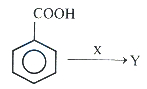
A
$X = \text{Conc. } HNO_3 + \text{Conc. } H_2SO_4$; $Y = 3-\text{Nitrobenzoic acid}$
B
$X = Br_2 / Fe$; $Y = 3-\text{Bromobenzoic acid}$
C
$X = NaOH, CaO$; $Y = \text{Benzene}$
D
$X = CH_3Cl / AlCl_3$; $Y = 3-\text{Methylbenzoic acid}$
Solution
(D) The reaction $X = CH_3Cl / AlCl_3$ is not feasible for benzoic acid because the $-COOH$ group is a strongly deactivating group,which makes the benzene ring unreactive towards electrophilic aromatic substitution. Furthermore,the $-COOH$ group coordinates with the Lewis acid $AlCl_3$ to form a complex,which further deactivates the ring and prevents the Friedel-Crafts alkylation reaction from occurring.
0 likesView Solution
107
ChemistryEasyMCQAP EAMCET · 2023
The preferred reagent for the following conversion is $CH_3CH_2COOH \rightarrow CH_3CH_2COCl$.
A
$HCl$
B
$HOCl$
C
$SOCl_2$
D
$NaOCl$
Solution
(C) The conversion of a carboxylic acid into an acyl chloride is best achieved using thionyl chloride $(SOCl_2)$.
The reaction is given by: $CH_3CH_2COOH + SOCl_2 \rightarrow CH_3CH_2COCl + SO_2 + HCl$.
This method is preferred because the by-products ($SO_2$ and $HCl$) are gases,which escape the reaction mixture,driving the reaction to completion.
The reaction is given by: $CH_3CH_2COOH + SOCl_2 \rightarrow CH_3CH_2COCl + SO_2 + HCl$.
This method is preferred because the by-products ($SO_2$ and $HCl$) are gases,which escape the reaction mixture,driving the reaction to completion.
0 likesView Solution
108
ChemistryEasyMCQAP EAMCET · 2023
The '$X$' in the following conversion is
$CH_3-CH_2-COOH \xrightarrow{X} CH_3-CH(Br)-COOH$
$CH_3-CH_2-COOH \xrightarrow{X} CH_3-CH(Br)-COOH$
A
$(I). Br_2 / \text{red } P, (II). H_2O$
B
$(I). Br_2 / CCl_4, (II). H_2O$
C
$Br_2 / OH^-$
D
$PBr_3$
Solution
(A) The given reaction is the Hell-Volhard-Zelinsky $(HVZ)$ reaction.
In this reaction,carboxylic acids having an $\alpha$-hydrogen atom are halogenated at the $\alpha$-position on treatment with bromine or chlorine in the presence of a small amount of red phosphorus.
The reaction is followed by hydrolysis to obtain the $\alpha$-halo carboxylic acid.
The reagents used are $(I). Br_2 / \text{red } P$ followed by $(II). H_2O$.
In this reaction,carboxylic acids having an $\alpha$-hydrogen atom are halogenated at the $\alpha$-position on treatment with bromine or chlorine in the presence of a small amount of red phosphorus.
The reaction is followed by hydrolysis to obtain the $\alpha$-halo carboxylic acid.
The reagents used are $(I). Br_2 / \text{red } P$ followed by $(II). H_2O$.
0 likesView Solution
109
ChemistryEasyMCQAP EAMCET · 2023
The compounds having coordinated water are
| $I$. $CrCl_3 \cdot 6 H_2 O$ | $II$. $BaCl_2 \cdot 2 H_2 O$ | $III$. $CuSO_4 \cdot 5 H_2 O$ |
A
$II, III$ only
B
$I, III$ only
C
$I, II$ only
D
$I, II, III$
Solution
(B) $CrCl_3 \cdot 6 H_2 O$ exists as $[Cr(H_2 O)_6]Cl_3$,where $6$ water molecules are coordinated to the $Cr^{3+}$ ion.
$BaCl_2 \cdot 2 H_2 O$ is a hydrated salt where water molecules are present in the crystal lattice but not coordinated to the metal ion.
$CuSO_4 \cdot 5 H_2 O$ exists as $[Cu(H_2 O)_4]SO_4 \cdot H_2 O$,where $4$ water molecules are coordinated to the $Cu^{2+}$ ion.
Therefore,compounds $I$ and $III$ contain coordinated water.
$BaCl_2 \cdot 2 H_2 O$ is a hydrated salt where water molecules are present in the crystal lattice but not coordinated to the metal ion.
$CuSO_4 \cdot 5 H_2 O$ exists as $[Cu(H_2 O)_4]SO_4 \cdot H_2 O$,where $4$ water molecules are coordinated to the $Cu^{2+}$ ion.
Therefore,compounds $I$ and $III$ contain coordinated water.
0 likesView Solution
110
ChemistryMediumMCQAP EAMCET · 2023
In the extraction of copper from copper glance,blister copper is formed by the evolution of gas $\underline{X}$. The shape of the molecule of $\underline{X}$ is
A
Angular
B
Planar trigonal
C
Tetrahedral
D
Pyramidal
Solution
(A) The extraction of copper from copper glance $(Cu_2S)$ involves the following reactions:
$2 Cu_2S + 3 O_2 \rightarrow 2 Cu_2O + 2 SO_2$
$2 Cu_2O + Cu_2S \rightarrow 6 Cu + SO_2$
Here,the gas $\underline{X}$ evolved is sulfur dioxide $(SO_2)$.
In $SO_2$,the sulfur atom is $sp^2$ hybridized with one lone pair of electrons.
Due to the presence of one lone pair,the shape of the $SO_2$ molecule is angular or bent.
$2 Cu_2S + 3 O_2 \rightarrow 2 Cu_2O + 2 SO_2$
$2 Cu_2O + Cu_2S \rightarrow 6 Cu + SO_2$
Here,the gas $\underline{X}$ evolved is sulfur dioxide $(SO_2)$.
In $SO_2$,the sulfur atom is $sp^2$ hybridized with one lone pair of electrons.
Due to the presence of one lone pair,the shape of the $SO_2$ molecule is angular or bent.
0 likesView Solution
111
ChemistryEasyMCQAP EAMCET · 2023
Which of the following are not in accordance with the property mentioned against them?
$I$. $F_2 > Cl_2 > Br_2 > I_2$ : Oxidising power
$II$. $MI > MBr > MCl > MF$ : Ionic character of metal halide
$III$. $F_2 > Cl_2 > Br_2 > I_2$ : Bond dissociation enthalpy
$IV$. $HI < HBr < HCl < HF$ : Hydrogen-halogen bond strength
$I$. $F_2 > Cl_2 > Br_2 > I_2$ : Oxidising power
$II$. $MI > MBr > MCl > MF$ : Ionic character of metal halide
$III$. $F_2 > Cl_2 > Br_2 > I_2$ : Bond dissociation enthalpy
$IV$. $HI < HBr < HCl < HF$ : Hydrogen-halogen bond strength
A
$I$ & $III$ only
B
$II$ & $III$ only
C
$I$ & $IV$ only
D
$II$ & $IV$ only
Solution
(B) $1$. Oxidising power: The order $F_2 > Cl_2 > Br_2 > I_2$ is correct due to the high reduction potential of fluorine.
$2$. Ionic character of metal halide: According to Fajan's rule,the order of ionic character is $MF > MCl > MBr > MI$. The given order $MI > MBr > MCl > MF$ is incorrect.
$3$. Bond dissociation enthalpy: The correct order is $Cl_2 > Br_2 > F_2 > I_2$. The $F-F$ bond is weaker than $Cl-Cl$ due to inter-electronic repulsion between lone pairs in the small $F_2$ molecule. The given order $F_2 > Cl_2 > Br_2 > I_2$ is incorrect.
$4$. Hydrogen-halogen bond strength: The order $HI < HBr < HCl < HF$ is correct due to the decrease in bond length as the size of the halogen decreases.
Thus,statements $II$ and $III$ are incorrect.
$2$. Ionic character of metal halide: According to Fajan's rule,the order of ionic character is $MF > MCl > MBr > MI$. The given order $MI > MBr > MCl > MF$ is incorrect.
$3$. Bond dissociation enthalpy: The correct order is $Cl_2 > Br_2 > F_2 > I_2$. The $F-F$ bond is weaker than $Cl-Cl$ due to inter-electronic repulsion between lone pairs in the small $F_2$ molecule. The given order $F_2 > Cl_2 > Br_2 > I_2$ is incorrect.
$4$. Hydrogen-halogen bond strength: The order $HI < HBr < HCl < HF$ is correct due to the decrease in bond length as the size of the halogen decreases.
Thus,statements $II$ and $III$ are incorrect.
0 likesView Solution
112
ChemistryMediumMCQAP EAMCET · 2023
Which of the following is correct with respect to the graph given?
$\begin{aligned} & [R]=\text{Concentration at time } t \\ & [R]_0=\text{Initial concentration} \end{aligned}$
$\begin{aligned} & [R]=\text{Concentration at time } t \\ & [R]_0=\text{Initial concentration} \end{aligned}$
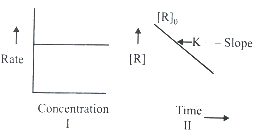
A
$I$ and $II$ represent zero order reaction.
B
$I$ represents first order and $II$ represents zero order reaction.
C
$I$ represents zero order and $II$ represents first order reaction.
D
$I$ and $II$ represent first order reaction.
Solution
(A) For a zero order reaction:
Rate $= k[R]^0 = k$. Thus,the rate is independent of concentration. Graph $I$ shows rate vs concentration as a constant line,which represents a zero order reaction.
For the integrated rate law of a zero order reaction:
$[R] = -kt + [R]_0$. This is in the form of $y = mx + c$,where $y = [R]$,$x = t$,$m = -k$,and $c = [R]_0$. Thus,graph $II$ represents a zero order reaction.
Therefore,both $I$ and $II$ represent zero order reactions.
Rate $= k[R]^0 = k$. Thus,the rate is independent of concentration. Graph $I$ shows rate vs concentration as a constant line,which represents a zero order reaction.
For the integrated rate law of a zero order reaction:
$[R] = -kt + [R]_0$. This is in the form of $y = mx + c$,where $y = [R]$,$x = t$,$m = -k$,and $c = [R]_0$. Thus,graph $II$ represents a zero order reaction.
Therefore,both $I$ and $II$ represent zero order reactions.
0 likesView Solution
113
ChemistryEasyMCQAP EAMCET · 2023
$A$ reaction,$3 X_{(g)} \rightarrow 2 Y_{(g)} + Z_{(g)}$ takes place in a closed vessel. What is the rate of formation of $Y$ (in $mol \ L^{-1} \ s^{-1}$) if the rate of disappearance of $X$ is $7.2 \times 10^{-3} \ mol \ L^{-1} \ s^{-1}$?
A
$3.6 \times 10^{-3}$
B
$4.8 \times 10^{-3}$
C
$2.4 \times 10^{-3}$
D
$1.2 \times 10^{-3}$
Solution
(B) The rate of reaction is given by the expression: $-\frac{1}{3} \frac{d[X]}{dt} = \frac{1}{2} \frac{d[Y]}{dt} = \frac{d[Z]}{dt}$
Given that the rate of disappearance of $X$ is $-\frac{d[X]}{dt} = 7.2 \times 10^{-3} \ mol \ L^{-1} \ s^{-1}$.
From the rate expression,we have: $\frac{1}{2} \frac{d[Y]}{dt} = -\frac{1}{3} \frac{d[X]}{dt}$
Therefore,the rate of formation of $Y$ is: $\frac{d[Y]}{dt} = \frac{2}{3} \times (-\frac{d[X]}{dt}) = \frac{2}{3} \times 7.2 \times 10^{-3} = 4.8 \times 10^{-3} \ mol \ L^{-1} \ s^{-1}$.
Given that the rate of disappearance of $X$ is $-\frac{d[X]}{dt} = 7.2 \times 10^{-3} \ mol \ L^{-1} \ s^{-1}$.
From the rate expression,we have: $\frac{1}{2} \frac{d[Y]}{dt} = -\frac{1}{3} \frac{d[X]}{dt}$
Therefore,the rate of formation of $Y$ is: $\frac{d[Y]}{dt} = \frac{2}{3} \times (-\frac{d[X]}{dt}) = \frac{2}{3} \times 7.2 \times 10^{-3} = 4.8 \times 10^{-3} \ mol \ L^{-1} \ s^{-1}$.
0 likesView Solution
114
ChemistryMediumMCQAP EAMCET · 2023
For a first order reaction,the concentration of reactant was reduced from $0.03 \ mol \ L^{-1}$ to $0.02 \ mol \ L^{-1}$ in $25 \ min$. What is its rate (in $mol \ L^{-1} \ s^{-1}$)?
A
$6.667 \times 10^{-6}$
B
$4 \times 10^{-4}$
C
$6.667 \times 10^{-4}$
D
$4 \times 10^{-6}$
Solution
(A) Given: $\Delta t = 25 \ min = 25 \times 60 \ s = 1500 \ s$.
Change in concentration $\Delta [R] = [R]_f - [R]_i = 0.02 - 0.03 = -0.01 \ mol \ L^{-1}$.
Rate $= -\frac{\Delta [R]}{\Delta t} = -\frac{-0.01}{1500} \ mol \ L^{-1} \ s^{-1}$.
Rate $= \frac{0.01}{1500} = \frac{1}{150000} = 6.667 \times 10^{-6} \ mol \ L^{-1} \ s^{-1}$.
Change in concentration $\Delta [R] = [R]_f - [R]_i = 0.02 - 0.03 = -0.01 \ mol \ L^{-1}$.
Rate $= -\frac{\Delta [R]}{\Delta t} = -\frac{-0.01}{1500} \ mol \ L^{-1} \ s^{-1}$.
Rate $= \frac{0.01}{1500} = \frac{1}{150000} = 6.667 \times 10^{-6} \ mol \ L^{-1} \ s^{-1}$.
0 likesView Solution
115
ChemistryMediumMCQAP EAMCET · 2023
Which of the following is correct with respect to the graph given?
$[R] = \text{Concentration at time } 't'$
$[R]_0 = \text{Initial concentration}$
$[R] = \text{Concentration at time } 't'$
$[R]_0 = \text{Initial concentration}$
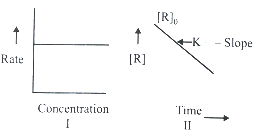
A
$I$ represents zero order and $II$ represents zero order reaction
B
$I$ represents zero order and $II$ represents zero order reaction
C
$I$ represents first order and $II$ represents zero order reaction
D
$I$ represents zero order and $II$ represents first order reaction
Solution
$(A)$ For a zero order reaction:
Rate $= K[A]^0 = K$
Thus, the rate does not change with concentration. Therefore, graph $I$ represents a zero order reaction.
For the integrated rate law of a zero order reaction:
$[R] = -Kt + [R]_0$
Comparing this with $y = mx + c$, the graph of $[R]$ vs $t$ is a straight line with a negative slope equal to $-K$. Thus, graph $II$ also represents a zero order reaction.
Rate $= K[A]^0 = K$
Thus, the rate does not change with concentration. Therefore, graph $I$ represents a zero order reaction.
For the integrated rate law of a zero order reaction:
$[R] = -Kt + [R]_0$
Comparing this with $y = mx + c$, the graph of $[R]$ vs $t$ is a straight line with a negative slope equal to $-K$. Thus, graph $II$ also represents a zero order reaction.
0 likesView Solution
116
ChemistryEasyMCQAP EAMCET · 2023
Consider a gas phase reaction which occurs in a closed vessel: $2 \ A \rightarrow 4 \ B + C$. The concentration of $B$ is found to be increased by $5 \times 10^{-3} \ mol \ L^{-1}$ in $10 \ s$. The rate of disappearance of $A$ (in $mol \ L^{-1} \ s^{-1}$) is:
A
$4.75 \times 10^{-4}$
B
$7.5 \times 10^{-4}$
C
$1.25 \times 10^{-4}$
D
$2.5 \times 10^{-4}$
Solution
(D) For the reaction $2 \ A \rightarrow 4 \ B + C$,the rate expression is given by: $-\frac{1}{2} \frac{d[A]}{dt} = \frac{1}{4} \frac{d[B]}{dt}$.
We need to find the rate of disappearance of $A$,which is $-\frac{d[A]}{dt}$.
From the expression: $-\frac{d[A]}{dt} = \frac{2}{4} \frac{d[B]}{dt} = \frac{1}{2} \frac{d[B]}{dt}$.
Given $\frac{\Delta [B]}{\Delta t} = \frac{5 \times 10^{-3} \ mol \ L^{-1}}{10 \ s} = 5 \times 10^{-4} \ mol \ L^{-1} \ s^{-1}$.
Therefore,$-\frac{d[A]}{dt} = \frac{1}{2} \times (5 \times 10^{-4} \ mol \ L^{-1} \ s^{-1}) = 2.5 \times 10^{-4} \ mol \ L^{-1} \ s^{-1}$.
We need to find the rate of disappearance of $A$,which is $-\frac{d[A]}{dt}$.
From the expression: $-\frac{d[A]}{dt} = \frac{2}{4} \frac{d[B]}{dt} = \frac{1}{2} \frac{d[B]}{dt}$.
Given $\frac{\Delta [B]}{\Delta t} = \frac{5 \times 10^{-3} \ mol \ L^{-1}}{10 \ s} = 5 \times 10^{-4} \ mol \ L^{-1} \ s^{-1}$.
Therefore,$-\frac{d[A]}{dt} = \frac{1}{2} \times (5 \times 10^{-4} \ mol \ L^{-1} \ s^{-1}) = 2.5 \times 10^{-4} \ mol \ L^{-1} \ s^{-1}$.
0 likesView Solution
117
ChemistryMediumMCQAP EAMCET · 2023
The time taken for $10 \%$ completion of a first order reaction is $20$ minutes. The time required for the completion of $19 \%$ of the same reaction in minutes is
A
$40$
B
$60$
C
$30$
D
$50$
Solution
(A) For a first order reaction,the rate constant $k$ is given by the formula: $k = \frac{2.303}{t} \log \left( \frac{a}{a-x} \right)$.
For $10 \%$ completion,$x = 0.1a$ and $t = 20 \text{ min}$.
$k = \frac{2.303}{20} \log \left( \frac{a}{0.9a} \right) = \frac{2.303}{20} \log \left( \frac{1}{0.9} \right)$.
For $19 \%$ completion,$x = 0.19a$ and $t = ?$.
$k = \frac{2.303}{t} \log \left( \frac{a}{0.81a} \right) = \frac{2.303}{t} \log \left( \frac{1}{0.81} \right) = \frac{2.303}{t} \log \left( \frac{1}{0.9^2} \right) = \frac{2.303}{t} \times 2 \log \left( \frac{1}{0.9} \right)$.
Equating the two expressions for $k$:
$\frac{2.303}{20} \log \left( \frac{1}{0.9} \right) = \frac{2.303}{t} \times 2 \log \left( \frac{1}{0.9} \right)$.
$\frac{1}{20} = \frac{2}{t} \implies t = 40 \text{ minutes}$.
For $10 \%$ completion,$x = 0.1a$ and $t = 20 \text{ min}$.
$k = \frac{2.303}{20} \log \left( \frac{a}{0.9a} \right) = \frac{2.303}{20} \log \left( \frac{1}{0.9} \right)$.
For $19 \%$ completion,$x = 0.19a$ and $t = ?$.
$k = \frac{2.303}{t} \log \left( \frac{a}{0.81a} \right) = \frac{2.303}{t} \log \left( \frac{1}{0.81} \right) = \frac{2.303}{t} \log \left( \frac{1}{0.9^2} \right) = \frac{2.303}{t} \times 2 \log \left( \frac{1}{0.9} \right)$.
Equating the two expressions for $k$:
$\frac{2.303}{20} \log \left( \frac{1}{0.9} \right) = \frac{2.303}{t} \times 2 \log \left( \frac{1}{0.9} \right)$.
$\frac{1}{20} = \frac{2}{t} \implies t = 40 \text{ minutes}$.
0 likesView Solution
118
ChemistryEasyMCQAP EAMCET · 2023
$20 \%$ of a first order reaction was found to be completed at $10:00 \ am$. At $11:30 \ am$ on the same day,$20 \%$ of the reaction was found to be remaining. The half-life period in minutes of the reaction is
A
$90$
B
$45$
C
$60$
D
$30$
Solution
(B) The time interval between $10:00 \ am$ and $11:30 \ am$ is $t = 90 \ min$.
At $10:00 \ am$,$20 \%$ is completed,so the remaining concentration is $80 \%$ of initial concentration $([A]_0)$.
At $11:30 \ am$,$20 \%$ is remaining,so $[A]_t = 0.20 [A]_0$.
The rate constant $k$ for a first-order reaction is given by $k = \frac{2.303}{t} \log \frac{[A]_{initial}}{[A]_{final}}$.
Substituting the values: $k = \frac{2.303}{90} \log \frac{0.80 [A]_0}{0.20 [A]_0} = \frac{2.303}{90} \log 4$.
Using $\log 4 \approx 0.602$,$k = \frac{2.303 \times 0.602}{90} \approx 0.0154 \ min^{-1}$.
The half-life $t_{1/2} = \frac{0.693}{k} = \frac{0.693}{0.0154} \approx 45 \ min$.
At $10:00 \ am$,$20 \%$ is completed,so the remaining concentration is $80 \%$ of initial concentration $([A]_0)$.
At $11:30 \ am$,$20 \%$ is remaining,so $[A]_t = 0.20 [A]_0$.
The rate constant $k$ for a first-order reaction is given by $k = \frac{2.303}{t} \log \frac{[A]_{initial}}{[A]_{final}}$.
Substituting the values: $k = \frac{2.303}{90} \log \frac{0.80 [A]_0}{0.20 [A]_0} = \frac{2.303}{90} \log 4$.
Using $\log 4 \approx 0.602$,$k = \frac{2.303 \times 0.602}{90} \approx 0.0154 \ min^{-1}$.
The half-life $t_{1/2} = \frac{0.693}{k} = \frac{0.693}{0.0154} \approx 45 \ min$.
0 likesView Solution
119
ChemistryEasyMCQAP EAMCET · 2023
Thermal decomposition of $HCOOH$ is a first order reaction and the rate constant at $T(K)$ is $4.606 \times 10^{-3} \ s^{-1}$. The time required to decompose $90 \%$ of initial quantity of $HCOOH$ at $T(K)$ in seconds is
A
$100$
B
$500$
C
$1000$
D
$50$
Solution
(B) For a first order reaction,the rate equation is given by:
$K = \frac{2.303}{t} \log \frac{[A]_0}{[A]_t}$
Given: $K = 4.606 \times 10^{-3} \ s^{-1}$
If $90 \%$ of the initial quantity decomposes,then the remaining quantity $[A]_t = 100 \% - 90 \% = 10 \%$.
Let $[A]_0 = 100$. Then $[A]_t = 10$.
Substituting the values:
$t = \frac{2.303}{4.606 \times 10^{-3}} \log \frac{100}{10}$
$t = \frac{2.303}{4.606 \times 10^{-3}} \log(10)$
Since $\log(10) = 1$:
$t = \frac{2.303}{4.606 \times 10^{-3}} \times 1 = 0.5 \times 10^3 = 500 \ s$.
$K = \frac{2.303}{t} \log \frac{[A]_0}{[A]_t}$
Given: $K = 4.606 \times 10^{-3} \ s^{-1}$
If $90 \%$ of the initial quantity decomposes,then the remaining quantity $[A]_t = 100 \% - 90 \% = 10 \%$.
Let $[A]_0 = 100$. Then $[A]_t = 10$.
Substituting the values:
$t = \frac{2.303}{4.606 \times 10^{-3}} \log \frac{100}{10}$
$t = \frac{2.303}{4.606 \times 10^{-3}} \log(10)$
Since $\log(10) = 1$:
$t = \frac{2.303}{4.606 \times 10^{-3}} \times 1 = 0.5 \times 10^3 = 500 \ s$.
0 likesView Solution
120
ChemistryEasyMCQAP EAMCET · 2023
Which of the following is used in perfumery?
A
Esters of benzoic acid
B
Ethanoic acid
C
Methanoic acid
D
Sodium benzoate
Solution
(A) Esters are derivatives of carboxylic acid with the general formula $(R-COOR')$.
They are well-known for their pleasant,fruity smells.
Due to these fragrant properties,esters are widely used in the manufacturing of perfumes and flavoring agents.
They are well-known for their pleasant,fruity smells.
Due to these fragrant properties,esters are widely used in the manufacturing of perfumes and flavoring agents.
0 likesView Solution
121
ChemistryMediumMCQAP EAMCET · 2023
The group present in prontosil is
A
$-N=N-$
B
$-As=As-$
C
$-CONH-$
D
$-C=N-$
Solution
(A) Prontosil is an antibacterial drug. Its chemical structure is $4-amino-2,4'-diaminoazobenzene-4-sulfonamide$.
It contains an azo group $(-N=N-)$ which links two aromatic rings.
Therefore,the group present in prontosil is $-N=N-$.
It contains an azo group $(-N=N-)$ which links two aromatic rings.
Therefore,the group present in prontosil is $-N=N-$.
0 likesView Solution
122
ChemistryEasyMCQAP EAMCET · 2023
Match the following items in List-$I$ with List-$II$:
| List-$I$ | List-$II$ |
|---|---|
| $A$. Broad spectrum | $I$. Amoxycillin |
| $B$. Typhoid | $II$. Vancomycin |
| $C$. Bactericidal | $III$. Erythromycin |
| $D$. Bacteriostatic | $IV$. Chloramphenicol |
| $V$. Ofloxacin |
A
$A-II, B-IV, C-V, D-III$
B
$A-I, B-IV, C-V, D-III$
C
$A-III, B-IV, C-II, D-I$
D
$A-III, B-II, C-IV, D-V$
Solution
(B) The correct matches are as follows:
$A$. Broad spectrum: $I$. Amoxycillin (also $II$. Vancomycin is broad-spectrum,but $I$ is the standard match here).
$B$. Typhoid: $IV$. Chloramphenicol (used in the treatment of typhoid).
$C$. Bactericidal: $V$. Ofloxacin (kills bacteria).
$D$. Bacteriostatic: $III$. Erythromycin (inhibits bacterial growth).
Thus,the correct matching is $A-I, B-IV, C-V, D-III$.
$A$. Broad spectrum: $I$. Amoxycillin (also $II$. Vancomycin is broad-spectrum,but $I$ is the standard match here).
$B$. Typhoid: $IV$. Chloramphenicol (used in the treatment of typhoid).
$C$. Bactericidal: $V$. Ofloxacin (kills bacteria).
$D$. Bacteriostatic: $III$. Erythromycin (inhibits bacterial growth).
Thus,the correct matching is $A-I, B-IV, C-V, D-III$.
0 likesView Solution
123
ChemistryEasyMCQAP EAMCET · 2023
Ranitidine belongs to which of the following class of drugs?
A
Tranquiliser
B
Antiseptic
C
Analgesic
D
Antacid
Solution
(D) Ranitidine,also known as $Zantac$,is a drug that reduces stomach acid production. It belongs to the class of drugs known as $Antacids$.
0 likesView Solution
124
ChemistryEasyMCQAP EAMCET · 2023
Correct statements with respect to morphine $(X)$ and Veronal $(Y)$ are:
$A$. Both $X$ and $Y$ are sleep-producing agents.
$B$. $X$ is hypnotic and $Y$ is analgesic.
$C$. $X$ is analgesic and $Y$ is hypnotic.
$D$. $X$ is non-narcotic analgesic and $Y$ is antidepressant.
$A$. Both $X$ and $Y$ are sleep-producing agents.
$B$. $X$ is hypnotic and $Y$ is analgesic.
$C$. $X$ is analgesic and $Y$ is hypnotic.
$D$. $X$ is non-narcotic analgesic and $Y$ is antidepressant.
A
$A, B$
B
$B, C$
C
$A, C$
D
$C, D$
Solution
(C) Morphine $(X)$ is a narcotic analgesic,which also induces sleep.
Veronal $(Y)$ is a derivative of barbituric acid and acts as a tranquilizer,specifically a hypnotic (sleep-producing agent).
Statement $A$ is correct because both substances induce sleep.
Statement $B$ is incorrect because $X$ is an analgesic and $Y$ is a hypnotic.
Statement $C$ is correct because $X$ is an analgesic and $Y$ is a hypnotic.
Statement $D$ is incorrect because morphine is a narcotic analgesic,not a non-narcotic one,and Veronal is a hypnotic,not an antidepressant.
Therefore,the correct statements are $A$ and $C$.
Veronal $(Y)$ is a derivative of barbituric acid and acts as a tranquilizer,specifically a hypnotic (sleep-producing agent).
Statement $A$ is correct because both substances induce sleep.
Statement $B$ is incorrect because $X$ is an analgesic and $Y$ is a hypnotic.
Statement $C$ is correct because $X$ is an analgesic and $Y$ is a hypnotic.
Statement $D$ is incorrect because morphine is a narcotic analgesic,not a non-narcotic one,and Veronal is a hypnotic,not an antidepressant.
Therefore,the correct statements are $A$ and $C$.
0 likesView Solution
125
ChemistryEasyMCQAP EAMCET · 2023
Which of the following hormones modulate inflammatory reactions?
A
Mineralocorticoids
B
Glucocorticoids
C
Epinephrine
D
Glucagon
Solution
(B) Glucocorticoids are steroidal hormones that control carbohydrate metabolism,modulate inflammatory reactions,and help the body react to stress.
0 likesView Solution
126
ChemistryEasyMCQAP EAMCET · 2023
In which of the following,is the drug class correctly matched with the criteria of drug classification?
A
Analgesics $-------$ molecular targets
B
Sulphonamides $-------$ drug action
C
Antihistamines $------$ chemical structure
D
Antiseptics $-------$ pharmacological effect
Solution
(D) Classification on the basis of molecular targets: Lipid targeting,carbohydrates targeting,etc.
Classification on the basis of drug action: Antihistamines,etc.
Classification on the basis of chemical structure: Sulphonamides,etc.
Classification on the basis of pharmacological effect: Antiseptics,analgesics,etc.
Therefore,the correct match is Antiseptics $-------$ pharmacological effect.
Classification on the basis of drug action: Antihistamines,etc.
Classification on the basis of chemical structure: Sulphonamides,etc.
Classification on the basis of pharmacological effect: Antiseptics,analgesics,etc.
Therefore,the correct match is Antiseptics $-------$ pharmacological effect.
0 likesView Solution
127
ChemistryEasyMCQAP EAMCET · 2023
Identify the correct statement from the following.
A
Unbranched hydrocarbon detergents are non-biodegradable.
B
$Cetyltrimethyl$ ammonium bromide is used in hair conditioners.
C
Liquid dishwashing detergents are anionic type.
D
Synthetic detergents cannot be used in hard water.
Solution
(B) Unbranched hydrocarbon detergents are easily biodegradable.
$Cetyltrimethyl$ ammonium bromide is a cationic detergent and is used in hair conditioners.
Liquid dishwashing detergents are of non-ionic type.
Synthetic detergents can be used in both soft and hard water.
$Cetyltrimethyl$ ammonium bromide is a cationic detergent and is used in hair conditioners.
Liquid dishwashing detergents are of non-ionic type.
Synthetic detergents can be used in both soft and hard water.
0 likesView Solution
128
ChemistryEasyMCQAP EAMCET · 2023
Hypothyroidism is due to
A
$A$. High level of iodine in the diet
B
$B$. Enlargement of thyroid gland
C
$C$. Low levels of iodine in the diet
D
$D$. Increased levels of thyroxine
Solution
(B) Hypothyroidism is a condition caused by the deficiency of iodine in the diet,which leads to the enlargement of the thyroid gland (goiter).
Thus,both $B$ and $C$ are correct.
Thus,both $B$ and $C$ are correct.
0 likesView Solution
129
ChemistryEasyMCQAP EAMCET · 2023
Addison's disease is characterized by:
$A$. Hyperglycemia
$B$. Weakness
$C$. Increased susceptibility to stress
$D$. Hypertension
$A$. Hyperglycemia
$B$. Weakness
$C$. Increased susceptibility to stress
$D$. Hypertension
A
$A, C$
B
$A, D$
C
$B, C$
D
$B, D$
Solution
(C) Addison's disease is caused by the deficiency of glucocorticoids and mineralocorticoids.
It is characterized by symptoms such as muscle weakness,fatigue,weight loss,low blood pressure (hypotension),and increased susceptibility to stress.
Therefore,the correct characteristics are $B$ (Weakness) and $C$ (Increased susceptibility to stress).
It is characterized by symptoms such as muscle weakness,fatigue,weight loss,low blood pressure (hypotension),and increased susceptibility to stress.
Therefore,the correct characteristics are $B$ (Weakness) and $C$ (Increased susceptibility to stress).
0 likesView Solution
130
ChemistryEasyMCQAP EAMCET · 2023
$Ortho-sulphobenzimide$ is used as:
A
Anti oxidant
B
Artificial sweetener
C
Food Preservative
D
Food supplement
Solution
(B) $Ortho-sulphobenzimide$,commonly known as $Saccharin$,is the first popular artificial sweetening agent discovered.
It is about $550$ times as sweet as cane sugar.
It is excreted from the body in urine unchanged and is considered inert.
Therefore,it is used as an artificial sweetener by diabetic patients and people who need to control their calorie intake.
It is about $550$ times as sweet as cane sugar.
It is excreted from the body in urine unchanged and is considered inert.
Therefore,it is used as an artificial sweetener by diabetic patients and people who need to control their calorie intake.
0 likesView Solution
131
ChemistryEasyMCQAP EAMCET · 2023
Food preservative sodium benzoate is eliminated from the body as which of the following metabolite?
A
benzamide
B
phenyl acetic acid
C
benzoic acid
D
Hippuric acid
Solution
(D) Sodium benzoate is metabolized in the body to form $Hippuric \ acid$ (or $Hippurate$).
This process involves the conjugation of benzoic acid with glycine,which is then excreted in the urine.
This process involves the conjugation of benzoic acid with glycine,which is then excreted in the urine.
0 likesView Solution
132
ChemistryEasyMCQAP EAMCET · 2023
Which of the following is a chlorine-containing artificial sweetener?
A
Sucralose
B
Aspartame
C
Saccharin
D
Alitame
Solution
(A) Sucralose is a trichloro derivative of sucrose. It is an artificial sweetener that contains chlorine atoms in its structure. The chemical structure of sucralose is shown in the image,which clearly indicates the presence of chlorine atoms $(Cl)$. Therefore,the correct option is $A$.
0 likesView Solution
133
ChemistryEasyMCQAP EAMCET · 2023
Consider the following two statements:
$Statement-I:$ Among $Mg, Al, Mg^{2+}, Al^{3+}$,the one having the smallest size is $Al^{3+}$.
$Statement-II:$ $Eu$ has an exceptionally high atomic radius among lanthanide elements.
The correct answer is:
$Statement-I:$ Among $Mg, Al, Mg^{2+}, Al^{3+}$,the one having the smallest size is $Al^{3+}$.
$Statement-II:$ $Eu$ has an exceptionally high atomic radius among lanthanide elements.
The correct answer is:
A
Both statements $I$ and $II$ are correct.
B
Both statements $I$ and $II$ are not correct.
C
Statement $I$ is correct but statement $II$ is not correct.
D
Statement $I$ is not correct but statement $II$ is correct.
Solution
(C) $Al$ atom is smaller than $Mg$ atom because $Al$ lies to the right of $Mg$ in the same period and has a greater effective nuclear charge.
$A$ cation is smaller than its parent atom,so $Al^{3+}$ is smaller than $Al$. Therefore,$Al^{3+}$ is the smallest in size among the given species.
Thus,$Statement-I$ is correct.
Among lanthanides,there is a gradual decrease in atomic and ionic radii as we move from left to right due to lanthanoid contraction.
The atomic radii of lanthanides generally decrease across the series. $Eu$ does not show an exceptionally high atomic radius compared to its neighbors in the context of the general trend of lanthanoid contraction.
Thus,$Statement-II$ is false.
$A$ cation is smaller than its parent atom,so $Al^{3+}$ is smaller than $Al$. Therefore,$Al^{3+}$ is the smallest in size among the given species.
Thus,$Statement-I$ is correct.
Among lanthanides,there is a gradual decrease in atomic and ionic radii as we move from left to right due to lanthanoid contraction.
The atomic radii of lanthanides generally decrease across the series. $Eu$ does not show an exceptionally high atomic radius compared to its neighbors in the context of the general trend of lanthanoid contraction.
Thus,$Statement-II$ is false.
0 likesView Solution
134
ChemistryMediumMCQAP EAMCET · 2023
Arrange the following in order of increasing number of unpaired electrons in them:
$i$. $[Fe(CN)_6]^{3-}$
$ii$. $[MnCl_6]^{3-}$
$iii$. $[FeF_6]^{3-}$
$iv$. $[Co(NH_3)_6]^{3+}$
$i$. $[Fe(CN)_6]^{3-}$
$ii$. $[MnCl_6]^{3-}$
$iii$. $[FeF_6]^{3-}$
$iv$. $[Co(NH_3)_6]^{3+}$
A
$i, iv, ii, iii$
B
$iv, i, iii, ii$
C
$iv, i, ii, iii$
D
$i, iv, iii, ii$
Solution
(C) $(i)$ $[Fe(CN)_6]^{3-}$: $Fe$ is in $+3$ oxidation state $(3d^5)$. $CN^-$ is a strong-field ligand,causing pairing. Unpaired electrons = $1$.
$(ii)$ $[MnCl_6]^{3-}$: $Mn$ is in $+3$ oxidation state $(3d^4)$. $Cl^-$ is a weak-field ligand. Unpaired electrons = $4$.
$(iii)$ $[FeF_6]^{3-}$: $Fe$ is in $+3$ oxidation state $(3d^5)$. $F^-$ is a weak-field ligand. Unpaired electrons = $5$.
$(iv)$ $[Co(NH_3)_6]^{3+}$: $Co$ is in $+3$ oxidation state $(3d^6)$. $NH_3$ is a strong-field ligand,causing pairing. Unpaired electrons = $0$.
Increasing order of unpaired electrons: $(iv) < (i) < (ii) < (iii)$.
$(ii)$ $[MnCl_6]^{3-}$: $Mn$ is in $+3$ oxidation state $(3d^4)$. $Cl^-$ is a weak-field ligand. Unpaired electrons = $4$.
$(iii)$ $[FeF_6]^{3-}$: $Fe$ is in $+3$ oxidation state $(3d^5)$. $F^-$ is a weak-field ligand. Unpaired electrons = $5$.
$(iv)$ $[Co(NH_3)_6]^{3+}$: $Co$ is in $+3$ oxidation state $(3d^6)$. $NH_3$ is a strong-field ligand,causing pairing. Unpaired electrons = $0$.
Increasing order of unpaired electrons: $(iv) < (i) < (ii) < (iii)$.
0 likesView Solution
135
ChemistryMediumMCQAP EAMCET · 2023
The $IUPAC$ name of $[Pt(NH_3)_2 Cl(NH_2 CH_3)] Cl$ is:
A
Diamminechloromethanamineplatinum $(II)$ chloride
B
Chlorodiammine (methanamine) platinum $(II)$ chloride
C
Diamminechloro (methanamine) platinum $(II)$ chloride
D
Diamminechloro (methylamine) platinum $(IV)$ chloride
Solution
(C) The complex is $[Pt(NH_3)_2 Cl(NH_2 CH_3)] Cl$.
The ligands are ammine $(NH_3)$,chloro $(Cl^-)$,and methanamine $(NH_2CH_3)$.
According to $IUPAC$ nomenclature,ligands are named in alphabetical order: ammine,chloro,methanamine.
The oxidation state of $Pt$ is calculated as: $x + 2(0) + (-1) + 0 = +1$,so $x = +2$.
Thus,the name is Diamminechloro (methanamine) platinum $(II)$ chloride.
The ligands are ammine $(NH_3)$,chloro $(Cl^-)$,and methanamine $(NH_2CH_3)$.
According to $IUPAC$ nomenclature,ligands are named in alphabetical order: ammine,chloro,methanamine.
The oxidation state of $Pt$ is calculated as: $x + 2(0) + (-1) + 0 = +1$,so $x = +2$.
Thus,the name is Diamminechloro (methanamine) platinum $(II)$ chloride.
0 likesView Solution
136
ChemistryMediumMCQAP EAMCET · 2023
The formula of tris(ethane-$1,2$-diamine)cobalt$(III)$ sulphate is:
A
$[Co(H_2NCH_2CH_2NH_2)_3]_2(SO_4)_3$
B
$[Co(H_2NCH_2CH_2NH_2)_3]_3(SO_4)_2$
C
$[Co(CH_3CH_2NHNH_2)_3]_2(SO_4)_3$
D
$[Co(H_2NCH_2CH_2NH_2)_3]_2(SO_4)_3$
Solution
(A) The central metal ion is cobalt in the $+3$ oxidation state,denoted as $Co^{3+}$.
Ethane-$1,2$-diamine $(en)$ is a neutral bidentate ligand,so its charge is $0$.
The coordination entity is $[Co(en)_3]^{3+}$.
The sulphate ion is $SO_4^{2-}$.
To balance the charges,we need two $[Co(en)_3]^{3+}$ ions and three $SO_4^{2-}$ ions.
Thus,the formula is $[Co(en)_3]_2(SO_4)_3$,which can be written as $[Co(H_2NCH_2CH_2NH_2)_3]_2(SO_4)_3$.
Ethane-$1,2$-diamine $(en)$ is a neutral bidentate ligand,so its charge is $0$.
The coordination entity is $[Co(en)_3]^{3+}$.
The sulphate ion is $SO_4^{2-}$.
To balance the charges,we need two $[Co(en)_3]^{3+}$ ions and three $SO_4^{2-}$ ions.
Thus,the formula is $[Co(en)_3]_2(SO_4)_3$,which can be written as $[Co(H_2NCH_2CH_2NH_2)_3]_2(SO_4)_3$.
0 likesView Solution
137
ChemistryMediumMCQAP EAMCET · 2023
Which of the following types of isomerism is exhibited by $[Co(NH_3)_5(NO_2)](NO_3)_2$?
$i$. Optical
$ii$. Linkage
$iii$. Ionization
$iv$. Coordination
$i$. Optical
$ii$. Linkage
$iii$. Ionization
$iv$. Coordination
A
$ii, iii$ only
B
$i, ii, iii$ only
C
$i, iii$ only
D
$ii, iv$ only
Solution
(A) The complex $[Co(NH_3)_5(NO_2)](NO_3)_2$ does not exhibit optical isomerism because it possesses a plane of symmetry.
Linkage isomerism is exhibited due to the ambidentate ligand $NO_2^-$,which can coordinate through $N$ or $O$ (forming $[Co(NH_3)_5(NO_2)]^{2+}$ and $[Co(NH_3)_5(ONO)]^{2+}$).
Ionization isomerism is exhibited because the $NO_2^-$ ligand inside the coordination sphere can exchange with the $NO_3^-$ ion outside the sphere (forming $[Co(NH_3)_5(NO_2)](NO_3)_2$ and $[Co(NH_3)_5(NO_3)](NO_2)(NO_3)$).
Coordination isomerism requires both cationic and anionic entities to be coordination complexes,which is not the case here.
Therefore,the complex exhibits linkage and ionization isomerism.
Linkage isomerism is exhibited due to the ambidentate ligand $NO_2^-$,which can coordinate through $N$ or $O$ (forming $[Co(NH_3)_5(NO_2)]^{2+}$ and $[Co(NH_3)_5(ONO)]^{2+}$).
Ionization isomerism is exhibited because the $NO_2^-$ ligand inside the coordination sphere can exchange with the $NO_3^-$ ion outside the sphere (forming $[Co(NH_3)_5(NO_2)](NO_3)_2$ and $[Co(NH_3)_5(NO_3)](NO_2)(NO_3)$).
Coordination isomerism requires both cationic and anionic entities to be coordination complexes,which is not the case here.
Therefore,the complex exhibits linkage and ionization isomerism.
0 likesView Solution
138
ChemistryMediumMCQAP EAMCET · 2023
Which of the following statements are correct?
$i$. $[Mn(CN)_6]^{3-}, [MnCl_6]^{3-}$ both are paramagnetic
$ii$. Both $[NiCl_4]^{2-}, [Ni(CO)_4]$ are tetrahedral and diamagnetic
$iii$. $[Co(NH_3)_6]^{3+}$ is an inner orbital complex,but $[Ni(NH_3)_6]^{2+}$ is an outer orbital complex
$i$. $[Mn(CN)_6]^{3-}, [MnCl_6]^{3-}$ both are paramagnetic
$ii$. Both $[NiCl_4]^{2-}, [Ni(CO)_4]$ are tetrahedral and diamagnetic
$iii$. $[Co(NH_3)_6]^{3+}$ is an inner orbital complex,but $[Ni(NH_3)_6]^{2+}$ is an outer orbital complex
A
$i, ii$ only
B
$i, iii$ only
C
$ii, iii$ only
D
$i, ii, iii$
Solution
(B) $i$. In $[Mn(CN)_6]^{3-}$,$Mn^{3+}$ is $3d^4$. $CN^-$ is a strong field ligand,so it is $d^2sp^3$ (inner orbital) with $2$ unpaired electrons (paramagnetic). In $[MnCl_6]^{3-}$,$Mn^{3+}$ is $3d^4$. $Cl^-$ is a weak field ligand,so it is $sp^3d^2$ (outer orbital) with $4$ unpaired electrons (paramagnetic). Thus,$i$ is correct.
$ii$. $[NiCl_4]^{2-}$ is $sp^3$ tetrahedral and paramagnetic ($2$ unpaired electrons). $[Ni(CO)_4]$ is $sp^3$ tetrahedral and diamagnetic. Thus,$ii$ is incorrect.
$iii$. $[Co(NH_3)_6]^{3+}$ involves $d^2sp^3$ hybridization (inner orbital). $[Ni(NH_3)_6]^{2+}$ involves $sp^3d^2$ hybridization (outer orbital). Thus,$iii$ is correct.
Therefore,the correct statements are $i$ and $iii$.
$ii$. $[NiCl_4]^{2-}$ is $sp^3$ tetrahedral and paramagnetic ($2$ unpaired electrons). $[Ni(CO)_4]$ is $sp^3$ tetrahedral and diamagnetic. Thus,$ii$ is incorrect.
$iii$. $[Co(NH_3)_6]^{3+}$ involves $d^2sp^3$ hybridization (inner orbital). $[Ni(NH_3)_6]^{2+}$ involves $sp^3d^2$ hybridization (outer orbital). Thus,$iii$ is correct.
Therefore,the correct statements are $i$ and $iii$.
0 likesView Solution
139
ChemistryMediumMCQAP EAMCET · 2023
Observe the following complexes: $[Mn(CN)_6]^{3-}, [Fe(CN)_6]^{3-}, [Co(C_2O_4)_3]^{3-}, [MnCl_6]^{3-}, [Fe(CN)_6]^{4-}, [CoF_6]^{3-}$. From the above,the number of inner orbital complexes with paramagnetic nature is
A
$2$
B
$1$
C
$3$
D
$4$
Solution
(A) Let us analyze each complex:
$1$. $[Mn(CN)_6]^{3-}$: $Mn^{3+}$ is $3d^4$. $CN^-$ is a strong-field ligand,causing pairing. The configuration becomes $t_{2g}^4 e_g^0$. It is an inner-orbital complex $(d^2sp^3)$ and is paramagnetic ($2$ unpaired electrons).
$2$. $[Fe(CN)_6]^{3-}$: $Fe^{3+}$ is $3d^5$. $CN^-$ is a strong-field ligand. The configuration becomes $t_{2g}^5 e_g^0$. It is an inner-orbital complex $(d^2sp^3)$ and is paramagnetic ($1$ unpaired electron).
$3$. $[Co(C_2O_4)_3]^{3-}$: $Co^{3+}$ is $3d^6$. $C_2O_4^{2-}$ is a weak-field ligand. It forms an outer-orbital complex $(sp^3d^2)$ and is diamagnetic.
$4$. $[MnCl_6]^{3-}$: $Mn^{3+}$ is $3d^4$. $Cl^-$ is a weak-field ligand. It forms an outer-orbital complex $(sp^3d^2)$ and is paramagnetic.
$5$. $[Fe(CN)_6]^{4-}$: $Fe^{2+}$ is $3d^6$. $CN^-$ is a strong-field ligand. The configuration becomes $t_{2g}^6 e_g^0$. It is an inner-orbital complex $(d^2sp^3)$ and is diamagnetic.
$6$. $[CoF_6]^{3-}$: $Co^{3+}$ is $3d^6$. $F^-$ is a weak-field ligand. It forms an outer-orbital complex $(sp^3d^2)$ and is paramagnetic.
Inner-orbital complexes are those using $(n-1)d$ orbitals. These are $[Mn(CN)_6]^{3-}, [Fe(CN)_6]^{3-}, [Fe(CN)_6]^{4-}$.
Among these,the paramagnetic ones are $[Mn(CN)_6]^{3-}$ and $[Fe(CN)_6]^{3-}$.
Thus,the total number is $2$.
$1$. $[Mn(CN)_6]^{3-}$: $Mn^{3+}$ is $3d^4$. $CN^-$ is a strong-field ligand,causing pairing. The configuration becomes $t_{2g}^4 e_g^0$. It is an inner-orbital complex $(d^2sp^3)$ and is paramagnetic ($2$ unpaired electrons).
$2$. $[Fe(CN)_6]^{3-}$: $Fe^{3+}$ is $3d^5$. $CN^-$ is a strong-field ligand. The configuration becomes $t_{2g}^5 e_g^0$. It is an inner-orbital complex $(d^2sp^3)$ and is paramagnetic ($1$ unpaired electron).
$3$. $[Co(C_2O_4)_3]^{3-}$: $Co^{3+}$ is $3d^6$. $C_2O_4^{2-}$ is a weak-field ligand. It forms an outer-orbital complex $(sp^3d^2)$ and is diamagnetic.
$4$. $[MnCl_6]^{3-}$: $Mn^{3+}$ is $3d^4$. $Cl^-$ is a weak-field ligand. It forms an outer-orbital complex $(sp^3d^2)$ and is paramagnetic.
$5$. $[Fe(CN)_6]^{4-}$: $Fe^{2+}$ is $3d^6$. $CN^-$ is a strong-field ligand. The configuration becomes $t_{2g}^6 e_g^0$. It is an inner-orbital complex $(d^2sp^3)$ and is diamagnetic.
$6$. $[CoF_6]^{3-}$: $Co^{3+}$ is $3d^6$. $F^-$ is a weak-field ligand. It forms an outer-orbital complex $(sp^3d^2)$ and is paramagnetic.
Inner-orbital complexes are those using $(n-1)d$ orbitals. These are $[Mn(CN)_6]^{3-}, [Fe(CN)_6]^{3-}, [Fe(CN)_6]^{4-}$.
Among these,the paramagnetic ones are $[Mn(CN)_6]^{3-}$ and $[Fe(CN)_6]^{3-}$.
Thus,the total number is $2$.
0 likesView Solution
140
ChemistryMediumMCQAP EAMCET · 2023
The spin-only magnetic moment of $[MnBr_4]^{x-}$ is $5.9 \ BM$. The geometry of the complex and $x$ respectively are
A
tetrahedral,$1$
B
square planar,$1$
C
square planar,$2$
D
tetrahedral,$2$
Solution
(D) The spin-only magnetic moment is given by the formula $\mu_{s} = \sqrt{n(n+2)} \ BM$,where $n$ is the number of unpaired electrons.
Given $\mu_{s} = 5.9 \ BM$,we have $\sqrt{n(n+2)} = 5.9$.
Squaring both sides,$n(n+2) \approx 34.81$,which gives $n = 5$.
Since $Mn$ $(Z=25)$ has the electronic configuration $[Ar] 3d^5 4s^2$,to have $5$ unpaired electrons,$Mn$ must be in the $+2$ oxidation state $(Mn^{2+}: [Ar] 3d^5)$.
$Br^-$ is a weak-field ligand,so it does not cause pairing of electrons,resulting in $sp^3$ hybridization.
For the complex $[MnBr_4]^{x-}$,the oxidation state of $Mn$ is $x-4 = -2$,so $x = 2$.
The geometry of $sp^3$ hybridized complexes is tetrahedral.
Given $\mu_{s} = 5.9 \ BM$,we have $\sqrt{n(n+2)} = 5.9$.
Squaring both sides,$n(n+2) \approx 34.81$,which gives $n = 5$.
Since $Mn$ $(Z=25)$ has the electronic configuration $[Ar] 3d^5 4s^2$,to have $5$ unpaired electrons,$Mn$ must be in the $+2$ oxidation state $(Mn^{2+}: [Ar] 3d^5)$.
$Br^-$ is a weak-field ligand,so it does not cause pairing of electrons,resulting in $sp^3$ hybridization.
For the complex $[MnBr_4]^{x-}$,the oxidation state of $Mn$ is $x-4 = -2$,so $x = 2$.
The geometry of $sp^3$ hybridized complexes is tetrahedral.
0 likesView Solution
141
ChemistryMediumMCQAP EAMCET · 2023
The configurations of the complexes of manganese $A$ and $B$ respectively are $t_{2g}^3 e_g^1$ and $t_{2g}^4 e_g^0$. Then $A$ and $B$ are:
A
$[Mn(H_2O)_6]^{2+}, [Mn(CN)_6]^{3-}$
B
$[Mn(H_2O)_6]^{2+}, [Mn(CN)_6]^{4-}$
C
$[Mn(H_2O)_6]^{3+}, [Mn(CN)_6]^{4-}$
D
$[Mn(H_2O)_6]^{3+}, [Mn(CN)_6]^{3-}$
Solution
(D) For complex $A$,the configuration is $t_{2g}^3 e_g^1$,which corresponds to $4$ electrons in the $d$-orbitals. This indicates $Mn^{3+}$ ($d^4$ system). Since $H_2O$ is a weak-field ligand,it results in a high-spin complex. Thus,$A$ is $[Mn(H_2O)_6]^{3+}$.
For complex $B$,the configuration is $t_{2g}^4 e_g^0$,which also corresponds to $4$ electrons in the $d$-orbitals $(Mn^{3+})$. Since $CN^-$ is a strong-field ligand,it causes pairing of electrons,resulting in a low-spin complex. Thus,$B$ is $[Mn(CN)_6]^{3-}$.
For complex $B$,the configuration is $t_{2g}^4 e_g^0$,which also corresponds to $4$ electrons in the $d$-orbitals $(Mn^{3+})$. Since $CN^-$ is a strong-field ligand,it causes pairing of electrons,resulting in a low-spin complex. Thus,$B$ is $[Mn(CN)_6]^{3-}$.
0 likesView Solution
142
ChemistryEasyMCQAP EAMCET · 2023
Which of the following is not correct about Grignard reagent?
A
It is a nucleophile
B
Forms new carbon-carbon bond
C
Reacts with carbonyl compounds
D
It is an organomanganese compound
Solution
(D) The general formula of a Grignard reagent is $R-Mg-X$,where $R$ is an alkyl or aryl group and $X$ is a halogen.
It acts as a nucleophile due to the partial negative charge on the carbon atom bonded to magnesium.
It is used to form new carbon-carbon bonds by reacting with carbonyl compounds.
It is an organomagnesium compound,not an organomanganese compound.
Therefore,option $D$ is incorrect.
It acts as a nucleophile due to the partial negative charge on the carbon atom bonded to magnesium.
It is used to form new carbon-carbon bonds by reacting with carbonyl compounds.
It is an organomagnesium compound,not an organomanganese compound.
Therefore,option $D$ is incorrect.
0 likesView Solution
143
ChemistryMediumMCQAP EAMCET · 2023
Given below are two statements:
Assertion $(A)$: All $Cu$ $(II)$ halides are known except the iodide.
Reason $(R)$: $Cu^{2+}$ oxidizes $I^{-}$ to $I_2$.
The correct answer is:
Assertion $(A)$: All $Cu$ $(II)$ halides are known except the iodide.
Reason $(R)$: $Cu^{2+}$ oxidizes $I^{-}$ to $I_2$.
The correct answer is:
A
Both $(A)$ and $(R)$ are correct and $(R)$ is the correct explanation of $(A)$
B
Both $(A)$ and $(R)$ are correct and $(R)$ is not the correct explanation of $(A)$
C
$(A)$ is correct but $(R)$ is not correct
D
$(A)$ is not correct but $(R)$ is correct
Solution
(A) The standard reduction potential for $Cu^{2+} + e^{-} \rightarrow Cu^{+}$ is $+0.15 \ V$ and for $I_2 + 2e^{-} \rightarrow 2I^{-}$ is $+0.54 \ V$.
Since the reduction potential of $I_2$ is higher,$Cu^{2+}$ is a strong enough oxidizing agent to oxidize $I^{-}$ to $I_2$.
The reaction is: $2Cu^{2+} + 4I^{-} \rightarrow 2CuI + I_2$.
Because $Cu^{2+}$ oxidizes $I^{-}$ to $I_2$,$CuI_2$ is unstable and does not exist; instead,$CuI$ is formed.
Thus,both Assertion $(A)$ and Reason $(R)$ are correct,and $(R)$ is the correct explanation of $(A)$.
Since the reduction potential of $I_2$ is higher,$Cu^{2+}$ is a strong enough oxidizing agent to oxidize $I^{-}$ to $I_2$.
The reaction is: $2Cu^{2+} + 4I^{-} \rightarrow 2CuI + I_2$.
Because $Cu^{2+}$ oxidizes $I^{-}$ to $I_2$,$CuI_2$ is unstable and does not exist; instead,$CuI$ is formed.
Thus,both Assertion $(A)$ and Reason $(R)$ are correct,and $(R)$ is the correct explanation of $(A)$.
0 likesView Solution
144
ChemistryEasyMCQAP EAMCET · 2023
Identify the correctly matched pairs:
$(i)$ $TiO_2$ - pigment industry
$(ii)$ $MnO_2$ - dry battery cells
$(iii)$ $Cu/Ni$ alloy - $UK$ 'copper' coins
$(i)$ $TiO_2$ - pigment industry
$(ii)$ $MnO_2$ - dry battery cells
$(iii)$ $Cu/Ni$ alloy - $UK$ 'copper' coins
A
$i, ii, iii$
B
$ii, iii$ only
C
$i, ii$ only
D
$i, iii$ only
Solution
(C) $TiO_2$ is a widely used white pigment in the paint and coating industry.
$MnO_2$ is used as a depolarizer in dry battery cells (Leclanché cells).
$UK$ 'copper' coins are primarily made of copper-plated steel or cupronickel alloys,but the statement $(iii)$ as presented is often considered incorrect in the context of standard chemistry curriculum which identifies them as cupronickel or bronze alloys,not simply $Cu/Ni$ in the context of pure extraction examples.
Therefore,only $(i)$ and $(ii)$ are correctly matched.
$MnO_2$ is used as a depolarizer in dry battery cells (Leclanché cells).
$UK$ 'copper' coins are primarily made of copper-plated steel or cupronickel alloys,but the statement $(iii)$ as presented is often considered incorrect in the context of standard chemistry curriculum which identifies them as cupronickel or bronze alloys,not simply $Cu/Ni$ in the context of pure extraction examples.
Therefore,only $(i)$ and $(ii)$ are correctly matched.
0 likesView Solution
145
ChemistryMediumMCQAP EAMCET · 2023
What is the correct order of basic strength of the following metallic hydroxides?
A
$Ce(OH)_3 < Lu(OH)_3 < Eu(OH)_3$
B
$Ce(OH)_3 < Eu(OH)_3 < Lu(OH)_3$
C
$Lu(OH)_3 < Eu(OH)_3 < Ce(OH)_3$
D
$Lu(OH)_3 < Ce(OH)_3 < Eu(OH)_3$
Solution
(C) The atomic numbers of the given lanthanides are: $Ce = 58$,$Eu = 63$,and $Lu = 71$.
As we move across the lanthanide series from $Ce$ to $Lu$,the ionic radius decreases due to lanthanide contraction.
This decrease in ionic radius leads to an increase in the covalent character of the $M-OH$ bond according to Fajan's rule.
Consequently,the basic strength of the hydroxides decreases as the atomic number increases.
Therefore,the correct order of basic strength is $Lu(OH)_3 < Eu(OH)_3 < Ce(OH)_3$.
As we move across the lanthanide series from $Ce$ to $Lu$,the ionic radius decreases due to lanthanide contraction.
This decrease in ionic radius leads to an increase in the covalent character of the $M-OH$ bond according to Fajan's rule.
Consequently,the basic strength of the hydroxides decreases as the atomic number increases.
Therefore,the correct order of basic strength is $Lu(OH)_3 < Eu(OH)_3 < Ce(OH)_3$.
0 likesView Solution
146
ChemistryEasyMCQAP EAMCET · 2023
The number of $d$-electrons in $Cr^{3+}$ ion $(Z=24)$ is
A
$6$
B
$4$
C
$3$
D
$8$
Solution
(C) The electronic configuration of $Cr$ $(Z=24)$ is $[Ar] 3d^5 4s^1$.
To form $Cr^{3+}$,we remove three electrons (one from $4s$ and two from $3d$).
Thus,the configuration of $Cr^{3+}$ is $[Ar] 3d^3$.
Therefore,the number of $d$-electrons is $3$.
To form $Cr^{3+}$,we remove three electrons (one from $4s$ and two from $3d$).
Thus,the configuration of $Cr^{3+}$ is $[Ar] 3d^3$.
Therefore,the number of $d$-electrons is $3$.
0 likesView Solution
147
ChemistryEasyMCQAP EAMCET · 2023
Which of the following statements are correct?
$I$. $P$ has the least negative electron gain enthalpy among $P, S, Cl$, and $F$.
$II$. In $Eu$ and $Yb$, lanthanoid contraction is not observed.
$III$. $Ce(OH)_3$ is the most basic among lanthanoid hydroxides.
$IV$. The radii of $Na$ and $Na^+$ are $95 \ pm$ and $186 \ pm$ respectively.
$I$. $P$ has the least negative electron gain enthalpy among $P, S, Cl$, and $F$.
$II$. In $Eu$ and $Yb$, lanthanoid contraction is not observed.
$III$. $Ce(OH)_3$ is the most basic among lanthanoid hydroxides.
$IV$. The radii of $Na$ and $Na^+$ are $95 \ pm$ and $186 \ pm$ respectively.
A
$I, III, IV$ only
B
$II, IV$ only
C
$I, III$ only
D
$I, II, III$ only
Solution
(D) Statement $I$: The electron gain enthalpy becomes more negative as we move across a period. The order of electronegativity is $P < S < Cl < F$. Thus, $P$ has the least negative electron gain enthalpy. Statement $I$ is correct.
Statement $II$: In $Eu$ $([Xe] 4f^7 6s^2)$ and $Yb$ $([Xe] 4f^{14} 6s^2)$, the atomic radii do not show the expected decrease due to lanthanoid contraction because of the stable half-filled and fully-filled $4f$ subshells, which provide better shielding. Thus, Statement $II$ is correct.
Statement $III$: Among lanthanoid hydroxides, basicity decreases as the ionic radius decreases (lanthanoid contraction). Since $Ce^{3+}$ has the largest ionic radius, $Ce(OH)_3$ is the most basic. Statement $III$ is correct.
Statement $IV$: The radius of a cation is always smaller than its parent atom. $Na^+$ $(95 \ pm)$ is smaller than $Na$ $(186 \ pm)$. The statement incorrectly assigns the values. Statement $IV$ is incorrect.
Therefore, statements $I, II,$ and $III$ are correct.
Statement $II$: In $Eu$ $([Xe] 4f^7 6s^2)$ and $Yb$ $([Xe] 4f^{14} 6s^2)$, the atomic radii do not show the expected decrease due to lanthanoid contraction because of the stable half-filled and fully-filled $4f$ subshells, which provide better shielding. Thus, Statement $II$ is correct.
Statement $III$: Among lanthanoid hydroxides, basicity decreases as the ionic radius decreases (lanthanoid contraction). Since $Ce^{3+}$ has the largest ionic radius, $Ce(OH)_3$ is the most basic. Statement $III$ is correct.
Statement $IV$: The radius of a cation is always smaller than its parent atom. $Na^+$ $(95 \ pm)$ is smaller than $Na$ $(186 \ pm)$. The statement incorrectly assigns the values. Statement $IV$ is incorrect.
Therefore, statements $I, II,$ and $III$ are correct.
0 likesView Solution
148
ChemistryEasyMCQAP EAMCET · 2023
Identify the correct statements from the following:
$I$. Brass is an alloy of copper and nickel
$II$. Bronze is an alloy of copper and zinc
$III$. German silver is an alloy of copper,zinc and nickel
$IV$. Brass is an alloy of copper and zinc
$I$. Brass is an alloy of copper and nickel
$II$. Bronze is an alloy of copper and zinc
$III$. German silver is an alloy of copper,zinc and nickel
$IV$. Brass is an alloy of copper and zinc
A
$I$ & $II$ only
B
$II$ & $III$ only
C
$III$ & $IV$ only
D
$I$ & $IV$ only
Solution
(C) The composition of the given alloys is as follows:
$I$. Brass is an alloy of $Cu$ and $Zn$. (Incorrect)
$II$. Bronze is an alloy of $Cu$ and $Sn$. (Incorrect)
$III$. German silver is an alloy of $Cu$,$Zn$,and $Ni$. (Correct)
$IV$. Brass is an alloy of $Cu$ and $Zn$. (Correct)
Therefore,statements $III$ and $IV$ are correct.
$I$. Brass is an alloy of $Cu$ and $Zn$. (Incorrect)
$II$. Bronze is an alloy of $Cu$ and $Sn$. (Incorrect)
$III$. German silver is an alloy of $Cu$,$Zn$,and $Ni$. (Correct)
$IV$. Brass is an alloy of $Cu$ and $Zn$. (Correct)
Therefore,statements $III$ and $IV$ are correct.
0 likesView Solution
149
ChemistryMediumMCQAP EAMCET · 2023
The formula of nickel oxide is $Ni_{0.98}O_{1.00}$. What is the approximate percentage of $Ni^{2+}$ in it?
A
$92$
B
$94$
C
$96$
D
$98$
Solution
(C) Let there be $100$ formula units of $Ni_{0.98}O_{1.00}$. Thus,for $100$ $O^{2-}$ ions,there are $98$ nickel ions ($Ni^{2+}$ or $Ni^{3+}$).
Let $x$ be the number of $Ni^{2+}$ ions.
Then,the number of $Ni^{3+}$ ions is $(98 - x)$.
For the compound to be electrically neutral,the total positive charge must equal the total negative charge:
$2x + 3(98 - x) + 100(-2) = 0$
$2x + 294 - 3x - 200 = 0$
$-x + 94 = 0$
$x = 94$
So,the number of $Ni^{2+}$ ions is $94$.
The percentage of $Ni^{2+}$ ions is $\frac{94}{98} \times 100 \approx 95.92\%$,which is approximately $96\%$.
Let $x$ be the number of $Ni^{2+}$ ions.
Then,the number of $Ni^{3+}$ ions is $(98 - x)$.
For the compound to be electrically neutral,the total positive charge must equal the total negative charge:
$2x + 3(98 - x) + 100(-2) = 0$
$2x + 294 - 3x - 200 = 0$
$-x + 94 = 0$
$x = 94$
So,the number of $Ni^{2+}$ ions is $94$.
The percentage of $Ni^{2+}$ ions is $\frac{94}{98} \times 100 \approx 95.92\%$,which is approximately $96\%$.
0 likesView Solution
150
ChemistryEasyMCQAP EAMCET · 2023
Which of the following statements are correct?
$(i)$ $V^{2+}$ liberates hydrogen from a dilute acid.
$(ii)$ The earlier members of the lanthanide series behave more like aluminium.
$(iii)$ The 'silver' $UK$ coins are made of $Cu/Ni$ alloy.
$(iv)$ The maximum oxidation state exhibited by Neptunium is $+7$.
$(i)$ $V^{2+}$ liberates hydrogen from a dilute acid.
$(ii)$ The earlier members of the lanthanide series behave more like aluminium.
$(iii)$ The 'silver' $UK$ coins are made of $Cu/Ni$ alloy.
$(iv)$ The maximum oxidation state exhibited by Neptunium is $+7$.
A
$(i)$,$(iii)$ only
B
$(ii)$,$(iv)$ only
C
$(i)$,$(iii)$,$(iv)$ only
D
$(i)$,$(ii)$,$(iii)$ only
Solution
(C) $V^{2+}$ acts as a strong reducing agent and liberates hydrogen from a dilute acid. Thus,$(i)$ is correct.
In chemical behavior,the earlier members of the lanthanide series behave more like calcium,not aluminium. Thus,$(ii)$ is incorrect.
The 'silver' $UK$ coins are indeed made of $Cu/Ni$ alloy. Thus,$(iii)$ is correct.
Neptunium $(Np)$ belongs to the actinide series and exhibits a maximum oxidation state of $+7$. Thus,$(iv)$ is correct.
Therefore,statements $(i)$,$(iii)$,and $(iv)$ are correct.
In chemical behavior,the earlier members of the lanthanide series behave more like calcium,not aluminium. Thus,$(ii)$ is incorrect.
The 'silver' $UK$ coins are indeed made of $Cu/Ni$ alloy. Thus,$(iii)$ is correct.
Neptunium $(Np)$ belongs to the actinide series and exhibits a maximum oxidation state of $+7$. Thus,$(iv)$ is correct.
Therefore,statements $(i)$,$(iii)$,and $(iv)$ are correct.
0 likesView Solution
Vedclass Products
For Students
Vedclass Test Series
Mock tests in real AP EAMCET style covering Chemistry with performance analysis. 5-day free trial.
Start Free TrialFor Teachers
Exam Paper Generator
Generate Set A/B/C/D Chemistry papers from 7.5L+ questions in 2 minutes. 3 chapters free.
Try FreeFor Institutes
Online Exam Module
Run live AP EAMCET mock exams with unlimited students, 360° analytics & white-label branding.
See DemoFrequently Asked Questions
How many Chemistry questions are in AP EAMCET 2023?
There are 414 Chemistry questions from the AP EAMCET 2023 paper on Vedclass, each with a detailed step-by-step solution in English.
Are AP EAMCET 2023 Chemistry solutions available in English?
Yes. All solutions on this page are in English. You can also switch to English or Hindi using the language buttons above the questions.
Can I practice AP EAMCET 2023 Chemistry as a timed test?
Yes. Use the Vedclass Test Series to attempt a full AP EAMCET mock test covering Chemistry with time limits and instant score analysis.
Can teachers create Chemistry papers from AP EAMCET previous year questions?
Yes. The Vedclass Exam Paper Generator lets teachers mix AP EAMCET Chemistry questions and generate Set A/B/C/D papers in minutes.
For Teachers & Institutes
Build a Custom Chemistry Paper
Pick AP EAMCET 2023 Chemistry questions, set difficulty, and generate Set A/B/C/D in 2 minutes.