
ChemistryQ101–200 of 414 questions
Page 3 of 5 · English
101
ChemistryEasyMCQAP EAMCET · 2023
Which of the following statements are not correct?
$i$. Atomic radius of $Ga$ is less than that of $Al$
$ii$. The order of ionization enthalpy of group $13$ elements is $B > Al > Ga > In > Tl$
$iii$. Boron trioxide is amphoteric in nature
$i$. Atomic radius of $Ga$ is less than that of $Al$
$ii$. The order of ionization enthalpy of group $13$ elements is $B > Al > Ga > In > Tl$
$iii$. Boron trioxide is amphoteric in nature
A
$ii, iii$ only
B
$i, iii$ only
C
$i, ii$ only
D
$i, ii, iii$
Solution
(A) The order of atomic radii of group $13$ elements is $B < Ga < Al < In < Tl$. This is due to the poor shielding effect of $3d$-electrons in $Ga$,which makes its atomic radius slightly smaller than that of $Al$. Thus,statement $(i)$ is correct.
The correct order of ionization enthalpy for group $13$ elements is $B > Tl > Ga > Al > In$. This anomaly is due to the poor shielding effect of $d$ and $f$ orbitals. Thus,statement $(ii)$ is incorrect.
Boron trioxide $(B_2O_3)$ is acidic in nature because it is a non-metal oxide and reacts with water to form boric acid $(H_3BO_3)$. Thus,statement $(iii)$ is incorrect.
Therefore,statements $(ii)$ and $(iii)$ are not correct.
The correct order of ionization enthalpy for group $13$ elements is $B > Tl > Ga > Al > In$. This anomaly is due to the poor shielding effect of $d$ and $f$ orbitals. Thus,statement $(ii)$ is incorrect.
Boron trioxide $(B_2O_3)$ is acidic in nature because it is a non-metal oxide and reacts with water to form boric acid $(H_3BO_3)$. Thus,statement $(iii)$ is incorrect.
Therefore,statements $(ii)$ and $(iii)$ are not correct.
0 likesView Solution
102
ChemistryEasyMCQAP EAMCET · 2023
The number of water molecules present in borax,kernite and bauxite respectively are
A
$10, 4, 2$
B
$5, 1, 2$
C
$4, 2, 3$
D
$10, 4, 10$
Solution
(A) The chemical formulas for the given compounds are as follows:
Borax: $Na_2B_4O_7 \cdot 10H_2O$ (contains $10$ water molecules).
Kernite: $Na_2B_4O_7 \cdot 4H_2O$ (contains $4$ water molecules).
Bauxite: $Al_2O_3 \cdot 2H_2O$ (contains $2$ water molecules).
Therefore,the number of water molecules are $10, 4, 2$ respectively.
Borax: $Na_2B_4O_7 \cdot 10H_2O$ (contains $10$ water molecules).
Kernite: $Na_2B_4O_7 \cdot 4H_2O$ (contains $4$ water molecules).
Bauxite: $Al_2O_3 \cdot 2H_2O$ (contains $2$ water molecules).
Therefore,the number of water molecules are $10, 4, 2$ respectively.
0 likesView Solution
103
ChemistryEasyMCQAP EAMCET · 2023
Statement $I$: Boron does not exhibit allotropy.
Statement $II$: Boron is an extremely hard and black-coloured solid.
Statement $II$: Boron is an extremely hard and black-coloured solid.
A
Both $I$ & $II$ are correct
B
Both $I$ & $II$ are not correct
C
$I$ is correct but $II$ is not correct
D
$I$ is not correct but $II$ is correct
Solution
(D) Boron exhibits allotropy and exists in several crystalline forms such as $\alpha-$rhombohedral,$\beta-$rhombohedral,and $\beta-$tetragonal,as well as an amorphous form. Therefore,Statement $I$ is incorrect.
Boron is an extremely hard,black-coloured solid with a very high melting point due to its strong covalent crystal lattice structure. Therefore,Statement $II$ is correct.
Boron is an extremely hard,black-coloured solid with a very high melting point due to its strong covalent crystal lattice structure. Therefore,Statement $II$ is correct.
0 likesView Solution
104
ChemistryEasyMCQAP EAMCET · 2023
In the reaction given below,what are the geometries of $BCl_3$ and $X$ respectively?
$BCl_3 + NH_3 \rightarrow X$
$BCl_3 + NH_3 \rightarrow X$
A
Pyramidal,tetrahedral
B
Pyramidal,octahedral
C
Trigonal planar,tetrahedral
D
Trigonal planar,octahedral
Solution
(C) The reaction is $BCl_3 + NH_3 \rightarrow BCl_3 \cdot NH_3$ (where $X = BCl_3 \cdot NH_3$).
In $BCl_3$,the boron atom is $sp^2$ hybridized with three bond pairs and no lone pairs,resulting in a trigonal planar geometry.
In the adduct $X$ $(BCl_3 \cdot NH_3)$,the boron atom undergoes a change in hybridization from $sp^2$ to $sp^3$ as it accepts a lone pair from the nitrogen atom of $NH_3$.
Consequently,the boron atom in $X$ adopts a tetrahedral geometry.
In $BCl_3$,the boron atom is $sp^2$ hybridized with three bond pairs and no lone pairs,resulting in a trigonal planar geometry.
In the adduct $X$ $(BCl_3 \cdot NH_3)$,the boron atom undergoes a change in hybridization from $sp^2$ to $sp^3$ as it accepts a lone pair from the nitrogen atom of $NH_3$.
Consequently,the boron atom in $X$ adopts a tetrahedral geometry.
0 likesView Solution
105
ChemistryEasyMCQAP EAMCET · 2023
Which one of the following statements is correct?
A
Thallium is more electropositive than aluminium
B
Boron has high electrical conductivity
C
An aqueous solution of orthoboric acid is generally used as a mild antiseptic
D
Boron-$11$ $(^{11}B)$ isotope has high ability to absorb neutrons
Solution
(C) The electronegativity of $Thallium$ $(Tl)$ is $1.62$ and $Aluminium$ $(Al)$ is $1.61$ on the $Pauling$ scale,making $Al$ slightly more electropositive than $Tl$.
Boron is a poor conductor of electricity at low temperatures.
$^{10}B$ isotope has a high ability to absorb neutrons,not $^{11}B$.
An aqueous solution of orthoboric acid $(H_3BO_3)$ is a weak acid and is commonly used as a mild antiseptic for eyes and skin.
Boron is a poor conductor of electricity at low temperatures.
$^{10}B$ isotope has a high ability to absorb neutrons,not $^{11}B$.
An aqueous solution of orthoboric acid $(H_3BO_3)$ is a weak acid and is commonly used as a mild antiseptic for eyes and skin.
0 likesView Solution
106
ChemistryEasyMCQAP EAMCET · 2023
The correct order of melting points of $Al$,$Ga$,$In$ is
A
$Ga < In < Al$
B
$In < Ga < Al$
C
$Al < Ga < In$
D
$Ga < Al < In$
Solution
(A) The melting points of group $13$ elements are influenced by their metallic bonding and crystal structure.
The melting points of group $13$ elements follow the order: $B > Al > Tl > In > Ga$.
Gallium $(Ga)$ has an unusually low melting point of $303 \ K$ because it exists as $Ga_2$ molecules in the solid state,which are held by weak van der Waals forces.
Therefore,the correct order for $Al$,$Ga$,and $In$ is $Ga < In < Al$.
The melting points of group $13$ elements follow the order: $B > Al > Tl > In > Ga$.
Gallium $(Ga)$ has an unusually low melting point of $303 \ K$ because it exists as $Ga_2$ molecules in the solid state,which are held by weak van der Waals forces.
Therefore,the correct order for $Al$,$Ga$,and $In$ is $Ga < In < Al$.
0 likesView Solution
107
ChemistryEasyMCQAP EAMCET · 2023
Choose the acidic oxide from the following.
A
$CO$
B
$GeO_2$
C
$SnO$
D
$PbO$
Solution
(B) $CO$ is a neutral oxide.
$GeO_2$ is an acidic oxide (as $Ge$ is a metalloid and higher oxidation state oxides of group $14$ are acidic).
$SnO$ and $PbO$ are amphoteric oxides.
Therefore,the correct option is $B$.
$GeO_2$ is an acidic oxide (as $Ge$ is a metalloid and higher oxidation state oxides of group $14$ are acidic).
$SnO$ and $PbO$ are amphoteric oxides.
Therefore,the correct option is $B$.
0 likesView Solution
108
ChemistryEasyMCQAP EAMCET · 2023
Among the following,the correct statements are:
$I$. Germanium exists only in traces.
$II$. $PbF_4$ molecule is tetrahedral in shape.
$III$. $GeX_2$ is more stable than $GeX_4$.
$I$. Germanium exists only in traces.
$II$. $PbF_4$ molecule is tetrahedral in shape.
$III$. $GeX_2$ is more stable than $GeX_4$.
A
$II, III$ only
B
$I, II$ only
C
$I, II, III$
D
$I, III$ only
Solution
(B) Statement $I$ is correct as $Ge$ and $Sn$ exist in the earth's crust in trace amounts $(1-2 \ ppm)$.
Statement $II$ is correct as $Pb$ belongs to group $14$ and has four valence electrons,all of which are used to form four $Pb-F$ bonds,resulting in a tetrahedral geometry.
Statement $III$ is incorrect because the stability of the $+2$ oxidation state increases down the group due to the inert pair effect,making it more stable for heavier elements like $Pb$. For $Ge$,the $+4$ oxidation state is more stable than the $+2$ state,so $GeX_4$ is more stable than $GeX_2$.
Statement $II$ is correct as $Pb$ belongs to group $14$ and has four valence electrons,all of which are used to form four $Pb-F$ bonds,resulting in a tetrahedral geometry.
Statement $III$ is incorrect because the stability of the $+2$ oxidation state increases down the group due to the inert pair effect,making it more stable for heavier elements like $Pb$. For $Ge$,the $+4$ oxidation state is more stable than the $+2$ state,so $GeX_4$ is more stable than $GeX_2$.
0 likesView Solution
109
ChemistryEasyMCQAP EAMCET · 2023
Given below are two statements:
Assertion $(A)$: The enthalpy of formation of graphite is taken as zero.
Reason $(R)$: Graphite is the thermodynamically most stable allotrope of carbon.
The correct answer is:
Assertion $(A)$: The enthalpy of formation of graphite is taken as zero.
Reason $(R)$: Graphite is the thermodynamically most stable allotrope of carbon.
The correct answer is:
A
Both $(A)$ and $(R)$ are correct and $(R)$ is the correct explanation of $(A)$
B
Both $(A)$ and $(R)$ are correct but $(R)$ is not the correct explanation of $(A)$
C
$(A)$ is correct but $(R)$ is incorrect
D
$(A)$ is incorrect but $(R)$ is correct
Solution
(A) The enthalpy of formation of a substance is defined as the change in enthalpy when $1 \ mol$ of a substance is formed from its constituent elements in their most stable states at standard conditions ($298 \ K$ and $1 \ bar$ pressure).
Since graphite is the most stable allotrope of carbon at standard conditions,its standard enthalpy of formation is defined as zero.
Therefore,the Assertion $(A)$ is correct because it states the standard enthalpy of formation of graphite is zero.
The Reason $(R)$ is also correct because the stability of graphite as the most stable allotrope is the fundamental reason why its enthalpy of formation is taken as zero.
Thus,$(R)$ is the correct explanation of $(A)$.
Since graphite is the most stable allotrope of carbon at standard conditions,its standard enthalpy of formation is defined as zero.
Therefore,the Assertion $(A)$ is correct because it states the standard enthalpy of formation of graphite is zero.
The Reason $(R)$ is also correct because the stability of graphite as the most stable allotrope is the fundamental reason why its enthalpy of formation is taken as zero.
Thus,$(R)$ is the correct explanation of $(A)$.
0 likesView Solution
110
ChemistryEasyMCQAP EAMCET · 2023
Thermodynamically most stable allotrope of carbon is
A
Graphite
B
Diamond
C
Fullerene
D
Coke
Solution
(A) The thermodynamic stability of carbon allotropes is determined by their standard enthalpy of formation.
Graphite is the standard state of carbon,meaning its $\Delta H_f^{\circ} = 0 \ kJ \ mol^{-1}$.
Other allotropes like diamond have a positive enthalpy of formation $(\Delta H_f^{\circ} = +1.9 \ kJ \ mol^{-1})$,making them less stable than graphite.
The order of thermodynamic stability is: $\text{Graphite} > \text{Diamond} > \text{Fullerene} > \text{Coke}$.
Graphite is the standard state of carbon,meaning its $\Delta H_f^{\circ} = 0 \ kJ \ mol^{-1}$.
Other allotropes like diamond have a positive enthalpy of formation $(\Delta H_f^{\circ} = +1.9 \ kJ \ mol^{-1})$,making them less stable than graphite.
The order of thermodynamic stability is: $\text{Graphite} > \text{Diamond} > \text{Fullerene} > \text{Coke}$.
0 likesView Solution
111
ChemistryEasyMCQAP EAMCET · 2023
Match the following:
| List-$I$ | List-$II$ |
| :--- | :--- |
| $A$. Carbon black | $I$. Electrodes in batteries |
| $B$. Graphite | $II$. Extraction of metals |
| $C$. Diamond | $III$. Abrasive |
| $D$. Activated charcoal | $IV$. Filler in automobile tyres |
| | $V$. Air conditioning system |
| List-$I$ | List-$II$ |
| :--- | :--- |
| $A$. Carbon black | $I$. Electrodes in batteries |
| $B$. Graphite | $II$. Extraction of metals |
| $C$. Diamond | $III$. Abrasive |
| $D$. Activated charcoal | $IV$. Filler in automobile tyres |
| | $V$. Air conditioning system |
A
$A-IV, B-I, C-III, D-V$
B
$A-III, B-I, C-II, D-IV$
C
$A-V, B-I, C-III, D-II$
D
$A-IV, B-I, C-III, D-II$
Solution
(A) The correct matches are as follows:
$A$. Carbon black is used as a filler in automobile tyres $(IV)$.
$B$. Graphite is used as electrodes in batteries $(I)$.
$C$. Diamond is used as an abrasive due to its extreme hardness $(III)$.
$D$. Activated charcoal is used in air conditioning systems to adsorb poisonous gases $(V)$.
Therefore,the correct sequence is $A-IV, B-I, C-III, D-V$.
$A$. Carbon black is used as a filler in automobile tyres $(IV)$.
$B$. Graphite is used as electrodes in batteries $(I)$.
$C$. Diamond is used as an abrasive due to its extreme hardness $(III)$.
$D$. Activated charcoal is used in air conditioning systems to adsorb poisonous gases $(V)$.
Therefore,the correct sequence is $A-IV, B-I, C-III, D-V$.
0 likesView Solution
112
ChemistryEasyMCQAP EAMCET · 2023
Identify the correct statements from the following.
$i$. Melting points and boiling points of group $13$ elements are much higher than those of corresponding group $14$ elements.
$ii$. $SiO$ only exists at high temperatures.
$iii$. $PbI_4$ does not exist.
$iv$. Buckminster fullerene contains twelve $6$-membered carbon rings and twenty $5$-membered carbon rings.
$i$. Melting points and boiling points of group $13$ elements are much higher than those of corresponding group $14$ elements.
$ii$. $SiO$ only exists at high temperatures.
$iii$. $PbI_4$ does not exist.
$iv$. Buckminster fullerene contains twelve $6$-membered carbon rings and twenty $5$-membered carbon rings.
A
$i, iii$ only
B
$ii, iii, iv$ only
C
$ii, iii$ only
D
$i, iv$ only
Solution
(C) The melting and boiling points of group $13$ elements are lower than those of corresponding group $14$ elements due to the stronger metallic bonding in group $14$ elements. Thus,statement $(i)$ is incorrect.
$SiO$ is less stable than $SiO_2$ and exists only at high temperatures. Thus,statement $(ii)$ is correct.
$PbI_4$ does not exist because $Pb$ prefers the $+2$ oxidation state over the $+4$ state due to the inert pair effect. Thus,statement $(iii)$ is correct.
Buckminster fullerene $(C_{60})$ contains $20$ six-membered rings and $12$ five-membered rings. Thus,statement $(iv)$ is incorrect.
Therefore,the correct statements are $(ii)$ and $(iii)$.
$SiO$ is less stable than $SiO_2$ and exists only at high temperatures. Thus,statement $(ii)$ is correct.
$PbI_4$ does not exist because $Pb$ prefers the $+2$ oxidation state over the $+4$ state due to the inert pair effect. Thus,statement $(iii)$ is correct.
Buckminster fullerene $(C_{60})$ contains $20$ six-membered rings and $12$ five-membered rings. Thus,statement $(iv)$ is incorrect.
Therefore,the correct statements are $(ii)$ and $(iii)$.
0 likesView Solution
113
ChemistryEasyMCQAP EAMCET · 2023
For a good quality cement,the ratio of silica to alumina should be in the range of:
A
$2.5-4.0$
B
$0.1-1.0$
C
$1.0-1.5$
D
$5.0-8.0$
Solution
(A) For a good quality cement,the chemical composition is strictly controlled to ensure proper setting and strength.
The ratio of silica $(SiO_2)$ to alumina $(Al_2O_3)$ is maintained in the range of $2.5-4.0$.
Additionally,the ratio of lime $(CaO)$ to the sum of silica,alumina,and iron oxide $(SiO_2 + Al_2O_3 + Fe_2O_3)$ is kept between $2.0$ and $3.0$.
The ratio of silica $(SiO_2)$ to alumina $(Al_2O_3)$ is maintained in the range of $2.5-4.0$.
Additionally,the ratio of lime $(CaO)$ to the sum of silica,alumina,and iron oxide $(SiO_2 + Al_2O_3 + Fe_2O_3)$ is kept between $2.0$ and $3.0$.
0 likesView Solution
114
ChemistryEasyMCQAP EAMCET · 2023
Which of the following is not correct?
A
Lead does not show catenation
B
Buckminster fullerene contains $20$ six-membered rings and $12$ five-membered rings
C
Stability order of $GeX_2, SnX_2$ and $PbX_2$ is $GeX_2 < SnX_2 < PbX_2$
D
The number of metalloids in group $14$ elements is $2$
Solution
(D) In group $14$,the elements are $C, Si, Ge, Sn, Pb$.
$C$ and $Si$ are non-metals.
$Ge$ is a metalloid.
$Sn$ and $Pb$ are metals.
Thus,there is only $1$ metalloid $(Ge)$ in group $14$.
Therefore,the statement in option $(D)$ is incorrect.
$C$ and $Si$ are non-metals.
$Ge$ is a metalloid.
$Sn$ and $Pb$ are metals.
Thus,there is only $1$ metalloid $(Ge)$ in group $14$.
Therefore,the statement in option $(D)$ is incorrect.
0 likesView Solution
115
ChemistryEasyMCQAP EAMCET · 2023
Which element of group $14$ decomposes steam to form dioxide and dihydrogen gas?
A
$C$
B
$Pb$
C
$Ge$
D
$Sn$
Solution
(D) Among the group $14$ elements,$Sn$ (tin) reacts with steam at high temperatures to produce tin dioxide and hydrogen gas.
The chemical reaction is: $Sn_{(s)} + 2 H_2O_{(g)} \rightarrow SnO_{2(s)} + 2 H_{2(g)}$.
The chemical reaction is: $Sn_{(s)} + 2 H_2O_{(g)} \rightarrow SnO_{2(s)} + 2 H_{2(g)}$.
0 likesView Solution
116
ChemistryEasyMCQAP EAMCET · 2023
For the ozone molecule,consider the following statements:
$(A)$ It is a linear molecule with a bond angle of $180^{\circ}$.
$(B)$ It is an angular molecule with a bond angle of $117^{\circ}$.
$(C)$ The bond lengths of both $O-O$ bonds are the same.
$(D)$ With respect to oxygen,it is thermodynamically more stable.
The correct options are:
$(A)$ It is a linear molecule with a bond angle of $180^{\circ}$.
$(B)$ It is an angular molecule with a bond angle of $117^{\circ}$.
$(C)$ The bond lengths of both $O-O$ bonds are the same.
$(D)$ With respect to oxygen,it is thermodynamically more stable.
The correct options are:
A
$(B), (C)$ only
B
$(A), (B)$ only
C
$(B), (D)$ only
D
$(A), (D)$ only
Solution
(A) Ozone $(O_3)$ is a bent (angular) molecule with a bond angle of approximately $117^{\circ}$. Thus,statement $(A)$ is incorrect and $(B)$ is correct.
Due to resonance,the two $O-O$ bond lengths in ozone are identical (intermediate between single and double bond length). Thus,statement $(C)$ is correct.
Ozone is thermodynamically less stable than dioxygen $(O_2)$ because its decomposition into oxygen results in the release of heat ($\Delta H$ is negative) and an increase in entropy ($\Delta S$ is positive),making the Gibbs free energy change $(\Delta G)$ negative. Thus,statement $(D)$ is incorrect.
Therefore,only statements $(B)$ and $(C)$ are correct.
Due to resonance,the two $O-O$ bond lengths in ozone are identical (intermediate between single and double bond length). Thus,statement $(C)$ is correct.
Ozone is thermodynamically less stable than dioxygen $(O_2)$ because its decomposition into oxygen results in the release of heat ($\Delta H$ is negative) and an increase in entropy ($\Delta S$ is positive),making the Gibbs free energy change $(\Delta G)$ negative. Thus,statement $(D)$ is incorrect.
Therefore,only statements $(B)$ and $(C)$ are correct.
0 likesView Solution
117
ChemistryMediumMCQAP EAMCET · 2023
$X + Y \rightarrow$ oleum. The sum of oxidation states of the central atom in $X$ and $Y$ is:
A
$12$
B
$10$
C
$06$
D
$08$
Solution
(A) Oleum is formed by the reaction of $H_2SO_4$ $(X)$ and $SO_3$ $(Y)$:
$H_2\stackrel{+6}{S}O_4 + \stackrel{+6}{S}O_3 \rightarrow H_2S_2O_7$ (oleum).
In $H_2SO_4$,the oxidation state of sulfur $(S)$ is $+6$.
In $SO_3$,the oxidation state of sulfur $(S)$ is $+6$.
Sum of oxidation states $= 6 + 6 = 12$.
$H_2\stackrel{+6}{S}O_4 + \stackrel{+6}{S}O_3 \rightarrow H_2S_2O_7$ (oleum).
In $H_2SO_4$,the oxidation state of sulfur $(S)$ is $+6$.
In $SO_3$,the oxidation state of sulfur $(S)$ is $+6$.
Sum of oxidation states $= 6 + 6 = 12$.
0 likesView Solution
118
ChemistryMCQAP EAMCET · 2023
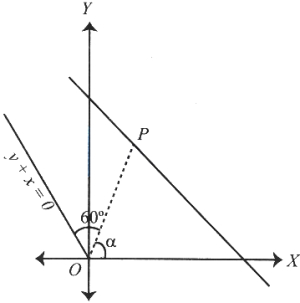
$A$ straight line $L$ at a distance of $4$ units from the origin makes positive intercepts on the coordinate axes,and the perpendicular drawn from the origin to this line makes an angle of $60^{\circ}$ with the line $x+y=0$. Then the equation of the line $L$ is
A
$(\sqrt{3}+1) x+(\sqrt{3}-1) y=8 \sqrt{2}$
B
$(\sqrt{3}-1) x+(\sqrt{3}+1) y=8 \sqrt{2}$
C
$\sqrt{3} x+y=8$
D
$x+\sqrt{3} y=8$
Solution
(B) The line $L$ is at a distance $d=4$ from the origin. Let the perpendicular from the origin to $L$ make an angle $\alpha$ with the positive $x$-axis. The equation of the line $L$ is $x \cos \alpha + y \sin \alpha = 4$.
Given that the perpendicular makes an angle of $60^{\circ}$ with the line $x+y=0$. The line $x+y=0$ makes an angle of $135^{\circ}$ with the positive $x$-axis.
Since the line $L$ makes positive intercepts,the perpendicular must lie in the first quadrant,so $0 < \alpha < 90^{\circ}$.
The angle between the perpendicular and $x+y=0$ is $135^{\circ} - \alpha = 60^{\circ}$,which gives $\alpha = 75^{\circ}$.
Now,$\cos 75^{\circ} = \cos(45^{\circ}+30^{\circ}) = \cos 45^{\circ} \cos 30^{\circ} - \sin 45^{\circ} \sin 30^{\circ} = \frac{1}{\sqrt{2}} \cdot \frac{\sqrt{3}}{2} - \frac{1}{\sqrt{2}} \cdot \frac{1}{2} = \frac{\sqrt{3}-1}{2\sqrt{2}}$.
$\sin 75^{\circ} = \sin(45^{\circ}+30^{\circ}) = \sin 45^{\circ} \cos 30^{\circ} + \cos 45^{\circ} \sin 30^{\circ} = \frac{1}{\sqrt{2}} \cdot \frac{\sqrt{3}}{2} + \frac{1}{\sqrt{2}} \cdot \frac{1}{2} = \frac{\sqrt{3}+1}{2\sqrt{2}}$.
Substituting these into the normal form equation: $x \left( \frac{\sqrt{3}-1}{2\sqrt{2}} \right) + y \left( \frac{\sqrt{3}+1}{2\sqrt{2}} \right) = 4$.
Multiplying by $2\sqrt{2}$,we get $(\sqrt{3}-1)x + (\sqrt{3}+1)y = 8\sqrt{2}$.
Given that the perpendicular makes an angle of $60^{\circ}$ with the line $x+y=0$. The line $x+y=0$ makes an angle of $135^{\circ}$ with the positive $x$-axis.
Since the line $L$ makes positive intercepts,the perpendicular must lie in the first quadrant,so $0 < \alpha < 90^{\circ}$.
The angle between the perpendicular and $x+y=0$ is $135^{\circ} - \alpha = 60^{\circ}$,which gives $\alpha = 75^{\circ}$.
Now,$\cos 75^{\circ} = \cos(45^{\circ}+30^{\circ}) = \cos 45^{\circ} \cos 30^{\circ} - \sin 45^{\circ} \sin 30^{\circ} = \frac{1}{\sqrt{2}} \cdot \frac{\sqrt{3}}{2} - \frac{1}{\sqrt{2}} \cdot \frac{1}{2} = \frac{\sqrt{3}-1}{2\sqrt{2}}$.
$\sin 75^{\circ} = \sin(45^{\circ}+30^{\circ}) = \sin 45^{\circ} \cos 30^{\circ} + \cos 45^{\circ} \sin 30^{\circ} = \frac{1}{\sqrt{2}} \cdot \frac{\sqrt{3}}{2} + \frac{1}{\sqrt{2}} \cdot \frac{1}{2} = \frac{\sqrt{3}+1}{2\sqrt{2}}$.
Substituting these into the normal form equation: $x \left( \frac{\sqrt{3}-1}{2\sqrt{2}} \right) + y \left( \frac{\sqrt{3}+1}{2\sqrt{2}} \right) = 4$.
Multiplying by $2\sqrt{2}$,we get $(\sqrt{3}-1)x + (\sqrt{3}+1)y = 8\sqrt{2}$.
0 likesView Solution
119
ChemistryMCQAP EAMCET · 2023
If the angle between the pair of lines $x^2+2 \sqrt{2} x y+k y^2=0, k>0$ is $45^{\circ}$,then the area (in square units) of the triangle formed by the pair of bisectors of the angles between these lines and the line $x+2 y+1=0$ is
A
$\frac{1}{3}$
B
$1$
C
$\frac{2}{3}$
D
$2$
Solution
(A) The given pair of lines is $x^2+2 \sqrt{2} x y+k y^2=0$. Comparing with $ax^2+2hxy+by^2=0$,we have $a=1, h=\sqrt{2}, b=k$.
The angle $\theta$ between the lines is given by $\tan \theta = \left| \frac{2\sqrt{h^2-ab}}{a+b} \right|$.
Given $\theta = 45^{\circ}$,so $\tan 45^{\circ} = 1 = \left| \frac{2\sqrt{2-k}}{1+k} \right|$.
Squaring both sides: $1 = \frac{4(2-k)}{(1+k)^2}$ $\Rightarrow (1+k)^2 = 8-4k$ $\Rightarrow 1+k^2+2k = 8-4k$ $\Rightarrow k^2+6k-7=0$.
Solving for $k$: $(k+7)(k-1)=0$. Since $k>0$,we get $k=1$.
The pair of lines is $x^2+2\sqrt{2}xy+y^2=0$. The equation of the angle bisectors is $\frac{x^2-y^2}{a-b} = \frac{xy}{h} \Rightarrow \frac{x^2-y^2}{1-1} = \frac{xy}{\sqrt{2}}$,which is not the standard form. Using $\frac{x^2-y^2}{a-b} = \frac{xy}{h}$ is invalid when $a=b$. The correct bisector equation is $h(x^2-y^2) = (a-b)xy$. Since $a=b=1$,we have $0 = \sqrt{2}(x^2-y^2)$,so $x^2-y^2=0$,which gives $x-y=0$ and $x+y=0$.
The triangle is formed by $x-y=0, x+y=0$ and $x+2y+1=0$. The vertices are $(0,0)$,$(-1,0)$,and $(-1/3, -1/3)$.
The area is $\frac{1}{2} |x_1(y_2-y_3) + x_2(y_3-y_1) + x_3(y_1-y_2)| = \frac{1}{2} |0 + (-1)(-1/3-0) + (-1/3)(0-0)| = \frac{1}{2} |1/3| = \frac{1}{6}$.
The angle $\theta$ between the lines is given by $\tan \theta = \left| \frac{2\sqrt{h^2-ab}}{a+b} \right|$.
Given $\theta = 45^{\circ}$,so $\tan 45^{\circ} = 1 = \left| \frac{2\sqrt{2-k}}{1+k} \right|$.
Squaring both sides: $1 = \frac{4(2-k)}{(1+k)^2}$ $\Rightarrow (1+k)^2 = 8-4k$ $\Rightarrow 1+k^2+2k = 8-4k$ $\Rightarrow k^2+6k-7=0$.
Solving for $k$: $(k+7)(k-1)=0$. Since $k>0$,we get $k=1$.
The pair of lines is $x^2+2\sqrt{2}xy+y^2=0$. The equation of the angle bisectors is $\frac{x^2-y^2}{a-b} = \frac{xy}{h} \Rightarrow \frac{x^2-y^2}{1-1} = \frac{xy}{\sqrt{2}}$,which is not the standard form. Using $\frac{x^2-y^2}{a-b} = \frac{xy}{h}$ is invalid when $a=b$. The correct bisector equation is $h(x^2-y^2) = (a-b)xy$. Since $a=b=1$,we have $0 = \sqrt{2}(x^2-y^2)$,so $x^2-y^2=0$,which gives $x-y=0$ and $x+y=0$.
The triangle is formed by $x-y=0, x+y=0$ and $x+2y+1=0$. The vertices are $(0,0)$,$(-1,0)$,and $(-1/3, -1/3)$.
The area is $\frac{1}{2} |x_1(y_2-y_3) + x_2(y_3-y_1) + x_3(y_1-y_2)| = \frac{1}{2} |0 + (-1)(-1/3-0) + (-1/3)(0-0)| = \frac{1}{2} |1/3| = \frac{1}{6}$.
0 likesView Solution
120
ChemistryMCQAP EAMCET · 2023
Let $a, b, c$ and $d$ be non-zero numbers. If the point of intersection of the lines $4ax + 2ay + c = 0$ and $5bx + 2by + d = 0$ lies in the fourth quadrant and is equidistant from the two coordinate axes,then
A
$3bc - 2ad = 0$
B
$3bc + 2ad = 0$
C
$2bc - 3ad = 0$
D
$2bc + 3ad = 0$
Solution
(A) Given lines are $4ax + 2ay + c = 0$ $(i)$ and $5bx + 2by + d = 0$ (ii).
Multiply $(i)$ by $b$ and (ii) by $a$:
$4abx + 2aby + bc = 0$ (iii)
$5abx + 2aby + ad = 0$ (iv)
Subtracting (iii) from (iv):
$(5ab - 4ab)x + (ad - bc) = 0$ $\Rightarrow abx = bc - ad$ $\Rightarrow x = \frac{bc - ad}{ab}$.
Substitute $x$ into (ii):
$5b(\frac{bc - ad}{ab}) + 2by + d = 0 \Rightarrow \frac{5(bc - ad)}{a} + 2by + d = 0$.
$2by = -d - \frac{5bc - 5ad}{a} = \frac{-ad - 5bc + 5ad}{a} = \frac{4ad - 5bc}{a}$.
$y = \frac{4ad - 5bc}{2ab}$.
The point $P(x, y)$ is in the fourth quadrant,so $x > 0$ and $y < 0$. Since it is equidistant from the axes,$|x| = |y|$,which implies $x = -y$ (since $y < 0$).
$\frac{bc - ad}{ab} = -(\frac{4ad - 5bc}{2ab}) \Rightarrow \frac{bc - ad}{ab} = \frac{5bc - 4ad}{2ab}$.
$2(bc - ad) = 5bc - 4ad \Rightarrow 2bc - 2ad = 5bc - 4ad$.
$2ad = 3bc \Rightarrow 3bc - 2ad = 0$.
Multiply $(i)$ by $b$ and (ii) by $a$:
$4abx + 2aby + bc = 0$ (iii)
$5abx + 2aby + ad = 0$ (iv)
Subtracting (iii) from (iv):
$(5ab - 4ab)x + (ad - bc) = 0$ $\Rightarrow abx = bc - ad$ $\Rightarrow x = \frac{bc - ad}{ab}$.
Substitute $x$ into (ii):
$5b(\frac{bc - ad}{ab}) + 2by + d = 0 \Rightarrow \frac{5(bc - ad)}{a} + 2by + d = 0$.
$2by = -d - \frac{5bc - 5ad}{a} = \frac{-ad - 5bc + 5ad}{a} = \frac{4ad - 5bc}{a}$.
$y = \frac{4ad - 5bc}{2ab}$.
The point $P(x, y)$ is in the fourth quadrant,so $x > 0$ and $y < 0$. Since it is equidistant from the axes,$|x| = |y|$,which implies $x = -y$ (since $y < 0$).
$\frac{bc - ad}{ab} = -(\frac{4ad - 5bc}{2ab}) \Rightarrow \frac{bc - ad}{ab} = \frac{5bc - 4ad}{2ab}$.
$2(bc - ad) = 5bc - 4ad \Rightarrow 2bc - 2ad = 5bc - 4ad$.
$2ad = 3bc \Rightarrow 3bc - 2ad = 0$.
0 likesView Solution
121
ChemistryMCQAP EAMCET · 2023
If $ad \neq 0$ and two of the lines represented by $ax^3+3bx^2y+3cxy^2+dy^3=0$ are perpendicular,then
A
$a^2+ac+bd+d^2=0$
B
$a^2+3ac+3bd+d^2=0$
C
$a^2-3ac-3bd+d^2=0$
D
$a^2+3ac-3bd+d^2=0$
Solution
(B) The given equation is $ax^3+3bx^2y+3cxy^2+dy^3=0$.
Dividing by $x^3$ and letting $m = \frac{y}{x}$,we get the auxiliary equation:
$dm^3+3cm^2+3bm+a=0$.
Let the roots be $m_1, m_2, m_3$.
The product of the roots is $m_1 m_2 m_3 = -\frac{a}{d}$.
Since two lines are perpendicular,let $m_1 m_2 = -1$.
Substituting this into the product,we get $(-1)m_3 = -\frac{a}{d}$,so $m_3 = \frac{a}{d}$.
Since $m_3$ is a root of the auxiliary equation,it must satisfy it:
$d(\frac{a}{d})^3 + 3c(\frac{a}{d})^2 + 3b(\frac{a}{d}) + a = 0$.
Multiplying by $d^2$,we get $\frac{a^3}{d^2} + \frac{3ca^2}{d} + 3ba + ad = 0$.
Multiplying by $d^2$ again (or simplifying the expression),we obtain $a^3+3a^2c+3abd+ad^2=0$.
Dividing by $a$ (since $a \neq 0$),we get $a^2+3ac+3bd+d^2=0$.
Dividing by $x^3$ and letting $m = \frac{y}{x}$,we get the auxiliary equation:
$dm^3+3cm^2+3bm+a=0$.
Let the roots be $m_1, m_2, m_3$.
The product of the roots is $m_1 m_2 m_3 = -\frac{a}{d}$.
Since two lines are perpendicular,let $m_1 m_2 = -1$.
Substituting this into the product,we get $(-1)m_3 = -\frac{a}{d}$,so $m_3 = \frac{a}{d}$.
Since $m_3$ is a root of the auxiliary equation,it must satisfy it:
$d(\frac{a}{d})^3 + 3c(\frac{a}{d})^2 + 3b(\frac{a}{d}) + a = 0$.
Multiplying by $d^2$,we get $\frac{a^3}{d^2} + \frac{3ca^2}{d} + 3ba + ad = 0$.
Multiplying by $d^2$ again (or simplifying the expression),we obtain $a^3+3a^2c+3abd+ad^2=0$.
Dividing by $a$ (since $a \neq 0$),we get $a^2+3ac+3bd+d^2=0$.
0 likesView Solution
122
ChemistryMCQAP EAMCET · 2023
The absolute value of the tangent of the difference of the angles made by the lines $4x^2 - 24xy + 11y^2 = 0$ with the $X$-axis is
A
$\frac{4}{11}$
B
$\frac{24}{11}$
C
$\frac{4}{3}$
D
$\frac{11}{24}$
Solution
(C) Given the equation of the pair of lines is $4x^2 - 24xy + 11y^2 = 0$.
Factorizing the equation: $4x^2 - 22xy - 2xy + 11y^2 = 0$ $\Rightarrow 2x(2x - 11y) - y(2x - 11y) = 0$ $\Rightarrow (2x - y)(2x - 11y) = 0$.
Thus,the lines are $2x - y = 0$ and $2x - 11y = 0$.
The slopes of these lines are $m_1 = 2$ and $m_2 = \frac{2}{11}$.
Let $\theta_1$ and $\theta_2$ be the angles made by these lines with the $X$-axis,so $\tan \theta_1 = 2$ and $\tan \theta_2 = \frac{2}{11}$.
We need to find $\tan |\theta_1 - \theta_2| = \left| \frac{\tan \theta_1 - \tan \theta_2}{1 + \tan \theta_1 \tan \theta_2} \right|$.
Substituting the values: $\left| \frac{2 - \frac{2}{11}}{1 + 2 \times \frac{2}{11}} \right| = \left| \frac{\frac{22 - 2}{11}}{\frac{11 + 4}{11}} \right| = \left| \frac{20}{15} \right| = \frac{4}{3}$.
Factorizing the equation: $4x^2 - 22xy - 2xy + 11y^2 = 0$ $\Rightarrow 2x(2x - 11y) - y(2x - 11y) = 0$ $\Rightarrow (2x - y)(2x - 11y) = 0$.
Thus,the lines are $2x - y = 0$ and $2x - 11y = 0$.
The slopes of these lines are $m_1 = 2$ and $m_2 = \frac{2}{11}$.
Let $\theta_1$ and $\theta_2$ be the angles made by these lines with the $X$-axis,so $\tan \theta_1 = 2$ and $\tan \theta_2 = \frac{2}{11}$.
We need to find $\tan |\theta_1 - \theta_2| = \left| \frac{\tan \theta_1 - \tan \theta_2}{1 + \tan \theta_1 \tan \theta_2} \right|$.
Substituting the values: $\left| \frac{2 - \frac{2}{11}}{1 + 2 \times \frac{2}{11}} \right| = \left| \frac{\frac{22 - 2}{11}}{\frac{11 + 4}{11}} \right| = \left| \frac{20}{15} \right| = \frac{4}{3}$.
0 likesView Solution
123
ChemistryMCQAP EAMCET · 2023
If $A+2 B=\begin{bmatrix} 1 & 2 & 0 \\ 6 & -3 & 3 \\ -5 & 3 & 1 \end{bmatrix}$ and $2 A-B=\begin{bmatrix} 2 & -1 & 5 \\ 2 & -1 & 6 \\ 0 & 1 & 2 \end{bmatrix}$,then $\operatorname{Tr}(A)-\operatorname{Tr}(B) = $
A
$1$
B
$2$
C
$3$
D
$4$
Solution
(B) Given equations are:
$A+2B = \begin{bmatrix} 1 & 2 & 0 \\ 6 & -3 & 3 \\ -5 & 3 & 1 \end{bmatrix}$ ... $(i)$
$2A-B = \begin{bmatrix} 2 & -1 & 5 \\ 2 & -1 & 6 \\ 0 & 1 & 2 \end{bmatrix}$ ... $(ii)$
Multiply equation $(ii)$ by $2$:
$4A-2B = \begin{bmatrix} 4 & -2 & 10 \\ 4 & -2 & 12 \\ 0 & 2 & 4 \end{bmatrix}$ ... $(iii)$
Adding $(i)$ and $(iii)$:
$5A = \begin{bmatrix} 1+4 & 2-2 & 0+10 \\ 6+4 & -3-2 & 3+12 \\ -5+0 & 3+2 & 1+4 \end{bmatrix} = \begin{bmatrix} 5 & 0 & 10 \\ 10 & -5 & 15 \\ -5 & 5 & 5 \end{bmatrix}$
$A = \begin{bmatrix} 1 & 0 & 2 \\ 2 & -1 & 3 \\ -1 & 1 & 1 \end{bmatrix}$
$\operatorname{Tr}(A) = 1 + (-1) + 1 = 1$
From $(i)$,$2B = (A+2B) - A = \begin{bmatrix} 1 & 2 & 0 \\ 6 & -3 & 3 \\ -5 & 3 & 1 \end{bmatrix} - \begin{bmatrix} 1 & 0 & 2 \\ 2 & -1 & 3 \\ -1 & 1 & 1 \end{bmatrix} = \begin{bmatrix} 0 & 2 & -2 \\ 4 & -2 & 0 \\ -4 & 2 & 0 \end{bmatrix}$
$B = \begin{bmatrix} 0 & 1 & -1 \\ 2 & -1 & 0 \\ -2 & 1 & 0 \end{bmatrix}$
$\operatorname{Tr}(B) = 0 + (-1) + 0 = -1$
Therefore,$\operatorname{Tr}(A) - \operatorname{Tr}(B) = 1 - (-1) = 2$.
$A+2B = \begin{bmatrix} 1 & 2 & 0 \\ 6 & -3 & 3 \\ -5 & 3 & 1 \end{bmatrix}$ ... $(i)$
$2A-B = \begin{bmatrix} 2 & -1 & 5 \\ 2 & -1 & 6 \\ 0 & 1 & 2 \end{bmatrix}$ ... $(ii)$
Multiply equation $(ii)$ by $2$:
$4A-2B = \begin{bmatrix} 4 & -2 & 10 \\ 4 & -2 & 12 \\ 0 & 2 & 4 \end{bmatrix}$ ... $(iii)$
Adding $(i)$ and $(iii)$:
$5A = \begin{bmatrix} 1+4 & 2-2 & 0+10 \\ 6+4 & -3-2 & 3+12 \\ -5+0 & 3+2 & 1+4 \end{bmatrix} = \begin{bmatrix} 5 & 0 & 10 \\ 10 & -5 & 15 \\ -5 & 5 & 5 \end{bmatrix}$
$A = \begin{bmatrix} 1 & 0 & 2 \\ 2 & -1 & 3 \\ -1 & 1 & 1 \end{bmatrix}$
$\operatorname{Tr}(A) = 1 + (-1) + 1 = 1$
From $(i)$,$2B = (A+2B) - A = \begin{bmatrix} 1 & 2 & 0 \\ 6 & -3 & 3 \\ -5 & 3 & 1 \end{bmatrix} - \begin{bmatrix} 1 & 0 & 2 \\ 2 & -1 & 3 \\ -1 & 1 & 1 \end{bmatrix} = \begin{bmatrix} 0 & 2 & -2 \\ 4 & -2 & 0 \\ -4 & 2 & 0 \end{bmatrix}$
$B = \begin{bmatrix} 0 & 1 & -1 \\ 2 & -1 & 0 \\ -2 & 1 & 0 \end{bmatrix}$
$\operatorname{Tr}(B) = 0 + (-1) + 0 = -1$
Therefore,$\operatorname{Tr}(A) - \operatorname{Tr}(B) = 1 - (-1) = 2$.
0 likesView Solution
124
ChemistryMCQAP EAMCET · 2023
$\int_0^{\frac{\pi}{4}} \frac{\cos ^2 x}{\cos ^2 x+4 \sin ^2 x} d x=$
A
$\frac{\pi}{4}+\frac{2}{3} \tan ^{-1} 2$
B
$-\frac{\pi}{3}-\frac{2}{3} \tan ^{-1} 3$
C
$-\frac{\pi}{12}+\frac{2}{3} \tan ^{-1} 2$
D
$\frac{\pi}{6}-\frac{2}{3} \tan ^{-1} 4$
Solution
(C) Let $I = \int_0^{\frac{\pi}{4}} \frac{\cos^2 x}{\cos^2 x + 4\sin^2 x} dx$.
Divide the numerator and denominator by $\cos^2 x$:
$I = \int_0^{\frac{\pi}{4}} \frac{1}{1 + 4\tan^2 x} dx$.
Let $u = \tan x$,then $du = \sec^2 x dx$. Since $\sec^2 x = 1 + \tan^2 x = 1 + u^2$,we have $dx = \frac{du}{1+u^2}$.
When $x = 0, u = 0$. When $x = \frac{\pi}{4}, u = 1$.
$I = \int_0^1 \frac{1}{(1+4u^2)(1+u^2)} du$.
Using partial fractions: $\frac{1}{(1+4u^2)(1+u^2)} = \frac{A}{1+4u^2} + \frac{B}{1+u^2}$.
$1 = A(1+u^2) + B(1+4u^2)$.
For $u^2 = -1, 1 = B(1-4) \Rightarrow B = -\frac{1}{3}$.
For $u^2 = -\frac{1}{4}, 1 = A(1-\frac{1}{4}) \Rightarrow A = \frac{4}{3}$.
$I = \int_0^1 (\frac{4/3}{1+4u^2} - \frac{1/3}{1+u^2}) du = [\frac{4}{3} \cdot \frac{1}{2} \tan^{-1}(2u) - \frac{1}{3} \tan^{-1}(u)]_0^1$.
$I = [\frac{2}{3} \tan^{-1}(2u) - \frac{1}{3} \tan^{-1}(u)]_0^1 = \frac{2}{3} \tan^{-1}(2) - \frac{1}{3} \tan^{-1}(1) = \frac{2}{3} \tan^{-1}(2) - \frac{1}{3} \cdot \frac{\pi}{4} = \frac{2}{3} \tan^{-1}(2) - \frac{\pi}{12}$.
Divide the numerator and denominator by $\cos^2 x$:
$I = \int_0^{\frac{\pi}{4}} \frac{1}{1 + 4\tan^2 x} dx$.
Let $u = \tan x$,then $du = \sec^2 x dx$. Since $\sec^2 x = 1 + \tan^2 x = 1 + u^2$,we have $dx = \frac{du}{1+u^2}$.
When $x = 0, u = 0$. When $x = \frac{\pi}{4}, u = 1$.
$I = \int_0^1 \frac{1}{(1+4u^2)(1+u^2)} du$.
Using partial fractions: $\frac{1}{(1+4u^2)(1+u^2)} = \frac{A}{1+4u^2} + \frac{B}{1+u^2}$.
$1 = A(1+u^2) + B(1+4u^2)$.
For $u^2 = -1, 1 = B(1-4) \Rightarrow B = -\frac{1}{3}$.
For $u^2 = -\frac{1}{4}, 1 = A(1-\frac{1}{4}) \Rightarrow A = \frac{4}{3}$.
$I = \int_0^1 (\frac{4/3}{1+4u^2} - \frac{1/3}{1+u^2}) du = [\frac{4}{3} \cdot \frac{1}{2} \tan^{-1}(2u) - \frac{1}{3} \tan^{-1}(u)]_0^1$.
$I = [\frac{2}{3} \tan^{-1}(2u) - \frac{1}{3} \tan^{-1}(u)]_0^1 = \frac{2}{3} \tan^{-1}(2) - \frac{1}{3} \tan^{-1}(1) = \frac{2}{3} \tan^{-1}(2) - \frac{1}{3} \cdot \frac{\pi}{4} = \frac{2}{3} \tan^{-1}(2) - \frac{\pi}{12}$.
0 likesView Solution
125
ChemistryMCQAP EAMCET · 2023
The magnifying power of a telescope with tube length $60 \ cm$ is $5$. Then the focal length of its eyepiece is: (in $cm$)
A
$20$
B
$40$
C
$30$
D
$10$
Solution
(D) The magnifying power $m$ of an astronomical telescope in normal adjustment is given by $m = \frac{f_o}{f_e} = 5$,where $f_o$ is the focal length of the objective lens and $f_e$ is the focal length of the eyepiece.
From this,we get $f_o = 5f_e$.
The length of the telescope tube $L$ is given by $L = f_o + f_e = 60 \ cm$.
Substituting $f_o = 5f_e$ into the length equation:
$5f_e + f_e = 60 \ cm$
$6f_e = 60 \ cm$
$f_e = 10 \ cm$.
Therefore,the focal length of the eyepiece is $10 \ cm$.
From this,we get $f_o = 5f_e$.
The length of the telescope tube $L$ is given by $L = f_o + f_e = 60 \ cm$.
Substituting $f_o = 5f_e$ into the length equation:
$5f_e + f_e = 60 \ cm$
$6f_e = 60 \ cm$
$f_e = 10 \ cm$.
Therefore,the focal length of the eyepiece is $10 \ cm$.
0 likesView Solution
126
ChemistryMCQAP EAMCET · 2023
The diameter of the objective lens of a telescope is $250 \ cm$. For light of wavelength $600 \ nm$ coming from a distant object,the limit of resolution of the telescope is close to:
A
$1.5 \times 10^{-7} \ rad$
B
$2.0 \times 10^{-7} \ rad$
C
$3.0 \times 10^{-7} \ rad$
D
$4.5 \times 10^{-7} \ rad$
Solution
(C) The limit of resolution of a telescope is given by the formula: $\Delta \theta = \frac{1.22 \lambda}{d}$
Given:
Wavelength $\lambda = 600 \ nm = 600 \times 10^{-9} \ m$
Diameter $d = 250 \ cm = 250 \times 10^{-2} \ m = 2.5 \ m$
Substituting the values:
$\Delta \theta = \frac{1.22 \times 600 \times 10^{-9}}{2.5}$
$\Delta \theta = \frac{732 \times 10^{-9}}{2.5}$
$\Delta \theta = 292.8 \times 10^{-9} \ rad \approx 3 \times 10^{-7} \ rad$
Given:
Wavelength $\lambda = 600 \ nm = 600 \times 10^{-9} \ m$
Diameter $d = 250 \ cm = 250 \times 10^{-2} \ m = 2.5 \ m$
Substituting the values:
$\Delta \theta = \frac{1.22 \times 600 \times 10^{-9}}{2.5}$
$\Delta \theta = \frac{732 \times 10^{-9}}{2.5}$
$\Delta \theta = 292.8 \times 10^{-9} \ rad \approx 3 \times 10^{-7} \ rad$
0 likesView Solution
127
ChemistryMediumMCQAP EAMCET · 2023
Observe the following reaction:
$Cl_{2(g)} + 2OH^{-}_{(aq)} \rightarrow ClO^{-}_{(aq)} + Cl^{-}_{(aq)} + H_2O_{(l)}$
Identify the correct statements about this reaction:
$I$. $Cl_{2(g)}$ is oxidized to $ClO^{-}_{(aq)}$
$II$. $Cl_{2(g)}$ is oxidized to $Cl^{-}_{(aq)}$
$III$. $Cl_{2(g)}$ is reduced to $ClO^{-}_{(aq)}$
$IV$. $Cl_{2(g)}$ is reduced to $Cl^{-}_{(aq)}$
The correct answer is:
$Cl_{2(g)} + 2OH^{-}_{(aq)} \rightarrow ClO^{-}_{(aq)} + Cl^{-}_{(aq)} + H_2O_{(l)}$
Identify the correct statements about this reaction:
$I$. $Cl_{2(g)}$ is oxidized to $ClO^{-}_{(aq)}$
$II$. $Cl_{2(g)}$ is oxidized to $Cl^{-}_{(aq)}$
$III$. $Cl_{2(g)}$ is reduced to $ClO^{-}_{(aq)}$
$IV$. $Cl_{2(g)}$ is reduced to $Cl^{-}_{(aq)}$
The correct answer is:
A
$I, IV$ only
B
$I, III$ only
C
$I, II, IV$ only
D
$II, III$ only
Solution
(A) In the given reaction,the oxidation state of $Cl$ in $Cl_2$ is $0$.
In $ClO^{-}$,the oxidation state of $Cl$ is $+1$. Since the oxidation state increases from $0$ to $+1$,$Cl_2$ is oxidized to $ClO^{-}$. (Statement $I$ is correct).
In $Cl^{-}$,the oxidation state of $Cl$ is $-1$. Since the oxidation state decreases from $0$ to $-1$,$Cl_2$ is reduced to $Cl^{-}$. (Statement $IV$ is correct).
Therefore,statements $I$ and $IV$ are correct.
In $ClO^{-}$,the oxidation state of $Cl$ is $+1$. Since the oxidation state increases from $0$ to $+1$,$Cl_2$ is oxidized to $ClO^{-}$. (Statement $I$ is correct).
In $Cl^{-}$,the oxidation state of $Cl$ is $-1$. Since the oxidation state decreases from $0$ to $-1$,$Cl_2$ is reduced to $Cl^{-}$. (Statement $IV$ is correct).
Therefore,statements $I$ and $IV$ are correct.
0 likesView Solution
128
ChemistryEasyMCQAP EAMCET · 2023
Identify the reactions in which $H_2O$ is oxidised:
$I$. Photosynthesis
$II$. Reaction of $H_2O$ with fluorine
$III$. Reaction of $H_2O$ with hydrogen
$IV$. Reaction of $H_2O$ with $P_4O_{10}$
The correct answer is
$I$. Photosynthesis
$II$. Reaction of $H_2O$ with fluorine
$III$. Reaction of $H_2O$ with hydrogen
$IV$. Reaction of $H_2O$ with $P_4O_{10}$
The correct answer is
A
$I, II$
B
$I, III$
C
$II, IV$
D
$III, IV$
Solution
(A) In photosynthesis $(I)$: $6CO_2 + 6H_2O \xrightarrow{h\nu} C_6H_{12}O_6 + 6O_2$. Here,the oxidation state of oxygen changes from $-2$ in $H_2O$ to $0$ in $O_2$,so $H_2O$ is oxidised.
In the reaction of $H_2O$ with fluorine $(II)$: $2H_2O + 2F_2 \rightarrow 4HF + O_2$. Here,the oxidation state of oxygen changes from $-2$ in $H_2O$ to $0$ in $O_2$,so $H_2O$ is oxidised.
In the reaction of $H_2O$ with hydrogen $(III)$: No reaction occurs.
In the reaction of $H_2O$ with $P_4O_{10}$ $(IV)$: $P_4O_{10} + 6H_2O \rightarrow 4H_3PO_4$. This is a hydrolysis reaction,not a redox reaction.
Therefore,$H_2O$ is oxidised in reactions $I$ and $II$.
In the reaction of $H_2O$ with fluorine $(II)$: $2H_2O + 2F_2 \rightarrow 4HF + O_2$. Here,the oxidation state of oxygen changes from $-2$ in $H_2O$ to $0$ in $O_2$,so $H_2O$ is oxidised.
In the reaction of $H_2O$ with hydrogen $(III)$: No reaction occurs.
In the reaction of $H_2O$ with $P_4O_{10}$ $(IV)$: $P_4O_{10} + 6H_2O \rightarrow 4H_3PO_4$. This is a hydrolysis reaction,not a redox reaction.
Therefore,$H_2O$ is oxidised in reactions $I$ and $II$.
0 likesView Solution
129
ChemistryMediumMCQAP EAMCET · 2023
Observe the following reaction:
$xS_{8\text{(s)}} + yOH^{-}{_{\text{(aq)}}} \rightarrow zS^{2-}{_{\text{(aq)}}} + 2S_2O_3^{2-}{_{\text{(aq)}}} + 6H_2O_{\text{(l)}}$
Find the values of $x, y$ and $z$ respectively.
$xS_{8\text{(s)}} + yOH^{-}{_{\text{(aq)}}} \rightarrow zS^{2-}{_{\text{(aq)}}} + 2S_2O_3^{2-}{_{\text{(aq)}}} + 6H_2O_{\text{(l)}}$
Find the values of $x, y$ and $z$ respectively.
A
$1, 12, 4$
B
$1, 12, 2$
C
$1, 4, 12$
D
$2, 12, 2$
Solution
(A) The given reaction is a disproportionation reaction of sulfur $(S_8)$.
To balance the reaction $xS_8 + yOH^- \rightarrow zS^{2-} + 2S_2O_3^{2-} + 6H_2O$:
Step $1$: Balance sulfur atoms. There are $8$ sulfur atoms on the left. On the right,there are $z$ atoms in $S^{2-}$ and $2 \times 2 = 4$ atoms in $2S_2O_3^{2-}$. Thus,$z + 4 = 8$,which gives $z = 4$.
Step $2$: Balance oxygen atoms. There are $y$ oxygen atoms on the left. On the right,there are $2 \times 3 = 6$ atoms in $2S_2O_3^{2-}$ and $6$ atoms in $6H_2O$. Thus,$y = 6 + 6 = 12$.
Step $3$: Balance hydrogen atoms. There are $y$ hydrogen atoms on the left and $6 \times 2 = 12$ on the right. This confirms $y = 12$.
Step $4$: The coefficient $x$ for $S_8$ is $1$ to satisfy the sulfur balance.
Therefore,$x = 1, y = 12, z = 4$.
To balance the reaction $xS_8 + yOH^- \rightarrow zS^{2-} + 2S_2O_3^{2-} + 6H_2O$:
Step $1$: Balance sulfur atoms. There are $8$ sulfur atoms on the left. On the right,there are $z$ atoms in $S^{2-}$ and $2 \times 2 = 4$ atoms in $2S_2O_3^{2-}$. Thus,$z + 4 = 8$,which gives $z = 4$.
Step $2$: Balance oxygen atoms. There are $y$ oxygen atoms on the left. On the right,there are $2 \times 3 = 6$ atoms in $2S_2O_3^{2-}$ and $6$ atoms in $6H_2O$. Thus,$y = 6 + 6 = 12$.
Step $3$: Balance hydrogen atoms. There are $y$ hydrogen atoms on the left and $6 \times 2 = 12$ on the right. This confirms $y = 12$.
Step $4$: The coefficient $x$ for $S_8$ is $1$ to satisfy the sulfur balance.
Therefore,$x = 1, y = 12, z = 4$.
0 likesView Solution
130
ChemistryDifficultMCQAP EAMCET · 2023
What are $x, y$ and $z$ respectively in the following reaction?
$xFe^{2+}{_{\text{(aq)}}} + yH^{+}{_{\text{(aq)}}} + zCr_2O_7^{2-}{_{\text{(aq)}}} \rightarrow \frac{y}{2}H_2O_{\text{(l)}} + xFe^{3+}{_{\text{(aq)}}} + 2zCr^{3+}{_{\text{(aq)}}}$
$xFe^{2+}{_{\text{(aq)}}} + yH^{+}{_{\text{(aq)}}} + zCr_2O_7^{2-}{_{\text{(aq)}}} \rightarrow \frac{y}{2}H_2O_{\text{(l)}} + xFe^{3+}{_{\text{(aq)}}} + 2zCr^{3+}{_{\text{(aq)}}}$
A
$6, 14, 1$
B
$14, 6, 1$
C
$6, 1, 14$
D
$1, 14, 6$
Solution
(A) To balance the redox reaction,we use the ion-electron method.
Oxidation half-reaction: $Fe^{2+} \rightarrow Fe^{3+} + e^-$
Reduction half-reaction: $Cr_2 O_7^{2-} + 14 H^{+} + 6 e^- \rightarrow 2 Cr^{3+} + 7 H_2 O$
Multiplying the oxidation half-reaction by $6$ to balance the electrons:
$6 Fe^{2+} \rightarrow 6 Fe^{3+} + 6 e^-$
Adding both half-reactions:
$6 Fe^{2+} + Cr_2 O_7^{2-} + 14 H^{+} \rightarrow 6 Fe^{3+} + 2 Cr^{3+} + 7 H_2 O$
Comparing this with the given equation $x Fe^{2+} + y H^{+} + z Cr_2 O_7^{2-} \rightarrow \frac{y}{2} H_2 O + x Fe^{3+} + 2 z Cr^{3+}$,we get $x = 6, y = 14, z = 1$.
Oxidation half-reaction: $Fe^{2+} \rightarrow Fe^{3+} + e^-$
Reduction half-reaction: $Cr_2 O_7^{2-} + 14 H^{+} + 6 e^- \rightarrow 2 Cr^{3+} + 7 H_2 O$
Multiplying the oxidation half-reaction by $6$ to balance the electrons:
$6 Fe^{2+} \rightarrow 6 Fe^{3+} + 6 e^-$
Adding both half-reactions:
$6 Fe^{2+} + Cr_2 O_7^{2-} + 14 H^{+} \rightarrow 6 Fe^{3+} + 2 Cr^{3+} + 7 H_2 O$
Comparing this with the given equation $x Fe^{2+} + y H^{+} + z Cr_2 O_7^{2-} \rightarrow \frac{y}{2} H_2 O + x Fe^{3+} + 2 z Cr^{3+}$,we get $x = 6, y = 14, z = 1$.
0 likesView Solution
131
ChemistryMediumMCQAP EAMCET · 2023
Observe the following reaction:
$aP_4{_{\text{(s)}}} + bOH^{-}{_{\text{(aq)}}} + cH_2O_{\text{(l)}} \rightarrow dPH_3{_{\text{(g)}}} + eH_2PO_2^{-}{_{\text{(aq)}}}$
The values of $a, b, c,$ and $d$ are respectively:
$aP_4{_{\text{(s)}}} + bOH^{-}{_{\text{(aq)}}} + cH_2O_{\text{(l)}} \rightarrow dPH_3{_{\text{(g)}}} + eH_2PO_2^{-}{_{\text{(aq)}}}$
The values of $a, b, c,$ and $d$ are respectively:
A
$1, 3, 3, 1$
B
$1, 3, 2, 3$
C
$3, 1, 3, 1$
D
$1, 3, 1, 3$
Solution
(D) The given reaction is a disproportionation reaction where $P_4$ is both oxidized and reduced.
Step $1$: Write the half-reactions.
Reduction: $P_4 \rightarrow PH_3$
Oxidation: $P_4 \rightarrow H_2 PO_2^-$
Step $2$: Balance the atoms and charges.
Reduction: $P_4 + 3 H_2 O + 3 e^- \rightarrow PH_3 + 3 OH^-$
Oxidation: $P_4 + 8 OH^- \rightarrow 4 H_2 PO_2^- + 4 e^-$
Step $3$: Multiply to equalize electrons and add the equations.
$4(P_4 + 3 H_2 O + 3 e^-$ $\rightarrow PH_3 + 3 OH^-)$ $\Rightarrow 4 P_4 + 12 H_2 O + 12 e^-$ $\rightarrow 4 PH_3 + 12 OH^-$
$3(P_4 + 8 OH^-$ $\rightarrow 4 H_2 PO_2^- + 4 e^-)$ $\Rightarrow 3 P_4 + 24 OH^-$ $\rightarrow 12 H_2 PO_2^- + 12 e^-$
Summing them: $7 P_4 + 12 H_2 O + 12 OH^- \rightarrow 4 PH_3 + 12 H_2 PO_2^-$
Dividing by $4$: $1 P_4 + 3 OH^- + 3 H_2 O \rightarrow 1 PH_3 + 3 H_2 PO_2^-$
Thus,$a=1, b=3, c=1, d=3$.
Step $1$: Write the half-reactions.
Reduction: $P_4 \rightarrow PH_3$
Oxidation: $P_4 \rightarrow H_2 PO_2^-$
Step $2$: Balance the atoms and charges.
Reduction: $P_4 + 3 H_2 O + 3 e^- \rightarrow PH_3 + 3 OH^-$
Oxidation: $P_4 + 8 OH^- \rightarrow 4 H_2 PO_2^- + 4 e^-$
Step $3$: Multiply to equalize electrons and add the equations.
$4(P_4 + 3 H_2 O + 3 e^-$ $\rightarrow PH_3 + 3 OH^-)$ $\Rightarrow 4 P_4 + 12 H_2 O + 12 e^-$ $\rightarrow 4 PH_3 + 12 OH^-$
$3(P_4 + 8 OH^-$ $\rightarrow 4 H_2 PO_2^- + 4 e^-)$ $\Rightarrow 3 P_4 + 24 OH^-$ $\rightarrow 12 H_2 PO_2^- + 12 e^-$
Summing them: $7 P_4 + 12 H_2 O + 12 OH^- \rightarrow 4 PH_3 + 12 H_2 PO_2^-$
Dividing by $4$: $1 P_4 + 3 OH^- + 3 H_2 O \rightarrow 1 PH_3 + 3 H_2 PO_2^-$
Thus,$a=1, b=3, c=1, d=3$.
0 likesView Solution
132
ChemistryEasyMCQAP EAMCET · 2023
White metal is an alloy of
A
$Li \& Mg$
B
$Li \& Pb$
C
$Pb \& Sn$
D
$Pb \& Al$
Solution
(B) White metal is an alloy consisting of $Li$ (Lithium) and $Pb$ (Lead).
Therefore,the correct option is $B$.
Therefore,the correct option is $B$.
0 likesView Solution
133
ChemistryEasyMCQAP EAMCET · 2023
Consider the elements $Ne$,$Na$,and $Mg$. The element with the highest first ionization enthalpy and the element with the lowest second ionization enthalpy,respectively,are:
A
$Na$,$Ne$
B
$Ne$,$Mg$
C
$Na$,$Na$
D
$Mg$,$Na$
Solution
(B) The electronic configurations are:
$_{10}Ne = 1s^2 2s^2 2p^6$
$_{11}Na = 1s^2 2s^2 2p^6 3s^1$
$_{12}Mg = 1s^2 2s^2 2p^6 3s^2$
$1$. Highest first ionization enthalpy: $Ne$ has the highest first ionization enthalpy because it is a noble gas with a stable,fully-filled valence shell $(2s^2 2p^6)$.
$2$. Lowest second ionization enthalpy: The second ionization enthalpy involves removing an electron from a unipositive ion.
For $Na^+$,the configuration becomes $1s^2 2s^2 2p^6$ (stable noble gas configuration),making the second ionization enthalpy very high.
For $Mg^+$,the configuration is $1s^2 2s^2 2p^6 3s^1$. Removing the second electron from $Mg^+$ leads to the stable $Mg^{2+}$ ion $(1s^2 2s^2 2p^6)$,which is energetically favorable. Thus,$Mg$ has the lowest second ionization enthalpy among the given elements.
$_{10}Ne = 1s^2 2s^2 2p^6$
$_{11}Na = 1s^2 2s^2 2p^6 3s^1$
$_{12}Mg = 1s^2 2s^2 2p^6 3s^2$
$1$. Highest first ionization enthalpy: $Ne$ has the highest first ionization enthalpy because it is a noble gas with a stable,fully-filled valence shell $(2s^2 2p^6)$.
$2$. Lowest second ionization enthalpy: The second ionization enthalpy involves removing an electron from a unipositive ion.
For $Na^+$,the configuration becomes $1s^2 2s^2 2p^6$ (stable noble gas configuration),making the second ionization enthalpy very high.
For $Mg^+$,the configuration is $1s^2 2s^2 2p^6 3s^1$. Removing the second electron from $Mg^+$ leads to the stable $Mg^{2+}$ ion $(1s^2 2s^2 2p^6)$,which is energetically favorable. Thus,$Mg$ has the lowest second ionization enthalpy among the given elements.
0 likesView Solution
134
ChemistryEasyMCQAP EAMCET · 2023
Which of the following statement$(s)$ is (are) correct?
$(i)$ $LiF$ is less soluble in water
$(ii)$ $NaCl$ is less ionic than $CsCl$
$(iii)$ Formation of alkali metal halide is an endothermic reaction
$(i)$ $LiF$ is less soluble in water
$(ii)$ $NaCl$ is less ionic than $CsCl$
$(iii)$ Formation of alkali metal halide is an endothermic reaction
A
$i$ & $ii$ only
B
$i, ii$ & $iii$
C
$ii$ & $iii$ only
D
$i$ only
Solution
(A) $LiF$ has a very high lattice enthalpy due to its small size,which makes it less soluble in water. Thus,statement $(i)$ is correct.
The polarizing power of $Na^{+}$ is higher than that of $Cs^{+}$ due to its smaller ionic radius. Consequently,$NaCl$ has more covalent character and is less ionic than $CsCl$. Thus,statement $(ii)$ is correct.
The formation of alkali metal halides from their constituent elements is a highly exothermic process,as it involves the release of energy to form a stable crystal lattice. Thus,statement $(iii)$ is incorrect.
The polarizing power of $Na^{+}$ is higher than that of $Cs^{+}$ due to its smaller ionic radius. Consequently,$NaCl$ has more covalent character and is less ionic than $CsCl$. Thus,statement $(ii)$ is correct.
The formation of alkali metal halides from their constituent elements is a highly exothermic process,as it involves the release of energy to form a stable crystal lattice. Thus,statement $(iii)$ is incorrect.
0 likesView Solution
135
ChemistryEasyMCQAP EAMCET · 2023
Among the following,the incorrect statement is
A
Cesium forms superoxide
B
Sodium peroxide is paramagnetic
C
Lithium chloride is deliquescent
D
White metal is an alloy of lithium and lead
Solution
(B) The peroxide ion $O_2^{2-}$ has $18$ electrons and all electrons are paired,making it diamagnetic. Therefore,the statement that sodium peroxide is paramagnetic is incorrect.
Cesium forms a stable superoxide $(CsO_2)$.
Lithium chloride $(LiCl)$ is deliquescent,meaning it absorbs moisture from the atmosphere to form a hydrate.
White metal is an alloy of lithium and lead.
Cesium forms a stable superoxide $(CsO_2)$.
Lithium chloride $(LiCl)$ is deliquescent,meaning it absorbs moisture from the atmosphere to form a hydrate.
White metal is an alloy of lithium and lead.
0 likesView Solution
136
ChemistryEasyMCQAP EAMCET · 2023
Match the following alkaline earth metals with their respective densities $(g/cm^3)$:
| $A$. $Be$ | $I$. $1.74$ |
| $B$. $Mg$ | $II$. $1.84$ |
| $C$. $Ca$ | $III$. $2.63$ |
| $D$. $Sr$ | $IV$. $1.55$ |
A
$A-II, B-I, C-IV, D-III$
B
$A-IV, B-I, C-II, D-III$
C
$A-II, B-I, C-III, D-IV$
D
$A-III, B-I, C-II, D-IV$
Solution
(A) The densities of alkaline earth metals are as follows:
$Be: 1.84 \ g/cm^3$ $(II)$
$Mg: 1.74 \ g/cm^3$ $(I)$
$Ca: 1.55 \ g/cm^3$ $(IV)$
$Sr: 2.63 \ g/cm^3$ $(III)$
Therefore,the correct matching is $A-II, B-I, C-IV, D-III$.
$Be: 1.84 \ g/cm^3$ $(II)$
$Mg: 1.74 \ g/cm^3$ $(I)$
$Ca: 1.55 \ g/cm^3$ $(IV)$
$Sr: 2.63 \ g/cm^3$ $(III)$
Therefore,the correct matching is $A-II, B-I, C-IV, D-III$.
0 likesView Solution
137
ChemistryMediumMCQAP EAMCET · 2023
Two alkali halide salts,$ACl$ and $BCl$,gave crimson red and violet colors in their flame tests,respectively. $A$ and $B$ are respectively:
A
$Li, K$
B
$Na, K$
C
$Li, Na$
D
$K, Li$
Solution
(A) The flame test colors for alkali metals are as follows:
$Li$ (Lithium) gives a crimson red color.
$Na$ (Sodium) gives a golden yellow color.
$K$ (Potassium) gives a violet color.
Since $ACl$ gives a crimson red color,$A$ is $Li$.
Since $BCl$ gives a violet color,$B$ is $K$.
Therefore,$A$ and $B$ are $Li$ and $K$ respectively.
$Li$ (Lithium) gives a crimson red color.
$Na$ (Sodium) gives a golden yellow color.
$K$ (Potassium) gives a violet color.
Since $ACl$ gives a crimson red color,$A$ is $Li$.
Since $BCl$ gives a violet color,$B$ is $K$.
Therefore,$A$ and $B$ are $Li$ and $K$ respectively.
0 likesView Solution
138
ChemistryEasyMCQAP EAMCET · 2023
Which of the following statement$(s)$ is/are correct?
$(i)$ $LiNO_3$ and $Ba(NO_3)_2$ both will give $NO_2$ on heating.
$(ii)$ $BaSO_4$ is less soluble in water than $CaSO_4$.
$(iii)$ Alkaline earth metals do not dissolve in liquid ammonia.
$(i)$ $LiNO_3$ and $Ba(NO_3)_2$ both will give $NO_2$ on heating.
$(ii)$ $BaSO_4$ is less soluble in water than $CaSO_4$.
$(iii)$ Alkaline earth metals do not dissolve in liquid ammonia.
A
$i$ only
B
$i, ii$ only
C
$i, ii \& iii$
D
$i, iii$ only
Solution
(B) $4 LiNO_3 \xrightarrow{\Delta} 2 Li_2O + 4 NO_2 + O_2$ (anomalous behavior).
$2 Ba(NO_3)_2 \xrightarrow{\Delta} 2 BaO + 4 NO_2 + O_2$.
Thus,statement $(i)$ is correct.
The solubility of alkaline earth metal sulphates decreases down the group due to a decrease in hydration enthalpy compared to the lattice enthalpy.
Thus,$BaSO_4$ is less soluble in water than $CaSO_4$. Thus,statement $(ii)$ is correct.
Alkaline earth metals dissolve in liquid ammonia to form a deep blue coloured solution.
$M + (x + y) NH_3 \rightarrow [M(NH_3)_x]^{2+} + 2[e(NH_3)_y]^{-}$.
Thus,statement $(iii)$ is incorrect.
$2 Ba(NO_3)_2 \xrightarrow{\Delta} 2 BaO + 4 NO_2 + O_2$.
Thus,statement $(i)$ is correct.
The solubility of alkaline earth metal sulphates decreases down the group due to a decrease in hydration enthalpy compared to the lattice enthalpy.
Thus,$BaSO_4$ is less soluble in water than $CaSO_4$. Thus,statement $(ii)$ is correct.
Alkaline earth metals dissolve in liquid ammonia to form a deep blue coloured solution.
$M + (x + y) NH_3 \rightarrow [M(NH_3)_x]^{2+} + 2[e(NH_3)_y]^{-}$.
Thus,statement $(iii)$ is incorrect.
0 likesView Solution
139
ChemistryEasyMCQAP EAMCET · 2023
The alkaline earth metal with the lowest density is
A
$Be$
B
$Mg$
C
$Ca$
D
$Sr$
Solution
(C) The density of alkaline earth metals generally increases down the group,but there are irregularities due to differences in atomic packing and atomic volume.
The density order for alkaline earth metals is: $Ca < Mg < Be < Sr < Ba < Ra$.
Among the given options,$Ca$ has the lowest density due to its relatively large atomic volume compared to $Be$ and $Mg$.
The density order for alkaline earth metals is: $Ca < Mg < Be < Sr < Ba < Ra$.
Among the given options,$Ca$ has the lowest density due to its relatively large atomic volume compared to $Be$ and $Mg$.
0 likesView Solution
140
ChemistryMCQAP EAMCET · 2023
If the extremities of a diagonal of a square are $(1, -2, 3)$ and $(2, -3, 5)$,then the length of its side is
A
$\sqrt{6}$
B
$\sqrt{3}$
C
$\sqrt{5}$
D
$\sqrt{7}$
Solution
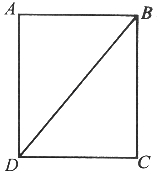
(B) Let $a$ be the length of the side of the square.
Let the vertices of the diagonal be $B = (1, -2, 3)$ and $D = (2, -3, 5)$.
The length of the diagonal $BD$ is given by the distance formula:
$BD = \sqrt{(2 - 1)^2 + (-3 - (-2))^2 + (5 - 3)^2}$
$BD = \sqrt{(1)^2 + (-1)^2 + (2)^2}$
$BD = \sqrt{1 + 1 + 4} = \sqrt{6}$
In a square,the relationship between the side $a$ and the diagonal $d$ is $d = a\sqrt{2}$.
Therefore,$a\sqrt{2} = \sqrt{6}$.
$a = \frac{\sqrt{6}}{\sqrt{2}} = \sqrt{3}$.
Thus,the length of the side is $\sqrt{3}$.
Let the vertices of the diagonal be $B = (1, -2, 3)$ and $D = (2, -3, 5)$.
The length of the diagonal $BD$ is given by the distance formula:
$BD = \sqrt{(2 - 1)^2 + (-3 - (-2))^2 + (5 - 3)^2}$
$BD = \sqrt{(1)^2 + (-1)^2 + (2)^2}$
$BD = \sqrt{1 + 1 + 4} = \sqrt{6}$
In a square,the relationship between the side $a$ and the diagonal $d$ is $d = a\sqrt{2}$.
Therefore,$a\sqrt{2} = \sqrt{6}$.
$a = \frac{\sqrt{6}}{\sqrt{2}} = \sqrt{3}$.
Thus,the length of the side is $\sqrt{3}$.
0 likesView Solution
141
ChemistryMCQAP EAMCET · 2023
$A$ plane passing through $(-1, 2, 3)$ and whose normal makes equal angles with the coordinate axes is
A
$x+y+z+4=0$
B
$x-y+z+4=0$
C
$x+y+z-4=0$
D
$x+y+z=0$
Solution
(C) The equation of a plane passing through the point $(x_0, y_0, z_0)$ with normal vector $\vec{n} = \langle a, b, c \rangle$ is given by $a(x-x_0) + b(y-y_0) + c(z-z_0) = 0$.
Given the point is $(-1, 2, 3)$,the equation is $a(x+1) + b(y-2) + c(z-3) = 0$.
The normal makes equal angles $\alpha$ with the coordinate axes,so the direction cosines are $\cos \alpha, \cos \alpha, \cos \alpha$.
Since $\cos^2 \alpha + \cos^2 \alpha + \cos^2 \alpha = 1$,we have $3 \cos^2 \alpha = 1$,which implies $\cos \alpha = \pm \frac{1}{\sqrt{3}}$.
Thus,the direction ratios $\langle a, b, c \rangle$ can be taken as $\langle 1, 1, 1 \rangle$.
Substituting these into the plane equation: $1(x+1) + 1(y-2) + 1(z-3) = 0$.
Simplifying,we get $x + 1 + y - 2 + z - 3 = 0$,which results in $x + y + z - 4 = 0$.
Given the point is $(-1, 2, 3)$,the equation is $a(x+1) + b(y-2) + c(z-3) = 0$.
The normal makes equal angles $\alpha$ with the coordinate axes,so the direction cosines are $\cos \alpha, \cos \alpha, \cos \alpha$.
Since $\cos^2 \alpha + \cos^2 \alpha + \cos^2 \alpha = 1$,we have $3 \cos^2 \alpha = 1$,which implies $\cos \alpha = \pm \frac{1}{\sqrt{3}}$.
Thus,the direction ratios $\langle a, b, c \rangle$ can be taken as $\langle 1, 1, 1 \rangle$.
Substituting these into the plane equation: $1(x+1) + 1(y-2) + 1(z-3) = 0$.
Simplifying,we get $x + 1 + y - 2 + z - 3 = 0$,which results in $x + y + z - 4 = 0$.
0 likesView Solution
142
ChemistryMCQAP EAMCET · 2023
If the foot of the perpendicular from $(0,0,0)$ to a plane is $(1,2,3)$,then the equation of the plane is
A
$x+2y+3z=14$
B
$x+2y+3z=10$
C
$x+2y+3z+14=0$
D
$x+2y-3z=14$
Solution
(A) The normal vector $\vec{n}$ to the plane is the vector joining the origin $(0,0,0)$ to the foot of the perpendicular $(1,2,3)$.
$\vec{n} = (1-0)\hat{i} + (2-0)\hat{j} + (3-0)\hat{k} = \hat{i} + 2\hat{j} + 3\hat{k}$.
The equation of a plane passing through a point $(x_0, y_0, z_0)$ with normal vector $\vec{n} = a\hat{i} + b\hat{j} + c\hat{k}$ is given by $a(x-x_0) + b(y-y_0) + c(z-z_0) = 0$.
Substituting the point $(1,2,3)$ and the normal vector $(1,2,3)$,we get:
$1(x-1) + 2(y-2) + 3(z-3) = 0$
$x - 1 + 2y - 4 + 3z - 9 = 0$
$x + 2y + 3z - 14 = 0$
$x + 2y + 3z = 14$.
$\vec{n} = (1-0)\hat{i} + (2-0)\hat{j} + (3-0)\hat{k} = \hat{i} + 2\hat{j} + 3\hat{k}$.
The equation of a plane passing through a point $(x_0, y_0, z_0)$ with normal vector $\vec{n} = a\hat{i} + b\hat{j} + c\hat{k}$ is given by $a(x-x_0) + b(y-y_0) + c(z-z_0) = 0$.
Substituting the point $(1,2,3)$ and the normal vector $(1,2,3)$,we get:
$1(x-1) + 2(y-2) + 3(z-3) = 0$
$x - 1 + 2y - 4 + 3z - 9 = 0$
$x + 2y + 3z - 14 = 0$
$x + 2y + 3z = 14$.
0 likesView Solution
143
ChemistryEasyMCQAP EAMCET · 2023
Which one of the following is a semiconductor?
A
$Fe$
B
$Ge$
C
Diamond
D
$Cu$
Solution
(B) Germanium $(Ge)$ belongs to group $14$ of the periodic table and exhibits semiconductor properties.
$Fe$ (Iron) and $Cu$ (Copper) are metallic conductors.
Diamond is a covalent solid and acts as an insulator.
$Fe$ (Iron) and $Cu$ (Copper) are metallic conductors.
Diamond is a covalent solid and acts as an insulator.
0 likesView Solution
144
ChemistryMediumMCQAP EAMCET · 2023
$A$ $100 \ L$ cylinder containing $H_2$ exerted a pressure of $4 \ atm$ at $300 \ K$. It was accidentally opened and some $H_2$ escaped. When it was closed,it exerted a pressure of $3 \ atm$ at $300 \ K$. The number of moles of $H_2$ remaining in the cylinder is equal to (Assume $H_2$ as an ideal gas; $R=$ gas constant)
A
$\frac{1}{2 R}$
B
$R$
C
$\frac{1}{R}$
D
$2 R$
Solution
(C) Given: Volume $V = 100 \ L$,Final pressure $P_2 = 3 \ atm$,Temperature $T = 300 \ K$.
Using the ideal gas law $PV = nRT$:
$n_2 = \frac{P_2 V}{RT}$
Substituting the values:
$n_2 = \frac{3 \ atm \times 100 \ L}{R \times 300 \ K} = \frac{300}{300 R} = \frac{1}{R} \ mol$.
Thus,the number of moles of $H_2$ remaining in the cylinder is $\frac{1}{R}$.
Using the ideal gas law $PV = nRT$:
$n_2 = \frac{P_2 V}{RT}$
Substituting the values:
$n_2 = \frac{3 \ atm \times 100 \ L}{R \times 300 \ K} = \frac{300}{300 R} = \frac{1}{R} \ mol$.
Thus,the number of moles of $H_2$ remaining in the cylinder is $\frac{1}{R}$.
0 likesView Solution
145
ChemistryMediumMCQAP EAMCET · 2023
The vapors of $1 \ g$ of an element occupy $2.5625 \ L$ exerting a pressure of $0.5 \ atm$ at $1000 \ K$. What is the molar mass (in $g \ mol^{-1}$) of the element? (Assume vapors follow ideal gas equation. Given $R=0.082 \ L \ atm \ mol^{-1} \ K^{-1}$)
A
$64$
B
$16$
C
$32$
D
$128$
Solution
(A) Using the ideal gas equation: $PV = nRT = \frac{m}{M}RT$
Rearranging for molar mass $M$: $M = \frac{mRT}{PV}$
Substituting the given values: $M = \frac{(1 \ g)(0.082 \ L \ atm \ mol^{-1} \ K^{-1})(1000 \ K)}{(0.5 \ atm)(2.5625 \ L)}$
$M = \frac{82}{1.28125} = 64 \ g \ mol^{-1}$.
Rearranging for molar mass $M$: $M = \frac{mRT}{PV}$
Substituting the given values: $M = \frac{(1 \ g)(0.082 \ L \ atm \ mol^{-1} \ K^{-1})(1000 \ K)}{(0.5 \ atm)(2.5625 \ L)}$
$M = \frac{82}{1.28125} = 64 \ g \ mol^{-1}$.
0 likesView Solution
146
ChemistryMediumMCQAP EAMCET · 2023
The weight percentage of $C$ and $H$ in a hydrocarbon is in the ratio of $4: 1$. What is its empirical formula?
A
$CH$
B
$CH_2$
C
$CH_3$
D
$CH_4$
Solution
(C) Let the mass of $C$ be $4x$ and the mass of $H$ be $1x$.
Number of moles of $C = \frac{4x}{12} = \frac{x}{3}$.
Number of moles of $H = \frac{1x}{1} = x$.
Ratio of moles of $C:H = \frac{x}{3} : x = \frac{1}{3} : 1 = 1 : 3$.
Therefore,the empirical formula is $CH_3$.
Number of moles of $C = \frac{4x}{12} = \frac{x}{3}$.
Number of moles of $H = \frac{1x}{1} = x$.
Ratio of moles of $C:H = \frac{x}{3} : x = \frac{1}{3} : 1 = 1 : 3$.
Therefore,the empirical formula is $CH_3$.
0 likesView Solution
147
ChemistryEasyMCQAP EAMCET · 2023
$20 \ mL$ of $0.1 \ M$ $HCl$ is added to $30 \ mL$ of $0.1 \ M$ $NaOH$. To this solution,an extra $50 \ mL$ of water was added. What is the molarity of the final solution formed (in $M$)?
A
$0.1$
B
$0.01$
C
$0.5$
D
$0.05$
Solution
(B) The reaction is: $HCl + NaOH \rightarrow NaCl + H_2O$.
Number of moles of $HCl = 0.1 \ M \times 0.02 \ L = 0.002 \ mol$.
Number of moles of $NaOH = 0.1 \ M \times 0.03 \ L = 0.003 \ mol$.
Since $HCl$ is the limiting reagent,it will be completely consumed.
Number of moles of $NaOH$ remaining after neutralization $= 0.003 \ mol - 0.002 \ mol = 0.001 \ mol$.
Total final volume $= 20 \ mL + 30 \ mL + 50 \ mL = 100 \ mL = 0.1 \ L$.
Molarity of the final solution $= \frac{0.001 \ mol}{0.1 \ L} = 0.01 \ M$.
Number of moles of $HCl = 0.1 \ M \times 0.02 \ L = 0.002 \ mol$.
Number of moles of $NaOH = 0.1 \ M \times 0.03 \ L = 0.003 \ mol$.
Since $HCl$ is the limiting reagent,it will be completely consumed.
Number of moles of $NaOH$ remaining after neutralization $= 0.003 \ mol - 0.002 \ mol = 0.001 \ mol$.
Total final volume $= 20 \ mL + 30 \ mL + 50 \ mL = 100 \ mL = 0.1 \ L$.
Molarity of the final solution $= \frac{0.001 \ mol}{0.1 \ L} = 0.01 \ M$.
0 likesView Solution
148
ChemistryMediumMCQAP EAMCET · 2023
One mole $H_2O_{(g)}$ and one mole $CO_{(g)}$ are taken in a $1 \ L$ flask and heated to $725 \ K$. At equilibrium,$40 \%$ (by mass) of water reacted with $CO_{(g)}$ as follows: $H_2O_{(g)} + CO_{(g)} \rightleftharpoons H_{2_{(g)}} + CO_{2_{(g)}}$. The value of $K_p$ is:
A
$2.220$
B
$0.444$
C
$4.440$
D
$0.222$
Solution
(B) For the reaction: $H_2O_{(g)} + CO_{(g)} \rightleftharpoons H_{2_{(g)}} + CO_{2_{(g)}}$
$\Delta n_g = (1 + 1) - (1 + 1) = 0$
Since $\Delta n_g = 0$,$K_p = K_c(RT)^{\Delta n_g} = K_c$.
Given that $40 \%$ of water reacted,the degree of reaction $\alpha = 0.4$.
Concentrations in $1 \ L$ flask: $[H_2O] = 0.6 \ M, [CO] = 0.6 \ M, [H_2] = 0.4 \ M, [CO_2] = 0.4 \ M$.
$K_c = \frac{[H_2][CO_2]}{[H_2O][CO]} = \frac{0.4 \times 0.4}{0.6 \times 0.6} = \frac{0.16}{0.36} = 0.444$.
Therefore,$K_p = 0.444$.
$\Delta n_g = (1 + 1) - (1 + 1) = 0$
Since $\Delta n_g = 0$,$K_p = K_c(RT)^{\Delta n_g} = K_c$.
Given that $40 \%$ of water reacted,the degree of reaction $\alpha = 0.4$.
| Species | Initial moles | Equilibrium moles |
| $H_2O$ | $1.0$ | $0.6$ |
| $CO$ | $1.0$ | $0.6$ |
| $H_2$ | $0.0$ | $0.4$ |
| $CO_2$ | $0.0$ | $0.4$ |
Concentrations in $1 \ L$ flask: $[H_2O] = 0.6 \ M, [CO] = 0.6 \ M, [H_2] = 0.4 \ M, [CO_2] = 0.4 \ M$.
$K_c = \frac{[H_2][CO_2]}{[H_2O][CO]} = \frac{0.4 \times 0.4}{0.6 \times 0.6} = \frac{0.16}{0.36} = 0.444$.
Therefore,$K_p = 0.444$.
0 likesView Solution
149
ChemistryMediumMCQAP EAMCET · 2023
$x \ g$ of methane was burnt completely in the presence of oxygen. The liberated gases were passed into a solution containing $370 \ g$ of $Ca(OH)_2$. The weight of white precipitate obtained was $500 \ g$. What is the value of $x$ (in $g$)? (Given: $C=12, H=1, Ca=40, O=16 \ u$)
A
$16$
B
$80$
C
$160$
D
$120$
Solution
(B) The combustion reaction of methane is: $CH_4 + 2O_2 \rightarrow CO_2 + 2H_2O$.
From the stoichiometry,$1 \ mole$ of $CH_4$ produces $1 \ mole$ of $CO_2$.
The reaction of $CO_2$ with calcium hydroxide is: $Ca(OH)_2 + CO_2 \rightarrow CaCO_3 \downarrow + H_2O$.
The molar mass of $Ca(OH)_2 = 40 + 2 \times (16 + 1) = 74 \ g/mol$.
The molar mass of $CaCO_3 = 40 + 12 + 3 \times 16 = 100 \ g/mol$.
Given $500 \ g$ of $CaCO_3$ precipitate is formed,which corresponds to $500 / 100 = 5 \ moles$ of $CaCO_3$.
Since $1 \ mole$ of $CaCO_3$ is produced from $1 \ mole$ of $CO_2$,$5 \ moles$ of $CO_2$ must have been produced.
From the combustion reaction,$5 \ moles$ of $CO_2$ are produced from $5 \ moles$ of $CH_4$.
The molar mass of $CH_4 = 12 + 4 \times 1 = 16 \ g/mol$.
Therefore,the mass of $CH_4$ $(x)$ = $5 \ moles \times 16 \ g/mol = 80 \ g$.
From the stoichiometry,$1 \ mole$ of $CH_4$ produces $1 \ mole$ of $CO_2$.
The reaction of $CO_2$ with calcium hydroxide is: $Ca(OH)_2 + CO_2 \rightarrow CaCO_3 \downarrow + H_2O$.
The molar mass of $Ca(OH)_2 = 40 + 2 \times (16 + 1) = 74 \ g/mol$.
The molar mass of $CaCO_3 = 40 + 12 + 3 \times 16 = 100 \ g/mol$.
Given $500 \ g$ of $CaCO_3$ precipitate is formed,which corresponds to $500 / 100 = 5 \ moles$ of $CaCO_3$.
Since $1 \ mole$ of $CaCO_3$ is produced from $1 \ mole$ of $CO_2$,$5 \ moles$ of $CO_2$ must have been produced.
From the combustion reaction,$5 \ moles$ of $CO_2$ are produced from $5 \ moles$ of $CH_4$.
The molar mass of $CH_4 = 12 + 4 \times 1 = 16 \ g/mol$.
Therefore,the mass of $CH_4$ $(x)$ = $5 \ moles \times 16 \ g/mol = 80 \ g$.
0 likesView Solution
150
ChemistryMediumMCQAP EAMCET · 2023
An ideal gas $(X)$ present in a vessel of volume $V \ L$ exerted a pressure of $16.4 \ atm$ at $200 \ K$. What is its concentration in $mol \ L^{-1}$? (Given $R=0.082 \ L \ atm \ mol^{-1} \ K^{-1}$)
A
$0.5$
B
$0.25$
C
$1$
D
$1.5$
Solution
(C) The ideal gas equation is given by $PV = nRT$.
Since concentration $C = \frac{n}{V}$,we can rewrite the equation as $P = CRT$.
Therefore,$C = \frac{P}{RT}$.
Substituting the given values: $C = \frac{16.4 \ atm}{0.082 \ L \ atm \ mol^{-1} \ K^{-1} \times 200 \ K}$.
$C = \frac{16.4}{16.4} = 1.00 \ mol \ L^{-1}$.
Since concentration $C = \frac{n}{V}$,we can rewrite the equation as $P = CRT$.
Therefore,$C = \frac{P}{RT}$.
Substituting the given values: $C = \frac{16.4 \ atm}{0.082 \ L \ atm \ mol^{-1} \ K^{-1} \times 200 \ K}$.
$C = \frac{16.4}{16.4} = 1.00 \ mol \ L^{-1}$.
0 likesView Solution
151
ChemistryEasyMCQAP EAMCET · 2023
Match the following complexes in List-$I$ with their colors in List-$II$:
| List-$I$ (Complex) | List-$II$ (Color) |
| $A. [Ni(en)_3]^{2+}$ | $I. \text{Green}$ |
| $B. [Ni(H_2O)_4(en)]^{2+}$ | $II. \text{Blue}$ |
| $C. [Ni(H_2O)_6]^{2+}$ | $III. \text{Pale blue}$ |
| $D. [Ni(H_2O)_2(en)_2]^{2+}$ | $IV. \text{Violet}$ |
A
$A-IV, B-I, C-III, D-II$
B
$A-I, B-II, C-III, D-IV$
C
$A-IV, B-III, C-I, D-II$
D
$A-I, B-III, C-II, D-IV$
Solution
(C) The correct matching is $A-IV, B-III, C-I, D-II$.
$[Ni(H_2O)_6]^{2+}$ is green $(I)$.
As $H_2O$ ligands are replaced by $en$ (a stronger field ligand), the crystal field splitting energy $(\Delta_o)$ increases.
The wavelength of light absorbed decreases, which shifts the observed color towards the violet end of the spectrum.
The sequence of colors as $en$ replaces $H_2O$ is: $[Ni(H_2O)_6]^{2+}$ (Green) $\rightarrow$ $[Ni(H_2O)_4(en)]^{2+}$ (Pale blue) $\rightarrow$ $[Ni(H_2O)_2(en)_2]^{2+}$ (Blue) $\rightarrow$ $[Ni(en)_3]^{2+}$ (Violet).
$[Ni(H_2O)_6]^{2+}$ is green $(I)$.
As $H_2O$ ligands are replaced by $en$ (a stronger field ligand), the crystal field splitting energy $(\Delta_o)$ increases.
The wavelength of light absorbed decreases, which shifts the observed color towards the violet end of the spectrum.
The sequence of colors as $en$ replaces $H_2O$ is: $[Ni(H_2O)_6]^{2+}$ (Green) $\rightarrow$ $[Ni(H_2O)_4(en)]^{2+}$ (Pale blue) $\rightarrow$ $[Ni(H_2O)_2(en)_2]^{2+}$ (Blue) $\rightarrow$ $[Ni(en)_3]^{2+}$ (Violet).
0 likesView Solution
152
ChemistryEasyMCQAP EAMCET · 2023
Identify the correct statement.
A
$Yb^{2+}$ is an oxidant.
B
$Lu^{3+}$ is paramagnetic.
C
$CrO$ is basic.
D
Brass is an alloy of $Cu, Sn$.
Solution
(C) $Yb^{2+}$ has the electronic configuration $[Xe] 4f^{14}$.
Since it has a stable $f^{14}$ configuration,it prefers to lose one electron to form $Yb^{3+}$,thus acting as a reductant.
$Lu^{3+}$ has the electronic configuration $[Xe] 4f^{14}$,which is fully filled,making it diamagnetic.
$CrO$ is a basic oxide because chromium is in a low oxidation state of $+2$.
Brass is an alloy of $Cu$ and $Zn$,whereas Bronze is an alloy of $Cu$ and $Sn$.
Since it has a stable $f^{14}$ configuration,it prefers to lose one electron to form $Yb^{3+}$,thus acting as a reductant.
$Lu^{3+}$ has the electronic configuration $[Xe] 4f^{14}$,which is fully filled,making it diamagnetic.
$CrO$ is a basic oxide because chromium is in a low oxidation state of $+2$.
Brass is an alloy of $Cu$ and $Zn$,whereas Bronze is an alloy of $Cu$ and $Sn$.
0 likesView Solution
153
ChemistryEasyMCQAP EAMCET · 2023
Arrange the oxides $CrO$,$CrO_3$,and $Cr_2O_3$ in the decreasing order of acidic strength.
A
$CrO_3 > Cr_2O_3 > CrO$
B
$CrO_3 > CrO > Cr_2O_3$
C
$CrO > Cr_2O_3 > CrO_3$
D
$CrO > CrO_3 > Cr_2O_3$
Solution
(A) The acidic strength of metal oxides increases with an increase in the oxidation state of the metal.
Calculating the oxidation states of $Cr$ in the given oxides:
$1$. In $CrO$,the oxidation state of $Cr$ is $+2$.
$2$. In $Cr_2O_3$,the oxidation state of $Cr$ is $+3$.
$3$. In $CrO_3$,the oxidation state of $Cr$ is $+6$.
Since the acidic character is directly proportional to the oxidation state,the order of acidic strength is:
$CrO_3 (+6) > Cr_2O_3 (+3) > CrO (+2)$.
Calculating the oxidation states of $Cr$ in the given oxides:
$1$. In $CrO$,the oxidation state of $Cr$ is $+2$.
$2$. In $Cr_2O_3$,the oxidation state of $Cr$ is $+3$.
$3$. In $CrO_3$,the oxidation state of $Cr$ is $+6$.
Since the acidic character is directly proportional to the oxidation state,the order of acidic strength is:
$CrO_3 (+6) > Cr_2O_3 (+3) > CrO (+2)$.
0 likesView Solution
154
ChemistryEasyMCQAP EAMCET · 2023
From the list given below,the number of lanthanides which exhibit $+4$ oxidation state in their oxides is: $Pr, Nd, Pm, Sm, Eu, Gd, Tb, Dy$
A
$5$
B
$4$
C
$6$
D
$2$
Solution
(B) The lanthanides that exhibit the $+4$ oxidation state in their oxides are $Pr, Nd, Tb,$ and $Dy$.
These elements show stability in the $+4$ state due to configurations approaching the stable $4f^0$ or $4f^7$ configurations.
Specifically,$PrO_2, NdO_2, TbO_2,$ and $DyO_2$ are known oxides where these elements exhibit the $+4$ oxidation state.
Therefore,the total number of such elements is $4$.
These elements show stability in the $+4$ state due to configurations approaching the stable $4f^0$ or $4f^7$ configurations.
Specifically,$PrO_2, NdO_2, TbO_2,$ and $DyO_2$ are known oxides where these elements exhibit the $+4$ oxidation state.
Therefore,the total number of such elements is $4$.
0 likesView Solution
155
ChemistryEasyMCQAP EAMCET · 2023
Select the correct order of ionic radii for the given ions:
A
$Yb^{3+} < Sm^{3+} < Dy^{3+} < Pr^{3+}$
B
$Yb^{3+} < Dy^{3+} < Sm^{3+} < Pr^{3+}$
C
$Pr^{3+} < Sm^{3+} < Dy^{3+} < Yb^{3+}$
D
$Pr^{3+} < Sm^{3+} < Yb^{3+} < Dy^{3+}$
Solution
(B) The ionic radii of lanthanoids decrease as the atomic number increases due to lanthanide contraction.
As we move from $Pr$ $(Z=59)$ to $Yb$ $(Z=70)$,the effective nuclear charge increases,causing the ionic radii to decrease.
The correct order of ionic radii is: $Yb^{3+} < Dy^{3+} < Sm^{3+} < Pr^{3+}$.
As we move from $Pr$ $(Z=59)$ to $Yb$ $(Z=70)$,the effective nuclear charge increases,causing the ionic radii to decrease.
The correct order of ionic radii is: $Yb^{3+} < Dy^{3+} < Sm^{3+} < Pr^{3+}$.
0 likesView Solution
156
ChemistryMediumMCQAP EAMCET · 2023
In the Kolbe electrolysis of sodium propanoate,the products $X$ and $Y$ are formed at respective electrodes. What are $X$ and $Y$?
A
$X=CH_3-CH_2-CH_2-CH_3$ at Cathode; $Y=H_2$ at Anode
B
$X=CH_3-CH_2-CH_3$ at Cathode; $Y=H_2$ at Anode
C
$X=CH_3-CH_2-CH_2-CH_3$ at Anode; $Y=H_2$ at Cathode
D
$X=CH_3-CH_3$ at Anode; $Y=H_2$ at Cathode
Solution
(C) The overall reaction for the Kolbe electrolysis of sodium propanoate is:
$2 CH_3 CH_2 COO^{-} Na^{+} + 2 H_2 O \xrightarrow{\text{electrolysis}} CH_3 CH_2-CH_2 CH_3 + 2 CO_2 + H_2 + 2 NaOH$
At the anode (oxidation),the propanoate ions undergo decarboxylation to form butane $(X)$:
$2 CH_3 CH_2 COO^{-} \rightarrow CH_3 CH_2-CH_2 CH_3 + 2 CO_2 + 2 e^-$
At the cathode (reduction),water is reduced to form hydrogen gas $(Y)$:
$2 H_2 O + 2 e^- \rightarrow 2 OH^{-} + H_2(Y)$
Thus,$X$ is butane formed at the anode,and $Y$ is hydrogen gas formed at the cathode.
$2 CH_3 CH_2 COO^{-} Na^{+} + 2 H_2 O \xrightarrow{\text{electrolysis}} CH_3 CH_2-CH_2 CH_3 + 2 CO_2 + H_2 + 2 NaOH$
At the anode (oxidation),the propanoate ions undergo decarboxylation to form butane $(X)$:
$2 CH_3 CH_2 COO^{-} \rightarrow CH_3 CH_2-CH_2 CH_3 + 2 CO_2 + 2 e^-$
At the cathode (reduction),water is reduced to form hydrogen gas $(Y)$:
$2 H_2 O + 2 e^- \rightarrow 2 OH^{-} + H_2(Y)$
Thus,$X$ is butane formed at the anode,and $Y$ is hydrogen gas formed at the cathode.
0 likesView Solution
157
ChemistryMediumMCQAP EAMCET · 2023
The number of Faradays required to completely deposit magnesium from $1 \ L$ of $0.1 \ M$ $MgCl_2$ aqueous solution is
A
$0.2$
B
$2$
C
$0.1$
D
$0.4$
Solution
(A) The dissociation of $MgCl_2$ is: $MgCl_2 \rightarrow Mg^{2+} + 2Cl^-$.
The reduction reaction at the cathode is: $Mg^{2+} + 2e^- \rightarrow Mg_{(s)}$.
From the stoichiometry,$2 \ moles$ of electrons are required to deposit $1 \ mole$ of $Mg_{(s)}$.
Since $1 \ mole$ of electrons is equivalent to $1 \ Faraday$ $(F)$,$2 \ moles$ of electrons correspond to $2 \ F$.
The number of moles of $MgCl_2$ is calculated as: $n = M \times V = 0.1 \ M \times 1 \ L = 0.1 \ mol$.
Thus,$n(Mg^{2+}) = 0.1 \ mol$.
The number of Faradays required to deposit $0.1 \ mol$ of $Mg$ is: $2 \times 0.1 \ mol = 0.2 \ F$.
The reduction reaction at the cathode is: $Mg^{2+} + 2e^- \rightarrow Mg_{(s)}$.
From the stoichiometry,$2 \ moles$ of electrons are required to deposit $1 \ mole$ of $Mg_{(s)}$.
Since $1 \ mole$ of electrons is equivalent to $1 \ Faraday$ $(F)$,$2 \ moles$ of electrons correspond to $2 \ F$.
The number of moles of $MgCl_2$ is calculated as: $n = M \times V = 0.1 \ M \times 1 \ L = 0.1 \ mol$.
Thus,$n(Mg^{2+}) = 0.1 \ mol$.
The number of Faradays required to deposit $0.1 \ mol$ of $Mg$ is: $2 \times 0.1 \ mol = 0.2 \ F$.
0 likesView Solution
158
ChemistryEasyMCQAP EAMCET · 2023
The time required (in hours) to reduce $3 \ mol$ of $Fe^{3+}$ ions to $Fe^{2+}$ ions with $2.0 \ A$ of current is $\left(1 \ F = 96500 \ C \ mol^{-1}\right)$ (in $.2$)
A
$30$
B
$40$
C
$10$
D
$15$
Solution
(B) The reduction reaction is: $Fe^{3+} + e^{-} \rightarrow Fe^{2+}$.
For $3 \ mol$ of $Fe^{3+}$ to be reduced to $Fe^{2+}$,$3 \ mol$ of electrons are required.
Total charge $Q = n \times F = 3 \ mol \times 96500 \ C \ mol^{-1} = 289500 \ C$.
Given current $I = 2.0 \ A$.
Using the formula $Q = I \times t$,we get $t = \frac{Q}{I} = \frac{289500 \ C}{2.0 \ A} = 144750 \ s$.
To convert time into hours: $t \text{ (in hours)} = \frac{144750}{3600} \approx 40.208 \ h$.
For $3 \ mol$ of $Fe^{3+}$ to be reduced to $Fe^{2+}$,$3 \ mol$ of electrons are required.
Total charge $Q = n \times F = 3 \ mol \times 96500 \ C \ mol^{-1} = 289500 \ C$.
Given current $I = 2.0 \ A$.
Using the formula $Q = I \times t$,we get $t = \frac{Q}{I} = \frac{289500 \ C}{2.0 \ A} = 144750 \ s$.
To convert time into hours: $t \text{ (in hours)} = \frac{144750}{3600} \approx 40.208 \ h$.
0 likesView Solution
159
ChemistryDifficultMCQAP EAMCET · 2023
Observe the following Ellingham diagram,and identify the incorrect statement regarding it.
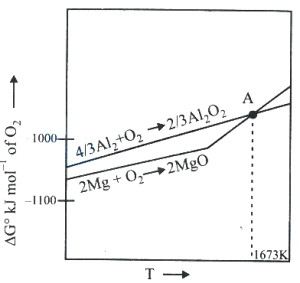
A
At point $A$ for the reduction of $Al_2O_3$ by $Mg$,$\Delta G^{\circ} = 0$.
B
Below $1673 \ K$,$Mg$ can reduce $Al_2O_3$ to $Al$.
C
Below $1673 \ K$,$Al$ can reduce $MgO$ to $Mg$.
D
Above $1673 \ K$,$Al$ can reduce $MgO$ to $Mg$.
Solution
(C) In an Ellingham diagram,the metal whose oxide line is lower can reduce the oxide of the metal whose line is higher.
At point $A$ $(1673 \ K)$,the lines for the formation of $MgO$ and $Al_2O_3$ intersect,meaning $\Delta G^{\circ} = 0$ for the reaction $3MgO + 2Al \rightarrow Al_2O_3 + 3Mg$.
Below $1673 \ K$,the $MgO$ line is below the $Al_2O_3$ line,so $Mg$ can reduce $Al_2O_3$ to $Al$.
Above $1673 \ K$,the $Al_2O_3$ line is below the $MgO$ line,so $Al$ can reduce $MgO$ to $Mg$.
Therefore,the statement that $Al$ can reduce $MgO$ to $Mg$ below $1673 \ K$ is incorrect.
At point $A$ $(1673 \ K)$,the lines for the formation of $MgO$ and $Al_2O_3$ intersect,meaning $\Delta G^{\circ} = 0$ for the reaction $3MgO + 2Al \rightarrow Al_2O_3 + 3Mg$.
Below $1673 \ K$,the $MgO$ line is below the $Al_2O_3$ line,so $Mg$ can reduce $Al_2O_3$ to $Al$.
Above $1673 \ K$,the $Al_2O_3$ line is below the $MgO$ line,so $Al$ can reduce $MgO$ to $Mg$.
Therefore,the statement that $Al$ can reduce $MgO$ to $Mg$ below $1673 \ K$ is incorrect.
0 likesView Solution
160
ChemistryMediumMCQAP EAMCET · 2023
The minimum voltage (in $V$) required to bring about the electrolysis of $1 \ M$ copper$(II)$ sulphate solution at $298 \ K$ is (Given $E^{\circ}_{Cu^{2+}/Cu} = 0.34 \ V$ and $E^{\circ}_{O_2/H_2O} = 1.23 \ V$)
A
$1.57$
B
$0.89$
C
$-0.89$
D
$-1.57$
Solution
(B) At the cathode,reduction of $Cu^{2+}$ ions occurs: $Cu^{2+}(aq) + 2e^- \rightarrow Cu(s)$; $E^{\circ}_{red} = 0.34 \ V$.
At the anode,oxidation of water occurs: $2H_2O(l) \rightarrow O_2(g) + 4H^+(aq) + 4e^-$; $E^{\circ}_{ox} = -1.23 \ V$.
The standard cell potential is $E^{\circ}_{cell} = E^{\circ}_{cathode} + E^{\circ}_{anode} = 0.34 \ V + (-1.23 \ V) = -0.89 \ V$.
Since the cell reaction is non-spontaneous $(E^{\circ}_{cell} < 0)$,the minimum external voltage required to drive the electrolysis is the magnitude of the cell potential,which is $0.89 \ V$.
At the anode,oxidation of water occurs: $2H_2O(l) \rightarrow O_2(g) + 4H^+(aq) + 4e^-$; $E^{\circ}_{ox} = -1.23 \ V$.
The standard cell potential is $E^{\circ}_{cell} = E^{\circ}_{cathode} + E^{\circ}_{anode} = 0.34 \ V + (-1.23 \ V) = -0.89 \ V$.
Since the cell reaction is non-spontaneous $(E^{\circ}_{cell} < 0)$,the minimum external voltage required to drive the electrolysis is the magnitude of the cell potential,which is $0.89 \ V$.
0 likesView Solution
161
ChemistryEasyMCQAP EAMCET · 2023
The standard electrode potential (in $V$) values for $Al^{3+}/Al$ and $Tl^{3+}/Tl$ are respectively:
A
$-1.66, -1.26$
B
$+1.66, +1.26$
C
$-1.66, +1.26$
D
$+1.66, -1.26$
Solution
(C) $Al^{3+}$ is much more stable than $Al$ and due to its high electropositive nature,the standard reduction potential of $Al^{3+}/Al$ is $-1.66 \ V$.
$Tl^{3+}$ is less stable than $Tl$ due to the inert pair effect,making $Tl^{3+}$ a strong oxidizing agent that is easily reduced to $Tl$. Thus,the standard reduction potential of $Tl^{3+}/Tl$ is $+1.26 \ V$.
$Tl^{3+}$ is less stable than $Tl$ due to the inert pair effect,making $Tl^{3+}$ a strong oxidizing agent that is easily reduced to $Tl$. Thus,the standard reduction potential of $Tl^{3+}/Tl$ is $+1.26 \ V$.
0 likesView Solution
162
ChemistryEasyMCQAP EAMCET · 2023
The electrolyte used in a mercury cell is:
A
Moist paste of $NH_4Cl$ and $ZnCl_2$
B
$38\%$ solution of $H_2SO_4$
C
Paste of $KOH$ and $ZnO$
D
Paste of $MgCl_2$ and $HgO$
Solution
(C) The mercury cell consists of a zinc-mercury amalgam as the anode and a paste of mercury$(II)$ oxide $(HgO)$ and carbon as the cathode.
The electrolyte used is a moist paste of potassium hydroxide $(KOH)$ and zinc oxide $(ZnO)$.
The electrolyte used is a moist paste of potassium hydroxide $(KOH)$ and zinc oxide $(ZnO)$.
0 likesView Solution
163
ChemistryEasyMCQAP EAMCET · 2023
Some statements about Leclanché cell are:
$(I)$ Anode is zinc metal
$(II)$ Cathode is graphite rod surrounded by powdered $MnO_2$ and carbon
$(III)$ Electrolyte is a moist paste of $ZnO$ and $KOH$
$(IV)$ Oxidation product is $ZnO$
The correct statements are:
$(I)$ Anode is zinc metal
$(II)$ Cathode is graphite rod surrounded by powdered $MnO_2$ and carbon
$(III)$ Electrolyte is a moist paste of $ZnO$ and $KOH$
$(IV)$ Oxidation product is $ZnO$
The correct statements are:
A
$I$ & $II$ only
B
$II$ & $III$ only
C
$I$ & $IV$ only
D
$I, II$ & $III$ only
Solution
(A) In a Leclanché cell:
$1$. The anode is a zinc container $(Zn_{(s)} \rightarrow Zn^{2+} + 2e^-)$,so statement $(I)$ is correct.
$2$. The cathode is a graphite rod surrounded by powdered $MnO_2$ and carbon,so statement $(II)$ is correct.
$3$. The electrolyte is a moist paste of $NH_4Cl$ and $ZnCl_2$,not $ZnO$ and $KOH$. Thus,statement $(III)$ is incorrect.
$4$. The oxidation product involves $Zn^{2+}$ ions,not $ZnO$. Thus,statement $(IV)$ is incorrect.
Therefore,only statements $(I)$ and $(II)$ are correct.
$1$. The anode is a zinc container $(Zn_{(s)} \rightarrow Zn^{2+} + 2e^-)$,so statement $(I)$ is correct.
$2$. The cathode is a graphite rod surrounded by powdered $MnO_2$ and carbon,so statement $(II)$ is correct.
$3$. The electrolyte is a moist paste of $NH_4Cl$ and $ZnCl_2$,not $ZnO$ and $KOH$. Thus,statement $(III)$ is incorrect.
$4$. The oxidation product involves $Zn^{2+}$ ions,not $ZnO$. Thus,statement $(IV)$ is incorrect.
Therefore,only statements $(I)$ and $(II)$ are correct.
0 likesView Solution
164
ChemistryMediumMCQAP EAMCET · 2023
The conductivity of a solution containing $2.08 \ g$ of anhydrous barium chloride in $200 \ mL$ solution is $6 \times 10^{-3} \ \Omega^{-1} \ cm^{-1}$. The molar conductivity of the solution (in $\Omega^{-1} \ cm^2 \ mol^{-1}$) is $\underline{x} \times 10^2$. The value of $\underline{x}$ is (Atomic mass of $Ba=137, Cl=35.5$)
A
$1.2$
B
$2.4$
C
$3.6$
D
$3$
Solution
(A) Molar mass of $BaCl_2 = 137 + 2 \times 35.5 = 208 \ g \ mol^{-1}$.
Number of moles of $BaCl_2 = \frac{2.08 \ g}{208 \ g \ mol^{-1}} = 0.01 \ mol$.
Molarity $(C) = \frac{\text{moles}}{\text{Volume in } L} = \frac{0.01 \ mol}{0.2 \ L} = 0.05 \ M$.
Molar conductivity $(\Lambda_m) = \frac{\kappa \times 1000}{C} = \frac{6 \times 10^{-3} \ \Omega^{-1} \ cm^{-1} \times 1000}{0.05 \ mol \ L^{-1}} = \frac{6}{0.05} = 120 \ \Omega^{-1} \ cm^2 \ mol^{-1}$.
Given $\Lambda_m = x \times 10^2$,so $120 = x \times 100$,which gives $x = 1.2$.
Number of moles of $BaCl_2 = \frac{2.08 \ g}{208 \ g \ mol^{-1}} = 0.01 \ mol$.
Molarity $(C) = \frac{\text{moles}}{\text{Volume in } L} = \frac{0.01 \ mol}{0.2 \ L} = 0.05 \ M$.
Molar conductivity $(\Lambda_m) = \frac{\kappa \times 1000}{C} = \frac{6 \times 10^{-3} \ \Omega^{-1} \ cm^{-1} \times 1000}{0.05 \ mol \ L^{-1}} = \frac{6}{0.05} = 120 \ \Omega^{-1} \ cm^2 \ mol^{-1}$.
Given $\Lambda_m = x \times 10^2$,so $120 = x \times 100$,which gives $x = 1.2$.
0 likesView Solution
165
ChemistryMediumMCQAP EAMCET · 2023
Which one of the following has the highest molar conductivity?
A
Diammine dichloroplatinum $(II)$
B
Tetraamminedichlorocobalt $(III)$ chloride
C
Potassium hexacyano ferrate $(II)$
D
Hexa aquo chromium $(III)$ chloride
Solution
(C) Molar conductivity is directly proportional to the number of ions produced upon dissociation in an aqueous solution.
$1$. $[Pt(NH_3)_2 Cl_2] \rightarrow$ Non-electrolyte ($0$ ions).
$2$. $[Co(NH_3)_4 Cl_2]Cl \rightarrow [Co(NH_3)_4 Cl_2]^+ + Cl^-$ ($2$ ions).
$3$. $K_4[Fe(CN)_6] \rightarrow 4K^+ + [Fe(CN)_6]^{4-}$ ($5$ ions).
$4$. $[Cr(H_2O)_6]Cl_3 \rightarrow [Cr(H_2O)_6]^{3+} + 3Cl^-$ ($4$ ions).
Since $K_4[Fe(CN)_6]$ produces the highest number of ions ($5$ ions),it exhibits the highest molar conductivity.
$1$. $[Pt(NH_3)_2 Cl_2] \rightarrow$ Non-electrolyte ($0$ ions).
$2$. $[Co(NH_3)_4 Cl_2]Cl \rightarrow [Co(NH_3)_4 Cl_2]^+ + Cl^-$ ($2$ ions).
$3$. $K_4[Fe(CN)_6] \rightarrow 4K^+ + [Fe(CN)_6]^{4-}$ ($5$ ions).
$4$. $[Cr(H_2O)_6]Cl_3 \rightarrow [Cr(H_2O)_6]^{3+} + 3Cl^-$ ($4$ ions).
Since $K_4[Fe(CN)_6]$ produces the highest number of ions ($5$ ions),it exhibits the highest molar conductivity.
0 likesView Solution
166
ChemistryMediumMCQAP EAMCET · 2023
Molar conductivities at infinite dilution $\wedge_{m}^{\circ}$ for $Ba(OH)_2$,$BaCl_2$ and $NH_4Cl$ are $457.0$,$240.6$ and $213.0 \ S \ cm^2 \ mol^{-1}$ respectively. The $\wedge_{m}^{\circ}$ for ammonium hydroxide (in $S \ cm^2 \ mol^{-1}$) is (in $.2$)
A
$1683$
B
$1080$
C
$321$
D
$2238$
Solution
(C) According to Kohlrausch's law of independent migration of ions:
$\wedge_{m}^{\circ}(NH_4OH) = \wedge_{m}^{\circ}(NH_4^+) + \wedge_{m}^{\circ}(OH^{-})$
We can express this using the given values:
$\wedge_{m}^{\circ}(NH_4OH) = \wedge_{m}^{\circ}(NH_4Cl) + \frac{1}{2} \wedge_{m}^{\circ}(Ba(OH)_2) - \frac{1}{2} \wedge_{m}^{\circ}(BaCl_2)$
Substituting the given values:
$\wedge_{m}^{\circ}(NH_4OH) = 213.0 + (\frac{1}{2} \times 457.0) - (\frac{1}{2} \times 240.6)$
$\wedge_{m}^{\circ}(NH_4OH) = 213.0 + 228.5 - 120.3 = 321.2 \ S \ cm^2 \ mol^{-1}$
$\wedge_{m}^{\circ}(NH_4OH) = \wedge_{m}^{\circ}(NH_4^+) + \wedge_{m}^{\circ}(OH^{-})$
We can express this using the given values:
$\wedge_{m}^{\circ}(NH_4OH) = \wedge_{m}^{\circ}(NH_4Cl) + \frac{1}{2} \wedge_{m}^{\circ}(Ba(OH)_2) - \frac{1}{2} \wedge_{m}^{\circ}(BaCl_2)$
Substituting the given values:
$\wedge_{m}^{\circ}(NH_4OH) = 213.0 + (\frac{1}{2} \times 457.0) - (\frac{1}{2} \times 240.6)$
$\wedge_{m}^{\circ}(NH_4OH) = 213.0 + 228.5 - 120.3 = 321.2 \ S \ cm^2 \ mol^{-1}$
0 likesView Solution
167
ChemistryEasyMCQAP EAMCET · 2023
Given below are two statements:
Assertion $(A)$: Conductivity of an electrolyte decreases on dilution.
Reason $(R)$: On dilution,the number of ions per unit volume increases.
The correct answer is:
Assertion $(A)$: Conductivity of an electrolyte decreases on dilution.
Reason $(R)$: On dilution,the number of ions per unit volume increases.
The correct answer is:
A
Both $(A)$ and $(R)$ are correct and $(R)$ is the correct explanation of $(A)$
B
Both $(A)$ and $(R)$ are correct and $(R)$ is not the correct explanation of $(A)$
C
$(A)$ is correct but $(R)$ is not correct
D
$(A)$ is not correct but $(R)$ is correct
Solution
(C) Conductivity $(K)$ is defined as the conductance of ions present in a unit volume of the solution.
Upon dilution,the total number of ions remains the same,but the volume of the solution increases.
Therefore,the number of ions per unit volume decreases,which leads to a decrease in conductivity.
Thus,Assertion $(A)$ is correct,but Reason $(R)$ is incorrect because the number of ions per unit volume decreases,not increases.
Upon dilution,the total number of ions remains the same,but the volume of the solution increases.
Therefore,the number of ions per unit volume decreases,which leads to a decrease in conductivity.
Thus,Assertion $(A)$ is correct,but Reason $(R)$ is incorrect because the number of ions per unit volume decreases,not increases.
0 likesView Solution
168
ChemistryMediumMCQAP EAMCET · 2023
The molar conductivity of $0.027 \ M$ methanoic acid is $40.42 \ S \ cm^2 \ mol^{-1}$. The value of dissociation constant of this acid is
(Given $\lambda_{H^{+}}^{\circ} = 349.6 \ S \ cm^2 \ mol^{-1}$ and $\lambda_{HCOO^{-}}^{\circ} = 54.6 \ S \ cm^2 \ mol^{-1}$)
(Given $\lambda_{H^{+}}^{\circ} = 349.6 \ S \ cm^2 \ mol^{-1}$ and $\lambda_{HCOO^{-}}^{\circ} = 54.6 \ S \ cm^2 \ mol^{-1}$)
A
$1.5 \times 10^{-5}$
B
$6.0 \times 10^{-5}$
C
$4.5 \times 10^{-4}$
D
$3.0 \times 10^{-4}$
Solution
(D) First,calculate the limiting molar conductivity of methanoic acid $(HCOOH)$:
$\Lambda_{m}^{\circ}(HCOOH) = \lambda_{H^{+}}^0 + \lambda_{HCOO^{-}}^0 = 349.6 + 54.6 = 404.2 \ S \ cm^2 \ mol^{-1}$
Next,calculate the degree of dissociation $(\alpha)$:
$\alpha = \frac{\Lambda_{m}}{\Lambda_{m}^0} = \frac{40.42}{404.2} = 0.1$
Finally,calculate the dissociation constant $(K_{a})$:
$K_{a} = \frac{C\alpha^2}{1-\alpha} = \frac{0.027 \times (0.1)^2}{1-0.1} = \frac{0.027 \times 0.01}{0.9} = \frac{0.00027}{0.9} = 3.0 \times 10^{-4}$
$\Lambda_{m}^{\circ}(HCOOH) = \lambda_{H^{+}}^0 + \lambda_{HCOO^{-}}^0 = 349.6 + 54.6 = 404.2 \ S \ cm^2 \ mol^{-1}$
Next,calculate the degree of dissociation $(\alpha)$:
$\alpha = \frac{\Lambda_{m}}{\Lambda_{m}^0} = \frac{40.42}{404.2} = 0.1$
Finally,calculate the dissociation constant $(K_{a})$:
$K_{a} = \frac{C\alpha^2}{1-\alpha} = \frac{0.027 \times (0.1)^2}{1-0.1} = \frac{0.027 \times 0.01}{0.9} = \frac{0.00027}{0.9} = 3.0 \times 10^{-4}$
0 likesView Solution
169
ChemistryMediumMCQAP EAMCET · 2023
At $298 \ K$,the conductivity of $KCl$ solutions of molarity $0.1 \ M, 0.01 \ M$ and $1.0 \ M$ are recorded as $X, Y$ and $Z \ S \ cm^{-1}$ respectively. The correct relation between $X, Y$ and $Z$ is
A
$X > Y > Z$
B
$Z > X > Y$
C
$Y > X > Z$
D
$X > Z > Y$
Solution
(B) Conductivity $(\kappa)$ is defined as the conductance of a solution of $1 \ cm^3$ volume.
It depends on the number of ions present per unit volume of the solution.
As the concentration of the electrolyte increases,the number of ions per unit volume increases,leading to an increase in conductivity.
Given molarities are $0.01 \ M$ $(Y)$,$0.1 \ M$ $(X)$,and $1.0 \ M$ $(Z)$.
Since $1.0 \ M > 0.1 \ M > 0.01 \ M$,the order of conductivity is $Z > X > Y$.
It depends on the number of ions present per unit volume of the solution.
As the concentration of the electrolyte increases,the number of ions per unit volume increases,leading to an increase in conductivity.
Given molarities are $0.01 \ M$ $(Y)$,$0.1 \ M$ $(X)$,and $1.0 \ M$ $(Z)$.
Since $1.0 \ M > 0.1 \ M > 0.01 \ M$,the order of conductivity is $Z > X > Y$.
0 likesView Solution
170
ChemistryEasyMCQAP EAMCET · 2023
Catechol and $m$-cresol respectively are
A
Benzene$-1,4-$diol; $3-$Methoxy phenol
B
Benzene$-1,2-$diol; $3-$Methoxy phenol
C
Benzene$-1,3-$diol; $3-$Methyl phenol
D
Benzene$-1,2-$diol; $3-$Methyl phenol
Solution
(D) Catechol is a dihydroxy benzene where the two hydroxyl groups are at the ortho position relative to each other,which corresponds to $Benzene-1,2-diol$.
$m$-Cresol is a methyl-substituted phenol where the methyl group is at the meta position relative to the hydroxyl group,which corresponds to $3-Methyl phenol$.
$m$-Cresol is a methyl-substituted phenol where the methyl group is at the meta position relative to the hydroxyl group,which corresponds to $3-Methyl phenol$.
0 likesView Solution
171
ChemistryEasyMCQAP EAMCET · 2023
Chlorocyclohexane is:
A
$Primary$ alkyl halide
B
$Tertiary$ alkyl halide
C
$Allylic$ halide
D
$Secondary$ alkyl halide
Solution
(D) In chlorocyclohexane,the chlorine atom is attached to a carbon atom that is further bonded to two other carbon atoms within the cyclohexane ring.
Since the carbon atom bearing the halogen is bonded to two other carbon atoms,it is a $secondary$ $(2^{\circ})$ carbon.
Therefore,chlorocyclohexane is classified as a $secondary$ alkyl halide.
Since the carbon atom bearing the halogen is bonded to two other carbon atoms,it is a $secondary$ $(2^{\circ})$ carbon.
Therefore,chlorocyclohexane is classified as a $secondary$ alkyl halide.
0 likesView Solution
172
ChemistryEasyMCQAP EAMCET · 2023
Which of the following belongs to the benzylic alcohol type?
A
$1-$Phenylpropan$-2-$ol
B
$1-$Phenylpropan$-1-$ol
C
$4-$Phenylbut$-3-$en$-2-$ol
D
$2-$Methylbut$-3-$en$-2-$ol
Solution
(B) Benzylic alcohols are those in which the hydroxyl group $(-OH)$ is attached to a carbon atom next to an aromatic ring (a benzylic carbon).
In $1-$Phenylpropan$-1-$ol $(C_6H_5-CH(OH)-CH_2-CH_3)$,the $-OH$ group is attached to the carbon atom directly bonded to the benzene ring,which is the benzylic position.
Therefore,it is a benzylic alcohol.
In $1-$Phenylpropan$-1-$ol $(C_6H_5-CH(OH)-CH_2-CH_3)$,the $-OH$ group is attached to the carbon atom directly bonded to the benzene ring,which is the benzylic position.
Therefore,it is a benzylic alcohol.
0 likesView Solution
173
ChemistryEasyMCQAP EAMCET · 2023
The correct statements regarding the froth floatation method in metallurgy are:
$I$. Used for the purification of sulphide ores
$II$. Used for the roasting of sulphide ores
$III$. It is based on the relative densities of gangue and ore particles
$IV$. It is based on the difference in the wetting properties of gangue and ore particles in frothing agent and water
$I$. Used for the purification of sulphide ores
$II$. Used for the roasting of sulphide ores
$III$. It is based on the relative densities of gangue and ore particles
$IV$. It is based on the difference in the wetting properties of gangue and ore particles in frothing agent and water
A
$I$ & $IV$ only
B
$II$ & $III$ only
C
$II$ & $IV$ only
D
$I$ & $III$ only
Solution
(A) The froth floatation process is used for the concentration (purification) of ores,especially sulphide ores.
It is based on the principle of the difference in wetting properties of gangue and ore particles in water and a frothing agent (ore particles are wetted by oil,while gangue particles are wetted by water).
Statement $I$ is correct as it is used for sulphide ores.
Statement $II$ is incorrect because roasting is a separate metallurgical process.
Statement $III$ is incorrect because relative density is the basis for hydraulic washing,not froth floatation.
Statement $IV$ is correct as it describes the fundamental principle of the process.
Therefore,$I$ and $IV$ are correct.
It is based on the principle of the difference in wetting properties of gangue and ore particles in water and a frothing agent (ore particles are wetted by oil,while gangue particles are wetted by water).
Statement $I$ is correct as it is used for sulphide ores.
Statement $II$ is incorrect because roasting is a separate metallurgical process.
Statement $III$ is incorrect because relative density is the basis for hydraulic washing,not froth floatation.
Statement $IV$ is correct as it describes the fundamental principle of the process.
Therefore,$I$ and $IV$ are correct.
0 likesView Solution
174
ChemistryEasyMCQAP EAMCET · 2023
The process which involves the treatment of the ore with a suitable reagent so as to make it soluble but not the impurities is called:
A
Froth floatation
B
Roasting
C
Hydrometallurgy
D
Leaching
Solution
(D) Leaching is a process of concentration of ore based on the principle of relative or selective solubility.
In this process,the ore is treated with a suitable reagent that dissolves the ore but leaves the impurities (gangue) undissolved.
For example,in the extraction of $Al$ from bauxite ore $(Al_2O_3 \cdot 2H_2O)$,the ore is treated with $NaOH$ solution,which dissolves $Al_2O_3$ to form sodium aluminate,while impurities like $Fe_2O_3$ and $SiO_2$ remain insoluble.
In this process,the ore is treated with a suitable reagent that dissolves the ore but leaves the impurities (gangue) undissolved.
For example,in the extraction of $Al$ from bauxite ore $(Al_2O_3 \cdot 2H_2O)$,the ore is treated with $NaOH$ solution,which dissolves $Al_2O_3$ to form sodium aluminate,while impurities like $Fe_2O_3$ and $SiO_2$ remain insoluble.
0 likesView Solution
175
ChemistryEasyMCQAP EAMCET · 2023
How many of the following can be purified by using zone refining method?
$Ni, B, Ti, In, Ge, Mn, Ag, Si, Ga$
$Ni, B, Ti, In, Ge, Mn, Ag, Si, Ga$
A
$4$
B
$5$
C
$6$
D
$7$
Solution
(B) The zone refining method is primarily used for the purification of semiconductors and metals of very high purity.
Among the given elements,$B$ (Boron),$In$ (Indium),$Ge$ (Germanium),$Si$ (Silicon),and $Ga$ (Gallium) are purified using this method.
Therefore,there are $5$ such elements.
Among the given elements,$B$ (Boron),$In$ (Indium),$Ge$ (Germanium),$Si$ (Silicon),and $Ga$ (Gallium) are purified using this method.
Therefore,there are $5$ such elements.
0 likesView Solution
176
ChemistryEasyMCQAP EAMCET · 2023
Match the following List-$I$ (Method) with List-$II$ (Metal refined):
The correct answer is:
| List-$I$ (Method) | List-$II$ (Metal refined) |
|---|---|
| $(A)$ Zone refining | $(I)$ $Sn$ |
| $(B)$ Liquation | $(II)$ $In$ |
| $(C)$ Vapour phase refining | $(III)$ $Zn$ |
| $(D)$ Distillation | $(IV)$ $Zr$ |
| - | $(V)$ $Al$ |
The correct answer is:
A
$A-IV, B-I, C-III, D-V$
B
$A-II, B-I, C-IV, D-III$
C
$A-II, B-V, C-III, D-I$
D
$A-I, B-III, C-IV, D-II$
Solution
(B) $(A)-(II), (B)-(I), (C)-(IV), (D)-(III)$
$(A)$ Zone refining is used for ultra-pure metals like $In$.
$(B)$ Liquation is used for low melting point metals like $Sn$.
$(C)$ Vapour phase refining (Van Arkel process) is used for $Zr$.
$(D)$ Distillation is used for low boiling point metals like $Zn$.
$(A)$ Zone refining is used for ultra-pure metals like $In$.
$(B)$ Liquation is used for low melting point metals like $Sn$.
$(C)$ Vapour phase refining (Van Arkel process) is used for $Zr$.
$(D)$ Distillation is used for low boiling point metals like $Zn$.
0 likesView Solution
177
ChemistryMediumMCQAP EAMCET · 2023
The metal purified by Mond process is $\underline{X}$ and metal purified by van Arkel method is $\underline{Y}$. $X$ and $Y$ respectively are
A
$Ni, Zr$
B
$Mn, Ti$
C
$Zr, Ti$
D
$Ni, Cu$
Solution
(A) Mond's Process is used for the purification of Nickel $(Ni)$. The reaction is: $Ni_{(s)} + 4 CO$ $\xrightarrow{330-350 \ K} Ni(CO)_{4(g)}$ $\xrightarrow{450-470 \ K} Ni_{(s)} + 4 CO$.
Van Arkel method is used for the purification of metals like Zirconium $(Zr)$ or Titanium $(Ti)$. The reaction is: $Zr_{(s)} + 2 I_{2(g)}$ $\xrightarrow{870 \ K} ZrI_{4(g)}$ $\xrightarrow{2075 \ K} Zr_{(s)} + 2 I_{2(g)}$.
Thus,$X$ is $Ni$ and $Y$ is $Zr$.
Van Arkel method is used for the purification of metals like Zirconium $(Zr)$ or Titanium $(Ti)$. The reaction is: $Zr_{(s)} + 2 I_{2(g)}$ $\xrightarrow{870 \ K} ZrI_{4(g)}$ $\xrightarrow{2075 \ K} Zr_{(s)} + 2 I_{2(g)}$.
Thus,$X$ is $Ni$ and $Y$ is $Zr$.
0 likesView Solution
178
ChemistryMediumMCQAP EAMCET · 2023
In $S_{N}2$ reaction,the carbon in the transition state is
A
Tri coordinated
B
Penta coordinated
C
Tetra coordinated
D
Hexa coordinated
Solution
(B) In an $S_{N}2$ reaction,the nucleophile attacks the carbon atom from the side opposite to the leaving group.
This leads to a transition state where the carbon atom is simultaneously bonded to the incoming nucleophile,the leaving group,and the three other substituents.
As shown in the mechanism,the carbon atom is bonded to $5$ groups in the transition state,making it penta-coordinated.
This leads to a transition state where the carbon atom is simultaneously bonded to the incoming nucleophile,the leaving group,and the three other substituents.
As shown in the mechanism,the carbon atom is bonded to $5$ groups in the transition state,making it penta-coordinated.
0 likesView Solution
179
ChemistryEasyMCQAP EAMCET · 2023
Which of the following is a geminal dichloride?
A
$1,1-$Dichloropropane
B
$1,2-$Dichloropropane
C
$1,3-$Dichloropropane
D
$2,3-$Dichloropropane
Solution
(A) geminal dihalide is a compound in which two halogen atoms are attached to the same carbon atom.
In $1,1-$Dichloropropane,both chlorine atoms are attached to the first carbon atom $(CH_3CH_2CHCl_2)$.
Therefore,it is a geminal dichloride.
In $1,1-$Dichloropropane,both chlorine atoms are attached to the first carbon atom $(CH_3CH_2CHCl_2)$.
Therefore,it is a geminal dichloride.
0 likesView Solution
180
ChemistryMediumMCQAP EAMCET · 2023
Which of the following alkyl halides is most reactive towards substitution by the $S_{N}1$ mechanism?
A
$(CH_3)_3C-Br$
B
$(CH_3)_3C-I$
C
$(CH_3)_3C-F$
D
$(CH_3)_3C-Cl$
Solution
(B) The $S_{N}1$ mechanism involves the formation of a carbocation as the rate-determining step.
Since the carbocation formed is the same for all given options $((CH_3)_3C^+)$,the rate of the reaction depends on the ease of leaving group departure.
The bond dissociation energy of the $C-X$ bond decreases as the size of the halogen atom increases $(F < Cl < Br < I)$.
Therefore,the $C-I$ bond is the weakest and breaks most easily.
Thus,$(CH_3)_3C-I$ is the most reactive towards $S_{N}1$ substitution.
Since the carbocation formed is the same for all given options $((CH_3)_3C^+)$,the rate of the reaction depends on the ease of leaving group departure.
The bond dissociation energy of the $C-X$ bond decreases as the size of the halogen atom increases $(F < Cl < Br < I)$.
Therefore,the $C-I$ bond is the weakest and breaks most easily.
Thus,$(CH_3)_3C-I$ is the most reactive towards $S_{N}1$ substitution.
0 likesView Solution
181
ChemistryMediumMCQAP EAMCET · 2023
The least reactive alkyl chloride in an $S_N2$ reaction is:
A
$1-$Chlorobutane
B
$1-$Chloro$-2-$methylpropane
C
$2-$Chloro$-2-$methylpropane
D
$2-$Chlorobutane
Solution
(C) The $S_N2$ reaction mechanism is a concerted,single-step process where the nucleophile attacks the $\alpha$-carbon from the backside.
Steric hindrance plays a crucial role in determining the rate of the $S_N2$ reaction.
As the number of alkyl groups attached to the $\alpha$-carbon increases,the steric hindrance increases,making the approach of the nucleophile more difficult.
The order of reactivity for $S_N2$ reactions is: $\text{Primary} > \text{Secondary} > \text{Tertiary}$.
$2-$Chloro$-2-$methylpropane is a tertiary alkyl chloride,which provides maximum steric hindrance,making it the least reactive towards $S_N2$ substitution.
Steric hindrance plays a crucial role in determining the rate of the $S_N2$ reaction.
As the number of alkyl groups attached to the $\alpha$-carbon increases,the steric hindrance increases,making the approach of the nucleophile more difficult.
The order of reactivity for $S_N2$ reactions is: $\text{Primary} > \text{Secondary} > \text{Tertiary}$.
$2-$Chloro$-2-$methylpropane is a tertiary alkyl chloride,which provides maximum steric hindrance,making it the least reactive towards $S_N2$ substitution.
0 likesView Solution
182
ChemistryMediumMCQAP EAMCET · 2023
The major product of the following reaction is:
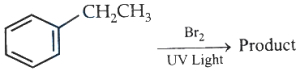
A
$1-$bromo$-1-$phenylethane
B
$2-$bromo$-1-$phenylethane
C
p-bromoethylbenzene
D
o,p-dibromoethylbenzene
Solution
(A) The reaction of ethylbenzene with $Br_2$ in the presence of $UV$ light is a free radical substitution reaction. The bromine radical abstracts a hydrogen atom from the benzylic carbon because the resulting benzylic radical is resonance-stabilized by the phenyl ring. The radical formed at the $\alpha$-carbon (benzylic position) is more stable than the radical at the $\beta$-carbon. Therefore,the major product is $1$-bromo-$1$-phenylethane $(C_6H_5CH(Br)CH_3)$.
0 likesView Solution
183
ChemistryMediumMCQAP EAMCET · 2023
Among the following organic halides,arrange them in the increasing order of their dehydrohalogenation reactions in the presence of alcoholic $KOH$:
$(A)$ $CH_3-CH_2-Br$
$(B)$ $CH_3-CH_2-CH_2-Br$
$(C)$ $CH_3-CH(Br)-CH_3$
$(D)$ $(CH_3)_3-CBr$
$(A)$ $CH_3-CH_2-Br$
$(B)$ $CH_3-CH_2-CH_2-Br$
$(C)$ $CH_3-CH(Br)-CH_3$
$(D)$ $(CH_3)_3-CBr$
A
$A < B < C < D$
B
$D < B < C < A$
C
$A < C < B < D$
D
$B < A < C < D$
Solution
(A) Dehydrohalogenation via the $E2$ mechanism is favored by the stability of the transition state,which is influenced by the degree of substitution of the alkyl halide. The reactivity order for dehydrohalogenation is $3^{\circ} > 2^{\circ} > 1^{\circ}$ alkyl halides due to the formation of more substituted (stable) alkenes (Saytzeff's rule).
The given compounds are:
$(A)$ $CH_3-CH_2-Br$ ($1^{\circ}$ halide)
$(B)$ $CH_3-CH_2-CH_2-Br$ ($1^{\circ}$ halide)
$(C)$ $CH_3-CH(Br)-CH_3$ ($2^{\circ}$ halide)
$(D)$ $(CH_3)_3-CBr$ ($3^{\circ}$ halide)
Comparing the $1^{\circ}$ halides,$CH_3-CH_2-Br$ is less reactive than $CH_3-CH_2-CH_2-Br$ due to steric and electronic factors. Thus,the increasing order of reactivity is $A < B < C < D$.
The given compounds are:
$(A)$ $CH_3-CH_2-Br$ ($1^{\circ}$ halide)
$(B)$ $CH_3-CH_2-CH_2-Br$ ($1^{\circ}$ halide)
$(C)$ $CH_3-CH(Br)-CH_3$ ($2^{\circ}$ halide)
$(D)$ $(CH_3)_3-CBr$ ($3^{\circ}$ halide)
Comparing the $1^{\circ}$ halides,$CH_3-CH_2-Br$ is less reactive than $CH_3-CH_2-CH_2-Br$ due to steric and electronic factors. Thus,the increasing order of reactivity is $A < B < C < D$.
0 likesView Solution
184
ChemistryMediumMCQAP EAMCET · 2023
Which is the correct order of the following alkyl halides for an $S_{N}2$ reaction?
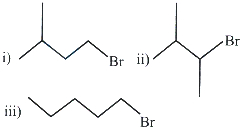
A
$ii > i > iii$
B
$iii > i > ii$
C
$iii > ii > i$
D
$ii > iii > i$
Solution
(B) The reactivity of alkyl halides towards $S_{N}2$ reactions depends on the steric hindrance at the $\alpha$-carbon atom. The order of reactivity is: primary $(1^{\circ})$ > secondary $(2^{\circ})$ > tertiary $(3^{\circ})$.
In the given structures:
(iii) is a primary alkyl halide ($1$-bromopentane).
$(i)$ is a primary alkyl halide ($1$-bromo$-3-$methylbutane),but it has more steric hindrance at the $\beta$-carbon compared to (iii).
(ii) is a secondary alkyl halide ($2$-bromo$-3-$methylbutane).
Therefore,the correct order of reactivity for $S_{N}2$ is $(iii) > (i) > (ii)$.
In the given structures:
(iii) is a primary alkyl halide ($1$-bromopentane).
$(i)$ is a primary alkyl halide ($1$-bromo$-3-$methylbutane),but it has more steric hindrance at the $\beta$-carbon compared to (iii).
(ii) is a secondary alkyl halide ($2$-bromo$-3-$methylbutane).
Therefore,the correct order of reactivity for $S_{N}2$ is $(iii) > (i) > (ii)$.
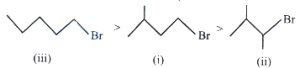
0 likesView Solution
185
ChemistryMediumMCQAP EAMCET · 2023
Arrange the following in the correct order of reactivity towards $S_{N}2$ reaction:
$I$: $1$-Chloropropane
$II$: $2$-Chloropropane
$III$: $1$-Iodopropane
$IV$: $2$-Iodopropane
$I$: $1$-Chloropropane
$II$: $2$-Chloropropane
$III$: $1$-Iodopropane
$IV$: $2$-Iodopropane
A
$III > I > IV > II$
B
$III > IV > I > II$
C
$I > II > III > IV$
D
$I > III > II > IV$
Solution
(A) $S_{N}2$ reactivity depends on two main factors: steric hindrance at the $\alpha$-carbon and the strength of the $C-X$ bond.
$1$. Steric hindrance: Primary alkyl halides $(1^{\circ})$ are more reactive than secondary alkyl halides $(2^{\circ})$ due to less steric crowding. Thus,$1$-substituted compounds $(I, III)$ are more reactive than $2$-substituted compounds $(II, IV)$.
$2$. Leaving group ability: The $C-I$ bond is weaker and longer than the $C-Cl$ bond,making $I^-$ a better leaving group than $Cl^-$. Therefore,iodides are more reactive than chlorides.
Combining these factors,the order of reactivity is:
$1$-Iodopropane $(III)$ > $1$-Chloropropane $(I)$ > $2$-Iodopropane $(IV)$ > $2$-Chloropropane $(II)$
Therefore,the correct order is $III > I > IV > II$.
$1$. Steric hindrance: Primary alkyl halides $(1^{\circ})$ are more reactive than secondary alkyl halides $(2^{\circ})$ due to less steric crowding. Thus,$1$-substituted compounds $(I, III)$ are more reactive than $2$-substituted compounds $(II, IV)$.
$2$. Leaving group ability: The $C-I$ bond is weaker and longer than the $C-Cl$ bond,making $I^-$ a better leaving group than $Cl^-$. Therefore,iodides are more reactive than chlorides.
Combining these factors,the order of reactivity is:
$1$-Iodopropane $(III)$ > $1$-Chloropropane $(I)$ > $2$-Iodopropane $(IV)$ > $2$-Chloropropane $(II)$
Therefore,the correct order is $III > I > IV > II$.
0 likesView Solution
186
ChemistryMediumMCQAP EAMCET · 2023
What is the product $X$ in the following Wurtz-Fittig reaction?
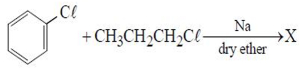
A
Propylbenzene
B
Isopropylbenzene
C
Ethylbenzene
D
Butylbenzene
Solution
(D) The given reaction is a Wurtz-Fittig reaction,which involves the coupling of an aryl halide with an alkyl halide in the presence of sodium metal and dry ether to form an alkylbenzene.
The reaction is:
$C_6H_5Cl + CH_3CH_2CH_2CH_2Cl + 2Na \xrightarrow{\text{dry ether}} C_6H_5-CH_2CH_2CH_2CH_3 + 2NaCl$
The product $X$ formed is $n$-butylbenzene (or simply butylbenzene).
The reaction is:
$C_6H_5Cl + CH_3CH_2CH_2CH_2Cl + 2Na \xrightarrow{\text{dry ether}} C_6H_5-CH_2CH_2CH_2CH_3 + 2NaCl$
The product $X$ formed is $n$-butylbenzene (or simply butylbenzene).
0 likesView Solution
187
ChemistryMediumMCQAP EAMCET · 2023
Two statements are given below:
Statement $I$: Chlorobenzene on nitration gives $1-$chloro$-4-$nitrobenzene as the major product.
Statement $II$: Chlorobenzene undergoes nitration more slowly than benzene.
Identify the correct answer.
Statement $I$: Chlorobenzene on nitration gives $1-$chloro$-4-$nitrobenzene as the major product.
Statement $II$: Chlorobenzene undergoes nitration more slowly than benzene.
Identify the correct answer.
A
Statement $I$ and $II$ are correct.
B
Statements $I$ and $II$ are incorrect.
C
Statement $I$ is correct but statement $II$ is incorrect.
D
Statement $II$ is correct but statement $I$ is incorrect.
Solution
(A) The nitration of chlorobenzene with a mixture of concentrated $HNO_3$ and $H_2SO_4$ yields a mixture of $1-$chloro$-2-$nitrobenzene (minor) and $1-$chloro$-4-$nitrobenzene (major) due to the ortho/para directing nature of the $-Cl$ group. Thus,Statement $I$ is correct.
The $-Cl$ atom is an electron-withdrawing group due to its $-I$ effect,which deactivates the benzene ring towards electrophilic aromatic substitution. Consequently,chlorobenzene reacts more slowly than benzene in nitration. Thus,Statement $II$ is also correct.
The $-Cl$ atom is an electron-withdrawing group due to its $-I$ effect,which deactivates the benzene ring towards electrophilic aromatic substitution. Consequently,chlorobenzene reacts more slowly than benzene in nitration. Thus,Statement $II$ is also correct.
0 likesView Solution
188
ChemistryEasyMCQAP EAMCET · 2023
The Fittig reaction is:
A
Reaction between two aryl halides in the presence of $Na / \text{dry ether}$
B
Reaction between two alkyl halides in the presence of $Na / \text{dry ether}$
C
Reaction between aryl halide and alkyl halide in the presence of $Na / \text{dry ether}$
D
Reaction between two aryl halides in the presence of $Fe / \text{dry ether}$
Solution
(A) The Fittig reaction involves the coupling of two aryl halide molecules in the presence of sodium metal and dry ether to form a diaryl compound (biphenyl).
The general reaction is:
$2 Ar-X + 2 Na \xrightarrow{\text{dry ether}} Ar-Ar + 2 NaX$
For example,with chlorobenzene:
$2 C_6H_5Cl + 2 Na \xrightarrow{\text{dry ether}} C_6H_5-C_6H_5 + 2 NaCl$
The general reaction is:
$2 Ar-X + 2 Na \xrightarrow{\text{dry ether}} Ar-Ar + 2 NaX$
For example,with chlorobenzene:
$2 C_6H_5Cl + 2 Na \xrightarrow{\text{dry ether}} C_6H_5-C_6H_5 + 2 NaCl$
0 likesView Solution
189
ChemistryMediumMCQAP EAMCET · 2023
Identify $X$ and $Y$ in the following reaction:
$CH_2=CH_2 \xrightarrow[(i) X]{(ii) Y} CH_3CH_2I$
$CH_2=CH_2 \xrightarrow[(i) X]{(ii) Y} CH_3CH_2I$
A
$HBr, NaI / \text{dry } CH_3COCH_3$
B
$HBr, I_2 / \text{dry } CH_3COCH_3$
C
$Br_2, NaI / \text{dry } CH_3COCH_3$
D
$Br_2, I_2 / \text{dry } CH_3COCH_3$
Solution
(A) The reaction proceeds in two steps:
Step $1$: Electrophilic addition of $HBr$ to ethene $(CH_2=CH_2)$ gives bromoethane $(CH_3CH_2Br)$. Thus,$X = HBr$.
Step $2$: Bromoethane reacts with $NaI$ in dry acetone to form iodoethane $(CH_3CH_2I)$ via the Finkelstein reaction. Thus,$Y = NaI / \text{dry } CH_3COCH_3$.
Therefore,the correct reagents are $X = HBr$ and $Y = NaI / \text{dry } CH_3COCH_3$.
Step $1$: Electrophilic addition of $HBr$ to ethene $(CH_2=CH_2)$ gives bromoethane $(CH_3CH_2Br)$. Thus,$X = HBr$.
Step $2$: Bromoethane reacts with $NaI$ in dry acetone to form iodoethane $(CH_3CH_2I)$ via the Finkelstein reaction. Thus,$Y = NaI / \text{dry } CH_3COCH_3$.
Therefore,the correct reagents are $X = HBr$ and $Y = NaI / \text{dry } CH_3COCH_3$.
0 likesView Solution
190
ChemistryMediumMCQAP EAMCET · 2023
In which of the following,reagent and product are correctly matched with respect to benzene diazonium chloride as reactant?
A
$Cu_2O ; C_6H_5Br$
B
$HI ; C_6H_5I$
C
$NaNO_2 ; C_6H_5NO$
D
$CH_3CH_2OH ; C_6H_6$
Solution
(D) The reaction of benzene diazonium chloride $(C_6H_5N_2Cl)$ with ethanol $(CH_3CH_2OH)$ is a well-known reduction reaction.
Ethanol acts as a reducing agent and gets oxidized to acetaldehyde $(CH_3CHO)$,while benzene diazonium chloride is reduced to benzene $(C_6H_6)$,with the evolution of nitrogen gas $(N_2)$ and formation of hydrochloric acid $(HCl)$.
The reaction is: $C_6H_5N_2Cl + CH_3CH_2OH \rightarrow C_6H_6 + N_2 + CH_3CHO + HCl$.
Therefore,option $D$ is the correctly matched pair.
Ethanol acts as a reducing agent and gets oxidized to acetaldehyde $(CH_3CHO)$,while benzene diazonium chloride is reduced to benzene $(C_6H_6)$,with the evolution of nitrogen gas $(N_2)$ and formation of hydrochloric acid $(HCl)$.
The reaction is: $C_6H_5N_2Cl + CH_3CH_2OH \rightarrow C_6H_6 + N_2 + CH_3CHO + HCl$.
Therefore,option $D$ is the correctly matched pair.
0 likesView Solution
191
ChemistryMediumMCQAP EAMCET · 2023
Identify $X$ and $Y$ in the following reactions:
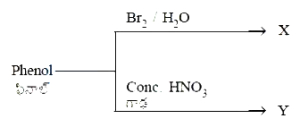
A
$X$ = $2-$bromophenol,$Y$ = $2-$nitrophenol
B
$X$ = $2,4-$dibromophenol,$Y$ = $2,6-$dinitrophenol
C
$X$ = $2,6-$dibromophenol,$Y$ = $2,6-$dinitrophenol
D
$X$ = $2,4,6-$tribromophenol,$Y$ = $2,4,6-$trinitrophenol
Solution
(D) When phenol reacts with bromine water $(Br_2/H_2O)$,it undergoes electrophilic substitution at all ortho and para positions due to the strong activating effect of the $-OH$ group,resulting in the formation of $2,4,6$-tribromophenol $(X)$.
When phenol reacts with concentrated nitric acid $(Conc. HNO_3)$,it undergoes nitration to form $2,4,6$-trinitrophenol,commonly known as picric acid $(Y)$.
When phenol reacts with concentrated nitric acid $(Conc. HNO_3)$,it undergoes nitration to form $2,4,6$-trinitrophenol,commonly known as picric acid $(Y)$.
0 likesView Solution
192
ChemistryEasyMCQAP EAMCET · 2023
Which of the following has the highest $pK_{a}$ value?
A
$2-$Nitrophenol
B
$3-$Nitrophenol
C
$4-$Nitrophenol
D
$2, 4-$Dinitrophenol
Solution
(B) The $pK_{a}$ value is inversely proportional to the acidity of the compound. $A$ higher $pK_{a}$ value indicates a weaker acid.
Among the given options,the $-NO_2$ group is a strong electron-withdrawing group $(EWG)$ that increases acidity via $-I$ and $-M$ effects.
In $2-$nitrophenol,intramolecular hydrogen bonding stabilizes the conjugate base,increasing acidity.
In $4-$nitrophenol,the $-NO_2$ group exerts a strong $-M$ effect,significantly increasing acidity.
In $2, 4-$dinitrophenol,two $-NO_2$ groups significantly increase acidity.
In $3-$nitrophenol,the $-NO_2$ group is at the meta position,where it only exerts an $-I$ effect (no resonance effect). Therefore,it is the least acidic among the choices,resulting in the highest $pK_{a}$ value.
Among the given options,the $-NO_2$ group is a strong electron-withdrawing group $(EWG)$ that increases acidity via $-I$ and $-M$ effects.
In $2-$nitrophenol,intramolecular hydrogen bonding stabilizes the conjugate base,increasing acidity.
In $4-$nitrophenol,the $-NO_2$ group exerts a strong $-M$ effect,significantly increasing acidity.
In $2, 4-$dinitrophenol,two $-NO_2$ groups significantly increase acidity.
In $3-$nitrophenol,the $-NO_2$ group is at the meta position,where it only exerts an $-I$ effect (no resonance effect). Therefore,it is the least acidic among the choices,resulting in the highest $pK_{a}$ value.
0 likesView Solution
193
ChemistryEasyMCQAP EAMCET · 2023
Match the following List-$I$ (Name of the mineral) with List-$II$ (Type):
| List-$I$ | List-$II$ |
| :--- | :--- |
| $A$. Calamine | $I$. Sulphide |
| $B$. Bauxite | $II$. Halide |
| $C$. Kaolinite | $III$. Carbonate |
| $D$. Cryolite | $IV$. Oxide |
| | $V$. Silicate |
| List-$I$ | List-$II$ |
| :--- | :--- |
| $A$. Calamine | $I$. Sulphide |
| $B$. Bauxite | $II$. Halide |
| $C$. Kaolinite | $III$. Carbonate |
| $D$. Cryolite | $IV$. Oxide |
| | $V$. Silicate |
A
$A-IV, B-III, C-I, D-II$
B
$A-III, B-IV, C-I, D-V$
C
$A-IV, B-II, C-V, D-I$
D
$A-III, B-IV, C-V, D-II$
Solution
(D) The correct matches are as follows:
$A$. Calamine $(ZnCO_3)$ is a Carbonate ore $(III)$.
$B$. Bauxite $(Al_2O_3 \cdot 2H_2O)$ is an Oxide ore $(IV)$.
$C$. Kaolinite $(Al_2(OH)_4Si_2O_5)$ is a Silicate mineral $(V)$.
$D$. Cryolite $(Na_3AlF_6)$ is a Halide ore $(II)$.
Therefore,the correct matching is $A-III, B-IV, C-V, D-II$.
$A$. Calamine $(ZnCO_3)$ is a Carbonate ore $(III)$.
$B$. Bauxite $(Al_2O_3 \cdot 2H_2O)$ is an Oxide ore $(IV)$.
$C$. Kaolinite $(Al_2(OH)_4Si_2O_5)$ is a Silicate mineral $(V)$.
$D$. Cryolite $(Na_3AlF_6)$ is a Halide ore $(II)$.
Therefore,the correct matching is $A-III, B-IV, C-V, D-II$.
0 likesView Solution
194
ChemistryEasyMCQAP EAMCET · 2023
Match the following:
The correct answer is:
| $List-I$ (Process) | $List-II$ (Catalyst) |
|---|---|
| $(A)$ Ostwald's process | $(I)$ $NO$ |
| $(B)$ Lead Chamber process | $(II)$ $Fe$ |
| $(C)$ Deacon's process | $(III)$ $Pt/Rh$ |
| $(D)$ Haber's process | $(IV)$ $CuCl_2$ |
The correct answer is:
A
$A-III, B-I, C-IV, D-II$
B
$A-II, B-III, C-IV, D-I$
C
$A-III, B-I, C-II, D-IV$
D
$A-I, B-III, C-IV, D-II$
Solution
(A) The correct matches are:
$A$. Ostwald's process uses $Pt/Rh$ gauge as a catalyst.
$B$. Lead Chamber process uses $NO$ as a catalyst.
$C$. Deacon's process uses $CuCl_2$ as a catalyst.
$D$. Haber's process uses $Fe$ as a catalyst.
Therefore,the correct sequence is $A-III, B-I, C-IV, D-II$.
$A$. Ostwald's process uses $Pt/Rh$ gauge as a catalyst.
$B$. Lead Chamber process uses $NO$ as a catalyst.
$C$. Deacon's process uses $CuCl_2$ as a catalyst.
$D$. Haber's process uses $Fe$ as a catalyst.
Therefore,the correct sequence is $A-III, B-I, C-IV, D-II$.
0 likesView Solution
195
ChemistryMediumMCQAP EAMCET · 2023
The sum of oxygen atoms in the formulae of peroxydisulphuric acid and pyrosulphuric acid is
A
$7$
B
$12$
C
$15$
D
$13$
Solution
(C) The formula for peroxydisulphuric acid (Marshall's acid) is $H_2S_2O_8$.
The formula for pyrosulphuric acid (Oleum) is $H_2S_2O_7$.
The number of oxygen atoms in $H_2S_2O_8$ is $8$.
The number of oxygen atoms in $H_2S_2O_7$ is $7$.
The sum of oxygen atoms $= 8 + 7 = 15$.
The formula for pyrosulphuric acid (Oleum) is $H_2S_2O_7$.
The number of oxygen atoms in $H_2S_2O_8$ is $8$.
The number of oxygen atoms in $H_2S_2O_7$ is $7$.
The sum of oxygen atoms $= 8 + 7 = 15$.
0 likesView Solution
196
ChemistryMediumMCQAP EAMCET · 2023
An oxide of chlorine with water gives the strongest acid. The ratio of chlorine and oxygen in its formula is
A
$2: 1$
B
$1: 2$
C
$2: 7$
D
$1: 3$
Solution
(C) Chlorine heptoxide $(Cl_2O_7)$ reacts with water to form perchloric acid $(HClO_4)$,which is the strongest oxoacid of chlorine.
The chemical equation is: $Cl_2O_7 + H_2O \rightarrow 2HClO_4$.
In the formula $Cl_2O_7$,the ratio of chlorine atoms to oxygen atoms is $2: 7$.
The chemical equation is: $Cl_2O_7 + H_2O \rightarrow 2HClO_4$.
In the formula $Cl_2O_7$,the ratio of chlorine atoms to oxygen atoms is $2: 7$.
0 likesView Solution
197
ChemistryMediumMCQAP EAMCET · 2023
Identify the reaction in which oxygen is not one of the products.
A
$XeF_2 + H_2O \rightarrow Xe + HF + O_2$
B
$XeF_4 + H_2O \rightarrow Xe + XeO_3 + HF + O_2$
C
$XeF_4 + O_2F_2 \rightarrow XeF_6 + O_2$
D
$XeF_6 + 3 H_2O \rightarrow XeO_3 + 6 HF$
Solution
(D) In the reaction $XeF_6 + 3 H_2O \rightarrow XeO_3 + 6 HF$,the products are $XeO_3$ and $HF$. Oxygen is not released as a product in this reaction. In the other reactions,oxygen is produced as a byproduct.
0 likesView Solution
198
ChemistryEasyMCQAP EAMCET · 2023
Which of the following fluorides of Xenon does not exist?
A
$XeF_3$
B
$XeF_2$
C
$XeF_6$
D
$XeF_4$
Solution
(A) $Xe$ forms fluorides with an even number of fluorine atoms.
This is because the promotion of one,two,or three electrons from the $5p$-orbital to the $5d$-orbital results in two,four,or six half-filled orbitals,respectively.
These half-filled orbitals form bonds with fluorine atoms,leading to the formation of $XeF_2$,$XeF_4$,or $XeF_6$.
Therefore,$XeF_3$ does not exist.
This is because the promotion of one,two,or three electrons from the $5p$-orbital to the $5d$-orbital results in two,four,or six half-filled orbitals,respectively.
These half-filled orbitals form bonds with fluorine atoms,leading to the formation of $XeF_2$,$XeF_4$,or $XeF_6$.
Therefore,$XeF_3$ does not exist.
0 likesView Solution
199
ChemistryEasyMCQAP EAMCET · 2023
In which of the following pairs is the polymer correctly matched with the intermolecular forces present in them?
| $A$. Neoprene --- Weak intermolecular forces | $B$. Terylene --- Hydrogen bonding |
| $C$. Polystyrene --- Very weak intermolecular forces | $D$. Polythene --- Hydrogen bonding |
A
$A, B$
B
$B, C$
C
$C, D$
D
$A, D$
Solution
(A) The classification of polymers based on intermolecular forces is as follows:
$1$. Neoprene is an elastomer,which possesses weak intermolecular forces. Thus,$A$ is correct.
$2$. Terylene is a fibre,which possesses strong intermolecular forces (dipole-dipole or hydrogen bonding). Thus,$B$ is correct.
$3$. Polystyrene is a thermoplastic,which possesses weak intermolecular forces,not 'very weak'.
$4$. Polythene is a thermoplastic,which possesses weak van der Waals forces,not hydrogen bonding.
Therefore,the correctly matched pairs are $A$ and $B$.
$1$. Neoprene is an elastomer,which possesses weak intermolecular forces. Thus,$A$ is correct.
$2$. Terylene is a fibre,which possesses strong intermolecular forces (dipole-dipole or hydrogen bonding). Thus,$B$ is correct.
$3$. Polystyrene is a thermoplastic,which possesses weak intermolecular forces,not 'very weak'.
$4$. Polythene is a thermoplastic,which possesses weak van der Waals forces,not hydrogen bonding.
Therefore,the correctly matched pairs are $A$ and $B$.
0 likesView Solution
200
ChemistryEasyMCQAP EAMCET · 2023
Identify the condensation polymers from the following:
$A$. $PHBV$
$B$. Buna$-N$
$C$. Neoprene
$D$. Nylon$-6$
$E$. Glyptal
$A$. $PHBV$
$B$. Buna$-N$
$C$. Neoprene
$D$. Nylon$-6$
$E$. Glyptal
A
$A, B, D$
B
$B, C, D$
C
$B, C, E$
D
$A, D, E$
Solution
(D) Condensation polymers are formed by the repeated condensation reaction between two different bi-functional or tri-functional monomeric units,usually involving the elimination of small molecules like $H_2O$,$HCl$,etc.
$1$. $PHBV$ (Poly-$\beta$-hydroxybutyrate-co-$\beta$-hydroxyvalerate) is a condensation polymer.
$2$. $Nylon-6$ is a condensation polymer (formed from caprolactam via ring-opening polymerization,which is a type of condensation).
$3$. $Glyptal$ is a condensation polymer (polyester).
$4$. $Buna-N$ and $Neoprene$ are addition polymers.
Therefore,the condensation polymers are $A, D$,and $E$.
$1$. $PHBV$ (Poly-$\beta$-hydroxybutyrate-co-$\beta$-hydroxyvalerate) is a condensation polymer.
$2$. $Nylon-6$ is a condensation polymer (formed from caprolactam via ring-opening polymerization,which is a type of condensation).
$3$. $Glyptal$ is a condensation polymer (polyester).
$4$. $Buna-N$ and $Neoprene$ are addition polymers.
Therefore,the condensation polymers are $A, D$,and $E$.
0 likesView Solution
Vedclass Products
For Students
Vedclass Test Series
Mock tests in real AP EAMCET style covering Chemistry with performance analysis. 5-day free trial.
Start Free TrialFor Teachers
Exam Paper Generator
Generate Set A/B/C/D Chemistry papers from 7.5L+ questions in 2 minutes. 3 chapters free.
Try FreeFor Institutes
Online Exam Module
Run live AP EAMCET mock exams with unlimited students, 360° analytics & white-label branding.
See DemoFrequently Asked Questions
How many Chemistry questions are in AP EAMCET 2023?
There are 414 Chemistry questions from the AP EAMCET 2023 paper on Vedclass, each with a detailed step-by-step solution in English.
Are AP EAMCET 2023 Chemistry solutions available in English?
Yes. All solutions on this page are in English. You can also switch to English or Hindi using the language buttons above the questions.
Can I practice AP EAMCET 2023 Chemistry as a timed test?
Yes. Use the Vedclass Test Series to attempt a full AP EAMCET mock test covering Chemistry with time limits and instant score analysis.
Can teachers create Chemistry papers from AP EAMCET previous year questions?
Yes. The Vedclass Exam Paper Generator lets teachers mix AP EAMCET Chemistry questions and generate Set A/B/C/D papers in minutes.
For Teachers & Institutes
Build a Custom Chemistry Paper
Pick AP EAMCET 2023 Chemistry questions, set difficulty, and generate Set A/B/C/D in 2 minutes.