
PhysicsQ1–48 of 48 questions
Page 1 of 1 · English
1
PhysicsMediumMCQAIPMT · 2001
If $|\vec A + \vec B| = |\vec A| + |\vec B|$,then the angle between $\vec A$ and $\vec B$ will be ....... $^o$.
A
$90$
B
$120$
C
$0$
D
$60$
Solution
(C) The magnitude of the resultant of two vectors $\vec A$ and $\vec B$ is given by the formula:
$|\vec R| = |\vec A + \vec B| = \sqrt{A^2 + B^2 + 2AB \cos \theta}$,where $\theta$ is the angle between the two vectors.
Given the condition $|\vec A + \vec B| = |\vec A| + |\vec B|$,we substitute the magnitude formula:
$\sqrt{A^2 + B^2 + 2AB \cos \theta} = A + B$
Squaring both sides:
$A^2 + B^2 + 2AB \cos \theta = (A + B)^2$
$A^2 + B^2 + 2AB \cos \theta = A^2 + B^2 + 2AB$
$2AB \cos \theta = 2AB$
$\cos \theta = 1$
Therefore,$\theta = 0^o$.
$|\vec R| = |\vec A + \vec B| = \sqrt{A^2 + B^2 + 2AB \cos \theta}$,where $\theta$ is the angle between the two vectors.
Given the condition $|\vec A + \vec B| = |\vec A| + |\vec B|$,we substitute the magnitude formula:
$\sqrt{A^2 + B^2 + 2AB \cos \theta} = A + B$
Squaring both sides:
$A^2 + B^2 + 2AB \cos \theta = (A + B)^2$
$A^2 + B^2 + 2AB \cos \theta = A^2 + B^2 + 2AB$
$2AB \cos \theta = 2AB$
$\cos \theta = 1$
Therefore,$\theta = 0^o$.
0 likesView Solution
2
PhysicsMediumMCQAIPMT · 2001
The dimension of Planck's constant is equal to that of:
A
Energy
B
Linear momentum
C
Power
D
Angular momentum
Solution
(D) The energy of a photon is given by $E = h\nu$,where $h$ is Planck's constant and $\nu$ is the frequency.
Thus,the dimension of $h$ is $[h] = [E] / [\nu]$.
$[E] = [M L^2 T^{-2}]$ and $[\nu] = [T^{-1}]$.
So,$[h] = [M L^2 T^{-2}] / [T^{-1}] = [M L^2 T^{-1}]$.
Angular momentum $L$ is defined as $L = mvr$,where $m$ is mass,$v$ is velocity,and $r$ is radius.
$[L] = [M] [L T^{-1}] [L] = [M L^2 T^{-1}]$.
Therefore,the dimension of Planck's constant is equal to that of angular momentum.
Thus,the dimension of $h$ is $[h] = [E] / [\nu]$.
$[E] = [M L^2 T^{-2}]$ and $[\nu] = [T^{-1}]$.
So,$[h] = [M L^2 T^{-2}] / [T^{-1}] = [M L^2 T^{-1}]$.
Angular momentum $L$ is defined as $L = mvr$,where $m$ is mass,$v$ is velocity,and $r$ is radius.
$[L] = [M] [L T^{-1}] [L] = [M L^2 T^{-1}]$.
Therefore,the dimension of Planck's constant is equal to that of angular momentum.
0 likesView Solution
3
PhysicsMediumMCQAIPMT · 2001
$A$ ball is thrown vertically upward. It has a speed of $10 \; m/s$ when it has reached one-half of its maximum height. How high does the ball rise? (Take $g = 10 \; m/s^2$)
A
$5$
B
$10$
C
$15$
D
$20$
Solution
(B) Let the initial velocity be $u$ and the maximum height be $H$. The maximum height is given by $H = \frac{u^2}{2g}$.
At height $h = \frac{H}{2}$,the velocity $v = 10 \; m/s$.
Using the equation of motion $v^2 = u^2 - 2gh$:
$(10)^2 = u^2 - 2g \left( \frac{H}{2} \right)$
$100 = u^2 - gH$
Substitute $H = \frac{u^2}{2g}$ into the equation:
$100 = u^2 - g \left( \frac{u^2}{2g} \right)$
$100 = u^2 - \frac{u^2}{2} = \frac{u^2}{2}$
$u^2 = 200 \; m^2/s^2$.
Now,calculate the maximum height $H$:
$H = \frac{u^2}{2g} = \frac{200}{2 \times 10} = \frac{200}{20} = 10 \; m$.
At height $h = \frac{H}{2}$,the velocity $v = 10 \; m/s$.
Using the equation of motion $v^2 = u^2 - 2gh$:
$(10)^2 = u^2 - 2g \left( \frac{H}{2} \right)$
$100 = u^2 - gH$
Substitute $H = \frac{u^2}{2g}$ into the equation:
$100 = u^2 - g \left( \frac{u^2}{2g} \right)$
$100 = u^2 - \frac{u^2}{2} = \frac{u^2}{2}$
$u^2 = 200 \; m^2/s^2$.
Now,calculate the maximum height $H$:
$H = \frac{u^2}{2g} = \frac{200}{2 \times 10} = \frac{200}{20} = 10 \; m$.
1 likesView Solution
4
PhysicsMediumMCQAIPMT · 2001
$A$ ball is projected with kinetic energy $E$ at an angle of $45^\circ$ to the horizontal. At the highest point during its flight,its kinetic energy will be
A
Zero
B
$E/2$
C
$E/\sqrt{2}$
D
$E$
Solution
(B) The initial kinetic energy of the ball is $E = \frac{1}{2}mv^2$,where $v$ is the initial velocity.
At the highest point of the trajectory,the vertical component of the velocity becomes zero,while the horizontal component remains constant.
The horizontal component of velocity is $v_x = v \cos \theta$.
At the highest point,the velocity of the ball is $v_h = v \cos \theta$.
The kinetic energy at the highest point is $E' = \frac{1}{2}m(v_h)^2 = \frac{1}{2}m(v \cos \theta)^2$.
$E' = (\frac{1}{2}mv^2) \cos^2 \theta = E \cos^2 \theta$.
Given $\theta = 45^\circ$,we have $\cos 45^\circ = \frac{1}{\sqrt{2}}$.
Therefore,$E' = E (\frac{1}{\sqrt{2}})^2 = E (\frac{1}{2}) = \frac{E}{2}$.
At the highest point of the trajectory,the vertical component of the velocity becomes zero,while the horizontal component remains constant.
The horizontal component of velocity is $v_x = v \cos \theta$.
At the highest point,the velocity of the ball is $v_h = v \cos \theta$.
The kinetic energy at the highest point is $E' = \frac{1}{2}m(v_h)^2 = \frac{1}{2}m(v \cos \theta)^2$.
$E' = (\frac{1}{2}mv^2) \cos^2 \theta = E \cos^2 \theta$.
Given $\theta = 45^\circ$,we have $\cos 45^\circ = \frac{1}{\sqrt{2}}$.
Therefore,$E' = E (\frac{1}{\sqrt{2}})^2 = E (\frac{1}{2}) = \frac{E}{2}$.
0 likesView Solution
5
PhysicsMediumMCQAIPMT · 2001
On the horizontal surface of a truck,a block of mass $1 \; kg$ is placed $(\mu = 0.6)$. If the truck is moving with an acceleration of $5 \; m/s^2$,then the frictional force on the block will be: (in $; N$)
A
$5$
B
$6$
C
$5.88$
D
$8$
Solution
(A) The limiting friction force is given by $F_l = \mu mg = 0.6 \times 1 \times 9.8 = 5.88 \; N$.
The pseudo force acting on the block in the frame of the truck is $F_p = ma = 1 \times 5 = 5 \; N$.
Since the pseudo force $(5 \; N)$ is less than the limiting friction $(5.88 \; N)$,the block does not slide relative to the truck.
Therefore,the static frictional force acting on the block is equal to the applied pseudo force,which is $5 \; N$.
The pseudo force acting on the block in the frame of the truck is $F_p = ma = 1 \times 5 = 5 \; N$.
Since the pseudo force $(5 \; N)$ is less than the limiting friction $(5.88 \; N)$,the block does not slide relative to the truck.
Therefore,the static frictional force acting on the block is equal to the applied pseudo force,which is $5 \; N$.
0 likesView Solution
6
PhysicsMediumMCQAIPMT · 2001
$A$ scientist claims that the efficiency of their heat engine,which operates between a source temperature of $127^{\circ}C$ and a sink temperature of $27^{\circ}C$,is $26\%$. Then:
A
It is impossible
B
It is possible but less probable
C
It is quite probable
D
Data are incomplete
Solution
(A) The maximum theoretical efficiency of a heat engine is given by the Carnot efficiency formula: $\eta_{\max} = 1 - \frac{T_2}{T_1}$.
First,convert the temperatures from Celsius to Kelvin: $T_1 = 127 + 273 = 400 \text{ K}$ and $T_2 = 27 + 273 = 300 \text{ K}$.
Substituting these values into the formula: $\eta_{\max} = 1 - \frac{300}{400} = 1 - 0.75 = 0.25$ or $25\%$.
Since the second law of thermodynamics states that no heat engine can have an efficiency greater than the Carnot efficiency operating between the same two temperatures,an efficiency of $26\%$ is impossible.
First,convert the temperatures from Celsius to Kelvin: $T_1 = 127 + 273 = 400 \text{ K}$ and $T_2 = 27 + 273 = 300 \text{ K}$.
Substituting these values into the formula: $\eta_{\max} = 1 - \frac{300}{400} = 1 - 0.75 = 0.25$ or $25\%$.
Since the second law of thermodynamics states that no heat engine can have an efficiency greater than the Carnot efficiency operating between the same two temperatures,an efficiency of $26\%$ is impossible.
0 likesView Solution
7
PhysicsMediumMCQAIPMT · 2001
$A$ cylindrical rod has temperatures $T_1$ and $T_2$ at its ends. The rate of flow of heat is $Q_1 \ cal/sec$. If all the linear dimensions are doubled while keeping the temperatures constant,then the new rate of flow of heat $Q_2$ will be:
A
$4Q_1$
B
$2Q_1$
C
$\frac{Q_1}{4}$
D
$\frac{Q_1}{2}$
Solution
(B) The rate of heat flow through a cylindrical rod is given by the formula: $\frac{dQ}{dt} = \frac{kA(T_1 - T_2)}{L}$,where $A = \pi r^2$.
Thus,the rate of heat flow is proportional to $\frac{r^2}{L}$.
Let the initial radius be $r_1$ and length be $L_1$. Then $Q_1 \propto \frac{r_1^2}{L_1}$.
When all linear dimensions are doubled,the new radius $r_2 = 2r_1$ and the new length $L_2 = 2L_1$.
The new rate of heat flow $Q_2 \propto \frac{r_2^2}{L_2} = \frac{(2r_1)^2}{2L_1} = \frac{4r_1^2}{2L_1} = 2 \left( \frac{r_1^2}{L_1} \right)$.
Therefore,$Q_2 = 2Q_1$.
Thus,the rate of heat flow is proportional to $\frac{r^2}{L}$.
Let the initial radius be $r_1$ and length be $L_1$. Then $Q_1 \propto \frac{r_1^2}{L_1}$.
When all linear dimensions are doubled,the new radius $r_2 = 2r_1$ and the new length $L_2 = 2L_1$.
The new rate of heat flow $Q_2 \propto \frac{r_2^2}{L_2} = \frac{(2r_1)^2}{2L_1} = \frac{4r_1^2}{2L_1} = 2 \left( \frac{r_1^2}{L_1} \right)$.
Therefore,$Q_2 = 2Q_1$.
0 likesView Solution
8
PhysicsEasyMCQAIPMT · 2001
The total energy of a particle performing $S.H.M.$ depends on:
A
$K, x$
B
$K, a$
C
$K, a, x$
D
$K, a, m$
Solution
(B) The total energy $E$ of a particle performing Simple Harmonic Motion $(S.H.M.)$ is given by the formula:
$E = \frac{1}{2} K a^2$
Where:
$K$ is the force constant (or spring constant),
$a$ is the amplitude of the oscillation.
Since the total energy is the sum of kinetic and potential energy at any point,it remains constant throughout the motion and is independent of the instantaneous displacement $x$.
Therefore,the total energy depends only on the force constant $K$ and the amplitude $a$.
$E = \frac{1}{2} K a^2$
Where:
$K$ is the force constant (or spring constant),
$a$ is the amplitude of the oscillation.
Since the total energy is the sum of kinetic and potential energy at any point,it remains constant throughout the motion and is independent of the instantaneous displacement $x$.
Therefore,the total energy depends only on the force constant $K$ and the amplitude $a$.
0 likesView Solution
9
PhysicsEasyMCQAIPMT · 2001
The equation of a wave is represented by $y = 10^{-4} \sin(100t - x/10)$. The velocity of the wave will be .... $m/s$.
A
$100$
B
$4$
C
$0$
D
$1000$
Solution
(D) The standard wave equation is given by $y = A \sin(\omega t - kx)$.
Comparing this with the given equation $y = 10^{-4} \sin(100t - x/10)$,we get:
Angular frequency $\omega = 100 \, rad/s$.
Wave number $k = 1/10 \, m^{-1}$.
The velocity of the wave $v$ is given by the formula $v = \frac{\omega}{k}$.
Substituting the values,$v = \frac{100}{1/10} = 1000 \, m/s$.
Comparing this with the given equation $y = 10^{-4} \sin(100t - x/10)$,we get:
Angular frequency $\omega = 100 \, rad/s$.
Wave number $k = 1/10 \, m^{-1}$.
The velocity of the wave $v$ is given by the formula $v = \frac{\omega}{k}$.
Substituting the values,$v = \frac{100}{1/10} = 1000 \, m/s$.
0 likesView Solution
10
PhysicsMediumMCQAIPMT · 2001
Two waves have equations $x_1 = a \sin(\omega t + \phi_1)$ and $x_2 = a \sin(\omega t + \phi_2)$. If the frequency and amplitude of the resultant wave remain equal to those of the superimposing waves,then the phase difference between them is:
A
$\frac{\pi}{6}$
B
$\frac{2\pi}{3}$
C
$\frac{\pi}{4}$
D
$\frac{\pi}{3}$
Solution
(B) The resultant amplitude $A$ of two superimposing waves with equal amplitude $a$ is given by the formula: $A^2 = a^2 + a^2 + 2a^2 \cos \phi$,where $\phi$ is the phase difference.
Given that the resultant amplitude $A$ is equal to the amplitude of the individual waves,$A = a$.
Substituting this into the equation: $a^2 = a^2 + a^2 + 2a^2 \cos \phi$.
$a^2 = 2a^2 + 2a^2 \cos \phi$.
$-a^2 = 2a^2 \cos \phi$.
$\cos \phi = -\frac{1}{2}$.
Since $\cos(120^\circ) = -\frac{1}{2}$,the phase difference $\phi = \frac{2\pi}{3}$ radians.
Given that the resultant amplitude $A$ is equal to the amplitude of the individual waves,$A = a$.
Substituting this into the equation: $a^2 = a^2 + a^2 + 2a^2 \cos \phi$.
$a^2 = 2a^2 + 2a^2 \cos \phi$.
$-a^2 = 2a^2 \cos \phi$.
$\cos \phi = -\frac{1}{2}$.
Since $\cos(120^\circ) = -\frac{1}{2}$,the phase difference $\phi = \frac{2\pi}{3}$ radians.
0 likesView Solution
11
PhysicsMediumMCQAIPMT · 2001
If the tension and diameter of a sonometer wire of fundamental frequency $n$ are doubled and density is halved,then its fundamental frequency will become
A
$\frac{n}{4}$
B
$\sqrt{2} \, n$
C
$n$
D
$\frac{n}{\sqrt{2}}$
Solution
(C) The fundamental frequency $n$ of a sonometer wire is given by the formula: $n = \frac{1}{2l} \sqrt{\frac{T}{\mu}}$,where $\mu = \pi r^2 \rho$ is the linear mass density.
Thus,$n \propto \sqrt{\frac{T}{r^2 \rho}}$.
Let the initial values be $T_1 = T$,$r_1 = r$,and $\rho_1 = \rho$. The new values are $T_2 = 2T$,$r_2 = 2r$,and $\rho_2 = \frac{\rho}{2}$.
The ratio of the frequencies is given by:
$\frac{n_2}{n_1} = \sqrt{\frac{T_2}{T_1} \cdot \left(\frac{r_1}{r_2}\right)^2 \cdot \frac{\rho_1}{\rho_2}}$
Substituting the values:
$\frac{n_2}{n_1} = \sqrt{\frac{2T}{T} \cdot \left(\frac{r}{2r}\right)^2 \cdot \frac{\rho}{\rho/2}} = \sqrt{2 \cdot \frac{1}{4} \cdot 2} = \sqrt{1} = 1$.
Therefore,$n_2 = n_1 = n$.
Thus,$n \propto \sqrt{\frac{T}{r^2 \rho}}$.
Let the initial values be $T_1 = T$,$r_1 = r$,and $\rho_1 = \rho$. The new values are $T_2 = 2T$,$r_2 = 2r$,and $\rho_2 = \frac{\rho}{2}$.
The ratio of the frequencies is given by:
$\frac{n_2}{n_1} = \sqrt{\frac{T_2}{T_1} \cdot \left(\frac{r_1}{r_2}\right)^2 \cdot \frac{\rho_1}{\rho_2}}$
Substituting the values:
$\frac{n_2}{n_1} = \sqrt{\frac{2T}{T} \cdot \left(\frac{r}{2r}\right)^2 \cdot \frac{\rho}{\rho/2}} = \sqrt{2 \cdot \frac{1}{4} \cdot 2} = \sqrt{1} = 1$.
Therefore,$n_2 = n_1 = n$.
0 likesView Solution
12
PhysicsEasyMCQAIPMT · 2001
Which of the following helps us in the determination of the temperature of the sun?
A
Kirchhoff's law
B
Maxwell-Boltzmann law
C
Planck's law
D
Stefan's law
Solution
(D) The correct answer is $D$.
According to Stefan-Boltzmann law,the total energy $E$ radiated per unit surface area of a black body per unit time is directly proportional to the fourth power of its absolute temperature $T$.
The formula is given by $E = \sigma T^4$,where $\sigma$ is the Stefan-Boltzmann constant.
By measuring the total energy radiated by the sun,we can determine its surface temperature using this law.
According to Stefan-Boltzmann law,the total energy $E$ radiated per unit surface area of a black body per unit time is directly proportional to the fourth power of its absolute temperature $T$.
The formula is given by $E = \sigma T^4$,where $\sigma$ is the Stefan-Boltzmann constant.
By measuring the total energy radiated by the sun,we can determine its surface temperature using this law.
0 likesView Solution
13
PhysicsMediumMCQAIPMT · 2001
$A$ $1 \; kg$ stationary bomb explodes into three parts having mass ratio $1:1:3$. The parts with equal mass move in perpendicular directions with a velocity of $30 \; m/s$. What is the velocity of the third (heavier) part?
A
$10/\sqrt{2} \; m/s$
B
$15/\sqrt{2} \; m/s$
C
$15\sqrt{2} \; m/s$
D
$10\sqrt{2} \; m/s$
Solution
(D) Let the total mass be $M = 1 \; kg$. The masses of the three parts are $m_1 = 0.2 \; kg$,$m_2 = 0.2 \; kg$,and $m_3 = 0.6 \; kg$ (ratio $1:1:3$).
Since the bomb is initially stationary,the initial momentum is $0$.
By the law of conservation of linear momentum,the final momentum must also be $0$.
Let the velocities of the two smaller parts be $\vec{v}_1 = 30\hat{i} \; m/s$ and $\vec{v}_2 = 30\hat{j} \; m/s$.
The momentum of these two parts is $\vec{p}_{12} = m_1\vec{v}_1 + m_2\vec{v}_2 = 0.2(30\hat{i} + 30\hat{j}) = 6\hat{i} + 6\hat{j} \; kg \cdot m/s$.
The magnitude of this momentum is $p_{12} = \sqrt{6^2 + 6^2} = 6\sqrt{2} \; kg \cdot m/s$.
For the total momentum to be zero,the third part must have momentum $\vec{p}_3 = -\vec{p}_{12}$.
Thus,$m_3 v_3 = 6\sqrt{2}$.
$0.6 \cdot v_3 = 6\sqrt{2}$.
$v_3 = \frac{6\sqrt{2}}{0.6} = 10\sqrt{2} \; m/s$.
Since the bomb is initially stationary,the initial momentum is $0$.
By the law of conservation of linear momentum,the final momentum must also be $0$.
Let the velocities of the two smaller parts be $\vec{v}_1 = 30\hat{i} \; m/s$ and $\vec{v}_2 = 30\hat{j} \; m/s$.
The momentum of these two parts is $\vec{p}_{12} = m_1\vec{v}_1 + m_2\vec{v}_2 = 0.2(30\hat{i} + 30\hat{j}) = 6\hat{i} + 6\hat{j} \; kg \cdot m/s$.
The magnitude of this momentum is $p_{12} = \sqrt{6^2 + 6^2} = 6\sqrt{2} \; kg \cdot m/s$.
For the total momentum to be zero,the third part must have momentum $\vec{p}_3 = -\vec{p}_{12}$.
Thus,$m_3 v_3 = 6\sqrt{2}$.
$0.6 \cdot v_3 = 6\sqrt{2}$.
$v_3 = \frac{6\sqrt{2}}{0.6} = 10\sqrt{2} \; m/s$.
1 likesView Solution
14
PhysicsMediumMCQAIPMT · 2001
$A$ disc is rolling, the velocity of its centre of mass is $v_{cm}$. Which one will be correct?
A
the velocity of highest point is $2 v_{cm}$ and point of contact is $2 v_{cm}$
B
the velocity of highest point is $v_{cm}$ and point of contact is $v_{cm}$
C
the velocity of highest point is $2 v_{cm}$ and point of contact is $v_{cm}$
D
the velocity of highest point is $2 v_{cm}$ and point of contact is zero
Solution
(D) For a disc rolling without slipping on a horizontal surface, the velocity of any point on the disc is the vector sum of the velocity of the centre of mass $(v_{cm})$ and the tangential velocity due to rotation $(v_{rot} = R\omega)$.
Since the disc is rolling without slipping, the velocity of the point of contact with the ground is zero, which implies $v_{cm} = R\omega$.
At the highest point, the velocity is $v_{top} = v_{cm} + R\omega = v_{cm} + v_{cm} = 2v_{cm}$.
At the point of contact, the velocity is $v_{contact} = v_{cm} - R\omega = v_{cm} - v_{cm} = 0$.
Therefore, the velocity of the highest point is $2v_{cm}$ and the velocity of the point of contact is zero.
Since the disc is rolling without slipping, the velocity of the point of contact with the ground is zero, which implies $v_{cm} = R\omega$.
At the highest point, the velocity is $v_{top} = v_{cm} + R\omega = v_{cm} + v_{cm} = 2v_{cm}$.
At the point of contact, the velocity is $v_{contact} = v_{cm} - R\omega = v_{cm} - v_{cm} = 0$.
Therefore, the velocity of the highest point is $2v_{cm}$ and the velocity of the point of contact is zero.
0 likesView Solution
15
PhysicsEasyMCQAIPMT · 2001
Two particles having mass $M$ and $m$ are moving in a circular path having radius $R$ and $r$. If their time periods are the same,then the ratio of their angular velocities will be:
A
$1$
B
$\frac{r}{R}$
C
$\frac{R}{r}$
D
$\sqrt{\frac{R}{r}}$
Solution
(A) The angular velocity $\omega$ of a particle moving in a circular path is related to its time period $T$ by the formula: $\omega = \frac{2 \pi}{T}$.
Since the time periods of both particles are the same $(T_1 = T_2 = T)$,the angular velocity for both particles is given by $\omega_1 = \frac{2 \pi}{T}$ and $\omega_2 = \frac{2 \pi}{T}$.
Therefore,the ratio of their angular velocities is $\frac{\omega_1}{\omega_2} = \frac{2 \pi / T}{2 \pi / T} = 1$.
Thus,the ratio is $1$.
Since the time periods of both particles are the same $(T_1 = T_2 = T)$,the angular velocity for both particles is given by $\omega_1 = \frac{2 \pi}{T}$ and $\omega_2 = \frac{2 \pi}{T}$.
Therefore,the ratio of their angular velocities is $\frac{\omega_1}{\omega_2} = \frac{2 \pi / T}{2 \pi / T} = 1$.
Thus,the ratio is $1$.
0 likesView Solution
16
PhysicsMediumMCQAIPMT · 2001
$250 \; N$ force is required to raise a $75 \; kg$ mass using a pulley system. If the rope is pulled by $12 \; m$ and the load is lifted by $3 \; m$,the efficiency of the pulley system will be ......$\%$
A
$75$
B
$25$
C
$33.3$
D
$90$
Solution
(A) The efficiency $\eta$ of a pulley system is defined as the ratio of output work to input work.
$\text{Input Work} = F \times d = 250 \; N \times 12 \; m = 3000 \; J$
$\text{Output Work} = m \times g \times h = 75 \; kg \times 10 \; m/s^2 \times 3 \; m = 2250 \; J$
$\eta = \frac{\text{Output Work}}{\text{Input Work}} \times 100\%$
$\eta = \frac{2250}{3000} \times 100\% = 0.75 \times 100\% = 75\%$
$\text{Input Work} = F \times d = 250 \; N \times 12 \; m = 3000 \; J$
$\text{Output Work} = m \times g \times h = 75 \; kg \times 10 \; m/s^2 \times 3 \; m = 2250 \; J$
$\eta = \frac{\text{Output Work}}{\text{Input Work}} \times 100\%$
$\eta = \frac{2250}{3000} \times 100\% = 0.75 \times 100\% = 75\%$
0 likesView Solution
17
PhysicsMediumMCQAIPMT · 2001
$A$ child is swinging on a swing. The minimum and maximum heights of the swing from the earth's surface are $0.75\,m$ and $2\,m$ respectively. The maximum velocity of this swing is ............. $m/s$.
A
$5$
B
$10$
C
$15$
D
$20$
Solution
(A) According to the law of conservation of mechanical energy,the loss in potential energy is equal to the gain in kinetic energy at the lowest point.
Let $m$ be the mass of the child,$g$ be the acceleration due to gravity $(g = 10\,m/s^2)$,$h_{max} = 2\,m$,and $h_{min} = 0.75\,m$.
Loss in potential energy = $mg(h_{max} - h_{min})$
Gain in kinetic energy = $\frac{1}{2}mv^2$
Equating the two:
$mg(2 - 0.75) = \frac{1}{2}mv^2$
$g(1.25) = \frac{1}{2}v^2$
$v^2 = 2 \times 10 \times 1.25$
$v^2 = 25$
$v = 5\,m/s$.
Let $m$ be the mass of the child,$g$ be the acceleration due to gravity $(g = 10\,m/s^2)$,$h_{max} = 2\,m$,and $h_{min} = 0.75\,m$.
Loss in potential energy = $mg(h_{max} - h_{min})$
Gain in kinetic energy = $\frac{1}{2}mv^2$
Equating the two:
$mg(2 - 0.75) = \frac{1}{2}mv^2$
$g(1.25) = \frac{1}{2}v^2$
$v^2 = 2 \times 10 \times 1.25$
$v^2 = 25$
$v = 5\,m/s$.
0 likesView Solution
18
PhysicsMediumMCQAIPMT · 2001
With what velocity should a particle be projected so that its height becomes equal to the radius of the Earth?
A
$\left(\frac{G M}{R}\right)^{1/2}$
B
$\left(\frac{8 G M}{R}\right)^{1/2}$
C
$\left(\frac{2 G M}{R}\right)^{1/2}$
D
$\left(\frac{4 G M}{R}\right)^{1/2}$
Solution
(A) According to the law of conservation of energy,the total energy at the surface of the Earth is equal to the total energy at the maximum height $h$.
Initial energy at the surface: $E_i = K_i + U_i = \frac{1}{2}mv^2 - \frac{GMm}{R}$
At maximum height $h$,the velocity is zero,so the final energy is: $E_f = K_f + U_f = 0 - \frac{GMm}{R+h}$
Equating $E_i = E_f$:
$\frac{1}{2}mv^2 - \frac{GMm}{R} = - \frac{GMm}{R+h}$
$\frac{1}{2}v^2 = GM \left( \frac{1}{R} - \frac{1}{R+h} \right) = GM \left( \frac{R+h-R}{R(R+h)} \right) = \frac{GMh}{R(R+h)}$
Given $h = R$,substitute this into the equation:
$\frac{1}{2}v^2 = \frac{GMR}{R(R+R)} = \frac{GM}{2R}$
$v^2 = \frac{GM}{R}$
$v = \sqrt{\frac{GM}{R}} = \left( \frac{GM}{R} \right)^{1/2}$
Initial energy at the surface: $E_i = K_i + U_i = \frac{1}{2}mv^2 - \frac{GMm}{R}$
At maximum height $h$,the velocity is zero,so the final energy is: $E_f = K_f + U_f = 0 - \frac{GMm}{R+h}$
Equating $E_i = E_f$:
$\frac{1}{2}mv^2 - \frac{GMm}{R} = - \frac{GMm}{R+h}$
$\frac{1}{2}v^2 = GM \left( \frac{1}{R} - \frac{1}{R+h} \right) = GM \left( \frac{R+h-R}{R(R+h)} \right) = \frac{GMh}{R(R+h)}$
Given $h = R$,substitute this into the equation:
$\frac{1}{2}v^2 = \frac{GMR}{R(R+R)} = \frac{GM}{2R}$
$v^2 = \frac{GM}{R}$
$v = \sqrt{\frac{GM}{R}} = \left( \frac{GM}{R} \right)^{1/2}$
0 likesView Solution
19
PhysicsMediumMCQAIPMT · 2001
Two springs $A$ and $B$ having spring constants $K_{A}$ and $K_{B}$ $(K_{A} = 2 K_{B})$ are stretched by applying forces of equal magnitude. If the energy stored in spring $A$ is $E_{A}$,then the energy stored in spring $B$ will be:
A
$2 E_{A}$
B
$E_{A}/4$
C
$E_{A}/2$
D
$4 E_{A}$
Solution
(A) The potential energy $E$ stored in a spring with spring constant $K$ when stretched by a force $F$ is given by the formula $E = \frac{F^2}{2K}$.
Since the applied force $F$ is the same for both springs,the energy stored is inversely proportional to the spring constant: $E \propto \frac{1}{K}$.
Therefore,the ratio of energies is $\frac{E_{A}}{E_{B}} = \frac{K_{B}}{K_{A}}$.
Given that $K_{A} = 2 K_{B}$,we have $\frac{K_{B}}{K_{A}} = \frac{1}{2}$.
Substituting this into the ratio,we get $\frac{E_{A}}{E_{B}} = \frac{1}{2}$.
Thus,$E_{B} = 2 E_{A}$.
Since the applied force $F$ is the same for both springs,the energy stored is inversely proportional to the spring constant: $E \propto \frac{1}{K}$.
Therefore,the ratio of energies is $\frac{E_{A}}{E_{B}} = \frac{K_{B}}{K_{A}}$.
Given that $K_{A} = 2 K_{B}$,we have $\frac{K_{B}}{K_{A}} = \frac{1}{2}$.
Substituting this into the ratio,we get $\frac{E_{A}}{E_{B}} = \frac{1}{2}$.
Thus,$E_{B} = 2 E_{A}$.
0 likesView Solution
20
PhysicsMediumMCQAIPMT · 2001
$A$ player caught a cricket ball of mass $150 \ g$ moving at a speed of $20 \ m/s$. If the catching process is completed in $0.1 \ s$,the magnitude of the force exerted by the ball on the hand of the player is .......... $N$.
A
$150$
B
$3$
C
$30$
D
$300$
Solution
(C) Given: Mass $m = 150 \ g = 0.15 \ kg$,Initial velocity $u = 20 \ m/s$,Final velocity $v = 0 \ m/s$,Time interval $\Delta t = 0.1 \ s$.
According to Newton's second law of motion,the force $F$ exerted is equal to the rate of change of momentum:
$F = \frac{\Delta p}{\Delta t} = \frac{m(v - u)}{\Delta t}$
$F = \frac{0.15 \times (0 - 20)}{0.1}$
$F = \frac{0.15 \times (-20)}{0.1} = \frac{-3}{0.1} = -30 \ N$
The magnitude of the force is $|F| = 30 \ N$.
According to Newton's second law of motion,the force $F$ exerted is equal to the rate of change of momentum:
$F = \frac{\Delta p}{\Delta t} = \frac{m(v - u)}{\Delta t}$
$F = \frac{0.15 \times (0 - 20)}{0.1}$
$F = \frac{0.15 \times (-20)}{0.1} = \frac{-3}{0.1} = -30 \ N$
The magnitude of the force is $|F| = 30 \ N$.
0 likesView Solution
21
PhysicsEasyMCQAIPMT · 2001
$A$ black body has a maximum wavelength $\lambda_{m}$ at a temperature of $2000 \ K$. Its corresponding wavelength at a temperature of $3000 \ K$ will be:
A
$\frac{4}{9} \lambda_m$
B
$\frac{2}{3} \lambda_m$
C
$\frac{3}{2} \lambda_m$
D
$\frac{9}{4} \lambda_m$
Solution
(B) According to Wien's displacement law,the product of the wavelength of maximum emission and the absolute temperature is a constant:
$\lambda_m T = \text{constant}$
Therefore,$\lambda_m \propto \frac{1}{T}$.
Given $T_1 = 2000 \ K$ and $T_2 = 3000 \ K$,and the initial wavelength is $\lambda_m$:
$\frac{\lambda_2}{\lambda_m} = \frac{T_1}{T_2}$
$\frac{\lambda_2}{\lambda_m} = \frac{2000}{3000} = \frac{2}{3}$
$\lambda_2 = \frac{2}{3} \lambda_m$
Thus,the corresponding wavelength at $3000 \ K$ is $\frac{2}{3} \lambda_m$.
$\lambda_m T = \text{constant}$
Therefore,$\lambda_m \propto \frac{1}{T}$.
Given $T_1 = 2000 \ K$ and $T_2 = 3000 \ K$,and the initial wavelength is $\lambda_m$:
$\frac{\lambda_2}{\lambda_m} = \frac{T_1}{T_2}$
$\frac{\lambda_2}{\lambda_m} = \frac{2000}{3000} = \frac{2}{3}$
$\lambda_2 = \frac{2}{3} \lambda_m$
Thus,the corresponding wavelength at $3000 \ K$ is $\frac{2}{3} \lambda_m$.
0 likesView Solution
22
PhysicsMediumMCQAIPMT · 2001
$A$ charge $Q \; \mu C$ is placed at the centre of a cube. The flux coming out from any one of its faces will be:
A
$\frac{Q}{8 \varepsilon_{0}}$
B
$\frac{Q}{24 \varepsilon_{0}}$
C
$\frac{Q}{6 \varepsilon_{0}} \times 10^{-3}$
D
$\frac{Q}{6 \varepsilon_{0}} \times 10^{-6}$
Solution
(D) According to Gauss's Law,the total electric flux $\varphi_{net}$ through a closed surface is equal to the total charge enclosed divided by the permittivity of free space $\varepsilon_{0}$.
For a cube with a charge $Q \; \mu C$ placed at its centre,the total flux is $\varphi_{net} = \frac{Q \times 10^{-6}}{\varepsilon_{0}}$.
Since a cube has $6$ identical faces and the charge is at the centre,the flux is distributed equally among all faces.
Therefore,the flux through any one face is $\varphi_{face} = \frac{\varphi_{net}}{6} = \frac{Q \times 10^{-6}}{6 \varepsilon_{0}} = \frac{Q}{6 \varepsilon_{0}} \times 10^{-6}$.
For a cube with a charge $Q \; \mu C$ placed at its centre,the total flux is $\varphi_{net} = \frac{Q \times 10^{-6}}{\varepsilon_{0}}$.
Since a cube has $6$ identical faces and the charge is at the centre,the flux is distributed equally among all faces.
Therefore,the flux through any one face is $\varphi_{face} = \frac{\varphi_{net}}{6} = \frac{Q \times 10^{-6}}{6 \varepsilon_{0}} = \frac{Q}{6 \varepsilon_{0}} \times 10^{-6}$.
0 likesView Solution
23
PhysicsMediumMCQAIPMT · 2001
$A$ potentiometer has a uniform potential gradient. The specific resistance (resistivity) of the material of the potentiometer wire is $10^{-7} \, \Omega \cdot m$, the current passing through it is $0.1 \, A$, and the cross-sectional area of the wire is $10^{-6} \, m^2$. The potential gradient along the potentiometer wire is:
A
$10^{-4} \, V/m$
B
$10^{-6} \, V/m$
C
$10^{-2} \, V/m$
D
$10^{-8} \, V/m$
Solution
(C) The potential gradient $(x)$ is defined as the potential drop per unit length of the wire, given by $x = \frac{V}{L}$.
Since $V = IR$ and $R = \frac{\rho L}{A}$, we can substitute these into the expression for the potential gradient:
$x = \frac{I \cdot (\rho L / A)}{L} = \frac{I \rho}{A}$.
Given values are:
Current $(I) = 0.1 \, A$,
Resistivity $(\rho) = 10^{-7} \, \Omega \cdot m$,
Area $(A) = 10^{-6} \, m^2$.
Substituting these values into the formula:
$x = \frac{0.1 \times 10^{-7}}{10^{-6}} = \frac{10^{-1} \times 10^{-7}}{10^{-6}} = \frac{10^{-8}}{10^{-6}} = 10^{-2} \, V/m$.
Since $V = IR$ and $R = \frac{\rho L}{A}$, we can substitute these into the expression for the potential gradient:
$x = \frac{I \cdot (\rho L / A)}{L} = \frac{I \rho}{A}$.
Given values are:
Current $(I) = 0.1 \, A$,
Resistivity $(\rho) = 10^{-7} \, \Omega \cdot m$,
Area $(A) = 10^{-6} \, m^2$.
Substituting these values into the formula:
$x = \frac{0.1 \times 10^{-7}}{10^{-6}} = \frac{10^{-1} \times 10^{-7}}{10^{-6}} = \frac{10^{-8}}{10^{-6}} = 10^{-2} \, V/m$.
0 likesView Solution
24
PhysicsEasyMCQAIPMT · 2001
If the number of turns,area,and current through a coil are given by $N$,$A$,and $I$ respectively,then its magnetic moment will be:
A
$NIA^2$
B
$\frac{NI}{\sqrt{A}}$
C
$N^2AI$
D
$NIA$
Solution
(D) The magnetic dipole moment $(M)$ of a current-carrying coil is defined as the product of the number of turns $(N)$,the current $(I)$ flowing through the coil,and the area $(A)$ of the coil.
Mathematically,it is expressed as:
$M = NIA$
Therefore,the correct option is $D$.
Mathematically,it is expressed as:
$M = NIA$
Therefore,the correct option is $D$.
0 likesView Solution
25
PhysicsEasyMCQAIPMT · 2001
$A$ tangent galvanometer is used to measure
A
Charge
B
Angle
C
Current
D
Magnetic intensity
Solution
(C) When a current $I$ is passed through the coil of a tangent galvanometer,a magnetic field $B$ is produced at right angles to the plane of the coil,i.e.,at right angles to the horizontal component of the Earth's magnetic field $H$.
Under the influence of these two crossed magnetic fields $B$ and $H$,the magnetic needle of the galvanometer undergoes a deflection $\theta$,which is governed by the tangent law.
According to the tangent law,the relationship is given by $B = H \tan \theta$.
Since $B \propto I$,we get $I = k \tan \theta$,where $k$ is the reduction factor of the galvanometer.
This clearly indicates that a tangent galvanometer is an instrument used for the measurement of electric current in a circuit.
Under the influence of these two crossed magnetic fields $B$ and $H$,the magnetic needle of the galvanometer undergoes a deflection $\theta$,which is governed by the tangent law.
According to the tangent law,the relationship is given by $B = H \tan \theta$.
Since $B \propto I$,we get $I = k \tan \theta$,where $k$ is the reduction factor of the galvanometer.
This clearly indicates that a tangent galvanometer is an instrument used for the measurement of electric current in a circuit.
0 likesView Solution
26
PhysicsEasyMCQAIPMT · 2001
Among the following, for which substance does the magnetic susceptibility not depend on the temperature?
A
Ferrimagnetic substances
B
Ferromagnetic substances
C
Diamagnetic substances
D
Paramagnetic substances
Solution
(C) The magnetic susceptibility $(\chi)$ of diamagnetic substances is independent of temperature.
For paramagnetic substances, $\chi$ follows Curie's Law, $\chi \propto 1/T$.
For ferromagnetic and ferrimagnetic substances, $\chi$ depends on temperature according to the Curie-Weiss Law, $\chi \propto 1/(T - T_c)$, where $T_c$ is the Curie temperature.
Therefore, diamagnetic substances are the only ones among the options whose magnetic susceptibility does not depend on temperature.
For paramagnetic substances, $\chi$ follows Curie's Law, $\chi \propto 1/T$.
For ferromagnetic and ferrimagnetic substances, $\chi$ depends on temperature according to the Curie-Weiss Law, $\chi \propto 1/(T - T_c)$, where $T_c$ is the Curie temperature.
Therefore, diamagnetic substances are the only ones among the options whose magnetic susceptibility does not depend on temperature.
0 likesView Solution
27
PhysicsEasyMCQAIPMT · 2001
Which of the following shows the particle nature of light?
A
Refraction
B
Interference
C
Polarization
D
Photoelectric effect
Solution
(D) The phenomena of refraction,interference,and polarization are explained by the wave theory of light,thus demonstrating the wave nature of light.
The photoelectric effect involves the emission of electrons when light of a suitable frequency strikes a metal surface. This phenomenon cannot be explained by wave theory and is successfully explained by Einstein's quantum theory,which treats light as consisting of discrete packets of energy called photons. Therefore,the photoelectric effect demonstrates the particle nature of light.
The photoelectric effect involves the emission of electrons when light of a suitable frequency strikes a metal surface. This phenomenon cannot be explained by wave theory and is successfully explained by Einstein's quantum theory,which treats light as consisting of discrete packets of energy called photons. Therefore,the photoelectric effect demonstrates the particle nature of light.
0 likesView Solution
28
PhysicsEasyMCQAIPMT · 2001
$A$ photocell is illuminated by a small bright source placed $d \; m$ away. When the same source of light is placed $\frac{d}{2} \; m$ away,the number of electrons emitted by the photocathode would
A
Decrease by a factor of $2$
B
Increase by a factor of $2$
C
Decrease by a factor of $4$
D
Increase by a factor of $4$
Solution
(D) The intensity of light $I$ at a distance $d$ from a point source is given by $I \propto \frac{1}{d^2}$.
Since the number of photoelectrons emitted per second is directly proportional to the intensity of the incident light,we have $N \propto I$.
Therefore,$N \propto \frac{1}{d^2}$.
When the distance is changed from $d$ to $\frac{d}{2}$,the new number of photoelectrons $N'$ is given by $N' \propto \frac{1}{(\frac{d}{2})^2} = \frac{4}{d^2}$.
Comparing $N'$ with $N$,we get $N' = 4N$.
Thus,the number of electrons emitted increases by a factor of $4$.
Since the number of photoelectrons emitted per second is directly proportional to the intensity of the incident light,we have $N \propto I$.
Therefore,$N \propto \frac{1}{d^2}$.
When the distance is changed from $d$ to $\frac{d}{2}$,the new number of photoelectrons $N'$ is given by $N' \propto \frac{1}{(\frac{d}{2})^2} = \frac{4}{d^2}$.
Comparing $N'$ with $N$,we get $N' = 4N$.
Thus,the number of electrons emitted increases by a factor of $4$.
0 likesView Solution
29
PhysicsMediumMCQAIPMT · 2001
If the energy of a hydrogen atom in the $n^{th}$ orbit is ${E_n}$,then the energy in the $n^{th}$ orbit of a singly ionized helium atom will be:
A
$4{E_n}$
B
${E_n}/4$
C
$2{E_n}$
D
${E_n}/2$
Solution
(A) The energy of an electron in the $n^{th}$ orbit of a hydrogen-like atom is given by the formula: ${E_n} = -13.6 \times \frac{Z^2}{n^2} \text{ eV}$.
For a hydrogen atom,the atomic number $Z_H = 1$,so the energy is ${E_n} = -13.6 \times \frac{1^2}{n^2} = -\frac{13.6}{n^2} \text{ eV}$.
For a singly ionized helium atom $(He^+)$,the atomic number $Z_{He} = 2$. The energy in the $n^{th}$ orbit is given by: ${E'_{n}} = -13.6 \times \frac{Z_{He}^2}{n^2} = -13.6 \times \frac{2^2}{n^2} = 4 \times \left( -\frac{13.6}{n^2} \right)$.
Substituting the expression for the hydrogen atom energy ${E_n}$,we get: ${E'_{n}} = 4{E_n}$.
For a hydrogen atom,the atomic number $Z_H = 1$,so the energy is ${E_n} = -13.6 \times \frac{1^2}{n^2} = -\frac{13.6}{n^2} \text{ eV}$.
For a singly ionized helium atom $(He^+)$,the atomic number $Z_{He} = 2$. The energy in the $n^{th}$ orbit is given by: ${E'_{n}} = -13.6 \times \frac{Z_{He}^2}{n^2} = -13.6 \times \frac{2^2}{n^2} = 4 \times \left( -\frac{13.6}{n^2} \right)$.
Substituting the expression for the hydrogen atom energy ${E_n}$,we get: ${E'_{n}} = 4{E_n}$.
0 likesView Solution
30
PhysicsMediumMCQAIPMT · 2001
$M_n$ and $M_p$ represent the mass of a neutron and a proton, respectively. If an element having atomic mass $M$ has $N$ neutrons and $Z$ protons, then the correct relation is:
A
$M < [N M_n + Z M_p]$
B
$M > [N M_n + Z M_p]$
C
$M = [N M_n + Z M_p]$
D
$M = N[M_n + M_p]$
Solution
(A) The actual mass of a nucleus $(M)$ is always less than the sum of the individual masses of its constituent nucleons (protons and neutrons).
This difference in mass is known as the mass defect $(\Delta m)$, which is converted into binding energy according to Einstein's mass-energy equivalence principle $(E = \Delta m c^2)$.
Therefore, the mass of the nucleus $M$ is related to the sum of the masses of $N$ neutrons and $Z$ protons as:
$M < (N M_n + Z M_p)$.
This difference in mass is known as the mass defect $(\Delta m)$, which is converted into binding energy according to Einstein's mass-energy equivalence principle $(E = \Delta m c^2)$.
Therefore, the mass of the nucleus $M$ is related to the sum of the masses of $N$ neutrons and $Z$ protons as:
$M < (N M_n + Z M_p)$.
0 likesView Solution
31
PhysicsMediumMCQAIPMT · 2001
In the nuclear reaction: $X(n, \alpha) {_3Li^7}$,the term $X$ will be
A
$_5B^{10}$
B
$_5B^9$
C
$_5B^{11}$
D
$_2He^4$
Solution
(A) The given nuclear reaction is $X(n, \alpha) {_3Li^7}$.
This can be written as: $_ZX^A + _0n^1 \to _3Li^7 + _2He^4$.
According to the law of conservation of mass number and atomic number:
For atomic number $(Z)$: $Z + 0 = 3 + 2 \implies Z = 5$.
For mass number $(A)$: $A + 1 = 7 + 4 \implies A + 1 = 11 \implies A = 10$.
Thus,the nucleus $X$ is $_5X^{10}$,which corresponds to Boron-$10$ $(_{5}B^{10})$.
This can be written as: $_ZX^A + _0n^1 \to _3Li^7 + _2He^4$.
According to the law of conservation of mass number and atomic number:
For atomic number $(Z)$: $Z + 0 = 3 + 2 \implies Z = 5$.
For mass number $(A)$: $A + 1 = 7 + 4 \implies A + 1 = 11 \implies A = 10$.
Thus,the nucleus $X$ is $_5X^{10}$,which corresponds to Boron-$10$ $(_{5}B^{10})$.
0 likesView Solution
32
PhysicsMediumMCQAIPMT · 2001
The truth table given below is for which gate?
$A: 0, 0, 1, 1$
$B: 0, 1, 0, 1$
$C: 1, 1, 1, 0$
$A: 0, 0, 1, 1$
$B: 0, 1, 0, 1$
$C: 1, 1, 1, 0$
A
$XOR$
B
$OR$
C
$AND$
D
$NAND$
Solution
(D) For a $NAND$ gate,the output $C$ is given by the Boolean expression $C = \overline{A \cdot B}$.
Checking the values:
$1$. For $A = 0, B = 0$: $C = \overline{0 \cdot 0} = \overline{0} = 1$.
$2$. For $A = 0, B = 1$: $C = \overline{0 \cdot 1} = \overline{0} = 1$.
$3$. For $A = 1, B = 0$: $C = \overline{1 \cdot 0} = \overline{0} = 1$.
$4$. For $A = 1, B = 1$: $C = \overline{1 \cdot 1} = \overline{1} = 0$.
Comparing these results with the given table,the output matches the $NAND$ gate logic.
Checking the values:
$1$. For $A = 0, B = 0$: $C = \overline{0 \cdot 0} = \overline{0} = 1$.
$2$. For $A = 0, B = 1$: $C = \overline{0 \cdot 1} = \overline{0} = 1$.
$3$. For $A = 1, B = 0$: $C = \overline{1 \cdot 0} = \overline{0} = 1$.
$4$. For $A = 1, B = 1$: $C = \overline{1 \cdot 1} = \overline{1} = 0$.
Comparing these results with the given table,the output matches the $NAND$ gate logic.
0 likesView Solution
33
PhysicsMediumMCQAIPMT · 2001
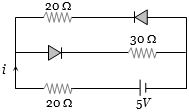
The current $i$ in the circuit will be:
A
$\frac{5}{40} \text{ A}$
B
$\frac{5}{50} \text{ A}$
C
$\frac{5}{10} \text{ A}$
D
$\frac{5}{20} \text{ A}$
Solution
(B) In the given circuit,the battery of $5 \text{ V}$ is connected in series with a $20 \text{ } \Omega$ resistor and two parallel branches.
The upper branch contains a $20 \text{ } \Omega$ resistor and a diode. The diode is connected such that its p-side is towards the right,making it reverse-biased with respect to the positive terminal of the battery.
The middle branch contains a diode and a $30 \text{ } \Omega$ resistor. The diode is connected such that its p-side is towards the left,making it forward-biased with respect to the positive terminal of the battery.
Since the upper branch is reverse-biased,it acts as an open circuit (no current flows through it).
The total resistance of the circuit is the sum of the $20 \text{ } \Omega$ resistor in the main line and the $30 \text{ } \Omega$ resistor in the active middle branch: $R_{eq} = 20 \text{ } \Omega + 30 \text{ } \Omega = 50 \text{ } \Omega$.
Using Ohm's law,the current $i$ is:
$i = \frac{V}{R_{eq}} = \frac{5 \text{ V}}{50 \text{ } \Omega} = \frac{5}{50} \text{ A}$.
The upper branch contains a $20 \text{ } \Omega$ resistor and a diode. The diode is connected such that its p-side is towards the right,making it reverse-biased with respect to the positive terminal of the battery.
The middle branch contains a diode and a $30 \text{ } \Omega$ resistor. The diode is connected such that its p-side is towards the left,making it forward-biased with respect to the positive terminal of the battery.
Since the upper branch is reverse-biased,it acts as an open circuit (no current flows through it).
The total resistance of the circuit is the sum of the $20 \text{ } \Omega$ resistor in the main line and the $30 \text{ } \Omega$ resistor in the active middle branch: $R_{eq} = 20 \text{ } \Omega + 30 \text{ } \Omega = 50 \text{ } \Omega$.
Using Ohm's law,the current $i$ is:
$i = \frac{V}{R_{eq}} = \frac{5 \text{ V}}{50 \text{ } \Omega} = \frac{5}{50} \text{ A}$.
0 likesView Solution
34
PhysicsEasyMCQAIPMT · 2001
The phenomenon utilised in an optical fibre is
A
Refraction
B
Interference
C
Polarization
D
Total internal reflection
Solution
(D) The correct answer is $(d)$.
Total internal reflection is a powerful process since it can be used to confine light. One of the most common applications of total internal reflection is in fibre optics.
An optical fibre is a thin,transparent fibre,usually made of glass or plastic,used for transmitting light.
If light is incident on a cable end with an angle of incidence greater than the critical angle,then the light will remain trapped inside the glass strand due to repeated total internal reflections.
In this way,light travels very quickly down the length of the cable over a very long distance (tens of kilometers) without significant loss of intensity.
Total internal reflection is a powerful process since it can be used to confine light. One of the most common applications of total internal reflection is in fibre optics.
An optical fibre is a thin,transparent fibre,usually made of glass or plastic,used for transmitting light.
If light is incident on a cable end with an angle of incidence greater than the critical angle,then the light will remain trapped inside the glass strand due to repeated total internal reflections.
In this way,light travels very quickly down the length of the cable over a very long distance (tens of kilometers) without significant loss of intensity.
0 likesView Solution
35
PhysicsMediumMCQAIPMT · 2001
$A$ point source of light is placed $4 \; m$ below the surface of water of refractive index $5/3$. The minimum diameter of a disc which should be placed over the source on the surface of water to cut-off all light coming out of water is ... $m$.
A
$2$
B
$6$
C
$4$
D
$3$
Solution
(B) The light from the source will be cut off if the disc covers the area corresponding to the critical angle $\theta_c$.
For a point source at depth $h$,the radius $r$ of the disc is given by $r = h \tan \theta_c$.
Since $\sin \theta_c = \frac{1}{\mu}$,we have $\tan \theta_c = \frac{1}{\sqrt{\mu^2 - 1}}$.
Substituting the given values $h = 4 \; m$ and $\mu = 5/3$:
$r = \frac{4}{\sqrt{(5/3)^2 - 1}} = \frac{4}{\sqrt{25/9 - 1}} = \frac{4}{\sqrt{16/9}} = \frac{4}{4/3} = 3 \; m$.
The minimum diameter of the disc is $D = 2r = 2 \times 3 = 6 \; m$.
For a point source at depth $h$,the radius $r$ of the disc is given by $r = h \tan \theta_c$.
Since $\sin \theta_c = \frac{1}{\mu}$,we have $\tan \theta_c = \frac{1}{\sqrt{\mu^2 - 1}}$.
Substituting the given values $h = 4 \; m$ and $\mu = 5/3$:
$r = \frac{4}{\sqrt{(5/3)^2 - 1}} = \frac{4}{\sqrt{25/9 - 1}} = \frac{4}{\sqrt{16/9}} = \frac{4}{4/3} = 3 \; m$.
The minimum diameter of the disc is $D = 2r = 2 \times 3 = 6 \; m$.
0 likesView Solution
36
PhysicsEasyMCQAIPMT · 2001
The biological importance of the ozone layer is that:
A
It absorbs harmful ultraviolet rays.
B
Ozone rays reduce the greenhouse effect.
C
The ozone layer reflects radio waves.
D
The ozone layer controls the $O_2/H_2$ ratio in the atmosphere.
Solution
(A) Ozone $(O_3)$ is present in the stratosphere region of the atmosphere.
It protects life on Earth by absorbing harmful ultraviolet $(UV)$ radiation emitted by the sun.
Exposure to high levels of $UV$ radiation causes various health problems in humans,such as skin cancer and cataracts,and damages plants and other animals,leading to ecosystem disruption.
Plants cannot grow effectively under intense ultraviolet radiation.
Therefore,the primary biological importance of the ozone layer is the absorption of these harmful rays.
Hence,option $A$ is correct.
It protects life on Earth by absorbing harmful ultraviolet $(UV)$ radiation emitted by the sun.
Exposure to high levels of $UV$ radiation causes various health problems in humans,such as skin cancer and cataracts,and damages plants and other animals,leading to ecosystem disruption.
Plants cannot grow effectively under intense ultraviolet radiation.
Therefore,the primary biological importance of the ozone layer is the absorption of these harmful rays.
Hence,option $A$ is correct.
0 likesView Solution
37
PhysicsMediumMCQAIPMT · 2001
For a common base circuit,if $\frac{I_C}{I_E} = 0.98$,then the current gain for a common emitter circuit will be:
A
$49$
B
$98$
C
$4.9$
D
$25.5$
Solution
(A) In a common base configuration,the current gain $\alpha$ is defined as the ratio of collector current to emitter current: $\alpha = \frac{I_C}{I_E} = 0.98$.
The current gain for a common emitter circuit,denoted by $\beta$,is related to $\alpha$ by the formula: $\beta = \frac{\alpha}{1 - \alpha}$.
Substituting the given value of $\alpha$ into the formula:
$\beta = \frac{0.98}{1 - 0.98} = \frac{0.98}{0.02} = 49$.
Therefore,the current gain for the common emitter circuit is $49$.
The current gain for a common emitter circuit,denoted by $\beta$,is related to $\alpha$ by the formula: $\beta = \frac{\alpha}{1 - \alpha}$.
Substituting the given value of $\alpha$ into the formula:
$\beta = \frac{0.98}{1 - 0.98} = \frac{0.98}{0.02} = 49$.
Therefore,the current gain for the common emitter circuit is $49$.
0 likesView Solution
38
PhysicsEasyMCQAIPMT · 2001
Copper and silicon are cooled from $300 \ K$ to $60 \ K$. The specific resistance:
A
decreases in copper but increases in silicon
B
increases in copper but decreases in silicon
C
increases in both
D
decreases in both
Solution
(A) The specific resistance or resistivity $\rho$ of a material depends on temperature.
For metals like copper,the resistivity decreases as the temperature decreases because the scattering of electrons by lattice vibrations reduces.
For semiconductors like silicon,the resistivity increases as the temperature decreases because the number of charge carriers (electrons and holes) decreases significantly due to the freezing out of carriers.
Therefore,when cooling from $300 \ K$ to $60 \ K$,the specific resistance of copper decreases,while the specific resistance of silicon increases.
For metals like copper,the resistivity decreases as the temperature decreases because the scattering of electrons by lattice vibrations reduces.
For semiconductors like silicon,the resistivity increases as the temperature decreases because the number of charge carriers (electrons and holes) decreases significantly due to the freezing out of carriers.
Therefore,when cooling from $300 \ K$ to $60 \ K$,the specific resistance of copper decreases,while the specific resistance of silicon increases.
0 likesView Solution
39
PhysicsEasyMCQAIPMT · 2001
$A$ capacitor of capacity $C$ has reactance $X$. If capacitance and frequency become double then reactance will be
A
$2X$
B
$4X$
C
$X/2$
D
$X/4$
Solution
(D) The capacitive reactance $X$ is given by the formula $X = \frac{1}{2 \pi f C}$,where $f$ is the frequency and $C$ is the capacitance.
Given that the new capacitance $C^{\prime} = 2C$ and the new frequency $f^{\prime} = 2f$.
The new reactance $X^{\prime}$ is calculated as:
$X^{\prime} = \frac{1}{2 \pi f^{\prime} C^{\prime}} = \frac{1}{2 \pi (2f) (2C)} = \frac{1}{4 (2 \pi f C)}$.
Since $X = \frac{1}{2 \pi f C}$,we substitute this into the equation:
$X^{\prime} = \frac{X}{4}$.
Given that the new capacitance $C^{\prime} = 2C$ and the new frequency $f^{\prime} = 2f$.
The new reactance $X^{\prime}$ is calculated as:
$X^{\prime} = \frac{1}{2 \pi f^{\prime} C^{\prime}} = \frac{1}{2 \pi (2f) (2C)} = \frac{1}{4 (2 \pi f C)}$.
Since $X = \frac{1}{2 \pi f C}$,we substitute this into the equation:
$X^{\prime} = \frac{X}{4}$.
0 likesView Solution
40
PhysicsEasyMCQAIPMT · 2001
Energy is released in nuclear fission due to:
A
Total binding energy of fragments is more than the binding energy of the parental element.
B
Some mass is converted into energy.
C
Total binding energy of fragments is less than the binding energy of the parental element.
D
Total binding energy of fragments is equal to the binding energy of the parental element.
Solution
(A) In a nuclear process,energy is released if the binding energy per nucleon of the daughter products increases.
In the nuclear fission process,the total binding energy of the fragments formed is greater than the binding energy of the parent fissionable nucleus.
This difference in binding energy is released as energy,consistent with the mass-energy equivalence principle where the mass defect is converted into energy.
In the nuclear fission process,the total binding energy of the fragments formed is greater than the binding energy of the parent fissionable nucleus.
This difference in binding energy is released as energy,consistent with the mass-energy equivalence principle where the mass defect is converted into energy.
0 likesView Solution
41
PhysicsEasyMCQAIPMT · 2001
The resistance of each arm of the Wheatstone bridge is $10 \, \Omega$. A resistance of $10 \, \Omega$ is connected in series with a galvanometer. Then, the equivalent resistance across the battery will be:
A
$15 \, \Omega$
B
$20 \, \Omega$
C
$10 \, \Omega$
D
$40 \, \Omega$
Solution
(C) Wheatstone bridge is balanced when the ratio of resistances in opposite arms is equal. Here, $\frac{P}{Q} = \frac{R}{S} = \frac{10}{10} = 1$.
In a balanced Wheatstone bridge, no current flows through the galvanometer arm.
However, the problem states that a resistance of $10 \, \Omega$ is connected in series with the galvanometer. Since no current flows through the galvanometer branch in a balanced state, this additional resistance does not affect the equivalent resistance of the circuit.
The circuit effectively consists of two parallel branches, each containing two $10 \, \Omega$ resistors in series.
Resistance of each branch = $10 \, \Omega + 10 \, \Omega = 20 \, \Omega$.
Since these two branches are in parallel, the equivalent resistance $R_{eq}$ is given by:
$\frac{1}{R_{eq}} = \frac{1}{20} + \frac{1}{20} = \frac{2}{20} = \frac{1}{10}$.
Therefore, $R_{eq} = 10 \, \Omega$.
In a balanced Wheatstone bridge, no current flows through the galvanometer arm.
However, the problem states that a resistance of $10 \, \Omega$ is connected in series with the galvanometer. Since no current flows through the galvanometer branch in a balanced state, this additional resistance does not affect the equivalent resistance of the circuit.
The circuit effectively consists of two parallel branches, each containing two $10 \, \Omega$ resistors in series.
Resistance of each branch = $10 \, \Omega + 10 \, \Omega = 20 \, \Omega$.
Since these two branches are in parallel, the equivalent resistance $R_{eq}$ is given by:
$\frac{1}{R_{eq}} = \frac{1}{20} + \frac{1}{20} = \frac{2}{20} = \frac{1}{10}$.
Therefore, $R_{eq} = 10 \, \Omega$.
0 likesView Solution
42
PhysicsEasyMCQAIPMT · 2001
$A$ ray of light travelling in air has wavelength $\lambda$,frequency $n$,velocity $v$,and intensity $I$. If this ray enters into water,then these parameters are $\lambda'$,$n'$,$v'$,and $I'$ respectively. Which relation is correct from the following?
A
$\lambda = \lambda'$
B
$n = n'$
C
$v = v'$
D
$I = I'$
Solution
(B) When a light ray travels from one medium to another,its frequency $(n)$ depends only on the source of light and remains unchanged regardless of the medium.
However,the wavelength $(\lambda)$ and velocity $(v)$ change because they depend on the refractive index of the medium.
Intensity $(I)$ also changes due to partial reflection at the interface.
Therefore,the correct relation is $n = n'$.
However,the wavelength $(\lambda)$ and velocity $(v)$ change because they depend on the refractive index of the medium.
Intensity $(I)$ also changes due to partial reflection at the interface.
Therefore,the correct relation is $n = n'$.
0 likesView Solution
43
PhysicsMediumMCQAIPMT · 2001
An electron having mass $m$ and kinetic energy $K$ enters a uniform magnetic field $B$ perpendicularly. Its frequency will be:
A
$\frac{e K}{m v B}$
B
$\frac{e B}{2 \pi m}$
C
$\frac{2 \pi m}{e B}$
D
$\frac{2 m}{e B K}$
Solution
(B) When a charged particle enters a magnetic field perpendicularly,it undergoes circular motion.
The magnetic force provides the necessary centripetal force:
$F_m = F_c$
$qvB = \frac{mv^2}{r}$
From this,the angular velocity $\omega$ is given by:
$\omega = \frac{v}{r} = \frac{qB}{m}$
Since the frequency $f$ is related to angular velocity by $\omega = 2\pi f$,we have:
$f = \frac{\omega}{2\pi} = \frac{qB}{2\pi m}$
For an electron,the charge $q = e$,so the frequency is:
$f = \frac{eB}{2\pi m}$
The magnetic force provides the necessary centripetal force:
$F_m = F_c$
$qvB = \frac{mv^2}{r}$
From this,the angular velocity $\omega$ is given by:
$\omega = \frac{v}{r} = \frac{qB}{m}$
Since the frequency $f$ is related to angular velocity by $\omega = 2\pi f$,we have:
$f = \frac{\omega}{2\pi} = \frac{qB}{2\pi m}$
For an electron,the charge $q = e$,so the frequency is:
$f = \frac{eB}{2\pi m}$
0 likesView Solution
44
PhysicsEasyMCQAIPMT · 2001
Which ray contains positively charged particles?
A
$\alpha -$ ray
B
$\beta -$ ray
C
$\gamma -$ ray
D
$X-$ ray
Solution
(A) $\alpha -$ particles are doubly ionized helium nuclei $(He^{2+})$. They carry a positive charge and are deflected towards negatively charged plates in an electric field.
$\beta -$ particles are high-speed electrons $(e^-)$,which carry a negative charge.
$\gamma -$ rays are high-energy electromagnetic waves and are electrically neutral.
$X-$ rays are also electromagnetic waves and are electrically neutral.
Therefore,the ray containing positively charged particles is the $\alpha -$ ray.
$\beta -$ particles are high-speed electrons $(e^-)$,which carry a negative charge.
$\gamma -$ rays are high-energy electromagnetic waves and are electrically neutral.
$X-$ rays are also electromagnetic waves and are electrically neutral.
Therefore,the ray containing positively charged particles is the $\alpha -$ ray.
0 likesView Solution
45
PhysicsMediumMCQAIPMT · 2001
The half-life of a radioactive element is $12.5 \; h$ and its initial quantity is $256 \; g$. After how much time (in $h$) will its quantity remain $1 \; g$?
A
$50$
B
$100$
C
$150$
D
$200$
Solution
(B) The formula for radioactive decay is given by $M = M_{0} \left(\frac{1}{2}\right)^{n}$,where $n = \frac{t}{T_{1/2}}$ is the number of half-lives.
Given: $M = 1 \; g$,$M_{0} = 256 \; g$,and $T_{1/2} = 12.5 \; h$.
Substituting the values: $1 = 256 \left(\frac{1}{2}\right)^{n}$.
This simplifies to $\frac{1}{256} = \left(\frac{1}{2}\right)^{n}$.
Since $256 = 2^{8}$,we have $\left(\frac{1}{2}\right)^{8} = \left(\frac{1}{2}\right)^{n}$.
Therefore,$n = 8$.
Using $n = \frac{t}{T_{1/2}}$,we get $t = n \times T_{1/2} = 8 \times 12.5 \; h = 100 \; h$.
Given: $M = 1 \; g$,$M_{0} = 256 \; g$,and $T_{1/2} = 12.5 \; h$.
Substituting the values: $1 = 256 \left(\frac{1}{2}\right)^{n}$.
This simplifies to $\frac{1}{256} = \left(\frac{1}{2}\right)^{n}$.
Since $256 = 2^{8}$,we have $\left(\frac{1}{2}\right)^{8} = \left(\frac{1}{2}\right)^{n}$.
Therefore,$n = 8$.
Using $n = \frac{t}{T_{1/2}}$,we get $t = n \times T_{1/2} = 8 \times 12.5 \; h = 100 \; h$.
0 likesView Solution
46
PhysicsEasyMCQAIPMT · 2001
If a dipole of dipole moment $\vec{p}$ is placed in a uniform electric field $\vec{E}$,then the torque acting on it is given by:
A
$\vec{\tau} = \vec{p} \cdot \vec{E}$
B
$\vec{\tau} = \vec{p} \times \vec{E}$
C
$\vec{\tau} = \vec{p} + \vec{E}$
D
$\vec{\tau} = \vec{p} - \vec{E}$
Solution
(B) The dipole moment of the dipole is $\vec{p}$ and the uniform electric field is $\vec{E}$.
When an electric dipole is placed in a uniform electric field,each charge $q$ experiences a force $\vec{F} = q\vec{E}$ and $\vec{F} = -q\vec{E}$.
These two equal and opposite forces form a couple,which exerts a torque on the dipole.
The magnitude of the torque is given by the product of the magnitude of one of the forces and the perpendicular distance between them.
$\tau = F \times (d \sin \theta) = (qE) \times (a \sin \theta) = (qa) E \sin \theta$.
Since the dipole moment $p = qa$,we have $\tau = pE \sin \theta$.
In vector form,this is expressed as $\vec{\tau} = \vec{p} \times \vec{E}$.
When an electric dipole is placed in a uniform electric field,each charge $q$ experiences a force $\vec{F} = q\vec{E}$ and $\vec{F} = -q\vec{E}$.
These two equal and opposite forces form a couple,which exerts a torque on the dipole.
The magnitude of the torque is given by the product of the magnitude of one of the forces and the perpendicular distance between them.
$\tau = F \times (d \sin \theta) = (qE) \times (a \sin \theta) = (qa) E \sin \theta$.
Since the dipole moment $p = qa$,we have $\tau = pE \sin \theta$.
In vector form,this is expressed as $\vec{\tau} = \vec{p} \times \vec{E}$.
0 likesView Solution
47
PhysicsMediumMCQAIPMT · 2001
In an inductor of self-inductance $L = 2 \, mH$,current changes with time according to the relation $i = t^2 e^{-t}$. At what time is the $emf$ zero? (in seconds)
A
$4$
B
$3$
C
$2$
D
$1$
Solution
(C) Given: Self-inductance $L = 2 \, mH$ and current $i = t^2 e^{-t}$.
The induced $emf$ $(E)$ in an inductor is given by the formula $E = -L \frac{di}{dt}$.
First,calculate the derivative of current with respect to time:
$\frac{di}{dt} = \frac{d}{dt} (t^2 e^{-t}) = (2t) e^{-t} + t^2 (-e^{-t}) = e^{-t} (2t - t^2)$.
Now,substitute this into the $emf$ equation:
$E = -L [e^{-t} (2t - t^2)]$.
For the $emf$ to be zero $(E = 0)$,the term inside the bracket must be zero:
$e^{-t} (2t - t^2) = 0$.
Since $e^{-t}$ is never zero for finite $t$,we have:
$2t - t^2 = 0$
$t(2 - t) = 0$.
This gives $t = 0 \, s$ or $t = 2 \, s$. Excluding the initial state at $t = 0$,the $emf$ is zero at $t = 2 \, s$.
The induced $emf$ $(E)$ in an inductor is given by the formula $E = -L \frac{di}{dt}$.
First,calculate the derivative of current with respect to time:
$\frac{di}{dt} = \frac{d}{dt} (t^2 e^{-t}) = (2t) e^{-t} + t^2 (-e^{-t}) = e^{-t} (2t - t^2)$.
Now,substitute this into the $emf$ equation:
$E = -L [e^{-t} (2t - t^2)]$.
For the $emf$ to be zero $(E = 0)$,the term inside the bracket must be zero:
$e^{-t} (2t - t^2) = 0$.
Since $e^{-t}$ is never zero for finite $t$,we have:
$2t - t^2 = 0$
$t(2 - t) = 0$.
This gives $t = 0 \, s$ or $t = 2 \, s$. Excluding the initial state at $t = 0$,the $emf$ is zero at $t = 2 \, s$.
0 likesView Solution
48
PhysicsMediumMCQAIPMT · 2001
Energy per unit volume for a capacitor having area $A$ and separation $d$ kept at potential difference $V$ is given by
A
$\frac{1}{2} \varepsilon_{0} \frac{V^{2}}{d^{2}}$
B
$\frac{1}{2 \varepsilon_{0}} \frac{V^{2}}{d^{2}}$
C
$\frac{1}{2} C V^{2}$
D
$\frac{Q^{2}}{2 C}$
Solution
(A) The energy density $u$ (energy per unit volume) of a capacitor is given by the formula $u = \frac{1}{2} \varepsilon_{0} E^{2}$.
Since the electric field $E$ between the plates of a capacitor is related to the potential difference $V$ and separation $d$ by $E = \frac{V}{d}$,
Substituting this into the energy density formula,we get $u = \frac{1}{2} \varepsilon_{0} (\frac{V}{d})^{2} = \frac{1}{2} \varepsilon_{0} \frac{V^{2}}{d^{2}}$.
Since the electric field $E$ between the plates of a capacitor is related to the potential difference $V$ and separation $d$ by $E = \frac{V}{d}$,
Substituting this into the energy density formula,we get $u = \frac{1}{2} \varepsilon_{0} (\frac{V}{d})^{2} = \frac{1}{2} \varepsilon_{0} \frac{V^{2}}{d^{2}}$.
0 likesView Solution
Vedclass Products
For Students
Vedclass Test Series
Mock tests in real AIPMT style covering Physics with performance analysis. 5-day free trial.
Start Free TrialFor Teachers
Exam Paper Generator
Generate Set A/B/C/D Physics papers from 7.5L+ questions in 2 minutes. 3 chapters free.
Try FreeFor Institutes
Online Exam Module
Run live AIPMT mock exams with unlimited students, 360° analytics & white-label branding.
See DemoFrequently Asked Questions
How many Physics questions are in AIPMT 2001?
There are 48 Physics questions from the AIPMT 2001 paper on Vedclass, each with a detailed step-by-step solution in English.
Are AIPMT 2001 Physics solutions available in English?
Yes. All solutions on this page are in English. You can also switch to English or Hindi using the language buttons above the questions.
Can I practice AIPMT 2001 Physics as a timed test?
Yes. Use the Vedclass Test Series to attempt a full AIPMT mock test covering Physics with time limits and instant score analysis.
Can teachers create Physics papers from AIPMT previous year questions?
Yes. The Vedclass Exam Paper Generator lets teachers mix AIPMT Physics questions and generate Set A/B/C/D papers in minutes.
For Teachers & Institutes
Build a Custom Physics Paper
Pick AIPMT 2001 Physics questions, set difficulty, and generate Set A/B/C/D in 2 minutes.