
ChemistryQ1–56 of 56 questions
Page 1 of 1 · English
1
ChemistryMCQAIPMT · 2001
$A$ black body has a maximum wavelength ${\lambda _m}$ at a temperature of $2000 \; K$. Its corresponding wavelength at a temperature of $3000 \; K$ will be:
A
$\frac{3}{2}{\lambda _m}$
B
$\frac{2}{3}{\lambda _m}$
C
$\frac{4}{9}{\lambda _m}$
D
$\frac{9}{4}{\lambda _m}$
Solution
(B) According to Wien's Displacement Law, the product of the wavelength corresponding to maximum spectral emissive power and the absolute temperature is constant.
${\lambda _m} T = \text{constant}$
Therefore, ${\lambda _{m1}} T_1 = {\lambda _{m2}} T_2$
Given:
$T_1 = 2000 \; K$
$T_2 = 3000 \; K$
${\lambda _{m1}} = {\lambda _m}$
Substituting the values:
${\lambda _m} \times 2000 = {\lambda _{m2}} \times 3000$
${\lambda _{m2}} = \frac{2000}{3000} \times {\lambda _m}$
${\lambda _{m2}} = \frac{2}{3}{\lambda _m}$
${\lambda _m} T = \text{constant}$
Therefore, ${\lambda _{m1}} T_1 = {\lambda _{m2}} T_2$
Given:
$T_1 = 2000 \; K$
$T_2 = 3000 \; K$
${\lambda _{m1}} = {\lambda _m}$
Substituting the values:
${\lambda _m} \times 2000 = {\lambda _{m2}} \times 3000$
${\lambda _{m2}} = \frac{2000}{3000} \times {\lambda _m}$
${\lambda _{m2}} = \frac{2}{3}{\lambda _m}$
0 likesView Solution
2
ChemistryMediumMCQAIPMT · 2001
The molarity of liquid $HCl$ with a density equal to $1.17 \ g/cc$ is: (in $M$)
A
$36.5$
B
$18.25$
C
$32.05$
D
$4.65$
Solution
(C) The density of liquid $HCl$ is $1.17 \ g/cc$.
This means $1 \ cc$ of $HCl$ has a mass of $1.17 \ g$.
Therefore,$1000 \ cc$ $(1 \ L)$ of $HCl$ has a mass of $1170 \ g$.
The molar mass of $HCl$ is $1.008 + 35.45 = 36.458 \ g/mol$,which is approximately $36.5 \ g/mol$.
Molarity = $\frac{\text{mass of solute in grams}}{\text{molar mass} \times \text{volume of solution in litres}}$.
Molarity = $\frac{1170 \ g}{36.5 \ g/mol \times 1 \ L} = 32.05 \ mol/L$.
This means $1 \ cc$ of $HCl$ has a mass of $1.17 \ g$.
Therefore,$1000 \ cc$ $(1 \ L)$ of $HCl$ has a mass of $1170 \ g$.
The molar mass of $HCl$ is $1.008 + 35.45 = 36.458 \ g/mol$,which is approximately $36.5 \ g/mol$.
Molarity = $\frac{\text{mass of solute in grams}}{\text{molar mass} \times \text{volume of solution in litres}}$.
Molarity = $\frac{1170 \ g}{36.5 \ g/mol \times 1 \ L} = 32.05 \ mol/L$.
0 likesView Solution
3
ChemistryMediumMCQAIPMT · 2001
The percentage of $Se$ in peroxidase anhydrous enzyme is $0.5\%$ by weight (atomic weight $= 78.4$). Then,the minimum molecular weight of peroxidase anhydrous enzyme is:
A
$1.568 \times 10^4$
B
$1.568 \times 10^3$
C
$15.68$
D
$3.136 \times 10^4$
Solution
(A) The minimum molecular weight of an enzyme is calculated assuming that at least one atom of the element $(Se)$ is present in one molecule of the enzyme.
Given that $0.5 \ g$ of $Se$ is present in $100 \ g$ of the enzyme.
Therefore,$78.4 \ g$ (atomic weight of $Se$) of $Se$ will be present in $\frac{100 \times 78.4}{0.5} \ g$ of the enzyme.
Calculation: $\frac{7840}{0.5} = 15680 = 1.568 \times 10^4 \ g/mol$.
Thus,the minimum molecular weight is $1.568 \times 10^4$.
Given that $0.5 \ g$ of $Se$ is present in $100 \ g$ of the enzyme.
Therefore,$78.4 \ g$ (atomic weight of $Se$) of $Se$ will be present in $\frac{100 \times 78.4}{0.5} \ g$ of the enzyme.
Calculation: $\frac{7840}{0.5} = 15680 = 1.568 \times 10^4 \ g/mol$.
Thus,the minimum molecular weight is $1.568 \times 10^4$.
0 likesView Solution
4
ChemistryDifficultMCQAIPMT · 2001
One litre of hard water contains $12.00 \ mg$ of $Mg^{2+}$. The milli-equivalents of washing soda $(Na_2CO_3)$ required to remove its hardness is:
A
$1$
B
$12.15$
C
$1 \times 10^{-3}$
D
$12.15 \times 10^{-3}$
Solution
(A) The hardness of water is removed by reacting $Mg^{2+}$ ions with washing soda $(Na_2CO_3)$.
The reaction is: $Mg^{2+} + Na_2CO_3 \rightarrow MgCO_3 + 2Na^+$.
Number of milli-equivalents (meq) of $Mg^{2+} = \frac{\text{mass in mg}}{\text{equivalent weight}}$.
Equivalent weight of $Mg^{2+} = \frac{\text{Atomic mass}}{\text{Valency}} = \frac{24}{2} = 12$.
Number of meq of $Mg^{2+} = \frac{12.00 \ mg}{12} = 1 \text{ meq}$.
Since $1 \text{ meq}$ of $Mg^{2+}$ reacts with $1 \text{ meq}$ of $Na_2CO_3$,the required milli-equivalents of washing soda is $1$.
The reaction is: $Mg^{2+} + Na_2CO_3 \rightarrow MgCO_3 + 2Na^+$.
Number of milli-equivalents (meq) of $Mg^{2+} = \frac{\text{mass in mg}}{\text{equivalent weight}}$.
Equivalent weight of $Mg^{2+} = \frac{\text{Atomic mass}}{\text{Valency}} = \frac{24}{2} = 12$.
Number of meq of $Mg^{2+} = \frac{12.00 \ mg}{12} = 1 \text{ meq}$.
Since $1 \text{ meq}$ of $Mg^{2+}$ reacts with $1 \text{ meq}$ of $Na_2CO_3$,the required milli-equivalents of washing soda is $1$.
0 likesView Solution
5
ChemistryEasyMCQAIPMT · 2001
The electronic configuration $1s^2 2s^2 2p_x^1 2p_y^1 2p_z^1$ corresponds to which of the following elements?
A
Oxygen
B
Nitrogen
C
Hydrogen
D
Fluorine
Solution
(B) The total number of electrons in the given configuration is $2 + 2 + 1 + 1 + 1 = 7$.
An element with $7$ electrons is Nitrogen $(N)$.
The electronic configuration of Nitrogen $(Z = 7)$ is $1s^2 2s^2 2p_x^1 2p_y^1 2p_z^1$.
An element with $7$ electrons is Nitrogen $(N)$.
The electronic configuration of Nitrogen $(Z = 7)$ is $1s^2 2s^2 2p_x^1 2p_y^1 2p_z^1$.
0 likesView Solution
6
ChemistryMediumMCQAIPMT · 2001
Which of the following has zero dipole moment?
A
$CH_2Cl_2$
B
$CH_4$
C
$NH_3$
D
$PH_3$
Solution
(B) $CH_4$ (Methane) has a regular tetrahedral geometry.
Due to the symmetrical arrangement of the four $C-H$ bonds,the individual bond dipoles cancel each other out,resulting in a net dipole moment of zero.
Due to the symmetrical arrangement of the four $C-H$ bonds,the individual bond dipoles cancel each other out,resulting in a net dipole moment of zero.
0 likesView Solution
7
ChemistryMediumMCQAIPMT · 2001
For the reaction $H_2 + I_2 \rightleftharpoons 2HI$,the equilibrium concentrations of $H_2$,$I_2$,and $HI$ are $8.0 \ mol \ L^{-1}$,$3.0 \ mol \ L^{-1}$,and $28.0 \ mol \ L^{-1}$ respectively. The equilibrium constant $(K_c)$ of the reaction is: (in $.66$)
A
$30$
B
$32$
C
$34$
D
$36$
Solution
(B) The chemical equation for the reaction is $H_2(g) + I_2(g) \rightleftharpoons 2HI(g)$.
The expression for the equilibrium constant $K_c$ is given by $K_c = \frac{[HI]^2}{[H_2][I_2]}$.
Given values are $[H_2] = 8.0 \ mol \ L^{-1}$,$[I_2] = 3.0 \ mol \ L^{-1}$,and $[HI] = 28.0 \ mol \ L^{-1}$.
Substituting these values into the expression:
$K_c = \frac{(28.0)^2}{8.0 \times 3.0} = \frac{784}{24} = 32.66$.
The expression for the equilibrium constant $K_c$ is given by $K_c = \frac{[HI]^2}{[H_2][I_2]}$.
Given values are $[H_2] = 8.0 \ mol \ L^{-1}$,$[I_2] = 3.0 \ mol \ L^{-1}$,and $[HI] = 28.0 \ mol \ L^{-1}$.
Substituting these values into the expression:
$K_c = \frac{(28.0)^2}{8.0 \times 3.0} = \frac{784}{24} = 32.66$.
0 likesView Solution
8
ChemistryMediumMCQAIPMT · 2001
Which of the following endothermic processes are spontaneous?
A
Melting of ice
B
Evaporation of water
C
Heat of combustion
D
Both $(a)$ and $(b)$
Solution
(D) process is spontaneous if the change in Gibbs free energy $\Delta G = \Delta H - T\Delta S$ is negative.
For endothermic processes,$\Delta H > 0$.
For the melting of ice $(H_2O(s) \rightarrow H_2O(l))$ and the evaporation of water $(H_2O(l) \rightarrow H_2O(g))$,the entropy change $\Delta S$ is positive.
At temperatures above the melting point or boiling point respectively,the term $T\Delta S$ becomes larger than $\Delta H$,making $\Delta G$ negative.
Thus,both melting of ice and evaporation of water are spontaneous endothermic processes under appropriate conditions.
For endothermic processes,$\Delta H > 0$.
For the melting of ice $(H_2O(s) \rightarrow H_2O(l))$ and the evaporation of water $(H_2O(l) \rightarrow H_2O(g))$,the entropy change $\Delta S$ is positive.
At temperatures above the melting point or boiling point respectively,the term $T\Delta S$ becomes larger than $\Delta H$,making $\Delta G$ negative.
Thus,both melting of ice and evaporation of water are spontaneous endothermic processes under appropriate conditions.
0 likesView Solution
9
ChemistryMediumMCQAIPMT · 2001
Enthalpy of formation of two compounds $X$ and $Y$ are $-84 \ kJ$ and $-156 \ kJ$ respectively. Which of the following statements is correct?
A
$X$ is more stable than $Y$
B
$X$ is less stable than $Y$
C
Both $X$ and $Y$ are unstable
D
$X$ and $Y$ are endothermic compounds
Solution
(B) The stability of a compound is inversely proportional to its enthalpy of formation.
Since the enthalpy of formation of $Y$ $(-156 \ kJ)$ is more negative than that of $X$ $(-84 \ kJ)$,$Y$ has lower potential energy and is more stable than $X$.
Therefore,$X$ is less stable than $Y$.
Since the enthalpy of formation of $Y$ $(-156 \ kJ)$ is more negative than that of $X$ $(-84 \ kJ)$,$Y$ has lower potential energy and is more stable than $X$.
Therefore,$X$ is less stable than $Y$.
0 likesView Solution
10
ChemistryMediumMCQAIPMT · 2001
The nitride ion in lithium nitride is composed of:
A
$7P + 7e$
B
$10P + 7e$
C
$7P + 10e$
D
$10P + 10e$
Solution
(C) Lithium nitride is $Li_3N$.
In this compound,the nitride ion is $N^{3-}$.
The atomic number of nitrogen is $7$,which means it has $7$ protons.
Since the ion has a charge of $-3$,it has gained $3$ electrons.
Therefore,the number of electrons = $7 + 3 = 10$.
Thus,the nitride ion is composed of $7P + 10e$.
In this compound,the nitride ion is $N^{3-}$.
The atomic number of nitrogen is $7$,which means it has $7$ protons.
Since the ion has a charge of $-3$,it has gained $3$ electrons.
Therefore,the number of electrons = $7 + 3 = 10$.
Thus,the nitride ion is composed of $7P + 10e$.
0 likesView Solution
11
ChemistryEasyMCQAIPMT · 2001
Which of the following gases does not have an octet or eight electrons in the outer shell?
A
$Ne$
B
$Ar$
C
$Rn$
D
$He$
Solution
(D) The correct answer is $(D)$.
$He$ (Helium) has an atomic number of $2$,meaning its electronic configuration is $1s^2$.
It has only $2$ electrons in its outermost shell (duplet) and does not possess an octet ($8$ electrons) like other noble gases.
$He$ (Helium) has an atomic number of $2$,meaning its electronic configuration is $1s^2$.
It has only $2$ electrons in its outermost shell (duplet) and does not possess an octet ($8$ electrons) like other noble gases.
0 likesView Solution
12
ChemistryMediumMCQAIPMT · 2001
The $IUPAC$ name of $(CH_3)_2CH-CH_2-CH_2Br$ is
A
$1-$bromopentane
B
$2-$methyl$-4-$bromobutane
C
$1-$bromo$-3-$methylbutane
D
$2-$methyl$-3-$bromopropane
Solution
(C) To determine the $IUPAC$ name,we identify the longest carbon chain containing the functional group.
The structure is $CH_3-CH(CH_3)-CH_2-CH_2Br$.
The longest chain has $4$ carbon atoms (butane).
Numbering starts from the carbon attached to the bromine atom to give it the lowest possible locant.
At position $1$,there is a bromo group,and at position $3$,there is a methyl group.
Therefore,the $IUPAC$ name is $1-$bromo$-3-$methylbutane.
The structure is $CH_3-CH(CH_3)-CH_2-CH_2Br$.
The longest chain has $4$ carbon atoms (butane).
Numbering starts from the carbon attached to the bromine atom to give it the lowest possible locant.
At position $1$,there is a bromo group,and at position $3$,there is a methyl group.
Therefore,the $IUPAC$ name is $1-$bromo$-3-$methylbutane.
0 likesView Solution
13
ChemistryMCQAIPMT · 2001
The $IUPAC$ name of $(CH_3)_2CH-CH_2-CH_2Br$ is
A
$1-$bromo$pentane$
B
$2-$methyl$-4-$bromobutane
C
$1-$bromo$-3-$methylbutane
D
$2-$methyl$-3-$bromopropane
Solution
(C) The structure is $(CH_3)_2CH-CH_2-CH_2Br$.
First,identify the longest carbon chain containing the functional group,which is a $4-$carbon chain (butane).
Number the chain starting from the end closer to the substituent (bromine),so $C-1$ is attached to $Br$.
At $C-3$,there is a methyl group $(CH_3)$.
Therefore,the $IUPAC$ name is $1-$bromo$-3-$methylbutane.
First,identify the longest carbon chain containing the functional group,which is a $4-$carbon chain (butane).
Number the chain starting from the end closer to the substituent (bromine),so $C-1$ is attached to $Br$.
At $C-3$,there is a methyl group $(CH_3)$.
Therefore,the $IUPAC$ name is $1-$bromo$-3-$methylbutane.
0 likesView Solution
14
ChemistryMediumMCQAIPMT · 2001
How many structural isomers are possible for a compound with molecular formula $C_3H_7Cl$?
A
$2$
B
$5$
C
$7$
D
$9$
Solution
(A) The molecular formula $C_3H_7Cl$ corresponds to a saturated alkyl halide.
Two structural isomers are possible for this formula:
$1$. $CH_3-CH_2-CH_2Cl$ ($1$-chloropropane)
$2$. $CH_3-CHCl-CH_3$ ($2$-chloropropane)
Thus,the total number of structural isomers is $2$.
Two structural isomers are possible for this formula:
$1$. $CH_3-CH_2-CH_2Cl$ ($1$-chloropropane)
$2$. $CH_3-CHCl-CH_3$ ($2$-chloropropane)
Thus,the total number of structural isomers is $2$.
0 likesView Solution
15
ChemistryMediumMCQAIPMT · 2001
Propane is obtained from propene,by which of the following methods?
A
Wurtz reaction
B
Dehydrogenation
C
Frankland reaction
D
Catalytic hydrogenation
Solution
(D) Propane is obtained from propene by catalytic hydrogenation.
In this reaction,propene reacts with hydrogen in the presence of a metal catalyst like $Ni$,$Pt$,or $Pd$ to form propane:
$CH_3-CH=CH_2 + H_2 \xrightarrow{Ni/Pt/Pd} CH_3-CH_2-CH_3$.
In this reaction,propene reacts with hydrogen in the presence of a metal catalyst like $Ni$,$Pt$,or $Pd$ to form propane:
$CH_3-CH=CH_2 + H_2 \xrightarrow{Ni/Pt/Pd} CH_3-CH_2-CH_3$.
0 likesView Solution
16
ChemistryMediumMCQAIPMT · 2001
Propane is obtained from propene by which method?
A
Catalytic hydrogenation
B
Wurtz reaction
C
Dehydrogenation
D
Frankland reaction
Solution
(A) The conversion of propene to propane involves the addition of hydrogen across the double bond,which is known as catalytic hydrogenation.
$CH_3-CH=CH_2 + H_2 \xrightarrow{Ni, 300 \ ^oC} CH_3-CH_2-CH_3$
Thus,the correct option is $(A)$.
$CH_3-CH=CH_2 + H_2 \xrightarrow{Ni, 300 \ ^oC} CH_3-CH_2-CH_3$
Thus,the correct option is $(A)$.
0 likesView Solution
17
ChemistryMediumMCQAIPMT · 2001
The reaction $CH_2 = CH_2 + H_2 \xrightarrow[250 - 300^{\circ}C]{Ni} CH_3 - CH_3$ is called:
A
Wurtz's reaction
B
Kolbe's reaction
C
Sabatier and Senderens reaction
D
Carbylamine reaction
Solution
(C) The reaction $CH_2 = CH_2 + H_2 \xrightarrow[250 - 300^{\circ}C]{Ni} CH_3 - CH_3$ is known as the Sabatier-Senderens reaction.
This process involves the catalytic hydrogenation of unsaturated hydrocarbons (alkenes or alkynes) in the presence of a metal catalyst like $Ni$,$Pt$,or $Pd$ at elevated temperatures to form alkanes.
This process involves the catalytic hydrogenation of unsaturated hydrocarbons (alkenes or alkynes) in the presence of a metal catalyst like $Ni$,$Pt$,or $Pd$ at elevated temperatures to form alkanes.
0 likesView Solution
18
ChemistryMCQAIPMT · 2001
The spleen is a:
A
Lymphoid organ
B
Haemopoietic organ
C
Celluloid organ
D
Reproductive organ
Solution
(A) The spleen is primarily a large,bean-shaped lymphoid organ.
It acts as a filter for the blood by trapping blood-borne microorganisms.
It also contains a large reservoir of erythrocytes and acts as a site for the maturation of lymphocytes.
Therefore,it is classified as a secondary lymphoid organ.
It acts as a filter for the blood by trapping blood-borne microorganisms.
It also contains a large reservoir of erythrocytes and acts as a site for the maturation of lymphocytes.
Therefore,it is classified as a secondary lymphoid organ.
0 likesView Solution
19
ChemistryMCQAIPMT · 2001
Which of the following is a long-day plant?
A
Tobacco
B
Glycine max
C
Mirabilis jalapa
D
Spinach
Solution
(D) Long-day plants flower only when they are exposed to light periods longer than a critical day length.
Examples include Spinach [Spinacia oleracea] and Sugar beet.
Short-day plants flower only when they are exposed to light periods shorter than a critical day length.
Examples include Glycine max [Soybean] and Tobacco.
Examples include Spinach [Spinacia oleracea] and Sugar beet.
Short-day plants flower only when they are exposed to light periods shorter than a critical day length.
Examples include Glycine max [Soybean] and Tobacco.
0 likesView Solution
20
ChemistryMCQAIPMT · 2001
Passive absorption of minerals depends on which of the following?
A
Temperature
B
Temperature and metabolic inhibitors
C
Metabolic inhibitors
D
Humidity
Solution
(A) Passive absorption of minerals is a process that does not require metabolic energy $(ATP)$.
Since this process occurs along the concentration gradient and does not involve active transport mechanisms,it is not affected by metabolic inhibitors.
However,temperature can influence the rate of passive diffusion by affecting the kinetic energy of the ions.
Therefore,passive absorption depends on temperature.
Since this process occurs along the concentration gradient and does not involve active transport mechanisms,it is not affected by metabolic inhibitors.
However,temperature can influence the rate of passive diffusion by affecting the kinetic energy of the ions.
Therefore,passive absorption depends on temperature.
0 likesView Solution
21
ChemistryMCQAIPMT · 2001
Which proteinaceous pigment controls light-dependent activities in plants?
A
Phytochrome
B
Chlorophyll
C
Anthocyanin
D
Carotenoids
Solution
(A) Phytochrome is a proteinaceous pigment that acts as a photoreceptor in plants.
It exists in two interconvertible forms: $P_r$ (which absorbs red light) and $P_{fr}$ (which absorbs far-red light).
It plays a crucial role in regulating various light-dependent developmental processes such as seed germination,flowering,and stem elongation.
It exists in two interconvertible forms: $P_r$ (which absorbs red light) and $P_{fr}$ (which absorbs far-red light).
It plays a crucial role in regulating various light-dependent developmental processes such as seed germination,flowering,and stem elongation.
0 likesView Solution
22
ChemistryMCQAIPMT · 2001
The number of Barr bodies in a $XXXX$ female is .....
A
$1$
B
$2$
C
$3$
D
$4$
Solution
(C) The number of Barr bodies in an individual is calculated using the formula: $N = n - 1$,where $n$ is the total number of $X$ chromosomes.
In a $XXXX$ female,there are $4$ $X$ chromosomes $(n = 4)$.
Therefore,the number of Barr bodies = $4 - 1 = 3$.
Thus,the correct answer is $3$.
In a $XXXX$ female,there are $4$ $X$ chromosomes $(n = 4)$.
Therefore,the number of Barr bodies = $4 - 1 = 3$.
Thus,the correct answer is $3$.
0 likesView Solution
23
ChemistryMCQAIPMT · 2001
The first life on Earth was .....
A
Cyanobacteria
B
Chemoheterotrophs
C
Autotrophs
D
Photoautotrophs
Solution
(B) According to the Oparin-Haldane hypothesis and the chemical evolution theory,the first life forms on Earth were simple,anaerobic,and chemoheterotrophic organisms. These organisms obtained their energy by consuming organic molecules present in the 'primordial soup' of the primitive ocean. They did not possess the ability to synthesize their own food (autotrophy) or perform photosynthesis,as these are more complex metabolic processes that evolved later.
0 likesView Solution
24
ChemistryMCQAIPMT · 2001
Which of the following pairs is correctly matched?
A
Reserpine - Tranquilizer
B
Cocaine - Opiate narcotic
C
Morphine - Hallucinogenic
D
Bhang - Analgesic
Solution
(A) $1$. Reserpine is a drug derived from the plant $Rauwolfia$ $\text{serpentina}$ and is used as a tranquilizer to treat high blood pressure and mental disorders.
$2$. Cocaine is a stimulant derived from $Erythroxylum$ $\text{coca}$, not an opiate.
$3$. Morphine is an opiate analgesic (painkiller), not a hallucinogen.
$4$. Bhang is a preparation from the cannabis plant, which acts as a hallucinogen, not an analgesic.
Therefore, the correct pair is Reserpine - Tranquilizer.
$2$. Cocaine is a stimulant derived from $Erythroxylum$ $\text{coca}$, not an opiate.
$3$. Morphine is an opiate analgesic (painkiller), not a hallucinogen.
$4$. Bhang is a preparation from the cannabis plant, which acts as a hallucinogen, not an analgesic.
Therefore, the correct pair is Reserpine - Tranquilizer.
0 likesView Solution
25
ChemistryMCQAIPMT · 2001
Phloem loading is related to:
A
Increase of sugar in phloem
B
Elongation of phloem cells
C
Separation of phloem parenchyma
D
Strengthening of phloem fibers
Solution
(A) Phloem loading is the process of transporting sugars from the source (usually leaves) into the sieve tube elements of the phloem.
This process involves the active transport of sucrose into the sieve elements,which increases the solute concentration inside the phloem.
As a result,water enters the phloem from the adjacent xylem by osmosis,creating a high turgor pressure that drives the bulk flow of sap towards the sink.
This process involves the active transport of sucrose into the sieve elements,which increases the solute concentration inside the phloem.
As a result,water enters the phloem from the adjacent xylem by osmosis,creating a high turgor pressure that drives the bulk flow of sap towards the sink.
0 likesView Solution
26
ChemistryMCQAIPMT · 2001
Which of the following is not a polyamide?
A
Nylon-$66$
B
Protein
C
Glyptal
D
Nylon-$6$
Solution
(C) Glyptal is a polyester (alkyd resin) formed by the condensation of ethylene glycol and phthalic acid.
Nylon-$66$,Nylon-$6$,and Proteins are all polyamides containing the amide linkage $(-CONH-)$.
Nylon-$66$,Nylon-$6$,and Proteins are all polyamides containing the amide linkage $(-CONH-)$.
0 likesView Solution
27
ChemistryMCQAIPMT · 2001
Which of the following is not a polyamide?
A
Nylon-$6$
B
Glyptal
C
Protein
D
Nylon-$66$
Solution
(B) Polyamides are polymers containing amide linkages $(-CONH-)$ in their backbone.
$1$. Nylon-$6$ is a polyamide formed by the polymerization of caprolactam.
$2$. Nylon-$66$ is a polyamide formed by the condensation of hexamethylenediamine and adipic acid.
$3$. Proteins are natural polyamides formed by the linkage of amino acids via peptide bonds $(-CONH-)$.
$4$. Glyptal is a polyester formed by the condensation of ethylene glycol and phthalic acid. It contains ester linkages $(-COO-)$,not amide linkages.
$1$. Nylon-$6$ is a polyamide formed by the polymerization of caprolactam.
$2$. Nylon-$66$ is a polyamide formed by the condensation of hexamethylenediamine and adipic acid.
$3$. Proteins are natural polyamides formed by the linkage of amino acids via peptide bonds $(-CONH-)$.
$4$. Glyptal is a polyester formed by the condensation of ethylene glycol and phthalic acid. It contains ester linkages $(-COO-)$,not amide linkages.
0 likesView Solution
28
ChemistryEasyMCQAIPMT · 2001
Which of the following orders for ionisation energy is correct?
A
$Be > B > C > N > O$
B
$B < Be < C < O < N$
C
$B < Be < C < N < O$
D
$B < Be < N < C < O$
Solution
(B) The general trend for ionisation energy $(IE)$ increases across a period from left to right due to an increase in effective nuclear charge.
However,there are exceptions due to stable electronic configurations.
$Be$ $(1s^2 2s^2)$ has a fully filled $2s$ orbital,making its $IE$ higher than $B$ $(1s^2 2s^2 2p^1)$.
$N$ $(1s^2 2s^2 2p^3)$ has a stable half-filled $p$-orbital,making its $IE$ higher than $O$ $(1s^2 2s^2 2p^4)$.
Therefore,the correct order is $B < Be < C < O < N$.
However,there are exceptions due to stable electronic configurations.
$Be$ $(1s^2 2s^2)$ has a fully filled $2s$ orbital,making its $IE$ higher than $B$ $(1s^2 2s^2 2p^1)$.
$N$ $(1s^2 2s^2 2p^3)$ has a stable half-filled $p$-orbital,making its $IE$ higher than $O$ $(1s^2 2s^2 2p^4)$.
Therefore,the correct order is $B < Be < C < O < N$.
0 likesView Solution
29
ChemistryEasyMCQAIPMT · 2001
Which of the following is not an electrophile?
A
$NO_2^+$
B
$Na^+$
C
$H^+$
D
$BF_3$
Solution
(B) An electrophile is an electron-deficient species that can accept an electron pair.
$NO_2^+$,$H^+$,and $BF_3$ are all electron-deficient and act as electrophiles.
$Na^+$ is a stable cation with a complete octet configuration $(1s^2 2s^2 2p^6)$. It does not have a tendency to accept electron pairs in typical organic reactions,hence it is not considered an electrophile.
$NO_2^+$,$H^+$,and $BF_3$ are all electron-deficient and act as electrophiles.
$Na^+$ is a stable cation with a complete octet configuration $(1s^2 2s^2 2p^6)$. It does not have a tendency to accept electron pairs in typical organic reactions,hence it is not considered an electrophile.
0 likesView Solution
30
ChemistryMCQAIPMT · 2001
Which of the following is the closest relative of humans?
A
Chimpanzee
B
Gorilla
C
Orangutan
D
Gibbon
Solution
(A) The $Pan$ $troglodytes$ (Chimpanzee) is considered the closest living relative of humans ($Homo$ $sapiens$).
Genetic studies have shown that humans and chimpanzees share approximately $98-99\%$ of their $DNA$ sequences.
This high degree of genetic similarity indicates a very recent common ancestor in the evolutionary timeline compared to other primates like gorillas,orangutans,or gibbons.
Genetic studies have shown that humans and chimpanzees share approximately $98-99\%$ of their $DNA$ sequences.
This high degree of genetic similarity indicates a very recent common ancestor in the evolutionary timeline compared to other primates like gorillas,orangutans,or gibbons.
0 likesView Solution
31
ChemistryMCQAIPMT · 2001
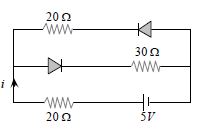
The current $i$ in the circuit will be:
A
$\frac{5}{40} \, A$
B
$\frac{5}{50} \, A$
C
$\frac{5}{10} \, A$
D
$\frac{5}{20} \, A$
Solution
(B) $1$. Analyze the circuit: The circuit consists of a $5 \, V$ battery and two parallel branches connected in series with a $20 \, \Omega$ resistor.
$2$. Check diode bias: In the upper branch,the diode is reverse-biased (the $p$-side is connected to the negative terminal relative to the $n$-side),so it acts as an open circuit (no current flows).
$3$. In the lower branch,the diode is forward-biased (the $p$-side is connected to the positive terminal),so it acts as a closed switch with negligible resistance.
$4$. Calculate total resistance: The total resistance in the active path is the sum of the $20 \, \Omega$ resistor in the main line and the $30 \, \Omega$ resistor in the lower branch: $R_{total} = 20 \, \Omega + 30 \, \Omega = 50 \, \Omega$.
$5$. Calculate current: Using Ohm's law,$i = \frac{V}{R_{total}} = \frac{5 \, V}{50 \, \Omega} = \frac{5}{50} \, A$.
$2$. Check diode bias: In the upper branch,the diode is reverse-biased (the $p$-side is connected to the negative terminal relative to the $n$-side),so it acts as an open circuit (no current flows).
$3$. In the lower branch,the diode is forward-biased (the $p$-side is connected to the positive terminal),so it acts as a closed switch with negligible resistance.
$4$. Calculate total resistance: The total resistance in the active path is the sum of the $20 \, \Omega$ resistor in the main line and the $30 \, \Omega$ resistor in the lower branch: $R_{total} = 20 \, \Omega + 30 \, \Omega = 50 \, \Omega$.
$5$. Calculate current: Using Ohm's law,$i = \frac{V}{R_{total}} = \frac{5 \, V}{50 \, \Omega} = \frac{5}{50} \, A$.
0 likesView Solution
32
ChemistryMCQAIPMT · 2001
Energy per unit volume for a capacitor having area $A$ and separation $d$ kept at potential difference $V$ is given by
A
$\frac{Q^{2}}{2 C}$
B
$\frac{1}{2} C V^{2}$
C
$\frac{1}{2 \varepsilon_{0}} \frac{V^{2}}{d^{2}}$
D
$\frac{1}{2} \varepsilon_{0} \frac{V^{2}}{d^{2}}$
Solution
(D) For a parallel plate capacitor,the capacitance is $C = \frac{A \varepsilon_{0}}{d}$.
The volume of the capacitor is $V_{vol} = Ad$.
The total energy stored in the capacitor is $U = \frac{1}{2} CV^{2}$.
The energy per unit volume (energy density) is given by $u = \frac{U}{V_{vol}} = \frac{\frac{1}{2} CV^{2}}{Ad}$.
Substituting $C = \frac{A \varepsilon_{0}}{d}$ into the expression:
$u = \frac{\frac{1}{2} (\frac{A \varepsilon_{0}}{d}) V^{2}}{Ad} = \frac{1}{2} \varepsilon_{0} \frac{V^{2}}{d^{2}}$.
The volume of the capacitor is $V_{vol} = Ad$.
The total energy stored in the capacitor is $U = \frac{1}{2} CV^{2}$.
The energy per unit volume (energy density) is given by $u = \frac{U}{V_{vol}} = \frac{\frac{1}{2} CV^{2}}{Ad}$.
Substituting $C = \frac{A \varepsilon_{0}}{d}$ into the expression:
$u = \frac{\frac{1}{2} (\frac{A \varepsilon_{0}}{d}) V^{2}}{Ad} = \frac{1}{2} \varepsilon_{0} \frac{V^{2}}{d^{2}}$.
0 likesView Solution
33
ChemistryMCQAIPMT · 2001
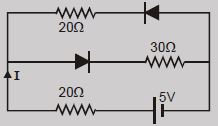
The current $I$ in the circuit will be:
A
$\frac{5}{40} \text{ A}$
B
$\frac{5}{50} \text{ A}$
C
$\frac{5}{10} \text{ A}$
D
$\frac{5}{20} \text{ A}$
Solution
(B) $1$. Analyze the circuit: The circuit consists of two parallel branches connected to a $5 \text{ V}$ battery and a $20 \text{ } \Omega$ resistor in series with the battery.
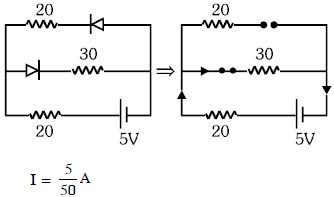
$2$. Check the diodes: The top branch has a diode in reverse bias (the triangle points against the conventional current flow from the positive terminal),so it acts as an open circuit (no current flows).
$3$. The middle branch has a diode in forward bias (the triangle points in the direction of conventional current flow),so it acts as a closed circuit (current flows).
$4$. Calculate the total resistance: The effective resistance of the circuit is the sum of the $20 \text{ } \Omega$ resistor (in series with the battery) and the $30 \text{ } \Omega$ resistor (in the middle branch).
$5$. Total resistance $R = 20 \text{ } \Omega + 30 \text{ } \Omega = 50 \text{ } \Omega$.
$6$. Calculate the current: Using Ohm's law,$I = \frac{V}{R} = \frac{5 \text{ V}}{50 \text{ } \Omega} = \frac{5}{50} \text{ A}$.
$2$. Check the diodes: The top branch has a diode in reverse bias (the triangle points against the conventional current flow from the positive terminal),so it acts as an open circuit (no current flows).
$3$. The middle branch has a diode in forward bias (the triangle points in the direction of conventional current flow),so it acts as a closed circuit (current flows).
$4$. Calculate the total resistance: The effective resistance of the circuit is the sum of the $20 \text{ } \Omega$ resistor (in series with the battery) and the $30 \text{ } \Omega$ resistor (in the middle branch).
$5$. Total resistance $R = 20 \text{ } \Omega + 30 \text{ } \Omega = 50 \text{ } \Omega$.
$6$. Calculate the current: Using Ohm's law,$I = \frac{V}{R} = \frac{5 \text{ V}}{50 \text{ } \Omega} = \frac{5}{50} \text{ A}$.
0 likesView Solution
34
ChemistryEasyMCQAIPMT · 2001
The most acidic compound in water is
A
$AlCl_3$
B
$BeCl_2$
C
$FeCl_3$
D
None of these
Solution
(C) Among the given compounds,ferric chloride $(FeCl_3)$ is the most acidic in water.
This is due to the higher charge density and effective nuclear charge of the $Fe^{3+}$ ion compared to $Al^{3+}$ and $Be^{2+}$.
As the charge density of the central metal cation increases,its ability to polarize the $O-H$ bond in coordinated water molecules increases,leading to greater acidity.
All these compounds undergo hydrolysis in water to liberate $HCl$ gas:
$BeCl_2 + 2 H_2O \rightarrow Be(OH)_2 + 2 HCl \uparrow$
$AlCl_3 + 3 H_2O \rightarrow Al(OH)_3 + 3 HCl \uparrow$
$FeCl_3 + 3 H_2O \rightarrow Fe(OH)_3 + 3 HCl \uparrow$
$Fe^{3+}$ has a higher charge-to-size ratio,making it the strongest Lewis acid among the choices.
This is due to the higher charge density and effective nuclear charge of the $Fe^{3+}$ ion compared to $Al^{3+}$ and $Be^{2+}$.
As the charge density of the central metal cation increases,its ability to polarize the $O-H$ bond in coordinated water molecules increases,leading to greater acidity.
All these compounds undergo hydrolysis in water to liberate $HCl$ gas:
$BeCl_2 + 2 H_2O \rightarrow Be(OH)_2 + 2 HCl \uparrow$
$AlCl_3 + 3 H_2O \rightarrow Al(OH)_3 + 3 HCl \uparrow$
$FeCl_3 + 3 H_2O \rightarrow Fe(OH)_3 + 3 HCl \uparrow$
$Fe^{3+}$ has a higher charge-to-size ratio,making it the strongest Lewis acid among the choices.
0 likesView Solution
35
ChemistryMediumMCQAIPMT · 2001
Pure water can be obtained from sea water by
A
Centrifugation
B
Plasmolysis
C
Reverse osmosis
D
Sedimentation
Solution
(C) Pure water can be obtained from sea water by the process of reverse osmosis. In this process,pressure greater than the osmotic pressure is applied to the sea water,forcing the water molecules to pass through a semi-permeable membrane,leaving behind the dissolved salts.
0 likesView Solution
36
ChemistryMediumMCQAIPMT · 2001
In the preparation of sulphuric acid,$V_2O_5$ is used in the reaction,which is:
A
$S + O_2 \to SO_2$
B
$2SO_2 + O_2 \xrightarrow{V_2O_5} 2SO_3$
C
$SO_2 + H_2O \to H_2SO_3$
D
$N_2 + 3H_2 \to 2NH_3$
Solution
(B) In the contact process for the industrial preparation of sulphuric acid,$SO_2$ is oxidized to $SO_3$ in the presence of a catalyst,vanadium pentoxide $(V_2O_5)$.
The chemical reaction is: $2SO_2(g) + O_2(g) \xrightarrow{V_2O_5} 2SO_3(g)$.
The chemical reaction is: $2SO_2(g) + O_2(g) \xrightarrow{V_2O_5} 2SO_3(g)$.
0 likesView Solution
37
ChemistryEasyMCQAIPMT · 2001
Which of the following is prepared by the electrolytic method?
A
$Ca$
B
$Sn$
C
$S$
D
$F_2$
Solution
(D) Fluorine $(F_2)$ is prepared by the electrolytic oxidation of fluoride ions. Specifically,it is obtained by the electrolysis of a mixture of potassium hydrogen fluoride $(KHF_2)$ and anhydrous hydrogen fluoride $(HF)$.
Other elements like $Ca$ are also prepared by electrolysis,but in the context of the $p$-block elements chapter,$F_2$ is the standard example of an element prepared by electrolysis.
Other elements like $Ca$ are also prepared by electrolysis,but in the context of the $p$-block elements chapter,$F_2$ is the standard example of an element prepared by electrolysis.
0 likesView Solution
38
ChemistryAdvancedMCQAIPMT · 2001
What is the molarity of a solution of $HCl$ which contains $49\%$ by weight of solute and whose specific gravity is $1.41$ (in $M$)?
A
$15.25$
B
$16.75$
C
$18.92$
D
$20.08$
Solution
(C) Given:
Percentage by weight of $HCl$ = $49\%$
Specific gravity of solution = $1.41 \ g/mL$
Density of solution $(d)$ = $1.41 \ g/mL$
Mass of $1000 \ mL$ of solution = $1.41 \times 1000 = 1410 \ g$
Mass of $HCl$ solute in $1000 \ mL$ solution = $49\% \text{ of } 1410 \ g = 0.49 \times 1410 = 690.9 \ g$
Molar mass of $HCl$ = $1 + 35.5 = 36.5 \ g/mol$
Molarity $(M)$ = $\frac{\text{Mass of solute}}{\text{Molar mass of solute} \times \text{Volume of solution in } L}$
$M = \frac{690.9}{36.5 \times 1} = 18.929 \ M \approx 18.93 \ M$
Therefore,the molarity is approximately $18.92 \ M$.
Percentage by weight of $HCl$ = $49\%$
Specific gravity of solution = $1.41 \ g/mL$
Density of solution $(d)$ = $1.41 \ g/mL$
Mass of $1000 \ mL$ of solution = $1.41 \times 1000 = 1410 \ g$
Mass of $HCl$ solute in $1000 \ mL$ solution = $49\% \text{ of } 1410 \ g = 0.49 \times 1410 = 690.9 \ g$
Molar mass of $HCl$ = $1 + 35.5 = 36.5 \ g/mol$
Molarity $(M)$ = $\frac{\text{Mass of solute}}{\text{Molar mass of solute} \times \text{Volume of solution in } L}$
$M = \frac{690.9}{36.5 \times 1} = 18.929 \ M \approx 18.93 \ M$
Therefore,the molarity is approximately $18.92 \ M$.
0 likesView Solution
39
ChemistryMediumMCQAIPMT · 2001
In an experiment,$1 \ g$ of a non-volatile solute was dissolved in $100 \ g$ of acetone (molar mass $= 58 \ g/mol$) at $298 \ K$. The vapour pressure of the solution was found to be $192.5 \ mm \ Hg$. The molecular weight of the solute is (vapour pressure of pure acetone $= 195 \ mm \ Hg$). (in $.24$)
A
$25$
B
$35$
C
$45$
D
$55$
Solution
(C) According to Raoult's Law for non-volatile solutes: $\frac{P^o - P_s}{P^o} = \frac{n_2}{n_1 + n_2} \approx \frac{n_2}{n_1} = \frac{w_2 \times M_1}{M_2 \times w_1}$.
Given: $P^o = 195 \ mm \ Hg$,$P_s = 192.5 \ mm \ Hg$,$w_2 = 1 \ g$,$w_1 = 100 \ g$,$M_1 = 58 \ g/mol$.
Substituting the values: $\frac{195 - 192.5}{195} = \frac{1 \times 58}{M_2 \times 100}$.
$\frac{2.5}{195} = \frac{58}{100 \times M_2}$.
$M_2 = \frac{58 \times 195}{2.5 \times 100} = \frac{11310}{250} = 45.24 \ g/mol$.
Given: $P^o = 195 \ mm \ Hg$,$P_s = 192.5 \ mm \ Hg$,$w_2 = 1 \ g$,$w_1 = 100 \ g$,$M_1 = 58 \ g/mol$.
Substituting the values: $\frac{195 - 192.5}{195} = \frac{1 \times 58}{M_2 \times 100}$.
$\frac{2.5}{195} = \frac{58}{100 \times M_2}$.
$M_2 = \frac{58 \times 195}{2.5 \times 100} = \frac{11310}{250} = 45.24 \ g/mol$.
1 likesView Solution
40
ChemistryMediumMCQAIPMT · 2001
The half-life of $_6C^{14}$,if its decay constant is $6.31 \times 10^{-4} \ yr^{-1}$,is ....... $yrs$.
A
$1098$
B
$109.8$
C
$10.98$
D
$1.098$
Solution
(A) The relationship between half-life $(t_{1/2})$ and decay constant $(k)$ is given by:
$t_{1/2} = \frac{0.693}{k}$
Given $k = 6.31 \times 10^{-4} \ yr^{-1}$.
Substituting the value:
$t_{1/2} = \frac{0.693}{6.31 \times 10^{-4}} \ yr$
$t_{1/2} \approx 0.1098 \times 10^4 \ yr$
$t_{1/2} = 1098 \ yrs$.
$t_{1/2} = \frac{0.693}{k}$
Given $k = 6.31 \times 10^{-4} \ yr^{-1}$.
Substituting the value:
$t_{1/2} = \frac{0.693}{6.31 \times 10^{-4}} \ yr$
$t_{1/2} \approx 0.1098 \times 10^4 \ yr$
$t_{1/2} = 1098 \ yrs$.
0 likesView Solution
41
ChemistryMediumMCQAIPMT · 2001
The given reaction $2NO + O_2 \to 2NO_2$ is an example of
A
First order reaction
B
Second order reaction
C
Third order reaction
D
None of these
Solution
(C) The reaction $2NO + O_2 \to 2NO_2$ follows the rate law expression: $Rate = k[NO]^2[O_2]^1$.
The overall order of the reaction is the sum of the powers of the concentration terms in the rate law expression.
$\text{Order} = 2 + 1 = 3$.
Therefore,it is a third-order reaction.
The overall order of the reaction is the sum of the powers of the concentration terms in the rate law expression.
$\text{Order} = 2 + 1 = 3$.
Therefore,it is a third-order reaction.
0 likesView Solution
42
ChemistryMediumMCQAIPMT · 2001
Electrode potential of $Zn^{2+}/Zn$ is $-0.76\,V$ and that of $Cu^{2+}/Cu$ is $+0.34\,V$. The $EMF$ of the cell constructed between these two electrodes is ............ $V$.
A
$1.10$
B
$0.42$
C
$-1.1$
D
$-0.42$
Solution
(A) The standard $EMF$ of the cell is calculated using the formula: $E^o_{cell} = E^o_{cathode} - E^o_{anode}$.
Here,$Cu^{2+}/Cu$ acts as the cathode $(E^o = +0.34\,V)$ and $Zn^{2+}/Zn$ acts as the anode $(E^o = -0.76\,V)$.
Substituting the values: $E^o_{cell} = 0.34\,V - (-0.76\,V) = 0.34\,V + 0.76\,V = 1.10\,V$.
Here,$Cu^{2+}/Cu$ acts as the cathode $(E^o = +0.34\,V)$ and $Zn^{2+}/Zn$ acts as the anode $(E^o = -0.76\,V)$.
Substituting the values: $E^o_{cell} = 0.34\,V - (-0.76\,V) = 0.34\,V + 0.76\,V = 1.10\,V$.
0 likesView Solution
43
ChemistryEasyMCQAIPMT · 2001
Which of the following conditions will increase the voltage of the cell,represented by the equation $Cu_{(s)} + 2Ag^{+}_{(aq)} \to Cu^{2+}_{(aq)} + 2Ag_{(s)}$?
A
Increase in the concentration of $Ag^{+}$ ions
B
Increase in the concentration of $Cu^{2+}$ ions
C
Increase in the dimension of the silver electrode
D
Increase in the dimension of the copper electrode
Solution
(A) The cell reaction is $Cu_{(s)} + 2Ag^{+}_{(aq)} \to Cu^{2+}_{(aq)} + 2Ag_{(s)}$.
According to the Nernst equation,the cell potential is given by $E_{cell} = E^{\circ}_{cell} - \frac{0.0591}{2} \log \frac{[Cu^{2+}]}{[Ag^{+}]^2}$.
To increase the $E_{cell}$,the value of the logarithmic term $\frac{[Cu^{2+}]}{[Ag^{+}]^2}$ must decrease.
This can be achieved by increasing the concentration of the reactant $[Ag^{+}]$ or decreasing the concentration of the product $[Cu^{2+}]$.
Therefore,an increase in the concentration of $Ag^{+}$ ions will increase the voltage of the cell.
According to the Nernst equation,the cell potential is given by $E_{cell} = E^{\circ}_{cell} - \frac{0.0591}{2} \log \frac{[Cu^{2+}]}{[Ag^{+}]^2}$.
To increase the $E_{cell}$,the value of the logarithmic term $\frac{[Cu^{2+}]}{[Ag^{+}]^2}$ must decrease.
This can be achieved by increasing the concentration of the reactant $[Ag^{+}]$ or decreasing the concentration of the product $[Cu^{2+}]$.
Therefore,an increase in the concentration of $Ag^{+}$ ions will increase the voltage of the cell.
0 likesView Solution
44
ChemistryMediumMCQAIPMT · 2001
The most convenient method to protect the bottom of a ship made of iron is
A
White tin plating
B
Coating with red lead oxide
C
Connecting with $Pb$ block
D
Connecting with $Mg$ block
Solution
(D) The most convenient method to protect the bottom of a ship made of iron is by connecting it with a more reactive metal block,such as $Mg$ (magnesium).
This is known as cathodic protection or sacrificial protection.
Since $Mg$ is more reactive than $Fe$ (iron),it acts as the anode and undergoes oxidation,while the iron acts as the cathode and is protected from corrosion.
This is known as cathodic protection or sacrificial protection.
Since $Mg$ is more reactive than $Fe$ (iron),it acts as the anode and undergoes oxidation,while the iron acts as the cathode and is protected from corrosion.
0 likesView Solution
45
ChemistryMediumMCQAIPMT · 2001
The oxidation number of $Cr$ in $[Cr(NH_3)_6]Cl_3$ is
A
$8$
B
$6$
C
$4$
D
$3$
Solution
(D) Let the oxidation number of $Cr$ be $x$.
The oxidation number of $NH_3$ is $0$ and the oxidation number of $Cl$ is $-1$.
The sum of oxidation numbers in a neutral complex is $0$.
$x + 6 \times (0) + 3 \times (-1) = 0$
$x - 3 = 0$
$x = +3$
Therefore,the oxidation number of $Cr$ is $+3$.
The oxidation number of $NH_3$ is $0$ and the oxidation number of $Cl$ is $-1$.
The sum of oxidation numbers in a neutral complex is $0$.
$x + 6 \times (0) + 3 \times (-1) = 0$
$x - 3 = 0$
$x = +3$
Therefore,the oxidation number of $Cr$ is $+3$.
0 likesView Solution
46
ChemistryDifficultMCQAIPMT · 2001
$[Pt(NH_3)_4Cl_2]Br_2$ and $[Pt(NH_3)_4Br_2]Cl_2$ are related to each other as
A
Optical isomers
B
Coordinate isomers
C
Ionization isomers
D
Linkage isomers
Solution
(C) The given complexes $[Pt(NH_3)_4Cl_2]Br_2$ and $[Pt(NH_3)_4Br_2]Cl_2$ have the same molecular formula but produce different ions in an aqueous solution.
$[Pt(NH_3)_4Cl_2]Br_2$ dissociates to give $Br^-$ ions,whereas $[Pt(NH_3)_4Br_2]Cl_2$ dissociates to give $Cl^-$ ions.
This phenomenon is known as ionization isomerism.
$[Pt(NH_3)_4Cl_2]Br_2$ dissociates to give $Br^-$ ions,whereas $[Pt(NH_3)_4Br_2]Cl_2$ dissociates to give $Cl^-$ ions.
This phenomenon is known as ionization isomerism.
0 likesView Solution
47
ChemistryMediumMCQAIPMT · 2001
When ethyl alcohol $({C_2}{H_5}OH)$ reacts with thionyl chloride,in the presence of pyridine,the product obtained is
A
$CH_3CH_2Cl + HCl$
B
$CH_3COCl + HCl + SO_2$
C
$CH_3CH_2Cl + H_2O + SO_2$
D
$C_2H_5Cl + HCl + SO_2$
Solution
(D) The reaction of ethyl alcohol with thionyl chloride in the presence of pyridine is known as the Darzens process.
The reaction is: $C_2H_5OH + SOCl_2 \xrightarrow{\text{Pyridine}} C_2H_5Cl + SO_2 + HCl$.
Pyridine is used to neutralize the $HCl$ produced in the reaction,which drives the reaction to completion.
The reaction is: $C_2H_5OH + SOCl_2 \xrightarrow{\text{Pyridine}} C_2H_5Cl + SO_2 + HCl$.
Pyridine is used to neutralize the $HCl$ produced in the reaction,which drives the reaction to completion.
0 likesView Solution
48
ChemistryMediumMCQAIPMT · 2001
Freon (dichlorodifluoromethane) is used:
A
As local anaesthetic
B
For dissolving impurities in metallurgical process
C
In refrigerators
D
In printing industry
Solution
(C) Freon $(CCl_2F_2)$ is an odourless,non-corrosive,and non-toxic gas which is stable even at high temperatures and pressures.
It has a low boiling point,low specific heat,and can be easily liquefied by applying pressure at room temperature.
It is,therefore,widely used as a refrigerant (cooling agent) in refrigerators and air conditioners.
It has a low boiling point,low specific heat,and can be easily liquefied by applying pressure at room temperature.
It is,therefore,widely used as a refrigerant (cooling agent) in refrigerators and air conditioners.
0 likesView Solution
49
ChemistryMediumMCQAIPMT · 2001
Which of the following is acidic?
A
$CH_3OH$
B
$C_6H_5OH$
C
$(CH_3)_2CHOH$
D
$CH_3CH_2OH$
Solution
(B) The correct answer is $(B)$.
Phenol $(C_6H_5OH)$ is acidic because the phenoxide ion formed after the loss of a proton is resonance-stabilized by the benzene ring.
Aliphatic alcohols like methanol,ethanol,and isopropyl alcohol are much less acidic than phenol because their corresponding alkoxide ions are not resonance-stabilized.
Phenol $(C_6H_5OH)$ is acidic because the phenoxide ion formed after the loss of a proton is resonance-stabilized by the benzene ring.
Aliphatic alcohols like methanol,ethanol,and isopropyl alcohol are much less acidic than phenol because their corresponding alkoxide ions are not resonance-stabilized.
0 likesView Solution
50
ChemistryMediumMCQAIPMT · 2001
Predict the product $B$ in the sequence of reaction:
$HC \equiv CH$ $\xrightarrow{30\% \ H_2SO_4, HgSO_4} A$ $\xrightarrow{dil. \ NaOH} B$
$HC \equiv CH$ $\xrightarrow{30\% \ H_2SO_4, HgSO_4} A$ $\xrightarrow{dil. \ NaOH} B$
A
$CH_3COONa$
B
$CH_3COOH$
C
$CH_3CHO$
D
$CH_3-CH(OH)-CH_2CHO$
Solution
(D) Step $1$: Acetylene $(HC \equiv CH)$ undergoes hydration in the presence of $30\% \ H_2SO_4$ and $HgSO_4$ to form vinyl alcohol,which tautomerizes to acetaldehyde $(CH_3CHO)$. Thus,$A = CH_3CHO$.
Step $2$: Acetaldehyde contains $\alpha$-hydrogen atoms,so it undergoes aldol condensation in the presence of dilute $NaOH$ to form $3$-hydroxybutanal $(CH_3-CH(OH)-CH_2CHO)$. Thus,$B = CH_3-CH(OH)-CH_2CHO$.
Step $2$: Acetaldehyde contains $\alpha$-hydrogen atoms,so it undergoes aldol condensation in the presence of dilute $NaOH$ to form $3$-hydroxybutanal $(CH_3-CH(OH)-CH_2CHO)$. Thus,$B = CH_3-CH(OH)-CH_2CHO$.
0 likesView Solution
51
ChemistryMediumMCQAIPMT · 2001
Which of the following statements is incorrect?
A
$FeCl_3$ is used in the detection of phenols.
B
Fehling solution is used in the detection of glucose.
C
Tollen’s reagent is used in the detection of unsaturation.
D
$NaHSO_3$ is used in the detection of carbonyl compounds.
Solution
(C) $FeCl_3$ is used to detect phenols by forming a violet-colored complex.
Fehling solution is used to detect reducing sugars like glucose.
$NaHSO_3$ (sodium bisulfite) is used to detect carbonyl compounds (aldehydes and ketones) by forming a crystalline addition product.
Tollen’s reagent is used to detect aldehydes,not unsaturation. Unsaturation is typically detected using bromine water or Baeyer's reagent.
Therefore,the statement that Tollen’s reagent is used in the detection of unsaturation is incorrect.
Fehling solution is used to detect reducing sugars like glucose.
$NaHSO_3$ (sodium bisulfite) is used to detect carbonyl compounds (aldehydes and ketones) by forming a crystalline addition product.
Tollen’s reagent is used to detect aldehydes,not unsaturation. Unsaturation is typically detected using bromine water or Baeyer's reagent.
Therefore,the statement that Tollen’s reagent is used in the detection of unsaturation is incorrect.
0 likesView Solution
52
ChemistryMediumMCQAIPMT · 2001
Which of the following is not a polyamide?
A
Nylon-$6,6$
B
Protein
C
Glyptal
D
Nylon-$6$
Solution
(C) Glyptal is a polyester resin formed by the condensation of ethylene glycol and phthalic acid. It is not a polyamide. Nylon-$6,6$,Nylon-$6$,and proteins all contain amide linkages $(-CONH-)$ in their structure.
0 likesView Solution
53
ChemistryMediumMCQAIPMT · 2001
Which of the following is a correct statement?
A
Proteins are amino acids
B
$\alpha$-hydrogen is present in fructose
C
Starch is a polymer of $\alpha$-glucose
D
Amylose is a component of cellulose
Solution
(C) The correct statement is that starch is a polymer of $\alpha$-glucose.
Starch is a polysaccharide composed of two components: amylose and amylopectin,both of which are polymers of $\alpha$-$D$-glucose units.
Starch is a polysaccharide composed of two components: amylose and amylopectin,both of which are polymers of $\alpha$-$D$-glucose units.
0 likesView Solution
54
ChemistryEasyMCQAIPMT · 2001
Proteins are built up of
A
Dicarboxylic acids
B
Amino acids
C
Alcohols
D
Hydroxy acids
Solution
(B) . Proteins are polymers of amino acids.
Amino acid $\to$ Dipeptide $\to$ Polypeptide $\to$ Protein.
Amino acid $\to$ Dipeptide $\to$ Polypeptide $\to$ Protein.
0 likesView Solution
55
ChemistryEasyMCQAIPMT · 2001
Antibodies are
A
Carbohydrate
B
Globular protein
C
Immunoglobulins
D
Cellulose compounds
Solution
(B) Antibodies are specialized proteins produced by the immune system to identify and neutralize foreign substances like bacteria and viruses. They are classified as $Globular \text{ } proteins$ and are also known as $Immunoglobulins$ $(Ig)$. Therefore,both options $B$ and $C$ are technically correct,but in the context of biochemical classification,they are primarily identified as $Globular \text{ } proteins$.
0 likesView Solution
56
ChemistryEasyMCQAIPMT · 2001
Energy is stored in our body in the form of
A
$ATP$
B
$ADP$
C
Fats
D
Carbohydrates
Solution
(A) The correct option is $(A)$.
Energy is stored in our body in the form of $ATP$ $(Adenosine \ Triphosphate)$,which acts as the primary energy currency of the cell.
Energy is stored in our body in the form of $ATP$ $(Adenosine \ Triphosphate)$,which acts as the primary energy currency of the cell.
0 likesView Solution
Vedclass Products
For Students
Vedclass Test Series
Mock tests in real AIPMT style covering Chemistry with performance analysis. 5-day free trial.
Start Free TrialFor Teachers
Exam Paper Generator
Generate Set A/B/C/D Chemistry papers from 7.5L+ questions in 2 minutes. 3 chapters free.
Try FreeFor Institutes
Online Exam Module
Run live AIPMT mock exams with unlimited students, 360° analytics & white-label branding.
See DemoFrequently Asked Questions
How many Chemistry questions are in AIPMT 2001?
There are 56 Chemistry questions from the AIPMT 2001 paper on Vedclass, each with a detailed step-by-step solution in English.
Are AIPMT 2001 Chemistry solutions available in English?
Yes. All solutions on this page are in English. You can also switch to English or Hindi using the language buttons above the questions.
Can I practice AIPMT 2001 Chemistry as a timed test?
Yes. Use the Vedclass Test Series to attempt a full AIPMT mock test covering Chemistry with time limits and instant score analysis.
Can teachers create Chemistry papers from AIPMT previous year questions?
Yes. The Vedclass Exam Paper Generator lets teachers mix AIPMT Chemistry questions and generate Set A/B/C/D papers in minutes.
For Teachers & Institutes
Build a Custom Chemistry Paper
Pick AIPMT 2001 Chemistry questions, set difficulty, and generate Set A/B/C/D in 2 minutes.