
ChemistryQ51–129 of 179 questions
Page 2 of 2 · English
51
ChemistryMediumMCQAIIMS · 2019
The chemical reaction is shown below:
$C_6H_5-CH_2-CH=CH_2 + HCl \rightarrow X$,$X$ is:
$C_6H_5-CH_2-CH=CH_2 + HCl \rightarrow X$,$X$ is:
A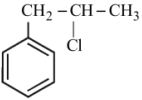
B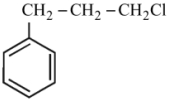
C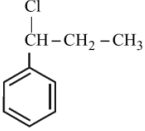
D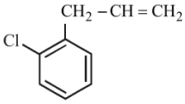
Solution
(C) The reaction follows Markovnikov's addition of $HCl$ to the alkene.
$1$. The $H^+$ ion attacks the terminal carbon of the double bond to form the most stable carbocation.
$2$. The intermediate formed is a $3^{\circ}$ benzylic carbocation $(C_6H_5-CH^+-CH_2-CH_3)$,which is highly stabilized by resonance with the phenyl ring.
$3$. The $Cl^-$ ion then attacks this carbocation to form the final product: $1$-chloro-$1$-phenylpropane $(C_6H_5-CH(Cl)-CH_2-CH_3)$.
$1$. The $H^+$ ion attacks the terminal carbon of the double bond to form the most stable carbocation.
$2$. The intermediate formed is a $3^{\circ}$ benzylic carbocation $(C_6H_5-CH^+-CH_2-CH_3)$,which is highly stabilized by resonance with the phenyl ring.
$3$. The $Cl^-$ ion then attacks this carbocation to form the final product: $1$-chloro-$1$-phenylpropane $(C_6H_5-CH(Cl)-CH_2-CH_3)$.
0 likesView Solution
52
ChemistryEasyMCQAIIMS · 2019
Excess nitrate in drinking water can cause
A
methemoglobinemia
B
kidney damage
C
liver damage
D
laxative effect
Solution
(A) Excess nitrate in drinking water can cause methemoglobinemia,which is also known as blue baby syndrome.
0 likesView Solution
53
ChemistryEasyMCQAIIMS · 2019
The correct order of $S-S$ bond length in the following oxyanions is:
$(I) \, S_2O_4^{2-}$
$(II) \, S_2O_5^{2-}$
$(III) \, S_2O_6^{2-}$
$(I) \, S_2O_4^{2-}$
$(II) \, S_2O_5^{2-}$
$(III) \, S_2O_6^{2-}$
A
$I > II > III$
B
$I > III > II$
C
$III > II > I$
D
$III > I > II$
Solution
(A) The $S-S$ bond length depends on the oxidation state of sulfur and the repulsion between lone pairs on the sulfur atoms.
In $S_2O_4^{2-}$ (dithionite),each sulfur atom has one lone pair,leading to significant $L.P.-L.P.$ repulsion between the two sulfur atoms,which increases the $S-S$ bond length.
In $S_2O_5^{2-}$ (disulfite),one sulfur has a lone pair and the other does not,resulting in less repulsion compared to $S_2O_4^{2-}$.
In $S_2O_6^{2-}$ (dithionate),both sulfur atoms are in a higher oxidation state and have no lone pairs involved in $S-S$ repulsion,resulting in the shortest $S-S$ bond length.
Therefore,the correct order of $S-S$ bond length is $I > II > III$.
In $S_2O_4^{2-}$ (dithionite),each sulfur atom has one lone pair,leading to significant $L.P.-L.P.$ repulsion between the two sulfur atoms,which increases the $S-S$ bond length.
In $S_2O_5^{2-}$ (disulfite),one sulfur has a lone pair and the other does not,resulting in less repulsion compared to $S_2O_4^{2-}$.
In $S_2O_6^{2-}$ (dithionate),both sulfur atoms are in a higher oxidation state and have no lone pairs involved in $S-S$ repulsion,resulting in the shortest $S-S$ bond length.
Therefore,the correct order of $S-S$ bond length is $I > II > III$.
0 likesView Solution
54
ChemistryMediumMCQAIIMS · 2019
Which one of the following sets of quantum numbers is not possible for a $4p$ electron?
A
$n=4, l=1, m=-1, m_{s}=+\frac{1}{2}$
B
$n=4, l=1, m=0, m_{s}=+\frac{1}{2}$
C
$n=4, l=1, m=2, m_{s}=+\frac{1}{2}$
D
$n=4, l=1, m=-1, m_{s}=-\frac{1}{2}$
Solution
(C) For a $4p$ electron,the principal quantum number $n=4$ and the azimuthal quantum number $l=1$.
The magnetic quantum number $m$ can take values from $-l$ to $+l$,which means for $l=1$,$m$ can be $-1, 0, +1$.
The value $m=2$ is not possible for $l=1$ because $m$ must satisfy the condition $|m| \leq l$.
Therefore,the set $n=4, l=1, m=2, m_{s}=+\frac{1}{2}$ is not possible.
The magnetic quantum number $m$ can take values from $-l$ to $+l$,which means for $l=1$,$m$ can be $-1, 0, +1$.
The value $m=2$ is not possible for $l=1$ because $m$ must satisfy the condition $|m| \leq l$.
Therefore,the set $n=4, l=1, m=2, m_{s}=+\frac{1}{2}$ is not possible.
0 likesView Solution
55
ChemistryEasyMCQAIIMS · 2019
One mole of a non-ideal gas undergoes a change of state ($2.0 \, atm$,$3.0 \, L$,$95 \, K$) $\rightarrow$ ($4.0 \, atm$,$5.0 \, L$,$245 \, K$) with a change in internal energy,$\Delta U = 30.0 \, L \, atm$. The change in enthalpy $\Delta H$ of the process in $L \, atm$ is.
A
$40.0$
B
$42.3$
C
$44.0$
D
Not defined because pressure is not constant
Solution
(C) The change in enthalpy is defined as $\Delta H = \Delta U + \Delta(PV)$.
Given $\Delta U = 30.0 \, L \, atm$.
Initial state: $P_1 = 2.0 \, atm$,$V_1 = 3.0 \, L$.
Final state: $P_2 = 4.0 \, atm$,$V_2 = 5.0 \, L$.
$\Delta(PV) = P_2 V_2 - P_1 V_1 = (4.0 \times 5.0) - (2.0 \times 3.0) = 20.0 - 6.0 = 14.0 \, L \, atm$.
Therefore,$\Delta H = 30.0 + 14.0 = 44.0 \, L \, atm$.
Given $\Delta U = 30.0 \, L \, atm$.
Initial state: $P_1 = 2.0 \, atm$,$V_1 = 3.0 \, L$.
Final state: $P_2 = 4.0 \, atm$,$V_2 = 5.0 \, L$.
$\Delta(PV) = P_2 V_2 - P_1 V_1 = (4.0 \times 5.0) - (2.0 \times 3.0) = 20.0 - 6.0 = 14.0 \, L \, atm$.
Therefore,$\Delta H = 30.0 + 14.0 = 44.0 \, L \, atm$.
0 likesView Solution
56
ChemistryMediumMCQAIIMS · 2019
The value of the ionic product of water $(K_w)$ at $393 \ K$ is:
A
less than $1 \times 10^{-14}$
B
greater than $1 \times 10^{-14}$
C
equal to $1 \times 10^{-14}$
D
equal to $1 \times 10^{-7}$
Solution
(B) The auto-ionization of water is an endothermic process.
According to Le Chatelier's principle,an increase in temperature shifts the equilibrium in the forward direction.
Therefore,the ionic product of water $(K_w = [H^+][OH^-])$ increases as the temperature increases.
At $298 \ K$,$K_w = 1 \times 10^{-14}$.
Since $393 \ K > 298 \ K$,the value of $K_w$ at $393 \ K$ will be greater than $1 \times 10^{-14}$.
According to Le Chatelier's principle,an increase in temperature shifts the equilibrium in the forward direction.
Therefore,the ionic product of water $(K_w = [H^+][OH^-])$ increases as the temperature increases.
At $298 \ K$,$K_w = 1 \times 10^{-14}$.
Since $393 \ K > 298 \ K$,the value of $K_w$ at $393 \ K$ will be greater than $1 \times 10^{-14}$.
0 likesView Solution
57
ChemistryDifficultMCQAIIMS · 2019
$o-$Nitrophenol is less soluble in water than $p-$ and $m-$nitrophenols because:
A
$o-$Nitrophenol is more volatile than $m-$ and $p-$ isomers.
B
$o-$Nitrophenol shows intramolecular $H-$bonding.
C
$o-$Nitrophenol shows intermolecular $H-$bonding.
D
Melting point of $o-$nitrophenol is lower than those of $m-$ and $p-$ isomers.
Solution
(B) In $o-$nitrophenol,the $-OH$ group forms an intramolecular hydrogen bond with the adjacent nitro group.
This makes the $-OH$ group unavailable for intermolecular hydrogen bonding with water molecules.
Consequently,$o-$nitrophenol exhibits lower solubility in water compared to $m-$ and $p-$nitrophenols,which form intermolecular hydrogen bonds with water.
This makes the $-OH$ group unavailable for intermolecular hydrogen bonding with water molecules.
Consequently,$o-$nitrophenol exhibits lower solubility in water compared to $m-$ and $p-$nitrophenols,which form intermolecular hydrogen bonds with water.
0 likesView Solution
58
ChemistryMediumMCQAIIMS · 2019
For which of the following ionic species would the radius be maximum?
A
$C^{4-}$
B
$N^{3-}$
C
$O^{2-}$
D
$Mg^{2+}$
Solution
(A) For isoelectronic species,the ionic radius increases as the negative charge increases and decreases as the positive charge increases.
All the given species $(C^{4-}, N^{3-}, O^{2-}, Mg^{2+})$ are isoelectronic with $10$ electrons.
Among these,$C^{4-}$ has the highest negative charge,which results in the greatest inter-electronic repulsion and the weakest effective nuclear attraction.
Therefore,$C^{4-}$ has the maximum ionic radius.
All the given species $(C^{4-}, N^{3-}, O^{2-}, Mg^{2+})$ are isoelectronic with $10$ electrons.
Among these,$C^{4-}$ has the highest negative charge,which results in the greatest inter-electronic repulsion and the weakest effective nuclear attraction.
Therefore,$C^{4-}$ has the maximum ionic radius.
0 likesView Solution
59
ChemistryMediumMCQAIIMS · 2019
Which one of the following is the lightest?
A
$0.2 \ mol$ of hydrogen gas
B
$6.023 \times 10^{23}$ molecules of nitrogen
C
$0.1 \ g$ of silver
D
$0.1 \ mol$ of oxygen gas
Solution
(C) To find the lightest,we calculate the mass for each option:
$1$. Mass of $0.2 \ mol$ of $H_2 = 0.2 \ mol \times 2 \ g/mol = 0.4 \ g$.
$2$. $6.023 \times 10^{23}$ molecules of $N_2$ corresponds to $1 \ mol$. Mass of $1 \ mol$ of $N_2 = 1 \ mol \times 28 \ g/mol = 28 \ g$.
$3$. Mass of $0.1 \ g$ of silver is given as $0.1 \ g$.
$4$. Mass of $0.1 \ mol$ of $O_2 = 0.1 \ mol \times 32 \ g/mol = 3.2 \ g$.
Comparing the masses: $0.1 \ g < 0.4 \ g < 2.8 \ g < 3.2 \ g$.
Therefore,$0.1 \ g$ of silver is the lightest.
$1$. Mass of $0.2 \ mol$ of $H_2 = 0.2 \ mol \times 2 \ g/mol = 0.4 \ g$.
$2$. $6.023 \times 10^{23}$ molecules of $N_2$ corresponds to $1 \ mol$. Mass of $1 \ mol$ of $N_2 = 1 \ mol \times 28 \ g/mol = 28 \ g$.
$3$. Mass of $0.1 \ g$ of silver is given as $0.1 \ g$.
$4$. Mass of $0.1 \ mol$ of $O_2 = 0.1 \ mol \times 32 \ g/mol = 3.2 \ g$.
Comparing the masses: $0.1 \ g < 0.4 \ g < 2.8 \ g < 3.2 \ g$.
Therefore,$0.1 \ g$ of silver is the lightest.
0 likesView Solution
60
ChemistryMediumMCQAIIMS · 2019
The rate of diffusion of $SO_{2}$,$CO_{2}$,$PCl_{3}$ and $SO_{3}$ are in the following order:
A
$PCl_{3} > SO_{3} > SO_{2} > CO_{2}$
B
$CO_{2} > SO_{2} > SO_{3} > PCl_{3}$
C
$SO_{2} > SO_{3} > PCl_{3} > CO_{2}$
D
$CO_{2} > SO_{2} > PCl_{3} > SO_{3}$
Solution
(B) According to Graham's Law of diffusion,the rate of diffusion $(r)$ is inversely proportional to the square root of the molar mass $(M)$: $r \propto \frac{1}{\sqrt{M}}$.
First,calculate the molar masses of the given compounds:
$M(CO_{2}) = 12 + 2 \times 16 = 44 \ g/mol$
$M(SO_{2}) = 32 + 2 \times 16 = 64 \ g/mol$
$M(SO_{3}) = 32 + 3 \times 16 = 80 \ g/mol$
$M(PCl_{3}) = 31 + 3 \times 35.5 = 31 + 106.5 = 137.5 \ g/mol$
Since the rate of diffusion is inversely proportional to the square root of the molar mass,the order of the rate of diffusion will be the reverse of the order of their molar masses:
$M(CO_{2}) < M(SO_{2}) < M(SO_{3}) < M(PCl_{3})$
Therefore,the rate of diffusion order is: $CO_{2} > SO_{2} > SO_{3} > PCl_{3}$.
First,calculate the molar masses of the given compounds:
$M(CO_{2}) = 12 + 2 \times 16 = 44 \ g/mol$
$M(SO_{2}) = 32 + 2 \times 16 = 64 \ g/mol$
$M(SO_{3}) = 32 + 3 \times 16 = 80 \ g/mol$
$M(PCl_{3}) = 31 + 3 \times 35.5 = 31 + 106.5 = 137.5 \ g/mol$
Since the rate of diffusion is inversely proportional to the square root of the molar mass,the order of the rate of diffusion will be the reverse of the order of their molar masses:
$M(CO_{2}) < M(SO_{2}) < M(SO_{3}) < M(PCl_{3})$
Therefore,the rate of diffusion order is: $CO_{2} > SO_{2} > SO_{3} > PCl_{3}$.
0 likesView Solution
61
ChemistryMediumMCQAIIMS · 2019
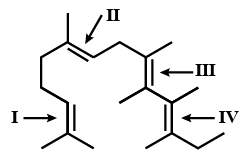
In the following structure,the double bonds are marked as $I$,$II$,$III$ and $IV$. Geometrical isomerism is not possible at site$(s)$:
A
$III$
B
$I$
C
$I$ and $III$
D
$III$ and $IV$
Solution
(C) For geometrical isomerism to occur at a double bond,each carbon atom of the double bond must be attached to two different groups.
$I$: The carbon atom is attached to two identical methyl groups $(a, a)$,so geometrical isomerism is not possible.
$II$: Both carbons are attached to different groups,so it shows geometrical isomerism.
$III$: The carbon atom is attached to two identical methyl groups,so geometrical isomerism is not possible.
$IV$: Both carbons are attached to different groups,so it shows geometrical isomerism.
Therefore,geometrical isomerism is not possible at sites $I$ and $III$.
$I$: The carbon atom is attached to two identical methyl groups $(a, a)$,so geometrical isomerism is not possible.
$II$: Both carbons are attached to different groups,so it shows geometrical isomerism.
$III$: The carbon atom is attached to two identical methyl groups,so geometrical isomerism is not possible.
$IV$: Both carbons are attached to different groups,so it shows geometrical isomerism.
Therefore,geometrical isomerism is not possible at sites $I$ and $III$.
0 likesView Solution
62
ChemistryEasyMCQAIIMS · 2019
Which of the following elements has the last electron in its outermost orbit with a magnetic quantum number $m = 0$?
A
$Na$
B
$O$
C
$Cl$
D
$N$
Solution
(A) The magnetic quantum number $m$ for an $s$-orbital is always $0$.
For $Na$ $(Z=11)$,the electronic configuration is $1s^{2} 2s^{2} 2p^{6} 3s^{1}$. The last electron enters the $3s$ orbital,which has $l=0$,therefore $m=0$.
For $O$ $(Z=8)$,the configuration is $1s^{2} 2s^{2} 2p^{4}$. The last electron enters a $2p$ orbital $(l=1)$,where $m$ can be $-1, 0, +1$.
For $Cl$ $(Z=17)$,the configuration is $1s^{2} 2s^{2} 2p^{6} 3s^{2} 3p^{5}$. The last electron enters a $3p$ orbital $(l=1)$,where $m$ can be $-1, 0, +1$.
For $N$ $(Z=7)$,the configuration is $1s^{2} 2s^{2} 2p^{3}$. The last electron enters a $2p$ orbital $(l=1)$,where $m$ can be $-1, 0, +1$.
Thus,only $Na$ has its last electron in an $s$-orbital where $m$ is strictly $0$.
For $Na$ $(Z=11)$,the electronic configuration is $1s^{2} 2s^{2} 2p^{6} 3s^{1}$. The last electron enters the $3s$ orbital,which has $l=0$,therefore $m=0$.
For $O$ $(Z=8)$,the configuration is $1s^{2} 2s^{2} 2p^{4}$. The last electron enters a $2p$ orbital $(l=1)$,where $m$ can be $-1, 0, +1$.
For $Cl$ $(Z=17)$,the configuration is $1s^{2} 2s^{2} 2p^{6} 3s^{2} 3p^{5}$. The last electron enters a $3p$ orbital $(l=1)$,where $m$ can be $-1, 0, +1$.
For $N$ $(Z=7)$,the configuration is $1s^{2} 2s^{2} 2p^{3}$. The last electron enters a $2p$ orbital $(l=1)$,where $m$ can be $-1, 0, +1$.
Thus,only $Na$ has its last electron in an $s$-orbital where $m$ is strictly $0$.
0 likesView Solution
63
ChemistryMediumMCQAIIMS · 2019
In the conversion of limestone to lime,$CaCO_{3(s)} \rightarrow CaO_{(s)} + CO_{2(g)}$,the values of $\Delta H^{\circ}$ and $\Delta S^{\circ}$ are $+179.1 \ kJ \ mol^{-1}$ and $160.2 \ J \ K^{-1} \ mol^{-1}$ respectively at $298 \ K$ and $1 \ bar$. Assuming that $\Delta H^{\circ}$ and $\Delta S^{\circ}$ do not change with temperature,the temperature above which the conversion of limestone to lime will be spontaneous is ........... $K$.
A
$1118$
B
$1008$
C
$1200$
D
$845$
Solution
(A) For a reaction to be spontaneous,the Gibbs free energy change $\Delta G^{\circ}$ must be less than $0$.
Given the equation: $\Delta G^{\circ} = \Delta H^{\circ} - T \Delta S^{\circ}$.
At equilibrium,$\Delta G^{\circ} = 0$,so $T = \frac{\Delta H^{\circ}}{\Delta S^{\circ}}$.
Given values: $\Delta H^{\circ} = 179.1 \ kJ \ mol^{-1} = 179100 \ J \ mol^{-1}$ and $\Delta S^{\circ} = 160.2 \ J \ K^{-1} \ mol^{-1}$.
Substituting these values into the equation:
$T = \frac{179100 \ J \ mol^{-1}}{160.2 \ J \ K^{-1} \ mol^{-1}} \approx 1117.97 \ K$.
Since the reaction is endothermic and entropy increases,the reaction becomes spontaneous at temperatures above $1118 \ K$.
Given the equation: $\Delta G^{\circ} = \Delta H^{\circ} - T \Delta S^{\circ}$.
At equilibrium,$\Delta G^{\circ} = 0$,so $T = \frac{\Delta H^{\circ}}{\Delta S^{\circ}}$.
Given values: $\Delta H^{\circ} = 179.1 \ kJ \ mol^{-1} = 179100 \ J \ mol^{-1}$ and $\Delta S^{\circ} = 160.2 \ J \ K^{-1} \ mol^{-1}$.
Substituting these values into the equation:
$T = \frac{179100 \ J \ mol^{-1}}{160.2 \ J \ K^{-1} \ mol^{-1}} \approx 1117.97 \ K$.
Since the reaction is endothermic and entropy increases,the reaction becomes spontaneous at temperatures above $1118 \ K$.
0 likesView Solution
64
ChemistryMediumMCQAIIMS · 2019
$2 \ g$ of aluminium is treated separately with excess of dilute $H_{2}SO_{4}$ and excess of $NaOH$. The ratio of the volumes of hydrogen evolved is
A
$2:3$
B
$1:1$
C
$2:1$
D
$1:2$
Solution
(B) When aluminium is treated with dilute $H_{2}SO_{4}$:
$2Al + 3H_{2}SO_{4} \rightarrow Al_{2}(SO_{4})_{3} + 3H_{2}$
From the stoichiometry,$2 \text{ moles of } Al$ produce $3 \text{ moles of } H_{2}$.
When aluminium is treated with $NaOH$:
$2Al + 2NaOH + 6H_{2}O \rightarrow 2Na[Al(OH)_{4}] + 3H_{2}$
From the stoichiometry,$2 \text{ moles of } Al$ produce $3 \text{ moles of } H_{2}$.
Since the same mass of aluminium $(2 \ g)$ is used in both cases,the number of moles of $Al$ is the same.
Therefore,the ratio of the volumes of hydrogen evolved is $3:3$,which simplifies to $1:1$.
$2Al + 3H_{2}SO_{4} \rightarrow Al_{2}(SO_{4})_{3} + 3H_{2}$
From the stoichiometry,$2 \text{ moles of } Al$ produce $3 \text{ moles of } H_{2}$.
When aluminium is treated with $NaOH$:
$2Al + 2NaOH + 6H_{2}O \rightarrow 2Na[Al(OH)_{4}] + 3H_{2}$
From the stoichiometry,$2 \text{ moles of } Al$ produce $3 \text{ moles of } H_{2}$.
Since the same mass of aluminium $(2 \ g)$ is used in both cases,the number of moles of $Al$ is the same.
Therefore,the ratio of the volumes of hydrogen evolved is $3:3$,which simplifies to $1:1$.
0 likesView Solution
65
ChemistryMediumMCQAIIMS · 2019
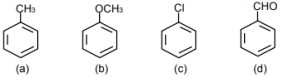
The correct order of reactivity towards electrophilic substitution reaction is:
A
$a > b > c > d$
B
$d > b > a > c$
C
$b > a > c > d$
D
$b > a > d > c$
Solution
(C) Electrophilic substitution reactivity depends on the electron density of the aromatic ring.
Electron donating groups $(EDG)$ increase electron density,while electron withdrawing groups $(EWG)$ decrease it.
$(a)$ Toluene $(-CH_3)$: $+I$ and hyperconjugation effect (activating).
$(b)$ Anisole $(-OCH_3)$: $+M$ effect is very strong (strongly activating).
$(c)$ Chlorobenzene $(-Cl)$: $-I$ effect dominates over $+M$ effect (deactivating).
$(d)$ Benzaldehyde $(-CHO)$: $-M$ and $-I$ effects (strongly deactivating).
The order of activation is: Anisole $(b)$ > Toluene $(a)$ > Chlorobenzene $(c)$ > Benzaldehyde $(d)$.
Therefore,the correct order is $b > a > c > d$.
Electron donating groups $(EDG)$ increase electron density,while electron withdrawing groups $(EWG)$ decrease it.
$(a)$ Toluene $(-CH_3)$: $+I$ and hyperconjugation effect (activating).
$(b)$ Anisole $(-OCH_3)$: $+M$ effect is very strong (strongly activating).
$(c)$ Chlorobenzene $(-Cl)$: $-I$ effect dominates over $+M$ effect (deactivating).
$(d)$ Benzaldehyde $(-CHO)$: $-M$ and $-I$ effects (strongly deactivating).
The order of activation is: Anisole $(b)$ > Toluene $(a)$ > Chlorobenzene $(c)$ > Benzaldehyde $(d)$.
Therefore,the correct order is $b > a > c > d$.
0 likesView Solution
66
ChemistryMediumMCQAIIMS · 2019
Predict the major product $A$ for the following reaction:
$2\text{-methylbuta-1,3-diene} + HBr (1 \text{ eq.}) \xrightarrow{-80^{\circ}C (1,2\text{-addition})} A$
$2\text{-methylbuta-1,3-diene} + HBr (1 \text{ eq.}) \xrightarrow{-80^{\circ}C (1,2\text{-addition})} A$
A
$3-$bromo$-2-$methylbut$-1-$ene
B
$1-$bromo$-3-$methylbut$-2-$ene
C
$4-$bromo$-2-$methylbut$-1-$ene
D
$2-$bromo$-2-$methylbutane
Solution
(D) The reaction is an electrophilic addition of $HBr$ to a conjugated diene $(2\text{-methylbuta-1,3-diene})$ at low temperature $(-80^{\circ}C)$,which favors the kinetic product $(1,2\text{-addition})$.
$1$. The proton $(H^+)$ from $HBr$ attacks the terminal double bond to form the most stable carbocation.
$2$. Protonation at the $C_1$ position leads to a tertiary allylic carbocation,which is more stable than the secondary allylic carbocation formed by protonation at the $C_4$ position.
$3$. The bromide ion $(Br^-)$ then attacks the tertiary carbocation at the $C_2$ position to form the $1,2\text{-addition}$ product.
$4$. The final product $A$ is $2\text{-bromo-2-methylbut-3-ene}$.
$1$. The proton $(H^+)$ from $HBr$ attacks the terminal double bond to form the most stable carbocation.
$2$. Protonation at the $C_1$ position leads to a tertiary allylic carbocation,which is more stable than the secondary allylic carbocation formed by protonation at the $C_4$ position.
$3$. The bromide ion $(Br^-)$ then attacks the tertiary carbocation at the $C_2$ position to form the $1,2\text{-addition}$ product.
$4$. The final product $A$ is $2\text{-bromo-2-methylbut-3-ene}$.
0 likesView Solution
67
ChemistryMediumMCQAIIMS · 2019
Which is the most stable conformer of ethane-$1,2$-diol?
A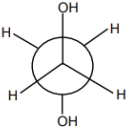
B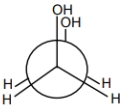
C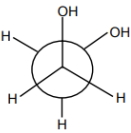
D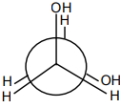
Solution
(C) In general,the anti-staggered conformer is the most stable for most molecules due to minimal steric hindrance. However,for ethane-$1,2$-diol,the gauche conformer is more stable than the anti-staggered form. This is due to the formation of an intramolecular hydrogen bond between the two hydroxyl $(-OH)$ groups,which stabilizes the gauche conformation. The structure showing this intramolecular hydrogen bonding is given in the reference image.
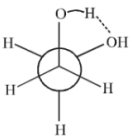
0 likesView Solution
68
ChemistryMediumMCQAIIMS · 2019
Which of the following compounds is the least soluble in water?
A
$Na_2S$
B
$NaCl$
C
$MgCl_2$
D
$MgS$
Solution
(D) The solubility of ionic compounds in water depends on their lattice energy and hydration energy.
According to Fajan's rule,compounds with higher covalent character exhibit lower solubility in polar solvents like water.
$MgS$ has a high degree of covalent character due to the small size and high charge density of the $Mg^{2+}$ ion,which polarizes the $S^{2-}$ ion significantly.
Therefore,$MgS$ is the least soluble among the given options.
According to Fajan's rule,compounds with higher covalent character exhibit lower solubility in polar solvents like water.
$MgS$ has a high degree of covalent character due to the small size and high charge density of the $Mg^{2+}$ ion,which polarizes the $S^{2-}$ ion significantly.
Therefore,$MgS$ is the least soluble among the given options.
0 likesView Solution
69
ChemistryMediumMCQAIIMS · 2019
$C_{(s)} + O_{2(g)} \rightarrow CO_{2(g)} \dots \dots(I) \quad \Delta H = -393 \, kJ \, mol^{-1}$
$H_{2(g)} + \frac{1}{2} O_{2(g)} \rightarrow H_{2}O_{(l)} \dots \dots(II) \quad \Delta H = -287.3 \, kJ \, mol^{-1}$
$2CO_{2(g)} + 3H_{2}O_{(l)}$ $\rightarrow C_{2}H_{5}OH_{(l)} + 3O_{2(g)} \dots \dots(III) \quad \Delta H = 1366.8 \, kJ \, mol^{-1}$
Find the standard enthalpy of formation of $C_{2}H_{5}OH_{(l)}$.
$H_{2(g)} + \frac{1}{2} O_{2(g)} \rightarrow H_{2}O_{(l)} \dots \dots(II) \quad \Delta H = -287.3 \, kJ \, mol^{-1}$
$2CO_{2(g)} + 3H_{2}O_{(l)}$ $\rightarrow C_{2}H_{5}OH_{(l)} + 3O_{2(g)} \dots \dots(III) \quad \Delta H = 1366.8 \, kJ \, mol^{-1}$
Find the standard enthalpy of formation of $C_{2}H_{5}OH_{(l)}$.
A
$281.1 \, kJ \, mol^{-1}$
B
$-562.2 \, kJ \, mol^{-1}$
C
$562.2 \, kJ \, mol^{-1}$
D
$-281.1 \, kJ \, mol^{-1}$
Solution
(D) The formation reaction of $C_{2}H_{5}OH_{(l)}$ is:
$2C_{(s)} + 3H_{2(g)} + \frac{1}{2} O_{2(g)} \rightarrow C_{2}H_{5}OH_{(l)}$
To obtain this,we perform the operation: $2 \times (I) + 3 \times (II) + (III)$.
$\Delta H_f = 2 \times (-393) + 3 \times (-287.3) + 1366.8$
$\Delta H_f = -786 - 861.9 + 1366.8$
$\Delta H_f = -1647.9 + 1366.8 = -281.1 \, kJ \, mol^{-1}$.
$2C_{(s)} + 3H_{2(g)} + \frac{1}{2} O_{2(g)} \rightarrow C_{2}H_{5}OH_{(l)}$
To obtain this,we perform the operation: $2 \times (I) + 3 \times (II) + (III)$.
$\Delta H_f = 2 \times (-393) + 3 \times (-287.3) + 1366.8$
$\Delta H_f = -786 - 861.9 + 1366.8$
$\Delta H_f = -1647.9 + 1366.8 = -281.1 \, kJ \, mol^{-1}$.
0 likesView Solution
70
ChemistryMediumMCQAIIMS · 2019
In an isolated system,find the condition for a spontaneous reaction.
A
$ \Delta U = 0, \Delta S = 0, \Delta G = 0 $
B
$ \Delta U < 0, \Delta S > 0, \Delta G < 0 $
C
$ \Delta U = 0, \Delta S > 0 $
D
$ \Delta U < 0, \Delta S < 0, \Delta G < 0 $
Solution
(C) An isolated system is defined as a system that cannot exchange energy or matter with its surroundings.
For an isolated system,the total internal energy remains constant,so $ \Delta U = 0 $.
According to the second law of thermodynamics,for a spontaneous process in an isolated system,the total entropy of the system must increase,so $ \Delta S_{total} > 0 $.
Note that $ \Delta G $ is typically defined for systems at constant temperature and pressure,which is not applicable to an isolated system in the same way; however,the primary criterion for spontaneity in an isolated system is $ \Delta S > 0 $.
For an isolated system,the total internal energy remains constant,so $ \Delta U = 0 $.
According to the second law of thermodynamics,for a spontaneous process in an isolated system,the total entropy of the system must increase,so $ \Delta S_{total} > 0 $.
Note that $ \Delta G $ is typically defined for systems at constant temperature and pressure,which is not applicable to an isolated system in the same way; however,the primary criterion for spontaneity in an isolated system is $ \Delta S > 0 $.
0 likesView Solution
71
ChemistryMediumMCQAIIMS · 2019
$A$ bulb emits electromagnetic radiation of $660 \, nm$ wavelength. The total energy of radiation is $3 \times 10^{-18} \, J$. The number of emitted photons will be :
$(h = 6.6 \times 10^{-34} \, J \cdot s, \, c = 3 \times 10^{8} \, m/s)$
$(h = 6.6 \times 10^{-34} \, J \cdot s, \, c = 3 \times 10^{8} \, m/s)$
A
$1$
B
$1000$
C
$100$
D
$10$
Solution
(D) The energy of a single photon is given by $E_{photon} = \frac{hc}{\lambda}$.
The total energy $E$ is given by $E = n \times E_{photon} = \frac{nhc}{\lambda}$,where $n$ is the number of photons.
Given:
$E = 3 \times 10^{-18} \, J$
$\lambda = 660 \, nm = 660 \times 10^{-9} \, m$
$h = 6.6 \times 10^{-34} \, J \cdot s$
$c = 3 \times 10^{8} \, m/s$
Rearranging for $n$:
$n = \frac{E \times \lambda}{h \times c}$
Substituting the values:
$n = \frac{3 \times 10^{-18} \times 660 \times 10^{-9}}{6.6 \times 10^{-34} \times 3 \times 10^{8}}$
$n = \frac{3 \times 660 \times 10^{-27}}{6.6 \times 3 \times 10^{-26}}$
$n = \frac{1980 \times 10^{-27}}{19.8 \times 10^{-26}} = 100 \times 10^{-1} = 10$
Thus,the number of emitted photons is $10$.
The total energy $E$ is given by $E = n \times E_{photon} = \frac{nhc}{\lambda}$,where $n$ is the number of photons.
Given:
$E = 3 \times 10^{-18} \, J$
$\lambda = 660 \, nm = 660 \times 10^{-9} \, m$
$h = 6.6 \times 10^{-34} \, J \cdot s$
$c = 3 \times 10^{8} \, m/s$
Rearranging for $n$:
$n = \frac{E \times \lambda}{h \times c}$
Substituting the values:
$n = \frac{3 \times 10^{-18} \times 660 \times 10^{-9}}{6.6 \times 10^{-34} \times 3 \times 10^{8}}$
$n = \frac{3 \times 660 \times 10^{-27}}{6.6 \times 3 \times 10^{-26}}$
$n = \frac{1980 \times 10^{-27}}{19.8 \times 10^{-26}} = 100 \times 10^{-1} = 10$
Thus,the number of emitted photons is $10$.
0 likesView Solution
72
ChemistryMediumMCQAIIMS · 2019
When $0.05 \ M$ dimethylamine is dissolved in $0.1 \ M$ $NaOH$ solution,the percentage dissociation of dimethylamine is: $(K_b)_{(CH_3)_2NH} = 5 \times 10^{-4}$
A
$5 \times 10^{-5}$
B
$5 \times 10^{-3}$
C
$5 \times 10^{-1}$
D
$5 \times 10^{-2}$
Solution
(C) Dimethylamine is a weak base: $(CH_3)_2NH + H_2O \rightleftharpoons (CH_3)_2NH_2^+ + OH^-$
Given: $C = 0.05 \ M$,$K_b = 5 \times 10^{-4}$,and $[OH^-]_{NaOH} = 0.1 \ M$.
Due to the common ion effect,the concentration of $OH^-$ is dominated by $NaOH$,so $[OH^-] \approx 0.1 \ M$.
The expression for $K_b$ is: $K_b = \frac{[(CH_3)_2NH_2^+][OH^-]}{[(CH_3)_2NH]} = \frac{C\alpha \times 0.1}{C(1-\alpha)} \approx \frac{0.05 \times \alpha \times 0.1}{0.05} = 0.1 \alpha$.
$5 \times 10^{-4} = 0.1 \alpha \implies \alpha = 5 \times 10^{-3}$.
Percentage dissociation $= \alpha \times 100 = 5 \times 10^{-3} \times 100 = 0.5 \% = 5 \times 10^{-1} \%$.
Given: $C = 0.05 \ M$,$K_b = 5 \times 10^{-4}$,and $[OH^-]_{NaOH} = 0.1 \ M$.
Due to the common ion effect,the concentration of $OH^-$ is dominated by $NaOH$,so $[OH^-] \approx 0.1 \ M$.
The expression for $K_b$ is: $K_b = \frac{[(CH_3)_2NH_2^+][OH^-]}{[(CH_3)_2NH]} = \frac{C\alpha \times 0.1}{C(1-\alpha)} \approx \frac{0.05 \times \alpha \times 0.1}{0.05} = 0.1 \alpha$.
$5 \times 10^{-4} = 0.1 \alpha \implies \alpha = 5 \times 10^{-3}$.
Percentage dissociation $= \alpha \times 100 = 5 \times 10^{-3} \times 100 = 0.5 \% = 5 \times 10^{-1} \%$.
0 likesView Solution
73
ChemistryMediumMCQAIIMS · 2019
For the chemical reaction: $A + B \rightarrow AB$,if $B$ is acting as the limiting reagent,choose the correct option.
A
$A = 50$ atoms,$B = 100$ atoms
B
$A = 100$ atoms,$B = 200$ atoms
C
$A = 50$ atoms,$B = 30$ atoms
D
$A = 50$ atoms,$B = 200$ atoms
Solution
(C) The limiting reagent is the reactant that is completely consumed in a reaction and limits the amount of product formed.
For the reaction $A + B \rightarrow AB$,the stoichiometric ratio is $1:1$.
To find the limiting reagent,we compare the number of atoms of $A$ and $B$.
The reactant with the smaller number of atoms (when stoichiometric coefficients are $1$) is the limiting reagent.
In option $C$,we have $50$ atoms of $A$ and $30$ atoms of $B$.
Since $30 < 50$,$B$ is the limiting reagent.
Therefore,the correct option is $C$.
For the reaction $A + B \rightarrow AB$,the stoichiometric ratio is $1:1$.
To find the limiting reagent,we compare the number of atoms of $A$ and $B$.
The reactant with the smaller number of atoms (when stoichiometric coefficients are $1$) is the limiting reagent.
In option $C$,we have $50$ atoms of $A$ and $30$ atoms of $B$.
Since $30 < 50$,$B$ is the limiting reagent.
Therefore,the correct option is $C$.
1 likesView Solution
74
ChemistryMediumMCQAIIMS · 2019
Which of the following can react with $K_{2}Cr_{2}O_{7}$?
A
$SO_{3}^{2-}$
B
$CO_{3}^{2-}$
C
$SO_{4}^{2-}$
D
$NO_{3}^{-}$
Solution
(A) $K_{2}Cr_{2}O_{7}$ acts as a strong oxidizing agent in acidic medium.
It can oxidize sulfite ions $(SO_{3}^{2-})$ to sulfate ions $(SO_{4}^{2-})$.
The balanced ionic reaction is:
$Cr_{2}O_{7}^{2-} + 3SO_{3}^{2-} + 8H^{+} \rightarrow 2Cr^{3+} + 3SO_{4}^{2-} + 4H_{2}O$
Other ions like $CO_{3}^{2-}$,$SO_{4}^{2-}$,and $NO_{3}^{-}$ are either already in their highest oxidation state or do not undergo redox reaction with dichromate under standard conditions.
It can oxidize sulfite ions $(SO_{3}^{2-})$ to sulfate ions $(SO_{4}^{2-})$.
The balanced ionic reaction is:
$Cr_{2}O_{7}^{2-} + 3SO_{3}^{2-} + 8H^{+} \rightarrow 2Cr^{3+} + 3SO_{4}^{2-} + 4H_{2}O$
Other ions like $CO_{3}^{2-}$,$SO_{4}^{2-}$,and $NO_{3}^{-}$ are either already in their highest oxidation state or do not undergo redox reaction with dichromate under standard conditions.
0 likesView Solution
75
ChemistryMediumMCQAIIMS · 2019
Which of the following intermediates is not expected to be formed in the following reaction?
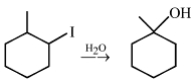
A
B
C
D
Solution
(D) The reaction is a solvolysis reaction of $1-$iodo$-2-$methylcyclohexane in water.
$1$. The leaving group $I^-$ departs to form a secondary carbocation at the $C-2$ position.
$2$. This secondary carbocation undergoes a $1,2-$hydride shift to form a more stable tertiary carbocation at the $C-1$ position.
$3$. Water acts as a nucleophile and attacks the tertiary carbocation to form an oxonium ion intermediate.
$4$. Finally,deprotonation yields $1-$methylcyclohexanol.
Comparing the options:
- Option $A$ is the oxonium ion intermediate.
- Option $B$ is the initial secondary carbocation.
- Option $C$ is the tertiary carbocation.
- Option $D$ is a primary carbocation,which is highly unstable and not expected to be formed in this mechanism.
$1$. The leaving group $I^-$ departs to form a secondary carbocation at the $C-2$ position.
$2$. This secondary carbocation undergoes a $1,2-$hydride shift to form a more stable tertiary carbocation at the $C-1$ position.
$3$. Water acts as a nucleophile and attacks the tertiary carbocation to form an oxonium ion intermediate.
$4$. Finally,deprotonation yields $1-$methylcyclohexanol.
Comparing the options:
- Option $A$ is the oxonium ion intermediate.
- Option $B$ is the initial secondary carbocation.
- Option $C$ is the tertiary carbocation.
- Option $D$ is a primary carbocation,which is highly unstable and not expected to be formed in this mechanism.
0 likesView Solution
76
ChemistryMediumMCQAIIMS · 2019
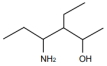
What is the $IUPAC$ name of the given compound?
A
$3-$Ethyl$-4-$aminohexan$-2-$ol
B
$3-$Amino$-4-$ethylhexan$-5-$ol
C
$2-$Hydroxy$-4-$aminohexane
D
$4-$Amino$-3-$ethylhexan$-2-$ol
Solution
(D) $1$. Identify the longest carbon chain containing the principal functional group $(-OH)$. The chain has $6$ carbons,so the parent alkane is hexane.
$2$. Number the chain starting from the end closer to the principal functional group $(-OH)$. Thus,the $-OH$ group is at position $2$.
$3$. Identify the substituents: an amino group $(-NH_2)$ at position $4$ and an ethyl group $(-CH_2CH_3)$ at position $3$.
$4$. Arrange the substituents alphabetically: amino comes before ethyl.
$5$. Combining these,the $IUPAC$ name is $4-$amino$-3-$ethylhexan$-2-$ol.
$2$. Number the chain starting from the end closer to the principal functional group $(-OH)$. Thus,the $-OH$ group is at position $2$.
$3$. Identify the substituents: an amino group $(-NH_2)$ at position $4$ and an ethyl group $(-CH_2CH_3)$ at position $3$.
$4$. Arrange the substituents alphabetically: amino comes before ethyl.
$5$. Combining these,the $IUPAC$ name is $4-$amino$-3-$ethylhexan$-2-$ol.
0 likesView Solution
77
ChemistryMediumMCQAIIMS · 2019
$CH_{3}-C \equiv CH$ $\xrightarrow{2 HBr}$ $\xrightarrow{H_{2}O} \text{Product}$. The product is:
A
$CH_{3}-CH(OH)-CH_{3}$
B
$CH_{3}-C(=O)-CH_{3}$
C
$CH_{3}-CH_{2}-CHO$
D
$CH_{3}-CH(OH)-CH_{2}OH$
Solution
(B) The reaction proceeds as follows:
$1$. Addition of $2 \text{ moles}$ of $HBr$ to propyne $(CH_{3}-C \equiv CH)$ follows Markovnikov's rule,resulting in the formation of a geminal dibromide: $CH_{3}-C(Br)_{2}-CH_{3}$.
$2$. Hydrolysis of the geminal dibromide with $H_{2}O$ replaces the bromine atoms with hydroxyl groups,forming a geminal diol (gem-diol): $CH_{3}-C(OH)_{2}-CH_{3}$.
$3$. Gem-diols are unstable and lose a molecule of water to form a ketone: $CH_{3}-C(OH)_{2}-CH_{3} \rightarrow CH_{3}-C(=O)-CH_{3} + H_{2}O$.
Therefore,the final product is acetone $(CH_{3}-C(=O)-CH_{3})$.
$1$. Addition of $2 \text{ moles}$ of $HBr$ to propyne $(CH_{3}-C \equiv CH)$ follows Markovnikov's rule,resulting in the formation of a geminal dibromide: $CH_{3}-C(Br)_{2}-CH_{3}$.
$2$. Hydrolysis of the geminal dibromide with $H_{2}O$ replaces the bromine atoms with hydroxyl groups,forming a geminal diol (gem-diol): $CH_{3}-C(OH)_{2}-CH_{3}$.
$3$. Gem-diols are unstable and lose a molecule of water to form a ketone: $CH_{3}-C(OH)_{2}-CH_{3} \rightarrow CH_{3}-C(=O)-CH_{3} + H_{2}O$.
Therefore,the final product is acetone $(CH_{3}-C(=O)-CH_{3})$.
0 likesView Solution
78
ChemistryMediumMCQAIIMS · 2019
$H_2O_2$ is obtained by which of the following?
A
$BaO_2$
B
$MnO_2$
C
$SeO_2$
D
$TeO_2$
Solution
(A) $H_2O_2$ is prepared by the action of dilute sulfuric acid on hydrated barium peroxide $(BaO_2 \cdot 8H_2O)$.
The chemical reaction is:
$BaO_2 \cdot 8H_2O_{(s)} + H_2SO_{4(aq)} \rightarrow BaSO_{4(s)} + H_2O_{2(aq)} + 8H_2O_{(l)}$.
The chemical reaction is:
$BaO_2 \cdot 8H_2O_{(s)} + H_2SO_{4(aq)} \rightarrow BaSO_{4(s)} + H_2O_{2(aq)} + 8H_2O_{(l)}$.
0 likesView Solution
79
ChemistryMediumMCQAIIMS · 2019
The graph between $P$ and $V$ below the critical temperature is:
A
B
C
D
Solution
(D) Below the critical temperature $(T_c)$,the isotherms show a distinct region where the gas and liquid phases coexist. In this region,the pressure remains constant as the volume decreases during the condensation process. This results in a characteristic horizontal or nearly horizontal segment in the $P-V$ isotherm,as shown in the provided figure (option $D$).
0 likesView Solution
80
ChemistryMediumMCQAIIMS · 2019
Which alkali metal during flame test will show color corresponding to maximum wavelength?
A
$Li$
B
$Na$
C
$K$
D
$Cs$
Solution
(A) The flame colors of the given alkali metals are:
$Li$ (Lithium): Crimson red flame $(\lambda \approx 670 \ nm)$
$Na$ (Sodium): Golden yellow flame $(\lambda \approx 589 \ nm)$
$K$ (Potassium): Violet flame $(\lambda \approx 404 \ nm)$
$Cs$ (Cesium): Blue flame $(\lambda \approx 455 \ nm)$
Since the wavelength $(\lambda)$ is inversely proportional to the energy of the emitted light,the color with the lowest energy corresponds to the maximum wavelength.
Among the given options,the crimson red color of $Li$ has the longest wavelength.
$Li$ (Lithium): Crimson red flame $(\lambda \approx 670 \ nm)$
$Na$ (Sodium): Golden yellow flame $(\lambda \approx 589 \ nm)$
$K$ (Potassium): Violet flame $(\lambda \approx 404 \ nm)$
$Cs$ (Cesium): Blue flame $(\lambda \approx 455 \ nm)$
Since the wavelength $(\lambda)$ is inversely proportional to the energy of the emitted light,the color with the lowest energy corresponds to the maximum wavelength.
Among the given options,the crimson red color of $Li$ has the longest wavelength.
0 likesView Solution
81
ChemistryMediumMCQAIIMS · 2019
Which pair of elements has the maximum electronegativity difference?
A
$Li \& F$
B
$Na \& F$
C
$Na \& Br$
D
$Na \& Cl$
Solution
(B) Electronegativity $(E.N.)$ increases across a period and decreases down a group. Fluorine $(F)$ is the most electronegative element $(E.N. = 4.0)$,while alkali metals have the lowest $E.N.$ values.
Comparing the given pairs:
$1$. $Li$ $(1.0)$ and $F$ $(4.0)$: Difference = $3.0$
$2$. $Na$ $(0.9)$ and $F$ $(4.0)$: Difference = $3.1$
$3$. $Na$ $(0.9)$ and $Br$ $(2.8)$: Difference = $1.9$
$4$. $Na$ $(0.9)$ and $Cl$ $(3.0)$: Difference = $2.1$
Thus,the pair with the maximum electronegativity difference is $Na \& F$.
Comparing the given pairs:
$1$. $Li$ $(1.0)$ and $F$ $(4.0)$: Difference = $3.0$
$2$. $Na$ $(0.9)$ and $F$ $(4.0)$: Difference = $3.1$
$3$. $Na$ $(0.9)$ and $Br$ $(2.8)$: Difference = $1.9$
$4$. $Na$ $(0.9)$ and $Cl$ $(3.0)$: Difference = $2.1$
Thus,the pair with the maximum electronegativity difference is $Na \& F$.
0 likesView Solution
82
ChemistryMediumMCQAIIMS · 2019
In the dimer of phosphorus pentaoxide $(P_4O_{10})$,what is the correct order of the number of $P-O-P$,$P=O$,and $P-P$ bonds?
A
$P-O-P > P=O > P-P$
B
$P=O > P-O-P > P-P$
C
$P-O-P > P-P > P=O$
D
$P=O > P-P > P-O-P$
Solution
(A) The structure of $P_4O_{10}$ consists of a tetrahedral arrangement of four phosphorus atoms.
Each phosphorus atom is bonded to three oxygen atoms via $P-O-P$ bridges,and one terminal oxygen atom via a $P=O$ double bond.
Counting the bonds in the structure:
$1$. Total $P-O-P$ bonds = $6$.
$2$. Total $P=O$ bonds = $4$.
$3$. Total $P-P$ bonds = $0$.
Therefore,the order is $P-O-P (6) > P=O (4) > P-P (0)$.
Each phosphorus atom is bonded to three oxygen atoms via $P-O-P$ bridges,and one terminal oxygen atom via a $P=O$ double bond.
Counting the bonds in the structure:
$1$. Total $P-O-P$ bonds = $6$.
$2$. Total $P=O$ bonds = $4$.
$3$. Total $P-P$ bonds = $0$.
Therefore,the order is $P-O-P (6) > P=O (4) > P-P (0)$.
0 likesView Solution
83
ChemistryMediumMCQAIIMS · 2019
For the endothermic reaction $A_{2} \rightarrow 2A$,which of the following will increase the yield of the monomer $A$?
A
Increase in both temperature and concentration of reactant.
B
Increase in temperature and decrease in concentration of reactant.
C
Decrease in temperature and increase in concentration of reactant.
D
Decrease in both temperature and concentration of reactant.
Solution
(A) The given reaction is $A_{2} \rightleftharpoons 2A$ with $\Delta H > 0$ (endothermic).
According to Le Chatelier's principle,for an endothermic reaction,an increase in temperature shifts the equilibrium in the forward direction,thereby increasing the yield of the product $A$.
Additionally,increasing the concentration of the reactant $A_{2}$ shifts the equilibrium in the forward direction to counteract the change,further increasing the yield of $A$.
Therefore,an increase in both temperature and concentration of the reactant will increase the yield of the monomer $A$.
According to Le Chatelier's principle,for an endothermic reaction,an increase in temperature shifts the equilibrium in the forward direction,thereby increasing the yield of the product $A$.
Additionally,increasing the concentration of the reactant $A_{2}$ shifts the equilibrium in the forward direction to counteract the change,further increasing the yield of $A$.
Therefore,an increase in both temperature and concentration of the reactant will increase the yield of the monomer $A$.
0 likesView Solution
84
ChemistryMediumMCQAIIMS · 2019
$pH$ of a salt solution of weak acid $(pK_a = 4)$ and weak base $(pK_b = 5)$ at $25^{\circ}C$ is:
A
$6.5$
B
$6$
C
$7$
D
$7.5$
Solution
(A) The $pH$ of a salt of a weak acid and a weak base is given by the formula:
$pH = \frac{1}{2}(pK_w + pK_a - pK_b)$
Given:
$pK_w = 14$
$pK_a = 4$
$pK_b = 5$
Substituting the values:
$pH = \frac{1}{2}(14 + 4 - 5)$
$pH = \frac{1}{2}(13)$
$pH = 6.5$
$pH = \frac{1}{2}(pK_w + pK_a - pK_b)$
Given:
$pK_w = 14$
$pK_a = 4$
$pK_b = 5$
Substituting the values:
$pH = \frac{1}{2}(14 + 4 - 5)$
$pH = \frac{1}{2}(13)$
$pH = 6.5$
0 likesView Solution
85
ChemistryMediumMCQAIIMS · 2019
Radius of $1^{st}$ orbit of $H$ and some orbit of $Be^{3+}$ is same. Energy of their orbit of $Be^{3+}$ is ............$eV$.
A
$-54.4$
B
$-13.6$
C
$-108.8$
D
$-27.2$
Solution
(A) The radius of the $n^{th}$ orbit is given by $r_n = 0.529 \times \frac{n^2}{Z} \ \mathring{A}$.
For $H$ atom,$Z = 1$ and $n = 1$,so $r_H = 0.529 \times \frac{1^2}{1} = 0.529 \ \mathring{A}$.
For $Be^{3+}$ ion,$Z = 4$. Let the orbit number be $n$.
Given $r_H = r_{Be^{3+}}$,so $0.529 \times \frac{1^2}{1} = 0.529 \times \frac{n^2}{4}$.
$1 = \frac{n^2}{4} \implies n^2 = 4 \implies n = 2$.
The energy of an orbit is given by $E_n = -13.6 \times \frac{Z^2}{n^2} \ \text{eV}$.
For $Be^{3+}$,$Z = 4$ and $n = 2$,so $E = -13.6 \times \frac{4^2}{2^2} = -13.6 \times \frac{16}{4} = -13.6 \times 4 = -54.4 \ \text{eV}$.
For $H$ atom,$Z = 1$ and $n = 1$,so $r_H = 0.529 \times \frac{1^2}{1} = 0.529 \ \mathring{A}$.
For $Be^{3+}$ ion,$Z = 4$. Let the orbit number be $n$.
Given $r_H = r_{Be^{3+}}$,so $0.529 \times \frac{1^2}{1} = 0.529 \times \frac{n^2}{4}$.
$1 = \frac{n^2}{4} \implies n^2 = 4 \implies n = 2$.
The energy of an orbit is given by $E_n = -13.6 \times \frac{Z^2}{n^2} \ \text{eV}$.
For $Be^{3+}$,$Z = 4$ and $n = 2$,so $E = -13.6 \times \frac{4^2}{2^2} = -13.6 \times \frac{16}{4} = -13.6 \times 4 = -54.4 \ \text{eV}$.
0 likesView Solution
86
ChemistryMediumMCQAIIMS · 2019
Select the correct statement regarding the shapes of $PCl_5$,$BrF_5$,and $IF_7$.
A
All are square pyramidal
B
All are trigonal bipyramidal
C
One of the following is square pyramidal
D
One of the following is tetrahedral
Solution
(C) $PCl_5$: Bond pairs $(bp)$ = $5$,Lone pairs $(lp)$ = $0$. Total = $5$. Hybridization = $sp^3d$. Shape = Trigonal bipyramidal.
$BrF_5$: Bond pairs $(bp)$ = $5$,Lone pairs $(lp)$ = $1$. Total = $6$. Hybridization = $sp^3d^2$. Shape = Square pyramidal.
$IF_7$: Bond pairs $(bp)$ = $7$,Lone pairs $(lp)$ = $0$. Total = $7$. Hybridization = $sp^3d^3$. Shape = Pentagonal bipyramidal.
Thus,the correct statement is that one of the following $(BrF_5)$ is square pyramidal.
$BrF_5$: Bond pairs $(bp)$ = $5$,Lone pairs $(lp)$ = $1$. Total = $6$. Hybridization = $sp^3d^2$. Shape = Square pyramidal.
$IF_7$: Bond pairs $(bp)$ = $7$,Lone pairs $(lp)$ = $0$. Total = $7$. Hybridization = $sp^3d^3$. Shape = Pentagonal bipyramidal.
Thus,the correct statement is that one of the following $(BrF_5)$ is square pyramidal.
0 likesView Solution
87
ChemistryDifficultMCQAIIMS · 2019
Appropriate reducing agent for the following conversion is:
$CH_2=CH-CH_2-CHO \to CH_3-CH_2-CH_2-CH_2OH$
$CH_2=CH-CH_2-CHO \to CH_3-CH_2-CH_2-CH_2OH$
A
$LiAlH_4 / H_2O$
B
$NaBH_4 / H_2O$
C
$Na + C_2H_5OH$
D
$H_2 / Ni$ or $B_2H_6 / H_2O_2, OH^-$
Solution
(D) The conversion $CH_2=CH-CH_2-CHO \to CH_3-CH_2-CH_2-CH_2OH$ involves the reduction of both the carbon-carbon double bond $(C=C)$ and the aldehyde group $(-CHO)$.
$LiAlH_4$,$NaBH_4$,and $Na + C_2H_5OH$ are selective reducing agents that reduce the aldehyde group to a primary alcohol but do not reduce isolated $C=C$ double bonds.
Catalytic hydrogenation using $H_2 / Ni$ (or $Pt/Pd$) is the appropriate method to reduce both the alkene and the aldehyde functional groups to an alkane and a primary alcohol,respectively.
$LiAlH_4$,$NaBH_4$,and $Na + C_2H_5OH$ are selective reducing agents that reduce the aldehyde group to a primary alcohol but do not reduce isolated $C=C$ double bonds.
Catalytic hydrogenation using $H_2 / Ni$ (or $Pt/Pd$) is the appropriate method to reduce both the alkene and the aldehyde functional groups to an alkane and a primary alcohol,respectively.
0 likesView Solution
88
ChemistryMediumMCQAIIMS · 2019
Which element has the least covalent radius?
A
$Mn$
B
$Cu$
C
$Zn$
D
$Ni$
Solution
(D) The covalent radii for the given transition elements are as follows:
$Ni = 125 \text{ pm}$
$Cu = 128 \text{ pm}$
$Zn = 137 \text{ pm}$
$Mn = 137 \text{ pm}$
Comparing these values, $Ni$ has the smallest covalent radius among the given options.
$Ni = 125 \text{ pm}$
$Cu = 128 \text{ pm}$
$Zn = 137 \text{ pm}$
$Mn = 137 \text{ pm}$
Comparing these values, $Ni$ has the smallest covalent radius among the given options.
0 likesView Solution
89
ChemistryMediumMCQAIIMS · 2019
Which of the following reacts most slowly with nitric acid?
A
Phosphorus
B
Sulphur
C
Iodine
D
Chlorine
Solution
(D) Nitric acid $(HNO_3)$ is a strong oxidizing agent. Among the given non-metals,$P$,$S$,and $I_2$ are oxidized by concentrated $HNO_3$ to their respective oxoacids ($H_3PO_4$,$H_2SO_4$,and $HIO_3$). Chlorine $(Cl_2)$ does not react with nitric acid because $HNO_3$ acts as an oxidizing agent and $Cl_2$ is already in a state where it is not easily oxidized further by $HNO_3$ under standard conditions. Thus,chlorine reacts most slowly (or effectively not at all) compared to the others.
0 likesView Solution
90
ChemistryMediumMCQAIIMS · 2019
In the processing of steel,which of the following allotropes of carbon is used?
A
Carbon black
B
Charcoal
C
Coke
D
Graphones
Solution
(C) Carbon black,charcoal,coke,and graphene are forms or allotropes of carbon. Among these,$Coke$ is primarily used in the blast furnace for the reduction of iron ore to produce steel.
0 likesView Solution
91
ChemistryMediumMCQAIIMS · 2019
Which of the following is incorrect about cyanogen gas?
A
It has a bent structure
B
It is a pseudohalogen
C
Its behavior is similar to halides
D
Both carbons are $sp$ hybridized
Solution
(A) The molecular formula of cyanogen gas is $(CN)_{2}$.
Cyanogen gas has a linear structure with the formula $N \equiv C - C \equiv N$.
In this molecule,both carbon atoms are $sp$ hybridized.
It is classified as a pseudohalogen because its chemical behavior resembles that of halogens.
Therefore,the statement that it has a bent structure is incorrect.
Cyanogen gas has a linear structure with the formula $N \equiv C - C \equiv N$.
In this molecule,both carbon atoms are $sp$ hybridized.
It is classified as a pseudohalogen because its chemical behavior resembles that of halogens.
Therefore,the statement that it has a bent structure is incorrect.
0 likesView Solution
92
ChemistryMediumMCQAIIMS · 2019
Which of the following complexes is optically inactive?
A
$[RhCl(CO)(PPh_3)(NH_3)]$
B
$[Fe(C_2O_4)_3]^{3-}$
C
$[Fe(en)_2Cl_2]$
D
$[Pd(en)_2Cl_2]$
Solution
(A) complex is optically inactive if it possesses a plane of symmetry or a center of inversion.
$1$. $[RhCl(CO)(PPh_3)(NH_3)]$ is a square planar complex. All square planar complexes are optically inactive because they possess a plane of symmetry (the molecular plane).
$2$. $[Fe(C_2O_4)_3]^{3-}$ is an octahedral complex with three bidentate ligands,which is chiral and optically active.
$3$. $[Fe(en)_2Cl_2]$ can exist as cis and trans isomers; the cis-isomer is optically active.
$4$. $[Pd(en)_2Cl_2]$ is a square planar complex,but in the context of coordination chemistry,$[RhCl(CO)(PPh_3)(NH_3)]$ is the most classic example of an inherently achiral square planar geometry.
$1$. $[RhCl(CO)(PPh_3)(NH_3)]$ is a square planar complex. All square planar complexes are optically inactive because they possess a plane of symmetry (the molecular plane).
$2$. $[Fe(C_2O_4)_3]^{3-}$ is an octahedral complex with three bidentate ligands,which is chiral and optically active.
$3$. $[Fe(en)_2Cl_2]$ can exist as cis and trans isomers; the cis-isomer is optically active.
$4$. $[Pd(en)_2Cl_2]$ is a square planar complex,but in the context of coordination chemistry,$[RhCl(CO)(PPh_3)(NH_3)]$ is the most classic example of an inherently achiral square planar geometry.
0 likesView Solution
93
ChemistryMediumMCQAIIMS · 2019
Correct increasing order for the wavelength of absorption in the visible region for the complexes of $Co^{3+}$ is :
A
$[Co(CN)_6]^{3-}, [Co(NH_3)_6]^{3+}, [Co(NH_3)_5(H_2O)]^{3+}, [Co(NH_3)_5Cl]^{2+}$
B
$[Co(CN)_6]^{3-}, [Co(NH_3)_5(H_2O)]^{3+}, [Co(NH_3)_5Cl]^{2+}, [Co(NH_3)_6]^{3+}$
C
$[Co(NH_3)_6]^{3+}, [Co(CN)_6]^{3-}, [Co(NH_3)_5(H_2O)]^{3+}, [Co(NH_3)_5Cl]^{2+}$
D
$[Co(NH_3)_5Cl]^{2+}, [Co(NH_3)_5(H_2O)]^{3+}, [Co(NH_3)_6]^{3+}, [Co(CN)_6]^{3-}$
Solution
(A) The crystal field splitting energy $(\Delta_{0})$ increases as the field strength of the ligand increases.
The spectrochemical series order for the given ligands is: $CN^{-} > NH_3 > H_2O > Cl^{-}$.
Since the energy of the absorbed light is inversely proportional to the wavelength $(\lambda \propto \frac{1}{\Delta_{0}})$,a stronger ligand field results in a larger $\Delta_{0}$ and a shorter wavelength of absorption.
Thus,the increasing order of wavelength is: $[Co(CN)_6]^{3-} < [Co(NH_3)_6]^{3+} < [Co(NH_3)_5(H_2O)]^{3+} < [Co(NH_3)_5Cl]^{2+}$.
The spectrochemical series order for the given ligands is: $CN^{-} > NH_3 > H_2O > Cl^{-}$.
Since the energy of the absorbed light is inversely proportional to the wavelength $(\lambda \propto \frac{1}{\Delta_{0}})$,a stronger ligand field results in a larger $\Delta_{0}$ and a shorter wavelength of absorption.
Thus,the increasing order of wavelength is: $[Co(CN)_6]^{3-} < [Co(NH_3)_6]^{3+} < [Co(NH_3)_5(H_2O)]^{3+} < [Co(NH_3)_5Cl]^{2+}$.
0 likesView Solution
94
ChemistryMediumMCQAIIMS · 2019
If the boiling point of water is $100 \,^{\circ}C$,how many grams of $NaCl$ must be added to $500 \,g$ of water to increase the boiling point by approximately $1 \,^{\circ}C$ (in $,g$)? Given $(K_{b})_{H_2O} = 0.52 \,K \cdot kg/mol$.
A
$2.182$
B
$7.03$
C
$14.06$
D
$28.12$
Solution
(D) The elevation in boiling point is given by the formula: $\Delta T_{b} = i \times K_{b} \times m$.
For $NaCl$,the van't Hoff factor $i = 2$.
The molality $m$ is defined as: $m = \frac{W_{NaCl} \times 1000}{M_{NaCl} \times W_{H_2O(g)}}$.
Given $\Delta T_{b} = 1 \,K$,$K_{b} = 0.52 \,K \cdot kg/mol$,$M_{NaCl} = 58.5 \,g/mol$,and $W_{H_2O} = 500 \,g$.
Substituting the values: $1 = 2 \times 0.52 \times \frac{W_{NaCl} \times 1000}{58.5 \times 500}$.
Solving for $W_{NaCl}$: $W_{NaCl} = \frac{1 \times 58.5 \times 500}{2 \times 0.52 \times 1000} = 28.125 \,g$.
For $NaCl$,the van't Hoff factor $i = 2$.
The molality $m$ is defined as: $m = \frac{W_{NaCl} \times 1000}{M_{NaCl} \times W_{H_2O(g)}}$.
Given $\Delta T_{b} = 1 \,K$,$K_{b} = 0.52 \,K \cdot kg/mol$,$M_{NaCl} = 58.5 \,g/mol$,and $W_{H_2O} = 500 \,g$.
Substituting the values: $1 = 2 \times 0.52 \times \frac{W_{NaCl} \times 1000}{58.5 \times 500}$.
Solving for $W_{NaCl}$: $W_{NaCl} = \frac{1 \times 58.5 \times 500}{2 \times 0.52 \times 1000} = 28.125 \,g$.
0 likesView Solution
95
ChemistryMediumMCQAIIMS · 2019
At $298 \, K$ temperature,a hydrogen gas electrode is made by dipping platinum wire in a solution of $HCl$ of $pH = 10$ and by passing hydrogen gas around the platinum wire at $1 \, atm$ pressure. The potential of the electrode would be ......... $V$.
A
$0.59$
B
$0.118$
C
$1.18$
D
$0.059$
Solution
(A) The reaction at the hydrogen electrode is: $H_{2}(g) \rightarrow 2H^{+}(aq) + 2e^{-}$.
Given $pH = 10$,so $[H^{+}] = 10^{-10} \, M$.
Pressure of $H_{2}$ gas,$P_{H_{2}} = 1 \, atm$.
Using the Nernst equation for the oxidation potential:
$E_{ox} = E^{\circ}_{ox} - \frac{0.0591}{n} \log \frac{[H^{+}]^{2}}{P_{H_{2}}}$
Since $E^{\circ}_{ox}$ for $S.H.E$ is $0 \, V$ and $n = 2$:
$E_{ox} = 0 - \frac{0.0591}{2} \log \frac{(10^{-10})^{2}}{1}$
$E_{ox} = -0.02955 \times \log(10^{-20})$
$E_{ox} = -0.02955 \times (-20) = 0.591 \, V$.
Rounding to two decimal places,the potential is $0.59 \, V$.
Given $pH = 10$,so $[H^{+}] = 10^{-10} \, M$.
Pressure of $H_{2}$ gas,$P_{H_{2}} = 1 \, atm$.
Using the Nernst equation for the oxidation potential:
$E_{ox} = E^{\circ}_{ox} - \frac{0.0591}{n} \log \frac{[H^{+}]^{2}}{P_{H_{2}}}$
Since $E^{\circ}_{ox}$ for $S.H.E$ is $0 \, V$ and $n = 2$:
$E_{ox} = 0 - \frac{0.0591}{2} \log \frac{(10^{-10})^{2}}{1}$
$E_{ox} = -0.02955 \times \log(10^{-20})$
$E_{ox} = -0.02955 \times (-20) = 0.591 \, V$.
Rounding to two decimal places,the potential is $0.59 \, V$.
0 likesView Solution
96
ChemistryMediumMCQAIIMS · 2019
The decomposition of $NH_3$ on $Pt$ surface is a zero order reaction. If the value of rate constant is $2 \times 10^{-4} \ mol \ L^{-1} \ s^{-1}$,the rates of appearance of $N_2$ and $H_2$ are respectively:
A
$N_2 = 1 \times 10^{-4} \ mol \ L^{-1} \ s^{-1}$; $H_2 = 3 \times 10^{-4} \ mol \ L^{-1} \ s^{-1}$
B
$N_2 = 3 \times 10^{-4} \ mol \ L^{-1} \ s^{-1}$; $H_2 = 1 \times 10^{-4} \ mol \ L^{-1} \ s^{-1}$
C
$N_2 = 2 \times 10^{-4} \ mol \ L^{-1} \ s^{-1}$; $H_2 = 6 \times 10^{-4} \ mol \ L^{-1} \ s^{-1}$
D
$N_2 = 3 \times 10^{-4} \ mol \ L^{-1} \ s^{-1}$; $H_2 = 3 \times 10^{-4} \ mol \ L^{-1} \ s^{-1}$
Solution
(C) The decomposition reaction of $NH_3$ is: $2NH_3 \rightarrow N_2 + 3H_2$.
Since it is a zero-order reaction,the rate of reaction is equal to the rate constant $k = 2 \times 10^{-4} \ mol \ L^{-1} \ s^{-1}$.
The rate of reaction is given by: $\text{Rate} = -\frac{1}{2} \frac{d[NH_3]}{dt} = \frac{d[N_2]}{dt} = \frac{1}{3} \frac{d[H_2]}{dt} = k$.
Therefore,the rate of appearance of $N_2$ is $\frac{d[N_2]}{dt} = k = 2 \times 10^{-4} \ mol \ L^{-1} \ s^{-1}$.
The rate of appearance of $H_2$ is $\frac{d[H_2]}{dt} = 3k = 3 \times (2 \times 10^{-4}) = 6 \times 10^{-4} \ mol \ L^{-1} \ s^{-1}$.
Since it is a zero-order reaction,the rate of reaction is equal to the rate constant $k = 2 \times 10^{-4} \ mol \ L^{-1} \ s^{-1}$.
The rate of reaction is given by: $\text{Rate} = -\frac{1}{2} \frac{d[NH_3]}{dt} = \frac{d[N_2]}{dt} = \frac{1}{3} \frac{d[H_2]}{dt} = k$.
Therefore,the rate of appearance of $N_2$ is $\frac{d[N_2]}{dt} = k = 2 \times 10^{-4} \ mol \ L^{-1} \ s^{-1}$.
The rate of appearance of $H_2$ is $\frac{d[H_2]}{dt} = 3k = 3 \times (2 \times 10^{-4}) = 6 \times 10^{-4} \ mol \ L^{-1} \ s^{-1}$.
0 likesView Solution
97
ChemistryMediumMCQAIIMS · 2019
What is the activation energy $(kJ \, mol^{-1})$ for a reaction if its rate constant doubles when the temperature is raised from $300 \, K$ to $400 \, K$ ? $(R = 8.314 \, J \, mol^{-1} \, K^{-1})$
A
$68.8$
B
$3.44$
C
$34.4$
D
$6.88$
Solution
(D) Given that the rate constant doubles,$K_{2} = 2 K_{1}$.
The Arrhenius equation in logarithmic form is:
$\log \frac{K_{2}}{K_{1}} = \frac{E_{a}}{2.303 \times R} \left(\frac{T_{2} - T_{1}}{T_{1} \times T_{2}}\right)$
Substituting the given values:
$\log(2) = \frac{E_{a}}{2.303 \times 8.314} \left(\frac{400 - 300}{300 \times 400}\right)$
$0.3010 = \frac{E_{a}}{19.147} \times \left(\frac{100}{120000}\right)$
$0.3010 = \frac{E_{a}}{19.147} \times \frac{1}{1200}$
$E_{a} = 0.3010 \times 19.147 \times 1200 \approx 6914 \, J \, mol^{-1} \approx 6.91 \, kJ \, mol^{-1}$.
Rounding to the nearest provided option,the correct value is $6.88 \, kJ \, mol^{-1}$.
The Arrhenius equation in logarithmic form is:
$\log \frac{K_{2}}{K_{1}} = \frac{E_{a}}{2.303 \times R} \left(\frac{T_{2} - T_{1}}{T_{1} \times T_{2}}\right)$
Substituting the given values:
$\log(2) = \frac{E_{a}}{2.303 \times 8.314} \left(\frac{400 - 300}{300 \times 400}\right)$
$0.3010 = \frac{E_{a}}{19.147} \times \left(\frac{100}{120000}\right)$
$0.3010 = \frac{E_{a}}{19.147} \times \frac{1}{1200}$
$E_{a} = 0.3010 \times 19.147 \times 1200 \approx 6914 \, J \, mol^{-1} \approx 6.91 \, kJ \, mol^{-1}$.
Rounding to the nearest provided option,the correct value is $6.88 \, kJ \, mol^{-1}$.
0 likesView Solution
98
ChemistryMediumMCQAIIMS · 2019
For the ions $Zn^{2+}, Ni^{2+}$ and $Cr^{3+}$ which among the following statements is correct?
(Atomic number of $Zn = 30, Ni = 28$ and $Cr = 24$)
(Atomic number of $Zn = 30, Ni = 28$ and $Cr = 24$)
A
All these are colourless.
B
All these are coloured.
C
Only $Ni^{2+}$ is coloured and $Zn^{2+}$ and $Cr^{3+}$ are colourless.
D
Only $Zn^{2+}$ is colourless and $Ni^{2+}$ and $Cr^{3+}$ are coloured.
Solution
(D) The colour of transition metal ions is due to the presence of unpaired electrons which allow $d-d$ transitions.
Electronic configurations:
$Zn^{2+} (Z=30): [Ar] 3d^{10} 4s^0$ (All electrons are paired,so it is colourless).
$Ni^{2+} (Z=28): [Ar] 3d^8 4s^0$ (Has $2$ unpaired electrons,so it is coloured).
$Cr^{3+} (Z=24): [Ar] 3d^3 4s^0$ (Has $3$ unpaired electrons,so it is coloured).
Therefore,only $Zn^{2+}$ is colourless,while $Ni^{2+}$ and $Cr^{3+}$ are coloured.
Electronic configurations:
$Zn^{2+} (Z=30): [Ar] 3d^{10} 4s^0$ (All electrons are paired,so it is colourless).
$Ni^{2+} (Z=28): [Ar] 3d^8 4s^0$ (Has $2$ unpaired electrons,so it is coloured).
$Cr^{3+} (Z=24): [Ar] 3d^3 4s^0$ (Has $3$ unpaired electrons,so it is coloured).
Therefore,only $Zn^{2+}$ is colourless,while $Ni^{2+}$ and $Cr^{3+}$ are coloured.
0 likesView Solution
99
ChemistryMediumMCQAIIMS · 2019
The $IUPAC$ name for the complex $[Co(NO_2)(NH_3)_5]Cl_2$ is :
A
Pentaammine nitrito$-N$-cobalt$(II)$ chloride
B
Nitrito$-N$-pentaammine cobalt$(II)$ chloride
C
Nitrito$-N$-pentaammine cobalt$(III)$ chloride
D
Pentaammine nitrito$-N$-cobalt$(III)$ chloride
Solution
(D) $1$. Identify the ligands: There are $5$ ammine $(NH_3)$ ligands and $1$ nitrito$-N$ $(NO_2^-)$ ligand.
$2$. Determine the oxidation state of the central metal atom $(Co)$: Let the oxidation state be $x$. The charge on $NH_3$ is $0$,$NO_2^-$ is $-1$,and $Cl^-$ is $-1$. The total charge of the complex is $0$. Thus,$x + 5(0) + 1(-1) + 2(-1) = 0$,which gives $x - 3 = 0$,so $x = +3$.
$3$. Name the complex: The ligands are named in alphabetical order (ammine before nitrito$-N$). The metal is cobalt followed by its oxidation state in Roman numerals in parentheses. The counter ion is chloride.
$4$. The correct name is Pentaammine nitrito$-N$-cobalt$(III)$ chloride.
$2$. Determine the oxidation state of the central metal atom $(Co)$: Let the oxidation state be $x$. The charge on $NH_3$ is $0$,$NO_2^-$ is $-1$,and $Cl^-$ is $-1$. The total charge of the complex is $0$. Thus,$x + 5(0) + 1(-1) + 2(-1) = 0$,which gives $x - 3 = 0$,so $x = +3$.
$3$. Name the complex: The ligands are named in alphabetical order (ammine before nitrito$-N$). The metal is cobalt followed by its oxidation state in Roman numerals in parentheses. The counter ion is chloride.
$4$. The correct name is Pentaammine nitrito$-N$-cobalt$(III)$ chloride.
0 likesView Solution
100
ChemistryMediumMCQAIIMS · 2019
The molar ionic conductance of the octahedral complexes:
$(i)$ $PtCl_4 \cdot 5 NH_3$ $(ii)$ $PtCl_4 \cdot 4 NH_3$ $(iii)$ $PtCl_4 \cdot 3 NH_3$ $(iv)$ $PtCl_4 \cdot 2 NH_3$
Follow the order:
$(i)$ $PtCl_4 \cdot 5 NH_3$ $(ii)$ $PtCl_4 \cdot 4 NH_3$ $(iii)$ $PtCl_4 \cdot 3 NH_3$ $(iv)$ $PtCl_4 \cdot 2 NH_3$
Follow the order:
A
$i < ii < iii < iv$
B
$iv < iii < i < ii$
C
$iii < iv < ii < i$
D
$iv < iii < ii < i$
Solution
(D) The molar ionic conductance is directly proportional to the number of ions produced in the solution.
$(i)$ $[Pt(NH_3)_5 Cl]Cl_3 \rightarrow [Pt(NH_3)_5 Cl]^{3+} + 3Cl^-$ ($4$ ions)
$(ii)$ $[Pt(NH_3)_4 Cl_2]Cl_2 \rightarrow [Pt(NH_3)_4 Cl_2]^{2+} + 2Cl^-$ ($3$ ions)
$(iii)$ $[Pt(NH_3)_3 Cl_3]Cl \rightarrow [Pt(NH_3)_3 Cl_3]^+ + Cl^-$ ($2$ ions)
$(iv)$ $[Pt(NH_3)_2 Cl_4]$ is a neutral complex and does not dissociate into ions ($0$ ions).
Thus,the order of molar ionic conductance is $(iv) < (iii) < (ii) < (i)$.
$(i)$ $[Pt(NH_3)_5 Cl]Cl_3 \rightarrow [Pt(NH_3)_5 Cl]^{3+} + 3Cl^-$ ($4$ ions)
$(ii)$ $[Pt(NH_3)_4 Cl_2]Cl_2 \rightarrow [Pt(NH_3)_4 Cl_2]^{2+} + 2Cl^-$ ($3$ ions)
$(iii)$ $[Pt(NH_3)_3 Cl_3]Cl \rightarrow [Pt(NH_3)_3 Cl_3]^+ + Cl^-$ ($2$ ions)
$(iv)$ $[Pt(NH_3)_2 Cl_4]$ is a neutral complex and does not dissociate into ions ($0$ ions).
Thus,the order of molar ionic conductance is $(iv) < (iii) < (ii) < (i)$.
0 likesView Solution
101
ChemistryMediumMCQAIIMS · 2019
The compound most reactive towards $S_{N}1$ reaction is :
A
$MeCOCH_{2}Cl$
B
Cyclopropyl chloride
C
$C_{6}H_{5}CH_{2}CH_{2}Cl$
D
$MeOCH_{2}Cl$
Solution
(D) The reactivity towards $S_{N}1$ reaction depends on the stability of the carbocation intermediate formed after the loss of the leaving group $(Cl^-)$.
$1$. For $MeCOCH_{2}Cl$,the carbocation $MeCOCH_{2}^+$ is destabilized by the electron-withdrawing carbonyl group.
$2$. For cyclopropyl chloride,the cyclopropyl cation is highly unstable due to significant angle strain.
$3$. For $C_{6}H_{5}CH_{2}CH_{2}Cl$,the carbocation $C_{6}H_{5}CH_{2}CH_{2}^+$ is a primary carbocation,which is relatively unstable.
$4$. For $MeOCH_{2}Cl$,the carbocation formed is $MeOCH_{2}^+$. This carbocation is resonance-stabilized by the lone pair on the oxygen atom: $Me-O-CH_{2}^+ \leftrightarrow Me-O^+=CH_{2}$. This structure is highly stable because every atom has a complete octet.
Therefore,$MeOCH_{2}Cl$ is the most reactive towards $S_{N}1$ reaction.
$1$. For $MeCOCH_{2}Cl$,the carbocation $MeCOCH_{2}^+$ is destabilized by the electron-withdrawing carbonyl group.
$2$. For cyclopropyl chloride,the cyclopropyl cation is highly unstable due to significant angle strain.
$3$. For $C_{6}H_{5}CH_{2}CH_{2}Cl$,the carbocation $C_{6}H_{5}CH_{2}CH_{2}^+$ is a primary carbocation,which is relatively unstable.
$4$. For $MeOCH_{2}Cl$,the carbocation formed is $MeOCH_{2}^+$. This carbocation is resonance-stabilized by the lone pair on the oxygen atom: $Me-O-CH_{2}^+ \leftrightarrow Me-O^+=CH_{2}$. This structure is highly stable because every atom has a complete octet.
Therefore,$MeOCH_{2}Cl$ is the most reactive towards $S_{N}1$ reaction.
0 likesView Solution
102
ChemistryMediumMCQAIIMS · 2019
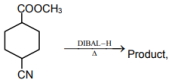
The product of the given reaction is:
A
B
C
D
Solution
(B) $DIBAL-H$ (Diisobutylaluminium hydride) acts as a selective reducing agent. It is capable of reducing both esters $(-COOR)$ and nitriles $(-CN)$ to aldehydes $(-CHO)$ at low temperatures. In the given substrate,both the ester group $(-COOCH_3)$ and the nitrile group $(-CN)$ are reduced to aldehyde groups $(-CHO)$. Therefore,the product is a cyclohexane$-1,4-$dicarbaldehyde. Thus,option $(B)$ is the correct answer.
0 likesView Solution
103
ChemistryMediumMCQAIIMS · 2019
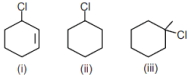
The correct order of $S_{N}1$ reaction rate for the given compounds is:
A
$iii > i > ii$
B
$iii > ii > i$
C
$i > iii > ii$
D
$i > ii > iii$
Solution
(C) The rate of $S_{N}1$ reaction depends on the stability of the carbocation intermediate formed after the departure of the leaving group $(Cl^-)$.
$(i)$ Forms an allylic carbocation,which is resonance stabilized.
(ii) Forms a secondary $(2^{\circ})$ cyclohexyl carbocation.
(iii) Forms a tertiary $(3^{\circ})$ carbocation.
Comparing the stability of these carbocations:
$1$. The allylic carbocation (from $i$) is highly stable due to resonance.
$2$. The tertiary carbocation (from $iii$) is stable due to inductive effect and hyperconjugation.
$3$. The secondary carbocation (from $ii$) is the least stable among the three.
Thus,the order of stability of carbocations is $i > iii > ii$. Consequently,the order of $S_{N}1$ reactivity is $i > iii > ii$. However,based on standard textbook problems of this type,the resonance-stabilized allylic carbocation is significantly more reactive. Given the options,$i > iii > ii$ is the correct chemical trend.
$(i)$ Forms an allylic carbocation,which is resonance stabilized.
(ii) Forms a secondary $(2^{\circ})$ cyclohexyl carbocation.
(iii) Forms a tertiary $(3^{\circ})$ carbocation.
Comparing the stability of these carbocations:
$1$. The allylic carbocation (from $i$) is highly stable due to resonance.
$2$. The tertiary carbocation (from $iii$) is stable due to inductive effect and hyperconjugation.
$3$. The secondary carbocation (from $ii$) is the least stable among the three.
Thus,the order of stability of carbocations is $i > iii > ii$. Consequently,the order of $S_{N}1$ reactivity is $i > iii > ii$. However,based on standard textbook problems of this type,the resonance-stabilized allylic carbocation is significantly more reactive. Given the options,$i > iii > ii$ is the correct chemical trend.
0 likesView Solution
104
ChemistryMediumMCQAIIMS · 2019
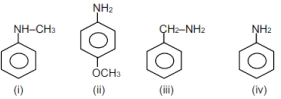
The correct order of basic strength is:
A
$iii > i > iv > ii$
B
$iv > iii > ii > i$
C
$iii > ii > i > iv$
D
$iii > i > ii > iv$
Solution
(C) $(i)$ $N$-methylaniline: The $+I$ effect of the methyl group increases basicity compared to aniline.
$(ii)$ $p$-methoxyaniline: The $+M$ effect of the $-OCH_3$ group significantly increases basicity,making it more basic than $N$-methylaniline.
$(iii)$ Benzylamine: The $-NH_2$ group is not directly attached to the benzene ring,so the lone pair is not involved in resonance. It is the most basic.
$(iv)$ Aniline: The lone pair on the $-NH_2$ group is involved in resonance with the benzene ring,making it the least basic.
Comparing these,the order is: Benzylamine $(iii) > p$-methoxyaniline $(ii) > N$-methylaniline $(i) >$ Aniline $(iv)$.
Therefore,the correct order is $iii > ii > i > iv$.
$(ii)$ $p$-methoxyaniline: The $+M$ effect of the $-OCH_3$ group significantly increases basicity,making it more basic than $N$-methylaniline.
$(iii)$ Benzylamine: The $-NH_2$ group is not directly attached to the benzene ring,so the lone pair is not involved in resonance. It is the most basic.
$(iv)$ Aniline: The lone pair on the $-NH_2$ group is involved in resonance with the benzene ring,making it the least basic.
Comparing these,the order is: Benzylamine $(iii) > p$-methoxyaniline $(ii) > N$-methylaniline $(i) >$ Aniline $(iv)$.
Therefore,the correct order is $iii > ii > i > iv$.
0 likesView Solution
105
ChemistryMediumMCQAIIMS · 2019
What is the product of the following reaction?
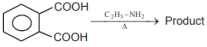
A
$N$-ethylphthalimide
B
$N$,$N$'-diethylphthalamide
C
o-ethylcarbamoylbenzoic acid
D
Phthalic anhydride
Solution
(A) The reaction between phthalic acid and ethylamine $(C_2H_5NH_2)$ under heating $(\Delta)$ involves the formation of an amide linkage.
Initially,the acid-base reaction forms a salt,which upon further heating undergoes dehydration to form the cyclic imide,$N$-ethylphthalimide.
The reaction is:
Phthalic acid $C_2H_5NH_2 \xrightarrow{\Delta} N$-ethylphthalimide $2H_2O$.
Initially,the acid-base reaction forms a salt,which upon further heating undergoes dehydration to form the cyclic imide,$N$-ethylphthalimide.
The reaction is:
Phthalic acid $C_2H_5NH_2 \xrightarrow{\Delta} N$-ethylphthalimide $2H_2O$.
0 likesView Solution
106
ChemistryMediumMCQAIIMS · 2019
Which is the chemical test for polysaccharide?
A
Iodine solution
B
Ninhydrin test
C
Tollens' test
D
Benedict's solution
Solution
(A) Starch is a common polysaccharide.
When it reacts with iodine solution,it forms a complex that produces a characteristic blue-black color.
Therefore,the iodine test is used to detect the presence of polysaccharides like starch.
When it reacts with iodine solution,it forms a complex that produces a characteristic blue-black color.
Therefore,the iodine test is used to detect the presence of polysaccharides like starch.
0 likesView Solution
107
ChemistryMediumMCQAIIMS · 2019
At what temperature does the rate become double that at $300 \, K$ (in $, K$)? Given $\ln k = 10 - \frac{69 \, kJ}{RT}$.
A
$329$
B
$307.7$
C
$292.03$
D
$323.5$
Solution
(B) Given the equation $\ln k = 10 - \frac{69 \, kJ}{RT} \cdots (i)$.
Comparing this with the Arrhenius equation $\ln k = \ln A - \frac{E_a}{RT}$,we get $E_a = 69 \, kJ/mol = 69000 \, J/mol$.
For two temperatures $T_1 = 300 \, K$ and $T_2$,the rate constant $k_2 = 2k_1$.
Using the Arrhenius equation: $\ln \frac{k_2}{k_1} = \frac{E_a}{R} \left( \frac{1}{T_1} - \frac{1}{T_2} \right)$.
Substituting the values: $\ln 2 = \frac{69000}{8.314} \left( \frac{1}{300} - \frac{1}{T_2} \right)$.
$0.693 = 8300 \left( \frac{T_2 - 300}{300 T_2} \right)$.
Solving for $T_2$: $\frac{0.693}{8300} = \frac{T_2 - 300}{300 T_2}$.
$8.349 \times 10^{-5} = \frac{T_2 - 300}{300 T_2}$.
$0.02505 T_2 = T_2 - 300$.
$0.97495 T_2 = 300$.
$T_2 \approx 307.7 \, K$.
Comparing this with the Arrhenius equation $\ln k = \ln A - \frac{E_a}{RT}$,we get $E_a = 69 \, kJ/mol = 69000 \, J/mol$.
For two temperatures $T_1 = 300 \, K$ and $T_2$,the rate constant $k_2 = 2k_1$.
Using the Arrhenius equation: $\ln \frac{k_2}{k_1} = \frac{E_a}{R} \left( \frac{1}{T_1} - \frac{1}{T_2} \right)$.
Substituting the values: $\ln 2 = \frac{69000}{8.314} \left( \frac{1}{300} - \frac{1}{T_2} \right)$.
$0.693 = 8300 \left( \frac{T_2 - 300}{300 T_2} \right)$.
Solving for $T_2$: $\frac{0.693}{8300} = \frac{T_2 - 300}{300 T_2}$.
$8.349 \times 10^{-5} = \frac{T_2 - 300}{300 T_2}$.
$0.02505 T_2 = T_2 - 300$.
$0.97495 T_2 = 300$.
$T_2 \approx 307.7 \, K$.
0 likesView Solution
108
ChemistryMediumMCQAIIMS · 2019
Which of the following complexes has maximum $CFSE$?
A
$K_{3}[Fe(CN)_{6}]$
B
$K_{3}[Co(Ox)_{3}]$
C
$K_{3}[CoF_{6}]$
D
$K_{3}[Co(CN)_{6}]$
Solution
(D) The $CFSE$ (Crystal Field Stabilization Energy) depends on the oxidation state of the metal,the nature of the ligand,and the $d$-electron configuration.
$1$. In $K_{3}[Fe(CN)_{6}]$,$Fe$ is in $+3$ oxidation state ($d^{5}$ configuration). $CN^{-}$ is a strong field ligand,resulting in a low-spin $t_{2g}^{5}e_{g}^{0}$ configuration. $CFSE = -2.0 \Delta_{o}$.
$2$. In $K_{3}[Co(Ox)_{3}]$,$Co$ is in $+3$ oxidation state ($d^{6}$ configuration). $Ox^{2-}$ is a moderate field ligand,resulting in a low-spin $t_{2g}^{6}e_{g}^{0}$ configuration. $CFSE = -2.4 \Delta_{o}$.
$3$. In $K_{3}[CoF_{6}]$,$Co$ is in $+3$ oxidation state ($d^{6}$ configuration). $F^{-}$ is a weak field ligand,resulting in a high-spin $t_{2g}^{4}e_{g}^{2}$ configuration. $CFSE = -0.4 \Delta_{o}$.
$4$. In $K_{3}[Co(CN)_{6}]$,$Co$ is in $+3$ oxidation state ($d^{6}$ configuration). $CN^{-}$ is a strong field ligand,resulting in a low-spin $t_{2g}^{6}e_{g}^{0}$ configuration. $CFSE = -2.4 \Delta_{o}$.
Comparing the magnitudes,$[Co(CN)_{6}]^{3-}$ and $[Co(Ox)_{3}]^{3-}$ have the highest $CFSE$ values. However,since $CN^{-}$ is a stronger field ligand than $Ox^{2-}$,$\Delta_{o}$ for $[Co(CN)_{6}]^{3-}$ is significantly larger,making its $CFSE$ the maximum.
$1$. In $K_{3}[Fe(CN)_{6}]$,$Fe$ is in $+3$ oxidation state ($d^{5}$ configuration). $CN^{-}$ is a strong field ligand,resulting in a low-spin $t_{2g}^{5}e_{g}^{0}$ configuration. $CFSE = -2.0 \Delta_{o}$.
$2$. In $K_{3}[Co(Ox)_{3}]$,$Co$ is in $+3$ oxidation state ($d^{6}$ configuration). $Ox^{2-}$ is a moderate field ligand,resulting in a low-spin $t_{2g}^{6}e_{g}^{0}$ configuration. $CFSE = -2.4 \Delta_{o}$.
$3$. In $K_{3}[CoF_{6}]$,$Co$ is in $+3$ oxidation state ($d^{6}$ configuration). $F^{-}$ is a weak field ligand,resulting in a high-spin $t_{2g}^{4}e_{g}^{2}$ configuration. $CFSE = -0.4 \Delta_{o}$.
$4$. In $K_{3}[Co(CN)_{6}]$,$Co$ is in $+3$ oxidation state ($d^{6}$ configuration). $CN^{-}$ is a strong field ligand,resulting in a low-spin $t_{2g}^{6}e_{g}^{0}$ configuration. $CFSE = -2.4 \Delta_{o}$.
Comparing the magnitudes,$[Co(CN)_{6}]^{3-}$ and $[Co(Ox)_{3}]^{3-}$ have the highest $CFSE$ values. However,since $CN^{-}$ is a stronger field ligand than $Ox^{2-}$,$\Delta_{o}$ for $[Co(CN)_{6}]^{3-}$ is significantly larger,making its $CFSE$ the maximum.
1 likesView Solution
109
ChemistryMediumMCQAIIMS · 2019
$NH_3$ reacts with bleaching powder to give:
A
$N_2$
B
$Ca(OH)_2$
C
$NCl_3$
D
$O_2$
Solution
(A) When ammonia $(NH_3)$ reacts with excess bleaching powder $(CaOCl_2)$,it undergoes oxidation to produce dinitrogen gas $(N_2)$.
The balanced chemical equation is:
$3 CaOCl_2 + 2 NH_3 \rightarrow 3 CaCl_2 + N_2 + 3 H_2O$
The balanced chemical equation is:
$3 CaOCl_2 + 2 NH_3 \rightarrow 3 CaCl_2 + N_2 + 3 H_2O$
0 likesView Solution
110
ChemistryMediumMCQAIIMS · 2019
For the reaction: $A + 2 B \rightarrow C + D$,the expression for the rate of reaction is:
A
$\frac{-d[A]}{dt} = \frac{-1}{2} \frac{d[B]}{dt}$
B
$\frac{d[A]}{dt} = \frac{-1}{2} \frac{d[B]}{dt}$
C
$\frac{-d[A]}{dt} = \frac{1}{2} \frac{d[B]}{dt}$
D
$\frac{d[A]}{dt} = \frac{-1}{2} \frac{d[B]}{dt}$
Solution
(A) For a general reaction $aA + bB \rightarrow cC + dD$,the rate of reaction is given by:
Rate $= -\frac{1}{a} \frac{d[A]}{dt} = -\frac{1}{b} \frac{d[B]}{dt} = \frac{1}{c} \frac{d[C]}{dt} = \frac{1}{d} \frac{d[D]}{dt}$.
For the given reaction $A + 2 B \rightarrow C + D$,the stoichiometric coefficients are $a=1$ and $b=2$.
Substituting these values,the rate of reaction is:
Rate $= -\frac{1}{1} \frac{d[A]}{dt} = -\frac{1}{2} \frac{d[B]}{dt}$.
Thus,the correct expression is $\frac{-d[A]}{dt} = \frac{-1}{2} \frac{d[B]}{dt}$.
Rate $= -\frac{1}{a} \frac{d[A]}{dt} = -\frac{1}{b} \frac{d[B]}{dt} = \frac{1}{c} \frac{d[C]}{dt} = \frac{1}{d} \frac{d[D]}{dt}$.
For the given reaction $A + 2 B \rightarrow C + D$,the stoichiometric coefficients are $a=1$ and $b=2$.
Substituting these values,the rate of reaction is:
Rate $= -\frac{1}{1} \frac{d[A]}{dt} = -\frac{1}{2} \frac{d[B]}{dt}$.
Thus,the correct expression is $\frac{-d[A]}{dt} = \frac{-1}{2} \frac{d[B]}{dt}$.
0 likesView Solution
111
ChemistryMediumMCQAIIMS · 2019
In $FCC$,the distance between the nearest tetrahedral voids is:
A
$a/2$
B
$a$
C
$\frac{\sqrt{3}a}{2}$
D
$\frac{\sqrt{3}a}{4}$
Solution
(A) In an $FCC$ unit cell,there are $8$ tetrahedral voids located at a distance of $\frac{a}{4}$ from each corner along the body diagonal.
Each body diagonal has a length of $\sqrt{3}a$.
The distance between two nearest tetrahedral voids is the distance between two voids located on the same body diagonal,which is $\frac{a}{4} + \frac{a}{4} = \frac{a}{2}$.
Each body diagonal has a length of $\sqrt{3}a$.
The distance between two nearest tetrahedral voids is the distance between two voids located on the same body diagonal,which is $\frac{a}{4} + \frac{a}{4} = \frac{a}{2}$.
0 likesView Solution
112
ChemistryDifficultMCQAIIMS · 2019
In $Fe(CO)_5$ and $Cr(CO)_6$,how many $CO$ ligands can be replaced by $NO$ to maintain the $18$ electron rule?
A
$3, 6$
B
$2, 4$
C
$3, 4$
D
$2, 6$
Solution
(A) The $CO$ ligand acts as a $2$-electron donor,while the $NO$ ligand acts as a $3$-electron donor.
For $Fe(CO)_5$: Total valence electrons = $8 + (5 \times 2) = 18$. To replace $CO$ with $NO$ while maintaining $18$ electrons,we replace $3$ $CO$ ($6$ $e^-$) with $2$ $NO$ ($6$ $e^-$),resulting in $Fe(CO)_2(NO)_2$.
For $Cr(CO)_6$: Total valence electrons = $6 + (6 \times 2) = 18$. To replace $CO$ with $NO$ while maintaining $18$ electrons,we replace $6$ $CO$ ($12$ $e^-$) with $4$ $NO$ ($12$ $e^-$),resulting in $Cr(NO)_4$.
Thus,the number of $CO$ ligands replaced are $3$ and $6$ respectively.
For $Fe(CO)_5$: Total valence electrons = $8 + (5 \times 2) = 18$. To replace $CO$ with $NO$ while maintaining $18$ electrons,we replace $3$ $CO$ ($6$ $e^-$) with $2$ $NO$ ($6$ $e^-$),resulting in $Fe(CO)_2(NO)_2$.
For $Cr(CO)_6$: Total valence electrons = $6 + (6 \times 2) = 18$. To replace $CO$ with $NO$ while maintaining $18$ electrons,we replace $6$ $CO$ ($12$ $e^-$) with $4$ $NO$ ($12$ $e^-$),resulting in $Cr(NO)_4$.
Thus,the number of $CO$ ligands replaced are $3$ and $6$ respectively.
0 likesView Solution
113
ChemistryMediumMCQAIIMS · 2019
Which of the following has maximum iron content?
A
Cast Iron
B
Wrought Iron
C
Pig Iron
D
Stainless steel
Solution
(B) The iron content in various forms of iron is as follows:
$1$. Cast iron: Contains about $93-95 \%$ iron.
$2$. Pig iron: Contains about $93-95 \%$ iron.
$3$. Wrought iron: Contains about $99.5-99.9 \%$ iron,making it the purest form of commercial iron.
$4$. Stainless steel: Contains about $70-80 \%$ iron along with chromium and nickel.
Therefore,Wrought iron has the maximum iron content.
$1$. Cast iron: Contains about $93-95 \%$ iron.
$2$. Pig iron: Contains about $93-95 \%$ iron.
$3$. Wrought iron: Contains about $99.5-99.9 \%$ iron,making it the purest form of commercial iron.
$4$. Stainless steel: Contains about $70-80 \%$ iron along with chromium and nickel.
Therefore,Wrought iron has the maximum iron content.
0 likesView Solution
114
ChemistryMediumMCQAIIMS · 2019
Calculate the molarity $(M)$ of a $63 \% \ w/w$ $HNO_3$ solution if the density is $5.4 \ g/mL$.
A
$54$
B
$12$
C
$10$
D
$8$
Solution
(A) The molarity $(M)$ of a solution is given by the formula: $M = \frac{\% \ w/w \times d \times 10}{M_{solute}}$.
Here,the percentage by weight $(\% \ w/w)$ is $63$,the density $(d)$ is $5.4 \ g/mL$,and the molar mass of $HNO_3$ $(M_{solute})$ is $1 + 14 + (3 \times 16) = 63 \ g/mol$.
Substituting these values into the formula:
$M = \frac{63 \times 5.4 \times 10}{63} = 54 \ M$.
Here,the percentage by weight $(\% \ w/w)$ is $63$,the density $(d)$ is $5.4 \ g/mL$,and the molar mass of $HNO_3$ $(M_{solute})$ is $1 + 14 + (3 \times 16) = 63 \ g/mol$.
Substituting these values into the formula:
$M = \frac{63 \times 5.4 \times 10}{63} = 54 \ M$.
0 likesView Solution
115
ChemistryMediumMCQAIIMS · 2019
Which of the following is incorrect about $K_{2}Cr_{2}O_{7}$?
A
It can be prepared from $K_{2}CrO_{4}$.
B
It is used in redox titrations.
C
It is stable in both acid and base.
D
It is orange in colour.
Solution
(C) $K_{2}Cr_{2}O_{7}$ is a strong oxidizing agent used in redox titrations.
It is prepared from $K_{2}CrO_{4}$ by adding acid.
It is orange in color.
However,it is not stable in both acid and base; it exists as $Cr_{2}O_{7}^{2-}$ (dichromate) in acidic medium and converts to $CrO_{4}^{2-}$ (chromate) in basic medium.
Thus,the statement that it is stable in both acid and base is incorrect.
It is prepared from $K_{2}CrO_{4}$ by adding acid.
It is orange in color.
However,it is not stable in both acid and base; it exists as $Cr_{2}O_{7}^{2-}$ (dichromate) in acidic medium and converts to $CrO_{4}^{2-}$ (chromate) in basic medium.
Thus,the statement that it is stable in both acid and base is incorrect.
0 likesView Solution
116
ChemistryMediumMCQAIIMS · 2019
The conductivity of a $0.05 \, M$ solution of a weak monobasic acid is $10^{-3} \, S \, cm^{-1}$. If $\lambda_{m}^{\infty}$ for the weak acid is $500 \, S \, cm^{2} \, mol^{-1}$,calculate the $K_{a}$ of the weak monobasic acid.
A
$8 \times 10^{-5}$
B
$4 \times 10^{-6}$
C
$16 \times 10^{-7}$
D
$14 \times 10^{-8}$
Solution
(A) First,calculate the molar conductivity $(\lambda_{m})$ using the formula: $\lambda_{m} = \frac{1000 \times \kappa}{M}$
$\lambda_{m} = \frac{1000 \times 10^{-3}}{0.05} = 20 \, S \, cm^{2} \, mol^{-1}$
Next,calculate the degree of dissociation $(\alpha)$: $\alpha = \frac{\lambda_{m}}{\lambda_{m}^{\infty}} = \frac{20}{500} = 0.04$
Finally,calculate the dissociation constant $(K_{a})$ using the formula: $K_{a} = C \alpha^{2}$
$K_{a} = 0.05 \times (0.04)^{2} = 0.05 \times 0.0016 = 8 \times 10^{-5}$
$\lambda_{m} = \frac{1000 \times 10^{-3}}{0.05} = 20 \, S \, cm^{2} \, mol^{-1}$
Next,calculate the degree of dissociation $(\alpha)$: $\alpha = \frac{\lambda_{m}}{\lambda_{m}^{\infty}} = \frac{20}{500} = 0.04$
Finally,calculate the dissociation constant $(K_{a})$ using the formula: $K_{a} = C \alpha^{2}$
$K_{a} = 0.05 \times (0.04)^{2} = 0.05 \times 0.0016 = 8 \times 10^{-5}$
0 likesView Solution
117
ChemistryMediumMCQAIIMS · 2019
$A$ chloro compound of vanadium has a spin-only magnetic moment of $1.73 \ BM$. This vanadium chloride has the formula:
A
$VCl_2$
B
$VCl_4$
C
$VCl_3$
D
$VCl_5$
Solution
(B) The spin-only magnetic moment is given by the formula $\mu = \sqrt{n(n+2)} \ BM$,where $n$ is the number of unpaired electrons.
Given $\mu = 1.73 \ BM$,we have $1.73 = \sqrt{n(n+2)}$.
Squaring both sides,$3 = n(n+2)$,which gives $n^2 + 2n - 3 = 0$.
Solving for $n$,we get $(n+3)(n-1) = 0$,so $n = 1$ (since $n$ cannot be negative).
Vanadium $(V)$ has the atomic number $23$ and electronic configuration $[Ar] 3d^3 4s^2$.
For $n=1$,the vanadium ion must have one unpaired electron.
In $VCl_4$,vanadium is in the $+4$ oxidation state $(V^{4+})$.
The configuration of $V^{4+}$ is $[Ar] 3d^1$,which contains $1$ unpaired electron.
Thus,the formula is $VCl_4$.
Given $\mu = 1.73 \ BM$,we have $1.73 = \sqrt{n(n+2)}$.
Squaring both sides,$3 = n(n+2)$,which gives $n^2 + 2n - 3 = 0$.
Solving for $n$,we get $(n+3)(n-1) = 0$,so $n = 1$ (since $n$ cannot be negative).
Vanadium $(V)$ has the atomic number $23$ and electronic configuration $[Ar] 3d^3 4s^2$.
For $n=1$,the vanadium ion must have one unpaired electron.
In $VCl_4$,vanadium is in the $+4$ oxidation state $(V^{4+})$.
The configuration of $V^{4+}$ is $[Ar] 3d^1$,which contains $1$ unpaired electron.
Thus,the formula is $VCl_4$.
0 likesView Solution
118
ChemistryMediumMCQAIIMS · 2019
Assume that a particular amino acid has an isoelectric point of $6.0$. In a solution of $pH$ $1.0$,which of the following species will predominate?
A
$H_3N^{+}-CH(R)-COOH$
B
$H_3N-CH(R)-COOH$
C
$H_3N^{+}-CH(R)-COO^{-}$
D
$H_2N-CH(R)-COO^{-}$
Solution
(A) The isoelectric point $(pI)$ is the $pH$ at which the amino acid exists as a zwitterion,i.e.,$H_3N^{+}-CH(R)-COO^{-}$.
At $pH$ values lower than the $pI$,the concentration of $H^{+}$ ions is high.
This leads to the protonation of the carboxylate group $(COO^{-})$,converting it into a carboxylic acid group $(COOH)$.
Since the given $pH$ $(1.0)$ is significantly lower than the $pI$ $(6.0)$,the amino acid will exist predominantly in its cationic form,$H_3N^{+}-CH(R)-COOH$.
At $pH$ values lower than the $pI$,the concentration of $H^{+}$ ions is high.
This leads to the protonation of the carboxylate group $(COO^{-})$,converting it into a carboxylic acid group $(COOH)$.
Since the given $pH$ $(1.0)$ is significantly lower than the $pI$ $(6.0)$,the amino acid will exist predominantly in its cationic form,$H_3N^{+}-CH(R)-COOH$.
0 likesView Solution
119
ChemistryMediumMCQAIIMS · 2019
Predict the product $X$ for the following reaction:
$2\text{-oxocyclohex-3-en-1-yl} \text{ acetate derivative} \rightarrow{NaBH_4, MeOH} X$
$2\text{-oxocyclohex-3-en-1-yl} \text{ acetate derivative} \rightarrow{NaBH_4, MeOH} X$
A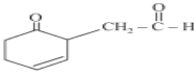
B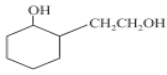
C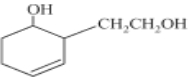
D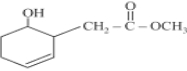
Solution
(D) $NaBH_4$ (Sodium borohydride) is a selective reducing agent that specifically reduces aldehydes and ketones to their corresponding alcohols.
It does not reduce esters or carbon-carbon double bonds $(C=C)$ under standard conditions.
In the given substrate,there is a ketone group on the cyclohexene ring and an ester group $(-COOCH_3)$ on the side chain.
Therefore,$NaBH_4$ will selectively reduce the ketone to a secondary alcohol $(-OH)$ while leaving the ester and the double bond intact.
The product $X$ is $2\text{-hydroxycyclohex-3-en-1-yl} \text{ acetate derivative}$ (specifically,the structure shown in option $D$).
It does not reduce esters or carbon-carbon double bonds $(C=C)$ under standard conditions.
In the given substrate,there is a ketone group on the cyclohexene ring and an ester group $(-COOCH_3)$ on the side chain.
Therefore,$NaBH_4$ will selectively reduce the ketone to a secondary alcohol $(-OH)$ while leaving the ester and the double bond intact.
The product $X$ is $2\text{-hydroxycyclohex-3-en-1-yl} \text{ acetate derivative}$ (specifically,the structure shown in option $D$).
0 likesView Solution
120
ChemistryDifficultMCQAIIMS · 2019
What is $X$ in the following reaction?
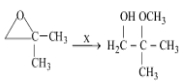
A
$CH_3OH, H_2SO_4$
B
$CH_3OH, CH_3O^{-}Na^{+}$
C
$H_2O / H_2SO_4$ followed by $CH_3OH$
D
$CH_3MgBr / \text{ether}$ followed by $H_3O^{+}$
Solution
(A) The reaction involves the acid-catalyzed ring opening of an epoxide.
In the presence of an acid catalyst like $H_2SO_4$,the epoxide oxygen is protonated,making the epoxide ring more susceptible to nucleophilic attack.
Since the reaction occurs under acidic conditions,the nucleophile $(CH_3OH)$ attacks the more substituted carbon atom of the epoxide due to the development of significant carbocation character at that position in the transition state.
Therefore,the reagent $X$ is $CH_3OH$ in the presence of an acid catalyst $(H_2SO_4)$.
In the presence of an acid catalyst like $H_2SO_4$,the epoxide oxygen is protonated,making the epoxide ring more susceptible to nucleophilic attack.
Since the reaction occurs under acidic conditions,the nucleophile $(CH_3OH)$ attacks the more substituted carbon atom of the epoxide due to the development of significant carbocation character at that position in the transition state.
Therefore,the reagent $X$ is $CH_3OH$ in the presence of an acid catalyst $(H_2SO_4)$.
0 likesView Solution
121
ChemistryEasyMCQAIIMS · 2019
Calcium acetate,on heating,gives:
A
$Acetic \ anhydride$
B
$Acetone$
C
$Acetaldehyde$
D
$Ethyl \ alcohol$
Solution
(B) When calcium acetate is heated (dry distillation),it undergoes thermal decomposition to form acetone and calcium carbonate.
$(CH_3COO)_2Ca \xrightarrow{\Delta} CH_3COCH_3 + CaCO_3$
$(CH_3COO)_2Ca \xrightarrow{\Delta} CH_3COCH_3 + CaCO_3$
0 likesView Solution
122
ChemistryDifficultMCQAIIMS · 2019
For the diazonium ions,the order of reactivity towards the diazo-coupling with phenol in the presence of dilute $NaOH$ is:
$(I)$ $Me_2N-C_6H_4-N_2^+$
$(II)$ $O_2N-C_6H_4-N_2^+$
$(III)$ $CH_3O-C_6H_4-N_2^+$
$(IV)$ $CH_3-C_6H_4-N_2^+$
$(I)$ $Me_2N-C_6H_4-N_2^+$
$(II)$ $O_2N-C_6H_4-N_2^+$
$(III)$ $CH_3O-C_6H_4-N_2^+$
$(IV)$ $CH_3-C_6H_4-N_2^+$
A
$I < IV < III < II$
B
$I < III < IV < II$
C
$III < I < II < IV$
D
$III < I < IV < II$
Solution
(B) The diazo-coupling reaction is an electrophilic aromatic substitution reaction. The reactivity of the diazonium ion towards coupling depends on the electrophilicity of the diazonium cation.
Greater electron-withdrawing character of the substituent on the benzene ring increases the electrophilicity of the diazonium group,thereby increasing the reactivity.
The substituent effects are as follows:
$(I)$ $-NMe_2$: Strong $+M$ effect (strongly electron-donating).
$(II)$ $-NO_2$: Strong $-M$ effect (strongly electron-withdrawing).
$(III)$ $-OCH_3$: $+M$ effect (electron-donating).
$(IV)$ $-CH_3$: $+I$ effect (weakly electron-donating).
Thus,the electron-withdrawing order is: $-NO_2 > -CH_3 > -OCH_3 > -NMe_2$.
Therefore,the order of reactivity is: $(I) < (III) < (IV) < (II)$.
Greater electron-withdrawing character of the substituent on the benzene ring increases the electrophilicity of the diazonium group,thereby increasing the reactivity.
The substituent effects are as follows:
$(I)$ $-NMe_2$: Strong $+M$ effect (strongly electron-donating).
$(II)$ $-NO_2$: Strong $-M$ effect (strongly electron-withdrawing).
$(III)$ $-OCH_3$: $+M$ effect (electron-donating).
$(IV)$ $-CH_3$: $+I$ effect (weakly electron-donating).
Thus,the electron-withdrawing order is: $-NO_2 > -CH_3 > -OCH_3 > -NMe_2$.
Therefore,the order of reactivity is: $(I) < (III) < (IV) < (II)$.
0 likesView Solution
123
ChemistryMediumMCQAIIMS · 2019
Acetanilide on nitration followed by alkaline hydrolysis mainly gives-
A
$o-$Nitroaniline
B
$p-$Nitroaniline
C
$m-$Nitroaniline
D
$2,4,6-$Trinitroaniline
Solution
(B) The nitration of acetanilide $(C_6H_5NHCOCH_3)$ is an electrophilic aromatic substitution reaction. The acetamido group $(-NHCOCH_3)$ is strongly activating and ortho/para-directing. Due to the steric hindrance of the bulky acetamido group,the para-isomer is the major product.
$1$. Nitration of acetanilide with $conc. HNO_3 / H_2SO_4$ yields $p-$nitroacetanilide as the major product.
$2$. Subsequent alkaline hydrolysis of $p-$nitroacetanilide removes the acetyl group to yield $p-$nitroaniline.
The reaction sequence is:
$C_6H_5NHCOCH_3$ $\xrightarrow{HNO_3/H_2SO_4} p-NO_2-C_6H_4-NHCOCH_3$ $\xrightarrow{OH^-/H_2O} p-NO_2-C_6H_4-NH_2$.
$1$. Nitration of acetanilide with $conc. HNO_3 / H_2SO_4$ yields $p-$nitroacetanilide as the major product.
$2$. Subsequent alkaline hydrolysis of $p-$nitroacetanilide removes the acetyl group to yield $p-$nitroaniline.
The reaction sequence is:
$C_6H_5NHCOCH_3$ $\xrightarrow{HNO_3/H_2SO_4} p-NO_2-C_6H_4-NHCOCH_3$ $\xrightarrow{OH^-/H_2O} p-NO_2-C_6H_4-NH_2$.
0 likesView Solution
124
ChemistryMediumMCQAIIMS · 2019
Accumulation of which of the following molecules in the muscles occurs as a result of vigorous exercise?
A
Glycogen
B
Glucose
C
Pyruvic acid
D
$L^{-}$-Lactic acid
Solution
(D) During vigorous exercise,the demand for energy in muscles exceeds the supply of oxygen.
Under these anaerobic conditions,the body converts pyruvic acid into lactic acid to regenerate $NAD^{+}$ and continue glycolysis for $ATP$ production.
This accumulation of $L^{-}$-Lactic acid in the muscle tissues leads to muscle fatigue and soreness.
The process is represented as: $\text{Glucose}$ $\rightarrow \text{Pyruvic acid}$ $\rightarrow \text{Lactic acid}$.
Under these anaerobic conditions,the body converts pyruvic acid into lactic acid to regenerate $NAD^{+}$ and continue glycolysis for $ATP$ production.
This accumulation of $L^{-}$-Lactic acid in the muscle tissues leads to muscle fatigue and soreness.
The process is represented as: $\text{Glucose}$ $\rightarrow \text{Pyruvic acid}$ $\rightarrow \text{Lactic acid}$.
0 likesView Solution
125
ChemistryMediumMCQAIIMS · 2019
In the primary structure of proteins,the amino acids are interconnected by-
A
Hydrogen bonds
B
Ionic bonds
C
Peptide bonds
D
Glycosidic linkages
Solution
(C) In the primary structure of proteins,amino acids are arranged in a specific sequence.
These amino acids are linked to each other by covalent bonds known as peptide bonds,which are formed by the condensation reaction between the carboxyl group $(-COOH)$ of one amino acid and the amino group $(-NH_2)$ of the next amino acid.
These amino acids are linked to each other by covalent bonds known as peptide bonds,which are formed by the condensation reaction between the carboxyl group $(-COOH)$ of one amino acid and the amino group $(-NH_2)$ of the next amino acid.
0 likesView Solution
126
ChemistryMediumMCQAIIMS · 2019
$[NH(CH_2)_6NHCO(CH_2)_4CO]_n$ is a
A
addition polymer
B
thermosetting polymer
C
homopolymer
D
copolymer
Solution
(D) The given structure represents the repeating unit of $Nylon-6,6$.
It is formed by the condensation polymerization of hexamethylenediamine $(H_2N(CH_2)_6NH_2)$ and adipic acid $(HOOC(CH_2)_4COOH)$.
Since it is formed from two different monomers,it is classified as a copolymer.
It is formed by the condensation polymerization of hexamethylenediamine $(H_2N(CH_2)_6NH_2)$ and adipic acid $(HOOC(CH_2)_4COOH)$.
Since it is formed from two different monomers,it is classified as a copolymer.
0 likesView Solution
127
ChemistryMediumMCQAIIMS · 2019
The monomer of $[-C(CH_3)_2-CH_2-]_n$ is:
A
$2$-methylpropene
B
styrene
C
propylene
D
ethene
Solution
(A) The given polymer is polyisobutylene,which is formed by the polymerization of $2$-methylpropene (isobutylene).
The structure of the monomer is $CH_3-C(CH_3)=CH_2$.
The structure of the monomer is $CH_3-C(CH_3)=CH_2$.
0 likesView Solution
128
ChemistryMediumMCQAIIMS · 2019
The following compound is used as:
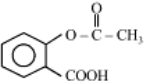
A
an anti-inflammatory compound
B
analgesic
C
hypnotic
D
antiseptic
Solution
(B) The structure shown is $2$-acetoxybenzoic acid,commonly known as $aspirin$.
$Aspirin$ is a well-known drug that acts as an $analgesic$ (pain reliever) and an $antipyretic$ (fever reducer).
It also possesses anti-inflammatory properties,but among the given options,$analgesic$ is the most standard classification for its primary use.
$Aspirin$ is a well-known drug that acts as an $analgesic$ (pain reliever) and an $antipyretic$ (fever reducer).
It also possesses anti-inflammatory properties,but among the given options,$analgesic$ is the most standard classification for its primary use.
0 likesView Solution
129
ChemistryMediumMCQAIIMS · 2019
The method of concentrating the ore which makes use of the difference in density between ore and impurities is called:
A
Levigation
B
Leaching
C
Magnetic separation
D
Liquation
Solution
(A) The method of concentrating ore based on the difference in densities of the ore and the gangue (impurities) is known as $Levigation$ or $Gravity$ $Separation$ or $Hydraulic$ $Washing$. In this process,the powdered ore is washed with a stream of water,where lighter gangue particles are carried away,leaving behind the heavier ore particles.
0 likesView Solution
Vedclass Products
For Students
Vedclass Test Series
Mock tests in real AIIMS style covering Chemistry with performance analysis. 5-day free trial.
Start Free TrialFor Teachers
Exam Paper Generator
Generate Set A/B/C/D Chemistry papers from 7.5L+ questions in 2 minutes. 3 chapters free.
Try FreeFor Institutes
Online Exam Module
Run live AIIMS mock exams with unlimited students, 360° analytics & white-label branding.
See DemoFrequently Asked Questions
How many Chemistry questions are in AIIMS 2019?
There are 179 Chemistry questions from the AIIMS 2019 paper on Vedclass, each with a detailed step-by-step solution in English.
Are AIIMS 2019 Chemistry solutions available in English?
Yes. All solutions on this page are in English. You can also switch to English or Hindi using the language buttons above the questions.
Can I practice AIIMS 2019 Chemistry as a timed test?
Yes. Use the Vedclass Test Series to attempt a full AIIMS mock test covering Chemistry with time limits and instant score analysis.
Can teachers create Chemistry papers from AIIMS previous year questions?
Yes. The Vedclass Exam Paper Generator lets teachers mix AIIMS Chemistry questions and generate Set A/B/C/D papers in minutes.
For Teachers & Institutes
Build a Custom Chemistry Paper
Pick AIIMS 2019 Chemistry questions, set difficulty, and generate Set A/B/C/D in 2 minutes.