
BiologyQ1–100 of 159 questions
Page 1 of 2 · English
1
BiologyMediumMCQAIIMS · 2019
The quiescent centre in root meristem serves as a
A
Site for storage of food,which is utilized during maturation
B
Reservoir of growth hormones
C
Reserve for replenishment of damaged cells of the meristem
D
Region for absorption of water
Solution
(C) The quiescent centre is a region in the root apical meristem where the rate of cell division is very low. It acts as a reservoir of active initials that can replace damaged cells of the meristem,ensuring the continuous growth of the root.
0 likesView Solution
2
BiologyMediumMCQAIIMS · 2019
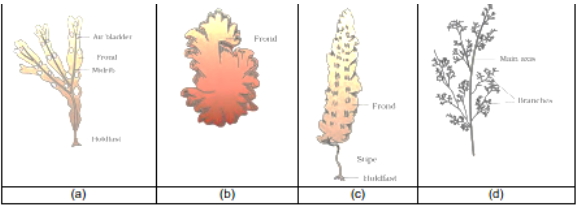
Identify the algae shown in the given diagrams $(a)$,$(b)$,$(c)$,and $(d)$.
A
$(a)$ - Laminaria,$(b)$ - Porphyra,$(c)$ - Fucus,$(d)$ - Polysiphonia
B
$(a)$ - Polysiphonia,$(b)$ - Laminaria,$(c)$ - Porphyra,$(d)$ - Fucus
C
$(a)$ - Fucus,$(b)$ - Porphyra,$(c)$ - Laminaria,$(d)$ - Polysiphonia
D
$(a)$ - Fucus,$(b)$ - Laminaria,$(c)$ - Porphyra,$(d)$ - Polysiphonia
Solution
(C) Based on the provided diagrams from the $NCERT$ textbook:
$(a)$ represents $Fucus$,which is a brown alga characterized by air bladders,a midrib,and a holdfast.
$(b)$ represents $Porphyra$,which is a red alga.
$(c)$ represents $Laminaria$,which is a brown alga showing a distinct frond,stipe,and holdfast.
$(d)$ represents $Polysiphonia$,which is a red alga showing a filamentous,branched structure.
Therefore,the correct sequence is $(a)$ - $Fucus$,$(b)$ - $Porphyra$,$(c)$ - $Laminaria$,$(d)$ - $Polysiphonia$.
$(a)$ represents $Fucus$,which is a brown alga characterized by air bladders,a midrib,and a holdfast.
$(b)$ represents $Porphyra$,which is a red alga.
$(c)$ represents $Laminaria$,which is a brown alga showing a distinct frond,stipe,and holdfast.
$(d)$ represents $Polysiphonia$,which is a red alga showing a filamentous,branched structure.
Therefore,the correct sequence is $(a)$ - $Fucus$,$(b)$ - $Porphyra$,$(c)$ - $Laminaria$,$(d)$ - $Polysiphonia$.
0 likesView Solution
3
BiologyEasyMCQAIIMS · 2019
Which of the following is correct about symplast?
A
Living continuum
B
Cell wall and intercellular space
C
Non-Living continuum
D
None of these
Solution
(A) The symplast pathway is the system of interconnected protoplasts of plant cells.
These protoplasts are connected by cytoplasmic bridges called plasmodesmata.
Since the protoplast is the living part of the cell,the symplast is considered a living continuum.
In contrast,the apoplast consists of non-living parts like cell walls and intercellular spaces.
Therefore,option $(A)$ is correct.
These protoplasts are connected by cytoplasmic bridges called plasmodesmata.
Since the protoplast is the living part of the cell,the symplast is considered a living continuum.
In contrast,the apoplast consists of non-living parts like cell walls and intercellular spaces.
Therefore,option $(A)$ is correct.
0 likesView Solution
4
BiologyMediumMCQAIIMS · 2019
Match the Column-$I$ with Column-$II$:
| Column-$I$ | Column-$II$ |
|---|---|
| $(i)$ Elaioplast | $(a)$ Storage of starch |
| $(ii)$ Aleuroplast | $(b)$ Storage of fat |
| $(iii)$ Amyloplast | $(c)$ Storage of protein |
| $(iv)$ Chromoplast | $(d)$ Colored pigments |
A
$i-a, ii-c, iii-d, iv-b$
B
$i-d, ii-d, iii-c, iv-a$
C
$i-d, ii-c, iii-d, iv-a$
D
$i-b, ii-c, iii-a, iv-d$
Solution
(D) The correct matching is as follows:
$(i)$ Elaioplast: These are leucoplasts specialized for the storage of fats or oils.
$(ii)$ Aleuroplast: These are leucoplasts specialized for the storage of proteins.
$(iii)$ Amyloplast: These are leucoplasts specialized for the storage of starch (carbohydrates).
$(iv)$ Chromoplast: These contain fat-soluble carotenoid pigments like carotene,xanthophylls,etc.,which provide yellow,orange,or red colors to plant parts.
Therefore,the correct sequence is $(i-b, ii-c, iii-a, iv-d)$.
The correct option is $(D)$.
$(i)$ Elaioplast: These are leucoplasts specialized for the storage of fats or oils.
$(ii)$ Aleuroplast: These are leucoplasts specialized for the storage of proteins.
$(iii)$ Amyloplast: These are leucoplasts specialized for the storage of starch (carbohydrates).
$(iv)$ Chromoplast: These contain fat-soluble carotenoid pigments like carotene,xanthophylls,etc.,which provide yellow,orange,or red colors to plant parts.
Therefore,the correct sequence is $(i-b, ii-c, iii-a, iv-d)$.
The correct option is $(D)$.
0 likesView Solution
5
BiologyEasyMCQAIIMS · 2019
Which of the following is the correct set of macronutrients?
A
$K, B, C, H$
B
$K, H, Mn, N$
C
$C, Zn, H, N$
D
$C, H, Mg, N$
Solution
(D) Macronutrients are essential mineral elements required by plants in relatively large amounts (usually $10 \text{ mmol kg}^{-1}$ of dry matter).
These include Carbon $(C)$, Hydrogen $(H)$, Oxygen $(O)$, Nitrogen $(N)$, Phosphorus $(P)$, Sulphur $(S)$, Potassium $(K)$, Calcium $(Ca)$, and Magnesium $(Mg)$.
In the given options, option $(D)$ contains $C, H, Mg,$ and $N$, all of which are macronutrients.
Boron $(B)$, Manganese $(Mn)$, and Zinc $(Zn)$ are micronutrients required in smaller quantities.
These include Carbon $(C)$, Hydrogen $(H)$, Oxygen $(O)$, Nitrogen $(N)$, Phosphorus $(P)$, Sulphur $(S)$, Potassium $(K)$, Calcium $(Ca)$, and Magnesium $(Mg)$.
In the given options, option $(D)$ contains $C, H, Mg,$ and $N$, all of which are macronutrients.
Boron $(B)$, Manganese $(Mn)$, and Zinc $(Zn)$ are micronutrients required in smaller quantities.
0 likesView Solution
6
BiologyEasyMCQAIIMS · 2019
Which of the following is a microelement?
A
$Ca$
B
$Mg$
C
$Mn$
D
$S$
Solution
(C) $Mn$ stands for manganese.
Microelements (or trace elements) are required by plants in very small amounts (less than $10 \text{ mmol kg}^{-1}$ of dry matter).
$Ca$ (calcium), $Mg$ (magnesium), and $S$ (sulfur) are macronutrients, whereas $Mn$ (manganese) is a micronutrient.
Microelements (or trace elements) are required by plants in very small amounts (less than $10 \text{ mmol kg}^{-1}$ of dry matter).
$Ca$ (calcium), $Mg$ (magnesium), and $S$ (sulfur) are macronutrients, whereas $Mn$ (manganese) is a micronutrient.
0 likesView Solution
7
BiologyMediumMCQAIIMS · 2019
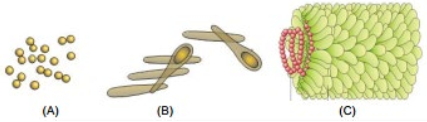
Identify the organisms shown in the figures $A$,$B$,and $C$:
A
$A$ - Tobacco mosaic virus,$B$ - Coccus,$C$ - Bacillus
B
$A$ - Coccus,$B$ - Bacillus,$C$ - Tobacco mosaic virus
C
$A$ - Bacillus,$B$ - Coccus,$C$ - Tobacco mosaic virus
D
$A$ - Coccus,$B$ - Tobacco mosaic virus,$C$ - Bacillus
Solution
(B) Based on the provided biological diagrams:
$1$. Figure $A$ shows spherical bacteria,which are known as $Coccus$.
$2$. Figure $B$ shows rod-shaped bacteria,which are known as $Bacillus$.
$3$. Figure $C$ shows the structure of the $Tobacco \ mosaic \ virus$ $(TMV)$,which is a plant virus with a helical capsid.
Therefore,the correct matching is $A$ - $Coccus$,$B$ - $Bacillus$,$C$ - $Tobacco \ mosaic \ virus$. The correct option is $(B)$.
$1$. Figure $A$ shows spherical bacteria,which are known as $Coccus$.
$2$. Figure $B$ shows rod-shaped bacteria,which are known as $Bacillus$.
$3$. Figure $C$ shows the structure of the $Tobacco \ mosaic \ virus$ $(TMV)$,which is a plant virus with a helical capsid.
Therefore,the correct matching is $A$ - $Coccus$,$B$ - $Bacillus$,$C$ - $Tobacco \ mosaic \ virus$. The correct option is $(B)$.
0 likesView Solution
8
BiologyEasyMCQAIIMS · 2019
Synthesis of lipid is the function of:
A
$SER$
B
$RER$
C
Golgi body
D
Mitochondria
Solution
(A) Various types of organelles are responsible for performing different types of functions.
$SER$ (Smooth Endoplasmic Reticulum) is primarily responsible for the synthesis of lipids,including steroidal hormones.
$RER$ (Rough Endoplasmic Reticulum) is mainly involved in protein synthesis due to the presence of ribosomes on its surface.
$SER$ also plays a crucial role in the detoxification of drugs and poisons in the body.
Therefore,the synthesis of lipids is the function of $SER$.
$SER$ (Smooth Endoplasmic Reticulum) is primarily responsible for the synthesis of lipids,including steroidal hormones.
$RER$ (Rough Endoplasmic Reticulum) is mainly involved in protein synthesis due to the presence of ribosomes on its surface.
$SER$ also plays a crucial role in the detoxification of drugs and poisons in the body.
Therefore,the synthesis of lipids is the function of $SER$.
0 likesView Solution
9
BiologyDifficultMCQAIIMS · 2019
Match the following:
| Fruit Type | Plant Species |
|---|---|
| $(a)$ Siliqua | $(i)$ Lycopersicum esculentum |
| $(b)$ Caryopsis | $(ii)$ Triticum aestivum |
| $(c)$ Berry | $(iii)$ Helianthus annuus |
| $(d)$ Cypsela | $(iv)$ Brassica campestris |
A
$a-ii, b-i, c-iii, d-iv$
B
$a-i, b-ii, c-iii, d-iv$
C
$a-iv, b-ii, c-i, d-iii$
D
$a-iii, b-ii, c-i, d-iv$
Solution
(C) The correct matching is as follows:
$1$. $(a)$ Siliqua: This is a characteristic fruit of the family Brassicaceae,found in $(iv)$ Brassica campestris.
$2$. $(b)$ Caryopsis: This is a dry,indehiscent fruit characteristic of the family Poaceae,found in $(ii)$ Triticum aestivum.
$3$. $(c)$ Berry: This is a fleshy fruit,found in $(i)$ Lycopersicum esculentum (Tomato).
$4$. $(d)$ Cypsela: This is a dry,indehiscent fruit characteristic of the family Asteraceae,found in $(iii)$ Helianthus annuus (Sunflower).
Therefore,the correct sequence is $a-iv, b-ii, c-i, d-iii$. The correct option is $(C)$.
$1$. $(a)$ Siliqua: This is a characteristic fruit of the family Brassicaceae,found in $(iv)$ Brassica campestris.
$2$. $(b)$ Caryopsis: This is a dry,indehiscent fruit characteristic of the family Poaceae,found in $(ii)$ Triticum aestivum.
$3$. $(c)$ Berry: This is a fleshy fruit,found in $(i)$ Lycopersicum esculentum (Tomato).
$4$. $(d)$ Cypsela: This is a dry,indehiscent fruit characteristic of the family Asteraceae,found in $(iii)$ Helianthus annuus (Sunflower).
Therefore,the correct sequence is $a-iv, b-ii, c-i, d-iii$. The correct option is $(C)$.
0 likesView Solution
10
BiologyEasyMCQAIIMS · 2019
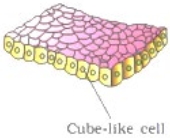
Identify the given diagram of tissue performing secretion and absorption.
A
Simple cuboidal epithelium
B
Simple columnar epithelium
C
Stratified cuboidal epithelium
D
Stratified columnar epithelium
Solution
(A) The given diagram shows a single layer of cube-like cells,which is characteristic of simple cuboidal epithelium.
This tissue is primarily found in ducts of glands and tubular parts of nephrons in kidneys.
Its main functions are secretion and absorption.
This tissue is primarily found in ducts of glands and tubular parts of nephrons in kidneys.
Its main functions are secretion and absorption.
0 likesView Solution
11
BiologyEasyMCQAIIMS · 2019
Cervical vertebrae differ from other vertebrae in having -
A
Spinous process
B
Centrum
C
Transverse process
D
Transverse foramen
Solution
(D) Cervical vertebrae are unique because they possess a $transverse \text{ } foramen$ in each of their transverse processes, which serves as a passage for the vertebral artery and vein. Other types of vertebrae, such as thoracic, lumbar, sacral, or coccygeal, do not have this $transverse \text{ } foramen$.
0 likesView Solution
12
BiologyEasyMCQAIIMS · 2019
Protein on reaction with which yields Ruhemann's purple?
A
Ninhydrin
B
$Cu^{2+}$
C
$H_{2}O_{2}$
D
Benedict's solution
Solution
(A) Ninhydrin is a chemical used to detect ammonia or primary and secondary amines. When proteins or amino acids react with the ninhydrin reagent,they undergo a series of reactions that result in the formation of a deep blue or violet-colored compound known as Ruhemann's purple. This reaction is commonly used in forensic science to detect fingerprints.
0 likesView Solution
13
BiologyEasyMCQAIIMS · 2019
Which maintains static equilibrium?
A
Cerebrum
B
Utricle $\&$ Saccule
C
Cerebellum
D
Semicircular canal
Solution
(B) Static equilibrium refers to the perception of the orientation of the head with respect to gravity. The macula,which is the sensory receptor located within the utricle and saccule of the inner ear,is responsible for detecting linear acceleration and the position of the head,thereby maintaining static equilibrium.
0 likesView Solution
14
BiologyMediumMCQAIIMS · 2019
Skeletal muscles are controlled by
A
Sympathetic nervous system
B
Parasympathetic nervous system
C
Somatic nervous system
D
Sympathetic and parasympathetic both
Solution
(C) The nervous system is divided into the central nervous system and the peripheral nervous system.
The peripheral nervous system is further divided into the somatic nervous system and the autonomic nervous system.
The somatic nervous system is responsible for relaying information from the central nervous system to the skeletal muscles,thereby controlling voluntary movements.
Therefore,skeletal muscles are under the control of the somatic nervous system.
The peripheral nervous system is further divided into the somatic nervous system and the autonomic nervous system.
The somatic nervous system is responsible for relaying information from the central nervous system to the skeletal muscles,thereby controlling voluntary movements.
Therefore,skeletal muscles are under the control of the somatic nervous system.
0 likesView Solution
15
BiologyMediumMCQAIIMS · 2019
Choose the correct statement for Periplaneta americana.
A
It has $6$ muscular hearts.
B
It has $10$ thoracic segments.
C
Anal style is present in both male and female.
D
It is nocturnal and present in damp places.
Solution
(D) Periplaneta americana is a nocturnal organism that prefers to live in damp and dark places.
Regarding other options:
- Cockroaches have $13$ chambers in their heart,not $6$.
- The thorax consists of only $3$ segments (prothorax,mesothorax,and metathorax),not $10$.
- Anal styles are present only in males,whereas anal cerci are present in both sexes.
Regarding other options:
- Cockroaches have $13$ chambers in their heart,not $6$.
- The thorax consists of only $3$ segments (prothorax,mesothorax,and metathorax),not $10$.
- Anal styles are present only in males,whereas anal cerci are present in both sexes.
0 likesView Solution
16
BiologyMediumMCQAIIMS · 2019
Animals of which phylum have hooks and suckers and are endoparasites on other animals?
A
Platyhelminthes
B
Annelida
C
Aschelminthes
D
Arthropoda
Solution
(A) Phylum $Platyhelminthes$ consists of organisms that are mostly endoparasites found in animals,including human beings. These organisms possess specialized structures like hooks and suckers for attachment to the host's body.
0 likesView Solution
17
BiologyMediumMCQAIIMS · 2019
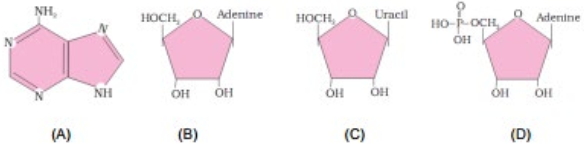
Identify the nucleosides from the given structures:
A
$A$ and $B$
B
$B$ and $C$
C
$C$ and $D$
D
$D$ and $A$
Solution
(B) nucleoside is formed by the attachment of a nitrogenous base to a sugar molecule (pentose sugar).
Structure $A$ represents a nitrogenous base (Adenine).
Structure $B$ represents a nucleoside (Adenosine),consisting of a sugar and Adenine.
Structure $C$ represents a nucleoside (Uridine),consisting of a sugar and Uracil.
Structure $D$ represents a nucleotide (Adenosine monophosphate),consisting of a sugar,Adenine,and a phosphate group.
Therefore,structures $B$ and $C$ are nucleosides. The correct option is $(B)$.
Structure $A$ represents a nitrogenous base (Adenine).
Structure $B$ represents a nucleoside (Adenosine),consisting of a sugar and Adenine.
Structure $C$ represents a nucleoside (Uridine),consisting of a sugar and Uracil.
Structure $D$ represents a nucleotide (Adenosine monophosphate),consisting of a sugar,Adenine,and a phosphate group.
Therefore,structures $B$ and $C$ are nucleosides. The correct option is $(B)$.
0 likesView Solution
18
BiologyMediumMCQAIIMS · 2019
Acoelomate animals with flame cells are:
A
Platyhelminthes
B
Annelida
C
Aschelminthes
D
Arthropoda
Solution
(A) Platyhelminthes are acoelomate animals,meaning they lack a body cavity.
They possess specialized cells called flame cells,which are primarily responsible for osmoregulation and excretion.
These organisms often possess suckers and hooks and are frequently found as endoparasites in other animals.
Therefore,the correct option is $A$.
They possess specialized cells called flame cells,which are primarily responsible for osmoregulation and excretion.
These organisms often possess suckers and hooks and are frequently found as endoparasites in other animals.
Therefore,the correct option is $A$.
0 likesView Solution
19
BiologyMediumMCQAIIMS · 2019
Mark the correct statement regarding earthworm.
A
One pair of female genital pores are present in $14^{\text{th}}$ segment.
B
Four pairs of spermathecae are located in $6^{\text{th}}-9^{\text{th}}$ segments.
C
Clitellum is present in $13-15$ segments.
D
Four pairs of spermathecae are situated on ventro-lateral sides of the intersegmental grooves i.e. $5^{\text{th}}$ segments.
Solution
(B) In earthworms ($Pheretima$ $posthuma$):
$1$. $A$ single female genital pore is present in the mid-ventral line of the $14^{\text{th}}$ segment.
$2$. Four pairs of spermathecae are located in the $6^{\text{th}}-9^{\text{th}}$ segments (one pair in each segment).
$3$. The clitellum is a prominent glandular and thickened part of the body wall,covering segments $14, 15,$ and $16$.
$4$. Spermathecae are situated on the ventro-lateral sides of the intersegmental grooves,specifically between segments $5/6, 6/7, 7/8,$ and $8/9$.
Therefore,the statement in option $B$ is correct.
$1$. $A$ single female genital pore is present in the mid-ventral line of the $14^{\text{th}}$ segment.
$2$. Four pairs of spermathecae are located in the $6^{\text{th}}-9^{\text{th}}$ segments (one pair in each segment).
$3$. The clitellum is a prominent glandular and thickened part of the body wall,covering segments $14, 15,$ and $16$.
$4$. Spermathecae are situated on the ventro-lateral sides of the intersegmental grooves,specifically between segments $5/6, 6/7, 7/8,$ and $8/9$.
Therefore,the statement in option $B$ is correct.
0 likesView Solution
20
BiologyMediumMCQAIIMS · 2019
Which of the following are homosporous?
A
Salvinia,Equisetum
B
Salvinia,Lycopodium
C
Selaginella,Salvinia
D
Lycopodium,Equisetum
Solution
(D) Homosporous plants are those that produce only one type of spore,which are not differentiated by sex.
Most pteridophytes are homosporous,such as $Lycopodium$ and $Equisetum$.
In contrast,$Selaginella$ and $Salvinia$ are heterosporous,meaning they produce two different types of spores (microspores and megaspores).
Most pteridophytes are homosporous,such as $Lycopodium$ and $Equisetum$.
In contrast,$Selaginella$ and $Salvinia$ are heterosporous,meaning they produce two different types of spores (microspores and megaspores).
0 likesView Solution
21
BiologyMediumMCQAIIMS · 2019
What is the site of $C_{3}$ cycle in $C_{3}$ and $C_{4}$ plants?
A
In $C_{3}$ plants $-$ mesophyll cells and in $C_{4}$ plants $-$ bundle sheath cells.
B
In $C_{3}$ plants $-$ bundle sheath cells and in $C_{4}$ plants $-$ mesophyll cells.
C
In $C_{4}$ plants $-$ bundle sheath cells and in $C_{3}$ plants $-$ bundle sheath cells.
D
In $C_{3}$ plants $-$ mesophyll cells and in $C_{4}$ plants $-$ mesophyll cells.
Solution
(A) The Calvin cycle ($C_{3}$ cycle) is the primary pathway for carbon fixation.
In $C_{3}$ plants,the entire process of the Calvin cycle takes place within the mesophyll cells,which contain chloroplasts.
In $C_{4}$ plants,the process is partitioned: the initial carbon fixation occurs in the mesophyll cells,but the Calvin cycle ($C_{3}$ cycle) specifically occurs in the bundle sheath cells to maintain a high concentration of $CO_{2}$ around the enzyme RuBisCO.
In $C_{3}$ plants,the entire process of the Calvin cycle takes place within the mesophyll cells,which contain chloroplasts.
In $C_{4}$ plants,the process is partitioned: the initial carbon fixation occurs in the mesophyll cells,but the Calvin cycle ($C_{3}$ cycle) specifically occurs in the bundle sheath cells to maintain a high concentration of $CO_{2}$ around the enzyme RuBisCO.
0 likesView Solution
22
BiologyMediumMCQAIIMS · 2019
Which of the following sets is not a natural plant growth regulator?
A
$GA_{3}, IAA, 2IP$
B
$IAA, 2IP, Zn$
C
$ABA, IBA, GA_{3}$
D
$ABA, GA_{3}, IAA$
Solution
(B) Plant growth regulators (PGRs) are organic compounds that influence the growth and development of plants.
$IAA$ (Indole$-3-$acetic acid) and $2IP$ ($2$-isopentenyl adenine) are natural plant hormones.
$GA_{3}$ (Gibberellic acid),$ABA$ (Abscisic acid),and $IBA$ (Indole$-3-$butyric acid) are also recognized as plant growth regulators.
Zinc $(Zn)$ is an essential micronutrient required for plant metabolism and enzyme activation,but it is not classified as a plant growth regulator or hormone.
Therefore,the set containing $Zn$ is not a set of plant growth regulators.
$IAA$ (Indole$-3-$acetic acid) and $2IP$ ($2$-isopentenyl adenine) are natural plant hormones.
$GA_{3}$ (Gibberellic acid),$ABA$ (Abscisic acid),and $IBA$ (Indole$-3-$butyric acid) are also recognized as plant growth regulators.
Zinc $(Zn)$ is an essential micronutrient required for plant metabolism and enzyme activation,but it is not classified as a plant growth regulator or hormone.
Therefore,the set containing $Zn$ is not a set of plant growth regulators.
0 likesView Solution
23
BiologyMediumMCQAIIMS · 2019
Which of the following represent zygomorphic symmetry?
A
Canna,Mustard,Chilly,Datura
B
Mustard,Canna,Pea,Datura
C
Pea,Bean,Cassia,Gulmohar
D
Pea,Bean,Canna,Chilly
Solution
(C) Zygomorphic symmetry refers to bilateral symmetry in flowers, where the flower can be divided into two identical halves only in one particular vertical plane.
Examples of plants exhibiting zygomorphic flowers include $Pea$, $Bean$, $Cassia$, and $Gulmohar$.
In contrast, actinomorphic flowers (radial symmetry) are found in $Mustard$, $Datura$, and $Chilly$, while $Canna$ exhibits asymmetry.
Examples of plants exhibiting zygomorphic flowers include $Pea$, $Bean$, $Cassia$, and $Gulmohar$.
In contrast, actinomorphic flowers (radial symmetry) are found in $Mustard$, $Datura$, and $Chilly$, while $Canna$ exhibits asymmetry.
0 likesView Solution
24
BiologyMediumMCQAIIMS · 2019
Match the column $I$ and $II$:
| Column $I$ | Column $II$ |
| $(i)$ Chrysophyte | $(a)$ Gonyaulax |
| $(ii)$ Dinoflagellate | $(b)$ Euglena |
| $(iii)$ Euglenoids | $(c)$ Diatom |
| $(iv)$ Slime moulds | $(d)$ Plasmodium |
A
$i-a, ii-c, iii-b, iv-d$
B
$i-a, ii-d, iii-b, iv-c$
C
$i-c, ii-b, iii-d, iv-a$
D
$i-c, ii-a, iii-b, iv-d$
Solution
(D) The correct matching is as follows:
$(i)$ Chrysophytes include diatoms and golden algae (desmids). Thus, $(i)$ matches with $(c)$.
$(ii)$ Dinoflagellates include organisms like Gonyaulax. Thus, $(ii)$ matches with $(a)$.
$(iii)$ Euglenoids include organisms like Euglena. Thus, $(iii)$ matches with $(b)$.
$(iv)$ Slime moulds are saprophytic protists, and an example is Plasmodium (an aggregation). Thus, $(iv)$ matches with $(d)$.
Therefore, the correct sequence is $i-c, ii-a, iii-b, iv-d$, which corresponds to option $(D)$.
$(i)$ Chrysophytes include diatoms and golden algae (desmids). Thus, $(i)$ matches with $(c)$.
$(ii)$ Dinoflagellates include organisms like Gonyaulax. Thus, $(ii)$ matches with $(a)$.
$(iii)$ Euglenoids include organisms like Euglena. Thus, $(iii)$ matches with $(b)$.
$(iv)$ Slime moulds are saprophytic protists, and an example is Plasmodium (an aggregation). Thus, $(iv)$ matches with $(d)$.
Therefore, the correct sequence is $i-c, ii-a, iii-b, iv-d$, which corresponds to option $(D)$.
0 likesView Solution
25
BiologyMediumMCQAIIMS · 2019
Match the Column $I$ and Column $II$:
| Column $I$ | Column $II$ |
| $(a)$ Apocarpous | $(i)$ Papaver |
| $(b)$ Syncarpous | $(ii)$ Michelia |
| $(c)$ Epiphyllous | $(iii)$ Cashew |
| $(d)$ Cotyledon | $(iv)$ Aloe |
A
$a-i, b-ii, c-iii, d-iv$
B
$a-ii, b-i, c-iv, d-iii$
C
$a-iv, b-iii, c-ii, d-i$
D
$a-iv, b-i, c-iii, d-ii$
Solution
(B) The correct matching is as follows:
$(a)$ Apocarpous: In this condition,the carpels are free,as seen in $Michelia$.
$(b)$ Syncarpous: In this condition,the carpels are fused,as seen in $Papaver$.
$(c)$ Epiphyllous: When stamens are attached to the perianth (tepals),it is called epiphyllous,as seen in $Aloe$.
$(d)$ Cotyledon: The embryo of a monocotyledonous seed contains one cotyledon,which is called scutellum,as seen in $Cashew$ (Note: While $Cashew$ is a dicot,in the context of typical textbook matching questions,the association is made based on specific structural examples provided in the $NCERT$ curriculum).
Therefore,the correct sequence is $a-ii, b-i, c-iv, d-iii$.
$(a)$ Apocarpous: In this condition,the carpels are free,as seen in $Michelia$.
$(b)$ Syncarpous: In this condition,the carpels are fused,as seen in $Papaver$.
$(c)$ Epiphyllous: When stamens are attached to the perianth (tepals),it is called epiphyllous,as seen in $Aloe$.
$(d)$ Cotyledon: The embryo of a monocotyledonous seed contains one cotyledon,which is called scutellum,as seen in $Cashew$ (Note: While $Cashew$ is a dicot,in the context of typical textbook matching questions,the association is made based on specific structural examples provided in the $NCERT$ curriculum).
Therefore,the correct sequence is $a-ii, b-i, c-iv, d-iii$.
0 likesView Solution
26
BiologyMediumMCQAIIMS · 2019
Match the following:
| Column $I$ | Column $II$ |
| $(a)$ Potato spindle tuber | $(i)$ Virus |
| $(b)$ Creutzfeldt-Jakob disease $(CJD)$ | $(ii)$ Viroid |
| $(c)$ Cholera | $(iii)$ Prion |
| $(d)$ Leaf rolling and curling | $(iv)$ Bacteria |
A
$a-i, b-ii, c-iii, d-iv$
B
$a-iv, b-iii, c-ii, d-i$
C
$a-ii, b-iii, c-iv, d-i$
D
$a-iv, b-i, c-iii, d-ii$
Solution
(C) The correct matching is as follows:
$(a)$ Potato spindle tuber is caused by a Viroid $(ii)$.
$(b)$ Creutzfeldt-Jakob disease $(CJD)$ is a neurodegenerative disorder caused by a Prion $(iii)$.
$(c)$ Cholera is a bacterial infection caused by Vibrio cholerae $(iv)$.
$(d)$ Leaf rolling and curling in plants is a common symptom of viral infection $(i)$.
Therefore,the correct sequence is $a-ii, b-iii, c-iv, d-i$,which corresponds to option $(C)$.
$(a)$ Potato spindle tuber is caused by a Viroid $(ii)$.
$(b)$ Creutzfeldt-Jakob disease $(CJD)$ is a neurodegenerative disorder caused by a Prion $(iii)$.
$(c)$ Cholera is a bacterial infection caused by Vibrio cholerae $(iv)$.
$(d)$ Leaf rolling and curling in plants is a common symptom of viral infection $(i)$.
Therefore,the correct sequence is $a-ii, b-iii, c-iv, d-i$,which corresponds to option $(C)$.
0 likesView Solution
27
BiologyMediumMCQAIIMS · 2019
Which of the following is correct regarding the position of floral parts on the thalamus?
A
Perigynous - plum,peach,rose
B
Epigynous - guava and cucumber
C
Hypogynous - mustard,rose
D
Both $A$ and $B$
Solution
(D) In $Perigynous$ flowers,the gynoecium is situated in the center and other parts of the flower are located at the rim of the thalamus almost at the same level. Examples include $Plum$,$Peach$,and $Rose$.
In $Epigynous$ flowers,the margin of the thalamus grows upward enclosing the ovary completely and getting fused with it,while other parts of the flower arise above the ovary. Examples include $Guava$,$Cucumber$,and the ray florets of $Sunflower$.
In $Hypogynous$ flowers,the gynoecium occupies the highest position while the other parts are situated below it. Examples include $Mustard$,$China$ $rose$,and $Brinjal$.
Therefore,both options $A$ and $B$ are correct.
In $Epigynous$ flowers,the margin of the thalamus grows upward enclosing the ovary completely and getting fused with it,while other parts of the flower arise above the ovary. Examples include $Guava$,$Cucumber$,and the ray florets of $Sunflower$.
In $Hypogynous$ flowers,the gynoecium occupies the highest position while the other parts are situated below it. Examples include $Mustard$,$China$ $rose$,and $Brinjal$.
Therefore,both options $A$ and $B$ are correct.
0 likesView Solution
28
BiologyDifficultMCQAIIMS · 2019
If mitochondria are absent in mature $RBC$,what will be the source of energy?
A
$TCA$
B
$ETS$
C
Link reaction
D
Glycolysis
Solution
(D) Mitochondria are known as the powerhouses of the cell because they are involved in the synthesis of $ATP$ (the energy currency of the cell).
Since mature $RBCs$ lack mitochondria,they cannot perform aerobic respiration (which includes the link reaction,$TCA$ cycle,and $ETS$).
Therefore,the energy requirement of mature $RBCs$ is met exclusively through the process of glycolysis.
Glycolysis occurs in the cytoplasm and results in the net production of $2$ molecules of $ATP$ per molecule of glucose.
Since mature $RBCs$ lack mitochondria,they cannot perform aerobic respiration (which includes the link reaction,$TCA$ cycle,and $ETS$).
Therefore,the energy requirement of mature $RBCs$ is met exclusively through the process of glycolysis.
Glycolysis occurs in the cytoplasm and results in the net production of $2$ molecules of $ATP$ per molecule of glucose.
0 likesView Solution
29
BiologyEasyMCQAIIMS · 2019
Which group represents micronutrients?
A
$Mn, Zn, Fe, B, Cl, Ni$
B
$C, S, O, N, K, Ca$
C
$Ca, Mg, K, S, P$
D
$C, H, Fe, Mn, Cu, Mo$
Solution
(A) Micronutrients are essential elements required by plants in very small amounts (less than $10 \ mmol \ kg^{-1}$ of dry matter).
These elements are crucial for various physiological and metabolic processes in plants.
The essential micronutrients include Iron $(Fe)$,Manganese $(Mn)$,Zinc $(Zn)$,Boron $(B)$,Copper $(Cu)$,Molybdenum $(Mo)$,Chlorine $(Cl)$,and Nickel $(Ni)$.
Therefore,the group $Mn, Zn, Fe, B, Cl, Ni$ represents micronutrients.
These elements are crucial for various physiological and metabolic processes in plants.
The essential micronutrients include Iron $(Fe)$,Manganese $(Mn)$,Zinc $(Zn)$,Boron $(B)$,Copper $(Cu)$,Molybdenum $(Mo)$,Chlorine $(Cl)$,and Nickel $(Ni)$.
Therefore,the group $Mn, Zn, Fe, B, Cl, Ni$ represents micronutrients.
0 likesView Solution
30
BiologyMediumMCQAIIMS · 2019
Which of the following does not have any membranous covering?
A
Mitochondria
B
Vacuole
C
Ribosome
D
Chloroplast
Solution
(C) Organelles can be classified based on the presence or absence of a membrane.
$Mitochondria$ and $Chloroplast$ are double-membrane bound organelles.
$Vacuole$ is surrounded by a single membrane called the $tonoplast$.
$Ribosome$ is a non-membrane bound organelle found in both prokaryotic and eukaryotic cells.
Therefore, the correct answer is $Ribosome$.
$Mitochondria$ and $Chloroplast$ are double-membrane bound organelles.
$Vacuole$ is surrounded by a single membrane called the $tonoplast$.
$Ribosome$ is a non-membrane bound organelle found in both prokaryotic and eukaryotic cells.
Therefore, the correct answer is $Ribosome$.
0 likesView Solution
31
BiologyMediumMCQAIIMS · 2019
In which of the following is phosphorylation absent?
A
Glycolysis
B
Krebs cycle
C
$C_{4}$ cycle
D
$ETS$
Solution
(C) Phosphorylation is a process involving the addition of a phosphate group to an organic molecule,such as the conversion of $ADP$ to $ATP$.
In Glycolysis,substrate-level phosphorylation occurs.
In the Krebs cycle,substrate-level phosphorylation occurs (conversion of succinyl-$CoA$ to succinate).
In the $ETS$ (Electron Transport System),oxidative phosphorylation occurs.
However,the $C_{4}$ cycle (Hatch-Slack pathway) is a carbon fixation pathway that does not involve phosphorylation as a direct step in its cycle reactions; it consumes $ATP$ produced elsewhere but does not perform phosphorylation itself.
In Glycolysis,substrate-level phosphorylation occurs.
In the Krebs cycle,substrate-level phosphorylation occurs (conversion of succinyl-$CoA$ to succinate).
In the $ETS$ (Electron Transport System),oxidative phosphorylation occurs.
However,the $C_{4}$ cycle (Hatch-Slack pathway) is a carbon fixation pathway that does not involve phosphorylation as a direct step in its cycle reactions; it consumes $ATP$ produced elsewhere but does not perform phosphorylation itself.
0 likesView Solution
32
BiologyMediumMCQAIIMS · 2019
Match the following columns regarding the classification of fungi:
| Column $I$ | Column $II$ |
|---|---|
| $(i)$ $Trichoderma$ | $(a)$ $Deuteromycetes$ |
| $(ii)$ $Yeast$ | $(b)$ $Basidiomycetes$ |
| $(iii)$ $Bread \text{ } mould$ $(Rhizopus)$ | $(c)$ $Phycomycetes$ |
| $(iv)$ $Smut$ $(Ustilago)$ | $(d)$ $Ascomycetes$ |
A
$i-d, ii-a, iii-c, iv-b$
B
$i-a, ii-d, iii-b, iv-c$
C
$i-a, ii-d, iii-c, iv-b$
D
$i-a, ii-c, iii-b, iv-d$
Solution
(C) The correct matching is as follows:
$1$. $Trichoderma$ belongs to the class $Deuteromycetes$ (imperfect fungi).
$2$. $Yeast$ $(Saccharomyces)$ belongs to the class $Ascomycetes$ (sac fungi).
$3$. $Bread \text{ } mould$ $(Rhizopus)$ belongs to the class $Phycomycetes$ (algal fungi).
$4$. $Smut$ $(Ustilago)$ belongs to the class $Basidiomycetes$ (club fungi).
Therefore, the correct sequence is $(i-a, ii-d, iii-c, iv-b)$. The correct option is $(C)$.
$1$. $Trichoderma$ belongs to the class $Deuteromycetes$ (imperfect fungi).
$2$. $Yeast$ $(Saccharomyces)$ belongs to the class $Ascomycetes$ (sac fungi).
$3$. $Bread \text{ } mould$ $(Rhizopus)$ belongs to the class $Phycomycetes$ (algal fungi).
$4$. $Smut$ $(Ustilago)$ belongs to the class $Basidiomycetes$ (club fungi).
Therefore, the correct sequence is $(i-a, ii-d, iii-c, iv-b)$. The correct option is $(C)$.
0 likesView Solution
33
BiologyMediumMCQAIIMS · 2019
Find the incorrect match:
A
Fleshy leaves - Onion
B
Underground stem - Turmeric
C
Racemose - Solanum
D
Phylloclade - Euphorbia
Solution
(C) Inflorescence refers to the arrangement of flowers on the floral axis.
In $Solanum$,the inflorescence is not racemose; it typically exhibits a solitary or cymose (specifically scorpioid cyme) type of inflorescence.
Therefore,the match $Racemose - Solanum$ is incorrect.
In $Solanum$,the inflorescence is not racemose; it typically exhibits a solitary or cymose (specifically scorpioid cyme) type of inflorescence.
Therefore,the match $Racemose - Solanum$ is incorrect.
0 likesView Solution
34
BiologyMediumMCQAIIMS · 2019
Mark the correct one regarding typhlosole.
A
Internal median fold of ventral intestinal wall
B
Extends from $20^{th} - 35^{th}$ segments
C
Increases the surface area for absorption
D
Decreases the surface area for absorption
Solution
(C) The typhlosole is a large,internal,median fold of the dorsal wall of the intestine in earthworms.
It typically extends from the $26^{th}$ segment to the $22^{nd}-25^{th}$ segment before the anus.
The primary function of the typhlosole is to increase the effective surface area for the absorption of digested food within the intestine.
It typically extends from the $26^{th}$ segment to the $22^{nd}-25^{th}$ segment before the anus.
The primary function of the typhlosole is to increase the effective surface area for the absorption of digested food within the intestine.
0 likesView Solution
35
BiologyMediumMCQAIIMS · 2019
Free-swimming,radially symmetrical animals with cnidocytes belong to
A
Coelenterata
B
Platyhelminthes
C
Ctenophora
D
Echinodermata
Solution
(A) The animals belonging to the phylum $Coelenterata$ (also known as $Cnidaria$) are characterized by being free-swimming or sessile,exhibiting radial symmetry,and possessing specialized cells called $cnidocytes$ or $cnidoblasts$.
These $cnidocytes$ contain stinging capsules called $nematocysts$,which are used for anchorage,defense,and capturing prey.
These $cnidocytes$ contain stinging capsules called $nematocysts$,which are used for anchorage,defense,and capturing prey.
0 likesView Solution
36
BiologyMediumMCQAIIMS · 2019
Which of the following statements is not true for a cockroach?
A
$1$ pair of compound eyes
B
Forewings called tegmina used for flight are attached to the $1^{st}$ thoracic segment
C
$1$ pair of maxilla and mandible
D
Has $10$ abdominal segments
Solution
(B) The cockroach has three thoracic segments: prothorax,mesothorax,and metathorax. The forewings (tegmina) are attached to the mesothorax (the $2^{nd}$ thoracic segment),not the prothorax (the $1^{st}$ thoracic segment). Therefore,the statement in option $B$ is incorrect.
0 likesView Solution
37
BiologyMediumMCQAIIMS · 2019
Choose the correct difference between $Pristis$ and $Catla$.
A
$3$-chambered heart $-$ $2$-chambered heart
B
Small placoid scales $-$ Large placoid scales
C
Ventral mouth $-$ Terminal mouth
D
Swim bladder present $-$ Swim bladder absent
Solution
(C) $Pristis$ (Sawfish) belongs to the class $Chondrichthyes$ (cartilaginous fishes),which typically possess a ventral mouth.
$Catla$ (Carp) belongs to the class $Osteichthyes$ (bony fishes),which typically possess a terminal mouth.
Therefore,the correct difference is that $Pristis$ has a ventral mouth,while $Catla$ has a terminal mouth.
$Catla$ (Carp) belongs to the class $Osteichthyes$ (bony fishes),which typically possess a terminal mouth.
Therefore,the correct difference is that $Pristis$ has a ventral mouth,while $Catla$ has a terminal mouth.
0 likesView Solution
38
BiologyMediumMCQAIIMS · 2019
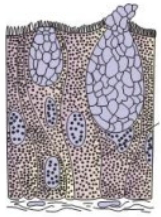
Identify the following diagram.
A
Glandular epithelium
B
Ciliated epithelium
C
Squamous epithelium
D
Areolar connective tissue
Solution
(A) The given diagram shows glandular epithelium.
Some of the columnar or cuboidal cells get specialized for secretion and are called glandular epithelium.
They are mainly of two types: unicellular,consisting of isolated glandular cells (like goblet cells of the alimentary canal),and multicellular,consisting of a cluster of cells (like salivary gland).
Some of the columnar or cuboidal cells get specialized for secretion and are called glandular epithelium.
They are mainly of two types: unicellular,consisting of isolated glandular cells (like goblet cells of the alimentary canal),and multicellular,consisting of a cluster of cells (like salivary gland).
0 likesView Solution
39
BiologyEasyMCQAIIMS · 2019
The vitamins required to maintain bone density:
A
Vitamin $A$ and $C$
B
Vitamin $C$ and $D$
C
Vitamin $B$ and $C$
D
Vitamin $A$ and $E$
Solution
(B) Vitamin $C$ and $D$ are essential for maintaining bone density.
Vitamin $C$ is crucial for the synthesis of collagen,which provides the structural framework for bone mineralization.
Vitamin $D$ is vital for the absorption of calcium from the digestive tract,which is necessary for bone strength and density.
Vitamin $C$ is crucial for the synthesis of collagen,which provides the structural framework for bone mineralization.
Vitamin $D$ is vital for the absorption of calcium from the digestive tract,which is necessary for bone strength and density.
0 likesView Solution
40
BiologyMediumMCQAIIMS · 2019
Oxytocin and $ADH$ are produced by the hypothalamus and released from:
A
Anterior pituitary
B
Posterior pituitary
C
Pineal gland
D
Thymus
Solution
(B) Oxytocin and anti-diuretic hormone $(ADH)$ are synthesized by the neurosecretory cells of the hypothalamus.
These hormones are transported axonally to the posterior pituitary (neurohypophysis).
From the posterior pituitary,they are stored and released into the bloodstream as required.
These hormones are transported axonally to the posterior pituitary (neurohypophysis).
From the posterior pituitary,they are stored and released into the bloodstream as required.
0 likesView Solution
41
BiologyMediumMCQAIIMS · 2019
Match the following substrates with their respective enzymes:
| Substrate | Enzyme |
|---|---|
| $(A)$ Ribonucleotide | $(i)$ Chitinase |
| $(B)$ Chitin | $(ii)$ Cellulase |
| $(C)$ Cellulose | $(iii)$ Ribonuclease |
A
$A-i, B-ii, C-iii$
B
$A-iii, B-i, C-ii$
C
$A-iii, B-ii, C-i$
D
$A-ii, B-i, C-iii$
Solution
(B) The correct matching is as follows:
$1$. Ribonucleotide is broken down by the enzyme Ribonuclease $(A-iii)$.
$2$. Chitin is broken down by the enzyme Chitinase $(B-i)$.
$3$. Cellulose is broken down by the enzyme Cellulase $(C-ii)$.
Therefore,the correct sequence is $A-iii, B-i, C-ii$,which corresponds to option $(B)$.
$1$. Ribonucleotide is broken down by the enzyme Ribonuclease $(A-iii)$.
$2$. Chitin is broken down by the enzyme Chitinase $(B-i)$.
$3$. Cellulose is broken down by the enzyme Cellulase $(C-ii)$.
Therefore,the correct sequence is $A-iii, B-i, C-ii$,which corresponds to option $(B)$.
0 likesView Solution
42
BiologyMediumMCQAIIMS · 2019
What is the function of Bowman's capsule and Glomerulus?
A
Filtration of blood
B
Reabsorption of ions from blood
C
Reabsorption of hormones from blood
D
Reabsorption of water from blood
Solution
(A) The Bowman's capsule and glomerulus together form the renal corpuscle,which is the essential part of the nephron responsible for the ultrafiltration of blood.
In the glomerulus,blood pressure forces water and small solutes out of the blood and into the Bowman's capsule.
This process creates a filtrate that is further processed along the nephron to eventually form urine.
In the glomerulus,blood pressure forces water and small solutes out of the blood and into the Bowman's capsule.
This process creates a filtrate that is further processed along the nephron to eventually form urine.
0 likesView Solution
43
BiologyDifficultMCQAIIMS · 2019
Which of the following is a nucleoside?
A
Adenosine,Adenylic acid,Cytosine
B
Adenosine,Guanosine,Cytidine
C
Cytidylic acid,Adenosine,Adenylic acid
D
Guanylic acid,Cytosine,Adenosine
Solution
(B) nucleoside is composed of a nitrogenous base and a pentose sugar (ribose or deoxyribose).
It does not contain a phosphate group.
Nucleotides are formed when a phosphate group is attached to a nucleoside.
Among the given options,Adenosine,Guanosine,and Cytidine are nucleosides,whereas Adenylic acid,Cytidylic acid,and Guanylic acid are nucleotides.
It does not contain a phosphate group.
Nucleotides are formed when a phosphate group is attached to a nucleoside.
Among the given options,Adenosine,Guanosine,and Cytidine are nucleosides,whereas Adenylic acid,Cytidylic acid,and Guanylic acid are nucleotides.
0 likesView Solution
44
BiologyMediumMCQAIIMS · 2019
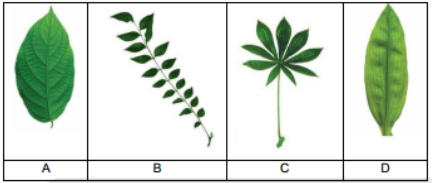
Identify the given diagrams and mark the correct option.
A
$A, D$ are compound while $B, C$ are simple leaves.
B
$A, D$ are simple while $B, C$ are compound leaves.
C
$A, B$ are simple while $C, D$ are compound leaves.
D
$A, B$ are compound while $C, D$ are simple leaves.
Solution
(B) leaf is said to be simple when its lamina is entire or when incised,the incisions do not touch the midrib. In the given diagrams,$A$ and $D$ represent simple leaves as they have a single,undivided leaf blade.
When the incisions of the lamina reach up to the midrib breaking it into a number of leaflets,the leaf is called a compound leaf. In the given diagrams,$B$ (pinnately compound) and $C$ (palmately compound) represent compound leaves as they have separate leaflets.
When the incisions of the lamina reach up to the midrib breaking it into a number of leaflets,the leaf is called a compound leaf. In the given diagrams,$B$ (pinnately compound) and $C$ (palmately compound) represent compound leaves as they have separate leaflets.
0 likesView Solution
45
BiologyDifficultMCQAIIMS · 2019
Which of the following are plant growth promoters?
A
$NAA, IBA,$ Zeatin,$GA_{3}$
B
$NAA, ABA,$ Zeatin,$GA_{3}$
C
$IBA, IAA, ABA, 2,4-D$
D
$IBA, BAP, ABA,$ Zeatin
Solution
(A) Plant growth regulators are broadly classified into two groups: plant growth promoters and plant growth inhibitors.
Plant growth promoters include auxins (e.g.,$NAA, IBA, IAA$),gibberellins (e.g.,$GA_3$),and cytokinins (e.g.,Zeatin,$BAP$).
Plant growth inhibitors include substances like Abscisic acid $(ABA)$.
In option $A$,$NAA$ (auxin),$IBA$ (auxin),Zeatin (cytokinin),and $GA_3$ (gibberellin) are all growth promoters.
Options $B, C,$ and $D$ contain $ABA$,which is a growth inhibitor.
Plant growth promoters include auxins (e.g.,$NAA, IBA, IAA$),gibberellins (e.g.,$GA_3$),and cytokinins (e.g.,Zeatin,$BAP$).
Plant growth inhibitors include substances like Abscisic acid $(ABA)$.
In option $A$,$NAA$ (auxin),$IBA$ (auxin),Zeatin (cytokinin),and $GA_3$ (gibberellin) are all growth promoters.
Options $B, C,$ and $D$ contain $ABA$,which is a growth inhibitor.
0 likesView Solution
46
BiologyMediumMCQAIIMS · 2019
Match the following:
| $(a)$ Protein | $(i)$ $SER$ |
| $(b)$ Lipid | $(ii)$ Golgi body |
| $(c)$ Glycoprotein | $(iii)$ Lysosome |
| $(d)$ Hydrolytic enzyme | $(iv)$ $RER$ |
A
$a-i, b-ii, c-iii, d-iv$
B
$a-iv, b-ii, c-i, d-iii$
C
$a-i, b-iii, c-ii, d-iv$
D
$a-iv, b-i, c-ii, d-iii$
Solution
(D) The correct option is $(D)$.
$(a)$ Protein is synthesized by the Rough Endoplasmic Reticulum $(RER)$ due to the presence of ribosomes on its surface.
$(b)$ Lipid is synthesized by the Smooth Endoplasmic Reticulum $(SER)$.
$(c)$ Glycoprotein formation occurs in the Golgi apparatus,where proteins are modified by adding carbohydrate chains.
$(d)$ Hydrolytic enzymes are characteristic components of lysosomes,which are responsible for intracellular digestion.
Therefore,the correct matching is $a-iv, b-i, c-ii, d-iii$.
$(a)$ Protein is synthesized by the Rough Endoplasmic Reticulum $(RER)$ due to the presence of ribosomes on its surface.
$(b)$ Lipid is synthesized by the Smooth Endoplasmic Reticulum $(SER)$.
$(c)$ Glycoprotein formation occurs in the Golgi apparatus,where proteins are modified by adding carbohydrate chains.
$(d)$ Hydrolytic enzymes are characteristic components of lysosomes,which are responsible for intracellular digestion.
Therefore,the correct matching is $a-iv, b-i, c-ii, d-iii$.
0 likesView Solution
47
BiologyMediumMCQAIIMS · 2019
$ATP$ formation occurs through which of the following?
A
Photophosphorylation
B
Oxidative phosphorylation
C
Substrate level phosphorylation
D
All of these
Solution
(D) $ATP$ can be synthesized through three primary mechanisms: photophosphorylation,oxidative phosphorylation,and substrate-level phosphorylation.
$1$. Photophosphorylation: $ATP$ is synthesized from $ADP$ and inorganic phosphate using light energy,typically occurring in chloroplasts.
$2$. Substrate-level phosphorylation: $A$ phosphoryl group is directly transferred from a high-energy substrate molecule to $ADP$ to form $ATP$,occurring in glycolysis and the Krebs cycle.
$3$. Oxidative phosphorylation: $ATP$ is synthesized by $ATP$ synthase using the energy derived from the electron transport system,where electrons are transferred from $NADH$ or $FADH_2$ to $O_2$.
$1$. Photophosphorylation: $ATP$ is synthesized from $ADP$ and inorganic phosphate using light energy,typically occurring in chloroplasts.
$2$. Substrate-level phosphorylation: $A$ phosphoryl group is directly transferred from a high-energy substrate molecule to $ADP$ to form $ATP$,occurring in glycolysis and the Krebs cycle.
$3$. Oxidative phosphorylation: $ATP$ is synthesized by $ATP$ synthase using the energy derived from the electron transport system,where electrons are transferred from $NADH$ or $FADH_2$ to $O_2$.
0 likesView Solution
48
BiologyMediumMCQAIIMS · 2019
Which statement is incorrect regarding mitochondria?
A
Site of aerobic respiration
B
Supported by double unit membrane
C
Infolding of inner membrane forms cristae
D
Many circular $DNA$ and few ribosomes are found in matrix.
Solution
(D) Mitochondria are double-membrane-bound organelles. They contain a single circular $DNA$ molecule and a few $70S$ ribosomes in their matrix,not many circular $DNA$ molecules. Therefore,statement $D$ is incorrect.
0 likesView Solution
49
BiologyMediumMCQAIIMS · 2019
Match List-$A$ and List-$B$ and choose the correct option.
| List-$A$ | List-$B$ |
| $(a)$ Citrus canker | $(i)$ Fungi |
| $(b)$ Spongiform encephalopathy | $(ii)$ Prion |
| $(c)$ Herpes | $(iii)$ Virus |
| $(d)$ Red rot | $(iv)$ Bacteria |
A
$a-i, b-ii, c-iii, d-iv$
B
$a-ii, b-iii, c-iv, d-i$
C
$a-iv, b-ii, c-iii, d-i$
D
$a-i, b-iii, c-ii, d-iv$
Solution
(C) The correct option is $(C)$.
$(a)$ Citrus canker is a plant disease caused by the bacterium $Xanthomonas \text{ citri}$. Thus,$(a)-(iv)$.
$(b)$ Spongiform encephalopathy (such as bovine spongiform encephalopathy or mad cow disease) is caused by infectious proteins known as prions. Thus,$(b)-(ii)$.
$(c)$ Herpes is a viral infection caused by the herpes simplex virus. Thus,$(c)-(iii)$.
$(d)$ Red rot of sugarcane is a fungal disease caused by $Colletotrichum \text{ falcatum}$. Thus,$(d)-(i)$.
Therefore,the correct matching is $a-iv, b-ii, c-iii, d-i$.
$(a)$ Citrus canker is a plant disease caused by the bacterium $Xanthomonas \text{ citri}$. Thus,$(a)-(iv)$.
$(b)$ Spongiform encephalopathy (such as bovine spongiform encephalopathy or mad cow disease) is caused by infectious proteins known as prions. Thus,$(b)-(ii)$.
$(c)$ Herpes is a viral infection caused by the herpes simplex virus. Thus,$(c)-(iii)$.
$(d)$ Red rot of sugarcane is a fungal disease caused by $Colletotrichum \text{ falcatum}$. Thus,$(d)-(i)$.
Therefore,the correct matching is $a-iv, b-ii, c-iii, d-i$.
0 likesView Solution
50
BiologyMediumMCQAIIMS · 2019
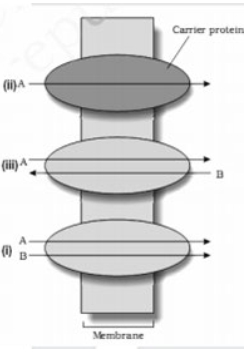
Identify $(i), (ii)$ and $(iii)$ based on the provided diagram of carrier proteins in a membrane.
A
$(i)$ - uniport,$(ii)$ - antiport,$(iii)$ - symport
B
$(i)$ - uniport,$(ii)$ - symport,$(iii)$ - antiport
C
$(i)$ - antiport,$(ii)$ - symport,$(iii)$ - uniport
D
$(i)$ - symport,$(ii)$ - uniport,$(iii)$ - antiport
Solution
(D) In the provided diagram:
$(i)$ shows two molecules ($A$ and $B$) moving in the same direction,which is known as symport.
$(ii)$ shows a single molecule $(A)$ moving in a single direction,which is known as uniport.
$(iii)$ shows two molecules ($A$ and $B$) moving in opposite directions,which is known as antiport.
Therefore,$(i)$ is symport,$(ii)$ is uniport,and $(iii)$ is antiport.
$(i)$ shows two molecules ($A$ and $B$) moving in the same direction,which is known as symport.
$(ii)$ shows a single molecule $(A)$ moving in a single direction,which is known as uniport.
$(iii)$ shows two molecules ($A$ and $B$) moving in opposite directions,which is known as antiport.
Therefore,$(i)$ is symport,$(ii)$ is uniport,and $(iii)$ is antiport.
0 likesView Solution
51
BiologyEasyMCQAIIMS · 2019
Select the correct diagram of a mature embryo sac.
A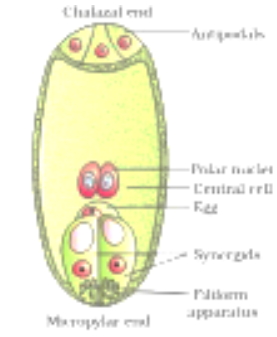
B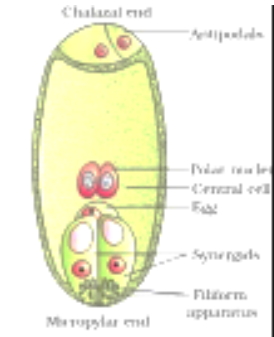
C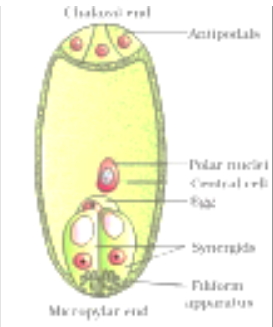
D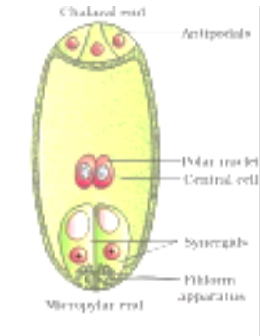
Solution
(A) mature angiosperm embryo sac is typically $7$-celled and $8$-nucleate.
It consists of three antipodal cells at the chalazal end,two synergids and one egg cell at the micropylar end,and a large central cell containing two polar nuclei.
Image $A$ correctly depicts this structure with three antipodal cells at the top (chalazal end),two synergids and one egg cell at the bottom (micropylar end),and two polar nuclei in the central cell.
It consists of three antipodal cells at the chalazal end,two synergids and one egg cell at the micropylar end,and a large central cell containing two polar nuclei.
Image $A$ correctly depicts this structure with three antipodal cells at the top (chalazal end),two synergids and one egg cell at the bottom (micropylar end),and two polar nuclei in the central cell.
0 likesView Solution
52
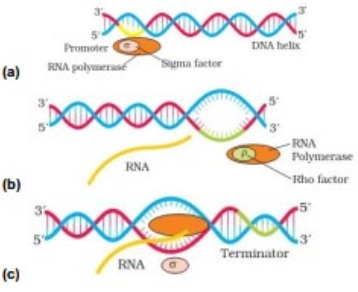
BiologyMediumMCQAIIMS · 2019
Identify $a, b$ and $c$ in the given process of transcription.
A
$(a)$ Elongation,$(b)$ Termination,$(c)$ Initiation
B
$(a)$ Initiation,$(b)$ Termination,$(c)$ Elongation
C
$(a)$ Initiation,$(b)$ Elongation,$(c)$ Termination
D
$(a)$ Termination,$(b)$ Elongation,$(c)$ Initiation
Solution
(C) The process of transcription in bacteria consists of three stages: Initiation, Elongation, and Termination.
$1$. In image $(a)$, the $RNA$ polymerase binds to the promoter region with the help of the sigma factor $(\sigma)$, which marks the initiation of transcription.
$2$. In image $(c)$, the $RNA$ polymerase moves along the $DNA$ template, facilitating the elongation of the $RNA$ chain.
$3$. In image $(b)$, the Rho factor $(\rho)$ binds to the $RNA$ polymerase at the terminator region, leading to the termination of transcription and the release of the nascent $RNA$.
$1$. In image $(a)$, the $RNA$ polymerase binds to the promoter region with the help of the sigma factor $(\sigma)$, which marks the initiation of transcription.
$2$. In image $(c)$, the $RNA$ polymerase moves along the $DNA$ template, facilitating the elongation of the $RNA$ chain.
$3$. In image $(b)$, the Rho factor $(\rho)$ binds to the $RNA$ polymerase at the terminator region, leading to the termination of transcription and the release of the nascent $RNA$.
0 likesView Solution
53
BiologyMediumMCQAIIMS · 2019
Match the Column-$I$ with Column-$II$:
| Column-$I$ | Column-$II$ |
|---|---|
| $(a)$ Parasitism | $(i)$ $++$ |
| $(b)$ Commensalism | $(ii)$ $+-$ |
| $(c)$ Amensalism | $(iii)$ $0+$ |
| $(d)$ Mutualism | $(iv)$ $0-$ |
A
$a-iii, b-ii, c-iv, d-i$
B
$a-i, b-ii, c-iii, d-iv$
C
$a-ii, b-iii, c-i, d-iv$
D
$a-ii, b-iii, c-iv, d-i$
Solution
(D) The correct matching is as follows:
$(a)$ Parasitism: One species benefits $(+)$ and the other is harmed $(-)$,represented as $+-$.
$(b)$ Commensalism: One species benefits $(+)$ and the other is neither harmed nor benefited $(0)$,represented as $0+$.
$(c)$ Amensalism: One species is harmed $(-)$ and the other is neither harmed nor benefited $(0)$,represented as $0-$.
$(d)$ Mutualism: Both species benefit $(+)$,represented as $++$.
Therefore,the correct sequence is $a-ii, b-iii, c-iv, d-i$. The correct option is $(D)$.
$(a)$ Parasitism: One species benefits $(+)$ and the other is harmed $(-)$,represented as $+-$.
$(b)$ Commensalism: One species benefits $(+)$ and the other is neither harmed nor benefited $(0)$,represented as $0+$.
$(c)$ Amensalism: One species is harmed $(-)$ and the other is neither harmed nor benefited $(0)$,represented as $0-$.
$(d)$ Mutualism: Both species benefit $(+)$,represented as $++$.
Therefore,the correct sequence is $a-ii, b-iii, c-iv, d-i$. The correct option is $(D)$.
0 likesView Solution
54
BiologyEasyMCQAIIMS · 2019
Genes on the same chromosome can be:
A
Linked
B
Homologous
C
Autosomes
D
Identical alleles
Solution
(A) Genes are the carriers of genetic information and serve as the functional units of heredity,located on chromosomes.
When two or more genes are present on the same chromosome,they are physically associated with each other.
This phenomenon,where genes located on the same chromosome tend to be inherited together,is known as linkage.
Therefore,genes on the same chromosome are referred to as linked genes.
When two or more genes are present on the same chromosome,they are physically associated with each other.
This phenomenon,where genes located on the same chromosome tend to be inherited together,is known as linkage.
Therefore,genes on the same chromosome are referred to as linked genes.
0 likesView Solution
55
BiologyMediumMCQAIIMS · 2019
Match the Column-$I$ with Column-$II$:
*(Note: Pusa Shubhra is resistant to Black rot, Pusa Swarnim to White rust, Pusa Sadabahar to Chilli mosaic virus, and Himgiri to Leaf and stripe rust.)*
| Column-$I$ | Column-$II$ |
| $(1)$ Pusa Shubhra | $(a)$ Leaf and stripe rust |
| $(2)$ Pusa Swarnim | $(b)$ Black rot |
| $(3)$ Pusa Sadabahar | $(c)$ Chilli mosaic virus |
| $(4)$ Himgiri | $(d)$ White rust |
*(Note: Pusa Shubhra is resistant to Black rot, Pusa Swarnim to White rust, Pusa Sadabahar to Chilli mosaic virus, and Himgiri to Leaf and stripe rust.)*
A
$1-a, 2-c, 3-d, 4-b$
B
$1-b, 2-d, 3-c, 4-a$
C
$1-d, 2-c, 3-b, 4-a$
D
$1-a, 2-b, 3-d, 4-c$
Solution
(B) The correct matching is as follows:
$(1)$ Pusa Shubhra is a variety of cauliflower resistant to Black rot $(b)$.
$(2)$ Pusa Swarnim is a variety of Brassica resistant to White rust $(d)$.
$(3)$ Pusa Sadabahar is a variety of Chilli resistant to Chilli mosaic virus $(c)$.
$(4)$ Himgiri is a variety of wheat resistant to Leaf and stripe rust $(a)$.
Therefore, the correct sequence is $1-b, 2-d, 3-c, 4-a$, which corresponds to option $(B)$.
$(1)$ Pusa Shubhra is a variety of cauliflower resistant to Black rot $(b)$.
$(2)$ Pusa Swarnim is a variety of Brassica resistant to White rust $(d)$.
$(3)$ Pusa Sadabahar is a variety of Chilli resistant to Chilli mosaic virus $(c)$.
$(4)$ Himgiri is a variety of wheat resistant to Leaf and stripe rust $(a)$.
Therefore, the correct sequence is $1-b, 2-d, 3-c, 4-a$, which corresponds to option $(B)$.
0 likesView Solution
56
BiologyMediumMCQAIIMS · 2019
Virus-free plants can be formed by
A
Meristem culture
B
Callus culture
C
Somatic cell culture
D
Protoplast fusion
Solution
(A) Virus-free plants can be obtained through meristem culture.
This is because the meristematic tissue is a region of continuous cell division and growth.
In many plants,the virus cannot keep pace with the rapid rate of cell division in the meristem,making this zone free from viral infection.
Therefore,by culturing the apical or axillary meristem,healthy,virus-free plants can be regenerated.
This is because the meristematic tissue is a region of continuous cell division and growth.
In many plants,the virus cannot keep pace with the rapid rate of cell division in the meristem,making this zone free from viral infection.
Therefore,by culturing the apical or axillary meristem,healthy,virus-free plants can be regenerated.
0 likesView Solution
57
BiologyEasyMCQAIIMS · 2019
The percentage of $(G + C)$ in a $DNA$ molecule is given by:
A
$\frac{G + C}{A + G + T + C} \times 100$
B
$\frac{100}{A + T} \times (G + C)$
C
$\frac{G + C}{A + G + T + C}$
D
$\frac{(G + C) \times (A + T)}{100}$
Solution
(A) In a $DNA$ molecule,the total nitrogenous bases consist of Adenine $(A)$,Guanine $(G)$,Thymine $(T)$,and Cytosine $(C)$.
To calculate the percentage of a specific base pair composition like $(G + C)$,we divide the sum of Guanine and Cytosine by the total number of nitrogenous bases $(A + G + T + C)$ and multiply by $100$.
Therefore,the formula is $\frac{G + C}{A + G + T + C} \times 100$.
Thus,option $(A)$ is the correct answer.
To calculate the percentage of a specific base pair composition like $(G + C)$,we divide the sum of Guanine and Cytosine by the total number of nitrogenous bases $(A + G + T + C)$ and multiply by $100$.
Therefore,the formula is $\frac{G + C}{A + G + T + C} \times 100$.
Thus,option $(A)$ is the correct answer.
0 likesView Solution
58
BiologyMediumMCQAIIMS · 2019
Arrange the following biological components in increasing order of their size:
A
Nucleotide,chromosome,gene,genome
B
Genome,chromosome,nucleotide,gene
C
Nucleotide,genome,gene,chromosome
D
Nucleotide,gene,chromosome,genome
Solution
(D) The hierarchical organization of genetic material is as follows:
$1$. $A$ $Nucleotide$ is the basic building block of $DNA$.
$2$. $A$ $Gene$ is a specific sequence of nucleotides that codes for a functional product.
$3$. $A$ $Chromosome$ is a highly condensed structure composed of $DNA$ (containing many genes) and proteins.
$4$. $A$ $Genome$ represents the entire set of genetic material (all chromosomes) of an organism.
Therefore,the increasing order of size is: $Nucleotide < Gene < Chromosome < Genome$.
Thus,the correct option is $(D)$.
$1$. $A$ $Nucleotide$ is the basic building block of $DNA$.
$2$. $A$ $Gene$ is a specific sequence of nucleotides that codes for a functional product.
$3$. $A$ $Chromosome$ is a highly condensed structure composed of $DNA$ (containing many genes) and proteins.
$4$. $A$ $Genome$ represents the entire set of genetic material (all chromosomes) of an organism.
Therefore,the increasing order of size is: $Nucleotide < Gene < Chromosome < Genome$.
Thus,the correct option is $(D)$.
0 likesView Solution
59
BiologyMediumMCQAIIMS · 2019
The genetic code of proline are:
A
$CCC, CCG, CCU$
B
$CUU, UCA, CUG$
C
$GUU, GUC, GUG$
D
$GGU, GUC, GGA$
Solution
(A) The genetic code is triplet in nature. Three nitrogenous bases together form one codon that is specific for a particular amino acid.
The amino acid proline is encoded by four codons: $CCU, CCC, CCA,$ and $CCG$.
Among the given options,$CCC, CCG,$ and $CCU$ are the codons for proline.
The amino acid proline is encoded by four codons: $CCU, CCC, CCA,$ and $CCG$.
Among the given options,$CCC, CCG,$ and $CCU$ are the codons for proline.
0 likesView Solution
60
BiologyMediumMCQAIIMS · 2019
The coding strand of $DNA$ is :
$5'AATTCAAATTAGG3'$
What is the sequence of $mRNA$ ?
$5'AATTCAAATTAGG3'$
What is the sequence of $mRNA$ ?
A
$3'TTAAGTTTAATCC5'$
B
$5'AAUUCAAAUUAGG3'$
C
$3'AAUUCAAAUUAGG5'$
D
$5'TTAAGTTTAATCC3'$
Solution
(B) In the process of transcription,the coding strand of $DNA$ $(5' \to 3')$ has the same sequence as the $mRNA$ transcript,except that $Thymine$ $(T)$ is replaced by $Uracil$ $(U)$ in $RNA$.
Given coding strand: $5'AATTCAAATTAGG3'$.
Replacing $T$ with $U$,the $mRNA$ sequence is $5'AAUUCAAAUUAGG3'$.
Thus,the correct option is $(B)$.
Given coding strand: $5'AATTCAAATTAGG3'$.
Replacing $T$ with $U$,the $mRNA$ sequence is $5'AAUUCAAAUUAGG3'$.
Thus,the correct option is $(B)$.
0 likesView Solution
61
BiologyMediumMCQAIIMS · 2019
$DNA$ polymerase links nucleotides by forming which type of bond?
A
Phosphodiester bond
B
Hydrogen bond
C
Glycosidic bond
D
Ester bond
Solution
(A) During $DNA$ replication, the enzyme $DNA$ polymerase catalyzes the formation of a phosphodiester bond between the $3'-OH$ group of the existing nucleotide and the $5'-phosphate$ group of the incoming nucleotide. This bond links the nucleotides together to form the sugar-phosphate backbone of the $DNA$ strand.
0 likesView Solution
62
BiologyMediumMCQAIIMS · 2019
Select the wrong statement:
A
The human genome contains $3164.7$ million nucleotide bases.
B
Less than $2 \%$ of the genome codes for proteins.
C
Repeated sequences make up a very large portion of the human genome.
D
Chromosome $1$ has the most genes $(2968)$ and $Y$ has the fewest $(231)$.
Solution
(B) The correct statement regarding the human genome is that less than $2 \%$ of the genome codes for proteins. Therefore,the statement 'Less than $10 \%$ of the genome codes for protein' is technically incorrect as it is an overestimation,but in the context of standard biology questions,option $B$ is identified as the wrong statement because the actual value is significantly lower (approximately $1.4 \%$).
0 likesView Solution
63
BiologyDifficultMCQAIIMS · 2019
Match the Column-$I$ with Column-$II$:
| Column-$I$ | Column-$II$ |
|---|---|
| $(a)$ Pleiotropic gene | $(i)$ Both alleles express equally |
| $(b)$ Co-dominance | $(ii)$ Change in nucleotide |
| $(c)$ Epistasis | $(iii)$ One gene shows multiple phenotypic expression |
| $(d)$ Mutation | $(iv)$ Non-allelic gene interaction |
A
$a-i, b-ii, c-iii, d-iv$
B
$a-ii, b-iii, c-iv, d-i$
C
$a-iii, b-i, c-iv, d-ii$
D
$a-iii, b-iii, c-iv, d-ii$
Solution
(C) The correct matching is as follows:
$(a)$ Pleiotropic gene: $A$ single gene influences multiple phenotypic traits,so $(a)-(iii)$.
$(b)$ Co-dominance: Both alleles of a gene pair express themselves equally in the $F_1$ generation,so $(b)-(i)$.
$(c)$ Epistasis: This is a form of non-allelic gene interaction where one gene masks the expression of another,so $(c)-(iv)$.
$(d)$ Mutation: It is defined as a sudden change in the nucleotide sequence of $DNA$,so $(d)-(ii)$.
Thus,the correct sequence is $a-iii, b-i, c-iv, d-ii$,which corresponds to option $(C)$.
$(a)$ Pleiotropic gene: $A$ single gene influences multiple phenotypic traits,so $(a)-(iii)$.
$(b)$ Co-dominance: Both alleles of a gene pair express themselves equally in the $F_1$ generation,so $(b)-(i)$.
$(c)$ Epistasis: This is a form of non-allelic gene interaction where one gene masks the expression of another,so $(c)-(iv)$.
$(d)$ Mutation: It is defined as a sudden change in the nucleotide sequence of $DNA$,so $(d)-(ii)$.
Thus,the correct sequence is $a-iii, b-i, c-iv, d-ii$,which corresponds to option $(C)$.
0 likesView Solution
64
BiologyEasyMCQAIIMS · 2019
Match the Column-$I$ with Column-$II$:
| Column-$I$ | Column-$II$ |
| $(a)$ $K$.$C$. Mehta | $(i)$ Fluid mosaic model |
| $(b)$ $P$. Maheshwari | $(ii)$ First recombinant plasmid |
| $(c)$ Cohen and Boyer | $(iii)$ Haploid culture |
| $(d)$ Singer and Nicolson | $(iv)$ Rust disease |
A
$a-i, b-iii, c-ii, d-iv$
B
$a-iv, b-iii, c-ii, d-i$
C
$a-i, b-ii, c-iii, d-iv$
D
$a-ii, b-iii, c-iv, d-i$
Solution
(B) The correct matching is as follows:
$(a)$ $K$.$C$. Mehta is known for his work on $(iv)$ Rust disease.
$(b)$ $P$. Maheshwari is known for his pioneering work in $(iii)$ Haploid culture.
$(c)$ Cohen and Boyer are credited with the creation of the $(ii)$ First recombinant plasmid.
$(d)$ Singer and Nicolson proposed the $(i)$ Fluid mosaic model of the cell membrane.
Therefore,the correct sequence is $a-iv, b-iii, c-ii, d-i$,which corresponds to option $(B)$.
$(a)$ $K$.$C$. Mehta is known for his work on $(iv)$ Rust disease.
$(b)$ $P$. Maheshwari is known for his pioneering work in $(iii)$ Haploid culture.
$(c)$ Cohen and Boyer are credited with the creation of the $(ii)$ First recombinant plasmid.
$(d)$ Singer and Nicolson proposed the $(i)$ Fluid mosaic model of the cell membrane.
Therefore,the correct sequence is $a-iv, b-iii, c-ii, d-i$,which corresponds to option $(B)$.
0 likesView Solution
65
BiologyMediumMCQAIIMS · 2019
Choose the correct statement.
A
Transcription and translation occur in the same compartment for prokaryotes.
B
Monocistronic $RNA$ - more than one structural gene under a single promoter.
C
Introns and exons both code for protein synthesis.
D
In prokaryotes,splicing and tailing occur before translation.
Solution
(A) Prokaryotes are microscopic unicellular organisms that possess the simplest type of cellular organization.
In these cells,there is no nuclear membrane to separate the genetic material from the cytoplasm.
Therefore,the process of transcription (synthesis of $mRNA$ from $DNA$) and translation (synthesis of protein from $mRNA$) occurs in the same compartment,i.e.,the cytoplasm.
In these cells,there is no nuclear membrane to separate the genetic material from the cytoplasm.
Therefore,the process of transcription (synthesis of $mRNA$ from $DNA$) and translation (synthesis of protein from $mRNA$) occurs in the same compartment,i.e.,the cytoplasm.
0 likesView Solution
66
BiologyMediumMCQAIIMS · 2019
Which of the following is correct about biogas?
A
Methane gas is produced along with ethyl alcohol by methanogens.
B
Methanogens act on cellulose and release biogas.
C
Biogas is produced by thunder and lightning.
D
The maximum gas found in biogas is $CO_{2}$.
Solution
(B) Biogas production is a result of the anaerobic activity of methanogens.
These microorganisms,such as $Methanobacterium$,grow anaerobically on cellulosic material.
They break down cellulose to produce large amounts of methane $(CH_{4})$,along with $CO_{2}$ and $H_{2}$.
Therefore,the correct statement is that methanogens act on cellulose and release biogas.
Thus,the correct option is $(B)$.
These microorganisms,such as $Methanobacterium$,grow anaerobically on cellulosic material.
They break down cellulose to produce large amounts of methane $(CH_{4})$,along with $CO_{2}$ and $H_{2}$.
Therefore,the correct statement is that methanogens act on cellulose and release biogas.
Thus,the correct option is $(B)$.
0 likesView Solution
67
BiologyMediumMCQAIIMS · 2019
The blood group of the father is $A$ and the blood group of the mother is $B$. Predict the possible blood groups of the progeny.
A
$A, AB$
B
$A, B, AB, O$
C
$B, AB$
D
$O, A, B$
Solution
(B) The inheritance of $ABO$ blood groups is controlled by the gene $I$. The gene $I$ has three alleles: $I^A, I^B,$ and $i$.
If the father has blood group $A$, his genotype can be $I^A I^A$ or $I^A i$.
If the mother has blood group $B$, her genotype can be $I^B I^B$ or $I^B i$.
Considering the heterozygous condition $(I^A i \times I^B i)$, the possible genotypes of the progeny are $I^A I^B$ $(AB)$, $I^A i$ $(A)$, $I^B i$ $(B)$, and $ii$ $(O)$.
Therefore, the possible blood groups of the progeny are $A, B, AB,$ and $O$.
If the father has blood group $A$, his genotype can be $I^A I^A$ or $I^A i$.
If the mother has blood group $B$, her genotype can be $I^B I^B$ or $I^B i$.
Considering the heterozygous condition $(I^A i \times I^B i)$, the possible genotypes of the progeny are $I^A I^B$ $(AB)$, $I^A i$ $(A)$, $I^B i$ $(B)$, and $ii$ $(O)$.
Therefore, the possible blood groups of the progeny are $A, B, AB,$ and $O$.
0 likesView Solution
68
BiologyMediumMCQAIIMS · 2019
Hardy-Weinberg equilibrium is affected by -
A
Natural selection
B
New mutation
C
Genetic drift
D
All of the above
Solution
(D) The Hardy-Weinberg principle states that allele frequencies in a population are stable and remain constant from generation to generation in the absence of evolutionary influences.
Factors that disturb this equilibrium include:
$1$. Natural selection: Differential survival and reproduction of individuals.
$2$. Mutation: Introduction of new alleles into the gene pool.
$3$. Genetic drift: Random changes in allele frequencies due to chance events.
$4$. Gene flow (migration): Movement of alleles into or out of the population.
$5$. Non-random mating: Individuals choosing mates based on specific phenotypes.
Since natural selection,mutation,and genetic drift are all factors that disrupt the equilibrium,the correct answer is $D$.
Factors that disturb this equilibrium include:
$1$. Natural selection: Differential survival and reproduction of individuals.
$2$. Mutation: Introduction of new alleles into the gene pool.
$3$. Genetic drift: Random changes in allele frequencies due to chance events.
$4$. Gene flow (migration): Movement of alleles into or out of the population.
$5$. Non-random mating: Individuals choosing mates based on specific phenotypes.
Since natural selection,mutation,and genetic drift are all factors that disrupt the equilibrium,the correct answer is $D$.
0 likesView Solution
69
BiologyMediumMCQAIIMS · 2019
Mark the incorrect statement for inbreeding.
A
Inbreeding depression increases productivity.
B
Inbreeding depression can be overcome by outcrossing.
C
Produces purelines.
D
Increases homozygosity.
Solution
(A) Inbreeding refers to the mating of more closely related individuals within the same breed for $4-6$ generations.
Continuous inbreeding,especially close inbreeding,usually reduces fertility and productivity,a phenomenon known as inbreeding depression.
Therefore,the statement that 'Inbreeding depression increases productivity' is incorrect.
Inbreeding increases homozygosity,which is necessary for the evolution of purelines in cattle.
Inbreeding depression can be overcome by outcrossing,which involves mating animals of the same breed that have no common ancestors on either side of their pedigree up to $4-6$ generations.
Continuous inbreeding,especially close inbreeding,usually reduces fertility and productivity,a phenomenon known as inbreeding depression.
Therefore,the statement that 'Inbreeding depression increases productivity' is incorrect.
Inbreeding increases homozygosity,which is necessary for the evolution of purelines in cattle.
Inbreeding depression can be overcome by outcrossing,which involves mating animals of the same breed that have no common ancestors on either side of their pedigree up to $4-6$ generations.
0 likesView Solution
70
BiologyMediumMCQAIIMS · 2019
Identify the correct statement regarding fertilization.
A
$Labeo$ - Internal fertilization
B
Frog - Internal fertilization
C
Birds - External fertilization
D
$Balaenoptera$ - Internal fertilization
Solution
(D) The correct option is $(D)$.
$Labeo$ (Rohu fish) exhibits external fertilization.
Frogs exhibit external fertilization.
Birds exhibit internal fertilization.
$Balaenoptera$ (Blue whale) is a mammal and exhibits internal fertilization.
$Labeo$ (Rohu fish) exhibits external fertilization.
Frogs exhibit external fertilization.
Birds exhibit internal fertilization.
$Balaenoptera$ (Blue whale) is a mammal and exhibits internal fertilization.
0 likesView Solution
71
BiologyMediumMCQAIIMS · 2019
Mark the correct statement.
A
Saheli is a once-a-week oral contraceptive.
B
Progestasert releases estrogen.
C
$Cu-T$ is a barrier method.
D
Vasectomy and tubectomy are temporary methods of contraception.
Solution
(A) The correct statement is that $Saheli$ is a once-a-week oral contraceptive.
$Saheli$ is a non-steroidal oral contraceptive pill developed by $CDRI$,Lucknow,which is taken once a week.
$Progestasert$ is a hormone-releasing $IUD$ that releases progesterone,not estrogen.
$Cu-T$ is a copper-releasing $IUD$,not a barrier method.
Vasectomy and tubectomy are permanent sterilization methods,not temporary.
$Saheli$ is a non-steroidal oral contraceptive pill developed by $CDRI$,Lucknow,which is taken once a week.
$Progestasert$ is a hormone-releasing $IUD$ that releases progesterone,not estrogen.
$Cu-T$ is a copper-releasing $IUD$,not a barrier method.
Vasectomy and tubectomy are permanent sterilization methods,not temporary.
0 likesView Solution
72
BiologyMediumMCQAIIMS · 2019
In Gene cloning:
A
Gene is isolated and inserted in same organism
B
Gene is isolated and inserted in different organism
C
Gene is isolated and inserted in plasmid of other organism
D
Gene is isolated and inserted in chromosomal $DNA$
Solution
(B) Gene cloning is a fundamental technique in recombinant $DNA$ technology. It involves the isolation of a specific gene of interest from an organism and its subsequent insertion into a different organism (often a host cell like $E. coli$) to produce multiple copies of that gene or its protein product. Therefore,the core principle is the transfer of genetic material between different organisms.
0 likesView Solution
73
BiologyEasyMCQAIIMS · 2019
Chimeric $DNA$ is
A
Gene clone
B
Recombinant $DNA$
C
Transposon
D
Vector shuttle
Solution
(B) chimeric $DNA$ is a type of recombinant $DNA$ which is synthesized by joining the $DNA$ fragments obtained from two or more different sources. The term 'chimeric' refers to an organism or molecule containing genetic material from different species or sources.
0 likesView Solution
74
BiologyMediumMCQAIIMS · 2019
Who discovered $DNA$ fingerprinting?
A
Alec Jeffreys
B
Jacques Monod
C
Herbert Boyer
D
Stanley Cohen
Solution
(A) $DNA$ fingerprinting is a widely used modern-day technique in the field of forensic science.
It is used to establish a correlation between biological evidence obtained from a crime scene and a potential suspect.
This technique was first developed and described by Sir Alec Jeffreys in $1984$.
It is used to establish a correlation between biological evidence obtained from a crime scene and a potential suspect.
This technique was first developed and described by Sir Alec Jeffreys in $1984$.
0 likesView Solution
75
BiologyEasyMCQAIIMS · 2019
Match the following columns regarding crop varieties and their resistance to diseases:
| Column $I$ (Variety) | Column $II$ (Resistance) |
| $(a)$ Pusa Komal | $(i)$ White rust |
| $(b)$ Himgiri | $(ii)$ Bacterial blight |
| $(c)$ Brassica (Pusa Swarnim) | $(iii)$ Yellow mosaic virus |
| $(d)$ Pusa Sawani (Parbhani Kranti) | $(iv)$ Leaf and stripe rust |
A
$a-ii, b-iv, c-i, d-iii$
B
$a-i, b-ii, c-iii, d-iv$
C
$a-iv, b-i, c-iii, d-ii$
D
$a-iv, b-iii, c-ii, d-i$
Solution
(A) The correct matching is as follows:
$(a)$ Pusa Komal is a variety of Cowpea resistant to Bacterial blight $(ii)$.
$(b)$ Himgiri is a variety of Wheat resistant to Leaf and stripe rust $(iv)$.
$(c)$ Brassica (Pusa Swarnim) is a variety of Mustard resistant to White rust $(i)$.
$(d)$ Pusa Sawani/Parbhani Kranti is a variety of Bhindi (Okra) resistant to Yellow mosaic virus $(iii)$.
Therefore, the correct sequence is $a-ii, b-iv, c-i, d-iii$.
$(a)$ Pusa Komal is a variety of Cowpea resistant to Bacterial blight $(ii)$.
$(b)$ Himgiri is a variety of Wheat resistant to Leaf and stripe rust $(iv)$.
$(c)$ Brassica (Pusa Swarnim) is a variety of Mustard resistant to White rust $(i)$.
$(d)$ Pusa Sawani/Parbhani Kranti is a variety of Bhindi (Okra) resistant to Yellow mosaic virus $(iii)$.
Therefore, the correct sequence is $a-ii, b-iv, c-i, d-iii$.
0 likesView Solution
76
BiologyMediumMCQAIIMS · 2019
Which of the following represents the correct sequence of codons for the amino acid Alanine?
A
$GCU, GCC, GCA$
B
$GAU, GAC, GAA$
C
$AGU, AGC, AGA$
D
$GUU, GUC, GUA$
Solution
(A) Alanine is an amino acid that is encoded by four specific codon triplets: $GCU, GCC, GCA,$ and $GCG.$
Among the given options,the sequence $GCU, GCC, GCA$ correctly represents codons for Alanine.
Among the given options,the sequence $GCU, GCC, GCA$ correctly represents codons for Alanine.
0 likesView Solution
77
BiologyMediumMCQAIIMS · 2019
In $Ti$-plasmid, which of the following is removed:
A
Auxin gene
B
Virulent gene
C
Cytokinin gene
D
Auxin and cytokinin gene
Solution
(D) The $Ti$-plasmid (tumor-inducing plasmid) is found in $Agrobacterium$ $tumefaciens$.
It is used by the bacterium to transfer its genetic material into the host plant, causing tumor formation.
When this plasmid is modified for use as a cloning vector in genetic engineering, the genes responsible for tumor formation (the oncogenes, specifically those encoding for auxin and cytokinin production) are removed.
This makes the plasmid 'disarmed', allowing it to carry the desired gene into the plant without causing disease.
It is used by the bacterium to transfer its genetic material into the host plant, causing tumor formation.
When this plasmid is modified for use as a cloning vector in genetic engineering, the genes responsible for tumor formation (the oncogenes, specifically those encoding for auxin and cytokinin production) are removed.
This makes the plasmid 'disarmed', allowing it to carry the desired gene into the plant without causing disease.
0 likesView Solution
78
BiologyMediumMCQAIIMS · 2019
Which mutation causes a change in an allele?
A
Chemical
B
Radiation
C
Transposons
D
Spontaneous mutation
Solution
(C) Transposons are known as jumping elements that have the ability to move within the genome.
When these transposable elements get inserted into or near genes,they can disrupt the gene sequence or alter gene expression.
This insertion results in a change in the allele,which is a primary cause of genetic variation and mutation.
When these transposable elements get inserted into or near genes,they can disrupt the gene sequence or alter gene expression.
This insertion results in a change in the allele,which is a primary cause of genetic variation and mutation.
0 likesView Solution
79
BiologyDifficultMCQAIIMS · 2019
Which is not possible by mutation?
A
Development of new variety
B
Regeneration
C
Recombination
D
Disease resistant plant
Solution
(B) mutation is defined as a sudden,heritable change in the $DNA$ sequence of an organism.
Mutations can lead to the development of new varieties,the creation of disease-resistant plants,and can influence recombination processes.
However,regeneration is a physiological process involving the regrowth of lost body parts or tissues,which is controlled by developmental and cellular signaling pathways,not by mutation.
Therefore,mutation is not able to cause regeneration.
Mutations can lead to the development of new varieties,the creation of disease-resistant plants,and can influence recombination processes.
However,regeneration is a physiological process involving the regrowth of lost body parts or tissues,which is controlled by developmental and cellular signaling pathways,not by mutation.
Therefore,mutation is not able to cause regeneration.
0 likesView Solution
80
BiologyMediumMCQAIIMS · 2019
Which of the following processes is helpful in hybrid seed production?
A
Embryo rescue
B
Apomixis
C
Polyembryony
D
Somatic hybridization
Solution
(B) Apomixis is a form of asexual reproduction that mimics sexual reproduction. In this process,seeds are produced without fertilization. Because apomictic seeds are genetically identical to the parent plant,they do not segregate traits in the offspring. This is highly beneficial in hybrid seed production because it prevents the loss of hybrid vigor in subsequent generations,eliminating the need for farmers to purchase new hybrid seeds every year.
0 likesView Solution
81
BiologyMediumMCQAIIMS · 2019
Non-viable seeds are produced by
A
Somatic embryogenesis
B
Apomixis
C
Hybridisation
D
Parthenocarpy
Solution
(C) Non-viable seeds are often produced as a result of $Hybridisation$ in plants. When two genetically distinct varieties are crossed, the resulting $F_1$ generation may sometimes produce seeds that lack a functional embryo or possess endosperm abnormalities, rendering them non-viable. In contrast, $Apomixis$ produces viable seeds without fertilization, $Parthenocarpy$ typically results in seedless fruits, and $Somatic$ $\text{embryogenesis}$ is a technique used for clonal propagation where embryos are derived from somatic cells.
0 likesView Solution
82
BiologyMediumMCQAIIMS · 2019
Match the following population interactions with their respective signs and descriptions:
| Interaction Type | Sign | Description |
|---|---|---|
| $(a)$ Parasitism | $(i) -, 0$ | $(A)$ Both get benefitted |
| $(b)$ Amensalism | $(ii) -, -$ | $(B)$ One gets harmed,other has no effect |
| $(c)$ Competition | $(iii) +, -$ | $(C)$ Both get harmed |
| $(d)$ Mutualism | $(iv) +, +$ | $(D)$ One is harmed and second is benefited |
A
$a-iii-D, b-i-B, c-ii-C, d-iv-A$
B
$a-ii-C, b-i-B, c-iii-D, d-iv-A$
C
$a-iii-D, b-i-A, c-ii-C, d-iv-B$
D
$a-iii-A, b-i-B, c-ii-D, d-iv-A$
Solution
(A) The correct matching is as follows:
$1$. Parasitism: $(+,-)$ where one is benefited and one is harmed. This matches $(iii)$ and $(D)$.
$2$. Amensalism: $(-,0)$ where one is harmed and the other is unaffected. This matches $(i)$ and $(B)$.
$3$. Competition: $(-,-)$ where both species are harmed. This matches $(ii)$ and $(C)$.
$4$. Mutualism: $(+,+)$ where both species are benefited. This matches $(iv)$ and $(A)$.
Therefore,the correct sequence is $a-iii-D, b-i-B, c-ii-C, d-iv-A$.
$1$. Parasitism: $(+,-)$ where one is benefited and one is harmed. This matches $(iii)$ and $(D)$.
$2$. Amensalism: $(-,0)$ where one is harmed and the other is unaffected. This matches $(i)$ and $(B)$.
$3$. Competition: $(-,-)$ where both species are harmed. This matches $(ii)$ and $(C)$.
$4$. Mutualism: $(+,+)$ where both species are benefited. This matches $(iv)$ and $(A)$.
Therefore,the correct sequence is $a-iii-D, b-i-B, c-ii-C, d-iv-A$.
0 likesView Solution
83
BiologyMediumMCQAIIMS · 2019
Identify which of the following fruits are false fruits based on the provided image:
$(a)$ Mango
$(b)$ Coconut
$(c)$ Apple
$(d)$ Strawberry
$(a)$ Mango
$(b)$ Coconut
$(c)$ Apple
$(d)$ Strawberry
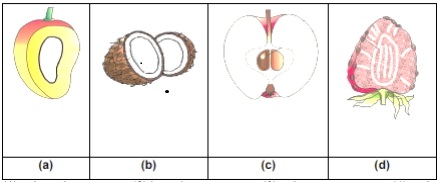
A
$a, b, c, d$
B
$b, c, d$
C
$a, b$
D
$c, d$
Solution
(D) In most plants,the fruit develops only from the ovary,and other floral parts degenerate. Such fruits are called true fruits.
However,in some species,such as apple,strawberry,and cashew,the thalamus also contributes to fruit formation. Such fruits are called false fruits.
In the given image:
$(a)$ Mango is a true fruit.
$(b)$ Coconut is a true fruit.
$(c)$ Apple is a false fruit (thalamus contributes to fruit formation).
$(d)$ Strawberry is a false fruit (thalamus contributes to fruit formation).
Therefore,$(c)$ and $(d)$ are false fruits.
However,in some species,such as apple,strawberry,and cashew,the thalamus also contributes to fruit formation. Such fruits are called false fruits.
In the given image:
$(a)$ Mango is a true fruit.
$(b)$ Coconut is a true fruit.
$(c)$ Apple is a false fruit (thalamus contributes to fruit formation).
$(d)$ Strawberry is a false fruit (thalamus contributes to fruit formation).
Therefore,$(c)$ and $(d)$ are false fruits.
0 likesView Solution
84
BiologyMediumMCQAIIMS · 2019
Which of the following labels in the given diagram of an ovule is incorrect?
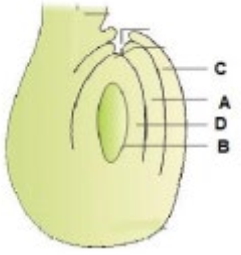
A
$D$ - Inner integument
B
$B$ - Embryo sac
C
$C$ - Outer integument
D
$A$ - Inner integument
Solution
(A) In the provided diagram of an anatropous ovule:
$C$ represents the outer integument.
$A$ represents the inner integument.
$D$ represents the nucellus (the central mass of tissue).
$B$ represents the embryo sac.
Therefore,the statement '$D$ - Inner integument' is incorrect because $D$ points to the nucellus,while $A$ points to the inner integument.
$C$ represents the outer integument.
$A$ represents the inner integument.
$D$ represents the nucellus (the central mass of tissue).
$B$ represents the embryo sac.
Therefore,the statement '$D$ - Inner integument' is incorrect because $D$ points to the nucellus,while $A$ points to the inner integument.
0 likesView Solution
85
BiologyMediumMCQAIIMS · 2019
Which statement is correct for apomixis?
A
Without fertilisation diploid embryo forms
B
With fertilisation diploid embryo forms
C
Without fertilisation haploid embryo cell form embryo
D
With fertilisation haploid embryo cell form embryo
Solution
(A) Apomixis is a form of asexual reproduction that mimics sexual reproduction. In this process,seeds are produced without fertilization. Specifically,a diploid embryo is formed from the diploid egg cell or other diploid cells of the embryo sac without undergoing meiosis or fertilization.
0 likesView Solution
86
BiologyMediumMCQAIIMS · 2019
Match the following plants/drugs with their correct descriptions:
| $(a)$ | Poppy plant | $(i)$ | Cannabis |
| $(b)$ | Cannabis plant | (ii) | Diacetyl morphine |
| $(c)$ | Datura plant | (iii) | Hallucination |
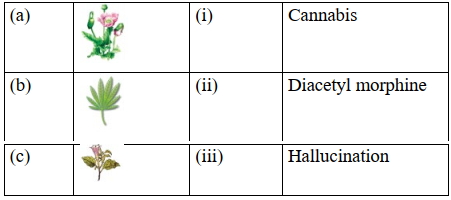
A
$(a)-i, (b)-ii, (c)-iii$
B
$(a)-ii, (b)-i, (c)-iii$
C
$(a)-iii, (b)-ii, (c)-i$
D
$(a)-i, (b)-iii, (c)-ii$
Solution
(B) The correct matching is as follows:
$(a)$ Poppy plant: This plant is the source of morphine,which is chemically processed to form Diacetyl morphine (Heroin). Thus,$(a)-(ii)$.
$(b)$ Cannabis plant: This plant is the source of cannabinoids like marijuana,hashish,charas,and ganja. Thus,$(b)-(i)$.
$(c)$ Datura plant: This plant is well-known for its hallucinogenic properties. Thus,$(c)-(iii)$.
Therefore,the correct sequence is $(a)-ii, (b)-i, (c)-iii$,which corresponds to option $(B)$.
$(a)$ Poppy plant: This plant is the source of morphine,which is chemically processed to form Diacetyl morphine (Heroin). Thus,$(a)-(ii)$.
$(b)$ Cannabis plant: This plant is the source of cannabinoids like marijuana,hashish,charas,and ganja. Thus,$(b)-(i)$.
$(c)$ Datura plant: This plant is well-known for its hallucinogenic properties. Thus,$(c)-(iii)$.
Therefore,the correct sequence is $(a)-ii, (b)-i, (c)-iii$,which corresponds to option $(B)$.
0 likesView Solution
87
BiologyEasyMCQAIIMS · 2019
Identify the correct label and its function based on the provided diagram of the human male reproductive system.
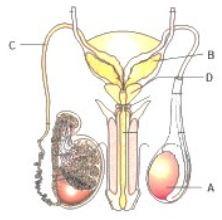
A
$(A)$ Testis - contains $250$ testicular lobules.
B
$(B)$ Seminal vesicle - stores sperms.
C
$(C)$ Vas deferens - helps in the transport of sperms.
D
$(D)$ Prostate gland - secretes seminal fluid.
Solution
(C) The correct option is $(C).$
In the given diagram:
$A$ represents the Testis,which contains about $250$ testicular lobules.
$B$ represents the Urinary bladder (not the seminal vesicle).
$C$ represents the Vas deferens,which transports sperms from the epididymis towards the urethra.
$D$ represents the Seminal vesicle.
Therefore,the statement '$C$ - Vas deferens - helps in the transport of sperms' is scientifically correct.
In the given diagram:
$A$ represents the Testis,which contains about $250$ testicular lobules.
$B$ represents the Urinary bladder (not the seminal vesicle).
$C$ represents the Vas deferens,which transports sperms from the epididymis towards the urethra.
$D$ represents the Seminal vesicle.
Therefore,the statement '$C$ - Vas deferens - helps in the transport of sperms' is scientifically correct.
0 likesView Solution
88
BiologyMediumMCQAIIMS · 2019
Choose the correct statement.
A
Filariasis occurs by $Trichoderma$.
B
Housefly is the vector of amoebiasis.
C
$Culex$ acts as vector for malaria.
D
Ascariasis occurs by droplet infection.
Solution
(B) Amoebiasis, also known as amoebic dysentery, is characterized by abdominal pain and diarrhea. It is caused by the protozoan $Entamoeba$ $\text{histolytica}$. Houseflies act as mechanical vectors, transferring the parasite from feces of infected persons to food and food products, thereby contaminating them.
0 likesView Solution
89
BiologyEasyMCQAIIMS · 2019
Select the correct option regarding the genetic code of Glycine.
A
$GUU, GUC, GUA$
B
$GAU, GAC, GAA$
C
$GGU, GGA, GGC$
D
$GGU, GGA, GCU$
Solution
(C) The amino acid Glycine is encoded by four codons in the genetic code: $GGU, GGC, GGA,$ and $GGG$.
Comparing this with the given options,option $C$ contains three of these codons $(GGU, GGA, GGC)$,making it the correct choice.
Comparing this with the given options,option $C$ contains three of these codons $(GGU, GGA, GGC)$,making it the correct choice.
0 likesView Solution
90
BiologyEasyMCQAIIMS · 2019
Virus-free plants can be generated through-
A
Meristem culture
B
Somatic hybridisation
C
Callus culture
D
Micropropagation
Solution
(A) Virus-free plants can be obtained through $Meristem$ culture.
Even if a plant is infected with a virus, the $Meristem$ (apical and axillary) remains free of the virus because the virus cannot replicate in these rapidly dividing cells.
By isolating and culturing the $Meristem$ in vitro, we can produce healthy, virus-free clones of the parent plant.
Even if a plant is infected with a virus, the $Meristem$ (apical and axillary) remains free of the virus because the virus cannot replicate in these rapidly dividing cells.
By isolating and culturing the $Meristem$ in vitro, we can produce healthy, virus-free clones of the parent plant.
0 likesView Solution
91
BiologyMediumMCQAIIMS · 2019
What are the requirements in tissue culture?
A
Hormones like auxin,cytokinin,agar-agar
B
Inorganic salt,vitamin,amino acid only
C
Carbon source like sucrose only
D
All of these
Solution
(D) Tissue culture is a technique of growing plant cells,tissues,or organs in a sterile,artificial nutrient medium under controlled laboratory conditions.
To support the growth and development of the explant,the culture medium must contain essential nutrients.
These requirements include:
$1$. Inorganic salts (macro and micronutrients).
$2$. Carbon sources (e.g.,sucrose).
$3$. Vitamins and amino acids.
$4$. Growth regulators (phytohormones) such as auxins and cytokinins.
$5$. Solidifying agents like agar-agar (if a solid medium is required).
Since all the options listed are essential components of the culture medium,the correct answer is $D$.
To support the growth and development of the explant,the culture medium must contain essential nutrients.
These requirements include:
$1$. Inorganic salts (macro and micronutrients).
$2$. Carbon sources (e.g.,sucrose).
$3$. Vitamins and amino acids.
$4$. Growth regulators (phytohormones) such as auxins and cytokinins.
$5$. Solidifying agents like agar-agar (if a solid medium is required).
Since all the options listed are essential components of the culture medium,the correct answer is $D$.
0 likesView Solution
92
BiologyMediumMCQAIIMS · 2019
$mRNA$ is formed by
A
Translation
B
Transcription
C
Duplication
D
Capping
Solution
(B) The messenger $RNA$ or $mRNA$ is synthesized by the process of transcription. In this process,the genetic information from $DNA$ is copied into $mRNA$.
0 likesView Solution
93
BiologyMediumMCQAIIMS · 2019
The process of removal of anther from the flower bud before it dehisces is called as
A
Emasculation
B
Bagging
C
Embryo rescue
D
Budding
Solution
(A) Emasculation is a technique used in plant breeding to prevent self-pollination.
In this process,the anthers are removed from the bisexual flower bud using a pair of forceps before they dehisce (release pollen).
This ensures that the stigma of the flower is only pollinated by the desired pollen grains from a selected male parent.
In this process,the anthers are removed from the bisexual flower bud using a pair of forceps before they dehisce (release pollen).
This ensures that the stigma of the flower is only pollinated by the desired pollen grains from a selected male parent.
0 likesView Solution
94
BiologyEasyMCQAIIMS · 2019
Which of the following is a sex-linked character?
A
White color blindness
B
Red-green color blindness
C
Night blindness
D
Sickle cell anaemia
Solution
(B) Red-green color blindness is a well-known $X$-linked recessive disorder.
In this condition,the gene responsible for the trait is located on the $X$ chromosome.
Females have two $X$ chromosomes $(XX)$,so they only express the trait if they are homozygous recessive $(X^cX^c)$.
Males have only one $X$ chromosome $(XY)$,so if they inherit the defective allele $(X^c)$,they will express the condition.
Therefore,red-green color blindness is a classic example of a sex-linked trait.
In this condition,the gene responsible for the trait is located on the $X$ chromosome.
Females have two $X$ chromosomes $(XX)$,so they only express the trait if they are homozygous recessive $(X^cX^c)$.
Males have only one $X$ chromosome $(XY)$,so if they inherit the defective allele $(X^c)$,they will express the condition.
Therefore,red-green color blindness is a classic example of a sex-linked trait.
0 likesView Solution
95
BiologyMediumMCQAIIMS · 2019
Select the correct match.
| Column $I$ $\&$ $II$ | Column $III$ |
|---|---|
| $a. (+, -)$ | $P. \text{Amensalism}$ |
| $b. (-, -)$ | $Q. \text{Commensalism}$ |
| $c. (-, 0)$ | $R. \text{Predation}$ |
| $d. (+, 0)$ | $S. \text{Competition}$ |
A
$a-R, b-S, c-P, d-Q$
B
$a-S, b-R, c-Q, d-P$
C
$a-R, b-P, c-S, d-Q$
D
$a-Q, b-S, c-P, d-R$
Solution
(A) The correct match is based on the interaction types between two species:
$1$. Predation $(a)$: One species benefits $(+)$ and the other is harmed $(-)$. So, $a-R$.
$2$. Competition $(b)$: Both species are harmed $(-, -)$. So, $b-S$.
$3$. Amensalism $(c)$: One species is harmed $(-)$ and the other is unaffected $(0)$. So, $c-P$.
$4$. Commensalism $(d)$: One species benefits $(+)$ and the other is unaffected $(0)$. So, $d-Q$.
Therefore, the correct sequence is $a-R, b-S, c-P, d-Q$.
$1$. Predation $(a)$: One species benefits $(+)$ and the other is harmed $(-)$. So, $a-R$.
$2$. Competition $(b)$: Both species are harmed $(-, -)$. So, $b-S$.
$3$. Amensalism $(c)$: One species is harmed $(-)$ and the other is unaffected $(0)$. So, $c-P$.
$4$. Commensalism $(d)$: One species benefits $(+)$ and the other is unaffected $(0)$. So, $d-Q$.
Therefore, the correct sequence is $a-R, b-S, c-P, d-Q$.
0 likesView Solution
96
BiologyEasyMCQAIIMS · 2019
Black rot of mustard is caused by
A
Colletotrichum falcatum
B
Xanthomonas oryzae
C
Xanthomonas campestris
D
Phytophthora infestans
Solution
(C) The black rot of mustard is caused by the bacterium $Xanthomonas \ campestris$.
In this disease,the leaves turn yellow and develop $V$-shaped necrotic lesions.
The causative organism can remain present in the plant residues for around $1-2$ years.
In this disease,the leaves turn yellow and develop $V$-shaped necrotic lesions.
The causative organism can remain present in the plant residues for around $1-2$ years.
0 likesView Solution
97
BiologyEasyMCQAIIMS · 2019
Match the following:
| Column-$I$ | Column-$II$ |
|---|---|
| $(a)$ Ranthambore National Park | $(i)$ Assam |
| $(b)$ Kaziranga National Park | $(ii)$ Rajasthan |
| $(c)$ Jim Corbett National Park | $(iii)$ Odisha |
| $(d)$ Nandankanan Zoological Park | $(iv)$ Uttarakhand |
A
$a-i, b-ii, c-iii, d-iv$
B
$a-ii, b-iii, c-iv, d-i$
C
$a-ii, b-i, c-iv, d-iii$
D
$a-iii, b-ii, c-i, d-iv$
Solution
(C) The correct matching is as follows:
$(a)$ Ranthambore National Park is located in Rajasthan $(ii)$.
$(b)$ Kaziranga National Park is located in Assam $(i)$.
$(c)$ Jim Corbett National Park is located in Uttarakhand $(iv)$.
$(d)$ Nandankanan Zoological Park is located in Odisha $(iii)$.
Therefore,the correct sequence is $a-ii, b-i, c-iv, d-iii$,which corresponds to option $(C)$.
$(a)$ Ranthambore National Park is located in Rajasthan $(ii)$.
$(b)$ Kaziranga National Park is located in Assam $(i)$.
$(c)$ Jim Corbett National Park is located in Uttarakhand $(iv)$.
$(d)$ Nandankanan Zoological Park is located in Odisha $(iii)$.
Therefore,the correct sequence is $a-ii, b-i, c-iv, d-iii$,which corresponds to option $(C)$.
0 likesView Solution
98
BiologyMediumMCQAIIMS · 2019
Identify $a, b$ and $c$ based on the provided image of the transcription process.
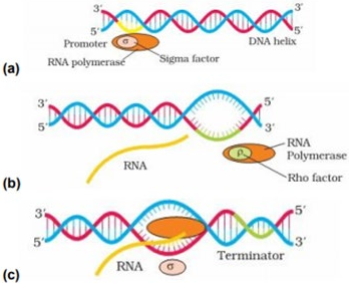
A
$(a)$ Elongation, $(b)$ Termination, $(c)$ Initiation
B
$(a)$ Initiation, $(b)$ Termination, $(c)$ Elongation
C
$(a)$ Initiation, $(b)$ Elongation, $(c)$ Termination
D
$(a)$ Termination, $(b)$ Elongation, $(c)$ Initiation
Solution
(C) The process of transcription in bacteria occurs in three stages: initiation, elongation, and termination.
$1$. In stage $(a)$, the $RNA$ polymerase enzyme binds to the promoter region with the help of the sigma factor $(\sigma)$, marking the initiation of transcription.
$2$. In stage $(b)$, the $RNA$ polymerase moves along the $DNA$ template, facilitating the elongation of the $RNA$ chain.
$3$. In stage $(c)$, the $RNA$ polymerase reaches the terminator region, where the rho factor $(\rho)$ helps in the termination of transcription and the release of the nascent $RNA$ strand.
$1$. In stage $(a)$, the $RNA$ polymerase enzyme binds to the promoter region with the help of the sigma factor $(\sigma)$, marking the initiation of transcription.
$2$. In stage $(b)$, the $RNA$ polymerase moves along the $DNA$ template, facilitating the elongation of the $RNA$ chain.
$3$. In stage $(c)$, the $RNA$ polymerase reaches the terminator region, where the rho factor $(\rho)$ helps in the termination of transcription and the release of the nascent $RNA$ strand.
0 likesView Solution
99
BiologyMediumMCQAIIMS · 2019
Plasmid of which bacterium was first time used in recombinant $DNA$ technology?
A
$E. coli$
B
$Salmonella typhimurium$
C
$Haemophilus influenzae$
D
$Streptococcus pneumoniae$
Solution
(B) plasmid is an extrachromosomal,self-replicating circular $DNA$ molecule found in bacteria.
In $1972$,Stanley Cohen and Herbert Boyer constructed the first recombinant $DNA$ molecule.
They achieved this by linking an antibiotic resistance gene with a native plasmid isolated from the bacterium $Salmonella typhimurium$.
In $1972$,Stanley Cohen and Herbert Boyer constructed the first recombinant $DNA$ molecule.
They achieved this by linking an antibiotic resistance gene with a native plasmid isolated from the bacterium $Salmonella typhimurium$.
0 likesView Solution
100
BiologyEasyMCQAIIMS · 2019
Identify the correct label from the given diagram of the female reproductive system.
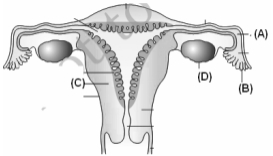
A
$(A)$ Ampulla - Site of blastocyst implantation
B
$(B)$ Fimbriae - Collect ova
C
$(C)$ Myometrium - Shed during menstrual bleeding
D
$(D)$ Ovary - Secrete $HCG$
Solution
(B) In the provided diagram of the female reproductive system:
- $(A)$ represents the Ampulla,which is the site of fertilization,not implantation.
- $(B)$ represents the Fimbriae,which are finger-like projections at the end of the fallopian tube that collect the ovum after ovulation.
- $(C)$ represents the Endometrium,not the Myometrium. The Endometrium is the layer that sheds during menstrual bleeding.
- $(D)$ represents the Ovary,which produces ova and steroid hormones,not $HCG$ (which is secreted by the placenta).
Therefore,the correct statement is that Fimbriae collect ova.
- $(A)$ represents the Ampulla,which is the site of fertilization,not implantation.
- $(B)$ represents the Fimbriae,which are finger-like projections at the end of the fallopian tube that collect the ovum after ovulation.
- $(C)$ represents the Endometrium,not the Myometrium. The Endometrium is the layer that sheds during menstrual bleeding.
- $(D)$ represents the Ovary,which produces ova and steroid hormones,not $HCG$ (which is secreted by the placenta).
Therefore,the correct statement is that Fimbriae collect ova.
0 likesView Solution
Vedclass Products
For Students
Vedclass Test Series
Mock tests in real AIIMS style covering Biology with performance analysis. 5-day free trial.
Start Free TrialFor Teachers
Exam Paper Generator
Generate Set A/B/C/D Biology papers from 7.5L+ questions in 2 minutes. 3 chapters free.
Try FreeFor Institutes
Online Exam Module
Run live AIIMS mock exams with unlimited students, 360° analytics & white-label branding.
See DemoFrequently Asked Questions
How many Biology questions are in AIIMS 2019?
There are 159 Biology questions from the AIIMS 2019 paper on Vedclass, each with a detailed step-by-step solution in English.
Are AIIMS 2019 Biology solutions available in English?
Yes. All solutions on this page are in English. You can also switch to English or Hindi using the language buttons above the questions.
Can I practice AIIMS 2019 Biology as a timed test?
Yes. Use the Vedclass Test Series to attempt a full AIIMS mock test covering Biology with time limits and instant score analysis.
Can teachers create Biology papers from AIIMS previous year questions?
Yes. The Vedclass Exam Paper Generator lets teachers mix AIIMS Biology questions and generate Set A/B/C/D papers in minutes.
For Teachers & Institutes
Build a Custom Biology Paper
Pick AIIMS 2019 Biology questions, set difficulty, and generate Set A/B/C/D in 2 minutes.