
BiologyQ1–60 of 60 questions
Page 1 of 1 · English
1
BiologyMediumMCQAIIMS · 2013
Which pair of the following belongs to basidiomycetes?
A
Puffballs and Claviceps
B
Peziza and stink horns
C
Morchella and mushrooms
D
Birds nest fungi and puffballs
Solution
(D) $Cyathus$ is known as bird's nest fungi,and $Lycoperdon$ is called puffballs. Both these fungi belong to the group of club fungi or basidiomycetes.
These fungi produce spores inside club-shaped fruit bodies called basidium.
Typically,a basidium has $4$ basidiospores produced exogenously.
$Peziza$,$Morchella$,and $Claviceps$ belong to ascomycetes (which produce ascospores in ascocarps).
Mushrooms are also basidiomycetes,but the pair in option $D$ consists entirely of basidiomycetes.
These fungi produce spores inside club-shaped fruit bodies called basidium.
Typically,a basidium has $4$ basidiospores produced exogenously.
$Peziza$,$Morchella$,and $Claviceps$ belong to ascomycetes (which produce ascospores in ascocarps).
Mushrooms are also basidiomycetes,but the pair in option $D$ consists entirely of basidiomycetes.
0 likesView Solution
2
BiologyMediumMCQAIIMS · 2013
Which one of the following statements in regard to the excretion by the human kidneys is correct?
A
Descending limb of loop of Henle is impermeable to water.
B
Distal convoluted tubule is incapable of reabsorbing $HCO_3^-$.
C
Nearly $99$ percent of the glomerular filtrate is reabsorbed by the renal tubules.
D
Ascending limb of loop of Henle is impermeable to electrolytes.
Solution
(C) : Urine formation involves three main processes namely,glomerular filtration,reabsorption,and secretion,which take place in different parts of the nephron.
$A$ comparison of the volume of the filtrate formed per day ($180$ litres per day) with that of the urine released ($1.5$ litres) suggests that nearly $99$ percent of the filtrate is reabsorbed by the renal tubules.
The descending limb of the loop of Henle is permeable to water but almost impermeable to electrolytes.
The ascending limb is impermeable to water but allows the transport of electrolytes actively or passively.
Conditional reabsorption of $Na^+$ and water takes place in the distal convoluted tubule $(DCT)$. It is also capable of reabsorption of $HCO_3^-$.
$A$ comparison of the volume of the filtrate formed per day ($180$ litres per day) with that of the urine released ($1.5$ litres) suggests that nearly $99$ percent of the filtrate is reabsorbed by the renal tubules.
The descending limb of the loop of Henle is permeable to water but almost impermeable to electrolytes.
The ascending limb is impermeable to water but allows the transport of electrolytes actively or passively.
Conditional reabsorption of $Na^+$ and water takes place in the distal convoluted tubule $(DCT)$. It is also capable of reabsorption of $HCO_3^-$.
0 likesView Solution
3
BiologyMediumMCQAIIMS · 2013
Which of the following is less general in characters as compared to genus?
A
Species
B
Division
C
Class
D
Family
Solution
(A) In the taxonomic hierarchy,the categories are arranged from the highest (most general) to the lowest (most specific) level: Kingdom > Phylum/Division > Class > Order > Family > Genus > Species.
As we move from higher to lower categories,the number of shared characters increases,meaning the group becomes 'less general' and 'more specific'.
Since 'Species' is the lowest taxonomic category,it possesses the most specific characters and is the least general compared to all other categories,including 'Genus'.
As we move from higher to lower categories,the number of shared characters increases,meaning the group becomes 'less general' and 'more specific'.
Since 'Species' is the lowest taxonomic category,it possesses the most specific characters and is the least general compared to all other categories,including 'Genus'.
0 likesView Solution
4
BiologyMediumMCQAIIMS · 2013
Assertion : Taxon and category are different things.
Reason : Category shows hierarchical classification.
Reason : Category shows hierarchical classification.
A
If both Assertion and Reason are correct and the Reason is a correct explanation of the Assertion.
B
If both Assertion and Reason are correct but Reason is not a correct explanation of the Assertion.
C
If the Assertion is correct but Reason is incorrect.
D
If both the Assertion and Reason are incorrect.
Solution
(A) category is a rank or level in the hierarchical classification of organisms.
Taxon is a unit in classification which represents a group of organisms based on certain common characteristics.
While a category represents a specific rank (e.g.,Kingdom,Phylum,Class),a taxon represents the actual biological group assigned to that rank (e.g.,$Angiospermae$ is a taxon,while Class is a category).
Therefore,taxon and category are distinct concepts,and the reason correctly describes the nature of a category.
Taxon is a unit in classification which represents a group of organisms based on certain common characteristics.
While a category represents a specific rank (e.g.,Kingdom,Phylum,Class),a taxon represents the actual biological group assigned to that rank (e.g.,$Angiospermae$ is a taxon,while Class is a category).
Therefore,taxon and category are distinct concepts,and the reason correctly describes the nature of a category.
0 likesView Solution
5
BiologyMediumMCQAIIMS · 2013
Choose the correct names of the different bacteria according to their shapes.
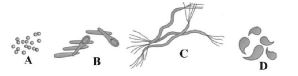
A
$A -$ Cocci,$B -$ Bacilli,$C -$ Spirilla,$D -$ Vibrio
B
$A -$ Bacilli,$B -$ Cocci,$C -$ Spirilla,$D -$ Vibrio
C
$A -$ Spirilla,$B -$ Bacilli,$C -$ Cocci,$D -$ Vibrio
D
$A -$ Spirilla,$B -$ Vibrio,$C -$ Cocci,$D -$ Bacilli
Solution
(A) Bacteria are grouped into four categories based on their shape:
$1$. $A$ represents spherical bacteria,known as Cocci.
$2$. $B$ represents rod-shaped bacteria,known as Bacilli.
$3$. $C$ represents spiral-shaped bacteria,known as Spirilla.
$4$. $D$ represents comma-shaped bacteria,known as Vibrio.
Therefore,the correct sequence is $A -$ Cocci,$B -$ Bacilli,$C -$ Spirilla,$D -$ Vibrio.
$1$. $A$ represents spherical bacteria,known as Cocci.
$2$. $B$ represents rod-shaped bacteria,known as Bacilli.
$3$. $C$ represents spiral-shaped bacteria,known as Spirilla.
$4$. $D$ represents comma-shaped bacteria,known as Vibrio.
Therefore,the correct sequence is $A -$ Cocci,$B -$ Bacilli,$C -$ Spirilla,$D -$ Vibrio.
0 likesView Solution
6
BiologyEasyMCQAIIMS · 2013
Coralloid roots of $Cycas$ are distinguished from angiosperm roots by
A
absence of pith
B
having xylem tissue
C
absence of algal zone
D
presence of algal zone
Solution
(D) In $Cycas$,coralloid roots are bluish-green in color and contain blue-green algae (cyanobacteria like $Anabaena$ or $Nostoc$) within their cortical region.
This specific feature,known as the algal zone,is unique to the coralloid roots of $Cycas$ and is absent in the roots of angiosperms.
This specific feature,known as the algal zone,is unique to the coralloid roots of $Cycas$ and is absent in the roots of angiosperms.
0 likesView Solution
7
BiologyMediumMCQAIIMS · 2013
Given are the four matches of phyla with their characteristic cells:
$A$. Coelenterata - Nematocytes
$B$. Porifera - Choanocytes
$C$. Ctenophora - Solenocytes
$D$. Platyhelminthes - Nephrocytes
Mark the option that has both correct matches.
$A$. Coelenterata - Nematocytes
$B$. Porifera - Choanocytes
$C$. Ctenophora - Solenocytes
$D$. Platyhelminthes - Nephrocytes
Mark the option that has both correct matches.
A
$A$ and $B$
B
$B$ and $C$
C
$C$ and $D$
D
$B$ and $D$
Solution
(A) Let us analyze the given matches:
$1$. $A$. Coelenterata - Nematocytes: This is correct. Nematocytes (or cnidoblasts) are characteristic cells found in the phylum Coelenterata (Cnidaria) used for anchorage,defense,and capturing prey.
$2$. $B$. Porifera - Choanocytes: This is correct. Choanocytes (collar cells) line the spongocoel and canals in sponges (phylum Porifera) and are responsible for water current generation.
$3$. $C$. Ctenophora - Solenocytes: This is incorrect. Ctenophores possess colloblasts (lasso cells) for prey capture. Solenocytes (flame cells) are typically associated with Platyhelminthes for excretion.
$4$. $D$. Platyhelminthes - Nephrocytes: This is incorrect. Platyhelminthes use flame cells (protonephridia) for excretion and osmoregulation.
Therefore,matches $A$ and $B$ are correct.
$1$. $A$. Coelenterata - Nematocytes: This is correct. Nematocytes (or cnidoblasts) are characteristic cells found in the phylum Coelenterata (Cnidaria) used for anchorage,defense,and capturing prey.
$2$. $B$. Porifera - Choanocytes: This is correct. Choanocytes (collar cells) line the spongocoel and canals in sponges (phylum Porifera) and are responsible for water current generation.
$3$. $C$. Ctenophora - Solenocytes: This is incorrect. Ctenophores possess colloblasts (lasso cells) for prey capture. Solenocytes (flame cells) are typically associated with Platyhelminthes for excretion.
$4$. $D$. Platyhelminthes - Nephrocytes: This is incorrect. Platyhelminthes use flame cells (protonephridia) for excretion and osmoregulation.
Therefore,matches $A$ and $B$ are correct.
0 likesView Solution
8
BiologyDifficultMCQAIIMS · 2013
Which of the following are not characteristic features of $Fabaceae$?
A
Tap root system,compound leaves and raceme inflorescence
B
Flowers actinomorphic,twisted aestivation and gamopetalous
C
Stamens $10$,introrse,basifixed,dithecous
D
Monocarpellary,ovary superior and bent stigma
Solution
(B) The family $Fabaceae$ is characterized by the following features:
$1$. Root system: Tap root with root nodules.
$2$. Leaves: Alternate,pinnately compound,stipulate,with pulvinus leaf base.
$3$. Inflorescence: Usually racemose.
$4$. Flowers: Zygomorphic,bisexual,papilionaceous corolla (vexillary aestivation).
$5$. Androecium: $10$ stamens,usually diadelphous $(9+1)$,dithecous,introrse.
$6$. Gynoecium: Monocarpellary,ovary superior,unilocular with many ovules,style single.
Option $B$ is incorrect because $Fabaceae$ flowers are zygomorphic (not actinomorphic),have vexillary aestivation (not twisted),and are polypetalous (not gamopetalous). Therefore,these are not characteristic features of $Fabaceae$.
$1$. Root system: Tap root with root nodules.
$2$. Leaves: Alternate,pinnately compound,stipulate,with pulvinus leaf base.
$3$. Inflorescence: Usually racemose.
$4$. Flowers: Zygomorphic,bisexual,papilionaceous corolla (vexillary aestivation).
$5$. Androecium: $10$ stamens,usually diadelphous $(9+1)$,dithecous,introrse.
$6$. Gynoecium: Monocarpellary,ovary superior,unilocular with many ovules,style single.
Option $B$ is incorrect because $Fabaceae$ flowers are zygomorphic (not actinomorphic),have vexillary aestivation (not twisted),and are polypetalous (not gamopetalous). Therefore,these are not characteristic features of $Fabaceae$.
0 likesView Solution
9
BiologyMediumMCQAIIMS · 2013
Which of the following statement$(s)$ is/are true?
$(A)$ Uneven thickening of cell wall is characteristic of sclerenchyma.
$(B)$ Periblem forms cortex of the stem and the root.
$(C)$ Tracheids are the chief water transporting elements in gymnosperms.
$(D)$ Companion cell is devoid of nucleus at maturity.
$(E)$ The commercial cork is obtained from $Quercus$ $suber$.
$(A)$ Uneven thickening of cell wall is characteristic of sclerenchyma.
$(B)$ Periblem forms cortex of the stem and the root.
$(C)$ Tracheids are the chief water transporting elements in gymnosperms.
$(D)$ Companion cell is devoid of nucleus at maturity.
$(E)$ The commercial cork is obtained from $Quercus$ $suber$.
A
$B, C$ and $E$ only
B
$A, B$ and $C$ only
C
$B, D$ and $E$ only
D
$A, C$ and $E$ only
Solution
(A) Let us analyze each statement:
$(A)$ Incorrect: Uneven thickening of the cell wall is a characteristic feature of collenchyma,not sclerenchyma.
$(B)$ Correct: According to the histogen theory,the periblem gives rise to the cortex of the stem and root.
$(C)$ Correct: Tracheids are the primary water-conducting elements in gymnosperms,as vessels are generally absent.
$(D)$ Incorrect: Companion cells possess a nucleus at maturity; it is the sieve tube elements that are devoid of a nucleus at maturity.
$(E)$ Correct: Commercial cork is obtained from the bark of the oak tree known as $Quercus$ $suber$.
Therefore,statements $(B), (C),$ and $(E)$ are true.
$(A)$ Incorrect: Uneven thickening of the cell wall is a characteristic feature of collenchyma,not sclerenchyma.
$(B)$ Correct: According to the histogen theory,the periblem gives rise to the cortex of the stem and root.
$(C)$ Correct: Tracheids are the primary water-conducting elements in gymnosperms,as vessels are generally absent.
$(D)$ Incorrect: Companion cells possess a nucleus at maturity; it is the sieve tube elements that are devoid of a nucleus at maturity.
$(E)$ Correct: Commercial cork is obtained from the bark of the oak tree known as $Quercus$ $suber$.
Therefore,statements $(B), (C),$ and $(E)$ are true.
0 likesView Solution
10
BiologyMediumMCQAIIMS · 2013
Assertion: In the stem,the pericycle takes an active part in secondary growth.
Reason: In dicots,the pericycle has the capacity to produce lateral roots.
Reason: In dicots,the pericycle has the capacity to produce lateral roots.
A
If both Assertion and Reason are correct and the Reason is a correct explanation of the Assertion.
B
If both Assertion and Reason are correct but Reason is not a correct explanation of the Assertion.
C
If the Assertion is correct but Reason is incorrect.
D
If both the Assertion and Reason are incorrect.
Solution
(D) The Assertion is incorrect because,in the stems of dicotyledonous plants,the pericycle generally does not participate in secondary growth; secondary growth is primarily driven by the vascular cambium and cork cambium.
The Reason is correct because the pericycle in dicot roots is indeed responsible for the initiation of lateral roots.
Therefore,the Assertion is incorrect,but the Reason is correct.
The Reason is correct because the pericycle in dicot roots is indeed responsible for the initiation of lateral roots.
Therefore,the Assertion is incorrect,but the Reason is correct.
0 likesView Solution
11
BiologyMediumMCQAIIMS · 2013
Which of the following types of cell junctions is not found in animal tissues?
A
Adhering junction
B
Tight junction
C
Gap junction
D
Plasmodesmata
Solution
(D) Cell junctions are specialized structures that provide structural and functional links between cells.
In animal tissues,three main types of cell junctions are found: $1$. Tight junctions,which prevent substances from leaking across a tissue; $2$. Adhering junctions,which perform cementing to keep neighboring cells together; and $3$. Gap junctions,which facilitate communication between cells by connecting the cytoplasm of adjacent cells.
Plasmodesmata are microscopic channels that traverse the cell walls of plant cells and some algal cells,enabling transport and communication between them. They are not found in animal cells because animal cells lack cell walls.
In animal tissues,three main types of cell junctions are found: $1$. Tight junctions,which prevent substances from leaking across a tissue; $2$. Adhering junctions,which perform cementing to keep neighboring cells together; and $3$. Gap junctions,which facilitate communication between cells by connecting the cytoplasm of adjacent cells.
Plasmodesmata are microscopic channels that traverse the cell walls of plant cells and some algal cells,enabling transport and communication between them. They are not found in animal cells because animal cells lack cell walls.
0 likesView Solution
12
BiologyMediumMCQAIIMS · 2013
Choose the incorrect match.
A
Nucleus $—$ $RNA$
B
Lysosome $—$ Protein synthesis
C
Mitochondria $—$ Respiration
D
Cytoskeleton $—$ Microtubules
Solution
(B) Protein synthesis occurs in ribosomes,which are attached to the surface of the endoplasmic reticulum by ribophorin-$I$ and ribophorin-$II$.
Lysosomes contain about $50$ different types of hydrolytic enzymes,including proteases,nucleases,glycosidases,lipases,phospholipases,phosphatases,and sulphatases.
These enzymes are acid hydrolases and are optimally active at $pH$ $5.0$.
Therefore,the match 'Lysosome $—$ Protein synthesis' is incorrect because lysosomes are involved in intracellular digestion,not protein synthesis.
Lysosomes contain about $50$ different types of hydrolytic enzymes,including proteases,nucleases,glycosidases,lipases,phospholipases,phosphatases,and sulphatases.
These enzymes are acid hydrolases and are optimally active at $pH$ $5.0$.
Therefore,the match 'Lysosome $—$ Protein synthesis' is incorrect because lysosomes are involved in intracellular digestion,not protein synthesis.
0 likesView Solution
13
BiologyEasyMCQAIIMS · 2013
Which of the following types of enzymes is not matched correctly with the molecule that it breaks down?
A
Amylase-starch
B
Lipase-starch
C
Protease-proteins
D
Disaccharidase-sugars
Solution
(B) Lipases are enzymes that catalyze the hydrolysis of fats (lipids) into fatty acids and glycerol. Amylase breaks down starch into sugars. Protease breaks down proteins into amino acids. Disaccharidase breaks down disaccharides into monosaccharides. Therefore,the pairing of Lipase with starch is incorrect.
0 likesView Solution
14
BiologyMediumMCQAIIMS · 2013
The diagram illustrates energy changes in an enzyme-controlled reaction. Which of the following represents the lowering of the activation energy?
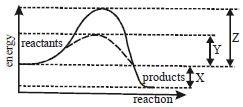
A
$X$
B
$Y$
C
$Z$
D
$Z - Y$
Solution
(D) The energy required to initiate a reaction is known as the activation energy,$E_a$.
The solid curve represents the uncatalysed reaction with an activation energy of $Z$.
The dashed curve represents the enzyme-catalysed reaction with a lower activation energy of $Y$.
Therefore,the reduction or lowering of the activation energy due to the presence of an enzyme is given by the difference between the two,which is $(Z - Y)$.
The solid curve represents the uncatalysed reaction with an activation energy of $Z$.
The dashed curve represents the enzyme-catalysed reaction with a lower activation energy of $Y$.
Therefore,the reduction or lowering of the activation energy due to the presence of an enzyme is given by the difference between the two,which is $(Z - Y)$.
0 likesView Solution
15
BiologyMediumMCQAIIMS · 2013
Assertion: Coenzymes serve as co-factors in a number of different enzyme-catalyzed reactions.
Reason: Coenzymes and prosthetic groups are cofactors.
Reason: Coenzymes and prosthetic groups are cofactors.
A
If both Assertion and Reason are correct and the Reason is a correct explanation of the Assertion.
B
If both Assertion and Reason are correct but Reason is not a correct explanation of the Assertion.
C
If the Assertion is correct but Reason is incorrect.
D
If both the Assertion and Reason are incorrect.
Solution
(A) Cofactors are non-protein components that are essential for the catalytic activity of enzymes. They can be classified into three types: prosthetic groups,coenzymes,and metal ions.
Prosthetic groups are organic compounds that are tightly bound to the apoenzyme.
Coenzymes are also organic compounds,but their association with the apoenzyme is only transient,usually occurring during the course of catalysis.
Both coenzymes and prosthetic groups are indeed types of cofactors. Therefore,the assertion is correct,and the reason is also correct. Furthermore,the reason provides the classification context that explains why coenzymes are considered cofactors.
Prosthetic groups are organic compounds that are tightly bound to the apoenzyme.
Coenzymes are also organic compounds,but their association with the apoenzyme is only transient,usually occurring during the course of catalysis.
Both coenzymes and prosthetic groups are indeed types of cofactors. Therefore,the assertion is correct,and the reason is also correct. Furthermore,the reason provides the classification context that explains why coenzymes are considered cofactors.
0 likesView Solution
16
BiologyMediumMCQAIIMS · 2013
Which stage of meiosis involves the separation of the centromere?
A
metaphase $I$
B
metaphase $II$
C
anaphase $I$
D
anaphase $II$
Solution
(D) In meiosis,the process is divided into two stages: meiosis $I$ and meiosis $II$.
During anaphase $I$ of meiosis $I$,homologous chromosomes separate,but the sister chromatids remain attached at their centromeres.
During anaphase $II$ of meiosis $II$,the centromere of each chromosome splits,allowing the sister chromatids to separate and move toward opposite poles of the cell.
Therefore,the separation of the centromere occurs during anaphase $II$.
During anaphase $I$ of meiosis $I$,homologous chromosomes separate,but the sister chromatids remain attached at their centromeres.
During anaphase $II$ of meiosis $II$,the centromere of each chromosome splits,allowing the sister chromatids to separate and move toward opposite poles of the cell.
Therefore,the separation of the centromere occurs during anaphase $II$.
0 likesView Solution
17
BiologyMediumMCQAIIMS · 2013
Assertion : During zygotene,chromosomes show bivalent stage.
Reason : Bivalent is half the number of chromosomes.
Reason : Bivalent is half the number of chromosomes.
A
If both Assertion and Reason are correct and the Reason is a correct explanation of the Assertion.
B
If both Assertion and Reason are correct but Reason is not a correct explanation of the Assertion.
C
If the Assertion is correct but Reason is incorrect.
D
If both the Assertion and Reason are incorrect.
Solution
(A) During the zygotene stage of Prophase-$I$ of meiosis,homologous chromosomes undergo pairing,a process known as synapsis.
Each pair of homologous chromosomes is referred to as a bivalent or a tetrad.
Because the homologous chromosomes pair up,the number of observable units (bivalents) is half the original diploid number of chromosomes $(2n)$.
Therefore,the Assertion is correct as chromosomes appear as bivalents,and the Reason is also correct as it accurately describes the numerical reduction of observable chromosomal units during this stage.
Each pair of homologous chromosomes is referred to as a bivalent or a tetrad.
Because the homologous chromosomes pair up,the number of observable units (bivalents) is half the original diploid number of chromosomes $(2n)$.
Therefore,the Assertion is correct as chromosomes appear as bivalents,and the Reason is also correct as it accurately describes the numerical reduction of observable chromosomal units during this stage.
0 likesView Solution
18
BiologyMediumMCQAIIMS · 2013
Water potential of pure water and its solution are
A
$0$ and $1$
B
$0$ and $0$
C
$0$ and more than one
D
$0$ and less than $0$
Solution
(D) The water potential of pure water at standard temperature and pressure is defined as $0$.
When solutes are added to pure water,the solution becomes more stable and the kinetic energy of water molecules decreases,which results in a decrease in water potential.
Therefore,the water potential of a solution is always negative (less than $0$).
When solutes are added to pure water,the solution becomes more stable and the kinetic energy of water molecules decreases,which results in a decrease in water potential.
Therefore,the water potential of a solution is always negative (less than $0$).
0 likesView Solution
19
BiologyMediumMCQAIIMS · 2013
Assertion : Upward movement of water is called ascent of sap.
Reason : Upward movement of water occurs through xylem and phloem.
Reason : Upward movement of water occurs through xylem and phloem.
A
If both Assertion and Reason are correct and the Reason is a correct explanation of the Assertion.
B
If both Assertion and Reason are correct but Reason is not a correct explanation of the Assertion.
C
If the Assertion is correct but Reason is incorrect.
D
If both the Assertion and Reason are incorrect.
Solution
(C) Sap is water containing dissolved minerals and organic solutes.
The upward movement of water from the roots towards the tips of stem branches and leaves is known as the ascent of sap.
This process occurs exclusively through the tracheary elements (tracheids and vessels) of the $Xylem$.
$Phloem$ is responsible for the translocation of food (sugars) from leaves to other parts of the plant,not for the upward movement of water.
Therefore,the Assertion is correct,but the Reason is incorrect.
The upward movement of water from the roots towards the tips of stem branches and leaves is known as the ascent of sap.
This process occurs exclusively through the tracheary elements (tracheids and vessels) of the $Xylem$.
$Phloem$ is responsible for the translocation of food (sugars) from leaves to other parts of the plant,not for the upward movement of water.
Therefore,the Assertion is correct,but the Reason is incorrect.
0 likesView Solution
20
BiologyMediumMCQAIIMS · 2013
Match Column-$I$ and Column-$II$ and choose the correct option given below the columns.
| Column-$I$ (Element) | Column-$II$ (Function) |
|---|---|
| $A$. Calcium | $I$. Required for ionic balance |
| $B$. Boron | $II$. Essential for constitution of nucleic acid |
| $C$. Phosphorus | $III$. Required for absorption of calcium |
| $D$. Chlorine | $IV$. Required to activate respiratory enzyme |
| $E$. Manganese | $V$. Required for synthesis of mitotic spindle |
A
$A-I, B-II, C-III, D-IV, E-V$
B
$A-V, B-IV, C-III, D-II, E-I$
C
$A-IV, B-I, C-V, D-III, E-II$
D
$A-V, B-III, C-II, D-I, E-IV$
Solution
(D) The correct matches are as follows:
$1$. Calcium $(A)$ is required for the synthesis of the mitotic spindle $(V)$.
$2$. Boron $(B)$ is required for the uptake and utilization of calcium $(III)$.
$3$. Phosphorus $(C)$ is an essential constituent of nucleic acids,cell membranes,and $ATP$ $(II)$.
$4$. Chlorine $(D)$ plays a crucial role in maintaining the ionic balance of cells $(I)$.
$5$. Manganese $(E)$ is required to activate various respiratory enzymes,including those involved in the Krebs cycle $(IV)$.
Therefore,the correct matching is $A-V, B-III, C-II, D-I, E-IV$.
$1$. Calcium $(A)$ is required for the synthesis of the mitotic spindle $(V)$.
$2$. Boron $(B)$ is required for the uptake and utilization of calcium $(III)$.
$3$. Phosphorus $(C)$ is an essential constituent of nucleic acids,cell membranes,and $ATP$ $(II)$.
$4$. Chlorine $(D)$ plays a crucial role in maintaining the ionic balance of cells $(I)$.
$5$. Manganese $(E)$ is required to activate various respiratory enzymes,including those involved in the Krebs cycle $(IV)$.
Therefore,the correct matching is $A-V, B-III, C-II, D-I, E-IV$.
0 likesView Solution
21
BiologyMediumMCQAIIMS · 2013
Which one does not differ between a $C_3$ and a $C_4$ plant?
$I.$ Initial $CO_2$ acceptor.
$II.$ Extent of photorespiration.
$III.$ Enzyme catalyzing reaction that fixes $CO_2$.
$IV.$ Presence of Calvin cycle.
$V.$ Leaf anatomy.
$I.$ Initial $CO_2$ acceptor.
$II.$ Extent of photorespiration.
$III.$ Enzyme catalyzing reaction that fixes $CO_2$.
$IV.$ Presence of Calvin cycle.
$V.$ Leaf anatomy.
A
$I$ and $V$
B
$IV$
C
$II$ and $III$
D
$II$
Solution
(B) To determine which factor does not differ between $C_3$ and $C_4$ plants,let us analyze each point:
$I.$ Initial $CO_2$ acceptor: In $C_3$ plants,it is $RuBP$,while in $C_4$ plants,it is $PEP$. They differ.
$II.$ Extent of photorespiration: $C_3$ plants show high photorespiration,whereas $C_4$ plants show negligible or no photorespiration. They differ.
$III.$ Enzyme catalyzing $CO_2$ fixation: $C_3$ plants use $RuBisCO$,while $C_4$ plants use $PEP$ carboxylase for initial fixation. They differ.
$IV.$ Presence of Calvin cycle: Both $C_3$ and $C_4$ plants perform the Calvin cycle to synthesize sugars. They do not differ.
$V.$ Leaf anatomy: $C_4$ plants exhibit Kranz anatomy,which is absent in $C_3$ plants. They differ.
Therefore,only $IV$ is common to both.
$I.$ Initial $CO_2$ acceptor: In $C_3$ plants,it is $RuBP$,while in $C_4$ plants,it is $PEP$. They differ.
$II.$ Extent of photorespiration: $C_3$ plants show high photorespiration,whereas $C_4$ plants show negligible or no photorespiration. They differ.
$III.$ Enzyme catalyzing $CO_2$ fixation: $C_3$ plants use $RuBisCO$,while $C_4$ plants use $PEP$ carboxylase for initial fixation. They differ.
$IV.$ Presence of Calvin cycle: Both $C_3$ and $C_4$ plants perform the Calvin cycle to synthesize sugars. They do not differ.
$V.$ Leaf anatomy: $C_4$ plants exhibit Kranz anatomy,which is absent in $C_3$ plants. They differ.
Therefore,only $IV$ is common to both.
0 likesView Solution
22
BiologyMediumMCQAIIMS · 2013
Assertion : Each molecule of ribulose $-1, 5-$ bisphosphate fixes one molecule of $CO_2$.
Reason : Three molecules of $NADPH$ and two $ATP$ are required for fixation of one molecule of $CO_2$.
Reason : Three molecules of $NADPH$ and two $ATP$ are required for fixation of one molecule of $CO_2$.
A
If both Assertion and Reason are correct and the Reason is a correct explanation of the Assertion.
B
If both Assertion and Reason are correct but Reason is not a correct explanation of the Assertion.
C
If the Assertion is correct but Reason is incorrect.
D
If both the Assertion and Reason are incorrect.
Solution
(C) Each molecule of ribulose $-1, 5-$ bisphosphate $(RuBP)$ fixes one molecule of carbon dioxide $(CO_2)$ during the carboxylation step of the Calvin cycle,resulting in the formation of two molecules of $3-$phosphoglyceric acid $(3-PGA)$.
The fixation and reduction of one molecule of $CO_2$ requires three molecules of $ATP$ and two molecules of $NADPH$ (for the reduction phase and regeneration of $RuBP$).
Therefore,the Assertion is correct,but the Reason states the requirement as three $NADPH$ and two $ATP$,which is the reverse of the actual requirement (two $NADPH$ and three $ATP$). Thus,the Reason is incorrect.
The fixation and reduction of one molecule of $CO_2$ requires three molecules of $ATP$ and two molecules of $NADPH$ (for the reduction phase and regeneration of $RuBP$).
Therefore,the Assertion is correct,but the Reason states the requirement as three $NADPH$ and two $ATP$,which is the reverse of the actual requirement (two $NADPH$ and three $ATP$). Thus,the Reason is incorrect.
0 likesView Solution
23
BiologyMediumMCQAIIMS · 2013
Assertion : The inner membrane of mitochondria contains systems involving electron transport.
Reason : The mitochondrial matrix contains enzymes of Kreb's cycle.
Reason : The mitochondrial matrix contains enzymes of Kreb's cycle.
A
If both Assertion and Reason are correct and the Reason is a correct explanation of the Assertion.
B
If both Assertion and Reason are correct but Reason is not a correct explanation of the Assertion.
C
If the Assertion is correct but Reason is incorrect.
D
If both the Assertion and Reason are incorrect.
Solution
(B) The inner mitochondrial membrane contains the electron transport system $(ETS)$ and $ATP$ synthase,which are essential for oxidative phosphorylation.
The mitochondrial matrix contains the enzymes required for the $Kreb's$ cycle (citric acid cycle) and fatty acid oxidation.
Both statements are scientifically correct,but the presence of $Kreb's$ cycle enzymes in the matrix does not explain why the electron transport system is located in the inner membrane. Therefore,the Reason is not the correct explanation for the Assertion.
The mitochondrial matrix contains the enzymes required for the $Kreb's$ cycle (citric acid cycle) and fatty acid oxidation.
Both statements are scientifically correct,but the presence of $Kreb's$ cycle enzymes in the matrix does not explain why the electron transport system is located in the inner membrane. Therefore,the Reason is not the correct explanation for the Assertion.
0 likesView Solution
24
BiologyMediumMCQAIIMS · 2013
Assertion: Dark period plays a more important part in flowering than the light period.
Reason: Flowering occurs in short-day plants if the dark period is interrupted by a light break.
Reason: Flowering occurs in short-day plants if the dark period is interrupted by a light break.
A
If both Assertion and Reason are correct and the Reason is a correct explanation of the Assertion.
B
If both Assertion and Reason are correct but Reason is not a correct explanation of the Assertion.
C
If the Assertion is correct but Reason is incorrect.
D
If both the Assertion and Reason are incorrect.
Solution
(C) It has been demonstrated that flowering in plants is more of a response to the dark period than to the light period.
In short-day plants $(SDP)$,the plants can flower in complete darkness if supplied with exogenous nutrients.
Flowering is inhibited in $SDP$ if the dark period,which is essential for flowering,is interrupted by a flash of light.
Therefore,the Reason is incorrect because a light break during the dark period prevents flowering in short-day plants,rather than inducing it.
In short-day plants $(SDP)$,the plants can flower in complete darkness if supplied with exogenous nutrients.
Flowering is inhibited in $SDP$ if the dark period,which is essential for flowering,is interrupted by a flash of light.
Therefore,the Reason is incorrect because a light break during the dark period prevents flowering in short-day plants,rather than inducing it.
0 likesView Solution
25
BiologyDifficultMCQAIIMS · 2013
The presence of $CO_2$ in blood will lower $pH$ because $CO_2$ combines with . . . . . . ,with the rate of reaction increased by . . . . . . .
A
$H_2O$ to form $H^+$ and $HCO_3^-$,carbonic anhydrase
B
$H_2O$ to form only $HCO_3^-$,carbonic anhydrase
C
$H_2O$ to form only $H^+$,carbonic ions
D
$H^+$ to form $HCO_3^-$,oxyhaemoglobin
Solution
(A) Carbon dioxide $(CO_2)$ reacts with water $(H_2O)$ in the blood to form carbonic acid $(H_2CO_3)$,which then dissociates into hydrogen ions $(H^+)$ and bicarbonate ions $(HCO_3^-)$.
This reaction is significantly accelerated by the enzyme carbonic anhydrase,which is present in high concentrations within red blood cells.
The increase in $H^+$ concentration leads to a decrease in the $pH$ of the blood.
This reaction is significantly accelerated by the enzyme carbonic anhydrase,which is present in high concentrations within red blood cells.
The increase in $H^+$ concentration leads to a decrease in the $pH$ of the blood.
0 likesView Solution
26
BiologyMediumMCQAIIMS · 2013
Which of the following statements are wrong?
$(i)$ Leucocytes disintegrate in the spleen and liver.
$(ii)$ $RBC$,$WBC$ and blood platelets are produced by bone marrow.
$(iii)$ Neutrophils bring about destruction and detoxification of toxins of protein origin.
$(iv)$ The important function of lymphocytes is to produce antibodies.
$(i)$ Leucocytes disintegrate in the spleen and liver.
$(ii)$ $RBC$,$WBC$ and blood platelets are produced by bone marrow.
$(iii)$ Neutrophils bring about destruction and detoxification of toxins of protein origin.
$(iv)$ The important function of lymphocytes is to produce antibodies.
A
$(i)$ and $(ii)$ only
B
$(i)$ and $(iv)$ only
C
$(i)$ and $(iii)$ only
D
$(ii)$ and $(iii)$ only
Solution
(C) Statement $(i)$ is wrong because erythrocytes (RBCs),not leucocytes (WBCs),disintegrate in the spleen and liver (the 'graveyard' of RBCs).
Statement $(ii)$ is correct as all formed elements ($RBC$,$WBC$,and platelets) are produced in the bone marrow.
Statement $(iii)$ is wrong because eosinophils,not neutrophils,are responsible for the destruction and detoxification of toxins of protein origin and are associated with allergic reactions.
Statement $(iv)$ is correct as lymphocytes are responsible for the immune response by producing antibodies.
Therefore,statements $(i)$ and $(iii)$ are incorrect.
Statement $(ii)$ is correct as all formed elements ($RBC$,$WBC$,and platelets) are produced in the bone marrow.
Statement $(iii)$ is wrong because eosinophils,not neutrophils,are responsible for the destruction and detoxification of toxins of protein origin and are associated with allergic reactions.
Statement $(iv)$ is correct as lymphocytes are responsible for the immune response by producing antibodies.
Therefore,statements $(i)$ and $(iii)$ are incorrect.
0 likesView Solution
27
BiologyMediumMCQAIIMS · 2013
Given below is the $ECG$ of a normal human. Which one of its components is correctly interpreted below?
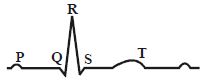
A
Peak $P$ and Peak $R$ together - systolic and diastolic blood pressures
B
Peak $P -$ Initiation of left atrial contraction only
C
Complex $QRS -$ One complete pulse
D
Peak $T -$ Initiation of total cardiac contraction
Solution
(C) The $P$-wave represents the electrical excitation (or depolarization) of the atria,which leads to the contraction of both the atria.
The $QRS$ complex represents the depolarization of the ventricles,which initiates the ventricular contraction. The contraction starts shortly after $Q$ and marks the beginning of the systole.
The $T$-wave represents the return of the ventricles from an excited to a normal state (repolarization). The end of the $T$-wave marks the end of systole.
Therefore,the $QRS$ complex corresponds to the depolarization of the ventricles,which initiates ventricular contraction,effectively representing one complete pulse or heartbeat cycle in terms of electrical activity.
The $QRS$ complex represents the depolarization of the ventricles,which initiates the ventricular contraction. The contraction starts shortly after $Q$ and marks the beginning of the systole.
The $T$-wave represents the return of the ventricles from an excited to a normal state (repolarization). The end of the $T$-wave marks the end of systole.
Therefore,the $QRS$ complex corresponds to the depolarization of the ventricles,which initiates ventricular contraction,effectively representing one complete pulse or heartbeat cycle in terms of electrical activity.
0 likesView Solution
28
BiologyMediumMCQAIIMS · 2013
Assertion : Blood is coloured in the insects.
Reason : Insect blood has no role in $O_2$ transport.
Reason : Insect blood has no role in $O_2$ transport.
A
If both Assertion and Reason are correct and the Reason is a correct explanation of the Assertion.
B
If both Assertion and Reason are correct but Reason is not a correct explanation of the Assertion.
C
If the Assertion is correct but Reason is incorrect.
D
If both the Assertion and Reason are incorrect.
Solution
(D) The blood of insects,known as hemolymph,is colourless because it lacks respiratory pigments like hemoglobin. Therefore,the Assertion is incorrect. The Reason is correct because insect blood does not transport $O_2$; instead,insects utilize a tracheal system for gas exchange,where air is delivered directly to tissues via tracheae.
0 likesView Solution
29
BiologyEasyMCQAIIMS · 2013
Assertion : Main constituent of human urine is ammonia.
Reason : If human urine is allowed to stand for some time,it smells strongly of ammonia.
Reason : If human urine is allowed to stand for some time,it smells strongly of ammonia.
A
If both Assertion and Reason are correct and the Reason is a correct explanation of the Assertion.
B
If both Assertion and Reason are correct but Reason is not a correct explanation of the Assertion.
C
If the Assertion is correct but Reason is incorrect.
D
If both the Assertion and Reason are incorrect.
Solution
(D) The main nitrogenous waste product in human urine is $Urea$,not $Ammonia$.
Therefore,the Assertion is incorrect.
However,when urine is left to stand,bacteria decompose the $Urea$ present in the urine,leading to the production of $Ammonia$,which causes a strong pungent smell.
Thus,the Reason is correct.
Therefore,the Assertion is incorrect.
However,when urine is left to stand,bacteria decompose the $Urea$ present in the urine,leading to the production of $Ammonia$,which causes a strong pungent smell.
Thus,the Reason is correct.
0 likesView Solution
30
BiologyEasyMCQAIIMS · 2013
Assertion : Arthritis or inflammation of a joint makes the joint painful.
Reason : Some toxic substances are deposited at the joint.
Reason : Some toxic substances are deposited at the joint.
A
If both Assertion and Reason are correct and the Reason is a correct explanation of the Assertion.
B
If both Assertion and Reason are correct but Reason is not a correct explanation of the Assertion.
C
If the Assertion is correct but Reason is incorrect.
D
If both the Assertion and Reason are incorrect.
Solution
(A) Arthritis is defined as the inflammation of a joint,which causes pain and stiffness,often leading to restricted movement.
This condition can be caused by various factors,including the reduction of synovial fluid,the ossification of articular cartilage,or the deposition of metabolic waste products like uric acid crystals within the joint cavity.
Since the deposition of such substances (like uric acid) is a known cause of joint inflammation and pain,the Reason correctly explains the Assertion.
This condition can be caused by various factors,including the reduction of synovial fluid,the ossification of articular cartilage,or the deposition of metabolic waste products like uric acid crystals within the joint cavity.
Since the deposition of such substances (like uric acid) is a known cause of joint inflammation and pain,the Reason correctly explains the Assertion.
0 likesView Solution
31
BiologyMediumMCQAIIMS · 2013
Neurons receive signals through their . . . . . . and send signals to other neurons through their . . . . . . .
A
dendrites ... receptors
B
end feet ... cell bodies and dendrites
C
cell bodies and dendrites ... axons
D
transmitter vesicles ... axons
Solution
(C) Neurons are the structural and functional units of the neural system.
$1$. Dendrites are short,branched processes that receive signals from other neurons and conduct them toward the cell body $(cyton)$.
$2$. The axon is a long fiber that conducts nerve impulses away from the cell body to the synapse,where they are transmitted to other neurons or effector cells.
Therefore,the correct answer is $C$.
$1$. Dendrites are short,branched processes that receive signals from other neurons and conduct them toward the cell body $(cyton)$.
$2$. The axon is a long fiber that conducts nerve impulses away from the cell body to the synapse,where they are transmitted to other neurons or effector cells.
Therefore,the correct answer is $C$.
0 likesView Solution
32
BiologyMediumMCQAIIMS · 2013
Assertion : The chemical stored in the synaptic vesicles are termed as neurotransmitters.
Reason : Synaptic vesicles release these chemicals in the synaptic cleft.
Reason : Synaptic vesicles release these chemicals in the synaptic cleft.
A
If both Assertion and Reason are correct and the Reason is a correct explanation of the Assertion.
B
If both Assertion and Reason are correct but Reason is not a correct explanation of the Assertion.
C
If the Assertion is correct but Reason is incorrect.
D
If both the Assertion and Reason are incorrect.
Solution
(A) The axon terminal of the neuron contains many membrane-bound vesicles called synaptic vesicles in its cytoplasm.
Within these vesicles,chemical substances such as adrenaline and acetylcholine remain stored.
These chemicals are called neurotransmitters because they help to transmit nerve impulses across the synapses.
When a nerve impulse reaches the axon terminal,its synaptic vesicles release their stored chemicals into the synaptic cleft.
These chemicals diffuse through the cleft to reach the membrane of the next neuron,stimulating it.
This process allows the nerve impulse to be transmitted to the next neuron.
Since the reason explains why these chemicals are stored and how they function in the synaptic cleft,both statements are correct and the reason is the correct explanation of the assertion.
Within these vesicles,chemical substances such as adrenaline and acetylcholine remain stored.
These chemicals are called neurotransmitters because they help to transmit nerve impulses across the synapses.
When a nerve impulse reaches the axon terminal,its synaptic vesicles release their stored chemicals into the synaptic cleft.
These chemicals diffuse through the cleft to reach the membrane of the next neuron,stimulating it.
This process allows the nerve impulse to be transmitted to the next neuron.
Since the reason explains why these chemicals are stored and how they function in the synaptic cleft,both statements are correct and the reason is the correct explanation of the assertion.
0 likesView Solution
33
BiologyMediumMCQAIIMS · 2013
Which of the following hormones have antagonistic (opposing) effects?
A
Thyroxine and calcitonin
B
Insulin and glucagon
C
Growth hormone and epinephrine
D
$ACTH$ and glucocorticoids
Solution
(B) Insulin is a hormone secreted by the beta cells of the pancreas that lowers blood glucose levels by facilitating the uptake of glucose into cells.
Conversely,glucagon is a hormone secreted by the alpha cells of the pancreas that raises blood glucose levels by stimulating glycogenolysis and gluconeogenesis in the liver.
Therefore,insulin and glucagon have antagonistic effects on blood sugar regulation.
Conversely,glucagon is a hormone secreted by the alpha cells of the pancreas that raises blood glucose levels by stimulating glycogenolysis and gluconeogenesis in the liver.
Therefore,insulin and glucagon have antagonistic effects on blood sugar regulation.
0 likesView Solution
34
BiologyMediumMCQAIIMS · 2013
Three children in a family have blood types $O$,$AB$ and $B$ respectively. What are the genotypes of their parents?
A
$I^A i$ and $I^B i$
B
$I^A I^B$ and $i i$
C
$I^B I^B$ and $I^A I^A$
D
$I^A I^A$ and $I^B i$
Solution
(A) To have a child with blood type $O$ (genotype $ii$),both parents must contribute an $i$ allele. Therefore,both parents must be heterozygous.
To have a child with blood type $AB$ (genotype $I^A I^B$),one parent must contribute $I^A$ and the other must contribute $I^B$.
To have a child with blood type $B$ (genotype $I^B i$ or $I^B I^B$),the parents must possess the $I^B$ allele.
Combining these requirements,the parents must have genotypes $I^A i$ and $I^B i$.
- Parent $1$ $(I^A i)$ can produce gametes $I^A$ and $i$.
- Parent $2$ $(I^B i)$ can produce gametes $I^B$ and $i$.
- Possible offspring genotypes: $I^A I^B$ (Type $AB$),$I^A i$ (Type $A$),$I^B i$ (Type $B$),and $ii$ (Type $O$).
Thus,the parents' genotypes are $I^A i$ and $I^B i$.
To have a child with blood type $AB$ (genotype $I^A I^B$),one parent must contribute $I^A$ and the other must contribute $I^B$.
To have a child with blood type $B$ (genotype $I^B i$ or $I^B I^B$),the parents must possess the $I^B$ allele.
Combining these requirements,the parents must have genotypes $I^A i$ and $I^B i$.
- Parent $1$ $(I^A i)$ can produce gametes $I^A$ and $i$.
- Parent $2$ $(I^B i)$ can produce gametes $I^B$ and $i$.
- Possible offspring genotypes: $I^A I^B$ (Type $AB$),$I^A i$ (Type $A$),$I^B i$ (Type $B$),and $ii$ (Type $O$).
Thus,the parents' genotypes are $I^A i$ and $I^B i$.
0 likesView Solution
35
BiologyMediumMCQAIIMS · 2013
What is common between vegetative reproduction and apomixis?
A
Both are applicable to only dicot plants
B
Both bypass the flowering phase
C
Both occur round the year
D
Both produce progeny identical to the parent
Solution
(D) Vegetative reproduction and apomixis are both forms of asexual reproduction.
In both processes,the offspring produced are genetically identical to the parent plant because no meiosis or fertilization occurs to create genetic variation.
Therefore,both methods result in the production of clones.
In both processes,the offspring produced are genetically identical to the parent plant because no meiosis or fertilization occurs to create genetic variation.
Therefore,both methods result in the production of clones.
0 likesView Solution
36
BiologyMediumMCQAIIMS · 2013
Emasculation is not required when flowers are
A
bisexual
B
intersexual
C
unisexual
D
either $(a)$ or $(b)$
Solution
(C) Emasculation is the process of removing anthers from a bisexual flower bud to prevent self-pollination.
In unisexual flowers,the plant already possesses separate male and female flowers.
Since the female flower does not contain stamens (male reproductive organs),there is no risk of self-pollination.
Therefore,emasculation is not required for unisexual flowers.
In unisexual flowers,the plant already possesses separate male and female flowers.
Since the female flower does not contain stamens (male reproductive organs),there is no risk of self-pollination.
Therefore,emasculation is not required for unisexual flowers.
0 likesView Solution
37
BiologyEasyMCQAIIMS · 2013
The correct sequence of spermatogenetic stages leading to the formation of sperms in a mature human testis is
A
spermatogonia $\rightarrow$ spermatid $\rightarrow$ spermatocyte $\rightarrow$ sperm
B
spermatocyte $\rightarrow$ spermatogonia $\rightarrow$ spermatid $\rightarrow$ sperm
C
spermatogonia $\rightarrow$ spermatocyte $\rightarrow$ spermatid $\rightarrow$ sperm
D
spermatid $\rightarrow$ spermatocyte $\rightarrow$ spermatogonia $\rightarrow$ sperm
Solution
(C) The process of spermatogenesis occurs in the following sequence:
$1$. Spermatogonia $(2n)$: These are the immature germ cells that undergo mitosis.
$2$. Primary Spermatocytes $(2n)$: Formed from spermatogonia,these undergo meiosis $I$ to form secondary spermatocytes $(n)$.
$3$. Spermatids $(n)$: Formed from secondary spermatocytes after meiosis $II$.
$4$. Spermatozoa (sperms): Formed from spermatids through the process of spermiogenesis.
Therefore,the correct sequence is: Spermatogonia $\rightarrow$ Spermatocyte $\rightarrow$ Spermatid $\rightarrow$ Sperm.
$1$. Spermatogonia $(2n)$: These are the immature germ cells that undergo mitosis.
$2$. Primary Spermatocytes $(2n)$: Formed from spermatogonia,these undergo meiosis $I$ to form secondary spermatocytes $(n)$.
$3$. Spermatids $(n)$: Formed from secondary spermatocytes after meiosis $II$.
$4$. Spermatozoa (sperms): Formed from spermatids through the process of spermiogenesis.
Therefore,the correct sequence is: Spermatogonia $\rightarrow$ Spermatocyte $\rightarrow$ Spermatid $\rightarrow$ Sperm.
0 likesView Solution
38
BiologyMediumMCQAIIMS · 2013
Progestasert and $LNG-20$ are
A
Implants
B
Copper releasing $IUDs$
C
Non-medicated $IUDs$
D
Hormone releasing $IUDs$
Solution
(D) Progestasert and $LNG-20$ are examples of hormone-releasing $IUDs$ (Intrauterine Devices).
These devices work by increasing the phagocytosis of sperm within the uterus and by altering the uterine environment to make it unsuitable for implantation.
Additionally,they make the cervix hostile to sperm,thereby preventing fertilization.
Therefore,the correct option is $D$.
These devices work by increasing the phagocytosis of sperm within the uterus and by altering the uterine environment to make it unsuitable for implantation.
Additionally,they make the cervix hostile to sperm,thereby preventing fertilization.
Therefore,the correct option is $D$.
0 likesView Solution
39
BiologyDifficultMCQAIIMS · 2013
Assertion : $DNA$ is associated with proteins.
Reason : $DNA$ binds around histone proteins that form a pool and the entire structure is called a nucleosome.
Reason : $DNA$ binds around histone proteins that form a pool and the entire structure is called a nucleosome.
A
If both Assertion and Reason are correct and the Reason is a correct explanation of the Assertion.
B
If both Assertion and Reason are correct but Reason is not a correct explanation of the Assertion.
C
If the Assertion is correct but Reason is incorrect.
D
If both the Assertion and Reason are incorrect.
Solution
(C) The Assertion is correct because $DNA$ is negatively charged and is associated with positively charged basic proteins called histones.
The Reason is incorrect because the histone proteins form an octamer (a core of $8$ histone molecules: $2$ each of $H_2A, H_2B, H_3,$ and $H_4$),not a 'pool'. The $DNA$ wraps around this histone octamer to form a nucleosome.
The Reason is incorrect because the histone proteins form an octamer (a core of $8$ histone molecules: $2$ each of $H_2A, H_2B, H_3,$ and $H_4$),not a 'pool'. The $DNA$ wraps around this histone octamer to form a nucleosome.
0 likesView Solution
40
BiologyMediumMCQAIIMS · 2013
Thorn of Bougainvillea and tendril of Cucurbita are examples of
A
analogous organs
B
homologous organs
C
vestigial organs
D
retrogressive evolution
Solution
(B) Homologous organs are those that have the same fundamental structure and developmental origin but perform different functions.
Thorns of $Bougainvillea$ and tendrils of $Cucurbita$ both arise from axillary buds (same origin).
Thorns provide protection,while tendrils provide support for climbing (different functions).
Therefore,they are classic examples of homologous organs.
Thorns of $Bougainvillea$ and tendrils of $Cucurbita$ both arise from axillary buds (same origin).
Thorns provide protection,while tendrils provide support for climbing (different functions).
Therefore,they are classic examples of homologous organs.
0 likesView Solution
41
BiologyMediumMCQAIIMS · 2013
Which one of the following is a correct match?
A
Bhang $-$ Analgesic
B
Cocaine $-$ Opiate narcotics
C
Morphine $-$ Hallucinogen
D
Barbiturate $-$ Tranquiliser
Solution
(D) The correct match is $D$.
$1$. $Bhang$ is a cannabinoid,not an analgesic.
$2$. $Cocaine$ is a stimulant,not an opiate narcotic.
$3$. $Morphine$ is an opiate narcotic,not a hallucinogen.
$4$. $Barbiturates$ are drugs that act as central nervous system depressants and are commonly used as tranquilizers or sedatives.
$1$. $Bhang$ is a cannabinoid,not an analgesic.
$2$. $Cocaine$ is a stimulant,not an opiate narcotic.
$3$. $Morphine$ is an opiate narcotic,not a hallucinogen.
$4$. $Barbiturates$ are drugs that act as central nervous system depressants and are commonly used as tranquilizers or sedatives.
0 likesView Solution
42
BiologyMediumMCQAIIMS · 2013
Which of the following is an autoimmune disorder?
A
Myasthenia gravis
B
Osteoporosis
C
Muscular dystrophy
D
Gout
Solution
(A) An autoimmune disorder occurs when the immune system mistakenly attacks the body's own healthy cells.
$A$. Myasthenia gravis is a chronic autoimmune neuromuscular disease that causes weakness in the skeletal muscles.
$B$. Osteoporosis is a condition where bones become weak and brittle due to loss of tissue.
$C$. Muscular dystrophy is a group of genetic diseases that cause progressive weakness and loss of muscle mass.
$D$. Gout is a form of arthritis caused by the accumulation of uric acid crystals in the joints.
Therefore,the correct option is $A$.
$A$. Myasthenia gravis is a chronic autoimmune neuromuscular disease that causes weakness in the skeletal muscles.
$B$. Osteoporosis is a condition where bones become weak and brittle due to loss of tissue.
$C$. Muscular dystrophy is a group of genetic diseases that cause progressive weakness and loss of muscle mass.
$D$. Gout is a form of arthritis caused by the accumulation of uric acid crystals in the joints.
Therefore,the correct option is $A$.
0 likesView Solution
43
BiologyMediumMCQAIIMS · 2013
Assertion: The antibodies separated from serum are homogenous.
Reason: Monoclonal antibodies are homogenous immunological reagents.
Reason: Monoclonal antibodies are homogenous immunological reagents.
A
If both Assertion and Reason are correct and the Reason is a correct explanation of the Assertion.
B
If both Assertion and Reason are correct but Reason is not a correct explanation of the Assertion.
C
If the Assertion is correct but Reason is incorrect.
D
If both the Assertion and Reason are incorrect.
Solution
(D) Antibodies isolated from the serum of hyperimmunized animals are typically polyclonal,meaning they are heterogeneous because they are produced by multiple $B$-cell clones in response to an antigen.
Conversely,monoclonal antibodies $(Mabs)$ are produced by a single clone of hybridoma cells,making them homogeneous immunological reagents with defined specificity.
Since the antibodies separated from serum are generally heterogeneous,the Assertion is incorrect,while the Reason is correct.
Conversely,monoclonal antibodies $(Mabs)$ are produced by a single clone of hybridoma cells,making them homogeneous immunological reagents with defined specificity.
Since the antibodies separated from serum are generally heterogeneous,the Assertion is incorrect,while the Reason is correct.
0 likesView Solution
44
BiologyMediumMCQAIIMS · 2013
Assertion: Interferons are effective against viruses.
Reason: Proteins which can be synthesized only by genetic engineering are effective against viruses.
Reason: Proteins which can be synthesized only by genetic engineering are effective against viruses.
A
If both Assertion and Reason are correct and the Reason is a correct explanation of the Assertion.
B
If both Assertion and Reason are correct but Reason is not a correct explanation of the Assertion.
C
If the Assertion is correct but Reason is incorrect.
D
If both the Assertion and Reason are incorrect.
Solution
(C) Interferons are antiviral proteins produced by virus-infected cells. They protect non-infected cells from further viral infection by inhibiting viral protein synthesis.
While interferons can now be produced using genetic engineering,they are naturally synthesized by the body's cells in response to viral infections. Therefore,the claim that they can be synthesized 'only' by genetic engineering is false.
Thus,the Assertion is correct,but the Reason is incorrect.
While interferons can now be produced using genetic engineering,they are naturally synthesized by the body's cells in response to viral infections. Therefore,the claim that they can be synthesized 'only' by genetic engineering is false.
Thus,the Assertion is correct,but the Reason is incorrect.
0 likesView Solution
45
BiologyMediumMCQAIIMS · 2013
Assertion : Cattle breeds can be improved by superovulation and embryo transplantation.
Reason : Superovulation in high milk-yielding cows is induced by hormonal injection.
Reason : Superovulation in high milk-yielding cows is induced by hormonal injection.
A
If both Assertion and Reason are correct and the Reason is a correct explanation of the Assertion.
B
If both Assertion and Reason are correct but Reason is not a correct explanation of the Assertion.
C
If the Assertion is correct but Reason is incorrect.
D
If both the Assertion and Reason are incorrect.
Solution
(A) Cattle breeds can be improved by superovulation and embryo transfer technique,which is known as Multiple Ovulation Embryo Transfer Technology $(MOET)$.
In this method,a cow is administered hormones with $FSH$-like activity to induce superovulation.
Instead of one egg,which they normally yield per cycle,they produce $6-8$ eggs.
The animal is then mated with an elite bull or artificially inseminated.
The fertilized eggs at $8-32$ cell stages are removed non-surgically and transferred to surrogate mothers.
This allows the genetic mother to be available for another round of superovulation,thus improving the breed.
In this method,a cow is administered hormones with $FSH$-like activity to induce superovulation.
Instead of one egg,which they normally yield per cycle,they produce $6-8$ eggs.
The animal is then mated with an elite bull or artificially inseminated.
The fertilized eggs at $8-32$ cell stages are removed non-surgically and transferred to surrogate mothers.
This allows the genetic mother to be available for another round of superovulation,thus improving the breed.
0 likesView Solution
46
BiologyMediumMCQAIIMS · 2013
Assertion : In case of vegetatively propagated crops,pure-line selection is not required.
Reason : Hybrid vigour is mostly used in vegetatively propagated plants.
Reason : Hybrid vigour is mostly used in vegetatively propagated plants.
A
If both Assertion and Reason are correct and the Reason is a correct explanation of the Assertion.
B
If both Assertion and Reason are correct but Reason is not a correct explanation of the Assertion.
C
If the Assertion is correct but Reason is incorrect.
D
If both the Assertion and Reason are incorrect.
Solution
(A) In case of vegetatively propagated crops,pure-line selection is not required because these plants are clones and genetically identical.
Pure-line selection is a method used primarily for self-pollinating,sexually reproducing plants to isolate homozygous lines.
Hybrid vigour (heterosis) is indeed most profitably used in vegetatively propagated crops because the hybrid traits can be maintained indefinitely through vegetative propagation without the risk of segregation or loss of superiority that occurs in sexual reproduction.
Therefore,both the Assertion and the Reason are correct,and the Reason provides a valid explanation for why pure-line selection is unnecessary in these crops.
Pure-line selection is a method used primarily for self-pollinating,sexually reproducing plants to isolate homozygous lines.
Hybrid vigour (heterosis) is indeed most profitably used in vegetatively propagated crops because the hybrid traits can be maintained indefinitely through vegetative propagation without the risk of segregation or loss of superiority that occurs in sexual reproduction.
Therefore,both the Assertion and the Reason are correct,and the Reason provides a valid explanation for why pure-line selection is unnecessary in these crops.
0 likesView Solution
47
BiologyMediumMCQAIIMS · 2013
The Human Genome Project $(HGP)$ is closely associated with the rapid development of a new area in biology called:
A
biotechnology
B
bioinformatics
C
biogeography
D
bioscience
Solution
(B) The Human Genome Project $(HGP)$ is closely associated with the rapid development of a new area in biology called Bioinformatics.
Bioinformatics is a field that combines biology,computer science,and information technology.
It is essential for the storage,retrieval,and analysis of the enormous amount of genomic data generated by projects like the $HGP$.
Bioinformatics is a field that combines biology,computer science,and information technology.
It is essential for the storage,retrieval,and analysis of the enormous amount of genomic data generated by projects like the $HGP$.
0 likesView Solution
48
BiologyMediumMCQAIIMS · 2013
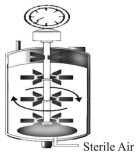
Identify the correct match for the given apparatus.
Apparatus $\to$ Function
Apparatus $\to$ Function
A
Gene gun $\to$ Vectorless direct gene transfer
B
Column chromatograph $\to$ Separation of chlorophyll pigments
C
Stirred tank bioreactor $\to$ Carry out fermentation process
D
Respirometer $\to$ Finding out rate of respiration
Solution
(C) The image provided shows a Stirred tank bioreactor.
$1$. $A$ Stirred tank bioreactor is a cylindrical vessel designed to provide optimal conditions for achieving the desired product by providing optimal growth conditions like temperature,pH,substrate,salts,vitamins,and oxygen.
$2$. It is primarily used to carry out large-scale fermentation processes to produce recombinant proteins or other biotechnological products.
$3$. While other options (Gene gun,Column chromatograph,Respirometer) describe valid scientific apparatus and their functions,the question asks to identify the match for the 'given apparatus' shown in the image,which is the Stirred tank bioreactor.
$1$. $A$ Stirred tank bioreactor is a cylindrical vessel designed to provide optimal conditions for achieving the desired product by providing optimal growth conditions like temperature,pH,substrate,salts,vitamins,and oxygen.
$2$. It is primarily used to carry out large-scale fermentation processes to produce recombinant proteins or other biotechnological products.
$3$. While other options (Gene gun,Column chromatograph,Respirometer) describe valid scientific apparatus and their functions,the question asks to identify the match for the 'given apparatus' shown in the image,which is the Stirred tank bioreactor.
0 likesView Solution
49
BiologyMediumMCQAIIMS · 2013
How many varieties of rice have been estimated to be present in India?
A
$2,000$
B
$20,000$
C
$200,000$
D
$2,000,000$
Solution
(C) India is known for its immense agricultural biodiversity.
It is estimated that there are approximately $200,000$ varieties of rice in India alone.
This diversity is a significant part of the country's rich biological heritage and is crucial for food security and breeding programs.
It is estimated that there are approximately $200,000$ varieties of rice in India alone.
This diversity is a significant part of the country's rich biological heritage and is crucial for food security and breeding programs.
0 likesView Solution
50
BiologyMediumMCQAIIMS · 2013
The scientific process by which crop plants are enriched with certain desirable nutrients is called
A
crop protection
B
breeding
C
bio-fortification
D
bio-remediation
Solution
(C) Bio-fortification is the scientific process of breeding crops to increase their nutritional value. This can be achieved through conventional selective breeding or through genetic engineering. The primary goal is to improve the public health status of populations by increasing the content of essential vitamins,minerals,and proteins in staple crops.
0 likesView Solution
51
BiologyMediumMCQAIIMS · 2013
The formula for exponential population growth is
A
$dN/rN = dt$
B
$rN / dN = dt$
C
$dN / dt = rN$
D
$dt / dN = rN$
Solution
(C) The formula for exponential population growth is $\frac{dN}{dt} = rN$.
Here,$\frac{dN}{dt}$ represents the rate of change in population size over time.
$r$ represents the intrinsic rate of natural increase (biotic potential).
$N$ represents the current population size.
Here,$\frac{dN}{dt}$ represents the rate of change in population size over time.
$r$ represents the intrinsic rate of natural increase (biotic potential).
$N$ represents the current population size.
0 likesView Solution
52
BiologyMediumMCQAIIMS · 2013
Assertion: In a sigmoid growth curve,the population finally stabilizes itself.
Reason: Finally,the death rate increases more than the birth rate.
Reason: Finally,the death rate increases more than the birth rate.
A
If both Assertion and Reason are correct and the Reason is a correct explanation of the Assertion.
B
If both Assertion and Reason are correct but Reason is not a correct explanation of the Assertion.
C
If the Assertion is correct but Reason is incorrect.
D
If both the Assertion and Reason are incorrect.
Solution
(C) In a sigmoid growth curve,the population growth rate eventually becomes stable as the population reaches the carrying capacity $(K)$ of the environment.
At this stage,the mortality rate (death rate) and natality rate (birth rate) become equal to each other.
Consequently,the population shows a zero growth rate because the birth rate equals the death rate,not because the death rate exceeds the birth rate.
Therefore,the Assertion is correct,but the Reason is incorrect.
At this stage,the mortality rate (death rate) and natality rate (birth rate) become equal to each other.
Consequently,the population shows a zero growth rate because the birth rate equals the death rate,not because the death rate exceeds the birth rate.
Therefore,the Assertion is correct,but the Reason is incorrect.
0 likesView Solution
53
BiologyEasyMCQAIIMS · 2013
Which one of the following is not a function of an ecosystem?
A
Energy flow
B
Decomposition
C
Productivity
D
Stratification
Solution
(D) The four important functional aspects of an ecosystem are:
$(i)$ Productivity
$(ii)$ Decomposition
$(iii)$ Energy flow
$(iv)$ Nutrient cycling
Stratification refers to the vertical distribution of different species occupying different levels in an ecosystem,which is a structural feature rather than a functional one.
$(i)$ Productivity
$(ii)$ Decomposition
$(iii)$ Energy flow
$(iv)$ Nutrient cycling
Stratification refers to the vertical distribution of different species occupying different levels in an ecosystem,which is a structural feature rather than a functional one.
0 likesView Solution
54
BiologyMediumMCQAIIMS · 2013
Assertion : Net primary productivity is gross primary productivity minus respiration.
Reason : Secondary productivity is produced by heterotrophs.
Reason : Secondary productivity is produced by heterotrophs.
A
If both Assertion and Reason are correct and the Reason is a correct explanation of the Assertion.
B
If both Assertion and Reason are correct but Reason is not a correct explanation of the Assertion.
C
If the Assertion is correct but Reason is incorrect.
D
If both the Assertion and Reason are incorrect.
Solution
(B) Net primary productivity $(NPP)$ is the rate of organic matter built up or stored by producers in their bodies per unit time and area. It is calculated as $NPP = GPP - R$,where $GPP$ is Gross Primary Productivity and $R$ is the energy lost due to respiration.
Secondary productivity is defined as the rate of formation of new organic matter by consumers (heterotrophs) per unit time and area.
Both statements are scientifically correct,but the Reason does not explain why $NPP$ is defined as $GPP$ minus respiration. Therefore,the correct option is $B$.
Secondary productivity is defined as the rate of formation of new organic matter by consumers (heterotrophs) per unit time and area.
Both statements are scientifically correct,but the Reason does not explain why $NPP$ is defined as $GPP$ minus respiration. Therefore,the correct option is $B$.
0 likesView Solution
55
BiologyMediumMCQAIIMS · 2013
Which of the following is considered a hot-spot of biodiversity in India?
A
Indo-Gangetic Plain
B
Eastern Ghats
C
Aravalli Hills
D
Western Ghats
Solution
(D) Biodiversity hot spots are regions that are exceptionally rich in biodiversity and are under significant threat due to human activities.
In India,there are three recognized biodiversity hot spots: the Western Ghats and Sri Lanka,the Himalayas,and the Indo-Burma region.
Among the given options,the Western Ghats are a globally recognized biodiversity hot spot characterized by high levels of endemism and habitat loss due to developmental activities.
In India,there are three recognized biodiversity hot spots: the Western Ghats and Sri Lanka,the Himalayas,and the Indo-Burma region.
Among the given options,the Western Ghats are a globally recognized biodiversity hot spot characterized by high levels of endemism and habitat loss due to developmental activities.
0 likesView Solution
56
BiologyMediumMCQAIIMS · 2013
Assertion: Tropical rain forests are disappearing fast from developing countries such as India.
Reason: No value is attached to these forests because these are poor in biodiversity.
Reason: No value is attached to these forests because these are poor in biodiversity.
A
If both Assertion and Reason are correct and the Reason is a correct explanation of the Assertion.
B
If both Assertion and Reason are correct but Reason is not a correct explanation of the Assertion.
C
If the Assertion is correct but Reason is incorrect.
D
If both the Assertion and Reason are incorrect.
Solution
(C) Tropical rain forests are located in the equatorial regions where the annual rainfall exceeds $140\, cm$.
They are also called jungles and cover one-twelfth of the Earth's surface but contain more than half of the Earth's flora and fauna,meaning they are extremely rich in biodiversity.
Therefore,the Reason provided is factually incorrect because these forests are actually very rich in biodiversity,not poor.
Nowadays,these forests are disappearing rapidly due to excessive deforestation for domestic purposes like fuel,furniture,accommodation,clothing,resin,gum,etc.
They are also called jungles and cover one-twelfth of the Earth's surface but contain more than half of the Earth's flora and fauna,meaning they are extremely rich in biodiversity.
Therefore,the Reason provided is factually incorrect because these forests are actually very rich in biodiversity,not poor.
Nowadays,these forests are disappearing rapidly due to excessive deforestation for domestic purposes like fuel,furniture,accommodation,clothing,resin,gum,etc.
0 likesView Solution
57
BiologyMediumMCQAIIMS · 2013
Which one of the following statements is true?
A
The greater the $BOD$ of waste water,more is its polluting potential.
B
The greater the $BOD$ of waste water,less is its polluting potential.
C
The lesser the $BOD$ of waste water,more is its polluting potential.
D
The lesser the $BOD$ of waste water,less is its polluting potential.
Solution
(A) $BOD$ stands for Biochemical Oxygen Demand.
It is a measure of the amount of dissolved oxygen required by aerobic microorganisms to decompose the organic matter present in a given volume of water.
If the $BOD$ of waste water is high,it indicates that there is a large amount of organic matter present,which requires more oxygen for decomposition.
Therefore,a higher $BOD$ value directly correlates with a higher polluting potential of the waste water.
It is a measure of the amount of dissolved oxygen required by aerobic microorganisms to decompose the organic matter present in a given volume of water.
If the $BOD$ of waste water is high,it indicates that there is a large amount of organic matter present,which requires more oxygen for decomposition.
Therefore,a higher $BOD$ value directly correlates with a higher polluting potential of the waste water.
0 likesView Solution
58
BiologyMediumMCQAIIMS · 2013
Which one of the following pairs is mismatched?
A
Fossil fuel burning - release of $CO_2$
B
Nuclear power - radioactive wastes
C
Solar energy - green house effect
D
Biomass burning - release of $CO_2$
Solution
(C) Solar energy reaching the Earth is not responsible for the greenhouse effect.
It is the increase in greenhouse gases in the atmosphere,such as $CO_2$,which is released by the complete combustion of fossil fuels or biomass in industries or transportation vehicles,that prevents the reradiation of infrared radiation from the Earth and results in an increase in the Earth's temperature.
It is the increase in greenhouse gases in the atmosphere,such as $CO_2$,which is released by the complete combustion of fossil fuels or biomass in industries or transportation vehicles,that prevents the reradiation of infrared radiation from the Earth and results in an increase in the Earth's temperature.
0 likesView Solution
59
BiologyMediumMCQAIIMS · 2013
Assertion : Water pollutants are measured by $BOD$.
Reason : If $BOD$ is more,the water is polluted.
Reason : If $BOD$ is more,the water is polluted.
A
If both Assertion and Reason are correct and the Reason is a correct explanation of the Assertion.
B
If both Assertion and Reason are correct but Reason is not a correct explanation of the Assertion.
C
If the Assertion is correct but Reason is incorrect.
D
If both the Assertion and Reason are incorrect.
Solution
(A) $BOD$ (Biochemical Oxygen Demand) refers to the amount of dissolved oxygen that would be consumed if all the organic matter in one liter of water were oxidized by bacteria.
The greater the $BOD$ of waste water,the more is its polluting potential.
Therefore,$BOD$ is used as a measure of the amount of organic matter (pollutants) present in water.
Since the Reason explains why $BOD$ is used as a measure of pollution,both statements are correct and the Reason is the correct explanation of the Assertion.
The greater the $BOD$ of waste water,the more is its polluting potential.
Therefore,$BOD$ is used as a measure of the amount of organic matter (pollutants) present in water.
Since the Reason explains why $BOD$ is used as a measure of pollution,both statements are correct and the Reason is the correct explanation of the Assertion.
0 likesView Solution
60
BiologyMediumMCQAIIMS · 2013
Assertion: Eutrophication shows an increase in productivity in water.
Reason: With increasing eutrophication,the diversity of the phytoplankton increases.
Reason: With increasing eutrophication,the diversity of the phytoplankton increases.
A
If both Assertion and Reason are correct and the Reason is a correct explanation of the Assertion.
B
If both Assertion and Reason are correct but Reason is not a correct explanation of the Assertion.
C
If the Assertion is correct but Reason is incorrect.
D
If both the Assertion and Reason are incorrect.
Solution
(C) Eutrophication is a natural process that literally means 'well-nourished' or 'enriched'.
It is a natural state in many lakes and ponds that have a rich supply of nutrients.
Eutrophication becomes excessive when abnormally high amounts of nutrients from sewage,fertilizers,animal waste,and detergents enter streams and lakes,causing excessive growth or blooms of microorganisms.
With increasing eutrophication,the diversity of the phytoplankton community of a lake decreases,not increases,because the lake eventually becomes dominated by a few species of blue-green algae,leading to a loss of overall biodiversity.
It is a natural state in many lakes and ponds that have a rich supply of nutrients.
Eutrophication becomes excessive when abnormally high amounts of nutrients from sewage,fertilizers,animal waste,and detergents enter streams and lakes,causing excessive growth or blooms of microorganisms.
With increasing eutrophication,the diversity of the phytoplankton community of a lake decreases,not increases,because the lake eventually becomes dominated by a few species of blue-green algae,leading to a loss of overall biodiversity.
0 likesView Solution
Vedclass Products
For Students
Vedclass Test Series
Mock tests in real AIIMS style covering Biology with performance analysis. 5-day free trial.
Start Free TrialFor Teachers
Exam Paper Generator
Generate Set A/B/C/D Biology papers from 7.5L+ questions in 2 minutes. 3 chapters free.
Try FreeFor Institutes
Online Exam Module
Run live AIIMS mock exams with unlimited students, 360° analytics & white-label branding.
See DemoFrequently Asked Questions
How many Biology questions are in AIIMS 2013?
There are 60 Biology questions from the AIIMS 2013 paper on Vedclass, each with a detailed step-by-step solution in English.
Are AIIMS 2013 Biology solutions available in English?
Yes. All solutions on this page are in English. You can also switch to English or Hindi using the language buttons above the questions.
Can I practice AIIMS 2013 Biology as a timed test?
Yes. Use the Vedclass Test Series to attempt a full AIIMS mock test covering Biology with time limits and instant score analysis.
Can teachers create Biology papers from AIIMS previous year questions?
Yes. The Vedclass Exam Paper Generator lets teachers mix AIIMS Biology questions and generate Set A/B/C/D papers in minutes.
For Teachers & Institutes
Build a Custom Biology Paper
Pick AIIMS 2013 Biology questions, set difficulty, and generate Set A/B/C/D in 2 minutes.