
PhysicsQ1–52 of 52 questions
Page 1 of 1 · English
1
PhysicsMediumMCQAIIMS · 2013
The radii of two planets are respectively $R_1$ and $R_2$ and their densities are respectively $\rho_1$ and $\rho_2$. The ratio of the accelerations due to gravity at their surfaces is
A
$g_1:g_2 = \frac{\rho_1}{R_1^2}:\frac{\rho_2}{R_2^2}$
B
$g_1:g_2 = R_1R_2:\rho_1\rho_2$
C
$g_1:g_2 = R_1\rho_2:R_2\rho_1$
D
$g_1:g_2 = R_1\rho_1:R_2\rho_2$
Solution
(D) The acceleration due to gravity $g$ at the surface of a planet of radius $R$ and density $\rho$ is given by the formula:
$g = \frac{GM}{R^2}$
Since the mass $M$ of a planet can be expressed in terms of its density $\rho$ and volume $V = \frac{4}{3}\pi R^3$ as $M = \rho V = \rho \left(\frac{4}{3}\pi R^3\right)$,
Substituting this into the expression for $g$:
$g = \frac{G}{R^2} \left(\rho \cdot \frac{4}{3}\pi R^3\right) = \frac{4}{3}\pi G \rho R$
Therefore,$g \propto \rho R$.
For two planets,the ratio of their accelerations due to gravity is:
$\frac{g_1}{g_2} = \frac{\rho_1 R_1}{\rho_2 R_2}$
Thus,$g_1:g_2 = R_1\rho_1:R_2\rho_2$.
$g = \frac{GM}{R^2}$
Since the mass $M$ of a planet can be expressed in terms of its density $\rho$ and volume $V = \frac{4}{3}\pi R^3$ as $M = \rho V = \rho \left(\frac{4}{3}\pi R^3\right)$,
Substituting this into the expression for $g$:
$g = \frac{G}{R^2} \left(\rho \cdot \frac{4}{3}\pi R^3\right) = \frac{4}{3}\pi G \rho R$
Therefore,$g \propto \rho R$.
For two planets,the ratio of their accelerations due to gravity is:
$\frac{g_1}{g_2} = \frac{\rho_1 R_1}{\rho_2 R_2}$
Thus,$g_1:g_2 = R_1\rho_1:R_2\rho_2$.
0 likesView Solution
2
PhysicsEasyMCQAIIMS · 2013
The escape velocity for a body projected vertically upwards from the surface of earth is $11.2 \ km/s$. If the body is projected at an angle of $45^o$ with the vertical,the escape velocity will be ......... $km/s$.
A
$11.2 / \sqrt{2}$
B
$11.2 \sqrt{2}$
C
$22.4$
D
$11.2$
Solution
(D) The escape velocity of a body from the surface of the Earth is given by the formula $v_e = \sqrt{2gR_e}$,where $g$ is the acceleration due to gravity and $R_e$ is the radius of the Earth.
This expression shows that the escape velocity depends only on the mass and radius of the planet (or the gravitational potential at the point of projection).
It is independent of the direction or the angle at which the body is projected.
Therefore,if the body is projected at an angle of $45^o$ with the vertical,the escape velocity remains the same,which is $11.2 \ km/s$.
This expression shows that the escape velocity depends only on the mass and radius of the planet (or the gravitational potential at the point of projection).
It is independent of the direction or the angle at which the body is projected.
Therefore,if the body is projected at an angle of $45^o$ with the vertical,the escape velocity remains the same,which is $11.2 \ km/s$.
0 likesView Solution
3
PhysicsMediumMCQAIIMS · 2013
$A$ hollow sphere is filled with water through a small hole in it. It is then hung by a long thread and made to oscillate. As the water slowly flows out of the hole at the bottom, the period of oscillation will
A
Continuously decrease
B
Continuously increase
C
First decrease and then increase to original value
D
First increase and then decrease to original value
Solution
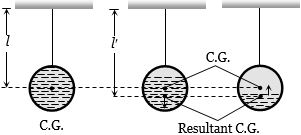
(D) The given system acts as a simple pendulum, where the effective length $(l)$ is the distance between the point of suspension and the center of gravity $(C.G.)$ of the oscillating body.
Initially, when the sphere is full, the $C.G.$ is at the center of the sphere. As water flows out, the center of mass of the remaining water shifts downwards, causing the resultant $C.G.$ of the system to move downwards. This increases the effective length $(l)$, and since the time period $T = 2\pi \sqrt{l/g}$, the time period $T$ increases.
As more water flows out, the weight of the remaining water becomes less than the weight of the empty sphere. The resultant $C.G.$ starts shifting back upwards towards the center of the sphere. Consequently, the effective length $(l)$ decreases, which causes the time period $T$ to decrease.
Finally, when the sphere is completely empty, the $C.G.$ returns to the center of the sphere, making the effective length equal to its initial value. Thus, the time period returns to its original value. Therefore, the period of oscillation first increases and then decreases to its original value.
Initially, when the sphere is full, the $C.G.$ is at the center of the sphere. As water flows out, the center of mass of the remaining water shifts downwards, causing the resultant $C.G.$ of the system to move downwards. This increases the effective length $(l)$, and since the time period $T = 2\pi \sqrt{l/g}$, the time period $T$ increases.
As more water flows out, the weight of the remaining water becomes less than the weight of the empty sphere. The resultant $C.G.$ starts shifting back upwards towards the center of the sphere. Consequently, the effective length $(l)$ decreases, which causes the time period $T$ to decrease.
Finally, when the sphere is completely empty, the $C.G.$ returns to the center of the sphere, making the effective length equal to its initial value. Thus, the time period returns to its original value. Therefore, the period of oscillation first increases and then decreases to its original value.
0 likesView Solution
4
PhysicsDifficultMCQAIIMS · 2013
$A$ spherical solid ball of volume $V$ is made of a material of density $\rho_1$. It is falling through a liquid of density $\rho_2$ $(\rho_2 < \rho_1)$. Assume that the liquid applies a viscous force on the ball that is proportional to the square of its speed $v$,i.e.,$F_{viscous} = -kv^2$ $(k > 0)$. The terminal speed of the ball is:
A
$\frac{Vg(\rho_1 - \rho_2)}{k}$
B
$\sqrt{\frac{Vg(\rho_1 - \rho_2)}{k}}$
C
$\frac{Vg\rho_1}{k}$
D
$\sqrt{\frac{Vg\rho_1}{k}}$
Solution
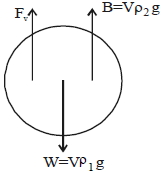
(B) At terminal speed $(v_t)$,the net force on the ball is zero.
Therefore,the downward weight of the ball is balanced by the upward buoyant force and the viscous force.
$Weight = \text{Buoyant force} + \text{Viscous force}$
$V\rho_1 g = V\rho_2 g + kv_t^2$
$kv_t^2 = Vg(\rho_1 - \rho_2)$
$v_t^2 = \frac{Vg(\rho_1 - \rho_2)}{k}$
$v_t = \sqrt{\frac{Vg(\rho_1 - \rho_2)}{k}}$
Therefore,the downward weight of the ball is balanced by the upward buoyant force and the viscous force.
$Weight = \text{Buoyant force} + \text{Viscous force}$
$V\rho_1 g = V\rho_2 g + kv_t^2$
$kv_t^2 = Vg(\rho_1 - \rho_2)$
$v_t^2 = \frac{Vg(\rho_1 - \rho_2)}{k}$
$v_t = \sqrt{\frac{Vg(\rho_1 - \rho_2)}{k}}$
0 likesView Solution
5
PhysicsDifficultMCQAIIMS · 2013
Two particles are projected from the same point with the same speed $u$ such that they have the same range $R$,but different maximum heights,$h_1$ and $h_2$. Which of the following is correct?
A
$R^2 = 4 h_1h_2$
B
$R^2 = 2 h_1h_2$
C
$R^2 = 16 h_1h_2$
D
$R^2 = h_1h_2$
Solution
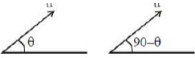
(C) For the same range $R$,the angles of projection must be complementary,i.e.,$\theta$ and $(90^\circ - \theta)$.
The range $R$ is given by: $R = \frac{u^2 \sin(2\theta)}{g} = \frac{2u^2 \sin\theta \cos\theta}{g}$.
The maximum heights for the two particles are:
$h_1 = \frac{u^2 \sin^2\theta}{2g}$
$h_2 = \frac{u^2 \sin^2(90^\circ - \theta)}{2g} = \frac{u^2 \cos^2\theta}{2g}$
Multiplying $h_1$ and $h_2$:
$h_1 h_2 = \left( \frac{u^2 \sin^2\theta}{2g} \right) \left( \frac{u^2 \cos^2\theta}{2g} \right) = \frac{u^4 \sin^2\theta \cos^2\theta}{4g^2}$
$h_1 h_2 = \frac{1}{16} \left( \frac{4u^4 \sin^2\theta \cos^2\theta}{g^2} \right) = \frac{1}{16} R^2$
Therefore,$R^2 = 16 h_1 h_2$.
The range $R$ is given by: $R = \frac{u^2 \sin(2\theta)}{g} = \frac{2u^2 \sin\theta \cos\theta}{g}$.
The maximum heights for the two particles are:
$h_1 = \frac{u^2 \sin^2\theta}{2g}$
$h_2 = \frac{u^2 \sin^2(90^\circ - \theta)}{2g} = \frac{u^2 \cos^2\theta}{2g}$
Multiplying $h_1$ and $h_2$:
$h_1 h_2 = \left( \frac{u^2 \sin^2\theta}{2g} \right) \left( \frac{u^2 \cos^2\theta}{2g} \right) = \frac{u^4 \sin^2\theta \cos^2\theta}{4g^2}$
$h_1 h_2 = \frac{1}{16} \left( \frac{4u^4 \sin^2\theta \cos^2\theta}{g^2} \right) = \frac{1}{16} R^2$
Therefore,$R^2 = 16 h_1 h_2$.
0 likesView Solution
6
PhysicsEasyMCQAIIMS · 2013
The density of a cube is measured by measuring its mass and the length of its sides. If the maximum error in the measurement of mass and length are $4\%$ and $3\%$ respectively,the maximum error in the measurement of density will be ........ $\%$
A
$7$
B
$9$
C
$12$
D
$13$
Solution
(D) The density $\rho$ of a cube is given by the formula $\rho = \frac{M}{V} = \frac{M}{l^3}$,where $M$ is the mass and $l$ is the length of the side of the cube.
The relative error in density is given by $\frac{\Delta \rho}{\rho} = \frac{\Delta M}{M} + 3 \frac{\Delta l}{l}$.
To find the percentage error,we multiply by $100$:
$\frac{\Delta \rho}{\rho} \times 100 = \left( \frac{\Delta M}{M} \times 100 \right) + 3 \left( \frac{\Delta l}{l} \times 100 \right)$.
Given that the percentage error in mass $\frac{\Delta M}{M} \times 100 = 4\%$ and the percentage error in length $\frac{\Delta l}{l} \times 100 = 3\%$.
Substituting these values:
Percentage error in density $= 4\% + 3(3\%) = 4\% + 9\% = 13\%$.
The relative error in density is given by $\frac{\Delta \rho}{\rho} = \frac{\Delta M}{M} + 3 \frac{\Delta l}{l}$.
To find the percentage error,we multiply by $100$:
$\frac{\Delta \rho}{\rho} \times 100 = \left( \frac{\Delta M}{M} \times 100 \right) + 3 \left( \frac{\Delta l}{l} \times 100 \right)$.
Given that the percentage error in mass $\frac{\Delta M}{M} \times 100 = 4\%$ and the percentage error in length $\frac{\Delta l}{l} \times 100 = 3\%$.
Substituting these values:
Percentage error in density $= 4\% + 3(3\%) = 4\% + 9\% = 13\%$.
0 likesView Solution
7
PhysicsEasyMCQAIIMS · 2013
$Assertion$ : Two balls of different masses are thrown vertically upward with the same speed. They will pass through their point of projection in the downward direction with the same speed.
$Reason$ : The maximum height and downward velocity attained at the point of projection are independent of the mass of the ball.
$Reason$ : The maximum height and downward velocity attained at the point of projection are independent of the mass of the ball.
A
If both $Assertion$ and $Reason$ are correct and the $Reason$ is a correct explanation of the $Assertion$.
B
If both $Assertion$ and $Reason$ are correct but $Reason$ is not a correct explanation of the $Assertion$.
C
If the $Assertion$ is correct but $Reason$ is incorrect.
D
If both the $Assertion$ and $Reason$ are incorrect.
Solution
$(A)$ When an object is thrown vertically upward with an initial velocity $u$, it reaches a maximum height $H = \frac{u^2}{2g}$.
Since the maximum height depends only on the initial velocity $u$ and acceleration due to gravity $g$, it is independent of the mass $m$ of the object.
According to the law of conservation of energy, the kinetic energy at the point of projection is $K = \frac{1}{2}mu^2$. When the object returns to the same point, its potential energy is the same as at the start, so its kinetic energy must be the same, meaning its speed $v = u$.
Thus, both the maximum height and the final speed at the point of projection are independent of the mass of the ball.
Therefore, both the $Assertion$ and $Reason$ are correct, and the $Reason$ is the correct explanation of the $Assertion$.
Since the maximum height depends only on the initial velocity $u$ and acceleration due to gravity $g$, it is independent of the mass $m$ of the object.
According to the law of conservation of energy, the kinetic energy at the point of projection is $K = \frac{1}{2}mu^2$. When the object returns to the same point, its potential energy is the same as at the start, so its kinetic energy must be the same, meaning its speed $v = u$.
Thus, both the maximum height and the final speed at the point of projection are independent of the mass of the ball.
Therefore, both the $Assertion$ and $Reason$ are correct, and the $Reason$ is the correct explanation of the $Assertion$.
0 likesView Solution
8
PhysicsMediumMCQAIIMS · 2013
$A$ projectile is thrown with velocity $v$ making an angle $\theta$ with the vertical. It reaches a maximum height $H$. The time of flight is:
A
$\sqrt{H \cos \theta / g}$
B
$\sqrt{2H \cos \theta / g}$
C
$\sqrt{4H / g}$
D
$\sqrt{8H / g}$
Solution
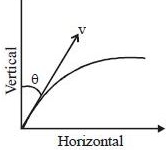
(D) The angle with the vertical is $\theta$,so the angle with the horizontal is $\alpha = 90^\circ - \theta$.
Maximum height $H = \frac{v^2 \sin^2(90^\circ - \theta)}{2g} = \frac{v^2 \cos^2 \theta}{2g}$.
From this,we get $\frac{v \cos \theta}{g} = \sqrt{\frac{2H}{g}}$.
The time of flight $T = \frac{2v \sin(90^\circ - \theta)}{g} = \frac{2v \cos \theta}{g}$.
Substituting the value of $\frac{v \cos \theta}{g}$ into the expression for $T$:
$T = 2 \sqrt{\frac{2H}{g}} = \sqrt{4 \cdot \frac{2H}{g}} = \sqrt{\frac{8H}{g}}$.
Maximum height $H = \frac{v^2 \sin^2(90^\circ - \theta)}{2g} = \frac{v^2 \cos^2 \theta}{2g}$.
From this,we get $\frac{v \cos \theta}{g} = \sqrt{\frac{2H}{g}}$.
The time of flight $T = \frac{2v \sin(90^\circ - \theta)}{g} = \frac{2v \cos \theta}{g}$.
Substituting the value of $\frac{v \cos \theta}{g}$ into the expression for $T$:
$T = 2 \sqrt{\frac{2H}{g}} = \sqrt{4 \cdot \frac{2H}{g}} = \sqrt{\frac{8H}{g}}$.
0 likesView Solution
9
PhysicsEasyMCQAIIMS · 2013
$A$ bomb is released from a horizontal flying aeroplane. The trajectory of the bomb is
A
a parabola
B
a straight line
C
a circle
D
a hyperbola
Solution
(A) When a bomb is released from a horizontally flying aeroplane,it possesses the same horizontal velocity as the aeroplane at the moment of release.
Due to gravity,it experiences a constant downward acceleration $(g)$.
The horizontal motion is uniform (constant velocity),while the vertical motion is uniformly accelerated.
The combination of these two independent motions results in a path that is a parabola.
Due to gravity,it experiences a constant downward acceleration $(g)$.
The horizontal motion is uniform (constant velocity),while the vertical motion is uniformly accelerated.
The combination of these two independent motions results in a path that is a parabola.
0 likesView Solution
10
PhysicsMediumMCQAIIMS · 2013
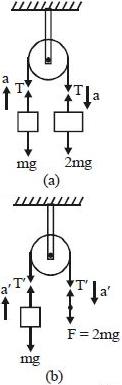
Two pulley arrangements shown in the figure are identical. The mass of the rope is negligible. In figure $(a)$,the mass $m$ is lifted by attaching a mass $2m$ to the other end of the rope. In figure $(b)$,$m$ is lifted up by pulling the other end of the rope with a constant downward force $F = 2mg$. The accelerations of $m$ in the two cases are respectively:
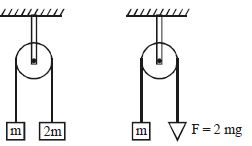
A
$3g, g$
B
$g/3, g$
C
$g/3, 2g$
D
$g, g/3$
Solution
(B) For figure $(a)$:
Let $a$ be the acceleration of the system. The equations of motion are:
For mass $m$: $T - mg = ma$ $(i)$
For mass $2m$: $2mg - T = 2ma$ $(ii)$
Adding $(i)$ and $(ii)$,we get:
$mg = 3ma$
$\therefore a = g/3$
For figure $(b)$:
Let $a'$ be the acceleration of mass $m$. The tension in the rope is $T' = F = 2mg$ because the force is applied directly to the rope.
The equation of motion for mass $m$ is:
$T' - mg = ma'$
Substituting $T' = 2mg$:
$2mg - mg = ma'$
$mg = ma'$
$\therefore a' = g$
Thus,the accelerations are $g/3$ and $g$ respectively.
Let $a$ be the acceleration of the system. The equations of motion are:
For mass $m$: $T - mg = ma$ $(i)$
For mass $2m$: $2mg - T = 2ma$ $(ii)$
Adding $(i)$ and $(ii)$,we get:
$mg = 3ma$
$\therefore a = g/3$
For figure $(b)$:
Let $a'$ be the acceleration of mass $m$. The tension in the rope is $T' = F = 2mg$ because the force is applied directly to the rope.
The equation of motion for mass $m$ is:
$T' - mg = ma'$
Substituting $T' = 2mg$:
$2mg - mg = ma'$
$mg = ma'$
$\therefore a' = g$
Thus,the accelerations are $g/3$ and $g$ respectively.
0 likesView Solution
11
PhysicsMediumMCQAIIMS · 2013
$A$ body of mass $3 \, kg$ hits a wall at an angle of $60^\circ$ with the wall and returns at the same angle. The speed of the body is $10 \, m/s$ and the impact time is $0.2 \, s$. Calculate the force exerted on the wall.
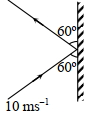
A
$100 \, N$
B
$50\sqrt{3} \, N$
C
$150\sqrt{3} \, N$
D
$75\sqrt{3} \, N$
Solution
(C) The change in momentum occurs only in the direction perpendicular to the wall.
Let the velocity be $v = 10 \, m/s$ and mass $m = 3 \, kg$.
The component of velocity perpendicular to the wall is $v_{\perp} = v \sin(60^\circ)$.
Initial momentum perpendicular to the wall: $p_i = mv \sin(60^\circ)$.
Final momentum perpendicular to the wall (after reflection): $p_f = -mv \sin(60^\circ)$.
Change in momentum: $\Delta p = p_f - p_i = -mv \sin(60^\circ) - mv \sin(60^\circ) = -2mv \sin(60^\circ)$.
The magnitude of the change in momentum is $|\Delta p| = 2mv \sin(60^\circ)$.
Force exerted on the wall $F = \frac{|\Delta p|}{\Delta t} = \frac{2mv \sin(60^\circ)}{\Delta t}$.
Substituting the values: $F = \frac{2 \times 3 \times 10 \times \sin(60^\circ)}{0.2} = \frac{60 \times (\sqrt{3}/2)}{0.2} = \frac{30\sqrt{3}}{0.2} = 150\sqrt{3} \, N$.
Let the velocity be $v = 10 \, m/s$ and mass $m = 3 \, kg$.
The component of velocity perpendicular to the wall is $v_{\perp} = v \sin(60^\circ)$.
Initial momentum perpendicular to the wall: $p_i = mv \sin(60^\circ)$.
Final momentum perpendicular to the wall (after reflection): $p_f = -mv \sin(60^\circ)$.
Change in momentum: $\Delta p = p_f - p_i = -mv \sin(60^\circ) - mv \sin(60^\circ) = -2mv \sin(60^\circ)$.
The magnitude of the change in momentum is $|\Delta p| = 2mv \sin(60^\circ)$.
Force exerted on the wall $F = \frac{|\Delta p|}{\Delta t} = \frac{2mv \sin(60^\circ)}{\Delta t}$.
Substituting the values: $F = \frac{2 \times 3 \times 10 \times \sin(60^\circ)}{0.2} = \frac{60 \times (\sqrt{3}/2)}{0.2} = \frac{30\sqrt{3}}{0.2} = 150\sqrt{3} \, N$.
0 likesView Solution
12
PhysicsEasyMCQAIIMS · 2013
If the linear momentum is increased by $5\%$,the kinetic energy will increase by.......$\%$
A
$5$
B
$10$
C
$10.25$
D
$25$
Solution
(C) The relationship between kinetic energy $E$ and linear momentum $p$ is given by $E = \frac{p^2}{2m}$.
For small percentage changes,we can use the differential method: $\frac{\Delta E}{E} = 2 \left( \frac{\Delta p}{p} \right)$.
Given $\frac{\Delta p}{p} = 5\% = 0.05$,the change in kinetic energy is $\frac{\Delta E}{E} = 2 \times 5\% = 10\%$.
Alternatively,using the exact formula: $E' = \frac{(1.05p)^2}{2m} = 1.1025 E$.
The percentage increase is $(1.1025 - 1) \times 100 = 10.25\%$. Since $10.25\%$ is the precise value,we select the closest standard approximation or the exact value if provided.
For small percentage changes,we can use the differential method: $\frac{\Delta E}{E} = 2 \left( \frac{\Delta p}{p} \right)$.
Given $\frac{\Delta p}{p} = 5\% = 0.05$,the change in kinetic energy is $\frac{\Delta E}{E} = 2 \times 5\% = 10\%$.
Alternatively,using the exact formula: $E' = \frac{(1.05p)^2}{2m} = 1.1025 E$.
The percentage increase is $(1.1025 - 1) \times 100 = 10.25\%$. Since $10.25\%$ is the precise value,we select the closest standard approximation or the exact value if provided.
0 likesView Solution
13
PhysicsMediumMCQAIIMS · 2013
$Assertion$: The total translational kinetic energy of all the molecules of a given mass of an ideal gas is $1.5$ times the product of its pressure and its volume.
$Reason$: The molecules of a gas collide with each other and the velocities of the molecules change due to the collision.
$Reason$: The molecules of a gas collide with each other and the velocities of the molecules change due to the collision.
A
If both Assertion and Reason are correct and the Reason is a correct explanation of the Assertion.
B
If both Assertion and Reason are correct but Reason is not a correct explanation of the Assertion.
C
If the Assertion is correct but Reason is incorrect.
D
If both the Assertion and Reason are incorrect.
Solution
(B) The total translational kinetic energy $(K)$ of an ideal gas is given by the formula: $K = \frac{3}{2} nRT$.
Since the ideal gas equation is $PV = nRT$,we can substitute $nRT$ with $PV$.
Therefore,$K = \frac{3}{2} PV = 1.5 PV$.
Thus,the Assertion is correct.
The Reason states that gas molecules collide and their velocities change. This is a fundamental property of the kinetic theory of gases,but it does not explain why the kinetic energy is related to $PV$ in that specific ratio.
Therefore,both statements are correct,but the Reason is not the correct explanation of the Assertion.
Since the ideal gas equation is $PV = nRT$,we can substitute $nRT$ with $PV$.
Therefore,$K = \frac{3}{2} PV = 1.5 PV$.
Thus,the Assertion is correct.
The Reason states that gas molecules collide and their velocities change. This is a fundamental property of the kinetic theory of gases,but it does not explain why the kinetic energy is related to $PV$ in that specific ratio.
Therefore,both statements are correct,but the Reason is not the correct explanation of the Assertion.
0 likesView Solution
14
PhysicsMediumMCQAIIMS · 2013
One quarter sector is cut from a uniform circular disc of radius $R$. This sector has mass $M$. It is made to rotate about a line perpendicular to its plane and passing through the centre of the original disc. Its moment of inertia about the axis of rotation is
A
$\frac{1}{2} M R^2$
B
$\frac{1}{4} M R^2$
C
$\frac{1}{8} M R^2$
D
$\sqrt{2} M R^2$
Solution
(A) Let the mass of the full circular disc be $M_{total}$. Since the quarter sector has mass $M$,the mass of the full disc is $M_{total} = 4M$.
The moment of inertia of a full uniform circular disc of mass $M_{total}$ and radius $R$ about an axis passing through its center and perpendicular to its plane is given by $I_{total} = \frac{1}{2} M_{total} R^2$.
Substituting $M_{total} = 4M$,we get $I_{total} = \frac{1}{2} (4M) R^2 = 2 M R^2$.
By the principle of symmetry,the moment of inertia of any sector of the disc about the same axis is proportional to its mass.
Therefore,the moment of inertia $I$ of the quarter sector is $I = \frac{I_{total}}{4} = \frac{2 M R^2}{4} = \frac{1}{2} M R^2$.
The moment of inertia of a full uniform circular disc of mass $M_{total}$ and radius $R$ about an axis passing through its center and perpendicular to its plane is given by $I_{total} = \frac{1}{2} M_{total} R^2$.
Substituting $M_{total} = 4M$,we get $I_{total} = \frac{1}{2} (4M) R^2 = 2 M R^2$.
By the principle of symmetry,the moment of inertia of any sector of the disc about the same axis is proportional to its mass.
Therefore,the moment of inertia $I$ of the quarter sector is $I = \frac{I_{total}}{4} = \frac{2 M R^2}{4} = \frac{1}{2} M R^2$.
0 likesView Solution
15
PhysicsEasyMCQAIIMS · 2013
$A$ particle is confined to rotate in a circular path with decreasing linear speed. Which of the following is correct?
A
$\vec{L}$ (angular momentum) is conserved about the centre.
B
Only the direction of angular momentum $\vec{L}$ is conserved.
C
It spirals towards the centre.
D
Its acceleration is towards the centre.
Solution
(B) The angular momentum is given by $\vec{L} = \vec{r} \times \vec{p} = m(\vec{r} \times \vec{v})$. Since the particle is moving in a circular path,the position vector $\vec{r}$ and velocity vector $\vec{v}$ are always perpendicular. The magnitude of angular momentum is $L = mvr$. Since the linear speed $v$ is decreasing,the magnitude of angular momentum $L$ is not conserved.
However,for a particle moving in a circular path in a plane,the direction of the angular momentum vector $\vec{L}$ is perpendicular to the plane of motion (determined by the right-hand rule). As long as the particle remains in the same circular path,the direction of $\vec{L}$ remains constant.
Since the particle is confined to a circular path,it cannot spiral towards the centre. Because the speed is changing,there is a tangential acceleration $a_t$ in addition to the centripetal acceleration $a_c$. Therefore,the net acceleration is not directed towards the centre. Thus,only the direction of angular momentum is conserved.
However,for a particle moving in a circular path in a plane,the direction of the angular momentum vector $\vec{L}$ is perpendicular to the plane of motion (determined by the right-hand rule). As long as the particle remains in the same circular path,the direction of $\vec{L}$ remains constant.
Since the particle is confined to a circular path,it cannot spiral towards the centre. Because the speed is changing,there is a tangential acceleration $a_t$ in addition to the centripetal acceleration $a_c$. Therefore,the net acceleration is not directed towards the centre. Thus,only the direction of angular momentum is conserved.
0 likesView Solution
16
PhysicsDifficultMCQAIIMS · 2013
$A$ flywheel rotates about an axis. Due to friction at the axis,it experiences an angular retardation proportional to its angular velocity. If its angular velocity falls to half while it makes $n$ rotations,how many more rotations will it make before coming to rest?
A
$2n$
B
$n$
C
$n/2$
D
$n/3$
Solution
(B) The angular retardation $\alpha$ is proportional to the angular velocity $\omega$,so $\alpha = k\omega$,where $k$ is a positive constant.
Since $\alpha = \frac{d\omega}{dt}$ and $\omega = \frac{d\theta}{dt}$,we have $\frac{d\omega}{dt} = k\omega$.
Using the chain rule,$\frac{d\omega}{d\theta} \cdot \frac{d\theta}{dt} = k\omega$,which simplifies to $\frac{d\omega}{d\theta} \cdot \omega = k\omega$.
Thus,$d\omega = k d\theta$.
Integrating from initial angular velocity $\omega_0$ to $\omega_0/2$ for $n$ rotations (where $\theta_1 = 2\pi n$):
$\int_{\omega_0}^{\omega_0/2} d\omega = \int_{0}^{2\pi n} k d\theta \implies -\frac{\omega_0}{2} = k(2\pi n)$.
Now,integrating from $\omega_0/2$ to $0$ for additional rotations $n'$ (where $\theta_2 = 2\pi n'$):
$\int_{\omega_0/2}^{0} d\omega = \int_{0}^{2\pi n'} k d\theta \implies -\frac{\omega_0}{2} = k(2\pi n')$.
Comparing the two equations,$k(2\pi n) = k(2\pi n')$,which gives $n' = n$.
Since $\alpha = \frac{d\omega}{dt}$ and $\omega = \frac{d\theta}{dt}$,we have $\frac{d\omega}{dt} = k\omega$.
Using the chain rule,$\frac{d\omega}{d\theta} \cdot \frac{d\theta}{dt} = k\omega$,which simplifies to $\frac{d\omega}{d\theta} \cdot \omega = k\omega$.
Thus,$d\omega = k d\theta$.
Integrating from initial angular velocity $\omega_0$ to $\omega_0/2$ for $n$ rotations (where $\theta_1 = 2\pi n$):
$\int_{\omega_0}^{\omega_0/2} d\omega = \int_{0}^{2\pi n} k d\theta \implies -\frac{\omega_0}{2} = k(2\pi n)$.
Now,integrating from $\omega_0/2$ to $0$ for additional rotations $n'$ (where $\theta_2 = 2\pi n'$):
$\int_{\omega_0/2}^{0} d\omega = \int_{0}^{2\pi n'} k d\theta \implies -\frac{\omega_0}{2} = k(2\pi n')$.
Comparing the two equations,$k(2\pi n) = k(2\pi n')$,which gives $n' = n$.
0 likesView Solution
17
PhysicsEasyMCQAIIMS · 2013
$Assertion$: $A$ rigid disc rolls without slipping on a fixed rough horizontal surface with uniform angular velocity. Then the acceleration of the lowest point on the disc is zero.
$Reason$: For a rigid disc rolling without slipping on a fixed rough horizontal surface,the velocity of the lowest point on the disc is always zero.
$Reason$: For a rigid disc rolling without slipping on a fixed rough horizontal surface,the velocity of the lowest point on the disc is always zero.
A
If both $Assertion$ and $Reason$ are correct and the $Reason$ is a correct explanation of the $Assertion$.
B
If both $Assertion$ and $Reason$ are correct but $Reason$ is not a correct explanation of the $Assertion$.
C
If the $Assertion$ is correct but $Reason$ is incorrect.
D
If the $Assertion$ is incorrect but $Reason$ is correct.
Solution
(D) For a disc rolling without slipping on a horizontal rough surface with uniform angular velocity $\omega$,the velocity of the point of contact is zero.
However,the acceleration of the lowest point is not zero.
The acceleration of any point on the rim of the disc consists of two components: centripetal acceleration $(a_c = \omega^2 R)$ directed towards the center and tangential acceleration $(a_t = \alpha R)$.
Since the angular velocity is uniform,$\alpha = 0$,so $a_t = 0$.
The centripetal acceleration $a_c = \omega^2 R$ is directed vertically upwards towards the center of the disc.
Therefore,the net acceleration of the lowest point is $\omega^2 R$ (upwards),which is non-zero.
Thus,the $Assertion$ is incorrect and the $Reason$ is correct.
However,the acceleration of the lowest point is not zero.
The acceleration of any point on the rim of the disc consists of two components: centripetal acceleration $(a_c = \omega^2 R)$ directed towards the center and tangential acceleration $(a_t = \alpha R)$.
Since the angular velocity is uniform,$\alpha = 0$,so $a_t = 0$.
The centripetal acceleration $a_c = \omega^2 R$ is directed vertically upwards towards the center of the disc.
Therefore,the net acceleration of the lowest point is $\omega^2 R$ (upwards),which is non-zero.
Thus,the $Assertion$ is incorrect and the $Reason$ is correct.
0 likesView Solution
18
PhysicsEasyMCQAIIMS · 2013
$Assertion$ : For the planets orbiting around the sun,angular speed,linear speed and $K.E.$ change with time,but angular momentum remains constant.
$Reason$ : No torque is acting on the rotating planet. So its angular momentum is constant.
$Reason$ : No torque is acting on the rotating planet. So its angular momentum is constant.
A
If both $Assertion$ and $Reason$ are correct and the $Reason$ is a correct explanation of the $Assertion$.
B
If both $Assertion$ and $Reason$ are correct but $Reason$ is not a correct explanation of the $Assertion$.
C
If the $Assertion$ is correct but $Reason$ is incorrect.
D
If both the $Assertion$ and $Reason$ are incorrect.
Solution
(A) The net torque acting on the planet orbiting the sun is zero because the gravitational force is a central force,i.e.,$\tau = 0$.
According to the principle of conservation of angular momentum,$\frac{dL}{dt} = \tau$.
Since $\tau = 0$,the angular momentum $L$ remains constant.
Thus,the $Reason$ statement is correct.
For a planet,$L = mvr = \text{constant}$. As the distance $r$ between the sun and the planet changes (elliptical orbit),the linear speed $v$ must change to keep $L$ constant. Consequently,the kinetic energy $K.E. = \frac{1}{2}mv^2$ also changes.
Similarly,$L = mr^2\omega = \text{constant}$. As $r$ changes,the angular speed $\omega$ must change.
Therefore,the $Assertion$ statement is correct,and the $Reason$ provides a correct explanation for it.
According to the principle of conservation of angular momentum,$\frac{dL}{dt} = \tau$.
Since $\tau = 0$,the angular momentum $L$ remains constant.
Thus,the $Reason$ statement is correct.
For a planet,$L = mvr = \text{constant}$. As the distance $r$ between the sun and the planet changes (elliptical orbit),the linear speed $v$ must change to keep $L$ constant. Consequently,the kinetic energy $K.E. = \frac{1}{2}mv^2$ also changes.
Similarly,$L = mr^2\omega = \text{constant}$. As $r$ changes,the angular speed $\omega$ must change.
Therefore,the $Assertion$ statement is correct,and the $Reason$ provides a correct explanation for it.
0 likesView Solution
19
PhysicsMediumMCQAIIMS · 2013
There are two wires of the same material and same length. If the diameter of the second wire is two times the diameter of the first wire,then the ratio of the extension produced in the wires by applying the same load will be:
A
$1 : 1$
B
$2 : 1$
C
$1 : 2$
D
$4 : 1$
Solution
(D) The formula for Young's modulus $(Y)$ is given by $Y = \frac{F \cdot L}{A \cdot \Delta L}$,where $F$ is the applied force,$L$ is the original length,$A$ is the cross-sectional area,and $\Delta L$ is the extension.
Since both wires are of the same material,their Young's modulus $(Y)$ is the same. Also,the applied load $(F)$ and original length $(L)$ are the same for both wires.
Therefore,$A_1 \cdot \Delta L_1 = A_2 \cdot \Delta L_2$.
The area of cross-section is $A = \pi r^2$,where $r$ is the radius (or diameter $d/2$).
Thus,$r_1^2 \cdot \Delta L_1 = r_2^2 \cdot \Delta L_2$.
Given that the diameter of the second wire is twice that of the first,$d_2 = 2d_1$,which implies $r_2 = 2r_1$.
Substituting this into the equation: $r_1^2 \cdot \Delta L_1 = (2r_1)^2 \cdot \Delta L_2$.
$r_1^2 \cdot \Delta L_1 = 4r_1^2 \cdot \Delta L_2$.
$\frac{\Delta L_1}{\Delta L_2} = \frac{4}{1}$.
So,the ratio of extension is $4 : 1$.
Since both wires are of the same material,their Young's modulus $(Y)$ is the same. Also,the applied load $(F)$ and original length $(L)$ are the same for both wires.
Therefore,$A_1 \cdot \Delta L_1 = A_2 \cdot \Delta L_2$.
The area of cross-section is $A = \pi r^2$,where $r$ is the radius (or diameter $d/2$).
Thus,$r_1^2 \cdot \Delta L_1 = r_2^2 \cdot \Delta L_2$.
Given that the diameter of the second wire is twice that of the first,$d_2 = 2d_1$,which implies $r_2 = 2r_1$.
Substituting this into the equation: $r_1^2 \cdot \Delta L_1 = (2r_1)^2 \cdot \Delta L_2$.
$r_1^2 \cdot \Delta L_1 = 4r_1^2 \cdot \Delta L_2$.
$\frac{\Delta L_1}{\Delta L_2} = \frac{4}{1}$.
So,the ratio of extension is $4 : 1$.
0 likesView Solution
20
PhysicsEasyMCQAIIMS · 2013
Bernoulli's principle is based on the law of conservation of
A
mass
B
energy
C
angular momentum
D
linear momentum
Solution
(B) Bernoulli's principle is derived from the work-energy theorem for a flowing fluid.
It states that for an incompressible,non-viscous,and steady flow of a fluid,the sum of pressure energy,kinetic energy,and potential energy per unit volume remains constant along a streamline.
Therefore,it is based on the law of conservation of energy.
It states that for an incompressible,non-viscous,and steady flow of a fluid,the sum of pressure energy,kinetic energy,and potential energy per unit volume remains constant along a streamline.
Therefore,it is based on the law of conservation of energy.
0 likesView Solution
21
PhysicsDifficultMCQAIIMS · 2013
$A$ ring is cut from a platinum tube with an internal diameter of $8.5\, cm$ and an external diameter of $8.7\, cm$. It is supported horizontally from the pan of a balance so that it comes in contact with the water in a glass vessel. If an extra $3.97\, g$ weight is required to pull it away from the water,the surface tension of water is ......... $dyne\, cm^{-1}$.
A
$72$
B
$70.80$
C
$63.35$
D
$60$
Solution
(A) When a ring is pulled from the surface of a liquid,the surface tension acts on both the inner and outer circumferences of the ring.
Total length of contact $L = 2\pi r_1 + 2\pi r_2 = \pi(D_1 + D_2)$,where $D_1$ and $D_2$ are the internal and external diameters.
Given: $D_1 = 8.5\, cm$,$D_2 = 8.7\, cm$,and mass $m = 3.97\, g$.
The force required to pull the ring is $F = mg = L \times \sigma$,where $\sigma$ is the surface tension.
$F = \pi(D_1 + D_2) \times \sigma = mg$.
Substituting the values: $\pi(8.5 + 8.7) \times \sigma = 3.97 \times 980$.
$\pi(17.2) \times \sigma = 3890.6$.
$\sigma = \frac{3890.6}{3.14159 \times 17.2} \approx 72\, dyne\, cm^{-1}$.
Total length of contact $L = 2\pi r_1 + 2\pi r_2 = \pi(D_1 + D_2)$,where $D_1$ and $D_2$ are the internal and external diameters.
Given: $D_1 = 8.5\, cm$,$D_2 = 8.7\, cm$,and mass $m = 3.97\, g$.
The force required to pull the ring is $F = mg = L \times \sigma$,where $\sigma$ is the surface tension.
$F = \pi(D_1 + D_2) \times \sigma = mg$.
Substituting the values: $\pi(8.5 + 8.7) \times \sigma = 3.97 \times 980$.
$\pi(17.2) \times \sigma = 3890.6$.
$\sigma = \frac{3890.6}{3.14159 \times 17.2} \approx 72\, dyne\, cm^{-1}$.
0 likesView Solution
22
PhysicsEasyMCQAIIMS · 2013
$Assertion :$ The velocity of flow of a liquid is smaller when pressure is larger and vice-versa.
$Reason :$ According to Bernoulli's theorem,for the stream line flow of an ideal liquid,the total energy per unit mass remains constant.
$Reason :$ According to Bernoulli's theorem,for the stream line flow of an ideal liquid,the total energy per unit mass remains constant.
A
If both the Assertion and Reason are incorrect.
B
If both Assertion and Reason are correct but Reason is not a correct explanation of the Assertion.
C
If the Assertion is correct but Reason is incorrect.
D
If both Assertion and Reason are correct and the Reason is a correct explanation of the Assertion.
Solution
(D) According to Bernoulli's theorem,for the streamline flow of an ideal liquid,the sum of pressure energy,kinetic energy,and potential energy per unit volume remains constant along a streamline.
The equation is $P + \frac{1}{2}\rho v^2 + \rho gh = \text{constant}$.
If we consider horizontal flow $(h = \text{constant})$,then $P + \frac{1}{2}\rho v^2 = \text{constant}$.
This implies that if the pressure $P$ increases,the velocity $v$ must decrease to keep the sum constant,and vice-versa. Thus,the Assertion is correct.
The Reason states that the total energy per unit mass remains constant. Bernoulli's theorem states that the total energy per unit volume (or mass) is constant for an ideal fluid. Therefore,the Reason is also correct and provides the physical basis for the Assertion.
The equation is $P + \frac{1}{2}\rho v^2 + \rho gh = \text{constant}$.
If we consider horizontal flow $(h = \text{constant})$,then $P + \frac{1}{2}\rho v^2 = \text{constant}$.
This implies that if the pressure $P$ increases,the velocity $v$ must decrease to keep the sum constant,and vice-versa. Thus,the Assertion is correct.
The Reason states that the total energy per unit mass remains constant. Bernoulli's theorem states that the total energy per unit volume (or mass) is constant for an ideal fluid. Therefore,the Reason is also correct and provides the physical basis for the Assertion.
0 likesView Solution
23
PhysicsEasyMCQAIIMS · 2013
If $\Delta Q$ and $\Delta W$ represent the heat supplied to the system and the work done on the system respectively,then the first law of thermodynamics can be written as
A
$\Delta Q = \Delta U + \Delta W$
B
$\Delta Q = \Delta U - \Delta W$
C
$\Delta Q = \Delta W - \Delta U$
D
$\Delta Q = -\Delta W - \Delta U$
Solution
(B) The first law of thermodynamics is given by the equation $\Delta Q = \Delta U + W_{by}$,where $W_{by}$ is the work done $BY$ the system.
Given that $\Delta W$ is the work done $ON$ the system,we have $W_{by} = -\Delta W$.
Substituting this into the first law equation:
$\Delta Q = \Delta U + (-\Delta W)$
$\Delta Q = \Delta U - \Delta W$
Therefore,the correct option is $B$.
Given that $\Delta W$ is the work done $ON$ the system,we have $W_{by} = -\Delta W$.
Substituting this into the first law equation:
$\Delta Q = \Delta U + (-\Delta W)$
$\Delta Q = \Delta U - \Delta W$
Therefore,the correct option is $B$.
0 likesView Solution
24
PhysicsEasyMCQAIIMS · 2013
$Assertion :$ Adiabatic expansion is always accompanied by fall in temperature.
$Reason :$ In adiabatic process, volume is inversely proportional to temperature.
$Reason :$ In adiabatic process, volume is inversely proportional to temperature.
A
If both Assertion and Reason are correct and the Reason is a correct explanation of the Assertion.
B
If both Assertion and Reason are correct but Reason is not a correct explanation of the Assertion.
C
If the Assertion is correct but Reason is incorrect.
D
If both the Assertion and Reason are incorrect.
Solution
(C) For an adiabatic process, the relation between temperature $T$ and volume $V$ is given by $TV^{\gamma-1} = \text{constant}$.
Since $\gamma > 1$ for all gases, $T \propto V^{-(\gamma-1)}$.
In an adiabatic expansion, the volume $V$ increases, which implies that the temperature $T$ must decrease. Thus, the Assertion is correct.
However, the Reason states that volume is inversely proportional to temperature $(V \propto 1/T)$, which is incorrect. The correct relation is $T \propto V^{-(\gamma-1)}$.
Therefore, the Assertion is correct but the Reason is incorrect.
Since $\gamma > 1$ for all gases, $T \propto V^{-(\gamma-1)}$.
In an adiabatic expansion, the volume $V$ increases, which implies that the temperature $T$ must decrease. Thus, the Assertion is correct.
However, the Reason states that volume is inversely proportional to temperature $(V \propto 1/T)$, which is incorrect. The correct relation is $T \propto V^{-(\gamma-1)}$.
Therefore, the Assertion is correct but the Reason is incorrect.
0 likesView Solution
25
PhysicsDifficultMCQAIIMS · 2013
$A$ point particle of mass $0.1\, kg$ is executing $S.H.M.$ with an amplitude of $0.1\, m$. When the particle passes through the mean position,its kinetic energy is $8 \times 10^{-3} \, J$. Obtain the equation of motion of this particle if the initial phase of oscillation is $45^o$.
A
$y = 0.1 \sin (\pm 4t + \pi/4)$
B
$y = 0.2 \sin (\pm 4t + \pi/4)$
C
$y = 0.1 \sin (\pm 2t + \pi/4)$
D
$y = 0.2 \sin (\pm 2t + \pi/4)$
Solution
(A) The displacement of a particle in $S.H.M.$ is given by $y = a \sin(\omega t + \phi)$.
The velocity is given by $v = \frac{dy}{dt} = a\omega \cos(\omega t + \phi)$.
The velocity is maximum at the mean position,where $v_{max} = a\omega$.
The kinetic energy at the mean position is $K.E._{max} = \frac{1}{2} m v_{max}^2 = \frac{1}{2} m (a\omega)^2$.
Given $m = 0.1 \, kg$,$a = 0.1 \, m$,and $K.E._{max} = 8 \times 10^{-3} \, J$.
Substituting these values: $\frac{1}{2} \times 0.1 \times \omega^2 \times (0.1)^2 = 8 \times 10^{-3}$.
$0.05 \times 0.01 \times \omega^2 = 8 \times 10^{-3} \implies 0.0005 \times \omega^2 = 0.008$.
$\omega^2 = \frac{0.008}{0.0005} = 16 \implies \omega = 4 \, rad/s$.
The initial phase $\phi = 45^o = \pi/4 \, rad$.
Thus,the equation of motion is $y = 0.1 \sin(\pm 4t + \pi/4)$.
The velocity is given by $v = \frac{dy}{dt} = a\omega \cos(\omega t + \phi)$.
The velocity is maximum at the mean position,where $v_{max} = a\omega$.
The kinetic energy at the mean position is $K.E._{max} = \frac{1}{2} m v_{max}^2 = \frac{1}{2} m (a\omega)^2$.
Given $m = 0.1 \, kg$,$a = 0.1 \, m$,and $K.E._{max} = 8 \times 10^{-3} \, J$.
Substituting these values: $\frac{1}{2} \times 0.1 \times \omega^2 \times (0.1)^2 = 8 \times 10^{-3}$.
$0.05 \times 0.01 \times \omega^2 = 8 \times 10^{-3} \implies 0.0005 \times \omega^2 = 0.008$.
$\omega^2 = \frac{0.008}{0.0005} = 16 \implies \omega = 4 \, rad/s$.
The initial phase $\phi = 45^o = \pi/4 \, rad$.
Thus,the equation of motion is $y = 0.1 \sin(\pm 4t + \pi/4)$.
0 likesView Solution
26
PhysicsEasyMCQAIIMS · 2013
$Assertion :$ Transverse waves are produced in a very long string fixed at one end. Only a progressive wave is observed near the free end.
$Reason :$ Energy of the reflected wave does not reach the free end.
$Reason :$ Energy of the reflected wave does not reach the free end.
A
If both Assertion and Reason are correct and the Reason is a correct explanation of the Assertion.
B
If both Assertion and Reason are correct but Reason is not a correct explanation of the Assertion.
C
If the Assertion is correct but Reason is incorrect.
D
If both the Assertion and Reason are incorrect.
Solution
(A) In a very long string fixed at one end,when a transverse wave is produced,it travels towards the fixed end and gets reflected.
However,because the string is very long,the reflected wave loses significant energy due to damping and internal friction before it can travel all the way back to the source or the free end.
Consequently,near the free end (where the wave is generated),the amplitude of the reflected wave is negligible compared to the incident wave.
Therefore,the superposition of the incident and reflected waves is not significant enough to form a standing wave pattern,and only the progressive wave is observed.
Both the Assertion and the Reason are correct,and the Reason explains why the reflected wave does not interfere significantly to form a standing wave at the source end.
However,because the string is very long,the reflected wave loses significant energy due to damping and internal friction before it can travel all the way back to the source or the free end.
Consequently,near the free end (where the wave is generated),the amplitude of the reflected wave is negligible compared to the incident wave.
Therefore,the superposition of the incident and reflected waves is not significant enough to form a standing wave pattern,and only the progressive wave is observed.
Both the Assertion and the Reason are correct,and the Reason explains why the reflected wave does not interfere significantly to form a standing wave at the source end.
0 likesView Solution
27
PhysicsMediumMCQAIIMS · 2013
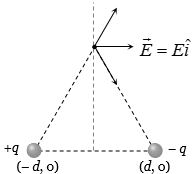
Two point charges $+q$ and $-q$ are held fixed at $(-d, 0)$ and $(d, 0)$ respectively of a $(X, Y)$ coordinate system. Then:
A
$E$ at all points on the $Y$-axis is along $\hat{i}$
B
The electric field $\overrightarrow{E}$ at all points on the $X$-axis has the same direction
C
Dipole moment is $2qd$ directed along $\hat{i}$
D
Work has to be done in bringing a test charge from infinity to the origin
Solution
(A) The electric dipole is formed by charges $+q$ at $(-d, 0)$ and $-q$ at $(d, 0)$.
$1$. The dipole moment $\overrightarrow{p}$ is directed from $-q$ to $+q$,which is along the negative $X$-axis ($-\hat{i}$ direction).
$2$. For any point on the $Y$-axis (equatorial plane),the electric field $\overrightarrow{E}$ is antiparallel to the dipole moment $\overrightarrow{p}$. Since $\overrightarrow{p}$ is along $-\hat{i}$,$\overrightarrow{E}$ at all points on the $Y$-axis is along $+\hat{i}$. Thus,option $(a)$ is correct.
$3$. On the $X$-axis,the electric field direction changes depending on whether the point is between the charges or outside them. Thus,option $(b)$ is incorrect.
$4$. The dipole moment is $\overrightarrow{p} = q(2d)$ directed from $-q$ to $+q$,which is along $-\hat{i}$. Thus,option $(c)$ is incorrect.
$5$. The electric potential $V$ at the origin $(0, 0)$ is $V = k(+q)/d + k(-q)/d = 0$. The work done in bringing a test charge $q_0$ from infinity to the origin is $W = q_0 \Delta V = q_0(V_{origin} - V_{\infty}) = q_0(0 - 0) = 0$. Thus,option $(d)$ is incorrect.
$1$. The dipole moment $\overrightarrow{p}$ is directed from $-q$ to $+q$,which is along the negative $X$-axis ($-\hat{i}$ direction).
$2$. For any point on the $Y$-axis (equatorial plane),the electric field $\overrightarrow{E}$ is antiparallel to the dipole moment $\overrightarrow{p}$. Since $\overrightarrow{p}$ is along $-\hat{i}$,$\overrightarrow{E}$ at all points on the $Y$-axis is along $+\hat{i}$. Thus,option $(a)$ is correct.
$3$. On the $X$-axis,the electric field direction changes depending on whether the point is between the charges or outside them. Thus,option $(b)$ is incorrect.
$4$. The dipole moment is $\overrightarrow{p} = q(2d)$ directed from $-q$ to $+q$,which is along $-\hat{i}$. Thus,option $(c)$ is incorrect.
$5$. The electric potential $V$ at the origin $(0, 0)$ is $V = k(+q)/d + k(-q)/d = 0$. The work done in bringing a test charge $q_0$ from infinity to the origin is $W = q_0 \Delta V = q_0(V_{origin} - V_{\infty}) = q_0(0 - 0) = 0$. Thus,option $(d)$ is incorrect.
0 likesView Solution
28
PhysicsMediumMCQAIIMS · 2013
Wires $1$ and $2$ carrying currents $i_1$ and $i_2$ respectively are inclined at an angle $\theta$ to each other. What is the force on a small element $dl$ of wire $2$ at a distance of $r$ from wire $1$ (as shown in figure) due to the magnetic field of wire $1$?
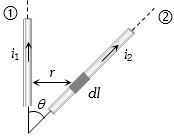
A
$\frac{\mu_0}{2\pi r} i_1 i_2 dl \tan \theta$
B
$\frac{\mu_0}{2\pi r} i_1 i_2 dl \sin \theta$
C
$\frac{\mu_0}{2\pi r} i_1 i_2 dl \cos \theta$
D
$\frac{\mu_0}{4\pi r} i_1 i_2 dl \sin \theta$
Solution
(C) The magnetic field $B$ produced by wire $1$ at a distance $r$ is given by $B = \frac{\mu_0 i_1}{2\pi r}$.
This magnetic field is directed perpendicular to the plane containing the wires.
The force $dF$ on a current element $i_2 dl$ in a magnetic field $B$ is given by $dF = i_2 (dl \times B)$.
The magnitude of the force is $dF = i_2 B dl \sin \phi$,where $\phi$ is the angle between the current element $dl$ and the magnetic field $B$.
Since the magnetic field $B$ is perpendicular to the plane of the wires,it is perpendicular to the current element $dl$ as well. Thus,$\phi = 90^\circ$ and $\sin \phi = 1$.
However,the force between two current-carrying wires is specifically due to the component of the current element that is parallel to the other wire.
The component of $dl$ parallel to wire $1$ is $dl \cos \theta$.
The force on this component is $dF = B \cdot i_2 \cdot (dl \cos \theta) = \left( \frac{\mu_0 i_1}{2\pi r} \right) i_2 dl \cos \theta = \frac{\mu_0 i_1 i_2 dl \cos \theta}{2\pi r}$.
This magnetic field is directed perpendicular to the plane containing the wires.
The force $dF$ on a current element $i_2 dl$ in a magnetic field $B$ is given by $dF = i_2 (dl \times B)$.
The magnitude of the force is $dF = i_2 B dl \sin \phi$,where $\phi$ is the angle between the current element $dl$ and the magnetic field $B$.
Since the magnetic field $B$ is perpendicular to the plane of the wires,it is perpendicular to the current element $dl$ as well. Thus,$\phi = 90^\circ$ and $\sin \phi = 1$.
However,the force between two current-carrying wires is specifically due to the component of the current element that is parallel to the other wire.
The component of $dl$ parallel to wire $1$ is $dl \cos \theta$.
The force on this component is $dF = B \cdot i_2 \cdot (dl \cos \theta) = \left( \frac{\mu_0 i_1}{2\pi r} \right) i_2 dl \cos \theta = \frac{\mu_0 i_1 i_2 dl \cos \theta}{2\pi r}$.
0 likesView Solution
29
PhysicsEasyMCQAIIMS · 2013
The materials suitable for making electromagnets should have
A
High retentivity and high coercivity
B
High retentivity and low coercivity
C
Low retentivity and low coercivity
D
Low retentivity and high coercivity
Solution
(C) An electromagnet requires a material that can be easily magnetized and demagnetized.
To achieve this,the material must have low retentivity so that it does not retain magnetism when the current is switched off.
Additionally,it must have low coercivity so that it can be easily demagnetized by a small reverse magnetic field.
Therefore,the correct choice is low retentivity and low coercivity.
To achieve this,the material must have low retentivity so that it does not retain magnetism when the current is switched off.
Additionally,it must have low coercivity so that it can be easily demagnetized by a small reverse magnetic field.
Therefore,the correct choice is low retentivity and low coercivity.
0 likesView Solution
30
PhysicsEasyMCQAIIMS · 2013
In an $ac$ circuit,the current is given by $i = 5 \sin \left( 100 t - \frac{\pi}{2} \right)$ and the $ac$ potential is $V = 200 \sin (100 t) \text{ volts}$. Then the power consumption is $....... \text{ watts}$.
A
$20$
B
$40$
C
$1000$
D
$0$
Solution
(D) The given current is $i = 5 \sin \left( 100 t - \frac{\pi}{2} \right)$ and the potential is $V = 200 \sin (100 t)$.
Comparing these with the standard forms $i = I_0 \sin(\omega t + \phi_1)$ and $V = V_0 \sin(\omega t + \phi_2)$,we get the phase of current $\phi_1 = -\frac{\pi}{2}$ and the phase of voltage $\phi_2 = 0$.
The phase difference $\phi$ between voltage and current is $\phi = \phi_2 - \phi_1 = 0 - \left( -\frac{\pi}{2} \right) = \frac{\pi}{2}$.
The average power consumption in an $ac$ circuit is given by $P = V_{rms} I_{rms} \cos \phi$.
Since $\phi = \frac{\pi}{2}$,the power factor $\cos \phi = \cos \left( \frac{\pi}{2} \right) = 0$.
Therefore,the power consumption $P = V_{rms} I_{rms} \times 0 = 0 \text{ watts}$.
Comparing these with the standard forms $i = I_0 \sin(\omega t + \phi_1)$ and $V = V_0 \sin(\omega t + \phi_2)$,we get the phase of current $\phi_1 = -\frac{\pi}{2}$ and the phase of voltage $\phi_2 = 0$.
The phase difference $\phi$ between voltage and current is $\phi = \phi_2 - \phi_1 = 0 - \left( -\frac{\pi}{2} \right) = \frac{\pi}{2}$.
The average power consumption in an $ac$ circuit is given by $P = V_{rms} I_{rms} \cos \phi$.
Since $\phi = \frac{\pi}{2}$,the power factor $\cos \phi = \cos \left( \frac{\pi}{2} \right) = 0$.
Therefore,the power consumption $P = V_{rms} I_{rms} \times 0 = 0 \text{ watts}$.
0 likesView Solution
31
PhysicsMediumMCQAIIMS · 2013
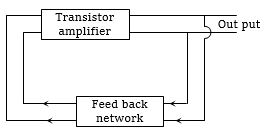
An oscillator is nothing but an amplifier with
A
Positive feedback
B
Large gain
C
No feedback
D
Negative feedback
Solution
(A) An oscillator is a circuit that produces a continuous,repeated,alternating waveform without any input signal.
It functions as an amplifier with positive feedback.
In this configuration,a portion of the output signal is fed back to the input in phase with the original signal.
This positive feedback reinforces the input,allowing the circuit to sustain oscillations indefinitely,provided the Barkhausen criterion (loop gain $A\beta = 1$ and phase shift of $360^{\circ}$ or $0^{\circ}$) is satisfied.
It functions as an amplifier with positive feedback.
In this configuration,a portion of the output signal is fed back to the input in phase with the original signal.
This positive feedback reinforces the input,allowing the circuit to sustain oscillations indefinitely,provided the Barkhausen criterion (loop gain $A\beta = 1$ and phase shift of $360^{\circ}$ or $0^{\circ}$) is satisfied.
0 likesView Solution
32
PhysicsEasyMCQAIIMS · 2013
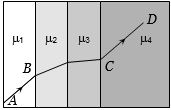
$A$ ray of light passes through four transparent media with refractive indices $\mu_1, \mu_2, \mu_3$ and $\mu_4$ as shown in the figure. The surfaces of all media are parallel. If the emergent ray $CD$ is parallel to the incident ray $AB$,we must have
A
$\mu_1 = \mu_2$
B
$\mu_2 = \mu_3$
C
$\mu_3 = \mu_4$
D
$\mu_4 = \mu_1$
Solution
(D) According to Snell's law for multiple parallel interfaces,the product of the refractive index and the sine of the angle of incidence at each interface remains constant.
Let $\theta_1$ be the angle of incidence in the first medium and $\theta_4$ be the angle of refraction in the fourth medium.
Applying Snell's law at each interface:
$\mu_1 \sin \theta_1 = \mu_2 \sin \theta_2 = \mu_3 \sin \theta_3 = \mu_4 \sin \theta_4$.
Since the emergent ray $CD$ is parallel to the incident ray $AB$,the angle of incidence $\theta_1$ must be equal to the angle of emergence $\theta_4$ (i.e.,$\theta_1 = \theta_4$).
Substituting this into the equation,we get $\mu_1 \sin \theta_1 = \mu_4 \sin \theta_1$.
Therefore,$\mu_1 = \mu_4$.
Let $\theta_1$ be the angle of incidence in the first medium and $\theta_4$ be the angle of refraction in the fourth medium.
Applying Snell's law at each interface:
$\mu_1 \sin \theta_1 = \mu_2 \sin \theta_2 = \mu_3 \sin \theta_3 = \mu_4 \sin \theta_4$.
Since the emergent ray $CD$ is parallel to the incident ray $AB$,the angle of incidence $\theta_1$ must be equal to the angle of emergence $\theta_4$ (i.e.,$\theta_1 = \theta_4$).
Substituting this into the equation,we get $\mu_1 \sin \theta_1 = \mu_4 \sin \theta_1$.
Therefore,$\mu_1 = \mu_4$.
0 likesView Solution
33
PhysicsEasyMCQAIIMS · 2013
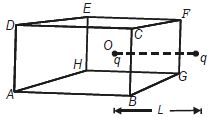
$A$ charged particle $q$ is placed at the centre $O$ of a cube of side length $L$ $(A, B, C, D, E, F, G, H)$. Another identical charge $q$ is placed at a distance $L$ from $O$, outside the cube, as shown in the figure. The electric flux through the face $BGFC$ is
A
$q / (4\pi \varepsilon_0 L)$
B
zero
C
$q / (2\pi \varepsilon_0 L)$
D
$q / (3\pi \varepsilon_0 L)$
Solution
(B) Let the charge at the center $O$ be $q_1 = q$ and the charge outside be $q_2 = q$.
By symmetry, the electric flux through the face $BGFC$ due to the charge $q_1$ at the center $O$ is $\phi_1 = q / (6\varepsilon_0)$, because the charge is at the center of the cube and the flux is distributed equally among the $6$ faces.
Now consider the charge $q_2$ placed at a distance $L$ from $O$. The face $BGFC$ is located at a distance $L/2$ from the center $O$. The charge $q_2$ is placed at a distance $L$ from $O$ along the line passing through the center of the face $BGFC$.
However, a simpler way to view this is by symmetry. The electric field lines from the charge $q_2$ enter the face $BGFC$ and exit through the opposite face.
Specifically, for the face $BGFC$, the flux due to the internal charge $q_1$ is $q / (6\varepsilon_0)$.
For the external charge $q_2$, the net flux through the entire closed cube is zero because the charge is outside.
Due to the specific geometry, the flux through face $BGFC$ due to $q_2$ is exactly $-q / (6\varepsilon_0)$.
Therefore, the total flux through the face $BGFC$ is $\phi_{total} = \phi_1 + \phi_2 = q / (6\varepsilon_0) - q / (6\varepsilon_0) = 0$.
By symmetry, the electric flux through the face $BGFC$ due to the charge $q_1$ at the center $O$ is $\phi_1 = q / (6\varepsilon_0)$, because the charge is at the center of the cube and the flux is distributed equally among the $6$ faces.
Now consider the charge $q_2$ placed at a distance $L$ from $O$. The face $BGFC$ is located at a distance $L/2$ from the center $O$. The charge $q_2$ is placed at a distance $L$ from $O$ along the line passing through the center of the face $BGFC$.
However, a simpler way to view this is by symmetry. The electric field lines from the charge $q_2$ enter the face $BGFC$ and exit through the opposite face.
Specifically, for the face $BGFC$, the flux due to the internal charge $q_1$ is $q / (6\varepsilon_0)$.
For the external charge $q_2$, the net flux through the entire closed cube is zero because the charge is outside.
Due to the specific geometry, the flux through face $BGFC$ due to $q_2$ is exactly $-q / (6\varepsilon_0)$.
Therefore, the total flux through the face $BGFC$ is $\phi_{total} = \phi_1 + \phi_2 = q / (6\varepsilon_0) - q / (6\varepsilon_0) = 0$.
0 likesView Solution
34
PhysicsEasyMCQAIIMS · 2013
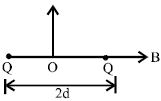
Assertion: Consider two identical charges placed at a distance $2d$ apart along the $x-$axis. The equilibrium of a positive test charge placed at the point $O$ midway between them is stable for displacements along the $x-$axis.
Reason: The net force on the test charge at point $O$ is zero.
Reason: The net force on the test charge at point $O$ is zero.
A
If both Assertion and Reason are correct and Reason is the correct explanation of Assertion.
B
If both Assertion and Reason are correct,but Reason is not the correct explanation of Assertion.
C
If Assertion is correct but Reason is incorrect.
D
If both the Assertion and Reason are incorrect.
Solution
(A) Let two identical charges $Q$ be placed at $x = -d$ and $x = +d$. The midpoint $O$ is at $x = 0$.
If a positive test charge $q$ is placed at $O$,the force from the left charge is $F_1 = \frac{kQq}{d^2}$ (towards right) and the force from the right charge is $F_2 = \frac{kQq}{d^2}$ (towards left). The net force is $F_{net} = F_1 - F_2 = 0$. Thus,the charge is in equilibrium.
If the test charge $q$ is displaced by a small distance $x$ towards the right,the force from the right charge increases and the force from the left charge decreases. The net force will act towards the left (opposite to the displacement),tending to restore the charge to its original position. This confirms stable equilibrium for displacements along the $x-$axis.
Since the Assertion is correct and the Reason correctly states that the net force is zero (which is a condition for equilibrium),the Reason is the correct explanation for the Assertion.
If a positive test charge $q$ is placed at $O$,the force from the left charge is $F_1 = \frac{kQq}{d^2}$ (towards right) and the force from the right charge is $F_2 = \frac{kQq}{d^2}$ (towards left). The net force is $F_{net} = F_1 - F_2 = 0$. Thus,the charge is in equilibrium.
If the test charge $q$ is displaced by a small distance $x$ towards the right,the force from the right charge increases and the force from the left charge decreases. The net force will act towards the left (opposite to the displacement),tending to restore the charge to its original position. This confirms stable equilibrium for displacements along the $x-$axis.
Since the Assertion is correct and the Reason correctly states that the net force is zero (which is a condition for equilibrium),the Reason is the correct explanation for the Assertion.
0 likesView Solution
35
PhysicsEasyMCQAIIMS · 2013
Three copper wires of lengths and cross-sectional areas are $(l, A)$,$(2l, A/2)$,and $(l/2, 2A)$. Resistance is minimum in
A
wire of cross-sectional area $A/2$
B
wire of cross-sectional area $A$
C
wire of cross-sectional area $2A$
D
same in all the three cases
Solution
(C) The resistance $R$ of a wire is given by the formula $R = \rho \frac{l}{A}$,where $\rho$ is the resistivity,$l$ is the length,and $A$ is the cross-sectional area.
For the three wires,the resistances are:
$R_1 = \rho \frac{l}{A}$
$R_2 = \rho \frac{2l}{A/2} = 4 \rho \frac{l}{A} = 4R_1$
$R_3 = \rho \frac{l/2}{2A} = \frac{1}{4} \rho \frac{l}{A} = 0.25R_1$
Comparing the resistances,$R_3 < R_1 < R_2$.
Therefore,the resistance is minimum for the wire with length $l/2$ and cross-sectional area $2A$.
For the three wires,the resistances are:
$R_1 = \rho \frac{l}{A}$
$R_2 = \rho \frac{2l}{A/2} = 4 \rho \frac{l}{A} = 4R_1$
$R_3 = \rho \frac{l/2}{2A} = \frac{1}{4} \rho \frac{l}{A} = 0.25R_1$
Comparing the resistances,$R_3 < R_1 < R_2$.
Therefore,the resistance is minimum for the wire with length $l/2$ and cross-sectional area $2A$.
1 likesView Solution
36
PhysicsMediumMCQAIIMS · 2013
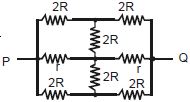
The effective resistance between points $P$ and $Q$ of the electrical circuit shown in the figure is
A
$\frac{2Rr}{R + r}$
B
$\frac{8R(R + r)}{3R + r}$
C
$2r + 4R$
D
$\frac{5R}{2} + 2r$
Solution
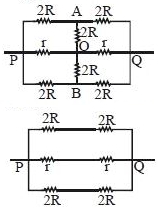
(A) The circuit is symmetrical about the axis $POQ$. Due to symmetry,the potential at nodes $A$ and $B$ is the same as the potential at node $O$. Thus,no current flows through the vertical resistors of resistance $2R$ connected to $O$.
The circuit simplifies to three parallel branches between $P$ and $Q$:
$1$. Top branch: Two $2R$ resistors in series,total $= 4R$.
$2$. Middle branch: Two $r$ resistors in series,total $= 2r$.
$3$. Bottom branch: Two $2R$ resistors in series,total $= 4R$.
The equivalent resistance $R_{PQ}$ is given by:
$\frac{1}{R_{PQ}} = \frac{1}{4R} + \frac{1}{2r} + \frac{1}{4R} = \frac{2}{4R} + \frac{1}{2r} = \frac{1}{2R} + \frac{1}{2r} = \frac{r + R}{2Rr}$.
Therefore,$R_{PQ} = \frac{2Rr}{R + r}$.
The circuit simplifies to three parallel branches between $P$ and $Q$:
$1$. Top branch: Two $2R$ resistors in series,total $= 4R$.
$2$. Middle branch: Two $r$ resistors in series,total $= 2r$.
$3$. Bottom branch: Two $2R$ resistors in series,total $= 4R$.
The equivalent resistance $R_{PQ}$ is given by:
$\frac{1}{R_{PQ}} = \frac{1}{4R} + \frac{1}{2r} + \frac{1}{4R} = \frac{2}{4R} + \frac{1}{2r} = \frac{1}{2R} + \frac{1}{2r} = \frac{r + R}{2Rr}$.
Therefore,$R_{PQ} = \frac{2Rr}{R + r}$.
0 likesView Solution
37
PhysicsEasyMCQAIIMS · 2013
$A$ charged particle moves through a magnetic field in a direction perpendicular to it. Then the
A
velocity remains unchanged
B
speed of the particle remains unchanged
C
direction of the particle remains unchanged
D
acceleration remains unchanged
Solution
(B) When a charged particle moves in a magnetic field with velocity $\vec{v}$ perpendicular to the magnetic field $\vec{B}$,the magnetic force acting on it is given by $\vec{F} = q(\vec{v} \times \vec{B})$.
Since the force $\vec{F}$ is always perpendicular to the velocity $\vec{v}$,the work done by the magnetic force on the particle is zero $(W = \vec{F} \cdot \vec{d} = 0)$.
According to the work-energy theorem,the change in kinetic energy is equal to the work done. Since work done is zero,the kinetic energy remains constant.
As kinetic energy $K = \frac{1}{2}mv^2$,a constant kinetic energy implies that the speed $(v)$ of the particle remains unchanged.
However,because the force acts perpendicular to the velocity,it changes the direction of motion,causing the particle to move in a circular path. Thus,velocity and acceleration change continuously.
Since the force $\vec{F}$ is always perpendicular to the velocity $\vec{v}$,the work done by the magnetic force on the particle is zero $(W = \vec{F} \cdot \vec{d} = 0)$.
According to the work-energy theorem,the change in kinetic energy is equal to the work done. Since work done is zero,the kinetic energy remains constant.
As kinetic energy $K = \frac{1}{2}mv^2$,a constant kinetic energy implies that the speed $(v)$ of the particle remains unchanged.
However,because the force acts perpendicular to the velocity,it changes the direction of motion,causing the particle to move in a circular path. Thus,velocity and acceleration change continuously.
0 likesView Solution
38
PhysicsMediumMCQAIIMS · 2013
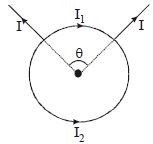
Assertion : The magnetic field at the centre of the circular coil in the following figure due to the currents $I_1$ and $I_2$ is zero.
Reason : $I_1 = I_2$ implies that the fields due to the current $I_1$ and $I_2$ will be balanced.
Reason : $I_1 = I_2$ implies that the fields due to the current $I_1$ and $I_2$ will be balanced.
A
If both Assertion and Reason are correct and Reason is the correct explanation of Assertion.
B
If both Assertion and Reason are correct,but Reason is not the correct explanation of Assertion.
C
If Assertion is correct but Reason is incorrect.
D
If both the Assertion and Reason are incorrect.
Solution
(D) The magnetic field at the center of a circular arc of radius $R$ carrying current $I$ and subtending an angle $\phi$ at the center is given by $B = \frac{\phi}{2\pi} \cdot \frac{\mu_0 I}{2R}$.
For the given coil,the current $I$ splits into $I_1$ and $I_2$ along arcs subtending angles $\theta$ and $(2\pi - \theta)$ respectively.
The magnetic field due to arc $I_1$ is $B_1 = \frac{\theta}{2\pi} \cdot \frac{\mu_0 I_1}{2R}$ (directed into the page).
The magnetic field due to arc $I_2$ is $B_2 = \frac{2\pi - \theta}{2\pi} \cdot \frac{\mu_0 I_2}{2R}$ (directed out of the page).
For the net magnetic field to be zero,$B_1 = B_2$,which implies $\theta I_1 = (2\pi - \theta) I_2$.
This condition is not satisfied simply by $I_1 = I_2$ unless $\theta = \pi$ (i.e.,the currents split into two semicircles). Therefore,the Assertion is generally false,and the Reason is also incorrect as $I_1 = I_2$ does not guarantee zero field unless the geometry is symmetric.
For the given coil,the current $I$ splits into $I_1$ and $I_2$ along arcs subtending angles $\theta$ and $(2\pi - \theta)$ respectively.
The magnetic field due to arc $I_1$ is $B_1 = \frac{\theta}{2\pi} \cdot \frac{\mu_0 I_1}{2R}$ (directed into the page).
The magnetic field due to arc $I_2$ is $B_2 = \frac{2\pi - \theta}{2\pi} \cdot \frac{\mu_0 I_2}{2R}$ (directed out of the page).
For the net magnetic field to be zero,$B_1 = B_2$,which implies $\theta I_1 = (2\pi - \theta) I_2$.
This condition is not satisfied simply by $I_1 = I_2$ unless $\theta = \pi$ (i.e.,the currents split into two semicircles). Therefore,the Assertion is generally false,and the Reason is also incorrect as $I_1 = I_2$ does not guarantee zero field unless the geometry is symmetric.
0 likesView Solution
39
PhysicsEasyMCQAIIMS · 2013
For the circuit shown in the figure,the current through the inductor is $0.9\,A$ while the current through the capacitor is $0.4\,A$. Then
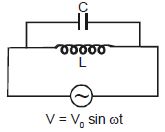
A
current drawn from generator $I = 1.13\,A$
B
$\omega = 1/(1.5\,LC)$
C
$I = 0.5\,A$
D
$I = 0.6\,A$
Solution
(C) In an $AC$ circuit with an inductor and a capacitor connected in parallel,the current through the inductor $(I_L)$ lags the voltage by $90^{\circ}$,and the current through the capacitor $(I_C)$ leads the voltage by $90^{\circ}$.
Thus,the currents $I_L$ and $I_C$ are in opposite phases,i.e.,they have a phase difference of $180^{\circ}$.
The total current $I$ drawn from the generator is the vector sum of these currents:
$I = |I_L - I_C|$
Given $I_L = 0.9\,A$ and $I_C = 0.4\,A$.
Therefore,$I = |0.9 - 0.4| = 0.5\,A$.
Thus,the currents $I_L$ and $I_C$ are in opposite phases,i.e.,they have a phase difference of $180^{\circ}$.
The total current $I$ drawn from the generator is the vector sum of these currents:
$I = |I_L - I_C|$
Given $I_L = 0.9\,A$ and $I_C = 0.4\,A$.
Therefore,$I = |0.9 - 0.4| = 0.5\,A$.
0 likesView Solution
40
PhysicsMediumMCQAIIMS · 2013
$L, C, R$ represent physical quantities inductance,capacitance,and resistance respectively. The combinations which have the dimensions of frequency are
A
$1/RC$
B
$R/L$
C
$1/\sqrt{LC}$
D
$C/L$
Solution
(C) The dimensions of $L$ are $[M L^2 T^{-2} A^{-2}]$.
The dimensions of $C$ are $[M^{-1} L^{-2} T^4 A^2]$.
The dimensions of $R$ are $[M L^2 T^{-3} A^{-2}]$.
For the combination $1/\sqrt{LC}$:
$\frac{1}{\sqrt{LC}} = \frac{1}{\sqrt{[M L^2 T^{-2} A^{-2}] \times [M^{-1} L^{-2} T^4 A^2]}} = \frac{1}{\sqrt{T^2}} = T^{-1}$.
Since $T^{-1}$ is the dimension of frequency,option $C$ is correct.
Note: $R/L$ also has dimensions of frequency $(T^{-1})$,but $1/\sqrt{LC}$ is the standard resonant frequency combination.
The dimensions of $C$ are $[M^{-1} L^{-2} T^4 A^2]$.
The dimensions of $R$ are $[M L^2 T^{-3} A^{-2}]$.
For the combination $1/\sqrt{LC}$:
$\frac{1}{\sqrt{LC}} = \frac{1}{\sqrt{[M L^2 T^{-2} A^{-2}] \times [M^{-1} L^{-2} T^4 A^2]}} = \frac{1}{\sqrt{T^2}} = T^{-1}$.
Since $T^{-1}$ is the dimension of frequency,option $C$ is correct.
Note: $R/L$ also has dimensions of frequency $(T^{-1})$,but $1/\sqrt{LC}$ is the standard resonant frequency combination.
0 likesView Solution
41
PhysicsEasyMCQAIIMS · 2013
Assertion: Long distance power transmission is done at high voltage.
Reason: At high voltage supply, power losses are less.
Reason: At high voltage supply, power losses are less.
A
If both Assertion and Reason are correct and the Reason is a correct explanation of the Assertion.
B
If both Assertion and Reason are correct but Reason is not a correct explanation of the Assertion.
C
If the Assertion is correct but Reason is incorrect.
D
If both the Assertion and Reason are incorrect.
Solution
(A) The power transmitted through a line is given by $P = VI$, where $V$ is the voltage and $I$ is the current.
The power loss in the transmission line due to resistance $R$ is given by $P_{\text{loss}} = I^2R$.
Substituting $I = \frac{P}{V}$, we get $P_{\text{loss}} = (\frac{P}{V})^2 R = \frac{P^2 R}{V^2}$.
From this expression, it is clear that $P_{\text{loss}} \propto \frac{1}{V^2}$.
Therefore, by increasing the voltage $V$, the power loss $P_{\text{loss}}$ decreases significantly.
Thus, both the Assertion and the Reason are correct, and the Reason is the correct explanation of the Assertion.
The power loss in the transmission line due to resistance $R$ is given by $P_{\text{loss}} = I^2R$.
Substituting $I = \frac{P}{V}$, we get $P_{\text{loss}} = (\frac{P}{V})^2 R = \frac{P^2 R}{V^2}$.
From this expression, it is clear that $P_{\text{loss}} \propto \frac{1}{V^2}$.
Therefore, by increasing the voltage $V$, the power loss $P_{\text{loss}}$ decreases significantly.
Thus, both the Assertion and the Reason are correct, and the Reason is the correct explanation of the Assertion.
0 likesView Solution
42
PhysicsEasyMCQAIIMS · 2013
The energy density of an electromagnetic wave in a vacuum is given by the relation:
A
$\frac{E^2}{2\varepsilon_0} + \frac{B^2}{2\mu_0}$
B
$\frac{1}{2}\varepsilon_0 E^2 + \frac{1}{2}\mu_0 B^2$
C
$\frac{E^2 + B^2}{c}$
D
$\frac{1}{2}\varepsilon_0 E^2 + \frac{B^2}{2\mu_0}$
Solution
(D) The total energy density $u$ of an electromagnetic wave is the sum of the electric energy density $u_E$ and the magnetic energy density $u_B$.
Electric energy density is given by $u_E = \frac{1}{2}\varepsilon_0 E^2$.
Magnetic energy density is given by $u_B = \frac{B^2}{2\mu_0}$.
Therefore,the total energy density is $u = u_E + u_B = \frac{1}{2}\varepsilon_0 E^2 + \frac{B^2}{2\mu_0}$.
Electric energy density is given by $u_E = \frac{1}{2}\varepsilon_0 E^2$.
Magnetic energy density is given by $u_B = \frac{B^2}{2\mu_0}$.
Therefore,the total energy density is $u = u_E + u_B = \frac{1}{2}\varepsilon_0 E^2 + \frac{B^2}{2\mu_0}$.
0 likesView Solution
43
PhysicsMediumMCQAIIMS · 2013
$A$ plano-convex lens of focal length $30\,cm$ has its plane surface silvered. An object is placed $40\,cm$ from the lens on the convex side. The distance of the image from the lens is.......$cm$
A
$18$
B
$24$
C
$30$
D
$40$
Solution
(B) For a silvered lens,the system acts as a concave mirror with an effective focal length $F$. The power of the system is $P = 2P_L + P_M$,where $P_L = \frac{1}{f_L}$ and $P_M = 0$ (for a plane mirror).
Given $f_L = 30\,cm$,the power of the lens is $P_L = \frac{1}{30}$.
The effective power is $P = 2(\frac{1}{30}) + 0 = \frac{1}{15}$.
Thus,the effective focal length is $F = -15\,cm$ (acting as a concave mirror).
Using the mirror formula $\frac{1}{v} + \frac{1}{u} = \frac{1}{F}$,where $u = -40\,cm$ and $F = -15\,cm$:
$\frac{1}{v} + \frac{1}{-40} = \frac{1}{-15}$
$\frac{1}{v} = \frac{1}{40} - \frac{1}{15} = \frac{3 - 8}{120} = \frac{-5}{120}$
$\frac{1}{v} = -\frac{1}{24}$
$v = -24\,cm$.
The distance of the image from the lens is $24\,cm$.
Given $f_L = 30\,cm$,the power of the lens is $P_L = \frac{1}{30}$.
The effective power is $P = 2(\frac{1}{30}) + 0 = \frac{1}{15}$.
Thus,the effective focal length is $F = -15\,cm$ (acting as a concave mirror).
Using the mirror formula $\frac{1}{v} + \frac{1}{u} = \frac{1}{F}$,where $u = -40\,cm$ and $F = -15\,cm$:
$\frac{1}{v} + \frac{1}{-40} = \frac{1}{-15}$
$\frac{1}{v} = \frac{1}{40} - \frac{1}{15} = \frac{3 - 8}{120} = \frac{-5}{120}$
$\frac{1}{v} = -\frac{1}{24}$
$v = -24\,cm$.
The distance of the image from the lens is $24\,cm$.
0 likesView Solution
44
PhysicsEasyMCQAIIMS · 2013
Assertion: Two convex lenses joined together cannot produce an achromatic combination.
Reason: The condition for achromatism is $\frac{\omega_1}{f_1} + \frac{\omega_2}{f_2} = 0$,where symbols have their usual meaning.
Reason: The condition for achromatism is $\frac{\omega_1}{f_1} + \frac{\omega_2}{f_2} = 0$,where symbols have their usual meaning.
A
If both Assertion and Reason are correct and the Reason is a correct explanation of the Assertion.
B
If both Assertion and Reason are correct but Reason is not a correct explanation of the Assertion.
C
If the Assertion is correct but Reason is incorrect.
D
If both the Assertion and Reason are incorrect.
Solution
(A) The condition for an achromatic doublet is $\frac{\omega_1}{f_1} + \frac{\omega_2}{f_2} = 0$.
Since $\omega_1$ and $\omega_2$ (dispersive powers) are always positive for any material,for the sum to be zero,one of the focal lengths ($f_1$ or $f_2$) must be negative.
$A$ negative focal length corresponds to a concave lens.
Therefore,to form an achromatic combination,one lens must be convex and the other must be concave.
Two convex lenses cannot satisfy this condition because both $f_1$ and $f_2$ would be positive,making the sum $\frac{\omega_1}{f_1} + \frac{\omega_2}{f_2}$ always positive (greater than zero).
Thus,the Assertion is correct and the Reason is also correct,providing the correct explanation.
Since $\omega_1$ and $\omega_2$ (dispersive powers) are always positive for any material,for the sum to be zero,one of the focal lengths ($f_1$ or $f_2$) must be negative.
$A$ negative focal length corresponds to a concave lens.
Therefore,to form an achromatic combination,one lens must be convex and the other must be concave.
Two convex lenses cannot satisfy this condition because both $f_1$ and $f_2$ would be positive,making the sum $\frac{\omega_1}{f_1} + \frac{\omega_2}{f_2}$ always positive (greater than zero).
Thus,the Assertion is correct and the Reason is also correct,providing the correct explanation.
0 likesView Solution
45
PhysicsEasyMCQAIIMS · 2013
To demonstrate the phenomenon of interference,we require two sources which emit radiation of
A
nearly the same frequency
B
the same frequency
C
different wavelengths
D
the same frequency and having a definite phase relationship
Solution
(D) For the phenomenon of interference to occur,the two sources of light must be coherent.
Coherent sources are defined as sources that emit light waves of the same frequency and maintain a constant or definite phase relationship with each other over time.
Coherent sources are defined as sources that emit light waves of the same frequency and maintain a constant or definite phase relationship with each other over time.
0 likesView Solution
46
PhysicsMediumMCQAIIMS · 2013
Two sources of light of wavelengths $2500 \text{ Å}$ and $3500 \text{ Å}$ are used in Young's double slit experiment simultaneously. Which orders of fringes of the two wavelength patterns coincide?
A
$3^{rd}$ order of $1^{st}$ source and $5^{th}$ of the $2^{nd}$
B
$7^{th}$ order of $1^{st}$ and $5^{th}$ order of $2^{nd}$
C
$5^{th}$ order of $1^{st}$ and $3^{rd}$ order of $2^{nd}$
D
$5^{th}$ order of $1^{st}$ and $7^{th}$ order of $2^{nd}$
Solution
(B) In Young's double slit experiment, the position of the $n^{th}$ bright fringe for a wavelength $\lambda$ is given by $y_n = \frac{n \lambda D}{d}$.
For two wavelengths $\lambda_1 = 2500 \text{ Å}$ and $\lambda_2 = 3500 \text{ Å}$ to coincide, their positions must be equal:
$n_1 \lambda_1 = n_2 \lambda_2$
$n_1 (2500) = n_2 (3500)$
$\frac{n_1}{n_2} = \frac{3500}{2500} = \frac{7}{5}$
This implies that the $7^{th}$ order fringe of the $1^{st}$ source $(\lambda_1)$ coincides with the $5^{th}$ order fringe of the $2^{nd}$ source $(\lambda_2)$.
For two wavelengths $\lambda_1 = 2500 \text{ Å}$ and $\lambda_2 = 3500 \text{ Å}$ to coincide, their positions must be equal:
$n_1 \lambda_1 = n_2 \lambda_2$
$n_1 (2500) = n_2 (3500)$
$\frac{n_1}{n_2} = \frac{3500}{2500} = \frac{7}{5}$
This implies that the $7^{th}$ order fringe of the $1^{st}$ source $(\lambda_1)$ coincides with the $5^{th}$ order fringe of the $2^{nd}$ source $(\lambda_2)$.
0 likesView Solution
47
PhysicsEasyMCQAIIMS · 2013
Assertion : When ultraviolet light is incident on a photocell,its stopping potential is $V_0$ and the maximum kinetic energy of the photoelectrons is $K_{max}$. When the ultraviolet light is replaced by $X-$ rays,both $V_0$ and $K_{max}$ increase.
Reason : Photoelectrons are emitted with speeds ranging from zero to a maximum value because of the range of frequencies present in the incident light.
Reason : Photoelectrons are emitted with speeds ranging from zero to a maximum value because of the range of frequencies present in the incident light.
A
If both Assertion and Reason are correct and the Reason is a correct explanation of the Assertion.
B
If both Assertion and Reason are correct but Reason is not a correct explanation of the Assertion.
C
If the Assertion is correct but Reason is incorrect.
D
If both the Assertion and Reason are incorrect.
Solution
(C) According to Einstein's photoelectric equation,$K_{max} = eV_0 = h\nu - \phi$,where $\nu$ is the frequency of incident light and $\phi$ is the work function of the metal.
Since the frequency of $X-$ rays is significantly higher than that of ultraviolet $(U.V.)$ light,the maximum kinetic energy $(K_{max})$ and the stopping potential $(V_0)$ will both increase when $X-$ rays are used.
Therefore,the Assertion is correct.
The Reason states that photoelectrons are emitted with a range of speeds due to a range of frequencies in the incident light. This is incorrect because photoelectric emission occurs even with monochromatic light (a single frequency),and the range of speeds arises due to energy losses of electrons within the metal before emission,not because of a range of incident frequencies.
Thus,the Assertion is correct but the Reason is incorrect.
Since the frequency of $X-$ rays is significantly higher than that of ultraviolet $(U.V.)$ light,the maximum kinetic energy $(K_{max})$ and the stopping potential $(V_0)$ will both increase when $X-$ rays are used.
Therefore,the Assertion is correct.
The Reason states that photoelectrons are emitted with a range of speeds due to a range of frequencies in the incident light. This is incorrect because photoelectric emission occurs even with monochromatic light (a single frequency),and the range of speeds arises due to energy losses of electrons within the metal before emission,not because of a range of incident frequencies.
Thus,the Assertion is correct but the Reason is incorrect.
0 likesView Solution
48
PhysicsMediumMCQAIIMS · 2013
The energy of an electron in the $n^{th}$ orbit of a hydrogen atom is expressed as $E_n = \frac{-13.6}{n^2} \, eV$. The shortest and longest wavelengths of the Lyman series will be:
A
$910 \, \mathring{A}, 1213 \, \mathring{A}$
B
$5463 \, \mathring{A}, 7858 \, \mathring{A}$
C
$1315 \, \mathring{A}, 1530 \, \mathring{A}$
D
None of these
Solution
(A) The Lyman series corresponds to transitions where the final state is $n_f = 1$. The wavelength $\lambda$ is given by the Rydberg formula: $\frac{1}{\lambda} = R \left( \frac{1}{n_f^2} - \frac{1}{n_i^2} \right)$,where $R \approx 1.097 \times 10^7 \, m^{-1}$.
For the longest wavelength (minimum energy transition),we take $n_i = 2$:
$\frac{1}{\lambda_{\max}} = R \left( \frac{1}{1^2} - \frac{1}{2^2} \right) = R \left( 1 - \frac{1}{4} \right) = \frac{3R}{4}$.
$\lambda_{\max} = \frac{4}{3R} \approx \frac{4}{3 \times 1.097 \times 10^7} \approx 1.215 \times 10^{-7} \, m = 1215 \, \mathring{A}$ (approximately $1213 \, \mathring{A}$ depending on the value of $R$ used).
For the shortest wavelength (maximum energy transition),we take $n_i = \infty$:
$\frac{1}{\lambda_{\min}} = R \left( \frac{1}{1^2} - \frac{1}{\infty^2} \right) = R$.
$\lambda_{\min} = \frac{1}{R} \approx \frac{1}{1.097 \times 10^7} \approx 9.11 \times 10^{-8} \, m = 911 \, \mathring{A}$ (approximately $910 \, \mathring{A}$).
Thus,the shortest wavelength is $910 \, \mathring{A}$ and the longest is $1213 \, \mathring{A}$.
For the longest wavelength (minimum energy transition),we take $n_i = 2$:
$\frac{1}{\lambda_{\max}} = R \left( \frac{1}{1^2} - \frac{1}{2^2} \right) = R \left( 1 - \frac{1}{4} \right) = \frac{3R}{4}$.
$\lambda_{\max} = \frac{4}{3R} \approx \frac{4}{3 \times 1.097 \times 10^7} \approx 1.215 \times 10^{-7} \, m = 1215 \, \mathring{A}$ (approximately $1213 \, \mathring{A}$ depending on the value of $R$ used).
For the shortest wavelength (maximum energy transition),we take $n_i = \infty$:
$\frac{1}{\lambda_{\min}} = R \left( \frac{1}{1^2} - \frac{1}{\infty^2} \right) = R$.
$\lambda_{\min} = \frac{1}{R} \approx \frac{1}{1.097 \times 10^7} \approx 9.11 \times 10^{-8} \, m = 911 \, \mathring{A}$ (approximately $910 \, \mathring{A}$).
Thus,the shortest wavelength is $910 \, \mathring{A}$ and the longest is $1213 \, \mathring{A}$.
0 likesView Solution
49
PhysicsEasyMCQAIIMS · 2013
An archaeologist analyses the wood in a prehistoric structure and finds that the ratio of $C^{14}$ (half-life $= 5700 \, years$) to $C^{12}$ is only one-fourth of that found in the cells of buried plants. The age of the wood is about .......... $years$.
A
$5700$
B
$2850$
C
$11400$
D
$22800$
Solution
(C) The radioactive decay law is given by $N(t) = N_0 \left(\frac{1}{2}\right)^{t/T_{1/2}}$.
Given that the ratio of $C^{14}$ to $C^{12}$ is one-fourth of the original amount,we have $\frac{N(t)}{N_0} = \frac{1}{4}$.
Substituting the values,we get $\frac{1}{4} = \left(\frac{1}{2}\right)^{t/5700}$.
Since $\frac{1}{4} = \left(\frac{1}{2}\right)^2$,we can equate the exponents: $2 = \frac{t}{5700}$.
Solving for $t$,we get $t = 2 \times 5700 = 11400 \, years$.
Given that the ratio of $C^{14}$ to $C^{12}$ is one-fourth of the original amount,we have $\frac{N(t)}{N_0} = \frac{1}{4}$.
Substituting the values,we get $\frac{1}{4} = \left(\frac{1}{2}\right)^{t/5700}$.
Since $\frac{1}{4} = \left(\frac{1}{2}\right)^2$,we can equate the exponents: $2 = \frac{t}{5700}$.
Solving for $t$,we get $t = 2 \times 5700 = 11400 \, years$.
0 likesView Solution
50
PhysicsEasyMCQAIIMS · 2013
Assertion : The binding energy per nucleon,for nuclei with atomic mass number $A > 100$,decreases with $A$.
Reason : The nuclear forces are weak for heavier nuclei.
Reason : The nuclear forces are weak for heavier nuclei.
A
If both Assertion and Reason are correct and the Reason is a correct explanation of the Assertion.
B
If both Assertion and Reason are correct but Reason is not a correct explanation of the Assertion.
C
If the Assertion is correct but Reason is incorrect.
D
If both the Assertion and Reason are incorrect.
Solution
(C) The binding energy per nucleon decreases for nuclei with $A > 100$ because the nuclear force is short-ranged,while the Coulomb repulsion between protons is long-ranged.
As the mass number $A$ increases,the size of the nucleus increases. Since the nuclear force acts only between nearest neighbors,the total nuclear binding energy increases roughly linearly with $A$.
However,the Coulomb repulsion acts between all pairs of protons,and the number of pairs increases as $A^2$. This causes the net binding energy per nucleon to decrease for heavier nuclei.
The Reason statement is technically incorrect because the nuclear force itself does not become 'weak' for heavier nuclei; rather,its short-range nature means it cannot compensate for the long-range Coulomb repulsion as the nucleus grows larger.
As the mass number $A$ increases,the size of the nucleus increases. Since the nuclear force acts only between nearest neighbors,the total nuclear binding energy increases roughly linearly with $A$.
However,the Coulomb repulsion acts between all pairs of protons,and the number of pairs increases as $A^2$. This causes the net binding energy per nucleon to decrease for heavier nuclei.
The Reason statement is technically incorrect because the nuclear force itself does not become 'weak' for heavier nuclei; rather,its short-range nature means it cannot compensate for the long-range Coulomb repulsion as the nucleus grows larger.
0 likesView Solution
51
PhysicsMediumMCQAIIMS · 2013
For $100\%$ modulation $(AM)$,the useful part of the total power radiated is
A
$1/2$ of the total power
B
$1/3$ of the total power
C
$1/4$ of the total power
D
$2/3$ of the total power
Solution
(B) For $100\%$ modulation,the modulation index $m_a = 1$.
The total power radiated in an $AM$ wave is given by $P_t = P_c (1 + \frac{m_a^2}{2})$,where $P_c$ is the carrier power.
The useful power is the power contained in the sidebands,given by $P_{sb} = P_c \frac{m_a^2}{2}$.
The ratio of useful power to total power is $\frac{P_{sb}}{P_t} = \frac{P_c \frac{m_a^2}{2}}{P_c (1 + \frac{m_a^2}{2})} = \frac{m_a^2}{2 + m_a^2}$.
Substituting $m_a = 1$:
$\frac{P_{sb}}{P_t} = \frac{1^2}{2 + 1^2} = \frac{1}{3}$.
Thus,the useful part of the total power radiated is $1/3$ of the total power.
The total power radiated in an $AM$ wave is given by $P_t = P_c (1 + \frac{m_a^2}{2})$,where $P_c$ is the carrier power.
The useful power is the power contained in the sidebands,given by $P_{sb} = P_c \frac{m_a^2}{2}$.
The ratio of useful power to total power is $\frac{P_{sb}}{P_t} = \frac{P_c \frac{m_a^2}{2}}{P_c (1 + \frac{m_a^2}{2})} = \frac{m_a^2}{2 + m_a^2}$.
Substituting $m_a = 1$:
$\frac{P_{sb}}{P_t} = \frac{1^2}{2 + 1^2} = \frac{1}{3}$.
Thus,the useful part of the total power radiated is $1/3$ of the total power.
0 likesView Solution
52
PhysicsMediumMCQAIIMS · 2013
The variation of electrostatic potential $V$ with radial distance $r$ from the centre of a positively charged metallic thin shell of radius $R$ is given by the graph:
A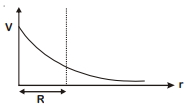
B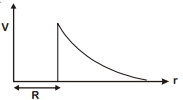
C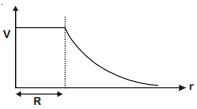
D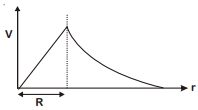
Solution
(C) For a positively charged metallic thin shell of radius $R$:
$1$. Inside the shell $(r < R)$,the electric field is zero,which implies that the electrostatic potential $V$ is constant and equal to the potential at the surface.
$V = \frac{q}{4 \pi \varepsilon_{0} R} = \text{constant}$
$2$. Outside the shell $(r \geq R)$,the shell behaves as a point charge placed at the centre. Thus,the potential varies inversely with distance.
$V = \frac{q}{4 \pi \varepsilon_{0} r} \implies V \propto \frac{1}{r}$
Therefore,the graph shows a constant potential for $r < R$ and a hyperbolic decrease for $r \geq R$,which matches the graph in option $C$.
$1$. Inside the shell $(r < R)$,the electric field is zero,which implies that the electrostatic potential $V$ is constant and equal to the potential at the surface.
$V = \frac{q}{4 \pi \varepsilon_{0} R} = \text{constant}$
$2$. Outside the shell $(r \geq R)$,the shell behaves as a point charge placed at the centre. Thus,the potential varies inversely with distance.
$V = \frac{q}{4 \pi \varepsilon_{0} r} \implies V \propto \frac{1}{r}$
Therefore,the graph shows a constant potential for $r < R$ and a hyperbolic decrease for $r \geq R$,which matches the graph in option $C$.
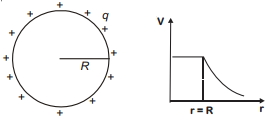
0 likesView Solution
Vedclass Products
For Students
Vedclass Test Series
Mock tests in real AIIMS style covering Physics with performance analysis. 5-day free trial.
Start Free TrialFor Teachers
Exam Paper Generator
Generate Set A/B/C/D Physics papers from 7.5L+ questions in 2 minutes. 3 chapters free.
Try FreeFor Institutes
Online Exam Module
Run live AIIMS mock exams with unlimited students, 360° analytics & white-label branding.
See DemoFrequently Asked Questions
How many Physics questions are in AIIMS 2013?
There are 52 Physics questions from the AIIMS 2013 paper on Vedclass, each with a detailed step-by-step solution in English.
Are AIIMS 2013 Physics solutions available in English?
Yes. All solutions on this page are in English. You can also switch to English or Hindi using the language buttons above the questions.
Can I practice AIIMS 2013 Physics as a timed test?
Yes. Use the Vedclass Test Series to attempt a full AIIMS mock test covering Physics with time limits and instant score analysis.
Can teachers create Physics papers from AIIMS previous year questions?
Yes. The Vedclass Exam Paper Generator lets teachers mix AIIMS Physics questions and generate Set A/B/C/D papers in minutes.
For Teachers & Institutes
Build a Custom Physics Paper
Pick AIIMS 2013 Physics questions, set difficulty, and generate Set A/B/C/D in 2 minutes.