
ChemistryQ1–80 of 80 questions
Page 1 of 1 · English
1
ChemistryMCQAIIMS · 2008
Two bodies of masses $m_1$ and $m_2$ are initially at rest at an infinite distance apart. They are then allowed to move towards each other under mutual gravitational attraction. Their relative velocity of approach at a separation distance $r$ between them is
A
$[2G(m_1 - m_2)/r]^{1/2}$
B
$[2G(m_1 + m_2)/r]^{1/2}$
C
$[r/(2G m_1 m_2)]^{1/2}$
D
$[2G m_1 m_2/r]^{1/2}$
Solution
(B) Let the velocities of these masses at distance $r$ be $v_1$ and $v_2$ respectively. Since the system is initially at rest,by the conservation of linear momentum,$m_1 v_1 = m_2 v_2$,which implies $v_1 = (m_2/m_1)v_2$.
By the law of conservation of energy,the loss in potential energy equals the gain in kinetic energy: $G m_1 m_2 / r = (1/2) m_1 v_1^2 + (1/2) m_2 v_2^2$.
Substituting $v_1 = (m_2/m_1)v_2$ into the energy equation: $G m_1 m_2 / r = (1/2) m_1 (m_2^2/m_1^2) v_2^2 + (1/2) m_2 v_2^2 = (1/2) (m_2^2/m_1 + m_2) v_2^2 = (1/2) [m_2(m_1 + m_2)/m_1] v_2^2$.
Solving for $v_2$,we get $v_2 = \sqrt{2 G m_1^2 / (r(m_1 + m_2))}$. Similarly,$v_1 = \sqrt{2 G m_2^2 / (r(m_1 + m_2))}$.
The relative velocity of approach is $v_{\text{rel}} = v_1 + v_2 = \sqrt{2 G / (r(m_1 + m_2))} (m_2 + m_1) = \sqrt{2 G (m_1 + m_2) / r}$.
By the law of conservation of energy,the loss in potential energy equals the gain in kinetic energy: $G m_1 m_2 / r = (1/2) m_1 v_1^2 + (1/2) m_2 v_2^2$.
Substituting $v_1 = (m_2/m_1)v_2$ into the energy equation: $G m_1 m_2 / r = (1/2) m_1 (m_2^2/m_1^2) v_2^2 + (1/2) m_2 v_2^2 = (1/2) (m_2^2/m_1 + m_2) v_2^2 = (1/2) [m_2(m_1 + m_2)/m_1] v_2^2$.
Solving for $v_2$,we get $v_2 = \sqrt{2 G m_1^2 / (r(m_1 + m_2))}$. Similarly,$v_1 = \sqrt{2 G m_2^2 / (r(m_1 + m_2))}$.
The relative velocity of approach is $v_{\text{rel}} = v_1 + v_2 = \sqrt{2 G / (r(m_1 + m_2))} (m_2 + m_1) = \sqrt{2 G (m_1 + m_2) / r}$.
0 likesView Solution
2
ChemistryMCQAIIMS · 2008
Charge $q$ is uniformly distributed over a thin half ring of radius $R$. The electric field at the centre of the ring is
A
$\frac{q}{{2{\pi ^2}{\varepsilon _0}{R^2}}}$
B
$\frac{q}{{4{\pi ^2}{\varepsilon _0}{R^2}}}$
C
$\frac{q}{{4\pi {\varepsilon _0}{R^2}}}$
D
$\frac{q}{{2\pi {\varepsilon _0}{R^2}}}$
Solution
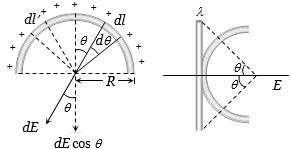
(A) Consider a small element of length $dl = R d\theta$ on the half ring at an angle $\theta$ with the vertical axis.
The linear charge density is $\lambda = \frac{q}{\pi R}$.
The charge on the element is $dq = \lambda dl = \lambda R d\theta$.
The electric field at the centre due to this element is $dE = \frac{1}{4\pi \varepsilon_0} \frac{dq}{R^2} = \frac{1}{4\pi \varepsilon_0} \frac{\lambda R d\theta}{R^2} = \frac{\lambda d\theta}{4\pi \varepsilon_0 R}$.
By symmetry,the horizontal components of the electric field cancel out,and only the vertical components $dE \cos \theta$ add up.
The total electric field at the centre is $E = \int_{-\pi/2}^{\pi/2} dE \cos \theta = \int_{-\pi/2}^{\pi/2} \frac{\lambda}{4\pi \varepsilon_0 R} \cos \theta d\theta$.
$E = \frac{\lambda}{4\pi \varepsilon_0 R} [\sin \theta]_{-\pi/2}^{\pi/2} = \frac{\lambda}{4\pi \varepsilon_0 R} (1 - (-1)) = \frac{2\lambda}{4\pi \varepsilon_0 R} = \frac{\lambda}{2\pi \varepsilon_0 R}$.
Substituting $\lambda = \frac{q}{\pi R}$,we get $E = \frac{q/\pi R}{2\pi \varepsilon_0 R} = \frac{q}{2\pi^2 \varepsilon_0 R^2}$.
The linear charge density is $\lambda = \frac{q}{\pi R}$.
The charge on the element is $dq = \lambda dl = \lambda R d\theta$.
The electric field at the centre due to this element is $dE = \frac{1}{4\pi \varepsilon_0} \frac{dq}{R^2} = \frac{1}{4\pi \varepsilon_0} \frac{\lambda R d\theta}{R^2} = \frac{\lambda d\theta}{4\pi \varepsilon_0 R}$.
By symmetry,the horizontal components of the electric field cancel out,and only the vertical components $dE \cos \theta$ add up.
The total electric field at the centre is $E = \int_{-\pi/2}^{\pi/2} dE \cos \theta = \int_{-\pi/2}^{\pi/2} \frac{\lambda}{4\pi \varepsilon_0 R} \cos \theta d\theta$.
$E = \frac{\lambda}{4\pi \varepsilon_0 R} [\sin \theta]_{-\pi/2}^{\pi/2} = \frac{\lambda}{4\pi \varepsilon_0 R} (1 - (-1)) = \frac{2\lambda}{4\pi \varepsilon_0 R} = \frac{\lambda}{2\pi \varepsilon_0 R}$.
Substituting $\lambda = \frac{q}{\pi R}$,we get $E = \frac{q/\pi R}{2\pi \varepsilon_0 R} = \frac{q}{2\pi^2 \varepsilon_0 R^2}$.
0 likesView Solution
3
ChemistryMCQAIIMS · 2008
Which of the following is a primary halide?
A
Isopropyl iodide
B
Secondary butyl iodide
C
Tertiary butyl bromide
D
Neo hexyl chloride
Solution
(D) In neo hexyl chloride $(CH_3-C(CH_3)_2-CH_2-CH_2-Cl)$,the chlorine atom is attached to a primary carbon atom.
Therefore,it is a primary halide.
Therefore,it is a primary halide.
0 likesView Solution
4
ChemistryMCQAIIMS · 2008
Which one of the following pairs of geographical areas shows maximum biodiversity in our country?
A
Sunderbans and Rann of Kutch
B
Eastern Ghats and West Bengal
C
Eastern Himalaya and Western Ghats
D
Kerala and Punjab
Solution
(C) India is recognized as one of the $12$ mega-biodiversity countries in the world.
Among the given options,the Eastern Himalayas and the Western Ghats are identified as two of the most important biodiversity hotspots in India.
These regions are characterized by high levels of species richness,endemism,and significant threats to their habitats,making them areas of maximum biodiversity.
Among the given options,the Eastern Himalayas and the Western Ghats are identified as two of the most important biodiversity hotspots in India.
These regions are characterized by high levels of species richness,endemism,and significant threats to their habitats,making them areas of maximum biodiversity.
0 likesView Solution
5
ChemistryMCQAIIMS · 2008
$A$ fish looking up through the water sees the outside world,contained in a circular horizon. If the refractive index of water is $\frac{4}{3}$ and the fish is $12 \ cm$ below the water surface,the radius of this circle in $cm$ is
A
$36\sqrt{7}$
B
$\frac{36}{\sqrt{7}}$
C
$36\sqrt{5}$
D
$4\sqrt{5}$
Solution
(B) The light from the outside world enters the water and undergoes refraction. Due to total internal reflection,the fish sees the outside world within a circular cone of light.
The radius $r$ of this circular horizon is given by the formula $r = \frac{h}{\sqrt{\mu^2 - 1}}$,where $h$ is the depth of the fish and $\mu$ is the refractive index of water.
Given $h = 12 \ cm$ and $\mu = \frac{4}{3}$.
Substituting the values: $r = \frac{12}{\sqrt{(4/3)^2 - 1}} = \frac{12}{\sqrt{16/9 - 1}} = \frac{12}{\sqrt{7/9}} = \frac{12 \times 3}{\sqrt{7}} = \frac{36}{\sqrt{7}} \ cm$.
The radius $r$ of this circular horizon is given by the formula $r = \frac{h}{\sqrt{\mu^2 - 1}}$,where $h$ is the depth of the fish and $\mu$ is the refractive index of water.
Given $h = 12 \ cm$ and $\mu = \frac{4}{3}$.
Substituting the values: $r = \frac{12}{\sqrt{(4/3)^2 - 1}} = \frac{12}{\sqrt{16/9 - 1}} = \frac{12}{\sqrt{7/9}} = \frac{12 \times 3}{\sqrt{7}} = \frac{36}{\sqrt{7}} \ cm$.
0 likesView Solution
6
ChemistryMCQAIIMS · 2008
Charge $q$ is uniformly distributed over a thin half ring of radius $R$. The electric field at the centre of the ring is
A
$\frac{q}{2{\pi ^2}{\varepsilon _0}{R^2}}$
B
$\frac{q}{4{\pi ^2}{\varepsilon _0}{R^2}}$
C
$\frac{q}{4\pi {\varepsilon _0}{R^2}}$
D
$\frac{q}{2\pi {\varepsilon _0}{R^2}}$
Solution
(A) Consider a small element of charge $dq$ on the half ring at an angle $\theta$ with the vertical. The charge per unit length is $\lambda = \frac{q}{\pi R}$.
The electric field due to this element at the centre is $dE = \frac{1}{4\pi\varepsilon_0} \frac{dq}{R^2}$.
Due to symmetry,the horizontal components of the electric field cancel out.
The vertical component is $dE_y = dE \cos\theta = \frac{1}{4\pi\varepsilon_0} \frac{\lambda R d\theta}{R^2} \cos\theta$.
Integrating from $-\frac{\pi}{2}$ to $\frac{\pi}{2}$:
$E = \int_{-\pi/2}^{\pi/2} \frac{\lambda}{4\pi\varepsilon_0 R} \cos\theta d\theta = \frac{\lambda}{4\pi\varepsilon_0 R} [\sin\theta]_{-\pi/2}^{\pi/2} = \frac{\lambda}{4\pi\varepsilon_0 R} (1 - (-1)) = \frac{2\lambda}{4\pi\varepsilon_0 R} = \frac{\lambda}{2\pi\varepsilon_0 R}$.
Substituting $\lambda = \frac{q}{\pi R}$,we get $E = \frac{q/(\pi R)}{2\pi\varepsilon_0 R} = \frac{q}{2\pi^2\varepsilon_0 R^2}$.
The electric field due to this element at the centre is $dE = \frac{1}{4\pi\varepsilon_0} \frac{dq}{R^2}$.
Due to symmetry,the horizontal components of the electric field cancel out.
The vertical component is $dE_y = dE \cos\theta = \frac{1}{4\pi\varepsilon_0} \frac{\lambda R d\theta}{R^2} \cos\theta$.
Integrating from $-\frac{\pi}{2}$ to $\frac{\pi}{2}$:
$E = \int_{-\pi/2}^{\pi/2} \frac{\lambda}{4\pi\varepsilon_0 R} \cos\theta d\theta = \frac{\lambda}{4\pi\varepsilon_0 R} [\sin\theta]_{-\pi/2}^{\pi/2} = \frac{\lambda}{4\pi\varepsilon_0 R} (1 - (-1)) = \frac{2\lambda}{4\pi\varepsilon_0 R} = \frac{\lambda}{2\pi\varepsilon_0 R}$.
Substituting $\lambda = \frac{q}{\pi R}$,we get $E = \frac{q/(\pi R)}{2\pi\varepsilon_0 R} = \frac{q}{2\pi^2\varepsilon_0 R^2}$.
0 likesView Solution
7
ChemistryMCQAIIMS · 2008
The input resistance of a common emitter transistor amplifier,if the output resistance is $500 \, k\Omega$,the current gain $\alpha = 0.98$ and power gain is $6.0625 \times 10^6$,is....$\Omega$
A
$198$
B
$300$
C
$100$
D
$400$
Solution
(A) First,calculate the current gain $\beta$ for the common emitter configuration using the relation $\beta = \frac{\alpha}{1 - \alpha}$.
Given $\alpha = 0.98$,we have $\beta = \frac{0.98}{1 - 0.98} = \frac{0.98}{0.02} = 49$.
The power gain is given by the formula $A_p = \beta^2 \times \frac{R_o}{R_i}$,where $R_o$ is the output resistance and $R_i$ is the input resistance.
Given $A_p = 6.0625 \times 10^6$ and $R_o = 500 \times 10^3 \, \Omega$.
Substituting the values: $6.0625 \times 10^6 = (49)^2 \times \frac{500 \times 10^3}{R_i}$.
$6.0625 \times 10^6 = 2401 \times \frac{500 \times 10^3}{R_i}$.
$R_i = \frac{2401 \times 500 \times 10^3}{6.0625 \times 10^6} = \frac{1200500 \times 10^3}{6.0625 \times 10^6} = \frac{1200.5}{6.0625} \approx 198 \, \Omega$.
Given $\alpha = 0.98$,we have $\beta = \frac{0.98}{1 - 0.98} = \frac{0.98}{0.02} = 49$.
The power gain is given by the formula $A_p = \beta^2 \times \frac{R_o}{R_i}$,where $R_o$ is the output resistance and $R_i$ is the input resistance.
Given $A_p = 6.0625 \times 10^6$ and $R_o = 500 \times 10^3 \, \Omega$.
Substituting the values: $6.0625 \times 10^6 = (49)^2 \times \frac{500 \times 10^3}{R_i}$.
$6.0625 \times 10^6 = 2401 \times \frac{500 \times 10^3}{R_i}$.
$R_i = \frac{2401 \times 500 \times 10^3}{6.0625 \times 10^6} = \frac{1200500 \times 10^3}{6.0625 \times 10^6} = \frac{1200.5}{6.0625} \approx 198 \, \Omega$.
0 likesView Solution
8
ChemistryMCQAIIMS · 2008
$A$ fish looking up through the water sees the outside world,contained in a circular horizon. If the refractive index of water is $\frac{4}{3}$ and the fish is $12 \ cm$ below the water surface,the radius of this circle in $cm$ is
A
$36\sqrt{7}$
B
$\frac{36}{\sqrt{7}}$
C
$36\sqrt{5}$
D
$4\sqrt{5}$
Solution
(B) The light from the outside world reaches the fish only if the angle of incidence is less than or equal to the critical angle $C$. The light rays forming the boundary of the circular horizon correspond to the critical angle $C$.
For water with refractive index $\mu = \frac{4}{3}$,the critical angle $C$ is given by $\sin C = \frac{1}{\mu} = \frac{3}{4}$.
From the geometry,the radius $r$ of the circular horizon is given by $r = h \tan C$,where $h = 12 \ cm$ is the depth of the fish.
Since $\sin C = \frac{3}{4}$,we have $\cos C = \sqrt{1 - \sin^2 C} = \sqrt{1 - (\frac{3}{4})^2} = \sqrt{\frac{7}{16}} = \frac{\sqrt{7}}{4}$.
Therefore,$\tan C = \frac{\sin C}{\cos C} = \frac{3/4}{\sqrt{7}/4} = \frac{3}{\sqrt{7}}$.
Substituting the values,$r = 12 \times \frac{3}{\sqrt{7}} = \frac{36}{\sqrt{7}} \ cm$.
For water with refractive index $\mu = \frac{4}{3}$,the critical angle $C$ is given by $\sin C = \frac{1}{\mu} = \frac{3}{4}$.
From the geometry,the radius $r$ of the circular horizon is given by $r = h \tan C$,where $h = 12 \ cm$ is the depth of the fish.
Since $\sin C = \frac{3}{4}$,we have $\cos C = \sqrt{1 - \sin^2 C} = \sqrt{1 - (\frac{3}{4})^2} = \sqrt{\frac{7}{16}} = \frac{\sqrt{7}}{4}$.
Therefore,$\tan C = \frac{\sin C}{\cos C} = \frac{3/4}{\sqrt{7}/4} = \frac{3}{\sqrt{7}}$.
Substituting the values,$r = 12 \times \frac{3}{\sqrt{7}} = \frac{36}{\sqrt{7}} \ cm$.
0 likesView Solution
9
ChemistryMCQAIIMS · 2008
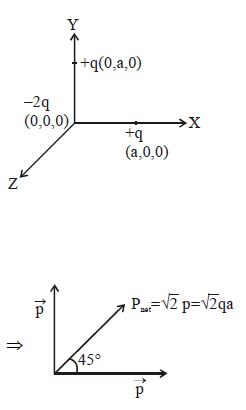
Three point charges $+q, -2q$ and $+q$ are placed at points $(x = 0, y = a, z = 0)$,$(x = 0, y = 0, z = 0)$ and $(x = a, y = 0, z = 0)$ respectively. The magnitude and direction of the electric dipole moment vector of this charge assembly are
A
$\sqrt{2}qa$ along $+y$ direction
B
$\sqrt{2}qa$ along the line joining points $(x = 0, y = 0, z = 0)$ and $(x = a, y = a, z = 0)$
C
$qa$ along the line joining points $(x = 0, y = 0, z = 0)$ and $(x = a, y = a, z = 0)$
D
$\sqrt{2}qa$ along $+x$ direction
Solution
(B) The charge $-2q$ can be considered as two charges of $-q$ each at the origin $(0, 0, 0)$.
This allows us to form two electric dipoles:
$1$. $A$ dipole with charges $+q$ at $(0, a, 0)$ and $-q$ at $(0, 0, 0)$. Its dipole moment is $\vec{p}_1 = q(a\hat{j}) = qa\hat{j}$.
$2$. $A$ dipole with charges $+q$ at $(a, 0, 0)$ and $-q$ at $(0, 0, 0)$. Its dipole moment is $\vec{p}_2 = q(a\hat{i}) = qa\hat{i}$.
The net dipole moment is $\vec{p}_{net} = \vec{p}_1 + \vec{p}_2 = qa\hat{i} + qa\hat{j}$.
The magnitude is $|\vec{p}_{net}| = \sqrt{(qa)^2 + (qa)^2} = \sqrt{2}qa$.
The direction is at an angle of $45^{\circ}$ with the $x$-axis,which is along the line joining $(0, 0, 0)$ and $(a, a, 0)$.
This allows us to form two electric dipoles:
$1$. $A$ dipole with charges $+q$ at $(0, a, 0)$ and $-q$ at $(0, 0, 0)$. Its dipole moment is $\vec{p}_1 = q(a\hat{j}) = qa\hat{j}$.
$2$. $A$ dipole with charges $+q$ at $(a, 0, 0)$ and $-q$ at $(0, 0, 0)$. Its dipole moment is $\vec{p}_2 = q(a\hat{i}) = qa\hat{i}$.
The net dipole moment is $\vec{p}_{net} = \vec{p}_1 + \vec{p}_2 = qa\hat{i} + qa\hat{j}$.
The magnitude is $|\vec{p}_{net}| = \sqrt{(qa)^2 + (qa)^2} = \sqrt{2}qa$.
The direction is at an angle of $45^{\circ}$ with the $x$-axis,which is along the line joining $(0, 0, 0)$ and $(a, a, 0)$.
0 likesView Solution
10
ChemistryMCQAIIMS · 2008
The input resistance of a common emitter transistor amplifier,if the output resistance is $500 \, k\Omega$,the current gain $\alpha = 0.98$ and power gain is $6.0625 \times 10^6$,is ......... $\Omega$.
A
$198$
B
$300$
C
$100$
D
$400$
Solution
(A) Given: $\alpha = 0.98$,$R_o = 500 \, k\Omega = 500 \times 10^3 \, \Omega$,Power Gain $= 6.0625 \times 10^6$.
First,calculate the current gain $\beta$ for the common emitter configuration:
$\beta = \frac{\alpha}{1 - \alpha} = \frac{0.98}{1 - 0.98} = \frac{0.98}{0.02} = 49$.
The formula for power gain in a common emitter amplifier is:
$\text{Power Gain} = \beta^2 \times \frac{R_o}{R_{in}}$.
Substituting the known values:
$6.0625 \times 10^6 = (49)^2 \times \frac{500 \times 10^3}{R_{in}}$.
$6.0625 \times 10^6 = 2401 \times \frac{500 \times 10^3}{R_{in}}$.
$R_{in} = \frac{2401 \times 500 \times 10^3}{6.0625 \times 10^6}$.
$R_{in} = \frac{1200500 \times 10^3}{6.0625 \times 10^6} = \frac{1200.5 \times 10^6}{6.0625 \times 10^6} \approx 198 \, \Omega$.
First,calculate the current gain $\beta$ for the common emitter configuration:
$\beta = \frac{\alpha}{1 - \alpha} = \frac{0.98}{1 - 0.98} = \frac{0.98}{0.02} = 49$.
The formula for power gain in a common emitter amplifier is:
$\text{Power Gain} = \beta^2 \times \frac{R_o}{R_{in}}$.
Substituting the known values:
$6.0625 \times 10^6 = (49)^2 \times \frac{500 \times 10^3}{R_{in}}$.
$6.0625 \times 10^6 = 2401 \times \frac{500 \times 10^3}{R_{in}}$.
$R_{in} = \frac{2401 \times 500 \times 10^3}{6.0625 \times 10^6}$.
$R_{in} = \frac{1200500 \times 10^3}{6.0625 \times 10^6} = \frac{1200.5 \times 10^6}{6.0625 \times 10^6} \approx 198 \, \Omega$.
0 likesView Solution
11
ChemistryMCQAIIMS · 2008
$A$ person speaking normally produces a sound intensity level of $40\, dB$ at a distance of $1\, m$. If the threshold intensity level for reasonable audibility is $20\, dB$,the maximum distance at which he can be heard clearly is ..... $m$.
A
$4$
B
$5$
C
$10$
D
$20$
Solution
(C) The sound intensity level $\beta$ is given by $\beta = 10 \log_{10} \left( \frac{I}{I_0} \right)$.
At distance $r_1 = 1\, m$,the intensity level $\beta_1 = 40\, dB$.
At distance $r_2$,the intensity level $\beta_2 = 20\, dB$.
We know that intensity $I \propto \frac{1}{r^2}$,so $\frac{I_1}{I_2} = \frac{r_2^2}{r_1^2}$.
From the intensity level formula: $\beta_1 - \beta_2 = 10 \log_{10} \left( \frac{I_1}{I_2} \right)$.
Substituting the values: $40 - 20 = 10 \log_{10} \left( \frac{r_2^2}{r_1^2} \right)$.
$20 = 10 \log_{10} \left( \frac{r_2^2}{1^2} \right) \Rightarrow 2 = \log_{10} (r_2^2)$.
Taking antilog on both sides: $10^2 = r_2^2$.
$r_2 = 10\, m$.
At distance $r_1 = 1\, m$,the intensity level $\beta_1 = 40\, dB$.
At distance $r_2$,the intensity level $\beta_2 = 20\, dB$.
We know that intensity $I \propto \frac{1}{r^2}$,so $\frac{I_1}{I_2} = \frac{r_2^2}{r_1^2}$.
From the intensity level formula: $\beta_1 - \beta_2 = 10 \log_{10} \left( \frac{I_1}{I_2} \right)$.
Substituting the values: $40 - 20 = 10 \log_{10} \left( \frac{r_2^2}{r_1^2} \right)$.
$20 = 10 \log_{10} \left( \frac{r_2^2}{1^2} \right) \Rightarrow 2 = \log_{10} (r_2^2)$.
Taking antilog on both sides: $10^2 = r_2^2$.
$r_2 = 10\, m$.
0 likesView Solution
12
ChemistryMCQAIIMS · 2008
In a mass spectrometer used for measuring the masses of ions,the ions are initially accelerated by an electric potential $V$ and then made to describe semicircular paths of radius $R$ using a magnetic field $B$. If $V$ and $B$ are kept constant,the ratio $\left( \frac{\text{charge on the ion}}{\text{mass of the ion}} \right)$ will be proportional to
A
$\frac{1}{R}$
B
$\frac{1}{R^2}$
C
$R^2$
D
$R$
Solution
(B) The centripetal force is provided by the magnetic force.
$i.e., \frac{mv^2}{R} = qvB ......... (1)$
where $m = \text{mass of the ion}$,$v = \text{velocity}$,$q = \text{charge of ion}$,$B = \text{magnetic field flux density}$.
From $(1)$,the velocity of the ion is $v = \frac{qBR}{m}$.
The kinetic energy gained by the ion when accelerated through a potential $V$ is given by $E = qV$.
Also,$E = \frac{1}{2}mv^2$.
Equating the two expressions for energy:
$qV = \frac{1}{2}m \left( \frac{qBR}{m} \right)^2$
$qV = \frac{1}{2}m \frac{q^2 B^2 R^2}{m^2}$
$qV = \frac{q^2 B^2 R^2}{2m}$
Rearranging for the ratio $\frac{q}{m}$:
$\frac{q}{m} = \frac{2V}{B^2 R^2}$
Since $V$ and $B$ are constant,we have $\frac{q}{m} \propto \frac{1}{R^2}$.
$i.e., \frac{mv^2}{R} = qvB ......... (1)$
where $m = \text{mass of the ion}$,$v = \text{velocity}$,$q = \text{charge of ion}$,$B = \text{magnetic field flux density}$.
From $(1)$,the velocity of the ion is $v = \frac{qBR}{m}$.
The kinetic energy gained by the ion when accelerated through a potential $V$ is given by $E = qV$.
Also,$E = \frac{1}{2}mv^2$.
Equating the two expressions for energy:
$qV = \frac{1}{2}m \left( \frac{qBR}{m} \right)^2$
$qV = \frac{1}{2}m \frac{q^2 B^2 R^2}{m^2}$
$qV = \frac{q^2 B^2 R^2}{2m}$
Rearranging for the ratio $\frac{q}{m}$:
$\frac{q}{m} = \frac{2V}{B^2 R^2}$
Since $V$ and $B$ are constant,we have $\frac{q}{m} \propto \frac{1}{R^2}$.
0 likesView Solution
13
ChemistryMCQAIIMS · 2008
An $AC$ source of angular frequency $\omega$ is fed across a resistor $R$ and a capacitor $C$ in series. The current registered is $I$. If now the frequency of the source is changed to $\omega/3$ (but maintaining the same voltage),the current in the circuit is found to be halved. Calculate the ratio of reactance to resistance at the original frequency $\omega$.
A
$\sqrt{3/5}$
B
$\sqrt{2/5}$
C
$\sqrt{1/5}$
D
$\sqrt{4/5}$
Solution
(A) At angular frequency $\omega$,the current $I$ in the $RC$ series circuit is given by:
$I = \frac{V}{\sqrt{R^2 + X_C^2}} = \frac{V}{\sqrt{R^2 + (1/\omega C)^2}}$ ..........$(1)$
When the angular frequency is changed to $\omega' = \omega/3$,the new capacitive reactance becomes $X_C' = \frac{1}{(\omega/3)C} = \frac{3}{\omega C} = 3X_C$.
The new current is $I' = I/2$. Thus:
$\frac{I}{2} = \frac{V}{\sqrt{R^2 + (3X_C)^2}}$ ..........$(2)$
Dividing equation $(1)$ by equation $(2)$:
$\frac{I}{I/2} = \frac{\sqrt{R^2 + (3X_C)^2}}{\sqrt{R^2 + X_C^2}}$
$2 = \sqrt{\frac{R^2 + 9X_C^2}{R^2 + X_C^2}}$
Squaring both sides:
$4 = \frac{R^2 + 9X_C^2}{R^2 + X_C^2}$
$4R^2 + 4X_C^2 = R^2 + 9X_C^2$
$3R^2 = 5X_C^2$
$\frac{X_C^2}{R^2} = \frac{3}{5}$
$\frac{X_C}{R} = \sqrt{\frac{3}{5}}$
$I = \frac{V}{\sqrt{R^2 + X_C^2}} = \frac{V}{\sqrt{R^2 + (1/\omega C)^2}}$ ..........$(1)$
When the angular frequency is changed to $\omega' = \omega/3$,the new capacitive reactance becomes $X_C' = \frac{1}{(\omega/3)C} = \frac{3}{\omega C} = 3X_C$.
The new current is $I' = I/2$. Thus:
$\frac{I}{2} = \frac{V}{\sqrt{R^2 + (3X_C)^2}}$ ..........$(2)$
Dividing equation $(1)$ by equation $(2)$:
$\frac{I}{I/2} = \frac{\sqrt{R^2 + (3X_C)^2}}{\sqrt{R^2 + X_C^2}}$
$2 = \sqrt{\frac{R^2 + 9X_C^2}{R^2 + X_C^2}}$
Squaring both sides:
$4 = \frac{R^2 + 9X_C^2}{R^2 + X_C^2}$
$4R^2 + 4X_C^2 = R^2 + 9X_C^2$
$3R^2 = 5X_C^2$
$\frac{X_C^2}{R^2} = \frac{3}{5}$
$\frac{X_C}{R} = \sqrt{\frac{3}{5}}$
0 likesView Solution
14
ChemistryDifficultMCQAIIMS · 2008
Assertion : Equivalent weight of a base $= \frac{\text{Molecular weight}}{\text{Acidity}}$
Reason : Acidity is the number of replaceable hydrogen atoms in one molecule of the base.
Reason : Acidity is the number of replaceable hydrogen atoms in one molecule of the base.
A
If both Assertion and Reason are correct and the Reason is a correct explanation of the Assertion.
B
If both Assertion and Reason are correct but Reason is not a correct explanation of the Assertion.
C
If the Assertion is correct but Reason is incorrect.
D
If both the Assertion and Reason are incorrect.
Solution
(C) The equivalent weight of a base is defined as the ratio of its molecular weight to its acidity. Thus,the assertion is correct.
Acidity is defined as the number of replaceable $-OH$ groups present in one molecule of a base,not the number of replaceable hydrogen atoms. Thus,the reason is incorrect.
Acidity is defined as the number of replaceable $-OH$ groups present in one molecule of a base,not the number of replaceable hydrogen atoms. Thus,the reason is incorrect.
0 likesView Solution
15
ChemistryDifficultMCQAIIMS · 2008
The uncertainties in the velocities of two particles,$A$ and $B$ are $0.05 \ ms^{-1}$ and $0.02 \ ms^{-1}$ respectively. The mass of $B$ is five times that of the mass of $A$. What is the ratio of uncertainties $\frac{\Delta x_A}{\Delta x_B}$ in their positions?
A
$2$
B
$0.25$
C
$4$
D
$1$
Solution
(A) According to Heisenberg's uncertainty principle,the relation is $\Delta x \cdot \Delta v \cdot m = \frac{h}{4 \pi}$.
Thus,$\Delta x = \frac{h}{4 \pi m \cdot \Delta v}$.
For particle $A$: $\Delta x_A = \frac{h}{4 \pi m_A \cdot \Delta v_A} = \frac{h}{4 \pi m_A \cdot 0.05}$.
For particle $B$: $\Delta x_B = \frac{h}{4 \pi m_B \cdot \Delta v_B} = \frac{h}{4 \pi (5m_A) \cdot 0.02}$.
Taking the ratio $\frac{\Delta x_A}{\Delta x_B} = \frac{h}{4 \pi m_A \cdot 0.05} \times \frac{4 \pi (5m_A) \cdot 0.02}{h}$.
$\frac{\Delta x_A}{\Delta x_B} = \frac{5 \times 0.02}{0.05} = \frac{0.10}{0.05} = 2$.
Thus,$\Delta x = \frac{h}{4 \pi m \cdot \Delta v}$.
For particle $A$: $\Delta x_A = \frac{h}{4 \pi m_A \cdot \Delta v_A} = \frac{h}{4 \pi m_A \cdot 0.05}$.
For particle $B$: $\Delta x_B = \frac{h}{4 \pi m_B \cdot \Delta v_B} = \frac{h}{4 \pi (5m_A) \cdot 0.02}$.
Taking the ratio $\frac{\Delta x_A}{\Delta x_B} = \frac{h}{4 \pi m_A \cdot 0.05} \times \frac{4 \pi (5m_A) \cdot 0.02}{h}$.
$\frac{\Delta x_A}{\Delta x_B} = \frac{5 \times 0.02}{0.05} = \frac{0.10}{0.05} = 2$.
0 likesView Solution
16
ChemistryMediumMCQAIIMS · 2008
Assertion : $A$ spectral line will be observed for a $2p_x - 2p_y$ transition.
Reason : The energy is released in the form of a wave of light when an electron drops from $2p_x$ to $2p_y$ orbital.
Reason : The energy is released in the form of a wave of light when an electron drops from $2p_x$ to $2p_y$ orbital.
A
If both Assertion and Reason are correct and the Reason is a correct explanation of the Assertion.
B
If both Assertion and Reason are correct but Reason is not a correct explanation of the Assertion.
C
If the Assertion is correct but Reason is incorrect.
D
If both the Assertion and Reason are incorrect.
Solution
(D) Both the assertion and the reason are false.
$2p_x$ and $2p_y$ orbitals are degenerate,meaning they have the same energy.
Since there is no energy difference between these orbitals,no electronic transition occurs.
Consequently,no energy is released,and no spectral line is observed.
$2p_x$ and $2p_y$ orbitals are degenerate,meaning they have the same energy.
Since there is no energy difference between these orbitals,no electronic transition occurs.
Consequently,no energy is released,and no spectral line is observed.
0 likesView Solution
17
ChemistryAdvancedMCQAIIMS · 2008
Sulphur reacts with chlorine in $1:2$ ratio and forms $X$. Hydrolysis of $X$ gives a sulphur compound $Y$. What is the structure and hybridisation of the anion of $Y$?
A
tetrahedral,$sp^3$
B
linear,$sp$
C
pyramidal,$sp^3$
D
trigonal planar,$sp^2$
Solution
(C) $S + 2Cl_2 \to SCl_4$
Hydrolysis of $SCl_4$ gives $H_2SO_3$ $(Y)$.
$SCl_4 + 3H_2O \to H_2SO_3 + 4HCl$
The anion of $Y$ is $SO_3^{2-}$.
In $SO_3^{2-}$,the central $S$ atom has $1$ lone pair and $3$ bond pairs,resulting in $sp^3$ hybridisation.
Due to the presence of one lone pair,the shape of $SO_3^{2-}$ is pyramidal.
Hydrolysis of $SCl_4$ gives $H_2SO_3$ $(Y)$.
$SCl_4 + 3H_2O \to H_2SO_3 + 4HCl$
The anion of $Y$ is $SO_3^{2-}$.
In $SO_3^{2-}$,the central $S$ atom has $1$ lone pair and $3$ bond pairs,resulting in $sp^3$ hybridisation.
Due to the presence of one lone pair,the shape of $SO_3^{2-}$ is pyramidal.
0 likesView Solution
18
ChemistryMediumMCQAIIMS · 2008
Assertion : Fluorine molecule has bond order one.
Reason : The number of electrons in the antibonding molecular orbitals is two less than that in bonding molecular orbitals.
Reason : The number of electrons in the antibonding molecular orbitals is two less than that in bonding molecular orbitals.
A
If both Assertion and Reason are correct and the Reason is a correct explanation of the Assertion.
B
If both Assertion and Reason are correct but Reason is not a correct explanation of the Assertion.
C
If the Assertion is correct but Reason is incorrect.
D
If both the Assertion and Reason are incorrect.
Solution
(A) The $MO$ electronic configuration of the $F_2$ molecule ($18$ electrons) is: $\sigma 1s^2, \sigma^* 1s^2, \sigma 2s^2, \sigma^* 2s^2, \sigma 2p_z^2, \pi 2p_x^2 = \pi 2p_y^2, \pi^* 2p_x^2 = \pi^* 2p_y^2$.
Number of bonding electrons $(N_b)$ $= 10$.
Number of antibonding electrons $(N_a)$ $= 8$.
Bond order $= \frac{N_b - N_a}{2} = \frac{10 - 8}{2} = 1$.
Since $N_b - N_a = 2$,the number of electrons in antibonding orbitals is indeed two less than in bonding orbitals.
Thus,both Assertion and Reason are correct,and the Reason is the correct explanation for the Assertion.
Number of bonding electrons $(N_b)$ $= 10$.
Number of antibonding electrons $(N_a)$ $= 8$.
Bond order $= \frac{N_b - N_a}{2} = \frac{10 - 8}{2} = 1$.
Since $N_b - N_a = 2$,the number of electrons in antibonding orbitals is indeed two less than in bonding orbitals.
Thus,both Assertion and Reason are correct,and the Reason is the correct explanation for the Assertion.
0 likesView Solution
19
ChemistryEasyMCQAIIMS · 2008
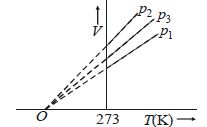
The volume-temperature graphs of a given mass of an ideal gas at different constant pressures are shown below. What is the correct order of pressures?
A
$p_1 > p_3 > p_2$
B
$p_1 > p_2 > p_3$
C
$p_2 > p_3 > p_1$
D
$p_2 > p_1 > p_3$
Solution
(A) According to the ideal gas equation,$PV = nRT$,which can be rearranged as $V = (\frac{nR}{P})T$.
This represents a straight line equation $y = mx$,where the slope $m = \frac{nR}{P}$.
Since the slope is inversely proportional to pressure $(m \propto \frac{1}{P})$,the line with the smallest slope corresponds to the highest pressure.
Looking at the graph,the slope of the line for $p_1$ is the smallest,followed by $p_3$,and then $p_2$.
Therefore,the correct order of pressures is $p_1 > p_3 > p_2$.
This represents a straight line equation $y = mx$,where the slope $m = \frac{nR}{P}$.
Since the slope is inversely proportional to pressure $(m \propto \frac{1}{P})$,the line with the smallest slope corresponds to the highest pressure.
Looking at the graph,the slope of the line for $p_1$ is the smallest,followed by $p_3$,and then $p_2$.
Therefore,the correct order of pressures is $p_1 > p_3 > p_2$.
0 likesView Solution
20
ChemistryEasyMCQAIIMS · 2008
For a reaction to be spontaneous at all temperatures,which of the following conditions must be satisfied?
A
$\Delta G < 0, \Delta H > 0, \Delta S > 0$
B
$\Delta G > 0, \Delta H < 0, \Delta S > 0$
C
$\Delta G < 0, \Delta H < 0, \Delta S < 0$
D
$\Delta G < 0, \Delta H < 0, \Delta S > 0$
Solution
(D) The spontaneity of a reaction is determined by the Gibbs free energy equation: $\Delta G = \Delta H - T\Delta S$.
For a reaction to be spontaneous at all temperatures,$\Delta G$ must be negative.
This occurs when the enthalpy change $\Delta H$ is negative (exothermic) and the entropy change $\Delta S$ is positive (increase in disorder).
In this case,$\Delta G = (\text{negative}) - T(\text{positive})$,which will always be negative regardless of the temperature $T$.
For a reaction to be spontaneous at all temperatures,$\Delta G$ must be negative.
This occurs when the enthalpy change $\Delta H$ is negative (exothermic) and the entropy change $\Delta S$ is positive (increase in disorder).
In this case,$\Delta G = (\text{negative}) - T(\text{positive})$,which will always be negative regardless of the temperature $T$.
0 likesView Solution
21
ChemistryDifficultMCQAIIMS · 2008
What will be the heat of formation of methane,if the heat of combustion of carbon is $-x \ kJ$,heat of formation of water is $-y \ kJ$ and heat of combustion of methane is $z \ kJ$?
A
$(-x - y + z) \ kJ$
B
$(-z - x + 2y) \ kJ$
C
$(-x - 2y - z) \ kJ$
D
$(-x - 2y + z) \ kJ$
Solution
(D) The given thermochemical equations are:
$C(s) + O_2(g) \to CO_2(g) \quad \Delta H_1 = -x \ kJ \dots (i)$
$H_2(g) + \frac{1}{2} O_2(g) \to H_2O(l) \quad \Delta H_2 = -y \ kJ \dots (ii)$
$CH_4(g) + 2O_2(g) \to CO_2(g) + 2H_2O(l) \quad \Delta H_3 = z \ kJ \dots (iii)$
Note: Heat of combustion is energy released,so $\Delta H$ is negative. Given $z$ is the heat of combustion,$\Delta H_3 = -z \ kJ$.
We need the heat of formation of methane:
$C(s) + 2H_2(g) \to CH_4(g) \quad \Delta H_f = ?$
To obtain this,we perform: $(i) + 2 \times (ii) - (iii)$
$\Delta H_f = (-x) + 2(-y) - (-z) = -x - 2y + z \ kJ$.
$C(s) + O_2(g) \to CO_2(g) \quad \Delta H_1 = -x \ kJ \dots (i)$
$H_2(g) + \frac{1}{2} O_2(g) \to H_2O(l) \quad \Delta H_2 = -y \ kJ \dots (ii)$
$CH_4(g) + 2O_2(g) \to CO_2(g) + 2H_2O(l) \quad \Delta H_3 = z \ kJ \dots (iii)$
Note: Heat of combustion is energy released,so $\Delta H$ is negative. Given $z$ is the heat of combustion,$\Delta H_3 = -z \ kJ$.
We need the heat of formation of methane:
$C(s) + 2H_2(g) \to CH_4(g) \quad \Delta H_f = ?$
To obtain this,we perform: $(i) + 2 \times (ii) - (iii)$
$\Delta H_f = (-x) + 2(-y) - (-z) = -x - 2y + z \ kJ$.
0 likesView Solution
22
ChemistryMCQAIIMS · 2008
Assertion : For a reaction $2NH_{3(g)} \to N_{2(g)} + 3H_{2(g)}$ ; $\Delta H > \Delta E$
Reason : Enthalpy change is always greater than internal energy change.
Reason : Enthalpy change is always greater than internal energy change.
A
If both Assertion and Reason are correct and the Reason is a correct explanation of the Assertion.
B
If both Assertion and Reason are correct but Reason is not a correct explanation of the Assertion.
C
If the Assertion is correct but Reason is incorrect.
D
If both the Assertion and Reason are incorrect.
Solution
(C) The relationship between enthalpy change $(\Delta H)$ and internal energy change $(\Delta E)$ is given by the equation $\Delta H = \Delta E + \Delta n_g RT$.
For the reaction $2NH_{3(g)} \to N_{2(g)} + 3H_{2(g)}$,the change in the number of gaseous moles is $\Delta n_g = (1 + 3) - 2 = +2$.
Since $\Delta n_g$ is positive,$\Delta H = \Delta E + 2RT$,which implies $\Delta H > \Delta E$. Thus,the Assertion is correct.
However,the Reason states that enthalpy change is always greater than internal energy change,which is false because if $\Delta n_g$ is negative (e.g.,$N_{2(g)} + 3H_{2(g)} \to 2NH_{3(g)}$),then $\Delta H < \Delta E$.
For the reaction $2NH_{3(g)} \to N_{2(g)} + 3H_{2(g)}$,the change in the number of gaseous moles is $\Delta n_g = (1 + 3) - 2 = +2$.
Since $\Delta n_g$ is positive,$\Delta H = \Delta E + 2RT$,which implies $\Delta H > \Delta E$. Thus,the Assertion is correct.
However,the Reason states that enthalpy change is always greater than internal energy change,which is false because if $\Delta n_g$ is negative (e.g.,$N_{2(g)} + 3H_{2(g)} \to 2NH_{3(g)}$),then $\Delta H < \Delta E$.
0 likesView Solution
23
ChemistryEasyMCQAIIMS · 2008
Assertion : For a reaction $2NH_{3(g)} \to N_{2(g)} + 3H_{2(g)}$ ; $\Delta H > \Delta E$.
Reason : Enthalpy change is always greater than internal energy change.
Reason : Enthalpy change is always greater than internal energy change.
A
If both Assertion and Reason are correct and the Reason is a correct explanation of the Assertion.
B
If both Assertion and Reason are correct but Reason is not a correct explanation of the Assertion.
C
If the Assertion is correct but Reason is incorrect.
D
If both the Assertion and Reason are incorrect.
Solution
(C) The relationship between enthalpy change $(\Delta H)$ and internal energy change $(\Delta E)$ is given by the equation: $\Delta H = \Delta E + \Delta n_g RT$.
For the reaction $2NH_{3(g)} \to N_{2(g)} + 3H_{2(g)}$,the change in the number of gaseous moles is $\Delta n_g = (1 + 3) - 2 = 2$.
Since $\Delta n_g = 2$ (which is positive),$\Delta H = \Delta E + 2RT$,implying $\Delta H > \Delta E$. Thus,the Assertion is correct.
The Reason states that enthalpy change is always greater than internal energy change,which is false because if $\Delta n_g$ is negative or zero,$\Delta H$ can be less than or equal to $\Delta E$.
For the reaction $2NH_{3(g)} \to N_{2(g)} + 3H_{2(g)}$,the change in the number of gaseous moles is $\Delta n_g = (1 + 3) - 2 = 2$.
Since $\Delta n_g = 2$ (which is positive),$\Delta H = \Delta E + 2RT$,implying $\Delta H > \Delta E$. Thus,the Assertion is correct.
The Reason states that enthalpy change is always greater than internal energy change,which is false because if $\Delta n_g$ is negative or zero,$\Delta H$ can be less than or equal to $\Delta E$.
0 likesView Solution
24
ChemistryMediumMCQAIIMS · 2008
What is the $pH$ value of $1 \, M \, H_2SO_4$?
A
$0$
B
$-0.213$
C
$-2$
D
$-0.3010$
Solution
(D) $H_2SO_4 \to 2H^{+} + SO_4^{2-}$
Since $H_2SO_4$ is a strong diprotic acid,it dissociates completely as $H_2SO_4 \to 2H^{+} + SO_4^{2-}$.
For a $1 \, M$ solution of $H_2SO_4$,the concentration of $H^{+}$ ions is $[H^{+}] = 2 \times 1 \, M = 2 \, M$.
The $pH$ is calculated as $pH = - \log [H^{+}]$.
$pH = - \log(2) = -0.3010$.
Since $H_2SO_4$ is a strong diprotic acid,it dissociates completely as $H_2SO_4 \to 2H^{+} + SO_4^{2-}$.
For a $1 \, M$ solution of $H_2SO_4$,the concentration of $H^{+}$ ions is $[H^{+}] = 2 \times 1 \, M = 2 \, M$.
The $pH$ is calculated as $pH = - \log [H^{+}]$.
$pH = - \log(2) = -0.3010$.
0 likesView Solution
25
ChemistryMCQAIIMS · 2008
In which of the following reactions,the concentration of the product is higher than the concentration of reactant at equilibrium? ($K =$ equilibrium constant)
A
$A \rightleftharpoons B; \, K = 0.001$
B
$M \rightleftharpoons N; \, K = 10$
C
$X \rightleftharpoons Y; \, K = 0.005$
D
$R \rightleftharpoons P; \, K = 0.01$
Solution
(B) The equilibrium constant $K$ is defined as the ratio of the concentration of products to the concentration of reactants at equilibrium: $K = \frac{[\text{Product}]}{[\text{Reactant}]}$.
Rearranging this,we get: $[\text{Product}] = K \times [\text{Reactant}]$.
For the concentration of the product to be higher than the concentration of the reactant $([\text{Product}] > [\text{Reactant}])$,the value of $K$ must be greater than $1$.
Comparing the given options:
$A) K = 0.001 < 1$
$B) K = 10 > 1$
$C) K = 0.005 < 1$
$D) K = 0.01 < 1$
Therefore,in reaction $M \rightleftharpoons N$ with $K = 10$,the concentration of the product is higher than the reactant.
Rearranging this,we get: $[\text{Product}] = K \times [\text{Reactant}]$.
For the concentration of the product to be higher than the concentration of the reactant $([\text{Product}] > [\text{Reactant}])$,the value of $K$ must be greater than $1$.
Comparing the given options:
$A) K = 0.001 < 1$
$B) K = 10 > 1$
$C) K = 0.005 < 1$
$D) K = 0.01 < 1$
Therefore,in reaction $M \rightleftharpoons N$ with $K = 10$,the concentration of the product is higher than the reactant.
0 likesView Solution
26
ChemistryMediumMCQAIIMS · 2008
On adding $0.1 \ M$ solution each of $[Ag^+]$,$[Ba^{2+}]$,and $[Ca^{2+}]$ to a $Na_2SO_4$ solution,which species precipitates first? Given: $K_{sp}(BaSO_4) = 10^{-11}$,$K_{sp}(CaSO_4) = 10^{-6}$,$K_{sp}(Ag_2SO_4) = 10^{-5}$.
A
$Ag_2SO_4$
B
$BaSO_4$
C
$CaSO_4$
D
All of these
Solution
(B) The precipitation of a salt occurs when the ionic product exceeds its solubility product $(K_{sp})$.
For salts with the same stoichiometry (like $BaSO_4$ and $CaSO_4$),the salt with the lowest $K_{sp}$ precipitates first.
Comparing the given values:
$K_{sp}(BaSO_4) = 10^{-11}$
$K_{sp}(CaSO_4) = 10^{-6}$
$K_{sp}(Ag_2SO_4) = 10^{-5}$
Since $BaSO_4$ has the minimum $K_{sp}$ value,it will precipitate first.
For salts with the same stoichiometry (like $BaSO_4$ and $CaSO_4$),the salt with the lowest $K_{sp}$ precipitates first.
Comparing the given values:
$K_{sp}(BaSO_4) = 10^{-11}$
$K_{sp}(CaSO_4) = 10^{-6}$
$K_{sp}(Ag_2SO_4) = 10^{-5}$
Since $BaSO_4$ has the minimum $K_{sp}$ value,it will precipitate first.
0 likesView Solution
27
ChemistryMediumMCQAIIMS · 2008
Assertion : For reaction $N_{2(g)} + 3H_{2(g)} \rightleftharpoons 2NH_{3(g)}$,the unit of $K_C$ is $L^2 \, mol^{-2}$.
Reason : For the reaction $N_{2(g)} + 3H_{2(g)} \rightleftharpoons 2NH_{3(g)}$,the equilibrium constant $K_C = \frac{[NH_3]^2}{[N_2][H_2]^3}$.
Reason : For the reaction $N_{2(g)} + 3H_{2(g)} \rightleftharpoons 2NH_{3(g)}$,the equilibrium constant $K_C = \frac{[NH_3]^2}{[N_2][H_2]^3}$.
A
If both Assertion and Reason are correct and the Reason is a correct explanation of the Assertion.
B
If both Assertion and Reason are correct but Reason is not a correct explanation of the Assertion.
C
If the Assertion is correct but Reason is incorrect.
D
If both the Assertion and Reason are incorrect.
Solution
(A) For the reaction $N_{2(g)} + 3H_{2(g)} \rightleftharpoons 2NH_{3(g)}$,the equilibrium constant expression is $K_C = \frac{[NH_3]^2}{[N_2][H_2]^3}$.
The units for concentration are $mol \, L^{-1}$.
Substituting these units into the expression: $K_C = \frac{(mol \, L^{-1})^2}{(mol \, L^{-1}) \times (mol \, L^{-1})^3} = \frac{mol^2 \, L^{-2}}{mol^4 \, L^{-4}} = mol^{-2} \, L^2$.
Thus,the unit of $K_C$ is $L^2 \, mol^{-2}$.
Both the Assertion and Reason are correct,and the Reason provides the correct explanation for the Assertion.
The units for concentration are $mol \, L^{-1}$.
Substituting these units into the expression: $K_C = \frac{(mol \, L^{-1})^2}{(mol \, L^{-1}) \times (mol \, L^{-1})^3} = \frac{mol^2 \, L^{-2}}{mol^4 \, L^{-4}} = mol^{-2} \, L^2$.
Thus,the unit of $K_C$ is $L^2 \, mol^{-2}$.
Both the Assertion and Reason are correct,and the Reason provides the correct explanation for the Assertion.
0 likesView Solution
28
ChemistryMediumMCQAIIMS · 2008
The oxidation states of iodine in $HIO_4$,$H_3IO_5$,and $H_5IO_6$ are respectively:
A
$+ 1, + 3, + 7$
B
$+ 7, + 7, + 3$
C
$+ 7, + 7, + 7$
D
$+ 7, + 5, + 3$
Solution
(C) To calculate the oxidation state of iodine $(x)$ in these compounds,we use the rule that the sum of oxidation states in a neutral molecule is $0$. The oxidation state of $H$ is $+ 1$ and $O$ is $- 2$.
For $HIO_4$: $1 + x + 4(- 2) = 0 \implies 1 + x - 8 = 0 \implies x = + 7$.
For $H_3IO_5$: $3(1) + x + 5(- 2) = 0 \implies 3 + x - 10 = 0 \implies x = + 7$.
For $H_5IO_6$: $5(1) + x + 6(- 2) = 0 \implies 5 + x - 12 = 0 \implies x = + 7$.
Thus,the oxidation states of iodine in all three compounds are $+ 7, + 7, + 7$.
For $HIO_4$: $1 + x + 4(- 2) = 0 \implies 1 + x - 8 = 0 \implies x = + 7$.
For $H_3IO_5$: $3(1) + x + 5(- 2) = 0 \implies 3 + x - 10 = 0 \implies x = + 7$.
For $H_5IO_6$: $5(1) + x + 6(- 2) = 0 \implies 5 + x - 12 = 0 \implies x = + 7$.
Thus,the oxidation states of iodine in all three compounds are $+ 7, + 7, + 7$.
0 likesView Solution
29
ChemistryMediumMCQAIIMS · 2008
Which of the following molecules can act as an oxidizing as well as a reducing agent?
A
$H_2S$
B
$SO_3$
C
$H_2O_2$
D
$F_2$
Solution
(C) $H_2O_2$ can act both as an oxidizing as well as a reducing agent because the oxidation state of oxygen in $H_2O_2$ is $-1$,which can be increased to $0$ (in $O_2$) or decreased to $-2$ (in $H_2O$).
As an oxidizing agent:
$PbS + 4H_2O_2 \to PbSO_4 + 4H_2O$
As a reducing agent:
$Ag_2O + H_2O_2 \to 2Ag + H_2O + O_2$
As an oxidizing agent:
$PbS + 4H_2O_2 \to PbSO_4 + 4H_2O$
As a reducing agent:
$Ag_2O + H_2O_2 \to 2Ag + H_2O + O_2$
0 likesView Solution
30
ChemistryDifficultMCQAIIMS · 2008
Select the correct statement$(s)$.
A
Cyanamide ion $(CN_2^{2-})$ is isoelectronic with $CO_2$ and has the same linear structure.
B
$Mg_2C_3$ reacts with water to form propyne.
C
$CaC_2$ has $NaCl$ type lattice.
D
All of the above.
Solution
(D) In $CO_2$,the total number of electrons is $6 + 8 + 8 = 22$.
In the cyanamide ion $(CN_2^{2-})$,the total number of electrons is $6 + 7 + 7 + 2 = 22$. Since both have $22$ electrons,they are isoelectronic. Both $CO_2$ and $(CN_2^{2-})$ exhibit a linear structure. Thus,statement $(a)$ is correct.
$Mg_2C_3$ reacts with water to produce propyne: $Mg_2C_3 + 4H_2O \to 2Mg(OH)_2 + CH_3C \equiv CH$. Thus,statement $(b)$ is correct.
The crystal structure of $CaC_2$ is of the $NaCl$ type (distorted rock salt structure). Thus,statement $(c)$ is correct.
Therefore,all the given statements are correct.
In the cyanamide ion $(CN_2^{2-})$,the total number of electrons is $6 + 7 + 7 + 2 = 22$. Since both have $22$ electrons,they are isoelectronic. Both $CO_2$ and $(CN_2^{2-})$ exhibit a linear structure. Thus,statement $(a)$ is correct.
$Mg_2C_3$ reacts with water to produce propyne: $Mg_2C_3 + 4H_2O \to 2Mg(OH)_2 + CH_3C \equiv CH$. Thus,statement $(b)$ is correct.
The crystal structure of $CaC_2$ is of the $NaCl$ type (distorted rock salt structure). Thus,statement $(c)$ is correct.
Therefore,all the given statements are correct.
0 likesView Solution
31
ChemistryDifficultMCQAIIMS · 2008
Non-oxide ceramics can be
A
$B_4C$
B
$SiC$
C
$Si_3N_4$
D
All of these
Solution
(D) Ceramics are inorganic,non-metallic,solid materials. They are classified into various types,including oxides and non-oxides.
Non-oxide ceramics do not contain oxygen in their chemical structure.
$1$. $B_4C$ (Boron carbide) is a carbide.
$2$. $SiC$ (Silicon carbide) is a carbide.
$3$. $Si_3N_4$ (Silicon nitride) is a nitride.
Since none of these compounds contain oxygen,they are all classified as non-oxide ceramics. Therefore,the correct option is $D$.
Non-oxide ceramics do not contain oxygen in their chemical structure.
$1$. $B_4C$ (Boron carbide) is a carbide.
$2$. $SiC$ (Silicon carbide) is a carbide.
$3$. $Si_3N_4$ (Silicon nitride) is a nitride.
Since none of these compounds contain oxygen,they are all classified as non-oxide ceramics. Therefore,the correct option is $D$.
0 likesView Solution
32
ChemistryMCQAIIMS · 2008
The chemical formula of 'tear gas' is
A
$COCl_2$
B
$CO_2$
C
$Cl_2$
D
$CCl_3NO_2$
Solution
(D) The chemical formula of 'tear gas' is $CCl_3NO_2$.
It is also known as chloropicrin.
It can be prepared by the reaction of chloroform with nitric acid:
$CHCl_3 + HNO_3 \rightarrow CCl_3NO_2 + H_2O$
Alternatively,it can be prepared by the chlorination of nitromethane in the presence of a base:
$CH_3NO_2 + 3Cl_2 \xrightarrow{NaOH} CCl_3NO_2 + 3HCl$
It is also known as chloropicrin.
It can be prepared by the reaction of chloroform with nitric acid:
$CHCl_3 + HNO_3 \rightarrow CCl_3NO_2 + H_2O$
Alternatively,it can be prepared by the chlorination of nitromethane in the presence of a base:
$CH_3NO_2 + 3Cl_2 \xrightarrow{NaOH} CCl_3NO_2 + 3HCl$
0 likesView Solution
33
ChemistryMediumMCQAIIMS · 2008
Assertion : $PbCl_2$ is more stable than $PbCl_4$.
Reason : $PbCl_4$ is a powerful oxidising agent.
Reason : $PbCl_4$ is a powerful oxidising agent.
A
If both Assertion and Reason are correct and the Reason is a correct explanation of the Assertion.
B
If both Assertion and Reason are correct but Reason is not a correct explanation of the Assertion.
C
If the Assertion is correct but Reason is incorrect.
D
If both the Assertion and Reason are incorrect.
Solution
(A) $Pb^{2+}$ is more stable than $Pb^{4+}$ due to the inert pair effect.
Because of this,$PbCl_4$ decomposes readily into $PbCl_2$ and $Cl_2$ as shown in the reaction: $PbCl_4 \to PbCl_2 + Cl_2$.
Since $Pb^{4+}$ has a strong tendency to get reduced to $Pb^{2+}$,$PbCl_4$ acts as a powerful oxidising agent.
Therefore,both the Assertion and Reason are correct,and the Reason correctly explains the Assertion.
Because of this,$PbCl_4$ decomposes readily into $PbCl_2$ and $Cl_2$ as shown in the reaction: $PbCl_4 \to PbCl_2 + Cl_2$.
Since $Pb^{4+}$ has a strong tendency to get reduced to $Pb^{2+}$,$PbCl_4$ acts as a powerful oxidising agent.
Therefore,both the Assertion and Reason are correct,and the Reason correctly explains the Assertion.
0 likesView Solution
34
ChemistryEasyMCQAIIMS · 2008
The correct structure of $4-bromo-3-methylbut-1-ene$ is
A
$Br-CH=C(CH_3)_2$
B
$CH_2=CH-CH(CH_3)-CH_2Br$
C
$CH_2=C(CH_3)-CH_2-CH_2Br$
D
$CH_3-C(CH_3)=CH-CH_2Br$
Solution
(B) The $IUPAC$ name $4-bromo-3-methylbut-1-ene$ indicates a $4$-carbon chain $(but)$ with a double bond at position $1$ $(but-1-ene)$.
At position $3$,there is a methyl group $(-CH_3)$,and at position $4$,there is a bromine atom $(-Br)$.
Constructing the chain: $C1(H_2)=C2(H)-C3(H)(CH_3)-C4(H_2)Br$.
Thus,the correct structure is $CH_2=CH-CH(CH_3)-CH_2Br$.
At position $3$,there is a methyl group $(-CH_3)$,and at position $4$,there is a bromine atom $(-Br)$.
Constructing the chain: $C1(H_2)=C2(H)-C3(H)(CH_3)-C4(H_2)Br$.
Thus,the correct structure is $CH_2=CH-CH(CH_3)-CH_2Br$.
0 likesView Solution
35
ChemistryEasyMCQAIIMS · 2008
Spin isomerism is shown by
A
dichlorobenzene
B
hydrogen
C
dibasic acid
D
$n-$butane
Solution
(B) Spin isomerism is shown by $H_2$ (hydrogen) molecules.
It arises due to the different relative orientations of the nuclear spins of the two hydrogen atoms in the molecule.
In $ortho-hydrogen$,the spins of the nuclei of the two atoms are in the same direction.
In $para-hydrogen$,the spins of the nuclei of the two atoms are in opposite directions.
It arises due to the different relative orientations of the nuclear spins of the two hydrogen atoms in the molecule.
In $ortho-hydrogen$,the spins of the nuclei of the two atoms are in the same direction.
In $para-hydrogen$,the spins of the nuclei of the two atoms are in opposite directions.
0 likesView Solution
36
ChemistryAdvancedMCQAIIMS · 2008
Assertion : The $S-S-S$ bond angle in $S_8$ molecule is $105^o$.
Reason : $S_8$ has a $V$-shape.
Reason : $S_8$ has a $V$-shape.
A
If both Assertion and Reason are correct and the Reason is a correct explanation of the Assertion.
B
If both Assertion and Reason are correct but Reason is not a correct explanation of the Assertion.
C
If the Assertion is correct but Reason is incorrect.
D
If both the Assertion and Reason are incorrect.
Solution
(C) The $S_8$ molecule adopts a puckered ring structure (crown shape).
In this structure,the $S-S-S$ bond angle is approximately $107^o$ (often cited in the range of $102^o-108^o$).
Therefore,the assertion is correct.
However,$S_8$ does not have a $V$-shape; it has a crown-like puckered ring structure.
Thus,the reason is incorrect.
In this structure,the $S-S-S$ bond angle is approximately $107^o$ (often cited in the range of $102^o-108^o$).
Therefore,the assertion is correct.
However,$S_8$ does not have a $V$-shape; it has a crown-like puckered ring structure.
Thus,the reason is incorrect.
0 likesView Solution
37
ChemistryDifficultMCQAIIMS · 2008
$C_8H_{16}$ that can form cis-trans geometrical isomers and also has a chiral centre,is
A
$5-$methylhept$-3-$ene
B
$2-$methylhept$-2-$ene
C
Both of these
D
None of these
Solution
(A) $5$-methylhept-$3$-ene $(CH_3-CH_2-CH(CH_3)-CH=CH-CH_2-CH_3)$ satisfies both conditions:
$1.$ **Geometrical Isomerism**: The double bond at $C_3$ has different groups on both carbons ($H$ and $-CH_2CH_3$ on $C_3$; $H$ and $-CH(CH_3)CH_2CH_3$ on $C_4$),allowing for cis and trans forms.
$2.$ **Chiral Center**: The carbon at $C_5$ is a chiral center as it is attached to four different groups: $-H$,$-CH_3$,$-CH_2CH_3$,and $-CH=CHCH_2CH_3$.
$1.$ **Geometrical Isomerism**: The double bond at $C_3$ has different groups on both carbons ($H$ and $-CH_2CH_3$ on $C_3$; $H$ and $-CH(CH_3)CH_2CH_3$ on $C_4$),allowing for cis and trans forms.
$2.$ **Chiral Center**: The carbon at $C_5$ is a chiral center as it is attached to four different groups: $-H$,$-CH_3$,$-CH_2CH_3$,and $-CH=CHCH_2CH_3$.
0 likesView Solution
38
ChemistryMCQAIIMS · 2008
An organic compound $X$ on treatment with pyridinium chlorochromate in dichloromethane gives compound $Y$. Compound $Y$ reacts with $I_2$ and alkali to form triiodomethane. The compound $X$ is
A
$C_2H_5OH$
B
$CH_3CHO$
C
$CH_3COCH_3$
D
$CH_3COOH$
Solution
(A) Compound $X$ is oxidized by $PCC$ in $CH_2Cl_2$ to give $Y$.
Compound $Y$ gives a positive iodoform test $(I_2 + \text{alkali} \rightarrow CHI_3)$.
This means $Y$ must be a methyl ketone or acetaldehyde.
Among the given options,$C_2H_5OH$ (ethanol) is a primary alcohol that is oxidized by $PCC$ to $CH_3CHO$ (acetaldehyde).
Acetaldehyde $(Y)$ reacts with $I_2$ and $NaOH$ to form triiodomethane $(CHI_3)$.
Reaction:
$CH_3CH_2OH \xrightarrow{PCC} CH_3CHO$
$CH_3CHO + 3I_2 + 4NaOH \rightarrow CHI_3 + HCOONa + 3NaI + 3H_2O$
Therefore,$X$ is $C_2H_5OH$.
Compound $Y$ gives a positive iodoform test $(I_2 + \text{alkali} \rightarrow CHI_3)$.
This means $Y$ must be a methyl ketone or acetaldehyde.
Among the given options,$C_2H_5OH$ (ethanol) is a primary alcohol that is oxidized by $PCC$ to $CH_3CHO$ (acetaldehyde).
Acetaldehyde $(Y)$ reacts with $I_2$ and $NaOH$ to form triiodomethane $(CHI_3)$.
Reaction:
$CH_3CH_2OH \xrightarrow{PCC} CH_3CHO$
$CH_3CHO + 3I_2 + 4NaOH \rightarrow CHI_3 + HCOONa + 3NaI + 3H_2O$
Therefore,$X$ is $C_2H_5OH$.
0 likesView Solution
39
ChemistryMediumMCQAIIMS · 2008
Maximum enol content is in
A
$CH_3COCH_3$
B
$CH_3COCH_2COCH_3$
C
$CH_3CHO$
D
$CH_3COCH_2CHO$
Solution
(B) In $CH_3COCH_2COCH_3$ (acetylacetone),the enol form is highly stabilized by resonance and intramolecular hydrogen bonding. The enol content is approximately $76\%$.
The enol structure is: $CH_3-C(OH)=CH-CO-CH_3$.
The enol structure is: $CH_3-C(OH)=CH-CO-CH_3$.
0 likesView Solution
40
ChemistryMCQAIIMS · 2008
The total number of nitrogenous bases in the human genome is estimated to be about
A
$3.5$ million
B
$35$ thousand
C
$35$ million
D
$3.1$ billion
Solution
(D) The human genome consists of approximately $3.1$ billion base pairs ($3.1 \times 10^9$ bp).
These base pairs are organized into $24$ distinct,physically separate microscopic units known as chromosomes.
The genome represents the complete set of genetic instructions required to build and maintain an organism.
These base pairs are organized into $24$ distinct,physically separate microscopic units known as chromosomes.
The genome represents the complete set of genetic instructions required to build and maintain an organism.
0 likesView Solution
41
ChemistryMCQAIIMS · 2008
Which one of the following pairs is correctly matched with regard to the codon and the amino acid coded by it?
A
$UUA - \text{Leucine}$
B
$AAA - \text{Lysine}$
C
$AUG - \text{Cysteine}$
D
$CCC - \text{Alanine}$
Solution
(B) The genetic code is degenerate, meaning multiple codons can code for the same amino acid.
$1$. $UUA$ codes for Leucine, not Valine.
$2$. $AAA$ codes for Lysine. This is a correct match.
$3$. $AUG$ codes for Methionine (the start codon), not Cysteine.
$4$. $CCC$ codes for Proline, not Alanine.
Therefore, the pair $AAA - \text{Lysine}$ is correctly matched.
$1$. $UUA$ codes for Leucine, not Valine.
$2$. $AAA$ codes for Lysine. This is a correct match.
$3$. $AUG$ codes for Methionine (the start codon), not Cysteine.
$4$. $CCC$ codes for Proline, not Alanine.
Therefore, the pair $AAA - \text{Lysine}$ is correctly matched.
0 likesView Solution
42
ChemistryMCQAIIMS · 2008
Assertion : Replication and transcription occur in the nucleus but translation takes place in the cytoplasm.
Reason : $mRNA$ is transferred from the nucleus into the cytoplasm where ribosomes and amino acids are available for protein synthesis.
Reason : $mRNA$ is transferred from the nucleus into the cytoplasm where ribosomes and amino acids are available for protein synthesis.
A
If both Assertion and Reason are correct and the Reason is a correct explanation of the Assertion.
B
If both Assertion and Reason are correct but Reason is not a correct explanation of the Assertion.
C
If the Assertion is correct but Reason is incorrect.
D
If both the Assertion and Reason are incorrect.
Solution
(A) In eukaryotes,$DNA$ replication and transcription occur within the nucleus because the genetic material is enclosed by a nuclear envelope.
After transcription,the $mRNA$ molecule is transported out of the nucleus into the cytoplasm through nuclear pores.
Translation,the process of protein synthesis,occurs in the cytoplasm because the necessary machinery,including ribosomes,$tRNA$,and amino acids,is located there.
Therefore,the Assertion is correct,and the Reason provides the correct explanation for why translation is spatially separated from transcription in eukaryotes.
After transcription,the $mRNA$ molecule is transported out of the nucleus into the cytoplasm through nuclear pores.
Translation,the process of protein synthesis,occurs in the cytoplasm because the necessary machinery,including ribosomes,$tRNA$,and amino acids,is located there.
Therefore,the Assertion is correct,and the Reason provides the correct explanation for why translation is spatially separated from transcription in eukaryotes.
0 likesView Solution
43
ChemistryMCQAIIMS · 2008
The plant part which consists of two generations,one within the other,is:
A
Germinated pollen grain
B
Embryo
C
Unfertilized ovule
D
Seed
Solution
(D) seed consists of the seed coat (derived from the integuments of the parent plant,representing the parental generation) and the embryo (the future plant,representing the next generation).
Thus,the seed contains two generations,one within the other.
Thus,the seed contains two generations,one within the other.
0 likesView Solution
44
ChemistryMCQAIIMS · 2008
Mating of an organism to a double recessive in order to determine whether it is homozygous or heterozygous for a character under consideration,is called
A
Reciprocal cross
B
Test cross
C
Dihybrid cross
D
Back cross
Solution
(B) test cross is the mating of an individual with its homozygous recessive parent.
It is a specialized type of back cross used to determine the genotype of an organism showing a dominant phenotype.
By crossing the individual with a homozygous recessive parent,we can observe the offspring to see if the individual is homozygous dominant or heterozygous for the character under consideration.
It is a specialized type of back cross used to determine the genotype of an organism showing a dominant phenotype.
By crossing the individual with a homozygous recessive parent,we can observe the offspring to see if the individual is homozygous dominant or heterozygous for the character under consideration.
0 likesView Solution
45
ChemistryMCQAIIMS · 2008
An organic compound '$X$' on treatment with pyridinium chlorochromate $(PCC)$ in dichloromethane gives compound '$Y$'. Compound '$Y$' reacts with $I_2$ and alkali to form triiodomethane. The compound '$X$' is
A
$C_2H_5OH$
B
$CH_3CHO$
C
$CH_3COCH_3$
D
$CH_3COOH$
Solution
(A) $1$. Pyridinium chlorochromate $(PCC)$ is a mild oxidizing agent that oxidizes primary alcohols to aldehydes and secondary alcohols to ketones.
$2$. The reaction of compound '$Y$' with $I_2$ and alkali (iodoform test) indicates that '$Y$' must be a methyl ketone or acetaldehyde $(CH_3CHO)$.
$3$. If '$X$' is ethanol $(C_2H_5OH)$,its oxidation with $PCC$ yields acetaldehyde $(CH_3CHO)$,which is compound '$Y$'.
$4$. Acetaldehyde $(CH_3CHO)$ gives a positive iodoform test with $I_2$ and $NaOH$ to form triiodomethane $(CHI_3)$.
$5$. The reaction sequence is:
$C_2H_5OH + [O] \xrightarrow{PCC, CH_2Cl_2} CH_3CHO$
$CH_3CHO + 3I_2 + 4NaOH \rightarrow CHI_3 + HCOONa + 3NaI + 3H_2O$
Thus,'$X$' is $C_2H_5OH$.
$2$. The reaction of compound '$Y$' with $I_2$ and alkali (iodoform test) indicates that '$Y$' must be a methyl ketone or acetaldehyde $(CH_3CHO)$.
$3$. If '$X$' is ethanol $(C_2H_5OH)$,its oxidation with $PCC$ yields acetaldehyde $(CH_3CHO)$,which is compound '$Y$'.
$4$. Acetaldehyde $(CH_3CHO)$ gives a positive iodoform test with $I_2$ and $NaOH$ to form triiodomethane $(CHI_3)$.
$5$. The reaction sequence is:
$C_2H_5OH + [O] \xrightarrow{PCC, CH_2Cl_2} CH_3CHO$
$CH_3CHO + 3I_2 + 4NaOH \rightarrow CHI_3 + HCOONa + 3NaI + 3H_2O$
Thus,'$X$' is $C_2H_5OH$.
0 likesView Solution
46
ChemistryMCQAIIMS · 2008
In which of the following reactions,the concentration of product is higher than the concentration of reactant at equilibrium? $(K = \text{equilibrium constant})$
A
$A \rightleftharpoons B ; K = 0.001$
B
$M \rightleftharpoons N ; K = 10$
C
$X \rightleftharpoons Y ; K = 0.005$
D
$R \rightleftharpoons P ; K = 0.01$
Solution
(B) For a reaction,$K_c = \frac{[\text{Product}]}{[\text{Reactant}]}$.
If $K_c > 1$,then $[\text{Product}] > [\text{Reactant}]$.
In option $B$,$K = 10$,which is greater than $1$. Therefore,the concentration of the product is higher than the concentration of the reactant at equilibrium.
If $K_c > 1$,then $[\text{Product}] > [\text{Reactant}]$.
In option $B$,$K = 10$,which is greater than $1$. Therefore,the concentration of the product is higher than the concentration of the reactant at equilibrium.
0 likesView Solution
47
ChemistryMCQAIIMS · 2008
The chemical formula of 'tear gas' is
A
$COCl_2$
B
$CO_2$
C
$Cl_2$
D
$CCl_3NO_2$
Solution
(D) Tear gas is known as chloropicrin $(CCl_3NO_2)$.
It is prepared by the reaction of chloroform $(CHCl_3)$ with concentrated nitric acid $(HNO_3)$.
The chemical reaction is as follows:
$CHCl_3 + HNO_3 \rightarrow CCl_3NO_2 + H_2O$
It is prepared by the reaction of chloroform $(CHCl_3)$ with concentrated nitric acid $(HNO_3)$.
The chemical reaction is as follows:
$CHCl_3 + HNO_3 \rightarrow CCl_3NO_2 + H_2O$
0 likesView Solution
48
ChemistryMCQAIIMS · 2008
An organic compound '$X$' on treatment with pyridinium chlorochromate $(PCC)$ in dichloromethane gives compound '$Y$'. Compound '$Y$' reacts with $I_2$ and alkali to form triiodomethane. The compound '$X$' is
A
$C_2H_5OH$
B
$CH_3CHO$
C
$CH_3COCH_3$
D
$CH_3COOH$
Solution
(A) $1$. Pyridinium chlorochromate $(PCC)$ is a mild oxidizing agent that oxidizes primary alcohols to aldehydes and secondary alcohols to ketones.
$2$. The compound '$Y$' gives a positive iodoform test (reacts with $I_2$ and alkali to form triiodomethane,$CHI_3$),which indicates that '$Y$' must contain a $CH_3CO-$ group or be ethanol $(C_2H_5OH)$ which oxidizes to acetaldehyde $(CH_3CHO)$.
$3$. Ethanol $(C_2H_5OH)$ on oxidation with $PCC$ gives acetaldehyde $(CH_3CHO)$.
$4$. Acetaldehyde $(CH_3CHO)$ reacts with $I_2$ and $NaOH$ to give $CHI_3$ (iodoform).
$5$. The reaction sequence is:
$C_2H_5OH + [O] \xrightarrow{PCC \text{ in } CH_2Cl_2} CH_3CHO$
$CH_3CHO + 4NaOH + 3I_2 \rightarrow CHI_3 + HCOONa + 3H_2O + 3NaI$
$6$. Thus,'$X$' is $C_2H_5OH$.
$2$. The compound '$Y$' gives a positive iodoform test (reacts with $I_2$ and alkali to form triiodomethane,$CHI_3$),which indicates that '$Y$' must contain a $CH_3CO-$ group or be ethanol $(C_2H_5OH)$ which oxidizes to acetaldehyde $(CH_3CHO)$.
$3$. Ethanol $(C_2H_5OH)$ on oxidation with $PCC$ gives acetaldehyde $(CH_3CHO)$.
$4$. Acetaldehyde $(CH_3CHO)$ reacts with $I_2$ and $NaOH$ to give $CHI_3$ (iodoform).
$5$. The reaction sequence is:
$C_2H_5OH + [O] \xrightarrow{PCC \text{ in } CH_2Cl_2} CH_3CHO$
$CH_3CHO + 4NaOH + 3I_2 \rightarrow CHI_3 + HCOONa + 3H_2O + 3NaI$
$6$. Thus,'$X$' is $C_2H_5OH$.
0 likesView Solution
49
ChemistryMediumMCQAIIMS · 2008
In which of the following reactions,the concentration of product is higher than the concentration of reactant at equilibrium? $(K = \text{equilibrium constant})$
A
$A \rightleftharpoons B ; K = 0.001$
B
$M \rightleftharpoons N ; K = 10$
C
$X \rightleftharpoons Y ; K = 0.005$
D
$R \rightleftharpoons P ; K = 0.01$
Solution
(B) For a general reaction,the equilibrium constant is defined as $K_c = \frac{[\text{Product}]}{[\text{Reactant}]}$.
If $[\text{Product}] > [\text{Reactant}]$,then the ratio $K_c$ must be greater than $1$.
Comparing the given values:
$A: K = 0.001 < 1$
$B: K = 10 > 1$
$C: K = 0.005 < 1$
$D: K = 0.01 < 1$
Therefore,in reaction $B$,the concentration of the product is higher than the concentration of the reactant.
If $[\text{Product}] > [\text{Reactant}]$,then the ratio $K_c$ must be greater than $1$.
Comparing the given values:
$A: K = 0.001 < 1$
$B: K = 10 > 1$
$C: K = 0.005 < 1$
$D: K = 0.01 < 1$
Therefore,in reaction $B$,the concentration of the product is higher than the concentration of the reactant.
0 likesView Solution
50
ChemistryMediumMCQAIIMS · 2008
During electrolysis of water,the volume of $O_2$ liberated is $2.24 \ dm^3$. The volume of hydrogen liberated,under same conditions,will be .............. $dm^3$.
A
$2.24$
B
$1.12$
C
$4.48$
D
$0.56$
Solution
(C) The balanced chemical equation for the electrolysis of water is:
$2H_2O(l) \rightarrow 2H_2(g) + O_2(g)$
According to the stoichiometry of the reaction,$2 \text{ moles}$ of $H_2$ are produced for every $1 \text{ mole}$ of $O_2$.
Under the same conditions of temperature and pressure,the volume of gas is directly proportional to the number of moles.
Therefore,the volume of $H_2$ liberated is twice the volume of $O_2$ liberated.
$\text{Volume of } H_2 = 2 \times \text{Volume of } O_2 = 2 \times 2.24 \ dm^3 = 4.48 \ dm^3$.
$2H_2O(l) \rightarrow 2H_2(g) + O_2(g)$
According to the stoichiometry of the reaction,$2 \text{ moles}$ of $H_2$ are produced for every $1 \text{ mole}$ of $O_2$.
Under the same conditions of temperature and pressure,the volume of gas is directly proportional to the number of moles.
Therefore,the volume of $H_2$ liberated is twice the volume of $O_2$ liberated.
$\text{Volume of } H_2 = 2 \times \text{Volume of } O_2 = 2 \times 2.24 \ dm^3 = 4.48 \ dm^3$.
0 likesView Solution
51
ChemistryDifficultMCQAIIMS · 2008
Assertion: One molal aqueous solution of glucose contains $180 \, g$ of glucose in $1 \, kg$ water.
Reason: Solution containing one mole of solute in $1000 \, g$ of solvent is called one molal solution.
Reason: Solution containing one mole of solute in $1000 \, g$ of solvent is called one molal solution.
A
If both Assertion and Reason are correct and the Reason is a correct explanation of the Assertion.
B
If both Assertion and Reason are correct but Reason is not a correct explanation of the Assertion.
C
If the Assertion is correct but Reason is incorrect.
D
If both the Assertion and Reason are incorrect.
Solution
(A) $Molality = \frac{\text{Number of moles of solute}}{\text{Weight of solvent in kg}}$
For glucose $(C_6H_{12}O_6)$,the molar mass is $180 \, g/mol$.
Number of moles of glucose = $\frac{180 \, g}{180 \, g/mol} = 1 \, mol$.
Since the solvent weight is $1 \, kg$,the molality is $\frac{1 \, mol}{1 \, kg} = 1 \, m$.
Thus,the assertion is correct.
The definition of a one molal solution is a solution containing $1 \, mole$ of solute in $1000 \, g$ $(1 \, kg)$ of solvent,which makes the reason correct and the correct explanation for the assertion.
For glucose $(C_6H_{12}O_6)$,the molar mass is $180 \, g/mol$.
Number of moles of glucose = $\frac{180 \, g}{180 \, g/mol} = 1 \, mol$.
Since the solvent weight is $1 \, kg$,the molality is $\frac{1 \, mol}{1 \, kg} = 1 \, m$.
Thus,the assertion is correct.
The definition of a one molal solution is a solution containing $1 \, mole$ of solute in $1000 \, g$ $(1 \, kg)$ of solvent,which makes the reason correct and the correct explanation for the assertion.
0 likesView Solution
52
ChemistryMediumMCQAIIMS · 2008
Assertion : $[Al(H_2O)_6]^{3+}$ is a stronger acid than $[Mg(H_2O)_6]^{2+}$.
Reason : Size of $[Al(H_2O)_6]^{3+}$ is smaller than $[Mg(H_2O)_6]^{2+}$ and possesses more effective nuclear charge.
Reason : Size of $[Al(H_2O)_6]^{3+}$ is smaller than $[Mg(H_2O)_6]^{2+}$ and possesses more effective nuclear charge.
A
If both Assertion and Reason are correct and the Reason is a correct explanation of the Assertion.
B
If both Assertion and Reason are correct but Reason is not a correct explanation of the Assertion.
C
If the Assertion is correct but Reason is incorrect.
D
If both the Assertion and Reason are incorrect.
Solution
(A) The acidity of metal complexes depends on the charge-to-size ratio (ionic potential) of the central metal ion.
$Al^{3+}$ has a higher charge $(+3)$ and a smaller ionic radius compared to $Mg^{2+}$ $(+2)$.
This results in a higher charge density for $Al^{3+}$,which polarizes the $O-H$ bond in the coordinated water molecules more effectively,facilitating the release of $H^+$ ions.
Therefore,$[Al(H_2O)_6]^{3+}$ is a stronger acid than $[Mg(H_2O)_6]^{2+}$.
Both the Assertion and the Reason are correct,and the Reason correctly explains the Assertion.
$Al^{3+}$ has a higher charge $(+3)$ and a smaller ionic radius compared to $Mg^{2+}$ $(+2)$.
This results in a higher charge density for $Al^{3+}$,which polarizes the $O-H$ bond in the coordinated water molecules more effectively,facilitating the release of $H^+$ ions.
Therefore,$[Al(H_2O)_6]^{3+}$ is a stronger acid than $[Mg(H_2O)_6]^{2+}$.
Both the Assertion and the Reason are correct,and the Reason correctly explains the Assertion.
0 likesView Solution
53
ChemistryDifficultMCQAIIMS · 2008
Assertion : Friedel-Craft's reaction is used to introduce an alkyl or acyl group in benzene nucleus.
Reason : Benzene is a solvent for the Friedel-Craft's alkylation of bromobenzene.
Reason : Benzene is a solvent for the Friedel-Craft's alkylation of bromobenzene.
A
If both Assertion and Reason are correct and the Reason is a correct explanation of the Assertion.
B
If both Assertion and Reason are correct but Reason is not a correct explanation of the Assertion.
C
If the Assertion is correct but Reason is incorrect.
D
If both the Assertion and Reason are incorrect.
Solution
(C) The assertion is correct because Friedel-Crafts reaction is indeed used to introduce an alkyl or acyl group into the benzene ring.
The reason is incorrect because benzene cannot be used as a solvent for the Friedel-Crafts alkylation of bromobenzene.
Bromobenzene is deactivated towards electrophilic aromatic substitution $(S_E)$ due to the electron-withdrawing inductive effect of the bromine atom.
Benzene is more reactive than bromobenzene towards electrophilic substitution.
Therefore,if benzene were used as a solvent,it would undergo alkylation in preference to bromobenzene,leading to a mixture of products.
The reason is incorrect because benzene cannot be used as a solvent for the Friedel-Crafts alkylation of bromobenzene.
Bromobenzene is deactivated towards electrophilic aromatic substitution $(S_E)$ due to the electron-withdrawing inductive effect of the bromine atom.
Benzene is more reactive than bromobenzene towards electrophilic substitution.
Therefore,if benzene were used as a solvent,it would undergo alkylation in preference to bromobenzene,leading to a mixture of products.
0 likesView Solution
54
ChemistryDifficultMCQAIIMS · 2008
Assertion : No compound has both Schottky and Frenkel defects.
Reason : Both defects change the density of the solid.
Reason : Both defects change the density of the solid.
A
If both Assertion and Reason are correct and the Reason is a correct explanation of the Assertion.
B
If both Assertion and Reason are correct but Reason is not a correct explanation of the Assertion.
C
If the Assertion is correct but Reason is incorrect.
D
If both the Assertion and Reason are incorrect.
Solution
(D) The Assertion is incorrect because certain ionic solids,such as $AgBr$,exhibit both Schottky and Frenkel defects.
The Reason is also incorrect because only Schottky defects change the density of the solid (due to missing ions),whereas Frenkel defects do not change the density because the ions merely shift to interstitial sites without leaving the crystal lattice.
The Reason is also incorrect because only Schottky defects change the density of the solid (due to missing ions),whereas Frenkel defects do not change the density because the ions merely shift to interstitial sites without leaving the crystal lattice.
0 likesView Solution
55
ChemistryDifficultMCQAIIMS · 2008
$0.01 \ M$ solutions of $KCl$ and $BaCl_2$ are prepared in water. The freezing point of $KCl$ is found to be $-2 \ ^oC$. What is the freezing point of $BaCl_2$ if it is completely ionised? ............. $^oC$
A
$-3$
B
$+3$
C
$-2$
D
$-4$
Solution
(A) The depression in freezing point is given by $\Delta T_f = i \times K_f \times m$.
Since the concentration $(m)$ and solvent $(K_f)$ are the same for both solutions,$\Delta T_f \propto i$.
For $KCl$,$i = 2$ $(KCl \rightarrow K^+ + Cl^-)$.
For $BaCl_2$,$i = 3$ $(BaCl_2 \rightarrow Ba^{2+} + 2Cl^-)$.
Given $\Delta T_f$ for $KCl = 0 - (-2) = 2 \ ^oC$.
Using the ratio: $\frac{\Delta T_f(KCl)}{\Delta T_f(BaCl_2)} = \frac{i(KCl)}{i(BaCl_2)} = \frac{2}{3}$.
$\Delta T_f(BaCl_2) = \frac{3 \times 2}{2} = 3 \ ^oC$.
Freezing point of $BaCl_2 = 0 - 3 = -3 \ ^oC$.
Since the concentration $(m)$ and solvent $(K_f)$ are the same for both solutions,$\Delta T_f \propto i$.
For $KCl$,$i = 2$ $(KCl \rightarrow K^+ + Cl^-)$.
For $BaCl_2$,$i = 3$ $(BaCl_2 \rightarrow Ba^{2+} + 2Cl^-)$.
Given $\Delta T_f$ for $KCl = 0 - (-2) = 2 \ ^oC$.
Using the ratio: $\frac{\Delta T_f(KCl)}{\Delta T_f(BaCl_2)} = \frac{i(KCl)}{i(BaCl_2)} = \frac{2}{3}$.
$\Delta T_f(BaCl_2) = \frac{3 \times 2}{2} = 3 \ ^oC$.
Freezing point of $BaCl_2 = 0 - 3 = -3 \ ^oC$.
0 likesView Solution
56
ChemistryAdvancedMCQAIIMS · 2008
The $emf$ of a $Daniell$ cell at $298 \, K$ is $E_1$:
$Zn | ZnSO_4 \,(0.01 \, M) || CuSO_4 \,(1.0 \, M) | Cu$
When the concentration of $ZnSO_4$ is $1.0 \, M$ and that of $CuSO_4$ is $0.01 \, M$,the $emf$ changes to $E_2$. What is the relation between $E_1$ and $E_2$?
$Zn | ZnSO_4 \,(0.01 \, M) || CuSO_4 \,(1.0 \, M) | Cu$
When the concentration of $ZnSO_4$ is $1.0 \, M$ and that of $CuSO_4$ is $0.01 \, M$,the $emf$ changes to $E_2$. What is the relation between $E_1$ and $E_2$?
A
$E_1 = E_2$
B
$E_2 = 0 \neq E_1$
C
$E_1 > E_2$
D
$E_1 < E_2$
Solution
(C) The cell reaction for the $Daniell$ cell is: $Zn(s) + Cu^{2+}(aq) \rightarrow Zn^{2+}(aq) + Cu(s)$.
Using the $Nernst$ equation:
$E_{cell} = E_{cell}^o - \frac{0.0591}{n} \log \frac{[Zn^{2+}]}{[Cu^{2+}]}$
For $E_1$:
$E_1 = E^o - \frac{0.0591}{2} \log \frac{0.01}{1.0} = E^o - \frac{0.0591}{2} \log(10^{-2}) = E^o + 0.0591 \, V$.
For $E_2$:
$E_2 = E^o - \frac{0.0591}{2} \log \frac{1.0}{0.01} = E^o - \frac{0.0591}{2} \log(10^2) = E^o - 0.0591 \, V$.
Comparing the two values,$E^o + 0.0591 > E^o - 0.0591$,therefore $E_1 > E_2$.
Using the $Nernst$ equation:
$E_{cell} = E_{cell}^o - \frac{0.0591}{n} \log \frac{[Zn^{2+}]}{[Cu^{2+}]}$
For $E_1$:
$E_1 = E^o - \frac{0.0591}{2} \log \frac{0.01}{1.0} = E^o - \frac{0.0591}{2} \log(10^{-2}) = E^o + 0.0591 \, V$.
For $E_2$:
$E_2 = E^o - \frac{0.0591}{2} \log \frac{1.0}{0.01} = E^o - \frac{0.0591}{2} \log(10^2) = E^o - 0.0591 \, V$.
Comparing the two values,$E^o + 0.0591 > E^o - 0.0591$,therefore $E_1 > E_2$.
0 likesView Solution
57
ChemistryMediumMCQAIIMS · 2008
Assertion: The cell potential of a mercury cell is $1.35 \ V$,which remains constant.
Reason: In a mercury cell,the electrolyte is a paste of $KOH$ and $ZnO$.
Reason: In a mercury cell,the electrolyte is a paste of $KOH$ and $ZnO$.
A
If both Assertion and Reason are correct and the Reason is a correct explanation of the Assertion.
B
If both Assertion and Reason are correct but Reason is not a correct explanation of the Assertion.
C
If the Assertion is correct but Reason is incorrect.
D
If both the Assertion and Reason are incorrect.
Solution
(B) The cell reaction is: $Zn_{(s)} + HgO_{(s)} \to ZnO_{(s)} + Hg_{(l)}$.
The cell potential remains constant during its life because the overall reaction does not involve any ions in the solution whose concentration changes during its operation.
The electrolyte used in a mercury cell is a paste of $KOH$ and $ZnO$,which is a correct statement,but it does not explain why the cell potential remains constant. The constancy of the potential is due to the fact that the concentration of the electrolyte does not change.
The cell potential remains constant during its life because the overall reaction does not involve any ions in the solution whose concentration changes during its operation.
The electrolyte used in a mercury cell is a paste of $KOH$ and $ZnO$,which is a correct statement,but it does not explain why the cell potential remains constant. The constancy of the potential is due to the fact that the concentration of the electrolyte does not change.
0 likesView Solution
58
ChemistryMediumMCQAIIMS · 2008
For a first order reaction,to obtain a positive slope,we need to plot $...$ where $[A]$ is the concentration of reactant $A$.
A
$-\log_{10}[A]$ vs $t$
B
$-\log_{e}[A]$ vs $t$
C
$\log_{10}[A]$ vs $\log t$
D
$[A]$ vs $t$
Solution
(B) For a first order reaction,the integrated rate equation is $\ln[A] = -kt + \ln[A]_0$.
Rearranging this gives $-\ln[A] = kt - \ln[A]_0$.
Comparing this with the equation of a straight line $y = mx + c$,where $y = -\ln[A]$ and $x = t$,the slope $m$ is equal to $k$,which is a positive value.
Therefore,plotting $-\log_{e}[A]$ vs $t$ yields a positive slope.
Rearranging this gives $-\ln[A] = kt - \ln[A]_0$.
Comparing this with the equation of a straight line $y = mx + c$,where $y = -\ln[A]$ and $x = t$,the slope $m$ is equal to $k$,which is a positive value.
Therefore,plotting $-\log_{e}[A]$ vs $t$ yields a positive slope.
0 likesView Solution
59
ChemistryMediumMCQAIIMS · 2008
$T_{50}$ of a first-order reaction is $10 \ min$. Starting with $10 \ mol \ L^{-1}$,the rate after $20 \ min$ is:
A
$0.0693 \ mol \ L^{-1} \ min^{-1}$
B
$0.0693 \times 2.5 \ mol \ L^{-1} \ min^{-1}$
C
$0.0693 \times 5 \ mol \ L^{-1} \ min^{-1}$
D
$0.0693 \times 10 \ mol \ L^{-1} \ min^{-1}$
Solution
(B) For a first-order reaction,the half-life $t_{1/2} = 10 \ min$.
Initial concentration $[A]_0 = 10 \ mol \ L^{-1}$.
After $20 \ min$ (which is $2 \times t_{1/2}$),the concentration $[A]$ will be:
$[A] = [A]_0 \times (1/2)^n = 10 \times (1/2)^2 = 10 / 4 = 2.5 \ mol \ L^{-1}$.
The rate constant $k = \frac{0.693}{t_{1/2}} = \frac{0.693}{10} = 0.0693 \ min^{-1}$.
The rate of reaction is given by $Rate = k \times [A]$.
Substituting the values: $Rate = 0.0693 \times 2.5 \ mol \ L^{-1} \ min^{-1}$.
Initial concentration $[A]_0 = 10 \ mol \ L^{-1}$.
After $20 \ min$ (which is $2 \times t_{1/2}$),the concentration $[A]$ will be:
$[A] = [A]_0 \times (1/2)^n = 10 \times (1/2)^2 = 10 / 4 = 2.5 \ mol \ L^{-1}$.
The rate constant $k = \frac{0.693}{t_{1/2}} = \frac{0.693}{10} = 0.0693 \ min^{-1}$.
The rate of reaction is given by $Rate = k \times [A]$.
Substituting the values: $Rate = 0.0693 \times 2.5 \ mol \ L^{-1} \ min^{-1}$.
0 likesView Solution
60
ChemistryMediumMCQAIIMS · 2008
Assertion: The order of a reaction can have a fractional value.
Reason: The order of a reaction cannot be determined from the balanced chemical equation of a reaction.
Reason: The order of a reaction cannot be determined from the balanced chemical equation of a reaction.
A
If both Assertion and Reason are correct and the Reason is a correct explanation of the Assertion.
B
If both Assertion and Reason are correct but Reason is not a correct explanation of the Assertion.
C
If the Assertion is correct but Reason is incorrect.
D
If both the Assertion and Reason are incorrect.
Solution
(B) The order of a reaction is an experimental quantity and can indeed have a fractional value. Thus,the Assertion is true.
The order of a reaction is determined experimentally and cannot be deduced simply from the stoichiometric coefficients in a balanced chemical equation,as the reaction mechanism may involve multiple steps. Thus,the Reason is also true.
However,the fact that the order is fractional (Assertion) is not explained by the fact that it cannot be determined from the balanced equation (Reason). Therefore,both are correct,but the Reason is not the correct explanation of the Assertion.
The order of a reaction is determined experimentally and cannot be deduced simply from the stoichiometric coefficients in a balanced chemical equation,as the reaction mechanism may involve multiple steps. Thus,the Reason is also true.
However,the fact that the order is fractional (Assertion) is not explained by the fact that it cannot be determined from the balanced equation (Reason). Therefore,both are correct,but the Reason is not the correct explanation of the Assertion.
0 likesView Solution
61
ChemistryMediumMCQAIIMS · 2008
Which of the following is a lyophobic colloidal solution?
A
Aqueous starch solution
B
Aqueous protein solution
C
Gold solution
D
Polymer solution in some organic solvents
Solution
(C) Lyophobic colloids are those in which the dispersed phase has little or no affinity for the dispersion medium.
Among the given options,$Gold$ $sol$ is a lyophobic colloidal solution.
Starch and protein solutions are lyophilic colloids,and polymer solutions in organic solvents are also typically lyophilic.
Among the given options,$Gold$ $sol$ is a lyophobic colloidal solution.
Starch and protein solutions are lyophilic colloids,and polymer solutions in organic solvents are also typically lyophilic.
0 likesView Solution
62
ChemistryMediumMCQAIIMS · 2008
Assertion : Colloidal solutions are stable but colloidal particles do not settle down.
Reason : Brownian movement counters the force of gravity actively on colloidal particles.
Reason : Brownian movement counters the force of gravity actively on colloidal particles.
A
If both Assertion and Reason are correct and the Reason is a correct explanation of the Assertion.
B
If both Assertion and Reason are correct but Reason is not a correct explanation of the Assertion.
C
If the Assertion is correct but Reason is incorrect.
D
If both the Assertion and Reason are incorrect.
Solution
(A) The stability of colloidal solutions is primarily due to the Brownian movement of particles.
Brownian movement is caused by the continuous bombardment of colloidal particles by the molecules of the dispersion medium.
This random motion counters the force of gravity,preventing the particles from settling down,thereby ensuring the stability of the colloidal system.
Brownian movement is caused by the continuous bombardment of colloidal particles by the molecules of the dispersion medium.
This random motion counters the force of gravity,preventing the particles from settling down,thereby ensuring the stability of the colloidal system.
0 likesView Solution
63
ChemistryMediumMCQAIIMS · 2008
Peroxodisulphuric acid $(H_2S_2O_8)$ contains which of the following bonds?
A
$O-O$ bond
B
$O=O$ bond
C
$O\to O$ bond
D
$O-O^-$ bond
Solution
(A) The chemical formula for peroxodisulphuric acid (also known as Marshall's acid) is $H_2S_2O_8$.
In its structure,two $SO_3$ groups are linked by a peroxide linkage,which is an $O-O$ single bond.
The structure is $HO-SO_2-O-O-SO_2-OH$.
Therefore,it contains an $O-O$ bond.
In its structure,two $SO_3$ groups are linked by a peroxide linkage,which is an $O-O$ single bond.
The structure is $HO-SO_2-O-O-SO_2-OH$.
Therefore,it contains an $O-O$ bond.
0 likesView Solution
64
ChemistryDifficultMCQAIIMS · 2008
$S^{2-}$ and $SO_3^{2-}$ can be distinguished by using
A
$(CH_3COO)_2Pb$
B
$Na_2[Fe(CN)_5NO]$
C
both $(A)$ and $(B)$
D
None of these
Solution
(C) $S^{2-}$ reacts with lead acetate $(CH_3COO)_2Pb$ to form a black precipitate of $PbS$,whereas $SO_3^{2-}$ does not form a black precipitate.
$S^{2-} + (CH_3COO)_2Pb \to PbS (black \downarrow) + 2CH_3COO^{-}$
$S^{2-}$ reacts with sodium nitroprusside $Na_2[Fe(CN)_5NO]$ to form a violet-colored complex,whereas $SO_3^{2-}$ does not give this test.
$S^{2-} + [Fe(CN)_5NO]^{2-} \to [Fe(CN)_5NOS]^{4-} (violet)$
Therefore,both reagents can be used to distinguish $S^{2-}$ from $SO_3^{2-}$.
$S^{2-} + (CH_3COO)_2Pb \to PbS (black \downarrow) + 2CH_3COO^{-}$
$S^{2-}$ reacts with sodium nitroprusside $Na_2[Fe(CN)_5NO]$ to form a violet-colored complex,whereas $SO_3^{2-}$ does not give this test.
$S^{2-} + [Fe(CN)_5NO]^{2-} \to [Fe(CN)_5NOS]^{4-} (violet)$
Therefore,both reagents can be used to distinguish $S^{2-}$ from $SO_3^{2-}$.
0 likesView Solution
65
ChemistryMediumMCQAIIMS · 2008
Which of the following compounds is coloured?
A
$TiCl_3$
B
$FeCl_3$
C
$CoCl_2$
D
All of these
Solution
(D) The colour in transition metal compounds is due to the presence of unpaired $d-$electrons,which allow for $d-d$ transitions.
$Ti^{3+} = [Ar] \, 3d^1$ (one unpaired electron).
$Fe^{3+} = [Ar] \, 3d^5$ (five unpaired electrons).
$Co^{2+} = [Ar] \, 3d^7$ (three unpaired electrons).
Since all these ions contain unpaired $d-$electrons,all the given compounds are coloured.
$Ti^{3+} = [Ar] \, 3d^1$ (one unpaired electron).
$Fe^{3+} = [Ar] \, 3d^5$ (five unpaired electrons).
$Co^{2+} = [Ar] \, 3d^7$ (three unpaired electrons).
Since all these ions contain unpaired $d-$electrons,all the given compounds are coloured.
0 likesView Solution
66
ChemistryEasyMCQAIIMS · 2008
$[Fe(NO_2)_3Cl_3]$ and $[Fe(ONO)_3Cl_3]$ show:
A
linkage isomerism
B
geometrical isomerism
C
optical isomerism
D
none of the above
Solution
(A) The given compounds contain the ambidentate ligand $-NO_2^-$,which can coordinate to the central metal atom through either the nitrogen atom (nitro,$-NO_2$) or the oxygen atom (nitrito,$-ONO$).
Because the point of attachment of the ligand to the metal center differs between the two complexes,they exhibit linkage isomerism.
Because the point of attachment of the ligand to the metal center differs between the two complexes,they exhibit linkage isomerism.
0 likesView Solution
67
ChemistryDifficultMCQAIIMS · 2008
In which of the following reactions is the product obtained $t-$butyl methyl ether?
A
$CH_3OH + HO-CH_2-CH_3 \xrightarrow{conc. H_2SO_4}$
B
$(CH_3)_3C-Br + CH_3OH \xrightarrow{HO^-Na^+}$
C
$CH_3Br + (CH_3)_3C-ONa \longrightarrow$
D
$CH_3-O^-Na^+ + (CH_3)_3C-Br \longrightarrow$
Solution
(C) The reaction of $CH_3Br$ (methyl bromide) with sodium $t-$butoxide $((CH_3)_3C-ONa)$ is an $S_N2$ reaction which produces $t-$butyl methyl ether.
In reaction $(d)$,the $t-$butyl bromide undergoes elimination due to steric hindrance and the presence of a strong base,forming isobutylene instead of the ether.
In reaction $(d)$,the $t-$butyl bromide undergoes elimination due to steric hindrance and the presence of a strong base,forming isobutylene instead of the ether.
0 likesView Solution
68
ChemistryMediumMCQAIIMS · 2008
Which of the following is a primary halide?
A
Neohexyl chloride
B
Secondary butyl iodide
C
Tertiary butyl bromide
D
Iso-propyl iodide
Solution
(A) primary halide is an alkyl halide in which the halogen atom is attached to a primary carbon atom (a carbon atom bonded to only one other carbon atom).
$1$. Neohexyl chloride: $CH_3-C(CH_3)_2-CH_2-CH_2-Cl$. Here,the $Cl$ atom is attached to a carbon that is bonded to only one other carbon. Thus,it is a primary halide.
$2$. Secondary butyl iodide: $CH_3-CH_2-CH(I)-CH_3$. The $I$ atom is attached to a secondary carbon.
$3$. Tertiary butyl bromide: $(CH_3)_3C-Br$. The $Br$ atom is attached to a tertiary carbon.
$4$. Iso-propyl iodide: $(CH_3)_2CH-I$. The $I$ atom is attached to a secondary carbon.
Therefore,the correct option is $A$.
$1$. Neohexyl chloride: $CH_3-C(CH_3)_2-CH_2-CH_2-Cl$. Here,the $Cl$ atom is attached to a carbon that is bonded to only one other carbon. Thus,it is a primary halide.
$2$. Secondary butyl iodide: $CH_3-CH_2-CH(I)-CH_3$. The $I$ atom is attached to a secondary carbon.
$3$. Tertiary butyl bromide: $(CH_3)_3C-Br$. The $Br$ atom is attached to a tertiary carbon.
$4$. Iso-propyl iodide: $(CH_3)_2CH-I$. The $I$ atom is attached to a secondary carbon.
Therefore,the correct option is $A$.
0 likesView Solution
69
ChemistryDifficultMCQAIIMS · 2008
Assertion : The ease of dehydration of the following alcohols is as shown in the image.
Reason : Alcohols leading to conjugated alkenes are dehydrated to a greater extent.
Reason : Alcohols leading to conjugated alkenes are dehydrated to a greater extent.
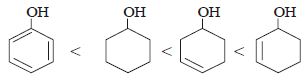
A
If both Assertion and Reason are correct and the Reason is a correct explanation of the Assertion.
B
If both Assertion and Reason are correct but Reason is not a correct explanation of the Assertion.
C
If the Assertion is correct but Reason is incorrect.
D
If both the Assertion and Reason are incorrect.
Solution
(A) The given order of dehydration is correct due to the following reasons:
$(i)$ Alcohols that lead to the formation of conjugated alkenes are dehydrated more readily because the resulting product is more stable.
$(ii)$ $2-Cyclohexenol$ is dehydrated more easily than $3-cyclohexenol$ because the carbocation formed from the former is stabilized by resonance with the double bond (allylic carbocation),making it more stable than the carbocation from the latter.
$(iii)$ Phenol is not dehydrated under standard conditions due to the high stability of the $C-O$ bond resulting from resonance,which gives it partial double-bond character.
$(i)$ Alcohols that lead to the formation of conjugated alkenes are dehydrated more readily because the resulting product is more stable.
$(ii)$ $2-Cyclohexenol$ is dehydrated more easily than $3-cyclohexenol$ because the carbocation formed from the former is stabilized by resonance with the double bond (allylic carbocation),making it more stable than the carbocation from the latter.
$(iii)$ Phenol is not dehydrated under standard conditions due to the high stability of the $C-O$ bond resulting from resonance,which gives it partial double-bond character.
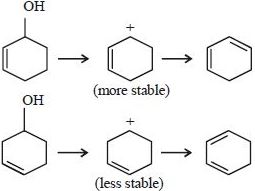
0 likesView Solution
70
ChemistryMediumMCQAIIMS · 2008
$CH_3CH_2C \equiv N \xrightarrow{X} CH_3CH_2CHO$. The compound $X$ is:
A
$SnCl_2 / HCl / H_2O$,boil
B
$H_2 / Pd - BaSO_4$
C
$LiAlH_4 / \text{ether}$
D
$NaBH_4 / \text{ether} / H_3O^{+}$
Solution
(A) The reaction is a standard method for the reduction of nitriles to aldehydes known as Stephen's reduction.
Step $1$: The nitrile $(CH_3CH_2C \equiv N)$ is reduced by $SnCl_2 / HCl$ to form an imine intermediate $(CH_3CH_2CH = NH)$.
Step $2$: The imine intermediate is then hydrolyzed by boiling with water $(H_2O)$ to yield the corresponding aldehyde $(CH_3CH_2CHO)$ and ammonium chloride $(NH_4Cl)$.
Step $1$: The nitrile $(CH_3CH_2C \equiv N)$ is reduced by $SnCl_2 / HCl$ to form an imine intermediate $(CH_3CH_2CH = NH)$.
Step $2$: The imine intermediate is then hydrolyzed by boiling with water $(H_2O)$ to yield the corresponding aldehyde $(CH_3CH_2CHO)$ and ammonium chloride $(NH_4Cl)$.
0 likesView Solution
71
ChemistryMediumMCQAIIMS · 2008
$3-\text{Hydroxybutanal}$ is formed when $X$ reacts with $Y$ in dilute $Z$ solution. What are $X, Y$ and $Z$? $(X, Y, Z)$
A
$CH_3-CHO, CH_3-CO-CH_3, NaOH$
B
$CH_3-CHO, CH_3-CHO, NaCl$
C
$CH_3-CO-CH_3, CH_3-CO-CH_3, HCl$
D
$CH_3-CHO, CH_3-CHO, NaOH$
Solution
(D) $3-\text{Hydroxybutanal}$ is formed by the $\text{Aldol condensation}$ of acetaldehyde $(CH_3-CHO)$ in the presence of dilute $NaOH$.
Therefore,$X = CH_3-CHO$,$Y = CH_3-CHO$,and $Z = NaOH$.
$2CH_3-CHO \xrightarrow{\text{dilute } NaOH} CH_3-CH(OH)-CH_2-CHO$
Therefore,$X = CH_3-CHO$,$Y = CH_3-CHO$,and $Z = NaOH$.
$2CH_3-CHO \xrightarrow{\text{dilute } NaOH} CH_3-CH(OH)-CH_2-CHO$
0 likesView Solution
72
ChemistryMediumMCQAIIMS · 2008
Acid hydrolysis of which of the following compounds yields two different organic compounds?
A
$CH_3COOH$
B
$CH_3CONH_2$
C
$CH_3COOC_2H_5$
D
$(CH_3CO)_2O$
Solution
(C) Acid hydrolysis of an ester involves the reaction with water in the presence of an acid catalyst to produce a carboxylic acid and an alcohol.
For ethyl acetate $(CH_3COOC_2H_5)$:
$CH_3COOC_2H_5 + H_2O \xrightarrow{H^+} CH_3COOH + C_2H_5OH$
Here,$CH_3COOH$ (acetic acid) and $C_2H_5OH$ (ethanol) are two different organic compounds.
For ethyl acetate $(CH_3COOC_2H_5)$:
$CH_3COOC_2H_5 + H_2O \xrightarrow{H^+} CH_3COOH + C_2H_5OH$
Here,$CH_3COOH$ (acetic acid) and $C_2H_5OH$ (ethanol) are two different organic compounds.
0 likesView Solution
73
ChemistryDifficultMCQAIIMS · 2008
The compound which gives an oily nitrosoamine on reaction with nitrous acid at low temperature is:
A
$CH_3-NH_2$
B
$CH_3-CH(NH_2)-CH_3$
C
$CH_3-NH-CH_3$
D
$(CH_3)_3N$
Solution
(C) Secondary amines react with nitrous acid $(HNO_2)$ at low temperature to form yellow oily $N$-nitrosoamines.
$CH_3-NH-CH_3$ is a secondary amine.
Reaction: $(CH_3)_2NH + HNO_2 \rightarrow (CH_3)_2N-NO + H_2O$
$CH_3-NH-CH_3$ is a secondary amine.
Reaction: $(CH_3)_2NH + HNO_2 \rightarrow (CH_3)_2N-NO + H_2O$
0 likesView Solution
74
ChemistryDifficultMCQAIIMS · 2008
Assertion : Nitrobenzene is used as a solvent in Friedel-Craft's reaction.
Reason : Fusion of nitrobenzene with solid $KOH$ gives a low yield of a mixture of $o-$ and $p-$ nitrophenols.
Reason : Fusion of nitrobenzene with solid $KOH$ gives a low yield of a mixture of $o-$ and $p-$ nitrophenols.
A
If both Assertion and Reason are correct and the Reason is a correct explanation of the Assertion.
B
If both Assertion and Reason are correct but Reason is not a correct explanation of the Assertion.
C
If the Assertion is correct but Reason is incorrect.
D
If both the Assertion and Reason are incorrect.
Solution
(B) Nitrobenzene is used as a solvent in Friedel-Craft's reaction because it is highly resistant to electrophilic substitution due to the strong electron-withdrawing $-NO_2$ group,which deactivates the benzene ring.
The fusion of nitrobenzene with solid $KOH$ is a known chemical reaction that produces a mixture of $o-$ and $p-$ nitrophenols,although the yield is generally low.
Both statements are factually correct,but the reason does not explain why nitrobenzene is used as a solvent in Friedel-Craft's reaction.
Therefore,the correct option is $B$.
The fusion of nitrobenzene with solid $KOH$ is a known chemical reaction that produces a mixture of $o-$ and $p-$ nitrophenols,although the yield is generally low.
Both statements are factually correct,but the reason does not explain why nitrobenzene is used as a solvent in Friedel-Craft's reaction.
Therefore,the correct option is $B$.
0 likesView Solution
75
ChemistryMediumMCQAIIMS · 2008
Which of the following statements is not correct?
A
Chlorophyll is responsible for the synthesis of carbohydrates in plants.
B
The compound formed by the addition of oxygen to haemoglobin is called oxyhaemoglobin.
C
Acetylsalicylic acid is known as aspirin.
D
The metal ion present in vitamin $B_{12}$ is $Mg^{2+}$.
Solution
(D) The statement $D$ is incorrect.
Vitamin $B_{12}$ (cyanocobalamine) contains cobalt $(Co^{3+})$ as the central metal ion.
Chlorophyll contains magnesium $(Mg^{2+})$,not vitamin $B_{12}$.
All other statements are correct.
Vitamin $B_{12}$ (cyanocobalamine) contains cobalt $(Co^{3+})$ as the central metal ion.
Chlorophyll contains magnesium $(Mg^{2+})$,not vitamin $B_{12}$.
All other statements are correct.
0 likesView Solution
76
ChemistryMediumMCQAIIMS · 2008
The $\beta$ and $\alpha$ glucose have different specific rotations. When either is dissolved in water,their rotation changes until the same fixed value results. This is called:
A
epimerisation
B
racemisation
C
anomerisation
D
mutarotation
Solution
(D) The change in the specific optical rotation of an optically active compound in solution with time,until it reaches a constant equilibrium value,is known as mutarotation. $\alpha$-$D$-glucose and $\beta$-$D$-glucose undergo this process when dissolved in water.
0 likesView Solution
77
ChemistryDifficultMCQAIIMS · 2008
Assertion : Disruption of the natural structure of a protein is called denaturation.
Reason : The change in colour and appearance of egg during cooking is due to denaturation.
Reason : The change in colour and appearance of egg during cooking is due to denaturation.
A
If both Assertion and Reason are correct and the Reason is a correct explanation of the Assertion.
B
If both Assertion and Reason are correct but Reason is not a correct explanation of the Assertion.
C
If the Assertion is correct but Reason is incorrect.
D
If both the Assertion and Reason are incorrect.
Solution
(B) Denaturation refers to the process where the natural structure of a protein (secondary,tertiary,or quaternary) is disrupted due to physical or chemical changes,such as temperature or $pH$ changes. This leads to the loss of biological activity.
Cooking an egg involves the coagulation of albumin protein,which is a classic example of denaturation.
Both the Assertion and the Reason are correct statements. However,the Reason describes a specific instance of denaturation and does not explain the general definition provided in the Assertion. Therefore,the Reason is not the correct explanation of the Assertion.
Cooking an egg involves the coagulation of albumin protein,which is a classic example of denaturation.
Both the Assertion and the Reason are correct statements. However,the Reason describes a specific instance of denaturation and does not explain the general definition provided in the Assertion. Therefore,the Reason is not the correct explanation of the Assertion.
0 likesView Solution
78
ChemistryMediumMCQAIIMS · 2008
Which of the following is a polymer containing nitrogen?
A
Polyvinyl chloride
B
Bakelite
C
Nylon
D
Terylene
Solution
(C) $Nylon$ is a polyamide polymer formed from adipic acid and hexamethylenediamine,thus it contains nitrogen atoms in its backbone.
$Polyvinyl \ chloride$ is a polymer of vinyl chloride $(CH_2=CHCl)$,which does not contain nitrogen.
$Bakelite$ is a thermosetting phenol-formaldehyde resin,which does not contain nitrogen.
$Terylene$ (also known as $Dacron$) is a polyester formed from ethylene glycol and terephthalic acid,which does not contain nitrogen.
$Polyvinyl \ chloride$ is a polymer of vinyl chloride $(CH_2=CHCl)$,which does not contain nitrogen.
$Bakelite$ is a thermosetting phenol-formaldehyde resin,which does not contain nitrogen.
$Terylene$ (also known as $Dacron$) is a polyester formed from ethylene glycol and terephthalic acid,which does not contain nitrogen.
0 likesView Solution
79
ChemistryEasyMCQAIIMS · 2008
An organic compound $X$ on treatment with $PCC$ in dichloromethane gives the compound $Y$. Compound $Y$ reacts with $I_{2}$ and alkali to form a yellow precipitate of triiodomethane. The compound $X$ is
A
$CH_{3}CHO$
B
$CH_{3}COCH_{3}$
C
$CH_{3}CH_{2}OH$
D
$CH_{3}COOH$
Solution
(C) Compound $(Y)$ gives the iodoform test,which means it contains an acetyl group $(CH_{3}-C=O)$.
$PCC$ (Pyridinium chlorochromate) is an oxidizing agent that oxidizes primary alcohols to aldehydes and secondary alcohols to ketones.
Since compound $Y$ is formed from $X$ using $PCC$ and $Y$ gives the iodoform test,$Y$ must be acetaldehyde $(CH_{3}CHO)$,as it is the only aldehyde that gives the iodoform test.
Therefore,the starting material $X$ must be ethanol $(CH_{3}CH_{2}OH)$.
The reactions are as follows:
$CH_{3}CH_{2}OH$ $\xrightarrow{PCC} CH_{3}CHO$ $\xrightarrow{I_{2}/OH^{-}} CHI_{3} + HCOONa$
$PCC$ (Pyridinium chlorochromate) is an oxidizing agent that oxidizes primary alcohols to aldehydes and secondary alcohols to ketones.
Since compound $Y$ is formed from $X$ using $PCC$ and $Y$ gives the iodoform test,$Y$ must be acetaldehyde $(CH_{3}CHO)$,as it is the only aldehyde that gives the iodoform test.
Therefore,the starting material $X$ must be ethanol $(CH_{3}CH_{2}OH)$.
The reactions are as follows:
$CH_{3}CH_{2}OH$ $\xrightarrow{PCC} CH_{3}CHO$ $\xrightarrow{I_{2}/OH^{-}} CHI_{3} + HCOONa$
0 likesView Solution
80
ChemistryEasyMCQAIIMS · 2008
The chemical formula of 'tear gas' is
A
$COCl_2$
B
$CO_2$
C
$Cl_2$
D
$CCl_3NO_2$
Solution
(D) Tear gas is known as chloropicrin $(CCl_3NO_2)$.
It is prepared by the reaction of chloroform $(CHCl_3)$ with concentrated nitric acid $(HNO_3)$:
$CHCl_3 + HNO_3 \rightarrow CCl_3NO_2 + H_2O$
It is prepared by the reaction of chloroform $(CHCl_3)$ with concentrated nitric acid $(HNO_3)$:
$CHCl_3 + HNO_3 \rightarrow CCl_3NO_2 + H_2O$
0 likesView Solution
Vedclass Products
For Students
Vedclass Test Series
Mock tests in real AIIMS style covering Chemistry with performance analysis. 5-day free trial.
Start Free TrialFor Teachers
Exam Paper Generator
Generate Set A/B/C/D Chemistry papers from 7.5L+ questions in 2 minutes. 3 chapters free.
Try FreeFor Institutes
Online Exam Module
Run live AIIMS mock exams with unlimited students, 360° analytics & white-label branding.
See DemoFrequently Asked Questions
How many Chemistry questions are in AIIMS 2008?
There are 80 Chemistry questions from the AIIMS 2008 paper on Vedclass, each with a detailed step-by-step solution in English.
Are AIIMS 2008 Chemistry solutions available in English?
Yes. All solutions on this page are in English. You can also switch to English or Hindi using the language buttons above the questions.
Can I practice AIIMS 2008 Chemistry as a timed test?
Yes. Use the Vedclass Test Series to attempt a full AIIMS mock test covering Chemistry with time limits and instant score analysis.
Can teachers create Chemistry papers from AIIMS previous year questions?
Yes. The Vedclass Exam Paper Generator lets teachers mix AIIMS Chemistry questions and generate Set A/B/C/D papers in minutes.
For Teachers & Institutes
Build a Custom Chemistry Paper
Pick AIIMS 2008 Chemistry questions, set difficulty, and generate Set A/B/C/D in 2 minutes.